Batman and Son

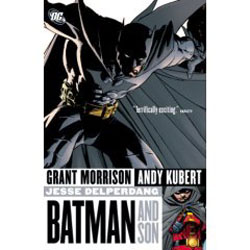
Batman and Son

By Grant Morrison, Andy Kubert & Jesse Delperdang (DC Comics)
ISBN13: 978-1-84576-429-6

Expectations were high when Grant Morrison was announced as the new scripter for Batman, so disappointment was always a risk. This volume (collecting Batman issues #655-658 and 663-666) tells only half the story of the eponymous son, however, so perhaps it’s a little premature to rush to judgement. Still, if I was a newcomer picking up a Bat-book for the first time…

The Joker is back on a murderous rampage when the Caped Crusader, finally snapping, shoots him in the face… The revelation that the shooter was an impostor is brushed aside and the obsessive hero goes on a vacation to London where Talia, a criminal mastermind and ex-girlfriend, attacks a charity ball with an army of mutated ninja Man-Bats, kidnaps the Prime Minister’s wife and leaves behind a sword-wielding boy she claims is their son.

Bringing the boy home, Batman tries to assimilate him into his life but the murderous child, trained from birth by the world’s greatest assassins, proves to be a bit of a handful. Even though he assaults Alfred, attempts to murder Robin and actually beheads a minor villain, Batman brings him along for a final confrontation with his mother and her Were-bat army.

After an interlude with the Joker (a prose story that took up a whole comic book issue – cloyingly overwritten to the point of self-indulgence, but with photorealistic illustrations by John Van Fleet) the saga reconvenes with Gotham plagued by more brutal Batman impostors terrorising the underworld and the populace, whilst son Damian (back with his mum) is still proving a trial…

Jump forward (for no apparent reason) a couple of decades and Damian is the new Batman: A savage, murderous mastermind in a monstrous world staving off the end of everything with uncompromising ruthlessness. And that’s where we end…

Although magnificently drawn by Andy Kubert this mess is just a pretty-but-vacuous triumph of style over content as Morrison “phones it in” for a change, in his typical iconoclastic fashion. Ending with Damien as a new Batman in a future the author knows full well won’t be part of the “real” continuity appears lazy and gratuitous, and although possibly good for the publicity machine, the faithful fan-base surely can’t be appeased with shallow stunts.

My own problem is the sudden stop without any attention to a narrative pay-off. People who buy books want endings as well as middles, no matter how familiar they think they are with the characters and scenarios. Let’s hope there’s a satisfactory conclusion coming, and soon.

© 2006, 2007 DC Comics. All Rights Reserved.

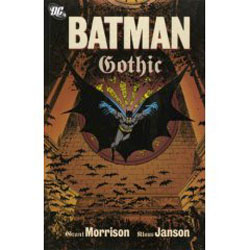
Batman: Gothic

Batman: Gothic

By Grant Morrison & Klaus Janson (DC Comics)
ISBN13: 978-1-84576-671-9

As with most of the “British Invaders” that made the jump to American comic-books, Grant Morrison was offered a shot at Batman sooner rather than later in his career. At this time, with popularity at an all-time high because of the Tim Burton movie, DC had launched a new Bat-title that was designed to present multi-part epics refining and infilling the history of the post-Crisis on Infinite Earths hero and his venerable cast. The added fillip was a fluid cast of premiere and up-and-coming creators.

Batman: Legends of the Dark Knight was a fascinating experiment even if the overall quality was haphazard. Most of the early story arcs were collected as trade paperbacks, helping to jump-start the graphic novel sector of the comics industry, and the re-imagining of the hero’s early career gave fans a wholly modern insight into the ancient if highly malleable concept.

This current edition is the second story-arc, (issues # 6-10), and features the rising star Morrison paired with relative veteran Klaus Janson in an interesting if slight supernatural thriller full of the author’s signature fascinations, and illustrated in the rough and visually dynamic post-Frank Miller manner.

Batman is still relatively new to the streets and shadows of Gotham when the city’s criminal hierarchy start dying in spectacular and rapid succession. Desperate, the surviving Ganglords try to establish an armistice with the caped vigilante so they can deal with the murderous and terrifying Mr. Whisper.

When Batman discovers that the monstrous murderer is not only a 300 year old monk but also a serial child-killer and one of the teachers at Bruce Wayne’s own prep school twenty years previously, he finds a potential connection to his own father which leads him into a world of ghosts, devils, arcane architecture, sacred geometry, and a plot to destroy Gotham with a centuries old Plague-bomb.

Fast-paced if a little over-egged, this modern horror-romp is a solid but uninspiring thriller. Bat-fans will be comfortable with the formula, but Morrison’s contemporary fan-base might find it a little insubstantial.

© 1990 DC Comics. All Rights Reserved.

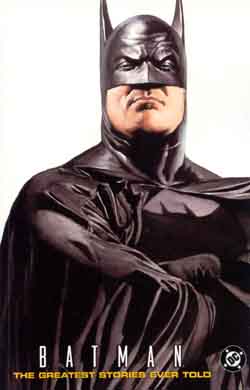
Batman: The Greatest Stories Ever Told

Batman: The Greatest Stories Ever Told

By Various (DC Comics)
ISBN: 1-84576-038-7

If you buy into the myth, then there are actually many, many great Batman stories. Over the decades lots of very talented creators excelled themselves with the various toys and icons of Gotham City. That’s not to say that there haven’t been some real turkeys along the way, but on the whole people seem to extend themselves for Batman. Often the real problem is one of context, since many stories worry reprint editors in terms of “Sell-By Date”; as if nearly eight decades of creativity can avoid looking dated to some modern consumers.

Guys, who cares? These are the ones who want to colourise Citizen Kane and Arsenic and Old Lace, add cell-phones to Shakespeare and never read any book written before 1989. If they can’t get Wuthering Heights unless Angelina’s in it, their money’s no good anyway.

At least this selection contains a few general rarities from the canon, although the origin from Detective Comics #33 (1939) has been seen so often that most fans can draw it from memory – and many parody artists have. ‘The Case of the Honest Crook’ comes from Batman #5 (1941) and ‘The Secret Life of the Catwoman’ is from #62 (1951). ‘Robin Dies at Dawn’ (Batman #156, 1963) is one of the last classic-look tales before Julie Schwartz, John Broome and Gardner Fox projected Batman into the Silver Age of Comics with their “New Look”, a period strangely unrepresented here.

‘The Batman Nobody Knows’ comes from Batman #250, an attempt by Frank Robbins and Dick Giordano to rationalize the then newly-restored aura of mystery to the character, whilst ‘The Joker’s Five-Way Revenge’ (Batman #251, 1973) is a genuine classic from Denny O’Neil and Neal Adams that totally redefined the Joker for our age. For many people this is The Definitive Batman/Joker story.

Steve Englehart is fondly remembered for his collaboration with Marshall Rogers, but ‘Night of the Stalker’ (Detective #439, 1974), illustrated by Vin and Sal Amendola, with Giordano inks is one of his most powerful and emotive successes, but Rogers’s accompanying illustrations for O’Neil’s lacklustre prose vignette ‘Death Comes at Midnight and Three’ displays little of his design skill. It originally ran in DC Special Series #15 (1978). Number 21 of that magazine (1980) gave us Frank Miller’s first Bat story when he illustrated O’Neil’s ‘Wanted: Santa Claus – Dead or Alive’.

In 1987 legendary and beloved artist Dick Sprang was coaxed out of retirement to produce a double page spread for Detective #572, which here precedes the introspective ‘…My Beginning… and My Probable End’ (Detective #574), by Mike W Barr, Alan Davis and Paul Neary. Bringing us out of the nineties is ‘Favourite Things’ by Mark Millar and Steve Yeowell (Legends of the Dark Knight #79, 1996) and the twenty-first century is represented by ’24/7′ by Devin Grayson and Roger Robinson from Gotham Knights #32 (2002).

In an industry that’s constantly seeking to reinvent and revitalize itself, it’s oddly reassuring to see that entertainment can have a timeless quality, even in a supposedly “throw-away” medium like the comic strip.

© 2005 DC Comics. All Rights Reserved.

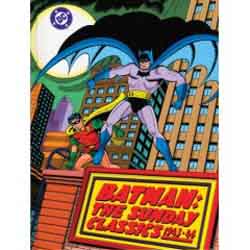
Batman: The Sunday Classics 1943-1946

Batmanf: The Sunday Classics

By various (Sterling)
ISBN 10: 1-4027-4718-7 ISBN 13: 978-1-1402-4718-2

For nearly seventy years the newspaper comic strip was the Holy Grail that cartoonists and graphic narrative storytellers hungered for. Syndicated across the country and the planet, with millions of readers and accepted (in most places) as a more mature and sophisticated form of literature than comic-books, it also paid better. And the Holiest of Holies was the full-colour Sunday page.

So it was always something of a poisoned chalice when a comic-book character became so popular that it swam against the tide (after all weren’t the funny-books invented just to reprint the strips in cheap accessible form?) and became a syndicated serial strip. Both Superman and Wonder Woman made the jump in the 1940s and many features have done so since. But one of the best regarded, highest quality examples, both in the Daily and Sunday format was ‘Batman and Robin’.

Although a highpoint in strip cartooning, both the Daily and Sunday Batman features were cursed by ill-timing at a period in newspaper publishing that was afflicted by rationing, shortages and a changing marketplace. These strips never achieved the circulation they deserved, but at least the Sundays were given a new lease of life when DC began reprinting vintage stories in the 1960s in their 80 page Giants and Annuals. The superior quality adventures were ideal short stories and added an extra cachet of exoticism for young readers already captivated by seeing tales of their heroes that were positively ancient and redolent of History with a capital “H”.

The stories themselves are broken down into complete single page instalments building into short tales averaging between four to six pages per adventure. The esoteric foes include such regulars as the Penguin (twice), Joker, Catwoman and Two-Face, original villains such as The Gopher, The Sparrow and Falstaff, but the bulk of the yarns have more prosaic criminals, if indeed there is any antagonist at all.

A benefit of work produced for an audience deemed “more mature” is the freedom to explore human interest stories such as exonerating wrongly convicted men, fighting forest fires and discovering the identity of an amnesia victim. There is even a jolly seasonal yarn that bracketed Christmas week, 1945.

The writers of the strip included Don Cameron, Bill Finger, Joe Samachson, Alvin Schwartz with art by Bob Kane, Jack Burnley and Fred Ray, inking by Win Mortimer and Charles Paris with lettering by Ira Schnapp. The strips were all coloured by Raymond Perry.

This lovely oversized (12 x 9.3x 1 inch) full colour book, first published by DC Comics/Kitchen Sink Press in 1991, also contains a wealth of extra features such as biographical notes, a history of the strip, promotional artefacts, behind-the-scenes artwork and sketches, promotional features and much more. It’s about time it was back in print, as it’s a must for both Bat-fans and lovers of the artform.

©1991, 2007 DC Comics. All Rights Reserved.

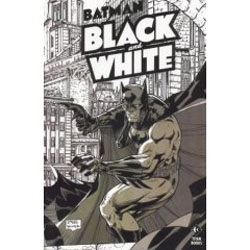
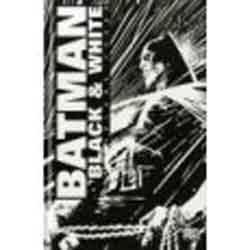
Batman: Black and White, Vol 3

Batman: Black and White, Vol 3

By various (DC Comics)
ISBN 10: 1-4012-1531-9 ISBN 13: 978-1-4012-1531-6

This third and final collection of short Batman adventures free of the hindrance of colour, despite being in many ways the weakest of the trilogy, is still a wonderfully varied and effective package showing the versatility of the character and the mercurial way in which creators as much as audiences respond to him.

Collecting the monochrome back-ups from issues #17-49 of the anthology Bat-title Gotham Knights, the thirty-three mini-epics here display just how far both art and story can go in terms of experimentation and entertainment. With so much material on offer detailed analysis is too space consuming for this forum, so a list of contributing creators must suffice, but I will call your attention to a few extra-special gems.

Amongst the pages art lovers should especially seek out are Aaron Weisenfeld’s ‘A Moment in the Light’, scripted by Joe Kelly, ‘The Call’, written by Mark Schultz, drawn in the classical manner by Claudio Castellini, and the largely pantomimic ‘The Bottom Line’ written by Michael Golden and illustrated by Jason Pearson.

The main body of work is the result of canny craftsmanship from the distinguished individuals listed below, and although I’d love to cover them all I will give a special mention to Mick McMahon and Dave Gibbons for bringing a slice of 2000AD style and bad taste to the mix with ‘Fat City’, Will Pfeifer and Brent Anderson’s charming ‘Urban Renewal’, ‘Sunrise’ from Alex Garland and Sean Phillips, and the startlingly punchy ‘Cornered’ by Brian Azzarello and Jim Mahfood.

Without doubt the three most rewarding pieces are ‘Day and Nite in Black and White’ by Mike Carlin, Dan DeCarlo and Terry Austin, ‘Last Call at McSurley’s’ by Mike W. Barr, Alan Davis and Mark Farmer, and the wonderful ‘Here be Monsters’ by Paul Grist and Darwyn Cooke, all distinctly true to the nature of the Caped Crusader, and each utterly unique unto themselves.

So without any intended slight to Christian Alamy, Doug Alexander, Mark Askwith, Chris Bachalo, Hilary Barta, John Bolton, Philip Bond, Ed Brubaker, Mike Carey, Tommy Castillo, Eric Cherry, Denys Cowan, Todd Dezago, Danielle Dwyer, John Floyd, Nathan Fox, Dick Giordano, Rob Haynes, Geoff Johns, Michael William Kaluta, Paul Kupperberg, , Steve Mannion, Dwayne McDuffie, Don McGregor, Mike Mignola, Scott Morse, Troy Nixey, Anne Nocenti, John Ostrander, Scott Peterson, Whilce Portacio, John Proctor, Rodney Ramos, Dan Raspler, Sal Regla, Robert Rodi, Julius Schwartz, Ryan Sook, Karl Story, Kimo Temperance, Jill Thompson, Cyrus Voris, John Watkiss, Mike Wieringo, Judd Winnick, Bill Wray and Danijel Zezelj, I’ll close with a heartfelt recommendation to complete your set of Batman: Black & White volumes.

They’re great, they’re satisfyingly varied and they’re a sure and certain message to publishers that there is still a market for short stories and anthology books.

© 2001, 2002, 2003, 2004, 2007 DC Comics. All Rights Reserved

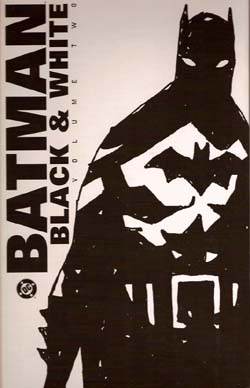
Batman: Black and White, Vol 2

Batman: Black and White, Vol 2

By various (DC Comics)
ISBN 1-56389-828-4

This second collection of Dark Knight adventures in monochrome is gathered from the back of the first sixteen issues of the Batman anthology title Gotham Knights, a showcase feature that derived from the success of the original miniseries collected in Volume 1 (ISBN 1-85286-987-9). Also included are five never before printed mini classics.

Kicking off proceedings is the incongruous ‘Case Study’, with Paul Dini’s Joker origin oddly over-rendered by Alex Ross. Much more satisfying is the hilarious ‘Bats, Man’ by Ty Templeton and Marie Severin, one of the most under-rated cartoon humorists of all time, which is followed by the charming and insightful ‘A Matter of Trust’ by Chris Claremont, Steve Rude and Mark Buckingham. The powerful reverie ‘Night After Night’ by Kelley Puckett and Tim Sale is followed by a classic duel of detective wits in ‘Fortunes’ by Steven T. Seagle and Daniel Torres.

Warren Ellis’ cynical procedural ‘To Become the Bat’ is sparsely illustrated by Jim Lee, whilst John Byrne returns to a simpler time in nostalgic ‘Batman with Robin, the Boy Wonder’. ‘Broken Nose’ is a sharp and visceral Paul Pope memory poem, and John Arcudi and Tony Salmons’ ‘Greetings from… Gotham City’ is an engaging caper yarn.

‘Hide and Seek’ is a moody tale with a twist, courtesy of Paul Levitz and Paul Rivoche, and an obvious arch foe comes off second best in Walter Simonson and John Paul Leon’s ‘The Riddle’. Arcudi returns to script the sadly lack-lustre ‘A Game of Bat and Rat’ for John Buscema to draw, but Brian Azzarello and Eduardo Risso are on top form with the dark and sinister ‘Scars’. Howard Chaykin returns Batman to a wartime era for some Bund-busting with Catwoman in the superbly illustrated ‘Blackout’, drawn with glorious dash by Jordi Bernet, and José Luis García-López does the same with Eisenhower’s mythical America in ‘Guardian’, as Alan Brennert scripts the first meeting between the Caped Crusader and Gotham’s first protector, the original Green Lantern.

Bob Kanigher and Kyle Baker unwisely resurrect the Batman Junior concept in ‘Snow Job’, Dave Gibbons graphically recalls simpler times in ‘The Black and White Bandit’ and Harlan Ellison and Gene Ha combine brains with brawn in ‘Funny Money’. Tom Peyer reunites Gene Colan and Tom Palmer for the pocket horror story ‘Stormy Nether’, while the runaway best tales are the utterly brilliant story of a wager between Harley Quinn and Poison Ivy, and the chilling psycho-drama duel of will between Batman and the Scarecrow. ‘The Bat No More’ is by Alan Grant and the astonishing Enrique Breccia, whilst ‘The Bet’ is written by Paul Dini and captivatingly depicted by the hugely under-rated Ronnie Del Carmen.

Batman is a character of seemingly unlimited flexibility and gifted with enough discrete history to provide apparently endless reinterpretation. These short tales, ignoring their gimmick of colour, show what Batman needs more than anything else is a venue for brief, complete tales as well as convoluted, over-long sagas.

© 2000, 2001 DC Comics. All Rights Reserved.

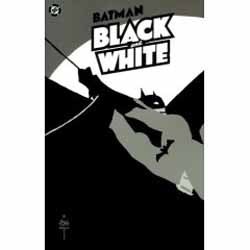
Batman: Black and White, Volume 1

Batman: Black and White, Volume 1

By various (DC Comics)
ISBN 1-85286-987-9

This is a frankly spectacular showing from some of the comics world’s greatest talents producing short complete tales without benefit or hindrance of colour. Ranging from poignant (‘Good Evening, Midnight’ written and illustrated by Klaus Janson and ‘Heroes’ by Archie Goodwin and Gary Gianni), to tragic (Bruce Timm’s ‘Two of a Kind’) and the just plain weird (‘The Third Mask’ by Katsuhiro Otomo) these highly personal takes from major league creators show why the Batman continues to grip the public consciousness.

As much a thematic metaphor as an artistic exercise, the stories were not restricted to current DC continuity, but explored the character in impressionistic terms. Originally produced as a four-issue miniseries the book also features ‘Perpetual Mourning’ by Ted McKeever, ‘The Hunt’ by Joe Kubert, ‘Petty Crimes’ by Howard Chaykin, and Archie Goodwin also scripted the eerily memorable Jazz thriller ‘The Devil’s Trumpet’ illustrated by the incredible José Muñoz.

Walter Simonson crafts the science myth ‘Legend’ whilst Jan Strnad and Richard Corben reunite for ‘Monster Maker’, as urbanly bleak as Kent William’s ‘Dead Boys Eyes’, whilst Chuck Dixon and the much-missed Jorge Zaffino’s ‘The Devil’s Children’ examines the police’s unique attitude to the Gotham Guardian.

Neil Gaiman and Simon Bisley’s ‘A Black and White World’ is probably the weakest entry in the book, relying on clichéd “Fourth Wall cleverness” rather than any actual plot, but Andrew Helfer and Liberatore’s insightful kidnap tale ‘In Dreams’ delivers a punch, as does Matt Wagner’s stylish romp ‘Heist’. ‘Bent Twig’ is an intense whimsy from Bill Sienkiewicz with a seasonal theme, as is ‘A Slaying Song Tonight’ by Dennis O’Neil and Teddy Kristiansen.

Brian Bolland produces the beautifully disturbed ‘An Innocent Guy’ and Strnad returns to script ‘Monsters in the Closet’ for the brilliant Kevin Nowlan, as does Denny O’Neil for Brian Stelfreeze with ‘Leavetaking’, and the book is well supplemented with pin-ups and sketch pages from the likes of Michael Allred, Moebius, Mikchal Kaluta, Tony Salmons, P. Craig Russell, Marc Silvestri, Alex Ross and Neal Adams.

The miniseries won numerous awards and its success led to a regular black-and-white slot in the monthly anthology comic Gotham Knights the contents of which are collected in two subsequent volumes.
© 2000 DC Comics. All Rights Reserved.

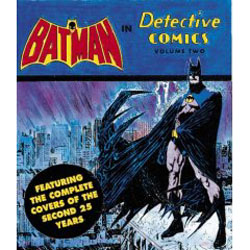
Batman in Detective Comics: Vol 2

Batman in Detective Comics: Vol 2

By Joe Desris (Introduction) and various (Abbeville Press Inc 1994)
ISBN: 1-5585-9837-5

This second pocket cover-art compendium, reproducing the seductive and blatant images that first made us buy all those funny-books, is probably the more potent of these little Nostalgia Grenades, covering as it does Detective Comics #301 (The Condemned Batman! – drawn by Sheldon Moldoff and dated March 1962) to #600 (Blind Justice by Denys Cowan and Malcolm Jones III from May 1989) a period during which surely most of us initially caught this four-colour bug.

From the whimsical, through the double-edged sword of 1960s Batmania, to the gradual return of the Dark Knight of Justice these incredible images are a catalogue of childhood and growing maturity for us all, as well as being incredible examples of popular art and design.

So come revel and recall the talents of Dick Dillin, Carmine Infantino, Joe Giella, Joe Kubert, Murphy Anderson, Gil Kane, Irv Novick, Neal Adams, Dick Giordano, Mike Kaluta, Bernie Wrightson, Nick Cardy, Jim Aparo, Ernie Chan, Mike Grell, Rich Buckler, Vince Colletta, Marshall Rogers, Terry Austin, Jim Starlin, José Luis García-López, Ross Andru, Walt Simonson. Gene Colan, Don Newton, Ed Hannigan, Gene Day, Todd McFarlane, Alan Davis and a host of others as they depict the incredible world of Batman.

A true childhood dream and a guilty pleasure.

© 1994 DC Comics. All Rights Reserved.

Batman in Detective Comics: Vol 1

Detective Comics: Complete Covers Vol 1

by Joe Desris (Introduction) and various (Abbeville Press Inc 1993)
ISBN: 1-5585-9643-7

Here’s a wonderful little item that any traditional comic book collector, and especially comic art fan, would consider an invaluable possession and all-around ‘Good Thing’. Measuring a diminutive 11.4 x 9.9 x 2.3 cm, this 320-page mini-book features all those magical Batman covers from Detective Comics #27 up to and including issue #300.

It’s a long-running debate whether our artform is primarily artistic or literary in nature (my vote is both and neither) but it’s hard to deny the effect these garish, stylish Eye-Grabbers have on us. And so very often a single picture does tell the story.

So come see The Dynamic Duo, The Penguin, The Joker, sundry thugs, malcontents and ne’er-do-wells, plus all the other paraphernalia of the Batman Legend as they blast their way into the world consciousness via these astounding examples of point-of-sale magic.

Once you’ve seen them you’re going to want them all…

© 1993 DC Comics. All Rights Reserved.

Batman: Harley and Ivy

Batman: Harley and Ivy 

By Paul Dini & various (DC Comics)
ISBN 1-84576-575-3

DC comics are sitting on a goldmine of quality product to repackage as trade paperbacks and graphic novels, and the sooner they begin utilising it, the better it will be for the industry. They have been publishing child friendly versions of their key characters, most notably Batman, ever since the Paul Dini/Bruce Timm cartoon series first aired in the 1990s.

These adventures are consistently some of the best comics produced of the last two decades and why they aren’t permanently in print, if only as a way of attracting new young readers to the medium, has always baffled me.

One step towards correcting this problem is the subject under discussion here. Collecting the eponymous three issue miniseries, plus the one-shot Love on the Lam and a short story from much-missed Batman anthology comic Gotham Knights.

The fourteenth issue of the aforementioned anthology yielded up the brilliantly dark but amusing tale ‘The Bet’, written by Dini and illustrated by Ronnie Del Carmen. Incarcerated once more in Arkham Asylum, the Joker’s would-be paramour Harley Quinn and the irresistible, but toxic Poison Ivy indulge in a little wager to pass the time. Namely, who can kiss the most men whilst remaining in custody. This razor-sharp little tale manages to combine innocent sexiness with genuine sentiment, and still packs a killer punch-line.

Judd Winick and Joe Chiodo rather over-egg the pudding with their earnest but heavy-handed adventure ‘Love on the Lam’. Unsure of its audience, this caper sees The Joker dump Harley once again, so she teams with Ivy in an attempt to steal enough money to buy him back. Stuffed with guest-stars, and fully painted by Chiodo, this is an unwieldy piece of eye-candy, but it does serve to clear the palette for the final tale.

Dini reunites with artist Bruce Timm, ably assisted by Shane Glines, for a joyous romp as the ‘Bosom Buddies’ have a spat that wrecks half of Gotham before escaping to the Amazon jungle (or is that Rain Forest these days?) together, to take over a small country responsible for much of the region’s deforestation. Once Batman gets involved the story shifts to Hollywood and the very last word in creative commentary on Superheroes in the movie business. This is a frantic, laugh-packed hoot that manages to be daring and demure by turns. An absolute delight, and well worth the price of admission.

© 2001, 2004, 2007 DC Comics. All Rights Reserved.