Captain America/Black Panther: Flags of Our Fathers


By Reginald Hudlin, Denys Cowan & various (Marvel)
ISBN: 978-0-7851-4401-4 (TPB/digital editions)

Everybody loves a solid sensibly sensational team-up and, if you’re a comicbook fan, “discovering” a slice of previously unrevealed secret history about your preferred fictive universe is an indescribable thrill. So, what better than if you can combine both guilty pleasures with enjoying a rollicking four-fisted action rollercoaster ride, well written and superbly rendered?

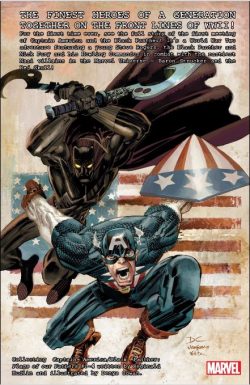
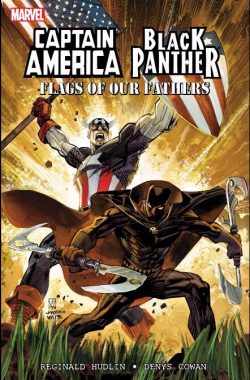
Just one such concatenation of good things in one basket is Captain America/Black Panther: Flags of Our Fathers by Reginald Hudlin & Denys Cowan. Comic continuity is especially fluid in this yarn, which was originally released as a 4-issue miniseries between June and September 2010. It depicts the secret and tumultuous first meeting between the patriotic symbols of two embattled nations and, thankfully, only nit-picking, uber fans-boys need quibble over which (of at least three) “first contacts” this riotous romp describes. The rest of us can simply hang on as a fabulous all-action clash unfolds before our very eyes…

The Black Panther rules over a fantastic African paradise which isolated itself from the rest of the world millennia ago. Blessed with unimaginable resources – both natural and not so much – the nation of Wakanda developed uninterrupted and unmolested by European imperialism into the most technologically advanced human nation on Earth.

The country has also never been conquered. The main reason for this is an unbroken line of divinely-sponsored warrior kings who safeguard the nation. The other is a certain miraculous super-mineral found nowhere else on Earth…

In contemporary times that chieftain is T’Challa: an unbeatable, feline-empowered, strategic genius who divides his time between ruling at home and serving abroad in superhero teams such as The Avengers, beside costumed champions such as Iron Man, Mr. Fantastic, Thor and Captain America…

However, long ago as World War II engulfed the world, another Black Panther – the grandfather of the one we know best – met a far younger and more impulsive Sentinel of Liberty…

With the first two chapters inked by Klaus Janson, the action kicks off in the middle of a furious as Gabe Jones – the only black guy in Sgt. Fury’s Howling Commandos – is just as startled as his white buddies to find a masked maniac dressed like an American flag pounding the crap out of the Nazis they’re being swamped by…

Although they initially think he’s a clown, the Howlers soon take to the naïve Star-Spangled Captain America. They have to, as the Top Brass think they complement each other and have ordered soldiers and superhero to work together from now on.

Meanwhile in Germany, Adolf Hitler orders his most elite warriors to invade a barely known African kingdom and secure supplies of a vibration-absorbing element crucial to the Wehrmacht’s development of V-weapons. Arch-supremacist Baron von Strucker and his cronies expect no trouble from the primitive, sub-human non-Aryans, but the malign Red Skull has reservations…

When the Allies get word of the expedition, they quickly send their top team to stop the Nazis, but they are too late. The fabled Wakandans have already despatched a German expeditionary force with the ruthless silent efficiency that has kept their homeland unconquered for thousands of years…

As a shocked Captain America surveys the bloody handiwork, he is challenged by a warrior in a sleek black outfit, looking like a human panther…

Soon his amazement increases exponentially. Although seemingly barbaric and uncivilised, the Wakandans are technologically more advanced than America, capable enough to capture Nick Fury and the Howling Commandos without a fight, and with a spy network that encompasses the world and has even gleaned his top secret civilian identity. Worst of all, the Black Panther kicks his butt when they inevitably clash…

Soon, however, the Americans are “guests” of the Wakandans, forced to watch as the next wave of Nazi conquerors attempt to overwhelm the nation. However, what nobody realises is that the Skull is in command now and the sacrifice of an entire tank division is part of his overall strategy to conquer the upstart Africans defying the might of the Third Reich…

Soon, the Howlers are on tricky ground: acting as unschooled diplomats and emissaries of their country and ideology. But Black Panther King Azzuri knows what they really want is a sample of precious, sacred Vibranium…

Until now Gabe has felt that he’s allied with the only non-racists in the US armed forces, but now Fury orders to get close to the Africans and secure some of the miracle metal at all costs. Stunned by the casual, unthinking racism of his superior and his white comrades, Gabe is torn by conflicting emotions. Especially as Azzuri has shown him great favour and a black-only promised land any “negro” living in America would die to live in…

The Nazis’ intent is also plain and the Skull’s true attack is not long in coming. As well as conventional troops and planes, the Nazis employ their own secret weapons – robotic war-suits and metahuman super-soldiers Master Man, Krieger Frau/Warrior Woman and merciless sadist Armless Tiger Man. They are assisted by a traitor from Wakanda’s own dissident region: the mercilessly savage, cruelly ambitious Man-Ape…

With issues #3 and 4 inked by Tom Palmer & Sandu Florea, the action roars into high gear as the offensive achieves its goal of penetrating Wakanda’s defences and even sees the king’s sons T’Chaka and S’Yan (both future Black Panthers) attacked in the palace by a murderous assassin before being saved by the deeply conflicted Gabe. From then on, it’s nothing but all-out war, picking up the pieces and adjusting to a new normal in a world that doesn’t know the meaning of the word…

Confronting head-on historical and contemporary issues of racism whilst telling a stunning tale of action and adventure is no mean feat, but Hudlin & Cowan pull it off with staggering success. Flags of Our Fathers brilliantly highlights two national symbols in conflict yet united in mutual benefit with style and wit, and still manages to tell a tale of breathtaking power and fun. Read it now and see for yourself.
© 2010, 2016 Marvel Characters, Inc. All rights reserved.

Klaws of the Panther


By Jonathan Mayberry, Shawn Moll, Gianluca Gugliotta, Walden Wong & Pepe Larraz (Marvel)
ISBN: 978-0-7851-5118-0 (TPB/Digital editions)

Debuting in Fantastic Four #52 (cover-dated July 1966) and hailed as the first black super hero character in American comics – and one of the first to carry his own series – the Black Panther‘s popularity and fortunes have waxed and waned since he boldly attacked the FF as part of an extended plan to gain vengeance on the murderer of his father.

Time passed and T’Challa, son of T’Chaka was revealed as an African monarch whose hidden kingdom was the only source of a vibration-absorbing alien metal upon which the country’s immense wealth was founded. Those mineral riches – derived from a fallen meteor which struck the continent in lost antiquity – had enabled him to turn his country into a technological wonderland. The tribal wealth had been guarded throughout history by a cat-like champion deriving physical advantages from secret ceremonies and a mysterious heart-shaped herb which ensured the generational dominance of the nation’s warrior Panther Cult.

In modern times the Vibranium mound made the country a target for increasing subversion and incursion and after an all-out attack by the forces of Doctor Doom, culminating in the Iron Dictator seizing control of Wakanda, T’Challa was forced to render all Vibranium on Earth inert, defeating the invader but leaving his own homeland broken and economically shattered.

During this cataclysmic clash T’Challa’s flighty, spoiled brat half-sister Shuri took on the mantle of the Black Panther and became the clan and country’s new champion whilst her predecessor struggled with the disaster he had deliberately caused…

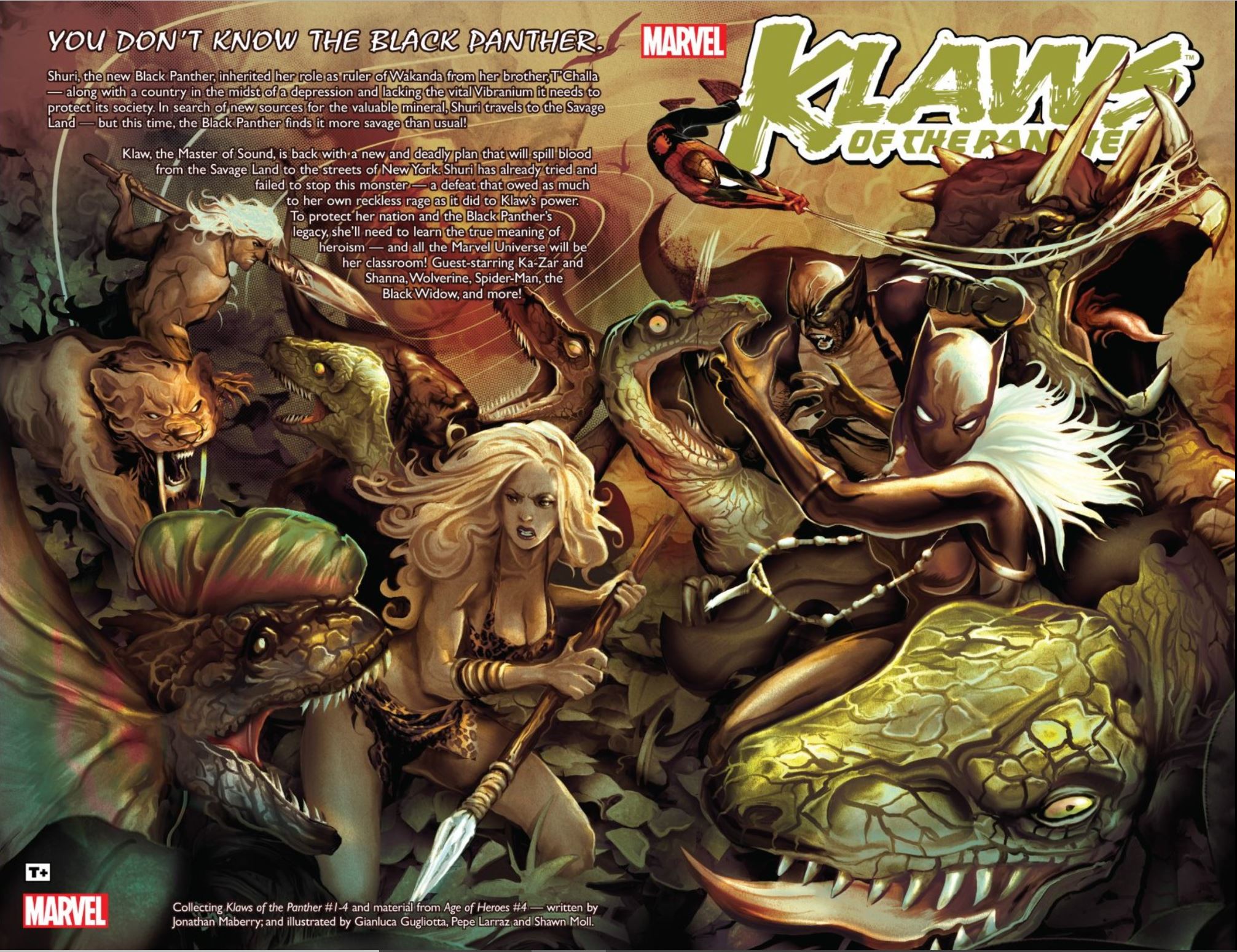
This slim, unassuming but extremely engaging Costumed Drama collects pertinent portions of the portmanteau Age of Heroes #4 and the guest-star packed Klaws of the Panther 4-part fortnightly miniseries from 2010-2011 – following a very different princess from the filmic one you probably know – as she progress through the Marvel Universe, striving to outlive her wastrel reputation, serve her country and the world whilst – crucially – defeating the growing homicidal rage that increasingly burns within her…

The story starts with ‘Honor’ by Jonathan Mayberry, Shawn Moll & Walden Wong, wherein the latest Panther Champion brutally repels an invasion by soldiers of Advanced Idea Mechanics: simply the latest opportunist agency attempting to take over the decimated country of Wakanda.

With her brother and (X-Man and occasional goddess) Queen Storm absent, Shuri is also de facto ruler of the nation, but faces dissent from her own people, as embarrassing reports and photos of her days as a billionaire good-time girl are continually surfacing to stir popular antipathy to her and the Panther clan.

When opportunist G’Tuga of the outlawed White Gorilla sect challenges for the role of national champion, Shuri treats the ritual combat as a welcome relief from insurmountable, intangible problems; but has badly misjudged her opponent and the sentiment of the people…

The main event by Mayberry, Gianluca Gugliotta & Pepe Larraz opens with ‘Savage Tales’ as Shuri is lured to fantastic dinosaur preserve the Savage Land, hoping to purchase a supply of a metal-eating Vibranium isotope, but instead uncovers a deadly plot by AIM and sentient sound-wave Klaw.

The incredible fauna of the lost world has been enslaved by the Master of Sound – who years previously murdered Shuri and T’Challa’s father in an earlier attempt to seize ultimate power – and the villain has captured the region’s protector Ka-Zar whilst seeking to secure all Savage Land Vibranium for his nefarious schemes.

Klaw, however, only thought he had fully compensated for the interference of Shuri and Ka-Zar’s formidable spouse Shanna the She-Devil…

Driven by lust for vengeance, Shuri almost allows Klaw to destroy the entire Savage Land and only the timely intervention of mutant sister-in-law Storm prevents nuclear armageddon in ‘Sound and Fury’, after which the impulsive Panther seeks out Wolverine on the outlaw island Madripoor, looking for help with her out-of-control anger management issues. Once again, AIM attacks, attempting to steal the rogue state’s priceless stockpile of Savage Land Vibranium, but instead walks into a buzzsaw of angry retribution…

Shuri is about to extract information from a surviving AIM agent in time-honoured Wakandan manner when Klaw appears, hinting at a world-shattering plan called “The Scream” which will use mysterious device M.U.S.I.C. to totally remake the Earth…

After another furious fight, the new Panther gains the upper hand by using SLV dust, but squanders her hard-won advantage to save Wolverine from certain death…

Knowing the entire planet is at stake, Shuri accepts the necessity for major-league assistance in ‘Music of the Spheres’ but unfortunately the only one home at Avengers Tower is the relatively low-calibre Spider-Man. Reluctantly she takes the wisecracking half-wit on another raid on AIM and finally catches a break when one of Klaw’s AIM minions reveals the tragic secret of the horrific M.U.S.I.C device…

All this time, Black Panther has had a hidden ally in the form of tech specialist Flea, who has been providing intel from an orbiting spaceship. Now the full truth is revealed and the heroes find Klaw’s plans centre on an attack from space. The maniac intends to destroy humanity from an invulnerable station thousands of miles above the planet and nothing can broach the base’s incredible defences. Happily, Spider-Man and ex-Captain America Steve Rogers know the world’s greatest infiltration expert and soon ‘Enter the Black Widow’ finds Earth’s last hopes depending on an all-or-nothing assault by the icily calm Panther and the world’s deadliest spy.

Cue tragic sacrifice, deadly combat, spectacular denouement, reaffirmed dedication and a new start for the ferociously inspired and determined Black Panther…

Slight yet gloriously readable, this compelling thriller boasts an impressive cover gallery by Jae Lee, Michael Del Mundo and Stephanie Hans, plus an information-packed text feature on Shuri’s life-history, career and abilities to bring the completist reader up to full speed.

If you don’t despise reboots and re-treads on unswerving principle and are prepared to give something new(ish) a go, there’s tons of fun to be had in this infectious, fast-paced Fights ‘n’ Tights farrago, so go set your sights and hunt this down…
© 2010, 2011 Marvel Characters, Inc. All rights reserved.

Black Panther Marvel Masterworks volume 3


By Peter B. Gillis, Don McGregor, Gene Colan, Denys Cowan, Tom Palmer & various (Marvel)
ISBN: 978-1-3029-2869-8 (HB)

Lauded as the first black superhero in American comics and one of the first to carry his own series, the Black Panther‘s popularity and fortunes have waxed and waned since the 1960s when he first attacked the FF (in Fantastic Four #52; cover-dated July 1966) as part of an elaborate plan to gain vengeance on the murderer of his father. Happy 55thAnniversary, guys!

T’Challa, son of T’Chaka was revealed as an African monarch whose hidden kingdom was the only source of a vibration-absorbing alien metal upon which the country’s immense wealth was founded. Those mineral riches – derived from a fallen meteor which struck the continent in primeval antiquity – had powered his country’s transformation into a technological wonderland. That tribal wealth had long been guarded by a hereditary feline-garbed champion deriving physical advantages from secret ceremonies and a mysterious heart-shaped herb that ensured the generational dominance of the nation’s warrior Panther Cult.

Peter Gillis’ Introduction ‘Travels with T’Challa’ details the long journey to publication for the original deeply-politicised anti-apartheid yarn and is followed by ‘To Follow the track of The Great Cat with renewed wonder on his Panther’s Quest (From “Panther’s Rage” to “Panther’s Prey”)’: a typically effulgent and informative Introduction from venerable author McGregor detailing his own lengthy association with “The Great Cat” and the landmark saga re-presented here…

Collected in this sterling hardback and digital collection is a much-delayed miniseries conceived and mostly crafted in 1984 but only completed and released between July to October 1988, as well as the astounding serial from fortnightly anthology Marvel Comics Presents # 13-37 running (February to December 1989).

As the 1980s closed, the Panther made a dynamic comeback after years of absence and occasional cameos, courtesy of writer Peter B. Gillis and illustrators Denys Cowan & Sam DeLarosa…

The Black Panthers rule over a fantastic African paradise which isolated itself from the rest of the world millennia ago. Blessed with unimaginable resources – both natural and not so much – Wakanda developed uninterrupted into the most technologically advanced human nation on Earth, utterly unmolested by rapacious European imperialism. That did not mean, however, geographical neighbours were allies, …

In ‘Cry, the Accursed Country!’ technologically-advanced white nationalist bastion Azania has subjugated and tormented its own black majority population for centuries whilst plotting Wakanda’s downfall. As global condemnation of the apartheid regime mounts, T’Challa learns that the Panther God has withdrawn its blessing: consecrating and empowering as a new Black Panther a priest imprisoned in Azania. When this savage avatar begins inflicting bloody retribution on the ruling class, the Azanians blame Wakanda…

Deprived of his feline blessings and herding war-hungry dissidents in his own nation, T’Challa faces a crisis of confidence – and faith – in ‘For Duty, For Honor, For Country!’ which is no help when Azania targets Wakanda with its own super-agents: The Supremacists…

Soon T’Challa’s people face international condemnation and nuclear Armageddon after ‘The Moorbecx Communique!’adds layers of espionage to the escalating crisis, compelling the outcast king to risk his principles and challenge his god to regain his birthright in ‘A Cat Can Look at a King…’

Most tragically, the Panther must defeat his dark mirror image and knows that, win or lose, nothing will ever be the same again…

That notion was confirmed mere months later when new fortnightly anthology Marvel Comics Presents offered a long-clamoured-for thematic sequel to a legendary epic. Lyrical intellectual Don McGregor immortalised T’Challa in a stunning 1970s periodical run which generated the revered Panther’s Rage saga and controversial Panther vs the Klan storyline. After years away from mainstream comics, crafting groundbreaking graphic novels such as Sabre: Slow Fade of an Endangered Species and Detectives Inc. and series such as Ragamuffins and Nathaniel Dusk, he was lured back to his roots to spin a shocking tale of contemporary intolerance and the end-days of Apartheid…

He was joined by a deeply sympatico, semi-regular collaborator whose credentials in crafting human-scaled tales of adventure, horror and empathetic emotional drama were second to none. He was also one the industry’s earliest exponents of strong black characters…

Eugene Jules “Gene” Colan (September 1st 1926 – June 23rd 2011) was one of comics’ greatest talents: a quietly professional artist who valued accuracy and authenticity in his work, whether science fiction, horror, war, satirical humour or the vast number of superheroes he brought to life.

A devotee of classic adventure strips, Colan studied at the Art Students League of New York, before beginning his own career in 1944 (on Wings Comics) before military service in the Philippines. The war had just ended and Colan had time to draw for local paper The Manilla Times.

By 1946 he was a civilian again, and working under Stan Lee for Atlas on supernatural, crime and other genre stories. He illustrated the last Golden Age Captain America (Captain America’s Weird Tales #75; February 1950), an all-horror issue sans any superhero material at all. It was like a sign…

As the industry radically transformed, he began freelancing at DC/National Comics whilst remaining an Atlas mainstay. His assignments increasingly focused on new genres: War and Romance.

As Superhero stories returned, he moved exclusively to Marvel (except for a range of monochrome horror stories done for Archie Goodwin at Warren Magazines), where his dynamic realism offered a powerful alternative to the graphic stylisations of Jack Kirby, Steve Ditko, John Romita and Don Heck.

Colan became renowned for Daredevil (where he created blind black detective Willie Lincoln), Captain America, Doctor Strange, Iron Man, Avengers, Sub-Mariner and Howard the Duck. During this period, he co-created Guardians of the Galaxy, two Captain Marvels (Mar-Vell and Carol Danvers), drew all of Tomb of Dracula – thereby introducing Blade the Vampire Slayer to the world – and was responsible for another black comic book icon (and the nation’s first African American costumed hero), The Falcon.

In the 1980s he returned to DC, working on Batman, Superman, Wonder Woman, and The Spectre, co-creating Night Force, Silverblade, Jemm, Son of Saturn and period private eye Nathanial Dusk before graduating into independent comics at the forefront of innovation that marked the rise of the Direct Sales Market.

His later career was blighted by health issues, but he continued drawing whenever he could, for many companies. On one of his periodic returns to Marvel he reunited with McGregor for this astounding tale: serialised in in 25 fortnightly chapters in MCP #13-37 (February to December1989).

One of the most thought-provoking mainstream comics tales ever created, Panther’s Quest added pressure to the ever-growing Anti-Apartheid movement in comics and western media, by examining not only the condition of racial inequality but also turning a damning eye on sexual oppression. Whether in his numerous solo series or as part of super-teams such as The Avengers, Fantastic Four or The Ultimates, Black Panther has always been one of Marvel’s most politically strident and socially-crusading characters.

Inked in its entirety by perfect partner Tom Palmer, it begins on a dark night as the Panther infiltrates neighbouring totalitarian South Africa where a white minority oppresses the millions of blacks who live there. T’Challa has heard ‘A Rumour of Life’ and come seeking his stepmother Ramonda. His father’s second wife had raised the bereaved boy when T’Challa’s birth mother died, but one day when he was only three, she vanished and no one would speak of her. Now, he’s invaded the most dangerous land on Earth – for his kind – in search of answers from unscrupulous information peddler Patrick Slade…

‘Forgotten Corpses’ observes that clandestine meeting savagely interrupted by white paramilitaries seeking to kill them – but without alerting police or security services…

McGregor has always a fascination with the real effects and consequences of violence, and this tale contains some pretty shocking moments that will make many readers wince. Suffice it to say I’m staying vague throughout this review, but will say that vicious brute Elmer Gore graphically tortures the Panther with barbed wire in ‘Lost Blood in Copper Dust’, leading to the maimed hero staggering into the arms of ‘The Man Who Loved Sunrise’.

Narrative voice of the ordinary man Zanti Chikane is a black miner and second-class citizen crushed by his intolerable life, but he stifles his understandable caution to offer assistance to torn, bleeding T’Challa. That leads to his own brush with death as white killers employ what they consider ‘Reasonable Force’ against the suspects, before being trounced by the still-fighting cat-man…

The scene changes with ‘Naked Exposures’ as government Magistrate of Communications Anton Pretorius orders his well-pummelled, furious minions to capture invading masked terrorist Black Panther. The invader is a threat to national security but the mercenaries need no other reasons to kill the treacherous “kaffir”. Just to be sure, though, Pretorius also uses his position to send out a nationwide TV alert…

‘Battered Artifacts’ finds T’Challa tracking Slade to an impoverished township, unaware that he’s under surveillance and about to step into the other side of the deadly politics that wracked South Africa at this time. ‘Hatred under Tears’ sees the mercenaries attack, uncaring of the small children they are endangering. As the Great Cat stops to aid a tear-gassed toddler, ‘Justifiable Action’ sees him shot for his efforts and arrested in ‘Personal Risk’ before breaking free and escaping…

‘The Official Version’ gives T’Challa a lesson in realpolitik from Slade’s wife, even as the State intensifies its hunt for him, with Security Minister Doeke Riebeek officially branding the entire emergency a communist plot…

In the township ‘Voices Heard, Voices Ignored’ finds Zanti pondering the terrifying dangers to his family before returning to aid the Panther, whilst ‘A Right to Kill’ shows Riebeek beginning to suspect Pretorius’ motives. Meanwhile, the enraged township men move against a suspected traitor determined ‘Somebody’s Going to Pay’. They’re carrying petrol and tyres needed for the appalling punishment they call “necklacing”. Do not google it or buy this book if you have a weak stomach…

When the Panther acts to save a life, he is horribly burned but events escalate to total tragedy as ‘Last Night I Wept for Freedom’ shows how the boy he helped returns the favour and pays the ultimate price, despite his own superhuman efforts and the initially-reluctant intervention of a white doctor in ‘Lost Promises’…

Traumatised and repentant, T’Challa returns to Slade whose ‘Dark Maneuvers’ lead them into a trap laid by Pretorius’ mercenaries in ‘So Many Nameless Enemies’. The battle is brief but provides a crucial clue in the true quest, as the trader reveals how, years ago, he learned of a black woman held in glittering bondage for decades in the home of a high-ranking government official…

‘Chances’ see Riebeek’s forces closing in as T’Challa follows his fresh clue to Johannesburg, confronting one merc in ‘The Great Cat in the City of Gold’. Now focused on Pretorius, the Panther and Zanti attempt to save his precious stealth-ship from being taken by Riebeek in ‘Losing Control’… but at a terrible cost…

After ‘Saying Goodbye’, the quest moves into its endgame as T’Challa assaults Pretorius’ luxurious citadel, circumventing deadly ‘Barriers’; crushing human and canine ‘Opponents’ (still more grimly authentic action in need of a strong stomach advisory…) to ultimately rescue Ramonda from the luxurious cell she has inhabited ever since Pretorius abducted her decades ago.

The tyrannical hypocrite’s obsessive, abusive passion for her was also his downfall: a secret capable of destroying him in a nation and government that decreed interracial mixing immoral, unnatural and illegal. Ultimately, it’s Ramonda who decrees his fate whilst enjoying a ‘Dawn Reunion’ with her long-lost child…

The edgily barbed political fantasy is augmented by a full cover gallery, pages and maps of Wakanda fromThe Official Handbook of the Marvel Universe, featuring T’Challa, Central Wakanda, Klaw, Klaw’s Blaster and Kiber the Cruel. There are also text features from Marvel Age #20 and #63 covering the Gillis/Cowan revival, plus pinups from Steve Rude (Marvel Fanfare #45) and Bill Reinhold (Marvel Fanfare #41), and the cover of Panther’s Quest 2017 collection it was eventually adapted for …

An explosive rocket ride of thrills, spills, chills, delayed gratification, and potent commentary, these long-lost classics confirm the Black Panther as one of the most complex and versatile characters in comics and simply scream “Read me! Read me!” You should, and you must…
© 2021 MARVEL

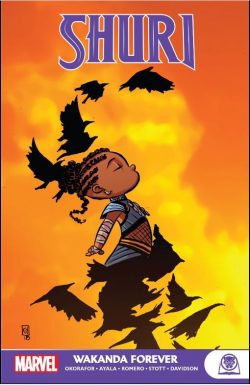
Shuri: Wakanda Forever


By Nnedi Okorafor, Vita Ayala, Leonardo Romero, Paul Davidson, Rachael Stott, Jordie Bellaire, Tríona Farrell, Carlos Lopez, VC’s Joe Sabino & various (Marvel)
ISBN: 978-1-3029-2369-3 (TPB)

Lauded as the first black superhero in American comics and one of the first to carry his own series, the Black Panther‘s popularity and fortunes have waxed and waned since the 1960s when he first attacked the FF (in Fantastic Four #52; cover-dated July 1966) as part of an extended plan to gain vengeance on the murderer of his father.

T’Challa, son of T’Chaka was revealed as an African monarch whose hidden kingdom was the only source of a vibration-absorbing alien metal upon which the country’s immense wealth was founded. Those mineral riches – derived from a fallen meteor which struck the continent in lost antiquity – had turned his country into a technological wonderland.

The tribal wealth had long been guarded by a hereditary feline champion deriving physical advantages from secret ceremonies and a mysterious heart-shaped herb that ensured the generational dominance of the nation’s warrior Panther Cult.

In recent years, Vibranium made the country a target for increasing subversion and incursion. After one all-out attack by Doctor Doom – culminating in the Iron Dictator seizing control of Wakanda – T’Challa was forced to render all Vibranium on Earth inert, defeating the invader but leaving his own homeland broken and economically shattered.

During that cataclysmic clash T’Challa’s flighty, spoiled brat half-sister Shuri took on the mantle of Black Panther, becoming clan and country’s new champion whilst her predecessor struggled with the disaster he had deliberately caused and recuperated from near-fatal injuries.

Despite initially being rejected by the divine Panther Spirit, Shuri proved a dedicated and ingenious protector, serving with honour until she perished defending the nation from alien invader Thanos. When T’Challa resumed his position as warrior-king, one of his earliest tasks was resurrecting his sister. She had passed into the Djalia (Wakanda’s spiritual Plane of Memories) where she absorbed the entire history of the nation from ascended Elders. On her return to physicality, she gained mighty new powers as the Ascended Future…

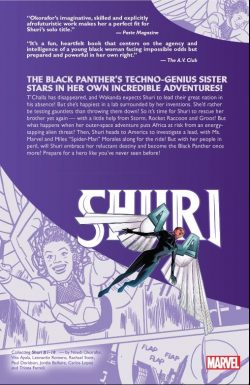
Since then – thanks to the equally formidable magic of a bravura role in a blockbuster movie – a slightly reimagined Shuri starred in her own series, blending established comics mythology with the fresh characterisation of a spunky, savvy, youthful super-scientist.

Initially written by multi award-winning fantasy author Nnedimma Nkemdili “Nnedi” Okorafor (Binti, Who Fears Death, Broken Places & Outer Spaces, Black Panther: Long Live the King) and illustrated by Leonardo Romero (Hawkeye, Captain America, Doctor Strange), this collection – gathering #1-10 of Shuri (spanning December 2018-September 2019 and available as a trade paperback or digitally) – finds Wakanda in turmoil.

In the aftermath of the nation’s first (official) manned space mission, King T’Challa is ‘Gone’, leaving Shuri to initially revel in the sheer joy and freedom of technological creation. However, the pressures of her family position always bedevil her. If it’s not frequent overtures from a mystery hacker she’s befriended and dubbed Muti or the constant chidings of the Ancestral Spirits who connect her to the Djalia, it’s her unwelcome invitation to join a secret society of women who have covertly steered and safeguarded Wakanda for generations…

The Sisters of the Elephant’s Trunk have a cherished goal: despite the nation recently becoming a constitutional monarchy, they want Shuri to step up in T’Challa’s absence and be the country’s spiritual leader … a new Black Panther…

Her answer in ‘The Baobab Tree’ pleases no one, but she has no time for second thoughts as sister-in-law Storm comes to her with news that T’Challa is now lost in space. The crisis is further compounded after Queen Mother Ramonda also vanishes. When Shuri resorts to spiritual means of locating her missing family, the ritual accidentally catapults her astral personality across the universe and into the vegetable body of a Guardian of the Galaxy…

Trapped but never helpless, Shuri’s brains save the alien heroes from dire peril and a deadly energy, memory and sound-eating bug in ‘Groot Boom’, but her return to Earth brings more trouble as the energy-insectoid follows to cause chaos in ‘Timbuktu’ – thanks in large part to the machinations of opportunist supervillain Moses Magnum. More concerning is the fact that many of her Ascended powers have gone…

With catastrophe all around and the planet in deadly peril, Shuri calls in a favour and Iron Man responds to assist in preventing ‘The End of the Earth’, but ultimately Shuri knows that the call of the Panther cult must be answered no matter what she wants…

The crisis deepens in ‘A Friend in Need’ parts 1 and 2 (illustrated by Paul Davidson & Tríona Farrell) as the reluctant new Black Panther traces a living black hole generator to Brooklyn, USA and shares a perilous romp with second Spider-Man Miles Morales and modern Ms. Marvel Kamala Khan, redeeming genius kid Augustin Torres from a dangerous association with major mag guy Graviton…

Events spiral to a spectacular conclusion as Vita Ayala (Livewire, New Mutants) takes over scripting for #8-10 with Rachael Stott & Carlos Lopez tackling the picture-making. In ’24/7 Vibranium’, that pesky bug resurfaces to imperil Earth prompting a fact-find visit to the Djalia, a fraught confrontation at Wakanda’s Vibranium mines in ‘Godhead’ and an unexpected resolution in ‘Living Memory’ that answers most of Shuri’s questions, restores her powers and sets her up for the next great adventure…

Balancing the fantastic fun and affirmative inspiration, this delightfully angst-free action romp also offers an Afterwordfrom Okorafor; Variant cover gallery by Skottie Young, Jamal Campbell, Carlos Pacheco, Travis Charest, John Tyler Christopher, Afua Richardson (plus movie photo-cover) and Romero design pages.

Wakanda Forever is a fast-moving, funny and supremely inventive delight: a splendidly fresh take on female superheroes that is compulsive reading for any fan of tight continuity, breathtaking action and smart characterisation as well as everyone who fell in love with the super-smart young woman who stole every scene in the Black Panther movie. What are you waiting for?
© 2020 MARVEL.

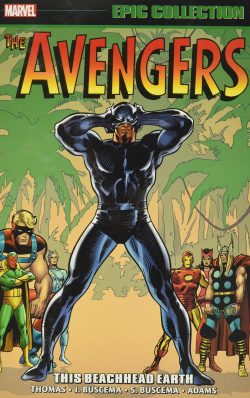
Avengers Epic Collection volume 5 1970-1972: This Beachhead Earth


By Roy Thomas, Harlan Ellison, John Buscema, Sal Buscema, Frank Giacoia, Herb Trimpe, Sam Grainger, Neal Adams & various (Marvel)
ISBN: 978-1-3029-2197-2 (TPB)

Win’s Christmas Gift Recommendation: Matchless Blockbuster Action… 9/10

One of the most momentous events in Marvel Comics history occurred in 1963 when a disparate array of individual heroes banded together to stop the Incredible Hulk.

The Avengers combined most of the company’s fledgling superhero line in one bright, shiny and highly commercial package. Over the decades the roster has unceasingly changed, and now almost every character in their universe has at some time numbered amongst their colourful ranks…

The Avengers always proved that putting all one’s star eggs in on single basket paid off big-time; even when all Marvel’s all-stars such as Thor, Captain America and Iron Man were absent, it merely allowed the lesser lights of the team to shine more brightly.

Of course, all the founding stars regularly featured due to a rotating, open door policy which meant that most issues included one of any reader’s favourites. The increasingly bold and impressively ambitious stories and artwork were no hindrance either.

This robust trade paperback and eBook compilation gathers the astounding contents of Avengers issues #77-97, plus a crossover classic from Incredible Hulk #140, collectively spanning June 1970 – March 1972: a riot of informed social commentary and astounding cosmic calamity which confirmed scripter Roy Thomas as a major creative force in comics whilst simultaneously demonstrating the potential the “debased” medium could aspire to.

At the time Thomas’ bold experiment was rightly considered the most ambitious saga in Marvel’s brief history: astounding sagas of tremendous scope which dumped Earth into a cosmic war the likes of which comics fans had never before seen.

“The Kree/Skrull War” set the template for all multi-part crossovers and publishing events from that point onwards and was followed by more astounding epics proving that more and better was to come…

This epochal tome opens ss the tone of the times shifted and comics titles entered a period of human-scaled storytelling dubbed “Relevancy” and here – crafted by Thomas, John Buscema & Tom Palmer – a far more mundane and insidious menace manifests as billionaire financier Cornelius Van Lunt manoeuvres to bankrupt Avengers (currently Cap, Black Panther, Goliath, the Vision, Scarlet Witch and Quicksilver) sponsor Tony Stark, compelling the team to become the mystery magnate’s ‘Heroes for Hire!’

Sal Buscema then popped in to pencil ‘The Man-Ape Always Strikes Twice!’ as the embattled champions are targeted by a coterie of vengeful villains competing to join a new league of evil, spectacularly culminating in a grand clash with the aforementioned anthropoid, the Swordsman, Power Man, Living Laser and the Grim Reaper in ‘Lo! The Lethal Legion!’, which concluding chapter heralded the artistic return of Big Brother John….

Next is the debut of the company’s first Native American costumed hero in ‘The Coming of Red Wolf!’ (Thomas, John B & Palmer) wherein the Avengers are drawn into a highly personal and decidedly brutal clash between ruthless entrepreneur Cornelius Van Lunt and an Indian tribe he is defrauding and persecuting.

The dramatic dilemma divides the team and concludes with Vision, Scarlet Witch and Goliath aiding Red Wolf in concluding episode ‘When Dies A Legend!’, whilst the remaining team plus Iron Man and Thor pursue super crime combine Zodiac and the Black Panther pursues what he believes is a personal quest beside Daredevil. (This last tale occurred in DD #69 but is not included here.)

Crucially, the malevolent mega-mob move first, taking the island of Manhattan ‘Hostage!’, leaving only the solitary sightless vigilante Man Without Fear free to save the day, after which Militant Feminism raises its disconcertingly strident head as the Wasp, Black Widow, Scarlet Witch and Madame Medusa are seduced into joining a new team called the Lady Liberators (yes, I know how all that sounds now but the all-male creative team meant well…).

However, The Valkyrie who declares ‘Come on in… the Revolution’s Fine!’ has her own dark secret and sinister agenda which has nothing to do with justice or equality…

Avengers #84 features part-time paladin Black Knight who has become addicted to the bloodthirsty hunger of his Ebony Blade, resulting in an otherworldly confrontation with alternate-Earth barbarian king Arkon the Magnificent and his latest paramour the Enchantress in ‘The Sword and the Sorceress!’ The resulting acrimonious clash subsequently drops half the team in a parallel existence with no apparent way back…

In ‘The World is Not for Burning!’ (inked by Frank Giacoia), Vision, Scarlet Witch and Quicksilver’s efforts to return home leave them stranded on an Earth where the Squadron Supreme are the World’s Greatest Heroes and a solar Armageddon is only hours away…

Illustrated by Sal B & Jim Mooney, ‘Brain-Child to the Dark Tower Came…!’ sees the extremely reluctant trans-Earth allies unite to save a very different world while, back home, the Black Panther reprises his bombastic origin before taking leave of his comrades to assume the throne of his hidden African nation in ‘Look Homeward, Avenger’ (Giacoia & Sal B).

Novelist Harlan Ellison was a very vocal comics fan in the 1970s and occasionally collaborated on Marvel tales. Avengers #88 began a radical adaptation of one his best short stories, heralding ‘The Summons of Psyklop’ (Ellison & Thomas, Sal Buscema & Mooney) wherein an experiment to cure the Hulk of his destructive nature leads to the Jade Juggernaut’s abduction by a preternatural entity.

The saga concluded in Incredible Hulk #140 (Ellison & Thomas, Herb Trimpe & Sam Grainger) as ‘The Brute… That Shouted Love… at the Heart of the Atom!’ finds the man-monster experiencing true love and idyllic peace in a sub-molecular paradise, only to lose it all when the demonic Psyklop finally tracks him down…

A major turning point in Marvel history begins relatively quietly as marooned Kree warrior Captain Marvel is finally freed from imprisonment in a ghastly antimatter universe. Mar-Vell was originally sent as a spy to Earth but quickly went native to become a protector of humanity. After an intergalactic mission to save his former masters, he was flying back to Earth when suddenly sucked into the anti-matter hell of the Negative Zone…

The trapped warrior found a loophole through long-dormant Kree artefacts and Nega-bands. Inextricably bonding to professional human side-kick Rick Jones, he could switch places whenever danger loomed, but was drawn back into the dread domain after three hours.

Following interminable, agonising months when Rick refused to trade atoms with his alien alter ego, ‘The Only Good Alien…’ (#89, with art by Sal B & Grainger) sees the bonded brothers finally separate just as, in the distant Kree Empire, the ruling Supreme Intelligence is overthrown by his enforcer Ronan the Accuser…

On Earth, the rebellion results in the activation of a long-dormant robotic Kree Sentry which attacks Mar-Vell and the Avengers before enacting a deep-programmed protocol to devolve humanity to the level of Neanderthals in concluding chapter ‘Judgment Day’ (drawn and inked by “Our pal Sal”).

Even with Ronan taking personal charge of a compromised polar base, the scheme to eradicate humanity is narrowly defeated in ‘Take One Giant Step… Backward!’, but the cat is let out of the bag about the panic-inspiring notion that extraterrestrials lurk among us. Moreover, public opinion rapidly turns against the heroes for concealing the threat of repeated alien incursions…

In a powerful allegory of the anti-Communist witch-hunts of the 1950s, the epic expands in issue #92 (Sal B & George Roussos) as ‘All Things Must End!’ reveals riots in American streets and a political demagogue capitalising on the crisis. Subpoenaed by the authorities, castigated by friends and public, Vision, Scarlet Witch and Quicksilver are ordered to disband by founding fathers Thor, Iron Man and Captain America.

Or are they…?

The plot thickens as Neal Adams & Tom Palmer assume art chores for double-sized Avengers #93 and ‘This Beachhead Earth’. Here the Vision is nigh-fatally attacked and those same founding fathers evince no knowledge of having benched the regular team.

With original Ant-Man Henry Pym undertaking ‘A Journey to the Center of the Android!’ to save the Vision’s artificial life, the Avengers become aware of not one, but two, hostile alien presences on Earth: bellicose Kree and sinister, seditious shape-shifting Skrulls. The shocking revelation triggers a ‘War of the Weirds!’ on our fragile globe.

Acting too late, the human heroes are unable to prevent mutant siblings Scarlet Witch and Quicksilver as well as their protector Mar-Vell from being abducted by the Super-Skrull…

With more stunning Adams art, ‘More than Inhuman!’ in issue #94 entangles the long-hidden race of advanced beings called Inhumans in the mix, disclosing that their advanced science and super-powers are the result of genetic meddling by the Kree in the depths of prehistory. Now, with Inhuman king Black Bolt missing and his mad, malign brother Maximus in charge, the Kree are calling in those ancient markers…

Second chapter ‘1971: A Space Odyssey’ (pencilled by John Buscema) focuses on Mar-Vell as he is increasingly pressured to reveal military secrets to his shape-shifting captors. The Skrulls are ready to launch a final devastating all-out attack on their eons-old rivals, even as on Earth ‘Behold the Mandroids!’ sees the American authorities attempting to arrest all costumed heroes…

In Avengers #95 ‘Something Inhuman This Way Comes…!’ coalesces the disparate story strands as aquatic Inhuman Triton helps defeat US government robotic Mandroids before beseeching the beleaguered heroes to find his missing monarch and rescue his people from the pressganging Kree.

After so doing, and with a solid victory under their belts at last, the Avengers head into space to liberate their kidnapped comrades and save Earth from becoming collateral damage in the impending cosmos-shaking clash between Kree and Skrulls…

‘The Andromeda Swarm!’ (with additional inking from Adams and Al Weiss) is perhaps the Avengers’ finest hour, as a small, brave band of valiant heroes hold off an immense armada of star-ships, losing one of their own in the conflict. Meanwhile the Supreme Intelligence is revealed to have been pursuing its own clandestine agenda all along, after having bewildered sidekick Rick Jones abducted to further its terrifyingly ambitious plans….

The astounding final episode ‘Godhood’s End!’ (John B & Palmer) brings the uncanny epic to a climactic close with a literal Deus ex Machina as the Supremor‘s master-plan is finally revealed. However, the war is actually ended by the most unlikely of saviours and an avalanche of costumed heroes: an action overload extravaganza which has never been surpassed in the annals of Fights ‘n’ Tights fiction…

This titanic tome is packed with extra treats, including the covers of all-reprint Avengers Annual #4 and a selection of House Ads, as well as a self-portrait of John Buscema and some of his creations. Also on view is a wealth of original art from him and Adams, plus the covers and new bridging material created by Alan Zelenetz, Walt Simonson & Palmer for the 1983 Kree-Skrull War starring the Avengers reprint miniseries and previous collection covers.

Roy Thomas and his artistic collaborators were always at the forefront of Marvel’s second generation of creators: brilliantly building on and consolidating Lee, Kirby and Ditko’s initial burst of comics creativity whilst spearheading and constructing a logical, fully functioning wonder-machine of places and events that so many others could add to.

These terrific tales are ideal examples of superheroes done exactly right and also act as pivotal points as the underdog company evolved into a corporate entertainment colossus. There are also some of the best superhero stories you’ll ever read…
© 2020 MARVEL.

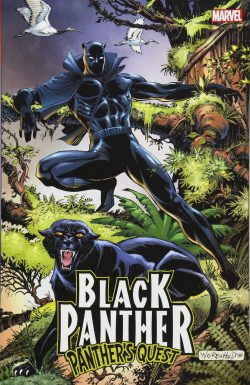
Black Panther: Panther’s Quest


By Don McGregor, Gene Colan, Tom Palmer & various (Marvel)
ISBN: 978-1302908034 (TPB)

The loss of Chadwick Boseman is a terrible blow to fans of film and every supporter of the rights and inherent dignity of all humanity. Whatever the reason, it seems that black people are just not allowed to have living role models. Our condolences and best wishes go out to his family and all who knew or were affected by him.

The pettiest part of that tragedy is that his iconic role as T’Challa of Wakanda is also ended. Having read about the kind of man he was, I’m shamelessly taking the opportunity to review the Black Panther story I suspect he would most have liked to realise on film…

Lauded as the first black superhero in American comics and one of the first to carry his own series, the Black Panther‘s popularity and fortunes have waxed and waned since the 1960s when he first attacked the FF (in Fantastic Four#52; cover-dated July 1966) as part of an extended and elaborate plan to gain vengeance on the murderer of his father.

T’Challa, son of T’Chaka was revealed as an African monarch whose hidden kingdom was the only source of a vibration-absorbing alien metal upon which the country’s immense wealth was founded. Those mineral riches – derived from a fallen meteor which struck the continent in primeval antiquity – had powered his country’s transformation into a technological wonderland.

That tribal wealth had long been guarded by a hereditary feline-garbed champion deriving physical advantages from secret ceremonies and a mysterious heart-shaped herb that ensured the generational dominance of the nation’s warrior Panther Cult.

Lyrical intellectual Don McGregor had already immortalised T’Challa in a stunning 1970s periodical run which produced the revered Panther’s Rage saga and the controversial Panther vs the Klan storyline. After years away from the mainstream, creating groundbreaking graphic novels such as Sabre: Slow Fade of an Endangered Species and Detectives Inc., series such as Ragamuffins and Nathaniel Dusk, he was lured back to his roots to spin a shocking tale of contemporary intolerance and the end-days of Apartheid…

He was joined by a semi-regular collaborator whose credentials in crafting human-scaled tales of adventure, horror and empathetic emotional drama were second to none. He was also one the industry’s earliest exponents of strong black characters…

Eugene Jules “Gene” Colan (September 1st 1926 – June 23rd 2011) was one of comics’s greatest talents: a quietly professional artist who valued accuracy and authenticity in his work, whether it was science fiction, horror, war, satirical humour of the vast number of superheroes he brought to life.

A devotee of classic adventure strips, Colan studied at the Art Students League of New York, before beginning his own illustration career in 1944 (on Wings Comics) before military service in the Philippines. The war had just ended and Colan had spare time to draw for local paper The Manilla Times.

By 1946 he was a civilian again, and working for Stan Lee’s Atlas outfit on crime and supernatural stories. He illustrated the last Golden Age Captain America (Captain America’s Weird Tales #75; February 1950), an all-horror issue that had no superhero material at all. It was like a sign…

As the industry radically transformed, he began freelancing at DC/National Comics as well as remaining a mainstay of Atlas. His assignments increasingly focused on the new genres of War Stories and Romance.

As Superhero stories returned, he moved exclusively to Marvel (except for a range of monochrome horror stories done for Archie Goodwin at Warren Magazines), where his dynamic realism offered a powerful alternative to the graphic styles of Jack Kirby, Steve Ditko, John Romita and Don Heck.

Colan became renowned for his work on Daredevil (where he created blind black detective Willie Lincoln), Captain America, Doctor Strange, Iron Man, Avengers, Sub-Mariner and Howard the Duck. During this period he co-created the Guardians of the Galaxy, two Captain Marvels (Mar-Vell and Carol Danvers), drew all of Tomb of Dracula – thereby introducing Blade the Vampire Slayer to the world – and was responsible for another black comic book icon and the nation’s first African American costumed hero, The Falcon.

In the 1980s he moved to DC, working on Batman, Superman, Wonder Woman, and the Spectre, co-creating Night Force, Silverblade, Jemm, Son of Saturn and period private eye Nathanial Dusk before expanding into independent comics at the forefront of innovation that marked the rise of the Direct Sales Market.

His later career was blighted by health issues, but he continued drawing whenever he could, for many companies. On one of his periodic returns to Marvel he reunited with McGregor for this astounding tale which was originally serialised in in 25 chapters in fortnightly anthology Marvel Comics Presents # 13-37 (February to December1989). Here, the entire affair is preceded by ‘To Follow the track of The Great Cat with renewed wonder on his Panther’s Quest (From “Panther’s Rage” to “Panther’s Prey”)’ a typically effulgent and informative Introduction from author McGregor…

One of the most thought-provoking mainstreaming comics tales ever released, Panther’s Quest added pressure to the ever-growing Anti-Apartheid movement in comics and western media, by examining not only the condition of racial inequality but also turning a damning eye on sexual oppression. Whether in his numerous solo series or as part of super-teams such as the Avengers, Fantastic Four or the Ultimates, Black Panther has always been one of Marvel’s most politically strident and socially-crusading characters. This is a book I’m certain Chadwick Boseman would have admired and supported…

Inked in its entirety by perfect partner Tom Palmer, it begins on a dark night as the Panther infiltrates neighbouring totalitarian South Africa where a white minority still oppresses the millions of blacks who live there. T’Challa has heard ‘A Rumour of Life’ and has come seeking his stepmother Ramonda. His father’s second wife had raised the bereaved boy when T’Challa’s birth mother died, but one day when he was only three, she vanished and no one would speak of her.

Now, he’s invaded the most dangerous land on Earth – for his kind – in search of answers from unscrupulous information peddler Patrick Slade…

‘Forgotten Corpses’ sees that clandestine meeting savagely interrupted by white paramilitaries who seek to kill them – but without alerting the police or security services…

McGregor has always a fascination with the real effects and consequences of violence, and this tale contains some pretty shocking moments that will make many readers wince. Suffice it to say I’m staying vague throughout this review, but will say that vicious brute Elmer Gore graphically tortures the Panther with barbed wire in ‘Lost Blood in Copper Dust’, leading to the maimed hero staggering into the arms of ‘The Man Who Loved Sunrise’.

Oppressed miner and narrative everyman Zanti Chikane is a black miner and second class citizen crushed by his intolerable life, but he still overcomes his understandable caution to offer assistance to torn, bleeding T’Challa. That leads to his own brush with death as white killers employ what they consider ‘Reasonable Force’ against the suspects, before being trounced by the still fighting cat-man…

The scene changes with ‘Naked Exposures’ as government Magistrate of Communications Anton Pretorius orders his battered and furious minions to capture an invading masked terrorist dubbed Black Panther. This invader is a threat to national security but the mercenaries need no other reasons to kill the treacherous “kaffir”. Just to be sure, though, Pretorius also uses his position to send out a nationwide TV alert…

‘Battered Artifacts’ finds T’Challa tracking Slade to an impoverished township, unaware that he’s under surveillance and about to step into the other side of the deadly politics that wracked South Africa at this time.

‘Hatred under Tears’ sees the mercenaries attack, uncaring of the small children they are endangering. As the Great Cat stops to aid a tear-gassed toddler, ‘Justifiable Action’ sees him shot for his efforts and arrested in ‘Personal Risk’ before breaking free and escaping…

‘The Official Version’ gives T’Challa a lesson in realpolitik from Slade’s wife even as the State intensifies its hunt for him, with Security Minister Doeke Riebeek officially branding the entire emergency a communist plot…

In the township ‘Voices Heard, Voices Ignored’ sees Zanti pondering the terrifying dangers to his family before returning to aid the Panther whilst ‘A Right to Kill’ shows Riebeek beginning to suspect Pretorius might have ulterior motives for his actions. Meanwhile, the enraged township men are moving against a suspected traitor determined ‘Somebody’s Going to Pay’. They’re carrying petrol and tyres needed for the appalling punishment they call “necklacing”. Do not google it or buy this book if you have a weak stomach…

When the Panther acts to save a life, he is horribly burned but events escalate to total tragedy as ‘Last Night I Wept for Freedom’ shows how the boy he helped returns the favour and pays the ultimate price, despite his own superhuman efforts and the initially-reluctant intervention of a white doctor in ‘Lost Promises’…

Traumatised and repentant, T’Challa returns to Slade whose ‘Dark Maneuvers’ lead them into a trap laid by Pretorius’ mercenaries in ‘So Many Nameless Enemies’. The battle is brief but results in a crucial clue in the true quest, as the trader reveals how, years ago, he learned of a black woman held in glittering bondage for decades at the home of a high-ranking government official…

‘Chances’ see Riebeek and his forces closing in as T’Challa follows his fresh clue to Johannesburg to confront one of the mercs in ‘The Great Cat in the City of Gold’. Now focused on finding Pretorius, the Panther and Zanti attempt to save his precious stealth-ship from being captured by Riebeek in ‘Losing Control’… but at a terrible cost…

After ‘Saying Goodbye’, the Panther’s quest moves into its endgame as T’Challa assaults Pretorius’ luxurious citadel, circumventing deadly ‘Barriers’, and crushing human and canine ‘Opponents’ (still more grimly authentic action in need of a strong stomach advisory…), to ultimately rescue Ramonda from the luxurious cell she has inhabited ever since Pretorius abducted her years ago.

The tyrannical hypocrite’s obsessive, abusive passion for her was also his downfall: a secret capable of destroying him in a nation and government that decreed interracial mixing immoral and illegal…

Ultimately, it’s Ramonda who decrees his fate whilst enjoying a ‘Dawn Reunion’ with her long-lost child…

Available in trade paperback and digital editions and augmented by a full cover gallery and pinups from Marvel Fanfare#47 (by Bill Reinhold & Linda Lessman) and #45(Steve Rude & Steve Oliff) this is the most important Black Panther tale you’ll ever read. So do.
© 2018 Marvel Characters Inc. All rights reserved.

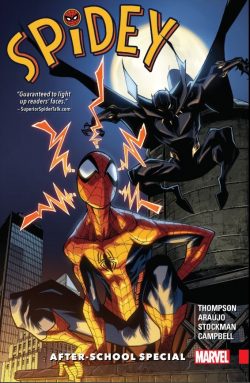
Spidey volume 2: After-School Special


By Robbie Thompson, André Lima Araújo, Nathan Stockman & various (Marvel)
ISBN: 978-0-7851-9676-1 (TPB)

Since its earliest days the publishing company now known as media monolith Marvel always courted the youngest of comicbook consumers. Whether through animated tie-ins and licensed properties such as Terrytoons Comics, Mighty Mouse, Duckula, assorted Hanna-Barbera and Disney licenses and a myriad of others, or original characters such as Millie the Model, Homer the Happy Ghost and Calvin, the House of Ideas always understood the necessity of cultivating the next generation of readers.

These days, however, kids’ interest titles are a tricky balancing act and, with the Marvel Universe’s characters all over screens large and small, the company usually prefers to create child-friendly versions of its own proprietary pantheon in their own playground, making that eventual hoped-for transition to more mature comics and other venues as painless as possible.

In the 1980s-1990s Marvel published an entire line of kiddie titles through its Star Comics line and, in 2003, the company created a Marvel Age line to update and retell classic original tales by Stan Lee, Jack Kirby & Steve Ditko, mixing it in with the remnants of its manga-inspired Tsunami imprint: again, all intended for a younger readership.

The experiment was tweaked in 2005, becoming the Marvel Adventures line, with titles reflecting the most popular characters and whatever was on TV screens at the time. In 2012 these were superseded by specific comicbook titles tied to Disney XD TV shows designated as “Marvel Universe cartoons”.

Today’s featured item – Spidey: After-School Special – is a horse of a different colour: similar but different…

Rather than simply crafting a wallcrawler for younger sensibilities, this iteration – presumably sparked by the teenaged, light-adventure version seen in the Spider-Man: Homecoming movie – innovates and modernizes by once again looking back and superbly succeeds in recapturing a sense of the madcap gaiety that counterbalanced the action and pathos of the earliest Lee/Ditko stories. This series is all about thrills and fun…

Scripted throughout by Robbie Thompson and re-presenting Spidey#7-12 (originally released from August 2016 to January 2017), the non-stop, youngster-appropriate mayhem recommences with a cracking catch-up origin-page illustrated by Nick Bradshaw and colourist Jim Campbell.

Firmly set in The Now, our hero is still and once again a callow schoolboy, fighting crime and making enemies between High School classes. In his off-hours he’s also a crimefighting sensation of the internet and social media whenever he puts on his blue-&-red duds. As ever, news magnate J. Jonah Jameson is there to vilify the webslinger at every opportunity…

Sadly, thanks to the kid’s double life, Peter Parker‘s grades – except for science and maths – are tanking now, and the secret superhero is forced to accept Popular Girl Gwen Stacy as a much-needed history tutor. Not only is she the hottest girl in school, but she also decks Flash Thompson with one punch after the jocks starts bullying “Puny” Parker again…

That tricky triangle develops in captivating manner over the next half dozen arachnid escapades, starting with an untitled team-up co-starring African monarch T’Challa the Black Panther and illustrated by André Lima Araújo. Here, the tutoring of classmates is counterbalanced by a spectacular teaching moment as the schoolboy hero stumbles into a subterranean smuggling operation masterminded by the diabolical and unhuman Klaw, Master of Sound…

Peter Parker’s dream “maybe date” with Gwen takes an even-more terrifying turn in ‘Blackout!’ (art by Nathan Stockman) as voltaic villain Electro assaults the city in a deadly but foredoomed attempt to kill Spider-Man. His spectacular trouncing is only slightly mitigated when he is sprung from custody by a band of fellow murderous Arachnophobes…

Peter’s desperate schemes to earn enough cash for Aunt May’s birthday present lead to confrontations with occasional-employer Jameson and all-out war with psycho-stalker Kraven the Hunter in ‘To Catch a Spider’ after which the wallcrawler’s media-created ‘Bad Reputation’ is temporarily redeemed after a dynamic team-up with Captain America against AIM and their lethal leader M.O.D.O.K.

The year-long story arcs detailing the tricky triangle of Gwen, Flash and Peter and the gradual coalition of a new Sinister Six coalesce in ‘Missing Out’ as the kids take their dreaded exams and Spidey attempts to join in a mass battle against Galactus, only to stopped at every stage by a far more important and immediate crisis – such as an unrelenting attack by brainwashed villain Scorpion – before the drama magnificently concludes in the boy hero’s best day ever. Unless, of course, Doctor Octopus, Mysterio, Sandman, Kraven, Electro and the Vulture succeed with their plan in ‘Spidey No More!’…

Supplemented with a wealth of behind-the-scenes artwork and illustration secrets from Lima Araújo and Stockman, this is a sublime slice of fun and action, referencing the intoxicating days of Stan Lee & Steve Ditko whilst offering an enthrallingly refreshing reinterpretation of an evergreen heroic icon. Here is an intriguing and more culturally accessible means of introducing character and concepts to kids born two and three generations or more away from those far-distant 1960s originating events. These Spidey super-stories are outrageously enjoyable yarns, and well worth seeking out.
© 2016 Marvel Characters, Inc. All rights reserved.

Daredevil Marvel Masterworks volume 5


By Stan Lee, Roy Thomas, Gene Colan, Barry Windsor-Smith & various (Marvel)
ISBN: 978-0-7851-3042-0 (HB)

Matt Murdock is a blind lawyer whose remaining – radioactively enhanced – senses hyper-compensate, make him an astonishing acrobat, formidable fighter and living lie-detector. Very much a second-string hero for his early years, Daredevil was nonetheless a striking and popular one, due in large part to the roster of brilliant artists who illustrated the series. He only really came into his own, however, after artist Gene Colan signed up for the long haul and wunderkind scripter Roy Thomas added an edge of darkness to the swashbuckling derring-do…

Covering July 1968 to June 1969, this tumultuous collection (in both hefty hardback and ephemeral eBook formats) reprints Daredevil #42-53 (plus a surprise comedy bonus), capturing the significant moments and radical shifts in treatment and content as Lee surrendered the scripter’s role to Thomas. Following a fascinating Introduction from Gene Colan, an aura of barely-contained, ever-escalating madness increasingly permeates the soap opera narrative beats, peerlessly pictured by his own astounding illustration – as well as a powerful interlude by a promising British fill-in artist named Barry Smith….

Having killed off his fictitious alter ego twin brother Mike Murdock, Matt briefly considered hanging up his scarlet long-johns but eventually retained his secret other-life by “revealing” to his girlfriend Karen Page and closest friend Franklin “Foggy” Nelson that Mike was only one of a number of Men without Fear in the first part of a prolonged battle with a new nemesis…

‘Nobody Laughs at The Jester!’ (by Lee, Colan and inker Dan Adkins) shows how that Malevolent Mountebank only wants to be more successful as a criminal than he had been as a bit-playing actor, but his motivation changes when crooked mayoral candidate Richard Raleigh hires him to spoil incorruptible Foggy‘s campaign for the position of District Attorney.

The role grew and the mission crept, precipitating a protracted saga which kicks off with a temporarily befuddled DD ‘In Combat with Captain America!’ (inked by Vince Colletta), before Hornhead is framed for killing the Jester’s alter ego Jonathan Powers in #44’s ‘I, Murderer!’

Soundly defeated in combat by the Jester, our hero experiences ‘The Dismal Dregs of Defeat!’ and becomes a wanted fugitive. Following a frenetic police manhunt, DD is finally arrested before snatching victory in the thoroughly enthralling conclusion ‘The Final Jest!’

With this episode, inker extraordinary George Klein began his long and impressive association with the series.

With the Vietnam War raging, a story involving the conflict was inevitable but – thanks in great part to Colan’s personal input – #47’s ‘Brother, Take My Hand!’ was so much more than a quick cash-in or even well-meaning examination of contemporary controversy. Here, Marvel found another strong and admirable African American character (one of far too few in those blinkered times) to add to their growing stable…

Newly-blinded veteran Willie Lincoln turns to Matt Murdock and Daredevil for help on his return home. A disgraced cop framed by gang-boss Biggie Benson before joining the army, Lincoln is now back in America and determined to clear his name at all costs. This gripping, life-affirming crime thriller not only triumphs in Daredevil’s natural milieu of moody urban menace but also sets up a long-running plot that would ultimately change the Man without Fear forever…

The return of Stilt-Man poses little more than a distraction in ‘Farewell to Foggy’, as Matt’s oldest friend wins the race for DA but acrimoniously turns his back on Murdock, seemingly forever….

Lee’s final script on the sightless crusader, ‘Daredevil Drops Out’ (#49), was illustrated by Colan & Klein, depicting Murdock as the target of a robotic assassin built by Mad-Scientist-for-Hire Starr Saxon. This tense, action-packed thriller grew into something very special with second chapter ‘If in Battle I Fall…!’ as neophyte penciller Barry Smith stepped in, ably augmented by veteran inker Johnny Craig. Colan had been shifted to the role of artist on prestigious title The Avengers, but he would soon return…

Lee then left comics-scripting protégé Roy Thomas to finish up for him in ‘Run, Murdock, Run!’ (Daredevil #51, April 1969 with art by Smith & Klein): a wickedly engaging, frantically escalating psychedelic thriller which sees Saxon uncover the hero’s greatest secret after the Man Without Fear succumbs to toxins in his bloodstream and goes berserk.

The saga climaxes in stunning style on ‘The Night of the Panther!’ (Smith & Craig) as African Avenger Black Panther joins the hunt for an out-of-control Daredevil before subsequently helping thwart, if not defeat, the dastardly Saxon.

The radically unsettling ending blew away all the conventions of traditional Fights ‘n’ Tights melodrama and still shocks me today…

Colan & Klein reunited for #53’s ‘As it Was in the Beginning…’ wherein Thomas reprised, revised and expanded Lee & Bill Everett’s origin script from Daredevil #1, allowing the troubled hero to reach a bold decision, which would be executed in #54 – or the next volume to us…

Adding extra value to the proceedings and ending on a comedic note, this enticing tome includes a pertinent parody by Lee & Colan from Marvel’s spoof title Not Brand Echh (#4, November 1967) as Splat Murdock – AKA Scaredevil – endures moments of hilarious existential angst and an identity crisis whilst being ‘Defeated by the Evil Electrico!’, concluding and complimenting a bonanza of bombastic battles tales that are pure Fights ‘n’ Tights magic in the grand Marvel Manner: comic epics no fan of stunning super-heroics can afford to ignore.
© 1968, 1969, 2016 Marvel Characters, Inc. All rights reserved.

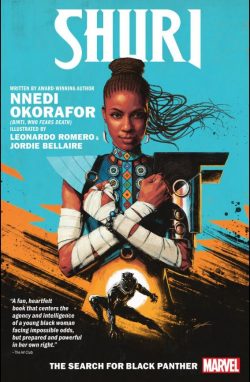
Shuri volume 1: The Search for Black Panther


By Nnedi Okorafor, Leonardo Romero, Jordie Bellaire, VC’s Joe Sabino & various (Marvel)
ISBN: 978-1-3029-1523-0 (TPB)

Lauded as the first black superhero in American comics and one of the first to carry his own series, the Black Panther‘s popularity and fortunes have waxed and waned since the 1960s when he first attacked the FF (Fantastic Four #52; cover-dated July 1966) as part of an extended plan to gain vengeance on the murderer of his father.

T’Challa, son of T’Chaka was revealed as an African monarch whose hidden kingdom was the only source of a vibration-absorbing alien metal upon which the country’s immense wealth was founded. Those mineral riches – derived from a fallen meteor which struck the continent in lost antiquity – had turned his country into a technological wonderland.

The tribal wealth had long been guarded by a hereditary feline champion deriving physical advantages from secret ceremonies and a mysterious heart-shaped herb that ensured the generational dominance of the nation’s warrior Panther Cult.

In recent years, Vibranium made the country a target for increasing subversion and incursion. After one all-out attack by Doctor Doom – culminating in the Iron Dictator seizing control of Wakanda – T’Challa was forced to render all Vibranium on Earth inert, defeating the invader but leaving his own homeland broken and economically shattered.

During that cataclysmic clash T’Challa’s flighty, spoiled brat half-sister Shuri took on the mantle of Black Panther, becoming the clan and country’s new champion whilst her predecessor struggled with the disaster he had deliberately caused and recuperated from near-fatal injuries.

Despite initially being rejected by the divine Panther Spirit, Shuri proved a dedicated and ingenious protector, serving with honour until she perished defending the nation from alien invader Thanos. When T’Challa resumed his position as warrior-king, one of his earliest tasks was resurrecting his sister. She had passed into the Djalia (Wakanda’s spiritual Plane of Memories) where she absorbed the entire history of the nation from ascended Elders. On her return to physicality, she gained mighty new powers as the Ascended Future…

Now – thanks to the equally formidable magic of a bravura role in a blockbuster movie – a slightly reimagined Shuri stars in her own series, blending established comics mythology with the fresh characterisation of a spunky, savvy youthful super-scientist.

Written by multi award-winning fantasy author Nnedimma Nkemdili “Nnedi” Okorafor (Binti, Who Fears Death, Lagoon, Broken Places & Outer Spaces, Black Panther: Long Live the King, Venomverse War Stories) and illustrated by Leonardo Romero (Hawkeye, Captain America, Doctor Strange), this first collection – gathering #1-5 of Shuri (spanning December 2018-April 2019 and available as a trade paperback or digitally) – finds Wakanda in turmoil.

In the aftermath of the nation’s first (official) manned space mission, King T’Challa is ‘Gone’, leaving Shuri to initially revel in the sheer joy and freedom of technological creation. However, the pressures of her family position always bedevil her. If it’s not frequent overtures from a mystery hacker she’s befriended and dubbed Muti or the constant chidings of the Ancestral Spirits who connect her to the Djalia, it’s her unwelcome invitation to join a secret society of women who have covertly steered and safeguarded Wakanda for generations…

The Sisters of the Elephant’s Trunk have a cherished goal: despite the nation recently becoming a constitutional monarchy, they want Shuri to step up in T’Challa’s absence and be the country’s spiritual leader … a new Black Panther…

Her answer in ‘The Baobab Tree’ pleases no one, but she has no time for second thoughts as sister-in-law Storm comes to her with news that T’Challa is now lost in space. The crisis is further compounded after Queen Mother Ramonda also vanishes. When Shuri resorts to spiritual means of locating her missing family, the ritual accidentally catapults her astral personality across the universe and into the vegetable body of a Guardian of the Galaxy…

Trapped but never helpless, Shuri’s brains save the alien heroes from dire peril and a deadly energy-eating bug in ,Groot Boom’, but her return to Earth brings more trouble as the energy-insectoid follows to cause chaos in ‘Timbuktu’ – thanks in large part to the machinations of opportunist supervillain Moses Magnum…

With catastrophe all around and the planet in deadly peril, Shuri calls in a favour and Iron Man responds to assist in preventing ‘The End of the Earth’ but ultimately Shuri knows that the call of the Panther cult must be answered no matter what she wants…

To Be Continued…

Featuring a superb variant covers gallery by Skottie Young, Carlos Pacheco, Rafael Fonteriz & Rachel Martin, Jamal Campbell, Travis Charest, John Tyler Christopher, Afua Richardson plus a Movie photo cover and character designs by Romero, this is a fast-moving, funny and supremely inventive romp: a splendidly fresh take on female superheroics that is compulsive reading for any fan of tight continuity, breathtaking action and smart characterisation as well as everyone who fell in love with the super-smart young woman who stole every scene in the Black Panther movie. What are you waiting for?
© 2019 MARVEL. All rights reserved.

X-Men: Worlds Apart


By Christopher Yost, Diogenes Neves & Ed Tadeo; Priest, Sal Velluto & Bob Almond; Chris Claremont & John Byrne, & various (Marvel)
ISBN: 978-0-7851-4030-6 (HB) 978-0-7851-3533-3 (TPB)

In 1963 The X-Men #1 introduced Cyclops, Iceman, Angel, Marvel Girl and the Beast: very special students of Professor Charles Xavier, a wheelchair-bound telepath dedicated to brokering peace and integration between the masses of humanity and the emergent off-shoot race of mutants – Homo Superior.

After years of eccentric and spectacular adventures the mutant misfits disappeared at the beginning of 1970 as mystery and all things supernatural once more gripped the world’s entertainment fields and triggered a sustained downturn in costumed hero comics.

Although their title was revived at the end of the year as a cheap reprint vehicle, the missing mutants were reduced to guest-stars and bit-players throughout the Marvel universe and the Beast was transformed into a monster to cash in on the horror boom, until Marvel editor-in-chief Roy Thomas green-lighted a bold one-shot in 1975 as part of the company’s line of Giant-Sized specials.

Giant Size X-Men #1 detailed how the classic team had been lost in action, leaving Xavier to scour the Earth for a replacement team. Recruiting old foes-turned-friends Banshee and Sunfire and throwaway Hulk villain Wolverine, most of the savant’s time and attention was invested in newcomers. These comprised Kurt Wagner, a demonic German teleporter who would be codenamed Nightcrawler, Russian farmboy Peter Rasputin, who could transform into a living steel Colossus, embittered, disillusioned Apache superman John Proudstar who was cajoled into joining the makeshift squad as Thunderbird and a young woman who was regarded as an African weather goddess.

Ororo Munroe AKA Storm was actually the lost daughter of Kenyan royalty and an American journalist. On joining Xavier’s team, she spent years fighting the world’s most deadly threats as part – and eventually leader – of the outlaw, unloved, distrusted mutant hero horde, before eventually leaving her second home to marry a boy she had met whilst trekking across the Dark Continent decades previously.

In Fantastic Four #52 (August 1966) an incredible individual calling himself the Black Panther tested himself against the Cosmic Quartet and disclosed in the following issue how, as a child, he had lost his father to a ruthless scientist’s mercenary army when they invaded his hidden African homeland Wakanda.

Young Prince T’Challa had single-handedly avenged the murder of his father T’Chaka and driven off the raiders, inheriting the role of king and spiritual leader of his people. Eventually, he became a member of the Mighty Avengersand introduced his country to the world, with technologically-advanced Wakanda swiftly advancing to the forefront of nations by trading its scientific secrets and greatest natural resource – incredible alien mineral Vibranium.

Whilst a boy wandering the plains of Africa, he had encountered a beautiful young girl with incredible powers trekking from Egypt to West Africa. Years later he found her again as one the X-Men. Slowly rediscovering old feelings, the pair married and Storm became the First Lady of Wakanda…

This compilation collects 4-issue miniseries X-Men: Worlds Apart from 2008-2009, Black Panther volume 3, #26 (January 2001) and material from Marvel Team-Up #100 (December 1980), and follows the African Queen through her darkest hours even as it affords a little space to examine key moments in her tempestuous relationship with the earthly agent of the very-real, very paws-on Panther God.

The romance commences with the eponymous ‘Worlds Apart’ crafted by Christopher Yost, Diogenes Neves, Ed Tadeo & Raul Treviño, with the action opening in New York’s sewers where Storm and some-time comrade Cyclops seek to convince hidden Morlock refugees to join the West Coast mutant enclave and safe-haven known as Utopia. When she is suddenly called back to Africa, Ororo’s erstwhile friend contentiously questions her loyalties…

Even as august and elevated co-ruler of a fabulous kingdom, Ororo iq adi T’Challa is still painfully aware of humanity’s – and more specifically her own subjects’ – bigotry regarding the genetic offshoot politely dubbed Homo Superior. When one of her protégés – young Wakandan mutant Nezhno Abidemi – is accused of murder she rushes to defend him.

…But the evidence is overwhelming, incontrovertible and damning…

Nevertheless, she knows something is amiss and when she arbitrarily frees him, the entire country turns against her. Even her adoring husband wants her blood…

The cause soon smugly reveals himself as Amahl Farouk: a sinister, soul-corrupting telepath she and Charles Xavier killed years ago, when she was merely an orphan child-thief in Cairo. Sadly, the dying monster evolved into a malign body-stealing psychic force; an untouchable Shadow King feeding on hatred and polluting everything it touches…

Biding its time, Shadow King insinuated itself into Wakanda, stoking ill-feeling throughout. Now wearing her beloved T’Challa, it plans on extracting a much-postponed final vengeance…

As the poisonous presence gloats, Ororo realises it is not just her at risk: the Shadow King has simultaneously taken Cyclops in America and is using her fellow X-Man as a weapon to kill the only earthly threat to Farouk’s power – supreme telepath Emma Frost, who is also Scott Summers’ lover…

With an entire nation and the precious body of her beloved mercilessly hunting her and Nezhno, the wondrous weather-warrior must first direct her powers half a world away to stop Cyclops whatever the cost, before somehow destroying a foe no power on Earth can touch.

Happily, the Spiritual co-ruler of Wakanda has her own direct line to the country’s cat god – or is that goddess?

Short, sharp, spectacularly action-packed and wickedly satisfying – especially the climactic battles with the assembled X-Men and friendly rival Cyclops – this bombastic Fights ‘n’ Tights adventure is rather bafflingly complemented with ‘Echoes’ from Black Panther #26. Created by Priest, Sal Velluto & Bob Almond, it’s the opening part of a longer epic entitled ‘Stürm und Drang – a Story of Love and War’. Here T’Challa’s childhood friendship with Ororo is slowly and painfully re-cultivated during an incursion into Wakanda by alien-hunting US Federal Agents, and a barely-civil embassy from the secret race known as Deviants, all seeking possession of an unearthly parent and child. The untenable situation eventually forces a drastic reaction from the sympathetic African heroes…

As an orphaned part of an ongoing storyline, this interlude, although smart and pretty, is pretty baffling and aggravating too, ending as it does on an unsatisfying cliffhanger, and unless you already know the greater tale, is far more annoying than elucidating…

Still at least you can track down the entire tale in numerous Black Panther collections…

This intriguing safari into the unknown concludes with the far more pleasing – and done-in-one – story of Ororo and T’Challa’s first meeting as kids in the wilds of Africa. It first appeared as a back-up in Marvel Team-Up #100 in 1980, cleverly revealing how the kids enjoyed an idyllic time on the veldt (reminiscent of Henry De Vere Stacpoole’s 1908 novel The Blue Lagoon) until a South African commando team tried to kidnap the Wakandan prince as a bargaining chip.

Now, as adults in America they are hunted by the vicious Afrikaner Andreas de Ruyter who has returned, attempting to assassinate Ororo before seeking to exact final revenge upon the Black Panther. Cue long-delayed lover’s reunion and team-raid on an automated House of Horrors…

Clearly designed as an outreach project to draw in audience demographics perceived to be short-changed by mainstream Marvel, Storm and the Black Panther have proved to be a winning combination in terms of story if not sales, and Worlds Apart is the kind of tale that will please fans of the genre and followers of the film franchises.
© 1980, 2001, 2008, 2009 Marvel Characters, Inc. All rights reserved.