Marvel Team-Up Marvel Masterworks volume 6


By Bill Mantlo, Chris Claremont, Sal Buscema, John Byrne, Keith Giffen & various (Marvel)
ISBN: 978-1-3029-2931-2 (HB)

The concept of team-ups – an established star pairing or battling (usually both) with new or less well-selling company characters – has been with us since the earliest days of comics, but making the brief encounter/temporary alliance a key selling point really took hold with DC’s The Brave and the Bold before being taken up by their biggest competitor.

Marvel Team-Up was the second regular Spider-Man title, launching at the end of 1971. It went from strength to strength, proving the time had finally come for expansion and offering a regular venue for uncomplicated action romps to supplement the House of Ideas’ complex sub-plot fare in regular books. However, even in the infinite Marvel Multiverse, certain stars shine more brightly than others and some characters turn up in team-ups more often than others…

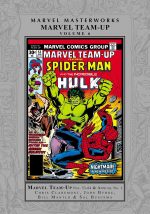
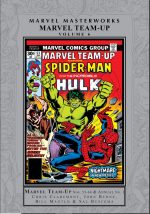
In recent years, carefully curated themed collections from the back-catalogue have served to initiate new readers intrigued by Marvel’s Movie and TV endeavours, but there’s no real substitute for seeing Marvel’s continuity unfolding in chronological and this compelling hardback/eBook compilation gathers the contents of Marvel Team-Up #53-64; MTU Annual #1 and includes a pertinent debut from Marvel Premiere #31; collectively covering August 1976 to December 1977.

Following Chris Claremont’s Introduction offering fond remembrances of the times and key writer Bill Mantlo, open with an epic length adventure from Marvel Team-Up Annual #1 by Mantlo, Sal Buscema & Mike Esposito (from a plot by Mantlo, Claremont & Bonnie Wilford).

‘The Lords of Light and Darkness!’ sees Spider-Man and the then-newly minted and revived X-Men, Banshee, Wolverine, Nightcrawler, Storm, Colossus, Phoenix and Cyclops helping Charles Xavier combat a pantheon of scientists mutated by atomic accident and elevated to minor godhood.

Like most deities, the puissant ones believed they knew what was best for humanity…

Mantlo then teamed with John Byrne & Frank Giacoia to bring closure to a tale begun – and left hanging – in August 1976’s Marvel Premiere #31, which can be found at the back of this book.

Marvel Team-Up #53 detailed a ‘Nightmare in New Mexico!’ as The Hulk meets troubled and AWOL gene-splicing experiment Woodgod as the tragic construct flees from corrupt Army Colonel Del Tremens. By the time the wallcrawler drops in, the fugitive outcasts have joined forces leaving him a  ‘Spider in the Middle!’ (inked by Esposito).

As Tremens seeks to suppress the calamitous crisis – and his own indiscretions – by killing everyone, the final scene sees the webspinner trapped in a rocket and blasted into space…

Marvel Team-Up #55 revealed a ‘Spider, Spider on the Moon!’ (Mantlo, Byrne & Dave Hunt) with returned cosmic Avenger Adam Warlock intercepting the ship before assisting the Arachnid and mysterious alien The Gardener against The Stranger: all seeking possession of the Golden Gladiator’s life-sustaining Soul Gem…

Back on Earth but still a trouble-magnet, in #56 Spider-Man assists Daredevil against ‘Double Danger at the Daily Bugle!’ (Mantlo, Sal B & Hunt) when Electro and Blizzard take the entire Newsroom hostage, after which Claremont assumed full scripting duties, laying the groundwork for a complex extended thriller embroiling the still-naïve hero in a deadly espionage plot.

With artists Sal Buscema & Dave Hunt, Claremont began redefining the Widow’s ways in Marvel Team-Up #57 (May 1977). ‘When Slays the Silver Samurai!’ sees Spidey saved from lethal ambush by the Black Widow, implausibly holding up a collapsing building, and reluctantly taking possession of a strange statuette that he soon forgets all about. That’s an oversight he’ll later regret…

In #58, the webspinner aids Ghost Rider against The Trapster in ‘Panic on Pier One!’ (Pablo Marcos inks) before he can investigate further.  Another distraction comes when MTU #59 declares ‘Some Say Spidey Will Die by Fire… Some Say by Ice!’ (Claremont, Byrne & Hunt) when veteran Avenger Yellowjacket is apparently murdered by rampaging mystery maniac Equinox, the Thermo-Dynamic Man. The Amazing Arachnid is hard-pressed to stop the traumatised Waspexacting bloody vengeance in concluding episode ‘A Matter of Love… and Death!’ in MTU #60…

The secret of the clay artefact is revealed in #61 as Human Torch Johnny Storm joins his creepy-crawly frenemy in battle against the Super-Skrull and learns ‘Not All Thy Powers Can Save Thee!’, with the furious clash calamitously escalating to include Ms. Marvel Carol Danvers with the next issue’s ‘All This and the QE2’…

Despite the very best efforts of Claremont & Byrne, their Kung Fu fantasy Iron Fist never quite achieved the kind of sales traction that rewarded their collaboration on the X-Men. The living weapon lost his circulation battle with issue #15 of his own title. Although ending in spectacular fashion, the cancellation was clearly unplanned, as two major subplots went unresolved: private detective Misty Knight had disappeared on an undercover assignment to investigate European gang-boss John Bushmaster and K’un Lun kid Danny Rand was suffering repeated attacks on his chi by the enigmatic and murderous Steel Serpent…

Frustrated fans didn’t have to wait long for a resolution. Marvel Team-Up was becoming the creative team’s personal clearing house for unresolved plot-lines. Issues #63 & 64 exposed the secret of the sinister K’un Lun pariah on the ‘Night of the Dragon’ before Rand and Spidey – with the assistance of Daughters of the Dragon Misty Knight and Colleen Wing– finally ended his threat in blistering martial arts manner with ‘If Death Be My Destiny!’

This epic tome is packed with rarely-seen extras, beginning with the contents of the Marvel Comics Memory Album Calendar 1977, released in late 1976 and preceded here by a ‘Special F.O.O.M. Preview!’ from the fabled fan-mag’s #16 (December 1976) issue. The Calendar pages follow, written by Roy Thomas and limned by Jack Kirby, John Romita Sr., Joe Sinnott, Ed Hannigan, Frank Giacoia, Gil Kane, John Buscema, Ron Wilson, Gene Colan, Jack Abel, Ross Andru & Mike Esposito, George Pérez, Tom Palmer, P. Craig Russell and John Verpoorten.

As an added treat, the debut/origin of “The Man-Brute Called Woodgod” (Marvel Premiere #31, August 1976) comes next as Mantlo, Keith Giffen and Klaus Janson explore the merits, ethics and repercussions of manufacturing life and meddling with nature. ‘Birthday!’ finds a modern-day faun rampaging through the ruins of a murdered town, searching for meaning and answers from the savage military men and technicians whose only solution to oversight and potential censure is murder and cover-ups…

The sinister science project saga is supplemented by F.O.O.M. #13’s interview ‘Woodgod Wanderings’ plus a gallery of Byrne original art pages.

These tales are of variable quality but all have an honest drive to entertain and please, whilst artistically the work – particularly action-man-on-fire Byrne – is superb, and most fans will find little to complain about. Although not perhaps a book for casual or more maturely-oriented readers there’s lots of fun on hand and young readers – or Marvel Cinematic supporters – will have a blast, so why not consider this tome for your “Must-Have” library? © 2021 MARVEL
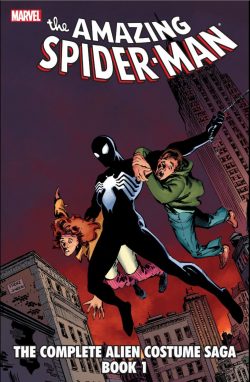
The Amazing Spider-Man: The Complete Alien Costume Saga – Book 1


By Tom DeFalco, Al Milgrom, David Michelinie, Louise Simonson, Cary Burkett & Tony Isabella with Roger Stern, Jim Owsley & Bob DeNatale, Ron Frenz, Greg LaRocque, Rick Leonardi & Paul Neary with David Mazzuchelli & various (MARVEL)
ISBN: 978-0-7851-8867-4 (TPB)

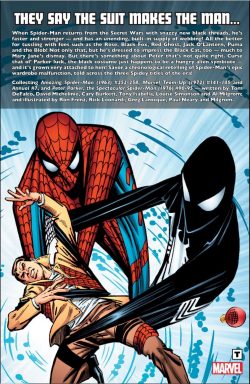
Spider-Man exchanged his heavily-copyrighted and thoroughly trademarked costume whilst on another planet during the first Marvel Secret Wars. It was replaced with a magnificently stylish black & white number for the duration of the 12 issue maxi-series in his own titles (except the all-reprint Marvel Tales) which over the course of the year revealed the true horrifying nature of the extraterrestrial ensemble…

Collecting Amazing Spider-Man #252-258; Marvel Team-Up #141-145 and MTU Annual #7 and Peter Parker, The Spectacular Spider-Man #90-95 and covering May-November 1984, this rather rare paperback or instantly accessible digital tome seeks to chronologically cover all the bases in regard to the black bodysuit’s every appearance and thus opens with relevant clips from clips from Secret Wars #8, 9 and 12…

Continuity-wise, the extended epic opens at the conclusion of the Secret Saga with Spider-Man and Curt Connors – occasionally lethally maniacal monster the Lizard – explosively returning to Earth after a week when the world’s greatest heroes and villains had simply vanished.

To clear up any potential confusion: Marvel Super Heroes Secret Wars debuted in May 1984 and ran for 12 monthly issues until April 1985. In it, a selection of metahumans good and bad were shanghaied by a godlike being dubbed The Beyonder: compelled to interminably battle each other. Every other Marvel comic  of that month chronologically occurred in the apparent aftermath of that struggle with most of the returned heroes and villains refusing to divulge what had happened on Battleworld …a cheap but extremely effective ploy which kept fans glued to the Limited Series in the months that followed.

This compendium catapults us into action with ‘Homecoming!’ by Roger Stern, Tom DeFalco, Ron Frenz & Brett Breeding as spectators in Central Park see a mysterious black garbed stranger explode out of an alien artefact … only the first of many costumed characters to escape the Beyonder’s world.

Spider-Man takes the shell-shocked Connors back to his family and then begins to explore his new uniform: a thought-controlled, self-activating, metamorphic ball with chameleon capabilities, able to construct webbing out of its own mass.

The smart-cloth is astonishing, but weary Peter Parker has family to see and a city to reacquaint himself with. The hero promises himself he’ll further research the incredible material at a later date…

Not included here, Marvel Team-Up #140 posed a morally trying dilemma as a city-wide blackout provoked riots and looting. Spider-Man was on scene when a pawnshop owner was shot dead and the next day, lawyer Matt Murdock was appointed to defend a teenager indicted for the murder. Parker was there too, and knows the kid is innocent. As Spider-Man investigates, Daredevil‘s old flame Natasha Romanoff volunteers to fact-find for the overworked attorney. When investigations overlapped a street gang was confirmed to be behind the incident, but the new murder suspect triggered a deadly car chase and hostage situation before being apprehended. Frustratingly – although responsible for much of the tragedy on that night – he quickly proves to also be innocent of the pawnbroker’s death…

This yarn happened at the beginning of Secret Wars and it’s a much-altered Spider-Man who joins Daredevil and the Black Widow in obtaining ‘Blind Justice’ in #141 (by DeFalco, Jim Owsley AKA Priest, Greg LaRoque & Mike Esposito) as the heroes uncover New York mob connections, a trail to Kingpin Wilson Fisk, the real killer and the true nature of the kid they’ve been defending…

In Peter Parker, The Spectacular Spider-Man #90, Al Milgrom & Jim Mooney’s ‘Where, oh Where Has My Spider-Man Gone…?’ sees occasionally reformed adventurer and thief the Black Cat scouring the city and encountering many foes and friends before finally finding her transformed man, after which the wonderful Rick Leonardi & Bill Anderson illustrate DeFalco’s powerful crime thriller ‘By Myself Betrayed!’

Here a prominent football player, sucked into gambling and match-fixing, drags the Web-spinner into conflict with new gang-lord The Rose. As his new uniform increasingly, obsessively amazes Peter with its rather disturbing autonomy (it comes to him unbidden and regularly envelops him while he sleeps), the hero uncomprehendingly alienates his beloved Aunt May when he drops out of college…

Milgrom & Mooney’s ‘If it Wasn’t for Bad Luck…’ in PPSS #91 sees the Black Cat keeping secrets from her frankly now-creepy paramour even as mutant menace the Blob goes on a grief-fuelled rampage before Amazing Spider-Man #254 questions ‘With Great Power…’ (DeFalco, Leonardi & Joe Rubinstein) as the ebon wallcrawler battles terrorist mercenary Jack O’Lantern for possession of a hi-tech battle-van designed and built by the terrifying Hobgoblin. Peter should have been reconciling with May, and suffers another heartbreaking personal setback…

PPSS #92 (Milgrom & Mooney) bombastically introduces the Kingpin’s latest diabolical fixer in ‘And the answer is…’, with the Cat desperate to keep Spider-Man in the dark about her deal with Wilson Fisk, whilst Marvel Team-Up #142 and 143 take the wallcrawler very far from home in a cosmic mini epic by David Michelinie, LaRoque & Esposito.

‘Foiled!’ sees living light source Monica Rambeau (the second Marvel Captain Marvel) trapped in energy form following a high-tech heist and dependent on Spidey and Titan Starfox to save the day and secure a trans-dimensional remedy in ‘Shifts and Planes’…

In Amazing Spider-Man #255, DeFalco, Frenz & Rubinstein introduce charismatic septuagenarian cat-burglar Black Fox(whose outfit coincidentally resembled Spidey’s new kit) who is a hapless pawn and target of the ruthless but cash-strapped Red Ghost and his Super-Apes in ‘Even a Ghost Can Fear the Night!’ Compelled to rob until caught by Spider-Man, the Fox orchestrated a spectacular battle between the hero and the Ghost before getting away with all the loot…

Marvel Team-Up Annual #7 (by Louise Simonson, Paul Neary & Sam De La Rosa) saw Spider and Cat meet Alpha Flight as a certain Elder of the Universe goes after aliens to complete a set and falls for ‘The Collected Spider-Man’.

The issue also revealed ‘No Place to Run’ for a loving ordinary couple forever unsettled by witnessing the world of Superheroes and villains by Bob DeNatale, David Mazzuchelli & Brett Breeding…

Milgrom & Mooney crafted ‘A Hot Time in the Old Morgue Tonight!’ for Peter Parker, The Spectacular Spider-Man#93 as The Answer stalks the Black Cat to unearth Spider-Man’s secrets, only to see love being poisoned and Spidey’s suit start to malfunction…

Subsequently kidnapping the Cat is only part of his masterplan – as is letting the wallcrawler win her back…

Cary Burkett, LaRoque & Esposito pit the webslinger and Moon Knight against Chinese ganglord White Dragon in ‘My Sword I Lay Down!’ as a prelude to Milgrom & Mooney bringing Cloak and Dagger into the game with PPSS #94’s ‘How Ya Gonna Keep ’em Down at the Morgue After They’ve Seen N.Y.C.?’ as the Kingpin resurrects his former rival Silvermane and the mindless cyborg goes wild. The tale ends but does not conclude here with #95 and ‘The Dagger at the End of the Tunnel’ as the Kingpin’s grand scheme is exposed and one hero falls…

Closing the team tussles, MTU #145 (September 1984, by Tony Isabella,  LaRocque & Esposito) delivers ‘Hometown Boy’: from the period when Tony Stark first succumbed to alcoholism. He lost everything, and friend/bodyguard Jim Rhodes took on the role and duties of the Golden Avenger. As Stark tried to make good with a new start-up company, this engaging yarn sees the substitute hero still finding his ferrous feet whilst battling oft-failed assassin Blacklash (formerly Whiplash) at a Cleveland trade fair, as much hindered as helped by visiting hero Spider-Man wearing his enigmatic black duds…

Having granted readers a period of adjustment, the saga hits its stride in Amazing Spider-Man #256 as ‘Introducing… Puma!’ finds an increasingly weary and listless Spider-Man attacked by a Native American super-mercenary hired by the Rose. The Arachnid’s gang-busting crusade beside Black Cat was making life too hot and unprofitable for the ambitious mobster…

That calamitous clash carries over into ‘Beware the Claws of Puma!’ furiously escalating until The Kingpin steps in to stop it, forcing the Rose to ally himself with the murderous Hobgoblin. The issue ends with an exhausted Parker confronted with a stunning revelation from former lover Mary Jane Watson…

The shock prompts Peter into seeking out ‘The Sinister Secret of Spider-Man’s New Costume!’ Plagued by nightmares, perpetually tired and increasingly debilitated, the webslinger visits the Fantastic Four and is disgusted and horrified to learn that his suit is alive: a parasite slowly attaching itself to him body and soul…

Meanwhile, Hobgoblin and the Rose’s uneasy alliance has resulted in bloody, undeclared war on the Kingpin…

With Reed Richards‘ help the creature is removed from Spider-Man and imprisoned, but the story is still unfinished and there’s so much more to come.

To Be Continued…

Also on show here are Leonardi designs from Mike Zeck’s design for the black costume from Marvel Age #12; text pieces by Bob Sodaro & Mark Lerer from #14; covers by Ron Lim, Larry Mahlstedt, Keith Williams, Milgrom, Terry Austin, from Marvel Tales #266-272 (reprinting the Amazing Spider-Man stories) and two previous collection covers by Ron Frenz, Rubinstein and John Romita Sr.

Rounding out this initial collection is a foreword by Jim Salicrup from the 1988 collection; seven original art pages by Frenz & Breeding, LaRocque, Rubinstein & Esposito, and front and back covers from Essential Peter Parker, The Spectacular Spider-Man volume 4 by Milgrom, tom chu and Tom Smith.

This run of tales marvellously rejuvenated the Amazing Arachnid: kicking off a period of gripping and imaginative stories that culminated with the creation of arch antihero/villain Venom and today’s whole symbiote super-subculture.  If you’re a fan of superhero comics these are tales you just don’t want to miss, specially in Spder-Man’s anniversary year!
© 2019 MARVEL

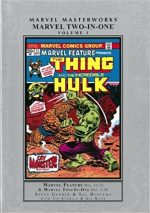
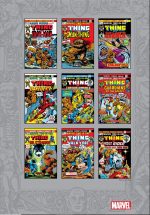
Marvel Two-in-One Masterworks volume 1


By Steve Gerber, Len Wein, Mike Friedrich, Chris Claremont, Jim Starlin, Gil Kane, Sal Buscema, George Tuska, Herb Trimpe, Bob Brown & various (Marvel)
ISBN: 978-0-7851-6633-7 (HB)

Imagination isn’t everything. As Marvel slowly grew to a position of dominance in the wake of losing their two most innovative and inspirational creators, they did so less by risky experimentation and more by expanding and exploiting proven concepts and properties.

The only real exception to this was their en masse creation of horror titles in response to the industry down-turn in super-hero sales – a move expedited by a rapid revision in the wordings of the increasingly ineffectual Comics Code Authority rules.

The concept of team-up books – an established star pairing, or battling – and usually both – with less well-selling company characters, was not new when Marvel decided to award their most popular hero the lion’s share of this new title, but they wisely left their options open by allocating an occasional substitute lead in the Human Torch. In those long-lost days, editors were acutely conscious of potential over-exposure – and since super-heroes were actually in a decline, they may well have been right.

After the runaway success of Spider-Man‘s collaborations in Marvel Team-Up, the House of Ideas reinforced the trend with a series starring bashful, blue-eyed Ben Grimm – the Fantastic Four‘s most iconic member – beginning with two test runs in Marvel Feature before graduating to its own somewhat over-elaborate title.

This compelling compendium – available in hardback and digital formats – gathers the contents of Marvel Feature #11-12 and Marvel Two-In-One #1-10, covering September 1973 – July 1975, and opens with a Roy Thomas Introduction explaining how it was Stan’s idea…

Then the much told tales take centre stage with a perennial favourite pairing and the Thing once more clashing with The Incredible Hulk in ‘Cry: Monster! by Len Wein, Jim Starlin & Joe Sinnott (from MF #11).

Here, Kurrgo, Master of Planet X and the lethal Leader manipulate both blockbusting brutes into duking it out – ostensibly to settle a wager – but with the mighty minded, misshapen masterminds each concealing hidden agendas…

That ever-inconclusive yet cataclysmic clash leaves Ben stranded in the Nevada desert where Mike Friedrich, Starlin & Sinnott promptly drop him in the middle of the ongoing war against mad Titan Thanos with Iron Man helping Ben crush monstrous alien invaders in ‘The Bite of the Blood Brothers!’ (Marvel Feature #12, November 1973): another spectacular and painfully pretty all-action punch-up.

Still stuck in the desert when the dust settles, Ben laboriously treks to a minor outpost of civilisation just in time to be diverted to Florida for the grand opening of his own title. Cover-dated January 1974, Marvel Two-In-One #1 sees Steve Gerber, Gil Kane & Sinnott magnificently detail the ‘Vengeance of the Molecule Man!’, with Ben learning some horrifying home truths about what constitutes being a monster after battling with and beside ghastly, grotesque anti-hero Man-Thing.

With the second issue Gerber cannily trades a superfluous supporting character from his Man-Thing series to add some much-needed depth to the team-up title. ‘Manhunters from the Stars!’ pits Ben, old enemy Namor, the Sub-Mariner (another series Gerber was currently writing) and the Aquatic Avenger’s feisty and single-minded cousin Namoritaagainst each other as well as aliens hunting the emotionally and intellectually retarded superboy Wundarr. Another dynamically, intoxicating tale illustrated by Kane & Sinnott, this case also leaves the Thing as de facto guardian of the titanic teenaged tot…

Sal Buscema signed on as penciller with #3 as the Rocky Ranger joins the Man Without Fear ‘Inside Black Spectre!’: a crossover instalment of the extended epic then playing out in Daredevil #108-112 (in case you’re wondering, this action-packed fight-fest occurs between the second and third chapters) after which ‘Doomsday 3014!’ (Gerber, Buscema & Frank Giacoia) finds Ben and Captain America visiting the 31st century to save Earth from enslavement by the reptilian Brotherhood of Badoon, leaving Wundarr with Namorita for the foreseeable future…

The furious future-shocker concludes in MTIO #5 as the original Guardians of the Galaxy (not the movie group) climb aboard the Freedom Rocket to help our time-lost heroes liberate New York before returning home. The overthrow of the aliens was completed by another set of ancient heroes in Defenders #26-29 (which is also the subject of a different review)…

Marvel Two-In-One #6 began a complex crossover tale with the aforementioned Defenders as Dr. Strange and the Thing witness a cosmic event which begins with a subway busker’s harmonica and leads inexorably to a ‘Death-Song of Destiny!’ (Gerber, George Tuska & Mike Esposito) before Asgardian outcasts Enchantress and the Executioner attempt to seize control of unfolding events in #7’s ‘Name That Doom!’ (pencilled by Sal Buscema).

As they are thwarted by Grimm and the valiant Valkyrie, there’s enough of an ending here for casual readers, but fans and completists will want to hunt down Defenders #20 or Defenders Masterworks link please volume 3 for the full story…

Back here, however, MTIO #8 teams Grimm and supernatural sensation Ghost Rider in a quirkily compelling Yuletide yarn. ‘Silent Night… Deadly Night!’ – by Gerber, Buscema & Esposito – finds the audacious Miracle Man trying to take control of a very special birth in a stable…

Gerber moved on after plotting Thor team-up ‘When a God goes Mad!’ for Chris Claremont to script and Herb Trimpe & Joe Giella to finish: a rushed and meagre effort with the Puppet Master and Radion the Atomic Man making a foredoomed power play, before issue #10 concludes this initial compendium.

Crafted by Claremont, the still much-missed Bob Brown & Klaus Janson, it is a slice of inspired espionage action-intrigue with Ben and the Black Widow battling suicidal terrorist Agamemnon who plans to detonate the planet’s biggest nuke in blistering thriller ‘Is This the Way the World Ends?’.

These stories from Marvel’s Middle Period are of variable quality but nonetheless represent an honest attempt to entertain and exhibit a dedicated drive to please. Whilst artistically the work varies from adequate to utterly superb, most fans of the frantic Fights ‘n’ Tights genre would find little to complain about.

Although not really a book for casual or more maturely-oriented readers there’s still buckets of fun on hand and young readers will have a blast, so why not to add this colossal comics chronicle to your straining superhero bookshelves?
© 2020 MARVEL

Black Widow Epic Collection volume 2: The Coldest War 1981-1998


By Ralph Macchio, Gerry Conway, D.G. Chichester, Jim Starlin, Cefn Ridout, Mindy Newell, Scott Lobdell, Paul Gulacy, George Pérez, George Freeman, Larry Stroman, Joe Chiodo, Charlie Adlard, Bob Layton, Butch Guice, John Stanisci, Sergio Cariello, Randy Green & various (Marvel)
ISBN: 978-1-3029-2126-2 (TPB)

Win’s Christmas Gift Recommendation: All-Out Action Adventure to Rival Any Cinema Classic… 8/10

Natasha Romanoff (sometimes Natalia Romanova) is a Soviet Russian spy who came in from the cold and stuck around to become one of Marvel’s earliest female stars, using a nomme de guerre first coined for a golden age supernatural superstar. Today’s Black Widow started life as a svelte, sultry honey-trap during Marvel’s early “Commie-busting” days, targeting Tony Stark and battling Iron Man in her debut (Tales of Suspense #52, April, 1964).

She was subsequently redesigned as a torrid tights-&-tech super-villain before defecting to the USA, falling for an assortment of Yankee superheroes – including Hawkeye and Daredevil – before finally enlisting as an agent of S.H.I.E.L.D., setting up as a freelance do-gooder and joining (occasionally leading) The Champions and The Avengers.

Throughout her career, she has always been considered ultra-efficient, coldly competent, deadly dangerous and yet somehow cursed to bring doom and disaster to her paramours. As her backstory evolved, it was disclosed that Natasha had undergone experimental processes which enhanced her physical capabilities and lengthened her lifespan, as well as assorted psychological procedures which had messed up her mind and memories…

Traditionally a minor fan favourite, the Widow only really hit the big time after Marvel’s cinematic franchise was established, but for us unregenerate comics-addicts, her print escapades have always offered a cool, sinister frisson of delight.

This expansive trade paperback and digital compilation gathers the contents of Bizarre Adventures #25, Marvel Fanfare #10-13; Solo Avengers #7; Black Widow: The Coldest War; Punisher/Black Widow: Spinning Doomsday’s Web; Daredevil/Black Widow: Abattoir; Marvel Comics Presents #135; Daredevil Annual #10; Fury/Black Widow:Death Duty and Journey into Mystery #517-519, cumulatively covering March 1981 to April 1998.

Preceded by prose  recaps ‘The Black Widow and Daredevil’ and ‘We are The Champions’, the action opens with an iconic appearance from 1981, first seen in monochrome mature-reader magazine Bizarre Adventures #25, featuring short tales starring female heroes.

Here Ralph Macchio scripted a far more devious spy yarn of double and triple cross with agents betraying each other while trying to ascertain who might be working for “the other side”…

‘I Got the Yo-Yo… You Got the String’ sees the Widow despatched by S.H.I.E.L.D. to assassinate her former tutor Irma Klausvichnova in an African political hot spot. However, as the mission proceeds, Natasha learns that she can’t trust anybody and everything she knows is either a lie or a test with fatal consequences…

The chilling, twist-ridden tale is elevated to excellence by the powerful tonal art of Paul Gulacy who fills the piece with sly tributes to numerous movie spies and the actors – such as Michael Caine and Humphry Bogart – who first made the genre so compelling.

Next up is a saga seen in Marvel Fanfare #10-13 (August 1983-March 1984), wherein Macchio and George Pérez – with inkers Brett Breeding, Jack Abel, Joe Sinnott, Al Milgrom & John Beatty – depict the spy in extreme peril as ‘Widow’finds her tapped again by S.H.I.E.L.D. to extract an abducted asset – her beloved mentor Ivan Petrovich.

As she tracks and trashes assorted killers and crazies, we get a potted rundown of her complex origins before she arrives ‘Back in the U.S.S.R.’: infiltrating a top-secret science project and facing the assembled killer elite of a mystery mastermind with a grudge…

As mercenary assassins close in, ‘The Web Tightens!‘ until a last-minute rescue by agent Jimmy Woo and frenzied clash with mad killer Snapdragon at last leads to revelation and full disclosure after ‘The Widow… Alone!’ faces a foe long believed dead and spectacularly triumphs…

A short from Solo Avengers #7 (June 1988) by Bob Layton & Jackson “Butch” Guice) sees the Widow brave unimaginable peril to return to her old dancing teacher ‘The Token’ she no longer feels worthy of before intriguing superhero spy Original Graphic Novel The Coldest War unfolds.

Set in the last days of the US/Soviet face-off – with what looks to be an epilogue added to address the collapse of the Soviet State – the tale was clearly meant as a contemporary thriller (probably for fortnightly anthology Marvel Comics Presents) before events overtook the time-consuming process of printing a comic.

The afterword – set after the fall of the Berlin Wall – doesn’t jar too much and must have lent an air of imminent urgency to the mix at the time.

Gerry Conway provides a typically complex, double-dealing tale set in the dog-days of Mikhail Gorbachev’s “Perestroika” (“openness”) government, where ambitious KGB upstarts undertake a plan to subvert Natasha  and return her to Soviet control. Their leverage and bait is husband Alexei Shostokoff – whom she has believed dead for years. Naturally, nothing is as it seems, nobody can be trusted and only the last spy standing can be called the winner…

Low key and high-tech go hand in hand in this sort of tale, and although there’s much reference to earlier Marvel classics, it can be easily enjoyed by the casual reader or movie convert.

And what art! George Freeman is a supreme stylist, whose drawing work – although infrequent – is always top rate. Starting out on Captain Canuck, he has excelled on Jack of Hearts, Green Lantern, Avengers, Batman Annual #11 (with Alan Moore), Wasteland, Elric, Nexus and The X-Files (for which he won an Eisner Award). Here, inked by Ernie Colon, Mark Farmer, Mike Harris, Val Mayerik & Joe Rubinstein, with colours from Lovern Kindzierski, he renders a subtle and sophisticated blend of costumed chic and espionage glamour to make this tale a “must-have” item all by itself.

It’s followed by 1992’s OGN Punisher/Black Widow: Spinning Doomsday’s Web by D.G. Chichester, Larry Stroman & Mark Farmer. Action-packed and plot-lite, it sees Frank Castle clash with the super-agent as she tracks rogue killer Peter Malum: an atomic scientist with a taste for slaughter and an insatiable thirst to test the deadliest weapon he’s ever built…

Presumably her spicy spy cachet wasn’t deemed enough to garner a regular series but warranted plenty of guest shots. In 1993, Jim Starlin & Joe Chiodo reunited her with an old lover for OGN Daredevil/Black Widow: Abattoir as a duo of depraved psionic predators inflict the tortures of the damned upon the Widow until the Man Without Fear saves her… and she subsequently rescues him…

Released in Late August 1993, ‘Legacy’ by Mindy Newell, John Stanisci & Sergio Cariello, was one quarter of Marvel Comics Presents #135 and sees Natasha touch base with her roots in New York’s Russian enclave only to find prejudice, murder and hidden KGB agents, before 1994’s Daredevil Annual #10 ‘Dead End’ offers a kind of sequel by Newell, Cariello & Rich Rankin as Natasha retrieves a lost bio-agent and is unexpectedly forced into reviewing her own defection to find a supposedly long-deceased old enemy…

Presumably crafted under the aegis of the much-missed Marvel UK sub-division, 1995 OGN Fury/Black Widow: Death Duty is by Cefn Ridout & Charlie Adlard and is a bit of a misnomer.

Don’t be fooled by the title and brace yourself for a disappointment if you’re a huge fan of the World War II Howling Commando and irascible erstwhile leader of the planet’s most advanced espionage agency. Although he gets top billing, Nick Fury is largely absent from the post-Cold War proceedings in this pacy thriller that is in actuality the spiritual conclusion to the saga of the mysterious Night Raven.

The enigmatic wanderer was a masked vigilante who fought crime in New York and Chicago s between World Wars I and II. In later years, he was locked in a bloody, pitiless vendetta with immortal villainess Yi Yang, Queen of the Dragon Tong.

Here, when a S.H.I.E.L.D. asset is murdered inside Moscow’s US embassy soon after the fall of the Soviet system, expatriate Russian super-agent/Avenger Natasha Romanoff is dispatched to unravel the secrets the new rulers don’t want revealed.

What she discovers is the incredible fate of the fearsome urban legend now known as Black Bird as he slaughters his way through bureaucrats and Russian Mafia alike in his single-minded mission to destroy the woman who kept him from a peaceful grave.

Superbly illustrated and tightly scripted, this is nonetheless an uncomfortable blending of genres, with a strange pace to it: as if a propose serial was savagely trimmed and pruned with no thought to narrative cohesion.

Closing the file this time around is a 3-part exploit by Scott Lobdell, Randy Green & Rick Ketcham from Journey into Mystery #517-519 (February to April 1998). ‘The Fire Next Time… parts 1-3’ offers a convoluted hunt for a Far Right terror group’s hidden leader whose scheme to simultaneously murder every S.H.I.E.L.D. agent on Earth revolves around a hidden traitor. But as the plot unfolds, it’s clear to the beleaguered Widow that absolutely nobody is who or what they seem…

Supplemented by Gulacy’s stunning 1982 Black Widow Portfolio (six monochrome plates and the cover image); info pages from the Official Handbook of the Marvel Universe and pin-ups and posters by Al Milgrom, Kevin Nowlan, Terry Austin, June Brigman & Jim Lee and Joe Chiodo, this monumental collection also contains original art pages from Chiodo, Stroman & Farmer and covers by Yancy LaBat, Mark Morales, Pérez & Layton from previous collections of Black Widow: Web of Intrigue combining to create a suspenseful dossier of devious delights no fan should miss.
© 2020 MARVEL.

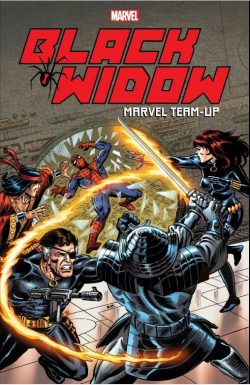
Black Widow: Marvel Team-Up


By Chris Claremont, Tom DeFalco, Marv Wolfman, Roger McKenzie, Bill Mantlo, Priest, Fabian Nicieza, Robert Campanella, Dan Slott, Bob Brown, Sal Buscema, Will Meugniot, Ron Frenz & Greg LaRocque, Rob Liefeld, Larry Alexander & Dwayne Turner & various (DC Comics)
ISBN: 978-1-3029- (TPB)

The concept of team-ups – an established star pairing or battling (usually both) with new or less well-selling company characters – has been with us since the earliest days of comics, but making the temporary alliance a key selling point really took hold with DC’s The Brave and the Bold before being taken up by their biggest competitor.

Marvel Team-Up was the second regular Spider-Man title, launching at the end of 1971. It went from strength to strength, heralding expansion and spawning a second collaborative vehicle in Marvel Two-In-One (with the Fantastic Four‘s strong man The Thing), both offering regular venues for uncomplicated action romps in addition to the House of Ideas’ complex sub-plot fare.

However, even in the infinite Marvel Multiverse, certain stars shine more brightly than others and some characters turn up in team-ups more often than others…

In recent years, carefully curated themed collections from the back-catalogue have served to initiate new readers intrigued by Marvel’s Movie and TV endeavours, and this engaging trade paperback/eBook compilation gathers a selection of potent pairings starring superspy The Black Widow, taken from MTIO #10; Marvel Team-Up #57, 82-85, 98, 140-141 and short tales from fortnightly anthology Marvel Comics Presents #53, 70 and 93: collectively spanning July 1975 – January 1992.

Natasha Romanoff (sometimes Natalia Romanova) is a Soviet Russian spy who came in from the cold and stuck around to become one of Marvel’s major female stars. She started life as a svelte, sultry honey-trap during the early “Commie-busting” days, targeting Tony Stark and battling Iron Man in her debut (Tales of Suspense #52, April, 1964).

She was subsequently redesigned as a torrid tights-&-tech super-villain before defecting to the USA, falling for an assortment of superheroes – including Hawkeye and Daredevil – before finally enlisting as an agent of S.H.I.E.L.D., setting up as a freelance do-gooder and joining/occasionally leading the Avengers.

Throughout her career she was always ultra-efficient, coldly competent, deadly dangerous and yet somehow cursed to bring doom and disaster to her paramours. As her backstory evolved, it was revealed Natasha had undergone experimental processes which enhanced her physical capabilities and lengthened her lifespan, as well as assorted psychological procedures which had messed up her mind and memories…

Traditionally a minor fan favourite, the Widow only really hit the big time after the Marvel Movie franchise was established, but for us unregenerate comics-addicts her print escapades have always offered a cool, sinister frisson of delight.

The multi-player mayhem opens with Marvel Two-In-One #10 by Chris Claremont, Bob Brown & Klaus Janson: a slice of inspired espionage action-intrigue with Ben Grimm joining the Widow’s war against suicidal terrorist Agamemnon who plans to detonate the planet’s biggest nuke at the bottom of the ocean in a blockbuster 007-styled thriller ‘Is This the Way the World Ends?’.

With artists Sal Buscema & Dave Hunt, Claremont continues defining the Widow’s ways in Marvel Team-Up #57 (May 1977) starting a complex extended thriller embroiling Spider-Man in a devious and deadly espionage plot which begins ‘When Slays the Silver Samurai!’ After being saved from a lethal ambush by Natasha and implausibly holding up a collapsing building, Spidey takes reluctant possession of a strange statuette but soon forgets all about it

The scheme comes to fruition in MTU #82 (June 1979) when Claremont, Sal B & Steve Leialoha craft a 4-part, multi-operative conclusion starting with Spider-Man saving Natasha from street thugs. In ‘No Way to Treat a Lady’ the lethal superspy has escaped capture and torture by retreating into a timid, ineffectual cover personality, and the Arachnid must keep “Nancy Rushman” alive until he learns how and why. The job gets even harder after S.H.E.I.L.D.’s Strike Forcecome mercilessly gunning for her…

The first (white) Nick Fury joins the fray in ‘Slaughter on 10th Avenue!’ capturing Nancy before discovering – when Spidey steals her back – that his entire organisation has been taken over by hidden mastermind Viper and her super hench-thugs Silver Samurai and Boomerang…

‘Catch a Falling Hero’ (MTU #84) reveals the purpose of that long-forgotten statuette, as Viper targets Washington DC and President Jimmy Carter. Meanwhile Spider-Man and the slowly recovering Nancy infiltrate the compromised flying fortress Helicarrier and Fury calls in British operative Shang Chi, Master of Kung Fu for a distracting frontal assault, culminating in all-out war above the Capitol and the closest of close shave conclusions for all concerned in ‘The Woman Who Never Was!’

A far simpler motive reunited the widow and the webspinner when separate cases overlapped in MTU #98 (October 1980, in an untitled tale by Marv Wolfman, Roger McKenzie, Will Meugniot & Bruce Patterson). Here dockside gunrunners and ambitious mobsters draw the heroes into a clash with The Owl, after which we jump to April 1983 and MTU #140 for the first part of a morally trying dilemma posed by Bill Mantlo, Tom DeFalco, Ron Frenz & Mike Esposito with ‘Where Were You …When the Lights Went Out?’

A city-wide blackout provokes riots and looting and Spider-Man is on scene when a skeevy pawnshop owner is shot dead. The next day, lawyer Matt Murdock is appointed to defend gangbanger teen Juan Santiago who is indicted for the murder. Press photographer Peter Parker is also in attendance, and both know the kid is not guilty. As Spider-Man resolves to investigate further, Daredevil‘s old flame Natasha Romanoff volunteers to fact-find for the overworked attorney. When investigations overlap a street gang are exposed as behind the incident, but the new murder suspect triggers a deadly car chase and hostage situation before being apprehended.

Frustratingly, although responsible for much of the tragedy on that night, he quickly proves to also be innocent of the pawnbrokers’ death…

This yarn takes place at the beginning of Marvel’s Secret Wars event and pauses for Spidey to go to The Beyonder‘s Battleworld; fight lots and come back with his all-black Symbiote uniform, so it’s a much-altered Spider-Man who joins Daredevil and the Widow in obtaining ‘Blind Justice’ in #141 (DeFalco, Jim Owsley AKA Priest, Greg LaRoque & Esposito) as the heroes uncover mob connections and a trail to Kingpin Wilson Fisk, the real killer and the true nature of the kid they’ve been defending…

The team-ups conclude with a selection from twice monthly rotating anthology Marvel Comics Presents, starting with ‘Heads I Win, Tails You Lose’: a jurisdictional clash between Natasha and mercenary antihero Silver Sable from #53 (July 1990) by Fabian Nicieza, Rob Liefeld & Bob Wiacek, and continuing with ‘One into Three Won’t Go!’ (#70, February 1991 by Robert Campanella, Larry Alexander, Jack Abel & Al Milgrom) as the Widow and fellow former Champion Darkstar battle the hyper-irradiated Red Guardian when her master The Presence orders her to capture them for his harem.

Their valiant resistance inspires Tania Belinskaya to overthrow her own mental shackles and transform into new hero Starlight before this collection closes with an early outing for superstar scripter Dan Slott & artist Dwayne Turner who end the ultra-espionage alliances with a ‘Split Seconds’ reunion for the Widow and Daredevil from MCP #93, battling Hydra goons and deactivating deadly booby traps in a midtown building.

The book’s bonus section offers original art from Meugniot & Patterson; Frenz & Esposito and cover-art by Ed Hannigan & Klaus Janson, plus data pages of Black Widow and her weapons and gear from the Official Handbook of the Marvel Universe and a painted cover by Al Milgrom.

These stories may vary in quality, but all stem from an honest drive to entertain and most fans will find little to complain about. Although primarily a tome for casual or new readers – who will have a blast – there’s also a ton of nostalgic delights and patented Marvel mayhem to be had by veteran viewers, and surely that’s reason enough to add this titanic tome to your secret stash of great reads…
© 2020 MARVEL

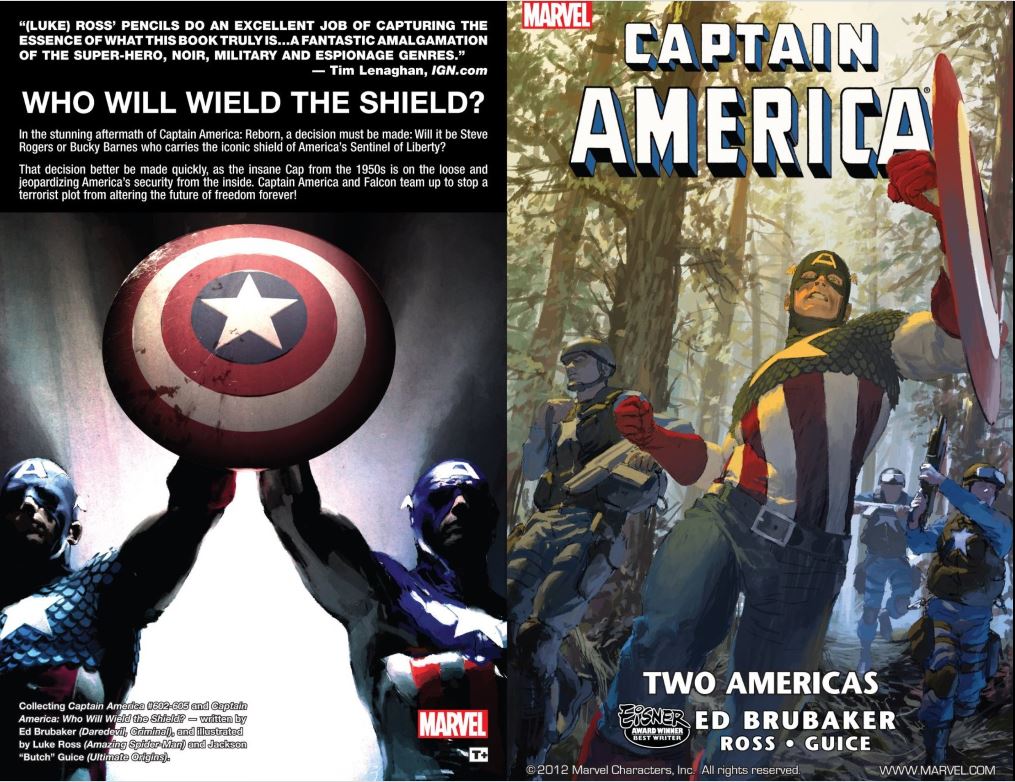
Captain America – Two Americas


By Ed Brubaker, Luke Ross, Butch Guice, Rick Magyar, Dean White & various (Marvel)
ISBN: 978-0-7851-4510-3 (HB) 978-0-7851-4511-0 (TPB)

Created by Joe Simon & Jack Kirby, the Star-Spangled Avenger debuted in his own title in an era of anthology publishing. Cover-dated March 1941, Captain America Comics #1 was a shattering success. The Sentinel of Liberty was the absolute and undisputed star of Timely (now Marvel) Comics’ “Big Three” (the other two being the Human Torch and the Sub-Mariner). He was also in the first rank to fade as the war changed tastes and the Golden Age closed.

When the Korean War and Communist aggression dominated America’s collective psyche in the 1950s, he was briefly revived – with the Torch and Sub-Mariner – but sank once more into obscurity until a resurgent Timely/Atlas reinvented itself as Marvel Comics. Resurrected again in Avengers #4 (March 1964) with the Vietnam conflict just starting to pervade the minds of the American public, this time he stuck around…

Whilst perpetually agonising over the death of teen sidekick (James Buchanan Barnes AKA Bucky) in the final days of the war, living war story Steve Rogers first stole the show in the Avengers, promptly graduated to his own series and, ultimately, returned to solo stardom.

He waxed and waned through the most turbulent period of social change in US history, but always struggled to find an ideological niche and stable footing in the modern world.

In 2006-2007 – as another morally suspect war raged in the real world – he became an anti-government rebel for Marvel event Civil War: subsequently arrested and assassinated on the steps of a Federal Courthouse.

Over the course of 3 epic volumes, he was replaced by the presumed-dead sidekick. In actuality, Bucky had been captured by the Soviets in 1945 and systematically transformed into their own super-agent/assassin The Winter Soldier.

Once rescued from his unwanted enslavement, artificially young and semi-cyborg Barnes reluctantly stepped into his mentor’s big crimson boots…

Set squarely in the immediate aftermath of the original Star-Spangled Avenger’s return from the dead (see various Captain America Reborn collections), this politically-charged compilation – written by Ed Brubaker – collects one-shot Captain America: Who Will Wield the Shield? and issues #602-605 of the monthly Captain America comic book. Available in hardback, trade paperback and digitally, it explores extremism with potent passion and cynical skill…

A rabble-rousing tale of ideology and patriotism begins with ‘Who Will Wield the Shield?’ (art by Luke Ross & Butch Guice), as the liberated Winter Soldier ponders his future in the wake of the “real” Captain America’s recent return to life and considers returning the role and unique Star-emblazoned disc to its rightful owner…

Meanwhile Steve Rogers, fresh from a timeless suspension where he perpetually relived his life over and again, battles debilitating, haunting memories by prowling snow-bound streets where he encounters his replacement and immortal super-spy Black Widow in combat with the ferociously brutal Mr. Hyde.

Content to observe his old partner at first, Rogers soon joins the fray. As the dust settles, the comrades-in-arms reach an understanding: Bucky Barnes will stay as the one-&-only Sentinel of Liberty as the President of the USA has a far more strategic role in mind for his mentor Steve…

That one is the meat of a different tome. Here we jump directly to the eponymous ‘Two Americas’ (Brubaker, Ross, Guice & Rick Magyar), focussing on a deranged duplicate super-soldier who briefly played Captain America in the 1950s, whilst the original languished in icy hibernation in the arctic.

William Burnside was a student from Boise, Idaho, obsessed with the war hero. The lad had ferreted out the hero’s true name, rediscovered most of the super-soldier serum which had created the Star-Spangled Avenger and even had his name and features changed to perfectly mimic the Missing-In-Action Rogers.

Volunteering his services to the FBI, at that time conducting a nationwide war on spies, subversives and (potential) commies, Burnside and impressionable youngster Jack Monroe briefly became the new Captain America and Bucky: crushing poorly-perceived threats to the Land of the Free.

Sadly, it quickly became apparent that their definition of such included not only criminals but also non-whites, independent women and anybody who disagreed with the government…

Some months later the reactionary patriot was forcibly “retired” as the super-soldier serum he and Monroe used turned them into super-strong, raving, racist paranoids.

Years later, when the fascistic facsimiles escaped suspended animation in Federal prison, they attacked the revived real deal, only to be defeated by Cap, his new partner Sam Wilson (AKA the Falcon) and S.H.I.E.L.D. agent Sharon Carter. Monroe was eventually cured, but Burnside’s psychosis was too deeply rooted and he returned often to confront the man he felt had betrayed the real America…

Used most recently as a pawn of the Red Skull, malign psychologist Dr. Faustus and genetic wizard Arnim Zola in a plot to plant a Nazi stooge in the Oval Office, the dark Captain America escaped, fleeing to the nation’s heartland and planning…

When police in Idaho raid a den of reactionary separatist fanatics the Watchdogs, they are butchered by the delusional Burnside who has aligned himself with them in a crazed bid to take back the nation for right-thinking ordinary people like himself. Alerted by Nick Fury, Barnes and the Falcon head for the economically-depressed Midwest where crumbling economy and lack of prospects has driven hard-pressed, hardworking folk into the open arms of the seditionists.

Intending to infiltrate the movement now led by the faux Captain America, things go sideways after Burnside recognises Barnes from his college researches…

Intent on starting a second American Revolution, the crazed patriot ambushes the newest Cap and the Falcon and, whilst planning to set off the biggest bomb in history against the Hoover Dam, demands Barnes returns to his first and proper heroic identity: becoming Bucky to Burnside’s one-and-only Cap…

Determined to convince the equally time-lost Winter Soldier that modern America must be destroyed and the Good Old Days restored, Burnside is still savvy enough to use the hostage Falcon to achieve his ends, but far too prejudiced to accept that a mere black man and flunky sidekick could be competent enough to foil his schemes…

Imprisoned on a train packed with explosives, Wilson busts free, trashing his Watchdog jailers and – with the aid of a simple working Joe (yes, a true “ordinary American”) – diverts the runaway bomb. Burnside and his fanatics then invade Hoover Dam with an even more devastating device, ready to send a message that will spell the end of the failed country and signal the return of the madman’s cherished if illusory idealised America…

However, when Bucky learns the Falcon is safe, he lashes out with ruthless efficiency…

This thoroughly readable thriller is a fascinating examination of idealism and the mutability of patriotism: a sharp, scary saga that avoids the usual trap of overly-depending on a working knowledge of Marvel continuity by providing in situ what little back-story new readers might need. It thunders along to its climactic conclusion, providing thrills, spills and chills in full measure for all fans of Fights ‘n’ Tights action and – sadly – offers insights into nationalism that are more pertinent now than they ever have been…
© 2009, 2010, 2012 Marvel Characters Inc. All Rights Reserved.

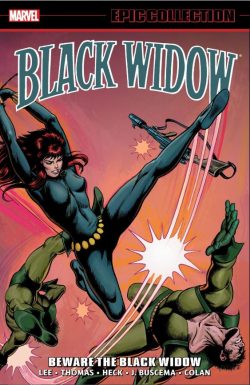
Black Widow Epic Collection volume 1: Beware the Black Widow 1964-1971


By Stan Lee, Don Rico & Don Heck, Roy Thomas, Gary Friedrich, Mimi Gold, Gerry Conway, Jack Kirby, John Buscema, John Romita, Gene Colan, Bill Everett & various (Marvel)
ISBN: 978-1-3029-2126-2 (TPB)

After a truly interminable time of waiting, the Black Widow movie is scheduled for general release on July 9th, so lets all take a look at her comic path from wicked wanton to war-weary world-saver courtesy of a carefully curated Epic Collection, gathering the majority of her earliest appearances.

Natasha Romanoff (sometimes Natalia Romanova) is a Soviet Russian spy who came in from the cold and stuck around to become one of Marvel’s earliest female stars. The Black Widow started life as a svelte, sultry honey-trap during Marvel’s early “Commie-busting” days, targeting Tony Stark and battling Iron Man in her debut (Tales of Suspense #52, April, 1964).

She was subsequently redesigned as a torrid tights-&-tech super-villain before defecting to the USA, falling for an assortment of Yankee superheroes – including Hawkeye and Daredevil – before finally enlisting as an agent of S.H.I.E.L.D., setting up as a freelance do-gooder and joining/occasionally leading the Avengers.

Throughout her career she has always been considered ultra-efficient, coldly competent, deadly dangerous and yet somehow cursed to bring doom and disaster to her paramours. As her backstory evolved, it was revealed that Natasha had undergone experimental processes which enhanced her physical capabilities and lengthened her lifespan, as well as assorted psychological procedures which had messed up her mind and memories…

Traditionally a minor fan favourite, the Widow only really hit the big time after Marvel Movie franchise was established, but for us unregenerate comics-addicts her print escapades have always offered a cool, sinister frisson of delight.

This expansive trade paperback and digital compilation gathers the contents of Tales of Suspense #52-53, 57, 60, 64; Avengers #29-30, 36-37, 43-44; Amazing Spider-Man #86; Amazing Adventures #1-8 and Daredevil #81, plus pertinent excerpts from Avengers #16, 32-33, 38-39, 41-42, 45-47, 57, 63-63 & 76, cumulatively spanning April 1964 to November 1971.

The action opens as a sexy Soviet operative Natasha and her hulking sidekick Boris (yes, I know: simpler times) is despatched to destroy recent defector Anton Vanko and his American protectors Tony Stark and Iron Man. ‘The Crimson Dynamo Strikes Again!’ (drawn by Don Heck and scripted, like the next issue, by “N. Kurok” – actually veteran creator Don Rico) sees the hero quickly dispose of the armoured Russian heavy while underestimating the far greater threat of the Soviet Femme Fatale.

With Tales of Suspense #53, she was a headliner. In ‘The Black Widow Strikes Again!’ she steals Stark’s anti-gravity ray yet ultimately fails in her sabotage mission, fleeing Russian retribution until resurfacing in ToS #57.

The Black Widow returned to beguile disgruntled budding superhero ‘Hawkeye, The Marksman!’ (Stan Lee & Heck) into attacking the Golden Avenger in #57, with no appreciable effect.

Tales of Suspense #60 featured an extended plotline with Stark’s “disappearance” leading to Iron Man being ‘Suspected of Murder!’. Capitalizing on the chaos, lovestruck Hawkeye and the Widow struck again, but another failure led to her being recaptured and re-educated by enemy agents…

Abruptly transformed from fur-clad seductress into a gadget-laden costumed villain, she returned in #64’s ‘Hawkeye and the New Black Widow Strike Again!’ (Lee, Heck & Chic Stone). Her failure led to big changes as pages from Avengers #16 reveal her punishment and Hawkeye’s reformation and induction into the superteam.

Jump forward more than a year and Avengers #29 as Quicksilver and the Scarlet Witch prepare to retire: returning to Europe to reinvigorate their fading powers even as ‘This Power Unleashed!’ brings back Hawkeye’s lost love: a brainwashed nemesis resolved to destroy the team.

Recruiting old foes Power Man and the Swordsman as cannon-fodder, she is foiled by her own incompletely submerged feelings for Hawkeye, after which ‘Frenzy in a Far-Off Land!’ sees dispirited colossus Henry Pym embroiled in a futuristic civil war amongst a lost south American civilisation while a temporary détente between Hawkeye and the Widow seems set to fail…

Extracts from Avengers #32-33 (with Heck providing raw, gritty inks over his own pencils in ‘The Sign of the Serpent!’ and concluding chapter ‘To Smash a Serpent!’) sees her own recovery begin as Natasha independently infiltrates a racist secret society before joining the Avengers to destroy the hatemongering snakes…

Her international credentials are exploited when long-missing Scarlet Witch and Quicksilver return, heralding an alien invasion of the Balkans in ‘The Ultroids Attack!’ and ‘To Conquer a Colossus!’ (Avengers #36-37). Newly cured, programming-free and reformed, she is the crucial factor in repelling an extraterrestrial invasion: a sinister, merciless Black Widow whose willingness to apply lethal force ultimately saves the day and the Earth……

Extracts from Avengers #38, 39, 41 and 42 detail how she then forsakes her new heroic reputation to go undercover for SHIELD, infiltrating a Communist Chinese super-weapon project as a supposed Soviet agent. In #43’s complete tale ‘Color him… the Red Guardian!’ (Roy Thomas, John Buscema & George Roussos) her origins and reasons for the title “widow” are revealed before – reacting to a world-threatening superweapon – the Avengers storm in for the fight of their lives as the saga climaxes in ‘The Valiant Also Die!’ (inked by Vince Colletta), a blistering all-out clash to save humanity from mental conquest…

The fractured relationship between Hawkeye and the Widow plays out in snippets from Avengers #45-47, #63 and 64 as her growing ties to SHIELD lead to an heartbreaking split with the Avenging Archer in #76 and the prospect of a new beginning for the Russian misfit…

It comes in Amazing Spider-Man #86 as ‘Beware… the Black Widow!’ affords John Romita & Jim Mooney a chance to redesign, redefine and relaunch the super-spy in an enjoyable if formulaic Lee-scripted misunderstanding/clash-of-heroes yarn with an ailing webspinner never really endangered. The entire episode was actually a promotion for the Widow’s own soon-to-debut solo series…

The Black Widow‘s first solo series, appeared in “split-book” Amazing Adventures #1-8: mini-epics paying dues the superspy’s contemporary influences… Modesty Blaise and Emma Peel (that lass from the other Avengers…)

It all begins with ‘Then Came…The Black Widow’ (Amazing Adventures #1, August 1970 by Gary Friedrich, John Buscema & John Verpoorten) wherein Natasha comes out of self-imposed retirement to be a socially-aware crusader: defending low-income citizens from thugs and loan sharks. One act of charity leads her to help activists ‘The Young Warriors!’ as their attempts to build a centre for underprivileged kids in Spanish Harlem are countered by crooked, drug-dealing property speculators…

Gene Colan & Bill Everett assume art duties from #3’s ‘The Widow and the Militants!’, with her actions and communist past drawing hostile media attention, more criminal attacks and ultimately precipitating an inner-city siege, before the ‘Deadlock’ (scripted by Mimi Gold) comes to a shocking end…

Roy Thomas steps in for a bleakly potent Christmas yarn as ‘…And to All a Good Night’ sees Natasha and faithful retainer/father figure Ivan meet and fail a desperate young man, only to be dragged into a horrific scheme by deranged cult leader the Astrologer who plans to hold the city’s hospitals to ransom in ‘Blood Will Tell!’ (art by Heck & Sal Buscema).

Convinced she is cursed to do more harm than good, the tragic adventurer nevertheless inflicts ‘The Sting of the Widow!’(Gerry Conway, Heck & Everett) on her ruthless prey and his kid warriors, after which the series wraps up in rushed manner with a haphazard duel against Russian-hating super-patriot Watchlord in the Thomas-scripted ‘How Shall I Kill Thee? Let Me Count the Ways!’

The formative tales conclude here with ‘And Death is a Woman Called Widow’ (Daredevil #81, by Conway, Colan & Jack Abel), which sees infamous defector Natasha Romanoff burst onto the scene to save the Man Without Fear from ubiquitous manipulator Mr. Kline and deadly predator The Owl: exposing the mastermind behind most of DD and the Widow’s recent woes and tribulations…

Rounding out the comics experience here are bonus pages including a stunning pin-up of the bodacious Black Widow by Bill Everett; house ads and a huge gallery of original art pages by John Buscema, Verpoorten, Heck, Colan and Everett – including restored artworks edited for overly-salacious content that revealed a little too much of the sexy spy, and toned down for eventual publication…

These beautifully limned yarns might still occasionally jar with their earnest stridency and dated attitudes, but the narrative energy and sheer exuberant excitement of the adventures are compelling delights no action fan will care to miss …
© 2020 MARVEL.

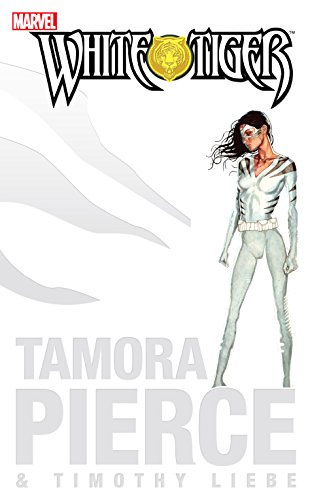
White Tiger: A Hero’s Compulsion


By Tamora Pierce, Timothy Liebe, Phil Briones, Alvaro Rio & various (Marvel)
ISBN: 978-0-7851-2273-9 (TPB)

I’ll try to be brief but bear with me because this might be a little complex for anyone not hardened by 55 years of constant exposure to raw comic-books…

After the mid-1970’s Kung Fu craze subsided Marvel was left with a couple of impressive themed properties (Master of Kung Fu and Iron Fist) and a few that needed some traditional superhero “topping up”. The Sons of the Tiger debuted in monochrome magazine Deadly Hands of Kung Fu: a multi-racial martial arts team who – augmented by three mystic amulets – fought the usual mystic ninja/secret empire types until internal dissent and an obvious lack of creative imagination split them up.

The amulets – a Tiger’s Head and two paws carved from magical jade – passed on to young Hector Ayala who donned all three to become a super-martial artist calling himself the White Tiger. After an inauspicious, short and excessively violent career including team-ups with both Spider-Man and Daredevil, the “first Puerto Rican Superhero” all but vanished until (in a Man Without Fear storyline I’ll get around to reviewing one day) he lost his life…

In the meantime, a new White Tiger had appeared in the 1997 revival of Heroes for Hire: an actual tiger evolved into a humanoid by renegade geneticist the High Evolutionary. In 2003 Kaspar Kole, a black, Jewish cop briefly replaced the Black Panther, becoming the third White Tiger shortly thereafter…

Which finally brings us here as this volume collects the first 6-issue miniseries to feature Angela Del Toro, niece of the first White Tiger; one time cop, de-frocked FBI agent and eventual recipient of the amulets that empowered and doomed her uncle Hector.

Normally I’d steer clear of reviewing a graphic novel like this because by all rights it should be all but impenetrable to non-fans, but novelist Tamora Pierce and co-scripter Timothy Liebe have made the necessary and mandatory recaps and references to other books (particularly the extended Daredevil storyline that dealt with the death of Angela’s uncle and her becoming a costumed vigilante in his memory) relatively painless: a seemingly seamless part of the overall narrative thrust of this tale and one that perfectly suits the action-packed, highly realistic artwork of Phil Briones, Alvaro Rio, Ronaldo Adriano Silva & Don Hillsman.

Angela Del Toro was a high-ranking Federal Agent, but now she’s jobless and bewildered, terrified of becoming just another masked crazy on the streets and skyways of New York City. Luckily, she still has a few friends – both in the legal and extra-legal law enforcement community – and soon links up with a private security firm while sorting out her new double life.

That mostly means coming to terms with being a costumed superhero, stopping a covert cabal of asset-stripping terrorists from turning the USA into a highly profitable war-zone and getting final closure if not revenge on Yakuza prince Orii Sano, the man who killed her partner…

White Tiger: A Hero’s Compulsion is a canny blend of family drama, cop procedural and gritty superhero thriller, with an engaging lead character, believable stakes, just enough laughs and truly sinister baddies who should appeal to the widest of audiences. Fun-filled and frantic with loads of guest-stars, including Spider-Man, Daredevil, Iron Fist, Luke Cage, Black Widow, and such scurrilous dirtbags as the Cobra, the Lizard, Deadpool and the assembled underworld of three continents, this is a read for devotees and dilettantes alike.

Whether cleaning up the mean streets and saving the entire world or just busting heads in her new day job, White Tiger has everything necessary to stay the course, but even if she somehow doesn’t, there will always be this thoroughly fascinating trade paperback and digital book to mark her territory, if not her passing…
© 2006, 2007, 2015 MARVEL. All rights reserved.

Black Widow: Web of Intrigue


By Ralph Macchio, George Pérez, Gerry Conway, Paul Gulacy, George Freeman & various (Marvel)
ISBN: 978-0-78514-474-8 (HB) 978-1-3029-0026-7 (TPB)

The Black Widow started life as a svelte and sultry honey-trap Soviet Russian agent during Marvel’s early “Commie-busting” days. As superhero fever mounted, Natasha Romanoff was subsequently redesigned as a supervillain, fell for an assortment of Yankee superheroes – including Hawkeye and Daredevil – and finally defected; becoming an agent of S.H.I.E.L.D., freelance do-gooder leader of superteam The Champions and occasional commander in chief of The Avengers.

Throughout her career she has been considered efficient, competent, deadly dangerous and somehow cursed to bring doom and disaster to her paramours. As her backstory evolved, it was revealed that she had undergone experimental procedures which had enhanced her physical capabilities and lengthened her lifespan, as well as assorted psychological processes which had messed up her mind and memories…

Always considered a minor fan favourite, the Widow only really hit the big time after appearing in the Iron Man and Captain America movies, but for us unregenerate comics-addicts her print escapades have always offered a cool, sinister frisson of delight.

This particular caper compilation originally surfaced in 2010 but was revived for the post-Avengers movie crowd, compiling an extended adventure from Marvel Fanfare #10-13 (August 1983-March 1984), a landmark mission from Bizarre Adventures #25 (March 1981) and 1990’s Marvel Graphic Novel – The Coldest War.

Leading off the espionage entertainment is Ralph Macchio’s introduction ‘For Your Eyes Only’, extolling the virtues of the genre and reminiscing about his time as Natasha’s scribe scripter, and an Al Milgrom pin-up before the action and intrigue kick off with a convoluted yarn by Macchio and George Pérez, with inkers Brett Breeding, Jack Abel, Joe Sinnott, Milgrom & John Beatty as ‘Widow’ finds the superspy tapped by SHIELD to rescue an abducted asset – her beloved  mentor Ivan Petrovich.

As she tracks and trashes assorted killers and crazies, we get a potted rundown of her complex origins before she arrives ‘Back in the U.S.S.R.’, infiltrating a top-secret science project and facing the assemble killer elite of a mystery madman with a grudge…

As the mercenary assassins close in, ‘The Web Tightens!‘ until a last-minute rescue by SHIELD agent Jimmy Woo and frenzied clash with mad killer Snapdragon at last leads to revelation and full disclosure after ‘The Widow… Alone!’ faces a foe long believed dead and spectacularly triumphs…

That superheroic struggle is followed by an iconic appearance from 1981, seen in mature-reader monochrome magazine Bizarre Adventures #25 featuring short tales starring female heroes. Here Macchio scripted a far more devious spy yarn of double and triple cross with agents betraying each other while trying to ascertain who might be working for “the other side”…

‘I Got the Yo-Yo… You Got the String’ finds the Widow despatched by SHIELD to assassinate her former teacher Irma Klausvichnova in an African political hot spot, but as the mission proceeds, Natasha learns that she can’t trust anybody and everything she knows is either a lie or a test with fatal consequences…

The chilling, twist-ridden tale is elevated to excellence by the powerful tonal art of Paul Gulacy who fills the piece with ironic tributes to many movie spies and the actors – such as Michael Caine and Humphry Bogart – who first made the genre so compelling.

The book concludes with intriguing superhero spy-romp The Coldest War.

Set in the last days of the US/Soviet face-off – with what looks to be an epilogue added to address the collapse of the Soviet State – the entire affair was clearly scripted as a contemporary thriller (probably for fortnightly anthology Marvel Comics Presents) before events overtook the time-consuming process of printing a comic. The afterword – set after the fall of the Berlin Wall – doesn’t jar too much and must have lent an air of imminent urgency to the mix at the time.

Gerry Conway provides a typically complex, double-dealing tale set in the dog-days of Mikhail Gorbachev’s “Perestroika” (“openness”) government where ambitious KGB upstarts undertake a plan to subvert Natasha (nee NataliaRomanova) and return her to Soviet control. Their leverage and bait is husband Alexei Shostokoff – whom she has believed dead for years. Naturally, nothing is as it seems, nobody can be trusted and only the last spy standing can be called the winner…

Low key and high-tech go hand in hand in this sort of tale, and although there’s much reference to earlier Marvel classics this tale can be easily enjoyed by the casual reader or movie convert.

And what art! George Freeman is a supreme stylist, whose drawing work – although infrequent – is always top rate. Starting out on the seminal Captain Canuck, he has excelled on Jack of Hearts, Green Lantern, Avengers, BatmanAnnual #11 (with Alan Moore), Wasteland, Elric, Nexus and The X-Files (for which he won an Eisner Award). Here, inked by Ernie Colon, Mark Farmer, Mike Harris, Val Mayerik & Joe Rubinstein with colours from Lovern Kindzierski, he renders a subtle and sophisticated blend of costumed chic and espionage glamour that make this tale to a “must-have” item all by itself.

Augmented with original art by Arthur Adams, previous collection cover by Yancy LaBat, Mark Morals, Steve Buccellato and Pérez, this epic Primer into the world of the Widow is a dark delight no fan should miss.
© 1990 Marvel Characters, Inc. All rights reserved.

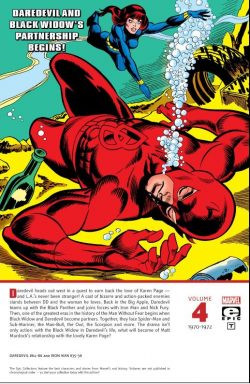
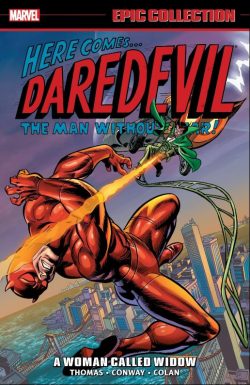
Daredevil Epic Collection volume 4 1970-1972: A Woman Called Widow


By Roy Thomas, Gerry Conway, Gary Friedrich, Gene Colan, Don Heck, Alan Weiss, Barry Windsor-Smith, Bill Everett & various (Marvel)
ISBN: 978-1-3029-2034-0 (TPB)

Matt Murdock is a blind lawyer whose remaining senses hyper-compensate, making him capable of astonishing acrobatic feats, a formidable fighter and a living lie-detector.

Very much a second-string hero for most of his early years, Daredevil was nonetheless a striking and popular one, due in large part to the roster of brilliant artists who had illustrated the strip. He only really came into his own, however, after artist Gene Colan signed up for the long haul…

The natal DD battled thugs, gangsters, an eclectic mix of established and new super-villains and even the occasional monster or alien invasion. He quipped and wise-cracked his way through life and life-threatening combat, utterly unlike the grim, moody quasi-religious metaphor he became under modern authorial regimes…

In these tales from the pivotal era of relevancy, social awareness and increasing political polarisation, the Man Without Fear was also growing into the judicial conscience of a generation turning its back on old values…

Covering May 1970 -April 1972, this trade paperback and digital compilation chronologically re-presents Daredevil #64-86 plus a crossover with Iron Man #35-36 and sees the once-staid and so-very Establishment Murdock move with the shifting cultural mores as scripter Roy Thomas hands over the reins to newcomer Gerry Conway in an increasingly determined move to make the Man Without Fear cutting edge and relevant… …

The action opens here with Horn-Head prowling the rooftops of Los Angeles. He’s there to find the love-of-his-life, who quit New York when the pressure of sharing DD’s secrets proved too much…

After trailing the star-struck Karen Page to Hollywood, DD gets to take out his bad mood on a handy hood in ‘Suddenly… The Stunt-Master!’ (Thomas, Gene Colan & Syd Shores) before eventually helping his old enemy (a petty criminal biker) get a TV show of his own…

Murdock remains in LA to oversee Karen’s first acting gig – a pastiche of then-hot spooky TV phenomenon Dark Shadows – and prevents her becoming part of a murder spree in ‘The Killing of Brother Brimstone’: a classy whodunit which cataclysmically climaxes one month later in ‘…And One Cried Murder!’

Still stuck on the West Coast, DD tackles another grudge-bearing villain as ‘Stilt-Man Stalks the Soundstage’ (Gary Friedrich, Thomas, Colan & Shores) with now-respectably reformed Stunt-Master ably assisting our hero. Matt eventually leaves Karen to the vicissitudes of Tinseltown, landing back in the Big Apple just in time to become embroiled in a plot blending radical politics and the shady world of Boxing – ‘The Phoenix and the Fighter!’

The Black Panther returns seeking a favour in ‘A Life on the Line’ as kid gangs and the birth of the “Black Power” movement leap from news headlines to comic pages. The same consideration of youth in protest also inspired the seditious menace of ‘The Tribune’ (written by Friedrich) as youthful ideologues, cynical demagogues and political bombers tear a terrified and outraged city apart.

The unrest peaks in Daredevil #71 as Thomas contributes his swansong script and concludes the right-wing manufactured anarchy in ‘If an Eye Offend Thee…!’

New find Gerry Conway assumed the scripting with #72, easing himself in with an interdimensional fantasy frolic wherein the Scarlet Swashbuckler encounters a strange rash of crimes and a mirror-dwelling mystery man named Tagak in ‘Lo! The Lord of the Leopards!’ before plunging readers into an ambitious cosmic crossover yarn which begins in Iron Man #35.

Here the Armoured Avenger, seductive, morally-ambivalent free agent Madame Masque and S.H.I.E.L.D. supremo Nick Fury all seek‘Revenge!’ (illustrated by Don Heck & Mike Esposito) for various vile acts, and specifically the near-fatal wounding of valiant young American agent Jasper Sitwell at the hand of the mercenary Spymaster.

Their efforts – and those of their assembled enemies – are somehow fuelling an alien artefact called the Zodiac Key and, when its creators suck Daredevil into the mix to battle Spymaster and a bunch of super-villains affiliated to the cosmic device, everybody is ultimately shanghaied to another universe for more pointless fighting in ‘Behold… the Brotherhood!’(Daredevil #73, illustrated by Colan & Shores with plot input from Allyn Brodsky) before the epic concludes with extreme briskness in Iron Man #36.

So brisk, in fact, that only the first 8 pages of ‘Among Us Stalks the Ramrod!’ (Conway, Heck & Esposito) are reprinted here, leaving this potent brew of action and suspense to wrap up with Daredevil #74: an impressive and mercifully complete conundrum with DD trapped ‘In the Country of the Blind!’ (art by Colan & Shores) and calling on a group of sight-impaired volunteers to help him thwart a criminal plot to cripple New York…

The social upheaval of the period produced a lot of impressively earnest material that only hinted at the true potential of Daredevil. These beautifully illustrated yarns may occasionally jar with their heartfelt stridency but the honesty and desire to be a part of a solution rather than blithely carry on as if nothing was happening affords them a potency that no historian, let alone comics fan, can dare to ignore.

The Sightless Swashbuckler makes a politically-charged appearance in Daredevil #75 (April 1971) in a drama of devious intrigue and kidnapping that begins as Murdock travels to the banana republic of Delvadia where ‘Now Rides the Ghost of El Condor!’ (Conway, Colan & Shores) offers a canny yarn of revolutionary fervour, self-serving greed and the power of modern mythology.

The saga concludes in ‘The Deathmarch of El Condor!’ – wherein inker Tom Palmer (perhaps Colan’s most effective inker) starts his long association with the penciller.

Guest stars abound in ‘…And So Enters the Amazing Spider-Man!’ when an uncanny artefact appears in Central Park, inviting DD, the webspinner and the Sub-Mariner to participate in a fantastic battle in a far-flung, lost world. The adventure concludes in the Atlantean’s own comic (#40) but as our hero didn’t join the quest, that sequel isn’t included in this tome.

Issue #78 returns to more traditional territory as ‘The Horns of the Bull!’ traces the downfall of petty thug Bull Taurusafter enigmatic mastermind Mr. Kline has him transformed into a savage beast and sets him upon the Scarlet Swashbuckler…

Friedrich scripted cataclysmic conclusion ‘Murder Cries the Man-Bull!’, but plotter Conway was back the following month to spectacularly reintroduce a vintage villain ‘In the Eyes… of the Owl!’: presaging a major format change for the series…

From issue #81’s ‘And Death is a Woman Called Widow’ (inked by Jack Abel), Soviet defector Natasha Romanoff bursts onto the scene as the ubiquitous Mr. Kline is finally unmasked and revealed to be behind most of DD’s recent woes and tribulations…

Sometimes called Natalia Romanova, she is a Soviet-era Russian spy who came in from the cold and stuck around to become one of Marvel’s earliest and most successful female stars. She started life as a svelte, sultry honey-trap during Marvel’s early “Commie-busting” days, battling Iron Man in her debut exploit (Tales of Suspense #52, April, 1964).

She was subsequently redesigned as a torrid tights-&-tech super-villain before defecting to the USA, falling for an assortment of Yankee superheroes – including Hawkeye and Daredevil – before finally enlisting as an agent of S.H.I.E.L.D., freelance do-gooder and occasional leader of The Avengers.

Throughout her career she has always been considered ultra-efficient, coldly competent, deadly dangerous and yet somehow cursed to bring doom and disaster to her paramours. As her backstory evolved, it was revealed that Natasha had undergone experimental processes which enhanced her physical capabilities and lengthened her lifespan, as well as assorted psychological procedures which had messed up her mind and memories…

Following a stunning pin-up of the bodacious Black Widow by Bill Everett, the conspiracy crisis continues with ‘Now Send… the Scorpion’, as Kline – AKA the Assassin – sets a manic artificial arachnid against DD and the Widow, even as his Machiavellian master attempts to suborn Murdock’s greatest friend Foggy Nelson.

At the end of that issue the Scorpion is apparently dead and ‘The Widow Accused!’ by Nelson of the villain’s murder. A sham trial intended to railroad and pillory the Russian émigré ensues in #83, (rendered by Alan Weiss, Barry Smith & Everett), with the Assassin subsequently dispatching brutish Mr. Hyde to ensure his victory.

Against all odds, however, Murdock exonerates Natasha of the charges, prompting the hidden mastermind to take direct action in ‘Night of the Assassin!’ (Colan & Syd Shores). After attacking DD and the Widow in Switzerland – whence the jetsetting former spy had fled to nurse her wounded pride – Kline at last meets final defeat in a stunning and baroque climax to the extended saga.

In the aftermath of that cataclysmic clash, the odd couple are stranded in Switzerland before #85 sees them tentatively beginning a romantic alliance and returning to America on a ‘Night Flight!’ courtesy of Conway, Colan & Shores.

Typically, the plane is hijacked by the bloodthirsty Gladiator, after which another long-forgotten foe resurfaces – for the last time – in ‘Once Upon a Time… the Ox!’ (with stunning Tom Palmer inks) culminating in the broken romantic triangle of Matt, Karen Page and Natasha compelling a life changing relocation for our players from the Big Apple to San Francisco…

The next volume heads even further into uncharted territory…

Rounding out the comics experience are bonus pages including the covers to all-reprint Daredevil Annual #2 and 3, a selection of house ads, unused cover pencils by Colan and his contribution to the 1970 Marvel Artist Self-Portrait project.

Despite a few bumpy spots, during this period Daredevil blossomed into a truly magnificent example of Marvel’s compelling formula for success: smart, contemporarily astute stories, truly human and fallible characters and always magnificent illustration. These bombastic tales are pure Fights ‘n’ Tights magic no fan of stunning super-heroics can afford to ignore.

© 2019 MARVEL.