DC Finest: Justice League of America – Crisis on Earth X


By Len Wein, Cary Bates, Elliot S! Maggin, Denny O’Neil, Gerry Conway, Martin Pasko, Bob Rozakis, Mark Hanerfeld, Dick Dillin, Dick Giordano, Frank McLaughlin, Nick Cardy, Mike Grell, Ernie Chan, José Luis García-López, Tatjana Wood, Glynis Oliver, Neal Adams, & various (DC Comics)
ISBN: 978-1-79950-883-0 (TPB)

This book includes Discriminatory Content produced in less enlightened times.

Keystone of the contemporary DC Universe, the Justice League of America is the reason we still have a comics industry today. The day the first JLA story was published marks the moment when superheroes truly made comic books their own particular preserve. Even though the popularity of masked champions has waxed and waned repeatedly since 1960, and other genres have re-won their places on published pages, in the minds of America and the world, Comics Means Superheroes and the League signalled that men – and even a few women and less definable options – in capes and masks were back for good…

When editorial legend Julius Schwartz began reviving and revitalising the nigh-defunct superhero genre in 1956, his Rubicon move came a few years later with the uniting of his reconfigured mystery men into a team. Cover-dated March 1960, the JLA debuted in The Brave and the Bold #28, cementing the growth and validity of the revived subgenre, and consequently triggering an explosion of new characters at every company publishing funnybooks before spreading to the rest of the world as the decade progressed.

Spanning cover-dates December 1972 to July 1976, this classic-crammed, full-colour paperback compendium re-presents issues #103-132 of the epochal first series, as a new wave of scripters provided steadfast illustrator Dick Dillin with increasingly challenging concepts he had no trouble bringing to vivid vibrant life. While we’re showing our gratitude, lets also salute stalwart letterer Ben Oda (and occasionally Milt Snappin) for herculean but unsung efforts to make the uncanny and obscure clear to us all, colourists Glynis Oliver, Tatjana Wood and anonymous colleagues as well as cover specialists Nick Cardy, Dick Giordano, Mike Grell, Ernie Chan, José Luis García-López and the others…

Richard Allen “Dick” Dillin (17th December 1928 – 1st March 1980) started in the 1940s at Quality Comics, limning Blackhawk, Plastic Man and their war anthologies. Utterly reliable and prodigiously prolific, the draughtsman moved to DC when the company bought out Quality. He spent over a decade drawing their Blackhawk and when Mike Sekowsky left, he would draw every JLA issue for the next twelve years, as well as countless outings of DC’s top characters and even a wealth of horror stories when DC started scaring kids for money again…

These yarns begin after a major JLA/JSA team up returned the Golden Age Seven Soldiers of Victory to the expanding continuity. Appetites unsatisfied, the revival and expansion continued by adding more as yet unaffiliated mystery men to the team. Returned to their own planet the Justice League teamed up with and then inducted one of the few heroes who hadn’t accompanied them to Earth-2 in ‘A Stranger Walks Among Us!’ (#103 by Len Wein, Dillin & Giordano) as cross-genre horror hero The Phantom Stranger foils a plot to slaughter six Leaguers during the annual Halloween carnival in Rutland, Vermont, after which Green Lantern’s arch-enemy Hector Hammond orchestrates an attack on his oldest foe by setting an unstoppable monster loose on the team in ‘The Shaggy Man Will Get You if You Don’t Watch Out!’ The “More-the-Merrier” recruitment drive continued in #105 as Elongated Man signs up to save the day against marauding, malignant putty-men in ‘Specter in the Shadows!’, albeit anonymously aided by a miraculously resurrected robotic Red Tornado who joins the party in #106, unaware that he has been reprogrammed into becoming a ‘Wolf in the Fold! Justice League of America #107’s ‘Crisis on Earth-X’ ( Wein, Dillin & Giordano) was the first chapter of another landmark crossover with their Earth-2 counterparts and antecedents in the JSA.

Following the revival of a forgotten superteam during their previous get-together, this time the annual get-together reintroduced another band of Golden Age warriors (from corporate acquisition Quality Comics) newly redesignated The Freedom Fighters. It began when a recreational trip across the dimensional divide is accidentally sabotaged by android stowaway Red Tornado, depositing Batman, Green Arrow & Elongated Man from Earth-1 and Superman, Sandman & Doctor Fate of Earth-2 into another alternate universe – one where the Nazis had won World War II. Trapped and outnumbered, the seven displaced heroes were rescued by the last liberty-loving champions of a world dominated by fascist super-science and a secret dictator. Joining forces with embattled champions Uncle Sam, The Ray, Doll Man, Phantom Lady, Black Condor & The Human Bomb, the newcomers ended the Nazi threat forever in sinister sequel ‘Thirteen Against the Earth!’

With everybody returned to their home planes #109 brought back a cultish guest star as ‘The Doom of the Divided Man!’ revived the dormant career of 1960’s hero/villain Eclipso, who attempted another cunning plan to conquer Earth. However, the real focus of this tale was the unexpected resignation of Hawkman following his recall to home planet Thanagar. Wein, Dillin & Giordano then got to deliver a delightful but potent seasonal present in #110 as Superman, Batman, Green Arrow, Black Canary & Red Tornado had to adapt to abrasive substitute Green Lantern John Stewart. A controversial “angry black man” conceived at a time when non-Caucasian heroes could be counted on the fingers of one hand he turned up mid-mission, just as the League gathered to hunt down ‘The Man Who Murdered Santa Claus!’

Murderous psychopath The Key had set up the heroes for ambush and destruction, with the callous assassination of an actor hired to cheer orphaned kids, but his horrific deeper scheme was only foiled thanks to the supernatural intervention of another almost forgotten League member…

For that issue, Bob Rozakis designed a ‘JLA Puzzle’ which follows accompanied by the answer page before JLA #111 introduced a seminal villain who became, decades later, a pivotal player in The Final Crisis. Here however, enigmatic Libra merely uses his incredible abilities to revive the dormant Injustice Gang of the World. Although his stated goal is to imbue Chronos, Mirror Master, Poison Ivy, Scarecrow, Shadow Thief & Tattooed Man with energies stolen from Aquaman, Superman, Batman, Flash, Elongated Man and fully recovered GL Hal Jordan, the ‘Balance of Power!’ he truly seeks actually entails keeping all the purloined might for his own incomprehensible use…

Those stolen super-powers feature in #112’s follow-up ‘War with the One-Man Justice League!’ as the entire team gather to help restore their diminished comrades. The high risk solution is to resurrect power-stealing android Amazo to collect the stolen energies and abilities… but nobody considers what the mechanoid might do after it absorbs Batman’s vast intellect and suspicious mind…

Justice League of America #113 (September/October 1974) proved how desperate were the times for the spandex set as the epic annual collaboration with the JSA was restricted to a single issue. Nevertheless, ‘The Creature in the Velvet Cage!’ proved to be one of the very best team-up tales ever, as a JLA visiting party to Earth-2 (Batman, Superman, GL Jordan & Elongated Man) share the shame and horror of The Sandman when his greatest, most shameful secret was catastrophically revealed.

Years ago the Master of Dreams had accidentally transformed sidekick Sandy, the Golden Boy into a ravening silicoid monster and been compelled to sedate and imprison his best friend. Now after three decades the beast is awake and free, seemingly intent on destroying the world. At least that’s what Hourman and the Golden Age Flash & Wonder Woman believe when they join their old comrade on his tragic manhunt…

Wein, with the plotting assistance of Mark Hanerfeld, ended his run as scripter with a smart and decidedly effective little thriller in #114:‘The Return of Anakronus!’ During a League-sponsored telethon, an enigmatic time-bending villain takes disgraced JLA team mascot Snapper Carr and his family hostage. Although definitely dangerous, the crazed felon’s ranting doesn’t make much sense: after all, why would a man who claims to have repeatedly defeated the JLA stoop to demanding a mere cash ransom?

The tone turned cosmic in #115 as Denny O’Neil provided a fill-in yarn bringing back retired hero J’onn J’onzz, Manhunter from Mars who implores his former allies to save the dying remnants of his people from ‘The Last Angry God!’ who has imprisoned them on a far-distant world. Cary Bates then contributed ‘The Kid Who Won Hawkman’s Wings!’ in #116, as sightings of Hawkman in Midway City lead Elongated Man, Green Arrow, Aquaman, Flash & Batman into a deadly duel against Matter Master. Closer inspection reveals the Pinioned Paladin to be a baffled kid Charley Parker, who has no idea why he suddenly changed into a Golden Eagle, whilst the actual mastermind behind the plot is a shock to all concerned. The tale is followed by another Rozakis ‘JLA Puzzle’ and a picture posing ‘JLA Super-Villain Quiz’…

After just over a year’s absence the true Winged Wonder returned in #117. ‘I Have No Wings and I Must Fly!’ was scripted by Elliot S! Maggin, with Giordano’s protégé Frank McLaughlin assuming regular inking chores over Dillin’s sleek and effective pencils. It saw alien cop Katar Hol resurface to warn Earth of a deadly extraterrestrial menace dubbed The Equalizer. This ineffable terror was driven to achieve pure balance in the universe, and to achieve this he somehow homogenised entire civilisations, making life forms exactly identical to each other. His Equalizer plague weapon was overwhelmingly contagious and – after reducing the population of Thanagar to imbecilic, four-foot tall clones of each other, (including Hol’s beloved wife Shayera) – the unfathomable voyager turned his single eye upon Earth…

With his homeworld quarantined and after defeating the appalling threat as part of the JLA, Hawkman had no other refuge than our planet and promptly joined Aquaman, Black Canary, Flash, Red Tornado & Superman in resisting the ‘Takeover of the Earth-Masters!’ (#118 by Maggin, Dillin & McLaughlin). This revealed a misguided attempt by trans-dimensional beings who sought to save our world from super beings by despatching eerie hyper-evolving Adaptoid organisms. With even the Man of Steel unable to face the ghastly invaders, Hawkman devises a risky strategy involving his Equalization-infected wife, which happily turns out in Humanity’s favour in #119’s concluding clash ‘Winner Takes the Earth!’

Another old friend reappeared in #120 as ‘The Parallel Perils of Adam Strange!’ (written by Bates) sees the Earth-born champion of Planet Rann forced to re-fight his greatest battles after despotic Kanjar Ro murders his beloved Alanna.

Even though Ro has cruelly stacked the deck, Strange and his newly arrived Earth allies triumph before pulling a rabbit out of the hat to restore the Rannian heroine in time for her own magical wedding in blistering conclusion ‘The Hero Who Jinxed the Justice League!’

In #122 Marty Pasko delved into the team’s private lives and revealed why the JLA shared their civilian secrets with each other in ‘The Great Identity Crisis!’ when old foe Dr. Light used photonic super-science and the too-good-to-be-true mineral Amnesium (guess what it causes?) to mess with the heroes’ minds and lure them into what should be inescapable death-traps…

Another year gone, it was time for the annual JLA/JSA yarn and Bates, Maggin, Dillin & McLaughlin stepped far off the reservation with ‘Where on Earth Am I?’ & ‘Avenging Ghosts of the Justice Society!’ from issues #123 & 124. Back in Flash #179 (‘The Flash – Fact of Fiction?, May 1968) Bates & Gardner Fox first took the multiple Earths concept to its illogical conclusion by trapping the Monarch of Motion in “our” Reality (Earth-Prime!) where the Sultan of Speed was just a comic book character. Now and here Bates and co-scripter Maggin return to the conceit as a story conference in editor Julie Schwartz’s office leads to the oafish goons playing with Flash’s hastily-constructed and long abandoned Cosmic Treadmill, before catapulting one of them between dimensions.

Transformed and empowered by the trip, Bates becomes the most dangerous villain alive, leading Earth-2 criminals The Wizard, Shade, Sportsmaster, Huntress, Icicle & The Gambler in a lethal assault on JSA heroes Robin, Hourman, Wildcat, Wonder Woman, Johnny Thunder and Dr. Mid-Nite. Maggin has followed his friend but ends up on Earth-1.

Undaunted, he recruits Batman, Black Canary, Aquaman, Hawkman, Green Arrow & Flash to save three imperilled universes but it eventually requires the Divine Might of the supernal Spectre to truly set everything and everybody back to their assigned places and times…

Gerry Conway began his long association with the Justice League in #125, in a smart 2-parter concerning dumping of toxic energy from an outer dimension onto Earth. ‘The Men Who Sold Destruction!’ craftily employ schizophrenic villain Two-Face as their wily broker to expend these deadly forces, but the super-minds of Dronndar completely underestimate double-dealing Harvey Dent‘s capacity for betrayal. Almost as bad is the opportunistic action of the Weaponers of Qward, and thus the JLA are easily – but only initially – fooled by the Machiavellian multi-visaged maniac in #126’s Byzantine conclusion ‘The Evil Connection!’

JLA #127 confirmed that ‘The Command is “Chaos!”’ after The Anarchist discovers a way to tap Green Lantern’s power battery and desperate Hal Jordan begs his fellow champions to stop him recharging his ring at any cost, after which Pasko popped back to author a sharp, smart reintroduction for the Earth-1 Amazing Amazon in #128’s ‘Death-Visions of the Justice League!’

For a period “our” Wonder Woman had lost her powers and fought crime as a martial artist, but once her supernatural gifts returned she underwent a self-imposed set of trials before rejoining the team. Sadly her readmission coincided with the team disbanding following a cataclysmic, psychologically punishing assault by alien fear-eater Nekron, and even she seemed unable to galvanise the Leaguers before ‘The Earth Dies Screaming!’in #129.

The next issue explored the revelatory early days of the team’s orbiting satellite HQ as ‘Skyjack at 22,300 Miles!’ (scripted by Pasko) disclosed how an intergalactic interloper attempted to turn the space base into a spawning ground, putting the nonplussed heroes through a gamut of ghastly trials before order and equilibrium were unconventionally restored.

This mammoth tome ends with a clever mystery double-bill from Conway, Dillin & McLaughlin. In #131’s ‘The Beasts Who Thought Like Men!’ a new credit card currency for America somehow enhances the minds of animals and insects, simultaneously decreasing human brainpower to such a low point that bugs can enslave deadly villains like Sonar & Queen Bee. The tale takes a stranger turn in #132 as Superman vanishes and Supergirl steps in to help against animals organised enough to conquer the country. Even then there was still one more tangled twist in the tale of ‘The Beasts Who Fought Like Men!…’

To Be Continued…

The Justice League of America was always the keystone of US comics and these tales are still among the most thought-provoking, controversial and purely entertaining episodes in their six and half decade history. These classical compendia are a dedicated fan’s delight: an absolute gift for modern readers who desperately need to catch up without going bankrupt. They are also perfect to give to youngsters as an introduction into a fabulous world of adventure and magic.

Come see for yourself…

© 1972, 1973, 1974, 1975, 1976, 2026 DC Comics. All Rights Reserved.

Today in 1946 cartoonist/scripter/letterer Rick Parker (Beavis and Butt-Head, Deadboy, Tales from the Crypt) was born, with mangaka Yumiko Ōshima (Gū-gū datte Neko de aru, Wata no Kuni Hoshi) arriving one year later and Brazilian Underground Commix exponent Arnaldo Angeli Filho AKA “Angeli” coming on scene in1956 and writer G. Willow Wilson (Air, Invisible Kingdom, Ms. Marvel, Poison Ivy) born in 1982.

Swedish cartoonist turned diplomat Jan Romare (Pyton) died today in 2017, and the day also marks Scott McCloud’s first 24-hour comic in 1990 and DC’s controversial relaunch The New 52 in 2011.


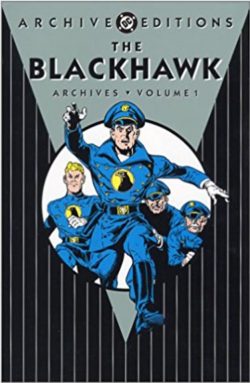
Blackhawk Archives volume 1


By Will Eisner, Dick French, William Woolfolk, Bob Powell, Chuck Cuidera, Reed Crandall & various (DC Comics)
ISBN: 978-1-56389-700-9 (HB)

This book includes Discriminatory Content produced in less enlightened times.

The early days of the US comic book industry were awash with both opportunity and talent, and these factors beneficially coincided with a vast population craving cheap entertainment. Comics had practically no fans or collectors; only a large marketplace open to all varied aspects of yarn-spinning and tale-telling. Thus, even though America loudly proclaimed its isolationism and remained more than six months away from active inclusion in World War II, creators like Will Eisner and publishers like Everett M. (known to all as “Busy”) Arnold felt Americans were ready for a themed anthology title such as Military Comics.
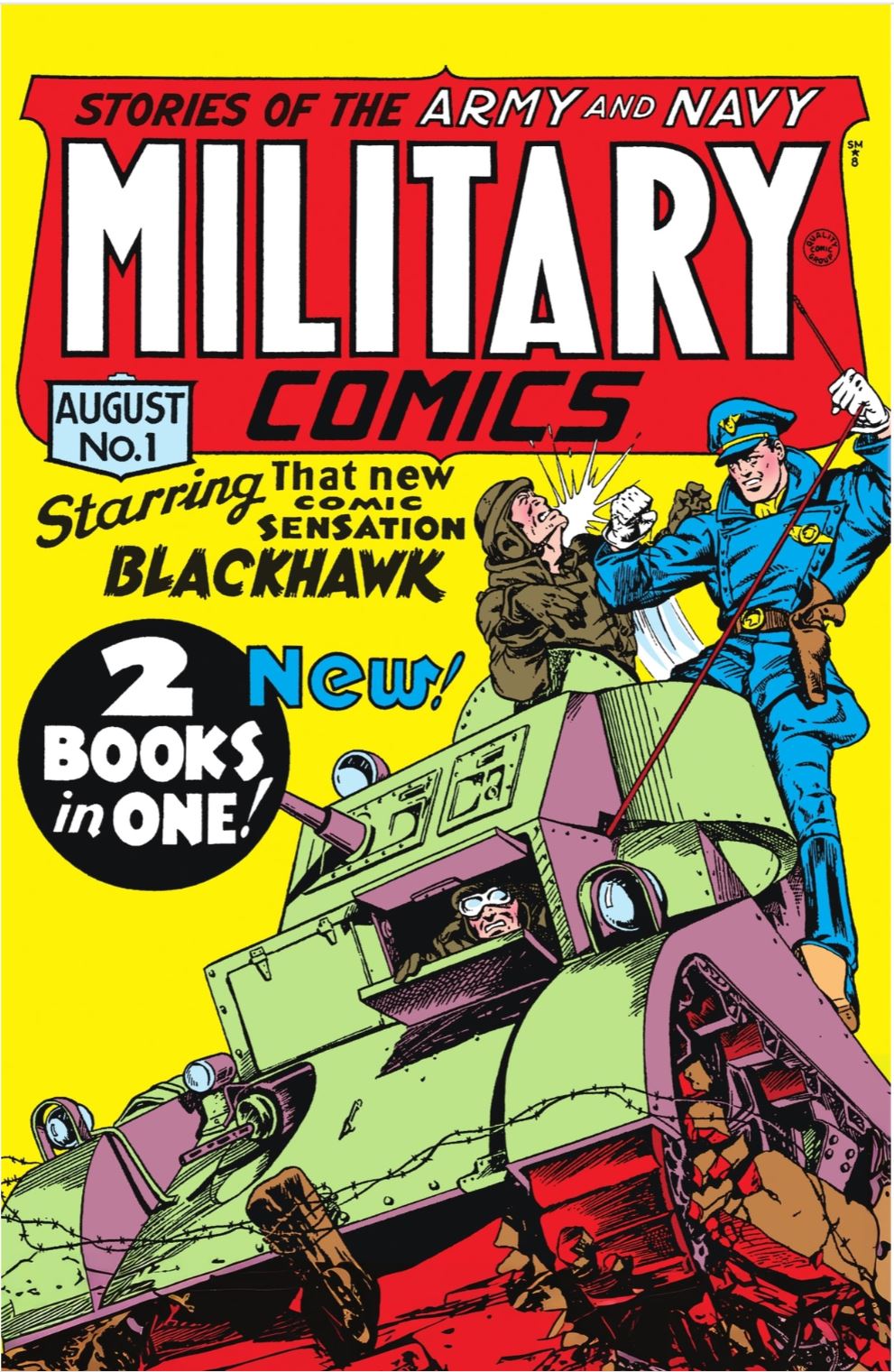
They were right; but Nobody was ready for Blackhawk.

Military Comics #1 launched on May 30th 1941 (with an August off-sale/ cover-date) and included in its gritty, two-fisted line-up Death Patrol by Jack Cole; Elmer Wexler’s Miss America; Fred Guardineer’s Blue Tracer; X of the Underground; John Stewart & Bill Smith’s Yankee Eagle; Q-Boat; Klaus Nordling’s Shot and Shell; Archie Atkins and Loops and Banks by “Bud Ernest” (in actuality, aviation-nut and unsung comics genius Bob Powell), but none of the strips, not even Cole’s surreal and suicidal team of hell-bent fliers, had the instant cachet and sheer appeal of Chuck Cuidera, Eisner & Powell’s “Foreign Legion of the Air” led by a charismatic Dark Knight known only as Blackhawk.

Cuidera – already famed for co-creating The Blue Beetle for Fox Publications – drew ‘The Origin of Blackhawk’ for the premiere issue, wherein a lone, magnificently skilled pilot fighting the Nazi invasion of Poland in 1939 is finally shot down by Nazi Ace Von Tepp. That sadistic killer then goes on to bomb a farmhouse sheltering the defeated pilot’s family. Rising from his plane’s wreckage, the distraught aviator vows vengeance…

Two years later, with the Nazis in control of most of Europe, Von Tepp’s unassailable position is threatened by a mysterious paramilitary squadron of unbeatable fliers, dedicated to crushing injustice and smashing the Axis war-machine…
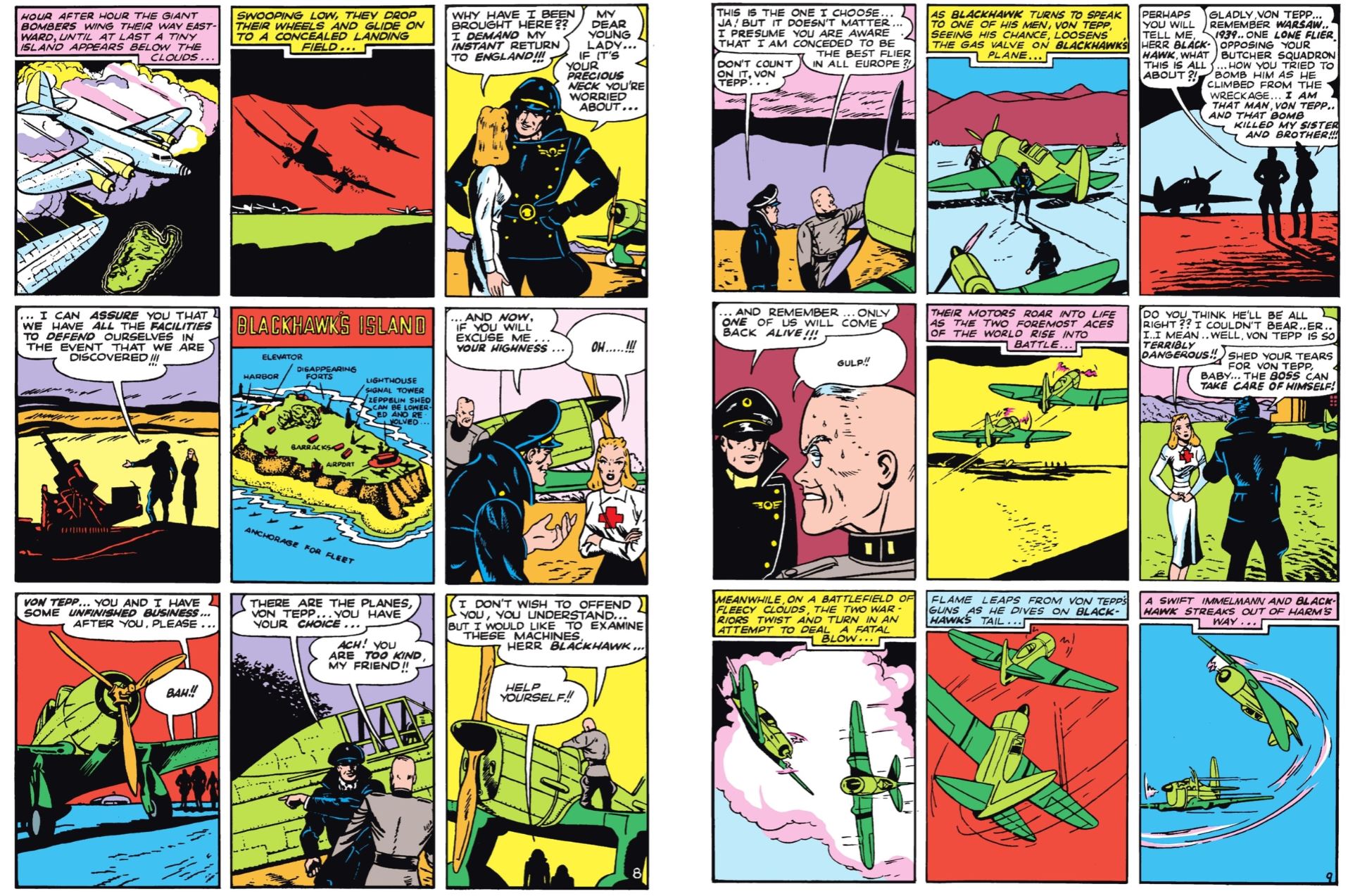
Eisner wrote the first four Blackhawk episodes and Cuidera stayed aboard until issue #11 – although the artist would return in later years. Many of the stories were originally untitled but have been conveniently characterized with such stirring designations as issue #2’s ‘The Coward Dies Twice’, wherein the squadron – “the last free men of the conquered countries” – offer a deserter from a Spitfire Flight a chance to redeem himself. The easy mix of patriotism, adventure and slapstick was magnified by the inclusion of Chop-Chop in ‘The Doomed Squadron’: a comedy Chinaman extremely painful to see through modern eyes, but a stock type considered nearly as mandatory as a heroic leading man in those dark days… and sadly not just in comics, either…

Its scant comfort but at least this Asian man is a brave and formidable fighter both on the ground and in a plane… when not being used for cheap laughs…

‘Desert Death’ takes the team to Suez – for the first of many memorable Arabian adventures – as Nazi agitators attempt to foment revolution among the tribesmen in hopes that they will rise up and destroy the British. This tale is also notable for the introduction of a species of sexy siren beloved of Eisner and Quality Comics. She or similar seductresses of her ilk would populate the strip until DC bought the property in 1957. Also included here is also a secret map of Blackhawk Island, mysterious base of the ebon-clad freedom fighters.

With issue #5 Dick French assumed the writing role. ‘Scavengers of Doom’ is a biting tale of battlefield looters allied to a Nazi mastermind, united to set an inescapable trap for the heroic fliers. More importantly, French began providing distinct and discrete characters for the previously anonymous minor players. In MC #6 the rapidly gelling team joins a frantic hunt for a germ weapon the Gestapo are desperate to possess, resulting in spectacular alpine incident ‘The Vial of Death’, after which #7 (the first issue released after the US entered World War II although the stories had not yet caught up to reality) lands the lads on the Mongolian Steppe ranging on horseback to thwart ‘The Return of Genghis Khan’

The saga in #8 was a striking maritime romp wherein the warring powers battle to occupy an island freshly risen from the Atlantic depths. The newborn landmass is strategically equidistant between the USA, Britain and Festung Europa (that’s what the Nazis called the enslaved stronghold they had made of mainland Europe), and no opponent or even ally can be trusted with control of ‘The Sunken Island of Death’.

Although complete in itself, the yarn is also the first of an experimental, thematic 3-part saga that stretched the way comics stories were told. Things changed rapidly back then, and many marvellously melodramatic touches to make the Blackhawks so memorable in the eyes of a wide-eyed populace of thrill-hungry kids were trialled. There was the cool, black leather uniforms and creepy peaked caps. The unique – yet real – Grumman F5F-1 Skyrocket planes they flew from their secret island base and their eerie battle-cry “Hawkaaaaa!” but perhaps the oddest idiosyncrasy to modern readers was that they had their own song which André, Stanislaus, Olaf, Chuck, Hendrickson & Chop-Chop would sing as they plunged into battle. … And just to be informative and inclusive, the sheet-music and lyrics were published in this issue and are re-presented here. Just remember this is written for seven really tough guys to sing while dodging bullets and weaving between bursts of flak…

Military #9 led with ‘The Man in the Iron Mask’ as the unflappable team discover that a fallen comrade did not actually die in combat, but was hideously disfigured saving them, and is back and seeking redress, whilst the next issue’s tale – ‘Trapped in the Devil’s Oven’ – is another desert adventure focusing on the still primitive science of plastic surgery to restore said hero to full fighting trim.

MC #11 – Cuidera’s last on Blackhawk for some time – saw the squadron turn their attention to Japan, as reality at last caught up with publishing schedules. Intriguingly, ‘Fury in the Philippines’ starts quietly with the entire team calmly discussing carrying on against the Nazis or switching their attentions to the Pacific Theatre of Operations, until comedy relief Chop-Chop sways the debaters with an impassioned stand. Though inarguably an offensive stereotype visually, the Chinese warrior was often given the best lines and most memorable actions. A sneakily subversive attempt on the part of the creators (frequently from immigrant backgrounds and ethnic origins) to shake up those hide-bound societal prejudices, perhaps?

Notwithstanding, the resultant mission against the Japanese fleet is a cataclysmic Battle Royale, full of the kind of vicarious payback that demoralized Americans needed to see following Pearl Harbor…
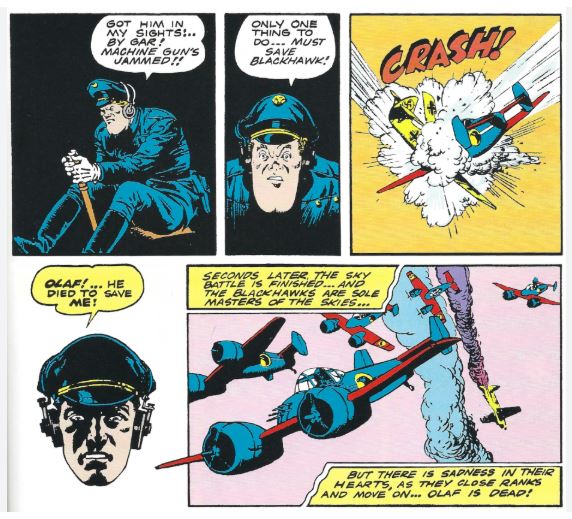
‘The Curse of Xanukhara’ added fantasy elements to the gritty mix of blood & iron as the group’s hunt for a stolen codebook leads them to occupied Borneo and eventually the heart of Tokyo; a classy espionage thriller marking the start of a superlative run of thrillers illustrated by the incredible Reed Crandall. The artist’s realistic line and the graceful poise of his work, especially on exotic femmes fatale and trustworthy girls-next-door, made his pages absolute joys to behold. ‘Blackhawk vs. The Butcher’ (Military #13, November 1942) was written by new regular scripter Bill Woolfolk and returned the Blackhawks to Nazi territory as a fleeing Countess turns their attention to the most sadistic Gauleiter (Nazi regional leader in charge of a conquered territory) in the German Army.

What follows is a spectacular saga of justice and righteous vengeance, whilst ‘Tondeleyo’ reveals a different kind of thriller as an exotic siren uses her almost unholy allure to turn the entire team against each other. Such quasi-supernatural overtones held firm in the stirring ‘Men Who Never Came Back’ – when the team travel to India to foil a Japanese plot – in a portmanteau report narrated by three witches. Trouble, Terror and Mystery were eerily presaging the EC horror classics that would cement Crandall’s artistic reputation more than a decade later…

‘Blackhawk vs. the Fox’ pits the flight of heroes against a Nazi strategic wizard (a clear reference to the epic victories of Erwin Rommel) in the burning sands of Libya, and remains one of the most authentic battle yarns in the canon; and precedes this sublime hardback volume’s concluding sortie: a racy tale of vengeance and tragedy wherein Japanese traitor Yoshi uses her wiles to punish the military government of Nippon, with Blackhawk as her unwitting tool in ‘The Golden Bell of Soong-Toy!’

These stories were produced at a pivotal moment in both comics and world history, delivering the blend of weary sophistication and glorious, juvenile bravado that comprised the best movies of the time: Casablanca, Foreign Correspondent, Freedom Radio, Captain of the Clouds, The Day Will Dawn, The First of the Few, In Which We Serve and all the rest. That understated, overblown way of accepting duty and loss permeates these primal, rousing Blackhawks tales, confirming the miracles good men can do when needed; and are some of the Golden Age’s finest moments. In fact, these are some of the best comics stories of their time and I sincerely wish DC had proceeded with further collections, or will resume and complete their comics casebooks for the benefit of us all…

Hunt this down and so will you.
© 1941-1942, 2001 DC Comics. All Rights Reserved.

Today in 1916 unsung genius of line and mood Mort Meskin (Sheena, Queen of the Jungle, Vigilante, Wildcat, Starman, Johnny Quick, Black Terror, Boy’s Ranch, Captain 3-D, Golden Lad, Mark Merlin) was born, as was Italian artist Roberto Raviola AKA Magnus (Kriminal, Alan Ford) in 1939, US writers Mike W. Barr (Maze Agency, Batman, Camelot 3000, Star Trek) in 1952, Alan Brennert (Batman, Brave and the Bold, Batman: Holy Terror) in 1954 and Kevin Eastman (Teenage Mutant Ninja Turtles) in 1962.

On this date in 1993 we lost Little Lulu cartoonist “Marge” (Marjorie Henderson Buell) and in 1999, prolific comics scripter Paul S. Newman (Turok, Dr. Solar, Man of the Atom, Lone Ranger).

Today in 1985 Osamu Tezuka completed his landmark award-winning manga Adorufu ni Tsugu (Message to Adolf).
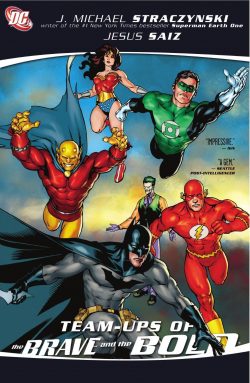
Team-Ups of the Brave and the Bold


By J. Michael Straczynski, Jesus Saiz, Chad Hardin, Justiniano, Cliff Chiang & various (DC Comics)
ISBN: 978-1-4012-2793-7 (HB) 978-1-4012-2809-5 (TPB/Digital edition)

The Brave and the Bold premiered in 1955; an anthology adventure comic featuring short complete tales starring a variety of period heroes and a format mirroring and cashing in on that era’s filmic fascination with historical dramas.

Devised and written by Robert Kanigher, issue #1 led with Roman epic Golden Gladiator, medieval mystery-man The Silent Knight and Joe Kubert’s now legendary Viking Prince. The Gladiator was soon replaced by National Periodicals/DC Comics’ iteration of Robin Hood, and the high adventure theme carried the title until the end of the decade when a burgeoning superhero revival saw B&B remodelled as a try-out vehicle like the astounding successful Showcase.

Deployed to launch enterprising concepts and characters such as Task Force X: The Suicide Squad, Cave Carson, Strange Sports Stories, Hawkman and the epochal Justice League of America, the title then evolved to create a whole sub-genre – although barely anybody noticed at the time…

That innovation was Superhero Team-Ups.

For almost a decade DC had enjoyed great success pairing Superman with Batman and Robin in World’s Finest Comics, and in 1963 sought to create another top-selling combo from their growing pantheon of masked mystery men. It didn’t hurt that the timing also allowed extra exposure for characters imminently graduating to their own starring vehicles after years as back-up features…

This was during a period when almost no costumed heroes acknowledged the jurisdiction or (usually) existence of other costumed champions. When B&B offered this succession of power pairings, they were unknowingly laying foundations for DC’s future close-knit comics continuity. Nowadays, there’s something wrong with any superstar who doesn’t regularly join every other cape or mask on-planet every five minutes or so…

The short-lived experiment eventually calcified as “Batman and…” but, for a while, readers were treated to some truly inspired pairings such as Flash and the Doom Patrol, Metal Men and Metamorpho, Flash and The Spectre or Supergirl and Wonder Woman.

The editors even achieved their aim after Robin, Kid Flash and Aqualad remained together after their initial foray and expanded into the ever-popular Teen Titans

That theme of heroes united together for a specific time and purpose was revived in 2007 for the third volume of The Brave and the Bold, resulting in many exceedingly fine modern Fights ‘n’ Tights classics, and this compilation collects issues #27-33 (November 2009 – June 2010): the first seven issues scripted by TV/comics star scribe J. Michael Straczynski.

The run of easily accessible, stand-alone tales delved into some of the strangest nooks and crannies of the DCU and opens here with ‘Death of a Hero’, illustrated by Jesús Saíz, wherein teenager Robby Reed visits Gotham City and decides to help out a Batman sorely pressed by the machinations of The Joker

The child prodigy had his own series in the 1960s as a kid who found a strange rotary device dotted with alien hieroglyphics that could temporarily transform him into a veritable army of super-beings when he dialled the English equivalents of H, E, R and O…

Here, however, after the lad dials up futuristic clairvoyant Mental Man, the visions he experiences force him to quit immediately and take to his bed…

He even forgets the Dial when he leaves, and it is soon picked up by down-&-out Travers Milton who also falls under its influence and is soon saving lives and battling beside the Dark Knight as The Star. What follows is a meteoric and tragic tale of a rise and fall…

Again limned by Saíz, B&B #28 takes us a wild trip to the ‘Firing Line’ as the Flash (Barry Allen) falls foul of a scientific experiment and winds up stranded in the middle of World War II. Injured and unable to properly use his powers, the diminished speedster is taken under the wing of legendary paramilitary aviator squadron The Blackhawks, but finds himself torn when his scruples against taking life crash into the hellish cauldron of the Battle of Bastogne and his manly, martial love of his new brothers in arms…

Brother Power, The Geek was a short-lived experimental title developed by legendary figure Joe Simon at the height of the hippy-dippy 1960s (or just last week if you’re a baby booming duffer like me).

He/it was a tailor’s mannequin mysteriously brought to life through extraordinary circumstances, just seeking his place in the world: a bizarre commentator and ultimate outsider philosophising on a world he could not understand.

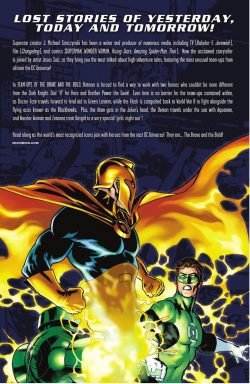
That cerebral angst is tapped in ‘Lost Stories of Yesterday, Today, and Tomorrow’ when the elemental outcast crawls out of wreckage in Gotham City and clashes with Batman as they both strive to save homeless people from authoritarian brutality and greedy arsonists.

Like the times it references, this story is one you have to experience rather than read about…

Straczynski & Saíz play fast and loose with time travel in ‘The Green and the Gold’ as mystic Lord of Order Doctor Fate is helped through an emotional rough patch by Green Lantern Hal Jordan. As a result of that unnecessary kindness, the mage gets to return the favour long after his own demise at the moment the Emerald Warrior most needs a helping hand…

Illustrated by Chad Hardin & Walden Wong and Justiniano, The Brave and the Bold #31 describes ‘Small Problems’ encountered by The Atom after Ray Palmer is asked to shrink into the synapse-disrupted brain of The Joker to perform life-saving surgery. Despite his better judgement, the physicist eventually agrees but nobody could have predicted that he would be assimilated into the maniac’s memories and forcibly relive the Killer Clown’s life…

Straczynski & Saíz reunite as sea king Aquaman and hellish warrior Etrigan the Demon combine forces in a long-standing pact to thwart a revolting Cthonic invasion of ‘Night Gods’ from a hole in the bottom of the ocean before this mesmerising tome concludes with a bittersweet ‘Ladies Night’ from times recently passed, illustrated by Cliff Chiang.

When sorceress Zatanna experiences a shocking dream, she contacts Wonder Woman and Batgirl Barbara Gordon, insisting that they should join her on an evening of hedonistic excess and sisterly sharing. Only Babs is left out of one moment of revelation: what Zatanna foresaw would inescapably occur to her the next day at the hands of the Joker…

Smart, moving and potently engaging, these heroic alliances are a true treat for fans of more sophisticated costumed capers, and skilfully prepared in such a way that no great knowledge of backstory is required. Team-ups are all about finding new readers and this terrific tome is a splendid example of the trick done right…
© 2009, 2010 DC Comics. All Rights Reserved.

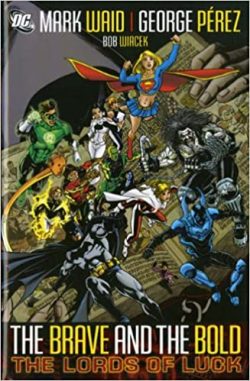
The Brave and the Bold volumes 1 & 2: The Lords of Luck and The Book of Destiny


The Lords of Luck By Mark Waid & George Pérez & various (DC Comics)
ISBN: 978-1-84576-649-8 (US HB) 978-1-84576-649-8 (TPB)

There are so many great graphic novels and compilations available these days that it’s always a shock when I realise how many more are still out of print. Here’s a classic example just begging for revival and digital editions…

The Brave and the Bold: The Lords of Luck collects the first 6 issues of another revival of a venerable DC title (technically volume 3 and spanning April -September 2007): returning it not only to the fitting team-up format we all enjoyed, but doing so with such style, enthusiasm and outright joy that I’m reduced to a gawping, drooling nine-year-old again.

Here Mark Waid, George Pérez and inkers Bob Wiacek & Scott Koblish crafted an intergalactic romp through time and nether dimensions, ripping across the DC Universe in a funny, thrilling and immensely satisfying murder-mystery-come-universal-conquest saga.

When Batman and Green Lantern (in part one ‘Roulette’ and concluding episode ‘The Girl Who Knew Too Much’) discover absolutely identical corpses hundreds of miles apart it sets them on the trail of probability-warping aliens and the missing Book of Destiny – a mystical chronicle of everything that ever was, is, and will be!

And yes, that makes this a notional tie-in to The Sandman series by Neil Gaiman and his coterie of classy creatives…

Each issue/chapter highlights a different team-up and eventually the hunt by Adam Strange, Blue Beetle (‘The Lord of Time’), Destiny (of the Endless, no less in chapter 4 ‘The Garden of Destiny’), the Legion of Super Heroes (‘The Batman of Tomorrow’), Lobo, Supergirl (‘Ventura’) and a mystery favourite from long-ago (you’ll thank me for not blowing the secret, honestly!) plus an incredible assortment of cameo stars coalesces into a fabulous free-for-all that affirms and reinforces all the reasons I love this medium.

With the value-added bonus of an annotated exploration of Waid & Pérez’s creative process to entrance the aspiring creator-of-tomorrow, this is a great story with great art, and is perfect for all ages to read and re-read over and over again. So let’s hope that happens soon…

© 2006, 2007 DC Comics. All Rights Reserved.


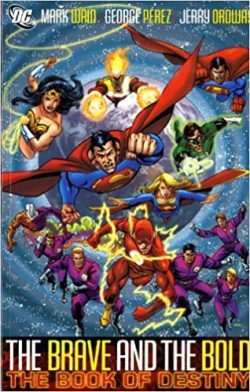
The Book of Destiny

By Mark Waid, George Pérez, Jerry Ordway, Bob Wiacek & Scott Koblish (DC Comics)

ISBN: 978-1-4012-1838-6 (HB) 978-1-4012-1861-4 (TPB)

The Book of Destiny is a mystical ledger which charts the history, progress and fate of all Reality and everything in it – except for the four mortals entrusted with its care at the end of The Brave and the Bold: The Lords of Luck. The death-defying Challengers of the Unknown – cool pilot Ace Morgan, indomitable strongman Rocky Davis, intellectual aquanaut Prof. Haley and daredevil acrobat Red Ryan – live on borrowed time and were bequeathed the terrifying tome by Destiny of the Endless since their lives are no longer included within its horrifying pages…

After the staggering spectacle of the previous Brave and the Bold story-arc, here Waid & Pérez, with inkers Bob Wiacek & Scott Koblish are joined by co-penciller Jerry Ordway for a stunning sequel featuring most of the DC universe…

This compilation collects issues #7-12 (volume 3 from December 2007-June 2008) of the high-energy, all-star revival of the venerable DC title: playing novel games with traditional team-up format as a mysterious mage begins manipulating heroes and villains in a diabolical alchemical scheme to transform the cosmos fundamentally and forever…

Beginning with ‘Scalpels and Chainsaws’ – wherein Wonder Woman and the ever-abrasive Power Girl rub each other the wrong way (oh please, what are you, ten!?) whilst tackling an undead invasion, the case takes a stranger turn and Kara-Zor-L accidentally discovers the Caped Kryptonian has been brainwashed into trying to murder her cousin Superman

Their ill-tempered investigations lead to the fabled Lost Library of Alexandria and a disastrous confrontation with the deranged Dr. Alchemy, but he too is only a pre-programmed pawn – of a sinister presence called Megistus – who needs Power Girl to use the mystical artefact known as the Philosopher’s Stone to turn the Fortress of Solitude into pure Red Kryptonite…

Thanks to Wonder Woman’s battle savvy, the plot is frustrated and the stone thrown into the sun… just as Megistus intended…

All this has been perused in the mystic chronicle by the Challengers and their fifth member Dr. June Robbins – whose merely mortal existence and eventual doom are tragically recorded in the Book. They rush off to investigate a universe-rending menace even as ‘Wally’s Choice’ brings The Flash and his rapidly aging children Jai and Iris West into unwelcome contact with manipulative genius Niles Caulder and his valiant Doom Patrol. “The Chief” claims he can cure the twins’ hyper-velocity malady, but Caulder never does anything for selfless reasons…

With no other hope, Wally and wife Linda acquiescence to the mad genius’ scheme – which relies on using elemental hero Rex Mason to stabilise their kids’ critical conditions. It might have worked, had not Metamorpho been mystically abducted mid-process – consequently transforming the children into bizarre amalgams of Negative Man and Robot Man

Worst of all, Flash is almost forced to choose which child to save and which should die…

Thinking faster than ever, the Scarlet Speedster beats the odds and pulls off a miracle but, in a distant place, the pages of the Book are suddenly possessed and abruptly attack the Challengers…

‘Changing Times’ features a triptych of short team-up tales which play out as the Men that History Forgot battle a monster made of Destiny’s pages, beginning as the robotic Metal Men joined forces with young Robby Reed who could become a legion of champions whenever he needs to Dial H for Hero.

Sadly not even genius Will Magnus could have predicted the unfortunate result when crushingly shy robot Tin stuck his shiny digit in the arcane Dial…

Next, during WWII the combative Boy Commandos are joined by The Blackhawks in battling animated mummies intent on purloining the immensely powerful Orb of Ra from a lost pyramid, after which perpetually reincarnating warrior Hawkman joined All-New Atom Ryan Choi in defending Palaeolithic star-charts from the marauding Warlock of Ys.

None of them are aware that they are doing the work of malignly omnipresent Megistus…

The fourth chapter paralleled the Challengers’ incredible victory over the parchment peril with a brace of tales seeing the Man of Steel travel to ancient Britain to join heroic squire Brian of Kent (secretly the oppression-crushing Silent Knight) in bombastic battle against a deadly dragon, whilst the Teen Titan’s untold second ever case finds Robin, Wonder Girl and Kid Flash in Atlantis for the marriage of Aquaman and Mera.

Unfortunately Megistus’ drone Oceanus crashes the party, intent on turning Aqualad into an enslaved route map to the future…

And in California, the Challengers attempted to save Green Lantern’s Power Battery from being stolen only to find it in the possession of an ensorcelled Metamorpho…

As the Element Man easily overwhelms Destiny’s Deputies, Jerry Ordway assumed the penciller’s role for issues #11-12.

‘Superman and Ultraman’ saw the natural enemies initially clash and then collaborate at the behest of an alternate universe’s Mr. Mixyezpitelik, who reveals the appalling scope and nature of Megistus’ supernal transformational ambitions, leading to a gathering of the heroic clans and a blistering Battle Royale in the roaring heart of the Sun…

With the fate of reality at stake and featuring a veritable army of guest stars ‘The Brave and the Bold’ concludes the saga with a terrible, tragic sacrifice from the noblest hero of all, whilst subtly setting the scene for the then-upcoming Final Crisis

With fascinating designs and pencil drawings from Ordway to tantalise the art lovers, this second captivating collection superbly embodies all the bravura flash’n’dazzle thrills superhero comics so perfectly excel at. This is a gripping fanciful epic with many engaging strands perfectly coalescing into a frantic and fabulous free-for-all overflowing with all the style, enthusiasm and exuberant joy you’d expect from top costumed drama talents.

The Brave and the Bold: The Book of Destiny is another great story with great art, ideal for kids of all ages to read and re-read over and over again.
© 2007, 2008 DC Comics. All Rights Reserved.

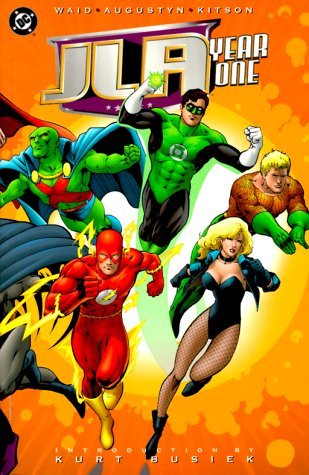
JLA: Year One


By Mark Waid, Brian Augustyn & Barry Kitson with Michael Bair, John Stokes, Mark Propst, & various (DC Comics)
ISBN: 978-1-56389-512-8 (TPB)

If the chop-and-change continuity gymnastics DC have undergone in recent years gives you a headache, but you still love reading excellent superhero team stories, you could just take my word that this is one of the best of that breed and move on to the next review. If you’re okay with the confusion or still need convincing, though, please read on.

With then-partner All-American Publishing, in 1940 DC published the Justice Society of America in All-Star Comics from #3. Cover-dated “Winter Issue”, it spanned the year end and was on sale from November 22nd until January. The JSA were the first superhero team in comics.

In 1960 after a decade largely devoid of superheroes, the now fully-amalgamated publisher sagely revived the team concept as the Justice League of America, and gradually reintroduced the JSA ancestors as heroes of an alternative Earth to a fresh new caped and cowled world. By 1985, the continuity had become saturated and overcrowded with so many heroic multiples and close duplicates that DC’s editorial Powers-That-Be deemed it all too confusing and a deterrent to new readers, and decreed total change. It resulted in maxi-series Crisis on Infinite Earths and the events of the groundbreaking, earth-shattering saga led to a winnowing and restructuring of the DC universe…

With all the best bits from past stories (for which one could read “least charming or daft”) having now occurred on one Earth, and with many major heroes remade and re-launched (Superman, Wonder Woman, Flash et al.), one of the newest curses to readers – and writers – was keeping definitive track of what was now DC “History” and what had now never actually happened.

Thus 12-issue maxi-series JLA: Year One presented the absolute, definitive, real story of the formation and early days of the Justice League, the World’s Greatest – but no longer first – Superheroes…

Of course, since Zero Hour, Infinite Crisis and all the other subsequent publishing course-correcting extravaganzas (such as 52, Countdown, Dark Nights: Death Metal and so on) it’s not strictly true anymore. Still. Again…

None of which impacts upon the superb quality of the tale told here. Way back then – January to December 1998 and in the wake of Grant Morrison & Howard Porter’s spectacular re-reboot of the team – Mark Waid, Brian Augustyn & illustrator Barry Kitson (plus assorted assisting inkers) produced a superb version of that iteration’s earliest days. It’s still one of the best and most readable variations on the theme, even if DC have inexplicably let it slide out of print…

It begins “ten years ago” in ‘Justice League of America: Year One’ as a hidden observer gathers files on an emergent generation of new costumed heroes. When an alien invasion from Appellax brings inexperienced neophyte heroes Flash, Green Lantern, Black Canary, Aquaman and Martian Manhunter together to save Earth from colonisation, the media scents a news sensation, but the real story is the hidden forces hovering in the background of the event…

The Canary was reimagined as the rebellious daughter of the JSA original who had been active during WWII, and the others, like the Sea King and J’onn J’onzz, had undergone recent origin revisions too…

The main action begins after that initial victory, as the heroes – novices all, remember – opt to stick together as a team, only to be targeted by secret super-science society Locus, who begin snatching up alien invader corpses for genetic experimentation…

The second issue sees the new kids as media sensations overwhelmed and out of their depth, with everyone wanting a piece of them. Older outfits like the Blackhawks, Challengers of the Unknown and even officially-retired JSA veterans are watching with apprehension whilst Bruce Wayne wants them far away from Gotham City as they establish their ‘Group Dynamic’. Even trick archer Green Arrow is constantly hanging around, clearly angling for an invitation to join, but that’s never gonna happen…

Immortal villain Vandal Savage targets the inexperienced heroes with a squad of veteran supervillains – the Thorn, Solomon Grundy, Clayface and Eclipso – as everywhere, more new superheroes are emerging. Savage is resolved to stop this second Heroic Age before it begins…

In #3, Locus’ bio advancements lead to alliance with Savage, but their schemes are sidelined as the team struggle to work together. Every man there seems distracted by Black Canary, but their “chivalrous impulses” in combat are not only insulting but will get someone killed – if not by enemies, then by her…

The team is fully occupied playing ‘Guess Who?’ after accepting funding and resources from a mystery billionaire. The influx of cash results in a purpose-built secret mountain HQ, a covert personal communications network, live-in custodian/valet/tech support Snapper Carr and a security system designed by maverick teen genius Ted Kord.

At least the heroes are starting to bond, sharing jokes, origins and trade secrets, but tensions are still high and trust in each other is fragile…

Inker Michael Bair joins with #4 as ‘While You Were Out…’ sees Locus at last launch their campaign of conquest: picking off lone hero Dan Garrett, whose mystic Blue Beetle scarab proves no match for alien-enhanced bio-weaponry, even as the heroes are all singled out for close observation by mystery operatives…

The merciless Brotherhood of Evil unleash Locus-designed horrors on Manchester, Alabama in #5, leading to a tenuous team-up of Justice League and Doom Patrol that ends in disaster and defeat. Maimed and deprived of their abilities, they are ‘A League Divided’ until the DP’s resident genius Niles Caulder provides stopgap powers and weapons in ‘Sum of Their Parts’ (inked by Bair & John Stokes), enabling the heroes to rally and restore themselves…

In ‘The American Way’ the JLA suffer a shock after their greatest inspiration – Superman – declines an offer to join, even as Locus’ endgame begins.

The dispirited heroes barely notice, as ‘Loose Ends’ exposes treachery in the ranks, further distracting the heroes who discover a trusted ally has been spying on them in their private lives. They have no idea what’s really going on…

With unity shattered, the JLA turns on itself, missing Locus’ attempt to terraform Earth and literally ‘Change the World’

‘Heaven and Earth’ (inked by Bair & Mark Propst) finds all humanity’s helpless and all its many heroes subdued in a superpowered blitzkrieg that catches the planet napping. Crushed, defeated and interned in ‘Stalag Earth’ all hope is lost until the reunited Justice League lead a counter-offensive, turning tragedy into triumph and ensuring ‘Justice for All’

A brilliantly addictive plot, superbly sharp dialogue and wonderfully underplayed art suck the reader into an enthralling climax that makes you proud to be human… or at least terrestrially-based. This saga of our champions’ bonding and feuding under extended threat of rogue geneticists, planetary upheaval, and the mystery of who actually bankrolls the team, all added to continual, usual, everyday threats in a superhero’s life, is both enchanting and gripping.

When it’s done right there’s nothing wrong with being made – and allowed – to be feel ten years old again. In-the-know fans will delight at the clever incorporation of classic comics moments, in-jokes and guest-shots from beloved contemporaneous heroes and villains such as the Sea Devils, Metal Men, Atom and such, but the creators of this revised history never forget their new audience and nothing here is unclear for first-timers. The finale is a fan’s all-action dream with every hero on Earth united to combat all-out alien invasion! …And of course, the rookie JLA save the day again in glorious style.
© 1998 DC Comics. All Rights Reserved.