
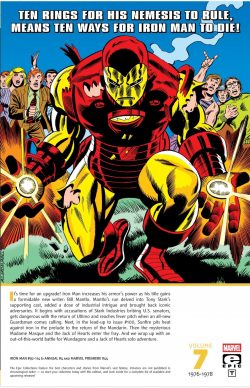
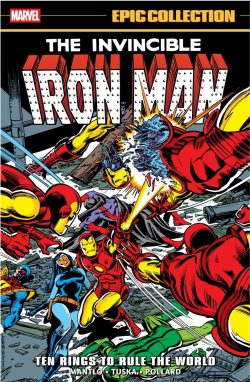
By Bill Mantlo, Gerry Conway, Herb Trimpe, Roger Stern, George Tuska, Keith Pollard, Keith Giffen, Carmine Infantino, Jeff Aclin, Mike Esposito, Don Perlin, Jack Abel, Fred Kida, Alfredo Alcala, Rudy Nebres, Bruce Patterson, Josef Rubinstein, Bob Wiacek, Pablo Marcos, Don Newton & various (MARVEL)
ISBN: 978-1-3029-6059-9 (TPB/Digital edition)
This book includes Discriminatory Content produced in less enlightened times.
Arch-technocrat and supreme survivor Tony Stark has changed profile and rebuilt himself many times since debuting in Tales of Suspense #39 (March 1963). There and then, as a VIP visitor to Vietnam assessing the efficacy of munitions he had designed, the inventor was critically wounded and captured by sinister, savage Communists. Put to work building weapons with the dubious promise of medical assistance upon completion, Stark instead crafted the first of innumerable technologically-augmented protective suits to keep himself alive and deliver him from his oppressors. From there it was a simple – transistor-powered – jump to full time superheroics as a modern Knight in Shining Armour…
Conceived after the Cuban Missile Crisis at a time when Western economies were booming and “Commie-bashing” was America’s obsession, a dashing new Thomas Edison employing Yankee ingenuity, wealth and invention to safeguard the Land of the Free and better the World seemed an obvious development. Combining then-sacrosanct faith that technology and business in unison could solve any problem, with the universal imagery of noble knights battling evil, Stark – the Invincible Iron Man – seemed an infallibly successful proposition.
Of course, whilst he was the acceptable face of 1960s Capitalism – a glamorous, benevolent, rich, technocratic and all-conquering hero when clad in super-scientific armour – the turbulent tone of the 1970s soon relegated his suave, “can-do” image to the dustbin of history. With ecological disaster and social catastrophe from myriad big business abuses new zeitgeists of the young, the Golden Avenger and Stark International were soon confronting some tricky questions from an increasingly politically savvy readership.
With glamour, money and fancy gadgetry not quite so cool anymore the questing voices of a new generation of writers began posing uncomfortable questions in the pages of a series that was once a bastion of militarised America. Collectively accommodating cover-dates November 1976 to October 1978, this Epic chronological epistle completes that transitional period, reprinting Iron Man #92-114, plus Annual #4 and a guest yarn from Marvel Premiere #44 as Bill Mantlo’s passionate writing triggered a minor renaissance in the Steel Sentinel’s chrome-plated chronicles that resulted in some of the best stories of the Eighties era. It also returned Iron Man to the top-rank of Marvel stars.
If you’re a fan thanks to the movie interpretation, that iteration starts right here, right now…
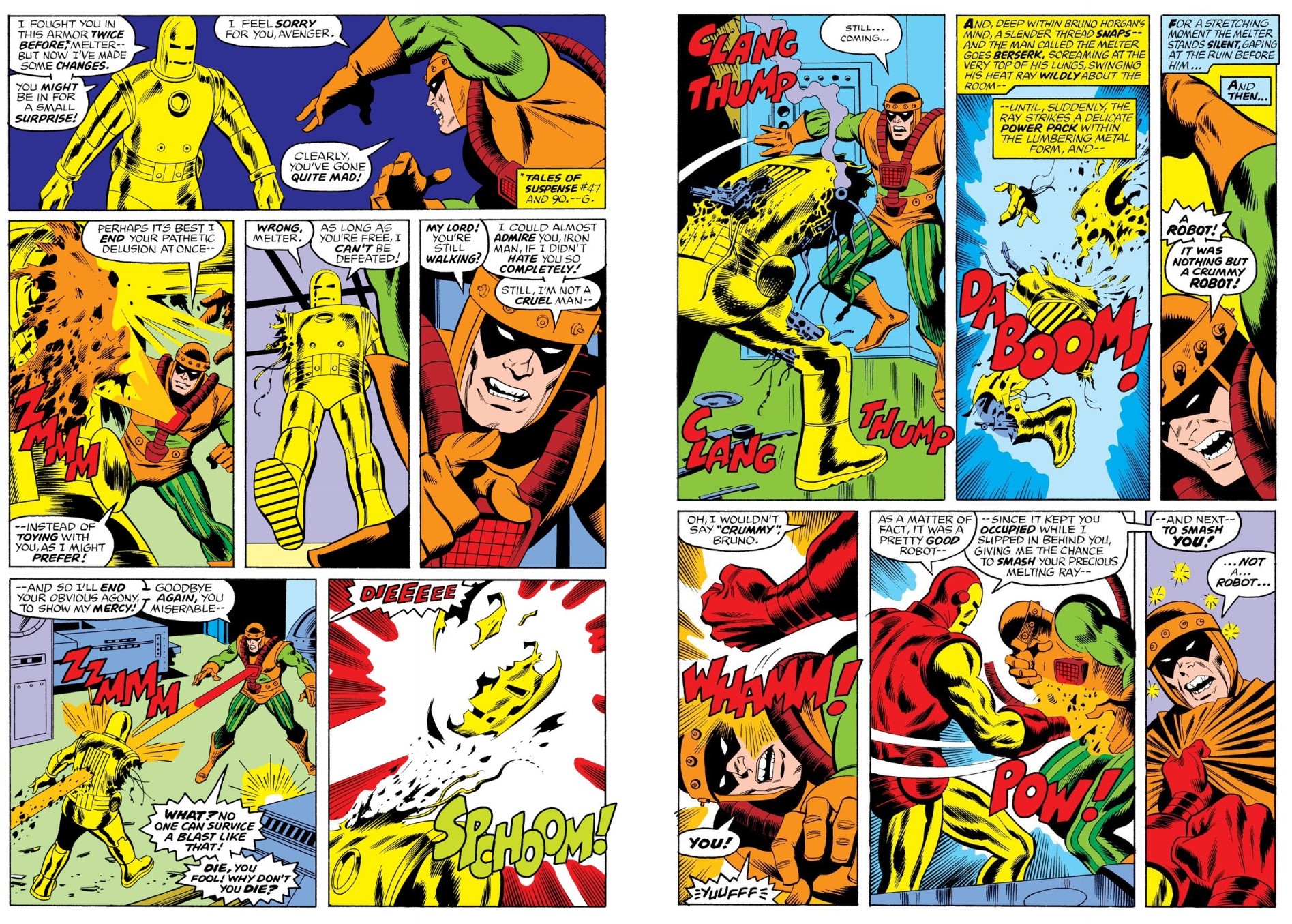
The mettle majesty opens with manic menace The Melter who soon regrets an ill-advised grudge rematch in ‘Burn, Hero… Burn!’ (Gerry Conway, George Tuska & Jack Abel) before Herb Trimpe returns to plot and pencil Iron Man #93. Pitting Old Shellhead against a British-based modern-day pirate in ‘Kraken Kills’ (Conway script & Abel inks), the self-declared Commander deduces Stark’s secret identity before blackmailing the inventor into building weapons for his super-submarine fleet. Never at a loss, though, Stark turns the tables, sparking ‘Frenzy at Fifty Fathoms!’ to scupper the madman’s plans…
Invincible Iron Man Annual #4 (August 1977) offers an all-action alliance with newly constituted super-team The Champions by Mantlo, Tuska & inker Don Perlin. When psychic assassin M.O.D.O.K. overwhelms the Golden Avenger, Iron Man calls in old allies Black Widow and Hercules (plus teammates Ghost Rider, Iceman, Darkstar and The Angel) to thwart ‘The Doomsday Connection!’
Also from that issue comes an out-of-place martial arts vignette by Roger Stern, Jeff Aclin & Don Newton. ‘Death Lair!’ stars former Master of Kung Fu villain Midnight on a mission of murder against old Iron Man enemy Half-Face…
The regular monthly climb to reclaimed pole position resumes with veteran Iron Man artist Tuska joining plotter Conway, scripter Mantlo and inker Perlin in unleashing giant android ‘Ultimo!’ (IM #95, cover-dated February 1977) against Washington DC. Clad in upgraded armour and in the Capitol to answer congressional questions about his company, Stark is targeted by a vengeful hidden nemesis who activates the mountainous monster for a classic B-movie sci fi rampage in the streets, with the Golden Avenger supplementing hard pressed Army and National Guard units… before falling in ignominious defeat due to sabotage…
Mantlo, Tuska & Abel prove you can’t keep a good Iron Man down as the embattled hero rallies and retaliates in ‘Only a Friend Can Save Him’ as former close ally and dutiful S.H.I.E.L.D. agent Jasper Sitwell joins the counterattack. Meanwhile, a long-simmering plotline advances as NYPD detective Michael O’Brien – who holds Stark responsible and accountable for the death of his brother Kevin – finally allows his obsession with a cover-up to pull him across legal lines and into collusion with shady PI Harry Key, whose latest client also has nasty plans for the playboy inventor…
Thanks to ingenuity and sheer guts, Stillwell & Iron Man seemingly destroy Ultimo deep below DC, but their triumph is short lived as a return to Stark’s Long Island factory provokes a ‘Showdown with the Guardsman!’ (Conway, Mantlo, Tuska & Perlin). When Mike takes PA Krissy Longfellow hostage, steals the armour suit that drove his brother insane and ambushes the Golden Avenger wearing it, the clash is swift and brutal. Thankfully this time, the blockbusting battle ends before another good man dies…
Whilst subsequently treating O’Brien, another distraction comes when an old frenemy attacks the facility and US interventionist economic practises. ‘Sunfire Strikes Again!’ sees the Japanese ultra-nationalist mutant warrior again seek to derail progress, unaware that he’s a pawn of the lurking presence gunning for Stark. However, the harried hero’s problems start with the fact that his greatest weapon is offline and he’s fighting in borrowed Guardsman armour. When the conflict frees imprisoned Michael O’Brien, the cop seeks to make amends by joining the battle in an obsolete Iron Man outfit, but – even with Mike Esposito inking – the new allies rapidly find themselves ‘At the Mercy of the Mandarin!’
During the melee, Key tries his luck in the Stark vaults once too often and encounters an unexpected problem, thanks to another insidious infiltrator planted by a different scheming mastermind. However, having freed himself, Tony is too now busy rushing to a far-distant, potentially world-ending final battle in anniversary issue #100. Invading China, Iron Man faces horrors, homunculi Death Squads, nuclear armageddon and his most obsessive enemy whose ‘Ten Rings to Rule the World!’ ultimately prove insufficient to the task…
With the tyrant’s countless plots to discredit Stark now exposed, our hero starts a long journey home, even as in Long Island, Harry Key, Sitwell and one of the traitors in Stark’s midst begin a cautious espionage dance…
Iron Man’s trip stalls when he’s shot down over Yugoslavia (just google it) and awakens in a creepy old castle filled with freaks and outcasts safeguarded by a familiar – to elderly or dedicated Marvelites at least – huge and daunting figure. Recovering in ‘Then Came the Monster!’ our weary voyager views Castle Frankenstein and panics: clashing with the gentle “Modern Prometheus” before the real menace emerges.
Inked by Esposito & Pablo Marcos, ‘Dreadknight and the Daughter of Creation!’ channels old Marvel horror tales as a brutal and brutalised escaped experiment of Doctor Doom’s laboratories seeks to compel the great granddaughter of Victor Frankenstein to share with him the secrets of creating life…
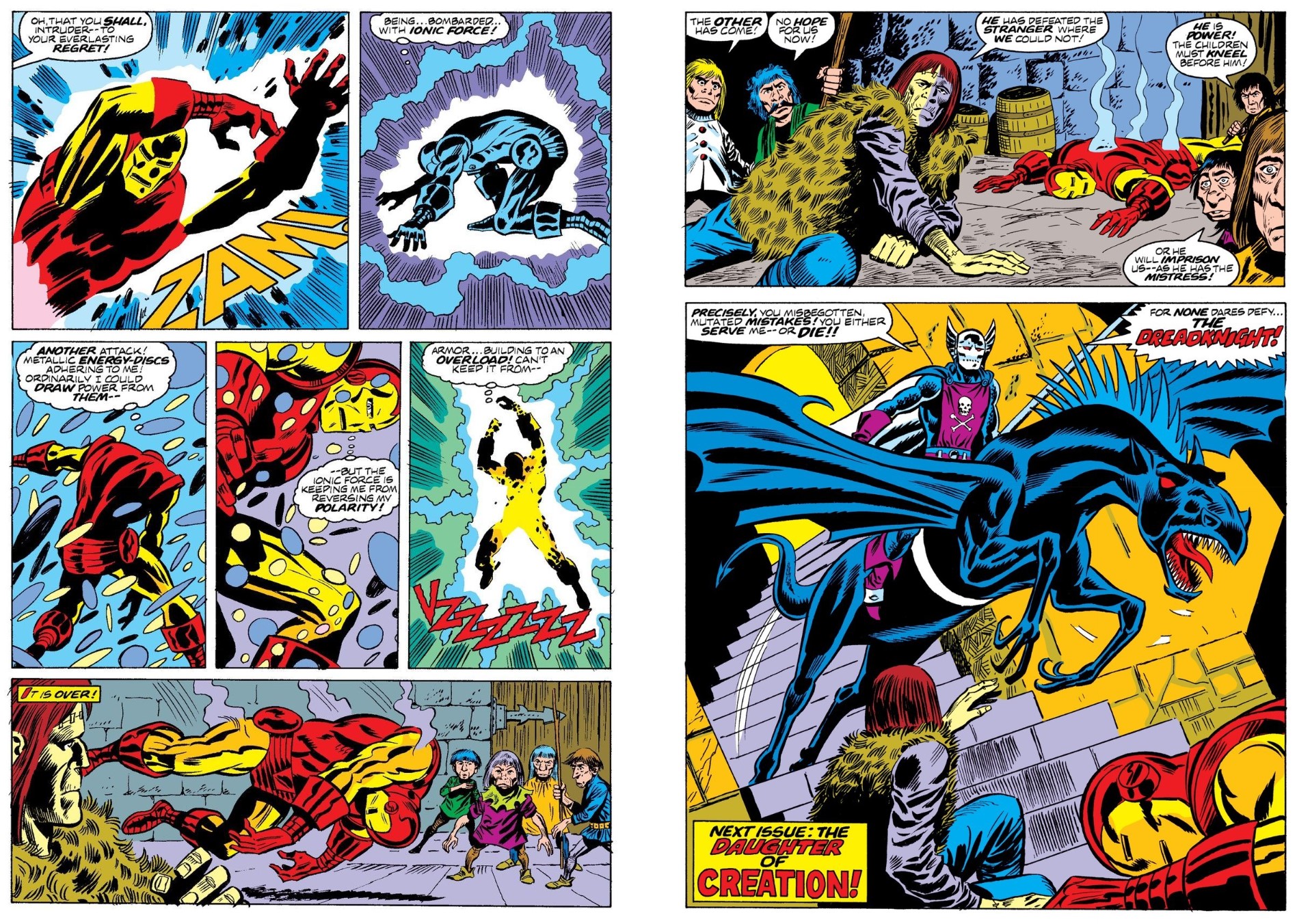
This ruthless high-tech paladin’s sadistic efforts are eventually thwarted by Iron Man and the original (good) Monster, after which the Steel-Shod Sentinel at last arrives home in #103’s ‘Run for the Money!’ by Mantlo, Tuska & Esposito. Sadly, it’s just in time for the next domestic crisis as Sitwell exposes the traitor only to be captured by revolting corporate villain Midas, who – patience exhausted – launches a truly hostile takeover using tanks, mercenaries, lawyers and the Stock Market…
He is temporarily checked by itinerant junior hero/innocent bystander Jack of Hearts who – as per standard Marvel protocol – is attacked by weary, late arriving Iron Man who misconstrues events and assaults the well-meaning stranger. Shock follows shock as Midas’ legal chicanery forces Iron Man’s surrender, ceding control of Stark International to his enemy, even as the villain’s agent and top lieutenant Madame Masque quits to ally herself with the defeated hero and his ousted, outmanoeuvred alter ego Tony Stark.
In the aftermath, repercussions of the takeover ripple outwards. With Stark no longer paying her bill, deeply disturbed super-telepath (and former Stark inamorata) Marianne Rodgers is kicked out of the sanatorium that has been keeping her psionic deadly tendencies in check…
The fightback begins in ‘Triad! (Mantlo, Tuska & Esposito) after Stark initially refuses the help of Masque. Thus she instead allies with former lover/patsy Sitwell whilst elsewhere, interested parties Michael O’Brien and Jack of Hearts also seek to stop Midas converting Stark’s purloined resources into a world-conquering armed force. Also heading slowly towards a showdown, Marianne graduates towards Long Island, leaving a trail of bodies in her wake…
With ‘Every Hand Against Him!’ and despite the stakes being so high, Tony has quit forever, preferring to hide in his father’s old house with Madame Masque. Less sanguine over the crisis and National Security threat, many of Iron Man’s allies join a volunteer force recruited by psychic superhero The Wraith and eventually consisting of Police Captain Jean de Wolf, former Iron Man stand-in Eddie March, The Guardsman & Jack of Hearts, covertly backed up by Sitwell and (the first) Nick Fury…
Still short of power, they co-opt through blackmail, Masque’s lethal skills and Tony’s last remaining armour suit to take out Midas. ‘Then There Came a War!’ (#106) sees the squad invade SI to face a legion of automated Iron Men. At the height of battle Marianne Rodgers – in a fugue state – finally reaches her destination. As Keith Pollard & Fred Kida step in to illustrate the catastrophic conclusion, ‘And, in the End…’ sees her power tip the scales, uncovering even more treachery in Tony’s inner circle and inspiring the despondent hero to take back his heritage, his company and his honour…
With most of his allies apparently dead, Iron Man calls in Avenging ally Yellowjacket (AKA original Ant-Man Henry Pym) to help whip up a miracle cure in #108 (Mantlo, Carmine Infantino & Bob Wiacek). This incurs some ‘Growing Pains!’ and a palate-cleansing action-filled monster-bash as the clear-up somehow reactivates Kang the Conqueror’s devastating Growing Man android to add to the wreckage and rubble…
Once the fighting is finished, rebuilding Stark International begins, with Mantlo, Infantino & Kida dictating the pace prior to another crisis after Jack of Hearts traces the Growing Man’s programming commands as emanating from Luna. Thus Iron Man and his superhero apprentice board a Quinjet and experiences a very painful ‘Moonrise!’ when their mission intersects a secret sortie by Soviet Super-soldiers Darkstar, Vanguard & Crimson Dynamo. The Communist cosmonauts are only investigating a bizarre alien artefact, but entrenched political and personal animosities spark a savage clash. Both sides are preoccupied when the silver egg activates, transporting those closest to it – the Americans – to somewhere far, far away…
Mantlo, Pollard & Kida stretch their fantasy muscles in an astral epic as the heroes materialise aboard a vast ship bearing Colonizers of Rigel to their next conquest. Sadly, these ‘Sojourners Through Space!’ have targeted Wundagore II – used by animal-enhancing man-made deity the High Evolutionary to store former experiments – and are soon caught up in a battle against formidable space Knights of Wundagore and two devastating late-arriving, quickly escaping human captives within their colossal Command ship…
When an alliance of humans and hyper-evolved Earth beasts proves too costly, the Rigellian venture is called off in ‘The Man, the Metal, and the Mayhem!’ but this in turn leads to renegade Colonizer subcommander Arcturus spitefully targeting Earth with a robot stolen from Galactus (the original Punisher from Fantastic Four #48-50). Upon its despatch, closing instalment ‘Moon Wars!’ (IM #112, July 1978 by Mantlo, Pollard & Alfredo Alcala) sees a swift, unauthorised Colonizer strike prompt a desperate dash back to Luna and shattering descent to Detroit for Iron Man, resulting in blistering battle with the cosmic weapon of chastisement and a new definition of the word “invincible” for the triumphant Golden Avenger…
With Mantlo scripting, Pollard layout pages and Trimpe’s pencilling for inker Josef Rubinstein, Iron Man #113 trumpeted a fresh beginning for Stark International after defeating the bloody takeover bid of Mr Midas. However, as the new complex opened for business, an old enemy is already infiltrating the company whilst a more brazen assault comes after a dying foe is manipulated into attacking the complex using ‘The Horn of the Unicorn!’
Seeking help for the beaten-and-at-death’s door Unicorn, the Metal Marvel consults The Avengers and inadvertently triggers a second assault by the villain who also activates a long-interred robotic threat that seems agonisingly familiar in ‘The Menace of… Arsenal!’ (Mantlo, Giffen & Bruce D. Patterson) leading to a turning point moment you’ll need the next book or another collection to enjoy…
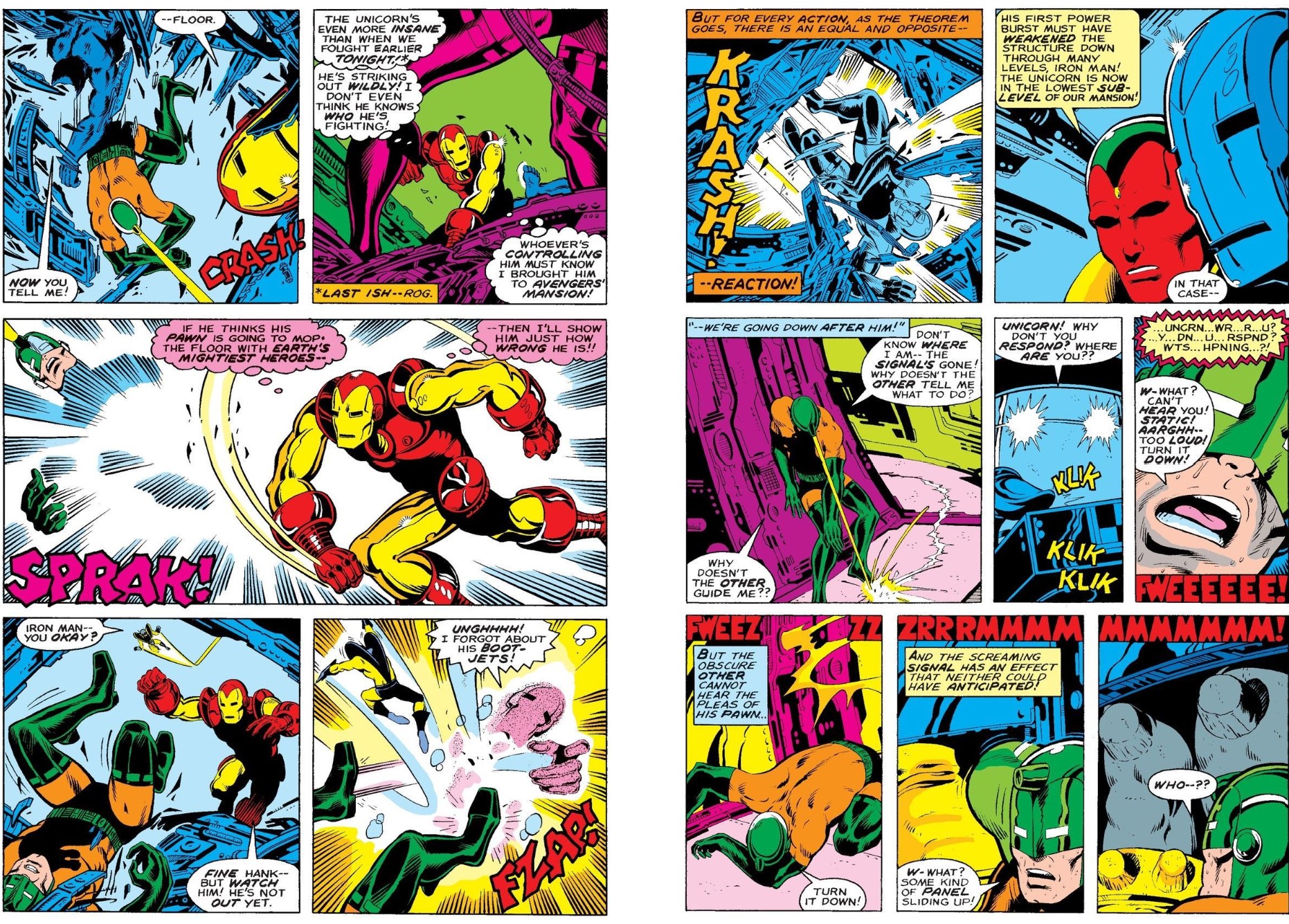
To Be Continued…
Here, however, one last narrative nubbin comes from Marvel Premiere #44 (October 1978): the one-shot try-out of Stark’s former apprentice, by Mantlo, Giffen & Rudy Nebres). ‘The Jack of Hearts!’ reexamines the origin of trust fund brat Jack Hart, who was inundated in the experimental “zero fluid” invented by his murdered father. Seemingly resurrected and imbued with incredible energy and computational powers, Jack hunts The Corporation who ordered the hit and here – thanks to new connection in S.H.I.E.L.D. – inconclusively clashes with their preferred hitman Hemlock…
With covers throughout by Jack Kirby, Al Milgrom, Abel, Ron Wilson, Dan Adkins, Gil Kane, Dave Cockrum, Sal Buscema, Jim Starlin, Val Mayerik, George Pérez, Terry Austin, Frank Giacoia, Joe Sinnott, Joe Rubinstein, John Byrne, Wiacek, Pollard, John Romta Jr., Ed Hannigan & Frank Giacoia, other extras include house ads, cartoon fan letter ‘Printed Circuits’ (by Fred Hembeck from #112); editorial pages and style sheets from Marvel Premiere #44 and original art covers by Starlin, Mayerik & Cockrum.
From our distant vantage point the polemical energy and impact might be dissipated, but the sheer quality of the comics and cool thrill of the eternal aspiration of man in perfect partnership with magic metal remains. These Fights ‘n’ Tights classics are amongst the most underrated but impressive tales of the period and are well worth your time, consideration and cold hard cash
© 2025 MARVEL.
You’d think we barely have room for a review this time as it’s such an auspicious day for comics…
In 1912 today creepy cartoon colossus Charles Addams was born, and in 1929 both Buck Rogers by Dick Calkins and Hal Foster’s Tarzan strips debuted. In 1934 Alex Raymond & Don Moore launched Jungle Jim and a year later combined it with new idea Flash Gordon.
Underground and Mad magazine artist Jay Lynch was born in 1945 and two years later Milton Caniff premiered his other masterpiece with the launch of Steve Canyon. That ran until 1988.
In 1953, Bob Wiacek joined the party as did Karl Kesel in 1959, and publisher Fabrice Giger (Les Humanoïdes Associés) arrived in 1965. Surely by coincidence, two years after, that nativity was followed by the launch of Greg & Eddie Paape’s Luc Orient in Le Journal de Tintin.


