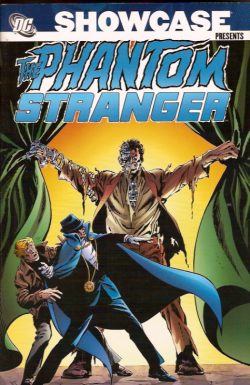
By Bob Haney, Len Wein, Marv Wolfman, Arnold Drake, Michael J Pellowski, Steve Skeates, David Michelinie, Paul Levitz, Gerry Conway, Marty Pasko, Jim Aparo, Gerry Talaoc, Michael Kaluta, Mike Grell, Fred Carrillo, Bernard Baily, Ross Andru/Mike Esposito, Dick Dillin, Tony DeZuñiga, Bill Draut, Romeo Tanghal, Dick Giordano, Bob Layton & various (DC Comics)
ISBN: 978-1-4012-1722-8 (TPB)
The Phantom Stranger was also one of the earliest transitional heroes of the Golden Age of comics, created at the very end of the first superhero boom as readers moved from costumed crimefighters to other genres such as mystery, crime, war and western tales. A trench-coated, mysterious know-it-all, with shadowed eyes and hat pulled down low, he would appear, debunk a legend or foil a supernatural-seeming plot, and then vanish again.
He was coolly ambiguous, never conclusively revealed as man, mystic or personally paranormal. Created by John Broome & Carmine Infantino, who produced the first story in Phantom Stranger #1 (August/September 1952 – Happy Anniversary, Mystery Man!) and most of the others, the 6-issue run also boasted contributions from Jack Miller, Manny Stallman and John Giunta. The last issue was cover-dated June/July, 1953, after which he vanished.
Flash-forward to the end of 1968. The second superhero boom is rapidly becoming a bust, and traditional costumed heroes are dropping like flies. Suspense and mystery titles are the Coming Thing and somebody – probably unsung genius E. Nelson Bridwell – has the bright idea of reviving Phantom Stranger.
He was the last hero revival of DC’s Silver Age and the last to win his own title: another graduate of a star-studded later run in Showcase. After only one appearance in #80 (cover-dated January/February 1969) he returned in his own comic three months later. This time, he found an appreciative audience, running for 41 issues over seven years.
Rather than completely renovate the character, or simply run simple reprints as DC had when trying to revive espionage ace King Faraday (in Showcase #50-51), editor Joe Orlando had writer Mike Friedrich & artist Jerry Grandenetti craft a modern framing sequence around a partial reprint, and – in a masterstroke of print economy – reintroduced another lost 1950s mystery hero to pad out the comic, and provide a rationalist’s contemporary counterpoint.
Dr. Terrence Thirteen was a parapsychologist known as the Ghost Breaker. He predated the Stranger, with his own feature in Star-Spangled Comics (#122-130; November 1951-July 1952). With fiancée (later wife) Marie, the parapsychologist roamed America and the world, debunking supernatural hoaxes and catching mystic-themed fraudsters, a vocal and resolute cynic imported whole into the modern series as a foil for the Stranger.
(Follow Me… For I Am…) The Phantom Stranger launched with a May/June 1969 cover-date. By the end of 1972, the horror/mystery boom had stabilized, and was a key component of both DC and Marvel’s mainstream output, with fantasy and sword & sorcery adventurers also scoring well with fans. However, the glory days of huge comic book print-runs were gone forever. And yet, although a depleted force, superhero comics did not disappear as many older heads suspected they might, and an initially unwieldy amalgam, the horror-hero, soon became a useful crossover sales tool.
Never as common as Marvel’s burgeoning pantheon of spooky crusaders, the most successful and enduring of DC’s supernatural stalwarts were Swamp Thing and Phantom Stranger. This sequel mammoth monochrome tome concludes that impressive second incarnation, incorporating not only his crossover trips into the greater DCU, but also rare appearances that closed his career …until he was resurrected post Crisis on Infinite Earths.
Spanning April/May 1970 to Winter 1978, this collects The Brave and the Bold #89 & 98; Justice League of America #103; Phantom Stranger #22-41; DC Super-Stars #18 and House of Secrets #150, blending a popular taste for blood and horror with traditional mystery man derring-do…
The magic begins with an impressive chiller from Bob Haney, Ross Andru & Mike Esposito originally seen in Batman team-up vehicle The Brave and the Bold (#89, April/May 1970). ‘Arise Ye Ghosts of Gotham’ sees a religious sect return to the city that had driven them out two centuries previously, only to awaken the vengeful spirits of their banished ancestors until pacified by our initially squabbling heroes.
The Stranger’s rerise in Brave and the Bold (#98, October/November 1971) was a more recognisably spooky tale, superbly crafted by Haney & Jim Aparo. ‘Mansion of the Misbegotten!’ is a twist-ridden riot of demon-cults, scheming plots and contemporary-cinema styled possession carefully exploiting the global obsession with Satanism that began with Rosemary’s Baby and peaked with The Exorcist. Here the Gotham Guardian finds himself outwitted, outmatched and in dire need of assistance to foil a truly diabolical force threatening the life of his godson.
Following on is ‘A Stranger Walks Among Us!’ by Len Wein, Dick Dillin & Dick Giordano, as the haunted hero saves Halloween and the World’s Greatest Superheroes from a magical murder plot. He was consequently offered membership in the Justice League of America (in issue #103 of their comic, December 1972) but seldom made any meetings or took a turn on monitor duty…
In the same month, his solo adventures featured ‘Circle of Evil’ (Phantom Stranger #22, by Wein & Aparo), wherein a coalition of evil calling itself the Dark Circle initiates a master plan: attacking the hero through blind psychic – and notional love-interest – Cassandra Craft. At the back of the book, Ghost-Breaker Dr. Thirteen exposes another hoary hoax in Steve Skeates & Tony DeZuñiga’s ‘Creatures of the Night’. These counterpoints to eldritch adventure – although usually excellent – were rapidly reaching their sell-by date, and very soon Thirteen would be battling real monsters he couldn’t rationalize away…
‘Panic in the Night!’ in #23 saw the Stranger and Cassandra in Paris, battling analogues of the Phantom of the Opera and Hunchback of Notre Dame whilst gathering an unlikely ally for the imminent final clash with the Dark Circle. However, great as this yarn is, the real gem is the back-up feature which transformed Terry Thirteen.
‘The Spawn of Frankenstein!’ saw the discovery of an ice-entombed man-monster lead to dark personal tragedy. When Thirteen’s colleague Victor Adams attempted to revive the legendary literary beast, it resulted in his death and Thirteen’s wife Marie being beaten into a coma. Vengeance-crazed, the Ghost-Breaker resolved to hunt down and destroy the monster, utterly unaware – and perhaps uncaring – that the beast was both rational and wholly innocent of any misdeed.
Written by Marv Wolfman and illustrated by the unique talent of Michael Kaluta, this debut promised much, but the feature was plagued by inconsistency. Phantom Stranger #24 (March/April 1973) offered the epic conclusion of the Dark Circle war as the Stranger and Cassandra defrayed the ‘Apocalypse!’ in the shadow of Mount Corcovado (that’s the one with the Jesus statue “Christo Redentor” overlooking Rio de Janeiro) with old foes Tannarak and Tala, Queen of Darkness along for the spectacular and long-overdue ride…
Wolfman & Kaluta’s The Spawn of Frankenstein continued as the revived revenant opted to revenge itself upon Victor Adams for dragging him back to cruel, unwanted life by returning the favour and resurrecting the dead scientist.
A fresh tone and resumption of episodic, supernatural triage marked issue #25 as the Man in the Hat confronted a voodoo cult in ‘Dance of the Serpent’ (Wein – from an idea by Michael J Pellowski – & Aparo), whilst Kaluta ended his run on Frankenstein with another untitled tale wherein Rachel Adams (wife of the departed Victor) was kidnapped by Satanists before being rescued by the monster; leading into #26’s crossover ‘From Dust Thou Art…’
Here Wein, Wolfman & Aparo teamed the Monster and the Stranger against demons seeking earthly bodies.
The radical change was completed with the next issue as innovative horror-anthology artist Gerry Talaoc replaced the sleekly realistic Aparo (moved to The Brave and the Bold for a long career illustrating Batman), whilst journeyman mainstay Arnold Drake assumed the writer’s seat on the stranger. He introduced another long-term nemesis in deeply disturbed psychiatrist/parapsychologist ‘Dr. Zorn: Soul-Master!’
This driven meddler callously warped his patients and performed illicit experiments for the US Military-Industrialist Complex: a far more insidious and freshly contemporary threat in tune with modern mores. Thwarted but seldom defeated, he constantly returned to bedevil the Stranger.
Skeates and legendary veteran Bernard Baily (Golden Age co-creator of Hourman and The Spectre) now helmed Frankenstein, with ‘The Terror and the Compassion’ seeing the misunderstood beast stumble into a commune that is actually a demonic coven intent on blood sacrifice and raising the devil…
‘The Counterfeit Madman!’ by Drake & Talaoc saw the Stranger explore the mind of mad-dog killer Johnny Ganz. Was the young offender a true psychopath or a cunning crook pretending to be a multiple-personality sufferer? Was there another innocent victim trapped inside the killer’s skull with him? An element of moral ambiguity had been added by Drake, layering later adventures with enticing, challenging dilemmas absent from most comic fiction and only matched by Steve Gerber’s challenging work on Man-Thing.
Back-up ‘Night of the Snake God’ was a more traditional tale which continued Frankenstein’s battle against the hippie cult in a solid, if undemanding manner.
Zorn resumed his unscrupulous scientific explorations of the supernatural in PS #29’s ‘The Devil Dolls of Dr. Z!’, whilst matters barely progressed at all in ‘The Snake-God Revealed!’, which saw the Spawn of Frankenstein lose momentum – and story-space – as his strip was reduced to 6 pages. The next issue contained more contemporary chills in ‘The Children’s Crusade!’ as a modern Pied Piper lures a town’s youngsters into his charismatic cult whilst ‘Turn-about!’ concludes – and not before time – the Spawn of Frankenstein’s run.
Issue #31 (June-July 1974) offers an exotic yarn dealing with the aftermath of the Vietnam war as a disgraced US “general” smuggling drugs for a local warlord awakens a slumbering demon in ‘Sacred is the Monster Kang!’ The Stranger’s tales were usually 12-pages long at this period, but the back-up feature that originally filled up the comics – The Black Orchid – is not included in this volume.
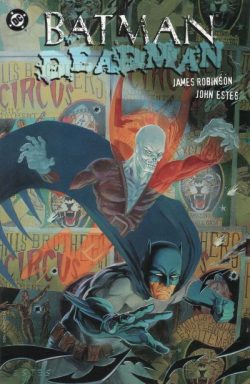
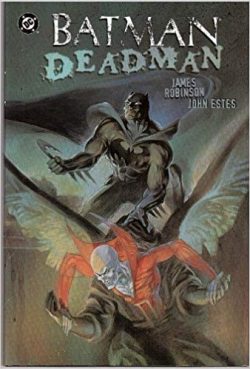
Bill Draut, one of the Stranger’s earliest illustrators returned in #32’s ‘It Takes a Witch…!’: an old-fashioned scary whodunit, whilst superstar-in-waiting Mike Grell illustrated a Dr. Zorn vehicle guest-starring Boston Brand. In ‘Deadman’s Bluff!’, the ghost’s protracted hunt for his own murderer ended as usual in frustration, but an antagonistic partnership was established for the future…
Talaoc was back in #34 for ‘A Death in the Family!’ wherein a “clean” brother is compelled to assume control of the family business – running an organised crime mob. His guilt is further compounded when his dead sibling returns from the grave to give him some pointers. Increasingly, the Stranger was becoming a mere witness to supernatural events in his own series, so perhaps it’s no coincidence that this issue featured a return for the more hands-on Dr. Thirteen (wife Marie cured and both of them ignoring that brief stint of Frankensteinian tragedy).
‘…And the Dog Howls Through the Night!’ is another straightforward yet gripping adventure from Skeates & DeZuñiga, which had probably been sitting in a drawer for years before publication.
‘The Demon Gate’ was writer David Michelinie’s debut tale, with the Stranger targeted by derivative Dr. Nathan Seine – who wanted to siphon off the hero’s mystic energy and soul to cure his dying wife. Like ‘Crimson Gold’, a deadly African treasure hunt for Nazi treasure in #36, it briefly betokened a more active role for the immortal wanderer.
Drake & Paul Levitz scripted ‘Images of the Dead’ in Phantom Stranger #37: another highly charged moral quandary with a young artist forced to commit reprehensible crimes to earn money for his wife’s hospital bills…
Talaoc made way for fellow Filipino artist Fred Carrillo with issue #38, as Dr Seine sought to extract bitter vengeance in Levitz’s ‘The Curse of the Stalking Skull’. The new creative team brought back Boston Brand for ‘Death Calls Twice for a Deadman’: a last-ditch effort to revive dwindling sales. Also including Batman villain The Sensei, it signalled a belated return to the company’s over-arching continuity, but was too little, too late.
Deadman also co-starred in #40’s ‘In the Kingdom of the Blind’ and #41’s concluding chapter (February-March 1976) ‘A Time for Endings’ as Seine sought to bring Elder Gods to Earth using long-absent Cassandra Craft as a medium. With that tale’s finish the series ended and the Stranger all-but vanished until the winter of 1978 and a giant-sized tale from DC Super-Stars #18.
‘Phantom Stranger and Deadman’ (by Gerry Conway, Marty Pasko, Romeo Tanghal, Dick Giordano & Bob Layton) was an extended Halloween extravaganza with the supernatural champions – and Dr. Thirteen and Tala in attendance – attempting to eradicate an infestation of demons infiltrating the comic book Mecca of the season: Rutland, Vermont (long associated in both Marvel and DC titles as the only place to be on the Eve of All Hallows).
One final tale appeared a few months later in the 150th issue of House of Secrets (February-March 1978) wherein Conway & Talaoc related a generational tale of restless evil in ‘A God by any Other Name.’
Here, the Stranger and Dr. Thirteen united to complete the work of Rabbi Samuel Shulman and Father John Christian who, in the dire environs of London, 1892, had joined spiritual forces to destroy the World’s first malignant machine intellect Molloch. Sadly, those Satanic Mills had a habit of being rebuilt by greedy men…
More than most, The Phantom Stranger is a strong character and concept at the mercy of pitiless fashion. Revived as the 1960s closed on a wave of interest in the supernatural, and seemingly immune to harm, he struggled to find an audience in the general marketplace before direct sales techniques made publishing a less hit-or-miss proposition. However, blessed with a cohort of talented creators, the stories themselves have proved to be of lasting quality, and would so easily transfer to today’s television screens that I wonder why they haven’t yet (and no, that doesn’t mean animated appearances or cameos on the Swamp Thing series). Mystery, exotic locales, forbidden monsters spectacular effects, a medallion and a cool hat: C’mon, you know you’d watch it…
But until then you’ll have to thrill and scare yourselves with these fantastic tales.
© 1970, 1971, 1972, 1973, 1974, 1975, 1976, 1978, 2006 DC Comics. All Rights Reserved.