
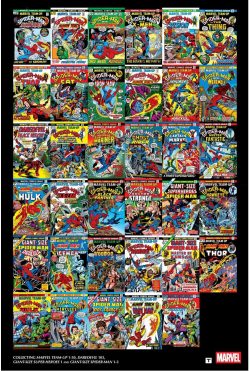
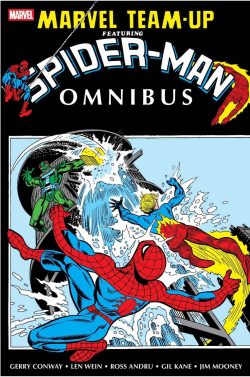
Marvel Team-Up Omnibus volume 1


By Roy Thomas, Gerry Conway, Len Wein, Steve Gerber, Ross Andru, Gil Kane, Jim Mooney, Sal Buscema, Don Heck, Mike Esposito, Frank Giacoia, Steve Mitchell, Frank Bolle, Don Perlin, Sal Trapani, Wayne Howard, Dave Hunt, Vince Colletta & various (MARVEL)
ISBN: 978-1-3029-6699-7 (HB/Digital edition)

This book includes Discriminatory Content produced in less enlightened times.

Inspiration isn’t everything. In fact, as Marvel slowly grew to a position of market dominance in the wake of losing their two most innovative and inspirational creators, they did so less by experimentation and more by expanding proven concepts and properties. The only real exception to this was the assembly line creation of horror and horror-hero titles in response to the industry down-turn in super-hero sales – a move expedited by a rapid revision in the wordings of the increasingly ineffectual Comics Code Authority rules.

The concept of team-up books – an established star pairing or battling (usually both) with less well-selling company characters – was not new when Marvel decided to award their most popular hero the lion’s share of this new title, but they wisely left their options open by allocating an occasional substitute lead in the Human Torch. In those long-lost days editors were acutely conscious of potential over-exposure – and since superheroes were actually in a decline they may well have been right.

Marvel Team-Up was the second regular Spider-Man title (abortive companion title Spectacular Spider-Man was created for the magazine market in 1968 but died after two issues). MTU launched at the end of 1971 and went from strength to strength, proving the time had finally come for expansion and a concentration on uncomplicated action over sub-plots…

This engaging hardback and/or eBook compilation gathers the first 30 issues of Marvel Team-Up (spanning cover-dates March 1972 to February 1975) and includes crossover fun from Daredevil (and the Black Widow) #103, plus double length larks from Giant-Size Super Heroes #1 and Giant-Size Spider-Man #1-3. As well as a monolithic assortment of nostalgic visual treats at the back, this mammoth tome is dotted throughout with editorial and letters pages (from ‘Team-Up’ to ‘Mail it to Team-Up’) and also includes recycled Introductions from previous Marvel Masterworks editions (namely Gerry Conway’s ‘Behold: An Introduction’ and Roy Thomas’ ‘A Long, Loose Leash’ and ‘Full Credit – or Blame’) plus other contemporary editorial announcements as seen in each original issue, just to enhance overall historical experience…

Marvel Team-Up #1was crafted by Roy Thomas, Ross Andru & Mike Esposito as a mutual old enemy reared his gritty head in charming seasonal saga ‘Have Yourself a Sandman Little Christmas!’. A light-heated romp full of Christmas cheer, rambunctious action and seasonal sentiment, the story set the tone for all epics to follow. Merry Marvelite Maximii can award themselves a point for remembering which martial arts/TV hero debuted in this issue, but folk with lives can simply take my word that it was Iron Fist’s sometimes-squeeze Misty Knight

Gerry Conway assumed the writer’s role and Jim Mooney the inks for ‘And Spidey Makes Four!’ in the succeeding issue as our hot and sticky heroes then take on and trounce the Frightful Four and Negative Zone bogeyman Annihilus before without pause going after Morbius the Living Vampire in #3’s ‘The Power to Purge!’ (as inked by Frank Giacoia). The new horror-star was still acting the villain in MTU #4 as the Torch was replaced by most of Marvel’s sole mutant team (The Beast having gone all hairy – and solo) in ‘And Then… the X-Men!’
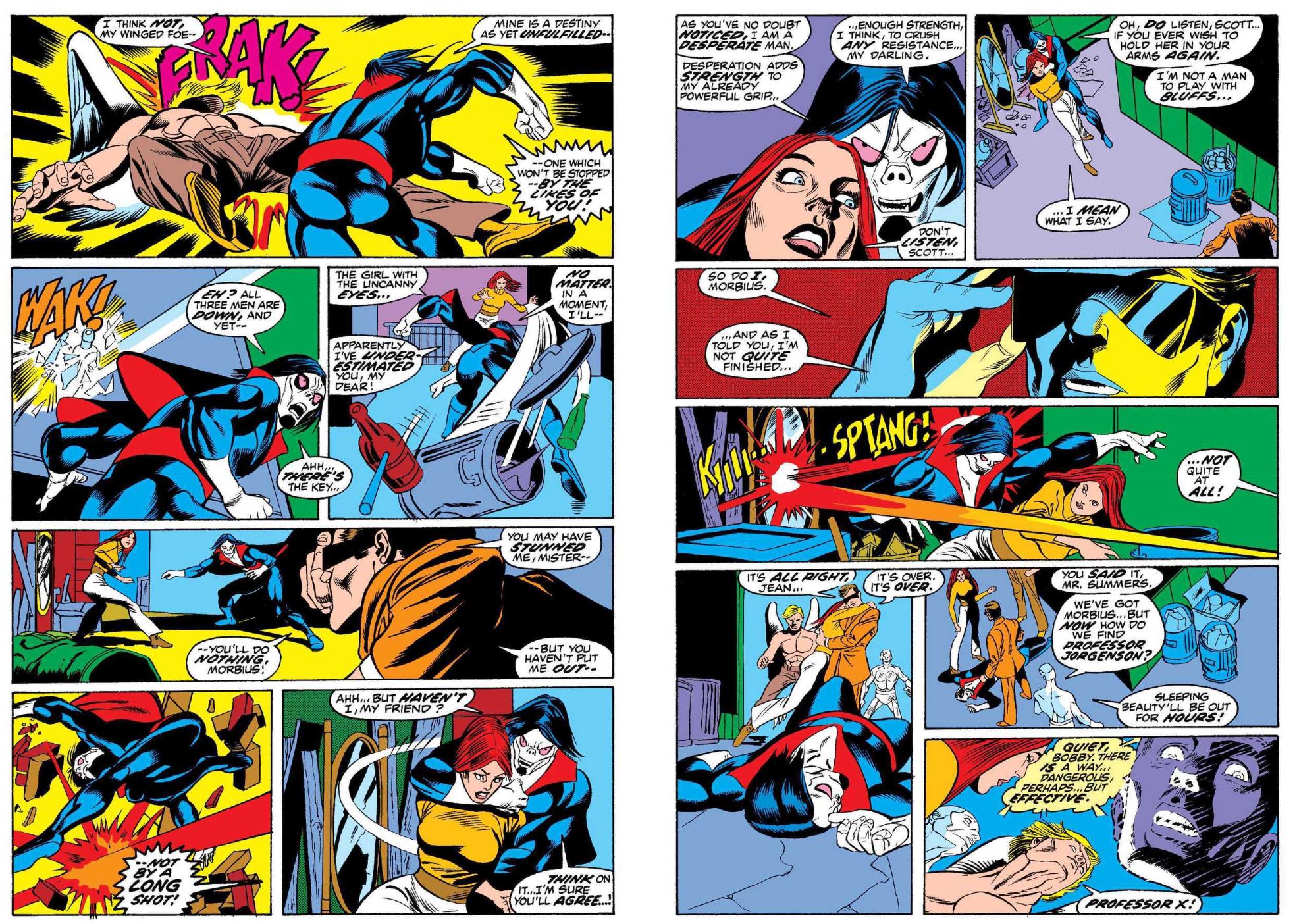
Inked by Steve Mitchell, this boldly enthralling thriller was illustrated by magnificent Gil Kane at the top of his form. Kane became a semi-regular penciller, and his dynamic style and extreme-action anatomy lifted many pedestrian tales such as #5’s ‘A Passion of the Mind!’ (Conway script & Esposito inks), pitting Spidey and The Vision against manipulative mesmeric Puppet Master and robotic assassin the Monstroid. The bad guy again carried over to the next issue and joined by the Mad Thinker in ‘…As Those Who Will Not See!’ pitted the wallcrawler and The Thing against cerebral scoundrels in a cataclysmic battle no Fights ‘n’ Tights fan could be unmoved by…

MTU #7’s ‘A Hitch in Time!’ was produced by Conway, Andru & Mooney: guest-starring Thor with otherworldly Trolls freezing Earth’s time-line as a prerequisite step to conquering Asgard, after which #8 provides a perfect example of the team-up comic’s other function – to promote and popularise new characters. ‘Man-Killer Moves at Midnight!’ was most fans’ first exposure to The Cat (later retooled as Tigra the Were-Woman) in a painfully worthy if ham-fisted attempt to address feminist issues from Conway & Mooney. The hard-pressed heroes joined forces here to stop a male-hunting murderer paying back abusive men. These days we’d probably be rooting for her…

Iron Man collaborated in the opening foray of 3-part tale ‘The Tomorrow War!’ (Conway, Andru & Frank Bolle) as he & Spidey are kidnapped by Zarkko the Tomorrow Man to battle Kang the Conqueror. The Torch returned to help deal with the intermediate threat of a ‘Time Bomb!’ (with art by Mooney & Giacoia) before the entire race of Black Bolt’s Inhumans pile in to help Spidey stop history unravelling in culminatory clash ‘The Doomsday Gambit!’ – this last chapter scripted by Len Wein over Conway’s plot for Mooney & Esposito to illustrate.

Deftly delineated by Andru & Don Perlin, Wein scripted a Conway plot for ‘Wolf at Bay!’ in MTU #12 wherein wallcrawler meets Werewolf By Night Jack Russell to maul malevolent mage Moondark in foggy San Francisco, after which we divert to the Man Without Fear’s own title. Here they share some left coast limelight as Daredevil and the Black Widow #103 (Steve Gerber, Don Heck & Sal Trapani). This sees them join the still-California-bound wallcrawler as a merciless cyborg attacks the odd couple while they pose for roving photojournalist Peter Parker in ‘…Then Came Ramrod!’

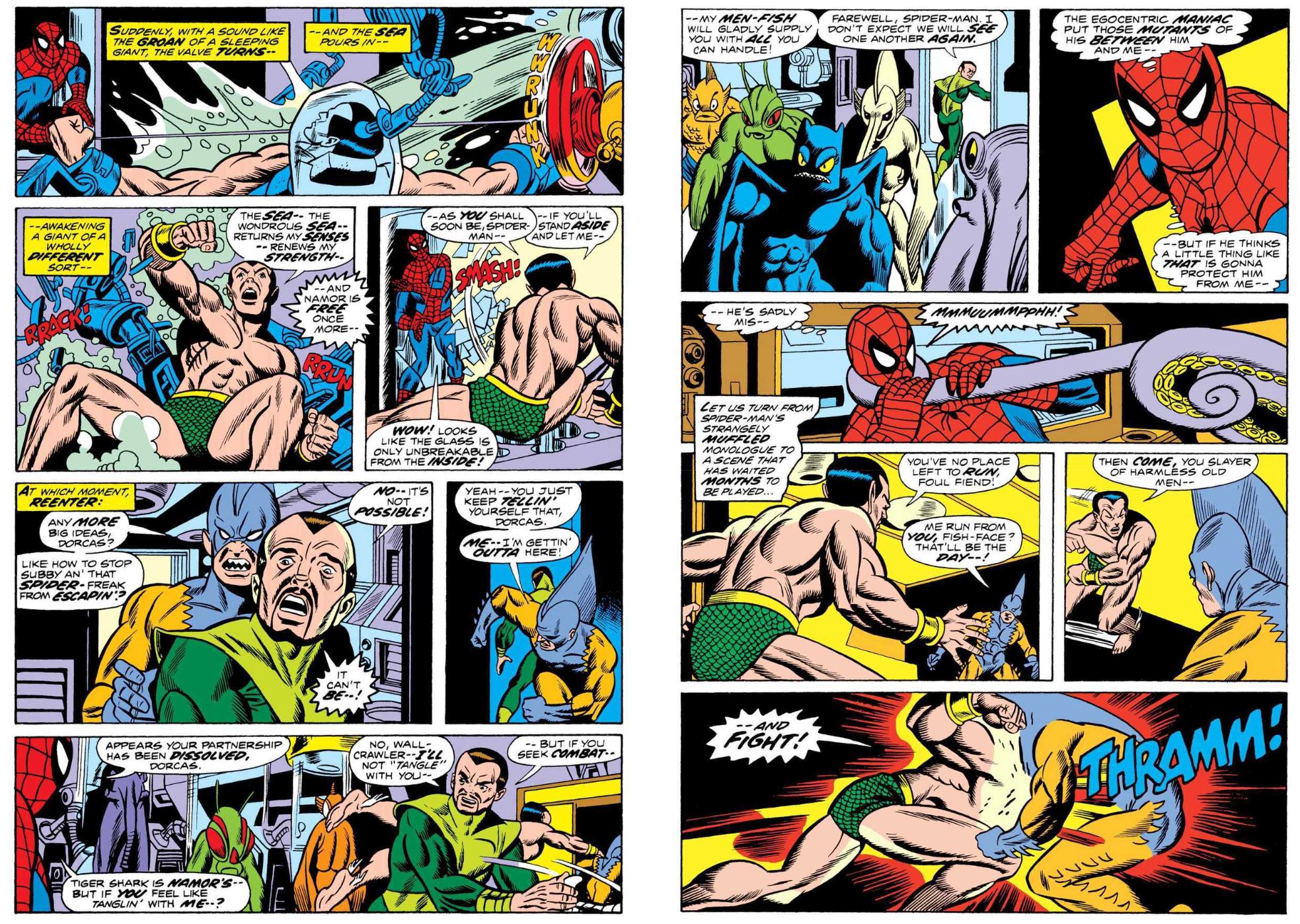
Kane & Giacoia limned ‘The Granite Sky!’ wherein Wein pits Spidey & Captain America against Hydra and Grey Gargoyle in a simple clash of ideologies, after which ‘Mayhem is… the Men-Fish!’ (inked by Wayne Howard – and, yes bad grammar, but great action-art!) matches the webslinger with the savage Sub-Mariner against vile villains Tiger Shark and Doctor Dorcas as well as an army (navy?) of mutant sea-beasts.
Wein, Andru & Perlin created The Orb to bedevil Spidey and Ghost Rider in ‘If an Eye Offend Thee!’ in #15 before Kane & Mooney limn ‘Beware the Basilisk my Son!’: a gripping romp featuring (the original Kree) Captain Marvel, concluding with ‘Chaos at the Earth’s Core!’ (inked by “everybody”!), as Mister Fantastic joins the fracas to stop Mole Man inadvertently blowing up the world. Human Torch Johnny Storm teams with The Hulk in MTU #18 to stop antimatter malcontent Blastaar in ‘Where Bursts the Bomb!’ (Giacoia & Esposito inks), but Spidey blazes back a month later with Ka-Zar in situ to witness ‘The Coming of… Stegron, the Dinosaur Man!’ (Wein, Kane & Giacoia). His plans to flatten New York by releasing ‘Dinosaurs on Broadway!’ is foiled with Black Panther’s help… as well as the artistic gifts of Sal Buscema, Giacoia & Esposito.
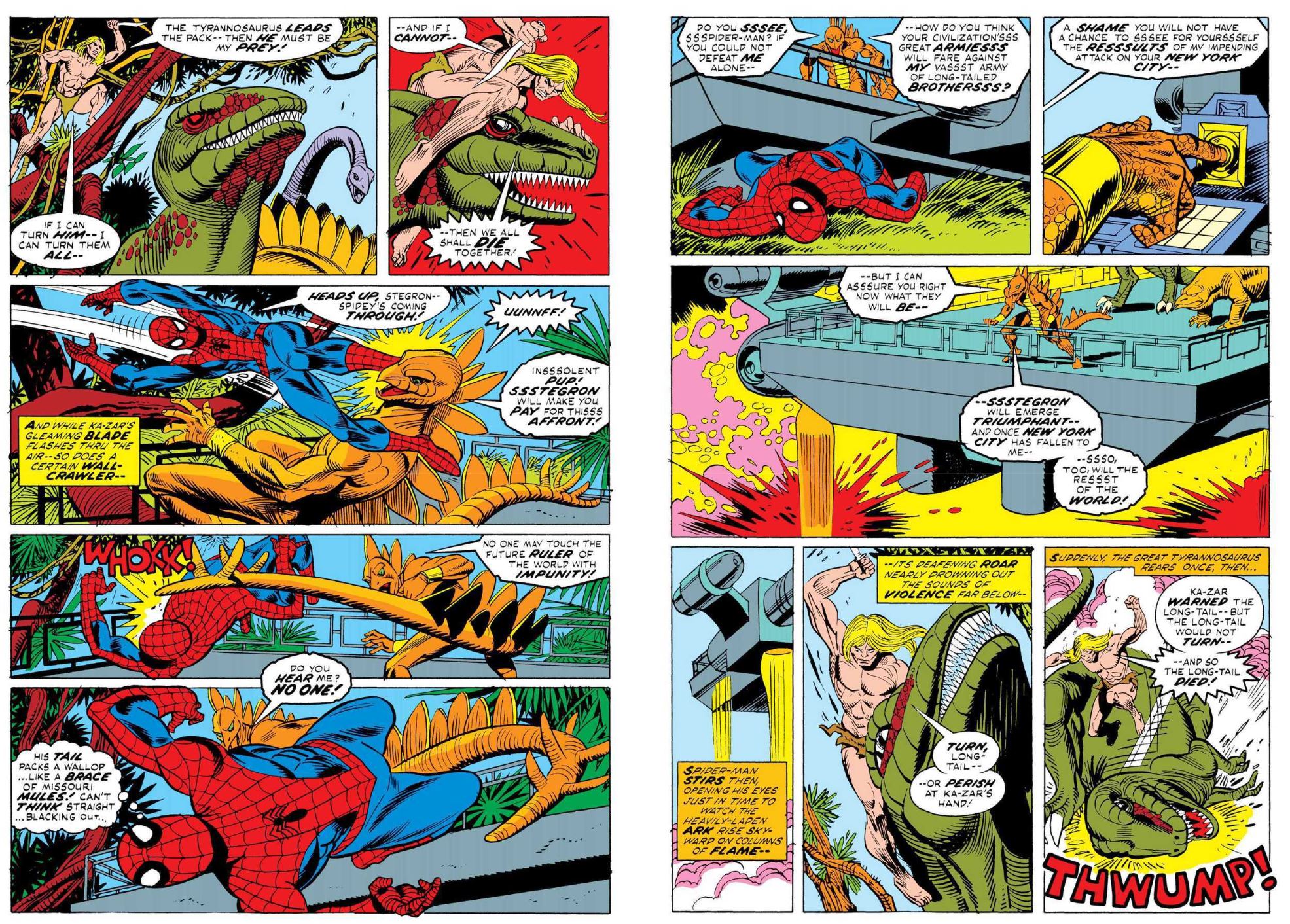
Dave Hunt replaced Esposito inking ‘The Spider and the Sorcerer!’ in #21 as Spidey and Doctor Strange once more battled Xandu, a wily wizard first seen in Spider-Man Annual #2, before we pause for a brief lecture.

Giant-Size titles were quarterly double-length publications added to the schedule of Marvel’s top tier heroes, and the wallcrawler’s were used to highlight outré or potentially controversial pairings such as Dracula and Doc Savage. Here they are represented by try-out Giant-Size Super Heroes #1 which pitted the wallcrawler against Living Vampire Morbius as well as hirsute and manic Man-Wolf. In a classic clash by Conway, Kane & Esposito. Within months a quarterly double-length Spider-Man team vehicle was added to Marvel’s schedule….

Back in MTU #22, Wein, Sal B & Giacoia’s ‘The Messiah Machine!’ brings the monthly story glories to a brief pause after depicting Hawkeye and the Amazing Arachnid frustrating deranged computer Quasimodo‘s ambitious if absurd mechanoid invasion. Then – cover-dated July 1974 and courtesy of Conway, Andru & Heck – Giant-Size Spider-Man #1 saw the webspinner in frantic pursuit of an experimental flu vaccine, improbably carried on an ocean liner in ‘Ship of Fiends!’ The quest brought him into chilling contact with newly-revived vampire lord Dracula and a scheming Maggia Capo at ‘The Masque of the Black Death!’

Here that bizarre battle is accompanied by its original editorial text feature ‘An Illuminating Introduction to Giant Size Spider-Man’ before we move on to monthly MTU wherein the Torch & Iceman fractiously unite to stop Equinox, the Thermo-Dynamic Man on ‘The Night of the Frozen Inferno!’ (Wein, Kane & Esposito). Still embracing supernatural themes and trends, the webslinger learns ‘Moondog is another Name for Murder!’ in a defiantly quirky yarn illustrated by Mooney & Trapani which brings the decidedly offbeat Brother Voodoo to the Big Apple to quash a Manhattan murder cult…

Wein, Mooney & Frank Giacoia then determine that ‘Three into Two Won’t Go!’ as Daredevil joins Spider-Man in thrashing inept kidnappers Cat-Man, Bird-Man and Ape-Man, after which Giant-Size Spider-Man #2 sees the amazing arachnid drawn into battle with Shang-Chi, Master of Kung Fu as sinister immortal Fu Manchu frames Spider-Man in ‘Masterstroke!’ The duped heroes clear the air in ‘Cross… and Double-Cross!’ before uniting to foil the cunning Celestial’s scheme to mindwipe America from the ‘Pinnacle of Doom!’

MTU #26 finds the Torch and Thor battling to save the world from Lava Men in The Fire This Time…’ by Wein, Mooney, Giacoia & Hunt. At this time, in a desperate effort to build some internal continuity into the perforce brutally brief encounters, the scripters introduced a shadowy trio of sinister observers with an undisclosed agenda who would monitor superhero episodes and eventually be revealed as providers of outrageous technologies for many of the one-shot villains who came and went so quickly and ignominiously…

They weren’t involved when the Chameleon frames Spider-Man (again) and tricks the Hulk into freeing a man – for the most unexpected reason of all – from the New York Men’s Detention Center in #27’s ‘A Friend in Need!’ (Wein, Mooney & Giacoia). They did, however, have a cloaked hand in ‘The City Stealers!’ (#28 by new regular creative team Conway, Mooney & Vince Colletta) when strange mechanoids swipe the island of Manhattan, necessitating Spidey and Hercules (mostly Hercules) having to drag it back to its original position…
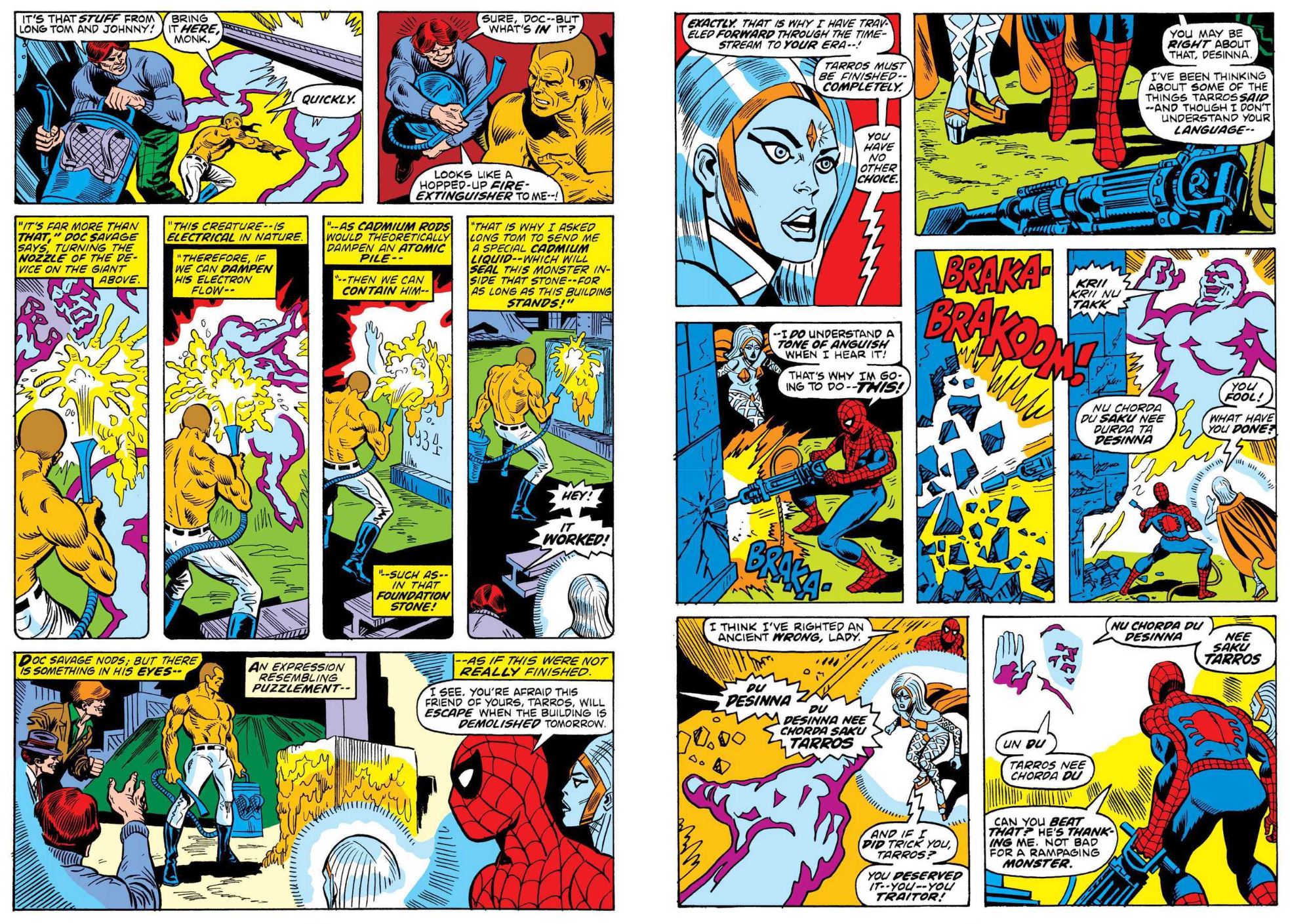
After that implausible minor miracle Spider-Man experiences time-displaced disaster as Giant-Size Spider-Man #3 (Conway, Andru & Esposito) explores ‘The Yesterday Connection!’ Now lovely alien Desinna seeks the aid of Spidey in 1974 and – in ‘The Secret Out of Time’ – the hands-on help of legendary 1930s adventurer Doc Savage. Across a gulf of four decades the heroes individually discover something is not right in ‘Other People in Other Times!’ With the escape of a savage rampaging monster, two eras seem doomed to destruction, at least until wiser, more suspicious heads and powers prevail in ‘Tomorrow is Too Late’ ensuring that ‘The Future is Now!’

Marvel Team-Up #29 displays a far less constrained – or even amicable – pairing as flaming kid Johnny Storm and patronising know-it-all Iron Man butt heads whilst tracking a seeming super-saboteur in ‘Beware the Coming of Infinitus! or How Can You Stop the Reincarnated Man?’ before in #30 Spider-Man and The Falcon find ‘All That Glitters is not Gold!’ whilst tracking a mind-control drug back to its crazy concoctor Midas, the Golden Man.

However, adding extra lustre are visual treats aplenty in the form of contemporaneous house ads; covers and frontispieces from seasonal tabloid treasury Giant Superhero Holiday Grab-Bag (with art from John Buscema & John Romita Sr.) and original art pages and covers from Andru, Kane, Esposito, Perlin, Mooney, & Giacoia plus Kane pencil layouts. Also on view are covers from Marvel Tales #234, 249, 254, by Todd McFarlane, Marshall Rogers, Brian Stelfreeze, complete with new bridging pages by Jae Lee. Jan Harpes & Renee Witterstatter, and another gallery of Spider-Man Megazine covers (#1-6) by James Fry, Hector Collazo, Stelfreeze, Jung Choi, Ron Frenz, Al Milgrom, Stuart Immonen, Kirk Jarvinen, Jason Moore and Mark Buckingham, plus the unpublished cover of #7 as crafted by John Romita Sr & Jr.. Closing the book is a truly unique unused cover for #8 by Brian Bolland.

These stories are of variable quality but nonetheless all exhibit an honest drive to entertain and please. Artistically the work is superb, and most fans of the genre would find little to complain about so, although not really a book for casual or more maturely-oriented readers, there’s bunches of fun on hand and young readers will have a blast, so there’s no real reason not to add this tome to your library…
© 2025 MARVEL.

Today in 1892 Korky the Cat creator James Crighton was born as was Golden Age great Creig Flessel in 1912 and Al McWilliams in 1916. Writer/editor/publisher Bob Shreck joined the party in 1955, three years after Crocket Johnson released the final episode of Barnaby.

Back in 1938, the very first Donald Duck newspaper strip was syndicated and in 1987 the astounding Ken Reid drew his last breath – as did Dutch comics maestro Lo Hartog van Banda in 2006. As always, look in the blog for more or just buy anything with these guys’ names on it…
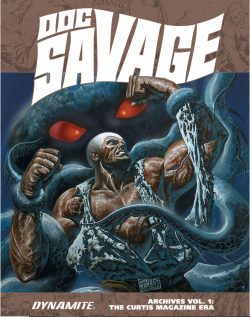
Doc Savage® Archives volume One: The Curtis Magazine Era


By Doug Moench, John Warner, John Whitmore, illustrated by John Buscema, Tony DeZuñiga, John Romita, Rico Rival, Marie Severin, Neal Adams, Marshall Rogers, Val Mayerik, Rich Buckler, Klaus Janson, Ed Davis, Tom Sutton, Ernie Chan, Bob Layton, Dick Giordano & various (Dynamite Entertainment)
ISBN: 978-1-60690-514-2 (HB/Digital edition)

Before comic books, thrill-starved readers endured the travails of the Great Depression by regular doses of extraordinary excitement derived from cheaply produced periodical novels dubbed – due to the low-grade paper they were printed on – “pulps”. There were hundreds published every month, ranging from the truly excellent to the pitifully dire: seemingly catering to every conceivable style, taste and genre.

The process spawned a new type of star and kind of story: damaged modern knights who were mysterious, implacable and extraordinary to the point of superhumanity, confronting uncanny overwhelming evil. In this fresh adventure medium, two-star characters outshone all others. The first was The Shadow – a true trendsetter who pioneered and beta-tested most of the methodology and mystique later mastered by Batman and most superheroes. Soon after him came the Superman of his day: Doc Savage, the Man of Bronze

In the early 1930s, The Shadow was a dark, relentless, unstoppable and much-imitated creature of the night preying on the wicked and dispensing his own terrifying justice (and for more about him check out the Dark Avenger review). A true game changer tailor-made by a committee of wise heads and a superb scripter, Street & Smith Publications’ The Shadow set the world on fire, and those savvy savants sensibly sought to repeat the miracle. The result was a modern Hercules, Plato, Hippocrates, King Arthur, Sherlock Holmes and Einstein rolled into one gleaming, oversized paragon of physical perfection.

The big man and his team of globe-trotting war-buddy science specialists had been cobbled together by publisher Henry W. Ralston, editor John L. Naonvic and writer Lester Dent, using the same gameplan that had materialised The Shadow. Editorial notions and sale points of the bosses were fleshed out, filled in and made to work by Dent, who – under house pen-name Kenneth Robeson – wrote 159 of the 181 original novels released between March 1933 (Happy Birthday Doc!) and Fall 1949. The other exploits were handled in whole or in part by ghost writers and assistants Harold A. Davis, Ryerson Johnson, Laurence Donavan, Martin E. Baker, William G. Bogart and Alan Hathway.

The core premise is delicious and instantly engaging. Clark Savage Jr. had been trained from infancy in all arts and sciences, even as he underwent a carefully-devised program and regimen of physical training and sensory stimulation to make him impossibly fast, strong, hardy, acute, astute and – to be honest – pretty smug.

The perfect “Competent Man” was forever solving manic mysteries and protecting the helpless – when not quietly puttering away improving the lot of humanity with his inventions and pioneering medical procedures. However, this self-appointed hero and champion was what we’d probably now call an overachieving abuse survivor. For example, his unique viewpoint deemed it sound and reasonable to cure “evil tendencies” with brain surgery…

Despite such caveats (different times, right?) “Doc” Savage and his militarily-distinguished apex troubleshooters, Renny, Johnny, Long Tom, Ham and Monk were hugely popular in prose, print, radio and comics: a fascinating prototype example of a superhero team.

They regularly aided the oppressed and exploited: battling mad geniuses, would-be world conquerors, scary monsters, weird forces, dictators and uncommon criminals, before fading from view as the 1940s closed. They stormed back into popular culture during the 1960s, revived as part of global fantasy boom which also resurrected The Shadow, Conan, the C’thulu mythos and so many other pulp stars and craftsmen. Doc was particularly memorable thanks to such magazine exploits being reprinted in iconic Bantam Books paperbacks sporting stunning covers by James Bama…

Savage and his “fabulous five” had been funnybook stars since 1940: firstly in Street & Smith’s own The Shadow #1-3, and then in their own Doc Savage Comics (1940-1943). He thereafter appeared intermittently in The Shadow and Supersnipe Comics until 1948.

In November 1966, an abortive movie of The Thousand-Headed Man came to nothing, but did result in a one-shot tie-in from Gold Key Comics by Leo Dorfman & Jack Sparling. It also sported a lovely cover by Bama…

During an era of nostalgia, Marvel secured rights to publish Doc Savage comics: adapting the novels Man of Bronze, Brand of the Werewolf, Death in Silver and The Monsters over 8 regular issues between October 1972 and January 1974. There was also a giant-sized special and Doc entered Marvel continuity by teaming with Spider-Man and The Thing.

George Pal’s movie Doc Savage: The Man of Bronze was released in June 1975. Heavily hyped but an eventual flop, it nevertheless prompted Marvel to revive their license: creating a monochrome magazine version combining interviews and articles with darker, more mature comics adventures. The movie was fun but misunderstood and underappreciated, but it allowed true fans to see how their hero should always have been handled…

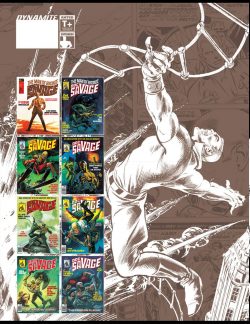
This hefty compilation re-presents all the material originally included in Doc Savage Magazine #1-8, spanning cover-dates August 1975 to Spring 1977. It is called the “Curtis Magazine Era” because that’s the name of the affiliated distribution company Marvel were part of at the time, and indicated a separate imprint producing comics outside the remit of the restrictive Comics Code Authority rules.

Thus, following Roger Kastel’s stunning full-colour painted cover (based on a movie poster) and a publicity photo frontispiece of actor Ron Ely beside an iconic Bama cover painting, Doc Savage #1 opens with Marv Wolfman’s ‘An Editorial in Bronze’ and John Romita (Sr.) & Tony DeZuñiga’s potent ‘Pin-up art’. This is mere prelude to an extra-long, peril-packed period drama by writer Doug Moench and illustrators John Buscema, Romita & DeZuñiga whose cunning comics chills commence with ‘The Doom on Thunder Isle!’.

When a Manhattan skyscraper is razed to rubble by lightning, Doc and his team are drawn into a missing persons case involving socialite Angelica Tremaine, her architect brother Winston and fiancé Thomas J. Bolt

A complex plot rapidly unfolds, involving her, them and a suicidally fanatical kidnap gang seemingly based in the clouds, before Doc deduces the actual tropical island location of the foe. Deploying his many signature war-machines and leading his team in a brief but brutal clash against mutant beasts, super-science weapons and ancient madness, Doc learns even he cannot foil or fix all the cruel experiments of the insane Silver Ziggurat

Following a contemporary body building ad (!), Jim Harmon & Chris Claremont interview director/producer ‘George Pal… The Man Who Made Doc Savage’ to end the first foray…

Scots artist Ken Barr painted the other covers, the first of which precedes Marv Wolfman’s editorial in #2 asking ‘Why Couldn’t Ron Ely Be Short and Ugly?’ (augmented by Marie Severin cartoons) before dark doom and destruction arrives in another extravagant mystery in Moench & DeZuñiga’s ‘Hell-Reapers at the Heart of Paradise’

Here a property tycoon’s abduction by an apparently crazed and definitely radioactive Viking pitches Savage and Co. into a lethal and terrifying treasure hunt for a galleon lost since 1504. The search expands to include a flotilla of missing ships vanished over centuries in the Arctic, and concludes spectacularly with civil war in a lost paradise packed with monsters…

More hilariously outdated macho ads bracket a ‘Ron Ely: the Man of Bronze!’ interview conducted by John Warner with photos by Michelle Wolfman…

Doc Savage Magazine #3 sees another Barr cover, frontispiece ‘Pin-up art’ by Rich Buckler & Klaus Janson and letters page ‘Mail of Bronze’ preface Moench, Buscema & DeZuñiga’s  titanic 45-page tale ‘The Inferno Scheme!’ When robot beasts plunder gems all across New York City, enigmatic, enticing Contessa De Chabrol points the finger at her brother, hoping Savage and his “brothers in arms” can keep the police out of the affair and save her deranged sibling from himself. With utterly smitten engineer Renny suitably distracted, they head upstate to Chabrol’s fortress to find the villain has mastered the science of lasers as well as robotics…

Well, almost. He still needs Renny to fine-tune his death ray cannon, but even as the captive’s comrades render a rescue mission, one last tragic betrayal awaits them…

Ape-shaped chemist/comedic relief Lieutenant Colonel Andrew Blodgett Mayfair then stars in a solo tale when Monk! experiences ‘A Most Singular Writ of Habeas Corpus’ by Moench & Rico Rival. When his eternal rivalry with lawyer Ham (Brigadier General Theodore Marly Brooks) leads to the legal fashion plate losing his latest suit to the Monk’s pet pig, it results in everyone being abducted by a ruthless racketeer seeking to ace out the competition through clever chemistry…

More classic ads neatly segue into a stripped-down DSM #4 wherein Moench, Marie Severin & DeZuñiga detail how ‘Ghost-Pirates from the Beyond!’ imperil the world. It begins in February 1936 as assassins kill high-ranking police officers in Casablanca before targeting Clark Savage Jr.’s friend Charles Villiers in the Big Apple. Seemingly murdered by a ghostly sheik, the criminologist’s demise is forensically deconstructed by Doc, who brings his team to Morocco and scotches a scheme to garner millions in lost treasure and foment rebellion in the fractious French Protectorate…

Another ‘Mail of Bronze’ section and more ads (where did I put those X-ray Spex?) takes us #5 where ‘The Doc Savage Oath’ is illustrated by Neal Adams and more ‘Mail of Bronze’ sets up a colossal comics clash with ‘The Earth Wreckers!’. Here Moench & DeZuñiga see our planet in peril in summer 1933, as Doc Savage traverses the globe, raiding lairs on six continents to ruthlessly secure the components for a device intended to end humanity. This tale introduces Doc’s formidable cousin Pat Savage who is dragged into the impending calamity by shy, retiring whistle-blower Hiram Meeker. As usual, there’s more going on than first appears and the climactic battle against maniac super-extortionist Iron Mask beneath Loch Ness affords many shocks before order is finally restored…

Pin-up art’ of Doc and the gang by Marshall Rodgers bisects Bob Sampson’s comprehensive feature on ‘The Pulp Doc Savage!’ and David Anthony Kraft’s photo-feature ‘An Interview with: Mrs. Lester Dent’ before more daft ads herald Doc Savage Magazine #6.

Another Barr classic cover, supported by anonymous ‘Pin-up art’ (that looks like early Mike Zeck to me) and editorial ‘Onward, the Man of Bronze’ written by John Warner & limned by Keith Pollard springs directly into wild action into Moench & DeZuñiga’s main feature ‘The Sky-Stealers!’ as supposed Egyptian gods employ astounding super science to wipe out the mining town of Plainville, Utah. When Doc investigates, he leans that not only was the bank looted, but all the freshly-procured uranium is also gone…

As neighbouring town Union is also eradicated, lawyer Ham and archaeologist Johnny strike gold: uncovering maverick savant Professor Johnathan Wilde whose theories on “pyramid power” led to his ostracization and eventual disappearance. The hunt inexorably leads the squad to the New York Museum of Natural History, the pyramid of Cheops in Giza and repeated clashes with beast-headed supermen before deranged mastermind Horus and his armies finally fall to Doc’s strategies and sheer determination to punish the unjust…

Bob Sampson’s prose biography of ‘Renny’ is supported by illustrations from art prodigies Frank Cirocco & Brent Anderson, ‘Mail of Bronze’ and ‘Pin-up art’ by Ron Wilson (?).

Penultimate issue DSM #7 offers ‘Pin-up art’ by Ed Davis, before storming straight into a monster-mash masterpiece with Moench, Val Mayerik & DeZuñiga detailing how ‘The Mayan Mutations!’ unleash giant terrors in Peru. It’s June 1941 and America is still officially neutral whilst most of the world is at war, but when missionary Vesper Hope seeks the team’s aid on behalf of her native companion Myrrana, the quest takes them back to south America’s rain forests where white men have enslaved the indigenous people and created devils to destroy everything.

The champions don’t even leave New York before the terrors target them, too…

Ultimately, our heroes clean up the green hell and uncover the shocking truth of the monsters, but this time not all the damage can be fixed…

More ‘Pin-up art’ by Ed Davis leads to Sampson’s article on ‘Johnny’ before the historical heroic hijinks halt with issue #8. Tom Sutton’s ‘Pin-up art’ frontispiece precedes Warner’s farewell in ‘Editorializing on the Bronze Side in Two Parts’ before he, John Whitmore, Moench & Ernie Chan unleash ‘The Crimson Plague’.

When Doc leads the team to Acapulco in search of an old medical colleague, they uncover an uncanny monster leaving brain-addled victims and corpses. The octopoid horror follows them back north and haunts Brooklyn before Savage uncovers human agency behind the scarlet death “disappearing” scientists and threatening the world’s greatest cities. The imminent crisis demands the Fabulous Five split up, but when that ploy fails it falls to Doc to save the day and destroy the ghastly culprit behind the plot…

Wrapping up the issues – and this epic collection – is one last ‘Mail of Bronze’ feature, and more ‘Pin-up art’: Long Tom and friends’ courtesy of Davis and Savage by Bob Layton & Dick Giordano, all tantalising bolstered by a tantalising promo for a new collected serial (stay tuned for that later in this Savage anniversary year!)…

Bold, bombastic and truly beloved, these yarns have been published by Marvel, DC and Dynamite: truly timeless tales of the perfect and prototypical man of wonders. These are stories no action-loving, monster-hunting, crime-busting armchair hero can be without.

So, is that you?
® and © 2014 Conde Nast. Used under license.