
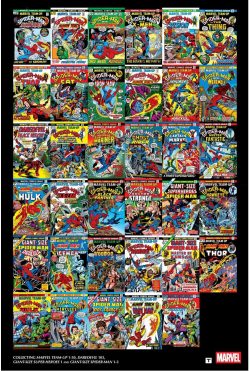
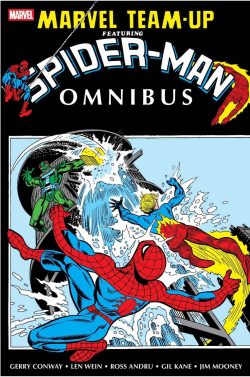
Marvel Team-Up Omnibus volume 1


By Roy Thomas, Gerry Conway, Len Wein, Steve Gerber, Ross Andru, Gil Kane, Jim Mooney, Sal Buscema, Don Heck, Mike Esposito, Frank Giacoia, Steve Mitchell, Frank Bolle, Don Perlin, Sal Trapani, Wayne Howard, Dave Hunt, Vince Colletta & various (MARVEL)
ISBN: 978-1-3029-6699-7 (HB/Digital edition)

This book includes Discriminatory Content produced in less enlightened times.

Inspiration isn’t everything. In fact, as Marvel slowly grew to a position of market dominance in the wake of losing their two most innovative and inspirational creators, they did so less by experimentation and more by expanding proven concepts and properties. The only real exception to this was the assembly line creation of horror and horror-hero titles in response to the industry down-turn in super-hero sales – a move expedited by a rapid revision in the wordings of the increasingly ineffectual Comics Code Authority rules.

The concept of team-up books – an established star pairing or battling (usually both) with less well-selling company characters – was not new when Marvel decided to award their most popular hero the lion’s share of this new title, but they wisely left their options open by allocating an occasional substitute lead in the Human Torch. In those long-lost days editors were acutely conscious of potential over-exposure – and since superheroes were actually in a decline they may well have been right.

Marvel Team-Up was the second regular Spider-Man title (abortive companion title Spectacular Spider-Man was created for the magazine market in 1968 but died after two issues). MTU launched at the end of 1971 and went from strength to strength, proving the time had finally come for expansion and a concentration on uncomplicated action over sub-plots…

This engaging hardback and/or eBook compilation gathers the first 30 issues of Marvel Team-Up (spanning cover-dates March 1972 to February 1975) and includes crossover fun from Daredevil (and the Black Widow) #103, plus double length larks from Giant-Size Super Heroes #1 and Giant-Size Spider-Man #1-3. As well as a monolithic assortment of nostalgic visual treats at the back, this mammoth tome is dotted throughout with editorial and letters pages (from ‘Team-Up’ to ‘Mail it to Team-Up’) and also includes recycled Introductions from previous Marvel Masterworks editions (namely Gerry Conway’s ‘Behold: An Introduction’ and Roy Thomas’ ‘A Long, Loose Leash’ and ‘Full Credit – or Blame’) plus other contemporary editorial announcements as seen in each original issue, just to enhance overall historical experience…

Marvel Team-Up #1was crafted by Roy Thomas, Ross Andru & Mike Esposito as a mutual old enemy reared his gritty head in charming seasonal saga ‘Have Yourself a Sandman Little Christmas!’. A light-heated romp full of Christmas cheer, rambunctious action and seasonal sentiment, the story set the tone for all epics to follow. Merry Marvelite Maximii can award themselves a point for remembering which martial arts/TV hero debuted in this issue, but folk with lives can simply take my word that it was Iron Fist’s sometimes-squeeze Misty Knight

Gerry Conway assumed the writer’s role and Jim Mooney the inks for ‘And Spidey Makes Four!’ in the succeeding issue as our hot and sticky heroes then take on and trounce the Frightful Four and Negative Zone bogeyman Annihilus before without pause going after Morbius the Living Vampire in #3’s ‘The Power to Purge!’ (as inked by Frank Giacoia). The new horror-star was still acting the villain in MTU #4 as the Torch was replaced by most of Marvel’s sole mutant team (The Beast having gone all hairy – and solo) in ‘And Then… the X-Men!’
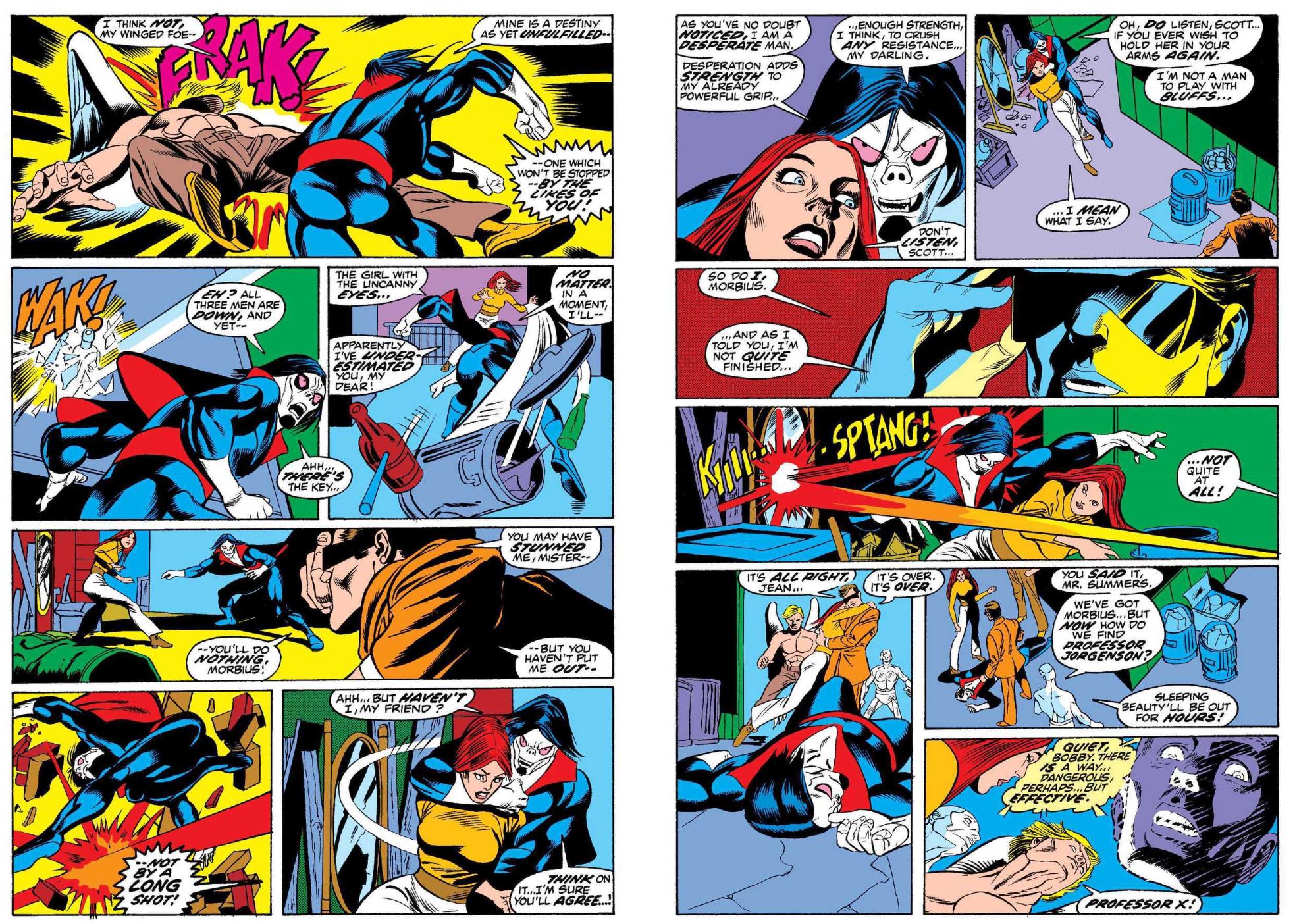
Inked by Steve Mitchell, this boldly enthralling thriller was illustrated by magnificent Gil Kane at the top of his form. Kane became a semi-regular penciller, and his dynamic style and extreme-action anatomy lifted many pedestrian tales such as #5’s ‘A Passion of the Mind!’ (Conway script & Esposito inks), pitting Spidey and The Vision against manipulative mesmeric Puppet Master and robotic assassin the Monstroid. The bad guy again carried over to the next issue and joined by the Mad Thinker in ‘…As Those Who Will Not See!’ pitted the wallcrawler and The Thing against cerebral scoundrels in a cataclysmic battle no Fights ‘n’ Tights fan could be unmoved by…

MTU #7’s ‘A Hitch in Time!’ was produced by Conway, Andru & Mooney: guest-starring Thor with otherworldly Trolls freezing Earth’s time-line as a prerequisite step to conquering Asgard, after which #8 provides a perfect example of the team-up comic’s other function – to promote and popularise new characters. ‘Man-Killer Moves at Midnight!’ was most fans’ first exposure to The Cat (later retooled as Tigra the Were-Woman) in a painfully worthy if ham-fisted attempt to address feminist issues from Conway & Mooney. The hard-pressed heroes joined forces here to stop a male-hunting murderer paying back abusive men. These days we’d probably be rooting for her…

Iron Man collaborated in the opening foray of 3-part tale ‘The Tomorrow War!’ (Conway, Andru & Frank Bolle) as he & Spidey are kidnapped by Zarkko the Tomorrow Man to battle Kang the Conqueror. The Torch returned to help deal with the intermediate threat of a ‘Time Bomb!’ (with art by Mooney & Giacoia) before the entire race of Black Bolt’s Inhumans pile in to help Spidey stop history unravelling in culminatory clash ‘The Doomsday Gambit!’ – this last chapter scripted by Len Wein over Conway’s plot for Mooney & Esposito to illustrate.

Deftly delineated by Andru & Don Perlin, Wein scripted a Conway plot for ‘Wolf at Bay!’ in MTU #12 wherein wallcrawler meets Werewolf By Night Jack Russell to maul malevolent mage Moondark in foggy San Francisco, after which we divert to the Man Without Fear’s own title. Here they share some left coast limelight as Daredevil and the Black Widow #103 (Steve Gerber, Don Heck & Sal Trapani). This sees them join the still-California-bound wallcrawler as a merciless cyborg attacks the odd couple while they pose for roving photojournalist Peter Parker in ‘…Then Came Ramrod!’

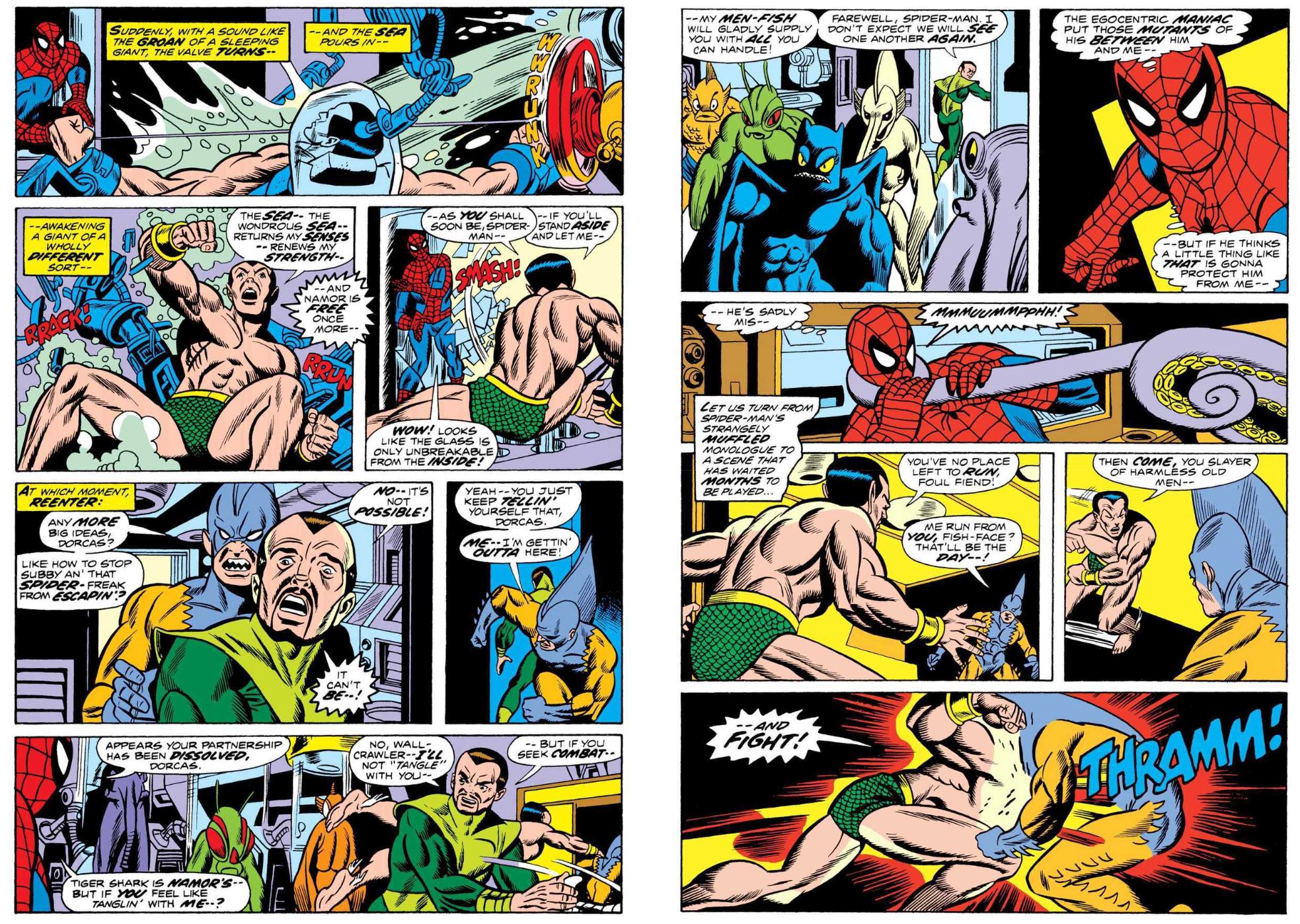
Kane & Giacoia limned ‘The Granite Sky!’ wherein Wein pits Spidey & Captain America against Hydra and Grey Gargoyle in a simple clash of ideologies, after which ‘Mayhem is… the Men-Fish!’ (inked by Wayne Howard – and, yes bad grammar, but great action-art!) matches the webslinger with the savage Sub-Mariner against vile villains Tiger Shark and Doctor Dorcas as well as an army (navy?) of mutant sea-beasts.
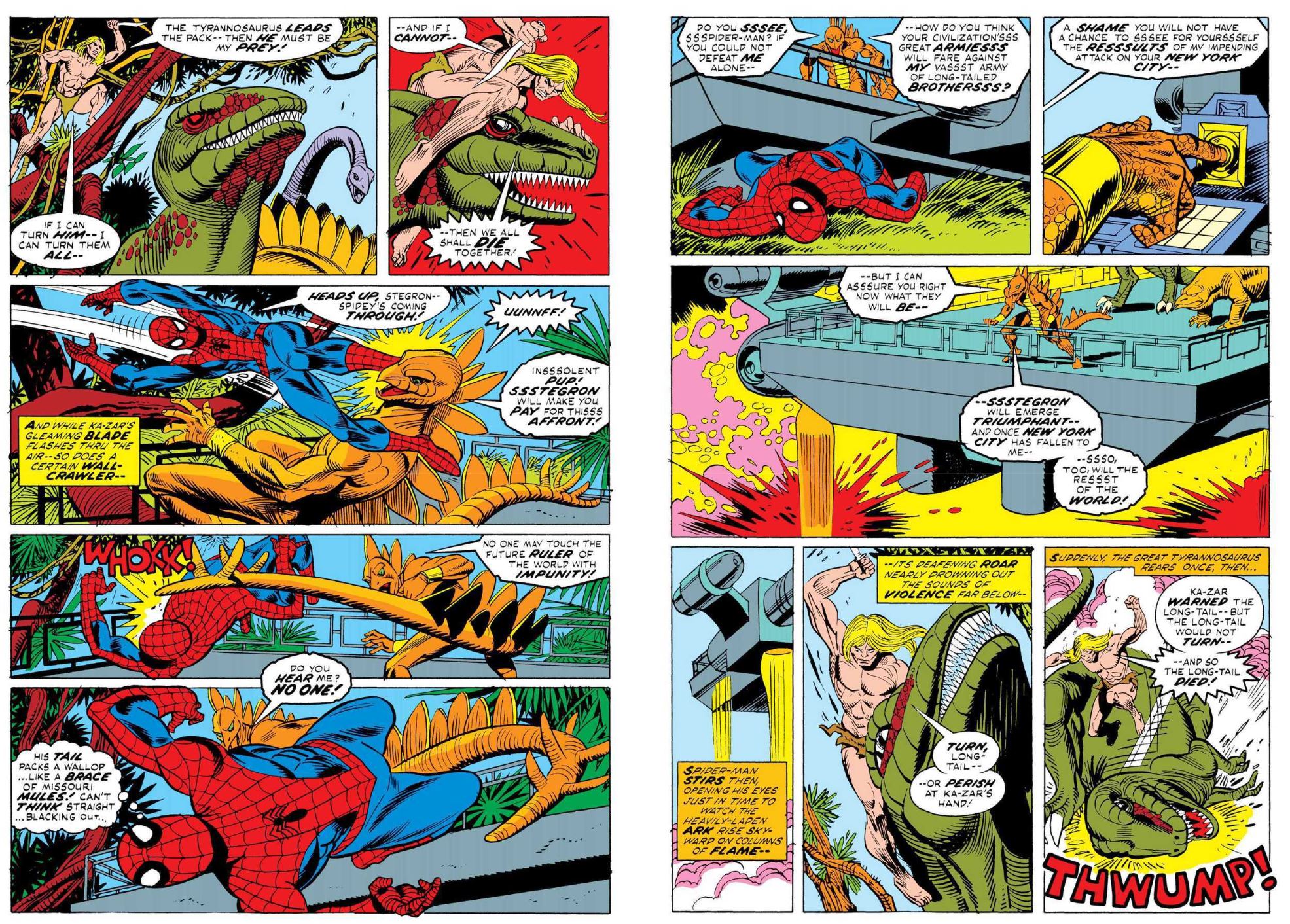
Wein, Andru & Perlin created The Orb to bedevil Spidey and Ghost Rider in ‘If an Eye Offend Thee!’ in #15 before Kane & Mooney limn ‘Beware the Basilisk my Son!’: a gripping romp featuring (the original Kree) Captain Marvel, concluding with ‘Chaos at the Earth’s Core!’ (inked by “everybody”!), as Mister Fantastic joins the fracas to stop Mole Man inadvertently blowing up the world. Human Torch Johnny Storm teams with The Hulk in MTU #18 to stop antimatter malcontent Blastaar in ‘Where Bursts the Bomb!’ (Giacoia & Esposito inks), but Spidey blazes back a month later with Ka-Zar in situ to witness ‘The Coming of… Stegron, the Dinosaur Man!’ (Wein, Kane & Giacoia). His plans to flatten New York by releasing ‘Dinosaurs on Broadway!’ is foiled with Black Panther’s help… as well as the artistic gifts of Sal Buscema, Giacoia & Esposito.
Dave Hunt replaced Esposito inking ‘The Spider and the Sorcerer!’ in #21 as Spidey and Doctor Strange once more battled Xandu, a wily wizard first seen in Spider-Man Annual #2, before we pause for a brief lecture.

Giant-Size titles were quarterly double-length publications added to the schedule of Marvel’s top tier heroes, and the wallcrawler’s were used to highlight outré or potentially controversial pairings such as Dracula and Doc Savage. Here they are represented by try-out Giant-Size Super Heroes #1 which pitted the wallcrawler against Living Vampire Morbius as well as hirsute and manic Man-Wolf. In a classic clash by Conway, Kane & Esposito. Within months a quarterly double-length Spider-Man team vehicle was added to Marvel’s schedule….

Back in MTU #22, Wein, Sal B & Giacoia’s ‘The Messiah Machine!’ brings the monthly story glories to a brief pause after depicting Hawkeye and the Amazing Arachnid frustrating deranged computer Quasimodo‘s ambitious if absurd mechanoid invasion. Then – cover-dated July 1974 and courtesy of Conway, Andru & Heck – Giant-Size Spider-Man #1 saw the webspinner in frantic pursuit of an experimental flu vaccine, improbably carried on an ocean liner in ‘Ship of Fiends!’ The quest brought him into chilling contact with newly-revived vampire lord Dracula and a scheming Maggia Capo at ‘The Masque of the Black Death!’

Here that bizarre battle is accompanied by its original editorial text feature ‘An Illuminating Introduction to Giant Size Spider-Man’ before we move on to monthly MTU wherein the Torch & Iceman fractiously unite to stop Equinox, the Thermo-Dynamic Man on ‘The Night of the Frozen Inferno!’ (Wein, Kane & Esposito). Still embracing supernatural themes and trends, the webslinger learns ‘Moondog is another Name for Murder!’ in a defiantly quirky yarn illustrated by Mooney & Trapani which brings the decidedly offbeat Brother Voodoo to the Big Apple to quash a Manhattan murder cult…

Wein, Mooney & Frank Giacoia then determine that ‘Three into Two Won’t Go!’ as Daredevil joins Spider-Man in thrashing inept kidnappers Cat-Man, Bird-Man and Ape-Man, after which Giant-Size Spider-Man #2 sees the amazing arachnid drawn into battle with Shang-Chi, Master of Kung Fu as sinister immortal Fu Manchu frames Spider-Man in ‘Masterstroke!’ The duped heroes clear the air in ‘Cross… and Double-Cross!’ before uniting to foil the cunning Celestial’s scheme to mindwipe America from the ‘Pinnacle of Doom!’

MTU #26 finds the Torch and Thor battling to save the world from Lava Men in The Fire This Time…’ by Wein, Mooney, Giacoia & Hunt. At this time, in a desperate effort to build some internal continuity into the perforce brutally brief encounters, the scripters introduced a shadowy trio of sinister observers with an undisclosed agenda who would monitor superhero episodes and eventually be revealed as providers of outrageous technologies for many of the one-shot villains who came and went so quickly and ignominiously…

They weren’t involved when the Chameleon frames Spider-Man (again) and tricks the Hulk into freeing a man – for the most unexpected reason of all – from the New York Men’s Detention Center in #27’s ‘A Friend in Need!’ (Wein, Mooney & Giacoia). They did, however, have a cloaked hand in ‘The City Stealers!’ (#28 by new regular creative team Conway, Mooney & Vince Colletta) when strange mechanoids swipe the island of Manhattan, necessitating Spidey and Hercules (mostly Hercules) having to drag it back to its original position…
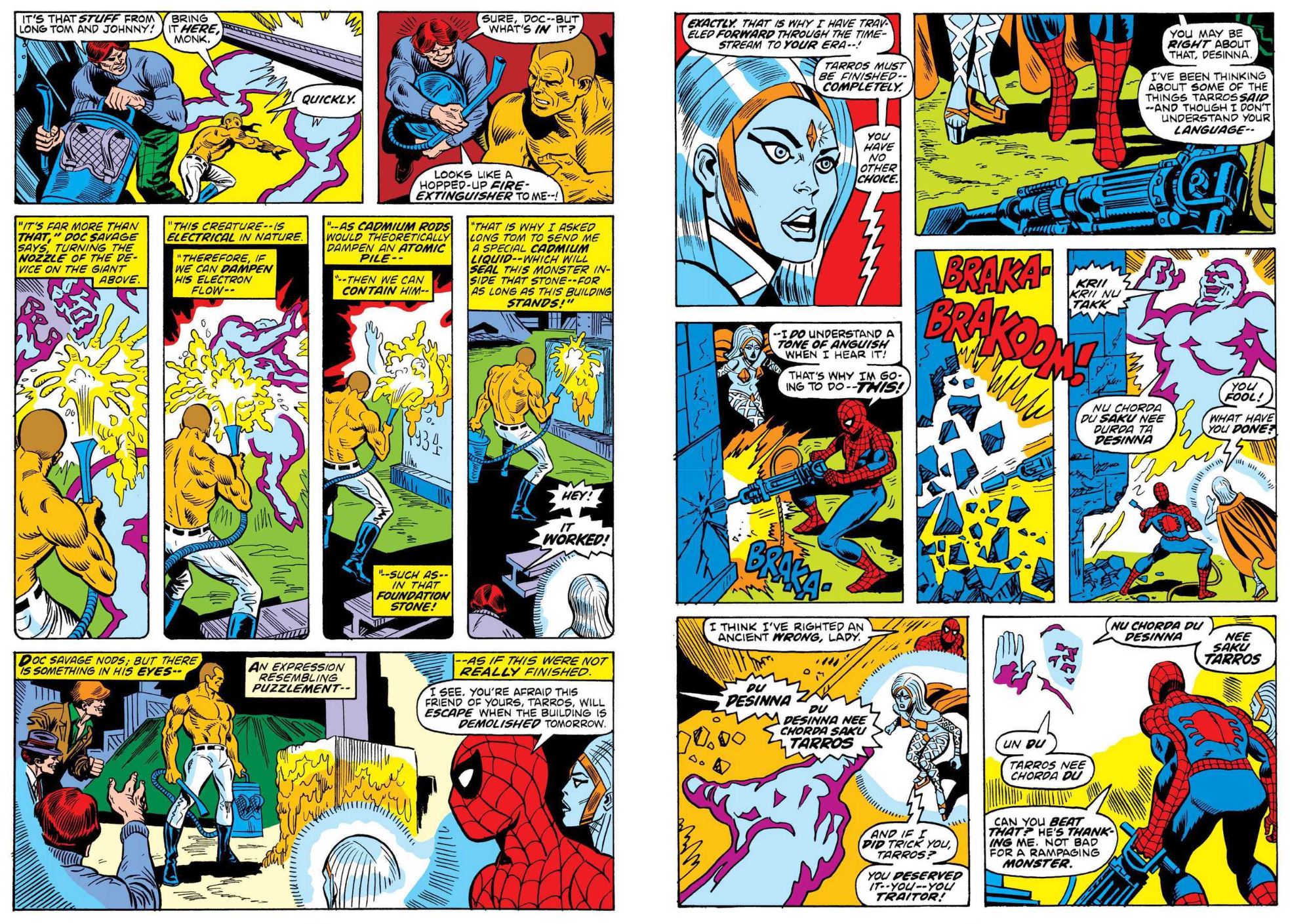
After that implausible minor miracle Spider-Man experiences time-displaced disaster as Giant-Size Spider-Man #3 (Conway, Andru & Esposito) explores ‘The Yesterday Connection!’ Now lovely alien Desinna seeks the aid of Spidey in 1974 and – in ‘The Secret Out of Time’ – the hands-on help of legendary 1930s adventurer Doc Savage. Across a gulf of four decades the heroes individually discover something is not right in ‘Other People in Other Times!’ With the escape of a savage rampaging monster, two eras seem doomed to destruction, at least until wiser, more suspicious heads and powers prevail in ‘Tomorrow is Too Late’ ensuring that ‘The Future is Now!’

Marvel Team-Up #29 displays a far less constrained – or even amicable – pairing as flaming kid Johnny Storm and patronising know-it-all Iron Man butt heads whilst tracking a seeming super-saboteur in ‘Beware the Coming of Infinitus! or How Can You Stop the Reincarnated Man?’ before in #30 Spider-Man and The Falcon find ‘All That Glitters is not Gold!’ whilst tracking a mind-control drug back to its crazy concoctor Midas, the Golden Man.

However, adding extra lustre are visual treats aplenty in the form of contemporaneous house ads; covers and frontispieces from seasonal tabloid treasury Giant Superhero Holiday Grab-Bag (with art from John Buscema & John Romita Sr.) and original art pages and covers from Andru, Kane, Esposito, Perlin, Mooney, & Giacoia plus Kane pencil layouts. Also on view are covers from Marvel Tales #234, 249, 254, by Todd McFarlane, Marshall Rogers, Brian Stelfreeze, complete with new bridging pages by Jae Lee. Jan Harpes & Renee Witterstatter, and another gallery of Spider-Man Megazine covers (#1-6) by James Fry, Hector Collazo, Stelfreeze, Jung Choi, Ron Frenz, Al Milgrom, Stuart Immonen, Kirk Jarvinen, Jason Moore and Mark Buckingham, plus the unpublished cover of #7 as crafted by John Romita Sr & Jr.. Closing the book is a truly unique unused cover for #8 by Brian Bolland.

These stories are of variable quality but nonetheless all exhibit an honest drive to entertain and please. Artistically the work is superb, and most fans of the genre would find little to complain about so, although not really a book for casual or more maturely-oriented readers, there’s bunches of fun on hand and young readers will have a blast, so there’s no real reason not to add this tome to your library…
© 2025 MARVEL.

Today in 1892 Korky the Cat creator James Crighton was born as was Golden Age great Creig Flessel in 1912 and Al McWilliams in 1916. Writer/editor/publisher Bob Shreck joined the party in 1955, three years after Crocket Johnson released the final episode of Barnaby.

Back in 1938, the very first Donald Duck newspaper strip was syndicated and in 1987 the astounding Ken Reid drew his last breath – as did Dutch comics maestro Lo Hartog van Banda in 2006. As always, look in the blog for more or just buy anything with these guys’ names on it…

Moon Knight Epic Collection volume 2: Shadows of the Moon


By Doug Moench & Bill Sienkiewicz, with Jack C. Harris, Alan Zelenetz, Denys Cowan, Vicente Alcazar, Jimmy Janes, Greg LaRoque, Klaus Janson, Frank Giacoia, Steve Mitchell, Josef Rubinstein, Armando Gil, John Tartaglione, Bob Camp, Dave Simons, Joe Albelo & various (MARVEL)
ISBN: 978-1-3029-3368-5 (TPB/Digital edition)

This book includes Discriminatory Content produced in less enlightened times.

Moon Knight is probably the most complex and convoluted hero(es) in comics. There’s also a lot of eminently readable strip evidence to support the contention that he’s a certifiable loon. The mercurial champion first appeared during the mid-1970s horror boom: a mercenary Batman knockoff hired by corporate villains to capture a monster. Sparking reader attention, the mercenary spun off into a brace of solo trial issues in Marvel Spotlight and welter of guest shots before securing an exceedingly sophisticated back-up slot in the TV-show-inspired Hulk Magazine and inevitably graduating to the first of many solo series. His origin eventually revealed how multiple-personality-suffering CIA spook-turned-mercenary Marc Spector was murdered by his employer and apparently resurrected by an entombed Egyptian god…

This second colossal compilation re-presents Moon Knight #5-23, transecting March 1981 through September 1982: a period of vast change and experimentation in comics that saw the Lunar Avenger notionally hived off from the greater Marvel Universe to experience far more mature storytelling, via the suddenly blooming Direct Sales comics marketplace…

The saga had begun in Werewolf by Night #32 (August 1975): a fresh strand in an extended plot thread wherein lycanthrope Jack Russell and his sister Lyssa were targets of criminal capitalists the Corporation. The plutocratic cabal believed that by terrorising the public, they could induce them to spend more and sought for months to add werewolves to their army of monsters. Thus Doug Moench & Don Perlin (with assistance from little Howie Perlin) introduced Spector: a rough-&-ready modern warrior hired by plutocratic plunderers and equipped with a silver-armoured costume and weapons to capture Russell or his animal other as ‘…The Stalker Called Moon Knight’. The bombastic battle and its ferocious sequel received an unprecedented response, rapidly rocketing the lunar avenger to prominence as Marvel’s edgy answer to Batman. Within a year the spectral sentinel had returned for a two-part solo mission that fleshed out his characters (yes, plural!) and hinted at a hidden history behind the simple hireling façade (Marvel Spotlight #28-29.

The back-written yarn proved the mercenary to be a well-established clandestine crimebuster with vast financial resources, a dedicated team of assistants including old comrade/pilot “Frenchie” and liaison/lover Marlene Alraune, in-the-know Grant Mansion domestics Nedda & Samuels, plus a wide-ranging network of street informants, a mansion/secret HQ, a ton of cool gadgets… and at least four separate identities. This latter aspect would inform Moon Knight’s entire career as various creators explored where playacting ended and Multiple Personality Disorder – if not outright supernatural possession – began. Thanks to his brush with the werewolf, the vigilante had also gained a partial superpower. As the moon waxed and waned, his physical strength, speed, stamina and resilience also doubled and diminished.

Firstly, however, billionaire Steven Grant, New York cabbie/information gatherer Jake Lockley, repentant gun-for-hire Marc Spector and the mysterious Moon Knight adapted to the lives of an urban vigilante even if occasionally his pasts – especially Spector’s former CIA career and exploits in espionage and terrorism-for-hire – often encroached on his chosen path of redemption. Groundswell took hold and the Moon Knight guested in Defenders #47-#51, Peter Parker, The Spectacular Spider-Man #22-23 & Marvel Two-In-One #52 before landing a back-up slot in adult-adjacent Hulk Magazine #11 (October 1978). The residency and more mature tales led to the advent of artistic debutante Bill Sienkiewicz from #13 (February 1979) and a certain syzygy gelled. The run ended in Hulk Magazine #20 (April 1980) and was followed by monochrome magazine Marvel Preview (#21, Spring 1980), before that chapter in the character’s life apparently closed, leading to the far more complex and conflicted career of a man seeking atonement as the November cover-dated premier solo title exposed the secrets of The Macabre Moon Knight

Moench & Sienkiewicz were allowed leeway to experiment with the format of lone avengers and revealed how world-weary, burned-out mercenary Spector was working for murderous marauder Raul Bushman but reclaimed his moral compass after his ruthless boss murdered archaeologist Peter Alraune for the contents of a recently excavated Sudanese tomb. His daughter Marlene escaped, as did equally disgusted comrade Frenchie, but when Spector attempted to stop Bushman executing witnesses he was beaten and left to die in the desert.

Dying by degrees, Spector crawled for miles and died just as he entered the tomb of Pharoah Seti, where Marlene and her workers were hiding. Dumped at the feet of a statue of Khonshu – ancient god of the Moon, Guardian of Night’s Travellers and Taker of Vengeance – he inexplicably revived. Clearly deranged, he draped the statue’s white mantle around himself, before going out into the night. By dawn, Bushman’s band are dead and the monster fled…

Skipping forward and hinting at an eventful road to his life as a multi-identity superhero, the origin ended with a fateful showdown with the returned Bushman in his New York lair…

In short order, gritty, edgy but (barely) mainstream stories focused on MK’s pitiful homeless informant Crawley targeted by a bloody butcher hunting bums and indigents, introduced first returning villain/nemesis Anton Mogart/The Midnight Man, and saw the Lunar Avenger stalked by a quintet of specialist assassins.

Without pausing for breath Moench, Sienkiewicz & Klaus Janson open proceedings in this second collection by exploring and spoofing teen horror movies, adopting changing cultural cues of the new era. Here the team barely survive a ‘Ghost Story’ (MK #5 March 1981) after tracking trigger-happy bandits to a notorious murder house in upstate New York. The Reddich place boasts horrific historical murders and attracts attention from bravado-drenched kids and ghost chasers but also masks a hidden history of family madness and ongoing mayhem. Add a hunt for long-lost buried loot and a determined guy draped in a white sheet and terrifying revelations – and an increased body count – are the end result…

One month later, Steven Grant gifts Moon Knight’s intelligence gathering unit – Crawley, diner owner Gena Landers, her teen sons Ricky & Ray and cabbie Jake Lockley – with a Caribbean vacation just in case Marc Spector needs help investigating a voodoo-themed crime wave on the isle of St. Lucien. Spector had been requested to crush the Zuvembie ‘White Angels’ by an old war buddy, but soon exposes a drugs and human trafficking scheme by a local plantation owner…

America’s “War on Drugs” also informed MK #7, as Moench, Sienkiewicz & Janson detail how ruthless miscreants poison Chicago’s water supply with hallucinogens and turn the conurbation into a howling homicidal madhouse. Moon Knight & Co are in town and are just as drenched and deranged by the time ‘The Moon Kings’ ends on a cliffhanger, and following a brief gallery of original art from the preceding stories, spectacularly concludes with Frank Giacoia inking ‘Night of the Wolves’ with the still impaired heroes foiling a cruel blackmail plot and last-ditch chemical revenge strike

Moon Knight #9 sees Sienkiewicz inking himself for ‘Vengeance in Reprise’ as Bushman breaks out of jail just as Anton Mogart steals the statue of Khonshu from Steven Grant’s mansion. Sadly, the artefact is all that stabilises Moon Knight’s splintered personalities and as he tracks down and defeats both his despised foes, ‘Too Many Midnights’ (#10) sees the statue lost and the hero fractured. Happily, Marlene has a solution and the lunar guardian is back in #11 ‘To Catch a Killer’ rampaging through the New Orleans Mardi Gras. The team are there in pursuit of coke dealer Cajun Creed, but Frenchie is dangerously distracted by the unexpected return and sudden murder of his old flame Isabelle Kristel

A ghastly new foe debuts in #12 as Marlene’s brother Dr. Peter Alraune Jr. endures ‘The Nightmare of Morpheus’. Administered experimental drugs that hideously mutated him and gave him energy-warping powers by the sleep disorder specialist, patient Robert Markam tirelessly tracks Alraune seeking revenge but thankfully Moon Knight is able to put him out, after which a notionally similar ally appeared…

Despite his early career being packed with guest shots, the solo spooky star Moon Knight was a difficult fixture for many Marvel heroes but a somewhat sympatico headset could be seen in Frank Miller’s Daredevil. Thus MK #13 offered ‘The Cream of the Jest’ as the fresh out on parole master of media manipulation unites with former Moon Knight foe Ace Taggert to achieve mutual revenge on their most hated enemies. Sadly, as both heroes monitor the malefactors, differences in style and approach lead to a clash of policy and methods… and then just a clash…

Moench & Sienkiewicz were continually experimenting and reaching a creative peak, and #14’s ‘Stained Glass Scarlet’ (cover-dated December 1981) was a milestone that polarised fans. A classic tragedy, delving deep into dysfunctional families, it saw a mysterious woman in red occupying an abandoned church until her solitude is shattered by Moon Knight’s pursuit of psychotic prison fugitive Joe “Mad Dog” Fasinera. The killer was looking for loot hidden by his equally murderous father, but found his cloaked foe, his mother Scarlett and his just deserts…

Released on October 6th 1981 but cover-dated January 1982, Moon Knight #15 heralded longer even more mature stories as Marvel dropped the ad content and hived off the title from standard newsstand distribution, making it available only through subscription or specialist comic book stores. To prove this was a far harder hero now Moench & Sienkiewicz’s ‘Ruling the World from His Basement’ featured an assassination campaign against foreign dignitaries perpetrated by a crazed white supremacist spouting Nazi ideology. He was also a trusted member of the community and associate of Moon Knight.

And Rats.

Racist killer Xenos employed rodents in a most disquieting manner, so be warned…

The big evolution was marked and celebrated in an illustrated essay by Moench with ‘Shades of Moon Knight’ precising the character(s) of the lone hero and recapitulating on his techniques, methodology and associates.

‘Shadows of the Moon’ by Jack C. Harris & Denys Cowan, inked by Steve Mitchell, Josef Rubinstein & Janson led in MK #16 as a cop who despises vigilantes like Moon Knight is murdered, and his son begs the masked hero to help. with a guest cameo by Ben The Thing Grimm, Spector’s efforts to expose corrupt industrialist Alexander Latimer, lead to brutal battle with philosopher/assassin Blacksmith and barely thwarted nuclear annihilation before justice is served.

The main event was supplemented by ‘Seekers of Stone’, first tale of new feature Spector: Mercenary – The Man Who Will Be Moon Knight with Harris, Jimmy Janes & Armando Gil revealing how the mercenary dealt with a double-crossing Nazi war criminal who hired him to “recover” a mystic trinket…

With Steve Mitchell inking, Moench & Sienkiewicz return with ‘Master Sniper’s Legacy!’ as an extended epic opened to find Spector contacted by old friend Benjamin Abramov. The Israeli agent needs his help to destroy terrorist Nimrod Strange and his fanatical Third World Slayers cult but is gunned down by Strange’s emissary the Master Sniper whilst talking to Spector and Marlene. Once the killer has been dealt with, Spector vows to destroy the Third World Army at any cost…

Moench, Cowan & Rubinstein’s far lighter ancillary tale sees the young(er) Spector south of the border, raiding tombs and learning the folly of indulging in ‘The Worship of False Idols’ before MK #18 resumes the war as Spector deals with ‘The Slayers Elite’ (Moench, Sienkiewicz & Mitchell) sent to make an example of Abramov’s widow, before “Allen” Zelenetz reminds us of earlier team-ups in ‘The Many Phases of Moon Knight’ text feature which neatly segues into #19’s ‘Assault on Island Strange’ by Moench, Sienkiewicz & Mitchell. As Moon Knight punishes operations by the Third World Slayers, Marlene goes undercover as the top terrorist’s bodyguard. Much too close to Nimrod Strange for comfort, her compromises to survive outrage Moon Knight who takes out his aggression on the maniac’s home base. However, his righteous fury is not enough to stop Strange giving himself a lethal munitions upgrade, renaming himself Arsenal and setting off to attack New York with Marlene still beside him…

The saga explosively concludes in #20’s ‘Cut Adrift off the Coast of America’ (Moench, Sienkiewicz & Mitchell) as Arsenal discovers the viper in his deranged bosom and attempts to turn Manhattan Island into a super-colossal bonfire with stolen oil tankers only to finally fail thanks to Moon Knight and a really, really angry Marlene…

Sudden change of pace ‘The Master of Night Earth!’ (Moench, Vicente Alcazar, John Tartaglione & Bob Camp in MK #21 sees the world-weary warrior of shadow encounter genuine supernatural forces after joining Jericho Drumm/Brother Voodoo to foil insurrection and revolution in Haiti, backed up by new bonus feature Tales of Khonshu, wherein Zelenetz, Greg LaRoque & Dave Simons expose ‘Murder by Moonlight’ as a fleeing murderer encounters a museum statue of the lunar god of vengeance and experiences something… uncanny…

Now possessing mind control and illusion-casting powers, maddened angry sleep-deprived Morpheus returns to wreak final vengeance on his tormentor in Moench & Sienkiewicz’s ‘The Dream Demon’ – and so very nearly succeeds before concluding episode ‘Perchance to Scream’ sees further escalating carnage lead to an ultimate sacrifice that seemingly ends Morpheus’ depredations forever…

Dividing those momentous events, Zelenetz, LaRoque & Joe Albelo lighten the mood with WWII titbit ‘Moon Over Alamein’ as British Eighth Army troops take shelter in a certain tomb, and resist every temptation to rob or defile it. Is that perhaps why a spectral apparition later escorts them safely through deadly mine fields? Only Khonshu knows for sure…

With covers by Sienkiewicz, Earl Norem, Frank Miller, Al Milgrom, Ron Wilson & Dave Simons, Steve Mitchell and Joe Jusko, this collection of groundbreaking and innovative tales and on-fire creators finding new envelopes to push wraps up with a House ad for Scarlet in Moonlight, 1981’s Moon Knight portfolio by Sienkiewicz, offering 4 pencil plates and letter page art from #6, 9, 21, 23. There are also  unused covers for #9, 12 &13 and 11 pages of original art/covers (including a painting) all by LaRoque, Sienkiewicz, Cowan & Rubinstein.

Moody, dark, thematically off-kilter and savagely entertaining this second volume sees the “Batman knock-off” fully evolve into a unique example of the line between hero and villain and sinner and saint, all wrapped up in pure electric entertainment for testosterone junkies and suspense lovers.
© 2019 MARVEL.