Invincible Iron Man Epic Collection volume 10: The Enemy Within 1982-1983


By Denny O’Neil, Roger McKenzie, Peter B. Gillis, Ralph Macchio, Carmine Infantino, Steve Ditko, Paul Smith, Luke McDonnell, Jerry Bingham, Mike Vosburg, Marie Severin & various (Marvel)
ISBN: 978-0-7851-8787-5 (TPB/Digital edition)

Tony Stark is a super-rich supergenius inventor who moonlights as a superhero: wearing a formidable, ever-evolving suit of armour stuffed with his own ingenious creations. The supreme technologist hates to lose and constantly upgrades his gear, making Iron Man one of the most powerful characters in the Marvel Universe.

However, in Iron Man #120-128 (March to November 1979), the unrelenting pressure of running a multinational corporation and saving the world on a daily basis resulted in the weary warrior succumbing to the constant temptations of his (originally sham) sybaritic lifestyle. Thus, he helplessly slipped into a glittering world drenched with excessive partying and drinking.

That dereliction was compounded by his armour being usurped by rival Justin Hammer: used to murder an innocent. The ensuing psychological crisis forced Stark to confront the hard fact that he was an alcoholic …and probably an adrenaline junkie too.

That crux landmark story ‘Demon in a Bottle’ saw the traumatised hero plumb the depths of grief and guilt, bury himself in pity, and alienate all his friends and allies before an unlikely intervention forced him to take a long, hard look at his life and actions…

A more cautious, level-headed and wiser man, Stark resumed his high-pressure lives, but he could not let up and the craving never went away. Then in 1982 author/editor Denny O’Neil made him do it again, with the result that Marvel gained another black superhero at long last…

It was the start of a period of legacy heroes inheriting the mantles, established roles and combat identities from white and mostly male champions, and was certainly a move in the right direction…

This grand and gleaming chronological compendium navigates that transitional period, re-presenting Iron Man #158-177 and Iron Man Annual #5: episodically spanning cover-dates May 1982 through December 1983, as the title experienced an uncomfortable number of creative personnel shuffles before settling on a steady team to tackle the biggest of changes…

It starts with Iron Man #158 as O’Neil, Carmine Infantino, Dan Green & Al Milgrom breeze through the motions as a deranged junior genius attacks modern technology from his literal man-cave by tapping the latent psychic power of his ‘Moms’

Roger McKenzie, rising art star Paul Smith & inking collective “Diverse Hands” stepped in to relate what occurs ‘When Strikes Diablo’, as the Fantastic Four’s alchemical nemesis infiltrates Stark International to steal the techno-wizard’s resources and obsolete suits, only to unleash a mystic menace beyond all control…

With pressure mounting and threats everywhere, the craving for booze painfully manifests in ‘A Cry of Beasts’ – by O’Neil, Steve Ditko, Marie Severin & Green – as Stark’s party-persona collides with hot, willing babes …until an attack on his factory by the sinister Serpent Squad reminds him of his priorities.

Preceding Iron Man Annual #5, and by O’Neil, Luke McDonnell, Mike Esposito & Steve Mitchell, a brief encounter with newcomer hero Moon Knight sees Stark at odds with rival rich man Steven Grant (one of four people comprising the edgy new crusader) in ‘If the Moonman Should Fail!’

Frenemies at first sight, the Golden Avenger and Fist of Khonshu swallow their differences to save mutual friends held hostage by Advanced Idea Mechanics, after which the extra-length Annual extravaganza sees Iron Man in Wakanda where The Black Panther must defeat mysteriously resurrected nemesis and determined usurper Eric Killmonger

Crafted by Peter B. Gillis, Ralph Macchio, Jerry & Bingham & Green, the action-packed ‘War and Remembrance!’ reveals an old foe methodically manoeuvring Stark and Iron Man into an inescapable trap, which closes tighter in Iron Man #162 as O’Neil, Mike Vosburg & Mitchell expose ‘The Menace Within!’ as a trusted employee sabotages S.I.…

There seems to be more than one campaign to crush Stark, and – as O’Neil, McDonnell & Mitchell become the regular creative team – ‘Knight’s Errand!’ opens an extended gambit with another hidden plotter turning ruthless capitalism, corporate raiding, advanced weaponry and an obsession with chess into a war for control of the company.

Up first is fast-flying tech terror The Knight who makes short work of Tony’s bodyguard, pilot, friend and confidante James Rhodey, but the real threat comes from a new acquaintance and future companion, covertly hollowing out Stark at close hand. Rising in the rankings after defeating the hovering horseman, Iron Man barely survives the ‘Deadly Blessing’ of The Bishop after his security team digs up leads to the plot in Scotland…

In IM #165, the trail leads to Jamie, Laird of Glen Travail and another deadly duel of devices, but the true purpose is to destabilise Stark by abducting Rhodey in an effort to coerce his capitulation. The resultant ‘Endgame’ seemingly goes Stark’s way, but the battle is fought on many levels by a distanced player secretly commanding the Laird: one with a cruel emotional counterpunch long-prepared to destroy the hero from within…

After a brief interlude offering original art pages from issues #161, 163 & 165, the stories resume and tensions mount on ‘One of Those Days…’ as old foe The Melter attacks Stark’s New York facility. Rhodey is recuperating in Scotland and Stark yet again faces enforced inactivity in the land of sublime alcoholic beverages, so he abruptly abandons his friend and jets home to stop the supervillain. He also learns his brilliant head of security Vic Martinelli has uncovered the identity of one of the hidden players attacking the company: chess grandmaster turned armaments entrepreneur Obadiah Stane

With Rhodey missing again in Scotland, the newcomer wants all Stark’s creations and in the most hostile of takeovers, has used every trick in the book – from honey traps to guided missiles and abduction to intoxication – to seize the advantage…

‘The Empty Shell’ sees that nefarious planning bear evil fruit as Stark finally cracks under interminable pressure and one last betrayal, leading to a crushing fall “off the wagon” and into the gutter in ‘The Iron Scream’.

Permanently drunk and deprived of all judgement, Stark dons his armour to clash with Machine Man, even as far away, Rhodey makes his own life-threatening break for freedom and home…

As chaos ensues at the Stark plant, a major player debuts in the form of junior employee and minor boffin Morley Erwin, who’s on hand for Stark’s reunion with Rhodey and an aghast witness to one of the smartest men alive willingly crawling into a bottle and trying to drown away his pain…

That process begins in #169 as ‘Blackout!’ sees Stark simply give up when confronted by volcanic B-list villain Magma, and sleep through the moment Jim Rhodes steps up – and into – the role and armour of Iron Man

The new era properly begins in #170’s ‘And Who Shall Clothe Himself in Iron?’ (cover-dated May 1983) as the former military airman promotes Erwin to the role of tech support adviser to help him pilot the most complex weapon he’s ever used to defeat Magma and save a far from grateful Tony Stark…

In the aftermath, the inventor just walks away: letting a new hero flounder even as, in the shadows, Stane gradually completes his takeover. Alone, isolated and under resourced, Rhodey and Erwin stumble into a heist in ‘Ball and Chain’, after seeking to arbitrate a domestic hostage situation triggered by Asgardian-powered supervillain Thunderball not knowing when no means no…

They are then duty-bound to intervene when Stark – completely off the rails – is arrested. However, his drunken debacle is only the start of their woes, as one the souse’s most murderous enemies tries to exact ‘Firebrand’s Revenge!’ and an entire hotel goes up in flames.

Thankfully Captain America is on hand to give the new guy in the suit a helping hand, but the distraction is just what Stane needs to seal his deal…

Homeless, broke and close to death on the streets, Stark is then accidentally saved by his conqueror, who lays the seeds of his own eventual downfall by dragging the lush to a grand takeover ceremony. Also attending is the new Iron Man who gets a lead to the woman who tempted and crushed Stark: an operative of freelance espionage ring The Sisters of Ishtar. This time both Stane and Rhodey learn that ‘Judas is a Woman’

During this period every effort to turn Stark around fails: shot down by his self-sabotage. Now however, his friends must pause their personal interventions as the national and international repercussions of Stane’s triumph grows. Refusing to let a ruthless war profiteer benefit from Iron Man tech, Rhodey and Morley take drastic steps: stealing all the old kit and prototypes from Stane International. They are blithely unaware Nick Fury and S.H.I.E.L.D. share those opinions and are making their own clandestine arrangements in ‘Armor Chase’ (inked by Sam de LaRosa)…

A three-way clash escalates in O’Neil, McDonnell, & Mitchell’s Iron Man #175 as all ‘This Treasure of Red and Gold…’ ends up dumped deep in the ocean: purportedly beyond human reach. Nobody seemed to think that maybe water breathers like bellicose Atlantean renegade Warlord Krang might be in the market for a weapons upgrade dropped right in his lap…

Still operating under what can only be described as trial-by-fire period, Rhodey dives right in, triumphs again and even makes a new friend…

Stark’s own deep descent is marginally arrested after befriending an elderly “un-homed” guy on the streets in ‘Turf’, even as far away Iron Man meets the Sisters of Ishtar again and has his first encounter with something not of this Earth…

This tome pauses for now with a transitional tale loaded with portents of bad times to come. After meeting Erwin’s even smarter sister Clytemnestra, Rhodey looks – after a chat with Heroes for Hire Luke Cage & Iron Fist – into forming a rather unique start-up company in ‘Have Armor Will Travel’. The idea only truly gels after he’s hired to bodyguard an officious unflappable official in South America and encounters – and survives – deadly armoured mercenary Flying Tiger. However, in all the furore, our hero barely notices that he’s having headaches almost constantly these days…

To Be Continued…

With covers by Bob Layton, Smith, Jim Starlin, Ed Hannigan & Al Milgrom, Bingham & Brett Breeding, McDonnell, Brent Anderson & Mitchell, the bonus section includes ‘Original art and covers’, the cover for The Many Armors of Iron Man collection by McDonnell, Mitchell, & Frank D’Armata and contemporary House ad from Marvel Age #12.

As comics companies sought to course correct old attitudes and adapt their wares to a far wider and more diverse readership than they had previously acknowledged, some rash rushed decisions were made that did not suit all the fans. Thankfully, that never stopped the editors and publishers from trying and the wonderful results are here and everywhere in comics because of it. Go read and enjoy and see how it all began to change.
© 2017 Marvel Characters, Inc. All rights reserved.
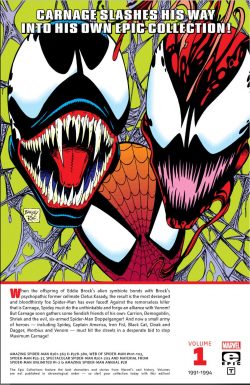
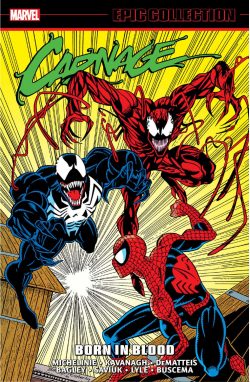
Carnage Epic Collection: Born in Blood 1991-1994


By David Michelinie, Tom DeFalco, Terry Kavanagh, J.M. DeMatteis, Mark Bagley, Ron Lim, Alex Saviuk, Tom Lyle, Sal Buscema, Steven Butler & various (MARVEL)
ISBN: 978-1-3029-4662-3 (TPB/Digital edition)

Win’s Christmas Gift Recommendation: Massive Marvel Mayhem… 7/10

After a shaky start in 1962 The Amazing Spider-Man soon became a popular sensation with kids of all ages, rivalling the creative powerhouse that was Lee & Kirby’s Fantastic Four. Soon the quirky, charming, action-packed comicbook soap-opera would become the model for an entire generation of younger heroes elbowing aside the staid, (relatively) old costumed-crimebusters of previous publications.

You all know the story: Peter Parker was a smart but alienated kid bitten by a radioactive spider during a school science trip. Discovering he had developed astonishing arachnid abilities – which he augmented with his own natural chemistry, physics and engineering genius – the kid did what any lonely, geeky nerd would do with such newfound prowess: he tried to cash in for girls, fame and money.

Making a costume to hide his identity in case he made a fool of himself, Parker became a minor media celebrity – and a criminally self-important one. To his eternal regret, when a thief fled past him one night he didn’t lift a finger to stop him, only to find when he returned home that his guardian uncle Ben Parker had been murdered.

Crazed with a need for vengeance, Peter hunted the assailant who had made his beloved Aunt May a widow and killed the only father he had ever known, finding, to his horror, that it was the self-same felon he had neglected to stop. His irresponsibility had resulted in the death of the man who raised him, and the traumatised boy swore to forevermore use his powers to help others…

Since that night the wondrous wallcrawler has tirelessly battled miscreants, monsters and madmen, with a fickle, ungrateful public usually baying for his blood even as he perpetually saves them.

In the anything-goes, desperate hurly-burly of the late 1980s and 1990s, fad-fever and spin-off madness obsessed the superhero genre in America as comics publishers hungrily exploited every trick to bolster flagging sales. In the mad melee Spider-Man spawned an intractable enemy called Venom: a disgraced and deranged reporter named Eddie Brock who bonded with Parker’s black costume (an semi-sentient alien parasite called the Symbiote) and become a savage, shape-changing dark-side version of the amazing arachnid.

Eventually the spidery adversaries reached a brooding détente and Venom became a “Lethal Protector”, dispensing a highly individualistic brand of justice everywhere but New York City.

However, the danger had not completely passed. When the Symbiote went into breeding mode it created a junior version of itself that merged with a deranged psycho-killer named Cletus Kasady (in Amazing Spider-Man #344, March 1991). The relevant pages by David Michelinie, Erik Larsen, Mark Bagley & Randy Emberlin open this collection…

Totally amoral, murderously twisted and addicted to both pain and excitement, Kasady became the terrifying metamorphic Carnage – a kill-crazy monster who carved a bloody swathe through the Big Apple before Spider-Man and Venom united to stop him.

Collecting a franchise-wide crossover which originally appeared in Amazing Spider-Man #331-363, 378-380, Web of Spider-Man #101-103 Spectacular Spider-Man #201-203, Spider-Man #35-37, and with material from Amazing Spider-Man #344-345, 359-360, Spider-Man Unlimited #1-2 and Amazing Spider-Man Annual #28 (spanning February 1991 to August 1993), this mammoth and extremely controversial summer event featured the inevitable return of the terrifying travesty and his bloodcurdling assault on everything Parker held dear: family, responsibility, love and the heartfelt faith that killing was never justifiable…

It all begins with pertinent extracts from Amazing Spider-Man #344 &345 (March & April 1991) and 359-360 (February – March 1992) as Michelinie, Chris Marrinan & Keith Williams detail Carnage’s escape and first kills before the beast’s proper debut in Amazing Spider-Man #361-363 as Michelinie, Bagley & Emberlin unleash the shapeshifting slaughterer on New York in ‘Savage Genesis!’, ‘Savage Alliance!’ and ‘Savage Grace!’, necessitating Spidey and the Human Torch breaking Venom out of his well-deserved incarceration to help stop a murder spree beyond imagining…

All that is mere aperitif to a monstrous main course of fast, furious and ferocious chaos that kicks off in‘Carnage Rising!’ by Tom DeFalco, Ron Lim & Jim Sanders III from Spider-Man Unlimited #1.

When a seemingly powerless Cletus Kasady is moved from ultra-high security penitentiary The Vault to an experimental lab at Ravencroft Asylum, ambitious psychiatrist Dr. Pournella believes she can cure the monster’s underlying psychosis. Those opinions die with her and the rest of the staff and security officers when the long-dormant Carnage entity manifests and breaks free…

Across town, tormented by guilt and shame, newlyweds Peter Parker and Mary Jane (nee Watson) are attending the funeral of their friend Harry Osborn – who had gone mad and perished battling Spider-Man as the second Green Goblin. As the downcast hero wallows in soul-searching and wonders at the point of his life, in Ravencroft a nihilistic scourge of insane bloodlust rampages through the facility until he is stopped in his tracks by another inmate.

Shriek is a creature after Carnage’s own heart: a survivor of appalling childhood abuse who found she possessed incredible powers to make all her vile drives and dreams come true…

Instantly attracted to each other, the pair join forces as a twisted “couple”, resolved to kill as often and as many as they can…

Escaping into New York they soon encounter and battle a mystical, nigh-mindless Spider-Man Doppelganger – which has been stalking the Webslinger since the end of the Infinity War crossover event – and adopt it. Together, the ultimate embodiment of a dysfunctional family set out to teach the city the pointlessness of life and the imminent inevitability of remorseless death…

Peter meanwhile has quarrelled with Mary Jane, but after making up, he hears of the bloodbath at Ravencroft and dutifully rushes off to recapture Carnage. Utterly unprepared for the trio of terror, he is savagely beaten: barely escaping with his life…

The tale continues in ‘Dark Light: Maximum Carnage  Part 2’ (Web of Spider-Man #101, by Terry Kavanagh, Alex Saviuk & Don Hudson) wherein the incapacitated Arachnid is accosted by street thugs hungry for vengeance and only saved by the appearance of homeless vigilantes Cloak and Dagger.

These nomadic teens are juvenile runaways who fell into the clutches of drug-pushing gangsters. Amongst a group of abducted kids they were used as guinea pigs for new designer drugs, but though all other test subjects died horribly, Tyrone Johnson and Tandy Bowen were mutated by the chemical cocktail into something more – and less – than human.

Isolated, alone, and vengeful they swore to help other lost kids by fighting drug dealers and all who preyed on the weak in the blackest corners of New York City.

Cloak is connected to a dimension of darkness: able to teleport, become intangible, amplifying and feeding on the wickedness in his targets. His unceasing hunger for negative emotions must be regularly – if only temporarily – sated by super-acrobat Dagger’s dazzling radiance. Her power too has advantages and hazards. The light can cleanse the gnawing dependency afflicting addicts, but constantly, agonizingly, builds up within her when not released. Thus Cloak’s incessant hunger can be assuaged by her light-knives and his apparently insatiable darkness.

Whilst tending to Spider-Man – whose injuries include cripplingly painful broken ribs – Cloak & Dagger are ambushed by the Carnage clan and the consequent catastrophic clash razes the church they are sheltering in.

Shriek especially revels in chaos. She has battled Cloak before and loathes him, taking sublime joy in tormenting him. Her greatest triumph comes when she uses her sonic powers to disintegrate his beloved Dagger before his horrified eyes…

Succeeding chapters open with ‘Demons on Broadway’ (Amazing Spider-Man #378, by Michelinie, Bagley & Randy Emberlin) ramp up the tension as Venom returns to New York, determined to exterminate the appalling threat he inadvertently created. Severely wounded, Spider-Man seeks to console Cloak who is crazed with grief and fury. Elsewhere Carnage, Shriek and Doppelganger are simultaneously gloating, planning further bloodshed and fighting each other…

When Cloak disappears in a blink of black torment the barely conscious Wallcrawler resumes his search for the trio of horrors and instead stumbles upon another old foe – Demogoblin.

Originally a science-powered super-crook, the mercenary killer was cursed: mystically transformed into a supernatural scourge dedicated to cleansing Earth of sin. To his diseased mind that means slaughtering humans because they are all sinners…

As the messianic devil thrashes the utterly exhausted and overstretched Spider-Man in Central Park, Venom tracks down Kasady but is similarly crushed by Doppelganger, Shriek and his sadistically exultant “offspring”…

Brock barely escapes with his life and crawls to Peter and Mary Jane’s apartment in Spider-Man #35, driving Mrs. Parker crazy with fear and resentment. It seems as if the entire city is on the edge and ready to explode in rage, negativity and violence…

As Spider-Man resigns himself to working again with his murderous worst nightmare, Demogoblin joins Carnage’s fiendish family. The good guys recruit Peter’s ex-girlfriend The Black Cat to even the odds in ‘Team Venom’ (Michelinie, Tom Lyle & Scott Hanna), but by the time they find their constantly bickering homicidal foes, Cloak has already impetuously attacked them and lies close to death…

As another blockbusting battle ends in defeat for the heroes, the Amazing Arachnid finds himself berated and deserted by his own allies. Taken to task for his foolish unwillingness to use lethal force, Peter questions his ingrained reluctance to go ‘Over the Line!’ (Spectacular Spider-Man #201, by J.M. DeMatteis & Sal Buscema) even as Carnage adopts another psychotic menace into his growing killer kin. Cadaverous mutated clone Carrion shares their ambitions and eagerly joins in their avowed mission to kill every human in New York.

The blood-soaked brood are aided in their task by the very citizens they imperil, as an inexplicable wave of fear and hatred grips the populace, sparking savage rioting and a tide of death. The inflamed innocents even attempt to lynch Spider-Man when he comes to their aid…

As Parker faces an overwhelming crisis of conscience in ‘Sinking Fast’ (Kavanagh, Saviuk & Hudson from Web of Spider-Man #102), Venom’s vengeance squad recruits another old Spider-Man foe in the ghastly shape of Michael Morbius – a science-spawned Living Vampire with an unquenchable appetite for human blood. After years of death and torment, the helpless victim had recently begun to seek a form of redemption by only slaking his thirst on the truly wicked…

With her husband insanely risking his life beside allies as bad as the villains, Mary Jane attempts to ease her own rage by going clubbing, just as Carnage’s “carnival of chaos” tears into the fashionable nightspot eager to display their warped philosophy of senseless death.

She is only saved by the appearance of Team Venom, with Spider-Man arriving far too late to help. After helping to drive off the macabre marauders a heartbroken Parker is forced to accept the antihero’s methods: rejoining the squad in time to confront ‘The Gathering Storm’ (Amazing Spider-Man #379, Michelinie, Bagley & Emberlin).

As the notional white hats again spectacularly and pointlessly clash with the cotillion of crazies – resulting in the collateral deaths of the NYPD’s Extreme Emergency Team – a new player enters the conflict.

Deathlok was pacifist scientist Michael Collins until his consciousness was imprisoned within a cyborg body built to be the ultimate battlefield weapon. Rebelling against the corporate monsters who doomed him to “life” as a mechanical zombie, Collins turned the war body into a macabre force for justice, so when he detected strange energies at work in town he immediately entered the fray – and is trashed by Clan Carnage, just as Spider-Man and Cloak recruit idealistic mutant Firestar to their side…

Fighting chaos and terror with logic, the webspinner reasons that since all Symbiote spawn are chronically susceptible to excessive heat (as well as high energy sonic assault) a champion capable of emitting microwaves could turn the tide in humanity’s favour…

As the heroes lay their plans, ‘Hate is In The Air’ (Spider-Man #36; Kavanagh, Lyle & Hanna) exposes Kasady’s horrific childhood and events that shaped the unrepentant kill-crazed fiend. Meanwhile, martial arts hero Iron Fist steps in to rescue the broken Deathlok before the Venom gang again engages Carnage’s crew. They almost succeed, but for the rallying efforts of the increasingly rebellious and independent Shriek…

A secret is revealed in ‘The Turning Point!’ (Spectacular Spider-Man #202, DeMatteis & Buscema) as a crazed mob attacks the battling metahumans, and Shriek discloses her powers enable her to broadcast her own madness to the entire city, driving everyone into paroxysms of despair and fury. With Spider-Man actively urging Firestar to kill Carnage, the heroes’ ethical collapse seems assured…

From the depths of his soul Peter’s moral core finally breaks through the madness and he stops the equally conflicted microwave mutant from committing the ultimate sin, just as inspirational legend Captain America arrives to take charge…

With both Avengers and Fantastic Four otherwise occupied, the Sentinel of Liberty has rushed back to save ‘Sin City’ (Kavanagh, Saviuk & Hudson, Web of Spider-Man #103) from Armageddon: instantly rallying the hard-pressed heroes and their more ambivalent allies.

Sadly, his presence causes a schism and as mysterious vigilante Nightwatch joins the dark defenders in still more reactive, pointless violence, ‘Soldiers of Hope’ (Amazing Spider-Man #380, Michelinie, Bagley & Emberlin) sees Parker at last use his brains rather than brawn. With Cap’s resources, the philosophical discipline of Iron Fist and technical skills of Deathlok, a weapon is devised to disable and even cure the frenzied killers running wild in the streets…

An even greater turnabout occurs in ‘The Light!’ (DeMatteis, Lyle, Hanna & Al Milgrom; Spider-Man #37) as, at the height of the most savage battle yet, all factions are stunned by the luminescent resurrection of Dagger, who spearheads a triumphant ‘War of the Heart!’ (Spectacular Spider-Man #203, DeMatteis & Buscema) that crushes the clan and kills Carnage…

Of course it’s never that easy and the cunning maniac is only shamming, as exhausted and traumatised Spider-Man and Venom discover when the blood-red maniac ambushes them in one last all-or-nothing attack in ‘The Hatred, the Horror, & the Hero!’ by DeFalco, Bagley, Lim, Sanders III & Sam de la Rosa (Spider-Man Unlimited #2). It almost works, but in the end, battered, bruised bloodied but ultimately uncompromised, the heroes are triumphant and the horrors are caged again…

By way of epilogue Amazing Spider-Man Annual #28 (1994) picks over ‘The Mortal Past’ (Michelinie, Steven Butler & Bud LaRosa) as Kasady escapes whilst being transported to the Vault and Spider-Man goes after him. More appalling secrets of the killer’s childhood are exposed and buckets of blood are spilled as the maniac takes refuge with his only friend… until the wallcrawler spoils that too and earns Carnage’s undying hatred all over again…

Also included are an unused cover and a bound-in poster and the 1993 Carnage TPB by Bagley & Emberlin; facts, pranks and illustrations from Marvel-Year-in-Review: Bring on the Bad Guys; the Official Handbook of the Marvel Universe Master Edition; A wraparound cover by Bart Sears from Wizard Magazine, and Micheline’s Introduction from another TPB, DeMatteis’ Afterword, plus covers of successive editions by Ron Lim, Emberlin, deleted and edited scenes. There is trading card art by Steve Lightle & Paul Mounts, the cover – by Lyle – and articles from Marvel Age #123 (April 1993), a wealth or original art pages by Bagley Emberlin & Lyle and variant and 2nd print covers.

If you love the extended hyperbolic, continual conflict which is at the core of all Costumed Dramas, this non-stop battle bonanza is a grand way to spoil yourself. Logic and pacing are subsumed into one long, escalating struggle, and a working knowledge of the players is largely unnecessary to the raw, brutal clash of wills, ideologies and super-powers. One fair warning however: although handled with a degree of reserve and taste, this yarn has an appalling body count and scenes of torture that might upset younger fans of the Amazing Arachnid.
© 2022 MARVEL.

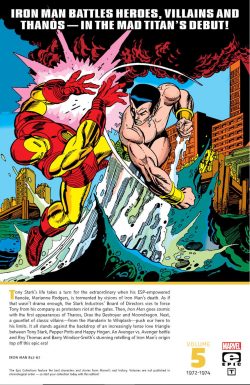
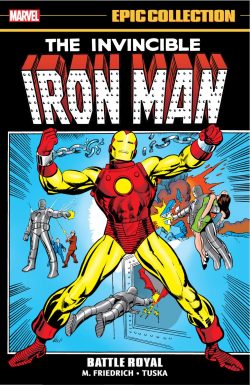
Iron Man Epic Collection volume 5: Battle Royal 1972-1974


By Roy Thomas, Jim Starlin, Steve Gerber, Bill Everett, George Tuska, Barry Windsor-Smith, P. Craig Russell, John Romita & various (MARVEL)
ISBN: 978-1-3029-3361-6 (TPB/Digital edition)

Win’s Christmas Gift Recommendation: Glittering Marvel Madness… 8/10

First conceived in the wake of the Cuban Missile Crisis at a time when the economy was booming and “Commie-bashing” was an American national obsession, the emergence of a new and shining young Thomas Edison, using Yankee ingenuity, wealth and invention to safeguard the Land of the Free and better the World, seemed an obvious development. Combining the then-sacrosanct faith that technology and business in unison could solve any problem, with the universal imagery of noble knights battling evil, Tony Stark the Invincible Iron Man – seemed an infallibly successful proposition.

Of course, whilst Tony Stark was the acceptable face of 1960s Capitalism – a glamorous millionaire industrialist/scientist and a benevolent all-conquering hero when clad in the super-scientific armour of his alter-ego – the turbulent tone of the 1970s soon relegated his suave, “can-do” image to the recycling bin of history.

With ecological disaster and social catastrophe from the myriad abuses of big business the new zeitgeists of the young, the Golden Avenger and Stark International were soon confronting a few tricky questions from the increasingly politically savvy readership.

With glamour, money and fancy gadgetry not quite so cool anymore, the questing voices of a new generation of writers began posing uncomfortable questions in the pages of a series that was once the bastion of militarised America…

This grand and gleaming chronological compendium navigates that transitional period, re-presenting Iron Man #47-67 and the period cover-dated June 1972 through April 1974, as the title experienced an unprecedented and often uncomfortable number of creative personnel changes whilst the country endured a radical and often divisive split in ideology.

It begins in the aftermath of best friend Kevin O’Brian’s pointless death and the gradual disintegration of his girlfriend Marianne Rodgers who is slowly being driven insane by her own psychic abilities.

After the funeral, Stark traumatically reviews his origins, twin careers and now-obscured objectives in ‘Why Must There be an Iron Man?’ (by Roy Thomas, Barry Windsor-Smith & Jim Mooney) after which, emotionally reinvigorated and rededicated to his life of service, the Armoured Avenger welcomes new scripter Mike Friedrich and established artists George Tuska & Vince Colletta to again face the ferocious threat of radical incendiary terrorist Firebrand in ‘The Fury and the Inferno!’

Meanwhile, whilst attempting a new start in life, Marianne’s final breakdown begins…

‘…There Lurks the Adaptoid!’ finds her experiencing horrifying precognitive visions of a power-mimicking robot attacking Iron Man, and leads to her accidental betrayal of the man she loves when the automaton actually arrives and evolves into an unbeatable new form in #50’s ‘Deathplay!’

This coincides with equally-troubled Z-list villain Princess Python attempting to kidnap Stark, just as our hero is being targeted by power-leeching sub-atomic tyrants, before the bizarre saga concludes with bombastic battle in ‘Now Stalks the Cyborg-Sinister!’

New Age mysticism and West Coast celebrity-cults informed Iron Man #52 as Stark faces ‘Raga: Son of Fire!: an emotion-fuelled, flaming maniac trained by an evil guru who subsequently takes over from his failed disciple when things get too hot…

With additional pencils from star-in-waiting Jim Starlin, concluding chapter ‘The Black Lama!’ shows that the master mage is also unable to destroy the Golden Avenger, but would subsequently return to become one of the hero’s greatest and most insidious foes of the period.

Issue #54 found Stark in California and drawn into what became one of Marvel’s earliest and most successful crossover epics. ‘Sub-Mariner: Target for Death!’ debuted pitiless alien researcher Madame MacEvil – later re-branded as Moondragon during the Thanos Saga…

She was a bald, sexy science siren who manipulated Iron Man into attacking the Prince of Atlantis in a spectacular blockbusting bout further enhanced by additional art from the legendary Bill Everett supplementing the efforts of Friedrich, Tuska & Colletta…

The Thanos story moved into full gear in Iron Man #55, as Friedrich scripted illustrator Jim Starlin’s opening gambit ‘Beware The… Blood Brothers!’: introducing haunted humanoid powerhouse Drax the Destroyer, who had been trapped by extraterrestrial invader Thanos under the Nevada desert and was in dire need of rescue…

(This was all merely a prelude to the full saga which appeared in Captain Marvel #25-33, Marvel Feature #12, Daredevil #106-107 and Avengers #125, and has been collected in many compilations…

Iron Man #56 was a literally magical palate-cleanser, as Steve Gerber joined Starlin & Mike Esposito to tell the satirically hilarious tragedy of ‘Rasputin’s Revenge!’, wherein a street corner doom-prophet accidentally gains the power to fulfil his prognostications but still falls sadly short of engineering an apocalypse…

It was back to business as usual with Gerber, Tuska, Esposito & Frank Giacoia in #57 as a devastating ‘Strike!’ hits troubled Stark Industries. The dissent has been engineered by an insidious old enemy who inevitably overplays his be-ringed hand in concluding episode ‘Mandarin and the Unicorn: Double-Death!’ (with Friedrich returning to script Gerber’s plot) after which ‘A Madness in Motown!’ sees Stark battling revenge-crazed anti-capitalist Firebrand whilst unknowingly falling for the torrid terrorist’s sister Roxie Gilbert.

Another 2-part clash follows – this time against a deadly technology-thief – opening with ‘Cry Marauder!’ after a masked malcontent steals Stark’s experimental space shuttle. Culmination comes with ‘Death Knells over Detroit!’ as the purloined prototype is aimed like a monstrous missile at the heart of Motor City, leaving a crippled Iron Man only seconds to save the day…

With Friedrich scripting, the action stays in Detroit as Stark inspects one of his factories until former Maggia assassin ‘Whiplash Returns!’ (illustrated by P. Craig Russell, Esposito, Frank Giacoia & John Romita Sr.). The crazed killer-for-hire is raging for revenge and especially ticked off that his girlfriend has been made his boss…

Illustrated by Tuska & Esposito, an extended epic began in #63 with ‘Enter: Dr. Spectrum’, seeing Stark relentlessly – and fruitlessly – romantically pursues pacifist dissident Roxie Gilbert in Detroit, whilst obnoxious Ugandan financier and diplomat Dr. Kinji Obatu visits the Long Island plant and is attacked by a gang of masked thugs…

The assault is repelled thanks to the timely assistance of stand-in Iron Man Eddie March, who is promptly offered a bodyguard job by the creepy ambassador and invited to accompany him to a meeting with Stark in Detroit.

On Stark’s arrival, photonic fiend Dr. Spectrum ambushes the inventor, before being driven off by the Armoured Avenger after a titanic and costly struggle. A far more serious problem emerges later when old friend Happy Hogan accuses Tony of having an affair with his wife Pepper

Spectrum strikes again in the next issue, with a similar lack of success, before Happy blows his top and takes a swing at Stark, but that confrontation is curtailed when a gigantic monster kidnaps just-arrived Obatu in ‘Rokk Cometh!’

When the beast then targets Roxie, exhausted Iron Man intervenes but is too drained to resist the relentless Spectrum…

Issue #65 exposes ‘The Cutting Edge of Death!’ when the Golden Avenger learns the true parasitical nature of Spectrum’s Power Prism as it transfers itself from wilfully disobedient villain Obatu to our worn-out hero.

Its glee is short lived though, as the possessed Iron Man is challenged by recently arrived comrade Thor, resulting in a blockbusting ‘Battle Royal!’ which only ends when the Thunderer crushes the crystal conqueror and discovers the dying man inside the armour is neither Stark nor Obatu…

As a consequence of that climactic clash of myth and mechanism, IM #67 sees the impostor Iron Man temporarily mutated by Stark’s medical miracle machine the Cobalt Enervator into a rampaging monster in ‘Return of the Freak’ but no sooner do the genuine Armoured Avenger and surgeon Don Blake (who we all know was Thor back then) stop and save the berserk victim than Stark is drawn into another conflict in South East Asia…

Sadly. That falls into the category of “To Be Continued”…

With covers by Kane, Colletta, Giacoia, Tuska, Starlin, Joe Sinnott, Rich Buckler, John Romita & Mike Esposito, the galvanised wonderment also includes many beautiful original art pages and covers by Windsor-Smith, Mooney, Tuska, Everett, Colletta, Starlin, Esposito, John Romita & Kane: wrapping up this collection with the Golden Gladiator being carefully politically repositioned at a time when Marvel solidly set itself up at the vanguard of a rapidly changing America increasingly at war with itself.

With this volume Marvel further entrenched itself in the camp of the young and the restless, experiencing first hand, and every day, the social upheaval America was undergoing. This rebellious teen sensibility and increased political conscience permeated Marvel’s publications as their core audience evolved from Flower Power innocents into a generation of acutely aware activists. Future tales would increasingly bring reformed capitalist Stark into many unexpected and outrageous situations…

That’s the meat of another review, as this engrossing ride is done. From our distant vantage point the polemical energy and impact might be dissipated, but the sheer quality of the comics and the cool thrill of the eternal aspiration of man in perfect partnership with magic metal remains. These superhero sagas are amongst the most underrated but impressive tales of the period and are well worth your time, consideration and cold hard cash.

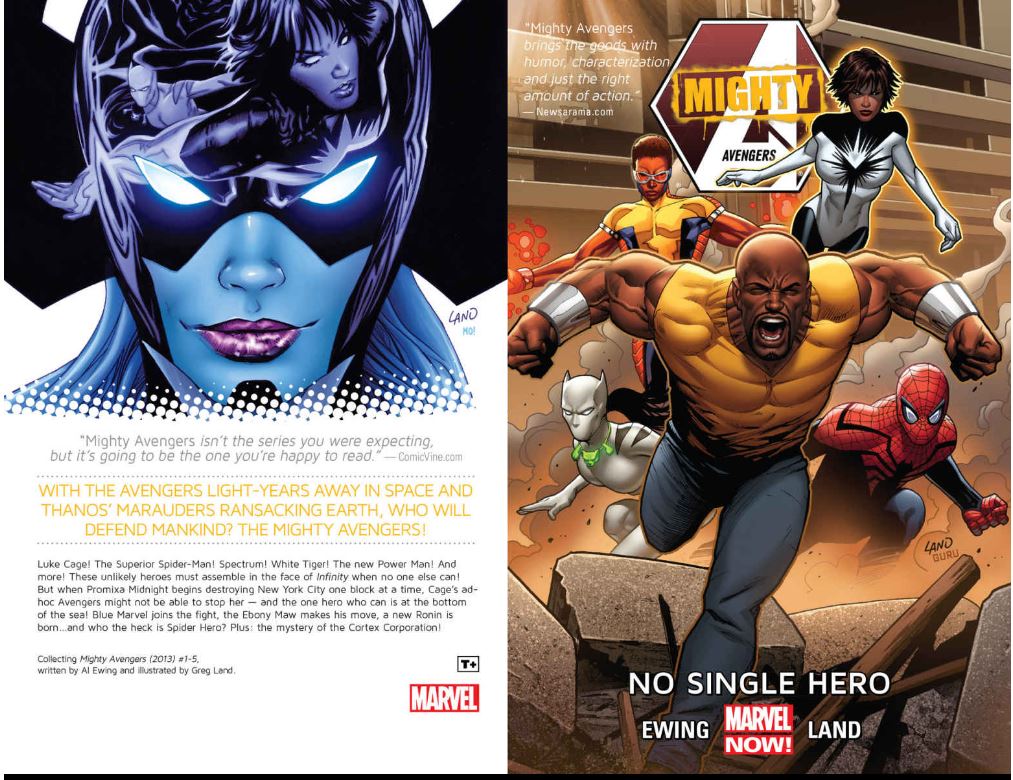
Mighty Avengers: No Single Hero


By Al Ewing, Greg Land, Jay Leisten & various (Marvel)
ISBN: 978-0785188742 (TPB/Digital edition)

Following blockbuster Avengers Versus X-Men publishing event, company-wide reboot MarvelNOW! reformed the entire overarching continuity: a drastic reshuffle and rethink of characters, concepts and brands with an eye to winning new readers and feeding the company’s burgeoning movie blockbuster machine…

Moreover, many disparate story strands were congealing to kick off the always-imminent Next Big Thing, with the cosmically expanded Avengers titles forming the spine of an encroaching mega-epic. The colossal Infinity storyline detailed a grandiose advance into Armageddon as an intergalactic Hammer of Doom fell with an all-out attack by impossibly ancient race The Builders. They claim to have sparked universal life, but now seek to rectify their mistake on Earth – and woe betide any species or intergalactic civilisation in their way.

When The Avengers mobilised most of their assemblage off-planet to tackle the threat before it reached them, Thanos of Titan took advantage of the dearth of metahuman defenders to invade, leaving the remaining superheroes with an almost impossible task…

Written by Al Ewing and illustrated by Greg Land & Jay Leisten, Mighty Avengers volume 2 #1-5 (November 2013 – March 2014) describes how those left behind unite as a resistance force and stayed together as a decidedly different kind of crusading team… one primarily comprising heroes of colour, not the usual bunch of white guys and ones who looked at problems beyond a self-appointed cosmic jurisdiction…

The action opens as Thanos hits Earth, where blithely unaware ex-Avenger Luke Cage is pitting his Heroes for Hire apprentices White Tiger and a new, teenaged Power Man against seasoned super-thief The Plunderer. Their efforts are interrupted and derided by the Superior Spider-Man who orders them to quit before insultingly offering Cage’s kids a real job.

Everybody sees that the wallcrawler has become insufferable since he technologically upgraded his act and hired a paramilitary gang as his deputies. Many of his oldest friends even think he might be going crazy. What no one knows is that the mind inside the arachnid hero’s head is actually archvillain Otto Octavius AKA Doctor Octopus who – despite a passionate initial desire to reform – is slowly reverting to his true manner and bad habits…

The webspinner’s derision spurs White Tiger into quitting, but only fuels her male teammates into trying harder to prove Spider-Man wrong…

Elsewhere ex-Avenger Monica Rambeau (formerly Captain Marvel and Photon, but now calling herself Spectrum) is getting back into the crime-busting game after a bout of retirement. She’s sorting out her costume and talking over old times with an enigmatic fellow champion when the first wave of the Titan’s invasion force smashes into New York.

Donning a store-bought comedy costume, the stranger – also black – joins Monica as a generic “Spider Hero” and converges on the landing site where Cage and the still-enraged Superior Spider-Man are battling the Titan’s ferocious warlord Proxima Midnight

Elsewhere, Mystic Master Doctor Strange has been possessed and corrupted by the Ebony Maw – the most personally ambitious of Thanos’ lieutenants – whilst at the bottom of the sea  Dr. Adam Brashear receives a cosmic visitor. A forgotten African American superhero forbidden by Presidential mandate from operating during the Civil Rights era, The Blue Marvel is thus stirred from a lengthy self-imposed exile and grudgingly agrees to return to the world which shunned and sidelined him…

In New York, ‘The Assembly’ give battle, but the Amazing Arachnid seems more concerned with suing his “copyright infringer” than defeating the invaders, and Spectrum is gravely wounded by Midnight. As Cage tackles Proxima, ordinary citizens are emboldened to join the struggle, compelling ever-watching Thanos to order a retreat.

It’s not over though, as the ravaged metropolis is then assaulted by an overwhelming aspect of voracious Elder God Shuma-Gorath, summoned by enslaved Stephen Strange. The rampant horror gleefully begins transforming native New Yorkers into ghastly demon duplicates…

As Blue Marvel rockets to the rescue, temporarily stymieing the devil god and healing Spectrum, mystically empowered White Tiger and Power Man arrive and Spider Hero -demonstrating a keen knowledge of arcane rites – devises a scheme to drive the Lovecraftian horror back to its own dimension for good.

Cage then has a eureka moment, realising ‘No Single Hero’ could have managed, declaring that they are all Avengers…

Originally parked above Manhattan, the Inhumans’ floating city Attilan was destroyed during the war and its ruins now languish in the Hudson River. Moreover, when Thanos personally attacked Black Bolt, the embattled Inhuman monarch released genetically transformative Terrigen Mists thereby unleashing a host of new super-powered warriors from the ranks of the humans below…

Issue #4 is set after the invasion is finally repelled, with the city engrossed in rapid reconstruction. The space-bound Avengers are still missing off-world but life is returning to normal.

Sleazy entrepreneur Jason Quantrell despatches his personal industrial spy Quickfire – a recent recipient of Terrigen-induced abilities – to raid the sunken citadel in search of fresh mutagens he can monetise, whilst in Times Square Cage has turned his old Gem Theatre offices into a storefront Avengers HQ.

He has a bold new idea: opening the heroic volunteer brigade to the public who can come to them with meta-related problems or issues of injustice. Even though Reservist The Falcon has come aboard, Spider-Man is becoming increasingly intolerant, alternately demanding to be placed in charge and ordering Cage’s crew to cease and desist. Unable to convince them, the furious superior wallcrawler storms off…

Meanwhile Spider Hero – who has some ominous magical acquaintances older fans might recognise – has detected an encroaching mystic crisis and resolved to stay. Adopting the vacant costume and identity of martial arts mystery man Ronin, he invites the team to join him in stopping an impending burglary in Attilan. It’s not Quickfire’s illegal raid that’s the problem, but rather that she’s going to inadvertently awaken the slumbering submerged threat of the Death Walkers if somebody doesn’t stop her…

However, as the most recent Ronin leads the Avengers to the already-in-progress monster catastrophe, Octavius returns to the Gem Theatre and – in a manic fit of frustrated rage – attacks Cage with all the paramilitary resources he can muster: mercenaries, spider-bots and urban assault vehicles all primed to shut down the Avengers forever.

Happily, the harassed Hero for Free had already contacted his lawyer and is delighted to follow Jennifer Walters’ guidance… which basically boils down to “She-Hulk Smash!”…

Fast, furious and fantastically offbeat, this epic epistle also offers a selection of editorial features from the issues in question and a covers gallery, as it delivers hard, fast, thrilling and funny stories about heroism on the other side of the tracks…
© 2013 Marvel Characters Inc.. All rights reserved.

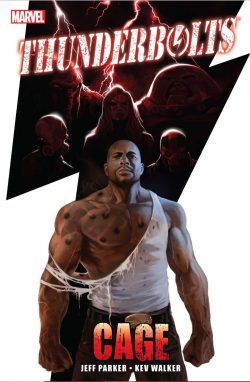
Thunderbolts – Cage


By Jeff Parker, Kev Walker & various (Marvel)
ISBN: 978-0-7851-4774-9 (HB/Digital) 978-0-7851-4775-6 (TPB)

At the end of 1996 the Onslaught publishing event removed The Fantastic Four, Avengers, Captain America and Iron Man from the Marvel Universe: rather unwisely handing over creative control to Rob Liefeld and Jim Lee for a year. For the early part of that period the “Image style” books got most of consumers’ attention, although a new title created to fill the gap in the “real” universe eventually proved to be the true breakthrough of that era…

Thunderbolts was initially promoted as a replacement team-book; untried champions pitching in because the big guns were dead and gone. They consisted of Captain America clone Citizen V, size-shifting Atlas, super-armoured Mach-1, energy-casting virago Meteorite, sonic siren Songbird and mechanised human weapon Techno.

A beleaguered and terrified populace instantly took them to their hearts, but these heroes shared a huge secret – they were actually super-villains in disguise and Citizen V (or Baron Helmut Zemo as he truly was) had nasty plans in mind…

Ultimately defeated by his own scheme as his criminal underlings (Mach-I AKA the Beetle, Techno/the Fixer, Atlas/Goliath, Songbird/Screaming Mimi and even deeply-disturbed Meteorite/Moonstone) increasingly yearned to be the heroic ideals they posed as, Zemo was ousted and the Thunderbolts thereafter carved out – under a succession of leaders – a rocky career as genuine, if controversial, champions.

Even with their Heroes Returned (a long story for another time) life got no easier for Earth and especially America. During the first superhero Civil War, the ever-changing Thunderbolts squad – generally comprised of felons looking to change their ways or escape punishment – became Federal hunters, tracking and arresting metahumans who refused to surrender to the Super-Human Registration Act. Eventually that iteration fell under the aegis of government hard-man Norman Osborn.

Through various deals, deeds and malign machinations former Green Goblin Osborn sought to control the Thunderbolt project as a stepping-stone to his becoming became the USA’s Security Czar…

As the “top-cop” in sole charge of a beleaguered nation’s defence and freedom, the psychotic Osborn controlled America’s costumed/metahuman community. Replacing super-spy agency S.H.I.E.L.D. with his own all-pervasive H.A.M.M.E.R. Directorate, the deadly despot had Captain America arrested and defamed. Setting the world’s heroes at each other’s throats, he dedicated all his energies to stealing political power to match his scientifically-augmented strength and overwhelming financial clout.

Numerous appalling assaults on the nation occurred, including a Secret Invasion by shape-shifting Skrull infiltrators and his own draconian, oppressive response – his Dark Reign – wherein Osborn drove the World’s Mightiest Heroes underground, replacing them with his own team of deadly Dark Avengers.

Not content with commanding the covert and military resources of the United States, Osborn personally led this team, wearing appropriated Tony Stark technology and calling himself the Iron Patriot: simultaneously betraying his country by conspiring with a coalition of major super-villains to divvy up the world between them.

He overreached himself by overruling the American President to direct an unsanctioned military Siege on godly citadel Asgard, and when the fugitive outlawed heroes at last reunited to stop him, Osborn’s fall from grace and subsequent incarceration led to a new Heroic Age.

In the aftermath, it was discovered that the Security Chief’s monstrous manipulations were even more Machiavellian than suspected. One of his initiatives was the kidnapping of super-powered children: tragic innocents he tortured, psychologically abused and experimented upon in a drive to create the next generation of fanatically loyal super-soldiers…

Those traumatised and potentially lethal kids became the responsibility of the exonerated and reassembled Avengers who decided to teach the surviving lab rats how to be heroes in a new Avengers Academy, whilst Osborn – beaten but not broken -was incarcerated in ultra-high-security penitentiary The Raft.

Collecting material from the Enter the Heroic Age one-shot and Thunderbolts #144-147 (July-October 2010) this new direction, written by Jeff Parker, illustrated by Kev Walker and coloured by Frank Martin, sees the Legion of the Lost reformed with a fresh brief and a new leader to once again offer penitence, potential redemption and probable death to the defeated dregs of the Marvel Universe…

For most of modern history black consumers of popular entertainments were provided with far too few fictive role models. In the English-speaking world that began changing in the turbulent 1960s and truly took hold during the decade that followed.

Many characters stemming from those days emerged due to a cultural phenomenon dubbed “Blaxploitation”. Although criticised for its seedy antecedents, stereotypical situations and violence, the films, books, music and art generated by the phenomenon were the first mass-market examples of minority characters in leading roles, rather than as fodder, flunkies or flamboyant villains.

If you care to look elsewhere in this blog, you’ll find a rather pompous review by (old, white) me detailing how that groundbreaking era led to the birth of superheroic cultural icon Luke Cage. You should read those stories: they’re groundbreaking landmarks and really good…

Here, however, the drama begins with the arrival on the high-tech island prison of Osborn and a new intake of monstrous convicts who pretty soon learned the ropes at the calloused hands of Power Man Luke Cage: former Hero for Hire, reserve Avenger and latest director of the Thunderbolts Program. The no-nonsense hard-man and former convict – albeit an innocent, framed and ultimately exonerated one – offered a last-chance way for some of America’s worst malefactors to pay back their immense debt to society and maybe buy a slice of salvation…

Issue #144 took up the story as new Warden John Walker (formerly super-soldier U.S.Agent before losing some limbs during the Siege of Asgard) and Cage begin selecting potential recruits in ‘The Boss’.

With original, genuinely reformed Thunderbolts Fixer and Mach-V as deputies, lethally ambivalent sociopath Moonstone opportunistically joins Cage’s team: the cream of a reluctant, conflicted and very bad bunch also comprising deranged phasing hacker Ghost; dispirited mystic mobile monolith Juggernaut and Captain America’s antithesis Cross-Bones – one of the most ruthless killers in existence.

Offering technical support is size-shifting Scientist Supreme/Avengers Academy headmaster Hank Pym (AKA Ant-Man, Goliath, Yellowjacket, The Wasp and Giant-Man), who devised a unique transport method for the penal battalion: one utilising unsuspected teleportational talents of the macabre, insentient monster called the Man-Thing

However, before the unit can even undergo basic training, intransigent Zemo attacks the inescapable penitentiary, determined to reclaim his old team…

‘Field Test’ offers a surprise or two before Cage seizes control again and the squad set off on an emergency first mission: tracking down man-eating trolls ravaging the Oklahoma countryside and presumably escaped from Asgard after Osborn’s ill-fated attack on the dimensionally-displaced City of the Gods…

That grisly outing promptly segues into another crisis-response from the woefully untrained squad when dispatched to a New Guinea cave to rescue scientists and S.H.I.E.L.D. agents investigating mutagenic, metahuman-creating Terrigen crystals…

The mission is another tragic debacle. There is no cure for what the techs have uncovered and then become, so the salvation run turned into a grim and nasty bug hunt…

This sleek, effective thriller concludes its dramatic presentation with the intermediate part of a crossover tale which began and ended in Avengers Academy, offering some intriguing insights into the ongoing personal rehabilitation of troubled Juggernaut Cain Marko.

The students at the unique school were being trained under a hidden agenda: although officially declared the most accomplished of Osborn’s next generation protégés, sextet Reptil, Finesse, Striker, Hazmat, Mettle and Veil were actually diagnosed as the most experimented upon, abused and psychologically damaged. The Academy not only wanted to turn them into heroes but also intended to ensure the prodigies were not incurably corrupted, potential menaces…

‘Scared Straight’ reveals how toxic nightmare Hazmat, animated Iridium golem Mettle and slowly dissipating gas-girl Veil turn a school-trip to The Raft into an attempt to gain revenge on their erstwhile tormentor. Although the most secure and infallible jail on the planet, no one realises just what Hazmat can really do and when the power goes out she and her equally incensed classmates headed straight for Osborn’s solitary cell…

Their ill-conceived ploy also liberates an army of irate, murderous villains forcing the new Thunderbolts to prove how far they’ve come by choosing which side they are now on. More important than showing Cage and Warden Walker, the convicts and once-pariahs must examine their own unsuspected moral changes and how far they have progressed before order is finally, ruthlessly restored…

This collection confirming Luke Cage’s elevation from edgy outsider to first rank major player in Marvel continuity also comes with a superb cover gallery by Marko Djurdjevic, Bryan Hitch & Karl Kesel, Larry Stroman, Frank Martin, a wealth of character designs and pages of un-inked art from Walker to complete a wry, clever and suspenseful action-adventure package that all fans of gritty superhero action will adore…
© 2010, 2011 Marvel Characters, Inc. All Rights Reserved.

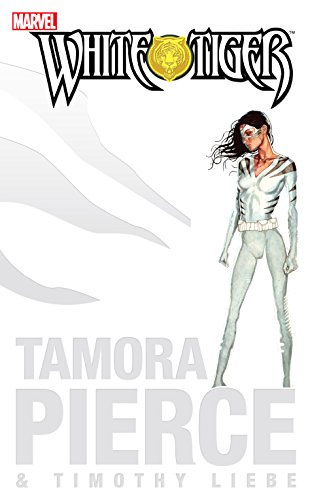
White Tiger: A Hero’s Compulsion


By Tamora Pierce, Timothy Liebe, Phil Briones, Alvaro Rio & various (Marvel)
ISBN: 978-0-7851-2273-9 (TPB)

I’ll try to be brief but bear with me because this might be a little complex for anyone not hardened by 55 years of constant exposure to raw comic-books…

After the mid-1970’s Kung Fu craze subsided Marvel was left with a couple of impressive themed properties (Master of Kung Fu and Iron Fist) and a few that needed some traditional superhero “topping up”. The Sons of the Tiger debuted in monochrome magazine Deadly Hands of Kung Fu: a multi-racial martial arts team who – augmented by three mystic amulets – fought the usual mystic ninja/secret empire types until internal dissent and an obvious lack of creative imagination split them up.

The amulets – a Tiger’s Head and two paws carved from magical jade – passed on to young Hector Ayala who donned all three to become a super-martial artist calling himself the White Tiger. After an inauspicious, short and excessively violent career including team-ups with both Spider-Man and Daredevil, the “first Puerto Rican Superhero” all but vanished until (in a Man Without Fear storyline I’ll get around to reviewing one day) he lost his life…

In the meantime, a new White Tiger had appeared in the 1997 revival of Heroes for Hire: an actual tiger evolved into a humanoid by renegade geneticist the High Evolutionary. In 2003 Kaspar Kole, a black, Jewish cop briefly replaced the Black Panther, becoming the third White Tiger shortly thereafter…

Which finally brings us here as this volume collects the first 6-issue miniseries to feature Angela Del Toro, niece of the first White Tiger; one time cop, de-frocked FBI agent and eventual recipient of the amulets that empowered and doomed her uncle Hector.

Normally I’d steer clear of reviewing a graphic novel like this because by all rights it should be all but impenetrable to non-fans, but novelist Tamora Pierce and co-scripter Timothy Liebe have made the necessary and mandatory recaps and references to other books (particularly the extended Daredevil storyline that dealt with the death of Angela’s uncle and her becoming a costumed vigilante in his memory) relatively painless: a seemingly seamless part of the overall narrative thrust of this tale and one that perfectly suits the action-packed, highly realistic artwork of Phil Briones, Alvaro Rio, Ronaldo Adriano Silva & Don Hillsman.

Angela Del Toro was a high-ranking Federal Agent, but now she’s jobless and bewildered, terrified of becoming just another masked crazy on the streets and skyways of New York City. Luckily, she still has a few friends – both in the legal and extra-legal law enforcement community – and soon links up with a private security firm while sorting out her new double life.

That mostly means coming to terms with being a costumed superhero, stopping a covert cabal of asset-stripping terrorists from turning the USA into a highly profitable war-zone and getting final closure if not revenge on Yakuza prince Orii Sano, the man who killed her partner…

White Tiger: A Hero’s Compulsion is a canny blend of family drama, cop procedural and gritty superhero thriller, with an engaging lead character, believable stakes, just enough laughs and truly sinister baddies who should appeal to the widest of audiences. Fun-filled and frantic with loads of guest-stars, including Spider-Man, Daredevil, Iron Fist, Luke Cage, Black Widow, and such scurrilous dirtbags as the Cobra, the Lizard, Deadpool and the assembled underworld of three continents, this is a read for devotees and dilettantes alike.

Whether cleaning up the mean streets and saving the entire world or just busting heads in her new day job, White Tiger has everything necessary to stay the course, but even if she somehow doesn’t, there will always be this thoroughly fascinating trade paperback and digital book to mark her territory, if not her passing…
© 2006, 2007, 2015 MARVEL. All rights reserved.

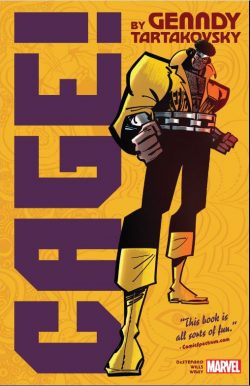
Cage!


By Genndy Tartakovsky, Stephen DeStefano & various (Marvel)
ISBN: 978-0-7851-2786-4 (TPB)

For most of modern history black consumers of popular entertainments enjoyed far too few fictive role models. In the English-speaking world that began changing in the turbulent 1960s and truly took hold during the decade that followed. Many characters stemming from those days come from a cultural phenomenon called Blaxploitation. Although criticised for its seedy antecedents, stereotypical situations and violence, the films, books, music and art were the first mass-market examples of minority characters in leading roles, rather than as fodder, flunkies or flamboyant villains. If you scroll back a bit, you’ll see a rather pompous review by (old, white) me detailing how that groundbreaking era led to the birth of superheroic cultural icon Luke Cage. You should read those stories: they’re rather good.

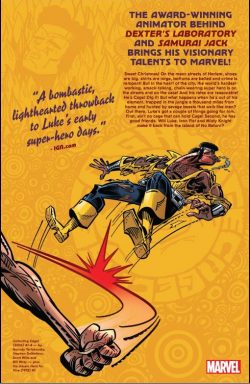
In 2016, animation superstar Genndy Tartakovsky (Dexter’s Laboratory, Samurai Jack, Hotel Transylvania) reminded readers of something else: those tales were outrageously frantic fun too.

Four-issue miniseries Cage! dials us back to that fabulous mythical moment – or at least 1977 in New York – for a sublimely daft interlude as the street-jivin’ Hero for Hire interrupts roller skating bank robbers before being drawn into an incredible mystery…

Super heroes and top ass-kickers like his friends Misty Knight and Iron Fist are going missing and diligent investigation leads him into nothin’ but trouble…

Soon the bewildered champion is facing off against an army of old enemies, enduring psychedelic enlightenment, and battling simian Professor Soos to liberate the lost defenders and survive a deadly festival of combat on a lost island…

With raucous and rowdy guest appearances from the pre-Dark Phoenix X-Men, Dazzler, Black Panther, Ghost Rider, Brother Voodoo and a host of period stars of the Marvel Pantheon, this timeless delight also includes a full reprint of origin/debut ‘Out of Hell… A Hero!’ (by Archie Goodwin, George Tuska, Billy Graham, Roy Thomas &John Romita Senior) as seen in Luke Cage Hero for Hire #1, plus a stunning covers-&-variants gallery by Tartakovsky, Trevor Von Eeden, Marco D’Alfonso, Joe Quesada, Damion Scott, Bruce Timm, Bill Pressing and Arthur Adams & Paul Mounts

I honestly don’t know what the commissioning editors were thinking, but By Gosh, It Works! This is a superb pastiche and spoof of distant days, packed with fun and frenetic energy. Read it fast with loud music playing and preferably wearing orange rayon slacks. Dig it in paperback or digital, but do, do dig it Baby…
© 2016 Marvel Characters, Inc. All rights reserved.
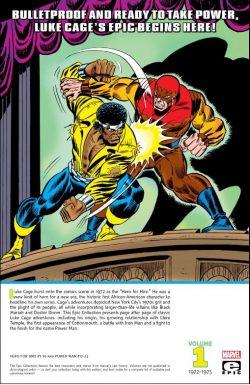
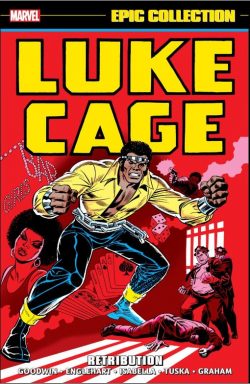
Luke Cage Epic Collection volume 1 1972-1975: Retribution


By Archie Goodwin, Steve Englehart, Tony Isabella, Len Wein, Gerry Conway, Billy Graham, George Tuska, Ron Wilson & various (Marvel)
ISBN: 978-1302928315 (TPB)

In 1968 the consciousness-raising sporting demonstration of Black Power at the Olympic Games politicised a generation of youngsters. By this time a few comics companies had already made tentative efforts to address what were national and socio-political iniquities, but issues of race and ethnicity took a long time to filter through to still-impressionable young minds avidly absorbing knowledge and attitudes via four-colour pages that couldn’t even approximate the skin tones of African-Americans.

As with television, breakthroughs were small, incremental and too often reduced to a cold-war of daringly liberal “firsts.” Excluding a few characters in Jungle comic-books of the 1940s and 1950, Marvel clearly led the field with a black soldier in Sgt. Fury’s Howling Commandos team – the historically impossible Gabe Jones who debuted in #1, May 1963. So unlikely a character was ol’ Gabe that he was re-coloured Caucasian at the printers, who clearly didn’t realise his ethnicity, but knew he couldn’t be un-white.

He was followed by actual negro superheroes Black Panther in Fantastic Four #52 (July 1966), and the Falcon in Captain America #117 (September 1969).

America’s first black hero to helm in his own title had come (and gone largely unnoticed) in a little remembered or regarded title from Dell Comics. Debuting in December 1965 and created by artist Tony Tallarico and scripter D.J. Arneson, Lobo was a gunslinger in the old west, battling injustice just like any cowboy hero would.

Arguably a greater breakthrough was Joe Robertson, City Editor of the Daily Bugle; an erudite, brave and proudly ordinary mortal distinguished by his sterling character, not costume or skin tone. He first appeared in Amazing Spider-Man # 51 (August 1967), proving in every panel that the world wouldn’t end if black folk and white folk occupied the same spaces…

This big change slowly grew out of raised social awareness during a terrible time in American history; yes, even worse than today’s festering social wound, as typified by cops under pressure providing no answer to seemingly constant Black Lives Matter events. Those tragedies occur in the UK too, so we have nothing to be smug about either. We’ve had race riots since the Sixties which left simmering scars that only comedians and openly racist politicians dare to talk about. Things today in don’t seem all that different, except the bile and growing taste for violence is turned towards European accents, or health workers as well as brown skins…

As the 1960s became a new decade, more positive and inclusive incidences of ethnic characters appeared in the USA, with DC finally getting an African-America hero in John Stewart (Green Lantern #87 December 1971/January 1972) – although his designation as a replacement Green Lantern might be construed as more conciliatory and insulting than revolutionary.

The first DC hero with his own title was Black Lightning. He didn’t debut until April 1977, although Jack Kirby had introduced Vykin in Forever People #1 and the Black Racer in New Gods #3 (March and July 1971) and Shilo Norman as Scott Free‘s apprentice (and eventual successor) in Mister Miracle #15 (August 1973).

As usual, it took a bold man and changing economics to really promote change. With declining comics sales at a time of rising Black Consciousness, cash – if not cashing in – was probably the trigger for “the Next Step.”

Contemporary “Blaxsploitation” cinema and novels had fired up commercial interests throughout America, and in that atmosphere of outlandish dialogue, daft outfits and barely concealed – if justified – outrage, an angry black man with a shady past and apparently dubious morals must have felt like a sure-fire hit to Marvel’s bosses.

Luke Cage, Hero for Hire launched in the summer of 1972. A year later, Black Panther finally got his own series in Jungle Action #5 and Blade: Vampire Hunter debuted in Tomb of Dracula #10.

This stunning trade paperback/digital compendium collects the first 23 issues of the breakthrough series: including the moment the series was thematically adjusted to become Luke Cage Power Man and cumulatively spanning June 1972 to February 1975.

The saga begins with Lucas, a hard-case inmate at brutal Seagate Prison. Like all convicts he says he was framed and his uncompromising attitude makes mortal enemies of savage, racist guards Rackham and Quirt, whilst not endearing him to the rest of the prison population such as genuinely bad guys Shades and Comanche either…

‘Out of Hell… A Hero!’ was written by Archie Goodwin and illustrated by George Tuska & Billy Graham – with some initial assistance from Roy Thomas and John Romita Senior – and sees a new warden arrive promising to change the hell-hole into a proper, correctly administered correctional facility. Prison doctor Noah Burstein convinces Lucas to participate in a radical experiment in exchange for a parole hearing, having heard the desperate con’s tale of woe…

Lucas had grown up in Harlem, a tough kid who had managed to stay honest even when his best friend Willis Stryker had not. They remained friends even though they walked different paths – until a woman came between them. To be rid of his romantic rival Stryker planted drugs and had Lucas shipped off to jail. While he was there his girl Reva, who had never given up on him, was killed when she got in way of bullets meant for up-and-coming gangster Stryker…

With nothing to lose Lucas undergoes Burstein’s process – an experiment in cell-regeneration – but Rackham sabotages it, hoping to kill the con before he can expose the illegal treatment of convicts. The equipment goes haywire and something incredible occurs. Lucas – panicked and somehow super-strong – punches his way out of the lab and the through the prison walls, only to be killed in hail of gunfire. His body plunges over a cliff and is never recovered…

Months later, a vagrant prowls the streets of New York City and stumbles into a robbery. Almost casually he downs the felon and accepts a reward from the grateful victim. He also has a bright idea. Strong, bullet-proof, street-wise and honest, Lucas will hide in plain sight while planning his revenge on Stryker. Since his only skill is fighting, he becomes a private paladin… a Hero for Hire…

Making allowances for the colourful, often ludicrous dialogue necessitated by the Comics Code’s sanitising of “street-talking Jive” this is probably the grittiest origin tale of the classic Marvel years, and the tense action continues in ‘Vengeance is Mine!’ as the man now calling himself Luke Cage stalks his target.

Stryker has risen quickly, now controlling a vast portion of the drug trade as the deadly Diamondback, and Cage has a big surprise in store when beautiful physician Claire Temple comes to his aid after a calamitous struggle. Thinking him fatally shot, her surprise is dwarfed by his own when Cage meets her boss.

Seeking to expiate his sins, Noah Burstein runs a rehab clinic on the sordid streets of Times Square, but his efforts have drawn the attention of Diamondback, who doesn’t like someone trying to fix his paying customers…

Burstein apparently does not recognise Cage, and even though faced with eventual exposure and return to prison, the Hero for Hire offers to help the hard-pressed medics. Setting up an office above a movie house on 42nd Street, Cage meets a lad who will be his greatest friend: D.W. Griffith: nerd, film freak and plucky white sidekick. However, before Cage can settle in, Diamondback strikes and the age-old game of blood and honour plays out the way it always does…

Issue #3 introduces Cage’s first returning villain in ‘Mark of the Mace!’ as Burstein – for his own undisclosed reasons – decides to keep Cage’s secret, and disgraced soldier Gideon Mace launches a terror attack on Manhattan. With his dying breath, one of the mad Colonel’s troops hires Cage to stop the attack, which he does in explosive fashion…

Inker Billy Graham graduated to full art chores for ‘Cry Fear… Cry Phantom!’ in #4, as a deranged, deformed maniac carries out random assaults in Times Square. Or is there perhaps another motive behind the crazed attacks?

Steve Englehart took over as scripter and Tuska returned to pencil ‘Don’t Mess with Black Mariah!’ in the next issue: a sordid tale of organised scavengers which debuts unscrupulous reporter Phil Fox: an unsavoury sneak with greedy pockets and a nose for scandal…

The private detective motif proved a brilliant stratagem in generating stories for a character perceived as a reluctant champion at best and outright antihero by nature. It allowed Cage to maintain an outsider’s edginess, but also meant danger and adventure literally walked through his shabby door every issue.

Such was the case with ‘Knights and White Satin’ (Englehart, Gerry Conway, Graham & Paul Reinman) as the swanky, ultra-rich Forsythe sisters hire Cage to bodyguard their dying father from a would-be murderer too impatient to wait the week it will take for the old man to die from a terminal illness.

This more-or less straight mystery yarn (if you discount a madman and killer robots) is followed by ‘Jingle Bombs’ – a strikingly different Christmas tale from Englehart, Tuska & Graham, before Cage properly enters the Marvel Universe in ‘Crescendo!’ after he is hired by Doctor Doom to retrieve rogue androids that had absconded from Latveria. They are

hiding as black men among the shifting masses of Harlem and the Iron Dictator needs someone who can work in the unfamiliar environment. Naturally, Cage accomplishes his mission, only to have Doom stiff him for the fee. Big mistake…

‘Where Angels Fear to Tread!’ (#9) finds the enraged Hero for Hire borrowing a vehicle from the Fantastic Four to play Repo Man in Doom’s own castle, just in time to get caught in the middle of a grudge match between the tyrant and alien invader the Faceless One.

It’s back to street-level basics in ‘The Lucky… and the Dead!’ as Cage takes on a gambling syndicate led by the schizophrenic Señor Suerte, who could double his luck by becoming murderous Señor Muerte (that’s Mr. Luck and Mr. Death to you): a 2-part thriller complete with rigged games and death-traps that climaxes in the startling ‘Where There’s Life…!’ as relentless Phil Fox finally uncovers Cage’s secret…

Issue #12 featured the first of many battles against alchemical villain ‘Chemistro!’, after which Graham handled full art duties with ‘The Claws of Lionfang’ – a killer using big cats to destroy his enemies – before Cage tackles hyperthyroid lawyer Big Ben Donovan in ‘Retribution!’ as the tangled threads of his murky past slowly become a noose around his neck…

‘Retribution: Part II!’ finds Graham and Tony Isabella sharing the writer’s role as many disparate elements converge to expose Cage. The crisis is exacerbated by Quirt kidnapping Luke’s girlfriend, and Seagate escapees Comanche and Shades stalking him whilst the New York cops hunt him.

The last thing the Hero for Hire needs is a new super-foe, but that’s just what he gets in #16’s ‘Shake Hands with Stiletto!’(Isabella, Graham & Frank McLaughlin): a dramatic finale which literally brings the house down and clears up most of the old business.

A partial re-branding of America’s premier black crimebuster began in issue #17. The mercenary aspect was downplayed (at least on covers) as Luke Cage, Power Man – by Len Wein, Tuska & Graham – got another new start during a tumultuous team-up in ‘Rich Man: Iron Man… Power Man: Thief!’

Here the still “For Hire” hero is commissioned to test Tony Stark‘s security by stealing his latest invention. Sadly, neither Stark nor his alter ego Iron Man know anything about it and the result is another classic hero-on-hero duel…

Vince Colletta signed on as inker with #18’s ‘Havoc on the High Iron!’, as Cage takes on a murderous high-tech Steeplejack before the next two issues offer the still-wanted fugitive hero a tantalising chance to clear his name.

‘Call Him… Cottonmouth!’ introduced a crime lord with inside information of the frame-up perpetrated by Willis Stryker. Tragically, that hope of a new clean life is snatched away after all Cage’s explosive, two-fisted efforts in the Isabella scripted follow-up ‘How Like a Serpent’s Tooth…’

Isabella, Wein, Ron Wilson & Colletta collaborated on ‘The Killer with My Name!’ with Cage attacked by old Avengers villain Power Man, who understandably wants his nom de guerre back. He changes his mind upon waking up from the resultant bombastic battle that ensues…

Psychotic archenemy Stiletto returned with his equally high-tech balmy brother Discus in ‘The Broadway Mayhem of 1974’ (Isabella, Wilson & Colletta), subsequently revealing a startling connection to Cage’s origins…

All this constant carnage and non-stop tension had sent sometime-romantic interest Claire Temple scurrying for points distant, and as this collection concludes with LCPM #23, Cage and D.W. go looking for her, promptly fetching up in a fascistic planned-community run by old foe and deranged military terrorist Gideon Mace in ‘Welcome to Security City’(inked by Dave Hunt).

Adding extra value to this sterling selection are a Marvel Bulletins page promo from 1972; unused cover art by Graham, pre-edited, corrected and just plain toned-down pages (LCHFH was one of the most potentially controversial and thus most scrupulously edited books in Marvel’s stable at the time); a House ad from 1974 and Dave Cockrum & John Romita’s Cage entry from the 1975 Mighty Marvel Calendar (March, in case you were wondering). Also on view are original art and covers by Graham, Gil Kane & Mike Esposito (#17 and 20), plus a editorial apology from Steve Englehart over language used in #8 which has been modified for later reprintings… Now you’re intrigued, right?

Arguably a little dated now – me, Genndy Tartakovsky and others in the know prefer the term “retro” – these tales were instrumental in breaking down a major barrier in the complacent, intolerant, WASP-flavoured American comics landscape and their quality and power if not their initial impact remains undiminished to this day. These are tales well worth your time and money.
© 2021 MARVEL.

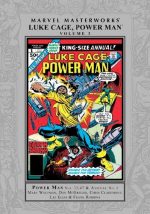
Marvel Masterworks Luke Cage, Power Man volume 3


By Marv Wolfman, Don McGregor, Chris Claremont, Bill Mantlo, Ed Hannigan, Roger Slifer, Frank Robbins, Lee Elias, Marie Severin, Ron Wilson, Bob Brown, George Tuska & various (Marvel)
ISBN: 978-1-3029-1635-0 (HB)

As a sickly pale kid growing up in a hugely white area of the Home Counties in the 1960s and 1970s, I got almost all my early experience of black people from television and films (for which I’m most profoundly sorry) – and, of course, comics – for which I’m not.

Blithely unaware of other people’s struggle for equality in my formative years, the incredible consciousness-raising explosion of Black Power after the 1968 Olympic Games rather politicised me, and even though some comics companies had by this time made tentative efforts to address what were national and global socio-political iniquities, issues of race and ethnicity took a long time to filter through to the still-impressionable young minds avidly absorbing knowledge and attitudes via four-colour newsprint pages that couldn’t even approximate the skin tones of African-Americans, Africans, Asians or even white folk with sun-burn or a deep tan.

As with television, breakthroughs were small, incremental and too often reduced to a cold-war of daringly liberal “firsts.” Excluding a few characters in Jungle comic-books of the 1940s and 1950, Marvel clearly led the field with a black member of Sgt. Fury’s Howling Commandos (the historically impossible Gabe Jones who debuted in #1, May 1963, and was accidentally re-coloured Caucasian at the printers – who clearly didn’t realise his ethnicity – for the debut issue), as well as the first negro superheroes Black Panther in Fantastic Four #52 (July 1966), and the Falcon in Captain America #117 (September 1969).

The honour of America’s first black hero to carry his own title came in a little-remembered or regarded title from Dell Comics. Lobo was a gunslinger/vigilante in the old west who sought out injustice just like any cowboy hero would, first appearing in December 1965, and created by artist Tony Tallarico & scripter D.J. Arneson.

Arguably a greater breakthrough was Joe Robertson, City Editor of Marvel’s Daily Bugle, an erudite, brave and magnificently ordinary mortal distinguished by his sterling character, not a costume or skin tone. He first appeared in Amazing Spider-Man # 51 (August 1967), proving in every panel that the world wouldn’t end if black folk and white folk worked and ate together…

This big change slowly grew out of raised social awareness during a terrible time in American history – although Britain had nothing to be smug about either. Following the advent of the “Windrush Generation”, race riots in Blighty had started early in the Sixties here (in all honesty, they weren’t a new thing then, either) and left simmering scars that only comedians and openly racist politicians dared to talk about. Shows such Till Death Us Do Part and Love Thy Neighbour made subtly telling headway but still raise a shudder when I see clips today…

Back in the USA, more positive ethnic characters were slowly let in, with DC finally getting a black hero in John Stewart(Green Lantern #87 December 1971/January 1972), although his designation as replacement Green Lantern might be construed as more conciliatory and insulting than revolutionary. The first DC hero with his own title was Black Lightning, who didn’t debut until April 1977, although Jack Kirby had introduced Shilo Norman as Scott Free‘s apprentice (and eventual successor) in Mister Miracle #15 (August (1973).

As usual, it took a bold man and changing economics to really promote change, and with declining comics sales at a time of rising Black Consciousness cash – if not cashing in – was probably the trigger for “the Next Step.”

Contemporary “Blacksploitation” cinema and novels had fired up commercial interests throughout America and in that atmosphere of outlandish dialogue, appalling apparel and barely concealed – if justified – outrage, an angry black man with a shady past and apparently dubious morals debuted as Luke Cage, Hero for Hire in the summer of 1972. A year later the Black Panther finally got his own series in Jungle Action #5 and Blade: Vampire Hunter debuted in Tomb of Dracula #10.

Cage’s origin was typically bombastic: Lucas, a hard-case inmate at brutal Seagate Prison always claimed to have been framed and his inflexible, uncompromising attitude made mortal enemies of the racist guards Rackham and Quirt whilst not exactly endearing him to the rest of the prison population – such as proudly adamant bad-guys Shades and Comanche…

The premiere issue was written by Archie Goodwin and illustrated by George Tuska & Billy Graham (with some initial assistance from Roy Thomas and John Romita), detailing how a new warden promised to reform the hell-hole into a proper, legal and decently administered penal institution.

Having heard the desperate con’s tale of woe, new prison doctor Noah Burstein convinced Lucas to participate in a radical experiment in exchange for a parole hearing…

Lucas had grown up in Harlem, a tough kid who’d managed to stay honest even when his best friend Willis Stryker had not. They remained friends even though walking different paths – at least until a woman came between them. To be rid of his romantic rival, Stryker planted drugs and had Lucas shipped off to jail. While he was incarcerated, Lucas’ girl Reva – who had never given up on him – was killed when she got in the way of bullets meant for Stryker…

With nothing left to lose, Lucas underwent Burstein’s process – an experiment in cell-regeneration – but Rackham sabotaged it, hoping to kill the con before he could expose the guard’s illegal treatment of convicts. It all went haywire and something incredible happened. Lucas, now incredibly strong and pain-resistant, punched his way out of the lab and the through the prison walls, only to be killed in hail of gunfire. His body plunged over a cliff and was never recovered…

Months later, a vagrant prowling the streets of New York City stumbled into a robbery. Almost casually downing the felon, he accepted a cash reward from the grateful victim, prompting a bright idea…

Super-strong, bullet-proof, street-wise and honest, Lucas would hide in plain sight while planning his revenge on Stryker. Since his only skill was fighting, he became a private paladin – A Hero For Hire…

Whilst making allowances for the colourful, often ludicrous dialogue necessitated by the Comics Code’s sanitising of “street-talking Jive” this was probably the edgiest series of Marvel’s early years (especially under the always evocative and culturally astute Don McGregor) but even so, after a few years the tense action and peripheral interactions with the greater Marvel Universe led to a minor rethink and the title was altered, if not the basic premise…

The private detective motif proved a brilliant stratagem in generating stories for a character perceived as a reluctant champion at best and anti-hero by nature. It allowed Cage to maintain an outsider’s edginess but also meant adventure literally walked through his shabby door every issue.

Cage had set up an office over a movie house on 42nd Street and met a young man who would become his greatest friend: D.W. Griffith – nerd, film freak and plucky white sidekick. Dr. Burstein resurfaced, running a rehab clinic on the dirty, deadly streets around Times Square, aided by beautiful Dr. Claire Temple. Soon, she too was an integral part of Luke’s new life…

This turbulent third hardback (or eBook) compilation collects #32-47 of Luke Cage, Power Man as well as his first Annual – spanning June 1976 through October 1977 – and begins with McGregor’s passionate Introduction ‘Luke Cage and the Big Bad City’ before the inner city, “outasight” action resumes….

Having rebranded himself Luke Cage, Power Man the urban privateer made ends meet whilst seeking a way to stay under police radar and dreamed of clearing his name. A new level of sophistication, social commentary and bizarre villainy began when McGregor took over as writer to craft a run of macabre crime sagas, culminating in saving the entire city from stolen nerve gas…

Issue #32 opens with Cage in the leafy suburbs, hired to protect a black family from literally incendiary racist super-villain Wildfire in ‘The Fire This Time!’ (by McGregor, Frank Robbins & Vince Colletta). This champion of moral outrage is determined to keep his affluent decent neighbourhood white, and even Power Man is ultimately unable to prevent a ghastly atrocity from being perpetrated…

Back in Times Square again, Cage is in the way when a costumed manic comes looking for Noah Burnstein, and learns that ‘Sticks and Stone Will Break Your Bones, But Spears Can Kill You!’ Even as shady reporters, sleazy lawyers and police detective Quentin Chase all circle, looking to uncover the Hero for Hire’s secret past in ‘Death, Taxes and Springtime Vendettas!’ (inked by Frank Springer), Cage’s attention is distracted from Burstein’s stalker by a deranged wrestler dubbed The Mangler, leading to savage showdown and near-fatal outcome in ‘Of Memories, Both Vicious and Haunting!’ (plotted by Marv Wolfman, dialogued by McGregor and illustrated by Marie Severin, Joe Giella & Frank Giacoia) wherein the reasons for the campaign of terror are finally exposed…

Power Man Annual #1 follows as ‘Earthshock!’ – by Chris Claremont, Lee Elias & Dave Hunt – takes Cage to Japan as bodyguard to wealthy Samantha Sheridan. She is being targeted by munitions magnate and tectonics-warping maniac Moses Magnum, who intends tapping the planet’s magma core, even though the very planet is at risk of being destroyed.

Thankfully not even his army of mercenary is enough to stop Cage in full rage…

Next is the cover for Power Man #36 (October 1976). Another casualty of the “Dreaded Deadline Doom”, it reprinted LCHFH #12, which featured the debut of the villain who follows in #37’s all-new ‘Chemistro is Back! Deadlier Than Ever!’ by Wolfman, Ron Wilson & A Bradford, as the apparently grudge-bearing recreant attacks Cage at the behest of a new mystery mastermind. He clarifies his position in follow-up ‘…Big Brother Wants You… Dead!’ (Wolfman, Bill Mantlo, Bob Brown & Jim Mooney) as minions Cheshire Cat and Checkpoint Charlie shadow the increasingly-frustrated PI, and repeated inconclusive and inexplicable clashes with Chemistro lead to a bombastic ‘Battle with the Baron!’ (inked by Klaus Janson) who turns out to be a rival mastermind hoping to corner the market on crime in NYC…

The crazed and convoluted clash concludes in ‘Rush Hour to Limbo!’ (Wolfman, Elias & Giacoia) as one final deathtrap for Cage turns into an explosive last hurrah for Big Brother and his crew…

Inked by Tom Palmer, a new vigilante debuts in #41’s ‘Thunderbolt and Goldbug!‘ as a super-swift masked hero makes a name for himself cleaning up low-level scum just as Cage is hired by a courier company to protect a bullion shipment. Sadly, when the van is bombed and the guards die, dazed and furious Cage can’t tell villain from vigilante and takes on the wrong guy…

Answers if not conclusions are forthcoming in ‘Gold! Gold! Who’s Got the Gold?’ (with Alex Niño on inks) as Luke learns who his real friends and foes are, only to be suckered into a deathtrap only barely escaped in #43’s ‘The Death of Luke Cage!’ In the aftermath, with the legal authorities closing in on his fake life, Cage flees town and sheds the Power Man persona, but even in the teeming masses of Chicago can’t escape his past as an old enemy mistakenly assumes he’s been tracked down by the hero he hates most in all the world…

Plotted by Wolfman and scripted by Ed Hannigan with Elias & Palmer on regular artistic duties, ‘Murder is the Man Called Mace!’ sees Luke dragged into the dishonoured soldier’s scheme to seize control of America and despite his best and most violent efforts, beaten and strapped to a cobalt bomb on ‘The Day Chicago Died!’ (Wolfman & Elias).

Sadly, after breaking free of the device, it’s lost in the sewers, prompting a frantic ‘Chicago Trackdown!’ and another savage showdown with Mace and his military madmen in a chilling ‘Countdown to Catastrophe!’ (scripted by Roger Slifer) as a fame-hungry sniper starts shooting citizens whilst the authorities are all searching for the missing nuke…

With atomic armageddon averted at the last moment, this collection – and Cage’s old life – end on a well-conceived final charge. With issue #48, Cage’s life – and his comics title – would be henceforth be shared with mystic martial artist Danny Rand in the superbly enticing odd couple feature Power Man and Iron Fist, but before that there’s still a ‘Hot Time in the Old Town Tonight!’ courtesy of Claremont, George Tuska & Bob Smith as Chicago is attacked by brain-sucking electrical parasite Zzzax! Thankfully, our steel-skinned stalwart is more than a match for the mind-stealing megawatt monstrosity…

With the comics sagas suspended, there’s still treats aplenty here, beginning with a house ad for 1976 Annuals, continuing with Wilson and Joe Sinnott’s art for the ‘Marvel Comics’ Memory Album Calendar 1977′ and ending with a short selection of original art pages by Brown, Mooney & Janson.

Arguably a little dated now (us in the know prefer the term “retro”), these tales were nonetheless instrumental in breaking down many social barriers in the complacent, intolerant, WASP-flavoured American comics landscape, and their power – if not their initial impact – remains undiminished to this day. These are tales well worth your time and money.
© 2019 MARVEL.

Iron Fist Marvel Masterworks volume 2


By Chris Claremont, John Byrne & various (Marvel)
ISBN: 978-0-7851-5955-1 (HB)

Comicbooks have always operated within the larger bounds of popular trends and fashions – just look at what got published whenever westerns or science fiction dominated on TV – so when the ancient philosophy and health-&-fitness discipline of Kung Fu made its unstoppable mark on domestic entertainment it wasn’t long before the Chop Sockey kicks and punches found their way onto the four-colour pages of America’s periodicals.

In 1974 Marvel’s second roll of the dice was a blending of Kung Fu tropes and fantasy settings with traditional masked crusader standards. Iron Fist combined Eastern combat philosophy with lost civilisations, magic powers and a proper superhero mask and costume…

The character owed a hefty debt to Bill Everett’s pioneering golden Age super-hero Amazing Man who graced various Centaur Comics publications between 1939 and 1942. The tribute was paid by Roy Thomas & Gil Kane who adopted and translated the fictive John Aman‘s Tibetan origins into something that meshed better with the 1970’s twin zeitgeists of Supernatural Adventure and Martial Arts Mayhem…

This second power-packed collection (available as both sturdy hardback and bantamweight EBook) gathers Iron Fist #3-15 plus a wrap-up tale from Marvel Team-Up ##63-64, collectively ranging from February 1976 to December 1977.

What Has Gone Before: A little more than years previously little Daniel Rand had watched helplessly as his father and mother died at the hands of family friend Harold Meachum whilst the party risked deadly Himalayan snows to find the legendary lost city of K’un Lun.

The boy had travelled with his wealthy parents and their business partner Meachum in search of the fabled city which only appears on Earth for one day every ten years. Wendell Rand had some unsuspected connection to the fabled Shangri La, but was killed before they find it, and Danny’s mother sacrificed herself to save her child from wolves… and their murderous pursuer.

As he wandered alone in the wilderness, the city came to Danny and he spent the next decade training: mastering all forms of martial arts in the militaristic, oriental, feudal paradise. He endured arcane ordeals, living only for the day he could return to Earth and avenge his parents.

After conquering all comers and refusing peace, a home and immortality, Iron Fist touched Earth once more: a Living Weapon able to turn his force of will into a devastating super-punch. As he left K’un Lun, supreme ruler of the city Yü-Ti, the August Personage in Jade, had revealed that murdered Wendell Rand had been his own brother……

After a relentless campaign against Meachum and his heirs, he eventually rejected vengeance but was nevertheless embroiled in cosmic schemes as enemies of city sought him out as a means of accessing the wandering paradise. He had made friends though: adopted by the enigmatic warrior Colleen Wing and her father, an aging professor of Oriental Studies who has fallen foul of a Death Cult. More importantly, he also grew close to her associate Misty Knight: a former cop with a bionic arm.

His greatest nemesis was now sublime wizard Master Khan, who had once attempted to conquer K’un Lun, only to be imprisoned within a crumbling book for his pains, but in the shadows a mysterious stalker dubbed Steel Serpent was getting ever closer to the K’un Lun Kid…

Over the years the prisoner had discovered a temporary escape and subsequently manipulated the Wings and Iron Fist to secure a permanent release and the doom of his jailers.

Another recent cast addition was Princess Azir of Halwan. Master Khan was also apparently intent on killing her and seizing her country…

After Colleen was abducted and her father pushed to the edge of insanity by mind-bending terrorist Angar the Screamer, they were renditioned to Halwan, leaving Danny and Misty to a resolute pursuit…

Following Bruce Canwell’s Introduction on the dream team of Chris Claremont & John Byrne, the action resumes with ‘The City’s Not for Burning!’ (inked by Frank Chiaramonte) with Master Khan attempting to break Colleen in Halwan and the determinedly Danny and Misty frantically giving chase.

They are forced to interrupt their chase with an enforced stopover in England after nuclear-powered maniac The Ravager slaughters innocents and blows up London Heathrow Airport. After defeating Danny on the runway, the monster tops that feat of terrorism by attacking the Post Office Tower (we rebuilt it as the BT Tower, so don’t panic).

With Iron Fist punching way above his weight it inevitably it ends in ‘Holocaust!’ as Ravager is unmasked as old villain Radion the Atomic Man.

He fatally irradiates Danny before the wounded warrior fortuitously discovers the miraculous cleansing and curative power of the Iron Fist and storms to his greatest triumph yet…

With Misty still recuperating in a London hospital, Danny gets involved with a guilt-ridden IRA bomber named Alan Cavenaugh before tackling another of Khan’s assassins in ‘When Slays the Scimitar!’

Danny and Misty finally infiltrate Halwan in #6, courtesy of crusading lawyer Jeryn Hogarth who also promises to secure Danny’s illegally-withheld inheritance and interests from the Rand-Meachum Corporation.

The Pride of K’un Lun doesn’t much care since the successfully brainwashed Colleen has been unleashed by Khan, determined to kill her rescuers in ‘Death Match!’…

None of the earthly participants are aware that, from a hidden dimension, Yü-Ti is observing the proceedings with cold calculation…

By using his mystic Iron Fist to psychically link with Colleen, Danny breaks Khan’s conditioning. Thus, at last, the malignant mage personally enters the fray in #7’s ‘Iron Fist Must Die!’: a blistering battle which breaches the dimensions and exposes the August Personage in Jade’s long-concealed involvement in Wendell Rand’s death.

Given the choice between abandoning his friends on Earth or returning to K’un Lun for answers and justice, the Living Weapon made a true hero’s choice…

A new direction for Iron Fist came with #8 as Danny returns to New York and attempts to pick up the pieces of a life interrupted for more than a decade.

Unaware that Steel Serpent now works for new CEO Joy Meachum, Danny joins the company as an executive, until merciless mob boss Chaka and his Chinatown gangs attack the business ‘Like Tigers in the Night!’ (inked by Dan Adkins). When Iron Fist responds in savage retaliation he is fatally poisoned.

Sportingly offered an antidote if he survives a gauntlet of Chaka’s warriors, Danny triumphs in his own manner when ‘The Dragon Dies at Dawn!’ (Chiaramonte inks). However, when a hidden killer bludgeons Chaka, Danny is once again a fugitive from the cops and dubbed the ‘Kung Fu Killer!’ (Adkins) until he, Colleen and Misty expose the entire plot as a fabrication of the gang lord.

In #11 ‘A Fine Day’s Dawn!’ the Living Weapon squares off against the Asgardian-empowered Wrecking Crew and, with Misty a hostage, is compelled to fight Captain America in #12’s ‘Assault on Avengers’ Mansion!’

Eventually, though, the Pride of K’un Lun and the Sentinel of Liberty unite to turn the tables on the grotesque god-powered gangsters…

In all this intervening time Cavenaugh has arrived in New York, but has not escaped the reach of his former Republican comrades. They hire hitman Boomerang to kill the defector and ‘Target: Iron Fist!’, but with little success, whereas the villain introduced in issue #14 comes a lot closer: even eventually eclipsing Iron Fist in popularity…

‘Snowfire’ – inked by Dan Green – finds Danny and Colleen running for their lives in arctic conditions when a retreat at Hogarth’s palatial Canadian Rockies estate is invaded by deadly mercenary Sabre-tooth. It just wasn’t their week as, only days before, a mystery assailant had ambushed Iron Fist and impossibly drained off a significant portion of the lad’s Shou-Lao fuelled life-force…

Despite being rendered temporarily blind, the K’un Lun Kid ultimately defeats his ferocious foe, but the fiercely feral mutant would return again and again…

With Claremont & Byrne increasingly absorbed by their stellar collaboration on the revived and resurgent adventures of Marvel’s mutant horde, Iron Fist #15 (September 1977) was their last Martial Arts mash-up for a while. The series ended in spectacular fashion as – through a comedy of errors – Danny stumbles into blazing battle against Wolverine, Colossus, Nightcrawler, Banshee, Storm and Phoenix in cataclysmic clash ‘Enter, the X-Men’.

The cancellation was clearly unplanned as two major subplots went unresolved: Misty had disappeared on an undercover assignment to investigate enigmatic European gang-boss John Bushmaster and Danny again had his chi siphoned off by Steel Serpent…

Fans didn’t have to wait long: Claremont & Byrne had already begun their magical stint on Marvel Team-Up: turning the Spider-Man vehicle into their own personal clearing house for unresolved plot-lines.

MTU #63-64 (November & December 1977 and inked by Dave Hunt) at last revealed the secret of K’un Lun exile Davos in ‘Night of the Dragon’ as Steel Serpent sucked the power of the Iron Fist from Danny, leaving him near death. Risking all she had gained, Misty broke cover and rushed to his aid…

With the wallcrawler and Colleen (the warrior women using the team name “Daughters of the Dragon”) to bolster him, Iron Fist defeats Davos and reclaims his heritage in ‘If Death be my Destiny…’ before shuffling off into a quiet retirement and anonymity.

…But not for long – and certainly the subject of further mammoth full-colour collections to come…

The Iron Fist saga ranks amongst the most exciting and enjoyable Costumed Dramas of Marvel’s second generation. If you want a good, clean fight comic this is probably one of your better bets, especially if you’re a fan of original artwork as this titanic tome closes with a fabulous selection, shot from Byrne’s pages and inked by Adkins, Green and Hunt…
© 1976, 1977, 2017 Marvel Characters, Inc. All rights reserved.