Showcase Presents Robin The Boy Wonder


By E. Nelson Bridwell, Ed Hamilton, John Broome, Leo Dorfman, Gardner F. Fox, Cary Bates, Mike Friedrich, Frank Robbins, Denny O’Neil, Bob Haney, Elliot Maggin, Bob Rozakis, Ross Andru, Curt Swan, Sheldon Moldoff, Pete Costanza, Chic Stone, Gil Kane, Irv Novick, Murphy Anderson, Dick Dillin, Rich Buckler, Bob Brown, Mike Grell, A. Martinez Al Milgrom & various (DC Comics)
ISBN: 978-1-4012-1676-4 (TPB)

This book includes Discriminatory Content produced in less enlightened times.

As previously mentioned, there are a lot of comics anniversaries occurring in this otherwise dreadful year. The ultimate and original sidekick is probably the most significant of DC’s representatives, and indeed there have been a few intriguing collections released to celebrate the occasion. This one, however, is probably the best but remains criminally out of print, if not utterly unavailable…

Robin the Boy Wonder debuted in Detective Comics #38 (cover dated April 1940 and on sale from March 6th). Co-created by Bob Kane, Bill Finger & Jerry Robinson, he was a juvenile circus acrobat whose parents were murdered by a mob boss. The story of how Batman took the orphaned Dick Grayson under his scalloped wing and trained him to fight crime has been told, retold and revised many times over the decades and still regularly undergoes tweaking to this day.

Grayson fought beside Batman until 1970 when, as an indicator of those turbulent times, he flew the nest, becoming a Teen Wonder college student. His creation as a junior hero for younger readers to identify with has inspired an incomprehensible number of costumed sidekicks and kid crusaders, and Grayson continued in similar innovative vein for the older, more worldly-wise readership of America’s increasingly rebellious youth culture.

The first Robin even had his own solo series in Star Spangled Comics from 1947 to 1952, a solo spot in the back of Detective Comics from the end of the 1960s – a position he alternated and shared with Batgirl – and a starring feature in anthology comic Batman Family. During the 1980s he led the New Teen Titans, initially in his original costumed identity but eventually in the reinvented guise of Nightwing, all while re-establishing a (somewhat turbulent) working relationship with his masked mentor.

This broad ranging easy on the eye monochrome compilation covers the period from Julie Schwartz’s captivating reinvigoration of the Dynamic Duo in 1964 until 1975 with Robin-related stories and material from Batman #184, 192, 202, 213, 227, 229-231, 234-236, 239-242, 244-246, 248-250, 252, 254 and portions of 217; Detective Comics #342, 386, 390-391, 394-395, 398-403, 445, 447, 450-251; World’s Finest Comics #141, 147, 195, 200; Superman’s Pal Jimmy Olsen #91, 111, 130 and Justice League of America #91-92.

The wonderment begins with the lead story from Batman #213 (July-August 1969) – a 30th Anniversary reprint Giant – which featured an all-new retelling of ‘The Origin of Robin’ courtesy of E. Nelson Bridwell, Ross Andru & Mike Esposito, perfectly reinterpreting that epochal event for the Vietnam generation. After that, the tales proceed in (more or less) chronological order, covering episodes where Robin took centre-stage.

First up is ‘The Olsen-Robin Team versus… the Superman-Batman Team!’ (from World’s Finest #141, May 1964, by Edmond Hamilton, Curt Swan & George Klein). In a stirring blend of science fiction thriller and crime caper, the underappreciated sidekicks fake their own deaths to undertake a secret mission even their adult partners must remain unaware of – for the very best of reasons of course. A sequel from WF #147 (February 1965) delivers an engaging drama of youth-in-revolt as ‘The New Terrific Team!’ quit their assistant roles to strike out on their disgruntled own. Naturally there’s a perfectly reasonable – if incredible – reason here, too…

Detective Comics #342 (August 1965) featured ‘The Midnight Raid of the Robin Gang!’ by John Broome, Sheldon Moldoff & Joe Giella, wherein the Boy Wonder joins a youthful gang of costumed criminals, after which Superman’s Pal Jimmy Olsen #91 (March 1966) delivers ‘The Dragon Delinquent!’ (Leo Dorfman & Pete Costanza) as Robin and the cub reporter, unknown to each other, both infiltrate the same biker gang with potentially fatal consequences.

‘The Boy Wonder’s Boo-Boo Patrol!’ – originally a back-up in Batman #184 (September 1966, Gardner Fox, Chic Stone & Sid Greene), shows the daring lad’s star-potential in a clever tale of thespian skulduggery and classic conundrum solving, before ‘Dick Grayson’s Secret Guardian!’ (Batman #192, June 1967, Fox, Moldoff & Giella) depicts his physical prowess in one of comic books’ first instances of the exo-skeletal augmentation gimmick.

‘Jimmy Olsen, Boy Wonder!’ (SPJO #111, June 1968, by Cary Bates & Costanza) finds the reporter trying to prove his covert skills by convincing the Gotham Guardian that he was actually Robin, whilst that same month in Batman #203 the genuine article tackles the ‘Menace of the Motorcycle Marauders!’ (Mike Friedrich, Stone & Giella) consequently learning a salutary lesson in the price of responsibility…

Cover-dated April 1969, Detective Comics #386 featured the Boy Wonder’s first solo back-up in what was to become his semi-regular spot for years. ‘The Teen-Age Gap!’ (as described by Friedrich, Andru & Esposito) depicts a High School Barn Dance which only narrowly escapes becoming a riot thanks to his diligent intervention, after which Gil Kane & Murphy Anderson assume the art-chores with #390’s ‘Countdown to Chaos!’ (August 1969), bringing the series stunningly alive. Friedrich concocted a canny tale of corruption and kidnapping leading to a paralysing city ‘Strike!’ for the Caped kid to spectacularly expose and foil in the following issue.

Batman #217 (December 1969) was a landmark in the character’s long history as Dick leaves home to attend Hudson University. Only the pertinent portion from ‘One Bullet Too Many!’ by Frank Robbins, Irv Novick & Dick Giordano is included here, closely followed by ‘Strike… Whilst the Campus is Hot’ (Detective #394 from the same month, by Robbins, Kane & Anderson) as the callow freshman stumbles into a campus riot organised by criminals and radical activists, forcing the now Teen Wonder to ‘Drop Out… or Drop Dead!‘ to stop the seditious scheme…

Detective #398-399 (April & May 1970) ran a 2-part spy-thriller with Vince Colletta replacing Anderson as inker. ‘Moon-Struck’ has lunar rock samples borrowed from NASA apparently causing a plague among Hudson’s students until Robin exposes a Soviet scheme to sabotage the Space Program in ‘Panic by Moonglow’. The 400th anniversary issue (June 1970) finally teamed the Teen Wonder with his alternating back-up star in ‘A Burial For Batgirl!’ (Denny O’Neil, Kane & Colletta): a college-based murder mystery which again heavily references the political and social unrest then plaguing US campuses, but which still finds space to be smart and action-packed as well as topical, before chilling conclusion ‘Midnight is the Dying Hour!’ wraps up the saga.

Never afraid to repeat a good idea, Superman’s Pal Jimmy Olsen #130 (July 1970) sees Bob Haney & Murphy Anderson detail the exploits of ‘Olsen the Teen Wonder!’ as the boy reporter again apes Batman’s buddy – this time to infiltrate an underworld newspaper – whilst World’s Finest #195 (August 1970) finds Jimmy & Robin targeted for murder by the Mafia in ‘Dig Now, Die Later!’ by Haney, Andru & Esposito. Simultaneously in DC #402 ‘My Place in the Sun’ (Friedrich, Kane & Colletta), embroils Grayson and fellow Teen Titan Roy Speedy Harper in a crisis of social conscience, before our scarce-bearded hero wraps up his Detective run with corking crime-busting caper ‘Break-Out’ in the September issue.

Robin’s romps transferred to the back of Batman, beginning with #227 (December 1970) and ‘Help Me – I Think I’m Dead!’ (Friedrich, Novick & Esposito) as ecological awareness and penny-pinching Big Business catastrophically collide on the campus, beginning an extended epic seeing the Teen Thunderbolt explore communes, alternative cultures and the burgeoning spiritual New Age fads of the day. Inked by Frank Giacoia ‘Temperature Boiling… and Rising!’ (#229, February 1971) continues the politically-charged drama, albeit uncomfortably interrupted by a trenchant fantasy team-up with Superman sparked when the Man of Steel attempts to halt a violent campus clash between students and National Guard.

Crafted by Friedrich, Dick Dillin & Giella, ‘Prisoners of the Immortal World!’ (WFC #200, February 1971), has brothers on opposite sides of the teen scene abducted with Robin & Superman to a distant planet where undying vampiric aliens wage eternal war on each other. A return to more pedestrian perils in Batman #230 (March 1971) sees ‘Danger Comes A-Looking!’ for our young hero in the form of a gang of right-wing, anti-protester jocks and a deluded friend who prefers bombs to brotherhood, courtesy of Friedrich, Novick & Dick Giordano. ‘Wiped Out!’ (#231, May 1971) then offers an eye-popping end to the jock gang whilst #234 sees a clever road-trip tale in ‘Vengeance for a Cop!’, when a campus guard is gunned down forcing Robin to track the only suspect to a commune. ‘The Outcast Society’ has its own unique system of justice, but eventually the shooter is apprehended in the cataclysmic ‘Rain Fire!’ (#235 & 236 respectively).

The Collective experience blooms into psychedelic and psionic strangeness in #239 as ‘Soul-Pit’ (illustrated by new penciller Rich Buckler) finds Grayson’s would-be girlfriend, “Jesus-freaks” and runaway kids all sucked into a telepathic duel between a father and son, played out in the ‘Theatre of the Mind!’ before exposing the ‘Secret of the Psychic Siren!’ and culminating in a lethal clash with a clandestine cult in ‘Death-Point!’ (Batman#242, June 1972). After that eerie epic we slip back a year to peruse the Teen Wonder’s participation in one of the hallowed JLA/JSA summer team-ups, beginning in Justice League of America #91 (August 1971) and ‘Earth… the Monster-Maker!’, as Supermen, Flashes, Green Lanterns, Atoms and a brace of Hawkmen from two separate Realities simultaneously and ineffectually battle an alien boy and his symbiotically-linked dog (sort of) on almost identical planets a universe apart. There’s still time to painfully patronise the Robins of both until ‘Solomon Grundy… the One and Only!’ gives everyone a brutal but ultimately life-saving lesson on acceptance, togetherness, youthful optimism and lateral thinking…

Elliot Maggin, Novick & Giordano then set ‘The Teen-Age Trap!’ (Batman#244, September 1972), with Grayson mentoring troubled kids – and finding plenty of troublemakers his own age – whilst ‘Who Stole the Gift from Nowhere!’ is a delightful old-fashioned change-of-pace mystery yarn. However, ‘How Many Ways Can a Robin Die?’ by Robbins, Novick, Dillin & Giordano (Batman #246, December 1972) is actually a Dark Knight story with Teen Wonder helpless hostage throughout, whereas #248 opens another run of solo stories with ‘The Immortals of Usen Castle’ (Maggin, Novick & Frank McLaughlin) wherein another deprived-kids day trip turns into an episode of Scooby-Doo, Where are You? The ‘Case of the Kidnapped Crusader!’ (pencilled by Bob Brown) then puts the Student Centurion on the trail of an abducted consumer advocate and ‘Return of the Flying Grayson!’ (Maggin, Novick & McLaughlin from #250) painfully reminds the hero of his Circus past after tracking down pop-art thieves.

Batman #252 (October 1973) sees Maggin, Dillin & Giordano’s light-hearted pairing of Robin with a Danny Kaye pastiche for charming romp ‘The King from Canarsie!’, before ‘The Phenomenal Memory of Luke Graham!’ (#254 January/February 1974 and inked by Anderson) causes nothing but trouble for the hero, his college professors and a gang of robbers…

It was a year before the Teen Wonder’s solo sallies resumed with ‘The Touchdown Trap’ in Detective Comics #445 as new scripter Bob Rozakis and artist Mike Grell catapulted our hero into a 50-year-old college football feud that refused to die, whilst ‘The Puzzle of the Pyramids’ (#447 and illustrated by A. Martinez & Mazzaroli) offers another clever crime conundrum. This eccentrically eclectic monochrome compendium concludes with an action-packed, chase-heavy human drama by Al Milgrom & Terry Austin as ‘The Parking Lot Bandit!’ & ‘The Parking Lot Bandit Strikes Again!’ (DC #450-451, August & September 1975), giving the titanic teen one last chance to strike a bit of terror into the hearts of evil-doers…

These stories span a turbulent and chaotic period for comic books: perfectly encapsulating and describing the vicissitudes of the superhero genre’s premier juvenile lead: complex yet uncomplicated adventures drenched in charm and wit, moody tales of rebellion and self-discovery, and rollercoaster, all-fun romps. Action is always paramount, and angst-free satisfaction is pretty much guaranteed. These cracking yarns are something no fan of old-fashioned Fights ‘n’ Tights fiction should miss.
© 1964-1975, 2008 DC Comics. All Rights Reserved.

Today in 1922, Belgian auteur Marc Sleen was born. We still haven’t seen English versions of his Nero yet, but have slavishly and repeatedly begged you all to tune in to the oeuvre of Ronald Searle, who left us all far less today in 2011.

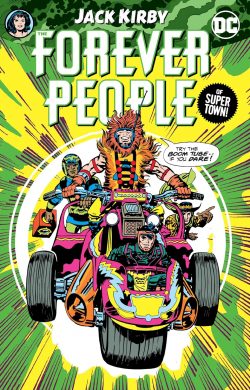
The Forever People by Jack Kirby


By Jack Kirby, Vince Colletta, Don Heck, Mike Royer, Murphy Anderson, Al Plastino & various (DC Comics)
ISBN: 978-1-77950-230-8 (TPB/Digital edition)

This book includes Discriminatory Content produced in less enlightened times.

Win’s Christmas Gift Recommendation: Monumental Masterpieces… 9/10

Today in 1970 American comic books changed forever. On December 1st newsstands saw Superman meet the counterculture head on courtesy of Jack Kirby in a title like no other ever before. Moreover it was only one crucial component part of a bold experiment that quite honestly failed, but still undid and remade everything. It was Forever People #1…

When Jack Kirby returned to the home of Superman in 1970 he brought with him one of the most powerful concepts in comic book history. The epic grandeur of his Fourth World saga grafted a complete new mythology onto and over the existing DC universe and blew the developing minds of a generation of readers. If only there had been a few more of them…

Starting in Superman’s Pal Jimmy Olsen, where he revived his 1940s kid-team The Newsboy Legion, introduced large-scale cloning in the form of The Project and hinted that the city’s gangsters had extraterrestrial connections, Kirby moved on to a main course beginning with The Forever People, intersecting where appropriate with New Gods and Mister Miracle to form an interlinked triptych of finite-length titles that together presented an epic mosaic. Those three groundbreaking titles collectively introduced rival races of gods, dark and light, risen from the ashes of a previous Armageddon to battle forever… and then their conflict spreads to Earth…

Kirby’s concepts, as always, fired and inspired contemporaries and successors. Gods of Apokolips & New Genesis became a crucial keystone of DC continuity and integral foundation of that entire fictional universe, surviving the numerous revisions and retcons which periodically bedevil long-lived comics fans. Many major talents dabbled with the concept over decades and a host of titles have come and gone starring Kirby’s creations. That’s happening now even as I type this…

As previously stated, the herald of all this innovation had been Superman’s Pal Jimmy Olsen, which Kirby had used to lay groundwork since taking it over with #133. There readers first met Darkseid, Intergang, The Evil Project and so much more, but it was also used as an emotional setup for a fascinating notion that had seldom if ever previously troubled the mighty, generally satisfied and well situated Man of Tomorrow…

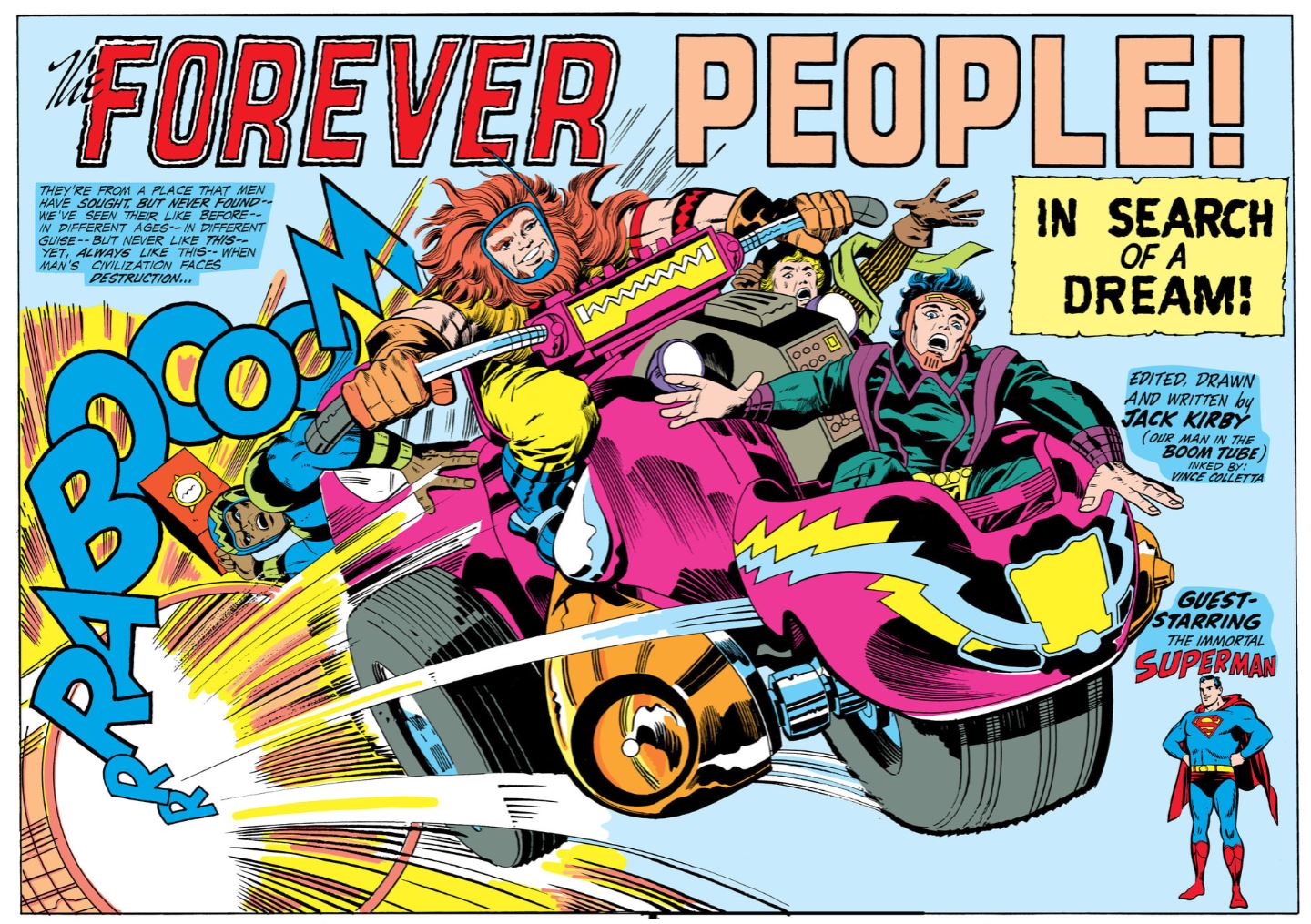
The Forever People #1’s ‘In Search of a Dream!’ saw Kirby & contractually assigned inker Vince Colletta open with a spectacular and contemporarily astute UFO sighting.

Despite a promise of complete autonomy, the King had surrendered much to get his dream rolling. Crushing deadlines and ridiculous expected monthly page counts were one thing, but his choice of inkers was vetoed, and he had to compromise and accept insulting art edits drawn by regular Superman artists perennially pasted onto Superman’s trademarked face to present something DC demanded. Nevertheless, the work was everything and wonders unfolded when friends of Jimmy Olsen witnessed the arrival of a quartet of weird wild kids on the strangest bike on – or off – Earth. Because they took pictures, Clark Kent’s life changed forever.

He had just completed a bruising interview that made him question his role and purpose on Earth when Jimmsys snapshots of those weird kids offered Superman a glimpse of a place where he could be one guy among equals…

Curiosity and a painful need to find those newcomers drove the Man of Steel to find them, and brought him into first known contact with the absolute embodiment of intellectual and philosophical totalitarianism…

Darkseid was infiltrating our world, quietly seeking a unique mind concealing a metaphysical ultimate weapon. The “Anti-Life Equation” was the instant, irresistible negation of choice and free will and with it the right despot would command all that lives. Darkseid’s obsessive search for it had led him to Earth and now he had kidnapped a psychic youngster from a world called New Genesis. Her name was Beautiful Dreamer

All this Superman learned later, after being ambushed by Intergang and saved by her friends Big Bear, Vykin the Black, Serifan and Mark Moonrider. They were all from that promised land Superman had glimpsed but had abandoned Eden to “get involved” helping their friend and Earth. They called themselves Forever People…

Apparently benevolent, curious kids open to new experiences and welcoming the myriad choices the future holds, they were also trained to handle trouble. When Darkseid’s forces counterattacked and took out Superman they revealed one final trick, combining into an unbeatable enigmatic being called Infinity Man

When Darkseid ceded the day, he left a booby trap only Superman could tackle and in return the kids let him travel to Supertown on their fabled paradise planet New Genesis. However, they stressed that any decent right-thinking person’s place was here, fighting evil by facing Darkseid. For the briefest moment, need overwhelmed duty before, inevitably, the Man of Tomorrow turned back and took up the new never-ending battle…

Exuberantly enjoying their dalliance with a primitive culture, the reunited quintet joyously interact with toiling humanity, finding shelter in a mostly deserted slum with disabled kid Donnie and his aging Uncle Willie. The odd youngster’s urge to learn is sadly curtailed when Darkseid steps up his hunt for the equation. His reasoning says abject terror might shake loose the formula from whoever is afflicted with it, and to that effect he orders bug-like behemoth Mantis to declare shattering ‘Super War!’ on humanity.

Arguably marginally less powerful than the Master of Apokolips, Mantis can only be countered by Infinity Man, and the Forever People happily ask mystic computer Mother Box to perform the ritual that will call him and subtract them from existence…

After exploring isolation versus community, introducing outside negation of free will and the concept of terror as addictive sustenance (vile deputy DeSaad feasts on fear and torture), FP #3 tackle’s head-on the series’ core concepts.

‘Life vs. Anti-Life!’ explores conformity, personal freedoms, informed choices, organised bigotry and the tyranny of psychological and physical fascism as the wonder kids are tracked down by Justifiers: human zealots who have willingly surrendered individual autonomy to what appears to be a televangelist telling them what they want to hear. Defeat doubt by surrendering to Anti-Life. It is Good to kill those who are better or weaker than you…

Equipped with terrifying Apokolips weapons, Justifiers burn libraries, attack minorities and even drive the kids out of their tatty home and onto the attack, infiltrating Apokoliptian infiltrator/demagogue Glorious Godfrey’s appalling recruitment rally. Shockingly, when Infinity Man faces Darkseid, the devil defeats the mysterious angel and the traumatised kids are captured…

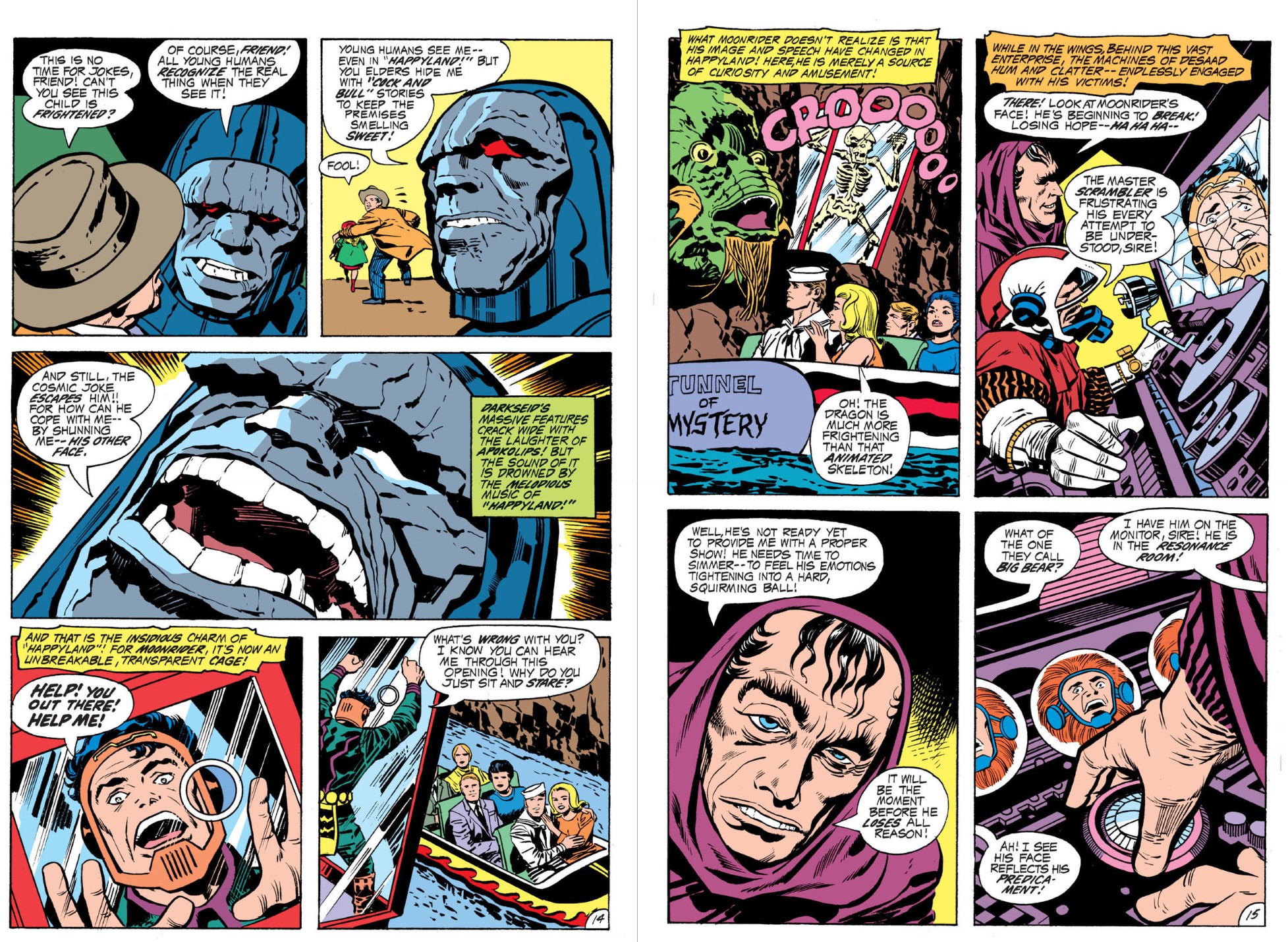
Forever People #4, horrifically subverts the American dream as fun theme park Happyland is revealed as ‘The Kingdom of the Damned’: a sprawling factory built to mass-produce terror by exploiting whimsy and fantasy. Here DeSaad torments countless human victims while others innocently observe nothing but toys and robots dancing and playing for their pleasure. To this set-up the captured waifs of New Genesis are added and DeSaad feeds, but they have all underestimated the power of Mother Box who seeks aid and finds it in the form of zen wrestler ‘Sonny Sumo’

With the living computer boosting his remarkable gifts, the pacifist warrior executes a one-man rescue that demonstrates the true horror of the Anti-Life Equation: a battle so fast and furious that even Darkseid is panicked and overreacts…

At this juncture DC comic books expanded to 52 pages and as well as reprints, Kirby’s Korner ran short background vignettes. The lost history of the previous war of pantheons was filled in as here when ‘The Young Gods of Supertown Introducing Lonar’ finds a wandering historian picking through cosmic rubble on New Genesis and uncovering a living, breathing remnant of that cataclysmic conflict

Cover-dated January 1971 FP #6 was inked by Mike Royer and revealed how the Master of Apokolips resorts to his personal ultimate weapon ‘The Omega Effect!!’: scattering Sumo and the triumphant New Genesisians throughout key moments of Earth’s history. All but sensitive Serifan who retreats bereft and shellshocked to their sentient Super-Cycle and a final brutal battle with Godfrey’s Justifiers…

Inked by Colletta, back-up The Young Gods of Supertown’ also focuses on the kid with cosmic cartridges as a sneaky ‘Raid from Apokolips’ ruins his and Big Bear’s meditation moment and makes them unpardonably rude in response…

Time travel travails are sorted in concluding episode ‘I’ll Find You in Yesterday!!’ as on New Genesis, Supreme Leader Highfather puts everyone back where they belong by use of almighty Alpha Bullets, and the kids find out how destiny dealt with their saviour Sonny Sumo. That’s bookended by ‘Lonar of New Genesis and his Battle-Horse Thunderer!!!’ as the survivor of the first fall meets current war god Orion

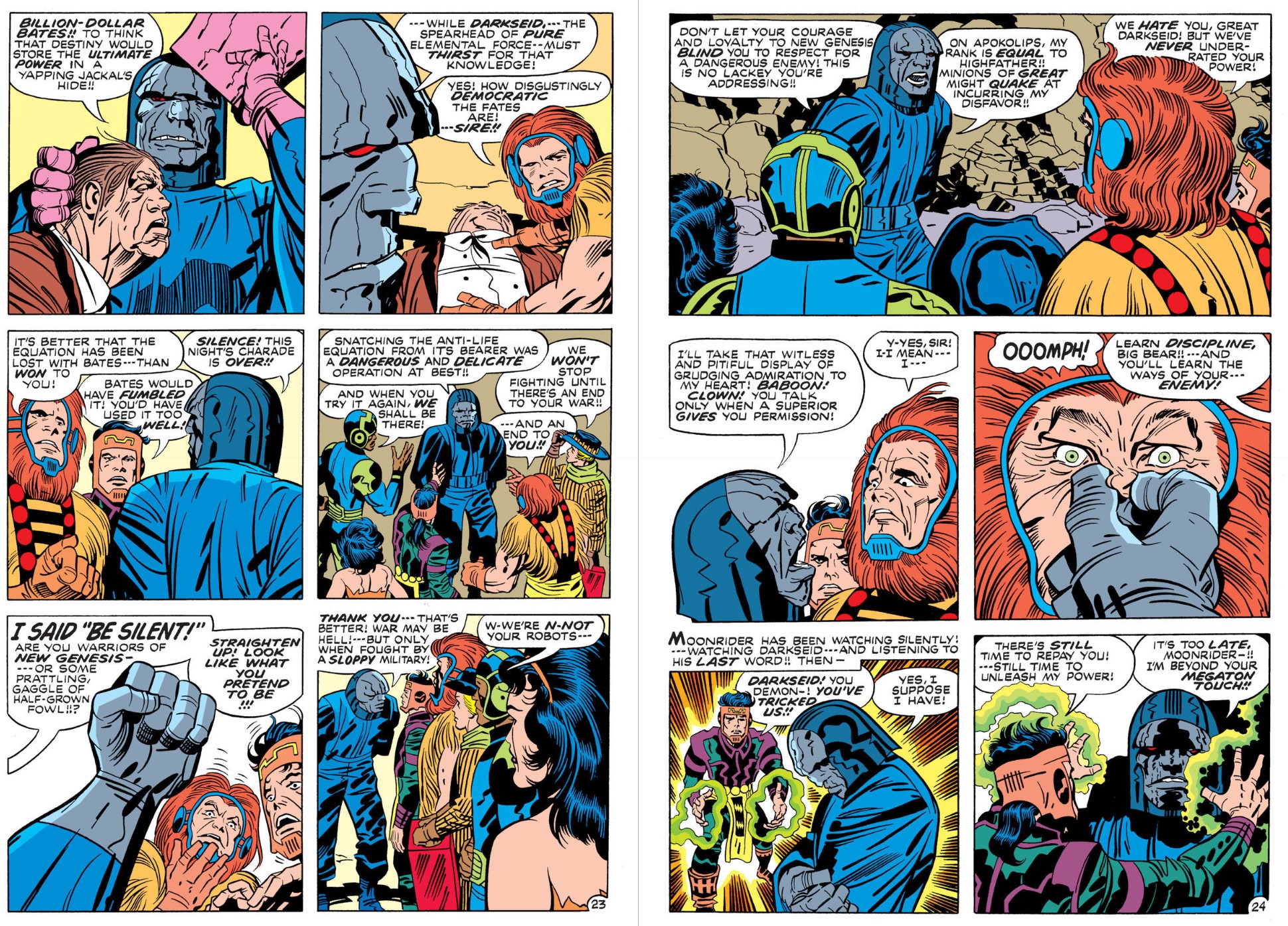
Everything Darkseid ransacks humanity’s subconscious for is found in #8 as manipulative human parasite Billion-Dollar Bates reveals he has ‘The Power!’ of the Anti-Life Equation. Every vice readily embraced, he thinks he’s evil incarnate until the Apokolips crowd show up, but Darkseid’s joy turns to ashes as the Forever People rush in and fate takes a hand that even gods cannot turn aside…

The Fourth World was a huge risk and massive gamble for an industry and company that was a watchword for conservatism. It was probably incredibly tough for editors and publishers to stop themselves interfering, and they often didn’t. With numbers low, spooky stories proliferating everywhere and popular wisdom saying character crossovers boosted sales, Kirby eventually caved to pressure and agreed to host another creator’s star in his epic. Thus Forever People #9 hosted (failed) horror hero Boston Brand, AKA Deadman who was made marginally manifest by a seance and another Cosmic Cartridge. The vengeance hunter accepted an artificial body to pursue the man who killed him in an intriguing, action-packed but ultimately ridiculous aside that began by introducing a ‘Monster in the Morgue!’ It rampaged through town before tech bandits ‘The Scavengers’ sought to steal Brand’s new “mobile home”, and drew the wrath of ghost and teen godlings. The yarn actually ended with a plug for Kirby’s forthcoming series The Demon

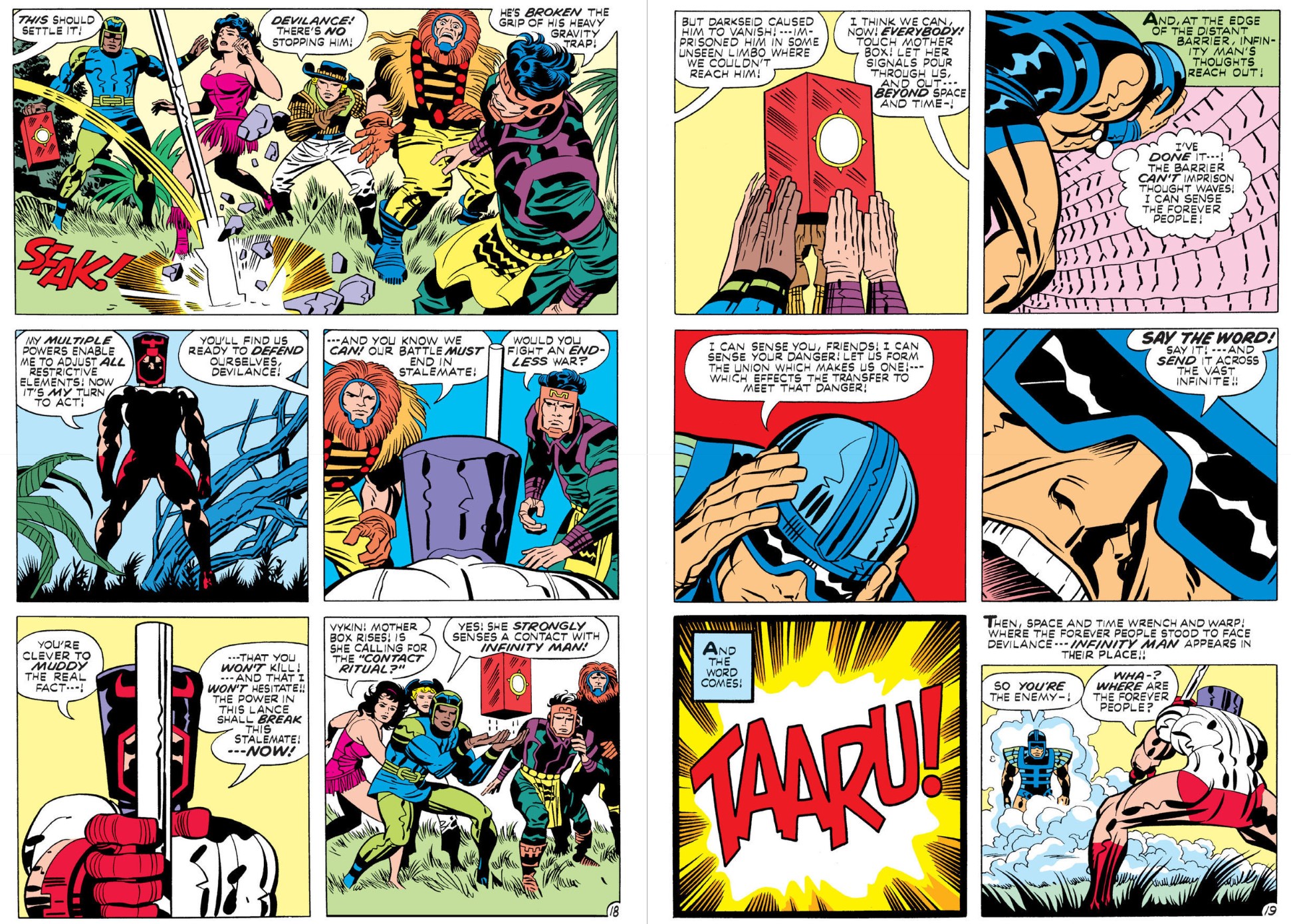
After that peculiar and extremely wearisome divertissement the war came for the interstellar innocents with ‘Devilance the Pursuer’. It was the last issue and at least the King had time enough to prepare a narrative pause if not proper conclusion. Simply put, Darkseid’s top killer is despatched to end the pesky brats and is unstoppable. Chased across Earth they appear doomed until the long missing Infinity Man is contacted, returning for one last hurrah that sees the Forever People vanished from the world and human ken…

And that was that. This title and New Gods were axed although Mister Miracle continued on with a definite change of emphasis until time and tastes brought sequels and, at long last, Kirby’s return to craft a proper ending… of sorts.

But that’s a tale for another day…

This handy compendium also offers bonus material including ‘Mother Box Files’ re-presenting dozens of pertinent Kirby characters as revisited by himself and others in various editions of the DC Who’s Who fact files. Here a group treatment of The Forever People augments solo entries for Beautiful Dreamer, Big Bear, DeSaad, Infinity Man, Mantis, Mark Moonrider and The Pursuer by Kirby & Greg Theakston; with Glorious Godfrey inked by Bob Smith, Serifan inked by Gary Martin and Vykin the Black inked by Karl Kesel. Augmenting them are Kirby pin-ups from the original run: the four guys in ‘The Forever People’, ‘Beautiful Dreamer versus Darkseid’ and ‘The Infinity Man’ plus a self-portrait of the King, all from FP #4 and inked by Colletta.

We close with a selection of stunning pencilled pages in ‘The Art of Jack Kirby’, what more do you need to know?
© 1970, 1971, 1972, 2020 DC Comics. All Rights Reserved.

Lucky Luke creator Morris was born today in 1923, and in 1945 Shazam/Captain Marvel spinoff Hoppy the Marvel Bunny debuted in Funny Animals Comics #1. Five years later cartoonist Gary Panter was born. I’m sure there’s no connection but just in case why not see Jimbo in Paradise.

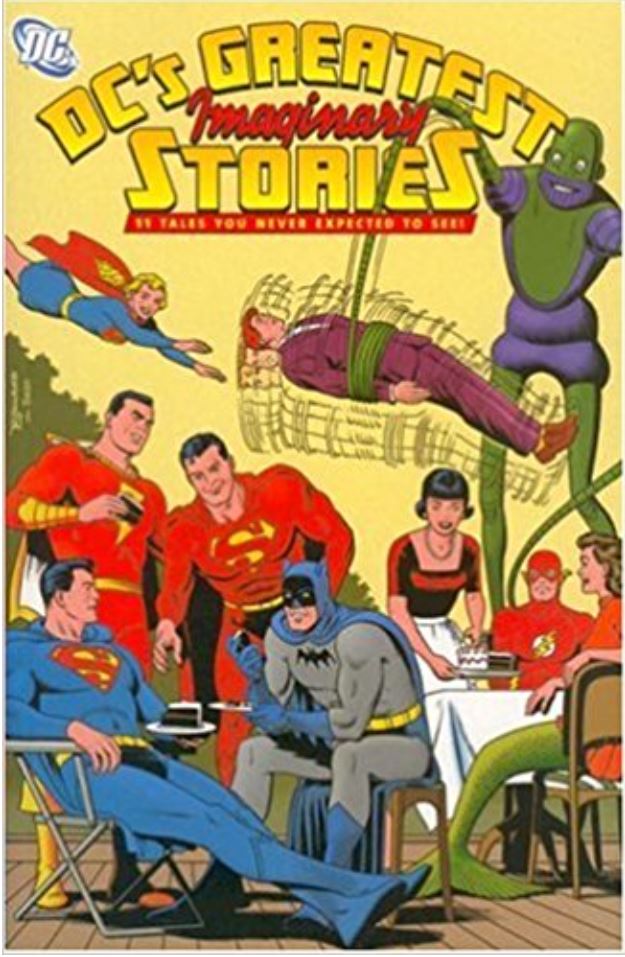
DC’s Greatest Imaginary Stories


By Otto Binder, Bill Finger, Jerry Siegel, John Broome, Leo Dorfman, Edmond Hamilton, Jim Shooter, C.C. Beck, Dick Sprang, Kurt Schaffenberger, Curt Swan, Carmine Infantino, Bob Kane & various (DC Comics)
ISBN: 978-1-4012-0534-8 (TPB)

This book includes Discriminatory Content produced in less enlightened times.

Win’s Christmas Gift Recommendation: Purely Addictive Comics Madness… 9/10

Alan Moore’s infamous epigram notwithstanding, not all comics tales are “Imaginary Stories”.

When DC Editor Mort Weisinger was expanding the Superman continuity and building the legend, he realised that each new tale was an event that added to a nigh-sacred canon: that what was written and drawn mattered to the readers. But, as a big concept guy, he wasn’t going to let that aggregated “history” stifle a good idea, nor would he allow his eager yet sophisticated audience to endure clichéd deus ex machina cop-outs to mar the sheer enjoyment of a captivating concept. The mantra known to every baby-boomer fan was “Not a Dream! Not a Hoax! Not a Robot!” boldly emblazoned on covers depicting scenes that couldn’t possibly be true… as a way of exploring non-continuity deviations, plots and scenarios devised at a time when editors believed entertainment trumped consistency and knew that every comic read was somebody’s first… or potentially last.

This jolly little compilation – long overdue for revival and expansion – celebrates the time when whimsy and imagination were king but somewhat stretches the point by leading with a fanciful tale of the World’s Mightiest Mortal. Courtesy of Otto Binder & CC Beck, ‘Captain Marvel and the Atomic War’ (Captain Marvel Adventures #66, October 1946) actually hoaxes the public through a demonstration of how the world might end in the new era of Nuclear Proliferation.

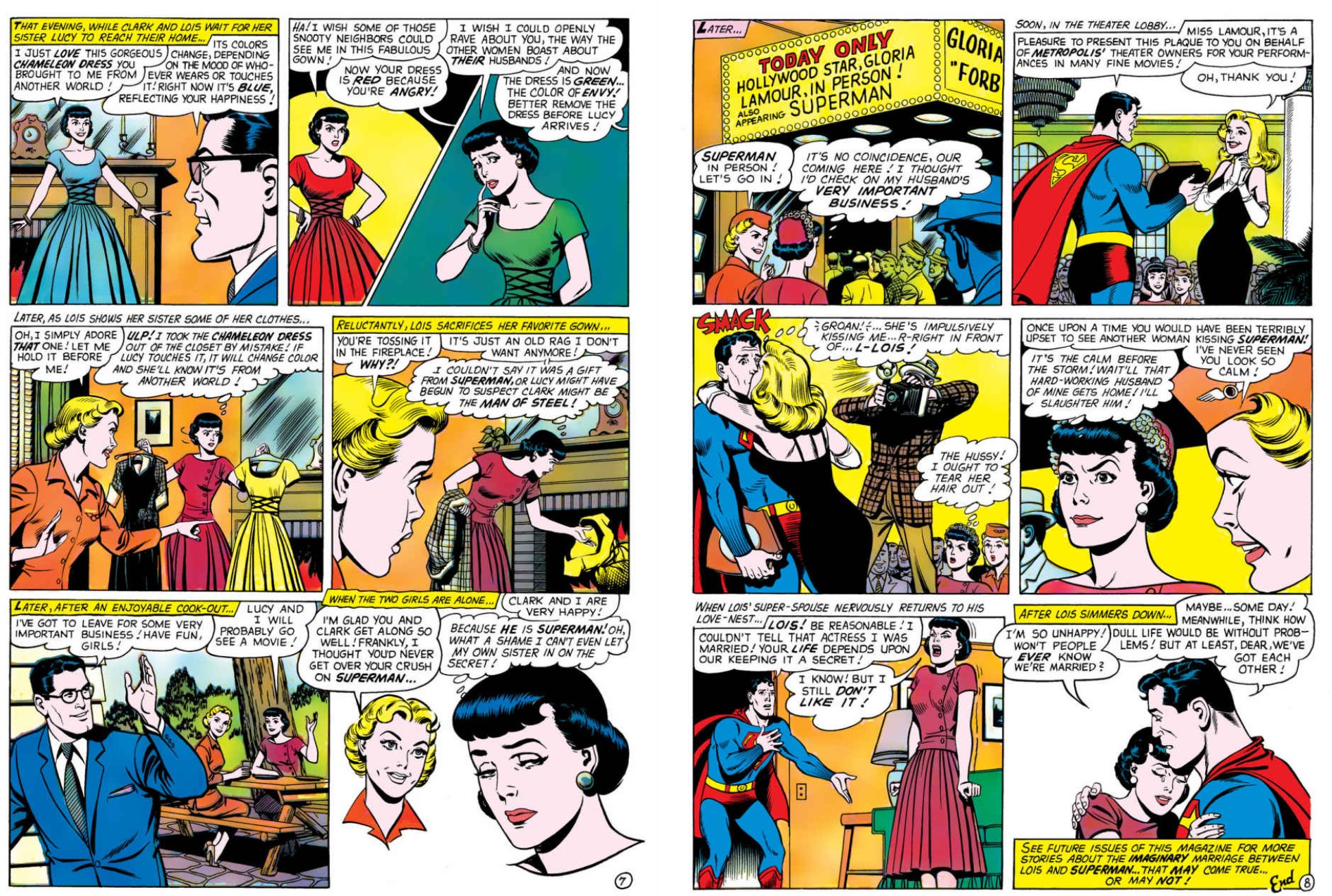
‘The Second Life of Batman’ (Bill Finger, Dick Sprang & Charles Paris in Batman #127, October 1959) doesn’t really fit the strict definition either, but the tale of a device that predicts how Bruce Wayne’s life would have run if his parents had not been killed is superb and engaging all the same. In contrast, ‘Mr. and Mrs. Clark (Superman) Kent!’ (Jerry Siegel & brilliant Kurt Schaffenberger) was the first of an occasional series that began in Superman’s Girlfriend Lois Lane #19 (August 1960). Far more apropos, it depicts the laughter and tears that might result if the plucky news-hen secretly marries the Man of Steel.

From an era uncomfortably parochial and patronising to women, there’s actually plenty of genuine heart and understanding in this tale and a minimum of snide sniping about “silly, empty-headed girls”…

Eventually the concepts became so bold that Imaginary Stories could command book-length status. ‘Lex Luthor, Hero!’ (Superman #149, November 1961) by Siegel, Curt Swan & Sheldon Moldoff details the mad scientist’s greatest master-plan and ultimate victory in a tale as powerful now as it ever was. In many ways this is what the whole concept was made for! No prizes for guessing what ‘Jimmy Olsen Marries Supergirl!’ (Superman’s Pal Jimmy Olsen #57, December 1961) is about, but the story is truly a charming delight, beautifully realized by Siegel, Swan & Stan Kaye.

Once more stretching a point ‘The Origin of Flash’s Masked Identity!’ (John Broome, Carmine Infantino & Joe Giella in The Flash# 128, May 1962) although highly entertaining, is more an enthusiastic day-dream than alternate reality and, I suspect, is added to bring variety to the mix – as is the intriguing ‘Batman’s New Secret Identity’ (Batman #151, November 1961, by Finger, Bob Kane & Paris).

‘The Amazing Story of Superman-Red and Superman-Blue!’ (Superman #162, July 1963) is possibly the most influential tale of this entire subgenre. Written by Leo Dorfman with art from Swan & George Klein, this startling utopian classic was so well-received that decades later it still influences and flavours Superman continuity. The plot involves the Action Ace being divided into two equal wonder men who promptly solve all universal problems and even the love rivalry between Lois Lane and Lana Lang!

Siegel & Schaffenberger’s ‘The Three Wives of Superman!’ is an enchanting tragedy of missed chances from SGLL #51 (August 1964) clearing the palate for ‘The Fantastic Story of Superman’s Sons’ (by Edmond Hamilton, Swan & Klein in Superman #166, November 1964): a solid thriller built on a tragic premise (what if only one of Superman’s children inherited his powers?), and this bright and breezy book closes with the stirring, hard-hitting ‘Superman and Batman… Brothers!’, wherein orphaned Bruce Wayne is adopted by the Kents, but cannot escape a destiny of tragedy and darkness. Written by Jim Shooter, with art from Swan & Klein for World’s Finest Comics #172 (cover-dated December 1967) this moody thriller in many ways signalled the end of carefree days and the beginning of a grittier, more cohesive DC universe for a less whimsical, fan-based audience.

This collection is a glorious slice of fancy, augmented by an informative introduction from columnist Craig Shutt, bolstered with mini-cover reproductions of many tales that tragically never made it into the collection, but I do have one minor quibble: No other type of tale was more dependent on an eye-catching, conceptually intriguing cover, so why couldn’t those belonging to these collected classics have been included here, too?

Surely, it’s time for a re-issue in either print or digital format with all those arresting covers included. Yes, it is… and don’t call me Shirley.
© 1946, 1959-1964, 1967, 2005 DC Comics. All Rights Reserved.

Today in 1900 Chester Gould was born. No help from me here, deduct who he was.

Happy birthday British arts icon Rian Hughes, arrived today in 1963, joined three years after by Jill Thompson and Guy Davis. Them also you should seek out here or in their own books…

Superman: The Secrets of the Fortress of Solitude


By Jerry Siegel, Jerry Coleman, Roy Thomas, Jerry Ordway, Roger Stern, Mark Schultz, Geoff Johns & Richard Donner, John Sikela, Wayne Boring & Stan Kaye, Ross Andru & Romeo Tanghal, John Statema, George Peréz, Mike Mignola, Curt Swan, Brett Breeding, Doug Mahnke & Tom Nguyen, Phil Jimenez & Andy Lanning & various (DC Comics)
ISBN: 978-1-4012-3423-2 (TPB)

This book includes Discriminatory Content produced in less enlightened times.

Superman is comics’ champion crusader: the hero who heralded and defined a genre. In the decades since his spectacular launch in April 1938 (cover-dated June), one who has survived every kind of menace imaginable. With this in mind it’s tempting and very rewarding to gather up whole swathes of his prodigious back-catalogue and re-present them in specifically-themed collections, such as this fun but far from comprehensive chronicling of someone who’s become his latter-day Kryptonian antithesis: a monstrous militaristic madman with the same abilities but far more sinister values and motivations.

For fans and creators alike, continuity can be a harsh mistress. These days, when maintaining a faux-historical cloak of rational integrity for the made-up worlds we inhabit is paramount, the greatest casualty of the semi-regular sweeping changes, rationalisations and reboots is those terrific tales which suddenly “never happened”.

The most painful example of this – for me at least – was a wholesale loss of the entire charm-drenched mythology which had evolved around Superman’s birthworld in the wonder years between 1948 and 1986. Happily, DC post Future State/Infinite Frontier/other recent publishing events are far more inclusive, all-encompassing and history-embracing…

Silver Age readers buying Superman, Action Comics, Superman’s Girlfriend Lois Lane, World’s Finest Comics and Superman’s Pal Jimmy Olsen (not forgetting Superboy and Adventure Comics) would delight every time some fascinating snippet of information was revealed. We spent our rainy days filling in the incredible blanks about the lost world through the delightful and thrilling tales from those halcyon publications.

Thankfully DC was never as slavishly wedded to continuity as its readership and understood that a good story is worth cherishing. This captivating compilation gathers material from

Superman #17: Action Comics #241 & 261; Action Comics Annual #2; Superman Man of Steel #100 and Superman and His Incredible Fortress of Solitude All New Collector’s Edition/DC Special Series #26 spanning 1942 to 2000, and focusing on landmark, rare, and notionally non-canonical tales of his astounding home-away-from-home/Super Mancave: all crafted by some of the countless gifted writers and artists to have contributed to the mythology of the Man of Tomorrow over the years.

Without preamble we open with Jerry Siegel & John Sikela’s ‘Muscles for Sale!’ (from Superman #17, cover-dated July/August 1942) which offered the very first revelation that the ultra-busy champion of the weak had built himself a little retreat. Here, located in a remote US mountain, the Action Ace enjoyed some Me-time in his new “Secret Citadel”, exercising, letting off super-steam and wandering about his Trophy Room before battling a mad mesmerist turning ordinary citizens into dangerously overconfident louts, bullies and thieves…

Then, an era later and after the Metropolis Marvel had become a small screen star, the Silver Age officially began with Action Comics #241 cover-dated June 1958. Scripted by Jerry Coleman and limned by Wayne Boring & Stan Kaye ‘The Super-Key to Fort Superman’ is a fascinating, clever puzzle-play guest-featuring Batman as an impossible intruder vexes, taunts and baffles the Man of Steel in his most sacrosanct sanctuary: a place packed with fascinating wonders for Space Age kids…

February 1960 offered a classic return to the icy palace in ‘Superman’s Fortress of Solitude!’ (Action Comics #261 by Siegel, Boring & Kaye) as linked but previously untold anecdotes detail the secret history of the citadel of wonders to foil a cunning criminal plot against the indomitable hero…

Next, from 1981 and in its 64-pages + covers entirety, is an epic time travel excursion catered and curated by Roy Thomas, Ross Andru & Romeo Tanghal, and only previously seen in film-inspired oversized tabloid treat Superman and His Incredible Fortress of Solitude All New Collectors Edition (DC Special Series #26). A cunning excuse to revisit past stories and glories and enjoy a room-by-room meander, ‘Fortress of Fear!’ finds the Man of Steel scouring his vast domicile for a clue to prevent the imminent explosive demise – 59 minutes and counting! – of his second homeworld! He’s also planning on thoroughly chastising mystery villain Dominus for risking all of humanity for simple vengeance…

Co-crafted by Jerry Ordway, John Statema, George Peréz, Mike Mignola, Roger Stern, Curt Swan & Brett Breeding, ‘Memories of Krypton’s Past’ (Action Comics Annual #2 1989) was a way-station moment in an absolutely epic endeavour wherein the post-Crisis on Infinite Earths Superman finally learned why he was the last and only Kryptonian.

Previously. when trapped in a pocket dimension he had been forced to execute three super-criminals who had killed every living thing on their Earth and were determined to do the same to ours. Although given no choice, Superman’s actions plagued him, and on his return his subconscious caused him to stalk the streets in a fugue-state dealing out brutal justice to criminals in the guise of Gangbuster. When finally made aware of his schizophrenic state, Kal-El banished himself before he could do any lasting harm to Earth.

For months the exile roamed space, losing his abilities (deprived of Sol’s rays his powers quickly fade), before being enslaved by tyrant Mongul and forced into gladiatorial games on giant battle-planet Warworld…

Not seen here is the aftermath of those revelations wherein Superman overthrows the despot, liberates the hordes of the Warworld and returns to Earth with the most powerful device in Kryptonian history…

Closing the vacation trips comes the last chapter of another extended epic as first seen in Superman: Man of Steel #100 (May 2000). In Mark Schultz, Doug Mahnke & Tom Nguyen’s ‘Creation Story’, semi-retired inventor hero John Henry Irons AKA Steel and his brilliant niece Natasha continue their battle against electronic packrat cult the Cybermoths: foiling the theft of future tech. Their efforts and resultant struggle happily lead to a brand new extra-dimensional opportunity for the astounded and late-arriving Caped Kryptonian as a freshly discovered pocket dimension discovered by Steel is filled and repurposed with the last Kryptonian remnants of the original Fortress of Solitude. Sadly, the astounding architectural feat draws rapacious Cybermoths and their anarchic queen Luna into action again, with neither Superman nor his engineering associates aware that a horrifying old enemy is behind her repeated attempts to seize this new citadel in a “Phantom Zone”…

No trip is complete without a little keepsake, and here we finish with double page cutaway diagram spread ‘Secrets of the Fortress of Solitude’ by Geoff Johns, Richard Donner, Phil Jimenez & Andy Lanning, taken from Action Comics Annual #10 in 2007. Be assured, should you ever get lost in the astounding arctic sanctuary, this should keep you out of the Interplanetary Zoo and well away from the Phantom Zone portal.

You’re welcome…
Copyright 1942, 1958, 1960, 1981, 1989, 2000, 2007, 2012 DC Comics. All Rights Reserved.

Action Comics: 80 Years of Superman the Deluxe Edition


By Jerry Siegel & Joe Shuster, Fred Guardineer, Don Cameron, Mort Weisinger, Jerry Coleman, Otto Binder, Edmond Hamilton, Len Wein, Cary Bates, Marv Wolfman, John Byrne, Roger Stern, Joe Kelly, Grant Morrison, Paul Levitz, Mort Meskin, Ed Dobrotka, Fred Ray, Wayne Boring, Al Plastino, Jim Mooney, Curt Swan, Carmine Infantino, Gil Kane, Dick Giordano, Kerry Gammill, Bob McLeod, Ben Oliver, Neal Adams plus Many & various (DC Comics)
ISBN: 978-1-4012-7887-8 (HB/Digital edition)

This book includes Discriminatory Content produced in less enlightened times.

It’s a fact (if such mythological concepts still exist): the American comic book industry would be utterly unrecognisable without the invention of Superman. His unprecedented adoption by a desperate and joy-starved generation quite literally gave birth to a genre if not an actual art form. Within three years of his June 1938 debut, the intoxicating blend of eye-popping action and social wish-fulfilment which hallmarked the early Man of Steel had grown to encompass cops-and-robbers crime-busting, socially reforming dramas, science fiction, fantasy, whimsical comedy and, once the war in Europe and the East embroiled America, patriotic relevance. He’s also been regular blockbuster business in his many and varied screen interpretations, too.

In comic book terms, though, Superman is master of the world, having utterly changed the shape of a fledgling industry and modern entertainment in general. There were newspaper strips, radio & TV shows, cartoons, games, toys, mountains of merchandise and those movies mentioned. Everyone on Earth gets a picture in their heads when they hear his name.

It all started with Action Comics #1 and continues to this day, so this bold compilation (presumably soon to be superseded by a 90th Anniversary edition) celebrates the magic, not just with the now-traditional re-runs of classic Superman tales, but with informative articles and fascinating glimpses of some of the other characters who shared the title with him. This epic album gathers material from Action Comics #0, 1, 2, 42, 64, 241, 242, 252, 285, 286, 309, 419, 484, 554, 584, 655, 662 & 800, opening with writer/DC publisher Paul Levitz’s Introduction, a fond Foreword from Laura Siegel Larson and Jules Feiffer’s scene-setting, context-creating essay ‘The Beginning’ before the immortal pictorial wonderment commences.

Most early tales were untitled, but for everyone’s convenience have been given descriptive appellations by the editors. Thus, after that unmistakeable, iconic cover and a single page describing the foundling’s escape from exploding Planet Krypton (also explaining his astonishing powers in 9 panels), with absolutely no preamble ‘The Coming of Superman’ by Jerry Seigel & Joe Shuster introduces a costumed crusader – masquerading by day as reporter Clark Kent – averting numerous tragedies. As well as saving an innocent woman from the electric chair and roughing up a wife-beater, the tireless crusader works over racketeer Butch Matson – consequently saving suave and feisty colleague Lois Lane from abduction and worse since she is attempting to vamp the thug at the time!

The mysterious Man of Steel makes a big impression on her by then outing a lobbyist for the armaments industry bribing Senators on behalf of greedy munitions interests fomenting war in Europe…

To say the editors were amazed by Superman’s popularity was a gross understatement. They had their money bet on a knock-off Mandrake the Magician crafted by veteran cartoonist Fred Guardineer as graphic top dog. Here, Zatara: Master Magician’s mystic/illusion powers are fully demonstrated in ‘The Mystery of the Freight Train Robberies’ but it’s still a run-of-the-mill, rather sedate affair when compared to the astounding exploits of the Caped Wonder.

Next up is a sneak peek at ‘The Ashcans’: unused and alternative illustrations that didn’t make that crucial first cut, after which Action #2 (with a Leo O’Mealia generic adventure cover) supplies the conclusion of Superman’s first case as ‘Revolution in San Monte’ finds the mercurial mystery-man travelling to the war-zone to spectacularly dampen down hostilities already in progress…

‘The Times’ by Tom DeHaven deconstructs the mythology of the title before Fred Ray’s Superman cover (November 194)1 introduces Action #42’s ‘The Origin of the Vigilante’ by Mort Weisinger & and incredible Mort Meskin. This spectacular western-themed hero-romp proves the anthology title had plenty of other captivating characters to enchant audiences…

AC #64 debuted ‘The Terrible Toyman’ (Don Cameron, Ed Dobrotka & George Roussos), wherein an elderly inventor of children’s novelties and knick-knacks conducts a spectacular campaign of high-profile and potentially murderous robberies, with Lois as his unwilling muse and accessory, and is followed by a little tale of serendipity as Marv Wolfman harks back to his early days and explains ‘How I Saved Superman’. That’s followed by a genuine lost treasure as ‘Too Many Heroes’ offers an unpublished 1940s Superman tale – credited to Siegel & Shuster – rescued from destruction and obscurity. What a gift!

David Hajdu exposes the allure of the alter ego in ‘Clark Kent, Reporter’, after which we jump to June 1958 and the beginning of the Silver Age. Action Comics #241 cover-featured ‘The Key to Fort Superman’: a fascinating, clever puzzle-play guest-featuring Batman, scripted by Jerry Coleman and limned by Wayne Boring & Stan Kaye as an impossible intruder vexes the Man of Steel in his most sacrosanct sanctuary. One month later Otto Binder & Al Plastino introduced both the greatest new villain and most expansive new character concept the series had seen in years.

‘The Super-Duel in Space’ has evil alien scientist Brainiac attempt to add Metropolis to his collection of miniaturised cities in bottles. As well as a titanic tussle in its own right, the tale totally changed the Man of Steel’s internal mythology: introducing Kandor, a city packed with Kryptonians who all escaped the planet’s destruction when Brainiac abducted them. Although Superman rescues his fellow survivors, the villain escaped to strike again, and it would be years before the hero could restore Kandorians to their true size.

After some intriguing and noteworthy test-runs, a future star of Superman’s ever-expanding universe launched in Action Comics #252. ‘The Supergirl from Krypton!’ (May 1959), saw Superman discover he has a living relative in cousin Kara Zor-El who had been born on a city-sized fragment of Krypton, which was hurled intact into space when the planet exploded. Eventually Argo City turned to Kryptonite like the rest of the detonated world’s debris, and her dying parents repeated recent history as, observing Earth through their scopes, they despatched Kara to safety as they perished.

Landing on Earth, she met Superman and he created the cover-identity of Linda Lee, hiding her in an orphanage in small town Midvale so that she could master her new powers in secrecy and safety. Larry Tye’s ‘Endurance’ discusses longevity and political merit before we return to Superman’s official Action Comics co-star throughout the 1960s…

Hogging the cover (by Super-stalwarts Curt Swan & George Klein) the simpler times of practicing in secret ended as a big change in the Maid of Might’s status occurred. When her new adoptive parents learned of their new daughter’s true origins, Superman allowed cousin Kara to announce her existence to the world in 2-part saga ‘The World’s Greatest Heroine!’ (#285 February 1962) and ‘The Infinite Monster!’ (#286, March). Here Siegel & Jim Mooney detail how Supergirl becomes the darling of the universe, openly saving planet Earth and finally getting the credit for it.

Those long-standing TV connections were exploited in Action Comics #309 (February 1964) for hoary secret-identity save plot ‘The Superman Super-Spectacular!’ as a telethon posed a puzzle for the always overbooked Man of Steel. Written by Edmond Hamilton and illustrated by Swan & Klein, it sets up a scene where the Action Ace can use none of his usual tricks to be both Superman and Clark simultaneously, and delivers a truly shocking and utterly era-appropriate solution…

Hurtling forward to December 1972 and Action #419 we meet a surprisingly successful back-up feature created by Len Wein, Carmine Infantino & Dick Giordano. ‘The Assassin-Express Contract!’ introduced Christopher Chance as the Human Target, hiring himself out to impersonate endangered individuals such as the businessman “accidentally” sitting in the sights of a hitman, thanks to a disgruntled employee dialling a wrong number…

From a period where Golden Age stories were assumed to have occurred on parallel world Earth-Two, ‘Superman Takes a Wife’ first appeared in 40th Anniversary issue #484 (June 1978). Here Cary Bates, Swan & Joe Giella detail how the original 1938 Man of Tomorrow became editor of the Metropolis Daily Star in the 1950s and married Lois Lane. Thanks to villains Colonel Future and The Wizard who had discovered a way to make Superman forget his own existence, only she knew that her husband was once Earth’s greatest hero…

More meta-realistic meandering led to ‘If Superman Didn’t Exist’ (by Marv Wolfman & Gil Kane in Action #554 (April 1984) which posits an alien-subjugated Earth deprived of heroes until two kids with big dreams invent one…

In 1985 DC Comics rationalised, reconstructed and reinvigorated their continuity with Crisis on Infinite Earths. They also used the event to regenerate key properties at the same time. The biggest gun they had was Superman and it’s hard to argue that the change was not before time. The big guy was in another slump, but he’d weathered those before. So how could a root and branch retooling be anything but a pathetic marketing ploy that would alienate the real fans for a few fly-by-night Johnny-come-latelies who would jump ship as soon as the next fad surfaced? This new Superman was going to suck…

But he didn’t.

Public furore began with all DC’s Superman titles being “cancelled” (actually suspended) for three months, and yes, that did make the real-world media sit-up and take notice of the character everybody thought they knew for the first time in decades. However, there was method in this seeming corporate madness.

The missing mainstays were replaced by a 6-part miniseries running from October to December 1986. Entitled Man of Steel it was written and drawn by Marvel’s mainstream superstar John Byrne and inked by venerated veteran Dick Giordano. The bold manoeuvre was a huge and instant success and the retuned Superman titles all came storming back with the accent on breakneck pace and action. Superman had always enjoyed brief or lengthy partnerships with other if lesser heroes and Action Comics was confirmed as a team-up vehicle for the Man of Steel. Issue #584 had a January 1987 cover-date and featured a case fighting with and beside the Teen Titans as the young heroes had to battle an apparently out-of-control Caped Kryptonian with a ‘Squatter’ secretly riding in his head…

Following a gentle cartoon “roasting” by Gene Luen Yang in ‘Supersquare’, Roger Stern, Kerry Gammill & Dennis Janke review ‘Ma Kent’s Photo Album’ (from AC #655, July 1990) offering some insights into growing up different before a major turning point began…

As years passed, Lois and Clark gradually grew beyond professionalism into a work romance but the hero had always kept his greatest secret from her. That all changed after the Man of Tomorrow narrowly defeated mystic predator Silver Banshee and decided no more ‘Secrets in the Night’ between him and his beloved (by Stern & Bob McLeod: #662, February 1991).

Action #800 (April 2003) offers a reverential examination of the ongoing myth thus far as ‘A Hero’s Journey’ combines a Joe Kelly script with art from Pasqual Ferry, Duncan Rouleau, Alex Ross, Tony Harris, Bill Sienkiewicz, Dave Bullock, Ed McGuiness, J.H. Williams III, Dan Jurgens, Klaus Janson, Killian Plunkett, Jim Lee, Tim Sale, Lee Bermejo, Cam Smith, Marlo Alquiza & Scott Hanna: cherry-picking unmissable moments from a life well lived…

In 2011, DC again rebooted their entire line and Superman was reimagined once more. ‘The Boy Who Stole Superman’s Cape’ by Grant Morrison & Ben Oliver comes from Action Comics #0, (November 2012), focussing on a decidedly blue-collar champion just learning the game and painfully aware of the consequences if he makes a mistake, before we wrap up the celebrations with April 2018’s ‘The Game’ by Levitz & Neal Adams. Here primal archenemies Superman and Luthor face off for another round in their never-ending battle…

Before the curtain comes down, there’s still more unbridled joy and rekindled memories as ‘Cover Highlights’ resurrects stunning examples from the Golden, Silver, Bronze, Dark and Modern ages of the Man of Tomorrow, as well as the very best of Action Comics ‘Now’.

Should you be of a scholarly or just plain reverential mood you can then study the copious ‘Biographies’ section so you know who to thank…

Exciting, epochal and unmissable, this is a book for all fans of superhero stories and the man who started them all.
© 1938, 1941, 1943, 1958, 1959, 1961, 1963, 1972, 1978, 1984, 1986, 1990, 1991, 2003, 2012, 2018 DC Comics. All Rights Reserved.

DC Finest: Superman – Kryptonite Nevermore


By Dennis O’Neil, Leo Dorfman, Cary Bates, Len Wein, Curt Swan & Murphy Anderson, Ross Andru & Mike Esposito, Dick Giordano, Carmine Infantino, Neal Adams & various (DC Comics)
ISBN: 978-1-79950-165-7 (TPB/Digital edition)

This book includes Discriminatory Content produced in less enlightened times

This stunning compilation is part of the DC Finest editions line: full colour chronologically curated paperback compilations delivering “affordably priced” comic books generally around 600 pages and highlighting past glories.Whilst primarily and understandably concentrating on the superhero character pantheon, there will also be genre selections like horror and war books, and themed compendia. Sadly, they’re not yet available digitally, as were the last decade’s Bronze, Silver and Golden Age collections, but we live in hope…

Superman is the comic book champion who started the whole genre and, in the decades since his 1938 debut, has probably undertaken every kind of adventure imaginable. With that in mind it’s tempting and very rewarding to gather up whole swathes of his inventory and periodically re-present them in specific themed collections, such as this one commemorating one his greatest extended adventures. The episodes contained herein were originally released just as comics fandom was becoming a powerful – if headless – lobbying force reshaping the industry to its own specialised desires and remains a true landmark of the superhero genre. Moreover the brand overhaul seen here was a major concerted effort to re-energise the Man of Steel at a time when comics superheroes were experincing a major die-back…

When Julie Schwartz took over editorial responsibility for the Superman title in 1970, he was expected to shake things up with nothing less than spectacular results. To that end, he incorporated many key characters and events simultaneously developing as part of fellow iconoclast Jack Kirby’s freshly unfolding “Fourth World”. That bold experiment was a breathtaking tour de force of cosmic wonderment which brought a staggering new universe to fans: instantly and permanently changing the way comics were perceived and how the entire medium could be received. Don’t think for a moment that the 1985 reboot triggered by Crisis on Infinite Earths was new or innovative… just necessary…

As the Sixties closed, Schwartz was again breathing fresh life into a powerful but moribund icon – a job he had been excelling at since more-or-less singlehandedly kickstarting the Silver Age of Comics. Superman had been a mega-media star since his launch, with internationally syndicated comics, books, newspaper strips, movie and cinema serials plus hugely successful radio and TV shows (live action and animated) making the franchise globally recognizable. Whenever that happens, inevitably overkill and overexposure inescapably set in and the core property needs to be carefully overhauled or vanish forever. I’ll bet you can think of plenty of really famous and ubiquitous things from your childhood that one day you simply stopped noticing. Happily, sometimes they can be reborn…

Schwartz knew his market and was open to new ideas, and his creative changes were just appearing in 1971. The new direction was also vanguard and trigger for a wealth of controversial, socially-challenging “realistic” story content unseen since the feature’s earliest days: a wave of tales ultimately described as “Relevant”…

With iconic covers by Curt Swan, Carmine Infantino, Neal Adams, Dick Giordano, Murphy Anderson & Jack Adler, this titanic tome collects in whole or in part the Man of Steel’s first comics renaissance through exploits from Action Comics #393-406 and Superman #233-238 and #240-242, spanning cover dates October 1970 to December 1971.

On sale from 27th August 1970, Action Comics #393 hinted at rather than heralded a new era as ‘Syperman Meets Super-Houdini!’ In a tale by prolific lead super-scribe Leo Dorfman and artists Curt Swan & Murphy Anderson (AKA “Swanderson”) the ultimate hero faces a moral dilemma when reformed crimnal turned escape artist “Hair-breadth” Holahan is blackmailed to resume his criminal ways – or lose his abducted son. Of course, Superman can help…

Following a Superman Scrapbook Pinup, with Swanderson reworking a classic Golden Age Superman contents page, second strip ‘The Day Superboy Became Superman!’ (by Dorfman as Geoff Brown with Ross Andru & Mike Esposito illustrating) depicts a pivotal moment for college boy Clark Kent as radical student Marla Harvey showed the so-conservative law-&-order adherent what those concepts meant to people trapped in poverty and privation…

The updating of an icon continued in AC #394 with Swanderson illustrating both ‘Midas of Metropolis’ and low key “Geoff Brown” character vignette ‘Requiem for a Hot Rod’. The lead yarn pits Superman against world’s richest man Cyrus Brand, who seemingly infects the Action Ace with his own all-encompsing lust for money, only to find the hero is incorruptible and knows actual crime when he sees it, whilst a humourous follow-up sees Clark and Lois Lane at a vintage car event, cleverly exposing a bully rigging games of chicken for cash…

Action #395 revealed ‘The Secrets of Superman’s Fortress’ with a dynamic cutaway spread fuelling an “untold tale” of an early romantic encounter with a sexy alien Superman could have loved. Sadly, super-powered Althera was of an incompatible species… and also a slaver…

Dorfman was the go-to guy for supernatural tales and weird phenomena articles, and at the forefront of a shift in tone as DC characters and titles embraced the global resurgence in spooky horror and mystery fare. Next here a back-up guest starring Supergirl explores the uncanny powers and shocking truth of accident inducing accessory ‘The Credit Card of Catastrophe’, but comes down down heavily on the side of rationality and confidence trickery in the end…

As the sixties closed and with his various screen appearances a thing of the past, Superman was soon in dire need of an editorial overhaul. That officially began with Superman #233 in a groundbreaking epic serial edited by incoming reboot wunderkind Julius Schwartz that was heavily promoted in advance. Crafted by scripter Dennis J. “Denny” O’Neil, and ubiquitous illustrators Swan & Anderson – although stand-in Dick Giordano inked #240 – a deliberate and very public abandonment of tired old super-villains, fanciful Kryptonian scenarios and otherworldly paraphernalia instantly poked the readership and revitalised the Man of Tomorrow, attracting new readers and beginning a period of engagingly human-scaled stories making Superman a “must-buy” character all over again.

The innovations began with ‘Superman Breaks Loose’ as a government experiment to harness Kryptonite as an energy source goes explosively wrong. Closely monitoring the test, the Metropolis Marvel is blasted across the desert surrounding the isolated lab, but somehow survives a supposedly fatal radiation-bath. Then, reports begin filtering in from all over Earth: every piece of the deadly mineral has been transformed to harmless, common iron! As he goes about his protective, preventative patrols, the liberated hero experiences an emotional high at the prospect of all the good he can now accomplish. He isn’t even phased when the Daily Planet’s new owner Morgan Edge – a key character created by Jack Kirby for his soon to unfold Fourth World Saga – shakes up Clark Kent’s cosy civilian life: summarily ejecting him from the print game and remaking him as a roving TV journalist…

Meanwhile, the desert site of his recent crashlanding offers a moment of deep foreboding as Superman’s irradiated imprint in the sand shockingly grows solid and shambles away in ghastly parody of life…

Over in Action Comics #396, editors Murray Boltinoff & E. Nelson Bridwell continued in their editorial positions (right up until #419 December 1972) but heralded the beginning of a radical new age with a 2-chapter Imaginary Story (hey, didn’t Alan Moore do that too?) ‘The Super-Panhandler of Metropolis!’ was set years from “now”, where a highly advanced Earth wonders why and how Superman disappeared. Media mogul Jimmy Olsen discovers the shocking truth of the hero’s degrading decline in #397 as ‘Secret of the Wheel-Chair Superman!’ sentimentally focuses on a pitiable but still valiant do-gooder giving everything for those in need, and thereby saving himself too.

For this colossal collection, each issue’s stand-alone back-up has been moved to allow an uninterrupted lead story and for reader convenience of comprehension. Thus, next comes #396’s Brown/Swanderson teaser ‘The Invaders from Nowhere!’: an intellectual mystery with Superman perplexed and imperiiled by super-technological aliens somehow living inside his own infallible arctic citadel. It is bolstered by the legendary ad that announced the big change in Metropolis…

Rendered by Swan & Vince Colletta, ‘A New Year Brings a New Beginning for Superman 1971’ announced Clark’s job change and enhanced cast, trumpeted that Jimmy Olsen and Lois Lane would be joined by The Newsboy Legion and Rose and the Thorn and that Supergirl would get a new look, as well as suspending the venerable World’s Finest team of Superman, Batman & Robin, with the title becoming a Superman team-up book…

‘The Super-Captive of the Sea!’ was AC #397’s closer, wherein the Man of Tomorrow is indefinitely trapped beneath the oceans thanks to aquatic aliens flooding Earth’s skies with red sun refracting crystal clouds. They wanted Superman for their own world, but foolishly understimated his ingenuity and determination…

O’Niel & Swanderson’s intensely sophisticated suspenseful overhaul properly resumes in Superman #234’s ‘How to Tame a Wild Volcano!’ as an out-of-control, politically untouchable plantation owner/human trafficker refuses to let his indentured workforce flee an imminent eruption on the island of Boki. Handicapped by international laws, the Man of Steel can only fume helplessly as the UN blunders towards a diplomatic solution, and his anxiety intensifies when a sinister sand-thing inadvertently and agonisingly drains him of his powers. Crashed to Earth in a turbulent squall, the de-powered champion is attacked by work boss Boysie Harker’s thugs and instantly responds to the foolish provocation, relying for a change on determination rather than overwhelming might to save the day…

In #235, the ‘Sinister Scream of the Devil’s Harp’ tacitly acknowledged fasionable arcane influences – remember, the comics industry and wider world was enjoying a periodic revival of interest in supernatural themes and stories – as mystery musician and apparent polymath Ferlin Nyxly reveals the secret of his ever-growing aptitudes and gifts is an archaic artefact which steals from living beings knowledge, talents and even Superman’s alien abilities. The Man of Steel is initially unaware of the drain as he’s trying to communicate with his eerily silent dusty doppelganger, but once Nyxly graduates to a full-on raving super-menace self-proclaimed “Pan”, the taciturn homunculus unexpectedly joins its living template to trounce the power plunderer…

“The Youth” and their music take centre stage in Action #398 as Kent’s news round-up of the college campus scene unmasks sinister sonic skulduggery that – accidentally combined with Kryptonian recording tech – makes Superman an out-of-control rioter thanks to ‘The Pied Piper of Steel’, after which Dorfman/Brown reveal a horrifiying transformation for Supergirl into a ‘Spawn of the Unknown’

Superman #236 offered a Batman cameo and science fictional morality play when cherubic E.T.’s seek Superman’s assistance to defeat a band of devils and rescue Kent’s friends from Hell. However, the ‘Planet of the Angels’ proves to be nothing of the kind, and the Man of Steel must pull out all the stops to save his adopted homeworld from a very real Armageddon, whilst in Action #399 ‘Superman, You’re Dead… Dead… Dead!’, finds the hero trapped with other great men of the past abducted by future historians and accidentally discovering a ghastly end that awaits him, before realising that something’s not quite right, whilst B-feature ‘Superbaby’s Lost World’ sees the Tot of Tomorrow lost in a theme park and exploited as cover by charismatic bandits Connie & Hyde. Of course this innocent waif is far more than anyone can handle…

Superman #237 sees him save an astronaut only to see him succumb to a madness-inducing mutative disease. After another savage confrontation with the Sand-thing further debilitates him, the harried hero is present as more mortals fall to the contagion. Convinced he is both carrier and cause, the ‘Enemy of Earth’ considers quarantining in space. Meanwhile, Lois tumbles into another lethal predicament and Kal-el’s instinctive intervention seemingly confirms his earlier diagnosis, before another clash with the sandy simulacrum on the edge of space presents an incredible truth.

Painfully debilitated, Superman nevertheless saves Lois and again meets the ever-more human creature. Now able to speak, it offers a chilling warning and the Man of Steel realises exactly what it is taking from him and what it might become…

In Action #400 ‘My Son… Is He Man or Beast?’ sees Superman made reluctant guardian to troubled teen Gregor Nagy: an angry boy with astounding shapeshifting powers that will inevitably kill him, whilst back-up ‘Duel of Doom!’ offers an untold Tale of Kandor as students, rivals and lovers Yllura and Arvor vie for academic awards, almost die together and ultimately learn the value of teamwork and togetherness…

The Man of Tomorrow is a mere shadow of his former self in Superman #238, unable to prevent terrorists taking over a magma-tapping drilling rig and endangering all Earth in ‘Menace at 1000 Degrees!’ With Lois among their hostages and the madmen threatening to detonate a nuke in the pipeline, the Action Ace desperately begs his doppelganger to assist him, but its cold rejection forces the depleted hero to take the biggest gamble of his life…

Superman #239 was an all-reprint giant featuring the hero in his incalculably all-powerful days – so not included here – before Action Comics #401 & 402 address the growing contemporary political crisis of First Nations’ rights in ‘Invaders Go Home’ and ‘This Hostage Must Die!’ The continued tale sees Superman taken hostage by Indian protesters seeking to stop the US government taking a piece of sacred ground for a rocket base. Despite being apparently helpless before the magic of Angry Young Medicineman Dan Red Hawk the Action Ace is playing a covert game and hunting a criminal profit motive behind all the passionate rhetoric and popular dissent…

Cary Bates scripted #401’s back-up yarn as ‘The Boy Whe Begged to Die!’ sees our hero forced to use his superwits when he’s accidentally activates a mega-timebomb and fails to evacuate every civilian in time whilst Brown delivers #402’s ‘The Feud of the Titans!’ as Superman and Supergirl inexplicably go to war for possesion of the Fortress of Solitude…

The physically diminished Caped Kryptonian returned in Superman #240 (O’Neil, Swan and Dick Giordano inks) to confront his own lessened state and seek a solution. In ‘To Save a Superman’, his inability to extinguish a tenement fire and the wider world’s realisation that their unconquerable champion is now vulnerable and fallible makes his dilemma dangerously common knowledge. Especially interested are the Anti-Superman Gang who immediately allocate all resources to destroying their nemesis. After one particularly close call, Clark is visited by an ancient Asian sage who somehow knows his other identity and offers an unconventional solution…

From 1968 superhero comics began to decline – just as they had at the end of the 1940s – so publishers sought fresh ways to maintain their readerships as tastes changed. Back then, the industry depended on newsstand sales, and if you weren’t popular, you died. Editor Jack Miller, innovating illustrator Mike Sekowsky and relatively new scripter Denny O’Neil came up with a radical proposal and made history by depowering the only female superhero then in the marketplace. They had the mystical Amazons leave our dimension, taking with them all their magic – including Wonder Woman‘s powers and all her weapons…

Reduced to humble humanity she chose to stay on Earth, assuming and legitimising her own secret identity of Diana Prince and resolved to fighting injustice as a mortal. Tutored by blind Buddhist monk I Ching, she trained as a martial artist, and quickly became a formidable enemy of contemporary evil. Now, I Ching claims he can repair Superman’s difficulties and restore his dwindling might, but evil eyes are watching. Arriving clandestinely, Superman allows the adept to remove his remaining Kryptonian powers as a precursor to fully regaining them, allowing the ASG opportunity to strike. In the resultant brutal melee, the all-too-human hero triumphs in the hardest fight of his life…

The saga continues with Swanderson back on art in #241, withSuperman overcoming momentary but nigh-overwhelming temptation to put down his oppressive burden of duty and lead a normal life. Admonished and resolved, he submits to Ching’s resumed remedy ritual and finds his spirit soaring to where the sand-being lurks, before explosively reclaiming the stolen powers. Leaving the gritty golem a shattered husk, the astral Kal-El brings the awesome energies back to their true owner and a triumphant hero returns to saving the world…

Over the next few days, however, it becomes clear that something has gone wrong. The Man of Tomorrow has become arrogant, erratic and unpredictable, acting rashly, overreacting and even making stupid mistakes. In her boutique, Diana Prince discusses the problem with Ching and the sagacious teacher deduces that whilst merely mortal and fighting ASG thugs, Superman received punishing blows to the head which have caused a brain injury that did not heal when his powers returned…

When the out-of-control hero refuses to listen, Diana & Ching track down the dying sand-thing and beg its aid. The elderly savant recognises it as a formless creature from other-dimensional Quarrm and listens to the amazing story of its entrance into our world. He also suggests a way for it to regain some of what it recently lost…

Superman, meanwhile, has blithely gone about his deranged business until savagely attacked by a statue of a Chinese war-demon. Also able to steal his power, it has been possessed by a second fugitive from Quarrm. It has no conscience and wears ‘The Shape of Fear!’…

The shocking saga concludes in ‘The Ultimate Battle’ as the second Quarrmer falls under the sway of two petty thugs who use it to put freshly de-powered Superman into hospital…

Rushed into emergency surgery, the Kryptonian fights for his life as sand-thing confronts war-demon in the streets. Events take an even more bizarre turn once the latter drives off its foe and turns towards the hospital to finish off the flesh-&-blood Superman…

Regaining consciousness – and a portion of his power – the Metropolis Marvel battles the beast to a standstill but needs the aid of his silicon stand-in to drive the thing back beyond the pale. With the immediate threat ended, Man of Steel and Man of Sand face off one last time, each determined to ensure his own existence no matter the cost…

The stunning conclusion was a brilliant stroke on the part of the creators, one which left Superman approximately half the Man of Tomorrow he used to be. Of course, he eventually returned to his unassailable, god-like power levels but never quite regained the tension-free smug assurance of his pre-1970s self…

For now though, with the epic ended day-to-day dilemmas resume with Action #403 and Bates & Swanderson’s ‘Attack of the Micro-Murderer’, wherein the Krptonian is attacked and fatally infected by sentient time-travelling micobe Zohtt before millions of earthlings donate blood to flush his system clean, after which Brown channels Daniel Keyes’ Flowers for Algernon for ‘The Man With the X-Ray Mind’ as an intellectually-challenged janitor develops and tragically loses astounding mental abilities…

Dorfman scripted #404’s ‘Kneel to Your Conqueror, Superman!’ wherein governemntal secret weapon/supergenius Rufus Caesar goes rogue and devises tech to steal The Action Ace’s powers, before inevitably overreaching and reaping every tyrant’s fate. As Geoff Brown, the multi-faceted writer offers another glimpse at our hero’s college years with ‘The Day They Killed Clark Kent’ relating a memorable teaching moment after a hazing incident is covertly commandeered and redirected by the Adolescent of Steel. Then Bates introduces ‘The Starry-Eyed Siren of Space!’ in Superman #243, as cosmic catastrophe catapults the Caped Kryptonian into an encounter with disembodied ultra-mentalities Kond & Rija. Sadly, the latter recalls the long forgotten joys of physicality and constructs an organic form to woo Superman, leaving Rija no choice but to do similar and win back his mate…

‘Superman, Bodyguard or Assassin?!’ leads in Action #405, as Bates posits an Imaginary Story near future where a Psy-ops expert turns the Man of Steel into an assassin pointed at the US President. He follows up with regulation continuity thriller ‘The Most Dangerous Bug in the World?’ as Clark Kent is swept up in a product demo that threatens to expose his secret identity. Over in Superman #244, O’Neil anticipates early AI anxiety and human responses via the rampages of ‘The Electronic Ghost of Metropolis!’, before AC #406 sees Dorfman deal with the rise of counter cultures and semi-religious cults as telejournalist Clark Kent investigates a charismatic ‘Master of Miracles’. What he discovers is a devious plot orchestrated by someone very close to his home and his heart…

For the same issue, the writer dons his “Brown” mantle to expose a restless and beleagured supernatural alchemist inhabiting the Tower of London for centuries as ‘The Ghost That Haunted Clark Kent’ before the wraparound superhero-bedecked cover for all reprint giant Superman #245 and Curt Swan’s pencilled model sheet ‘The Man of Many Faces’ penultimately usher in final wonder ‘Danger… Monster at Work!’ from #246, with Len Wein debuting as super-scribe and introducing an extended cast of Clark Kent’s neighbours in a wry and witty warning tale of pollution gone mad and monsters in Metropolis’ sewers, perfectly limned by Swan & Anderson…

A fresh approach, snappy dialogue and more human-scaled concerns to balance outrageous implausible fantasy elements all wedded to gripping plots and sublime art make Kryptonite Nevermore one of the very best Superman sagas ever created, and its wonderful to see the other stories of the time included for balance and to prove that this was very much the Man of Steel getting his long-needed second wind for the next comics age.

A must-have graphic collection to sit on the same shelf as Watchmen, Batman: Year One, Segar’s Popeye, Gottfredson’s Mickey Mouse, The Fourth World Saga, Kirby & Lee’s Galactus Trilogy and Chaykin’s American Flagg!, this is a shining exemplar of action- adventure comics captured at their most perfect moment. Why don’t you have this yet?
© 1970, 1971, 2025 DC Comics. All Rights Reserved.

DC Finest: Supergirl – The Girl of Steel


By Otto Binder & Jim Mooney, Jerry Seigel, Robert Bernstein, Leo Dorfman, Al Plastino, Curt Swan, Wayne Boring, Stan Kaye, John Forte, George Klein & various (DC Comics)
ISBN: 978-1-4012-8131-1 (TPB/Digital edition)

This book includes Discriminatory Content produced in less enlightened times.

This epic compilation is another DC Finest edition: full colour continuations of their chronolgically curated monochrome Showcase Presents line, all delivering “affordably priced, large-size paperback collections”. Whilst primarily concentrating on superheroes, later releases will also cover genre selections like horror and war books, and themed compendia. Sadly, they’re not yet available digitally, as were the last decade’s Bronze, Silver & Golden Age collections, but we live in hope…

Superhero comics seldom do sweet or charming anymore. Narrative focus nowadays concentrates on turmoil, angst and spectacle and – although there’s nothing intrinsically wrong with that – sometimes the palate just craves a different flavour.

Such was not always the case, as this superb compendium of the early career of Superman’s cousin Kara Zor-El of Argo City joyously proves. Gathering here is pertinent material from Action Comics #252-288, Adventure Comics #278, Superman #139, 140 & 144, Superboy #80, Superman’s Girlfriend Lois Lane #14 & 20 and Superman’s Pal Jimmy Olsen #40, 46, 51 & 57 collectively spanning cover-dates May 1959 to May 1962.

Kicking off proceedings is the delightful DC House Ad advertising the imminent arrival of a new “Girl of Steel”. Sadly missing, however, is the try-out story ‘The Three Magic Wishes’ by Otto Binder, Dick Sprang & Stan Kaye from Superman #123 (August 1958) which told how a mystic totem briefly conjured up a young girl with superpowers as one of three wishes made by Jimmy Olsen. Such was the reaction to the plucky distaff hero that within a year a new, permanent (ish) version joined the Superman Family…

Here, then, after that promo, the drama commences with ‘The Supergirl from Krypton!’, the third story from Action Comics #252 introducing Superman’s cousin Kara, who had been born on a city-sized fragment of Krypton, which was somehow hurled intact into space when the planet exploded. Eventually Argo City turned to Kryptonite like the rest of the giant world’s debris, and Kara’s dying parents, having observed Earth through their scanners and scopes, sent their daughter to safety as they perished. Crashed on Earth, she’s met by Superman, who creates the cover-identity of Linda Lee whilst hiding her in an orphanage in rural small town Midvale, allowing the newcomer to learn about her new world and powers in secrecy and safety. This groundbreaking tale was also written by Binder and drawn by the hugely talented, vastly underrated Al Plastino.

Once the formula was established Supergirl became a regular feature in Action Comics (from #253), a residency that lasted until 1969 when she graduated to the lead spot in Adventure Comics. Then ‘The Secret of the Super-Orphan!’ sees her at orphanage, befriending fellow orphan Dick Wilson (eventually Malverne) who would become her personal gadfly – much as Lois Lane then was to Superman – a recurring romantic entanglement who suspects she has a secret. As a young girl in even less egalitarian times than ours, romance featured heavily in our neophyte star’s thoughts and she frequently met other potential boyfriends: including alien heroes and even a Merboy from Atlantis. Many early exploits involved keeping her presence concealed, even whilst practising and performing super-feats. Jim Mooney became regular artist whilst Binder remained chief scripter for the early run.

In Action #254, ‘Supergirl’s Foster-Parents!’ sees an unscrupulous couple of grifters adopt her in the belief she uses a “power tonic” to gain mighty abilities. They are easily foiled and sent packing, after which Linda meets a mystery DC hero after ‘Supergirl Visits the 21st Century!’ in #255 (Spoilers!: it’s World’s Finest Comics B-feature star Tommy Tomorrow – who you’ve never heard of or cared about…).

Linda’s secret is nearly exposed again in ‘The Great Supergirl Mirage!’ but she covers her tracks expertly before meeting a fellow associate of her cousin in ‘Jimmy Olsen, Supergirl’s Pal!’ by Binder, Curt Swan & John Forte from Superman’s Pal Jimmy Olsen #40 (October 1959). Here the Maid of Might repeatedly saves the temporarily blind cub reporter from a murderous conman, but cannot convince him that she is a Kryptonian and Superman’s secret weapon. Back in Action, she then grants ‘The Three Magic Wishes!’ to despondent youngsters and teaches a mean bully a much-needed lesson.

The Man of Steel often came off rather poorly when dealing with women in those unenlightened days, always under the guise of “teaching a lesson” or “testing” someone. When she ignores his secrecy decree by playing with superdog Krypto, cousin Kal-El banishes the lonely youngster to an asteroid in ‘Supergirl’s Farewell to Earth!’ – but of course there’s paternalistic method in the madness. Next, ‘The Cave-Girl of Steel!’ sees her voyage to Earth’s primordial past and become a palaeolithic legend before Jerry Siegel & Kurt Schaffenberger share ‘Lois Lane’s Secret Romance!’ (Superman’s Girlfriend Lois Lane #14, January 1960) as Linda plays matchmaker in a scheme to get Clark Kent and Lois hitched and eligible to adopt her…

Action Comics #260 does double duty next as the lead Superman – cowritten by Binder & Siegel and limned by Plastino – feature delivers more heartbreak for Lois after Superman & Supergirl perpetrate a very public romantic hoax on the world to thwart a potential alien attack in ‘Mighty Maid!’ In her own slot, the mystical Fountain of Youth transforms Supergirl into ‘The Girl Superbaby!’, eventually recovering for a tale introducing feline fan-favourite Streaky the Super-Cat as ‘Supergirl’s Super Pet!’ – with an attempt to cure kryptonite poisoning imbuing a mischievous stray kitty with on-again-off-again superpowers – after which ‘Supergirl’s Greatest Victory!’ supplies a salutary lesson in humility to the Girl of Steel as a second anti-K attempt almost kills cousin Kal-El…

Over in Superboy #80 (April 1960), Siegel, Swan & Forte detail a bittersweet encounter as Kara time travels to the recent past to alleviate the Boy of Steel’s loneliness and isolation on a star spanning playdate in ‘Superboy meets… Supergirl’s Darkest Day!’ only to realise to late that he must lose those precious memories or risk wrecking the course of history…

In Action Comics Binder moved on after scripting ‘Supergirl’s Darkest Day!’ – in which the Maid of Might rescues an alien prince – whilst incoming Jerry Siegel began his own tenure with ‘Supergirl Gets Adopted!’: a traumatic yet sentimental tale which ends with the lonely lass stuck back at Midvale orphanage.

I’ve restrained myself so please do likewise and act your age when I say the next story isn’t what you think. ‘When Supergirl Revealed Herself!’ (Siegel & Mooney, Action #265) is another story about nearly finding a family, after which Siegel, Swan & Forte’s ‘Jimmy Olsen, Orphan!’ (Superman’s Pal Jimmy Olsen #46) reveals how an accident gives the cub reporter amnesia and he ends up in Midvale where Linda Lee  is hiding whilst learning how to be a Supergirl…

Streaky returns in Siegel & Mooney’s ‘The World’s Mightiest Cat!’, straightening out a lost kid in the process of going bad, before Superman #139 (August 1960, by Binder, Swan & Forte) delivers a dramatic dilemma, a redefinition of the parameters of the deadly crimson mineral, and plenty of thrills with the Man of Steel forced to risk deadly danger and lots of informative flashbacks to rescue a sunken submarine whilst offering cousin Kara a lesson on ‘The Untold Story of Red Kryptonite!’

Courtesy of Siegel & Mooney Supergirl finally finds fantastic fellow super-kids in Action #267’s ‘The Three Super-Heroes!’ but narrowly fails to qualify for the Legion of Super Heroes through the cruellest quirk of fortune. After emotionally picking herself up she then exposes ‘The Mystery Supergirl!’ as a movie PR stunt prior to Superman #140 introducing the Maid of Might to her cousin’s unliving opposite.

Although later played for laughs, most early appearances of the warped duplicate were moving comic-tragedies, here as Binder, Wayne Boring & Stan Kaye debuted ‘The Son of Bizarro!’ When the fractured facsimile and wife Bizarro-Lois have a baby, it is fast-growing super-powered and human looking, causing the first couple of Htrae to be shunned by the populace of their square world of monsters.

The simple-minded, heartbroken father has no choice but to exile his son into space where chance brings the tyke crashing to Earth as ‘The Orphan Bizarro!’ Despatched to the same institution where Supergirl resides, “Baby Buster” becomes a permanent headache for the undercover Girl of Steel until a tragic accident seemingly mutates him. Eventually, distraught dad comes looking for him at the head of an angry army of enraged Superman duplicates and a devastating battle is narrowly avoided, with a happy ending only materialising due to the introduction of ‘The Bizarro Supergirl!’, after which ‘Lois Lane’s Super-Daughter!’ (by Siegel & Schaffenberger from SGLL #20) revisits the Imaginary Mr. & Mrs. Superman scenario wherein Lois & Clark Lane-Kent’s attempts to adopt Linda Lee lead to heartbreak and disaster…

Back in Action #369, Siegel & Mooney introduce fish-tailed Mer-boy Jerro as ‘Supergirl’s First Romance!’ in a charming comedy of manners and errors, whilst #270 provides a double bill beginning with Binder, Swan & Forte’s whimsical delight ‘The Old Man of Metropolis!’ as the Metropolis Marvel glimpses his own twilight years with Kara as Superwoman tending to an increasingly doddery and troublesome dotard of Steel before ‘Supergirl’s Busiest Day!’ by Siegel & Mooney sees her celebrating a very special occasion, accompanied by a cameo packed guest cast including Batman & Robin, Krypto and Superman’s Atlantean ex Lori Lemaris, after which Adventure Comics #278 (November 1960, by Binder & Plastino) sees Linda head to the days of Superboy in ‘Supergirl in Smallville!’ with the intention of proving to herself that she’s ready for adoption. It does not go well and crestfallen Linda heads back to the orphanage…

In Action #271 Siegel & Mooney host another bombastic appearance for Streaky as the wonder child builds ‘Supergirl’s Fortress of Solitude!’ and Binder wrote ‘The Second Supergirl!’ – a parallel world tale too big for one issue. Sequel ‘The Supergirl of Two Worlds!’ came in Action #273 – as did a novel piece of market research. ‘Pick a New Hairstyle for Linda (Supergirl) Lee!’ involved eager readers in the actual physical appearance of their heroine and provided editors valuable input into who was actually reading the series. It’s followed by another guest appearance (in Superman’s Pal Jimmy Olsen #51) where Binder Swan & Forte introduce ‘The Girl with Green Hair!’: a sultry superpowered alien who takes an unlikely shine to the lad. Unfortunately, she’s utterly bogus, a sham by a well-meaning Kara Zor-El to get Lucy Lane to be nicer to her supposed boyfriend. It all goes painfully, horribly wrong…

Siegel & Mooney soundly demonstrated DC’s dictum that “history cannot be changed” in ‘Supergirl’s Three Time Trips!’ – to meet Annie Oakley, Betsy Ross and Pocahontas – before Siegel & Plastino describe the terrifying plight of Superman, Supergirl and Krypto as ‘The Orphans of Space!’ (Superman #144) after the Man of Steel seemingly blows up Earth! ‘Ma and Pa Kent Adopt Supergirl!’ then offers a truly nightmarish scenario as Linda Lee experiences what might have been had she reached Earth before baby Kal-El…

Action Comics #276 delivers another double bill beginning with ‘The War Between Supergirl and the Superman Emergency Squad’ (Robert Bernstein, Wayne Boring & Stan Kaye) as Superman is conned into revealing his secret identity and must resort to incredible measures to make a swindler disbelieve his eyes, after which Siegel & Mooney’s ‘Supergirl’s Three Super Girl-Friends!’ offers a return visit with  the Legion of Super Heroes whilst in Action #277 an amazing animal epic ensues in ‘The Battle of the Super-Pets!’ as Streaky & Krypto compete for the attention and approval of their biped bosses…

Siegel & Mooney’s next five Action efforts comprise an extended saga, taking the Girl of Steel in completely new directions. On the eve of Superman announcing her existence to the world, Supergirl loses her powers and – resigned to a normal life – is adopted by childless couple Fred and Edna Danvers. Sadly, it’s all a cruel, deadly plot by wicked Lesla-Lar, Kara’s identical double from the Bottle City of Kandor. This evil genius wants to replace Supergirl… and conquer Earth. Mini-epic ‘The Unknown Supergirl!’, ‘Supergirl’s Secret Enemy!’, ‘Trapped in Kandor!’, ‘The Secret of the Time-Barrier!’ and – following the results of the Hair Style competition –‘The Supergirl of Tomorrow!’ ran in Action Comics#278-282: solidly repositioning the character for a more positive, effective and fully public role in the DC universe. The saga also hinted of a more dramatic, less paternalistic, parochial and even reduced-sexist future for the most powerful girl in the world, over the months to come; although the young hero is still very much a student-in-training, her existence still kept from the general public as she lives with adoptive parents who are completely unaware the orphan they have adopted is a Kryptonian super-being.

Its back to silliness first though as Superman’s Pal Jimmy Olsen #57 (Siegel, Swan & Kaye) offers an Imaginary story in which Linda loses her powers and memories. Through a cascade of coincidences ‘Jimmy Olsen Marries Supergirl!’. However when she returns to normal, newlywed Linda Olsen faces a dilemma that is only further fouled up by ‘Jimmy Olsen’s Two Brides!’

The accent on all these stories generally revolves around problem-solving, identity-saving and loneliness, with both good taste and the Comics Code ensuring readers weren’t traumatised by unsavoury or excessively violent tales. Plots akin to situation comedies often pertained, as in Action #283’s ‘The Six Red “K” Perils of Supergirl!’ Weird transformations were a mainstay at this time, and although post-modern interpretations might discern some metaphor for puberty or girls “becoming” women, I rather suspect the true answer is author Seigel’s love of comedy and an editorial belief that fighting was simply unladylike…

Red Kryptonite, a cosmically-altered isotope of the radioactive element left when Krypton exploded, caused temporary physical and sometimes mental mutations in the survivors of that doomed world. It was a godsend to writers in need of a challenging visual element when writing characters with the power to drop-kick planets. Here as limned by Mooney, the wonder-stuff generates a circus of horrors, transforming Supergirl into a werewolf, shrinking her to microscopic size and making her fat. I’m not going to say a single bloody word…

The drama continues with ‘The Strange Bodies of Supergirl!’ wherein Linda Lee Danvers’ travails escalate after she grows a second head, gains death-ray vision (ostensibly!) and morphs into a mermaid. This daffy holdover was actually more madcappery by Mr. Mxyzptlk, a shout out to simpler times in the face of a major change in the Girl of Steel’s status…

Hogging the cover (by Super-stalwarts Swan & George Klein) the simpler times ended as a major change in the Maid of Might’s status finally occurred. When her parents learn of their new daughter’s true origins, Superman allows his cousin to announce her existence to the world in 2-chapter saga ‘The World’s Greatest Heroine!’ concluding with a monumental battle against ‘The Infinite Monster!’ Here Siegel & Mooney detail how Supergirl becomes the darling of the universe: openly saving planet Earth and finally getting all the credit for it.

Action Comics #286 then pits her against her cousin’s greatest foe in ‘The Death of Luthor!’, prior to ‘Supergirl’s Greatest Challenge!’ seeing her visit the Legion of Super-Heroes to save future Earth from invasion. She also meets the telepathic descendent of her cat Streaky. His name is Whizzy – I could have left that out but chose not to – one more blow for smug, comedic effect…

Ending this epic compilation is ‘The Man who Made Supergirl Cry!’, signalling the beginning of Leo Dorfman’s contributions as scripter. Hugely prolific, he worked from the 1950s for Fawcett, on all Superman Family titles, Batman, DC’s horror line, Dell/Gold Key’s M.A.R.S. Patrol Total War and mystery anthologies including The Twilight Zone, Ripley’s Believe it or Not!, Boris Karloff Mystery and Grimm’s Ghost Stories under his own byline, as Geoff Brown or David George – and probably others – generating quality material continuously from the Golden Age until his death in 1974.

In this tight little closer thriller, Phantom Zone villains mentally control Supergirl’s new dad in a plot to escape their ethereal dungeon dimension… until she stops them with the help of fellow Legionnaire Mon-El…

Possibly the last time a female super-character’s sexual allure and sales potential wasn’t freely and gratuitously exploited, these tales are a link and window to a far less crass time, celebrating one of the few strong female characters parents can still happily share with their youngest girl children. I’m certainly not embarrassed to let any women see this volume, unlike most modern “Bad-Girl” books or male public figures you could possibly name.
© 1959, 1960, 1961, 1962, 2024 DC Comics. All Rights Reserved.

Superman: The Golden Age Dailies 1944 to 1947 (volume 2)


By Alvin Schwartz, Wayne Boring & the Superman Studio (IDW/Library of American Comics)
ISBN: 978-1-68405-197-7 (HB)

This book includes Discriminatory Content produced in less enlightened times.

The American comic book industry – if it still existed at all – would be utterly unrecognisable without Superman. Jerry Siegel & Joe Shuster’s unprecedented invention was first fervidly adopted by a desperate and joy-starved generation, and gave birth to a genre if not an actual art form. Spawning an army of imitators and variations within three years of his 1938 debut, the intoxicating blend of breakneck, breathtaking action and wish-fulfilment epitomising the early Man of Steel grew to encompass cops-&-robbers crimebusting, socially reforming dramas, sci fi fantasy, whimsical comedy and, once the war in Europe and the East sucked in America, patriotic relevance for a host of gods, heroes and monsters, all dedicated to profit through exuberant, eye-popping excess and vigorous, dashing derring-do.

From the outset, in comic book terms Superman was master of the world. Moreover, whilst transforming the shape of the fledgling funnybook biz, the Man of Tomorrow irresistibly expanded into all areas of the entertainment media. Although we all think of the Cleveland boys’ iconic invention as epitome and acme of comics creation, the truth is that very soon after his springtime debut in Action Comics #1 the Man of Steel was a fictional multimedia monolith in the same league as Popeye, Tarzan, Sherlock Holmes and Mickey Mouse. We parochial and possessive comics fans too often regard our purest and most powerful icons in purely graphic narrative terms, but the likes of Batman, Spider-Man, Avengers and their hyperkinetic kind long ago outgrew four-colour origins to become fully mythologized modern media creatures familiar in mass markets, across all platforms and age ranges…

In the last century and even more so in this one, far more people have seen and heard the Man of Steel than have ever read his comic books. These globally syndicated newspaper strips alone were enjoyed by countless millions, and by the time his 20th anniversary rolled around, at the very start of what we call the Silver Age of Comics, he had been a thrice-weekly radio serial star, headlined 17 astounding animated cartoons, become a novel attraction (written by George Lowther) and helmed two feature films. He had then seamlessly segued into the next Big Thing – television. His first smash 8-season live-action show was but the first of many, making Superman a perennial sure-fire success for toys, games, food, puzzle and apparel manufacturers all over the planet.

Although pretty much a spent force these days, for the majority of the previous century the newspaper comic strip was the Holy Grail all American cartoonists and graphic narrative storytellers hungered for. Syndicated across the country – and often the world – a strip feature could be seen by millions if not billions of readers and was generally accepted as a more mature and sophisticated form of literature than comic books. It also – at the start! – paid better, and rightly so. Some of the most enduring, entertaining characters and concepts of all time were devised to lure readers from one particular paper to another and many of the best became cornerstones of a global culture. Mutt and Jeff, Flash Gordon, Dick Tracy, Buck Rogers, Charlie Brown and so many more escaped humble, tawdry newsprint origins to become meta-real: existing in the minds of earthlings from Albuquerque to Zanzibar. Most still do…

The daily Superman newspaper strip launched on 16th January 1939, swiftly augmented by a full-colour Sunday page from November 5th of that year. Originally crafted by luminaries like Siegel & Shuster and their studio (Paul Cassidy, Leo Nowak, Dennis Neville, John Sikela, Ed Dobrotka, Paul J. Lauretta & Wayne Boring), the mammoth task soon required additional talents like strip veteran Jack Burnley and writers including Whitney Ellsworth, Jack Schiff & Alvin Schwartz. The McClure Syndicate feature ran continuously until May 1966, appearing, at its peak, in over 300 daily and 90 Sunday newspapers: a combined average readership of more than 20 million. Eventually, Win Mortimer & Curt Swan joined the unflagging Boring & Stan Kaye, whilst Bill Finger and Siegel also provided stories, telling serial tales largely divorced from comic book continuity throughout years when superheroes were scarcely seen.

This second volume of the Library of American Comics collection continues the vast reprint program begun in the Sterling/Kitchen Sink softcover editions which ceased production in 1999. All of that material – and these books too – are long overdue for re-release and digital editions. Here, however, the never-ending battle resumes with Siegel & Shuster and their helpers ceding control to new creators, but still addressing the World War the USA was close to ending. These sorties in “the never-ending battle” occur over episodes #31-46, pages #1815 through 2594, and publication dates October 30th 1944 to April 26 1947.

We open with an Introduction by Sidney Friefertig, discussing the changes from conflict to reconstruction and sharing why and how the strip aroused the ire of military intelligence and the FBI after casually stepping on the toes of the ultra-top-secret Manhattan Project. All they had wanted was to explore how atomic energy might affect the Action Ace. Also in review is the Man of Tomorrow’s post-war evolution via new scribe (and later poet, novelist and essayist) Alvin Schwartz (1916-2011) in the ever-evolving social stewpot of Metropolis and an increasingly smaller world.

With the majority of material credited to Schwartz (Batman, Wonder Woman, Aquaman, Tomahawk, Newsboy Legion, Slam Bradley, House of Mystery, A Date With Judy, Buzzy, Bizarro) and increasingly the sole province of artist Wayne Boring, the compilation kicks off with Episode 31 (strips #1815-1844 as seen between October 30th and December 2nd 1944) and the dilemma of ‘Superman’s Secret Revealed!’ as “World’s Richest Girl” Aline Wail announces her betrothal to the Man of Steel. Nobody is more despondent than Lois Lane or more surprised than Clark Kent, but by the time this genuine teletype typo is spotted, the story has gone global and Aline’s actual fiancé Aubrey Jones has been outed by frantic reporters – including Lois – as the superhero; thanks to a concatenation of accidents and misconceptions…

Sadly, inveterate gambler Aubrey needs to keep the deception going if he’s to pay off his bookies, and plans to cash in by suing Lois and the Daily Planet, until the real Superman steps in to divert and dispel the mounting media madness…

‘Lois Lane, Millionaire’ (strips #1845-1904, December 4th 1944 – February 10th 1945) then details how a murderous lawyer Homer G. Clutch and his virtual slave Mortimer attempt to procure the feisty journalist’s unsuspected inheritance of $3,000,000 from recently departed Grand-uncle Phineas Lane. Of course, to get the cash, Lois must marry within 10 days of receiving the official letter of notification, and account executor Clutch has many ways of intercepting the pay-out. Moreover, when Clark breaks the story, his scoop makes Lois the target of every other chancer and ne’er-do-well in town. They also all make it onto Clutch’s to-do list before Superman – and ironical fate – end Lane’s dreams of idle indolence…

Mundane crime gives way to wild fantasy next as ‘The Obnoxious Ogies’ (#1905-1946, February 12th – March 31st 1945) are annoying heard but not seen. When the invisible fairy pranksters attach themselves to Superman they make his life – and Clark’s – a cacophony of chaos until the Metropolis Marvel concocts something even these puckish pranksters cannot cope with…

Spanning April 2nd to June 23rd, strips #1947-2018 reveal ‘The Science of Superman’ as intractable intransigent physics Professor Ebenezer Duste refuses student Gil Gilmore his degree because the callow youth used clearly fictious examples of a Man of Tomorrow’s power set in his thesis. With his future career and current romance endangered the kid enlists Superman himself but even he cannot convince the sage of his authenticity, until at the height of a spiralling campaign of bizarre stunts, Duste finally finds his opinions shaken by attentive widow Prunella Busby who has her own way of winning an argument…

When a Daily Planet cooking contest prize goes to elderly spinsters Annabelle and Amelia, they parlay the reception into a longed-for meeting with Superman, inadvertently drawing the cataclysmic attention of Extra-Dimensional prankster Mr. Mxyztplk in ‘A Recipe for Disaster’ (June 25th – August 25th, strips #2019-2072)

Eager to impress, the sprite embarks on a career as a chef to win their attention/annoy the pants off his arch enemy and scare all Metropolis witless. It takes all Superman’s ingenuity and large helping of cunning from the old biddies before the Myxy can be convinced to go home again…

Lois finally finds herself ‘Engaged to Superman’ (#2073-2138, August 27th – November 10th) but when she insists that Clark be Best Man it triggers a wave of popular resentment among the city’s women, who protest in the streets and literally strike a blow for romance. As if that weren’t bad enough, mob chief Gaunt suspends all operations until after the wedding, planning to curb Superman’s anti-crime activities by threatening his bride. First, though, he has to marry Lois and the unhappy couple keep postponing the big day…

Domestic screwball comedy gives way to more traditional dramatic fare when Superman must save the Daily Planet – and Clark’s reputation – after a disgruntled employee publishes implausible predictions that Superman must make come true in ‘Phoney Prophecies’ (#2139-2198, November 12th 1945 to January 19th 1946) after which ‘Lois Lane, Editor’ (January 21st – April 6th, strips #2199-2264) confirms her courage, capability and ingenuity when high powered crooks seek to end her crusading crime reporting by seeking to buy her off with a major promotion. However, staunch and valiant, Miss Lane subverts the plot and makes The Daily Sphere a certified success before exposing the villains and negotiating a most rewarding return to the Planet…

A fantastic crimewave heralds the return of super-science bandit Lex Luthor (AKA Dr. Phineas Hackensack) between April 8th and June 1st (#2265-2312) as the villain unleashes ‘The Red Plague’ as a means of getting Superman into his lab and subjecting to a battery of horrific tests all designed to end his life. When all else fails he turns the Man of Steel into a living atomic bomb but once again tastes bitter defeat, after which ‘The Golden Scam’ (June 3rd – July 20th, #2313-2354) sees super conman J. Phineas Foxtrap gulled by his own greed and lose another fortune after selling fake gold bars to suckers with Superman’s approval. Of course, thanks to maverick atomic boffin Dr. Al Kemist, this time the ingots are completely genuine and vile trickster gets a taste of his own medicine…

In ‘Labors of Love’ (#2355-2378; July 22nd to August 17th) Superman again resolves to propose to Lois, but his heartfelt efforts are continually sabotaged by Mr. Mxyztplk, who spitefully decides that she’s actually the only girl in creation fit to be his mate. Cue crazed chaos, calamity and just a little carnage….

The trend towards whimsy and intellectual challenges continued when Lois is ordered to edit the Planet’s “Advice to the Lovelorn” column. She consequently asks our hero to cure a lazy dockside bum of being old, useless and unemployed in ‘Superman Finds a Job’ (#2379-2432; August 19th – October 2nd. He triumphs by inspiring aging wastrel Sam Brodie to discover his true calling and at last take the wrinkly hand of not-so-patient lady love Miss Tillie Crockett, but it’s a close call and takes all his super-wits and a lot of dumb luck…

Pure wickedness informs ‘The Prankster’s Peculiar Premonitions’ (#2433-2462; October 21st – November 23rd) as the lethal Joker-wannabe feigns clairvoyance and prophecy to humiliate Superman and plunder the city, before a war of aerial signwriters breaks out in ‘Sky Pirates’ (November 25th 1946 to January 4th 1947 and instalments #2463-2498) with a rogue pilot instigating a cunning crime wave of the air.

‘Portrait of a Crime’ (January 6th – February 8th; #2499-2528) introduces devious painter Pierre Laguerre who seeks to remove the Man of Steel from action by the strangest of methods, prior to the book concluding on a potent note of social relevancy.

‘Juvenile Delinquency’ (#2529-2594; February 10th to April 26th 1947) finds privileged brat Stanton Gladstone team up with dead-end kid Nicky Darrow to run wild, have fun and teach their respective families a lesson in parenting. However, rowdy rebellion escalates to felony and possibly murder when veteran criminals lead by top thug Big Jim step in to exploit the situation. Now Superman must not only punish the irredeemably wicked but save what remains of the boys’ tarnished innocence…

These yarns offer timeless wonders and mesmerising excitement for lovers of action and fantasy. The raw-boned early Superman is beyond compare and if you can handle the warts of the era or just crave simpler stories from less angst-wracked times, the adventures gathered here are ideal comics reading, and this a book you simply must see.
© 2018 DC Comics. All rights reserved. Superman and all related names, characters and elements are ™ DC Comics.

DC Finest: Superman Family – The Giant Turtle Man


By Jerry Siegel, Otto Binder, Robert Bernstein, Jerry Coleman, Leo Dorfman, Curt Swan, Jim Mooney, Kurt Schaffenberger, George Papp, Al Plastino, John Forte, Sheldon Moldoff, Stan Kaye & various (DC Comics)
ISBN: 978-1-79950-110-7 (TPB)

This book includes Discriminatory Content produced in less enlightened times.

On April 18th 1938 when the Man of Tomorrow debuted in Action Comics #1, he was instantly the centre of attention. However, even then the need for a solid supporting cast was apparent and cleverly catered for. Glamorous daredevil reporter Lois Lane premiered right beside Clark Kent and was his constant companion and foil from the outset. Although unnamed, a plucky red-headed, freckled kid started working alongside Lois & Clark from issue #6 (November 1938) onwards.

His first name was disclosed in Superman #13 (November-December 1941), having already been revealed as Jimmy Olsen to radio fans as he was a major player in The Adventures of Superman show from its debut on April 15th 1940. As someone the same age as the target audience: on hand for the hero to explain stuff to (all for the listener’s benefit), Jimmy was the closest thing to a sidekick the Action Ace ever needed. He’s remained a sporadic yet amazingly popular one ever since.

When the similarly titled TV show launched in the autumn of 1952, it was again an overnight sensation and National Periodical Publications began cautiously expanding their revitalised franchise with new characters and titles. First to get a promotion to solo-star status was the Daily Planet’s impetuously capable if occasionally conveniently naive “cub reporter”. His addictively charming, light-hearted escapades began in Superman’s Pal Jimmy Olsen #1 (September/October 1954): only one of many spin-off stars in the Caped Kryptonian’s ever-expanding entourage.

Nevertheless, despite characters burgeoning on the pages of Superman’s titles it took three years for cautious Editors to tentatively extend the franchise again. In 1957, just as the Silver Age of Comics was getting underway, try-out title Showcase – which had already launched The Flash in #4 and Challengers of the Unknown in #6 – followed up with two issues entitled Superman’s Girl Friend Lois Lane (#9 & 10). Also conveniently naïve when a story demanded it, the “plucky News-hen” was awarded a series of her own. Technically it was her second, since in the 1940s she had commanded a regular solo-spot in Superman.

In previous reviews I’ve banged on about the patronising, parochial – and to at least some of us – potentially offensive portrayals of kids and most especially women during this period, and although some fairer, more affirmative instances were starting to appear, those warnings still bear repeating. Read with eyes open and social conscience primed please…

At that time, hers was one of precious few titles with a female lead, and, in the context of today, one that causes many 21st century fans understandable qualms of conscience. Within the confines of her series the valiant, capable and determined working woman careered crazily from man-hungry, unscrupulous paranoid bitch through ditzy simpleton to indomitable and brilliant troubleshooter – often all in the same issue. The comic book was clearly intended to appeal to the family demographic that made I Love Lucy a national phenomenon, and many stories were played for laughs in the same patriarchal, parochial manner: a “gosh, aren’t ladies funny?” tone that appals me today – but not as much as the fact that I still love them to bits.

That they’re mostly sublimely illustrated by the wonderfully whimsical Kurt Schaffenberger softens the repeated blows, but really, at my age I should know better…

For the close Superman Family and extended cast the tone of the times dictated a highly strictured code of conduct and parameters: Daily Planet Editor Perry White was a stern, shouty, elder statesman with a heart of gold, Cub Reporter Jimmy was a brave, impulsive, unseasoned fool – with a heart of gold – and Lois was brash, impetuous, unscrupulous and nosy, obsessed with marrying Superman, despite being – deep down – another possessor of an auric aorta. There were also more people with blue or green skin than brown or other human shades, but as I’m trying to plug this book’s virtues I’m just shutting up now.

While I’m at it though, this stunning compilation is another DC Finest editions: full colour extensions of their monochrome Showcase Presents line, delivering “affordably priced, large-size (comic book dimensions generally around 600 pages) paperback collections” highlighting past glories. Sadly, as yet they’re unavailable digitally but we live in hope…

Somehow, even with such byzantine editorial mandates in place the talented writers and artists assigned to detail these wholesomely uncanny exploits crafted tales both beguiling and breathtakingly memorable… and usually as funny as they were thrilling.

By today’s standards, Superman’s Pal Jimmy Olsen wasn’t quite as contentious, but still far too often stories meant to amuse portrayed the bright, bold boy in demeaning if not downright cruel situations and experiencing humiliating physical transformations. Even so, a winning blend of slapstick adventure, action, fantasy and science fiction (in the gentle, insidiously charming manner scripter Otto Binder had perfected 15 years previously at Fawcett Comics on Captain Marvel) made the series one of the most popular of the era. Again, originally most yarns were played for laughs in a father-knows-best manner and tone which can again appal me today, even though I still count them amongst some of my very favourite comics. Confusing, ain’t it?

This cinematically timely, intriguingly chronologically comprehensive compendium collects exploits starring the Man of Steel’s mates and kin (and pets) as first seen in Action Comics #266, 277 & 278, Adventure Comics #287, Superman #142,143 & 147, Superboy #87, 90 & 92, Superman’s Girlfriend, Lois Lane #19-28, and Superman’s Pal Jimmy Olsen #47-56, cumulatively spanning July 1960 to October 1961: a period of infinite wackiness and outrageous absurdity, but heralding the inevitable dawning of a more serious milieu for the Action Ace and those close to him.

This particular series of ethical conundrums commence with ‘The World’s Mightiest Cat!’ by Jerry Siegel & Jim Mooney, as the Supergirl story in back of Action Comics #266 finds her secret identity of foundling Linda Lee endangered by a fellow orphan at Midvale Orphanage who thinks her ginger cat Streaky has super powers…

Our perpetual lady-in-waiting follows in 3 yarns limned by Schaffenberger as Superman’s Girlfriend, Lois Lane #19 (August 1960) opens with Robert Bernstein’s ‘The Day Lois Lane Forgot Superman!’ Here, devoted sister Lucy convinces her perennially heartbroken elder sibling to try hypnosis and get past her destructive obsession. Sadly, when it works, Lois finds time to pester Clark so much he has no time to save the world…

When an accident seemingly catapults Lois into history she becomes enamoured of Samson, a hero with a secret identity and ‘The Superman of the Past!’ This quirky yarn by Binder segues into a new occasional series from Siegel & Schaffenberger. ‘Mr. and Mrs. Clark (Superman) Kent!’ was the first of a poignant tragi-comedy feature depicting the laughter and tears that might result if Lois secretly married the Man of Steel. Although seemingly having achieved her heart’s desire, she is officially only married to dull, safe Clark, and must keep her relationship with Superman secret: unable to brag or show pride and forced to swallow the rage she feels whenever another woman throws herself at the still eligible bachelor hero…

For an artefact of an era uncomfortably dismissive of women, there’s actually genuine heart and understanding in this tale, and a minimum of snide sniping about “silly, empty-headed girls”. Perhaps it was the influence of the tailored-for-adults Superman newspaper strip Siegel was simultaneously scripting leaking into the funnybook line….

Superman’s Pal Jimmy Olsen #47 sees Jimmy in over his head, impersonating escaped convict Winky McCoy and trapped as ‘The King of Crime!’ in a cracking thriller by Bernstein, Curt Swan & John Forte, before the impatiently underage lad transforms into a husky 30-something thanks to another Professor Phineas Potter potion in ‘Jimmy Grows Up!’  Here Binder sagely proves maturity isn’t everything, before Siegel wraps up the issue with a rousing romp as alien producers who previously made horror movies starring Superman & Jimmy return to Earth seeking sequels. It soon transpires that the robot reporter they use to replace Jimmy doesn’t like the prospect of being junked at shooting’s end, and tries to do away with the original in ‘The Monsters from Earth!’

SGLL #20 (October 1960) opens whimsically with ‘Superman’s Flight from Lois Lane’ (Siegel & Schaffenberger), as the Man of Steel escapes into his own past to see if a different life-path might result in a civilian existence unencumbered by “nosy snooping females”. Disc jockey Clark soon learns his inquisitive assistant Liza Landis makes Lois look positively disinterested and gladly ends the experiment, after which ‘The Luckiest Girl in Metropolis!’ (Bernstein & Al Plastino) finds Lois targeted by a Machiavellian mobster seeking to destroy her credibility as a witness, prior to Siegel & Schaffenberger revisiting the Imaginary Mr. & Mrs. scenario with ‘Lois Lane’s Super-Daughter!’ wherein attempts to adopt Linda Lee lead to heartbreak and disaster…

That same month in all-Swan & Forte Jimmy Olsen #48, anonymously scripted ‘The Story of Camp Superman!’ presents heartwarming mystery as the cub works as counsellor to troubled kids – one of whom knows entirely too much about Superman – whilst ‘The Disguises of Danger!’ revisits undercover Jimmy’s acting gifts to get close to a cunning crook. Binder’s ‘The Mystery of the Tiny Supermen!’ sees the Kryptonian Bottled City Kandor’s miniscule Superman Emergency Squad harass Olsen in a devious ploy to prevent his accidentally exposing the Man of Steel’s civilian identity…

All-Schaffenberger Lois Lane #21 delivers a double length epic by author unknown wherein the Anti-Superman Gang utilise explosive toys to endanger the pesky reporter in ‘The Lois Lane Doll!’ It compels the Action Ace to hide her in his Fortress of Solitude, but even that proves insufficient and she finds refuge – and unlikely romance – ‘Trapped in Kandor!’ Siegel then pens a classic yarn of bitter rivalry as the two women most dear to Superman gain incredible abilities and duke it out like men in ‘The Battle Between Super-Lois and Super-Lana!’

SPJO #49 leads with ‘Jimmy’s Gorilla Identity!’ as the luckless lad meets DC stalwart Congo Bill and gets his personality trapped in the hunter’s occasional alter ego – giant golden ape Congorilla. Next, Prof. Potter is blamed for – but entirely innocent of – turning the kid into ‘The Fat Boy of Metropolis!’ in a daft but clever crime caper, prior to Siegel playing with contemporary trends as Jimmy impersonates a rock ‘n’ roll star to impress Lucy Lane in ‘Alias, Chip O’Doole!’…

In Superman #142 (January 1961), Schaffenberger limns Binder’s ‘Lois Lane’s Secret Helper!’ wherein faithful super dog Krypto cunningly plays matchmaker to secure a comfy future for himself, before SGLL #22 – another all Schaffenberger affair – starts with a Red Kryptonite experiment afflicting the Metropolis Marvel with a compulsion to repeatedly pop the question to dubious and suspicious Lois in Siegel’s ‘The Day When Superman Proposed!’

Bernstein’s ‘Lois Lane’s X-Ray Vision!’ sees irradiated sunglasses create a tidal wave of problems for Superman, before making her the ‘Sweetheart of Robin Hood!’ in another time-shift dream seeing the reporter courted by a very familiar-seeming Defender of Truth, Justice and the Nottinghamshire Way…

In SPJO #50, Siegel, Swan & Sheldon Moldoff’s ‘The Lord of Olsen Castle!’ sees Jimmy as potential heir to a Swedish castle and title. All he must do is accomplish a slew of fantastic feats and defeat an ogre, utterly unaware Superman and a host of Kryptonians are secretly pitching in. ‘The Weirdest Asteroid in Space’ (Binder, Swan & Moldoff) then offers a bold monster mystery before another Potter experiment shifts all Superman’s might into his teen pal in ‘The Super-Life of Jimmy Olsen!’ (by an unknown author and illustrated by Plastino).

Superman #143 (February 1961 by Siegel & Forte) celebrates ‘Lois Lane’s Lucky Day!’ as the courageous reporter busts up a crooked carnival with some unsuspected Kryptonian help, before Lois Lane #23 opens with Binder & Schaffenberger’s riotous romp ‘The 10 Feats of Elastic Lass!’  Here our impetuous journalist borrows Jimmy’s stretching serum to track down mad bomber The Wrecker, before debunking ‘The Curse of Lena Thorul!’ (Siegel): exposing a bewitching beauty’s incredible connection to Lex Luthor and leading into another Seigel Imaginary visit to a possible future wherein ‘The Wife of Superman!’ is worn to a frazzle by twin super-toddlers and yearns for her old job at the Daily Planet…

Jimmy Olsen #51 discloses ‘Jimmy Olsen’s 1000th Scoop!’ (Bernstein, Swan & Forte), with the prospective milestone repeatedly delayed by Superman for the best possible reasons, after which a sultry alien takes an unlikely shine to the lad. Unfortunately, ‘The Girl with Green Hair’ (Binder, Swan & Forte) is the result of a scheme by a well-meaning third party to get Lucy to be nicer to Jimmy and it all goes painfully, horribly wrong before ‘The Dream Detective!’ (Swan & Kaye) finds the callow cub inexplicably develop psychometric abilities and unravel mysteries in his sleep…

In Superboy #87, Bernstein & George Papp reveal ‘When Lana Lang First Suspected Clark Kent!’ proving that even when he was a kid, pesky smart girls kept trying to expose his secret identity even as ‘Krypto’s First Romance!’ (Siegel & Papp) finds the star -spanning superdog falling for Kolli – a comely canine shot into space by nasty humanoids on planet Mogar as part of their war preparations. Tragically, Krypto’s brief fling is doomed from the start and he has to make an appalling decision and sacrifice…

‘The Super-Surprise!’ opens Lois Lane #24: an anonymously scripted thriller sending Lois undercover as a platinum blonde, to scupper a plot against Superman, and superbly rendered by Schaffenberger, as is Bernstein’s ‘The Perfect Husband!’, wherein a TV dating show leads Lois into a doomed affair with a he-man hunk almost the spitting image of Clark. Almost…

The issue closes on Bernstein & Forte’s ‘Lois Lane… Traitor!’ with her in the frame for murdering the King of Pahla… until the incredible, unbelievable true culprit comes forward. Also available that month, Superman’s Pal Jimmy Olsen #52 featured Leo Dorfman, Swan & Kaye’s ‘The Specter of the Haunted House!’ as a gang of cunning thieves use supernatural sceptic Olsen as a patsy for a robbery scheme, before ‘The Perils of Jimmy Olsen!’ (Swan & Forte art) sees the laid-up apprentice scribe use a robot double to perform feats of escalating daring… and stupidity. ‘Jimmy Olsen, Wolfman!’ (Siegel, Swan & Kaye) then delivers a welcome sequel to an earlier tale wherein Superman’s Pal is again afflicted by lycanthropy thanks to the pranks of 5th dimensional imp Mr. Mxyzptlk

In Lois Lane #25 Siegel & Schaffenberger’s Imaginary series reaches a bittersweet high point in ‘Lois Lane and Superman, Newlyweds!’ as the severely sidelined spouse convinces hubby to announce their relationship to the world… and faces shocking consequences. The brilliant reporter side is highlighted in Bernstein’s diabolical thriller ‘Lois Lane’s Darkest Secret!’ with the daring investigator risking her life to draw out a mesmeric master criminal before ‘The Three Lives of Lois Lane!’ (uncredited, with Forte illustrating) sees her surviving a car crash, only to be subsumed into the personalities of dead historical figures Florence Nightingale, Betsy Ross and Queen Isabella of Spain. Here, Superman can only stay near and try to limit the damage her episodes create…

SPJO #53 opens with Siegel, Swan & Kaye’s ‘The Boy in the Bottle!’ as Jimmy suffers future shock whilst trapped in Kandor, after which sheer medical mischance results in Siegel, Swan & Forte’s now-legendary saga of ‘The Giant Turtle Man!’ and an oddly casualty-free monster rampage before ‘The Black Magician!’ (unknown writer, Swan & Forte) finds Olsen banished to King Arthur’s court by spiteful Mr. Mxyzptlk. Action Comics #277 then offers a truly delightful Supergirl yarn crafted by Siegel & Mooney. ‘The Battle of the Super-Pets!’ finds Streaky typically envious after she pays attention to shameless ingratiating mutt Krypto. When Superman suggests they compete for her attentions to prove who’s best (no, really!), they select the most unlucky locale of all for their arena…

Superman’s Girlfriend, Lois Lane #26 delivers three more Schaffenberger classics, starting with Siegel’s ‘The Day Superman Married Lana Lang!’  In this imaginary tragedy, the Action Ace finally settles down with his childhood sweetheart, but lives to regret it, whilst ‘Lois Lane’s Childhood!’ (Siegel) reveals how the lives of Kal-El on doomed Krypton and baby Lois on Earth were intertwined by fate and providence, before Bernstein’s ‘The Mad Woman of Metropolis’ closes the comics cavalcade on a stunning high. Here, Lois foils a diabolical plot by criminals to murder Clark and drive her insane, whilst for SPJO #54, Bernstein, Swan & Kaye’s ‘Elastic Lad’s Wrestling Match!’ finds Jimmy incensed after deducing that the grappling game is fixed and fake (shocking, no?).  The outraged fan uses his occasionally empowered alter ego to expose the institutionalised shenanigans, after which he comes into possession of Mr. Mxyzptlk’s magic wishing hat and – through a succession of whacky happenstances – saves Superman as ‘King of the Giant Ants!’ An unrecorded writer then employs Swan & Kaye’s gift for comedy to catalogue the horrors of literal infantilisation after the impetuous boy reporter accidentally transforms himself into ‘Baby Jimmy Olsen!’

Action Comics #278 exposed ‘The Super Powers of Perry White!’ (Jerry Coleman, Swan & Kaye) with the senescent editor suddenly gaining incredible abilities and an inexplicable urge to conquer the world, whilst in Superboy #90 another uncredited script – this time delineated by Papp – shares ‘Pete Ross’ Super-Secret!’ as Clark’s best friend discovers his alien alter ego. SGLL #27 follows, opening with Bernstein & Schaffenberger’s ‘Lois Lane’s Super-Brain!’ When Lois accidentally mutates herself into a creature with a colossal cranium she spends all her time and boosted intellect trying to hide it from Superman, before baffling mystery ‘The Battle of the Sisters!’ (Siegel Swan & Kaye) seemingly sees the Man of Steel ditch Lois for hot, blonde, younger sibling Lucy, prior to Bernstein & Schaffenberger relating ‘The Last Days of Lois Lane!’ as – believing herself fatally irradiated – the dedicated journalist resolves to risk what time she has left scoring the most dangerous scoops ever…

One of the most consistent motifs in fiction is the “Dark Opposite” or “player on the other side”: a complete antithesis of the protagonist often bearing many apparent similarities. Rock yourself to sleep at night if you wish, listing such deadly doppelgangers from Professor Moriarty to Gladstone Gander

“Imperfect” Superman duplicate Bizarro either debuted as a misunderstood freak/unwilling monster in Binder & Papp’s captivatingly tragic ‘The Battle with Bizarro’ (Superboy #68, October 1958 and not included here) or in the similarly titled Superman newspaper strip sequence written by Alvin Schwartz (episode 105, pages #6147-6242, spanning August 25th -December 13th 1958), with the latter scribe claiming he’d thought up the idea months earlier. The newsprint version was certainly first to employ those eccentric reversed-logic thought-patterns and idiomatic speech impediment…

Although later played primarily for laughs, such as in his tenure in Tales of The Bizarro World (Adventure Comics #285-299 June 1961 – August 1962), most early comic book appearances of the dippy double were generally moving, child-appropriate tragedies, unlike here – Adventure Comics #287 – as ‘Jimmy Olsen’s Kookie Scoops!’ reveal the backwards-living artificial beings kidnapping him to run their newspaper on their square planet Htrae…

Next ‘Krypto Battles Titano’ (Superman #147, by Siegel & Plastino) after the Dog of Steel voyages back to the Age of Dinosaurs to romp, inadvertently saving humanity from alien invasion beside the Kryptonite-mutated giant ape. Then, SPJO #55 and Plastino plus unknown author introduce ‘The Monster That Loved Aqua-Jimmy!’ The odd coupling occurs after Olsen gains the powers of Aquaman and stands (swims?) in for him in the world’s oceans. The rest of the issue offers tales from Bernstein, Swan & Kaye, beginning withJimmy the Red, Thor’s Best Pal!’ wherein a magic tablet hurls the lucky lad back to ancient Scandinavia to befriend the god of thunder and help defeat Loki, after which ‘Jimmy Olsen’s Secret Power!’ exposes seeming betrayal as a strange new talent literally repels his best pal…

Pausing women’s business for now, Superman’s Girlfriend, Lois Lane #28 begins with ‘The Lois Lane of the Future!’ as Siegel & Forte supervise the Man of Tomorrow being banished to the far future by Lex Luthor. There he meets – and is incredibly annoyed by – super-powered possible descendent Lois 4XR until he finds his way home, prior to Schaffenberger & Siegel’s ‘Lois Lane’s Super-Lesson!’ with Superman secretly aiding billionaire Rajah Bandhi win her hand in marriage after she cruelly scorns and spurns him (!!) and concluding with Bill Finger & Schaffenberger’s ‘Lois Lane, Gun Moll!’ as another Luthor scheme apparently turns her into the most vicious criminal in Metropolis…

Cover-dated October 1961, Superman’s Pal Jimmy Olsen #56 leads with Imaginary Story ‘The Son of Jimmy Olsen!’ by Siegel & Schaffenberger, as Superman & Lois’ daughter elopes with the rash child of Jimmy & Lucy, culminating in catastrophic consequences. It’s followed by a return to consensual Continuity and Siegel & Forte’s mystery tale ‘The Jinx of Metropolis!’ as Jimmy suddenly becomes sudden death to anything metallic. This ushers us into Bernstein & Plastino’s Hollywood glamour-soaked yarn ‘Jimmy Olsen’s Sweethearts’, wherein Lucy is outraged – and utterly baffled – to find Jimmy apparently two-timing her with every starlet in Tinseltown. Of course, all is not what it seems…

This monumental memento to simpler, weirder times concludes with a shaggy dog tale from Superboy #92, where Coleman & Papp debuted ‘Krypto’s Arch-Enemy!’ after teenaged Lex Luthor’s canine companion Destructo stumbles into a lab experiment and gains superpowers. Obviously, the Bad Boy (and his mighty dog) seek to settle old scores, but happily Krypto is too smart for them…

As well as containing some of the most delightful episodes of the pre-angst, cosmically catastrophic DC, these fun, thrilling, deeply peculiar and, yes, occasionally offensive tales perfectly capture the changing tone and tastes reshaping comics moving from the smug, safe 1950s to the seditious, rebellious 1960s, all the while keeping to the prime directive of the industry: “keep them entertained and keep them wanting more.”

Despite all the well-intentioned quibbles from my high horse here in the 21st century, I think these stories still have a huge amount to offer funnybook fun-seekers and strongly urge you to check them out for yourselves. You won’t be sorry…
© 1960, 1961, 2025 DC Comics. All Rights Reserved.

Superman: The Golden Age Dailies 1942 to 1944


By Jerry Siegel & Joe Shuster, Whitney Ellsworth, Wayne Boring & the Superman Studio (IDW/ Library of American Comics)
ISBN: 978-1-63140-383-5 (HB)

This book includes Discriminatory Content produced in less enlightened times.

In this month of romantic anticipation and disillusionment, it’s worth reminding ourselves that every iconic hero of strips and comics has a dutiful, stalwart inamorata waiting ever so patently in the wings for their moment to spoon and swoon or be rescued. Here’s another vintage outing for one of the earliest and most resolute…

The American comic book industry – if it existed at all – would be utterly unrecognisable without Superman. Jerry Siegel & Joe Shuster’s unprecedented invention was first fervidly adopted by a desperate and joy-starved generation, and gave birth to a genre if not an actual art form. Spawning an army of imitators and variations within three years of his 1938 debut, the intoxicating blend of breakneck, breathtaking action and wish-fulfilment which epitomised the early Man of Steel grew to encompass cops-&-robbers crimebusting, socially reforming dramas, sci fi fantasy, whimsical comedy and, once the war in Europe and the East sucked in America, patriotic relevance for a host of gods, heroes and monsters, all dedicated to profit through exuberant, eye-popping excess and vigorous dashing derring-do.

From the outset, in comic book terms Superman was master of the world. Moreover, whilst transforming the shape of the fledgling funnybook biz, the Man of Tomorrow irresistibly expanded into all areas of the entertainment media. Although we all think of the Cleveland boys’ iconic invention as epitome and acme of comics creation, the truth is that very soon after his springtime debut in Action Comics #1 the Man of Steel was a fictional multimedia monolith in the same league as Popeye, Tarzan, Sherlock Holmes and Mickey Mouse. We parochial and possessive comics fans too often regard our purest and most powerful icons in purely graphic narrative terms, but the likes of Batman, Spider-Man, Avengers and their hyperkinetic kind long ago outgrew four-colour origins to become fully mythologized modern media creatures familiar in mass markets, across all platforms and age ranges…

Far more people have seen and heard the Man of Steel than have ever read his comic books. These globally syndicated newspaper strips alone were enjoyed by countless millions, and by the time his 20th anniversary rolled around, at the very start of what we call the Silver Age of Comics, he had been a thrice-weekly radio serial star, headlined 17 astounding animated cartoons, become a novel attraction (written by George Lowther) and helmed two feature films and his first smash 8-season live-action television show. Superman was a perennial sure-fire success for toy, game, puzzle and apparel manufacturers all over the planet.

Although pretty much a spent force these days, for the majority of the previous century the newspaper comic strip was the Holy Grail that all American cartoonists and graphic narrative storytellers hungered for. Syndicated across the country – and often the planet – it was seen by millions, if not billions, of readers and generally accepted as a more mature and sophisticated form of literature than comic books. It also paid better, and rightly so. Some of the most enduring and entertaining characters and concepts of all time were created to lure readers from one particular paper to another and many of them grew to be part of a global culture. Mutt and Jeff, Flash Gordon, Dick Tracy, Buck Rogers, Charlie Brown and so many more escaped humble, tawdry newsprint origins to become meta-real: existing in the minds of earthlings from Albuquerque to Zanzibar. Most still do…

The daily Superman newspaper strip launched on 16th January 1939, augmented by a full-colour Sunday page from November 5th of that year. Originally crafted by luminaries like Siegel & Shuster and their studio (Paul Cassidy, Leo Nowak, Dennis Neville, John Sikela, Ed Dobrotka, Paul J. Lauretta & Wayne Boring), the mammoth task required additional talents like strip veteran Jack Burnley and writers including Whitney Ellsworth, Jack Schiff & Alvin Schwartz.

The McClure Syndicate feature ran continuously until May 1966, appearing, at its peak, in over 300 daily and 90 Sunday newspapers; a combined readership of more than 20 million. Eventually, Win Mortimer and Curt Swan joined the unflagging Boring & Stan Kaye whilst Bill Finger and Siegel provided stories, telling serial tales largely divorced from comic book continuity throughout years when superheroes were scarcely seen.

This is the first volume of the Library of American Comics collection, which picks up from the Sterling/Kitchen Sing softcover editions which ceased production in 1999. All of the material is long overdue for re-release and digital editions. Here, however, the never-ending battle resumes with Siegel & Shuster and their helpers addressing the world war had just become part of. This superb collection – still not available digitally, despite its superb quality and sublime content – opens with an Introduction by John Wells discussing the Man of Tomorrow’s role of during those days of combat and fear, comprises episodes #20-30, pages 967 through 1814, and publication dates February 16th 1942 to October 28th 1944. It begins with ‘Lair of the Leer’ (February 16 – May 23 1942, #967-1050) as following Pearl Harbor, Clark Kent tries to enlist but fails the physical. In his eagerness, the hero had accidentally activated his super vision and read an eye chart in another room!

Marooned at home, Superman instead counters a wave of sabotage instigated by a murderous maniac dubbed The Leer and addresses Congress, swearing to defend the homeland while America’s brave boys settle the fascists overseas…via a string of Japanese, Italian and German operatives, seeking to destroy government, shipping transport infrastructure and arms plants. As he tirelessly stops these attempts, savvy Lois Lane investigates and soon is in the thick of the action…

The challenge is swiftly taken up by the master spy who mistakenly targets male reporter Clark, but gets snoopy Lois anyway; a mistake that leads to his undoing and his end…

Dialling down fury and spectacle, strips 1051-1115 reveal the secret of ‘The Steel Mill Poet’ (May 25-August 8) as Lois & Clark visit critical war industry site the Canby steel mill where fanciful dowager Mrs Canby believes her cousin’s odes and ditties will uplift the sweaty toilers. With morale plummeting Superman goes looking for her vanished husband, and finds himself playing cupid to two generations of steel tycoons whilst also scotching a sabotage scheme unlike any other…

The naval war features heavily in ‘The Monocle Menace’ (August 10-November 21, #1116-1205) as a new malicious mastermind targets shipping and support services by creating a evil Superman doppelganger, although his real objective is a secret formula. As usual Lois is first on the case and has a ringside seat to an ever-escalating battle of super-powers against super science; even saving her hero when the Man of Steel succumbs to sinister mesmerism and seemingly switches sides!

With Wayne Boring taking more and more of the drawing duties, Seasonal whimsy informs the 23rd exploit as Hitler, Mussolini and General Tojo combine forces to shatter the moral of the world by having ‘Santa Claus Kidnapped’ (November 23-December 19, strips 1206-1229). This compels Superman to go undercover in Berlin, saving Saint Nick and giving the German resistance a big boost before returning to truly nasty business by countering ‘The Villainy of the Voice’ (December 21 1942 to April 17 1943, and 1230-1331). Here an anonymous plotter uses a whispering campaign of insinuation and innuendo to terrorise key workers until Lois and Clark expose the rat and his insidious gang of spying blackmailers and extortionists…

As the Daily Planet’s top reporters are despatched to “war-torn Europe”, Lois &Clark accidentally encounter super spy ‘The Nefarious Noname’ (April 19-June 26, 1332-1391) and are sucked into a Hitchcockian chase around London in pursuit of stolen Allied invasion plans. “Luckily” Superman is also on hand to help them against the freakish, many-eyed psionic mutant terror commanding the enemy agents and a ferocious battle of powers and war of wills ends with the right side victorious again…

Returning safely to America, LL & CK are just in time to see how ‘The Sneer Strikes’ (June 28 – August 21, #1392-1439) as the brother of the Leer targets Japanese Internment Camps in a remarkably even-handed exploration of what we now consider one of the darkest ethical moments in US history. Hopefully that’s not a statement I’ll have amend over the next four years…

Back then though, the reporters’ investigative visits uncover spy schemes and escape plots, forcing the Man of Steel to use his disguise powers to go undercover, infiltrating the Nipponese gang as they attempt to destroy US/Chinese relations and foil a West Coast invasion. The war was slowly turning in the Allies’ favour and reader burnout was growing, so it’s no surprise story #27 moved into solid mystery territory with ‘Where is Lois Lane?’ (August 23 – November 18, #1440-1518) as Clark and Jimmy Olsen realise the woman working at the Daily Planet with them has vanished. Moreover, every aspect of her non-work life – home, neighbours, friends – has been eradicated…

It’s even more confusing when she suddenly reappears, claiming everyone else is crazy. Maybe its because she’s been replaced by an enemy agent wearing her face and form carrying out a bizarre ploy to make Superman her slave and destroy the US economy…

A different kind of whimsy is in play when Lois’s niece – a habitual liar who could shame Baron Munchausen, if not the 47th President – debuts in ‘Little Susie’s Fibs’ (November 19 1943 – February 19 1944, #1519-1598). The fabricating deceiver is an inveterate troublemaker, and when she sees Clark become Superman the scene is set for an avalanche of chaos, after Susie confronts Kent. Of course, he denies everything but cannot find a way to prove he is NOT the Man of Steel telling a lie, and the fantastic hilarity goes into overdrive when ‘The Mischievous Mr. Mxyztplk’ first manifests (February 21 – July 19, #1599-1727). Forewarned by medium Madame Zodia, Lois & Clark are still utterly unprepared for a spate of poltergeist phenomena at the Planet building, heralding the arrival of a fun-addicted magical imp who doesn’t care who gets hurt whilst he’s getting his giggles…

As if his antics aren’t enough to fully occupy the Action Ace, the “Most Beautiful Woman in the World” chooses that moment to stop covering her face, no longer caring about the fights and accidents her looks generate. With men rioting and suiciding everywhere, the imp sets his heart on her too, but Miss Dreamface seeks to steal Superman’s, even though faithful old flame Ted is still chasing her too. The frenzy mounts and peaks in Metropolis, setting the scene for tragedy and disaster, even if true love eventually finds a way to restore order…

Acclaimed favourite of the Superman radio show, the Daily Planet copy boy got his first taste of pictorial fame in concluding sequence #30 ‘King Jimmy Olsen’ (July 20-October 28 1944, #1728-1814). Here the dauntless is lad abducted by hidden super-scientific kingdom Thymaung. The boy is the exact double of ruler Rahma, and a council of usurpers want to replace their noble boy king with a pliable primitive they can control and who will front their campaign to conquer Earth. Unfortunately for them, Superman tracks down his pal, but insists the kid plays along until the Man of Tomorrow can safely liberate the captive king. A whirlwind ride of action, fantasy and first love, it heralds a new era of decreasingly political satire in favour of gender stereotyping and reinforcement masked as a comedic “battle of the sexes”. There will be more of that next time -and all through the “Atomic age” of the 1950s & 1960s…

For now though, these yarns offer timeless wonders and mesmerising excitement for lovers of action and fantasy. The raw-boned early Superman is beyond compare. If you can handle the warts of the era or just crave simpler stories from less angst-wracked times, they are ideal comics reading, and this a book you simply must see.
© 2016 DC Comics. All rights reserved. Superman and all related names, characters and elements are ™ DC Comics.