Crisis on Multiple Earths volume 4


By Cary Bates, Elliot S! Maggin, E. Nelson Bridwell, Marty Pasko, Paul Levitz, Dick Dillin, Frank McLaughlin & various (DC Comics)
ISBN: 978-1-4012-0957-2

In regard to comic material from this period I cannot declare myself an impartial critic. That counts doubly so for the Julie Schwartz edited Justice League of America and its annual summer tradition of teaming up with its progenitor organisation, the Justice Society of America. If that sounds a tad confusing there are many places to look for clarifying details. If you’re interested in superheroes and their histories you’ll even enjoy the search. But this is not the place for that.

Ultra-Editor Schwartz ushered in the Silver Age of American Comics with his landmark Showcase successes Flash, Adam Strange and Green Lantern, directly leading to the JLA which in turn inspired Fantastic Four and the whole Marvel Empire; changing forever the way comics were made and read…

Whereas the 1940s were about magic and macho, the Silver Age polished everything with a thick veneer of SCIENCE and a wave of implausible rationalistic concepts quickly filtered into the dawning mass-consciousness of a generation of baby-boomer kids.

The most intriguing and rewarding was, of course, the notion of parallel worlds…

Once DC’s Silver Age heroes began meeting their Golden Age predecessors from “Earth-2”, that aforementioned annual tradition commenced: every summer the JLA would team-up with the JSA to combat a trans-dimensional Crisis…

This volume reprints get-togethers from 1975 through 1977, encompassing Justice League of America #123 & 124 (October and November 1975), #135-137 (October to December 1976) and #147-148 (October and November 1977), offering also a wash of memory-intensive reminiscences in an Introduction from veteran colourist Carl Gafford.

All these tightly-plotted tales are competently and comfortably rendered by the criminally underappreciated Dick Dillin with his long-term inker Frank McLaughlin and, in terms of narrative, the writing consists of nothing more – or if you’re still a kid like me, nothing less – than two bunches of beguiling mystery men getting together to deal with extra-extraordinary problems.

From the early 1970s it also became about reintroducing other lost characters from other companies and pantheons DC had bought out over the years, so in hindsight, it was all also about sales and the attempted revival of more super characters during a period of intense sales rivalry between DC Comics and Marvel.

But for those who love costumed heroes, who crave these carefully constructed modern mythologies and care, it is simply a grand parade of straightforward action, great causes and momentous victories.

I love ’em, not because they’re the best of their kind, but because I did then and they haven’t changed even if I have. Surely everyone fancies finding their Inner Kid again?

This batch of blockbusters begins with a yarn from Cary Bates and Elliot Maggin, stepping far off the reservation with ‘Where on Earth Am I?’ and its conclusion ‘Avenging Ghosts of the Justice Society!’ from #123- 124.

In Flash #179 (‘The Flash – Fact of Fiction?, May 1968) Bates and Gardner Fox first took the multiple Earths concept to its illogical conclusion by trapping the Monarch of Motion in “our” Reality of Earth-Prime, where he was known only to a dwindling readership as a mere comic-book character. It took the financial assistance of his editor Julie Schwartz in building a “cosmic treadmill” to return the Scarlet Speedster to his proper dimension…

In this quirky follow-up, Bates and co-scripter Maggin revisit the notion as a story conference in Schwartz’s office leads to the oafish goons playing with the Flash’s abandoned construct until one of them is sent hurtling between Realities…

Transformed and cosmically empowered by the journey, Bates became the most dangerous villain alive, leading Earth-2 criminals The Wizard, Shade, Sportsmaster, Huntress, Icicle and The Gambler in a lethal assault on JSA heroes Robin, Hourman, Wildcat, Wonder Woman, Johnny Thunder and Dr. Mid-Nite.

Frantic and terrified, Maggin follows his friend but ends up on Earth-1 where he recruits Batman, Black Canary, Aquaman, Hawkman, Green Arrow and Flash to save three imperilled universes. In the end however it requires the Divine Might of the supernal Spectre to truly set every thing back on track and in its assigned place and time…

A year later the get-together took on epic proportions with the inclusion of stars from the Shazam! Universe (imaginatively dubbed Earth-S) which began with a ‘Crisis in Eternity!’ plotted by E. Nelson Bridwell and scripted by Marty Pasko.

One of the most venerated and loved characters in American comics, the original Captain Marvel was created by Bill Parker & C. C. Beck: the best of a wave of costumed titans devised in the wake of Superman’s blockbuster 1938 debut.

Although there were many similarities in the early years, the Fawcett character moved early into the realm of fanciful light entertainment and even comedy, whilst as the 1940s progressed the Man of Steel increasingly left whimsy behind in favour of action and drama.

Homeless orphan Billy Batson was chosen to battle injustice by an ancient wizard who bestowed the powers of six gods and heroes. Billy transforms from scrawny boy to brawny (adult) hero by speaking aloud the wizard’s name – an acronym for the legendary six patrons Solomon, Hercules, Atlas, Zeus, Achilles and Mercury.

At the height of his popularity Captain Marvel was published twice a month and outsold Superman, but as tastes and the decade changed sales slowed and a court case begun by National Comics citing copyright infringement was settled. The Big Red Cheese disappeared – as did many superheroes – becoming a fond memory for older fans.

In Britain, where an English reprint line had run for many years, creator/publisher Mick Anglo had an avid audience and no product, and swiftly transformed Captain Marvel into the atomic age hero Marvelman, continuing to thrill readers into the 1960s.

As America lived through another superhero boom-&-bust, the 1970s dawned with a shrinking industry and wide variety of comics genres servicing a base that was increasingly founded on collector/aficionados, not casual or impulse buys.

DC needed sales and were prepared to look for them in unusual places.

After the settlement with Fawcett in 1953 they had secured the rights to Captain Marvel and Family and, even though the name itself had been taken up by Marvel Comics (via a circuitous and quirky robotic character published by Carl Burgos and M.F. Publications in 1967), they decided to tap into that discriminating fanbase.

In 1973, riding a wave of nostalgia, DC brought back the entire beloved Fawcett cast and crew in their own kinder, weirder universe. To circumvent the intellectual property clash, they entitled the new comic book Shazam! (‘With One Magic Word…’) the trigger phrase used by most of the many Marvels to transform to and from mortal form and a word that had already entered the American language due to the success of the franchise the first time around…

Now in Justice League #135 the stand-alone Shazam heroes met other costumed champions when antediluvian dictator King Kull (a bestial king from a pre-human civilisation who held mankind responsible for the extinction of his race) invaded the Wizard’s home on the Rock of Eternity.

From this central point in the Multiverse Kull intended to wipe out humanity on three different Earths and began by capturing the gods and goddesses who empowered Billy and his magical allies Captain Marvel Jr. and Mary Marvel.

Thankfully fleet Mercury was able to escape and warn Earths 1 and 2 even as lesser heroes Bulletman & Bulletgirl, Ibis the Invincible, Spysmasher and Mister Scarlet & Pinky took up the fight without the missing Marvels…

Recruiting an army of indigenous super-villains from three worlds, Kull unleashes a plague of unnatural disasters in ‘Crisis on Earth-S!’ unaware that Mercury, Shazam and imbecilic magic-wielder Johnny Thunder are undertaking a devious counterattack which brings the vanished Marvel Family back into action just in time to avert a cataclysmic ‘Crisis in Tomorrow!’

This monumental melange of metahuman mayhem concludes with a brace of double-length sagas guest-starring Silver Age DC’s second-most popular superteam.

Once upon a time, a thousand years from now, a band of super-powered kids from many worlds took inspiration from the greatest heroic legend of all time and formed a club of champions. One day those Children of Tomorrow came back in time and invited their inspiration to join them…

Thus began the vast, epic saga of the Legion of Super-Heroes, as first envisioned by writer Otto Binder & artist Al Plastino when the many-handed mob of juvenile universe-savers debuted in Adventure Comics #247 (April 1958), just as the revived superhero genre was gathering an inexorable head of steam in America.

The coalition grew and prospered, becoming a phenomenon generally attributed with birthing organised comics fandom. After years of slavishly remaining a closely-guarded offshoot of Superman’s corner of continuity the Legion finally crossed over into the broader DC Universe with this saga as writers Paul Levitz & Pasko combined to detail a ‘Crisis in the 30th Century!’

It begins when ultimate sorcerer Mordru drags a handful of JLA and JSA-ers (Superman, Batman, Green Lantern, Green Arrow and Black Canary from Earth-1 plus the other Green Lantern, Doctor Fate, Power Girl, Flash and Hawkman from E-2) into the future to replace a band of ensorcelled Legionnaires he has lost contact with…

Mordru’s previous captives had been tasked with retrieving three arcane artefacts that were in the JLA’s keeping a millennium past, but with them gone the wizard now expects his new pets to finish the task. Of course the ancient heroes have other ideas…

Even after linking up with the lost Legionnaires, the 20th Centurians are unable to prevent the return of demonic triumvirate Abnegazar, Rath and Ghast, but happily their eons in stasis has affected the eldritch horrors’ psychological make-up and their disunity gives the puny humans one shot at saving the universe from a ‘Crisis in Triplicate!’…

This staggering panoply of multi-hued calamities and alternate Armageddons is rounded off with an instructive contextual lecture in John Wells’ Afterword ‘Those Were the Days‘, rounding out a glorious gathering of captivating Costumed Dramas no lover of Fights ‘n’ Tights fun and frolics could possibly resist.
© 1975, 1976, 1977, 2006 DC Comics. All Rights Reserved.

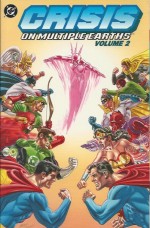
Crisis on Multiple Earths volume 2


By Gardner Fox, Dennis O’Neil, Mike Sekowsky, Dick Dillin & Sid Greene (DC Comics)
ISBN: 978-1-4012-0003-9

As I’ve frequently mentioned before, I was one of the Baby Boomers who grew up with Julie Schwartz, Gardner Fox and John Broome’s tantalisingly slow reintroduction of DC’s Golden Age superheroes during the halcyon, eternally summery days of the 1960s. To me those fascinating counterpart crusaders from Earth-Two weren’t vague and distant memories rubber-stamped by parents or older brothers – they were cool, fascinating and enigmatically new.

…And for some reason the “proper” heroes of Earth-One held them in high regard and treated them with marked deference…

It all began, naturally enough, in The Flash; pioneering trendsetter of the Silver Age Revolution. After successfully ushering in the triumphant return of the superhero concept, the Scarlet Speedster, with Fox & Broome at the writing reins, set an incomparably high standard for costumed adventurers in sharp, witty tales of science and imagination, always illustrated with captivating style and clean simplicity by Carmine Infantino.

The epochal epic that literally changed the scope of American comics forever was Fox’s ‘Flash of Two Worlds’ (Flash #123 September 1961, as seen in Showcase Presents the Flash volume 2) which introduced the theory of alternate Earths to the continuity and by extension resulted in the multiversal structure of the DCU – and all the succeeding cosmos-shaking yearly “Crisis” sagas that grew from it.

And of course, where DC led, others followed…

With the concept of Infinite Earths and multiple versions of costumed crusaders solidly established, public pressure began almost instantly to agitate for the return of the “Golden Age Greats” but Editorial powers-that-be were hesitant, fearing too many heroes would be silly and unmanageable, or worse yet, put readers off. If they could see us now…

A torturous trickle of innovative crossover yarns generated an avalanche of popular and critical approval (big sales figures, too) so inevitably the trans-dimensional tests led to the ultimate team-up in the summer of 1963. ‘Crisis on Earth-One’ and ‘Crisis on Earth-Two’ (Justice League of America #21-22, August and September) comprised one of the most important stories in DC history and arguably one of the most crucial tales in American comics.

Its success led to a sequel the following summer and by year three it had become an eagerly-awaited tradition that would last as long as the JLA comicbook did.

This second collected volume gathers the fifth through eighth summer collaborations (JLA #55-56, 64-65, 73-74 and 82-83), encompassing a period of editorial flux and change. The background is covered in Martin Pasko’s erudite Introduction ‘Crisis Behind the Scenes’ which details how the loss of stalwart originators Gardner Fox & Mike Sekowsky led to a new way of telling stories, offsetting in some respects the genuine dilemma of readers’ changing tastes…

These classics span a period in DC’s history which still makes many fans shudder with dread but I’m going to ask them to reconsider their aversion to the “Camp Craze” that saw America go superhero silly in the wake of the Batman TV show (and, to a lesser extent, the Green Hornet series that introduced Bruce Lee to the world). I should also mention that comics didn’t create the craze. Many popular media outlets felt the zeitgeist of a zanier, tongue-in-cheek, mock-heroic fashion: Just check out old episodes of Lost in Space or The Man from U.N.C.L.E if you doubt me…

A wise-cracking campy tone was fully in play for the first two-parter – ‘The Super-Crisis that Struck Earth-Two’ and ‘The Negative-Crisis on Earths One-Two!’ from JLA #55-56 (August and September 1967).

Opening on Earth-2, it boasted a radical change as the JSA now included an adult Robin instead of Batman, although Hourman, Wonder Woman, Hawkman, Wildcat, Johnny Thunder and Mr. Terrific still needed the help of Earth-1’s Superman, Flash, Green Lantern and Green Arrow to cope with an invasion of superpower-creating black spheres which gave mere mortals uncanny abilities enabling them to satisfy their darkest desires.

Things went from bad to worse after the harried heroes used the ebony invaders to augment their own abilities and turn half the combined team evil too…

Peppered with wisecracks and “hip” dialogue, it’s sometimes difficult to discern what a cracking yarn this actually is, but if you’re able to forgive or swallow the dated patter, this is one of the best plotted and illustrated stories in the entire JLA/JSA canon. Furthermore, with immensely talented Sid Greene’s inking adding expressive subtlety, mesmerising texture and whimsical humour to Sekowsky’s pencils, Fox’s bright, breezy comedic scripts simply shine.

By 1968 the second superhero boom looked to be dying just as its predecessor had at the end of the 1940s. Sales were down generally in the comics industry and costs were beginning to spiral. More importantly “free” entertainment, in the form of television, was by now ensconced in even the poorest household. If you were a kid in the sixties, think on just how many brilliant cartoon shows were created in that decade, when artists like Alex Toth and Doug Wildey were working in West Coast animation studios.

Moreover, comicbook stars were appearing on the small screen. Superman, Aquaman, Batman, the Marvel heroes and even the JLA were there every Saturday in your own living room…

It was a time of great political and social upheaval. Change was everywhere and unrest even reached the corridors of DC. When a number of creators agitated for increased work-benefits the request was not looked upon kindly. Many left the company for other outfits. Some quit the business altogether.

Fox ended his magnificent run on the Justice League with a stunning annual team-up of the League and Justice Society. Creative and perfectly professional to the very end, his last story was yet another of the Golden-Age revivals which had resurrected the superhero genre.

JLA #64 and 65 (August to September 1968) featured the ‘Stormy Return of the Red Tornado’ and ‘T.O. Morrow Kills the Justice League – Today!’ with a cyclonic super-android taking on the mantle of a 1940s spoof “Mystery Man” who appeared in the very first JSA adventure (if you’re interested, the original Red Tornado was a brawny washerwoman named Ma Hunkle).

The plot involved a cagy time thief creating an artificial hero to help him defeat the JLA and JSA, but realising too late he had built better than he knew…

Fox’s departing thriller was also the series’ artistic debut for former Blackhawk artist Dick Dillin, a prolific draughtsman who would draw every JLA issue for the next twelve years, as well as many other adventures of DC’s top characters like Superman and Batman. He was inked by Greene, a pairing that seemed vibrant and darkly realistic after the eccentrically stylish, nigh-abstract Sekowsky.

Next up from August and September 1969 is Denny O’Neil’s first shot at the yearly cross-dimensional crisis as #73 and 74 offered ‘Star Light, Star Bright… Death Star I See Tonight!’ and ‘Where Death Fears to Tread!’

The tense, brooding tale introduced Aquarius, a sentient but insane star, who magically destroys Earth-Two until our Earth-1 heroes (with their surviving Golden Age counterparts) manage to restore it, but not without some personal tragedy as Black Canary loses her husband and opts to emigrate to our world, handily becoming the JLA’s resident Girl Superhero and picking up a new if somewhat unreliable power in the process.

This splendid exercise in fantastic nostalgia ends with another grand get-together as alien property speculators from space seek to raze both Earths in ‘Peril of the Paired Planets’ (#82 August 1970 by O’Neil, Dillin & Joe Giella) and only the ultimate sacrifice by a true hero can avert trans-dimensional disaster in the concluding ‘Where Valor Fails… Will Magic Triumph?’ (#83 September, O’Neil, Dillin & Giella)

This volume also includes a few beguiling extras: the front and back covers of Limited Collectors Edition #C-46 (by Neal Adams from August/September 1976), a double-page pin-up of the JSA by Murphy Anderson from Justice League of America #76 (October 1969) and a JLA Mail Room comprised of found letters from many of the passionate fans like Gerry Conway, Alan Brennert and Martin Pasko who grew up to be somebody in comics…

These tales won’t suit everybody and I’m as aware as any that in terms of the “super-powered” genre the work here can be boiled down to two bunches of heroes formulaically getting together to deal with extra-extraordinary problems.

In mature hindsight, it’s obviously also about sales and the attempted revival of more sellable characters during a period of intense rivalry between DC Comics and Marvel.

But I don’t have to be mature in my off-hours and for those who love costume heroes, who crave these cunningly constructed modern mythologies and actually care about fun, this is simply a grand parade of straightforward action, great causes and momentous victories.

…And since I wouldn’t have it any other way, why should you?
© 1967, 1968, 1969, 1970, 2003 DC Comics. All Rights Reserved.

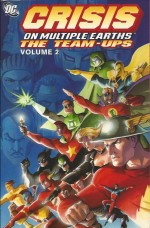
Crisis on Multiple Earths: the Team-Ups volume 2


By John Broome, Gardner Fox, Mike Friedrich, Neal Adams, Murphy Anderson, Gil Kane, Carmine Infantino & various (DC Comics)
ISBN: 978-1-4012-1228-5

Super-Editor Julius Schwartz ushered in the Silver Age of American Comics with his Showcase successes Flash, Adam Strange and Green Lantern, directly leading to the Justice League of America which in turn inspired Fantastic Four and the whole Marvel Empire and changed the way comics were made and read…

Whereas the 1940s were about magic and macho, the Silver Age polished everything with a thick veneer of SCIENCE and a wave of implausible rationalistic concepts quickly filtered into the dawning mass-consciousness of a generation of baby-boomer kids.

The most intriguing and rewarding was, of course, the notion of parallel worlds…

It all began, naturally enough, in The Flash, flagship title of the Silver Age Revolution. After ushering in the triumphant return of the costumed superhero concept, the Crimson Comet, with key writers Gardner Fox and John Broome at the reins, set an unbelievably high standard for superhero adventure in sharp, witty tales of technology and imagination, illustrated with captivating style and clean simplicity by Carmine Infantino.

Fox didn’t write many Flash scripts at this time, but those few he did were all dynamite; none more so than the full-length epic which literally changed the scope of American comics forever.

‘Flash of Two Worlds’ (Flash #123, September 1961) introduced the theory of alternate Earths to the continuity which grew by careful extension into a multiversal structure comprising Infinite Earths. Once established as a cornerstone of a newly integrated DCU through a wealth of team-ups and escalating succession of cosmos-shaking crossover sagas, a glorious pattern was set which would, after joyous decades, eventually culminate in a spectacular Crisis on Infinite Earths…

During a benefit gig Flash (police scientist Barry Allen) accidentally slips into another dimension where he finds the comic-book hero upon whom he based his own superhero identity actually exists. Every adventure he had absorbed as an eager child was grim reality to Jay Garrick and his comrades on the controversially designated “Earth-2”. Locating his idol, Barry convinced the elder to come out of retirement just as three Golden Age villains were making their own wicked comeback…

The floodgates were opened, as over the months that followed many Earth-1 stalwarts met their counterparts either in annual collaborations in the pages of Justice League of America or in their own series. Schwartz even had a game go at reviving a cadre of the older titans in their own titles. Public approval was decidedly vocal and he used DC’s try-out magazines to take the next step: stories set on Earth-2 exclusively featuring Golden Age characters.

Showcase #55 and 56 saw Doctor Fate and Hourman as a dynamic duo battling Solomon Grundy and the Psycho-Pirate and, still searching for an concept that would support its own series, Schwartz, Fox and Murphy Anderson debuted the team of Starman and Black Canary in The Brave and the Bold #61 (September-October 1965); the first of two stunning sagas which somehow led to nothing…

All those stories can be found in the previous edition (Crisis on Multiple Earths: the Team-Ups volume 1) whilst this second splendid collection – chronologically re-presenting The Atom #29 & 36, Flash #170 & 173, Green Lantern #45 & 52 and The Spectre #3 , cumulatively spanning October/November 1965 to April/May 1968 – opens with Brave & Bold #62 and a second Starman/Black Canary case wherein the resurgent champions ferociously face off against husband-and-wife criminals Huntress and Sportsmaster who had been stalking superheroes for kicks and profit. By the time Feline Fury Wildcat became their victim our heroes were on the case and ready for anything…

This compelling thriller was originally augmented by a text feature biography of the original Starman and that is reprinted here before Earth-2 Emerald Gladiator Alan Scott reunites with “our” Hal Jordan (Green Lantern #45, June 1966, by Broome, Gil Kane & Sid Greene) to thwart ‘Prince Peril’s Power Play’ as Scott’s comedy foil Doiby Dickles was romanced by an alien princess. The only fly in their ointment was a gigantic and ambitious space warrior who needed her to cement his own plans for conquest, but judicious use of green energies soon taught him that nobody likes a pushy tyrant…

Earth-2’s Tiny Titan was Al Pratt, a short man with super-strength, whilst we had size changing physicist Ray Palmer. When they met in Atom #27 (February/March 1967, by Fox, Kane & Greene) it was for an all-out cataclysmic clash between the Mighty Mites and one of the most dangerous villains of DC’s Golden Age in ‘The Thinker’s Earth-Shaking Robberies!’

With Green Lantern #52 (Broome & Kane, April 1967) Alan Scott and Doiby popped over from Earth-2 to aid Hal against the scurrilous return of his arch nemesis Sinestro in camp-crazed and frankly rather peculiar fight-frenzied fist-fest ‘Our Mastermind, the Car!’ after which a brace of Scarlet Speedsters at long last reunited in Flash #170 to face the ‘The See-Nothing Spells of Abra Kadabra!’ (May 1967 by Broome, Infantino & Greene) which found the Vizier of Velocity hexed by the cunning conjuror and rendered unable to detect the villain’s actions or presence.

Sadly for the sinister spellbinder, Jay Garrick was visiting and called on the services of JSA pals Doctors Fate and Mid-Nite to counteract the wicked wizard’s wiles…

Promptly following, Flash #173 (September 1967 by Broome, Infantino & Greene again) featured a titanic team-up as Barry, Wally “Kid Flash” West and Jay were sequentially shanghaied to another galaxy as putative prey for alien hunter Golden Man in ‘Doomward Flight of the Flashes!’

However, the sneaky script slowly revealed devilish layers of intrigue and his Andromedan super-safari concealed a far more arcane purpose for the three speedy pawns, before the wayward wanderers finally fought free and found their way home again…

Eventually Schwartz finally achieved the ambition of launching a Golden Age hero into his own title; sadly just as the superhero bubble was bursting and supernatural stories were again on the rise…

After three Showcase appearances and many guest-shots, The Spectre won his own book at the end of 1967. From #3 (March/April 1968) comes this all Earth-2 team-up by neophyte scripter Mike Friedrich and artistic iconoclast Neal Adams which exposed the ‘Menace of the Mystic Mastermind’ wherein pugilistic paragon Wildcat confronted head-on the inevitable prospect of age and infirmity even as an inconceivable force from another universe possessed petty thug Sad Jack Dold and turned him into a nigh-unstoppable force of cosmic chaos…

This fabulous peek into forgotten worlds and times concludes with one of the very best team-up tales of the Silver Age as the Earth-2 Atom returns in ‘Duel Between the Dual Atoms’ (April/May 1968, by Fox, Kane & Greene) wherein a radiation plague plays hob with victim’s ages on both worlds simultaneously. Sadly the deadly situation also turns normally hyper-rational Ray Palmer into an enraged maniac and almost more than his aging counterpart can handle…

Still irresistible and compellingly beautiful after all these years, the stories collected here shaped the American comics industry for decades and are still influencing not only today’s funnybooks but also the wave animated shows, movies and TV series which grew from them. These are tales and this is a book you simply must have.

© 1965-1968, 2007 DC Comics. All Rights Reserved.

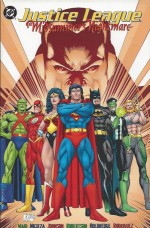
Justice League: Midsummer’s Nightmare


By Mark Waid, Fabian Nicieza, Jeff Johnson, Darick Robertson, John Holdredge, Hanibal Rodriguez & various (DC Comics)
ISBN: 978-1-56389-338-4

There are many facets that contribute to the “perfect mix” in the creation of any continuing character in comics. How much more so then, when the idea is to build a superhero team that will stand out from the seething masses that already exist?

In the mid-1990s, the iconic squad which truly ushered in the return of superheroes to comics suffered one of its periodic plunges in quality and popularity and ignominiously folded.

Of course the Justice League of America is too hallowed, venerated and valuable to fester in oblivion for any length of time and was quickly reconvened in a fresh new interpretation which quickly became the breakout book of 1997, courtesy of Grant Morrison & Howard Porter (see JLA: New World Order).

However, the scene was set for them by a strikingly exuberant miniseries which acted as a reassessment and reintroduction of the World’s Greatest Superheroes. Since the Silver Age’s greatest team-book died a slow, painful, embarrassing death, not once but twice, DC were taking no chances with their next revival and tapped Big Ideas wünderkind Morrison to reconstruct the group and the franchise.

However he was to a large extent riffing on groundwork laid by writers Mark Waid and Fabian Nicieza – as well as the impressive illustration of Jeff Johnson, Darick Robertson, John Holdredge & Hanibal Rodriguez – in a captivating no-nonsense miniseries which went a long way towards regenerating interest…

This slim sleek compilation (collecting Justice League: Midsummer’s Nightmare #1-3 from September-November 1996) opens with an effusive ‘Intro’ from Morrison before a world of confusion is revealed in ‘True Lies’ where comicbook artist Kyle Rayner struggles to meet the deadline for his assignment. He can’t understand why anybody would want to read about fictitious masked mystery men characters like Green Lantern when the entire planet is in the midst of a cosmic revolution.

All over earth humans are spontaneously developing super-powers as an inexplicable genetic “spark” triggers the next stage in evolution. Millions of superhumans are manifesting with no rhyme or reason whilst others seem doomed to remain merely mundane. It’s like a comicbook plot come to life…

Amongst the ordinary mortals left behind are reporter Clark Kent, philanthropist Bruce Wayne, schoolteacher Diana Prince, college lecturer Wally West and corporate compliance officer Arthur Curry. Elsewhere, separated by immeasurable gulfs, scientist J’onn J’onzz leads an idyllic life under the skies of Mars with his wife and daughter…

The dreams of all these mortals are troubled. They have vague, impossible recollections of beings colourful heroes in a world filled with their like, not this savage situation where selfish “Sparkers”, intoxicated with newfound power, squabble and bicker like bullies and thugs in a primarily plebeian universe…

In a hidden place, an immortal mastermind manipulates a super-villain the entire world has forgotten, using his power to reshape dreams to achieve an eons-long plan. However there’s far more to heroism than powers and each mentally diminished champion individually struggles to find the disturbing deeper truth they know has been somehow taken from them…

The spell of targeted amnesia starts to unravel when journalist Kent somehow survives being caught in a savage exchange between rival sparker gangs. Shocked back to Kryptonian normality he starts tracking down his vanished costumed contemporaries…

Elsewhere relative neophyte legacy heroes Wally and Kyle have their own epiphany moments as the second chapter ‘To Know a Veil’ finds a restored Superman and Batman systematically unravelling the sinister plot.

In a hidden sanctum Machiavellian Know Man further exploits the reality-warping gifts of his slave Doctor Destiny to create a team of sparkers specifically designed to eradicate the re-emergent heroes. Meanwhile Aquaman and Wonder Woman have united with the World’s Finest team in time to be ambushed by an army of sparkers. The battle is in no way certain until the restored Flash and Green Lantern pile in…

After the inconclusive clash the heroes realise they need their old telepathic team-mate back and hunt for J’onzz, eventually dragging the Martian Manhunter from his perfect dream of paradise regained in a bunker at Roswell. Having lost his world and family a second time, he is not in any mind to be merciful with his anonymous abductors…

The saga kicks into terminal high gear with ‘Daze & Knights’ as Know Man’s tailor-made sparker squad attacks only to fall as one before the brutal psychic assault of the furious and heartbroken Manhunter.

His mental capabilities then glean the whereabouts of their true foes from data buried by rebellious Dr. Destiny in Kyle’s subconscious and the fighting mad team race off to a final confrontation with their hidden enemy…

Fast-paced, action-packed and breathtakingly bold, this galvanic tale, pitting the greatest champion’s in DC’s pantheon against an immortal enemy whose roots stem back to the earliest days of the universe is a gloriously baggage-free romp and a splendid jumping on point for readers new and old alike, and this fantastic Fights ‘n’ Tights foray also includes a handy information section recapitulating and assessing the characters of Superman, Batman, Wonder Woman, Flash, Green Lantern, Aquaman and Martian Manhunter.
© 1996 DC Comics. All Rights Reserved.

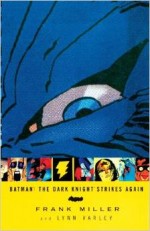
Batman: The Dark Knight Strikes Again


By Frank Miller& Lynn Varley (DC Comics)
ISBN: 978-1-56389-929-4

Despite and because of all the controversy and uproar over The Dark Knight Returns, the clamour for a sequel began almost immediately. Auteur Frank Millar kept everybody hungry for almost fifteen years and when he finally did capitulate it was – as usual – not what anyone was expecting.

Originally released as a 3-issue prestige format miniseries between November 2001 and July 2002 under DC’s Elseworlds imprint (a line featuring key characters in non-canonical or out-of-continuity tales). Batman: The Dark Knight Strikes Again once more confounded reader expectations with its concentration on contemporary social commentary, other (lesser?) superheroes and political corruption as well as the dumbing-down and sexualisation of the media …

Three years after the climax of the original epic, America and the world are worse off than ever and following a mood-setting Introduction from veteran journalist “Vicki Vale”, Book One opens with a well-hidden Bruce Wayne assessing just how far his country has fallen: a tidal wave of Bread-&-Circuses on the airwaves saturation-lobotomising the populace with tawdry titillation and celebrity news soporifics whilst impossibly popular, implausibly avuncular President Rickard assures the complacent proles they’ve never had it so good…

The Batman knows a secret however: PoTUS doesn’t exist…

There’s still some dissent, but who listens nowadays to old dinosaurs like Jimmy Olsen constantly bemoaning the repeal of The Bill of Rights or carping on about how all the costumed heroes have somehow vanished.

Elswehere, an incredibly tiny man continues his daily battle against voracious monsters until suddenly he is plucked from his hostile micro-prison by a young girl dressed like an animal.

After years in Hell Ray Palmer is ready to help an old comrade take back the world, but first he and Catgirl Carrie Kelley have to battle their way through an army of federal heavies and rent-a-cops…

Young, independent bedroom-&-basement News-hackers run with the story of “Masks and Capes” making a comeback, prompting Rickard to extend Martial Law into its 19th month. Somewhere far away a former Bastion of Liberty is terrified of the repercussions. Superman is still permitted to save lives in the world… as long as nobody sees him doing it…

In a cave far below ground, Catgirl helps The Atom retool for the forthcoming fight whilst introducing the bemused physicist to the Dark Knight’s latest addition to his arsenal: a legion of former gangstas and protégés dubbed The Batboys.

Buried in the nightly teaser-fest entitled News in the Nude, the Prez is delivering another placating homily when his image suddenly fritzes. The word is now out with more and more people realising their beloved paternalistic patriarch might be nothing than a hologram mask for any anonymous monster or maniac…

In the White House Lex Luthor fears his grip on power is slipping, whilst far-too-close-for-comfort, quintessential investigator The Question listens and learns…

The long days of quiet resistance at last end when an explosion deprives the entire Eastern Seaboard of power, allowing Catgirl and the Batboys to move into Phase Two of the plan: liberating missing speedster Barry Allen from captivity and energy-generating slavery on a collosal power-grid-feeding treadmill.

The Flash is resistant – horrified and furious until Carrie reassures him that his beloved wife Iris is no longer a hostage of the American Government…

Deep in his lair Wayne contemplates his successes and calculates when exactly the Administration will send his old friend Clark after him again…

As the free and unsanctioned parts of the media speculate on the return of caped crusaders and the freaks quickly become a hot trend, out in space Superman contacts the long-hidden Wonder Woman and she joins him in a conference with Captain Marvel.

The World’s most powerful heroes are still castrated by the secret alliance of Luthor and Brainiac which has held their loved ones safety against them for years. After being horrifically reminded once more of the cost of disobedience, Superman heads after Batman but flies straight into a perfectly planned ambush and falls to a resurgent and growing rebel Justice League and a particularly vengeance-hungry Green Arrow…

Book Two finds the nation gripped by “Superhero Chic” as a torrent of fashion-crazed wannabes spring up everywhere. Increasingly furious Federal spin-doctors and government apparatchiks are helpless to stem, denigrate or even belittle the tide.

Ignoring the media storm Batman takes a more active role, attacking Luthor’s strongholds, liberating the likes of Plastic Man, Elongated Man and the rest whilst striking fear into the hearts of the too-long-complacent oppressors…

In a momentous change of heart, eternal lovers Wonder Woman and Superman abandon their previous position and even allow their long hidden daughter Lara to join the struggle.

As Earth celebrates the “return” of Superman, Luthor unleashes a ghastly facsimile of The Joker to kill the returned champions one by one, whilst Brainiac utilises an alien monster to draw the Man of Steel into battle. Heroes begin to fall. Manhunter, Guardian, The Creeper and Captain Marvel die before Lara arrives to decide the outcome…

With Luthor and Brainiac on the defensive Bruce Wayne unmasks at a massive freedom concert in Gotham and beseeches the public to reclaim their country. This revolution is being televised…

The apocalyptic conclusion in Book Three finds the battle in full flow with the massed forces and resources of totalitarian government ranged against two generations of masked champions and more – such as the exiled Green Lantern – arriving every moment.

Batman still has unfinished business: freeing the captive bottle-city Kandorians whose possession by Brainiac has neutered The Man of Tomorrow for years, but despite a concerted and successful campaign the Dark Knight is captured and tortured by Luthor even as the faux Joker targets Catgirl.

The killer has a history with the Bat-dynasty and a personal score to settle with the aging hero’s newest junior assistant…

With chaos, anarchy and even freedom in the air, the beaten dictators opt for a Scorched Earth policy and before long the entire planet looks unlikely to survive…

This controversial sequel volume is packed with production drawings and a Designs Sketchbook to augment a unique and decidedly different Bat-saga at once bombastic, brutal, challenging and immensely entertaining.

Whilst certainly not the equal of its mythic predecessor, The Dark Knight Strikes Again is certainly a tremendously important tale no fan of comics should miss.
© 2001, 2002, 2005 DC Comics, Inc. All Rights Reserved.

Brightest Day volume 1


By Geoff Johns, Peter J. Tomasi, Ivan Reis, Patrick Gleason, Fernando Pasarin, Ardian Syaf, Scott Clark, Joe Prado & various (DC Comics)
ISBN: 978-1-4012-3276-4

Following the intergalactic Zombie Apocalypse of The Blackest Night, Earth’s profound importance to the nature and make-up of Reality was finally revealed and a select number of deceased heroes and villains were resurrected by a strange white energy force.

As the world slowly recovered from a horrific undead invasion, these newly resurrected and unaccountably different beings began seeking their own places and purpose in the bright new tomorrow, unaware that incredible and subtle forces were still manipulating them like meat puppets.

Scripted by Geoff Johns and Peter J. Tomasi, this first compilation of the extended mega braided-crossover series Brightest Day collects issue #0-7 of the sequel event (spanning June to October 2010) and begins here with ‘Carpe Diem’ illustrated by Fernando Pasarin, John Dell, Cam Smith, Prentis Rollins, Dexter Vines & Art Thibert.

In the shining light of day, former disembodied spirit Boston Brand – nee Deadman – finds himself disconcertingly corporeal again, yet still utterly invisible to the teeming masses of humanity. He now wears a white-glowing power ring which advises him “live” and demonstrates the ex-ghost’s new gifts by resurrecting a dead bird. The voice then screams “help me” and Brand is teleported away…

Aquatic warrior-queen Mera is luxuriating in the return of her husband Arthur Curry but Aquaman broods, disturbed by the changes he perceives in himself, even as Boston reappears in the depths of super-penitentiary Iron Heights, where both the Reverse Flash and Captain Boomerang have been held since their unfathomable and unwelcome reanimations.

In Louisiana Carter and Shiera Hall discuss their present situation. The eternal lovers have been reincarnated hundreds of times since they were murdered in Ancient Egypt, but his time is somehow different. Meanwhile, at the top of the world a team of ruthless men are recovering the bones the Hawks inhabited in one of those previous existences… After a glowing Zamaron power-gem smashes through the ceiling to embed itself in Nth metal super-weapon the Claw of Horus, the mystically alerted Winged Wonders furiously set off after them…

In a hidden hideaway, with only Boston Brand imperceptibly watching, fully restored mental manipulator Maxwell Lord takes the biggest risk of his fresh new life, overloading his psychic power to make (almost) everybody on Earth forget he ever existed, whilst on the Red Planet revived Martian Manhunter J’onn J’onzz exerts all his mighty powers in an attempt to make the dead world bloom again. He is glad to see again Green Lanterns Hal Jordan and Guy Gardner and promises to visit Earth soon…

On far distant Oa, home of the Guardians of the Universe, Jennifer-Lynn Hayden discusses her former boyfriend with GL doctor Natu as the medic subjects her to numerous tests. Emerald revenant Jade knows that since she came back Green Lantern Kyle Rayner just doesn’t look at her the same way anymore…

In New York Ronnie Raymond feels unwelcome at the funeral of Jason Rusch‘s girlfriend Gehenna. When he was dead and dominating the energy-matrix composite dubbed Firestorm, Ron commanded their shared body to turn her to salt but the grieving Jason won’t listen and refuses to believe it was the Black Lantern Ring then animating him which gave the orders. When he again tries to apologise Jason hits him, triggering an unwanted fusion which traps them both in the form of the Nuclear Man…

Meanwhile in Kahndaq, reborn mystic superman Amon Tomaz is greeted as a god by the astounded peasantry. Their shining Osiris swears to them that he will usher in a golden age of prosperity and power whilst at the Arlington National Cemetery returned Avatar of War Hank “Hawk” Hall picks up just where he left off, brutally smashing bad guys whilst partner and Peace Avatar Dove – AKA Dawn Granger – tries to ameliorate the carnage he inflicts. Being dead has done nothing to improve his temperament…

All such things Deadman secretly observes as the power of the voice bounces him unseen around creation, but when it unceremoniously dumps him in the ravaged heart of what was once Star City the power urgently demands that Brand now help it and all of the “returned”. In a flare of white energy it then turns the devastated city centre into a miles wide star-shaped primeval forest…

And in Silver City, New Mexico, ordinary people – exploring a huge crater with an immovable white lantern at its bottom – look up to see intergalactic conqueror Sinestro flying towards them…

Scenes set, the drama truly begins with ‘Second Chances’ (art by Ivan Reis, Patrick Gleason, Ardian Syaf, Scott Clark, Joe Prado Vicente Cifuentes, Mark Irwin, Oclair Albert & David Beaty) as the renegade former Green Lantern is joined by Hal Jordan and Star Sapphire, but none of them can lift the tantalising white power lamp…

Assuming some kind of Sword in the Stone riff is in play, Jordan voices the question everybody is thinking… “Where’s King Arthur?”

Sea King Arthur Curry is half a word away, routing a band of pirates/human traffickers. However his righteous fury gives way to shock and horror when he telepathically summons the aquatic creatures he controls. The only thing which answers is a colossal, half devoured squid. Somehow his power now only affects and compels dead sea life…

At the same time on the Massachusetts coast, a restaurateur stops gutting fish and begins knifing people after seeing a broadcast on Aquaman’s return. Black Manta retired when his greatest foe died but now he has to go and kill him again…

At Pittsburgh University, inside the head of Firestorm, Ronnie and Jason are psychically tearing each other apart, whilst on Mars an agonising suppressed memory resurfaces, driving J’onn J’onzz to Earth to confirm the shocking recollection. In the Peruvian Andes Hawkman and Hawkwoman smash into the mercenaries stealing the bones of their former incarnations and get a chilling inkling of the ancient enemy who has been acting against them…

‘Nuclear Options’ (with additional inks by Tom Nguyen & Rebecca Buchman) opens to find the two component parts of Firestorm still railing against each other but unable to escape the body they spitefully share. Relief only comes after size-changing physicist Ray “The Atom” Palmer invades their conjoined nuclear form and forcibly disrupts the atomic matrix. But before the two separate into their human forms Ronnie detects another presence in the mental mix…

In New York a happy housewife, after years in hiding, learns of Martian Manhunter’s resurrection and slaughters hubby and the kids before resuming her ghastly true shape, whilst in the Andes Carter and Shiera learn that sorcerer Hath-Set – the third side of an ever-reincarnating Eternal Triangle – has been collecting the bones of each and every doom-drenched conjunction, and vow that this time they will end their curse by killing him before he can kill them…

In Colorado J’onn J’onzz visits the dementia-ridden daughter of the scientist who first transported him to Earth and learns the truth of his origins and of the beast Saul Erdel tragically teleported to earth before the Manhunter arrived from Mars…

Still being unwillingly shuttled around the globe, Boston Brand now finds himself transported to the antimatter universe to confront an appalling horror…

Discovering the white ring’s unsuspected offensive capabilities, Brand narrowly escapes an attack by the terrifying Anti-Monitor in ‘Revelations’ (inks by Vicente Cifuentes, Beaty & Irwin) before falling back into our cosmos, whilst in a hospital bed Ronnie Raymond realises the vile mentality of the Black Lantern Firestorm is still with him and hundreds of miles away J’onn J’onzz examines a New York atrocity and realises the beast Erdel summoned him to Earth to destroy now knows he’s coming…

As the White Lantern begins to pulse in Silver City, in Peru the Hawks find the extra-dimensional portal Hath-Set has built from millennia of their bleached bones and follow their nemesis into a bizarre new universe…

‘Thresholds’ then sees them stumble into a fantastic war between incredible beast species on a ferocious and fantastic Hawkworld where Hath-Set is making his final play for ultimate power, whilst back home Boston Brand’s life changes forever after he materialises in Dawn Granger’s bedroom. Both Dove and her maniacally over-protective “big brother” Hawk can see and – quite painfully – touch him…

In Silver City the situation is escalating as an entire lake mysteriously vanishes, whilst in the Bermuda Triangle, a phalanx of eerily familiar aquatic warriors begin to slaughter humans and in Pittsburgh Ron Raymond experiences a ghostly visitation…

‘Under Pressure’ opens with Aquaman and Mera investigating the bloodbath in Bermuda whilst in Georgetown Hawk has dragged Deadman to the grave of Don Hall, determined that his brother will also be revived by Brand’s touch.

As the Sea monarchs work they are attacked by the band of sea soldiers led by Mera’s twin Siren, even as on Hawkworld a furious attack by beastmen separates Carter and Shiera. In a Georgetown cemetery a White Voice admonishes Deadman and refuses to return the at-peace Don Hall. His subsequent attempt to bring back Dawn’s murdered sister is even more of a terrifying travesty…

In Bermuda, having narrowly escaped utter destruction, Mera is compelled to explain to her husband her true origins and the lie they have been living all their married lives…

The Martian Manhunter’s investigations bring him to a shocking conclusion in ‘Dead Zone’ (art from Reis, Clark, Prado, Cifuentes, Beaty, Irwin & extra inks by Christian Alamy) as he realises his mere presence is toxic to terrestrial flora, but whilst Hawk and Dove take the shellshocked Brand for his first meal in decades, in Pittsburgh a construction disaster compels Jason Rusch to summon the Firestorm Matrix, only to find his despised partner has been drowning his sorrows and the resultant merger has left the Nuclear Man dangerously intoxicated. As they struggle to save lives Jason too discovers a third – malevolent – personality in their mind-mix…

After consulting with the Justice League J’onn J’onzz determines to seek out fellow Martian survivor M’gann M’orzz but on arrival at her place of hermitage finds his brutally merciless foe has already found her…

This initial offering concludes with ‘The Secret of Life as Boston, Hawk and Dove are peremptorily teleported to Silver City where the former Deadman lifts the White Lantern and a wave of blinding energy blazes out, transforming all the other returnees and imparting unto all of them – in highly ambiguous terms – the specific reasons for each revivification…

To Be Continued…

Also included is a monumental gallery of 28 covers-&-variants from the series and numerous tie-in titles by David Finch, Scott Williams, Peter Steigerwald, Reis, Chuck Pires, Nei Ruffino, Dave McCaig, Ryan Sook, Pasarin, Joel Gomez, Randy Mayor and Carrie Strachan, with input by Jim Lee.

Complex, convoluted and compelling, this is epic and impressive fare for fans but probably impenetrable to casual readers, but I suspect even the most devout DC disciple will be best served by rereading the assorted volumes of Blackest Night before attempting this wonderful example of tight continuity, cosmic Costumed Drama.
© 2010 DC Comics. All Rights Reserved.

Showcase Presents Super Friends volume 1


By E. Nelson Bridwell, Denny O’Neil, Ric Estrada, Joe Orlando, Ramona Fradon, Kurt Schaffenberger, Bob Smith & Vince Colletta (DC Comics)
ISBN: 978-1-4012-4757-7

Once upon a time comics were primarily created with kids in mind and, whilst I’d never advocate exclusively going back to those days, the modern industry is greatly lacking for not properly addressing the needs and tastes of younger fans these days.

A superb case in point of all-ages comics done right can be seen in Showcase Presents Super Friends volume 1 which gathers the licensed comicbook tales which spun off from a popular Saturday Morning TV Cartoon show: one that, thanks to the canny craftsmanship and loving invention of lead scripter E. Nelson Bridwell, became an integral and unmissable component of the greater DC Universe.

It was also one of the most universally thrilling and satisfying superhero titles of the period for older fans: featuring the kind of smart and witty, straightforward adventures people my age grew up with, produced during a period when the entire industry was increasingly losing itself in colossal continued storylines and angsty, soap opera melodrama.

Sometimes all you really want is a smart plot well illustrated; sinister villains well-smacked, a solid resolution and early bed…

The TV show Super Friends ran (under various iterations) from 1973 to 1986; starring Superman, Batman and Robin, Wonder Woman, Aquaman and a brace of studio-originated kids as student crimebusters, supplemented by occasional guest stars from the DCU on a case by case basis.

The series then made the transition to print as part of the publisher’s 1976 foray into “boutiqued” comics which saw titles with a television connection cross-marketed as “DC TV Comics”.

Child-friendly Golden Age comicbook revival Shazam!- the Original Captain Marvel had been adapted into a successful live action television series and its Saturday Morning silver screen stablemate The Secrets of Isis consequently reversed the process by becoming a comicbook.

With the additions of hit comedy show Welcome Back Kotter and animated blockbuster Super Friends into four-colour format, DC had a neat little outreach imprimatur tailor-made to draw viewers into the magic word of funnybooks.

At least that was the plan: with the exception of Super Friends none of the titles lasted more than ten issues beyond their launch…

This bombastic black-&-white extravaganza collects Super Friends #1-24 (spanning November 1976 to September 1979) and opens with a crafty two-part caper by Bridwell, Ric Estrada, Vince Colletta & Joe Orlando.

‘The Fury of the Super Foes’ found heroes-in-training Wendy and Marvin – and their incredible astute mutt Wonderdog – studying at the palatial Hall of Justice, even as elsewhere a confederation of villains prove that imitation is the sincerest form of flattery if not outright intellectual theft…

The Penguin, Cheetah, Flying Fish, Poison Ivy and Toyman, having auditioned a host of young criminals, are creating a squad of sidekicks and protégés to follow in their felonious footsteps and Chick, Kitten, Sardine, Honeysuckle and Toyboy are all ready and willing to carry out their first caper.

When the giant “Troubalert” screen informs the heroes of a three-pronged attack on S.T.A.R. Labs’ latest inventions, the champions split up to tackle the crises but are thoroughly trounced until Wendy and Marvin break curfew to help them.

As a result of the clash, Chick and Kitten are brought back to the Hall of Justice, but their talk of repentance is a rascally ruse and they secretly sabotage vital equipment…

Unluckily for them Wonderdog has seen everything and quickly finds a way to inform the still-oblivious good guys in issue #2 but too late to prevent the Super Friends being briefly ‘Trapped by the Super Foes’…

The incomparable Ramona Fradon – aided and abetted by inker Bob Smith – took over the pencilling with #3 as ‘The Cosmic Hit Man?’ saw fifty intergalactic super-villains murdered by infernal Dr. Ihdrom, who then combined their harvested essences to create an apparently unbeatable hyper-horror who utterly overwhelmed Earth’s heroic defenders. However he soon fell victim to his own arrogance and Wendy and Marvin’s logical deductions…

‘Riddles and Rockets!’ found the Super Friends overmatched by new ne’er-do-well Skyrocket whilst simultaneously trying to cope with a rash of crimes contrived by King of Conundra The Riddler.

It wasn’t too long before a pattern emerged and a criminal connection was confirmed…

Author Bridwell was justly famed as DC’s keeper of the continuity, possessing an astoundingly encyclopaedic knowledge of DC’s publishing minutiae. ‘Telethon Treachery!’ gave him plenty of scope to display it with a host of near-forgotten guest-stars joining our heroes as they hosted a televised charity event whilst money-mad menace Greenback lurked in the wings, awaiting the perfect moment to grab the loot and kidnap the wealthiest donators…

The Atom played a crucial role in stopping the dastardly depredations of an animal trainer who used beasts as bandits in ‘The Menace of the Menagerie Man!’ before a huge cast change was unveiled in #7 (October 1977) with ‘The Warning of the Wondertwins’…

TV is very different from comics. When the new season of Super Friends aired, Wendy, Marvin and Wonderdog were gone, replaced without warning or explanation by alien shapeshifters Zan and Jayna and their elastic-tailed space monkey Gleek.

With more room – and consideration for the fans – Bridwell turned the sudden cast change into a bombastic battle to save Earth from total annihilation whilst properly introducing the adult heroes’ newest students in memorable style…

At the Hall of Justice Wendy and Marvin spot a spaceship hurtling to Earth on the Troubalert monitor and dash off to intercept it. Aboard are two siblings from distant planet Exor: a girl who can change into animals and a boy who can become any form of water from steam to ice. They have come with an urgent warning…

Superman’s alien enemy Grax has determined to eradicate humanity and devised a dozen different super-bombs and attendant weird-science traps to ensure his victory. The weapons are scattered all over Earth and even the entire Justice League cannot stretch its resources to cover every angle and threat…

To Wendy and Marvin the answer is obvious: call upon the help and knowledge of hyper-powered local heroes…

Soon Superman and Israel’s champion The Seraph are dismantling a black hole bomb whilst Elongated Man and titan-tressed Godiva are performing similar duties on a life-eradicator in England and Flash and mighty-leaping Impala are dismantling uncatchable ordnance in South Africa…

Hawkman and Hawkwoman then join Native American avenger Owlwoman to crush darkness-breeding monsters in Oklahoma whilst from the Hall of Justice Wendy, Marvin and the Wondertwins monitor the crisis with a modicum of mounting hope…

The cataclysmic epic continues in #8 with ‘The Mind Killers!’ as Atom and Rising Son tackle a deadly device designed to decimate Japan even as in Ireland Green Lantern and Jack O’Lantern battle multi-hued monstrosities before switching off their target of technological terror.

In New Zealand time-scanning Tuatara tips off Red Tornado to the position of a bomb cached in the distant past and Venezuela’s doom is diverted through a team-up between Batman and Robin and reptile-themed champion Bushmaster whilst Taiwan benefits from a melding of sonic superpowers possessed by Black Canary and the astounding Thunderlord…

The saga soars to a classic climax with ‘Three Ways to Kill a World!’ in which the final phases of Grax’s scheme finally fail thanks to Green Arrow and Tasmanian Devil in Australia, Aquaman and Little Mermaid in the seas off Denmark and Wonder Woman and The Olympian in Greece.

Or at least they would have if the Hellenic heroes had found the right foe. Sadly their triumph against Wrong-Place, Right-Time terrorist Colonel Conquest almost upset everything. Thankfully the quick thinking students send an army of defenders to Antarctica where Norwegian novice Icemaiden dismantles the final booby-trap bomb.

However, whilst the adult champions are thus engaged, Grax invades the Hall of Justice seeking revenge on the pesky whistleblowing Exorian kids, but is completely unprepared for and overwhelmed by Wendy, Marvin and Wonderdog who categorically prove they are ready to graduate to the big leagues…

With Zan and Jayna enrolled as the latest heroes-in-training, Super Friends #10 details their adoption by Batman’s old associate – and eccentric time travel theoretician – Professor Carter Nichols just before a legion of alien horrors arrives on Earth to teach the kids that appearances can be lethally deceiving in ‘The Monster Menace!’ after which Kingslayer’ pits the heroes against criminal mastermind Overlord who has contracted the world’s greatest hitman to murder more than one hundred leaders at one sitting…

Another deep dive into DC’s past then resurrected Golden Age titans T.N.T and Dan, the Dyna-Mite in ‘The Atomic Twosome!’

The 1940s mystery men had been under government wraps ever since their radioactive powers began to melt down, but when an underground catastrophe ruptured their individual lead-lined vaults, the Super Friends were called in to prevent a potential nuclear nightmare…

The subterranean reason for the near tragedy was tracked to a monstrous mole creature, and led to the introduction of eternal mystic Doctor Mist who revealed the secret history of civilisation and begged help to halt ‘The Mindless Immortal!’ before its random burrowing shattered mankind’s cities…

Super Friends #14 opened with ‘Elementary!’; introducing four ordinary mortals forever changed when they were possessed by ancient sprits and tasked with plundering the world by Overlord. When the heroes scotched the scheme, Undine, Salamander, Sylph and Gnome retained their powers and determined to become a crime-fighting team dubbed The Elementals…

The issue also contained a short back-up tale illustrated by Kurt Schaffenberger & Bob Smith. ‘The Origin of the Wondertwins’ at last revealed how the Exorian genetic throwbacks – despised outcasts on their own world – fled from a circus of freaks and uncovered Grax’s plot before taking that fateful rocketship to Earth…

Big surprises were in store in ‘The Overlord Goes Under!’ (Fradon & Smith) as the Elementals began their battle against evil by joining the Super Friends in crushing the crimelord. All the heroes were blithely unaware that they were merely clearing the way for a far more cunningly subtle mastermind to take Overlord’s place…

‘The People Who Stole the Sky!’ in #16 was a grand, old fashioned alien invasion yarn, perfectly foiled by the team and the increasingly adept Wondertwins whilst ‘Trapped in Two Times!’ found Zan and Jayna used by the insidious Time Trapper (nee Time Master) to lure the adult heroes into deadly peril on Krypton in the days before it detonated and future water world Neryla in the hours before it was swallowed by its critically expanding red sun.

After rescuing the kids – thanks in no small part to Superman’s legendary lost love Lyla Ler-rol – the Super Friends used Tuatara’s chronal insight and Professor Nichol’s obscure methodologies to go after the Trapper in the riotous yet educational ‘Manhunt in Time!’ (illustrated by Schaffenberger & Smith), by way of Atlantis before it sank, medieval Spain and Michigan in 1860AD, to thwart a triple-strength scheme to derail history and end Earth civilisation…

Issue #19 saw the return of Menagerie Man in ‘The Mystery of the Missing Monkey!’ (Fradon & Smith) as the beast-breaker boosted Gleek, intent on turning his elastic-tailed talents into the perfect pickpocketing tool, after which Denny O’Neil – writing as Sergius O’Shaugnessy – teamed with Schaffenberger & Smith for a more jocular turn.

Chaos and comedy ensued when the team tackled vegetable monsters unleashed when self-obsessed shlock-movie director Frownin’ Fritz Frazzle got hold of Merlin’s actually magical Magic Lantern and tried to make a masterpiece on the cheap in ‘Revenge of the Leafy Monsters!’…

Bridwell, Fradon & Smith were back in #21 where ‘Battle Against the Super Fiends!’ found the heroes travelling to Exor to combat a brace of super-criminals who could duplicate all their power-sets, after which ‘It’s Never Too Late!’ (#22, O’Neil, Fradon & Smith) revealed how temporal bandit Chronos subjected the Super Friends to a time-delay treatment which made them perennially too late to stop him – until Batman and the Wondertwins out-thought him…

The Mirror Master divided and banished teachers and students in #23 but was unable to prevent an ‘SOS from Nowhere!’ (Bridwell, Fradon & Smith) to the fleet-footed Flash. This episode also spent some time fleshing out the Wondertwin’s earthly secret identities as Gotham Central highschoolers John and Joanna Fleming…

This splendid selection of super thrills then concludes with ‘Past, Present and Danger!’ by O’Neil, Fradon & Smith wherein Zan and Jayna’s faces are found engraved on a recently unearthed Egyptian pyramid. Upon investigation inside the edifice, the heroes awaken two ancient exiles who resemble the kids, but are in fact criminals who have been fleeing Exorian justice for thousands of years.

How lucky then that the kids are perfect doubles the crooks can send back with the robot cops surrounding the pyramid – once they’ve got rid of the Earthling heroes…

Brilliantly entertaining, masterfully crafted and always utterly engaging, these stories are comics gold that will delight children and adults in equal proportion. Truly generational in appeal, they are probably the closest thing to an American answer to the magic of Tintin or Asterix and no family home should be without this tome.
© 1976, 1977, 1978, 1979, 2014 DC Comics, Inc. All Rights Reserved.

Batman: The Dark Knight Returns


By Frank Miller, Klaus Janson & Lynn Varley (DC Comics)
Item ISBN: 0-930289-15-3,               current ISBN: 978-1-56389-342-1

I always feel a bit daft reviewing stuff that everyone already knows about, but I’m constantly being reminded that even though somebody talks about the classics of our art-form it doesn’t mean they actually have read them.

Moreover, the great thing about comics is that they’re meant to be re-experienced, over and over and over…

So here’s a quick look at Frank Miller’s most celebrated epic: a canny mix of iconoclastic bravura and contemporary dystopian angst blending urban anxiety with bleak wish-fulfilment power-fantasies and making all us whiny liberals love it anyway…

There had been many “Last Batman” stories over the decades since his creation in 1939 but none had the telling impact of the 4-issue “Prestige Format” miniseries which ran from February to June 1986, during a period when DC were creatively on fire and could do no wrong commercially…

The subsequent collection into a complete edition did much to kick off the still tentative graphic novel market, offering a plethora of different versions at the time: hardcover, paperback, bookstore editions, foreign language editions – and an Absolute Dark Knight edition, in 2008 – all proving how a single story could be successfully monetised to the benefit of all, except the poor bewildered fans who clung tenaciously to the cruelly punishing collectors’ credo “gotta have ’em all”…

(There are a number of editions available to this day, but I’m concentrating here on my first edition hardback from 1986. Therefore, some of the ancillary features and articles might be omitted, augmented or replaced in later releases…)

The epic transformed the character as much as the industry, with writers adapting facets of the chaos and carnage-resisting, end-of-days Caped Crusader to subsequent in-continuity tales whilst the readership spent years looking for clues in the regular comics that the story would eventually become canonical…

After Alan Moore’s Introduction ‘The Mark of the Batman’ the challenge to a civilisation in crisis begins with ‘The Dark Knight Returns’ as Gotham swelters under a crippling heat wave and ubiquitous TV pundits jabber on incessantly, disseminating what the government allows to pass for news.

Aging playboy Bruce Wayne (55 and no longer counting) has narrowly escaped blazing death during a car race, street gang The Mutants have perpetrated another ghastly atrocity and long-past-it Police Commissioner James Gordon has challenged them to a showdown before his enforced retirement in four weeks.

It’s also the tenth anniversary of the last sighting of the fabled masked vigilante the Batman…

Later that night Wayne and Gordon talk over old times but the billionaire’s journey home is interrupted by a pack of Mutants…

On the nightly News homicidal maniac Harvey Dent is paraded by arrogant surgeons and therapists as a shining example of their restorative and curative regimes. Two-Face is now a fully rehabilitated citizen ready to reclaim his place in the world…

Back at the Manor, as the TV disgorges a litany of tragedy and travesty, a grumbling urge that has been boiling in Wayne’s gut for a decade finally breaks loose and decrepit manservant Alfred realises with dismay and disgust that Bruce’s other self is coming back…

Whilst a storm breaks over Gotham the night is filled with the screams and the cracking of bones as a horde of violent thieves and thugs are brutalised. Wayward 13-year old Carrie Kelley is saved from a pack of Mutant chickenhawks by a merciless shadow and the News is filled with reports of gangsters reduced to cripples by a maniac “dressed like Dracula”…

When the savage shadow foils a bank raid, one of the hoodlums has a coin with the heads-side scarred and defaced.

…And in Arkham Asylum‘s quiet-ward an old, mute cripple with fading green hair watches the News, smiling and laughing for the first time in a decade…

That night the public gets its first full view of the unfolding situation as Two-Face holds Gotham’s Twin Towers hostage and Batman spectacularly ends his campaign of explosive extortion…

‘The Dark Knight Triumphant’ opens to public and media uproar as the Batman’s latest exploits galvanise the Man in the Street, the cops and especially psychotic monsters like the leader of the Mutants – who offers a terrifying challenge to the citizens and their returned hero.

Carrie Kelley rises to that challenge, buying a Robin outfit and jumping over rooftops looking to help clean up the city. Batman doesn’t have time for nonsense and hot air. He’s an old man with a dodgy heart who knows his days are already numbered.

All he wants is to get through another night and punish the Mutants who kidnapped a little boy…

Government – Federal and local – remains stonily silent on the issue of Batman (the first masked hero to break ranks since the government outlawed them years ago) and tension and unrest only escalates when a subway commuter is blown up by the Mutants…

At long last the Mayor acts, appointing Captain Ellen Yindel as his new Commissioner of Police. Her first act is to issue an arrest warrant for The Batman on assault and sundry other charges.

The subject of the manhunt doesn’t care: he’s engaged in a savage battle with the Mutant Army, his bat-tank and gadgets decimating the feral thugs at the City Dump.

His big mistake is to engage their leader in hand-to-hand combat. The steroid and rage fuelled gangbanger is a hate-propelled mass of muscle and speed, half his age and utterly immune to the Dark Knight’s every fighting trick and stratagem.

He is moments from beating the old fool to death when Robin introduces herself to her hero by causing an explosive distraction and stealing the battered body. Guided back to the Batcave, she can only watch as Alfred stitches the broken sack of meat and bone back together for the millionth time…

In the White House the American President takes extreme action, sanctioning the colourful assistance of the Nation’s Kryptonian Secret Weapon whilst in Arkham Dr. Bartholomew Wolper – the man who “cured” Two-Face – continues his treatment of the newly reinvigorated inmate once known as The Joker, whilst in the streets a growing number of Batman imitators take the law into their own increasingly bloody hands.

Although not fully recovered, Batman and Robin are forced to strike again when the Mutant Leader murders the Mayor with his teeth. The old campaigner orchestrates a showdown in front of the entire Mutant nation who watch in astonishment as their unbeatable ruler is methodically taken apart and left a crippled wreck by the resurgent, unholy Warrior Bat…

The beginning of the End starts with ‘Hunt the Dark Knight’ as Gotham is beset by more urban violence as the Mutants splinter into smaller fringe gangs. More worrisome is the huge uptick in citizen violence as the ordinary, decent folk of Gotham get out their legally purchased guns and start shooting at anyone who threatens, frightens, annoys or disgusts them.

The strangest result of the leader’s fall is the declaration by a hard core of former Mutants who publicly convert to “Sons of the Bat”, dedicated to carrying on the Dark Knight’s work: channelling their need for violence into excessive force applied to all malefactors from murderers to jaywalkers…

The Government is far more concerned with the deteriorating international crisis and The Batman is otherwise occupied. As well as cleaning up street scum whilst avoiding the police trying to catch him, there is fresh hell unleashed when the Joker hijacks Gordon’s televised retirement party and incoming Commissioner Yindel’s moment of glory with an explosively gory statement of his own…

With Armageddon clearly coming, clandestine Federal operative Clark Kent takes time out from a very busy schedule of secretly thwarting Soviet military strikes across the world to give old comrade Bruce Wayne a very clear cease-and-desist-or-else message from the White House. Naturally he is utterly ignored…

When the Joker is interviewed on a hugely popular talk show, Yindel’s squads are ready for Batman’s inevitable intervention but not the appalling atrocity the Clown Prince has engineered. In the bloodbath that follows, the openly suicidal Harlequin of Hate pushes himself to even greater excesses after abducting High Society Madam Selina Kyle and instigating another murder spree…

With the gung-ho cops dogging Batman’s heels the bloody trail leads to Gotham County Fair and a horrific, breathtaking final confrontation…

The final chapter then opens with Batman as Public Enemy Number One and a desperate fugitive. The warrants now read “murder”…

Elsewhere Superman prevents nuclear devastation by diverting a Soviet mega-warhead but the explosion radically weakens him. Despite this the Good Soldier obeys his Commander-in-Chief’s next order… stop Batman…

The world is in total chaos as fallout and electromagnetic disturbances bring about a nuclear winter and fry most electrical systems. The Caped Crusader, however, has always been a planner and has an arsenal of weapons and a small core of converts ready for the world that survives.

He also has a hidden ally. Radical firebrand Oliver Queen used to be the heroic Green Arrow…until Superman maimed the intransigent rabble-rouser who refused to toe the Government line once too often…

All that’s left is the final apocalyptic duel between two old, broken and dying heroes defending to the death their respective visions of justice. Despite a phenomenal showing, at last ‘The Dark Knight Falls’, but there’s still one last surprise in store…

Peppered with barbed and biting cultural commentary courtesy of the perpetual vox-pop of talking heads incessantly interviewed by the caustically lampooned and satirised news media, bombarding the reader with key narrative information in subtly layered levels and periodically enhanced throughout by stunningly iconic and powerful full-page tableaux, The Dark Knight Returns ushered in a new style of storytelling and made comics something adults outside the comics industry simply had to acknowledge.

Mythic, challenging and staggeringly visceral, this is rightly the Batman book everyone has heard of. Why not read it at last and see why?
© 1986 DC Comics, Inc. All Rights Reserved.
Wonder Woman: The Twelve Labors


By Martin Pasko, Elliot S. Maggin, Cary Bates, Len Wein, Curt Swan, John Rosenberger, Irv Novick, Dick Dillin, Kurt Schaffenberger, Dick Giordano, Jose Delbo & various (DC Comics)
ISBN: 978-1-4012-3494-2

The Princess of Paradise Island originally debuted as a special feature in All Star Comics #8 (December 1941), conceived by polygraph pioneer William Moulton Marston and illustrated by Harry G. Peter, in a calculated attempt to offer girls a positive and forceful role model and, on forward thinking Editor M.C. Gaines’ part, sell more funnybooks.

She catapulted into her own series and the cover-spot of new anthology title Sensation Comics a month later. An instant hit, the Amazing Amazon won her own eponymous supplemental title a few months later, cover-dated Summer 1942.

Once upon a time on a hidden island of immortal super-women, American aviator Steve Trevor of US Army Intelligence crashed to Earth. Near death, he was nursed back to health by young, impressionable Princess Diana.

Fearful of her besotted child’s growing obsession with the creature from a long-forgotten and madly violent world, Diana’s mother Queen Hippolyte revealed the hidden history of the Amazons: how they were seduced and betrayed by men but rescued by the goddess Aphrodite on condition that they forever isolated themselves from the mortal world and devoted their eternal lives to becoming ideal, perfect creatures.

However with the planet in crisis, goddesses Athena and Aphrodite instructed Hippolyte to send an Amazon back with the American to fight for global freedom and liberty and, although forbidden to compete, Diana clandestinely overcame all other candidates to become their emissary Wonder Woman.

On arriving in the Land of the Free she purchased the identity and credentials of lovelorn Army nurse Diana Prince, which elegantly allowed the Amazing Amazon to stay close to Steve whilst enabling the heartsick care-worker to join her own fiancé in South America. Diana soon gained a position with Army Intelligence as secretary to General Darnell, further ensuring she would always be able to watch over her beloved. She little suspected that, although the painfully shallow Steve only had eyes for the dazzling Amazon superwoman, the General had fallen for the mousy but supremely competent Lieutenant Prince…

That set up enabled the Star Spangled Siren to weather the vicissitudes of the notoriously transient comicbook marketplace and survive the end of the Golden Age of costumed heroes along with Superman, Batman and a few lucky hangers-on who inhabited the backs of their titles.

She soldiered on well into the Silver Age revival under the canny auspices of Robert Kanigher, Ross Andru & Mike Esposito, but by 1968 superhero comics were in decline again and publishers sought new ways to keep audiences interested as tastes – and American society – changed.

Back then, the entire industry depended on newsstand sales and if you weren’t popular, you died.

Editor Jack Miller and Mike Sekowsky stepped up with a radical proposal and made a little bit of comic book history with the only female superhero to still have her own title that marketplace.

The superbly eccentric art of Sekowsky had been a DC mainstay for nearly two decades, and he had also scored big with fans at Gold Key with Man from Uncle and at Tower Comics in T.H.U.N.D.E.R. Agents and on war title Fight The Enemy!

His unique take on the Justice League of America had cemented its overwhelming success, and now in 1968 he began stretching himself further with a number of experimental, young-adult oriented projects.

Tapping into the teen zeitgeist with Easy Rider style drama Jason’s Quest proved ultimately unsuccessful, but with the Metal Men and the hopelessly moribund Wonder Woman he had much greater impact. He would subsequently work the same magic with Supergirl.

The big change came when the Amazons were forced to leave our dimension, taking with them all their magic – including Wonder Woman’s powers and all her weapons. Now no more or less than human, she opted to stay on Earth permanently, assuming her own secret identity of Diana Prince, dedicated to fighting injustice as a mortal, very much in the manner of Emma Peel and Modesty Blaise.

Blind Buddhist monk I Ching trained her as a martial artist, and she quickly became embroiled in the schemes of would-be world-conqueror Doctor Cyber. Most shockingly her beloved Steve was branded a traitor and murdered…

Sekowsky’s root and branch overhaul offered a whole new kind of Wonder Woman (and can be seen in the magical quartet of full-colour collections entitled Diana Prince: Wonder Woman) but as I’ve already said fashion ruled and in a few years, without any fanfare or warning, everything that had happened since Wonder Woman lost her powers was unwritten.

Her mythical origins were revised and re-established as she returned to a world of immortals, gods, mythical monster and super-villains with a new nemesis, an African (Greek?) American half-sister named Nubia…

Such an abrupt reversal had tongues wagging and heads spinning in fan circles. Had the series offended some shady “higher-ups” who didn’t want controversy or a shake-up of the status quo?

Probably not.

Sales were never great even on the Sekowsky run and the most logical reason is probably Television.

The Amazon had been optioned as a series since the days of the Batman TV show in 1967, and by this time (1973) production work had begun on the original 1974 pilot featuring Cathy Lee Crosby. An abrupt return to the character most viewers would be familiar with from their own childhoods seems perfectly logical to me… By the time Linda Carter made the concept live in 1975 Wonder Woman was once again “Stronger than Hercules, swifter than Mercury and more beautiful than Aphrodite”…

But as Diana returned to mainstream DC continuity the fans expected her to fully reintegrate, leading to this early and impressive example of a comics miniseries which ran in Wonder Woman #212 to 222 (cover-dated July 1974 – March 1976) and detailed how the Amazing Amazon rejoined the JLA.

Scripter Len Wein and artists Curt Swan & Tex Blaisdell got the ball rolling with ‘The Man Who Mastered Women!’ as the Hellenic Heroine thwarted a terrorist attack at New York’s United Nations building where Diana Prince worked as a translator. In the aftermath she surprisingly met old friend Clark Kent.

Over the course of the conversation she realised her memories had been tampered with and suddenly understood why her JLA colleagues hadn’t called her to any meetings… she had resigned years ago…

Although her former comrades begged her to re-enlist, she declined, fearing that her memory lapses might endanger the team and the world. After much insistent pleading she relented enough to suggest that the League should covertly monitor her next dozen major cases – in the manner of Hercules’ twelve legendary tests – as she proved herself competent and worthy, for her own peace of mind if not the JLA’s…

Once they grudgingly agreed she left and Superman began the surveillance, observing her flying to Paradise Island in her Invisible Plane. Correctly deducing that she had been subject to Amazonian selective memory manipulation, she confronted her mother and learned of her time as a mere mortal and of Steve’s death.

Although the past had been removed by her well-meaning Amazon sisters, Diana now demanded that every recollection excised be returned…

Back in Man’s World a crisis was already brewing as costumed crazy The Cavalier began exerting his uncanny influence over women to controlling female Heads of State, but his powers proved ultimately ineffectual over Wonder Woman…

As a result of that case Diana Prince changed jobs, going to work as a troubleshooter for dashing Morgan Tracy at the UN Crisis Bureau, and her first mission wasn’t long in coming…

Wonder Woman #213 was crafted by Cary Bates, Irv Novick & Blaisdell as an alien robot landed and removed all aggression from humanity in one stroke. As the Flash helplessly observed however ‘The War-No-More Machine!’ also quashed all bravery, determination, confidence and capability and the species faced imminent – if long and drawn out – extinction.

Happily Diana, a teenaged girl and a murderous criminal were all somehow immune to the invader’s influence…

Elliot S. Maggin, Swan & Phil Zupa then disclosed Green Lantern Hal Jordan‘s undercover observations after a lost Amazon gem in unwitting, unscrupulous hands almost started World War III and the Princess of Power had to avert a nuclear holocaust triggered by a ‘Wish Upon a Star!’

The superb and vastly undervalued John Rosenberger pencilled Cary Bates’ tale of the ‘Amazon Attack Against Atlantis’ (inked by Vince Colletta) as Aquaman watched Wonder Woman unravel a baroque and barbaric plot by Mars, God of War to set Earth’s two most advanced nations at each throats, after which #216 found Black Canary uncovering the Amazon Sisterhood’s greatest secret in ‘Paradise in Peril!’ by Maggin, Rosenberger & Colletta.

The tale concerned an obsessed multi-millionaire risking everything – including possibly the collapse of civilisation – to uncover exactly what would happen if a man set foot upon the hidden Island of the Amazons…

One of Wonder Woman’s oldest foes resurfaced in ‘The Day Time Broke Loose!’ (by Maggin, Dick Dillin & Colletta) and Green Arrow was caught in the crossfire as the Duke of Deception attacked the UN with temporally torturous images and hallucinations designed to create madness and death on a global scale.

Issue #218 was produced by Martin Pasko & Kurt Schaffenberger and offered two short complete tales. Firstly Red Tornado reported on the ‘Revolt of the Wonder Weapons’ as an influential astrologer used mind-control techniques to gain power and accidentally undermined Diana’s arsenal, after which The Phantom Stranger stealthily observed her foiling a mystic plot by sorcerer Felix Faust which animated and enraged the Statue of Liberty in ‘Give Her Liberty – and Give Her Death!’

This was a time when feminism was finally making inroads into American culture and Pasko, Swan & Colletta slyly tipped their hats to the burgeoning movement in a wry and fanciful sci-fi thriller.

Thus issue  #219 found Diana preventing a vile incursion by the dominating males of Xro, a ‘World of Enslaved Women!’ with stretchable sleuth Elongated Man secretly traversing the parallel dimensions in Wonder Woman’s wake.

With the epic endeavour almost ended, regular scripter Pasko added a patina of mystery to the affair as the Atom watched Diana tackle ‘The Man Who Wiped Out Time!’ Illustrated by Dick Giordano, Wonder Woman #220 found temporal obsessive Chronos eradicating New York’s ability to discern time and time pieces: a plot foiled with style and brilliance by the on-form, in-time Power Princess.

The only problem was that during that entire exacting episode Hawkman had been watching Diana tackling another potential disaster hundreds of miles away…

The Feathered Fury’s report detailed how Crisis Bureau operative Diana Prince had been targeted by Dr. Cyber and Professor Moon – old enemies from her powerless period – who combined a hunger for vengeance with a plan to steal a UN-controlled chemical weapon in ‘The Fiend with the Face of Glass’ (illustrated by Swan & Colletta).

How she could be in two places simultaneously was revealed by Batman, who wrapped up the twelve trials in ‘Will the Real Wonder Woman Please… Stand Up Drop Dead!’ (art by Jose Delbo & Blaisdell), detailing how a beloved children’s entertainment icon had been subverted into a monster feeding off people and replacing them with perfect duplicates…

With covers by Bob Oksner, Nick Cardy, Mike Grell, Dick Giordano & Ernie Chan, this is a spectacular slice of pure, uncomplicated, all ages superhero action/adventure starring one of comics’ true all stars.

Stuffed with stunning art and witty, beguiling stories, this is Wonder Woman at her most welcoming in a timeless, pivotal classic of the medium: one that still provides astounding amounts of fun and thrills for anyone interested in a grand old time.
© 1974, 1975, 1976, 2012 DC Comics. All Rights Reserved.

JLA Classified: New Maps of Hell

New, revised review

By Warren Ellis & Jackson Guice (DC Comics)
ISBN: 978-1-4012-0944-5

It’s been quite a while since we covered a good old-fashioned straightforward and no-strings-attached superhero blockbuster: one which any old punter can pick up with no worry over continuity or identification and where good guys and bad guys are clearly defined.

That’s due in large part to the fact that nobody makes many of those anymore, but at least it gives me the opportunity to take another look a tale I didn’t much like when it first came out in 2006, but which has definitely grown on me after a recent re-read.

Produced at a time when the Justice League of America was enjoying immense popularity and benefiting from a major reboot courtesy of Grant Morrison, the end-of-the-world epic – starring Superman, Batman, Wonder Woman, Flash, Green Lantern, Oracle and Martian Manhunter – originally ran in issues #10-15 of ancillary spin-off title JLA Classified (September 2005-February 2006) with gritty futurist super-scribe Warren Ellis upping the angst-quotient on a hoary old plot whilst hyper-realist illustrator Jackson Guice adds a terrifying veracity to events.

The drama begins as Clark Kent and wife Lois Lane stumble onto a dirty little secret. Assorted, and presumably unconnected, scientists and bean-counters at President Luthor‘s Lexcorp conglomerate have committed suicide in large numbers and the intrepid reporters suspect something very nasty is going on…

In Gotham City Batman learns the police have been turned away from an extremely unconventional crime-scene by Feds and a private security company, and he too begins to dig…

In the Bermuda triangle, a group of researchers are invited to the Amazon’s ancient library of knowledge only to die when the sky-floating island explodes in a horrendous detonation.

Wally West has terrible dreams of his beloved predecessor Barry Allen which lead him to a similar catastrophic conflagration, whilst Green Lantern Kyle Rayner ruminates on a primordial legend of the Corps’ origins until a wave of explosions rouses him to action.

In the ruins of each disaster the scattered, hard-pressed heroes find an ancient parchment of alien hieroglyphs and, when Superman recovers another page of the same from the shredded remnants of a plummeting space station, the call goes out to activate the League…

Tasking cyber-savant Oracle and aged Martian sole survivor J’onn J’onzz with digging up information, the team learn of an antediluvian scourge which wracked the red planet million’s of years past. A God/Devil which tested species’ right to survive and heralded its coming through a written code…

Luthor’s scientist’s had found such writings in remnants of ancient Sumeria and begun deciphering the text…

Mobilising to stop the summoning, the heroes confront Luthor in the White House but are too late. In Las Vegas the bowels of Hell vomit horrors into the streets and as the frantic team rushes to battle they are snatched up separated by the malign entity which has spent eons traversing the universe testing the worth of intelligent races and individually putting them to their sorest tests.

However the monstrous terror has never faced beings like the JLA before, or a mind like Batman’s, and soon its own darkest secret is exposed and its fatal weakness exploited to devastating effect…

With a painted cover gallery by Michael Stribling, this book offers simple, solid Fights ‘n’ Tights fun gilded with a sly and cynical post-modern edge: a sound example of contemporary action blockbuster comics at their best.
© 2005, 2006 DC Comics. All Rights Reserved.