JSA volume 7: Princes of Darkness

New Extended Review

By Geoff Johns, David Goyer & various (DC Comics)
ISBN 1-84576-035-2

As a kid in the 1960s I used to love any appearance of the Justice Society of America, DC’s pioneering and popular crime-busting characters from the 1940s. They seemed full of a resonance that was equal parts Mystery and History. They belonged to the mythical land of “Before I Was Born” and their rare guest-shots always filled me with wonder and joy.

A few years ago they were permanently revived and I found very little to complain of. As superhero sagas go the stories and art were entertaining enough, often even outstanding, but with this compilation (collecting issues #46–55), I finally found myself agreeing with those wise editorial heads of my well-spent youth who felt that less was more and that over-exposure was a real and ever-present danger.

That’s not to say that these tales are in any way less than they need to be nor that the full-on, goodies-vs.-baddies extravaganzas are boring or tired. The problem is much more insidious and, I regret, more to do with me than the material. It finally became clear with this extended, spectacular struggle of valiant heroes against Darkness-wielding villains who black out the entire Earth and let evil reign free that the JSA were back for good.

But they were no longer quite so “special”.

Following on from the cliffhanger revelations of JSA: Savage Times the shadowy saga, written as ever, by David Goyer and Geoff Johns, with art from Sal Velluto, Leonard Kirk, Don Kramer, Bob Almond, Keith Champagne, & Wade von Grawbadger, opens with ‘Into the Valley’ and a blistering attack by the Chaos Lord Mordru, acting in concert with the conflicted ex-JSA-er Obsidian and the demonic spirit of rage, Eclipso.

Apparently dead, the sprit of Hector Hall, the latest Doctor Fate, travels to a distant realm for some sage advice in ‘Eclipse’ whilst on Earth, utter soul-drinking blackness has blanketed the globe unleashing the worst aspects of human nature. ‘Enlightenment’ and ‘Army of Darkness’ see Fate delve deeper into a potential solution whilst on the physical plane all of the World’s heroes – and some villains – are slowly being destroyed by the irresistible wave of Night.

A turning point comes in ‘The Last Light’ as a valiant sacrifice turns one of the dark masters from foe to friend, resulting in stupendous battles and an earth-shattering climax as the heroes save the day in ‘Princes of Darkness Coda: Justice Eternity’ – with which scripter Goyer moves on to fresh pastures.

After all that angsty spectacle and shiny triumph, the team catches a collective breath in ‘Brand New Day’ with a few new members and general recuperation, unaware the Atom Smasher and Black Adam have covertly crossed a moral line which will come back to haunt them all whilst the new heroic Eclipso feels himself drawn to do likewise. The main action of the piece comes in the form of a return for haunted huntress Crimson Avenger; a woman driven by possessed handguns to execute murderers who have escaped justice. To everyone’s astonishment her latest target is veteran hero Wildcat and nothing in the universe can stop or sway her…

The tale concludes in ‘Blinded’ as the relentless Avenger and Wildcat find a unique way to satisfy the curse of her relentless pistols, whilst Black Adam continues to recruit disenchanted heroes for a new kind of super-team, and the book ends on a satisfyingly welcome lighter note with a brace of seasonal tales, beginning with a lovely, lighthearted Thanksgiving bash starring both Justice League and Society.

‘Virtue, Vice & Pumpkin Pie’ is a splendid and jolly change of pace after all the high-octane testosterone which readily displays Geoff John’s comedic flair whilst ‘Be Good for Goodness’ Sake’ finds the surviving WWII heroes (Green Lantern, Wildcat, Hawkman and the Flash) bringing a lump to the throat and a tear to the eye (comic fans being the most soft and sentimental creatures in the universe) with a Christmas present for a long-lost member, not seen since the early days of the Golden Age…

These are characters that everyone in the industry seems to venerate, and I would be churlish to deny new readers and fans a chance to discover them too, but anticipation, delayed gratification and keen imagination once made every appearance of the JSA a source of raging joy to me and a million other kids. It’s such a shame today’s readers can’t experience that unbeatable buzz too. At least the stories are high quality. It would be utterly unbearable if the team were over-exposed and sucked too…

© 2003, 2004 DC Comics. All Rights Reserved.
JSA volume 6: Savage Times


By Geoff Johns, David Goyer, Leonard Kirk & Keith Champagne (DC Comics)
ISBN: 1-84023-984-0
New Extended Review

When they’re producing what their confirmed readership wants, today’s mainstream comics publishers seem to be on comfortably solid ground, so perhaps I shouldn’t be so harsh in my judgements when they seemingly go berserk with multi-part, braided mega-crossovers. The tale collected as Savage Times is top notch, well crafted, standard comic book fare, but I just can’t escape the nagging worry that by only regurgitating the past – no matter how well – ultimately you’re only diminishing the business and the medium.

This volume gathers together issues #39-45 of the monthly JSA title, and as costumed capers go, it is a saga packed with action, excitement, soap opera tension , humour and that heady mix of continuity in-filling we fan-boys adore…

The drama begins with two stand-alone tales ‘Power Crush’ by Goyer, Johns, Patrick Gleason and Christian Alamy, starring the unfeasibly pneumatic and feisty Power Girl as she deals in characteristically direct manner with a metahuman stalker obsessed with her prodigious physical charms, before moving into far more sinister territory with ‘…Do No Harm’ (by Leonard Kirk & Keith Champagne who also illustrated the rest of this book) as Star-Spangled Kid and Captain Marvel must use extreme care to rescue an entire school from a sadistic telepathic suicide bomber, whilst Doctor Mid-Nite struggles to keep the monster’s geriatric master alive on the operating table…

The main event begins in the ‘Unborn Hour’ as a time-travelling villain accidentally shifts some of the Justice Society back to 1944 and a climactic meeting with the first Mister Terrific. In ‘Paradox Play’ the malfunctioning time vehicle sends Captain Marvel to ancient Egypt, and after defeating the chronal marauder, Hawkgirl and Terrific’s modern successor follow the world’s mightiest mortal into a spectacular confrontation with the immortal conqueror Vandal Savage and an elemental metamorph determined to lay waste the Black Lands.

Meanwhile the new Doctor Fate is in another dimension seeking answers to the mystery of his comatose wife…

‘Yesterday’s War’ unites the modern heroes with Egypt’s champions Nabu, Prince Khufu, Chay-Ara (Hawkgirl’s own earlier incarnation) and Black Adam – who is both hero and villain in the JSA’s own time – but as the war goes against the beleaguered defenders Marvel and Adam are dispatched to the Land of the Dead to seek godly aid in ‘The Tears of Ra’, wherein the Black Marvel’s tragic history is poignantly revealed…

With Savage defeated and history restored, the book closes on a treble cliffhanger in ‘Princes of Darkness Prologue: Peacemakers’ as Doctor Fate returns to discover the true nature of the woman he believed to be his long-lost wife, the genocidal terrorist Kobra smugly escapes his long-deserved fate and the Society’s most powerful foe reveals how he has manipulated the team from the start…

It’s always unsatisfying to reach the end of a book but not the story, so even though this is a class superhero act it is hard to not feel a bit resentful, even though the next volume promises everything a fan could wish for.

At least the thing has already been published. Maybe you shouldn’t wait for my impending follow-up graphic novel review but just get this book and JSA: Princes of Darkness right away…
© 2002, 2003 DC Comics. All Rights Reserved.
JSA volume 5: Stealing Thunder


By Geoff Johns, David Goyer & various (DC Comics)
ISBN: 978-1-84023-667-5

The groundbreaking reinvention of the World’s first super-team continued apace with these compelling thrillers which originally appeared in JSA #32-38, beginning with a chilling peek into the life of the new Crimson Avenger: a haunted woman compelled to hunt down murderers by her own magic guns. Her irresistible compulsion has brought her to her next target – one of the Society’s greatest heroes…

‘Death Duty’ is illustrated by Peter Snejbjerg who also provided the pictures for the ‘Stealing Thunder Prologue’ wherein octogenarian hero Johnny Thunder, miraculously cured of senile dementia, reclaimed his magical Thunderbolt genie from his successor Jakeem. Unfortunately it’s all a macabre plot constructed by the body-hopping Ultra-Humanite…

The epic begins in ‘Wish Fulfillment’ (with art by Keith Giffen & Al Milgrom, Leonard Kirk & Keith Champagne), as, an unspecified time later, silicon superhero Sand awakens to discover that the Ultra-Humanite has usurped the power of the Thunderbolt and taken control of Earth. Those superbeings not directly mind-controlled and used as storm troopers are all stored in a giant body-bank.

Escaping with homicidal foe the Icicle in tow, Sand accidentally makes contact with the last free minds on the planet: Jakeem, Crimson Avenger, Power Girl, Hourman and Captain Marvel…

Kirk and Champagne continue in ‘Troublestruck’, ‘Lightning Storm’ and ‘Time-Bound’ as the desperate rebels risk everything to liberate the enslaved electric genie whilst being pursued by an murderous armada of their oldest friends before the tragic, spectacular finale returns the World to its original state in ‘Crossing Over’.

This volume ends with one of those touching “after the Apocalypse” tales: quiet, reflective and focusing on the heirs of lost heroes as Jakeem and the second Hourman contemplate their legacies and new responsibilities on ‘Father’s Day’, movingly illustrated by Stephen Sadowski and Andrew Pepoy.

By this time a fully realised superhero soap opera, Geoff Johns and the soon to depart David Goyer had made the Justice Society of America a stunning mix of old and new by blending cosmic action and human scaled drama with a memorable cast of characters. These tales are among the very best “fights and tights” adventures in contemporary comics, and should be on every old fan and potential convert’s “must-have” list.

© 2002, 2003 DC Comics. All Rights Reserved.
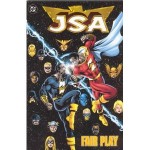
JSA volume 4: Fair Play


By Geoff Johns & various (DC Comics)
ISBN: 978-1-84023-628-6

Now firmly re-established as a major force in the DC universe as well as the commercial comics market, the Justice Society of America went from strength to strength after the rebirth of the seminal, eternal hero Hawkman (see the previous volume JSA: the Return of Hawkman), with Geoff Johns writing increasingly grander epics, tinctured with intriguing soap-opera sub-plots whilst scrupulously exploring and reinventing the internal mythology that has kept the characters as beloved best friends for generations of fans.

This volume, collecting issues #26-31 of the monthly comic and pertinent selections from JSA Secret Files #2, leads off with ‘Breaking Storms’ (co-plotted by Davis S. Goyer and illustrated by Javier Saltares & Ray Kryssing) finding assorted members of the team getting reacquainted, generally carrying out day-to-day business, but beyond the rewarding view of heroes behind their masks, the groundwork for two upcoming epics were stylishly foreshadowed as a pair of old enemies made their first cautious moves…

‘Who Do You Trust?’ (with art from Rags Morales & Michael Bair) found the nominally reformed villain Black Adam making himself less than welcome with his new team-mates until magical boy-scout Captain Marvel intervened, and it was back to all-out action in ‘Upping the Ante’ (illustrated by Derec Aucoin) when extreme gambler Roulette laid plans to pressgang the JSA for her next cage-fighter gladiatorial tournament.

The plan got underway in ‘Thunderstruck’ (Morales & Bair) as the team elected a new chairman only to find themselves abducted and enslaved; forced to fight each other to the death for the edification of super-villains and evil millionaires. Throughout it all Roulette was playing a double-game: something other than greed for profit and blood was fuelling her actions…

The big climax began in a ‘Face-Off’ (by Stephen Sadowski, Christian Alamy & Dave Meikis) but the saga paused – if not digressed – for a short interlude featuring the team’s youngest members, Jakeem Thunder and Star-Spangled Kid (with art from Peter Snejbjerg), who were caught up in a battle with a “Jokerised” Solomon Grundy.

‘Kids’ was part of a braided crossover event that spanned the entire DC pantheon (see Batman: the Joker’s Last Laugh for more details and murderous high jinks) but scripter Johns also cannily used the opportunity to advance one of those aforementioned big plots by bringing back the original Johnny Thunder – who wanted his magic genie back from Jakeem…

Roulette’s motives were revealed even as her illicit fight-club went down in flames when the triumphant JSA overwhelmed her assembled hordes in ‘Fair Play’ (Sadowski & Keith Champagne) and this volume concludes with a team field trip to Gotham City and a terse encounter with the Dark Knight in ‘Making Waves’ (chillingly executed by Snejbjerg) as the assembled heroes raced to rescue a kidnapped baby…

Superhero stories simply aren’t to everybody’s tastes, but if the constant and continuous battle of gaudy costumes and flashy personas must be part of the graphic narrative arts market then high quality material like this should always be at the top of the list. If you haven’t been tempted yet these sterling stirring tales might make a convert of you yet…

© 2001, 2002 DC Comics. All Rights Reserved.

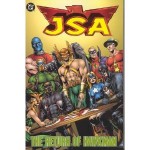
JSA: volume 3 The Return of Hawkman


By David S. Goyer, Geoff Johns & various (DC Comics)
ISBN 1-84023-628-0

The third collection of the revered, revived and very legendary Justice Society of America continued the crusade to resurrect or re-induct all the classic big names by reviving the biggest name and most visually arresting of the original team: Hawkman.

However, before that epic unfolds this volume (reprinting issues #16-26 of the monthly comic and portions of JSA Secret Files #1) kicks off with a triumphant extended return engagement for some old foes with ‘Injustice Be Done’. The first chapter ‘Divide and Conquer’ (illustrated by Stephen Sadowski and Michael Bair) finds an expanded Injustice Society in possession of the heroes’ most intimate secrets, ambushing them whilst they’re off guard with significant success.

In ‘Cold Comfort’ mastermind Johnny Sorrow reveals his plans as the heroes begin their fight back, and we see his horrific origins in ‘Sorrow’s Story’ (with additional art Steve Yeowell), before the World goes to Hell with ‘Into the Labyrinth’ (extra inks by Keith Champagne) and the ghostly Spectre returns to save the day.

And spectacularly fails…

The saga concludes in cataclysmic fashion with ‘Godspeed’ as Black Adam and Jakeem, the heir of genie-wielding Johnny Thunder join the team, but not before Jay Garrick the veteran Flash is lost in time and space…

Compelling as it was the entire saga was just a set-up for the eponymous ‘Return of Hawkman’ which I’ll get to after this necessary diversion…

Hawkman is one of the oldest and most revered heroes in comic-books, premiering in Flash Comics #1 (January 1940), created by Gardner Fox and Dennis Neville, although the most celebrated artists to have drawn the Winged Wonder are Sheldon Moldoff and Joe Kubert, whilst a young Robert Kanigher was justly proud of his later run as writer.

Carter Hall was a playboy archaeologist until he uncovered a crystal knife that unlocked his memories. He realised that once he was Prince Khufu of ancient Egypt, and that he and his lover Shiera had been murdered by High Priest Hath-Set. Moreover with his returned memories came the knowledge that his love and his kicker were also nearby.

Using the restored knowledge of his past life he fashioned a costume and flying harness, hunting his killer as the Hawkman. Once his aim had been achieved he and Shiera maintained their “Mystery-Man” roles to fight modern crime and tyranny with weapons of the past.

Disappearing at the end of the Golden Age they were revived by Julie Schwartz’s crack creative team in the early 1960s (see Showcase Presents Hawkman volume 1 for further details), and after a long career involving numerous revamps and retcons  the Pinioned Paladin “died” during the Zero Hour crisis.

Now the lost Jay Garrick awakens in old Egypt greeted by a pantheon of that era’s superheroes. Nabu, the Lord of Order who created Doctor Fate, the original incarnation of Black Adam and Khufu himself reveal the true origins of Hawkman whilst in the 21st century the JLA‘s heavenly hero Zauriel tells the modern Hawkgirl just who and what she really is in ‘Guardian Angels’.

The epic further unfolds as a major connection to the alien Hawkworld of Thanagar is clarified and explored in ‘Lost Friends’ and as Garrick returns to his home time Hawkgirl is abducted to the aforementioned Thanagar by its last survivors, desperate to thwart the schemes of the insane death-demon Onimar Synn who has turned the entire planet into a zombie charnel house.

As the JSA frantically follow their abducted member to distant Polaris in ‘Ascension’ Carter Hall makes his dramatic return from beyond and saves the day in typical fashion before leading the team to magnificent victory in the concluding ‘Seven Devils’.

Illustrated by Buzz, Rags Morales, Sadowski, Bair, David Meikis and Paul Neary, this latest return not only led to Hawkman regaining his own title (more graphic novel magic to review soonest!) but also stands as one of the most cosmic and grand-scaled of all the JSA‘s adventures.

Complex, enticing, thrilling and full of the biggest sort of superhero hi-jinks, if costume drama is your meat, this book should be your prey…

© 2001, 2002 DC Comics.  All Rights Reserved.

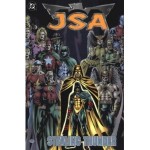
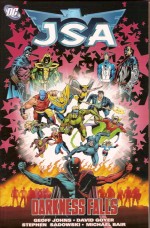
JSA volume 2: Darkness Falls


By Geoff Johns, David S. Goyer, Stephen Sadowski, Michael Bair & various (DC Comics)
ISBN: 978-1-56389-739-9

Following hard on the heels of their successful revival of the industry’s first super-team, the assorted creators hit the ground running and began expanding the roster and finding bigger and bolder cataclysms for the multi-generational army to combat.

The Justice Society of America was created in the third issue of All-Star Comics (Winter 1940/1941), an anthology title featuring established characters from various All-American Comics publications, by the simple expedient of having the heroes gather around a table and tell each other their latest adventure. From this low key collaboration it wasn’t long before the heroes joined forces to defeat the greatest villains and social ills of their generation.

Gathering issues #6-15 of the monthly JSA comicbook in one mighty tome, this volume begins with the official relaunch of the team in ‘Justice. Like Lightning…’ (illustrated by Marcos Martin & Keith Champagne) as the veteran members Flash, Sentinel and Wildcat assume the role of mentors for both current and future champions only to be attacked by a demented super-human named Black Adam. The bombastic battle serves to introduce some very far-reaching plot threads as the new incarnations of Doctor Fate, Hourman and Hawkgirl journey to ancient Egypt to solve the mystery of the Black Marvel’s madness, before the second major story-arc of the series begins.

In ‘Darkness Falls’ (art by Stephen Sadowski & Michael Bair) Sentinel’s troubled son Obsidian, haunted by his own powers, seemingly goes mad and attempts to drag the world into a supernatural realm of dark despondence. Naturally there’s more to the mess that might first appear, and when the new Doctor Mid-Nite appears it’s not long before the black tide begins to turn…

The epic concludes in a savage battle for the ‘Black Planet’ and Wildcat then takes centre-stage for a magnificent solo stint against the entire Injustice Society in ‘Wild Hunt’ – the best “Die Hard” tribute ever seen in comics.

Beginning with ‘Split’ (by Bair & Buzz) the next extended saga pits the team simultaneously against serpentine super-terrorist Kobra and the time-bending villain Extant (who killed many of the original team in Zero Hour) forcing the still largely untested JSA to divide its forces between a world in peril and a continuum in crisis.

‘The Blood-Dimmed Tide’ concentrates on the anti-Kobra contingent but their swift victory is spoiled when the sole survivor of the other team appears to bring them into battle against Extant in ‘Time’s Assassin’, ‘Chaos Theory’ and the spectacular ‘Crime and Punishment’ wherein reality is stretched beyond its limits, the gates of the afterlife are propped open and more than a few dead heroes return…

Complex and enthralling, these super shenanigans are the very best of their genre, filled with wicked villains and shining, triumphant heroes, cosmic disaster and human tragedies, always leavened by optimism and humour.

As such they’re simply not for every graphic novel reader, but if you can put yourself into the head and heart of a thrill-starved ten year old and handle the burden of seven decades of history, these tales will supercharge your imagination and restore your faith in justice…

© 2000, 2002 DC Comics. All Rights Reserved.

JSA volume 1: Justice Be Done


By James Robinson, David S. Goyer & various (DC Comics)
ISBN: 978-1-56389-620-0

After the actual invention of the comicbook superhero – for which read the launch of Superman in 1938 – the most significant event in the genre, and indeed industry’s progress was the combination of individual sales-points into a group. Thus what seems blindingly obvious to us with the benefit of four-colour hindsight was proven – a number of popular characters could multiply readership by combining forces and readerships. Plus of course, a whole bunch of superheroes is a lot cooler than just one – or even one and a sidekick.

The Justice Society of America was created in the third issue of All-Star Comics (Winter 1940/1941), an anthology title featuring established characters from various All-American Comics publications, by the simple expedient of having the heroes gather around a table and tell each other their latest adventure. From this low key collaboration it wasn’t long before the guys – and they were all guys (except Red Tornado who pretended to be one – don’t ask!) until Wonder Woman premiered in the eighth issue regularly joined forces to defeat the greatest villains – and social ills of their generation.

Within months the concept had spread far and wide…

And so the Justice Society of America is rightly revered as a true landmark in the development of comic books, and, when Julius Schwartz revived the superhero genre in the late 1950s, the key moment would come with the inevitable teaming of the reconfigured mystery men into a Justice League of America. From there it wasn’t long until the original and genuine returned. Since then there have been many attempts to formally revive the team’s fortunes but it wasn’t until 1999 on the back of both the highly successful revamping of the JLA by Grant Morrison and Howard Porter and the seminal but critically favoured new Starman by Golden Age devotee James Robinson, that the multi-generational team found a concept and fan-base big enough to support them.

This first volume collects the prequel tale from JSA: Secret Files #1 and the first complete story-arc from JSA #1-5, detailing with great style and remarkable facility (considering the incredibly convoluted continuity of the feature) how the last active survivors of the original team, Wildcat, Flash and Green Lantern/Sentinel, unite with the inheritors of the veteran team’s legacy to continue the tradition, train the next generation of heroes and battle one of the oldest evils in the universe.

It all begins with the death of the Sandman, octogenarian Wesley Dodds, who beats the odds one last time to thwart an unstoppable ancient foe and warn his surviving comrades of the peril to come…

At Dodds’ funeral a horde of death-demons attack the mourners after the hero known as Fate is murdered, and the assembled mourners – legacy heroes Sand, Stargirl, Hourman, Atom Smasher, Starman and Obsidian, plus Black Canary, Wonder Woman (actually her mother Hippolyta) and the aforementioned trio above are sent on a tripartite mission to rescue three babies; one of which is the new incarnation of the magical hero Doctor Fate.

Meanwhile, unbeknownst to all, a wild card has been introduced with the unexpected return of another departed comrade in the guise of a new and deeply troubled Hawkgirl…

Although deeply fixed in the vast backstory of the DC universe, ‘Gathering Storm’, ‘The Wheel of Life’, ‘Old Souls’ and ‘Ouroboros’, illustrated by Scott, Benefiel, Stephen Sadowski, Mark Propst and Michael Bair, is a accessible superhero-rebirth saga, wonderfully compelling with a frenetic pace that keeps the reader barrelling along. The struggle against the mystery villain is pitched perfectly, with plenty of clues for the old-timers and enough character illustration to educate and satisfy those who have never heard of “the Dark Lord…”

With the revival and reintroduction of Hawkgirl and Doctor Fate achieved, the volume concludes with ‘Grounded’ (illustrated by Derec Aucoin and Bair) focusing on the history and new powers of the latest Sandman and introducing a new Mister Terrific to the team, whilst foreshadowing horrors yet to come…

Complex, thrilling, breathtaking; this is the very best modern superhero comics can aspire to: adding to rather than subtracting from the shared mythology whilst not afraid to dump the utterly unsalvageable bits of stuff that just won’t play today – never once forgetting that it’s all about entertainment…

Although this will never be a universally acclaimed graphic novel like Maus or Watchmen, for dyed-in-the-wool tights and fights fans JSA: Justice Be Done is just what the Doctor ordered and what Fate decrees…
© 1999 DC Comics. All Rights Reserved.

Checkmate: Pawn Breaks


By Greg Rucka, Jesus Saiz, Steve Scott & various (DC Comics)
ISBN:978-1-84576-603-0

In the aftermath of DC’s Infinite Crisis an international organisation to monitor and control meta-human affairs was developed, under the aegis of the United Nations Security Council. Originally an American agency, Checkmate had gone rogue under the telepathic influence of Maxwell Lord, and the new internationally sanctioned organisation is tasked with policing all nations, protecting them from metahuman dangers and terrorism, and also preventing “rogue” nations and regimes from weaponising their own paranormal resources.

This second tripwire-tight collection reprints issues #8-12 of the fondly remembered comic book, following as the organisation (composed of superheroes and traditional intelligence operatives) goes to absolutely outrageous lengths to place an undercover agent in the global death cult Kobra, courtesy of Greg Rucka, Jesus Saiz and Fernando Blanco.

‘Pawn 502’ is a superbly paranoid thriller with plenty of twists and turns and spellbinding action, cleverly plundering many dark and dusty corners of DC continuity for the delectation of long-term readers whilst skilfully keeping the newly initiated appraised. Crossover fans mighty like to know there’s a classy Shadowpact guest-shot included here.

Following is an intriguing tale that slips uncomfortably into the too-real world of South American death squads and rigged elections from writers Rucka, Nunzio DeFilippis and Christina Weir, pencillers Steve Scott and Cliff Richards, and inkers Nathan Messengill, Steve Bird and Art Thibert.

‘Corvahlo’ is a dark, sordid tale featuring ex-JLA-er Fire and Bat-baddie Bane which cleverly reveals that there’s a traitor in Checkmate and, as a team is sent to retrieve a witness to vote-rigging, that mystery Judas is planning to subvert or destroy the entire organisation if necessary…

This is a cool and engaging blend of genres, with the murky world of espionage coldly and logically grounding the high-flying gloss of costumed super-doers. Moody and addictive, but perhaps a little too dependent on a working knowledge of the DC universe, this is nevertheless a fabulous series of yarns for the older fan, and the spy-game milieu should guarantee a few converts from espionage devotees looking for a little something on the wild side…

© 2007 DC Comics. All Rights Reserved.

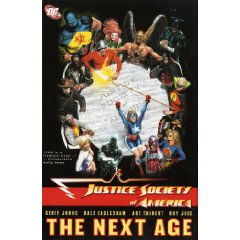
Justice Society of America: the Next Age


By Geoff Johns, Dale Eaglesham, Art Thibert & Ruy Jose (DC Comics)
ISBN: 978-1-84576-606-1

The World’s first Superhero team reboots itself once more after the interminable series of universal Crises (specifically World War III) and in conjunction with the Justice League of America returns as an organisation of heroic veterans working with and training the next generation of young heroes in this new interpretation of the JSA.

Originally published as issues #1-4 of the latest monthly comicbook series, this gripping thriller sees Elder Statesmen Flash, Green Lantern and Wildcat begin a recruitment drive that leads them to the heirs and inheritors of a number of older mystery men just as the corpse of one of the very first costumed heroes comes crashing through their HQ’s skylight, alerting them to a vicious plot by their oldest foe to wipe out “legacy heroes” forever…

Fast paced, tense and eerily gratifying, the venerable, journeyman and apprentice heroes cut loose against modern super-Nazis and the most evil man alive as they gather Cyclone, a new (or perhaps not) Starman, Citizen Steel, Liberty Bell, Damage and another Wildcat into their burgeoning fold just in time for the incipient JLA/JSA crossover The Lightning Saga and the unfolding Countdown to Final Crisis.

Steeped in DC lore and continuity this won’t be accessible to every reader, but it is still a compelling and enjoyable new chapter for the Justice Society and a worthwhile endeavour for fans of big plots and bold costumed crusaders.

© 2007 DC Comics. All Rights Reserved.

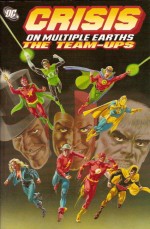
Crisis on Multiple Earths: The Team-Ups


By Gardner Fox, John Broome & various (DC Comics)
ISBN: 978-1-4012-0470-9

As I’ve mentioned before, I was one of the “Baby Boomer” crowd that grew up with Gardner Fox and John Broome’s tantalisingly slow reintroduction of Golden Age superheroes during the halcyon, eternally summery days of the 1960s. To me those fascinating counterpart crusaders from Earth-Two weren’t vague and distant memories rubber-stamped by parents or older brothers – they were cool, fascinating and enigmatically new. And for some reason the “proper” heroes of Earth-One held them in high regard and treated them with obvious deference…

It all began, naturally enough, in The Flash, flagship title of the Silver Age Revolution. After ushering in the triumphant return of the costumed superhero concept the Scarlet Speedster, with Fox and Broome at the reins, set an unbelievably high standard for superhero adventure in sharp, witty tales of science and imagination, illustrated with captivating style and clean simplicity by Carmine Infantino.

Gardner Fox didn’t write many Flash scripts at this time, but those few he did were all dynamite. None more so than the full-length epic that literally changed the scope of American comics forever. ‘Flash of Two Worlds’ (the Flash #123 September 1961, illustrated by Infantino and Joe Giella) introduced the theory of alternate Earths to the continuity and by extension resulted in the multiversal structure of the DCU, Crisis on Infinite Earths and all the succeeding cosmos-shaking crossover sagas that grew from it. And of course where DC led, others followed…

During a benefit gig Flash (police scientist Barry Allen) accidentally slips into another dimension where he finds that the comic-book hero he based his own superhero identity upon actually exists. Every adventure he had absorbed as an eager child was grim reality to Jay Garrick and his mystery-men comrades on the controversially named Earth-2. Locating his idol Barry convinces the elder to come out of retirement just as three Golden Age villains, Shade, Thinker and the Fiddler make their own wicked comeback… Thus is history made and above all else, ‘Flash of Two Worlds’ is still a great read that can electrify today’s reader.

Fox revisited Earth-2 nine months later in #129’s ‘Double Danger on Earth!’ (inked by Murphy Anderson) as Jay Garrick ventured to Earth-1 to save his own world from a doom comet, only to fall foul of Captain Cold and the Trickster. Another cracking thriller, as well as double Flash action, this tale teasingly reintroduced Justice Society stalwarts Wonder Woman, Atom, Hawkman, Green Lantern, Doctor Mid-Nite and Black Canary. Clearly Editor Schwartz had something in mind…

‘Vengeance of the Immortal Villain!’ from Flash #137 (June 1963, inked by Giella) was the third incredible Earth-2 crossover, and saw the two Flashes unite to defeat 50,000 year old Vandal Savage and save the Justice Society of America: a tale which directly led into the veteran team’s first meeting with the Justice League of America and the start of all those aforementioned “Crisis” epics.

That landmark epic can be found elsewhere (most notably in Crisis on Multiple Earths volume 1, ISBN-13: 978-1-56389-895-2), and this collection continues with the less well-known ‘Invader from the Dark Dimension!’ (Flash #151, March 1964, by Fox, Infantino and Giella), a full-length shocker where the demonic Shade ambitiously attempts to plunder both worlds.

Public approval was decidedly vocal and Editor Julie Schwartz used DC’s try-out magazines to sound out the next step: stories set on Earth-2 with exclusively Golden Age characters.

Showcase #55 saw the initial team-up of Doctor Fate and Hourman as the Justice Society stalwarts battled the monster of Slaughter Swamp when ‘Solomon Grundy Goes on a Rampage!’ Produced by Fox and Anderson, this bombastic yarn even had room for a cameo by Earth-2’s Green Lantern, and the original text page featuring the heroes’ origins is also reproduced here.

Showcase #56 also featured “the Super-Team Supreme” (and by the same creative team supreme) in ‘Perils of the Psycho-Pirate!’ wherein ex-con Roger Hayden (cell-mate of the original JSA villain) steals the magical Masks of Medusa to go on an emotion-controlling crime-spree. Fan-historians should note that this tale is a pivotal antecedent of the landmark Crisis on Infinite Earths (ISBN: 978-1-5638-9750-4) as well as a superbly engaging adventure in its own right. A text feature on the original Psycho-Pirate accompanies the story.

Although getting in late to the Counterpart Collaborations game, the inevitable first teaming of the Hal Jordan and Alan Scott Green Lanterns is one of the best and arguably second-most important story of the entire decade. ‘Secret Origin of the Guardians!’ by John Broome, Gil Kane and Sid Greene (Green Lantern #40, October 1965) introduced the renegade Guardian Krona, revealed the origin of the multiverse, showed how evil entered our universe and described how the immortal Oans took up their self-appointed task of policing the cosmos. It also shows Gil Kane’s paramount ability to stage a superhero fight like no other. This pure comicbook perfection should be considered a prologue to the aforementioned Crisis on Infinite Earths.

Still looking for an Earth-2 concept that would support its own series Schwartz, Fox and Anderson debuted the team of Starman and Black Canary in The Brave and the Bold #61 (September-October 1965), pairing the heroes against the eerily translucent villain the Mist in ‘Mastermind of Menaces!’ This compelling thriller is augmented here by the text feature biography of the Black Canary.

Although not featured in this volume, Schwartz and Fox did finally achieve their ambition to launch a Golden Age hero into his own title. After three Showcase appearances and many guest-shots the Spectre won his own book at the end of 1967, just as the super-hero craze went into a steep decline.

This fabulous volume concludes with a back-up tale from issue #7 (November/December 1968) of that brilliant but ill-fated series. ‘The Hour Hourman Died!’ by Fox, Dick Dillin and Sid Greene, is a dark and clever attempted-murder mystery that packs a book’s worth of tension and action into its nine moody pages and serves as a solid thematic reminder that the golden Silver Age of the 1960s was a creative high point that simply couldn’t last. When you start at the top the only way is down…

Still irresistible and compellingly beautiful after all these years, the stories collected here shaped the American comics industry for decades and are still influencing not only today’s funny-books but also the brilliant animated TV shows and movies that grew from them. These are tales and this is a book you simply must have.

© 1961, 1962, 1963, 1964, 1965, 1968, 2005 DC Comics. All rights reserved.