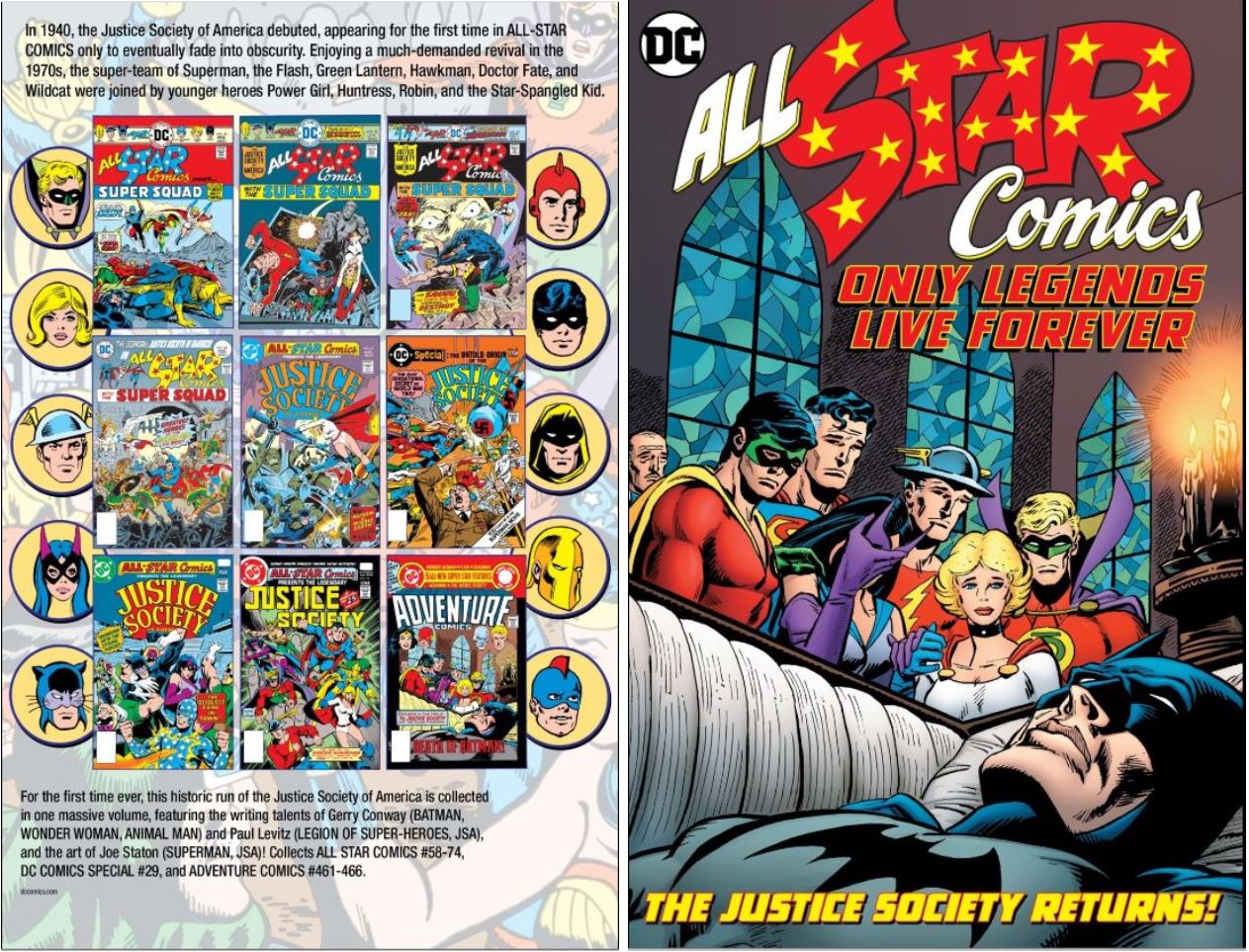
All-Star Comics: Only Legends Live Forever


By Gerry Conway, Paul Levitz, Ric Estrada, Wally Wood, Keith Giffen, Joe Staton, Bob Layton, Joe Giella, Dave Hunt, Dick Giordano, Brian Bolland, Jim Aparo & various (DC Comics)
ISBN: 978-1-7795-0071-7 (HB/Digital edition)

This book includes Discriminatory Content produced in less enlightened times.

Win’s Christmas Gift Recommendation: Ageless Evergreen Super-Sensationalism… 8/10

In the torrid and turbulent 1970s many of the comics industry’s oldest publishing ideas were finally laid to rest. The belief that characters could be “over-exposed” was one of the most long-lasting (after all, it never hurt Superman, Batman or the original Captain Marvel), garnered from years of experience in an industry which lived or died on that fractional portion of pennies derived each month from pocket-money and allowances of kids that wasn’t spent on candy, toys or movies.

By the end of the 1960s, comic book costs and retail prices were inexorably rising and a proportion of titles – especially newly resurrected horror stories – were consciously being produced for older readerships. Nearly a decade of organised fan publications and letter writing crusades had finally convinced publishing bean-counters what editors already knew: grown-ups avidly read comics too. Avidly. Passionately. Obsessively. They would happily spend more than kids and, most importantly, wanted more, more, more of what they particularly loved.

Explicitly: If one appearance per month was popular, extras, specials and second series would be more so. By the time Marvel Wunderkind Gerry Conway was preparing to leave The House of Ideas, DC was willing and ready to expand its variegated line-up with some oft-requested/demanded fan-favourite characters…

Paramount among these was the Justice Society of America, the first comic book super-team and a perennial gem whose annual guest-appearances in the Justice League of America had become an inescapable and beloved summer tradition. Thus in 1976 Writer/Editor Conway marked his second DC tenure (he had first broken into the game writing horror shorts for Joe Orlando) by reviving All Star Comics with number #58. In 1951, as the first Heroic Age ended, the key title had transformed overnight into All Star Western, with that numbering running for a further decade as home cowboy crusaders like Strong Bow, Trigger Twins, Johnny Thunder (a new “masked” do-gooder, not the Golden Age costumed idiot with a genie) and Super-Chief.

If you’re interested, among the other revivals/introductions in “Conway’s Corner” were perennial star Plastic Man, Blackhawk, The Secret Society of Super-Villains, Freedom Fighters, Kobra, Blitzkrieg – and many more.

In case you need reminding in their anniversary year: All Star Comics #3 (cover-dated Winter 1940-1941 and released in November 1940) is the officially cited kick-off for all Superteam tales, even if the assembled mystery men merely had dinner and recounted recent cases. They didn’t actually go on a mission together until ASC #4, which had an April 1941 cover-date and hit newsstands on February 7th.

Set on the parallel world of Earth-2, and in keeping with the editorial sense of ensuring the series be relevant to young readers too, Conway reintroduced a veteran team, leavened with a smattering of teen heroes, combined into a contentious, generation-gap fuelled Super Squad. These young whippersnappers included Robin (already a JSA-er since the mid-1960s and Justice League of America #55); Sylvester Pemberton AKA The Star-Spangled Kid (in actuality a boy-hero from the 1940s lost in time for decades) and – it must shamefully be said – a busty young thing who quickly became the feisty favourite of a generation of growing boys.

Kara Zor-L was attention grabbing in all the right and wrong ways and would soon become infamous as the “take-charge” pushy feminist dynamo Power Girl.

This titanic hardback and digital collection volume gathers that 4-year run of the JSA from the late 1970s into a sublime showcase of so-different, ever-changing times via All-Star Comics #58-74, plus the series’ continuation and conclusion from epic anthology title Adventure Comics (#461-466), and includes the seminal saga from DC Special #29 which, after almost four decades, finally provided the team with an origin…
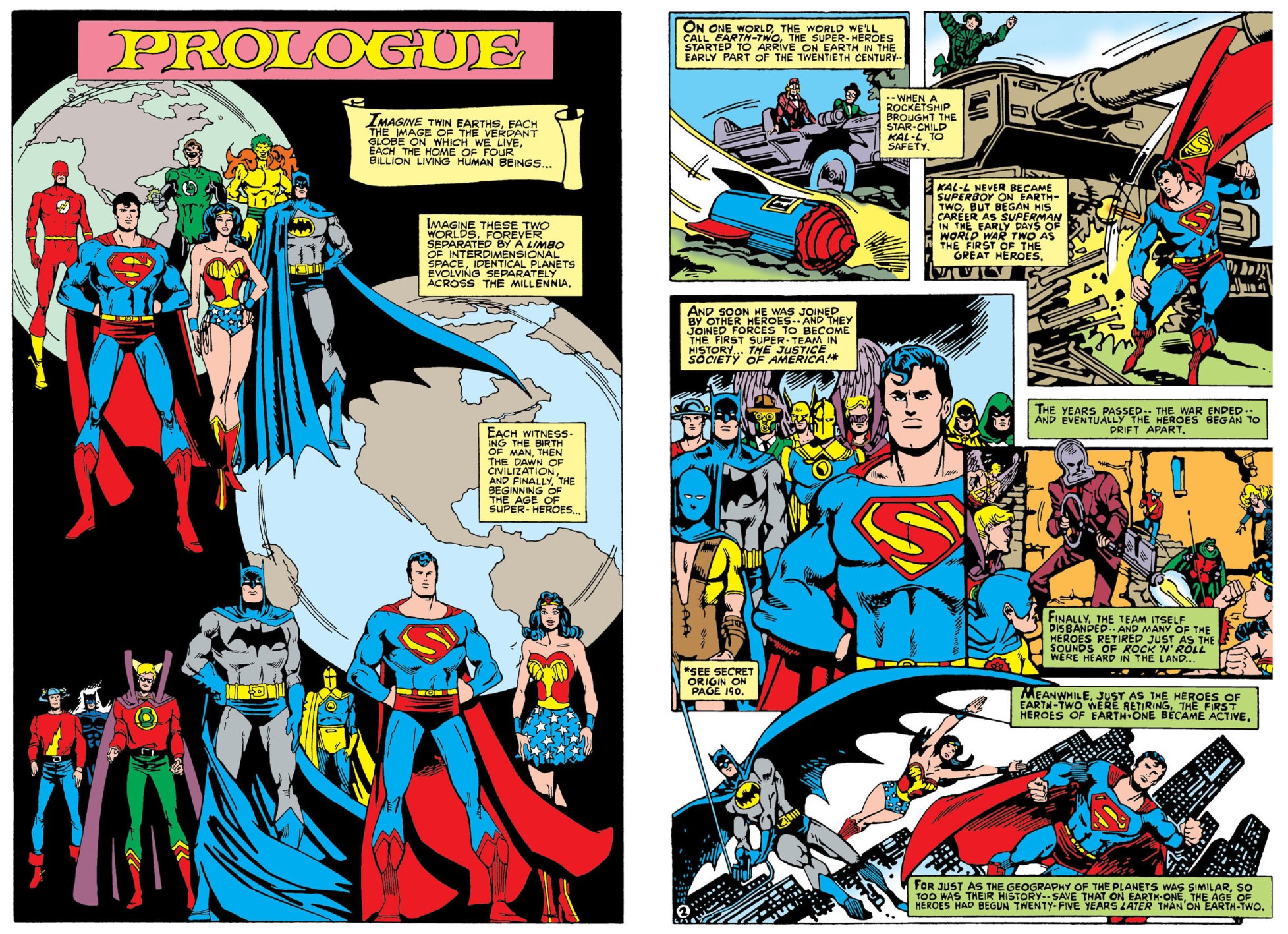
Without preamble, the action begins with ‘Prologue’: a 3-page introduction/recap/summation of the Society’s history as well as the celestial mechanics of Alternate Earths, as crafted by Paul Levitz, Joe Staton & Bob Layton and first seen in Adventure #461, January/February 1979. This outlines the history and workings of DC’s parallel continuities, after which the first half of the 2-part debut tale from All-Star Comics #58 (January/February 1976 by Conway, Ric Estrada &Wally Wood) finds newly-inducted Pemberton chafing at his time-lost plight and revelling in new powers after being given a cosmic-energy device by retired JSA veteran Starman.

When a crisis propels him and elder heroes Flash, Dr. Mid-Nite, Wildcat, Green Lantern, Hawkman and Dr. Fate into a 3-pronged calamity devastating Seattle, Cape Town and Peking (which you youngsters now known as Beijing). With man-made natural disasters, everywhere the elder statesmen split up but are overwhelmed, giving the new kids a chance to shine in ‘All Star Super-Squad’. With abrasive, impatient Power Girl in the vanguard, the entire team is soon on the trail of old foe Degaton and his mind-bending ally in #59’s conclusion ‘Brainwave Blows Up!’
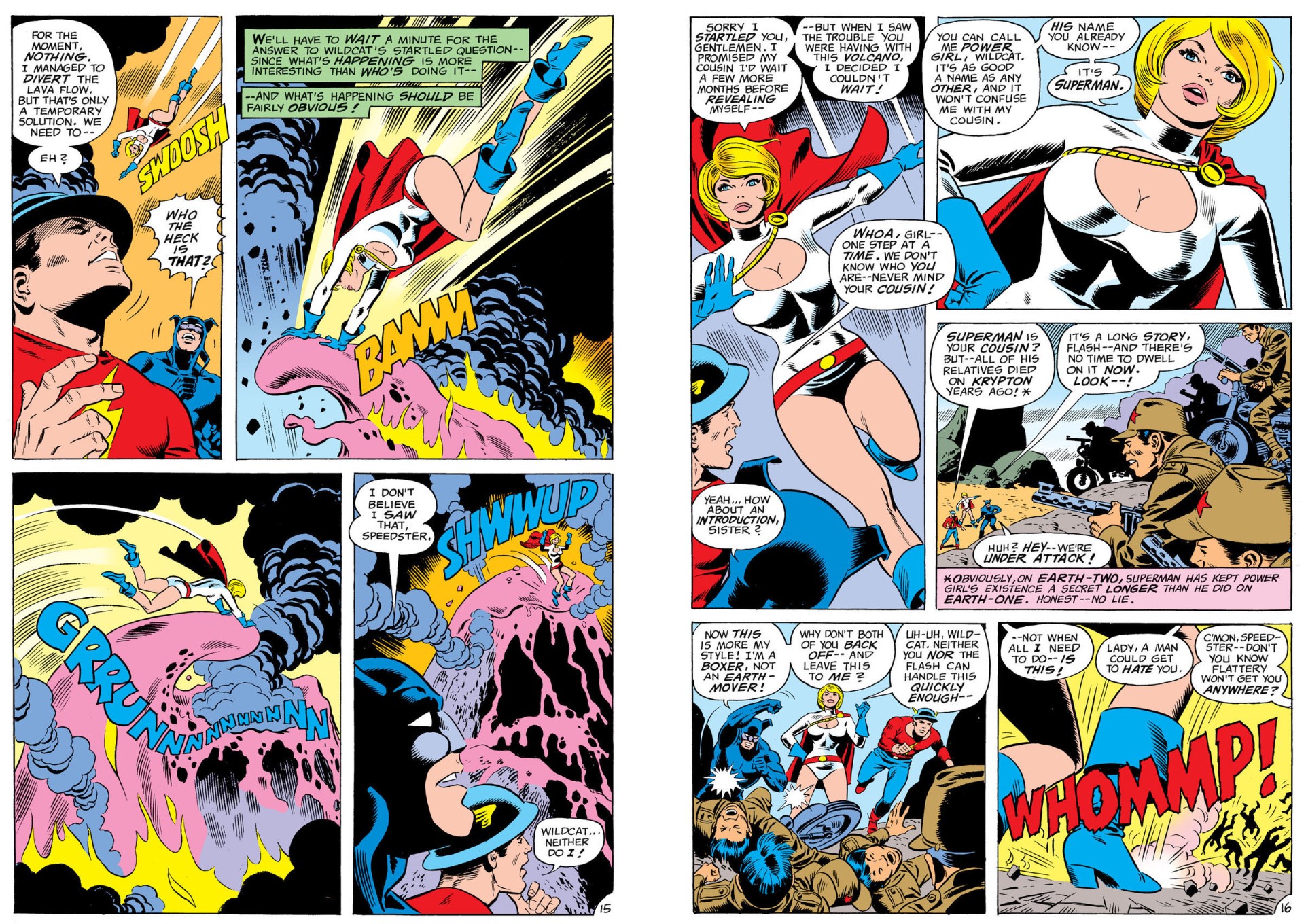
Keith Giffen replaced Estrada in #60 whilst introducing a psychotic super-arsonist who attacks the Squad just as the age-divide starts grating and PG begins ticking off (or “re-educating”) the stuffy, paternalistic JSA-ers in ‘Vulcan: Son of Fire!’. Closing instalment ‘Hellfire and Holocaust’ finds the flaming fury fatally wounding Fate before his own defeat, just as a new mystic menace is stirring…

Conway’s last issue as scripter was #62. ‘When Fall the Mighty’ highlights antediluvian sorcerer Zanadu who devastatingly attacks, even as the criminal Injustice Gang open their latest vengeful assault using mind-control to turn friend against friend. The cast subsequently expands with the return of Hourman and Power Girl’s Kryptonian mentor, but even they prove insufficient to prevent ‘The Death of Doctor Fate’ as written by Paul Levitz. Assaulted on all sides, the team splinters. Wildcat, Hawkman and the Kryptonian cousins tackle the rampant super-villains whilst Flash & Green Lantern search Egypt for a cure to Fate’s condition, and Hourman, Mid-Nite & Star-Spangled Kid desperately attempt to keep their fallen comrade alive.

When they fail Zanadu renews his assault, almost adding the moribund Fate’s death-watch defenders to his tally… until the archaic alien’s very presence calls Kent Nelson back from beyond the grave…
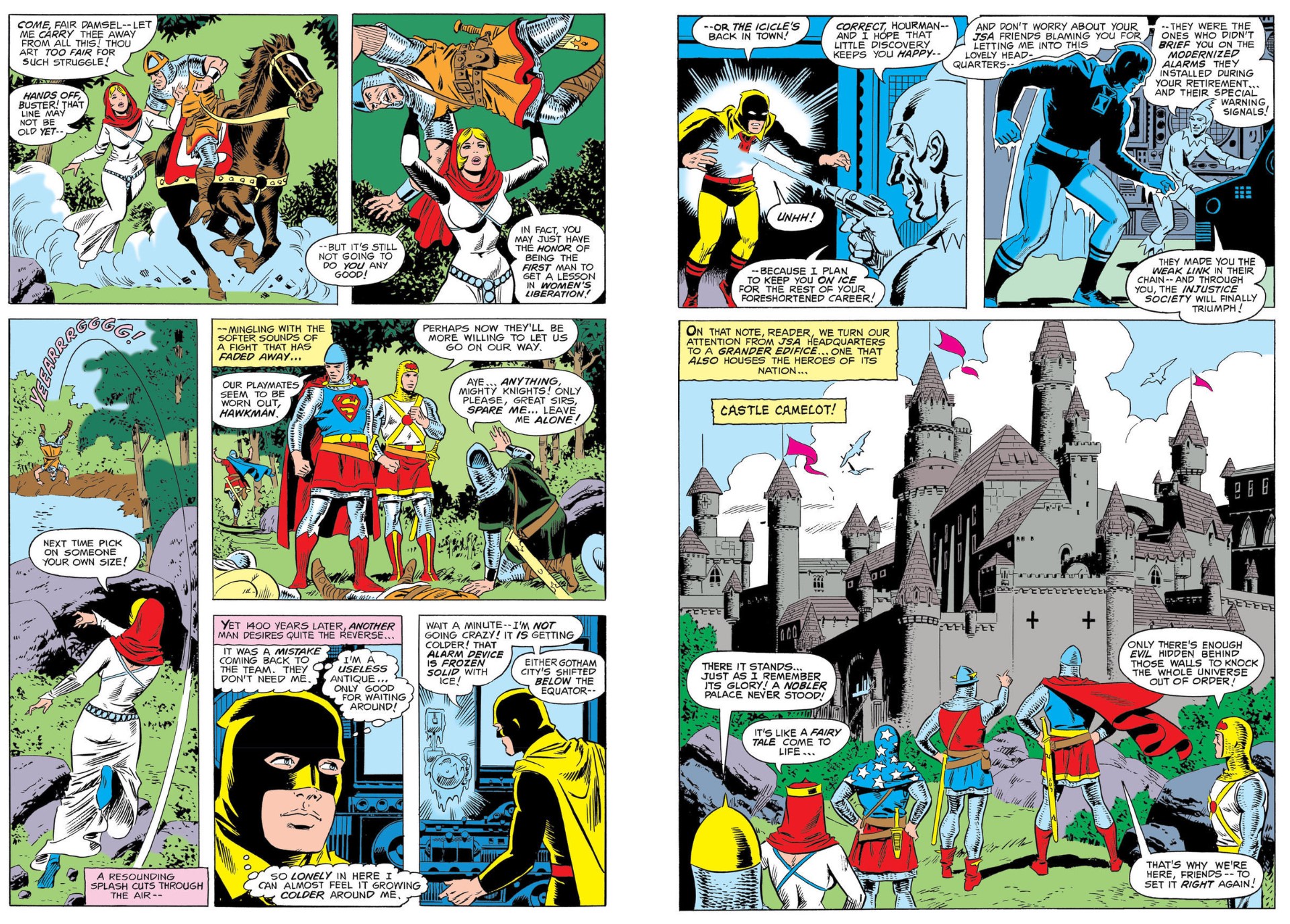
With that crisis averted, Superman makes ready to leave but is embroiled in a last-minute, manic time-travel assassination plot (Levitz script, and fully illustrated by inimitable Wally Wood) which drags the team and guest-star The Shining Knight from an embattled Camelot in ‘Yesterday Begins Today!’ to the far-flung future and ‘The Master Plan of Vandal Savage’: a breathtaking spectacle of drama and excitement that signalled Woody’s departure from the series.

Joe Staton & Bob Layton took the unenviable task of filling his artistic shoes, beginning with #66 as ‘Injustice Strikes Twice!’ wherein the reunited team – sans Superman – fall prey to ambush by arch-enemies, whilst emotion-warping Psycho-Pirate starts twisting GL Alan Scott into an out-of-control menace determined to crush Corporate America beneath his emerald heel. This subsequently leads to the return of Earth-2’s Bruce Wayne, who had previously retired his masked persona to become Gotham’s Police Commissioner. In ‘Attack of the Underlord!’ (All-Star Comics #67, July/August 1977), the Injustice Society’s monstrous allies are revealed as subterranean conquerors who nearly end the team forever. Meanwhile, Wayne’s plans near fruition. He wants to shut down the JSA before their increasingly destructive exploits demolish his beloved city…

Contemporary continuity pauses here as the aforementioned case from DC Special #29 (September 1977) discloses ‘The Untold Origin of the Justice Society’ in an extra-length epic set in 1940. Here Levitz, Staton & Layton reveal previously classified events which saw Adolf Hitler acquire the mystical Spear of Destiny and immediately summon mythical Teutonic Valkyries to aid in the invasion of Britain. Alerted to the threat, US President Franklin Delano Roosevelt – hampered by his country’s neutrality – unofficially asks a select band of masked mystery-men to lend their aid as non-political, private citizens.

In a cataclysmic escalation, the struggle ranges from the heart of Europe throughout the British Isles and even to the White House Oval Office before ten bold costumed champions finally – albeit temporarily – stymy the Nazis’ plans…

Back in All Star #68 (October 1977) the Kryptonian Kid was clearly becoming top star of the show. ‘Divided We Stand!’ (Levitz, Staton & Layton) concludes the Psycho-Pirate’s scheme to discredit and destroy the JSA, and sets the scene for her first solo outing in Showcase #97-99 (which is not included here). Meanwhile GL resumes a maniacal rampage through Gotham and Police Commissioner Wayne takes extreme measures to bring the seemingly out-of-control JSA to book. With ASC #69’s ‘United We Fall!’, he reunites in his own team of retired JSA stars to arrest the rogue squad, resulting in a classic fanboy dream duel as Dr. Fate, Wildcat, Hawkman, Flash, GL & Star-Spangled Kid battled the original Batman, Robin, Hourman, Starman, Dr. Mid-Nite and Wonder Woman. It’s a colourful catastrophe in waiting until PG & Superman intervene to reveal the true cause of all that unleashed madness.
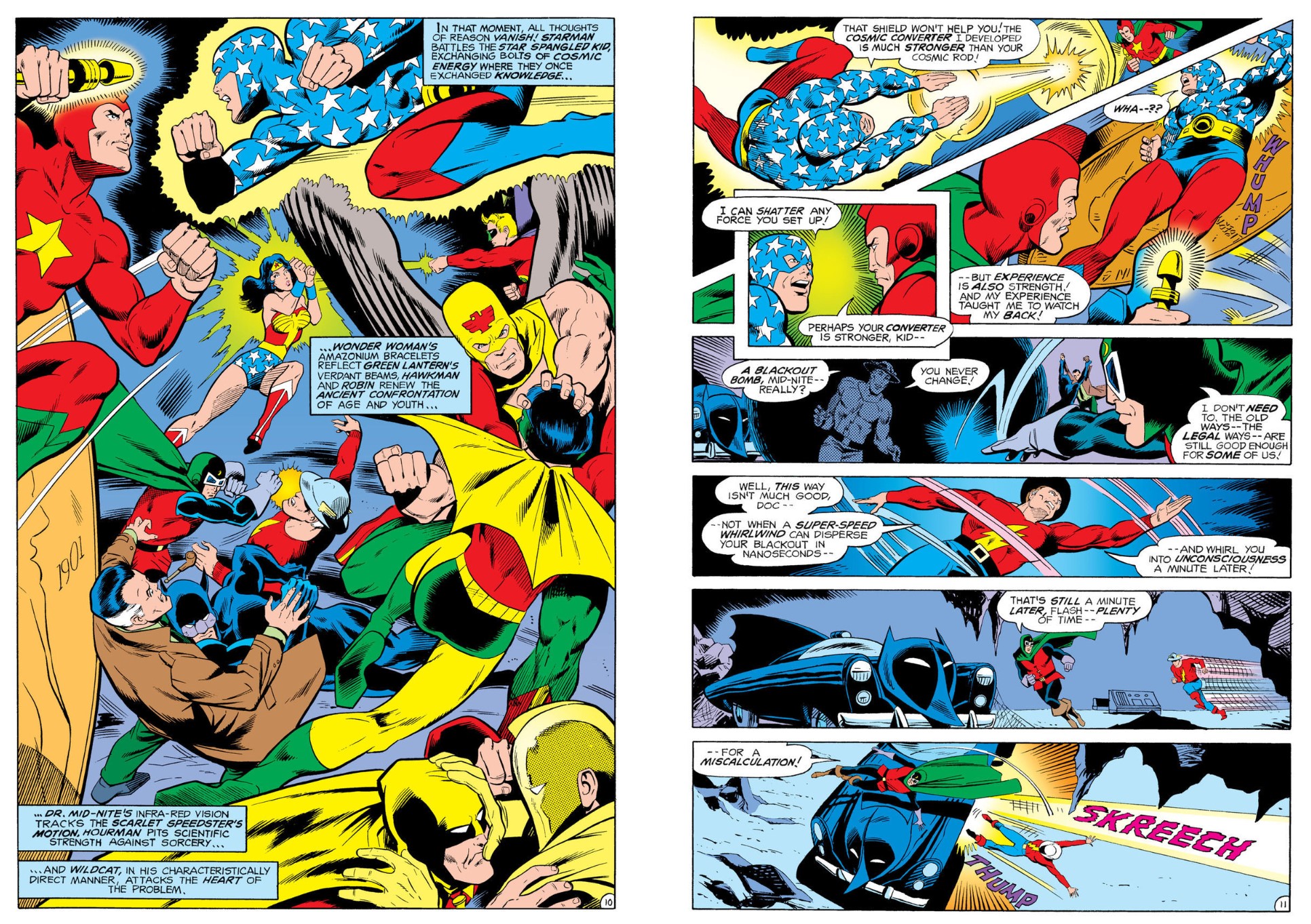
… And in the background, a new character was about to make a landmark debut…

With order restored ‘A Parting of the Ways!’ spotlights Wildcat and Star-Spangled Kid as the off-duty heroes stumble upon high-tech super-thieves Strike Force. These bandits initially prove too much for the pair – and even new star The Huntress – but with a pair of startling revelations in ‘The Deadliest Game in Town!’ the trio finally triumph. In the aftermath, the Kid resigns and the daughter of Batman & Catwoman replaces him…

All-Star Comics #72 reintroduces a brace of classic Golden Age villainesses in ‘A Thorn by Any Other Name’ – wherein the psychopathic floral fury returns to poison Wildcat, leaving Helena Wayne to battle the original 1940’s Huntress for an antidote and rights to the name. With Joe Giella taking over the inker’s role, concluding chapter ‘Be it Ever So Deadly’ sees the whole team deployed as Huntress battled Huntress whilst Thorn and The Sportsmaster do their deadly best to destroy the heroes and their loved ones. Meanwhile in Egypt, Hawkman & Dr. Fate stumble upon a deadly ancient menace to all of reality…

The late 1970s was a perilous period for comics, with exponentially rising costs inevitably resulting in drastically dwindling sales. Many titles were abruptly cancelled in a “DC Implosion” and All-Star Comics was one of the casualties. Issue #74 was the last, pitting the reunited Society against a mystic Armageddon perpetrated by a nigh-omnipotent Master Summoner who orchestrated a ‘World on the Edge of Ending’ before the JSA triumphantly dragged victory from the jaws of defeat…

Although the book was gone, the series continued in 68-page anthology title Adventure Comics, beginning in #461 (January/February 1979) with the first half of a blockbuster tale originally intended for the anniversary 75th issue. Drawn & inked by Staton, ‘Only Legends Live Forever’ details the Batman’s last case as the Dark Knight comes out of retirement to battle a seeming nonentity who has mysteriously acquired god-like power. Adventure #462 delivered the heartbreaking conclusion in ‘The Legend Lives Again!’ before AC #462’s ‘The Night of the Soul Thief!’ sees Huntress, Robin and assembled Society members deliver righteous justice to the mysterious mastermind who actually orchestrated the death of the World’s Greatest Detective…

For #464, an intriguing insight into aging warrior Wildcat reveals ‘To Everything There is a Season…’ as Ted Grant embraces his own mortality and begins a new career as a teacher of heroes, before ‘Countdown to Disaster!’ (inked by Dave Hunt) finds Flash, Green Lantern, Hawkman, Power Girl, Huntress & Dr. Fate hunting a doomsday device lost amidst Gotham’s teeming masses. It would be the last modern outing of the team for years to come…
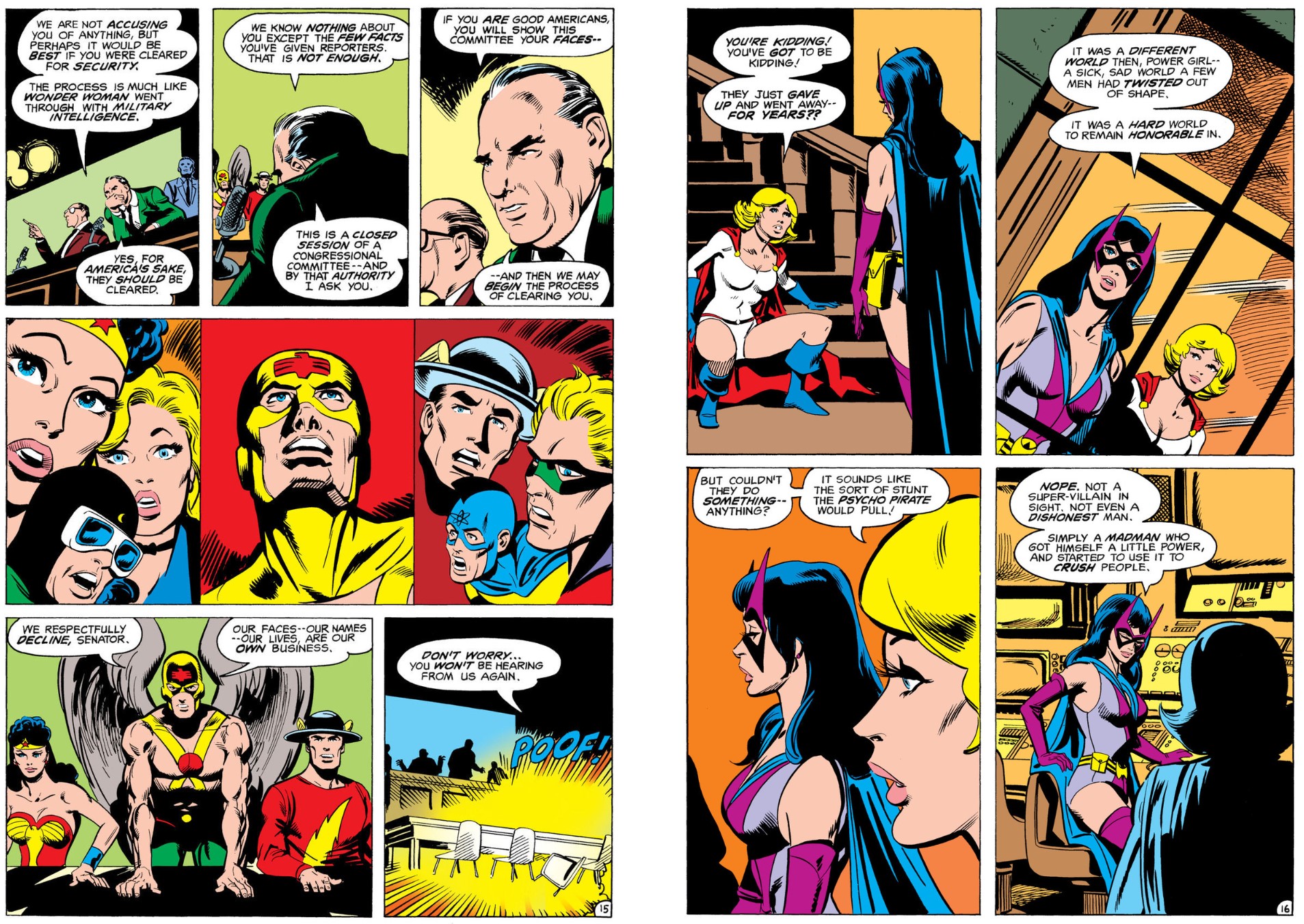
But not the last in this volume: that honour falls to another Levitz & Staton landmark: a little history lesson wherein they expose the reason why the team vanished at the beginning of the 1950s. From Adventure #466, ‘The Defeat of the Justice Society!’ shows how the US Government had cravenly betrayed their greatest champions during the McCarthy witch-hunts: provoking the mystery-men into voluntarily withdrawing from public, heroic life for over a decade… until the costumed stalwarts of Earth-1 started the whole Fights ‘n’ Tights scene all over again…
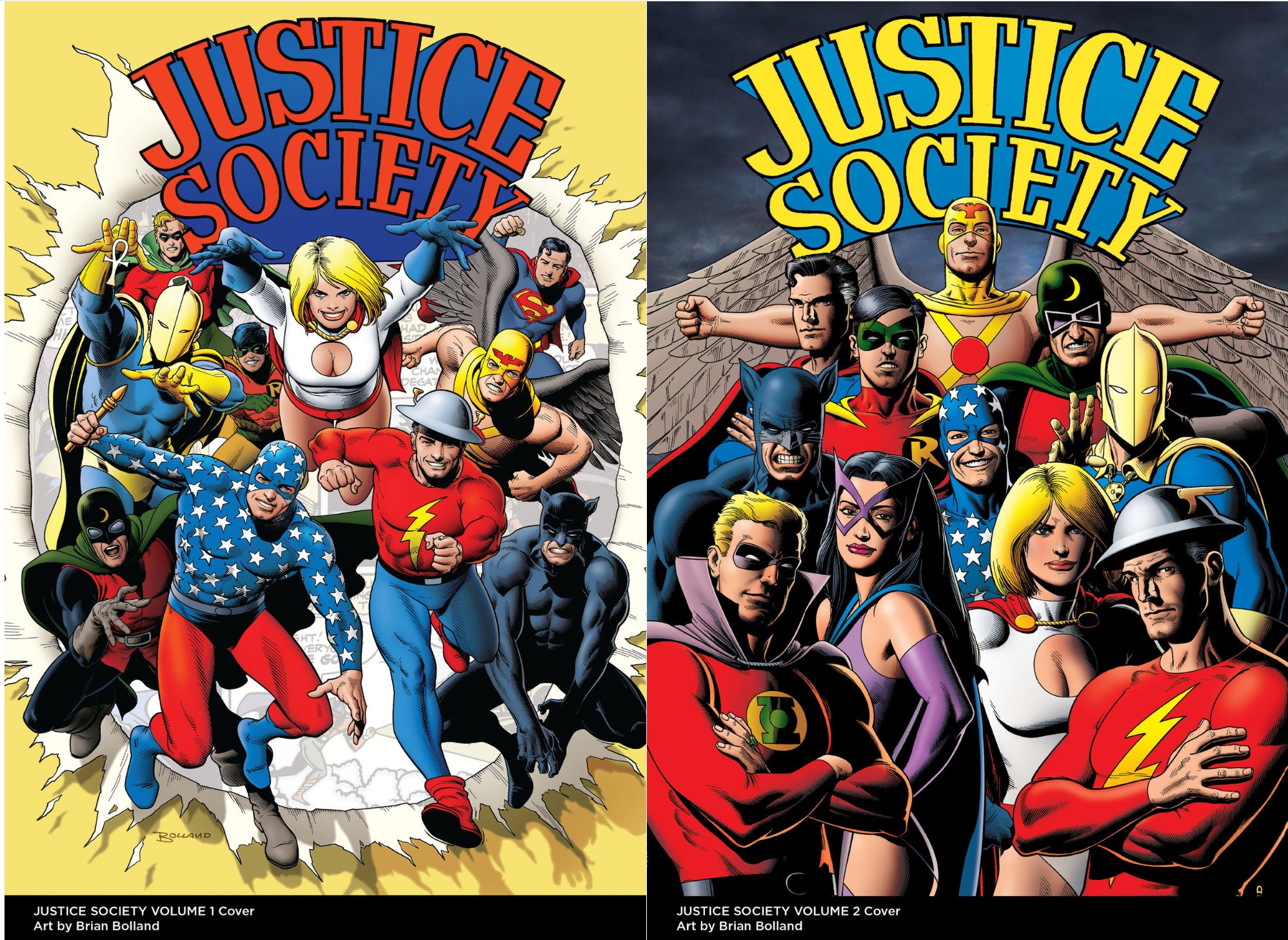
Upping the gaudy glory quotient, a team pin-up by Staton & Dick Giordano and two earlier collection covers from Brian Bolland cap off the costumed dramas.

Although perhaps a tad dated now, these exuberant, rapid-paced, imaginative yarns perfectly blend the naive charm of Golden Age derring-do with cynical modern sensibilities. Here you will be reassured that no matter what, in the end our heroes will always find a way to save the day. Such classic spectacles from simpler times are a glorious example of traditional superhero storytelling at its finest: fun, furious, ferociously engaging, excitingly written and beguilingly illustrated. No Fights ‘n’ Tights fan should miss these marvellous sagas.
© 1976, 1977, 1978, 1979, 2019 DC Comics. All Rights Reserved.

Today in 1912 Cliff Sterrett’s astounding strip Polly and Her Pals ran in US papers for the first time, and in 1921 artist Art Saaf was born – someone else you’ve probably enjoyed without even knowing it, so go learn about him too.
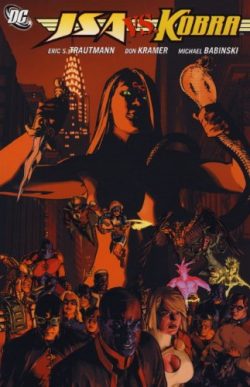
JSA vs. Kobra


By Eric S. Trautmann, Don Kramer & Michael Babinski, with Neil Edwards & various (DC Comics)
ISBN: 978-1-84856-955-3 (TPB)

This book includes some Discriminatory Content produced during less enlightened times.

After the actual invention of the comic book superhero – for which read Superman’s debut in 1938 – the most significant event in the genre – and indeed industry’s – progress was the combination of individual attention-getters into a group. Thus what seems blindingly obvious to us with the benefit of four-colour hindsight was proven: a number of popular characters could multiply readership by combining forces and readerships. Plus of course, a whole bunch of superheroes is a lot cooler than just one – or even one and a sidekick.

The Justice Society of America was created in the third issue (Winter 1940/1941) of All-Star Comics, an anthology title featuring established characters from various All-American Comics publications. The magic was instigated by the simple expedient of having the assorted heroes gather around a table and tell each other their latest adventure. From this low-key collaborative conference it wasn’t long before the guys – and they were all white guys (except Red Tornado who merely pretended to be one) – regularly joined forces to defeat the greatest villains and social ills of their generation. Within months the concept had spread far and wide…

And so the Justice Society of America is rightly revered as a landmark in the development of comic books and, when Julius Schwartz revived the superhero genre in the late 1950s, the game-changing moment came with the inevitable teaming of the reconfigured mystery men into a Justice League of America. From there it wasn’t long until the original and genuine article returned. There were many attempts to formally revive the team’s fortunes but it wasn’t until 1999, on the back of both a highly successful reboot of the JLA by Grant Morrison & Howard Porter, and a seminal but critically favoured new Starman by Golden Age devotee James Robinson, that the multi-generational team found a concept and fanbase big enough to support them. In 1999, the original super-team returned and have been with us in one form or another ever since. In this anniversary year there have numerous excellent efforts to revamp the original OG, and we’ll be getting to those in the months to come…

On sale from November 13th 1975 but cover-dated February 1976, Kobra originated in his own short-lived title during a period of desperate experimentation, whilst traditional superhero sales were plummeting and the industry feared its inevitable extinction. Credited to Martin Pasko, Steve Sherman, Jack Kirby & Pablo Marcos, the saga was a radical updating of Alexandre Dumas’ 1844 novel Les Frères CorsesThe Corsican Brothers

When conjoined twins Jeffrey and Jason Burr were surgically separated soon after birth, Jeffrey was abducted by disciples of the Cult of Kobra and raised to be their Dark Messiah: a deadly warrior, scientist and strategist dedicated to bringing about the end of civilisation and initiating a cleansing “Age of Chaos”. The peculiar circumstances of their birth meant that Jeffrey and Jason maintained an uncanny psychic connection wherein one would experience the hurts and harms inflicted upon the other. Over the years this led Jason to become the ultimate weapon in a war waged by numerous DC heroes against his serpentine terrorist sibling.

Eventually Jason was safely murdered by Kobra, but later resurrected as an even greater evil, assuming his brother’s position as head of the World’s most dangerous death-cult. The new Kobra was an utterly dedicated fanatic who wedded the cult’s technological resources to hideous, sacrificial blood-magic and preferred faith-driven disciples to the disaffected proto-thugs employed by his predecessor (for further details you should see Checkmate: Pawn Breaks or wait for me to finally review the new edition or just buy the book and take a chance…)

The JSA battled the first Kobra many times (most notably in JSA: Darkness Falls and JSA: Savage Times) but were utterly unprepared for the sheer horrors in store when they swung into action against the inheritor of the Snake cult…

This terse, tense collection re-presents 6-issue JSA vs. Kobra ‘Engines of Faith’ miniseries which, informed by the actions of real-world terrorism of fundamentalist factions around the globe, finally elevated Kobra to the first rank of villains: the deadly herald of the World’s End who plays a lethal game of cat-&-mouse with the Planet’s Smartest Man and some of the most experienced heroes of all time…

The Serpent Lord begins his campaign of terror in ‘Bad Religion’, dispatching suicide bombers to destroy the Justice Society in their own home and thereby confronting logic and superpowers with pure faith and high-tech explosives. Caught off guard by foes actually happy to die if they can strike a blow against their master’s enemies, the JSA are further wrong-footed by seemingly random attacks against civilians and institutions, all orchestrated by field commander and fanatical bride of death Ariadne Persakis.

The sheer scale of the bloodletting and illogical nature of the attacks soon has our heroes fighting amongst themselves as they strive to find some rhyme or reason behind such senseless, murderous assaults… so why then does Persakis abruptly surrender herself to their custody?

‘Strange Days’ finds the team seething but still unable to fathom the terrorist’s game plan… until Ariadne breaks free of Checkmate custody. Apparently the covert international spy-force has been hopelessly infiltrated and compromised. The senseless death-toll mounts exponentially and as, the team narrowly thwart an assault on a giant particle accelerator that could split the Earth in two, masked genius Mr. Terrific begins to discern a pattern to the random madness in ‘Misdirection’

Brutal attacks intensify and, although it appears the good guys are slowly gaining the upper hand, Terrific perceives the hidden agenda behind the unceasing ghastly blows against decency and civilisation. ‘Lightning in a Bottle’ sees Kobra make his ultimate move and apparently fail, leading to a gathering of champions ‘Beating the Grass’ and taking the war to the relentless foe, but even after stunning climax ‘Shedding Skin’ the weary heroes cannot be sure if they have won the day or somehow lost the war entirely…

This is a stunning piece of Fights ‘n’ Tights fiction: dark, dramatic and intensely compelling. Writer Eric S. Trautmann melded shiny superheroics, grim realpolitik and genuine cultural zeitgeists into a splendidly mature costumed drama, and the effective underplayed art of Don Kramer, Neil Edwards and inker Michael Babinski is chillingly effective at capturing the tone as well as the events.

If you think you’ve grown beyond gaudy mystery men and “goodies” against “baddies” this graphic novel is more than likely to make you think again.
© 2009, 2010 DC Comics. All rights reserved.

Harley Quinn: A Rogue’s Gallery – The Deluxe Cover Art Collection


By Bruce Timm, Terry & Rachel Dodson, Amanda Connor & Paul Mounts, Tim Sale, Jim Lee, Frank Cho, Alex Ross and many & various (DC Comics)
ISBN: 978-1-4012-7423-8 (HB/Digital edition)

Comic books aren’t just stories. So often the cover is as important and thrilling as the contents – if not more so. Let’s face it; we’ve all gone for something for its appearance only to be disappointed by its interior. So it’s a relief and a delight to thoroughly recommend a comic cover-art compilation where the visuals are as extraordinary as the material they were promoting.

Harley Quinn was never supposed to be a star – or even actual comics character. As soon became apparent, however, the manic minx always has her own astoundingly askew and off-kilter ideas on the matter – and any other topic you could name: ethics, friendship, ordnance, coffee, cuddle bunnies…

Created by Paul Dini & Bruce Timm, Batman: The Animated Series aired in the US from September 5th 1992 to September 15th 1995. Ostensibly for kids, the breakthrough television cartoon revolutionised everybody’s image of the Dark Knight and immediately began feeding back into the print iteration, consequently leading to some of the absolute best comic book tales in the Dark Knight’s many decades of existence.

Employing a timeless visual style dubbed “Dark Deco”, the show mixed elements from all iterations of the character and, without diluting the power, tone or mood of the premise, reshaped the grim avenger and his extended team into a universally accessible, thematically memorable form even the youngest of readers could enjoy, whilst adding exuberance and panache that only the most devout and obsessive Batmaniac could possibly object to…

Harley was initially the Clown Prince of Crime’s self-destructive, slavishly adoring, extreme abuse-enduring assistant, as seen in “Joker’s Favor” (airing September 11th 1992). She instantly captured the hearts and minds of millions of viewers and began popping up in the incredibly successful licensed comic book. Always stealing the show, Harley soon graduated into mainstream DC continuity. Along the circuitous way, Quinn – AKA Dr. Harleen Quinzel – developed a support network of sorts in living bioweapon Poison Ivy and a bizarre love/hate relationship with some of Gotham’s other female felons…

After a brief period bopping around the DCU, she was re-imagined as part of the company’s vast post-Flashpoint major makeover: subsequently appearing all over comics as cornerstone of a new iteration of the Suicide Squad, in those aforementioned movies and her own adult-oriented animation series. At heart, however, she’s always been a comic glamour-puss, with big, bold, primal emotions and only the merest acknowledgement of how reality works…

Harley Quinn: A Rogue’s Gallery – The Deluxe Cover Art Collection is a giant collection of some of the best comic covers from her first quarter century of existence spanning her first print appearance in Batman Adventures #12 (1993) to 2017: charting her progress from frolicsome cartoon felon to comic book big draw, movie magnate and all around gay icon.

Of course, you could just take my word for it and accept there are gathered here 170 fabulous eye-grabbing images (plus a few bonus sketches and such) by 92 stellar artists – mostly stripped of verbal clutter and text livery – but I suspect many will also study the huge shopping lists of names and numbers assembled below.

YOU DO NOT HAVE TO READ THEM – they are for obsessive completists like me, okay?

If you’re still here and not off shopping now, what’s here are the covers from Batman Adventures: Mad Love #1, Batman Adventures #12; Gotham Adventures #12;  Batman: Harley Quinn #1;  Harley and Ivy: Love on the Lam #1; Harley Quinn #1, 3, 4, 9, 11, 13, 19, 38; Batman Adventures #3, 16; Gotham Girls #3; Harley and Ivy#1-3; Detective Comics #831, 837; Batman #613; Joker’s Asylum II: Harley Quinn #1; Gotham City Sirens #1, 5, 15, 20; Gotham City Sirens Book II; Suicide Squad #1, 6, 7, 14, 15, 21; Detective Comics volume 2 #23.2, 39; Harley Quinn volume 2 #0-3, 6-9, 11-13, 15-19, 23, 24, 26, 29, 30; Harley Quinn Invades Comic-Con International: San Diego #1; Harley Quinn Holiday Special #1; Harley Quinn Valentine’s Day Special #1; Secret Six #5; Action Comics volume 2 #39; Aquaman volume 2 #39; Batgirl volume 4 #39; Batman volume 2 #39; Batman and Robin volume 2 #39; Batman/Superman #19; Catwoman volume 4 #39; The Flash volume 4 #39, 47; Grayson #7; Green Lantern volume 5 #39, 47; Green Lantern Corps volume 3 #39; Justice League volume 2 #39, 47; Justice League Dark volume 1 #39; Justice League United #9; Sinestro #10; Supergirl volume 6 #39; Superman volume 3 #39, 47, Superman/Wonder Woman #19; Teen Titans volume 4 #7; Wonder Woman volume 4 #39, 47; New Suicide Squad #4, 22; Green Arrow volume 5 #47; Justice League of America volume 3 #6; Harley Quinn and the Suicide Squad: April Fool’s Special #1; Harley Quinn and the Suicide Squad: April Fool’s Special #1; Harley Quinn and Her Gang of Harleys #1; DC Comics Bombshells #27, 32; Harley Quinn volume 4 #1, 4, 6, 10, 11, 13, 17-19, 21, 22; Harley’s Greatest Hits; Harley Quinn Volume 1: Die Laughing; Justice League Vs Suicide Squad #1, 3; Suicide Squad: Rebirth #1 and Suicide Squad volume 7 #1-2, 4, 8, 13, 16, 20.

These are chronologically delivered, fully listed and accredited on the contents pages, so I’m also going to list the creators in case someone’s a particular favourite. Represented here by single images or many bites of the cheery cherry are Bruce Timm, Mike Parobeck & Rick Burchett, Alex Ross, Shane Glines, Joe Chiodo, Terry Dodson & Rachel Dodson, Tim Sale, Scott Morse, Kelsey Shannon, Simone Biachi, Jim Lee & Scott Williams, Claudio Castellini, Guillem March, Ryan Benjamin, Paul Renaud, Ivan Reis, Eber Ferreira & Rod Reis, Greg Capullo & FCO Plascencia, Ken Lashley & Matt Yackley, Jason Pearson, Chris Burnham & Nathan Fairbairn, Amanda Connor & Paul Mounts, Dave Johnson, Alex Sinclair, Stephane Roux, Adam Hughes, Clay Mann, Tommy Lee Edwards, Mike Allred & Laura Allred, Ant Lucia, Darwin Cooke, Dan Panosian, Eduardo Risso, Ben Caldwell, Emanuela Lupacchino & Tomeu Morey, Chad Hardin, Neal Adams, Ryan Sook, Jeromy Cox, John Timms, Nicola Scott, Danny Miki, Cliff Chiang, Jill Thompson, J.G. Jones, Jim Balent, Mike McKone & Dave McCaig, Marco D’Alfonso, Dustin Nguyen, Joe Quinones, Mikel Janin, Ian Bertram, Matt Hollingsworth, Joe Benitez, Peter Steigerwald, Francis Manapul, Sean Galloway, Phil Jimenez & Hi-Fi, Jeremy Roberts, Juan Ferreyra, Brennan Wagner, Joe Madureira, Nei Ruffino, Lee Bermejo, Frank Cho, Mirka Andolfo, Joseph Michael Linsner, Minjue Helen Chen, Tony S. Daniel, Jason Fabok, Babs Tarr, Rafael Albuquerque, Yanick Paquette, Paul Pope & Lovern Kindzierski, Tyler Kirkham, Jae Lee & June Chung, Ed Benes & Dinei Ribeiro, Aaron Lopresti, Tom Raney & Gina Going, Khary Randoph & Emilio Lopez, Michael Turner, Carlos D’Anda, Laura Martin, Sabine Rich, Bill Sienkiewicz, Ashley Witter, Dawn McTeigue, Jonboy Myers, Sunny Gho, Philip Tan & Jonathan Glapion, Paul Pelletier & Sandra Hope, Joshua Middleton. Liam Sharp, Billy Tucci, John Romita Jr & Dean White, and Otto Schmidt.

This collection is exciting, lovely to look upon, deliriously daft, happily hilarious and will provide hours of delighted deliberation as we all dip in, reminisce and ultimately disagree on what should and shouldn’t be included. Enjoy, Art-lovers, Bat-Fans and proud Harley-queens!

If you are utterly absorbed and crave still more, you might want to also see companion volume The Art of Harley Quinn by Andrew Farago.
© 1993, 1994, 1995, 1999, 2001, 2002, 2003, 2004, 2007, 2009, 2010, 2011, 2012, 2013, 2014, 2015, 2016, 2017 DC Comics. All Rights Reserved.

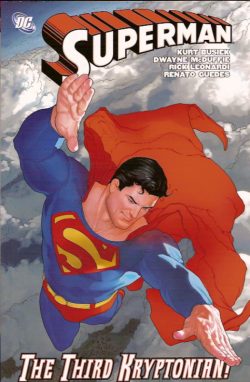
Superman: The Third Kryptonian


By Kurt Busiek, Dwayne McDuffie, Fabian Nicieza, Rick Leonardi, Renato Guedes, José Wilson Magalhaés, Dan Green & various (DC Comics)
ISBN: 978-1-4012-1987-1 (TPB)

After interminable page counts and the preponderant never-ending angst of hyper-mega-ultra-braided multi-part cross-overs, it’s quite nice to pick up an – admittedly slim – endeavour of more modest means and intent: to wit, a book with a couple of stories that actually begin, occur and end.

Collecting Action Comics #847, Superman #668-670 and Superman Annual #13, this tome actually has three yarns to delight, beginning with Kurt Busiek, Rick Leonardi and Dan Green’s mini-epic wherein every survivor of lost Krypton on Earth, including Power Girl, Clark and Lois’ adopted son Chris (don’t fret, it’s all explained in the story) and even Krypto are targeted for destruction by brutal space pirate Amalak, hungry to take vengeance for the misdeeds of the long dead “Kryptonian Empire”.

Imagine how the irate rogue reacts upon discovering that – unbeknownst to all – an actual survivor of that long-dead galactic aggressor-state has been living secretly on Earth for years…

Good old-fashioned romp though it is, the real meat of this tale was an adjustment and rewriting of Kryptonian history for the post-Smallville/Superman Returns generation. As the disparate continuities of TV, Cinema and comic books were massaged closer to overarching homogeneity, the best of the old was retrofitted to the new. This is an uncomplicated adventure thriller with nostalgic overtones that has a lot to recommend it.

‘The Best Day’ (Busiek, Fabian Nicieza, Guedes & José Wilson Magalhaés) offers sheer delight, and beautiful execution. In a quiet moment, Superman and Supergirl take the Kent clan on a picnic to the stars where we get a chance to see beloved characters interact in joy and relaxation, as the skies of a million universes aren’t collapsing around their invulnerable ears. It’s a brave, rewarding return to old ways and I still want to see more of it.

So go no further than ‘Intermezzo’ (McDuffie and Guedes), another introspective segment sliced from a longer epic, short on punching but big on emotional wallop as Jonathan and Martha Kent share secrets and reveal close-held fears as their adopted son struggles off-camera with another “Never-Ending Battle.”

It’s such gentle moments and the emotional beats that give the best adventure fiction its edge, and this book has them in delightful quantities. This is the stuff that made Superman a legend, and in this anniversary year this collection is an ideal argument for stuff like this to stage a comeback.
© 2007, 2008 DC Comics. All Rights Reserved.

The Brave and the Bold volumes 1 & 2: The Lords of Luck and The Book of Destiny


The Lords of Luck By Mark Waid & George Pérez & various (DC Comics)
ISBN: 978-1-84576-649-8 (US HB) 978-1-84576-649-8 (TPB)

There are so many great graphic novels and compilations available these days that it’s always a shock when I realise how many more are still out of print. Here’s a classic example just begging for revival and digital editions…

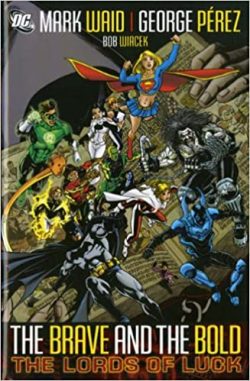
The Brave and the Bold: The Lords of Luck collects the first 6 issues of another revival of a venerable DC title (technically volume 3 and spanning April -September 2007): returning it not only to the fitting team-up format we all enjoyed, but doing so with such style, enthusiasm and outright joy that I’m reduced to a gawping, drooling nine-year-old again.

Here Mark Waid, George Pérez and inkers Bob Wiacek & Scott Koblish crafted an intergalactic romp through time and nether dimensions, ripping across the DC Universe in a funny, thrilling and immensely satisfying murder-mystery-come-universal-conquest saga.

When Batman and Green Lantern (in part one ‘Roulette’ and concluding episode ‘The Girl Who Knew Too Much’) discover absolutely identical corpses hundreds of miles apart it sets them on the trail of probability-warping aliens and the missing Book of Destiny – a mystical chronicle of everything that ever was, is, and will be!

And yes, that makes this a notional tie-in to The Sandman series by Neil Gaiman and his coterie of classy creatives…

Each issue/chapter highlights a different team-up and eventually the hunt by Adam Strange, Blue Beetle (‘The Lord of Time’), Destiny (of the Endless, no less in chapter 4 ‘The Garden of Destiny’), the Legion of Super Heroes (‘The Batman of Tomorrow’), Lobo, Supergirl (‘Ventura’) and a mystery favourite from long-ago (you’ll thank me for not blowing the secret, honestly!) plus an incredible assortment of cameo stars coalesces into a fabulous free-for-all that affirms and reinforces all the reasons I love this medium.

With the value-added bonus of an annotated exploration of Waid & Pérez’s creative process to entrance the aspiring creator-of-tomorrow, this is a great story with great art, and is perfect for all ages to read and re-read over and over again. So let’s hope that happens soon…

© 2006, 2007 DC Comics. All Rights Reserved.


The Book of Destiny

By Mark Waid, George Pérez, Jerry Ordway, Bob Wiacek & Scott Koblish (DC Comics)

ISBN: 978-1-4012-1838-6 (HB) 978-1-4012-1861-4 (TPB)

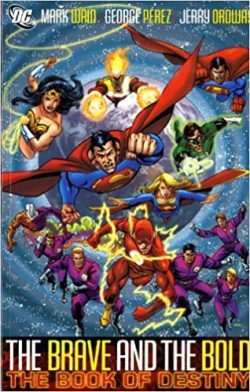
The Book of Destiny is a mystical ledger which charts the history, progress and fate of all Reality and everything in it – except for the four mortals entrusted with its care at the end of The Brave and the Bold: The Lords of Luck. The death-defying Challengers of the Unknown – cool pilot Ace Morgan, indomitable strongman Rocky Davis, intellectual aquanaut Prof. Haley and daredevil acrobat Red Ryan – live on borrowed time and were bequeathed the terrifying tome by Destiny of the Endless since their lives are no longer included within its horrifying pages…

After the staggering spectacle of the previous Brave and the Bold story-arc, here Waid & Pérez, with inkers Bob Wiacek & Scott Koblish are joined by co-penciller Jerry Ordway for a stunning sequel featuring most of the DC universe…

This compilation collects issues #7-12 (volume 3 from December 2007-June 2008) of the high-energy, all-star revival of the venerable DC title: playing novel games with traditional team-up format as a mysterious mage begins manipulating heroes and villains in a diabolical alchemical scheme to transform the cosmos fundamentally and forever…

Beginning with ‘Scalpels and Chainsaws’ – wherein Wonder Woman and the ever-abrasive Power Girl rub each other the wrong way (oh please, what are you, ten!?) whilst tackling an undead invasion, the case takes a stranger turn and Kara-Zor-L accidentally discovers the Caped Kryptonian has been brainwashed into trying to murder her cousin Superman

Their ill-tempered investigations lead to the fabled Lost Library of Alexandria and a disastrous confrontation with the deranged Dr. Alchemy, but he too is only a pre-programmed pawn – of a sinister presence called Megistus – who needs Power Girl to use the mystical artefact known as the Philosopher’s Stone to turn the Fortress of Solitude into pure Red Kryptonite…

Thanks to Wonder Woman’s battle savvy, the plot is frustrated and the stone thrown into the sun… just as Megistus intended…

All this has been perused in the mystic chronicle by the Challengers and their fifth member Dr. June Robbins – whose merely mortal existence and eventual doom are tragically recorded in the Book. They rush off to investigate a universe-rending menace even as ‘Wally’s Choice’ brings The Flash and his rapidly aging children Jai and Iris West into unwelcome contact with manipulative genius Niles Caulder and his valiant Doom Patrol. “The Chief” claims he can cure the twins’ hyper-velocity malady, but Caulder never does anything for selfless reasons…

With no other hope, Wally and wife Linda acquiescence to the mad genius’ scheme – which relies on using elemental hero Rex Mason to stabilise their kids’ critical conditions. It might have worked, had not Metamorpho been mystically abducted mid-process – consequently transforming the children into bizarre amalgams of Negative Man and Robot Man

Worst of all, Flash is almost forced to choose which child to save and which should die…

Thinking faster than ever, the Scarlet Speedster beats the odds and pulls off a miracle but, in a distant place, the pages of the Book are suddenly possessed and abruptly attack the Challengers…

‘Changing Times’ features a triptych of short team-up tales which play out as the Men that History Forgot battle a monster made of Destiny’s pages, beginning as the robotic Metal Men joined forces with young Robby Reed who could become a legion of champions whenever he needs to Dial H for Hero.

Sadly not even genius Will Magnus could have predicted the unfortunate result when crushingly shy robot Tin stuck his shiny digit in the arcane Dial…

Next, during WWII the combative Boy Commandos are joined by The Blackhawks in battling animated mummies intent on purloining the immensely powerful Orb of Ra from a lost pyramid, after which perpetually reincarnating warrior Hawkman joined All-New Atom Ryan Choi in defending Palaeolithic star-charts from the marauding Warlock of Ys.

None of them are aware that they are doing the work of malignly omnipresent Megistus…

The fourth chapter paralleled the Challengers’ incredible victory over the parchment peril with a brace of tales seeing the Man of Steel travel to ancient Britain to join heroic squire Brian of Kent (secretly the oppression-crushing Silent Knight) in bombastic battle against a deadly dragon, whilst the Teen Titan’s untold second ever case finds Robin, Wonder Girl and Kid Flash in Atlantis for the marriage of Aquaman and Mera.

Unfortunately Megistus’ drone Oceanus crashes the party, intent on turning Aqualad into an enslaved route map to the future…

And in California, the Challengers attempted to save Green Lantern’s Power Battery from being stolen only to find it in the possession of an ensorcelled Metamorpho…

As the Element Man easily overwhelms Destiny’s Deputies, Jerry Ordway assumed the penciller’s role for issues #11-12.

‘Superman and Ultraman’ saw the natural enemies initially clash and then collaborate at the behest of an alternate universe’s Mr. Mixyezpitelik, who reveals the appalling scope and nature of Megistus’ supernal transformational ambitions, leading to a gathering of the heroic clans and a blistering Battle Royale in the roaring heart of the Sun…

With the fate of reality at stake and featuring a veritable army of guest stars ‘The Brave and the Bold’ concludes the saga with a terrible, tragic sacrifice from the noblest hero of all, whilst subtly setting the scene for the then-upcoming Final Crisis

With fascinating designs and pencil drawings from Ordway to tantalise the art lovers, this second captivating collection superbly embodies all the bravura flash’n’dazzle thrills superhero comics so perfectly excel at. This is a gripping fanciful epic with many engaging strands perfectly coalescing into a frantic and fabulous free-for-all overflowing with all the style, enthusiasm and exuberant joy you’d expect from top costumed drama talents.

The Brave and the Bold: The Book of Destiny is another great story with great art, ideal for kids of all ages to read and re-read over and over again.
© 2007, 2008 DC Comics. All Rights Reserved.