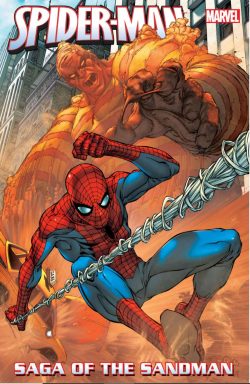
Spider-Man: Saga of The Sandman


By Stan Lee, Roy Thomas, Tom DeFalco, Kurt Busiek, Steve Ditko, Jack Kirby, Herb Trimpe, Ross Andru, Ron Wilson, Patrick Olliffe & various (Marvel)
ISBN: 978-0-7851-2497-9 (TPB/Digital edition)

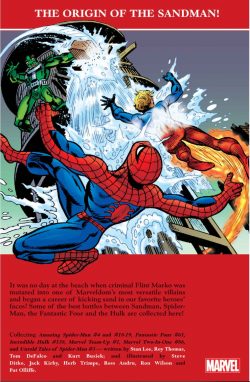
Spider-Man debuted in the summer of 1962 – Happy Anniversary, webslinger! – but didn’t really take off until he won his own title in the early days of 1963 – so expect a whole bunch of Spidey-reviews here next year. A crucial factor in his success was the ever-expanding and iconic legion of super-foes Steve Ditko, Stan Lee and all their successors so sensibly highlighted over the years. many of them starring in archives like this one on the back of their movie appearances. Here’s another to be going on with… 

Heroes are only truly defined by their enemies and superheroes doubly so, with the added proviso that costumed crusaders generally have a rogue’s gallery of fantastic foes rather than just one arch-nemesis. Even so, there’s always one particular enemy who wears that mantle: Moriarty for Sherlock Holmes; Blofeld for James Bond; Luthor for Superman.

Spider-Man has always had two top contenders… but Sandman isn’t one of them. (*If you can’t guess, check out the end of the review, puzzle-fans!).

This nifty compilation gathers a range of tales featuring gritty gangster William Baker (AKA Flint Marko): a cheap thug who remade himself into a major threat in numerous spectacular clashes with the wondrous wallcrawler and other Marvel Stars. This brief compilation traces his rather rocky development by a series of key moments: uncomplicated, no-frills thrill-rides each delivering frantic spills and chills, equally appetising to film-inspired new meat and grizzled old veterans of the Fights ‘n’ Tights arena.

It all starts with Amazing Spider-Man #4, cover-dated September 1963, as Lee & Ditko resort to the ubiquitous atomic experiment maguffin to absurdly empower a commonplace, uneducated low grade career criminal, to counterbalance the preponderance of evil geniuses.

‘Nothing Can Stop… the Sandman!’ was another instant classic as brutally violent, simplistic thug Marko gains the shapeshifting power to transform into all aspects of sand. Terrorising New York City, he evades and humiliates the cops before invading Peter Parker’s high school.

Ruthless and deadly, he is challenged by the mysterious Spider-Man who must stop the monster at all costs. The epic clash proves that wits trump force every time…

Marko returned in issues #18-19 (November & December 1964), joining an already in-progress imbroglio by Lee & Ditko. In AS #17 (not included here) the wallcrawler endured renewed print assaults from the Daily Bugle and its rabid publisher J. Jonah Jameson just as enigmatic archfoe Green Goblin began a war of nerves and attrition, employing the Enforcers, Sandman and an army of thugs to publicly humiliate the Amazing Arachnid. To exacerbate matters Parker’s beloved Aunt May’s health took a drastic downward turn…

Resuming here with ‘The End of Spider-Man!’ and explosively concluding in the triumphal ‘Spidey Strikes Back!’ – featuring a turbulent team-up with friendly rival Johnny StormThe Human Torch was another teen Sandman frequently fought – the extended tale proved fans were ready for every kind of narrative experiment and that overwhelming tension, drama and action were always welcome.

As the sixties progressed Sandman teamed up with fellow Torch arch foes The Wizard and Trapster as the core of evil alliance The Frightful Four: targeting the Fantastic Four with determination but little success. That war led to a revolutionary evolution in Fantastic Four #61 (April 1967, by Lee, Jack Kirby & Joe Sinnott)…

Having just defeated cosmically-empowered Doctor Doom and returned to the Silver Surfer his purloined life-energies, the weary team entered their Baxter Building HQ and were ambushed by a new and improved foe in ‘Where Stalks the Sandman?’ Having gone back to school for a crash course in chemistry, Marko had designed a gadget-and-mineral-enhanced costume to maximise his powers. Brashly overconfident, the villain almost defeated the FF before being driven off…

He became a roving solo villain: adding Ka-Zar and The Hulk to his hit list. The latter was a mistake that almost destroyed his powdery predations as a he was turned from sand to glass. That plot thread was resolved by Roy Thomas, Herb Trimpe & Sam Grainger in Incredible Hulk #138 (April 1971) as ‘Sincerely, the Sandman!’ sees the vicious villain rid himself of his crystalline affliction by callously transferring it to Bruce Banner’s true love: turning Betty Ross into a brittle, fragile thing of glass…

Having fallen too low, a touch of humanity was found in Sandman when he was the creep du jour in a bold new publishing venture…

In those long-lost days editors were acutely conscious of potential over-exposure; and since superheroes were actually in a decline they may well have been right. Marvel Team-Up was the second regular Spider-Man title (because abortive companion title Spectacular Spider-Man was created for the magazine market in 1968 but died after two issues). MTU launched at the end of 1971 and went from strength to strength, proving the time had finally come for expansion and a concentration on uncomplicated action over sub-plots…

Marvel Team-Up #1was crafted by Thomas, Ross Andru & Mike Esposito and saw a mutual old enemy of the wallcrawler and the Torch rear his gritty head in a charming seasonal spree: ‘Have Yourself a Sandman Little Christmas!’ is a light-hearted romp full of Christmas cheer, rambunctious action and seasonal sentiment, as Marko repeatedly routs the young heroes in a desperate attempt to wish his mother – blithely unaware of his criminal career – the season’s greetings…

It was back to bombastic bad guy bouts for a long time after that, but time and Tom DeFalco, Ron Wilson & Chic Stone eventually set the super-villain on a new path with April 1982’s Marvel Two-in-One #86. Here, ‘Time Runs Like Sand!’ presents an astoundingly low-key landmark as Ben and the sinister Sandman meet again. However, instead of another battle, they have a few bevies in a bar and talk about their remarkably similar past lives. Treating monsters like men seemingly turns the felon’s life around…

Since then, The Sandman has vacillated between heroic mercenary, greedy criminal and outcast horror according to editorial whim, but this tome terminates with another visit to the early days of unthinking larceny…

Untold Tales of Spider-Man was a series designed to tell new stories chronologically set during the early Lee/Ditko days of the character, and here Kurt Busiek, Patrick Oliffe, Al Vey & Pam Eklund see the webspinner ‘Sand Blasted’ (UTS-M #3, November 1995) as the malleable menace goes a robbing rampage even The Avengers cannot counter. Despite initially thrashing Spider-Man, Marko cannot stop or deter the bold, irrepressible kid and ultimately goes down big time…

Also included here are pertinent ‘Spider’s Web’ letters pages, House ads, info pages from The Official Handbook of the Marvel Universe and the ‘Cover Process’ undertaken from Marks Brooks’ pencil sketch to Jaime Mendoza’s inks and Danimation’s colour finishes.

Epic and engaging, this grab-bag of gritty tussles is pure comic book catharsis: fast, furious fun and thrill-a-minute-melodrama no Fights ‘n’ Tights fan could resist.
© 2017 Marvel Characters, Inc. All rights reserved.

* Green Goblin Norman Osborn and Doctor Otto Octavius still share the dishonours of being Spider-Man’s most dastardly nemeses. If you had trouble with that, you need to read more mainstream comics. If you’re interested, I have a little list …

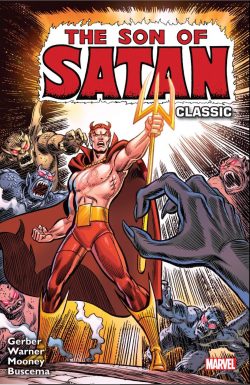
Son of Satan Classic


By Gary Friedrich, Steve Gerber, Gerry Conway, Chris Claremont, John Warner, Bill Mantlo, Mike Friedrich, Herb Trimpe, Tom Sutton, Jim Mooney, Gene Colan, Sal Buscema, Sonny Trinidad, P Craig Russell, Ed Hannigan, Russ Heath, Jim Starlin & various (Marvel)
ISBN:  978-3029-0104-2 (TPB/Digital edition)

As the 1960s closed, American comics were in turmoil, reflecting the greater society they were being published in – the one full of reactionary establishment types, turbulent rebellious youth, black people and their multi-ethnic supporters all agitating for universal Civil Rights and impressionable kids looking for entertainment and getting an education along the way.

In that cauldron – one fully addressed and depicted in comics books as much as laws and the Comics Code would allow – dissatisfaction and the need for change permeated everyone’s mind and the desire for a new way gripped the national and international consciousness.

Superheroes had dominated for most of the decade: peaking globally with a rush of outrageously daft, “Camp” humour excess before explosively falling to ennui and overkill. Business never sleeps, however, and in their place, TV, movies and comics returned to familiar old genres like westerns, war, science fiction and especially horror stories: although these too benefitted from and were changed by expanded consciousness and enlightened social attitudes.

For Marvel, the problem must have been particularly acute: Stan Lee & Jack Kirby had rebuilt an ailing minor publisher into a close contender for the top spot, on the backs of gaudily attired mystery men, but now that the bubble seemed to have both deflated and burst… for a second time.

Since other genres were now piquing the still-presumed mostly adolescent interests of comics core readership – like the alternative “cool” vibe attached to the modern notion of disenchanted, unchained youth (and generally ones riding motorbikes) – all publishers were looking for fresh and different ways forward.

To counter the abrupt downturn in superhero sales, the Comics Code prohibition against horror stories and iconography was hastily amended to facilitate the resurrection of scary material and bolster an industry in economic freefall. With terror tales and magical situations back in a big way, a new crop of anthologies and supernatural heroes and monsters started to thrive, supplementing the ghosts, ghoulies and goblins that had been gradually infiltrating the formerly science-only scenarios of the superhero who had weathered the downturn by tackling horror themes and villains…

It should be noted that more mature scary stories had been available since the mid-60s in the monochrome publications of Jim Warren and his imitators, who had deftly sidestepped Comics Code embargos by redefining their graphic output as “magazines” not comics. Now the likes of Eerie and Creepy had some real competition…

Lifting the CCA ban sparked a mass spawning of horror titles of varying degrees of potency and excess. Whether new material or reprints from before and after the instigation of the Code, the inexorable wave of thrillers and chillers helped even more venerable costumed crusaders close their doors and – temporarily at least – bite the dust.

Almost overnight, nasty monsters became acceptable fare on four-colour pages and a parade of pre-code reprints refreshed jaded palates whilst making sound financial sense. However, the creative aspect of the contemporary fascination with supernatural themes was best catered to by adapting already-popular and well-known cultural icons (all long out of copyright) before gambling on new concepts and an untested readership.

Whereas DC quickly cornered the market in new anthology tales – in the mordantly dark vein of Poe, Lovecraft, M.R. James, Algernon Blackwood, Ambrose Bierce, O. Henry and more – Marvel’s attempts at new, stand-alone anthological vehicles proved less successful and they soon shifted editorial efforts to their strong suite: developing ongoing characters in a shared universe. centred

The House of Ideas combined the new trend with their established style to create dark and tragic adventure heroes and even explored having unrepentant villains – like Dracula – as chief protagonist. As always in entertainment, the watchword was fashion: what was hitting big outside comics must be adapted and incorporated into the continuity. Marvel was still reeling from Kirby’s defection to DC in 1970 (where he would conjure his own chilling legends with Spirit World and The Demon) and new Editor-in-Chief Roy Thomas cannily greenlit a new character combining freewheeling, teen-friendly biker themes with the all-pervasive horror-furore…

Are you up for a bit more context before we really begin?

When proto-monster star Morbius, the Living Vampire debuted in Amazing Spider-Man #101 (cover-dated October 1970) and the sky failed to fall in, Marvel moved quickly and instituted a string of shocking super-stars. The began with a tragic wild beast and cruelly cunning predator – Werewolf by Night and The Tomb of Dracula – before chancing something truly new: a devil-haunted biker who could tap into both the motorcycling chic of movie Easy Rider and the global supernatural zeitgeist.

Preceded by god-touched western star Red Wolf and the aforementioned Werewolf by Night a new Ghost Rider premiered in Marvel Spotlight #5 (August 1972), and in turn led to the birth of the troubled subject of this Classic collection.

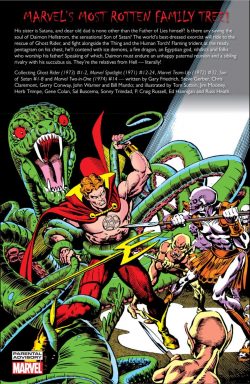
The graphic grimoire gathers the earliest exploits of Daimon Hellstrom as first seen in Ghost Rider #1-2, Marvel Spotlight #13-24, and Son of Satan #1-8, plus pertinent crossovers from Marvel Team-Up #32 and Marvel Two-In-One #14. Said saga spanned September 1973 to February 1977.

And will need even more background to with your continued indulgence…

Stunt-biker Johnny Blaze sold his soul to Satan to save his adopted father-figure Crash Simpson from cancer, but was cheated by the Devil. When the Lord of Lies came to collect his due, Johnny’s devoted and virginal girlfriend Roxanne Simpson interceded and partially redeemed her man. Although her purity prevented Satan’s victory, the Devil was only temporarily thwarted and took a measure of vengeance by afflicting Blaze with a body that burned with the fiery torments of Hell every time the sun set…

Initially haunting the night and terrorising thugs and criminals, the traumatised biker soon left the city for the solitary desert, perpetually battling The Deceiver’s countless agents who were tasked with shattering Roxanne’s loving aura of protection and claiming Blaze for Hell.

As part of these adventures Blaze battled a diabolical cult led by First Nations medicine man Snake Dance who sought to sacrifice Roxanne. The Ghost Rider barely saved her and – after dodging gun-happy cops – rushed her to hospital, where he was again attacked, this time by the Medicine Man’s daughter, Linda Littletrees, who revealed her own intimate connection to the Infernal…

The confrontation culminated in a devastating eldritch assault as she revealed her hidden role as satanic siren Witch-Woman

That epic duel opens this compendium with Ghost Rider #1 (cover-dated September 1973, by Gary Friedrich, Tom Sutton & Syd Shores), further extending the escalating war between Blaze and the Devil and using the conflict to introduce a new horror-hero who would take over the biker’s vacant slot in Spotlight: one owing much to the tone of the times and the imminent release of movie blockbuster The Exorcist

It transpires that Linda Littletrees isn’t so much a Satan-worshipping witch as ‘A Woman Possessed!’, but when her father and her fiancé Sam Silvercloud call in a Boston-based exorcist named Daimon Hellstrom, they are utterly unprepared for the kind of assistance this demonologist offers.

A Roxanne slowly recuperates, Blaze is still on the run from the police and Ghost Rider #2 sees the bedevilled biker dragged down to Hell in ‘Shake Hands With Satan!’ (illustrated by Jim Mooney & Shores) before the tale concludes in Marvel Spotlight #12 with the official debut of ‘The Son of Satan!’, courtesy of Friedrich, Herb Trimpe & Frank Chiaramonte.

Here it is revealed that religious scholar Hellstrom has a long and painfully suppressed inner self, and that the exorcist is actually a brutal scion of the Infernal Realm eternally at war with his diabolical dad.

Unleashed and liberated, the Prince of Hell swiftly rushes to Blaze’s aid – although more to spite his sire than succour the victim – and, with his own series off to a spectacular start, continues to take the pressure off the flaming-skulled hero.

We learn that the star-crossed career of the perpetually divided champion is comprised of a war between a devout demonologist and the Prince of Pandemonium: a studious, spiritual scholar sharing one body with a rebellious, sadistically violent demonic alter ego dubbed “the Darksoul”, and the Devil’s true spawn and legacy…

Friedrich, Trimpe & Chiaramonte reveal the source of the conflict in Marvel Spotlight #13’s as ‘When Satan Walked the Earth!’ takes Hellstrom back to the house he was reared in to find and read his mother’s diary.

Victoria Hellstrom’s words describe an enigmatic, beguiling stranger who swept her off her feet and subsequent early years of wedded bliss. How she bore a son and, three years after, a daughter. The toe shifts as the writer notes her husband’s increased absences, and the day she found her man and his girl-child performing a macabre blood-oath ritual sacrifice in the cellar of the idyllic family home…

When her spouse revealed himself as Satan Incarnate, the writer went quite mad.

With his mother institutionalised, his sister taken into care and their father vanished, the grieving shellshocked son entered a seminary and studied for the priesthood.

The diary ends with the writer’s death, but Daimon’s reawakened memories stir and he recalls how, on his 21st birthday his heritage came for him. Following an irresistible call, the student followed a disembodied voice through  portal to Hell and saw his father once more…

Offered all the twisted power and malign glory of a seat by the Devil’s side, Hellstrom rebelled, rejecting and battling his father and triggering a short-lived revolution in The Pit, before escaping with Satan’s all-powerful infernal Trident. The unique pitchfork is made of exotic mineral Netheranium: the only substance (other than prayer, piety, devotion and that other holy stuff) that can weaken the Devil. Best remember this is a comic book, and notionally an all-ages one at that…

Thus, after an untold age suppressing his own dark passenger, Daimon Hellstrom reaches an accommodation with his other self and prepares to take the war to the father they both despise…

At this time, Steve Gerber was Marvel’s undisputed Wizard of Weird: a brilliant, erudite, sensitive and ingenious writer who could make almost any off-the-wall concept accessible to readers – everything from Man-Thing to Howard the Duck, Daredevil to Sub-Mariner, Marvel Two-In-One to Iron Man.

He assumed the writer’s reins with Marvel Spotlight #14, joining artists Mooney & Sal Trapani in lying out a career path for the infernal antihero. It began with ‘Ice and Hellfire’ as the demonologist relocated to St. Louis, Missouri, at the request of Gateway University parapsychologist Dr. Katherine Reynolds. She has been terrorised and terrified by a string of bizarre apparitions and periodic poltergeist phenomena plaguing the campus…

Hellstrom soon uncovers an infestation of Ikthalon ice demons, and that these vile visitors and frozen furies are not invaders but have been summoned. In order to defeat them he takes Reynolds into his confidence and is enraged but unsurprised when she fails him…

Resorting to his father’s tactics to repulse the demons, Hellstrom sticks around for reasons he cannot fathom, and #15 (an all-Mooney art job) sees him endure a sinister physical change as a monstrous – possibly prophetic – dream propels him into a state of permanent chaos as his divergent natures fully merge into one eternally warring personality.

Accepting a lecturer’s position at Gateway, Hellstrom then disrupts an undergraduate ‘Black Sabbath’ and clashes again with his father – in his demonic iteration Baphomet – to save the souls of some stupidly curios students…

Trapani inked #16 as ‘4000 Holes in Forest Park!’ lure the exorcist into a very public media circus when a mysterious overnight event entices every kind of whacko out of the woodwork… as well as far less harmless loons like Christian End-Timers and a depraved Legion of Nihilists…

Inevitably the park explodes into a religion-fuelled riot, and when the Son of Satan intervenes, his supernal hellfire gimmick only exacerbates matters, igniting the scattered holes to form a colossal blazing pictogram. When the image then materialises into physical life, Dr. Reynolds and Divinity student Byron Hyatt are hurled back in time to the days before Atlantis sank, resulting in a shattering confrontation and startling glimpse at how magic reshaped the world in MS #17’s ‘In the Shadow of the Serpent!’ Schooled by legendary sorceress Zhered-Na, Hellstrom learns the necessity of catastrophe and the cosmic purpose of disaster, as well as his true role in existence before returning to the present with his fellow voyagers.

Gene Colan stepped in with #18, and – inked by Chiaramonte – takes the exorcist into a ‘Madhouse!’ when Katherine drags Daimon to a party attended by faculty and fellow parapsychologists only to find the festivities befouled by an act of animal cruelty.

The next morning Hellstrom learns that the house burned down after he left, and – curiosity aroused – investigates the ruins and detects psychic evil of tremendous potency. The fresh trail leads to young Melissa who has become the new home of truly ancient evil…

However, even after seemingly banishing ghastly Allatou back to damnation, the rescue mission continues as #19 (inked by Mike Esposito) then pits the exorcist against the girl’s fully-occupied parents in ‘Demon, Demon, Who’s Got the Demon?’: a brutal struggle that only ends when Daimon abandons holy lore and crushes his opponent with the Devil’s despised power and tactics…

Sal Buscema & Al McWilliams limned #20 as ‘The Fool’s Path!’ sees Satan’s Son targeted by a bizarre tarot reader and attacked by her animated cards. Three covers from previous SoS collections then offer a brief pause before #21 concludes the manic mystery in ‘Mourning at Dawn!’ with Joe Giella inks – exposing Madame Swabada’s incredible true nature… The battle concludes in the Bob McLeod inked ‘Journey into Himself!’ with Daimon corporeally confronting his past and a legion of demons and – ultimately – the true cause of all his woes…

Marvel Team-Up #32 – by Gerry Conway, Buscema & Vince Colletta – then offered a fiery collaboration between Human Torch Johnny Storm and Hellstrom. The exorcist inflicts ‘All the Fires in Hell…!’ on a demon possessing Johnny’s best pal Wyatt Wingfoot and assorted fellow members of his Native American Keewazi tribe. An era ended in Marvel Spotlight #23, as Gerber, Mike Friedrich, Sal B & Dan Green declare ‘In this Light, Darkness!’ with Hellstrom looking to conclude his unfinished business with the Legion of Nihilists before leaving St. Louis. The task is delayed when aged sage Father Darklyte seeks to test the scholar, only to be exposed for the menace he is…

The inheritor of Hell ended his tenure in Spotlight with #24 (October 1975) as Chris Claremont, Buscema & McLeod made him ‘Walk the Darkling Road!’ after mortal satanist Gloria Hefford summons Kthara, the Mother of Demons. Travelling to Los Angeles, Daimon seeks to save her, but is manipulated into clashing with his despised younger sister Satana: a girl after her daddy’s heart…

Even after uniting to stop Kthara, no bridges are built or fences mended between the infernal siblings…

The dispossessed Dauphin of Darkness moved into his own place as – cover-dated December 1975 – The Son of Satan #1 proclaimed ‘The Homecoming!’ as scripter John Warner, splash page artist Jim Starlin and story illustrator Jim Mooney took the eccentric exorcist into strange new territory as Hellstrom returned to the family house only to find it defiled. By invading Hell, he then learns that civil war has come to the pit as his father struggles against a usurper called The Possessor: a human who can control demons…

The war spreads, enveloping a well-meaning Navajo shaman in ‘The Possession!’ – illustrated by Sonny Trinidad – and emptying his village of living souls. As Hellstrom probes the history of the Possessor his inquiries take him back to Hell where the deranged super-psychic has his tool Nightfire lead ensorcelled tribesmen in an attack on the infernal hierarchy that the exorcist is barely able to stop in concluding clash ‘Demon’s Head’

Another brief diversion takes us to Marvel Two-In-One #14 where Bill Mantlo, Trimpe & John Tartaglione take Ben Grimm to a western ‘Ghost Town!’ for a spooky encounter with spectres and demons. The notoriously superstitious Thing thought he was on a mission of mercy, but needed much merciful magical assistance from exorcist Daimon Hellstrom to escape the deadly grip of sinister spectre Jedediah Ravenstorm

The final days of Daimon begin in SoS #4 as Warner, P. Craig Russell & Trinidad form a ‘Cloud of Witness!’ when the scholar returns to academia and meets Georgetown (that’s Washington DC) educator Saripha Thames. He believes he’s a specialist researcher, but is unaware that a hidden mastermind is actually studying him under laboratory conditions…

As always, plagued by incomprehensible dreams, Hellstrom gets an inkling of what’s in play when he’s accosted by higher being the Celestial Fool and challenged over his dual nature…

The mental and spiritual assault intensifies in ‘Assassin’s Mind’, with Daimon apparently unable to control his powers or Darksoul, even as new nemesis Mindstar ups the cosmic stakes before #6 begins pulling the strands together in ‘House of Elements!’ (pencilled by Ed Hannigan).and the mystery is explosively resolved in #7’s ‘Mirror of Judgement!’ by Warner & Trinidad.

The series concluded on an artistic high with #8 as Mantlo and Russ Heath – with additional art from John Romita – offered a treatise on temptation as a disturbing phantom begs ‘…Dance with the Devil My Red-Eyed Son!’. By dragging the Son of Satan through the inferno and history’s greatest flashpoints, someone attempts to seduce and soil his soul. Ultimately however, who can say who tempts whom?

This bombastic broadside of metaphysical mastery also includes the Son of Satan Preview article from Monsters Unleashed #3; Comics Code rejected pages, art from Official Handbook of the Marvel Universe entries and a selection of reprint covers to complete a superb journey to Comics’ darkest side.

One final note: backwriting and retcons notwithstanding, Christian boycotts and moral crusades of a later decade compelled increasingly criticism-averse controversy-shy, commercially astute Corporate Marvel to “translate” the biblical Satan of these tales into watered-down generic and apparently more palatable demonic analogues like Mephisto, Satannish, Marduk Kurios and other equally-naff downgrades. Never forget, however, that the original intent of Ghost Rider, spin-offs Daimon Hellstrom and Satana was to tap into the era’s global fascination with supernature and satanism, which had begun with epochal films and novels like Rosemary’s Baby. Please remember these aren’t your modern and feeble Hell-Lite horrors, but concern the real-deal Infernal Realm (as much as the Comics Code would allow) and reflect good people struggling to save their souls from bad breaks and Faustian bargains, so brace yourselves, hold steady and accept no supernal substitutes…
2016 Marvel Characters, Inc. All rights reserved.

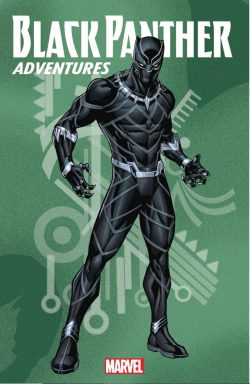
Black Panther Adventures


By Jeff Parker, Marc Sumerak, Christopher Yost, Elliot Kalan, Roy Thomas, Manuel Garcia, Ig Guara, Scott Wegener, Christopher Jones, Chris Giarusso, John Buscema & various (Marvel)
ISBN: 978-1-3029-1034-1 (Digest PB/Digital edition)

From its earliest days, Marvel always courted and accommodated young comic book consumers, often through separates titles and imprints. In 2003, the company instituted the Marvel Age line to reframe classic original tales by Stan Lee, Jack Kirby, Steve Ditko and others for a fresh-faced 21st century readership.

The experiment was tweaked in 2005, becoming Marvel Adventures. The tone of all the tales was very much that of the company’s burgeoning TV animation franchises, in execution if not name. Titles bearing the Marvel Adventures brand included Spider-Man, Fantastic Four and The Avengers and ran until 2010 when they were all cancelled and replaced by new volumes of Marvel Adventures: Super Heroes and Marvel Adventures: Spider-Man.

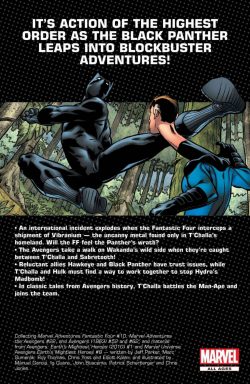
Most of those comic book yarns have since been collected in digest-sized compilations such as this one, gathering a quartet of all-ages Black Panther tales but also including a brace of early1960s episodes from his first stint in mainstream MU series The Avengers.

Acclaimed as the first black superhero in American comics and one of the first to carry his own series, the Black Panther’s popularity and fortunes have waxed and waned since he first debuted as a character in Fantastic Four #52.

In that 1966 landmark the cat king attacked Marvel’s First Family as part of his extended scheme to gain vengeance on the murderer of his father, before eventually teaming up with them to defeat malign master of sound Klaw.

This eclectic compilation – comprising Marvel Adventures Fantastic Four #10, Marvel Adventures The Avengers #22, Avengers: Earth’s Mightiest Heroes #1, Marvel Universe Avengers Earth’s Mightiest Heroes #8, plus Silver Age epics from Avengers #52 and 62 – begins by broadly reimagining that initial FF encounter in ‘Law of the Jungleby Jeff Parker, Manuel Garcia & Scott Koblish (from Marvel Adventures Fantastic Four #10; May 2006) wherein the quixotic quartet are suckered into buying smuggled Vibranium.

The miracle mineral is Wakanda’s only export and the illegal sale quickly brings the duped heroes into savage conflict with a mysterious cat-garbed super-warrior. Tracking the Black Panther back to his super-scientific jungle kingdom, the team  eventually convince the king of their innocence and good intentions before teaming up to tackle the true villains…

Two years later Marvel Adventures The Avengers #22 (May 2008 and by Marc Sumerak, Ig Guara & Jay Leisten) revealed the ‘Wakanda Wild Side as sightings of murderous mutant Sabretooth in Africa draws Wolverine, Storm, Captain America, Spider-Man, Giant-Girl and the Hulk into an uncharted kingdom. They needn’t have bothered: Wakanda’s Panther chieftain is more than equal to the task of taking down the savage invader…

Following a page of comedic Marvel Mini Classics by Chris Giarusso, a short vignette from Avengers: Earth’s Mightiest Heroes #1 (November 2010) as Christopher Yost & Scott Wegener reveal how rival heroes T’Challa and Hawkeye work out their ‘Trustissues whilst battling crazed villain Whiplash.

Never the success the company hoped, the Marvel Adventures project was superseded in 2012 by specific comics tied to those Disney XD television shows designated as “Marvel Universe cartoons”, but these collected stories are still an amazingly entertaining and superbly accessible means of introducing characters and concepts to kids born sometimes three generations or more away from the originating events. They’re also pretty good fun for us old lags too…

Another short tale – this time from Marvel Universe Avengers Earth’s Mightiest Heroes #8 (November 2012) – unites the Panther with the Hulk. Crafted by Elliott Kalan, Christopher Jones & Pond Scum, ‘Mayhem of the Madbomb!finds Green Goliath and Cat King furiously fighting Hydra to prevent he detonation of an insanity-inducing WMD stashed in the Empire State Building…

Wrapping up the action are a brace of classic exploits from Roy Thomas & John Buscema.

On Captain America’s recommendation the Black Panther joined the Avengers in #52’s ‘Death Calls for the Arch-Heroes!’ (May 1968, inked by Vince Colletta): a fast-paced murder mystery which also saw the advent of obsessive super-psycho The Grim Reaper who tried to frame the freshly-arrived-in-America T’Challa for the murder of Goliath, The Wasp and Hawkeye.

Then ‘The Monarch and the Man-Ape!(Avengers #62, March 1969, and inked by George Klein) offered Marvel fans the first real view of hidden Wakanda – and a brutal exploration of T’Challa’s history and rivals – as his trusted regent seeks to usurp the kingdom and overturn the state religion after declaring himself to be ‘M’Baku the Man-Ape!’

Augmented by a cover gallery from Carlo Pagulayan & Chris Sotomayor, Leonard Kirk & Val Staples, Scott Wegener & Jean- François Beaulieu, Khoi Pham & Edgar Delgado and John Buscema, these ferociously enthralling riotous mini-epics are extremely enjoyable and engaging, but parents should note that some of the themes and certainly the level of violence might not be what everybody considers “All-Ages Super Hero Action”…
© 2017 Marvel Characters, Inc. All rights reserved.

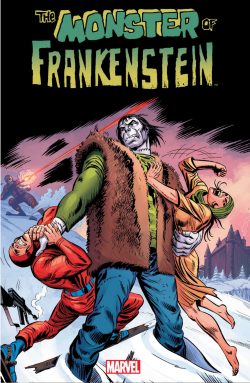
The Monster of Frankenstein


By Gary Friedrich, Doug Moench, Bill Mantlo, Gerry Conway, Mike Ploog, John Buscema, Bob Brown, Val Mayerik, Don Perlin, Sal Buscema & various (Marvel)
ISBN: 978-0-7851-9906-9 (TPB/Digital edition)

Whereas DC Comics capitalised on the early 1970s global boom in all things supernatural and mystic by creating a plethora of short-story anthologies and the occasional spooky star, Marvel Comics took the trend in another direction and created a small army of horror-heroes to headline their own series.

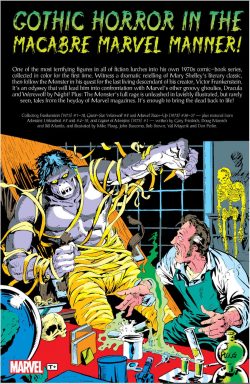
This particular collection reprints the House of Ideas’ interpretation of the Mary Shelley classic from a time when the censorious Comics Code Authority first loosened some of its strictures banning horror material from the pages of comics. That translates here to 18 issues of the colour comicbook; Giant-Sized Werewolf #2, Marvel Team-Up #36-37 and all the pertinent strips from adult-oriented Marvel magazines Monsters Unleashed #2, 4-7, 9-10 and one-shot Legion of Monsters (spanning January 1973-September 1975), all awaiting your rapt attentions.

Some comic artists work best in black-&-white. Such is certainly the case with Mike Ploog. A young find who had previously worked with Will Eisner, Ploog illustrated Gary Friedrich’s pithy adaptation of the original novel before moving on to groundbreaking new ventures as the strip graduated to in-house originated material. This monumental tome is presented mostly in colour, but if you are of a similar opinion you could try to lay your hands on the 2004 monochrome Essential Monster of Frankenstein edition…

Cover-dated January 1973, ‘Mary Shelley’s Frankenstein!’ introduced Robert Walton IV, great grandson of the sea-captain who had rescued scientist Victor Frankenstein from the polar ice and who was subsequently regaled with the incredible tale of “the Modern Prometheus”.

Now, in 1898 and leading a band of rogues, cutthroats and sullen Inuit, Walton finds the fabled monster interred in a frozen slab and brings it aboard his ice-breaker. He then recounts the story to his fascinated cabin-boy, unaware of the fear and discontent simmering below decks…

A bloody mutiny during a terrible gale opens the second issue as the burning ship founders. Meanwhile the flashbacked saga of tragic Victor reaches the terrible moment when the monster demanded a mate. The guilt-plagued scientist complied only to baulk at the last and destroy his second creation. ‘Bride of the Monster!’ concludes with the creature’s fearsome vengeance on his creator, paralleling the grim fate of the storm-tossed ship…

In The Monster of Frankenstein #3, ‘The Monster’s Revenge!’ has the reawakened creature freed from its ice-block to overhear the continuation of his life-story from Walton’s lips, even as the last survivors struggle to find safety in the Arctic wastes.

Thereafter ‘Death of the Monster!’ – with inker John Verpoorten taking some of the deadline pressure off hard-pressed Ploog – turns the tables as the monster reveals what happened after the polar showdown with his creator, leading to a new beginning as Walton reveals that not all the Frankensteins were eradicated by the Monster’s campaign of vengeance. Their warped blood-line lives on…

A new direction began with issue #5 in ‘The Monster Walks Among Us!’. Making his way south, the tragic creature arrives in a Scandinavian village in time to save a young woman from being burned at the stake on a blazing longboat, only to rediscover that when villagers pick up pitchforks and torches to go a-screamin’ and a-hollerin’ for blood, they generally have a good reason…

With issue #6 the comic book renamed itself The Frankenstein Monster as the undying creature reaches the village of Ingolstadt a century after he first wreaked bloody vengeance on his creator’s loved ones.

‘…In Search of the Last Frankenstein!’ is a mini-classic of vintage horrors scripted as usual by Friedrich but plotted, pencilled & inked by Ploog, who was reaching an early peak in his artistic career. It was also his last issue.

Ploog was followed by John Buscema & Bob Brown before Val Mayerik settled as regular artist whilst Friedrich gave way to Doug Moench, a writer once synonymous with Marvel’s horror line.

Issues #7, 8 and 9 bowed to the inevitable, pitting the Monster against Marvel’s top horror star (albeit 75-ish years prior to his contemporary adventures). Beginning with ‘The Fury of a Fiend!’ continuing in ‘My Name is… Dracula!’ and concluding with ‘The Vampire Killers!’, this is an extremely classy tribute to the old Universal movies and then-current Hammer Films in equal measure, wherein the misunderstood misanthrope battled an undying evil for ungrateful humanity, consequently losing the power of speech; and becoming more monstrous in the process.

Produced by Friedrich, Buscema and Verpoorten, this trilogy lacks the atmosphere of Ploog’s tenure, but the action is very much in the company’s house-style. With #10 (inked by Frank Giacoia and Mike Esposito) the creature finally found ‘The Last Frankenstein!’ …much to his regret.

With number #11’s ‘…And in the End…!?’ – illustrated by Brown & Vince Colletta – and #12’s ‘A Cold and Lasting Tomb’ (Moench, Mayerik and Colletta), the Monster wrapped up his historical adventures by falling into a glacial sea. Frozen once again into another block of ice he was revived, Captain America-style, in modern times: i.e. the swinging 1970s…

The epic account then switches to monochrome as more mature episodes from Monsters Unleashed begin, starting with #2 and ‘Frankenstein 1973’ by Friedrich, Buscema & Syd Shores. Here we see how an obsessive young man finds the Monster preserved as a carnival exhibit, only to see his jealous girlfriend revive it whilst trying to burn down the sideshow. The story continued in #4 as ‘Frankenstein 1973: Chapter TwoThe Classic Monster’ (Friedrich, Buscema & Win Mortimer), with a literal mad scientist actually putting his own brain in the monster’s skull. Happily, the unnatural order is restored in ‘Once a Monster…’

Monsters Unleashed #6 introduced new creative team Doug Moench & Val Mayerik who completed the introduction to modern times with a good old-fashioned monster hunt in ‘…Always a Monster!’

This leads directly to #7’s ‘A Tale of Two Monsters!’: a dark, socially relevant tale of the modern underclass and man-made horrors carried over into ‘Frankenstein 1974: Fever in the Freak House’ before concluding in #9’s ‘The Conscience of the Creature’.

The horror boom was fading by this time and Monsters Unleashed #10 was the Monster’s last outing there: a superbly dark and sardonic Christmas offering complete with elves, snow, terrorists and a Presidential assassination attempt.

One final monochrome tale from Moench, Mayerik, Dan Adkins & Pablo Marcos (accompanied by a chilling frontispiece by Marcos) appeared in 1975 one-shot The Legion of Monsters. ‘The Monster and the Masque’ was a bittersweet morality play seeing the creature accidentally accepted at a fancy dress party, which is ruined when a different sort of monster gets carried away…

Switching back to full-colour comics, next up is a rather tame team-up/clash from Giant-Size Werewolf #2 wherein ‘The Frankenstein Monster Meets Werewolf by Night’ (Moench, Don Perlin & Colletta) to collaterally combine and quash a band of run-of-the-mill West Coast Satanists.

Resuming his own series, The Frankenstein Monster #13 displays ‘All Pieces of Fear!’ (Moench, Mayerik & Jack Abel) as, shoe-horned into mid-1970s America, the Monster is drawn into a tale heavy with irony as men act like beasts and an obsessive father ignores his family whilst building his own abominations through the nascent science of cloning.

With a hip young teenager as sidekick/spokesperson, ‘Fury of the Night-Creature’ (Dan Green inks) extends the saga by introducing I.C.O.N. (International Crime Organizations Nexus): yet another secret organisation intent on conquest by merging corporate business practices with traditional gangsterism.

Issue #15’s ‘Tactics of Death’ (Klaus Janson inks) briefly concludes the acronym-agenda as the Monster and companion Ralph mop up the men in suits only to be shanghaied to Switzerland to meet the latest Last-of-the-Frankensteins in ‘Code-name: Berserker!’ (inked by Bob McLeod – who managed to handle the next issue too).

Veronica Frankenstein was still absorbed in the family business, but claimed to be fixing her ancestors’ mistakes when I.C.O.N. creeps showed up, demanding her biological techniques in ‘A Phoenix Beserk!’. Beautifully inked by Mayerik and Adkins, the last colour issue ended on a never-to-be completed cliffhanger (although scripter Bill Mantlo covered elements of the story in Iron Man some years later) as the Monster and his new friend met ‘The Lady of the House’ – the utterly bonkers creature-crafter dubbed Victoria Von Frankenstein

Perhaps the abrupt cancellation was a mercy-killing after all…

Rounding off the narrative wonderment is a 2-part tale from Gerry Conway, Sal Buscema & Colletta first seen in Marvel Team-Up #36-37 wherein Spider-Man is kidnapped and shipped off to Switzerland by the assuredly insane Baron Ludwig Von Shtupf, who proudly proclaims himself The Monster Maker

In ‘Once Upon a Time, in a Castle…’ the bonkers biologist wants to pick-&-mix creature traits – having already secured the Frankenstein Monster to practise on… After the webslinger busts them both out, they stumble upon sexy SHIELD Agent Klemmer, but a rapid counterattack goes badly wrong when Von Shtupf unleashes his other captive – the furiously feral Man-Wolf – and only big Frankie can prevent a wave of ‘Snow Death!’

This codex of comic creepiness concludes with a mammoth bonus section offering art lovers and funnybook historians additional treats such as Ploog’s very first design sketch of the monster from 1972, original art, illustrations and (finished but pre-editorial addition) painted covers by Boris Vallejo.

Also on show are assorted frontispieces, pencils, inks and previous collected editions, covers and original art by Tom Sutton, Gray Morrow, Vince Evans, Mayerik, Bernie Wrightson & Arthur Adams, making this compendium a perfect treat for fantasy fans and dedicated horrorists: one that should be a first choice for introducing scare-loving civilians to the world of comics.
© 1973, 1974, 1975, 2015 Marvel Characters, Inc. All Rights Reserved.

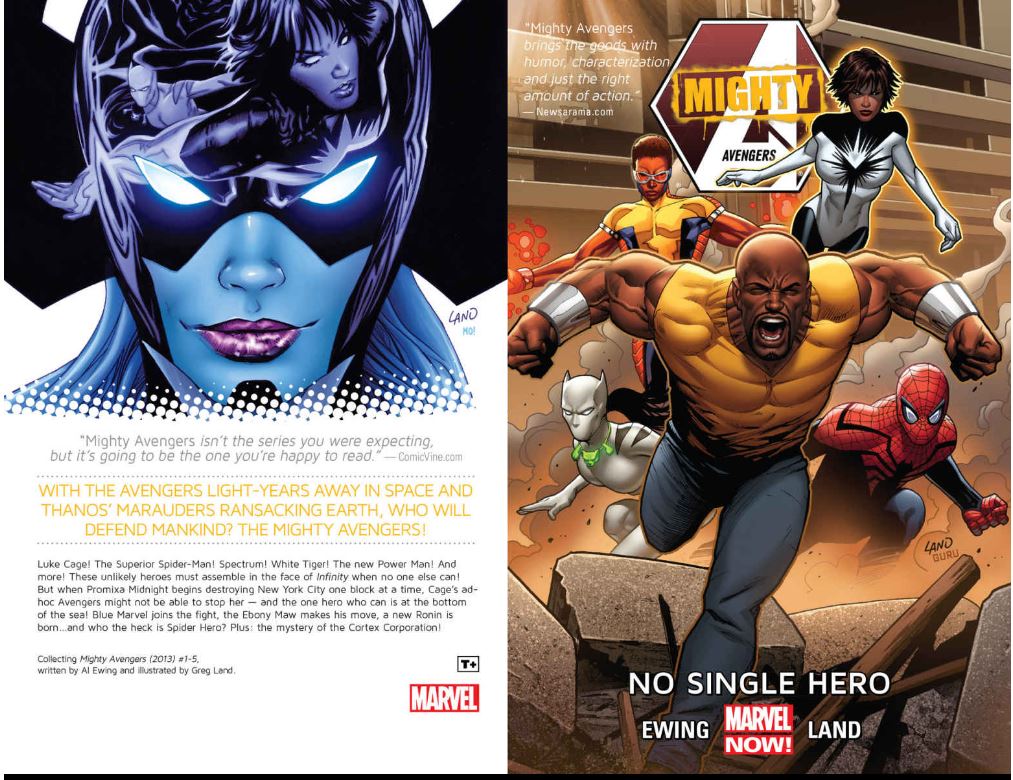
Mighty Avengers: No Single Hero


By Al Ewing, Greg Land, Jay Leisten & various (Marvel)
ISBN: 978-0785188742 (TPB/Digital edition)

Following blockbuster Avengers Versus X-Men publishing event, company-wide reboot MarvelNOW! reformed the entire overarching continuity: a drastic reshuffle and rethink of characters, concepts and brands with an eye to winning new readers and feeding the company’s burgeoning movie blockbuster machine…

Moreover, many disparate story strands were congealing to kick off the always-imminent Next Big Thing, with the cosmically expanded Avengers titles forming the spine of an encroaching mega-epic. The colossal Infinity storyline detailed a grandiose advance into Armageddon as an intergalactic Hammer of Doom fell with an all-out attack by impossibly ancient race The Builders. They claim to have sparked universal life, but now seek to rectify their mistake on Earth – and woe betide any species or intergalactic civilisation in their way.

When The Avengers mobilised most of their assemblage off-planet to tackle the threat before it reached them, Thanos of Titan took advantage of the dearth of metahuman defenders to invade, leaving the remaining superheroes with an almost impossible task…

Written by Al Ewing and illustrated by Greg Land & Jay Leisten, Mighty Avengers volume 2 #1-5 (November 2013 – March 2014) describes how those left behind unite as a resistance force and stayed together as a decidedly different kind of crusading team… one primarily comprising heroes of colour, not the usual bunch of white guys and ones who looked at problems beyond a self-appointed cosmic jurisdiction…

The action opens as Thanos hits Earth, where blithely unaware ex-Avenger Luke Cage is pitting his Heroes for Hire apprentices White Tiger and a new, teenaged Power Man against seasoned super-thief The Plunderer. Their efforts are interrupted and derided by the Superior Spider-Man who orders them to quit before insultingly offering Cage’s kids a real job.

Everybody sees that the wallcrawler has become insufferable since he technologically upgraded his act and hired a paramilitary gang as his deputies. Many of his oldest friends even think he might be going crazy. What no one knows is that the mind inside the arachnid hero’s head is actually archvillain Otto Octavius AKA Doctor Octopus who – despite a passionate initial desire to reform – is slowly reverting to his true manner and bad habits…

The webspinner’s derision spurs White Tiger into quitting, but only fuels her male teammates into trying harder to prove Spider-Man wrong…

Elsewhere ex-Avenger Monica Rambeau (formerly Captain Marvel and Photon, but now calling herself Spectrum) is getting back into the crime-busting game after a bout of retirement. She’s sorting out her costume and talking over old times with an enigmatic fellow champion when the first wave of the Titan’s invasion force smashes into New York.

Donning a store-bought comedy costume, the stranger – also black – joins Monica as a generic “Spider Hero” and converges on the landing site where Cage and the still-enraged Superior Spider-Man are battling the Titan’s ferocious warlord Proxima Midnight

Elsewhere, Mystic Master Doctor Strange has been possessed and corrupted by the Ebony Maw – the most personally ambitious of Thanos’ lieutenants – whilst at the bottom of the sea  Dr. Adam Brashear receives a cosmic visitor. A forgotten African American superhero forbidden by Presidential mandate from operating during the Civil Rights era, The Blue Marvel is thus stirred from a lengthy self-imposed exile and grudgingly agrees to return to the world which shunned and sidelined him…

In New York, ‘The Assembly’ give battle, but the Amazing Arachnid seems more concerned with suing his “copyright infringer” than defeating the invaders, and Spectrum is gravely wounded by Midnight. As Cage tackles Proxima, ordinary citizens are emboldened to join the struggle, compelling ever-watching Thanos to order a retreat.

It’s not over though, as the ravaged metropolis is then assaulted by an overwhelming aspect of voracious Elder God Shuma-Gorath, summoned by enslaved Stephen Strange. The rampant horror gleefully begins transforming native New Yorkers into ghastly demon duplicates…

As Blue Marvel rockets to the rescue, temporarily stymieing the devil god and healing Spectrum, mystically empowered White Tiger and Power Man arrive and Spider Hero -demonstrating a keen knowledge of arcane rites – devises a scheme to drive the Lovecraftian horror back to its own dimension for good.

Cage then has a eureka moment, realising ‘No Single Hero’ could have managed, declaring that they are all Avengers…

Originally parked above Manhattan, the Inhumans’ floating city Attilan was destroyed during the war and its ruins now languish in the Hudson River. Moreover, when Thanos personally attacked Black Bolt, the embattled Inhuman monarch released genetically transformative Terrigen Mists thereby unleashing a host of new super-powered warriors from the ranks of the humans below…

Issue #4 is set after the invasion is finally repelled, with the city engrossed in rapid reconstruction. The space-bound Avengers are still missing off-world but life is returning to normal.

Sleazy entrepreneur Jason Quantrell despatches his personal industrial spy Quickfire – a recent recipient of Terrigen-induced abilities – to raid the sunken citadel in search of fresh mutagens he can monetise, whilst in Times Square Cage has turned his old Gem Theatre offices into a storefront Avengers HQ.

He has a bold new idea: opening the heroic volunteer brigade to the public who can come to them with meta-related problems or issues of injustice. Even though Reservist The Falcon has come aboard, Spider-Man is becoming increasingly intolerant, alternately demanding to be placed in charge and ordering Cage’s crew to cease and desist. Unable to convince them, the furious superior wallcrawler storms off…

Meanwhile Spider Hero – who has some ominous magical acquaintances older fans might recognise – has detected an encroaching mystic crisis and resolved to stay. Adopting the vacant costume and identity of martial arts mystery man Ronin, he invites the team to join him in stopping an impending burglary in Attilan. It’s not Quickfire’s illegal raid that’s the problem, but rather that she’s going to inadvertently awaken the slumbering submerged threat of the Death Walkers if somebody doesn’t stop her…

However, as the most recent Ronin leads the Avengers to the already-in-progress monster catastrophe, Octavius returns to the Gem Theatre and – in a manic fit of frustrated rage – attacks Cage with all the paramilitary resources he can muster: mercenaries, spider-bots and urban assault vehicles all primed to shut down the Avengers forever.

Happily, the harassed Hero for Free had already contacted his lawyer and is delighted to follow Jennifer Walters’ guidance… which basically boils down to “She-Hulk Smash!”…

Fast, furious and fantastically offbeat, this epic epistle also offers a selection of editorial features from the issues in question and a covers gallery, as it delivers hard, fast, thrilling and funny stories about heroism on the other side of the tracks…
© 2013 Marvel Characters Inc.. All rights reserved.

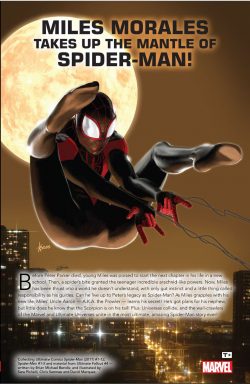
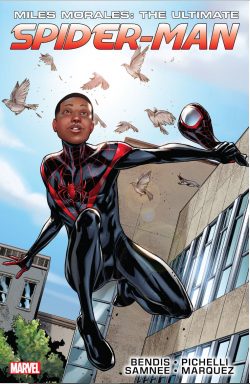
Miles Morales: The Ultimate Spider-Man Ultimate Collection volume 1


By Brian Michael Bendis, Sarah Pichelli, Chris Samnee, David Marquez & various (Marvel)
ISBN: 978-0-7851-9778-2 (TPB/digital edition)

After Marvel’s financial and creative problems in the late 1990s, the company came back swinging. A key new concept involved remodelling and modernising their core pantheon for the new youth culture. The Ultimate imprint abandoned the monumental, slavish continuity which had always been Marvel’s greatest asset, giving its revamped players a separate reality to play in. Varying degrees of radical makeover appealed to a contemporary 21st century audience and proved a godsend as base material for the new Marvel Cinematic Universe.

Peter Parker was once again reduced to a callow, nerdy high-school geek, brilliant but perpetually bullied by his physical superiors. There were even fresh, fashionable, more scientifically feasible rationales for the fore-destined spider bite which imparted those patented, impossible arachnoid abilities.

His uncle Ben Parker still died because of the lad’s lack of responsibility. The Daily Bugle was still there, as was bombastically outrageous J. Jonah Jameson. Now, however, in a more cynical, litigious world, well-used to cover-ups and conspiracy theories, arch-foe Norman Osborn – a corrupt, ruthless billionaire businessman – was behind everything.

Any gesture towards the faux-realism of traditional superhero fare was surrendered to the tried-and-tested soap-opera melodrama which inevitably links all characters together in invisible threads of karmic coincidence and familial consanguinity but, to be honest, it seldom hurt the narrative. After all, as long as internal logic isn’t contravened, subplots don’t have to make sense to be entertaining.

After a short and spectacularly impressive career, the originally outcast Peter finally gained a measure of acceptance and was hailed a hero when the Ultimate Comics Spider-Man valiantly and very publicly met his end at Osborn’s hands during a catastrophic super-villain showdown…

Soon after he died, a new champion cast in his image arose to carry on the fight…

Written throughout by Brian Michael Bendis, this collection concerns controversial new kid Miles Morales, and contains material published before mega-crossover events Time Runs Out and Secret Wars merged him and other remnants of the Ultimate Universe with the mainstream Marvel continuity. It specifically re-presents an introductory teaser from Ultimate Comics Fallout #4 (August 2011), Ultimate Comics Spider-Man #1-12 (-February 2013) and trans-multiversal team-up Spider-men #1-5 (June to September 2012).

In the aftermath of Parker’s last moments, brilliant African American/Latino child prodigy Miles Morales was revealed to have gained similar powers. The freshly empowered 13-year old quickly adjusted to his astounding new physical abilities whilst painfully discovering the daily costs of living a life of lies and how an inescapable sense of responsibility is the worst of all possible burdens…

The revelations here begin by spinning back to the relatively recent past when manic industrialist Osborn repeated the genetic experiment which first bestowed incredible powers on Peter Parker via the accidental bite of a deliberately-mutated spider. Unfortunately, the deranged mastermind failed to anticipate a burglar waltzing in and carrying off the latest test animal as part of his haul …

When grade-schooler Miles gets into prestigious, life-changing Brooklyn Visions Academy Boarding School by the most callous of chances, the boy cynically realises life is pretty much a crap-shoot… and unfair to boot. Feeling guilty about his unjust success and sorry for the 697 other poor kids who don’t get his lucky break, he sneaks off to visit his uncle Aaron. The visit has to be secret since his uncle is a “bad influence” and a career criminal …

Whilst there, a huge spider with a number on its back bites Miles and the boy begins to feel very odd. He also starts fading from sight…

Suddenly super-fast and strong, able to leap huge distances and become practically invisible, Miles rushes to consult geeky pal Ganke, a prodigious nerd already attending Brooklyn Visions. Applying “scientific testing”, the self-proclaimed hero-expert confirms Miles is similar to Spider-Man but can also deliver shocking, destructive blasts through his hands.

When Morales heads home, Ganke continues online research and deduces the connection to the wallcrawler, and is soon strenuously pushing his friend towards becoming a costumed crusader just like him…

However, after Miles intervenes during a tenement fire and saving a mother and baby, shock sets in and he resolves never to use his powers again…

Time passes: Miles and Ganke have been roommates at the Academy for almost a year when news of a major metahuman clash rocks the city. Troubled Miles heads out and becomes an accidental witness to Spider-Man’s murder. Seeing a brave man perish so nobly, he is again consumed by guilt: if he had used his own powers when they first manifested, he might have been able to help save a true hero…

Part of the crowds attending Parker’s memorial, Miles and Ganke talk to another mourner, a girl who actually knew Parker. Gwen Stacy offers quiet insights to the grieving boys and a phrase which alters the course of Miles’ life forever – “with great power comes great responsibility…”

Clad in a Halloween Spidey costume borrowed from Ganke, Miles takes to the night streets for the first time and stops minor miscreant Kangaroo from committing murder…

Feeling he’s come full circle, on his third night out the exhilarated 13-year old encounters the terrifying and furiously indignant Spider-Woman who thrashes and arrests him. Morales wakes at a Government agency in S.H.I.E.L.D. custody where Hawkeye, Iron Man and master manipulator Nick Fury coldly assess him.

However, before they can reach a decision on the boy’s fate, murderous malcontent Electro breaks free of the Triskelion’s medical custody ward and goes on a rampage. Despite easily defeating the seasoned heroes, the voltaic villain is completely unprepared for a new Spider-Man: especially as the kid’s extra powers include camouflage capability and an irresistible “venom-strike” sting…

As Miles considers the full implications of his victory, Fury imparts a staggeringly simple homily: “With great power…” even as he arranges for the kid a properly designed and tooled high-tech costume to crusade in…

Now a day resident at the Brooklyn Boarding School, Miles spends only weekends at home and is coming to terms with some unpleasant truths. Foremost is that his secrets must be kept from his parents, but also poisoning the family air is the fact that his father used to be a street-thug and now passionately hates costumed heroes like Spider-Man.

Almost as bad is the discovery that Uncle Aaron is a major thief and bad-guy known in the game as The Prowler

Ever since a living piece of Aaron’s loot bit Miles and transformed him, the Prowler has been laying low, but the tide turns here as he resurfaces in Mexico, narrowly escaping a deal-gone-sour with local super-powered gang-lord the Scorpion. Meanwhile the new Spider-Man has been making a name for himself in New York, and news of a junior Arachnid Avenger is making global headlines…

With additional art from Chris Samnee, David Messina and David Marquez, classmate, confidante and fellow nerd Ganke undertakes to “train” Miles using candid footage of the deceased Peter Parker in action and – when continued sightings of the boy hero reach Aaron south of the border – the wily rogue instantly puts two and two together and heads back to the Big Apple.

As the troubled teen tackles street scum and old Spidey villains like Omega Red – triumphing more by luck than skill or judgement – Uncle Aaron murders underworld tech-guru The Tinkerer and swipes his ingenious arsenal of criminal gadgets before confronting Miles at school. He’s thinking possible partnership…

Since Parker perished his Aunt May and true love Gwen have been world travelling. They’re in Paris when the shocking news of a successor reaches them…

In New York, Police Captain Quaid is also coming to terms with a new wallcrawling crazy complicating his life, but is utterly unaware that major grief has hit town as the Scorpion, following the Prowler, has realized New York is wide open for a new Kingpin of Crime to step in and take over…

After a brutal battle against The Ringer, Spider-Man and Quaid reach an accommodation of sorts, but Prowler’s first North American clash with the Scorpion doesn’t go nearly as well and Aaron Morales once again accosts his nephew with veiled threats and a shocking offer…

Of course it all devolves into a fist-fight before calmer heads prevail and Miles really thinks over what’s on the table: one of the world’s most effective and capable villains is offering to train him in combat, strategy and survival on the streets whilst schooling him in the myriad ways the underworld works…

Only problem is that the Prowler has no intention of reforming and won’t say what he expects in return…

Eventually Miles realises his uncle has been secretly grooming him ever since some of his loot bit the youngster, and refuses to let the manipulative creep tricks Miles into attacking the seemingly unstoppable Mexican gang-lord seizing control of the city…

The action (illustrated by David Marquez) begins with a blistering raid on the Scorpion’s plush new club where, in the heat of battle, the novice wall-crawler at last realises Aaron will never change or make amends, but his simply eradicating opposition in advance of his own attempt to take over the underworld…

Events explode tragically when Aaron accosts Miles at school, trying to blackmail him with threats of telling the boy’s father all about Spider-Man, and resulting in a devastating showdown. Equipped with years of criminal experience and Tinkerer’s ingenious arsenal, Aaron goes crazy, determined to finish his rebellious nephew.

The fight inevitably escalates, endangering a busload of civilians who all apparently see the neophyte wallcrawler first save them before killing the Prowler in a horrific explosion…

To Be Continued…

Meanwhile in the mainstream Marvel Universe, “our” Peter Parker underwent his own turmoil and travails, surviving to become a more-or-less grown man and first rank superhero…

The miniseries Spider-Men #1-5 was designed as part of celebrations for the webspinner’s 50th anniversary, and offers a slight but magically enthralling guest-star-packed riff on one of the superhero genre’s most popular themes.

The action begins in the original universe where Peter is on patrol, stopping some fleeing thieves – and almost getting arrested for his help – when he spots an eerie light. Investigating, he discovers the latest hideout of old foe Mysterio and – after a brief struggle – overpowers the sinister Special Effects savant.

Something is off though and the villain’s babblings make no sense. The creep is clearly delusional, screaming Spider-Man is already dead before breaking loose to trigger a bizarrely glowing device he’d been defending.

In a blaze of light, Spider-Man transits from a dark warehouse at night to a sunny rooftop in a radically different New York. Things get even stranger when he stops a mugging and the victim thanks him but says his costume is in “terrible taste” before enquiring if he knew Peter Parker.

…And that’s when the kid in a way cooler Spider suit shows up…

In another universe, the Ultimate Mysterio wakes up and activates a telemetric avatar of himself to follow Spider-Man across dimensions, where Parker is – in true Marvel style – fighting his namesake in a fever of confused misapprehension. Utterly underestimating his diminutive opponent, the elder Arachnoid is defeated by the kid’s secret powers (invisibility and a debilitating venom sting) and wakes up in a S.H.I.E.L.D. cell where an African-American Nick Fury confirms that he’s fallen into an alternate Earth…

Eventually released into Miles’ custody, the newcomer is introduced to a New York where Peter Parker is a revered – albeit dead – hero. Before he can adapt, the Mysterio avatar attacks with a lethal arsenal of ballistic weapons and mind-warping chemical weapons…

By the time Ultimate operatives Thor, Hawkeye and Iron Man appear, the battle is won and the mechanoid trashed, but as ferociously curious Tony Stark examines the dimensional transfer tech in our world, their Mysterio is preparing another deadly assault…

As the assembled heroes seek a way home for the wallcrawling wanderer, Parker is torturing himself by visiting “his” old haunts and hangouts, leading to gut-wrenching meetings with Aunt May, Mary Jane Watson and a Gwen Stacy who wasn’t murdered by the Green Goblin

…And in the other universe, Mysterio just can’t let go: once again preparing to launch his devilish devices across the rift to kill Spider-Man… all of them and whoever stands with them…

Aided by painter/colourist Justin Ponsor, Bendis & Sara Pichelli crafted a hugely impressive and fresh take on alternate Earth team-ups: drenched in warmth and tragedy, brimming with breathtaking action and stuffed with light-hearted, razor sharp humour, elevating it from the ranks of formularized Costumed Dramas into it easily one of the best superhero tales of the decade.

This initial Ultimately Ultimate compendium also offers a colossal gallery of covers and variants by Kaare Andrews. Jorge Molina, Marquez, Rain Beredo, Pichelli, Ponsor, Adi Granov Marko Djurdjevic, Mark Bagley, Marcos Martin, Terry & Rachel Dodson, Travis Charest, Tommy Lee Edwards, Jimmy Cheung, Humberto Ramos & Mike Deodato to delight and thrill in a rollercoaster ride of tense, evocative suspense and easy-going adventure that is the essential Spider-Man.

Tense, breathtaking, action-packed, evocative, suspenseful and full of the light-hearted, self-aware razor sharp humour which blessed the original Lee/Ditko tales, this second Spider-Man is here to stay …unless they kill him too…
© 2019 MARVEL.

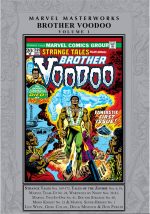
Brother Voodoo Marvel Masterworks volume 1


By Len Wein, Doug Moench, Roy Thomas, Marv Wolfman, David Anthony Kraft, Roger Slifer, Roger Stern, Scott Lobdell, Jean-Marc Lofficier, Randy Lofficier, Gene Colan, Don Perlin, Jim Mooney, Tony DeZuñiga, Ron Wilson, Marshall Rogers, Vicente Alcazar, Fred Hembeck, Geoff Isherwood & various (MARVEL)
ISBN: 978-1-3029-2923-7 (HB/Digital edition)

In 1968 the consciousness-raising sporting demonstration of Black Power at the Olympic Games politicised a generation of youngsters. By this time a few comics companies had already made tentative but concerted efforts to address what were national and socio-political iniquities. Nevertheless, issues of race and ethnicity took a bloody long time to filter through to still-impressionable young minds avidly absorbing knowledge and attitudes via four-colour pages that couldn’t even approximate the skin tones of African-Americans.

As with TV and films, breakthroughs were small, incremental and too often reduced to a cold war of daringly liberal “firsts.” Excluding characters in 1940s-1950s jungle themed comic books, Marvel clearly led the field with a recurring character: historically impossible Gabe Jones, a black soldier in Sgt. Fury’s Howling Commandos – debuting in #1 (May 1963).

Technically, he was beaten to that dubious honour by DC’s Jackie Johnson. Created by Robert Kanigher & Joe Kubert, the negro prizefighter joined Sgt Rock’s Easy Company in late 1961 (Our Army at War #113), but it was years before he was a regularly-seen character…

By the way, so unlikely a character was ol’ Gabe in 1963 that he was – without even consulting editor Stan Lee – helpfully re-coloured Caucasian at the printers who didn’t realise his ethnicity but just knew that he just couldn’t be non-white. Jones was eventually followed by actual black superheroes Black Panther in Fantastic Four #52 (July 1966), and the Falcon in Captain America #117 (September 1969). America’s first hero or colour to helm his own title had come and gone (largely unnoticed) in a little remembered or regarded title from Dell Comics. Debuting December 1965 and created by artist Tony Tallarico & scripter D.J. Arneson, Lobo was a wild west gunslinger battling injustice just like any cowboy would.

Arguably the greater breakthrough was Joe Robertson, City Editor of the Daily Bugle: an erudite, brave, proudly ordinary mortal distinguished by his sterling character, not costume or skin tone. He debuted in Amazing Spider-Man # 51 (August 1967), proving in every panel thereafter that the world wouldn’t end if black folk and white folk shared the same spaces…

This big change slowly grew out of raised public awareness during a terrible time in US history: even worse than today’s festering social wounds and agonisingly commonplace occurrences of cops claiming to misjudge immediate life-or-death situations, perilous racial pressures and a seemingly constant, officially policy of Black Lives Not Mattering. These tragedies occur unpardonably often the UK too, so we’ve nothing to be smug about…

Britain has suffered race riots since the Sixties, leaving simmering scars that only comedians and openly racist politicians dare to talk about. Things today don’t seem all that different, except the bile and growing taste for violence is turned towards European accents, or health workers as well as brown skins, and now includes non-white sectarian aggravation too…

As the 1960s became a newer, darker decade, more positive and inclusive incidences of ethnic characters appeared in the USA, with DC finally getting an African-America hero in John Stewart (Green Lantern #87 December 1971/January 1972) – although his designation as a replacement Green Lantern might be construed as more conciliatory and insulting than revolutionary.

The first DC hero with his own title was Black Lightning. He didn’t debut until April 1977, although Jack Kirby had introduced Vykin in Forever People #1, the Black Racer in New Gods #3 (March and July 1971) and Shilo Norman as Scott Free’s apprentice (and eventual successor) in Mister Miracle #15 (August 1973). A month later there was Dr. Jericho Drumm: Brother Voodoo

It was a turbulent time culturally, but it was also a life-or-death moment for comics. The American industry was in turmoil if not meltdown, much like the youth of the nation they courted. With costs of production skyrocketing, every title had to be a success and no one seemed clear on what audiences wanted…

Superheroes had dominated for most of the 1960s: peaking globally before explosively falling to ennui and overkill. Traditional genres like horror, westerns, romance and science fiction returned, fed by radical trends in movie-making where another wrinkle had emerged: films by and for African American audiences. Most called them “Blacksploitation” films…

Marvel was already a pioneer in diversity. As well as a plethora of white Christian males there were pagan gods, female characters (a few but not for long), extraterrestrials, native Americans, Atlanteans and monsters spearheading their own features. Why not another black lead with roots in multiple of genres at once?

Contemporary Blaxsploitation cinema and novels had fired up commercial interests throughout America, and in that miasma of outlandish dialogue, daft outfits and barely concealed – if justified – outrage, an angry black man with a shady past and questionable morals must have felt like a sure-fire hit to Marvel’s bosses. Luke Cage, Hero for Hire launched in the summer of 1972. A year later, Black Panther finally got his own series in Jungle Action #5 and Blade: Vampire Hunter debuted in Tomb of Dracula #10 (July 1973. Surely there was room for more?

Astonishingly soon after, with the Comics Code prohibition against horror hastily rewritten (amazing how plunging sales can affect ethics), scary comics returned in force and a fresh crop of supernatural superheroes and monsters began appearing on newsstands to supplement the ghosts, ghoulies and goblins already infiltrating the once science-only scenarios of the surviving Fights ‘n’ Tights titles.

In fact, the lifting of the Code ban resulted in such an avalanche of horror titles in response to the industry-wide downturn in superhero sales, that it probably caused a few more venerable costumed crusaders to – albeit temporarily – bite the dust.

Almost overnight nasty monsters – both new and reprinted from the1950s (and narcotics; but that’s another story) became acceptable fare on four-colour pages. Whilst a parade of pre-code reprints made sound business sense, the creative aspect of the contemporary fascination in supernatural themes was catered to by adapting popular cultural icons, before risking whole new concepts on an untested public. Oddly the last Code-embargoed genre – Crime comics – never figured in this particular populist revival…

As always in entertainment, the watch-world was fashion: what was hitting big outside comics was to be incorporated into the mix as soon as possible. When proto-horror Morbius debuted in Amazing Spider-Man #101 (cover-dated October 1971) and the sky failed to fall in, Marvel moved ahead with a line of shocking superstars.

They began with a traditional werewolf and a vampire before chancing something new: a haunted biker who tapped into both Easy Rider’s freewheeling motorcycling chic and the prevailing supernatural zeitgeist. Recycling an old western’s title, the all-new Ghost Rider debuted in Marvel Spotlight #5, August 1972. He had been preceded by western hero Red Wolf in #1 and the aforementioned Werewolf by Night in #2-4. From these beginnings spooky floodgates opened to such an extent there was even room for non-white stars like The Living Mummy and our star turn today…

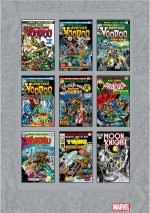
This quirky compendium collects Brother Voodoo’s earliest exploits from a time when he was equal parts tragic outsider and in-joke laughing stock and long before he was reclaimed as a major hero and rebooted as Doctor Voodoo. These adventures from Strange Tales #169-173, Tales of the Zombie #6 &10, Marvel Team-Up #24, Werewolf by Night #38-41, Marvel Two-in-One #41, Doctor Strange #48, Moon Knight #21, Marvel Super-Heroes #1 and Doctor Strange: Sorcerer Supreme #16, 17, 20 also include extracts from Tomb of Dracula #34-37: epically spanning cover-dates September 1973 to August 1990. The mystic materials are preceded by an informative Introduction from Ron Wilson on how the series came to be and his editorial origins…

Built from an idea by then Editor-in-Chief  Roy Thomas, with defining input from Stan Lee, John Romita and eventual assigned creators Len Wein & Gene Colan, the end result was a complex and convoluted affair spread out over a number of issues. It’s also fair to say that there’s a lot of dialogue and some notions that haven’t fared well as we’ve become a more inclusive society. If you can’t temper your modern sensibilities in the face of well-meaning but dated attitudes, it might be best to look elsewhere for evidence of role models for young black readers…

Brother Voodoo was a series that took its time to tell a tale, and we need to remember that the idea was to create a hero who could have lots of adventures for as long as possible: a new Doctor Strange or Spider-Man or Daredevil, created at a moment when society and the comic industry were in utter turmoil. Lots of good ideas debuted and died unfulfilled, only to blossom again in years to come…

With their hero ready to launch, Marvel capitalised on the times as much as possible. The company had launched a wave of new titles (many of them cost-effective reprint anthologies) and restored defunct titles to crowd rival publishers off newsstands. Cover dated May 1968, Strange Tales #168 was officially the last issue of a prestigious horror book that had run from the 1951 before becoming a vehicle for The Human Torch, Doctor Strange and Nick Fury, Agent of S.H.I.E.L.D. in the 1960s. When Marvel the top-selling brand in 1968, its numbering had carried on for Doctor Strange’s first solo title.

Cover dated September 1973, the book was revived after a 5-year hiatus as a try-out title, kicking off with Brother Voodoo who occupied #169-174, after which The Golem, classic horror reprints and Jim Starlin’s landmark reinterpretation of Adam Warlock took the magazine to its ultimate oblivion in 1975.

Enough background now: let’s get down among the dead men…

The drama commences in the eponymous ‘Brother Voodoo!’ (Wein, Gene Colan & Dan Adkins), as a UN special investigator lands in Haiti and is saved from murderous ambush by an oddly-garbed man with incredible powers, emerging from clouds of smoke amidst thunderous frenetic drum beats. Accompanied by elderly aide Bambu, the stranger escorts Dr Maitland to safety even as his mind flashes back to how it all began…

Years ago, Jericho Drumm abandoned his brother Daniel and family heritage as voodoo priests for the rationalism, wealth and acclaim of the USA. Almost 20 years later, celebrated psychologist Dr. Drumm returned to Haiti to witness his brother’s murder by magic. Daniel had taken his brother’s destined place as houngan (voodoo priest) of his people but was dying from a curse laid by evil loa (spirit)/serpent god Damballah

Utterly disbelieving, Jericho was helpless to prevent his brother’s death and his own subsequent humiliation by Damballah, and after swallowing his civilised pride sought out Daniel’s teacher Papa Jambo to accept his fate, learn the lore and accept the onerous responsibilities of protecting the world from evil magic. Now splitting his time between his Caribbean homeland and his practice in the French Quarter of New Orleans, Dr. Jericho Drumm ministers to the world’s unknown ailments and hidden horrors…

The origin flashback extended to the next issue with a ‘Baptism of Fire!’ tracing Jericho’s accelerated course of study and triumphant battle against the loa lord. Amongst his many new gifts, the power that tipped the balance was his eerie ability to channel his dead brother’s power and soul: a chilling tactic possible because Daniel now lived within him…

We return to the present with ST #171 and learn why the UN is under attack in Haiti when ‘March of the Dead!’ (with Frank Giacoia inking Colan’s gloriously beautiful, increasingly scary pencils) sees Drumm attacked by the walking dead.

Thanks to the Comics Code, at this time the literal word “zombie” was banned in newsstand publications, compelling writers and editors to take torturous steps to do their job. Marvel’s monochrome magazines used the term with impunity and without sanction, but for the mainstream colour titles, Wein had to coin a new appellation, which is why Brother Voodoo here clashes with “zuvembies” in a graveyard. You couldn’t make it up, could you?

These specific “soulless ones” prowl at the command of sinister Baron Samedi, sabotaging much-needed industry providing jobs for the impoverished nation. The tale catapults BV into the heart of Marvel continuity as the true perpetrators are exposed as far-from-supernatural assailants and one of the MU’s greatest threats to life and liberty…

Dick Giordano inked #172 and 173 as the hero returns to Louisiana. Seeking to assist a woman targeted by mystic malevolence, in ‘Fiend in the Fog!’, police chief’s daughter Loralee Tate is singled out by voodoo villain and cult leader Black Talon and Drumm is inexorably drawn into a massive conspiracy demanding a ‘Sacrifice Play!’ and the initially unwelcome aid of local legend Mama Limbo. The spooky thrills culminate in a do-or-die battle with the Talon’s tribe and Brother Voodoo’s defeat and capture, resulting in a painful cliffhanger since the series ceased here with April 1974 episode…

Mere months later, the already drawn conclusion resurfaced in one of those aforementioned mature Marvel magazines. The Black Talon tale concluded in July’s Tales of the Zombie #6, with Doug Moench scripting Wein’s plot and Frank Chiaramonte inking Colan – who always worked best in monochrome. ‘End of a Legend!’ exposes devious duplicity and reaps a rich harvest of destruction when Drumm breaks loose and unleashes all his power…

He then appeared in New York, joining Spider-Man in Marvel Team-Up #24 (August 1974) in a Wein yarn illustrated by Jim Mooney & Sal Trapani: a decidedly offbeat hero haunting the Big Apple to quash a Manhattan murder cult in ‘Moondog is Another Name for Murder’

Almost one year later, Brother Voodoo returned as Tales of the Zombie #10 delivered ‘The Resurrection of Papa Jambo!’ (March 1975, by Moench & Tony DeZuñiga) wherein Jericho Drumm’s long-departed tutor is forcibly revived by malign Dramabu, the Death-Lord. As the revered savant stalks the shanty towns of Haiti, claiming sacrificial fodder for his power-hungry new master, the harassed hero and Bambu return to their roots and make some hard decisions to save their people…

Following that yarn, Brother Voodoo joined Marvel’s own ranks of the living dead: reduced to occasional cameos and guests shots in other series. Represented here in excerpts from The Tomb of Dracula #34-37 (July to October 1975 as crafted by Marv Wolfman, Colan & Tom Palmer), the houngan visits the Brazilian Amazon, rescuing vampire hunter Frank Drake from an army of zuvembies unleashed by the Transylvanian terror. Times and tastes were changing, with superheroes again ascendent, and the horror fad fading. Soon, only The Tomb of Dracula would remain…

Lovingly realised by Moench & Don Perlin, former furry hit Werewolf by Night had ridden the storm longer than most: deftly adapting to new trends and ideas by allowing character and not plot dictate the course. An earlier arc depicting Haiti holding a cure for lycanthrope Raymond Coker was revisited and an extract here from WBN#38 (May 1976) sets up an epic intervention and unfolding wonder as Coker now requests the aid of Brother Voodoo…

Cover-dated July, Werewolf by Night #39 reveals ‘Some Are Born to the Night’ as – after being visited by a trinity of infinite beings who threaten to alter his existence forever – wild werewolf Jack Russell is hurled into a life-changing crisis. The celestial visitants are also in touch with Coker as he squats in a hut in far off Haiti, and even appear to Russell’s sister Lissa and girlfriend Topaz.

The “Three Who Are All” are manoeuvring players into a game of cosmic consequences and when Jack gets home, he finds Coker and Drumm waiting. No sooner are introductions made than another army of zuvembies attack and Russell learns that Some are Born to the Night!’

Portentous proclamations of unfulfilled destinies propel the adventurers and Topaz back to Haiti where they are abducted and taken to an infernal pit nurturing a shocking travesty of life with resurrected wizard/old enemy Dr. Glitternight in charge of Souls in Darkness’…

Revealed in WBN #41 as an ex-member of the gestalt once called “Five Who Are All”, the villain’s obsessive monster-making is explained before his attempts to dominate reality are spectacularly thwarted through the return of a missing fourth being and the indomitable resistance of Jack and Brother Voodoo in ‘…And Death Shall Be the Change’

Key to their eventual triumph is the moment when Russell discovers how to transform into a werewolf fully in control of his mental faculties day or night. Returning to America, the Werewolf-by-Choice naturally became a superhero and moved to New York, but for Jericho Drumm it was time to fade into the shadows once more…

Marvel Two-in-One #41 (July 1978) sees David Anthony Kraft, Ron Wilson & Pablo Marcos close an open case where The Black Panther had vanished whilst fighting a “zombie-vampire” stalking New York’s streets and abducting prominent African Americans. Here, concluding chapter ‘Voodoo and Valor!’ sees Drumm volunteer his specialised services to BenThe ThingGrimm to save T’Challa, and end the crisis. The trail takes them to Uganda for a confrontation with Doctor Spectrum and far deadlier crazed killer Idi Amin

Jumping to August 1981 and Doctor Strange #48, Roger Stern, Marshall Rogers & Terry Austin reveal how the voodoo vigilante and his passenger Daniel are possessed by minor god Damballah and require ‘The Power of Dr. Strange’ to restore them to sanity and safety, after which Moon Knight #21 (July 1982) is paid a visit by ‘The Master of Night Earth!’

Crafted by Moench, Vicente Alcazar, John Tartaglione & Bob Camp. This dark delight sees the Fist of Khonshu join Brother Voodoo in Haitian port city Mirebalais. Battling gunrunners before colliding with a thug possessed by Daniel Drumm, the lunar avenger is soon helping head off a revolution: one fought by zuvembies on zombie alligators fighting for a greedy politician with voodoo training…

May 1990 brought giant anthology Marvel Super-Heroes (Spring Special) #1 and buried deep inside Scott Lobdell, Fred Hembeck & Dell Barras detailed short done-in-one saga ‘Don’t Do that Voodoo You Do So Well’ with Drumm saving hurricane victims and unexpectedly encountering again a lost love from his youth…

Contemporaneously, Drumm scored a short back-up series in Doctor Strange: Sorcerer Supreme (April-August 1990) seen here as ‘The Book of the Vishanti: The Mark of the Vodû! Part I-III’ as featured in issues #16-17 and 20. A way of reinventing the hero whilst revisiting and revising his origins, the serial by Roy Thomas, Randy & Jean-Marc Lofficier and illustrator Geoff Isherwood, Mickey Ritter reprised the Brother’s career and legacy, whilst laying out how the history and practise of voodoo slotted into Marvel’s cosmology. and continuity.

With covers by Romita, Gil Kane, Giordano, Giacoia, Rich Buckler, Ernie Chan, Earl Norem, Palmer, Keith Pollard, Bill Sienkiewicz & Jim Lee, pages of original art by Colan, Kane and a host of forementioned inkers, this tome also offers contemporary house ads, info pages on Brother Voodoo and Black Talon from The Official Handbook of the Marvel Universe and the 2008 cover of Essential Marvel Horror volume 2. These are supplemented by full creator biographies, ‘Introducing Brother Voodoo!’ – a heavily illustrated feature by Tony Isabella from Tales of the Zombie #2 in anticipation of his imminent debut in Strange Tales #169 and ‘Brother Voodoo Lives Again’ from TotZ #5 discussing his move out of colour comics.

Definitely not everybody’s role model or anyone’s “Great White Hope”, Brother Voodoo remains a noble experiment and intriguing concept that still offers great enjoyment and astounding art for those who like their fun challenging and off centre.

Don’t let silly prejudice make you miss out on something special…
© 2021 MARVEL.

Thor Volume One


By Dan Jurgens & John Romita Jr., Klaus Janson, with Howard Mackie, Scott Hanna, & various (MARVEL)
ISBN: 978-0-7851-4632-2 (TPB/Digital edition)

In the middle of 1962, Stan Lee and Jack Kirby launched their latest offbeat superhero creation in anthology monsters-and-mysteries title Journey into Mystery #83. The tale introduced meek, disabled American doctor Donald Blake who took a vacation in Norway only to encounter the vanguard of an alien invasion. Fleeing in terror, he was trapped in a cave and found an old, gnarled walking stick. When, in helplessness and frustration, he smashed the cane into a huge boulder obstructing his escape, his insignificant frame was transformed into the hulking and brawny Norse God of Thunder, Thor!

The series grew from formulaic beginnings battling aliens, commies and cheap thugs into a vast, breathtaking cosmic playground for Kirby’s burgeoning imagination with Journey into Mystery inevitably becoming the Mighty Thor. After years of celestial adventuring, the peculiarities and inconsistencies of the Don Blake/Thor relationship were re-examined – as well as his doomed romance with his nurse Jane Foster – and all was finally clarified and explained regarding how an immortal godling could also be frail Don Blake.

The epic saga took the immortal hero back to his long-distant youth, ultimately revealing that the mortal surgeon was no more than an Odinian deception: a living shell designed to teach the Thunder God humility and compassion…

Time passed, Kirby left and the Thunderer’s fortunes waxed and waned. During the troubled mid-1990’s the title vanished, culled with The Avengers, Iron Man, Captain America and Fantastic Four and subcontracted out to Image creators Jim Lee and Rob Liefeld during 1996-1997 in a desperate attempt to improve sales after Marvel’s apocalyptic Onslaught publishing event.

In 1998 Heroes Return and Heroes Reborn saw those properties rejoin the greater Marvel Universe, relaunched with brand new first issues with the Thunder God reappearing a few weeks later. In July, Mighty Thor volume 2 launched, and this compendium gathers #1-8, plus Peter Parker, Spider-Man #2 spanning July 1998 to February #1999.

It begins with ‘In Search of the Gods’ by Dan Jurgens, John Romita Jr. & Klaus Janson and finds the Thunderer back on Midgard after more than a year away from the home cosmos, and instantly involved in a desperate hostage situation.

Acting immediately, he ends the crisis only to discover the perpetrator is the now-powerless Guardian God Heimdall. In the recently relaunched Avengers #1, Thor had found Asgard devastated and deserted and now that shocking mystery has been further compounded on Earth…

Elsewhere, Death Goddess Hela and Volla the Prophetess conspire in anticipation of cosmic calamity and desires reaching fruition, even as a military shipment goes badly wrong at New York’s docks where EMT/paramedic Jake Olsen gets the call to assist…

Before leaving Heimdall with (now) Doctor Jane Foster, Thor and the sentinel Asgardian explored shattered Asgard again, inadvertently liberating an unknown horror from ancient captivity, but that is forgotten as the docks situation worsens and Thor joins the hard-pressed Avengers in battling reawakened Odinian ultimate weapon The Destroyer

Despite the best efforts of the World’s Mightiest Heroes, the carnage is shattering and people die. People like Olson… and Thor…

Thor’s story nevertheless continues as his journey to Hela’s realm is interrupted by disturbing new cosmic entity Marnot who claims the Thunderer’s soul and returns it to the living world, bound to equally-miraculously resurrected Olsen in a revival of the spell that created Don Blake and just in time to stop The Destroyer. However, the new-old arrangement will prove to be a true ‘Deal with the Devil!’

Reborn as ‘God and Man’ in #3, the Storm Lord again walks the Earth – but only as the dormant-until-summoned alter-ego of another frail mortal host with a painfully complex personal life. It makes battling the sea-monsters of beguiling sea-goddess Sedna beside former Avenger Namor the Sub-Mariner a far from friendly reunion in ‘From the Ashes’ and leads to Mjolnir rebelling after Thor’s take-charge personality overrules Olsen’s legal authority when the Thunderer compels the paramedic to perform illegal surgery to save a life in ‘Heroes’

The wreckers of Asgard and Marnot have all been manoeuvring in the background throughout and following a flashback to Asgardian childhood ‘What’s a God to Do?’ finds Thor edging closer to the truth after another pointless clash with best pal Hercules. Once the dust has settled, Thor finds his people have been framed for attacking Olympus even as in Asgard the fate of the vanquished All-Father is revealed. However,  the ‘Deception’ has proven effective and Thor and Hercules are attacked by the entire outraged Hellenic pantheon…

The true architects of most of this mayhem are a pantheon of previously unknown Dark Gods – Perrikus, Adva, D’Chel, Slottoth, Tokkots and Majeston Zelia – so powerful that they have managed to take possession of the fallen Fabled Realm, constantly attack Thor since his return to Asgard and now bar him entirely from reaching his sundered home…

This initial collection concludes with a stellar crossover between hammer-hurler and webspinner as Thor #8 sees the Thunder God encounter Spider-Man when Tokkots goes on an Earthly rampage of destruction in ‘…and the Home of the Brave!’ before being spectacularly defeated and despatched to enslaved Asgard in ‘Plaything of the Gods’ (Peter Parker, Spider-Man #2, by Howard Mackie, Romita Jr. & Scott Hanna).

An all action, rocket-paced return to comic book basics, this revival includes a wealth of covers and variants by Romita Jr., Janson & Hanna, and, whilst perhaps not to everyone’s taste (it’s woefully short of anything even approaching a funny moment) is a blistering epic to delight the Fight’s ‘n’ Tights faithful, with the artwork undeniably some of the best of the modern Marvel Age. If you want your pulse to pound and your graphic senses to swim, this is the ideal item for you.
© 1998, 1999, 2010 Marvel Characters, Inc. All rights reserved. Digital version © 2020 MARVEL

Hawkeye Epic Collection volume 1: The Avenging Archer 1964-1988


By Stan Lee & Don Heck, Roy Thomas, Len Wein, Steven Grant,  Mark Gruenwald, David Michelinie, Mike Friedrich, J.M. DeMatteis, Scott Edelman, Roger Stern, Charlie Boatner, Jack Kirby, Gene Colan, Sal Buscema, John Byrne, Carmine Infantino, Greg LaRoque, George Evans, Jimmy Janes, Paul Neary, Joe Staton, Dick Ayers, Mike Netzer, Trevor Von Eeden, Eliot R. Brown & various (MARVEL)
ISBN: 978-0-7851-3723-8 (TPB/Digital edition)

Clint Barton is probably the world’s greatest archer: swift, bold, unerringly accurate and augmented by a fantastic selection of multi-purpose high-tech arrows. Other masked bow persons are available… including a young, female Hawkeye…

Following an early brush with the law and as a reluctant Iron Man villain, Barton reformed to join the Mighty Avengers, serving with honour and distinction, despite always feeling overshadowed by his more glamorous, super-powered comrades.

Long a mainstay of Marvel continuity and probably Marvel’s most popular B-list hero, the Battling Bowman has risen to great prominence in recent years, boosted by his film and television incarnation.

This brash and bombastic collection – available in paperback and digital formats – re-presents breakthrough miniseries Hawkeye #1-4, the major early appearances from Tales of Suspense #57, 60, 64 and momentous moments from The Avengers #16, 63-65, 189, 223: supplemented by outings in Marvel Team-Up #22, 92, 95; Captain America #317 and pertinent material from Marvel Tales #100; Marvel Fanfare #3, 39 and Marvel Super Action #1, all chronologically covering September 1964 to August 1988. It should be noted that some of these tales feature his occasional wife and partner Mockingbird

It naturally begins with a blockbusting debut from Tales of Suspense #57. In ‘Hawkeye, the Marksman!’ by Stan Lee & Don Heck – as the villainous Black Widow resurfaces to beguile an ambitious and frustrated former carnival performer-turned-neophyte-costumed vigilante. She convinces him to attack her archenemy Iron Man and, despite a clear power-imbalance, the amazing ingenious archer comes awfully close to beating the Golden Avenger…

Natasha Romanoff (sometimes Natalia Romanova) was a Soviet Russian spy who came in from the cold to become one of Marvel’s earliest female stars. She started life as a svelte, sultry honey-trap during Marvel’s early “Commie-busting” days, periodically targeting Tony Stark and battling Iron Man. She was subsequently redesigned as a torrid, tights-&-tech super-villain before defecting to the USA, falling for an assortment of Yankee superheroes – including Hawkeye, Daredevil and Hercules – and enlisted as an agent of S.H.I.E.L.D., setting up as a freelance do-gooder before joining (and occasionally leading) The Avengers.

Tales of Suspense #60 (December 1964, by Lee, Heck & Dick Ayers) featured an extended plotline with Stark’s “disappearance” leading to Iron Man being ‘Suspected of Murder!’. Capitalizing on the chaos, lovestruck Hawkeye and the Widow again attacked the Armoured Avenger, but another failure led to her being recaptured and re-educated by enemy agents…

Abruptly transformed from fur-draped seductress into gadget-laden costumed villain, she resurfaced in #64 (April 1965 by Lee, Heck & Chic Stone), again steering the bewitched bowman into attacking her enemy. Her final failure led to huge changes…

Most importantly, one month later, Avengers #16 saw the superstar team split up following climactic battles against Zemo and the Masters of Evil. Laid out by Jack Kirby & embellished by Ayers, ‘The Old Order Changeth!’ introduced a dramatic change of concept for the series. As Lee increasingly wrote to the Marvel’s unique strengths – tight continuity and strongly individualistic characterisation – he found juggling individual stars in their own titles in addition to a combined team episode every month was almost impossible…

As Captain America and substitute sidekick Rick Jones fight their way back to civilisation, the Avengers institute changes and seek out their own replacements. The big-name stars resigned making way for three erstwhile villains: Quicksilver, the Scarlet Witch and Hawkeye, all reformed, reenergised and hungry for redemption…

The Straightshooter became a mainstay and backbone of the team, but in Avengers #63, survived a battle epiphany that triggered a big change after returning from a mission in Wakanda.

Beginning a 3-part tale illustrated by Gene Colan & George Klein ‘And in this Corner… Goliath! saw Barton abandon the arrow schtick in favour of true super-powers as Roy Thomas finally gave the enigmatic Avenger an origin.

The first chapter was part of a broader tale: an early crossover experiment intersecting with the 14th issue of both Sub-Mariner and Captain Marvel, wherein a coterie of cerebral second-string villains combined to conquer the world by stealth…

Within the Avengers portion of proceedings, Hawkeye revealed his civilian identity for the first time. He was ex-circus performer Clint Barton and shared his origins before forsaking bow and trick-arrows to become a size-changing hero using Pym particles. He then adopted the now-vacant name Goliath to save the Black Widow.

In #64’s ‘Like a Death Ray from the Sky!he reluctantly reunited with his mobster brother Barney Barton and led the team against a terror satellite scheme cooked up by Egghead before #65 (inked by Sam Grainger) saw him attacked by his old enemy/mercenary mentor the Swordsman in ‘Mightier than the Sword?

Jumping to June 1974 – a time when the archer pursued a solo career – Marvel Team-Up #22 (by Len Wein, Sal Buscema & Frank Giacoia) unleashes ‘The Messiah Machine!’ as Battling Bowman and Amazing Spider-Man frustrate deranged computer Quasimodo’s ambitious if absurd mechanoid invasion of Earth.

Cover-dated February 1979, reprint title Marvel Tales #100 concealed ‘Killers of a Purple Rage!’: a new short tale by Scott Edelman, Michael Netzer & Terry Austin which finds time-displaced Two-Gun Kid and Hawkeye battling each other and then mind controlling menace Killgrave the Controller

Avengers #189 (November 1979, by Steven Grant, John Byrne & Dan Green) then reveals how official reservist Hawkeye get a day job at Cross Technological Enterprises in ‘Wings and Arrows!’ Before long, he’s earning every penny as the new security chief by battling alien avian interloper Deathbird

For Marvel Team-Up #92 (April 1980) Grant, Carmine Infantino & Pablo Marcos reunite Archer and Arachnid after a new iteration of Mr. Fear steals CTE technology and almost cripples the heroes with ‘Fear!’ after which vigilante activist El Águila raids the corporate citadel in a tight tale from Marvel Fanfare #3 (July 1982). Crafted by Charlie Boatner, Trevor Von Eeden & Josef Rubinstein, ‘Swashbucklers’ at last opens Hawk’s eyes to what his bosses are truly like and what they do with their discoveries…

Cover-dated September 1982, Avengers #223 talked ‘Of Robin Hoods and Roustabouts’. Devised by David Michelinie, Greg LaRocque, Brett Breeding & Crew, it saw reinstated Avenger Clint Barton join Ant-Man Scott Lang, when he and daughter Cassie attend a circus and stumble into a clash with skills-mimic Taskmaster to extricate an old friend from the maniac’s clutches and influence.

Hawkeye was always a team player and unlucky in love, but that was all about to change. In the interests of complete clarity, this collection pops briefly back to 1976 for some classy comics context and the first (costumed) appearance of occasional wife and frequent paramour Bobbi “Mockingbird” Morse as first seen in January 1976.

Preceded by a Howard Chaykin frontispiece from monochrome Marvel Super Action #1, former Ka-Zar romantic interest Dr. Barbera Morse was reinvented by Mike Friedrich, George Evans & Frank Springer in ‘Red-Eyed Jack is Wild!’ Adopting unwieldy nomme de guerre Huntress, skilled combat operative Morse devotes herself to cleaning up corruption inside S.H.I.E.L.D., no matter what the cost…

Huntress became Mockingbird in Marvel Team-Up #95 (July) in a smart thriller by Grant, Jimmy Janes & Bruce Patterson. ‘…And No Birds Sing!’ ended the long-extant S.H.I.E.L.D. corruption storyline as Morse invited Spider-Man to join forces and expose the true cancer at the heart of America’s top spy agency…

All this was laying the groundwork for something truly game-changing…

Written and drawn by the hugely underrated and much-missed Mark Gruenwald, assisted by inkers Brett Breeding & Danny Bulanadi and running from September-December 1983, Hawkeye #1-4 was one of Marvel’s earliest miniseries and remains one of the very best and most eventful adventures of the Ace Archer. Much like the character himself, this project was seriously underestimated when first released. Most industry pundits and the more voluble fans expected very little from a second-string hero drawn by a professional writer. Guess again, suckers!

 ‘Listen to the Mockingbird’ sees Clint still moonlighting as security chief for electronics corporation CTE when he captures a renegade S.H.I.E.L.D. agent. She reveals that his bosses are all crooks, secretly involved in shady mind-control experiments.

After some initial doubts, in ‘Point Blank’ Barton teams with the svelte and sexy super-agent to foil the plot, gaining in the process a new costume and an instant rogues’ gallery of archfoes such as Silence, Oddball and Bombshell by third chapter ‘Beating the Odds’

As the constant hunt and struggle wears on, Barton succumbs to – but is not defeated by – a life-changing physical injury leading to permanent disability. He also impetuously marries in explosive conclusion ‘Till Death us do Part…’ wherein the sinister mastermind behind everything is finally revealed and summarily dealt with.

In those faraway days both Gruenwald and Marvel Top Gun Jim Shooter maintained that a miniseries had to deal with significant events in a character’s life, and this bright and breezy, no-nonsense, compelling and immensely enjoyable yarn certainly kicked out the deadwood and re-launched Hawkeye’s career.

In short order from here the bowman went on to create and lead his own team: The West Coast Avengers, gained a regular series in Solo Avengers/Avengers Spotlight and his own titles, consequently becoming one of the most vibrant and popular characters of the period and today as well as a modern-day action movie icon…

However, there are still treats to share

Next here is fun foray from Captain America 317 (May 1986) by Gruenwald, Paul Neary & Dennis Janke. In ‘Death-Throws’ Hawkeye and Mockingbird hunt circus-themed villains and their boss Crossfire with the Sentinel of Liberty reduced almost to a spectator and proud dad watching the kids grow up…

The comics wonderment concludes with a little-seen story from Marvel Fanfare #39 (August 1988). Courtesy of J.M. DeMatteis, Joe Staton & Kim DeMulder, ‘The Cat’s Tale’ finds the Ace Archer seriously off his game until taken on a vision-quest by Navajo shaman Jesse Black Crow to confront the predatory feline spirit that is poisoning his existence…

Packed with terrific tales of old-fashioned romance, skulduggery and derring-do, this book comes with extras including the Gil Kane cover to Marvel Triple Action #10, text articles on the Hawkeye miniseries from Marvel Age #6; the event’s 1983 house ad by Gruenwald & Brett Breeding and the covers and introduction from the 1988 TPB collection (and three subsequent re-releases), plus text pieces from Archie Goodwin, & Gruenwald.

Also on view are contemporaneous info pages from the Official Handbook of the Marvel Universe, about Hawkeye, Mockingbird, Death-Throws, Ringleader, Oddball, Bombshell, Tenpin and KnickKnack, plus diagrammatic cutaways by Eliot R. Brown, detailing the secrets of ‘Hawkeye’s Skymobile’, ‘Hawkeye’s Quiver and Bows’ and ‘Mockingbird’s Battle-Staves’.

This is a no-nonsense example of the straightforward action-adventure yarns that cemented Marvel’s reputation and success and a collection to enhance any Fights ‘n’ Tights fans’ place of honour on the bookshelf.
© 2021 MARVEL.

Morbius Epic Collection volume 1: The Living Vampire 1971-1975


By Roy Thomas, Steve Gerber, Don McGregor, Gerry Conway, Mike Friedrich, Doug Moench, Gil Kane, Pablo Marcos, Ross Andru, Paul Gulacy, P. Craig Russell, Tom Sutton, Rich Buckler, Luiz Dominguez, Virgil Redondo, Mike Vosburg, Frank Robbins & various (DC Comics)
ISBN: 978-1-3029-2835-3 (TPB/Digital edition)

One of the most crucial aspects defining classical horror archetypes and characters is tragedy in equal amount to fear and violence. Frankenstein’s monster and werewolves are more victims than villains and even true predators like Dracula wed desire to necessity to underpin their dark depredations. This factor was the prime driver of Marvel’s many misunderstood monster stars in the early 1970s, and none more so than doomed researcher Michael Morbius who surrendered his humanity in service of physical survival and paid the price in shame, regret and guilt every time his thirst resurged….

This century’s transition of Marvel’s print canon to every size of screen seems unstoppable and with their pioneering horror hero/villain now a film presence, the company released a wave of collections to support the release. The most comprehensive and contextually crucial are the Epic Collections revisiting his life in more or less chronological order.

This initial titanic tome re-presenting Amazing Spider-Man #101-102; Marvel Team-Up #3-4; Giant-Size Super-Heroes #1; (Adventure into) Fear #20-26; Giant-Size Werewolf by Night #4, and pertinent material from Vampire Tales #1-8, cumulatively comprising cover-dates October 1971 to April 1975. It traces the science-spawned nosferatu through debut, guest villain shots and ultimately to his time in the spotlight as a confirmed horror hero…

It all begins with The Amazing Spider-Man #101: the second chapter in an anniversary trilogy tale begun by Stan Lee, Gil Kane & Frank Giacoia which saw the wallcrawler accidentally mutate himself and gain four extra arms…

Roy Thomas takes over with ‘A Monster Called… Morbius!’ as our 8-limbed arachnid oddity desperately seeks a way to reverse his condition. Whilst hiding out in Dr. Curt Connors’ Long Island home/lab, Peter Parker stumbles across a costumed horror who drinks human blood. The newcomer has just reached shore fleeing from a ship that he left a charnel house. Making matters even worse is Connors’ sudden arrival in scaly savage form of The Lizard. Suddenly surprised and always enraged, the saurian attacks, set on killing all intruders…

Amongst the many things banned by the Comics Code Authority in 1954 were horror staples zombies, werewolves and vampires, but changing tastes and spiralling costs of the era were seeing superhero titles dropping like flies in a blizzard.

With interest in suspense and the supernatural growing globally , all publishers pushed for a return to scary comics, and the covert introduction of a “Living Vampire” in superhero staple Spider-Man led to another challenge to the CCA, the eventually revision of the Code’s horror section and a resurgent rise of supernatural heroes and titles.

For one month Marvel also experimented with double-sized comic books (DC’s switch to 52-page issues lasted almost a year: August 1971 to June 1972 cover-dates). Thus, Amazing Spider-Man #102 featured a bombastic 3-chapter blockbuster brawl beginning with ‘Vampire at Large!’ wherein the octo-webspinner and anthropoid reptile joined forces to hunt a science-spawned bloodsucker after discovering a factor in the bitey brute’s saliva could cure both part-time monsters’ respective conditions.

‘The Way it Began’ abruptly diverges from the main narrative to present the tragic tale of Nobel Prize winning biologist Michael Morbius and how be turned himself into a haunted night-horror in hopes of curing his fatal blood disease, before ‘The Curse and the Cure!’ brought a blistering conclusion: restoring the status quo and requisite appendage-count…

Gerry Conway assumed the writer’s role for the third appearance of the living (not dead; never ever undead but “Living”, okay?), breathing humanoid predator who drank blood to live, in Marvel Team-Up #3 (July 1972). Illustrated by Ross Andru & Giacoia) it saw Spidey and Human Torch Johnny Storm hunting a resurgent Morbius after he attacks student Jefferson Bolt and somehow passes on his plague of thirst.

The conflicted scientist still seeks a cure and tracks old colleague Hans Jorgenson to Parker’s college, but his now-vampiric servant Bolt wants just what all true bloodsuckers want in ‘The Power to Purge!’

The horror was still acting the villain in MTU #4, as the Torch was replaced by most of Marvel’s sole mutant team (The Beast having gone all hairy – and solo – in another science-based workaround to publish comic book monsters who were anything but supernatural) in ‘And Then… the X-Men!’

This enthralling thriller was magnificently illustrated by Kane at the top of his game and inked by Steve Mitchell, with the webslinger and X-Men at odds while both hunting the missing Jorgenson. After the unavoidable butting of heads, the heroes united to overcome Morbius and left him for Professor Charles Xavier to contain or cure…

Sadly, as we already know, his Nobel Prize-winning research only led to the death of his greatest friend and colleague, the abandonment of his true love and an unlife sentence as a rampaging killer…

Like Hawkeye, The Punisher, Wolverine and many others, Morbius followed the classic Marvel character arc and tradition of villain-turned-hero, but he fits far more in the mould of Doctor Doom, Magneto, The Hulk and Namor the Sub-Mariner: a driven protagonist whose needs and agendas generally set him apart from and in conflict with society and civilisation. Despite his every wish and effort, Morbius is repeatedly forced to feed on humanity: a victim of his own mutated body.

As the superhero decline continued and horror bloomed, Morbius found refuge in Marvel’s black-&-white magazines. Designated mature material, these titles skated around Comics Code rules, offering adult scenes and themes and an early home for numerous horror stars, barbarians like Conan and Kull, as well as more sophisticated superhero fare for The Punisher, Mockingbird, Moon Knight and others.

Vampire Tales #1 launched in August 1973 with ‘Morbius’ as lead feature. Following the painted cover by Esteban Maroto, contents page and vintage vamp movie still, a moody monochrome shocker by Steve Gerber & Pablo Marcos details the bloodsucker’s relocation to Los Angeles and immersion in its wild night life scene as he searches for former lover Martine… Instead he became entangled with sinister swinger Carolyn: a satanic cultist looking for recruits …and victims…

Lured to a séance with spiritualist Madame Laera, Morbius is intended to feed a demon but instead turns the tables on his attackers…

The bloody predator was a constant presence there, but in this instance story-sense overrules chronology and that first outing is followed by a return to four-colour publishing with a classic monster team-up from Giant-Size Super-Heroes #1 (June 1974).

With the monster boom in full swing, Marvel during this period flooded newsstands with horror antiheroes. Morbius had already launched in his own newsstand, code-sanctioned series but is here cannily paired with another of  the Amazing Spider-Mans’s eeriest enemies in a double-length epic as ‘Man-Wolf at Midnight!’ (Conway, Kane & Mike Esposito) finds John Jameson again gripped by murderous moon-madness. Now, however, the tormented former astronaut was controlled by the Living Vampire and used to help the bloodsucker secure a possible cure for his appalling condition ‘When Strikes the Vampire!’

The saga then shifts to (Adventure into) Fear #20 (cover-dated February 1973). The title had previously hosted the macabre Man-Thing, and his/its promotion to a solo title gave Morbius opportunity to spread his own (glider) wings. Spawned by scripter Mike Friedrich and artists Paul Gulacy, Jack Abel & George Roussos, ‘Morbius the Living Vampire!’ revealed how the bloodsucker escaped X-Men captivity before moving to Los Angeles to live (whenever possible) off victims who deserved his voracious bite.

The initial tale also set up a bizarre relationship with Rabbi Krause and Reverend Daemond who sought to cure him, before one was exposed as a human devil, catapulting Morbius into intergalactic conflict that had shaped humanity over millennia.

That began in Fear #21 as ‘Project: Second Genesis!’ – by Gerber, Kane & Vince Colletta – sees Morbius ordered to consume a most remarkable little girl by Daemond. Despite his best intentions and all his moral compunctions, the vampire succumbs to temptation and attacks the child Tara only to face her super-powered future-self.

He is then reluctantly recruited by a cult of alien technologists who claim to have shepherded homo sapiens from barbarism to civilisation. These “Caretakers” are trying to create a race of supermen but are losing a secret war with Daemon.

By the time Morbius returns to the reverend’s fold however, the mage and his acolyte – Martine – have summoned cat demon Balkatar to destroy the Living Vampire…

Illustrated by Rich Buckler & Luis Dominguez ‘…This Vampire Must Die!’ finds Morbius easily overwhelmed before the victorious demon abruptly defies Daemond, bringing his foe to another realm – The Land Within – to become a very grim saviour. His kind breed but do not die and their king wants Morbius to cull the overcrowded herd by acting as an invited apex predator…

A little fan side note: this storyline fed into Gerber’s later arcs in The Defenders and Guardians of the Galaxy so continuity completists should pay close attention…

Instead the appalled vampire escapes and discovers he is on another planet, standing ‘Alone Against Arcturus!’ (Fear #23, by Gerber, P. Craig Russell & Colletta). The world has been devastated by genetic conflagration and is now populated by automatons, cyborgs and mutants who were once the same race as the Caretakers. They long only for death…

Realising the same unresolved conflict is currently unfolding on Earth, Morbius employs alien technology and volunteer “meals” to ‘Return to Terror!’ and his birthworld in #24 (October 1974, and inked by Jack Abel). Tragically the ship crash lands in front of Blade the Vampire Slayer

Morbius has still not met an actual vampire and thinks he’s fighting a crazy man whilst Blade believes he’s facing a blood sucker from space and the brutal clash ends inconclusively. In the aftermath Morbius treks back to LA to find the war between Daemond and the Caretakers has intensified…

We now travel back to October 1973 for a run of Vampire Tales appearances starting with #2 and ‘The Blood Sacrifice of Amanda Saint!’ with Don McGregor, Buckler & Marcos revealing how a potential snack becomes an unlikely and enduring ally after devil cult Demon-Fire targets her.

Forced into the role of rescuer and defender, Morbius endures mystery, monsters, the torture of a toxic family and his own taste of American Gothic as he unceasingly defends Amanda whilst tearing apart a mystic secret society entwined around a culture in decline and modern American mythology.

The fightback begins with ‘Demon Fire!’ (#3 February 1974 and inked by Klaus Janson), moves mercilessly on to Malevolence, Maine and the ‘Lighthouse of the Possessed’ (April 1974, illustrated by Tom Sutton) to repel more monstrosities and turn back a ‘Blood Tide!’ (#5 June, Buckler & Ernie Chua/Chan)…

Morbius took a break in #6 – represented here by the cover and ‘Frontispiece’ – before we resume in Malevolence, Maine with #7, asking ‘Where is Gallows Bend and What the Hell Am I Doing There?’ before events shamble to a chilling conclusion in #8 (December 1974, limned by Mike Vosburg & Frank Chiaramonte) at ‘High Midnight’ presenting a final clash with hidden manipulators Apocalypse and Death-Flame and a return to less complex exploits in the colour comics…

The monochrome madness was supported  throughout by painted covers from JAD, Boris, & Maroto and was all augmented by essays, photo-features and material from the magazines.

Also cover-dated December 1974, Fear #25 sported a Gerber plot and Doug Moench script  for Frank Robbins & Frank Giacoia to illustrate. After briskly recapitulating the Caretakers of Arcturus storyline ‘And What of a Vampire’s Blood?’ rapidly brings events to a conclusion as Morbius’ presence triggers a premature final battle between the ancient schemers, Daemond, Martine, Tara,  and the freshly-hatched Children of the Comet, resulting in ‘A Stillborn Genesis!’ (Moench, Robbins & Giacoia in #26, February 1975) and an abrupt change of direction…

That’s for the next volume however, whilst here we enjoy a crossover clash from April 1975’s Giant-Size Werewolf by Night #4 which brings the story portion of this pulse-pounding package to a close with a long-delayed and anticipated clash with fellow hostage to macabre fortune Jack Russell.

Cursed with uncontrolled lycanthropy under a full moon, and also a California kid, he endured ‘A Meeting of Blood’ (by Moench & Virgil Redondo) after the mutated biologist tracks Martine following Daemond’s destruction and discovers a possible cure for his own exsanguinary condition.

Unfortunately, the chase brings him into savage and inconclusive combat with a certain hairy hellion and the solution is forever lost…

This initial outing comes with a wealth of extras beginning with 9 house ads from 1973-1974; editorial page ‘Mail it to Morbius’ from Fear #21; un-inked original art pages by Kane; full art originals by Gulacy & Abel, Russell, Colletta & Abel; cover art by Kane, Giacoia, John Romita Sr., and Ron Wilson.

The compendium concludes with cover reproductions of Marvel Treasury Edition #14 (1977: front by Kane & Giacoia, back by Romita Sr., plus contents page by Dave Cockrum); #18 (1978: front & back by Bob Budiansky & Chan); cover galleries of Marvel Tales – #234 (Todd McFarlane), #252 (Marshal Rogers) and 253 (Moebius & Sylvain) – Spider-Man Megazine #3-4 (Ron Frenz/Stuart Immonen), Spider-Man Strange Adventures (Steve Lightle) and Marvel Selects: Spider-Man #2-3 4 (Mike Wieringo).

Compelling, complex, dark, often daft and always fretfully poised on the tightrope between superhero shenanigans and antihero angst, Morbius is one of Marvel’s most fluid and versatile characters, and can honestly promise something to please every type of fan or casual reader. Moreover, there’s even better to come that won’t work unless you take a big bite out of this tempting tome.
© 2021 MARVEL.