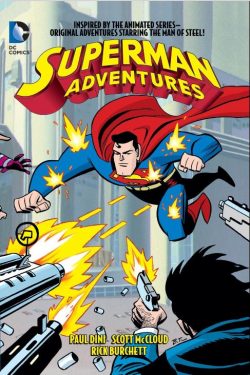
Superman Adventures volume 1


By Paul Dini, Scott McCloud, Rick Burchett, Bret Blevins, Mike Manley & various (DC Comics)
ISBN: 978-1-4012-5867-2

A decade after John Byrne galvanised, reinvigorated and reinvented the look and feel of the Man of Steel animator Bruce Timm returned to comicbook country to meld modern sensibility and classic mythology with Superman: The Animated Series.

With Paul Dini he had designed and overseen Batman: The Animated Series: a 1993 TV show that captivated young and old alike and breathed vibrant new life into an old concept. In 1996 lightning struck a second time. The show was another masterpiece and led to a tranche of sequels and spin-off including The New Batman/Superman Adventures, Justice League and Justice League Unlimited.

Although the Superman cartoon show (which originally aired in the USA from September 6th 1996 to February 12th 2000) never got the airplay it deserved in Britain, it remains a highpoint in the character’s long, long animation history, second only to the astounding and groundbreaking seventeen shorts produced by the Max Fleischer Studio in the 1940s.

These stylish modern visualisations became the norm, extending to the Teen Titans, Legion of Super Heroes, Young Justice and Brave and the Bold animation series that so successfully followed.

The broad stylisation – described as “Ocean Liner Art Deco” – also worked magnificently in static two dimensions for the spin-off comicbook produced by DC as seen in this first of four (so far) trade paperback and eBook compilations, gathering Superman Adventures #1-10 from November 1996 through August 1997.

With no further ado the all-ages action opens with ‘Men of Steel’ by show writer Paul Dini and illustrated with dash and verve by Rick Burchett & Terry Austin. Because they know their audience, the editors wisely treated the animated episodes and comicbook releases as equally canonical and here shady mega-billionaire Lex Luthor is a public hero even whilst clandestinely organising clandestine criminal deals, international coups and a secret war against the Man of Tomorrow.

The devil’s brew of dark deeds culminates here in the oligarch’s creation of a new secret weapon: a hyper-powerful robot-duplicate of Superman, which he uses to initially discredit and ultimately battle against the Caped Kryptonian. If it manages to kill him, Lex will mass-produce them and sell them to warlords around the world…

Comics grand master Scott McCloud comes aboard as regular scripter with the second issue as ‘Be Careful What You Wish For…’ sees the return of Kryptonite-powered cyborg Metallo. The mechanical maniac – like the rest of Metropolis – erroneously believes lonely, attention-seeking Kelly to be Superman’s girlfriend, but his sadistic revenge scheme hasn’t factored in how Lois Lane might react to the claim…

Computerised Kryptonian relic Brainiac resurfaces in ‘Distant Thunder’, having placed its malign consciousness into Earth artefacts (such as robot cats!) before building a new body to facilitate a new attack on the Metropolis Marvel. As ever, Brainiac’s end goal is assimilating data, but Superman quickly realises how to turn that programmed compulsion into a weapon ensuring the computer tyrant’s defeat…

Apprentice photo-journalist Jimmy Olsen‘s dreams of success and stardom get a big boost in issue #4’s ‘Eye to Eye’. After Luthor orchestrates a deadly attack on Superman with an enhanced gravity-weapon, the cub reporter learns it’s as much about grit and guts as it is being in the right place at the right time…

Bret Blevins pencils fifth exploit ‘Balance of Power’ as electrical villain Livewire awakes from a coma and sets about equalizing gender inequality by taking over the world’s broadcast airwaves. With all male presences edited out thanks to her galvanic power, the sparky ideologue then returns to her original agenda and attempts to eradicate too-powerful men like Superman and Luthor

McCloud, Burchett & Austin reunite for the astoundingly gripping ‘Seonimod’ wherein Superman utterly fails to save Metropolis from complete annihilation. All is not lost however, as Fifth Dimensional imp Mr. Mxyzptlk has trapped the Man of Steel in a backwards-spiralling time-loop, allowing the hero one last chance to track a concatenation of disasters back to the inconsequential event that triggered the string of accidents which wiped out everything the hero cherishes…

‘All Creatures Great and Small part 1’ opens a titanic two-part tale which sees Kryptonian Phantom Zone villains General Zod and Mala escape the miniaturised prison Superman had incarcerated them in. In the process they also shrink our hero to a few centimetres in height, but the endgame is far more devilish that that.

When scientific savant Professor Hamilton and top cop Dan “Terrible” Turpin join Lois in using a growth ray to restore Superman, Zod intercepts them and transforms himself into a towering colossus of chaos and carnage. Utterly overmatched and without options, the miniscule Man of Tomorrow is forced into the most disgusting and risky manoeuvre of his career to bring the gigantic General low in the concluding ‘All Creatures Great and Small part 2’…

Mike Manley pencils Superman Adventures #9 as ‘Return of the Hero’ focuses on an idealistic boy whose two heroes are Superman and Lex Luthor. However, as a series of arson attacks plagues his neighbourhood, Francisco Torres learns some unpleasant truths about the billionaire that shatter his worldview and almost destroy his family. Happily, the Caped Kryptonian proves to be a far more dependable role model…

Wrapping up this first cartoon collection is a classic clash between indomitable hero and deadly maniac as twisted techno-terrorist Toyman returns, peddling Superman action figures designed to plunder and rob their owners’ parents. ‘Don’t Try This at Home!’ by McCloud, Burchett & Austin once again proves that no amount of devious deviltry can long deter the champion of Truth, Justice and the American Way…

Breathtakingly written and spectacularly illustrated, these stripped-down, hyper-charged rollercoaster-romps are pure, irresistible examples of the most primal kind of comics storytelling, capturing the idealised essence of what every superman story should be. This is a compendium every fan of any age and vintage will adore.
© 1996, 1997, 2015 DC Comics. All Rights Reserved.

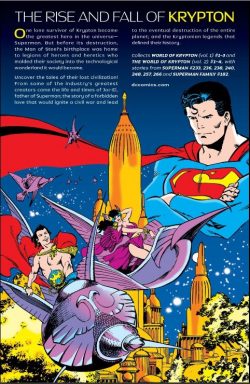
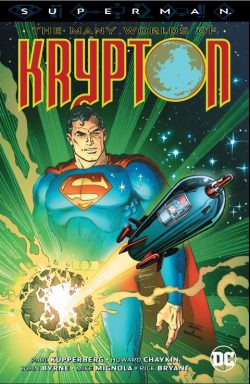
Superman: The Many Worlds of Krypton


By E. Nelson Bridwell, Denny O’Neil, Cary Bates, Marv Wolfman, Elliot S. Maggin, Paul Kupperberg, John Byrne, Murphy Anderson, Dick Giordano, Gray Morrow, Michael Kaluta, Dave Cockrum, Dick Dillin, Marshall Rogers, Howard Chaykin, Paul Kupperberg, Mike Mignola, Rick Bryant, Carlos Garzon & various (DC Comics)
ISBN: 978-1-4012-7889-2

For fans and comics creators alike, continuity can be a harsh mistress. These days, when maintaining a faux-historical cloak of rational integrity for the made-up worlds we inhabit is paramount, the worst casualty of the semi-regular sweeping changes, rationalisations and reboots is great stories that suddenly “never happened”.

The most painful example of this – for me at least – was the wholesale loss of the entire charm-drenched mythology that had evolved around Superman’s birthworld in the wonder years between 1948 and 1985.

Silver Age readers avidly consuming Superman, Action Comics, Superman’s Girlfriend Lois Lane, World’s Finest Comics and Superman’s Pal Jimmy Olsen (not forgetting Superboy and Adventure Comics) would delight every time some fascinating snippet of information leaked out.

We spent our rainy days filling in the incredible blanks about the lost world through the tantalising and thrilling tales from those halcyon publications. The Fabulous World of Krypton was a long-running back-up feature in Superman during the 1970s, revealing intriguing glimpses from the history of that lost world.

Throughout the decade and into the 1980s – and an issue of giant-sized anthology Superman Family – the feature delivered 27 “Untold Tales of Superman’s Native Planet” (and long overdue for a complete archival collection) by a host of the industry’s greatest talents which further explored that defunct wonderland.

A far-too-small selection of those are re-presented in this beguiling trade paperback and eBook commemoration, taken from Superman #233, 236, 238, 240, 248, 257, 266 and Superman Family #182, to augment a brace of miniseries World of Krypton #1-3 and World of Krypton volume 2 #1-4 (December 1987-March 1988).

These collectively span 1971-1988 and, following scene-setting introduction ‘The World (of Krypton) According to Paul (Kupperberg)’, kick off Chapter 1: Fabulous World of Krypton with E. Nelson Bridwell (who was always the go-to guy for any detail of fact or trivia concerning the company’s vast comics output) & Murphy Anderson’s trendsetting and groundbreaking yarn ‘Jor-El’s Golden Folly’.

Follow-up tales would alternate between glimpses of historical or mythological moments in the development of the Kryptonians and tales of the House of El, such as this astoundingly concise and drama-packed yarn which in seven pages introduces Superman’s father, traces his scholastic graduation and early triumphs in anti-gravity physics and rocketry and reveals how he met his bride-to-be, trainee astronaut Lara Lor-Van.

The story goes on to reveal how she stows away on a test rocket, crashes on the (luckily) habitable moon Wegthor and survives until her infatuated suitor finds a way to rescue her.

This a superb adventure yarn in its own right and, set against what we fans already knew about the doomed planet, augured well what was to follow…

The remaining tales in this section concentrate on non-Jor-El episodes – presumably in lieu of what follows – so the next fable comes from Superman #236 with Green Arrow and Black Canary hearing their Justice League recount the story of ‘The Doomsayer’ (by Denny O’Neil & Dick Giordano). This eco-terror tale reveals how scientist Mo-De detected the mounting tectonic pressures at the planet’s core but was silenced by modern day lotus eaters who didn’t want to hear any unpleasant truths…

In the guise of a Kryptonian kindergarten class story-time, Cary Bates & Gray Morrow devised a hard science creation myth for Superman #238 as ‘A Name is Born’ details how two marooned – and initially mutually antagonistic – aliens crashed on the primeval planet and joined to birth a new race together…

Bates & Michael Kaluta teamed in #240 for a cunning, irony-drenched murder mystery as ‘The Man Who Cheated Time’ details the unexpected consequences of an ambitious scientist who stole from and slaughtered his rivals only to pay for his crimes in a most unexpected manner.

Kryptonian archaeologists unearth a lost moment in planetary history as ‘All in the Mind’ (by Marv Wolfman & Dave Cockrum from #248) discloses how the ancient war between the city states of Erkol and Xan resulted in a generation of mutants. Apparently, if the parents had been more understanding and less intolerant, those super-kids might have saved their forebears from extinction…

Superman #257 (October 1972) offered a timeless instant classic wherein Elliot S. Maggin and illustrators Dick Dillin & Giordano celebrated ‘The Greatest Green Lantern of All’. Here avian GL Tomar-Re reports his tragic failure in preventing Krypton’s detonation, unaware that the Guardians of the Universe had a plan to preserve and use that world’s greatest bloodline – or at least its last son…

Maggin, Dick Dillin & Joe Giella then emphasised a long-hidden connection between Earth and Krypton in #266 as ‘The Face on the Falling Star’ reveals how in eons past two Kryptonian children are saved from doom by a strange device fallen from the sky: a machine sent from a lost civilisation on pre-historic Terra…

Wrapping up this section is ‘The Stranger’ by Paul Kupperberg, Marshall Rogers & Frank Springer and first seen in Superman Family #182: an analogue Christmas fable explaining how four millennia past a holy man named Jo-Mon sacrificed his life to liberate the people and end the depredations of the tyrannical Al-Nei…

The second section here is Chapter 2: The Life of Jor-El and reprints a pioneering miniseries that referenced many of those 27 vignettes as well as the key Krypton-focussed yarns of the Superman franchise.

In 1979 – when the Superman movie had made the hero a global sensation once more – scripter Paul Kupperberg and artist Howard Chaykin (assisted and ghost-pencilled by Alan Kupperberg) and inkers Murphy Anderson & Frank Chiaramonte synthesised the scattered back-story details into DC’s first limited series World of Krypton.

Although never collected into a graphic novel, this glorious indulgence was resized into a monochrome pocket paperback book in 1982, supervised by and with an introduction from the much-missed, multi-talented official DC memory E. Nelson Bridwell. That magical celebration of life on the best of all fictional worlds is a grand old slice of comics fun and forms the spine of this new composite compilation.

The story opens on ‘The Jor-El Story’ with Superman reviewing a tape-diary found on Earth’s moon: a record from his long-deceased father which details the scientist’s life, career and struggle with the nay-saying political authorities whose inaction doomed the Kryptonian race to near-extinction.

As the Man of Steel listens, he hears how Jor-El wooed and won his mother Lara Lor-Van despite all the sinister and aberrant efforts of the planetary marriage computer to frustrate them, how his sire discovered anti-gravity and invented the Phantom Zone ray, uncovered the lost technology of a dead race which provided the clues to Kal-El’s escape rocket, and learns his father’s take on Superman’s many time-twisting trips to Krypton…

In ‘This Planet is Doomed’ the troubled orphan feels his father’s pain when android marauder Brainiac steals the city of Kandor, reels as rogue scientist Jax-Ur blows up the inhabited moon of Wegthor, and is revolted as civil war almost crushes civilisation thanks to the deranged militarist General Zod and when his own cousin Kru-El forever disgraces the noble House of El…

The countdown to disaster continues until ‘The Last Days of Krypton’ as political intrigue and exhaustion overwhelm the distraught scientist and, all avenues closed to him, Jor-El takes drastic action…

Heavily referencing immortal classics such as ‘Superman’s Return to Krypton’ (Superman volume 1 #141, November 1960), Fabulous World of Krypton mini-epics ‘Jor-El’s Golden Folly’, ‘Moon-Crossed Love’, ‘Marriage, Kryptonian Style’ and a host of others, this epochal saga from simpler and more wondrous times is a sheer delight for any fan tired of unremitting angst and non-stop crises…

The final section – Chapter 3: The World of Krypton – is a dark reworking by John Byrne, Mike Mignola, Rick Bryant & Carlos Garzon depicting a radically different planet.

In 1985 when DC Comics decided to rationalise, reconstruct and reinvigorate their continuity with Crisis on Infinite Earths, they used the event to simultaneously regenerate their key properties at the same time. The biggest gun they had was Superman and it’s hard to argue that the change was not before time.

The big guy was in a bit of a slump, but he’d weathered those before. So how could a root and branch retooling be anything but a pathetic marketing ploy that would alienate the real fans for a few fly-by-night Johnny-come-latelies who would jump ship as soon as the next fad surfaced?

This new Superman repurposed the hero into a harsher, more uncompromising hero who might be alien in physicality but completely human in terms of feelings and attitudes. As seen in Man of Steel #1 (not included here), ‘From Out of the Green Dawn’ traced the child’s voyage in a self-propelled birthing matrix to a primitive but vital and vibrant world.

He had escaped from a cold, sterile, soulless and emotionally barren planet barely glimpsed before it was gone in a cosmic flash…

As the hero’s new adventures became a sensational success, his creators felt compelled to revisit the hero’s bleakly dystopian birthworld. It was however, now conceived of as a far darker and more forbidding place and 1987’s 4-issue miniseries opted to reveal how that transformation came about.

Scripted by Byrne, it all begins in ‘Pieces’ (art by Mignola & Rick Bryant) as an indolent hedonistic scientific paradise comes crashing into ruin after the age’s greatest moral dilemma boils over into global civil war.

For 10 thousand generations Kryptonians have enjoyed virtual immortality thanks to the constant cultivation of clones to use for medical spare parts. The rights of the clones had been debated for centuries but has recently resulted in sporadic violence. The situation changes after ultra-privileged Nyra is exposed as having stolen one of her supposedly brain-dead clones for an act of social abomination. Exposure leads to murder, suicide and a rapidly escalating collapse of social cohesion…

Centuries ‘After the Fall’, Van-L wanders a planet shattered by devastating war technologies, surviving only because of the nurturing war suit. The grand planetary society is gone, replaced by constantly warring pockets of humanity, but Van is in need of allies, even if they were once lovers or despised foes. He has learned that the original instigator of the collapse still lives and plans to assuage his shame and guilt by blowing up the planet…

For the third issue the scene shifts to millennia later as young scholar Jor-El immerses himself in a traumatic ‘History Lesson’.

The distant descendant of Van-L obsessively probes the last days of the conflict and the nuclear annihilation scheme of terrorist cell Black Zero, but his compulsion causes him to almost miss a crucial social obligation: meeting his father and the grandparent of Lara, selected by The Masters of the Gestation Chamber as his ideal DNA co-contributor to the first Kryptonian allowed to be born in centuries…

Carlos Garzon steps in to finish Mignola’s pencils for concluding chapter ‘Family History’ as, in contemporary times, Superman agrees to an interview with Daily Plant reporter Lois Lane. The subject is how Krypton died, and why…

Precising the intervening millennia of history and stagnation, the Last Son of Krypton reveals how his own birth-father uncovered a shocking secret, rebelled against his moribund, repressed culture and found brief comfort with perhaps the last kindred spirit on his world. Kal-El then tells of how they ensured his survival at the cost of their own…

Celebrating the many and varied Worlds of Krypton, this is a magnificent tribute to the imagination of man creators and the power of a modern mythology: the ever-changing evolution of a world we all wanted to live on back in the heady days of yore…
© 1970, 1971, 1972, 1973, 1976, 1977, 1979, 1987, 2008, 2018 DC Comics. All Rights Reserved.

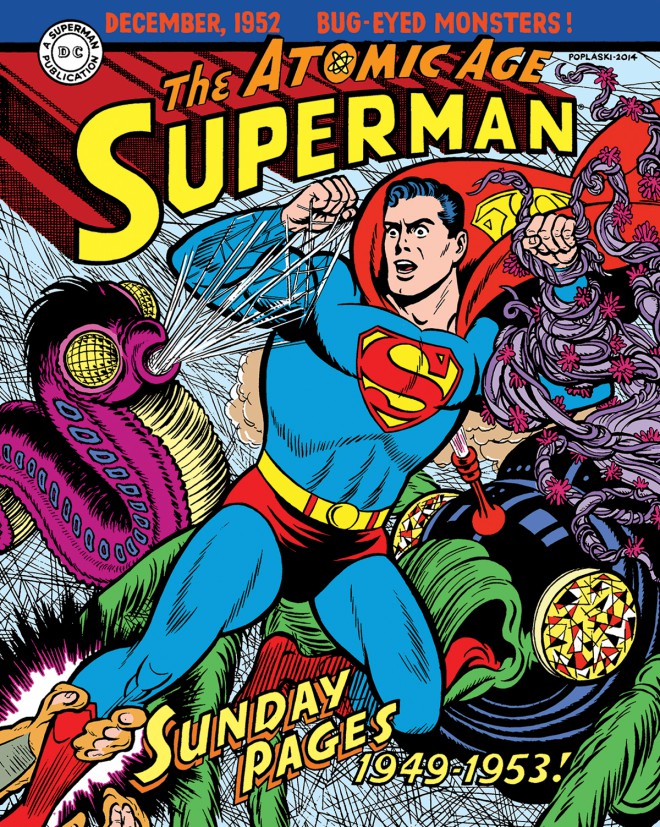
Superman: The Atomic Age Sundays volume 1: 1949-1953


By Alvin Schwartz, Wayne Boring & Stan Kaye (IDW/DC Comics)
ISBN: 978-1-63140-262-3

It’s indisputable that the American comicbook industry – if it existed at all – would have been an utterly unrecognisable thing without Superman. Jerry Siegel & Joe Shuster’s bold and unprecedented invention was fervidly adopted by a desperate and joy-starved generation and quite literally gave birth to a genre if not an actual art form.

He was also shamelessly copied and adapted by many inspired writers and artists for numerous publishers, spawning an incomprehensible army of imitators and variations within three years of his summer 1938 debut.

The intoxicating blend of breakneck, breathtaking action and triumphal wish-fulfilment which epitomised the early Man of Steel soon grew to encompass cops-and-robbers crime-busting, socially reforming dramas, science fiction, fantasy, whimsical comedy and, once the war in Europe and the East also engulfed America, patriotic relevance for a host of gods, heroes and monsters, all dedicated to profit through exuberant, eye-popping excess and vigorous dashing derring-do.

In comicbook terms Superman was master of the world. Moreover, whilst transforming and dictating the shape of the fledgling funnybook industry, the Man of Tomorrow relentlessly expanded into all areas of the entertainment media.

Although we all think of the Cleveland boys’ iconic invention as the epitome and acme of comicbook creation, the truth is that very soon after his debut in Action Comics #1 the Man of Steel became a fictional multimedia monolith in the same league as Popeye, Tarzan, Sherlock Holmes and Mickey Mouse.

Diehard comics fans regard our purest and most powerful icons in primarily graphic narrative terms, but the likes of Batman, Spider-Man, Black Panther, The Avengers and all their hyperkinetic kind long ago outgrew their four-colour origins and are now fully mythologized modern media creatures, instantly familiar in mass markets across all platforms and age ranges…

Far more people have viewed or heard the Man of Steel than have ever read his comicbooks. His globally syndicated newspaper strips alone reached untold millions, and by the time his 20th anniversary rolled around at the very start of what we know as the Silver Age of Comics, he had been a thrice-weekly radio serial regular and starred in a series of astounding animated cartoons, as well as two films and a novel by George Lowther.

Superman was a perennial sure-fire success for toy, game, puzzle and apparel manufacturers and had just ended his first smash live-action television serial. In his future were three more shows (Superboy, Lois & Clark and Smallville), a stage musical, a franchise of blockbuster movies and an almost seamless succession of games, bubblegum cards and TV cartoons beginning with The New Adventures of Superman in 1966 and continuing ever since. Even his superdog Krypto got in on the small-screen act…

However, during his formative years the small screen was simply an expensive novelty so the Action Ace achieved true mass market fame through a different medium: one not that far removed from his print origins.

Although pretty much a spent force these days, for the majority of the last century the newspaper comic strip was the Holy Grail that all American cartoonists and graphic narrative storytellers hungered for. Syndicated across the country – and frequently the planet – it was seen by millions, if not billions, of readers and generally accepted as a more mature and sophisticated form of literature than comic-books. It also paid far better.

And rightly so: some of the most enduring and entertaining characters and concepts of all time were created to lure readers from one particular paper to another and many of them grew to be part of a global culture.

Flash Gordon, Dick Tracy, Buck Rogers, Charlie Brown and so many more escaped humble and tawdry newsprint origins to become meta-real: existing in the minds of earthlings from Albuquerque to Zanzibar.

Some still do…

Even so, it was always something of a risky double-edged sword when a comicbook character became so popular that it swam against the tide (after all weren’t the funny-books invented just to reprint strips in cheap accessible form?) to became actual mass-entertainment – and often global – syndicated serial strips.

Superman was the first original comicbook character to make that leap – about six months after as he exploded out of Action Comics – but only a few have ever successfully followed. Wonder Woman, Batman (eventually) and groundbreaking teen icon Archie Andrews made the jump in the 1940s with only a handful such as Spider-Man, Howard the Duck and Conan the Barbarian having done so since.

The daily Superman newspaper comic strip launched on 16th January 1939, supplemented by a full-colour Sunday page from November 5th of that year. Originally crafted by such luminaries as Siegel & Shuster and their studio (Paul Cassidy, Leo Nowak, Dennis Neville, John Sikela, Ed Dobrotka, Paul J. Lauretta & Wayne Boring), the mammoth task soon required the additional talents of Jack Burnley and writers Whitney Ellsworth, Jack Schiff & Alvin Schwartz.

The McClure Syndicate feature ran continuously from 1939 until May 1966, appearing at its peak in more than 300 daily and 90 Sunday newspapers; boasting a combined readership of more than 20 million. For most of the post war years Boring & Stan Kaye illustrated the spectacular Sundays (eventually supplemented by artists Win Mortimer and Curt Swan). The majority of the strips – from 1944 to 1958 – were written by still largely unsung scribe Alvin Schwartz.

Born in 1916, Schwartz was an early maestro of comicbooks, writing for Batman, Superman, Captain Marvel and many other titles and companies. Whilst handling the Superman strip he also freelanced on Wonder Woman and other superheroes as well as genre titles such as Tomahawk, Buzzy, A Date with Judy and House of Mystery.

After numerous clashes with new superman Editor Mort Weisinger, Schwartz quit comics for commercial writing, selling novels and essays, and latterly, documentaries and docudramas for the National Film Board of Canada. He also worked miracles in advertising and market research, developing selling techniques such as psychographics and typological identification and was a member of the advisory committee to the American Association of Advertising Agencies. He died in 2011.

After too many years wallowing in obscurity most of Superman’s newspaper strip exploits are at last available to aficionados and the curious newcomer in tomes such as this compiled under the auspices of the Library of American Comics.

Showcasing Schwartz and artist Wayne Boring in their purest prime, these Sundays (numbered as pages #521 to #698 and collectively spanning October 23rd 1949 to March 15th 1953) feature a nigh-omnipotent Man of Steel in domestically-framed and curated tales of emotional dilemmas and pedestrian criminality rather than a parade of muscle-flexing bombast, with humour, wit and satire comfortably replacing non-stop angst and bludgeoning action.

Following an affable appreciation of the creators and the times in ‘An Introduction’ by Mark Waid, ‘A Wayne Boring Gallery’ provides a tantalising selection of Superman and Action Comics covers from the period before the weekly wonderment commences in all its vibrant glory.

Sadly, the serials are untitled, so you’ll just have to manage with my meagre synopses of the individual yarns…

Kicking things off is a charming fantasy as the Metropolis Marvel is temporarily stranded in Arthurian Britain after a US government time travel experiment goes awry. Whilst living in the past he befriends and helps out court magician Merlin: an old duffer whose conjuring tricks aren’t fooling anyone anymore…

The first new story of 1950 begins on February 12th and details how swindler Joseph Porter cons the Man of Steel into taking his place and clearing up his problems with the cops and the numerous gulled victims. This includes a hilarious spoofing sequence as Superman plays un-matchmaker to a scandalously-affianced hillbilly ingenue that will delight fans of Li’l Abner…

The extended tale opening on May 28th offers another timeless human-interest drama given a super-powered spin as two aging robber barons recall their regulation-free heydays before embarking on a ruthless wager to see who will get “anything they wish for” first.

The only limitations imposed are their imaginations and financial resources and before long Superman is hard-pressed to keep collateral casualties to a minimum…

One of the few antagonists to transfer from the funnybooks to the Funnies pages was fifth dimensional prankster Mr. Mxyztplk who popped back to our third dimension and took instant umbrage to an arrogant Earth educator. Dr. Flipendale had the temerity to declare the imp a mass delusion and refused to believe or even acknowledge the escalating chaos his pronouncements triggered…

Strip #573 (October 22nd) offers a different take on the classic secret identity crisis when Clark is exposed as an invulnerable man to all of Metropolis. Although gangsters are convinced, Lois Lane is not, claiming the underworld is perpetrating a frame-up…

That yarn takes us to the end of the year and 1951 opens on January 7th with a tale of suspicion and injustice as Clark heads back to childhood hometown Smallville to celebrate Superboy Week and encounters a young man nursing an ancient grudge.

When a poison pen and rumour campaign looks set to spoil the festivities, the hero’s investigations uncover a betrayed child, a framed, murdered father and nefarious clandestine misdeeds carried out by corporate rogues in the Boy of Steel’s name…

Another identity crisis bedevils Clark beginning on April 1st 1951. Here a killer’s case of mistaken identity seemingly exposes the reporter as super-strong and bulletproof. Surely, he must be the indomitable Man of Steel in disguise?

Not according to Professor Pinberry who believes the hapless scribe has been accidentally exposed to his new superpower ray machine, Clark is happy to grasp at the fortuitous alibi but trouble mounts after the public demands to see the machine in action again and the city’s biggest mobster goes after the gadget to make himself Superman’s equal…

Strip #609 starts the next quirky exploit on July 1st as old duffer Salem Cooley comes to Metropolis and enjoys the most miraculous winning streak in history. Even Superman’s astounding powers can’t keep up with the string of happy circumstances, fortuitously profitable accidents and close shaves. Everybody wants to be the old coot’s pal, so who then is behind the constant assassination attempts on superstitious Salem and what reward could possibly tempt anyone to challenge the luckiest man alive?

A new serial opens on September 9th as Superman agrees to write Daily Planet articles about some of his previous exploits to benefit crime prevention charities. However, when the capers he cites are restaged by mysterious malefactors the city soon turns against the Man of Tomorrow and it takes all his super-wits to uncover the mastermind behind it all and stop one of the boldest crimes in the city’s history…

To lure a crime boss out, Superman agrees to be absent from Metropolis for a few weeks in the next adventure (running from November 18th 1951 to January 13th 1952). However, when a poverty-struck boy succumbs to disease and depression, the Man of Might decides to return and act undercover, inspiring the kid’s recovery by granting wishes made on a “magic wand”.

That task becomes increasingly difficult after crooks get hold of the stick and the invisible hero has to play along to sustain little Teddy’s recuperation…

From January 20th Superman plays guardian angel to former wastrel and drunken playboy Reggie de Peyster who swears he’s a reformed character. Nobody but Superman realises the trust fund brat is sincere and all the appalling and shameful scandals he’s currently implicated in are being manufactured to cut the heir out of a vast inheritance…

Lois Lane takes centre stage in the tale opening on April 6th as, after months of being sidelined, the daring reporter quits her job to find a career offering some real excitement. She’s soon the assistant to private detective Mike Crain, catching crooks and bodyguarding glamourous stars, but the work seems dull and pedestrian. Of course, Lois is utterly oblivious to the fact that Superman is secretly intervening in his patriarchal efforts to get her back where she belongs. Ah, different times, eh?

When maverick Hollywood producer/director Hans Bower arrives in Metropolis, (June 29th he promptly declares Clark Kent to be his latest mega-sensational super-star. A force of nature unable to take “no” for an answer, he soon has the bewildered reporter helming his next box office blockbuster but as shooting progresses Superman uncovers a covert agenda and shocking secret behind the mogul’s extraordinary actions.

Uncanny crime is the order of the day from September 21st when bizarre illusions plague Metropolis and scientist Dr. Wagonrod accuses Superman of perpetrating hoaxes and staging crises due to an undiagnosed split personality. The truth is far more devious than that, though…

Concluding this first Atomic Age collection, from November 30th 1952 to March 15th 1953, readers were avidly watching the skies as an alien capsule fell to Earth and disgorged a succession of alien bio-weapons to test humanity. The Man of Steel was hard-pressed to defeat the army of bizarre beasts but did have one immeasurable advantage: the sage advice and input of life-long science fiction fan Sedgwick Ripple…

The Atomic Age Superman: – Sunday Pages 1949-1953! is the first of three huge (312 x 245 mm), lavish, high-end hardback collections starring the Man of Steel and a welcome addition to the superb commemorative series of Library of American Comics which has preserved and re-presented in luxurious splendour such landmark strips as Li’l Abner, Tarzan, Rip Kirby, Polly and her Pals and many of the abovementioned cartoon icons.

It’s an unimaginable joy to see these “lost” Superman stories again, offering a far more measured, domesticated and comforting side of one of America’s most unique contributions to world culture. It’s also a pure delight to see some of the most engaging yesterdays of the Man of Tomorrow. Join me and see for yourself…
© 2015 DC Comics. All rights reserved. SUPERMAN and all related characters and elements are trademarks of DC Comics.

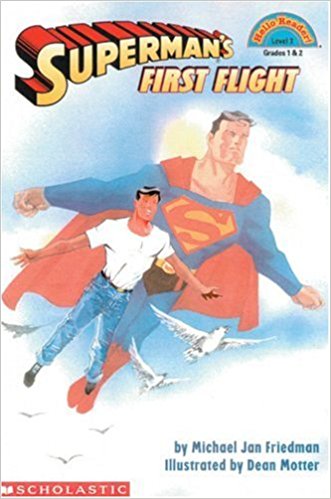
Superman’s First Flight


By Michael Jan Friedman & Dean Motter (Scholastic)
ISBN: 978-0-43909-550-1

Congratulations on your Anniversary, Man of Tomorrow!

We parochial and possessive comics fans too often regard our purest and most powerful icons in purely sequential narrative terms, but characters such as Batman, Wonder Woman and Superman long ago outgrew their four-colour origins and are now fully mythologized modern media creatures instantly familiar in mass markets, platforms and age ranges.

One particularly captivating case in point is this enthralling retelling of the Man of Steel’s formative journey to self-discovery, retold for youngsters as part of the Hello Reader early-learning program devised by children’s publisher Scholastic.

Categorised as US Level 3 (school years 1 and 2), with Level 2 being kindergarten and 1 as pre-schoolers, the smartly recapitulated story spans that crucial divide wherein kids still want their parents to read to and with them, but as the little tykes are also beginning that wonderful, magical journey into literacy as solo voyagers…

This clever, sensitive and age-appropriate retelling by Michael Jan Friedman encapsulates and addresses every maturing child’s growing feelings of potential alienation, sense of growth, self-discovery and independence by focussing on High School student Clark Kent on the day that the solitary teen discovered exactly why he has always felt somehow different from his classmates.

When Clark suddenly, impossibly, hears and sees a car crash occurring miles away, without thinking he is running and jumping over buildings. Arriving on the scene he tears the metal doors off burning cars and outraces an explosion to save a trapped driver…

Terrified that he is some kind of monster he confides in his parents, who promptly share a secret they have been harbouring all Clark’s life.

In the barn they show the awe-struck lad a tiny one-man spaceship which had crashed to Earth years ago. Its cargo was an alien baby…

As Clark approaches the relic a hologram activates and he witnesses his birth-parents Jor-El and Lara who explain why he can perform feats no one else can…

Shocked and distraught, Clark runs away as fast as he can and before he even notices it is flying high above the world. The glorious shock at last makes him realise that different doesn’t mean bad…

Before long the world is daily improved and even saved by a visitor from afar known as Superman…

This captivating adventure is a cleverly weighed introduction into the Action Ace’s canonical comicbook history, subtly addressing issues of adoption and belonging as well as more modern ideological issues such as the plight of refugees and immigrants. Remember, for a very long time distressed and needy strangers were welcomed with open arms in civilised countries…

Magnificently complemented by 31 painted illustrations by design guru and illustrator Dean Motter, this is an epic retold that will amaze kids and astound even their jaded, seen-it-all-before elders.

No Supermaniac could consider their collection complete without a copy of this wonderful little gem. Superman’s First Flight is the ideal introduction for youngsters to their – surely – life-long love affair with the Last Son of Krypton and reading in general…
© 2000 DC Comics. All Rights Reserved. All Rights Reserved.

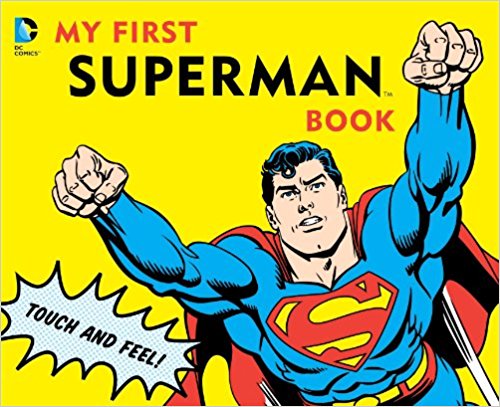
My First Superman Book


By David Katz, designed by George Rucker with illustrations by José Luis García-López (Downtown Bookworks)
ISBN: 978-1-935703-00-6

Happy Birthday, Caped Kryptonian!

Superman is a hero for all ages. Since his debut in June 1938 (actually Action Comics #1 was on newsstands in May but let’s not quibble here), that’s a fact his creators and owners have always understood, with spin-offs and specially tailored books and other merchandise. He’s also the ideal power-embodiment that appeals to the little kid in us all: an unstoppable icon that says “you can’t dictate to me. I know what’s right and I’m going to do it!”

Good thing he’s not a bully then, no?

Such a potent image is ones you simply can’t assimilate early enough and there are number of books and merchandise items tailored to the youngest of potential fanatics. This is one of my very favourites and because of the art (yeah, sure, fanboy) is one even older and aged aficionados can legitimately hunt down.

Printed on solid durable board, My First Superman Book reiterates the key aspects of the Man of Steel’s mythology with bold primary-coloured art-spreads, courtesy of DC’s top brand and merchandising visualiser José Luis García-López. As an added inducement, the images are enhanced with 3D additions and gimmicks such as X-ray vision demonstrated by pop-up and pull-away tabs, as is the legendary phonebooth costume change.

Fabric and faux fur inserts afford a tactile dimension to the hero’s billowing cape and superdog Krypto‘s glowing coat, whilst abundant glitter overprints add a sparkling sheen to the fabulous arctic Fortress of Solitude.

This book is a captivating introduction to the world of classic superhero symbology: offering a literally solid grounding in the basics of the Man of Steel’s incomparable legend and never forgetting the dual aim is inculcating fun and wonder.

A genuine delight and one you could even have some children to share it with if you want…
™ and © DC Comics 2010. All Rights Reserved.

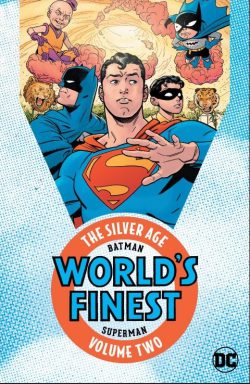
Batman & Superman in World’s Finest Comics: The Silver Age volume 2


By Edmond Hamilton, Bill Finger, Jerry Coleman, Curt Swan, Dick Sprang, Stan Kaye, Sheldon Moldoff, Charles Paris, Ray Burnley & various (DC Comics)
ISBN: 978-1-4012-7780-2

For decades Superman and Batman worked together as the “World’s Finest” team. They were friends as well as colleagues and the pairing made sound financial sense since DC’s top heroes could cross-pollinate and, more importantly, cross-sell their combined readerships.

This most inevitable of Paladin Pairings first occurred on the Superman radio show in the early 1940s, whereas in comics the pair had only briefly met whilst on a Justice Society of America adventure in All-Star Comics #36 (August-September 1947) – and perhaps even there they missed each other in the brightly-hued hubbub…

Of course, they had shared the covers of World’s Finest Comics from the outset, although never crossing paths inside; sticking firmly to their specified solo adventures within. For us pictorial continuity buffs, the climactic real first time was in the pages of Superman’s own bi-monthly comic (issue #76, May/June 1952, as seen in the previous volume of this splendid compilation series). However once that Rubicon was crossed, thanks to spiralling costs and dwindling page-counts the industry never looked back…

This second stunning trade paperback (and eBook) compendium of Silver Age solid gold re-presents the lead stories from World’s Finest Comics #95-116, spanning July/August 1958 to March 1961: another astounding archive of adventure that opens with an Edmond Hamilton, Dick Sprang & Ray Burnley yarn pitting the temporarily equally multi-powered and alien-entranced champions against each other in ‘The Battle of the Super-Heroes’.

A magical succession of magnificent and light-heartedly whacky classics began in #96 with Hamilton’s ‘The Super-Foes from Planet X’ wherein indolent and effete aliens dispatch fantastic monsters to battle the titanic trio for the best possible reasons…

Bill Finger took over scripting with #97, incomprehensibly turning the Man of Steel on his greatest friends in ‘The Day Superman Betrayed Batman’, after which ‘The Menace of the Moonman!’ pits the heroes against a deranged hyper-powered astronaut, ‘Batman’s Super-Spending Spree!’ baffles all his close friends and Lex Luthor devilishly traps Superman in the newly-recovered Bottle City of Kandor to become ‘The Dictator of Krypton City’ – all breathtaking epics beautifully limned by Sprang & Kaye.

Sprang inked himself in the rocket-paced super-crime thriller ‘The Menace of the Atom-Master’ whereas it took Curt Swan, Burnley, Sprang & Sheldon Moldoff to properly unveil the titanic tragedy of ‘The Caveman from Krypton’ in #102.

‘The Secret of the Sorcerer’s Treasure’ (Sprang & Moldoff) then reveals a couple of treasure hunters driven mad by the tempting power of freshly unearthed magical artefacts whilst Luthor quickly regrets using a hostage Batwoman to facilitate ‘The Plot to Destroy Superman’.

After the metamorphosis which turned Clark Kent into ‘The Alien Superman’ proves not at all what it seems to be, ‘The Duplicate Man’ in WF #106 sees the ultimate downfall of a villain who develops an almost unbeatable crime tool.

Next up ‘The Secret of the Time-Creature’ encompassed centuries and resulted in one of Finger’s very best detective thrillers to baffle but never stump the Cape & Cowl Crusaders, after which Jerry Coleman assumes the writer’s role with ‘The Star Creatures’ (art by Sprang & Stan Kaye), the tale of an extraterrestrial moviemaker whose deadly props were stolen by Earth crooks.

Stellar cover artist Curt Swan (with Stan Kaye inking) finally makes the move to interior illustrator for ‘The Bewitched Batman’, detailing a tense race against time to save the Gotham Guardian from an ancient curse, before ‘The Alien who Doomed Robin’ (Sprang & Moldoff) sees a symbiotic link between monster marauder and Boy Wonder leave the senior heroes apparently helpless… at least for a little while…

‘Superman’s Secret Kingdom’ (Finger, Sprang & Moldoff from #111, August 1960) is a compelling lost world yarn wherein a cataclysmic holocaust deprives the Man of Steel of his memory and Batman and Robin must find and cure him at all costs…

The next issue – by Coleman, Sprang & Moldoff – delivered a unique and tragic warning in ‘The Menace of Superman’s Pet’ as a phenomenally cute teddy bear from space proves to be an unbelievably dangerous menace and unforgettable true friend. Bring tissues, you big baby…

In an era when disturbing or terrifying menaces were frowned upon, many tales featured intellectual dilemmas and unavoidably irritating pests to torment our heroes. Both Gotham Guardian and Man of Steel had their own magical 5th dimensional gadflies and it was therefore only a matter of time until ‘Bat-Mite Meets Mr. Mxyzptlk’: a madcap duel to determine whose hero was best… with America caught in the metamorphic middle.

WF #114 reveals Superman, Batman and Robin shanghaied to the distant world of Zoron as ‘Captives of the Space Globes’ where their abilities are reversed. Nevertheless, justice is still served in the end, after which ‘The Curse that Doomed Superman’ sees the Metropolis Marvel consistently outfoxed by a scurrilous Swami with the Darknight Detective helpless to assist him…

Swan & Kaye at last return for #116’s thrilling monster mash ‘The Creature from Beyond’ to wrap up this volume with a criminal alien out-powering Superman whilst concealing an incredible secret…

These are gloriously clever yet uncomplicated tales whose dazzling style has returned to inform if not dictate the form for much of DC’s modern television animation – especially the fabulous Batman: The Brave and the Bold series – and the contents of this titanic tome offer a veritable feast of witty, charming thrillers packing as much punch and wonder now as they always have.
© 1958, 1959, 1960, 1961 2018 DC Comics. All Rights Reserved.

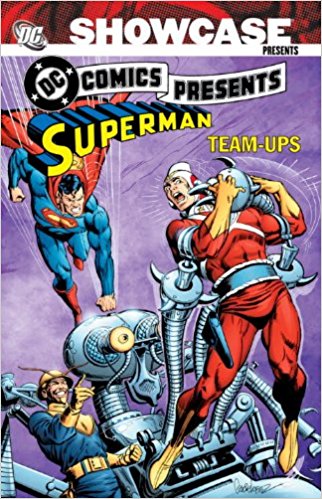
Showcase Presents DC Comics Presents Superman Team-Ups volume 1


By Martin Pasko, Dave Michelinie, Len Wein, Paul Levitz, Cary Bates, Steve Englehart, Denny O’Neil, Gerry Conway, Mike W. Barr, Jim Starlin, Marv Wolfman, José Luis García-López, Murphy Anderson, Curt Swan, Dick Dillin, Joe Staton, Rich Buckler & various (DC Comics)
ISBN: 978-1-4012-2535-3

As I’ve been inundating you with Superman stuff in this Anniversary year and celebrating the graphic literary device of team-ups this week, how could I let this superb collection go unremarked, especially as so much of the material remans inaccessible in more modern, full-colour compilations? Comics fans are all completists at heart, and until new editions or digital equivalents are released this is as good at it gets…

From the moment a kid first sees his second superhero the only thing he/she wants is to see how the new gaudy gladiator stacks up against the first. From the earliest days of the comics industry (and according to DC Comics Presents editor Julie Schwartz it was the same with the pulps and dime novels that preceded it) we’ve wanted our idols to meet, associate, battle together – and if you follow the Timely/Marvel model, that means against each other – far more than we want to see them trounce their archenemies in a united front…

The concept of team-up books – an established star pairing or battling (usually both) with less well-selling company characters – was far from new when DC awarded their then-biggest gun (it was the publicity-drenched weeks before the release of Superman: The Movie and Tim Burton’s Batman was over a decade away) a regular arena to have adventures with other stars of their firmament, just as Batman had been doing since the middle of the 1960s in The Brave and the Bold.

In truth, the Action Ace had already enjoyed the serial sharing experience once before, when World’s Finest Comics briefly ejected the Caped Crusader and Superman battled beside a coterie of heroes including Flash, Robin, Teen Titans, Vigilante, Dr. Fate and others (issues #198-214; November 1970 to October/November 1972) before the proper status quo was re-established.

This superbly economical monochrome collection re-presents the first 26 issues of the star-studded monthly and opens the show with a two-part thriller featuring Barry Allen, the Silver Age Flash who had also been Superman’s first co-star in that aforementioned World’s Finest Comics run.

‘Chase to the End of Time!’ and ‘Race to the End of Time!’ featured in DC Comics Presents #1 and 2 (July-August and September-October 1978), as scripter Marty Pasko and the utterly astounding José Luis García-López (inked by Dan Adkins) rather reprised that WF tale. Here warring alien races trick both heroes into speeding relentlessly through the time-stream to prevent Earth’s history from being corrupted and destroyed.

As if that wasn’t dangerous enough, nobody could predict the deadly intervention of the Scarlet Speedster’s most dangerous foe, Professor Zoom, the Reverse-Flash…

David Michelinie wrote a tantalising pastiche of classic Adam Strange Mystery in Space thrillers for García-López to draw and ink in ‘The Riddle of Little Earth Lost’ wherein the Man of Two Worlds and Man of Tomorrow foil the diabolical cosmic catastrophe scheme of a deranged genius to transpose, subjugate and/or destroy Earth and light-years distant planet Rann.

Len Wein came aboard to script the superb ‘Sun-Stroke!’ wherein the Man of Steel and the madly-malleable Metal Men join forces to thwart solar-fuelled genius I.Q. and toxic elemental menace Chemo after an ill-considered plan to enhance Earth’s solar radiation exposure provokes a cataclysmic solar-flare.

Sea King Aquaman is embroiled in ‘The War of the Undersea Cities’ (by Wein, Paul Levitz & Murphy Anderson) when his subjects re-open ancient hostilities with the mer-folk of undersea neighbour Tritonis, home of Superman’s old college girlfriend Lori Lemaris. Fortunately, cooler heads prevail when the deadly Ocean Master is revealed to be meddling in their sub-sea politics, after which ‘The Fantastic Fall of Green Lantern’ (Levitz, Curt Swan & Francisco Chiaramonte) sees the Man of Steel inherit the awesome power ring after Hal Jordan falls in battle against Star Sapphire.

Although triumphant against his female foe, Superman is subsequently ambushed by anti-matter warriors from Qward leading to ‘The Paralyzed Planet Peril!’ (#7, Levitz, Dick Dillin & Chiaramonte) wherein those aliens try to colonise Earth until the robotic Red Tornado swirls in to the rescue.

‘The Sixty Deaths of Solomon Grundy’ by Steve Englehart & Murphy Anderson co-stars Swamp Thing (at a time when the bog-beast still believed he was a transformed human and not an enhanced plant) searching the sewers of Metropolis for a cure to his condition, only to stumble onto a battle between the Man of Steel and the mystic zombie who was “born on a Monday”…

Marty Pasko returns to script the Joe Staton & Jack Abel illustrated ‘Invasion of the Ice People!’ wherein Wonder Woman assists in repelling an attack by malign disembodied intellects before another 2-part tale commences with ‘The Miracle Man of Easy Company’ (Cary Bates, Staton & Abel)…

Here a super-bomb blasts Superman back to World War II and a momentous meeting with indomitable everyman soldier Sgt. Rock, before the Caped Kryptonian returns home to battle a brainwashed and power-amplified Hawkman in ‘Murder by Starlight!’ (Bates, Staton & Chiaramonte).

DCCP #12 offered a duel between the Action Ace and New God Mister Miracle in ‘Winner Take Metropolis’ by Englehart, Richard Buckler & Dick Giordano before Levitz scripts an ambitious continued epic that begins with ‘To Live in Peace… Nevermore!’ (art from Dillin & Giordano), wherein the Legion of Super-Heroes prevent Superman saving a little boy from alien abduction to preserve the integrity of the time-line. It didn’t help that the lad was Jon Ross, son of Clark Kent’s oldest friend and most trusted confidante…

Driven mad by loss, Pete Ross risks the destruction of reality itself by enlisting the aid of Superboy to battle his older self in ‘Judge, Jury… and No Justice!’ (Levitz, Dillin & Giordano), after which the Man of Steel helps scientist-hero Ray Palmer regain his size-changing powers in ‘The Plight of the Giant Atom!’ (Bates, Staton & Chiaramonte).

Issue #16 finds Superman and Black Lightning battling a heartsick alien trapped on Earth foe millennia in ‘The De-volver!’ (Denny O’Neil, Staton & Chiaramonte) after which Gerry Conway, García-López & Steve Mitchell herald the return of Firestorm in ‘The Ice Slaves of Killer Frost!’: a bombastic, saves-the-day epic which brought the Nuclear Man back into the active DC pantheon after a long hiatus.

Zatanna co-stars in the Conway, Dillin & Chiaramonte rollercoaster ride ‘The Night it Rained Magic!’; Batgirl helps solve the eerie mystery ‘Who Haunts This House?’ (O’Neil, Staton & Chiaramonte) and Green Arrow steals the show as always in the gripping, big-business-busting eco-thriller ‘Inferno from the Sky!’ by O’Neil, García-López & Joe Giella.

DCCP #21 depicts the eclectic and eccentric detective Elongated Man as patient zero in ‘The Alien Epidemic’: a tense medical mystery by Conway, Staton & Chiaramonte, after which Mike W. Barr provides an effective science fiction doom-tale co-starring Captain Comet as the future-man endures ‘The Plight of the Human Comet!’ (art by Dillin & Frank McLaughlin).

‘The Curse Out of Time!’ (#23, O’Neil, Staton & Vince Colletta) affects two separate Earths, compelling Superman and Doctor Fate to defeat imps and ghosts before normality can be restored and the supernatural theme continues in a magnificent team-up with Deadman in #24 wherein Wein & García-López revealed the tragic and chilling story of ‘The Man Who Was the World!’

The long unresolved fate of Jon Ross is happily concluded in the cunning and redemptive ‘Judgement Night’ with the enigmatic Phantom Stranger finagling and overcoming an insoluble, intolerable situation with Superman, courtesy of Levitz, Dillin & McLaughlin.

This stellar collection concludes with a spectacular return engagement for Green Lantern as Emerald Crusader and Man of Tomorrow battle each other and a trans-dimensional shape-shifter in ‘Between Friend and Foe!’; plotted and pencilled by Jim Starlin, scripted by Marv Wolfman and inked by Steve Mitchell.

These short, pithy adventures act as a perfect shop window for DC’s fascinating catalogue of characters and creators; delivering a breadth and variety of self-contained, exciting and satisfying entertainments ranging from the merely excellent all the way to utterly unmissable. This book is the perfect introduction to the DC Universe for every kid of any age and a delightful slice of the ideal Costumed Dramas of a simpler, more inviting time…
© 1978, 1979, 1980, 2009 DC Comics. All Rights Reserved.

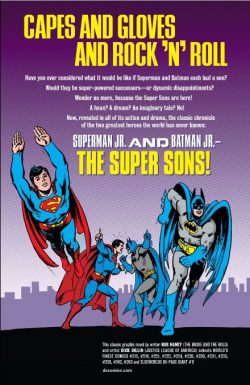
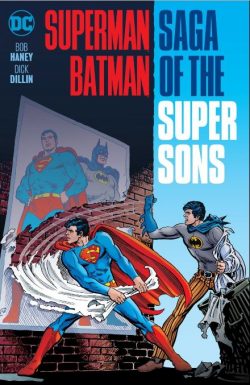
Superman/Batman: Saga of the Super Sons


By Bob Haney & Dick Dillin, Dennis O’Neil, John Calnan, Ernie Chan, Rich Buckler, Kieron Dwyer & various (DC Comics)
ISBN: 978-1-4012-6968-5

Are you old enough to yearn for simpler times?

The brilliant expediency of the 52 Parallel Earths concept lends the daftest tale from DC’s back catalogue credibility and contemporary resonance since there’s now a chance that even the hippest and most happening of the modern pantheon can visit/interact with the most outrageous world or concept in DC’s long history. It doesn’t hurt either that following DC’s Rebirth reboot the actual sons of the Dark Knight and Man of Tomorrow are now part of the established – and “real” – DC Universe.

Thus, this collection (available in trade paperback and eBook editions) of well-told “imaginary” tales from the 1970s (January 1972-December 1976), supplemented by a few episodes from more self-conscious times, can be re-released with a clear continuity-conscience without even the most strident fan complaining.

Written by Bob Haney and drawn by Dick Dillin, the Super-Sons appeared with no preamble fanfare in World’s Finest Comics #215, 1972; a bad time for superhero comics, but a great era for teen rebels. Those free-wheeling, easy-rider, end of the flower-power days saw a huge focus on “teen consciousness” and the “Generation Gap” was a phrase on many lips.

The editors clearly saw a way to make arch-establishment characters instantly pertinent and relevant and – being mercifully oblivious to the constraints of continuity (and some would say logic) – simply generated tales of the maverick sons of the World’s Finest heroes out of whole cloth.

And well-constructed, well told tales they are. In debut outing ‘Saga of the Super Sons!’ (inked by Henry Scarpelli) the young warriors run away from home – on the inevitable motorcycle, natch! – and encounter a scurrilous gang-lord.

But worry not, the paternalistic parents are keeping a wary eye on the lads! Speaking as someone who was the target market for this experiment, I can admit that the parental overview grated then and still does, but as there were so many sequels somebody must have liked it.

‘Little Town with a Big Secret!’ appeared in the very next issue: another low key human interest tale, but with a science-fiction twist and the superb inking of Murphy Anderson complimenting Haney & Dillin’s murder-mystery yarn.

Crafted by the same team, WF # 221 featured ‘Cry Not for My Forsaken Son!’ which showed a troubled runaway boy the difference between merit and worth, and the value of a father as opposed to a biological parent, whilst in #222 ‘Evil in Paradise’ (inked by Vince Colletta) the young heroes voyaged to an undiscovered Eden to resolve the ancient question of whether Man is intrinsically Good or Evil.

‘The Shocking Switch of the Super-Sons’ (WF #224, and also inked by Colletta) carried teen rebellion to its most logical conclusion as a psychologist convinces the boys to temporarily trade fathers whereas ‘Crown for a New Batman!’ provides a radical change of pace as Bruce Wayne Jr. inherits the Mantle and the Mission after his father is murdered!

Never fear, all is not as it seems, fans! This thriller – guest starring Robin – first appeared in WF #228, and was inked by Tex Blaisdell, who then inked Curt Swan, on the more traditional Lost Civilisation yarn ‘The Girl Whom Time Forgot’ in WF#230.

The Relevancy Era was well over by the time Haney, Dillin & Blaisdell crafted ‘Hero is a Dirty Name’ (WF #231), wherein the Sons are forced to question the motivation for heroism, in a thriller also featuring Green Arrow and The Flash.

In #233’s ‘World Without Men ‘(inked by John Calnan) the ever-questioning rambling Super-Sons tackle sexual equality issues and unravel a crazy plot to supplant human males, after which ‘The Angel with a Dirty Name’ (by the same team in WF #238) offers a super-villains ‘n’ monsters slug-fest indistinguishable from any other super tale, before the original series ends with WF #242’s ‘Town of the Timeless Killers’ – illustrated by Ernie Chua (nee Chan) & Calnan – wherein the kids are trapped in a haunted ghost town and stalked by immortal gunslingers; an ignominious close to a bold experiment.

Four years later the boys popped back for a momentary revival in ‘Final Secret of the Super-Sons’ (Denny O’Neil, Rich Buckler & Dick Giordano in WF #263, 1980) where it was shockingly revealed that they were no more than a simulation running on Superman’s giant Computer. In a grim indication of how much of a chokehold shared continuity had grown into, they then escaped into “reality” anyway to wreak havoc in a manner the Matrix movies would be proud of…

The collection concludes with a short tale by Haney & Kieron Dwyer that appeared in Elseworlds 80-Page Giant in 1999. ‘Superman Jr. is No More!’ is a charming and fitting conclusion to this odd, charming and idiosyncratic mini-saga, embracing the original conceit as it posits what wold happen if the Man of Steel died and his boy was forced to take over too soon…

Supplemented with a full cover gallery by Nick Cardy, Chan, Calnan, Dick Giordano, Ross Andru & Ty Templeton, these classic adventures are packed with potency and wit. If you’ve an open mind and refined sense of fun, why not take a look at a few gems (and one or two duds) from an era where everybody read comics and nobody took them too seriously?
© 1972, 1973, 1974, 1975, 1976, 1980, 1999, 2017 DC Comics. All rights reserved.

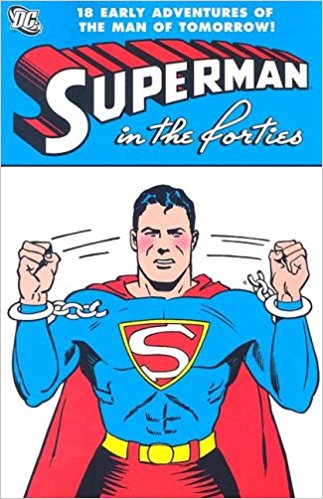
Superman in the Forties


By Jerry Siegel, Joe Shuster & the Superman studio (DC Comics/Little, Brown & Co)
ISBN: 978-1-4012-0457-0

Part of a series of trade paperbacks intended to define DC’s top heroes through the decades (the other being Batman, of course), these much-missed books always delivered a superb wallop of comicbook magic and a tantalising whiff of other, perhaps better, times.

Divided into sections partitioned by cover galleries, this box of delights opens with the untitled initial episodes from Action Comics #1 and 2 (even though they’re technically ineligible, coming from June and July 1938) as written and drawn by Jerry Siegel and Joe Shuster.

With boundless enthusiasm the Man of Tomorrow explodes into action, saving an innocent condemned to the electric chair, teaching a wife-beater a salutary lesson, terrorising mobsters and teaching war profiteers to think again. It’s raw, unpolished and absolutely captivating stuff.

Swiftly following from Superman #58 (May/June 1949) is a beguiling teaser written by William Woolfolk and illustrated by Wayne Boring and Stan Kaye. ‘Lois Lane Loves Clark Kent!’ finds the intrepid pioneering lady reporter seeing a psychiatrist because of her romantic obsession with the Man of Steel. His solution?

The quack tells her to switch her affections to her bewildered, harassed workmate with resultant hilarity and chaos ensuing! A rare treat follows as the seldom seen Superman prose story from Superman #1 (Summer 1939 and of course written by Siegel with accompanying art by Shuster) reappears for the first time in decades.

In 1948 the editors finally declassified the full and original ‘Origin of Superman’ written by Bill Finger with art from Boring and Kaye (Superman #53, cover-dated July/August). It was sequelled a year later and is directly followed in this volume by ‘Superman Returns to Krypton’ (Finger and Al Plastino) wherein the Man of Tomorrow breaks the time barrier to observe his lost homeworld at first hand.

This little gem (from Superman #61, November/December, 1949) provided the comic-book explanation for Kryptonite – which was originally introduced on the radio show in 1943 then promptly forgotten – and opened the door for a magical expansion of the character’s universe that still resonates with us today.

During the late 1940s Siegel & Shuster retrofitted their creation by creating Superboy (“the adventures of Superman when he was a boy”) for More Fun Comics #101 (January/February 1945). An instant hit, the youthful incarnation soon took the lead spot in Adventure Comics and won his own solo title in 1949.

From Superboy #5 (November/December, 1949) comes the charming tale of a runaway princess ironically entitled ‘Superboy Meets Supergirl’ by Woolfolk and the hugely talented John Sikela.

The second section is dedicated to the Man of Steel’s opponents, starting with ‘Superman Meets the Ultra-Humanite’ (Action Comics #14; (July 1939) by Siegel, Shuster and Paul Cassidy. They also devised a much more memorable criminal scientist in Lex Luthor who debuted in an untitled tale from Action #23 (April 1940). This larcenous landmark is followed by ‘The Terrible Toyman’ (Action #64, September 1943) by Don Cameron, Ed Dobrotka & George Roussos.

In such socially conscious times one of Superman’s most persistent foes was a heartless swindler called Wilbur Wolfingham. ‘Journey into Ruin’ by Cameron, Ira Yarbrough & Stan Kaye (Action #107; November #107) is a fine example of this type of tale and the hero’s unique response to it.

A different kind of whimsy is in play when Lois’s niece – a liar who could shame Baron Munchausen – returns with a new pal who can make her fantasies reality in ‘The Mxyztplk-Susie Alliance’ (from Superman #40; May/June 1946), charmingly crafted by Cameron, Yarbrough & Kaye.

The American Way section begins with a genuine war-time classic. ‘America’s Secret Weapon’ is from Superman #23 (July/August 1943, by Cameron, Sam Citron and Sikela): a masterpiece of patriotic triumphalism, as is the excerpt from the Superman newspaper strip which reveals how the over-eager Man of Tomorrow accidentally fluffs his own army physical. These strips by Siegel, Shuster & Jack Burnley originally ran from 16th – 19th February 1942,

Look Magazine commissioned a legendary special feature by the original creators for their 27th February 1943 issue. ‘How Superman Would End the War’ is a glorious piece of wish-fulfilment which still delights, and it’s followed by a less famous but equally affecting human interest yarn ‘The Superman Story’.

Taken from World’s Finest Comics #37 (1947, by Finger, Boring & Kaye), it pictures a pack of reporters trailing Superman to see how the world views him…

The book ends with ‘Christmas Around the World’ as Superman becomes the modern Spirit of the Season in a magical Yule yarn by Cameron, Yarbrough & Kaye from Action #93 (February 1946).

With a selection of cover galleries, special features and extensive creator profiles this is a magnificent Primer to the greatest hero of a bygone Golden Age, but one that can still deliver laughter and tears, thrills and spills and sheer raw excitement. No real fan can ignore these tales…
© 1940-1939, 2005 DC Comics. All Rights Reserved.

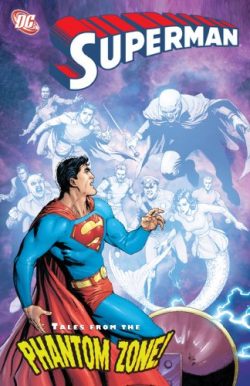
Superman: Tales from the Phantom Zone


By Jerry Siegel, Edmond Hamilton, Otto Binder, Curt Swan & various (DC Comics)
ISBN: 978-1-4012-2258-1

Superman is comics’ champion crusader: the hero who effectively started a whole genre and, in the decades since his spectacular launch in June 1938, one who has survived every kind of menace imaginable. With this in mind it’s tempting and very rewarding to gather up whole tranches of his prodigious back-catalogue and re-present them in specifically-themed collections, such as this sinister set of sorties into the stark and silent realm of nullity designated the Phantom Zone: a time-proof timeless prison for the worst villains of lost planet Krypton.

This captivating trade paperback collection (gathering material from Adventure Comics #283, 300, Action Comics #336, Superman’s Girl Friend, Lois Lane #33, Superman’s Pal, Jimmy Olsen #62, Superman #157, 205, Superboy #89, 104 and Who’s Who in the DC Universe volume 18) represents appearances both landmark and rare, crafted by the many brilliant writers and artists who have contributed to the Kryptonian canon over the years.

Naturally, this terrific tome begins with the very first appearance of the dolorous dimension in ‘The Phantom Superboy’ by Robert Bernstein & George Papp (from Adventure Comics #283 April, 1961).

Here, a mysterious alien vault smashes to Earth and the Smallville Sensation finds sealed within three incredible super-weapons built by his long-dead dad Jor-El. There’s a disintegrator gun, a monster-making de-evolutioniser and a strange projector that opens a window into an eerie, timeless dimension of stultifying intangibility.

However, as Superboy reads the history of the projector – used to incarcerate Krypton’s criminals – a terrible accident traps him inside the Phantom Zone and only by the greatest exercise of his mighty intellect does he narrowly escape…

Next is pivotal 2-part tale ‘Superboy’s Big Brother’ (by Robert Bernstein & Papp from Superboy #89, June 1961) in which an amnesiac, super-powered space traveller crashes in Smallville. Slightly older than Superboy, the befuddled visitor speaks Kryptonese and carries star-maps written by the long-dead Jor-El…

Jubilant, baffled and suspicious in equal amounts, the Boy of Steel eventually, tragically discovers ‘The Secret of Mon-El’ by accidentally exposing the stranger to a fatal, inexorable death before desperately providing critical life-support by depositing the dying alien in the Phantom Zone until a cure can be found…

Superman’s Girl Friend, Lois Lane #33 (May 1962), by a sadly unknown writer but illustrated by the always exceptional art team of Curt Swan & George Klein, further explored the dramatic potential of the Zone in ‘The Phantom Lois Lane!’ wherein a temporarily deranged Lana Lang dispatches all her romantic rivals for the Man of Tomorrow’s affections to the extra-dimensional dungeon.

From one month later, ‘Superman’s Phantom Pal!’ (Leo Dorfman, Swan & Klein as seen in Superman’s Pal, Jimmy Olsen #62) Jimmy Olsen in his Elastic Lad role is drawn through a miniscule rip in the fabric of reality and joins Mon-El in the Zone where the plucky cub reporter faces down the worst of Krypton’s villains and resists their ultimate temptation…

Adventure Comics #300 (September 1962) saw the launch of the Legion of Super-Heroes in their own series by Jerry Siegel, John Forte & Al Plastino. That premier yarn, ‘The Face Behind the Lead Mask!‘, pits Superboy and the 30th century champions against an unbeatable foe until Mon-El intervenes, briefly freed from a millennium of confinement to save the day…

‘The Super-Revenge of the Phantom Zone Prisoner!’ by Edmond Hamilton, Swan & Klein (Superman#157, November 1962) saw the introduction of power-stealing Gold Kryptonite and Superman’s Zone-o-phone – which allows him to communicate with the incarcerated inhabitants – in a stirring tale of injustice and redemption. Convicted felon Quex-Ul uses the device to petition Superman for release since his sentence has been served, and despite reservations the fair-minded hero can only agree.

However further investigation reveals Quex-Ul has been framed and is wholly innocent of any crime, but before Superman can explain or apologise, he has to avoid the deadly trap the embittered and partially mind-controlled parolee has laid for the son of the Zone’s discoverer…

Superboy #104 (April 1963) contained an epic two-part saga ‘The Untold Story of the Phantom Zone’ and ‘The Crimes of Krypton’s Master Villains’. Crafted by Hamilton & Papp it describes Jor-El’s discovery of the Zone, his defeat of ambitious political criminal Gra-Mo and the reasons the vault of super-weapons was ultimately dispatched into space, after which ‘The Kid who Knocked Out Superboy!’ (illustrated by Swan & Klein) sees Gra-Mo return to take vengeance on the son of his nemesis.

‘The Man from the Phantom Zone!’ (Hamilton, Swan & Klein from Action Comics #336, April 1966) finds Superman releasing another convict whose time was served, leading to a captivating crime mystery in the Bottle City of Kandor as 50-year old juvenile delinquent Ak-Var discovers life in a solid and very judgemental world a most mixed blessing…

By April 1968, times and tone were changing, as seen in ‘The Man Who Destroyed Krypton!’ (Superman #205, Otto Binder & Plastino) as alien terrorist Black Zero comes to Earth, determined to blow it up just as he had planet Krypton decades ago!

Overmatched and stunned by the truth of his world’s doom, the Man of Steel is convinced that releasing Jax-Ur, the Zone’s wickedest inhabitant, is the only way to save his adopted homeworld… an absorbing, enthralling, and surprisingly gritty tale of vengeance acting as the perfect way to end this eclectic collection.

With a comprehensive informational extract from the 1986 Who’s Who in the DC Universe entry from the Zone and its most notorious inmates, illustrated by Rick Veitch, this compelling collection is an intriguing introduction to the aliens hidden amongst us and a superb treat for fans of every vintage.
© 1961, 1962, 1963, 1964, 1966, 1968, 1986, 2009 DC Comics. All Rights Reserved.