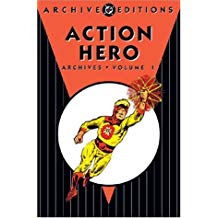
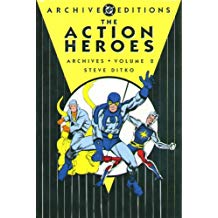
Action Heroes Archive Vol 1: Captain Atom & Vol. 2 Captain Atom, Blue Beetle & The Question


By Steve Ditko and various (DC Comics)
ISBN: 978-1-4012-0302-3  ISBN: 978-1-4012-1346-6 (vol 2)

It’s been a grim few weeks for lovers of the graphic arts. Peter Firmin passed away at the beginning of the month, and I’ve just heard that Steve Ditko has been found dead in his apartment. Both these men shaped my life and so many millions of others, especially the solitary work-obsessed genius who gave us Spider-Man, The Creeper, Mr. A and so many more. A more considered response and review will come in the weeks to come, but for now let’s consider these books: classic outsider wonderment from a creator who reshaped every aspect of comics by sniping from the edge and never once buying into the hype…

Steve Ditko is possibly comics’ most unique stylist. Love him or hate him, you can’t mistake his work for anyone else’s. His career began in the early 1950’s and, depending on whether you’re a superhero fan or prefer the deeper and more visually free and experimental work, peaked in either the mid-1960’s or 1970’s.

Leaving the Avenging World, Mr. A and his other philosophically derived creations for another time, the super-hero crowd should heartily celebrate this deluxe collection of the first costumed do-gooder that Ditko worked on. Although I’m a huge fan of his linework – which is best served by black and white printing – the crisp, sharp colour of this Archive edition is still much better than the appalling reproduction on bog-paper that first displayed Charlton Comics’ Atomic Ace to the kids of Commie-obsessed America, circa 1960.

Captain Adam is an astronaut accidentally atomised in a rocketry accident. Eerily – and the way it’s drawn spooked the short pants off me when I first read it more than fifty years ago – he reassembles himself on the launch pad, gifted with astounding powers. Reporting to the President, he swiftly becomes the USA’s secret weapon.

In those simpler times the short, terse adventures of Captain Atom seemed somehow more telling than the anodyne DC fare, and Marvel was still pushing monsters in underpants; their particular heroic revolution was still months away. Ditko’s hero was different and we few who read him all knew it.

Mostly written or co-written with Joe Gill, the first wonderful, addictive run of 18 stories from Space Adventures #33-42 (and three of those were drawn by the uninspired and out-of-his-depth Rocke Mastroserio) are a magnificent example of Ditko’s emerging mastery of mood, pacing, atmosphere and human dynamics.

In 1961, as Ditko did more and more work for the blossoming – and better paying – Marvel, Charlton killed the series. But when Dick Giordano created a superhero line for Charlton in late 1965, Captain Atom was revived. Space Adventures was retitled, and the Captain’s first full length issue was numbered #78.

As he was still drawing Amazing Spider-Man and Doctor Strange, Ditko could only manage pencils for the Captain and Mastroserio was recruited to ink the series, resulting in an oddly jarring finish. With #79 Ditko became lead writer too, and the stories took on an eccentric, compelling edge and tone that lifted them above much of the competition’s fare. Eventually the inker adapted to Ditko’s style and much of the ungainliness had disappeared from the figurework, although so had the fine detail that had elevated the early art.

This volume ends with issue #82, leaving six more published issues and a complete unpublished seventh for another time…

This second volume completes Ditko’s costumed hero contributions with the remainder of the Captain Atom tales, and the introduction of a new Blue Beetle and the uniquely iconic Question.

Captain Atom #83 (November 1966) starts the ball rolling here with a huge blast of reconstructive character surgery. Although ‘Finally Falls the Mighty!’ was inked by Rocke Mastroserio and scripted by David Kaler, thematically it’s pure Ditko. Plotted and drawn by him, it sees an ungrateful public turn on the Atomic Ace, due to the manipulations of a cunning criminal.

Intended to remove some of the omnipotence from the character, the added humanity of malfunctioning powers made his struggles against treacherous Professor Koste all the more poignant, and the sheer visual spectacle of his battle against a runaway reactor is some of Ditko’s most imaginative design and layout work. The tale ends on a cliffhanger – a real big deal when the comic only came out every two months – and the last seven pages featured the debut of a new superhero with one of the oldest names in the business.

The Blue Beetle first appeared in Mystery Men Comics #1, released by Fox Comics and dated August 1939. Created by Charles Nicholas (née Wojtkowski) the character was inexplicably popular and survived the death of a number of publishers to end up as a Charlton property in the mid 1950s. After releasing a few issues sporadically the character disappeared until the superhero revival of the early 1960s when young Roy Thomas revised and revived the character for a ten issue run (June 1964 – February 1966).

Here Ditko completely recreated the character. Ted Kord was an earnest young scientist with a secret tragedy in his past but Ditko and scripter Gary Friedrich wisely eschewed origin for action in a taut and captivating crime-thriller where the new hero displayed his modus operandi by stopping a vicious crime-spree by the Killer Koke Gang.

This untitled short has all the classic elements of a Ditko masterpiece: outlandish fight scenes, compact, claustrophobic yet dynamic layouts, innovative gimmickry and a clear-cut battle between Right and Wrong. It’s one of the very best introductory stories of a new hero anywhere in comics – and it’s seven pages long.

The remodeling of the Atomic Ace concluded in the next issue with ‘After the Fall a New Beginning.’ Once again Ditko rattled his authorial sabre about the fickleness of the public as the villainous Koste exposed the hero’s face on live TV. Escaping, Atom got a new costume with his curtailed powers and consequently a lot more drama entered the series.

Now there was a definite feeling of no safety or status quo. The untitled Beetle back-up (scripted by Gary Friedrich with pencils and inks by Ditko) pitted the hero against the masked Marauder but the real kicker was the bombshell that Homicide detective Fisher, investigating the disappearance of Dan Garrett, suspected a possible connection to scientist Ted Kord…

‘Strings of Punch and Jewelee’ introduced a couple of shady carnival hucksters who found a chest of esoteric alien weapons and used them for robbery whilst extending a running plot-line about the mysterious Ghost and his connection to a lost civilization of warrior women. Although Cap and partner Nightshade are somewhat outclassed here, the vigour and vitality of the Blue Beetle was undeniable when a mid-air hijack is foiled and a spy sub and giant killer octopus are given short thrift by the indomitable rookie crusader.

Captain Atom #86 finally brought the long-simmering plot-thread of tech thief The Ghost to a boil as the malevolent science-wizard went on a rampage, utterly trouncing Nightshade and our hero before being kidnapped by the aforementioned Warrior girls. ‘The Fury of the Faceless Foe!’ is by Ditko, Kaler & Mastroserio whilst in the (still) untitled Blue Beetle strip by Friedrich and Ditko the azure avenger battled a ruthless scientist and industrial spy.

This led directly into the first issue of his own comic-book. Blue Beetle #1 (June 1967) is an all-Ditko masterpiece (he even scripted it under the pen-name D.C. Glanzman) and saw the hero in all-out action against a deadly gang of bandits. ‘Blue Beetle… Bugs the Squids’ is crammed with the eccentric vitality that made the Amazing Spider-Man such a monster hit, and the crime-busting joie de vivre is balanced by the moody, claustrophobic introduction of Steve Ditko’s most challenging superhero creation.

‘The Question’ is Vic Sage, a TV journalist with an uncompromising attitude to crime and corruption and an alter-ego of faceless, relentless retribution. In his premiere outing he exposes the link between his own employers’ self-righteous sponsors and gambling racketeer Lou Dicer. This theme of unflinching virtue in the teeth of both violent crime and pernicious social and peer pressure marked Ditko’s departure from straight entertainment towards philosophical – some would say polemical – examination of greater societal issues and the true nature of both Good and Evil that would culminate in his controversial Mr. A, Avenging World and other independent ventures.

Captain Atom #87, ‘The Menace of the Fiery-Icer’ (August 1967) presaged the beginning of the end for the Atomic Ace as Kaler, Ditko & Mastroserio dialed back on the plot threads to deliver a visually excellent but run-of-the-mill yarn about a spy ring with a hot line in cold-blooded leaders.

Blue Beetle #2 however, an all-Ditko affair from the same month, showed the master at his heroic peak, both in the lead story ‘The End is a Beginning!’ which finally revealed the origin of the character as well as the fate of Dan Garrett, (the original Beetle) and even advanced his relationship with his girl Friday Tracey. The enigmatic Question, meanwhile, tackled the flying burglar known as the Banshee in a vertiginous, moody thriller reminiscent of early Doctor Strange strips.

Frank McLaughlin took over the inking for ‘Ravage of Ronthor’ in Captain Atom #88 (October 1967) as the hero answered a distress call from outer space to preserve a paradise planet from marauding giant bugs, in a satisfying no-nonsense escapist romp. Blue Beetle #3 was another superbly satisfying read as the eponymous hero routed the malevolent, picturesque thugs ‘The Madmen’ in a sharp parable about paranoia and misperception. Equally captivating was the intense and bizarre Question vignette as a murderous ghostly deep-sea diver stalks some shady captains of industry.

Issue #89 was the last Captain Atom published by Charlton (December 1967): an early casualty of the burn-out afflicting the superhero genre that led to a resurrected horror/mystery craze. This genre would then form a new backbone for the company’s 1970’s output; one where Ditko would shine again in his role as master of short story horror.

Scripter Dave Kaler managed to satisfactorily tie up most of the hanging plot threads with the warrior women of Sunuria in the sci-fi-meets-witchcraft thriller ‘Thirteen’ although the Ditko/McLaughlin art team was nowhere near their best form.

The next episode promised a final ‘Showdown in Sunuria’, but this never materialized.

Blue Beetle #4 (released the same month) is visually the best of the bunch as Ted Kord followed a somehow returned Dan Garrett to an Asian backwater in pursuit of lost treasure and a death cult. ‘The Men of the Mask’ is pure strip poetry and bombastic action, perfectly counterbalanced by a seedy underworld thriller as the Question sought to discover who gave the order to ‘Kill Vic Sage!’ This was scripted by Steve Skeates (as Warren Savin) and was the last action any Charlton hero saw for the better part of a year.

Cover-dated October 1968, The Question returned as the star of Mysterious Suspense #1. Ditko produced a captivating cover and a three-chapter thriller (whilst Rocke Mastroserio provided a rather jarring full-page frontispiece).

‘What Makes a Hero?’ (probably rescued from partially completed inventory material) saw crusading Vic Sage pilloried by the public, abandoned by friends and employers yet resolutely sticking to his higher principles in pursuit of hypocritical villains masquerading as pillars of the community. Ditko’s interest in Ayn Rand’s philosophical Objectivism had become increasingly important to him and this story is probably the dividing line between his “old” and “new” work. It’s also the most powerful and compelling piece in the entire book.

A month later one final issue of Blue Beetle (#5) was published. ‘The Destroyer of Heroes’ is a decidedly quirky tale that features a nominal team-up of the azure avenger and the Question as a frustrated artist defaced heroic and uplifting paintings and statues. Ditko’s committed if reactionary views of youth culture, which so worried Stan Lee, are fully on view in this controversial, absorbing work.

Other material had been created and languished incomplete in editorial limbo. In the early 1970s a burgeoning and committed fan-base created a fanzine called Charlton Portfolio. With the willing assistance of the company, a host of kids who would soon become household names in their own right found a way to bring the lost work to the public gaze.

Their efforts are also included here, in black and white as they originally appeared. For Charlton Portfolio #9 and 10 (1974), Blue Beetle #6 was serialized. ‘A Specter is Haunting Hub City!’ is another all-Ditko extravaganza, pitting the hero against an (almost) invisible thief whilst the follow-up magazine Charlton Bullseye (1975) finally published ‘Showdown in Sunuria’ in its first two issues.

Behind an Al Milgrom Captain Atom cover, Kaler’s plot was scripted by Roger Stern (working as Jon G. Michels) and Ditko’s pencils were inked by rising star John Byrne – a cataclysmic climax almost worth the eight year wait. But even there the magic doesn’t end in this magnificent Archive volume.

From Charlton Bullseye #5 (1975) comes one final pre-DC tale of The Question: eight, gripping, intense, beautiful pages plotted by Stern, scripted by Michael Uslan and illustrated by the legendary Alex Toth, This alone is well worth the rather high price of admission.

These weighty snapshots of another era are packed with classic material by brilliant craftsmen. They are books no Ditko addict, serious fan of the genre or lover of graphic adventure can afford to be without. It’s impossible to describe the grace, finesse, and unique eclectic shape of Steve Ditko’s art. It should be experienced. And this is as good a place to start as any, and probably a lot easier to obtain than much of this lost genius’ back catalogue.

© 1966, 1967, 1968, 1974, 1975, 1976, 2007 DC Comics. All Rights Reserved.
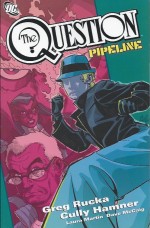
The Question: Pipeline


By Greg Rucka, Cully Hamner, Laura Martin, Dave McCaig & various (DC Comics)
ISBN: 978-1-4012-3041-8

The Question, as created by Steve Ditko, was Vic Sage, a driven, obsessed journalist who sought out crime and corruption irrespective of the consequences. The Charlton Comics “Action-Hero” was purchased by DC – along with a host of other cool and quirky outsiders – when the B-List company folded in 1983, and became the template for the compulsive loner Rorschach when Alan Moore & Dave Gibbons first drafted the miniseries which would become the groundbreaking Watchmen.

An ordinary man pushed to the edge by his upbringing and obsessions, Sage used his fists and a mask that made him look faceless to get answers (and, consequently, justice) whenever normal journalistic methods failed.

After a few minor successes around the DC universe Sage got a job in the town where he grew up. Hub City (purportedly based on East St. Louis) was a hell-hole, the most corrupt and morally bankrupt municipality in America. When Sage started cleaning house as The Question he was promptly killed, rescued and resurrected by the inscrutable Shiva – “World’s Deadliest Assassin”.

Crippled, he journeyed into the wilderness to be healed and trained by O’Neil’s other legendary martial arts creation, Richard Dragon.

Eventually a new type of hero returned to Hub City, philosophically inquisitive rather than merely angry and frustrated, but still cursed with a drive to understand how and why things universally go bad. Aligning himself with his old intellectual mentor and sounding board Professor Aristotle Rodor, Sage set about cleaning up “The Hub” and finally getting a few answers…

Spinning out of DC’s 52 (2006-2007) and Countdown to Final Crisis (2007-2008) mega-series, disgraced Gotham City cop Renee Montoya was groomed to take up the faceless mask and obsessions of the shadowy hero as Sage slowly succumbed to cancer.

First as his disciple and then as his heir (and after being masterfully schooled in martial arts by Richard Dragon) she took up Sage’s quest and was soon drawn into a secret war with the passionate adherents of a malign gospel of All Things Evil alternatively known as the Books of Blood or the Crime Bible.

This legendary tome was said to counter all that is good in the world and justify and codify all that is wrong. Driven by a need to understand the evils she fights and stop the spread of this monstrous belief, the new Question hunted down the remaining copies of the book and the distinct factions which protected them and promoted the terrible teachings.

Her path eventually pitted her against the secret master of the “Dark Faith”: the immortal Vandal Savage, believed by many to be the human species’ first murderer…

Collecting the stunning back-up series from Detective Comics #854-865 (August 2009 to July 2010) this globe-girdling saga of corruption and depravity by writer Greg Rucka, illustrator Cully Hamner and colourists Laura Martin and Dave McCaig begins in the aftermath of that apocalyptic confrontation, with Montoya and “Tot” Rodor ensconced in their desolate lighthouse on the Outer Banks of North Carolina.

They are looking for a new case; sorting through emails from a “help-offered” website they’d set up when a particular message catches Renee’s eye.

Hector Soliz is an illegal immigrant who has been searching for his sister ever since she went missing. He foolishly trusted the “coyote” who originally smuggled him into America to do the same for Louisa, but never took into account that, for men like Varga, pretty young girls have a value far beyond simple cargo to be smuggled across a closed border…

Taking the case, Renee is soon breaking into the flesh peddler’s home and dealing harshly with Varga’s brutal thugs where she finds a bed with chains and a camera set-up…

After undergoing some especially intense enquiries the coyote gives up the name of the man he eventually sold Louisa to: millionaire shipping exporter Gordon Chandless.

Breaking into the businessman’s palatial HQ isn’t much harder, but overconfidence soon costs The Question dearly as she is surprised and overpowered by hulking bodyguard Mr. Bolt and his handy tasers…

Unable to get any answers from his faceless captive, Chandless opts for her quiet removal, but by the time The Question escapes a watery death-trap and returns in a very bad mood, the wily human trafficker is already gone…

Painfully aware that she’s tracking an evil enterprise of vast proportions, Renee uses Tot’s data-mining skills to track the mogul of misery to his luxury Hollywood lair and goes in blazing, disdainful of his army of heavies. They might be utterly unable to stop the implacable Question, but two of them are capable enough to kill their own boss at the clandestine command of his master…

Despite being back at square one in regard to the criminal hierarchy, Renee does now have a location on a certain container vessel ready to ship out with a new cargo of slaves. Righteous indignation, cold fury and a lucky intervention by the FBI soon finds all of the victims safe and free – including little Louisa Soliz…

‘Pipeline: Chapter Two’ moves the story on as The Question continues her crusade to destroy the trafficking empire, slowly and violently working her way up the chain of scumbags and crushing individual enterprises whilst inexorably zeroing in on the major player behind the network of sin and misery…

Of course such costly interventions prompt the mystery leader to fight back, and during her raid on a top-of-the-range hot car franchise the bad guys retaliate with a devious and deadly ambush of their own. That’s when Montoya’s secret weapon makes her presence known and the crooks all end up maimed or worse at the hand of the relentless unforgiving Huntress…

Helena Bertinelli was mob royalty but, following a massacre considered an occupational hazard in “The Family” line of work, she disappeared. The only survivor of a major hit, she trained to become a masked avenger ruthlessly punishing all gangsters whilst sticking up for innocent ordinary folk. She especially despises those who prey on children…

Huntress and the Question continue busting rackets all across the world, methodically dismantling the network as they climb the ladder to the big boss, and finally provoke an overwhelming response in the form of super-assassin Zeiss.

It was all part of a far deeper plan conceived by the vengeful vigilantes who promptly co-opt the mercenary killer to give up his unassailable paymaster. Their tactics however revolt Tot and the elderly scholar resigns.

Undeterred but now deprived of crucial technical support, the determined duo head for Gotham City where Helena introduces The Question to the top-secret leader of the all-female super-team known as the Birds of Prey. Former GCPD detective Montoya cannot believe that Commissioner Gordon‘s mousey dweeb daughter Barbara was once Batgirl and is now covert anti-crime mastermind “Oracle”…

Her irresistible cyber-probing soon has the dynamic duo invading an underworld server-farm in Odessa which – after the studied application of maximum force – provides a money trail to the Pipeline overlord. However when they sneak onto Oolong Island they walk straight into a trap…

The rogue state is the ultimate expression of Capitalism: peopled by criminals and the mad scientists of many nations, it maintains its precarious independence by selling proscribed technologies to anyone with money, proudly free from the annoying oversight of law or hindrance of morality…

President-for-Life Veronica Cale starts by torturing her captive heroes but after debating with The Question soon sees that the most profit doesn’t necessarily stem from staying bought…

Before long, Montoya and Bertinelli are on the final stretch: sneaking into Syria and invading the stronghold of the man who has turned humans into commodities and exported sin and horror on a global scale.

Unfortunately the wickedest man alive is ready and waiting for them…

The cataclysmic final confrontation is as much theosophical debate as brutal beat-down and in the final reckoning the allies must become enemies for the best possible reasons before finding anything approaching an acceptable answer to their dilemmas…

Moody, fast-paced, challenging and astoundingly action-packed, this stylish trade paperback edition also offers a hugely engaging ‘Sketchbook’ section from Cully Hamner offering developmental peeks into his evolution of the characters, a fascinating eight pages of layouts and roughs and some of his amazing set designs for story-locations which will delight and amaze all lovers of comic art.

Compelling and breathtaking, Pipeline exposes the dark underbelly of mainstream Fights ‘n’ Tights comics and proves that you don’t need graphic excess to tell hard-hitting tales or captivate lovers of adventure blockbusters.
© 2009, 2010, 2011 DC Comics. All Rights Reserved.

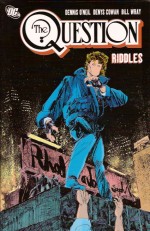
The Question volume 5: Riddles


By Dennis O’Neil, Denys Cowan, Bill Wray & various (DC Comics)
ISBN: 978-1-84856-513-5

This is a saga about dysfunction and a search for answers: Social, societal, political, emotional, familial and even methodological. The normal masked avenger tactics don’t work in a “real”-er world, and some solutions require better Questions…

Challenging Western dystopia with Eastern thought and martial arts action is not a new concept but O’Neil’s focus on cultural and social problems rather than histrionic super-heroics make this series a truly philosophical work, and Cowan’s raw, edgy art imbues this darkly adult, powerfully sophisticated thriller with a maturity that is simply breathtaking.

This fifth collection (reprinting issues #25-30) picks up from the shock ending of The Question: Welcome to Oz with ‘Skells’ illustrated by Cowan & Malcolm Jones III. New Mayor Myra Fermin-Connelly has been gunned down by her drunken, brain-addled husband and lies in a coma. Due to a quirk of Hub City law, with both current candidates unable to take office, the incumbent – despite being wanted for attempted murder – is technically next-in-line, and therefore de facto Mayor…

The tornado that struck the city on Election Day has finished the job begun by years of corruption and the gang warfare of the campaign. Hub City is a billion-dollar disaster zone. All essential services have ceased, the surviving populace are either rioting, looting or hiding. Food and water are running out.

State authorities are unwilling to step in and the urban hell-hole is poised to become a purely Darwinian jungle (this storyline probably inspired Batman’s ‘No Man’s Land’ publishing event) but all the Question wants to do is hunt down Myra’s addled husband/killer…

‘Riddles’ is a strange and melancholy Christmas divertissement, from fill-in penciller Bill Wray and Jones III which sees the Riddler, fresh out of jail and in a slump, catch a bus to Hub City and a new start. Sadly he picks the wrong girl to chat up and the result is the bloodiest and most senseless night of his life. It’s a genuine Christmas miracle that Vic Sage and Professor Rodor are on the same road that night…

With the city in turmoil, Myra in a coma, and no foe he can hit, The Question is helpless, but when the Prof reveals that his long-lost brother was a comic book artist in the 1940s it leads them all on a quasi-mystic quest which just might provide the mauled metropolis with its first glimmer of hope and recovery. ‘Captain Stars & Sergeant Stripes’ is illustrated by Cowan and Jones III, with Golden Age pastiche pages from Rick Stasi & Terry Beatty.

The last three tales here, also limned by Cowan and Jones, form an extended epic as the lethal Lady Shiva (see The Question: Zen and Violence) returns. Myra has emerged from her coma and taken charge, but with no resources and open warfare on the streets she is forced to take some extraordinary measures to restore order. In ‘A Place for the Arts’ Shiva, drawn to the chaos and ever-hungry to test her martial arts skills, offers her murderous services to one of the gangs trying to take over what’s left of Hub City, only to have her potential employers snatched from her as the new Lady Mayor convinces the warring thugs to become her new police force…

Incredibly disaster seems to have been averted until in ‘The Slaying’ one of the rival gang-lords is stabbed at a peace-conference and the Faceless Inquisitor has a murder to solve before the last remnants of hope are swallowed by renewed bloodshed. ‘Whodunit’ reveals all, but as is always the case in this superb series the answers are far from neat, tidy or satisfactory, and as always a moral and philosophical pall clouds the issues. And like a ghost Shiva stalks the city, ambivalent, ambiguous, unfathomable in her private purposes…

Like life, The Question never produces easy answers…

Bleak, brutal, confrontational and mordantly action-packed these tales come from one of DC’s very best series, and they form a perfect snapshot in comics history of a hugely creative and historically significant time. These graphic novels demonstrate just how evocative sequential narrative can be and no fan of serious fun literature or mature, sensitive escapism can afford to miss them.

© 1989, 2009 DC Comics. All Rights Reserved.

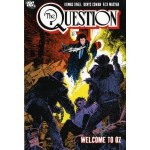
The Question volume 4: Welcome to Oz


By Dennis O’Neil, Denys Cowan, Rick Magyar & various III (DC Comics)

ISBN: 978-1-84856-328-5

The Question, created by Steve Ditko, was Vic Sage, a driven, obsessed reporter who sought out crime and corruption irrespective of the consequences. This Charlton ‘Action-Hero’ was purchased by DC when Charlton folded in 1983 and was the template for the compulsive Rorschach when Alan Moore and Dave Gibbons first drafted the miniseries that would become the groundbreaking Watchmen.

An ordinary man pushed to the edge by his obsessions, Sage used his fists and a mask that made him look utterly faceless to get answers (and justice) whenever normal journalistic methods failed. After a few minor successes around the DC universe Sage got a job in the town where he grew up.

Hub City (purportedly based on East St Louis) was a hell-hole, the most corrupt and morally bankrupt municipality in America. Mayor Wesley Fermin was a degenerate drunken sot and the real power was insane cleric Reverend Jeremiah Hatch. When Sage started cleaning house as The Question he was “killed”, rescued and resurrected by the inscrutable Shiva – the World’s deadliest assassin.

Crippled, he journeyed into the wilderness to be healed and trained by O’Neil’s other legendary martial arts creation, Richard Dragon.

It’s a new type of hero who returned to Hub City, philosophical rather than angry, but still cursed with a drive to understand how things universally go bad. The city has degenerated even further. Sage’s girlfriend is now Mayor Fermin’s wife, and crime and chaos are everywhere…

This fourth collection (reprinting issues #19-24 of the seminal 1980s series) brings to a head many of the dark plot threads that have been with the series since its inception. With Fermin permanently drunk and oblivious Sage has renewed his affair with Myra, even whilst she is running for her husband’s job.

Closet racist Royal Dinsmore has better ways of winning the race than smearing his opponent, but thanks to an extremely disturbed good citizen those plans are exposed in ‘The Plastic Dilemma’ (illustrated by Denys Cowan & Rick Magyar) and Myra refuses the financial support of a particularly unwholesome millionaire backer, whilst the emotional impact of her affair with Sage is revealed in ‘Send in the Clowns’ (an all-Magyar art job) a brutal tale of freaks, greed and prejudice.

Dick Giordano inks Cowan in ‘Rejects’ as psychopathic Junior Musto, returns (see The Question: Zen and Violence) to take a hospital hostage, demanding a heart transplant for the father who abused and tried to destroy him. That Greek tragedy leads into the main event…

‘Election Day (by Cowan & Malcolm Jones III): The Fix’ begins an agonising comedy of political errors as Dinsmore’s plan to steal the election is thwarted and he resorts to hiring a gang of Bikers to prevent the populace from voting – a t least those who can be bothered to turn out.

All the while Myra is having heartrending second thoughts. She doesn’t want to win but can’t afford to let a monster like Dinsmore gain control of her city. In the background her sot husband lurks; drunk deranged, bitter: clutching a bottle and a gun…

Some disquieting historical facts about Hub City are revealed in ‘Election Day: Welcome to Oz’ as the situation worsens. Open warfare in the streets is compounded by the arrival of a tornado that smashes most of the city to rubble, and the terrible conclusion ‘Election Day: The Dark’ sees Dinsmore defeated by a last-minute Machiavellian masterstroke from Vic Sage.

Mrya becomes the new Mayor of the biggest, most corrupt pile of rubble in America. A shot rings out…

Even ending on such a painful cliffhanger is grudgingly acceptable when the work is of such sterling quality and these eccentric epics are as readable now as they ever were. Complex characters, a very mature depiction of the struggle between Good and Evil using Eastern philosophy and very human prowess to challenge crime, corruption, abuse, neglect and complacency would seem to be a recipe for heady but dull reading yet these stories by one of the American industry’s greatest wordsmiths, and especially the mythic martial arts action delineated by Denys Cowan are gripping beyond belief and constantly challenge any and all preconceptions. So grab this book; absorb, enjoy and then move briskly on to the next volume.

I’m going to…

© 1988, 1989, 2008 DC Comics. All Rights Reserved.

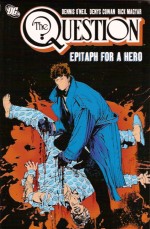
The Question Volume 3: Epitaph for a Hero


By Dennis O’Neil, Denys Cowan & Rick Magyar (DC Comics)
ISBN: 978-1-84576-996-3

In the “real” world, some solutions require careful Questions…

An ordinary man pushed to the edge by his obsessions, Vic Sage used his fists and a mask that made him look faceless to get answers (and justice) whenever normal journalistic methods failed – or whenever his own compulsive curiosity gripped him too tightly. After a few minor successes around the DC universe Sage got a TV reporting job in the town where he grew up.

This third collection (reprinting issues #13-18 of the highly regarded 1980s series) brings Sage into a thoroughly modern nightmare as he seeks to discover the foundations of patriotism, honour and glory and the roots of domestic terrorism in ‘Be All that you can Be…’ when a team operating on strict military principles carries out a series of murderous attacks on Army recruiting centres and personnel. The ace reporter tracks down the killers only to be captured and experience a harrowing example of their torturous training and a staggering example of their integrity in the concluding ‘Saving Face’.

The major portion of the Question’s adventures take place within the urban hell of Hub City, a ghastly analogue of blighted, Reagan-era Chicago, run by a merciless political machine and an utterly corrupt police force until Sage and the Question returned. His old girlfriend Myra Connelly had married the drunken puppet who is the Mayor and now as he dissolves into madness she is trying to win a mandate to run the city herself. Another unlikely champion is reformed and conflicted cop Izzy O’Toole, formerly the most corrupt lawman in “the Hub”.

‘Epitaph for a Hero’ further pushes the traditional boundaries and definitions of heroism when racist private detective Loomis McCarthy comes seeking to pool information on a spate of racially motivated murders during a tight fought election struggle between Myra and millionaire “old guard” patrician Royal Dinsmore. This startling mystery is not as cut-and-dried as it appears and presents some very unsettling facets for all concerned…

Izzy O’Toole continues his struggle for redemption in a brutal untitled confrontation with mythic underpinnings as illegal arms-dealers Butch and Sundance attempt to turn Hub into their own Hole-in-the-Wall (that was an impregnable hideout used by bandits in the old West), casting the grizzled old lawdog as a highly unlikely “Sheriff of Dodge City”.

The tale continues in ‘A Dream of Rorschach’ which tacitly acknowledges the debt owed to the groundbreaking Watchmen in the revival of the Question, as Sage reads the book and has a vision of and conversation with the iconic sociopath whilst flying to Seattle and a chilling showdown with Butch and Sundance as well as a highly suspicious and impatient Green Arrow in the concluding ‘Desperate Ground’.

Complex characters, a very mature depiction of the struggle between Good and Evil using Eastern philosophy and very human prowess to challenge crime, corruption, abuse, neglect and complacency would seem to be a recipe for heady but dull reading yet these stories and especially the mythic martial arts action delineated by Denys Cowan are gripping beyond belief and constantly challenge any and all preconceptions.

Combating Western dystopia with Eastern Thought and martial arts action is not a new concept but O’Neil’s focus on cultural and social problems rather than histrionic super-heroics make this series a truly philosophical work, and Cowan’s raw, edgy art imbues this darkly adult, powerfully sophisticated thriller with a maturity that is simply breathtaking.

The Question’s direct sales series was one of DC’s best efforts from a hugely creative period, and with a new hero wearing the faceless mask these days those tales form a perfect snapshot in comics history. Whether it fades to obscurity or becomes a popular, fabled and revered icon depends on you people: to make it the hit it always should have been all you have to do is obtain these superb trade paperback collections, and enjoy the magic…

© 1988, 2008 DC Comics. All Rights Reserved.

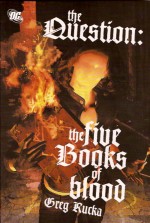
The Question: the Five Books of Blood


By Greg Rucka & various (DC Comics)
ISBN13: 978-1-4012-1799-0

Spinning out of DC’s 52 and Countdown to Final Crisis year-long mega-series, ex-Gotham City cop Renee Montoya took up the faceless mask and obsessions of the shadowy hero known as The Question and sought to track down the physical copies and adherents of the gospel of All Things Evil alternatively known as the Books of Blood or the Crime Bible.

This legendary tome is said to counter all that is good in the world and justify and codify all that is wrong. Driven by a need to understand the evils she fights and stop the spread of this monstrous belief, the driven martial artist hunts for the remaining copies of the book and the distinct factions that protect them promote their teachings. She begins by following – or perhaps being stalked by – a diabolical missionary of sin: a monk of darkness. But as she closes on the secret master of the “Dark Faith” she inexorably nears her own ultimate corruption…

Originally released as five inter-related one-shots entitled Crime Bible: the Five Books of Blood, each chapter of her quest is preceded by a salutary lesson excerpted from the dreadful chronicle, with each Book of Blood illustrated by a different artist or team. ‘The Lesson of Deceit’ leads off with art by Tom Mandrake, followed by ‘The Lesson of Lust’ by Jesus Saiz, ‘The Lesson of Greed’ by Matthew Clark and ‘The Lesson of Murder’ by Diego Olmos, culminating in ‘The Parable of the Faceless’ by Manuel Garcia and Jimmy Palmiotti. But the shock ending is not what it appears as Greg Rucka’s grim tale and Montoya’s dark voyage was designed to lead directly into the final part of the mega-series triptych Final Crisis.

Moody and stylish, this hardcover edition also contains rare promotional materials distributed to retailers in the form of Montoya’s notes collected as a hunting journal.

Although highly readable with many excellent set pieces, this book is inextricably wedded to a much larger story and is pretty much impenetrable to casual readers, and the lack of a conclusive ending (pending the events of the aforementioned Final Crisis) pretty much relegates it to the limited attention of the already converted… which is in many ways the biggest crime.

© 2007, 2008 DC Comics. All Rights Reserved.