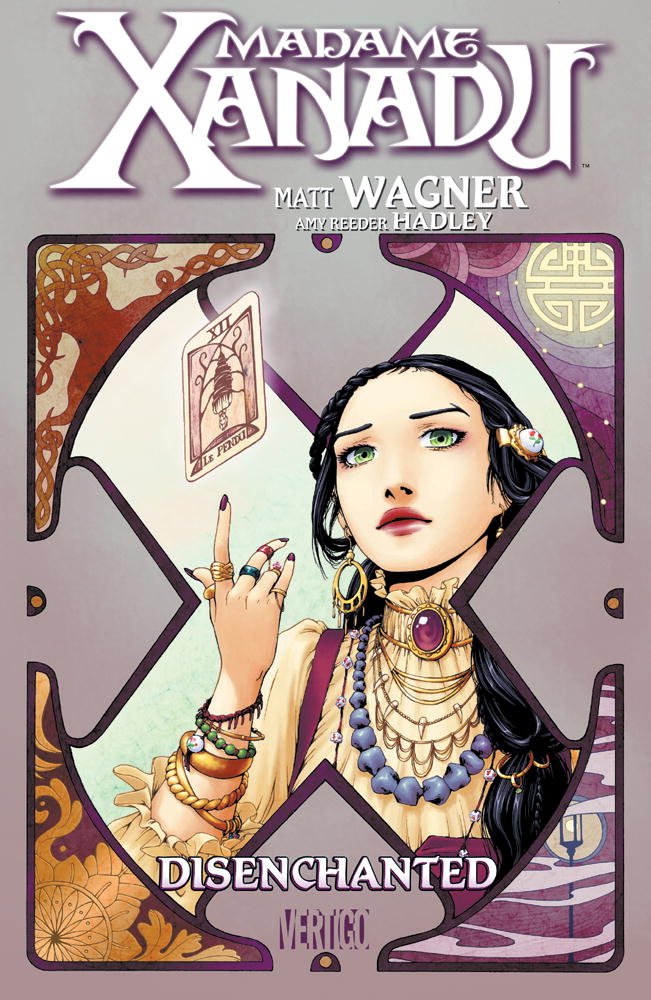
Madame Xanadu volume 1: Disenchanted


By Matt Wagner, Amy Reeder Hadley, Richard Friend & various (DC/Vertigo)
ISBN: 978-1-4012-2291-8 (TPB)

After the Vertigo imprint carefully aligned a number of DC properties beyond an iron curtain of sophisticated suspense and grown-up tale telling, in the early 21st century Matt Wagner was at the forefront of reuniting the divided camps. He successfully blurred the boundaries between mainstream DC continuity and the story-driven experimentation of mature, independent Vertigo. Although it still drives continuity mavens raving bonkers, stuff like this graphic gold – a superbly fetching yarn which tells a stand-alone tale for newcomers whilst also being a smart piece of historical in-filling for dedicated readers – is steeped in the arcane magical lore of DC’s multiverse, allowing old guard readers to pick and mix with spectacular effect. This sort of subtle side saga eventually led to the full integration of storylines in the “New 52” and after…

Collecting the first 10 issues of the lovely, thoughtful monthly comic that was the third volume of Madame Xanadu, Disenchanted finally provided an origin for one of the most mysterious characters in the company’s pantheon, and made her a crucial connection and lynchpin in the development of a number of the company’s biggest stars.

Madame Xanadu originally debuted in Doorway to Nightmare #1 (cover-dated February 1978): one of DC’s last 1970’s mystery stable, and a rare deviation from the standard anthology format. As designed by Michael William Kaluta & Joe Orlando, she was a wilfully enigmatic but benign tarot reader who became (peripherally) involved in the supernatural adventures of her clients.

The incarnation ended after only five issues although four further tales appeared in The Unexpected, and one last solo adventure was released as a one-shot billed as DC’s second “Direct Sales only” title.

After lurking in the musty, magical corners of the DCU for decades, she finally got another shot at the limelight. It was well worth the wait.

In the final days of Camelot, the fairy Nimue, Mistress of the Sacred Grove and sister to the Lady of the Lake and haughty Morgana, is disturbed by growing chaos in the land. However, when the puissant clairvoyant is unexpectedly visited by a Stranger who urges her to act on her visions, she is proud and reluctant, and drives him away.

Meanwhile, her lover Merlin is making dire preparations for inevitable battle, and lets his loving mask slip. His dalliance with her is clearly exposed as mere pretence to obtain her secrets of immortality…

As Camelot falls and the land burns, Merlin summons a demon from Hell to protect him and leaves it loose after the castle falls. The stranger returns, urging Nimue to beware Merlin’s intentions, but although she is wary of the wizard, she will not believe him capable of harming her.

She learns otherwise almost too late, and seeks to bind Merlin in a magical snare, but the wizard’s retaliation is terrible as – with his last vestige of power – he destroys her enchanted nature. With her potions, she will still know magic, but never again will she be magical…

Centuries later she is seer for mighty Kublai Khan when the stranger appears again: guiding the expedition conveying Marco Polo to his heady destiny. Once again, the enigma’s warnings are unwelcome but true, and again Nimue’s complacent sheltered life and innocent friends suffer because she will not listen.

She departs, painfully aware that the Stranger believes he serves a purpose more important than innocent lives. When she confronts him he vanishes – as always – like a Phantom…

Time marches on: in France, she advises Marie Antoinette, both before and after she is dragged to the Bastille, and begs the ubiquitous stranger to save the tragic queen to no avail. When she finally returns to England she hunts Jack the Ripper, unable to fathom how the stranger can believe any cause more important than stopping such a monster. The episodic epic pauses for now in 1930s New York, during the fleeting moments before masked avengers and costumed supermen burst onto the world stage. Here Nimue finally discovers what the stranger’s mission is, learning how her ancient antics shaped it…

Despite hosting a huge coterie of magical guest-stars, from Etrigan to Zatarra to Death of the Endless and delightfully disclosing close ties to key moments of DC’s shared history, this is a fabulous, glorious, romantic, scary stand-alone tragedy starring one of the most resilient women in comics, and a classic long overdue for revival and one that any fervid fantasy fan and newcomer to comics could easily read… and really must.
© 2008, 2009 DC Comics. All Rights Reserved.

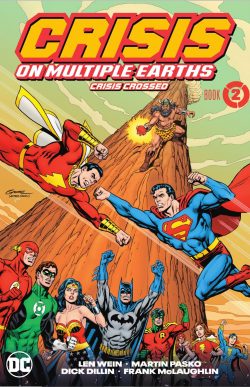
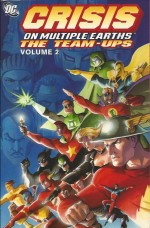
Crisis on Multiple Earths Book 2: Crisis Crossed


By Mike Friedrich, Len Wein, Martin Pasko, E. Nelson Bridwell, Cary Bates, Elliot S! Maggin, Paul Levitz, Gerry Conway, Dick Dillin, Frank McLaughlin, Joe Giella, Dick Giordano & various (DC Comics)
ISBN: 978-1-77951-342-7 (TPB/Digital)

Win’s Christmas Gift Recommendation: utterly Unmissable Entertainment… 9/10

As I’ve incessantly mentioned, I was one of the “Baby Boomer” crowd growing up with Julie Schwartz, Gardner Fox and John Broome’s tantalisingly slow reintroduction of Golden Age superheroes during the halcyon, eternal summery days of the early 1960s. To me, those fascinating counterpart crusaders from Earth-Two weren’t vague and distant memories rubber-stamped by parents or older brothers – they were cool, fascinating and enigmatically new. And for some reason the “proper” heroes of Earth-One held them in high regard and treated them with obvious deference…

The transcendent wonderment began, naturally enough, in The Flash; pioneering trendsetter of the Silver Age Revolution. After successfully ushering in the triumphant return of the superhero concept, the Scarlet Speedster – with Fox & Broome writing – set an unbelievably high standard for costumed adventure in sharp, witty tales of science and imagination, always illustrated with captivating style and clean simplicity by Carmine Infantino.

The epochal epic that literally changed the scope of American comics forever was Fox’s ‘Flash of Two Worlds’ (Flash #123 September 1961, reprinted in many places, but not here): introducing to an emerging continuity the concept of alternate Earths and, by extension, the multiversal structure of the future DCU as well as all the succeeding cosmos-shaking yearly “Crisis” sagas that grew from it.

…And, where DC led, others followed…

Received with tumultuous acclaim, the concept was revisited months later in Flash #129 which also teasingly reintroduced evergreen stalwarts – Wonder Woman, The Atom, Hawkman, Green Lantern, Doctor Mid-Nite and Black Canary: venerable members of the fabled Justice Society of America. Clearly Editor Schwartz had something in mind…

That tale directly led into the veteran team’s first meeting with the Justice League of America and the start of an annual tradition. When ‘Flash of Two Worlds’ brought us the notion of Infinite Earths and multiple iterations of costumed crusaders, fan pressure had begun almost instantly to agitate for the return of the Greats of the “Golden Age”. Editorial powers-that-be were hesitant, fearing too many heroes would be silly and unmanageable, or worse yet, put readers off. If they could see us now…

These innovative adventures generated an avalanche of popular and critical approval (big sales figures, too) so inevitably the trans-dimensional tests led to the ultimate team-up in the summer of 1963. This second gloriously enthralling volume celebrating Infinite Diversity in Infinite Costumes gathers more summer double-headers starring the JLA & JSA and includes a number of revivals and outreach tam-ups designed to set young hearts racing and pulses pounding. The alliances encompass Justice League of America # 91-2, 100-102, 107-108, 113, 123-124, 135-137, 147-148 and 159-160: stunning superhero wonderments which never fail to astound and delight. Also on offer are Len Wein’s context-conveying Foreword ‘Too Much of a Good Thing?’ revealing how the landmark anniversary team-up he scripted came about, and colourist Carl Gafford’s Introduction discussing the incredible achievements of the series’ illustrators such as the criminally underappreciated Dick Dillin who pencilled every story here… usually with his long-term inker Frank McLaughlin, although there are few other old friends here.

In terms of narrative, the writing – by a formidable cohort of writers nurtured and mentored by “Julie” – consists of nothing more and nothing less than bunches of beguiling mystery men getting together to deal with extra-extraordinary problems…

From the early 1970s, DC started methodically reintroducing lost and forgotten characters from other companies and pantheons DC had bought out over the years, at last convinced that costumed heroes were not a fad but here to stay. With hindsight, it was all also about sales and the attempted revival of so many super-characters during a period of intense sales rivalry between DC Comics and Marvel was just sound business sense…

The dramas resume with Mike Friedrich, Dillin & inker Joe Giella’s Justice League of America #91 (cover-dated August 1971), the hero-heavy opening chapter of the annual get-together. In ‘Earth… the Monster-Maker!’, the Supermen, Flashes, Green Lanterns, Hawkmen, Atoms and Robins of two separate Realities simultaneously but ineffectually battle an alien boy and his symbiotically-linked “dog” on twin planets a universe apart.

The result is pointless carnage and imminent death until ‘Solomon Grundy… the One and Only!’ gives all concerned a life-saving lesson on togetherness and lateral thinking…

Justice League of America #100 (August 1972) heralded a move away from relevancy and social hot-button topics that had dominated the industry for a number of years and a return to full-on Costumed melodramas, beginning with a colossal 3-team collaboration that also featured almost every hero in then-DC’s pantheon.

‘The Unknown Soldier of Victory!’ saw debuting scripter Len Wein assemble champions of two Earths to facilitate a monumental hunt through time and retrieve forgotten heroes the Seven Soldiers of Victory: not simply out of common decency, but also because the vanished vigilantes held the answer to defeating a criminal mastermind literally holding the world of Earth-Two to ransom.

Inked by Giella & Dick Giordano, the quest continued in ‘The Hand that Shook the World!’ before ending in one adventurer’s gallant final sacrifice in ‘And One of Us Must Die!’

A year gone by, Justice League of America #107 by Wein, Dillin & Giordano proclaimed ‘Crisis on Earth-X!’ as the opening chapter of another landmark crossover. Following the successful revival of a lost team in their previous get-together, this time the annual shenanigans reintroduced another band of Golden Age warriors – from corporate acquisition Quality Comics and newly rechristened The Freedom Fighters

It begins when a recreational trip across the dimensional barrier is accidentally sabotaged by android stowaway Red Tornado, depositing Batman, Green Arrow and Elongated Man from Earth-One and Superman, Sandman and Doctor Fate from Earth-Two into another alternate universe – one where the Nazis had won World War II.

Trapped and outnumbered, the seven displaced heroes were rescued by the last liberty-loving champions of a world dominated by fascist super-science and a secret dictator. Joining forces with embattled champions Uncle Sam, The Ray, Doll Man, Phantom Lady, Black Condor and The Human Bomb, the newcomers ended the fascist threat forever in sinister sequel ‘Thirteen Against the Earth!’

With everybody returned to their home planes, #113 (September/October 1974) proved how desperate times were the for the spandex set as the epic annual collaboration was restricted to a single issue. Nevertheless, ‘The Creature in the Velvet Cage!’ proved to be one of the very best tales as a JLA visiting party to Earth-Two (Batman, Superman, Green Lantern and Elongated Man) share the shame and horror of The Sandman, when his greatest secret is catastrophically revealed.

Years previously, the Master of Dreams had accidentally transformed his sidekick Sandy, the Golden Boy into a ravening silicoid monster during an attempt to modify their crimebusting technology. Dreading a holocaust, Wesley Dodds been compelled to sedate and imprison his best friend for years…

Now after three decades the beast was awake and free, seemingly intent on destroying the world. At least, that’s what Hourman and the Golden Age Flash and Wonder Woman believe] when they join their old comrade on his tragic manhunt…

For the next annual yarn, Cary Bates, Elliot S! Maggin, Dillin & Frank McLaughlin stepped far off the reservation with ‘Where on Earth Am I?’ and ‘Avenging Ghosts of the Justice Society!’ (#123 and 124)….

In Flash #179 (‘The Flash – Fact of Fiction?’: May 1968) Bates & Gardner Fox first took the multiple Earths concept to its illogical conclusion by trapping the Monarch of Motion in “our” Reality of Earth-Prime, where the Sultan of Speed was merely a fictional comic book character.

For this sequel, Bates and co-scripter Maggin revisited the notion, as a story conference in Editor Julie Schwartz’s office leads to the oafish goons playing with the Flash’s hastily-constructed Cosmic Treadmill. Inevitably their meddling sends one of them hurtling between dimensions…

Transformed and empowered by the journey, Bates becomes the most dangerous villain alive, leading Earth-Two criminals The Wizard, Shade, Sportsmaster, Huntress, Icicle and The Gambler in a lethal assault on JSA heroes Robin, Hourman, Wildcat, Wonder Woman, Johnny Thunder and Dr. Mid-Nite.

Maggin, meanwhile, has followed his friend but ended up on Earth-One. Undaunted, he recruits Batman, Black Canary, Aquaman, Hawkman, Green Arrow and Flash to save three imperilled universes, but it takes the Divine Might of the supernal Spectre to truly set everything back to its assigned place and time…

Plotted by E. Nelson Bridwell and scripted by Marty Pasko, 12 months later the get-together attained epic proportions with the inclusion of venerable champions of the recreated Shazam! Universe – imaginatively dubbed Earth-S. It opens with a ‘Crisis in Eternity!’

One of the most venerated and loved characters in American comics, the original Captain Marvel was created by Bill Parker & C. C. Beck: the best of a wave of costumed titans devised in the wake of Superman’s blockbuster 1938 debut.

Although there were many similarities in the early years, the Fawcett character moved early into fanciful light entertainment and even comedy, whilst as the 1940s progressed the Man of Steel increasingly left whimsy behind in favour of action and drama.

Homeless orphan Billy Batson was chosen to battle injustice by an ancient wizard who bestowed upon him the powers of six gods and heroes. Billy transforms from scrawny boy to brawny (adult) hero by speaking aloud the wizard’s name – an acronym for the legendary patrons Solomon, Hercules, Atlas, Zeus, Achilles and Mercury. At the height of his popularity Captain Marvel was published twice a month and outsold Superman.

However, as tastes and the decade changed, sales slowed and a court case begun by National Comics citing copyright infringement was settled. The Big Red Cheese disappeared – as did many superheroes – becoming merely a fond memory for older fans.

As America lived through another superhero boom-&-bust, the 1970s dawned with a shrinking industry and wide variety of comics genres servicing a base that was increasingly founded on collector/aficionados, not casual or impulse buys. DC needed sales and were prepared to look for them in unusual places: opting to tap into a proven, discriminating fanbase…

After the settlement with Fawcett in 1953, DC secured the rights to Captain Marvel and Family, even though the name itself had been taken up by Marvel Comics (via a circuitous and quirky robotic character published by Carl Burgos and M.F. Publications in 1967). In 1973, riding a wave of nostalgia, DC brought back the entire beloved Fawcett cast and crew in their own kinder, weirder universe. To circumvent an intellectual property clash, they entitled the new comic book Shazam! (With One Magic Word!) the trigger phrase used by most of the many Marvels to transform to and from mortal form, and a word that had entered the American language due to the success of the franchise the first time around…

In Justice League of America #135, the usually stand-alone Shazam heroes meet other costumed champions when antediluvian dictator King Kull (a bestial despot from a pre-human civilisation who held mankind responsible for the extinction of his race) invaded the Wizard’s home on the Rock of Eternity.

From this central point in the Multiverse, Kull intends wiping out humanity on three different Earths and commences by capturing the gods and goddesses who empower Billy and his magical allies Captain Marvel Jr. and Mary Marvel.

Thankfully, fleet Mercury is able to escape, warning Earths-One and Two, even as lesser heroes Bulletman & Bulletgirl, Ibis the Invincible, Spysmasher and Mister Scarlet & Pinky take up the fight without the missing Marvels…

Recruiting an army of super-villains from three worlds, Kull unleashes a plague of unnatural disasters in ‘Crisis on Earth-S!’, unaware that Mercury, Shazam and dim-witted magic-wielder Johnny Thunder are undertaking a devious counterattack to bring the vanished Marvel Family back into action, just in time to avert a cataclysmic ‘Crisis in Tomorrow!’

The cross-collaboration protocol resurfaces one year later in brace of double-length sagas guest-starring Silver Age DC’s second-most popular superteam…

Once upon a time, a thousand years from now, a band of super-powered kids from many worlds took inspiration from the greatest heroic legend of all time, founding a club of champions. One day those Children of Tomorrow came back in time and invited their inspiration to join them…

Thus began the vast, epic saga of the Legion of Super-Heroes, as first envisioned by writer Otto Binder & artist Al Plastino when the many-handed mob of juvenile universe-savers debuted in Adventure Comics #247 (April 1958), just as the revived superhero genre was gathering an inexorable head of steam in America.

The coalition grew and prospered, becoming a phenomenon generally attributed with birthing organised comics fandom. After years of slavishly remaining a closely-guarded offshoot of Superman’s corner of continuity, the Legion finally crossed over into the broader DCU with this saga wherein Paul Levitz & Martin Pasko united to detail ‘Crisis in the 30th Century!’

It begins when ultimate sorcerer Mordru drags a handful of JLA and JSA-ers (Superman, Batman, Green Lantern, Green Arrow and Black Canary from Earth-One plus the other Green Lantern, Doctor Fate, Power Girl, Flash and Hawkman from E-Two) into the future to replace a band of ensorcelled Legionnaires he has somehow lost contact with…

Mordru’s previous slaves had been tasked with retrieving three arcane artefacts that were in the JLA’s keeping a millennium past, but with the pawns lost, the wizard now expects his new pets to finish the task. Naturally, the ancient heroes have other ideas…

Even after linking up with the lost Legionnaires, the 20th Centurians cannot prevent the return of demonic triumvirate Abnegazar, Rath and Ghast, but happily, their eons in stasis have affected the eldritch horrors’ psychological make-up and their consequent disunity gives the puny humans one shot at saving the universe from a ‘Crisis in Triplicate!’

This monumental melange of metahuman mayhem concludes with another time tempest and more forgotten stars as five legendary warriors are plucked from history by a most malevolent malefactor for the noblest of reasons. They are then pitted against the greatest superheroes of two worlds in ‘Crisis from Yesterday!’ by scripter Gerry Conway and artistic dynamic duo Dillin & McLaughlin.

In his zeal to conquer and plunder, the nefarious Lord of Time has accidentally created an omnipotent super-computer which is counting down to permanently ending the passage of time. Unable to halt or avoid an impending cosmic catastrophe, the temporal terrorist extracts Jon, the Viking Prince, English freebooter Black Pirate, Revolutionary War heroine Miss Liberty, western gunman Jonah Hex and WWI German enemy ace Hans von Hammer: supercharging them with eerie energies and programming them to attack the united Justice League and Society.

The Time Lord’s logic is simple: after suffering a shattering defeat, the teams – fired with determination and righteous fury – will promptly track him down, invade his Palace of Eternity and destroy for him his unstoppable computer. Or at least, the survivors will…

Surprisingly, that convoluted plan seems to work out in ‘Crisis from Tomorrow!’, but only after the chronally kidnapped quintet overcome their perfidious programming and revert to their valiant true selves. Even as the beleaguered superhero teams sacrifice everything to thwart the Lord of Time, the time-lost warriors prove their mettle against the errant computer…

This staggering panoply of multi-manned calamities and alternate Armageddons is rounded off with an instructive contextual lecture in John Wells’ Afterword ‘Those Were the Days’, augmented by all the rousing front covers by Neal Adams, Giordano, Nick Cardy, Ernie Chan, Frank Giacoia, McLaughlin, Rich F. Buckler, Jack Abel & Dillin: supported by full creator biographies and a ‘Cover Gallery’ from Alex Ross, featuring his painted delights from earlier collected editions.

These tales won’t suit everybody, and I’m as aware as any that in terms of the “super-powered” genre, the work here can be boiled down to bunches of heroes formulaically getting together to deal with extra-extraordinary problems.

Thankfully, I don’t have to be mature in my off-hours and for those who love costume heroes, crave cunningly constructed modern mythologies and actually care about fun, this is simply a grand parade of straightforward action, great causes and momentous victories.

…And since I wouldn’t have it any other way, why should you?
© 1971, 1972, 1973, 1974, 1975, 1976, 1977, 1978, 2021 DC Comics. All Rights Reserved.

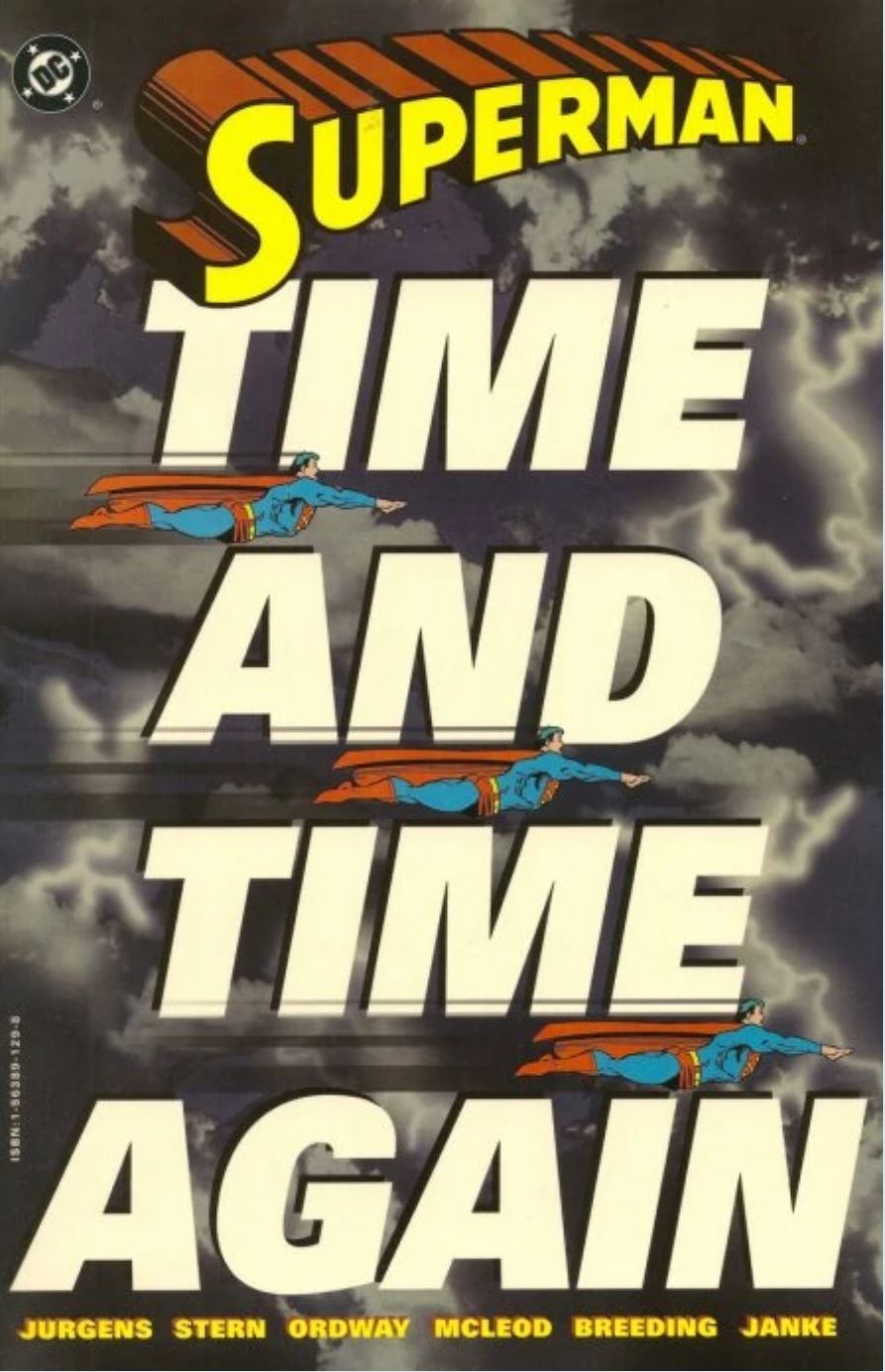
Superman: Time and Time Again


By Dan Jurgens, Jerry Ordway, Roger Stern, Bob McLeod, Brett Breeding, Dennis Janke, Tom Grummett, Jose Marzan & various (DC Comics)
ISBN: 978-1852865702 (TPB)

When Superman was re-imagined after Crisis on Infinite Earths, many of his more omnipotent abilities were discarded. Like his earliest days, he was a far from omnipotent hero, more in touch with humanity because he wasn’t so far above it. One thing that was abandoned was his casual ability to travel through time.

Indeed, rather than being able to navigate the chronal corridors with ease, in this splendid epic from 1991 (originally published serially in Action Comics #663-665, Adventures of Superman #476-478, and Superman (volume 2) #54-55 -with epilogues from #61 & 73 – the Man of Tomorrow is trapped in a cataclysmic and volatile temporal warp, bounced around from era to era with his abilities constantly diminishing and utterly unable to regain his home and loved ones.

That specifically means co-worker and girlfriend Lois Lane, to whom he has just divulged his greatest secret… his real identity…

It all begins in Adventures of Superman #476 as Dan Jurgens & Brett Breeding’s ‘The Linear Man’ sees a rogue (self-appointed) guardian of the Time Stream attempt to forcibly return chronal refugee-turned superhero Booster Gold to the 25th century he originated from. When Superman intervenes, the battle sparks a tremendous explosion, causing the Caped Kryptonian to careen through time. Each “landing” leaves him in a significant period of Earth’s history such as Roger Stern & Bob McLeod’s ‘Lost in the ‘40s Tonight’ (Action Comics #663) precipitating a meeting with that era’s first mystery men before almighty wraith the Spectre transports him not home but to ‘The Warsaw Ghetto!’ to act as temporary savour in an iconic battle saga by Jerry Ordway & Dennis Janke from Superman #54.

Apparently only gigantic explosions can launch him back into the time stream, such as occurs in in ‘Death Rekindled’ (Adventures of Superman #477 Jurgens & Brett Breeding) when a trip to the future introduces him to an iteration of the Legion of Super-Heroes needing help to destroy a monstrous Sun Eater… ‘

That climactic detonation deposits him ‘Many Long Years Ago’ (Action Comics #664, Stern & McLeod) to end up a Jurassic castaway until a clash with marooned time thief Chronos propels him into the Pleistocene and a chronologically adrift encounter with primordial alien race the H’v’ler’ni (AKA the Host)…

That tussle tosses him forward to ‘Camelot’ just as the Dark Ages begin, battling valiantly but in vain beside eventual All-Star Squadron champion and Seventh Soldier of Victory Sir Justin the Shining Knight in Superman #55 (Ordway) before landing again with another LSH for blockbusting finale ‘Moon Rocked’ (Adventures of Superman #478 Jurgens & Breeding) and resolution and reunion with Lois via a 5-page excerpt from Action Comics #665’s ‘Wake the Dead’

Also included are the contents of Superman #61’s ‘Time and Time Again Again!’ and #73’s ‘Time Ryders’ – both by Jurgens & Breeding – as the Man of Tomorrow has further dealings with the Linear Men Matthew Ryder, Waverider, Liri Lee and Hunter

As Superman is gradually depowered whilst seeking to get home without wrecking reality, he enjoys incredible memorable moments – such as walking with dinosaurs, cathartically crushing Nazis, tussling with a mammoth and fighting Etrigan the Demon during the fall of civilisation. He also meets many milestone characters from DC history including the WWII Justice Society of America, and encounters the Legion of Super-Heroes at three critical points of their long and varied career: making this tale a significant marker for establishing the key points of post-Crisis on Infinite Earths continuity…

This hugely enjoyable epic is highly readable and cheerfully accessible for both returning and first time fans so it’s a true shame it’s currently out of print and still unavailable as a digital edition. Hopefully with Superman’s 85th anniversary impending there are moves afoot to rectify that…
© 1991, 1992, 1994 DC Comics. All Rights Reserved.

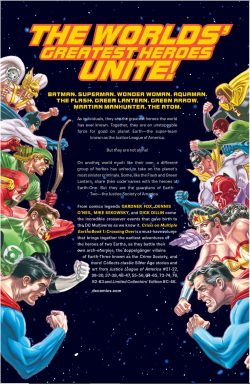
Crisis on Multiple Earths Book 1: Crossing Over


By Gardner Fox, Dennis O’Neil, Mike Sekowsky, Dick Dillin, Bernard Sachs, Sid Greene, Joe Giella & various (DC Comics)
ISBN: 978-1-7795-0753-2 (TPB/Digital)

As I’ve frequently mentioned before, I was one of the “Baby Boomer” crowd which grew up with Julie Schwartz, Gardner Fox and John Broome’s tantalisingly slow reintroduction of Golden Age superheroes during the halcyon, eternally summery days of the early 1960s. To me those fascinating counterpart crusaders from Earth-Two weren’t vague and distant memories rubber-stamped by parents or older brothers – they were cool, fascinating and enigmatically new.

…And for some reason the “proper” heroes of Earth-One held them in high regard and treated them with obvious deference…

The transcendent wonderment began, naturally enough, in The Flash; pioneering trendsetter of the Silver Age Revolution. After successfully ushering in the triumphant return of the superhero concept, the Scarlet Speedster – with Fox & Broome at the writing reins – set an unbelievably high standard for costumed adventure in sharp, witty tales of science and imagination, always illustrated with captivating style and clean simplicity by Carmine Infantino.

The epochal epic that literally changed the scope of American comics forever was Fox’s ‘Flash of Two Worlds’ (Flash #123 September 1961, reprinted in many places, but not here): introducing to an emerging continuity the concept of alternate Earths and, by extension, the multiversal structure of the future DCU as well as all the succeeding cosmos-shaking yearly “Crisis” sagas that grew from it.

Moreover, where DC led, others followed…

Received with tumultuous acclaim, the concept was revisited months later in Flash #129 which also teasingly reintroduced evergreen stalwarts – Wonder Woman, the Atom, Hawkman, Green Lantern, Doctor Mid-Nite and Black Canary: venerable members of the fabled Justice Society of America. Clearly Editor Schwartz had something in mind…

That tale directly led into the veteran team’s first meeting with the Justice League of America and the start of an annual tradition. When ‘Flash of Two Worlds’ brought us the notion of Infinite Earths and multiple iterations of costumed crusaders, fan pressure had begun almost instantly to agitate for the return of the Greats of the “Golden Age”. Editorial powers-that-be were hesitant, fearing too many heroes would be silly and unmanageable, or worse yet, put readers off. If they could see us now…

These innovative adventures generated an avalanche of popular and critical approval (big sales figures, too) so inevitably the trans-dimensional tests led to the ultimate team-up in the summer of 1963.

This gloriously enthralling volume is the first in a sequence of collections celebrating Infinite Diversity in Infinite Costumes, gathering the first eight summer double-header JLA/JSA convocations (Justice League of America #21-22, 29-30, 37-38, 46-47, 55-56, 64-65, 73-74, and 82-83) plus pertinent excerpts from other places: stunning superhero wonderments which never fail to astound and delight. Also on offer are a context-conveying Introduction ‘1 & 2 – Crisis’ by wonder-scribe Mark Waid detailing even more cool facts behind the phenomenon and Martin Pasko’s erudite Foreword ‘Crisis Behind the Scenes’, revealing how the loss of stalwart originators Gardner Fox & Mike Sekowsky led to a new way of telling stories, offsetting in many respects the genuine dilemma of readers’ changing tastes…

The comic book catharsis commences with the landmark ‘Crisis on Earth-One’ and ‘Crisis on Earth-Two’ (from Justice League of America #21-22, August & September 1963) combining to form one of the most important stories in DC history and arguably one of the most crucial tales in American literature: at least the stuff with pictures in it.

Written by Fox and illustrated by Mike Sekowsky & Bernard Sachs, the yarn finds a coalition of assorted villains from each Earth plundering at will, meeting and defeating the mighty Justice League before impertinently imprisoning them in their own secret mountain HQ…

Temporarily helpless, “our” heroes contrive a desperate plan to combine forces with the champions of another Earth to save the world – both of it – and the result is pure Fights ‘n’ Tights majesty.

It’s impossible for me to be totally objective about this saga. I was a drooling kid in short trousers when I first read it and the thrills haven’t diminished with this umpty-first re-reading.

This is what superhero comics are all about!

The buying public clearly agreed. One year later ‘Crisis on Earth-Three’ and ‘The Most Dangerous Earth of All!’ (JLA #29-30) reprised the team-up after super-beings of a third alternate Earth discover the secret of trans-universal travel.

Unfortunately, Ultraman, Owlman, Superwoman, Johnny Quick and Power Ring are villains on a world without heroes who see costumed crimebusters like the JLA and JSA as living practise dummies to sharpen their evil skills upon.

With this cracking thriller the annual summer get-together became solidly entrenched in heroic lore, giving fans endless entertainment for years to come and making the approaching end of school holidays less gloomy than they could have been.

The third annual event was a touch different; a largely forgotten experimental tale wherein the educationally-challenged and extremely larcenous Johnny Thunder of Earth-1 wrests control of the genie-like Thunderbolt from his otherworld counterpart: employing its magical powers to change the events which created of all Earth-1’s superheroes. Catastrophically altered, in #37 it became ‘Earth – Without a Justice League’, and it was up to the JSA to save the day in a gripping battle of wits and power before Reality was re-established in #38’s concluding chapter ‘Crisis on Earth-A!’.

Veteran inker Bernard Sachs retired before the fourth team-up, leaving the amazing Sid Greene to embellish a gloriously whacky saga: one springing out of the global “Batmania” craze engendered by the first Batman television show…

A wise-cracking campy tone was fully in play, acknowledging the changing audience profile and this time the stakes are raised to encompass the destruction of both planets in ‘Crisis Between Earth-One and Earth-Two’ and ‘The Bridge Between Earths’ (Justice League of America #46-47, August & September 1966).

Here a bold continuum-warping experiment drags the twin sidereal worlds towards an inexorable hyper-space collision. Making matters worse, an awesome anti-matter being uses the opportunity to break into and explore our positive-matter universe whilst the heroes of both worlds are distracted by the destructive rampages of monster-men Blockbuster and Solomon Grundy.

Peppered with wisecracks and “hip” dialogue, it’s sometimes difficult to discern what a cracking yarn this actually is, but if you’re able to forgive or swallow dated patter, it is one of the very best plotted and illustrated stories in the entire JLA/JSA canon. Furthermore, the vastly talented Greene’s expressive subtlety, beguiling textures and whimsical humour add unheard-of depth to Sekowsky’s pencils and the light and frothy comedic scripts of Fox.

The same can be said of the next year’s outing as the wise-cracking campy tone was still fully in play for ‘The Super-Crisis that Struck Earth-Two’ and ‘The Negative-Crisis on Earths One-Two!’ (JLA #55-56; August and September 1967).

Opening on Earth Two, it boasted a radical change as the JSA now included an adult Robin instead of Batman, although Hourman, Wonder Woman, Hawkman, Wildcat, Johnny Thunder and Mr. Terrific still needed the help of Earth One’s Superman, Flash, Green Lantern and Green Arrow to cope with an invasion of superpower-creating black spheres bestowing upon mere mortals uncanny abilities enabling them to satisfy their darkest desires.

Things went from bad to worse after the harried heroes used the ebony invaders to augment their own abilities and turn half the combined team evil too…

By 1968 the second superhero boom looked to be dying just as its predecessor had at the end of the 1940s. Sales were down generally in the comics industry and costs were beginning to spiral. More importantly, “free” entertainment, in the form of television, was by now ensconced in even the poorest household. If you were a kid in the sixties, think on just how many brilliant cartoon shows were created in that decade, when artists like Alex Toth and Doug Wildey were working in West Coast animation studios.

Moreover, comic book stars were appearing on the small screen. Superman, Aquaman, Batman, the Marvel heroes and even the JLA were there every Saturday in your own living room…

It was a time of great political and social upheaval. Change was everywhere and unrest even reached the corridors of DC. When a number of creators agitated for increased work-benefits the request was not looked upon kindly. Many left the company for other outfits. Some quit the business altogether.

Fox ended his magnificent run on the Justice League with a stunning annual team-up extravaganza. Creative and perfectly professional to the very end, his last story was yet another of the Golden-Age revivals which had resurrected the superhero genre.

JLA #64 and 65 (August- September 1968) featured the ‘Stormy Return of the Red Tornado’ and ‘T.O. Morrow Kills the Justice League – Today!’, with a cyclonic super-android taking on the mantle of a 1940s spoof “Mystery Man” who appeared in the very first JSA adventure (if you’re interested, the original Red Tornado was a brawny washerwoman named Ma Hunkle who escaped comedy feature Scribbly by Sheldon Mayer and became our earliest crossdressing masked marvel…).

The plot here involved a cagy time-plundering thief creating an artificial hero to help him defeat both JLA and JSA, before realising too late he had built better than he knew…

Fox’s departing thriller was also the series’ artistic debut for former Blackhawk artist Dick Dillin: a prolific draughtsman who would draw every JLA issue for the next twelve years, as well as many other adventures of DC’s top characters. He was inked by Greene, a pairing that seemed vibrant and darkly realistic after the eccentrically stylish, nigh-abstract Sekowsky.

Next up from August and September 1969 is Denny O’Neil’s first shot at the yearly cross-dimensional crisis as #73 and 74 offered ‘Star Light, Star Bright… Death Star I See Tonight!’ and ‘Where Death Fears to Tread!’

The tense, brooding tale introduced Aquarius; a sentient but insane star, who magically destroys Earth Two until Earth One’s heroes (with their surviving Golden Age counterparts) manage to restore it, but not without some personal tragedy. Black Canary loses her husband and opts to emigrate to our world, handily becoming the JLA’s resident Girl Superhero and picking up a new if somewhat unreliable power in the process.

This splendid exercise in fantastic nostalgia ends with another grand get-together as perfidious property speculators from space seek to raze both Earths in ‘Peril of the Paired Planets’ (#82 August 1970 by O’Neil, Dillin & Joe Giella) and only the ultimate sacrifice by a true hero averts trans-dimensional disaster in concluding chapter ‘Where Valor Fails… Will Magic Triumph?’

This volume also includes a few beguiling extras: covers by Sekowsky, Sachs, Greene, Murphy Anderson, Jack Abel, Dillin, Joe Kubert and Neal Adams, the front and back covers of Limited Collectors’ Edition #C-46 (by Neal Adams from August/September 1976); a double-page pin-up of the JSA by Anderson from Justice League of America #76 (October 1969) and previous collection covers by Alex Ross and Jerry Ordway…

These tales won’t suit everybody, and I’m as aware as any that in terms of the “super-powered” genre the work here can be boiled down to two bunches of heroes formulaically getting together to deal with extra-extraordinary problems. In mature hindsight, it’s obviously also about sales and the attempted revival of more sellable characters during a period of intense rivalry between DC Comics and Marvel.

But I don’t have to be mature in my off-hours and for those who love costume heroes, who crave these cunningly constructed modern mythologies and actually care about fun, this is simply a grand parade of straightforward action, great causes and momentous victories.

…And since I wouldn’t have it any other way, why should you?
© 1963, 1964, 1965, 1966, 1967, 1968, 1969, 1970, 1976, 2002, 2003, 2020 DC Comics. All Rights Reserved.

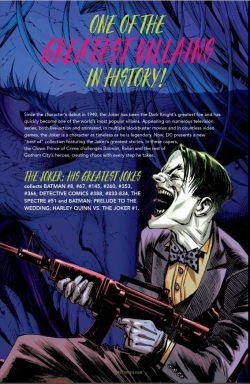
The Joker: His Greatest Jokes


By Bill Finger, Bob Kane, David Vern, John Broome, Denny O’Neil, Gerry Conway, Doug Moench, Paul Dini, Tom Seeley, Lew Sayre Schwartz, Sheldon Moldoff, Bob Brown, Irv Novick, José Luis García-López, Don Newton, Don Kramer, Sami Basri, Otto Schmidt, Jerry Robinson, George Roussos, Charles Paris, Joe Giella, Dick Giordano, Dan Adkins, Alfredo Alcala, Wayne Faucher & various (DC Comics)
ISBN: 978-1-4012-9441-0 (TPB)

When this year started, I expected to spend lots more time celebrating and commemorating the comics anniversaries that had rolled around. We all know how and why that didn’t happen, so with some frantic re-jigging I’ve shoehorned one of the most enduring arch-foes in fiction in to this Halloween segment.

It’s safe to assume that almost everybody knows some iteration of the Joker – probably more than one – so kudos to the editors of this curated historical compilation for unearthing some of the less well-known clown-clashes here. Therefore, sit back and ponder just why the Monarch of Malignant Mirth known got to survive 80 gory-ous years and enjoy…

However, fascinating and informative as those features are, the real literary largesse is to be found in the 19 stirring tales which comprise the bulk of this tome…

A good old-fashioned chronological compendium of the Harlequin of Hate’s ever-changing, so-mutable antics and aggressive transgressions, this trade paperback/digital treat re-presents stories from Batman #8, 67, 145, 260, 353, 366, Detective Comics #388, 833-834, The Spectre #51 and Batman: Prelude to the Wedding: Harley Quinn vs The Joker #1, and opens sans preamble with ‘The Cross Country Crimes’ (Batman #8, by Bill Finger, Bob Kane, Jerry Robinson & George Roussos; December 1941/January 1942) which sees the plundering poltroon rampage across America in a classic blend of larceny and lunacy.

A decade later, the edgy, implied violence was replaced by smart plotting and bizarre situations as David Vern, Kane, Lew Sayre Schwartz & Charles Paris’ ‘The Man Who Wrote the Joker’s Jokes’ (Batman #67, by October/November 1951) sees the Crime Clown hire literary ghosts to plot his capers before ultimately overreaching by blackmailing Batman into writing his next – and last – heist…

Finger & Sheldon Moldoff t told a tale within a tale as ‘The Son of the Joker’ (Batman #145; February 1962) sees butler Alfred penning his own brand of fanfic, detailing how the next generation of Caped Crusaders (an adult Dick Grayson and Bruce Wayne‘s son) clash with the inheritors of the Clown’s colours…

Detective Comics #388 (June 1969) saw John Broome make a major course correction, moving the Joker away from buffoonery back towards the insane killer we all cherish in ‘Public Luna-tic Number One!‘ – a classy sci-fi thriller totally reinventing the Laughing Loon, in no small part thanks to the artistic efforts of artists Bob Brown & Joe Giella.

‘This One’ll Kill You, Batman!’ by Denny O’Neil, Irv Novick & Dick Giordano from Batman #260 (January/February 1975) sees the grim, po-faced Darknight Detective racing to save his own life after being poisoned by Joker Toxin that acts like an irresistible, lethal laughing gas, after which ‘Last Laugh’ (Batman #353, November 1982) sees Gerry Conway, the incomparable José Luis García-López and inker Dan Adkins detail the Mountebank of Mayhem’s latest ego boost, by attempting to immortalise his face in mountainous stone whilst getting rid of his greatest enemy forever…

Batman #366 – from December 1983 and courtesy of Doug Moench, Don Newton & Alfredo Alcala offers some contemporary unrealpolitik as the Joker brings his singular taste for chaos to war-torn Guatemala as he attempts to take over the nation. He is foiled by a unique team consisting of journalist Vicki Vale, Batman and the hero’s latest recruit… a masked kid named Jason Todd…

‘A Savage Innocence’ (The Spectre #51, by John Ostrander & Tom Mandrake; March 1997) takes a peek behind the lunacy, as God’s instrument of Divine Wrath faces the Crazy Clown. After the Joker kills everyone in New York comedy club The Killing Joke, the Spectre enters the maniac’s mind and is horrifically compromised and converted…

Crafted by Paul Dini, Don Kramer & Wayne Faucher, ‘Trust’ (parts one and two, from Detective Comics #833-834; August and September 2007), ostensibly feature an encore performance for warped and homicidal stage magician Ivar Loxias, but all too soon, the chilling tale of slaughter and trickery guest-starring the bewitching Zatanna turns up a Joker in the stacked deck…

This box of exotic delights ends with a recent but thoroughly entertaining slice of catharsis from Batman: Prelude to the Wedding: Harley Quinn vs The Joker #1 (August 2018). Written by Tom Seeley, with art by Sami Basri, Otto Schmidt & Jessica Kholinne, ‘Till Death Do Us Part’ finds the Grinning Ghoul diverted from his intended disruption of Batman and Catwoman‘s wedding, by old flame Harley Quinn, who feels there are unresolved issues from their own unique romantic interlude. She wants to talk it all out and she’s brought the necessary restraints and weaponry…

The Joker has spanned DC’s entire continuity, adding mirth, mayhem and madness to the shining clockwork universe. If you need to walk a bit wild and enjoy straying from the paths most taken, this intriguing confection might be just up your dark and threatening alley…
© 1941, 1951, 1962, 1969, 1974, 1982, 1983, 1997, 2007, 2018, 2019 DC Comics. All rights reserved.
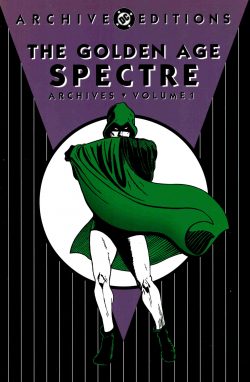
The Golden Age Spectre Archives


By Jerry Siegel & Bernard Baily with various (DC Comics)
ISBN: 978-1-5638-9955-3 (HB)

There are a lot of comics anniversaries this year. Many will be rightly celebrated, but it appears that some few are going to be unjustly ignored. As a feverish fanboy wedged firmly in the past, I’m abusing my privileges here to kvetch yet again about another brilliant vintage book, criminally out of print and not slated for revival either physically or in digital formats. That means I’ll be occasionally recommending some items that might be a bit hard to find. But at least that means you might be buying from those poor beleaguered comics shops and specialists desperately in need of your support now, rather than some faceless corporate internet emporium…

In fact, considering the state of the market, how come DC doesn’t just convert its entire old Archive line into eBooks and win back a few veteran fans? Don’t ask me, I only work here…

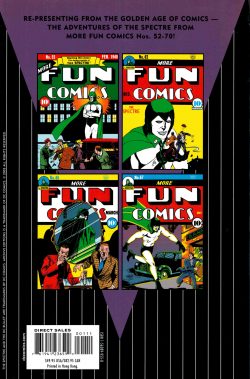
The Spectre is one of the oldest characters in DC’s vast stable of characters, created by Jerry Siegel and Bernard Baily in 1939 before debuting with a 2-part origin epic in More Fun Comics #52 and 53 (cover-dated February and March 1940). He was the first superhero to star in the previously all-genres adventure anthology. For a few years, the Ghostly Guardian reigned supreme in the title with flamboyant and eerily eccentric supernatural thrillers, but gradually slipped from popularity as firstly Dr. Fate and successively Johnny Quick, Aquaman, Green Arrow and finally Superboy turned up to steal the show.

By the time of his last appearance in More Fun #101 February 1945, the Spectre had been reduced to a foil for his own comedic sidekick Percival Popp, the Super-Cop…

Just like Siegel’s other iconic creation, the Dark Man suffered from a basic design flaw: he was just too darn powerful. Unlike the vigorously vital and earthy early Superman however, the ethereal champion of justice was already dead, so he couldn’t be logically or dramatically imperilled. Of course, in those far-off early days that wasn’t nearly as important as sheer spectacle: grabbing the reader’s utter attention and keeping it stoked to a fantastic fever pitch. This the Grim Ghost could do with ease and always-increasing intensity.

Re-presenting the first 19 eerie episodes and following a fulsome Foreword from pre-eminent Comics historian Dr. Jerry Bails, detailing the state of play within the budding marketplace during those last months of the 1930s, the arcane action in this astoundingly enticing full-colour deluxe hardback collection commences with ‘The Spectre: Introduction’ from More Fun Comics #52.

This wasn’t the actual title: like so many strips of those early days, most stories didn’t have individual titles and have been only retroactively designated for compilations such as this.

The Ghostly Guardian was only barely glimpsed in this initial instalment. Instead, the action rests upon hard-bitten police detective Jim Corrigan, who is about to wed rich heiress Clarice Winston when they are abducted by mobster Gat Benson. Stuffed into a barrel of cement and pitched off a pier, Corrigan dies and goes to his eternal reward.

Almost…

Rather than finding Paradise and peace, Corrigan’s spirit is accosted by a glowing light and disembodied voice which, over his strident protests, orders him return to Earth to fight crime and evil until all vestiges of them are gone…

Standing on the seabed and looking at his own corpse, Corrigan began his mission by going after his own killers…

In #53 ‘The Spectre Strikes’ find the outraged revenant swiftly, mercilessly and horrifically ending his murderers and saving Clarice, before calling off the engagement and moving out of the digs he shared with fellow cop and best friend Wayne Grant. After all, a cold, dead man has no need for the living…

The origin ends with Corrigan implausibly sewing himself a green and white costume and swearing to eradicate all crime…

Splendidly daft, this 2-part yarn comprises one of the darkest and most memorable origins in comic book annals and the feature only got better with each issue as the bitter, increasingly isolated lawman swiftly grows into most overwhelmingly powerful hero of the Golden Age.

In MFC #54 the Supernatural Sentinel tackled ‘The Spiritualist’, a murderous medium and unscrupulous charlatan who almost kills Clarice and forever ends the Spectre’s hopes for eternal rest, after which #55 introduces ‘Zor’: a ghost of far greater vintage and power, dedicated to promulgating evil on Earth. He too menaces Clarice and only the intervention of the Heavenly Voice and a quick upgrade in phantasmal power enables The Spectre to overcome his malign menace.

More Fun Comics #56 was the first to feature Howard Sherman’s Dr. Fate on the cover but the Spectre was still the big attraction, even if the merely mundane bandits and blackmailers instigating ‘Terror at Lytell’s’ are no match for the ever-inventive wrathful wraith. Far more serious was ‘The Return of Zor’ in #57, as the horrific haunt escapes from beyond to frame Corrigan for murder and again endanger the girl Jim dare not love…

An embezzler turns to murder as ‘The Arsonist’ in #58, but is no match for the cop – let alone his eldritch alter ego – whilst ‘The Fur Hi-Jackers’ actually succeed in killing the cop, yet are still suffer the Spectre’s unique brand of justice.

In #60, ‘The Menace of Xnon’ sees a super-scientist using incredible inventions to frame the ghost – and even menace his ethereal existence – prompting The Voice to again increase its servant’s power. This means giving The Spectre the all-powerful Ring of Life – but not before the Ghostly Guardian has been branded Public Enemy No. 1.

With Corrigan now ordered to arrest his spectral other self on sight, #61 (another Dr. Fate cover) features ‘The Golden Curse Deaths’ wherein prominent citizens perish from a scientific terror with a deadly Midas Touch, after which ‘The Mad Creation of Professor Fenton’ pits the Phantom Protector against a roving, ravaging, disembodied mutant super-brain…

In #63, a kill-crazy racketeer gets his just deserts in the electric chair only to return and personally execute ‘Trigger Daniels’ Death Curse’ upon all who opposed him in life. Happily, The Spectre proves to be more than his match whereas ‘The Ghost of Elmer Watson’ is a far harder foe to face. Murdered by mobsters who also nearly kill Wayne Grant, the remnant of the vengeful dead man refuses to listen to The Spectre’s brand of reason. Thus, its dreadful depredations must be dealt with in fearsome fashion…

‘Dr. Mephisto’ was a spiritualist who utilised an uncanny blue flame for crime in #65, after which the Ghostly Guardian battles horrendous monsters called forth from ‘The World Within the Paintings’ (probably written by the series’ first guest writer Gardner Fox), before Siegel returns with ‘The Incredible Robberies’ putting the phantom policeman into fearful combat with diabolical mystic Deeja Kathoon to the death and beyond…

With MFC #68 The Spectre finally lost his protracted cover battle to Dr. Fate even though, inside, the ‘Menace of the Dark Planet’ features a fabulously telling tale of Earthbound Spirit against alien invasion by life-leeching Little Green Men. In his next exploit ‘The Strangler’ murders lead Corrigan into an improbable case with an impossible killer…

This terrifying titanic tome terminates with issue #70 and ‘The Crimson Circle Mystery Society’ in which a sinister cult employs a merciless phantasmal psychic agent named Bandar to carry out its deadly schemes…

Although still a mighty force of fun and fearful entertainment, The Spectre’s Glory Days and Nights were waning and more credible champions were coming to the fore. He would be one of the first casualties of the post-War decline in mystery men and not be seen again until the Silver Age 1960’s…

Moreover, when he did return to comics, the previously omnipotent ghost was given strict limits and as he continued to evolve through various returns, refits and reboots The Spectre was finally transmogrified into a tormented mortal soul bonded inescapably to the actual embodiment of the biblical Wrath of God. Revamped and revived in perpetuity, revealed to be the Spirit of Vengeance wedded to a human conscience, Jim Corrigan was finally laid to rest in the 1990s and HalGreen Lantern) Jordan replaced him. Returning to basics in more recent years, the next host was murdered Gotham City cop Crispus Allen.

They’re all worth tracking down and exhuming: spooky comic champions who have never failed to deliver an enthralling, haunted hero rollercoaster – or is that Ghost Train? – of thrills and chills.
© 1940, 1941, 2003 DC Comics. All Rights Reserved.

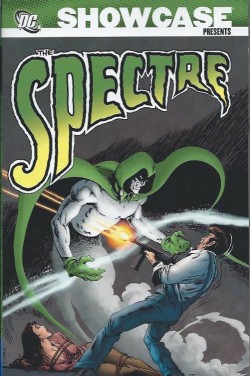
Showcase Presents the Spectre volume 1


By Gardner F. Fox, Bob Haney, Mike Friedrich, Steve Skeates, Dennis J. O’Neil, Mark Hanerfeld, Michael L. Fleisher, Len Wein, Paul Kupperberg, Mike W. Barr, Murphy Anderson, Carmine Infantino, Ross Andru & Mike Esposito, Neal Adams, Jerry Grandenetti, Jack Sparling, Bernie Wrightson, Jim Aparo, Frank Thorne, Ernie Chan, Jim Starlin, Michael R. Adams & various (DC Comics)
ISBN: 978-1-4012-3417-1 (TPB)

Created by Jerry Siegel & Bernard Baily in 1940 and debuting via a 2-part origin epic in More Fun Comics #52 and 53, The Spectre is one of the oldest characters in DC’s vast character stable. Crucially, just like Siegel’s other iconic creation, he soon began to suffer from a basic design flaw: he was just too darn powerful.

Unlike Superman however, this relentless champion of justice was already dead, so he can’t really be logically or dramatically imperilled. Of course, in those far off early days that wasn’t nearly as important as sheer spectacle: forcibly grabbing the reader’s utter attention and keeping it stoked to a fantastic fever pitch.

Starting as a virtually omnipotent phantom, the Grim Ghost evolved, over various revivals, refits and reboots into a tormented mortal soul bonded inescapably to the actual embodiment of the biblical Wrath of God.

The story is a genuinely gruesome one: police detective Jim Corrigan is callously executed by gangsters before being called back to the land of the living. Commanded to fight crime and evil by a glowing light and disembodied voice, he was indisputably the most formidable hero of the Golden Age.

He has been revamped many times, and in the 1990s was revealed to be God’s own Spirit of Vengeance wedded to a human conscience. When Corrigan was finally laid to rest, Hal (Green Lantern) Jordan and murdered Gotham City cop Crispus Allen replaced him as the mitigating conscience of the unstoppable, easily irked force of Divine Retribution…

However, the true start of that radically revitalised career began in the superhero-saturated mid-1960s when, hot on the heels of feverish fan-interest in the alternate world of the Justice Society of America and Earth-2 (where all the WWII heroes retroactively resided), DC began trying out solo revivals of 1940’s characters, as a counterpoint to such wildly successful Silver Age reconfigurations as Flash, Green Lantern, Atom and Hawkman…

This sublime and colossal Showcase selection collects and documents the almighty Man of Darkness’ return in the Swinging Sixties, his landmark reinterpretation in the horror-soaked, brutalised 1970s and even finds room for some later appearances before the character was fully de-powered and retrofitted for the post-Crisis on Infinite Earths DC Universe.

As such, this mammoth monochrome tome (624 peril-packed pages!) contains Showcase #60, 61 and 64; The Spectre #1-10; team-up tales from The Brave and the Bold #72, 75, 116, 180 & 199 and DC Comics Presents #29; the lead strips from Adventure Comics #431-440 and one last hurrah from horror-anthology Ghosts #97-99, cumulatively encompassing the end of 1965 to the middle of 1983.

DC had tried a number of Earth-2 team-iterations (Starman/Black Canary – with Wildcat – in The Brave and the Bold #61-62, whilst Showcase #55 & 56 spotlighted Doctor Fate & Hourman with a cameo from the original Green Lantern), but inspirational editor Julie Schwartz and scripter Gardner F. Fox only finally achieved their ambition to launch a Golden Age hero into his own title with the revival of the Ghostly Guardian in Showcase. It was hard going and perhaps ultimately benefited from a growing general public interest in supernatural stories…

After three full length appearances and many guest-shots, The Spectre won his own solo series at the end of 1967, just as the super-hero craze went into a steep decline, but arguably Showcase #60 (January/February 1966) anticipated the rise of supernatural comics by re-introducing Corrigan and his phantom passenger in ‘War That Shook the Universe’ by Earth-2 team supreme Fox & illustrator Murphy Anderson.

This spectacular saga reveals why the Heroic Haunt had vanished two decades previously, leaving the fundamentally human Corrigan to pursue his war against evil on merely mortal terms – until a chance encounter with a psychic investigator frees the spirit buried deep within him.

A diligent search reveals that, 20 years previously, a supernal astral invader broke into the Earth plane and possessed a mortal, but was so inimical to our laws of reality that both it and the Grim Ghost were locked into their meat shells – until now…

Thus began a truly spectre-acular (feel free to groan, but that’s what they called it back then) clash with the devilish Azmodus that spans all creation and blew the minds of us gobsmacked kids…

Issue #61 (March/April) upped the ante when the even-more satanic Shathan the Eternal subsequently insinuates himself into our realm from ‘Beyond the Sinister Barrier’, stealing mortal men’s shadows until he is powerful enough to conquer the physical universe. This time The Spectre treats us to an exploration of the universe’s creation before narrowly defeating the source of all evil…

The Sentinel Spirit re-manifested in Showcase #64 (September/October 1966) for a marginally more mundane but no less thrilling adventure when ‘The Ghost of Ace Chance’ takes up residence in Jim’s body. By this time, it was established that ghosts need a mortal anchor to recharge their ectoplasmic “batteries”, and this unscrupulous crooked gambler is determined to inhabit the best frame available…

The try-out run concluded, the editors sat back and waited for sales figures to dictate the next move. When they proved inconclusive Schwartz orchestrated a concerted publicity campaign to further promote Earth-2’s Ethereal Adventurer.

The Brave and the Bold #72 (June/July 1967) saw the Spectre clash with Earth-1’s Scarlet Speedster in ‘Phantom Flash, Cosmic Traitor’ (by Bob Haney, Carmine Infantino & Charles “Chuck” Cuidera). This sinister saga sees the mortal meteor arcanely transformed into a sinister spirit-force and power-focus for unquiet American aviator Luther Jarvis who returns from his death in 1918 to wreak vengeance on the survivors of his squadron – until the Spectre intervenes…

Due to the vagaries of comicbook scheduling, Brave and the Bold #75 (December 1967/January 1968) appeared at around the same time as The Spectre #1, although the latter had a cover-date of November/December 1967. In the Batman team-up tale – scripted by Haney and drawn by Ross Andru & Mike Esposito – Ghostly Guardian joins Dark Knight to free Gotham City’s Chinatown from ‘The Grasp of Shahn-Zi!’: an ancient oriental sorcerer determined to prolong his reign of terror at the expense of an entire community and through the sacrifice of an innocent child, after which the Astral Avenger finally, simultaneously, debuted in his own title…

The Spectre #1 featured ‘The Sinister Lives of Captain Skull’ by Fox & Anderson, divulging how the botched assassination of American Ambassador Joseph Clanton and an experimental surgical procedure allows one of the diplomat’s earlier incarnations to seize control of his body and, armed with mysterious eldritch energies, run amok on Earth.

These “megacyclic energy” abilities enable the revenant to harm and potentially destroy the Ghostly Guardian and compel the Spectre to pursue the piratical Skull through a line of previous lives until he can find their source and purge the peril from all time and space…

With issue #2 (January/February 1968) artistic iconoclast Neal Adams came aboard for the Fox-scripted mystery ‘Die Spectre – Again’ wherein crooked magician Dirk Rawley accidentally manifests his etheric self and severely tests both Corrigan and his phantom lodger as they seek to end the double-menace’s string of crimes, mundane and magical. At this time, the first inklings of a distinct separation and individual identities began. The two halves of the formerly sole soul of Corrigan were beginning to disagree and even squabble…

Neophyte scripter Mike Friedrich joined Adams for #3’s ‘Menace of the Mystic Mastermind’ wherein pugilistic paragon Wildcat faces the inevitable prospect of age and infirmity even as an inconceivable force from another universe possesses petty thug Sad Jack Dold, turning him into a nigh-unstoppable force of cosmic chaos…

‘Stop that Kid… Before He Wrecks the World’ was written & illustrated by Adams with a similar trans-universal malignity deliberately empowering a young boy as a prelude to its ultimate conquest, whilst #5’s ‘The Spectre Means Death?’ (all Adams again) appears to show the Ghostly Guardian transformed into a pariah and deadly menace to society, until Jim’s investigations uncover the emotion-controlling Psycho Pirate at the root of the Heroic Haunt’s problems…

Despite all the incredible talent and effort lavished upon it, The Spectre simply wasn’t finding a big enough audience. Adams left for straight superhero glory elsewhere and a hint of changing tastes came as veteran illustrator of horror comics Jerry Grandenetti came aboard.

Issue #6 (September/October 1968) saw his eccentric, manic cartooning adding raw wildness to the returning Fox’s moody thriller ‘Pilgrims of Peril!’ Murphy Anderson also re-enlisted, applying a solid ink grounding to the story of a sinister quartet of phantom Puritans who invade the slums of Gateway City, driving out the poor and hopeless as they hunt long-lost arcane treasures. These would allow demon lord Nawor of Giempo access to Earth unless The Spectre can win his unlife or death duel with the trans-dimensional horror…

As the back of issue #7 was dedicated to a solo strip starring Hourman (not included in this collection), The Spectre saga here – by Fox, Grandenetti & Anderson – was a half-length tale which followed the drastic steps necessary to convince the soul of bank-robber Frankie Barron to move on. Since he was killed during a heist, the astral form of aversion therapy used to cure ‘The Ghost That Haunted Money!’ proves not only ectoplasmically effective but outrageously entertaining…

Issue #8 (January/February 1969) was scripted by Steve Skeates and began a last-ditch and obviously desperate attempt to turn The Spectre into something the new wave of anthology horror readers would buy.

As a twisted, time-lost apprentice wizard struggles to return to Earth after murdering his master and stealing cosmic might from the void, on our mundane plane an exhausted Ghostly Guardian neglects his duties and is taken to task by his celestial creator.

As a reminder of his error, the Penitent Phantasm is burdened by a fluctuating weakness – which would change without warning – to keep him honest and earnest. What a moment for the desperate disciple Narkran to return then; determined to secure his elevated god-like existence by securing ‘The Parchment of Power Perilous!’…

The Spectre #9 completed the transition, opening with an untitled short from Friedrich (illustrated by Grandenetti & Bill Draut) which sees the Man of Darkness again overstep his bounds by executing a criminal. This prompts Corrigan to refuse the weary wraith the shelter of his reinvigorating form and when the Grim Ghost then assaults his own host form, the Heavenly Voice punishes the spirit by chaining him to the dreadful Journal of Judgment: demanding he atone by investigating the lives inscribed therein in a trial designed to teach him again the value of mercy…

The now anthologised issue continued with ‘Abraca-Doom’ (Dennis J. O’Neil & Bernie Wrightson) as The Spectre attempts to stop a greedy carnival conjurer signing a contract with the Devil, whilst ‘Shadow Show’ – by Mark Hanerfeld & Jack Sparling – details the fate of a cheap mugger who thinks he can outrun the consequences of a capital crime…

The next issue gave up the ghost. The Spectre folded with #10 (May/June 1969), but not before a quartet of tantalising tales by – writer or writers unknown – shows what might have been…

‘Footsteps of Disaster’ with art from Grandenetti & George Roussos, follows a man from cradle to early grave, revealing the true wages of sin, whilst ‘Hit and Run’ (probably drawn by Ralph Reese) proves again that the Spirit of Judgment is not infallible and even human scum might be redeemed…

‘How Much Can a Guy Take?’ (Sparling) offers salvation to a shoeshine boy pushed almost too far by an arrogant mobster before the series closed with a cunning murder mystery involving what appeared to be a killer ventriloquist’s doll in the Grandenetti & Roussos limned ‘Will the Real Killer Please Rise?’

With that the Astral Avenger returned to comicbook limbo for nearly half a decade until changing tastes and another liberalising of the Comics Code saw him arise as lead feature in Adventure Comics #431 (January/February 1974) for a shocking run of macabre, ultra-violent tales from Michael L. Fleisher & Jim Aparo.

‘The Wrath of… The Spectre’ offered a far more stark, unforgiving take on the Sentinel Spirit; reflecting the increasingly violent tone of the times. Here, a gang of murderous thieves slaughter the crew of a security truck and are tracked down by a harsh, uncompromising police lieutenant named Corrigan. When the bandits are exposed, the cop unleashes a horrific green and white apparition from his body which inflicts ghastly punishments that horrendously fit their crimes…

With art continuity (and no, I’m not sure what that means either) from Russell Carley, the draconian fables continue in #432 as in ‘The Anguish of… The Spectre’ assassins murder millionaire Adrian Sterling and Corrigan meets the victim’s daughter Gwen. Although the now-infallible Wrathful Wraith soon exposes and excised the culprits, the dead detective has to reveal his true nature to the grieving daughter. Moreover, Corrigan begins to feel the stirring of impossible, unattainable yearnings…

Adventure #433 exposed ‘The Swami and… The Spectre’ as Gwen seeks spiritual guidance from a ruthless charlatan who promptly pays an appalling price when he finally encounters an actual ghost, whilst in #434 ‘The Nightmare Dummies and… The Spectre’ (with additional pencils by the great Frank Thorne), a plague of department store mannequins run wild in a killing spree at the behest of a crazed artisan who believes in magic – but can’t imagine the cost of his dabbling…

Issue #435 introduces journalist Earl Crawford who tracks the ghastly fallout of the vengeful spirit’s anti-crime campaign as ‘The Man Who Stalked The Spectre!’ Of course, once he sees the ghost in grisly action, Crawford realises the impossibility of publishing this scoop…

Adventure #436 finds Crawford still trying to sell his story as ‘The Gasmen and… The Spectre’ sets the Spectral Slaughterman on the trail of a gang who kill everyone at a car show as a simple demonstration of intent before blackmailing the city. Their gorily inescapable fate only puts Crawford closer to exposing Corrigan, after which, in #437’s ‘The Human Bombs and… The Spectre’ (with pencils from Ernie Chan & Aparo inks) a kidnapper abducts prominent persons – including Gwen – to further a merciless mad scheme of amassing untold wealth… until the Astral Avenger ended the depredations forever…

In #438, ‘The Spectre Haunts the Museum of Fear’ (Chan & Aparo again) sees a crazed taxidermist turning people into unique dioramas until the Grim Ghost intervenes, but the end was in sight again for the Savage Shade. Issue #439’s ‘The Voice that Doomed… The Spectre’ (all Aparo) turns the wheel of death full circle, as the Heavenly Presence who created him allows Corrigan to fully live again so that he can marry Gwen. Sadly, it is only to have the joyous hero succumb to ‘The Second Death of The… Spectre’ (#440, July/August 1975) and tragically resume his never-ending mission…

This milestone serial set a stunning new tone and style for the Ghostly Guardian which has informed each iteration ever since…

From midway through that run, Brave and the Bold #116 provides another continuity-coshing supernatural team-up with Batman – a far less graphically violent struggle against the ‘Grasp of the Killer Cult’ (Haney & Aparo). When Kali-worshipping Thugs from India seemingly target survivors of a WWII American Army Engineer unit, Detective Corrigan and the Dark Knight clash on both the method and motives of the mysterious murderers…

DC Comics Presents #29 (January 1981, by Len Wein, Jim Starlin & Romeo Tanghal) revealed what happened after Supergirl is knocked unconscious during a cataclysmic battle and sent hurtling through dimensions measureless to man. When her cousin tries to follow, the Ghostly Guardian is dispatched to stop the Metropolis Marvel from transgressing ‘Where No Superman Has Gone Before’…

By the early 1980s, the horror boom had again exhausted itself and DC’s anthology comics were disappearing. As part of the effort to keep them alive, Ghosts featured a 3-part serial starring “Ghost-Breaker” and inveterate sceptic Dr. Terry 13 who at last encounters ‘The Spectre’ in issue #97 (February 1981, by Paul Kupperberg, Michael R. Adams & Tex Blaisdell), wherein terrorists invade a high society séance and are summarily dispatched by the inhuman poetic justice of the freshly-manifested Astral Avenger…

Now determined to destroy the monstrous revenant vigilante, Dr. 13 returns in #98 as ‘The Haunted House and The Spectre’ finds the Ghost-Breaker interviewing Earl Crawford and subsequently discovering the long-sought killer of his own father. Before 13 can act however, the Spectre appears and steals his justifiable retribution from the aggrieved psychic investigator…

The drama closed in Ghosts #99 as ‘Death… and The Spectre’ (inked by Tony DeZuñiga) sees scientist and spirit locked in one final furious confrontation.

This staggering compendium of supernatural thrillers concludes with two more team-up classics from Brave and the Bold, beginning with ‘The Scepter of the Dragon God’ by Fleisher & Aparo (from #180, November 1980). Although Chinese wizard Wa’an-Zen steals enough mystic artefacts to conquer Earth and destroy The Spectre, he gravely underestimates the skill and bravery of merely mortal Batman, whilst in #199 (June 1983) ‘The Body-napping of Jim Corrigan’ (Mike W. Barr, Andru & Rick Hoberg), finds the ethereal avenger baffled by the abduction and disappearance of his mortal host. Even though he cannot trace his own body, the Spectre knows where the World’s Greatest Detective hangs out…

Ranging from fabulously fantastical to darkly, violently enthralling, these comic masterpieces perfectly encapsulate the way superheroes changed over a brief 20-year span, but remain throughout some of the most beguiling and exciting tales of DC’s near-80 years of existence. If you love comicbooks you’d be crazy to ignore this one…
© 1966, 1967, 1968, 1969, 1974, 1975, 1981, 1983, 2012 DC Comics. All Rights Reserved.

The Spectre volume 1: Crimes and Judgements


By John Ostrander & Tom Mandrake (DC Comics)
ISBN: 978-1-4012-4718-8

The Spectre is one of the oldest characters in DC’s vast stable, created by Jerry Siegel & Bernard Baily in 1940 for More Fun Comics #52 and 53, but just like Siegel’s other iconic co-creation, he soon began to suffer from a basic design flaw: he was just too darn powerful. In fact, unlike Superman, he’s already dead, so he can’t really be dramatically imperilled by anything.

Starting out as a virtually omnipotent ghost and single-minded fighter of evil, the Sinister Spirit ultimately resolved – over various returns and refits spanning more than five decades – into a succession of tormented souls bound to the merciless personification of the biblical Wrath of God. That last revelation came about thanks to a piece of inspired rethinking in a revival from the early 1990s.

The character had been rebooted and resurrected many times, but none better than this superbly incisive iteration, wherein scripter John Ostrander shifted the narrative spotlight onto the relative Tabula Rasa that was Jim Corrigan, a depression era cop whose brutal murder unleashed The Spectre into the burgeoning world of costumed heroes.

His story was a genuinely gruesome one: on the eve of his wedding police detective Corrigan was captured by the Gat Benson mob, shoved in a barrel of cement and pitched off a pier. Called back to the land of the living, he was commanded by a glowing light and disembodied voice to “confront Evil”.

Over the following decade in his subsequent dark crusade fighting crime and crushing demonic monsters, the Avenging Astral Angel was indisputably the most formidable hero of the Golden Age.

For most of the Spectre’s time on Earth, Corrigan had been its human face: a way for readers to glimpse the softer side of a relentless punisher of misdeeds. Ostrander’s take on the character delved deeper. For nearly five years he and artistic collaborator Tom Mandrake lent a tragic, barbaric humanity to a champion who was simply too big and too strong for periodical comics.

After far too long a wait DC recently began releasing compilations of Mandrake’s stellar run. Initial offering Crime and Judgements gathers issues #1-12 of The Spectre (volume 3 from December 1992 to November 1993) in a deliriously dark trade paperback of macabre mood and shocking suspense in which Corrigan and the Spectre finally learned the truth about their relationship…

It begins as Corrigan visits the bedside of dying thug Louis Snipe in ‘Crimes of Violence’. Fifty years previously this gunsel was one of the gang who murdered Corrigan, but before their potentially final exchange can progress they are interrupted by social worker Amy Beitermann, who gets a strange vibe off the ex-policeman…

Moments later she inadvertently witnesses his uncanny secret in action as the Spectre emerges to deliver gory justice to gangbangers perpetrating a drive-by shooting on the steps of the hospital…

She keeps the unbelievable details of the resultant bloodbath from Police Inspector Nate Kane. She knows the older man has a crush on her, and isn’t above using his doting interest to ply him with questions about a former cop named Corrigan…

Later, as the Spectre is concluding his business with Snipe, somewhere in the city, a blood-spilling serial killer takes his latest victim and Corrigan once more questions the point of his existence.

Half a century of punishing the guilty and nothing has changed…

‘Crimes of Passion’ opens with the Ghostly Guardian drawn to a house where a repeating phantom constantly relives her own murder. When she refuses to disclose any details of the crime or perpetrator Spectre reacts with typical furious overkill…

Elsewhere Amy is entering the storefront of fortune teller Madame Xanadu. Her enquiries have traced private eye Corrigan to an office in the building, but an abrupt meeting with the sultry seer proves more than she can handle after the sorceress summarily demands she find Corrigan for her…

The driven spirit they’re pursuing has been just as inquisitive. Unfortunately his questioning of the unquiet ghost’s husband, lover and sister leads to nothing but death and damnation for all the wrong people…

And at the docks Nate Kane inspects the site of the latest atrocity attributed to “the Reaver” but finds himself unexpectedly encumbered with two bodies: one of them encased in cement and in a fifty year old barrel…

‘Crimes and Punishments’ finds Amy visiting Kane at the Precinct house. Poking around, she is aghast to find a concrete corpse and beyond words when she sees it has Jim Corrigan’s agonised face…

Across town commercial artist Danny Geller is thinking about passion and the kind of woman he likes, but the Spectre is busy, or at least Corrigan is.

Having caused the suicide of an innocent, the human half of the Astral Amalgamation is in need of confession and seeks out Amy. He can’t understand why, but Jim is inexplicably drawn to her…

It’s exactly the wrong moment for a street gang to jump them and the Spectre’s revolting response-in-kind utterly disgusts the stunned social worker. When she questions why such violence is necessary, Spectre mystically shows her Corrigan’s savage childhood with an abusive, travelling-preacher father and later how the cop he became met his eventual end.

Although that panorama is too awful to bear, Amy takes some solace in seeing how happy Jim once was with his fiancée Clarice Winston…

The revelatory visions conclude with ‘Crime and Judgment’ as Corrigan re-experiences his meeting with God’s Will in Limbo. Amy intangibly observes his mission laid out again and realises the newly dead man missed something the first time: the Voice actually saying “Confront Evil. Confront and Comprehend”…

Flashing back in time to the moment the Spectre began, Amy watches as Clarice is killed and how Corrigan dragged her back from Heaven. His beloved lived again… but she shouldn’t have…

Challenging the Spectre only causes him to turn his excoriating gaze upon Amy. He probes and exposes her greatest guilt. Once she was married to an unfaithful man. When she caught her spouse in his lustful betrayals she spitefully reacted just like him and unknowingly passed on the killer contagion he had afflicted her with to many of her one-night partners.

In her own eyes she is every inch a killer too…

However when the aroused Spectre seeks to administer judgement, Corrigan rises to resist his other half and, after a tremendous struggle, a deal is struck…

A new story arc begins with a road accident that leaves a kidnapper dead before the missing child can be found. With no hope remaining, Amy asks Jim for specialised help and the detective follows the abductor’s soul to its reward in The Pit. Ignoring his own justly-suffering father, Corrigan probes deeper into the Abode of the Damned and meets again Shathan the Eternal. Their epic battle triggers ‘A Rage in Hell’ before the Ghostly Guardian gets what he needs and the child is saved…

The Devil landed a last telling blow, however, citing the legend of how a demonic Prince of the Damned escaped Hell. This Spirit of Wrath volubly and piously repented and was bound to a human. Together they roam Earth, doing Heaven’s work. The story deeply unsettles the Spectre…

With uncomfortable suspicions of infernal taint destabilising his usually implacable composure, the Ghostly Guardian seeks out Amy. Although her condition has forced her to avoid intimacy with guys like poor Nate, she feels comfortable in the arms of a dead man, and takes the opportunity to talk Jim into trying to ameliorate his alter ego’s excesses. The inconclusive initial results are seen as Spectre goes on a rampage against a succession of callous casual murderers and greedy gangbangers in ‘The Bleeding Gun’.

Greater forces are in play, however. Xanadu, urgently seeking her ghost lodger, unleashes magic forces against uncooperative Amy even as Danny Geller makes another killing. Every day he’s getting closer to the one woman he really wants…

With Jim and Amy trapped in a fantastic realm, ‘Vision and Power’ reveals that whilst Xanadu was sheltering Corrigan after his latest resurrection, she began tapping tiny slivers of the Spectre’s mystic energies and has become addicted. Taunting her victims by claiming this magic could even cure Amy – something the Spectre would never allow – the seer then steals all that arcane might but is promptly overwhelmed by the force of the mission underpinning the power…

With Xanadu on a brutally bloody rampage of distorted judgment and punishment, Corrigan – free and free-thinking for the first time in decades – has no choice but to convince her to surrender the infinite force before picking up his burden once again…

The second act of Shathan’s vengeance begins when his diabolical lieutenant Azmodus – carried back to Earth in the wrathful Spectre’s wake – begins possessing mortals and sowing destruction. Nate, meanwhile, discovers all the Reaver’s victims were HIV-positive like Amy and gets an uncanny inkling of what’s really going on when he finally realises the ex-cop she was asking about and the concrete corpse both have the same face as the creepy new guy she’s been seeing…

When he confronts them his ‘Righteous Anger’ leads to a shattering series of further revelations…

Kane learns ‘No Good Deed Goes Unpunished’ as news of the HIV angle goes public and he’s made the police’s scapegoat for their failure to catch the Reaver. As the Spectre is dragged from Amy’s side when body-hopping Azmodus begins a campaign of spectacular slaughter, the Astral Avenger is trapped by his own zealousness within the demon whilst it continues its appalling kill-spree…

Geller too has been busy and although his body-count is far less impressive it has a single purpose. All this time he’s been hunting the harlot who infected him with a vile death-sentence and now he’s found her. The ‘Unforgivable Acts’ by all the players then continue with the restored Xanadu pondering Amy’s destiny, well aware that not even the Spectre is mighty enough to foil Fate.

The Supernal Spirit has other ideas however and follows the killer’s latest victim to the Gates of Heaven, determined to glean the Reaver’s identity. Unfortunately Archangel Michael won’t permit that and the Spectre finally finds a foe he cannot defeat…

‘The Deepest Cut’ begins the end as cashiered Nate Kane – who has pluckily stationed himself outside Amy’s home – also falls to the Reaver, but the inevitable attack is delayed once Azmodus arrives.

The devil has been gathering power with each possession and bloodbath but now he has found the perfect host in Danny Geller. Drawing the Spectre into the Greater Realms for a catastrophic final confrontation, Azmodus leaves Danny enough autonomy to fulfil his dark dream and deal Amy her ‘Final Fate’…

The physical and ethereal demons have both made the same mistake, however: underestimating the victim’s will to live, Madame Xanadu’s desire to atone and Nate’s dying wish to save the woman he loves…

And as always the Spectre will be there at the end to scourge the truly guilty…

With a stunning cover gallery by Mandrake, Glen Fabry, Sandy Plunkett, Charles Vess, Garry Leach, Dan Brereton, Matt Wagner, Michael Wm. Kaluta, Greg Hildebrandt & Bryn Barnard, this tome offers a powerful and deviously convoluted tale that goes beyond the genre’s usual cause-&-effect, calamity-&-rescue mode to examine the nature of Love and Hate and Good and Evil.

Powerful, scary and often shocking, the intricate developing relationships and interactions all compel The Spectre’s mortal aspect to confront the traumas of his long-suppressed childhood as he relives his own death and the ghastly repercussions of his return.

With intense, brooding art from Mandrake, this incarnation of the character was by far the most accessible and successful and if it had launched a year or so later might well have been a star of the budding Vertigo imprint, but even as a spooky of the mainstream DC Universe it stood alone in its maturity and complexity.

This is a book no lover of grown-up super-sagas can afford to miss.
© 1992, 1993, 2014 DC Comics. All Rights Reserved.

Crisis on Multiple Earths: the Team-Ups volume 2


By John Broome, Gardner Fox, Mike Friedrich, Neal Adams, Murphy Anderson, Gil Kane, Carmine Infantino & various (DC Comics)
ISBN: 978-1-4012-1228-5

Super-Editor Julius Schwartz ushered in the Silver Age of American Comics with his Showcase successes Flash, Adam Strange and Green Lantern, directly leading to the Justice League of America which in turn inspired Fantastic Four and the whole Marvel Empire and changed the way comics were made and read…

Whereas the 1940s were about magic and macho, the Silver Age polished everything with a thick veneer of SCIENCE and a wave of implausible rationalistic concepts quickly filtered into the dawning mass-consciousness of a generation of baby-boomer kids.

The most intriguing and rewarding was, of course, the notion of parallel worlds…

It all began, naturally enough, in The Flash, flagship title of the Silver Age Revolution. After ushering in the triumphant return of the costumed superhero concept, the Crimson Comet, with key writers Gardner Fox and John Broome at the reins, set an unbelievably high standard for superhero adventure in sharp, witty tales of technology and imagination, illustrated with captivating style and clean simplicity by Carmine Infantino.

Fox didn’t write many Flash scripts at this time, but those few he did were all dynamite; none more so than the full-length epic which literally changed the scope of American comics forever.

‘Flash of Two Worlds’ (Flash #123, September 1961) introduced the theory of alternate Earths to the continuity which grew by careful extension into a multiversal structure comprising Infinite Earths. Once established as a cornerstone of a newly integrated DCU through a wealth of team-ups and escalating succession of cosmos-shaking crossover sagas, a glorious pattern was set which would, after joyous decades, eventually culminate in a spectacular Crisis on Infinite Earths…

During a benefit gig Flash (police scientist Barry Allen) accidentally slips into another dimension where he finds the comic-book hero upon whom he based his own superhero identity actually exists. Every adventure he had absorbed as an eager child was grim reality to Jay Garrick and his comrades on the controversially designated “Earth-2”. Locating his idol, Barry convinced the elder to come out of retirement just as three Golden Age villains were making their own wicked comeback…

The floodgates were opened, as over the months that followed many Earth-1 stalwarts met their counterparts either in annual collaborations in the pages of Justice League of America or in their own series. Schwartz even had a game go at reviving a cadre of the older titans in their own titles. Public approval was decidedly vocal and he used DC’s try-out magazines to take the next step: stories set on Earth-2 exclusively featuring Golden Age characters.

Showcase #55 and 56 saw Doctor Fate and Hourman as a dynamic duo battling Solomon Grundy and the Psycho-Pirate and, still searching for an concept that would support its own series, Schwartz, Fox and Murphy Anderson debuted the team of Starman and Black Canary in The Brave and the Bold #61 (September-October 1965); the first of two stunning sagas which somehow led to nothing…

All those stories can be found in the previous edition (Crisis on Multiple Earths: the Team-Ups volume 1) whilst this second splendid collection – chronologically re-presenting The Atom #29 & 36, Flash #170 & 173, Green Lantern #45 & 52 and The Spectre #3 , cumulatively spanning October/November 1965 to April/May 1968 – opens with Brave & Bold #62 and a second Starman/Black Canary case wherein the resurgent champions ferociously face off against husband-and-wife criminals Huntress and Sportsmaster who had been stalking superheroes for kicks and profit. By the time Feline Fury Wildcat became their victim our heroes were on the case and ready for anything…

This compelling thriller was originally augmented by a text feature biography of the original Starman and that is reprinted here before Earth-2 Emerald Gladiator Alan Scott reunites with “our” Hal Jordan (Green Lantern #45, June 1966, by Broome, Gil Kane & Sid Greene) to thwart ‘Prince Peril’s Power Play’ as Scott’s comedy foil Doiby Dickles was romanced by an alien princess. The only fly in their ointment was a gigantic and ambitious space warrior who needed her to cement his own plans for conquest, but judicious use of green energies soon taught him that nobody likes a pushy tyrant…

Earth-2’s Tiny Titan was Al Pratt, a short man with super-strength, whilst we had size changing physicist Ray Palmer. When they met in Atom #27 (February/March 1967, by Fox, Kane & Greene) it was for an all-out cataclysmic clash between the Mighty Mites and one of the most dangerous villains of DC’s Golden Age in ‘The Thinker’s Earth-Shaking Robberies!’

With Green Lantern #52 (Broome & Kane, April 1967) Alan Scott and Doiby popped over from Earth-2 to aid Hal against the scurrilous return of his arch nemesis Sinestro in camp-crazed and frankly rather peculiar fight-frenzied fist-fest ‘Our Mastermind, the Car!’ after which a brace of Scarlet Speedsters at long last reunited in Flash #170 to face the ‘The See-Nothing Spells of Abra Kadabra!’ (May 1967 by Broome, Infantino & Greene) which found the Vizier of Velocity hexed by the cunning conjuror and rendered unable to detect the villain’s actions or presence.

Sadly for the sinister spellbinder, Jay Garrick was visiting and called on the services of JSA pals Doctors Fate and Mid-Nite to counteract the wicked wizard’s wiles…

Promptly following, Flash #173 (September 1967 by Broome, Infantino & Greene again) featured a titanic team-up as Barry, Wally “Kid Flash” West and Jay were sequentially shanghaied to another galaxy as putative prey for alien hunter Golden Man in ‘Doomward Flight of the Flashes!’

However, the sneaky script slowly revealed devilish layers of intrigue and his Andromedan super-safari concealed a far more arcane purpose for the three speedy pawns, before the wayward wanderers finally fought free and found their way home again…

Eventually Schwartz finally achieved the ambition of launching a Golden Age hero into his own title; sadly just as the superhero bubble was bursting and supernatural stories were again on the rise…

After three Showcase appearances and many guest-shots, The Spectre won his own book at the end of 1967. From #3 (March/April 1968) comes this all Earth-2 team-up by neophyte scripter Mike Friedrich and artistic iconoclast Neal Adams which exposed the ‘Menace of the Mystic Mastermind’ wherein pugilistic paragon Wildcat confronted head-on the inevitable prospect of age and infirmity even as an inconceivable force from another universe possessed petty thug Sad Jack Dold and turned him into a nigh-unstoppable force of cosmic chaos…

This fabulous peek into forgotten worlds and times concludes with one of the very best team-up tales of the Silver Age as the Earth-2 Atom returns in ‘Duel Between the Dual Atoms’ (April/May 1968, by Fox, Kane & Greene) wherein a radiation plague plays hob with victim’s ages on both worlds simultaneously. Sadly the deadly situation also turns normally hyper-rational Ray Palmer into an enraged maniac and almost more than his aging counterpart can handle…

Still irresistible and compellingly beautiful after all these years, the stories collected here shaped the American comics industry for decades and are still influencing not only today’s funnybooks but also the wave animated shows, movies and TV series which grew from them. These are tales and this is a book you simply must have.

© 1965-1968, 2007 DC Comics. All Rights Reserved.

Showcase Presents the Spectre volume 1


By Gardner F. Fox, Bob Haney, Michael L. Fleisher, Paul Kupperberg, Murphy Anderson, Neal Adams, Jim Aparo & various (DC Comics)
ISBN: 978-1-4012-3417-1

The Spectre is one of the oldest characters in DC’s vast stable, created by Jerry Siegel and Bernard Baily in 1940 and debuting via a 2-part origin epic in More Fun Comics #52 and 53. Moreover, just like Siegel’s other iconic creation, he soon began to suffer from a basic design flaw: he’s just too darn powerful.

Unlike Superman however, this champion of justice was already dead, so he can’t really be logically or dramatically imperilled. Of course in those far off early days that wasn’t nearly as important as sheer spectacle: forcibly grabbing the reader’s utter attention and keeping it stoked to a fantastic fever pitch.

Starting as a virtually omnipotent ghost, the Grim Ghost evolved, over various returns, refits and reboots into a tormented mortal soul bonded inescapably to the actual embodiment of the biblical Wrath of God.

The story is a genuinely gruesome one: police detective Jim Corrigan was callously executed by gangsters before being called back to the land of the living. Ordered to fight crime and evil by a glowing light and disembodied voice, he was indisputably the most formidable hero of the Golden Age.

He has been revamped and revived many times, and in the 1990s was revealed to be God’s Spirit of Vengeance wedded to a human conscience. When Corrigan was finally laid to rest, Hal (Green Lantern) Jordan and latterly murdered Gotham City cop Crispus Allen replaced him as the mitigating conscience of the force of Divine Retribution…

However the true start of that radically revised and revitalised career began in the superhero-saturated mid-1960s when, hot on the heels of feverish fan-interest in the alternate world of the Justice Society of America and Earth-2 (where all the WWII heroes retroactively resided), DC began trying out solo revivals of 1940’s characters, as opposed to their wildly successful Silver Age reconfigurations such as Flash, Green Lantern, Atom and Hawkman…

This sublime and colossal Showcase selection collects and documents the Man of Darkness’ return in the Swinging Sixties, his landmark reinterpretation in the horror-soaked, brutalised 1970s and even finds room for some later appearances before the character was fully de-powered and retrofitted for the post-Crisis on Infinite Earths DC Universe.

As such this mammoth monochrome tome (624 peril-packed pages!) contains Showcase #60, 61 and 64, The Spectre #1-10, team-up tales from The Brave and the Bold #72, 75, 116, 180 & 199 and DC Comics Presents #29, the lead strips from Adventure Comics #431-440 and one last hurrah from horror-anthology Ghosts #97-99, encompassing the end of 1965 to the middle of 1983.

As previously mentioned, DC tried out a number of Earth-2 iterations (Starman/Black Canary – with Wildcat – in The Brave and the Bold #61-62 whilst Showcase #55 & 56 spotlighted Doctor Fate & Hourman with a cameo from the original Green Lantern), but Schwartz and Fox only finally achieved their ambition to launch a Golden Age hero into his own title with the revival of the Ghostly Guardian in Showcase – but it was hard going and perhaps benefited from a growing general public interest in supernatural stories…

After three full length appearances and many guest-shots, The Spectre won his own solo series at the end of 1967, just as the super-hero craze went into a steep decline, but maybe Showcase #60 (January/February 1966) anticipated the rise of supernatural comics by re-introducing Corrigan and his phantom passenger in ‘War That Shook the Universe’ by Earth-2 team supreme Gardner F. Fox & Murphy Anderson.

This spectacular saga revealed that the Heroic Haunt had vanished two decades previously, leaving the fundamentally human Corrigan to pursue his war against evil on merely mortal terms until a chance encounter with a psychic investigator freed the ghost buried within him.

A diligent search revealed that, twenty years previously, a supernal astral invader had broken into the Earth plane and possessed a mortal, but was so inimical to our laws of reality that both it and the Grim Ghost were locked into their meat shells – until now…

Thus began a truly spectre-acular (don’t groan – that’s what they called it back then) clash with the devilish Azmodus that spanned all creation and blew the minds of us gobsmacked kids…

Issue #61 (March/April) upped the ante when the even more satanic Shathan the Eternal subsequently insinuated himself into our realm from ‘Beyond the Sinister Barrier’, stealing mortal men’s shadows until he was powerful enough to conquer the physical universe. This time The Spectre treated us to an exploration of the universe’s creation before narrowly defeating the source of all evil…

The Sentinel Spirit returned in Showcase #64 (September/October 1966) for a marginally more mundane but no less thrilling adventure when ‘The Ghost of Ace Chance’ took up residence in Jim’s body. By this time it was established that ghosts needed a mortal anchor to recharge their ectoplasmic “batteries”, and the unscrupulous crooked gambler was determined to inhabit the best frame available…

The try-out run concluded, the editors sat back and waited for sales figures to dictate the next move. When they proved inconclusive Schwartz orchestrated a concerted publicity campaign to further promote Earth-2’s Ethereal Adventurer.

The Brave and the Bold #72 (June/July 1967) saw the Spectre clash with Earth-1’s Scarlet Speedster in ‘Phantom Flash, Cosmic Traitor’ by Bob Haney, Carmine Infantino & Charles “Chuck” Cuidera. This sinister saga saw the mortal meteor transformed into a sinister spirit-force and power-focus for unquiet American aviator Luther Jarvis who returned from death in 1918 to wreak vengeance on the survivors of his squadron – until the Spectre intervened…

Due to the vagaries of comicbook scheduling, Brave and the Bold #75 (December 1967/January 1968) appeared at around the same time as The Spectre #1, although the latter had a cover-date of November/December 1967.

In the Batman team-up title – scripted by Haney and drawn by Ross Andru & Mike Esposito – the Ghostly Guardian joined the Dark Knight to free Gotham City’s Chinatown from ‘The Grasp of Shahn-Zi!’: an ancient oriental sorcerer determined to prolong his reign of terror at the expense of an entire community and through the sacrifice of an innocent child, after which the Astral Avenger finally, simultaneously, debuted in his own title…

The Spectre #1 featured ‘The Sinister Lives of Captain Skull’ by Fox & Anderson, and divulged how the botched assassination of American Ambassador Joseph Clanton and an experimental surgical procedure allowed one of the diplomat’s earlier incarnations to take over his body and, armed with mysterious eldritch energies, run amok on Earth.

Those “megacyclic energy” abilities enabled the revenant to harm and potentially destroy the Ghostly Guardian and compelled the Spectre to pursue the piratical Skull through a line of previous lives until he could find their source and purge the peril from all time and space…

With issue #2 (January/February 1968) artistic iconoclast Neal Adams came aboard for the Fox-scripted mystery ‘Die Spectre – Again’ wherein crooked magician Dirk Rawley accidentally manifested his etheric self and severely tested both Corrigan and his phantom partner as they sought to end the double-menace’s string of crimes, mundane and magical. At this time the first inklings of a distinct separation and individual identities began. The two halves of the formerly sole soul of Corrigan were beginning to disagree and even squabble…

New scripter Mike Friedrich joined Adams for #3’s ‘Menace of the Mystic Mastermind’ wherein pugilistic paragon Wildcat faced the inevitable prospect of age and infirmity even as an inconceivable force from another universe possessed petty thug Sad Jack Dold and turned him into a nigh-unstoppable force of cosmic chaos…

‘Stop that Kid… Before He Wrecks the World’ was written & illustrated by Adams and saw a similar trans-universal malignity deliberately empower a young boy as a prelude to its ultimate conquest, whilst #5’s ‘The Spectre Means Death?’ (all Adams again) appeared to show the Ghostly Guardian transformed into a pariah and deadly menace to society, until Jim’s investigations uncovered the emotion-controlling Psycho Pirate at the root of the Spectre’s problems…

Despite all the incredible talent and effort lavished upon it, The Spectre simply wasn’t finding a big enough audience. Adams departed for straight superhero glory elsewhere and a hint of changing tastes came as veteran illustrator of horror comics Jerry Grandenetti came aboard.

Issue #6 (September/October 1968) saw his eccentric, manic cartooning adding raw wildness to the returning Fox’s moody thriller ‘Pilgrims of Peril!’ and Murphy Anderson also re-enlisted to apply a solid ink grounding to the story of a sinister invasion by a quartet of phantom Puritans who invaded the slums of Gateway City, driving out the poor and hopeless as they sought lost arcane treasures. These would allow demon lord Nawor of Giempo access to Earth unless The Spectre could win his unlife or death duel with the trans-dimensional horror…

As the back of issue #7 was dedicated to a solo strip starring Hourman (not included in this collection), The Spectre saga here – by Fox, Grandenetti & Anderson – was a half-length tale which followed the drastic steps necessary to convince the soul of bank-robber Frankie Barron to move on. Since he was killed during a heist, the astral form of aversion therapy used to cure ‘The Ghost That Haunted Money!’ proved to be not only ectoplasmically effective but outrageously entertaining…

Issue #8 (January/February 1969) was scripted by Steve Skeates and began a last-ditch and obviously desperate attempt to turn The Spectre into something the new wave of anthology horror readers would buy.

As a twisted, time-lost apprentice wizard struggled to return to Earth after murdering his master and stealing cosmic might from the void, on the mundane plane an exhausted Ghostly Guardian neglected his duties and was taken to task by his celestial creator.

As a reminder of his error, Penitent Phantasm was burdened by a fluctuating weakness – which would change without warning – to keep him honest and earnest. What a moment for the desperate disciple Narkran to return then, determined to secure his elevated god-like existence by securing ‘The Parchment of Power Perilous!’…

The Spectre #9 completed the transition and opened with an untitled short from Friedrich (illustrated by Grandenetti & Bill Draut) which saw the Man of Darkness again overstep his bounds by executing a criminal. This prompted Corrigan to refuse the weary wraith the shelter of his reinvigorating form and, when the Grim Ghost then assaulted his own host form, the Heavenly Voice punished the spirit by chaining him to the dreadful Journal of Judgment: demanding he atone by investigating the lives inscribed therein in a trial designed to teach him again the value of mercy…

The now anthologised issue continued with ‘Abraca-Doom’ (Dennis J. O’Neil & Bernie Wrightson) as The Spectre attempted to stop a greedy carnival conjurer from signing a contract with the Devil, whilst ‘Shadow Show’ by Mark Hanerfeld & Jack Sparling detailed the fate of a cheap mugger who thought he could outrun the consequences of a capital crime…

The next issue gave up the ghost and The Spectre folded with #10 (May/June 1969), but not before a quartet of tantalising tales by writer or writers unknown showed what might have been…

‘Footsteps of Disaster’ with art from Grandenetti & George Roussos, followed a man from cradle to early grave and revealed the true wages of sin, whilst ‘Hit and Run’ (probably drawn by Ralph Reese) proved again that the Spirit of Judgment was not infallible and even human scum could be redeemed…

‘How Much Can a Guy Take?’ (Sparling) offered salvation to a shoeshine boy pushed almost too far by an arrogant mobster, and the series closed with a cunning murder mystery involving what appeared to be a killer ventriloquists doll in the Grandenetti & George Roussos illustrated ‘Will the Real Killer Please Rise?’

With that the Astral Avenger returned to comicbook limbo for nearly half a decade until changing tastes and another liberalising of the Comics Code saw him return as the lead feature in Adventure Comics #431 (January/February 1974) in a shocking run of macabre, ultra-violent tales from Michael L. Fleisher & Jim Aparo.

‘The Wrath of… The Spectre’ offered a far more stark and unforgiving take on the Spirit Sentinel and reflected the increasingly violent tone of the times as a gang of murderous thieves slaughtered the crew of a security truck and were tracked down by a harsh, uncompromising police lieutenant named Corrigan.

When the bandits were exposed, the cop unleashed a horrific green and white apparition from his body which inflicted ghastly punishments that horrendously fitted their crimes…

With art continuity (and no, I’m not sure what that means either), from Russell Carley, the draconian fables continued in #432 as in ‘The Anguish of… The Spectre’ assassins murdered millionaire Adrian Sterling and Corrigan met the victim’s daughter Gwen. Although the now-infallible Wrathful Wraith soon exposed and excised the culprits, the dead detective had to reveal his true nature to the grieving daughter. Moreover, Corrigan began to feel the stirring of impossible, unattainable yearnings…

Adventure #433 exposed ‘The Swami and… The Spectre’ as Gwen sought spiritual guidance from a ruthless charlatan who promptly paid the appalling price when he finally met a real ghost, whilst in #434 ‘The Nightmare Dummies and… The Spectre’ (with additional pencils by the great Frank Thorne) saw a plague of department store mannequins run wild in a killing spree at the behest of a crazed artisan who believed in magic – but couldn’t imagine the cost of his dabbling…

Issue #435 introduced journalist Earl Crawford who tracked the ghastly fallout of the vengeful spirit’s anti-crime campaign and became ‘The Man Who Stalked The Spectre!’ Of course once he saw the ghost in grisly action Crawford realised the impossibility of publishing this scoop…

Adventure #436 saw Crawford still trying to sell his story as ‘The Gasmen and… The Spectre’ set the Spectral Slaughterman on the trail of a gang who killed everybody at a car show as a demonstration of intent before blackmailing the city. Their gorily inescapable fate only put Crawford closer to exposing Corrigan, after which in #437 ‘The Human Bombs and… The Spectre’ (with pencils from Ernie Chan & Aparo inks) found a kidnapper abducting prominent persons – including Gwen – to further a merciless mad  scheme of amassing untold wealth… until the Astral Avenger ended their depredations forever…

In #438 ‘The Spectre Haunts the Museum of Fear’ (Chan & Aparo again) saw a crazed taxidermist turning people into unique dioramas until the Grim Ghost intervened, but the end was in sight again for the Savage Shade and #439’s ‘The Voice that Doomed… The Spectre’ (all Aparo) turned the wheel of death full circle, as the Heavenly Presence who created him allowed Corrigan to fully live again so that he could marry Gwen.

Sadly it was only to have the joyous hero succumb to ‘The Second Death of The… Spectre’ (#440, July/August 1975) and tragically resume his endless mission…

This milestone serial set a stunning new tone and style for the Ghostly Guardian which has informed each iteration ever since…

From midway through that run, Brave and the Bold #116 provided another continuity-crunching supernatural team-up with Batman in a far less graphically violent struggle against the ‘Grasp of the Killer Cult’ (Haney & Aparo). When Kali-worshipping Thugs from India seemingly targeted survivors of a WWII American Army Engineer unit, Detective Corrigan and the Dark Knight clashed on both the method and motives of the mysterious murderers…

DC Comics Presents #29 (January 1981, by Len Wein, Jim Starlin & Romeo Tanghal) revealed what happened after Supergirl was knocked unconscious after a cataclysmic battle and sent hurtling through dimensions measureless to man. When her cousin tried to follow, the Ghostly Guardian was dispatched to stop the Metropolis Marvel from transgressing ‘Where No Superman Has Gone Before’…

By the early 1980s the horror boom had exhausted itself and DC’s anthology comics were disappearing. As part of the effort to keep them alive, Ghosts featured a 3-part serial starring “Ghost-Breaker” and inveterate sceptic Dr. Terry 13 who at last encountered ‘The Spectre’ in issue #97 (February 1981, by Paul Kupperberg, Michael R. Adams & Tex Blaisdell), where terrorists invaded a high society séance and were summarily dispatched by the inhuman poetic justice of the Astral Avenger…

Now determined to destroy the monstrous revenant vigilante, Dr. 13 returned in #98 as ‘The Haunted House and The Spectre’ found the Ghost-Breaker interviewing Earl Crawford and subsequently discovering the long sought killer of his own father. Before 13 could act, however, the Spectre appeared and stole his justifiable retribution from the aggrieved psychic investigator…

The drama closed in Ghosts #99 as ‘Death… and The Spectre’ (Kupperberg, Michael R. Adams & Tony DeZuniga) found the scientist and the spirit locked in one final furious confrontation.

This staggering compendium of supernatural thrillers concludes with two more team-up classics from Brave and the Bold beginning with ‘The Scepter of the Dragon God’ by Fleisher & Aparo (from #180, November 1980).

Although Chinese wizard Wa’an-Zen stole enough mystic artefacts to conquer the world and destroy the Spectre, he foolishly underestimated the skill and bravery of the merely mortal Batman, whilst #199 (June 1983) ‘The Body-napping of Jim Corrigan’, by Mike W. Barr, Ross Andru & Rick Hoberg, found the ethereal avenger baffled by the abduction and disappearance of his mortal host.

Even though he could not trace his own body, the Spectre did know where the World’s Greatest Detective hung out…

Ranging from fabulously fantastical to darkly – violently – enthralling, these comic masterpieces perfectly encapsulate the way superheroes changed over a brief twenty year span, but remain throughout some of the most beguiling and exciting tales of DC’s near-80 years of existence. If you love comicbooks you’d be crazy to ignore this one…
© 1966, 1967, 1968, 1969, 1974, 1975, 1981, 1983, 2012 DC Comics. All Rights Reserved