By Gardner F. Fox, Bob Haney, Michael L. Fleisher, Paul Kupperberg, Murphy Anderson, Neal Adams, Jim Aparo & various (DC Comics)
ISBN: 978-1-4012-3417-1
The Spectre is one of the oldest characters in DC’s vast stable, created by Jerry Siegel and Bernard Baily in 1940 and debuting via a 2-part origin epic in More Fun Comics #52 and 53. Moreover, just like Siegel’s other iconic creation, he soon began to suffer from a basic design flaw: he’s just too darn powerful.
Unlike Superman however, this champion of justice was already dead, so he can’t really be logically or dramatically imperilled. Of course in those far off early days that wasn’t nearly as important as sheer spectacle: forcibly grabbing the reader’s utter attention and keeping it stoked to a fantastic fever pitch.
Starting as a virtually omnipotent ghost, the Grim Ghost evolved, over various returns, refits and reboots into a tormented mortal soul bonded inescapably to the actual embodiment of the biblical Wrath of God.
The story is a genuinely gruesome one: police detective Jim Corrigan was callously executed by gangsters before being called back to the land of the living. Ordered to fight crime and evil by a glowing light and disembodied voice, he was indisputably the most formidable hero of the Golden Age.
He has been revamped and revived many times, and in the 1990s was revealed to be God’s Spirit of Vengeance wedded to a human conscience. When Corrigan was finally laid to rest, Hal (Green Lantern) Jordan and latterly murdered Gotham City cop Crispus Allen replaced him as the mitigating conscience of the force of Divine Retribution…
However the true start of that radically revised and revitalised career began in the superhero-saturated mid-1960s when, hot on the heels of feverish fan-interest in the alternate world of the Justice Society of America and Earth-2 (where all the WWII heroes retroactively resided), DC began trying out solo revivals of 1940’s characters, as opposed to their wildly successful Silver Age reconfigurations such as Flash, Green Lantern, Atom and Hawkman…
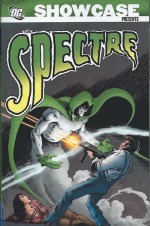
This sublime and colossal Showcase selection collects and documents the Man of Darkness’ return in the Swinging Sixties, his landmark reinterpretation in the horror-soaked, brutalised 1970s and even finds room for some later appearances before the character was fully de-powered and retrofitted for the post-Crisis on Infinite Earths DC Universe.
As such this mammoth monochrome tome (624 peril-packed pages!) contains Showcase #60, 61 and 64, The Spectre #1-10, team-up tales from The Brave and the Bold #72, 75, 116, 180 & 199 and DC Comics Presents #29, the lead strips from Adventure Comics #431-440 and one last hurrah from horror-anthology Ghosts #97-99, encompassing the end of 1965 to the middle of 1983.
As previously mentioned, DC tried out a number of Earth-2 iterations (Starman/Black Canary – with Wildcat – in The Brave and the Bold #61-62 whilst Showcase #55 & 56 spotlighted Doctor Fate & Hourman with a cameo from the original Green Lantern), but Schwartz and Fox only finally achieved their ambition to launch a Golden Age hero into his own title with the revival of the Ghostly Guardian in Showcase – but it was hard going and perhaps benefited from a growing general public interest in supernatural stories…
After three full length appearances and many guest-shots, The Spectre won his own solo series at the end of 1967, just as the super-hero craze went into a steep decline, but maybe Showcase #60 (January/February 1966) anticipated the rise of supernatural comics by re-introducing Corrigan and his phantom passenger in ‘War That Shook the Universe’ by Earth-2 team supreme Gardner F. Fox & Murphy Anderson.
This spectacular saga revealed that the Heroic Haunt had vanished two decades previously, leaving the fundamentally human Corrigan to pursue his war against evil on merely mortal terms until a chance encounter with a psychic investigator freed the ghost buried within him.
A diligent search revealed that, twenty years previously, a supernal astral invader had broken into the Earth plane and possessed a mortal, but was so inimical to our laws of reality that both it and the Grim Ghost were locked into their meat shells – until now…
Thus began a truly spectre-acular (don’t groan – that’s what they called it back then) clash with the devilish Azmodus that spanned all creation and blew the minds of us gobsmacked kids…
Issue #61 (March/April) upped the ante when the even more satanic Shathan the Eternal subsequently insinuated himself into our realm from ‘Beyond the Sinister Barrier’, stealing mortal men’s shadows until he was powerful enough to conquer the physical universe. This time The Spectre treated us to an exploration of the universe’s creation before narrowly defeating the source of all evil…
The Sentinel Spirit returned in Showcase #64 (September/October 1966) for a marginally more mundane but no less thrilling adventure when ‘The Ghost of Ace Chance’ took up residence in Jim’s body. By this time it was established that ghosts needed a mortal anchor to recharge their ectoplasmic “batteriesâ€, and the unscrupulous crooked gambler was determined to inhabit the best frame available…
The try-out run concluded, the editors sat back and waited for sales figures to dictate the next move. When they proved inconclusive Schwartz orchestrated a concerted publicity campaign to further promote Earth-2’s Ethereal Adventurer.
The Brave and the Bold #72 (June/July 1967) saw the Spectre clash with Earth-1’s Scarlet Speedster in ‘Phantom Flash, Cosmic Traitor’ by Bob Haney, Carmine Infantino & Charles “Chuck†Cuidera. This sinister saga saw the mortal meteor transformed into a sinister spirit-force and power-focus for unquiet American aviator Luther Jarvis who returned from death in 1918 to wreak vengeance on the survivors of his squadron – until the Spectre intervened…
Due to the vagaries of comicbook scheduling, Brave and the Bold #75 (December 1967/January 1968) appeared at around the same time as The Spectre #1, although the latter had a cover-date of November/December 1967.
In the Batman team-up title – scripted by Haney and drawn by Ross Andru & Mike Esposito – the Ghostly Guardian joined the Dark Knight to free Gotham City’s Chinatown from ‘The Grasp of Shahn-Zi!’: an ancient oriental sorcerer determined to prolong his reign of terror at the expense of an entire community and through the sacrifice of an innocent child, after which the Astral Avenger finally, simultaneously, debuted in his own title…
The Spectre #1 featured ‘The Sinister Lives of Captain Skull’ by Fox & Anderson, and divulged how the botched assassination of American Ambassador Joseph Clanton and an experimental surgical procedure allowed one of the diplomat’s earlier incarnations to take over his body and, armed with mysterious eldritch energies, run amok on Earth.
Those “megacyclic energy†abilities enabled the revenant to harm and potentially destroy the Ghostly Guardian and compelled the Spectre to pursue the piratical Skull through a line of previous lives until he could find their source and purge the peril from all time and space…
With issue #2 (January/February 1968) artistic iconoclast Neal Adams came aboard for the Fox-scripted mystery ‘Die Spectre – Again’ wherein crooked magician Dirk Rawley accidentally manifested his etheric self and severely tested both Corrigan and his phantom partner as they sought to end the double-menace’s string of crimes, mundane and magical. At this time the first inklings of a distinct separation and individual identities began. The two halves of the formerly sole soul of Corrigan were beginning to disagree and even squabble…
New scripter Mike Friedrich joined Adams for #3’s ‘Menace of the Mystic Mastermind’ wherein pugilistic paragon Wildcat faced the inevitable prospect of age and infirmity even as an inconceivable force from another universe possessed petty thug Sad Jack Dold and turned him into a nigh-unstoppable force of cosmic chaos…
‘Stop that Kid… Before He Wrecks the World’ was written & illustrated by Adams and saw a similar trans-universal malignity deliberately empower a young boy as a prelude to its ultimate conquest, whilst #5’s ‘The Spectre Means Death?’ (all Adams again) appeared to show the Ghostly Guardian transformed into a pariah and deadly menace to society, until Jim’s investigations uncovered the emotion-controlling Psycho Pirate at the root of the Spectre’s problems…
Despite all the incredible talent and effort lavished upon it, The Spectre simply wasn’t finding a big enough audience. Adams departed for straight superhero glory elsewhere and a hint of changing tastes came as veteran illustrator of horror comics Jerry Grandenetti came aboard.
Issue #6 (September/October 1968) saw his eccentric, manic cartooning adding raw wildness to the returning Fox’s moody thriller ‘Pilgrims of Peril!’ and Murphy Anderson also re-enlisted to apply a solid ink grounding to the story of a sinister invasion by a quartet of phantom Puritans who invaded the slums of Gateway City, driving out the poor and hopeless as they sought lost arcane treasures. These would allow demon lord Nawor of Giempo access to Earth unless The Spectre could win his unlife or death duel with the trans-dimensional horror…
As the back of issue #7 was dedicated to a solo strip starring Hourman (not included in this collection), The Spectre saga here – by Fox, Grandenetti & Anderson – was a half-length tale which followed the drastic steps necessary to convince the soul of bank-robber Frankie Barron to move on. Since he was killed during a heist, the astral form of aversion therapy used to cure ‘The Ghost That Haunted Money!’ proved to be not only ectoplasmically effective but outrageously entertaining…
Issue #8 (January/February 1969) was scripted by Steve Skeates and began a last-ditch and obviously desperate attempt to turn The Spectre into something the new wave of anthology horror readers would buy.
As a twisted, time-lost apprentice wizard struggled to return to Earth after murdering his master and stealing cosmic might from the void, on the mundane plane an exhausted Ghostly Guardian neglected his duties and was taken to task by his celestial creator.
As a reminder of his error, Penitent Phantasm was burdened by a fluctuating weakness – which would change without warning – to keep him honest and earnest. What a moment for the desperate disciple Narkran to return then, determined to secure his elevated god-like existence by securing ‘The Parchment of Power Perilous!’…
The Spectre #9 completed the transition and opened with an untitled short from Friedrich (illustrated by Grandenetti & Bill Draut) which saw the Man of Darkness again overstep his bounds by executing a criminal. This prompted Corrigan to refuse the weary wraith the shelter of his reinvigorating form and, when the Grim Ghost then assaulted his own host form, the Heavenly Voice punished the spirit by chaining him to the dreadful Journal of Judgment: demanding he atone by investigating the lives inscribed therein in a trial designed to teach him again the value of mercy…
The now anthologised issue continued with ‘Abraca-Doom’ (Dennis J. O’Neil & Bernie Wrightson) as The Spectre attempted to stop a greedy carnival conjurer from signing a contract with the Devil, whilst ‘Shadow Show’ by Mark Hanerfeld & Jack Sparling detailed the fate of a cheap mugger who thought he could outrun the consequences of a capital crime…
The next issue gave up the ghost and The Spectre folded with #10 (May/June 1969), but not before a quartet of tantalising tales by writer or writers unknown showed what might have been…
‘Footsteps of Disaster’ with art from Grandenetti & George Roussos, followed a man from cradle to early grave and revealed the true wages of sin, whilst ‘Hit and Run’ (probably drawn by Ralph Reese) proved again that the Spirit of Judgment was not infallible and even human scum could be redeemed…
‘How Much Can a Guy Take?’ (Sparling) offered salvation to a shoeshine boy pushed almost too far by an arrogant mobster, and the series closed with a cunning murder mystery involving what appeared to be a killer ventriloquists doll in the Grandenetti & George Roussos illustrated ‘Will the Real Killer Please Rise?’
With that the Astral Avenger returned to comicbook limbo for nearly half a decade until changing tastes and another liberalising of the Comics Code saw him return as the lead feature in Adventure Comics #431 (January/February 1974) in a shocking run of macabre, ultra-violent tales from Michael L. Fleisher & Jim Aparo.
‘The Wrath of… The Spectre’ offered a far more stark and unforgiving take on the Spirit Sentinel and reflected the increasingly violent tone of the times as a gang of murderous thieves slaughtered the crew of a security truck and were tracked down by a harsh, uncompromising police lieutenant named Corrigan.
When the bandits were exposed, the cop unleashed a horrific green and white apparition from his body which inflicted ghastly punishments that horrendously fitted their crimes…
With art continuity (and no, I’m not sure what that means either), from Russell Carley, the draconian fables continued in #432 as in ‘The Anguish of… The Spectre’ assassins murdered millionaire Adrian Sterling and Corrigan met the victim’s daughter Gwen. Although the now-infallible Wrathful Wraith soon exposed and excised the culprits, the dead detective had to reveal his true nature to the grieving daughter. Moreover, Corrigan began to feel the stirring of impossible, unattainable yearnings…
Adventure #433 exposed ‘The Swami and… The Spectre’ as Gwen sought spiritual guidance from a ruthless charlatan who promptly paid the appalling price when he finally met a real ghost, whilst in #434 ‘The Nightmare Dummies and… The Spectre’ (with additional pencils by the great Frank Thorne) saw a plague of department store mannequins run wild in a killing spree at the behest of a crazed artisan who believed in magic – but couldn’t imagine the cost of his dabbling…
Issue #435 introduced journalist Earl Crawford who tracked the ghastly fallout of the vengeful spirit’s anti-crime campaign and became ‘The Man Who Stalked The Spectre!’ Of course once he saw the ghost in grisly action Crawford realised the impossibility of publishing this scoop…
Adventure #436 saw Crawford still trying to sell his story as ‘The Gasmen and… The Spectre’ set the Spectral Slaughterman on the trail of a gang who killed everybody at a car show as a demonstration of intent before blackmailing the city. Their gorily inescapable fate only put Crawford closer to exposing Corrigan, after which in #437 ‘The Human Bombs and… The Spectre’ (with pencils from Ernie Chan & Aparo inks) found a kidnapper abducting prominent persons – including Gwen – to further a merciless mad scheme of amassing untold wealth… until the Astral Avenger ended their depredations forever…
In #438 ‘The Spectre Haunts the Museum of Fear’ (Chan & Aparo again) saw a crazed taxidermist turning people into unique dioramas until the Grim Ghost intervened, but the end was in sight again for the Savage Shade and #439’s ‘The Voice that Doomed… The Spectre’ (all Aparo) turned the wheel of death full circle, as the Heavenly Presence who created him allowed Corrigan to fully live again so that he could marry Gwen.
Sadly it was only to have the joyous hero succumb to ‘The Second Death of The… Spectre’ (#440, July/August 1975) and tragically resume his endless mission…
This milestone serial set a stunning new tone and style for the Ghostly Guardian which has informed each iteration ever since…
From midway through that run, Brave and the Bold #116 provided another continuity-crunching supernatural team-up with Batman in a far less graphically violent struggle against the ‘Grasp of the Killer Cult’ (Haney & Aparo). When Kali-worshipping Thugs from India seemingly targeted survivors of a WWII American Army Engineer unit, Detective Corrigan and the Dark Knight clashed on both the method and motives of the mysterious murderers…
DC Comics Presents #29 (January 1981, by Len Wein, Jim Starlin & Romeo Tanghal) revealed what happened after Supergirl was knocked unconscious after a cataclysmic battle and sent hurtling through dimensions measureless to man. When her cousin tried to follow, the Ghostly Guardian was dispatched to stop the Metropolis Marvel from transgressing ‘Where No Superman Has Gone Before’…
By the early 1980s the horror boom had exhausted itself and DC’s anthology comics were disappearing. As part of the effort to keep them alive, Ghosts featured a 3-part serial starring “Ghost-Breaker†and inveterate sceptic Dr. Terry 13 who at last encountered ‘The Spectre’ in issue #97 (February 1981, by Paul Kupperberg, Michael R. Adams & Tex Blaisdell), where terrorists invaded a high society séance and were summarily dispatched by the inhuman poetic justice of the Astral Avenger…
Now determined to destroy the monstrous revenant vigilante, Dr. 13 returned in #98 as ‘The Haunted House and The Spectre’ found the Ghost-Breaker interviewing Earl Crawford and subsequently discovering the long sought killer of his own father. Before 13 could act, however, the Spectre appeared and stole his justifiable retribution from the aggrieved psychic investigator…
The drama closed in Ghosts #99 as ‘Death… and The Spectre’ (Kupperberg, Michael R. Adams & Tony DeZuniga) found the scientist and the spirit locked in one final furious confrontation.
This staggering compendium of supernatural thrillers concludes with two more team-up classics from Brave and the Bold beginning with ‘The Scepter of the Dragon God’ by Fleisher & Aparo (from #180, November 1980).
Although Chinese wizard Wa’an-Zen stole enough mystic artefacts to conquer the world and destroy the Spectre, he foolishly underestimated the skill and bravery of the merely mortal Batman, whilst #199 (June 1983) ‘The Body-napping of Jim Corrigan’, by Mike W. Barr, Ross Andru & Rick Hoberg, found the ethereal avenger baffled by the abduction and disappearance of his mortal host.
Even though he could not trace his own body, the Spectre did know where the World’s Greatest Detective hung out…
Ranging from fabulously fantastical to darkly – violently – enthralling, these comic masterpieces perfectly encapsulate the way superheroes changed over a brief twenty year span, but remain throughout some of the most beguiling and exciting tales of DC’s near-80 years of existence. If you love comicbooks you’d be crazy to ignore this one…
© 1966, 1967, 1968, 1969, 1974, 1975, 1981, 1983, 2012 DC Comics. All Rights Reserved