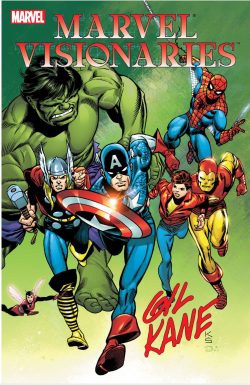
Marvel Visionaries: Gil Kane


By Gil Kane, with Stan Lee, Jack Kirby, Roy Thomas, Jim Shooter, Tony Isabella, Dan Slott, Mike Esposito, Joe Sinnott, Dan Adkins, Frank Giacoia, Dick Giordano, Klaus Janson, Jim Mooney & various (MARVEL)
ISBN: 978-0-7851-0888-7 (TPB), 978-1-3029-3737-9 (Digital edition)

This book includes Discriminatory Content produced in less enlightened times.

This year marks the centenary of Eli Katz, who, as Gil Kane, worked from the Golden Age until his death (on January 31st 2000) to make comics the art form it is today. Diligent, resolute and always challenging himself, Kane was a trendsetting pioneer in style, in form and in comics philosophy. He was also a visual architect of the superhero revival in the Silver Age and a key component in the evolution of the Graphic Novel.

Kane started young and toiled as an artist all his life. An ever-more effective and influential one, he drew and wrote for many companies since his debut (thus far verified as inking Carl Hubbell on The Scarlet Avenger in Zip Comics #14 and cover-dated May 1941): illustrating superheroes, action/adventure, war, mystery, romance, horror, movie adaptations and, perhaps most importantly, Westerns and Science Fiction tales. In the 1950s he was one of DC editor Julius Schwartz’s go-to artists for regenerating the superhero. Yet by 1968, at the top of his (admittedly much denigrated) profession, this relentlessly revolutionary and creative man felt so confined by juvenile strictures of the industry that he struck out on new ventures, jettisoning job security, and the editorial format bounds of comic books for new visions and media. However, the time was not right and after brief forays at other companies (like Dell and Tower) and attempting to create graphic narratives outside the comic book industry – such as His Name Is Savage and Blackmark – Kane began selling his services to Marvel Comics…

Kane’s earliest comic book output included Boy Commandos, Young Allies & Newsboy Legion, Doll Man, Zip Comics, Airboy Comics and many more, but by the Fifties he was settled at National/DC and working on Johnny Thunder, Jimmy Wakely, Matt Savage, Hopalong Cassidy, Rex the Wonder Dog and hundreds of genre yarns – romance, war, sci fi, western and horror. When Superheroes returned, he co-created Green Lantern and The Atom, and generated countless pages and captivating covers for Plastic Man, Batman, Superman, Flash, Teen Titans, Robin, Batgirl, Hawk and Dove, Captain Action and everything in between. Then, in 1966, with ever-increasing bureaucracy and panic over a new upstart rival gripping DC, Kane tentatively – and initially using the pseudonym Scott Edwards – began looking at other publishers, leading to breakthrough art for T.H.U.N.D.E.R. Agents, U.N.D.E.R.S.E.A. Agent, Dell Four Color, The Lost World, Brain Boy, The Frogmen, dozens of TV westerns and other licensed properties, and began his long association with modern Marvel Comics.

Initially a poor fit (he was asked to draw The Hulk over Jack Kirby’s layouts!), Kane persisted, going on to spectacularly redefine if not pictorially reinvent Amazing Spider-Man, Conan, Captain America and Captain Marvel; co-create Adam Warlock, Morbius, and Iron Fist and put his indelible stamp on Thor, Hulk, Ka-Zar, Daredevil, Marvel Team-Up and all the rest. Kane adapted John Carter, Warlord of Mars and other literary adventure-fantasy properties and reinvigorated dozens of horror-hero and superhero stalwarts, all while filling in on seemingly every character and cover going. Restless and craving what the medium could still achieve, he worked on newspaper strips too. Even before co-creating Star Hawks in 1977 with Ron Goulart, he had limned the daily Flash Gordon for King Features in the 1960s, and Tarzan Sunday pages.

Kane’s latter career included animation/design, and choice comics book outings as well as numerous special projects like Jason Drum for Le Journal de Tintin and The Ring of the Nibelung.

Although Marvel Visionaries: Gil Kane was originally released in 2002, it’s still readily available as it was digitally rereleased in 2021, so if you can read this you can find that…

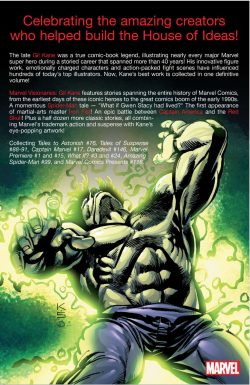
Offering a brief selection of the many tales crafted by Kane, this tome re-presents gems first seen in Tales to Astonish #76; Tales of Suspense #88-#91; Captain Marvel #17; Amazing Spider-Man #99; Marvel Premiere #1 & 15 and Daredevil #146 plus material from What If #3 & #24 and Marvel Comics Presents #116, as well as offering a host of appealing production and art extras at the far end.

The trek through Marvel History begins with a fulsome appraisal of the artist’s career and achievements from frequent collaborator Roy Thomas in his foreword ‘The Mark of Kane’ after which it’s “on with the motley” and that first foray from Tales to Astonish #76. Cover-dated February 1966, this was on sale from November 4th 1965 and saw Kane draw – over Kirby layouts and under Mike Esposito finishes – an episode of a time-bending sequence with the Green Goliath helplessly trapped in a compounded by a doom-drenched duel with time-lost Asgardian immortal The Executioner

Assume and accept that you will need to find other collections to experience the full force of these extracted snippets and then move on to those portions of Tales of Suspense #88-#91 (cover-dates April -July 1967) that featured Captain America. Here Lee scripts all four chapters of a classic clash as Kane takes his first run on the character. The extended saga comprises ‘If Bucky Lives…!’ and ‘Back from the Dead!’, as inked by Kane before Joe Sinnott joins as embellisher for ‘…And Men Shall Call Him Traitor!’ and ‘The Last Defeat!’ for a superb thriller of blackmail and betrayal starring the Red Skull. The fascist felon had baited a trap with a robotic facsimile of Cap’s dead partner, triggered it with malign super-hirelings Power Man and The Swordsman whilst blackmailing the Star-Spangled Sentinel into betraying his country and stealing a new atomic submarine. It all turned out okay in the end though…

Next up is Captain Marvel #17 (cover-date October 1969), sole example from a stunning and influential run on the Kree Captain Mar-Vell. Captain Marvel as we know him really begins with this reinvention wherein Thomas, Kane & Dan Adkins totally retooled and upgraded the character.

‘And a Child Shall Lead You!’ sees the imperilled star warrior inextricably bonded to voice-of-a-generation/professional sidekick Rick Jones who – just like Billy Batson (the boy who turned into the original Fawcett hero by shouting “Shazam!”) – switched places with a mighty adult hero when danger loomed by striking together a pair of ancient, wrist-worn “Nega-bands”. This allowed them to temporarily trade atoms: one active in our universe whilst the other floated, a ghostly untouchable, ineffectual voyeur to events glimpsed from the ghastly Negative Zone. As thrilling and as revolutionary as the idea of a comic written from the viewpoint of a teenager was, the real magic comes from Kane’s experimental page layouts and phenomenally kinetic artwork, and whose mesmeric staging of proportionally warped yet somehow still perfect human-form-in-motion rewrote the playbook on superhero illustration with this series.

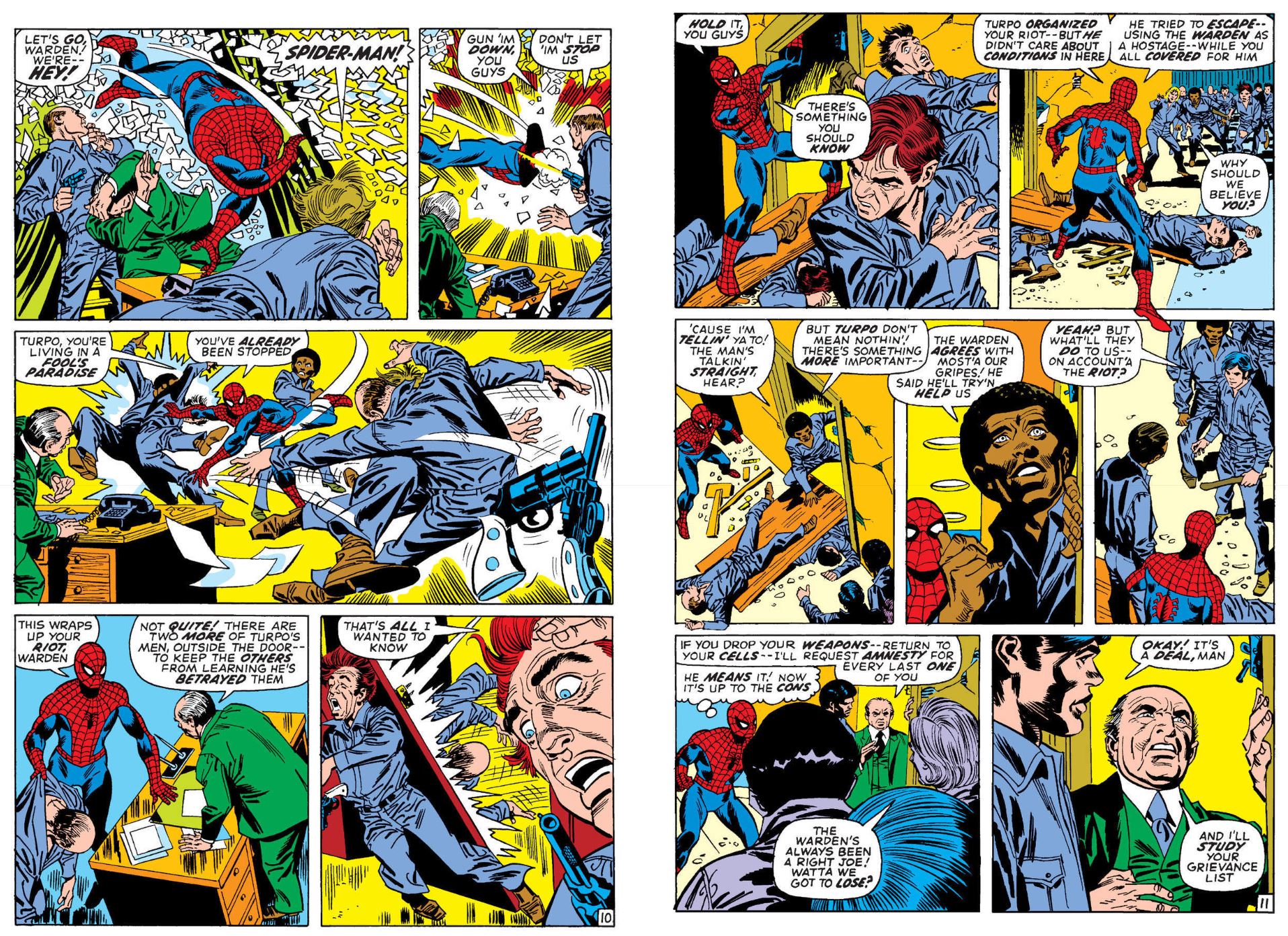
Kane’s ascendancy was confirmed as he became the regular illustrator on Marvel’s greatest hit. A monumental first run on the wallcrawler is marked here by Amazing Spider-Man #99 (August 1971) portraying ‘A Day in the Life of…’: an all-action, social drama-tinged palate-cleanser with Peter Parker and Gwen Stacy finally getting their love-life back on track, only marginally diverted by a prison breakout easily quelled by the Arachnid Avenger, whilst highlighting the growing scandal of prison conditions…
Jump forward to tumultuous turbulent November 1971 where the April cover-dated Marvel Premiere #1 boldly proclaimed on its cover The Power of… Warlock. Inside, the stunning fable by Thomas, Kane & Adkins declared ‘And Men Shall Call Him… Warlock’ neatly recapitulated artificial man Him’s origins as a lab experiment concocted by rogue geneticists eager to create a superman they could control for conquest. Also on view is the manufactured man’s face off with the Fantastic Four, and clash with Thor over the rights to a mate before returning to an all-encompassing cosmic cocoon to evolve a little more.

Now that shell is plucked from the void thanks to the moon-sized ship of self-created god The High Evolutionary. Having artificially ascended to godhood, he is wrapped up in a bold new experiment…

Establishing contact with Him as he basks in his cocoon, the Evolutionary explains that he is constructing from space rubble a duplicate planet Earth on the opposite side of the sun. Here he will replay the development of life, intending that humanity on Counter-Earth will evolve without the taint of cruelty and greed and deprived of the lust to kill. It’s a magnificent scheme that might well have worked, but as the Evolutionary wearies, his greatest mistake intervenes…

Man-Beast was over-evolved from a wolf and gained mighty powers, but also ferocious savagery and ruthless wickedness. Now he invades the satellite, despoiling humanity’s rise and ensuring the new world’s development exactly mirrors True-Earth’s. The only exception is the meticulous exclusion of enhanced individuals. The beleaguered orb has all Earth’s woes but no superheroes to save or inspire its people. A helpless witness to the desecration, the golden being furiously crashes free of his cocoon to save the High Evolutionary and rout Man-Beast and his bestial cronies (all similarly evolved animal-humanoids called “New-Men”). When the despondent, enraged science god recovers, he decides to erase his failed experiment but is stopped by his rescuer. As a helpless observer, Him saw the potential and value of embattled humanity. Despite all their flaws, he believes he can save them from imminent doom caused by their own unthinking actions, wars and intolerance. When his pleas convince the Evolutionary to give this mankind one last chance, the wanderer is hurled down to Counter-Earth, gifted and graced with a strange “Soul Gem” to focus his powers, on a divine mission to find the best in the fallen and a name of his own…

Enjoying and thriving in an era and atmosphere of experimentation, Kane returned to Marvel Premiere with #15 (May 1974) for the debut of masked martial artist Iron Fist. His saga began on a spectacular high with Thomas, Kane & Dick Giordano’s ‘The Fury of Iron Fist!’, as a teenaged masked warrior defeats the cream of a legendary combat elite in a fabled other-dimensional city before returning to Earth.

Ten years previously little Daniel Rand had watched his father and mother die at the hands of Harold Meachum whilst the party of millionaire adventurers risked Himalayan snows to find the legendary city of K’un Lun. Little Danny had travelled with his parents and business partner Meachum in search of the fabled city – which only appeared on Earth for one day every decade. Wendell Rand had some unsuspected connection to the fabled Shangri La but was killed before they found it, whilst Danny’s mother sacrificed herself to save the child from wolves and her murderous pursuer.

As he wandered alone in the wilderness, the city found Danny. The boy spent ten years training: mastering all forms of martial arts in a militaristic, oriental, feudal paradise while enduring countless arcane ordeals, living only for the day he would return to Earth and avenge his parents. After conquering all comers and rejecting immortality, the Iron Fist returned to Earth, a Living Weapon able to channel his force of will into a devastating super-punch…
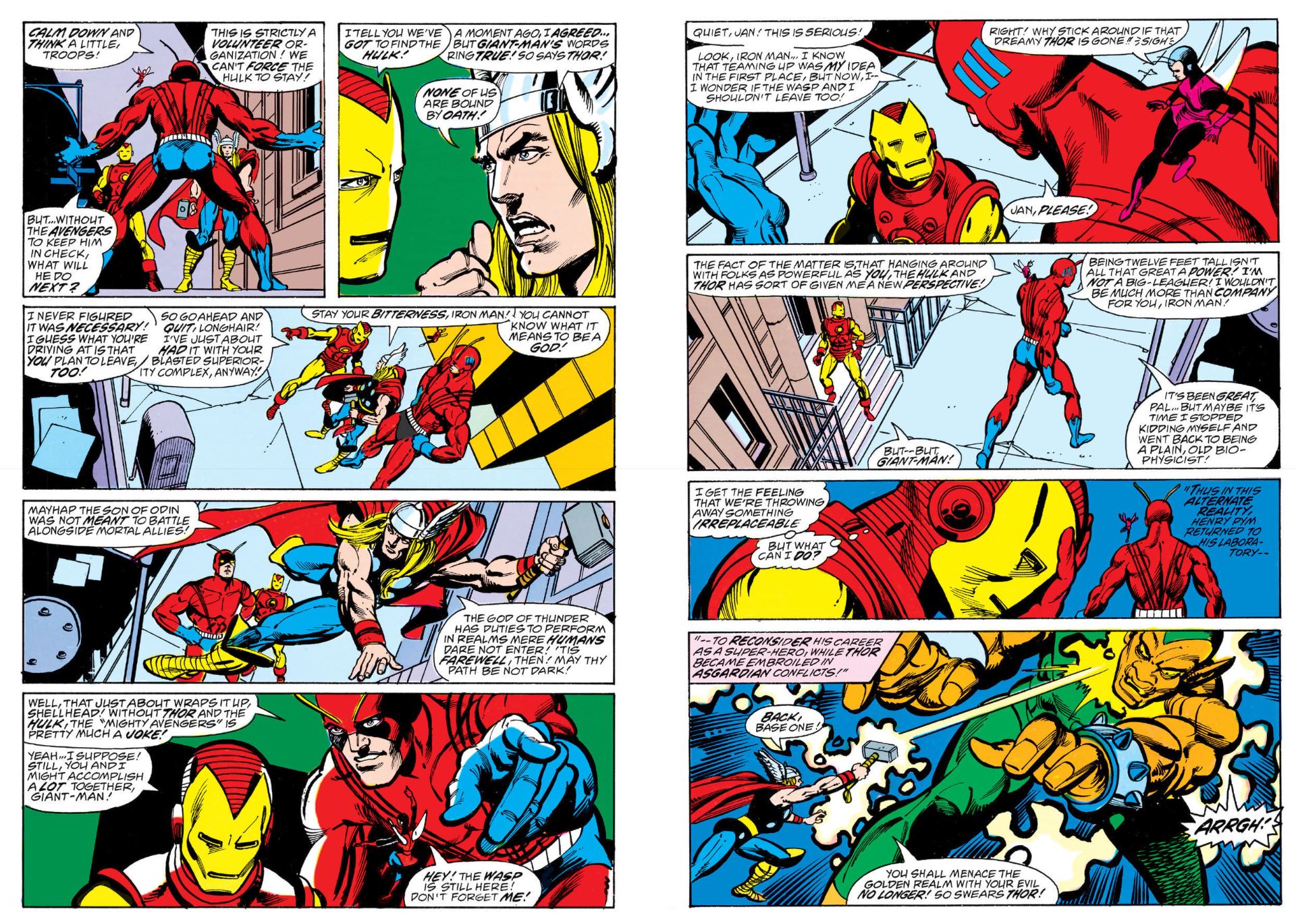
Alternate worlds vehicle What If? #3 (June 1977) provided one of the most memorable stories of the era and one of Kane’s greatest triumphs. Scripted by Jim Shooter and inked by Klaus Janson ‘What If the Avengers Had Never Been?’ diverted from established Marvel Continuity at the end of Avengers #2 when Hulk quit the still-forming team. In this instance, the act sunders the entire squad who go their own ways with shocking, spectacular and ultimately tragic consequences. If you buy this book for only one tale it will be this one…

That same month in Daredevil #146 the artist again demonstrated his brilliance in staging dramatic fight scenes. Scripted by Shooter and inked by Jim Mooney, ‘Duel!’ saw the sightless swashbuckler searching Manhattan for maniac marksman Bullseye even as his quarry was setting up a lethal showdown. The brutally bruising climax came when the crazed killer took an entire TV studio hostage but ended with his being soundly defeated yet again…

With Tony Isabella writing and Frank Giacoia inking, Kane revisited one of his greatest comics triumphs in What If? #24 (December 1980), as ‘What If Gwen Stacy had Lived?’ explored an Alternity where Spider-Man saved his fiancée from Green Goblin Norman Osborn and went on to marry her before losing everything he loved to the obsessive hatred of J. Jonah Jameson

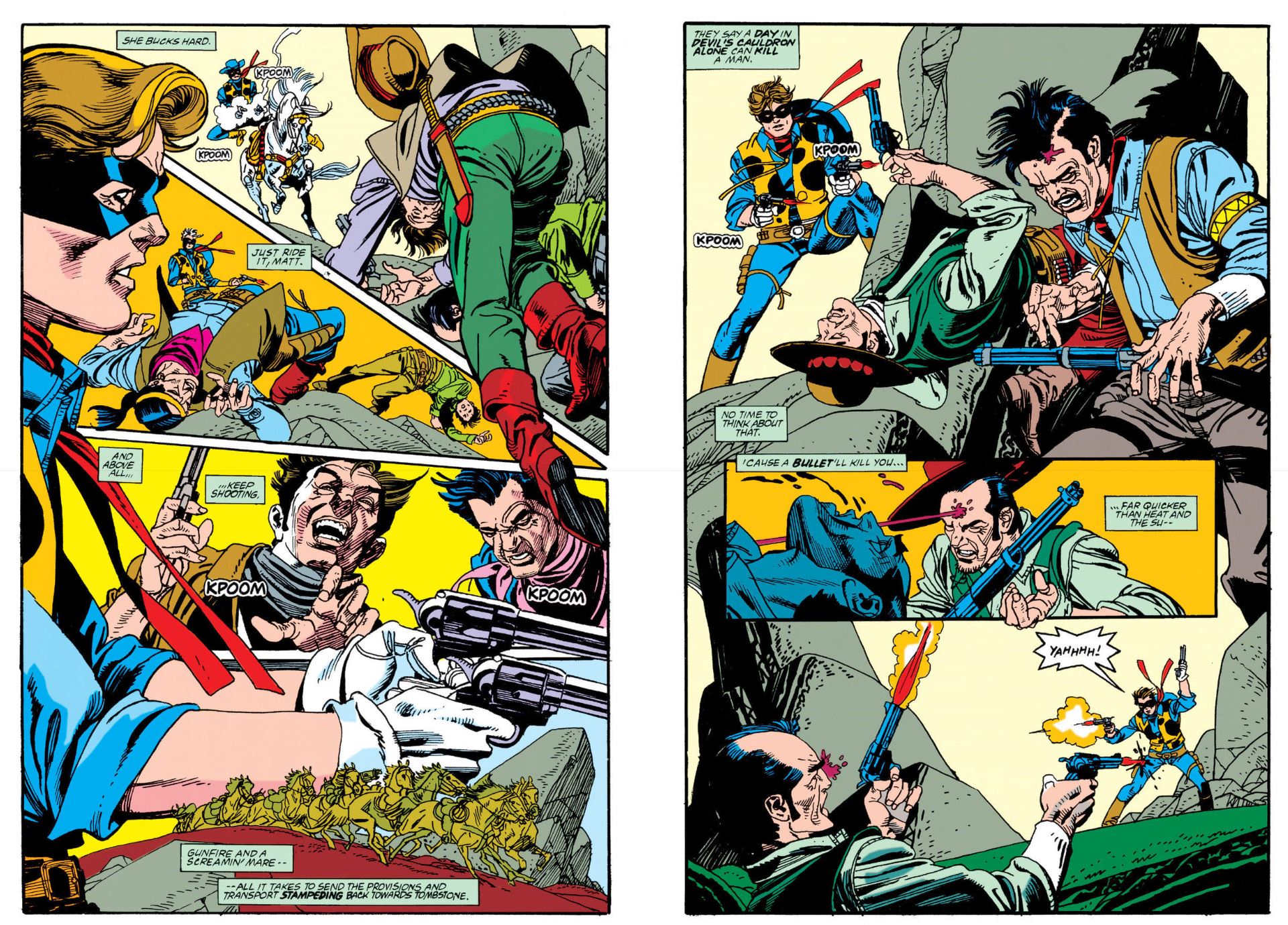
This compelling compilation notionally concludes with a late treat from Marvel Comics Presents #116 (cover-dated November 1992) with future superstar scripter Dan Slott taking Kane back to his cowboy roots for a short rip-roaring romp featuring the Two-Gun Kid. Here the occasional Avenger and prototype Marvel Mystery-man hero serves up ‘Just Deserts’ to vicious scheming owlhoots John Baker and the Unlucky Thirteen Gang before marching the sole survivor back across the searing Devil’s Cauldron back to Tombstone city jail…

Providing pertinent covers by Kane, this tome offers additional pictorial treats including Kane’s favourite cover (Mighty Marvel Western #44) plus a gallery of others such as Western Gunfighters #31, Kid Colt, Outlaw #161, Sub-Mariner #44 & Captain Marvel #23), the extras also deliver a vast selection of page layouts, design roughs, fully-pencilled pages and covers as well as inked and completed pages of marvels.
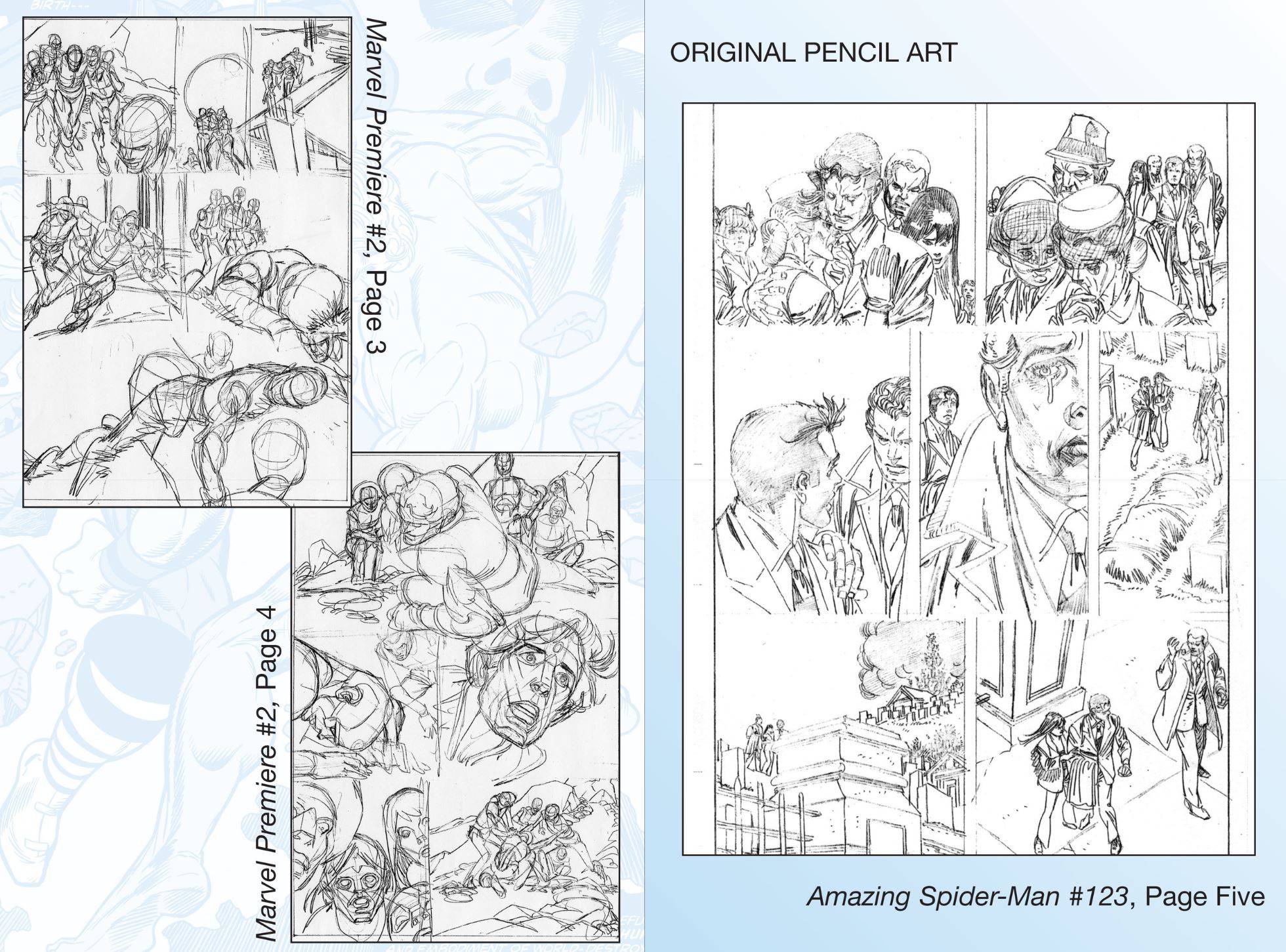
Also working as Gil Stack, Scott Edward, Stack Til, Stacktil, Pen Star and Phil Martell, Gil Kane became a foundation stone of comics and remains a vivid, vital inspiration to future generations of creators and readers. With all that in mind why not have a far too brief look at some of the man’s early Marvel superhero triumphs and gently remind the Powers-that-Be that this is only the tip of a graphic iceberg that includes plenty of room for barbarian, sci fi and horror collection one day…
© 2021 MARVEL.

Born today in 1924, cartoonist Brad Anderson (Marmaduke), Belgian illustrator Willy Lambillotte AKA Lambil (Sandy, The Bluecoats, Pauvre Lampil) in 1936 and cartoonist/illustrator Norm Fueti (Retail, Gil, The King of Kazoo) in 1970.

Today we lost someone you’ve probably never heard of: letterer, designer and production artist/manager Gerda Gattel (October 28th 1908 – May 14th 1993). She was filling the ballons and fixing pages for Timely-Atlas from 1947 to the company’s implosion and then moved across town to National DC where she did the same thing from 1958 to her retirement as Production Coordinator in 1973.
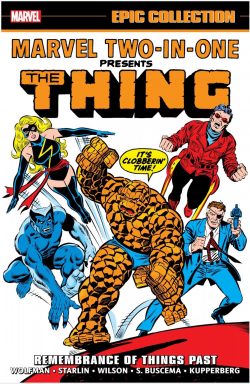
Marvel Two-In-One Epic Collection volume 3 (1977-1979): Remembrance of Things Past


By Marv Wolfman, Jim Starlin, Roger Slifer, Tom DeFalco, David Anthony Kraft, Ralph Macchio, Peter B. Gillis, Alan Kupperberg, Bill Mantlo, Jo Duffy, John Byrne, Steven Grant, Allyn Brodsky, David Michelinie, Ron Wilson, Sal Buscema, Bob Hall, Chic Stone, Frank Miller, Jim Craig, Pablo Marcos, Josef Rubinstein, Jim Mooney, Alfredo Alcala, Sam Granger, Frank Giacoia, Dave Hunt, Tex Blaisdell, Gene Day, Joe Sinnott, Bob McLeod, Bruce Patterson, Mike Esposito & various (MARVEL)
ISBN: 978-1-3029-5564-9 (TPB/Digital edition)

This book includes Discriminatory Content produced in less enlightened times.

Above all else, Marvel has always been about team-ups. The concept of team-up books – an established star pairing, or battling (often both) with less well-selling company characters – was not new when Marvel awarded their most popular hero the same deal DC had with Batman in The Brave and the Bold. Although confident in their new title, they wisely left options open by allocating an occasional substitute lead: the Human Torch. In those long-ago days, editors were acutely conscious of potential over-exposure – and since super-heroes were actually in a decline they may well have been right.

Nevertheless, after the runaway success of Spider-Man’s guest vehicle Marvel Team-Up, the House of Ideas carried on the trend with a series starring bashful, blue-eyed Ben Grimm – the Fantastic Four’s most iconic and popular member. They began with a test run in Marvel Feature #11-12, before awarding him his own team-up title, with this third power-packed compendium gathering in the contents of Marvel Two-in-One #37-52; MTIO Annuals #2-4 and Avengers Annual #7, covering November 1977 to June 1979.

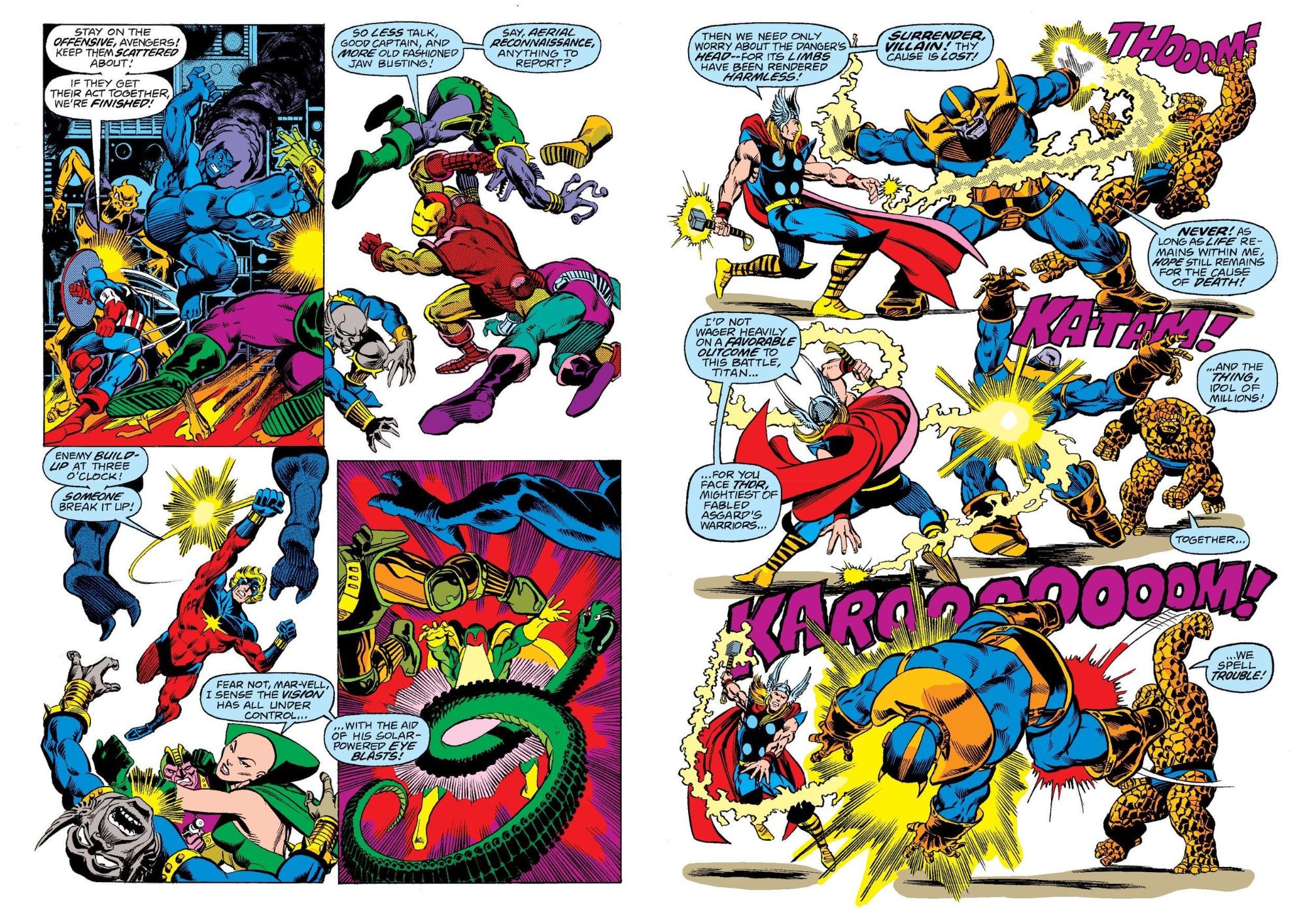
The action begins with ‘The Final Threat’ (by Jim Starlin & Joe Rubinstein) from Avengers Annual #7, wherein Kree warrior Captain Marvel and Titanian mind-goddess Moondragon return to Earth with vague anticipations of impending cosmic catastrophe. Their premonitions are confirmed when galactic wanderer Adam Warlock arrives with news that death-obsessed Thanos has amassed an alien armada and built a Soul-gem powered weapon to snuff out the stars like candles. Broaching interstellar space to stop the scheme, the united heroes forestall interstellar incursion and prevent the Mad Titan destroying the Sun, but only at the cost of Warlock’s life…

Then Marvel Two-in-One Annual #2 undertakes a ‘Death Watch!’ (Starlin & Rubinstein): finding Peter Parker plagued by prophetic nightmares disclosing how Thanos had snatched victory from defeat and now holds the Avengers captive whilst again preparing to extinguish Sol. With nowhere else to turn, anguished, disbelieving Spider-Man heads for the Baxter Building to borrow a spacecraft, unaware The Thing also has history with the terrifying Titan. Although utterly outpowered, the mismatched champions of Life subsequently upset Thanos’ plans, allowing the Avengers and the Universe’s true agent of retribution to end the Titan’s threat forever… or at least until next time…

Marvel Two-In-One’s apparent function as a clearing-house for old, unresolved series and plot-lines was then briefly put on hold as issue #37 teamed Ben with Matt Murdock (not alter ego Daredevil) for Marv Wolfman, Ron Wilson & Pablo Marcos’ legal drama ‘Game Point!’

Ben had been framed for monstrous acts of wanton destruction, and when the case went badly, he faced decades in jail. However, the Man Without Fear and eccentric street punk Eugene the Kid determined the Mad Thinker was behind the plot to place the ‘Thing Behind Prison Bars’ (Roger Slifer, Wilson & Jim Mooney): tackling the maniac whose ultimate game plan is to corner the future, mass-producing his own squadron of the synthezoid Avenger in #39’s conclusion ‘The Vision Gambit’ (inked by Marcos).

Slifer, Tom DeFalco, Wilson & Marcos then detail a spooky international yarn as the Black Panther is involved in a monstrous reign of terror with a zombie-vampire stalking the streets and abducting prominent African Americans. Concluding chapter ‘Voodoo and Valor!’ – by David Anthony Kraft, Wilson & Marcos – sees Jericho Drumm/Brother Voodoo volunteer his extremely specialised services to Ben and T’Challa in hopes of ending the crisis. The trail takes our heroes to Uganda for a confrontation with Doctor Spectrum and the far more dangerous real-world crazed killer Idi Amin

Crafted by Ralph Macchio, Sal Buscema, Alfredo Alcala & Sam Grainger, Marvel Two-In-One #42 then debuts a future mainstay of Marvel Universe continuity as Project Pegasus premiers in ‘Entropy, Entropy…’

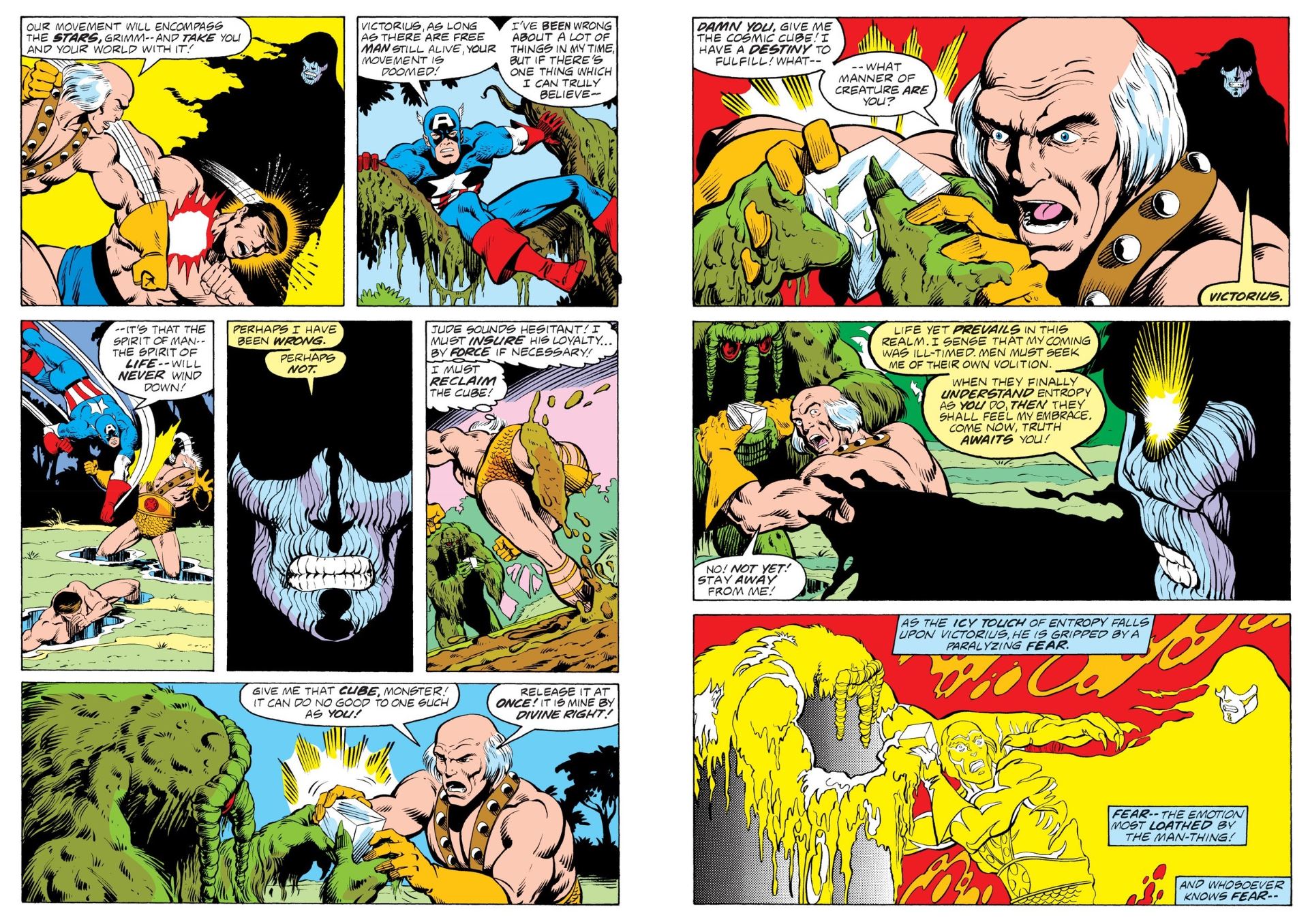
The Federal research facility designated Potential Energy Group/Alternate Sources/United States is dedicated to investigating new and exotic power sources and naturally became the most sensible place to dump energy-wielding super-baddies once they were subdued. Ben finds and begins trashing the place whilst tracking down his educationally – and emotionally -challenged ward Wundarr after the kid was renditioned by the Government. The furious Thing is soon confronted and contained by Captain America in his role as security advisor and together they stumble over a sabotage scheme by martial maniac Victorius who unleashes a deadly new threat in the ghostly form of Jude, the Entropic Man. This phantasmic force easily trounces Cap and Ben but finds the macabre Man-Thing far harder to handle in concluding chapter ‘The Day the World Winds Down’ from Macchio, John Byrne & Friends & Bruce Patterson)…

The third Marvel Two-In-One Annual then hosts a great big, old-fashioned world-busting blockbuster wherein Nova the Human Rocket battles beside Ben to free captive alien princesses and save Earth from colossal cosmos-marauding space invaders: a simple yet entertaining tussle entitled ‘When Strike the Monitors!’ all crafted by Wolfman, Sal Buscema, Frank Giacoia & Dave Hunt… after which, back in the monthly comic book, issue #44 strays away from standard fare with ‘The Wonderful World of Brother Benjamin J. Grimm’ (Wolfman, Bob Hall & Frank Giacoia) with the Thing telling rowdy kids a fanciful bedtime story concerning his recent partnership with Hercules to free Olympus from evil giants…

Marvel Two-In-One #45’s sees Kree Captain Marvel warned by his Cosmic Awareness that the Thing had been targeted by vengeful Skrulls in ‘The Andromeda Rub-Out!’ (Peter Gillis, Alan Kupperberg & Mike Esposito), after which the Incredible Hulk’s new TV show compels an outraged Ben to head for Hollywood, only to become accidentally embroiled in a ‘Battle in Burbank!’ (Kupperberg & Chic Stone)…

The Thing’s self-appointed gadflies The Yancy Street Gang headlined in MT-I-O #47 as ‘Happy Deathday, Mister Grimm!’ (Bill Mantlo & Stone) sees a cybernetic tyrant long believed dead take over Ben’s old neighbourhood… until the hero pays a visit. The invasion exposed, it is quickly concluded once awesome alien energy powerhouse Jack of Hearts joins the fight against ‘My Master, Machinesmith!’ (in #48 by Mantlo, Stone & Tex Blaisdel).

Mary Jo Duffy, Alan Kupperberg & Gene Day piled on spooky laughs in #49 as the ‘Curse of Crawl-Inswood’ highlights how Doctor Strange manipulates Ben into helping crush a paranormal incursion in a quaint and quiet seaside resort…

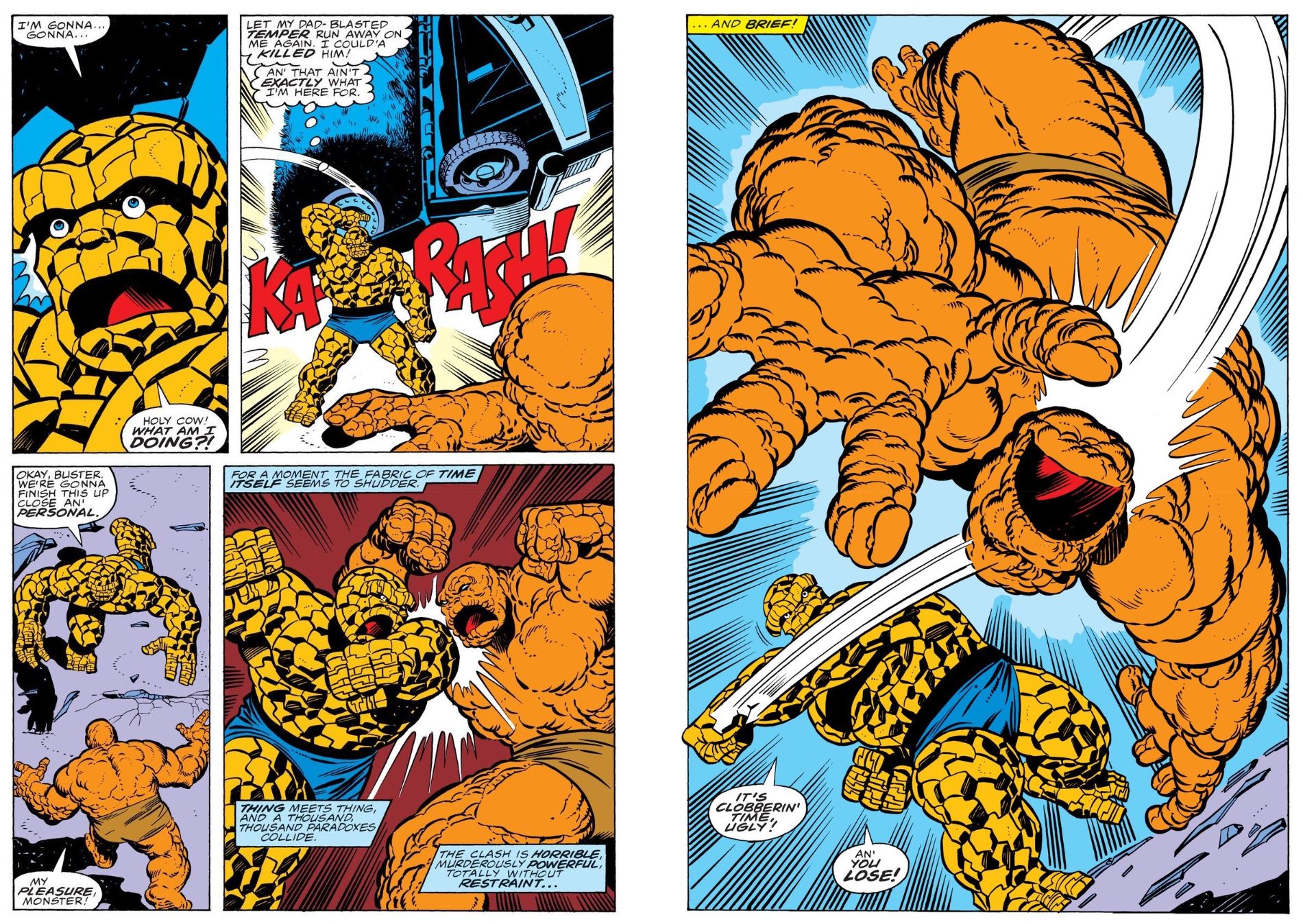
Anniversary issue #50 was everything a special issue should be. ‘Remembrance of Things Past’ by Byrne & Joe Sinnott takes a powerful and poignant look at the Thing’s history as a monster outcast and posits a few what-might-have-beens…

Following another failure by Reed Richards to cure Ben’s rocky state, The Thing steals the chemical and travels into his own past, determined to use the remedy on his younger, less mutated self. However, his bitter, brooding, brittle earlier incarnation is hardly prepared to listen to another monster and, inevitably, catastrophic combat ensues…

Issue #51 was even better. ‘Full House… Dragons High!’ by Peter Gillis, up-&-coming artist Frank Miller & Bob McLeod, details how a weekly poker session at Avengers Mansion is interrupted by rogue US General Pollock, who again tries to conquer America with stolen technology. Happily, Ben and Nick Fury find Ms. Marvel (not today’s teenager Kamala Khan but current Captain Marvel Carol Danvers), Wonder Man and The Beast better combat comrades than poker opponents…

A note of sinister paranoia creeps in with Marvel Two-In-One #52’s ‘A Little Knight Music!’ (Steven Grant, Jim Craig & Marcos), as the mysterious Moon Knight joins Ben in stopping CIA Psy-Ops master Crossfire brainwashing the city’s superheroes into killing each other, prior to MTIO Annual #4 providing an old-fashioned, world-busting fantasy finale – for now – as ‘A Mission of Gravity!’(plotted by Allyn Brodsky, scripted by David Michelinie, limned by Craig, Bob Budiansky & Patterson) unites Ben and Inhuman monarch Black Bolt (and Good Boi Lockjaw!) to stop unstable maniac Graviton turning into a black hole and taking the world with him…

Backed up by the covers of Starlin, Rubinstein, Wilson, Sinnott, Marcos, Terry Austin, George Pérez, Walt Simonson, Sal Buscema, Hall, Giacoia, Keith Pollard, Layton, Stone, Budiansky, and Al Milgrom, there is also a big bold bonus section including contemporary house ads, covers from reprint title The Adventures of the Thing (by Sam Keith, Mike Mignola & Joe Quesada) and original art pages by Starlin, Rubinstein, Perez & Sinnott.

This tome of tales from Marvel’s Middle Period are admittedly of variable quality. They are, however, offset by truly timeless classics, still as captivating today as they ever were. Most fans of Costumed Dramas will have little to complain about and there’s lots of fun to be found for young and old readers. So why not lower your critical guard and have an honest blast of pure warts ‘n’ all comics craziness? You’ll almost certainly grow to like it…
© 2025 MARVEL.

This date in 1754 – and attributed to Benjamin Franklin – the first American newspaper cartoon “Join, or Die” was published in The Pennsylvania Gazette.

Somewhat less momentously – perhaps – today in 1893 Wonder Woman co-creator William Moulton Marton was born as was Short Ribs cartoonist Frank O’Neal in 1921; Half Hitch and Henry illustrator Dick Hodgins, Jr. in1931 and multi-directional art scribe Barbara Slate (Yuppies From Hell, Angel Love, Sweet XVI, Ms. Liz) in 1947. They were joined in 1953 by writer Pat McGreal (Chiaroscuro; The Private Lives of Leonardo DaVinci, Veils, I, Paparazzi and more Disney comics than seems humanly possible); in 1955 by American Splendor illustrator Brian Bram; inveterate comics publisher David Campiti in 1958, and the astoundingly funny Ty Templeton (Stig’s Inferno, Batman Adventures, The Simpsons) in 1962.

Today in 1991 The Simpsons episode “Three Men and a Comic Book” aired, giving Comic Book Guy to the world…

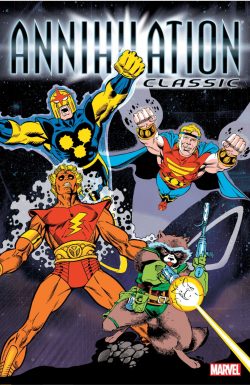
Annihilation Classic


By Todd Dezago, Stan Lee, Larry Lieber, Marv Wolfman, Mark Gruenwald, Bill Mantlo, Doug Moench, Scott Edelman, Roy Thomas, Pat Broderick, Fred Hembeck, Derec Aucoin, Jack Kirby, John Buscema, Paul Ryan, Mike Mignola, Tom Sutton, Mike Zeck, Gil Kane & various (MARVEL)
ISBN: 978-0-7851-3410-7 (TPB/Digital edition)

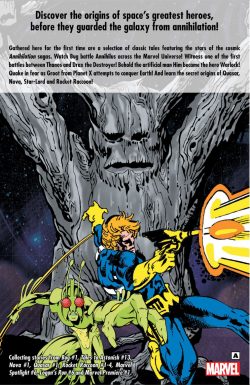
With the third Guardians of the Galaxy movie set to open on May 5th, here’s a brief reminder of what comics did to inspire the phenomenon: still a grand example of cosmic hero wonderment…

Annihilation was another of those company-wide publishing events that “Changed the Marvel Universe Forever” (and don’t they all?). which ran for most of 2006, involving most of the House of Ideas’ outer space outposts and cosmic characters. Among the stalwarts in play were Silver Surfer, Galactus, Firelord, Moondragon, Quasar, Star-Lord, Thanos, Super-Skrull, Gamora, Ronan the Accuser, Nova, Drax the Destroyer, The Watchers and a host of alien civilisations such as the Kree, Skrulls, Xandarians, Shi’ar, et al, all falling before an invasion of rapacious Negative Zone bugs and beasties unleashed by the insectoid horror Annihilus.

If you’re new to the Marvel universe and that bewildering list of daunting data didn’t leave you screaming in frustration, then please read on…

As is usual in these public herd-thinnings, a number of good guys and bad died and had their trademark assumed by newer, glitzier models whilst some moribund careers got a successful and overdue shot in the arm…

The event spawned a number of specials, miniseries and new titles (subsequently collected as three volumes plus this Annihilation Classic compilation reprinting key and origin appearances of some major players) and led to follow-up event Annihilation: Conquest. Of particular interest to fun-loving screen-watchers might be early appearances of Galaxy Guardians Rocket Raccoon, Groot, Starlord and Adam Warlock

This sharp selection comprises of and contains pertinent material from Bug #1, (March 1997), Tales to Astonish #13, (December 1960), Nova #1, (September 1976), Quasar #1 (October 1989), Rocket Raccoon #1-4 (May-August 1995) ,Marvel Spotlight #6 (May 1980), Logan’s Run #6 (June 1977) and Marvel Premiere #1 (April 1972) and opens with the frenetic and light-hearted solo outing for Galactic Warrior Bug (originally a cheeky stalwart from the 1970’s toy-license phenomenon Micronauts)…

In ‘Apples and Oranges’ by Tod Dezago, Derec Aucoin, Rich Farber & Ralph Cabrera, the insectivorid from the Microverse accidentally clashes with all-consuming cosmic menace Annihilus and gets stuck in a time/space warp.

Bounced around the history of the Marvel Universe, the warring weirdoes reveal their unheralded contributions to the origin stories of a number of the company’s greatest stars before Bug finally triumphs…

With accompanying pinup by Pat Broderick and hilarious game pages by Fred Hembeck including ‘Bug’s Brain-Tik-lers’, ‘The Help Bug Right the Time/Space Continuum Board Game’, ‘What’s Wrong with This Picture?’ and ‘Bug’s Catch-All Activity Page’, this is a splendidly engaging and irreverent treat, followed by an absolute classic of the gloriously whacky “Kirby Kritter” genre as a humble biologist saved earth from a rapacious walking tree in ‘I Challenged Groot! The Monster from Planet X!’ (Tales to Astonish #13 by Stan Lee/Larry Lieber, Jack Kirby & Dick Ayers).

Next to grab the spotlight is The Man Called Nova who was in fact a boy named Richard Rider. A working-class nebbish in the tradition of Peter Parker – except he was good at sports and bad at learning – Rich attended Harry S. Truman High School, where his strict dad was the principal. His mom worked as a police dispatcher and he had a younger brother, Robert, who was a bit of a genius. Other superficial differences to the Spider-Man canon included girlfriend Ginger and best friends Bernie and Caps, but Rich did have his own school bully, Mike Burley…

An earlier version, “Black Nova” had apparently appeared in the author Marv Wolfman’s fan-mag Super Adventures in 1966 (produced with fellow writer Len Wein), but following a few revisions and artistic make-over by the legendary John Romita (Senior) the Human Rocket launched into the Marvel Universe in his own title, beginning in September 1976, ably supported by the illustration A-Team of John Buscema & Joe Sinnott.

‘Nova’ – borrowing heavily from DC’s Silver Age Green Lantern franchise as well as Spider-Man’s origin – is structured like a classic 4-chapter Lee/Kirby early Fantastic Four fable, and rapidly introduced its large cast before quickly zipping to the life-changing moment in Rider’s life when a star-ship with a dying alien aboard transferred to the lad all the mighty powers of an extraterrestrial peacekeeper and warrior.

Rhomann Dey tracked a deadly marauder to Earth. Zorr had already destroyed the idyllic world of Xandar, but the severely wounded vengeance-seeking Nova Prime was too near death and could not avenge the genocide. Trusting to fate, Dey beams his powers and abilities towards the planet below where Rider is struck by the energy bolt and plunged into a coma. On awakening the teen realises he has gained awesome powers …and the responsibilities of the last Nova Centurion…

Wendell Vaughn debuted in 1977 as S.H.I.E.L.D. super-agent Marvel Boy (Captain America #217), graduating and rebranding as Quasar during a stint as security chief of Project Pegasus during the early 1980s. He finally got an origin with his own title Quasar #1 (cover-dated October 1989).

He learned ‘The Price of Power!’ courtesy of Mark Gruenwald, Paul Ryan & Danny Bulanadi in a rousing romp wherein he washes out of agent training for lack of a killer instinct. Whilst acting in a security detail, Wendell dons alien quantum wrist-bands to stop them being stolen by AIM, even though they had vaporised every S.H.I.E.L.D. operative who had test-piloted them.

As well as not dying, he gained incredible quantum light powers and began a brief but glorious career as an Avenger and Protector of the Universe…

Rocket Raccoon was a minor character who appeared in brief backup sci fi serial ‘The Sword in the Star’ (specifically in Marvel Preview #7 in 1976). He won a larger role in Incredible Hulk #271 (May 1982), and like Wolverine years before, refused to go away quietly.

Reprinted here in its entirety is the 4-issue Rocket Raccoon miniseries (May to August 1985, as crafted by Bill Mantlo, Mike Mignola, Al Gordon & Al Milgrom): a bizarre, baroque sci-fi fantasy blending the edgy charm of Pogo with the biting social satire of One Flew Over the Cuckoo’s Nest, all whilst ostensibly describing a battle between Good and Evil in a sector of space completely crazy even by comicbook standards.

Rocket was one of many talking animals populating the impenetrable, inescapable Keystone Quadrant; a Ranger in charge of keeping the peace as robots and anamorphic beasties went about their holy, ordained task of caring for the distinctly odd and carefree humans known as The Loonies on their idyllic, sybaritic planet Halfworld.

However when a brutal shooting war between voracious apex toymakers Judson Jakes and Lord Dyvyne led to Rocket’s girlfriend Lylla Otter being kidnapped, the planet went wild, or more accurately… Animal Crackers’

In rescuing her, Rocket and his faithful deputy Wal Rus had to contend with a murderous army of mechanised Killer Clowns, face an horrific, all-consuming bio-weapon at ‘The Masque of the Red Breath’ and even team up with arch-foe and disreputable mercenary bunny Blackjack O’Hare before uncovering the horrendous truth behind the mad society he so tirelessly defended in ‘The Book of Revelations!’

The final chapter then shook everything up as ‘The Age of Enlightenment’ saw the end of The Loonies, allowing Rocket and his surviving companions to escape the confines of the eternally segregated Keystone Quadrant into the greater universe beyond…

Starlord (without the hyphen) premiered in 1976, headlining monochrome mature-reader magazine Marvel Preview # 4. He appeared thrice more – in #11, 14 and 15 – during the height of a Star Wars inspired Science Fiction boom.

Years previously, the warrior prince of an interstellar empire was shot down over Colorado and had a fling with solitary Earther Meredith Quill. Despite a desire to remain in idyllic isolation, duty called her starman back to battle and he left, leaving behind an unborn son and a unique weapon. A decade later, the troubled boy saw his mother assassinated by alien lizard men.

Peter Jason Quill vengefully slew the creatures with Meredith’s shotgun, before his home was explosively destroyed by a flying saucer.

The newly-minted orphan awoke in hospital, his only possession a “toy” ray-gun his mother had hidden from him his entire life. Years later his destiny found him, as the half-breed scion was elevated by the divinity dubbed the “Master of the Sun”, becoming StarLord. Rejecting both Earth and his missing father, Peter chose freedom, the pursuit of justice and the expanse of the cosmos…

Here, from Marvel Spotlight volume 2 #6, Doug Moench & Tom Sutton revisit and clarify that origin as the pacifistic Quill and his sentient starship return to Sol and discover the truth about his nativity and ascension as well as the true nature of The Master of the Sun…

Logan’s Run was a short-lived licensed property tie-in, and #6 incongruously featured a 5-page short starring mad Titan Thanos in battle against his precision-crafted nemesis Drax the Destroyer: a typically inconclusive, explosively violent out-world clash over ‘The Final Flower’ crafted by Scott Edelman & Mike Zeck.

This star-studded compilation then concludes with an allegorical masterpiece by Roy Thomas, Gil Kane & Dan Adkins from Marvel Premiere #1. During a time of tremendous social upheaval Thomas transubstantiated an old Lee/Kirby Fantastic Four throwaway foe into a potent political and religious metaphor. Debuting as a dreaded mystery menace, the character dubbed Him was re-imagined as a contemporary interpretation of the Christ myth and placed on a world far more like our own than the Earth of Marvel’s superhero-stuffed universe.

‘And Men Shall Call Him… Warlock!’ adroitly recapitulates the artificial man’s origins as a lab experiment concocted by rogue geneticists eager to create a superman they could control for conquest. After facing the FF, Him subsequently escaped to the stars and later initiated a naive clash with Thor over the rights to a mate before returning to his all-encompassing cocoon to evolve a little bit more.

Now that stellar shell is picked up by the moon-sized ship of self-created god The High Evolutionary who is obsessed with a bold new experiment. Our hand-made hero observes as the savant creates a duplicate Earth on the far side of the sun, fast-forwarding through billions of years of evolution in mere hours. The man-god’s intent is to create a civilisation without aggression or rancour, but the Evolutionary collapses from exhaustion just as proto-hominid becomes Homo Sapien and his greatest mistake takes instant advantage of his exhaustion to meddle with fate…

Years previously Man-Beast had been hyper-evolved from a wolf and instantly became his creator’s nemesis. Now he and his equally-debased minions invade the ship and interfere with the experiment: reintroducing evil to the perfect creatures below and, in fact, making them just like us. At incredible speed Earth’s history re-ran with the creature in the cocoon afforded a ring-side seat to humanity’s fall from grace…

When the High Evolutionary awakes to fight Man-Beast’s army, Him explodes from his shell to help rout the demons, who flee to despoiled Counter-Earth. With calm restored, the science-god prepares to sterilise his ruined experiment: a world now indistinguishable from our own. No superheroes; disease and poverty rampant; injustice in ascendance and moments away from nuclear Armageddon… but the cosmic newborn begs him not to.

He claims the evil tide can be turned and pleads for the Evolutionary to stay his hand. The grieving, despondent creator agreed… but only until the rechristened Adam Warlock should admit that humanity is beyond redemption…

This ends a magnificent compendium of genuine magical Marvel moments: an eclectic but hugely entertaining procession of thrills, spectacle and laughs no comic fan or interested neophyte could possibly resist. And when you’ve read all this, you’ll be properly primed for some wide screen wonders too…
© 2020 MARVEL.

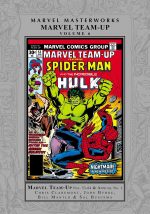
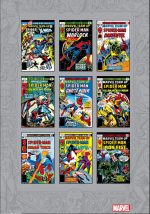
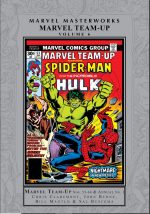
Marvel Team-Up Marvel Masterworks volume 6


By Bill Mantlo, Chris Claremont, Sal Buscema, John Byrne, Keith Giffen & various (Marvel)
ISBN: 978-1-3029-2931-2 (HB)

The concept of team-ups – an established star pairing or battling (usually both) with new or less well-selling company characters – has been with us since the earliest days of comics, but making the brief encounter/temporary alliance a key selling point really took hold with DC’s The Brave and the Bold before being taken up by their biggest competitor.

Marvel Team-Up was the second regular Spider-Man title, launching at the end of 1971. It went from strength to strength, proving the time had finally come for expansion and offering a regular venue for uncomplicated action romps to supplement the House of Ideas’ complex sub-plot fare in regular books. However, even in the infinite Marvel Multiverse, certain stars shine more brightly than others and some characters turn up in team-ups more often than others…

In recent years, carefully curated themed collections from the back-catalogue have served to initiate new readers intrigued by Marvel’s Movie and TV endeavours, but there’s no real substitute for seeing Marvel’s continuity unfolding in chronological and this compelling hardback/eBook compilation gathers the contents of Marvel Team-Up #53-64; MTU Annual #1 and includes a pertinent debut from Marvel Premiere #31; collectively covering August 1976 to December 1977.

Following Chris Claremont’s Introduction offering fond remembrances of the times and key writer Bill Mantlo, open with an epic length adventure from Marvel Team-Up Annual #1 by Mantlo, Sal Buscema & Mike Esposito (from a plot by Mantlo, Claremont & Bonnie Wilford).

‘The Lords of Light and Darkness!’ sees Spider-Man and the then-newly minted and revived X-Men, Banshee, Wolverine, Nightcrawler, Storm, Colossus, Phoenix and Cyclops helping Charles Xavier combat a pantheon of scientists mutated by atomic accident and elevated to minor godhood.

Like most deities, the puissant ones believed they knew what was best for humanity…

Mantlo then teamed with John Byrne & Frank Giacoia to bring closure to a tale begun – and left hanging – in August 1976’s Marvel Premiere #31, which can be found at the back of this book.

Marvel Team-Up #53 detailed a ‘Nightmare in New Mexico!’ as The Hulk meets troubled and AWOL gene-splicing experiment Woodgod as the tragic construct flees from corrupt Army Colonel Del Tremens. By the time the wallcrawler drops in, the fugitive outcasts have joined forces leaving him a  ‘Spider in the Middle!’ (inked by Esposito).

As Tremens seeks to suppress the calamitous crisis – and his own indiscretions – by killing everyone, the final scene sees the webspinner trapped in a rocket and blasted into space…

Marvel Team-Up #55 revealed a ‘Spider, Spider on the Moon!’ (Mantlo, Byrne & Dave Hunt) with returned cosmic Avenger Adam Warlock intercepting the ship before assisting the Arachnid and mysterious alien The Gardener against The Stranger: all seeking possession of the Golden Gladiator’s life-sustaining Soul Gem…

Back on Earth but still a trouble-magnet, in #56 Spider-Man assists Daredevil against ‘Double Danger at the Daily Bugle!’ (Mantlo, Sal B & Hunt) when Electro and Blizzard take the entire Newsroom hostage, after which Claremont assumed full scripting duties, laying the groundwork for a complex extended thriller embroiling the still-naïve hero in a deadly espionage plot.

With artists Sal Buscema & Dave Hunt, Claremont began redefining the Widow’s ways in Marvel Team-Up #57 (May 1977). ‘When Slays the Silver Samurai!’ sees Spidey saved from lethal ambush by the Black Widow, implausibly holding up a collapsing building, and reluctantly taking possession of a strange statuette that he soon forgets all about. That’s an oversight he’ll later regret…

In #58, the webspinner aids Ghost Rider against The Trapster in ‘Panic on Pier One!’ (Pablo Marcos inks) before he can investigate further.  Another distraction comes when MTU #59 declares ‘Some Say Spidey Will Die by Fire… Some Say by Ice!’ (Claremont, Byrne & Hunt) when veteran Avenger Yellowjacket is apparently murdered by rampaging mystery maniac Equinox, the Thermo-Dynamic Man. The Amazing Arachnid is hard-pressed to stop the traumatised Waspexacting bloody vengeance in concluding episode ‘A Matter of Love… and Death!’ in MTU #60…

The secret of the clay artefact is revealed in #61 as Human Torch Johnny Storm joins his creepy-crawly frenemy in battle against the Super-Skrull and learns ‘Not All Thy Powers Can Save Thee!’, with the furious clash calamitously escalating to include Ms. Marvel Carol Danvers with the next issue’s ‘All This and the QE2’…

Despite the very best efforts of Claremont & Byrne, their Kung Fu fantasy Iron Fist never quite achieved the kind of sales traction that rewarded their collaboration on the X-Men. The living weapon lost his circulation battle with issue #15 of his own title. Although ending in spectacular fashion, the cancellation was clearly unplanned, as two major subplots went unresolved: private detective Misty Knight had disappeared on an undercover assignment to investigate European gang-boss John Bushmaster and K’un Lun kid Danny Rand was suffering repeated attacks on his chi by the enigmatic and murderous Steel Serpent…

Frustrated fans didn’t have to wait long for a resolution. Marvel Team-Up was becoming the creative team’s personal clearing house for unresolved plot-lines. Issues #63 & 64 exposed the secret of the sinister K’un Lun pariah on the ‘Night of the Dragon’ before Rand and Spidey – with the assistance of Daughters of the Dragon Misty Knight and Colleen Wing– finally ended his threat in blistering martial arts manner with ‘If Death Be My Destiny!’

This epic tome is packed with rarely-seen extras, beginning with the contents of the Marvel Comics Memory Album Calendar 1977, released in late 1976 and preceded here by a ‘Special F.O.O.M. Preview!’ from the fabled fan-mag’s #16 (December 1976) issue. The Calendar pages follow, written by Roy Thomas and limned by Jack Kirby, John Romita Sr., Joe Sinnott, Ed Hannigan, Frank Giacoia, Gil Kane, John Buscema, Ron Wilson, Gene Colan, Jack Abel, Ross Andru & Mike Esposito, George Pérez, Tom Palmer, P. Craig Russell and John Verpoorten.

As an added treat, the debut/origin of “The Man-Brute Called Woodgod” (Marvel Premiere #31, August 1976) comes next as Mantlo, Keith Giffen and Klaus Janson explore the merits, ethics and repercussions of manufacturing life and meddling with nature. ‘Birthday!’ finds a modern-day faun rampaging through the ruins of a murdered town, searching for meaning and answers from the savage military men and technicians whose only solution to oversight and potential censure is murder and cover-ups…

The sinister science project saga is supplemented by F.O.O.M. #13’s interview ‘Woodgod Wanderings’ plus a gallery of Byrne original art pages.

These tales are of variable quality but all have an honest drive to entertain and please, whilst artistically the work – particularly action-man-on-fire Byrne – is superb, and most fans will find little to complain about. Although not perhaps a book for casual or more maturely-oriented readers there’s lots of fun on hand and young readers – or Marvel Cinematic supporters – will have a blast, so why not consider this tome for your “Must-Have” library? © 2021 MARVEL