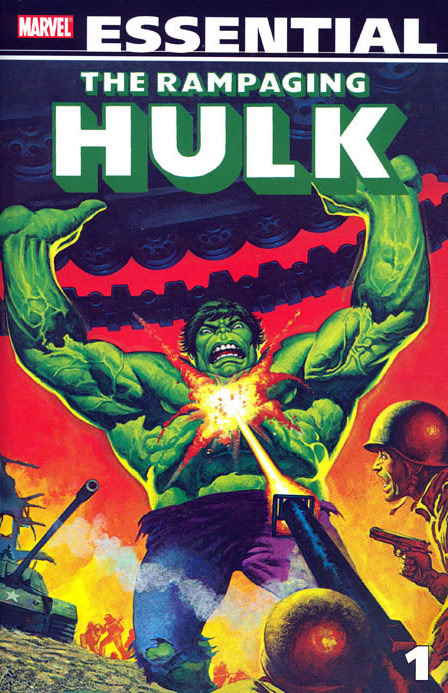
Essential Rampaging Hulk volume 1


By Doug Moench, John Warner, Walter Simonson, Alfred Alcala, Alex Niño, Jim Starlin, Keith Pollard, Tony DeZuñiga, Herb Trimpe, Sal Buscema, Ron Wilson, Bill Sienkiewicz, Rudy Nebres, Bob McLeod & various (Marvel)
ISBN: 978-0-7851-2699-7 (TPB)

The Incredible Hulk was Marvel’s second “superhero” title, although technically Henry Pym debuted earlier in a one-off yarn in Tales to Astonish #27 (January 1962). However, he didn’t become a costumed hero until the autumn, by which time Ol’ Greenskin was not-so-firmly established.

The Hulk crashed right into his own comic book and – after some classic romps by Young Marvel’s finest creators – crashed right out again. After six bi-monthly issues the series was cancelled and Lee retrenched, making the man-monster a perennial guest-star in Marvel’s other titles (Fantastic Four #12, Amazing Spider-Man #14, The Avengers from #1 and so forth) until such time as they restarted his own exploits in the new “Split-Book” format. The Jade Giant landed in Tales To Astonish where Ant/Giant-Man was rapidly proving to be a character who had outlived his time.

It all began in The Incredible Hulk #1 (cover-dated May 1962) which saw puny atomic scientist Bruce Banner sequestered on a secret military base in the desert, and perpetually bullied by bombastic commander General “Thunderbolt” Ross as the clock counted down to the world’s first Gamma Bomb test. Besotted by Ross’s daughter Betty, Banner endured the General’s constant jibes as the clock ticked on and tension increased. During the final countdown, Banner spotted a teenager lollygagging at Ground Zero and frantically rushed to the site to drag the boy away…

Rick Jones was a wayward but good-hearted kid. After initial resistance he let himself be pushed into a safety trench, but just as Banner was about to join him The Bomb detonated…

Miraculously surviving the blast, Banner and the boy were secured by soldiers, but that evening as the sun set the scientist underwent a monstrous transformation. He grew larger and his skin turned a stony grey…

In six simple pages that’s how it all started, and no matter what any number of TV, movie or comic book retcons and psycho-babble re-evaluations would have you believe, it’s still the best and most primal take on the origin. A good man, an unobtainable girl, a foolish kid, an unknown enemy and the horrible power of destructive science unchecked. It was clearly also the idea for a later iteration where continuity was rolled right back to the era of the first run: set in the Sixties and revealing previously “untold tales”…

In December 1976 that’s how the retrospective spin-off series began. Now a literal and figurative Marvel powerhouse, the Jade Juggernaut was awarded a monochrome magazine free of Comics Code supervision to augment his many in-continuity appearances. The Rampaging Hulk took the controversial tack of telling stories of what Banner, Jones and the Big Guy did next during the further formation of the nascent Marvel Universe…

Keeping up the theme, early issues featured tales of monster-hunter Ulysses Bloodstone, but you’ll need to look elsewhere for them…

The Hulk stories were set in 1963, after his own first series foundered, and – following a terse retelling of the classic origin cited above – scripter Doug Moench and illustrators Walt Simonson & Alfredo Alcala channelled primal Jack Kirby via a rather heavy grey-tone wash in a wild yarn of flying saucer sightings over Rome. The portentous sightings heralded invasion and, by also referencing the company’s early Sixties monster mag triumphs, the second-generation creators tacitly acknowledged their target audience: a supposedly older magazine readership who were presumably many of the same kids who had bought the original fantasy masterpieces…

Moench’s scripts and tone were wryly tongue-in-cheek, offering constant visual and verbal comedic touches whilst channelling early Marvel continuity and the tropes of the Sixties, if only as seen from the distant perspective of ten years after…

The magazine phenomenon had only a minor impact and effect on the Hulk’s four-colour adventures at that time, but, as always, the fury-fuelled fugitive was alternately aided or hunted by General Ross and met a variety of guest-star heroes and villains…

Opening gambit ‘The Krylorian Conspiracy’ saw Banner and Jones teaming up with alien rebel Bereet: a pacifist techno-artist hiding on Earth and seeking to prevent her bellicose shape-shifting people conquering humanity. The militaristic, monster-obsessed Krylorians – having failed to recruit the Gamma Goliath – attack Rome whilst enlisting the aid of The Hulk’s first super-foe: renegade Russian mutant The Gargoyle. Of course, they intend to betray him at the first opportunity…

It all ends up in a colossal clash with lots of spectacular smashing, with Bereet, Jones, Banner and The Hulk all resolved to stop the invasion at any cost…

Embellisher Alcala switched to a drybrush technique for the second issue as ‘And Then… The X-Men’ finds the wanderers in Paris, contesting more Krylorian shapeshifters, robots and crazy creatures, and subsequently attracting the attention of a certain band of mutant hunting teenagers. After the customary violent misunderstandings, the clandestine outsiders join forces with the Hulk to stop the razing of the City of Lights…

Another early foe returned as #3 shifted the action to the South of France where ‘The Monster and the Metal Master’ sees the treacherous Krylorians dupe and exploit another alien – a manic metal-moulding malcontent who appeared in the last issue of the original Hulk comic – into piloting their new weapon (“The Ferronaut”), whilst Rick, Bruce and Bereet seek to save little boy Spirou from being abused by his guardian and hotel-running employer. When they also find the invaders, all hell breaks loose and another Krylor base gets rocked to rubble…

The Rampaging Hulk #4 diverts from the overarching plot arc as Jim Starlin & Alex Niño take the tormented Green Giant to another time and place situated on ‘The Other Side of Night!’ Scripted by John Warner from Starlin’s plot, the tale reveals how extraterrestrial wizard Chen K’an abducts Banner and places his intellect into the Hulk’s body to make him the ideal comrade in a quest to defeat evil and save his dying, demon-infested world. The plan succeeds, but as is always the case with mages, Chen K’an has been less than honest about his ultimate intentions…

Back on Earth and his own era, the Hulk next meets his undersea antithesis in an epic 2-part continued tale from Moench, Keith Pollard, Alcala & Tony DeZuñiga. Beginning with ‘Lo, the Sub-Mariner Strikes!’ wherein Krylorians use manufactured sea monsters to assault Atlantis and provoke Prince Namor’s retaliation on Rome. The scheme explosively escalates as Sub-Mariner rescues and is captivated by Bereet, provoking a far from chivalrous response from the Hulk…

During the monumental battle that follows, Bereet is wounded and taken by Namor to Atlantis. The ever-enraged Hulk and Rick follow for cataclysmic climax ‘…And All the Sea With Monsters!’ arriving just in time to duel Namor in his own element until another Krylorian undersea attack puts them on the same side… for a moment…

Throughout the series, Bereet’s semi-sentient techno-creations had played a major role in aiding their efforts but in #7 a typical Hulk tantrum unleashes an inimical spirit inhabiting her bag of tricks and spawning a terrifying ‘Night of the Wraith!’ (Moench, Pollard & Jim Mooney) before the end of the reprised era begins with #8’s ‘A Gathering of Doom!’ – illustrated by Hulk veteran Herb Trimpe & Alcala.

The Hulk’s biggest boost after his debut title was cancelled came as he fought, joined, co-founded and left The Avengers: a saga that took up the first five issues of the new team title. Here that debt is acknowledged in another 2-parter as the Krylorians at last attack America and the valiant trio go after them.

With the shapeshifters impersonating recently emergent hero Iron Man, and the Hulk battling the doppelganger, other new champions are drawn to the conflict. However, when Thor, Ant-Man, The Wasp and the real Iron Man converge, another wrong conclusion is leapt to and the “Pre-Vengers” turn on the big green angry monster…

The shattering finale is by Moench, Sal Buscema & Rudy Mesina as all-out chaos explodes when the assembled titans clash. It’s exactly to wrong moment for the Krylorian fleet to distract everybody with a screaming attack, but that’s what they do, accidentally uniting the suspicious heroic strangers who join forces to ‘To Avenge the Earth’ and repel the invasion…

Originally released as newsprint magazine, The Rampaging Hulk abruptly transformed (and became the testing ground of the company’s “Marvelcolor” process) when a hugely successful TV show starring the Green Goliath took off. It saw the periodical upgraded to slicker paper stock. Sadly, that’s not apparent in this monochrome collection, but I’m sure that one day we’ll see the tales as they were meant to be…

The obliquely continuity-adjacent storylines were instantly shelved and the narrative tone adjusted to address the needs of casual curious readers and television converts. Although guest stars were dropped the scenario shifted back to present day as a solitary emerald outcast wandered the world looking for a cure or at least a little peace…

Supposedly a more sophisticated product, the book also offered a home to Moon Knight, who moved in for a series of darkly modern tales also outside standard superhero parameters.

Only a taste of those is included here, but before those begin, #10 of retitled The Hulk! magazine offers ‘Thunder of Dawn’ with Moench, Ron Wilson & Ricardo Villamonte depositing Hulk/Banner in the Pacific west and working in a local mine.

A born trouble-magnet, Banner takes up with Dawn – a whistle-blower investigating kickbacks and environmental abuses but his assistance only triggers tragedy, murder and a blockbusting battle against colossal digging machines…

The tale is divided by a brief prose vignette by David Anthony Kraft & Dwight Jon Zimmerman with spot illustrations by Ernie Chan. ‘The Runaway and the Rescuer!’ channels a key moment of a classic Universal Pictures Frankenstein film as the lonely misunderstood monster befriends a little girl with tragic and unexpected consequences…

Issue #11 (October 1978) continues the scary star’s picaresque perambulations with restless vagrant Banner joining a travelling circus, only to find his cherished anonymity threatened by ‘The Boy Who Cried Hulk!’ (inked by Fran Matera). When the abused kid’s plight coincides with a string of suspicious fires, Banner’s new friends (such as strongman Bruno) turn against him, and the Hulk is again unleashed…

Moench, Wilson & Chan return to Bruno in #12 as ‘The Color of Hate!’ sees the humiliated performer – now obsessed by the mysterious green brute – sign up for a science experiment and steal an exoskeleton to destroy his personal bête noire (or is that vert?)

The Hulk! #13 finds Banner flying to Zurich after a newspaper headline hints at a possible cure for The Hulk. Inked by Bob McLeod, ‘Season of Terror’ starts with the Green Goliath bringing down the airliner an increasingly stressed Banner was a passenger on – and that was before hijackers took control of the cockpit…

The enraged colossus redeems himself by (mostly) saving it from crashing into an alp with a minimum of fatalities, but that only means the terrorists are able to make hostages of the survivors. As a wary, weary Banner tries to keep everyone safe until rescue parties arrive, he is reminded again what true monsters look and act like…

With Rudy Nebres inking Wilson, the Swiss tragedy resolves into a spark of hope as the fugitive scientist finds ‘A Cure for Chaos!’ in the chateau/schloss of Dr. Hans Feldstadt. Sadly, not all researchers are as altruistic as Banner and the hope is extinguished amidst a wash of unleashed gamma rays and a flurry of huge flying fists…

This initial compilation concludes with Alcala back for #15 (June 1980) to ink Wilson on ‘The Top Secret’. Banner is again in his southwestern desert stomping grounds, and headed for his old subterranean secret lab, resolved to cure himself but the region is now home to bunch of crazed militarists seeking to gain a technological head start on the Soviet Union, telemetrically planting good American patriots in fearsome Cybortron warbots…

When they stumble across and even capture The Hulk, the researchers think they’ve found a way to upgrade the tech even further, but it’s never a good idea to let Banner or The Hulk near your machines or plans…

Just for once, the full contents of this issue are included in the form of a notional crossover between headliner and back-up star. As stated above, Moon Knight was building his reputation in the rear of this title and here is part of a single encounter told from two perspectives. Moench, Sienkiewicz & McLeod explored ‘An Eclipse, Waning’ with millionaire playboy Steven Grant indulging a neglected passion for astronomy by visiting an old pal in the countryside on the night of a total lunar occultation. The event brings brutal burglars out of the woodwork and Moon Knight is required to stop them, but, bizarrely, at the height of the eclipse, during the moment of utter darkness, the Lunar Avenger encounters something huge, monstrous and unbeatable, barely escaping with his life.

Answers come in ‘An Eclipse Waxing’ as on that same night, fugitive Bruce Banner stumbles into burglars breaking into an isolated house. Helplessly transforms into the Hulk just as total night falls, the monster briefly encounters an unseen foe of uncanny capabilities…

With painted covers by Ken Barr, Earl Norem, Starlin, Val Mayerik and Bob Larkin, plus pin-ups and frontispiece from occasional series ‘Great moments in Hulk History’ revisited and reprised by Moench and artists Ed Hannigan, John Romita, Jr. & Nebres, Al Milgrom, Chan, Terry Austin, Rich Buckler, Simonson, Mike Zeck and Gene Colan, this tome concludes with a house ad and a bargain bonus.

In regular monthly comic book The Incredible Hulk #269 (cover-dated March 1982 and by Bill Mantlo &Sal Buscema) it was revealed that the entire tranche of lost 1960s stories and Krylorian Saga was actual an art installation by alien artis Bereet. That 5-page sequence is included here to denote the character finally joining the official Marvel continuity…

The Hulk is one of the most well-known comics characters in the business, thanks in great part to his numerous assaults on the wider world of both large and small screens. The satisfyingly effective formula of radioactively-afflicted Bruce Banner wandering the Earth seeking a cure for his gamma-transformative curse whilst constantly pursued by authoritarian forces struck a particular chord in the late 1970s as the first live action TV show captured the hearts and minds of the viewing public. You can relive or at last sample that simplistic but satisfying situation just by stopping here for little while before inevitably moving on…
© 1976, 1977, 1978, 2010 Marvel Characters, Inc. All rights reserved.
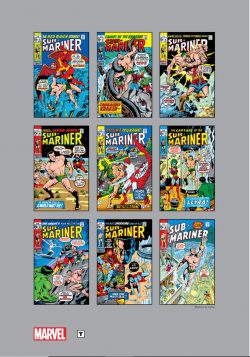
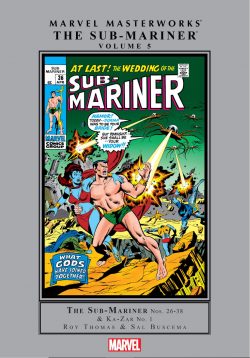
Sub-Mariner Marvel Masterworks volume 5


By Roy Thomas, Allyn Brodsky, Sal Buscema, Ross Andru, Frank Springer & various (Marvel)
ISBN: 978-0-7851-6619-1 (HB/Digital edition)

Prince Namor, the Sub-Mariner is the offspring of a water-breathing Atlantean princess and an American polar explorer; a hybrid being of immense strength, highly resistant to physical harm, able to fly, and thrive above and below the waves. Created by young, talented Bill Everett, Namor technically predates Marvel/Atlas/Timely Comics.

He first caught the public’s avid attention as part of an elementally appealing fire vs. water headlining team-up in the October 1939 Marvel Comics #1 (which renamed itself Marvel Mystery Comics from #2 onwards). The amphibian antihero shared honours and top billing with The Human Torch, but had originally been seen (albeit in a truncated, monochrome version) in Motion Picture Funnies: a promotional booklet handed out to moviegoers earlier in the year. Rapidly emerging as one of the industry’s biggest draws, Namor won his own title at the end of 1940 (cover-dated Spring 1941) and was one of the last super-characters to vanish at the end of the first heroic age.

In 1954, when Atlas (as the company then was) briefly revived its “Big Three” line-up – the Torch and Captain America being the other two – Everett returned for an extended run of superbly dark, mordantly timely fantasy fables. However, even his input wasn’t sufficient to keep the title afloat and eventually Sub-Mariner sank again.

In 1961, as Stan Lee & Jack Kirby were reinventing superheroes with the landmark title Fantastic Four, they revived the awesome, all-but-forgotten aquanaut as a troubled, semi-amnesiac antihero. Decidedly more bombastic, regal and grandiose, this returnee despised humanity: embittered and broken by the loss of his sub-sea kingdom which had been (seemingly) destroyed by American atomic testing. His rightful revenge became infinitely complicated after he became utterly besotted with the FF’s Susan Storm.

Namor knocked around the budding Marvel universe for a few years, squabbling with other star turns such as The Hulk, Avengers, X-Men and Daredevil before securing his own series as one half of Tales to Astonish, and from there graduating in 1968 to his own solo title.

This fifth subsea selection trawls Prince Namor, the Sub-Mariner #26-38 and portions of Ka-Zar #1, spanning June 1970 to June 1971, and opens with another heartfelt appreciation and more creative secret-sharing in an Introduction from life-long devotee – and primary scribe of this book – Roy Thomas. The drama recommences as recently self-appointed relentless guardian of the safety and ecology of all Earth’s oceans, the Prince of Atlantis furtively returns to the surface world.

In ‘“Kill!” Cried the Raven!’ by Thomas, Sal Buscema & Joe Gaudioso (AKA Mike Esposito) the Sub-Mariner has come to investigate reports of comatose superhuman Red Raven. He was the human emissary of a legendary race of sky-dwelling Birdmen recently encountered by The Angel of the X-Men in their last clash with Magneto. With the covert assistance of old friend Diane Arliss, Namor seeks to forge an alliance with the Avian race, but shocks, surprises and the Raven’s trauma-induced madness all conspire to sink the plan…

Back brooding in Atlantis in the wake of another failure, Namor’s mood is further plagued when a human pirate uses his giant monster-vessel to attack shipping with Atlantis bearing the brunt of blame ‘When Wakes the Kraken!’ His hunt for bizarre bandit Commander Kraken again involves Diane and ends only when the Sub-Mariner demonstrates what a real sea monster looks like…

Recuperating with her in New York City, Namor is incensed by the actions of an unrepentant industrial polluter and joins teen protestors fighting developer Sam Westman’s thugs and mega machines in ‘Youthquake!’ before we pause for a little diversion…

Beginning as a Tarzan tribute act relocated to a lost world in a sub-polar realm of swamp-men and dinosaurs, Ka-Zar eventually evolved into one of Marvel’s more complex and mercurial characters. Wealthy heir to one of Britain’s oldest noble families, his best friend is Zabu the sabretooth tiger, his wife is feisty environmental-crusader Shanna the She-Devil and his brother is a homicidal super-scientific bandit. Kevin Reginald, Lord Plunder is perpetually torn between the clean life-or-death simplicity of the jungle and the bewildering constant compromises of modern civilisation.

The primordial paragon even outranks Namor in terms of longevity, having begun as a prose pulp star, boasting three issues of his own magazine between October 1936 and June 1937. They were authored by Bob Byrd – a pseudonym for publisher Martin Goodman or one of a fleet of writers on his staff – and he was latterly shoehorned into a speculative new-fangled comic book venture Marvel Comics #1. There he roamed alongside another pulp mag graduate: The Angel, plus Masked Raider, the Human Torch and Sub-Mariner

When Ka-Zar reappeared all rowdy and renovated in 1965’s X-Men #10, it was clear the Sovereign of the Savage Land was destined for bigger things. However, for years all he got was guest shots as misunderstood foe du jour for Daredevil, Sub-Mariner, Spider-Man, and the Hulk.

In 1969, he took his shot with a solo saga in Marvel Super-Heroes and later that year – after Roy Thomas & Neal Adams used him so effectively in their X-Men run (issues #62-63) – was awarded a giant-sized solo title reprinting many previous appearances. The title also incongruously offered all-new stories of Hercules and the second, mutant X-Man Angel. That same month, Ka-Zar’s first regular series began in Astonishing Tales

That Hercules back up from Ka-Zar #1 (August 1970 by Allyn Brodsky, Frank Springer & Dick Ayers) is reprinted here as it impacts Namor’s exploits…

‘In his Footsteps… The Huntsman of Zeus!’ sees the potent Prince of Power on the run from an Olympian agent despatched by the King of the Gods. Following another bitter dispute with his sire Hercules returns to Earth, leaving Ares to foment trouble and prompt Zeus to set his terror-inducing Huntsman on the godling’s trail…

After seeking sanctuary with the Avengers, Hercules sees his mortal friends brutally beaten and flees once again…

The panicked rush takes him to Sub-Mariner #29 and the distant Mediterranean where the Huntsman ensorcells Namor and pits him against the fugitive. Although Hercules soon breaks the hypnotic spell, ‘Fear is the Hunter!’ reveals why the pursuer is so dreaded as he sends mythical terrors Scylla, Charybdis and Polyphemus against the heroes and the pitiful mortals of the region, until a valiant breakthrough ends the threat and forces a paternal reconciliation…

Another guest star treat materialises in #30 as ‘Calling Captain Marvel!’ sees Namor again reduced to a mesmerised puppet and attacking the Kree warrior and his human host Rick Jones. This time the condition is due to the amphibian’s falling in battle against toxic terrorist Mr. Markham who attempts to blackmail Earth by threatening to poison the seas with his molecular polluter. Once Captain Marvel batters Namor back to his right mind, they make quick work of the maniac in a concerted twin assault…

The fallout from his recent actions have unsettled Namor’s old friend Triton, and the Inhuman goes looking for the prince in #31 just as apparent Atlantean attacks on surface shipping mounts. Meeting equally concerned human Walt Newell (who operates as undersea Avenger Stingray) they finally find – and fight – the Sub-Mariner, only to learn the crisis has been manufactured by his old enemy who is now ‘Attuma Triumphant!’

The barbarian’s plans include destroying human civilisation, but he still has time to pit his captives against each other in a gladiatorial battle to the death; which of course is Attuma’s undoing…

Jim Mooney comes aboard as inker with #32 as a new and deadly enemy debuts in ‘Call Her Llyra… Call Her Legend!’ when fresh human atomic tests prompt Namor to voyage to the Pacific and renew political alliance with the undersea state of Lemuria. However, on arrival he finds noble Karthon replaced by a sinister seductress who lusts for war and harbours a tragic Jekyll & Hyde secret…

By the time he reaches Atlantis again the Sunken City is being ravaged by seaquakes and old political enemy Prince Byrrah is seizing control from Namor’s deputies and devoted paramour Lady Dorma. ‘Come the Cataclysm’ sees him first accuse surface-worlders before locating and defeating the true culprits – an alliance of Byrrah with failed usurper Warlord Krang and human mad genius Dr. Dorcas. In the throes of triumph, Prince Namor announces his imminent marriage to Dorma…

Antihero superteam The Defenders officially begin with Sub-Mariner #34-35 (cover-dated February & March 1971). As previously stated, the Prince of Atlantis had become an early and ardent activist and advocate of the ecology movement, and here he takes radical steps to save the planet by fractiously recruiting The Hulk and Silver Surfer to help him destroy an American Nuclear Weather-Control station.

In ‘Titans Three!’ and concluding chapter ‘Confrontation!’ (by Thomas, Sal Buscema & Jim Mooney) the always-misunderstood outcasts unite to battle a despotic dictator’s legions, the US Army, UN defence forces and the mighty Avengers to prevent the malfunctioning station from vaporising half the planet…

Inked by Berni Wrightson, Sub-Mariner #36 augurs a huge sea change in Namor’s fortunes that begins with time-honoured holy preparations for a happy event as ‘What Gods Have Joined Together!’ Elsewhere, arcane enemy Llyra is resuurected and seeks to steal the throne by abducting and replacing the bride-to-be whilst Namor is distracted by an invasion of Attuma’s hordes.

Ross Andru & Esposito take over illustration duties with #37 as an era ends and tragedy triumphs, leading to a catastrophic battle on ‘The Way to Dusty Death!’

Betrayed by one of his closest friends and ultimately unable to save his beloved, the heartbroken prince thinks long and hard before abdicating in #38 ‘Namor Agonistes!’: reprising his origins and life choices before choosing to henceforth pursue the human half of his hybrid heritage as a surface dweller…

To Be Continued…

More sunken treasures salvaged here include the cover to all-reprint Sub-Mariner Annual #1 (January 1971, and reprising the underwater portions of Tales to Astonish #70-73) plus Bill Everett’s pin-up of young Namor, contemporary House Ads and Marie Severin’s glorious cover sketch for #33, plus a huge Biographies section.

Many early Marvel Comics are more exuberant than qualitative, but this volume, especially from an art-lover’s point of view, is a wonderful exception: a historical treasure with narrative bite that fans will delight in forever. Moreover, with the Prince of Atlantis now a bona fide big screen sensation that no one’s ever heard of, now might be the time to get wise and impress your friends with a little insider knowledge…
© 2018 Marvel Characters, Inc. All rights reserved.
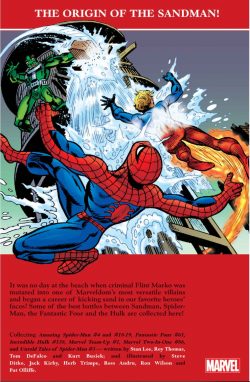
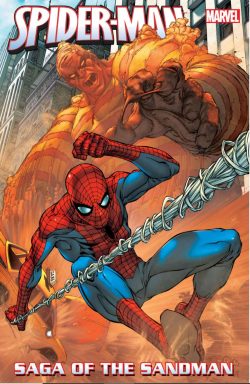
Spider-Man: Saga of The Sandman


By Stan Lee, Roy Thomas, Tom DeFalco, Kurt Busiek, Steve Ditko, Jack Kirby, Herb Trimpe, Ross Andru, Ron Wilson, Patrick Olliffe & various (Marvel)
ISBN: 978-0-7851-2497-9 (TPB/Digital edition)

Spider-Man debuted in the summer of 1962 – Happy Anniversary, webslinger! – but didn’t really take off until he won his own title in the early days of 1963 – so expect a whole bunch of Spidey-reviews here next year. A crucial factor in his success was the ever-expanding and iconic legion of super-foes Steve Ditko, Stan Lee and all their successors so sensibly highlighted over the years. many of them starring in archives like this one on the back of their movie appearances. Here’s another to be going on with… 

Heroes are only truly defined by their enemies and superheroes doubly so, with the added proviso that costumed crusaders generally have a rogue’s gallery of fantastic foes rather than just one arch-nemesis. Even so, there’s always one particular enemy who wears that mantle: Moriarty for Sherlock Holmes; Blofeld for James Bond; Luthor for Superman.

Spider-Man has always had two top contenders… but Sandman isn’t one of them. (*If you can’t guess, check out the end of the review, puzzle-fans!).

This nifty compilation gathers a range of tales featuring gritty gangster William Baker (AKA Flint Marko): a cheap thug who remade himself into a major threat in numerous spectacular clashes with the wondrous wallcrawler and other Marvel Stars. This brief compilation traces his rather rocky development by a series of key moments: uncomplicated, no-frills thrill-rides each delivering frantic spills and chills, equally appetising to film-inspired new meat and grizzled old veterans of the Fights ‘n’ Tights arena.

It all starts with Amazing Spider-Man #4, cover-dated September 1963, as Lee & Ditko resort to the ubiquitous atomic experiment maguffin to absurdly empower a commonplace, uneducated low grade career criminal, to counterbalance the preponderance of evil geniuses.

‘Nothing Can Stop… the Sandman!’ was another instant classic as brutally violent, simplistic thug Marko gains the shapeshifting power to transform into all aspects of sand. Terrorising New York City, he evades and humiliates the cops before invading Peter Parker’s high school.

Ruthless and deadly, he is challenged by the mysterious Spider-Man who must stop the monster at all costs. The epic clash proves that wits trump force every time…

Marko returned in issues #18-19 (November & December 1964), joining an already in-progress imbroglio by Lee & Ditko. In AS #17 (not included here) the wallcrawler endured renewed print assaults from the Daily Bugle and its rabid publisher J. Jonah Jameson just as enigmatic archfoe Green Goblin began a war of nerves and attrition, employing the Enforcers, Sandman and an army of thugs to publicly humiliate the Amazing Arachnid. To exacerbate matters Parker’s beloved Aunt May’s health took a drastic downward turn…

Resuming here with ‘The End of Spider-Man!’ and explosively concluding in the triumphal ‘Spidey Strikes Back!’ – featuring a turbulent team-up with friendly rival Johnny StormThe Human Torch was another teen Sandman frequently fought – the extended tale proved fans were ready for every kind of narrative experiment and that overwhelming tension, drama and action were always welcome.

As the sixties progressed Sandman teamed up with fellow Torch arch foes The Wizard and Trapster as the core of evil alliance The Frightful Four: targeting the Fantastic Four with determination but little success. That war led to a revolutionary evolution in Fantastic Four #61 (April 1967, by Lee, Jack Kirby & Joe Sinnott)…

Having just defeated cosmically-empowered Doctor Doom and returned to the Silver Surfer his purloined life-energies, the weary team entered their Baxter Building HQ and were ambushed by a new and improved foe in ‘Where Stalks the Sandman?’ Having gone back to school for a crash course in chemistry, Marko had designed a gadget-and-mineral-enhanced costume to maximise his powers. Brashly overconfident, the villain almost defeated the FF before being driven off…

He became a roving solo villain: adding Ka-Zar and The Hulk to his hit list. The latter was a mistake that almost destroyed his powdery predations as a he was turned from sand to glass. That plot thread was resolved by Roy Thomas, Herb Trimpe & Sam Grainger in Incredible Hulk #138 (April 1971) as ‘Sincerely, the Sandman!’ sees the vicious villain rid himself of his crystalline affliction by callously transferring it to Bruce Banner’s true love: turning Betty Ross into a brittle, fragile thing of glass…

Having fallen too low, a touch of humanity was found in Sandman when he was the creep du jour in a bold new publishing venture…

In those long-lost days editors were acutely conscious of potential over-exposure; and since superheroes were actually in a decline they may well have been right. Marvel Team-Up was the second regular Spider-Man title (because abortive companion title Spectacular Spider-Man was created for the magazine market in 1968 but died after two issues). MTU launched at the end of 1971 and went from strength to strength, proving the time had finally come for expansion and a concentration on uncomplicated action over sub-plots…

Marvel Team-Up #1was crafted by Thomas, Ross Andru & Mike Esposito and saw a mutual old enemy of the wallcrawler and the Torch rear his gritty head in a charming seasonal spree: ‘Have Yourself a Sandman Little Christmas!’ is a light-hearted romp full of Christmas cheer, rambunctious action and seasonal sentiment, as Marko repeatedly routs the young heroes in a desperate attempt to wish his mother – blithely unaware of his criminal career – the season’s greetings…

It was back to bombastic bad guy bouts for a long time after that, but time and Tom DeFalco, Ron Wilson & Chic Stone eventually set the super-villain on a new path with April 1982’s Marvel Two-in-One #86. Here, ‘Time Runs Like Sand!’ presents an astoundingly low-key landmark as Ben and the sinister Sandman meet again. However, instead of another battle, they have a few bevies in a bar and talk about their remarkably similar past lives. Treating monsters like men seemingly turns the felon’s life around…

Since then, The Sandman has vacillated between heroic mercenary, greedy criminal and outcast horror according to editorial whim, but this tome terminates with another visit to the early days of unthinking larceny…

Untold Tales of Spider-Man was a series designed to tell new stories chronologically set during the early Lee/Ditko days of the character, and here Kurt Busiek, Patrick Oliffe, Al Vey & Pam Eklund see the webspinner ‘Sand Blasted’ (UTS-M #3, November 1995) as the malleable menace goes a robbing rampage even The Avengers cannot counter. Despite initially thrashing Spider-Man, Marko cannot stop or deter the bold, irrepressible kid and ultimately goes down big time…

Also included here are pertinent ‘Spider’s Web’ letters pages, House ads, info pages from The Official Handbook of the Marvel Universe and the ‘Cover Process’ undertaken from Marks Brooks’ pencil sketch to Jaime Mendoza’s inks and Danimation’s colour finishes.

Epic and engaging, this grab-bag of gritty tussles is pure comic book catharsis: fast, furious fun and thrill-a-minute-melodrama no Fights ‘n’ Tights fan could resist.
© 2017 Marvel Characters, Inc. All rights reserved.
* Green Goblin Norman Osborn and Doctor Otto Octavius still share the dishonours of being Spider-Man’s most dastardly nemeses. If you had trouble with that, you need to read more mainstream comics. If you’re interested, I have a little list …

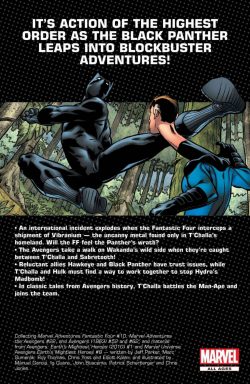
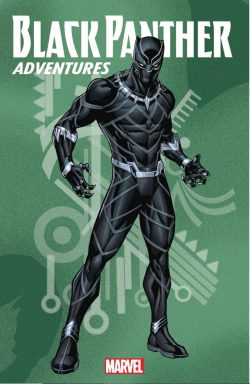
Black Panther Adventures


By Jeff Parker, Marc Sumerak, Christopher Yost, Elliot Kalan, Roy Thomas, Manuel Garcia, Ig Guara, Scott Wegener, Christopher Jones, Chris Giarusso, John Buscema & various (Marvel)
ISBN: 978-1-3029-1034-1 (Digest PB/Digital edition)

From its earliest days, Marvel always courted and accommodated young comic book consumers, often through separates titles and imprints. In 2003, the company instituted the Marvel Age line to reframe classic original tales by Stan Lee, Jack Kirby, Steve Ditko and others for a fresh-faced 21st century readership.

The experiment was tweaked in 2005, becoming Marvel Adventures. The tone of all the tales was very much that of the company’s burgeoning TV animation franchises, in execution if not name. Titles bearing the Marvel Adventures brand included Spider-Man, Fantastic Four and The Avengers and ran until 2010 when they were all cancelled and replaced by new volumes of Marvel Adventures: Super Heroes and Marvel Adventures: Spider-Man.

Most of those comic book yarns have since been collected in digest-sized compilations such as this one, gathering a quartet of all-ages Black Panther tales but also including a brace of early1960s episodes from his first stint in mainstream MU series The Avengers.

Acclaimed as the first black superhero in American comics and one of the first to carry his own series, the Black Panther’s popularity and fortunes have waxed and waned since he first debuted as a character in Fantastic Four #52.

In that 1966 landmark the cat king attacked Marvel’s First Family as part of his extended scheme to gain vengeance on the murderer of his father, before eventually teaming up with them to defeat malign master of sound Klaw.

This eclectic compilation – comprising Marvel Adventures Fantastic Four #10, Marvel Adventures The Avengers #22, Avengers: Earth’s Mightiest Heroes #1, Marvel Universe Avengers Earth’s Mightiest Heroes #8, plus Silver Age epics from Avengers #52 and 62 – begins by broadly reimagining that initial FF encounter in ‘Law of the Jungleby Jeff Parker, Manuel Garcia & Scott Koblish (from Marvel Adventures Fantastic Four #10; May 2006) wherein the quixotic quartet are suckered into buying smuggled Vibranium.

The miracle mineral is Wakanda’s only export and the illegal sale quickly brings the duped heroes into savage conflict with a mysterious cat-garbed super-warrior. Tracking the Black Panther back to his super-scientific jungle kingdom, the team  eventually convince the king of their innocence and good intentions before teaming up to tackle the true villains…

Two years later Marvel Adventures The Avengers #22 (May 2008 and by Marc Sumerak, Ig Guara & Jay Leisten) revealed the ‘Wakanda Wild Side as sightings of murderous mutant Sabretooth in Africa draws Wolverine, Storm, Captain America, Spider-Man, Giant-Girl and the Hulk into an uncharted kingdom. They needn’t have bothered: Wakanda’s Panther chieftain is more than equal to the task of taking down the savage invader…

Following a page of comedic Marvel Mini Classics by Chris Giarusso, a short vignette from Avengers: Earth’s Mightiest Heroes #1 (November 2010) as Christopher Yost & Scott Wegener reveal how rival heroes T’Challa and Hawkeye work out their ‘Trustissues whilst battling crazed villain Whiplash.

Never the success the company hoped, the Marvel Adventures project was superseded in 2012 by specific comics tied to those Disney XD television shows designated as “Marvel Universe cartoons”, but these collected stories are still an amazingly entertaining and superbly accessible means of introducing characters and concepts to kids born sometimes three generations or more away from the originating events. They’re also pretty good fun for us old lags too…

Another short tale – this time from Marvel Universe Avengers Earth’s Mightiest Heroes #8 (November 2012) – unites the Panther with the Hulk. Crafted by Elliott Kalan, Christopher Jones & Pond Scum, ‘Mayhem of the Madbomb!finds Green Goliath and Cat King furiously fighting Hydra to prevent he detonation of an insanity-inducing WMD stashed in the Empire State Building…

Wrapping up the action are a brace of classic exploits from Roy Thomas & John Buscema.

On Captain America’s recommendation the Black Panther joined the Avengers in #52’s ‘Death Calls for the Arch-Heroes!’ (May 1968, inked by Vince Colletta): a fast-paced murder mystery which also saw the advent of obsessive super-psycho The Grim Reaper who tried to frame the freshly-arrived-in-America T’Challa for the murder of Goliath, The Wasp and Hawkeye.

Then ‘The Monarch and the Man-Ape!(Avengers #62, March 1969, and inked by George Klein) offered Marvel fans the first real view of hidden Wakanda – and a brutal exploration of T’Challa’s history and rivals – as his trusted regent seeks to usurp the kingdom and overturn the state religion after declaring himself to be ‘M’Baku the Man-Ape!’

Augmented by a cover gallery from Carlo Pagulayan & Chris Sotomayor, Leonard Kirk & Val Staples, Scott Wegener & Jean- François Beaulieu, Khoi Pham & Edgar Delgado and John Buscema, these ferociously enthralling riotous mini-epics are extremely enjoyable and engaging, but parents should note that some of the themes and certainly the level of violence might not be what everybody considers “All-Ages Super Hero Action”…
© 2017 Marvel Characters, Inc. All rights reserved.
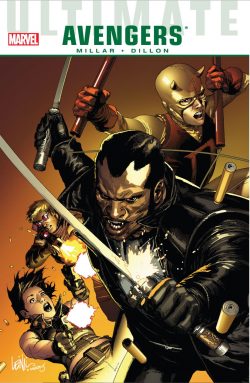
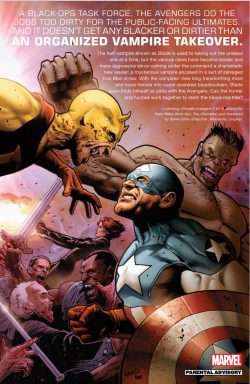
Ultimate Comics Avengers: Blade versus The Avengers


By Mark Millar, Steve Dillon, Andy Lanning, Scott Hanna & various (Marvel)
ISBN: 978-0-7851-4009-2 (TPB/Digital)

Marvel’s Ultimates sub-imprint began in 2000 with key characters and concepts retooled to bring them into line with the tastes and sensibilities of modern readers – a potentially discrete market from the baby-boomers and their descendants. The line proliferated and prospered, but eventually this darkly nihilistic new universe became as continuity-constricted as its predecessor.

In 2008, cleansing event Ultimatum culminated in a reign of terror that killed dozens of superhumans and millions of lesser mortals. Although a strong seller, the saga was largely trashed by the fans who bought it, and the ongoing new Ultimatum Comics line quietly back-pedalled on its declared intentions…

The key and era-ending event was a colossal tsunami that drowned the superhero-heavy island of Manhattan. This post-tsunami collection (re-presenting Ultimate Comics Avengers 3 #1-6) focuses on a more or less dried out world with diminished global populations adapted to the new status quo.

Before the Deluge, Nick Fury (a black iteration so popular that he not only became the film version, but was also retrofitted into the mainstream MCU and replaced the white guy from WWII) ran a super-secret Black Ops team of superhumans designated the Avengers. He was eventually ousted from his position for sundry rule-bending antics – and being caught doing them. Now, as the world dries, he’s firmly re-established, running another black ops team, doing stuff his publicity-courting, officially sanctioned Ultimates team wouldn’t dream of…

Fury’s secret army consists of Hawkeyethe man who never misses; James Rhodes: a fanatical soldier wearing devastating War Machine armour; Gregory Stark, Iron Man’s smarter, utterly amoral older brother; Nerd Hulk – a cloned gamma-monster with all the original’s power but implanted/programmed with Banner’s brain and milksop character; size-shifting insect queen Red Wasp and ruthless super-spy Black Widow.

Also popping in when no one’s looking is resurrected WWII super soldier Captain America – part of the bright and shiny squad, but always happy to slum it when necessary…

Here the dark-side heroes stumble into an ancient and clandestine war that has continued uninterrupted by the end of the world, which sees half-human vampire-hunter Blade on the unaccustomed defensive. The undead bloodsuckers he has historically picked off with ease are now far better organised, more effective and more dangerous. As the story unfolds, it transpires they have found a new king with a grand plan…

This mysterious mastermind is wearing Iron Man’s old armour and now ignores ordinary mortals, preferring to turn super-heroes into a vampiric army. The situation starts bad and gets exponentially worse with metahuman heroes and guest-stars – like Kid Daredevil, Slavic thunder god Perun, numerous Giant-Men, and zen hero-trainer Stick – dropping like flies. With all possible saviours succumbing to the unstoppable plague, it looks hopeless when only Fury, Black Widow and Hawkeye are left untainted, and only the greatest miracle or boldest masterstroke can save humanity. After Cap also succumbs to the curse of the undead, the team’s unwelcome sometime-ally Blade makes a bold but surely suicidal move…

With covers and variants by Leinil Francis Yu, Marte Gracia, Ed McGuinness, Morry Hollowell, Olivier Coipel, Laura Martin, Greg Land, Frank D’Armata, this dark, moody and fast-paced thriller comes from Mark Millar (Judge Dredd, Civil War, Superman, Kick-Ass, The Kingsman, American Jesus, Jupiter’s Legacy) and Steve Dillon (Laser Eraser & Pressbutton, Abslom Daak, Judge Dredd, Animal Man, Preacher, Hellblazer, The Punisher): a wry, violent and powerfully scary romp that is engrossing and eminently readable.

This spooky, cynical, sinister shocker is another breathtakingly effective yarn that could only be told outside the Marvel Universe proper, but one that will resonate with older fans who love the darkest side of superheroes (and remember fondly the days when heroes could be horrors) as well as casual readers who know the company’s movies better than the comics.
© 2020 MARVEL. A British edition published by Panini is also available.

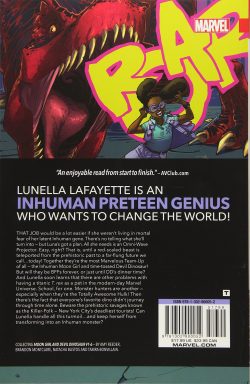
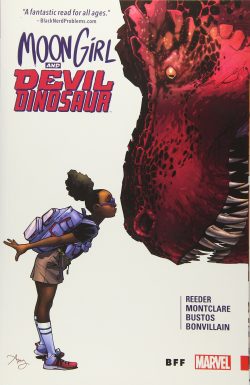
Moon Girl and Devil Dinosaur volume one: BFF


By Brandon Montclare, Amy Reeder, Natacha Bustos, Tamra Bonvillain & various (Marvel)
ISBN: 978-1-3029-0005-2 (TPB/Digital edition)

The Marvel Universe is absolutely stuffed with astounding young geniuses but Lunella Lafayette is probably the most memorable you’ll ever meet. Very young, very gifted and proudly black, she lives with her parents on Manhattan’s Lower East Side when not attending Public School 20 Anna Silver on Essex Street.

Thanks to her obsessive interest in astronomy and alien races the other kids mockingly call her “Moon Girl” whilst the brilliant, bored 4th grader’s teachers universally despair because she already knows so much more than they do…

It’s a hassle, but Lunella actually has bigger problems. Time is running out and her numerous applications to specialist schools such as the Fantastic Four’s Future Foundation have all gone unanswered. The situation needs resolving as it’s pretty important and urgent. Lunella has – correctly – deduced that she carries dormant Inhuman genes, and the constantly moving mutagenic Terrigen Cloud recently released into Earth’s atmosphere (see both the Infinity and Inhumanity events) could transform her into a monster at any windswept moment…

Thanks to her investigations, she’s an expert in advanced and extraterrestrial technology, and her quest for a cure or Terrigen-deterrence procedure sees her perpetually sneaking out past bedtime in search of gadgets and detritus left behind after frequent superhero clashes around town…

That impetus reaches its hope-filled climax when her handmade detectors locate a discarded Kree Omni-Wave Projector in opening chapter ‘Repeat After Me’…

At some unspecified time in Earth’s distant prehistory, various emergent species of hominids eked out a perilous existence beside the last of the great lizards and other primordial giants. At one particular key moment, a wide-eyed innocent of the timid yet clever Small Folk saved a baby tyrannosaur from ruthless pre-human hunters the Killer Folk.

They had already slaughtered its mother and siblings with cunning snares and were merrily torturing the little lizard with blazing firebrands – which turned its scorched hide a livid, blazing red – before Moon Boy intervened…

Under the roaring light of a blazing volcano, boy and beast bonded, becoming inseparable companions. It was soon apparent the scarlet saurian was no ordinary reptile: blessed with uncanny intelligence and unmatchable ferocity, Devil became an equal partner in a relationship never before seen in the world. It did not, however, prevent the duo becoming targets for ruthless Killer Folk leader Thorn-Teeth who now slaughters and sacrifices beasts and Small Folk to a mystic “Nightstone”. A more advanced observer might remark on how much it resembles a Kree Omni-Wave Projector…

When Moon-Boy steals the dread talisman, he is savagely beaten near to death even as – in a gym class on Essex Street – Coach Hrbek confiscates and accidentally activates a fancy doodad Lunella’s been playing with instead of paying attention to getting fit.

Lights flash, time shreds and universes collide. A hole opens in space and a pack of bizarre monkey men shamble into modern New York. Arriving too late in the antediluvian valley, Devil Dinosaur thunders straight through the portal, intent on avenging his dying comrade…

Arriving in an impossibly confusing new world, Devil understandably panics. After causing much chaos and carnage, the bombastic beast sniffs little Lunella and snatches her up…

A mad chase ensues in ‘Old Dogs and New Tricks’ as deeply confused Devil marauds through Manhattan with outraged Lunella unable to escape or control the ferocious thunder lizard.

Meanwhile, the Killer Folk rapidly adapt to the new environment. Hiding out and observing everything occurring in the Yancy Street Subway Station, they soon prove the old adage about primitive not meaning stupid. Within days they have grasped the fundamentals of English and new concepts like money and clothes, as well as the  trickier notions of “gangs” and “protection rackets”…

Most importantly, Thorn-Teeth remembers that when they arrived, one of the hairless Small Folk was holding his Nightstone…

In ‘Out of the Frying Pan’, Moon Girl is having little luck ditching the overly-attentive, attention-attracting Torrid T-Rex. Tragically, when she finally does, the Killer Folk grab her and the Omni-Wave…

Their triumph is short-lived, since the lizard’s superior sense of smell summons Devil to the rescue, although, in the resulting melee, the precious device is lost. Growing grudgingly fond of the colossal critter, Lunella stashes Devil in her super-secret lab underneath PS 20, but when a spot of student arson sets the school ablaze, her hideaway is exposed and Devil bursts up through the ground to rescue kids trapped on an upper floor…

The fracas also unfortunately attracts the kind of superhero response Lunella has been dreading. ‘Hulk + Devil Dinosaur – ‘Nuff Said’ sees smug, teenaged Gamma-powered Avenger Amadeus Cho butt in with his bulging muscles and inability to listen to reason…

Poor Devil is no match for the Totally Awesome Hulk, forcing Moon Girl to intervene with some her own inventions. Across town, the Killer Folk – proudly carrying the Nightstone – deal with the last obstacle to their supremacy in the Yancy Street criminal underworld…

The Battle of PS 20 reaches its inevitable conclusion and Cho confiscates Devil Dinosaur, leaving Lunella thoroughly grounded and (apparently) behaving like a normal little girl in ‘Know How’.

Of course, it’s all a trick and as soon as everybody is lulled into complacency Moon Girl kits herself out with more devious gadgetry and busts Devil out of the Top Secret Wing of the Natural History Museum. She’s on a tight deadline now: her weather-monitoring gear confirms the Terrigen Cloud is rolling back towards Manhattan…

The spectacular jailbreak results in a ‘Eureka!’ moment coinciding with the Killer Folk consolidating their grip on the streets and using the Omni-Wave to capture Moon Girl. It also results in Lunella’s mother discovering who broke a dinosaur out of jail, and she furiously heads to the school for a reckoning with her wayward child…

The final conflict sees our little warrior at last victorious over the Killer Folk, albeit too late. As Moon Girl and Devil Dinosaur roar in triumph on the rooftops, Lunella realises she is trapped outside with the Terrigen cloud descending. Her time and opportunity to create a cure has come and gone…

To Be Continued…

Collecting Moon Girl and Devil Dinosaur #1-6 from January to June 2016, this compelling, immensely entertaining romp is crafted by writers Brandon Montclare & Amy Reeder, with art from Natacha Bustos, colours by Tamra Bonvillain and letters from Travis Lanham. With a cover and variants gallery from Trevor Von Eeden, Pascal Campton, Paul Pope, Jeffrey Veregge & Pia Guerra, this addictively engaging yarn affords non-stop fun: a wonderful all-ages Marvel saga that is as fresh, thrilling, moving and hilariously funny now as it ever was.

Moon Girl and Devil Dinosaur: BFF is the kind of tale to lure youngsters into the comics habit and a perfect tool to seduce jaded older fans back into the fold…
© 2016 Marvel Characters, Inc. All rights reserved.
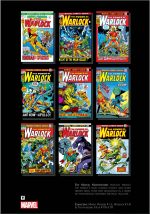
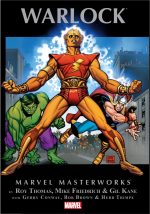
Warlock Marvel Masterworks volume 1


By Roy Thomas, Mike Friedrich, Gerry Conway, Ron Goulart, Tony Isabella, Gil Kane, Bob Brown, Herb Trimpe, John Buscema, Tom Sutton & various (Marvel)
ISBN: 978-0-7851-2411-5 (HB) 978-0-7851-8858-2 (TPB/Digital edition)

During the 1970s in America and Britain (the latter of which deemed newspaper cartoons and strips worthy of adult appreciation for centuries whilst fervently denying similar appreciation and potential for comics), the first inklings of wider public respect for the medium of graphic narratives began to blossom. This followed teen response to such pioneering series as Stan Lee & John Buscema’s biblically allegorical Silver Surfer and Roy Thomas’ ecologically strident antihero Sub-Mariner, a procession of thoughtfully-delivered attacks on drugs in many titles and constant use of positive racial role models everywhere on four-colour pages.

Comics were inexorably developing into a vibrant forum of debate (a situation also seen in Europe and Japan), engaging youngsters in real world issues relevant to them. As 1972 dawned, Thomas took the next logical step, transubstantiating an old Lee & Jack Kirby Fantastic Four throwaway foe into a potent political and religious metaphor.

Debuting in FF #66 (September 1967) dread mystery menace Him was re-imagined by Thomas and Gil Kane as a modern interpretation of the Christ myth: stationed on an alternate Earth far more like our own than that of Marvel’s unique universe.

Re-presenting Marvel Premiere #1-2, Warlock #1-8 and Incredible Hulk #176-178 – collectively spanning the tumultuous time between April 1972 and August 1974, this epic adventure also offers a context-soaked Introduction from originator Thomas.

It all began with April cover-dated Marvel Premiere #1, which boldly proclaimed on its cover The Power of… Warlock. Inside, the stunning fable – by Thomas, Kane & Dan Adkins – declared ‘And Men Shall Call Him… Warlock’: swiftly recapitulating the artificial man’s origins as a lab experiment concocted by rogue geneticists eager to create a superman they could control for conquest.

After facing the Fantastic Four, the manufactured man had subsequently escaped to the stars, later initiating a naive clash with Asgardian Thor over the rights to a mate before returning to an all-encompassing cosmic cocoon to evolve a little more…

Now the all-encompassing shell is plucked from the interplanetary void thanks to the moon-sized ship of self-created god The High Evolutionary. Having artificially ascended to godhood, he is wrapped up in a bold new experiment…

Establishing contact with Him as he basks in his cocoon, the Evolutionary explains that he is constructing from space rubble a duplicate planet Earth on the opposite side of the sun. Here he replays the development of life, intending that humanity on Counter Earth will evolve without the taint of cruelty and greed and deprived of the lust to kill…

It’s a magnificent scheme that might well have worked, but as the Evolutionary wearies, his greatest mistake intervenes. The Man-Beast was hyper-evolved from a wolf and gained mighty powers, but also ferocious savagery and ruthless wickedness. Now he invades the satellite, despoiling humanity’s rise and ensuring the new world’s development exactly mirror’s True-Earth’s. The only exception is the meticulous exclusion of enhanced individuals. This beleaguered planet has all mankind’s woes but no superheroes to save or inspire them.

A helpless witness to the desecration, the golden being furiously crashes free of his cocoon to save the High Evolutionary and rout the Man-Beast and his bestial cronies (all similarly evolved animal-humanoids called “New-Men”).

When the despondent and enraged science god recovers, he makes to erase his failed experiment but is stopped by his rescuer. As a powerless observer, Him saw the potential and value of embattled humanity. Despite all its flaws, he believes he can save them from the imminent doom caused by their own unthinking actions, wars and intolerance. His pleas at last convince the Evolutionary to give this mankind one last chance, and the wanderer is hurled down to Counter-Earth, equipped with a strange gem to focus his powers, a mission to find the best in the fallen and a name of his own… Adam Warlock

Marvel Premiere #2 (July) sees the golden man-god crash to Earth in America and immediately win over a small group of disciples: a quartet of disenchanted teen runaways fleeing The Man, The Establishment and their oppressive families. His nativity and transformation leave him briefly amnesiac, and as Warlock’s followers seek to help, all are unaware that Man-Beast has moved quickly, insinuating himself and his bestial servants into the USA’s political hierarchy and Military/Industrial complex.

This devil knows the High Evolutionary is watching and breaks cover to introduce unnatural forces on a world previously devoid of superbeings and aliens. The result is an all-out attack by rat mutate Rhodan, who pounces on his prey at the very moment Colonel Barney Roberts, uber-capitalist Josiah Grey and Senator Nathan Carter track their missing kids to the desolate Southern Californian farm where they have been nursing the golden angel…

Men of power and influence, they realise their world has changed forever after seeing Warlock destroy the monstrous beast and ‘The Hounds of Helios!’

Doctor Strange was revived to fill the space in MP #3, as the gleaming saviour catapulted into his own August cover-dated title. Inked by Tom Sutton, Warlock #1 decreed ‘The Day of the Prophet!’: recapping key events and seeing the High Evolutionary safeguard his failing project by masking Counter-Earth from the rest of the solar system behind a vibratory screen.

With his mistake securely isolated from further contamination, HE asks Adam if he’s had enough of this pointless mission, and is disappointed to see Warlock’s resolve is unshaken. That assessment is questioned when the disciples take the spaceman to his first human city. Senses reeling, Warlock is drawn to bombastic street preacher and his psychic sister Astrella who are seemingly targeted by the Man-Beast. Of course, all is not as it seems…

Thomas’s plot is scripted by Mike Friedrich and John Buscema joins Sutton in illuminating ‘Count-Down for Counter-Earth!’: taking the biblical allegory even further as Warlock is captured by his vile foes and tempted with power in partnership with evil, even as his erstwhile disciples are attacked and deny him. Counter-Earth has never been closer to damnation and doom, but once more the saviour’s determination overcomes the odds…

The epic continues with Friedrich in the hot seat and Kane & Sutton reunited to steer the redeemer’s path. ‘The Apollo Eclipse’ begins with Adam and his apostles harassed by the increasingly impatient High Evolutionary following a breaching of his vibratory barrier by the Incredible Hulk and the Rhino (in Hulk #158 and reprinted in many volumes …but not this one). That episode is soon forgotten after they are targeted by another Man-Beast crony, hiding his revolting origins and unstable psyche behind a pretty façade.

The brute attacks a rocket base where Adam seeks to reconcile his youthful followers with their parents, but the subsequent clash turns into tragedy in #4’s ‘Come Sing a Searing Song of Vengeance!’ as the exposed monster takes the children hostage. Astrella senses that visiting Presidential candidate Rex Carpenter holds the key to the stalemate, but when he intervenes at her urging, unbridled escalation, death and disaster follow…

Although super-beings were excised from the world’s evolution, extraordinary beings still exist. Warlock #5 (April 1973) sees Ron Goulart write the aftermath as the doubt-riddled redeemer emerges from another sojourn in a recuperative cocoon. In the intervening months Carpenter has become President and ordered an increase in weapons testing to combat the incredible new dangers he personally witness.

Tragically, he also ignores warnings from government scientist Victor Von Doom, and when one military manoeuvre sparks ‘The Day of the Death-Birds!’ Adam is there to help when a dam is wrecked. His might is sufficient to stop the automated launch of swarms of robotic drones programmed to strafe ground-based beings, but cannot stop the grateful citizenry turning on him when President Carter declares him a menace to society…

Friedrich scripts Goulart & Thomas’ plot and Bob Brown joins the team as penciller in #6 as Warlock battles the army and Doom contacts fellow genius Reed Richards for help. However, the Latverian is unaware of a shocking change in his oldest friend who is now ‘The Brute!’: a mutated cosmic horror enthralled by the malign thing running the White House and now ordered to ambush Warlock as Astrella brings him to truce talks…

It’s all a pack of lies and a trap. As the Golden Gladiator defeats Richards, enraged mobs egged on by the President move on Warlock’s growing band of supporters. Now, though, the alien’s very public life-saving heroics have swayed fickle opinion and Carter is compelled to reverse his stance and exonerate Warlock. Even this is a ploy, allowing him to set the energy-absorbing Brute on the redeemer in ‘Doom: at the Earth’s Core!’

Beyond all control, Richards’ rampage threatens to explode Counter-Earth, and only the supreme sacrifice of one of Adams’s constantly dwinling band of supporters saves the planet…

Warlock’s rocky road paused with the next issue. Cancelled with #8, Friedrich, Brown & Sutton dutifully detailed ‘Confrontation’ in Washington DC as the supposed saviour’s supporters clashed with incensed cops. Intent on stopping a riot, Warlock finds his work magnified when Man-Beast’s New-Men minions join the battle. The saga then ends on an eternal cliffhanger as Warlock finally exposes what Carpenter is… before vanishing from sight for 8 months…

The aforementioned Hulk #158 had seen the Jade Giant dispatched to the far side of the Sun to clash on Counter-Earth with the messiahs enemies. Although excluded here, the 3-issue sequel it spawned was concocted after the Golden Godling’s series ended.

When the feature returned the tone, like the times had comprehensively changed. All the hopeful positivity and naivety had, post-Vietnam and Watergate, turned to world-weary cynicism in the manner of Moorcock’s doomed hero Elric. Maybe that was a harbinger of things to come…?

The cosmic codicil closing this initial collection came after the Hulk’s typically short-tempered encounter with the Uncanny Inhumans and devastating duel with silent super-monarch Black Bolt. Following the usual collateral carnage, the bout ended with the Gamma Goliath hurtling in a rocket-ship to the far side of the sun for a date with allegory, if not destiny.

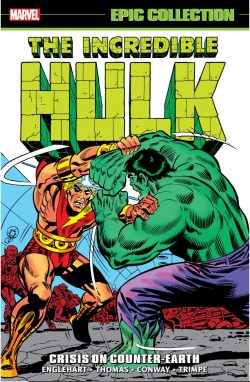
The troubled globe codified Counter-Earth had seen messianic Adam Warlock futilely battle Satan-analogue Man-Beast: a struggle the Jade Juggernaut learned of on his previous visit. Now he crashed there again to complete the cruelly truncated metaphorical epic, beginning in ‘Crisis on Counter-Earth!’ (Incredible Hulk #176, June 1974) by Gerry Conway, Herb Trimpe & Jack Abel.

Since the Hulk’s last visit Man-Beast and his animalistic flunkies had become America’s President and Cabinet. Moving deceptively but decisively, they had finally captured Warlock and led humanity to the brink of extinction, leaving the would-be messiah’s disciples in utter confusion.

With the nation reeling, Hulk’s shattering return gives Warlock’s faithful flock opportunity to save their saviour in ‘Peril of the Plural Planet!’ but the foray badly misfires and Adam is captured. Publicly crucified, humanity’s last hope perishes…

The quasi-religious experience concludes with ‘Triumph on Terra-Two’ (Conway, Tony Isabella, Trimpe & Abel, Incredible Hulk #178). Whilst Hulk furiously battles Man-Beast, the expired redeemer resurrects in time to deliver a karmic coup de grace before ascending from Counter-Earth to the beckoning stars…

Adding temptation at the end is a gallery of Kane pencil page layouts and a half dozen inked pages plus the Marvel Bullpen Bulletins page that first announced Warlock’s debut.

Ambitious and beautiful to behold, the early Warlock adventures are very much a product of their tempestuous, socially divisive times. For many, they proved how mature comics might become, but for others they were simply pretty pictures and epic fights with little lasting relevance. What they unquestionably remain is a series of crucial stepping stones to greater epics and unmissable appetisers to Marvel Magic at its finest.
© 2020 MARVEL

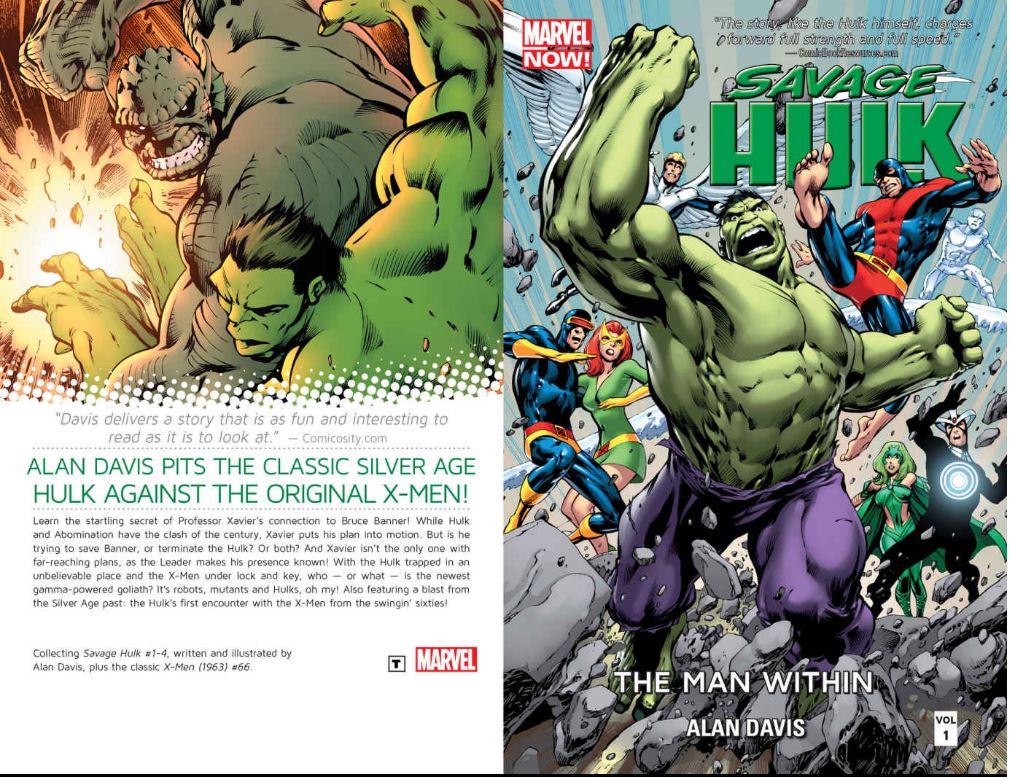
Savage Hulk: The Man Within


By Alan Davis, Roy Thomas, Sal Buscema, Mark Farmer, Sam Grainger & various (Marvel)
ISBN: 978-0-7851-9043-1 (TPB/Digital edition)

The Incredible Hulk is the perfect guest star: both staunch ally and ultimate enemy to any hero or team and always a figure of tragedy and barely suppressed terror. Here’s a very entertaining proof of the dictum…

In 1969, after six years of quirky, deliciously off-kilter adventures, The X-Men comic book folded: a relatively early casualty of the latest periodic, cyclic changing-of-reading-tastes, which saw the buying public again shun superhero stories in favour of traditional genres like war, westerns and, most especially, supernatural horror yarns…

Of course, once the fantasy fad receded again, the team emerged resurgent and unstoppable in 1975’s Giant-Size X-Men #1 to become an unshakable fixture of contemporary comics, TV animation and cinema culture. Nevertheless, when they first folded, a goodly number of us diehard funnybook fans couldn’t believe the loss of such outré and irreplaceable characters.

Despite their reappearance in recycled reprints, a certain magic had gone from the world back then and this mostly modern confection from Alan Davis seeks to redress that loss, albeit more than four decades later…

That final 1960s X-Men exploit was one of those weird quasi-team-ups and, as it pivotally informs the all-original 4-part tale by Davis, inker Mark Farmer & colourist Matt Hollingsworth which comprises the majority of this scintillating chronicle, the editors at Marvel have thoughtfully included it – in all its raw glory – at the back of the book.

I’m reviewing it first because that’s just the way I am…

Crafted by Roy Thomas, Sal Buscema & Sam Grainger ‘The Mutants and the Monster!’ (X-Men volume 1, #66, cover-dated March 1970), was actually the epilogue to an epic clash between the mutants and voracious alien invaders. The campaign had shockingly brought back long-believed dead Professor Charles Xavier, who then nearly killed himself for real by uniting every mind on Earth in a psychic thrust of unparalleled force to repel the already repellent Z’Nox.

The tragic aftermath was seen here: a debilitating coma caused by psychic exertion left the telepath near death, able only to convey a feeble psionic message which sent the team hunting for Bruce Banner in Nevada. Apparently, the two cerebral heavyweights had previously and secretly collaborated on a gamma-powered device which might now save and restore the fallen Xavier…

However, the harried young heroes, in their hasty attempt to save their mentor, forgot one crucial fact: when you hunt Banner what you usually end up with is an immensely irate Incredible Hulk

The resulting destructive debacle wrecked a lot of landscape but throughout the extended brouhaha, the Hulk seemed to be subconsciously leading the titanic teens to his hidden desert lab where the prototype Gamma Stimulator was stashed.

Despite colossal carnage and inevitable US Army interference, the gadget was recovered and the Professor saved…

Flipping now to the front of the book, the main event reveals a previously undisclosed follow-up encounter published as Savage Hulk #1-4 (August-November 2014). ‘The Man Within’ opens with TV coverage of the Nevada battle being carefully scrutinised by Gamma-spawned evil super-genius The Leader. The sinister savant soon gleans a connection between the mutant warriors and their previously unsuspected boss Charles Xavier…

The Hulk meanwhile, is fending off another furious attack by the military even as – back in Westchester County – the recuperating Xavier examines the life-saving device and realises Banner had completed it to cure himself of his emerald alter ego. The benevolent mentor quickly discovers why it didn’t work on the tragic titanic transformer. It needed a telepathic trigger…

Convinced he can return the favour and finally cure Banner, guilty, grateful Professor X accompanies Cyclops, Marvel Girl, Angel, Beast, Iceman, Havok and magnetic warrior Lorna Dane to Nevada and Banner’s clandestine lab. They are all blithely unaware that The Leader has already staked the place out…

Elsewhere, the frenzied fugitive at the heart of the matter has been found by a well-meaning elderly couple whose offer of assistance leads to unbridled terror as the timid down-and-out suddenly shapeshifts into a mountain of angry green muscle…

Nearby the X-Men are ambushed by the murderous, monstrous Abomination – also hunting for the Hulk – and their titanic tussle soon intrudes on the Jade Giant’s agonised antics. The 3-way war immediately escalates as the army close in, all guns blazing, but the merely human military are swiftly driven back by the mutants, leaving Hulk to trash his gamma-powered nemesis single handed.

In the quiet aftermath, Marvel Girl uses her own still-developing telepathy to quell the victorious Hulk’s rage and manifest deeply-traumatised Bruce. Soon, the physicist confers with Xavier and prepares to be rid of his ominous other for all time, but as their salvation device is set in motion none are aware another deadly threat is nearby, awaiting the perfect moment to strike…

Shock follows shock as the procedure goes awry with the Hulk’s gamma-energy migrating to Marvel Girl, creating a bellicose female green giantess reeling with incomprehensible psionic power.

…And that’s when The Leader makes his move at the head of an army of mechanoids and a legion of the Hulk’s old foes…

Only Xavier is aware things are not entirely what they seem, and is capable of combating the true source of the threat, aided by the Hulk’s most incredible gamma transformation yet…

Also included in this splendid and explosively entertaining epistle are the original covers by Davis, Farmer, Val Staples, Matt Hollingsworth & Brad Andersen, plus Marie Severin & Grainger’s 1969 classic image.

Cleverly crafted, beautifully illustrated, riotously action-packed and stunningly suspenseful, this tale of triumph and tragedy is pure vintage Marvel Mastery, ably augmented by the original inspirational yarn ending a unique era. It offers readers young and old a magnificent chance to re-experience the glory days of the House of Ideas and must not be missed.
© 2014 Marvel Characters, Inc. All rights reserved.
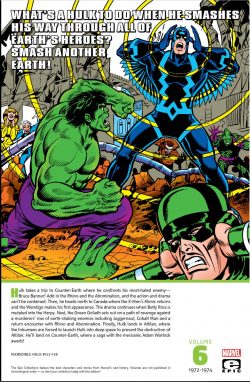
Incredible Hulk Epic Collection volume 6: Crisis on Counter-Earth 1972-1974


By Roy Thomas, Steve Englehart, Gerry Conway, Archie Goodwin, Steve Gerber, Chris Claremont, Tony Isabella, Herb Trimpe & various (MARVEL)
ISBN: 978-1302929169 (TPB/Digital)

The Incredible Hulk #1 hit newsstands and magazine spinners on March 1st 1962. The comic book was cover-dated May, so happy sort-of birthday Big Guy!

Bruce Banner was a military scientist caught in a gamma bomb detonation of his own devising. As a result of ongoing mutation, stress and other factors caused him to transform into a giant green monster of unstoppable strength and fury.

After an initially troubled few years the irradiated idol finally found his size-700 feet and a format that worked, becoming one of young Marvel’s most popular features. After his first solo-title folded, Hulk shambled around the slowly-coalescing Marvel Universe as guest star and/or villain of the moment, until a new home was found for him in “split-book” Tales to Astonish: sharing space with fellow misunderstood misanthrope Namor the Sub-Mariner, who proved an ideal thematic companion from his induction in #70.

As the 1970s tumultuously unfolded, the Jade Juggernaut settled into a comfortable – if excessively, spectacularly destructive – niche. A globe-trotting, monster-mashing plot formula saw Banner hiding and seeking cures for his gamma-curse, alternately aided or hunted by prospective father-in-law US General Thaddeus “Thunderbolt” Ross and his daughter – the afflicted scientist’s unobtainable inamorata – Betty, with a non-stop procession of guest-star heroes and villains providing the battles du jour.

Herb Trimpe made the Hulk his own, displaying a gift for explosive action and unparalleled facility for drawing technology – especially honking great military ordnance and vehicles. Beginning with Roy Thomas, a string of skilful scripters effectively played the Jekyll & Hyde card for maximum angst  and ironic impact as the monster became a pillar of Marvel’s pantheon.

This compelling compendium re-presents The Incredible Hulk #157-178, encompassing cover-dates April 1971 to November 1972-August 1974 and opens without delaying preamble as the Hulk – having just returned to Earth and normal size after a heartbreaking sojourn in a sub-atomic realm – promptly and potently battles a brace of old enemies in ‘Name My Vengeance: Rhino!’ (written by Archie Goodwin, with Trimpe inked by Sal Trapani). That clash is only resolved after gamma genius The Leader despatches Hulk and Rhino to the far side of the Sun. Here orbits a bizarre parallel world…

During the early 1970s, throwaway Fantastic Four character Him was transubstantiated into a modern interpretation of the Christ myth and placed on a world far more like our own than the Earth of Marvel’s universe. That troubled globe was codified as Counter-Earth and upon it messianic Adam Warlock battled a Satan-analogue known as Man-Beast.

Here and now, Hulk battles both the golden saviour and his evil antithesis in ‘Frenzy on a Far-Away World’, courtesy of Thomas, Steve Gerber, Trimpe & Trapani. Meanwhile on “true Earth”, heartbroken Betty – believing her lover forever gone – marries over-attentive, ever-present military martinet Major Glenn Talbot…

Steve Englehart assumed scripting duties with #159 as ‘Two Years Before the Abomination!’ sees Banner and the Rhino explosively returned to our embattled globe, only to be again attacked by General Ross’ Hulkbuster forces. The grizzled soldier is more determined than ever to kill Banner – to safeguard America and preserve his unsuspecting daughter’s new marriage. However, the resulting conflagration accidentally awakens a comatose gamma monster even deadlier than the Hulk…

‘Nightmare in Niagara!’ finds the misunderstood man-brute instinctively drawn to the honeymooning couple, only to encounter amphibian outcast Tiger Shark and another blockbusting battle issue, after which his northerly rampage takes the Green Goliath into Canada. ‘Beyond the Border Lurks Death!’ has the Hulk a reluctant ally of recently hyper-mutated Hank McCoy – best known as the bludgeoning Beast – in battle against the Mimic. This veteran X-foe possesses the ability to absorb the attributes of others, but the gift has become a curse, going tragically, catastrophically haywire and threatening to consume the entire planet…

Still under Northern Lights, Hulk encounters carnivorous, cannibalistic horror the Wendigo in ‘Spawn of the Flesh-Eater!’, but the maniacal man-eater harbours a shattering secret which makes it as much victim as villain…

Pushing ever Pole-ward, Hulk reaches the top of the world but cannot elude Ross’ relentless pursuit. After a cataclysmic arctic clash, ‘Trackdown’ sees man-monster and his stalker fall into the super-scientific clutches of Soviet prodigy the Gremlin (mutant offspring of the Hulk’s very first foe the Gargoyle). Although the Gamma Giant breaks free with ease, the General is left behind to become a highly embarrassing political prisoner…

Shambling into Polar seas, Hulk is captured by a fantastic sub-sea colony of aquatic human nomads in #164’s ‘The Phantom from 5,000 Fathoms!’ Decades previously, egomaniacal Captain Omen had created his own mobile submarine nation, roaming the ocean beds at will, and foolishly thought the Jade Goliath could be his latest freakish beast of burden. Sadly, the draconian dictator has no idea how his dissatisfied clan hungers for freedom, fresh air and sunlight. They disastrously rebel, following ‘The Green-Skinned God!’ to their doom…

Incredible Hulk #166 finally finds “Ol’ Greenskin” back in the USA, hitting New York just in time to clash with Battling Bowman Hawkeye and brain-eating electrical monster Zzzax in ‘The Destroyer from the Dynamo!’ Meanwhile in the sub-plot section, a bold bid to rescue General Ross from the godless Commies succeeds, but seemingly costs the life of his new son-in-law…

Jack Abel took over inking duties in #167 with ‘To Destroy the Monster!’ as grieving widow Betty Ross-Talbot suffers a nervous breakdown and is targeted by intellectual murder-mutate M.O.D.O.K. and his minions of Advanced Idea Mechanics who need an infallible weapon to break the Hulk.

As ghetto kid Jim Wilson fortuitously reconnects with the Emerald Behemoth, Banner’s bestial alter ego effortlessly destroys M.O.D.O.K.’s giant robot body but fails to prevent Betty’s abduction, and next issue’s ‘The Hate of the Harpy!’ reveals her as gamma-mutated avian horror programmed to destroy her former lover…

Issue #169 finds the temporarily triumphant Harpy and her verdant victim trapped aboard an ancient floating fortress in the sky, enduring ‘Calamity in the Clouds!’ before battling together against monstrous android Bi-Beast. When M.O.D.O.K. attacks, intent on possessing its alien tech, the response eradicates the last vestige of the sky-citadel, propelling a now-human Banner and Betty onto a lost tropical island inhabited by incredible alien creatures…

Englehart, Chris Claremont, Trimpe & Abel’s monster-romp ‘Death from on High!’ features an army of alien castaways in all-out terrain trashing aggressive action who fall to someone even tougher, after which subplots and human drama recommence with excessive bombast but no appreciable fanfare as ‘Revenge!’ (by Gerry Conway – from an Englehart plot) finds the Green Goliath a stowaway on a plane back to military Mecca Hulkbuster Base.

The jet carries Project: Greenskin’s new commanding officer. Spit-&-polish Colonel John D. Armbruster has taken over from the recently rescued but now politically sidelined Thunderbolt Ross….

The camp is eerily deserted and the reason becomes clear as bludgeoning brutes The Abomination and The Rhino attack the new arrivals. Subduing the entire garrison, they try to detonate the base’s gamma-bomb self-destruct device but are utterly unprepared for the Hulk’s irascible intervention…

Roy Thomas plotted Tony Isabella’s script for #172 wherein the Hulk – captured by the ungrateful soldiers he saved – is hurled into another dimension, allowing a mystic menace to inadvertently escape. ‘And Canst Thou Slay… The Juggernaut?’ (with a telling cameo by The X-Men) proves even a magically augmented menace can’t resist our favourite monster’s might.  Thomas then scripts all-Trimpe delight ‘Anybody Out There Remember… The Cobalt Man?’, as another old X-adversary – Ralph Roberts – picks up the Jade Giant at sea before sailing his research vessel right into a nuclear test explosion…

Dying of radiation exposure, the deranged technologist is determined to demonstrate atomic bombs are bad to a callous, uncaring world… by detonating one over Sydney in ‘Doomsday… Down Under’ (Conway, Thomas, Trimpe & Abel). A second clash with the azure-armoured Cobalt Man results in a blistering battle in the stratosphere, a cataclysmic explosion and Hulk crashing to earth far, far away as a ‘Man-Brute in the Hidden Land!’ (#175, by Thomas, Trimpe & Abel)…

Here – after the usual collateral carnage – a typically short-tempered encounter with the Uncanny Inhumans and devastating duel with silent super-monarch Black Bolt ends with the gamma gladiator stuck in a rocket-ship hurtling to the far side of the sun for a date with allegory, if not destiny…

Hulk had briefly visited once before and now crashes there again to complete a long lain fallow allegorical epic. It begins with ‘Crisis on Counter-Earth!’ by Conway, Trimpe & Abel. Since Hulk’s departure, Man-Beast and his animalistic minions (all spawned by godlike genetic meddler The High Evolutionary) had become America’s President and Cabinet. Moving decisively, they finally captured Warlock and led humanity to the brink of extinction, leaving the would-be messiah’s disciples in utter confusion.

With the nation in foment, the Hulk’s shattering return gives the messiah’s faithful flock opportunity to save their saviour in ‘Peril of the Plural Planet!’ but the foray badly misfires and Warlock is captured. Publicly crucified at the behest of the people, humanity’s last hope perishes…

Meanwhile on true Earth, Ross and Armbruster discover trusted comrade Glenn Talbot has escaped from a top security Soviet prison and is making his triumphant way back to the USA…

Scripted by Conway & Isabella, the quasi-religious experience concludes with ‘Triumph on Terra-Two’ as the dead prophet resurrects whilst Hulk wages his last battle against Man-Beast, just in time to deliver a cosmic coup de grace before ascending from Counter-Earth to the beckoning stars…

To Be Continued…

This superbly cathartic tome also offers some seminal extras, beginning with a Hulk-themed crossword puzzle from in-house fan vehicle F.O.O.M. (Friends of Ol’ Marvel; February 1973). The second issue – September – was an all-Hulk affair and from it comes a stunning cover and editorial illustrated by Jim Steranko, a ‘Hunt the Hulk’ game and ‘Many Faces of the Hulk’: a collage of previous artists (Kirby, Ditko, Dick Ayers, Trimpe, Marie & John Severin, Kane, Steranko, Bob Powell, Mike Esposito/Demeo, John Romita Sr., Bill Everett, John & Sal Buscema), plus a history by Martin Greim, a checklist of appearances to date and strip spoof ‘Hunk’ by Thomas, Len Brown, Gil Kane & Wally Wood.

Also on view are 8 original art pages by Trimpe and assorted inkers from the stories contained herein.

The Incredible Hulk is one of the most well-known comic characters on Earth, and these stories, as much as the movies, cartoons, TV shows, games, toys and action figures, are the reason why. For an uncomplicated, honestly vicarious and cathartic experience of Might literally making Right, you can’t do better than these yarns.
© MARVEL 2021

The Savage She-Hulk Marvel Masterworks volume 1 


By Stan Lee, David Anthony Kraft, John Buscema, Mike Vosburg, Chic Stone, Frank Springer & various (Marvel) 
ISBN: 978-1-3029-0354-1 (HB/Digital edition) 

Until comparatively recently, American comics – especially Marvel – had very little in the way of strong female role models and almost no viable solo stars. Although there was a woman starring in the very first comic of the Marvel Age, Invisible Girl Susan Storm took years to become a potent and independent character in her own right. She didn’t even become Invisible WOMAN until the 1980s… 

The company’s very first starring heroine was Black Fury, a leather-clad, whip-wielding crimebuster lifted from a newspaper strip created by Tarpe Mills in April 1941. The slinky vigilante was repackaged as a resized reprint for Timely’s funnybooks and renamed Miss Fury: enjoying a 4-year run between 1942 and 1946, with her tabloid incarnation surviving until 1952. 

Miss Fury was actually pre-dated by the Silver Scorpion who debuted in Daring Mystery Comics #7 (April 1941), but was always relegated to a minor position in the book’s line-up. She enjoyed a very short shelf-life. 

Miss America first appeared in anthological Marvel Mystery Comics #49 (November 1943), created by Otto Binder and artist Al Gabriele. After a flurry of appearances, she won her own title in early 1944. Miss America Comics lasted but the costumed cutie didn’t, as with the second issue (November 1944) the format abruptly altered, becoming a combination of teen comedy, fashion feature and domestic tips magazine. Feisty take-charge super-heroics were steadily squeezed out and the publication is most famous now for introducing virginal evergreen teen ideal Patsy Walker. 

A few more woman warriors appeared immediately after WWII, many as spin-offs and sidekicks of established male stars, like female Sub-Mariner Namora (debuting in Marvel Mystery Comics #82, May 1947 and graduating to her own 3-issue series in 1948). She was followed by the Human Torch‘s secretary Mary Mitchell who, as Sun Girl, starred in her own 3-issue 1948 series before becoming a wandering sidekick and guest star in Sub-Mariner and Captain America Comics. 

Decked out in mask and ball-gown, detective Blonde Phantom was created by Stan Lee & Syd Shores for All Select Comics #11 (Fall 1946), and (sort-of) goddess Venus debuted in her own title in August 1948, becoming the gender’s biggest Timely/Atlas/Marvel success… until the advent of the Jungle Girl fad of the mid-1950s. This was mostly by dint of the superb stories and art from the incredible Bill Everett, and by ruthlessly shifting genres from crime to romance to horror every five minutes… 

Jann of the Jungle (by Don Rico & Jay Scott Pike) was just part of an anthology line-up in Jungle Tales #1 (September 1954), but she took over the title with the eighth issue (November 1955). Jann of the Jungle then ran until June 1957 (issue #17), spawning a host of in-company imitators like Leopard Girl, Lorna the Jungle Queen ad nauseum… 

During the costumed hero boom of the 1960s, Marvel dallied with a title shot for Madame Medusa in Marvel Super-Heroes (#15, July 1968) and a solo series starring the Black Widow (Amazing Adventures #1-8; August 1970-September 1971). Both were sexy, reformed villainesses, not wholesome girl-next-door heroines… and neither lasted alone for long. 

When the costumed crazies craze started to subside in the 1970s, Stan Lee & Roy Thomas looked into founding a girl-friendly boutique of heroines written by women. Opening shots in this mini-liberation war were Claws of the Cat by Linda Fite, Marie Severin & Wally Wood and Night Nurse by Jean Thomas & Win Mortimer (both #1’s cover-dated November 1972). Modern jungle goddess Shanna the She-Devil #1 – by Carole Seuling & George Tuska – debuted in December 1972; but despite impressive creative teams, none of these fascinating experiments lasted beyond a fifth issue. 

Red Sonja, She-Devil with a Sword, caught every one’s attention in Conan the Barbarian #23 (February 1973), eventually securing her own series whilst The Cat mutated into Tigra, the Were-Woman in Giant-Size Creatures #1 (July 1974), but the general editorial position remained that books starring chicks didn’t sell. 

To be fair, the company kept trying and eventually found the right mix at the right time with Ms. – now Captain - Marvel. She launched in her own title (cover-dated January 1977), to be followed by equally copyright-protecting Spider-Woman in Marvel Spotlight #32 (February 1977, and securing her own title 15 months later).  

Savage She-Hulk #1 came in February 1980, and was followed by music-biz sponsored Dazzler, who premiered in Uncanny X-Men #130 the same month, before graduating to her own book. 

This hulking hardcover volume (or enthralling eBook, if you prefer), collects Savage She-Hulk volume 1 #14, spanning February 1980 to March 1981 and opens with fact-packed, behind the scenes Introduction ‘The Savage Subversive’, courtesy of David Anthony Kraft.  

The new era begins with a publicity-attracting first issue crafted by old guard stars Stan Lee & John Buscema, inked by equally acclaimed veteran Chic Stone. Here, with deliberate tones of the Hulk’s early exploits and in the manner of the mega-hit TV show, we meet crusading Los Angeles lawyer Jennifer Walters, whose latest case is defending minor hoodlum Lou Monkton.  

Just as her infamous fugitive cousin hits town, Walters is gunned down by killers working for Monkton’s rival Nick Trask, and saved by a hasty blood transfusion from her kinsman. He is Dr. Bruce Banner and he should have known better… 

Fleeing when the cops arrive, he doesn’t know how the rapidly recovering Jennifer is targeted again in her hospital room or how the stress of the second murder attempt triggers a shocking transformation. Easily thrashing the would-be killers, a gigantic green woman then rampages through the medical facility and the city before reverting to human. However, LA is now fearfully aware that ‘The She-Hulk Lives’… 

The second issue is where the story truly begins as scripter David Anthony Kraft and artists Mike Vosburg & Chic Stone kick off a string of unconventional thrillers slightly askew of standard Marvel Fights ‘n’ Tights fare. Resuming the Monkton case piles on more stress for the recuperating legal eagle, as do smug assistant DA “Buck” Bukowski and her own father Sheriff Morris Walters. Thankfully, iron willpower and strong drugs keep her raging fury at bay until a confrontation with Trask prompts another murder attempt.  

This time though, the mobster’s thugs accidentally snatch her best friend Jill, triggering a second change – just as overly-attentive neighbour Danny “Zapper” Ridge walks by… 

A frantic freeway car chase ensues with the green goliath easily pacing high performance engines, but ends in failure and tragedy at the end of the ‘Deathrace!!’ with a body everyone believes is Jennifer Walters… 

Since Jen had cleared Monkton, her emerald alter ego is now the only thing LA is talking about and ‘She-Hulk Murders Lady Lawyer!’ sees the situation escalate as Trask’s men are assassinated in jail by something with giant green arms that can punch through walls. In hiding and cared for by unwilling confidante Zapper, Walters is traced by Trask’s deadly She-droid (a stolen Stark tech robot painted green and wearing a wig) but proves too much for mere mechanisms. In the aftermath of brutal battle, She-Hulk – savage, super-strong and far smarter than her male counterpart – resolves to deal with Trask once and for all… 

However, as detailed in #4, when ‘The She-Hulk Strikes Back!’ she finds sheriff Walters still believes the monster killed his daughter. Seizing his opportunity, Trask – now revealed as more Bond-villain than local Godfather – offers to join forces with the grief-stricken policeman and provide a superweapon to kill the unsuspecting monster woman… 

Surviving the traumatic family encounter drives She-Hulk to her ‘Breaking Point!’, but her very public terror tantrums simply divert focus as Jennifer Walters quietly re-emerges and resumes her life. Her latest client is Roxxon Oil: suffering inexplicable losses in their storage facilities. When Jennifer investigates, She-Hulk ends up battling Trask’s subterranean theft device and seemingly ends his threat forever. 

‘Enter: The Invincible Iron Man’ sees the Golden Avenger finally hit town to find out who stole his tech, and manoeuvred by Sheriff Walters into going after She-Hulk, even as Jen defends Tony Stark from accusations of criminal collusion with Trask, after which ‘Richard Rory… Winner’ sees Steve Gerber’s everyman loser strike it rich, move to California and – having seen the good side on another green beast – immediately side with the fugitive She-Hulk in her latest clash with the cops. As romance blossoms, Jen returns with Rory to Florida only to stumble, as She-Hulk, into the mystically-tainted swamp that birthed the muck-monster.  

Captured by the last eternally-young occupants of secret retreat La Hacienda – who wish her company forever – She-Hulk’s time ‘Among the Ogres!’ ends in strife when she rejects their bovine passivity and clashes with Rory’s old associate the mossy Man-Thing… 

Danny Bulanadi “and friends” ink #10 as ‘The Power of the Word’ introduces a charismatic preacher/cult leader with vast ambitions and very strange ideas about personal empowerment. College science student Zapper meanwhile, has offered to have Jenifer’s blood secretly tested, and his efforts have brought him to the attention of radical researcher Dr. Michael Morbius… 

The Word believes his positive affirmations have unleashed his daughter’s physical and mental potential, but her emotional state is as fragile as any teen and when Ultima mistakes’ Jen Walters’ patient enquiries as a play for her boyfriend it results in brutal battle with the Green Queen and a ‘War of… the Word!’ (inked by Frank Springer) as Jen gets a day in court against the malevolent master of motivation, but – as is increasingly commonplace – loses out to chicanery and her own evermore uncontrollable other self… 

Zapper’s meeting with Morbius revealed a degenerative blood disease in Jen’s sample and that plot thread culminates now ‘In the Shadow of Death!’ as the critically enfeebled gamma transmute collapses and is arrested. At UCLA, Morbius has his own problems. Students have started rioting after learning of his previous life as a blood-drinking “living vampire”. Marked for death by Mr & Mrs LeClerc (parents of one of his victims), the “outed” professor is saved by Zapper in time to treat the recently escaped and almost expired She-Hulk… 

Initially ineffective, the cure eventually resurrects her, but ‘Reason and Rage!’ war uncontrollably within both of her, especially after Jen’s inexplicably hostile father rails at her for representing “mass-murderer” Morbius in court. With nobody satisfied by the eventual verdict, the scientist is released only to be targeted again by the LeClercs who convince philosophically-motivated android Gemini to go after him and Jen in the name of a higher balance. Things go very bad very quickly when She-Hulk tips the scales of justice… 

A long-dangling plot thread is plucked in #13 as Richard Rory’s return completes a romantic triangle with Jen and Zapper, even as trans-dimensional star god Man-Wolf resurfaces and Defenders Hellcat and Valkyrie cameo in ‘Through the Crystal!’  

When the divine wolf’s forces seek to abduct She-Hulk to liberate their leader, the result is a cosmic chain reaction and potential end of existence unless Hellcat Patsy Walker can orchestrate a cleansing clash between wolf and she-beast in ‘Life in the Bloodstream’… 

The fearsomely furious Savage She-Hulk would eventually evolve into a scintillating semi-comedic superstar and tragic paragon but for now these early epics pause with an extras section including original art pages by Buscema & Stone and Vosburg/Stone; original plot ages for #2 and character bio sheet; Vosburg’s pencil thumbnail layouts; unused script pages and a draft for comedic ‘How Dave and Mike Write & Draw the She-Hulk!’ story plus house ads, John Romita’s pencil art and Frank Springer’s inked version for the first ad. 

Lean, mean, and evergreen, these are intriguing and long-overlooked Marvel Masterpieces in need of your attention. Why are you waiting?  
© 2017 Marvel Characters, Inc. All rights reserved.Â