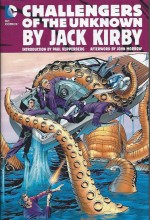
Challengers of the Unknown by Jack Kirby


By Jack Kirby, Dave Wood, France “Ed” Herron, Roz Kirby Wally Wood, Marvin Stein, George Klein & various (DC Comics)
ISBN: 978-1-4012-3474-4

The Challengers of the Unknown were a bridging concept between the fashionably all-American human trouble-shooters who monopolised comicbooks for most of the 1950s and the costumed mystery men who would soon return to take over the industry.

As superheroes were being revived in 1956 here was a super-team – the first of the Silver Age – with no powers, the most basic and utilitarian of costumes and the most dubious of motives – Suicide by Mystery.

Yet they were a huge hit and struck a chord that lasted for more than a decade before they finally died… only to rise again and yet again. The idea of them was stirring enough, but their initial execution made their success all but inevitable.

Jack Kirby was – and still is – the most important single influence in the history of American comics. There are quite rightly millions of words written (such as Paul Kupperberg’s enthusiastic Introduction and John Morrow’s pithy Afterword in this superb hardback compilation) about what the man has done and meant, and you should read those if you are at all interested in our medium.

I’m going to add a few words to that superabundance in this review of one of his best and most influential projects which, like so many others, he perfectly constructed before moving on, leaving highly competent but never quite as inspired talents to build upon.

When the comic industry suffered a witch-hunt-caused collapse in the mid-50’s, Kirby returned briefly to DC Comics where he worked on mystery tales and Green Arrow (then simply a back-up strip in Adventure Comics) whilst creating the newspaper strip Sky Masters of the Space Force.

He also re-packaged for Showcase (a try-out title that launched the careers of many DC mainstays) an original super-team concept that had been kicking around in his head since he and long-time collaborator Joe Simon had closed their innovative but unfortunately ill-timed Prize/Essankay/Mainline Comics ventures.

After years of working for others Simon & Kirby had finally established their own publishing company, producing comics with a much more sophisticated audience in mind, only to find themselves in a sales downturn and awash in public hysteria generated by an anti-comicbook pogrom spearheaded by US Senator Estes Kefauver and pop psychologist Dr. Frederic Wertham.

Simon quit the business for advertising, but Kirby soldiered on, taking his skills and ideas to a number of safer, if less experimental, companies.

The Challengers were four ordinary mortals; explorers and adventurers who walked away unscathed from a terrible plane crash. Already obviously what we now call “adrenaline junkies”, pilot Ace Morgan, diver Prof Haley, acrobat/mountaineer Red Ryan and wrestler Rocky Davis summarily decided that since they were all living on borrowed time, they would dedicate what remained of their lives to testing themselves and fate. They would risk their lives for Knowledge and, naturally, Justice.

The series launched with ‘The Secrets of the Sorcerer’s Box!’ in Showcase #6 (cover-dated January/February 1957 – so it was on spinner-racks and news-stands in time for Christmas 1956).

Kirby and scripter Dave Wood, plus inkers Marvin Stein and Jack’s wife Roz, crafted a creepily spectacular epic wherein the freshly introduced doom-chasers were hired by the duplicitous magician Morelian to open an ancient container holding otherworldly secrets and powers.

This initial story roars along with all the tension and wonder of the B-movie thrillers it emulates and Jack’s awesome drawing resonates with power and dynamism, which grew even greater for the sequel, a science fiction drama instigated after an alliance of leftover Nazi technologies and contemporary American criminality unleashes a terrible robotic monster.

‘Ultivac is Loose!’ (Showcase #7, March/April 1957) introduced a necessary standard appendage of the times and the B-movie genre in the form of brave, capable, brilliant and beautiful-when-she-took-her-labcoat-off boffin Dr. June Robbins, who became the fifth Challenger at a time when most comics females had returned to a subsidiary status in that so-conservative era.

The uncanny exploits then paused for a sales audit and the team didn’t reappear until Showcase #11 (November/December 1957) as The Flash and Lois Lane got their respective shots at the big time. When the Challengers returned it was in alien invasion epic ‘The Day the Earth Blew Up’.

Uniquely engaging comics realist Bruno Premiani (a former associate and employee from Kirby’s Prize Comics days) came aboard to ink a taut doomsday chiller that keeps readers on the edge of their seats even today, and by the time of their last Showcase issue (#12, January /February 1958) the Questing Quartet were preparing to move into their own title.

‘The Menace of the Ancient Vials’ was defused by the usual blend of daredevil heroics and inspired ingenuity (with the wonderful inking of George Klein adding subtle clarity to the tale of an international criminal who steals an ancient weapons cache that threatens the entire world if misused), but the biggest buzz would come two months later with the first issue of their own magazine.

Challengers of the Unknown #1 (May 1958) was written and drawn by Kirby, with Stein on inks and presented two complete stories plus an iconic introductory page that would become almost a signature logo for the team. ‘The Man Who Tampered with Infinity’ pitted the heroes against a renegade scientist whose cavalier dabbling loosed dreadful monsters from the beyond onto our defenceless planet, before the team were actually abducted by aliens in ‘The Human Pets’ and had to win their freedom and a rapid rocket-ship (sphere actually) ride home…

The same creators were responsible for both stories in the second issue. ‘The Traitorous Challenger’ is a monster mystery, with June returning to sabotage a mission in the Australian Outback for the very best reasons , after which ‘The Monster Maker’ finds the team seemingly helpless against super-criminal Roc who can conjure and animate solid objects out of his thoughts.

Issue #3 features ‘Secret of the Sorcerer’s Mirror’ with Roz Kirby and Marvin Stein again inking The King’s mesmerising pencils, as the fantastic foursome pursue a band of criminals whose magic looking-glass can locate deadly ancient weapons, but undoubtedly the most intriguing tale for fans and historians of the medium is ‘The Menace of the Invincible Challenger’ wherein team strongman Rocky Davis is rocketed into space only to crash back to Earth with strange, uncanny powers.

For years the obvious similarities of this group – and especially this adventure – to the origin of Marvel’s Fantastic Four (FF #1 was released in November 1961) have fuelled speculation. In all honesty I simply don’t care. They’re both similar but different and equally enjoyable so read both. In fact, read them all.

With #4 the series became artistically immaculate as the sheer brilliance of Wally Wood’s inking elevated the illustration to unparalleled heights. The scintillant sheen and limpid depth of Woody’s brushwork fostered an abiding authenticity in even the most outrageous of Kirby’s designs and the result is – even now – simply breathtaking.

‘The Wizard of Time’ is a full length masterpiece of the art form as a series of bizarre robberies lead the team to a scientist with a time-machine. By visiting oracles of the past rogue researcher Darius Tiko found a path to the far future. When he got there he intended robbing it blind, but the Challengers found a way to follow and foil him…

‘The Riddle of the Star-Stone’ (#5) is a full-length contemporary thriller, wherein an archaeologist’s assistant uncovers an alien tablet which bestows various super-powers when different gems are inserted into it. The exotic locales and non-stop action are intoxicating, but Kirby’s solid characterisation and ingenious writing are what make this such a compelling read.

Scripter Dave Wood returned for #6’s first story. ‘Captives of the Space Circus’ has the boys kidnapped from Earth to perform in a interplanetary show, but the evil ringmaster is promptly outfoxed and the team returns for France “Ed” Herron’s mystic saga ‘The Sorceress of Forbidden Valley’, wherein June becomes an amnesiac puppet in a power struggle between a fugitive gangster and a ruthless feudal potentate.

Issue #7 is another daring double-feature both scripted by Herron. First up is relatively straightforward alien-safari tale ‘The Beasts From Planet 9’, followed by a much more intriguing yarn on the ‘Isle of No Return’ as the team face a scientific bandit whose shrinking ray has left them all mouse-sized.

Issue #8 (July 1959) offered a magnificent finale to a superb run as Kirby & Wally Wood went out in stunning style with a brace of gripping thrillers – both of which introduced menaces who would return to bedevil the team in future tales.

‘The Man Who Stole the Future’ by Dave Wood, Kirby and the unrelated Wally Wood, introduces Drabny – an evil mastermind who steals mystic artefacts and conquers a small nation before the team dethrones him. This is a tale of spectacular battles and uncharacteristic, if welcome, comedy, but the real gem here is space opera tour-de-force ‘Prisoners of the Robot Planet’, (probably) written by Kirby & Herron. Petitioned by a desperate alien, the Challs travel to his distant world to liberate the population from bondage to their own robotic servants, who have risen in revolt under the command of the fearsome autonomous automaton, Kra…

These are classic adventures, told in a classical manner. Kirby developed a brilliantly feasible concept with which to work and heroically archetypical characters. He then tapped into an astounding blend of genres to display their talents and courage in unforgettable exploits that informed and affected every team comic that followed – and certainly influenced his successive landmark triumphs with Stan Lee.

But then Jack was gone…

The Challengers would follow the Kirby model until cancellation in 1970, but due to a dispute with Editor Jack Schiff the writer/artist resigned at the height of his powers. The Kirby magic was impossible to match, but as with all The King’s creations, every element was in place for the successors to run with. Challengers of the Unknown #9 (September 1959) saw an increase in the fantasy elements favoured by Schiff, and perhaps an easing of the subtle tension that marked previous issues (Comics Historians take note: the Challs were bitching, bickering and snarling at each other years before Marvel’s Cosmic Quartet ever boarded that fateful rocket-ship).

But that’s meat for another different book…

Challengers of the Unknown is sheer escapist wonderment, and no fan of the medium should miss the graphic exploits of these perfect adventurers in that ideal setting of not-so-long-ago in a simpler, better galaxy than ours.

© 1957, 1958, 1959, 2004, 2012 DC Comics. All Rights Reserved

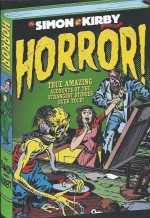
The Simon & Kirby Library: Horror!


By Joe Simon, Jack Kirby, Mort Meskin and various (Titan Books)
ISBN13: 978-1-84856-959-1

After too many years left languishing, there’s some magnificent vintage Jack Kirby material around these days, and the latest in Titan Books’ splendidly sumptuous Simon & Kirby Library gathers that iconic coupling’s groundbreaking contributions to the genre of mystery, suspense and the supernatural.

His collaborations with fellow industry pioneer Joe Simon always produced dynamite concepts, unforgettable characters, astounding stories and huge sales no matter what genre avenues they pursued (they actually invented the Romance comicbook), blazing trails for so many others to follow and always reshaping the very nature of American comics with their innovations and sheer quality.

Comicbooks started slowly in 1933, until the creation of superheroes like Superman unleashed a torrent of creative imitation and invented a new genre. Implacably vested in the Second World War, the masked mystery man swept all before him (very occasionally her or it) until the troops came home and older genres supplanted the Fights ‘n’ Tights crowd.

Although new kids kept up the buying, much of the previous generation also retained their four-colour habit but increasingly sought more mature themes in the reading matter. The war years altered the psychology of society and a more world-weary, cynical reading public came to see that all the fighting and dying hadn’t really changed anything. Their chosen forms of entertainment – film and prose as well as comics – increasingly reflected this.

Western, War and Crime comics, madcap teen comedy and anthropomorphic funny animal features were immediately resurgent, the aforementioned love comics appeared in 1947 and pulp-style Science Fiction began to spread, but gradually another global revival of spiritualism and interest in the supernatural (possibly provoked by the monstrous losses of the recent conflict, just as had happened in the 1920s following WWI) led to a wave of increasingly impressive, evocative and even shocking horror comics.

There were grisly, gory and supernatural stars before, including a pantheon of ghosts, monsters and wizards draped in costumed hero trappings (the Spectre, Mr. Justice, The Heap, Frankenstein, Sargon the Sorcerer, Zatara, Dr. Fate and dozens of others), but these had been victims of circumstance: the Unknown as power source for super-heroics.

Now the focus shifted to ordinary mortals thrown into a world beyond their ken with the intention of unsettling, not vicariously empowering, the reader.

Almost every publisher jumped on the monumentally popular juggernaut, but B & I (which became the magical one-man-band Richard E. Hughes’ American Comics Group) launched the first regularly published horror comic in the Autumn of 1948, although Adventures Into the Unknown was technically pipped by Avon whose impressive single issue release Eerie debuted and closed in January 1947. They wised up late and launched a regular series in 1951.

By this time Classics Illustrated had already long milked the literary end of the medium with adaptations of the Headless Horseman, Dr. Jekyll and Mr. Hyde (both 1943), The Hunchback of Notre Dame (1944) and Frankenstein (1945) among others.

It was at this time that Joe Simon and Jack Kirby identified another “mature market” gap for the line of magazines they autonomously packaged for publishers Crestwood-Prize-Essenkay to supplement Headline Comics, Justice Traps the Guilty, Police Trap, Young Romance and their other anthologies. They too saw the sales potential for spooky material, resulting in the superb and eerily seminal Black Magic (launched with an October-November 1950 cover-date) and the boldly obscure psychological drama anthology Strange World of Your Dreams in1952.

Marvel had jumped on the bloody bandwagon early but National/DC Comics only reluctantly bowed to the inevitable, launching a comparatively straight-laced short story title that nevertheless became one of their longest-running and most influential titles with the December 1951/January 1952 launch of The House of Mystery.

Soon after, however, a hysterical censorship scandal led to witch-hunt Hearings (feel free to type Senate Subcommittee on Juvenile Delinquency, April-June 1954 into your search engine at any time) which panicked most comics publishers into adopting a castrating straitjacket of self regulatory rules…

Just like today, America back then cast about wildly looking for external contaminants rather than internal causes for a perceived shift in social attitudes and youthful rebellion, happily settling on bloodthirsty comics about crime or horror, drenched in unwholesome salacious sex, as the reason their children were talking back, acting up and staying out.

S&K didn’t do those kinds of comicbooks but they got tarred – and metaphorically feathered too – in the media-fuelled frenzy…

This striking full-colour hardback begins with the essay ‘That Old Black Magic’ by series editor Steve Saffel, delineating the history of the title and tone of the times whilst ‘Simon and Kirby’s Little Shop of Horror’ describes the working of the small but prolific studio of rotating artists who augmented the output of the named stars: creators such as Mort Meskin, Bill Draut, Martin Stein, Ben Oda, George Roussos, Vic Donahue, Bill Walton, Jim Infantino, Bruno Premiani, John Prentice, Jerry Grandenetti and more…

With a vast output across many titles, S&K simply couldn’t produce every story and many yarns here are ghosted by other hands, although each and every one does begin with a stunning Kirby splash panel.

As with all their titles, Simon & Kirby offered genre material tweaked by their own special sensibilities. Black Magic – and the Mort Meskin-inspired The Strange World of Your Dreams – eschewed cheap shocks, mindless gore and goofy pun-inspired twist-ending yarns in favour of dark, oppressive suspense soaked in psychological unease and inexplicable unease: tension over teasing…

The stories presented fantastic situations and too frequently for comfort there were no happy endings, pat cosmic justice or calming explanations: sometimes the Unknown just blew up in your face and you survived or didn’t… and never whole or unchanged.

The compendium of black cartoon cavortings commences with ‘Last Second of Life!’ (from volume 1 #1, October-November 1950) wherein a rich man obsessed over what the dying see at the final breath, but learned to regret the unsavoury lengths he went to finding out, after which ‘The Scorn of the Faceless People!’ (#2 December 1950-January 1951) relates the meaning behind a chilling nightmare. It’s not hard to believe this one must have prompted the creation of the spin-off Strange World of Your Dreams. Issue #2 also provided a chilling report on a satanic vestment dubbed ‘The Cloak!’ whilst an impossible love in the icy wastes of Canada ended with ‘A Silver Bullet for Your Heart!’ in #3 (February-March 1951).

Issue #4 provided ‘Voodoo on Tenth Avenue’ as a disgruntled wife went too far in her quest to get rid of her man, whilst in #5 ‘The World of Spirits’ recounted the uncanny predictions of Emanuel Swedenborg in a brief fact feature before #6 described psychic connection and a ‘Union with the Dead!’ and a ravaged mariner survived meeting ‘The Thing in the Fog!’ (#7) – an encounter with the legendary Flying Dutchman…

Black Magic #8 (December 1951-January 1952) detailed the sacrifice a woman made to save her man from ‘Donovan’s Demon!’ (mostly illustrated by Bob McCarty) whilst ‘Dead Man’s Lode!’ (#10 March 1952 – the series now being monthly) related a ghostly experience in an old mine and ‘The Girl Who Walked on Water!’ in #11 showed the immense but fragile power of self-belief…

Meskin & Roussos illustrated #12’s ‘A Giant Walks the Earth!’ as a downed pilot lost his best friend to a roving colossus in India, after which the utterly chilling and unforgettable ‘Up There!’ kicks off three stories from the landmark 13th issue…

That saga of a beguiling siren of the upper stratosphere is followed by ‘A Rag – a Bone and a Hank of Hair!’ (Meskin) and a pile of trash that learned to love, whilst ‘Visions of Nostradamus!’ (by Al Eadeh) tracked and interpreted the prognosticator’s predictions.

‘The Angel of Death!’ in #15 detailed a horrific medical mystery and ‘Freak!’ (#17, possibly by Bill Draut) exposed a country doctor’s deepest shame.

Black Magic #18 (November 1952) is another multi-threat issue. ‘Nasty Little Man!’ gets my vote for scariest horror art job of all time and saw three hobos discover to their everlasting regret why you shouldn’t pick on short old men with Irish accents.

Then ‘Come Claim My Corpse’ (Martin Stein?) offers a short, sharp, shocker wherein a convict discovers too late the flaw in his infallible escape plan, before an investigator tracing truck-wreckers learns of ‘Detour Lorelei on Highway 52’ (McCarty)…

‘Sammy’s Wonderful Glass!’ in #19 (December 1952) outlined the tragic outcome of a retarded lummox whose favourite toy could expose men’s souls, after which two shorts from #20 (January 1953) follow.

‘Birth After Death’ retold the true story of how Sir Walter Scott‘s mother survived premature burial, whilst ‘Oddities in Miniature: The Strangest Stories Ever Told!’ offered half a dozen uncanny tales on one page.

Issue #21 provided ‘The Feathered Serpent’ in which an American archaeologist uncovers the truth about an ancient god, #22 (March 1953) slipped into sci-fi morality play mode with the UFO yarn ‘The Monsters on the Lake!’, and ‘Those Who Are About to Die!’ from #23 sketched out the tale of a painter who could predict imminent doom…

A brace of tales from #24 – May 1953 – begin with a scholar who attempts to contact the living ‘After I’m Gone!’, complemented by the half page fact feature ‘Strange Predictions’ (Harry Lazarus) after which ‘Strange Old Bird!’ is the first of three stories from the (again bimonthly) Black Magic #25 (June-July 1953).

In this gently eerie thriller a little old lady gets the gift of life from her tatty old feathered friend, whilst ‘The Human Cork!’ precis’ the life of the literally unsinkable Angelo Faticoni , before a man without a soul escapes the morgue to become ‘A Beast in the Streets!’

There’s a similar surfeit of sinister riches from #26, beginning with ‘Fool’s Paradise!’ wherein a cheap bag-snatcher makes a deal with the devil, after which ‘The Sting of Scorpio!’ sees a rude sceptic wish she’d never taunted a fortune teller, whilst ‘The Strange Antics of the Mystic Mirror!’ terrified nurses in a major metropolitan hospital and ‘Demon Wind!’ (Kirby inked by Premiani) finds a brash Yankee learn not to mock the justice system of primitive native peoples…

‘The Cat People’ (#27) mesmerised and forever marked an unwary tourist in rural Spain, and the same issue exposed a seductive Scottish supernatural shindig hosted by ‘The Merry Ghosts of Campbell Castle’, whilst #28 saw an unwilling organ donor return to take back his property in ‘An Eye For an Eye!’ after which the same issue revealed with mordant wit how a mummy returned to make his truly beloved ‘Alive After Five Thousand Years!’…

From an issue actually cited during the anti-comicbook Senate Hearings, ‘The Greatest Horror of Them All!’ (#29 March-April 1954) told a tragic tale of a freak hidden amongst freaks, before Black Magic #30 revealed the appalling secret of ‘The Head of the Family!’ (Kirby & Premiani) whilst #31 provided both alien invasion horror ‘Slaughter-House!’ and the cautionary tale of a child raised by beasts in ‘Hungry as a Wolf!’ (Ernie Schroeder).

‘Maniac!’ from #32 is another artistic tour de force and a tale much “homaged” in later years, detailing how a loving brother stops villagers taking his simple-minded sibling away, and the Black Magic section concludes with a terrifying fable of atomic radiation and mutated sea creatures in ‘Lone Shark’ from #33 November-December 1954.

With the sagacious, industry-hip, quality-conscious Simon & Kirby undoubtedly seeing the writing on the wall, their uniquely macabre title was wisely cancelled in 1954, not long before the Comics Code came into effect. A bowdlerised version was relaunched in 1957, long after they had dissolved their partnership and moved into different areas of the industry.

However the eerie treats don’t end as a short but sublime sampling from their other mystery title is appended here.

We Will Buy Your Dreams‘ discusses the features and stories from abortive and revolutionary title The Strange World of Your Dreams, a title inspired by studio-mate Mort Meskin’s vivid night terrors. The premise involved parapsychologist Richard Temple explaining and analysing storied nightmares and pictorially dramatising dreams sent in by readers.

The too short comics section then begins with ‘Send Us Your Dreams’ from #1 (August 1952), a “typical” insecurity nightmare and the chilling ‘I Talked with my Dead Wife!’, whilst #2 (September-October) provided a trio of traumen tales: ‘The Girl in the Grave!’ a scary wedding scenario in ‘You Sent Us This Dream!’ and ‘Send Us Your Dreams’ in which Dr. Tempe describes the extent of self preservation imagery…

‘The Woman in the Tower!’ came from #3 (November-December) and detailed typical symbolism whilst ‘You Sent Us this Dream’ from the same issue explains away a nightmare climb up an unending tower…

Capping off everything is a spectacular Cover Gallery reprinting Black Magic #1 through #33 plus a stunning unpublished cover, and performs the same service for The Strange World of Your Dreams #1-4, and includes the unpublished #5 just to make our lives utterly complete.

The Simon & Kirby Library: Horror! is a gigantic compendium of classic dark delights that perfectly illustrates the depth and scope of their influence and innovation and readily displays the sheer bombastic panache and artistic virtuosity they brought to everything they did.

This tremendous hardcover is a worthy, welcome introduction to their unique comics contributions, but there’s loads left still to see so let’s have some more please…

© 2014 Joseph H. Simon and the Estate of Jack Kirby. All Rights Reserved.

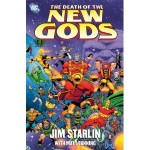
The Death of the New Gods


By Jim Starlin, Matt Banning, Art Thibert & Mark McKenna (DC Comics)
ISBN: 978-1-84576-871-3

When Jack Kirby returned to the home of Superman in 1970 he brought with him one of the most powerful concepts in comicbook history. The epic grandeur of his Fourth World saga grafted a whole new mythology over the existing DC universe and blew the developing minds of a generation of readers.

Starting in Superman’s Pal Jimmy Olsen, where he revived the 1940s kid-team The Newsboy Legion, introduced large-scale cloning in the form of The Project and hinted that the city’s gangsters had extraterrestrial connections, Kirby then moved on to the Forever People, New Gods and Mister Miracle; an interlinked triptych of projected finite length titles that together formed an epic mosaic.

Those three groundbreaking titles introduced two rival races of gods, dark and light, risen from the ashes of a previous Armageddon to battle forever …and then their conflict spread to Earth…

Kirby’s concepts, as always, fired and inspired his contemporaries and successors. The gods of Apokolips and New Genesis became a crucial keystone of DC continuity and integral foundation of that entire fictional universe, surviving the numerous revisions and retcons which periodically bedevil long-lived comics fans.

Many major talents dabbled with the concept over the years and a host of titles have come and gone starring Kirby’s creations. Recently, however as part of yet another attention-grabbing crossover Crisis publishing event, it was decided to kill them all off.

This compendium from 2007 collects the 8 issue miniseries that ostensibly finished Kirby’s wildest imagining – but of course this is comics and nobody dies forever…

The tale begins after a number of events around the planet, wherein denizens of Apokolips and New Genesis were found dead with gaping holes in their chests.

In ‘So Begins… the End’ Daily Planet reporter Jimmy Olsen investigates the bloody murder of paraplegic war veteran Willie Walker, unaware that the case is connected to the recent death of New God Lightray. In fact Walker was the host of the Black Racer, physical embodiment of Death for all Fourth World Deities.

Meanwhile God of Inquiry Metron has detected something subtly wrong with Reality and Darkseid, Lord of Apokolips and privy to secret data, makes fresh, bold plans… As Scott (Mister Miracle) Free and his beloved wife Big Barda play hero on Earth, in the Supertown floating above New Genesis the war god Orion makes a grisly discovery – another mighty warrior with his chest ripped open. On Earth Scott turns his back for a second and Barda too dies…

In ‘Celestial Genocide’ the New Gods take stock and realise that a vast number of superbeings have been cut down without a hint of a struggle and that the death toll is rising exponentially. Back on Earth, the Justice League begins to investigate the death of one of their own. Scott and Superman bring Barda’s body to New Genesis, where Orion is pressing for an attack on Darkseid, the obvious culprit for the deaths.

After conferring with Metron, Superman and Scott follow Orion to Apokolips, whilst the leader of New Genesis Takion goes with the aged Himon to examine the Cosmic Source Wall – a colossal barrier that separates the universe from the creation force that birthed reality…

‘Armageddon Tarantella’ sees the trio of heroes as they battle their way through the Darkseid’s forces, only to realise that the god-killer has been decimating Apokoliptians with equal ease… and the pace of deicide is increasing…

‘Bearing Witness’ follows Superman, Orion and Scott as they pursue the notion that the killer is someone they know, but each successive suspect turns up dead. Chaos and panic are building and whilst the gentle gods of New Genesis seem frightened but fatalistically resigned, the terrors of Apokolips are determined to fight and kill before they eventually succumb…

In the interim Metron has used his time-spanning capabilities to discover the brains if not the hands behind the slaughter, subsequently learning the true history of the Gods and meeting the source of all the horrors…

In ‘Mistakes’ Apokolips heavies Kalibak and Mantis lead an invasion of New Genesis with only Superman and Orion to face them, after which the war-god makes the ultimate sacrifice to draw out the mysterious and seemingly unstoppable killer in the sixth chapter ‘Sacrifice’…

The end draws close in ‘Seraphic Reunification’ as with only a handful of New Gods remaining Superman and Scott Free face the killer only to discover he has been an impostor all along. Whilst they are occupied in cataclysmic combat Darkseid finally makes his move attacking the mastermind behind the plot, determined to wrest ultimate power from the God-killer in ‘The End’…

Jim Starlin is the “go-to guy” for both cosmic storylines and major character deaths (see The Death of Captain Marvel or Batman: A Death in the Family for examples) and his introduction explains how and why he was pressured into writing the end to Jack Kirby’s ultimate comics achievement; and for my money nobody else alive could have done the job justice. It ain’t Kirby, but at least the deed was done with understanding and respect for what The King stood for.

A spectacular murder mystery, full of metaphysical flourishes and human depth with eye-popping action and even a few left-field surprises along the way, The Death of the New Gods is a fitting end to The Fourth World… at least until some editor decides that the concept is too valuable to leave alone…

This volume, which is strictly for fans of superhero tales and au fait with the minutiae of the original series (which absolutely ought to be read first…) also contains a stunning cover gallery by Starlin & Matt Banning and includes the variant cover by Ryan Sook.

© 2007, 2008 DC Comics. All Rights Reserved.

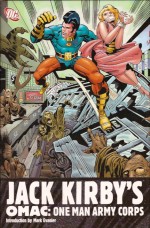
Jack Kirby’s OMAC: One Man Army Corps


By Jack Kirby with D. Bruce Berry & Mike Royer (DC Comics)
ISBN: 978-1-84576-922-2

There’s a magnificent abundance of Jack Kirby collections around these days (‘though still not all of it, so I’m not completely happy yet) and this slim hardback compendium re-presents possibly his boldest and most heartfelt creation after the comics landmark that was his Fourth World Cycle.

Famed for his larger than life characters and gigantic, cosmic imaginings, “King” Kirby was an astute, spiritual man who had lived though poverty, gangsterism, the Depression and World War II. He had seen Post-War optimism, Cold War paranoia, political cynicism and the birth and death of peace-seeking counter-cultures. He always looked to the future and he knew human nature intimately. In OMAC: One Man Army Corps, he let his darkest assumptions and prognostications have free rein, and his “World That’s Coming” was far too close to the World we’re now in…

In 1974, with his newest creations inexplicably tanking at DC, Kirby tentatively considered a return to Marvel, but ever the consummate professional he scrupulously carried out every detail of his draconian DC contract. When The Demon was cancelled he needed to find another title to maintain his Herculean (Jack was legally expected to deliver 15 completed pages of art and story per week) commitments and returned to an idea he had shelved in 1968.

That was to re-interpret Captain America into a distant future where all Kirby’s direst prognostications and fears could be made manifest. In 1974 he returned to those re-imaginings and produced a nightmare scenario that demanded not a hero but a warrior.

Dubbing his Day-After-Tomorrow dystopia “The World That’s Coming”, Kirby let his mind run free – and scared – to produce a frighteningly close appreciation of our now, where science and wealth have outstripped compassion and reason, and humanity teeters on the brink of self-inflicted global destruction.

OMAC #1 launched in September-October 1974 and introduced the Global Peace Agency, a world-wide Doomwatch police force who created a super-soldier to crisis-manage the constant threats to a species with hair-trigger fingers on nuclear stockpiles, chemical weapons of mass destruction and made-to-measure biological horrors.

Base human nature was the true threat behind this series, and that was first demonstrated by the decent young man Buddy Blank, who whilst working at Pseudo-People Inc., discovers that the euphemistically entitled Build-A-Friend division hides a far darker secret than merely pliant girls that come in kit-form.

Luckily Buddy had been singled out by the GPA and genius Professor Myron Forest for eternal linkage to the sentient satellite Brother Eye, his atoms reconstructed until he became a living God of War, and the new-born human weapon easily destroys his ruthless employers before their murderous plans can be fully realised. ‘Buddy Blank and Brother Eye’ was followed by a truly prophetic tale, wherein impossibly wealthy criminal Mister Big purchased an entire city simply to assassinate Professor Forest in ‘The Era of the Super-Rich!’

Kirby’s tried and trusted approach was always to pepper high concepts throughout blazing action, and #3 was the most spectacular yet. OMAC fought ‘One Hundred Thousand Foes!’ to get to the murderous Marshal Kafka; terrorist leader of a Rogue-State with a private army, WMDs and a solid belief that the United Nations couldn’t touch him. Sound familiar…?

That incredible clash concluded in #4’s ‘Busting of a Conqueror!’ and by #5 Kirby had moved on to other new crimes for a new world. The definition of a criminal tends to blur when you can buy anything – even justice – but rich old people cherry-picking young men and women for brain-implantation is (hopefully) always going to be a no-no. Still, you can sell or plunder some organs even now…

Busting the ‘New Bodies for Old!!’ racket took two issues, and after the One Man Army Corps smashed ‘The Body Bank!’ he embarked on his final adventure. Water shortage was the theme of the last tale, but as our hero trudged across a dry and desolate lake bottom amidst the dead and dying marine life he was horrified to discover the disaster was the work of one man. ‘The Ocean Stealers!’ (issue #7) introduced Doctor Skuba, a scientific madman who had mastered the very atomic manipulation techniques that had turned feeble Buddy Blank into an unstoppable war machine.

Joe Kubert drew the cover to OMAC #8 ‘Human Genius Vs Thinking Machine’; an epic episode that saw Brother Eye apparently destroyed as Skuba and Buddy Blank died in an incredible explosion.

But that final panel is a hasty, last-minute addition by unknown editorial hands, for the saga was never actually finished. Kirby, his contract completed, had promptly returned to Marvel and new challenges such as Black Panther, Captain America, 2001, Devil Dinosaur, Machine Man and especially The Eternals.

Hormone treatments, Virtual Reality, medical computers, satellite surveillance, genetic tampering and all the other hard-science predictions in OMAC pale into insignificance against Kirby’s terrifyingly accurate social observations in this bombastic and tragically incomplete masterpiece. OMAC is Jack Kirby’s Edwin Drood, an unfinished symphony of such power and prophecy that it informs not just the entire modern DC universe and inspires ever more incisive and intriguing tales from the King’s artistic inheritors but still presages more truly scary developments in our own mundane and inescapable reality…

As always in these wondrously economical collections it should be noted that the book is also stuffed with un-inked Kirby pencilled pages and roughs, and Mark Evanier’s fascinating, informative introduction is a fact-fan’s delight. And as ever, Jack Kirby’s words and pictures are an unparalleled, hearts-and-minds grabbing delight no comics lover could resist.

Jack Kirby is unique and uncompromising. If you’re not a fan or simply not prepared to see for yourself what all the fuss has been about then no words of mine will change your mind. That doesn’t alter the fact that Kirby’s work from 1937 to his death in 1994 shaped the entire American comics scene, affected the lives of billions of readers and thousands of creators in all areas of artistic endeavour around the world for generations and still wins new fans and apostles every day, from the young and naive to the most cerebral of intellectuals. His work is instantly accessible, irresistibly visceral, deceptively deep whilst being simultaneously mythic and human: and just plain Great.

© 1974, 1975, 2009 DC Comics. All Rights Reserved.