
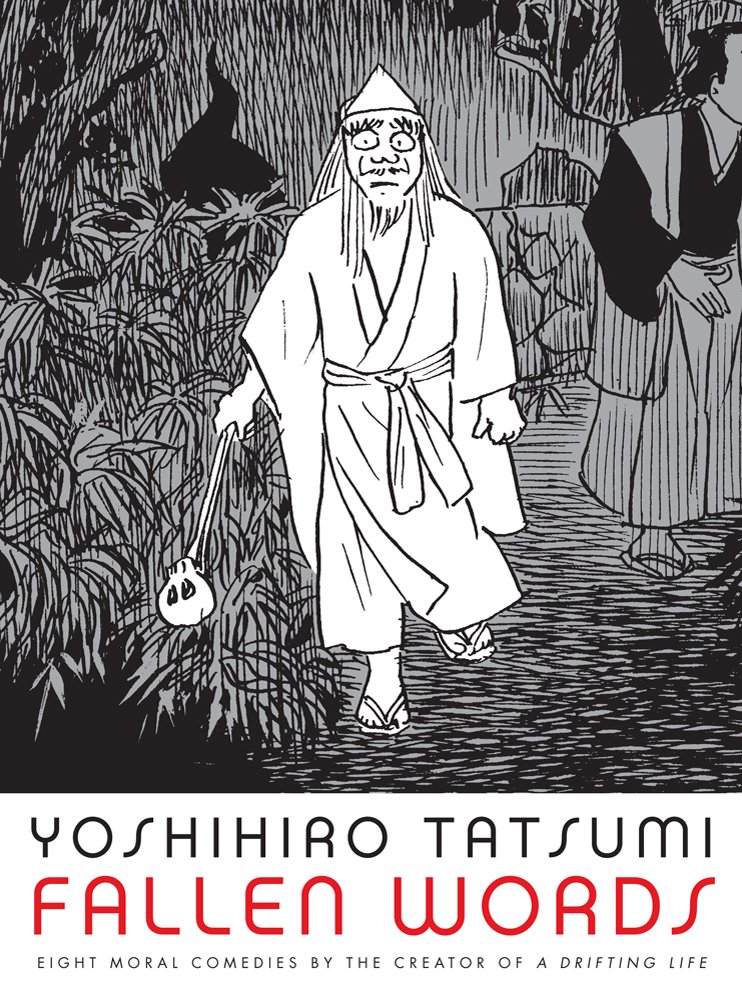
By Yoshihiro Tatsumi, translated by Jocelyne Allen (Drawn & Quarterly)
ISBN: 978-1-77046-074-4 (TPB)
This book includes Discriminatory Content produced in really really less enlightened times.
After half a century of virtual obscurity, crafting brilliantly incisive and powerfully personal tales of modern humanity on the margins and on the edge, Yoshihiro Tatsumi (10th June 1935 – 7th March 7, 2015) found “overnight success” in 2009 with his glorious autobiographical work A Drifting Life.
To describe his dark, bleak vignettes of raw real life, in 1957 Tatsumi devised the term Gekiga or “dramatic pictures”, practically if not actually inventing the genre of adult, realistic, socially aware and literary comics stories in Japan. He began his career after WWII, at a time when sequential narratives or “manga” literally meant “Irresponsible” or “Foolish Pictures”: a flashy and fanciful form of cheap, escapist entertainment targeted specifically at children (and the simple-minded) in the years immediately following the cessation of hostilities.
His tales continued in a never-ending progression, detailing the minutiae and momentum of Japanese popular culture and, with his star assured in the manga firmament, turned to a far older aspect of his country’s artistic heritage for this project.
The traditional performance art of Rakugo seems to combine many elements British observers would recognise: reverentially combining familiar tales told many times over such as morality or mystery plays with instructive fables and especially shaggy dog stories. Just like Christmas pantomimes, the art derives from how the story is revamped, retold and re-expressed – although the ending (punchline?) is sacrosanct and must always be delivered in its purest, untrammelled form…
Developing out of the far older Karukuchi and Kobanashi shows, Rakugo was first accepted as a discrete performance style accessible to the lower classes around 1780 CE, during the Edo Period, and going on to establish itself as a popular entertainment which still thrives today, regarded as a type of intimate comedy drama act in Vaudeville theatres.
As with all Japanese art-forms and disciplines, Rakuga is highly structured, strictured and codified, with many off-shoots and subgenres abounding, but basically it’s a one-man show where a storyteller (Rakugoka or Hanashika) relates a broad, widely embellished tale of Old Japan, acting all the parts from a sitting position, with only a paper fan (Sensu) and hand-cloth (Tenegui).
Equal parts humorous monologue, sitcom and stand-up act (or more accurately “kneel-down comedy”, since the Rakugoka never rises from the formal Seiza position) the crucial element is always delivery of the traditional ochi or punchline; inviolate, eagerly anticipated and already deeply ingrained in audience members and baffled foreign onlookers…
As is only fitting, these tales are presented in the traditional back to front, right to left Japanese format with a copious section of notes and commentary, plus an ‘Afterword’ from Mr. Tatsumi himself, and I’d be doing potential readers an immense disservice by being too detailed in my plot descriptions, so I’ll be both brief and vague from now on… as if any of you could tell the difference…
‘The Innkeeper’s Fortune’ relates the salutary events following the arrival of an immensely rich man at a lowly hostel, and what happens after – against his express desires – he wins a paltry 1000 Ryo in a lottery, whilst the ‘New Year Festival’ only serves to remind one reluctant father what a noisome burden his rowdy ungrateful son is…
An itinerant young artist cannot pay his inn bill and, as a promissory note, paints a screen with birds so lifelike they fly off the paper every morning. The populace are willing to pay good money to see the daily ‘Escape of the Sparrows’, more than the bill ever came to.
…And then one day another far more experienced artist wishes to see the screen…
When a dutiful merchant succumbs to the temptations of his trade and engages a mistress, she quickly consumes all his attention, leading to his poor neglected wife trying to kill the homewrecker with sorcery. Soon both women are dead and the merchant is plagued by their ‘Fiery Spirits’, after which ‘Making the Rounds’ details one night in a brothel where four clients are growing increasingly impatient: incensed by the non-appearance of the woman they’ve already paid for…
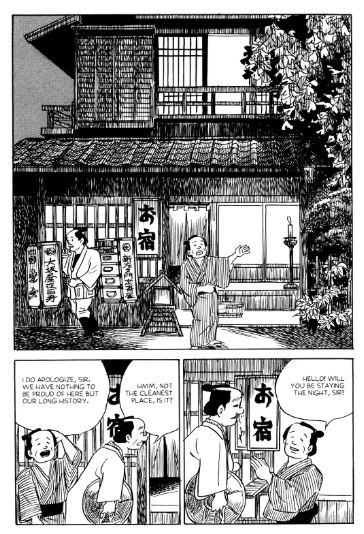
‘The Rooster Crows’ details the fate of a proud and puritanical young man tricked into visiting a brothel by his friends, whilst a poor and untrained man becomes an infallible doctor after entering into a bargain with ‘The God of Death’. This superb book of fables concludes with the sorry story of a lazy fishmonger who loved to drink, but whose life changed when he found a wallet full of money whilst fishing on ‘Shibahama’ beach – or was it just a dream?
With these “Eight Moral Comedies” Tatsumi succeeded – at least to my naive Western eyes – in translating a phenomenon where plot is so familiar as to be an inconvenience, but where an individual performance on the night is paramount, into a beguiling, charming and yes, funny paean to a uniquely egalitarian entertainment. That bit of graphic literary legerdemain proved him to be a true and responsible guardian of Japanese culture, ancient or modern, and begs the question: why is this glorious tome out of print and not available digitally?
Art and stories © 2009, 2012 Yoshihiro Tatsumi. This edition © 2012 Drawn & Quarterly. All rights reserved.
Today in 1874 pioneering Canadian cartoonist animator and comics creator Vital Achille Raoul Barré was born, just like Belgian Spirou editor Thierry Martens in 1942. One year later American scripter Steve Skeates (T.H.U.N.D.E.R. Agents, Aquaman, Hawk & Dove) arrived, but we had to wait until 1958 for Jeph Loeb (Batman: The Long Halloween, loads of others).
On the debit side today in 1977, we lost Bob Brown (Space Ranger, Challengers of the Unknown, Batman, Daredevil, The Avengers) and in 1982 Henry cartoonist John Liney, who can be properly appreciated by seeing Henry Speaks for Himself.