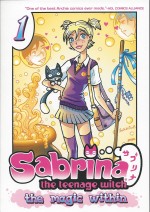
Sabrina the Teenage Witch: The Magic Within Book 1


By Tania del Rio & Jim Amash (Archie Comics Publications)
ISBN: 978-1-936975-39-6

Sabrina the Teen-Age Witch debuted in Archie’s Madhouse #22 (October 1962), created by George Gladir & Dan de Carlo as a throwaway character in the gag anthology which was simply one more venue for comics’ undisputed kings of kids comedy. She instantly proved popular enough to become a regular in the burgeoning cast surrounding the core stars Archie Andrews, Betty Cooper, Veronica Lodge and Jughead Jones.

By 1969 the comely enchantress had grown popular enough to win her own animated Filmation TV series (just like Archie and Josie and the Pussycats) and graduated to a lead feature in Archie’s TV Laugh Out before in 1971 finally winning her own title.

The first volume ran 77 issues from 1971 to 1983 and, when a hugely successful live action TV series launched in 1996, an adapted comicbook iteration followed in 1997. That version folded in 1999 after a further 32 issues.

Volume 3 – simple titled Sabrina – was based on new TV show Sabrina the Animated Series. This ran from 2000 to 2002 for 37 issues before a back-to-basics reboot saw the comicbook revert to Sabrina the Teenage Witch with #38, carefully blending elements of all the previous print and TV versions. A creature of seemingly infinite variation and variety, the mystic maid continued in this vein until 2004 and #57 wherein, acting on the global popularity of Japanese comics, the company boldly switched format and transformed the series into a manga-style high school comedy-romance in the classic Shōjo manner.

Written and drawn by Tania del Rio and inked by Jim Amash, this canny supernatural soap ran until #100 in 2009. The series folded four issues later.

An incredibly successful experiment, the beginnings of the manga saga were collected in a trade paperback as Sabrina – the Magic Revisited and issues #58-67 were later added to Archie Comics’ online library as digital editions. Now with the release of this black-&-white digest sized US tankōbon edition, the concept comes full circle…

Collecting Sabrina the Teenage Witch #58-68 from 2004-2005, this vibrant slice of wild whimsy opens with ‘Entering the Magic Realm’ – a fond remembrance from del Rio – and a handy character guide before issue/chapter 1 introduces us to a different kind of Winsome Witch in ‘Spellfreeze’…

Sabrina is just a typical Greendale High School girl. She lives with her Aunts Hilda and Zelda Spellman, has a pet cat Salem and barely conceals a crush on childhood pal Harvey Kinkle. The cute but clueless boy reciprocates the affection but is far too scared to rock the boat by acting on his desires.

Sabrina is also an atypical witch: living in the mortal world and passing herself off as normal. To make up for this peccadillo she has to attend Charm-School in the “Other Realm” to learn all about her heritage, powers and especially the rules of magic/mortal interaction.

Her life takes a complicated turn when a cute new boy enrols at Greendale. Shinji Yamagi is gorgeous and instantly popular – but he’s also a young warlock from Sabrina’s class at her other school. He’s on Earth to clandestinely study for a Charm-School project but soon finds it hard to keep his gifts secret.

Moreover he’s soon turning Sabrina’s head and she can’t decide which boy she likes best…

Complicating the mess is mortal Amy Reinhardt – a spiteful rival for Harvey’s affections who will do anything to upset Sabrina and sharp enough to instantly realise that she can use Shinji to further her ambitions…

Shinji is having real problems not using his magic to ease the tedious drudgery of mortal life and is soon openly flouting the rules just to make himself popular. Knowing that eventually somebody will realise he’s not simply performing tricks – and perhaps just a little jealous – Sabrina determines to stop him…

Salem is not just an ordinary cat; long ago he was Salem Saberhagen: the most powerful warlock of all. After trying to conquer the world he was imprisoned in a cat’s body where he could do no magic, but he can still talk and his rehabilitation is very grudging. He doesn’t need much urging to guide Sabrina to the Magic Realm where she can obtain a spell to neutralise Shinji’s powers.

It’s quite complex though, and the junior conjuress gets it badly wrong. Rather than freezing the warlock’s magic the spell turns Shinji’s body to ice.

Horrified at her mistake Sabrina confesses all to her Aunts and learns that only a kiss can turn him back to normal, but she’s slowly becoming aware that for all his arrogant faults, she really, really likes Shinji and doesn’t fully trust herself…

Chapter 2 has a sporting theme as Sabrina tries to get Harvey to make his move. Although a star of the basketball squad, the wishy-washy boy is badly fumbling the school tradition of bestowing a team ribbon upon the girl of one’s dreams.

Sabrina is cruelly teased by Amy who tells her Harvey has already offered her his silken favour in ‘Blue Ribbon Blues’ and the distraction cannot come at a worse time. There’s a big test coming up in Charm-School – it’s the time when students have to make their first flying broomstick – and a bad result could affect her whole life…

Unbeknownst to her Shinji too is feeling the power of attraction. In ‘Councils and Concerts’, Aunt Hilda is lobbying to be elected to the ruling Council of the Magic Realm and needs no embarrassing distractions, but that hope is doomed after Sabrina is summonsed by the fearsome Galiena, Czarina of Decree to explain her recent rule-breaking and magical abuse of the adults-only spellfreeze incantation, not to mention riding a broom without a license…

As the depressed teen talks things over with best friend and eldritch classmate Llandra da Silva, Shinji appears and asks her on a date to see the hip, magic band Oberon. The wayward warlock has had plenty of run-ins with the Council though, and advises her just to ignore them, even as Llandra warns him not to come between her BFF and poor mortal Harvey…

After the gig, Shinji tries to get Sabrina to join him in another illegal broom flight and they have a blazing row before he ditches her. Humiliated and furious, all she can do is call the aunt she has again let down…

A Halloween party is the setting for ‘The Magic Within’ as troubled Goth girl Gwenevive Ricci arrives in Greendale, a mortal who can somehow make real magic. The brittle human is rather hard to like, but when Salem investigates he finds the secret of Gwenevive’s powers to be a rival someone he’d thought long gone and the soiree turns into a deadly supernatural battle.

More by luck than skill Sabrina saves the world and vindicates herself with the Council, but they might not be so mellow if they realised she had accidentally allowed Gwen to learn her secret…

‘Winter Wallflower’ deals with some of the potential repercussions as witchly wannabe Gwen pumps Sabrina for more information, blithely uncaring that she risks having her mind wiped by the Council. However rebellious Sabrina faces even greater challenges when she finds herself dateless for a school dance. Good old dependable Harvey has asked a cute freshman to the affair, and when Sabrina goes looking for Shinji she sees him in a passionate embrace with Llandra…

This chapter is complimented by a one-page gag strip starring Salem who abuses a present in ‘House Cat!’ before the Sabrina/Harvey/Shinji romantic triangle is dramatically resolved in ‘Cabin Fever’ wherein the kids and Llandra dash off for a winter break in a log cabin (with Aunt Zelda along as reluctant chaperone). However when the boys drive off for provisions they are caught in a killer ice storm and trapped on a mountain.

Soon their seething rivalry for Sabrina causes a confrontation, but after Harvey saves Shinji from death the chastened young magician determines to help Harvey win the girl of his dreams – even if neither of them is sure that’s what he wants…

After another Salem single ‘Here’s Looking at You’, Harvey’s indecisiveness resurfaces during Valentine’s Day. Despite the warlock boy’s every effort, his new mortal pal just cannot summon up the courage to ask Sabrina out. Moreover the frustrated teen Witch knows something’s amiss and has been having nightmares waiting for Harvey to make his move.

Unfortunately Sabrina talks – and enchants – in her sleep and wakes up on February 14th with the power to see ‘Love Connections’ between people and even animals. The teen witch spends the day acting as an unofficial Cupid, bringing together people who don’t realise how close their one true loves actually are, before – unable to handle Harvey’s paralysis – she just gives up and makes the first move herself.

Watching from concealment Shinji is delighted that at last they are together – and cannot understand why his own heart is breaking…

‘Caught on Tape’ deals with another kind of crisis just as Sabrina is finally together with Harvey. Hilda has been elected to the Council as Czarina of Meditation and the entire family has to move to the Magic Realm. The boy is still unaware of her true nature and now she may never see him again…

However when evidence is found of mortal poachers in the Magic Realm, Sabrina’s knowledge of the mundane world enables them to track down unscrupulous crypto-zoologist Atticus Rex and free the fantastic beast he thought would make him a TV sensation.

Realising that they increasingly need contact with Earth, the Council relents and stations Hilda permanently in the human Realm, but even after having his memories wiped the Spellmans have not seen the last of Atticus…

When Shinji’s mortal, toymaker uncle arrives from Japan and sees Sabrina’s cat he copies the creature’s unique appearance and spawns global ‘Salem Mania’. With the cat now on backpacks, apparel, toys, jewellery and every other form of merchandise as the ignominious ‘Mr. Kitty Litter’, the furious former arch-mage alternately plans revenge and how to cash in, with Sabrina otherwise occupied and unable to stop or help him.

Her attention has been diverted by an impossible dilemma: now that she has Harvey, why is she so jealous that Llandra is with Shinji?

This beguiling first collection concludes with a crossover of sorts when Shinji is “discovered” by a fashion agency and briefly becomes a male model. With Sabrina becoming increasingly disenchanted with Harvey, the warlock suddenly goes slow with Llandra and is romantically linked to pop sensations Josie and the Pussycats, but his meteoric career comes to a sudden halt when his bosses demand to see a little too much skin…

Enticing, funny and genuinely enthralling, this witty, fresh take on a classic American icon will delight most fans and readers. With actual human interaction rather than manufactured atom-powered fistfights to hold your attention, it offers women in particular a solid entertaining reason to give comics one more try. Sheer exuberant fun; perfectly crafted and utterly irresistible.
© 2013 Archie Comics Publications, Inc. All rights reserved.

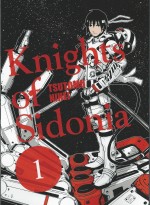
Knights of Sidonia volume 1


By Tsutomo Nihei translated by Kumar Sivasubramanian (Vertical)
ISBN: 978-1-935654-80-3

As I’ve often said, these days nobody does hard comics science fiction like the Japanese – although admittedly our own 2000AD and Warren Ellis’ SF are keeping the flag flying ahead of much of even manga’s greatest masters in their own mostly unacknowledged way…

In the tech-obsessed East, the tough, no-nonsense, nuts-and-bolts mystery and refined imagination of star flight have long been blended with more fanciful and romantic futuristic themes to captivate at least four generations since Osamu Tezuka first started the ball rolling in the 1950s, making space commonplace and conceptually comfortable for the Japanese.

We in Western world have been simultaneously enraptured and frantically trying to catch up, ever since some – too few, alas – of these manga tales first began to be translated into English at the end of the 1980s.

One of the most talented and respected proponents of the genre is Tsutomu Nihei whose triumphs have ranged from wholly self-created graphic epics such the stunning cyberpunk thriller Blame!, its prequel NOiSE, and Biomega to impressive stints on major commercial properties such as comics iterations of the video game Halo and the miniseries Wolverine: Snikt! for Marvel.

Born in 1971, the author prefers to let his works speak for him. His latest series Shidonia no Kishi began in 2009, debuting in Kodansha’s Seinen title Bessatsu Shonen Magazine and running to nine volumes so far.

The premise is familiar but evergreen. A thousand years from now Earth is gone. Our solar system was destroyed by unstoppable alien monsters and the survivors of humanity have scattered to the stars in vast self-contained generational vessels as much rock as rocketship. Over a millennium these colonies have hurtled ever outward seeking escape and survival, whilst within them humans have slowly become something different…

The eponymous Knights of Sidonia are the young pilots gifted enough to pilot the colossal humanoid fighter vessels that defend and scavenge interstellar resources for the ever-moving colony our story concerns…

The story begins with ‘Nagate Tanikaze’s Choice’ as an unexpected event occurs. Unknown to all the inhabitants of the hive-like colony ship years ago, an old man took his infant grandson deep into the bowels of the vessel and vanished. Raised in utter isolation with only tapes, a flight simulator/VR trainer and stolen food, the boy grew into a tough, hardy and independent survivor.

When, after three years, Nagate Tanikaze finally accepted that the corpse in the chair was no longer his “gramps”, he regretfully headed up in search of food and was soon caught by the incredulous authorities. He is starving and impossibly weak, but adamantly refuses to undergo the commonplace genetic procedure that will enable him to photosynthesise starlight. He might well be the only traditionally human being on Sidonia…

His captors-turned-benefactors accept his idiosyncrasies and welcome him into their austere, oddly passionless society, but some people seem to seethe with hostility at Tanikaze’s presence.

He is assigned quarters at a dorm and is welcomed by Ms. Hiyama, a motherly amalgam of human, bear and cyborg. He spends his time acclimatising by aimlessly wandering the vast labyrinthine cocoon which has patterned itself on an idealised 20th century Japan, but trouble still finds him when he wanders into a female photosynthesis chamber and is beaten up by the outraged girls “feeding” inside…

In the higher echelons of the ship, passive panic is gripping the ship’s leaders. Long range sensors have spotted a Gauna – one of the Brobdingnagian bio-horrors that invaded and destroyed Earth ten centuries past – and with grim fatality the Garde pilots are mobilised.

Tanikaze has been tested and found to be a superb pilot prospect. As the ship goes on alert his actual training begins, converting his years on the simulator into hands-on experience…

‘Nagate Tanikaze’s Maiden Battle’ finds the trainee mecha-rider still experiencing some prejudice but making his first friend in pretty Izana Shinatose, a fellow Garde pilot who adopts the outsider, acting as his guide and social mentor. Izana is warm and welcoming and it’s not too long before Nagate accepts “her” (to him) odd situation as a third-gendered, asexual parthenogenetic hermaphrodite. “She” also seems to be mildly telepathic…

Testing on the latest simulator, the outcast astounds all his classmates by scoring far above the machine’s assessment parameters but the purely physical – and appallingly uncomfortable and embarrassing – aspects of wearing a working spacesuit and dealing with the psychological pressures of working in the limitless void still challenges Tanikaze’s resolve and mental resources.

And even training is deadly work. As two squads of Mecha extract ice from a passing asteroid the simple drill turns into a disaster when a Gauna ambushes the novices…

‘Eiko Yamano’s Starry Heavens’ recalls that cadet’s spurning of the students’ superstitious pre-flight ritual before returning to her present as the star-beast consumes her and adds her DNA to its metamorphic mass, simultaneously gravely damaging Tanikaze’s vessel. The telemetry from his ship indicates he’s near death…

Aboard Sidonia, their superiors can only write off the kids and begin readying their only effective weapon – a Heavy Mass Cannon that should push the nigh-unkillable free-floating carnivore far out of range…

The Sidonians are astonished when Nagate apparently regains consciousness and valiantly confronts the gigantic horror slowly assuming Yamano’s form. Incomprehensibly driving it back, he is dragged away by his comrades just as the huge projectile from the mass cannon devastatingly hits home…

‘Norio Kunato’s Fury’ finds the recovering Nagate plagued by ghastly dreams of Eiko’s death – and particularly her imagined transubstantiation into a Gauna. He should be dead but refuses even to give in to the pace of his own healing and soon drags himself on crutches back to lectures. When Izana sees him leaning on willowy Kunato in moments of dizziness, the outraged asexual storms off in a huff…

The baffled Tanikaze only gets the chance to make amends at the Gravity Festival – an annual function that allows the barbarian boy opportunity to eat as much actual food as he can hold – but is distracted by the attentions of fellow pilot Hoshijiro Shizuka who had brought his wounded Mecha and battered body back to Sidonia after the Gauna ambush. However when haughty Norio Kunato insults and assaults Izana, Nagate goes crazy and jumps the elitist bigot. Their battle wrecks the fair, and the outcast learns that many of his fellow pilot candidates feel he is unworthy to ride the giant guardian mecha…

This first monochrome volume concludes with ‘Mochikuni Akai’s Glory’ as the trainees continue their steep and brutal learning curve. The repelled Gauna is gradually, inexorably approaching Sidonia again. Moreover it’s clear that not all the populace despise the new kid. As the first person to fight – let alone survive – a Gauna attack Tanikaze is apparently held in high regard by the older Guardians.

When hot-shot pilot Akai invites Nagate and Izana to a private paradise of artificial seas and beaches, it is to reveal that he and his fellow officers have been tasked with deflecting the beast’s next attack. Although the party is enjoyable and the surroundings stunning, the cadets can’t help but feel they’re intruders at a Last Supper…

To Be Continued…

Like Robert Heinlein, Larry Niven and other masters of the art form, Tsutomu Nihei frequently works in a notional shared continuity (for instance the monstrous Gauna first appeared in his earlier series Abara), but there’s no sense of having missed anything in this premier instalment of a wonderfully engrossing, gloriously engaging epic of Horatian heroism and Mankind’s Last Stand.

Compelling, subtle, spectacular and even funny, this is a yarn no adventure aficionados or sci-fi fanatics should miss.

This book is printed in the traditional Japanese right to left, back to front format.

© 2013 Tsutomu Nihei. All rights reserved.

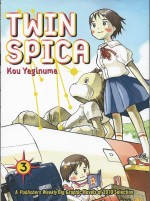
Twin Spica volume 3


By Kou Yaginuma (Vertical)
ISBN: 978-1-934287-90-3

The hungry fascination, hopeful imagination and fevered anticipation of space travel which was an integral component of post-World War II society is the driving narrative engine for this inspiring manga epic from Kou Yaginuma, who began capturing questing imaginations with his poignant short story ‘2015 Nen no Uchiage Hanabi’ (‘2015: Fireworks’), published in Gekkan Comics Flapper magazine in June 2000.

The author subsequently expanded and enhanced the subject, themes and characters into an all-consuming narrative epic combining hard science and humanist fiction with lyrical mysticism and traditional tales of school-days and growing up.

Diminutive teenager Asumi Kamogawa has always dreamed of going into space. From her earliest moments the lonely child had gazed with intense longing up at the stars, her only companion and confidante her imaginary friend Mr. Lion.

When Asumi was a year old, the first Japanese space-launch ended in utter catastrophe when rocket-ship Shishigō (“The Lion”), exploded: crashing back to earth on the city ofYuigahama where the Kamogawas lived. Hundreds were killed and so many more injured, including Asumi’s mother.

Maimed and comatose, the matron took years to die and the long-drawn-out tragedy utterly traumatised the tiny uncomprehending daughter. The shock also crushed her grieving husband who had worked as a designer on the rockets for Japan’s Space Program.

In the wake of the disaster, Tomoro Kamogawa was assigned by the corporation who built the ship to head the reparations committee. Guilt-wracked and personally bereaved, the devastated technologist had to visit and formally apologise to each and every survivor or victim’s grieving family. The experience completely destroyed the man.

He was certainly no fan of the space program, having lost his wife, his beloved engineering career, and his pride to the race for the stars. He has raised his daughter alone by working two and often three menial jobs at a time for over a decade and cannot countenance losing the very last of his loved ones to the cold black heavens…

In response to the disaster,Japanset up an Astronautics and Space Sciences Academy. After years of passionate struggle and in defiance of her father’s wishes, in 2024 Asumi – an isolated, solitary, serious but determinedly star-bound teenager – was accepted to theTokyoNationalSpaceSchool. She reluctantly left Yuigahama and joined the new class.

Amongst the year’s fresh intake were surly, abrasive Shinnosuke Fuchuya (an elementary school classmate who used to bully her as a child back in Yuigahama), jolly Kei Oumi, chilly Marika Ukita and spooky, ultra-cool style-icon and fashion victim Shu Suzuki who became the shy introvert’s closest acquaintances.

Every day Asumi nudged inexorably towards her goal: the stars. Ever since the crashing rocket had shattered her family, she had drawn comfort from the firmament, with Mr. Lion staring up at the heavens at her wide – especially drawn to the twinkling glow of Virgo and the alluring binary star Spica. And now she was so tantalisingly close…

Small, poor, physically weak but resolutely capable, Asumi endures and triumphs over every obstacle… and she still talks with Mr. Lion – who might just be the ghost of one of the astronauts who died on the Shishigō…

All the students can think of is going to space, but they are constantly reminded of the fact that most of them won’t even finish their schooling…

Asumi – barely four feet, eight inches tall – is constantly struggling to meet the arduous physical requirements dictated by the Academy but has more immediate problems. She is only slowly adjusting to life in Tokyo, sleeps in tawdry communal women’s dorm “The Seagull”, struggles with many of her classes and subsists on meagre funds, supplemented by part-time jobs.

Moreover she has inexplicably incurred the obsessive hostility of astrophysics lecturer Professor Sano. Unbeknownst to Asumi, Sano has a long-hidden grievance with her father and has thus determined to kick her out of the school at all costs…

He has already tried to have her removed because her small size dictates that she needs a customised pressure suit – offering Sano an opportunity to force her out by citing budget restrictions…

The individual stories are broken up into “Missions” and this particularly moving and moody third volume covers numbers 9-13, plus a revealing sidebar tale and another autobiographical vignette about the author’s own school days.

‘Mission: 09’ begins with Asumi returning to her father’s home, pondering if she should ask Mr. Lion if the disgraced engineer was actually responsible for the rocketship crash all those years ago. Meanwhile inTokyo her classmates are trying to intervene in Sano’s obvious vendetta against their friend…

Mr. Lion is there too, but has been drawn to the wedding of Asumi’s old teacher Miss Yuko Suzinari. Although she still desperately misses her fiancé, who piloted The Lion and died in the tragic explosion five years previously, she is getting married today… a fact Asumi discovers from an invitation left in an unopened pile of mail she finds in her father’s empty house…

Having missed another day of school, Asumi again incurs Sano’s wrath as ‘Mission: 10’ begins, but the astrophysicist and his mysterious superior are in for a rude awakening. Meanwhile the determinedly upbeat Miss Kamogawa is having an oddly unifying effect on her fiercely independent classmates, turning rivals into comrades. All, that is, except the chilly, acerbic, mysteriously aloof Marika Ukita…

Undeterred, Asumi probes deeper, and with her phantom mentor’s spiritual advice finally finds a way to crack the ice-queen’s brittle exterior. Valiant, protective Kei Oumi meanwhile openly challenges Sano over his unfair treatment and is soundly reminded by the teacher that the course is a process of elimination. Would she surrender her own chances of success to ensure Asumi remained…?

‘Mission: 11’ continues the deliberation of the completion for final places, but Mr. Lion again offers sage and calming words as, in the upper echelons, Sano’s words and actions have drawn unfavourable criticism, leading to some further surprising revelations about Asumi’s dad, hints of a concealed scandal regarding the construction of the doomed Shishigō and the disappearance of the conniving astrophysicist from the faculty…

With Sano abruptly replaced by the far more amenable and encouraging Mr. Shiomi, Asumi and the gang decide to take a short camping vacation to the Cosmic Communications Center atChiba, but not before Asumi has one last moving confrontation with her former nemesis…

‘Mission: 12’ finds them readying for the trip – all but the stand-offish Ukita who flatly refuses to join them – when an incident in the Multi-Axis Trainer (that’s the cool-looking. spinning ball thingy astronauts sit in) results in the ice-queen collapsing. When she gets out of the infirmary Asumi and Kei follow Ukita home and discover she lives in a palatial mansion…

When they see her being brutalised and abused by a shouting man – presumably her father – Asumi sees red and attacks. Suzuki and Fuchuya are astounded when without any explanation Ukita gets on the bus to Chiba with them and the smiling girls…

At their destination the cash-strapped kids walk until Marika again collapses.

Belligerent Fuchuya picks up the moody girl with the badly bleeding feet and carries her to their destination as ‘Mission: 13’, through dreamy flashbacks and a near-fatal hiking incident, discloses some of the incredible, uncomfortable secrets of Marika Ukita and how her own abiding love affair with the cosmos began…

To Be Continued…

Although the ongoing saga pauses here, there’s even more affecting revelations to come in the complete tale ‘Asumi’s Cherry Blossom’ which harks back to her school days in Yuigahama. A weird, distracted child, she is bullied by many classmates and even a few teachers, but is championed by a boy who seems very interested in her. Takashi Shimazu is a talented artist who won’t let Asumi see what he’s constantly drawing, and he’s absent from school quite a lot, but they strike up a friendship anyway. Asumi really likes the boy, but wishes he wouldn’t joke about being able to see Mr. Lion…

This bittersweet tragedy is followed by a beguiling and introspective ‘Another Spica’ episode in which Yaginuma details his shiftless, ambition-free teens and shared moment of clarity with a girl in his classroom…

These powerfully unforgettable tales originally appeared in 2001-2002 as Futatsu no Supika and in the Seinen manga magazine Gekkan Comics Flapper, targeted at male readers aged 18-30, but this ongoing, unfolding beguiling saga is perfect for any older kid with stars in their eyes…

Twin Spica filled sixteen collected volumes from September 2001 to August 2009, tracing the trajectories of Asumi and friends from callow students to competent astronauts and the series has spawned both anime and live action TV series.

This delightful serial has everything: plenty of hard science to back up the informed extrapolation, an engaging cast, mystery and frustrated passion, alienation, angst and true friendships; all welded seamlessly into a joyous coming-of-age drama with supernatural overtones and masses of sheer sentiment.

Rekindling the magical spark of the Wild Black Yonder for a new generation, this is a treat no imagineer with head firmly in the clouds can afford to miss…

This book is printed in the Japanese right to left, back to front format.
© 2010 by Kou Yaginuma. Translation © 2010 Vertical, Inc. All Rights Reserved.

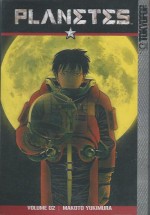
Planetes volume 2


By Makoto Yukimura, translated and adapted by Yuki Nakamura & Anna Wenger (TokyoPop)
ISBN: 978-1-59182-509-8

These days nobody does gritty, authentic, fun hard-tech comics science fiction like the Japanese (although for sheer tight-lipped underplayed drama I’d still place Sydney Jordan’s Jeff Hawk, Frank Hampson’s Dan Dare and most of Warren Ellis’ SF work ahead of even Manga’s greatest masters…).

The tough, no-nonsense, gritty mystery and refined imagination of space travel – so much a component of immediate post-World War II industrial society in the West – began to once again captivate a legion of level-headed imagineers at the end of the 20th century when Japanese tales first began to be translated into English. One superb exponent of that mini-boom was relative newcomer Makoto Yukimura who rekindled interest in near-space exploration in all its harsh and grimy glory with an inspiring “nuts-and-bolts” manga series which scrupulously explored the probable rather than the possible…

Yukimura (born in Yokohamain 1976, just as the once-ambitious American space program was languishing in cash-strapped doldrums and five long years before the first space shuttle launch) began his professional life as an assistant to veteran creator Shin Morimura before launching his independent career with the Planetes.

Working exclusively for Kodansha, his award-winning premier Seinen series ran in Weekly Morning magazine from January 1999-January 2004 and was later collected as four tankōbon volumes. The serial easily made the jump to a popular anime series and since then Yukimura, after producing Sayōnara ga Chikai node for Evening magazine, has since 2005 abandoned the future for the past and concentrated his creative energies on the monolithic historical epic Vinland Saga – serialized in Weekly Shōnen Magazine and Afternoon – and filling 11 bloodcurdling volumes to date…

The grimly existential premise of Planetes is devilishly simply and powerfully engaging. Humanity is a questing species but cannot escape its base origins. In 2075 space travel and exploitation is practically commonplace but, as we’ve conquered the void between Earth and the asteroid belt and prepare to exploit the outer planets, the once-pristine void around us has become clotted with our obsolete tech and casually discarded rubbish.

Even the most minuscule piece of junk or debris falling through hard vacuum is a high-speed, potentially deadly missile and to keep risk to a minimum, hardy teams of rugged individualists have to literally sweep the heavens free of our discarded crap.

The stories revolve around youthful trashman Hachimaki Hoshino whose greatest dream is to become a true deep-space astronaut and famous explorer like his famous – if disreputable – father. The boy has his future all mapped out: a similar career-path to dear old dad will lead to fame and wealth and then he can buy his own spaceship and be really free…

Sadly the incessantly dull toil of his deep night day-job is wearing away at the passionate, excitable Hachi who is becoming swiftly disenchanted with the whole dreary, disgusting drudgery aboard DS-12 – a standard sanitation/cargo ship fondly dubbed Toybox…

The first episode in this stunning second volume begins with ‘Running Man’ as the Toybox’s weary crew visit Moon Orbital Space Port and the obsessively training Hachimaki is approached by an unctuous business type looking for his infamous dad. Werner Locksmith is the head and chief designer of the Earth Development Community-sponsored manned mission to Jupiter and, unknown to the starry-eyed kid, had pegged Hachi’s father as the only man capable of piloting the innovative new vessel on the five year mission: one the boy would give anything to be on.

However the elder explorer doesn’t want to go and has actually absconded from the Private/Public sector project and is currently a fugitive…

The old rogue has had enough of space-faring: a fact he finds impossible to relate to his furious son when they meet. The old spacer intends to retire to Earth and make things right with the wife he’s abandoned…

Meanwhile Locksmith has been called away. Something has gone disastrously wrong with the Jupiter ship Von Braun…

Above Luna as Hachi argues with his dad, another crisis occurs as a devastating explosion rips through the station and everybody evacuates. In the safe chill of the void, Hachi and the crew see a phenomenal debris field emanating from the moon’s surface. The Von Braun’s experimental engines have failed and an entire lunar base has been evaporated…

Following the tragedy the ruthlessly cool Locksmith unswervingly starts to rebuild and the senior Hoshino breathes a sigh of relief. Hachi is undeterred. He resumes his training, knowing that when the Von Braun is ready to fly, he will be ready to join it…

Acknowledging their comrade’s impossible dream, stoic Russian Yuri Mihairokov and commander Fee Carmichael have inducted by a raw new recruit to the Toybox team and tasked Hachi with training her to be his eventual replacement. According to the ambitious lad, however, Ai ‘Tanabe’ is a hopeless case, fruitlessly wasting valuable time he could be using to train and study for his application to the Jupiter Mission. Suffering mightily from having to baby-sit the useless girl, he only discovers her suppressed inner fire after a 50-year old space coffin is recovered from the dark expanse and provokes a bitter dispute about love, passion and man’s place in the cold, lonely universe…

Hachi’s dream comes a giant leap closer to reality in ‘A Black Flower named Sakinohaka Part 1’ as he finally begins his official audition for the Von Braun. The boy has become an emotional void with nothing but his cold ambition driving him. He can’t even process the deadly and constant threat posed by increased sabotage activity from the terrorist SDL; a group determined to keep space free of Man’s toxic presence.

Despite the more than 20,000 applicants, Hoshino is beginning to distinguish himself when a series of bomb blasts rocks the controversial project. Narrowly escaping death, Hachi is visited by his old friends who are horrified by the obsessed spacer’s blasé attitude and apparent disregard for the pain and suffering of his rival candidates who were caught in the detonations. Is he truly so determined to get on the mission that all he sees are fewer competitors?

Only fellow applicant and new buddy Hakimu seems to understand that any sacrifice and personal misery are worth the prize…

Soon the testing is in its final stages and Werner Locksmith lectures the remaining candidates from the bridge of the almost completed Von Braun. Only nine of the desperate spacers will make this final cut but the big day is again delayed after Hachi confronts the insidious saboteur and fails to stop him…

The tale resumes six months later as the last twenty three candidates await the final call whilst in ‘A Black Flower named Sakinohaka Part 2’ Hachi’s still-fugitive father is targeted by SDL assassins and heads back to the son who has disowned him. His arrival coincides with young Tanabe’s visit to deliver the boy’s belongings from Toybox, leading to an embarrassing confusion as to her amatory status, but before things can be fully clarified the terrorists attack again, determined to ensure the death of the “only man who could pilot the Von Braun”…

Fleeing through the lowest levels of the Moon’s Oriental Basin Underground Tunnel City the trio are more of a danger to each other than their murderous pursuers and after another catastrophic explosion Hachi again confronts the traitor who sabotaged his last attempt to join the mission and almost commits an unpardonable act until gentle Tanabe talks him off the emotionally-charged metaphorical ledge…

‘Lost Souls’ sees the lad successfully in final training for the mission that has become his life when a lunar accident strands Hachi and new comrade Leonov on the unforgiving surface with only hours of oxygen and a 40 kilometre walk to the nearest relief station. It would have been impossible even if the co-pilot wasn’t wounded with a slowly-leaking suit.

By the time rescue arrived Hachi had reached the stage where he fought his saviours, frantic to prove that he truly needs no one’s help to achieve his goals…

This sublime saga concludes here with ‘СПАСИБО’ (or “Spasibo” which can be either “thank you” or “God save you”) as the recuperating Hachi returns to the family home in Japan, accompanied by his penitent father, and is visited by Leonov’s grateful mother. Although he doesn’t understand a word she says, the old lady still makes far more sense than his constantly warring family and, after another drunken fight with his dad, events come to tragic, galvanising crisis which at last crushes the walls around the traumatised young man’s head and heart…

Also included are working sketches, pin-ups, a bunch of four-panel sidebar humour strips ‘A Four Panel Comic’, ‘Namao-san (Presumably Male)’, ‘Eat? That Thing?’, ‘Drinking Hot Coffee through a Straw’ and prose biographies of revered and inspirational author Kenji Miyazawa and pioneer Cosmonaut Yuri Alexeyevitch Gagarin in ‘Conceptualising Space Travel’.

Suspenseful, funny, thrilling and utterly absorbing, these tales readily reinvigorate and reinvent the magical allure of the Wild Black Yonder for newer generations, and this authentic, hard-edged and wittily evocative epic is a treat no hard-headed dreamer with head firmly in the clouds can afford to miss…

This book is printed in the traditional Japanese right to left, back to front format.
© 2001 Makoto Yukimura. All rights reserved. English text © 2004 TOKYOPOP Inc.

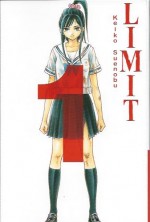
Limits book 1


By Keiko Suenobu, translated by Mari Morimoto (Vertical)
ISBN: 978-1-93565-456-8

Travelling a little off the beaten Shōjo or “girl’s comic” path is a newly translated work by the marvellous Keiko Suenobu, whose latest series Limit has just been released byNew York publisher Vertical.

Born in KitakyÅ«shÅ«, Fukuokain March 1979, Suenobu graduated from the Universityof Tsukubabefore beginning her creative career with the school romance Happy Tomorrow, before gravitating towards darker themes of conformity, social pressure and bullying in Vitamin and the moving, controversial and award-winning Raifu – translated as Life by TokyoPop in 2006.

The author took her interest in the nastier side of school life to imaginative extremes in 2009 when Limit began serialisation in Kodansha’s Bessatsu Friend. Now this rather dark and exceptionally grim tale – which will definitely appeal to a readership far beyond the general Shōjo target-market of young girls – is available in English and might well be a future classic.

Mizuki Konno is lucky – and wise – enough to fit with the “In-Crowd” at her all-girls school. Acceptably cute and suitably smart, she has learned to make no waves and accept that the ways things work is the way things should be. The popular girls – like undisputed teen goddess Sakura Himezawa – make the rules, and the rest conform. It’s a simple matter of survival…

If you’re physically different or interested in odd things, like dumpy manga-fan and tarot reader Arisa Morishige, life can be hell. Only the strongest personalities, such as bookish, decent and determinedly wound-tight non-conformist Chieko Kamiya have any chance of standing up to the constant bitchy pressure to comply, accept and keep your place in the hierarchy of ‘A Perfect World’…

Everything changes however when Sakura’s class drives off for an extended visit to an Exchange Camp in the wilderness. Every class spends a week roughing it with nothing more than a communal scythe and their ever-present cell-phones to hold back the horrors of nature, but with this last trip of the semester things go tragically wrong.

High in the mountains the coach driver has a heart attack and the vehicle, packed with excited girls and their harried teacher, plunges catastrophically into a wooded hidden valley.

Only five girls survive, and undisputed queen of the modern world Sakura isn’t one of them…

As Konno drags the shell-shocked Haru Ichinose (Sakura’s devoted deputy, utterly unable to function without her) out of the wreckage some time later, she sees smoke from a fire. Tracking the signal they find middle-ranking Chikage Usui with her leg splinted and bandaged outside a cave. The wounded lass has been saved and succoured by the coldly efficient Kamiya, who has also scavenged everything potentially useful from the crash site.

At the back of the cave Morishige sits inside a pentagram, casting the cards…

Kamiya has brusquely taken charge, organising resources and outlining options until the girls can be found and rescued, but introspective Konno can barely grasp the strange situation and the new rules of survival. Events take an even nastier turn when the Tarot reader suddenly explodes in jubilation, claiming her prayers have been answered and her tormentors all punished…

Indifferent, ambiguous pragmatist Konno is forced to confront a new world order in ‘The Strong vs. the Weak’ as the increasingly unstable Morishige takes control.

After panicking and unsuccessfully failing to climb out of the box valley, Konno returns to find the bereft Haru attacking the former class pariah but Morishige’s big and burly frame – which brought her such cruel treatment in school – is now the most valuable asset in this new environment and moreover she has also found that wickedly lethal scythe…

The new queen easily defeats her attacker and then regales the horrified girls with a litany of all the cruel acts she saw the perfect princesses constantly inflict upon each other during their wonderful school days.

Haru is unable to accept the change of status and even refuses Konno’s overtures to become allies just as the ascendant Morishige casts the cards again and sees a future where only the strong will survive…

With food already running out, events spiral towards deadly conflict as Konno recalls better days that weren’t actually that great, only to be dragged back to reality when Morishige decides to split the remaining rations four ways. The clearly unstable would-be witch has established her own social hierarchy with the pragmatically compliant Kamiya as “Royalty”, Usui a “Commoner” and the roles of “Servant” and “Slave” still to be determined by her under ‘The Empress’ Rules’…

Haru is provisionally a Slave but since they don’t get food she must fight Konno to determine who gets the final privileged – and rewarded – role of Servant… to the death…

To Be Continued…

Rather inaccurately likened to Michael Lehmann’s 1988 cult black comedy Heathers (although perhaps influenced by Koushun Takami’s novel Batoru Rowaiaru or Kinji Fukasaku’s filmic adaptation Battle Royale) but certainly deriving much of its energising concepts from William Golding’s landmark tale Lord of the Flies, this bleak, viciously introspective and effectively chilling tale marries beautiful illustration to fearsome examination of what civilised folk consider acceptable behaviour and asks some entertainingly challenging questions.

This book – which also includes a charming glance at the author’s methodology in the mini-feature My Workroom – is printed in the traditional Japanese right to left, back to front format.
© 2012 Keiko Suenobu. All rights reserved.

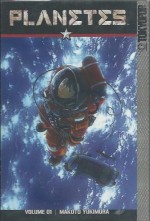
Planetes volume 1


By Makoto Yukimura, translated and adapted by Yuki Nakamura & Ann Wenger (TokyoPop)
ISBN: 978-1-59182-262-2

The hard, gritty mystery and imagination of space travel, so much a component of immediate post-World War II industrial society, once again captivated a legion of level-headed imagineers at the end of the 20th century when relative newcomer Makoto Yukimura rekindled interest in near-space exploration in all its harsh and grimy glory with this inspiring “nuts-and-bolts” manga series which explored the probable rather than the possible…

Yukimura (born in Yokohamain 1976, just as the once-ambitious American space program was languishing in cash-strapped doldrums and five long years before the first space shuttle launch) began his professional life as an assistant to veteran creator Shin Morimura before launching his independent career with the Planetes.

Working exclusively for Kodansha, his award-winning premier Seinen series ran in Weekly Morning magazine from January 1999-January 2004 and was later collected as four tankōbon volumes. The serial easily made the jump to a popular anime series and Yukimura – after producing Sayōnara ga Chikai node for Evening magazine – has since 2005 abandoned the future for the past and concentrated his creative energies on the monolithic historical epic Vinland Saga – serialized in Weekly Shōnen Magazine and Afternoon – and filling 11 bloodcurdling volumes to date…

The premise of Planetes is devilishly simply and powerfully engaging. Humanity is a questing species but cannot escape its base origins. In 2074 space travel and exploitation is practically commonplace but as we’ve conquered the void between Earth and the asteroid belt and prepare to exploit the outer planets, the once-pristine void around us has become clotted with our obsolete tech and casually discarded rubbish.

Even the most minute piece of junk or debris falling through hard vacuum is a high-speed, potentially deadly missile, and to keep risk to a minimum hardy teams of rugged individualists have to literally sweep the heavens free of our discarded crap.

‘A Stardust Sky’ begins with the death of a passenger on a commercial low-orbit space liner before jumping six years forward to introduce a trio of these celestial dustbin-men scooping up Mankind’s negligent cast-offs and unconsidered detritus.

Hachirota Hoshino is the newest member of the team, a kid who craves becoming a real astronaut and famous explorer like his dad and even dreams of one day owing his own prestige spaceship. However excitable “Hachimaki” is quickly becoming disenchanted with the dreary, dull and disgusting daily life of drudgery aboard DS-12 – a sanitation/cargo ship fondly dubbed Toybox but little better than the discards he and his two comrades daily scoop up or destroy…

These days there’s something wrong with the sombre, stoic Russian, Yuri Mihairokov.

The big man is increasingly distracted, blanking out, staring vacantly into the Wild Black Yonder as the cleaners orbit the Earth at 8 kilometres per second. Events come to head when a shard of micro-debris holes their ramshackle vessel and an old timer reveals the Russian’s tragic secret.

Long ago Yuri and his wife were on that shuttle and when it was holed she died. Heartbroken, her husband – one of the few survivors – returned to space to clear the deadly trash that took his wife, but he never forgot her.

Later, whilst drifting in the void the solitary astronaut sees a glitter, and her keepsake compass just floats into his hand, brought back to him by the winds of space. Beguiled, Yuri falls into Earth’s Gravity Well and only Hachimaki’s most frantic efforts save his comrade from a fiery death.

Safely back in free orbit, the Russian opens his gauntleted fist. On the compass are scratched his wife’s final thoughts as death took her – “please save Yuri”…

The poignant, bittersweet and deeply spiritual initial episode is followed by ‘A Girl from Beyond the Earth’ wherein young Hoshino slowly and impatiently recovers from a broken leg in the hospital of the moon colony Archimedes Crater City.

These tales are laced with the most up-to-date space science available to author Yukimura, and the recent discovery that extended time spent in low or zero-gravity radically weakens bones and muscles was the lynchpin of this moving brush with another youngster bound irrevocably to the void.

When a doctor suggests returning to full-gravity Earth to recuperate the easy way, Hachi is in two minds and sorely tempted. His commander and fellow debris-destroyer Fee Carmichael and an old 20-year veteran pour scorn on the quitter’s option. All real astronauts know that once back on the home world few ever return to space.

The lad is still tempted though until he strikes up a friendship with a thin, wasted young woman. Nono has been on Luna for twelve years and dreams of blue skies and open seas but will never see them. After aged Mr. Roland chooses to spend the rest of his life among the stars, Hachimaki learns Nono’s incredible sad secret and at last abandons all thoughts of forsaking the stars…

The focus stays on nicotine-fiend Fee Carmichael as she struggles to enjoy a well-deserved vice in ‘A Cigarette under Starlight’ in Orientale Basin Underground City a few months later. With breathing-oxygen at a premium, smokers must juggle their addiction for the weed with their dedication to life in space and poor Fee has been Jonesing for a drag for far too long. Now though, even whilst on shore-leave at a station big enough and sufficiently civilised to house a designated smoking area, the Toybox’s chief is still unable to indulge her vice.

An ideological terrorist group called the Space Defense Fighters want to keep the void pristine and free of Mankind’s polluting influence and have been detonating bombs in outposts all over the moon. Their latest outrages targeted the base’s vending machines and smoking rooms so the authorities have sealed them all in the name of public safety.

Driven near to distraction, Fee snaps and lights up in the public toilets, forgetting that smoke detection devices and fire countermeasures are automatic, incredibly sensitive and painfully effective…

Humiliated, sodden but undeterred, she takes off for another city and a solitary snout (for all you non-Brits that’s a particularly derogatory term for having a smoke) and finds the only guy more in need of a drag than her. Of course setting bombs is nervous work and a quick ciggy always calms his nerves…

The frustration is too much and Fee returns to her job but the SDF’s explosive campaign doesn’t end. Their latest scheme is the creation of deadly Kessler Syndrome wave (a blast or impact which changes the trajectories of free-floating orbital scrap and debris, making even more debris/shrapnel and aiming it like a hard rain of lethal micro-missiles)…

With a commandeered satellite directed inexorably at a space station, the terrorists intend to detonate their captured vehicle and shred the habitat – which coincidentally carries the last smokes in space – shooting it out of the sky and creating a lethal chain reaction making high-orbit space forever un-navigable…

Unsure of her own motives Fee uses the DS-12 to suicidally shove the stolen projectile away from the station and into Earth’s atmosphere…

In ‘Scenery for a Rocket’, as Fee recuperates in Florida, Hachimaki brings Yuri to visit Japan and falls back into a violent and historic sibling rivalry with baby brother Kyutaro, a rocketry prodigy even more determined to conquer space than his surly fanatical brother or their absentee astronaut father Goro…

Happily the Russian’s calming influence begins to repair fences between the warring Hoshino boys, but not before a series of explosive confrontations lead to Yuri finally passing on his beloved wife’s compass…

This first passionately philosophical and sentimentally suspenseful chronicle concludes with ‘Ignition’ as Fee, Yuri and Hachimaki reunite in time for the junior junkman to suffer an almost career-ending psychological injury. Although utterly unharmed by a rogue solar flare, the lad was completely isolated in the void for so long that he developed post-traumatic “Deep-Space Disorder”.

If he could not shake off the debilitating hallucinatory condition his life in space was over. Nothing the experts of the Astronaut Training Center did seemed to work, but fortunately Yuri knew just what prodding could awaken the wide-eyed, Wild Black Wonder in his feisty little comrade…

Tense, sensitive and moodily inspirational, these tales readily reinvigorate and reinvent the magical allure of the cold heavens for newer generations and this authentic, hard-edged and wittily rational saga is a treat no hard-headed dreamer with head firmly in the clouds can afford to miss…

This book – which also includes prose biographies of Konstantin Tsiolkovsky, Robert H. Goddard, Herman Julius Oberth & Werhner von Braun in ‘A Brief History of Modern Rocket Science’ – are printed in the traditional Japanese right to left, back to front format.
© 2001 Makoto Yukimura. All rights reserved. English text © 2003 TOKYOPOP Inc.

Let’s Be Perverts Book 1-4


By Youjung Lee (NetComics)
ISBNs: 978-1-60009-124-7, 978-1-60009-125-4, 978-1-60009-126-1,978-1-60009-127-8

If you look closely there are definite tonal and thematic differences in South Korean and Japanese comics (known as manhwa and manga respectively) – at least in the relatively few series that get translated into English.

Take for instance this bizarrely intriguing twisted love story from Youjung Lee: one aimed at a slightly older and more questioning and discerning audience.

What kind of parents name their son “Perverto”?

Although we never really learn the answer to that question, this peculiarly coy sex-comedy does introduce a very naïve, horny and troubled lad saddled with that disastrous moniker and a huge dose of adolescent misfortune as well…

Inescapably dubbed “pervert” by his classmates, the poor 17-year old virgin is forced to transfer to a new school after his catastrophically public first romance ended in utter, shameful disaster.

Unfortunately on his very first day another transfer student – a pretty, strong and fiercely independent tomboy named Hongdan – is groped on the subway and poor Perverto is framed for the assault, even though what he actually did was try to stop the real culprit.

Unknown to Hongdan the assailant was the new maths teacher Mr. Pi – and the obsessed and cunning deviant is planning on continuing his creepy campaign against the girl at every opportunity…

Perverto knows the truth, but can prove nothing to the girl. Moreover he begins to develop a major crush on her but cannot act upon his feelings.

Despite their poor start, Perverto and Hongdan grow close. In fact the dopey, bewildered sap is completely smitten with her until she makes an unexpected effort to intensify their friendly relationship, and the confused boy, mindful of his last painful and humiliating experience with a girl, violently rebuffs her. He still loves her though…

Hongdan has her own secrets too. Her glorious young body is frequently marred by unexplained bruises and, most shockingly, she has an possessive ex-girlfriend, Gaheul, who just won’t accept that her inamorata has moved on and certainly won’t let a boy named Pervert have her…

Strangest of all, although Mr. Pi is lurking in the background, still targeting her for clandestine attacks in public places, she doesn’t seem that bothered by the constant assaults…

Perverto and Hongdan are not the only frustrated time-bombs at the school – which like all places where adolescents congregate, is a seething hotbed of boiling hormones. One sadistic teacher is far too keen on beating students, a host of girls seem to be coming to school with no pants on and a classmate of Perverto’s is planning on raping a girl who rejected him…

Perhaps the dejected lad is fooling himself and he really is a pervert after all…?

Things are coming to a head (don’t: it’s beneath you and me) and the devious Mr. Pi is beginning to crack under the pressure of his increasingly insistent compulsion to assault Hongdan and Perverto’s knowledge of his shamefully irresistible affliction…

Driven to distraction the corrupted educator confronts Hongdan and finds her strangely complacent – even actively willing. Getting into his car she hears Pi’s disturbing history and considers his startling offer…

Meanwhile, since he might as well be a sleaze-hound, Perverto joins two equally frustrated classmates in a binge of illicit pornography and, after desperately egging each other on, the sex-starved virgins proposition girls in an online chat-room, offering money for sex.

To their horror one of them, “tomboy”, accepts and sets up an assignation…

Embarrassed and terrified, the trio keep the appointment but, when his friends bottle out and lock themselves in the bathroom at the last moment, the apoplectic Perverto is left alone and shaking to open the door to a girl from his own school class…

As the story concludes with a whimper and not a bang, the lives of Perverto and Hongdan have changed forever, but in ways neither of them ever expected or wanted…

Targeting sophisticated older kids, this tale is beautifully illustrated but might contain a little too much soft-focus, genteel nudity for some readers, even though its extremely moral theme is an examination of temptation and perception.

Clever, thought-proving, complicated, always surprising and just a little bit scary, this is a compelling fantasy of love, desire and obsession, viewed through the lens of a truly different culture and social code; both extremely engaging and terrifically appealing. Even if you aren’t a fan of manga or the far edgier Korean manhwa equivalent, this enticing adult romance series might just open your jaded old eyes…
© 1996, 1997 Youjung Lee. All Rights Reserved. English text © 2006, 2007 NetComics.

Star Trek the Manga volume 1: Shinsei Shinsei (“New Lives/New Stars”)


By Chris Dows, Joshua Ortega, Jim Alexander, Mike W. Barr, Rob Tokar, Makoto Nakatsuka, Gregory Giovanni Johnson, Michael Shelfer, Jeong Mo Yang & EJ Su (Tokyopop)
ISBN: 978-1-59816-744-3

Whilst the stellar Star Trek brand and franchise might not have actually reached any new worlds yet, it certainly has permeated every civilisation here on Earth, with daily live-action and animated screen appearances appearing somewhere on the planet almost every hour and comics iterations generated in a host of countries long lying fallow and unseen.

If only somebody could sort out the legal and logistical hassles so we could see again the stunning UK strips which appeared in Joe 90, TV21, TV Comic and Valiant from such fabulous creators as Angus Allan, Harry Lindfield, Mike Noble, Alan Willow, Ron Turner, Jim Baikie, Harold Johns, Carlos Pino, Vicente Alcázar, John Stokes and others, I could die a happy boy…

In 2006, to celebrate the 45th anniversary of the phenomenon, and capitalising on the global boom in Japanese styled comics, Tokyopop began releasing a series of all new manga adventures starring the indomitable crew of the Starship Enterprise as they boldly went all over the universe, courtesy of a serried band of international comics creators…

This initial monochrome masterpiece kicks off with ‘Side Effects’ by Chris Dows & Makoto Nakatsuka, and finds Captain Kirk, Science Officer Spock, Dr. McCoy and Ensign Pavel Chekov investigating a derelict ship which houses unsuspected horrors. Aboard the aged vessel are bodies from many species, displaying the hideous evidence of ruthless biological and mechanical augmentation…

When they release an exotic woman who appears to be the only survivor, she attacks them and infects Chekov with a virulent mutagenic virus whilst the other “corpses” revive and converge on them…

Although they beam back to the relative safety of the Enterprise, when a colossal vessel emerges from a wormhole, the derelict and Federation ship are swiftly snagged in a tractor beam and pulled into the time-dilation field of a Black Hole, seemingly harnessed to a ramshackle space-station.

Lost in space and time, Kirk beams a party over to the satellite in search of a cure for the disease ravaging Chekov, only to find the same unstoppable woman devastating the equally-infected remnants of an ancient civilisation who have sheltered aboard the station for centuries. Chief scientist Mynzek has been seeking a cure for untold ages, experimenting on volunteers and captives alike, but with success in his grasp at last, his latest subject has returned with vengeance in mind and her own all-assimilating agenda…

With resistance futile and the station rapidly self-destructing, Spock manages to secure a blood-sample to save Chekov, and the Enterprise quickly hurtles back through the wormhole and to the 23rd century, utterly unaware of the universal threat that will grow over the millennia from the last gasp of a desperate, dying civilisation and its first cyborg queen…

‘Anything But Alone’, by Joshua Ortega & Gregory Giovanni Johnson, sees the Enterprise orbiting an unknown world in response to a mysterious signal. Beaming down, Kirk, Spock and McCoy discover the thriving survivors of a long dead civilisation, maintained by miraculous nano-machines which can construct anything the people could possibly need. However the gracious, welcoming, childless citizens of Ximega II are concealing a tragic secret which only head scientist Prekraft seems willing to reveal. Moreover, he seems to going crazy with loneliness…

”Til Death’ (Mike W. Barr & Jeong Mo Yang) opens with Captain Kirk performing one of his more pleasant duties by officiating at the wedding of crewmembers Becky Randall and Tom Markham whilst the Enterprise scans a long-dead planet. However when dormant automated systems begin firing on the ship from separate locations, the survey mission switches to investigation mode and two landing parties beam down to find the shattered remnants of a civilisation which clearly self-destructed.

Retrieving twin sarcophagi which have somehow survived the holocaust, the explorers return to the Federation vessel, but soon inexplicable events begin to disrupt the ordered running of the ship and discipline of the crew…

The elaborate electronic coffins had each contained a withered husk and, momentarily forgotten as friends and lovers increasingly turn on each other, power is leeched from ship’s systems to rejuvenate the interred aliens. Soon the telepathic tyrants Faron and Nadira are fully restored and ready to finally end the hate-fuelled gender-war which pitted male against female and eradicated all life on their world. How lucky that there are so many men and women on the ship to act as their drones. But how unfortunate that one is a coldly dispassionate telepathic half-breed whose best friend is the most stubborn man in the galaxy…

A diplomatic mission to end an interplanetary conflict sees the Enterprise acting as a cargo courier, shuttling peace-making gifts between warring worlds. But whilst the entrancing emotion-reactive screen entitled The Weave by its Xoxxan craftsmen delights and beguiles all who regard it, the cutely appealing sacred animal ‘Oban’ genetically  recreated by the Xanvians conceals a monstrous and deadly secret which only becomes apparent when an unfortunate accident releases a mind-boggling, indestructible horror on the ship…

Faced with the prospect of renewed war, Kirk and Spock must determine if a maverick dissident, a duplicitous government or an impossible freak occurrence has endangered the tenuous peace process in a compelling political thriller by Jim Alexander & Michael Shelfer.

The manga action ends in classic style with ‘Orphans’, by Rob Tokar & E.J. Su, as the Enterprise performs escort duty for a peaceful space-faring race plagued by piracy. However the Lowarians and James T. Kirk have sadly underestimated the determination of the Haarkos, whose one-man raider-craft were shaped like humanoid robot-knights – complete with gigantic, lethal swords and shields…

When the battle-crazed mecha attack the starship, the lead pilot loses her life and another is captured before the Enterprise’s superior firepower drives off the rest of the pack, leaving Kirk with the impossible task of trying to reason with a merciless, ten-year old boy-soldier trained to kill from infancy.

If Kirk cannot find a way to reason with the honour-obsessed, battle-hardened warrior Xill he may have no choice but to exterminate all of these brutal, suicidal children who are as much victims as the race they now prey upon…

This particular edition (there are three counting a Diamond Distributor Exclusive and a Convention Special Exclusive) also includes the moving short-story ‘First, Do No Harm’ (by Dayton Ward & Kevin Dillmore from the prose Star Trek anthology Constellations) which details an unpleasant and unwelcome mission to extract rogue doctor Revati Jendra from the closed, primitive world of Grennai.

The fugitive medic’s actions contravene the Prime Directive and daily endanger the social development of the entire planet, even though she perfectly blends in with the natives and saves lives in a manner no patient would ever suspect as being beyond planetary norms…

However, as her close friend of twenty years, Leonard McCoy knows that there must be a damned good reason for her actions, whilst Kirk and Spock are more concerned by Starfleet’s suspicious wall of “classified” and “top security” roadblocks surrounding every aspect of her first expedition to Grennai decades ago…

Full of the verve, sparkle and wide-eyed enthusiasm of the original TV show, these continuing adventures are a real treat, and even if the manga visuals are a bit of a shock at first, you’ll soon adapt and surely settle in for another splendid ride on the timeless rollercoaster ride that is Star Trek…
™, ® & © 2006 CBS Studios Inc. All rights reserved.

Dark Hunger


By Christine Feehan, adapted by Dana Kurtin, illustrated by Zid & Imaginary Friends Studios (Berkley)
ISBN: 978-0-42521-783-2

Hard though it might be for us to imagine, there are people who go months at a time – even longer in rare cases – without reading a comicbook or graphic novel. Unbelievably these sad unfortunates derive their regular fun-fixes from other forms of entertainment such as TV, movies or even prose stories, so it’s just as well that every so often a brave creator from that side of the tracks makes moves to cross-pollinate by turning their favoured medium of creative expression into something we panel-pushers are more at home with.

Christine Feehan is an extraordinarily prolific and successful author of romantic fantasies and paranormal thrillers. Since 1999 she has produced a wealth of novels, novellas and short-stories, many of them for five distinct series which – like the book under review here – often interact with each other.

Her “Carpathian” novels deal with a savage but noble subspecies of vampire who eschew killing their human “blood donors” and hunt their murderously traditional cousins, determined to eradicate the monstrous horrors to extinction.

Amongst their many gifts are virtual immortality, shape-shifting, telepathy, flight, fantastic strength and speed and the power to manipulate lightning, but like all their kind they cannot abide sunlight…

Carpathians are an endangered species with few females, and if a male cannot find a “lifemate” he gradually withers; first losing the ability to see colour and experience emotion. Eventually all he can feel is the thrill of killing and he turns into a full, ravening undead vampire or commits suicide by “greeting the dawn”…

This intriguing manga-style tome from 2007 adapts the 14th Carpathian yarn and originally appeared as a text tale in the anthology Hot Blooded in 2004, describing how dedicated animal rights activist Juliette Sangria meets her ideal man whilst raiding a hidden testing facility deep in the heart of the jungle…

With her younger sister Jasmine, Juliette raids the high-security Morrison Laboratory intent on releasing the many endangered big cats held there, but the pair have no idea what other horrors the lab perpetrates until Juliette discovers a beautiful, exotic man chained in a cell…

Riordan De La Cruz has been a long-suffering prisoner of vampire and human scientists who run the lab, poisoned, tortured and humiliated until he considered ending his own immortal life. However, when the woman touches him he feels a burst of power and emotion. Viewing colours for the first time in ages, the Carpathian realises that somehow he has found his one and only: his lifemate…

In a fit of passion, he bites her and, refuelled by her blood, destroys the facility…

With Jasmine apparently still inside…

Flown to safety in his arms, Juliette’s heart and mind are reeling with the intensity of the inexplicable passion she feels for this sublime stranger, but as the night passes and Riordan explains his history, nature and powers she realises his absurd assessment is true; they are bonded for ever…

With the vampires in hot pursuit the couple flee and, of necessity, Riordan feeds on her again, before, to restore his beloved, sharing his own invigorating blood with her. However Juliette has a fantastic secret of her own and when Riordan burrows into the Earth at dawn she reverts to her animal form to search for her lost sister.

Juliette is a Were-Jaguar and her people do not marry. Their males are cruel brutes who beat and force themselves upon were-females they capture. Propagation is usually by rape and with Jasmine and her cousin Solange unaccounted for, Juliette is terribly worried. Whilst the physically comatose Riordan speaks to her telepathically, Juliette searches all day and when he comes to her at night they discover a partially destroyed hut where Were-women were recently held…

The trails lead in different directions and male Jaguar tracks are everywhere, but as they ponder how to proceed a Master Vampire attacks and Riordan is severely hurt driving it off. Giving her blood to save him, Juliette is aware that she is changing. Soon she will be unable to walk in daylight too…

As Riordan sleeps Solange appears, recounting that the were-males are holding Jasmine in a distant cave. Unable to tolerate the sun in human form, Juliette becomes a cat for the last time and with her ferocious cousin heads for a showdown…

The frantic Carpathian, psychically bonded to her, desperately urges Juliette to wait for sunset but they cannot and rush the assembled brutes. The alpha male rips Juliette’s throat out, and as she lies dying Riordan appears in a clap of thunder and wielding lightning like a whip…

To save his lifemate, the enraged hunter converts her fully, forcing the Jaguar-essence from her torn body but giving her the mystic arsenal of a full Carpathian. When they next emerge from the nourishing jungle Earth they will hunt together, determined to destroy forever the unholy alliance of humans, Were-men and the Master Vampire…

Despite being squarely aimed at the broadly female and teenaged Supernatural bodice-ripper market, this strange romance has strong thread of action and good steady pace underpinning it, so lads too will get a big charge from the book, whilst hopefully traditional prose readers tempted by the adaptation will be impressed enough by the clean, slick black and white visuals to give other graphic novels a go…
© 2004 Christine Feehan. All rights reserved.

Fallen Words


By Yoshihiro Tatsumi, translated by Jocelyne Allen (Drawn & Quarterly)
ISBN: 978-1-77046-074-4

After half a century of virtual obscurity, crafting brilliantly incisive and powerfully personal tales of modern humanity on the margins and on the edge, Yoshihiro Tatsumi found “overnight success” with his glorious autobiographical work A Drifting Life in 2009.

To describe his dark, bleak vignettes of raw real life, Tatsumi devised the term Gekiga or “dramatic pictures”, practically if not actually inventing the genre of adult, realistic, socially aware and literary comics stories in Japan. He began his career at a time when sequential narratives or “manga” literally meant “Irresponsible” or “Foolish Pictures”; a flashy and fanciful form of cheap, escapist entertainment targeted specifically at children – and the simple-minded – in the years immediately following the cessation of hostilities.

His tales have continued, in a never-ending progression, to detail the minutiae and moment of Japanese popular culture and, with his star assured in the manga firmament, have turned to a far older aspect of his country’s artistic heritage for this project.

The traditional performance art of Rakugo seems to combine many elements British observers would quickly recognise: reverentially combining familiar tales told many times over such as morality or mystery plays with instructive fables and especially shaggy dog stories and, just like Christmas pantomimes, the art derives from how the story is revamped, retold and expressed – but the ending is sacrosanct and must always be delivered in its purest, untrammelled form…

Developing out of the far older Karukuchi and Kobanashi shows, Rakugo first appeared as a discrete performance style accessible to the lower classes around 1780 during the Edo Period, establishing itself as a popular entertainment which still thrives today, regarded as a type of intimate comedy drama act in Vaudeville theatres.

As with all Japanese art-forms and disciplines Rakuga is highly structured, strictured and codified, with many off-shoots and sub-genres abounding, but basically it’s a one-man show where a storyteller (Rakugoka or Hanashika) relates a broad and widely embellished tale of Old Japan, acting all the parts from a sitting position, with only a paper fan (Sensu) and hand-cloth (Tenegui).

Equal parts humorous monologue, sitcom and stand-up act (or more accurately “kneel-down comedy”, since the Rakugoka never rises from the formal Seiza position) the crucial element is always the delivery of the traditional ochi or punch-line; inviolate, eagerly anticipated and already deeply ingrained in all audience members…

As is only fitting these tales are presented in the traditional back to front, right to left Japanese format with a copious section of notes and commentary, plus an ‘Afterword’ from Mr. Tatsumi, and I’d be doing potential readers an immense disservice by being too detailed in my plot descriptions, so I’ll be both brief and vague from now on…

‘The Innkeeper’s Fortune’ relates the salutary events following the arrival of an immensely rich man at a lowly hostel, and what happens after, against his express desires, he wins a paltry 1000 ryo in a lottery whilst the ‘New Year Festival’ only serves to remind one reluctant father what a noisome burden his rowdy ungrateful son is…

An itinerant young artist can’t pay his inn bill and, as a promissory note, paints a screen with birds so lifelike they fly off the paper every morning. The populace are willing to pay good money to see the daily ‘Escape of the Sparrows’, more than the bill ever came to. And then one day another far more experienced artist wishes to see the screen…

When a dutiful merchant succumbs to the temptations of his trade and engages a mistress she soon consumes all his attention, leading to his neglected wife trying to kill the home-wrecker with sorcery. Soon both women are dead and the merchant is plagued by their ‘Fiery Spirits’, whilst ‘Making the Rounds’ details one night in a brothel where four clients are becoming increasingly impatient and incensed by the non-appearance of the woman they’ve already paid for…

‘The Rooster Crows’ details the fate of a proud and puritanical young man tricked into visiting a brothel by his friends whilst a poor and untrained man becomes an infallible doctor after entering into a bargain with ‘The God of Death’ and this superb book of fables concludes with the sorry story of a lazy fishmonger who loved to drink, but whose life changed when he found a wallet full of money whilst fishing on ‘Shibahama’ beach

– or was it just a dream?

With these “Eight Moral Comedies” Tatsumi has succeeded – at least to my naive Western eyes – in translating an phenomenon where the plot is so familiar as to be an inconvenience but where an individual performance on the night is paramount into a beguiling, charming and yes, funny paean to a uniquely egalitarian entertainment, proving himself to be a true and responsible guardian of Japanese culture, ancient or modern …

Art and stories © 2009, 2012 Yoshihiro Tatsumi. This edition © 2012 Drawn & Quarterly. All rights reserved.