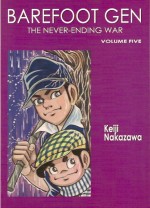
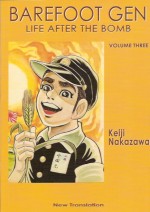
Barefoot Gen Volume 3: Life After the Bomb


By Keiji Nakazawa (Last Gasp)
ISBN: 978-0-86719-594-1

As much a justified assault on the horrors of atomic weapons and the kind of people who could even contemplate using them as semi-autobiography, Keiji Nakazawa’s epic Barefoot Gen is an examination of hope and change; of cultures in drastic upheaval.

Volume 3 opens with Gen, his mother and newborn sister Tomoko resolutely seeking somewhere to shelter, or a permanent place to live. But everywhere they are confronted by exploitative greed, suspicion and even superstitious terror. Bomb victims, displaced and helpless, were considered to be tainted with invisible disease and worst of all “Bad Luck”.

They had found brief refuge with the widow Kiyo, a childhood friend of Gen’s mother Kimie, but were driven away by their saviour’s greedy children and embittered grandmother. But now after searching her conscience, Kiyo shrugs off the institutionalised deference to senior family and offers the refugees her storage shed as a house of their own. Delighted with so little a gesture, the family rejoices unaware of the depth of resentment their very existence seems to engender.

This attitude to the A Bombs’ survivors persisted in Japan for decades. Even now Hibakusha (“Explosion-Affected People”) have a dichotomous existence in Japan. They are revered, spoken of with polite deference, but acknowledged as being “different”. To many Japanese this is still a major problem: conformity is everything. They have the dubious honour of being sacred pariahs. Laws were passed regarding them and they are still tracked and monitored by the Government.

The Atomic Bomb Survivors Relief Law defined Hibakusha as those people:

  • who were within a few kilometers of the hypocenters of the bombs
  • who were within 2 km of the hypocenters within two weeks of the bombings
  • who were exposed to radiation from fallout
  • babies carried by pregnant women in any of these categories.

The Hibakusha get a monthly government allowance, but they (and their descendents) were and are often the victims of severe discrimination due to ignorance about radiation sickness, which people initially believed to be hereditary or even contagious, About 1% of survivors, certified as suffering from bomb-related diseases, receive a special medical allowance.

Most of them live in Japan, but thousands have escaped social stigma by moving to more hospitable places like Korea. Every year, on the anniversaries of the bombings, the names of Hibakusha who have died in the previous year are added to the cenotaphs in Hiroshima and Nagasaki. As of August 2008, the death tolls stood at 258,310 at Hiroshima, and 145,984 at Nagasaki.

Desperate to earn money Gen tries everything, and eventually is hired by a rich man to tend his younger brother, whose bomb-induced injuries are so disgusting that no member of the family can bear to be in the same room with him. In a truly stomach-turning sequence Gen befriends the bitter, hostile victim, but all his neighbours and even his family think he’s a monster and pray for his death – his nieces even offer to double his pay if Gen will kill their uncle….

Seiji Yoshida was a promising artist visiting Hiroshima at exactly the wrong moment. Now maimed, deranged, despondent and dying, he is inspired by the irrepressible Gen to find a way to paint again. But as the petty abuses and tyrannies of the villagers, street kids, bomb orphans and even police make every day a new trial, Gen and Seiji establish a doomed rapport… And among those bomb orphans is a little thief named Ryuta (see volume 2, ISBN: 978-0-86719-619-1), the spitting image in looks and character of Gen’s dead brother Shinji. Eventually the waif is convinced to join Gen’s family, but this good deed, too will not go unpunished…

Seiji’s radiation sickness has inexorably advanced: whilst taken on a jaunt in a handcart by Gen and Ryuta they stumble upon a military body disposal site. The sight of thousands of bodies burned in vast, callous pyres with no thought of human dignity engulfs the artist: delirious and enraged he grips his brush, determined to record the impersonal horror for the world to see. As ever the message is “if we know, we won’t allow it to happen again…”

The effort nearly kills him, and in the final stages of illness he removes his bandages and demands the children take him naked through village, defying the people who called him “monster” and tried to ignore the hideous consequences of the war. With Seiji’s death his family breathes an unfeeling sigh of relief, but his example has inspired Gen: one day he too will be an artist and finish the tragic artist’s work. He will record the truth of Hiroshima…

Akira Nakaoka was evacuated from the city before the bomb hit. All this time he has been “safe and well” in the country, working on a state farm in Yamagata. Or so Gen thought. As with so much the government proclaimed, the truth was painfully different. Starved and beaten, used as slave-labour, the children of the farm get a rude awakening when the new of Japan’s surrender reaches them on August 15th. Abandoned by their teachers they drift away, back to Hiroshima…

Stuffed with broad humour to leaven the dire situations, Life After the Bomb uses the hardships and brutality of the aftermath to further hone Gen into a valiant, self-reliant, eternally optimistic character, capable of unrelenting compassion and empathy even as he learns new tricks to relieve the “haves” of what his family “has not”; a terrifyingly resilient fighter (the amount of physical abuse he takes and hands out would make Bruce Willis fans wince) always ready for trouble whilst looking to a brighter tomorrow. But there’s much more horror and tragedy to endure before that day dawns…

Barefoot Gen is a series that should be mandatory upper school reading (with proper adult supervision) but I should mention a rather obvious cultural difference that English speakers seem to think of significant import: in many countries nudity and coarse language are not the almighty taboos they are here.

The Japanese do not share our view of the human body and they acknowledge that kids know and use the occasional cuss-word when we’re not listening. Barefoot Gen is an earthy, human masterpiece about real people enduring and overcoming one of the greatest atrocities in the history of civilisation. To forego this incredible reading experience because of a four-letter word or a coyly drawn willy is just bloody stupid…

© 2008 Keiji Nakazawa. All Rights Reserved.
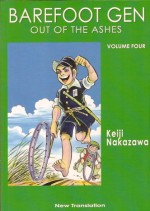
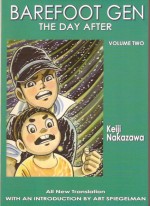
Barefoot Gen Volume 2: The Day After


By Keiji Nakazawa (Last Gasp)
ISBN: 978-0-86719-619-1

The second volume of Keiji Nakazawa’s astounding anti war masterpiece finds six year old Gen Nakaoka with his mother and newborn sister in the streets of devastated Hiroshima, traumatised witnesses to a parade of unique horrors and madness as the walking dead of the city stagger past, looking for aid or surcease – or perhaps for nothing at all.

Nakazawa, like Gen, does not only blame the Americans for the monstrous tragedy. In dry, bulletin-like manner the author blends the facts of the event into his passionate drama, and shows that the Japanese Military suppressed the news of the Atomic Bomb, fearing a panic or popular revolt, and allowing – perhaps even forcing (although that’s a pretty hard-sell for me) the Americans to do the same thing to Nagasaki three days later.

What I hadn’t previously known was that on that same day Russia ended its neutrality agreement with the Empire and attacked the Japanese Kwantung Army in a Soviet invasion of Manchuria: the Manchurian Strategic Offensive Operation. Only then did the war leaders stop throwing away their peoples’ lives…

Gen and his mother make for the suburbs driven by revulsion and hunger. Severely malnourished for months, she has no milk to suckle her baby with, and the boy leaves her to scavenge for food, but comes upon a military clean-up squad literally stacking bodies, making no distinction between dead and nearly so…

He finds children and an old woman brutalising a dead American POW. Many prisoners and slave races like the Korean Mr. Pak (a friend and fellow Pariah, as despised as the anti-war Nakaoka “traitors” had been) were used for forced labour in the industrial heart of Hiroshima – a fact the Americans must have known…

Overcome with hunger and exhaustion Gen collapses, and ends up on a pyre with a pile of corpses. He is saved by one of the funeral squad – a decent soldier who tries to carry him home only to collapse from hideous, mysterious ailments – Gen’s first experience of the invisible destroyer Radiation Sickness. Soon he realises that he hasn’t escaped the unseen terror either as his hair falls out in knotted clumps. Nakazawa is a master of emotional placement – we readers know what is happening but to the survivors in 1945 this was a completely new experience – a ghost disease that struck without warning, affecting everybody in a different manner, and with his open, stylized drawing he makes us feel the bewilderment and terror.

Lurching from one encounter to the next Gen is an innocent cataloguing the many horrors of the bomb, but always he tries to encourage the people who had reviled him mere days ago. However when he stops the disfigured little girl Natsue from committing suicide, he finds a greater purpose and begins his lifelong campaign to defeat the evil of warfare with a positive attitude and bold action.

Throughout the epic, folk songs are used as a narrative device, and when Gen’s performance at a suburban house earns enough rice to stave off death a while longer it leads to a startling encounter with a pack of child thieves, one of whom is the exact double of dead brother Shinji. Called Ryuta, the boy’s tale of woe is as bad as all the rest but it does lead to a reunion with the Mr. Pak and a realisation: Gen must find and honour the remains of his family…

With all their obligations fulfilled the remaining Nakaoka’s head for the rural district of Eba and temporary refuge with Mother’s oldest friend. But the reception would prove to be anything but hospitable…

August 6th 1945 changed the world forever and deeply affected six-year-old Keiji Nakazawa. When the “Little Boy” thermonuclear weapon was thrown from the American B-29 bomber “Enola Gay” onto the city of Hiroshima, he was only one kilometre from Ground Zero, just entering Kanzaki Primary School. He was saved from instant vaporisation in the same manner as his comics alter-ego Gen Nakaoka, and over the years he has suffered many of the same hardships, tragedies and triumphs. Hopefully Barefoot Gen, the evocative anti-war weapon he created, will always stand ready to counteract the periodic madness that arouses the greedy and afflicts the vain and the foolish.

© 2008 Keiji Nakazawa. All Rights Reserved.
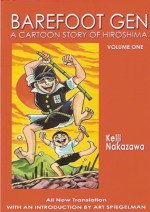
Barefoot Gen Volume 1: A Cartoon Story of Hiroshima

barefoot-gen-v
By Keiji Nakazawa (Last Gasp)
ISBN: 978-0-86719-602-3

I first found the Educomics magazine I Saw It! in 1982; initially seduced by the garish cover and the Chester Gould-like illustrations. There was very little translated manga around then, and it was lumped in with the wild, wacky and often salaciously outrageous “Underground Comix” on the racks of my regular comics shop.

I was gobsmacked.

In England we’ve had educational comics for decades, but this was something completely new to me. There was no tasteful distancing here; just an outraged scream of defiance and a direct plea to make things right. This was history and politics – and it was deadly serious, not played for laughs or to make points as British cartooning traditionally did.

I Saw It! became Barefoot Gen, constantly revised and refined, and now the entire semi-autobiographical saga is being remastered in an unabridged ten volume English translation by Last Gasp under the auspices of Project Gen, a multinational organisation dedicated to peace and the abolition of nuclear weapons.

Hadashi no Gen originally began in 1973, serialised in ShÅ«kan Shōnen Jampu (Weekly Boys Jump) after an occasional series of single stories in 1972 including Kuroi Ame ni Utarete (Struck by Black Rain) and Aru Hi Totsuzen, (One Day, Suddenly) in various magazines. These led Shonen’s editor Tadasu Nagano to commission the 45 page Ore wa Mita (I Saw It) for a Monthly Jump special devoted to autobiographical works. Nagano realised that the author – an actual survivor of the first Atomic Bombing – had much more to say and commissioned the serial which has grown into this stunning epic.

The tale was always controversial in a country that too often prefers to ignore rather than confront its mistakes and indiscretions, and after 18 months Hadashi no Gen was removed from Jump transferring first to Shimin (Citizen), Bunka Hyōron (Cultural Criticism), and Kyōiku Hyōron (Educational Criticism). Like his indomitable hero Keiji Nakazawa never gave up and his persistence led to the first Japanese book collection in 1975, translated by the first Project Gen into English, and many other languages including Norwegian, French German, Italian, Portuguese Swedish, Finnish, Indonesian, Tagalog and Esperanto. He completed the tale in 1985 and his dark chronicle has been adapted into three live action films (from 1976 to 1980), 2 anime films, (1983 and 1987) and in 2007, a 2-part live action television drama.

The unabridged first book A Cartoon Story of Hiroshima introduces six year old Gen Nakaoka in a small allotment, cultivating wheat with his father, an artist whose anti-war sentiment has made life even more difficult for his family. Hiroshima is starving, with American air-raids a constant hazard and rabid patriotic militarists urging the weary populace to greater and greater sacrifice. Every one is constantly reminded that their greatest honour would be to die for the Emperor. I almost expected Darkseid to pop up at any moment…

Gen is the third of five children; Koji and Akira, are his older brothers, his sister Eiko and brother Shinji are younger. His beloved, devoted mother is heavily pregnant. It is a desperate time. Neighbours spy on neighbours, secret police skulk everywhere, criminals and police confiscate all the food and everywhere the militarists scream that total victory for Japan is only a few days away…

Spring 1945: Hunger is everywhere. The bitter realist Papa Nakaoka is increasingly unable to suppress his anger at the greedy warmongers who have brought Japan to the edge of ruin. His open dissent turns his neighbours and friends against the family. They are all labelled traitors for his beliefs, shunned and cheated. Akira is evacuated to the countryside, Koji forced to join the ranks of the Kamikaze, but for pregnant Kimie and her youngest children the stress is unrelenting and inescapable…

Gen’s father is a complex figure – often regarded by critics as a pacifist, though he is far from that. He is however a totally honest man with a warrior’s heart and a true descendent of an honourable warrior culture. Arrested, beaten, maligned, he is unwavering in his fierce belief that the war is wrong, instigated by greedy men to line their own pockets. He always fights for what he knows is right and even as he is beaten by the police he tells his sons “When you know something’s right, don’t give it up…”

His other lesson becomes a major metaphor and visual theme of the series “Be like wheat that sprouts in the dead of winter and gets trampled over and over, but grows straight and tall and bears good fruit”.

The level of domestic violence – and indeed casual social and cultural violence – is apt to cause some modern readers a little concern. Papa Nakaoka is a “hands-on” father, always quick to physically chastise his children, and Gen himself develops into a boy all too ready to solve problems with his fists, but that the family loves deeply and is loved in return is never in doubt – you will just have to steel yourself for a tale about and prominently displaying lots of “tough love”.

There’s a great resemblance to the best of Charles Dickens in Barefoot Gen, especially Oliver Twist and Nicholas Nickleby, but as the human travails of Gen and his family mount there’s no human face of evil; only a ghastly clock counting down. We all know what’s coming even if they don’t and a repeating motif of a circle sun – more often dark than light – keeps that dread tension and foreknowledge of an utterly abhuman crisis solidly in focus.

Monday August 6th 1945 dawns bright and clear. Gen is celebrating a rare personal victory as little Shinji plays with a hard-won toy. There’s a flash of light in the sky…

Much has been written about the effects of the bomb and the incredible, matter-of-fact, nightmarish way Nakazawa has captured them. They’re all true. The depiction of the atomic aftermath and its immediate effects upon the survivors – although I hesitate to use such a hopeful term – are truly ghastly, and a testament to the power of the artist’s understated drawing talent. But this is a book about overcoming the impossible and to understand Gen’s achievement and victory, one has to see the face of his foe.

As the firestorm engulfs the city the miraculously unscathed boy rushes home. The structure has collapsed upon itself, trapping Papa, Eiko and Shinji. Despite his and mother’s efforts they can’t be extricated and no one will help. Mother and child watch helplessly as the family burns to death and the trauma induces labour. Amidst the flames Gen delivers his sister into a world of pain and horror…

Polemical, strident and unrelenting, A Cartoon Story of Hiroshima is also a great piece of craft: graphic narrative at its most effective and powerful. Gen is a flawed but likable hero, big-hearted and trustworthy, a source of cathartic laughter of the best slapstick kind, and a beacon of tragedy, hope and (im)patient understanding.

Although undoubtedly overshadowed by the strength and effect of its message, it’s also a compelling read as a drama, supremely informative and entertaining, memorably beguiling. Please read it. Read all of the series.

It might make you sick: it should. It’s meant to. Read it anyway. And when you think they’re ready, show it to your children. “Those who do not learn from history…”

© 2008 Keiji Nakazawa. All Rights Reserved.
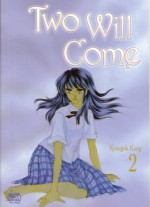
Two Will Come Book 2


By Kyungok Kang (NetComics)
ISBN: 978-1-60009-116-2

Set at the close of the 20th century, this is the story of Jina, a young Korean girl with all the usual problems of the comfortable modern miss, but with a family secret that threatens to tear her cosy world apart…

Hundreds of years ago her ancestors were Kings. One vain and foolish monarch ordered the death of a magical serpent called an Imugi just as it was preparing to ascend to Heaven. It cursed his family for eternity, decreeing that in every generation one of them would die as a result of the actions of two people close to them. The fear, distrust and misery of this most subtle pronouncement blighted the family through the centuries and no attempts to forestall their doom with priests, fortune tellers or exorcisms have worked. Long ago they decided to keep all knowledge of the curse from the children, only revealing the secret when – or if – they reach a certain age.

Jina has few friends but as her birthday approached her school rivalry with the obnoxious Jaesuk seemed to be turning into something more. The girls in class picked on her less and her cousin Myunghyun returned from America after three years, bringing with him a gorgeous and enigmatic young man named Yoojin Lee. As she grew closer to them all her parents began acting oddly: as though dreading her new and maturing relationships…

When the latest soothsayer determined that Jina was the most probable target of this generation’s curse it had to mean that two people close to her would cause her death…

The second book begins when Jina’s scary aunt accosts her whilst she’s out with Myunghyun and Yoojin. The traumatised woman reveals more facets of the family curse, and believing that she must soon die Jina listens attentively, especially after her aunt reveals that she killed the last victim: her own sister…

Meanwhile Jaesuk has decided to stop playing the field and dedicate himself to Jina alone, but his ex-girlfriends (Jina’s best friend and worst enemy respectively) don’t take the news too well… Worst of all, the curse seems to have mutated as a ghastly presence invades her house, possessing first her mother and then the exorcist, driving them to murderous attacks upon the young girl. It seems as if any friend, family member or even random associate could now be her predestined killer.

Confused and despondent, haunted by dreams of a ghostly young woman with death in her eyes, Jina goes on a road-trip. Accompanied by the two boys, who are rapidly becoming her truest friends and allies, she visits another broken family member, but the awful tale he tells does little to comfort her. And when Myunghyun reveals that he also sees the Ghost woman – and knows her identity – Jina finally realises just what her life may mean…

The promised edge of tragic horror in book 1(ISBN: 978-1-60009-116-2) of this compelling contemporary Gothic Romance strikes tellingly home here as with beautiful pictures revealing an inescapable and fatalistic, the star-crossed doom of young Jina gathers unstoppably about her. Can courage, fortitude and true love overcome the power of the centuries-long curse?

As much teen-soap as thriller, this manhwa fantasy’s subtle undercurrents and classical precedents raise it far above the usual manga arena to deliver a truly powerful tragedy which any lover of great fiction will adore. I advise you to get aboard and keep watching… the rewards should be huge and very fulfilling.

© 2007 Kyungok Kang. All Rights Reserved.  English text © 2007 NetComics.

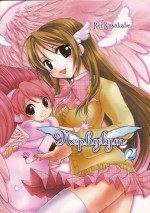
Nephylym Book 2


By Rei Kusakabe (DrMaster Publications)
ISBN13:  978-1-59796-182-0

Shun Imai has a little problem. He’s a fairly average high-school boy but a martyr to static electricity. Every time he touches metal there’s a painful flash and spark. It’s a very similar situation whenever he sees pretty classmate Sanari Kurosaki. His other big problem is that he’s been hand-picked by a diminutive Angel named Air to be an “Answerer”, a supernatural warrior dedicated to eradicating the disruptive effects of “Noir” wherever it strikes. Air is a supernatural guardian known as a Nephylym…

Noir is a bad mood made manifest: When black emotions and negative feelings become too oppressive they can take on physical form and cause grave, destructive harm. This volume begins with Shun still adapting to his new position as a secret warrior and the revelations that the girl of his classroom dreams is an Answerer too.  Just like his friendly rival Tsukasa…

Even supernatural Cops have bureaucracy and a pecking order though, and Shun’s current problems divide equally between having to take an Answerer Proficiency Test and simply surviving the persistent attacks of a completely new – and very hot! – menace calling herself Qliphoth – the Noir’s equivalent to the angelic Nephylym

Engaging, funny and faster-paced than many mangas of this genre, this is a highly readable, well-drawn fantasy adventure that has lots to offer the casual browser as well as the dedicated collector and fan.

This black and white book is printed in the Japanese right-to-left format.

© 2007 Rei Kusakabe. English translation © 2008 DrMaster Publications. Inc. All Rights Reserved.

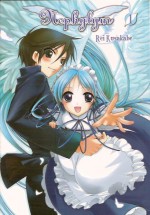
Nephylym Book 1


By Rei Kusakabe (DrMaster Publications)
ISBN13:  978-1-59796-181-3

Shun Imai has a little problem. He’s a fairly average high-school boy but is a martyr to static electricity. Every time he touches metal there’s a painful flash and spark. It’s a very similar situation whenever he sees pretty classmate Sanari Kurosaki.

His life takes a big turn into weird territory when he discovers a tiny winged girl following him and a black slime oozing maniac attacking people. Valiantly going to the rescue he finds his static problem has a powerful effect on the berserker. The little pixie girl somehow aids him. She can’t speak but telepathically reveals her name is “Air”.

His life gets even crazier when his dream-girl Sanari reveals that he is an “Answerer” – just like she is. The little winged angels are Nephylym, and they seek out and bond with worthy warriors to combat the dark forces of bad emotions given destructive physical form as “Noir”. Shun is destined to be a secret hero…

And thus begins a rather charming, simple action-fantasy/schoolboy hero yarn that will delight newcomers to the genre. The progress of Shun as he discovers the hidden world of Answerers, meets his rival for Sanari’s affections (she, of course, only thinks of the boys as her friends), and has to save his oldest pal from the curse of Noir is pretty standard manga fare but delivered with great flair and comedic grace to counterpoint the terror and tragedy of the core premise.

Light, enchanting yet full of humour and wholesome action, this series is a solid work that should entice readers new to comics and especially youngsters just dipping their toes into the world of graphic narratives.

This black and white book is printed in the Japanese right-to-left format.

© 2007 Rei Kusakabe. English translation © 2008 DrMaster Publications. Inc. All Rights Reserved.

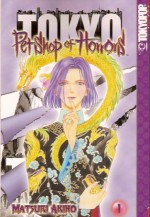
Pet Shop of Horrors: Tokyo Book 1


By Matsuri Akino (Tokyopop)
ISBN: 978-1-4278-0607-9

Spinning off from the original series featuring the enigmatic Count D, which was set in the Chinatown of Los Angeles, this intriguing sequel finds the emporium of unique beasts firmly established in the futuristic Tokyo skyscraper mall called Neo Chinatown in that city’s red light district. Into this enclave of desperate commerciality drifts a troubled mother seeking a dog to protect her young son Shingo.

What the exotic, ambiguous, androgynous Count sells her appears to be another child, but whilst her minds spins, trying to remember just how she became a human trafficker, the eerie child reveals itself to be very far from human but a faithful guardian for all that…

As with the original 10 volume saga, this horror fable is a cautionary tale about making decisions and keeping promises, with dire results for transgressors. The Pet Shop’s most exotic creatures are far from dumb beasts and they always act as supernatural catalysts for people at a turning point in their lives. As the Count carries out his mysterious business amongst a wide and wary clientele we can see an inkling of some greater plan afoot…

Also included in this volume is ‘Door’; a beguiling tale of the Pet Shop in years past when it was situated in Nazi Berlin…

In many ways the tale has much of the flavour of Charles G. Finney’s 1935 brilliantly satirical cult novel The Circus of Dr. Lao (a fantastic, weird morality play/social commentary crying out for broader popular attention – preferably in an edition with the baroque illustrations by Boris Artzybasheff which were inexplicably omitted from many later versions). The fantastic elements of the offered “pets” are a double-edged sword that will alter lives not because the purchasers want it but because change is necessary – and inevitable.

The fabulous creatures stocked by Count D are tailored to reveal the buried secrets and desires of their future owners, and the tone of inevitable destiny does much to flavour this dark, pretty portmanteau yarn. Fans of classic mystery and suspense, as well as manga-lovers will experience a true treat with this compelling series.

This black and white book is printed in the Japanese right-to-left format.
© 2005 Matsuri Akino. All Rights Reserved. English text © 2008 TOKYOPOP Inc.

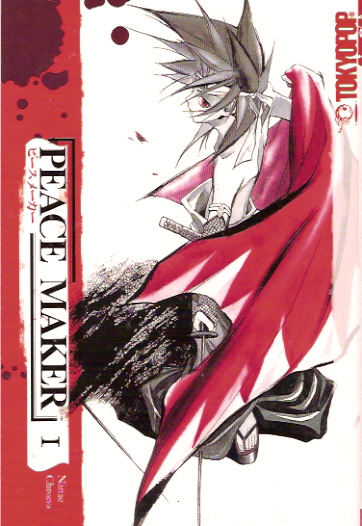
PEACE MAKER VOLUME 1

PEACE MAKER VOLUME 1

By Nanae Chrono (TokyoPop)
ISBN: 978-1-4278-0075-6

Fast-paced and quite manic, this superlative historical manga tells of Tetsunosuke and Tatsunosuke, two brothers who saw their parents murdered.

During the days of the Meiji Revolution their father was a diplomat dedicated to bring peaceful change, but Ichimura’s ways were not to everybody’s tastes and his family paid the price. The Revolution or “Renewal” was a series of events and incidents which altered the very nature of Japan in the later 19th century. It spans the end of the Tokugawa Shogunate or Edo period and the beginning of the Meiji Era. It saw the chaotic, irresistible modernization which followed the enforced breaking of Japan’s self-imposed Isolation by the American Commodore Matthew Perry and his “Black Ships” in 1854.

Ten years later Ichimura Tetsunosuke provokes a battle with a squad of warriors from the Shinsengumi, the unofficial, volunteer police force who have taken it upon themselves to restore order to Kyoto. Although only fifteen he desperately wants to emulate his brother Tatsunosuke, who has already joined this militia of brutal warriors. Both of them are driven to avenge their parents’ deaths.

As a member of the uncompromising Shinsengumi Tatsu has access to many secrets from the Revolution’s early days, and slowly he gets closer to solving the ten-year riddle surrounding the death of the man everybody called “the Peacemaker”. But awash in a sea of intrigue, espionage, violence and death it becomes increasingly hard to keep his own hands clean – and his impulsive brother is becoming ever more impatient and unmanageable…

Steeped in actual historical events this canny revenge thriller blends the beginnings of modern Japan with the death of the Samurai way of life, and even manages to weave a canny mystery and the frantic social slapstick of youthful heroes into a compulsive read that promises great things to come.
This book is printed in the ‘read-from-back-to-front’ manga format.


© 2005 Nanae Chrono. All Rights Reserved. English text © 2007 TOKYOPOP Inc.

Goth’s Cage

Goth's Cage
Goth's Cage

By Yasushi Suzuki (DGN/DrMaster Publications)
ISBN 13: 978-1-59796-157-8

Yasushi Suzuki is one of the design world’s most respected artists. In illustration, design and the realm of computer and video games his eerie ethereal art has charmed and mesmerized millions, and his powerful manga Purgatory Kabuki (ISBN13: 978-1-59796-070-0) has won him fans for his ability to tell a story.

This slim (32 pages) little tome is a reworking of much pre-existing artwork into a bleak and beautiful picture book for adults. Surreal and deeply moving the book relates three short tales of love and horror, all rendered in a dazzling blend of styles but forming darkly memorable comic narratives.

‘Glass Magic’ stars a willfully cruel princess, ‘The Feeling of Pain’ traces the morbid journey of a little boy and the collection concludes with the dire love experience of ‘The Pair.’

Suzuki’s sublime skill with colour and line here blend with evocative line and wash creations and the incredibly high production values of this book, utilising the most modern of print techniques and processes to highlight the art make every page turn the doorway to fresh delights.

The narrative is simplistic and often obscure, but here plot is not as desirable as emotional reaction and the audience – hopefully much wider than the Lolli-goths and game-boys-&-girls it’s clearly targeting – should find itself drawn into an all-encompassing other world without worrying too much about how they got there.

This is an ideal and lovely present for the fantasist in your life, a fine piece of classic fantasy in its own right and well worth your time a-questing for it.

© 2008 Yasushi Suzuki. © 2008 DGN Production Inc. All Rights Reserved.

Chinese Hero: Tales of the Blood Sword volume 8

Chines Hero 8
Chines Hero 8

By Wing Shing Ma (DGN/DrMaster Publications)
ISBN13: 978-1-59796-149-3

This is the final volume in the spellbindingly action-packed but narratively nonsensical martial arts drama. Fans of the bizarre yet so enthralling series will be delighted and probably amazed that the spectacular fighting and action scenes are ratcheted up to an even more frenetic pitch as Hero Hua and the remnants of his family continue to defend the mystical Blood Sword from the meanest and most accomplished master villains of the veritable horde of vicious, exotic baddies determined to use its powers for evil.

If you need a starting context, it all kicked off when a gangster tried to steal the Sword, which Hero’s family had guarded for centuries. That fight’s collateral damage included most of Hero’s family, and began a bloody vendetta encompassing half the planet. The Foes are thoroughly evil, masters of every fighting art and dirty trick whom Hero and his incomprehensibly wide circle of friends and associates – coming and going with dazzling brevity – must fight unceasingly to preserve the Sword and achieve their vengeance.

I’ve said it before and it’s still true: Hong Kong comics are beautiful. Produced using an intensive studio art-system wherein any individual page might be composed of painted panels, line-art, crayons and coloured pencils – literally anything that will get the job done.

They’re wonderful to look at, but don’t expect them to make much sense, because fundamentally this genre of comic is one glorious, spectacular exhibition of Kung Fu mastery. Like much of the region’s classic cinema, all other considerations are suborned to the task of getting the fighting started and just keeping it going.

Remarkably that carries on right up until the very last page here. There’s no resolution – at least not in any recognisable western manner – just a brief cessation of violence, and as a tacked on text epilogue explains, all the varied combatants will go on making their plans and fighting for and against evil. The adventure never truly ends.

If you’re looking for characterisation, sharp dialogue or closure, look elsewhere. If, however, you want Good Guys thumping Bad Guys in eye-popping ways, give this fantastical series a shot. I never really “got it” but I think I’m going to miss it!

© 2006 Culturecom, Ltd. All Rights Reserved.