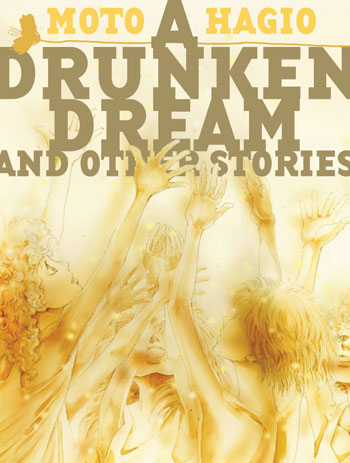
Moto Hagio’s A Drunken Dream and Other Stories


By Moto Hagio, translated by Matt Thorn (Fantagraphics Books)
ISBN: 978-1-60699-377-4 (HB)

Girls’ comics have always taken a secondary role in publishing – at least in most countries. In Japan this was the case until a new wave of female artists and writers stormed the male bastions in the 1970s transforming a very much distaff niche into a viable, autonomous marketplace, consequently reshaping the entire manga landscape in the process. At the forefront and regarded as part of a holy trinity of astoundingly gifted and groundbreaking creators is Moto Hagio. The other two, if you’re in the mood to Go Googling – and of course, other search engines are available – are Keiko Takamiyaand Yumiko Oshima…

This lovely hardback collection (regrettably not available in digital formats yet) presents ten of her best short stories gleaned from a career spanning more than 50 years, over which time she and her revolutionary compatriots created whole genres, advanced the status of fantasy, horror and science fiction tales, reinvented and perfected the shōjo (“girl’s story”) form, all while introducing a degree of literacy, symbology, authority and emotional depth to the medium that has gone on to transform comics in Japan and globally.

Editor, translator and cultural ambassador Matt Thorn has contributed an informative historical treatise on Japan’s comic world and those revolutionary comics creators (thoroughly annotated) as well as providing a far-reaching, moving and engrossing interview with the artist and academic herself.

Although her most popular works are generally science fictional (another arena where she broke new ground in such sagas as They Were Eleven!, Marginal and Otherworld Barbara), socially probing human dramas like Mesh and A Savage God Reigns explored previously forbidden realms of psycho-sexual and abusive family relationships with such deft sensitivity that they served to elevate manga from the realm of cheap escapism to literature and even Great Art – a struggle we’re still waging in the West…

This compelling volume traces her beginnings through more traditional themes of romance, but with growing success came the confidence to probe into far darker and more personal subjects, so whereas my usual warnings are about pictorial nudity and sexual situations, here I’m compelled to say that if your kids are smart enough, the contextual matter in these tales might be a tad distressing. It is all, however, rendered with stunning sensitivity, brilliantly visual metaphors and in truly beautiful graceful tones and lines.

The comics section (which is re-presented in the traditional front-to-back, “flopped” manner) begins with ‘Bianca’ from 1971: a wistful reminiscence and disguised disquisition on creativity wrapped in the tragic story of a childhood companion whose parents separated, whilst 1971’s ‘Girl on Porch with Puppy’ is a disquieting cautionary tale about disobedient little girls who don’t try to fit in. From the same year, ‘Autumn Journey’ is a complex mystery concerning a young man trying to meet his favourite author – as well as a painful exploration of families growing up apart.

‘Marié, Ten Years Late’ hails from 1977: a heartbreaking example of a “Sophie’s Choice” as a lonely, frustrated artist discovers the truth behind the breakup of a perfect friendship which twisted three lives, whilst the eponymous science fictional ‘A Drunken Dream’ (1980) deftly describes a doomed reincarnating romance which has spanned centuries and light-years. This is the only full colour story in a generally monochrome volume.

Moto Hagio is one of a select band of creators credited with creating the “boy’s love” sub-genres of shōnen–ai and Yaio: sensitively homoerotic romances, generally created by women for women and now more popularly described as BL (as opposed to Bara – gay manga created by men for men) and this lyrical, star-crossed fantasy is a splendid example of the form.

‘Hanshin: Half-God’ (1984) is a disturbing, introspective psychological exploration of Hagio’s favoured themes of familial pressure and intolerance, described through the lives of anther girls’ comic favourite; twin sisters. The siblings here however are conjoined: Yucy is a beautiful angelic waif whilst her monovular other Yudy is an ugly withered homunculus.

The story is told by ugly Yudy, whose life is changed forever by an operation to separate them. This incredibly moving tale adds barbed edges and ground glass to the ugly duckling fairytale and cannot fail to shock and move the reader…

From the same year comes longer romantic tale ‘Angel Mimic’ as a failed suicide eventually evolves into a slim chance of ideal love, which poesy leads into the harrowing tale of rejection that is ‘Iguana Girl’.

Although couched in fantasy terms, this tale of contemporary Japanese family life follows the life of Rika, an ordinary girl whose mother thinks she is a monster, and how that view warps the way the child perceives the world throughout her life.

‘The Child Who Comes Home’ (1998) again examines rejection, but uses the memory of a dead son and brother to pick open the hidden scabs of home and hearth – or perhaps it’s just a sad ghost story to clear the palate before this superb commemoration ends with the elegiac and almost silent, solitary pantomime of 2007’s ‘The Willow Tree’ which shows yet another side of family love…

Abuse of faith and trust. Love lost or withheld. Isolation, rejection, loss of purpose: all these issues are woven into a sensuously evocative tapestry of insightful inquiry and beautiful reportage. These tales are just the merest tip of a cataclysmic iceberg that invaded the stagnant waters of Girls’ comics and shattered their cosy world forever. The stories grew up as the readers did; offering challenging questions and options, not pat answers and stifling pipedreams.

Until the day our own comics industries catch up at least we have these stories – and hopefully many more from the same source. Sequels please, ASAP!
All rights reserved. Original Japanese edition published 1977, 1985, 2007, 2008 by Shogakukan Inc. English translation rights arranged through Viz Media, LCC, USA. © 2010 Fantagraphics Books.
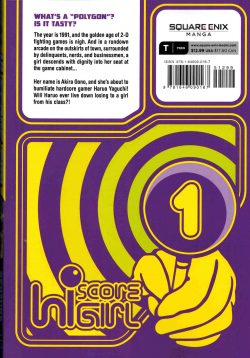
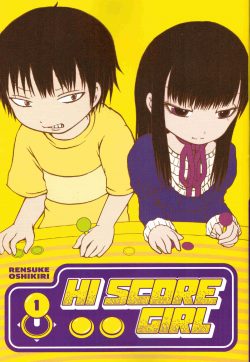
Hi Score Girl


By Rensuke Oshikiri translated by Alexander Keller-Nelson (Square Enix Manga & Books)
ISBN: 978-64609-076-7 (Tankōbon PB)

I’ve been dreadfully longwinded of late so here’s a quick review of a book I didn’t expect to like at all, but which happily surprised me.

Let me start by admitting I’m old and slow and physically decrepit. Computer gaming of all stripes and sorts has completely passed me by, and even when I was a fit, demi-god-like Adonis, I was completely immune to the allure of moving screens, ghastly cartoon explosions and things that went blip or bleep. I knew other folk liked them, but I couldn’t care less.

I still don’t, but they’ve been around long enough to have entertained generations and acquire some vintage, and this delightful manga (and the usual anime and movie/TV spinoffs) cannily access that sense of time well spent and happy childhoods to splendid effect for a very human story.

Created by Rensuke Oshikiri, the strip Hai Sukoa Gāru began in October 2010 in Monthly Big Gangan, running until September 2018 and filling ten Tankōbon volumes with the collected adventures. There is talk of a sequel series soon…

It’s actually a slow-burning romcom that begins in 1991, concerning poor schoolboy Haruo “Mighty Fingers” Yaguchi. He hasn’t got much, but he’s the king of his local video game arcade – and any other he can find money to enter. At least, that is, until little perfect miss Akira Oona comes in and starts trashing his scores…

She’s in his sixth-grade class: pretty, rich, aloof. Everybody loves her – even the teachers – even though she never speaks to anyone. What right – or need – has she to invade his sordid dominions?

He hates her.

As she continually and constantly wrecks his rep on a variety of games that will cripple fans and cognoscenti with overpowering nostalgia, his ire grows. However, as shared interests and surprisingly similar domestic problems push them together, his attitudes begin to change. Hers are harder to fathom. Like Tommy in that rock opera, she only seems to come alive in front of a console…

Packed with the kind of technical detail and historical background all geeks – gamers, comics, whatever – and surprise features, this is a truly engaging yarn that ends on a potentially tragic cliffhanger that will have you clamouring for more…
© 2016 Rensuke Oshikiri/SQUARE ENIX CO., LTD. English translation © 2020 SQUARE ENIX CO., LTD.

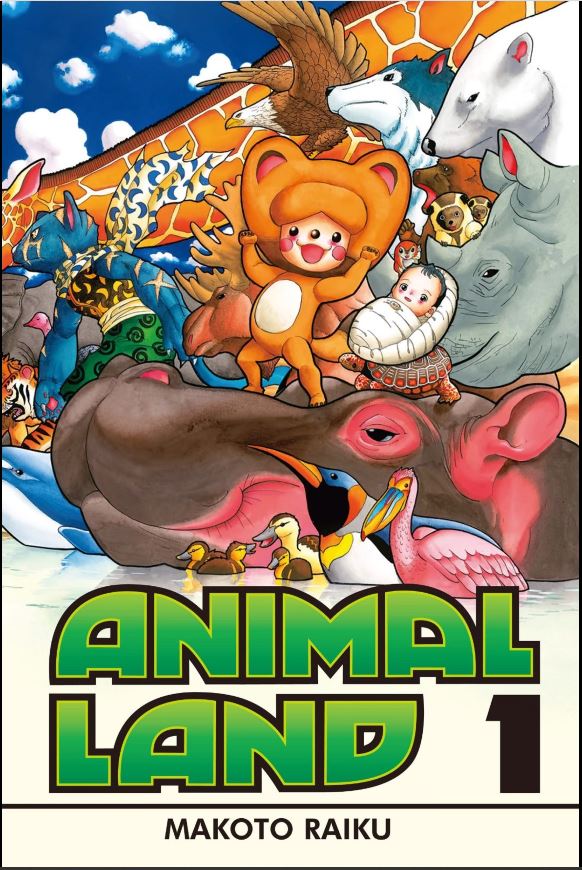
Animal Land volume 1


By Makoto Raiku, translated and adapted by Stephen Paul (Kondansha Comics)
ISBN: 978-1-68233-202-3 (PB)

Born in Gifu on August 1974, Makoto Raiku started his manga career as an assistant to Kazuhiro Fujita before creating his own award-winning strips such as Bird Man, Newtown Heroes, Genmai Blade, and the enormously popular Konjiki no Gash!! (which hit American TV screens as Zatch Bell!!). All these were for Shogakukan’s Shōnen Sunday Super and Weekly Shōnen Sunday.

Following a legal dispute in 2008, the artist moved to rival publisher Kodansha and devised Dōbutsu no Kuni (Animal Country) which began in the October 2009 issues of Bessatsu Shonen Magazine. The series ran until February 2014, garnering the Best Children’s Manga Award and filling 14 tankōbon volumes from March 2010 onwards.

The all-ages fable follows the incredible life of a seemingly-human baby abandoned and cast adrift on a river only to wash up in the land of animals: a dog-eat-dog, literally bestial world of raw savagery where the weak always die and only the strong are able to survive.

‘Word 1: Hello, Baby’ opens proceedings with little Monoko, an orphan Tanuki (a tiny raccoon dog indigenous to Japan). Since her parents were eaten by wildcats, she’s been unable to pull her weight in the hard-pressed Tanuki community. The others spend all their time and energy rushing to store enough food for the rapidly approaching winter. It doesn’t look like Monoko’s going to make it…

Her world and existence change forever when she adopts the strange hairless monkey cub which washes up on the river bank one cold day. This is a very strange baby and Monoko insanely decides to become its new mother against all the advice of the village.

In Animal Land all creatures are at odds and cannot understand other species’ cries, but Monoko decides to risk everything – including being eaten by cats such as the fearsome Kurokagi – to steal some milk for the foundling to drink.

Despite the horrifying but successful mission the baby is cold and dying: it has no will to live and the Tanuki elders brusquely tell her to stop wasting everybody’s time and resources. Instead, desperate Monoko cuddles it with her body, sharing her warmth in a futile, lonely struggle to keep it alive one more night. When she awakes, the Tanuki discovers something miraculous and staggeringly game-changing…

The initial episode end with another huge shock: the alien infant can speak her language…

The mystery increases in second instalment ‘Word 2: Baby’s Power’ when the waif reveals that he can converse and understand the speech of all animals – even ultimate predator Kurokagi.

That useful trait leads to the discovery of the dire marauder’s tragic secret and further reshapes the nature and destiny of the savage domain, whilst third and final (for now) chapter ‘Word 3: Baby Cries Over His Name’ sees Monoko’s first maternal crisis as she finds a keepsake from the baby’s biological mother and fears her joyous new world is crumbling around her… until once more the wonder baby comes to her emotional and physical rescue…

Despite what the publishers would have you believe this isn’t just another cute kiddie-book. For starters it’s filled with scatological asides and the audience advisory is 13 and older. Moreover, despite being filled with action, adventure and slapstick/social gaffe humour in the grand manga manner, this tale is filled with scary moments, brutal situations and situations of heartbreaking poignancy. It also has a lot to say about family, community, integration, unity and understanding through plain-talking and communication.

Included in this initial monochrome volume are translator’s notes, a guide to Japanese honorifics, Omake pages (“extra” or “bonus”) of short cartoon strips and a longer piece wherein Makuto Raiku lets us in on the background of and inspiration for the strip: sharing the bittersweet story of his and wife’s best friend Riku – an abandoned, wounded puppy…

More Animal Farm than The Gruffalo or the Tiger Who Came to Tea, this is an enthralling and impressive slice of social fantasy for kids, and would make a great gift for older children getting too big for traditional kids’ stuff.

This monochrome paperback and digital volume is printed in the traditional front-to-back, right-to-left reading manner.
© 2010 Makoto Raiku. English translation © 2011 Makoto Raiku. All rights reserved.

Saint Young Men volume 01


By Hikaru Nakamura, translated by Alethea & Athena Nibley (Kodansha)
ISBN: 978-1-63236-936-9 (HB)

Win’s Christmas Gift Recommendation: ‘Tis the Season to be Thoughtful… 9/10

Here’s a divine treat and global sensation with a lot of timely punch and just a touch of wild eclecticism to boost its appeal, all neatly released in English just in time to make your day and make you think…

Born in April 1984 in Shizoku Prefecture, Japan, Hikaru Nakamura is one of the world’s most successful manga creators, thanks mostly to her thought-provoking yet inviting conceptions such as Arakawa Under the Bridge and the bizarrely engaging buddy-comedy under review today.

In September 2006 Seinto Oniisan began as an occasional gag feature in Morning 2 magazine where, due to its rapturous reception, it grew into an unmissable regular narrative strip that remains to this day. The divine comedy has filled 17 tankōbon collections plus all the usual mass-media iterations that follow such popularity: a brace of anime DVDs and films, a live-action series and much more.

In this premiere stunning and sturdy hardback English compilation (or its ethereal digital equivalent), more extensive detail and context can be found in the effusive Foreword Hikaru Nakamura’s Saint Young Men Power’ by Nicole Coolidge Rousmaniere (who curated a Japanese Exhibition at the British Museum in which Saint Young Men played a major role). Whilst this aids overall comprehension, the book also graciously provides a comprehensive set of Translation Notes for each chapter episode, offering cultural comparison points, theological points of interest and even general notes on modern life in the East.

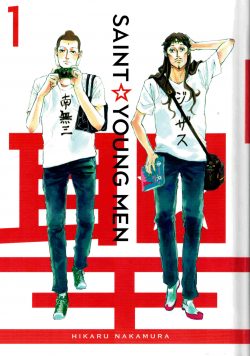
It sounds like the opening of a joke – and, in fact, it is – but the narrative premise is simple: one day after a particularly arduous millennial turnover, Jesus Christ and Guatama Buddha opt to take a break from Paradise/Nirvana/the Great Beyond and indulge in a kind of gap year experience by re-manifesting as two young guys in Tokyo: living as anonymous mortals; chasing rent, getting picked on, playing with fashions and new technologies and just generally being human. What could possibly go wrong?

The trials begin in ‘Buddha’s Day Off’ as the impoverished pair settle into their tawdry dwelling and ardently discuss the unexpected ways other people respond to them, after which they try adjusting to culture shock but endure even stranger reactions and responses on overcrowded trains and subways in ‘Most Holy Travels’…

Man-Toys, gadgets and fashions are perennial fascinations for the pair – their near-infinite logo T-shirt collection often acts as a barometer and commentary for what’s about to occur – but it’s hard to leave their pasts behind and the pair as often visit shrines and churches as theme parks. Sometimes – such as in ‘Another Paradise’ – it’s hard to tell them apart. Moreover, although earthbound, their transcendental natures still adversely affect everything around them, leading to unearthly surprises when they become overfocussed on mundane delights such as shopping in ‘Debut Performance’…

‘Oh My Hobby’ finds the holy goofs seeking further homogeneity as Buddha tries screen printing to round out his days whilst Jesus further pursues his dream of being a comedian whilst attempting to curtail his unhappy tendency to make miracles if his concentrates too hard or laughs too much…

Cooling down and discussing their slow assimilation leads to more confusion in ‘Summer Jam at the Community Center’when their oblique mutterings convince a mobbed-up eavesdropper that he’s stumbled into two Yakuza princes trying to get out of “The Life”, after which ‘Buddha and Jesus’s “Can I Do It?”’ reveals how their escalating heavenly energies compel the pair into staying home and trying new pastimes such as drawing manga and throwing pottery…

There’s another innocently bewildering clash with celebrity, commercialism and gangsterism when the inquisitive waifs attend a ‘Sacred Fall Festival’ before Christmas (in its thoroughly formulated Japan-ised form, and celebrated here by a partial conversion to full-colour for their generally monochrome exploits) intersects with an unfortunate ‘Holy Birthday’for Jesus.

That debacle leads to dabbling with disguises to attend the ‘New Year’s Self-Worship’ ceremony, segueing into a nasty brush with human frailty and disease in ‘Hospital Fever’.

Manly vanity rears its inevitable head when Buddha rashly responds to accusations of becoming a ‘Portly Prince?!’, but it’s his scatty roommate who makes an unlikely public scene by losing concentration in ‘The Park Nearest Heaven’. This leads to a necessary but unwise ‘Pilgrimage’ to the shopping mall before these initial devotions conclude with a catastrophic bout of tonsorial ablutions and accidental miracle-making for the ‘Thrice Stranded Bath Drinker’…

It’s true to say that in fiction, there are precious few original ideas whereas tone and treatment are everything. Whilst not a new notion, the concept of divine beings popping back to Earth is one that has plenty of antecedents but also infinite appeal and permutations, and here at least, there’s been a vast amount of research undertaken to confirm canonical veracity and deep thinking to keep the jokes fresh and outcomes original.

Charming, funny, brash and subtly challenging, Saint Young Men is a delightful peek into other realms that will leave you hungry for further scriptures and might even lead to a lifelong conversion…
© 2008 Hikaru Nakamura. English translation © 2009 Hikaru Nakamura. All rights reserved.

Available in in both paperback and digital formats, this book is printed in ‘read-from-back-to-front’ manga format.
Saint Young Men volume 01will be released on December 19th 2019 and is available for pre-order now.

The Pits of Hell


By Ebisu Yoshikazu (Breakdown Press)
ISBN: 978-1-91108-108-1 (PB)

Win’s Christmas Gift Recommendation: Shocking, Momentous, Unmissable… 8/10

Please be warned: I’ll be using some harsh language further down: if you of your dependents are likely to be offended, please skip this review. You certainly won’t be comfortable reading the book we’re reviewing here…

If you’re one of those people who’s never read a manga tale, or who’s been tempted but discouraged by the terrifying number of volumes these tales can run to, here’s a delicious feast of fantasy fables complete in one book revealing all that’s best about comics from the East in one darkly digestible big gulp.

Although an industry of immense, almost incomprehensible variety, much of Japan’s output is never seen in western translation, so for us, most manga – divided into story genres we easily recognise – can be lazily characterised by a fast, raucous, over-stylised, occasionally choppy style and manner of delivery, offering peeks into the quirks of a foreign culture through coy sensuality, carefully managed action and “aw shucks” conviviality.

It’s not all like that.

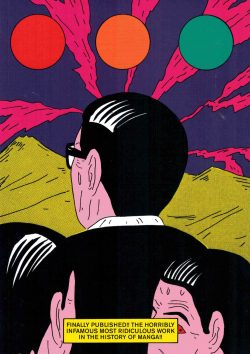
This volume gathers emphatically eerie and definitely disturbing short stories for adults that originate from the nation’s rebellious heta-uma movement (equivalent to but not the same as our late 1970s Punk revolution), all crafted by a fringe creator who became a true national treasure…

Ebisu Yoshikazu began as an outsider: a self-trained manga maker who shunned the sleek polish of mainstream Japanese comics to craft deeply personal ant-art yarns, initially for avant-garde counter culture anthology style icon Garo and landmark experiment Jam, but later for many other magazines after his harsh material struck a chord with 1970s-1980s readers, increasingly reeling from social and economic change.

Mr. Yoshikazu was born in Amakusa, Kumamoto Prefecture in October 1947 and raised in Nagasaki, where he was fatefully shaped by the post war trauma that permeated the region and the country. Drawing comics from early on, he was especially influenced by the fantasy works of Osamu Tezuka and Mitsuteru Yokoyama, but as a teenager his life changed when he discovered the gekiga (“Dramatic Pictures”) comics sub-genre as well as American action movies.

He moved to Tokyo in 1970 and – while working menial jobs – began submitting stories to Garo in 1973. His bleak, violently surreal, dream-based efforts featured bizarre, antisocial situations and outcomes and found a welcome – if unpaid – home in the magazine. He became a fan favourite without his knowledge and when years later he finally released a compilation of his tales, was astonished to see it become a huge hit with many reprintings.

The creatively-driven working-class manga-maker – think more Harvey Pekar than Harvey Kurtzman – parlayed his growing fame as an outsider artist and misfit into mass-media celebrity, but latterly suffered a great loss of fame, prestige and revenue following a gambling scandal.

In Japan, commercial betting is illegal except in certain, highly proscribed and policed situations. That doesn’t bother Ebisu Yoshikazu who remains a proud advocate and champion of what many people consider a shameful addiction. His passion for wagers has shaped his life and continues to …

Heta-uma transliterates to “bad-good” or “bad but nice”: glorying in the power of raw, primitivist graphics and narratives that are seductively seditious whilst exploring uncomfortable themes, so please be warned that most of these nine early vignettes are brutally violent and also distressing on other, more intimate levels. If you’re looking for Western equivalents, go no further than the more excessive outings of Gary Panter and Johnny Ryan…

This potent tome reprints that first compilation in English and is preceded (or followed by – depending on your graphic orientation, as the comics portion of the book is traditional manga right to left, end to beginning format) by a series of text features including ‘Why is This So Good?’: a deconstruction of the stories by Garo editor Minami Shinbō from the 1981 original compilation.

‘About these Comics’ offers the author’s own thoughts on the material from 2016 and is followed by extended essay ‘Damn All Gamblers to the Pits of Hell’ by translator/editor Ryan Holmberg affording us not only history, context and insight into the artist but also gauging the effects of his works on the industry and society.

The stories begin with a shocking answer to classroom inattention in ‘Teachers Damned to the Pits of Hell’ after which a poor family hungrily await the results of father’s latest addictive session at the pachinko parlour in ‘Fuck Off’.

Many stories take a hard but always off-kilter look at employment and wage earning. ‘Workplace’ deals with a time when Yoshikazu worked as a sign designer’s much-abused assistant and vicariously, cathartically, depicts what the menial wanted most, whereas ‘Wiped Out Workers’ details a plague of selective narcolepsy that grips salarymen and other hapless toilers during their daily travails.

‘Tempest of Love’ addresses the imbalance and inequality of the sexes as a job-enhancing abacus class devolves into a ghastly crime scene, whilst a punter’s obsessive attention to the sanctioned boat races and his crucial bets result in a strange series of events that can only be explained by ‘ESP’…

More uncomfortable sexual tension is dangerously unleashed at the ‘Late Night Party’ provided by a smug boss before the spiralling cost of living sparks civil unrest and deadly consequences in ‘Battles without Honor and Humanity: A Documentary’.

The walk on the weird wild side then concludes with a phantasmagorical deluge of uncanny situations and crises as a worker takes his son for a walk in ‘Salaryman in Hell’

By no means a work of universal appeal, The Pits of Hell provides a stunning and revelatory look at the other side of Japanese comics: one no fan of the medium can afford to miss.
English edition © 2019 Breakdown Press. Translation and essay © 2019 Ryan Holmberg. All rights reserved.

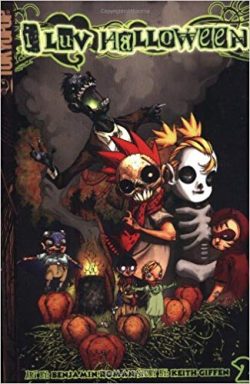
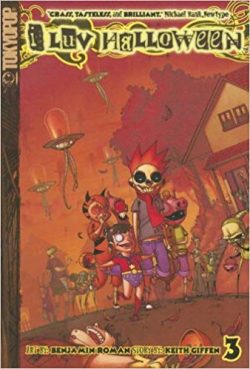
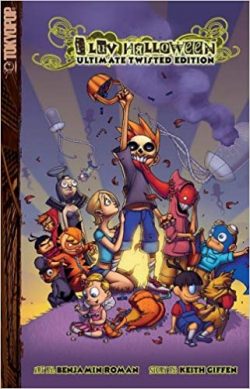
I Luv Halloween Ultimate Twisted Edition (Cabbage Poot)


By Keith Giffen & Benjamin Roman & various (TokyoPop)
ISBN: 978-1-42781-072-4 (HB U Twisted) 978-1-59532-831-1 (PB vol. 1) 978-1-59532-832-8 (PB vol. 2) 978-1-59532-833-5 (PB vol. 3)

Are you sick, depraved, demented or just plain ‘not right’? If so (it’s not necessary – but it won’t hurt either) you might want to pick up this darkly wicked little tome to reaffirm your skewed view of reality.

First unleashed in 2005, it spawned two further paperback volumes, a snazzy hardback Ultimate Edition in full-colour and, latterly, eBook editions (all converted from moody monochrome to gaudy sunset shades and blood-spatter hues thanks to the tender ministrations of Michael Kelleher and Glasshouse Graphics)…

This holiday now is primarily one where kids of varying ages go mooching about, begging for sweets, exercising their inalienable rights to practise extortion and generally threating mayhem. Once upon a time, it used to be about predatory monsters roaming the land, terrorising the citizenry and making mischief. Here, those worlds collide and collude…

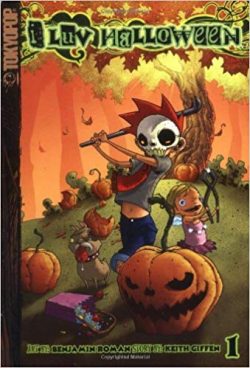
In I Luv Halloween volume 1 we learn that every Halloween, Finch, Moochie, Pig Pig, Mr. Kitty, Spike, Bubbles & Squeak, Li’l Bith and the rest of the kids join Devil Lad for their annual sugar-coated loot-fest.

Typically, this year it’s all botched up from the get-go ’cause the very first old lady they accost just gives them fruit, and everyone knows if you don’t get candy right from the start it’s nothing but rubbish all evening. Drastic steps have to be taken, or else this Halloween is ruined…

You don’t know drastic until you see what this band of masked reprobates get up to. These are not your average trick-or-treaters…

Along the way you’ll also meet that friendly old policeman, the vicious, bullying older kids and the really stacked chick who lives next door (they call her “Nips” for suitably scandalous reasons) as well as her doofus boyfriend. See their ultimate fates and give thanks it’s just a comic!

And as the night unfolds – with each kid given his/her/its own chapter to play in – we’ll see that theirs is a very bleak and nasty kind of fun with a vicious undercurrent to the shenanigans. You might even call it tragic if it wasn’t so inappropriately funny…


Volume 2 somehow sees another All Hallows Eve in the township of Turgid Meadows, where Finch’s little sister Moochie is inexplicably addressing the issues of Christianity and bodily functions in a distressingly scatological-slash-surgical manner, thanks to set of extremely sharp knives that have become her constant companions.

There are some new kids – such as Hully Gully, Vera, Vinnie and unfortunate Vivian – prowling the streets, even though there had been some doubt about the event actually taking place, what with the plague of flesh-eating zombies attacking the town…

Still, tradition is sacrosanct, so the kids make do as best they can, even though candy seems in short supply and the adults who are still breathing act real weird. Some even try to keep the kids inside, so they can repopulate after the apocalypse, but Finch has a pretty good idea how to deal with them…It has to be quick, though because the Walking Dead are everywhere and have their own ideas about “Hhhik Uh Heeeett”-ing…

Happily, Finch, Devil Lad and the remaining uneaten have an explosive solution to securing the town and remains of the sweet, sweet loot…


Volume 3 opens on yet another October festival and again circumstances are conspiring to spoil the fun for Finch, Devil Lad, Mr. Kitty (don’t call him Spencer!) and the rest. This time the town is being attacked by marauding aliens. Sure, some adults are apparently delighted with all the probing that’s going on, but most are just running and screaming or being turned into mobile roman candles by all the indiscriminate heat ray blasts.

Moochie has moved on a bit: now her incessant inquisitiveness is fixated on the miracles of birth and why she hasn’t had a sister yet. At least there’s plenty of fleshy material she can examine with her enhanced surgical techniques, especially after she commandeers kindly Dr. Kramer‘s office and surgery…

Pig Pig is, as usual, not quite in tune; asking why the aliens haven’t been deported back to Mexico, whilst new recruits Kevin Kyle Kramer – a black kid who hates being called Triple K – and pious dog-killer Monica do their best to keep up. They almost lose Mr. Kitty entirely when the invaders drag a naked Nips off to their mothership and strange, uncontrollable feelings compel him to follow…

Most importantly, a rival band of kids are also on the streets. Brutish lunch money extorters Bubbles and Squeak are on the prowl, even though the big boss can’t get his mind off Monica and back on candy-scoring…

All the kids know for sure is that no-one’s got any treats to hand over, so they’re supposed to come up with lots of retaliatory tricks, but now something’s just not feeling right anymore…

Worst of all, the incredible secret beneath Kramer’s office threatens to end their annual sweet deal forever…

This book also contains bonus story and cartoon coda to the previous night ‘Friends till the End’: a solo outing for inspired originator and illustrator, 3D concept artist and genuine sick puppy Benjamin Roman (Cryptics, Auntie Agatha’s Home for Wayward Rabbits); a delight for the dark hearted and strong-stomached, supplemented by pin-ups, a Roll Call of characters; instructions for making a Pig Pig Mask (Pig Pig Papier-Mache Madness!); and fan art by Dan Hurd, Liz Siegel, Jeremy Goad, Kevin Harden, Mauricio Arcila, Neil Phyfer, Tara Billinger and “Rez”

Comics veteran Keith Giffen flexes his comedy – and bad taste – muscles in this addictive confection that would win nodding approval from Charles Addams and the producers of any self-respecting splatter movie. Jovial malice is uniquely captured by Roman’s astonishingly enchanting art: his inexplicably charming grotesques are the stuff of any animation studio’s dreams. If you don’t believe me just check out the stupefying Sketchbook sections and frankly alarming Creator Bio feature…

All the above irresistible atrocity has been latterly packed into a deliriously compelling hardback entitled I Luv Halloween Ultimate Twisted Edition (Cabbage Poot), and there’s a new super-complete warts ‘n’ all edition slated for release in January 2020 (slick timing, no?), but if you have no patience or impulse control issues, there’s never been a better time to revisit perhaps the most definitive statement on the hallowed festival known nowhere at all as “Knock! Knock!BOO!! Night” as so callously perpetrated by two grown men who really should have known better…

If you have no fear of the dark, love a gross joke, have a soft side that can be hit by a brilliantly sad twist or two and especially if you don’t care what your immediate family or the clergy think of you, then you really want to read this stuff. Over and over and over and over again. Amen…
© 2005 Keith Giffen & Benjamin Roman. All Rights Reserved.

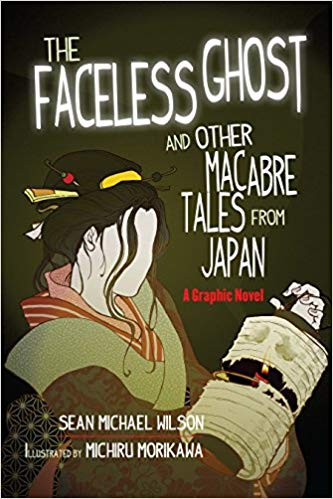
Lafcadio Hearn’s The Faceless Ghost and Other Macabre Tales from Japan: A Graphic Novel


By Seán Michael Wilson & Michiru Morikawa (Shambhala Publications)
ISBN: 978-1-61180-197-2 (TPB)

If you read prose and love old stories you should really track down the works of Patrick Lafcadio Hearn, an Irish-Greek raconteur laterally renamed Koizumi Yakumo. They are wonderful and truly compelling. He was a pretty impressive character too, so you’d be best served to learn of his remarkable life too…

I’m not certain how the socially pioneering teacher, journalist, historian, translator and archivist would react to seeing some of his most engaging works translated into graphic narratives but as a renowned breaker of borders and flouter of taboos, I suspect he’d approve, even if this gleefully wry collation hadn’t been produced by such stellar luminaries as Scottish author Seán Michael Wilson (Breaking the Ten and Portraits of Violence – An Illustrated History of Radical Thinking) and his frequent collaborator Michiru Morikawa.

Wilson’s life has some parallels with Hearn’s. The Japan-based writer, educator and dedicated Humanist has written political and philosophical tracts such as Goodbye God – An Illustrated Examination of Science Vs. Religion in graphic form and has adapted Western and Eastern literary classics such as Wuthering Heights, A Christmas Carol, Sweeney Todd, and Chinese classics Tao Te Ching and The Garden, as well as original genre pieces such as urban interacial romance The Story of Lee.

Illustrator and manga artist Michiru Morikawa won the 2005 International Manga and Anime Award before going on to illustrate Wilson’s books Buskers, Yakuza Moon, The Demon’s Sermon on the Martial Arts and Musashi, amongst numerous comics series.

Hearn visited Japan as a correspondent in 1890, and fell in love with the land and the culture. He ended his days there in 1904, after marrying, becoming a Japanese citizen, teaching in numerous schools and universities and introducing the western world to the exotic enigmatic East through his writings and translations of its myths and legends.

Absurdly accessible, the tales here are gathered from the nation’s feudal period and open with a samurai yarn dubbed ‘Diplomacy’, wherein a highborn executioner performs his onerous task and plays a subtle and crafty trick upon the imminently departed to ensure that there will be no repercussions from beyond the grave…

That mordantly amusing distraction then gives way to a classic ghost story in ‘The Snow Woman’, wherein a young woodcutter survives an icy encounter with a mystical spirit at the cost of a simple promise. Tragically, in all such stories, a keeping one’s word is always impossible and leads to appalling inescapable circumstances…

Vanity and dissatisfaction fuel the saga ‘Of a Mirror and a Bell’, after the priests of Mugenyama ask the local women to donate their bronze mirrors so they can be cast into a great bell. After complying, one farmer’s wife began to bitterly regret her actions and so intense were her feelings that the mirror could not be melted down.

Wracked with guilt for her shameful intentions and the spoiling of the bell, she took her life, triggering a concatenation of unfortunate events…

After the history-making final clash between Heike (Taira) and Genji (Minamoto) clans, the rulership of Japan was decided for centuries to come. However, the sea battle created thousands of ghosts and ‘Hoichi the Earless’ relates how a blind musician and bard was tricked and beguiled by these restless spirits until a Buddhist priest intervened.

The end result was not an unqualified success…

Straight, inescapable horror drives the brief yet potent tale of a luckless merchant who encounters ‘The Faceless Ghost’, whilst love and friendship inspire the story of a young man in need of bride who prospers after he graciously saves a shark spirit and is uniquely rewarded by ‘The Gratitude of the Samebito’…

As recounted in the ‘Author’s Note’ – detailing the origins and source material of the adaptions – the stories are mostly taken from Hearn’s books Kwaidan: Stories and Studies of Strange Things (1903) and Shadowings (1900), and come packed with sleek, informative and delightfully rambling diversions which add fabulously engaging context to the stories.

Eerie, exotic and wonderfully compelling, these “yokai” stories are gems of unease, disquiet and wonder that no lover of the strange can fail to adore.
© 2015 by Sean Michael Wilson. Illustrations © 2015 by Michiru Morikawa. All rights reserved.

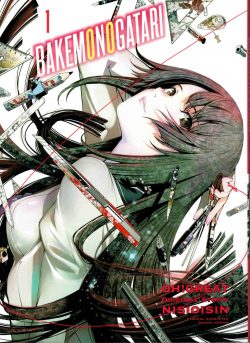
Bakemonogatari volume 1


By OH!GREAT & NISIOISIN, translated by Ko Ransom (Vertical Comics)
ISBN: 978-1-947194-97-7 (PB)

Win’s Christmas Gift Recommendation: Fabulously Fresh Fear-Fest… 8/10

Here’s a rare treat with a lot of timely punch and just a touch of wild exoticism to boost its appeal…

Based on his own immensely popular “Light Novel” series Monogatari – 25 volumes since November 2006 with at least three more imminently pending – the incredibly prolific NISIOISIN (sometimes called Nisio Isin and creator of Katanagatari, Kubikiri Cycle and prose adaptations of Tsugumi Ohba & Takeshi Obata’s Death Note) here oversees the transformation of his biggest hit serial into manga form by artist OH! Great (AKA Ogure Ito: best known for Air Gear, Tenjo Tenge, Biorg Trinity, Soul Calibur IV and assorted outbreaks of Tekken)…

Phenomenally successful, the Monogatari series began their transformation into manga in Kodansha’s Weekly Shonen Magazine in 2017 with this retelling of the first adventure. In fact it’s the first of two books and ends on a cliffhanger, but English-language publisher Vertical have slated the concluding book for early January release, so you won’t be on tenterhooks for too long…

Third-year high school student Koyomi Araragi is not normal. That’s mostly to do with having been targeted by a vampire and almost joining the ranks of the undead. Thankfully, he was saved by weird hobo priest Meme Oshino, who has made his life quite interesting ever since…h

The story begins with ‘Hitagi Crab’ as hopeful amorously overachieving Araragi meets a cute but violently defensive (perhaps “murderously psychotic” is more accurate after she almost kills him with the lethal stationery and pencil case tools in her bag!) girl and discovers she weighs practically nothing. Hitagi Senjōgahara‘s density and earthly grounding have been taken by a giant invisible crab monster…

Eager to help – she’s damaged and dangerous, but also incredibly vulnerable and beautiful – Araragi arranges a meeting with Meme, but the outsider priest knows there’s more going on than is being admitted. His harsh response in ‘Bakemono Gatari’ reveals not only the workings and motives of the gods and monsters which still infest the physical modern world, but also the concomitant burden of human sin and misery which attracts them. When cured and liberated Senjōgahara finally admits the long-buried secrets which have twisted and changed her, she makes a seemingly impossible request of her saviours…

To Be Concluded…

Aiding comprehension, the book graciously provides a comprehensive timeline feature with ‘Bakemonogatari in Detail’ offering comparison points between prose and manga iterations, plus lists of other media versions to track for total immersion and enjoyment.
© 2018 – NISIOISIN/Oh!great. All rights reserved.
Available in in both paperback and digital formats, this book is printed in ‘read-from-back-to-front’ manga format.

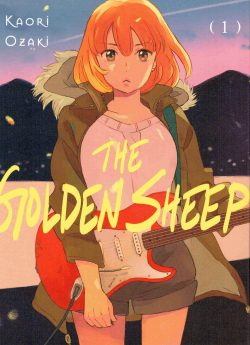
The Golden Sheep Book 1


By Kaori Ozaki (Vertical Comics)
ISBN: 978-1-947194-80-9 (PB)

Win’s Christmas Gift Recommendation: Moving and Evergreen Family Drama… 9/10

Manga maestro Kaori Ozaki (An Angel Above the Piano, Immortal Rain, The Gods Lie) started her professional comics making at in 1993, aged 15. Since then has she become a byword for smart, compelling, sensitive storytelling, whether in the realms of high-flying fantasy or in more grounded, rationalistic human scaled stories.

Originally published in Japan as Kin no Hitsuji in Kodansha’s Afternoon magazine, The Golden Sheep falls into the latter category: examining bonds of friendship, burdens of family, dreams of success and the eternal youthful drive to escape and get away from the past. The serial began in September 2017 and ran until April 2019.

Childhood friendships are pure and earnest and wholehearted, but as Tsugu Miikura discovers, not always clearheaded or totally open. Growing up in a rural mountain community, she and classmates Sora, Yuushin and Asari swore lifelong fidelity – even burying a time-capsule of their secret wishes for the future in their favourite spot – but when the Miikuras moved to Osaka things changed. Now, six years later, with her dad gone, the large brood have been forced to move back and live with an aunt.

Although on the surface the high school pals are just bigger, there are deeply hidden and constantly growing divisions. Big city girl Tsugu now talks funny and has become a world-class rock guitarist, but doesn’t believe her soul is any different. Nevertheless, she can’t understand what has happened to her besties.

Studious Asari is superficially the same, but shows signs of becoming a really mean and backbiting sneak, whilst manga-obsessed, anime-loving Sora is now sullen, perpetually skips school and has frequent accidents that leave him battered and bruised. The biggest change is valiant Yuushin. Once a noble, honest, champion of the underdog, he’s become a cool, aloof bad boy leading a pack of young thugs and possibly even involved in criminal acts…

As Tsugu attempts to resume her place in the group, the changes they’ve all experienced push her further away from them and even her own family.

When she thwarts a suicide attempt by one of her beloved companions – at huge personal cost – she decides to run away to Tokyo with the despondent survivor. Penniless and without shelter, they skirt the fringes of a sordid world, only to stumble into another shocking surprise to her already-reeling sense of self and worth…

Alternating winning jolly charm with moving glimpses of the crisis besetting Japan’s directionless youth, The Golden Sheep promises to become a classic modern romance and survival testament for Young Adults: a book with lots to say and in a most captivating manner.
© 2018 Kaori Ozaki. All rights reserved.

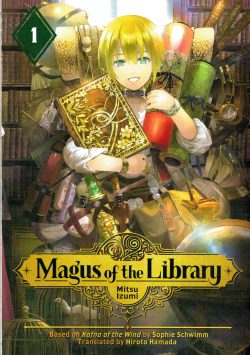
Magus of the Library volume 1


By Mitsu Izumi, translated by Stephen Kohler (Kodansha Comics)
ISBN: 978-1-63236-823-2 (TPB)

Everyone knows reading is a magical experience and many fanciful tales have delightfully taken that premise at its most literal. This particular offering comes from modern manga maestro Izumi Mitsu who’s a bit of a mystery herself: preferring to let a canon of short stories and such serialised gems as 7th Garden and Ano Hi Mita Hana no Namae o Boku-tachi wa Mada Shiranai act as her credentials.

Magus of the Library was first seen in good! Afternoon as Toshokan no Daimajutsushi and has thus far filled two volumes. It’s also made the translation jump and is waiting on English-language shelves for your rapt consideration…

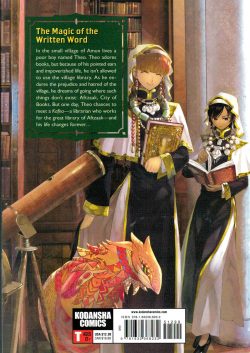
In a wondrous Eastern kingdom, literature is worshipped and books are venerated. Reading them is a social privilege shared with all and fostered through a string of public libraries. Sadly, the tomes themselves have become objects of great value. That means some people keep private collections and others think they have the right to dictate who reads what…

In the rural village of Amun, a strange half-breed boy named Theo Fumis is utterly addicted to reading – especially pirate adventures. A poor slum-kid disgraced by blonde hair and pointed ears, he is the subject of much abuse, particularly from merchant-turned-librarian Ossei Menes who claims the urchin is unworthy to even touch books, let alone borrow them…

Luckily, he has a few friends, a devoted – albeit broken – family, a rich imagination and unflagging optimism to reinforce his hunger to read and learn. Moreover, one day he will definitely make the pilgrimage to the incredible, fabled Aftzaak: City of Books, where prejudice and injustice don’t exist. He just knows he will…

That dream comes one step closer when a quartet of riders enter Amun. They are Kafna: legendary warrior-librarians dedicated to preserving books and the status quo allowing all to partake of knowledge. After their leader Sedona befriends little Theo, he begins to get an inkling of their true power and purpose. The enigmatic riders are in search of a wild grimoire, teeming with magic it can no longer safely contain, but soon suspect they have stumbled onto a long-prophesied chosen one who will reshape and reconnect the world…

They better hope so, for as well as rampant escaped magic dark and ingrained bigotry, peril comes constantly courtesy of dangerous forces from beyond slowly gathering and focussing their attention on the land of literature…

Packed with wide-eyed wonder and traditional adventure set pieces, Magus of the Library traces the first steps on Theo’s path of destiny with winning exuberance and plenty of action: a delightful trip every kid and all their imaginative elders will be happy to share.
© 2018 Mitsu Izumi. English translation © 2019 Mitsu Izumi. All rights reserved.