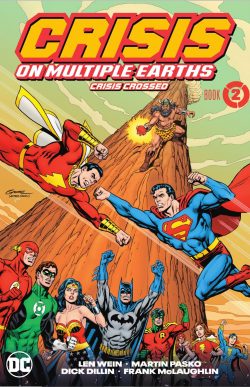
Crisis on Multiple Earths Book 2: Crisis Crossed


By Mike Friedrich, Len Wein, Martin Pasko, E. Nelson Bridwell, Cary Bates, Elliot S! Maggin, Paul Levitz, Gerry Conway, Dick Dillin, Frank McLaughlin, Joe Giella, Dick Giordano & various (DC Comics)
ISBN: 978-1-77951-342-7 (TPB/Digital)

Win’s Christmas Gift Recommendation: utterly Unmissable Entertainment… 9/10

As I’ve incessantly mentioned, I was one of the “Baby Boomer” crowd growing up with Julie Schwartz, Gardner Fox and John Broome’s tantalisingly slow reintroduction of Golden Age superheroes during the halcyon, eternal summery days of the early 1960s. To me, those fascinating counterpart crusaders from Earth-Two weren’t vague and distant memories rubber-stamped by parents or older brothers – they were cool, fascinating and enigmatically new. And for some reason the “proper” heroes of Earth-One held them in high regard and treated them with obvious deference…

The transcendent wonderment began, naturally enough, in The Flash; pioneering trendsetter of the Silver Age Revolution. After successfully ushering in the triumphant return of the superhero concept, the Scarlet Speedster – with Fox & Broome writing – set an unbelievably high standard for costumed adventure in sharp, witty tales of science and imagination, always illustrated with captivating style and clean simplicity by Carmine Infantino.

The epochal epic that literally changed the scope of American comics forever was Fox’s ‘Flash of Two Worlds’ (Flash #123 September 1961, reprinted in many places, but not here): introducing to an emerging continuity the concept of alternate Earths and, by extension, the multiversal structure of the future DCU as well as all the succeeding cosmos-shaking yearly “Crisis” sagas that grew from it.

…And, where DC led, others followed…

Received with tumultuous acclaim, the concept was revisited months later in Flash #129 which also teasingly reintroduced evergreen stalwarts – Wonder Woman, The Atom, Hawkman, Green Lantern, Doctor Mid-Nite and Black Canary: venerable members of the fabled Justice Society of America. Clearly Editor Schwartz had something in mind…

That tale directly led into the veteran team’s first meeting with the Justice League of America and the start of an annual tradition. When ‘Flash of Two Worlds’ brought us the notion of Infinite Earths and multiple iterations of costumed crusaders, fan pressure had begun almost instantly to agitate for the return of the Greats of the “Golden Age”. Editorial powers-that-be were hesitant, fearing too many heroes would be silly and unmanageable, or worse yet, put readers off. If they could see us now…

These innovative adventures generated an avalanche of popular and critical approval (big sales figures, too) so inevitably the trans-dimensional tests led to the ultimate team-up in the summer of 1963. This second gloriously enthralling volume celebrating Infinite Diversity in Infinite Costumes gathers more summer double-headers starring the JLA & JSA and includes a number of revivals and outreach tam-ups designed to set young hearts racing and pulses pounding. The alliances encompass Justice League of America # 91-2, 100-102, 107-108, 113, 123-124, 135-137, 147-148 and 159-160: stunning superhero wonderments which never fail to astound and delight. Also on offer are Len Wein’s context-conveying Foreword ‘Too Much of a Good Thing?’ revealing how the landmark anniversary team-up he scripted came about, and colourist Carl Gafford’s Introduction discussing the incredible achievements of the series’ illustrators such as the criminally underappreciated Dick Dillin who pencilled every story here… usually with his long-term inker Frank McLaughlin, although there are few other old friends here.

In terms of narrative, the writing – by a formidable cohort of writers nurtured and mentored by “Julie” – consists of nothing more and nothing less than bunches of beguiling mystery men getting together to deal with extra-extraordinary problems…

From the early 1970s, DC started methodically reintroducing lost and forgotten characters from other companies and pantheons DC had bought out over the years, at last convinced that costumed heroes were not a fad but here to stay. With hindsight, it was all also about sales and the attempted revival of so many super-characters during a period of intense sales rivalry between DC Comics and Marvel was just sound business sense…

The dramas resume with Mike Friedrich, Dillin & inker Joe Giella’s Justice League of America #91 (cover-dated August 1971), the hero-heavy opening chapter of the annual get-together. In ‘Earth… the Monster-Maker!’, the Supermen, Flashes, Green Lanterns, Hawkmen, Atoms and Robins of two separate Realities simultaneously but ineffectually battle an alien boy and his symbiotically-linked “dog” on twin planets a universe apart.

The result is pointless carnage and imminent death until ‘Solomon Grundy… the One and Only!’ gives all concerned a life-saving lesson on togetherness and lateral thinking…

Justice League of America #100 (August 1972) heralded a move away from relevancy and social hot-button topics that had dominated the industry for a number of years and a return to full-on Costumed melodramas, beginning with a colossal 3-team collaboration that also featured almost every hero in then-DC’s pantheon.

‘The Unknown Soldier of Victory!’ saw debuting scripter Len Wein assemble champions of two Earths to facilitate a monumental hunt through time and retrieve forgotten heroes the Seven Soldiers of Victory: not simply out of common decency, but also because the vanished vigilantes held the answer to defeating a criminal mastermind literally holding the world of Earth-Two to ransom.

Inked by Giella & Dick Giordano, the quest continued in ‘The Hand that Shook the World!’ before ending in one adventurer’s gallant final sacrifice in ‘And One of Us Must Die!’

A year gone by, Justice League of America #107 by Wein, Dillin & Giordano proclaimed ‘Crisis on Earth-X!’ as the opening chapter of another landmark crossover. Following the successful revival of a lost team in their previous get-together, this time the annual shenanigans reintroduced another band of Golden Age warriors – from corporate acquisition Quality Comics and newly rechristened The Freedom Fighters

It begins when a recreational trip across the dimensional barrier is accidentally sabotaged by android stowaway Red Tornado, depositing Batman, Green Arrow and Elongated Man from Earth-One and Superman, Sandman and Doctor Fate from Earth-Two into another alternate universe – one where the Nazis had won World War II.

Trapped and outnumbered, the seven displaced heroes were rescued by the last liberty-loving champions of a world dominated by fascist super-science and a secret dictator. Joining forces with embattled champions Uncle Sam, The Ray, Doll Man, Phantom Lady, Black Condor and The Human Bomb, the newcomers ended the fascist threat forever in sinister sequel ‘Thirteen Against the Earth!’

With everybody returned to their home planes, #113 (September/October 1974) proved how desperate times were the for the spandex set as the epic annual collaboration was restricted to a single issue. Nevertheless, ‘The Creature in the Velvet Cage!’ proved to be one of the very best tales as a JLA visiting party to Earth-Two (Batman, Superman, Green Lantern and Elongated Man) share the shame and horror of The Sandman, when his greatest secret is catastrophically revealed.

Years previously, the Master of Dreams had accidentally transformed his sidekick Sandy, the Golden Boy into a ravening silicoid monster during an attempt to modify their crimebusting technology. Dreading a holocaust, Wesley Dodds been compelled to sedate and imprison his best friend for years…

Now after three decades the beast was awake and free, seemingly intent on destroying the world. At least, that’s what Hourman and the Golden Age Flash and Wonder Woman believe] when they join their old comrade on his tragic manhunt…

For the next annual yarn, Cary Bates, Elliot S! Maggin, Dillin & Frank McLaughlin stepped far off the reservation with ‘Where on Earth Am I?’ and ‘Avenging Ghosts of the Justice Society!’ (#123 and 124)….

In Flash #179 (‘The Flash – Fact of Fiction?’: May 1968) Bates & Gardner Fox first took the multiple Earths concept to its illogical conclusion by trapping the Monarch of Motion in “our” Reality of Earth-Prime, where the Sultan of Speed was merely a fictional comic book character.

For this sequel, Bates and co-scripter Maggin revisited the notion, as a story conference in Editor Julie Schwartz’s office leads to the oafish goons playing with the Flash’s hastily-constructed Cosmic Treadmill. Inevitably their meddling sends one of them hurtling between dimensions…

Transformed and empowered by the journey, Bates becomes the most dangerous villain alive, leading Earth-Two criminals The Wizard, Shade, Sportsmaster, Huntress, Icicle and The Gambler in a lethal assault on JSA heroes Robin, Hourman, Wildcat, Wonder Woman, Johnny Thunder and Dr. Mid-Nite.

Maggin, meanwhile, has followed his friend but ended up on Earth-One. Undaunted, he recruits Batman, Black Canary, Aquaman, Hawkman, Green Arrow and Flash to save three imperilled universes, but it takes the Divine Might of the supernal Spectre to truly set everything back to its assigned place and time…

Plotted by E. Nelson Bridwell and scripted by Marty Pasko, 12 months later the get-together attained epic proportions with the inclusion of venerable champions of the recreated Shazam! Universe – imaginatively dubbed Earth-S. It opens with a ‘Crisis in Eternity!’

One of the most venerated and loved characters in American comics, the original Captain Marvel was created by Bill Parker & C. C. Beck: the best of a wave of costumed titans devised in the wake of Superman’s blockbuster 1938 debut.

Although there were many similarities in the early years, the Fawcett character moved early into fanciful light entertainment and even comedy, whilst as the 1940s progressed the Man of Steel increasingly left whimsy behind in favour of action and drama.

Homeless orphan Billy Batson was chosen to battle injustice by an ancient wizard who bestowed upon him the powers of six gods and heroes. Billy transforms from scrawny boy to brawny (adult) hero by speaking aloud the wizard’s name – an acronym for the legendary patrons Solomon, Hercules, Atlas, Zeus, Achilles and Mercury. At the height of his popularity Captain Marvel was published twice a month and outsold Superman.

However, as tastes and the decade changed, sales slowed and a court case begun by National Comics citing copyright infringement was settled. The Big Red Cheese disappeared – as did many superheroes – becoming merely a fond memory for older fans.

As America lived through another superhero boom-&-bust, the 1970s dawned with a shrinking industry and wide variety of comics genres servicing a base that was increasingly founded on collector/aficionados, not casual or impulse buys. DC needed sales and were prepared to look for them in unusual places: opting to tap into a proven, discriminating fanbase…

After the settlement with Fawcett in 1953, DC secured the rights to Captain Marvel and Family, even though the name itself had been taken up by Marvel Comics (via a circuitous and quirky robotic character published by Carl Burgos and M.F. Publications in 1967). In 1973, riding a wave of nostalgia, DC brought back the entire beloved Fawcett cast and crew in their own kinder, weirder universe. To circumvent an intellectual property clash, they entitled the new comic book Shazam! (With One Magic Word!) the trigger phrase used by most of the many Marvels to transform to and from mortal form, and a word that had entered the American language due to the success of the franchise the first time around…

In Justice League of America #135, the usually stand-alone Shazam heroes meet other costumed champions when antediluvian dictator King Kull (a bestial despot from a pre-human civilisation who held mankind responsible for the extinction of his race) invaded the Wizard’s home on the Rock of Eternity.

From this central point in the Multiverse, Kull intends wiping out humanity on three different Earths and commences by capturing the gods and goddesses who empower Billy and his magical allies Captain Marvel Jr. and Mary Marvel.

Thankfully, fleet Mercury is able to escape, warning Earths-One and Two, even as lesser heroes Bulletman & Bulletgirl, Ibis the Invincible, Spysmasher and Mister Scarlet & Pinky take up the fight without the missing Marvels…

Recruiting an army of super-villains from three worlds, Kull unleashes a plague of unnatural disasters in ‘Crisis on Earth-S!’, unaware that Mercury, Shazam and dim-witted magic-wielder Johnny Thunder are undertaking a devious counterattack to bring the vanished Marvel Family back into action, just in time to avert a cataclysmic ‘Crisis in Tomorrow!’

The cross-collaboration protocol resurfaces one year later in brace of double-length sagas guest-starring Silver Age DC’s second-most popular superteam…

Once upon a time, a thousand years from now, a band of super-powered kids from many worlds took inspiration from the greatest heroic legend of all time, founding a club of champions. One day those Children of Tomorrow came back in time and invited their inspiration to join them…

Thus began the vast, epic saga of the Legion of Super-Heroes, as first envisioned by writer Otto Binder & artist Al Plastino when the many-handed mob of juvenile universe-savers debuted in Adventure Comics #247 (April 1958), just as the revived superhero genre was gathering an inexorable head of steam in America.

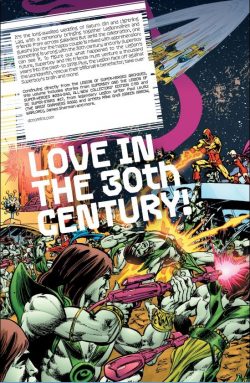
The coalition grew and prospered, becoming a phenomenon generally attributed with birthing organised comics fandom. After years of slavishly remaining a closely-guarded offshoot of Superman’s corner of continuity, the Legion finally crossed over into the broader DCU with this saga wherein Paul Levitz & Martin Pasko united to detail ‘Crisis in the 30th Century!’

It begins when ultimate sorcerer Mordru drags a handful of JLA and JSA-ers (Superman, Batman, Green Lantern, Green Arrow and Black Canary from Earth-One plus the other Green Lantern, Doctor Fate, Power Girl, Flash and Hawkman from E-Two) into the future to replace a band of ensorcelled Legionnaires he has somehow lost contact with…

Mordru’s previous slaves had been tasked with retrieving three arcane artefacts that were in the JLA’s keeping a millennium past, but with the pawns lost, the wizard now expects his new pets to finish the task. Naturally, the ancient heroes have other ideas…

Even after linking up with the lost Legionnaires, the 20th Centurians cannot prevent the return of demonic triumvirate Abnegazar, Rath and Ghast, but happily, their eons in stasis have affected the eldritch horrors’ psychological make-up and their consequent disunity gives the puny humans one shot at saving the universe from a ‘Crisis in Triplicate!’

This monumental melange of metahuman mayhem concludes with another time tempest and more forgotten stars as five legendary warriors are plucked from history by a most malevolent malefactor for the noblest of reasons. They are then pitted against the greatest superheroes of two worlds in ‘Crisis from Yesterday!’ by scripter Gerry Conway and artistic dynamic duo Dillin & McLaughlin.

In his zeal to conquer and plunder, the nefarious Lord of Time has accidentally created an omnipotent super-computer which is counting down to permanently ending the passage of time. Unable to halt or avoid an impending cosmic catastrophe, the temporal terrorist extracts Jon, the Viking Prince, English freebooter Black Pirate, Revolutionary War heroine Miss Liberty, western gunman Jonah Hex and WWI German enemy ace Hans von Hammer: supercharging them with eerie energies and programming them to attack the united Justice League and Society.

The Time Lord’s logic is simple: after suffering a shattering defeat, the teams – fired with determination and righteous fury – will promptly track him down, invade his Palace of Eternity and destroy for him his unstoppable computer. Or at least, the survivors will…

Surprisingly, that convoluted plan seems to work out in ‘Crisis from Tomorrow!’, but only after the chronally kidnapped quintet overcome their perfidious programming and revert to their valiant true selves. Even as the beleaguered superhero teams sacrifice everything to thwart the Lord of Time, the time-lost warriors prove their mettle against the errant computer…

This staggering panoply of multi-manned calamities and alternate Armageddons is rounded off with an instructive contextual lecture in John Wells’ Afterword ‘Those Were the Days’, augmented by all the rousing front covers by Neal Adams, Giordano, Nick Cardy, Ernie Chan, Frank Giacoia, McLaughlin, Rich F. Buckler, Jack Abel & Dillin: supported by full creator biographies and a ‘Cover Gallery’ from Alex Ross, featuring his painted delights from earlier collected editions.

These tales won’t suit everybody, and I’m as aware as any that in terms of the “super-powered” genre, the work here can be boiled down to bunches of heroes formulaically getting together to deal with extra-extraordinary problems.

Thankfully, I don’t have to be mature in my off-hours and for those who love costume heroes, crave cunningly constructed modern mythologies and actually care about fun, this is simply a grand parade of straightforward action, great causes and momentous victories.

…And since I wouldn’t have it any other way, why should you?
© 1971, 1972, 1973, 1974, 1975, 1976, 1977, 1978, 2021 DC Comics. All Rights Reserved.
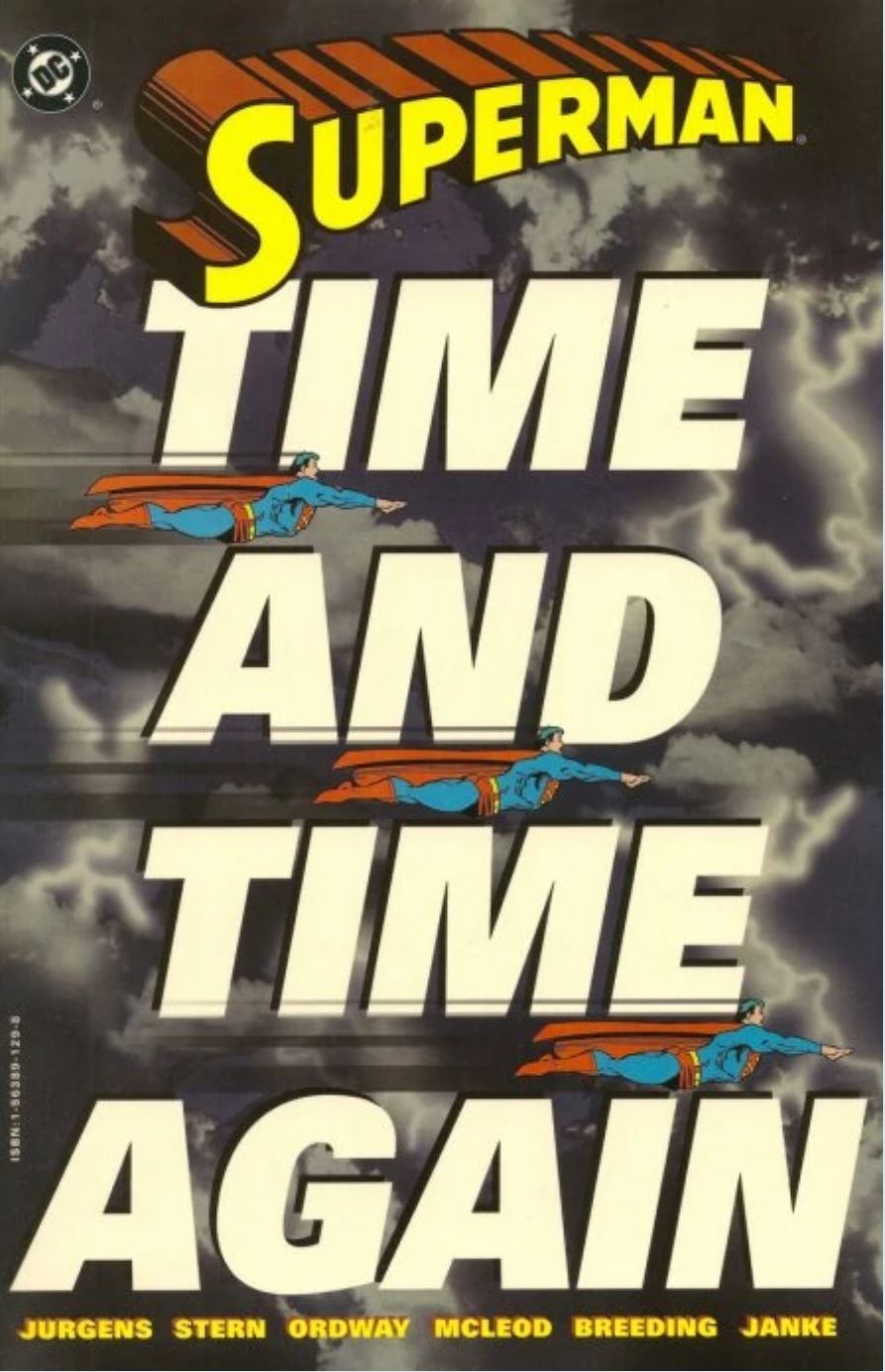
Superman: Time and Time Again


By Dan Jurgens, Jerry Ordway, Roger Stern, Bob McLeod, Brett Breeding, Dennis Janke, Tom Grummett, Jose Marzan & various (DC Comics)
ISBN: 978-1852865702 (TPB)

When Superman was re-imagined after Crisis on Infinite Earths, many of his more omnipotent abilities were discarded. Like his earliest days, he was a far from omnipotent hero, more in touch with humanity because he wasn’t so far above it. One thing that was abandoned was his casual ability to travel through time.

Indeed, rather than being able to navigate the chronal corridors with ease, in this splendid epic from 1991 (originally published serially in Action Comics #663-665, Adventures of Superman #476-478, and Superman (volume 2) #54-55 -with epilogues from #61 & 73 – the Man of Tomorrow is trapped in a cataclysmic and volatile temporal warp, bounced around from era to era with his abilities constantly diminishing and utterly unable to regain his home and loved ones.

That specifically means co-worker and girlfriend Lois Lane, to whom he has just divulged his greatest secret… his real identity…

It all begins in Adventures of Superman #476 as Dan Jurgens & Brett Breeding’s ‘The Linear Man’ sees a rogue (self-appointed) guardian of the Time Stream attempt to forcibly return chronal refugee-turned superhero Booster Gold to the 25th century he originated from. When Superman intervenes, the battle sparks a tremendous explosion, causing the Caped Kryptonian to careen through time. Each “landing” leaves him in a significant period of Earth’s history such as Roger Stern & Bob McLeod’s ‘Lost in the ‘40s Tonight’ (Action Comics #663) precipitating a meeting with that era’s first mystery men before almighty wraith the Spectre transports him not home but to ‘The Warsaw Ghetto!’ to act as temporary savour in an iconic battle saga by Jerry Ordway & Dennis Janke from Superman #54.

Apparently only gigantic explosions can launch him back into the time stream, such as occurs in in ‘Death Rekindled’ (Adventures of Superman #477 Jurgens & Brett Breeding) when a trip to the future introduces him to an iteration of the Legion of Super-Heroes needing help to destroy a monstrous Sun Eater… ‘

That climactic detonation deposits him ‘Many Long Years Ago’ (Action Comics #664, Stern & McLeod) to end up a Jurassic castaway until a clash with marooned time thief Chronos propels him into the Pleistocene and a chronologically adrift encounter with primordial alien race the H’v’ler’ni (AKA the Host)…

That tussle tosses him forward to ‘Camelot’ just as the Dark Ages begin, battling valiantly but in vain beside eventual All-Star Squadron champion and Seventh Soldier of Victory Sir Justin the Shining Knight in Superman #55 (Ordway) before landing again with another LSH for blockbusting finale ‘Moon Rocked’ (Adventures of Superman #478 Jurgens & Breeding) and resolution and reunion with Lois via a 5-page excerpt from Action Comics #665’s ‘Wake the Dead’

Also included are the contents of Superman #61’s ‘Time and Time Again Again!’ and #73’s ‘Time Ryders’ – both by Jurgens & Breeding – as the Man of Tomorrow has further dealings with the Linear Men Matthew Ryder, Waverider, Liri Lee and Hunter

As Superman is gradually depowered whilst seeking to get home without wrecking reality, he enjoys incredible memorable moments – such as walking with dinosaurs, cathartically crushing Nazis, tussling with a mammoth and fighting Etrigan the Demon during the fall of civilisation. He also meets many milestone characters from DC history including the WWII Justice Society of America, and encounters the Legion of Super-Heroes at three critical points of their long and varied career: making this tale a significant marker for establishing the key points of post-Crisis on Infinite Earths continuity…

This hugely enjoyable epic is highly readable and cheerfully accessible for both returning and first time fans so it’s a true shame it’s currently out of print and still unavailable as a digital edition. Hopefully with Superman’s 85th anniversary impending there are moves afoot to rectify that…
© 1991, 1992, 1994 DC Comics. All Rights Reserved.
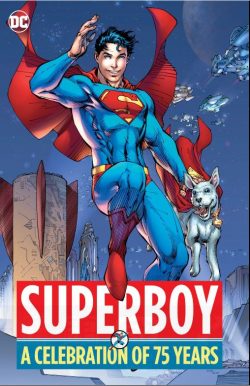
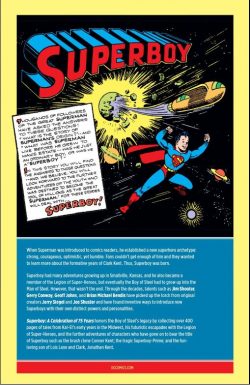
Superboy: A Celebration of 75 Years


By Jerry Siegel & Joe Shuster, Bill Finger, Otto Binder, Robert Bernstein, Jim Shooter, Paul Levitz, Gerry Conway, Elliot S! Maggin, Geoff Johns, Karl Kesel, Brian Michael Bendis, Peter J. Tomasi, Patrick Gleason, John Sikela, Curt Swan, Al Plastino, George Papp, James Sherman, Joe Staton, Phil Jimenez, Jerry Ordway, George Pérez, Ivan Reis, Tom Grummett, Dusty Abell, Matthew Clark, Francis Manapul, Viktor Bogdanovic, Jonathan Glapion & various (DC Comics)
ISBN: 978-1-4012-9951-4 (HB)

Win’s Christmas Gift Recommendation: Superb Supercharged Stocking Stuffer… 9/10

Superman is the initiating act and spark that created the superhero genre. Without him we would have no modern gods to worship. However, less than a decade after his launch, creators Jerry Siegel & Joe Shuster also devised a concept nearly as powerful and persistent: the sheer delight of a child no adult could dominate or control…

The ever-reinventing DC Universe has hosted many key entertainment concepts that have done much to bring about the vibrant comics industry of today. This stunning compilation – part of a dedicated series reintroducing and exploiting the comics pedigree of veteran DC icons and concepts – is available in hardback and digital formats and offers an all-too-brief sequence of snapshots detailing how one of the most beguiling came to be, and be and be again…

Collecting material from More Fun Comics #101; Superboy #10, 89; Adventure Comics #210, 247, 271, 369-370; DC Comics Presents #87; Infinite Crisis #6; Superboy and the Legion of Super-Heroes #233, 259; Adventures of Superman #501; Superboy (volume 2) #59; Teen Titans (volume 3) #24, Adventure Comics (volume 2) #2; Young Justice (volume 3) #3 and Superman (volume 4) #6, 10-11, and introducing the many characters who have earned the soubriquet of the Boy of Steel, the landmark moments are all preceded by a brief critical analysis by Karl Kesel, outlining the significant stages in their development.

It begins with Part I – 1945-1961: A Boy and His Dog …

After the Man of Tomorrow had made his mark as Earth’s premier champion, his originators took a long look and reasoned that a very different tone could offer a fresh look. What would it be like for a fun-loving lad who could do literally anything?

The answer came in More Fun Comics #101 (January 1945) as Jerry Siegel & Joe Shuster crafted ‘The Origin of Superboy!’, fleshing out doomed Krypton and baby Kal-El‘s flight and giving him accessible foster parents and a childhood full of fun and incident…

The experiment was a huge hit. The lad swiftly bounced into the lead slot of Adventure Comics and in 1949, his own title, living a life set twenty years behind his adult counterpart.

Cover-dated October 1950, Superboy #10 originated ‘The Girl in Superboy’s Life’, wherein Bill Finger & John Sikela introduced Smallville newcomer Lana Lang, who immediately saw resemblances between Clark Kent and the Boy of Steel and set out to confirm her suspicions…

Despite battling crooks, monsters, aliens, scandal and the girl next door, Superboy enjoyed a charmed and wonderful life which only got better in Adventure Comics #210 (March 1955), as Otto Binder, Curt Swan & Sy Barry introduced ‘The Super-Dog from Krypton!’ Although waywardly mischievous and dangerously playful, Krypto heralded a wave of survivors from the dead world and made Superboy feel less lonely and unique. Every boy needs a dog…

The next tale here is a certified landmark. Adventure Comics #247 (April 1958) was at the cusp of the Silver Age costumed character revival, as Otto Binder & Al Plastino introduced a concept that would reshape comics fandom: ‘The Legion of Super-Heroes!’

The many-handed mob of juvenile universe-savers debuted in a Superboy tale wherein three mysterious kids invited the Smallville Sensation to the future to join a team of metahuman champions inspired by his historic feats. The throwaway concept inflamed public imagination and after a slew of further appearances throughout Superman Family titles, the LSH eventually took over Superboy’s lead spot in Adventure for their own far-flung, quirky escapades, with the Caped Kryptonian reduced to one of the crowd…

Before then though, Adventure Comics #271 (April 1960) revealed ‘How Luthor Met Superboy!’ Siegel & Plastino united to depict how teenaged scientist Lex Luthor and Superboy became fast friends, before the genius became deranged when a laboratory fire extinguished by the Caped Kryptonian caused Lex to lose his hair. Enraged beyond limit, the boy inventor turned his talents to crime…

Robert Bernstein & George Papp then introduced ‘Superboy’s Big Brother!’ in Superboy #89 (June 1961) in which an amnesiac, super-powered space traveller crashes in Smallville, speaking Kryptonese and carrying star-maps written by the Boy of Steel’s long-dead father…

Jubilant, baffled and suspicious in equal amounts, the Superboy eventually, tragically discovers ‘The Secret of Mon-El’ by accidentally exposing the stranger to a lingering, inexorable death, before desperately providing critical life-support by depositing the dying alien in the Phantom Zone until a cure could be found…

Anybody who regularly reads these reviews know how crotchety and hard-to-please I can be. Brace yourself…

The next section – Part II – 1968-1980: The Space Age – concentrates on Superboy’s Legion career. That’s not the problem because those are great stories, well deserving of their own book, but they’re wasted here while the Boy of Steel’s adventures from this period are completely neglected. That’s work by the likes of Frank Robbins, Binder, Jim Shooter, Curt Swan, Bob Brown, Wally Wood and others we don’t get to see. Poor editorial decision, that…

Calm again, so let’s see how the Boy of Tomorrow fares one thousand years from now…

During this period the youthful, generally fun-loving and carefree Club of Champions peaked; having only just evolved into a dedicated and driven dramatic action series starring a grittily realistic combat force in constant, galaxy-threatening peril.

Although now an overwhelming force of valiant warriors ready and willing to pay the ultimate price for their courage and dedication, science itself, science fiction and costumed crusaders all increasingly struggled against a global resurgence in spiritual questioning and supernatural fiction…

The main architect of the transformation was teenaged sensation Jim Shooter, whose Legion of Super-Hero scripts and layouts (generally finished and pencilled by the astoundingly talented and understated Curt Swan) made the series accessible to a generation of fans growing up with their heads in the Future. Ultimately, however, as tastes and fashions shifted, the series was unceremoniously ousted from its ancestral home and full-length adventures to become a truncated back-up feature in Action Comics. Typically, that shift occurred just as the stories were getting really, really good and truly mature…

Here tense suspense begins with Adventure Comics #369’s (June 1968) and ‘Mordru the Merciless!’(Shooter, Swan & Jack Abel) as the Legion is attacked by their most powerful enemy, a nigh-omnipotent sorcerer the entire assemblage only narrowly defeated once before.

A sneak attack shatters the team and only four escape, using a time bubble to flee to the remote and archaic time-period where Superboy lived. With him come Mon-El, (freed from the Phantom Zone to become a Legion stalwart), Shadow Lass and Duo Damsel – the last remnants of a once-unbeatable team.

Mordru’s magic is stronger though and even the time-barrier cannot daunt him…

Disguised as mere mortals, the fugitive Legionnaires’ courage shines through. When petty gangsters take over Smallville, the teen heroes quash the parochial plunderers and opt to return to the 30th century and confront Mordru, only to discover he’s found them first…

The saga concludes in #370 and ‘The Devil’s Jury!’ wherein the band escape and hide in plain sight by temporarily wiping their own memories to thwart the Dark Lord’s probes. Against appalling odds and with only Clark’s best friend Pete Rossand Insect Queen Lana Lang to aid them, the heroes’ doomed last stand only succeeds because Mordru’s overbearing arrogance causes his own downfall.

Then, when the exhausted fugitives got back the future, they joyously learn that Dream Girl and benign sorceress White Witch have undone the deluded Dark Lord’s worst atrocities…

Since that time the fortunes and popularity of the Legion have perpetually waxed and waned, with their future history tweaked and overwritten, retconned and rebooted over and over again to comply with editorial diktat and popular fashion. After disappearing from the newsstands, the team returned as Guests in Superboy, before eventually taking over the title. Deju Vu, much?

From November 1977, Superboy and the Legion of Super-Heroes #233, sees the Kryptonian join his teammates to thwart ‘The Infinite Man Who Conquered the Legion!’: an extra length blockbuster battle by Paul Levitz, James Sherman & Bob Wiacek, after which issue #259 (January 1980) drops Superboy and the… to become Legion of Super-Heroes #259, subsequently ending an era.

‘Psycho War!’ by Gerry Conway, Joe Staton & Dave Hunt sees the time-lost teen targeted by a deranged war veteran using futuristic trauma weapons, forcing his legion chums to mindwipe Kal-El and return him to his original time forever…

In the mid-1980s, DC’s editorial hierarchy felt their vast 50-year continuity was stopping them winning new readers. The solution was a colossal braided-mega series to streamline, redefine and even add new characters to the mix.

The worlds-shattering, reality-altering bombast of Crisis on Infinite Earths resulted in such spectacular commercial success, those movers-&-shakers must have felt more than justified in revamping a number of their hoariest icons for their next fifty years of publishing. As well as Superman, Flash, and Wonder Woman, many moribund and directionless titles were reconsidered for a radical revision. It didn’t all go to plan…

The background on a new Boy of Steel is covered in the essay and tales comprising Part III 1985-2006: Dark Reflection, which opens with two stories from DC Comics Presents # 87 (November 1985) by Elliot S! Maggin, Swan & Al Williamson.

In ‘Year of the Comet’ Superman of Earth-1 meets and mentors teen Clark Kent from an alternate world previously devoid of superheroes and alien invaders, after which ‘The Origin of Superboy-Prime’ exposes the crucial differences that would make Earth Prime’s Last Son of Krypton so memorable…

Events culminated in ‘Touchdown’ by Geoff Johns, Phil Jimenez, Jerry Ordway, George Pérez, Ivan Reis, inkers Andy Lanning, Oclair Albert Marc Campos, Drew Geraci, Sean Parsons, Norm Rapmund, Art Thibert, from issue #6 of mega event Infinite Crisis (May 2006). Teen Clark had evolved into Superboy-Prime – one of the most sadistic and unstoppable monsters in DCU history – but here he met his end battling another kid calling himself Superboy…

That hero gets his own out-of-chronology section: Part IV 1993-2019: The New Kid detailing how he grew out of another different publishing landmark.

Post-Crisis on Infinite Earths, Superman was stripped-down and back to basics, grittily re-imagined by John Byrne, and marvellously built upon by a succession of immensely talented comics craftsmen, resulted in some genuine comics classics.

Most significant was a 3-pronged story-arc which saw the martyrdom, loss, replacement and inevitable resurrection of the World’s Greatest Superhero in a stellar saga which broke all records and proved that a jaded general public still cared about the venerable, veteran icon of Truth, Justice and the American Way.

The dramatic events also provided a spectacular springboard for a resurgent burst of new characters who revitalised and reinvigorated more than one ailing franchise over the next decade, all exploding from braided mega-saga “Reign of the Supermen” which introduced a quartet of heroes each claiming the mantle of Superman (Don’t panic: the Real Deal Man of Steel returned too!).

The final contender for the S-shield cropped up in Adventures of Superman #501. ‘…When He Was a Boy!’ (Kesel, Tom Grummett & Doug Hazlewood) reveals the secret history of a brash and cocky kid wearing an adaptation of the Man of Tomorrow’s outfit and claiming to be a clone of the deceased hero, recently escaped from top secret bio-factory Cadmus.

After alienating everybody at the Daily Planet, the horny, inexperienced juvenile latches onto ambitious journalist – and hottie – Tana Moon, falling under the spell of corrupt media mogul Vinnie Edge. Soon the kid is fighting crime live on TV to boost ratings…

Blending fast action with smart sassy humour, the clone Superboy was a breakout hit running for years, and gradually infiltrating the established Superman Family. A key moment came in Superboy (volume 2) #59 – by Kesel, Dusty Abell, Dexter Vines – as a virtual ‘Mission to Krypton’ results in the clone finally earning a family name as Kon-El of the House of El…

In the build-up to DC’s Infinite Crisis crossover event, many long-running story-threads were all pulled together ready for the big bang. Crafted by Geoff Johns, Matthew Clark & Art Thibert ‘The Insiders Part 1’ (from Teen Titans #24, July 2005) reveals how Superboy’s belief that he was Superman’s clone is shattered after learning that half of his DNA comes courtesy of Lex Luthor.

Just as Kon-El is about to share the revelation with his Teen Titan team-mates, Luthor activates a deep-seated psychological program that overrides Superboy’s consciousness and makes him evil and murderous…

From November 2009, ‘The Boy of Steel Part Two’ (Adventure Comics volume 2 #2, by Johns & Francis Manapul) then offers a gentler moment as Kon-El, now living in Smallville as Conner Kent, enjoys a potentially romantic interlude with team mate Wonder Girl.

We then jump to May 2019 and ‘Seven Crises Part Three’ from Young Justice volume 3 #3, by Brian Michael Bendis, Patrick Gleason, Viktor Bogdanovic & Jonathan Glapion. Having skipped two universe-altering events (Flashpoint and Rebirth) the formerly erased-from-continuity Impulse has found his old friend Conner living on mystic Gemworld as part of his quest to put his old band back together. It’s fast, furious, heart-warming and hilarious. You should really get all of this tale in its own compilation – Young Justice: Gemworld – even before I review it next year…

Wrapping up this saunter in Super-kids’ shoes is the freshest take on the concept in decades. Part V 2016 and Beyond: Like Father, Like Son offers a too short glimpse at Jon Kent, the child of Superman and Lois Lane, inserted into the mainstream continuity after the New 52 Superman died. If this is making your brain hurt, don’t fret. It’s really unnecessary background for some truly exemplary comics yarns…

Superman (volume 4) #6, 10, 11 are by Peter J. Tomasi, Patrick Gleason, Mick Gray, Mark Morales & Christian Alamy, and firstly depict the ‘Son of Superman’ helping dad defeat evil Kryptonian mechanoid The Eradicator before settling into outrageous action comedy beside, with and frequently against, Damian Wayne: son of Bruce and the latest, most psychotic Robin yet. ‘In the Name of the Father: World’s Smallest Parts One and Two’ pits the junior odd couple against aliens, monsters, girls, but mostly each other. It’s unmissable stuff and you should expect me to wax delirious about the new Super Sons in the New Year…

Adding immeasurably to the wonderment is a superb gallery of covers by Swan with Stan Kaye & Abel, Neal Adams, Mike Grell, Dick Giordano, Eduardo Barreto, Jim Lee & Sandra Hope, Grummett, Kesel & Hazlewood, Mike McKone & Marlo Alquiza, Manapul, Doug Mahnke & Wil Quintana and Gleason with Alejandro Sanchez, Gray & John Kalisz.

Superboy has a long, proud history of shaking things up and providing off-kilter fun to offset the general angst level of Superhero storytelling. Even with my petty caveats, this compelling primer of snapshots is staggeringly entertaining and a monolithic testament to the inestimable value of a strong core concept matured over decades of innovation.
© 1960, 1964, 1969, 1977, 1982, 1984, 1987, 1997, 2000, 2006, 2005, 2011, 2018, 2020 DC Comics. All Rights Reserved.
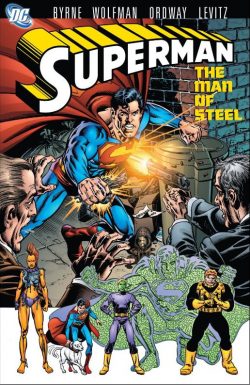
Superman: The Man of Steel volume 4


By John Byrne, Marv Wolfman, Paul Levitz, Jerry Ordway, Greg LaRoque, Erik Larsen & various (DC Comics)
ISBN: 978-1-4012-0455-6 (TPB)

Here’s a classic compilation – and series – which has inexplicably been allowed to drop out of print and is thus long overdue for re-issue. At least this one’s still available in digital editions…

In 1985, when DC Comics decided to rationalise and reconstruct their continuity with Crisis on Infinite Earths, they used the event to regenerate their key properties at the same time. The biggest gun they had was Superman and it’s hard to argue that change came none too soon.

The big guy was in a bit of a slump, but he’d weathered those before. So how could a major makeover be anything but a pathetic marketing ploy that would alienate the real fans for a few Johnny-come-latelies who would jump ship as soon as the next fad surfaced? The popular wisdom amongst fans was that this new Superman was going to suck. They couldn’t have been more wrong.

Superman titles were cancelled or suspended for three months, and yes, that did make the real-world media sit up and take notice of the character for the first time in decades. But there was method in the corporate madness.

Beginning with 6-part miniseries Man of Steel – written and drawn by mainstream superstar John Byrne and inked by venerated veteran Dick Giordano – the experiment was a huge and instant success. So much so, that when it was first collected as a stand-alone graphic novel in the 1980s, it became one of the industry’s premiere break-out hits. From his overwhelming re-inception the character returned to his suspended comicbook homes with the addition of a third monthly title premiering that same month.

Superman, Adventures of Superman, and Action Comics (which became a fan-appeasing team-up book guest-starring other heroes of the DC Universe) were instant best-sellers. So successful was the relaunch that by the early 1990’s Superman would be able to sustain four monthly titles as well as Specials, Annuals, guest shots and his semi-regular appearances in titles such as Justice League.

It was quite a turnaround from the earlier heydays of the Man of Steel when editors were frantic about not over-exposing their biggest gun. With Byrne’s controversial reboot a solid hit, the collaborative teams tasked with ensuring his continued success really hit their stride with the tales collected in this fourth volume.

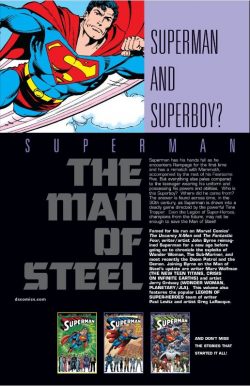
First published between July and September 1987 and re-presenting in paperback (if you can find it) and eBook formats (if you can’t) the contents of Superman #7-8, Action #590-591 and Adventures of Superman #430-431, this epic tome also includes two critical issues of Legion of Super-Heroes (#37-38) and the wonderment is necessarily preceded here by Introduction ‘Superman or Superboy?’ which outlines the dilemma that occurred after the Man of Tomorrow’s recent retcon eliminated his entire career and achievements as the Boy of Steel…

This event provided a classic back-writing exercise to solve an impossible post-Crisis paradox whilst giving us old geeks a chance to see a favourite character die in a way all heroes should….

The drama kicks off with ‘Rampage!’ by Byrne and inker Karl Kesel (Superman volume 2 #7) as a petty colleague sabotages an experiment at a Metropolis lab and accidentally transforms his boss Dr. Kitty Faulkner into a super-strong rage-fuelled monstrosity. Thankfully, Superman is on hand and possessed of a cool head…

Adventures of Superman #430 then sees the Action Ace ‘Homeward Bound!’ – courtesy of Marv Wolfman & Jerry Ordway – in pitched battle against metahuman bandits the Fearsome Five whilst in Action Comics #590 Byrne & Dick Giordano explore ‘Better Living Dying Through Chemistry’, wherein a bizarre toxic accident turns ambulatory waste dump Chemo into a giant Superman clone. Happily, its old adversaries The Metal Men are on hand to aid in the extremely violent clean-up…

Legion of Super-Heroes #37 (August 1987, by Paul Levitz, Greg LaRoque, Mike DeCarlo & Arne Starr) then sets the scene for ‘A Twist in Time’ as a team of Legionnaires heads back to Smallville to visit founding member Superboy only to find themselves attacked by their greatest ally and inspiration…

The tale continues in Byrne & Kesel’s ‘Future Shock’ (Superman #8): a strange squad of aliens appear in his boyhood hometown. Mistaking Superman for Superboy, the Legionnaires attack and after the inconclusive clash concludes begin to piece together an incredible tale of cosmic villainy that has made suckers of them all…

When a kill-crazed Superboy shows up the tale shifts to Action #491 where Byrne & Keith Williams reveal a ‘Past Imperfect’ as the youthful and adult Kal-El’s butt heads until a ghastly truth is revealed leading to Levitz, LaRoque & Mike DeCarlo’s stunning and tragic conclusion in Legion of Super-Heroes #38 where the manipulative reality-warping mastermind behind the scheme falls to ignominious defeat at the hands of ‘The Greatest Hero of Them All’…

Back on solid ground and his own reality the one-and-only Superman then battles a new kind of maniac malcontent in ‘They Call Him… Doctor Stratos’ (by Wolfman, Erik Larsen & “India Inc.” from Adventures of Superman #431): delivering a crushing defeat to a weather-controlling would-be god to wrap up the never-ending battle for another day…

The back-to-basics approach perfected here lured many readers to – and back to – the Superman franchise, but the sheer quality of the stories and art are what convinced them to stay. Such cracking, clear-cut superhero exploits are a high point in the Metropolis Marvel’s decades-long career, and these chronologically-curated collections are certainly the easiest way to enjoy one of the most impressive reinventions of the ultimate comic-book icon.
© 1987, 2005 DC Comics. All Rights Reserved.
Legion of Super-Heroes: The Silver Age volume 1


By Otto Binder, Jerry Siegel, Edmond Hamilton, Robert Bernstein, Al Plastino, George Papp, Jim Mooney, Curt Swan, John Forte & various (DC Comics)
ISBN: 978-1-4012-8157-1

Win’s Christmas Gift Recommendation: Astounding All Ages Entertainment… 9/10

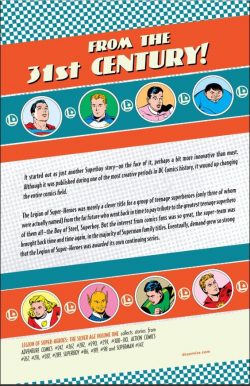
Once upon a time, in the far future, a band of super-powered kids from dozens of alien civilisations took inspiration from the greatest legend of all time and formed a club of heroes. One day those Children of Tomorrow came back in time and invited that legend to join them…

And thus began the vast and epic saga of the Legion of Super-Heroes, as first envisioned by writer Otto Binder & artist Al Plastino in early 1958, just as the revived comicbook genre of superheroes was gathering an inexorable head of steam. Since that time the fortunes and popularity of the Legion have perpetually waxed and waned, with their future history tweaked and rebooted, retconned and overwritten again and again to comply with editorial diktat and popular whim.

This glorious, far-and-wide ranging trade paperback and eBook collection assembles the many preliminary appearances of these valiant Tomorrow People and their inevitable progress towards and attainment of their own feature; including all pertinent material from Adventure Comics #247, 267, 282, 290, 293, and 300-310, Action Comics #267, 276, 287 and 289, Superboy #86, 89, 98 and Superman #147, cumulatively spanning April 1958 through July 1963.

The many-handed mob of juvenile universe-savers debuted in Adventure Comics #247 (cover-dated April 1958) in a Superboy tale wherein three mysterious kids invited the Boy of Steel to the 30th century to join a team of metahuman champions all inspired by his historic career.

Devised by Otto Binder & Al Plastino, the throwaway concept inflamed public imagination and, after a slew of further appearances throughout Superman Family titles, the LSH eventually took over Superboy’s lead spot in Adventure for their own far-flung, quirky escapades, with the Caped Kid Kryptonian reduced to merely “one of the in-crowd”…

However here the excitement was still gradually building as the kids returned more than 18 months later in Adventure #267 (December 1959) for Jerry Siegel & George Papp to play with.

In ‘Prisoner of the Super-Heroes!‘ the teen wonders turn up to attack and incarcerate the Boy of Steel because of a misunderstood ancient record they have uncovered…

The following summer Supergirl met the Legion in Action Comics #267 (August 1960, by Siegel & Jim Mooney) as Lightning Lad, Saturn Girl and Cosmic Boy secretly travel to “modern day” America to invite the Maid of Might to join the team, in a repetition of their offer to Superboy 15 years previously (in nit-picking fact they claimed to be the children of the original team – a fact glossed over and forgotten these days: don’t time-travel stories make your head hurt…?).

Due to a dubious technicality, young and eager Kara Zor-El fails her initiation task at the hands of ‘The Three Super-Heroes’ and is asked to reapply later – but at least we get to meet a few more Legionnaires, including Chameleon Boy, Invisible Kid and Colossal Boy…

With editors still cautiously testing the waters, it was Superboy #86 (January 1961) before ‘The Army of Living Kryptonite Men!’ (by Siegel & Papp) who turned the LSH into a last-minute Deus ex Machina to save the Smallville Sentinel from juvenile delinquent Lex Luthor‘s most insidious assault.

Two months later in Adventure #282, Binder & Papp introduced Star Boy as a romantic rival for the Krypton Kid in ‘Lana Lang and the Legion of Super-Heroes!’

In Action #276 (May 1961) Siegel & Mooney introduced ‘Supergirl’s Three Super Girl-Friends’, which finally saw her crack the plasti-glass ceiling and join the team, sponsored by Saturn Girl, Phantom Girl and Triplicate Girl. We also meet for the first time Bouncing Boy, Shrinking Violet, Sun Boy and potential bad-boy love-interest Brainiac 5 (well at least his distant ancestor Brainiac was a very bad boy…)

Next comes a pivotal two-part tale. ‘Superboy’s Big Brother’ (by Robert Bernstein & Papp from Superboy #89, June 1961) reveals how an amnesiac, super-powered space traveller crashes in Smallville, speaking Kryptonese and carrying star-maps written by the Boy of Steel’s long-dead father…

Jubilant, baffled and suspicious in equal amounts, Superboy eventually, tragically discovers ‘The Secret of Mon-El’ by accidentally exposing the stranger to a lingering, inexorable death, before desperately providing critical life-support by depositing the dying alien in the Phantom Zone until a cure can be found…

With an August 1961 cover-date Superman #147 unleashed ‘The Legion of Super-Villains’ (Siegel, Curt Swan & Sheldon Moldoff): a stand-out thriller featuring the adult Luthor and correspondingly mature wicked future bad guys coming far too close to destroying the Action Ace until the temporal cavalry arrives…

Bernstein & Papp seemingly give Sun Boy a starring role in ‘The Secret of the Seventh Super-Hero!’ (Adventure #290, November 1961) – a clever tale of redemption and second chances, followed in #293 (February 1962) by a gripping thriller from Siegel, Swan & George Klein. ‘The Legion of Super-Traitors’ posits the future heroes turning evil, prompting Saturn Girl to recruit a Legion of Super-Pets including Krypto, Streaky the Super Cat, Beppo, the monkey from Krypton and Comet the magical Super-horse to save the world – and yes, I typed all that with a reasonably straight face…

‘Supergirl’s Greatest Challenge!’ by Siegel & Mooney (Action #287 April 1962) sees her visit the Legion (quibblers be warned: for some reason it was mis-determined as the 21st century in this story) and saved future Earth from invasion.

She also met a telepathic descendent of her cat Streaky. His name was Whizzy (I could have omitted that fact but chose not to – once more for smug, comedic effect and in sympathy with cat owners everywhere)…

Action #289 originally hosted ‘Superman’s Super-Courtship!’ wherein the Girl of Steel scours the universe for an ideal mate for her cousin. One highly possible candidate is the adult Saturn Woman, but her husband Lightning Man objects…

Perhaps charming at the time, but modern sensibilities might quail at the conclusion that his perfect match was a doppelganger of Supergirl herself, albeit thankfully a little bit older…

By the release of Superboy #98 (July 1962), the decision had been made. The buying public wanted more Legion stories and after ‘The Boy with Ultra-Powers’ (Siegel, Swan & Klein) introduces a mysterious lad with greater powers than the Boy of Steel, focus shifts to Adventure Comics #300 (cover-dated September 1962) where the futuristic super-squad finally land their own gig; even occasionally taking an alternating cover-spot from the still top-featured Boy of Steel.

Tales of the Legion of Super-Heroes opened its stellar run with ‘The Face Behind the Lead Mask!’ by Siegel, John Forte & Plastino: a fast-paced premier pitting Superboy and the 30th century champions against an impossibly unbeatable foe until Mon-El, long-trapped in the Phantom Zone, briefly escapes a millennium of confinement to save the day…

In those halcyon days humour was as important as action, imagination and drama, so many of the early exploits were light-hearted and moralistic. Issue #301 offered hope to fat kids everywhere with ‘The Secret Origin of Bouncing Boy!’ by regular creative team Siegel & Forte, wherein the process of open auditions was instigated.

These provided devoted fans with loads of truly bizarre and memorable applicants over the years whilst here allowing the rebounding human rotunda to give a salutary pep talk and inspirational recount of heroism persevering over adversity.

Adventure #302 featured ‘Sun Boy’s Lost Power!’ with the golden boy forced to resign until fortune and boldness restore his abilities after which ‘The Fantastic Spy!’ in #303 provides a tense tale of espionage and possible betrayal by new member Matter-Eater Lad.

The happy readership was stunned by the events of #304 when Saturn Girl engineered ‘The Stolen Super-Powers!’ to make herself a one-woman Legion. Of course, it was for the best possible reasons, but still didn’t prevent the shocking murder of Lightning Lad…

With comfortable complacency utterly destroyed, #305 further shook everything up with ‘The Secret of the Mystery Legionnaire!’ who turns out to be the long-suffering Mon-El finally cured and freed from his Phantom Zone prison.

Normally I’d try to be more obscure about story details – after all my intention is to get new people reading old comics – but these “spoiler” revelations are crucial to further understanding here and besides you all know these characters are still around, don’t you?

Pulp science fiction writer Edmond Hamilton took over the major scripting role with Adventure #306, introducing ‘The Legion of Substitute Heroes!’ (still quirkily, perfectly illustrated by John Forte): a group of rejected audition applicants selflessly banding together and clandestinely assisting the champions who had spurned them, after which transmuting orphan Element Lad joins the big league.

He is seeking vengeance of the space pirates who had wiped out his entire species in ‘The Secret Power of the Mystery Super-Hero!’ whilst in #308 readers seemingly saw ‘The Return of Lightning Lad!’

Actual Spoiler Warning: skip to the next paragraph NOW!!!

Otherwise you’ll find out it was actually his similarly empowered sister who – once unmasked and unmanned – took her brother’s place as Lightning Lass…

Penultimate escapade ‘The Legion of Super-Monsters!’ was a straightforward clash with embittered applicant Jungle King who took his rejection far too personally and gathered a deadly clutch of space beasts to wreak havoc and vengeance after which the future tension temporarily subsides with ‘The Doom of the Super-Heroes!’ from #310: a frantic battle for survival against an impossible foe

The Legion is undoubtedly one of the most beloved and bewildering creations in American comicbook history and largely responsible for the growth of the groundswell movement that became Comics Fandom.

Moreover, these sparkling, simplistic and devastatingly addictive stories, as much as the legendary Julie Schwartz Justice League, fired up the interest and imaginations of a generation of young readers and built the industry we all know today.

These naive, silly, joyous, stirring and utterly compelling yarns are precious and fun beyond any ability to explain – even if we old lags gently mock them to ourselves and one another. If you love comics and haven’t read this stuff, you are the poorer for it and need to enrich your future life as soon as possible.
© 1958-1963, 2018 DC Comics. All Rights Reserved.
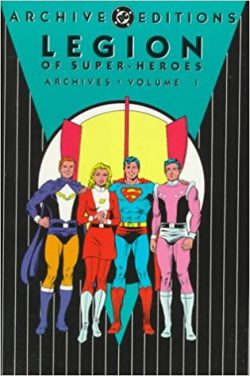
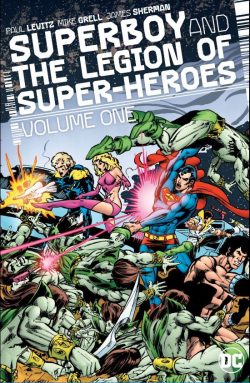
Superboy and the Legion of Super Heroes volume 1


By Paul Levitz, Gerry Conway, Paul Kupperberg, Jack C. Harris, Mike Grell, James Sherman, Jim Starlin, Ric Estrada, Howard Chaykin, George Tuska, Walt Simonson, Mike Nasser, Juan Ortiz & various (DC Comics)
ISBN: 978-1-4012-7291-3 (HB)

Once upon a time, a thousand years from now, a band of super-powered kids from a multitude of worlds took inspiration from the greatest legend of all time and formed a club of heroes. One day those Children of Tomorrow came back in time and invited their inspiration to join them…

Thus, began the vast and epic saga of the Legion of Super-Heroes, as first envisioned by writer Otto Binder & artist Al Plastino when the many-handed mob of juvenile universe-savers debuted in Adventure Comics #247 (April 1958), just as the revived superhero genre was gathering an inexorable head of steam in America. Happy 60th Anniversary, Futurians!

Since that time the fortunes and popularity of the Legion have perpetually waxed and waned, with their future history continually tweaked and overwritten, retconned and rebooted time and time again to comply with editorial diktat and popular fashion.

This cosmically-captivating compendium (available in sturdy hardback and digital editions) gathers a chronological parade of futuristic delights from Superboy and The Legion of Super-Heroes #234-240, covering December 1977 to June 1978, as well as an untold tale of their earliest exploits from DC Super-Stars #17 as well as a major event from tabloid colossus All-New Collector’s Edition C-55.

This was a period when the recently impoverished superhero genre had again flared into vibrant new life to gain its current, seemingly unassailable ascendancy.

That prior plunge in costumed character popularity had seen the team lose their long-held lead spot in Adventure Comics, get relegated to a back-up slot in Action Comics and even vanish completely for a time. Legion fans however are the most passionate of an already fanatical breed…

No sooner had the LSH faded than fan agitation to revive them began. After a few tentative forays as an alternating back-up feature in Superboy, the game-changing artwork of Dave Cockrum inspired a fresh influx of fans and the back-up soon took over the book – exactly as they had done in the 1960s when the Tomorrow Teens took Adventure from the Boy of Steel and made it uniquely their own…

Without warning or preamble, the adventure resumes with Jack C. Harris, Juan Ortiz & Bob Smith exploring ‘The Secret of the Quintile Crystal’ (from DC Super-Stars #17, December 1977) as founders Saturn Girl, Lightning Lad and Cosmic Boy relate to Superboy how a theft by diplomats beyond the reach of the law catapulted the kids – and their unique problem-solving gifts – to the forefront of United Planets security planning…

Superboy and The Legion of Super-Heroes #234 then details a contemporary cosmic catastrophe as a clash with a space dragon mutates a squad of heroes into a marauding amalgamated menace. When the call goes out ‘Wanted Dead or Alive: The Composite Legionnaire’ (by Gerry Conway, Ric Estrada & Jack Abel) ultimate mercenary Bounty goes after the victim and he’ won’t let sentiment of the remaining heroes interfere with ‘The Final Hunt!’…

Happily, Superboy and energy-being Wildfire have enough power to stop the hunter and cure their companions…

Issue #235 features the kind of story uber-dedicated fans adore. ‘The Legion’s Super-Secret’ – by Paul Levitz, Mike Grell & Vince Colletta) gives a glimpse into the covert mental condition Superboy endures every time he returns to his own era. When the process is abruptly interrupted because of a raid by resource hungry Sklarians, the Legionnaires fear the greatest hero of all time may betray the 39th century’s most dangerous biological deception.

Although a tense and rousing escapade, the sad truth is that this tale was conceived to placate sections of the audience who kept carping on about why clearly fully mature characters were still being designated “Boy”, “Girl”, “Kid”, “Lass” and “Lad”. As if comics never had serious social problems and issues to address, right?

The lead story is far-surpassed by potent back-up ‘Trial of the Legion Five’ (Conway, George Tuska & Colletta) wherein some of the heroes are accused of causing the death of a citizen caught in the rampage of the Composite Legionnaire. Their accuser is an old political adversary bearing a grudge and as ever, things are not what they seem…

S&LSH #236 was a power-packed portmanteau offering and brimming with vibrant new artistic talent. It begins with ‘A World Born Anew’ (written by Levitz & Paul Kupperberg with stunning art from neophytes James Sherman & Bob McLeod). When fantastically powerful alien property speculator Worldsmith starts arbitrarily terraforming the planet Braal, even a full team of heroes is unable to stop him until Princess Projectra deduces a better way to send the crazed capitalist packing.

Levitz, Mike Nasser, Joe Rubinstein & Rick Bryant then provide an all-action prologue to greater sagas ahead as ‘Mon-El’s One-Man War’ finds the formidable Daxamite exerting all his energies to save an experimental star mine during a bloody incursion by the war-crazed Khunds before the moment Legion fans had awaited for decades finally came…

‘Words Never Spoken’ by Levitz, Sherman & Rubinstein at long last saw Lightning Lad and Saturn Girl set the day…

No longer bound by responsibility, they had agreed to quit the team – because teammates weren’t allowed to marry – resulting in a huge tabloid sized publishing milestone released as All-New Collector’s Edition C-55 (March 1978).

Comicbook weddings never start well and ‘The Millennium Massacre’ (by Levitz, Grell & Colletta) coincided with a dastardly plot to rewrite history by their greatest foe. As the young marrieds stumble into a honeymoon ‘Murder by Moonlight’, Superboy and a select team voyage to 1988. They’re hoping to prevent the destruction of the United Nations and solve ‘The Twisted History Mystery’ before their comrades and the newlyweds perish in an interplanetary war but the real showdown only occurs after a ‘Showdown at the End of Eternity’…

Accompanied by a potted visual history of ‘Superboy and the Legion of Super-Heroes’ from Gell & Colletta and fact-features ‘The Origins and Powers of the Legionnaires’ and Secrets of the Legion’ by Levitz, Sherman & Abel this epic event set the scene for a darker, more compelling tone…

That began with #237’s ‘No Price Too High’ (Levitz, Walt Simonson & Abel) wherein the team’s financial backer R. J. Brande is abducted by maniac Arma Getten who demands the team bring him ‘The Heart of a Star’, ‘The Stolen Trophy’ and life-sustaining artefact ‘The Crown of the Graxls’ in return for their friend’s life…

Well aware these objects hold the power ‘To Shake the Stars’ the team comply. Apparently…

Due to deadline problems #238 was a hasty reprint of Adventure Comics #359 & 360 and is represented here by its spiffy new Jim Starlin wraparound cover, but the intended tale when it finally emerged was an instant classic.

Plotted and laid out by Starlin, with Levitz script and Rubinstein finishes, #239’s ‘Murder Most Foul’ saw rowdy, rebellious Ultra Boy framed for murdering a prostitute and on the run from his former comrades. Only LSH Espionage Squad leader Chameleon Boy saw something behind the seemingly open-&-shut case, and his off-the-books investigation indicated there was indeed a Legion traitor: potentially the most dangerous opponent of all…

The final inclusion in this mammoth compilation is #240 which offered a brace of thrillers. Levitz, Harris, Howard Chaykin & Bob Wiacek opened with ‘The Man Who Manacled the Legion’ as old foe Grimbor the Chainsman kidnapped the UP President in a bizarre plot to kill the heroes he held responsible for the death of his true love. The book does end on a tantalising high however as Levitz, Kupperberg, Sherman & McLeod take us into the Legion Training Academy to introduce a bevy of new heroes eager to join the big guns. Super dense Jed Rikane (yes, I know, just go with it), invulnerable Laurel Kent and Shadow Lad (Shadow Lass‘ younger brother) all show potential and flaws in equal amounts but the mutant tracker mercenary is who really troubles Wildfire. ‘Dawnstar Rising’ shows not only her immense ability but a disregard for her comrades that could have lethal consequences in the days to come, unless the Legion somehow works its inclusive magic on her…

Rounding out the future fun, ‘Notes from Behind the Scenes’ provides glimpses at Levitz’s original presentation for tabloid edition, plots for a Queen Projectra tale and data cheat sheets for Saturn Girl and others.

The Legion is unquestionably one of the most beloved and bewildering creations in comics history and largely responsible for the growth of the groundswell movement that became American Comics Fandom. Moreover, these scintillating and seductively addictive stories – as much as Julie Schwartz’s Justice League of America or Jack Kirby’s Fantastic Four – fuelled the interest and imaginations of generations of readers to create the industry we all know today.

If you love comics and haven’t read this stuff, you are the poorer for it and need to feed your dreams of a better tomorrow as soon as possible.
© 1977, 1978, 2017 DC Comics. All Rights Reserved.
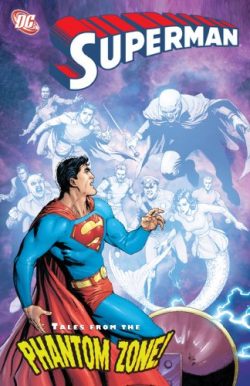
Superman: Tales from the Phantom Zone


By Jerry Siegel, Edmond Hamilton, Otto Binder, Curt Swan & various (DC Comics)
ISBN: 978-1-4012-2258-1

Superman is comics’ champion crusader: the hero who effectively started a whole genre and, in the decades since his spectacular launch in June 1938, one who has survived every kind of menace imaginable. With this in mind it’s tempting and very rewarding to gather up whole tranches of his prodigious back-catalogue and re-present them in specifically-themed collections, such as this sinister set of sorties into the stark and silent realm of nullity designated the Phantom Zone: a time-proof timeless prison for the worst villains of lost planet Krypton.

This captivating trade paperback collection (gathering material from Adventure Comics #283, 300, Action Comics #336, Superman’s Girl Friend, Lois Lane #33, Superman’s Pal, Jimmy Olsen #62, Superman #157, 205, Superboy #89, 104 and Who’s Who in the DC Universe volume 18) represents appearances both landmark and rare, crafted by the many brilliant writers and artists who have contributed to the Kryptonian canon over the years.

Naturally, this terrific tome begins with the very first appearance of the dolorous dimension in ‘The Phantom Superboy’ by Robert Bernstein & George Papp (from Adventure Comics #283 April, 1961).

Here, a mysterious alien vault smashes to Earth and the Smallville Sensation finds sealed within three incredible super-weapons built by his long-dead dad Jor-El. There’s a disintegrator gun, a monster-making de-evolutioniser and a strange projector that opens a window into an eerie, timeless dimension of stultifying intangibility.

However, as Superboy reads the history of the projector – used to incarcerate Krypton’s criminals – a terrible accident traps him inside the Phantom Zone and only by the greatest exercise of his mighty intellect does he narrowly escape…

Next is pivotal 2-part tale ‘Superboy’s Big Brother’ (by Robert Bernstein & Papp from Superboy #89, June 1961) in which an amnesiac, super-powered space traveller crashes in Smallville. Slightly older than Superboy, the befuddled visitor speaks Kryptonese and carries star-maps written by the long-dead Jor-El…

Jubilant, baffled and suspicious in equal amounts, the Boy of Steel eventually, tragically discovers ‘The Secret of Mon-El’ by accidentally exposing the stranger to a fatal, inexorable death before desperately providing critical life-support by depositing the dying alien in the Phantom Zone until a cure can be found…

Superman’s Girl Friend, Lois Lane #33 (May 1962), by a sadly unknown writer but illustrated by the always exceptional art team of Curt Swan & George Klein, further explored the dramatic potential of the Zone in ‘The Phantom Lois Lane!’ wherein a temporarily deranged Lana Lang dispatches all her romantic rivals for the Man of Tomorrow’s affections to the extra-dimensional dungeon.

From one month later, ‘Superman’s Phantom Pal!’ (Leo Dorfman, Swan & Klein as seen in Superman’s Pal, Jimmy Olsen #62) Jimmy Olsen in his Elastic Lad role is drawn through a miniscule rip in the fabric of reality and joins Mon-El in the Zone where the plucky cub reporter faces down the worst of Krypton’s villains and resists their ultimate temptation…

Adventure Comics #300 (September 1962) saw the launch of the Legion of Super-Heroes in their own series by Jerry Siegel, John Forte & Al Plastino. That premier yarn, ‘The Face Behind the Lead Mask!‘, pits Superboy and the 30th century champions against an unbeatable foe until Mon-El intervenes, briefly freed from a millennium of confinement to save the day…

‘The Super-Revenge of the Phantom Zone Prisoner!’ by Edmond Hamilton, Swan & Klein (Superman#157, November 1962) saw the introduction of power-stealing Gold Kryptonite and Superman’s Zone-o-phone – which allows him to communicate with the incarcerated inhabitants – in a stirring tale of injustice and redemption. Convicted felon Quex-Ul uses the device to petition Superman for release since his sentence has been served, and despite reservations the fair-minded hero can only agree.

However further investigation reveals Quex-Ul has been framed and is wholly innocent of any crime, but before Superman can explain or apologise, he has to avoid the deadly trap the embittered and partially mind-controlled parolee has laid for the son of the Zone’s discoverer…

Superboy #104 (April 1963) contained an epic two-part saga ‘The Untold Story of the Phantom Zone’ and ‘The Crimes of Krypton’s Master Villains’. Crafted by Hamilton & Papp it describes Jor-El’s discovery of the Zone, his defeat of ambitious political criminal Gra-Mo and the reasons the vault of super-weapons was ultimately dispatched into space, after which ‘The Kid who Knocked Out Superboy!’ (illustrated by Swan & Klein) sees Gra-Mo return to take vengeance on the son of his nemesis.

‘The Man from the Phantom Zone!’ (Hamilton, Swan & Klein from Action Comics #336, April 1966) finds Superman releasing another convict whose time was served, leading to a captivating crime mystery in the Bottle City of Kandor as 50-year old juvenile delinquent Ak-Var discovers life in a solid and very judgemental world a most mixed blessing…

By April 1968, times and tone were changing, as seen in ‘The Man Who Destroyed Krypton!’ (Superman #205, Otto Binder & Plastino) as alien terrorist Black Zero comes to Earth, determined to blow it up just as he had planet Krypton decades ago!

Overmatched and stunned by the truth of his world’s doom, the Man of Steel is convinced that releasing Jax-Ur, the Zone’s wickedest inhabitant, is the only way to save his adopted homeworld… an absorbing, enthralling, and surprisingly gritty tale of vengeance acting as the perfect way to end this eclectic collection.

With a comprehensive informational extract from the 1986 Who’s Who in the DC Universe entry from the Zone and its most notorious inmates, illustrated by Rick Veitch, this compelling collection is an intriguing introduction to the aliens hidden amongst us and a superb treat for fans of every vintage.
© 1961, 1962, 1963, 1964, 1966, 1968, 1986, 2009 DC Comics. All Rights Reserved.
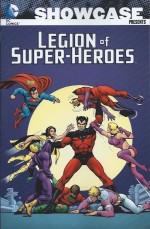
Legion of Super-Heroes: Archive Edition volume 1


By Otto Binder, Jerry Siegel, Edmond Hamilton, Al Plastino, Curt Swan, John Forte, Jim Mooney & various (DC Comics)
ISBN: 978-1-56389-020-8

Once upon a time, in the far future, a band of super-powered kids from dozens of alien civilisations took inspiration from the legend of the greatest champion of all time and formed a club of heroes. One day those Children of Tomorrow came back in time and invited that legend to join them…

And thus began the vast and epic saga of the Legion of Super-Heroes, as first envisioned by writer Otto Binder and artist Al Plastino in early 1958, just as the revived comicbook genre of superheroes was gathering an inexorable head of steam. Since that time the popularity of the Legion has perpetually waxed and waned, with their complex continuity continually tweaked and rebooted, retconned and overwritten again and again to comply with editorial diktat and popular whim.

We Silver Age Legion fans are indubitably the most persistent, passionate, finicky and snitty of all – and editors crossed us at their peril – so when DC announced that it would be gathering all the titanic team’s appearances in a chronological series of deluxe hardcover Archive Editions we were overjoyed (actually most of us thought it was about time and long overdue…) and eager.

Sadly, even in this anniversary year those stories are no longer all in print, but at least old editions like this one from 1997 can still be found if you look hard enough. You’d think in the advanced world of the 21st century a popular series about the future would be available digitally, but you’d be wrong…

Spanning 1958-1963, this glorious full-colour compendium assembles the numerous and far-ranging preliminary appearances of these valiant Tomorrow People and their inevitable progress towards and attainment of their own feature; specifically, all pertinent material from Adventure Comics #247, 267, 282, 290, 293, and 300-305; Action Comics #267, 276, 287 and 289; Superboy #86, 89, 98 and Superman #147.

Also included are an introduction by editor, publisher and devotee Mike Gold, creator biographies and a Curt Swan cover gallery (all inked by either Stan Kaye or George Klein) featuring all the burgeoning band of brothers’ pole positions from those comics.

The multi-hued mob of universe-savers first manifested in Adventure Comics #247 (April 1958) in a Superboy tale wherein three mysterious kids – Lightning Lad, Saturn Girl and Cosmic Boy – invited the bemused Boy of Steel to visit the 30th century and join their team of metahuman champions: all originally inspired by his historic career.

Created by Otto Binder & Al Plastino, the throwaway concept inflamed public imagination and after a slew of further appearances throughout Superman Family titles, the LSH eventually took over Superboy’s lead spot in Adventure for their own far-flung, quirky escapades, with the Caped Kid Kryptonian reduced to simply a face in the in-crowd…

Here, however, the excitement was still gradually building when the kids returned more than 18 months later in Adventure #267 (December 1959) for Jerry Siegel & George Papp to play with.

In ‘Prisoner of the Super-Heroes!‘ the teen wonders reappear to attack and incarcerate the Boy of Steel because of a misunderstood ancient historical record…

The following summer Supergirl met the Legion in Action Comics #267 (August 1960, by Siegel & Jim Mooney) as Lightning Lad, Saturn Girl and Cosmic Boy secretly voyage to modern day America to similarly invite the Maid of Might to join, in a repetition of their offer to Superboy 15 years previously (in nit-picking fact, they claimed to be the children of the original team – a fact glossed over and forgotten these days: don’t time-travel stories make your head hurt…?).

Due to a dubious technicality, young and eager Kara Zor-El fails her initiation at the hands of ‘The Three Super-Heroes’ and was regretfully required to reapply later – but at least we got to meet a few more Legionnaires, including Chameleon Boy, Invisible Kid and Colossal Boy…

With the editors still cautiously testing the waters, it was January 1961 and Superboy #86 before the ‘The Army of Living Kryptonite Men!’ (by Siegel & Papp) turn the LSH into a last-minute Deus ex Machina to save the Smallville Sentinel from juvenile delinquent Lex Luthor‘s most insidious assault.

Two months later in Adventure #282, Binder & Papp introduce Star Boy as a romantic rival for the Last Son of Krypton in ‘Lana Lang and the Legion of Super-Heroes!’

Action #276 (May 1961) then debuted ‘Supergirl’s Three Super Girl-Friends’ (Siegel & Mooney, which finally sees her crack the plasti-glass ceiling and successfully enlist, sponsored by Saturn Girl, Phantom Girl and Triplicate Girl.

We also meet for the first time Bouncing Boy, Shrinking Violet, Sun Boy and potential bad-boy love-interest Brainiac 5 (well at least his distant ancestor Brainiac was a very bad boy…)

Next comes pivotal two-part tale ‘Superboy’s Big Brother’ (by Robert Bernstein & Papp from Superboy #89; June 1961) in which an amnesiac, super-powered space traveller crashes in Smallville, speaking Kryptonese and carrying star-maps written by the Boy of Steel’s long-dead father…

Jubilant, baffled and suspicious in equal amounts Superboy eventually, tragically discovers ‘The Secret of Mon-El’ by accidentally exposing the stranger to a lingering, inexorable death, before desperately providing critical life-support by depositing the dying alien in the Phantom Zone until a cure can be found…

With an August 1961 cover-date, Superman #147 unleashed ‘The Legion of Super-Villains’ (by Siegel, Curt Swan & Sheldon Moldoff): a stand-out thriller featuring Lex Luthor and the adult adversary Legion coming far too close to destroying the Action Ace until the temporal cavalry arrive…

Adventure #290 (November 1961, Bernstein & Papp) seemingly gave Sun Boy a starring role in ‘The Secret of the Seventh Super-Hero!’ – a clever tale of redemption and second chances, followed in #293 (February 1962) by a gripping thriller from Siegel, Swan & George Klein: ‘The Legion of Super-Traitors!’

Here the future heroes are turned evil, prompting Saturn Girl to recruit a Legion of Super-Pets including Krypto, Streaky the Super Cat, Beppo, the monkey from Krypton and Comet the magical Super-horse to save the world – and yes, I typed all that with a (reasonably) straight face…

Siegel & Mooney’s ‘Supergirl’s Greatest Challenge!’ (Action #287, April 1962) has her visit the Legion (quibblers be warned: it is mistakenly described as the 21st century in this story) to save future Earth from invasion. She also meets a telepathic descendent of her cat Streaky. His perhaps ill-considered name was Whizzy…

Action #289 featured ‘Superman’s Super-Courtship!’ wherein the Girl of Steel scours the universe for an ideal mate for her cousin. One highly likely candidate is the adult Saturn Woman, but her husband Lightning Man objects…

Perhaps charming at the time, but modern sensibilities might quail at the conclusion that Superman’s perfect match is a total doppelganger of Supergirl herself, albeit thankfully a few years older…

By the release of Superboy #98 (July 1962), the decision had been made. The buying public wanted more Legion stories and once ‘The Boy with Ultra-Powers’ by Siegel, Swan & Klein introduced a mysterious lad with greater powers than the Boy of Steel, the focus shifted to Adventure Comics #300 (cover dated September 1962) wherein the futuristic super-squad finally begin their own series; even occasionally stealing the odd cover-spot from the still top-featured Superboy.

Tales of the Legion of Super-Heroes opened its stellar run with Siegel, John Forte & Plastino’s ‘The Face Behind the Lead Mask!’; a fast-paced premier pitting Superboy and the 30th century champions against an impossibly unbeatable foe. All looks bleak until Mon-El – long-trapped in the Phantom Zone – briefly escapes a millennium of confinement to save the day…

In those halcyon days humour was as important as action, imagination and drama, so many early escapades were light-hearted and overtly moralistic. Issue #301 offered hope to fat kids everywhere with ‘The Secret Origin of Bouncing Boy!’ – by regular creative team Siegel & Forte – wherein the process of open auditions is instigated (providing devoted fans with loads of truly bizarre and memorable applicants over the years) whilst allowing the rebounding human rotunda to give a salutary pep talk and inspirational recount of heroism persevering over adversity.

Adventure #302 highlighted ‘Sun Boy’s Lost Power!’ as the golden boy is forced to resign until fortune and boldness restore his abilities after which ‘The Fantastic Spy!’ in #303 provides a tense tale of espionage and possible betrayal by new member Matter-Eater Lad.

The happy readership was stunned by the events of #304 when Saturn Girl engineered ‘The Stolen Super-Powers!’ to make herself a one-woman Legion. Of course, it was for the best possible reasons, but still didn’t prevent the shocking murder of Lightning Lad…

With comfortable complacency utterly destroyed, #305 further shook everything up with ‘The Secret of the Mystery Legionnaire!’ – who turned out to be the long-suffering Mon-El, finally cured of terminal lead poisoning and freed from his Phantom Zone prison.

The Legion is undoubtedly one of the most beloved and bewildering creations in American comicbook history and largely responsible for the growth of the groundswell movement that became Comics Fandom. Moreover, these sparkling, simplistic and astoundingly addictive stories, as much as the innovations of Julie Schwartz’s Justice League, fired up the interest and imaginations of a generation of young readers and built the industry we all know today.

Naive, silly, joyous, stirring and utterly compelling yarns are precious and fun beyond any ability to explain, and if you love comics and haven’t read this stuff, you are the poorer for it and need to enrich your future life as soon as possible…
© 1958-1964, 1991, 1997 DC Comics. All Rights Reserved.

Superman and the Legion of Super-Heroes


By Geoff Johns, Gary Frank & Jon Sibal (DC Comics)
ISBN: 978-1-4012-1819-5 (HC)                    978-1-4012-1904-8 (TPB)

Almost 79 years ago Superman started the whole modern era of fantasy heroes: outlandish, flamboyant indomitable, infallible, unconquerable.

He also saved a foundering industry and created an entirely new genre of storytelling – the Super Hero. Since June 1938 he has grown into a mighty presence in all aspects of art, culture and commerce even as his natal comicbook universe organically grew and expanded.

Long ago and far away a scientifically advanced civilisation perished, but not before its greatest genius sent his baby son to safety is a star-spanning ship. It landed in Kansas and the interplanetary orphan was reared by decent folk as one of us…

Once upon a time, in the far future, a band of super-powered kids from dozens of alien civilisations took inspiration from the greatest legend of all time and formed a club of heroes. One day these Children of Tomorrow came back in time and invited that legend to join them…

And thus began the vast and epic saga of Superman and tangentially the Legion of Super-Heroes: as first envisioned by writer Otto Binder and artist Al Plastino in the landmark Adventure Comics #247 (April 1958). Since that time, the fortunes and popularity of the Legion have perpetually waxed and waned, with their future history tweaked and rebooted, retconned and unwritten over and again to comply with editorial diktat and popular whim.

One popular trend is to re-embrace the innocent, silly, joyous, stirring and utterly compelling pre-Crisis on Infinite Earths tales but to shade them with contemporary sensibilities and with this in mind Geoff Johns gradually reinstituted the Lore of the Legion in a number of his assignments during the early part of this century.

Beginning most notably with Justice League of America: The Lightning Saga and culminating in the epic New Krypton and War against Brainiac sagas the Legion were back and once more carving out a splendid niche in the DC Universe.

Along the way came this superb, nostalgia-laced cracker of a tale which re-established direct contact between the futuristic paladins and the Man of Tomorrow…

Compiling Action Comics #858-863 (spanning December 2007 through May 2008), this collected chronicle – also sporting an Introduction from veteran LSH creator Keith Giffen – finds the Legion back in the 21st century, summoning Superman to save Tomorrow’s World once more. Long ago the Legion had regularly visited: spiriting the young Kryptonian to a place and time where he didn’t have to hide his true nature. However, once he began his public career, the visits ceased and his memories were suppressed to safeguard the integrity of history and the inviolability of the time-line.

Now a desperate squad of Legionnaires must reawaken those memories since the Man of Steel is the last hope for a world on the edge of destruction. In the millennium since his debut Superman has become a beacon of justice and tolerance throughout the Utopian Universe, but a radical, xenophobic anti-alien movement has swept Earth, marginalising, interning and even executing all non-Terrans.

Moreover, a super-powered team of Legion rejects has formed a Justice League of Earth to lead a crusade against all extraterrestrial immigrants, claiming Superman was actually a true-born Earthling, and declaring him their spiritual leader…

Of course, Kal-El of Krypton must travel to the future and not only save the day but scour the racist stain from his name – a task made infinitely more difficult because Earth-Man, psychotic xenophobic leader of the Earth-First faction, has turned our yellow sun a power-sapping red…

Bold, thrilling and absolutely enthralling, the last-ditch struggle of a few brave aliens against a racist, fascistic and completely ruthless totalitarian tomorrow is the stuff of pure comic-book dreams. Superman strives to unravel a poisonous future where all his hopes and aspirations have been twisted, with only his truest childhood friends to aid him with the incredibly intense and hyper-realistic art of Gary Frank & Jon Sibal making it all seem not only plausible but inevitable…

Sweetening the deal is a stunning covers and variants gallery by Gary Frank, Adam Kubert, Steve Lightle, Mike Grell and Al Milgrom plus pages of notes, roughs and designs from Frank’s preparatory work before embarking on the epic adventure.

Total Fights ‘n’ Tights future shock in the best way possible
© 2007, 2008 DC Comics. All Rights Reserved.

Showcase Presents the Legion of Super-Heroes volume 5


By Cary Bates, Jim Shooter, Paul Levitz, Dave Cockrum, Mike Grell & various (DC Comics)
ISBN: 978-1-4012-4297-8

Once upon a time, a thousand years from now, a band of super-powered kids from a multitude of worlds took inspiration from the greatest legend of all time and formed a club of heroes. One day those Children of Tomorrow came back in time and invited their inspiration to join them…

Thus began the vast and epic saga of the Legion of Super-Heroes, as first envisioned by writer Otto Binder & artist Al Plastino when the many-handed mob of juvenile universe-savers debuted in Adventure Comics #247 (April 1958), just as the revived superhero genre was gathering an inexorable head of steam in America.

Since that time the fortunes and popularity of the Legion have perpetually waxed and waned, with their future history tweaked and overwritten, retconned and rebooted over and over again to comply with editorial diktat and popular fashion.

This sturdy, cosmically-captivating fifth massive monochrome compendium gathers a chronological parade of futuristic delights from Superboy #193, 195, and Superboy starring the Legion of Super-Heroes #197-220, covering February 1973 to October 1976, as well as the debut issue of opportunistic spin-off Karate Kid #1 (March 1976) at a time when the superhero genre had again waned but which was slowly recovering to gain its current, seemingly unassailable ascendancy.

That plunge in costumed character popularity had seen the team lose their long-held lead spot in Adventure Comics, be relegated to a back-up in Action Comics and even vanish completely for a time. Legion fans however are the most passionate of an already fanatical breed…

No sooner had the LSH faded than agitation to revive them began. After a few tentative forays as an alternating back-up feature in Superboy, the game-changing artwork of Dave Cockrum inspired a fresh influx of fans and the back-up soon took over the book – exactly as they had done in the 1960s when the Tomorrow Teens took Adventure from Superboy and made it uniquely their  own…

The resurgent dramas begin here with the back-up by Cary Bates & Cockrum from Superboy #193 wherein a select team consisting of Chameleon Boy, Duo Damsel, Chemical King and Karate Kid went undercover on a distant world to prevent atomic Armageddon in ‘War Between the Nights and the Days!’

That’s followed by #195’s ‘The One-Shot Hero!’ which told the story of ERG-1 – a human converted to sentient energy in an antimatter accident. The character had been mentioned in a 1960’s tale of the Adult Legion but here Bates & Cockrum at last fleshed out his only mission and heroic sacrifice with passion and overwhelming style…

The really big change came with the July issue as the long-lived title (it had premiered in 1949 just as the Golden Age was coming to an end) became Superboy starring the Legion of Super-Heroes with #197.

The relaunch offered a full-length extravaganza, ‘Timber Wolf: Dead Hero, Live Executioner!’ which saw the Boy of Steel summoned to the future to be greeted by a hero he believed long dead in the line of duty.

Somehow Timber Wolf has escaped the grave and triumphantly greets his old comrade, but astute Legion leader Mon-El fears some kind of trick and is proved right when the miraculous survivor goes berserk at an awards ceremony, attempting to assassinate the President of Earth.

Wolf is restrained before any harm can be done and a thorough deprogramming soon gives him a clean bill of mental health. Unfortunately that’s exactly what the team’s hidden enemy had planned and when a deeper layer of brainwashing kicks in the helpless mind-slave turns off the security systems allowing militaristic alien warlord Tyr to invade Legion HQ.

Thankfully telepathic Saturn Girl is on hand to free the mental vassal and scupper the assault, but in the scuffle Tyr’s computerised gun hand escapes, swearing vengeance…

The organisation’s greatest foes resurface with a seemingly infallible plan in #198’s ‘The Fatal Five Who Twisted Time!’ – travelling back to 1950s Smallville to plant a device which will edit the next thousand years to prevent the LSH from forming.

As second chapter ‘Prisoners of the Time Lock’ reveals, however, a squad comprising Brainiac 5, Element Lad, Karate Kid, Princess Projectra, Chameleon Boy and Mon-El has already escaped to the relative safety of the time stream, determined to restore history or die with the resultant clash concluding in a ‘Countdown to Catastrophe’…

With an entire issue to play with and short stories clearly popular, the format settled on alternating epics with a double-dose of vignettes. Thus issue #199 opened with ‘The Gun That Mastered Men!’ as Tyr’s computerised wonder weapon returned to liberate its creator, only to rebel at the last moment and try to take over Superboy’s body instead. With that threat comprehensively crushed, Bouncing Boy then took centre stage to relate his solo battle against Orion the Hunter in ‘The Impossible Target’…

It was mere prelude to the anniversary issue #200 wherein he lost his power to hyper-inflate and had to resign. However it did allow the Bounding Bravo to propose to girlfriend Duo Damsel, unaware that she had been targeted to become ‘The Legionnaire Bride of Starfinger’…

The marriage was an event tinged with grandeur and tragedy as the super-villain kidnapped her in ‘This Wife is Condemned’, attempting to emulate her powers and make an army of doppelgangers but ‘The Secret of the Starfinger Split!’ was never revealed after Superboy enacted a cunning counter-ploy…

Issue #201 featured the resurrection of ERG-1 as the energy-being reconstituted himself to save the Legion from treachery in ‘The Betrayer From Beyond’ whilst ‘The Silent Death’ saw precognitive Dream Girl infallibly predict a comrade’s imminent demise even though no hero anywhere appeared to be endangered…

Superboy starring the Legion of Super-Heroes #202 was a 100-Page Giant but only two tales were new. They were also Cockrum’s final forays in the 30th century and saw the debut of his equally impressive successor Mike Grell as inker on ‘Lost a Million Miles from Home!’

Here Colossal Boy and Shrinking Violet face a perplexing mystery in deep space: an inexplicable loss of ship’s power which compels them to abandon ship in the worst possible place imaginable…

‘Wrath of the Devil-Fish’ by Bates & Cockrum was the artist’s swan song, featuring the debut of the re-designated ERG-1 as Wildfire and an eerie amphibian creature who attacked a pollution-cleansing automated Sea-Station. Of course the monster was not what he seemed and the Legion thought they might have found a unique new recruit…

Having utterly transformed the look, feel and fortunes of the Legion, Cockrum moved to Marvel where he would perform the same service for another defunct and almost forgotten series entitled X-Men…

With Grell now handling the full art, our youthful Club of Champions were still on the meteoric rise, depicted as a dedicated, driven, grittily realistic combat force in constant, galaxy-threatening peril. However the super-science stalwarts still struggled against a global resurgence in spiritual soul-searching and supernatural dramas, with most of the comics industry churning out a myriad of monster and magic tales.

Thus the genre even invaded the bastions of graphic futurism in #203’s ‘Massacre by Remote Control’ (Bates & Grell) when increasing indifference and neglect caused veteran legionnaire Invisible Kid to lose his life saving his comrades.

The sadness was tinged with joy, however, as this was a twist on gothic ghost stories and the fallen hero was united with a lover from the other side of the Veil of Tears…

It was back to sensibly rational ground for SsLSH #204 and ‘The Legionnaire Nobody Remembered’, wherein the heroes explored the secrets of time traveller Anti-Lad whose accidental meddling altered history, demanding a most hands-on response to fix everything. Bates & Grell then exposed ‘Brainiac 5’s Secret Weakness!’ by reigniting his millennium-spanning romance with Supergirl…

Issue #205 was another mostly-reprint 100-Page Giant but included one novel-length saga which saw 20th century Lana Lang save the assembled heroes from becoming ‘The Legion of Super-Executioners’ after the entire team was overwhelmed by a psionic immortal who patiently planned to abduct them all and breed a super-army of conquest…

‘The Legionnaires who Haunted Superboy’ led in #206 and saw Superboy visited by dead friends Invisible Kid and Ferro Lad. This time however the underlying theme was nascent cloning science not eldritch unrest and the outcome was mostly upbeat, after which ‘Welcome Home Daughter… Now Die!’ highlighted Princess Projectra‘s dilemma as both modern hero with a commoner boyfriend and untouchable heir to a primitive feudal kingdom after a dutiful family visit resulted in an attack by a marauding monster…

SsLSH #207 opened with ‘The Rookie who Betrayed the Legion!’ as Science Police liaison Dvron seemingly colluded with mesmeric villain Universo whilst ‘Lightning Lad’s Day of Dread!’ saw the hero unite with his wicked brother Mekt to share a moment of personal grief.

It was but a prelude to the next issue (another 100-Page Giant) with a two pronged plan marooning Mon-El and Superboy in the 1950s whilst their comrades suffered the ‘Vengeance of the Super-Villains’ in the 30th Century. However the cunning murder-plot of Lightning Lord‘s Legion of Super-Villains was not clever enough to fool Brainiac 5 of wily LSH espionage chief Chameleon Boy…

During the 1960’s the main architect of the Legion’s transformation from semi-comedic adventure feature to gritty super-battalion was teenaged sensation Jim Shooter, whose scripts and layouts (generally finished and pencilled by the astoundingly talented Curt Swan) made the series irresistible to a generation of fans growing up with their heads in the Future and tension-drenched drama on their minds.

Now, after time away getting a college education and working in advertising, Shooter returned in Superboy starring the Legion of Super-Heroes #209 with ‘Who Can Save the Princess?’ tersely detailing how Projectra succumbing to the lethal Pain Plague led her lover Karate Kid to make an ultimate sacrifice.

Bates & Grell then wrapped up the issue with a heart-warming mystery as young fan Flynt Brojj became a ‘Hero for a Day’; saving the Legion from an insidious assassination attempt…

Issue #210 was an all Shooter/Grell affair, opening with far darker fare as ‘Soljer’s Private War’ revealed how a tragic victim of World War VI was transformed by horrific circumstances and resurrected to rampage unstoppably through 30th century Metropolis after which ‘The Lair of the Black Dragon’ revealed the incredible origin of Karate Kid.

When a pack of martial artists attack the hero, their defeat leads to a further attack on the aged Sensei who trained Val Armorr from birth, and painful revelations that the Legionnaire’s birth-father was Japan’s greatest villain…

In issue #211 ‘The Ultimate Revenge’ (Shooter) saw Element Lad risk his career and honour to exact vengeance from space pirate Roxxas who exterminated the hero’s entire race whilst Bates detailed how the Legion of Substitute Heroes took possession of ‘The Legion’s Lost Home’ incidentally solving one of the most infamous cold cases in the history of theft…

Shooter was now main writer on the series and SsLSH #212 began with ‘Last Fight for a Legionnaire’ wherein a sextet of ambitious and disgruntled teens challenged Matter-Eater Lad, Saturn Girl, Cosmic Boy, Phantom Girl, Shrinking Violet and Chameleon Boy for their positions on the team – resulting in the replacement of one of veteran heroes – whilst ‘A Death Stroke at Dawn’ found ineffectual-seeming Substitute Legionnaire Night Girl rediscovering her confidence by triumphantly saving boyfriend Cosmic Boy and herself from murderous ambushers…

In #213 Ultra Boy only realised he was afflicted with a crippling psychological handicap when the hunt for infallible super-thief Benn Pares took the team into ‘The Jaws of Fear’ after which Timber Wolf overcame a far more physical threat with his rarely exercised wits when attacked by mega-thug Black Mace in ‘Trapped to Live – Free to Die!’ by Shooter, Grell and inker Bill Draut.

In #214 the heroes found ‘No Price Too High’ to save a trillionaire’s obnoxious son from himself and the deranged, disaffected employee who had taken over one of his dad’s automated manufacturing worlds before Bates, Grell & Draut revealed the deep-seated trauma which took away Shrinking Violet’s powers in ‘Stay Small – Or Die!’

Luckily for Brainiac 5, his drastic plan to shock her back to normal worked in time for her to save him from the fallout of his own callous actions…

Bates & Grell also observed ‘The Final Eclipse of Sun Boy’ in SsLSH #215, as an intangible assassin stalked Phantom Girl to Earth and was in turn followed by an unlikely and unsuspected ally, before Shooter, Grell & Draut revealed Cosmic Boy as ‘The Hero Who Wouldn’t Fight’: honouring a sacred day of penance and super-power abstinence even at the cost of his life…

Despite the comics world being in the grip of martial arts madness since 1973, DC were a little slow in making an obvious move and giving one of the oldest comicbook Kung Fu fighters his own solo title.

Karate Kid #1 launched with a March-April 1976 cover-date and plunged valiant Val Armorr back a thousand years to contemporary New York City in ‘My World Begins in Yesterday’ by Paul Levitz, Ric Estrada & Joe Staton.

The self-made warrior had crashed the time barrier to recapture arch enemy Nemesis Kid, and, after rejecting friendly advice and stern orders to return to Tomorrow, tracked and trashed his enemy with the astounded assistance of schoolteacher Iris Jacobs.

Finding the primitive milieu far more amenable than his origin era, Karate Kid unexpectedly then elected to stick around in the 20th century…

That same month SsLSH #216 saw Bates & Grell tackle a thorny issue in ‘The Hero who Hated the Legion’ as the team tried to recruit its first black member. The isolationist Tyroc and his entire long-sequestered race carried a big grudge and it took determined diplomacy and a crisis which threatened the entire island of Marzal to challenge the prejudice of centuries…

The same creative team then took a peek into ‘The Private Lives of Bouncing Boy and Duo Damsel’ revealing how even retired Legionnaires still had to fight for their lives on occasion.

Shooter & Grell monopolised issue #217 beginning with ‘The Charge of the Doomed Legionnaires’ wherein rapacious Khund warlord Field Marshal Lorca pitted his strategic genius against Brainiac 5 but underestimated the sheer guts of his despised foes, whilst ‘Future Shock for Superboy’ found the Teen of Steel beguiled by 30th century girl Laurel Kent, blithely unaware that he was interested in his own descendant…

Superboy starring the Legion of Super-Heroes #218 revealed how Tyroc’s induction into the team was shanghaied by Zoraz, ‘The Secret Villain the World Never Knew’ (Bates & Grell) although the neophyte soon turned the tables on the interloper, after which Shooter (with story inspiration from Ken Klaczac) disclosed ‘The Plunder Ploy of the Fatal Five’ in #219.

Here the terrifying Fatal Five went on an implausible spree of cosmic crimes, gathering items which could only be used for the creation of an all-conquering army, but when the Legion capably counterattacked they realised they’d jumped to woefully wrong conclusions…

This cavalcade of chronal capers concludes with #220 as inker Bob Wiacek joined Shooter & Grell for one final brace of bombastic blockbusters, beginning with ‘The Super Soldiers of the Slave-Maker’ wherein the Legion attempted to liberate conquered planet Murgador.

With most resistance coming from the terrified inhabitants, the astounded heroes learned that a huge bomb at the world’s core made them all helpless hostages to their alien overlord, forcing an application of subterfuge and misdirection to rectify the impossible situation…

Everything wraps up here with ‘Dream Girl’s Living Nightmare’ as Chameleon Boy tried to cheat fate and save a cosmic benefactor from death despite the infallible prediction of his precognitive comrade…

The Legion is unquestionably one of the most beloved and bewildering creations in funnybook history and largely responsible for the growth of the groundswell movement that became American Comics Fandom. Moreover, these scintillating and seductively addictive stories – as much as Julie Schwartz’s Justice League or Marvel’s Fantastic Four– fuelled the interest and imaginations of generations of readers and created the industry we all know today.

If you love comics and haven’t read this stuff, you are the poorer for it and need to feed your future dreams as soon as possible.

© 1973-1976, 2014 DC Comics. All Rights Reserved.