Safer Places


By Kit Anderson (Avery Hill Publishing)
ISBN: 978-1-910395-77-6 (PB)

If you get a holiday this year and you’re one of those folk that like to read, here’s something a bit different that will certainly add to the desired sense of getting away from it all…

If you’re open to the idea, there’s wonder all around us. It’s not a new notion but remains a potently beguiling one that confirms its power in these interconnected vignettes exploring memory, imagination, inner worlds, nature, secrets, self-help solutions and isolation.

Explored over an initially undisclosed set of parameters and across myriad places and times, these are moments of shared-yet-exclusive realities that appear to be an example of a growing creative vogue/creative zeitgeist – as you’ll see when we imminently review similar but so different Avery Hill release Infinite Wheat Paste: Catalytic Conversions.

Here, however, cartoonist and tale-teller Kit Anderson merges mundane momentary travails with commonplace entertainment escape routes (wizard’s worlds, haunted houses, cyber-realities, alien mindscapes, fresh starts) to explore “liminal spaces and small magic”: digging deep to find the “something greater” we all crave and that must be waiting just out of our sight and other perceptions. Master of short form graphic narratives – you can just call them comics if you want – she hails from Boulder, Colorado but now lives near Zürich. Anderson was ceaselessly making graphic stories even before earning an MFA from The Center for Cartoon Studies in 2022. You can look for her stuff at Parsifal Press and The Rumpus for greater elucidation and edification…

Taking a year to complete, over 18 brief tales Safer Places melds inquisitive inspirations to contemplative cartooning and builds an interlocking sampling of other worlds, times and existences which all lead back to a common core. Blending pedestrian and surreal, employing a variety of art styles and colour palettes, it all begins with ‘Quest I’ as unseen critics speculate upon an old guy who seems to be a wizard who favours the wilds over civilisation, before a bereft boy looking for his cat finds something strange, wondrous and ultimately unsustainable in ‘The Basement’

Tantalising travelogue ‘Wonders of the Lost City’ carries us to ‘Sleep Tape: Country Lane’ and a loving couple under strain and in need of calming talk therapies before the wizard – still moving in mysterious ways – pops back into view for ‘Quest II’, after which a boy in very uncharted waters takes a revelatory ‘Deep Breath’

More calming tactics and rural idyls manifest in ‘Sleep Tape: Forest Walk’ for a woman too wedded to a Wi-Fi-enabled “Smart” world, whereas work pressure taking its toll on a watcher of post dystopian woodlands cannot be as readily assuaged in ‘Lookout Station’. At least the poetic ruminations of ‘Morning’, ‘Hills’ and ‘Waves’ carry us gently into ‘Quest III’ and the wizard’s dramatic interaction with a forest fox, prior to ‘Fallow’ detailing the shocking behaviour of an aged, burned out farmer making amends… and one last lifestyle change.

A computer nerd’s close encounter with digital ‘Wallpaper’ quietly segues into floral terrors as a student succumbs to transformative life-changing illness in ‘Weeds’ whilst ‘Quest IV’ sees a darker day dawn for the wizard before a harassed and lonely wage-slave finding solace and companionship thanks to ‘Sleep Tape: At the Seaside’

‘Whump’ offers a contemplative laugh before a solitary walking tour takes a lonely wanderer to ‘The World’s Biggest Ball of Twine’ even as another recluse escapes connections by grabbing a bike and going for a ‘Ride’, all before the wizard heads home to recharge in ‘Quest V’

Bemusing and seductive, these interlocking voyages reveal the cathartic force of creativity and therapeutic siren call of world-making. Come visit soon, yes?
© Kit Anderson 2024. All rights reserved.

Liebestrasse


By Greg Lockard, Tim Fish, Héctor Barros, Lucas Gattoni & various (Dark Horse/Greg Lockard-ComiXology Originals)
ISBN: 9781506724553 (TPB/Digital edition)

As we’re all mindful of D-Day, WWII and how the world changed after that, here’s a poignant fable set in those distant days about one of the things they were all fighting for – the right to love and be loved by whoever you choose…

The story opens covertly in the Land of the Free. It’s 1952 and an aging, wealthy man seeks solace and the company of “his own kind” in a very special bar…

The next day, Sam Wells visits a modern art exhibition where a brief encounter with a young man of similar tastes and disposition triggers memories and a potent flashback to an old friend. Soon after, Wells is flying to Berlin to establish new business contacts and, hopefully, relive some of the better moments of his past.

As he moves around the divided city, Wells’ mind flits back to 1932 when, as a young Mover & Shaker, he was posted to Germany to set up an overseas office for his company. For a young man of wealth and his particular proclivities, the Weimar Republic offered many opportunities and temptations. Crucially, it also allowed freedom from dangerous oversight. Nevertheless, there was also an inescapable sense of oppressive menace, especially after meeting audacious, outspoken Philip Adler and falling madly, passionately, head over heels in love.

Philip’s sister Hilde was already in the sights of the rising National Socialists for creating un-Aryan art, but his constant challenging of the party in words, and especially with his “degenerate” lifestyle, soon painted a target on all their backs, as well as on the numerous doomed-and-dancing-on-the-volcano’s-edge liberals Sam met at endless parties and in the music clubs…

As months passed, the affair intensified – as did the danger – and inevitably, the hammer fell. For Sam that meant a beating and deportation, but for Philip there was no such callous leniency. Now decades later, Wells is back and has to face Hilde again…

Set firmly in the footsteps of the Berlin Stories by Christopher Isherwood, Liebestrasse is a tale of regret, thwarted love and “might-have-beens ” from writer Greg Lockard and artist Tim Fish, aided and abetted by Héctor Barros on colours with Lucas Gattoni providing letters and calligraphy. Forceful, frantic, passionate and deeply moving, it is a powerful testament to the abiding power and wonder of passion but also a sobering reminder of how far we’ve come: an irrefutable argument for live and let love…
LIEBESTRASSE © 2019 Greg Expectations, LLC & Timothy Poisson. All rights reserved.

Little David


By David Cantero (Northwest Press)
eISBN: 978-1-9438900-0-2 (digital only)

Families are important: by every conceivable metric the foundation of human society. If we swallow our arrogant exceptionalism for a moment, it’s also the binding concept of all mammalian life and a fair bit of the rest of Earth’s breathing occupants. You just need to try and be flexible, tolerant, willing to re-examine old ideas in the light of changing information and where necessary loosen any old hidebound definitions you might have acquired while growing up… and be amenable to change. It always comes whether or not you want it too.

Traditional interpretation of the family concept is one we’re finally shedding: escaping centuries of oppressive preconditioning and the diktat of whatever autocratic – or, more usually, theocratic – hegemony presumes to run your life at any one time. You can consider the current foofaraw about the imaginary cosmic threat of letting people self-define their gender just the latest bunch of reactionary twaddle of a none-too-rapidly dying breed…

I’ll restate that just in case I wasn’t clear: human beings are all about families and what constitutes a family is open to personal interpretation…

David Cantero Berenguer (The Little Swallow Light, Cunitoons, People) was born in Cartagena, Spain and – after graduating in 1996 from the Royal Academy of Fine Arts in Liège – embarked on a stellar career as an author, cartoonist, illustrator, concept artist, designer and games maker. He is a prolific creator of books and graphic novels for kids and adults. Many of his works involve gay themes, ranging from inclusive all-ages chronicles (like the one under review here) to beguiling adult erotica.

Little David was first released in 2015 and deftly references Winsor McCay’s classic fantasy Little Nemo in Slumberland. It is a delightful and charming selection of short gags wherein an ever-inquisitive titular star cavorts, chats and interacts with nine other kids, each and all cumulatively representing the wealth of options qualifying as family units today.

David himself has two dads, and pal Ulysses has a widowed mother, a stepdad and two half-brothers. Earnest and forthright Marie just has her mum. Abrasive Big Harry is full-nuclear in a biological clan of mum, dad and one sister, whereas Lena is a result of artificial insemination undertaken by her already-divorced mother. Anastasia has a mum and dad who conceived her in vitro, and PJ was adopted. Completing the roster, Ian has a mum and a trans dad whilst twins Yoko and Keiko have two mums and are the result of natural insemination.

That’s a heady mix and subject to exactly the kind of innocently incisive, hilarious conversations you’d imagine a bunch of smart, curious kids will indulge in when the adults are absent and they’re trying to get to know each other.

The result is a wittily compelling string of spit-take moments, especially as David (and his beloved stuffed unicorn Little Poo Poo) not only learn about many other ways of living but also explore various ways of dressing and expressing his own developing personality, interests and choices…

As innocently enchanting as Peanuts, as astute as Bloom County and as outrageously revelatory as Calvin and Hobbes, this peewee playground of family fun offers as sincerely inclusive and heartwarming kindergarten of comics messaging as you’d ever want your kids to see, and is also a superb example of top rate cartooning to gladden the eyes.

Little David is a book every home and elementary school should have and use. Tell your government I said so…
© 2015 David Cantero. All rights reserved.

A Quick & Easy Guide to Queer and Trans Identities


By Mady G & J.R. Zuckerberg (Limerance Press/Oni Press)
ISBN: 978-1-62010-586-3 (PB) eISBN: 978-1-62010-587-0

Here’s a handy rule of thumb for getting along. People get to decide what to call themselves. You get to accept and agree with them, as long as no one is being actually harmed or just mind your own business. That assessment is to be made by Law, not personal belief or some higher calling. If you can’t accept their definitions of themselves, you have the right to leave people alone and never interact with them. Okay?

We are the Naming Primate. If we encounter something unknown and/or scary, we give it a description, definition and title and accept it into our ever-expanding understanding of Reality. It’s what enabled us to take over this world. Naming things is generally a good thing and allows us to navigate the universe. Some people, however, use the power of naming to isolate, ostracise and wound. They are not doing it right. People like us have plenty of really fitting names for people like them when they abuse our gift.

In reality though, it seems like every time we make a move towards greater inclusivity, some faction of retrograde, regressive backwards-looking churl or biological luddite manufactures a reason (usually cribbing the lexicon of science to mask opinionated complete tosh) to prove why we can’t all get along. Dudes: take a look in a mirror…

I personally favour retaliation, but the only way to truly counter them is with understanding, so here’s a book that offers plenty of names and definitions we should all be adding to our own lexicons.

I’ve frequently/perpetually argued comic strips are a matchless tool for education: rendering the most complex topics easily accessible and displaying a potent and lasting facility to inform, affect and alter behaviour. Here’s a timely revisit and splendid example of the art form using its great powers for good…

The Quick & Easy Guide series has an admirable record of addressing uncomfortable issues with taste, sensitivity and breezy forthrightness, offering solutions as well as awareness or solidarity. Here, coast-to-coast cartoonists Mady G. & J. R. Zuckerberg collaborate on a bright and breezy primer covering the irrefutable basics on establishing one’s own sexual and gender identity (including the difference between those terms), safely navigating all manner of relationship and exploring the spectrum of experiences available to consenting adults.

A major aspect of us People Primates is that we spend a lot of our lives trying to work out who we are. It takes varying amounts of time and emotional effort for every individual… and lots of honesty.

It’s like most work. It can be unwelcome, laborious, painful and even dangerous and nobody should attempt it too soon or alone. Moreover, all too often, assistance and advice offered can be unwelcome and stemming from somebody else’s agenda. In my own limited experience for example, any sexual guidance offered by anybody with a religious background is immediately suspect and a waste of breath. Perhaps your experience is different. That’s pretty much the point here. In the end, you have make up your own mind and be your own judge…

Unlike me, A Quick & Easy Guide to Queer and Trans Identities takes no sides and offers no bias as it runs through the fundamentals, but only after a Foreword from cartoonist and author Roz Chast and an Intro by Mady lay out the rules of engagement on the attaching and utilisation of the labels and roles gradually becoming common modern parlance…

Micro lectures are set during a wilderness trek where an agglomeration of troubled humans have a group teaching encounter under the supervision of a “Queer Educator” endeavouring to define for them the nature of ‘Queerness’. The useful commentary, educational asides and plentiful laughs are generated by a colony of snails avidly observing proceedings like a raucous, bonerless and bewildered Greek Chorus. Such gastropods, as I’m sure you recall from school, are either male, female, hermaphroditic or something else entirely, depending on what time it is. Now that’s perspective…

Subjects covered with forthright verve, clarity and – crucially – wry wit begin with ‘What is Queer?’, proffering terms for defining Sexuality and Gender subdivided into Bisexuality, Asexuality, Pansexuality amongst many other permutations. These and later lessons are illustrated with examples starring primarily neutral vegetable critters dubbed The Sproutlings who are conveniently pliable and malleable…

‘What is Gender Identity?’ digs deeper, discussing Gender vs Sex via a little biology tutorial before ‘Now… What’s Gender Expression?’ expands the debate, determining modern manners and ways of signalling the wider world what one has decided is a person’s (current, but not necessarily permanent) status. The chat comes with carefully curated real-world examples…

This is all fine in an ideal world, but contentious, often life changing problems that can occur are tackled head-on in ‘What Does Dysphoria Mean?’: detailing examples of traumas accompanying the realisation of not being how you believe you ought to be. Divided into Physical, Social and Non-Binary Dysphoria, the examination includes ways of combatting the problems and more case histories courtesy of the human wilderness students…

In swift succession ‘So, what is Asexuality?’ and ‘What does it mean to Come Out?’ offer further practical thoughts and prospective coping tactics before vital life lessons are covered in ‘Here are some Relationship Basics’.

Also included here are an “Outro” by Zuckerberg and a section of activities including ‘Design a Pair of Friendship Jackets’, ‘Create Your Own Sprout-sona!’ and ‘How to make a Mini Zine!!’ as well as information on ‘More Resources!’ and Creator Biographies.

I hail from a fabulous far-distant era where we happily ravaged the planet without a qualm but believed emotional understanding led to universal acceptance. We’re apparently smarter about the planet now, and it’s wonderful (if a bit disappointing) to see the quest to destroy intolerance and ignorance still continues. This witty, welcoming treatise offers superb strategies for fixing a pernicious issue which really should have been done and dusted decades ago.

Hopefully, when we all share appropriate, non-evocative, un-charged terms for discussing human sexuality and gender – such as seen here – we can all make decisions and assessments to build a fairer, gentler world for everybody…
A Quick & Easy Guide to Queer and Trans Identities™ & © 2019 Mady G & J.R. Zuckerberg. All rights reserved.

George Sand: True Genius, True Woman


By Séverine Vidal & Kim Consigny, translated by Edward Gauvin (SelfMadeHero)
ISBN: 978-1-914224-20-1 (TPB/Digital edition)

It’s a sad but inescapable fact that throughout history men have constantly belittled, gaslit, constrained, oppressed, repressed and sabotaged women, presumably in some misguided, malign and apparently pointlessly dick-fuelled campaign to keep them in their place and at our beck and call. It’s also a wonderful truism that over and again, despite personal danger and inevitable pain of consequences endured, many remarkable women have found ways to escape the trap.

Quite a few have done it by guile: simply pretending to one of the guys…

One such was Amantine Lucile Aurore Dupin de Francueil (1st July 1804 – 8th June 1876) who defied, dodged and practically avoided almost all the arbitrary constraints of being a rich, propertied heiress in a strictly codified society where women (just like minors, criminals and imbeciles) had no rights.

Employing her brains, innate diplomatic acumen and passion for storytelling, Aurore made her own way all her life: writing books, plays, articles, literary criticism, and memoires whilst employing her growing influence and ever-expanding net of contacts to fight for social equality – and generally scandalise Europe – as “George Sand”.

She was also bold a pioneer in Gender Expression, defiantly smoking in public and drinking, dressing and acting as a man – an actual legal offense from 1800 onwards, albeit one typically ignored by the Parisian intelligentsia. This wilful civil disobedience won Sand access to many venues expressly barring women, as she also flouted the nation’s ethical foundations with “libertine” behaviour: exploring true sexual liberation and parity through a reputed “host” of male and female partners…

Daughter of a flighty Bohemian, raised by her autocratic paternal grandmother and married off to an appallingly typical rich husband (Baron Casimir Dudevant), Aurore rebelled and lived her own way. She became a staunch proponent of radical ideas, especially women’s rights to full equality under law, and freedom to love as they chose. She even claimed everyone had a right to self-declare a preferred gender and railed against Church-sanctioned strictures of marriage and over tumultuous decades, publicly risked everything to champion social freedoms. She battled bourgeois reactionary governments and sought to elevate the lower classes during the most politically volatile time in France’s history.

Internationally revered and reviled, but – partially – insulated by wealth and position, Sand only wanted to tell stories and live free, but – because that right was universal – became a powerful social commentator, agitator, noteworthy journalistic gadfly. An effective player of power politics at a time when women were relegated to a decorative but always submissive role (generally a means of transferring property and wealth from one man to another) Sand was a tireless reformer who at heart just wanted to live an unshackled life.

Aurore ceaselessly challenged the system: using as example the way she lived; employing rabble-rousing tactics and direct action; instigating subtle intrigue and debate amongst her intellectual peers, and in any other way that came to her – all whilst living a s guilt-free, hedonistic existence. Meanwhile, a steady stream of groundbreaking books and plays confronted these issues and made converts one reader at a time…

First released in Europe as George Sand, fille du siècle in 2019 and as closely detailed and diligently depicted by author Séverine Vidal (A Tale Off the Top of My Head, Le Manteau, J’ai une maison) and illustrated by frequent collaborator Kim Consigny (Forte, À l’orée du monde, L’été de mes 17 ans), this compelling and charming monochrome biography reads far more like a sprawling generational dramatic saga in the manner of Wuthering Heights, Vanity Fair or Le Colonel Chabert rather than a dusty historical tract. Interleaved with excerpts from her own “tell-all” book Story of My Life: The Autobiography of George Sand, her books and other scholarly sources such as The George Sand-Gustave Flaubert Letters, the epic chronologically traces her torrid life, agonising mistakes, family struggles, literary and political successes: a riches to rags to riches story arc peppered with a tantalising smattering of enemies made at a time when France struggled against cultural annihilation and civil chaos.

Along the way George Sand wrote 70 novels, 13 plays, and 50 volumes worth of collected writings and speeches that are more relevant today than ever…

What’s most significant here is just how contemporaneous and readable modern audiences will find this true story. The subject and narrative are a treat for fans of racy modern bodice ripper dramas like Bridgerton or Succession – with a healthy helping of Les Misérables seasoning the mix. Incidentally, Victor Hugo numbered amongst her many intellectual – if not amatory – conquests. Other “close friends” and/or foes guest starring in these pages include Chopin, Liszt, Delacroix, Balzac, Baudelaire, the Emperor Louis Napoleon, Jules Sandeau, Prosper Mérimée, Marie Dorval, Flaubert and more. However, amidst trauma and tragedy are many moments of lasting true love and rewarding contentment – such as George’s idyllic 15-year relationship with adored partner “Mancel” – which counter any notion of this being a moralistic warning tale.

Although Sand’s astounding life was filled with enough drama, setbacks, family feuding, skulduggery, glamour, global travel and sheer celebrity cachet to make her a proper modern icon, with the added allure of being absolutely true and shaped by iniquity, inequality, triumph and heartbreak, this is ultimately the history of a winner beating the system and whose uncompromising life was lived triumphantly on her own terms: confirming that life doesn’t have to be endured on any terms but your own…
© Editions Delcourt 2019. All rights reserved.

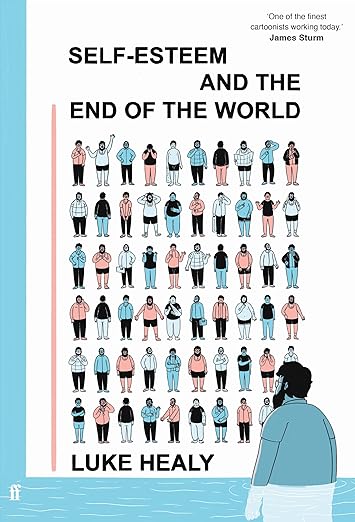
Self-Esteem and The End of the World


By Luke Healy (Faber)
ISBN: 978-0-571-37560-8 (HB)

Ireland’s multi-award-winning low-key iconoclast Luke Healy studied journalism at Dublin University and earned an MFA in Cartooning from the Center for Cartoon Studies (Vermont, USA). An occasional stand-up comedian, his previous cartoon works – such as Americana, Permanent Press and How to Survive in the North – have won prizes and acclaim, and he’s also done gallery shows in places like Manhattan’s Museum of Comics & Cartoon Art.

His aforementioned comics for VICE, The Nib, A24, Medium, Nobrow and Avery Hill are exceptionally good and, as I hinted, he apparently likes exposing himself to ridicule on stage. But not so much, these days.

By combining all that trauma, weltschmerz and experience into tales exploring basic big stuff like life, friends, and how to keep your head above emotional water, he has kept many of us wonderfully entertained and himself alive for a decade. Here and now, that self-excoriating journey manifests as bursts of small-scale prediction and prognostication. By looking inwards and backwards, Healy has unlocked a doorway to our probable mutual future…

As seen in prior books (like The Con Artists) our absolutely Unreliable Narrator is London-based, Irish, gay, formerly Catholic, clinically anxious and helplessly honest. He’s still undergoing treatment for his head problems and other self-diagnosed personal issues whilst perennially building pre-emptive stress for the next Big Bad Thing. Incisive, sentimental absurdist, pedestrian and casually surreal, the collective appointments with destiny are delivered in three acts each entitled Luke Healy is…’ with the first preceded by tone-setting prelude ‘fig (i) Self (ish)’.

Here the aging worry-wort consults his treatment advisor and grudgingly accepts a new tactic to process feelings and responses. The first prophetic episode then sees him making Plans’ as a moment of elation at a family gathering plunges him back down and confirms his gloomy assessment of everything after he attends twin brother Teddy’s engagement party and endures a major disappointment. Retreating if not exactly retrenching, Luke immerses himself in a tidal wave of self-help books and runs away to a hotel where he indulges in some unwise acts. And then Teddy tracks him down…

The narrative digresses for ‘Interlude (i) Luke brings a date back to his flat’ after which hilarious encounter we jump ahead five years to reveal ‘Luke Healy is…’ a paid writer scripting a work-training play for a major company. Sadly, devising ‘L’hotel du Murder’ as a whodunnit was a doomed proposition from the start.

The country is on viral lockdown again, Wye Valley’s Regional Hereford Gotel experiences an actual real murder the night before the premiere and with his Mam in the invited audience, Luke has to stage-manage rubbish players, his own stress, a deadly flood and the revelation that he’s subconsciously made the entire story all about him and his bosses and now faces inevitable exposure and humiliation. It never rains but it pours…

Another strange break comes with ‘Interlude (ii) Luke has a video conference with his former agents’ and he learns his books have been re-optioned. The pittance paid means the studio still aren’t making the film they’ve already “bagsied” – and so no one else can – but his reps are keen to sell something else. Surely he must have some old comics or small press stories they can push?

Another five years go by and ‘Luke Healy is…’ in Lefkada. The Greek island – like much of the planet – is mostly submerged now. Although officially working as a telemarketer at and from home, Luke has come to the expanded Aegean on a deeply personal mission. Soon he’s adopted by fellow traveller Beth: there to explore the unearthed archaeological detritus of the past.

Framed from the start in deceit, the jaunt ends painfully for all concerned and – after returning to England – ‘Interlude (iii) Luke receives a phone call’ which promises to change his life forever. Following another ‘fig (ii) Self (ish)’ moment, ‘Luke Healy is… OTMPOW’ finds the bewildered failed author and his Mam five years further on: whisked to Palm Springs (the new Hollywood ever since Los Angeles slipped beneath the seas) where a sleazy producer is turning Healy’s old comic about whale-watching into a mega blockbuster. It’s such a shame the cetaceans aren’t real and the filmmaker is hiding his secret agenda…

An ‘Epilogue’ details the sorry aftermath of all that and is accompanied by ‘appendix (ii) Of the Monstrous Pictures of Whales’ which “reprints” the college mini comic notionally adapted into that ludicrous and conniving movie, with young teens in Reykjavik hanging out, having sex and making mistakes on an Icelandic whale-spotting boat: a terse and grittily witty romance I’d certainly watch…

It seems fittingly ironic that this wry and introspective examination of the fustercluck that has become the totality of All Human Endeavour is released on the day much of Britain goes to the polls to choose the minor nabobs who will mis-guide and mis-lead us until our next general election, but that’s really just a peculiar and coincidental facet of publishing schedules. There’s certainly nothing conspicuously covert or conspiratorial. Nope. Nu-uh. No sirree-bob. Read nothing into it, but please do read this book…
© Luke Healy, 2024. All rights reserved.

Self-Esteem and The End of the World is published today.

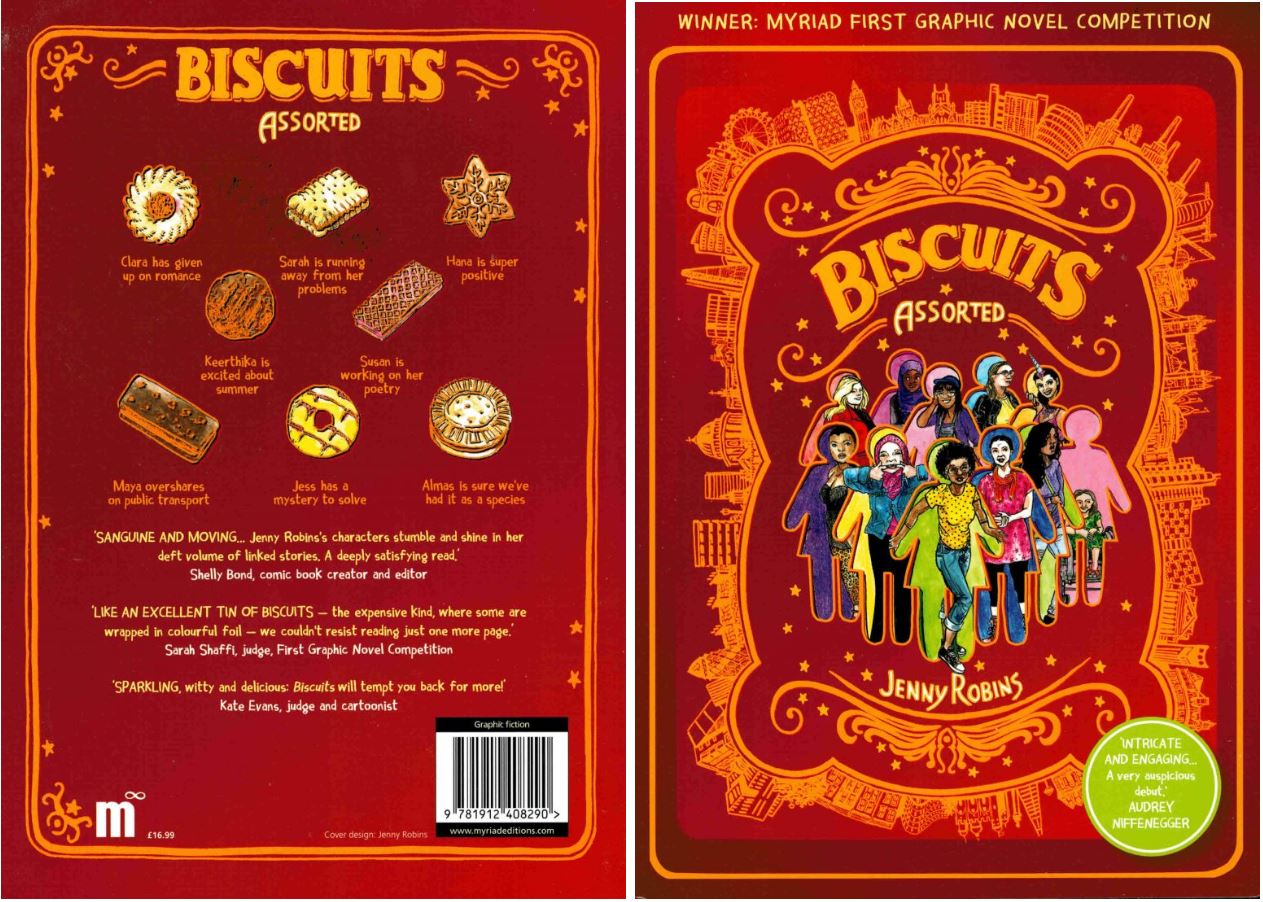
Biscuits Assorted


By Jenny Robins (Myriad Editions)
ISBN: 978-1-91240-82-90 (TPB)

There’s a 1944 Powell & Pressburger film called A Canterbury Tale, wherein a group of disparate, loosely ordinary associated characters weave in and out of each other’s lives for a defined period, gradually proceeding towards a shared denouement. It’s about far more than that and is really good. You should see it.

Biscuits Assorted is a bit like that, but also completely different. You should read it. It’s really, REALLY good.

Artist, teacher, Small Press artisan and author Jenny Robins is clearly a keen observer and gifted raconteur deftly attuned to nuance and ambiance and quite possibly hopelessly in love with London. Her award-winning debut graphic novel is a paean to modern living in the city, recounted through overlapping snapshots of many women’s lives in the months of June’, July’ and August’ of a recent year (and don’t worry about which one).

If you need the metaphor explained, there are different varieties and, occasionally, they don’t do quite what it says on the tin…

Seriously though, here in captivating and compelling monochrome linework are a plethora of distinct, well-rounded individuals of differing ages and backgrounds working, playing, living, dying, risking, winning, failing and constantly interacting with each other to a greater or lesser extent. They are all united by place, circles of friends, shared acquaintances and enjoying – for once – full access to their own unexpurgated voices.

Strangers or seasoned intimates, life-long or Mayfly-momentary, this addictively engaging collection of incidents and characters share locations and similar pressures as they go about their lives, but the way in which they each impact upon one another is utterly mesmerising. I’m a bluff old British codger and I’ve been meeting these very women and girls all my life, except for those who are completely new to my white male privileged experience. Now, however, I know what they’re like and what they’ve been thinking all this time…

Moreover, it’s outrageously funny and terrifying elucidating, rude in all the right ways and places, and absolutely able to break your heart and jangle the nerves with a turn of a page.

Biscuits Assorted is a brilliant and revelatory picaresque voyage impossible to put down and deserves to become a classic of graphic literature. It’s also the most fun you can have with your brain fully engaged.
© Jenny Robins 2020. All rights reserved.

Shaft volume 2: Imitation of Life


By David F. Walker, Dietrich Smith & various (Dynamite Entertainment)
ISBN: 978-1-52410-260-9 (TPB/Digital edition)

For most of modern history black consumers of popular entertainments in what used to be called the “Free West” have found far too few fictive role models. In the English-speaking world that began changing in the turbulent 1960s as America’s Civil Rights Movement gained traction and truly took hold during the decade that followed. Many characters stemming from those days come from a commercially-led cultural phenomenon called Blaxploitation.

Although criticised for seedy antecedents, stereotypical situations and extreme violence, the films, books, music and art were the first mass-market examples of minority characters in charge and in leading roles, rather than as fodder, flunkies or flamboyant villains. One of the earliest movie icons of the genre was the man called Shaft. His filmic debut in 1971 was scripted by journalist and screenwriter Ernest Tidyman (The French Connection; High Plains Drifter; A Force of One) adapting his own 1970 novel. Tidyman authored six more between 1972 and 1975, with his urbane urban warrior simultaneously starring in numerous films and a (far, far tamer) TV series. He even had in his own retro-themed, adults-only comic book.

An eighth prose novel – Shaft’s Revenge – was released in 2016, written by David F. Walker. Amongst his many talents – you should hunt down his online culture-crunching ’zine BadAzzMoFo and you won’t be sorry – Walker numbers writing intriguing, hard-edged comics (Occupy Avengers, Cyborg, Red Sonja, Tarzan on the Planet of the Apes and many more), so in 2014 it was probably inevitable he be invited to write that long-overdue comics iteration…

Blockbusting premier miniseries Shaft: A Complicated Man – relating the lone wolf’s origins – led to this sequel, illustrated by Dietrich Smith and coloured by Alex Guimarães, with Walker himself lettering the series. Whereas that comic book took its look, settings and tone from the novels more than the Richard Roundtree (whom we tragically lost in October last year) films, this one carefully refocuses and aims for a satisfactory blending of prose and film iterations.

Originally released as a 4-issue miniseries, Imitation of Life finds the detective ‘Before and After’, regretting his life choices, successes and recent notoriety as the highly publicised rescue of an abducted girl suddenly make him a famous – if not actually notorious – man. It’s nothing he wanted: Shaft was literally forced to take the job by a major mobster no one in their right mind ever refuses, and now, after sorting the problem in his inimitably pitiless manner, the gumshoe is slowly drinking himself to death on the huge fee he also couldn’t safely turn down…

Eventually guilt and boredom compel him to get back in the game and, free of money worries, he can pick and choose from a big list of inquiries. That said, Shaft can’t explain just why he takes on the pointless problems of the Prossers: a hick white couple desperate to find their son. Mike is 18; a good-looking homosexual kid (we say “gay” today, apparently) swallowed up by the sleaze-peddlers of 1970s Times Square. The kid’s legal and not even a real missing person, but there’s something Shaft can’t get out of his head about this particular runaway…

Convinced it’s all pointless, Big John hits appropriate bars and clubs but no one knows anything: they never do. And then a kid named Tito recognizes him and just like that, the violence starts coming.

Surviving a homophobic attack – and teaching a few bigots the cost of intolerance – Shaft finds his case abruptly stalled just as shady wannabe filmmakers seeks to hire him to consult on their new (blaxsploitation) flick “The Black Dick”. It promises to be an easy gig, but they never are…

Before long, Shaft is writhing in discomfort as the script ludicrously bastardises his career and reputation, but when Tito turns up and bamboozles the detective into facing off with a Mafia pornographer just as the secret moneyman behind his own filmic fiasco starts demanding an early return on his investment, it all stops being a laugh and becomes deadly serious again. Once more, he remembers there’s no such thing as ‘Easy Money’

As fictional and real worlds increasingly intersect, Vice cops contact Shaft and he sees that somehow all his irons seem to be stacked in the same fire. When the ludicrous leading man is abducted and troublemaking Tito pops up again with some very perilous photographs from his own incessant snooping, Shaft discovers in penultimate chapter ‘Love & Loss’ just what happened to Mike Prosser before tooling up to rescue one bad actor while invading a film set where pornos and snuff films are the preferred hot product…

The strands all pull together in a typically cathartic climax as ‘All the World’s a Stage’ sees order restored, bad guys righteously dealt with and even sets up a delicious funny ending to usher us out…

Revisiting a legendarily foetid cesspool of civic corruption, warring mobsters and get-rich-quick chancers, this tour of a mythic milieu is another wry and intoxicating crime thriller no fan of the genre should miss.
Shaft is ™ & © 2016 Ernest Tidyman. All rights reserved.

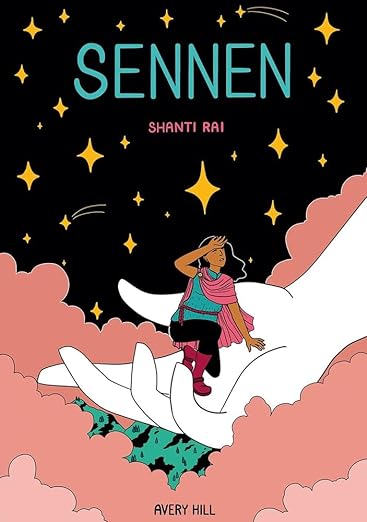
Sennen


By Shanti Rai (Avery Hill Publishing)
ISBN: 978-1-910395-71-4 (PB)

Win’s Christmas Gift Recommendation: Family Feast for Modern Mindsets… 9/10

In the valley, all people toil faithfully to sustain themselves and venerate the gods. That worship comes in the form of crops that uncanny messengers of the divine actually come and collect. Everyone is content in their pastoral idyl, working gratefully in harmony and devotion. No one questions… except Sennen.

Restless, dissatisfied and increasingly rebellious, she is at an age where things no longer seem certain or right. Her growing dissent against doctrine and just the way how life is has resulted in pushing her few friends away: even loyal co-conspirator Margate now considers her a “Bad Influence”.

Sennen, however, dreams of one day going over the all-enclosing mountains and learning what lies beyond… maybe even meeting different people…?

When her acting out forces her biological father Baba Gwent and the man he lives with (Pelynt, whom she calls “Dad”) to reveal the true circumstances of Sennen’s birth and her mother’s death, it leads to Gwent being taken away and offered up as sacrifice to the Gods. Furious, Sennen secretly follows, stowing away in an incredible machine and taken up above where she discovers a horrific truth about the Supreme Beings who rule her people. She also finds allies of her own age and apostate disposition willing to help her share the shocking truth… and even destroy the status quo.

… And that’s when an even more appalling truth manifests…

Born in South London and therefore knowing all about “salt of the Earth types” and layers of disbelief, Shanti Rai has constructed a beguiling politico-religious Coming of Age tale with heavy notes of “adults always lie” to flavour the broth: a properly thoughtful thriller that askes eternal but always important questions.

Powerful, beguiling, comfortingly apocalyptic and harbouring the promise of a sequel (soon please!) Sennen is a mini-masterpiece worthy of your attention – especially in this season of spiritual revelation…
© Shanti Rai, 2022. All rights reserved.

Doctor Who Graphic Novel #21: The Eye of Torment


By Scott Gray, Mike Collins, Jacqueline Rayner, Martin Geraghty, David A. Roach & various (Panini Books)
ISBN: 978-1-84653-673-1 (TPB)

Win’s Christmas Gift Recommendation: A Timely Seasonal Treat… 8/10

Today is the 60th Anniversary of Doctor Who. Here’s another Timey-Wimey treat to celebrate a unique TV and comics institution in a periodical manner …

We Brits love comic strips, adore “characters” and are addicted to celebrity. The history of our comics includes an astounding number of comedians, Variety stars and television actors: such disparate legends as Charlie Chaplin, Arthur Askey, Charlie Drake and so many more I’ve long forgotten and you’ve likely never heard of.

As much adored and adapted were actual shows like Ace of Wands, Timeslip, Supercar, The Clangers and countless more. If we watched or listened, an enterprising publisher made printed spectacles of them. Hugely popular anthology comics like Radio/Film Fun/TV Fun, Look-In, TV Comic, TV Tornado, and Countdown would translate light entertainment favourites into pictorial joy. It was a pretty poor star or show that couldn’t parley the day job into a licensed strip property…

Doctor Who debuted on black-&-white televisions across Britain on November 23rd 1963 with episode 1 of ‘An Unearthly Child’. Months later in 1964, TV Comic began a decades-long association, as issue #674 began ‘The Klepton Parasites’ – by an unknown author with the art attributed to illustrator Neville Main.

On 11th October 1979, Marvel’s UK subsidiary launched Doctor Who Weekly. Turning monthly in September 1980 (#44) it’s been with us – via various iterations – ever since: proving the Time Lord is a comic star of impressive pedigree, not to be trifled with.

Panini’s UK division ensured his comics immortality by collecting all strips of every Time Lord Regeneration in a series of graphic albums – although we’re still waiting for digital versions. Each time tome focused on a particular incarnation of the deathless wanderer, with this one gathering almost a year’s worth of stories plucked from the annals of history and the Terran cover dates August 2014 to August 2015. These yarns all feature The Twelfth Doctor as played by Peter Capaldi in a collection of full-colour episodes all given hues from James Offredi and letters by Roger Langridge.

It all kicks off with eponymous shocker ‘The Eye of Torment’ (Doctor Who Magazine #477-480, October-December 2014). Written by Scott Gray and drawn by Martin Geraghty – with inks from infallibly rewarding David A. Roach – it finds a newly-minted incarnation of the Time Lord and capable companion Clara Oswald fetch up inside a spaceship traversing the surface of the sun.

With inescapable flavours of Armando Iannucci’s 2020 comedy sci fi vehicleAvenue 5, the good ship Pollyanna is manned solely by women working for gigajazillionaire Rudy Zoom: a rich, over-achieving narcissist in love with his own legend. Surprisingly, he’s not the actual problem: that would a semi-sentient predatory alien infection imprisoned eons ago by Sol’s gravity. “The Umbra” mimic humanoid form: magnifying and feeding on despair. Once the horror broaches Pollyanna’s invulnerable hull, it/they start picking off the crew until the newcomers find a way to stop it/them and escape…

The epic yarn leads directly into the ‘The Instruments of War’ (DWM #481-483, January-March 2015) wherein writer/artist Mike Collins, ably assisted by Roach) deposit the time travellers in Earth’s Sahara just as German General Erwin Rommel is preparing to finish the Afrika campaign. Sadly, that’s when an agent of the Rutan Horde finally disinters a world-reshaping weapon long lost by their eternal arch-enemies The Sontarans…

Forced to ally with a few of the Sontaran clone-warriors, assorted Germans of various philosophies, righteously rebellious Tuaregs and the living enigma of an honourable warrior fighting for the wrong side, The Doctor and Clara are initially separated but soldier on to save everyone with a degree of success…

Skipping #484, we next arrive as south as we can get for some ‘Blood and Ice’ served up by Jacqueline Rayner, Geraghty & Roach, with actual schoolmarm Clara and the tall, rude one claiming to be Ofsted inspectors giving a college at the bottom of the world a cautious once-over. It’s 2048, the Antarctic Treaty protecting the polar continent from resource exploitation is about to expire and something strange is happening at Snowcap University: something Dr. Patricia Audley is very unhappy to acknowledge and a situation she is working very hard to remedy. However, even with fatal accidents, mutants appearing and students vanishing, both our heroes are a bit off their game. Fans will recall that on TV, Clara had been splintered into a million alternate versions scattered throughout the timestream and finding one of herself at Snowcap has truly unsettled her. The Doctor also has qualms: last time he was here it was a military base filled with cybermen and resulted in the death of his first generation (First Doctor William Hartnell, keep up, keep up!) and first re-generation…

The disorientation doesn’t stop them solving the riddle of the place, but not before a lot of people are dead or worse…

The dramas conclude in fine style and traditional form as a holding pattern allowing the TV Doctor’s debut to catch up with his print incarnation allows DWM #475-476 to deliver a Gallifreyan-adjacent sidebar saga from Gray, Collins, Roach, Offredi & Langridge. Set during London’s Great Exhibition of 1851 ‘The Crystal Throne’ is an untold adventure of “The Paternoster Gang” (Silurian Madame Vastra, her human wife Jenny Flint and their butler Sontaran Strax) who – with assorted associates – oppose weird terror, scurrilous sedition and deranged genetic meddler Lady Cornelia Basildon-Stone for rule of the British Empire. The battle at “The Crystal Palace” is made harder by their ruthless foe, who remakes men into insectoid monsters; employing stolen Silurian technology…

Supplemented with fascinating insights from all the creatives involved in each tale and augmented by tons of sketches and other pre-publishing artwork in the Commentary section, this is a splendid book for casual readers, a fine shelf addition for dedicated fans of the show and a perfect opportunity to cross-promote our particular art-form to anyone minded to give comics another go…
All Doctor Who material © BBCtv 2015. Doctor Who, the Tardis and all logos are trademarks of the British Broadcasting Corporation and are used under licence. All other material © 2017 its individual creators and owners. Published 2015 by Panini. All rights reserved.