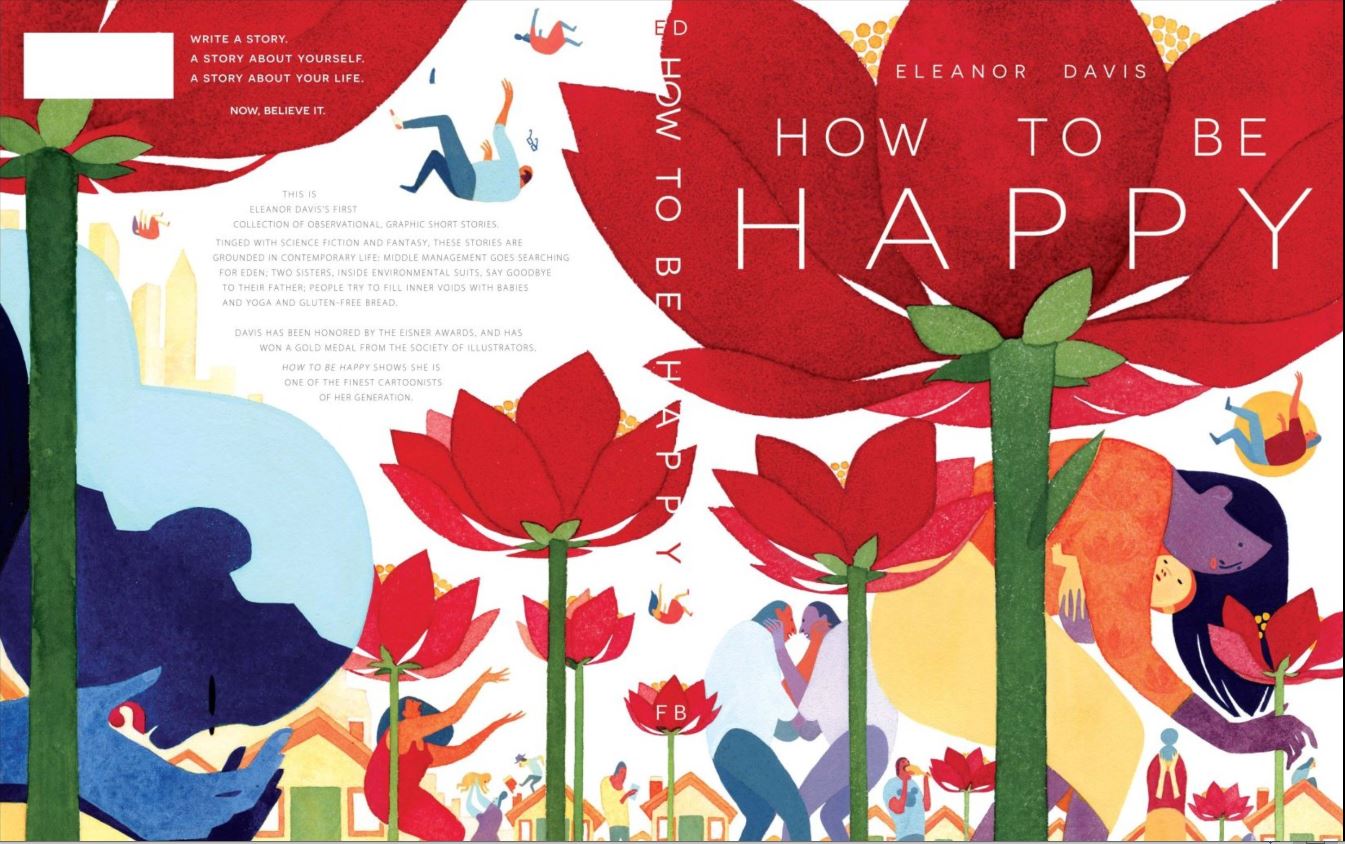
By Eleanor Davis (Fantagraphics Books)
ISBN: 978-1-60699-740-6 (HB)
Do acts of creation make one happy? They certainly do for me. but sometimes so do acts of wanton destruction. I’m sharing, not judging…
Eleanor Davis is one of those rare sparks that just can’t help making great comics. Born in 1983, and growing up in Tucson, Arizona, she was blessed with parents who reared her on classic strips such as Little Nemo, Little Lulu and Krazy Kat. Following unconventional schooling and teen years spent making minicomics, she studied at Georgia’s wonderful Savannah College of Art and Design, where she now teaches. Her innovative works have appeared in diverse places such as Mome, Nobrow and Lucky Peach.
A life of glittering prizes began after her award-winning easy reader book Stinky was released in 2008. Davis has since followed up with gems such as The Secret Science Alliance and the Copycat Crook (with her husband Drew Weing), You & a Bike & a Road and Why Art?
In 2014, Fantagraphics released her themed collection of epigrammatic tales, crafted in a mesmerising variety of styles and riffing on the concept of joy and contentment: causes, failings, and what to do with them when and if they happen. These are enigmatic variations on the most ephemeral of emotions and one you only really notice when it’s gone, but the individual episodes here are truly joyous to share.
How to Be Happy is NOT a self-help book – at least not in any traditional sense, but it did make me feel very good when I first read it and only increases my sense of fulfilment every time I pick it up, whether in its comforting reassuring hardback edition or my ever-present anxiety-reducing digital edition…
These observational short stories were created, it seems, for the sheer innocent joy of making them, and examine many aspects of life through self-contained yarns ranging from cautionary tales to excoriating self-diagnosis to flights of sardonic fancy. Some are titled like proper narratives whilst others just happen like life does. Those I’ve identified by first lines if no title is obvious…
Packed with evocative, stand-alone imagery, the episodes commence with line art pictorial pep talk ‘Write a Story’ before switching to lush colour for ‘In Our Eden’, wherein a primitive life of pastoral toil starts to grate on Adam and Eve. They are, unsurprisingly, not all they seem…
Further monochrome line art interventionism manifests in ‘First We Take Off Our Clothes’ after which a short hop into full-colour and a longer one into a fraught future examines family life on Tomorrow’s sub-continent when ‘Nita Goes Home’…
Separation and rural isolation underpin black-&-white monologue ‘We Come Down on Clear Days’ before the restricted colour palette of ‘Stick and String’ offers a hard look at relationships and agency in the tale of a wandering minstrel and the captivating power of momentary fascination…
Relations are further tested in monochrome as ‘Darling I’ve Realized I Don’t Love You’ provides unwise solutions to ancient problems before a truly disquieting incident of mutual grooming in ‘Snip’ segues into a chilling visit to ‘The Emotion Room’.
Colour is employed to potent effect in ‘He turned a grey-green and thought he might pass out’ whilst ‘Seven Sacks’ addresses grisly problems in a fresh fable Aesop or the Brothers Grimm would be proud to pen.
Two colours and self-delusion tinge ‘Did you want to see the statue?’, whilst B&W lines detail the rewards of heroic vitality in ‘Make Yourself Strong’, after which young love blossoms in living colour in ‘Summer Snakes’…
The pure exultation and imagination of childhood is exposed through stark monochrome in ‘Thomas the Leader’ before a brief Vox-pop moment in ‘I used to be so unhappy but then I got on Prozac’ is built upon in further untitled moments of self-realisation before a strong admonition to ‘Pray’…
Observation, tribulation and revelation all come to the author in ‘In 2006 I took a Greyhound from Georgia to Los Angeles’ before a descent into dark moments and extreme actions in ‘The fox must have been hit pretty recently…’ is balanced by intimate sharing in ‘The woman feels sadness’.
Colour adds depth in an extended moment of group therapy release in ‘No Tears, No Sorrow’, after which the wandering introspection of ‘9/26’ leads to a conclusion of sorts in a cab ride to ’25 Washington Street, Please’…
A superb example of the range and versatility of image and text happily combined, this a true joy for all fans of unbridled expression no one could fail to enjoy.
© Eleanor Davis 2014. All rights reserved.