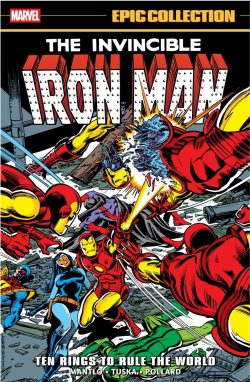
Invincible Iron Man Epic Collection volume 7 (1976-1978): Ten Rings to Rule the World


By Bill Mantlo, Gerry Conway, Herb Trimpe, Roger Stern, George Tuska, Keith Pollard, Keith Giffen, Carmine Infantino, Jeff Aclin, Mike Esposito, Don Perlin, Jack Abel, Fred Kida, Alfredo Alcala, Rudy Nebres, Bruce Patterson, Josef Rubinstein, Bob Wiacek, Pablo Marcos, Don Newton & various (MARVEL)
ISBN: 978-1-3029-6059-9 (TPB/Digital edition)

This book includes Discriminatory Content produced in less enlightened times.

Arch-technocrat and supreme survivor Tony Stark has changed profile and rebuilt himself many times since debuting in Tales of Suspense #39 (March 1963). There and then, as a VIP visitor to Vietnam assessing the efficacy of munitions he had designed, the inventor was critically wounded and captured by sinister, savage Communists. Put to work building weapons with the dubious promise of medical assistance upon completion, Stark instead crafted the first of innumerable technologically-augmented protective suits to keep himself alive and deliver him from his oppressors. From there it was a simple – transistor-powered – jump to full time superheroics as a modern Knight in Shining Armour…

Conceived after the Cuban Missile Crisis at a time when Western economies were booming and “Commie-bashing” was America’s obsession, a dashing new Thomas Edison employing Yankee ingenuity, wealth and invention to safeguard the Land of the Free and better the World seemed an obvious development. Combining then-sacrosanct faith that technology and business in unison could solve any problem, with the universal imagery of noble knights battling evil, Stark – the Invincible Iron Man – seemed an infallibly successful proposition.

Of course, whilst he was the acceptable face of 1960s Capitalism – a glamorous, benevolent, rich, technocratic and all-conquering hero when clad in super-scientific armour – the turbulent tone of the 1970s soon relegated his suave, “can-do” image to the dustbin of history. With ecological disaster and social catastrophe from myriad big business abuses new zeitgeists of the young, the Golden Avenger and Stark International were soon confronting some tricky questions from an increasingly politically savvy readership.

With glamour, money and fancy gadgetry not quite so cool anymore the questing voices of a new generation of writers began posing uncomfortable questions in the pages of a series that was once a bastion of militarised America. Collectively accommodating cover-dates November 1976 to October 1978, this Epic chronological epistle completes that transitional period, reprinting Iron Man #92-114, plus Annual #4 and a guest yarn from Marvel Premiere #44 as Bill Mantlo’s passionate writing triggered a minor renaissance in the Steel Sentinel’s chrome-plated chronicles that resulted in some of the best stories of the Eighties era. It also returned Iron Man to the top-rank of Marvel stars.

If you’re a fan thanks to the movie interpretation, that iteration starts right here, right now…

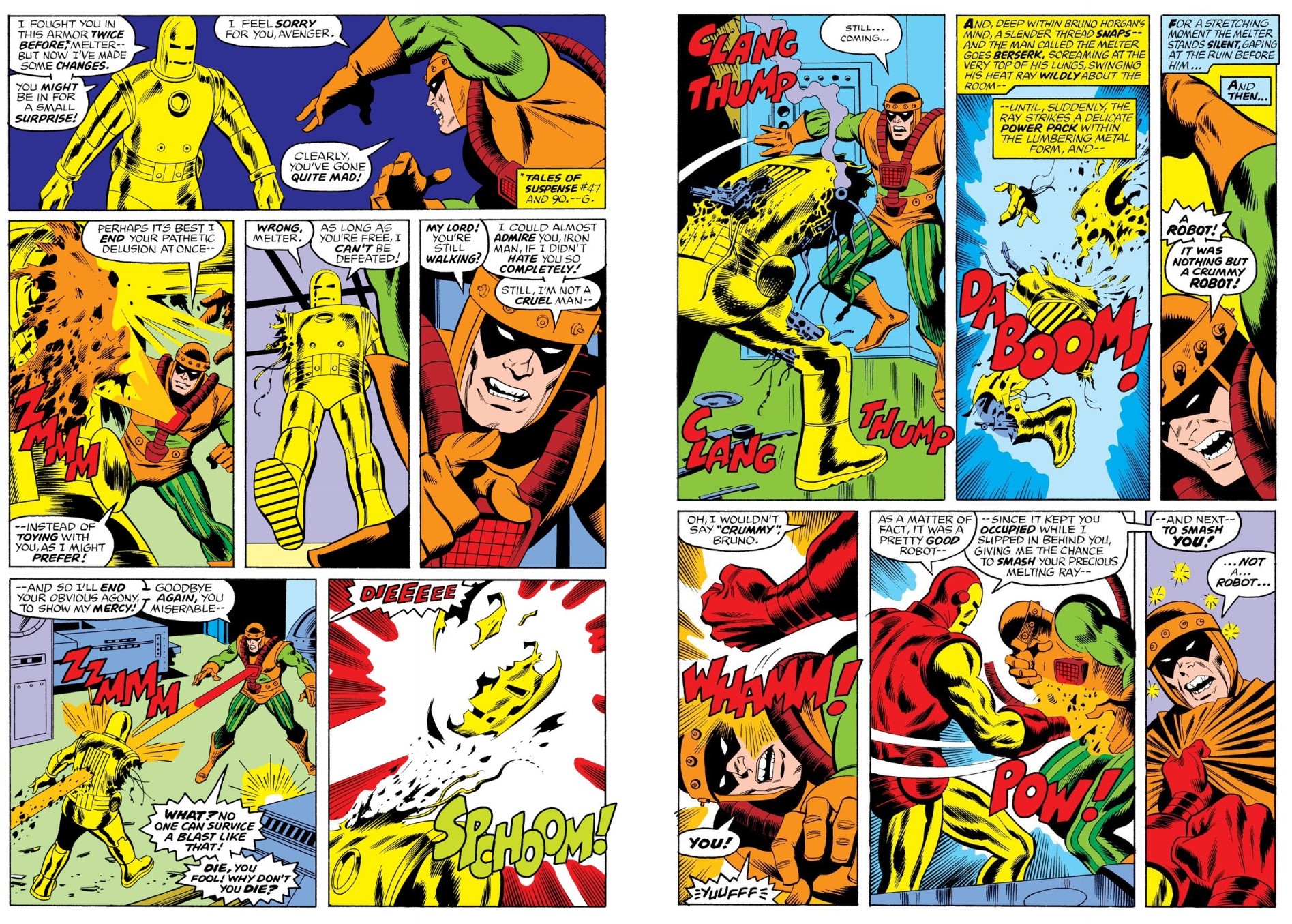
The mettle majesty opens with manic menace The Melter who soon regrets an ill-advised grudge rematch in ‘Burn, Hero… Burn!’ (Gerry Conway, George Tuska & Jack Abel) before Herb Trimpe returns to plot and pencil Iron Man #93. Pitting Old Shellhead against a British-based modern-day pirate in ‘Kraken Kills’ (Conway script & Abel inks), the self-declared Commander deduces Stark’s secret identity before blackmailing the inventor into building weapons for his super-submarine fleet. Never at a loss, though, Stark turns the tables, sparking ‘Frenzy at Fifty Fathoms!’ to scupper the madman’s plans…

Invincible Iron Man Annual #4 (August 1977) offers an all-action alliance with newly constituted super-team The Champions by Mantlo, Tuska & inker Don Perlin. When psychic assassin M.O.D.O.K. overwhelms the Golden Avenger, Iron Man calls in old allies Black Widow and Hercules (plus teammates Ghost Rider, Iceman, Darkstar and The Angel) to thwart ‘The Doomsday Connection!’

Also from that issue comes an out-of-place martial arts vignette by Roger Stern, Jeff Aclin & Don Newton. ‘Death Lair!’ stars former Master of Kung Fu villain Midnight on a mission of murder against old Iron Man enemy Half-Face

The regular monthly climb to reclaimed pole position resumes with veteran Iron Man artist Tuska joining plotter Conway, scripter Mantlo and inker Perlin in unleashing giant android ‘Ultimo!’ (IM #95, cover-dated February 1977) against Washington DC. Clad in upgraded armour and in the Capitol to answer congressional questions about his company, Stark is targeted by a vengeful hidden nemesis who activates the mountainous monster for a classic B-movie sci fi rampage in the streets, with the Golden Avenger supplementing hard pressed Army and National Guard units… before falling in ignominious defeat due to sabotage…

Mantlo, Tuska & Abel prove you can’t keep a good Iron Man down as the embattled hero rallies and retaliates in ‘Only a Friend Can Save Him’ as former close ally and dutiful S.H.I.E.L.D. agent Jasper Sitwell joins the counterattack. Meanwhile, a long-simmering plotline advances as NYPD detective Michael O’Brien – who holds Stark responsible and accountable for the death of his brother Kevin – finally allows his obsession with a cover-up to pull him across legal lines and into collusion with shady PI Harry Key, whose latest client also has nasty plans for the playboy inventor…

Thanks to ingenuity and sheer guts, Stillwell & Iron Man seemingly destroy Ultimo deep below DC, but their triumph is short lived as a return to Stark’s Long Island factory provokes a ‘Showdown with the Guardsman!’ (Conway, Mantlo, Tuska & Perlin). When Mike takes PA Krissy Longfellow hostage, steals the armour suit that drove his brother insane and ambushes the Golden Avenger wearing it, the clash is swift and brutal. Thankfully this time, the blockbusting battle ends before another good man dies…

Whilst subsequently treating O’Brien, another distraction comes when an old frenemy attacks the facility and US interventionist economic practises. ‘Sunfire Strikes Again!’ sees the Japanese ultra-nationalist mutant warrior again seek to derail progress, unaware that he’s a pawn of the lurking presence gunning for Stark. However, the harried hero’s problems start with the fact that his greatest weapon is offline and he’s fighting in borrowed Guardsman armour. When the conflict frees imprisoned Michael O’Brien, the cop seeks to make amends by joining the battle in an obsolete Iron Man outfit, but – even with Mike Esposito inking – the new allies rapidly find themselves ‘At the Mercy of the Mandarin!’

During the melee, Key tries his luck in the Stark vaults once too often and encounters an unexpected problem, thanks to another insidious infiltrator planted by a different scheming mastermind. However, having freed himself, Tony is too now busy rushing to a far-distant, potentially world-ending final battle in anniversary issue #100. Invading China, Iron Man faces horrors, homunculi Death Squads, nuclear armageddon and his most obsessive enemy whose ‘Ten Rings to Rule the World!’ ultimately prove insufficient to the task…

With the tyrant’s countless plots to discredit Stark now exposed, our hero starts a long journey home, even as in Long Island, Harry Key, Sitwell and one of the traitors in Stark’s midst begin a cautious espionage dance…

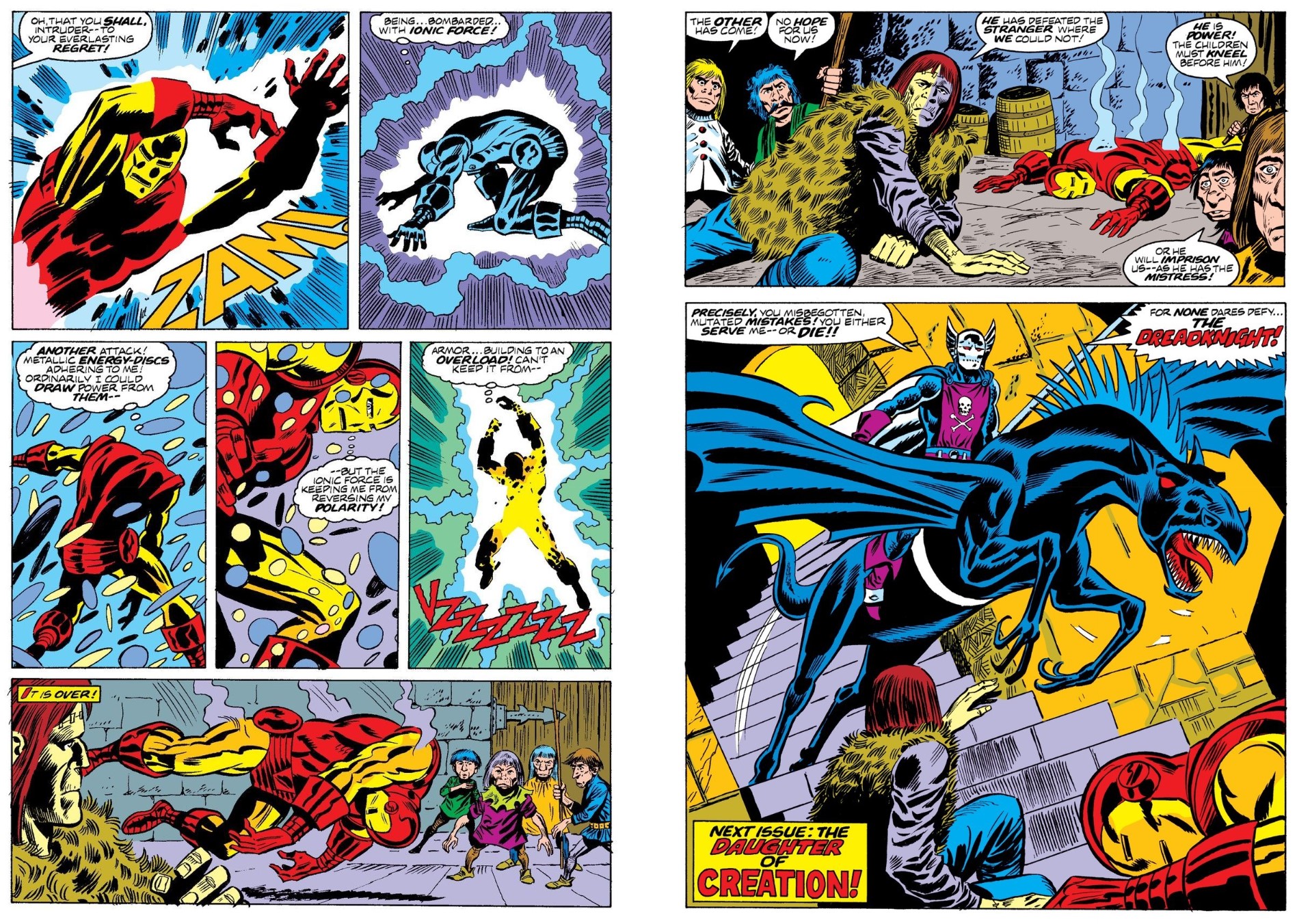
Iron Man’s trip stalls when he’s shot down over Yugoslavia (just google it) and awakens in a creepy old castle filled with freaks and outcasts safeguarded by a familiar – to elderly or dedicated Marvelites at least – huge and daunting figure. Recovering in ‘Then Came the Monster!’ our weary voyager views Castle Frankenstein and panics: clashing with the gentle “Modern Prometheus” before the real menace emerges.

Inked by Esposito & Pablo Marcos, ‘Dreadknight and the Daughter of Creation!’ channels old Marvel horror tales as a brutal and brutalised escaped experiment of Doctor Doom’s laboratories seeks to compel the great granddaughter of Victor Frankenstein to share with him the secrets of creating life…

This ruthless high-tech paladin’s sadistic efforts are eventually thwarted by Iron Man and the original (good) Monster, after which the Steel-Shod Sentinel at last arrives home in #103’s ‘Run for the Money!’ by Mantlo, Tuska & Esposito. Sadly, it’s just in time for the next domestic crisis as Sitwell exposes the traitor only to be captured by revolting corporate villain Midas, who – patience exhausted – launches a truly hostile takeover using tanks, mercenaries, lawyers and the Stock Market…

He is temporarily checked by itinerant junior hero/innocent bystander Jack of Hearts who – as per standard Marvel protocol – is attacked by weary, late arriving Iron Man who misconstrues events and assaults the well-meaning stranger. Shock follows shock as Midas’ legal chicanery forces Iron Man’s surrender, ceding control of Stark International to his enemy, even as the villain’s agent and top lieutenant Madame Masque quits to ally herself with the defeated hero and his ousted, outmanoeuvred alter ego Tony Stark.

In the aftermath, repercussions of the takeover ripple outwards. With Stark no longer paying her bill, deeply disturbed super-telepath (and former Stark inamorata) Marianne Rodgers is kicked out of the sanatorium that has been keeping her psionic deadly tendencies in check…

The fightback begins in ‘Triad! (Mantlo, Tuska & Esposito) after Stark initially refuses the help of Masque. Thus she instead allies with former lover/patsy Sitwell whilst elsewhere, interested parties Michael O’Brien and Jack of Hearts also seek to stop Midas converting Stark’s purloined resources into a world-conquering armed force. Also heading slowly towards a showdown, Marianne graduates towards Long Island, leaving a trail of bodies in her wake…

With ‘Every Hand Against Him!’ and despite the stakes being so high, Tony has quit forever, preferring to hide in his father’s old house with Madame Masque. Less sanguine over the crisis and National Security threat, many of Iron Man’s allies join a volunteer force recruited by psychic superhero The Wraith and eventually consisting of Police Captain Jean de Wolf, former Iron Man stand-in Eddie March, The Guardsman & Jack of Hearts, covertly backed up by Sitwell and (the first) Nick Fury

Still short of power, they co-opt through blackmail, Masque’s lethal skills and Tony’s last remaining armour suit to take out Midas. ‘Then There Came a War!’ (#106) sees the squad invade SI to face a legion of automated Iron Men. At the height of battle Marianne Rodgers – in a fugue state – finally reaches her destination. As Keith Pollard & Fred Kida step in to illustrate the catastrophic conclusion, ‘And, in the End…’ sees her power tip the scales, uncovering even more treachery in Tony’s inner circle and inspiring the despondent hero to take back his heritage, his company and his honour…

With most of his allies apparently dead, Iron Man calls in Avenging ally Yellowjacket (AKA original Ant-Man Henry Pym) to help whip up a miracle cure in #108 (Mantlo, Carmine Infantino & Bob Wiacek). This incurs some ‘Growing Pains!’ and a palate-cleansing action-filled monster-bash as the clear-up somehow reactivates Kang the Conqueror’s devastating Growing Man android to add to the wreckage and rubble…

Once the fighting is finished, rebuilding Stark International begins, with Mantlo, Infantino & Kida dictating the pace prior to another crisis after Jack of Hearts traces the Growing Man’s programming commands as emanating from Luna. Thus Iron Man and his superhero apprentice board a Quinjet and experiences a very painful ‘Moonrise!’ when their mission intersects a secret sortie by Soviet Super-soldiers Darkstar, Vanguard & Crimson Dynamo. The Communist cosmonauts are only investigating a bizarre alien artefact, but entrenched political and personal animosities spark a savage clash. Both sides are preoccupied when the silver egg activates, transporting those closest to it – the Americans – to somewhere far, far away…

Mantlo, Pollard & Kida stretch their fantasy muscles in an astral epic as the heroes materialise aboard a vast ship bearing Colonizers of Rigel to their next conquest. Sadly, these ‘Sojourners Through Space!’ have targeted Wundagore II – used by animal-enhancing man-made deity the High Evolutionary to store former experiments – and are soon caught up in a battle against formidable space Knights of Wundagore and two devastating late-arriving, quickly escaping human captives within their colossal Command ship…

When an alliance of humans and hyper-evolved Earth beasts proves too costly, the Rigellian venture is called off in ‘The Man, the Metal, and the Mayhem!’  but this in turn leads to renegade Colonizer subcommander Arcturus spitefully targeting Earth with a robot stolen from Galactus (the original Punisher from Fantastic Four #48-50). Upon its despatch, closing instalment ‘Moon Wars!’ (IM #112, July 1978 by Mantlo, Pollard & Alfredo Alcala) sees a swift, unauthorised Colonizer strike prompt a desperate dash back to Luna and shattering descent to Detroit for Iron Man, resulting in blistering battle with the cosmic weapon of chastisement and a new definition of the word “invincible” for the triumphant Golden Avenger…

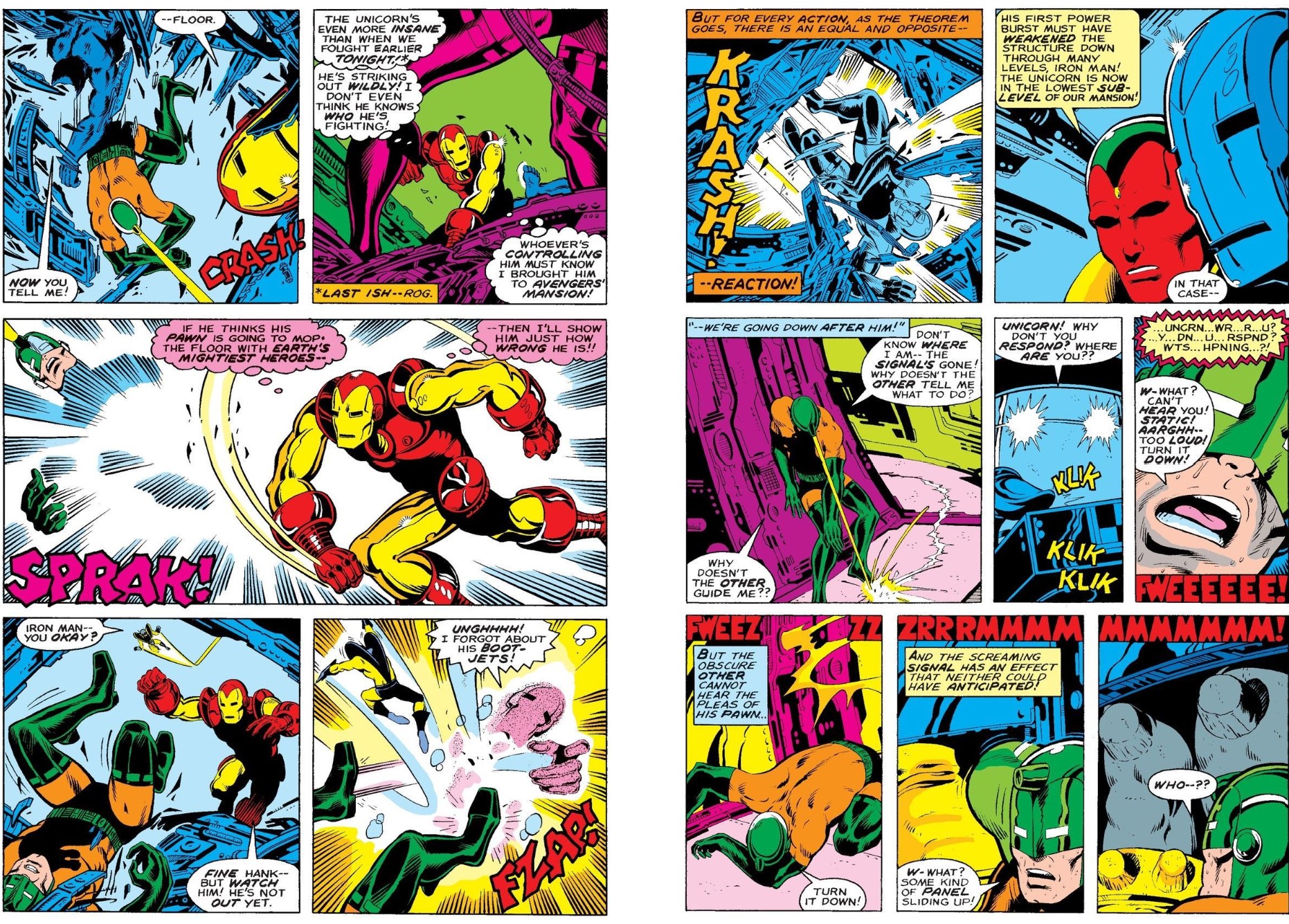
With Mantlo scripting, Pollard layout pages and Trimpe’s pencilling for inker Josef Rubinstein, Iron Man #113 trumpeted a fresh beginning for Stark International after defeating the bloody takeover bid of Mr Midas. However, as the new complex opened for business, an old enemy is already infiltrating the company whilst a more brazen assault comes after a dying foe is manipulated into attacking the complex using ‘The Horn of the Unicorn!’

Seeking help for the beaten-and-at-death’s door Unicorn, the Metal Marvel consults The Avengers and inadvertently triggers a second assault by the villain who also activates a long-interred robotic threat that seems agonisingly familiar in ‘The Menace of… Arsenal!’ (Mantlo, Giffen & Bruce D. Patterson) leading to a turning point moment you’ll need the next book or another collection to enjoy…

To Be Continued…

Here, however, one last narrative nubbin comes from Marvel Premiere #44 (October 1978): the one-shot try-out of Stark’s former apprentice, by Mantlo, Giffen & Rudy Nebres). ‘The Jack of Hearts!’ reexamines the origin of trust fund brat Jack Hart, who was inundated in the experimental “zero fluid” invented by his murdered father. Seemingly resurrected and imbued with incredible energy and computational powers, Jack hunts The Corporation who ordered the hit and here – thanks to new connection in S.H.I.E.L.D. – inconclusively clashes with their preferred hitman Hemlock

With covers throughout by Jack Kirby, Al Milgrom, Abel, Ron Wilson, Dan Adkins, Gil Kane, Dave Cockrum, Sal Buscema, Jim Starlin, Val Mayerik, George Pérez, Terry Austin, Frank Giacoia, Joe Sinnott, Joe Rubinstein, John Byrne, Wiacek, Pollard, John Romta Jr., Ed Hannigan & Frank Giacoia, other extras include house ads, cartoon fan letter ‘Printed Circuits’ (by Fred Hembeck from #112); editorial pages and style sheets from Marvel Premiere #44 and original art covers by Starlin, Mayerik & Cockrum.

From our distant vantage point the polemical energy and impact might be dissipated, but the sheer quality of the comics and cool thrill of the eternal aspiration of man in perfect partnership with magic metal remains. These Fights ‘n’ Tights classics are amongst the most underrated but impressive tales of the period and are well worth your time, consideration and cold hard cash
© 2025 MARVEL.

You’d think we barely have room for a review this time as it’s such an auspicious day for comics…

In 1912 today creepy cartoon colossus Charles Addams was born, and in 1929 both Buck Rogers by Dick Calkins and Hal Foster’s Tarzan strips debuted. In 1934 Alex Raymond & Don Moore launched Jungle Jim and a year later combined it with new idea Flash Gordon.

Underground and Mad magazine artist Jay Lynch was born in 1945 and two years later Milton Caniff premiered his other masterpiece with the launch of Steve Canyon. That ran until 1988.

In 1953, Bob Wiacek joined the party as did Karl Kesel in 1959, and publisher Fabrice Giger (Les Humanoïdes Associés) arrived in 1965. Surely by coincidence, two years after, that nativity was followed by the launch of Greg & Eddie Paape’s Luc Orient in Le Journal de Tintin.

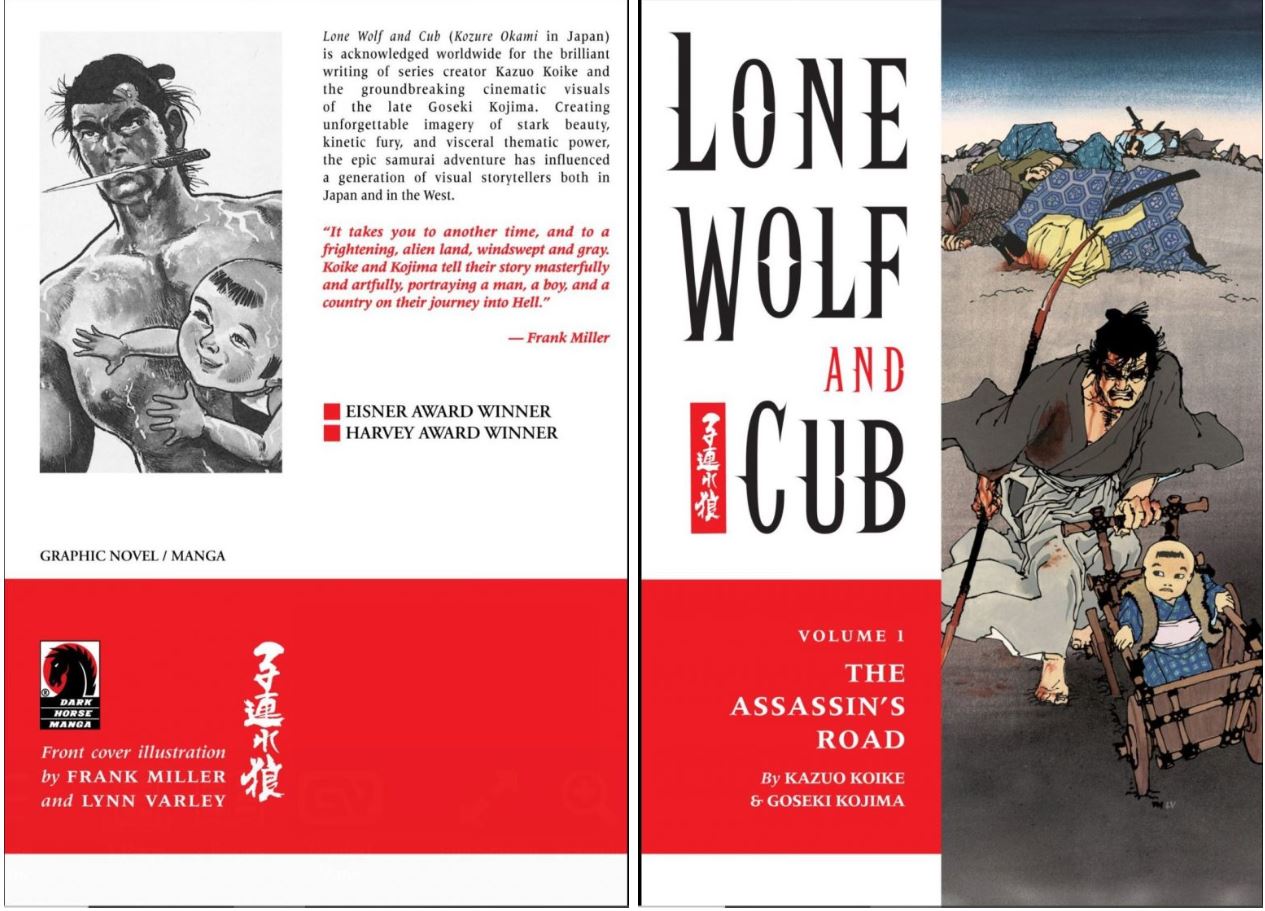
Lone Wolf and Cub volume 1: The Assassins Road


By Kazuo Koike & Goseki Kojima, translated by Dana Lewis (Dark Horse Manga)
ISBN: 978-1-56971-502-4 (TPB/Digital edition)

This book includes Discriminatory Content produced in less enlightened times.

Best known in the West as Lone Wolf and Cub, the epic Samurai saga created by Kazuo Koike & Goseki Kojima is a global classic of comics literature. An example of the hugely popular Chanbara (“sword-fighting”) genre of print and screen, Kozure Okami was serialised in Weekly Manga Action from September 1970 until April 1976. It was an immense and overwhelming Seinen (“Men’s manga”) hit. Those tales quickly prompted thematic companion series Kubikiri Asa (Samurai Executioner) which ran from 1972-1976, but the major draw and main attraction – at home and, increasingly, abroad – was always the nomadic wanderings of doomed noble Ōgami Ittō and his solemn silent child Daigoro: framed by family rivals, dishonoured by the Shōgun and condemned to death by his peers. Breaching all etiquette, the court executioner refused to suicide quietly and instead opted to vengefully walk the bloody road to Meifumadō: the hell of Buddhist legend…

Revered and influential, Kozure Okami was followed after years of supplication by fans and editors by sequel Shin Lone Wolf & Cub (illustrated by Hideki Mori). The serial even spawned – through Koike’s indirect participation – science fiction homage Lone Wolf 2100 by Mike Kennedy & Francisco Ruiz Velasco.

The original saga has been successfully adapted to most other media, spawning movies, plays, TV series (plural), games and merchandise. The property is notoriously still in pre-production in Hollywood.

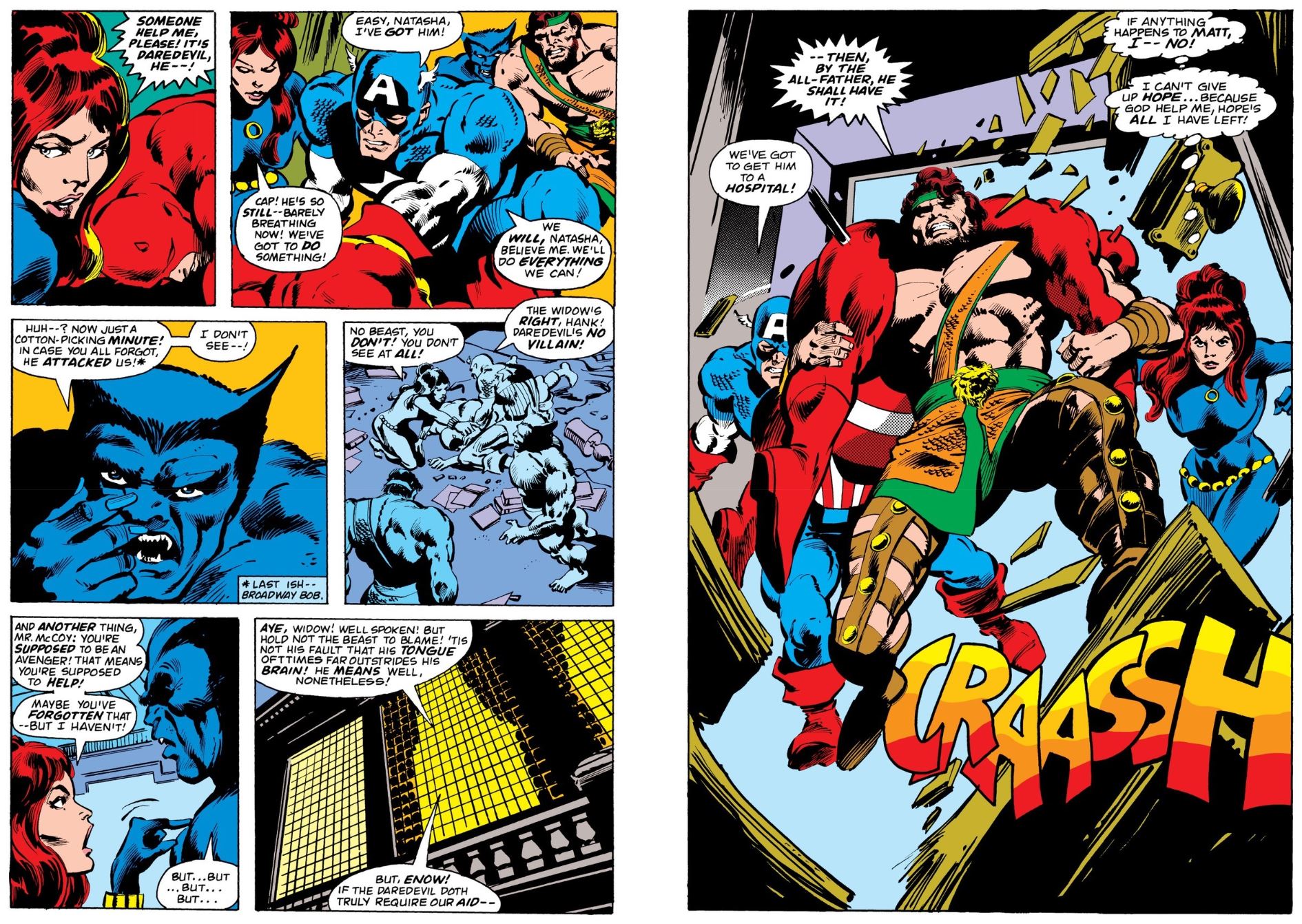
The several thousand pages of enthralling, exotic, intoxicating narrative art produced by the legendary creators eventually filled 28 collected volumes, beguiling generations of readers in Japan and, inevitably, the world. More importantly, their philosophically nihilistic odyssey – with its timeless themes and iconic visuals – has influenced hordes of other creators. The many manga, comics, movies, TV and animated versions these stories have inspired around the globe are utterly impossible to count. Frank Miller, who illustrated the cover of this edition, referenced the series in Daredevil, his dystopian opus Ronin, The Dark Knight Returns and Sin City. Max Allan Collins’ Road to Perdition is a proudly unashamed tribute to the masterpiece of vengeance-fiction. Stan Sakai has superbly spoofed, pastiched and celebrated the wanderer’s path in his own epic Usagi Yojimbo, and children’s cartoon shows like Samurai Jack are direct descendants of this astounding achievement of graphic narrative. The material has become part of a shared global culture.

In the West, we first saw the translated tales in 1987 as 45 Prestige Format editions from First Comics. That innovative trailblazer foundered before getting even a third of the way through the vast canon, after which Dark Horse Comics acquired the rights, systematically reprinting and translating the entire epic into 28 tank?bon-style editions of around 300 pages each. Once the entire epic was translated (between September 2000 & December 2002) it was all placed online through the Dark Horse Digital project.

Following a cautionary ‘Note to Readers’ – on stylistic interpretation – this moodily magnificent monochrome missal truly gets underway, retaining many terms and concepts western readers may find unfamiliar. Therefore this lean, mean, martial edition offers at the close a Glossary providing detailed context on the term used in the stories, plus profiles of author Koike Kazuo & illustrator Kojima Goseki and the first instalment of ‘The Ronin Report’: an occasional series of articles offering potted history essays on the period of the Tokugawa Shogunate, with Tim Ervin starting the ball rolling here.

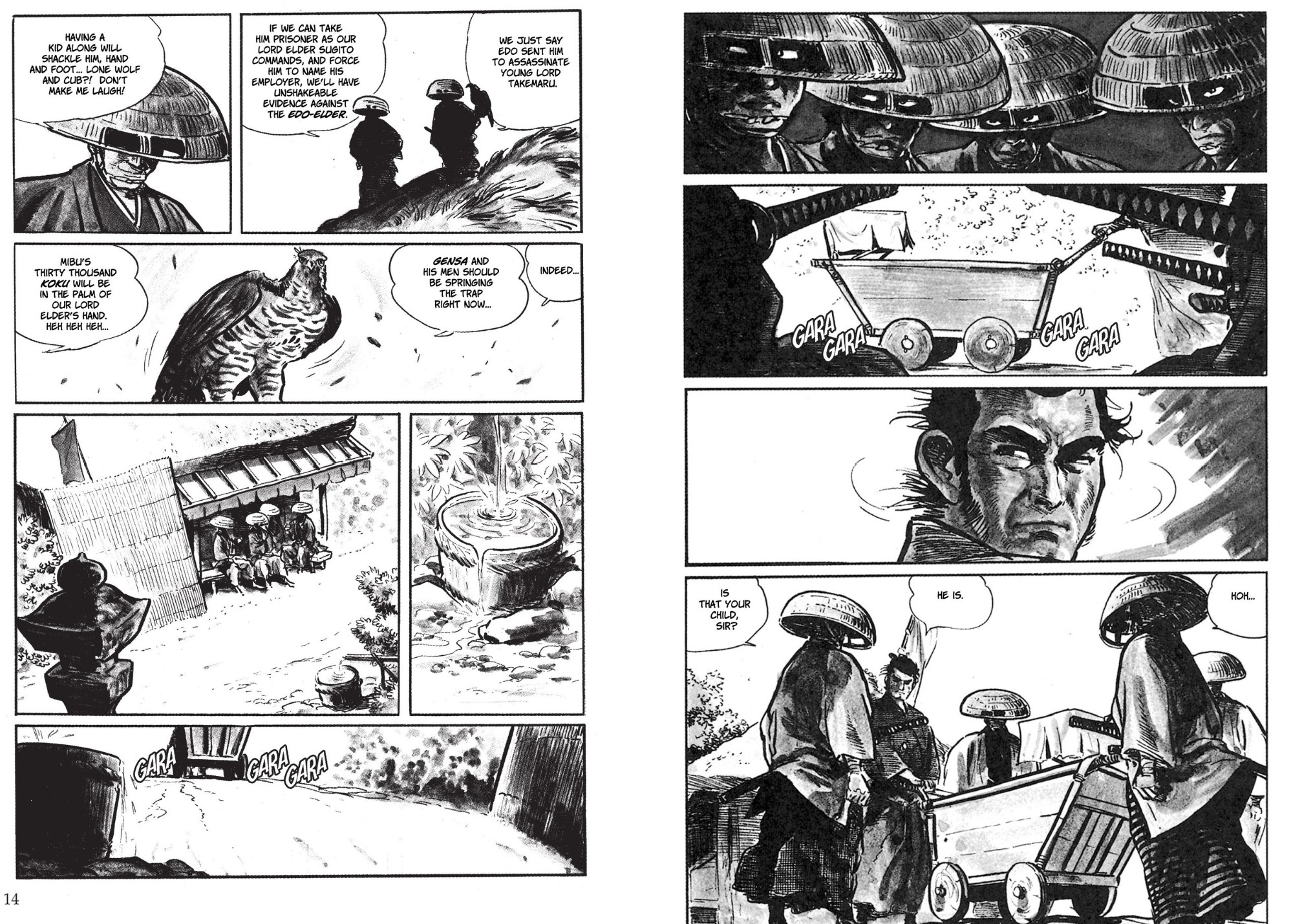
Of course, the true meat is the captivating, grimly compelling combination of revenge fable and action-adventure which opens here with intriguing episodes of stripped-down mystery, gripping intensity and galvanic bloodletting as the first tale introduces a scruffy indigent pushing a homemade bamboo pram with a 3-year-old boy in it. A banner on the contraption proclaims ‘Son for Hire, Sword for Hire’ and, as the man stoically ignores mockery and derision from louts on the road, his promotional ploy attracts the attention of four deadly men who have been warned of an assassin carrying his baby boy with him…

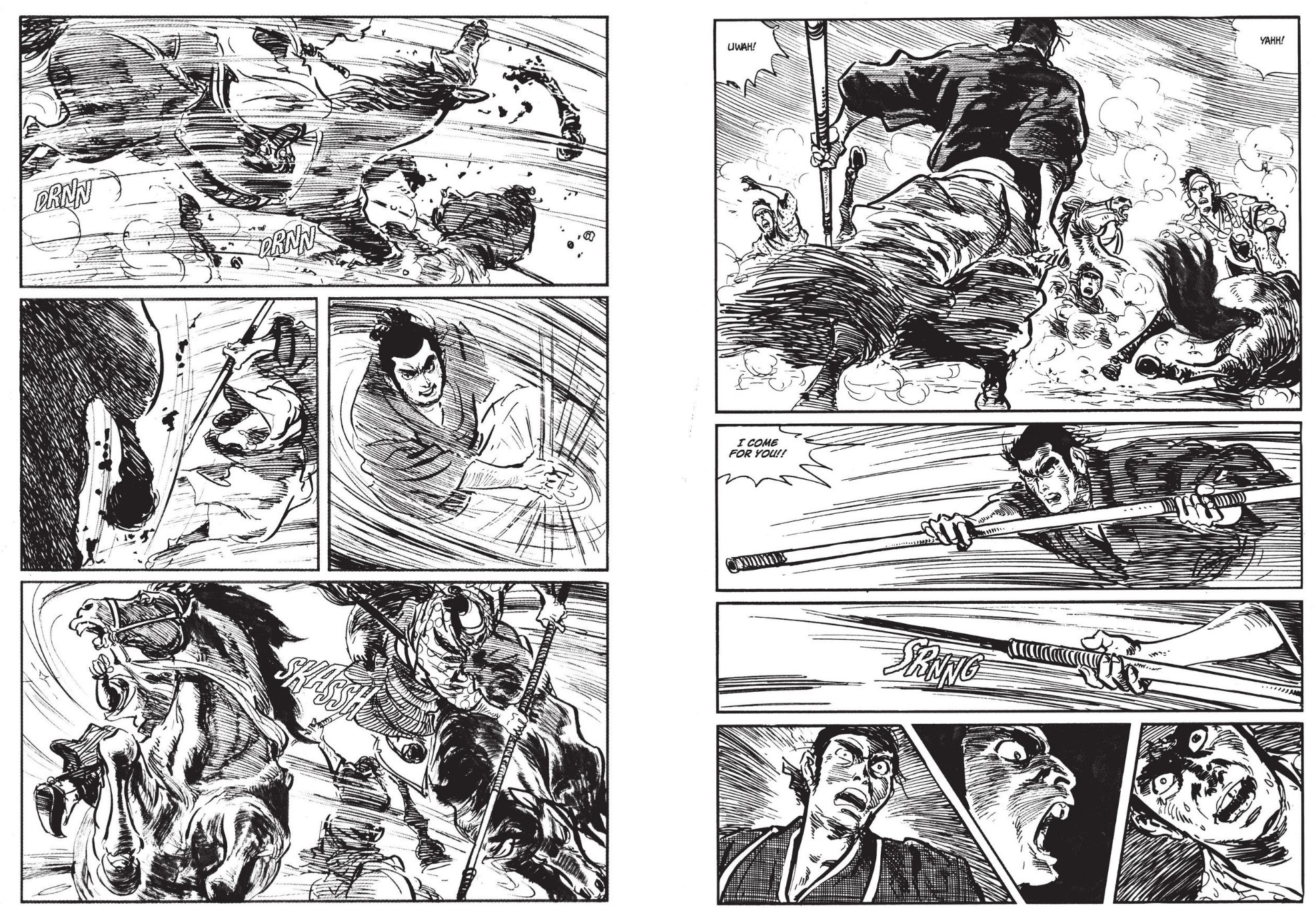
A basic formula informs early episodes: the acceptance of a commission to kill an impossible target necessitates the forging of a cunning plan and relentless determination leads to inevitable success: all underscored with bleak philosophical musings alternately informed by Buddhist teachings in conjunction with or in opposition to the unflinching personal honour code of Bushido…

You won’t learn it until the end of this tome, but the fore-doomed killer-wanderer was once the Shogun’s official executioner: capable of cleaving a man in half with one stroke. An eminent individual of esteemed imperial standing, elevated social position and impeccable honour, Ōgami Ittō lost it all and now roams feudal Japan as a doomed soul, hellbent for the dire, demon-haunted underworld of Meifumadō. When the noble’s wife was murdered and his clan dishonoured due to the machinations of the treacherous and politically ambitious Yagyu Clan, the Emperor ordered Ōgami to commit suicide.

Instead, he rebelled, choosing to become a despised Ronin (masterless samurai) and assassin, pledging to revenge himself on the traitors until they were all dead or Hell claimed him. His son, toddler Daigoro, also chose the way of the sword and together they roam the grim and evocative landscapes of feudal Japan, one step ahead of doom and with death behind and before them. Frequently, the infallible assassin’s best ploy is to allow himself to be captured, endure unimaginable torture and then fight his way out having slaughtered his target…

The tactic is again employed in ‘A Father Knows His Child’s Heart, As Only a Child Can Know His Father’s’, with the wolf despatching willing Daigoro to penetrate the unyielding defences of Takai Han so Papa can kill a dishonourable usurper…

Another aspect of Ōgami’s methodology emerges in ‘From North to South, From West to East’. The assassin always insists on a personal interview with every client, demanding not only who is to die, but why. Perhaps the cautious killer only wants to know the extent of what he’s getting into, but we know he’s judging: seeing whether the target deserves death… or if the client does…

The legend of the Lone Wolf and Cub quickly spreads, and when faithful guards briefly hire Daigoro to help their beloved mistress, it is with full knowledge of what the boy’s father is. In ‘Baby Cart on the River Styx’ that knowledge is crucial to Ōgami’s plan for quashing a gang turf-war before it begins, even whilst bringing down a corrupt yet untouchable lord. Shocking for us may be the accepted conceit that father is fully prepared to sacrifice son to compete the mission, fulfil his promises and uphold his word. ‘Suio School Zanbato’ sees the boy willingly become hostage to fortune so his dad can lure a swords-master – and all his honourless students – into an officially sanctioned duel, killing all without legal ramifications or repercussions.

Lyrically twisting the theme of star-crossed lovers, ‘Waiting for the Rains’ sees him befriend a dying woman even as his father stoically anticipates completing his next commission: expunging the man she so patiently awaits…

These stories are deeply metaphorical and work on multiple cultural levels most of us westerners just won’t grasp on first reading – even with contextual aid provided by the bonus features. That only makes them more exotic and fascinating. Also a little unsettling is the even-handed treatment of women in the tales. Within the confines of the notoriously stratified society depicted, women – from servants to courtesans, prostitutes to highborn ladies – are all fully rounded characters, with their own motivations and drives. The wolf’s female allies are valiant and dependable, and his foes, whether targets or mere enemy combatants in his path, are treated with professional respect by Ōgami. He kills them just as if they were men…

In ‘Eight Gates of Deceit’ the indomitable nomad is ambushed by an octet of female assassins hired by his latest client who foolishly chooses to discount the professional honour of his hireling in favour of clearing up loose ends. It’s his last mistake…

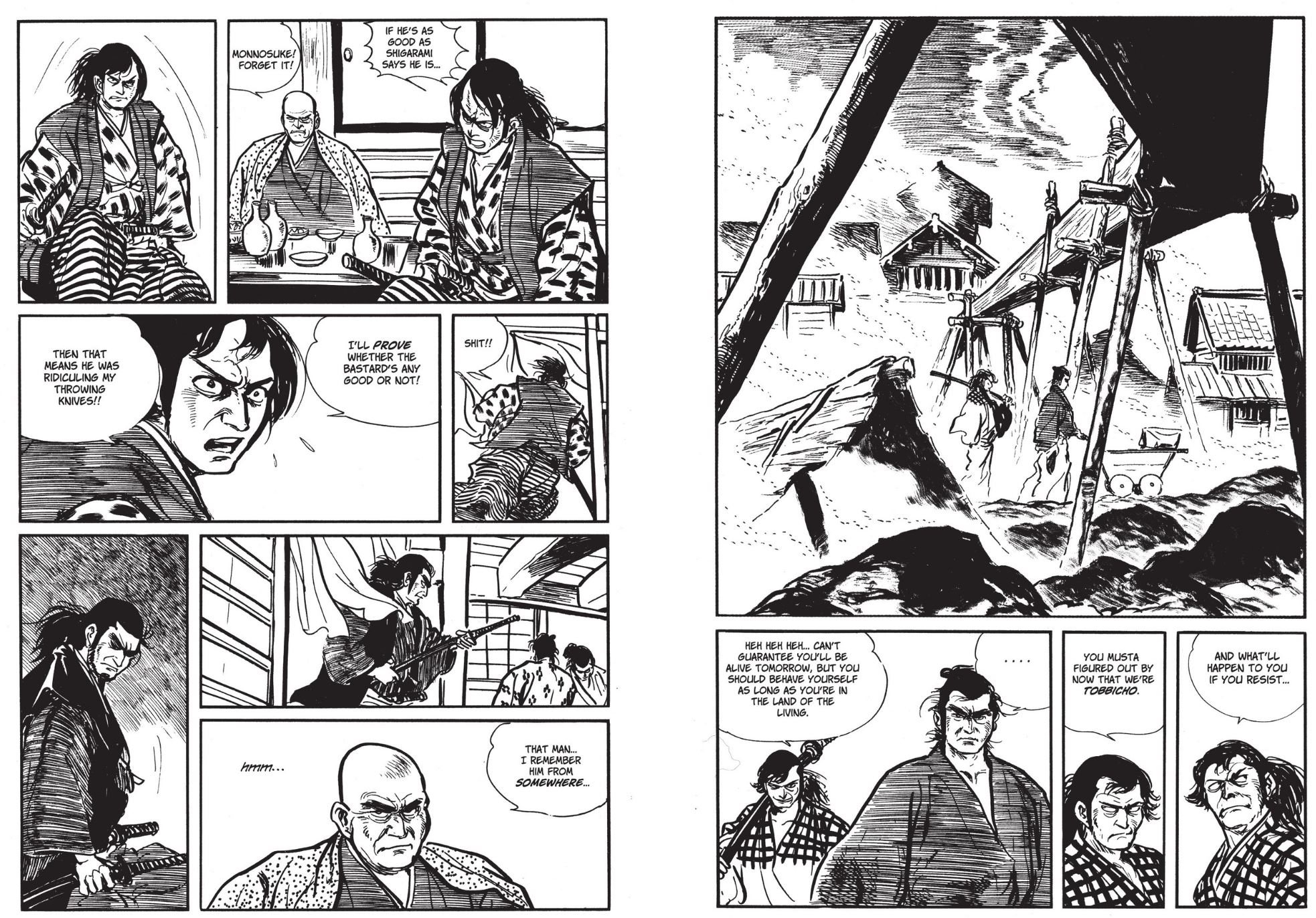
‘Wings to the Birds, Fangs to the Beast’ finds the tireless wanderer stumbling into a hot-spa village recently taken over by bandits. To their eternal cost, and despite the newcomer’s every forbearing effort, the human beasts refuse to believe the man with the baby wants no trouble…

This stunning opening collection ends with a few of the answers readers want as the scene shifts to the recent past at the Shogun’s palace in Edo for an origin. There, thanks to political manoeuvrings of ambitious nefarious Lord Yagyu, Shogun’s Executioner Ōgami Ittō has been ousted and his entire clan disgraced. With his wife Asami dead, the austere warrior outwits his opponent – who assumed honourable suicide the only option he’d left his enemy – by opting to travel ‘The Assassin’s Road’ with his baby son momentously choosing to follow him to Meifumadō or victory…

Whichever English transliteration you prefer – Wolf and Baby Carriage is what I was first introduced to – the grandiose, thought-provoking hellbent Samurai tragedy created by Kazuo Koike & Goseki Kojima is without doubt one of those all too rare breakthrough classics of comics literature. A breathtaking tour de force, these are comics you must not miss.
© 1995, 2000 Kazuo Koike & Goseki Kojima. All other material © 2000 Dark Horse Comics, Inc. Cover art © 2000 Frank Miller. All rights reserved.

Today in 1916 lettering legend Artie Simek was born and in Italy in 1953 Dylan Dog cocreator Angelo Stano arrived, whilst 2000 saw the end of an era as Mad mastermind Don Martin died.

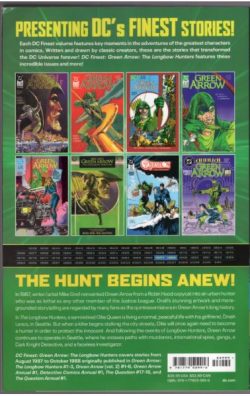
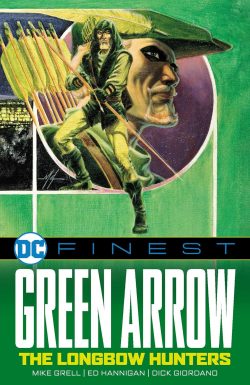
DC Finest: Green Arrow The Longbow Hunters


By Mike Grell, Sharon Wright, Dennis J. O’Neil, Lurene Haynes & Julia Lacquement, Ed Hannigan, Denys Cowan, Randy DuBurque, Ed Barreto, Tom Artis, Dick Giordano, Frank McLauglin, Rick Magyar, Klaus Janson, Tony DeZuñiga, Tom Dzon, Arne Starr, Gary Martin & various (DC Comics)
ISBN: 978-1-77952-991-6 (TPB)

This book includes Discriminatory Content produced in less enlightened times

It’s been a big year for comic book anniversaries and next year is another one. Let’s get our congratulations in early for a change…

Debuting in More Fun Comics #73 (cover-dated November 1941 and on sale from 19th September), Green Arrow is one of very few costumed heroes to be continuously published (more or less) since the Golden Age of American comic books. On first look, the combination of Batman and Robin Hood seems to have very little going for him, but he has always managed to keep himself in vogue and on view. Probably the most telling of his many, many makeovers came in 1987, when – hot on the heels of The Dark Knight Returns – Mike Grell was given the green light to make the Emerald Archer the star of DC’s second Prestige Format Mini-Series.

Grell was a major league, much celebrated creator at the time, having practically saved the company with his Edgar Rice Burroughs-inspired fantasy series Warlord. He had also illustrated many of GA’s most recent and radical tales (in Green Lantern/Green Arrow, Action Comics and elsewhere, and was a confirmed fan-favourite after well-received runs on Legion of Super-Heroes, Aquaman, Phantom Stranger, Batman and others. During the early 1980s, he had worked on the prestigious Tarzan newspaper strip and created successful genre series including Starslayer and Jon Sable, Freelance for pioneering indie publisher First Comics.

By the middle of the grim ‘n’ gritty Eighties, it was certainly time for an overhaul of the Battling Bowman. Exploding arrows yes, maybe even net or rope arrows, but arrows with boxing gloves on them just don’t work (trust me – I know this from experience!).

Moreover, in his 1960s makeover, the hero had evolved into a tempestuous, social reformer using his gifts to battle for the little guy. Now, in a cynical era of corrupt government, secret services with private agendas, drug cartels and serial killers, this emerald survivor adapted again and thrived once more. Thus, sans preamble, the action unfolds, laying a new path that would quickly lead to the hero becoming a major player at long last and, ultimately, a TV sensation.

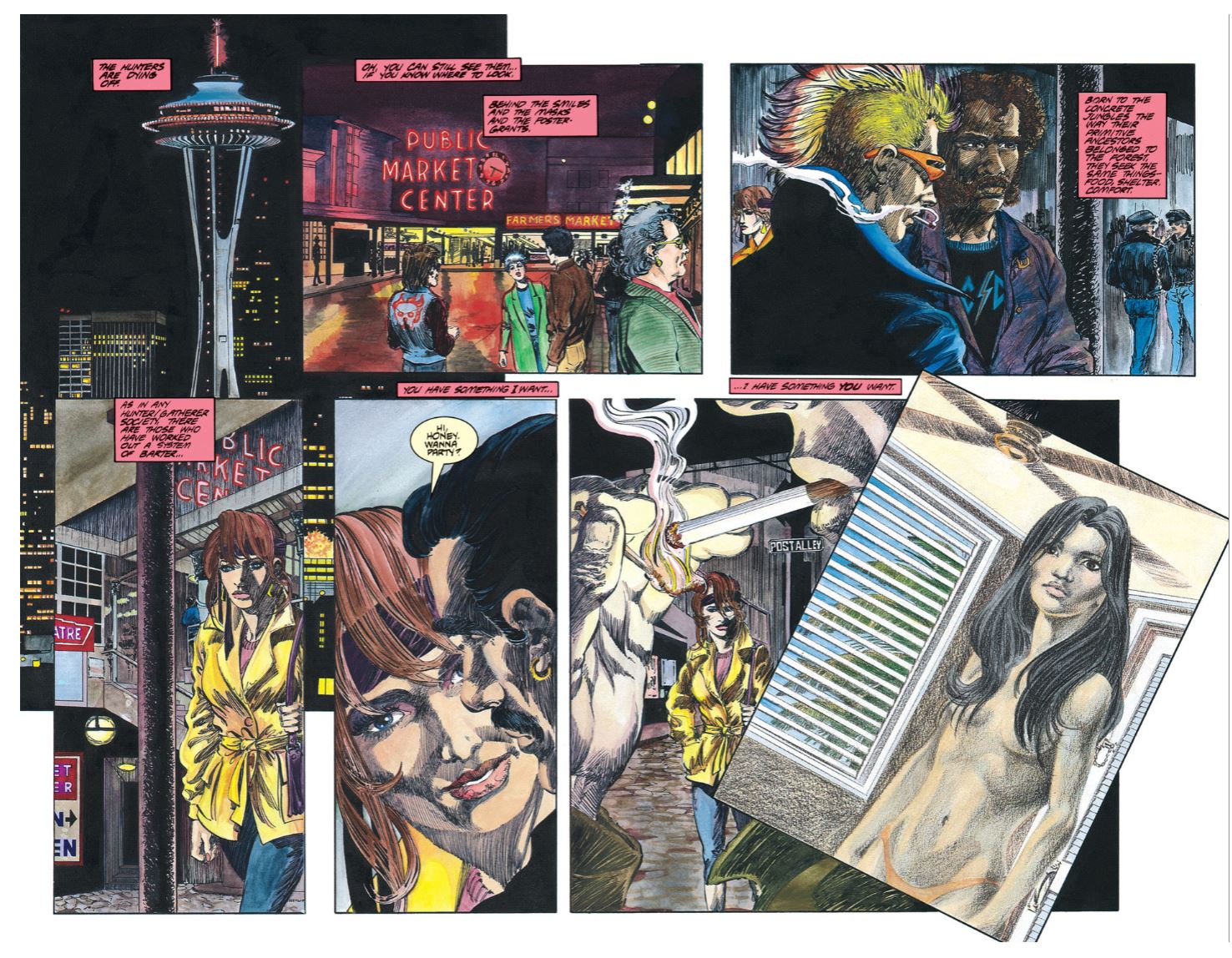
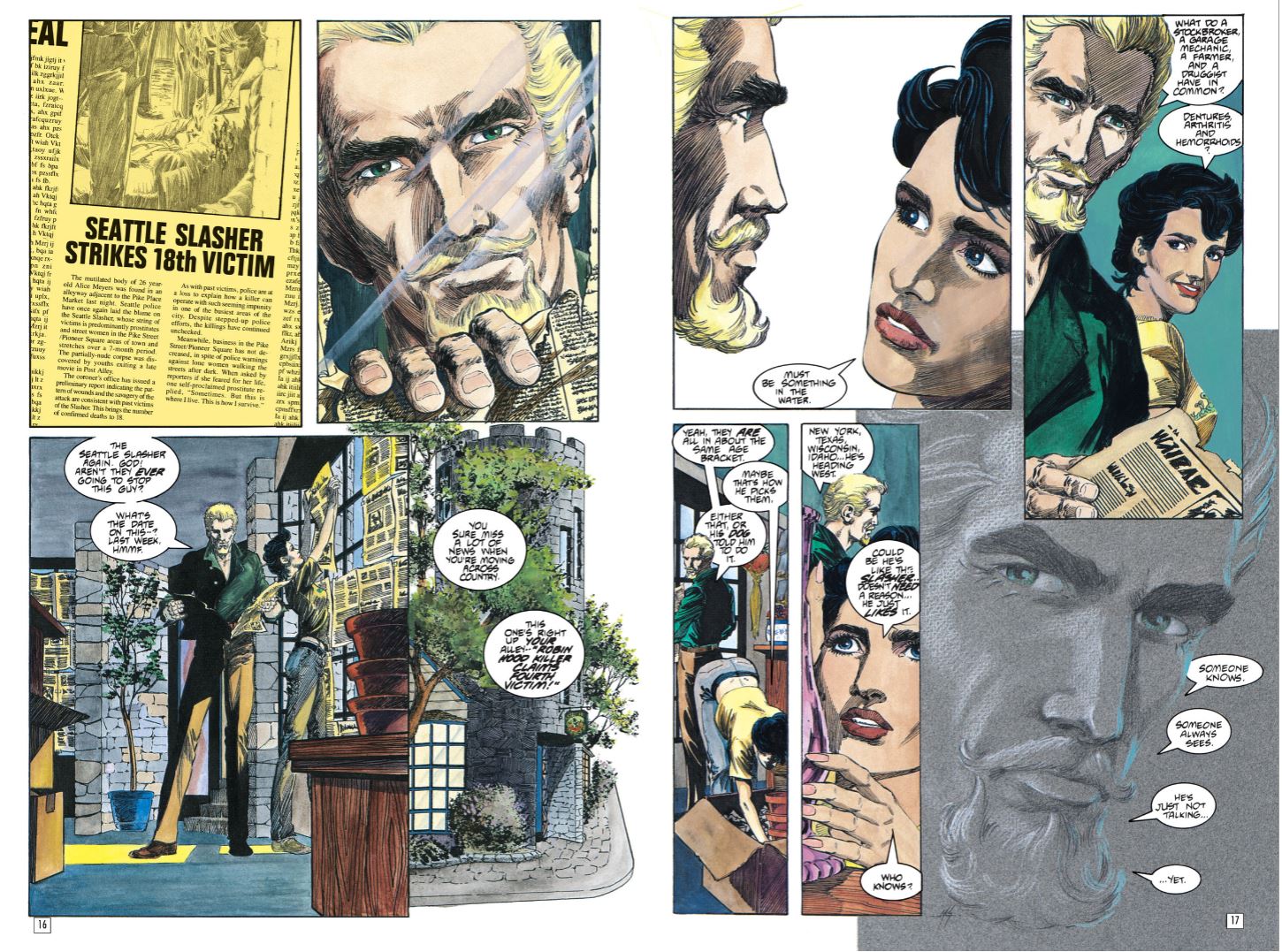
The plot is astutely logical and still controversial, concerning a superhero midlife crisis. Weary, aging Oliver Queen relocates to Seattle, struggling to come to terms with the fact that since his former sidekick Speedy, is now a dad, he is “technically” a grandfather. With longtime significant other Dinah Lance AKA Black Canary, Ollie starts simplifying his life, but the drive to fight injustice hasn’t dimmed for either of them. As she goes undercover to stamp out a pervasive drug ring, the Arrow becomes embroiled in the hunt for a psycho-killer dubbed “The Seattle Slasher”.

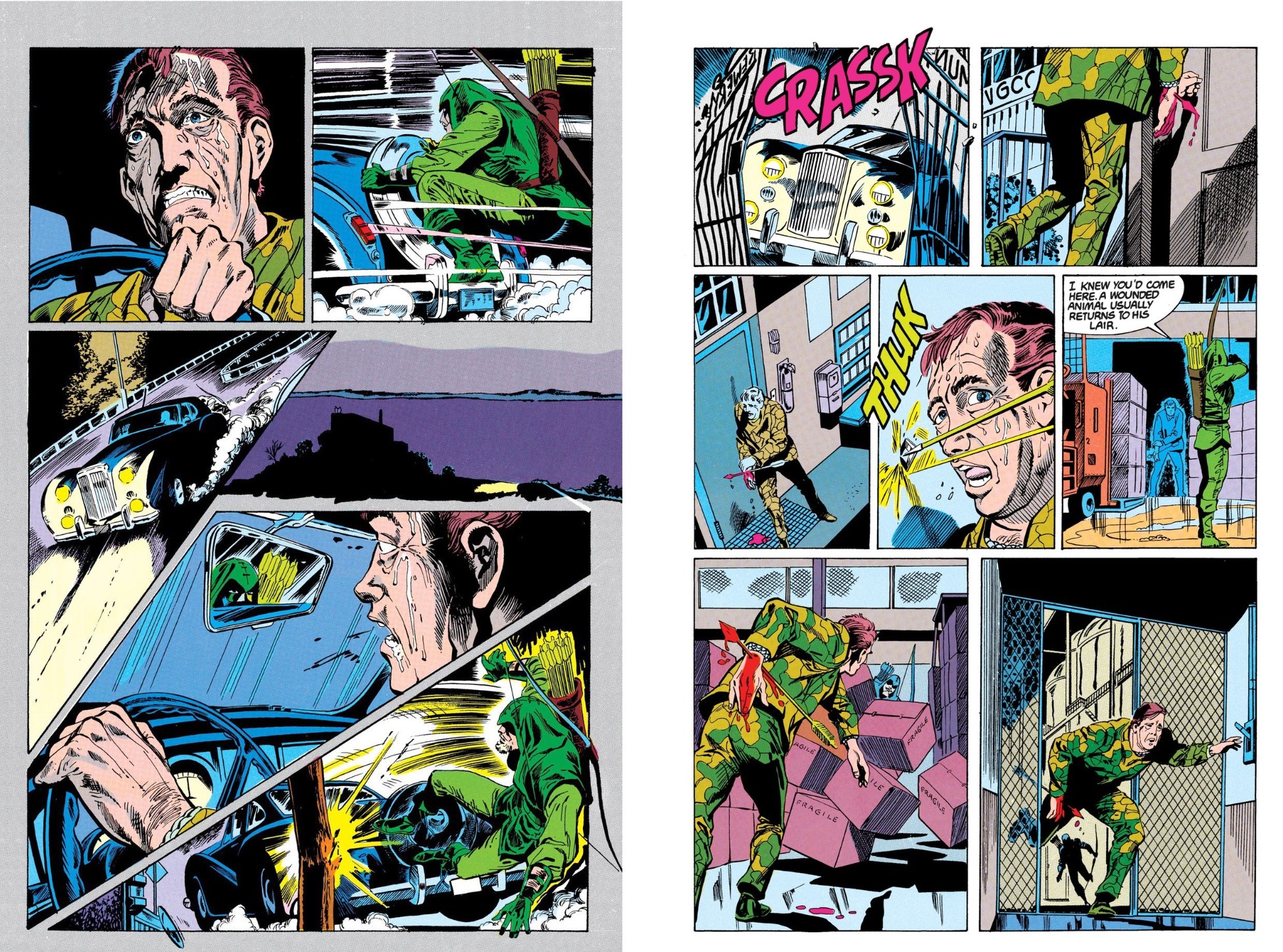
As he tracks a prolific stalker butchering prostitutes, Ollie becomes aware of a second – cross-country – slayer using arrows to murder people. Infuriatingly, this travesty only comes to his attention after the “Robin-Hood Killer” slaughters a gravedigger in his new city…

Eschewing gaudy costume and gimmicks to find such unglamorous hidden monsters, Queen reinvents himself as an urban hunter relentlessly searching Seattle’s darkest corners and soon stumbles into a complex mystery leading back to World War II involving the Yakuza, CIA, corporate America and even the Vietnam war: secrets that converge and will eventually change the course of the Archer’s life…

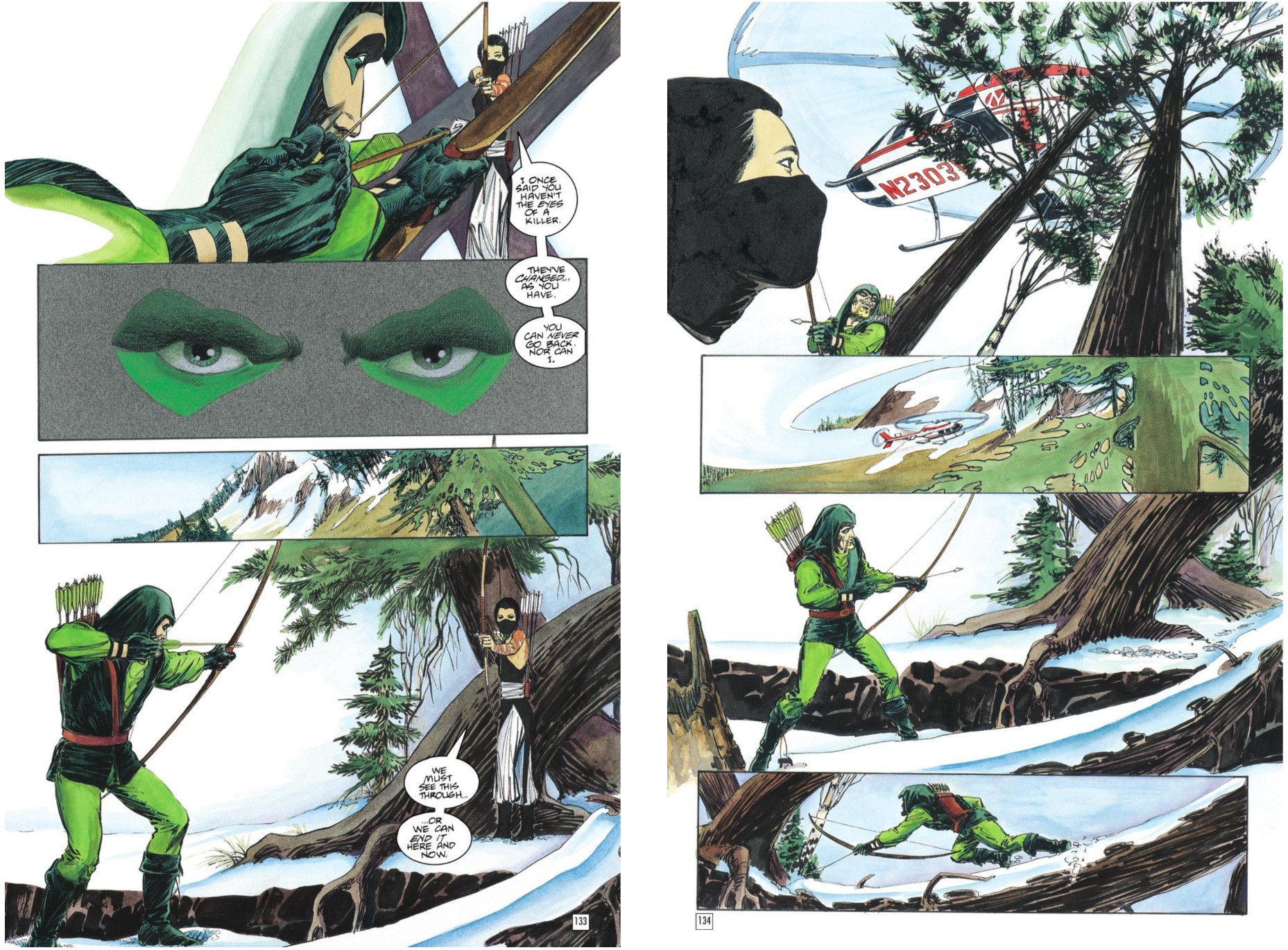
The intricate plot effortlessly weaves around the destabilized champion and past loves, thereby introducing new character Shado, exploring and echoing themes of vengeance and family in a blending of three stories that are in fact one, yet still delivers a shocking punch even now, through its disturbingly explicit examination of torture. These issues won the miniseries much undeserved negative press when first published. Although possibly tame to modern eyes this was eye-opening stuff at the time, which is a shame, since it diverted attention from the tale’s real achievement. That was narrative quality and sophistication, as this tale is arguably the first truly mature superhero yarn in the DCU.

Across ‘The Hunters’, ‘Dragon Hunt’ and ‘Tracking Snow’ Grell crafts a gripping, action-packed mystery adventure that pushes all the right buttons, all conveyed by artwork – in collaboration with Lurene Haynes & Julia Lacquement – that was and remains a revelation. Beautifully demure yet edgily sharp as required, these painterly visuals and watercolour tones perfectly complement a terse, sparse script, offering a compulsive, compelling ride any prose thriller writer would be proud of.

The saga – weaving themes of age, diminishing potency, vengeance and family – was another major turning point in American comics and led to an ongoing series specifically targeting “Mature Readers”. Latterly, the treatment and tone herein heavily influenced and flavoured TV adaptation Arrow.

Collectively covering February to October 1988, this paperback compilation (no digital edition yet, sadly) gathers the miniseries Green Arrow: The Longbow Hunters, Green Arrow volume 2, #1-8, The Question #17-18, and a crossover tale told in Detective Comics Annual #1, The Question Annual #1 and Green Arrow Annual #1. Controversy notwithstanding, the comic book retooling swiftly spawned a monthly series which itself evolved into one of the best reads of the 1990s and those monthly events immediately follow…

Scripted by Grell with superbly efficient and powerfully understated art from Ed Hannigan, Dick Giordano & Frank McLaughlin, the new series presented grimly realistic yarns ripped from headlines, tailored and honed for maximum impact and relevance. Sparse, spartan and devastatingly compelling, the initial episodes were constructed as two-part dramas, beginning with ‘Hunter’s Moon’ as the hunter (the series was notable in that other than on the cover, the soubriquet “Green Arrow” was never, ever used or uttered) prowls his new home. He deals harshly with thugs, gangbangers and muggers before heading home to his still-traumatised girlfriend.

As graphically depicted in Longbow Hunters, Black Canary was tortured for days before Ollie found her and, although the physical wounds have faded, Dinah is still suffering…

She’s not the only one. Police Lieutenant Jim Cameron has just heard that child-torturing sociopath Al Muncie has used his vast beer-dynasty inheritance to buy a retrial after 18 years in prison. The cops couldn’t get him for murdering all those “missing” kids back then, but one lucky 10-year-old, after days of appalling torment, escaped and testified so Muncie’s been locked up for aggravated assault ever since. Now the heartbroken cop has to tell that brave survivor she must do it all over again…

The victim grew up to be Dr. Annie Green and she’s working wonders treating Dinah, but the therapist’s own long-suppressed terrors come flooding back when Muncie – despite being in total lockdown in his palatial house on the family brewery estate – somehow hand-delivers a little souvenir of their time together…

Present when Annie freaks out and flees in panic, Ollie gives chase and finds her once more calm and resigned. On hearing the full story he makes a house-call on the maniac but cannot “dissuade” him from paying Annie another visit that night. The veteran manhunter is waiting as a masked assailant tries to break ino the doctor’s apartment, but when the intruder shrugs off a steel arrow to the chest Ollie realises something’s not right…

Part Two expands the mystery of how Muncie gets past police guards at will, but by the time the Arrow has convinced cops to raid Muncie’s den with the solution to the obsessed sociopath’s disappearing act and apparent invulnerability, the killer has already made his move. Sadly for him, once again Muncie has underestimated Annie, and her defiance buys Ollie time to intercept the hellbent human fiend. After a furious chase back to the brewery, the killer meets his fate in a most ironic manner…

A broad change of pace follows as part one of ‘The Champions’ sees Ollie abducted by US government spooks and pressganged into competing for a deadly prize. A joint space venture with the Chinese has resulted in a deadly “DNA-programmable” virus being created and – following the sudden destruction of the satellite lab where it was propagated – the only surviving sample has crashed onto remote San Juan Island. With political allies turned rivals for sole possession of a bio-agent which can be set to kill anything from wheat harvests to black or yellow or white people, open warfare would only lead to catastrophic publicity, so the political superpowers have agreed to a gladiatorial bout as the method of deciding ownership.

Ollie has his own reasons for accepting the job. For starters he doesn’t trust any government with the DNA-hunting bug, the agents who drafted him are actually Russian, not American and, most urgently, he has no doubt that he’ll be killed if he refuses to compete…

Equipped with a tracking device, Ollie is dumped on the island as a colossal storm kicks off, meeting his arrogant opposite getting off the ferry. Former CIA operative Eddie Fyers is an old foe and one of the sneakiest killers on Earth. Fyers convinces Ollie they should work together before double-crossing and leaving him to bleed out in a blizzard. The archer is saved by an archaeologist who has inadvertently picked up the lost bio-agent pod, but as Ollie argues with his rescuer over the wisdom and morality of his mission, her cabin is peppered with gunfire…

Fyers has the upper hand but suffers a sudden change of attitude when a third team ambushes him and his prisoners. It seems neither Russians nor Chinese trust their champions…

Again forced to join forces, spy and vigilante despatch the hit squad before Ollie has the very last word after finding a way to deprive everybody of the death-sample…

The hunter appeared tangentially in The Question #17-18 (June & July 1988 by Dennis O’Neil, Denys Cowan & Rick Magyar) as ‘A Dream of Rorschach’; tacitly acknowledging the debt owed to the groundbreaking series Watchmen for the revival of Steve Ditko’s obsessive faceless trouble-seeker The Question. Here journalist/crimebuster Vic Sage is chasing murder-obsessed miscreants Butch and Sundance out of Hub City. Catching a plane, he reads the graphic novel and has a vision of and conversation with the iconic sociopath whilst flying to Seattle and a chilling showdown. On arrival he is intercepted by highly suspicious, extremely overprotective and intensely impatient local hero the Arrow before they ally to catch the scum as they seek fresh kill supplies from terrorists in massive clash-concluding chapter ‘Desperate Ground’

Determined to challenge all manners of social inequity, Grell’s next story in Green Arrow confronted the rise in homosexual prejudice that manifested in the wake of the AIDs crisis. It begins after two customers leaving Dinah’s flower shop are brutally attacked by kids ordered to “gay-bash” as part of their gang initiation. The horrific crime is further compounded when Ollie discovers Dinah’s new assistant Colin is not only a bloody-handed perpetrator but also a victim…

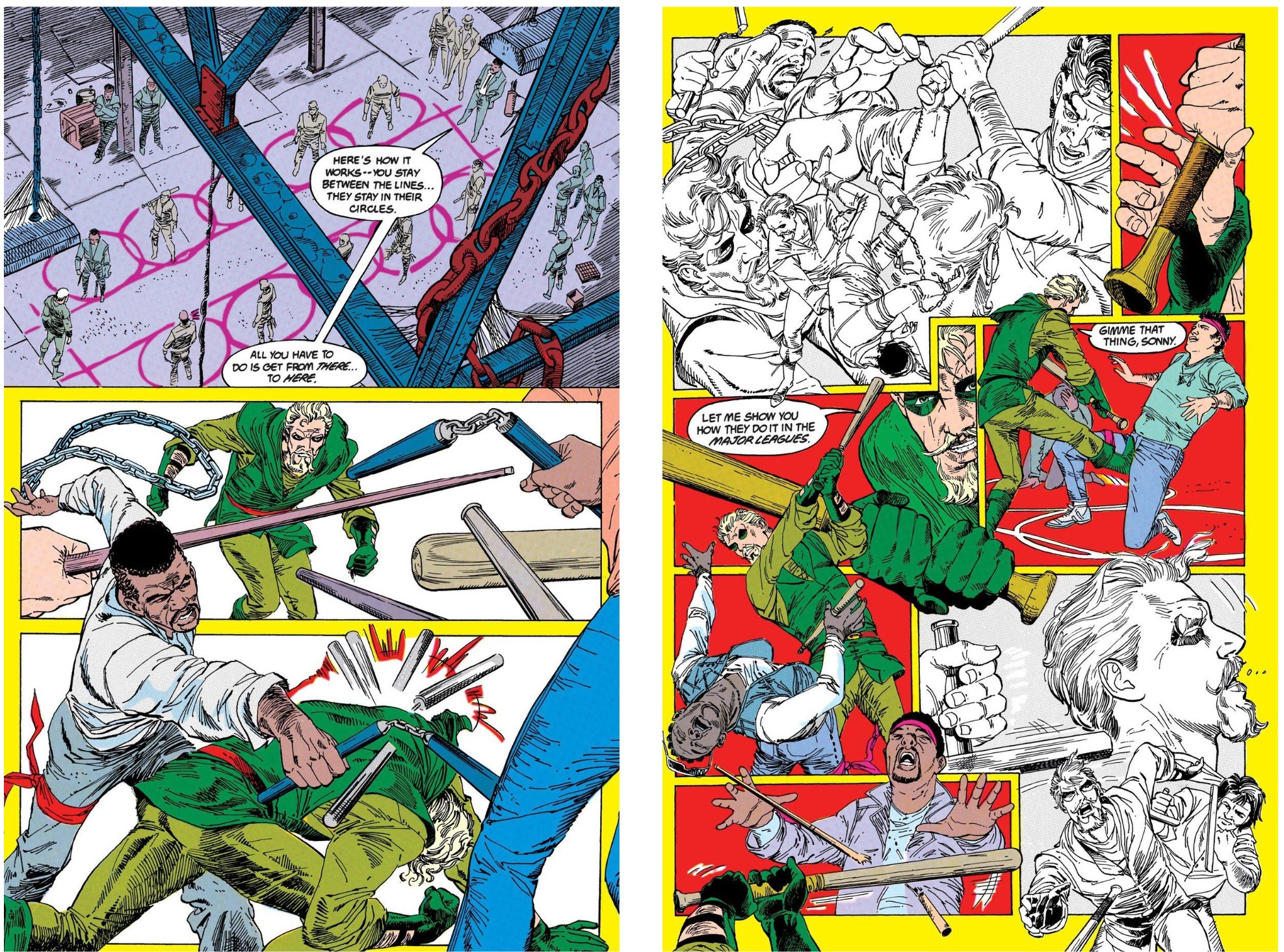
The Warhogs are the most powerful gang in the city, but their latest induction policy is one the Arrow cannot allow to exist any longer. Any kid refusing to join is mercilessly beaten by a ‘Gauntlet’ of thugs. Those who eagerly volunteer suffer the same treatment at their own initiation… and once you’re accepted as a Warhog, you still have to prove your loyalty by beating – and preferably killing – a “queer”…

In the shocking conclusion Ollie, having failed to make a dent through any of his usual tactics, goes straight to the top. Big boss Reggie Mandel has big plans for the Warhogs. He’s already made them a national force to be reckoned with, but when he arrives in Seattle to check on regional deputy Kebo, the Machiavellian schemer is confronted by a nut with a bow challenging him in his own crib…

The Arrow is keen to point out the strictly local Warhog policy of gay hate-crimes is not only bad for business but serves someone else’s private agenda. Reggie actually agrees with the vigilante, but before he’s prepared to take appropriate action he expects his verdant petitioner to undergo the same gauntlet any Warhog must survive before being heard…

Next comes complex collaboration ‘The Powderhorn Trail’ – written by Grell & Sharon Wright who divided the Ollie and Dinah sections between them, with Randy DuBurque illustrating Black Canary pages whilst Ed Barreto pencilled Arrow bits, with Giordano & Arne Starr inking it all. The round-robin episode sees the hunter stumbling upon a clue to drug-smuggling at his local carwash and having to explain to Dinah why he’s taking off for Alaska. Possibly coincidentally, she is approached by a casual acquaintance whose life the Canary once saved, who inadvertently tips Dinah to a string of crimes-in-the-making…

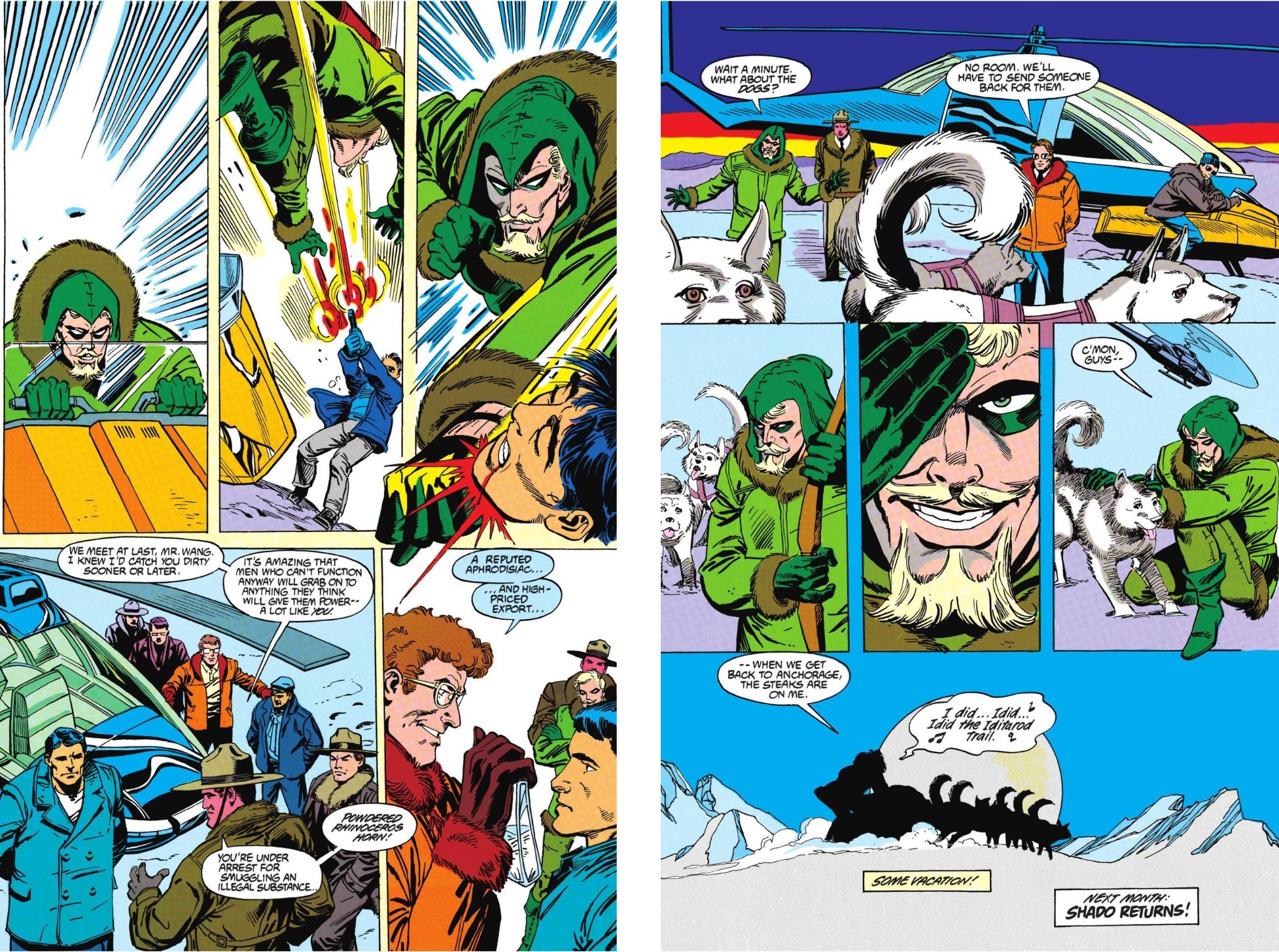
The tempestuous conclusion (by Grell, Paris Cullins, Gary Martin & Giordano) then sees Ollie solo-stalking from Anchorage to deep in the North country on the trail of not just drug dealers and high-end car thieves but also opportunistic Tong smugglers trafficking illegal, poached and utterly pointless Chinese herbal remedies under cover of the infamous Iditarod. Sometimes it’s just good and so satisfying to be a lawless vigilante…

This initial collection concludes with a Denny O’Neil martial arts epic/experimental comic book koan ‘Fables’: a crossover tale encompassing Detective Comics Annual #1, Green Arrow Annual #1 and The Question Annual #1, which will make far more sense if you read Richard Dragon: Kung Fu Fighter: Coming of the Dragon!

It begins in China during Japan’s invasion prior to the official start of WWII, where a truly honourable bushido warrior is shamed by his own troops and resigns his commission to become a warrior monk: the O-sensei. Years later he and his student (Lady Shiva “the most dangerous woman on Earth”) arrive in America seeking a new hero called The Batman. They have a lesson to impart but first must find him. This overture means working again with an old student named Vic Sage…

Rendered by Klaus Janson & Tony DeZuñiga, ‘The Monkey Trap’ sees the Dark Knight hunt a horrific bio-weapon stolen from arch maniac Ra’s Al Ghul and pursued by money-mad miscreant The Penguin. The quest is only accomplished after the cocky masked manhunter learns a crucial lesson from the warrior sage and incurs a monumental debt of honour…

Then ‘Lesson for a Crab’ – illustrated by Tom Artis & Tom Dzon – finds the former Emerald Archer & Black Canary embroiled in the schemes of English aristocrat Lord Kalesque who wants to be the greatest archer in the world but cannot feel secure in the title until he crushes a certain vigilante in Seattle. As Kalesque is no adherent of fair play, that can be accomplished by perpetrating a string of murders to destabilize the hunter and put him and his woman off their game. Happily, Shiva and the O-Sensei are already on their way with advice and a zen teaching that will be of great service…

The interlinked saga concludes in The Question Annual #1 (Cowan & Magyar art) with explanations and conclusions. The aged sage wants to be buried beside his Japanese wife but her family are opposed to the plan and have moved her body. Star pupil Shiva orchestrates a plan involving western heroes touched by his teachings and owing service to the O-Sensei, and her efforts culminate in ‘The Silent Parable’. Now Batman’s detective skills locate the resting place and the Americans join what seems like a cursed mission to Malaya – one that is beset by an army of assassins and string of natural disasters; and which seems to end in utter failure…

However, in the aftermath The Question deduces that fate and honour have worked their own miracles and made a suitable accommodation with the universe…

Closing the book and capping the fantasy is a linked cover triptych of the Annuals by Janson, Ed Hannigan, Cowan & Bill Sienkiewicz, and rest – both fully painted and line art – are by Grell, Cowan, Sienkiewicz, Giordano, Hannigan & Tatjana Wood and suitably placed throughout…

Terse, sparse scripts, intelligent, flawed human interactions, stunning action delivered through economical and immensely effective illustration and an unfailing eye for engaging controversy make these some of the most powerful comic tales US comics ever produced, an epic of masked mystery saga no lover of the genre will want to miss.
© 1987, 1988, 2024 DC Comics. All Rights Reserved.

In 1911 strip writer Nicholas P. Dallis (Apartment 3-G, Rex Morgan MD) was born. Nine years later so was the fabulous Kurt Scaffenberger (Captain Marvel, Lois Lane, Jimmy Olsen) with Al Plastino popping in 366 days later. He was a key Superman illustrator who co-created the Legion of Super-Heroes and also drew the Batman newspaper strip (see Batman: Silver Age Dailies and Sundays 1968 – 1969).

In 1953 JM DeMatteis was born, in 1961 Reginald Hudlin arrived and in 1969 Stuart Immonen, but we did lose Abie the Agent illustrator Harry Hershfield in 1974 and Uruguayan Eduardo Barreto who drew many US features including Steel Sterling, Aliens, Teen Titans, Superman, Batman and Judge Parker.

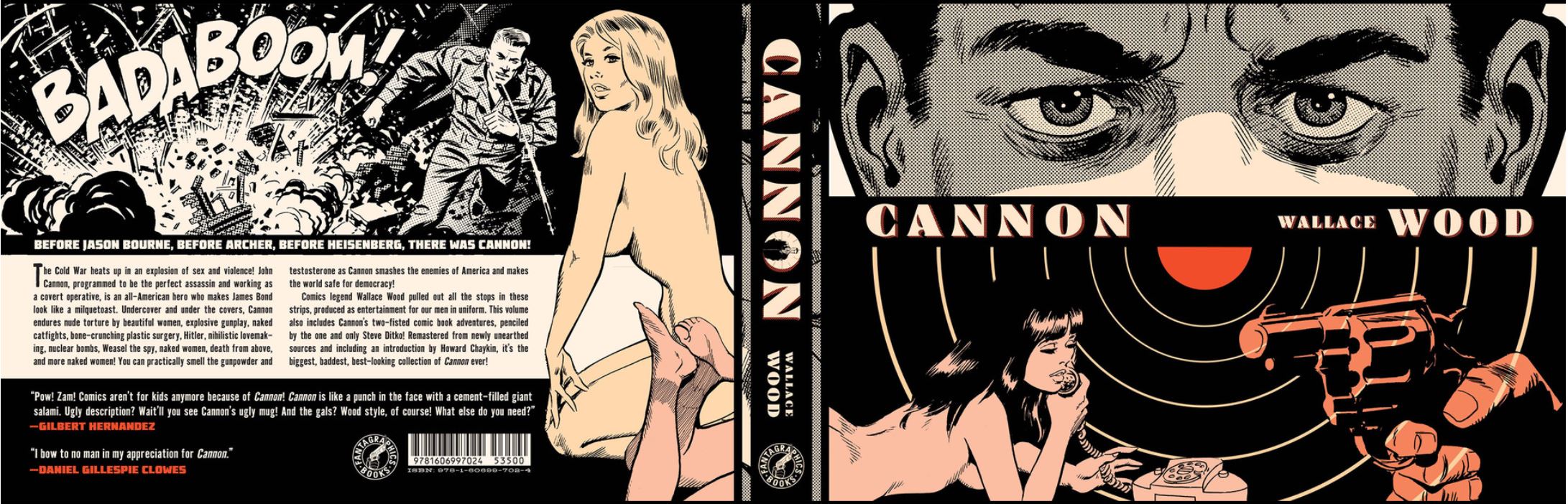
Cannon


By Wally Wood & various, introduction by Howard Chaykin (Fantagraphics Books)
ISBN: 978-1-60699-702-4 (HB/Digital edition)

This book includes Discriminatory Content produced in less enlightened times.

As with any historical perspective addressing popular mass-entertainments and evolving societies, a look back often finds uncomfortable material that can jar some modern sensitivities and set today’s collective hackles rising. That’s especially true of this lovely but confounding collection compiling seldom seen material by one of the industry’s greatest stars…

This is quite frankly a lovely book of beautiful work that I now find hard to recommend to a general audience. That’s more to do with how society has evolved rather than its admittedly always deeply flawed and often unsavoury content…

We all carry within us the seeds of our own destruction and probably none more so than troubled comics genius Wallace Allan Wood (June 17th 1927 – November 2nd 1981): one of the greatest draughtsmen and graphic imagineers our art form has ever produced. Woody was a master of every aspect of the business. He began his career lettering Will Eisner’s Spirit newspaper strip, readily moving into pencilling and inking as the 1940s ended and, ultimately into publishing. After years working all over the comic book and syndicated strip markets, as well as in book illustration, package-design and other areas of commercial art, he devised the legendary T.H.U.N.D.E.R. Agents franchise and even predated and anticipated the counter-culture’s Underground Commix phenomenon by launching in 1965s one of the first adult-oriented, independent comics: Witzend.

The troubled genius was frequently his own worst enemy. Woody’s life was one of addiction (guns, booze & cigarettes); traumatic relationships; tantalisingly close yet always inevitably frustrated financial security; illness and eventually, suicide. It was as if all the joy and beauty in his existence stayed on the pages and there was none left for real life.

Although during his time with EC Wood became the acknowledged, undisputed Master of Science Fiction art in America, he was equally adept, driven and accomplished in the production of all genres. He was a lusty man and was a pioneer of sexually explicit, ultra-violent (but always beautiful) and titillating comics where sex played a major role. Remember, even if everybody loves comics, it’s not always about superheroes and cosmic quests. Men like sexy comics and cartoons. I’m not saying that it’s right or proper to ogle women, but it is a sad fact of life and has made many publishers rich for centuries. This customer base especially likes looking at beautiful naked women and amongst so very many cartoonists over the decades, Wood was arguably the paramount exponent of the subgenre…

Remarkably and without in any way seeking to apologise for it, I can confirm that this gritty strip was made to entertain REAL-MEN!! It abounds with naked, nude, undraped and forcibly undressed women (and men, but not as many or as often as the women). Somehow less controversially it also heavily features mega violence, and both physical and psychological torture because that’s what the audience wanted. If you don’t believe me go and rewatch Goldfinger (1964) but this time watch and listen closely…

Cannon’s inbuilt misogyny is a feature not a bug with levels of abusive behaviour and conduct that seldom exceed those of any 1960-1970s Bond or Man from U.N.C.L.E. movie. There’s practically no gadgets either, but loads of fast flashy cars, planes and boats… and much sublimely rendered, awesomely accurate ordnance because that’s one thing your average GI or swabbie will spot instantly if fudged…

This cartoon series captures a moment in history that was deeply, deeply unfair to women, even if – for its time – the feature was uncharacteristically racially & socially diverse and most equitable in its treatment of African-American, Hispanic, Arabic and Asian guys. This was probably as much about the target readership – the desegrated but still mostly male US Military Service personnel – as Woody’s views on the Civil Rights movement. Wally was always utterly professional and diligent in all his work commitments and liberated from all editorial constraints, but his own experience gave the audience exactly what they wanted…

Following Howard Chaykin’s ‘Intro’ confirming the best and worst of the legends, the strip unfolds in one unbroken stream of non-stop blockbuster action heavily seasoned with geopolitical themes and contemporary headline fodder. It’s fitting to note here that Woody utilised and mentored dozens of guys who went on to their own notoriety. If you’re a fanatic, you’ll spot many of them – Pearson, Reese, Wenzel, Hama et al – as characters in the strip, but in-jokes aside, this one’s all about satisfying manly urges.

Guaranteeing sex, death and horror and NAKED WOMEN in almost every episode, Cannon by Wood and his ever-shifting studio ran from 1970-1973 in three separate editions of The Overseas Weekly: a tabloid specifically created and disseminated to US military personnel stationed overseas. He & Steve Ditko later recycled the character in an abortive indie publishing venture Heroes, Inc., which we’ll cover at the end.

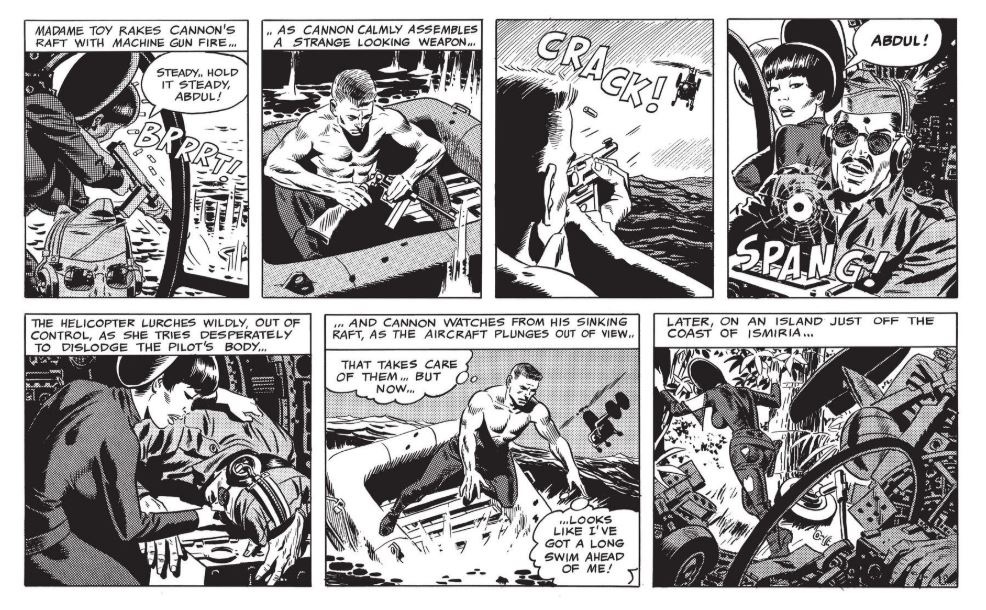
John Cannon was a U2 pilot captured and tortured by the Red Chinese. Broken and turned into their assassin, he threw off the ministrations of their top brainwasher Madame Toy but suffered a psychological collapse that left him a relentless, emotionless living weapon pointed by the CIA at any target that needed killing.

His successes didn’t affect him at all but did make him a permanent target of the Chinese and Soviet governments. The latter tasked beautiful lethal killer Sue Smith to remove him by any means and at all costs, but her attempts were as frequent and futile as Toy’s, who doggedly and repeatedly seeks to recapture or kill him. Both curvaceous killers spent as much time shagging Cannon as shooting, stabbing, electrocuting, drowning, poisoning, bombing and running over the implacable agent.

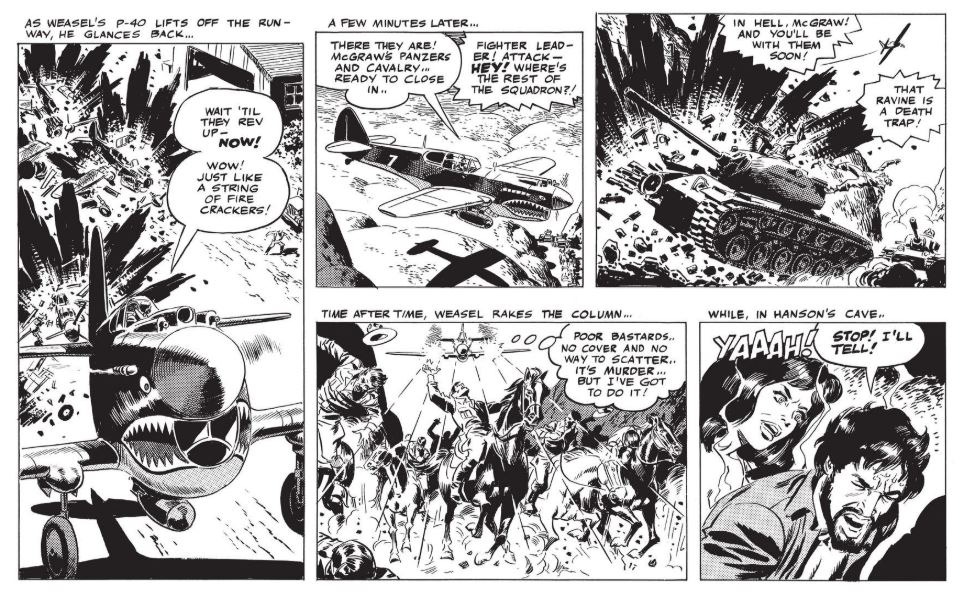
Encountering and exterminating hundreds of spies Cold War spies and assassins, Cannon saves US-friendly middle-Eastern Ismiria from infiltration and insurrection; defends US ally Israel from subversion; shatters the schemes (and sleeper agent army) of Comrade Gorsk and saves Latin American San Sierra from both Red-backed rebels and the incumbent US-friendly fascist dictatorship. He even gets to save a few lives along the way, like his own Uncle Fred back in Iowa and charming conman/serial bigamist/accidental hitman Charles M. Fogarty

At home, Cannon eradicates gangsters and spies as his conditioning begins to fade. No longer a reliable asset, he tries to retire to his old family home but trouble follows and the CIA soon re-recruit him. With Toy & Sue Smith perpetually hunting him and “cat-fighting” each other, Cannon even clashes with killer hippies in a murder commune and an ultra-conservative millionaire with his own private militia seeking to set the nation back on the Right path. John even has a couple of shots at true love and a Happy Ever After, but inevitably learns over and again that “women are just no damn good”…

Along the way he experiences every kind of action from scuba combat to aerial dogfights, and even battles a killer cyborg, He’s particularly adept at ferreting out leftover Nazis and dodges more than his fair share of atomic detonations. This is a strip very much of its time and for adults if not grown-ups, so like many of his audience, our hero even has to face up to the consequences of his actions when one paramour falls pregnant. The wedding is an utter disaster…

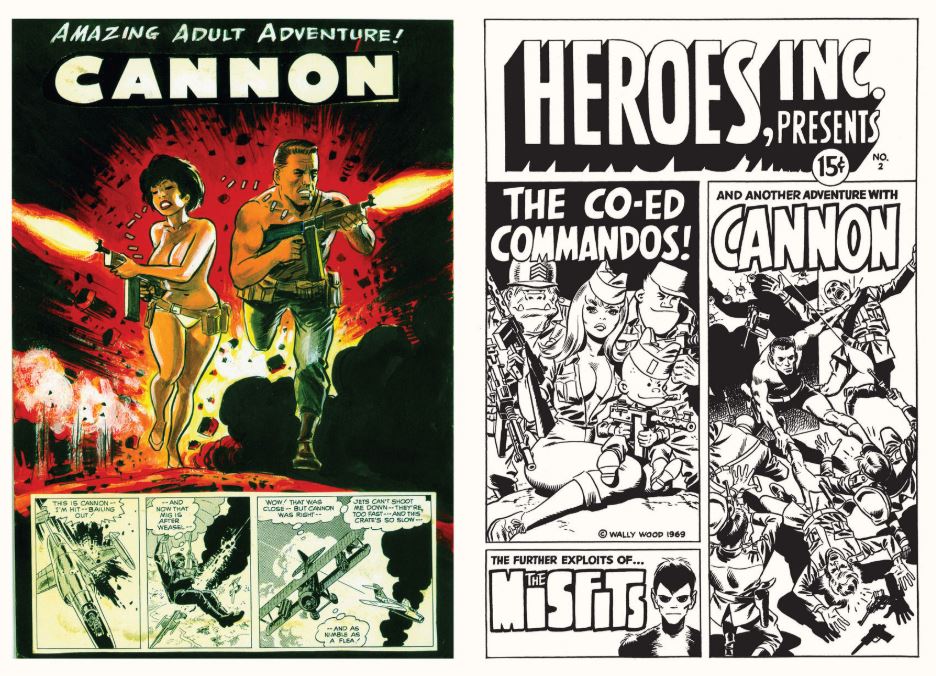
As much a document of art history as an expertly-targeted wank-book, Cannon comes with fascinating bonus features for comics fans, beginning a voluminous Appendix section with a brace of long lost cover paintings.

These augment the Roger Hill’s essay ‘The Overseas Weekly Discovery’ detailing the bizarre circumstance that led to the retrieval of the material forming this book, and compliments a

‘Letter by Wallace Wood’ exhorting how the industry must change. These are followed by the tamed down, general audience full-colour Cannon story by Wood & Ditko as seen by almost nobody in 1969’s Heroes, Inc. Presents Cannon, and another similar but monochrome lost Wood & Ditko treat from Heroes, Inc. No. 2 (1976) once again kicking the stuffing out of stubborn Nazis by Wood & Ditko. The experience ends as it should with a fulsome and fair “Bio” of Wally Wood by J. David Spurlock.

Fast, furious and ferociously unreconstructed and sexist, this can be a hard read: one packed with pitfalls, but undeniably honest in its intent and delivery. If you like this kind of thing you’ll love it, and if you find it offensive, you’re still free enough for the moment to reject and not buy it. However, if you do feel the urge to condemn, do us all the courtesy of reading it first…
“Intro” © 2014 Howard Chaykin. “The Overseas Weekly Discovery” © 2014 Roger Hill. “Bio” © 2014 J. David Spurlock. Photos © Bhob Stewart & Paul Kirchner. All other contents © 2014 Wallace Wood Properties LLC. All rights reserved.

Daredevil Marvel Masterworks volume 16


By Frank Miller & Klaus Janson, Mike W. Barr, Roger McKenzie, Terry Austin, Paul Smith, Denys Cowan, Fred Hembeck, Paul Gulacy & various (MARVEL)
ISBN: 978-1-3029-3316-6 (HB/Digital edition)

This book includes Discriminatory Content included for dramatic effect.

Matt Murdock is a lawyer obsessed with saving the innocent. Thanks to a childhood nuclear accident he lost his sight but later discovered his remaining senses were hyper-stimulated to a miraculous degree, allowing him to become an astonishing acrobat, formidable fighter and living lie-detector. He also developed a kind of biological radar giving him complete awareness of his local environment.

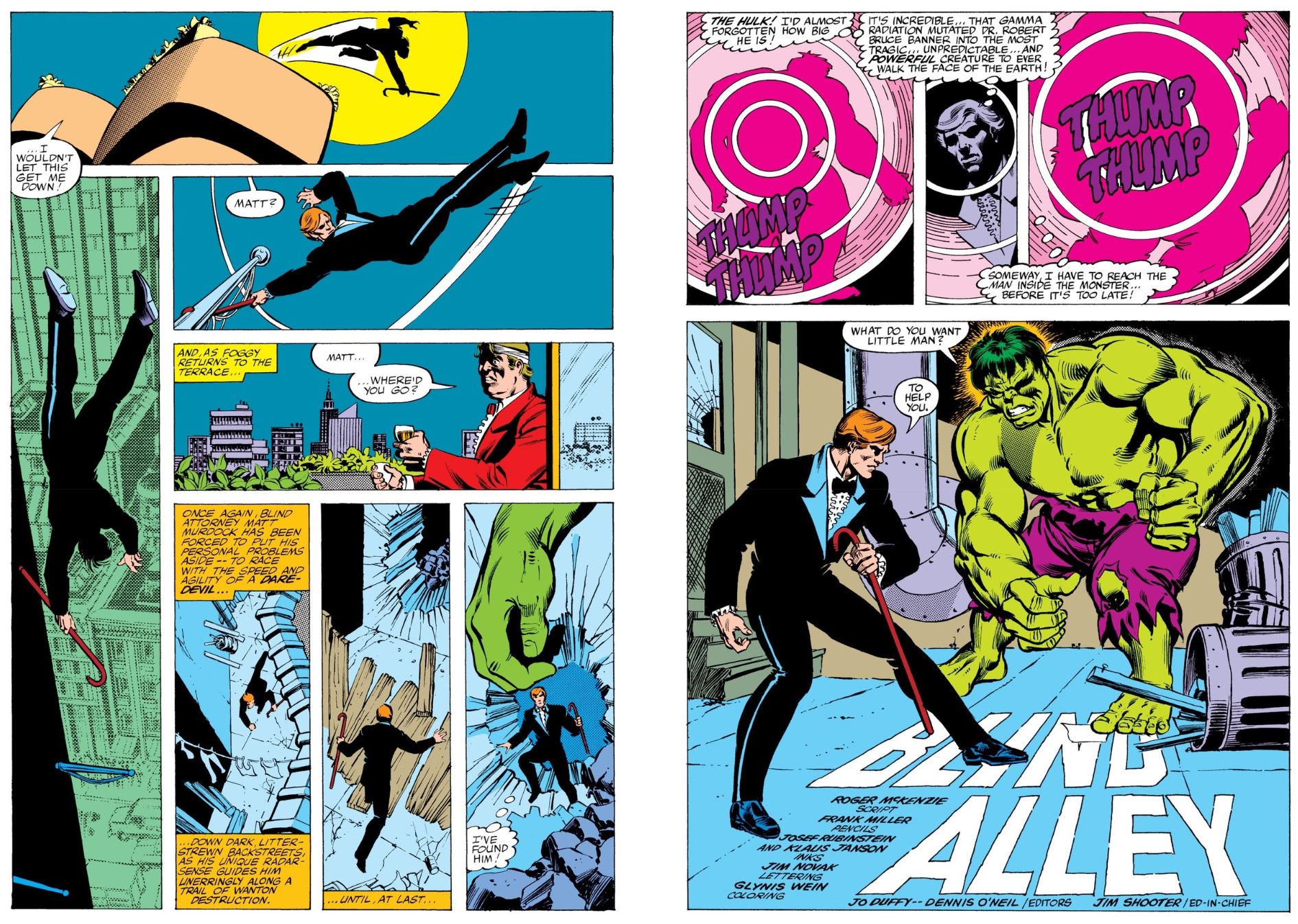
A second-string hero for most of his early years, Daredevil was nonetheless a striking and popular one, due in large part to the captivatingly humanistic art of Gene Colan. He fought gangsters, a variety of super-villains and even the occasional monster or alien invasion. He quipped and wise-cracked his way through life and life-threatening combat, but under the auspices of Jim Shooter, Roger McKenzie and finally Frank Miller and Klaus Janson, the character transformed into a dark, moody avenger and grim, quasi-religious metaphor of justice and retribution…

Spanning cover-dates August 1981- October 1982, this crucial compilation comprises relevant material from Daredevil #173-181, plus spin-off material generated for a readership that simply could not get enough of the newly darkened avenging devil as seen in Bizarre Adventures #28 and What If? #28, 34 & 35 and material from Marvel Fanfare #1. The visual tumult and tension are preceded by an Introduction from Klaus Janson, detailing his increasing contribution to the character’s arc, and foreshadowing the time when the title would, visually at least, be all his…

When Miller took on authorship in #168 he immediately began remodelling Matt’s past, testing his established relationships and the memory of his murdered father Battling Jack Murdock and created a deadly new former lover in Elektra Natchios, all while putting the damned hero through his paces against archnemesis Bullseye and severely denting the untouchable empire and reputation of evil untouchable Wilson Fisk.

The end result was The Kingpin once more implicitly ruling New York, but enthroned in misery after losing his greatest treasure when his beloved wife Vanessa was blown up and presumed killed during the gang war that followed…

With the city increasingly awash in mobsters, monsters, assassins and deviants, Daredevil 173 returns to the difficult, painful redemption of mentally troubled former foe The Gladiator. Having suffered an emotional crisis Melvin Potter prays his violent old life is over but when a woman is brutalised in the streets, she identifies the supervillain as her attacker. Murdock begins a stout defence of the ‘Lady Killer’, but despite his truth-sensing abilities, even his confidence takes a battering when his own assistant Becky Blake reveals Potter is the man who put her in a wheelchair years ago. Shocked and betrayed on all sides Matt lets DD take charge and discovers a world of horror and abuse as he tracks down a cunning, opportunistic human beast torturing women for kicks…

Elektra co-stars in #174 as her former master The Jonin orders ‘The Assassination of Matt Murdock’, introducing resurrecting zombie ninja cult The Hand, just when the Potter trial is going badly and faithful partner Foggy Nelson has abandoned him. The cult’s official expansion into America is lethally and effectively countered by Elektra, but when Daredevil joins the fight he is wounded, losing his greatest supersense, leaving him to depend on her and Melvin reluctantly returning to his Gladiator persona…

Now targeted by immortal super ninja Kirigi, Elektra goes after the Jonin in ‘Gantlet’ and leaves DD to his own devices. In ‘Hunters’, severely impaired Matt hunts for the old guy who first taught him to use his super senses and rattles his old foes and street sources so badly that even Z-grade thugs Turk and Grotto are prompted to steal a super-armour suit and settle with the Scarlet Swashbuckler for good…

As Elektra finally faces Kirigi, #177 sees Murdock in the brutal care of old hermit Stick; undergoing pitiless trials and torment to regain all that he has lost. The physical and mental abuse triggers hallucinations, flashbacks to his early life and ultimately delirious revelation ‘Where Angels Fear to Tread’

Meanwhile elsewhere, future Mayor Winston Cherryh is being investigated by Daily Bugle reporter Ben Urich, who uncovers his links to the Kingpin just as a reinvigorated, reunited Nelson & Murdock find a kid with physical proof of Hizzoner’s malfeasance. They recruit Heroes for Hire Luke Cage & Iron Fist as bodyguards whilst Fisk hires the best assassin in town to clean up the impending mess. However, Elektra is deeply conflicted and the resultant ‘Paper Chase’ leaves no winners…

Things get deep and dirty when Elektra sends Urich a warning he’ll never forget, but does put aside after getting a photo of a sewer-dwelling bag lady Wilson Fisk would do anything to know about. As the war of wills mounts she then has to kill the reporter and defeat Matt in ‘Spiked!’, leading the sightless sentinel of the modern hell beneath his city: a community of ‘The Damned’ governed by a barbaric degenerate thug who loses everything to the crimson invader, especially his queen, Vanessa…

Forced to scuttle Cherryh to regain his beloved, Wilson Fisk craves petty vengeance and orders the assassination of Foggy Nelson. Meanwhile, recovered from brain surgery undertaken after his last defeat by Daredevil, Bullseye escapes jail to reclaim his position and title as the world’s deadliest killer for hire. He desperately wants to kill Elektra, and finds himself able to profit from it when she baulks at ending Foggy. The assassins’ brutally balletic dance across New York City ends with her, and Daredevil seeks revenge with the words Bullseye said when he was last captured. “By saving me, everyone I kill from now on is on you”…

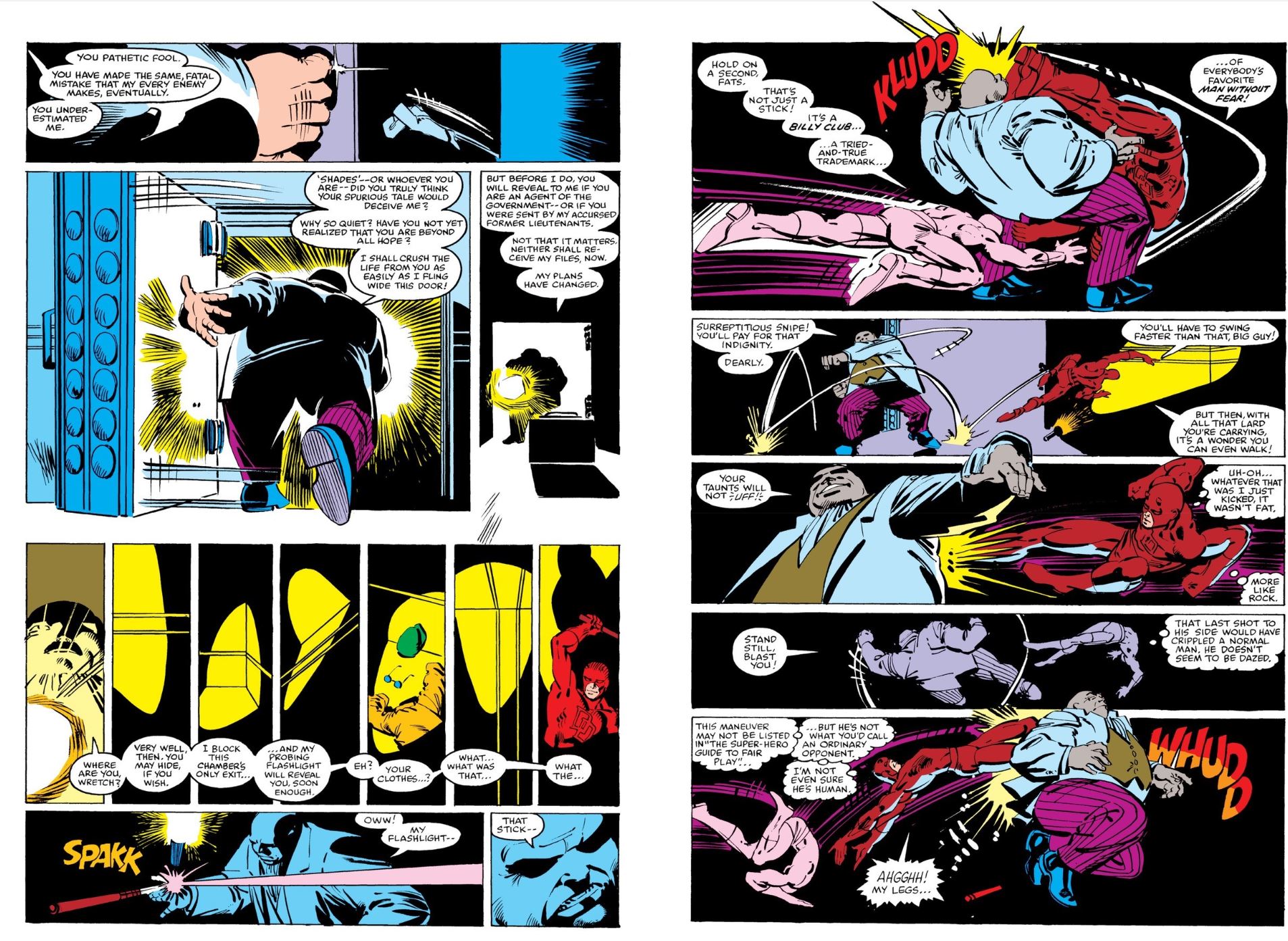
Daredevil #181 ‘Last Hand’ (April 1982) is a cinematically styled masterpiece of graphic design reflecting emotional tumult and is one of the best single stories of the era. It also ends the old Daredevil and heralds a new hero to come, but that’s all for another book.

Here, however, the events sparked a number of ancillary delights beginning with spectacular monochrome prequel ‘Elektra’, as crafted by Miller for Bizarre Adventures #28 (October 1981) with the hired killer going off-book after finding out an unsavoury truth about her client. That’s followed by What If? #28 and ‘Matt Murdock, Agent of S.H.I.E.L.D.’ by Mike W. Barr, Miller & Janson, exploring what might have been had Anthony Stark and Nick Fury been nearby when Young Matt was hit by that senses-altering radioactive cannister…
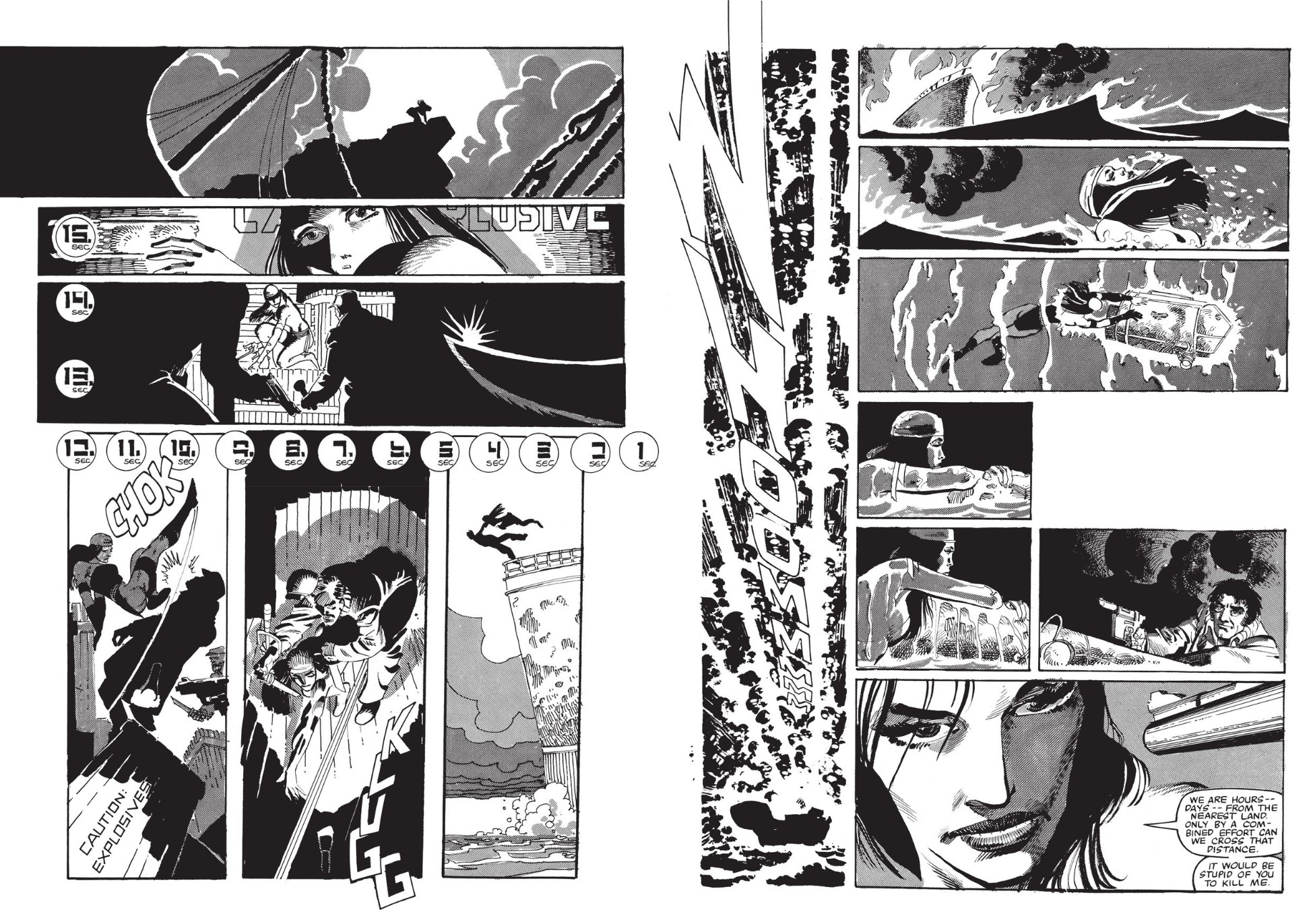
Cover dated August 1982, What If? #34 was an all-comedy issue with Miller outrageously expressing the results of answered question ‘What if Daredevil Were Deaf Instead of Blind?’, before the rather self-explanatory ‘What if Bullseye Had Not Killed Elektra?’ (WI? #35, October 1982) by Miller & Terry Austin…

As a special treat, a short Christmas yarn from Marvel Fanfare #1 (March 1982) concludes the comics treats as DD joins a street Santa to save the season for a bunch of orphans in ‘Snow’ by Roger McKenzie, Paul Smith & Austin.

The Miller limned back cover of that issue begins this book’s bonus section, and is followed by Miller’s full Daredevil character bible, written in 1980 as he prepared to take over the writing. A house ad for the Power Man & Iron Fist team-up precedes Fred Hembeck & Miller’s collaboration from Fantastic Four Roast #1 (May 1982) prior to a gallery of fan publication art. The Miller/Janson cover for Amazing Heroes #4 (September 1981) segues into Comics Feature #14 (December 1981) and their wraparound for The Daredevil Chronicles (February 1982) which also reprints the lengthy ‘Frank Miller/Klaus Janson Interview’ conducted by Peter Sanderson, with illos by Hembeck, George Peréz, John Byrne, and Miller & Janson (including a double page pin-up of DD, Black Widow, Black Panther and Elektra).

Joe Rubinstein inked the covers of Marvel Index 9B (listing DD, Black Widow, Black Goliath, Black Panther, Shanna the She-Devil, Dazzler and the Human Fly) and Rick Hoberg rendered the Frontispiece, before Paul Gulacy’s sublime “Good Girl” art Black Widow Portfolio – 6 stunning monochrome plates plus cover – segues into a 20-strong covers and interior page gallery, topped off by Miller & Steve Buccellato’s 2001 cover for Daredevil Visionaries: Frank Miller vol. 2, as well as its Elektra frontispiece, and Diana Schutz’ reminiscing Introduction

Short sharp, shocking, game-changing, revolutionary and still fantastically readable, these tales kicked open the doors for truly mature comics dramas, whilst promising the true potential of Daredevil was in reach. Their narrative energy and exuberant excitement are dashing delights no action fan will care to miss.

… And the next volume heads full on into darker shadows, the grimmest of territory and the breaking of even more boundaries…
© MARVEL 2022.

Birds of Prey volume 1


By Chuck Dixon, Jordan Gorfinkel, Gary Frank, Jennifer Graves, Matt Haley, Sal Buscema, Stefano Raffaele, Dick Giordano, Greg Land & various (DC Comics)
ISBN: 978-1-4012-5816-0 (TPB/Digital edition)

This book includes Discriminatory Content produced in less enlightened times.

Truly groundbreaking at the time, the exploits of the Birds of Prey recount the missions and lives of a rotating team of female crimefighters led by Barbara Gordon, the computer genius and omega level coder known to her inner circle as Oracle. Child of Gotham City Police Commissioner James Gordon, her own career as Batgirl was ended when the Joker blew out her spine during a terrifying kidnap attempt. Trapped in a wheelchair, she hungered for justice and sought new ways to make a difference in a very bad world…

Reinventing herself as a covert information-gatherer for Batman’s clique of avengers and defenders, she made herself an invaluable resource for the entire superhero community, but in the first of these collected tales Babs undertakes a new project that will allow her to become an even more effective crusader against injustice…

This volume contains the numerous one-shots, specials and miniseries that successfully introduced an eye-popping, mindblowing blend of no-nonsense bad-girl attitude and spectacular all-out action which finally convinced timid editorial powers-that-be of the commercial viability of a team composed of nothing but female superheroes. Who could possibly have guessed that some readers would like effective, positive, clever women kicking evil butt, and that boys would follow the adventures of violent, sexy, usually underdressed chicks hitting bad-guys – and occasionally each other? Or even eventually spawn their own TV series and sub-genre?

Gathered here, Black Canary/Oracle: Birds of Prey #1, Birds of Prey: Revolution, a pertinent section of Showcase ’96 #3, Birds of Prey: Manhunt #1-4, Birds of Prey: Revolution #1, Birds of Prey: Wolves #1 and Birds of Prey: Batgirl #1 (collectively spanning cover-dates June 1996 through February 1998) comprise a breathtaking riot of dynamic, glossy crimebusting, heavily highlighting the kind of wickedness costumed crusaders generally ignored back then: white collar and thoroughly black-hearted…

Opening tale ‘One Man’s Hell’ is written by Chuck Dixon and illustrated by Gary Frank & John Dell: set at a time when veteran martial arts crime-crusher Black Canary (AKA Dinah Laurel Lance) was slowly going to hell after the death of her long-time lover Oliver Queen. Of course, he got better a few years later (don’t they all?).

Broke, uncontrolled and hellbent on self-destruction, the increasingly violent, adrenaline-addicted heroine is contacted by a mysterious unseen presence and dispatched to a third world country to investigate a series of “terrorist attacks” that always seem to profit one unimpeachably benevolent philanthropist. With nothing left to lose, the Canary undertakes a tragically brutal mission and gains an impossibly valuable prize: purpose.

Peppered with an intriguing array of guest-stars and villains, this socially-conscious high-octane thriller established the Canary as one of the most competent and engaging combatants of the DCU and a roving agent of conscience and retribution more than capable of tackling any villainous scum clever enough to stay below regular superhero radar: a reputation enhanced in the sequel ‘Revolution’. Here Dixon, Stefano Raffaele & Bob McLeod craft a superbly compelling tale from a time when Oracle is no more than a rumour to everybody but Batman and Dinah Lance – and even they only get “intel” and advice from an anonymous voice over phone, by text or via radio-jewellery in a mysteriously provided new combat Canary uniform. Here Dinah and her silent partner track a human trafficking ring to failed state Santa Prisca and stumble into a dirty campaign by American interests to topple the standing dictator. Not for long…

When the venerable Showcase try-out title was revived in the 1990s it was as a monthly anthology highlighting old, unemployed characters and tapping into events already originated, rather than offering wholly new concepts. It swiftly becoming a place to test the popularity of DC’s bit players, with a huge range of heroes and team-ups passing through its eclectic pages. This made it a perfect place to trot out the new team for a broader audience who might have ignored the one-shots with girls on the cover…

Showcase ’96 #3 cover-starred Black Canary and Lois Lane, featuring a frantic collusion between the reporter, the street fighter and the still “silent partner” Oracle in a tale scripted by series editor Jordan B. Gorfinkel, laid out by Jennifer Graves and finished by Stan Woch. ‘Birds of a Feather’ sees Superman’s then Girlfriend and the Birds taking out a metahuman gangmaster who enslaves migrant workers to work in Metropolis’ secret sweat shops. Punchy and potent, the tales led to a 4-issue miniseries introducing a new wrinkle in the format – pairing Oracle and the Canary with an ever-changing cast of DC’s women warriors.

‘Manhunt’ has Dixon again scripting a breakneck, raucous thriller which begins ‘Where Revenge Delights’ (illustrated by Matt Haley & Wade Von Grawbadger) wherein the Birds’ pursuit of a philandering embezzler/scam-artist leads them to heated conflict and grudging alliance with The Huntress – a mob-busting vigilante even Batman thinks plays too rough…

She also wants the revoltingly skeevy Archer Braun (whom she knows and loathes as “Tynan Sinclair”) but her motives soon seem a good deal more personal than professional…

The two regular agents cautiously agree to cooperate, but the mix gets even headier after Selina Kyle invites herself to the lynching party in ‘Girl Crazy’ (enjoying additional inking from John Lowe). Over the strident objections of the never-more-helpless and frustrated Oracle, Canary consents. Braun, it seems, is into bigger, nastier crimes than anyone suspected and has made the terminal error of bilking the notorious Catwoman

Fed up with Babs shouting in her ear, Canary goes offline, subsequently getting captured by Braun, ‘The Man That Got Away’ (inked by Cam Smith) and clearly a major threat. He might even be a secret metahuman…

Shanghaied to a criminal enclave in Kazakhstan for the stunning conclusion ‘Ladies Choice’ (with art by Sal Buscema, Haley & Von Grawbadger) Canary is more-or-less rescued by the unlikely and unhappy pairing of Catwoman & Huntress, but none of them is ready or able to handle Braun’s last surprise – Lady Shiva Woosan – the world’s greatest martial arts assassin.

Birds of Prey: Revolution (#1, February 1997, limned by Stefano Raffeale & Bob McLeod) then switches locale back to Caribbean rogue state/playground of the evil idle rich Santa Prisca, where the Canary trusts the wrong allies but still manages to shut down a human trafficking ring and drug-peddling general with delusions of grandeur.

Cover-dated October and illustrated by Dick Giordano & Wayne Faucher, one-shot Birds of Prey: Wolves #1 sees long-festering tensions over suitable targets seemingly split the core duo. However, after separately stopping Eastern European mobsters and a gang of high-tech home invaders, the heroes realize that flying solo is for the birds and they are better together, before the action and adventure pause after the long-awaited Birds of Prey: Batgirl #1 (February 1998, with art by Greg Land & Drew Geraci). The launch proper offers a baffling mystery, with a somehow fully physically functional Batgirl battling beside Black Canary to end the threat of the mindbending Mad Hatter and a host of Batman’s most vicious foes. All is obviously not as it seems, but the true nature of the spellbinding threat is almost too much for cerebral savant Oracle. Almost…

To Be Continued…

These rollercoaster rides of thrills, spills and consistently beautifully edgy, sardonic attitude finally won the Birds their own regular series. It quickly became one of DC’s best and most consistently engaging superhero adventure series of the nineties and Noughties and has manifested some type of team for readers ever since. This opening salvo is both landmark and groundbreaking and is still a fantastically fun adventure to delight any comics Fights ‘n’ Tights follower.
© 1995, 1996, 1997, 1998, 2015 DC Comics. All Rights Reserved.

Iron Fist Epic Collection: The Fury of Iron Fist volume 1 1974-1977


By Roy Thomas, Len Wein, Doug Moench, Tony Isabella, Chris Claremont, Doug Moench, Tony Isabella, Gil Kane, Larry Hama, John Byrne, Arvell Jones, Keith Pollard, Pat Broderick, Dick Giordano, Dan Green, Vince Colletta, Aubrey Bradford, Bob McLeod, Al McWilliams, Frank Chiaramonte, Dan Adkins, Dave Hunt & various (MARVEL)
ISBN: 978-0-7851-9164-3 (TPB/Digital edition

Comic books have always operated within the larger bounds of popular trends and fashions – just look at what got published whenever westerns or science fiction dominated on TV – so when the ancient philosophy/health-&-fitness discipline of Kung Fu made its unstoppable mark on domestic entertainment in the West, it wasn’t long before the “Chop Sockey” kicks and punches found their way en masse onto the four-colour pages of America’s periodicals.

As part of the first Martial Arts bonanza, Marvel converted a forthcoming license to use venerable pulp fictional villain Fu Manchu into a series about his son. The series launched in Special Marvel Edition #15, December 1973 as The Hands of Shang Chi: Master of Kung Fu and by April 1974 (#17) it became his exclusively. A month later the House of Ideas launched a second orient-informed hero in Iron Fist; a character combining Eastern combat philosophy with high fantasy, magic powers and a proper superhero mask and costume. Happy 50th Anniversary!

The character owed a hefty debt to Bill Everett’s pioneering golden Age super-hero Amazing Man who graced various Centaur Comics publications between 1939 and 1942. The tribute was paid by Roy Thomas & Gil Kane who adopted and translated the fictive John Aman’s Tibetan origins into something that gibed better with twin 1970’s zeitgeists of Supernatural Fantasy and Martial Arts Mayhem…

This collection gathers the far-ranging first years of publishing True Survivor and “Living Weapon”, as delivered in Marvel Premier #15-25, Iron Fist #1-15 and Marvel Team-Up #63-64 (spanning May 1974 to December 1977). These saw the high-kicking wonder uncover his past and rediscover his heritage and humanity before inevitably settling into an apparently inescapable role of costumed crusader as half of superhero and detective bromance Power Man and Iron Fist.

The saga began on a spectacular high in Marvel Premier #15 with The Fury of Iron Fist!’ by Thomas, Kane and inker Dick Giordano, as a teenaged masked warrior defeats the cream of a legendary combat elite in a fabled other-dimensional city before returning to Earth.

Ten years previously little Daniel Rand had watched his father and mother die at the hands of Harold Meachum whilst the party of millionaire adventurers risked Himalayan snows to find the legendary city of K’un Lun. Little Danny had travelled with his parents and business partner Meachum in search of the fabled city – which only appeared on Earth for one day every decade. Wendell Rand had some unsuspected connection to the fabled Shangri La but was killed before they found it, whilst Danny’s mother sacrificed herself to save the child from wolves and her murderous pursuer.

As he wandered alone in the wilderness, the city found Danny. The boy spent ten years training: mastering all forms of martial arts in a militaristic, oriental, feudal paradise while enduring countless arcane ordeals, living only for the day he would return to Earth and avenge his parents. After conquering all comers and rejecting immortality, the Iron Fist returned to Earth, a Living Weapon able to channel his force of will into a devastating super-punch…

From the outset the feature was plagued by its inability to sustain a stable creative team, although, to be fair, story quality never suffered, only plot and direction. Reaching New York City in #16, ‘Heart of the Dragon!’ (Len Wein, Larry Hama & Giordano) found Iron Fist reliving the years of toil which had culminated in a trial by combat with mystic dragon Shou-Lao the Undying, which won him the power to concentrate his fist “like unto a thing of Iron” as well as other unspecified abilities. The epic clash permanently branded his chest with the seared silhouette of the fearsome wyrm.

His recollections are shattered when martial arts bounty hunter Scythe attacks, revealing that prospering murderer Meachum knew the boy was back and had put a price on his head…

Danny had not only sacrificed immortality for vengeance but also prestige and privilege. As he left K’un Lun, supreme ruler of the city the August Personage in Jade Yu-Ti had revealed that murdered Wendell Rand was his brother…

Marvel Premier #17 saw Doug Moench take over scripting as Iron Fist stormed Meachum’s skyscraper headquarters – a ‘Citadel on the Edge of Vengeance’ converted into a colossal 30-storey death trap. The assault led to a duel with cybernetically-augmented giant Triple-Iron and a climactic confrontation with his parents’ killer in #18’s ‘Lair of Shattered Vengeance!’

The years had not been kind to Meachum. He’d lost his legs to frostbite returning from the high peaks, and, upon hearing from Sherpas that a boy had been taken into K’un Lun, had spent the intervening decade awaiting in dread his victims’ avenger…

Filled with loathing, frustration and pity, Iron Fist turns away from his intended retribution, but Meachum dies anyway, slain by a mysterious Ninja as the deranged multi-millionaire attempts to shoot Danny in the back…

In #19, Joy Meachum and her ruthless uncle Ward – convinced Iron Fist had killed the crippled Harold – step up the hunt for the returnee via legal and illegal means, whilst the shell-shocked Living Weapon aimlessly wanders the strange streets of Manhattan. Adopted by enigmatic Colleen Wing, Danny meets her father, an aging professor of Oriental Studies who has fallen foul of a Death Cult!’

In his travels the aged savant had acquired ancient text The Book of Many Things, which, amongst other items, held the secret of K’un Lun’s destruction. The deadly disciples of Kara-Kai are determined to possess it, and after thwarting their next murder attempt Danny tries to make peace with Joy, but instead walks into an ambush with the bloodthirsty Ninja again intervening and butchering the bushwhackers…

A period of often painful inconsistency began as Tony Isabella, Arvell Jones & Dan Green took over with #20. The Kara-Kai cultists renew their attacks on the Wings whilst Ward Meachum hires an army of killers to destroy the Living Weapon in Batroc and other Assassins’ – with the identity of the ninja apparently revealed here as the elderly scholar…

Marvel Premier #21 introduced the ‘Daughters of the Death Goddess’ (Vince Colletta inks) as the Wings are abducted by cultists and bionic ex-cop Misty Knight debuts, first as foe but soon as an ally. When Danny tracks down the cult he discovers some shocking truths – as does the Ninja, who had been imprisoned within the ancient book by the August Personage in Jade in ages past and recently possessed Professor Wing in search of escape and vengeance.

All was revealed and the hero exonerated in #22’s ‘Death is a Ninja’ (“A. Bradford” inks) with the Ninja disclosing how, as disciple to sublime wizard Master Khan, he had attempted to conquer K’un Lun and been imprisoned within the crumbling tome for his pains. Over years he had discovered a temporary escape and subsequently manipulated the Wings and Iron Fist to secure permanent release and the doom of his jailers. Now exposed, he faces the Living Weapon in a final cataclysmic clash…

A measure of stability began with #23 as Chris Claremont, Pat Broderick & Bob McLeod took the series in a new direction. With his life’s work over and nearly nine years until he could return “home”, Danny is now a man without purpose – until whilst strolling with Colleen he stumbles into a spree shooting in ‘The Name is… Warhawk!When the cyborg-assassin has a Vietnam flashback and begins heedlessly sniping in Central Park, the Pride of K’un Lun instantly responds to the threat – and thus begins his career as a superhero…

In ‘Summerkill’ (inked by Colletta), the itinerant exile battles alien robot the Monstroid and opens a long and complicated association with Princess Azir of Halwan, as the mysterious Master Khan resurfaces, apparently intent on killing her and seizing her country…

Marvel Premier #25 was the last of the run and start of the hero’s short but sweet Golden Age as John Byrne became regular penciller for ‘Morning of the Mindstorm!’ (inked by Al McWilliams). Whilst Colleen is driven to unconsciousness and abducted and her father pushed to the edge of insanity by mind-bending terrorist Angar the Screamer, Danny – made of far sterner stuff – overcomes the psychic assault and tracks the attackers to Stark Industries and into his own series…

Iron Fist #1 (November 1975) featured ‘A Duel of Iron!’ as he is manoeuvred into battling Iron Man, even as Colleen escapes and runs into Danny’s future nemesis Steel Serpent before being recaptured and renditioned to Halwan. Following a spectacular, inconclusive and ultimately pointless battle, Danny and Misty Knight also head for Halwan in ‘Valley of the Damned!’ (#2, inked by Frank Chiaramonte) with K’un Lun’s finest recalling a painful episode from his youth wherein best friends Conal and Miranda chose certain death beyond the walls of the regimented war-paradise rather than remain in the lost city where they could not love each other…

As Master Khan begins to break Colleen, Danny & Misty stopover in England where nuclear horror The Ravager slaughters innocents by blowing up London Airport and the Post Office Tower (we rebuilt it as the BT Tower, so don’t panic), compelling Iron Fist to punch way above his weight in ‘The City’s Not For Burning!’ Inevitably it ends in ‘Holocaust!’ as the unmasked Ravager is revealed to be old villain Radion the Atomic Man. He fatally irradiates Danny until the wounded warrior fortuitously discovers the cleansing, curative power of the Iron Fist before storming to his greatest triumph yet…

With Misty recuperating, Danny befriends guilt-ridden IRA bomber Alan Cavenaugh before tackling another of Khan’s assassins in ‘When Slays the Scimitar!’, after which Iron Fist & Misty finally infiltrate Halwan in #6, courtesy of crusading lawyer Jeryn Hogarth, who also promises to secure Danny’s inheritance and interests from the Rand-Meachum Corporation.

The Pride of K’un Lun doesn’t much care, since brainwashed Colleen has been unleashed by Khan, determined to kill her rescuers in ‘Death Match!’

None of the earthly participants are aware that, from a hidden dimension, Yu-Ti is observing the proceedings with cold calculation…

Using his Iron Fist to psychically link with Colleen, Danny breaks Khan’s conditioning and at last the malignant mage personally enters the fray in #7’s ‘Iron Fist Must Die!’: a blistering battle which breaches dimensions and exposes the August Personage in Jade’s involvement in Wendell Rand’s death. Given the choice between abandoning his friends on Earth or returning to K’un Lun for answers and justice, the Living Weapon makes a true hero’s choice…

With Iron Fist #8 Danny returns to New York and attempts to pick up the pieces of a life interrupted by more than a decade of pointless obsession. Unaware that Steel Serpent now works for Joy Meachum, Danny joins the company until merciless mob boss Chaka and his Chinatown gangs attack the business ‘Like Tigers in the Night!’ (inked by Dan Adkins). In resisting the invasion Iron Fist is fatally poisoned.

Sportingly offered an antidote if he survives a gauntlet of Chaka’s warriors, Danny triumphs in his own manner before ‘The Dragon Dies at Dawn!’ (Chiaramonte inks) but when a hidden killer bludgeons Chaka, Danny is again a fugitive from the cops and dubbed the Kung Fu Killer!’ (Adkins) until he, Colleen and Misty expose the entire plot as a fabrication of the gangster.

IF #11’s ‘A Fine Day’s Dawn!’ sees the Living Weapon square off against Asgardian-empowered thugs the Wrecking Crew and, with Misty a hostage, compelled to fight Captain America in #12’s ‘Assault on Avengers’ Mansion!’ – until the Pride of K’un Lun and the Sentinel of Liberty unite to turn the tables on the grotesque god-powered gangsters…

In the intervening time Cavenaugh arrives in New York, but cannot escape the reach of his former Irish Republican comrades. They hire hitman Boomerang to kill the defector and ‘Target: Iron Fist!’ with little success, whereas the villain introduced in issue #14 comes a lot closer: even eventually eclipsing Iron Fist in popularity…

‘Snowfire’ – inked by Dan Green – finds Danny and Colleen running for their lives in arctic conditions when a retreat at Hogarth’s palatial Canadian Rockies estate is invaded by deadly mercenary Sabre-tooth. It just wasn’t their week as, only days before, a mystery assailant had ambushed Iron Fist and somehow drained off a significant portion of his Shou-Lao-fuelled life-force. Despite being rendered temporarily blind, the K’un Lun Kid ultimately defeats Sabre-tooth, but the fiercely feral mutant would return again and again…

With Claremont & Byrne increasingly absorbed by their stellar collaboration on revived and resurgent mutant horde The X-Men, something had to go and Iron Fist#15 (September 1977) was their last Martial Arts mash-up for a while. The series ended in spectacular fashion as – through a comedy of errors – Danny stumbles into battling Wolverine, Storm, Colossus, Nightcrawler, Banshee and Phoenix in ‘Enter, the X-Men!.

The cancellation was unplanned, as two major subplots remained unresolved: Misty had disappeared on undercover assignment investigating European gang boss John Bushmaster whilst Danny again had his chi siphoned off by Steel Serpent. Fans didn’t have to wait long: Claremont & Byrne had already begun a stint on Marvel Team-Up and turned the Spider-Man vehicle into their own personal clearing house for unresolved plot-lines. MTU #63-64 (November & December 1977 and inked by Dave Hunt) revealed the secret of K’un Lun exile Davos in ‘Night of the Dragon’, with Steel Serpent sucking the power of the Iron Fist from Danny, leaving him near death. Risking all she had gained, Misty broke cover and rushed to his aid…

With the wallcrawler and Colleen (the girls using team codename Daughters of the Dragon) to bolster him, Iron Fist defeats Davos to reclaims his birthright in ‘If Death Be My Destiny… before shuffling off into a quiet retirement and anonymity.

… But not for long…

Although suffering a few grim patches, the greater bulk of the Iron Fist saga ranks amongst the most exciting and enjoyable Costumed Dramas of Marvel’s second generation. If you want a good, clean fight comic this is probably one of your better bets, especially if you’re a fan of original artwork as this titanic tome closes with a house ad and fabulous selection, shot from Byrne’s inked pages and original pencil character sketches…

Now a screen star and solid stanchion of Marvel’s massive continuity, Iron Fist easily outgrew his opportunistic, faddy roots and is waiting to shake hand with you. Are you going to keep the birthday boy waiting any longer?
© 1974, 1975, 1976, 1977, 2015 Marvel Characters, Inc. All rights reserved.

Teenage Mutant Ninja Turtles: The Ultimate Collection volume 1


By Kevin Eastman & Peter Laird, Steve Lavigne & various (IDW)
ISBN: 978-1-61377-007-8 (TPB) eISBN: 978-1-62302-298-3

FORTY(!!!) years ago this month an indie comic by a pair of cannily adroit wannabe creators began making waves and soon sparked a revolution. The guys were Kevin Eastman & Peter Laird and their work did remarkably well, interesting companies outside our traditionally cautious insular industry and garnering a few merchandising deals. Thanks to TTE (the Telescoping Time Effect that renders the passage of many years between adulthood and the grave to the blink of an eye), my comics generation still regard these upstart critters as parvenu newcomers.

The Teenage Mutant Ninja Turtles first appeared in May 1984, bombastically occupying an oversized, self-published black-&-white parody mag. Eastman & Laird were huge fans of Ditko and Kirby, and so set up Mirage Studios so they could control their efforts, having great fun telling pastiche adventures notionally derived and inspired by contemporary superhero fare.

They especially honed in on the US marketplace’s obsession with Frank Miller’s reinterpretations of manga stars Kazuo Koike & Goseki Kojima: particularly Lone Wolf & Cub. There were also smart pokes at and conceptual themes poached from other top trends as inspired by The X-Men, New Teen Titans and outsider icon Howard the Duck. This was at a time when the US industry was experiencing an explosive boom in do-it-yourself comics: one that changed forever the very nature of the industry and destroyed the virtual monopoly od DC and Marvel.

Eastman & Laird’s quirky concept became the paradigm of Getting Rich Quick: a template for many others and – in their case at least – an ideal example of beneficial exploitation. Their creation expanded to encompass toys, movies, games, food, apparel, general merchandising and especially television cartoons. In 1987 it became – and remains – a globally potent franchise. There’s probably another movie on the go even as I type this…

None of that matters here as I want to look at the actual comics that started everything and there’s no better way than with this carefully curated edition chronologically covering the primal tales and offering commentaries and reminiscences from the guys who were there…

Just as Los Bros Hernadez had done with Love and Rockets in 1981, Teenage Mutant Ninja Turtles debuted as a self-published (print run of 3000 copies), self-financed one-shot that was swiftly picked up by a legion of independent comics shops run by fans for fans. Word of mouth and frantic demand generated a wave of reprintings and much speculative imitation. The rest is history…

This book – re-presenting issues #1-7 and one-shot Raphael Micro-Series – was the first of a sequence of collections published a dozen years ago by licensing specialists IDW. By that time the original creators had long sold the rights and moved well on, to the extent of even occasionally revisiting their baby through nostalgia, but here their fevered passion in their creation and the sheer joy of having fun by learning was at its intoxicating height.

Drafted with verve, gusto and no respect for “the rules”, the saga of ‘Eastman and Laird’s Teenage Mutant Ninja Turtles opens with four outlandish humanoids fighting for their lives in a dingy alley. The enemy are thugs and street scum and – once they’re emphatically taken care of – with victory assured, the bizarre heroes retreat into the sewers…

Here they greet a giant rat dressed as a sensei and discuss their origins and goals. You all already know the tale – or just don’t care – but briefly: the pet rat of martial artist Yoshi absorbed kung fu skills and concepts of honour and duty by observation. He also witnessed romantic rivals become arch foes. The losing suitor’s brother subsequently destroys the lovers (even after they fled to New York) and is now leader of ninja clan The Foot.

The youngster – Oroku Saki but known as The Shredder – pursued his warped obsession in the New World and murdered the lovers, even as nearby a boy saved an old one from being hit by a truck carry toxic material. The kid was blinded when the cannister hit his eyes, but as he was carted off to his own comics destiny, the canister that hit him broke, leaking mutagens into sewers where an uncaring owner had dumped somebaby turtles and where Yoshi’s escaped pet was hiding…

Over years exposure changed them all. The rat called Splinter became a sagacious humanoid rodent who diligently trained four brilliant, rapidly growing reptiles in the skills he had observed with his master. Splinter named them Donatello, Michelangelo, Leonardo and Raphael and at last deemed them sufficiently advanced to obtain vengeance for his murdered master.

Called to battle, the villain employs all his minions but nevertheless falls to turtle justice…

Fast-paced and action-packed, the tale delivers a sure no-frills punch and – as revealed in the commentary ‘Annotations’ section that follows – left the creators with a rare dilemma: overnight success, demands for reprints and readers demanding more of the same…

Each issue’s bonus section also provides background, insights and developmental drawings but the meat is contained in the stories as the debutantes quickly gained confidence and ran wild. The second issue introduced insufferable mad scientist Baxter Stockman who unleashes robot rat-hunters (“Mousers”) in a scheme to get rich by cleaning up the sewers. In fact, he is also using them to rob from below and when his assistant April O’Neil finds out he frames and tries to kill her. Thankfully the turtles step in to save her and New York…

The third episode reveals heroism comes at a cost: when they return to their underground lair, the Turtles discover it devastated, with Mouser fragments and rat blood everywhere… but no Master Splinter…

When April offers them shelter, relocation turns into a major headache as the strange, heavily shrouded quartet are mistaken for burglars, triggering a massive police car chase through the streets. The spectacular road riot is appended by an ‘Epilogue’ revealing exactly what happened to Splinter, leading to major plot developments in #4, as mystery company TCRI are revealed as the creators of the mutagen and far more than they seem.

Before that though, the Raphael Micro-Series offers all-action romp ‘Me, Myself and I’ as the moody, anger-management-challenged young warrior loses control whilst sparring and flees the team in shame. Sadly, Raphael seeks to calm down by prowling the streets and encounters well-meaning street vigilante Casey Jones thrashing a gang of molesters. Of course, a violent misunderstanding ensues…

In TMNT #4, the search for Splinter is interrupted by an army of Foot ninjas, but the ambush drops our heroes right into TCRI HQ. With the corporate logo from that fateful cannister blazoned across a skyscraper, priorities shift and the turtles retrench. When they infiltrate the building, the shock of finding Splinter is instantly erased by finding out just what they’re facing, but it is as nothing to the trauma of being teleported to another universe…

The fifth issue came out in November 1985, the first to sport a full colour cover and used to expand a phenomenon into a merchandisable continuity universe by guest-starring another, subsequent Eastman & Laird creation – Fugitoid. The little droid was a (non-Terran) human teleportation scientist whose discoveries made him a target of the local military dictatorships on a world packed with hundreds of different sentient species. When Honeycutt was killed, his mind was trapped in a small mechanoid and his plight intersected that of the shanghaied shellbacks. They join forces to thwart evil tyrant General Blanque and an army of secretly invading “Triceratons”, all whilst Honeycutt finds a way to send them home…

Sadly, that route leads directly to an orbiting Triceraton war base in #6 and magnifies the manic mayhem and martial arts magic as the Turtles battle every creature imaginable and still end up as interstellar gladiators before another transmat glitch sends them, Fugitoid and some Triceratons back to Earth and the heart of TCRI.

Of course, in the interim, the building has been surrounded by America’s military and the robotic-augmented Kraangs who run the place are in full battle mode. Cue much more ray gun shenanigans and sword-filled fists of fury as TMNT #7 offers conflict, contusions, confusions, conclusion, explanations and a long-awaited reunion…

To Be Continued…

Fast, furious, fun-filled and funny, but with all sharp edges prominently featured (so nervous parents might want to pre-assess the material before giving this book to true youngsters) this debut saga of the shell-backed sentinels of the sewers offers a superb slice of excitement and enjoyment that will keep kids and adults alike bouncing off the walls with eager appreciation.
© 2011 Viacom International Inc. All Rights Reserved.

Elektra Lives Again


By Frank Miller & Lynn Varley (Marvel/Epic Comics)
ISBN (hardback):0-87135-738-0 ISBN13 (softcover): 978-0-7851-0890-0

Matt Murdock is a blind lawyer who fights crime and injustice as Daredevil: a costumed acrobat and martial artist whose other senses are so hyper-sensitive he can track a bullet leaving a gun, hear pulse-rates across a street and identify felons by their scent. In college he loved and lost a girl named Elektra Natchios, whose father was murdered before her eyes. She left Matt and became a ninja assassin. Years later they briefly reunited before she was murdered by Bullseye, one of Daredevil’s greatest foes.

Ninja masters The Hand brought Elektra back from death before Murdock granted her final redemption and peace. He was left not knowing if she was actually dead or alive.

Now plagued by nightmares in which her murdered victims are pursuing her, sightless Murdock is being driven mad by visions of her. In the waking world, The Hand are back too and plan to kill Bullseye and reanimate him as their Prime Assassin. Elektra is definitely alive now and intends to stop them…

This cold, lyrical tale of love and horror is a powerful example of Frank Miller’s ability to tell a raw, stripped-down iconic story. Although an uncomfortable fit for the continuity conscious, its bleak and desolate scenario, the balletic grace of the action sequences – all superbly finished with the icy palette of Lynn Varley’s painted colours – and the sheer depth of characterisation makes this one of the most compelling Daredevil stories ever told, although not one to read if unfamiliar with Elektra’s back-story.

Best to track down those stories – collected as Daredevil Visionaries: Frank Miller: Volume II, or in Daredevil Masterworks and Epic Collection editions – first then …

I’m looking at the superb hardback released in 1990, but the most recent release was as part of the ultra-rare, digitally unavailable Elektra by Frank Miller & Bill Sienkiewicz Omnibus from 2016: one of number of revived editions spanning 2002 to 2008. It will be worth your efforts as this multi-award-winning saga is a remarkably impressive and contemplative psychological thriller of obsession and loss and one of the high points in Daredevil’s 60-year history.
© 1990 Epic Comics. © 2002 Marvel Characters, Inc. All Rights Reserved.

Showcase Presents the Legion of Super-Heroes volume 5


By Cary Bates, Jim Shooter, Paul Levitz, Dave Cockrum, Mike Grell, Bill Draut, Bob Wiacek, Ric Estrada & Joe Staton & various (DC Comics)
ISBN: 978-1-4012-4297-8 9 (TPB)

Once upon a time, a thousand years from now, super-powered kids from many worlds took inspiration from the greatest legend of all time and formed a club of heroes. One day those Children of Tomorrow came back in time and invited their inspiration to join them…

Thus began the vast and epic saga of the Legion of Super-Heroes, as first envisioned by writer Otto Binder & artist Al Plastino when the many-handed mob of juvenile universe-savers debuted in Adventure Comics #247 (April 1958), just as the revived superhero genre was gathering an inexorable head of steam in America. Since that time the fortunes and popularity of the Legion have perpetually waxed and waned, with their future history tweaked and overwritten, retconned and rebooted over and over again to comply with editorial diktat and popular fashion.

This sturdy, cosmically-captivating fifth massive monochrome compendium gathers the chronological parade of futuristic delights from Superboy #193, 195, and Superboy Starring the Legion of Super-Heroes #197-220, covering February 1973 to October 1976, as well as the debut issue of opportunistic spin-off Karate Kid #1 (March 1976) at a time when the superhero genre had again waned but which was slowly recovering to gain its current, seemingly unassailable ascendancy. That plunge in costumed character popularity had seen the team lose their long-held lead spot in Adventure Comics, be relegated to a back-up in Action Comics and even vanish completely for a time. Legion fans, however, are the most passionate of an already fanatical breed…

No sooner had the LSH faded than agitation to revive them began. Following a few tentative forays as an alternating back-up feature in Superboy, the game-changing and sleekly futuristic artwork of newcomer Dave Cockrum inspired a fresh influx of fans and the back-up soon took over the book – exactly as they had done in the 1960s when the Tomorrow Teens took Adventure from The Boy of Steel and made it uniquely their own…

The resurgent dramas begin here with the back-up by Cary Bates & Cockrum from Superboy #193 wherein a select team consisting of Chameleon Boy, Duo Damsel, Chemical King and Karate Kid went undercover on a distant world to prevent atomic Armageddon in ‘War Between the Nights and the Days!’ That’s followed by #195’s ‘The One-Shot Hero!’ which told the story of ERG-1 – a human converted to sentient energy in an antimatter accident. The character had been mentioned in a 1960’s tale of the Adult Legion but here Bates & Cockrum at last fleshed out his only mission and heroic sacrifice with passion and overwhelming style.

The really big change came with the July issue as the long-lived title (which had premiered in 1949 just as the Golden Age was ending) morphed into Superboy Starring the Legion of Super-Heroes with #197.

The relaunch kicked off with a full-length extravaganza. ‘Timber Wolf: Dead Hero, Live Executioner!’ saw the Boy of Steel summoned to the future to be greeted by a hero he believed had died in the line of duty. Somehow Timber Wolf had survived and triumphantly greets his old comrade, but astute Legion leader Mon-El fears some kind of trick in play. He is proved right when the miraculous survivor goes berserk at an awards ceremony, attempting to assassinate the President of Earth.

Wolf is restrained before any harm can be done and a thorough deprogramming soon gives him a clean bill of mental health. Unfortunately that’s exactly what the team’s hidden enemy had planned and when a deeper layer of brainwashing kicks in the helpless mind-slave turns off the security systems allowing militaristic alien warlord Tyr to invade Legion HQ. Happily telepathic Saturn Girl is on hand to free the mental vassal and scupper the assault, but in the scuffle Tyr’s computerised gun hand escapes, swearing vengeance…

The organisation’s greatest foes resurface with a seemingly infallible plan in #198’s ‘The Fatal Five Who Twisted Time!’ – travelling back to 1950s Smallville to plant a device to edit the next thousand years and prevent the Legion ever forming. Second chapter ‘Prisoners of the Time Lock’ reveals how a squad comprising Brainiac 5, Element Lad, Chameleon Boy, Karate Kid, Princess Projectra and Mon-El has already slipped into the relative safety of the time stream, resolved to restore history or die with a resultant clash concluding in ‘Countdown to Catastrophe’

With an entire issue to play with but short stories still popular with readers, the format settled on alternating epics with a double-dose of vignettes. Thus issue #199 opened with ‘The Gun That Mastered Men!’ as Tyr’s computerised wonder weapon sought to liberate its creator, only to rebel at the last moment and try to take over Superboy instead. With that threat comprehensively crushed, Bouncing Boy took centre stage to relate his solo battle against Orion the Hunter in ‘The Impossible Target’ It was mere prelude to anniversary issue #200 wherein he lost his power to hyper-inflate and had to resign. However, it did allow the Bounding Bravo to propose to girlfriend Duo Damsel, unaware that she had been targeted to become ‘The Legionnaire Bride of Starfinger’. The marriage was an event tinged with grandeur and tragedy as the supervillain kidnapped her in ‘This Wife is Condemned’, attempting to emulate her powers and make an army of doppelgangers, but ‘The Secret of the Starfinger Split!’ was never revealed after Superboy enacted a cunning counter-ploy…

SsLSH #201 featured the resurrection of ERG-1 as the energy-being reconstituted himself to save the team from treachery in ‘The Betrayer From Beyond’ whilst ‘The Silent Death’ saw precognitive Dream Girl infallibly predict a comrade’s imminent demise – even though no hero anywhere appeared to be endangered. The next issue was a 100-Page Giant but only two tales were new. They were also Cockrum’s final forays in the 30th century and saw the debut of his equally impressive successor Mike Grell as inker on ‘Lost a Million Miles from Home!’ Here Colossal Boy and Shrinking Violet face a perplexing mystery in deep space: an inexplicable loss of ship’s power which compels them to abandon ship in the worst possible place imaginable. ‘Wrath of the Devil-Fish’ by Bates & Cockrum was the artist’s swan song, featuring the debut of the re-designated ERG-1 as Wildfire as an eerie amphibian creature attacked a pollution-cleansing automated Sea-Station. Of course the monster was not what he seemed and the Legion hoped they might have found a unique new recruit…

Having utterly transformed the look, feel and fortunes of the Legion, Cockrum moved to Marvel where he would perform the same service for another defunct and almost forgotten series called the X-Men

With Grell now handling full art, the youthful Club of Champions were still on the meteoric rise, depicted as a dedicated, driven, combat force in constant, cosmos-threatening peril. However the super-science stalwarts still struggled against a real-world resurgence in spiritual soul-searching and supernatural dramas, with most of the comics industry churning out a myriad of monster and magic tales. The dominant genre even invaded the bastions of graphic futurism in #203’s ‘Massacre by Remote Control’ (Bates & Grell) when increasing indifference and neglect caused veteran legionnaire Invisible Kid to sacrifice his life to save his comrades. Sadness was tinged with arcane joy, however, as this was a twist on gothic ghost stories with the fallen hero united with a lover from the far side of the Veil of Tears…

It was back to sensibly rationalist ground for SsLSH #204 and ‘The Legionnaire Nobody Remembered’, wherein the heroes explored secrets of time traveller Anti-Lad. His accidental meddling altered history, demanding a hands-on response to fix everything, after which Bates & Grell exposed ‘Brainiac 5’s Secret Weakness!’ by reigniting his millennium-spanning romance with Supergirl. Issue #205 was another primarily-reprint 100-Page Giant which included one novel-length saga as 20th century Lana Lang saves the heroes from becoming ‘The Legion of Super-Executioners’, after the entire roster is overwhelmed by a psionic immortal patiently planning to abduct them all and breed a super-army of conquest…

‘The Legionnaires who Haunted Superboy’ led in #206 with Superboy visited by dead friends Invisible Kid and Ferro Lad. This time, the underlying theme was nascent cloning science not eldritch unrest and the outcome was mostly upbeat, after which ‘Welcome Home Daughter… Now Die!’ highlights Princess Projectra’s dilemma as both Royal champion with a commoner boyfriend and untouchable sacrosanct heir to a feudal kingdom after a dutiful family visit results in an attack by a marauding monster…

SsLSH #207 led with ‘The Rookie who Betrayed the Legion!’ as Science Police liaison Dvron seemingly colludes with mesmeric villain Universo, whilst ‘Lightning Lad’s Day of Dread!’ sees the founding hero join his wicked brother Mekt to share a moment of personal grief. It’s just a prelude to the next issue (another 100-Pager) where a 2-pronged scheme maroons Mon-El and Superboy in the 1950s whilst their comrades suffer the ‘Vengeance of the Super-Villains’ in the 30th Century. However, the cunning murder-plot of Lightning Lord’s Legion of Super-Villains is not enough to fool Brainiac 5 or wily LSH espionage chief Chameleon Boy…

In the 1960s the main architect of the Legion’s shift from quasi-comedic adventurers to gritty super-battalion was teen sensation Jim Shooter, whose scripts and layouts (generally finished and pencilled by the astoundingly talented Curt Swan) made the series irresistible to a generation of fans growing up with their heads in the Future and tension-drenched drama on their minds. Now, after time away getting a college education and working in advertising, Shooter returned in Superboy Starring the Legion of Super-Heroes #209 as ‘Who Can Save the Princess?’ tersely details how Projectra succumbs to the lethal “Pain Plague” leading her lover Karate Kid to make an ultimate sacrifice. Bates & Grell wrap up the issue with heartwarming mystery as young fan Flynt Brojj becomes a ‘Hero for a Day’; saving the Legion from an insidious assassination attempt…

SsLSH #210 was an all Shooter/Grell affair, opening with darker fare as ‘Soljer’s Private War’ reveals how a tragic victim of World War VI was transformed by horrific circumstances and resurrected to rampage unstoppably through 30th century Metropolis after which ‘The Lair of the Black Dragon’ at last unearths the incredible origin of Karate Kid. When a pack of martial artists ambush him, their defeat leads to a further attack on the aged Sensei who trained Val Armorr from infancy, and painful revelations that the Legionnaire’s birth-father was Japan’s greatest villain…

‘The Ultimate Revenge’ (scripted by Shooter in #211) sees Element Lad risk career and honour to exact vengeance on space pirate Roxxas who exterminated the hero’s entire race, whilst Bates detailed how the Legion of Substitute Heroes takes over ‘The Legion’s Lost Home’, incidentally solving one of the most infamous cold cases in the history of theft…

Shooter was now main writer and SsLSH #212 began with ‘Last Fight for a Legionnaire’ wherein a sextet of ambitious, disgruntled teens challenge Matter-Eater Lad, Saturn Girl, Cosmic Boy, Phantom Girl, Shrinking Violet and Chameleon Boy for their positions on the team – resulting in the replacement of one of veteran heroes – whilst ‘A Death Stroke at Dawn’ finds apparently ineffectual Substitute Legionnaire Night Girl regaining confidence by triumphantly saving boyfriend Cosmic Boy and herself from murderous ambushers…

In #213 Ultra Boy only realises he has a crippling psychological handicap when the hunt for infallible super-thief Benn Pares takes the team into ‘The Jaws of Fear’, after which Timber Wolf overcomes a far more physical threat with his rarely exercised wits when attacked by mega-thug Black Mace in ‘Trapped to Live – Free to Die!’ (art by Grell and inker Bill Draut).

The heroes find ‘No Price Too High’ (#214) to save a trillionaire’s obnoxious son from himself and a deranged, disaffected employee who had taken over one of his dad’s automated manufacturing worlds before Bates, Grell & Draut reveal deep-seated trauma cancelling out Shrinking Violet’s powers in ‘Stay Small – Or Die!’ Luckily for Brainiac 5, his drastic plan to shock her back to normal works in time for her to save him from the fallout of his callous actions…

Bates & Grell also observed ‘The Final Eclipse of Sun Boy’ in SsLSH #215, as an intangible assassin trails Phantom Girl to Earth and is in turn followed by an unlikely and unsuspected ally, before Shooter, Grell & Draut reveal Cosmic Boy as ‘The Hero Who Wouldn’t Fight’: honouring a sacred day of penance and superpower abstinence … even at the cost of his life.

Despite the comics world being in the grip of martial arts madness since 1973, DC were slow in making an obvious move and giving one of the oldest comic book Kung Fu fighters his own title. Karate Kid #1 (by Paul Levitz, Ric Estrada & Joe Staton) launched with a March-April 1976 cover-date, plunging valiant Val Armorr back a thousand years to contemporary New York City in ‘My World Begins in Yesterday’. The self-made warrior crashed the time barrier to recapture arch enemy Nemesis Kid, and, after rejecting friendly advice and stern orders to return to Tomorrow, tracked and trashed his enemy with the astounded assistance of schoolteacher Iris Jacobs.

Finding the primitive milieu far more amenable than his origin era, Karate Kid unexpectedly then elected to stick around in the 20th century. That same month SsLSH #216 saw Bates & Grell tackle a thorny issue in ‘The Hero who Hated the Legion’ as the team tries to recruit its first black member. Isolationist Tyroc and his entire long-sequestered race nursed a big (and perfectly understandable) grudge against modern Earth and it took determined diplomacy and a crisis threatening their entire island homeland of Marzal to confront and challenge the prejudice of centuries…

Back then, the simple fact that an African-American hero was considered sales-worthy was the biggest leap imaginable. Excluding jungle comics of the 1940s & 1950s, War comics first opened the door to black characters in the early 1960s, when Robert Kanigher & Joe Kubert created negro boxer Jackie Johnson for Sgt. Rock’s Easy Company (Our Army at War #113, cover-dated December 1961) and Marvel followed suit with a black soldier in Sgt. Fury’s Howling Commandos (Gabe Jones, debuting in #1, May 1963).

After Dell’s western gunfighter Lobo (#1-2, December 1965 & September 1966) the House of Ideas pulled far ahead in the diversity stakes by introducing America’s first negro superheroes. The Black Panther premiered in Fantastic Four #52, (July 1966) and The Falcon first fought in Captain America #117 (September 1969). Luke Cage didn’t become became the Hero for Hire until the spring of 1972, (#1, June cover-date), by which time DC had introduced August Durant/Mockingbird in Secret Six #1 (1968) and Mal Duncan in Teen Titans #26 (1970). Jack Kirby introduced Flipper-Dipper in Superman’s Pal Jimmy Olsen #133 (October 1970), New God Vykin the Black in Forever People #1 (March 1971) and many more super-characters of colour for his Fourth World Saga. He later created enterprising “ghetto kid” Shilo Norman as a hero’s apprentice and eventual successor in Mister Miracle ##15 (August, 1973): the same year Bates & Don Heck launched Nubia in Wonder Woman #206.

With more ethnic lead characters appearing, DC finally launched a black-skinned hero – John Stewart (Green Lantern #87, December 1971/January 1972) – although his designation as a “replacement” GL could be construed as more conciliatory and insulting than revolutionary. Black Lightning – DC’s first superhero in his own solo title – didn’t debut until 1977, but before that and all but forgotten now, the Legion had entered the Race race in their future chronicles…

Bates & Grell then took a peek into ‘The Private Lives of Bouncing Boy and Duo Damsel’, revealing how even retired Legionnaires still have to fight on occasion. Shooter & Grell monopolised issue #217, beginning with ‘The Charge of the Doomed Legionnaires’ wherein rapacious Khund warlord Field Marshal Lorca pits his strategic genius against Brainiac 5 but underestimates the sheer guts of his foes, whilst ‘Future Shock for Superboy’ sees the Teen of Steel beguiled by 30th century girl Laurel Kent, blithely unaware he is expressing possibly amorous interest in his own distant descendant…

Courtesy of Bates & Grell, Superboy starring the Legion of Super-Heroes #218 reveals how Tyroc’s induction into the team is shanghaied by ‘The Secret Villain the World Never Knew’ although the neophyte soon turns the tables on the interloper Zoraz, after which Shooter (with story inspiration from Ken Klaczac) discloses ‘The Plunder Ploy of the Fatal Five’ in #219 as the terrifying Fatal Five go on an implausible but ruthless spree of cosmic crimes. The Galaxy’s Most Wanted are seemingly gathering items which can only be used for the creation of an all-conquering army, but when the Legion capably counterattack, they realise they have jumped to a woefully wrong conclusion…

The comprehensive cavalcade of chronal capers concludes with #220 as inker Bob Wiacek joins Shooter & Grell for one final brace of bombastic blockbusters beginning with ‘The Super Soldiers of the Slave-Maker’. As the Legion attempts to liberate conquered planet Murgador, resistance comes from the terrified inhabitants, and the astounded saviours learn that a huge bomb at the world’s core makes them all helpless hostages to their alien overlord. The only answer is an application of subterfuge and misdirection to rectify the impossible situation before everything wraps up with ‘Dream Girl’s Living Nightmare’ as Chameleon Boy tries to cheat fate and save a cosmic benefactor from death despite infallible predictions from his precognitive comrade…

The Legion of Super-Heroes is one of the most beloved but bewildering creations in funnybook history: primarily responsible for the rapid growth of a groundswell movement that became American Comics Fandom. Moreover, these scintillating, seductively addictive stories – as much as Julie Schwartz’s Justice League or Marvel’s Fantastic Four – fuelled the interest and imaginations of generations and created the industry we know today. If you love comics and haven’t read this stuff yet, you are the poorer for it and need to feed your future dreams as soon as possible.
© 1973-1976, 2014 DC Comics. All Rights Reserved.