Edgar Rice Burroughs’ Tarzan: The Complete Joe Kubert Years


By Joe Kubert with Burne Hogarth, Hal Foster, Frank Thorne, Robert Kanigher, Russ Heath & various (Dark Horse)
ISBN: 978-1-61655-982-3 (TPB/digital editions)

For those that care, it’s a week until St. Valentine’s Day, and once more I’m foregoing gift recommendations in favour of comics-related pep talks. This year, you can see here how some relationships – albeit in cartoon form – have weathered the test of time. One of the longest drives a strip that – despite a shift in social sensibilities and general growth in consensus attitudes – still has lot to offer on many levels…

Soon after first publication in 1912, Tarzan of the Apes became a multi-media sensation and global brand. More novels and many, many movies followed: a comic strip arrived in 1929, followed by a radio show in 1932 with the Ape-Man inevitably carving out a solid slice of the comic book market too, once that industry was firmly established.

Rivalling and frequently surpassing DC and Marvel at the height of their powers, Western Publishing were a big publishing/print outfit based on America’s West Coast. They specialised in licensed properties and the jewels in their crown were comics starring the Walt Disney and Warner Brothers cartoon characters.

As publishers, they famously never capitulated to the wave of anti-comics hysteria that resulted in the crippling self-censorship of the 1950s. Dell Comics – and latter imprints Gold Key and Whitman – never displayed a Comics Code Authority symbol on their covers. They never needed to.

Dell also handled other properties like movie or newspaper strip franchises, and would become inextricably associated with TV adaptations once the small screen monopolised modern homes. In 1948, Dell produced the first all-new Tarzan comic book. The newspaper strip had previously provided plenty of material for expurgated reprint editions until Dell Four Color Comic #134 (February 1947).

That milestone featured a lengthy, captivating tale of the Ape-Man scripted by Robert P Thompson – who wrote both the radio show and aforementioned syndicated strip – with art by the legendary Jesse Marsh.

Marsh & Thompson’s Tarzan returned with two further tales in Dell Four Color Comic #161, cover-dated August 1947. This was a frankly remarkable feat: Four Colour was an umbrella title showcasing literally hundreds of different properties – often as many as ten separate issues per month – so such a rapid return meant pretty solid sales figures.

Within six months, the bimonthly Tarzan #1 was released (January/February 1948), beginning an unbroken run that only ended in 1977, albeit by a convoluted route…

After decades as solid Whitman staples, licensed Edgar Rice Burroughs properties transferred to DC – not just Tarzan and his extended family, but also fantasy pioneers John Carter of Mars, Carson of Venus, Pellucidar and others – with the new company continuing the original numbering.

Tarzan #207 had an April 1972 cover-date and the series carried on until #258 in February 1977. Thereafter, Marvel, Malibu and Dark Horse extended the Jungle Lord’s comic canon…

The early 1970s were the last real glory days of National/DC Comics. As they lost market share to Marvel, their response was controversial: delivered in the form of landmark superhero material eschewing fantasy and super-villains in favour of social commentary. However their greatest strength lay – as it always had – in the variety and quality of its genre divisions. War, Mystery & Supernatural, Romance, and Kids’ titles remained strong and the company’s eye for a strong brand was as keen as ever.

The Ape Man and his family were a Dell/Gold Key mainstay and global multi-media phenomenon, so when DC acquired rights they justifiably trumpeted it out, putting one of their top creators in sole charge of the legend’s monthly exploits, as well as generating a boutique bunch of ERB titles in a variety of formats.

DC’s incarnation premiered in a blaze of publicity at the height of a nostalgia boom and was generally well received by fans. For many of us, those years provided the definitive graphic Tarzan, thanks solely to the efforts of the Editor, publisher and illustrator who shepherded the Ape-man through the transition.

They were all the same guy: Joe Kubert.

Kubert was born in 1926 in rural Southeast Poland (which became Ukraine and might be Outer Russia by the time you read this). His parents took him to America when he was two. and he grew up in Brooklyn. According to his Introduction, his earliest memory of cartooning was Hal Foster’s Tarzan Sunday strips…

Joe’s folks encouraged him to draw and the precocious kid began a glittering career at the start of the Golden Age, before he was even a teenager. Working and learning at the Chesler comics packaging “Shop”, MLJ, Holyoke and assorted other outfits, he began his lifelong association with DC in 1943.

A canny survivor of the Great Depression, he also maintained outside contacts, dividing his time and energies between Fiction House, Avon, Harvey and All-American Comics, where he particularly distinguished himself on The Flash and Hawkman. In the early 1950s he and old school chum Norman Maurer were the creative force behind publishers St. Johns: creating evergreen caveman Tor and launching the 3D comics craze with Three Dimension Comics.

Joe never stopped freelancing: appearing in EC’s Two-Fisted Tales, Avon’s Strange Worlds, Lev Gleason Publications & Atlas Comics until 1955 when, with the industry imploding, he took a permanent position at DC, only slightly diluted whilst he illustrated the contentious and controversial newspaper strip Tales of the Green Berets (1965 to 1968). From then on, he split his time drawing Sgt. Rock and other features, designing covers and editing DC’s line of war comicbooks.

And then DC acquired Tarzan…

This monumental archive collects the entirety of his work with the Ape-Man: stories from Tarzan #207-235 (April/November 1972 to February/March 1975): a tour de force of passion transubstantiated into stunning comic art, with Kubert writing, illustrating and lettering.

Moreover, the vibrant colours in this epic re-presentation are based on Tatjana Wood’s original guides, offering readers a superbly authentic and immersive experience whether you’re coming fresh to the material or joyously revisiting a beloved lost time.

The only disconcerting things about this stellar compilation are the cover reproductions, which appear in all their iconic glory but manipulated to remove DC’s trademark logos. The mightiest force in the modern jungle is still Intellectual Property lawyers…

The tense suspense begins with Kubert’s Introduction to earlier collections before his adaptation of debut novel Tarzan of the Apes opens with a safari deep in the jungle. A pretty rich girl is driving her white guide and native bearers at a ferocious pace as she desperately hunts for her missing father.

When a bronzed god bursts into view battling a panther, she watches aghast as human impossibly triumphs over killer cat and then pounds his chest whilst emitting astounding screams. As the terrifying figure vanishes back into the green hell, the girl’s questions are grudgingly answered by the old hunter who relates a story he has heard…

‘Origin of Tarzan of the Apes’ reveals how, following a shipboard mutiny, John Clayton, Lord Greystoke – and his wife Lady Alice – are marooned on the African coast with all their possessions, including a vast library of books and Primers intended for their soon-to-be-born baby…

Against appalling odds, they persevered with Greystoke building a fortified cabin to shelter them from marauding beasts, particularly the curious and savage apes roaming the region. Despite the birth of a son, eventually the jungle won and the humans perished, but their son was saved by a grieving she-ape who adopted the baby to replace her own recently killed “Balu”…

The ugly, hairless boy thrived under Kala’s doting attentions, growing strong but increasingly aware of intrinsic differences. He only discovered the how and why after years of diligent effort: through sheer intellectual effort and the remnants of his father’s books and papers, Tarzan learned to read and thereby deduced that he was a M-A-N…

The tale within a tale continues in ‘A Son’s Vengeance: Origin of the Ape-Man Book 2’ as the boy rises to prominence amongst his hirsute brethren and through imagination and invention masters all the beasts of his savage environment. Eventually, brutal, nomadic natives settle in the area and Tarzan has his first contact with creatures he correctly identifies as being M-E-N like him…

The new situation leads to the greatest tragedy of his life as a hunter of M’Bonga‘s tribe kills beloved, devoted Kala and Tarzan learns the shock of loss and overpowering hunger for revenge…

Issue #209 revealed how civilisation finally caught up with Tarzan as ‘A Mate For the Ape-Man: Origin of the Ape-Man Book 3’ saw him meet and save American Jane Porter, her elderly father and his own cousin…

Just as had happened years earlier, these unlucky voyagers were marooned by mutineers. Discovering John Clayton’s cabin, the castaways find the lost peer’s diary, which is of especial interest to William Clayton, the current Lord Greystoke. As tensions rise and humans die, Tarzan takes his golden-haired mate deep into the impenetrable verdure…

It all concludes neatly and tantalisingly in ‘Civilisation: Origin of the Ape-Man Book 4’ wherein the innately noble Tarzan returns Jane to her fiancé William, just in time for the westerners to be rescued by Naval Officer Paul D’Arnot.

When the dashing French Lieutenant is captured and tortured by M’Bonga’s warriors, Tarzan rescues and nurses him back to health. In return, the grateful sailor teaches him to speak human languages that up until that moment he could only read and write in. By then, however, the navy vessel and saved souls have all sailed away, each carrying their own secrets with them…

With no other options, lovelorn Tarzan accompanies D’Arnot back to civilisation. The eternal comrades eventually settle in Paris with Tarzan practically indistinguishable from other men…

Even today ‘Origin of the Ape-Man’ is still the most faithful adaptation of ERB’s novel in any medium: potent and evocative, fiercely expressive: a loving, utterly visceral translation of the landmark saga.

Kubert’s intent was to adapt all 24 Burroughs novels and intersperse them with short, complete tales, but the workload, coupled with his other editorial duties, was crippling. To buy some time #211 combined old with new as ‘Land of the Giants’ partially adapted and incorporated Don Garden & Burne Hogarth’s newspaper classic ‘Tarzan and the Fatal Mountain’: Sunday strip pages #582-595 which had originally ran from May 3rd to August 2nd 1942.

A clash with crocodiles lands Tarzan in a lost valley where giant natives are persecuted by deformed, diminutive outworlder Martius Kalban: a sadist hungry for the secrets of their prodigious size and strength. Even after gaining his dark desire, Kalban finds himself no match for the outraged Ape-Man…

It’s followed by ‘The Captive!’: a latter-day exploit beginning a run of yarns based on the short stories comprising ERB’s book Jungle Tales of Tarzan as the relationship between Ape-Man and elephants is explored with each saving the other from the ever-present threat of the hunters of M’Bonga…

The Jungle Tales reworkings continue with ‘Balu of the Great Apes’ with childhood friends of Tarzan becoming incomprehensibly aggressive after the birth of their first baby, before ending with ‘The Nightmare’ as starving Tarzan steals and gorges on meat and drink from the native village. The resultant food poisoning takes him on a hallucinogenic journey never to be forgotten: one that almost costs his life when he can no longer tell phantasm from genuine threat…

Following Kubert’s Introduction to Tarzan #215-#224, the pictorial wonderment resumes with another vintage visual treat as ‘The Mine!’ (Tarzan #215, December 1972) incorporates material originally seen in 1930s Sunday newspaper strips (by Foster & George Carlin) embedded in an original tale by Kubert.

As before, deadline pressure again compelled Kubert to combine original with found material, detailing how Tarzan is captured by slavers and pressed into toil deep in the bowels of the earth for a sadistic mine owner. Naturally, he soon chafes at enforced servitude and leads a savage workers’ revolt to overturn and end the corporate bondage…

Issue #216 took another route to beating deadlines with old pal Frank Thorne pencilling Kubert’s script for ‘The Renegades’: leaving hard-pressed Joe to ink and complete the story of a murderous raid which wipes out a Red Cross mission.

Investigating the atrocity, Tarzan discovers the “maddened savages” responsible are actually white men in disguise; stealing supplies for a proposed expedition to plunder a lost treasure vault. When he catches the culprits, Tarzan’s vengeance is terrible indeed…

‘The Black Queen!’ was all-new, all-Kubert, as the Jungle Lord almost saves a man from crocodiles. Acceding to the ravaged victim’s last wish, Tarzan then travels to his distant country and overturns the brutal regime of tyrannical Queen Kyra – who rules her multicultural kingdom with whimsy, ingrained prejudice and casual cruelty…

The equally selfish choices of American millionaire tycoon Darryl T. Hanson blight his family as his search for ‘The Trophy’ decimates the fauna of Tarzan’s home and leads to a clash of wills and ideologies which can only end in tragedy…

With #219, Kubert began an epic 5-issue adaptation of ERB’s sequel novel The Return of Tarzan. It opens in Paris as the unacknowledged son of long-vanished Lord Greystoke tries to adapt to his new life as a civilised man of leisure.

One night, his natural gallantry draws him to the side of a woman screaming for help and he is attacked by a gang of thugs. After easily thrashing the brigands he is astounded to find her accusing him of assault and simply bounds effortlessly away from the gendarmes called to the disturbance. The entire trap had been engineered by a new enemy; Russian spy and émigré Nikolas Rokoff beside his duplicitous toady Paulvitch…

The rightful heir to the Greystoke lands and titles silently stood aside and let his apparently unaware cousin William Cecil Clayton claim both them and the American Jane Porter after the wild one rescued her from attacking apes in the jungle. Missing her terribly, Tarzan has chosen to make his own way in the human world beside French Naval Officer D’Arnot. In the course of his urbane progression, Tarzan had exposed the Russian cheating at cards to blackmail French diplomat Count De Coude and earned himself a relentless, implacable foe, forever.

When Rokoff subsequently tries to murder Tarzan, the vile miscreant agonisingly learns how powerful his jungle-bred enemy is…

With physical force clearly of no use, Rokoff’s latest plan is to put the Ape-Man through a ‘Trial by Treachery’: manufacturing “evidence” that Tarzan is having an affair with the Comte’s wife. Once again, the civilised beast underestimates his target’s forthright manner of handling problems and is savagely beaten until he admits to the plot and clears the innocent woman’s name…

With news of Jane’s impending marriage to Clayton, Tarzan seeks to ease his tortured mind with action, and the next chapter sees him in Algeria where, sponsored by the grateful, ashamed Count, he works for the French Secret Service in Sidi Bel Abbes, ferreting out a traitor in the turbulently volatile colony. His hunt leads to a likely turncoat and subsequent brutal battle with Arab agent provocateurs, but things start to turn his way after he liberates a dancing slave who is the daughter of a local sheik.

When word of Jane comes from D’Arnot, Tarzan throws himself even more deeply into his tasks and falls into another ambush organised by Rokoff. This time his ‘Fury in the Desert’ seems insufficient to his needs …until his newfound friend the Sheik rides to the rescue…

The intrigue further unfolds in ‘Return of the Primitive’ as Tarzan finally uncovers a link between Rokoff and spies at Sidi Bel Abbes. Mission accomplished, he is then posted to Capetown and aboard ship meets voyager Hazel Strong, a close friend of Jane’s who reveals the heiress had never forgotten her tryst with an Ape-Man.

Unable to watch Jane enter into a loveless marriage, Hazel took off on an ocean cruise…

The story rocks Tarzan’s mind, but not so completely that he fails to notice Rokoff is also aboard and murderously dogging his footsteps. This time, the Tsarist is properly prepared and that night the jungle man vanishes from the ship…

Rokoff’s act of assassination is a purely pyrrhic victory. Soon after reaching Capetown the villain insinuates himself into the Clayton wedding party but when their yacht’s boilers explode next morning, he, Hazel, Clayton, Jane and her father are left adrift in a lifeboat…

Tarzan, meanwhile, has survived being tumbled overboard and spent days swimming hundreds of miles. He now washes up on the same beach his parents were left upon decades ago. Staggering inland, he finds himself in the cabin his father built before being stolen and adopted by Kala the She-Ape.

John Clayton is forgotten, for fate has brought Tarzan home…

A man changed by his time amongst other men, the Jungle Lord instinctively saves a native warrior from certain death and is astonished to find himself declared chieftain of the Waziri nation.

…And off the coast, a lifeboat filled with dying travellers espies land and wearily sculls towards a welcoming beach in the heart of primeval forests…

Revelling in his newfound status, popularity and freedom, Tarzan enquires about the fabulous jewelled ornaments of his new friends and learns of an incredible lost metropolis. Soon he is curiously journeying to ‘The City of Gold’ to encounter debased, degenerate sub-men led by a gloriously beautiful Queen.

La is high priestess of lost Atlantean outpost Opar, but can barely control her subjects enough to allow the perfect specimen of manhood to escape to safety. Both she and Tarzan know they are destined to meet again…

Refusing to be cheated of their sacrifice, the bloodthirsty Oparian males search far into the jungle and soon encounter the Clayton yacht survivors. When the primitives attack the human strangers and carry off Jane, Rokoff shows his true colours, leaving William to his fate. This callous act also inadvertently clears the path for Tarzan to finally claim his inheritance and reunite with Jane. All the Jungle Lord has to do is break back into Opar, save his one true love from ‘The Pit of Doom!’ and escape the wrath of spurned Queen La…

That mission accomplished, he and Jane return to the beach in time to witness William’s dying confession and accept the succession to the estates and title of Lord Greystoke…

The adaptation is followed by an original adventure codicil, seeing Tarzan rescue a beautiful maiden from attacking apes to find she comes from La, now in peril of her life…

In Opar, another Beast Man insurrection has left the Queen imperilled by her subjects and threatened by a gigantic mutant whom she tearfully reveals is her sibling in ‘Death is My Brother!’ With no choice, Tarzan regretfully battles the nigh-mindless brute and proves to the insurgents that his wrath is greater than their malice…

A third and final Kubert text missive of fond reminiscences about Tarzan #225-235 leads into original tale ‘Moon Beast’ which sees a mother and child brutally slaughtered and Tarzan captured: framed for the hideous crime by cunning medicine man Zohar. When the vile trickster overreaches himself, the captive lord breaks free but still has to deal with the mutant brute Zohar employed to perpetrate the atrocity…

Kubert only produced the cover for #226, as deadline pressures finally caught up with him. The contents – not included here – featured a retelling of the Ape-Man’s origins by Russ Manning, taken from the Sunday newspaper strips of 15thNovember 1970-7th February 1971.

Back for #227, Joe took Tarzan out of his comfort zone as ‘Ice Jungle’ saw young warrior Tulum endure a manhood rite at the top of a mountain. Also converging on the site for much the same reason is American trust-fund brat J. Pellington Stone III: determined to impress his father by bagging a legendary snow ape. Sensing impending doom, Tarzan follows them both and is proved correct in his assessment…

After single-handedly killing an immense Sabretooth tiger in an unexplored region of the continent, Tarzan is captured by pygmies intent on offering him as sacrifice to a mighty monster that has terrorised them for years. However, a ‘Trial By Blood!’ sees the Ape-Man cleverly outwit a giant lizard and teach tribal elders a valuable lesson in leadership, after which albino queen Zorina seeks to extend her power by making him her consort.

The mighty wanderer wants nothing to do with ‘The Game!’, and, after the kingdom descends into savage civil war, sees ironic Fate deal the white queen a telling death blow…

With Tarzan #230 (April/May 1974), the title transformed into a sequence of 100-page giants, mixing new material with reprints of ERB characters and thematically-aligned stars from DC’s vast back-catalogue.

Leading off that issue was a brief all-Kubert vignette as ‘Tarzan’ saves a deer from a lioness. It neatly segues into ‘Leap into Death’ starring Korak, Son of Tarzan (written by Robert Kanigher, with Kubert pencilling and inks from Russ Heath). Here the titanic teen nomad hunts for his stolen true love Meriem and barbarian Iagho who   abducted her, before stumbling into a nest of aggressively paranoid bird-people who learn to respect his courage before flying away with his lover…

The next issue featured the start of another-Kubert-adapted Burroughs novel: possibly the most intriguing conception of the entire canon.

‘Tarzan and the Lion Man Part One’ sees a movie company on location in the deep jungle. They are making a picture about a white man raised by animals who becomes undisputed master of all he surveys. The chain of coincidences grows more improbable as actor Stanley Obroski is a dead ringer for Tarzan… which probably explains why he is taken by savages set on torturing the Jungle Legend to death…

Rescued by Tarzan, Stanley explains how the expedition was attacked, unaware exactly how much trouble his fellow actors are in. During Obroski’s absence, stand-in Rhonda Terry and starlet Naomi Madison are kidnapped by El Ghrennem‘s Arab bandits. They think the production’s prop map leads to an actual valley of diamonds…

When Tarzan finds the rest of the film crew, he is mistaken for Stanley and drawn into their search for the missing women. The plucky Americans have already made a mad dash for freedom, however, and Rhonda has been captured by creatures she simply cannot comprehend…

After a fascinating bonus section revealing Kubert’s ‘Layouts and Thumbnails’ for the opening chapter, ‘Tarzan and the Lion Man Part Two’ reveals Rhonda taken by apes who speak Elizabethan English, and made the subject of a fierce debate. Half of the articulate anthropoids want to take her to “God” whilst the other faction believes her a proper prize of their liege lord “King Henry VIII”…

After being briefly recaptured by El Ghrennem, Naomi too is taken by the talkative Great Apes. When Tarzan discovers the kidnapper’s corpses, he follows a trail up an apparently unscalable escarpment. Rescuing and returning Miss Madison to her surviving friends, “Stanley” then re-ascends the stony palisade to discover an incredible pastoral scene complete with feudal village and English castle…

Tracking Rhonda, he enters the citadel and meets a bizarre human/ape hybrid calling himself God. The garrulous savant explains that once he was simply a brilliant Victorian scientist pursuing the secrets of life. When his unsavoury methods of procuring test-subjects forced him to flee England and relocate to this isolated region of Africa, he resumed his experiments and transformed himself into a superior being, before making the apes into fitting servants.

Now they have a society of their own – based on the history books he brought with him – and his experiments near completion. Having already extended his life and vitality far beyond its normal span by experimenting upon himself, God is now ready to attain immortality and physical perfection. All he has to do is consume Tarzan…

Of course, the madman has no conception of his captive’s capabilities, and when the Ape-Man and Rhonda promptly vanish from his dungeon it sends the palace into turmoil and God into a paroxysm of insanity…

The chaos also prompts already ambitious apostate King Henry to begin a revolt to overthrow his creator. As ‘Part Three‘ opens, war between Church and State is in full swing and Tarzan battles to rescue Rhonda whilst God’s castle becomes a flaming hell. Losing her in the chaos, Tarzan is forced into a hasty alliance with God, unaware that maniacal monarch Henry has taken her back to the jungles below the escarpment, and into a region where God casts his scientific failures…

All too soon Henry is dead and Rhonda is facing beings even stranger than talking apes. Thankfully, ‘Part Four‘ (preceded by another fascinating Kubert Layout spread) sees the Ape-Man arrive in time to save and return her to the film party in a dazzling, tragic conclusion…

Kubert ended his close association with Tarzan in #235’s ‘The Magic Herb’. Here, the hero saves a couple from a crashed aeroplane and siblings Tommy and Gail urge him to help them find a legendary flower that might cure the man’s fatal ailment. However, something about them makes Tarzan deeply suspicious…

Nevertheless, he takes them to the primeval lost valley where it grows, only to be betrayed as the intruders frame him: throwing the jungle lord to the resident lizard men and fleeing with specimens that will make them millionaires in the outside world. Sadly, the treacherous pair have completely misunderstood the powers of the plant and pay the ultimate price all betrayers must…

Wrapping up the astounding thrills and captivating artistry, more revelatory treasures from ‘Joe Kubert’s Tarzan Sketchbook’ trace the art process from page-roughs to competed page.

Supplemented by Creator Biographies of Burroughs and Kubert, this tome is an unmissable masterpiece of romance fantasy, wild adventure and comics creation no lover of the medium or genre can do without.
Edgar Rice Burroughs’ The Complete Joe Kubert Years © 1972, 1973, 1974, 1975, 2005, 2016 Edgar Rice Burroughs, Inc. All rights reserved. Trademark Tarzan and Edgar Rice Burroughs Inc. All rights reserved.

Will You Still Love Me If I Wet the Bed?


By Liz Prince (Top Shelf Productions)
ISBN: 978-1-89183-072-3 (PB/Digital edition)

There’s an irrepressible rumour going about that Love makes the World Go Round. My grasp of physics isn’t strong enough to confirm or deny the hypothesis but I have read enough comics in my time to spot a magical and unmissable celebration of the all-consuming emotion when I see one.

Liz Prince originally hailed from Sante Fe, New Mexico before upping sticks and heading across county in an Eastward direction to attend the School of the Museum of Fine Arts in Boston (Massachusetts, not Lincolnshire).

She is a cartoonist – one of many – who thankfully opted to create a visual journal of her life and saw that one subject kept monopolising her attention. She is also an inspired raconteur who knows how to spin a graphic yarn in adroitly truncated form. Thus, this slim collection which gathers a whole bunch of sublimely intimate, hilariously real moments spent with and apart from her equally fascinating man Kevin and the awesome force which is their cat Science.

Contained in this marvellous monochrome paperback posy are vignettes exploring the giddy silliness of fresh physicality, quirkily adorable breaking of bathroom taboos, the agony and relief of momentary solitude, incidents of intimate accommodation and lots of lovely eternal challenges that test every couple… especially the often bloody traumas of explaining to the incumbent household pet that they are not necessarily “Number One” any more…

Fronted by a suitably droll but downbeat pictorial Introduction ‘On Liz Prince’ by legendary lovelorn doodler Jeffrey Brown, Will You Still Love Me If I Wet the Bed? is thankfully still available – and instantly so if you opt for a downloadable versions (Kindle, Comixology etc.), or preferably direct from Top Shelf Productions – so if you want to share some romantic fellow feeling or just need to see that there’s still hope for all the lonely hearts, this a graphic gem you should promptly treat yourself to.
© & ™ Liz Prince 2005. All rights reserved.

Popeye volume 1: Olive Oyl & Her Sweety (The E.C. Segar Popeye Sundays


By Elzie Crisler Segar with Sergio Ponchione, Cathy Malkasian & various(Fantagraphics Books)
ISBN: 978-1- 68396-462-9 (PB/digital edition)

Popeye popped up in the Thimble Theatre comic strip for January 17th 1929. The strip was an unassuming feature that debuted on 19th December 1919: one of many newspaper cartoon funnies to parody, burlesque and mimic the era’s silent  movies serials. Its more successful forebears included C.W. Kahles’ Hairbreadth Harry and Ed Wheelan’s Midget Movies / Minute Movies .

These all used a repertory company of characters to play out generic adventures firmly based on those expressive cinema antics. Thimble Theatre‘s cast included Nana and Cole Oyl, their gawky daughter Olive, diminutive-but-pushy son Castor, and Horace Hamgravy, Olive’s sappy, would-be beau.

The series ticked along for a decade, competent and unassuming, with Castor and Ham Gravy (as he became) tumbling through get-rich-quick schemes, fear-free adventures and simple gag situations until September 10th 1928, when explorer uncle Lubry Kent Oyl gave Castor a present from his latest exploration of Africa: a hand-reared Whiffle Hen – most fabulous of all birds. It was the start of something groundbreaking.

Whiffle Hens are troublesome, incredibly rare and possessed of fantastic powers, but after months of inspired hokum and slapsick shenanigans, Castor was resigned to Bernice – for that was the hen’s name – when a series of increasingly peculiar circumstances brought him into contention with the ruthless Mr. Fadewell, world’s greatest gambler and king of the gaming resort of ‘Dice Island’.

Bernice clearly affected writer/artist E.C. Segar, because his strip increasingly became a playground of frantic, compelling action and comedy during this period…

When Castor and Ham discovered that everybody wanted the Whiffle Hen because she could bestow infallible good luck, they sailed for Dice Island to win every penny from its lavish casinos. Sister Olive wanted to come along but the boys planned to leave her behind once their vessel was ready to sail. It was 16th January 1929…

The next day, in the 108th instalment of the saga, a bluff, irascible, ignorant, itinerant and exceeding ugly one-eyed old sailor was hired by the pair to man the boat they had rented, and the world was introduced to one of the most iconic and memorable characters ever conceived. By sheer, surly willpower, Popeye won the hearts and minds of readers: his no-nonsense, grumbling simplicity and dubious appeal enchanting the public until by the end of the tale, the walk-on had taken up full residency. He would eventually make the strip his own…

The Sailor Man even affably bulldozed his way onto the full-colour Sunday Pages which form the main course of this curated collection spanning 2nd March 1930 through February 28th  1932.

This paperback is the first of four that will contain the entire Segar Sunday canon and is designed to be stored in a forthcoming slipcase. Spiffy as that sounds, the wondrous stories are also available in digital editions if you want to think of ecology or mitigate age and muscle strain in your spinach-deprived muskles…

Since many papers only carried dailies or Sundays, not necessarily both, a system of differentiated storylines developed early in American publishing, and when Popeye finally made his belated appearance, he was already a fairly well-developed character.

Thus, Segar concentrated on more family-friendly gags – and eventually continued mini-sagas – and it was here that the Popeye/Olive Oyl modern romance began: a series of encounters full of bile, intransigence, repressed hostility, jealousy, mind games and passion which usually ended in raised voices and scintillating cartoon violence – and they are still as riotously funny now as then. Olive was well ahead of her time: the serendipitous stick insect knew her mind and always gave better than she got…

Preceding the vintage treats, this tome also offers some modern and very lovely laudatory comic strips in Sergio (DKW; Grotesque; Memorabilia) Ponchione’s ‘Have a Segar’ and Cathy (Percy Gloom; Eartha) Malkasian’s ‘Oomph – A Popeye Short’: each offering their unique interpretations of Segar’s now meta-real cast and how they changed the world…

When the wondrous weekly full-page instalments start we see Castor Oyl heading home at the heart of the Depression accompanied by Ham Gravy who is appalled to find a ghastly sailor man pitching woo at his (presumed) sweet patootie. When the rival suitors clash, it’s Olive who has the final word …and throws the last punch!

From there onwards, in done-in-one gag instalments an unlikely but enduring romance blossomed (withered, bloomed, withered some more, hit cold snaps and early harvests – you get the idea…) as Olive pursued her man and Popeye vacillated between ignoring her and moving mountains to impress her. As she always kept her options open, he spent a lot of time fighting off – literally – her other gentlemen callers…

A mercurial creature, the maiden miss Oyl spent a lot of her time trying to stop her beau’s battles – tricky, as he spent his time ashore as an extremely successful “sprize fighter” – but would batter mercilessly any floozy who cast cow eyes at the devil-may-care matelot…

In these early formative Sundays, we see how Castor becomes Popeye’s manager and how originally-philanthropic millionaire Mr. Kilph moves from eager backer to demented arch enemy, willing to pay any price to see Popeye pummelled. Opponents include husky two-fisted guys with names like Bearcat, Mr. Spar, Kid Sledge, Joe Barnacle, Kid Smack, Kid Jolt, The Bullet, Johnny Brawn, an actual giant dubbed Tinearo and even a trained gorilla (Kid Klutch), but none ever win and Kilph goes crazier and crazier…

Among many timeless supporting characters, mega moocher J. Wellington Wimpy debuts here as a lazy and corrupt ring referee in extended, trenchant and scathingly witty sequences about boxing. Rowdy, slapstick cartoon violence is at a premium – family values were different then – but Segar’s worldly, probing satire and Popeye’s beguiling (but relative) innocence and lack of experience keeps the entire affair in hilarious perspective whilst making him an unlikely and lovable waif, albeit one eternally at odds with cops and rich folk…

We see softer sides of the sailor-man as he repeatedly gives away multiple purses – and even houses – to widows and “orphinks”, and his rebellious core with numerous jail sentences self-commuted. Popeye always escapes, but – being scrupulously fair-minded – never fails to turn himself in when his latest escapade ends.

After a riot of fun, bonkers pugilism and mad love, this initial outing closes with the Sailor Man’s bold disclosure that the secret of his strength is spinach. Cue a riot at Rough-House‘s seedy diner…

Segar famously considered himself an inferior draughtsman – most of the world disagreed and still does – but his ability to weave a yarn was unquestioned, and grew to astounding and epic proportions in these strips.

Week after week he was creating the syllabary and graphic lexicon of a brand-new art-form: inventing narrative tricks and beats that generations of artists and writers would use in their own cartoon creations.

Popeye is fast approaching his centenary and well deserves his place as a world icon. How many comics characters are still enjoying new adventures 93 years after their first? These volumes are the perfect way to celebrate the genius and mastery of E.C. Segar and his brilliantly flawed superman. These are books that belong in every home and library.
This edition of Popeye Volume 1: Olive Oyl and Her Sweety is © 2021 Fantagraphics Books Inc. All Segar comics and drawings © 2021 King Features Syndicate. Inc./ ™Hearst Holdings, Inc. Strips provided by Bill Blackbeard and his San Francisco Academy of Comic Art, “Have a Segar!” © Sergio Ponchione. Translation © Jamie Richards. “Oomph” © Cathy Malkasian. All rights reserved.

Cedric volume 2: Dad’s Got Class


By Laudec & Cauvin with colours by Leonardo and translated by Erica Jeffrey (Cinebook)
ISBN: 978-1-84918-003-0 (Album PB & Digital edition)

Time for another rumination on romance, and this one has both kinds that afflict Young Boys of an Impressionable Age: older women and the unattainable classmate…

At least our continental cousins have discovered the secret of finding the funny side of the horrors of young love…

Raoul Cauvin was one of Europe’s most successful comics scripters. Born in Antoing, Belgium in 1938, he joined publishing giant Dupuis’ animation department in 1960 after studying Lithography. Happily, he soon discovered his true calling – comedy writing – and began a glittering, prolific career at Le Journal de Spirou where he devised (with Salvérius) the astoundingly successful Bluecoats amongst dozens of other long-running, award winning series. Those included Sammy, Les Femmes en Blanc, Boulouloum et Guiliguili, Cupidon, Pauvre Lampil and Agent 212: cumulatively shifting more than 240 separate albums topping 45 million books in total thus far. Bluecoats alone has sold in excess of 15 million copies thus far.

We lost him to cancer on 19th August 2021.

His collaborator on sharp, witty yet kid-friendly family strip Cédric is Italian born, Belgium-raised Tony de Luca who studied electro-mechanics and toiled as an industrial draughtsman until he could make his break into comics.

Following a few fanzine efforts in the late 1970s, Laudec landed soap-style series Les Contes de Curé-la-Fl’ûte at Spirou in 1979. He built it into a brace of extended war-time serials (L’an 40 in 1983 and Marché Noir et Bottes à Clous in 1985) whilst working his way around many of the title’s other strips. In 1987 Laudec united with Cauvin on the first Cédric shorts and the rest is history… and science and geography and PE and…

We have Dennis the Menace (the Americans have one too but he’s just not the same) and the French-speaking world has Cédric: an adorable lovesick rapscallion with a heart of gold and an irresistible streak of mischief dogging his heels. Collected albums of the variable-length strips – ranging from a ½ page to half a dozen – began appearing in 1989 (with 34 released so far) and are always amongst the most popular and best-selling on the Continent, as is the animated TV show spun off from the strip.

This second Cinebook translation – from 2009 and originally continentally released as Cédric 4: Papa a de la classe – hauls straight in to the love action as the little lout is invited to a party at the palatial home of posh-boy and romantic rival The Right Honourable Alphonse Andre Jones-Tarrington-Dupree…

Previously, overly-imaginative Cedric had been utterly enamoured of his teacher Miss Nelly, but once new girl Chenjoined the class his life changed forever. Chen is different: her skin isn’t the same colour as everyone else’s and she talks really funny. He just can’t stop thinking about her…

All’s fair in love and war as ‘Milady and the Geisha’ finds Dupree tricking Cedric into wearing the most embarrassing fancy dress costume imaginable, only to see his devilish scheme badly backfire, after which ‘There are Flakes, and then there are Flakes…’ reveals how not everything falling from the sky is snow, before ‘Cats, Cats, Cats…’ sees Cedric and best pal Christian try to extort extra New Year’s gifts from feline fancier Aunt Jean only to fall at the first hurdle…

A young man’s initial encounter with grooming products and cologne is always a heady experience and ‘The A-Scent of Man’ shows the result of Cedric’s lack of impulse control, whilst grown-ups take centre stage in ‘A Story That’ll Make Your Hair Stand Up Straight’ as Grandpa starts dangerously criticising his useless son-in-law’s visit to a tonsorial stylist, after which ‘To Each His Own’ renews the simmering war after each tries – and fails – to hang a picture on the living room wall…

When Chen falls ill, Cedric goes to extreme efforts to be with and be like her in ‘Love, Love, Love’ before ‘Tails of All Sorts’ finds Cedric and Grandpa checking out each other’s romantic fascinations…

Kicking and screaming, Cedric is forced into the local Cub Scout group, and even after yomping all over the countryside in ‘Valderee, Valderah’ uses every opportunity to sabotage the experience. Just as he’s being kicked out, however, the Girl Guides march past with little Chen happily with them in line.

When she becomes obsessed with her headphones, Cedric decides to record a message for his darling Chen, but his delivery is no match for his heartfelt enthusiasm in ‘Message Not Received’ and – after Mum and Dad have one of those blazing row over nothing – Grandpa has to explain a few painful facts of life about ‘The Big Scene’ to the appalled kid…

‘Hair Apparent’ deals with the 8-year-old’s first attempt at shaving whilst ‘A Tough Choice’ finds the cash-strapped kid having to choose between a present for Mum or Chen, before the episodic antics end on a slapstick high note with another Cubs camping trip disrupted when ‘A Man Misses His Calling’ finds Cedric seemingly lost in the woods…

Rapid-paced, warm and witty, the exploits of this painfully keen, adorably amorous scallywag are a superbly charming example of how all little boys are just the same and infinitely unique. Cedric is a splendid family-oriented strip perfect for enticing youngsters and old folk alike – but should not to be considered a “How-To” manual for romance…
© Dupuis 1991 by Cauvin & Laudec. All rights reserved. English translation © 2009 Cinebook Ltd.

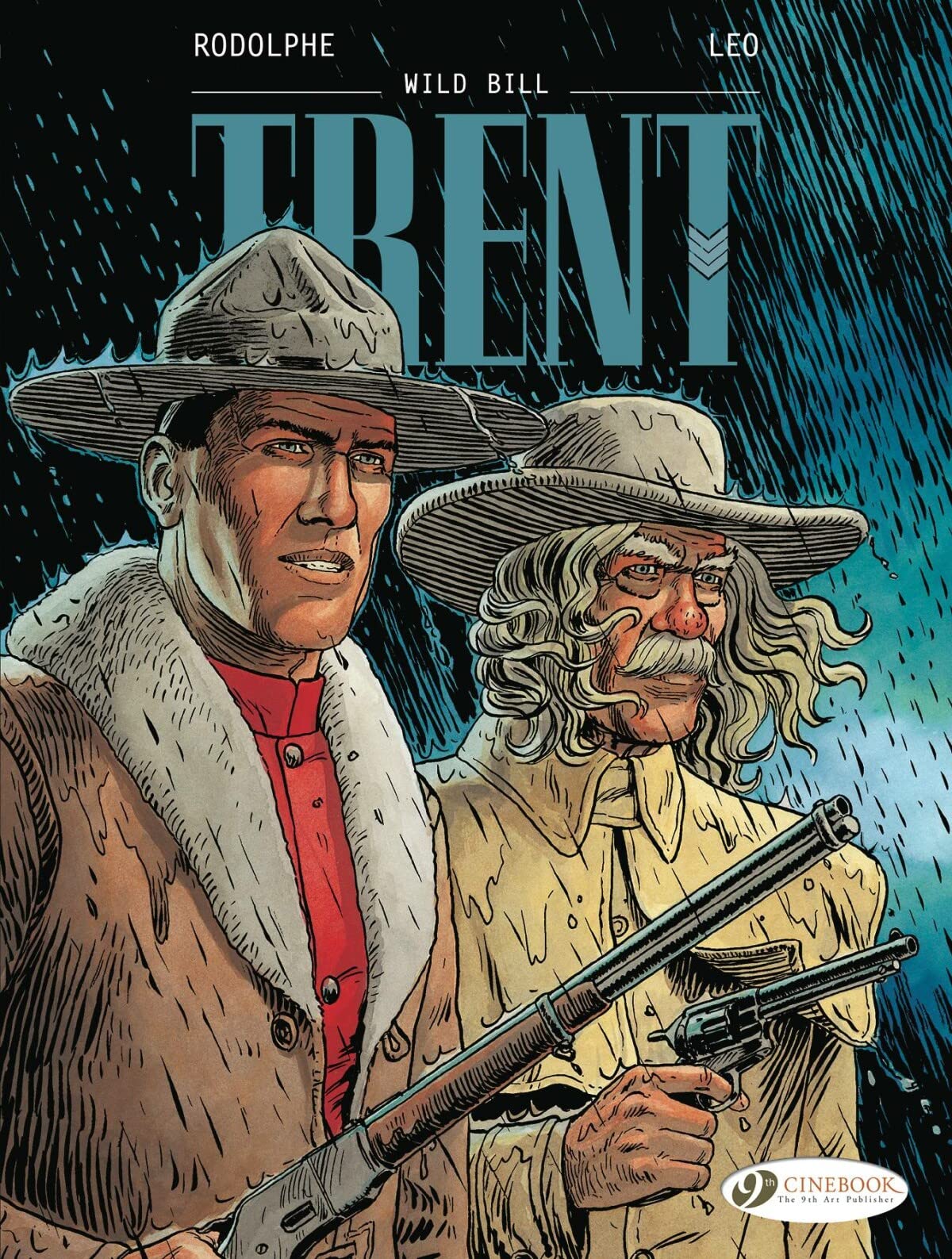
Trent volume 3: When the Lamps are Lit


By Rodolphe & Léo with colour by Marie-Paule Alluard, translated by Jerome Saincantin (Cinebook)
ISBN: 978-1-84918-836-4 (Album PB)

I’m thinking about relationships and romance at the moment, and comics have always explored pair-bonds as a fundamental aspect of any genre they exploit. It’s not always about simple attainment of a dream either. Sometimes, failure and the loss of love is more powerful, rewarding and/or entertaining than “True Love Ways”. The attendant emotion certainly has generated some astoundingly moving fiction…

European comics audiences have long been fascinated with the mythologised American experience, whether it be the Big Sky Wild West or later eras of crime-riddled, gangster-fuelled dramas. They also have a vested historical interest in the northernmost parts of the New World which has resulted in some pretty cool graphic extravaganzas.

Léo is actually Brazilian artist and storymaker Luiz Eduardo de Oliveira Filho: born in Rio de Janeiro on December 13th, 1944. Attaining a degree in mechanical engineering from Puerto Alegre in 1968, he was a government employee for three years, until forced to flee the country because of his political views. While a military dictatorship ran Brazil, he lived in Chile and Argentina before illegally returning to his homeland in 1974. To survive, he worked as a designer/graphic artist in Sao Paulo and created his first comics art for O Bicho magazine.

In 1981 he migrated to Paris, seeking to pursue a career in Bande Dessinée, and found work with Pilote and L’Echo des Savanes as well as more advertising and graphics fare. The big break came when Jean-Claude Forest invited him to draw stories for Okapi which led to regular illustration work for Bayard Presse. In 1988 Léo began his long association with scripter and scenarist Rodolphe D. Jacquette – AKA Rodolphe.

His prolific, celebrated writing partner has been a giant of comics since the 1970s: a Literature graduate who transitioned from teaching and running libraries to creating poetry and writing criticism, novels, biographies, children’s stories and music journalism. In 1975, after meeting Jacques Lob, he expanded his portfolio to write for a vast number of artists and strip illustrators in magazines ranging from Pilote and Circus to À Suivre and Métal Hurlant. Amongst his most successful endeavours are Raffini (with Ferrandez) and L’Autre Monde (Florence Magnin) but his collaborations in all genres and age ranges are too numerous to list here.

In 1991 he began working with Léo on a period adventure series of the far north. Taciturn, introspective and fiercely driven Royal Canadian Mounted Police sergeant Philip Trent premiered in L’Homme Mort, forging a lonely path through the 19th century Dominion over eight tempestuous, hard-bitten albums between then and 2000. He also prompted the collaborators’ later fantasy classics Kenya (and its spin-offs), Centaurus and Porte de Brazenac.

Cast very much in the classic adventure mould perfected by Jack London and John Buchan, Trent is a man of few words, deep thoughts and unyielding principles who gets the job done whilst stifling emotional turmoil boiling deep within him, but is the very embodiment of the phrase “still waters run deep”…

As ‘Quand S’allument Les Lampes’, this third adventure comes from 1993, with the solitary man and his faithful hound “Dog” trudging into and through another snow-wrapped town (stunning rendered as always by Leo) to eventually make camp alone in the frozen woods beyond. His thoughts dwell on the warm loving families therein, and wander back, as they always will, to Agnes.

He had saved her – but not her brother – and was given a clear invitation that he had never acted upon. Now, under the cold stars, he makes a decision. Applying for leave, he travels to Providence with marriage in mind, but on arrival finds a dilapidated, empty house and learns that his Miss St. Yves had reached the same conclusion years ago… and with another man…

Shaken and crushed, he finds a saloon and picks up a whisky glass…

Weeks later, a penniless broken staggering shambles, he plagues the barkeeps of a nameless frontier railtown, pitied and despised by residents as they go about their business and try to avoid the rummy in the gutter.

Howling constantly with desolated loss, Trent’s only human connection is bar girl Mary Lou, but he is blind to her more than Christian interest. Wendley City is all bustle and terror. The railway will bring wealth – and is already reaping dividends – but it’s also drawn out human wolves. Seemingly invisible outlaws dubbed “the Coalmen” have targeted elderly residents for months, cruelly torturing and killing to extract the savings of the weakest townsfolk…

After another night of atrocity, an outraged posse manages to wound a suspect before losing him. The fugitive hides under the stoop drunken sot Trent is slumped on, and in gratitude offers the despised reprobate a job if he has the stomach for bad business and can sober up…

The final act contains a brutal denouement and reveals a cunning and extended undercover scheme to catch the Coalmen, but one that turned on the implacable Mountie’s honest despair and deadly near all-consuming brush with loss and loneliness…

Mission accomplished, the quiet man returns to duty and the wastelands he patrols to preserve the safety of the families he cannot find a way to join…

Another beguiling and introspective voyage of internal discovery, where environment and locales are as much lead characters as hero and foe, When the Lamps are Lit offers suspense, action, drama and poignant evocation in a compelling confection that will appeal to any fan of widescreen cinematic crime fiction or epic western drama.
Original edition © Dargaud Editeur Paris 1993 by Rodolphe & Léo. All rights reserved. English translation © 2017 Cinebook Ltd.

The Fall of Homunculus


By Pentti Otsamo (Drawn & Quarterly)
ISBN: 978-1896597157 (PB)

Joel and Anna are a young couple just getting by. They both have great artistic aspirations, but when Anna falls pregnant their previously harmonious partnership begins to unravel. Does Joel’s confusion and reluctance mean that they are not as compatible as he’d believed? Does Anna’s willingness to put her career on hold show her lack of dedication to her art?

Unless they truly communicate, how can they learn what each truly wants and needs?

This pensive Graphic Novella is a brief yet telling examination of the creative urge and process that makes some telling points about competing human drives, and the nature of creativity.

Such a gentle tragedy makes no great leaps forward or claims to innovation, but this tale is honest and engaging, and the inviting and expressive black and white artwork is subversively addictive.

Regrettably out of print and currently unavailable in digital editions, this a beguiling and rewarding yarn long overdue for a comeback and creative reassessment. Get it if you can.
© 1998 Pentti Otsamo. All Rights Reserved.

A Sea of Love


By Wilfrid Lupano & Grégory Panaccione (Lion Forge/The Magnetic Collection)
ISBN: 978-1-942367-45-1 (HB)

Win’s Christmas Gift Recommendation: Because Words Just Aren’t Enough… 10/10

The sheer breadth, variety and creative ambition of comics holds me breathless sometimes. It feels like there’s no subject or blend thereof; no tone or trope; no limits and absolutely no style or admixture that talented individuals can’t turn into heartrending, hilarious, thrilling, educational, evocative, uplifting and/or infuriating stories.

This completely silent saga from prolific French writer Wilfrid Lupano (Old Geezers; Azimut; Blanc Autour; Le Loup; Valerian spin-off Shingouzlooz Inc. and many more) and illustrator Grégory Panaccione (Someone to Talk To; Toby Mon Ami; Match; Âme perdue) somehow offers all of those in one delicious hardback or digital package.

Originally seen au continent as Un Océan d’amour in 2014, this wordless yet universally comprehensible pantomime is an unforgettable saga celebrating the timeless resilience of mature love. Here it is craftily concealed but constantly displayed in a tale of tetchy devotion between an aged diminutive fisherman and his quiet, timid, overly-flappable but formidably indomitable wife.

Every morning before the sun lights their rustic hovel, she makes him a wonderful breakfast before he heads out into the big ocean in his little boat. They have their fractious moments and he can be a trial sometimes, but their relationship is rock solid and never-ending.

This particular morning, however, the old coot finally falls foul of a changing world, when his little vessel is snagged in the nets of a vast trawler factory ship. Saving his idiot apprentice, the old git is soon swallowed up and gone…

At least, that’s what the sole survivor believes when he washes up ashore. However, the matronly fresh widow refuses to accept that and – disregarding decades of homey domestic programming – goes looking for him.

Oh, the incredible adventures she has and the people she meets…

He, meanwhile, is still very much alive. Stranded on his little tub, with nothing but tinned sardines and memories to sustain him, he is washed uncontrollably across the world. Befriended by a sardine-loving gull, he experiences first hand and close up the way we’ve befouled the seas and meets a wide variety of people he’s casually misjudged all his life, before eventually fighting his way back to his little cottage and the faithful one who’s waiting for him. At least, he complacently assumed she is…

Epic, hilarious, terrifying, shocking and sublimely satisfying, this is masterpiece of graphic narrative with so very much to say. Why not give your eyes a treat and have a good listen?
A Sea of Love © 2018 Editions Delcourt. All rights reserved.

Necromantic


By Lovern Kindzierski, David Ross, Geof Isherwood, Chris Chuckry & Taylor Esposito (Renegade Arts Entertainment)
ISBN: 978-1-98890-369-9 (TPB) eISBN: 978-1-98890-373-6

Real and fictionalised espionage tales are equally gripping when done well, and modern drama demands a healthy dose of genre cross-fertilisation. A perfect example catering to modern tastes is this opening salvo from Lovern Kindzierski (author of the Shame trilogies, Underworld, VMT and colourist of most of your favourite US superhero comics) and veteran illustrators David Ross (Star Wars; X-Men; Alpha Flight; Rai) and Geof Isherwood (Suicide Squad; Conan the Barbarian; Silver Surfer; Doctor Strange). In case you’re wondering, the crucial backroom boys here are Chris Chuckry on colours, and Taylor Esposito delivering calligraphic sound, captions and dialogue…

This rowdy, raunchy introductory action-fest reveals a critical turning point in the life of top-gun US Special Forces operative Jesse Harris whose latest successful mission in North Africa is forever blighted in ‘Love’s Labour’s Lost’ after she learns that her beloved Blake Williams has been killed in action.

Harris goes to pieces in ‘Much Ado About Nothing’: not simply from grief and anger, but also because she still sees him. It’s the kind of situation she has secretly endured and ignored since childhood, when she first discovered a facility for seeing and talking to people no one else can see…

Dragged out of shattering despondency by fellow ISA agent Rich Boon, she takes a “soft” mission in Afghanistan, only to find herself dragged to the edge of hell and a bittersweet reunion with Blake. In the course of her duties, she realises the local governor/warlord is a mortal agent of infernal demons pressganging recently deceased human souls into a legion intended to oust the devil, and install a new lord of the Damned. To aid the recruitment program, still-breathing Prince Minyar has bolstered his brutal living forces with rampaging zombies and ruthless killer ghosts only Jesse can perceive…

Facing modern arms and ancient devils revelling in another chance to spill blood, her team are swept away in ‘A Midsummer Night’s Dream’, but Harris gains valuable intel from the King’s vizier – an enslaved spirit determined to end the horrific recruitment program – and eventually a blessed ally when Blake escapes the Pit to render assistance and battle beside her to deliver earth and the afterlife from ‘The Tempest’…

Savage, fast-paced and strictly for adult eyes only, Necromantic is a blockbuster thrill-ride for the action-movie generation and a manic joy for those who still crave their cathartic release in print of digital comics form.
© Lovern Kindzierski and Renegade Arts Canmore Ltd. 2020

The Clockwork Girl


By Sean O’Reilly & Kevin Hanna, illustrated by Mike Thomas, Grant Bond, Karen Krinbrink, Mirana Reveier & others (Arcana Studio)
ISBN: 978-0-9809204-1-3 (TPB Arcana) 978-0-06208-039-4 (HB Harper Design) 978-0062091291 (PB film edition)

The literary concept of autonomous automatons has been with us a long time now: my first exposure was wind-up warrior Tik-Tok from L. Frank Baum’s Ozma of Oz in 1907 (that’s when the book was published, not when my parents read it to me), but even he wasn’t the first. You could try tracking down 1868’s “Huge Hunter” AKA The Steam Man of the Prairies (by Edward S. Ellis) or dip into mythology for Talos, the bronze construct who defended Europa in ancient Crete to see how wedded we are to the notion of constructed comrades and champions.

“Mechanical Men” are one of those rare confabulations that existed in people’s heads long before we actually discovered, built or confirmed them – just like teleportation, the Higgs Boson or equal pay for women. It’s a rare person who doesn’t have some inner conception of what a robot should be…

As such a chimeric concept, hand-made beings fit almost anywhere in storytelling, as seen here in this modern fairy tale, crafted with the intention of becoming a film classic for kids of all ages. The 5-issue miniseries came out in 2008 and was collected as a graphic novel the same year, with the movie finally released in 2014…

In the fantastic city of Harfang, a metropolis both ancient and futuristic, wise men and savants, enquiring minds and inventors enjoy lives of wondrous creativity and hold regular contests to determine who is the most brilliant and inspired among them. Here Dendrus the Grafter specialises in resurrections, radical surgery and biological blending whilst his old friend and greatest rival Wilhelm the Tinkerer has devoted his life to mastering physics, engineering and all mechanical disciplines…

One night, just before the Haraway Fair that would determine this year’s greatest intellectual achievement, the Tinkerer finally succeeds in creating true life from cold metal, cogs and springs. Unlike his soulless, lumbering previous attempt T-Bolt, this latest effort is a sublime creature of wonder and delight who will show the world what genius is…

Dendrus, meanwhile, is having problems with a previous triumph. Last year Huxley was a sensation: a masterpiece of biological cross-pollination and reconstructive surgery, but lately the lad has been living up to his daunting appearance and – undeserved – reputation, increasingly becoming an unruly handful and headache for his “father”…

Leaving the “monster boy” to check out the usual parade of insane experiments on display (by the usual scientific suspects), Dendrus is there when the Tinkerer unveils his metal marvel: a beautiful, beguiling Clockwork Girl who is truly alive. He proudly awards Wilhelm first prize, but is too distracted by the chaos of the Botanist’s exhibit escaping to notice the effect the gleaming gamin has on awestruck Huxley…

Utterly enraptured, the beast boy can talk of nothing else to best pal Maddox, and soon they are trailing the victor’s carriage back to the Tinkerer’s castle and risking their lives to get in and meet her. Persistence overcomes all odds and soon they are in her tower chamber, chatting with the charming innocent. Huxley is astonished to discover she has no name. At his insistence she christens herself, plucking the name “Tesla” out of thin air and her imagination…

Before they leave, Huxley agrees to meet with her again tomorrow, and show her the world her neglectful, fame-besotted father has brought her into…

Meanwhile, Wilhelm broods, remembering the fiasco of T-Bolt’s debut at last year’s fair; how Dendrus betrayed him and his abominable monster-boy denied him of his glorious due – a rather one-sided and inaccurate summation of what actually happened…

Next day, in the wilds around the castle, Huxley is amazed at Tesla’s joyous response to each new observation and experience, but wonder turns to terror as a sudden rain shower sparks pain and terror in the mechanical maid. Saving her day-old life through prompt action, he shares his unique origins with her as they shelter whilst she – literally – opens her heart to him, inadvertently proving how alike they truly are…

It’s an innocent moment presaging heartbreak, as when the kids return to their respective homes, their perpetually meddling parents forbid any further contact. It’s a recipe for disaster…

Unable to stay apart, the kids disobey and in the melee that follows, Maddox is grievously injured and Huxley driven off, with Tesla rushing out into the deadly rain to somehow make things right.

As Dendrus and Wilhelm recover their wits and finally reconcile, it may be too late to save the children that have brought them back together. Thankfully, science and cooperation will provide the solution…

An enchanting pastiche of Romeo and Juliet, The Clockwork Girl blends whimsy, humour and the drama of first love in a charming romp with a happy ending, and comes with a bonus section that includes ‘Origins’ of the project, ‘Story Concepts’ and sketches by Sean O’Reilly & Kevin Hanna, plus Pin-Ups from illustrators and guest artists Sean “Cheeks” Galloway, Mirana Reveier, Jose Lopez & Aron Lusen, Barnaby Ward, Paul Adam, Vincent Perea, Hanna, Javier Giangiacomo, Royden Lepp and Bengal.

A wonderful confection proving the power of diversity and confirming the rewards of inclusion, this is a timeless treat long overdue for a revisit and some serious acclaim.
© 2008 Arcana Studio, Inc. All rights reserved.

You Brought Me the Ocean


By Alex Sanchez, Julie Maroh & various (DC Comics)
ISBN: 978-1-4012-9081-8 (TPB)

In recent years DC has opened up its shared superhero universe to generate Original Graphic Novels featuring its stars in stand-alone(ish) adventures for the demographic clumsily dubbed Young Adult. To date, results have been rather hit or miss, but when they’re good they are very good indeed…

An ideal example is You Brought Me the Ocean, which reinterprets the origin of modern day Aqualad, concentrating on the comic book character’s Gay credentials rather than his costumed career.

Crafted by Alex Sanchez (Rainbow Boys; So Hard to Say; The God Box; The Greatest Superpower) and Julie Maroh (Blue is the Warmest Color; Body Music) and available in paperback and eBook editions, this dreamily-rendered, salty sea tale details the graduating year of High School student Jake Hyde who lives in the driest part of New Mexico but dreams of deep-sea kingdoms and fantastic marine adventure.

His mother is a constant worrier: always telling him to eat properly, dress appropriately and stay hydrated. Ironically though, ever since his all-but-forgotten dad drowned years ago, she has never let him near large bodies of water… or even allowed him to swim…

Always a loner, Jake’s absolute best friend in the one-horse town of Truth or Consequences (formerly Hot Springs, NM) is Maria Mendez. She has already mapped out their future together and has no idea he yearns for the nautical life and has already applied to University of Miami to study Oceanography…

The Mendez’s are neighbours and a second family, and far more amenable to Jake’s aspirations of leaving New Mexico, whilst his own mother shuts down every attempt to discuss the issue. She’s far more concerned with why Jake and Maria haven’t started dating yet. Sadly, Jake has never – ever – thought of her that way and has resigned himself to going it alone if he wants to realise his ambitions…

One day, things change dramatically as Jake suddenly notices class rebel Kenny Liu. He’s known the strange, outspoken outsider since Middle School, but has stayed well away – painfully aware of the target the outsider’s actions made him. Now though, the bully-defying, openly-Gay swim team star-athlete seems irresistibly fascinating…

And apparently, the interest is mutual…

Life changes forever when Jake agrees to accompany Kenny on a hike into the desert. The far more mature misfit has plenty of solid advice – on Maria, leaving town and life choices – but all that is forgotten when a sudden flash-flood interrupts their first kiss and activates tattoo-like birthmarks all over Jake’s body. Suddenly, he starts to glow and project water-manipulating energies…

With Jake’s world suddenly shaken to flotsam and jetsam, shock follows shock and calamity arrives in its wake. Jake’s attempts to explore his sexuality bring heartbreak and chaos, but even that’s dwarfed when he comes out to his mom and learns the truth about his father and how he is connected to both superhero Aquaman and one of the most dangerous villains on Earth…

Moreover, in the throes of these astounding revelations and an irresistible attraction, it’s too easy to forget that not only metahuman maniacs respond with bigotry and mindless violence to what they deem “unnatural”…

A truly magical treatment exploring the processes of coming out and finding yourself, deftly cloaked in the shiny trappings of costumed heroics, the search for belonging and teen feelings of alienation, You Brought Me the Ocean is an intriguing tale to warm the heart and comes with a contact page detailing Resources available to those affected by the issues herein; personal messages from Sanchez and Maroh and an extensive section of designs and drawings from the illustrator’s Sketchbook.
© 2020 DC Comics. All Rights Reserved.