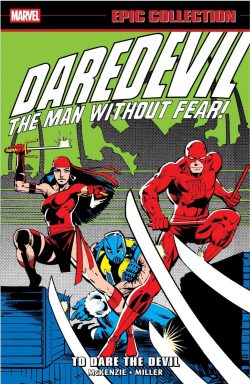
Daredevil Epic Collection volume 8: To Dare the Devil (1978-1981)


By Roger McKenzie, Frank Miller, David Micheline, Jo Duffy, Michael Fleischer, Mike W. Barr, Frank Robbins, Gene Colan, Steve Ditko, Klaus Janson, Frank Springer, Josef Rubinstein & various (MARVEL)
ISBN: 978-1-3029-60537 (TPB/Digital edition)

This book contains Discriminatory Content included for dramatic effect.

Matt Murdock is a blind lawyer whose remaining senses hyper-compensate, making him an astonishing acrobat, formidable fighter and living lie-detector. He also developed a kind of biological radar, granting him complete awareness of his immediate environment. A second-string hero for much of his early career, Daredevil was nonetheless a striking and popular one, due mostly to the captivatingly humanistic art of Gene Colan. DD fought gangsters, super-villains and even the occasional monster or alien invasion, quipping his way through life and life-threatening combat, utterly unlike the grim, moody, quasi-religious metaphor of justice and retribution that he became.

Under the auspices of Jim Shooter, Roger McKenzie and finally Frank Miller & Klaus Janson, the character transformed into a grimly modern figure, but here we find him navigating choppy relationship waters. After a disastrous on-again, off-again relationship with his secretary Karen Page, Murdock took up with Russian émigré Natasha Romanoff, infamous and notorious former soviet spy Black Widow, but their similarities and incompatibilities led to her leaving and Matt taking up with flighty, fun-loving trouble-magnet heiress Heather Glenn

Spanning cover-dates November 1978 to October 1981, this crucial compilation comprises relevant material from Daredevil #155-176, plus spin-off material generated for a readership that simply could not get enough of their newly darkened avenging devil and his secret paramour, as first seen in What If? #28 & Bizarre Adventures #28. The visual tumult and tension begin sans any delay or debate…
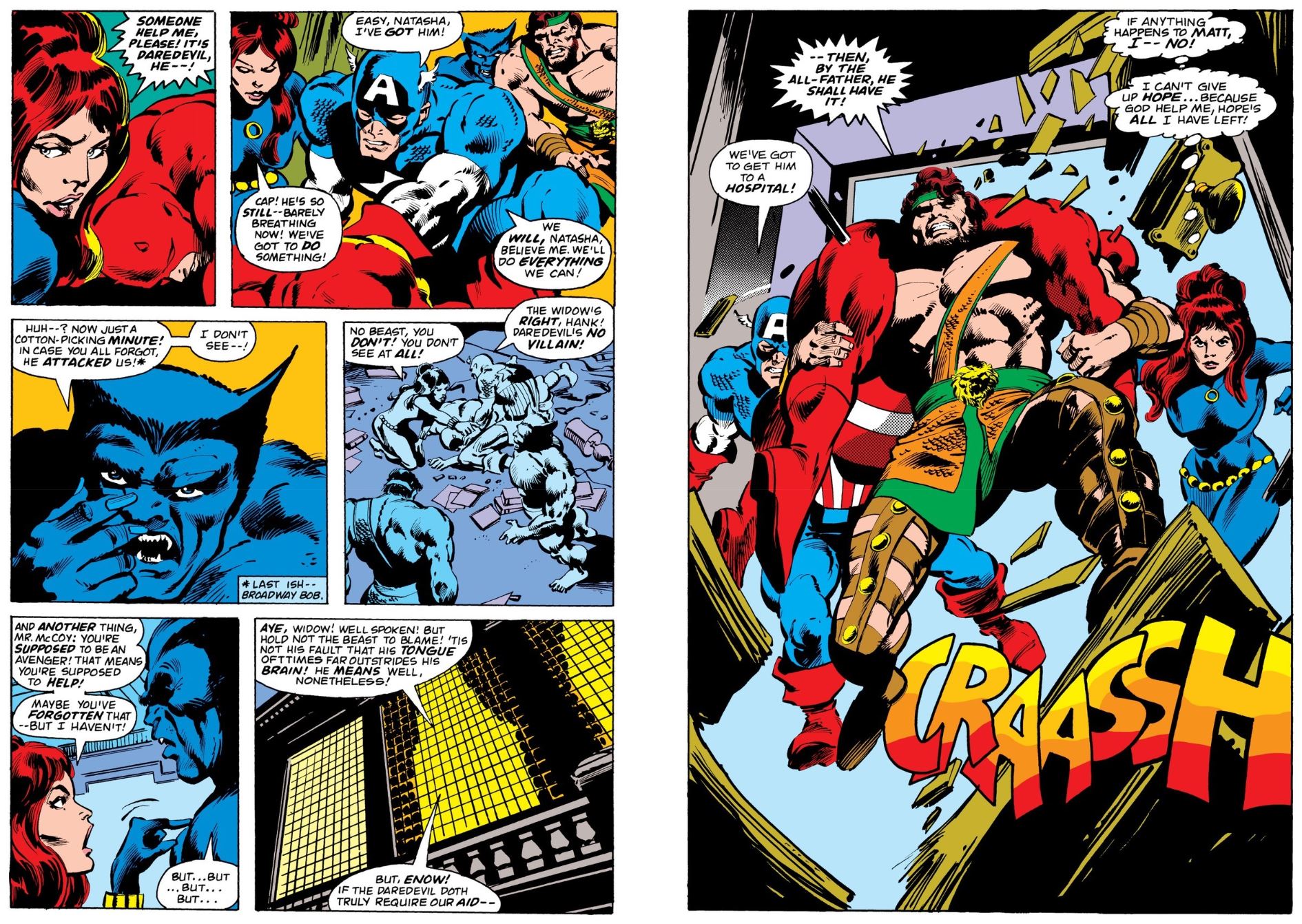
Heroic endeavours resume with writer Roger McKenzie describing the repercussions of a massive ambush on the hero by his worst enemies. Guest-starring Black Widow, Hercules and The Avengers, aftermath episode ‘The Man Without Fear?’ is illustrated by Frank Robbins & Frank Springer, wherein a brain-damaged Murdock repeatedly attacks innocent bystanders and his allies before collapsing. Keenly observing, macabre mystery menace Death-Stalker spots an opportunity and follows the hospitalised hero into #156’s ‘Ring of Death!’ (McKenzie, Colan & Klaus Janson). As DD undergoes surgery and suffers deadly delusions of fighting himself, the teleporting terror with a death-touch seeks to end the scarlet swashbuckler’s meddling forever, but finds the Avengers almost too much to handle…

The assault ends in DD #157’s ‘The Ungrateful Dead’, with Mary Jo Duffy scripting from McKenzie’s plot. Now, after frustrating the vanishing villain, Matt is cruelly kidnapped by a new squad of the Ani-Men (Ape-Man, Cat-Man & Bird-Man) all leading to Miller’s debut as penciller in #158’s ‘A Grave Mistake!’ With McKenzie writing and Janson inking, all plot threads regarding Death-Stalker spectacularly conclude as the monster gloatingly shares his true origins and reasons for haunting the Sightless Swashbuckler for so long. As always, Villain underestimates Hero and the stunning final fight in a graveyard became one of the most iconic duels in superhero history…

From this point on, Daredevil was increasingly repositioned as an outcast urban defender and compulsive vengeance-taker: a tortured demon dipped in blood. The character makeover was carried on initially by McKenzie from his predecessor Jim Shooter, and fully manifested in collaboration with Miller until the latter fully took control to deliver audacious, shocking, groundbreakingly compelling dark delights, making Daredevil one of comics’ most momentous, unmissable, “must-read” series.

That revitalisation resumes with ‘Marked for Murder!’ (McKenzie, Miller & Janson) wherein infallible assassin-broker Eric Slaughter comes out of retirement for a very special hit on the hero of Hell’s Kitchen. Meanwhile elsewhere, veteran Daily Bugle reporter Ben Urich works a nagging hunch: slowly piecing together dusty news snippets that indicate a certain sight-impaired attorney might be far more than he seems……

The spectacular showdown between the Crimson Crimebuster and Slaughter’s hit-man army inevitably compels his covert client to eventually do his own dirty work: brutally ambushing and abducting former flame Natasha Romanoff, aka The Black Widow…

After a single-page fact-feature on ‘Daredevil’s Billy Club!’, the saga continues in #160 with our hero having no choice but to place himself ‘In the Hands of Bullseye!’ – a stratagem culminating in a devastating duel and shocking defeat for the villain in cataclysmic conclusion ‘To Dare the Devil!’

Next issue offered a fill-in tale by Michael Fleisher & Steve Ditko wherein another radiation accident impairs our hero’s abilities and induces amnesia just as a figure from his father’s pugilistic past resurfaces. Becoming a boxer for crooked promoter Mr. Hyle, Murdock unknowingly relives his murdered dad’s last days in ‘Requiem for a Pug!’… until his own memories return and justice is served…

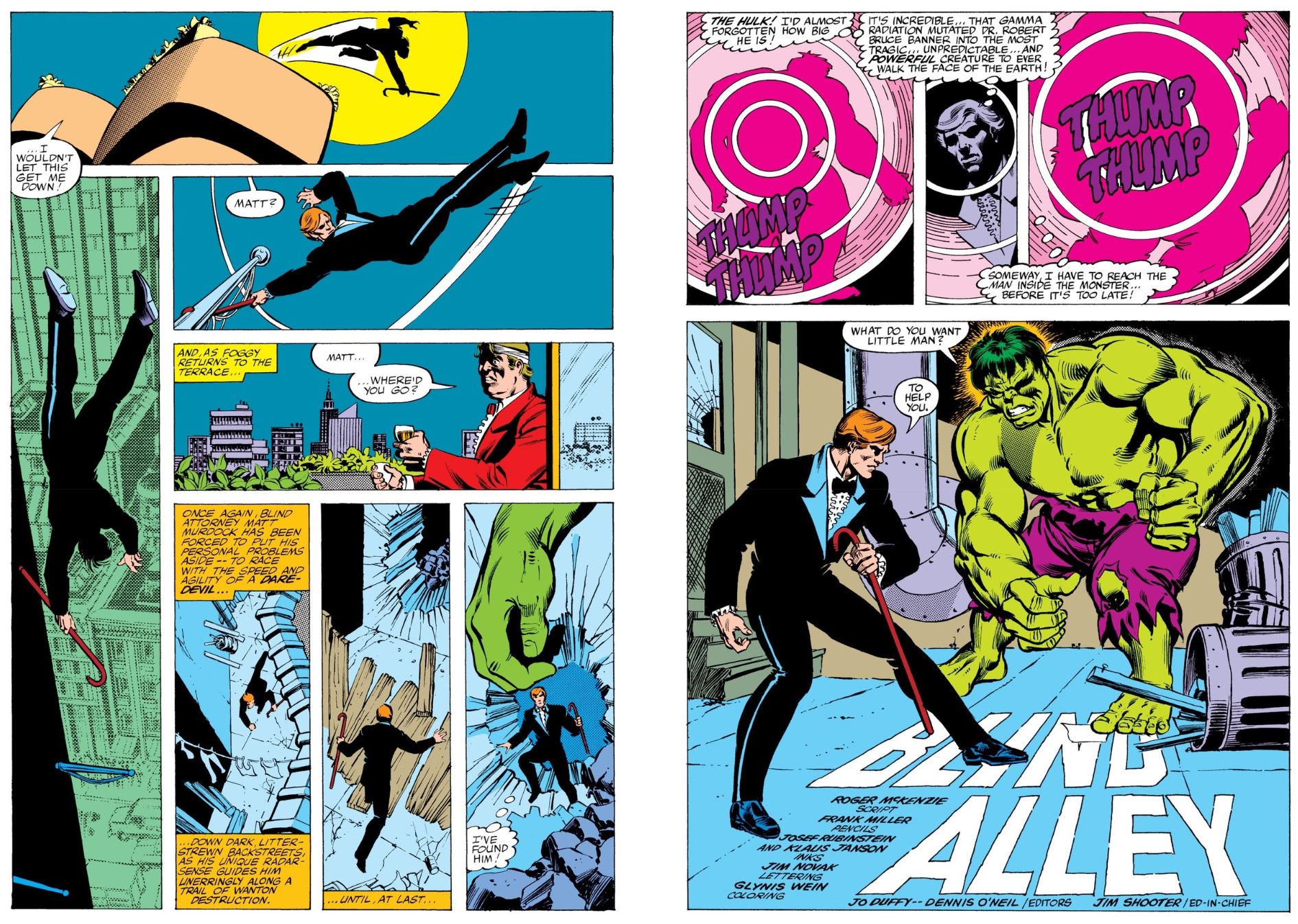
Stunning David & Goliath action belatedly comes in #163 as the merely mortal Man Without Fear battles The Incredible Hulk in ‘Blind Alley’ (McKenzie & Miller, inked by Josef Rubenstein & Janson) wherein Murdock’s innate compassion for hounded Bruce Banner inadvertently endangers Manhattan and triggers a desperate, bone-breaking, but ultimately doomed attempt to save his beloved city…
In #164 McKenzie, Miller & Janson deliver an evocative ‘Exposé’, retelling the origin saga as meticulous, dogged Urich confronts the hospitalised hero with inescapable conclusions from his diligent research and a turning point is reached…

The landmark tale is followed by accompanied by Miller’s unused cover for Ditko’s fill-in yarn, and precedes a mean-&-moody modern makeover for a moribund and over-exposed Spider-Man villain. DD #165 finds the Scarlet Swashbuckler in the ‘Arms of the Octopus’ when Murdock’s millionaire girlfriend Heather is kidnapped by Dr. Otto Octavius. Her company can – and do – rebuild his mechanical tentacles with Adamantium, but “Doc Ock” stupidly underestimates both his hostage and the seemingly powerless Man Without Fear…

A long-running plot thread of Matt’s best pal Foggy Nelson’s oft-delayed wedding finally culminates with some much-needed comedy in #166’s ‘Till Death Do Us Part!’, with true tragedy coming along too as old enemy Gladiator has a breakdown and kidnaps his parole officer. With visions of Roman arenas driving him, tormented killer Melvin Potter only needs to see Daredevil to go completely over the top…

David Michelinie wrote #167 for Miller & Janson, with a cruelly wronged employee of tech company the Cord Conglomerate stealing super-armour to become ‘…The Mauler!’ and exact personal justice. Constantly drawn into the conflict, DD finds his sense of justice and respect for the law at odds when another avoidable tragedy results…

The tale is backed up by an info feature revealing the ‘Dark Secrets’ of DD’s everyday life before segueing neatly into the story that changed everything.

With Daredevil #168 Miller took over the writing and with Janson’s art contributions increasing in each issue, rewired the history of Matt Murdock to open an era of noir-tinged, pulp-fuelled, Eisner-inspired innovation. It begins when Daredevil encounters a new bounty hunter in town which prompts recall of lost college-days first love. Back then, diplomat’s daughter Elektra Natchios shared his secrets – until her father was kidnapped and murdered before her eyes, partly due to Matt’s hasty actions. She left him and vanished, apparently becoming a ninja assassin, but is now tearing up the town hunting Eric Slaughter. Matt cannot help but get involved…

When Daredevil last defeated Bullseye, the psycho-killer was diagnosed with a brain tumour, and in #169 escapes from hospital to enact another murder spree. He is deep in a delusional state where everyone he sees are horn-headed scarlet-draped ‘Devils’. A frenetic chase and brutal battle results in countless civilian casualties and great anxiety as Daredevil has a chance to let the manic die… but doesn’t.

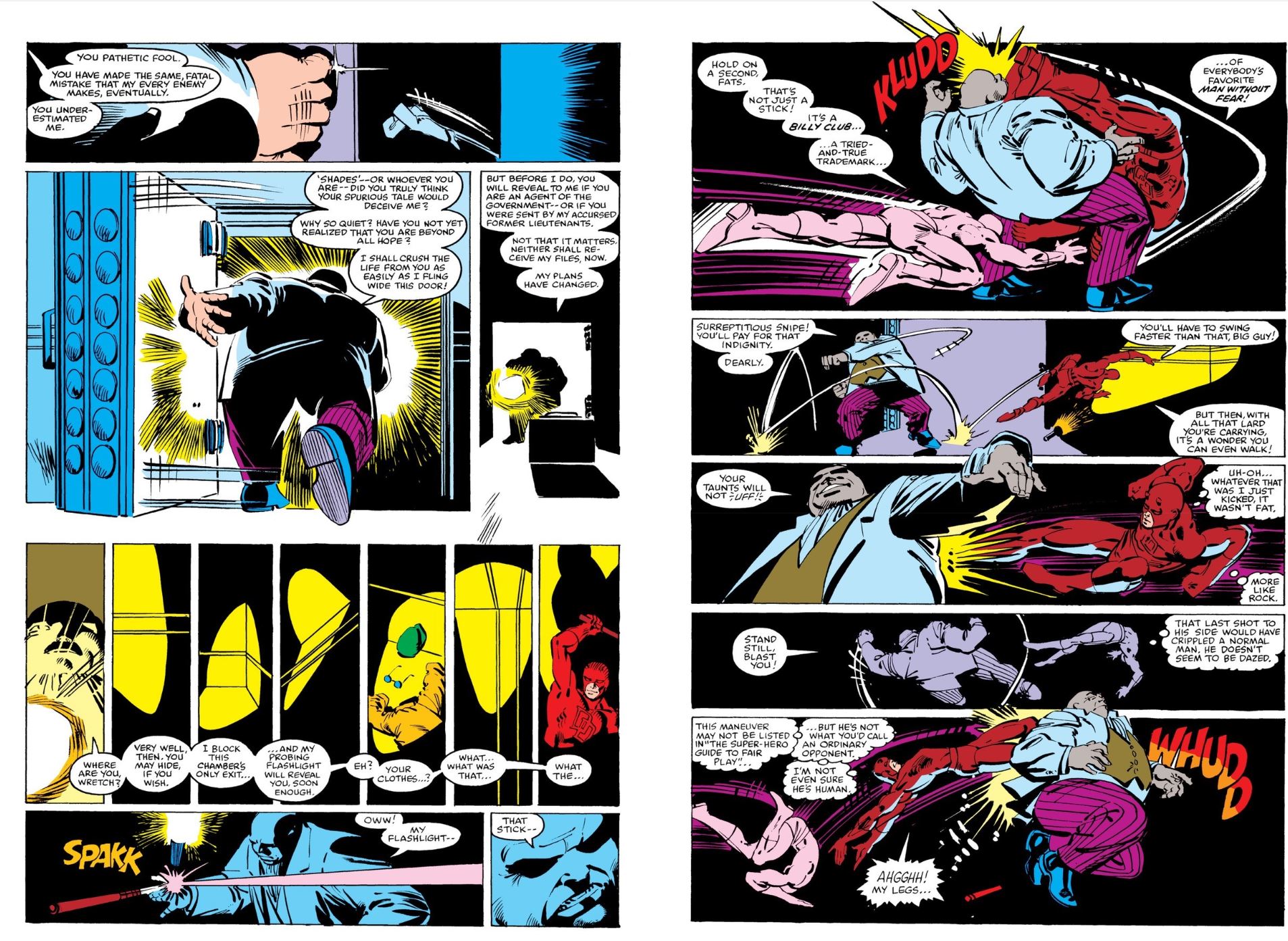
Yet another landmark resurrection of a tired villain begins in DD #170 as Miller & Janson decree ‘The Kingpin Must Die’. The former crimelord of New York had faded into serene retirement in Japan by impassioned request of his wife Vanessa, until this triptych of terror sees him return, more powerful and resourceful than ever. It all begins when the Devil of Hell’s Kitchen hears rumours the syndicate that replaced Wilson Fisk are trying to kill their old boss. Apparently, he has offered all his old records to the Feds…

When Vanessa hires Nelson & Murdock to broker the deal, all hell breaks loose, assassins attack and Mrs Fisk goes missing. Further complicating matters, having survived brain surgery, Bullseye now offers his services to the syndicate, mercenary killer Elektra senses a big business opportunity and a murderously resolute Kingpin sneaks back into the country resolved to save his Vanessa at any cost…
The title at last returned to monthly schedule with #171 as the city erupted into sporadic violence with civilians caught in the crossfire. DD dons a disguise and goes undercover but is soon ‘In the Kingpin’s Clutches’, and seemingly sent to a watery grave prior to Fisk gambling and losing everything.

The saga ends in all-out ‘Gangwar!’ as, with Vanessa lost and presumed dead, Wilson Fisk destroys the in situ Syndicate and takes back control of New York’s underworld. At least Daredevil scores a small-yet-toxic victory by apprehending the Kingpin’s assassin, all the while aware that every death since Bullseye’s operation has been because Murdock was not strong enough to let the monster die…

… And deep in the bowels of the city, an amnesiac woman wanders, a future trigger for much death and destruction to come…

With the city increasingly awash in mobsters, monsters, assassins and deviants, Daredevil 173 returns to the difficult, painful redemption of mentally-ill former foe The Gladiator. Having suffered an emotional crisis Melvin Potter prays his violent old life is over, but when a woman is brutalised in the streets, she identifies the anxious supervillain as her attacker. Murdock begins a stout defence of the ‘Lady Killer’, but despite his truth-sensing abilities, even his confidence takes a battering when his own assistant Becky Blake reveals Potter is the man who put her in a wheelchair years previously. Shocked and betrayed on all sides, Matt lets DD take charge and exposes a world of horror and abuse while tracking down a cunning, opportunistic human beast who tortures women just for kicks…

Elektra co-stars in #174 as her former master The Jonin demands ‘The Assassination of Matt Murdock’, introducing resurrecting zombie ninja cult The Hand just when the Potter trial is going badly and faithful partner Foggy Nelson has abandoned him. The cult’s expansion into America is lethally and effectively countered by Elektra, but when Daredevil joins the fight he is wounded and loses his greatest supersense, leaving him to depend on her and Melvin reluctantly returned to his Gladiator persona…

Now targeted by immortal super ninja Kirigi, Elektra goes after Jonin in ‘Gantlet’ and leaves DD to his own devices prior to ‘Hunters’, showing severely impaired Matt hunting for the old guy who first taught him to use his super senses. He rattles his old foes and street sources so badly that even Z-grade thugs Turk and Grotto are scared enough to steal a super-armour suit and settle with the Scarlet Swashbuckler for good…

To Be Continued…

Here, however, the events sparked a number of ancillary delights represented here by What If? #28’s ‘Matt Murdock, Agent of S.H.I.E.L.D.’ (by Mike W. Barr, Miller & Janson, and cover-dated August 1981), seeing what might have been had Anthony Stark and Nick Fury been nearby when young Matt was hit by that senses-altering radioactive cannister. That’s followed by spectacular monochrome prequel ‘Elektra’, crafted by Miller for Bizarre Adventures #28 (October 1981) with the hired killer going off-book after she finds out an unsavoury truth about her client.
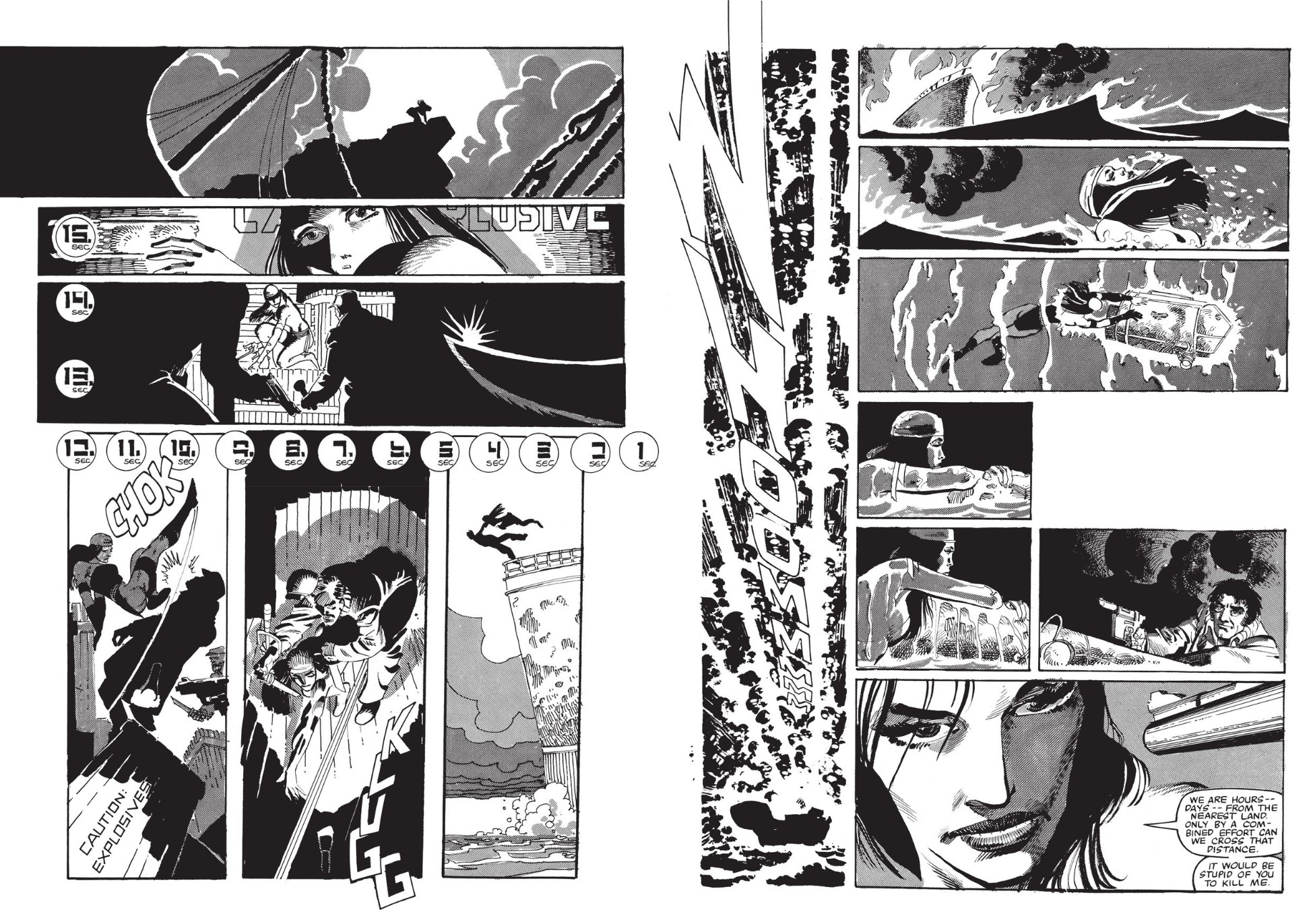
Supplementing throughout with the covers by Colan, Springer, Janson, Rubinstein, Al Milgrom, Miller, Ditko, Bob McLeod, George Roussos and Bob Larkin, this roster depicting the resurgent rise in comics form is further bedecked and bedazzled with contemporary house ads; the Marvel Bullpen Bulletins page heralding Miller’s debut; original art and Miller’s full Daredevil character bible, written in 1980 as he prepared to take over the writing. Also on view are Miller & Janson’s pages from Marvel Comics 20th Anniversary Calendar 1981 (June) and their Spider-Man vs DD plate from Marvel Team-Up Portfolio One. Those are supplemented by Miller covers & frontispieces for Daredevil Visionaries: Frank Miller volume 1 & 2 (with Steve Buccellato) before closing with M&J’s iconic Amazing Heroes #4 cover from September 1981.

As the decade closed, these gritty tales set the scene for truly mature forthcoming dramas, promising the true potential of Daredevil was finally in reach. Their narrative energy and exuberant excitement are dashing delights no action fan will care to miss.

… And the next volume heads full on into darker shadows, the grimmest of territory and the breaking of many more boundaries…
© MARVEL 2025.

In 1958 horror artist John Totleben was born, as was Italy’s Antonio Serra (Nathan Never) in 1963, Tim Bradstreet in 1967 and Warren Ellis one year later.

We lost letterer/colourist/comics artist/animator Frank Engli in 1977 but we can still enjoy Popeye, Betty Boop, Terry and the Pirates, Male Call, Steve Canyon, Scorchy Smith and his own creations On the Wing and Rocky the Stone Age Kid. Don’t you want to go look him up now?

In 1963 UK standby Knockout finally lay down after 24 years and in1980 Nutty launched with the debut of Bananaman. And in 2017 dutchman designer Dick Bruna died, having introduced us all to his bunny star Miffy way back in 1955.
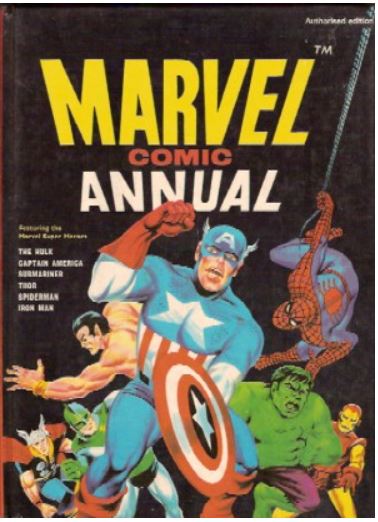
Marvel Comic Annual 1969


By Stan Lee, Larry Lieber, Jack Kirby, Steve Ditko, John Romita, Bill Everett, Don Heck, Chic Stone, Dick Ayers, Mick Anglo Studios & various (World Distributors, Ltd.)
No ISBN ASIN: B001G8UJME

This book includes Discriminatory Content produced in less enlightened times.

When Stan Lee rejuvenated the US comic-book industry in the early 1960s, his biggest advantage wasn’t the small but superb talent pool available, but rather a canny sense of marketing and promotion. DC, Dell/Gold Key and Charlton all had limited overseas licenses (usually in dedicated black-and-white anthologies like the much beloved Alan Class Comics such as Suspense) but Lee – or his business managers – went further, sanctioning Marvel’s revolutionary early efforts in regular British weeklies like Pow!, Wham!, Smash! and even the venerable Eagle. There were two wholly Marvel-ised papers, Fantastic! & Terrific! which ran from 1967 to 1968. These featured a plethora of key Marvel properties, and, appearing every seven days, soon exhausted the back catalogue of the company.

After years being a guest in other publications Marvel finally secured their own UK Annuals through World Distributors’ publishing arm and packaged courtesy of jobbing comics content outfit Mick Anglo Studios. This sparkling collection is one of the very best. Completely absent are the text pieces, quizzes and game pages that filled out British Christmas books, replaced with cover-to-cover superhero action mimicking the emergent House of Ideas at the very peak of their creative powers. It even includes a few almost Golden Age classics. Moreover it’s in full colour throughout – almost unheard of at the time.

A closer look by Marvel scholars would ascertain that all of the strips published here were actually taken from the wonderful 25¢ giants (Marvel Tales, Marvel Collector’s Item Classics and Marvel Superheroes) released during the preceding year, perfectly portioned out to fit into a book intended for a primarily new and young audience.

Behind the delightful painted cover the enchantment commences with a John Romita drawn Captain America tale from 1954, as the Sentinel of Liberty & Bucky lay waste to a scurvy gang of Red Chinese dope smugglers in ‘Cargo of Death’, followed by a spectacular Thor saga from Lee, Jack Kirby & Chic Stone as the Thunder God tackled ‘The Cobra and Mr. Hyde’, complete with cameo from the mighty Avengers.

The first of two Hulk shorts comes next, another Commie-busting classic with sci-fi overtones. Lee, Kirby & Dick Ayers’s ‘The Gladiator from Outer Space’ is a terrific all-action mini-blockbuster, perfectly complimented by Lee & Steve Ditko’s sinister crime shocker wherein Spider-Man is trapped between ‘The Goblin and the Gangsters!’

Unsung genius Bill Everett provided a brace of sublime Sub-Mariner tales, both from the fabulous 1950s. The secret origin saga ‘Wings on his Feet’ is the first and undeniable best of these, his magical line-work wonderfully enhanced by a bold colour palette and the crisp white paper stock of this comfortingly sturdy tome.

He’s followed by a masterful clash of titans as ‘Iron Man Faces Hawkeye the Marksman’ (Lee & Don Heck) before ‘The Hulk Triumphant’ (concluding chapter of the very first appearance wherein the Green Goliath ends the menace of Soviet mutation The Gargoyle)/ The book then closes with another enthralling Everett Sub-Mariner epic as the Prince of Atlantis defeats mad scientists and monsters ‘On a Mission of Vengeance!’

These oft-reprinted tales have never looked better than on the 96 reassuringly stout pages here: bold heroes and dastardly villains running riot and forever changing the sensibilities of a staid nation’s unsuspecting children. Magic, utterly Marvellous Magic!
© 1969 Perfect Film & Chemical Corporation, Marvel Comics Group. All rights reserved.

Today is pretty auspicious for births! In 1893 Robert Ripley (Ripley’s Believe It or Not!) was whelped, as was Red Ryder co-creator Stephen Slesinger in 1907, whilst Tarzan maestro and educational powerhouse Burne Hogarth showed up in 1911. Two years after that, Elliot Caplin (The Heart of Juliet Jones & Abbie an’ Slats) joined the party, whilst in 1920 Letterer Joe Rosen who lettered all the other Marvel classic stories was born.

Season’s Greetings, Boys, Girls and especially those Still Thinking About It!

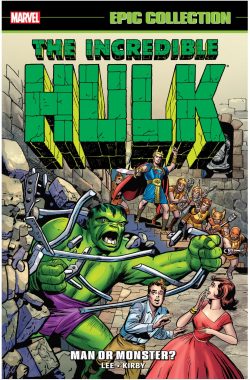
Incredible Hulk Epic Collection volume 1: Man or Monster? (1962-1964)


By Stan Lee, Jack Kirby, Steve Ditko, Paul Reinman, Dick Ayers, George Roussos, Chic Stone & various (MARVEL)
ISBN: 978-0-7851-9600-6 (TPB/Digital edition)

This book includes Discriminatory Content produced in less enlightened times.

Win’s Christmas Gift Recommendation: Timeless Monster Madness Masterpieces… 10/10

We all still like superheroes right? Here’s a bunch of yarns thou shouldst not miss…

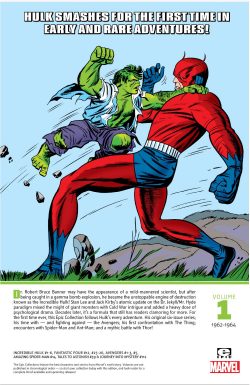
Chronologically collecting the Jade Juggernaut’s earliest appearances, this titanic tome (available as a hefty paperback and relatively weightless digital edition) gathers Incredible Hulk #1-6; Fantastic Four #2 & 25-26; Avengers #1-3 & 5, Amazing Spider-Man #14; Tales to Astonish #59 and an unforgettable clash with Thor from Journey into Mystery #112: cumulatively spanning early 1962 to the end of 1964.

The Incredible Hulk was new-born Marvel’s second new superhero title, despite Henry Pym technically debuting earlier in a one-off yarn from Tales to Astonish #27 (January 1962). However, Hank didn’t become a costumed hero until the autumn, by which time Ol’ Greenskin was not-so-firmly established.

The Hulk smashed right into his own bi-monthly comic and, after some classic romps by Young Marvel’s finest creators, crashed right out again. After six issues the series was cancelled and Lee retrenched, making the Gruff Green Giant a perennial guest-star in other titles until such time as they could restart the drama in their new “Split-Book” format in TtA where Ant/Giant-Man was rapidly proving to be a character who had outlived his time.

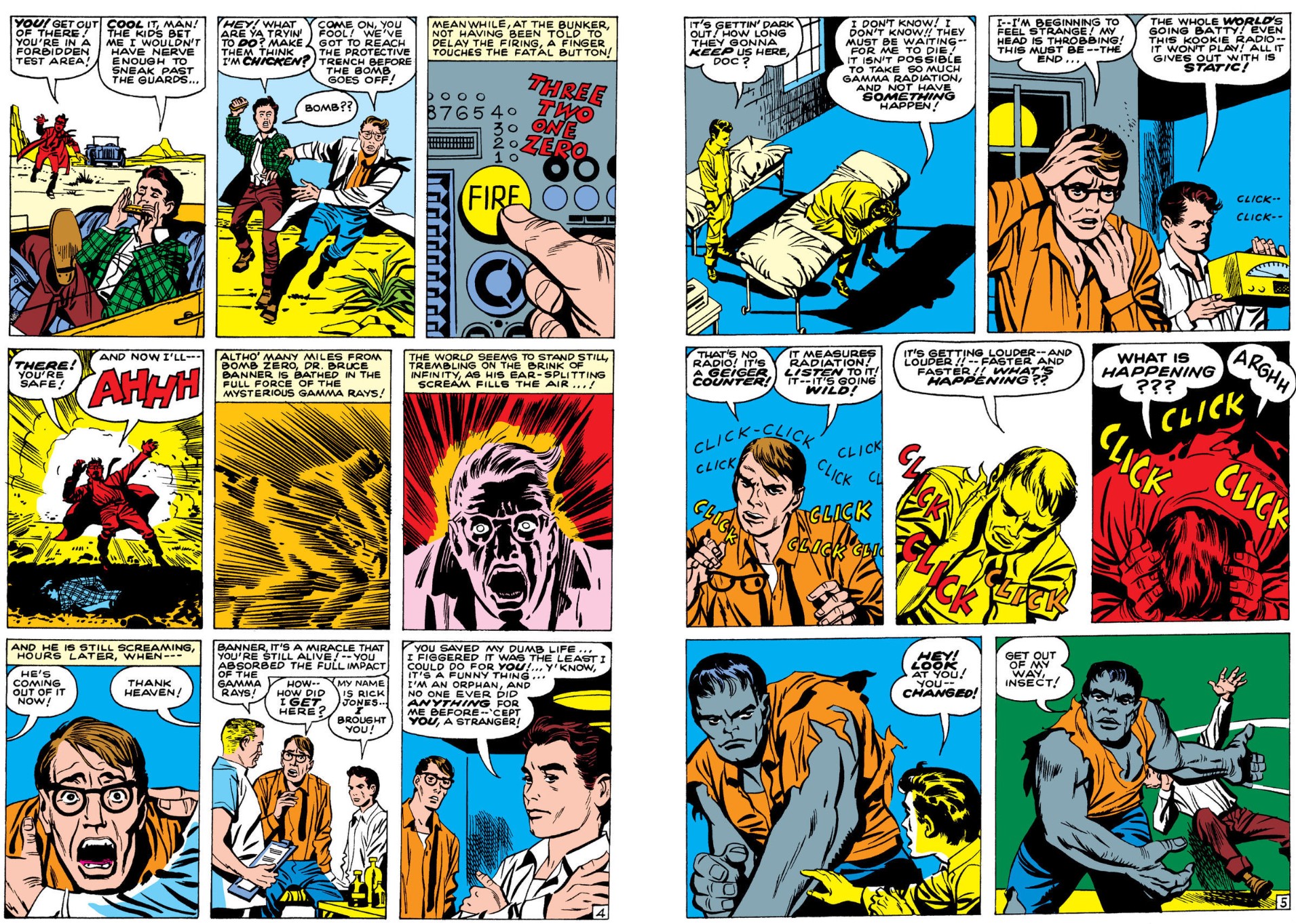
Cover-dated May 1962, Incredible Hulk #1 finds puny atomic scientist Bruce Banner sequestered on a secret military base in the desert, perpetually bullied by bombastic boss General “Thunderbolt” Ross, even as the clock counts down to the World’s first Gamma Bomb test.

Besotted with Ross’s daughter Betty, Banner endures the General’s constant jibes as the timer ticks on and tension increases, but at the final moment the boffin sees a teenager lollygagging at Ground Zero. As he frantically rushes to the site to drag the boy away, unknown to all, the assistant he’s entrusted to delay the countdown has an agenda of his own…

Rick Jones is a wayward but good-hearted kid. After initial resistance he lets himself be pushed into a safety trench, but just as Banner prepares to join him The Bomb detonates…

Somehow surviving the blast, Banner and the boy are secured by soldiers, but that evening as the sun sets the scientist undergoes a monstrous transformation. He grows larger; his skin turns a stony grey…

In six simple pages that’s how it all starts, and no matter what any number of TV or movie reworkings or comicbook retcons and psycho-babble re-evaluations would have you believe that’s still the best and most primal take on the origin. A good man, an unobtainable girl, a foolish kid, an unknown enemy and the horrible power of destructive science unchecked…

Written by Stan Lee, drawn by Jack Kirby with inking by Paul Reinman, ‘The Coming of the Hulk’ barrels along as the man-monster & Jones are kidnapped by Banner’s Soviet counterpart The Gargoyle for a rousing round of espionage and Commie-busting. He soon sees the (green) light, though…

In the second issue the plot concerns invading aliens, and the Banner/Jones relationship settles into a traumatic nightly ordeal where the good doctor transforms and is locked into an escape-proof cell whilst the boy stands watch helplessly. Neither ever considers telling the government of their predicament…

‘The Terror of the Toad Men’ is formulaic but viscerally, visually captivating as Steve Ditko inks Kirby; imparting a genuinely eerie sense of unease to the artwork. Incidentally, this is the story where the Hulk inexplicably changed to his more accustomed Green persona…

Although back-written years later as a continuing mutation, the plain truth is that grey tones caused all manner of problems for production colourists so it was arbitrarily changed to the simple and more traditional colour of monsters.

The third issue presented a departure in format as chaptered epics gave way to complete short stories. Dick Ayers inked Kirby in the transitional ‘Banished to Outer Space’ which radically altered the relationship of Jones and the rage-beast, with the story thus far reprised in 3-page vignette ‘The Origin of the Hulk’. Marvel mainstay of villainy the Circus of Crime debuts at the end in ‘The Ringmaster’ whilst in #4 The Hulk goes on an urban rampage for first tale ‘The Monster and the Machine’ prior to aliens and Commies combining in second escapade ‘The Gladiator from Outer Space!’

The Incredible Hulk #5 is a joyous classic of Kirby action, introducing immortal despot Tyrannus and his underworld empire in ‘The Beauty and the Beast!’, after which those pesky Commies came in for another pasting when the Jolly Green freedom-fighter crushes the invasion of Lhasa in ‘The Hordes of General Fang!’

Lee grasped early on the commercial impact of cross-pollination and – presumably aware of disappointing sales – inserted the Green Gargantuan into his top selling title next. Fantastic Four #12 (March 1963) featured an early crossover as the team were asked to help the US army capture ‘The Incredible Hulk’: a tale from Lee, Kirby & Ayers packed with intrigue, action and bitter irony. It begins with a series of spectacularly destructive sabotage incidents putting the heroes on the trail of a monster when they should have been looking at spies… Despite the sheer verve and bravura of these simplistic classics – some of the greatest, most rewarding comics nonsense ever produced – the Hulk series was not doing well. Kirby moved on to more appreciated arenas and Steve Ditko stepped up to handle art chores for #6: another full-length epic and an extremely engaging one.

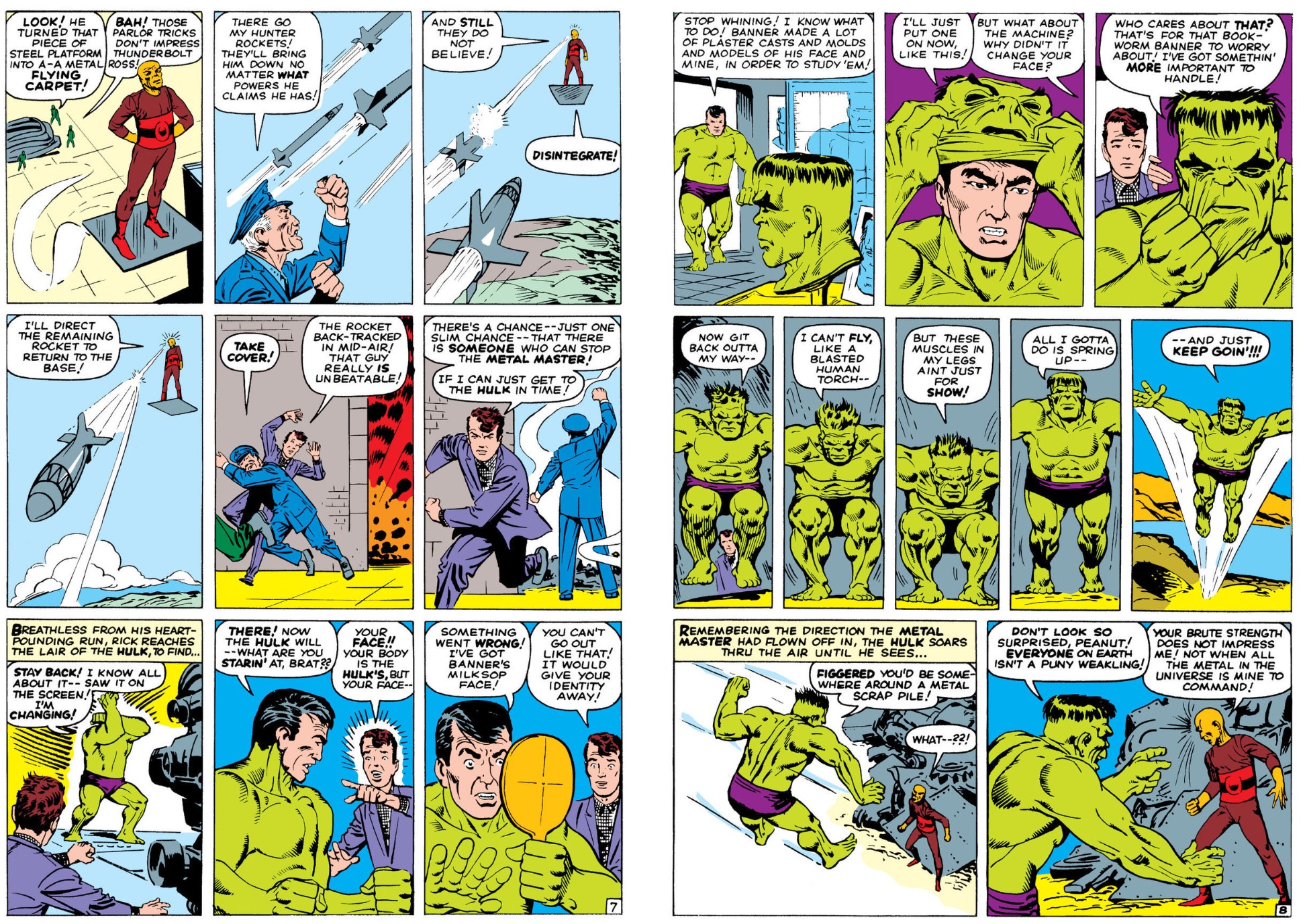
‘The Incredible Hulk Vs the Metal Master’ has astounding action, slyly subtle sub-plots and a thinking man’s resolution, but nonetheless the title died with the issue, also dated March. Another comic debuted that month and offered a lifeline to the floundering Emerald Outcast. ‘The Coming of the Avengers’ offers one of the cannier origin tales in comics. Instead of starting at a zero point and acting as if the reader knew nothing, creators Lee, Kirby & Ayers assumed interested parties had at least a passing familiarity with Marvel’s other titles, and wasted little time or energy on introductions in the premiere issue.

In Asgard Loki, god of evil, is imprisoned on a dank islet but still craves vengeance on his step-brother Thor. Observing Earth, the villain sees the monstrous Hulk and engineers a situation wherein the man-brute goes on a rampage, hoping to trick the Thunder God into battling the bludgeoning brute. When sidekick Rick Jones radios the Fantastic Four for assistance, Loki diverts the transmission so they cannot hear it and expects his mischief to quickly blossom. However, other heroes pick up the SOS – namely Iron Man, Ant-Man & the Wasp – and as the costumed champions converge on the desert in search of the Hulk, they realize something’s amiss…

This terse and compelling yarn is Lee & Kirby at their absolute best, and one of the greatest stories of the Silver Age, here promptly followed by ‘The Space Phantom’ (Lee, Kirby & Reinman): another unforgettable epic, in which an alien shape-stealer almost destroys the group from within. The tale ends with the volatile Hulk quitting the team only to return in #3 as a villain in partnership with ‘Sub-Mariner!’: a globetrotting romp delivering high energy thrills and one of the best battle scenes in comics history.

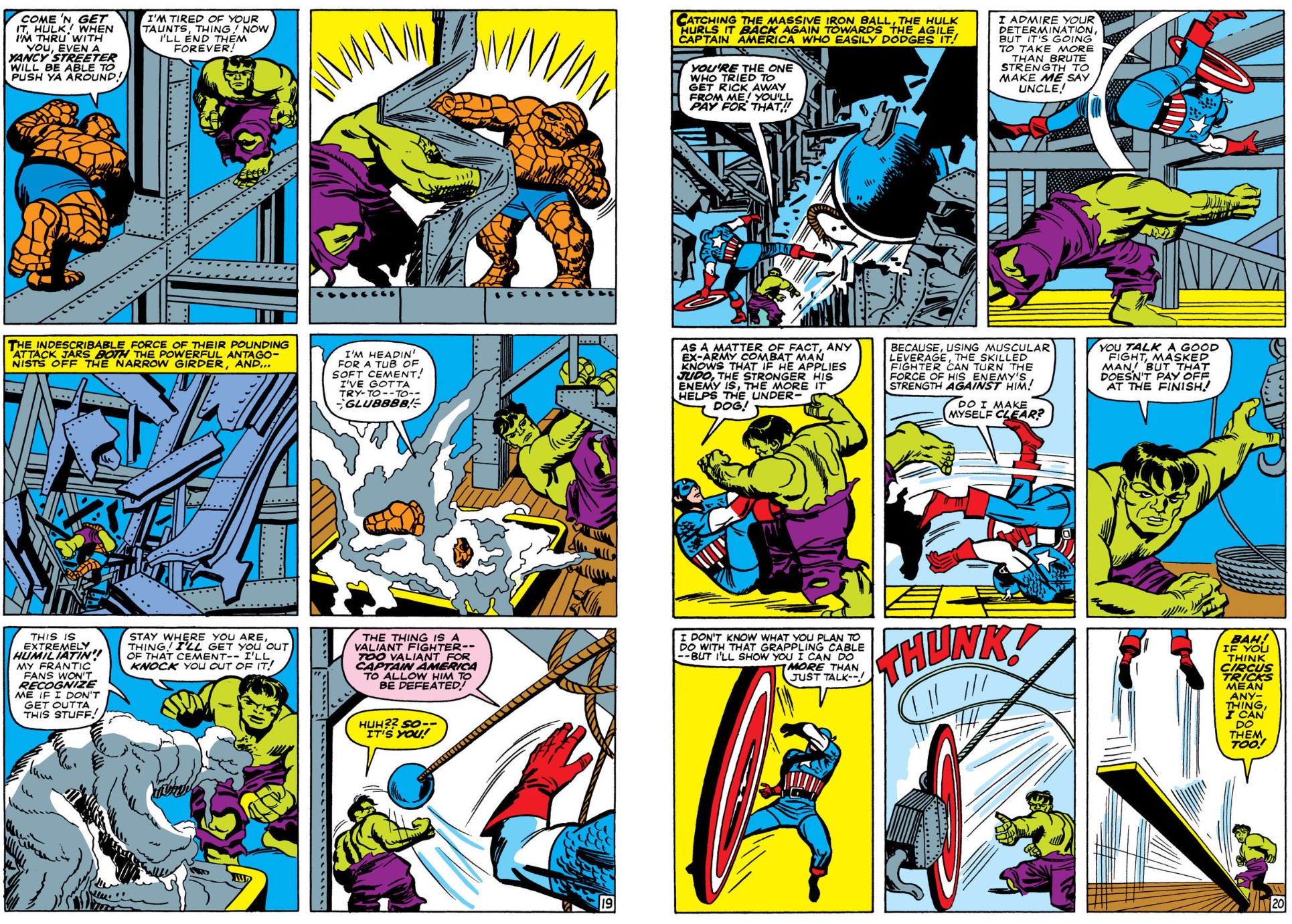
Three months later, Fantastic Four #25 featured a cataclysmic clash that had young heads spinning in 1964… and pretty much ever since. Inked by George Roussos, ‘The Hulk Vs The Thing’ and concluding saga ‘The Avengers Take Over!’ in FF #26 offered a fast-paced, all-out Battle Royale as the disgruntled man-monster comes to New York in search of sidekick Rick, with only an injury-wracked FF in the way of his destructive rampage.

A definitive moment in the character development of The Thing, the action accelerates and amplifies when a rather stiff-necked, officious Avengers team horns in claiming jurisdictional rights on “Bob” Banner and his Jaded Alter Ego. This tale is plagued with pesky continuity errors which would haunt Lee for decades, but notwithstanding the bloopers, this is one of Marvel’s key moments and still a vivid, vital read.

Over in Avengers #5, ‘The Invasion of the Lava Men!’ (Lee, Kirby & Reinman) resulted in another incredible romp as Earth’s Mightiest battled superheated, superhuman subterraneans and a lethally radioactive mutating mountain with the unwilling assistance of the Hulk. It would be his last appearance there for many months…

However, the next cameo came in Amazing Spider-Man #14 (July 1964): an absolute milestone as a hidden criminal mastermind debuted; manipulating a Hollywood studio into making a movie about the wall-crawler. Even with guest-star opponents such as the Enforcers the Incredible Hulk steals all the limelight in ‘The Grotesque Adventure of the Green Goblin’ (Lee & Ditko) which is only otherwise notable for introducing Spider-Man’s most perfidious and flamboyant enemy (sarcasm alert!).

The second stage of the man-brute’s career was about to take off and Tales to Astonish #59 (September) offered a pulse-pounding prologue as ‘Enter: The Hulk!’ (Lee, Ayers & Reinman) sees the Avengers inadvertently provoking Giant-Man to hunt down the Green Goliath. Although The Human Top devilishly engineered that blockbusting battle, Lee was the real mastermind, as with the next issue The Hulk debuted in his own series – and on the covers – whilst Giant-Man’s adventures shrank back to a dozen or so pages.

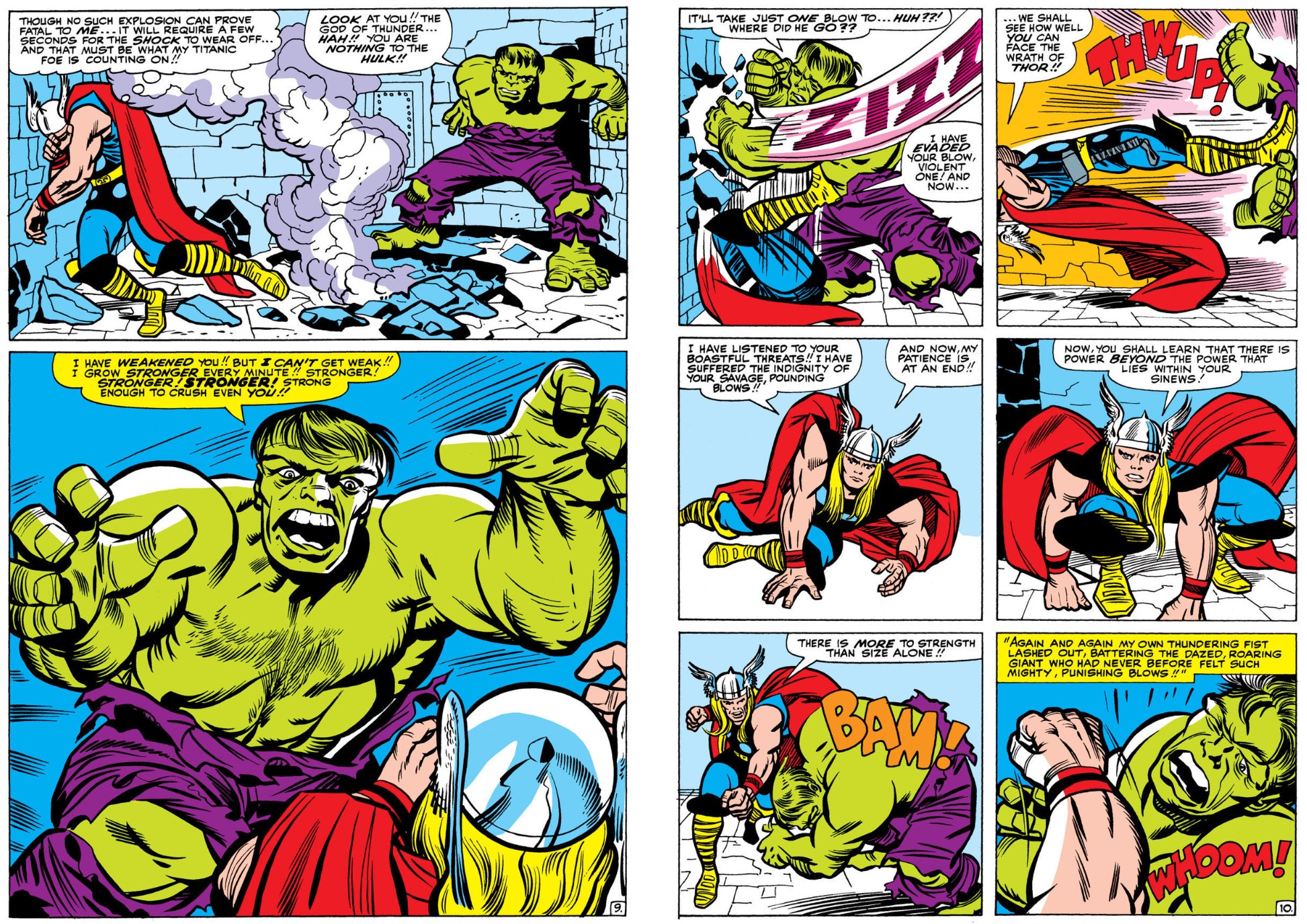
This wonderfully economical compendium of classic wonders closes with the lead story from Journey into Mystery #112 (January 1965). ‘The Mighty Thor Battles the Incredible Hulk!’ is a glorious gift to all those fans who can’t help but ask “Who’s stronger?”

Arguably Kirby & Chic Stone’s finest artistic moment together, it details the private duel between these two super-humans that occurred during the free-for-all between Earth’s Mightiest, Sub-Mariner and Ol’ Greenskin back in Avengers #3. The sheer raw power of that tale is a perfect exemplar of what makes the Hulk work (and one that inspired that fight in the Thor: Ragnarok movie) and would be an ideal place to close proceedings.

Happily, however, fans and art lovers can enjoy further treats in the form of assorted House Ads; original artwork by Kirby & Ditko; a gallery of classic Kirby covers modified by painter Dean White (originally seen on assorted Marvel Masterworks editions) plus reproduced Essentials collection and Omnibus covers by Bruce Timm and Alex Ross…

Hulk Smash! He always was and with material like this he always will be.
© 1962, 1963, 1964, 1965, 2016 Marvel Characters, Inc. All rights reserved.

Today in 1923 the magnificently quirky Mike Sekowsky was born. We all know about his Justice League, Adam Strange, Metal Men and Inhumans stuff but have you seen Diana Prince, Wonder Woman volume 1?

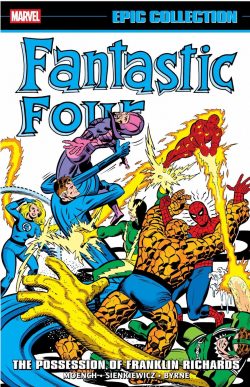
Fantastic Four Epic Collection volume 12: The Possession of Franklin Richards


By Marv Wolfman, Bill Mantlo, John Byrne, Ed Hannigan, George Pérez, Peter B. Gillis, Roger Stern, Doug Moench & Bill Sienkiewicz, Steve Ditko, Tom Sutton, Keith Pollard, Al Milgrom, Joe Sinnott, Pablo Marcos, Bruce Patterson, Chic Stone, Jon D’Agostino, Mike Esposito, Jerome Moore, Frank Giacoia & various (MARVEL)
ISBN: 978-1-3029-6056-8 (TPB/Digital edition)

This book includes Discriminatory Content produced in less enlightened times.

Win’s Christmas Gift Recommendation: Fantastic Fun for Comics Addicts… 8/10

It’s a been a big year for the fabulous FF. Here’s another titanic tome to add to your seasonal swag list…

For Marvel everything started with The Fantastic Four.

Monolithic modern Marvel truly began with eccentric monster ‘n’ alien filled adventures of a compact superteam as much squabbling family as coolly capable costumed champions. All that Modern Marvel is, company and brand, stems from that quirky quartet and the inspired, inspirational, groundbreaking efforts of Stan Lee & Jack Kirby…

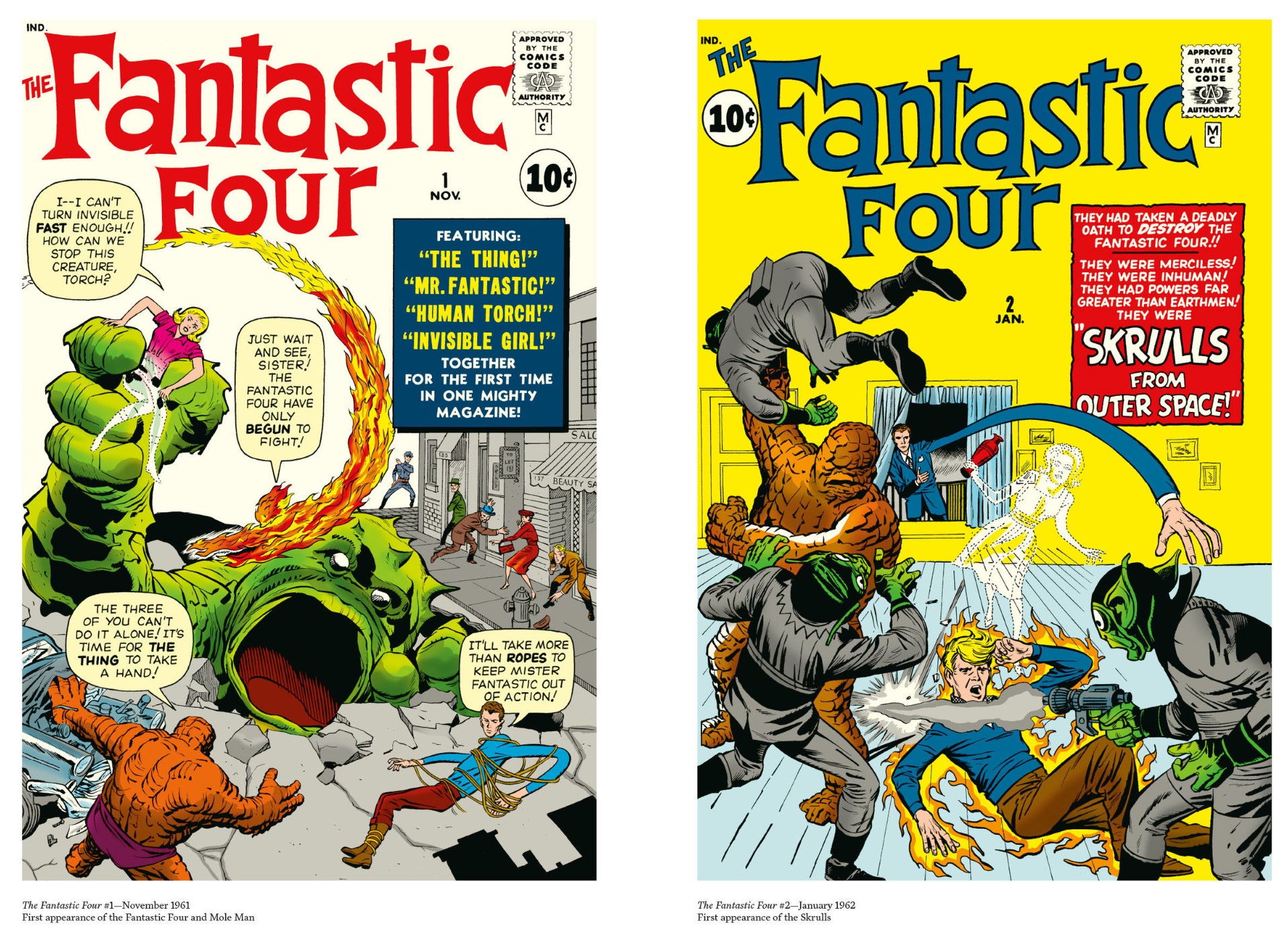
Cautiously bi-monthly and cover-dated November 1961, Fantastic Four #1 – by Stan, Jack, George Klein and/or Christopher Rule – was raw and crude even by its ailing publisher’s steadily plunging standards. However, it seethed with rough, passionate, uncontrolled excitement and thrill-hungry kids pounced on its dynamic storytelling. The series caught a wave of change beginning to build in America, and every succeeding issue changed comics a little bit more… and forever. Revealed in that premier, maverick scientist Reed Richards, fiancée Sue Storm, close friend Ben Grimm and Sue’s bratty teenaged brother survived an ill-starred private spaceshot after cosmic rays penetrated their ship’s inadequate shielding.

All permanently mutated: Richards’ body became elastic, diffident Sue became (even more) invisible, Johnny Storm burst into living flame and tragic Ben shockingly devolved into a shambling, rocky freak. After the initial revulsion and trauma passed, they solemnly agreed to use their abilities to benefit mankind. Thus was born The Fantastic Four – you can add your own fanfare and timpani here if you wish…

Throughout the 1960s it was the key title and most consistently groundbreaking series of Marvel’s ever-unfolding web of cosmic creation: a forge for new concepts and characters. Jack Kirby was approaching his creative peak: unleashing his vast imagination on plot after spectacular plot, and intense, incredible new characters whilst Lee scripted some of the most passionate superhero sagas ever seen. Both were on an unstoppable roll, at the height of their powers and full of the confidence only success brings, with The King particularly eager to see how far the genre and the medium could be pushed… which is rather ironic since it was the company’s reticence to give the artist more creative freedom that led to Kirby’s moving to National/DC in the 1970s.

Without Kirby’s soaring imagination the rollercoaster of mindbending High Concepts lost out to traditional tales of characters in conflict, with soap opera leanings and supervillain-heavy Fights ‘n’ Tights forays abounding. With Lee & Kirby long gone but their mark very much still stamped onto every page of the still-prestigious title, this full-colour compendium represents Fantastic Four #215-231 and Annuals #14-16, spanning Fall 1979 to June 1981.

What You Should Know: After being rejuvenated and repowered in an extended space-spanning saga, the Family FF are getting used to being back on Earth even with supervillains all over the place. Now Read On…

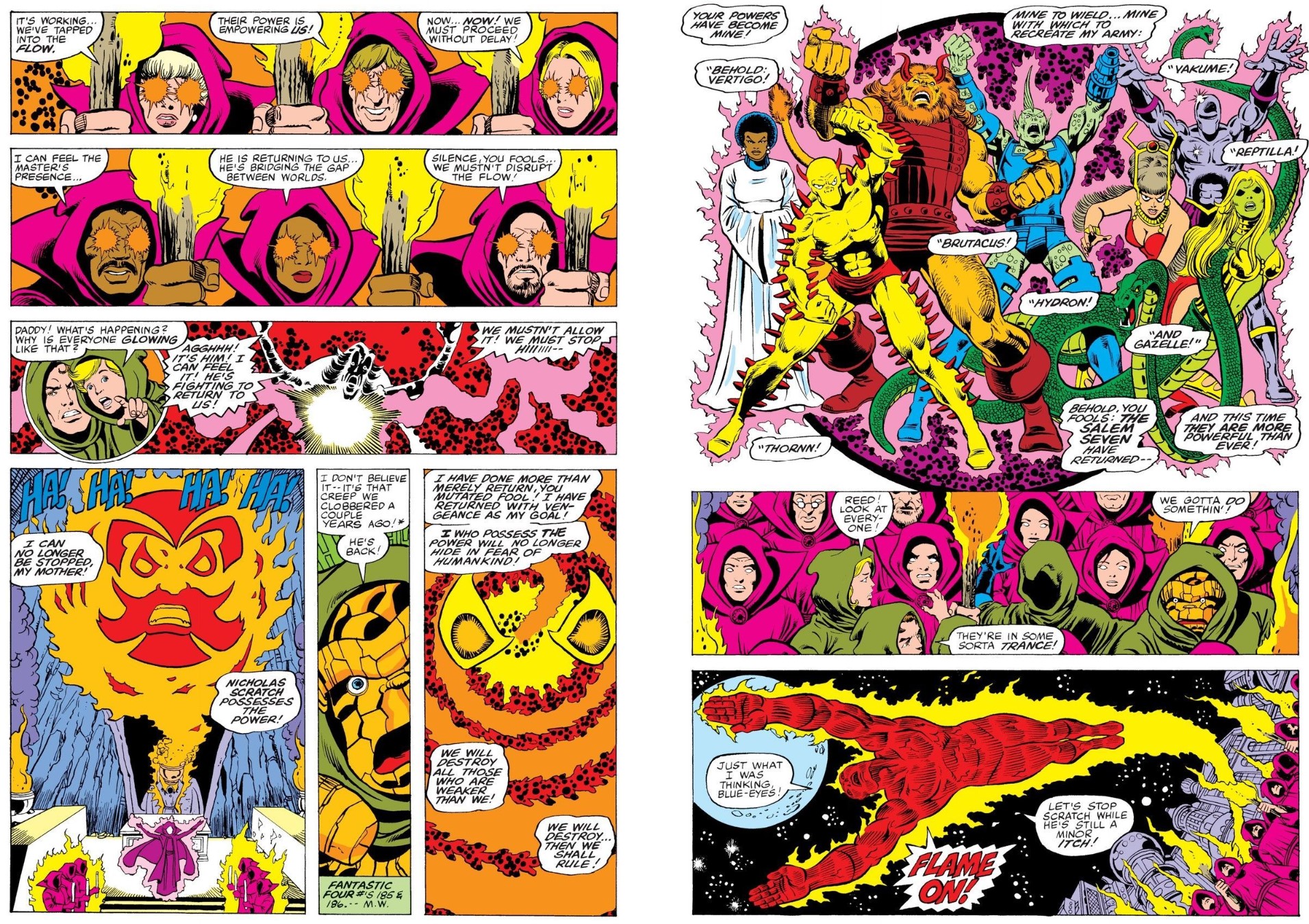
The revived, excessively rejuvenated team are in full fine fettle for Fantastic Four Annual #14 wherin Marv Wolfman, George Pérez & Pablo Marcos put firstborn Franklin Richards and his sorcerous nanny Agatha Harkness in the spotlight for ‘Cats-Paw!’ When magical cult Salem’s Seven abduct and brainwash the adult FF in hopes of resurrecting their macabre master Nicholas Scratch, even the Avengers are helpless to stop the carnage unleashed. Thankfully, the extra-dimensional voyage of the kid and the crone is enough to set everything right…

The arcane account is augmented by ‘A Gallery of the Fantastic Four’s Most Famous Foes!’ by Keith Pollard & Marcos, giving the lowdown on late-debuting villains and ne’er-do-wells including Invincible Man, Attuma, Gideon, Dragon Man, The Frightful Four and Quasimodo. Monthly FF #215 then finds Wolfman, John Byrne & Joe Sinnott reintroducing Negative Zone terror tyrant ‘Blastaar!’ who somehow escapes the antimatter universe to take over the Baxter Building just as a reinvigorated Reed Richards is distracted by former colleague Professor Randolph James who has hyper-evolved himself to offset an otherwise fatal beating by street thugs. Sadly, his accelerator device has not advanced James’ ethical outlook, and after taking vengeance on his attackers, the future man proves that ‘Where There Be Gods!’ there be trouble too, as the mental marvel aligns with Blastaar only to fall before a far greater power… angry cosmic child Franklin…

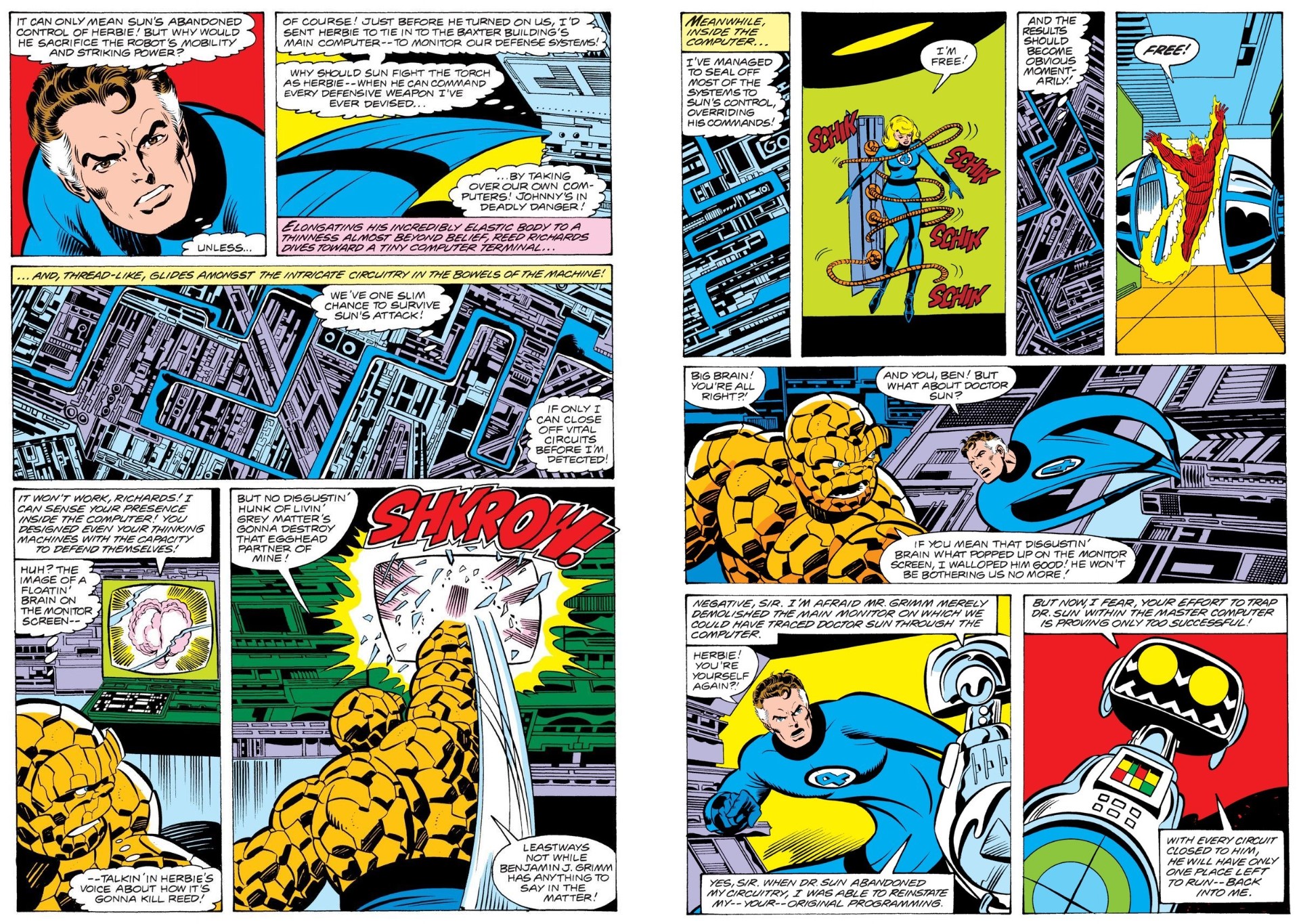
Bill Mantlo scripts #217 for Byrne & Sinnott, as ‘Masquerade!’ at last exposes the viper in the team’s midst: an inimical force responsible for most of the recent setbacks and accidents, and almost the deaths of the heroes and Johnny’s new intended girlfriend Dazzler

No spoilers here this time, but back then we all just knew who the hidden villain actually was… that acursed robot!

Infernal gadget H.E.R.B.I.E. was imposed on the series due to concerns by producers of the current Fantasic Four cartoon show. Rejecting fire hazard Johnny for a cutely telegenic robot, Wolfman cheekily made that commercial compromise in-world canon, dividing fans forever after. The bleeping bot – a Humanoid Experimental Robot, B-type, Integrated Electronics (latterly, Highly Engineered Robot Built for Interdimensional Exploration; don’cha just love nominative deterministic acronymics?) – is pure Marmite in most readers eyes…

Next is the last half of an old-school saga that, for completeness, means you need to read Peter Parker, the Sensational Spider-Man #42 before enjoying the contents of FF #218. What’s not here is how ESU student Peter Parker goes on a class jaunt and is lured into a trap by the Frightful Four (in ‘Give Me Liberty or Give Me Death’ by Mantlo, Mike Zeck & Jim Mooney if you were wondering). The villains broadsided the wallcrawler after new recruit Electro impersonated the Human Torch there…

Now for ‘When a Spider-Man Comes Calling!’ (cover-dated May 1980 by Mantlo, Byrne & Sinnott), Trapster repeats the tactic to ambush the comfortably at home quartet, allowing his comrades The Wizard and Sandman to take over the heroes’ Baxter Building citadel… at least until a fighting-mad webspinner breaks free for an unstoppable counterattack…

Penciller John Byrne, having served out his first term on the series he was to soon make his alone, was officially only temporarily replaced for FF #219. Ably augmented by Sinnott, stalwart “Guest-Team” Doug Moench & Bill Sienkiewicz were parachuted in for monster mash-up ‘Leviathans’ due to the huge success and acclaim generated by their vigilante thriller Moon Knight. They brought with them a whole new look and sensibility, as well as far faster pace to the stories. Here, modern day pirate Cap’n Barracuda steals the fabled Horn of Proteus from Atlantis to unleash a wave of giant monsters on New York City. Thankfully, this is a subject the mighty Sub-Mariner and Mr. Fantastic can agree on, and their combined forces soon stomp the beasties to stop a piratical plunder ploy without peer…

Byrne bounced back writing & pencilling in #220 as ‘…And the Lights Went Out All Over the World!’ sees the Avengers call Reed and Co. when all Earth suffers a catastrophic power-outage. Science! sends the explorers to the arctic to encounter an astounding and unbelievable obelisk being constructed by beings of utterly alien appearance…

The story includes an updated origin for the quartet and guest shot for Canada’s finest (that’s Vindicator of Alpha Flight in case you were wondering) as the tale halts for a pinup by inker Sinnott (the Torch battling a flaming Skrull) prior to #221’s concluding chapter ‘Tower of Glass… Dreams of Glass!’ Following the usual misconceptions and rash clashes it is revealed that three aliens shipwrecked for half a million years just need their myriad mobile mechanisms to reverse the planet’s magnetic poles so they can return home at last. Happily, Reed has a less end-of-human-civilisation-y solution leaving everyone involved happy and safe; and back where they belong…

Now officially the regular creative team, Moench & Sienkiewicz prep for Halloween in FF #222’s ‘The Possession of Franklin Richards!’ as the cosmic ray kid is again targeted from beyond the unknown by exiled soul Nicholas Scratch. The son of Agatha Harkness is the kind of warlock who gives witchcraft a bad name. and, having made the boy his conduit back to reality, Scratch goes on to terrorise and torture his hated enemies. With Doctor Strange unavailable, they enlist the dubious gifts of self-doubting failed horror hero Gabriel the Devil Hunter and his morally ambiguous familiar Desadia (from Marvel’s monochrome magazine line titles Haunt of Horror and Monsters Unleashed)…

Apparently acquiescing, the team agree to liberate the dead diabolist’s minions of magical mayhem and Salem’s Seven toil ‘That a Child May Live…’ Of course, their instant assaults on humanity are an acceptable risk and consequence in Reed’s plan: setting the worlds to rights for all but the defeated devil…

Fantastic Four Annual #15 swiftly follows, wherein Moench & Pérez, abetted by Chic Stone, Jon D’Agostino & Mike Esposito, renew hostilities between the FF and Skrull empire as the shapeshifters target the supergenius’ latest energy-casting breakthrough in ‘Time for the Prime Ten!’ Infiltrating the Baxter Building, negating his valiant teammates and almost banishing Mr. Fantastic to the tender mercies of Annihilus in the Negative Zone, the sneaky killers are actually seeking to end their millennial war against stellar rivals The Kree, but have underestimated Reed’s brilliance, his family’s tenacity and the cosmic awareness of Earth-loving Kree Exile Captain Mar-Vell

A back-up tale by Moench & Tom Sutton takes us to recently liberated Latveria for the opening of proposed series ‘The Return of Doctor Doom!’ Only episode ‘The Power of the People!’ shows how restored monarch King Zorba fails to live up to his democratic promises and discover how excessive taxation really upsets voters, at around the same moment crazed, catatonic Victor von Doom goes missing from the most secure dungeon in Doomstadt…

Sadly, the impending crisis never materialised and was only addressed by Byrne in Fantastic Four #247…

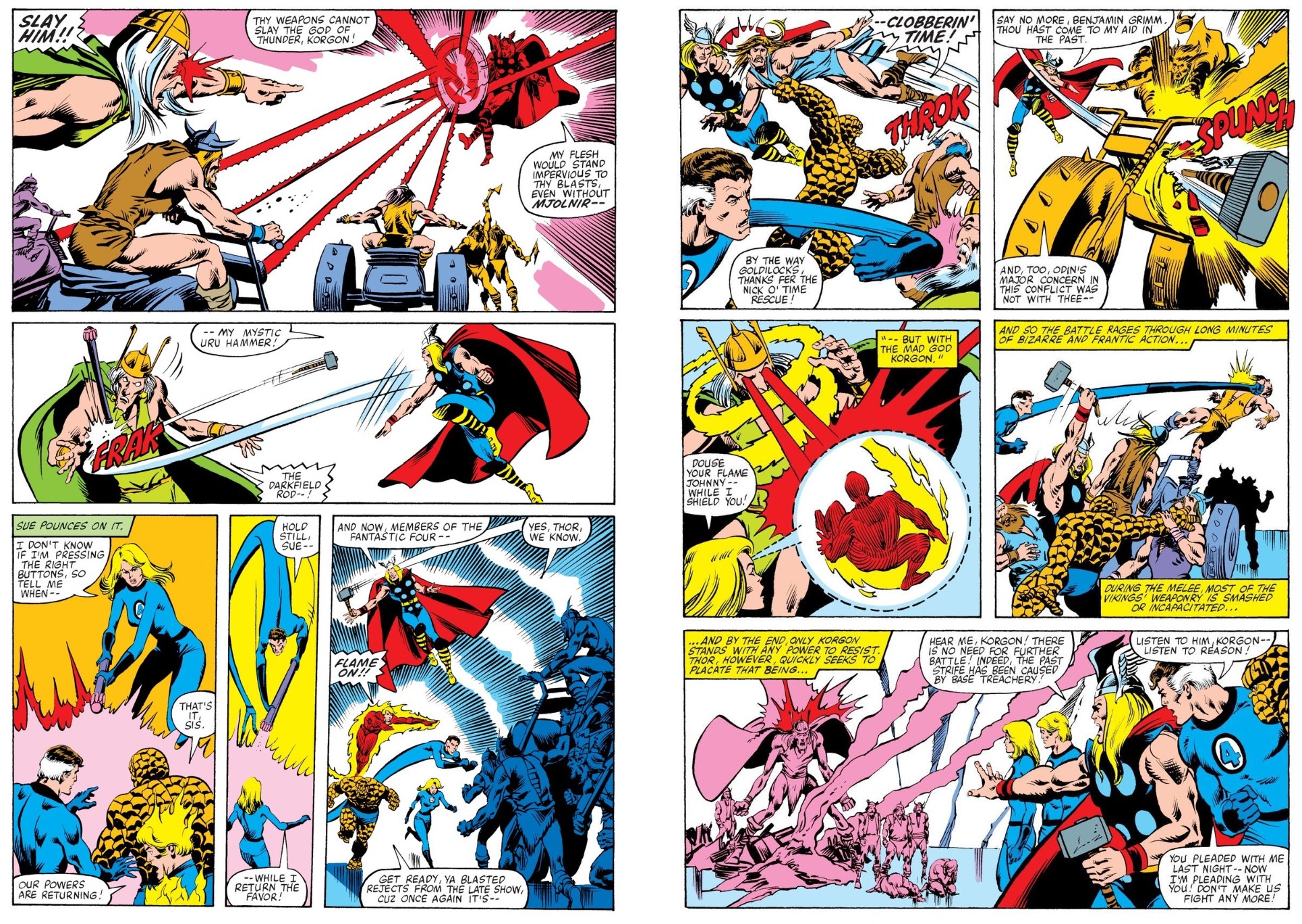
Over in FF #224 & 225, fresh calamity unfolds in ‘The Darkfield Illumination’ (Moench, Sienkiewicz & Pablo Marcos) as radioactive red mist blankets Manhattan and plays hob with the team’s powers. Tracing the cloud’s origin point to an icy dome in the Arctic, the FF find a lost colony of technologically advanced Vikings utterly dependent upon a mutated immortal giant. ‘The Blind God’s Tears’ supply heat, light, food materials from the outside world and immortality, but now Korgon is dying and demands the explorers save him and the people who worship him. Always eager to help, the FF strive and succeed in saving the God, only to see him betrayed by his most trusted ally. As Korgon rages madly in response, the crisis escalates as Mighty Thor arrives to investigate worshippers who have abandoned their true god for a false one…

Bruce Patterson joins Marcos inking Sienkiewicz when Moench next brings closure to fans of his Shogun Warriors series. In their own title the former pilots of monster-fighting mega-mecha Dangard Ace, Raydeen and Combatra had been recruited by an ancient order to defend humanity, but retired when their machines were destroyed. That epic sacrifice had come when evil enemy Maur-Kon targeted the Fantastic Four and attempted to kill Reed. Now a new giant mecha rampages and robs, so the teams reunite with Ilongo Savage, Richard Carson and Genji Odashu aiding the fight against ‘The Samurai Destroyer’ and the unworthy soul exploiting its power for profit….

Movie-toned terror in the heartland follows as a meteor crashes in rural Pennsylvania resort Lost Lake just as the FF head out to the Boonies for a break. Their encounter with ‘The Brain Parasites’ reverting hosts to earlier evolutionary forms is by-the-books horror fun from Moench, Sienkiewicz & Patterson, and readily fixed by little Franklin’s increasingly unreliable powers. This sets the scene for the next – Sinnott inked – issue where further tests by professional head shrinkers and brain benders unleash uncontrollable chaos, possessed bystanders and an adult super-powered version of the lad. Thankfully, loving parents and uncles allow Franklin to exorcise his deadly ‘Ego-Spawn’.

The experiment in alternative tale-telling ends with a 3-part saga opening on #229’s ‘The Thing From the Black Hole’. When it homes in on Reed’s latest invention, Earth totters on the edge of destruction as a sentient singularity made of antimatter disrupts physical laws. Desperate Richards makes contact with its cosmic equivalent and uncovers a tale of love lost in service to scientific exploration. The wandering extinction event was once a living being whose love for a fellow astronaut turned them both into creatures of uncanny forces. Thankfully, ‘Firefrost and the Ebon Seeker’ now reach an understanding that saves Earth, but as a consequence a section of Manhattan – including the Baxter Building – is left inside the Negative Zone.

With panic amongst the abducted New Yorkers barely suppressed, the FF seek a solution ‘In All the Gathered Gloom!’ (Moench & Roger Stern, Sienkienwisz, Jerome Moore, Sinnott, & Frank Giacoia) even as new antimatter menace Stygorr zeroes in on the intruding enclave. The last thing the FF need is bullying big business plutocrat Lew Shiner telling everyone his money puts him in charge. After his posturing triggers a riot, tragedy is guaranteed, and the heroes barely beat the alien invader in time to return everyone surviving back home…

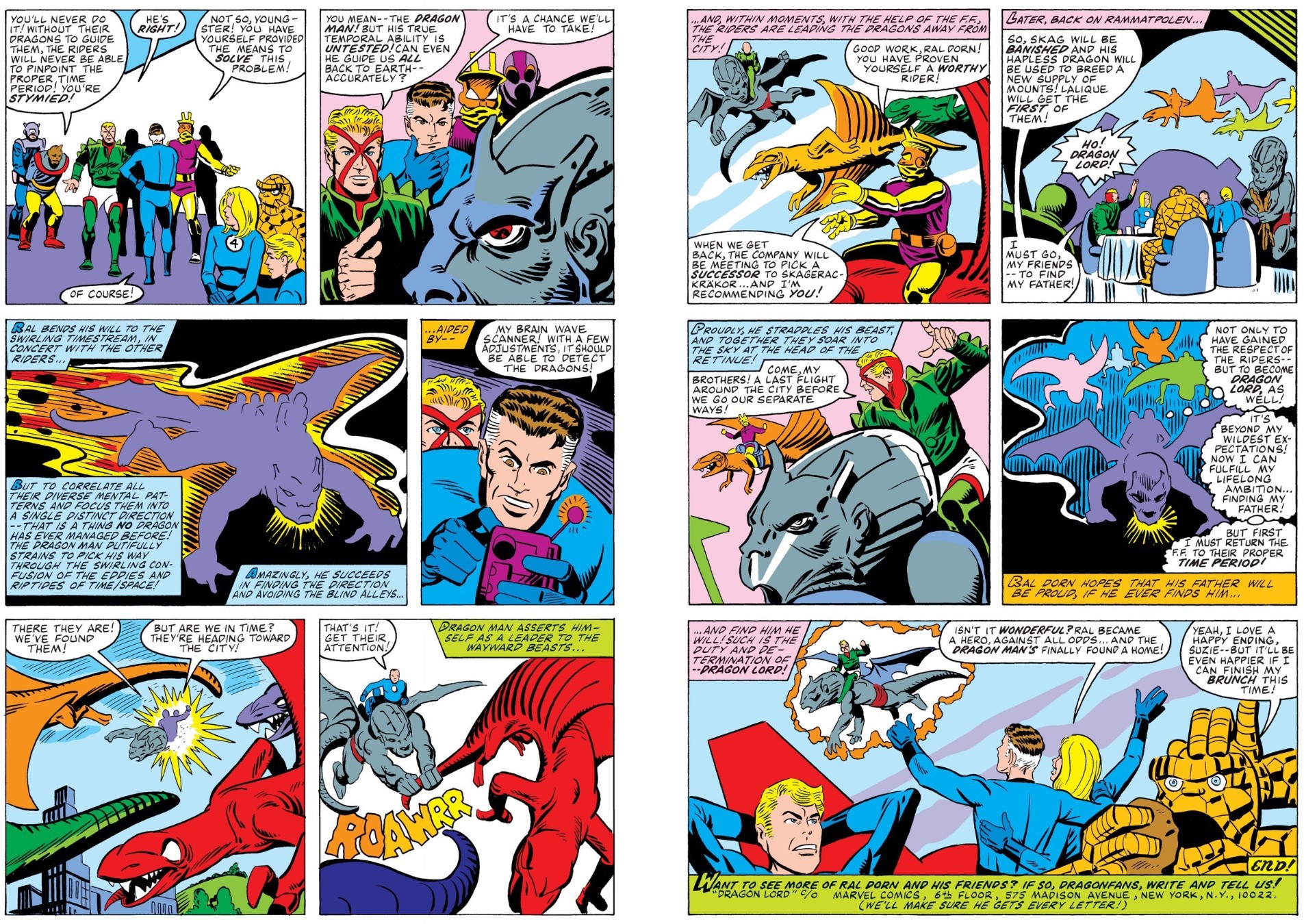
This foray into the fantastic finishes on a “soft pilot episode” as Fantastic Four Annual #16 embraces the contemporary fantasy market with ‘The Coming of… Dragon Lord!’ by Ed Hannigan & Steve Ditko. When trainee Ral Dorn is framed for killing a sacred beast and hunted by former fellows in the puissant extradimensional Dragon Rider organisation, the chase ends up with him wounded. His flight, employing a multi-powered Dragon Staff, leads to a collision with an off-duty quirky quartet, celebrating a reunion on the college campus where they first encountered astouding android Dragon Man,. but the coincidence escapes everybody and the heroes leave the mystery man to the medics.

Days later the fugitive breaks into their skyscraper home and with the Staff holding the FF at bay explains his predicament. A novice lawkeeper, his dream of bonding with a dragon has been shattered by the death of his destined beast-partner, and accusations that he’s responsible. The wild story is inadvertantly backed up by a posse of Dragon Riders seeking to stop him and the intervention of Ral’s bizarre former ally Lalique. When they are driven away, it is clear to the human heroes that something is not kosher and they determine to help him. It’s obvious to Ral that his boss Dragon Lord Skagerackäkor is behind the plot but without a bonded beast what can he do? That’s why he was on campus. He had learned of former FF foe Dragon Man and decided that needs must when the devil drives…

The classic plot left all the goodies rewarded amd baddies punished and was claearly an attempt to launch a series, but…

With covers by Sinnott, Ron Wilson, Josef Rubinstein, Rich Buckler, Al Milgrom, Byrne, Pollard, Sienkienwicz, Bob McLeod & Ditko the extras here include Sinnott pinups of the whole team and Thing pinup from FF #218 & 219: Sienkievich’s rejected cover-turned-pinup as printed in #224; the entries for January in the Marvel Comics 20th Anniversary Calandar 1981 (Sienkienwicz & Sinnott) plus original art pages/covers from Byrne, Sinnott, Sienkienwicz, Marcos and Patterson, as well as original colour-guides painted by George Roussos.

Although never quite returning to the stratospheric heights of the Kirby era, this truly different collection represents a closing of the First Act for the “World’s Greatest Comics Magazine”, and palate-cleansing preparation for the second groundbreaking run by John Byrne. These extremely capable efforts are probably most welcome to dedicated superhero fans and continuity freaks like me, but will still thrill and delight casual browsers looking for an undemanding slice of graphic narrative excitement.
© 2025 MARVEL.

Today in 1858, French cartoonist Emmanuel Poiré was born. He annoyed all the right people as Caran d’Ache… and plenty of the wrong ones too. Far less controversial were Fred Harmon and screenwriter/ scripter Stephen Slesinger who launched epic cowboy strip Red Ryder this day in 1938.

The Creeper by Steve Ditko


By Ditko, Don Segall, Denny O’Neil, Michael Fleisher, Mike Peppe, Jack Sparling & various (DC Comics)
ISBN: 978-1-4012-2592-6 (HB)

This book includes Discriminatory Content produced in less enlightened times.

It’s Steve Ditko’s 99th birthday today and I’m not letting the fact that he’s no longer with us stop us enjoying his wonders and celebrating his unique storytelling mastery…

Steve Ditko was one of our industry’s greatest and most influential talents and, during his lifetime, amongst America’s least lauded. Always reclusive and reticent by inclination, his fervent desire was always just to get on with his job, tell stories the best way he can and let his work speak for him.

Whilst the noblest of aspirations, that attitude was usually a minor consideration – and even an actual stumbling block – for the commercial interests which for so long controlled all comics production and still exert an overwhelming influence upon the mainstream bulk of the comic industry’s output. After Ditko’s legendary disagreements with Stan Lee led to his quitting Marvel – where his groundbreaking efforts made the reclusive genius (at least in comicbook terms) a household name – he found work at Warren Comics and resumed his long association with Charlton Comics.

That company’s laissez faire editorial attitudes had always offered him the most creative freedom, if not greatest financial reward, but in 1968 their wünderkind editor Dick Giordano was poached by the rapidly-slipping industry leader and he took some of his bullpen of key creators with him to DC Comics. Whilst Jim Aparo, Steve Skeates, Frank McLaughlin and Denny O’Neil found a new and regular home, Ditko began only a sporadic – if phenomenally productive – association with DC.

It was during this heady if unsettled period that the first strips derived from Ditko’s interpretation of the Objectivist philosophy of novelist Ayn Rand began appearing in fanzines and independent press publications like Witzend and The Collector, whilst for the “over-ground” publishing colossus he devised a brace of cult classics with The Hawk and the Dove and the superbly captivating concept re-presented here: Beware The Creeper. Later efforts would include Shade, the Changing Man, Stalker and The Odd Man, plus truly unique interpretations of Man-Bat, the Legion of Super-Heroes and many more… including a wealth of horror, mystery and sci fi shorts reminiscent of his Charlton glory days.

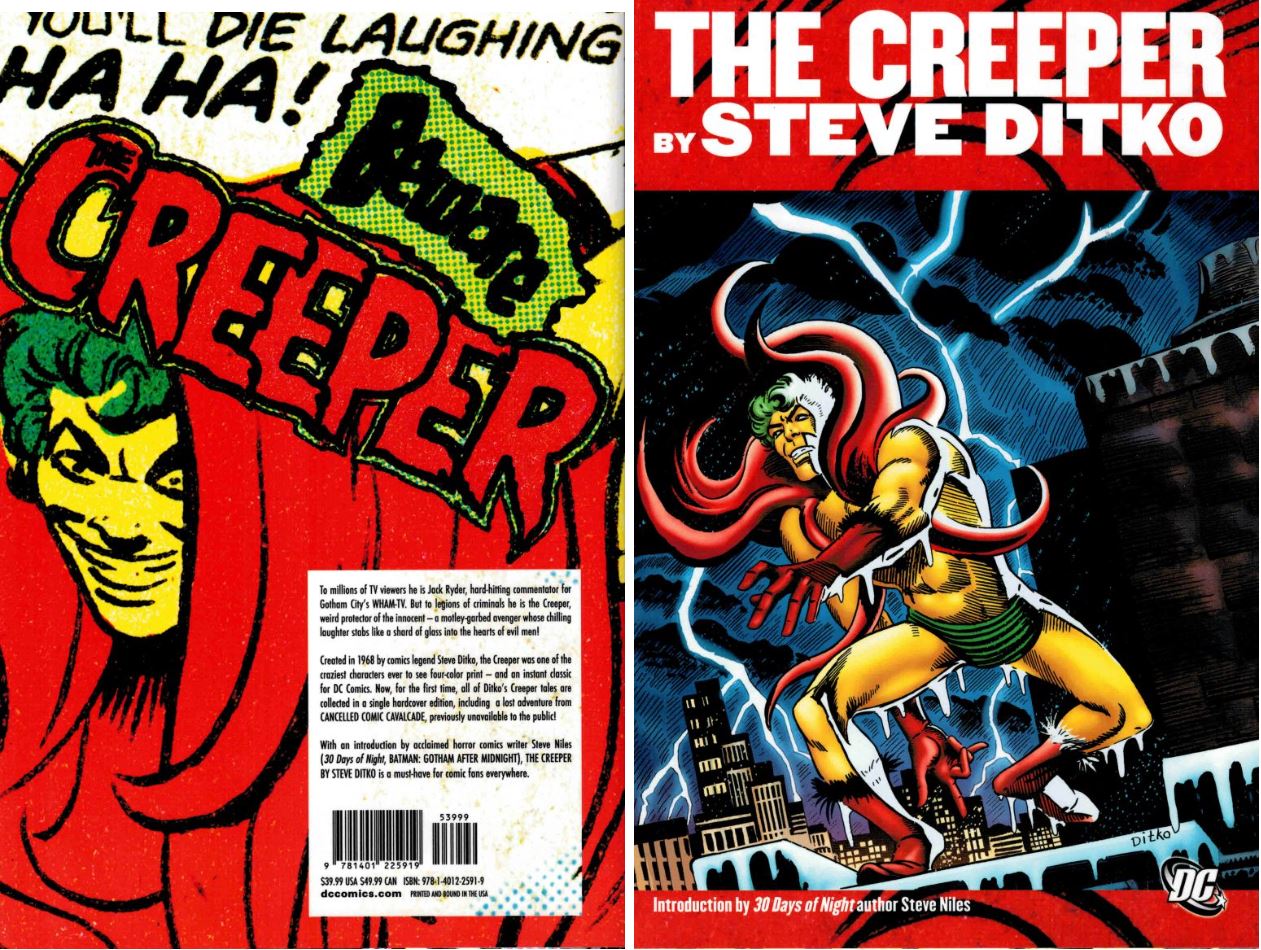
The auteur’s comings and goings also allowed him to revisit past triumphs and none more so than with The Creeper – who kept periodically popping up like a mad, bad penny. This superb hardcover compilation – still tragically and inexplicably languishing with other classics DC hasn’t got around to making available in digital formats – gathers every Ditko-drafted/delineated Creeper classic from a delirious decade for your delight, and the spooky superhero spectacle kicks off with an effusive Introduction from appreciative fan Steve (30 Days of Night) Niles.

This collation curates tales from Showcase #73; Beware the Creeper #1-6; 1st Issue Special #7; World’s Finest Comics #249-255 and Cancelled Comics Cavalcade #2/Showcase #106 (collectively spanning March/April 1968 to February/March 1979), so settle in for a long ride…

Like so many brilliant ideas before it, Ditko’s bizarre DC visions first exploded off the newsstands in try-out title Showcase. Issue #73 heralded ‘The Coming of the Creeper!!’ with veteran comics & TV scripter Don Segall putting the words to Ditko’s plot and illustrations. The moodily macabre tale introduces suicidally-outspoken TV host Jack Ryder, whose attitude to his show’s sponsors and cronies loses him his cushy job. His brazen attitude does, however, impress network security chief Bill Brane and the gruff oldster offers him a job as an investigator and occasional bodyguard.

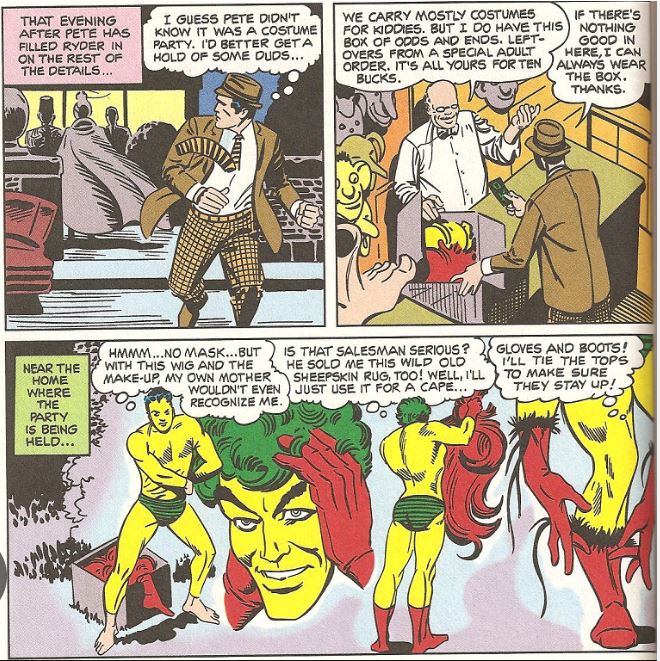
Jack’s first case involves tracking down recent Soviet defector Professor Yatz who has gone missing. The CIA suspect has been abducted by gangster Angel Devilin and sold to Red agent Major Smej. Displaying a natural affinity for detective work, Ryder tracks a lead to Devilin’s grand house and interrupts a costume party designed as a cover to make the trade. Promptly kicked out by thugs, Ryder heads for a costume shop but can only find a box of garish odds and ends… and lots of makeup.

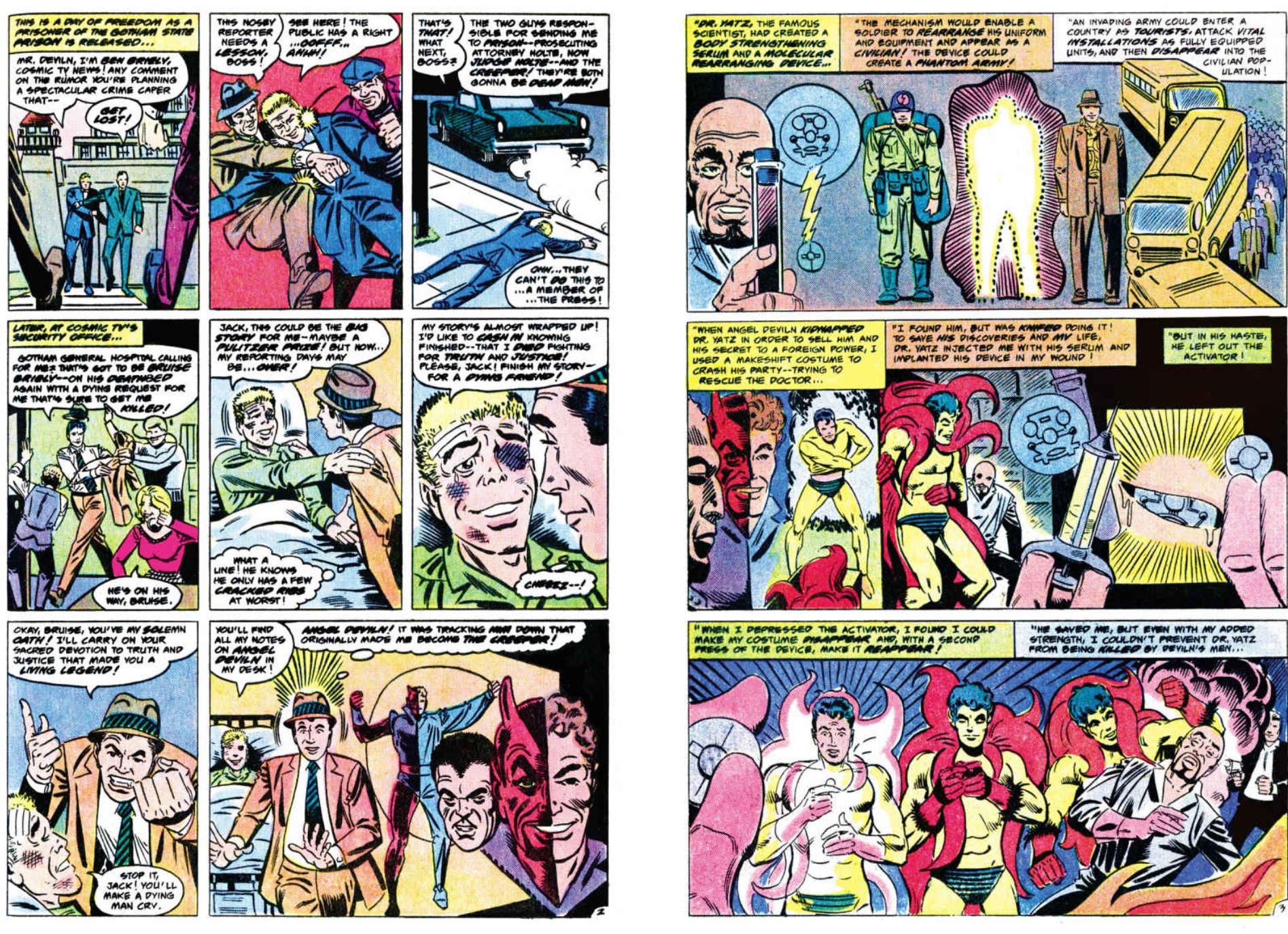
Kitted out in a strange melange of psychedelic attire and accoutrements, he breaks back in but is caught and stabbed before being thrown into a cell with the missing Yatz. The scientist – also grievously wounded – is determined to keep his inventions out of the hands of evil men. These creations comprise an instant-healing serum and a Molecular Transmuter, able to shunt whatever a person is wearing or carrying into and out of our universe. A fully equipped army could enter a country as harmless tourists and materialise a complete armoury before launching sneak attacks…

To preserve them, Yatz lodges the Transmuter inside Ryder’s knife wound before injecting him with the untested serum. The effect is instantaneous and doesn’t even leave a scar. The investigator is also suddenly faster, stronger and more agile…

When Jack presses a handheld activator, he is instantly naked, and experimentation shows that he can make his motley costume appear and disappear just by touching a button. Of course, now, whenever it is activated, neither makeup nor wig, bodystocking, boots or gloves will come off. It’s like the crazy outfit has become his second skin…

When the gangsters come for their captives, Yatz is burning his notes. In the fracas that follows he catches a fatal bullet and, furious, guilt-ridden and strangely euphoric, Ryder goes after the thugs and spies. By the time the cops arrive he finds himself (or at least his canary yellow alter ego) blamed by Devilin for the chaos and even a burglary. The mobster has even given him a name – The Creeper

As soon as the furore dies down vengeful Ryder returns to exact justice for the professor and discovers his uncanny physical prowess and macabre, incessant unnerving laughter give him an unbeatable edge whilst winning him a supernatural reputation…

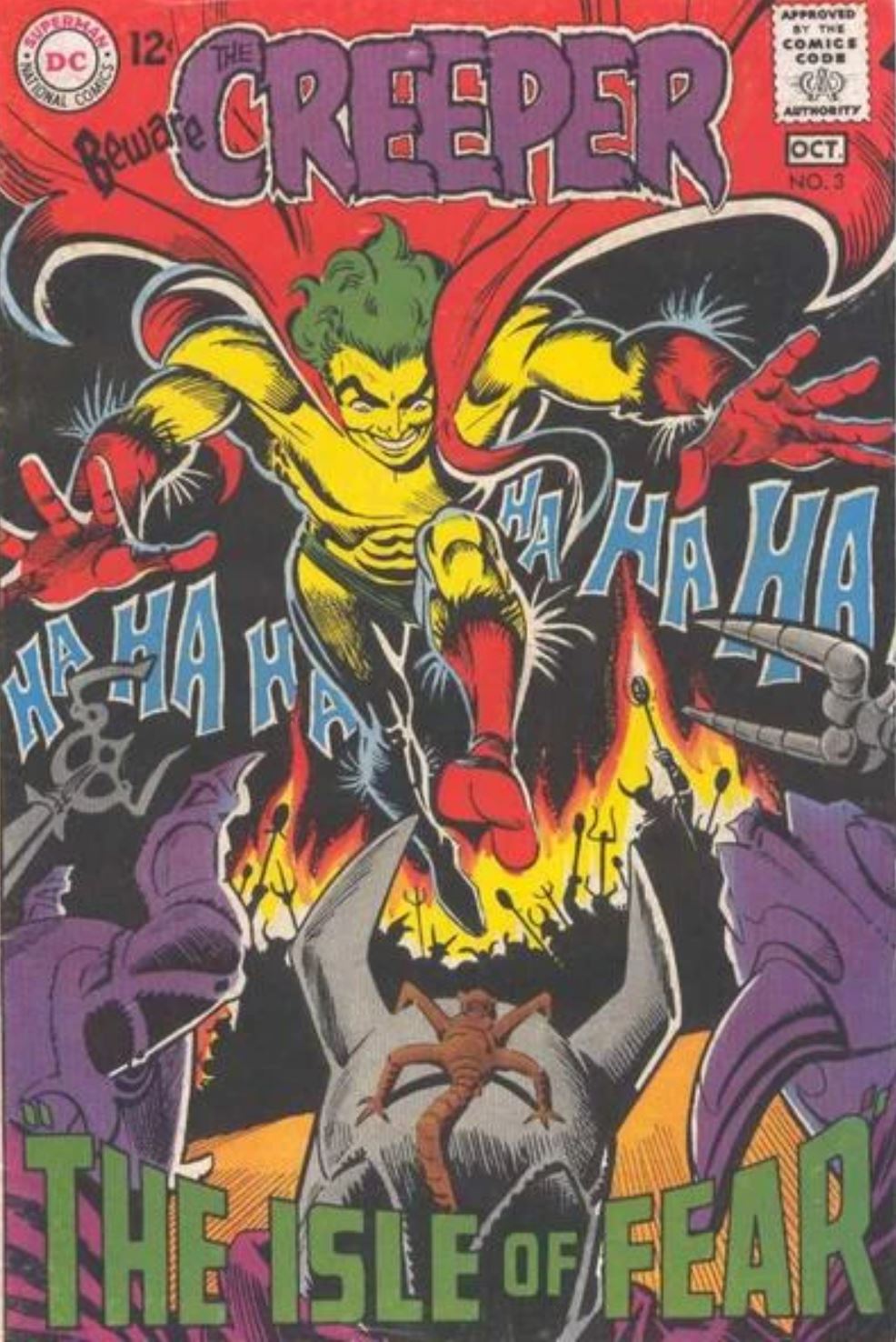
After that single yarn the haunting hero hurtled straight into his own bimonthly series. Beware the Creeper #1 debuted with a May/June cover-date. Behind one of the most evocative covers of the decade – or indeed, ever – ‘Where Lurks the Menace?’ (scripted by Denny O’Neil under his occasional pen-name Sergius O’Shaughnessy) finds Ryder and the Creeper hunting an acrobatic killer beating to death numerous shady types in a savage effort to take over the city’s gangs. Sadly, Jack’s relentless pursuit of “the Terror” and careful piecing together of many disparate clues to his identity is hindered by the introduction of publicity-hungry, obnoxious glamour-puss ‘Vera Sweet’. The TV weathergirl thinks she has the right to monopolise Ryder’s time and attention, even when he’s ducking fists and bullets…

The remainder of the far-too-brief run featured a classic duel of opposites as a chameleonic criminal mastermind insinuated himself into the lives of Jack and the Brane bunch. It all began with ‘The Many Faces of Proteus!’ in BtC #2 (by Ditko & O’Shaughnessy) wherein a pompous do-gooder’s TV campaign against The Creeper is abruptly curtailed after the Golden Grotesque shows up at the studio and throws bombs.

Caught in the blast is baffled and battered Jack Ryder, and he’s even more bewildered when Brane informs him that a tip has come in confirming the Creeper is working for gambler gangboss Legs Larsen

Dodging Vera, whose latest scheme involves a fake engagement, the real Creeper reaches Larsen’s gaming house in time to see a faceless man put a bullet into the prime suspect. In the ensuing panic the Laughing Terror transforms back into Ryder and strolls out with Larsen’s files, unaware that the faceless man is watching him leave and putting a few clues together himself…

The documents reveal a lone player slowly consolidating a grip on the city’s underworld but discloses no concrete information, so the Creeper goes on a very public rampage against all criminals in hopes of drawing Proteus out. The gambit works perfectly as a number of close friends try to kill Ryder, but only after frantically fending off flamethrower-wielding Vera in his own apartment does the Creeper realise that Proteus is far more than a madman with a makeup kit. A spectacular rooftop duel ends in a collapsed building and apparent end of the protean plunderer… but there’s no body to be found in the rubble…

Beware the Creeper #3 has our outré hero tearing the city’s thugs apart looking for Proteus, but his one-man spook-show is curtailed when Brane sends Ryder to find Vera. Little Miss Wonderful is determined to be the first to interview an island society cut off from the world for over a century, but all contact has been lost since she arrived. Tracking her to ‘The Isle of Fear’ Jack finds her in the hands of a death cult. More important to Ryder, however, is the fact that the Supreme One leading the maniacs is actually a top criminal offering sanctuary to Proteus flunkies he’s been scouring the city for…

Back in civilisation again, ‘Which Face Hides My Enemy?’ sees Ryder expose High Society guru and criminal mesmerist Yogi Birzerk’s unsuspected connection to Proteus. The cops drive The Creeper away before he can get anything from the charlatan, and when he dejectedly returns home Jack walks into an explosive booby trap in his new apartment. The “warning” from Proteus heralds the arrival of Asian troubleshooters Bulldog Bird and Sumo who claim to be also pursuing the faceless villain. They reveal he was a high-ranking member of the government of Offalia who stole a chemical which alters the molecular composition of flesh, before suggesting they all team up. Heading back to Bizerk’s place, it soon becomes clear that they are actually working for Proteus and that the faceless fiend knows Ryder’s other identity…

With #5, inker Mike Peppe joined Ditko & O’Neil as the epic swung into high gear with ‘The Color of Rain is Death!’ Proteus makes his closing moves, attacking Jack’s associates and framing him again whilst preparing for a criminal masterstroke which will win him much of the city’s wealth. Luring the Creeper into the sewers as a major storm threatens to deluge the city, the face-shifter reveals a scheme to blow up the drainage system and cause catastrophic flooding. After a brutal battle, he also leaves The Creeper tied to a grating to drown…

The stunning saga closed with final issue Beware the Creeper #6 (March/April 1969), by which time Ditko had all but abandoned his creation. ‘A Time to Die’ saw tireless, reliable everyman artist Jack Sparling pencil most of the story as the Howling Hero escapes his death-trap, deciphers the wily villain’s true gameplan and delivers a crushing final defeat. It was fun and thrilling and – unlike many series which folded at that troubled time – even provided an actual conclusion, but it somehow it wasn’t satisfactory and it wasn’t what we wanted.

This was a time when superheroes went into another steep decline with supernatural and genre material rapidly gaining prominence throughout the industry. With Fights ‘n’ Tights comics folding all over, Ditko concentrated again on Charlton’s mystery line, an occasional horror piece for Warren and his own projects…

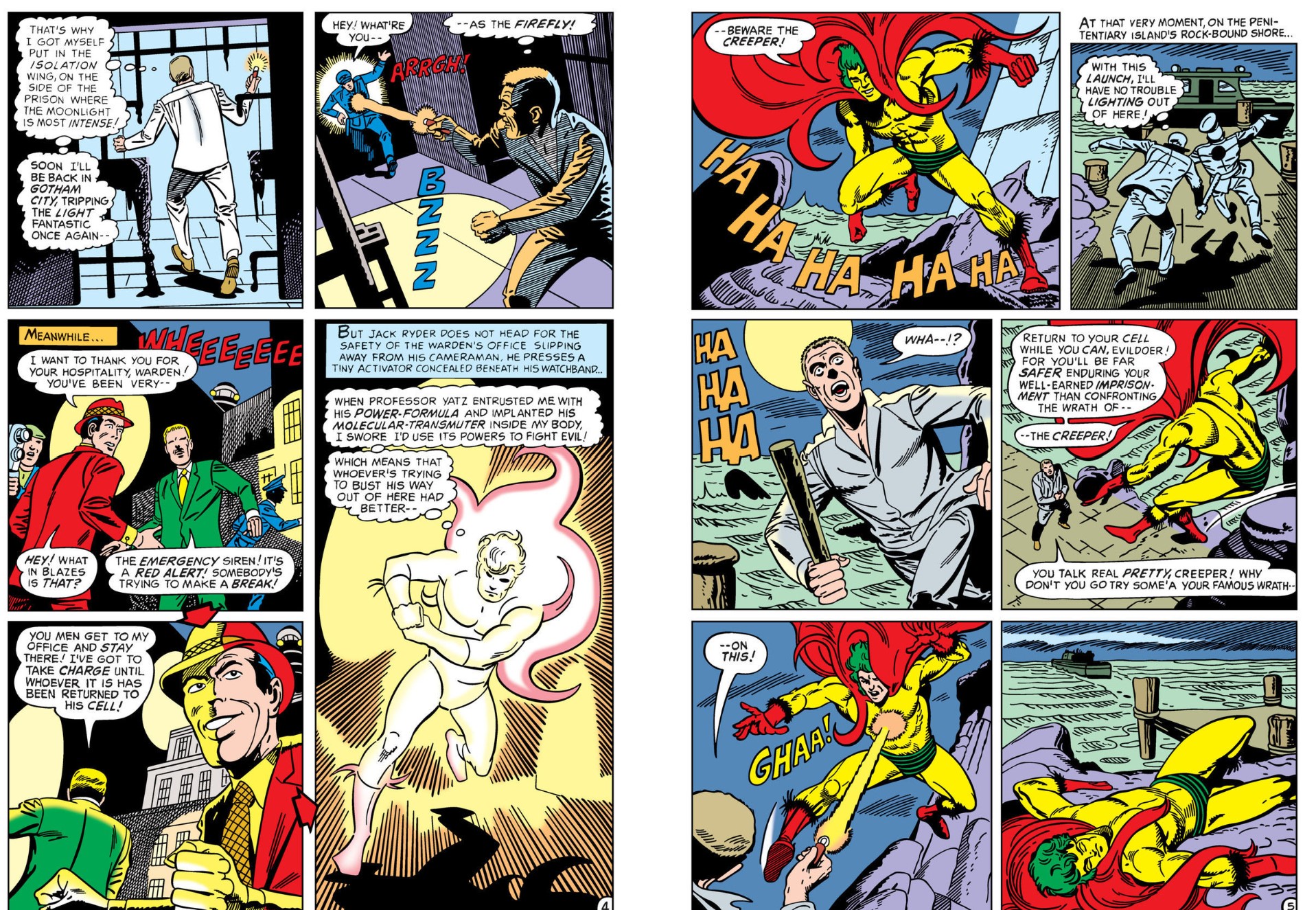
In the years his own title was dormant, the Creeper enjoyed many guest shots in other comics and it was established that the city he prowled was in fact Gotham. When Ditko returned to DC in the mid-1970s, try-out series 1st Issue Special was alternating new concepts with revivals of old characters. Issue #7 (October 1975) gave the quirky crusader another shot at stardom in ‘Menace of the Human Firefly’ – written by Michael Fleisher & inked by Mike Royer. Here restored TV journalist Jack Ryder is inspecting the fantastic felons in Gotham Penitentiary just as manic lifer Garfield Lynns breaks jail to resume his interrupted costumed career as the master of lighting effects. By the time the rogue’s brief but brilliant rampage is over, the Creeper has discovered something extremely disturbing about his own ever-evolving abilities…

The story wasn’t enough to restart the rollercoaster, but some years later DC instituted a policy of giant-sized anthologies, and the extra page counts allowed a number of lesser lights to secure back-up slots and shine again. For World’s Finest Comics #249-255 (cover-dated February/March 1978 to February/March 1979) Ditko was invited to produce a series of 8-page vignettes starring his most iconic DC creation. This time he wrote as well as illustrated and the results are pure eccentric excellence. The sequence begins with ‘Moon Lady and the Monster’ as Ryder – once again a security operative for Cosmic Broadcasting Network – must ferret out a grotesque brute stalking a late-night horror-movie hostess, after which #250’s ‘Return of the Past’ reprises the origin as Angel Devilin gets out of jail and goes looking for revenge…

In WFC #251, ‘The Disruptor’ proves to be a blackmailer attempting to extort CBN by sabotaging programmes whilst ‘The Keeper of Secrets is Death!’ in #252 follows the tragic murder of Dr. Joanne Russell who was accused on a sensationalistic TV show of knowing the Creeper’s secret identity. Next issue ‘The Wrecker’ offers an actual grudge-bearing mad scientist who has built a most unconventional robot, whilst ‘Beware Mr. Wrinkles!’ in #254 debuts a villain with the power to age his victims. Neither, however, are a match for the tireless, spring-heeled Technicolor Tornado, whose too-short return culminates in a lethal duel with a knife-throwing jewel thief in #255’s ‘Furious Fran and the Dagger Lady’

Until this volume, that was it for Ditko devotees and Creeper collectors, but as the final delight in this splendid compendium reveals, there was more. An ill-considered expansion was followed by 1978’s infamous “DC Implosion”, when a number of titles were shut down or cancelled before release. One of those was Showcase #106 which would have featured a new all-Ditko Creeper tale.

It was collected – with sundry other lost treasures – in a copyright-securing, monochrome, minimum print-run internal publication entitled Cancelled Comics Cavalcade. Here, from CCC #2 (1978) and presented in stark black & white, fans can see the Garish Gallant’s last Ditko-devised hurrah as ‘Enter Dr. Storme’ pits the Creeper (and cameo crimebuster The Odd Man) against a deranged weatherman turned climatic conqueror able to manipulate the elements.

Fast, fight-filled, furiously fun and devastatingly dynamic, Beware the Creeper was a high-point in skewed superhero sagas and this is a compendium no lovers of the genre can do without.
© 1968, 1969, 1975, 1978, 1979, 2010 DC Comics. All Rights Reserved.

Today in 1926 Harvey Comics star and Anthro originator Howie Post was born, followed a year later by the mighty Steve Ditko. Just scroll back up or look anywhere on this blog, dude!

Sadly, it’s also the anniversary of Wally Wood’s death in 1981. We last looked closely at Ditko’s frequent collaborator in Cannon.

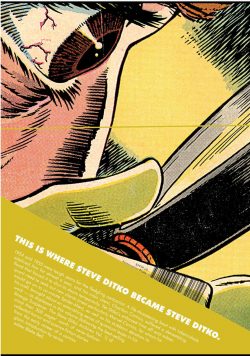
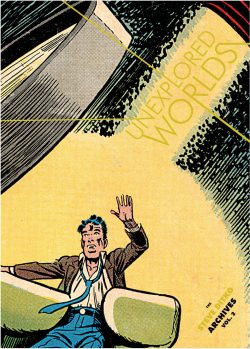
Steve Ditko Archives volume 2: Unexplored Worlds


By Steve Ditko, Joe Gill & various, edited by Blake Bell (Fantagraphics Books)
ISBN: 978-1-60699-289-0 (HB/Digital edition)

Win’s Christmas Gift Recommendation: Immaculate Yarn-Spinning… 9/10

This book includes Discriminatory Content produced in less enlightened times. It also has Discriminatory Content included for comedic and satirical effect.

Once upon a time the anthological title of short stand-alone stories was the sole staple of the comicbook profession, where the plan was to deliver as much variety as possible to the reader. Sadly, that particular vehicle of expression seems all but lost to us today…

Despite his death Steve Ditko remains one of our industry’s greatest talents and one of America’s least lauded. His fervent desire to just get on with his job and to tell stories the best way he can – whilst the noblest of aspirations – had always been a minor consideration or even stumbling block for the commercial interests which for so long controlled all comics production and still exert an overwhelming influence upon the mainstream bulk of comic book output. Before his time at Marvel, young Ditko perfected his craft creating short sharp yarns for a variety of companies and it’s an undeniable joy today to be able to look at this work from such an innocent time when he was just breaking into the industry: tirelessly honing his craft with genre tales for whichever publisher would have him, utterly free from the interference of intrusive editors.

A superb full-colour series of hardback collections reprinted those early efforts (all of them here are from 1956-1957) with material produced after the draconian, self-inflicted Comics Code Authority sanitised the industry following Senate Hearings and a public witch-hunt.

Most are wonderfully baroque bizarre supernatural or science fantasy stories, but there are also examples of Westerns, Crime and Humour: cunningly presented in the order he completed and sold them rather than the more logical but far-less-revealing chronological release dates. Moreover, they’re all helpfully annotated with a purchase number to indicate approximately when they were actually drawn – even the brace of tales done for Stan Lee’s pre-Marvel Atlas company.

Sadly, there’s no indication of how many (if any) were actually written by the moody master…

This second sublime selection reprints more heaping helpings of his increasingly impressive works: most courtesy of the surprisingly liberal (at least in its trust of its employees’ creative instincts) sweat-shop publisher Charlton Comics.

And whilst we’re being technically accurate, it’s also important to reiterate that those cited publication dates have very little to do with when Ditko crafted them: as Charlton paid so little, the cheap, anthologically astute outfit had no problem in buying material it could leave on a shelf for months – occasionally years! – until the right moment arrived to print. The work is assembled and runs here in the order Ditko submitted it, rather than when it reached our grubby sweaty paws…

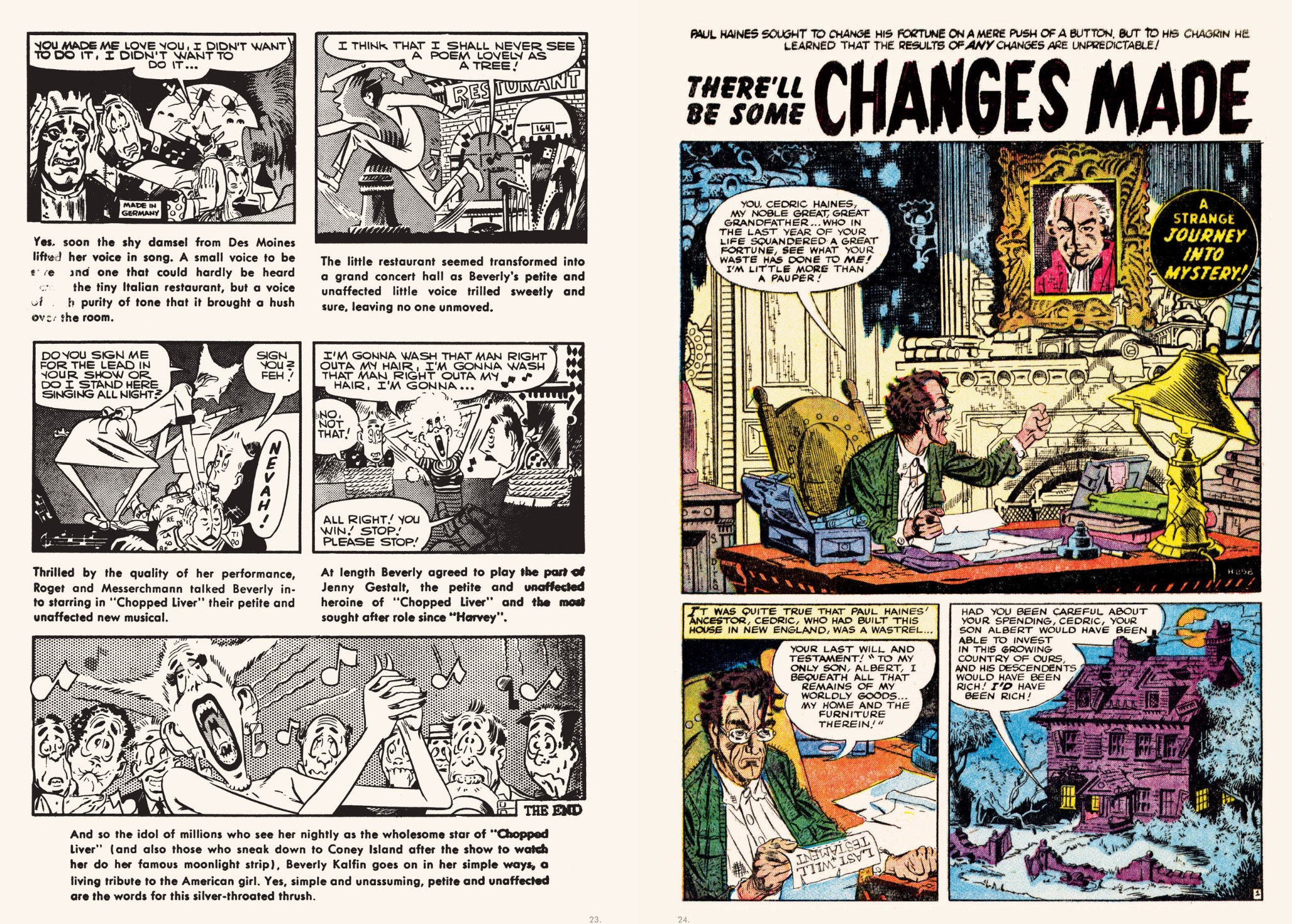
Following an historically informative Introduction and passionate advocacy by Blake Bell, concentrating on Ditko’s near-death experience in 1954 (when the artist contracted tuberculosis) and subsequent recovery, the evocatively eccentric excursions open with a monochrome meander into the realms of satire with the faux fable – now we’d call it a mockumentary – ‘Starlight Starbright’ as first seen in From Here to Insanity (volume 3 #1 April 1956) before “normal” service resumes with financial fable ‘They’ll Be Some Changes Made’ (scripted by Carl Wessler from Atlas’ Journey Into Mystery #33, April 1956).

Here a petty-minded pauper builds a time machine to steal the fortune his ancestors squandered, after which a crook seeking to exploit a mystic pool finds himself the victim of fate’s justice in ‘Those Who Vanish’ (Journey Into Mystery #38, September 1956) again scripted by Wessler.

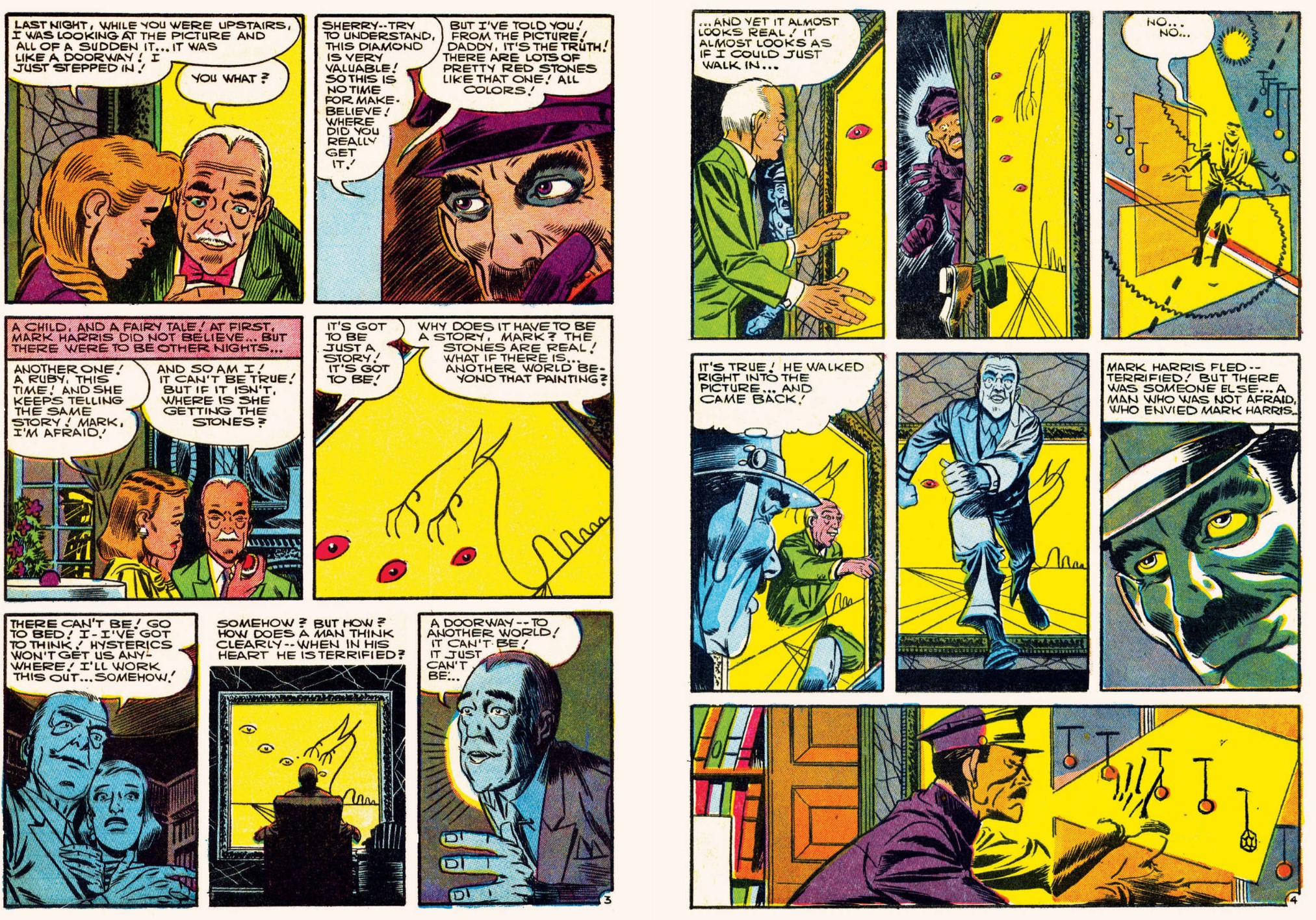
Almost – if not all – the Charlton material was scripted by astoundingly prolific Joe Gill at this time, and records are spotty at best, so let’s assume his collaboration on all the material here begins with ‘The Man Who Could Never Be Killed’ (Strange Suspense Stories #31, published in February 1957). This yarn of a circus performer with an incredible ethereal secret segues into ‘Adrift in Space’ (Mysteries of Unexplored Worlds #8 June 1958) as a veteran starship captain pushes his weary crew over the edge, whereas ‘The King of Planetoid X’ from the previous MoUW (February) details a crisis of conscience for a benevolent and ultimately wise potentate…

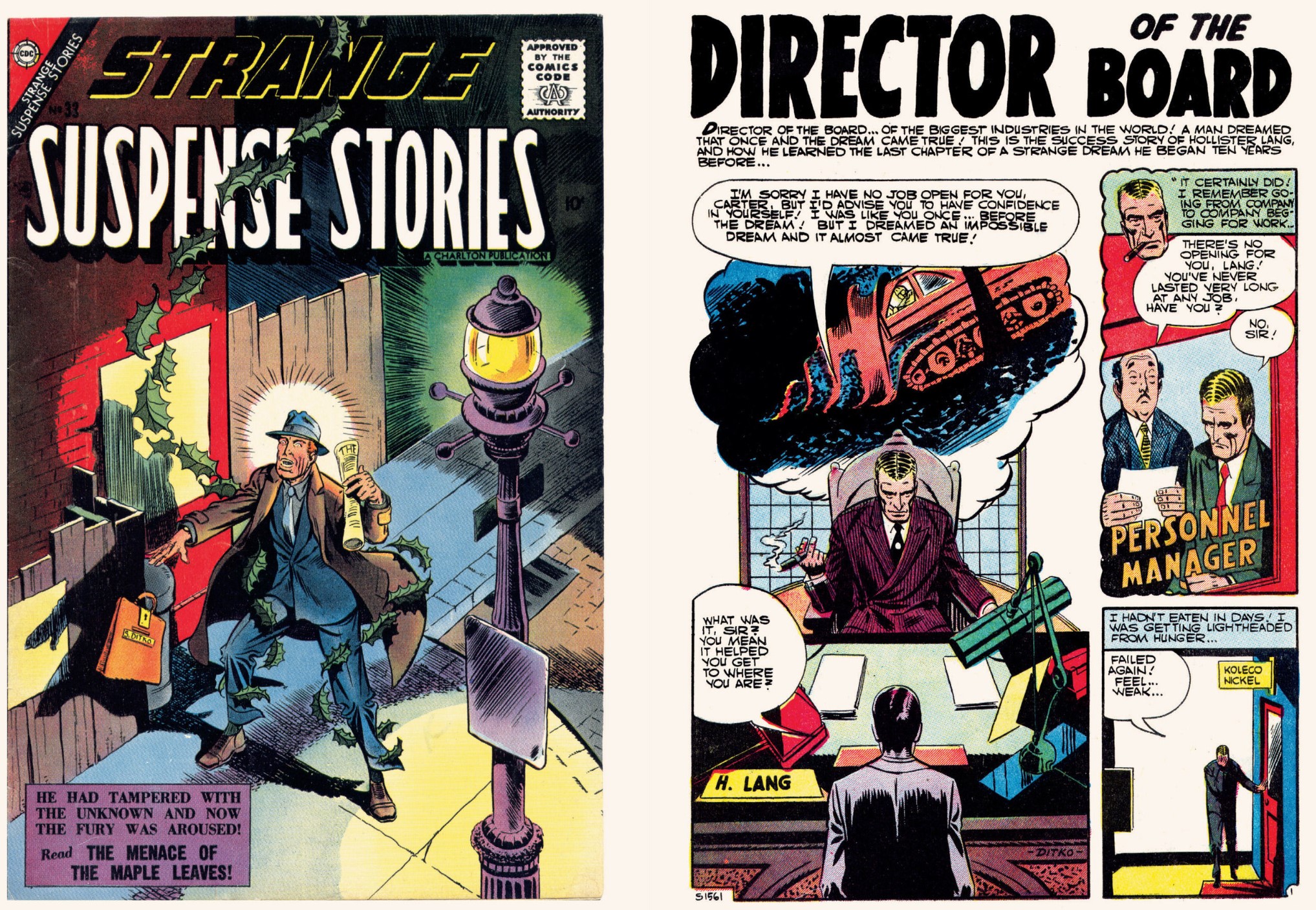
The cover of Strange Suspense Stories #31 (February 1957) leads into ‘The Gloomy One’ as a misery-loving alien intruder is destroyed by simple human joy, before the cover to Out of This World #5 (September 1957) heralds that issue’s ‘The Man Who Stepped Out of a Cloud’ and an alien whose abduction plans only seem sinister in intent. MoUW #5 (October 1957) tells the story of a young ‘Stowaway’ who finds fulfilment aboard a harshly-run space ship after which Out of This World #3’s cover (March 1957) ushers us to an apparent alien paradise for weary star-men in ‘What Happened?’

Next up is a tale from one of Charlton’s earliest star characters. The title came from a radio show that Charlton licensed the rights to, with the lead/host/narrator acting more as voyeur than active participant. The Mysterious Traveler spoke directly to camera, asking readers for opinion and judgement as he shared a selection of funny, sad, scary and miraculous human-interest yarns, all tinged with a hint of the weird or supernatural. Whenever rendered by Ditko, whose storytelling mastery, page design and full, lavish brushwork were just beginning to come into its mature full range, the contents of Tales of the Mysterious Traveler were always exotic and esoteric and utterly beguiling.

From issue #2 (February 1957), ‘What Wilbur Saw’ reveals the reward bestowed on a poverty-stricken country bumpkin who witnessed a modern-day miracle, after which Out of This World #3 covers a cautionary tale of atomic mutation in ‘The Supermen’ before the eerie cover to OoTW #4 (June 1957) signals a chilling encounter for two stranded sailors who briefly board the ‘Flying Dutchman’ whilst SSS #32’s cover (May 1957) dabbles in magic art when a collector is victimised by a thief who foolishly stumbles into ‘A World of His Own’.

From the same issue comes a salutary parable concerning a rich practical joker who goes too far before succumbing to ‘The Last Laugh’, after which ‘Mystery Planet’ (SSS #36, March 1958) offers a dash of interplanetary derring-do as valiant agent Bryan Bodine and comely associate Nedra confound intergalactic pirates piloting a planet-eating weapon against Earth!

A similarly bold defender liberates ‘The Conquered Earth’ from alien subjugation (OoTW #4, June 1957) whilst in ‘Assignment Treason’ (Outer Space #18. August 1958) the clean-cut hero goes undercover to save Earth from the predatory Master of Space as OoTW #8 (May 1958) and ‘The Secret of Capt. X’ reveals the inimical alien tyrant threatening humanity is not what he seems…

The cover to Mysteries of Unexplored Worlds #3 (April 1957) makes way for three fantastic thrillers, beginning with ‘The Strange Guests of Tsaurus’ as an alien paradise proves to be anything but, then ‘A World Where I Was King’ sees a clumsy janitor catapulted into a wondrous realm to win a kingdom he doesn’t want. Diverting slightly, Fightin’ Army #20 (May 1957) provides a comedic interlude as a civil war soldier finds himself constantly indebted to ‘Gavin’s Stupid Mule’ before ‘A Forgotten World’ wraps up MoUW #3’s contributions with a scary tale of invasion from the Earth’s core. ‘The Cheapest Steak in Nome’ turns out to be defrosted from something that died millions of years ago in a light-hearted yarn from MoUW #7 (February 1958)…

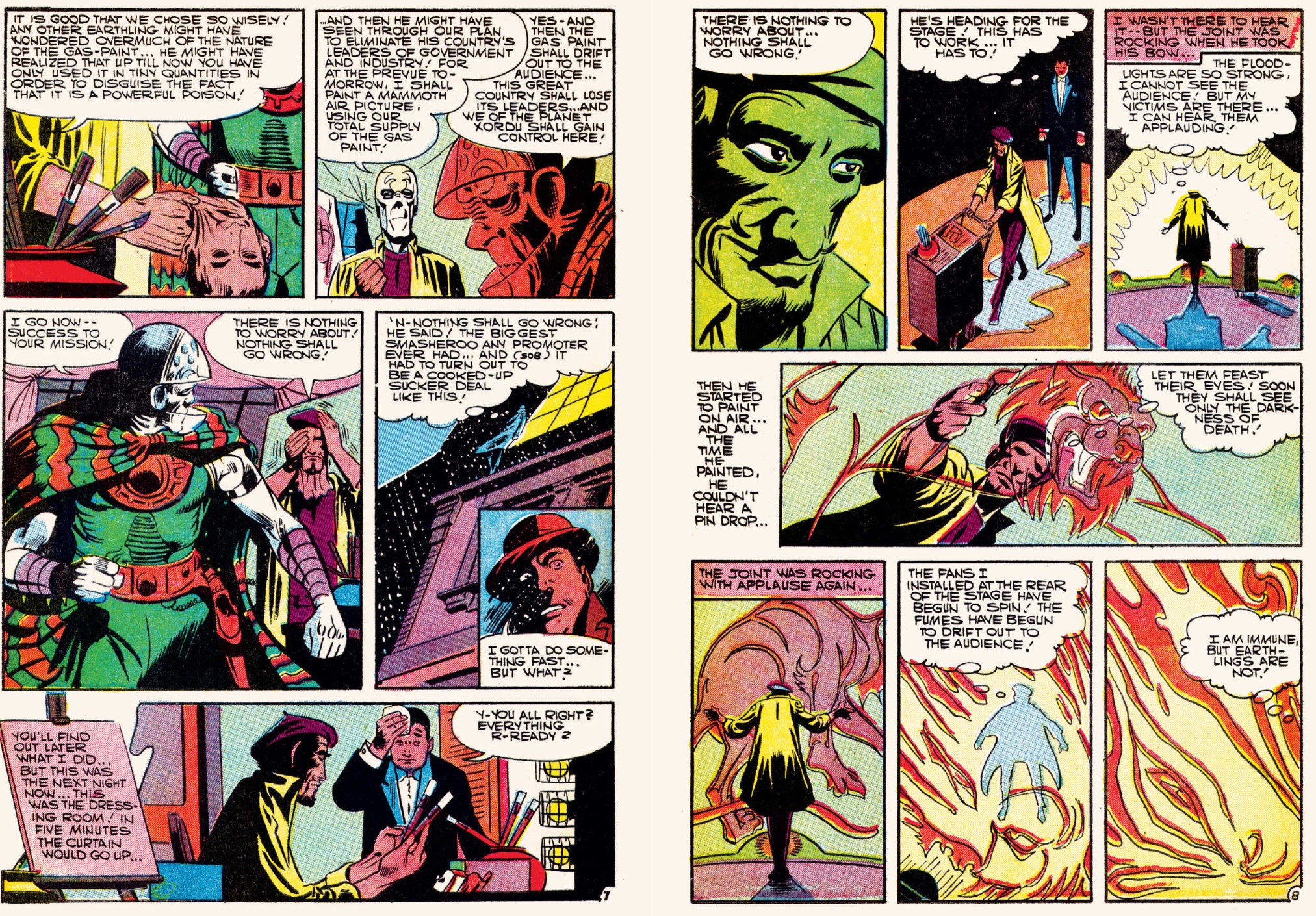
The cover to MoUW #4 (July 1957) precedes more icy antediluvian preservations found in the ‘Valley in the Mist’ whilst the one for Strange Suspense Stories #33 (August 1957) leads into a bizarre corporate outreach project as the ‘Director of the Board’ attempts to go where no other exploitative capitalist has gone before. Next, it’s back to MoUW #3 for a brush with the mythological in ‘They Didn’t Believe Him’ after which ‘Forever and Ever’ (SSS #33) reveals an unforeseen downside to immortality and Out of This World #3 sees a stranger share ‘My Secret’ with ordinary folk despite – or because of – a scurrilous blackmailer…

‘A Dreamer’s World’ from Mysteries of Unexplored Worlds #5 (October 1957) follows the chilling cover thereof as a test pilot hits his aerial limit and discovers a whole new existence, whilst Unusual Tales #7 (May 1957) traces the tragic path of ‘The Man Who Could See Tomorrow’ before the cover of Tales of the Mysterious Traveler #4 (August 1957) opens a mini-feast of voyeur’s voyages beginning with that issue’s ‘The Desert’: a saga of polar privation and survival.

TotMT #3 (May 1957) shows the appropriate cover and a ‘Secret Mission’ for a spy parachuted into Prague, whilst #4 offers ‘Escape’ for an unemployed pilot dragged into a gun-running scam in a south American lost world; ‘Test of a Man’ sees a cruel animal trainer receive his just deserts and ‘Operation Blacksnake’ grittily exposes American venality in the ever-expanding Arabian oil trade. Returning to Mysteries of Unexplored Worlds #5, ‘The Mirage’ torments an escaped convict who thinks he’s escaped his fate, whilst Texas Rangers in Action #8 (July 1957) sees a ruthless rancher crushed by the weight of his own wicked actions as ‘The Only One’, after which stunning covers to Unusual Tales #6 and 7 (February and May 1957) lead into our final vignette – ‘The Man Who Painted on Air’: exposing and thwarting a unique talent to preserve humanity and make a few bucks on the side…

This sturdily capacious volume has episodes that terrify, amaze, amuse and enthral: utter delights of fantasy fiction with lean, plots and stripped-down dialogue that let the art set the tone, push the emotions and tell the tale, from times when a story could end sadly as well as happily and only wonderment was on the agenda, hidden or otherwise.

These stories display the sharp wit and contained comedic energy which made so many Spider-Man/J. Jonah Jameson confrontations an unforgettable treat half a decade later, and this is another cracking collection not only superb in its own right but as a telling tribute to the genius of one of the art-form’s greatest stylists. This is something every serious comics fan would happily kill or die or be lost in time for…
Unexplored Worlds: The Steve Ditko Archive Vol. 2. This edition © 2010 Fantagraphics Books. Introduction © 2010 Blake Bell. All rights reserved.

Today in 1914, Jerry Siegel was born. Don’t make me have to finish this heads-up…

In 1937 Huey, Dewey & Louie Duck debuted. Ditto.

In 1959 The last issue of UK icon Comet was published and a decade later across the Pond Sidney Smith’s The Gumps ended. It had begun in 1917 as you’d know if read Sidney Smith’s The Gumps.

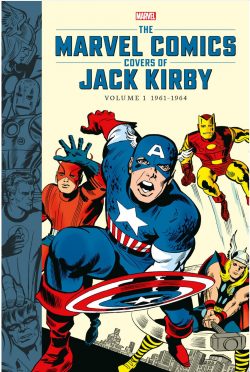
The Marvel Comics Covers of Jack Kirby volume 1: 1961-1964


By Jack Kirby, with Steve Ditko, Don Heck, Dick Ayers, Paul Reinman, Bill Everett, George Roussos, Joe Sinnott, Chic Stone, Vince Colletta, George Klein, Sol Brodsky, Al Hartley, Stan Goldberg, Art Simek, Sam Rosen & various, Introduction by Patrick McDonnell (Dark Horse Comics)
ISBN: 978-1-50673-246-6 (HB) eISBN: 978-1-50673-247-3

Today in 1917 on New York’s Lower East Side, Jacob Kurtzberg was born to Jewish-Austrian parents. He grew up to be one of the most influential and recognised artists in world history. The reason why can be read here.

The Marvel Comics Covers of Jack Kirby chronologically collects The King’s superhero cover art in a spectacular hardcover coffee table book which simultaneously preserves the wonderment in a digital edition, thus allowing instant enlargements of any and all bits you might have glossed over or missed before…

Preceding the massive and momentous art attack comes heartfelt appreciation from Patrick McDonnell (Mutts) in his Introduction and via collector memory ‘Echoes of the King’ by Vincent Iadevaia. At the far end of the collection there’s a succinct biography and appreciation of Jack for those of you who don’t know him as well as we declining comics stalwarts do.

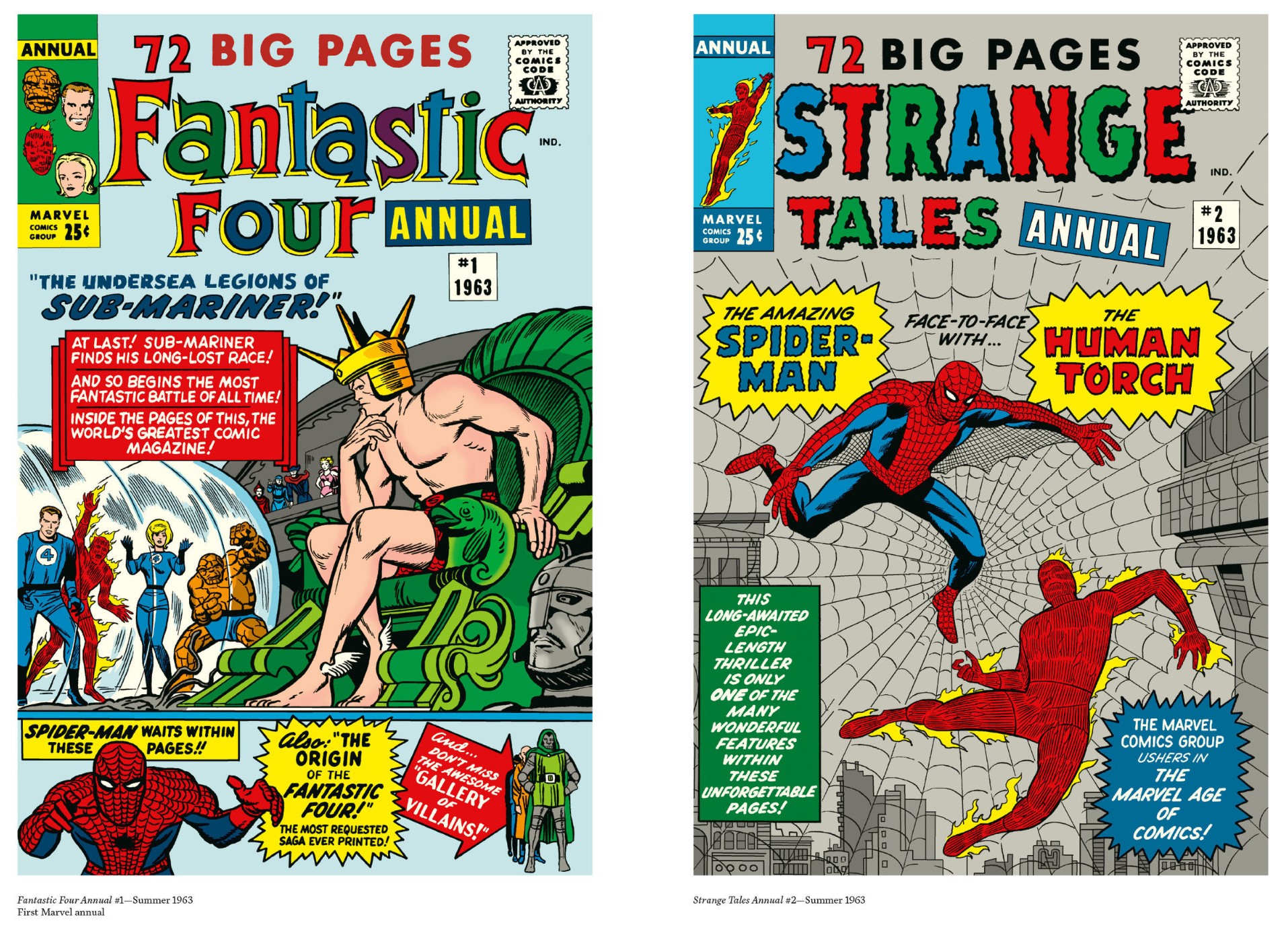
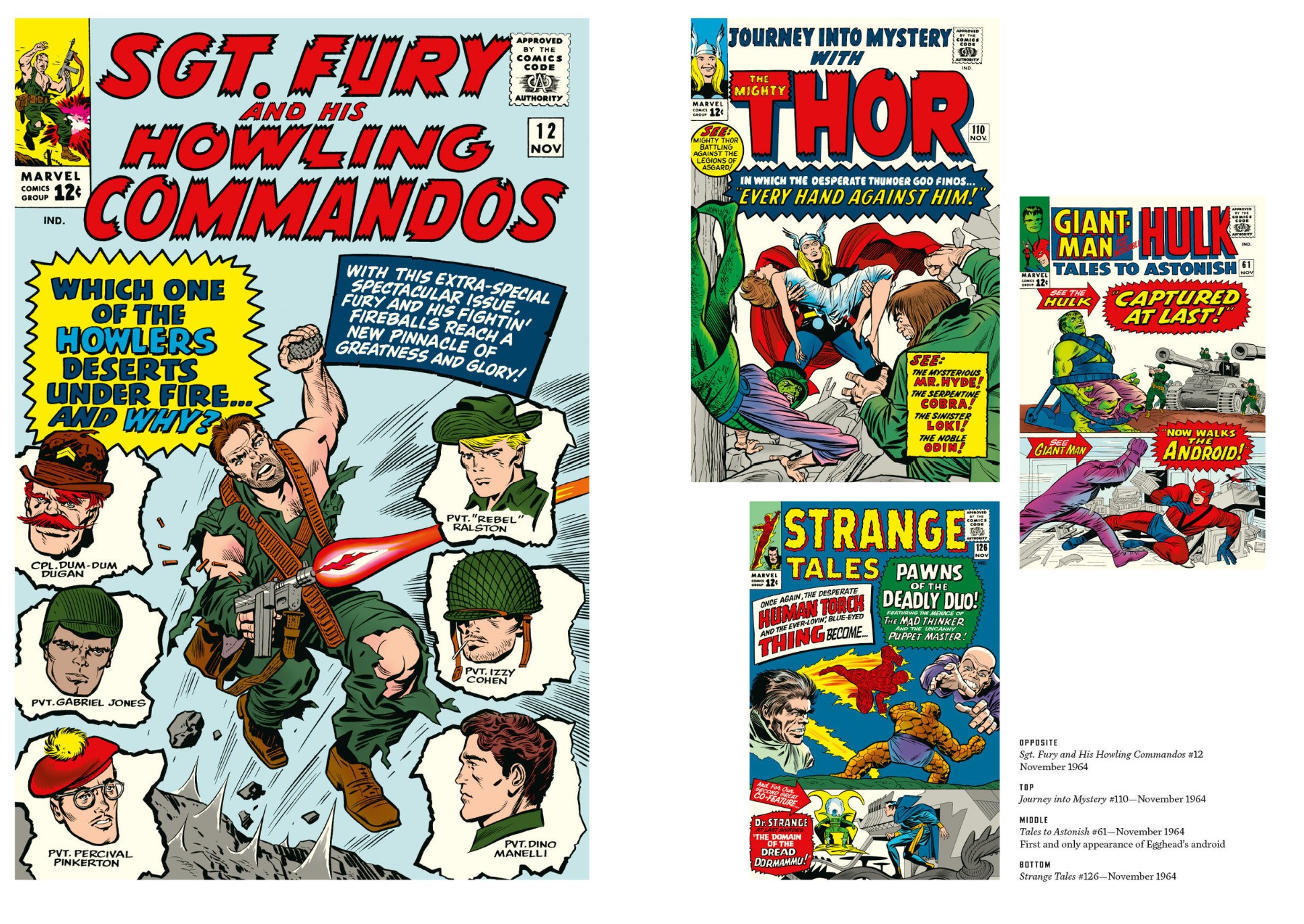
In between those points reside a torrent of those visual highpoints that served to introduce new and revolutionary ways of seeing and enjoying comic books. These collectively span cover-dates November 1961 to December 1964 as seen on The Avengers #1-11; Fantastic Four #1-33; Incredible Hulk #1-5; Journey into Mystery #83-111; Strange Tales #90, 101-127; Tales to Astonish #25, 27, 35-62; Tales of Suspense #39-56, 58-60; X-Men #1-8; Amazing Fantasy #15; Amazing Spider-Man #1; Sgt. Fury and His Howling Commandos #1-13; Daredevil # 1-4 plus Strange Tales Annual #2, Marvel Tales Annual #1, Fantastic Four Annuals #1-2, a few (far too few!) pre-Marvel genre covers including combat classic Battle #65, and a selection of monster book covers…

Inkers, colourists and letterers are not credited here, but that oversight is hopefully covered by us in the great big shopping list under the title…

Despite the too-tight brief – where are all the war, romance and particularly western and sci fi covers!? – this is a magnificent meander around the things that literally drew most of us into comics… that eye-grabbing first image. Jack Kirby was a master of electric storytelling, but he was also the god of the perfect moment and single pictures worth a thousand words. Look here and learn how and why…

© 2025 MARVEL.

Win’s First Christmas Gift Recommendation of the year!: Utter Acme of Visual Iconography… 9/10

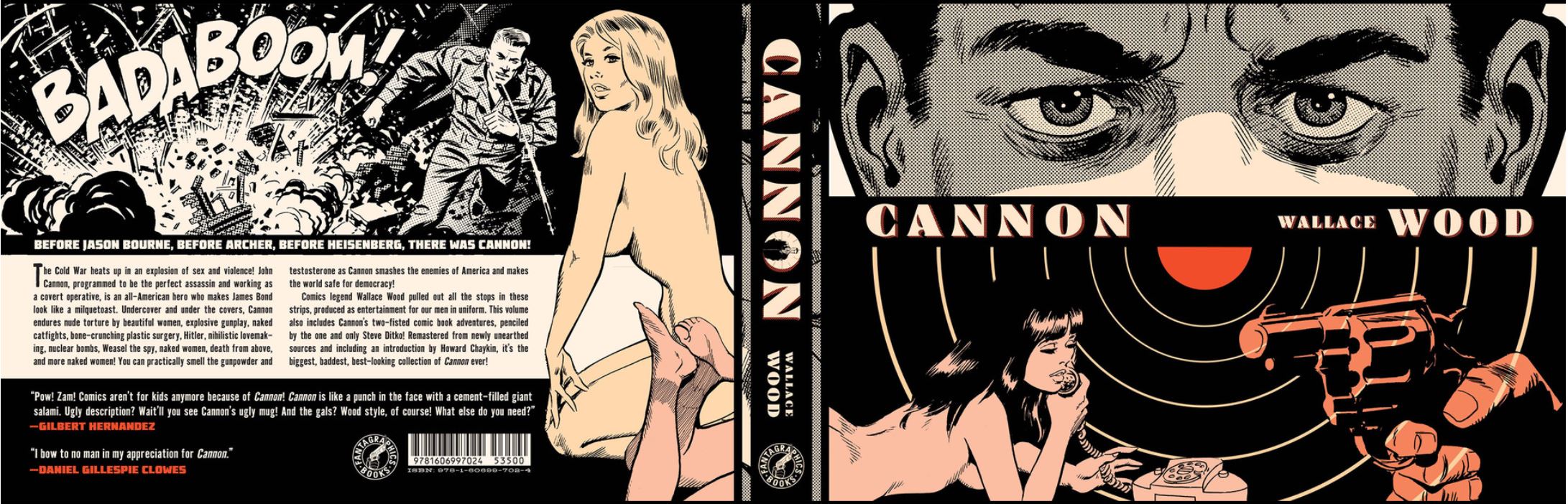
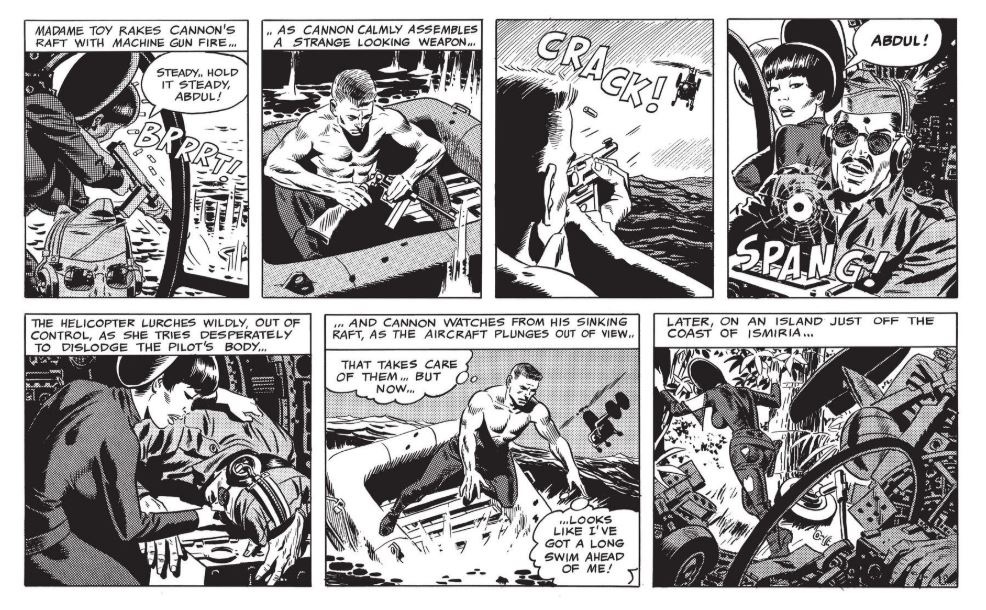
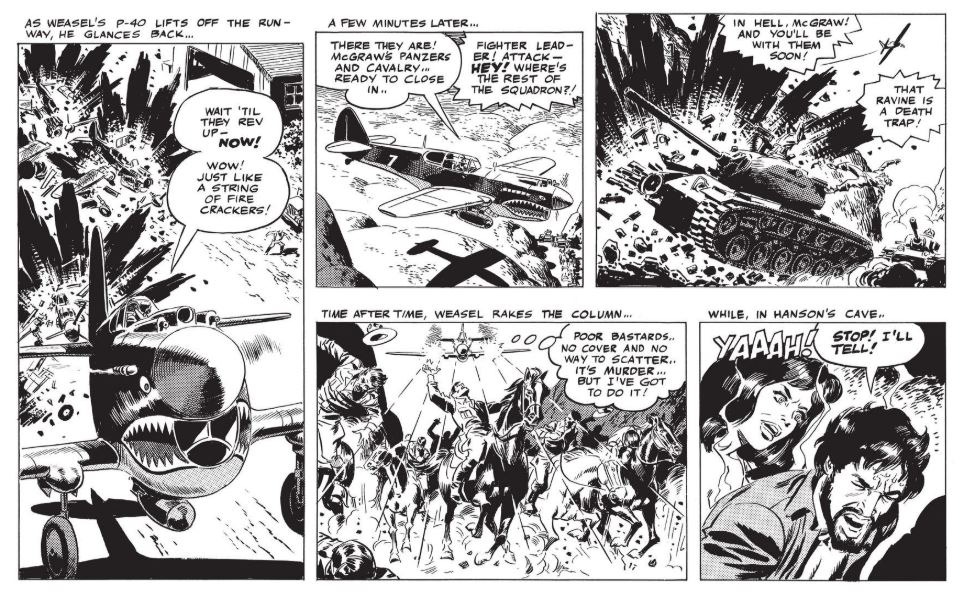
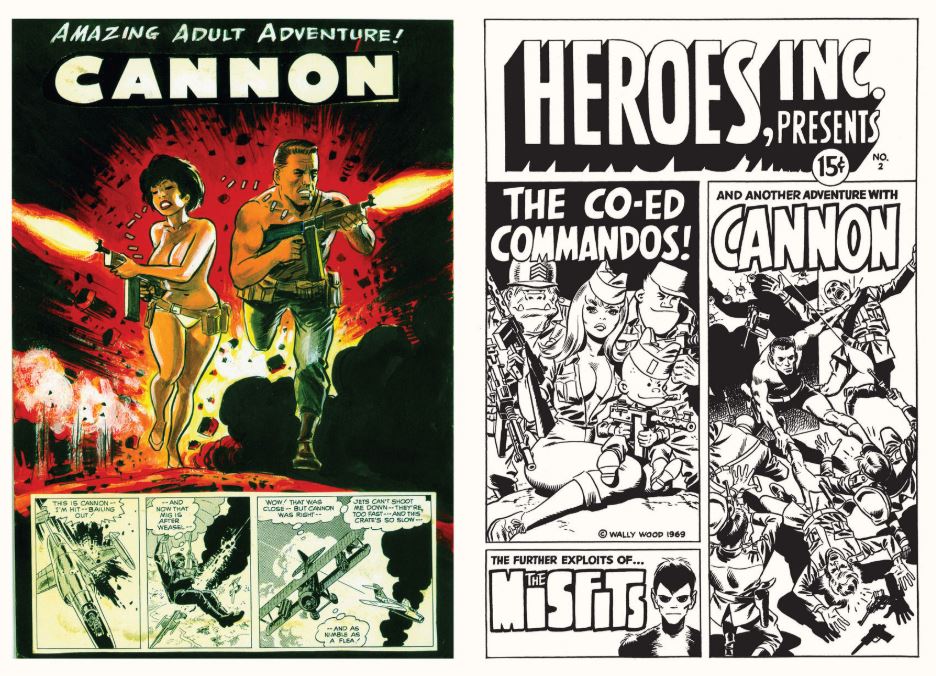
Cannon


By Wally Wood & various, introduction by Howard Chaykin (Fantagraphics Books)
ISBN: 978-1-60699-702-4 (HB/Digital edition)

This book includes Discriminatory Content produced in less enlightened times.

As with any historical perspective addressing popular mass-entertainments and evolving societies, a look back often finds uncomfortable material that can jar some modern sensitivities and set today’s collective hackles rising. That’s especially true of this lovely but confounding collection compiling seldom seen material by one of the industry’s greatest stars…

This is quite frankly a lovely book of beautiful work that I now find hard to recommend to a general audience. That’s more to do with how society has evolved rather than its admittedly always deeply flawed and often unsavoury content…

We all carry within us the seeds of our own destruction and probably none more so than troubled comics genius Wallace Allan Wood (June 17th 1927 – November 2nd 1981): one of the greatest draughtsmen and graphic imagineers our art form has ever produced. Woody was a master of every aspect of the business. He began his career lettering Will Eisner’s Spirit newspaper strip, readily moving into pencilling and inking as the 1940s ended and, ultimately into publishing. After years working all over the comic book and syndicated strip markets, as well as in book illustration, package-design and other areas of commercial art, he devised the legendary T.H.U.N.D.E.R. Agents franchise and even predated and anticipated the counter-culture’s Underground Commix phenomenon by launching in 1965s one of the first adult-oriented, independent comics: Witzend.

The troubled genius was frequently his own worst enemy. Woody’s life was one of addiction (guns, booze & cigarettes); traumatic relationships; tantalisingly close yet always inevitably frustrated financial security; illness and eventually, suicide. It was as if all the joy and beauty in his existence stayed on the pages and there was none left for real life.

Although during his time with EC Wood became the acknowledged, undisputed Master of Science Fiction art in America, he was equally adept, driven and accomplished in the production of all genres. He was a lusty man and was a pioneer of sexually explicit, ultra-violent (but always beautiful) and titillating comics where sex played a major role. Remember, even if everybody loves comics, it’s not always about superheroes and cosmic quests. Men like sexy comics and cartoons. I’m not saying that it’s right or proper to ogle women, but it is a sad fact of life and has made many publishers rich for centuries. This customer base especially likes looking at beautiful naked women and amongst so very many cartoonists over the decades, Wood was arguably the paramount exponent of the subgenre…

Remarkably and without in any way seeking to apologise for it, I can confirm that this gritty strip was made to entertain REAL-MEN!! It abounds with naked, nude, undraped and forcibly undressed women (and men, but not as many or as often as the women). Somehow less controversially it also heavily features mega violence, and both physical and psychological torture because that’s what the audience wanted. If you don’t believe me go and rewatch Goldfinger (1964) but this time watch and listen closely…

Cannon’s inbuilt misogyny is a feature not a bug with levels of abusive behaviour and conduct that seldom exceed those of any 1960-1970s Bond or Man from U.N.C.L.E. movie. There’s practically no gadgets either, but loads of fast flashy cars, planes and boats… and much sublimely rendered, awesomely accurate ordnance because that’s one thing your average GI or swabbie will spot instantly if fudged…

This cartoon series captures a moment in history that was deeply, deeply unfair to women, even if – for its time – the feature was uncharacteristically racially & socially diverse and most equitable in its treatment of African-American, Hispanic, Arabic and Asian guys. This was probably as much about the target readership – the desegrated but still mostly male US Military Service personnel – as Woody’s views on the Civil Rights movement. Wally was always utterly professional and diligent in all his work commitments and liberated from all editorial constraints, but his own experience gave the audience exactly what they wanted…

Following Howard Chaykin’s ‘Intro’ confirming the best and worst of the legends, the strip unfolds in one unbroken stream of non-stop blockbuster action heavily seasoned with geopolitical themes and contemporary headline fodder. It’s fitting to note here that Woody utilised and mentored dozens of guys who went on to their own notoriety. If you’re a fanatic, you’ll spot many of them – Pearson, Reese, Wenzel, Hama et al – as characters in the strip, but in-jokes aside, this one’s all about satisfying manly urges.

Guaranteeing sex, death and horror and NAKED WOMEN in almost every episode, Cannon by Wood and his ever-shifting studio ran from 1970-1973 in three separate editions of The Overseas Weekly: a tabloid specifically created and disseminated to US military personnel stationed overseas. He & Steve Ditko later recycled the character in an abortive indie publishing venture Heroes, Inc., which we’ll cover at the end.

John Cannon was a U2 pilot captured and tortured by the Red Chinese. Broken and turned into their assassin, he threw off the ministrations of their top brainwasher Madame Toy but suffered a psychological collapse that left him a relentless, emotionless living weapon pointed by the CIA at any target that needed killing.

His successes didn’t affect him at all but did make him a permanent target of the Chinese and Soviet governments. The latter tasked beautiful lethal killer Sue Smith to remove him by any means and at all costs, but her attempts were as frequent and futile as Toy’s, who doggedly and repeatedly seeks to recapture or kill him. Both curvaceous killers spent as much time shagging Cannon as shooting, stabbing, electrocuting, drowning, poisoning, bombing and running over the implacable agent.

Encountering and exterminating hundreds of spies Cold War spies and assassins, Cannon saves US-friendly middle-Eastern Ismiria from infiltration and insurrection; defends US ally Israel from subversion; shatters the schemes (and sleeper agent army) of Comrade Gorsk and saves Latin American San Sierra from both Red-backed rebels and the incumbent US-friendly fascist dictatorship. He even gets to save a few lives along the way, like his own Uncle Fred back in Iowa and charming conman/serial bigamist/accidental hitman Charles M. Fogarty

At home, Cannon eradicates gangsters and spies as his conditioning begins to fade. No longer a reliable asset, he tries to retire to his old family home but trouble follows and the CIA soon re-recruit him. With Toy & Sue Smith perpetually hunting him and “cat-fighting” each other, Cannon even clashes with killer hippies in a murder commune and an ultra-conservative millionaire with his own private militia seeking to set the nation back on the Right path. John even has a couple of shots at true love and a Happy Ever After, but inevitably learns over and again that “women are just no damn good”…

Along the way he experiences every kind of action from scuba combat to aerial dogfights, and even battles a killer cyborg, He’s particularly adept at ferreting out leftover Nazis and dodges more than his fair share of atomic detonations. This is a strip very much of its time and for adults if not grown-ups, so like many of his audience, our hero even has to face up to the consequences of his actions when one paramour falls pregnant. The wedding is an utter disaster…

As much a document of art history as an expertly-targeted wank-book, Cannon comes with fascinating bonus features for comics fans, beginning a voluminous Appendix section with a brace of long lost cover paintings.

These augment the Roger Hill’s essay ‘The Overseas Weekly Discovery’ detailing the bizarre circumstance that led to the retrieval of the material forming this book, and compliments a

‘Letter by Wallace Wood’ exhorting how the industry must change. These are followed by the tamed down, general audience full-colour Cannon story by Wood & Ditko as seen by almost nobody in 1969’s Heroes, Inc. Presents Cannon, and another similar but monochrome lost Wood & Ditko treat from Heroes, Inc. No. 2 (1976) once again kicking the stuffing out of stubborn Nazis by Wood & Ditko. The experience ends as it should with a fulsome and fair “Bio” of Wally Wood by J. David Spurlock.

Fast, furious and ferociously unreconstructed and sexist, this can be a hard read: one packed with pitfalls, but undeniably honest in its intent and delivery. If you like this kind of thing you’ll love it, and if you find it offensive, you’re still free enough for the moment to reject and not buy it. However, if you do feel the urge to condemn, do us all the courtesy of reading it first…
“Intro” © 2014 Howard Chaykin. “The Overseas Weekly Discovery” © 2014 Roger Hill. “Bio” © 2014 J. David Spurlock. Photos © Bhob Stewart & Paul Kirchner. All other contents © 2014 Wallace Wood Properties LLC. All rights reserved.

Word came yesterday that we’ve lost yet another comics giant. James Charles Shooter (27th September 27th 1951 – 30th June 2025) wrote countless comics stories, from the minor to the most major of major stars, and changed or steered the courses of US comic book stars with landmark tales like Marvel Super Hero Secret Wars, Secret Wars 2, Avengers: The Korvac Saga, The Superman vs. Flash race tradition, and Original Graphic Novels for Dazzler, Thor, the Avengers & X-Men (The Aladdin Effect) and more.

Wikipedia has a very fair assessment of him which you can read here .

Jim Shooter began his creative career at DC, a teenager helping his poorly-paid parents with bills. His submissions impressed editor Murray Boltinoff who bought his early stories, leading to residencies on the Legion of Super-Heroes and most of the Superman family of titles.

Combining his continued education with the stresses of being a jobbing writer, when he moved to Marvel his tales included continuity-changing runs on Daredevil, The Avengers, Super-Villain Team-Up, Ghost Rider, Spider-Man and others. As editor and publisher he created child-friendly imprint Star Comics for younger readers, sanctioned creator-owned venue Epic Comics and created Marvel’s New Universe sub-strand (writing core title Star Brand – some would say as autobiographical wish fulfilment). He pushed moving beyond the company’s established complex-continuity roots, writing “real world” material such as Team America and others. He also forged indelible links with toy and licensing brands that swiftly made Marvel the most profitable comics publisher in the US.

Outspoken, controversial and often ferociously dogmatic, Jim was Business to the bone without ever forgetting his blue-collar, poverty-driven roots. Bluntly, he alienated many key creators, but whatever others thought, did what he considered best. However, his work – he also pencilled many stories – was never dull and never, never, never boring. He was a master of science fiction themes, and understood childlike wonder, loss and comedy moments.

Always championing creator rights, Jim instituted return of artwork to artists and, when ousted from Marvel and setting up his later companies Valiant, Defiant and Broadway Comics, operated a collective writing policy that saw every participant in the incredibly collaborative process of making comics fully credited and remunerated for their contributions. He also always mentored new talent and encouraged everyone to push their own limits.

Jim Shooter was One of Us: a comics fan and story lover who made the jump from consumer to creator, so I’m asking those who care to remember him for his less well known – but often best written – efforts by hunting down and enjoying the items – or any Shooter effort – reviewed here.

The Valiant Era Collection and Warriors of Plasm
By Jim Shooter, Bob Hall, Faye Perozich, Kevin Vanhook, Don Perlin, Steve Ditko, Gonzalo Mayo, Stan Drake, Yvel Guichet, Ted Halsted, John Dixon, Paul Autio & various (Valiant)
No ISBN/ ASIN: B000H2UTEI

During the market-led, gimmick-crazed frenzy of the 1990s, amongst the interminable spin-offs, fads and shiny multiple-cover events a new comics company revived some old characters and proved once more that good story-telling never goes out of fashion. At DC, 14-year-old Shooter wrote epic runs on The Legion of Super-Heroes, Supergirl and Superman, and scripted the company’s first toy tie-in Captain Action, before moving to Marvel in 1976. When he became the Editor-in-Chief, Shooter made Marvel the most profitable and high-profile they had ever been. and, after his departure, used that writing skill and business acumen to transform an almost forgotten Silver-Age character pantheon into contemporary gold.

Western Publishing had been a major player since comics’ earliest days, blending a wealth of licensed titles such as TV and Disney titles, Tarzan, and the Lone Ranger with homegrown hits like Turok, Son of Stone and Space Family Robinson. During the 1960s superhero boom, these adventure titles expanded to include, Brain Boy, M.A.R.S. Patrol – Total War, Magnus, Robot Fighter and in deference to the atomic age of heroes, Nukla and the utterly brilliant Dr. Solar, Man of the Atom. Despite supremely high quality and passionate fan-bases, they never captured the media spotlight of DC or Marvel’s costumed cut-ups. Western shut up their comics division in 1984.

With an agreement to revive some, any or all of these four-colour veterans, Shooter and co-conspirator Bob Layton came to a bold decision and made those earlier adventures part-&-parcel of their refit: acutely aware that older fans don’t like having their childhood favourites bastardized and that revivals need all the support they can get. Thus the old days were canonical: they “happened”…

The company launched with a classy reinterpretation of science fiction icon Magnus, but the key title to the new universe they were building was the broadly super-heroic Solar, Man of the Atom Alpha & Omega and Second Death which launched with an eye to all the gimmicks of the era, but also cleverly realised and realistically drawn.

Hit after hit followed and the roster of heroes expanded until dire market conditions and corporate chicanery ended the company’s stellar expansion. Gradually it fractionated and despite many revivals since, has all but disappeared now…

Here’s another innovation of that idea-packed era – a sampler of hits and one of their earliest graphic novels – from the early days of the format we’re all so familiar with. The Valiant Era Collection, re-presenting Magnus #12, Solar #10-11, Eternal Warrior #4-5 and Shadowman #8 was released in 1994 as an introduction to the new old brand and canny compendium of first appearances from the company’s burgeoning continuity. It gathered a disparate selection of tales which had one thing in common: the debuts of characters that had quickly become “hot”.

In the collector-led era of the early 1990s – before one zillion internet sites and social networking media – many new concepts caught the public’s attention only after publication. The seemingly-savvy snapped up multiple copies of comics they subsequently couldn’t sell and many genuinely popular innovations slipped by unnoticed until too late. This trade paperback from a company that valued storytelling above all else addressed that thorny issue by simply bundling their own hot and hard to find hits in one book…

‘Stone and Steel’ was written by Faye Perozich & Shooter and illustrated by Gonzalo Mayo, and found Robot-Fighting superman Magnus transported to a timeless dimension where dinosaurs and cavemen existed side by side. Once there he became embroiled in a battle for survival against his old enemy Laslo Noel: a rabid anti-technologist not averse to using modern super-weapons to force his point of view.

The Lost Land had other defenders, most notably two Native American warriors named Turok and his young companion Andar. The pair had been a popular Western Publishing mainstay for over a quarter of a century (see Turok, Son of Stone) and their initial (re)appearance here led to their revival in a succession of titles which survived the company’s demise, as well as a series of major computer and video games.

That spectacular, entrancing epic is followed by a 2-part Solar saga introducing an immortal warrior prince and paving the way for the disclosure of the secret history which underpinned the entire Valiant Universe.

Solar was brilliant nuclear physicist Phil Seleski, who designed a new type of fusion reactor and was transformed into an atomic god when he sacrificed his life to prevent it destroying the world. His energized matter, troubled soul, coldly rational demeanour and aversion to violence made him a truly unique hero – but his discovery of hidden meta-humans and a genuine supervillain in the ambitious, mega-maniacal form of ultra psionic Toyo Harada led Solar into a constantly escalating Secret War. Solar #10 – ‘The Man who Killed the World’ by Shooter, Don Perlin, Stan Drake, John Dixon & Paul Autio – introduced a raft of new concepts and characters, beginning with troubled teen Geoffry McHenry – the latest in a long line of Geomancers blessed/cursed with the power to communicate with every atom that comprises our planet. When the world screams that a sun-demon is about to consume it, Geoff tracks down Seleski only to determine that Solar is not unique and the threat is still at large.

Meanwhile, Harada’s Harbinger Foundation has sent all its unnatural resources to destroy the Man of the Atom, supplemented by a mysterious individual named Gilad Anni-Padda: an Eternal Warrior who had been battling evil around the globe for millennia and has worked with a number of Geoff’s predecessors…

Concluding chapter ‘Justifiable Homicides’ (Shooter, Steve Ditko, Ted Halsted & Mayo) finds Geomancer, Gilad and Solar battling for their lives against an army of Harbinger super-warriors. As always with this series, the ending is not one you’ll see coming…

Gilad soon helmed his own series and Eternal Warrior #4-5 introduced his immortal but unnamed undying nemesis in ‘Evil Reincarnate’ (Kevin Vanhook, Yvel Guichet & Dixon), a tale of ancient China which segues neatly into a contemporary clash with a drug-baron who is his latest reborn iteration. Then nanite-enhanced techno-organic wonder warrior Bloodshot explodes onto the scene in ‘The Blood is the Life’ (Vanhook & Dixon): a blockbusting action epic setting up the enhanced assassin’s own bullet-bestrewn series and tangentially, the 40th century Magnus spin-off Rai

The final debut in this volume was not for another hero but rather the introduction of the Valiant Universe’s most diabolical villain. Shadowman #8 held ‘Death and Resurrection’ (Bob Hall, Guichet & Dixon) and changed the rules of the game throughout the company’s growing line of books.

Jack Boniface was a struggling session saxophonist trying to strike it rich in the Big Easy when he was seduced by Lydia, a mysterious woman he picked up in a club. Her sinister, trysting assault left him unconscious, amnesiac and forever altered by a bite to his neck. Lydia was a Spider Alien: part of a race preying on humanity for uncounted centuries and responsible for creating many of the paranormal humans who secretly inhabit the world.

Her bite forever changes Jack and when darkness falls he becomes agitated, restless and extremely aggressive: forced to roam the Voodoo-haunted streets of New Orleans as the compulsive, impulsive daredevil dubbed Shadowman – violent, driven, manic and hungry for conflict… but only when the sun goes down. This tale examines the deadly criminal drug sub-culture of the city as a new narcotic begins to take its toll. a poison forcing its victims to careen through the streets bleeding from every orifice until they die. Witnesses call them “Blood Runners”…

As Shadowman investigates he is unaware that he is a target of the drug’s creator – ancient sorcerer Master Darque – and that soon the world will no longer be the rational, scientific place he believed. Before long, Jack will have terrifying proof that magic is both real and painfully close and that the Man of Shadow is not a creature of exotic physics and chemistry but something far more arcane and unnerving…

Despite being a little disjointed, these stories are immensely readable and it’s a tragedy that they’re not all readily available, as Valiant’s hostile takeover led to the breaking up of and selling on of various stars…

Still, there are always back issue comics and digital collections and the hope that the new revival might spawn a few trade paperback editions. Until then you can still hunt down this and the precious few other collections via your usual internet and comic retailers, and trust me, you really should…
© 1994 Voyager Communications Inc. and Western Publishing Company, Inc. All rights reserved.

Warriors of Plasm: The Collected Edition
By Jim Shooter, David Lapham, Mike Witherby, Bob Smith & various (Defiant)
ISBN: 978-1374700000, ASIN: B000R4LMUQ

If the 1980s was the decade where anybody with a pencil and a printer’s phone number could enter the business, the 1990s saw the rapid rise – and very often equally swift fall – of the small corporation publisher. Many businesses opened or acquired a comics division to augment or supplement their core business: like the Nintendo Comics that were packaged by and published in conjunction with Valiant Comics…

Jim Shooter founded Valiant with Bob Layton, and later went on to launch the short-lived but highly impressive Defiant Comics of which this book is – to my knowledge – the only collected edition. That’s a great pity as the range of talent that briefly worked there, as well as the titles themselves, showed immense promise. The legal war of attrition with Marvel that caused their early closure is well documented elsewhere, so I’ll swiftly move on to the product itself.

Flagship title Warriors of Plasm was a powerful alien intervention tale set mostly in an alternate universe where a single race had taken genetic science to such extremes that their homeworld had become a voracious planetary organism continually feeding on the biomass of other worlds.

Society on The Org was hierarchical, imperialistic and ritually sadistic, where the credos of “survival of the fittest” and “evolve or die” had the force of fanatical religion. Ruled by a weak Emperor, the court lived a life of brutal hedonistic luxury, revelling in decadence whilst relentlessly jockeying for advantage.

Lorca is a Seeker, high in the court and charged with finding new worlds for the Org to consume, but something within him defies official doctrine that personality is an aberration and that all bio-matter belongs to the greater whole. Bodies are mulched and recycled whilst individuality is an anti-social aberration, yet all organisms clearly would do absolutely anything not to die.

Spurred on by his corrupt rival Ulnareah, Lorca forms an illegal relationship with Laygen, a girl created without state-approval, and when caught, he is forced to recycle her to preserve his own existence.

Bitter and discontented, he eventually returns to work, but when he discovers Earth beyond the transdimensional veil he sees an opportunity to overthrow the Org and take supreme control. Humans are strong, individualistic, fierce warriors, and – with his tricks of genetic augmentation – could defeat any force the Org might muster. Thus, he teleports 10,000 test subjects to his private vats… but something goes wrong.

Only five humans survive, mutated into superhuman beings, but the Seeker is unaware of this since he’s been arrested by the authorities who never stopped watching him…

How the transformed humans escape and the uneasy alliance they form with unlikely liberator Lorca makes for a refreshingly novel spin on the old plot of revolution and redemption, and Shooter’s dialogue and characterisations of what could so easily have been stock characters add layers of sophistication to a fantasy drama many “adult” comics would kill for even today.

Simultaneously understated and outrageous as inked by Mike Witherby, David Lapham’s incredible art & design captivates and bewilders, adding a moody disorientation to a superb, action-packed thriller, especially in the incredible, climactic 4-page fold-out battle scene.

Originally produced as Warriors of Plasm #1-4, ‘The Sedition Agenda’ was preceded by an issue #0 daringly released only as a set of trading cards and supplemented by a prequel tale outlining the social relevance of gory global sporting phenomenon known as ‘Splatterball’, (written & drawn by Lapham with inks by Bob Smith), and these too are gathered here for your delectation.

Still seen on internet vendors’ sites, I have no idea where else you can find a copy of this terrific little book but I hope you do, just as I wish that some smart publisher would pick up the rights for all the Defiant material and the Broadway Comics Shooter produces after Defiant died: but maybe one day somebody will get the remaining band back together and finish all these lost stories…
© 1994 EEP, L.P. All Rights Reserved.

R.I.P. Jim…

New Crusaders Legacy


By Rich Buckler, Ian Flynn, Robert Kanigher, Marty Griem, Lou Manna, Rex Lindsey, Stan Timmons, Bill DuBay, Jr., Rich Margopoulos, David M. Singer, Alex Toth, Carmine Infantino, Steve Ditko, Dick Ayers, Gray Morrow, Alec Niño, Tony DeZuñiga, Louis Barreto, Adrian Gonzales, Ricardo Villagran, Frank Giacoia, Alan Kupperberg, Jerry Gaylord, Ben Bates, Alitha Martinez & many more (Red Circle/Archie Comics)
ISBN: 978-1-936975-22-8 (TPB/Digital edition)

This book includes Discriminatory Content produced in less enlightened times.

In the dawning days of the comic book business, just after Superman and Batman pioneered a new genre of storytelling, many publishers jumped onto the bandwagon and made their own bids for cash and glory. Many thrived and many more didn’t; now relished only as trivia by sad old blokes like me. Some few made it to an amorphous middle-ground: not forgotten, but certainly not household names either.

MLJ were one of the quickest publishers to jump on the Mystery-Man bandwagon, following the spectacular successes of the Man of Tomorrow with their own small yet inspirational pantheon of gaudily clad costumed crusaders, beginning in November 1939 with Blue Ribbon Comics. Soon followed by Top-Notch and Pep Comics, their content was the standard blend of two-fisted adventure strips, prose pieces and gag panels and, from #2 on, superheroes. However, after only a few years Maurice Coyne, Louis Silberkleit and John Goldwater spotted a gap in the blossoming market and in December 1941 nudged aside their masked heroes and action strips to make room for a far less imposing hero; an “average teen” who would have ordinary adventures like the readers, but with triumphs, romance and slapstick emphasised. The teen phenomenon was pure gold and by 1946 the kids had taken over, so MLJ renamed itself Archie Comics; retiring its heroic characters years before the end of the Golden Age and becoming, to all intents and purposes, a publisher of family comedies. Its success, like Superman’s, changed the content of every other publisher’s titles, and led to a multi-media industry including TV shows, movies, a chain of restaurants and even a global pop hit Sugar, Sugar (a tune from their animated show).

By this stage the company had blazed through an impressive pantheon of mystery-men who would form the backbone of numerous future superhero revivals, most notably in the High-Camp/Marvel Explosion/Batman TV show-frenzied mid-60’s era. The heroes impressively resurfaced under the company’s Red Circle imprint during the early days of the Direct Sales revolution of the 1980s, but after a strong initial showing, again failed to sustain the public’s attention.

Archie let them lie fallow (except for occasional revivals and intermittent guest-shots in Archie titles) until 1991, when the company licensed its heroes to superhero specialists DC for a magically fun, all-ages iteration (and where’s that star-studded trade paperback collection, huh?!). Impact Comics was a vibrant, engaging and fun all-ages rethink that really should have been a huge hit but was again cruelly unsuccessful. When the line folded in 1993 the characters returned to limbo. DC had one more crack at them in 2008, incorporating The Mighty Crusaders & Co into their own maturely angst-ridden and stridently dark continuity – with the usual overwhelming lack of success.

Over the last decade the wanderers returned home to Archie in superbly simplistic and winningly straightforward revivals aimed squarely at old nostalgics and young kids reared on action/adventure TV cartoons: brimming with all the exuberant verve and wide-eyed honest ingenuity you’d expect from an outfit which has been pleasing kids for over 80 years.

Released initially online in May 2012 – followed by a traditional monthly print version that September – the first story-arc made it to full legitimacy with a thrill-packed trade paperback collection, equally welcoming to inveterate fanboys and eager newcomers alike. The series introduced a new generation of legacy heroes rising from the ashes of their parents/guardians’ murders to become a team of teenaged gladiators carrying on the fight as New Crusaders.

This collection supplements and follows on from that magical makeover: with mentor The Shield training the potential-filled juniors with the records of their predecessors. The stories included here come from those aforementioned 1980s Red Circle episodes; culled from the

Mighty Crusaders #1, 8, 9; The Fly #2, 4, 6; Blue Ribbon (vol 2) #3, 8, 14; The Comet #1 and Black Hood #2, collectively spanning 1983-1985.

Following an engaging reintroduction and recap, contemporary creative team Ian Flynn, Jerry Gaylord, Ben Bates & Alitha Martinez reveal how the grizzled, flag-draped veteran has trouble reaching his teenaged students until he begins treating them as individuals, and sharing past Crusaders’ cases. Starting with personal recollections of his own early days as America’s first Patriotic superhero in ‘The Shield’ (Mighty Crusaders #8, by Marty Greim, Dick Ayers & Rich Buckler), Joe Higgins explains his active presence in the 21st century, leading into a recapitulation of the first Red Circle yarn.

‘Atlantis Rising’ is from Mighty Crusaders #1, by Buckler & Frank Giacoia, which saw psionic plunderer Brain Emperor and immortal antediluvian Eterno the Conqueror launching a multi-pronged attack on the world. They are countered by an army of costumed champions including the Golden Age Shield, Lancelot Strongthe (other) Shield – and for a while there were three different ones active at once – Fly and Fly-Girl, The Jaguar, The Web, Black Hood and The Comet, who communally countered a global crimewave and clobbered the villains’ giant killer robots…

This is followed by a modern interlude plus pin-up and data pages on Ralph Hardy AKA ‘The Jaguar’ before a potent vignette by Chas Ward & Carlos Vicat. ‘The Web’ offers the same data-page update for masked detective/criminologist John Raymond before ‘The Killing Hour’ (Blue Ribbon #14, by Stan Timmons, Lou Manna, Rex Lindsey & Chic Stone) sees the merely mortal manhunter join his brother-in-law The Jaguar in foiling nuclear terrorism.

Modern pin-ups and data-pages reintroduce ‘The Comet’ before Bill DuBay, Jr., Carmine Infantino & Alec Niño reworked the original 1940’s origin tale by Jack Cole from Pep Comics #1 in (1940). Reproduced from 1984’s The Comet #1, this chilling yarn detailed how an idealistic scientist became the most bloodthirsty hero of the Golden Age, with a body-count which made The Punisher look like a social worker.

The infomercial for ‘Steel Sterling’ precedes a wild and whimsical origin-retelling of the star-struck, super-strong “Man of Steel” by his 1940s scripter Robert Kanigher, illustrated with superb style by Louis Barreto & Tony DeZuñiga from Blue Ribbon #3, after which ‘Fly Girl’ gets star treatment in a brace of tales, augmented as always by the ubiquitous fact-folio.

Buckler, Timmons, Adrian Gonzales & Ricardo Villagran’s ‘A Woman’s Place’ (The Fly #2) clears up an exceedingly sexist old-school extortion ring whilst ‘Faithfully Yours’ (Fly #6) sees her movie-star alter ego Kim Brand subjected to a chilling campaign of terror from a fan. Timmons, Buckler, Steve Ditko & Alan Kupperberg take just the right tone in what might be the first incidence of stalking in US comics…

‘Black Hood’ has no modern iteration in the New Crusaders. Still active in contemporary times, he encountered the kids during their debut exploit and is phenomenally cool, so he gets a place here. Following the customary introductory lesson he appears in a gritty, Dirty Harry styled caper (from Blue Ribbon #8 by Gray Morrow) as undercover cop – and latest convert – Kip Burland, who sidesteps Due Process to save a kidnapped girl and ensure the conviction of crooks hiding behind the law. The gripping yarn also discloses the centuries-long justice-seeking tradition of “The Man of Mystery”…

That’s followed by a snippet from Rich Margopoulos, Kupperberg & Giacoia’s ‘A Hero’s Rage’ wherein Kip discovers his uncle Matt (the Golden Age Black Hood) has been murdered. Ditching his leather jacket and ski-mask in favour of the traditional costume, the bereaved hero suits up and joins the Mighty Crusaders…

Without doubt the most engaging reprint in this collection and by itself well worth the price of admission is ‘The Fox’ from Black Hood #2. Written and drawn by the inimitable Alex Toth, this scintillating light-hearted period comedy-drama finds the devilish do-gooder in Morocco in 1948 and embroiled with wealthy expatriate ex-boxer Cosmo Gilly, who has no idea he’s become the target for assassination…

The recondite recollections surge to a climax with ‘Old Legends Never Die’ (MC#9, by David M. Singer, Buckler & Ayers) as the first Shield is accused of excessive force and manslaughter when his 1940’s crime-fighting style seemingly results in the death of a thief he apprehended. With Joe Higgins’ costumed friends in support but out of their depth in a courtroom, the convoluted history of the three heroes bearing his codename is unpicked during ‘The Trial of the Shield’ before the uncannily sinister truth is exposed…

Supplemented by a plentiful cover gallery and packed with the kind of ephemera that sends old Fights ‘n’ Tights fans into paroxysms of delight, I fear this is probably a book only the wide-eyed young and dedicated still ambulatory old fart nostalgists could handle, but it is such a perfect artefact of the superhero genre I strongly urge anyone with a hankering for masked adventure and craving Costumed Dramas to give it a long look.
NEW CRUSADERS and RED CIRCLE COMICS ® ACP, Inc. © 2013 Archie Comics Publications. All rights reserved.