Brothers of the Spear (Dark Horse Archive) volume 1


By Gaylord DuBois, Russ Manning, Jesse Marsh & various (Dark Horse Books)
ISBN: 978-1-59582-821-7 (HB)

This book includes Discriminatory Content produced in less enlightened times.

Situated on the West Coast, Western’s Dell/Gold Key imprints rivalled DC & Marvel at the height of their powers, and the comics licensee specialists famously never capitulated to the wave of anti-comics hysteria that resulted in the crippling self-censorship of the 1950s. No Dell or Gold Key Comic ever displayed a Comics Code Authority symbol on the cover – they never needed to…

An utterly unique visual stylist, Jesse Marsh was born on 27th July 1907 and died far too young on April 28th 1966 from diabetic complications at the height of a TV Tarzan revival he was in large part responsible for. Marsh was another Disney animator (from 1939 on) who took a sideways step, becoming a full-time narrative illustrator for the studio’s comic book licensee Whitman Publishing in 1945. Marsh jobbed around and adapted movie properties (mostly westerns like Gene Autry) until 1948 when Dell introduced the first all-new Tarzan comic book. The newspaper strip had run since 1929 and all previous funnybook releases had featured expurgated or modified reprints of those tales.

That all changed when the Ape-Man finally got his own funnybook (beginning with Dell Four Color Comic #134 (February 1947) and eventually a titular periodical. Bimonthly, Edgar Rice Burroughs’ Tarzan #1 was cover dated January/February 1948. Marsh dived in, never looked back and became the go-to guy for other ERB adaptations like Jon of the Kalahari and John Carter of Mars. He naturally handled all the extra stuff in Tarzan…

Marsh was unique in the way he positioned characters in space, using primitivist forms and hidden shapes to augment his backgrounds, and as the man was a fanatical researcher, his trees, rocks, and constructions were 100% accurate. His animals and natives, especially children and women, were all distinct and recognisable; not the blacked-up stock figures in grass skirts even the greatest artists so often resorted to. He also knew when to draw big and draw small: the internal dynamism of his work is spellbinding. Perhaps that was in part due to ever-deteriorating eyesight – due to his battle with diabetes – but it also led to his hiring one of the medium’s most gifted illustrator’s just as the kid was starting out…

Back then, to accommodate US postal regulations (and tax-ratings) regarding shipping rates, comic books and magazines – as opposed to other printed matter – were defined as having a plurality of individual features, strips, pinups and supporting features. Over many decades this legal quirk happily spawned a vast variety of fact-features, prose sections, gag-pages, and crucially for us here, back-up strips in all US comics books…

The Tarzan comic was very much in the Burroughs tradition, but although most of the early ancillary pages were filled with the rich material of the world of  John Clayton, Lord Greystoke, soon the brief was expanded to cover wider wonders of jungle existence. This might be to not overexpose the character, but also due to a global uptick in similar rainforest stars like film & TV sensation Nyoka the Jungle Girl and the growing host of sultry “Jungle Queens” in comics.

Moreover, any back up strips – if popular and spun off – would be the property of Western/Dell/Gold Key. The man to generate this vast supporting cast was canny editor and staggeringly prolific scripter Gaylord DuBois.

Poet, author, novelist, biographer, avid outdoorsman and comic book/strips mastermind Gaylord McIlvaine Du Bois was born on August 24th 1899, in Winthrop, Massachusetts. There’s not much biographical data on him, as he seems to have spent every moment of his life writing. Apparently tireless, DuBois created and scripted many long-running favourites (Space Family Robinson/Lost in Space, Turok, Son of Stone, Indian Chief), as well as numerous comics-based kids’ material, ghosted many top newspaper strips, wrote Big Little Books and produced countless movie and TV comics adaptations (like Lassie, Robin Hood, Spartacus and Quentin Durward, Raggedy Ann and Andy, Andy Panda, Our Gang, Tom and Jerry, Jungle Jim,) for Dell/Gold Key. His work on licensed hits also included many Westerns like The Lone Ranger, Red Ryder, Gene Autry, Roy Rogers, Zane Grey’s King of the Royal Mounted, Bat Masterson, and Bonanza, and he delighted and specialised in creating long-running, appropriately-themed support strips (such as Captain Venture: Beneath the Sea, Leopard Girl, Young Hawk, Jungle Twins, Two Against the Jungle, Little Beaver, Bullet, Lotor, Owd Bob and more).

For the ever-expanding Tarzan franchise he wrote the lead, support features and everything else (including puzzles!), forging a 20-year working relationship with Marsh and carrying on his good works with his successors on Marsh’s passing. DuBois died on October 20th 1993.

Brothers of the Spear began in 1951 (Tarzan #25, cover-dated October) replacing DuBois & Marsh’s previous serial Two Against the Jungle, and commencing an epic never-ending African wilderness fantasy that would run continuously between that point and Tarzan #156 in 1966.

The brothers returned sporadically thereafter (#158, 160, 161, 202, 202). but did win their own 18-issue comic book (June 1972 to May 1982, by DuBois, Jesse Santos & Dan Spiegle). Back in Tarzan, Dubois & Spiegle provided Jungle Girl tales whenever the Brothers were absent, and when the book moved to DC Comics with #207 the Bros got their own comic book…

This archive collection – first of three and reprinting the stories from Tarzan #25-67 (October 1951 to April 1955) – comes from 2012 and is long overdue for rerelease. It opens with Foreword ‘Soul Brothers of the Spear’: a heartfelt appreciation and appraisal by legendary cartoonist Gary Panter, packed with information about the enigmatic master and well-considered opinions on what made Marsh and his pupil/assistant so similar and so different…

Born in Van Nuys, California on January 5th 1929, Russell George Manning was one of comics’ greatest stylists. He attended Los Angeles County Art Institute before joining the war effort. Serving in Japan he naturally cartooned for the local servicemen’s newspapers.

Back home in 1953, Russ joined local firm Western Publishing, doing assorted jobs for Dell before settling in with Jesse Marsh. In many ways Manning was the direct antithesis of his mentor, favouring slick presentation and sleek realism, but he too valued simple design, pared-down linework and bold use of empty space. Manning became an absolute master of his art, and is most popularly remembered now for the Star Wars newspaper strip and  Magnus, Robot Fighter, but his other triumphs were all Tarzan-related. As well as the comic book and newspaper strip (dailies from 1969-1972 and the Sundays from 1969-1979) he crafted sublime Graphic novel incarnations of Edgar Rice Burroughs’s immortal Lord of the Jungle such as Tarzan: The Land That Time Forgot (most commonly seen these days in international editions; although a Dark Horse edition from the turn of this century is still around if you look hard).

We lost Manning far too soon, to cancer on December 1st 1981.

This tome covers the origins of and transitional hand-over of the supremely compelling Brothers of the Spear, sharing the advancement of two teens reared far from civilisation before set upon an epic journey of vengeance and destiny across Africa in days gone by.

Tarzan #25 cover-dated October #1951) saw the first episode, with Marsh handling the B-feature boys for the first 14 episodes. The feature never had individual chapter titles and steadily grew from 4½ to 8 (or more!) pages.
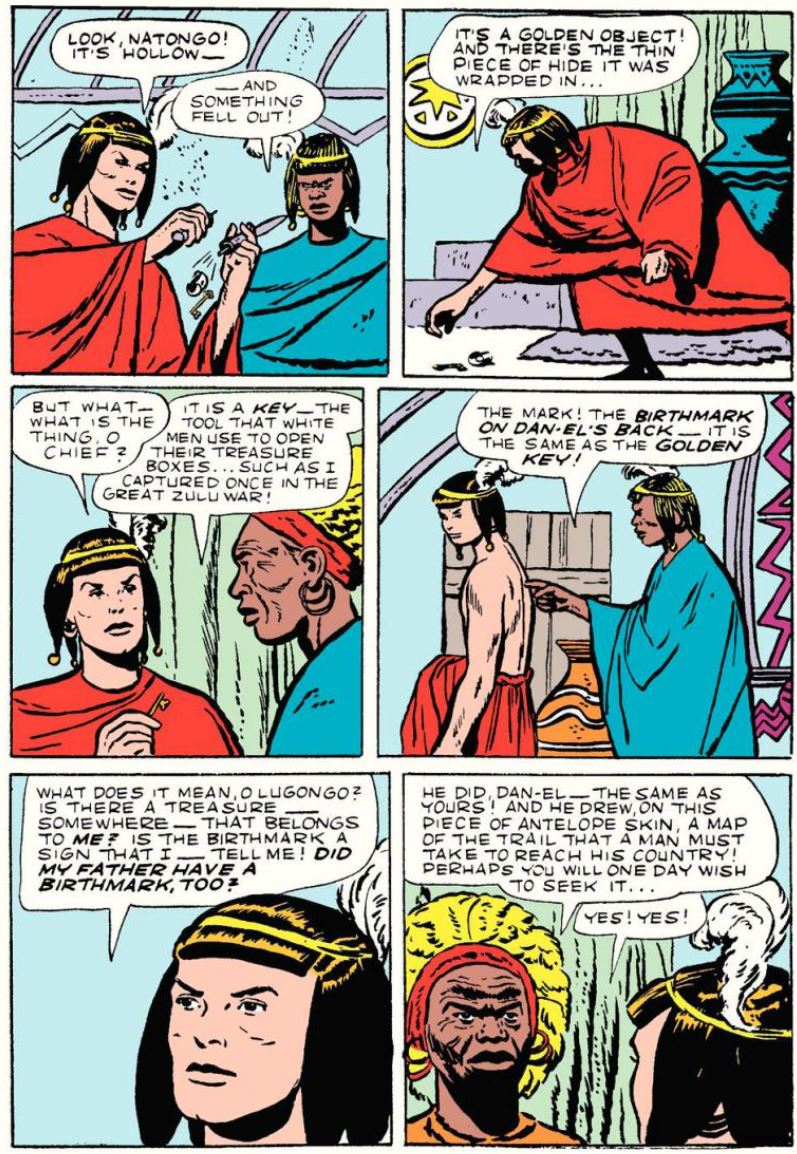
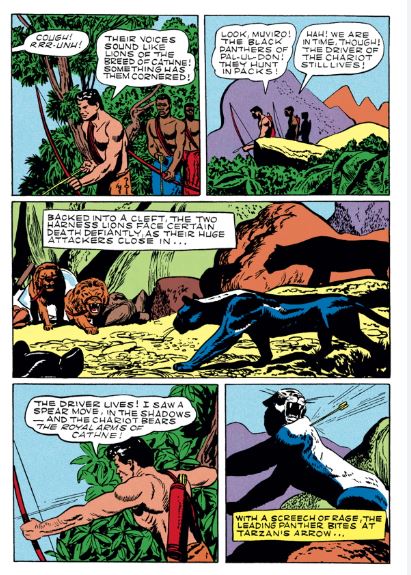
Edged with authenticity, if not realism, it began in Bechuanaland (now Botswana) when Zulu prince Natongo undertakes his manhood ritual – The Ceremony of the Spear. He is superb but matched in every way by his foster brother Dan-El, a white foundling adopted by the great chief sixteen years previously. the boys are inseparable in ability and filial affection and now that he is a man Dane-El is told how he came to the tribe. Long ago his father (a king of a fabled far country) left the infant with the Zulu chieftain for his own safety, with only a golden key. It matched a birthmark on the back of both father and son…

Apparently Dan-El is the fugitive prince of a lost tribe of white men. The mountain domain of Aba-Zulu had haunted his dreams for years and now, armed with knowledge, Dan-El sets out to find them. His beloved, brother, equal in every aspect and skill, will not let him go alone and together they set off…

The next 13 instalments saw the mighty spear-wielding warriors overcome all the dramatic standbys of the genre: like white tyrants with weapons called “guns”; embattled farmers in need of saving; lions and leopards; Arab slavers; warring tribes and other beasts either ferocious and rampaging or faithful and beloved. As they ferreted out clues to the distant destination, their trek took them through deserts, against black insurgent seeking to overturn white rule; wild savannah and across vast, pirate-plagued Lake Tanganyika,  but even with diversions and distractions like becoming embroiled in war and failing to save the most beautiful warrior princess ever born (Dell’s lack of Comics Code validation often led to quite horrific, tragic and REALISTIC body counts!), and befriending many tribes and native nations, inexorably the devoted, deathly determined siblings near the ever-calling mountains…
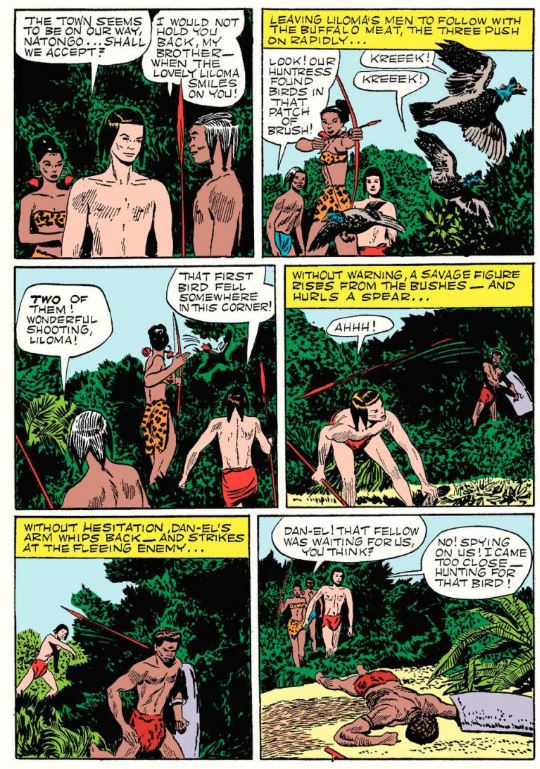
Fortune turns in their favour after escaping slavers. The Brothers fetch up at the foot of a vast mountain range and discover ancient tombs containing dead embalmed kings lying in state… white ones…

With the goal of Aba-Zulu reached in Tarzan #39 (December 1952), a new era of adventure and tribulation began. This episode marked the first solo outing for Manning, who continued on the strip (increasingly with his own assistant Mike Royer) until i966. In those latter days Manning was being pulled away from the Brothers, his own Magnus Robot Fighter and Captain Johner and the Aliens series and even high profile launches like Gold Key’s My Favourite Martian due to the intense scheduling conflicts of the Tarzan newspaper strips and comic book, but at this key moment all his creative efforts were expended on learning and getting better…

Now Natongo & Dan-El begin the next phase of heir eventful lives as entering Aba-Zulu they discover a land oppressed by a ruling class of witchdoctors using trickery and superstition to rule. Their leader Nagopa instituted the uprising that dethroned Dan-El’s father and the malign mage still dominates through royal puppet Han-Ool, a distant relative of Dan-El’s. The people are unhappy but too scared to react… until The Brothers of the Spear rouse old retainers like General Kongoni and valiant aide Mothibi to lead a counter rebellion and free the people.
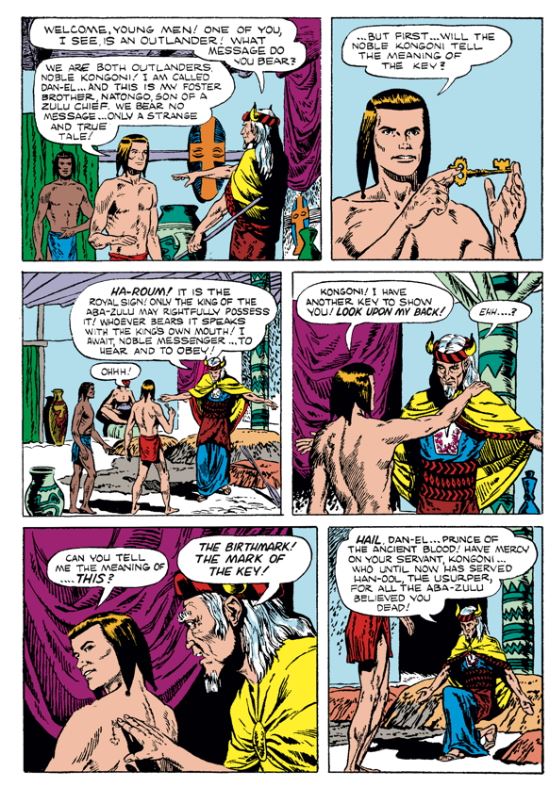
The battle is long and hard and filled with sudden death and constant distraction.  Frustratingly over 16 years the tyranny of Nagopa’s tricks are deeply embedded in the people’s consciousness. These mental shackles are hard to shake, but at least the warriors have the support of Kongoni’s daughter Tavane and the irrefutable talisman of the golden key and Dan-El’s birthmark…

Eventually the witchdoctors are forced into retreat, but this only sees the war evolve into a campaign of assassination attempts and traps to discredit Dan-El and Natongo. And of course, this is Africa, with roaming warriors from other regions like neighbouring Obelo, wild weather, and slavers always likely to strike and further divert the cause of liberation…

Nonetheless, the Brothers persevere and triumph, feeling at last most of their work is done, but it’s just a pause allowing Nagopa to unleash all his venomous ire against capable princess to be Tavane…

To Be Continued…

Far less fanciful and more solidly grounded, this strip is a masterful rationalistic saga short on mutants and monsters but brimming with bold, cinematic adventure that should be on everyone’s revival list.
BROTHERS OF THE SPEAR™ ARCHIVE Volume 1 © 1951-1955, 2012, Classic Media LLC. Brothers of the Spear and associated character names, images and other indicia are trademarks of and copyrighted by Classic Media LLC. All rights reserved.

Today in 1899 Gaylord DuBois was born, sharing this day with artist extraordinaire Jim Aparo (The Phantom, Stern Wheeler, Phantom Stranger, Aquaman, The Spectre, Brave and the Bold, Batman) in 1932; Italian writer Max Bunker (Alan Ford) in 1939; Gasoline Alley cartoonist Jim Scancarelli in 1941 and cartoonist Keith Knight (The K Chronicles, (Th)ink, The Knight Life, Woke) in 1966.
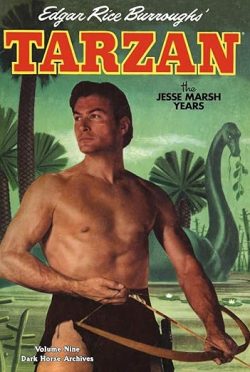
Edgar Rice Burroughs’ Tarzan: The Jesse Marsh Years Volume Nine


By Gaylord DuBois & Jesse Marsh (Dark Horse Books)
ISBN: 978-1-59582-649-7 (HB)

This book includes Discriminatory Content produced in less enlightened times.

Win’s Christmas Gift Recommendation: Primal fantasy Adventure… 8/10

I don’t know an awful lot about Jesse Marsh, other than that he was born on 27th July 1907 and died far too young: on April 28th 1966 from diabetic complications at the height of a TV Tarzan revival he was in large part responsible for. What I do know, however, is that to my unformed, pre-fanboy, kid’s mentality, his drawings were somehow better than most of the other artists and that every other kid who read comics in my school disagreed with me.

There’s a phrase we used at 2000 AD that summed it up: “Artist’s artist”, which usually meant someone whose fan-mail divided equally into fanatical raves and bile-filled hate-mail. It seems there are some makers of comic strips that many readers simply don’t get.

It isn’t about the basic principles or artistic quality or even anything tangible – although you’ll hear some cracking justifications: “I don’t like his feet” (presumably the way he draws them) and “it just creeps me out” being my two favourites. Never forget in the 1980s DC were told by the Comics Code Authority that Kevin O’Neill’s entire style and manner of Drawing was unacceptable to American readers!

I got Jesse Marsh. He was another Disney animator (beginning in 1939) who moved sideways – in 1945 – to become a full-time narrative illustrator for the studio’s comic book licensee Whitman Publishing. Marsh never looked back and became the go-to guy for other ERB adaptations such as John Carter of Mars.

Situated on the West Coast, Western’s Dell/Gold Key imprints rivalled DC and Marvel at the height of their powers, and the licensee famously never capitulated to the wave of anti-comics hysteria that resulted in the crippling self-censorship of the 1950s. No Dell Comics ever displayed a Comics Code Authority symbol on the cover – they never needed to…

Marsh jobbed around adapted movie properties – mostly westerns like Gene Autry – until 1948 when Dell introduced the first all-new Tarzan comic book. The newspaper strip had run since 1929 and all previous funnybook releases had featured expurgated and modified reprints of those adventures. That all changed with Dell Four Color Comic #134 (February 1947) which featured a lengthy, captivating tale of the Ape-Man scripted by Robert P. Thompson, who also wrote both the Tarzan radio show and the aforementioned syndicated strip (as you can see in Tarzan and the Adventurers).

The comic was very much in the Burroughs tradition: John Clayton, Lord Greystoke and his friend Paul D’Arnot aid a young woman in rescuing her lost father from a hidden tribe ruled over by a monster. The engrossing yarn was made magical by the simple, underplayed magic of a heavy brush line and absolutely unmatched design sense. Marsh was unique in the way he positioned characters in space, using primitivist forms and hidden shapes to augment his backgrounds, and as the man was a fanatical researcher, his trees, rocks, and constructions were 100% accurate. His animals and natives, especially children and women, were all distinct and recognisable; not the blacked-up stock figures in grass skirts even the greatest artists so often resorted to.

He also knew when to draw big and draw small: the internal dynamism of his work is spellbinding. His Africa became mine, and of course the try-out comic book was an instant hit. Marsh and Thompson’s Tarzan returned with two tales in Dell Four Color Comic #161, cover-dated August 1947. This was a remarkable feat: Four Colour was a catch-all title showcasing in rotation literally hundreds of different licensed properties, often as many as ten separate issues per month. So rapid a return engagement meant pretty solid sales figures…

Bolstered by a healthy and extremely popular film franchise and those comics strips, within six months, bimonthly Tarzan #1 was released (January/February 1948). It was a swansong for Thompson, but another unforgettable classic for Marsh – and the first of an unbroken run that would last until 1965: over 150 consecutive issues. Moreover there were also spin-offs featuring other ERB character adaptations and gigantic specials like the Annual that opens this collected volume.

Prior to that, the collection – reprinting material from 1953 from Edgar Rice Burroughs’ Tarzan #44-46 and monumental bonus book Tarzan’s Jungle Annual #2 – opens with Foreword ‘Looking for Jesse Marsh’: a heartfelt appreciation and appraisal of the secretive genius by publisher Dan Nadel, packed with information about the enigmatic master. Then, cover-dated August 1953 and on sale from 16th July, that colossal bonus book delivers a painted cover by Morris Gollub (not featuring then current big screen Tarzan Lex Barker) in advance of a beguiling trip to an Africa that never was…

A monochrome Jungle World frontispiece revels in an idyllic quiet moment for the Ape-Man and faithful pachyderm pal Tantor, before main event ‘Tarzan in the Valley of Towers’ transports the Jungle Lord and pilot/scientist Professor Alexander MacWhirtle to a distant unexplored region in aid of a girl who sent a plea for help in a tiny parachute woven from spider-webs…

As always this yarn (and everything else including puzzles) was written by Gaylord DuBois. Editor and prolific scripter (Lone Ranger, Lost in Space, Turok, Son of Stone, Brothers of the Spear and many more) he was Marsh’s creative collaborator for nearly 20 years.

Flying into the great desert, Tarzan and “Professor Mac” soon find Heather Day laid out as a sacrifice on a towering limestone altar, left for giant carnivorous bats by debased humans who have turned themselves into flying/gliding predators in their image. The battle to overthrow the petty tyrants of the sky takes them from the highest peaks to deepest subterranean depths, but inevitably Tarzan triumphs and returns Hearther to the outer world.

Back then, entertainment was full on and informative, so this Annual was packed with fact and activity features. First up, and still all Marsh in vision, is potted travelogue ‘Jungle Trails’ augmented by a simple method for ‘Making Maps’ and a clever rebus message from Tarzan to his ‘Jungle Village’. Then it’s back to action as ‘Tarzan and the Cannibals of Kando-Mor’ finds the Ape-Man and his Waziri friend Chief Muviro traversing the fearsome Great Swamp when the party is captured by man-eating men. Their escape brings the wanders fully into Burroughs’ rich fantasy-scape as they discover another isolated and embattled outpost of lost land Pal-Ul-Don (introduced in 8th novel Tarzan the Terrible) and befriend the buffalo-worshipping Gallugos. The event is quite timely as the ever-encroaching cannibals have almost completed their extended scheme to eliminate the cow-lovers…

Almost…

Illustrated sheet music provides long-distance lessons for ‘Dancing Feet’ to cavort at a ‘Moonlight Marriage’ ceremony, whilst ‘Happy Warrior’ shares the secrets of kite-making before ‘Boy Stands by a Friend’ offers another intimate peek at the formative years of Greystoke’s African family when Boy – later called Korak – and ape pal Zorok stow away on a riverboat and nearly end up as zoo exhibits. ‘Letters from Boy’ to the readers feature next, as ‘Jungle Hunt’ details how to make an inner tube popgun and water canteens, prior to an adventure with elephants as ‘The Troubles of Tantor’ seen the herd patriarch go to extraordinary lengths to rescue wayward calves captured by angry farmers.

Picture essays detail the secrets of MacWhirtle’s plane and the domain of dinosaurs in ‘Boys Air Adventure to the Valley of Monsters’ after which a touch of old-fashioned racial profiling describes native characteristics in ‘Jungle Tribes’ and ‘Jungle Woman’ before embracing romance as final story ‘Tarzan Trails the Brothers of the Barracuda’ sees the Ape-Man reunite shipwrecked and separated young lovers by hunting down the slave traders who have seized and sought to sell her…

Wrapping up with a load of lexicons, ‘Jungle Language: Swahili-English’ and ‘Jungle Language: Ape-English’ provides illustrated dictionaries that come in handy for the puzzle pages and crossword, before monochrome endpiece ‘Jungle World’ explores the violent existence of bugs and minibeasts.

Cover-dated May 1953, Edgar Rice Burroughs’ Tarzan #44 sees the Jungle Lord enjoying a quiet ride over vast hidden Pal-Ul-Don on his giant eagle Argus when he saves a tiny shepherd from a vulture as big as the mighty raptor Tarzan rides. In ‘Tarzan and the Little Spearmen’ this good deed soon sours. Coro of Saparta is grateful and desperate and happy in turn as the benevolent giant and his equally immense pal Muviro hunt down the ferocious carrion feeders who find living little people more tasty than corpses. Sadly, the interaction sparks civil war between the farming fraternity and now-unemployed spearman clan who used to defend them, especially after Tarzan teaches them the high-tech marvel of archery…

Pathos and nostalgia hit hard in second saga ‘Tarzan and the Strange Balu’ as a she-ape finds a human baby and replaces her own dead newborn with him. Poor, grieving Kalahari will not surrender the infant, leaving the Ape-Man in a double bind: finding the child’s real family and saving the mother surrogate from heartbreak…

The task is made even harder but more gratifying when Tarzan discovers vile slavers have been transporting a white woman to market…

The issue ends with a stunning pinup of Argus and a GIANT-giant vulture and contemporary house ad before ERBT #45 (June 1953) opens with ‘Tarzan and the Haunted Plantations’ wherein the Ape-Man visits old friend Chief Buto and learns his warrior comrade is plagued by devils and ghosts. A little careful investigation then reveals the fields where his people hire out as croppers are coveted by a bandit with knowledge of unexploited resources beneath that fruitful dirt, and Razan devises a sneaky scheme…

‘Boy and the Shamba Raider’ again focuses on the exploits of Korak-to-come as the kid and his pal Dombie take executive action to trap rogue water buffalo raiding crops and attacking workers. They wouldn’t have had to if the adult warriors had listened to them in the first place…

Epic fantasy follows in ‘Tarzan Returns to Cathne’ when the Jungle Man and Waziri’s Pal-Ul-Don explorations bring them into conflict with sabretooth tigers attacking the war-lions of Queen Elaine of Cathne. The staunch friend and ally is a fugitive now as her husband King Jathon is gone and usurper Timon rules. The madman is unstoppable and seeks to conquer sister city Athne, but Tarzan has other ideas and the wits to implement them…

The issues closes with another house ad and ‘Tarzan’s World’ pinup of the Dangina (Cape Hunting Dog) before we segue into final entry Tarzan #46 .

Dated July 1953 it begins with ‘Tarzan Defends a City’ as the Ape-Man and not-dead Jathon (surprise!) trek back to Cathne with super-colossal war lion Goliath, only to find the citadel under siege by crocodile-riding Terribs from the Great Swamp. Things look bleak until the Gallugos – freshly fled from the cannibal Kando-Mors – arrive and turn the muddy tide. All they want in return is land to build their new city…

Back in regular Africa, ‘Boy Faces the Fangs of the Mamba’ after Matusi witchdoctor Ungali – having failed to kill Tarzan – frames his annoying spawn Boy for theft and orchestrates a lethal trial by snake. Sadly for the villain, Ape-Man arrives just in time…

This titanic tome terminates with whimsical mystery ‘Tarzan and the Treasure of the Apes’ as brutal unscrupulous white hunters discover the great apes dubbed “mangani” are all bedecked in priceless jewels. Ruthlessly stalking the vain bedazzled beasts the safari killers even manage to wound Tarzan, before he convinces the apes to surrender their “pretty stones” in favour of something better: something edible.

The Jungle King then delivers a unique judgement that might not look like justice but truly is nothing but…

Although these are tales from a far-off, simpler time they have lost none of their passion, inclusivity and charm, whilst the artistic virtuosity of Jesse Marsh looks better than ever. Perhaps this time a few more people will “get” him…
Edgar Rice Burroughs® Tarzan®: The Jesse Marsh Years volume 9 © 1953, 2011, Edgar Rice Burroughs Inc. Tarzan ® Edgar Rice Burroughs Inc. All rights reserved.

In 1952 Jack of all comics trades Keith Giffen was born. We haven’t reviewed Ambush Bug, Legion of Super-Heroes or his Doom Patrol yet, so why not recall gleeful glory days with Justice League International volume 1?

In 1978 screen writer and comics luminary Robert Kirkman was born. You probably know him best for Walking Dead volume 1: Days Gone Bye.

Edgar Rice Burroughs’ Tarzan: The Jesse Marsh Years Omnibus volume two


By Gaylord DuBois & Jesse Marsh (Dark Horse Books)
ISBN: 978-1-59582-294-9 (HB)

Win’s Christmas Gift Recommendation: Dynamic Days-Gone-By Derring Do … 8/10

This book includes Discriminatory Content produced in less enlightened times.

I don’t know an awful lot about Jesse Marsh, other than that he was born on 27th July 1907 and died far too young: on April 28th 1966 from diabetic complications at the height of a TV Tarzan revival he was in large part responsible for. What I do know, however, is that to my unformed, pre-fanboy, kid’s mentality, his drawings were somehow better than most of the other artists and that every other kid who read comics in my school disagreed with me.

There’s a phrase we used to use at 2000 AD that summed it up: “Artist’s artist”, which usually meant someone whose fan-mail divided equally into fanatical raves and bile-filled hate-mail. It seems there are some makers of comic strips that many readers simply don’t get.

It isn’t about the basic principles or artistic quality or even anything tangible – although you’ll hear some cracking justifications: “I don’t like his feet” (presumably the way he draws them) and “it just creeps me out” being my two favourites. Never forget in the 1980s DC were told by the Comics Code Authority that Kevin O’Neill’s entire style and manner of Drawing was unacceptable to American readers!

I got Jesse Marsh.

Like many Western Publishing stalwarts Jesse Mace Marsh originally worked for Disney Studios (1939-1948) as an animator on projects including Pinocchio and Fantasia. His first comics work appeared in 1945, and he continued as a staff artist until his death in 1966. In addition to his Tarzan contributions, he illustrated Gene Autry, Daniel Boone, Davy Crockett and more, as well as John Carter of Mars: three 4-Color series issues. In this second compilation, hyper-prolific Gaylord McIlvaine Du Bois (August 24th 1899 – October 20th 1993) is scripter as – nourished by a burgeoning movie franchise, radio, newspaper and new novels – the comic book Ape-Man phenomenon grew and steadied for the long haul. The editor/scripter (for ALL the Tarzan titles and spin-offs, Lone Ranger, Lost in Space, Turok, Son of Stone, Brothers of the Spear, Lassie, Andy Panda, Red Ryder, Tom and Jerry, Bonanza and so many more) would be Marsh’s creative collaborator for the next 19 years.

Situated on the West Coast, Western’s Dell/Gold Key imprints rivalled DC and Marvel at the height of their powers, and the licensee famously never capitulated to the wave of anti-comics hysteria that resulted in the crippling self-censorship of the 1950s. No Dell Comics ever displayed a Comics Code Authority symbol on the cover – they never needed to…

Marsh jobbed around adapted movie properties – mostly westerns – until 1948 when Dell introduced the first all-new Tarzan comic book. The newspaper strip had been running since January 1929 and all previous collections and funnybook releases had featured expurgated and modified reprints of those exploits. Everything changed with Dell Four Color Comic #134 (February 1947) which offered a lengthy, captivating tale of the Ape-Man, scripted by Robert P. Thompson. He had also written both the Tarzan radio show and the aforementioned syndicated strip. link to Tarzan and the Adventurers please.

‘Tarzan and the Devil Ogre’ was very much in the Burroughs tradition: John Clayton, Lord Greystoke and his friend Paul D’Arnot aid a young woman in rescuing her lost father from a hidden tribe ruled over by a monster. The engrossing yarn was made magical by the simple, underplayed magic of a heavy brush line and absolutely unmatched design sense. Marsh was unique in the way he positioned characters in space, employing primitivist forms and hidden shapes to augment his backgrounds. He was a fanatical researcher: his trees, rocks, and constructions were 100% accurate. His animals and natives, especially children and women, were all distinct and recognisable; not the badly-shaded stock figures in grass skirts that even the greatest artists so often resorted to.

Marsh also knew when to draw big and draw small: the internal dynamism of his work is spellbinding. His Africa became mine, and as the try-out comic book was an instant hit he stuck around for decades. Dell never messed with something that was already working. Marsh and Thompson’s Tarzan returned with two tales in Dell Four Color Comic #161, cover-dated August 1947. That was remarkable: Four Colour was a catch-all title showcasing literally hundreds of different licensed properties in rotation, often as many as ten separate and stunningly diverse issues per month. So rapid a return engagement meant pretty solid sales figures…

Following a gracious and wondering Foreword by Gilbert Hernandez discussing the sheer ubiquity of Tarzan comics in households – particularly Latino ones – we return to distant days of rampaging fantasy, garnished by yet another warning from me. In past reviews I’ve described how this character comes with lots of inbuilt colonial baggage and an unhealthy side-order of appalling white supremacy for those readers pre-sensitised pro or con. What I haven’t addressed is the sheerly shocking death toll of animals, killed for food, for sport or because someone needs an action scene proving how cruel villains are or how mighty the hero is. This is not a book for vegans or animal activists, okay?

Volume Two gathers the pertinent material from Edgar Rice Burroughs’ Tarzan #5-10, spanning September/October 1948 through July/August 1949) and includes (line art) covers and back covers by eventual painter/illustrator Morris Gollub. Most issues also include two colour frontispieces and endpieces offering lessons in ‘Tarzan’s Ape-English Dictionary’, prompting millions of kids everywhere to shout “Kreegah! Bundolo!” and “Tantor, ho!” in the playground and look like complete loons trying to talk to baboons and monkeys every time we visited a zoo…

The dramas resume with Tarzan #5 (September/October 1948) with harsh morality play ‘Tarzan and the Men of Greed’. Here, wife Jane and son Boy (latterly “Korak”) are kidnapped by American gangsters and a bandit sheikh as a means of forcing Tarzan to bring them and their army of African bandits to the lost treasure vaults of Opar. After an arduous trek, and terrifying ascent of an ancient escarpment, the thieves learn to their eternal cost why it’s not healthy to antagonise the legendary Ape-Man…

As well as the epic 33 page saga and the opportunity to practise primate patois “Mangani to Paco” there’s a stunning back cover pinup of the forest family before – cover dated November/December 1948 – we dig deep into the novels’ mythology for #6 as ‘Tarzan and the Outlaws of Pal-ul-don’ sees Jane abducted (again!). This time it’s raiders from a primordial enclave first introduced in eighth novel Tarzan the Terrible (1921), necessitating man and boy chasing the perfidious primitives all the way back to their lost realm. This is a huge oasis of jungles, mountains, dinosaurs and evolutionary dead-ends at the centre of a vast desert and results in reunion with old Waz-don ally Om-At and war with bandit nation Ho-Don, using Triceratops as tanks…

Following another pin-up, Tarzan #7 (January/February 1949) finds the family back home, and bored Tarzan making a hot air balloon. His efforts lead to more trouble when Boy and his Waziri friend Dombie are accidentally caught when it breaks loose and transported to a land of terrors. ‘Tarzan and the Valley of the Monsters’ sees the Jungle Lord and his ally Muviro (Dombie’s dad) give chase in a plane until brought down by Pterodactyls. From there it’s all fight and flight from giant lizard and volcanoes until the humans are reunited and heading home again.

Morris Gollub takes over covers and pin-up duties with #8 (March/April 1949) as the lost quartet continue the trek home. Traversing mountains and deserts, they almost fail until meeting a strange albino tribe in ‘Tarzan and the White Pygmies’, and in return for aid when they need it most teach their benefactors modern warfare by introducing them to archery, and saving them from predation by legions of giant vultures…

Cover-dated May/June 1949, issue #9 returns to Pal-ul-don as ‘Tarzan and the Men of A-lur’ sees King Ja-Don usurped by surly vassal Dak-Lot, propelling Tarzan, Boy and even Jane into a full-scale civil war (with lots of comparatively shocking violence for a Golden Age comic book!) as humans, pre-men, cave bears, dinosaurs and modern elephants clash to decide the fate of the kingdom time forgot…

This second time-wracked voyage to the past pauses with Tarzan #10 (July/August 1949) as the epic page counts drop to allow side stories and a greater range of fun. Main event ‘Tarzan and the Treasure of the Bolgani’ is a pure sci fi romp as the Ape-man and his Waziri subjects are captured by intelligent gorillas who shrink them to half size so that they can mine gems for them. When the process goes awry, Tarzan becomes a hyper-dense (Must you? Really?) tiny titan who leads a revolt and ends a threat to all of Africa, after which DuBois and Marsh begin years of light-hearted backup tales as Boy tries to avoid his chores and learns to regret running off to become ‘The Baboons’ King’

Although these are tales from a far-off, simpler time they have lost none of their passion, inclusivity and charm, whilst the artistic virtuosity of Marsh looks better than ever. Perhaps this time a few more people will “get” him, especially if the rest of this series finally makes the jump to digital editions as Volume One has…
Edgar Rice Burroughs® Tarzan®: The Jesse Marsh Years Omnibus Volume Two © 1948, 1949, 2009, Edgar Rice Burroughs Inc. Tarzan ® Edgar Rice Burroughs Inc. All rights reserved.

Edgar Rice Burroughs’ Tarzan® of the Apes volume 1


By Edgar Rice Burroughs, adapted by Roy Thomas, Pablo Marcos, Oscar González & various (Dark Horse Books)
ISBN: 987-1-50673-236-7 (HB) eISBN: 987-1-50673-335-7

This book includes historical Discriminatory Content.

Beginning with the October 1912 number, Tarzan of the Apes was serialized in anthological pulp magazine The All-Story before being collected into the world famous novel first released in June 1914. It and sequel tales were thereafter constantly adapted into plays, films and newspaper strip form: that last one beginning on January 7th 1929, and illustrated by Hal (Prince Valiant) Foster. A truly spectacular full page Sunday strip began on March 15, 1931, with artwork by Rex Maxon and carried on by some of the greatest illustrators in the business. United Feature Syndicate distributed the strip, which carried new Sunday material until 2002. The Daily strip had ended new material on 29th July 1972, when Russ Manning quit it to concentrate on the Sunday feature and Tarzan books for Europe. From 2003 even the Sundays switched to offering reprints of early classics – due more to the parlous state of US strips and newspapers than a loss of interest in the hero…

Edgar Rice Burroughs’ fantasy epic has been a hugely appreciated and acclaimed property for more than a century. The character has enjoyed countless novel releases (23 official sequels by ERB and many “rogue” tales by others) in every language and in every medium of expression – even a bunch of ballets!

The jungle man is (arguably) a public domain figure these days, spawning a number of hotly-contested crossover team-ups and “unauthorised” exploits. Just over a decade ago, his story was celebrated and commemorated by a return to basics as we’ll see in this review.

As already stated, very soon after his prose debut, Tarzan became a multimedia sensation and global brand. More novels and many, many movies – all created or at least sanctioned by Burroughs and his family – followed. The American comic strip arrived in 1929, followed by a radio show in 1932, and the Ape-Man inevitably carved out a solid slice of television and comic book markets too, once those industries were established. His comic book exploits have been with us since the start: initially gathering newspaper strips until Dell Four Color Comic #134 (February 1947) began a run of original material spanning Dell, Gold Key, Charlton, DC, Marvel, Blackthorne, Malibu, Dark Horse and Idaho Comics Group that is still unfolding.

… And that’s just the USA: Tarzan has been a global byword for adventure for most of the last hundred years, with many countries contributing to the oeuvre if not the canon. In Britain for a while in the 1950s, Michael Moorcock steered the course of Tarzan’s Adventures…

The book look today focuses on a compilation of the latest entertainment platform to go ape. As revealed in the ‘Introduction by Roy Thomas’ the formation of EdgarRiceBurroughs.com led to Thomas and Tom Grindberg reviving and expanding the Ape-Man’s canon via a webcomic – Tarzan: The New Adventures. Those online strips soon spawned a second string to the bow…

The parent company wanted more and Thomas’ solution was to re-adapt Burroughs’ original books as Foster had done in 1929, but by judicious editing of Tarzan of the Apes and its follow-ups, create at last a definitive, fully chronological biography of the immortal hero’s journey from birth to …whenever…

Thus he scoured the 24 canonical novels for revelatory moments, braiding them into a tapestry tracing the wild boy’s development over 127 Sunday instalments based on the material’s many flashback moments. Moreover, the feature would benefit from the experience of Peruvian master artist Pablo Marcos (James Bond 007, Star Trek: The Next Generation, Conan, Tales of the Zombie, Secret Society of Super-Villains) and designer/computer colour painter Oscar González.

By way of introduction, this version of Tarzan of the Apes opens in a bar where Edgar Rice Burroughs meets with a man with an extraordinary tale to tell…

It – and ‘Tarzan of the Apes: A Classic Adaptation’ – begins in 1888 as, following a shipboard mutiny, John Clayton, Lord Greystoke and his wife Lady Alice are marooned on the African coast. At least they have their possessions, including books for their soon-to-be-born baby…

Against appalling odds they persevere, with Greystoke building a fortified cabin to shelter them from marauding beasts – particularly curious and savage apes roaming the region. Despite the birth of a son, eventually the jungle wins and the humans die. However, their son is saved by a grieving she-ape who adopts the infant to replace her own recently dead “Balu”…

Here the saga diverges, as incidents latterly revealed in short stories comprising ERB’s 6th book Jungle Tales of Tarzan are intercut with the ongoing adaptation. Tragic circumstance leads to the wild boy discovering he can swim whilst further moments see the foundling exercise his growing intellect and penchant for practical jokes against older apes like bullies like Tublat and Kerchak before the origin resumes. As the ugly hairless freak thrives under mother Kala’s doting attentions, he grows strong but increasingly aware of his differences. He only discovers the how and why after years of diligent effort when – through sheer intellectual effort and the remnants of his father’s books and papers – the boy teaches himself to read and deduces that he is actually a “M-A-N”…

These lone forays to the abandoned cabin also lead to a major rite of passage as the boy is attacked by a berserk gorilla and almost perishes in the process of making his first kill…

No sooner has Kala nursed him back to health than Tublat attacks her and the “the hairless one” (the meaning of the term “Tarzan”) scores his second magnificent bloody triumph…

The tale within a tale continues as the boy rises to prominence amongst his hirsute kin. Through observation, imagination and ingenuity he invents a lasso, creates warm protective clothing and masters the beasts of his pitiless environment: most by force but some – like the elephants (“Tantor”) by friendly mutual cooperation…

When cannibalistic natives settle in the area Tarzan has his first contact with creatures he correctly identifies as being M-E-N like him. The situation leads to the greatest tragedy of his life, as one of M’Bonga’s tribe kills beloved, devoted Kala, teaching Tarzan the shock of loss and bestowing an overpowering hunger for revenge – which he inflicts on the whole tribe with chilling ruthlessness. The punitive actions grant him mastery of another infallible weapon: a hunting bow and poisoned arrows…

Weekly instalments adapt more vignettes from Jungle Tales, beginning with ‘Tarzan’s First Love’, detailing how the adolescent is increasingly drawn to fetching young she-ape Teeka. Incomprehensibly, no matter what he does, the young maiden just isn’t interested in her ardent pink admirer yet somehow sees his friend Taug as ideal…

Clearly, the heart wants what the heart wants and Tarzan understands: even nobly saving his rival from the M’Bonga’s relentless hunger for bushmeat. They call Tarzan “Forest-Devil”, and ‘The Capture of Tarzan’ follows, revealing how overconfidence leads to his downfall but also how his relationship with elephants saves him.

Reworkings continue in ‘The Battle for the Balu’ as Teeka & Taug become incomprehensibly aggressive after the birth of their first balu, and build in ‘The God of Tarzan’ with the ever-curious jungle wonder overdosing on his dead dad’s books and suffering a brain-expanding religious experience. As a result, a search for divinity takes him all over his savage kingdom and into clashes with beasts and men…

Next comes ‘Tarzan and Black Boy’ (often retitled ‘Tarzan and the Native Boy’) with the young outsider experiencing paternal yearnings. After abducting a small human boy and learning guilt, folly and shame, the Ape-Man gains his first human arch-enemy by spoiling greedy fetish-man Bukuwai the Unclean’s scam to impoverish the distraught mother of his kidnapped prize Tibo

To Be Continued

Supplemented by Creator Biographies of Thomas, Marcos and Gonzalez, this tome is a fascinating addition to the pictorial annals of the Ape-Man and a monument to romantic fantasy, wild adventure and comics creativity no lover of the medium, character or genre can do without.
Edgar Rice Burroughs’ Tarzan® of the Apes © 2013, 2014, 2015, 2016, 2022 Edgar Rice Burroughs, Inc. All rights reserved. Trademarks Tarzan®, Tarzan of the Apes™ and Edgar Rice Burroughs® are owned by Edgar Rice Burroughs Inc. and used with permission. All rights reserved.

The Detective Chimp Casebook


By John Broome, Mike Tiefenbacher, Carmine Infantino, Irwin Hasen, Alex Kotzky, Gil Kane, Joe Giella, Sy Barry, Bernard Sachs & various (DC Comics)
ISBN: 978-1-7795-2165-1 (HB/Digital edition)

This book includes Discriminatory Content produced during less enlightened times.

Detective stories are a literary subgenre wherein an investigation by amateur or professional (active or retired) into a legal transgression or moral/social injustice plays out before the consumer, who may or may not include themselves in the process. Like exploration and adventuring, fantasy, horror and science fiction, Detective stories blossomed in white western societies during the mid-19th century: spreading from magazines and prose novels to later forms of entertainment media such as plays, films and radio shows, with early crime puzzle solvers including C. Auguste Dupin, Judge Dee/Di Gong An, Sherlock Holmes, Jules Maigret, Father Brown, Lord Peter Wimsey, Sexton Blake and Hercule Poirot. Tales targeting youngsters generated their own sleuthing stars: Nancy Drew, The Hardy Boys and more, sparking a subgenre especially popular on television…

Comic strips developed detective stalwarts like Hawkshaw, Dick Tracy, Charlie Chan, Kerry Drake ad infinitum: all contributing to a tidal wave of fictive crimebusters that in many ways inspired true literary legends – Philip Marlow, Sam Spade, Simon Templar, Mike Hammer and so on. Where there is such variety and richness, strange yet rewarding things may blossom, none more rewarding than those seen in graphic narratives. Gathered here is the original, seminal comics lunacy in the hirsute form of Detective Chimp: a Florida-based do-gooder who – thanks to an extremely unconventional official lawman – became assistant sheriff of a major coastal metropolis.

In later years, wit and whimsey fell prey to the all-consuming fan-drive for rationality and reason (at least in comic book science terms) and both the police primate and his comic book host Rex the Wonder Dog were given origins rationalising and explaining their mighty mentalities. You can see the first hint of that at the end of this compilation which gathers the madcap monkeyshines of an ape answering to Bobo, as first seen in The Adventures of Rex The Wonder Dog #4 and thereafter #6-46, plus a canny codicil from  DC Comics Presents #35: spanning July 1952 to September/October 1959 and including a moment of animal magic from July 1981. Also in here is material from DC Special #1, Helmet of Fate: Detective Chimp #1, Tarzan #231, 234 & 235, Amazing World of DC Comics #1 and Who’s Who: The Definitive Directory of the DC Universe #6. And while we’re at it, let’s get one thing straight: I know and you know chimpanzees are APES. The author(s) did too, but to have more fun and engage euphony I – as they did – reserve the right to use many terms associated with both primates and prosimians throughout…

We now pause for me to pontificate some more…

Boasting a March 1937 cover-date, Detective Comics #1 was the third and final anthology title devised by luckless comics pioneer Major Malcolm Wheeler-Nicholson. In 1935, the entrepreneur had seen the potential in Max Gaines’ new invention – the Comic Book – and reacted quickly, conceiving and releasing packages of all-new strips in New Fun: The Big Comic Magazine and follow-up New Fun/New Adventure (ultimately Adventure Comics) under the banner of National Allied Publications. These publications differed from similar prototype comics magazines which simply reprinted edited collations culled from established newspaper strips. However, these vanguard titles were as varied and undirected in content as any newspaper funnies page.

Detective Comics was different. Specialising solely in tales of crime and crimebusters, the initial roster included (amongst others) adventurer Speed Saunders, Cosmo, the Phantom of Disguise, Gumshoe Gus and two series by a couple of kids from Cleveland named Siegel & Shuster – espionage agent Bart Regan and two-fisted shamus Slam Bradley

Within two years the commercially inept and unseasoned Wheeler-Nicholson had been forced out by his more savvy business partners, and his company eventually grew into monolithic DC (for Detective Comics) Comics. Surviving a myriad of changes and temporary shifts of identity and aims, it’s still with us – albeit primarily as a vehicle for the breakthrough character who debuted in the 27th issue…

In the years when superheroes were in retreat and considered a bit foolish, DC concentrated on genre stars. At the end of 1951 they launched Rex the Wonder Dog (#1 cover-dated January/February 1952), based equally on Rin Tin Tin, Lassie and their own miracle mutt Streak – the original Green Lantern’s dog who had ousted Alan Scott and Co. from his own title in the dying days of the Golden Age.

Rex solved crimes, saved lives in disasters, fought dinosaurs and saved the world, but that wasn’t enough and real-world legal restrictions dictated his title required other strips to qualify for favourable postal shipping rates. In #4 (July/August 1952), a future back-up feature was trialled. Written by John Broome, drawn by Carmine Infantino and inked by Sy Barry, the tale of a little chimp who helped solve the murder of his beloved owner captivated readers. Infantino always claimed this hirsute anthropoid crimebuster was his favourite character…

In The Adventures of Rex the Wonder Dog #4 readers were invited to ‘Meet Detective Chimp!’ in a charming comedy thriller. It was the first outing of undeniably captivating comics lunacy revealing how, when Oscaloosa Florida’s Sheriff Chase snared the killer of prominent businessman and owner of Thorpe Animal Farm, it was only with the valiant and uncanny help of a certain young chimp. He consequently adopts and deputises the beast, with Bobo thereafter acting as assistant sheriff right up until the final issue. The hairy savant also enjoyed a revival at the end of the century and fresh fame in the 21st as new generations of creators and fans rediscovered him…

Response must have been overwhelming and immediate in 1952, because mere months later ‘The Return of Detective Chimp!’ came with #6 (cover-dated November/December – and remember, this was the company that took 3 years to give The Flash his own title…). Broome again scripted the hirsute Hawkshaw – as he would almost all (I’m presuming: records are sadly incomplete) – in a delightful succession of what we would call “Cosy Mysteries”. Infantino was inked by Joe Giella as the chimp – with the aid of an enraged nesting bird – solved a family murder, restored a sabotaged will and settled a family inheritance in a wild romp setting the pattern for years to come…

Illustrated by Alex (The Sandman, Plastic Man) Kotzky, #7 settled in for the long haul and exposed ‘Monkeyshines at the Wax Museum!’, with Bobo catching the killer of amiable murder-enthusiast Len Billings, after which Irwin (Green Lantern, Wildcat, Justice Society of America, Dondi) Hasen & Giella highlighted how ‘Death Walks the High Wire!’ as the savvy simian proved a circus trapeze accident was anything but, even deputising some four-legged performers to bring the assassin to justice…

For RtWD #9 (May/June 1953), Broome, Hasen & Bernard Sachs indulged a passion for sports as Bobo saved his favourite baseball star from kidnappers in ‘Crime Runs the Bases’ before uncovering ‘Monkey Business on the Briny Deep!’ (Broome, Hasen & Giella, July-August 1953). Here, Bobo became an inveterate but dilettante hobby fanatic, exploring a different fascination each episode which would miraculously impact on the current case. This time it was sea fishing that netted cunning thieves, whilst in #11 it was horses and jockeys, as the impressionable assistant solved ‘The Riddle of the Riverside Raceway!’ (Hasen & Giella): befriending a prize steed, stymying race-fixing gangsters and collaring the FBI’s Most Wanted fugitive…

Th chimp made and lost a new friend next with Hasen & Giella limning the saga of how ‘The Million Dollar Gorilla!’ was killed by a big game hunter’s jealous love-rival before Infantino (inked by Sy Barry) embraced Bobo’s new love of Westerns in #13’s The Case of the Runaway Ostrich!’. This hobby afforded the hairy half-pint much opportunity to display his roping and riding skills when corralling a rare bird rustler…

In RtWD #14 (March/April 1954, with art by Hasen & Sachs) Bobo became a Flying Fool addicted to aircraft just in time to stumble over ‘Murder in the Blue Yonder!’ and catch the killer of his flight instructor, after which Infantino settled in for the long haul as his favourite character became a lifeguard and solved The Case of the Fishy Alibi!’, wherein a gambler almost pulls off the perfect crime. For #16 Bobo’s new passion for scuba diving/ spearfishing exposes a millionaire’s murderer in ‘Monkey Sees, Monkey Does!’ Two months later Bobo cracked ‘The Case of the Suspicious Signature!’ (September/October 1954) when his new passion for autograph collecting accidentally lands him in a Hollywood star’s kidnapping…

When Chase starts paying his deputy in cash as well as room-&-board and bananas, Bobo goes ape over finance with The Case of Bobo’s Bankbook!’ leaving him in the right place at the right time to foil a big heist, prior to succumbing to more basic fascination in #19’s ‘See No Evil, Hear No Evil!’ Bobo falls for visiting movie star Moka and takes up bodybuilding to impress her, but it proves no help at all when “The Most Famous Female Chimpanzee in the World” is kidnapped and he needs all his old skills to save the day…

With Sy Barry inking Infantino, ‘Detective Bobo… Chimp-Napped!’ sees the deputy abducted when his circus chums hit town again, just in time to thwart a jewel snatch, after which #21’s ‘The Secret of the ‘Indian’ Monkey!’ offers opportunity for dressing up when a historical pageant uncovers a treasure map and draws thieves like flies. In #22’s topical tale – inked by Giella – the chimp goes ape for sci fi stories yet still foils a cunning robbery scheme after ‘Bobo Rides a Flying Saucer!’ RtWD #23 saw Sheriff Chase’s only hobby – stamp collecting – key to solving ‘The Secret of the Spanish Castle!’ as a misdelivered letter inadvertently draws the lawgivers into a robbery/hostage situation, whilst Bobo’s temporary love of railways is the spur for ‘The Mystery of the Silver Bullet!’ when locomotive driver Mike Layton allows the chimp onto the footplate just as hijackers attack…

A dalliance with firefighting in #25 proves ‘Where There’s Smoke – There’s Trouble!’ as Bobo joins the Junior Forest Rangers just when a couple of thieves trying to hide their loot in the woods start throwing lighted cigarettes around, and #26 sees the simian Sherlock take up Egyptology in time to solve ‘The Mystery of the Missing Mummy!’ (Giella inks) and save Chase from being entombed forever…

After months of eating premium-promotion cereal, the eager ape at last opens the pack containing ‘A Whistle for Bobo!’ and subsequently drives everyone crazy as an impromptu traffic cop… until one car packed with brigands and boodle refuses to stop. Then a string of robberies by the Goliath Gang again sees him seeking to build up his physique by using ‘Bobo’s Amazing Jungle Gym!’ That turns into bad news for the bandits…

Broome & Infantino transformed Detective Chimp into ‘The Scientific Crook-Catcher!’ (#29 September/October 1956) when the savvy simian sneaks into a symposium of savants disguised as human professor and wowing the assembled savants by tracking down quick-change disguise artist Larry the Lynx, after which a duel with a jewel thief and rendezvous with a robbing raven presents ‘A Jailbird for Bobo!’

The special deputy met his match in a gang of boy do-gooders in ‘Clue of the Secret Seven!’ but even collaboratively collaring a brace of escaped convicts was no preparation for tackling the maritime ‘Mystery of the Talking Fish!’ (#32) after returning to diving to hunt for sunken treasure. When Bobo’s friend Alice Rogers – inheritor of the animal farm in the first adventure – needs a favour, the detective is more than happy to be companion to her new albino Guereza monkey. However, when it vanishes, Bobo attempts to impersonate a creature he has never seen, whilst seeking to find ‘The Mystery Monkey from Zanzibar!’ leads to the capture of its opportunistic abductors instead…

Infantino tested a range of stylistic innovations on Detective Chimp and excels in #34’s The Case of the Chimpanzee’s Camera!’ when Bobo takes up photography and snaps a trio of paranoid thieves casing their next caper, whilst ‘Bobo’s New York Adventure!’ sees the little ape in the Big Apple, pinch-hitting for a monkey TV star and stumbling into Oscaloosa’s Most Wanted: murderous jewel thief “Dangerous Jack” Diamond

Giella inks in #36 as ‘The Mystery of the Missing Missile!’ sees Bobo and Secret Seven pal Tommy Wheeler stymie thieves and test a new invention before the chimp takes a vacation in human guise and unearths ‘The Treasure of Thunder Island!’ In #38 he catches canny counterfeiters whilst accidentally debunking the theories of a scientist who believes he can make animals talk in ‘The Amazing Experiment of Professor Snodgrass!’

For the next case ‘Bobo Goes to Sheriff’s School!’ as Chase sends the assistant in his place to a detection and criminology seminar. It disturbs the chimp’s latest passion of collecting marbles but the substitution works out okay as the chimp outshines all human attendees and even catches a couple of robbers along the way, after which ‘Bobo the Baby Sitter!’ recovers escaped circus star Kangy (the Boxing ’Roo) and nabs a brace of thieving fugitives prior to becoming ‘Bobo – Sleuth on Skis!’ when freak weather turns Oscaloosa into a snowcapped winter playground for thieves…

Giella inks a road rage riot in #42 as hot-rod fanatic Bobo drives a kiddie stock car for the Secret Seven in a big meet, becoming ‘Demon of the Speedways!’ after his new invention allows him to pip all rivals at the post. This attracts the unwanted attention of a gang boss in need of  super-fast getaway car, but does not end well for him…

Keen on being a model citizen, Bobo resolves to ‘Stop That Litterbug!’ in #43, accidentally intercepting a scrap of paper worth millions to the desperate men who lost it, before Giella’s last inking hurrah confirms ‘Where There’s Smoke – There’s Bobo!’ as the ape’s drive to be a fireman almost costs him his real job – until he encounters crooks at a fire – after which a logical outcome of Bobo’s career comes to pass in penultimate episode The Case of the Monkey Witness!’ Here the anthropoid must testify against crime boss Legs Dunne, with the mobster’s gang seeking to end him before the trial begins…

Bobo’s last case came in #46 as he joins a Little League team and becomes ‘The Chimp-Champ of Baseball!’ (September/October 1959), all while preventing a pair of crooks escaping custody.

And that was that…

To make room for resurgent superheroes, The Adventures of Rex the Wonder Dog folded with that issue and – other than an occasional reprint – Bobo vanished for years. The covers of most of those re-appearances are displayed at the back of this book and are listed there, but before that one last story falls under the aegis of this pre-Crisis on Infinite Earths collection.

DC Comics Presents had an occasional back-up series offering short tales of lost stars and in #35 (July 1981) Mike Tiefenbacher & Gil Kane (who had drawn the majority of exploits starring Bobo’s canine companion) revealed ‘Whatever Became of Rex the Wonder Dog?’ Here the canine marvel teamed with now-ancient and decrepit ape Bobo to solve one last mystery, inadvertently restoring themselves to youthful health and vitality for another round of action adventures…

The collection closes with gallery of images under the umbrella of ‘The Ape Files’ which include the 1969 cover to DC Special #1 (an “All-Infantino Issue”), those for Joe Kubert’s covers for Tarzan #231, 234, 235 (which carried Bobo reprints) and Amazing World of DC Comics #1: another Infantino mega montage. Brian Bolland’s preliminary pencil art for Helmet of Fate: Detective Chimp #1 is augmented by the finished full-colour piece before all the ape antics end with Infantino & Bill Wray’s page on Bobo from Who’s Who: The Definitive Directory of the DC Universe #6, a brief biography ‘About the Ape’ and similar treatment for creators Broome and Infantino.

In this century an ape solving crimes is less of a sure-fire winner – as many other hirsute DC gumshoes could attest – and Detective Chimp speaks many human tongues, consults with Batman and works with Shadowpact and for Justice League Dark: a far different beast operating on less charming levels. However, if you’re looking for daft laughs, sublime wit and astounding artwork, this is a book worth casing…
© 1952, 1952, 1952, 1952, 1952, 1952, 1952, 1952, 1968, 1974, 1975, 1981, 1985, 2007, 2023 DC Comics. All Rights Reserved.

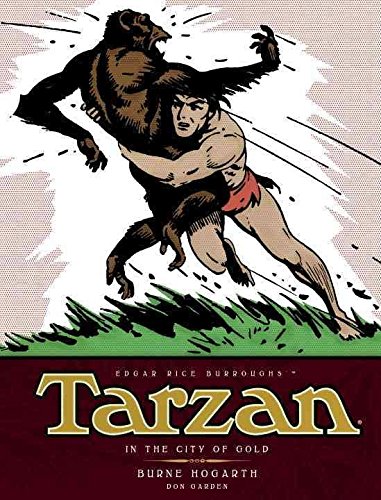
Tarzan and the Adventurers (Complete Burne Hogarth Comic Strip Library volume 5)


By Burne Hogarth & Rob Thompson with James Freeman, Dan Barry, Nick Cardy, Bob Lubbers & various (Titan Books)
ISBN: 978-1-78565-380-3 (landscape album HB)

This book includes Discriminatory Content produced during less enlightened times.

The 1930 and 1940s were decades of astounding pictorial periodical adventure. In the age before mass television, newspaper strips (and their bastard spawn comic books) were the only form of visually-based home entertainment for millions of citizens young and old, consequently shaping the culture of many nations. Relatively few strips attained nigh-universal approval and acclaim. The Gumps, Little Orphan Annie, Flash Gordon, Mandrake the Magician, Terry and the Pirates and Prince Valiant were in that rarefied pantheon but arguably the most famous was Tarzan.

Evolving from mock melodrama comedic features like Roy Crane’s Wash Tubbs or Carl Ed’s Harold Teen, the full-blown dramatic adventure serial truly started on January 7th 1929 with Buck Rogers and Tarzan debuting that day. Both were skilful adaptations of pre-existing prose properties and their influence changed the shape of the medium forever. The following years saw an explosion of similar fare, launched with astounding rapidity to huge success. Not only strips, but also actual fictive genres were born in that decade, still impacting today’s comic books and all our popular entertainment forms.

In terms of art quality, adaptations of Edgar Rice Burroughs’ immensely successful novels starring jungle-bred John Clayton, Lord Greystoke by Canadian commercial artist Harold “Hal” Foster were unsurpassed. The strip soon became beloved by the masses, supplementing and nurtured by the movies, books, radio show and ubiquitous advertising appearances.

As detailed in previous volumes of this sublime oversized (330 x 254 mm), monochrome/full -colour hardback series, Foster initially quit at the end of a 10-week adaptation of first novel Tarzan of the Apes. He was replaced by Rex Maxon, but at the insistent urging of author Burroughs, returned when the black-&-white daily expanded to include a lush, full colour Sunday page offering original adventures. Maxon was left to capably handle the weekday book adaptations, as Foster crafted the epic and lavish Sunday page until 1936: 233 consecutive weeks. He then left again for good: moving to King Features Syndicate and his own landmark weekend masterpiece Prince Valiant in the Days of King Arthur which debuted in February 1937. Once the 4-month backlog of material he had built up was gone, Foster was succeeded by a precociously brilliant 25-year old neophyte.

Burne Hogarth was a passionate graphic visionary whose superb anatomical skill, cinematic design flair and compelling page composition revolutionised action/adventure narrative illustration. His galvanic dynamism of idealised human figures and animals can still be seen in today’s comic books: all that impossibly body-positive perfection in motion can be directly attributed to Hogarth’s pioneering drawing and, in later years, educational efforts. Burroughs was a big fan and cannily used the increasingly popular comic strip to cross-market his own prose efforts with great effect.

This fabulous fifth & final tome encompasses Sunday pages from October 1949 to September 1950 and the equivalent Daily strips (September 1947 through September 1950), with Hogarth gradually easing out of the now-onerous job and employing a legion of gifted ghosts to fulfil his obligations. During this period, commercially-led format changes reduced the size and changed the shape of the Sunday strip from tabloid to landscape framing, but the contents suffered no loss of wonder, action or drama. The transition and repercussions are discussed with some academic frontloading and fitting further explanation in the form of extended essay ‘Transforming Tarzan’s Jungle’ by Henry G. Franke III. Fully briefed for our trek, we resume the fun with ‘Tarzan and the Adventurers’: Sunday pages #973 – 1010 as seen spanning October 30th 1949 to July 16th 1950. The saga was crafted by Hogarth, writer Rob Thompson and latterly James Freeman – who was forced upon Hogarth after the syndicate fired his preferred collaborator. It sees the Ape-Man visiting old ally Masai chief N’Kola just as white explorers Baker and Cleveland arrive, seeking the tribes’ help in locating a medicinal herb which might be a malaria cure.

In truth, the scurrilous duo are hunting lost treasure sunk in kingdom-demarcating Lake Dagomba, and need help in convincing Dagomba headman Mabuli to allow them access. This chief hates Tarzan but the impasse is ended when wicked witch doctor Chaka strikes a sinister side deal that triggers valiant efforts and vile betrayal, double cross, murder and bloody civil warfare incorporating spectacular chases, fantastic duels with beasts, mortals and the very landscape, captivating readers for months until the saga ended with explosive irony and tons of TNT…

The end was near for Hogarth and the Jungle Lord, and the Sunday association closed in a short serial finished by a comic book artist slowly making strips his career. Born in 1922, Robert Bartow “Bob” Lubbers drew a host of features before WWII, but other than The Vigilante and The Human Fly after hostilities ceased, mostly settled on newspaper stars like The Saint, Big Ben Bolt, Li’l Abner, Secret Agent X-9 and his own creations Long Sam and Robin Malone. That all occurred after a stellar run assisting/replacing Hogarth.

Ostensibly crafted by – and still signed “Hogarth”, ‘Tarzan and the Wild Game Hunters’ (#1011-1019: July 23rd to September 17th 1950) saw the vine-voyaging valiant aid cowboy-turned safari man Russ Rawson in capturing a rhino and gorilla for Winchester Zoo… but only after determining that Africa would be a far better place without these pair of particularly perilous rogue beasts…

Before switching to moody monochrome and standard single tier-per-diem layouts for the dailies section, Franke III explores ‘The Daily Grind’ in another erudite prose prologue preceding the accumulated serial sequences: providing context and background on writer Thompson and artistic aids/replacements Dan Barry, Nick Cardy & Lubbers, with John Lehti and Paul Reinman also getting a worthy mention.

Monday to Saturday storylines were relentless and tough to get right. No matter how good you are, there’s only so much progress to be made in 3-4 panels at a time, and savvy creators usually combined classic themes with familiar material whenever they could. Here that notion resulted in a (very) broad adaptation/reinterpretation of ERB’s prose pulp serial Tarzan at the Earth’s Core, which had been first serialised between September 1929 and March 1930 ,before becoming the 13th canonical novel in 1932. The strips comprising ‘Tarzan at the Earth’s Core’ (#2509 to 2616, September 1st 1947 through January 3rd 1948) were supervised by Hogarth & Thompson but limned primarily by Dan Barry (1911-1997).

He also began as a jobbing comic book guy. Like his own brother Seymour “Sy” Barry – who produced The Phantom newspaper strip for three decades – Dan worked in a finely-detailed, broadly realistic style, blending aesthetic sensibility with straightforward visual clarity and firm, almost burly virile toughness: a gritty “He-man” attitude for a new era, contemporarily christened “New York Slick”.

He drew masked hero fare like Airboy, Skywolf, Boy King, Black Owl, Spy Smasher, Doc Savage and more before joining the US Air Force and, on returning after the hostilities, drew monster hero The Heap and sundry genre shorts for titles like Crimebusters whilst running his own outfit producing educational/informational comics. Dan began his  gradual withdrawal from funnybooks as early as 1947, joining Hogarth’s studio and assuming art chores on the Tarzan daily for a year, whilst still gracing DC’s crime, mystery and science fiction anthologies until as late as 1954. He was offered Flash Gordon and quickly accepted, but that’s the stuff of another review…

In deepest, darkest Africa, the Jungle Lord is tracked down by explorer Jason Gridley who has been in contact with a man named David Innes, and resolved to save that lost soul. Innes is an adventurer who joined Professor Abner Perry in a giant drilling vehicle that took them deep inside the Earth. They are now trapped in an incredible antediluvian realm more than 500 miles below the world’s crust: a land of beast men, lost empires, dinosaurs and even more incredible things…

Tarzan is largely a spectator for this sequence as ERB’s prose adventures in Pellucidar are updated and recounted for readers before Lord Greystoke joins the rescue party using another mole machine – built by boffin Dr. Dana Franklin – to reach the exotic underworld. Adding romantic interest is Franklin’s glamourous daughter/assistant Doris as they voyage deep into a myriad of incredible adventures.

As well as saving Innes and Perry and reuniting the former with his own true love Dian the Beautiful, the newcomers face sentient pterodactyl tyrants (Thipdars if you’re au fait with the books), clash with cavemen and ape beasts (Sagoths), fight a macabre menagerie of long-extinct monsters, war with lizard warriors (Horibs) and get utterly lost and reunited in a land where time does not pass and night never comes…

The series is a paean to primitivism and is a boost to all those besotted with wild kingdoms. There are even pulchritudinous primeval pairings… Gridley to cavegirl princess Jana and Doris with Clovian cave chief Ulan

The drama is divided into individual overlapping adventures until all the players eventually reunite for a big, big finale. With the aforementioned ghost artists deployed to augment Barry & Thompson, the saga concludes with episodes #2617-2640 of ‘Tarzan at the Earth’s Core’ (January 5th – 31st January 1948) as all the plot threads cleave together and those who want to return to the surface do so…

Although he was still involved in a mostly administrative capacity, Hogarth’s signature had been missing for some time when ‘Tarzan and Hard-Luck Harrigan’ #3361-3414: 22nd May – 22nd July 1950) began. The strip sported the name of new illustrator Nick Cardy; AKA strip veteran Nicolas Viscardi, who had drawn Lady Luck and other features for Will Eisner, and post-war became a DC mainstay on Gang Busters, Congo Bill, Aquaman, Teen Titans, Bat Lash, Batman/The Brave and the Bold and so much more. The tale itself was lighter fare with humorous overtones as Greystoke encountered a decrepit and devious old western prospector/snake oil peddler who had foolishly hitched his wagon to an African adventure… The affable scoundrel initially tried to capture Tarzan’s monkey pals before attempting to catch and sell the Ape-man himself before learning the error of his ways…

Sadly, old habits died hard. When the odd companions encountered desert raider El Mahmud dying of wounds, they were forced by the bandit’s devoted lieutenant Rambul to “cure” him with Harrigan’s bottled nostrum. That’s when the literal gold-digger spots the treasure the raiders possess and reverts to type, determined to enjoy one last lucky strike, no matter who he must betray…

Again demarcated by an artist change, ‘Tarzan and Hard-Luck Harrigan’ concluded with episodes #3415-3420 (24th – 29th July 1950) signifying the beginning of Lubbers 3½ year tenure, with a rowdily raucous big battle and the old coot’s redemption before moving briefly on to final inclusion ‘Attack of the Apes’ (#3421-3462: 31st July – 16th September 1950) with Lubbers benefitting from Hogarth’s last moments of oversight in a spooky yarn where a renegade troop of Great Apes (the fictious subspecies that reared Tarzan) begin attacking native villages…

After investigating in the primal manner of the lord of the forests, Tarzan gains a new anthropoid assistant in brutal Bay-At, learns who, why and what the true culprits are and renders his own judgement…

And that was that for Hogarth’s Tarzan until a flurry of new material appeared as graphic novel prototypes in the 1970s, which helped usher in a more mature view of the comics medium itself.

Tarzan is a fictive figure who has attained immortal reality in a number of different creative arenas, but none offer the breathtaking visceral immediacy of Burne Hogarth’s comic strips. These vivid visual masterworks are all coiled-spring tension or vital, violent explosive motion: stretching, running, fighting, surging rushes of power and glory where even backgrounds and landscapes achieve a degree of dramatic interactive expressionism. It’s a dream come true that these majestic exploits are available in full for ours and future generations of dedicated fantasists to enjoy.
Trademarks Tarzan® and Edgar Rice Burroughs® owned by Edgar Rice Burroughs, Inc. and Used by Permission. Copyright © 2018 Edgar Rice Burroughs, Inc. All Rights Reserved.

Tarzan and the Lost Tribes (Complete Burne Hogarth Comic Strip Library volume 4)


By Burne Hogarth & Rob Thompson (Titan Books)
ISBN: 978-1-78116-320-7 (Album HB)

The 1930 and 1940s was an era of astounding pictorial periodical adventure. In the years before television, newspaper strips (and later comicbooks) were the only visually-based home entertainment for millions of citizens young and old and consequently shaped the culture of many nations. Relatively few strips attained near-universal approval and acclaim. Flash Gordon, Terry and the Pirates and Prince Valiant were in that rarefied pantheon but arguably the most famous was Tarzan.

The full-blown dramatic adventure serial started on January 7th 1929 with Buck Rogers and Tarzan debuting that day. Both were adaptations of pre-existing prose properties and their influence changed the shape of the medium forever. The 1930s saw an explosion of similar fare, launched with astounding rapidity and success. Not just strips but actual genres were created in that decade, still impacting on today’s comic-books and, in truth, all our popular fiction forms.

In terms of art quality, the adaptations of Edgar Rice Burroughs’ immensely successful novels starring jungle-bred John Clayton, Lord Greystoke by Canadian commercial artist Harold “Hal” Foster were unsurpassed. These strips soon became a firm favourite of the masses, supplementing movies, books, a radio show and ubiquitous advertising appearances.

As detailed in previous volumes of this sublime oversized (330 x 254 mm), full-colour hardback series, Foster initially quit the strip at the end of a 10-week adaptation of first novel Tarzan of the Apes and was replaced by Rex Maxon. At the insistent urging of author ER Burroughs, Foster returned when the black-&-white daily expanded to include a lush, full colour Sunday page featuring original adventures.

Maxon was left to capably handle the weekday book adaptations, and Foster crafted the epic and lavish Sunday page until 1936 (233 consecutive weeks). He then left again, for good: moving to King Features Syndicate and his own landmark weekend masterpiece Prince Valiant in the Days of King Arthur – debuting in February 1937. Once the 4-month backlog of material he built up was gone, Foster was succeeded by precociously brilliant 25-year old Burne Hogarth: a graphic visionary whose superb anatomical skill, cinematic design flair and compelling page composition revolutionised the entire field of action/adventure narrative illustration. The galvanic modern dynamism of the idealised human figure in today’s comicbooks can be directly attributed to Hogarth’s pioneering drawing and, in later years, educational efforts. Burroughs cannily used the increasingly popular comic strip to cross-market his own prose efforts with great effect.

This fantastic fourth tome begins with the spectacularly illustrated ‘Jusko on Hogarth: An Education in Form and Movement’ with the fantasy painter harking back to his childhood comics experiences and influences after which the astounding action/adventure epic recommences. At this time, Hogarth was sharing the scripting chores veteran collaborator Rob Thompson, having only recently returned to the feature after a dispute with the owners. He had moved to the Robert Hall Syndicate for whom he produced seminal adventure classic Drago, and then United Features to create comedy strip Miracle Jones. During the time away from Tarzan, Hogarth – with Silas Rhodes – opened the Cartoonists and Illustrators School, which later evolved into the School of Visual Arts.

‘Tarzan and N’Ani’ (episodes #875-896, 14th December to 1948 – 9th May 1948) offers more raw drama as Tarzan visits old friend Pangola only to find the chief dead and his Wakamba warriors under the thumb of apparent spirit soldiers and their White Queen. A little spirited resistance and dedicated investigation by the Ape-Man soon reveals crooked circus performers exploiting and enslaving the natives, but before he can confront the villains they take his wife Jane hostage. N’Ani’s big mistake is thinking her captive is a weak and feeble civilised woman…

When the bad guys and their trained big cats are dealt with, the excitement briefly subsides, but all too soon the Jungle Lord is duped into boarding a scientist’s reconditioned atomic submarine and whisked away against his will to uncanny uncharted regions in year-long saga ‘Tarzan on the Island of Mua-Ao’ (pages #897-947 and running from 16th May 1948 to 1st May 1949). After some Nemo-like subsea escapades (the mad scientist not the cartoon fish) Tarzan and his unwelcome companions fetch up on a Polynesian (minor) lost continent only to be captured by the scientifically advanced but morally barbarous Lahtian people. This slave-owning totalitarian kingdom is ripe for revolution and after our hero – with worthy warriors Soros and Timaru – escapes a gladiatorial arena they go about arranging one. Of course, that necessitates traversing the savage jungle hinterlands, surviving its ubiquitous feline predators and making peace with the dominant Ornag-Rimba and Thalian tribes…

A little complication crops up when local witchdoctor Totama feels threatened and repeatedly seeks to assassinate Tarzan, but the Ape-Man counters every plot and foray in his own unstintingly decisive manner…

Eventually, Tarzan has his coalition in place and leads an unstoppable assault against the Lahtians which inevitably leads to regime-change and his return to Africa…

The titanic tome concludes in a macabre yarn and a radical overhaul of the strip. During ‘Tarzan and the Ononoes’ (#948-972) which ran from May 8th to 23rd October 1949, the venerated traditional full-page vertical format was controversially downgraded to episodes printed in landscape format, allowing a certain liberalisation of layouts but making pages seem cramped and claustrophobic…

Narratively, the tone is full-on fantasy as Tarzan swears to expiring explorer Philip Ransome that he will rescue his lost daughter from mysterious creatures holding her beyond the impassable Ashangola Mountains.

That mission brings him into conflict with Waloks – intelligent missing-link anthropoids – and their bitter enemies, a race of depraved monsters called Ononoes. These carnivorous horrors are giant heads with arms but no legs or torsos with a penchant for human sacrifice. Their next victim is to be an outworlder girl named Barbara Ransome

Grim, grotesque and genuinely scary, Tarzan’s struggle against the rotund terrors is a high point of the strip and anticipates even greater thrills in the forthcoming final collection.

To Be Concluded…

Tarzan is a fictive creation who has attained an immortal reality in a number of different creative arenas, but none offer the breathtaking visceral immediacy of Burne Hogarth’s comic strips.

These vivid visual masterworks are all coiled-spring tension or vital, violent explosive motion, stretching, running, fighting: a surging rush of power and glory. It’s a dream come true that these majestic exploits are back in print for ours and future generations of dedicated fantasists to enjoy.
Trademarks Tarzan® and Edgar Rice Burroughs® owned by Edgar Rice Burroughs, Inc. and Used by Permission. Copyright © 2017 Edgar Rice Burroughs, Inc. All Rights Reserved.

Tarzan versus The Nazis (Complete Burne Hogarth Comic Strip Library volume 3)


By Burne Hogarth with Don Garden & Rubén Moreira (Titan Books)
ISBN: 978-1-78116-319-1 (Album HB)

The 1930 and 1940s was an era of astounding pictorial periodical adventure. In the years before television, newspaper strips (and later comic books) were the only visually-based home entertainment for millions of citizens young and old and consequently shaped the culture of many nations. Relatively few strips attained near-universal approval and acclaim. Flash Gordon, Terry and the Pirates and Prince Valiant were in that rarefied pantheon but arguably the most famous was Tarzan.

The dramatic adventure serial as we know it started on January 7th 1929 with Buck Rogers and Tarzan debuting that day. Both were adaptations of pre-existing prose properties and their influence changed the shape of the medium forever. An explosion of similar fare followed, launched with astounding rapidity and success. Not just strips but actual genres were created in that decade, still impacting on today’s comic-books and, in truth, all our popular fiction forms.

In terms of sheer quality, the adaptations of Edgar Rice Burroughs’ immensely successful novels starring jungle-bred John Clayton, Lord Greystoke by Hal Foster were unsurpassed, and the strip soon became a firm favourite of the masses, supplementing movies, books, a radio show and ubiquitous advertising appearances. As detailed in previous volumes of this oversized (330 x 254 mm), full-colour hardback series, Foster initially quit at the end of a 10-week adaptation of first novel Tarzan of the Apes and was replaced by Rex Maxon. At the insistent urging of Edgar Rice Burroughs, Foster returned when the black-&-white daily expanded to include a lush, full colour Sunday page featuring original adventures.

Maxon was left to capably handle the weekday book adaptations, and Foster crafted the epic and lavish Sunday page until 1936 (233 consecutive weeks). He then left again, for good: moving to King Features Syndicate and his own landmark weekend masterpiece Prince Valiant in the Days of King Arthur which debuted in February 1937. Once the four-month backlog of material he had built up was gone, Foster was succeeded by a precociously brilliant 25-year-old artist named Burne Hogarth: a graphic visionary whose astounding anatomical acumen, cinematic design flair and compelling page composition revolutionised the entire field of action/adventure narrative illustration. The galvanic modern dynamism of the idealised human figure in today’s comicbooks can be directly attributed to Hogarth’s pioneering drawing and, in later years, educational efforts. Burroughs cannily used the increasingly popular comic strip to cross-market his own prose efforts with great effect…

This third titanic tome begins with the prolifically illustrated ‘Hogarth on Burroughs’: George T. McWhorter’s interview with the master draughtsman from 1982’s Edgar Rice Burroughs Quarterly volume 1 #1, after which the timeless adventure resumes. At this time Hogarth had assumed writing the strip too, with veteran collaborator Don Garden leaving to pursue other, more patriotic pursuits.

Running from 30th October 1943 – March 12th 1944 (episodes #660-679), ‘Tarzan Against Kandullah and the Nazis’ is an explosive procession of coiled-spring action and crushing suspense as the Ape-Man, incessantly crisscrossing fabled, unexplored Africa returns to the lands of the Boers. Here he discovers his old friends infiltrated by insidious Nazi deserters. The human monsters have seen the tide of history turn against them and instead of fighting on or surrendering are attempting to secure this desolate enclave from which they can rebuild a Fourth Reich to attack democracy again at some future date…

Their plan is to divide and conquer: fomenting strife between the indigenous Mogalla tribe and the isolationist Afrikaaners. After narrowly averting one blood-stained crisis, Tarzan swears to deliver a military packet for a dying Allied airman, undertaking a staggering trek across the hostile lands before anonymously completing his mission and heading back into the veldt. His travels next bring him into contention with a baroque and murderous slave-master in ‘Tarzan Against Don Macabre’ (#680-699, running from 19th March to 30th July). After rescuing beautiful captive Thaissa from his decadent clutches, the all-conquering Ape-Man decimates the Don’s menagerie of savage beasts – everything from a ravening bull to a giant octopus – and leads a slave revolt deep within his island citadel…

Once back on the mainland there was an extended return engagement for modern history’s most popular bad guys in ‘Tarzan Against the Nazis’ (#700-731, August 6th 1944-March 11th 1945). This clash began innocuously enough with the Jungle Lord saving albino ape Bulak from his own dark-pelted tribe, before being distracted by sadistic Arabian hunter Korojak. The vile stalker was trapping hundreds of animals for his master Emin-Nagra – and secretly mistreating his prizes for his own sick amusement – until Tarzan taught him the error of his ways. Sadly, it was not a lesson which stuck and before long both Bulak and Tarzan became part of the booty being transported to golden-domed city Bakhir

While the Ape-Man chafed in captivity as part of Emin-Nagra’s Circus, agents of Germany and Japan were negotiating for the oil under the cruel potentate’s pocket kingdom and quietly confident of a favourable deal, due to their column of storm troopers. However, when Tarzan faced a tidal wave of starved jungle beasts in the Circus, he turned them into his personal army to bring down the despot. Then he turned his merciless attention to the Nazis and their nearby new oil wells…

With the real-world war winding down, escapist fantasy became a larger part of the Sunday strip environment. ‘Tarzan Against the Gorm-Bongara Monster’ (#732-748, 18th March to July 8th) saw the nomadic Ape-Man encounter a lost tribe of pygmies in a primordial valley, battling against them before becoming their champion against a marauding, voracious dinosaur. His inevitable victory led directly into ‘Tarzan and The Tartars Part One’ (#749-768, July 15th – November 25th) wherein landless Prince Kurdu begged the Ape-Man’s assistance in overthrowing a usurper and saving his oppressed kingdom. The turbulent alliance offered privation, hardship, a quest for mystic relics and – for one of the heroes at least – the promise of true love. This romantic epic is divided into separate chapters because from December 2nd 1945 onwards, Hogarth was replaced as illustrator by Ruben Moreira, who finished the tale from his predecessor’s scripts.

‘Tarzan and The Tartars Part Two’ (pages #769-778) concluded with the February 3rd 1946) instalment, after which Don Garden returned to provide fresh material for Moreira. You won’t find that here…

Hogarth was in dispute with the feature’s owners and had moved to the Robert Hall Syndicate for whom he produced seminal adventure classic Drago and thereafter United Features where he created comedy strip Miracle Jones. During the time away from Tarzan, Hogarth – with Silas Rhodes – also opened the Cartoonists and Illustrators School which later evolved into the School of Visual Arts.

After his two-year hiatus, Hogarth bombastically returned to the Lord of the Jungle in 1947, midway through an ongoing story. For the sake of convenience, Garden & Moreira’s ‘Tarzan on the Island of Ka-Gor Part One’ (#840-856, April 13th-3rd August 1947) is included here, setting the scene as sassy Texan heiress Dallas Doyle journeys to the home of Tarzan and his mate Jane, determined to recruit the famed adventurer in the search for her long-missing father. It takes a lot of persuading, but eventually Tarzan capitulates, due in no small part to the urgings of native mystic Maker of Ghosts

Following an old map of a diamond mine, the expedition proceeds slowly until sneak thief Dirk Mungo and a devious riverboat skipper steal it and frame Tarzan. Jailed by a corrupt police official, the Ape-Man abandons the niceties of civilisation and breaks out, following the villains with Dallas and golden lion Jad-Bal-Ja rushing to keep up. The trail takes them through all manner of incredible horror before culminating in an aeroplane dogfight. Shot down but surviving, the pursuers doggedly press on, until captured by pygmies who trade them to decadent priests…

‘Tarzan on the Island of Ka-Gor Part Two’ (#857-861, August 10th to 7th September 1947) sees Hogarth’s spectacular re-emergence, illustrating Garden’s script as the lost Doyle patriarch is finally found and rescued, just as the entire lost world he ruled succumbs to volcanic destruction. Hogarth then took sole control again for the concluding instalments.

‘Tarzan on the Island of Ka-Gor Part Three’ (#862-874, 14th September-7th December 1947) swiftly wrapped up the saga with the hero saving his companions but almost losing his own life in the process.

Wounded unto death, Tarzan is lost and expiring with rumours of his passing inciting various villains of the jungle lands to begin their raids and depredations again. However, saved by the tender ministrations of Manu the monkey and elephantine comrade Tantor, Tarzan soon storms back to restore his fair if heavy-handed peace…

To Be Continued…

These tales are full of astounding, unremitting, unceasing action with Hogarth and the other contributors spinning page after page of blockbuster Technicolor action over months of non-stop wonder and exoticism. Plot was never as important as engendering a wild rush of rapt and rousing visceral responses, and every Sunday the strip delivered that in spades.

Edgar Rice Burroughs was a master of populist writing and always his prose crackled with energy and imagination. Hogarth was an inspired intellectual and, as well as gradually instilling his pages with ferocious, unceasing action, layered panels with subtle symbolism. Heroes looked noble, villains suitably vile and animals powerful and beautiful. Even vegetation, rocks and clouds looked spiky, edgy and liable to attack at a moment’s notice…

These vivid visual masterworks are all coiled-spring tension or vital, violently expressively explosive motion: stretching, running, jumping, fighting in a surging rush of power and glory. It’s a dream come true that these majestic exploits are back in print for ours and future generations of dedicated fantasists to explore and enjoy.
Tarzan ® and Edgar Rice Burroughs ™ & © Edgar Rice Burroughs, Inc. All Rights Reserved. All images Edgar Rice Burroughs, 2015. All text copyright Edgar Rice Burroughs, Inc 2015.

Tarzan versus The Barbarians (Complete Burne Hogarth Comic Strip Library volume 2)


By Burne Hogarth & Don Garden (Titan Books)
ISBN: 978-1-78116-318-4 (Album HB)

Modern comics and graphic novels evolved from newspaper comic strips. These pictorial features were – until quite recently – overwhelmingly popular with the public and highly valued by publishers who used them as a powerful tool to guarantee and increase circulation and profits. From the earliest days humour was paramount; hence the terms “Funnies” and, of course, “Comics”…

The full blown dramatic adventure serial began with Buck Rogers on January 7th 1929 – and Tarzan which debuted the same day. Both were adaptations of pre-existing prose properties and their influence changed the shape of the medium forever. The 1930s saw an explosion of such fare, launched with astounding rapidity and success. Not just strips but actual genres were created in that decade which still impact on today’s comic-books and, in truth, all our popular fiction forms. In terms of sheer artistic quality, adaptations of Edgar Rice Burroughs’ novels starring jungle-bred John Clayton, Lord Greystoke by Canadian commercial artist Harold “Hal” Foster were unsurpassed, and the strip soon became a firm favourite of the masses, supplementing movies, books, a radio show and ubiquitous advertising appearances. As fully detailed in the previous volume of this superb oversized (330 x 254mm), full-colour hardback series, Foster initially quit the strip at the end of the 10-week adaptation of the first novel Tarzan of the Apes. He was replaced by Rex Maxon, but returned (at the insistent urging of Edgar Rice Burroughs) when the black-&-white daily was expanded to include a lush, full colour Sunday page featuring original adventures.

Leaving Maxon to capably handle the Monday through Saturday series of novel adaptations, Foster produced the Sunday page until 1936 (233 consecutive weeks) after which he moved to King Features Syndicate to create his own momentous weekend masterpiece Prince Valiant in the Days of King Arthur which debuted on February 13th 1937.

Once the four month backlog of material he had built up was gone, Foster was succeeded by a precociously brilliant 25-year-old artist named Burne Hogarth: a young graphic visionary whose superb anatomical skill, cinematic design flair and compelling page composition revolutionised the entire field of action/adventure narrative illustration. The galvanic modern dynamism of the idealised human figure in today’s comicbooks can be directly attributed to Hogarth’s pioneering drawing and, in later years, educational efforts…

This second sublime collection begins with fascinating original art examples peppering the ‘Introduction’ by former Tarzan and Prince Valiant illustrator Thomas Yeates, who shares memories of and commentary upon Hogarth the man, the exemplar and the educator. The visual virtuosity then resumes with ‘Tarzan and the Peoples of the Sea and the Fire’ (episodes #478-527-8, spanning 5th May 1940 to April 20th 1941) wherein the ape-man, incessantly journeying across fantastic, unexplored Africa, discovers an inland sea and stumbles into an ages-old war between two lost races.

On one side are water-worshipping mariners called the Sea People whose vile Prince Jagurt captures Tarzan whilst beautiful maiden Leecia is falling for him. Sadly, the real problem is arch-priest Molocar, who takes an instant dislike to the newcomer and tries to feed him to the Demon-fish…

Escaping antediluvian ichthyosaurs, the jungle lord stumbles upon secret subterranean caverns where the priesthood perfect their seemingly supernatural tricks to cow the populace. These superstition-peddlers try to make him a slave. Within the compound Tarzan meets a warrior of the city’s ancestral enemies, the volcano-worshipping Fire People, befriending a crippled boy named Prince Tanny. The child is heir to the lava-lovers’ throne and Molocar intends to brainwash and torture him into switching faiths…

The ape-man cannot abide cruelty and in a fit of righteous rage frees the boy and breaks out of the den of iniquity. Eluding the prowling demon-fish, Tarzan swims the lagoon with his frail prize, moving into the city, where – after sustained pursuit – he elicits Leecia’s aid. After many savage battles they flee together into the dense jungle.

The plan had been to take Tanny home, but since the boy’s capture his father has been murdered and Towrit the Cruel now rules the Fire People. When the fugitive trio are intercepted by the usurper’s soldiers, only Tarzan and Tanny escape, but after hiding in a cave the jungle lord is ambushed by a ferocious giant who turns out to be the boy’s faithful guardian Jaxie

Resolved to free Leecia and restore Tanny to the throne, Tarzan’s herculean efforts are thwarted as all-out war begins. The implacable religious hatred of each faction for him and each other results in unceasing battle, but as Jagurt, Molocar and Tawrit all strive for supremacy, nature itself rebels and the entire region is devastated when the volcano erupts, imperilling all dwellers around the inland sea…

Lost World romance gave way to modern militaristic mayhem in ‘Tarzan Against Dagga Ramba’ (#529-581, running from 27th April 1941 to 26th April 1942). Having sailed a river to a great desert, the regal wanderer encounters a camel caravan in time to save an Arabian princess from a stalking leopard, although it leaves him grievously injured. Haughty Ta’ama much prefers the wild man saviour to her own (arranged) affianced man, something rapacious Sheik Numali is not going to allow. The caravan continues with comatose Tarzan guarded by the Princess, but Numali knows that sooner or later her attention will lapse and accidents can be made to happen…

Happily, the white god recovers before any untoward occurrences but frustratingly agrees to remain with them until the Great Desert is crossed. Into that simmering bath of tension and suspicion a greater menace soon intrudes as ambitious army sergeant Dagga Ramba abandons the war currently engulfing North Africa. Declaring himself General, he convinces a band of Askari deserters they can carve out their own kingdom in the sands…

When the caravan is captured by Ramba’s band, Tarzan escapes and stumbles upon old ally Kamur and his mountain-living Ibek Nomads. The doughty warrior is tracking the Askaris -who have stolen his wife Nikotris – but that noble woman is in far greater danger from her fellow captive Ta’ama than the self-appointed warlord. The mountain dwelling elder has idly expressed her (platonic) admiration for Tarzan in the cell they share and the ruthless Arabian princess has wrongly deduced she has a rival for the ape-man’s affections…

Thankfully, a daring raid of the warlord’s fortress by Tarzan liberates Kamur’s bride before Ta’ama can act, but in the melee he is trapped and – despite soundly thrashing Dagga Ramba – is sentenced to hang. Spectacularly escaping the gallows, the hero rapidly returns to the mountains unaware the warlord has subtly suborned noxious Numali…

Soon a guerrilla war is underway at great cost to the Ibeks, whose bows and raw courage are no match for machine guns and armoured cars. Tarzan volunteers to re-cross the desert and try to recruit the normally impartial Soufara into a grand alliance against Ramba. His brief time with nomadic Bedouins garners no support but their initial refusal only allows the upstart warmonger to mount a surprise attack on the desert dwellers.

Racing out into a sandstorm on a stolen camel, Tarzan heads for the Soufara with Numali in hot pursuit. When his mount expires the indomitable ape-man continues his epic trek on foot, eventually reaching their forbidden city, only to find gloating Numali waiting for him.

The sheik’s attempts to assassinate jungle-man are forestalled by the Emir (Ta’ama’s father), but the potentate is disdainful of the warning Tarzan brings. Only Numali is aware Ramba’s army is approaching and will soon attack the complacently overconfident walled metropolis…

With his daughter hostage, the Emir is helpless to resist a mechanised assault and names Tarzan his War Sheik. The noble savage’s ideas on what we now call asymmetrical warfare rapidly stem the tide and when he abandons the battle to call the Ibeks into the fray, it spells the beginning of the end for Dagga Ramba’s dreams…

Job done, Tarzan slips away, crossing the mountains until washed by a tumult into a lush, isolated valley where two unlikely westerners are exploring. ‘Tarzan and the Fatal Mountain’ (#582-595, 3rd May – 2ndAugust 1942) returns to high fantasy as murderous dwarf Kalban Martius takes an instant dislike to the tall, clean-limbed Adonis, whilst his reluctant companion and unwitting target object d’amour Olga finds her heart all a-flutter…

These unwelcome Europeans were exploring the valley with Olga’s scientist father who had discovered the place was rife with oversized lifeforms. Even the generally peaceful white natives dubbed Kolosans average eight feet tall. In fact, almost everything there was bigger yet more passive…

After Martius fires a few shots at Tarzan and is easily eluded and subdued, the ape-man is befriended by Olga who explains they are looking for the secret of the Kolosans’ immensity. Later, the giants take him into their confidence whilst explaining that he can never escape the steep encircling escarpments back to his own world. The big men also reveal an ancient temple where a lizard-shaped “forbidden fountain” spews forth a vile liquid. This tribal secret is unfortunately exposed by Martius who covertly joined the party. When he stole some of the evil water it instantly transformed him into a brutal gargantuan twice the size of Kolosans…

Crazed with dreams of power, the beast-man flees taking a canteen full of the liquid. Soon the gentle valley is filled with his aggressive army of super-giants and Tarzan must lead the Kolosans in a final cataclysmic battle for survival. Eventually the carnage subsides and Olga reveals how they will leave the hidden valley. She, her father and Kalban had arrived by airplane and Tarzan can return with them. Sadly, one final catastrophe looms as their take-off is interrupted by a super-ape altered by Martius’ stolen growth toxin…

Following a stupendous duel on the ship’s wing Tarzan returns to the relative safety of the cockpit, but as they fly on the voyagers encounter an RAF plane in a death-spiral over a murky island as ‘Tarzan and the Barbarians’ (#596-659, 9th August 1942 to 24th October 1943) opens with the ape-man parachuting out of Olga’s plane (and life) to assist the downed pilot.

Wing Commander Jonathan is badly injured, but before Tarzan can administer aid he is interrupted by a bizarre stranger. Nahro the Hermit wants them gone and has decided to hunt the pair for sport. The swampy terrain proves the madman’s downfall, after which Tarzan carries his ailing charge across lethal trees through mire and past deadly beasts until they are captured by brutal warriors who look like Vikings…

The barbarians are dismissive of their captives as they carry them up a huge mesa to their stony citadel. Although threatened with death Tarzan eschews easy escape by refusing to marry one of the warrior’s women and earns the undying enmity of the shamed Hilsa.

Penned with other captives, he meets the slave Leeta and learns the mesa-marauders have preyed on the region’s inhabitants for centuries. When Tarzan tries to carry her away to safety, Hilsa is waiting and ambushes them…

Forced to flee alone, Tarzan heads for Leeta’s village seeking men to mount a rescue mission for her and the aviator but the chieftain’s wizard ignores his entreaties and instead prepares to undertake a venerable custom. The Berian people have always sacrificed the strongest heroes in their midst so the warrior could travel to the departed ancestors and beseech supernatural aid. Tarzan ferociously suggests they stop killing the best fighters and use them to actually fight the barbarians. To aid their assault he even introduces them to the concept of aerial warfare, engineering a giant balloon from sewn animal hides…

The skyborne blitzkrieg fails and Tarzan plunges into a vast cave in the centre of the mesa, which fortuitously exposes the citadel’s great weakness… a secret tunnel leading to the plains below, big enough for a small force of men to use in a sneak attack…

After much travail and bloodshed the plan succeeds but even in victory Tarzan finds no peace. Ferrying Jonathan back to civilisation leads to another primitive city, another lusty lass and one more jealous suitor. Soon the ape-man is embroiled in a brutal conflict where the balance of power rests with the side that can muster the most mastodons! The most worrying aspect of the war is that it is being fought for ownership of a huge jewel which can cause instant death…

Although the battle eventually goes to the just, it exposes Jonathan’s true colours as he tries to seize the lethal death-ray device for his country and especially himself. Exasperated and fed up with humans, Tarzan heads back to the wild woods only, to encounter old “friends” when arboreal amazon Tibeela ambushes the man who once eluded her amorous advances. This time she takes no chances, knocking him unconscious before making her move…

Her scheme might have worked had not a band of roving buccaneers chosen that moment to come to the forest hunting women for slaves, leading to another uncanny escapade against a decadent king in a debased kingdom as well as three uncanny reunions… with an ape, a lion and a Boer beside whom Tarzan had battled before…

These tales are full of astounding, unremitting, unceasing action with Hogarth and scripter Don Garden spinning page after page of blockbuster Technicolor epics over months of non-stop wonder and exotic adventure. Plot was never as important as generating a wild rush of rapt and rousing visceral response and every Sunday the strip delivered that in spades.

Edgar Rice Burroughs was a master of populist writing and always his prose crackled with energy and imagination. Hogarth was an inspired intellectual and, as well as gradually instilling his pages with ferocious, unceasing action, layered panels with subtle symbolism. Heroes looked noble, villains suitably vile and animals powerful and beautiful. Even rocks, vegetation and clouds looked spiky, edgy and liable to attack at a moment’s notice…

These vivid visual masterworks are all coiled-spring tension or vital, violent explosive motion, stretching, running, fighting: a surging rush of power and glory. It’s a dream come true that these majestic exploits exist – especially in such lavish and luxurious editions for generations of dedicated fantasists to enjoy.

Magnificent, majestic and awe-inspiring.
Tarzan ® & © 2014 Edgar Rice Burroughs, Inc. All Rights Reserved. All images copyright of Edgar Rice Burroughs, Inc 2014. All text copyright of Edgar Rice Burroughs, Inc 2014.

Tarzan in the City of Gold (The Complete Burne Hogarth Comic Strip Library volume 1)


By Burne Hogarth and Don Garden (Titan Books)
ISBN: 978-1-78116-317-7 (HB)

Modern comics and graphic novels evolved from newspaper comic strips. These daily pictorial features were – until relatively recently – extremely popular with the public and highly valued by publishers who used them as a powerful weapon to guarantee and even increase circulation and profits. From the earliest days humour was paramount; hence the terms “Funnies” – and of course, “Comics”.

The 1930s saw an explosion of action and drama strips launched with astounding rapidity and success. Not just strips but actual genres were created in that decade which still impact on not just today’s comic-books but all our popular fiction. Despite the odd ancestor or precedent like Roy Crane’s Wash Tubbs (comedic when it began in 1924, but gradually moving through mock-heroics to light-action and becoming a full-blown adventure serial with the introduction of Captain Easy in 1929), the majority of strips in production were feel-good humour strips with the occasional child-oriented fantasy.

The full-blown adventure serial strip started on January 7th 1929 with Buck Rogers and Tarzan launching on the same day. Both were adaptations of pre-existing prose properties – although the Ape-Man had already conquered the silver screen – and their influence changed the shape of the medium forever. In terms of sheer quality of art, the adaptations of Edgar Rice Burroughs’ novels starring jungle-bred John Clayton, Lord Greystoke by Canadian commercial artist Harold “Hal” Foster were unsurpassed, and the strip became a firm favourite of the reading masses, supplementing movies, books, a radio show and ubiquitous advertising appearances.

As fully detailed in Tarzan historian/author Scott Tracy Griffin’s informative overview ‘Burne & Burroughs: The Story of Burne Hogarth and Edgar Rice Burroughs’, Foster initially quit the strip after the10-week adaptation of Tarzan of the Apes. He was replaced by Rex Maxon, but returned (at the insistent urging of Edgar Rice Burroughs) when the black-&-white daily was expanded to include a lush, full colour Sunday page of new tales.

Leaving Maxon to cater the Monday through Saturday series of novel adaptations, Foster produced the Sunday page until 1936 (233 weeks) after which he momentously moved to King Features Syndicate and created his own weekend masterpiece. Prince Valiant in the Days of King Arthur debuted on February 13th 1937. Once a four month backlog of material he had built up was gone, Foster was succeeded by a precociously brilliant 25-year old artist named Burne Hogarth: a young graphic visionary whose superb anatomical skill, cinematic design flair and compelling page composition revolutionised action/adventure narrative illustration.

The galvanic modern dynamism of the idealised human figure in comic books is directly attributable to Hogarth’s pioneering drawing and, in later years, educational efforts.

When he in turn finally left the strip, Hogarth found his way into teaching as co-founder – with Silas H. Rhodes – of the Cartoonist and Illustrators School for returning veterans. This became the New York School of Visual Arts and Hogarth produced an invaluable and inspirational series of art textbooks including Dynamic Anatomy and Dynamic Figure Drawing, shaping generations of aspiring pencillers. I can see my own well-worn copies from where I sit typing this.

In the early 1970s, Hogarth was lured back to the leafy domain of legendary Lord Greystoke, producing two magnificent volumes of graphic narrative in the dazzling style that had captivated audiences more than 30 years previously. Large bold panels, vibrantly coloured, with blocks of Burroughs’ original text, leapt out at the reader in a riot of hue and motion as they retold the triumphant, tragic tale of an orphaned scion of British nobility raised to puissant manhood by Great Apes in Tarzan of the Apes and Jungle Tales of Tarzan.

Burroughs cannily used the increasingly popular strip feature to cross-market his own prose efforts with great effect. Tarzan and the City of Gold was first serialised in pulp magazine Argosy in 1932 and released in book form the following year. So by May 17th 1936, Foster’s new and unconnected Tarzan in the City of Gold could be described as a brand new adventure on one hand, whilst boosting already impressively book sales by acting as a subtle weekly ad for the fantastic fantasy novels.

As discussed and précised in ‘Hal Foster’s Tarzan in the City of Gold – the Story So Far’, the illustrator and regular scripter Don Garden’s final yarn began with the 271st weekly page: revealing how the wandering Ape-Man had stumbled upon a lost outpost built by ancient refugees from Asia Minor in a desolate region of the “Dark Continent”.

The city of Taanor was so rich in gold that the material was only useful for weather-proofing roofs and domes of houses, but when white ne’er-do-wells Jim Gorrey and Rufus Flint discover the fantastic horde they marshalled a mercenary army, complete with tanks and aircraft to plunder the lost kingdom. Tarzan, meanwhile, had become war-chief of noble King Dalkon and his beautiful daughter Princess Nakonia and determined to use every trick and stratagem to smash the invaders…

After 51 epic weekly episodes, Foster was gone and we pick up the story of ‘Tarzan in the City of Gold’ (episodes #322-343, 9th May to October 3rd 1937) as the drama takes a bold new direction when the embattled Jungle Lord leads a slow war of attrition against the invaders whilst simultaneously recruiting a bizarre battalion of beasts comprising apes, lions and elephants to crush the greedily amassed armaments of 20th century warfare with fang and claw, sinew and muscle…

In those halcyon days the action was non-stop and, rather than cleanly defined breaks, storylines flowed one into another. Thus, Tarzan allowed the victorious Taanorians to believe he had perished in battle and journeyed to familiar territory, revisiting the cabin where he had been born and the region where he was raised by the she-ape Kala – stopping to punish a tribe of humans hunting and tormenting his old family/band of apes. Then, Hogarth’s first full epic began.

‘Tarzan and the Boers Part I’ (pages #344-377, 10th October 1937 – 29th May 1938) sees the erstwhile Greystoke lured to the assistance of duplicitous chieftain Ishtak who craves the Ape-Man’s assistance in repulsing an “invasion” by white pioneers from South Africa.

It isn’t too long before Tarzan discovers Ishtak is playing a double game. Having sold the land in question to families led by aged Jan Van Buren, the avaricious king intends to wipe them out and keep his tribal territories intact…

When Tarzan unravels the plot he naturally sides with the Boers and, over many bloody, torturous weeks, helps the refugees survive Ishtak’s murderous campaign of terror to establish a sound, solid community of honest (white) farmers…

When Hogarth first took over he had used an affected drawing style mimicking Foster’s static realism, but by the time of ‘Tarzan and the Chinese’ (#378-402, 5 June – 20th November 1938) had completed a slow transition to his own tautly hyper-kinetic visual methodology, perfectly suited to the electric vitality of the ever-onrushing feature’s exotic wonders.

Here, after leaving the new Boer nation, Tarzan finds a vast, double-walled enclosure and – ever curious – climbs into a fabulous hidden kingdom populated by the descendants of imperial Chinese colonists.

Once again he was just in time to prevent the overthrow of the rightful ruler – firstly by rebels and bandits, then a treacherous usurper and latterly by invading African warriors – before slipping away to befriend another clan of Great Apes and be mistaken for an evolutionary missing link by Professor John Farr in ‘Tarzan and the Pygmies’ (#403-427, 27th November 1938 to 14th May 1939). However, the boffin’s nefarious guide Marsada knows exactly who and what the Ape-Man is and spends a great deal of time and effort trying to kill Tarzan, as payback for his destroying a profitable poaching racket years before. Most infuriatingly, the husky newcomer had caught the passionate fancy of Farr’s lovely daughter Linda

Following an extended clash with actual missing links – a mountain tribe of primitive, bestial half-men – Tarzan and Linda fall into the brawny hands of magnificent (white) tree-dwelling viragos who all want to mate with a man who seems their physical equal. The trials and tribulations of ‘Tarzan and the Amazons’ (#428-437, 21st May-23rd July 1939) only ends when the jungle Adonis fakes his own death…

More relatively aimless perambulations bring the hero once more to the nascent homeland of his Afrikaans friends. ‘Tarzan and the Boers Part II’ (#438-477, 30th July 1939 – 28th April 1940) has him perfectly matched against cunning, truly monstrous villain Klaas Vanger. This wandering diamond hunter has discovered a mother-lode of gems on Jan Van Buren’s farm and, after seducing his way into the family’s good graces by romancing impressionable daughter Matea, he tries to murder them all. When this also fails, Vanger instigates a new war between settlers and natives, whilst absconding with a cache of diamonds and massacring a tribe of baboons befriended by Tarzan…

These vile acts lead to a horrific boom town of greedy killers springing up on Boer lands, compelling Tarzan, baby baboon Bo-Dan and hulking. tongue-tied lovelorn farmhand Groot Carlus to take a terrible but well-deserved vengeance on the money-crazed monster and his minions and rescuing crestfallen Matea from the seducer’s vile clutches…

Edgar Rice Burroughs was a master of populist writing and always his prose crackled with energy and imagination. Hogarth was an inspired intellectual and, as well as gradually instilling his pages with ferocious, unceasing action, layered the panels with subtle symbolism. Even vegetation looked spiky, edgy and liable to attack at a moment’s notice…

His pictorial narratives are all coiled-spring tension or vital, violent explosive motion, stretching, running, fighting: a surging rush of power and glory. It’s wonderful these majestic exploits are back in print – especially in such a lavish and luxurious oversized (330 x 254mm) hardback format – even if only to give us comic lovers and other couch potatoes a thorough cardio-vascular work-out. Nevertheless, I won’t be completely happy until all this wild wonderment is online too…

Beautifully rendered and reassuringly formulaic, these masterful interpretations of the utterly authentic Ape-Man are a welcome addition to any comics’ connoisseurs’ cupboard and you would be crazy not to take advantage of this beautiful collection; the first of five in the Complete Burne Hogarth Comic Strip Library.
Tarzan® & © 2014 ERB, Inc. All Rights Reserved. All images copyright of ERB, Inc 2014. All text copyright of ERB, Inc 2014.