All-Star Comics: Only Legends Live Forever


By Gerry Conway, Paul Levitz, Ric Estrada, Wally Wood, Keith Giffen, Joe Staton, Bob Layton, Joe Giella, Dave Hunt, Dick Giordano, Brian Bolland, Jim Aparo & various (DC Comics)
ISBN: 978-1-7795-0071-7 (HB/Digital edition)

This book includes Discriminatory Content produced in less enlightened times.

Win’s Christmas Gift Recommendation: Ageless Evergreen Super-Sensationalism… 8/10

In the torrid and turbulent 1970s many of the comics industry’s oldest publishing ideas were finally laid to rest. The belief that characters could be “over-exposed” was one of the most long-lasting (after all, it never hurt Superman, Batman or the original Captain Marvel), garnered from years of experience in an industry which lived or died on that fractional portion of pennies derived each month from pocket-money and allowances of kids that wasn’t spent on candy, toys or movies.

By the end of the 1960s, comic book costs and retail prices were inexorably rising and a proportion of titles – especially newly resurrected horror stories – were consciously being produced for older readerships. Nearly a decade of organised fan publications and letter writing crusades had finally convinced publishing bean-counters what editors already knew: grown-ups avidly read comics too. Avidly. Passionately. Obsessively. They would happily spend more than kids and, most importantly, wanted more, more, more of what they particularly loved.

Explicitly: If one appearance per month was popular, extras, specials and second series would be more so. By the time Marvel Wunderkind Gerry Conway was preparing to leave The House of Ideas, DC was willing and ready to expand its variegated line-up with some oft-requested/demanded fan-favourite characters…

Paramount among these was the Justice Society of America, the first comic book super-team and a perennial gem whose annual guest-appearances in the Justice League of America had become an inescapable and beloved summer tradition. Thus in 1976 Writer/Editor Conway marked his second DC tenure (he had first broken into the game writing horror shorts for Joe Orlando) by reviving All Star Comics with number #58. In 1951, as the first Heroic Age ended, the key title had transformed overnight into All Star Western, with that numbering running for a further decade as home cowboy crusaders like Strong Bow, Trigger Twins, Johnny Thunder (a new “masked” do-gooder, not the Golden Age costumed idiot with a genie) and Super-Chief.

If you’re interested, among the other revivals/introductions in “Conway’s Corner” were perennial star Plastic Man, Blackhawk, The Secret Society of Super-Villains, Freedom Fighters, Kobra, Blitzkrieg – and many more.

In case you need reminding in their anniversary year: All Star Comics #3 (cover-dated Winter 1940-1941 and released in November 1940) is the officially cited kick-off for all Superteam tales, even if the assembled mystery men merely had dinner and recounted recent cases. They didn’t actually go on a mission together until ASC #4, which had an April 1941 cover-date and hit newsstands on February 7th.

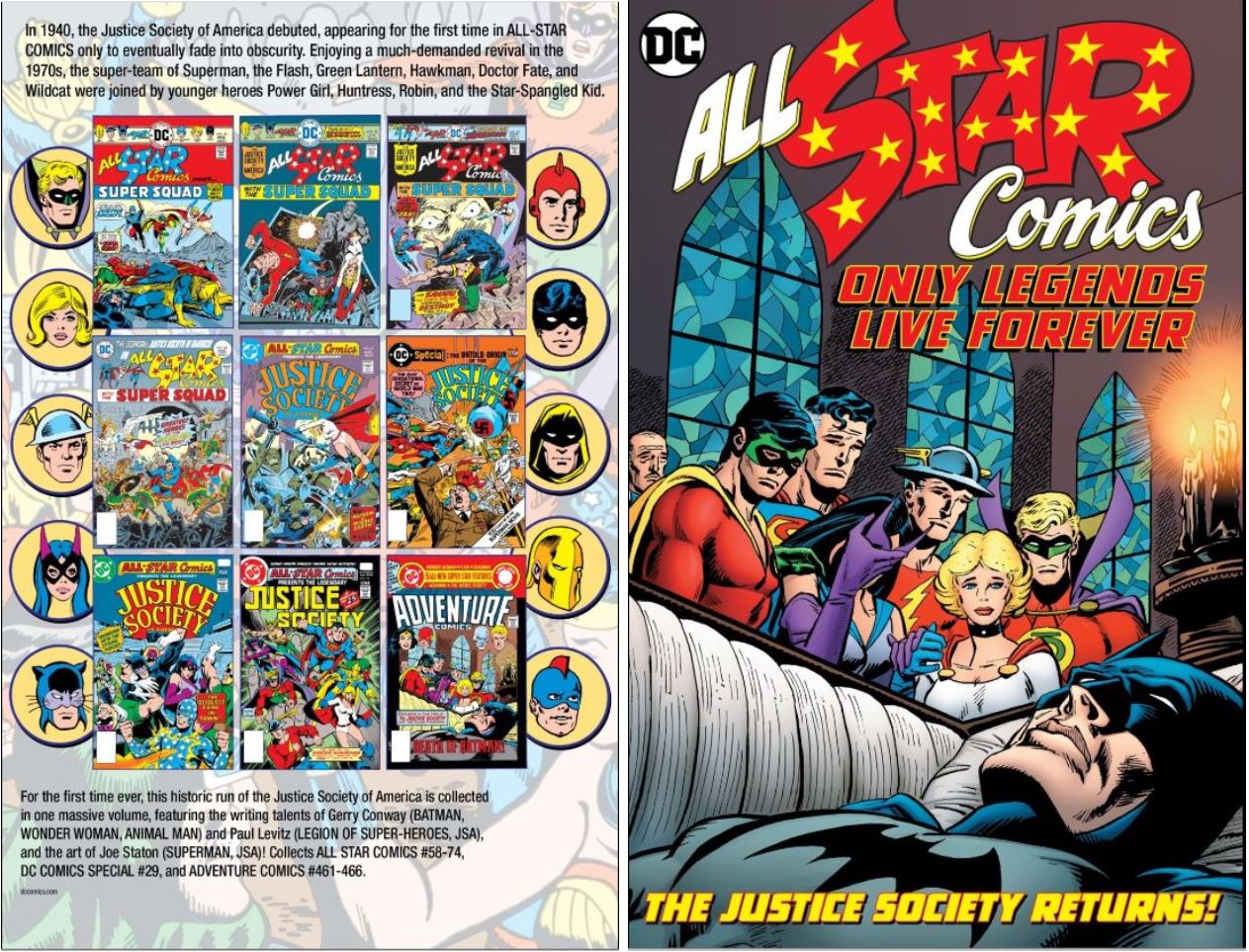
Set on the parallel world of Earth-2, and in keeping with the editorial sense of ensuring the series be relevant to young readers too, Conway reintroduced a veteran team, leavened with a smattering of teen heroes, combined into a contentious, generation-gap fuelled Super Squad. These young whippersnappers included Robin (already a JSA-er since the mid-1960s and Justice League of America #55); Sylvester Pemberton AKA The Star-Spangled Kid (in actuality a boy-hero from the 1940s lost in time for decades) and – it must shamefully be said – a busty young thing who quickly became the feisty favourite of a generation of growing boys.

Kara Zor-L was attention grabbing in all the right and wrong ways and would soon become infamous as the “take-charge” pushy feminist dynamo Power Girl.

This titanic hardback and digital collection volume gathers that 4-year run of the JSA from the late 1970s into a sublime showcase of so-different, ever-changing times via All-Star Comics #58-74, plus the series’ continuation and conclusion from epic anthology title Adventure Comics (#461-466), and includes the seminal saga from DC Special #29 which, after almost four decades, finally provided the team with an origin…
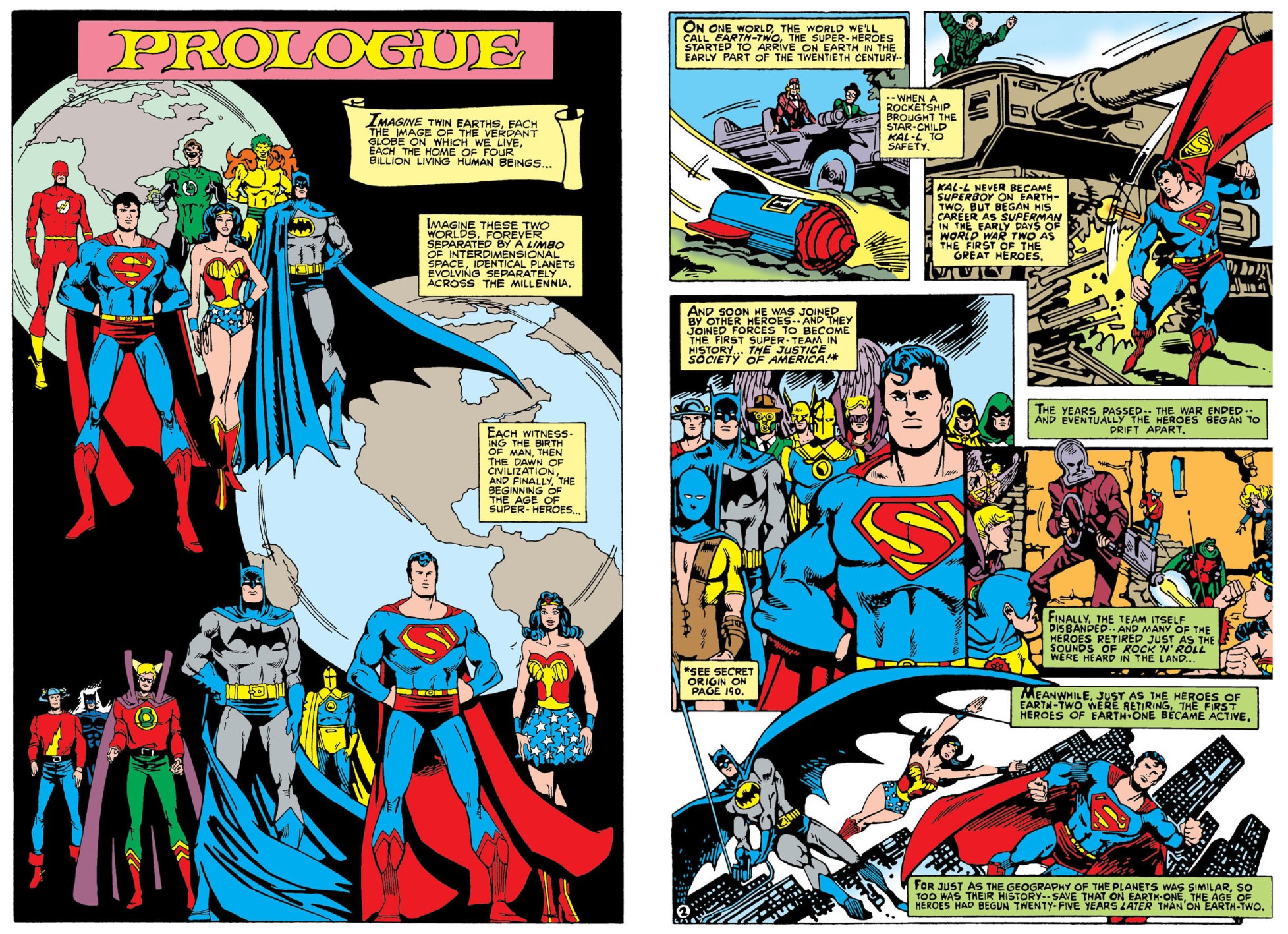
Without preamble, the action begins with ‘Prologue’: a 3-page introduction/recap/summation of the Society’s history as well as the celestial mechanics of Alternate Earths, as crafted by Paul Levitz, Joe Staton & Bob Layton and first seen in Adventure #461, January/February 1979. This outlines the history and workings of DC’s parallel continuities, after which the first half of the 2-part debut tale from All-Star Comics #58 (January/February 1976 by Conway, Ric Estrada &Wally Wood) finds newly-inducted Pemberton chafing at his time-lost plight and revelling in new powers after being given a cosmic-energy device by retired JSA veteran Starman.

When a crisis propels him and elder heroes Flash, Dr. Mid-Nite, Wildcat, Green Lantern, Hawkman and Dr. Fate into a 3-pronged calamity devastating Seattle, Cape Town and Peking (which you youngsters now known as Beijing). With man-made natural disasters, everywhere the elder statesmen split up but are overwhelmed, giving the new kids a chance to shine in ‘All Star Super-Squad’. With abrasive, impatient Power Girl in the vanguard, the entire team is soon on the trail of old foe Degaton and his mind-bending ally in #59’s conclusion ‘Brainwave Blows Up!’
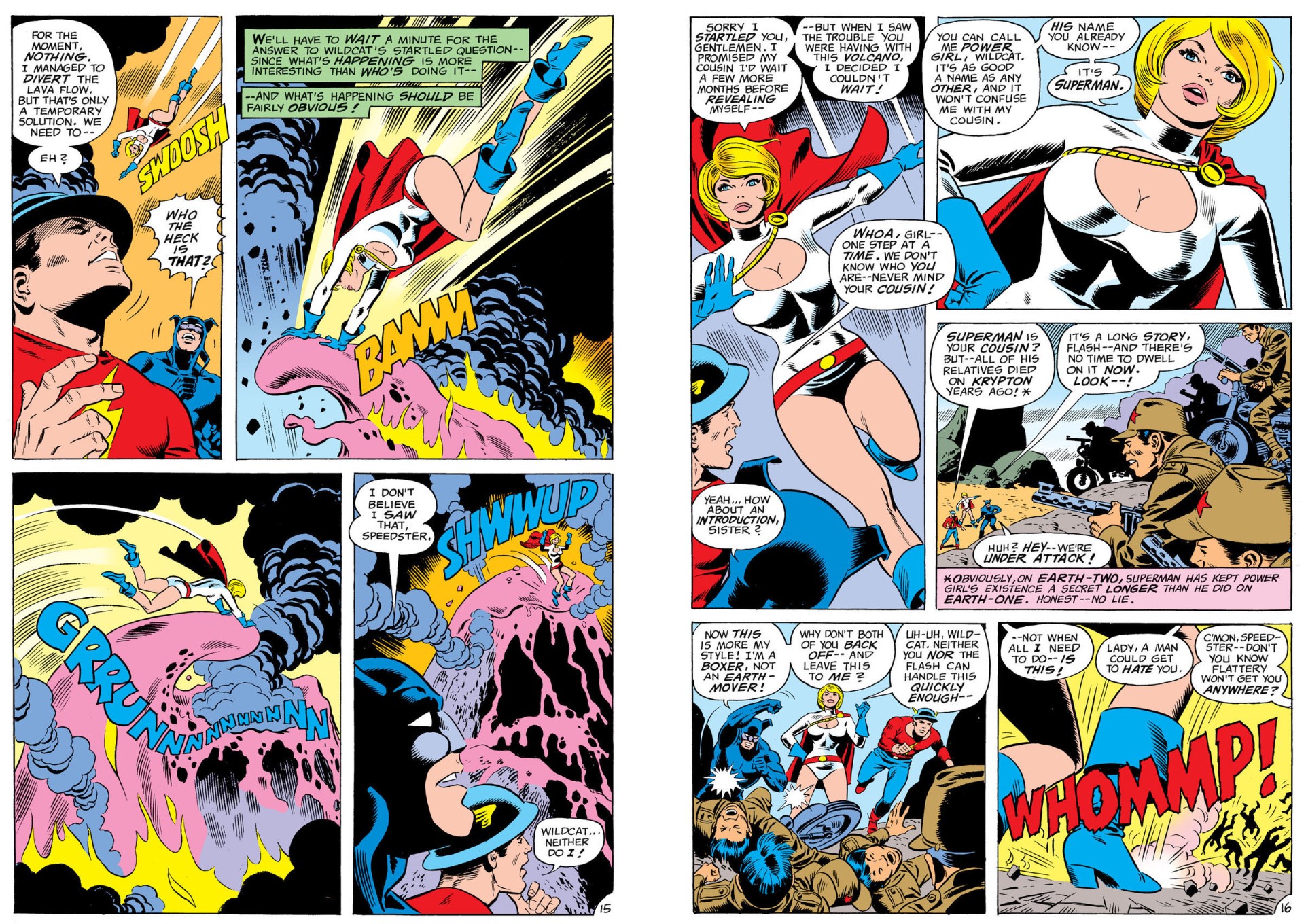
Keith Giffen replaced Estrada in #60 whilst introducing a psychotic super-arsonist who attacks the Squad just as the age-divide starts grating and PG begins ticking off (or “re-educating”) the stuffy, paternalistic JSA-ers in ‘Vulcan: Son of Fire!’. Closing instalment ‘Hellfire and Holocaust’ finds the flaming fury fatally wounding Fate before his own defeat, just as a new mystic menace is stirring…

Conway’s last issue as scripter was #62. ‘When Fall the Mighty’ highlights antediluvian sorcerer Zanadu who devastatingly attacks, even as the criminal Injustice Gang open their latest vengeful assault using mind-control to turn friend against friend. The cast subsequently expands with the return of Hourman and Power Girl’s Kryptonian mentor, but even they prove insufficient to prevent ‘The Death of Doctor Fate’ as written by Paul Levitz. Assaulted on all sides, the team splinters. Wildcat, Hawkman and the Kryptonian cousins tackle the rampant super-villains whilst Flash & Green Lantern search Egypt for a cure to Fate’s condition, and Hourman, Mid-Nite & Star-Spangled Kid desperately attempt to keep their fallen comrade alive.

When they fail Zanadu renews his assault, almost adding the moribund Fate’s death-watch defenders to his tally… until the archaic alien’s very presence calls Kent Nelson back from beyond the grave…
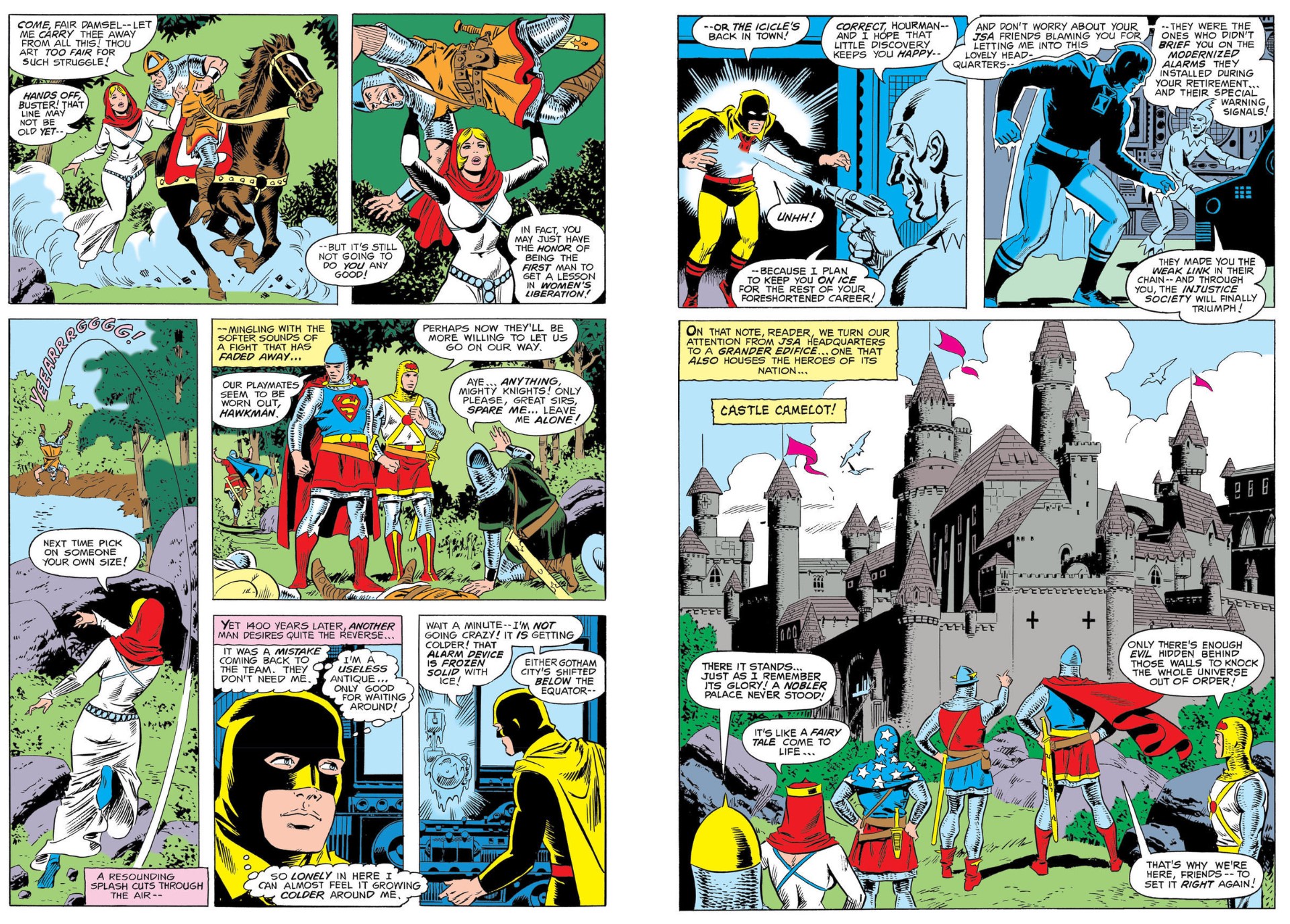
With that crisis averted, Superman makes ready to leave but is embroiled in a last-minute, manic time-travel assassination plot (Levitz script, and fully illustrated by inimitable Wally Wood) which drags the team and guest-star The Shining Knight from an embattled Camelot in ‘Yesterday Begins Today!’ to the far-flung future and ‘The Master Plan of Vandal Savage’: a breathtaking spectacle of drama and excitement that signalled Woody’s departure from the series.

Joe Staton & Bob Layton took the unenviable task of filling his artistic shoes, beginning with #66 as ‘Injustice Strikes Twice!’ wherein the reunited team – sans Superman – fall prey to ambush by arch-enemies, whilst emotion-warping Psycho-Pirate starts twisting GL Alan Scott into an out-of-control menace determined to crush Corporate America beneath his emerald heel. This subsequently leads to the return of Earth-2’s Bruce Wayne, who had previously retired his masked persona to become Gotham’s Police Commissioner. In ‘Attack of the Underlord!’ (All-Star Comics #67, July/August 1977), the Injustice Society’s monstrous allies are revealed as subterranean conquerors who nearly end the team forever. Meanwhile, Wayne’s plans near fruition. He wants to shut down the JSA before their increasingly destructive exploits demolish his beloved city…

Contemporary continuity pauses here as the aforementioned case from DC Special #29 (September 1977) discloses ‘The Untold Origin of the Justice Society’ in an extra-length epic set in 1940. Here Levitz, Staton & Layton reveal previously classified events which saw Adolf Hitler acquire the mystical Spear of Destiny and immediately summon mythical Teutonic Valkyries to aid in the invasion of Britain. Alerted to the threat, US President Franklin Delano Roosevelt – hampered by his country’s neutrality – unofficially asks a select band of masked mystery-men to lend their aid as non-political, private citizens.

In a cataclysmic escalation, the struggle ranges from the heart of Europe throughout the British Isles and even to the White House Oval Office before ten bold costumed champions finally – albeit temporarily – stymy the Nazis’ plans…

Back in All Star #68 (October 1977) the Kryptonian Kid was clearly becoming top star of the show. ‘Divided We Stand!’ (Levitz, Staton & Layton) concludes the Psycho-Pirate’s scheme to discredit and destroy the JSA, and sets the scene for her first solo outing in Showcase #97-99 (which is not included here). Meanwhile GL resumes a maniacal rampage through Gotham and Police Commissioner Wayne takes extreme measures to bring the seemingly out-of-control JSA to book. With ASC #69’s ‘United We Fall!’, he reunites in his own team of retired JSA stars to arrest the rogue squad, resulting in a classic fanboy dream duel as Dr. Fate, Wildcat, Hawkman, Flash, GL & Star-Spangled Kid battled the original Batman, Robin, Hourman, Starman, Dr. Mid-Nite and Wonder Woman. It’s a colourful catastrophe in waiting until PG & Superman intervene to reveal the true cause of all that unleashed madness.
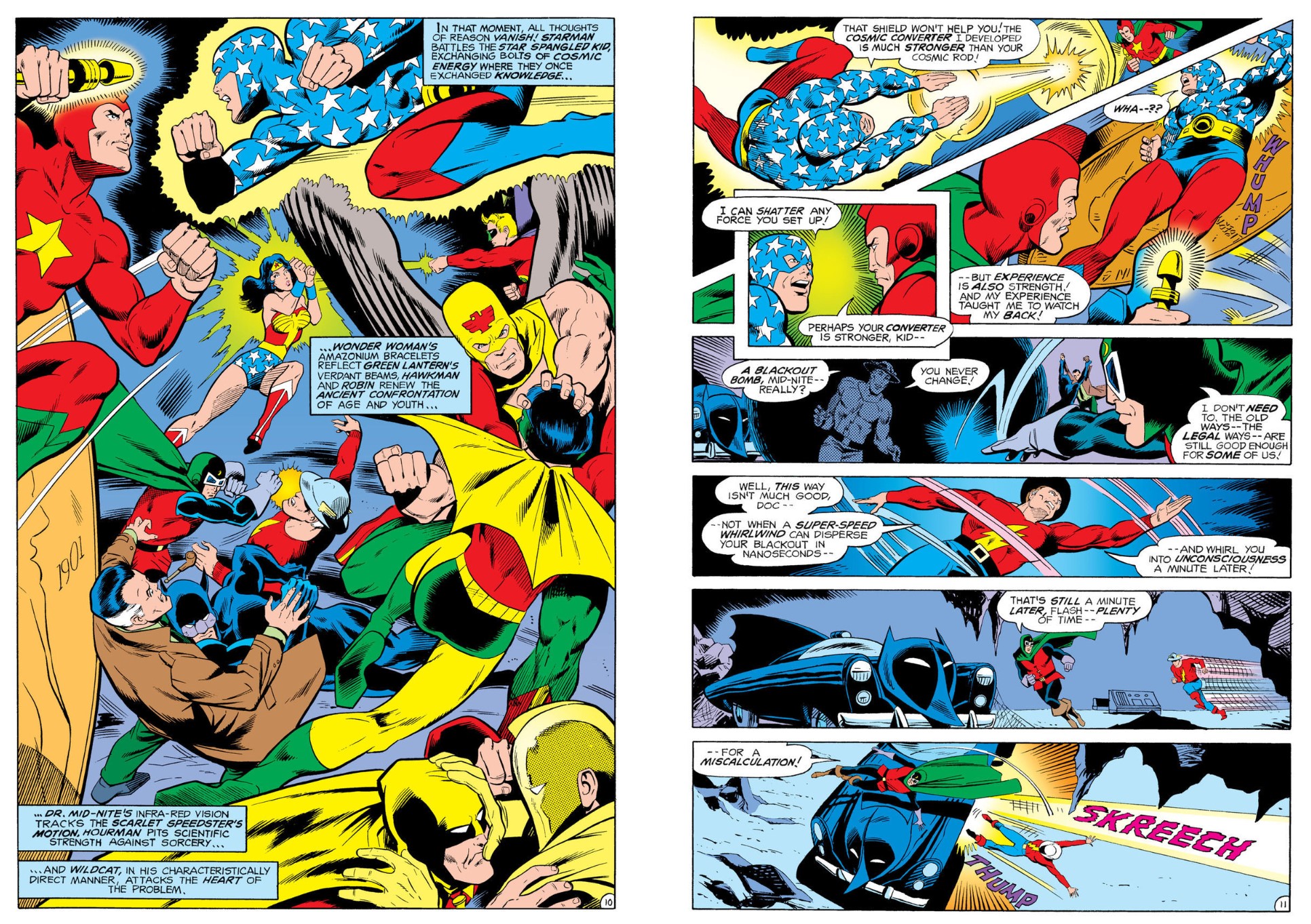
… And in the background, a new character was about to make a landmark debut…

With order restored ‘A Parting of the Ways!’ spotlights Wildcat and Star-Spangled Kid as the off-duty heroes stumble upon high-tech super-thieves Strike Force. These bandits initially prove too much for the pair – and even new star The Huntress – but with a pair of startling revelations in ‘The Deadliest Game in Town!’ the trio finally triumph. In the aftermath, the Kid resigns and the daughter of Batman & Catwoman replaces him…

All-Star Comics #72 reintroduces a brace of classic Golden Age villainesses in ‘A Thorn by Any Other Name’ – wherein the psychopathic floral fury returns to poison Wildcat, leaving Helena Wayne to battle the original 1940’s Huntress for an antidote and rights to the name. With Joe Giella taking over the inker’s role, concluding chapter ‘Be it Ever So Deadly’ sees the whole team deployed as Huntress battled Huntress whilst Thorn and The Sportsmaster do their deadly best to destroy the heroes and their loved ones. Meanwhile in Egypt, Hawkman & Dr. Fate stumble upon a deadly ancient menace to all of reality…

The late 1970s was a perilous period for comics, with exponentially rising costs inevitably resulting in drastically dwindling sales. Many titles were abruptly cancelled in a “DC Implosion” and All-Star Comics was one of the casualties. Issue #74 was the last, pitting the reunited Society against a mystic Armageddon perpetrated by a nigh-omnipotent Master Summoner who orchestrated a ‘World on the Edge of Ending’ before the JSA triumphantly dragged victory from the jaws of defeat…

Although the book was gone, the series continued in 68-page anthology title Adventure Comics, beginning in #461 (January/February 1979) with the first half of a blockbuster tale originally intended for the anniversary 75th issue. Drawn & inked by Staton, ‘Only Legends Live Forever’ details the Batman’s last case as the Dark Knight comes out of retirement to battle a seeming nonentity who has mysteriously acquired god-like power. Adventure #462 delivered the heartbreaking conclusion in ‘The Legend Lives Again!’ before AC #462’s ‘The Night of the Soul Thief!’ sees Huntress, Robin and assembled Society members deliver righteous justice to the mysterious mastermind who actually orchestrated the death of the World’s Greatest Detective…

For #464, an intriguing insight into aging warrior Wildcat reveals ‘To Everything There is a Season…’ as Ted Grant embraces his own mortality and begins a new career as a teacher of heroes, before ‘Countdown to Disaster!’ (inked by Dave Hunt) finds Flash, Green Lantern, Hawkman, Power Girl, Huntress & Dr. Fate hunting a doomsday device lost amidst Gotham’s teeming masses. It would be the last modern outing of the team for years to come…
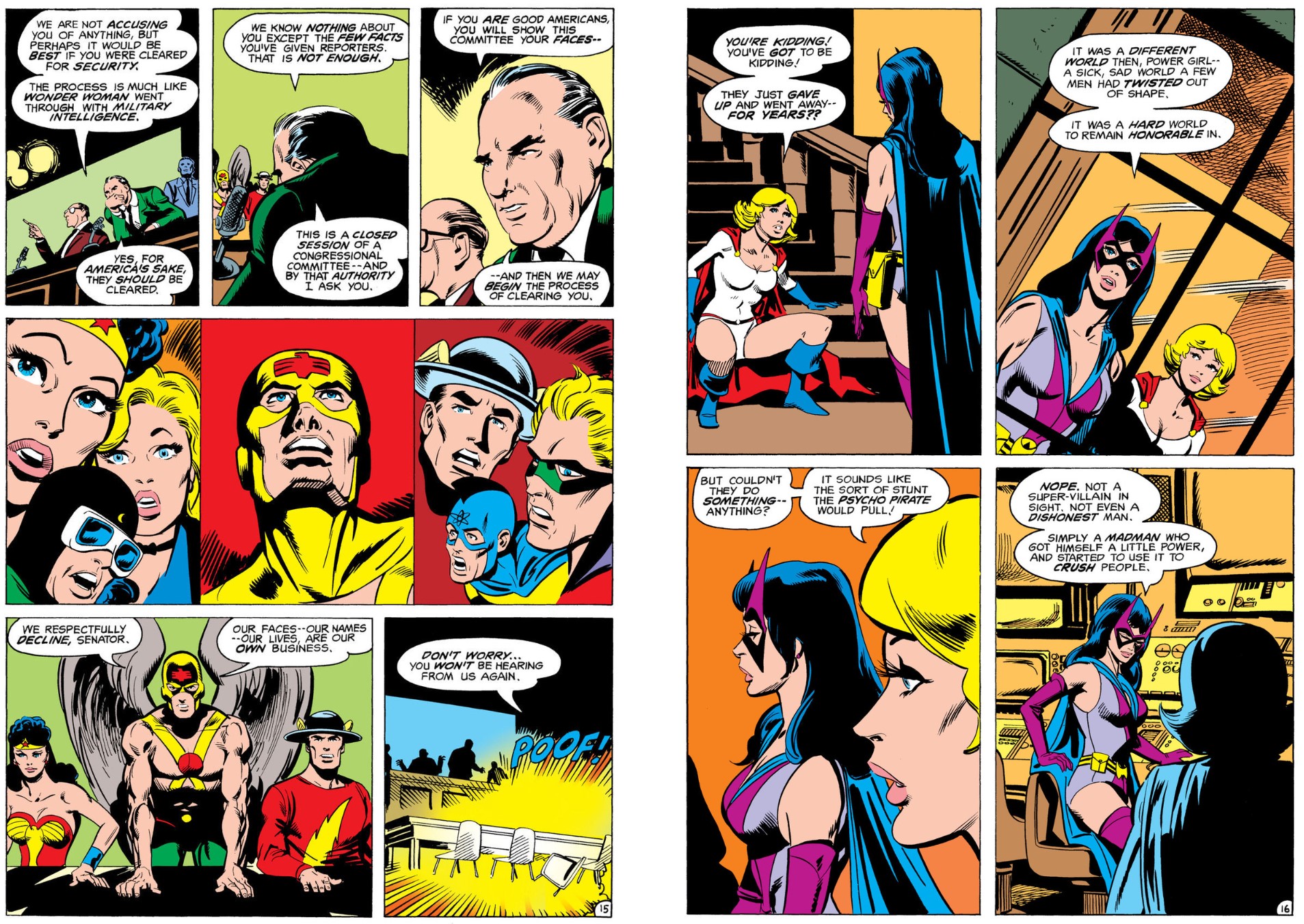
But not the last in this volume: that honour falls to another Levitz & Staton landmark: a little history lesson wherein they expose the reason why the team vanished at the beginning of the 1950s. From Adventure #466, ‘The Defeat of the Justice Society!’ shows how the US Government had cravenly betrayed their greatest champions during the McCarthy witch-hunts: provoking the mystery-men into voluntarily withdrawing from public, heroic life for over a decade… until the costumed stalwarts of Earth-1 started the whole Fights ‘n’ Tights scene all over again…
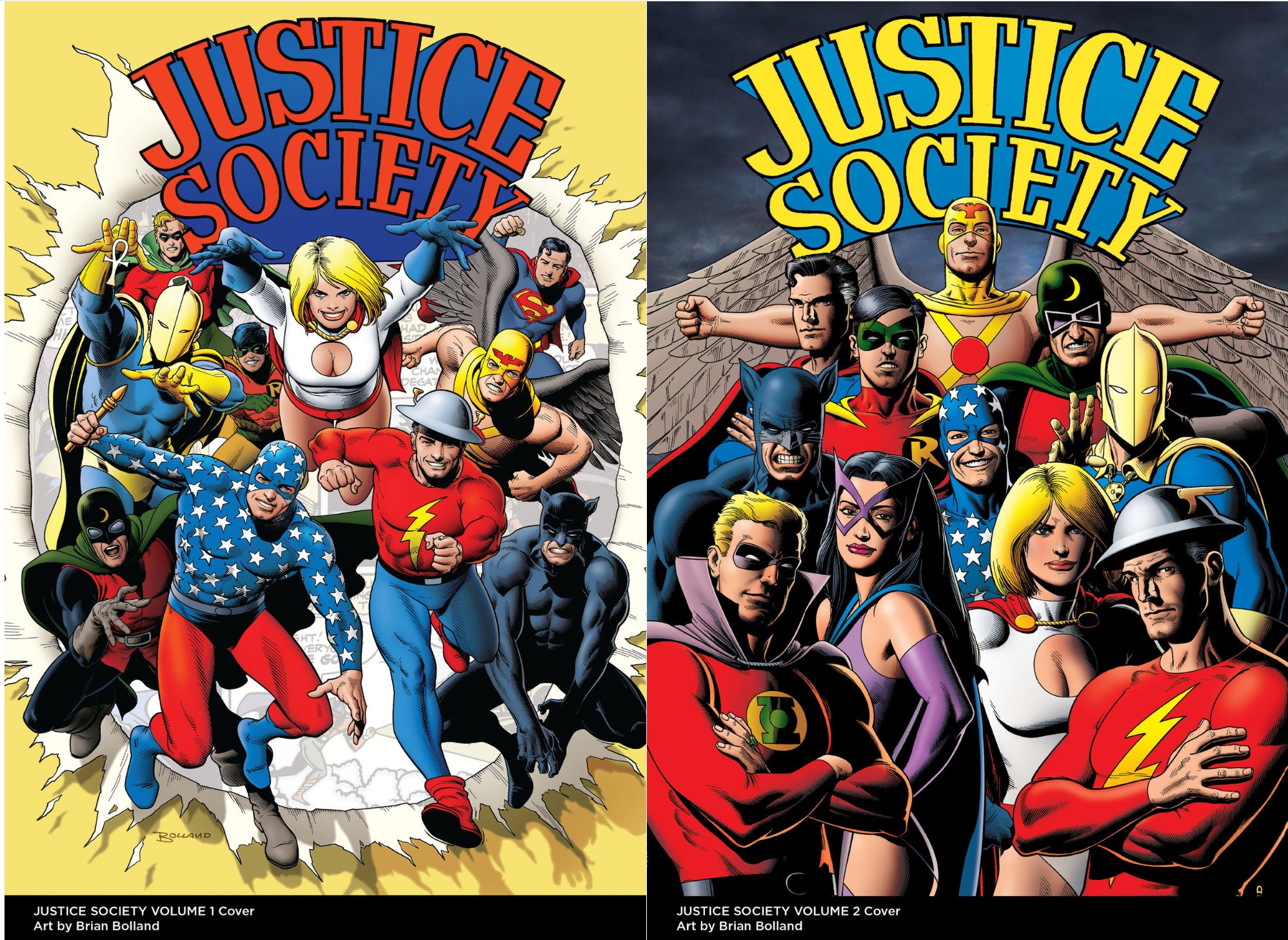
Upping the gaudy glory quotient, a team pin-up by Staton & Dick Giordano and two earlier collection covers from Brian Bolland cap off the costumed dramas.

Although perhaps a tad dated now, these exuberant, rapid-paced, imaginative yarns perfectly blend the naive charm of Golden Age derring-do with cynical modern sensibilities. Here you will be reassured that no matter what, in the end our heroes will always find a way to save the day. Such classic spectacles from simpler times are a glorious example of traditional superhero storytelling at its finest: fun, furious, ferociously engaging, excitingly written and beguilingly illustrated. No Fights ‘n’ Tights fan should miss these marvellous sagas.
© 1976, 1977, 1978, 1979, 2019 DC Comics. All Rights Reserved.

Today in 1912 Cliff Sterrett’s astounding strip Polly and Her Pals ran in US papers for the first time, and in 1921 artist Art Saaf was born – someone else you’ve probably enjoyed without even knowing it, so go learn about him too.
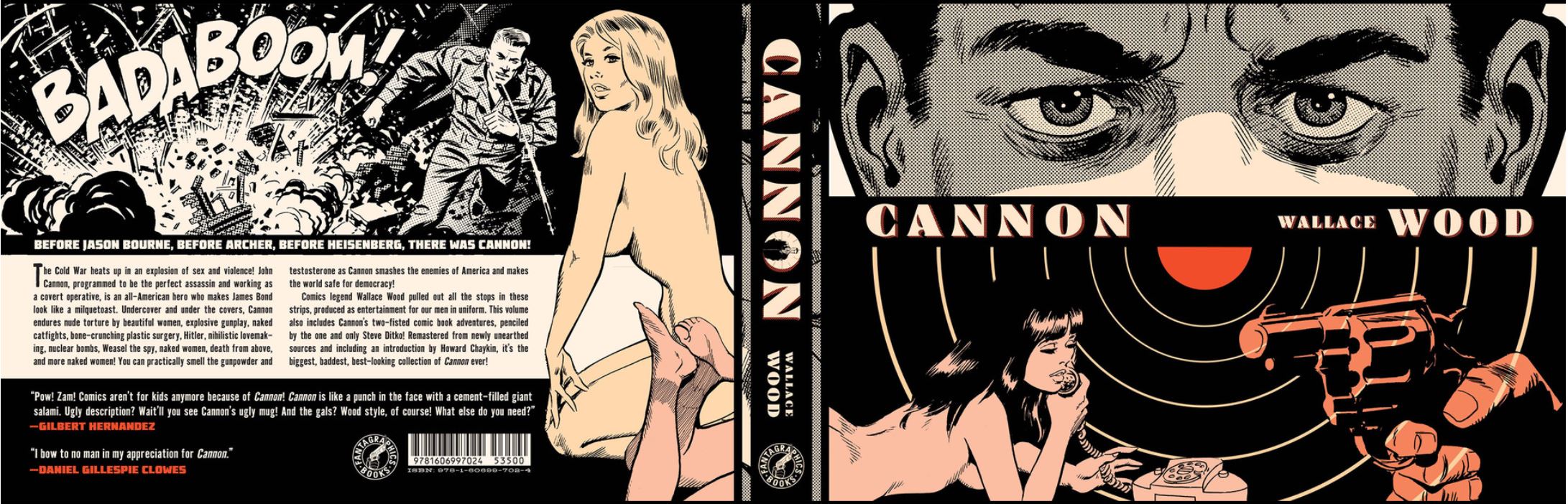
Cannon


By Wally Wood & various, introduction by Howard Chaykin (Fantagraphics Books)
ISBN: 978-1-60699-702-4 (HB/Digital edition)

This book includes Discriminatory Content produced in less enlightened times.

As with any historical perspective addressing popular mass-entertainments and evolving societies, a look back often finds uncomfortable material that can jar some modern sensitivities and set today’s collective hackles rising. That’s especially true of this lovely but confounding collection compiling seldom seen material by one of the industry’s greatest stars…

This is quite frankly a lovely book of beautiful work that I now find hard to recommend to a general audience. That’s more to do with how society has evolved rather than its admittedly always deeply flawed and often unsavoury content…

We all carry within us the seeds of our own destruction and probably none more so than troubled comics genius Wallace Allan Wood (June 17th 1927 – November 2nd 1981): one of the greatest draughtsmen and graphic imagineers our art form has ever produced. Woody was a master of every aspect of the business. He began his career lettering Will Eisner’s Spirit newspaper strip, readily moving into pencilling and inking as the 1940s ended and, ultimately into publishing. After years working all over the comic book and syndicated strip markets, as well as in book illustration, package-design and other areas of commercial art, he devised the legendary T.H.U.N.D.E.R. Agents franchise and even predated and anticipated the counter-culture’s Underground Commix phenomenon by launching in 1965s one of the first adult-oriented, independent comics: Witzend.

The troubled genius was frequently his own worst enemy. Woody’s life was one of addiction (guns, booze & cigarettes); traumatic relationships; tantalisingly close yet always inevitably frustrated financial security; illness and eventually, suicide. It was as if all the joy and beauty in his existence stayed on the pages and there was none left for real life.

Although during his time with EC Wood became the acknowledged, undisputed Master of Science Fiction art in America, he was equally adept, driven and accomplished in the production of all genres. He was a lusty man and was a pioneer of sexually explicit, ultra-violent (but always beautiful) and titillating comics where sex played a major role. Remember, even if everybody loves comics, it’s not always about superheroes and cosmic quests. Men like sexy comics and cartoons. I’m not saying that it’s right or proper to ogle women, but it is a sad fact of life and has made many publishers rich for centuries. This customer base especially likes looking at beautiful naked women and amongst so very many cartoonists over the decades, Wood was arguably the paramount exponent of the subgenre…

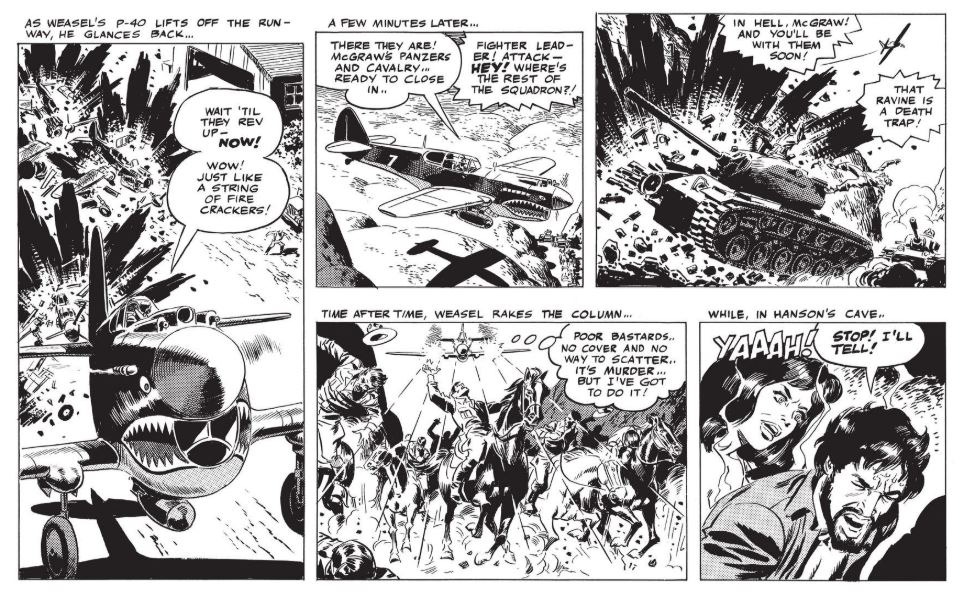
Remarkably and without in any way seeking to apologise for it, I can confirm that this gritty strip was made to entertain REAL-MEN!! It abounds with naked, nude, undraped and forcibly undressed women (and men, but not as many or as often as the women). Somehow less controversially it also heavily features mega violence, and both physical and psychological torture because that’s what the audience wanted. If you don’t believe me go and rewatch Goldfinger (1964) but this time watch and listen closely…

Cannon’s inbuilt misogyny is a feature not a bug with levels of abusive behaviour and conduct that seldom exceed those of any 1960-1970s Bond or Man from U.N.C.L.E. movie. There’s practically no gadgets either, but loads of fast flashy cars, planes and boats… and much sublimely rendered, awesomely accurate ordnance because that’s one thing your average GI or swabbie will spot instantly if fudged…

This cartoon series captures a moment in history that was deeply, deeply unfair to women, even if – for its time – the feature was uncharacteristically racially & socially diverse and most equitable in its treatment of African-American, Hispanic, Arabic and Asian guys. This was probably as much about the target readership – the desegrated but still mostly male US Military Service personnel – as Woody’s views on the Civil Rights movement. Wally was always utterly professional and diligent in all his work commitments and liberated from all editorial constraints, but his own experience gave the audience exactly what they wanted…

Following Howard Chaykin’s ‘Intro’ confirming the best and worst of the legends, the strip unfolds in one unbroken stream of non-stop blockbuster action heavily seasoned with geopolitical themes and contemporary headline fodder. It’s fitting to note here that Woody utilised and mentored dozens of guys who went on to their own notoriety. If you’re a fanatic, you’ll spot many of them – Pearson, Reese, Wenzel, Hama et al – as characters in the strip, but in-jokes aside, this one’s all about satisfying manly urges.

Guaranteeing sex, death and horror and NAKED WOMEN in almost every episode, Cannon by Wood and his ever-shifting studio ran from 1970-1973 in three separate editions of The Overseas Weekly: a tabloid specifically created and disseminated to US military personnel stationed overseas. He & Steve Ditko later recycled the character in an abortive indie publishing venture Heroes, Inc., which we’ll cover at the end.

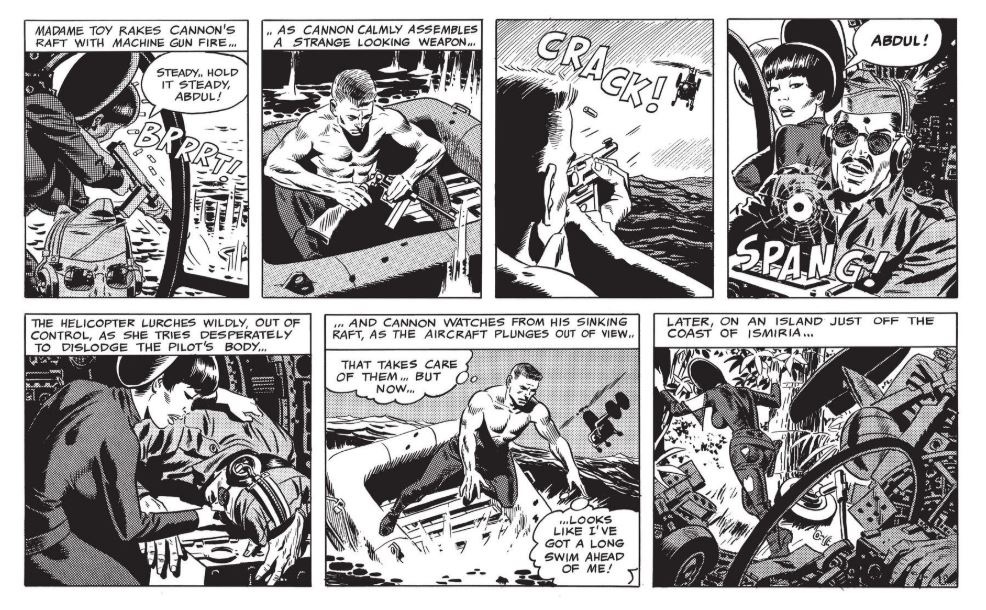
John Cannon was a U2 pilot captured and tortured by the Red Chinese. Broken and turned into their assassin, he threw off the ministrations of their top brainwasher Madame Toy but suffered a psychological collapse that left him a relentless, emotionless living weapon pointed by the CIA at any target that needed killing.

His successes didn’t affect him at all but did make him a permanent target of the Chinese and Soviet governments. The latter tasked beautiful lethal killer Sue Smith to remove him by any means and at all costs, but her attempts were as frequent and futile as Toy’s, who doggedly and repeatedly seeks to recapture or kill him. Both curvaceous killers spent as much time shagging Cannon as shooting, stabbing, electrocuting, drowning, poisoning, bombing and running over the implacable agent.

Encountering and exterminating hundreds of spies Cold War spies and assassins, Cannon saves US-friendly middle-Eastern Ismiria from infiltration and insurrection; defends US ally Israel from subversion; shatters the schemes (and sleeper agent army) of Comrade Gorsk and saves Latin American San Sierra from both Red-backed rebels and the incumbent US-friendly fascist dictatorship. He even gets to save a few lives along the way, like his own Uncle Fred back in Iowa and charming conman/serial bigamist/accidental hitman Charles M. Fogarty

At home, Cannon eradicates gangsters and spies as his conditioning begins to fade. No longer a reliable asset, he tries to retire to his old family home but trouble follows and the CIA soon re-recruit him. With Toy & Sue Smith perpetually hunting him and “cat-fighting” each other, Cannon even clashes with killer hippies in a murder commune and an ultra-conservative millionaire with his own private militia seeking to set the nation back on the Right path. John even has a couple of shots at true love and a Happy Ever After, but inevitably learns over and again that “women are just no damn good”…

Along the way he experiences every kind of action from scuba combat to aerial dogfights, and even battles a killer cyborg, He’s particularly adept at ferreting out leftover Nazis and dodges more than his fair share of atomic detonations. This is a strip very much of its time and for adults if not grown-ups, so like many of his audience, our hero even has to face up to the consequences of his actions when one paramour falls pregnant. The wedding is an utter disaster…

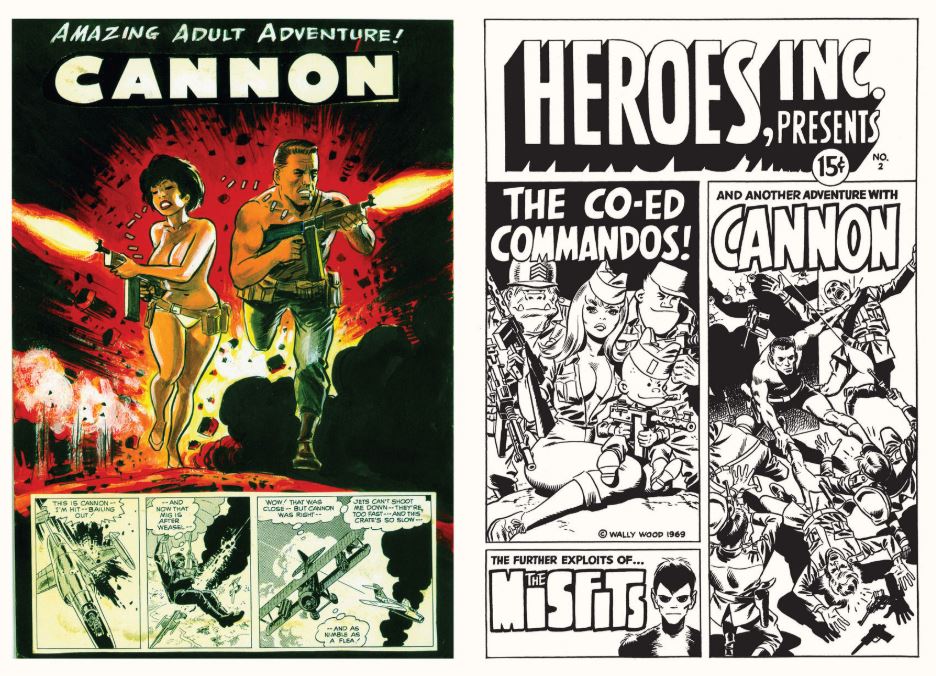
As much a document of art history as an expertly-targeted wank-book, Cannon comes with fascinating bonus features for comics fans, beginning a voluminous Appendix section with a brace of long lost cover paintings.

These augment the Roger Hill’s essay ‘The Overseas Weekly Discovery’ detailing the bizarre circumstance that led to the retrieval of the material forming this book, and compliments a

‘Letter by Wallace Wood’ exhorting how the industry must change. These are followed by the tamed down, general audience full-colour Cannon story by Wood & Ditko as seen by almost nobody in 1969’s Heroes, Inc. Presents Cannon, and another similar but monochrome lost Wood & Ditko treat from Heroes, Inc. No. 2 (1976) once again kicking the stuffing out of stubborn Nazis by Wood & Ditko. The experience ends as it should with a fulsome and fair “Bio” of Wally Wood by J. David Spurlock.

Fast, furious and ferociously unreconstructed and sexist, this can be a hard read: one packed with pitfalls, but undeniably honest in its intent and delivery. If you like this kind of thing you’ll love it, and if you find it offensive, you’re still free enough for the moment to reject and not buy it. However, if you do feel the urge to condemn, do us all the courtesy of reading it first…
“Intro” © 2014 Howard Chaykin. “The Overseas Weekly Discovery” © 2014 Roger Hill. “Bio” © 2014 J. David Spurlock. Photos © Bhob Stewart & Paul Kirchner. All other contents © 2014 Wallace Wood Properties LLC. All rights reserved.

The Outer Space Spirit: 1952


By Will Eisner, Jules Feiffer & Wally Wood & various (Kitchen Sink Press)
ISBN: 978-0-87816-007-5 (HB) 978-0-87816-012-9 (TPB)

Win’s Christmas Gift Recommendation: A Lost Classic …10/10

This book includes Discriminatory Content produced during less enlightened times.

In keeping with the dolorous nature of this time of year I’m concentrating on a few missed opportunities so here’s a graphic novel that was let slip by and rests in some nebulous limbo waiting for someone like me to say: why don’t we reprint this?

It is pretty much accepted today that Will Eisner was one of those pivotal creators who shaped America’s comic book industry, with most of his graphic works more or less permanently in print – as they should be. However, although the story can be found as part of the also ultra-rare Spirit Archive volume 24, this classy monochrome volume from much-missed independent publisher Kitchen Sink in 1983, released in both hardback and softcover, is by far a better reading experience.

Sometimes the Medium is the Message, especially when the artefact is a substantially solid tome delivering magical artwork in crisp, breathtaking black & white which details – not only in the reprinted strips but also sketches, incidental artwork and author’s breakdown layouts – the last and most striking saga of one of the world’s greatest fantasy characters. From 1936 to 1938, Eisner worked as a jobbing cartoonist in the comics production firm known as the Eisner-Eiger Shop, creating strips for both domestic US and foreign markets. Under pen-name Willis B. Rensie, he created and drew opening instalments for a huge variety of characters ranging from funny animal to historical sagas, Westerns, Detectives, aviation action thrillers… and superheroes… lots of superheroes…

In 1940, Everett “Busy” Arnold, head honcho of the superbly impressive Quality Comics outfit, invited Eisner to take on a new challenge. The Register-Tribune newspaper syndicate wanted a 16-page weekly comic book insert to be given away with the Sunday editions. Eisner jumped at the opportunity, creating three strips which would initially be handled by him before two of them were handed off to his talented assistants. Bob Powell inherited Mr. Mystic and distaff detective Lady Luck fell into the capable hands of Nick Cardy (then still Nicholas Viscardi) and later, the inimitable Klaus Nordling.

Eisner kept the lead feature for his own playground and over the next 12 years The Spirit became the most impressive, innovative, imitated and talked-about strip in the business. However, by 1952 he had more or less abandoned it for more challenging and decidely more profitable commercial, instructional and educational strips, working extensively for the US military in manuals and magazines like P*S, The Preventative Maintenance Monthly, and generally leaving comics books behind. Gathered here are last newspaper sections (July 27th through October 5th 1952), plus scripts for what would have been the final three sections of The Outer Space Spirit.

For that final year or so, the bulk of Spirit tales were produced by other hands with assistant Jules Feiffer handling the majority of scripts and diverse artists producing the art. Feiffer preferred to map out his episodes in rough pencil with word balloons and captions fully scripted: once approved by Eisner, the roughs would then be interpreted by an assigned artist for the individual episodes. The long-term plan was not to cancel The Spirit but redefine it for a new decade and expand the Eisner studio/company beyond and around it – but that’s not quite how it played out.

As seen in the scholarly introduction by Cat Yronwoode and Eisner’s own director’s commentary ‘Reminiscence’, the plans to reposition The Spirit were not welcomed by the client papers buying the strip; the creators handling the feature had different creative goals and drives and Eisner himself couldn’t quite let go of his precious baby. Even though society and comic books were wildly in love with the bold new genre of space opera/science fiction and Eisner had previously dabbled with the form in a few previous tales, a large number of Spirit clients and readers did not want any “flying saucer spacey stuff” in their Sunday funnies. Moreover, the brilliantly sardonic, existentialist and sensitively satirical Feiffer was approaching the stories in a bleak, nigh-nihilistic manner, emphasising existentialist isolation, human frailty and the passing of an era, rather than rugged he-men with hot babes in bikinis and fishbowl helmets…

After a succession of fill-in draughtsmen, Wally Wood was selected as artist: a stunningly gifted imagineer reaching unparalleled heights with his work for EC and other comic book Sci Fi publishers. Wood actually began his professional career on The Spirit in the 1940s (as a letterer) and was fantastically keen on the new project, but merciless deadlines and his overwhelming desire to surmount his own high standards soon had the saga experiencing deadline problems on top of everything else.

After text features, the first episode ‘Outer Space’ begins, preceded – as are most of strips here – by Feiffer’s meticulous and detailed script layouts. First appearing on Sunday, July 27th 1952, we see Denny Colt, The Spirit, managing a crew of convict volunteers on an American rocketship to the moon, at the insistent request of eminent space scientist Professor Hartley Skol. However, this was a new hero for an uncertain age. The tough, fun-loving, crime-fighting daredevil had become a cautious, introspective leader, feeling fully the weight of his mission and the burden of unwelcome responsibilities.

‘Mission: the Moon’ (August 3rd 1952), follows Colt, Skol and the pardoned felons onto the satellite’s barren surface and recounts the Spirit’s first victory as he heads off potential mutiny with reason, not force, before ‘A DP on the Moon’ reveals how closely Eisner still monitored the series. DP’s were “Displaced Persons” a common term in the post-war world, and when the explorers find a diary in the lunar dust, it reveals how the world’s greatest dictator and his inner circle fled to the moon to escape Allied justice. Unfortunately, they could not outrun their own paranoia and madness…

In the original script and finished art the diarist is Adolf Hitler, but the grim fate that befell his fellow Nazis was altered at the very last moment by Eisner, who felt the plot was already old hat. Swift retouching transformed Der Fuehrer into fictitious Latin American dictator Francisco Rivera and the revised version ran on August 10th 1952. It still reads pretty well, but if you look carefully, those uniforms in the background flashbacks are hauntingly familiar.

With ‘Heat on the Moon’ the deadline crunch hit, and 1½ pages of spectacular Lunar exploration by Wood abruptly segues to a “meanwhile back on Earth” scene from Eisner, featuring Chief Dolan, daughter Ellen and a criminal with a vested interest in assuring that at least one of the moon volunteers isn’t pardoned. Following their first fatality, the mission goes swiftly awry and ‘Rescue’ (the instalments now cut to only 4 pages in an attempt to fight the deadline doom) sees another body-blow to the expedition. Defeated and demoralised, Spirit decided to return the survivors to Earth…

‘The Last Man on the Moon’ depicts the launch from the moon as, on Earth, another gangster attempts to scotch the return trip. Clearly cursed, the mission suffers one more disaster as a convict sneaks away before take-off, becoming, with the September 7th episode ‘The Man in the Moon’. On September 14th the inevitable occurred and the feature was forced to run a modified reprint (‘The Amulet of Osiris’ from the late 1940s) before Wood resurfaced to illustrate the philosophically barbed ‘Return from the Moon’ on September 21st. Here Denny Colt and the remaining lunar-nauts debate the nature of reality, as Eisner steps in with the help of Al Wenzel to produce ‘The Return’, a hasty wrap-up that still found room for a close encounter with a flying saucer.

A scheduling blip saw an alternate version of the return a week later (sadly not included here) and final episode ‘Denny Colt, UFO Investigator’ ran on October 5th 1952: an inconclusive new beginning illustrated by Klaus Nordling. The strip died with that episode as Eisner, increasingly occupied with military work, and bleeding client-papers, terminated the feature.

But that isn’t quite the end: this book also includes – in various forms – what would have been the next three chapters, discovered in Eisner’s extensive file vault in the early 1980s. First is a fully lettered Feiffer layout, followed by a sequence of lettered pages prior to the art being drawn and the first (and only) typed script from assigned new creator Nordling.

Tense, suspenseful, dark and fearsomely compelling, these are the stories that signified the Spirit demise for nearly two decades, but today they stand as a mini-masterpiece of comics storytelling that was, quite simply, too far advanced for its audience. For we survivors of Cold War, Space Race and Budget-cut scientific exploration, they are a chilling and intensely prophetic examination of human nature in a Brave New World rendered with all the skill and frantic passion of some of comics’ greatest talents.

What wonders could have followed if the readers had come along with them? I don’t know, but at least we still have these tales – as soon as someone reprints them again…
© 1983 Kitchen Sink Press. © Art and stories 1983 Will Eisner. All rights reserved.