
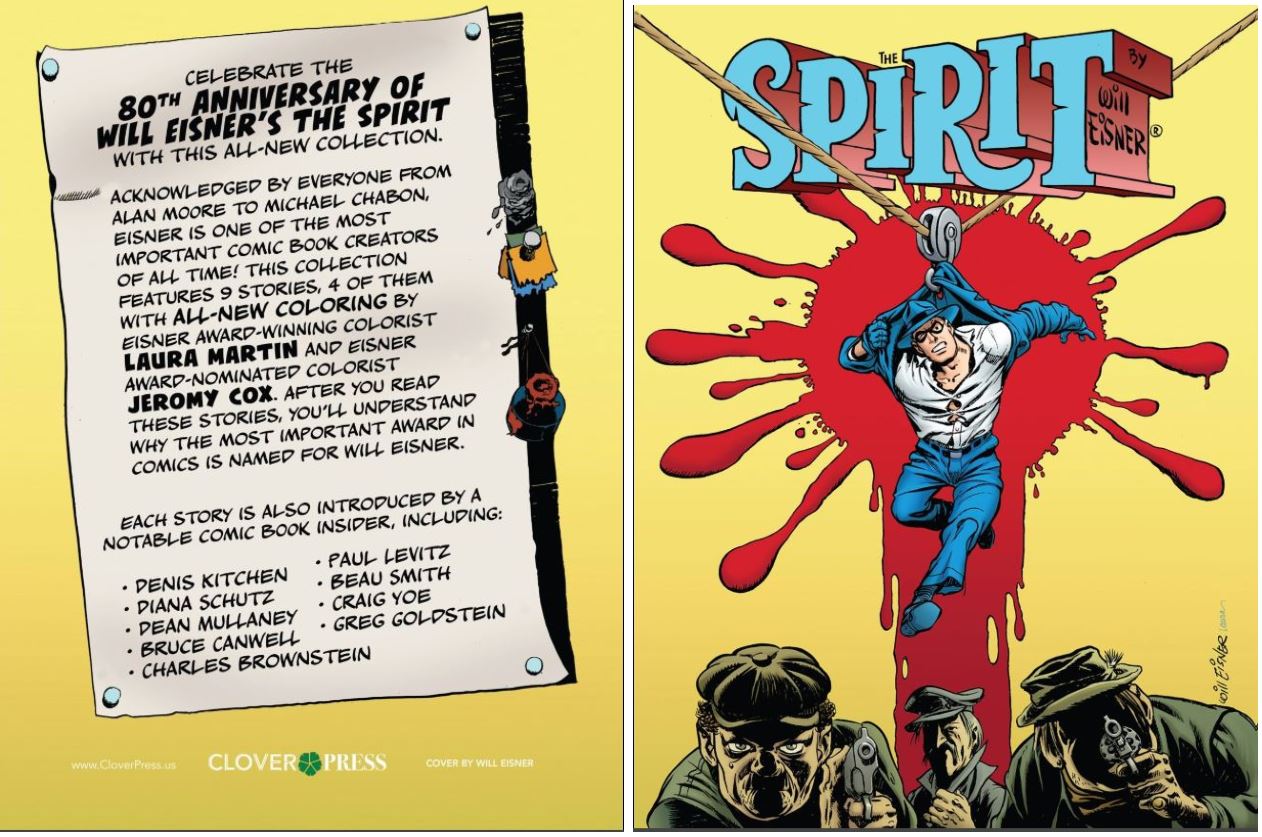
The Spirit: An 80th Anniversary Celebration


By Will Eisner with Abe Kanegson, Sam Rosen, Laura Martin, Jeromy Cox & various (Clover Press)
ISBN: 978-1-95103-805-2 (TPB/Digital edition)

This book includes Discriminatory Content produced in less enlightened times.

It is pretty much accepted today that Will Eisner was one of the prime creative forces that shaped the comic book industry, but still many of his milestones escape public acclaim in the English-speaking world.

William Erwin Eisner was born on March 6th 1917, in Brooklyn, and grew up in the ghettos of the city. They never left him. After time served inventing much of the visual semantics, semiotics and syllabary of the medium he dubbed “Sequential Art” in strips, comicbooks, newspaper premiums and instructional comics, he then invented the mainstream graphic novel, bringing maturity, acceptability and public recognition to English language comics.

In 1978 a collection of four original short stories in comics form released in a single book, A Contract With God and Other Tenement Stories. All the tales centred around 55 Dropsie Avenue: a 1930’s Bronx tenement housing poor Jewish and immigrant families. It changed the American perception of cartoon strips forever.

Eisner wrote and drew a further 20 further masterpieces, opening the door for all other comics creators to escape the funny book and anodyne strip ghettos of superheroes, funny animals, juvenilia and “family-friendly” entertainment. At one stroke comics grew up.

Eisner constantly pushed the boundaries of his craft, honing his skills not just on the legendary Spirit but with years of educational and promotional material. In A Contract With God he moved into unexplored territory with truly sophisticated, mature themes worthy of Steinbeck and F. Scott Fitzgerald, using pictorial fiction as documentary exploration of social experience.

Restlessly plundering his own childhood and love of human nature as well as his belief that environment was a major and active character in fiction, in the 1980s Eisner began redefining the building blocks unique to sequential narrative with a portmanteau series of brief vignettes that told stories and tested the expressive and informational limits of representational drawings on paper. From 1936 to 1938, Eisner worked as a jobbing cartoonist in the comics production firm known as the Eisner-Eiger Shop, creating strips for domestic US and foreign markets. Using pen-name Willis B. Rensie he conceived and drew the opening instalments of a huge variety of characters ranging from funny animal to historical sagas, Westerns, Detectives, aviation action thrillers – and superheroes – lots of superheroes…

In 1940 Everett “Busy” Arnold (head honcho of the superbly impressive Quality Comics outfit) invited Eisner to take on a new challenge. The Register-Tribune newspaper syndicate wanted a 16-page weekly comic book insert to be given away with the Sunday editions. Despite the terrifying workload such a commission demanded, Eisner jumped at the opportunity, creating three strips which would initially be handled by him before two of them were handed off to his talented assistants. Bob Powell inherited Mr. Mystic whilst masked detective Lady Luck fell into the capable hands of Nick Cardy (then still Nicholas Viscardi), and later the inimitable Klaus Nordling.

Eisner kept the lead strip for himself, and over the next twelve years The Spirit became the most impressive, innovative, imitated and talked-about strip in the business. In 1952 the venture folded and Eisner moved into commercial, instructional and educational strips. He worked extensively for the US military in manuals and magazines like P*S, the Preventative Maintenance Monthly, generally leaving comics books behind.

In the wake of “Batmania” and the 1960s superhero craze, Harvey Comics released two giant-sized reprints with a little new material from the artist, which lead to underground/indie editions and a slow revival of the Spirit’s fame and fortune via monochrome newsstand reprint magazines. Initially, Warren Publishing collected old stories, even adding colour sections with painted illumination from such contemporary luminaries as Rich Corben, but with #17 the title reverted to Kitchen Sink, who had produced the first two underground collections.

Eisner found himself re-enamoured with graphic narrative and saw a willing audience eager for new works. From producing new Spirit covers for the magazine (something the original newspaper insert had never needed) he became increasingly inspired. American comics were evolving into an art form and the restless creator finally saw a place for the kind of stories he had always wanted to tell.

Eisner began crafting some of the most telling and impressive work the US industry had ever seen: first in limited collector portfolios and eventually in 1978, A Contract With God. If Jack Kirby was American comics’ most influential artist, Will Eisner undoubtedly was – and remains – its most venerated and exceptional storyteller. Contemporaries originating from strikingly similar Jewish backgrounds, each used comic arts to escape from their own tenements, achieving varying degrees of acclaim and success, and eventually settling upon a theme to colour all their later works. For Kirby it was the Cosmos, what Man would find there, and how humanity would transcend its origins in The Ultimate Outward Escape. Will Eisner went Home, went Back and went Inward.

The Spirit debuted on June 2nd 1940 in the Sunday edition of newspapers belonging to the Register and Tribune Syndicates. “The Spirit Section” expanded into 20 Sunday newspapers, with a combined circulation of five million copies during the 1940s and ran until October 5th 1952. This collection re-presents a selection of classic adventures from the original 12-year canon, in stark stunning monochrome, with five digitally recoloured by Laura Martin and Jeromy Cox. Furthermore, each episode is preceded by an essay from Industry insiders and unashamed fans.

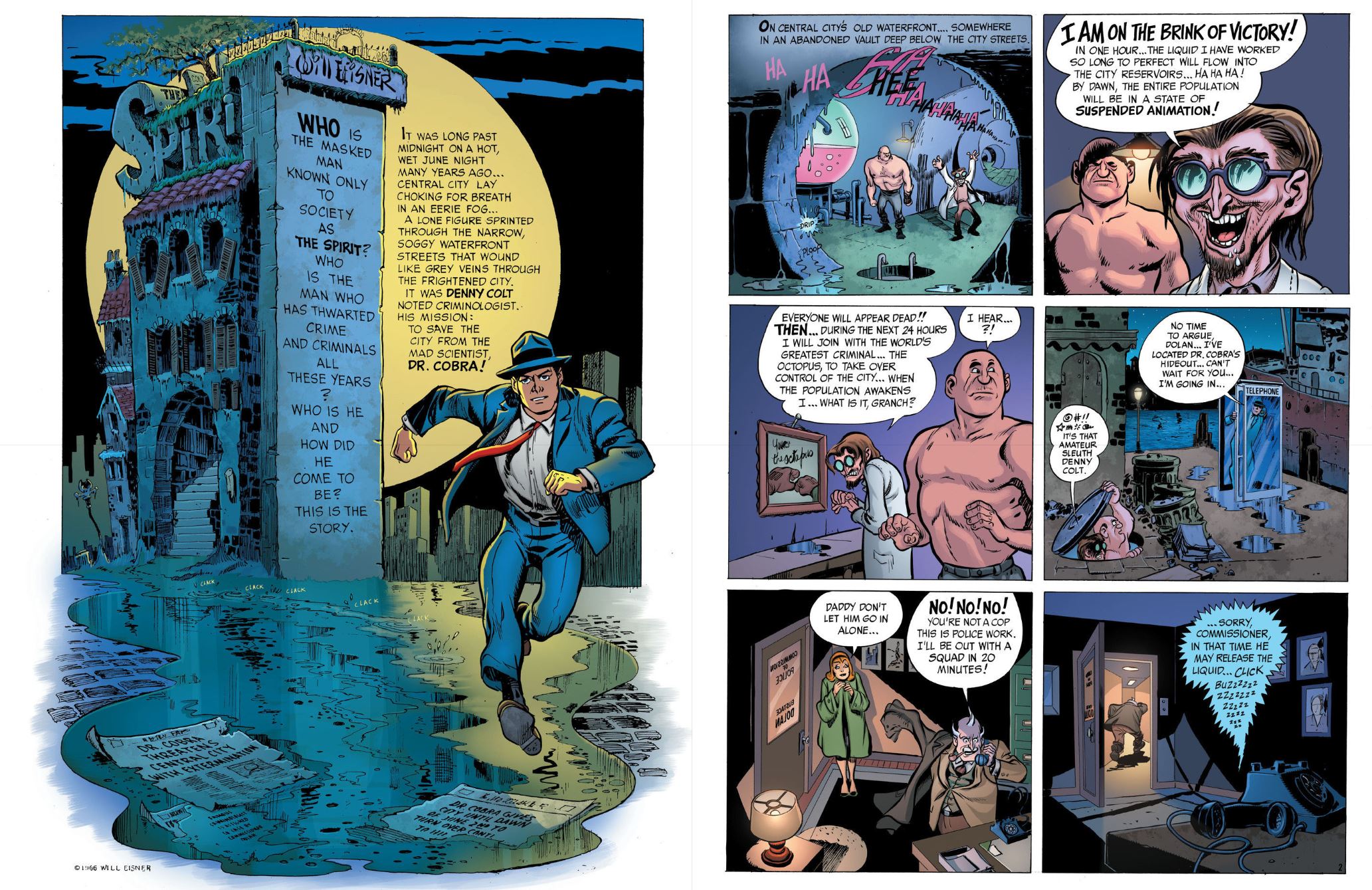
Leading the charge and providing a fascinating breakdown on the history of the masked marvel is former publisher (one of 15 to date) Denis Kitchen, who provides ‘A Brief History and Appreciation of The Spirit before the Cox-coloured ‘Who is The Spirit?’ reveals how a battle of wills between private detective Denny Colt and scientific terror Dr. Cobra leads to the hero’s death and resurrection as the ultimate man of mystery…
Editorial wonder Diana Schutz deconstructs one of Eisner’s most metaphysically mirthful yarns as ‘No Spirit Story Today’ treats us all to monochrome madness with a deadline crunch inspiring a Central City cartoonist to break the fourth wall. Dean Mullaney then spills the beans over atomic era intrigue as Martin’s hues add bite to the 1947 armageddon spoof ‘Wanted’, with the entire world as well as our hero hunting a little man with a deadly secret…

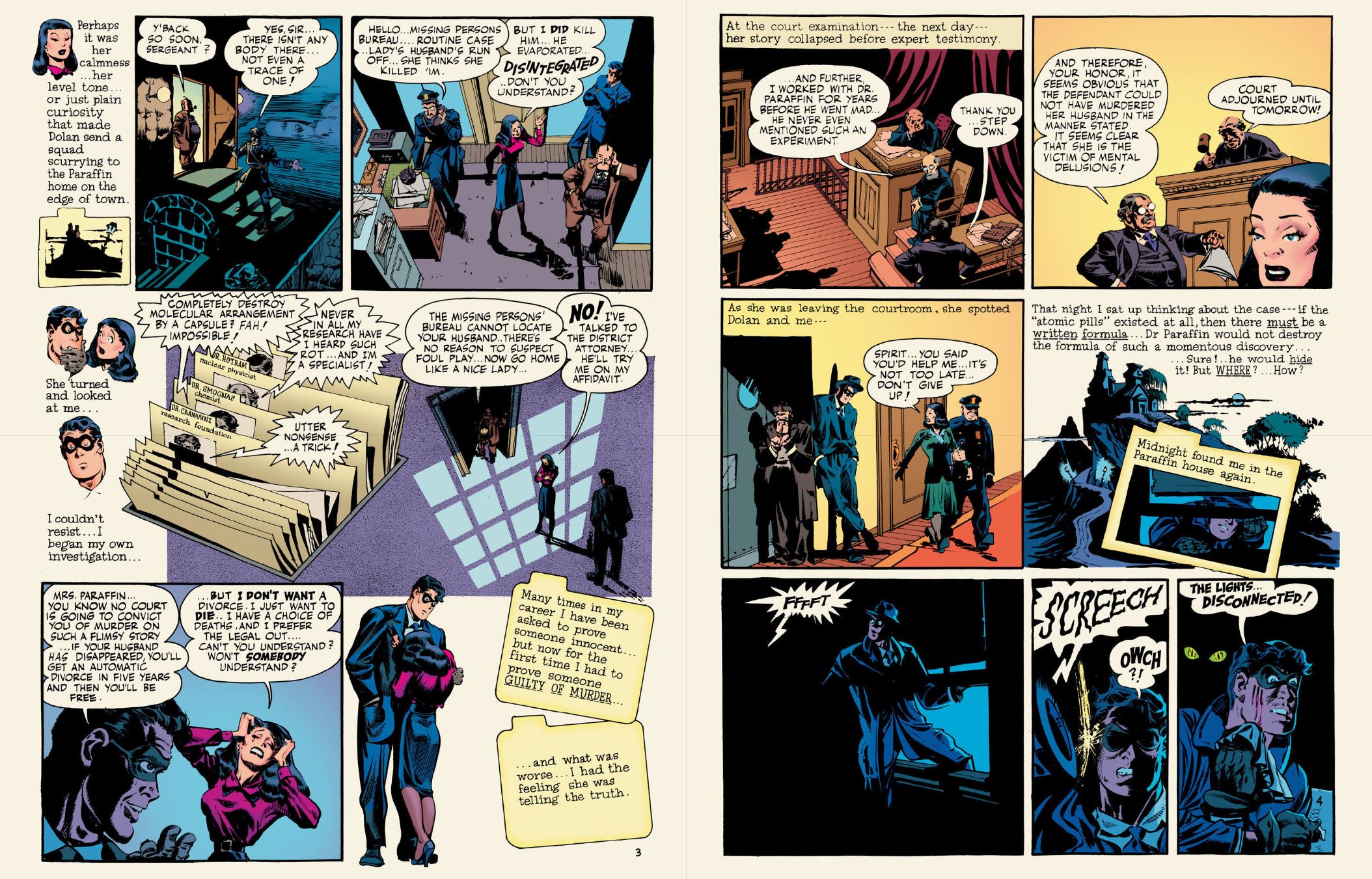
According to Bruce Canwell’s essay, Li’ Abner parody ‘Li’l Adam’ was part of a scheme between Eisner and Al Capp to mutually boost popularity of their respective properties. The jury’s still out, but there no doubt that the Spirit portion is one of the wackiest episodes in the gumshoe’s case files, unlike the moody, compelling tragedy of ‘The Strange Case of Mrs. Paraffin’ (previewed by Charles Brownstein), wherein the ghostly gangbuster strives to convince a widow that she is not also a murderess…
Paul Levitz examines authorial inspiration in anticipation of a return to black & white and The Spirit’s battle against arsonist ‘The Torch’: a potentially passé romp rendered hilariously unforgettable by Eisner’s wry poke at advertising sponsorship, before Beau Smith fondly recalls his mentor’s gift for teaching using modern magic realist western ‘Gold’ as his exemplar…

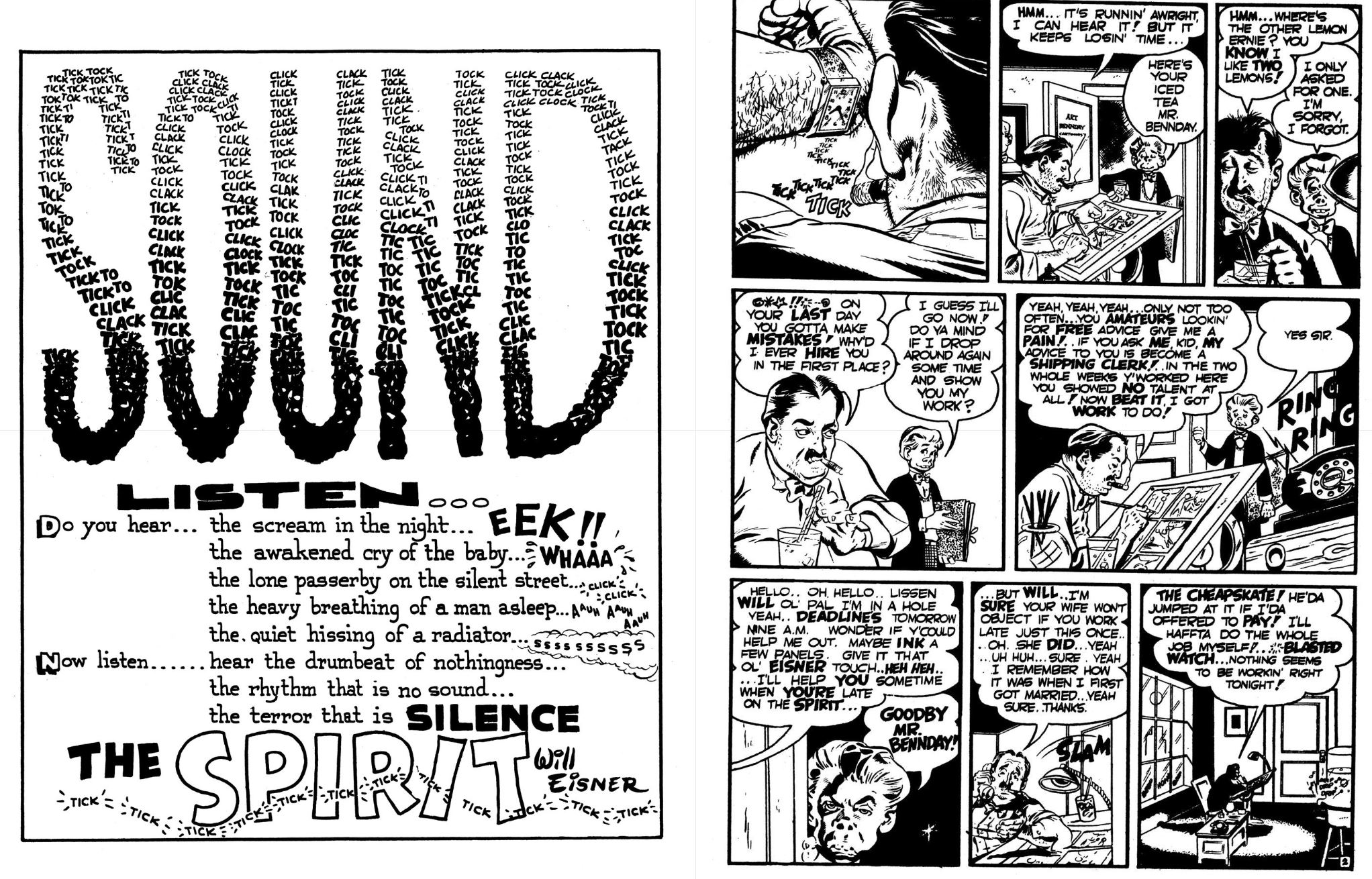
Coloured by Cox and discussed by Craig Yoe, ‘Matua’ is a deftly winsome tribute to myths and legends disguised as a poke at monster movies with the Spirit wandering the Pacific Islands and meeting an awakened colossal beast, after which Greg Goldstein focusses on ‘Sound’ as a monochrome moment again peeks behind the curtain of a cartoonist’s life.

Eisner always had a superb team to back him up and here letterers Sam Rosen & Abe Kanegson combine with design assistant Jules Pfeiffer to make the wordforms the surreal stars of this picture show about another murdered pencil pusher…
Rounding out this tribute to eight tumultuous decades of Spiritual Enlightenment is a Will Eisner Art Gallery of latterday sketches, pin-ups and covers by the master.

Will Eisner is rightly regarded as one of the greatest writers in American comics but it is too seldom that his incredible draughtsmanship and design sense get to grab the spotlight. This book is a joy no fan or art-lover should be without, and is especially recommended for newbies who only know Eisner’s more mature works.

By the Way: Although Eisner started out utilising the commonplace racial and gender stereotypes employed by so many sectors of mass entertainment, he was among the first in comics – or anywhere else – to eschew and abandon them. In these more enlightened, if not settled, times, it’s nice to see a statement addressing the historical and cultural problems not to mention potential distress these outdated sensibilities might cause right at the front of the collection. So, if funny books can do it, how come statues and people can’t?
THE SPIRIT and WILL EISNER are Registered Trademarks of Will Eisner Studios, Inc. Will Eisner’s The Spirit © 2020 Will Eisner Studios, Inc. All Rights Reserved. All other material © its respective contributor. © 2020 Clover Press, LLC. All Rights Reserved.

In case you missed it, today in 1917 Will Eisner was born, and shared his natal day with Al Milgrom in 1950 and Kieron Dwyer in 1967. The date also marks the deaths of Jack Abel in 1996 and in 2007, groundbreaking woman artist Lina Buffolente who drew Italian comics from age 17 in 1941 ‘til the end.

Take That, Adolf! – The Fighting Comic Books of the Second World War


By Mark Fertig and many & various (Fantagraphics Books)
ISBN: 978-1-60699-987-5 (TPB/Digital edition)

This book includes Discriminatory Content produced in less enlightened times.

Long the bastion of the arcane, historic, esoteric and the just plain interesting arenas of the comics experience, Fantagraphics Books here celebrates the dawn age of Fights ‘n’ Tights funnybooks with a magnificent collection of (mostly) superhero covers culled from the fraught period which most truly defined the comics industry.

Comic book covers are a potent and evocative way of assessing the timbre of an era and a captivating shortcut into worlds far removed from our own. They are also half the sum total of fun generated by narrative art and arguably an art form all their own. In this torrid tome, educator, scholar and writer Mark Fertig (Chair of Art and Art History at Susquehanna University, Pennsylvania and revered film noir expert – check out his Where Danger Lives for more populist fun) offers an erudite, wide-reaching treatise comprehensively addressing every aspect of the four-colour Home Front’s graphic endeavours in support of America’s WWII war effort.

Detailing how Jewish émigré artists’ and writers’ creative influences advocated America surrender its isolationist stance in ‘Four Color Fantasies’ and ‘Building Towards War’, Fertig then traces the development of ‘Red, White, and Blue Heroes’ such as The Shield and Uncle Sam before ‘The Coming of Captain America’ sparks the invention of ‘An Army of Captains’.

After the USA finally enters the war ‘All-Out Assault: August & September 1941’  is followed by an examination of female masked fighters in ‘She Can Do It!’ and reveals how Wonder Woman became ‘An Amazon for the Ages’.

‘Kids Can Fight Too!’ reveals the impact of junior and underage crusaders as well as the sub-genre of Kid Gangs whilst ‘Attaboy, Steamboat!’ confronts head-on the depiction of ethnic characters – both vile foreign predators and monstrous conquerors and decent Pro-democracy non-white types…

From here in the distant future, some of the appalling jingoism and racism is even more disturbing than the tortures, torments and buckets of gore liberally scattered through the images of Evil Nazis and “Japs”…

Next ‘Into the Breach’ addresses the reasons omnipotent heroes such as Superman and Captain Marvel left the actual fighting in Europe and the Pacific to ordinary mortals before ‘Pulling Together’ details the promotion of Home Front solidarity munitions manufacture and the arming of the armies of Freedom. Then Hitler repeatedly gets his just deserts (in graphic effigy at least) ‘In Der Führer’s Face!’

‘Soldiers, Sailors, Airmen, and Marines!’ follows the development of more human fictional soldiers and heroes whilst ‘More Thrilling Than Fiction’ sees the beginnings of fact-based accounts of true champions such as President Roosevelt and General Eisenhower before ‘Pitch Men’ follows the numerous examples of masked warriors and kiddie-characters inciting readers to help pay for the war through selling war bonds and liberty stamps before ‘On to Victory’ celebrates the end of hostilities and the aftermath.

The fact-packed lecture is also supplemented at the back of the book by creator biographies of industry giants and iconic cover crafters Charles Clarence Beck, Jack Binder, Charles Biro, Hardin “Jack” Burnley, Reed Crandall, Will Eisner, Lou Fine, Irv Novick, Manuel “Mac” Raboy and Alex Schomburg (regarded as the most prolific cover illustrator of the period) but the true merit of this enchanting tome is the covers gathered for your perusal.

Designed to incite patriotic fervour and build morale, the awesome majority of this tome features a potent avalanche of stunning covers from almost every company, displaying not only how mystery men and superheroes dealt with the Axis of Evil in those tense times but also the valiant efforts of “ordinary fighting men” and even cartoon fantasy stars such as Bugs Bunny, Porky Pig and Walt Disney stars such as Mickey Mouse and Donald Duck

Shopping List Alert: Feel free to skip if you must…

This book celebrates an absolute torrent of spectacular, galvanising scenes of heroes legendary and obscure, costumed and uniformed, all crushing tanks, swatting planes, sinking U-Boats and decimating enemy ranks, and unleashed before your assuredly goggled eyes by artists long forgotten, and never known as well as more familiar names. This battalion of the worthy includes Joe Shuster, Joe Simon & Jack Kirby, Eisner, Harry G. Peter, Jack Burnley, Frank Harry, Irwin Hasen, Al Avison, Bob Powell, Edd Ashe, Harry Lucey, Paul Gustavson, Bill Everett, Jerry Robinson, Gus Ricca, Al Gabriele, Charles Sultan, Gene Fawcette, Louis & Arturo Cazeneuve, Gill Fox, Sam Cooper, Jim Mooney, Elmer Wexler, Fred Ray, Dan Zolnerowich, Don Rico, Max Plaisted, Howard Sherman, Everett E. Hibbard, Ramona Patenaude, Pierce Rice, Harry Anderson, Lin Streeter, Dan Gormley, Bernard Klein, Stephen Douglas, Martin Nodell, Charles Quinlan, Dan Noonan, Sheldon Moldoff, Henry Keifer, Marc Swayze, Carl Buettner, Charles A. Winter, Maurice, del Bourgo, Jack Warren, Bob Montana, Bob, Fujimori, Vernon Greene, George Papp, John Jordan, Syd Shores, John Sikela, Alex Blum, Ray Ramsey, R. Webster, Harry Sahle, Mort Leav, Alex Kotzky, Dan Barry, Al Camy, Stan Kaye, George Gregg, Art Saaf, George Tuska, Alexander Kostuk, Al Carreno, Fred Kida, Ruben Moreira, Sidney Hamburg, Rudy Palais, Joe Doolin, Al Plastino, Harvey K. Fuller, Louis Goodman Ferstadt, Matt Bailey, Ham Fisher, Walt Kelly, Wayne Boring, John Giunta, Creig Flessel, Harold Delay, Lee Elias, Henry Boltinoff, L.B. Cole and George Marcoux – plus oh so many more who did their bit by providing safe thrills, captivating joy and astounding excitement for millions.

These powerful, evocative, charming, funny, thrilling, occasionally daft and often horrific images are controversial these days. Many people consider them Art with a capital ‘A’ whereas close-minded, reactionary, unimaginative, bigoted die-hard poltroons don’t.

Why not Dig back in time (For Victory!) and make your own decision?
© 2017 Fantagraphics Books, Inc. Main text © 2017 Mark Fertig. All comics covers and illustrations herein © 2017 the respective copyright holders All rights reserved.

The Dreamer


By Will Eisner (Kitchen Sink Press/W. W. Norton & Company/DC Comics)
ISBN: 978-0-87816-015-0 (HB) 978-0-39332-808-0 (TPB)

This book includes some Discriminatory Content produced during less enlightened times.

It’s Will Eisner’s Birthday today. He was born on March 6th 1917 and between that moment and his death on January 3rd 2005 was the leading proponent and champion of American comics as an art form. Many consider him the father of the Graphic Novel. For such a prominent and prolific creator, it’s truly remarkable how so many of his stories and books are out of print. Currently, this is mini masterpiece is one of them, but is still fairly available in many of its assorted editions…

First released by Kitchen Sink Press in 1986, The Dreamer is thinly disguised diary (call it a graphic Mise-en-scène if you wish) depicting the early days of the American comic book industry as observed by hungry comics creators looking to make a buck. However, some of the toilers can’t help but see such untapped potential in what they do at their desks…

It might be short on action and page count – some editions come in at between 46 and 54 pages – but the strength of the characters’ aspirations all shine through. Creative people seem to gravitate towards each other, and depression era tales abound with big dreams fuelled by desperation, playing out against a backdrop of comradeship. The politics of revolution simmer in the minds and unfilled bellies of the poor. Characters we all should recognize make their choices and move on to become the gods of popular or even High Culture we all grew older with. Can you spot ’em all?

There is an added impetus for the afficionado of the strips. Not only engaging characters, not merely an insider’s perspective on the beginnings of our beloved obsession, not at last a direct link to history that the rest of world thinks worth remembering, but also a real glimpse inside the minds and hearts of the creative wizards that started it all.

Covering a period rife with daily human drama, and exploring an age where dreams were common and creativity unshackled, The Dreamer is a captivating reverie of how comics were, and how they work, delivered in the best manner of one of comics’ greatest innovators and practitioners.
© 1986, 2004, 2008 Will Eisner.

The Outer Space Spirit: 1952


By Will Eisner, Jules Feiffer & Wally Wood & various (Kitchen Sink Press)
ISBN: 978-0-87816-007-5 (HB) 978-0-87816-012-9 (TPB)

Win’s Christmas Gift Recommendation: A Lost Classic …10/10

This book includes Discriminatory Content produced during less enlightened times.

In keeping with the dolorous nature of this time of year I’m concentrating on a few missed opportunities so here’s a graphic novel that was let slip by and rests in some nebulous limbo waiting for someone like me to say: why don’t we reprint this?

It is pretty much accepted today that Will Eisner was one of those pivotal creators who shaped America’s comic book industry, with most of his graphic works more or less permanently in print – as they should be. However, although the story can be found as part of the also ultra-rare Spirit Archive volume 24, this classy monochrome volume from much-missed independent publisher Kitchen Sink in 1983, released in both hardback and softcover, is by far a better reading experience.

Sometimes the Medium is the Message, especially when the artefact is a substantially solid tome delivering magical artwork in crisp, breathtaking black & white which details – not only in the reprinted strips but also sketches, incidental artwork and author’s breakdown layouts – the last and most striking saga of one of the world’s greatest fantasy characters. From 1936 to 1938, Eisner worked as a jobbing cartoonist in the comics production firm known as the Eisner-Eiger Shop, creating strips for both domestic US and foreign markets. Under pen-name Willis B. Rensie, he created and drew opening instalments for a huge variety of characters ranging from funny animal to historical sagas, Westerns, Detectives, aviation action thrillers… and superheroes… lots of superheroes…

In 1940, Everett “Busy” Arnold, head honcho of the superbly impressive Quality Comics outfit, invited Eisner to take on a new challenge. The Register-Tribune newspaper syndicate wanted a 16-page weekly comic book insert to be given away with the Sunday editions. Eisner jumped at the opportunity, creating three strips which would initially be handled by him before two of them were handed off to his talented assistants. Bob Powell inherited Mr. Mystic and distaff detective Lady Luck fell into the capable hands of Nick Cardy (then still Nicholas Viscardi) and later, the inimitable Klaus Nordling.

Eisner kept the lead feature for his own playground and over the next 12 years The Spirit became the most impressive, innovative, imitated and talked-about strip in the business. However, by 1952 he had more or less abandoned it for more challenging and decidely more profitable commercial, instructional and educational strips, working extensively for the US military in manuals and magazines like P*S, The Preventative Maintenance Monthly, and generally leaving comics books behind. Gathered here are last newspaper sections (July 27th through October 5th 1952), plus scripts for what would have been the final three sections of The Outer Space Spirit.

For that final year or so, the bulk of Spirit tales were produced by other hands with assistant Jules Feiffer handling the majority of scripts and diverse artists producing the art. Feiffer preferred to map out his episodes in rough pencil with word balloons and captions fully scripted: once approved by Eisner, the roughs would then be interpreted by an assigned artist for the individual episodes. The long-term plan was not to cancel The Spirit but redefine it for a new decade and expand the Eisner studio/company beyond and around it – but that’s not quite how it played out.

As seen in the scholarly introduction by Cat Yronwoode and Eisner’s own director’s commentary ‘Reminiscence’, the plans to reposition The Spirit were not welcomed by the client papers buying the strip; the creators handling the feature had different creative goals and drives and Eisner himself couldn’t quite let go of his precious baby. Even though society and comic books were wildly in love with the bold new genre of space opera/science fiction and Eisner had previously dabbled with the form in a few previous tales, a large number of Spirit clients and readers did not want any “flying saucer spacey stuff” in their Sunday funnies. Moreover, the brilliantly sardonic, existentialist and sensitively satirical Feiffer was approaching the stories in a bleak, nigh-nihilistic manner, emphasising existentialist isolation, human frailty and the passing of an era, rather than rugged he-men with hot babes in bikinis and fishbowl helmets…

After a succession of fill-in draughtsmen, Wally Wood was selected as artist: a stunningly gifted imagineer reaching unparalleled heights with his work for EC and other comic book Sci Fi publishers. Wood actually began his professional career on The Spirit in the 1940s (as a letterer) and was fantastically keen on the new project, but merciless deadlines and his overwhelming desire to surmount his own high standards soon had the saga experiencing deadline problems on top of everything else.

After text features, the first episode ‘Outer Space’ begins, preceded – as are most of strips here – by Feiffer’s meticulous and detailed script layouts. First appearing on Sunday, July 27th 1952, we see Denny Colt, The Spirit, managing a crew of convict volunteers on an American rocketship to the moon, at the insistent request of eminent space scientist Professor Hartley Skol. However, this was a new hero for an uncertain age. The tough, fun-loving, crime-fighting daredevil had become a cautious, introspective leader, feeling fully the weight of his mission and the burden of unwelcome responsibilities.

‘Mission: the Moon’ (August 3rd 1952), follows Colt, Skol and the pardoned felons onto the satellite’s barren surface and recounts the Spirit’s first victory as he heads off potential mutiny with reason, not force, before ‘A DP on the Moon’ reveals how closely Eisner still monitored the series. DP’s were “Displaced Persons” a common term in the post-war world, and when the explorers find a diary in the lunar dust, it reveals how the world’s greatest dictator and his inner circle fled to the moon to escape Allied justice. Unfortunately, they could not outrun their own paranoia and madness…

In the original script and finished art the diarist is Adolf Hitler, but the grim fate that befell his fellow Nazis was altered at the very last moment by Eisner, who felt the plot was already old hat. Swift retouching transformed Der Fuehrer into fictitious Latin American dictator Francisco Rivera and the revised version ran on August 10th 1952. It still reads pretty well, but if you look carefully, those uniforms in the background flashbacks are hauntingly familiar.

With ‘Heat on the Moon’ the deadline crunch hit, and 1½ pages of spectacular Lunar exploration by Wood abruptly segues to a “meanwhile back on Earth” scene from Eisner, featuring Chief Dolan, daughter Ellen and a criminal with a vested interest in assuring that at least one of the moon volunteers isn’t pardoned. Following their first fatality, the mission goes swiftly awry and ‘Rescue’ (the instalments now cut to only 4 pages in an attempt to fight the deadline doom) sees another body-blow to the expedition. Defeated and demoralised, Spirit decided to return the survivors to Earth…

‘The Last Man on the Moon’ depicts the launch from the moon as, on Earth, another gangster attempts to scotch the return trip. Clearly cursed, the mission suffers one more disaster as a convict sneaks away before take-off, becoming, with the September 7th episode ‘The Man in the Moon’. On September 14th the inevitable occurred and the feature was forced to run a modified reprint (‘The Amulet of Osiris’ from the late 1940s) before Wood resurfaced to illustrate the philosophically barbed ‘Return from the Moon’ on September 21st. Here Denny Colt and the remaining lunar-nauts debate the nature of reality, as Eisner steps in with the help of Al Wenzel to produce ‘The Return’, a hasty wrap-up that still found room for a close encounter with a flying saucer.

A scheduling blip saw an alternate version of the return a week later (sadly not included here) and final episode ‘Denny Colt, UFO Investigator’ ran on October 5th 1952: an inconclusive new beginning illustrated by Klaus Nordling. The strip died with that episode as Eisner, increasingly occupied with military work, and bleeding client-papers, terminated the feature.

But that isn’t quite the end: this book also includes – in various forms – what would have been the next three chapters, discovered in Eisner’s extensive file vault in the early 1980s. First is a fully lettered Feiffer layout, followed by a sequence of lettered pages prior to the art being drawn and the first (and only) typed script from assigned new creator Nordling.

Tense, suspenseful, dark and fearsomely compelling, these are the stories that signified the Spirit demise for nearly two decades, but today they stand as a mini-masterpiece of comics storytelling that was, quite simply, too far advanced for its audience. For we survivors of Cold War, Space Race and Budget-cut scientific exploration, they are a chilling and intensely prophetic examination of human nature in a Brave New World rendered with all the skill and frantic passion of some of comics’ greatest talents.

What wonders could have followed if the readers had come along with them? I don’t know, but at least we still have these tales – as soon as someone reprints them again…
© 1983 Kitchen Sink Press. © Art and stories 1983 Will Eisner. All rights reserved.