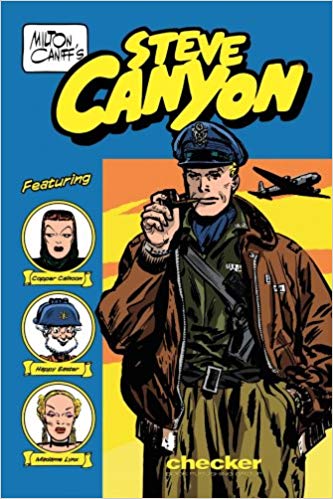
Milton Caniff’s Steve Canyon 1947


By Milton Caniff (Checker Book Publishing Group)
ISBN: 978-0-97102-49-9-1

Milton Caniff wasn’t an overnight sensation. He worked long and hard before he achieved stellar status in the comic strip firmament. Before Terry and the Pirates brought him fame, and Steve Canyon secured his fortune and reputation, the strip which brought him to the attention of legendary Press Baron “Captain” Joseph Patterson (in many ways the co-creator of Terry) was an unassuming daily feature about a little boy hungry for adventure.

Caniff was working for The Associated Press as an entry-level jobbing cartoonist when a gap opened in their strips department. AP was an organisation that devised and syndicated features for the thousands of local and small newspapers which could not afford to produce the cartoons, puzzles, recipes and other fillers that ran between the local headlines and the regional sports.

Over a weekend Caniff came up with Dickie Dare, a studious lad who would read a book and then fantasize himself into the story, taking his faithful little white dog Wags with him. The editors went for it and the strip launched on July 31st 1933. Caniff produced the adventures for less than eighteen months before moving on, but his replacement Coulton Waugh steered the series until its conclusion two decades later.

As well as being one of the greatest comic-strip artists of all time, Caniff was an old-fashioned honest American Patriot, from the time when it wasn’t a dirty word or synonym for fanatic.

The greatest disappointment of his life was that he was never physically fit enough to fight. Instead, during World War II he not only continued the morale-boosting China Seas epic Terry and the Pirates newspaper strip seven days a week, he also designed art, brochures and posters (all unpaid) for the War Department and made live appearances for soldiers and hospital residents. Even that wasn’t enough.

Again unpaid, he devised Male Cale: a strip to be printed in the thousands of local military magazines and papers around the world. Originally using established characters from Terry, Caniff swiftly switched (for reasons best explained in Robert C Harvey’s wonderful Meanwhile… a Biography of Milton Caniff) to a purpose-built (and was she built!) svelte and sexy ingénue who would titillate, amuse but mostly belong to the lonely and homesick American fighting men away from home and under arms.

Funny, saucy, even racy but never lewd or salacious, Miss Lace spoke directly to the enlisted man – the “ordinary Joe” – as entertainer, confidante and trophy date. She built morale and gave brief surcease from terror, loneliness or boredom. Although comparisons abound with our own Jane, the rationales behind each combat glamour girl were poles apart. Miss Lace spoke to and with the soldiers, and she wasn’t in normal papers. She was simply and totally theirs and theirs alone.

After leaving the incredibly successful and world-renowned Terry and the Pirates Caniff created another iconic comic hero in the demobbed World War II pilot Steve Canyon. The reasons for the move were basically rights and creative control, but it’s also easy to see another reason. Terry, set in a fabled Orient – even with the contemporary realism the author so captivatingly imparted – is a young man’s strip and limited by locale.

The worldly, if not war-weary, Canyon was a mature adventurer who could be sent literally anywhere and would appeal to the older, wiser readers of Atom-Age America, now a fully active, if perhaps reluctant, player on the world stage.

Canyon also reflects an older creator who has seen so much more of human nature and frailty than even the mysterious East could provide. Put another way, William Shakespeare could write Romeo and Juliet as a young man, but needed more than passion and genius to produce King Lear.

Steve Canyon began on 13th January 1947, after a long period of public anticipation following a very conspicuous resignation from Terry. Always a master of suspense and adept at manipulating his reader’s attention, Caniff’s eponymous hero didn’t actually appear until January 16th (and then only in a “file photograph”).

The public first met Stevenson Burton Canyon, former bomber pilot, medal winning war-hero, Air-Force flight instructor and latterly, independent charter airline operator in the first Sunday colour page, on 19th January 1947.

By then, eager readers had glimpsed his friends and future enemies, how acquaintances felt about him and even been introduced to ultra-rich, super-spoiled Copper Calhoun, the latest in a startlingly long line of devastating Femme Fatales created by Caniff to bedevil his heroes and captivate his audiences. And thus, the magic began…

This series of collections from Checker re-presents the strip in yearly segments (regrettably, with the Sundays printed in the same black-&-white as the daily episodes) and this one begins as Calhoun manoeuvres Canyon’s Horizons Unlimited charter line into flying her to countries where her pre-war holdings were disrupted. That seemingly simple job results in deadly peril from both strangers and trusted employees. There’s also a goodly helping of old-fashioned intrigue, jealousy and racketeering in the mix too…

The action and tragedy lead directly to an encounter with a couple of deadly female con-artists in ‘Delta’, and a gripping, yet light-hearted, romp in the booming petroleum industry in ‘Easter’s Oil’ which also introduces off-the-wall supporting character Happy Easter and the lascivious Madame Lynx, who would play such large and charismatic roles in the strip’s future.

The first volume ends with ‘Jewels of Africa’, a classic of suspense with modern-day pirate and wrecker Herr Splitz falling foul of our heroes in a world rapidly becoming a hotbed of International tension.

As Caniff’s strip became more and more a compass of geo-political adventure, his skill with human drama became increasingly mature and intense. This was comic strip noir that was still irresistible to a broad spectrum of readers. And that’s as true now as it was then. Steve Canyon is magnificent comic art at its two-fisted best.

These stories are also available in a fancy IDW hardcover archive, but although lovely it does suffer from small print – unless you have a digital edition – so if you love stunning artwork stick with this cheap-&-cheerful monochrome version.
© 2003, Checker Book Publishing Group, an authorized collection of works © Ester Parsons Caniff Estate 1947.

All characters and distinctive likenesses thereof are trademarks of the Ester Parsons Caniff Estate. All rights reserved.

Flash Gordon Volume 1


By Alex Raymond with Don Moore (Checker BPG)
ISBN: 978-0-97416-643-8 (HB)

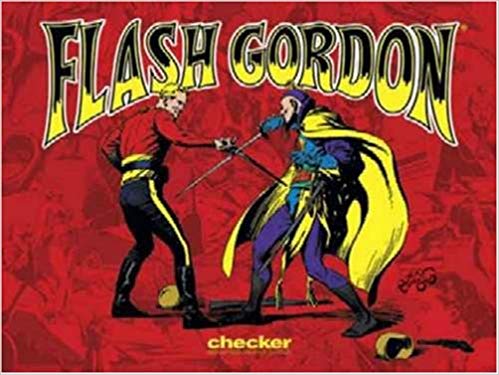
By many lights Flash Gordon is the most influential comic strip in the world. When the hero debuted on Sunday January 7th 1934 (with the superb Jungle Jim running as a supplementary “topper” strip) as an answer to the revolutionary, inspirational, but clunky Buck Rogers of Philip Nolan & Dick Calkins (which also began on January 7th but in 1929), a new element was added to the wonderment: Classical Lyricism.

Where Rogers had traditional adventures and high science concepts, the new feature reinterpreted Fairy Tale, Heroic Epics and Mythology, spectacularly draping them in the trappings of the contemporary future, with varying ‘Rays’, ‘Engines’ and ‘Motors’ substituting for trusty swords and lances – although there were also plenty of those – and exotic craft and contraptions standing in for Galleons, Chariots and Magic Carpets.

Most important of all, the sheer artistic talent of Raymond, his compositional skills, fine line-work, eye for concise, elegant detail and just plain genius for drawing beautiful people and things, swiftly made this the strip that all young artists swiped from.

When all-original comic books began a few years later, literally dozens of talented kids used the clean lined Romanticism of Gordon as their model and ticket to future success in the field of adventure strips. Most of the others went with Milton Caniff’s expressionistic masterpiece Terry and the Pirates (which also began in 1934 – and he’ll get his go another day).

Thankfully there are a few collections knocking about, but I’m plumping here for the 2003 Checker hardcover which combines quality reproduction with affordability…

The very first tale begins with a rogue planet about to smash into the Earth. As panic grips the planet, polo player Flash and fellow passenger Dale Arden narrowly escape disaster when a meteor fragment downs the airplane they are on. They land on the estate of tormented genius Dr. Hans Zarkov, who imprisons them on the rocket-ship he has built. His plan? To fly the ship directly at the astral invader and deflect it from Earth by crashing into it!

And that’s just in the first, 13-panel episode. ‘On the Planet Mongo’ ran every Sunday until April 15th 1934, when, according to this wonderful full-colour book, second adventure ‘Monsters of Mongo’ began, promptly followed by ‘Tournaments…’ and ‘Caverns of Mongo’.

To the readers back then, of course, there were no such artificial divisions. There was just one continuous, unmissable Sunday appointment with sheer wonderment.

The machinations of the utterly evil but magnetic Ming, emperor of the fantastic wandering planet; Flash’s battles and alliances with all the myriad exotic races subject to the Emperor’s will and the gradual victory over oppression captivated America, and the World, in tales that seemed a direct contrast to the increasingly darker reality in the days before World War II.

In short order the Earthlings become firm friends – and in the case of Flash and Dale, much more – as they encounter beautiful, cruel Princess Aura, the Red Monkey Men, Lion Men, Shark Men, Dwarf Men, King Vultan and the Hawkmen.

The rebellion against Ming begins with the awesome ‘Tournaments of Mongo’, a sequence spanning November 25th to February 24th 1935 – and where Raymond seemed to simply explode with confidence.

It was here that the true magic began, with every episode more spectacular than the last. Without breaking step Raymond moved on, and the next tale, which leaves this book on something of a cliffhanger, sees our hero enter ‘The Caverns of Mongo’.

Don Moore “assisted” Raymond with the writing, beginning soon after the strip first gained popularity, and Moore remained after Raymond departed. The artist joined the Marines in February 1944, and the last page he worked on was published on April 30th of that year. Mercifully, that still leaves a decade’s worth of spectacular, majestic adventure for us to enjoy. Why don’t you join me?
© 2003 King Features Syndicate Inc. ™ Hearst Holdings, Inc.

Asterix Omnibus volume 2: Asterix the Gladiator, Asterix and the Banquet, Asterix and Cleopatra


By René Goscinny & Albert Uderzo, translated by Anthea Bell & Derek Hockridge (Orion Childrens Books)
ISBN: 978-1-4440-0424-3

It’s been a painful year for lovers of comics, with many of our greatest practitioners – famous or otherwise – leaving us. I’m going to spend the remainder of the year dwelling on them and recommending examples of their work we can read to commemorate them in the best way possible… through enjoyment.

Suffolk-born Anthea Bell OBE came from prestigious stock. She was born in 1936 and translated numerous works from history books such as WG Siebald’s Austerlitz to the works of Hans Christian Andersen to fantasies such as Cornelia Funke’s Inkworld books Either singly or with Derek Hockridge, however, she found true immortality: translating thousands of pages of European comics and Bande Dessinée. She was a smart and dedicated woman and brilliantly adroit with worlds and concepts in many tongues. Her creative punning and naming techniques in the Asterix books garnered praise all over the world and many aficionados believe the strip is actually funnier in English than in any other language.

I can certainly confirm that’s the case with German…

Among her many triumphs are the aforementioned Asterix, Le Petit Nicolas, Lieutenant Blueberry and Iznogoud.

She died on 18th October 2018 and can never be replaced.

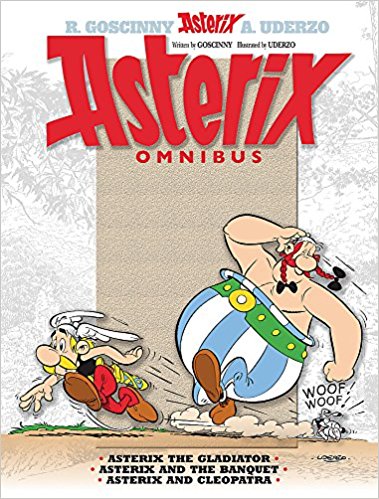
Asterix the Gaul is probably France’s greatest literary export: a wily wee warrior who resisted the iniquities, experienced the absurdities and observed the myriad wonders of Julius Caesar’s Roman Empire with brains, bravery and a magic potion which bestowed incredible strength, speed and vitality.

One of the most popular comics in the world, the chronicles have been translated into more than 100 languages; 8 animated and 3 live-action movies, assorted games and even into a theme park (Parc Astérix, near Paris). More than 325 million copies of 34 Asterix books have been sold worldwide, making Goscinny & Uderzo France’s bestselling international authors.

The diminutive, doughty hero was created as the transformative 1960s began by two of the art-form’s greatest masters, René Goscinny & Albert Uderzo and even though their perfect partnership ended in 1977 the creative wonderment still continues – albeit at a slightly reduced rate of rapidity.

When Pilote launched in 1959 was Asterix was a massive hit from the start. For a while Uderzo continued working with Charlier on Michel Tanguy, (Les Aventures de Tanguy et Laverdure), but soon after the first epic escapade was collected as Astérix le gaulois in 1961 it became clear that the series would demand most of his time – especially as the incredible Goscinny never seemed to require rest or run out of ideas (after the writer’s death the publication rate dropped from two books per year to one volume every three to five).

By 1967 the strip occupied all Uderzo’s time and attention. In 1974 the partners formed Idéfix Studios to fully exploit their inimitable creation and when Goscinny passed away three years later Uderzo was convinced to continue the adventures as writer and artist, producing a further ten volumes since then.

Like all great literary classics, the premise works on two levels: for younger readers as an action-packed comedic romp of sneaky, bullying baddies regularly getting their just deserts and as a pun-filled, sly and witty satire for older, wiser heads, enhanced here by the brilliantly light touch of the translators who played such a massive part in making the indomitable Gaul so very palatable to the English tongue.

Launched in Pilote #1 (29th October 1959, with the first page appearing a week earlier in a promotional issue #0, June 1st 1959), the stories were set on the tip of Uderzo’s beloved Brittany coast in the year 50BC, where a small village of redoubtable warriors and their families resisted every effort of the all-conquering Roman Empire to complete their conquest of Gaul. Unable to defeat these Horatian hold-outs, the Empire resorted to a policy of containment and the little seaside hamlet is perpetually hemmed in by the heavily fortified garrisons of Aquarium, Laudanum, Petibonum and Barbaorum (the latter two becoming Compendium and Totorum for us Brits).

The Gauls don’t care: they daily defy the world’s greatest military machine by just going about their everyday affairs, protected by a magic potion provided by the resident druid and the shrewd wits of a rather diminutive dynamo and his simplistic best friend…

With these volumes a key pattern was established: the adventures would henceforth – like a football match – alternate between Home and Away, with each globe-trotting escapade balanced by an epic set in and around he happily beleaguered Gaulish village (if you’re counting, home tales were odd numbered volumes and travelling exploits even-numbered…)

Asterix the Gladiator debuted in Pilote #126-168 (1963) with the canny rebel and his increasingly show-stealing pal Obelix (who had fallen into a vat of potion as a baby and was a genial, permanently superhuman, eternally hungry foil to the smart little hero) despatched to the heart of the Roman Empire on an ill-conceived mission of mercy…

When Prefect Odius Asparagus seeks to give Julius Caesar a unique gift he decides upon one of the indomitable Gauls who had been giving his occupying forces such a hard time.

Thus, he has village Bard Cacofonix abducted and bundled off to Rome. Although in two minds about losing the raucous harpist, pride wins out and the villagers mount a rescue attempt, but after thrashing the Romans again they discover that their lost comrade is already en route for the Eternal City…

Asterix and Obelix are despatched to retrieve the missing musician and hitch a ride on a Phoenician galley operated under a bold new business plan by captain/general manager Ekonomikrisis. On the way to Italy the heroes first encounter a band of pirates who would become frequent guest-stars and perennial gadflies.

The pirates were a creative in-joke between the close-knit comics community: Barbe-Rouge or Redbeard was a buccaneering strip created by Charlier & Victor Hubinon that also ran in Pilote at the time.

As Asterix and Obelix make friends among the cosmopolitan crowds of Rome, Caesar has already received his latest gift. Underwhelmed by his new Bard, the Emperor sends Cacofonix to the Circus Maximus to be thrown to the lions just as his chief of Gladiators Caius Fatuous is “talent-spotting” two incredibly tough strangers who would make ideal arena fighters…

Since it’s the best way to get to Cacofonix, our heroes join the Imperial Gladiatorial school; promptly introducing a little Gallic intransigence to the tightly disciplined proceedings. When the great day arrives, the lions get the shock of their lives and the entertainment-starved citizens of Rome “enjoy” a show they will never forget…

As always, the good-natured, comedic situations and sheer finesse of the yarn rattles along, delivering barrages of puns, oodles of insane situations and loads of low-trauma slapstick action, marvellously rendered in Uderzo’s expansive, authentic and continually improving big-foot art-style.

Asterix and the Banquet originated in Pilote #172-213 (1963), inspired by the Tour de France cycle race.

After being continually humiliated by the intractable Gauls coming and going as they please, Roman Inspector General Overanxius instigates a policy of exclusion and builds a huge wall around the little village, determined to shut them off from their country and the world. Modern world leaders might get a clue from this book, here… if they read books. Even books with pictures…

Incensed, Asterix best the smug Prefect that Gauls can go wherever they please and to prove it invites the Romans to a magnificent feast where they can sample the culinary delights of various regions. Breaking out of the stockade and through the barricades, Asterix and Obelix gather produce from as far afield as Rotomagus (Rouen), Lutetia (Paris, where they also picked up a determined little mutt who would eventually become a star cast-member), Camaracum (Cambrai) and Durocortorum (Rheims), easily evading or overcoming the assembled patrols and legions of man-hunting soldiers. However, they don’t reckon on the corrupting power of the huge – and growing – bounty on their heads and some Gauls are apparently more greedy than patriotic…

Even with Asterix held captive and all the might of the Empire ranged against them, Gaulish honour is upheld and Overanxius, after some spectacular fights, chases and close calls, eventually is made to eat his words – and a few choice Gallic morsels – in this delightful, bombastic and exceedingly clever celebration of pride and whimsy.

Asterix and Cleopatra ran from 1963-1963 in issues #215-257 and, although deriving its title from Shakespeare’s Antony and Cleopatra, is actually a broad visual spoof of the 1963 movie blockbuster Cleopatra (the original collected album cover was patterned on the film poster).

Rome is a big empire to run but Caesar always has time to spare for the fascinating Queen of Egypt – even though she can be a little overbearing at times…

When Caesar calls her people decadent, Cleopatra announces that her Egyptians will build a magnificent palace within three months to prove their continued ingenuity and vitality.

Her architect Edifis is less confidant and subcontracts the job, recruiting his old friend Getafix the Druid to help, with Asterix, Obelix and faithful pooch Dogmatix coming along to keep him out of trouble…

After another short, sharp visit with the pirates, the voyagers reach the Black Lands only to find the building site an utter shambles. Edifis’ arch rival Artifis has stirred up unrest among the labourers and consequently sabotaged the supply-chain, entombing the visitors in a deadly tourist-trap and even frames Edifis by attempting to poison the Queen.

For all these tactics the ingenious Gauls have a ready solution and the Palace construction continues apace, but when Caesar – determined not to lose face to his tempestuous paramour – sends his Legions to destroy the almost-completed complex, it’s up to the two smallest, smartest warriors to come up with a solution to save the day, the Palace and the pride of two nations…

Outrageously fast-paced and funny and magnificently illustrated by a supreme artist at the very peak of his form, Asterix and Cleopatra is one of the very best epics from a series that has nothing but brilliant hits.

This is supremely enjoyable comics storytelling and if you’re still not au fait with these Village People you must be as Crazy as the Romans ever were…
© 1964-1965 Goscinny/Uderzo. Revised English translation © 2004 Hachette. All rights reserved.

The Graphic Canon of Children’s Literature


By Many and various, Edited by Russ Kick (Seven Stories)
ISBN: 978-1-60980-530-2

Win’s Christmas Gift Recommendation: Amazing Recollections for Every Kid of Voting Age… 10/10

If you are of a certain age, you will remember that Christmas when you got The Book. What it was varies and you may not even have it now (probably not, in truth), but the getting of it, the cherishing of it in that moment, and the nostalgic debilitation recalling it brings now shaped your life. This book might well be it for someone you know and can’t think of a gift for…

Swallow the lump in your throat, grab a tissue and we’ll begin…

Once upon a time in the English-speaking world, nobody clever, educated or in any way grown-up liked comics. Now we’re an accredited really and truly art form and spectacular books like this can be appreciated…

The Graphic Canon is an astounding literary and art project, instigated by legendary crusading editor, publisher, anthologist and modern Renaissance Man Russ Kick. It seeks to interpret the world’s great books through the eyes of masters of crusading sequential narrative in an eye-opening synthesis of modes and styles. The project was initially divided into three periods roughly equating with the birth of literature and the rise of the modern novel.

Such was the success and impact of the feat that a number of side projects grew from the original, such as this startling confection celebrating the uniquely dual-purpose arena of stories for Children.

Make no mistake: this is not a simple bowdlerising “prose to strip” exercise like generations of Classics Illustrated comics, and you won’t pass any tests on the basis of what you see here. Moreover, these images will make you want to re-read the texts you know and hunger for the ones you haven’t got around to yet. Even those you think you’ve known for your entire life…

They certainly did for me…

Following the fascinating and agenda-setting ‘Editor’s Introduction’ the reimagination of centuries of wonder begins with a selection of Aesop’s immortal fables. Deliciously concocted by Roberta Gregory ‘The Miller, His Son, and the Donkey’ and ‘The Eagle, The Cat, and The Sow’ are followed by Peter Kuper’s refreshing interpretations of ‘The Ape and the Fisherman’ and ‘The Wasp and the Snake’.

Lance Tooks then takes torrid liberties but still makes magic with ‘The Lion in Love’, ‘The Fox and the Grapes’ and ‘The City Mouse and the Country Mouse’ before we move on to another timeless tale…

David W. Tripp offers a psycho-sexual take in his silent reworking of European fairy tale ‘Little Red Riding Hood’ after which Andrice Arp beguilingly details the saga of the ‘The Mastermaid’. Following that Norse fairy tale we head further north and east for Lesley Barnes’ iconic celebration of Russian folk tale ‘The Firebird’ before Miguel Molina offers a brace of scenes from Peruvian fairy tale ‘The Shepherdess and the Condor’.

The unfailingly entertaining Rachel Ball adapts a British yarn of abduction in ‘The Weardale Fairies’ after which Maëlle Doliveaux applies astounding collage and cut-paper acumen to ‘Four Fables’ by French mediaeval poet Jean de La Fontaine before a selection of Brothers Grimm tales opens with Kevin H. Dixon applying his studied blend of cultural appropriation and mordant insubordination to the ‘Town Musicians of Bremen’…

Chandra Free – with technical assistance from BLAM! Ventures – then scrupulously documents ‘A Tale of One who Travelled to Learn what Shivering Meant’ before Noah Van Sciver adapts ‘Star Dollars’ and ‘The Water-Sprite’.

E.T.A. Hoffman’s ‘The Nutcracker and the Mouse King’ is translated into pictorial beats by Sanya Glisic and Dame Darcy revels in the full horror of ‘The Little Mermaid’ by Hans Christian Andersen whilst Isabel Greenberg concentrates the old master’s imaginative whimsy for ‘The Tinderbox’.

Billy Nunez reinvigorates British fairy tale ‘Goldilocks and the Three Bears’ by transposing it to rural China before Frank M. Hansen has wicked fun updating Mark Twain’s shockingly wry ‘Advice to Little Girls’.

Vicki Nerino liberally updates ‘Alice’s Adventures in Wonderland’ – by Lewis Carroll in case you don’t know – and Keren Katz illustrates a triptych of ‘Fables for Children’ by Leo Tolstoy (The Birds in the Net, The Duck and the Moon, The Water Sprite and the Pearl, The Mouse Under the Granary and The Falcon and the Cock) after which Sandy Jimenez adds a sheen of Glam Rock iconoclasm to an extract of Jules Verne’s ‘20,000 Leagues Under the Sea’.

Nabob of Nonsense Edward Lear is celebrated in ‘The Owl and the Pussycat’ by Rick Geary and doubly so by Joy Kolitsky who colourfully interprets ‘Calico Pie’ and ‘The New Vestments’, after which R. Sikoryak stunningly reduces Twain’s ‘The Adventures of Tom Sawyer’ to a quartet of symbolically eventful maps.

Lost story master George McDonald is represented by Dasha Tolstikova’s moving treatment of ‘At the Back of the North Wind’ and Molly Brooks adapts the first tantalising chapter of Johanna Spyri’s ‘Heidi’ before Eric Knisley redeems the fabulous and unfairly embargoed sagas of Joel Chandler Harris with a vivid take on ‘The Tar Baby (From Tales of Uncle Remus)’.

Molly Colleen O’Connell adapts Carlo Collodi’s ‘The Adventures of Pinocchio’ and Robert Louis Stevenson’s ‘Treasure Island’ is given a meta-textual going over by Lisa Fary, Kate Eagle & John Dallaire before Tara Seibel gives a modern spin to Oscar Wilde’s heartbreaking ‘The Nightingale and the Rose’.

Caroline Picard ambitiously and simultaneously covers four tales from ‘The Jungle Book’ by Rudyard Kipling – specifically ‘Rikki Tikki Tavi’, ‘Toomai of the Elephants’, ‘Kaa’s Hunting’, and ‘The White Seal’ – whilst Matthew Houston adds a graphically futuristic spin to his treatment of H.G. Wells’ ‘The Time Machine’.

Shawn Cheng adapts L. Frank Baum’s ‘The Wonderful Wizard of Oz’ in a single colour-splashed page and then does the same for the remaining 13 novels in ‘The Oz Series’ after which Sally Madden silently shows a key scene from ‘Peter Pan’ by J.M. Barrie and Andrea Tsurumi delicately details the retaking of Toad Hall from the end of Kenneth Grahame’s ‘The Wind in the Willows’ before Juliacks turns in a most dramatic reinterpretation of Frances Hodson Burnett’s ‘The Secret Garden’…

Kate Glasheen adapts and modifies ‘The Velveteen Rabbit’ by Margery Williams, after which C. Frakes adapts ‘How the Potato Face Blind Man Enjoyed Himself on a Fine Spring Morning’ from Carl Sandburg’s ‘Rootabaga Stories’ and Matt Wiegle offers his rebus-filled silent take on Franklin W. Dixon’s ‘The Tower Treasure (A Hardy Boys Mystery)’ whilst Katherine Hearst goes wild with an eerie examination of ‘Peter and the Wolf’ as never imagined by Serge Prokofiev…

Astrid Lindgren’s immortal ‘Pippi Longstocking’ inhabits a decidedly off-kilter world thanks to Emelie Östergren, balanced by a sobering snippet from Anne Frank’s ‘The Diary of a Young Girl’ from mainstream comicbook royalty Sid Jacobson & Ernie Colón, after which John W. Pierard treats us to a selection of contemporaneous (and Rude) ‘Schoolyard Rhymes’.

Hitting the home stretch of modernity, we close with a chilling and wordless adaption from Tori Christina McKenna of Richard Adams’ ‘Watership Down’ and a stunning recapitulation by Lucy Knisley J.K. Rowling’s ‘The Harry Potter Series’ – all of it. Really. In 8 pages…

Complementing the childhood obsessions is a ‘Gallery’ by 58 more artists, and ‘Contributors’, ‘Acknowledgments’, ‘Credits and Permissions’ and even an ‘Index’.

Each piece is preceded by an informative commentary page by Kick, and this sort of book is just what the art form comics needs to grow beyond our largely self-imposed ghetto, and anything done this well with so much heart and joy simply has to be rewarded.
© 2014 Russ Kick. All work © individual owners and copyright holders and used with permission. All rights reserved.

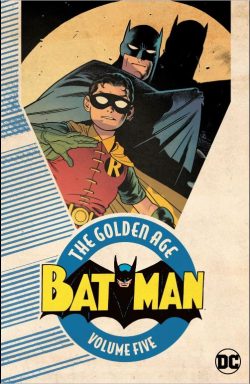
Batman: The Golden Age volume 5


By Bill Finger, Don Cameron, Ruth “Bunny” Lyon Kaufman, Horace L. Gold, Joseph Greene, Joe Samachson, Bob Kane, Jerry Robinson, George Roussos, Dick Sprang, Jack Burnley, Ray Burnley, Fred Ray, Norman Fallon & various (DC Comics)
ISBN: 978-1-4012-8461-9 (TPB)

Win’s Christmas Gift Recommendation: Timely and Evergreen Family Adventure… 10/10

Debuting a year after Superman, “The Bat-Man” (and latterly Robin, the Boy Wonder) confirmed DC/National Comics as the market frontrunner and conceptual leader of the burgeoning comicbook industry.

Having established the parameters of the metahuman with their Man of Steel, the physical mortal perfection and dashing derring-do of the strictly-human Dynamic Duo rapidly became the swashbuckling benchmark by which all other four-colour crime-busters were judged.

Batman: The Golden Age is a series of paperback feasts (there are also weightier, pricier, more capacious hardback Omnibus editions available, and digital iterations too) re-presenting the Dark Knight’s earliest exploits.

Presented in original publishing release order, the tomes trace the character’s growth into the icon who would inspire so many and develop the resilience needed to survive the stifling cultural vicissitudes that coming decades would inflict upon him and his partner, Robin.

Re-presenting a glorious and astounding treasure-trove of cape-&-cowl classics and iconic covers from Detective Comics #75-81, Batman #16-20 plus contemporary companion tales from World’s Finest Comics #10-11: this book covers groundbreaking escapades from April/May 1943 to December/January 1944: as the Dynamic Duo continually develop and storm ahead of all competition.

I’m certain it’s no coincidence that many of these Golden Age treasures are also some of the best and most reprinted tales in the Batman canon. With chief writers Bill Finger and Don Cameron at a peak of creativity and production, everybody on the Home Front was keen to do their bit – even if that was simply making kids of all ages forget their troubles for a brief while. These tales were crafted just as the dark tide was turning and an odour of hopeful optimism was creeping into the escapist, crime-busting yarns – and especially the stunning covers – seen here in the work of Jerry Robinson, George Roussos, Bob Kane Jack Burnley, Dick Sprang, Fred Ray and Stan Kaye…

The supplemental writers all pushed the boundaries of the adventure medium whilst graphic genius Sprang began to slowly supersede Kane and Burnley: making the feature uniquely his own while keeping the Dynamic Duo at the forefront of the vast army of superhero successes.

War always stimulates creativity and advancement and these sublime adventures of Batman and Robin more than prove that axiom as the growing band of creators responsible for producing myriad adventures of the Dark Knight hit an artistic peak which only stellar stable-mate Superman and Fawcett’s Captain Marvel were able to equal or even approach.

with

The compelling dramas open with the landmark Batman #16 (cover-dated April/May 1943) and one of three tales by Cameron. ‘The Joker Reforms!’ (Kane, Robinson & Roussos art) sees the Clown Prince suffer a blow to the head and enjoy a complete personality shift… but not for long…, after which Ruth “Bunny Lyons” Kaufman scripted a bold and fascinating Black Market milk caper in ‘The Grade A Crimes!’ for Ray & Jack Burney to dynamically delineate.

‘The Adventure of the Branded Tree’ (Cameron and the Burnleys) has the Gotham Gangbusters heading to lumberjack country for a vacation to become embroiled in big city banditry before the issue wraps up with hilarious thriller-comedy ‘Here Comes Alfred!’ (Cameron, Kane, Robinson & Roussos) which foists a rotund, unwelcome and staggeringly faux-English manservant upon the Masked Manhunters to finally complete the classic core cast of the series in a brilliantly fast-paced spy-drama with loads of laughs and buckets of tension…

Detective Comics #75 (May 1943) introduces a new aristocrat of crime in pompous popinjay ‘The Robber Baron!’ (Cameron, Jack Burnley & Roussos) before the Joker resurfaces in #76 to ‘Slay ’em With Flowers’: a graphic chiller by Horace L. Gold, Robinson & Roussos.

Next up is Batman #17 which opens with the gloriously human story of B. Boswell Brown: a lonely, self-important old man who claims to be ‘The Batman’s Biographer!’ Unfortunately, ruthless robber The Conjurer gives the claim far more credence than most in a tense thriller by Cameron, Kane, Robinson & Roussos…

Counterbalancing the dark whimsy is ‘The Penguin Goes A-Hunting’ (Cameron, Jack & Ray Burnley): a wild romp wherein the Perfidious Popinjay undertakes a hubris-fuelled crime-spree after being left off a “Batman’s Most Dangerous Foes” list.

The same creative team concocted ‘Rogues Pageant!’ wherein murderous thieves in Western city Santo Pablo inexplicably disrupt the towns historical Anniversary celebrations after which Joe Greene, Kane & Robinson detail the Dynamic Duo’s brutal battle with a deadly gang of maritime marauders in the appealing ‘Adventure of the Vitamin Vandals!’

The creation of Superman propelled National Comics to the forefront of their fledgling industry and in 1939 the company was licensed to produce a commemorative comicbook celebrating the start of the New York World’s Fair, with the Man of Tomorrow prominently featured among the four-colour stars of the appropriately titled New York World’s Fair Comics.

A year later, following the birth of Batman and Robin, National combined Dark Knight, Boy Wonder and Action Ace on the cover of the follow-up New York World’s Fair 1940.The spectacular 96-page anthology was a tremendous success and the oversized bonanza format was established, becoming Spring 1941’s World’s Best Comics#1, before finally settling on the now-legendary title World’s Finest Comics from the second issue, beginning a stellar 45-year run which only ended as part of the massive clear-out and de-cluttering exercise that was Crisis on Infinite Earths.

Until 1954 and the swingeing axe-blows of rising print costs, the only place Superman and Batman ever met was on the stunning covers by the likes of Burnley, Fred Ray and others. Between those sturdy card covers, the heroes maintained a strict non-collaboration policy.

Here World’s Finest Comics #10 (Summer 1943) features Finger, Robinson & Roussos’ ‘The Man with the Camera Eyes’: a gripping battle of wits between the Gotham Guardians and a crafty crook with an eidetic memory, before Finger, Kane & Roussos introduce a fascinating new wrinkle to villainy with the conflicted doctor who operates ‘The Crime Clinic’ in Detective #77. Crime Surgeon Matthew Thorne would return many times over the coming decades…

Issue #78 (August 1943) pushes the patriotic agenda with ‘The Bond Wagon’ (Joseph Greene, Burnley & Roussos) as Robin’s efforts to raise war funds through a parade of historical look-alikes is targeted by Nazi spies and sympathisers, after which Batman #18 starts with a spectacular, visually stunning crime-caper wherein the Gotham Gangbusters clash again with rascally rotund rogues Tweedledum and Tweedledee whilst solving ‘The Secret of Hunter’s Inn!’ (Samachson & Robinson).

‘Robin Studies his Lessons!’ (Samachson, Kane & Robinson) sees the Boy Wonder grounded from all crime-busting duties until his school work improves – even if it means Batman dying for want of his astounding assistance!

Bill Finger and the Burnley bros craft ‘The Good Samaritan Cops’: another brilliantly absorbing human interest drama focused on the tense but unglamorous work of the Police Emergency Squad before the action culminates in a shocking and powerful final engagement for manic physician and felonious mastermind Matthew Thorne. ‘The Crime Surgeon!’ (Finger, Kane & Robinson) here tries his deft and devilish hand at masterminding other crooks’ capers…

Over in Detective Comics #79 ‘Destiny’s Auction’ – Cameron & Robinson – offers another sterling moving melodrama as a fortune teller’s prognostications lead to fame, fortune and deadly danger for a failed actress, has-been actor and superstitious gangster…

World’s Finest Comics #11’s Batman episode reveals ‘A Thief in Time!’ (Finger & Robinson inked by Fred Ray), pitting our heroes against future-felon Rob Callender, who falls through a time-warp and thinks he’s found the perfect way to get rich.

Detective #80 sees the turbulent tragedy of deranged, double-edged threat Harvey Kent, finally resolved after a typically terrific tussle with ‘The End of Two-Face!’ (Finger, Kane, Robinson & Roussos), after which Batman #19 unleashes another quartet of compelling crime-busting cases.

There’s no mistaking the magnificent artwork of rising star Dick Sprang who pencilled every tale in this astounding issue, beginning with Cameron’s ‘Batman Makes a Deadline!’ as the Dark Knight investigates skulduggery and attempted murder at the City’s biggest newspaper. He also scripted breathtaking fantasy masterpiece ‘Atlantis Goes to War!’ with the Dynamic Duo rescuing that fabled submerged city from overwhelming Nazi assault.

The Joker rears his garish head again in anonymously-penned thriller ‘The Case of the Timid Lion!’ (perhaps William Woolfolk or Jack Schiff?) with the Harlequin of Hate enraged and lethal whilst tracking down an impostor committing crazy capers in his name… Samachson, Sprang and inker Norman Fallon then unmask the ‘Collector of Millionaires’ with Dick Grayson covertly investigating his wealthy mentor’s bewildering abduction and subsequent replacement by a cunning doppelganger…

‘The Cavalier of Crime!’ (Detective #81, by Cameron, Kane & Roussos) introduces another bizarre, baroque costumed crazy who tests his rapacious wits and sharp-edged weapons against the Dynamic Duo – naturally and ultimately to no avail…

The Home Front certainly seemed a lot brighter, as can be seen in Batman #20 which opens with the Joker in ‘The Centuries of Crime!’ (Cameron, Jack & Ray Burnley) with the Mountebank of Mirth claiming to have discovered a nefariously profitable method of time-travelling, whilst ‘The Trial of Titus Keyes!’ (Finger, Kane & Robinson) offers a masterful courtroom drama of injustice amended, focussing on the inefficacy of witness statements…

‘The Lawmen of the Sea!’ (Finger & the Burnley boys) finds the Dynamic Duo again working with a lesser known Police Division as they join The Harbor Patrol in their daily duties, uncovering a modern-day piracy ring, before the issue and this collection concludes on an emotional high with ‘Bruce Wayne Loses Guardianship of Dick Grayson!’ as a couple of fraudsters claiming to be the boy’s last remaining relatives petition to adopt him. A melodramatic triumph by Finger, Kane & Robinson, there’s still plenty of action, especially after the grifters try to sell Dick back to Bruce Wayne…

This stuff set the standard for comic superheroes. Whatever you like now, you owe it to these tales. Superman gave us the idea, and writers like Finger and Cameron refined and defined the meta-structure of the costumed crime-fighter. Where the Man of Steel was as much social force and wish fulfilment as hero, Batman and Robin did what we ordinary mortals wanted and needed to do.

They taught bad people the lesson they deserved.

The history of the American comicbook industry in almost every major aspect stems from the raw, vital and still powerfully compelling tales of DC’s twin icons: Superman and Batman.

It’s only fair and fitting that both those characters are still going strong and that their earliest adventures can be relived in chronological order in a variety of formats from relatively economical newsprint paperbacks to deluxe hardcover commemorative Archive editions – and digital formats too.

These are the stories that cemented the popularity of Batman and Robin and brought welcome surcease to millions during a time of tremendous hardship and crisis. Even if these days aren’t nearly as perilous or desperate – and there ain’t many who thinks otherwise! – the power of such work to rouse and charm is still potent and just as necessary. You owe it to yourself and your family and even your hamster to Buy This Book…
© 1943, 1944, 2018 DC Comics. All Rights Reserved.

The Juggler of Our Lady – the Classic Christmas Story


By R. O. Blechman with a Foreword by Jules Feiffer and Introduction by Maurice Sendak (Dover Comics & Graphic Novels)
ISBN: 978-0-486-80030-1

Win’s Christmas Gift Recommendation: A truly immaculate confection… 10/10

Christmas is not just about shiny new toys and sparkly knitwear. It’s just as much about unearthing or revisiting old, beloved and almost totally forgotten treasures.

Here’s a superb case in point - a magnificent hardback picture-perfect gift that’s still readily available – thanks to the perspicacious souls at Dover Books…

Oscar Robert Blechman is a glittering star in America’s graphic arts firmament and an international superstar. Brooklyn-born in 1930, he has excelled as cartoonist, illustrator, author, animator/Director, editorial cartoonist, Editorial Director and ad-man.

He’s won awards for his commercials and TV specials and been venerated in an exhibition at The Museum of Modern Art. His anti-Vietnam cartoons graced The Village Voice through the early 1970s whilst his cartoons and illustrations appeared in such prestigious vehicles as Punch, The New Yorker, Trump, Harper’s Bazaar, Esquire, Show, Theater Arts and Humbug.

He’s also produced fascinating graphic narratives such as Georgie and can reasonably claim to have produced one of the very first English-language Graphic Novels… and thus beginneth today’s lesson…

In 1952 Blechman used his groundbreaking and soon-to-be phenomenally influential minimalist line-style – deftly augmented with judicious watercolours – to make a much-told tale all his own.

The Juggler of Our Lady was his first book: initially published by Henry Holt, and superbly fetishized and commemorated through brother-cartoonist Maurice Sendak’s fondly emotional Introduction in this sublime new pocket hardback edition. The slim tome became a landmark in graphic narrative and is beloved by generations.

Anatole France’s 1892 tale Le Jongleur de Notre Dame is probably the most widely accepted version of the original medieval religious-miracle legend but there have been so many others that the story is as much part of most people’s seasonal landscape as Santa Claus or Rudolph the Red-Nosed Reindeer.

Blechman’s reinvigoration retains all the awe and wonder, whilst adding such a potent blend of wry humour, pitiful humility and gentle hope to the mix that it can make a grown man weep. In 1958 his book became an animated Terrytoons TV short with a huge impact when it was adapted by Al Kouzel & Gene Deitch and narrated by that legendary Spirit of Christmas Fun Boris Karloff…

You know the story: Cantalbert is an itinerant juggler who loves his work. He feels that if more people juggled there would less time for war and misery and folk would act better, feel better and be better.

Nobody, however, will listen and the despondent performer – hungry for spirituality – joins a monastery. Even here he does not fit in and is saddened by his lack of suitable talents to venerate The Lord and especially The Virgin Mary…

Everything comes to a head on Christmas Eve when the monks all display the magnificent presents they have made for the Madonna and poor Cantalbert has nothing worthy to give.

Later, when all is quiet, the sad juggler offers the only thing he knows and loves to the statue of The Virgin and something wonderful happens…

Deftly deconstructed and wondrously appreciated in a Foreword by Comics and Cartooning Titan Jules Feiffer, The Juggler of Our Lady is a masterpiece of graphic dexterity and an utterly beguiling experience no lover of the storytelling arts should be without.

Text and illustrations © 1997 R. O. Blechman. Foreword © 1997 2015 Jules Feiffer. Introduction © 1980 Maurice Sendak. All rights reserved.
Check out www.doverpublications.com, your internet retailer or local comic or bookshop.

Krazy & Ignatz 1939-1940: “A Brick Stuffed with Moom-bims”


By George Herriman, edited by Bill Blackbeard (Fantagraphics Books)
ISBN: 978-1-56097-789-6

Win’s Christmas Gift Recommendation: En Ebsoloot Epitome of Graphic Wundah… 10/10

In a field positively brimming with magnificent and eternally evergreen achievements, the cartoon strip Krazy Kat is – for most cognoscenti – the pinnacle of pictorial narrative innovation; a singular and hugely influential body of work which shaped the early days of the comics industry and elevated itself to the level of a treasure of world literature.

Krazy and Ignatz, as it is dubbed in these gloriously addictive commemorative tomes from Fantagraphics, is a creation which must be appreciated on its own terms. Over the decades the strip developed a unique language – simultaneously visual and verbal – whilst exploring the immeasurable variety of human experience, foibles and peccadilloes with unfaltering warmth and understanding… and without ever offending anybody. Baffled millions, but offended… no.

It did go over the heads and around the hearts of far more than a few, but Krazy Kat was never a strip for dull, slow or unimaginative people: those who simply won’t or can’t appreciate the complex, multi-layered verbal and cartoon whimsy, absurdist philosophy or seamless blending of sardonic slapstick with arcane joshing. It is still the closest thing to pure poesy that narrative art has ever produced.

Herriman was already a successful cartoonist and journalist in 1913 when a cat and mouse who had been noodling about at the edges of his outrageous domestic comedy strip The Dingbat Family/The Family Upstairs graduated to their own feature. Mildly intoxicating and gently scene-stealing, Krazy Kat subsequently debuted in William Randolph Hearst’s New York Evening Journal on Oct 28th 1913 and – largely by dint of the publishing magnate’s enrapt adoration and overpowering direct influence and interference – gradually and inexorably spread throughout his vast stable of papers.

Although Hearst and a host of the period’s artistic and literary intelligentsia (such as Frank Capra, e.e. Cummings, John Alden Carpenter, Gilbert Seldes, Willem de Kooning, H.L. Mencken and Jack Kerouac) all adored the strip, many local and regional editors did not; taking every potentially career-ending opportunity to drop it from the populace-beguiling comics section.

Eventually the feature found a true home and safe haven in the Arts and Drama section of Hearst’s papers. Protected there by the publisher’s doctrinaire patronage and enhanced with the cachet of enticing colour, the Kat & Ko. flourished unharmed by editorial interference or fleeting fashion, running generally unmolested until Herriman’s death in April 1944.

The saga’s basic premise is simple: Krazy is an effeminate, dreamy, sensitive and romantic feline, hopelessly in love with Ignatz Mouse; a venal everyman, rude, crude, brutal, mendacious and thoroughly scurrilous.

Ignatz is a truly, proudly unreconstructed male: drinking, stealing, fighting, conniving, constantly neglecting his wife and innumerable children and always responding to Krazy’s genteel advances by clobbering the Kat with a well-aimed brick. These he obtains singly or in bulk from noted local brick-maker Kolin Kelly. And by the time of these tales it’s not even a response, except perhaps a conditioned one: the mouse spends all his time, energy and ingenuity in bouncing a brickbat off the mild moggy’s bonce. He can’t help himself, and Krazy’s day is bleak and unfulfilled if the hoped-for assault doesn’t happen…

The smitten kitten always misidentifies (or does he?) these missiles as tokens of equally recondite affection showered upon him in the manner of Cupid’s fabled arrows…

The final crucial element completing an anthropomorphic eternal triangle is lawman Offissa Bull Pupp: completely besotted with Krazy, professionally aware of the Mouse’s true nature, yet hamstrung by his own amorous timidity and sense of honour from permanently removing his devilish rival for the foolish feline’s affections.

Krazy is, of course, blithely oblivious to the perennially “Friend-Zoned” Pupp’s dolorous dilemma…

Secondarily populating the ever-mutable stage are a stunning supporting cast of inspired bit players such as terrifying deliverer of unplanned babies Joe Stork; hobo Bum Bill Bee, unsavoury huckster Don Kiyoti, social climbing busybody Pauline Parrot, portal-packing Door Mouse, self-aggrandizing Walter Cephus Austridge, inscrutable, barely intelligible Chinese mallard Mock Duck, dozy Joe Turtil and a host of other audacious animal crackers all equally capable of stealing the limelight and even supporting their own features.

The exotic, quixotic episodes occur in and around the Painted Desert environs of Coconino (patterned on the artist’s vacation retreat in Coconino County, Arizona) where surreal playfulness and the fluid ambiguity of the flora and landscape are perhaps the most important member of the cast.

The strips themselves are a masterful mélange of unique experimental art, cunningly designed, wildly expressionistic and strongly referencing Navajo art forms whilst graphically utilising sheer unbridled imagination and delightfully evocative lettering and language: alliterative, phonetically and even onomatopoeically joyous with a compelling musical force (“you sim to be cuttin’ a mellin”, “or “it would be much mo’ betta if it was a pot of momma lade or eppil butta”).

Yet for all that, the adventures are poetic, satirical, timely, timeless, bittersweet, self-referential, fourth-wall bending, eerily idiosyncratic, astonishingly hilarious escapades encompassing every aspect of humour from painfully punning shaggy dog stories to riotous, violent slapstick.

Sometimes Herriman even eschewed his mystical mumblings and arcane argots for the simply sublime grace of a supremely entertaining silent gag in the manner of his beloved Keystone Cops…

There’s been a wealth of Krazy Kat collections since the late 1970s when the strip was first rediscovered by a better-educated, open-minded and far more accepting generation. This delirious tome covers all the strips from 1937-1938 in a comfortably hefty (231 x 305 mm) softcover edition – and is also available as a madly mystical digital edition.

Preceded by candid photos and examples of some of Herriman’s personalised gifts and commissions (hand-coloured artworks featuring the cast and settings), the splendid madness is bolstered by Jeet Heer’s superb analysis of production techniques in ‘Kat of a Different Color‘ before the jocularity resumes with January 1st 1939 – with the hues provided by professional separators rather than Herriman.

Within this jubilant journal of passions thwarted, the torrid triangular drama plays out as winningly as ever, but with a subtle shifting of emphasis as an old face gains far greater presence and impact whilst the one significant new face seems to be a scene-stealing rival for our fuzzy feline ingenue…

The usual parade of hucksters and conmen continue to feature, but the eternally triangular confusions and contusions – although still a constant – are not the satisfying punchlines they used to be, but rather provide a comforting continuity as the world subtly changes around the cast…

As well as frequent incarceration, Ignatz endures numerous forms of exile and social confinement, but with Krazy aiding and abetting, these sanctions seldom result in a reduction of cerebral contusions… a minor plague of travelling conjurors and unemployed magician also make life hard for the hard-pressed constabulary… which is expanding in personnel, if not wisdom…

Never long daunted, Bull Pupp indulges in a raft of home-away-from home improvements, and introduces mechanised, radiophonic and robotic policing, and sundry innovations in incarceration architecture…

As always, the mouse’s continual search for his ammunition of choice leads to many brick-based gags but now the mouse is often the receiver of painful retribution. His brief preoccupation with hornet’s nests ultimately proves to be a painful dead end though…

Of course, the mouse is a man who enjoys revenge served hot, cold or late…

A flurry of telescope buying adds an of nosy edge of conspiracy to proceedings, with spying as big a hobby for all citizens as stargazing and gossip used to be. At least, the traditional fishing, water sports, driving and the parlous and participatory state of the burgeoning local theatre scene remain hot topics in town…

And, welcomingly as ever, there is still a solid dependence on the strange landscapes and eccentric flora for humorous inspiration and all manner of weather and terrain play a large part in inducing anxiety, bewilderment and hilarity.

A big shift in status comes to old busybody Mrs Kwakk Wakk as she assumes a role akin to wise old crone and sarcastic Greek Chorus; upping her status from bit-player to full-on supporting cast. She has a mean and spiteful beak on her too…

The big change comes on July 7th 1940. Pupp is startled to see Ignatz going back to school and thinks it’s so he can ambush the Kat. That’s until he too meets the new teacher. Miss Mimi is French…

Soon class attendance is at record levels and the males are all making komplete fools of themselves…

This antepenultimate collection is again supplied with an erudite and instructional ‘Ignatz Mouse Debaffler Page’, providing pertinent facts, snippets of contextual history and necessary notes for the young and potentially perplexed.

Herriman’s epochal classic is a stupendous and gleeful monument to whimsy: in all the arenas of Art and Literature there has never been anything like these strips which have inspired comics creators and auteurs in fields as disparate as prose fiction, film, dance, animation and music, whilst fulfilling its basic function: engendering delight and delectation in generations of wonder-starved fans.

If, however, you are one of Them and not Us, or if you actually haven’t experienced the gleeful graphic assault on the sensorium, mental equilibrium and emotional lexicon carefully thrown together by George Herriman from the dawn of the 20th century until the dog days of World War II, this astounding compendium is a most accessible way to do so.
© 2007, 2015 Fantagraphics Books. All rights reserved.

Adventures of Tintin: The Crab with the Golden Claws


By Hergé & various; translated by Leslie Lonsdale-Cooper & Michael Turner (Egmont)
ISBN: 978-1-40520-808-6 (HB)                    : 978-0-31619-876-9 (PB)

Win’s Christmas Gift Recommendation: Comics and Presents don’t get better than this… 10/10

Georges Prosper Remi – AKA Hergé – created a true masterpiece of graphic literature with his many tales of a plucky boy reporter and his entourage of iconic associates. Singly, and later with assistants including Edgar P. Jacobs, Bob de Moor and the Hergé Studio, Remi completed 23 splendid volumes (originally produced in brief instalments for a variety of periodicals) that have grown beyond their popular culture roots and attained the status of High Art.

It’s only fair, though, to ascribe a substantial proportion of credit to the many translators whose diligent contributions have enabled the series to be understood and beloved in 38 languages. The subtle, canny, witty and slyly funny English versions are the work of Leslie Lonsdale-Cooper & Michael Turner.

On leaving school in 1925, Remi worked for Catholic newspaper Le Vingtiéme Siécle where he fell under the influence of its Svengali-like editor Abbot Norbert Wallez. The following year, the young artist – a passionate and dedicated boy scout – produced his first strip series: The Adventures of Totor for the monthly Boy Scouts of Belgium magazine.

By 1928 he was in charge of producing the contents of the paper’s children’s weekly supplement Le Petit Vingtiéme and unhappily illustrating The Adventures of Flup, Nénesse, Poussette and Cochonette when Abbot Wallez urged Remi to create a new adventure series. Perhaps a young reporter who would travel the world, doing good whilst displaying solid Catholic values and virtues?

And also, perhaps, highlight and expose some the Faith’s greatest enemies and threats…?

Having recently discovered the word balloon in imported newspaper strips, Remi decided to incorporate this simple yet effective innovation into his own work.

He would produce a strip that was modern and action-packed. Beginning January 10th 1929, Tintin in the Land of the Soviets appeared in weekly instalments, running until May 8th 1930.

Accompanied by his dog Milou (Snowy to us Brits), the clean-cut, no-nonsense boy-hero – a combination of Ideal Good Scout and Remi’s own brother Paul (a soldier in the Belgian Army) – would report back all the inequities of the world, since the strip’s prime conceit was that Tintin was an actual foreign correspondent for Le Petit Vingtiéme…

The odyssey was a huge success, assuring further – albeit less politically charged and controversial – exploits to follow. At least that was the plan…

During the Nazi Occupation of Belgium, Le Petit Vingtiéme was closed down and Hergé was compelled to move the popular strip to straight daily newspaper. He diligently continued producing strips for the duration, but in the period following Belgium’s liberation was accused of being a collaborator and even a Nazi sympathiser.

It took the intervention of Resistance hero Raymond Leblanc to dispel the cloud over Hergé, which he did by simply vouching for the cartoonist and by providing the cash to create a new magazine – Le Journal de Tintin – which he published and managed. The anthology comic swiftly achieved a weekly circulation in the hundreds of thousands.

With this tale we enter the Golden Age of an iconic creator’s work. Despite being produced whilst Belgium was under the control of Nazi Occupation Forces during World War II, the qualitative leap in all aspects of Hergé’s creativity is tangible.

His homeland fell to the invaders in 1940, and Georges Remi’s brief military career was over. He was a reserve Lieutenant, working on The Land of Black Gold when he was called up, but the swift fall of Belgium meant that he was back at his drawing board before the year’s end, albeit working for a new paper on a brand-new adventure. He would not return to the unfinished ‘Black Gold’, with its highly anti-fascistic subtext, until 1949.

Initially Le Crabe aux pinces d’or featured in children’s supplement Le Soir Jeunesse, from October 17th 1940 to September 3rd 1941, when increasing paper shortages resulted in the kid’s section being axed. The strip continued in parent paper Le Soir (Belgium’s premiere French-language newspaper and a most crucial tool for the occupiers to control minds if not hearts) until conclusion on 18th October 1941: the first of six extraordinary tales of light-hearted, escapist thrills, with strong plots and deep characterisation that created a haven of delight from the daily horrors of everyday life then and remain a legacy of joyous adventure to this day.

On completion it was collected as a monochrome book in 1941 and later serialised in French newspaper Coeurs Vaillants (from June 21st 1942), before being re-released as a full colour volume in 1943. Its success sparked a flurry of reissues of earlier albums – all but Tintin in America and The Black Island, both set in countries Germany was still at war with…

This remastered edition of The Crab with the Golden Claws was modified by Studio Hergé and released in 1953: revised to accommodate the wishes of publishers in the US and UK. It opens with Snowy getting his head caught in an empty crab-meat can whilst scavenging in a trash bin. When Tintin meets the detectives Thompson and Thomson, they discuss their latest case and he sees that a vital piece of evidence is a scrap of label from a crab-meat tin – and it matches the torn label on the can he so recently extricated his bad dog from!

And so begins a superb mystery adventure as Tintin follows his lead to the sinister freighter “Karaboudjan” where he uncovers a sinister criminal enterprise and is nearly murdered before the diabolical first mate Allan (last seen in Cigars of the Pharaoh) shanghaies him.

It is whilst a prisoner that the boy reporter meets a drunken reprobate who would become his greatest companion: The ship’s inebriated Master, Captain Haddock.

Escaping together, they eventually reach the African Coast, with Haddock’s dipsomaniac antics as much a threat to the pair as the gangsters, ocean storms, and deprivation. These trials are masterpieces of comedy cartooning that have never been surpassed.

Despite all odds the heroes survive sea, sands and scoundrels to link up with the military authorities. Making their perilous way to Morocco, battling Berber desert raiders and Haddock’s ongoing hallucinations, the plucky pair – and Snowy – track down the criminals to reveal a huge opium smuggling operation. A fast-paced tour-de-force of art and action, liberally laced with primal comedy and captivating exotic locales, this is quite simply mesmerising fare.

Full of dash, as breathtaking as a rollercoaster ride and as compelling as any Indiana Jones romp, this is classic adventure to match the best of the cinema’s swashbucklers and as suspenseful as a Hitchcock thriller, balancing insane laughs with moments of genuine tension.

Clearly as the world experienced a new Dark Age, Hergé was concentrating on the next -Golden – one…

These ripping yarns for all ages are an unparalleled highpoint in the history of graphic narrative. Their constant popularity proves them to be a worthy addition to the list of world classics of literature.
The Crab with the Golden Claws: artwork © 1953, 1981 Editions Casterman, Paris & Tournai. Text © 1958 Egmont UK Limited. All Rights Reserved.

Prince Valiant volumes 1-3 Gift Box Set


By Hal Foster (Fantagraphics Books)
ISBN: 978-1 68396-072-0

Win’s Christmas Gift Recommendation: Ideal for anybody who ever dreamed or wondered… 10/10

Rightly reckoned one of the greatest comic strips of all time, the majestic and nigh-mythical saga of a king-in-exile who became one of the greatest warriors in an age of unparalleled heroes is at once fantastically realistic and beautifully, perfectly abstracted – an indisputable paradigm of adventure fiction where anything is possible and justice will always prevail. It is the epic we all want to live in…

On one thing let us be perfectly clear: Hal Foster’s Prince Valiant is not historical. It is far better and more real than that.

Possibly the most successful and evergreen fantasy creation ever conceived, Prince Valiant in the Days of King Arthur launched on Sunday 13th February 1937, a glorious weekly, full-colour window not onto the past but rather onto a world that should have been. It followed the tempestuous life of a refugee boy driven by invaders from his ancestral homeland of faraway Thule who persevered and, through tenacity, imagination and sheer grit, rose to become one of the mightiest heroes of the age of Camelot.

As depicted by the incredibly gifted Foster, this noble scion would, over the years, grow to mighty manhood helming a heady sea of wonderment; roaming the globe and siring a dynasty of equally puissant heroes whilst captivating and influencing generations of readers and thousands of creative types in all the arts.

There have been films, cartoon series and all manner of toys, games and collections based on the feature – one of the few newspaper strips to have lasted from the thunderous 1930s to the present day (well over 4000 episodes and counting) and, even in these declining days of newspaper cartooning, it still claims over 300 American papers as its home.

Foster produced the strip, one spectacular page a week until 1971, when, after auditioning such notables as Wally Wood and Gray Morrow, Big Ben Bolt artist John Cullen Murphy was selected to draw the feature. Foster carried on as writer and designer until 1980, after which he fully retired and Murphy’s son took over scripting duties.

In 2004 Cullen Murphy also retired (he died a month later on July 2nd) but the strip soldiered on under the extremely talented auspices of artist Gary Gianni and writer Mark Schultz and latterly Thomas Yeates, conquering one more exotic land by making it onto the world wide web.

The first three exquisite oversized hardback volumes (362 x 268mm) are available as a monumental gift set nobody could resist. They reprint in glorious colour – spectacularly restored from Foster’s original printer’s proofs – the princely pristine Sunday pages cumulatively spanning February 1937 to 20th December 1942: six years of formative forays of an instantly impressive tale which promised much and delivered far more than anybody might have suspected during those dim and distant days…


Volume 1 opens with editor Brian M. Kane’s informative picture and photo-packed potted history of ‘Harold Rudolf Foster: 1892-1982’ after which Fred Schreiber conducts ‘An Interview with Hal Foster’ – as first seen in Nemo: The Classic Comics Magazine (1984).

Moreover, after the superb Arthurian epic exploits of the quintessential swashbuckling hero which follows, this initial collection is rounded off by Kim Thompson’s discourse on the many iterations of reprints over the years and around the world in ‘A History of Valiants’…

The actual action-packed drama then commences in distant Scandinavia as the King of Thule, his family and a few faithful retainers dash for a flimsy fishing boat, intent only on escaping the murderous intentions of a usurper’s army.

Their voyage carries them to the barbarous coast of Britain to battle bands of wild men before securing a safe retreat in the gloomy fens of East Anglia. After many hard fights they reach an uneasy détente with the locals and settle into a harsh life as regal exiles…

The young Prince Valiant is but five years old when they arrive and his growing years in a hostile environment toughen the boy, sharpen his wits and give him an insatiable taste for mischief and adventure.

He befriends a local shepherd boy and together their escapades include challenging the marauding ancient dinosaurs which infest the swamp, battling a hulking man-brute and bedevilling a local witch. In retaliation the hag Horrit predicts that Val’s life will be long and packed with incredible feats… but always tainted by great sorrow.

All that, plus the constant regimen of knightly training and scholarly tuition befitting an exile learning how to reclaim his stolen kingdom, make the lad a veritable hellion, but everything changes when his mother passes away. After a further year of intense schooling in the arts of battle, Valiant leaves the Fens and make his way in the dangerous lands beyond…

Whilst sparring with his boyhood companion, Val unsuspectingly insults Sir Launcelot who is fortuitously passing by. Although the noble warrior is sanguine about the cheeky lad’s big mouth, his affronted squire attempts to administer a stern punishment and is rewarded with a thorough drubbing. Indeed, Launcelot has to stop the Scion of Thule from slitting the battered and defeated man’s throat.

Although he has no arms, armour, steed or money, Valiant swears that he too will be a Knight…

Luck is with the Pauper Prince. After spectacularly catching and taming a wild stallion, his journey is interrupted by gregarious paladin Sir Gawain, who shares a meal and regales the boy with tales of chivalry and heroism. When their alfresco repast is spoiled by robber knight Sir Negarth who unfairly strikes the champion of Camelot, Val charges in. Gawain regains consciousness to find the threat ended, Negarth hogtied and his accomplice skewered…

Taking Val under his wing, wounded Gawain escorts the boy and his prisoner to Camelot, but their journey is delayed by a gigantic dragon. Val kills it too – with the assistance of Negarth – and spends the rest of the trip arguing that the rogue should be freed for his gallantry…

Val is still stoutly defending the scoundrel at the miscreant’s trial before King Arthur, and is rewarded by being appointed Gawain’s squire. Unfortunately, the lad responds badly to being teased by the other knights-in-training and quickly finds himself locked in a dungeon whilst his tormentors heal and the remaining Knights of the Round Table ride out to deal with an invasion of Northmen…

Whilst the flowers of chivalry are away, a plot is hatched by scheming Sir Osmond and Baron Baldon. To recoup gambling debts, they capture and ransom Gawain, but have not reckoned on the dauntless devotion and ruthless ingenuity of his semi-feral squire.

Easily infiltrating the bleak fortress imprisoning the hero, Val liberates his mentor through astounding feats of daring and brings the grievously wounded knight to Winchester Heath and Arthur…

As Gawain recuperates, he is approached by a young maiden. Ilene is in need of a champion and – over his squire’s protests – the still gravely unfit knight dutifully complies. Val’s protests might have been better expressed had he not been so tongue-tied by the most beautiful girl he has ever seen…

The quest to rescue Ilene’s parents is delayed when an unscrupulous warrior in scarlet challenges them, intent on possessing the lovely maiden. Correctly assessing Gawain to be no threat, the Red Knight does not live long enough to revise his opinion of the wild-eyed boy who then attacks him…

Leaving Ilene and the re-injured Gawain with a hermit, Valiant continues on alone to Branwyn Castle, recently captured by an “Ogre” who is terrorising the countryside. Through guile, force of arms and devilish tactics the boy ends that threat forever.

This is an astonishing tour de force of graphic bravura that no fan could ever forget. Aspiring cartoonist Jack Kirby certainly didn’t: he recycled Val’s outlandish outfit used to terrorise the Ogre’s soldiers as the visual basis for his 1970s horror-hero Etrigan the Demon…

Having successfully routed the invaders and freed Ilene’s family, Val begins earnestly courting the grateful girl. His prophecy of lifelong misery seems assured however, when her father regretfully informs him that she is promised to Arn, son and heir of the King of Ord…

Even before that shock can sink in, Valiant is called away again. Ailing Gawain has been abducted by sorceress Morgan le Fey, who is enamoured of the knight’s manly charms…

When Val confronts her, she drugs him with a potion and he endures uncounted ages in her dungeon before escaping. Weak and desperate, he makes his way to Camelot and enlists Merlin in a last-ditch ploy to defeat the witch and save his adored mentor…

In the meantime, events have progressed and Val’s bold plans to win Ilene are upset when invitations to her wedding arrive at Camelot. Initially crushed, the resilient youth determines to travel to Ord and challenge Prince Arn for her hand.

Their meeting is nothing like Val imagined but, after much annoying interference, he and the rather admirable Arn finally engage in their oft-delayed death-duel, only to be again distracted when news comes that Ilene has been stolen by Viking raiders…

What follows is another unparalleled moment of comics magnificence as Valiant sacrifices everything for honour, gloriously falls to superior forces, wins possession of Flamberge (the legendary Singing Sword which is brother to Excalibur), is captured and then reunited with Ilene… only to lose her again to the cruellest of fates…

After escaping from the Vikings and covering himself with glory at the Lists in Camelot – although he doesn’t realise it – the heartsick, weary Prince returns to his father in the melancholy Anglian fens, again encountering ghastly Horrit and nearly succumbing to fever.

When he recovers months later, he has a new purpose: he and his faithful countrymen will travel to Thule and rescue the nation from the cruel grip of usurper Sligon. Unfortunately, during the preparations Valiant discovers his region of Britain has been invaded by Saxons and is compelled by his honour to race to Camelot and warn Arthur…

To Be Continued…

(Volume 1: All comics material © 2009 King Features Syndicate except Tarzan page, © 2009 ERB Inc. All other content and properties © 2009 their respective creators or holders. All rights reserved.)


Volume 2 reprints in the perfectly-restored Sunday pages from January 1st 1939 to 29th December 1940, following Sir Gawain’s extremely capable squire as he rushes to warn Camelot of invasion by rapacious Saxons via the vast Anglian Fens. Here the Royal Family of Thule have hidden since being ousted from their Nordic Island Kingdom by the villainous usurper Sligon.

After a breathtaking battle which sees the Saxons repulsed and the battle-loving boy-warrior knighted upon the field of victory, Valiant begins a period of globe-trotting through the fabled lands of Europe just as the last remnants of the Roman Empire is dying in deceit and intrigue.

Firstly, Val returns to Thule and restores his father to the throne, narrowly escaping the alluring wiles of a conniving beauty with an eye to marrying the Heir Apparent. Soon bored with peace and plenty, the roving royal wildcat then encounters a time-twisting pair of mystical perils who show him the eventual fate of all mortals. Sobered but not daunted, he makes his way towards Rome, where he will become unwittingly embroiled in the manic machinations of the Last Emperor, Valentinian.

Before that however, he is distracted by an epic adventure that would have struck stunning resonances for the readership at the time. With episode #118 (14th May 1939) Val joins the doomed knights of mountain fortress Andelkrag, who alone and unaided hold back the assembled might of the terrifying hordes of Attila the Hun currently decimating the civilisations of Europe and now gathered to wipe out its last vestige.

With Hitler and Mussolini hogging the headlines and Modern European war seemingly inevitable, Val shares the Battle of Decency and Right against untrammelled Barbarism. His epic struggle and sole survival comprise one of the greatest episodes of glorious, doom-fated chivalry in literature…

After the fall of the towers of Andelkrag, Valiant made his way onward to diminished Rome, picking up a wily sidekick in the form of cutpurse vagabond Slith. Once more he is distracted and delayed by dastardly Huns. The indomitable lad resolves to pay them back in kind, gathering dispossessed victims of Hunnish depredations and forging them into a resistance army of guerrilla-fighters – the Hun-Hunters…

Thereafter he liberates the vassal city Pandaris, driving back the invaders and their collaborator allies in one spectacular coup after another.

Valiant eventually reunites with equally action-starved Round Table companions Sir Tristram and Sir Gawain to make fools of the Hun, who have lost heart after the death of their charismatic leader Attila (nothing to do with Val, just a historical fact). When Slith falls for a beauteous warrior princess, the English Knights leave him to a life of joyous domesticity and move ever on.

An unexpected encounter with a giant and his unconventional army of freaks leads to the heroes inadvertently helping a band of marshland refugees (from Hunnish atrocity) before establishing the nation-state of Venice until at long last – after a after a side-trip to the fabulous city of Ravenna – the trio cross the fabled Rubicon and plunge into a hotbed of political tumult.

Unjustly implicated in a web of murder and double-dealing, the knights barely escape with their lives and split up to avoid pursuit. Tristan goes back to England and a star-crossed rendezvous with the comely Isolde, Gawain takes ship for fun in Massilia and Valiant, after an excursion to the rim of fiery Vesuvius, boards a pirate scow for Sicily and further adventure.

To Be Continued…

(Volume 2: Prince Valiant © 2009 King Features Syndicate. All other content and properties © 2009 their respective creators or holders. All rights reserved.)


Volume 3 of the most successful and evergreen fantasy creation ever conceived offers the Sunday pages from January 5th 1941 to 20th December 1942, but only after erudite foreword ‘Modestly, Foster’ by Dan Nadel.

The action opens in the shadow of fiery Vesuvius as Val’s vessel is attacked by self-proclaimed Sea-King Angor Wrack. Even our fierce warrior-prince’s martial might is insufficient against insurmountable odds and the young Lord is captured and enslaved, his fabled Singing Sword confiscated by the victorious pirate.

Thus begins an astonishingly impressive chapter in the hero’s history. Val becomes a galley slave, escapes and washes up, starving and semi-comatose on the lost shores of the Misty Isles. Delirious, he glimpses his future wife Queen Aleta when she re-provisions his boat before casting him back to the sea’s mercies.

The Misty Isles are secure only because of their secret location and the noble girl has broken a great taboo by sparing the shipwrecked lad. Replenished but lost, Val drifts helplessly away but resolves that one day he will discover again the Misty Isles and the enigmatic Aleta…

Eventually he is picked up by more pirates, but overwhelms the captain and takes charge. Finding himself in the island paradise of Tambelaine courting the daughters of the aged King Lamorack, Val encounters Angor Wrack once again, but fails to recover the Singing Sword, precipitating an extended saga of maritime warfare and spectacular voyaging across the Holy Land from Jaffa to Jerusalem.

The vendetta results in both Angor and Val being taken by Arab slavers, but the boy nobly allows Wrack to escape whilst he battles the Bedouin hordes…

Enslaved in Syria, Val’s indomitable will and terrifying prowess are insufficient to his need so he seduces his owner’s daughter to effect an escape, only to stumble into a marital spat between the region’s greatest necromancer and his tempestuous bride.

Reaching Jerusalem, Val finally regains his beloved sword and settles all scores with Angor Wrack before determining to return to the hidden Misty Isles, but once again falls afoul of the pirates infesting the region. After incredible hardships, he is reunited with Aleta but fate drags them apart once more and he departs alone and despondent.

Not for long though, as on reaching Athens he meets the far-larger-than-life Viking Boltar: a Falstaff-like rogue and “honest pirate”. Together they rove across the oceans to the heart of the African jungles…

Securing a huge fortune, their Dragonship reaches Gaul and Val is finally reunited with Gawain. After settling a succession of generational feuds between knights and defeating a seductive maniac, the paladins at last return to Britain courtesy of Boltar, just in time to be dispatched by Arthur to the far North to scout Hadrian’s Wall and see if it can still keep the belligerent Picts out.

Unfortunately, libidinous Gawain abandons Val and the lad is captured by Caledonian wild-men and their new allies – a far nastier breed of Vikings intent on conquering England. Tortured almost unto death, the Prince is saved by the ministrations of Julian – a Roman warrior who has seemingly safeguarded the wall for centuries…

When he is recovered, Prince Valiant begins to inflict a terrible and studied revenge upon his tormentors…

To Be Continued…

Rendered in an incomprehensibly lovely panorama of glowing art, Prince Valiant is a lyrical juggernaut of stirring action, exotic adventure and grand romance; blending realistic fantasy with sardonic wit, and broad humour with unbelievably dark violence (the closing text feature ‘Too Violent for American Dog Lovers’, reveals a number of censored panels and changes editors around the world inflicted upon the saga during this period).

Beautiful, captivating and utterly awe-inspiring, Foster’s magnum opus is a World Classic of storytelling, and this magnificent collection is something no adventuresome fan can afford to be without.

(Prince Valiant volume 3 © 2011 King Features Syndicate. All other content and properties © 2011 their respective creators or holders. All rights reserved).
Gift Set © 2017 King Features Syndicate. Published by Fantagraphics Books.

Superman: The Golden Age volume 4


By Jerry Siegel & Joe Shuster, Paul Cassidy, Ed Dobrotka, Leo Nowak, John Sikela, Fred Ray & various (DC Comics)
ISBN: 978-1-4012-7867-0

Win’s Christmas Gift Recommendation: Vital Vintage Superhero Fun and Fantasy… 9/10

As his latest record-breaking anniversary year rapidly approaches its end, the popularity of Superman is on the climb again. The American comicbook industry – if it existed at all by now – would have been an utterly unrecognisable thing without The Man of Tomorrow. His unprecedented invention and adoption by a desperate and joy-starved generation gave birth to an entire genre if not an actual art form.

Imitation is the most honest compliment and can be profitable too. Superman triggered an inconceivable army of imitators and variations and, within three years of his Summer 1938 debut, the intoxicating blend of action and social wish-fulfilment which hallmarked the early Action Ace had grown to encompass cops-and-robbers crime-busting, socially reforming dramas, science fiction, fantasy, whimsical comedy.

Once the war in Europe and the East finally involved America, to that list was added patriotic relevance for a host of gods, heroes and monsters – all dedicated to profit through exuberant, eye-popping excess and vigorous dashing derring-do.

In comicbook terms at least, Superman was master of the world. He had already utterly changed the shape of the fledgling industry by the time of these tales. There was a successful newspaper strip, foreign and overseas syndication and the Fleischer studio was producing some of the most expensive – and best – animated cartoons ever conceived.

Thankfully the quality of the source material was increasing with every four-colour release, and the energy and enthusiasm of Jerry Siegel & Joe Shuster had infected the burgeoning studio that grew around them to cope with the relentless demand.

This latest addition to the splendid Golden Age/Silver Age strand of DC reprint compendia presents more of an epochal run of raw, unpolished but viscerally vibrant stories by Siegel, Shuster and the sterling crew of their ever-expanding “Superman Studio” who were setting the funnybook world on fire: crude, rough, uncontrollable wish-fulfilling, cathartically exuberant exploits of a righteous and superior man dealing out summary justice equally to social malcontents, exploitative capitalists, thugs and ne’er-do-wells that initially captured the imagination of a generation.

This fourth remastered paperback collection (also available digitally) of the Action Ace’s early exploits – reprinted in the order they first appeared – covers the turbulent, times spanning September 1941 to April 1942: encompassing escapades from Action Comics #41-47, Superman #12-15 and solo-adventures from World’s Finest Comics #3-5 (an oversized anthology title where he shared whimsical cover-stardom with Batman and Robin).

As always, every comic appearance is preceded by the original cover illustration, all captivating graphic masterpieces from Fred Ray whilst each tale is credited to co-originator Siegel.

Although he & Shuster had very much settled into the character by now, the latter was increasingly involved with the Superman newspaper strip. Even so, the buzz of success still fired them both and innovation still sparkles amidst the exuberance.

Written entirely by Seigel this incredible panorama of torrid tales opens with ‘The Case of the Death Express’: a tense thriller about train-wreckers illustrated by Nowak from the Fall issue of World’s Finest (#3).

Due to the exigencies of periodical publishing, although the terrific tales collected in this compendium take the Man of Steel to December 1941 and beyond, they were all prepared well in advance of Japan’s sneak attack on Pearl Harbor.

Even though spies and sabotage plots were already a solid standby of the narrative currency of the times and many in America felt war was inevitable (patriotic covers were beginning to appear on many comic books), the war was still a distant and exotic affair, impersonal and at one remove from daily life as experienced by the kids who were as the perceived audience for these four-colour fantasies.

That would change radically in the months and issues to come…

Most stories of the time were untitled; these have been named post-hoc simply to provide differentiation and make my task simpler …

Leo Nowak was drawing most of the comic output at this time and is responsible for the lion’s share of these adventures, beginning with the first three from Superman #12 (September/October 1941). ‘Peril on Pogo Island’ sees Lois Lane and Clark Kent at the mercy of rampaging tribesmen, although spies from a certain foreign power are at the back of it all, whilst ‘The Suicide Murders’ finds them facing a particularly grisly band of gangsters. John Sikela inked Nowak on ‘The Grotak Bund’ wherein seditionists attempt to destroy vital US industries, and fully illustrated the final tale as an old foe rears his shiny head once more in ‘The Beasts of Luthor’, accompanied by a spectacular array of giant monsters…

Action Comics #41 (October 1941) exposes ‘The Saboteur’ in a terse tale of a traitor motivated by greed rather than ideology illustrated by Paul Cassidy, whilst Nowak’s ‘City in the Stratosphere’ (Action #42) reveals that a trouble-free paradise floating above Metropolis has been subverted by an old enemy. He also handled most of Superman #13 (November/December 1941).

This issue led with a Cassidy pin-up after which ‘The Light’ debuts an old foe in a new super-scientific guise after which ‘The Archer’ pits the Man of Steel against his first costumed villain. ‘Baby on the Doorstep’ took an opportunity for fun and the feel-good factor as Clark becomes a temporary parent in a tale of stolen battle plans before ‘The City Beneath the Earth’ (illustrated by Sikela) returns to the serious business of action and spectacle as our hero discovers a subterranean kingdom lost since the Ice Age.

World’s Finest Comics #4 (Winter 1941) offers ‘The Case of the Crime Crusade’: another Nowak-rendered socially relevant racketeering yarn before ‘The Crashing Planes’ – from Action #43 and with Superman attacking Nazi paratroopers on the cover – sees the Man of Tomorrow smashing a plot to destroy a commercial airline.

Even though war was undeclared DC and many other publishers had struck their colours well before December 7th. When the Japanese attack filtered through to the gaudy pages the patriotic indignation and desire for retribution would generate some of the very best art and stories the budding art-form would ever see.

Superman’s rise had been meteoric and inexorable and seemed to never stall. He was the indisputable star of Action, World’s Finest Comics and his own dedicated title. A daily newspaper strip had begun on 16th January 1939, with a separate Sunday strip following from November 5th that year, garnered millions of new fans and a thrice-weekly radio serial launched on February 12th 1940. With a movie cartoon series, games, toys, apparel and a growing international media presence, Superman was swiftly becoming everybody’s hero…

Although the gaudy burlesque of monsters and super-villains still lay years ahead of our hero, these captivating tales of villainy, criminality, corruption and disaster are just as engrossing and speak powerfully of the tenor of the times. A perilous parade of rip-roaring action, seedy hoods, vile masterminds, plagues, disasters, lost kids and distressed damsels are all dealt with in a direct and captivating manner by our relentlessly entertaining exemplar in summarily swift and decisive fashion.

No “to be continueds” here!

The sheer escapism continues with ‘The Caveman Criminal’ (Action #44, illustrated by Nowak & Ed Dobrotka), wherein crooks capitalise on a frozen “Dawn Man” who thaws out and goes wild in crime-ridden Metropolis, after which Superman #14 (January/February 1942 begins.

Again primarily a Nowak art affair – following a fabulous page of ‘Superman’s Tips for Super-Health’ by Shuster & Cassidy – the drama commences with ‘Concerts of Doom!’. Here a master pianist learns just how mesmerising his recitals are and joins forces with unpatriotic thieves and dastardly saboteurs, after which the tireless Man of Tomorrow is hard-pressed to cope with the diabolical destruction caused by ‘The Invention Thief’.

Sikela inks Nowak’s pencils in a frantic high fantasy romp resulting from the Man of Steel’s discovery of a friendly mermaid and malevolent fishmen living in ‘The Undersea City’ before Nowak solos again for more high-tension catastrophic graphic destruction signalling Superman’s epic clash with sinister electrical savant ‘The Lightning Master’.

Action #45 (Nowak & Dobrotka) sees ‘Superman’s Ark’ girdle the globe to repopulate a decrepit and nigh-derelict city zoo, whilst issue #46 features ‘The Devil’s Playground’ (Cassidy) wherein masked murderer The Domino stalks an amusement park wreaking havoc and instilling terror.

Spring 1942’s Finest Comics #6 explores the mystery of a flying castle as Superman breaches ‘The Tower of Terror’ to confront an Indian curse and an unscrupulous businessman, whereas in the bimonthly Superman #15 a dandy exercise regimen from Shuster (‘Attaining Super-Health: A few Hints from Superman!’) leads to Nowak’s ‘The Cop Who was Ruined’ wherein the Metropolis Marvel clears framed detective Bob Branigan – a man who even believes himself guilty – before scurvy Orientals menace the nation’s Pacific fleet in ‘Saboteurs from Napkan’ with Sikela again lending his pens and brushes to Nowak’s pencil art.

Thinly-veiled fascist oppression and expansion is spectacularly nipped in the bud with ‘Superman in Oxnalia’– an all-Sikela art job, before Nowak returns to pencils concluding science fiction thriller ‘The Evolution King’. Here, a malignant mastermind artificially ages his wealthy, prominent victims until the invulnerable Man of Steel storms in…

This splendid compilation concludes with a blockbusting, no-holds-barred battle which was only the opening skirmish in a bigger campaign. Action #47 (by Sikela) reveals how Lex Luthor gains incredible abilities after acquiring the incredible ‘Powerstone’, making the mad scientist temporarily Superman’s physical equal – if not mental – match…

As fresh and thrilling now as they ever were, the endlessly re-readable epics are perfectly housed in these glorious paperback collections where the savage intensity and sly wit still shine through in Siegel’s stories – which literally defined what being a Super Hero means – whilst Shuster’s shadows continued to create the basic iconography of superhero comics for all others to follow.

Such Golden Age tales are priceless enjoyment at an absurdly affordable price and in a durable, comfortingly approachable format. What dedicated comics fan could possibly resist them?
© 1941, 1942, 2018 DC Comics. All Rights Reserved.