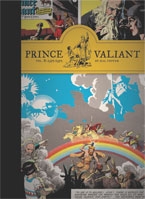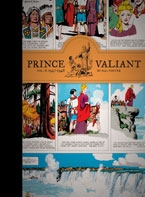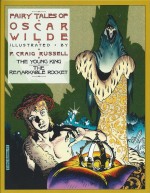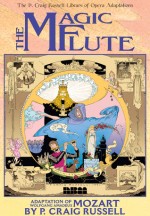
P. Craig Russell’s Opera Adaptations Hardcover Set


By P. Craig Russell & various (NBM)
Set ISBN: 978-1-56163-755-3
Vol. 1 ISBN: 978-1-56163-350-0
Vol. 2 ISBN: 978-1-56163-372-2
Vol. 3 ISBN: 978-1-56163-388-3

Win’s Christmas Gift Recommendation: Startling, seductive and sublime… 10/10

Here’s a tremendous opportunity and irresistible bargain for aficionados of magnificent Art and Grand Spectacle…

P. Craig Russell began his illustrious career in comics during the early 1970s and came to fame early with a groundbreaking run on science fiction adventure series Killraven, Warrior of the Worlds. His fanciful, meticulous classicist style was derived from the great illustrators of Victorian and Edwardian heroic fantasy and was greatly at odds with the sausage-factory deadlines and sensibilities of the mainstream comicbook industry.

By the 1980s he had largely retired from the merciless daily grind, preferring to work on his own projects (generally adapting operas and plays into sequential narratives) whilst undertaking the occasional high-profile Special for the majors – such as Dr. Strange Annual 1976 (totally reworked and re-released as Dr. Strange: What Is It that Disturbs You, Stephen? In 1996) or Batman: Robin 3000.

As the industry grew up and a fantasy boom began he returned to comics with Marvel Graphic Novel: Elric (1982), further adapting Michael Moorcock’s iconic sword-&- sorcery star in the magazine Epic Illustrated and elsewhere.

Russell’s stage-arts adaptations had begun appearing in 1978: first in the independent Star*Reach specials Night Music and Parsifal and then from 1984 at Eclipse Comics where the revived Night Music became an anthological series showcasing his earlier experimental adaptations; not just operatic dramas but also tales from Kipling’s Jungle Books and others.

In 2003 Canadian publisher NBM began a prodigious program to collect all those music-based masterpieces into The P. Craig Russell Library of Opera Adaptations: first as the luxurious clothbound hardcovers under discussion here and eventually in more affordable trade paperback albums.

Now all three of the sturdy originals are available again as a lavish economical shrink-wrapped set no fan of the comic arts could possibly resist.

Completed in 1990, the first huge volume (300 x210mm) features an epic rendering of Mozart’s lush fairytale romance The Magic Flute (from Emanuel Schikaneder’s libretto) wherein valiant if lackadaisical Prince Tamino and his unwelcome but supremely practical bird-catcher sidekick Papageno are tricked by the Queen of Night into rescuing her daughter Pamina from the wicked sorcerer Sarastro.

To aid them she gave the Prince a Magic Flute and the oafish dullard a set of enchanted bells, but she had not told them the true nature of the victim or their opponents…

A glorious panorama of love, betrayal, duplicity, enchantment and comedy – and dragons! – this is a fabulous example of the artist’s visual virtuosity.

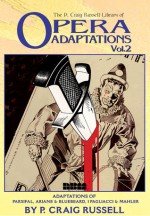
Volume 2 is comprised of shorter works, beginning with the aforementioned Parsifal, realised from the Second Act of Richard Wagner’s opera, with a script adapted by long-term collaborator Patrick C. Mason, who also provides an Introduction and erudite commentary.

The work is the earliest represented in the collection and still contains stirring remnants of Russell’s action-hero style as the pure and heroic knight (a “germanised” version of Camelot’s Sir Percival in quest of the Holy Grail) finds the doughty and beautiful seeker undertaking ‘His Journey’, facing the seductive wiles of the debased siren Kundry and her Flower-Maidens in ‘His Temptation’ before eventually achieving ‘His Victory’ over malign magic and the weaknesses of the flesh…

Letitia Glozer’s Introduction to Songs by Mahler precedes two powerful evocations of ferocious imagination as ‘The Drinking Song of Earth’s Sorrow’ (with a script by Mason) and the idyllic Arcadian pastel dreamscape of ‘Unto This World’ bemuse the reader until the opening of dark fairytale horror with ‘Ariane & Bluebeard’.

As revealed in Olivier Messiaen’s Introduction, Maurice Maeterlinck’s poem became a stunning symbolist opera scored by Paul Dukas, and Russell’s adaptation maintains the philosophical underpinnings whilst deftly telling of a township in revolt as the brutal lord of the manor brings his sixth bride to his castle.

The peasants are determined that the killer will not destroy another maiden but strong-willed Ariane has her own opinions and will determine her own fate…

Russell himself provided the Introduction for the final work in this volume. ‘The Clowns’ is crafted in stark and memorable monochrome, eschewing the vibrant colours of the previous pieces for a horrific interpretation of Ruggero Leoncavallo’s I Pagliacci – a play-within-a-play of the new “Verismo” school of operatic storytelling which abandoned fantasy for tales of ordinary people and tawdry, sordid realism.

Pencilled by Galen Showman over Russell’s layouts and under the master’s inks and tones, it concerns a band of travelling players, who find that close proximity breeds boredom not fidelity, and proves that sinful passions indulged cannot help but lead to jealousy and murder…

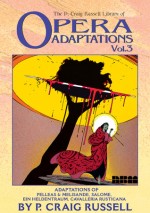
The wide-eyed full colour wonderment wraps up in the third P. Craig Russell Library of Opera Adaptations, which features Pelleas and Melisande, Salome, Ein Heldentraum and Cavalleria Rusticana.

Mason’s informative Introduction to Maeterlinck’s masterpiece of forbidden love and familial injustice (as set to music by Claude Debussy) precedes a superb adaptation by Russell and scripter Barry Daniels, which relates how gruff widower Prince Golaud finds a strange, forlorn young woman whilst out hunting and, smitten with the sad, beautiful creature, marries her. He was supposed to wed distant Princess Ursula whose alliance might have saved the impoverished and slowly starving kingdom…

Melisande doesn’t really care. She seems to carries a mysterious secret within that manifests as a quiet compliance. She only really appears to display any passion for life after her new husband’s brother Prince Pelleas returns to court. As the two young people spend time together, Golaud is wracked with growing suspicion and when his bride loses her wedding ring the scene is irretrievably set for tragedy…

Scripted by Mason again, ‘Ein Heldentraum’ (A Hero’s Dream) is a short piece completed for this volume, visualising a bleak Lied or Art Song by German composer Hugo Wolf – a minor epic of fantastic imagination with just the hint of a potential happy ending.

That can’t be said of the next tale. ‘The Godfather’s Code’ is also new: a cruel, grim tale of death and broken promises taken from the Cavalleria Rusticana (rustic or peasant’s chivalry) by Pietro Mascagni from the libretto by Giovanni Targioni-Tozzetti and Guido Menasci as originally adapted from a play and short story written by Giovanni Verga.

It was the first great example of the Verismo opera and is also one of Russell’s most effective adaptations.

Depicted in the bright, vivid colours of an Italian Easter, the story concerns vivacious Lola who revels in the first flowering of a new romance, even as fallen woman Santuzza desperately seeks the man for whose attentions she gave her virtue and now stands excommunicated by the Church and damned by her own conscience…

The outcast kneels in prayer outside the chapel, hungry for a glance of her adored Turridu, but she knows in her heart he has abandoned her for his first love.

When at last he arrives, the cad discards her whilst hypocritical Lola mocks. Thus Santuzza is driven to do the unpardonable: tell proud carter Alfio what his wife and best friend do whilst he works away from home…

The grandeur and tragedy all concludes with the biblical horror story of ‘Salome’ transformed from Oscar Wilde’s play into Richard Strauss’ opera of “shocking depravity” and thus perfect meat for comics cognoscenti.

In ancient Judea, the Tetrarch Herod rules by the grace of Rome, in a Court of utter decadence and indulgence. His wife is the debauched wanton Herodias, but lately even she has paled in the King’s eyes as her daughter Salome has blossomed.

The queen’s every blandishment is useless as her husband becomes more and more obsessed with the virginal sixteen year old…

Have grown up in the most debased place on world Salome is under no illusions as to Herod’s attentions or intentions, but her mind is preoccupied by the strident prisoner pent in the hole beneath the palace floor. Jokanaan condemns everything about the Court and warns all who hear of the messiah to come, heedless of the danger to himself. He is also exceedingly beautiful, as wilful Salome discovers when she forces a besotted guard to let him out so that she can see him. The precocious child has never met anyone who did not want her and John the Baptist’s indifference enflames her. The prophet is someone worthy of her body and chastity so she throws herself at him, but is roundly rejected.

Her passions aroused and rebuffed, the furious, confused girl decides to do anything she must and give everything she is if it will punish her tormentor…

The astounding strips and stories contained here are an indisputable high point in the long, slow transition of an American mass market medium into a genuine art form, but they are also incredibly lovely and irresistibly readable examples of comics on their own terms too.

This collection is a grand spectacle all lovers of picture storytelling would be crazy to miss.
© 1977, 1978, 1984, 1986, 1989, 1990 1998, 2004, 2013 P. Craig Russell. All rights reserved.

Fall Guy for Murder and Other Stories


By Johnny Craig, with Ray Bradbury, Bill Gaines & Al Feldstein (Fantagraphics Books)
ISBN: 978-1-60699-658-4

From 1950-1954 EC was the most innovative and influential comicbook publisher in America, dominating the genres of crime, horror, adventure, war and science fiction. They even originated an entirely new beast – the satirical comicbook.

After a shaky start, following the death of his father (who actually created Comicbooks in 1933), new head honcho William Gaines and his trusty master-of-all-comics trades Al Feldstein turned a slavishly derivative minor venture into a pioneering, groundbreaking enterprise which completely altered the perception of the industry and art form.

As they began co-plotting the bulk of EC’s output together, intent on creating a “New Trend” of stories aimed at older and more discerning readers – and not the mythical 8-year-old comicbooks ostensibly targeted – they shifted the emphasis of the ailing company towards dark, funny, socially aware and more adult fare.

Their publishing strategy also included hiring some the most gifted writers and artists in the field. One of the very best and most undervalued today was Johnny Craig…

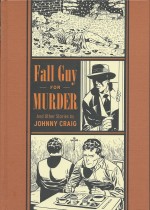
This lavish monochrome hardcover volume, part of Fantagraphics’ EC Library, gathers a chilling collection of Craig’s supernatural suspense and especially his superbly Noir-drenched crime stories in a wonderful primer of peril packed with supplementary interviews, features and dissertations, beginning with the informative and picture-packed ‘Brilliant Good Guys, Even More Brilliant Bad Guys’ by lecturer Bill Mason, after which the succession of classic genre tales begins with  ‘One Last Fling!’ from Vault of Horror #21 October/November 1951. Craig was an absolute master of pen-and-ink illustration, but his scripting was just as slick and deceptively, hilariously seductive.

In his initial yarn here, a circus knife-thrower refused to let the mere fact that his beloved assistant had become a vampire drive them apart, whilst ‘Out of the Frying Pan…’ (from Crime SuspenStories #8, December 1951/January 1952) is a wry gem of misdirection, as a temporarily blind killer lets the wrong little old man plan his escape from hospital for him…

From Vault of Horror #22 (December 1951/January 1952), ‘Fountains of Youth!’ was straightforward supernatural thriller about a vitality-leeching monster, but ‘Understudy to a Corpse!’ (Crime SuspenStories #9, February/March 1952) was a brilliantly twisty murder-plot involving a penniless actor who murdered his uncle and diverted police attention by impersonating the victim post mortem. It did not go according to plan…

‘A Stitch in Time!’ (Vault of Horror #23 February/March 1952) is a grotesque classic in which a tyrannical sweatshop boss pays a ghastly price for abusing the desperate seamstresses in his employ, before ‘…Rocks in His Head!’ from Crime SuspenStories #10 (April/May 1952) sees a harassed hard-pressed surgeon with a greedy young wife making a disastrous choice when faced with a jewel-bedecked corpse to autopsy, and ‘A Bloody Undertaking!’ (Vault of Horror #24, April/May 1952) takes the same theme into supernatural territory as a pretty young thing turns the head of an old country doctor who really should know better…

Regarded as one of the company’s slowest creators, Craig nevertheless found time to illustrate scripts by Gaines & Feldstein such as ‘…On a Dead Man’s Chest!’ (Haunt of Fear #12 March/April 1952) wherein, after a sordid affair and brutal murder, retribution from beyond the grave sought out the victim’s wife and philandering brother…

‘Stiff Punishment!’ from Crime SuspenStories #11 June/July 1952 was all Craig, however, and again dealt with the pressures of greedy young things who wed staid old doctors. This time when the medical lecturer finally snapped he thought he had the perfect way to hide the body – but, ironically, he hadn’t…

In ‘Séance!’ (Vault of Horror #25 June/July 1952) a couple of conmen kill a mark who learns too much but are undone when the widow consults their own spiritualist for answers, after which Gaines & Feldstein scripted a shocking tale of gluttony and a vengeful sword-swallower in the gloriously macabre ‘Fed Up!’ from Haunt of Fear #13 May/June 1952.

The genuine tension of ‘The Execution!’ (Crime SuspenStories #12 August/September 1952), wherein a death row inmate waited for the witness who could save him from the chair, came from one simple shocking fact. In Craig’s stories the good guys didn’t always win, and justice was frequently derailed and even cheated…

‘Two of a Kind!’ (Vault of Horror #26 August/September 1952) offered a sexually charged love story of the most extreme kind of sacrifice, whilst in ‘Silver Threads Among the Mold!’ (Vault of Horror #27 October/November 1952) an avaricious model regrets making a fool of the sculptor who adores and supports her, and ‘Sweet Dreams!’ (Crime SuspenStories #14 December 1952/January 1953) reveals the dire lengths an insomniac will stoop to in search of a little rest.

‘Till Death…’from Vault of Horror #28, December 1952/January 1953 – is, for many fans, the ultimate zombie story as a besotted plantation owner loses his new bride to disease and soon learns to regret using voodoo to restore her to his side.

‘When the Cat’s Away…’ (Crime SuspenStories #15 February/March 1953) is pure Crime Noir as a cuckolded husband deals with his wife and best friend with finesse and grim finality, whilst ‘The Mausoleum!’ from Vault of Horror #29, February/March 1953, sees an English landowner sell his family castle to a ghost-crazy American, lock, stock and damning evidence of the murder he committed to inherit everything…

‘Rendezvous!’ (Crime SuspenStories #16 April/May 1953) brilliantly outlines the sheer dumb luck that scotched the perfect murder/insurance scam, after which ‘Split Personality!’ (Vault of Horror #30 April/May 1953) details the incredible lengths to which a con artist went to deprive identical twin sisters of their fortunes…

‘Touch and Go!’ from Crime SuspenStories #17 June/July 1953 is Craig’s sublimely paranoiac and compulsive adaptation of the Ray Bradbury vignette about a killer who left damning fingerprints, whilst romantic obsession underpins the tragic tale of an artist-turned-mugger who only stole to pay for true love’s medical bills in ‘Easel Kill Ya!’ from Vault of Horror #31 June/July 1953.

This addictive compilation concludes with a devilishly convoluted tale of a Private Eye set up to take the blame for a perfect crime. Written by Gaines & Feldstein, ‘Fall Guy for Murder!’ (Crime SuspenStories #18 August/September 1953) is the quintessential 1950s crime story: smart, scary, devious and morally utterly ambiguous…

The comics classics are then followed by more background revelations via S.C. Ringgenberg’s in-depth personal history in ‘Johnny Craig’ – complete with a stunning selection of Craig’s most eye-catching and controversial covers – and a general heads-up on the short-lived but world-shaking  phenomenon in ‘The Ups and Downs of EC Comics: A Short History’ by author, editor, critic and comics fan Ted White and the comprehensively illuminating ‘Behind the Panels: Creator Biographies’ by Mason, Tom Spurgeon and Janice Lee.

The short, sweet but severely limited output of EC has been reprinted ad infinitum in the decades since the company died. These titanic comics tales revolutionised not just our industry but also impacted the whole world through film and television and via the millions of dedicated devotees still addicted to New Trend tales.

Fall Guy for Murder is the fifth Fantagraphics compendium highlighting the contributions of individual creators, adding a new dimension to aficionados’ enjoyment whilst providing a sound introduction for those lucky souls encountering the material for the very first time.

Whether an aged EC Fan-Addict or the merest neophyte convert, this is a book no comics lover or crime- caper victim should miss…

Fall Guy for Murder and Other Stories © 2013 Fantagraphics Books, Inc. All comics stories © 2013 William M. Gaines Agent, Inc., reprinted with permission. All other material © 2013 the respective creators and owners.
Win’s Christmas Gift Recommendation: Brooding menace and stunning drama leavened with black humour… 10/10

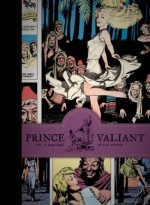
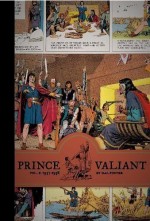
Hal Foster’s Prince Valiant volume 7: 1949-1950


By Hal Foster (Fantagraphics Books)
ISBN: 978-1-60699-645-4

Arguably the most successful comic strip fantasy ever conceived, Prince Valiant in the Days of King Arthur launched as a Sunday page feature on February 13th 1937, a luscious full-colour weekly window onto a perfect realm of perfect adventure and romance.

The strip followed the life and exploits of a refugee boy driven by invaders from his ancestral homeland in Scandinavian Thule who grew up to roam the world and rose to a paramount position amongst the mightiest heroes of fabled Camelot.

Written and drawn by sublime master draftsman and storyteller Harold “Hal” Foster, the epic followed the little princeling through decades of thrilling exploits as he matured into a clean-limbed warrior and eventually family patriarch through a heady sea of wonderment, visiting far-flung lands and siring a dynasty of equally puissant heroes whilst captivating and influencing generations of readers and thousands of creative types in all the arts.

There have been films, animated series and all manner of toys, games and collections based on the strip – one of the few to have lasted from the thunderous 1930s to the present day (over 3900 episodes and counting) – and even in these declining days of the newspaper narrative strip as a viable medium, it still claims over 300 American papers as its home. It has even made it into the very ether with an online edition.

Foster ceaselessly produced the strip, one enchanting page per week until 1971 when, after auditioning such notables as Wally Wood and Gray Morrow, Big Ben Bolt illustrator John Cullen Murphy was chosen to succeed him as illustrator. Foster continued as writer and designer until 1980, after which he retired and Cullen Murphy’s daughter Mairead took over colouring and lettering whilst her brother John assumed the writer’s role.

In 2004 the senior Cullen Murphy also retired (he died a month later on July 2nd) and the strip has since soldiered on under the extremely talented auspices of artists Gary Gianni and latterly Thomas Yeates, with Mark Schultz scripting.

Restored from Foster’s original Printer’s Proofs, this seventh spectacularly luxurious oversized (362 x 264mm) full-colour hardback volume reprints the pages from January 2nd 1949 to 31st December 1950 (#621 to 725 if you’re counting).

What has Gone Before: after an extended sojourn in an incredible New World, Valiant and Aleta have brought their newborn son back to Britain and sought out the warrior’s old comrade Prince Arn to be the child’s Godfather. Val is astounded that the bluff solitary hero is also a husband and currently searching for Godparents for his own newborn son and heir…

Before the Dark Ages delights resume, latest illuminator Thomas Yeates delivers a remarkable introductory essay discussing ‘The Long Shadow of Hal Foster’ and the innumerable artists who owe him a creative debt, after which the never-ending saga picks up with the Princes and their families travelling back to fabled Camelot for a double Christening, presided over by King Arthur himself…

Soon however duty calls again and Valiant, Sir Gawain and hapless, bumbling hedge-wizard Oom Fooyat are dispatched to the wilds of Wales to investigate a nest of vile black magic. Seamlessly blending thrills and grandeur with broad comedy, Foster delivers an enchanting light-hearted romantic romp wherein level-headed Val exposes the macabre happenings at Illwynde Castle and plays matchmaker to more than one of his faithful retinue…

Job done and the fief secure, Gawain and the Prince of Thule return to Camelot, picking up en route a boy with chivalric intentions and the determined courage of a lion. The enigmatic Geoffrey is desperate to win his spurs, but when Valiant introduces the lad to Aleta, the prospective page boy is gripped by a ferocious, life-changing, all consuming crush…

Whilst the well-meaning kid perpetually embarrasses himself in his drive to impress his master’s wife, Arthur despatches Valiant and a small band of knights to Scotland to inspect the wall which keeps the northern savages at bay. Aleta then attempts to keep Geoffrey out of trouble by ordering the puppy to follow and keep her husband safe…

It’s an unlucky decision: as Valiant and his inspection force discover when they see that Hadrian’s Wall has been breached and hundreds of Picts are ravening southward…

Confronted with an impossible situation the Prince again resorts to unconventional tactics and traps the huge barbarian army on the English side whilst sending Geoffrey back to Camelot with a message for Arthur… and to save the hero-struck boy from dying in the unwinnable battle to come…

Breaking all the rules of knighthood for the noblest of reasons, Geoffrey speedily delivers his message and is astounded when Aleta rushes off to join Valiant in Scotland. Again disregarding consequences and probably relinquishing forever his dream of knighthood, the boy follows her northwards…

Their arrival precipitates an unexpected and nigh-miraculous end to the war, but Valiant is close to death. After tending his hurts Aleta decides that she will take her husband back to his Scandinavian homeland, and dispatches the now-exhausted Geoffrey back to Camelot to inform her handmaiden Katwin and nurse Tillicum to obtain a ship and meet her with baby Arn at the village of Newcastle…

Despite dreading the judgement awaiting him at Court, the boy thunders back and, after arranging for his wounded master’s (wonderful wife’s) wishes to be carried out, surrenders himself to his fate…

Of course the King is no fool and a great respecter of honour and courage. He summarily condemns the boy to banishment: for a year and a day Geoffrey must not set foot on English soil…

Mind in a whirl the redoubtable boy is taken to a barge secured by Katwin and sails to Caledonia with the family party to a reunion with Valiant and Aleta…

Soon the group are headed to Thule, bolstered by the bombastic reappearance to boisterous far-larger-than-life Viking Boltar: a Falstaff-like rogue and “honest pirate” not seen since volume 3…

The excitable old rogue ferries the extended family to Val’s cold homeland – with a few unplanned, profitable but dangerous stops along the way – but soon finds himself smitten by the love bug too…

One mystery has been solved, however, as a chance meeting with an old cleric discloses the faithful squire to be actually called Arf, forced from his home when his father Sir Hugo Geoffrey took a new young bride who didn’t want an annoying stepson underfoot. Now she is gone and the boy can return home if he wishes…

Eventually the expanded party reaches the chilly castle of King Aguar and settles in to a long period of snowbound rest and recuperation – until boisterous Jarl Egil makes an inappropriate advance on Aleta and hotheaded Arf dashes to her defence…

Soon the encounter has escalated and Valiant is forced into an utterly unnecessary duel of honour which can only end in pointless tragedy…

Happily the repentant Arf finds a way to satisfy honour all around but the King is plagued by a knotty problem wit cannot solve. Aguar has been seriously considering converting his Norse realm to Christianity, but the many devout missionaries roaming the land are cantankerous idiots all preaching their own particular brand of faith – when not actively fighting each other.

Thus in Spring, he tasks the fully fit Valiant with an embassage to Rome to ask the Pope to send priests and teachers who actually carry the true and official Word of God. Restless and eager Val promptly sets out, accompanied by Arf, the doughty Rufus Regan and new comrade Egil. Their mission coincides with the planting season when Aguar’s men return to their homes to sow the crops for the coming year…

No sooner have they departed however than vassal king Hap-Atla, seething from an old slight delivered to his deceased sire, rebels and besieges Arguar’s castle. With manpower dangerously depleted the situation looks grim until wily Aleta takes control of the situation and scores a devastating victory that contravenes all the rules of manly warfare.

Unseen for three months, Valiant and his companions at last reappear as they land in Rouen to begin the arduous overland trek to the HolyCity. The journey is full of short bursts of violence and outrageous incidents as, since Rome fell to the Vandals, Europe has become a seething mass of lawless principalities.

Most of these improvised kingdoms are run by brigands or worse, all seeking to fill their coffers at any unwary traveller’s expense…

In one unhappy demesne the quartet dethrone a robber baron and nearly end up married to his daughters (young Arf particularly caught the imagination of the decidedly dangerous and ambitious teenager Ollie), whilst in another Val gets hold of an alchemist ruler’s horrific black powder and is almost blown to smithereens.

Eventually however they arrive at the castle of welcoming noble Ruy Foulke and enjoy a pleasant night’s rest – only to awaken and find the place under attack by heinous villain Black Robert and his savagely competent forces…

To Be Continued…

Also included in this striking compendium is an intoxicating glimpse at the author’s virtuosity in ‘“See America First”: Hal Foster’s Union Pacific Paintings’, a series of painted advertising landscapes compiled and discussed by Brian M. Kane.

Rendered in a simply stunning panorama of glowing visual passion and precision, Prince Valiant is a non-stop rollercoaster of boisterous action, exotic adventure and grand romance; blending human-scaled fantasy with dry wit and broad humour, soap opera melodrama with shatteringly dark violence.

Beautiful, captivating and utterly awe-inspiring, the strip is a World Classic of fiction and something no fan can afford to miss. If you have never experienced the intoxicating grandeur of Foster’s magnum opus these magnificent, lavishly substantial deluxe editions are the best way possible to do so and will be your gateway to an eye-opening world of wonder and imagination…

Prince Valiant © 2013 King Features Syndicate. All other content and properties © 2013 their respective creators or holders. All rights reserved.

Win’s Christmas Gift Recommendation: Ideal for anybody who ever strived or dreamed or wished… 10/10 

Child of Tomorrow and Other Stories


By Al Feldstein with Graham Ingels, George Roussos, George Olesen, Max Elkan & Sid Check (Fantagraphics Books)
ISBN: 978-1-60699-659-1

EC Comics began in 1944 when comicbook pioneer Max Gaines sold the superhero properties of his All-American Comics company to half-sister National/DC, retaining only Pictures Stories from the Bible. His plan was to produce a line of Educational Comics with schools and church groups as the major target market.

He augmented his core title with Picture Stories from American History, Picture Stories from Science and Picture Stories from World History but the worthy project was already struggling when he died in a boating accident in 1947.

As detailed in the final comprehensive essay in this superb graphic collection, his son William was dragged into the family business, with much support and encouragement from unsung hero Sol Cohen – who held the company together until the initially unwilling Bill Gaines abandoned his dreams of being a chemistry teacher and transformed the ailing enterprise into Entertaining Comics…

After a few tentative false starts and abortive experiments following industry fashions, Gaines took advantage of his multi-talented associate Al Feldstein, who promptly graduated from creating teen comedies and westerns into becoming Gaines’ editorial supervisor and co-conspirator.

As they began co-plotting the bulk of EC’s stories together, they shifted the emphasis of the ailing company in a bold and impressive change of direction. Their publishing strategy, utilising the most gifted illustrators in the field, was to tell a “New Trend” of stories aimed at older and more discerning readers, not the mythical 8-year old all comicbooks ostensibly targeted.

From 1950 to 1954 EC was the most innovative and influential publisher in America, dominating the genres of crime, horror, war and science fiction and the originator of an entirely new beast: the satirical comicbook…

Feldstein had started life as a comedy cartoonist and after creator/editor Harvey Kurtzman departed in 1956, Al became Mad’s Editor for the next three decades…

This volume of the Fantagraphics EC Library gathers a mind-boggling selection of Feldstein fantasy stories in a lavish monochrome hardcover edition, packed with supplementary interviews, features and dissertations, beginning with the informative ‘Cosmic Destruction With a Twist of Wry’ by lecturer Bill Mason and a gushing Introduction from cartoon superstar Gilbert Hernandez. Oddly enough writer-artist Feldstein was no fan of science fiction but was turned on to the genre by Gaines; an insomniac with a brain that always voraciously sought out the fresh and the new…

Feldstein worked on every genre in EC’s stable, but the short, ironic, iconic science thrillers he produced during that paranoid period of Commies and H-Bombs, Flying Saucer Scares and Red Menaces, irrevocably transformed the genre from Space-babes and Ray-gun adventure into a medium where shock and doom lurked everywhere.

His cynically trenchant outlook and darkly comedic satirical stories made the cosmos a truly dangerous, unforgiving place and kept it such – until the Comics Code Authority and television pacified and diminished the Wild Black Yonder for all future generations…

This superb monochrome hardback sampler of cosmic calamity opens with ‘“Things” from Outer Space!’ (originally presented in Weird Science #12, May/June 1950), wherein a scientist’s comely assistant accidentally uncovers alien infiltrators in the highest echelons of America’s government.

From the same month ‘Am I Man or Machine?’ (Weird Fantasy #13) then taps into Noir sensibilities with a tale of true love and tragic sacrifice when an accident victim falls into the hands of scientists too concerned with mere mechanical advancement, oblivious to sentiment…

Weird Science #13 (July/August 1950) tapped into the nation’s unease by gloriously spoofing the Air Force investigation into alien sightings with ‘The Flying Saucer Invasion’, whilst Feldstein and Gaines started a convention of writing themselves into their stories in Weird Fantasy #14 that same month as their comicbook editorial speculation led to enemy agents causing a ‘Cosmic Ray Bomb Explosion!’

Doomsayers and whistleblowers always played a big part in these tales. In ‘Destruction of the Earth!’ (Weird Science #14, September/October 1950), Washington’s refusal to listen to maverick researcher Fredrick Holman had truly catastrophic repercussions, whilst over in that month’s Weird Fantasy (#15) the Capitol was saved from ‘Martian Infiltration!’ by another, friendlier race of visitors…

‘Panic!’ (Weird Science #15, November/December 1950) played with the fact of Orson Welles’ infamous War of the Worlds radio broadcast, but the tone over in Weird Fantasy #16 was far more sardonic when ‘The Last City’ revealed the logical flaw in New York’s plan to erect an impenetrable, air-tight, H-bomb proof force field over the metropolis…

Sex, love and time-travel merged in Weird Science #5 (January/February 1951) as an ordinary Joe took a mysterious tourist trip into the future and brought back heartbreak in the form of a synthetic, build-her-yourself wife – and trust me, the ending is not one you’ll be expecting – whilst in ‘Child of Tomorrow!’ (Weird Fantasy #17) a lucky survivor of an atomic conflagration discovers at first hand the appalling effects of radiation on human reproduction…

The grim warnings and prognostications continued in ‘Spawn of Venus’ (Weird Science #6, March/April 1951) as an exploratory voyage to our sister world brings back something hungry which cannot be killed, whilst in that month’s Weird Fantasy (#6 – as the frankly whacky numbering systems were at last rationalised) a doomed romance was rekindled by fate after a bold astronaut returned from a ‘Space-Warp!’.

‘It Was the Monster from the Fourth Dimension’ (Weird Science #7, May/June 1951) pitted valiant friends against a creature – or a least a portion of it – from outside our limited perceptions, but Feldstein’s wry, cynically dry humour fully informed the tale of a patriotic hillbilly super-prodigy who naturally offered his gifts and services to the bigwigs in Washington in ‘7 Year Old Genius!’ (Weird Fantasy #7, May/June 1951).

Man versus Monster was an inescapably popular and rousing theme of the times and ‘Seeds of Jupiter!’ (Weird Science #8, July/August 1951) is one of the most visually compelling examples of the type, whilst the accidental time-travel by astronauts in Weird Fantasy #8 imaginatively postulated on ‘The Origin of the Species!’ displays the author’s superb ability to build tension, even if you have already guessed the “shock ending”…

Even whilst scripting and illustrating these stories, the tireless Feldstein was becoming increasingly involved in the editorial and production side of the business.

After The Origin of the Species! he stopped drawing science fiction adventures, but wrote stories for other artists to draw. This final section reprints a few of them by less prolific or well known illustrators – who probably won’t have their own book collections – and kicks off with ‘House, in Time!’ (Weird Science #15, November/December 1950) for horror star Graham Ingels to render

In it a young couple rent a perfect dwelling at a ludicrous price, but are unable to comply with the peculiar landlord’s simple request – to never open the back door…

The multi-talented George Roussos limned the next three, beginning with Weird Fantasy #7 (May/June 1951) wherein astronauts discover another Earth ‘Across the Sun!’ and learn a ghastly secret of human development, after which ‘The Escape!’ (Weird Science #8, July/August 1951) delivers a knockout crime thriller of murder in space and inescapable justice.

That motif of cosmic comeuppance also informs ‘The Slave Ship!’ (Weird Fantasy #8, July/August 1951) as piratical traders in human flesh find out just what that feels after aliens abduct them…

Unsung comic strip stalwart George Olesen (Ozark Ike, The Phantom) illustrated ‘The Slave of Evil!’ (Weird Science #9, September/October 1951) wherein a mechanical man displays more humanity than the humans who constructed him, after which veteran Max Elkan revealed the heartbreaking secret of ‘The Connection!’ (Weird Fantasy #9, September/October 1951) between a heartbroken old inventor and a vivacious young orphan girl.

The forays into the fantastic conclude then with ‘Strategy!’ (Weird Science #14, July/August 1952) illustrated by Sid Check, which reveals the big mistake of brain-stealing aliens who picked the wrong man to probe for Earth’s military secrets…

Also adding to the value of this captivating chronicle is ‘Gut and Glory’: an interview with the creator himself, conducted by Gary Groth, the incisive biography ‘Al Feldstein’ by S.C. Ringgenberg, a general heads-up on the entire EC phenomenon in ‘The Ups and Downs of EC Comics: A Short History’ by author, editor, critic and comics fan Ted White and the comprehensively illuminating ‘Behind the Panels: Creator Biographies’ by Bill Mason, Arthur Lortie and Janice Lee.

The short, sweet but severely limited output of EC has been reprinted ad infinitum in the decades since the company died. These astounding stories and art changed not just comics but also infected the larger world through film and television and via the millions of dedicated devotees still addicted to New Trend tales.

However, this series of collections (Child of Tomorrow is the sixth) highlighting thematic contributions of individual creators has added a new dimension to au fait readers’ enjoyment and offers a solid introduction for those lucky souls encountering the material for the very first time.

I strongly suggest that whether you are an aged EC Fan-Addict or callow contemporary convert, this is a book no comics aficionado can afford to miss…

Child of Tomorrow and Other Stories © 2013 Fantagraphics Books, Inc. All comics stories © 2013 William M. Gaines Agent, Inc., reprinted with permission. All other material © 2013 the respective creators and owners.

Win’s Christmas Gift Recommendation: Wide Eyed Wonderment seasoned with wry wit… 9/10

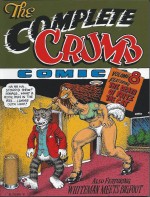
The Complete Crumb Comics volume 5: Happy Hippy Comix – New Edition


By R. Crumb & various (Fantagraphics Books)
ISBN: 978-0-930193-92-8

This book contains really clever and outrageously dirty pictures, rude words, non-condemnatory drug references and allusions, apparent racism, definite sexism, godless questioning of authority and brilliantly illustrated, highly moving personal accounts and opinions.

If you – or those legally responsible for you – have a problem with that, please skip this review and don’t buy the book.

Really. I’m not kidding…

Robert Crumb is a unique creative force in comics and cartooning, with as many detractors as devotees. His uncompromising, excoriating, neurotic introspections, his pictorial rants and invectives, unceasingly picked away at societal scabs and peeked behind forbidden curtains for his own benefit, but he has always happily shared his unwholesome discoveries with anybody who takes the time to look…

In 1987 Fantagraphics Books began the nigh-impossible task of collating, collecting and publishing the chronological totality of the artist’s vast output and those critically important volumes are now being reissued.

The son of a career soldier, Robert Dennis Crumb was born in Philadelphia in 1943 into a functionally broken family. He was one of five kids who all found different ways to escape their parents’ highly volatile problems, and comic strips were paramount among them.

As had his older brother Charles, Robert immersed himself in the comics and cartoons of the day; not just reading but creating his own. Harvey Kurtzman, Carl Barks and John Stanley were particularly influential, but also comic strip masters such as E.C. Segar, Gene Ahern, Rube Goldberg, Bud (Mutt and Jeff) Fisher, Billy (Barney Google), De Beck, George (Sad Sack) Baker and Sidney (The Gumps) Smith, as well as illustrators like C.E. Brock and the wildly imaginative and surreal 1930’s Looney Tunes and Merrie Melodies animated shorts.

Defensive, introspective and always compulsively driven, young Robert pursued art and self-control through religion with equal desperation. His early spiritual repression and flagrant, hubristic celibacy warred with his body’s growing needs…

From this point onwards, the varied and exponentially impressive breadth of Crumb’s output becomes increasingly riddled with his often hard-to-embrace themes and declamatory, potentially offensive visual vocabulary as his strips grope towards the creator’s long-sought personal artistic apotheosis, and this third volume covers material created and published between 1960-1966 as the self-tormented artist began to find a popular following in a strangely changing world.

Escaping his stormy early life, he married young and began working in-house at the American Greeting Cards Company. He discovered like minds in the growing counterculture movement and discovered LSD. By 1967 Crumb had moved to California and became an early star of Underground Commix. As such he found plenty of willing hippie chicks to assuage his fevered mind and hormonal body whilst reinventing the very nature of cartooning with such creations as Mr. Natural, Fritz the Cat, Devil Girl and a host of others. It is from this period that the engrossing, amazing and still shocking strips in this book stem…

He worked on in what was essentially a creative utopia throughout the early 1970’s but the alternative lifestyle of the Underground was already dying. Soon it would disappear: dissipated, disillusioned, dropped back “in” or demised. A few truly dedicated publishers and artists stayed the course, publishing on a far more businesslike footing as Crumb carried on creating, splitting his time between personal material and commercial art projects whilst incessantly probing deeper into his turbulent inner world.

This particular collection covers the period when the insular, isolated Crumb first began to make a name for himself with a flood of gags, posters, commercial art jobs, short strips and longer material popping up seemingly everywhere. All are faithfully reproduced in this compilation – which makes for a rather dry listing here, I’m afraid – but (trust me) the pictorial output is both engrossing and legendary.

Actually, don’t trust me: buy the book and see for yourselves…

After a photo and cartoon-stuffed (from 1968 sketchbooks) Introduction from the old scallywag himself, praising the effects of mind-altering chemicals and recalling the first heady days of Counter-Culture celebrity, the wave of visual excess and literary freewheeling begins with ‘The Old Pooperoo Pauses to Ponder’: a baroque procession of his fun-loving characters rounded off with a micro strip at the bottom, revealing Eggs Ackley’s opinion that ‘This Kid’s a Scream!’, after which Mr. Natural, Angelfood McSpade and all the rest are reassured that ‘You’re Gonna Get There Anyway’ (all from East Village Other December 1-16, 1967).

Next ‘Mr. Natural, the Man from Affiganistan’ shares more timeless wisdom with resident curious “Straight” Flakey Foont (EVO December 15-30 1968), after which a rush of shorts from EVO January 12-17 begins.

‘Sky-Hi Comics’, ‘Then on the Other Hand…’ are followed by ‘Nuttin’ but Nuttin’, ‘Here She Comes! It’s Hippy!’ and ‘Junior High & his Sidekick Judy Holiday’ from the January 19-25 edition whilst ‘Those Cute Little Bearzy Wearzies/George Gwaltny’ (EVO January 26-February 1 1968) precedes Natural’s inevitable return to act as guru to ‘Schuman the Human’ from EVO February 9-15th.

The Wise one continues in revelatory style when ‘Mr. Natural Meets God’ (supplemented by) ‘Gail Snail and The Walkie Talkies’ from EVO February 16-22, whilst the next weekly issue described how ‘Mr. Natural Gets the Bum’s Rush’, and Schuman declared ‘Let’s Be Honest’ before Crumb confronted the period’s racism head on with customary shocking frankness in ‘Mr. Natural Repents’, ‘Hey, Mom!’ and attendant strip ‘Let’s Have Nigger Hearts For Lunch’ (EVO March 1-7 1968).

Zap #2 June 1968, then provided wry ‘Hamburger Hi-Jinx’ with Cheezis K. Reist and shockingly introduced iconic Bête Noir ‘Angelfood McSpade’ before closing with a warning to avoid cheap imitations from ‘Mr. Natural’.

Bijou #1, from Summer 1968, then supplies a wealth of intriguing, astonishing fare leading with ‘Neato Keano Time!’ before ‘The Big Little Boy’ and ‘Bo Bo Bolinski, He’s a Clown!’ went through their paces. Following that ‘Mr. Spiff’ makes a call and ‘Here They Are! Puppets of your favourite cartoon characters!’ provides paper-dolls of Angelfood and Mr. Natural. The harsh, ironic hilarity all ends with a laidback Bijou Funnies Ad…

The inescapably controversial Ms. McSpade and friends then cropped up in ‘All Asshole Comics’ (Chicago Seed, July 1968), after which covers for ‘Nope #6’ and ‘Nope #7’ (both 1968) are followed here by ‘The Zap Show’ – a captivating art jam with Rick Griffin, Victor Moscoso & S. Clay Wilson.

A ‘Fritz the Cat title page’ then acts as prologue to an outrageous tale of student terrorism and teen licentiousness in ‘Fritz the No-Good’ (taken from Cavalier, September/October 1968), after which you’ll need to rotate the book to be shocked by the interiors of digest-sized Snatch #1 (October 1968): rude and raunchy spoofs such as ‘The Adventures of Andy Hard-on’, ‘Krude Cut-Ups’ and ‘The Fight’ plus assorted gags like ‘Jailbait of the Month’, ‘Hi, Swingers’ and much more…

A rather lovely ‘Janis Joplin: original cover for Cheap Thrills (1968) is followed by

‘The Phonus Balonus Blues’ and ‘Where the Action Isn’t’ (EVO September 27 1968) as well as the cover of that issue – ‘Can the Mind Know it?’

From the October 11 issue of East Village Other comes a barrage of strips: ‘Sleezy Snot Comics’, ‘Mr. Natural’, ‘Booger Buddies’ and more plus an ‘Ad for Head Comix’ whilst the October 18th edition provided both ‘Angelfood McSpade’ and ‘Cum Comix’, and October 25th a ‘Mr. Natural, disguised as a vacuum cleaner salesman, talks to the Housewives of America’ cover.

‘Edgar and Maryjane Crump’ and ‘Crime in the Streets’ both originated in EVO November 1) after which an ‘alternate cover for Zap #3′ segues into the infamous ‘Dirty Dog’ strip from Zap #3 (December 1968).

That underground classic also premiered ‘Mr. Goodbar “Off his Rocker”’, an astounding

‘Atomic Comics Jam’ with S. Clay Wilson, Gilbert Shelton, Victor Moscoso & Rick Griffin, grotesque shorts ‘Let’s Eat’ and ‘Mr. Natural’, ‘Hairy’ and ‘Street Corner Daze.’

Another digest-sized landscape section next reproduces the XXX-rated contents of Snatch #2′ (January 1969) including ‘Look Out Girls!! The Grabbies are Coming’, ‘Down on the Farm’, ‘The Family that Lays Together Stays Together’ and far more before an ‘ad for San Francisco Comic Book Company’ from Bogeyman #2, 1969, leads seamlessly into ‘Don’t Gag On It… Goof On It!’ (Gothic Blimp Works, Ltd. #1, March 1969).

The April 1969 ‘cover for Creem #2′ precedes a stunning spoof of Romance comics with ‘The Bleeding Heart Syndrome’ (Tales from the Ozone #1, 1969) before ‘Shoo Shoo Baby’ and ‘The Pricksters’ (GBW #2, 1969) suspends the black and white barrage to briefly usher in a spectacular ‘Color Section’…

The polychromatic madness begins with ‘Head Comix covers’ (front and back and 1968), keeping up the pressure with the Zap Comix #2 covers’ from December, as well as a ‘Fritz the Cat cover’, the ‘Cheap Thrills’ record cover for Big Brother and the Holding Company and the December 1968Snatch #1 covers’.

The ribald rainbows end with Snatch #2 covers’ (January 1969) before ‘Flower Children on Broadway’ from Bijou #2 (1969) return us to monochrome merriment, ‘Nutsboy’ (Bogeyman #2, 1969) presages today’s teen obsession with “Slasher-flicks” and ‘Mr. Know-It-All and his pal Diz in What the Fuck’ (with S. Clay Wilson from GBW #3, 1969) continues the dark and bloody mood.

This landmark compilation concludes with Crumb’s contributions to Motor City #1 (April 1969) starting with ultra-independent femme fatal ‘Lenore Goldberg and her Girl Commandos’, after which cool dude ‘The Inimitable Boingy Baxter’ turns Detroit on its head, and mini-mystic Savannah Foomo explores reality with ordinary folk and ‘The Desperate Character’ in ‘Deep Meaning Comics’ and ‘More Deep Meaning Gommigs’, leaving good old Eggs Ackley to wrap thing up in macabre style with ‘Eyeball Kicks’…

If Crumb had been able to suppress his creative questing, he could easily have settled for a lucrative career in any one of a number of graphic disciplines from illustrator to animator to jobbing comic book hack, but as this pivotal collection readily proves, the artist was haunted by the dream of something else – he just didn’t yet know what that was…

Crumb’s subtle mastery of his art-form and obsessive need to reveal his most hidden depths and every perceived defect – in himself and the world around him – has always resulted in an unquenchable fire of challenging comedy and riotous rumination, and this chronicle begins to show his growing awareness of where to look.

This superb series charting the perplexing pen-and-ink pilgrim’s progress is the perfect vehicle to introduce any (over 18) newcomers to the world of grown up comics. And if you need a way in yourself, seek out this book and the other sixteen as soon as conceivably possible…
© 1967, 1968, 1969, 1989, 2004, 2013 Robert Crumb. All contributory art material and content © the respective creators/copyright holders. All rights reserved.

The Twin Knights


By Osamu Tezuka, translated by Maya Rosewood (Vertical)
ISBN: 978-1-939130-01-3

Osamu Tezuka first rescued and then utterly revolutionised the Japanese comics industry during the 1950s and 1960s. Being a devoted fan of the films of Walt Disney he also performed similar sterling service in the country’s fledgling animation industry.

Many of his earliest works were aimed at children but right from the start his expansive fairytale stylisations – so perfectly seen in this splendid romp – harboured more mature themes and held hidden treasures for older readers…

Ribon no Kishi or “Knight of the Ribbon” was a breakthrough series which Tezuka returned to repeatedly during his life and one that is being continued even in the 21st century by his disciples. The simplistic but engaging fable of a Princess forced by political intrigue and cruel fate to pose as a man – and a warrior knight at that – has been adapted into movie and TV anime seen all over the world (generally known as some variation of “Choppy and the Princess” in places as far-flung as Canada, France Australia and Brazil) and in 2006 a stage musical was launched.

The serial was first published in Kodansha’s Shoujo Korabu (Shōjo Club), running from January 1954 to January 1956, with the generational sequel collected here appearing in Nakayoshi magazine as Futago no Kishi between January 1958 and June 1959.

The series is a perennial favourite and classic of the medium and this complete-in-one-volume yarn continues the saga begun in the two-volume softcover English-language Princess Knight.

Influenced heavily by Disney’s fairytale feature-films, each chapter herein is designated a “Scene” and opens with an homage to movie musical set-pieces in a ‘Prologue’ which reveals that the beautiful Queen Sapphire of Silverland has just given birth to a boy and a girl…

Scene 2 reveals ‘The Twin’s Secret’ as ambitious nobles of the court begin lobbying for one or other of the newborns to be named as heir (apparently, the subject of male primogeniture doesn’t appear to be a hindrance or issue in Silverland), with such vigour that proud father Franz is spending all his time breaking up duels…

Depressed and flustered the King gets a helping hand from the angel Tink, and Prince Daisy rather than Princess Violetta is officially nominated Heir Apparent.

However ambitious Duchess Dahlia and her ineffectual husband are unprepared to accept the decision and make treasonous plans. Soon, baby boy Daisy has been abducted and left to die in a wooded wilderness ruled over by the ferocious monster Slobb…

The people are divided and, in an effort to curtail civil war, Sapphire and Franz devise an insane plan. The twins were identical and now Violetta will play the part of both siblings, for as long as it takes to find her lost brother and preserve the kingdom. The Queen is particularly distraught that, for sake of duty, her daughter must endure the selfsame hardships that forced a young Sapphire to become the turbulent Knight of the Ribbon all those years ago…

‘In the Forest’ meanwhile, the Prince has been adopted by a fawn whose love and devotion is so great that the Goddess of the Forest grants her the power to become human from dusk till dawn. Papi will raise the boy as her little brother “Ronnie”, but the Goddess warns that her shape-shifting gift comes with some serious provisos and inevitable tragic consequences…

A decade passes and Daisy, left alone every day, becomes a headstrong, independent lad and mighty hunter. His greatest dream is to shoot a certain deer that always avoids him with almost human intelligence…

At the palace ‘Violetta’s Sadness’ grows as she is one day demure damsel and the next a boy harshly schooled in all the manly arts of war. Eventually she runs off and meets the palace gardener’s boy Tom Tam, but her brief, carefree respite kindles an incredible suspicion in the ever-scheming, always watching Dahlia…

More time passes and on the separated children’s fifteenth birthday a crisis is reached when only Violetta attends the huge party. Thankfully, the arrival of enigmatic envoys ‘Prince White and Prince Black’ distracts the ever-watching plotters and allows the distraught Princess to change into her masculine mode. The visiting brothers are keen on hunting in the Forest of Slobb, however, and when “Daisy” accompanies them Dahlia confirms her suspicions using the keen nose of a savage hunting hound…

Prince Black is as dark as his name and belligerently picks a fight with “Daisy”. Although beaten in the ensuing duel he cheats and is admonished by his noble brother, but in his heart hatred blooms and festers…

Prince White, meanwhile, finds himself impossibly drawn to the beautiful boy Daisy and is delighted to hear that the plucky lad has a sister who is his exact match and equal…

Dahlia, seeing an opportunity, distracts Prince Black from taking out his ire on the local fauna and offers him an intriguing proposition…

When White is wounded by Slobb, the hunting party returns to the palace – with Papi in her deer form one of the captured prizes – and as Daisy changes into her girl clothes to meet and minister to the visiting Prince’s injuries the scurrilous Black observes the transformation and discovers the nation’s greatest secret…

As the sun sets the trussed but living fawn becomes human again and ‘What Papi Saw’ describes how her eavesdropping on Black and Dahlia changes the fate of Silverland forever…

Horrifically, however, after escaping the palace and earnest pursuit from Prince Black, she is shot in her own home by the boy she has raised. Reverting to human and on her deathbed she tells heartbroken Ronnie everything she has learned and urges him to fulfil his true destiny …

That begins with a final fateful battle against the terrifying Slobb after which the keen hunter forever forswears his boyhood pursuits and finds all the animals in the forest pay him homage. Meanwhile in the palace Dahlia makes her move, forcing the compromised Royal Family into temporary custody in ‘The North Tower’.

Even her husband is surprised at her plan to ensure that they never leave it…

Long ago the King of Mice pledged his allegiance to Sapphire, and his successor now informs Violetta of her lost brother’s location and even aids her escape – clad in the legendary guise of Knight Ribbon – but she is too late.

Her brother has vanished. As the disguised Violetta slumps in dejection she is accosted by a saucy wench most taken with the beautiful young man before her. The wild, teasing creature offers aid which is gratefully accepted…

Emerald is in fact a ‘Gypsy Queen’ and, promising to aid the Knight, takes “him” to their wizened fortune teller Nara Yama, who reveals the missing brother is alive. She also divines the masquerader’s true identity and gender!

Just then the usurper Duke’s men raid the camp but the gypsies fight them off and flee…

At the palace Dahlia’s husband as acting regent gets a double surprise. The first is the corpse of the once-unstoppable Slobb and the other is the youth who dragged it in.

Common woodsman Ronnie is the spitting image of the missing Violetta in her male aspect and might well act as a pliable ‘Substitute Daisy’ when the Royal Family finally succumb to the slow-acting poison secretly being administered to them…

Things take a magical turn when Emerald and Knight Ribbon stumble upon the hidden ‘Palace of Roses’ and learn the true nature of Princes Black and White. Both are mystical creatures but whilst the good Prince wishes he could lose his powers and wed Violetta, Black is determined to cause her extreme suffering and death…

With the faithful, still-oblivious Gypsy Queen’s aid the Ribbon Knight survives Black’s garden of horrors and the pair escape ‘Inundation’ and eldritch ‘Storm’ as they fight their way out of Rose Citadel, but are soon trapped in a ghastly ‘Mirage Forest’ controlled by the witch Begonia until a magical sprite adopts them. However ‘Devoted Tiln’ must pay an awful price for her valiant intercession which only brings the fugitives to the relative safety of a small village.

Prince Black leads the Regent’s soldiers to them there and Violetta is exposed. Shocked and angry, Emerald nevertheless helps her escape to ‘Wolf Mountain’ where another tragic sacrifice leads the rebels into one final battle against the plotters, restores order for the just and inflicts well-deserved punishment upon the wicked in the action-packed, wildly romantic – if inappropriately entitled – ‘Epilogue’…

The Twin Knights is a spectacular, riotous, rollicking adventuresome fairytale about desire, destiny and determination which cemented the existence of the Shoujo (“Little Female” or young girl’s manga) genre in Japan and can still deliver a powerful punch and wide eyed wonder on a variety of intellectual levels. One of the most beguiling kid’s comics Tezuka ever crafted, it’s a work that all fans and – especially parents – should know, but be warned, although tastefully executed, this tales doesn’t sugar coat the drama and more than one favourite character won’t be alive at the end. If you have sensitive kids read it first and, if you too have a low woe quotient, pack handkerchiefs…

This black and white book is printed in the traditional ‘read-from-back-to-front’ manga format.
© 2013 by Tezuka Productions. Translation © 2013 by Vertical, Inc. All rights reserved.

The Love and Rockets Companion – 30 Years and Counting


Edited by Marc Sobel & Kristy Valenti (Fantagraphics Books)
ISBN: 978-1-60699-579-2

In the 1980s a qualitative revolution forever destroyed the clichéd, stereotypical ways different genres of comic strips were produced and marketed. Most prominent in destroying the comfy pigeonholes we’d built for ourselves were three guys from Oxnard, California; Jaime, Mario (occasionally) and Gilberto Hernandez.

Love and Rockets was an anthology magazine (which first appeared as a self-published comic in 1981) featuring intriguing, adventuresome larks and bold experimental comic narratives that pretty much defied classification, all wrapped up in the ephemera of the LA Hispanic and punk music scene.

Most stories focussed on either the slick, sci-fi-soused hi-jinx of punky young gadabouts Maggie and Hopey (and their extended eccentric circle of friends) or the heart-warming, terrifying, gut-wrenching soap-opera fantasies from the rural Central American paradise of Palomar.

Jaime Hernandez was always the most visible part of the graphic and literary revolution: his sleek, seductive, clean black line and beautiful composition – not to mention impeccably rendered heroes and villains and the comfortingly recognisable comic book iconography – being particularly welcomed by readers weaned on traditional Marvel and DC superheroes.

However his love of that material, as well as the influence of Archie Comics cartoonists (I often see shades of the great Sam Schwartz and Harry Lucey in his drawing and staging), accomplished and enticing as it is, often distracted from the power of his writing, especially in his extended saga of Maggie Chascarillo and Hopey GlassLas Locas, something never true of Gilbert, whose cartoony, reined-in graphics never overwhelmed the sheer magnetic power of his writing…

The Hernandez Boys, gifted synthesists all, enthralled and enchanted with incredible stories that sampled a thousand influences conceptual and actual – everything from Comics, TV cartoons, masked wrestlers and the exotica of American Hispanic pop culture to German Expressionism. There was also a perpetual backdrop displaying the holy trinity of youth: Sex and Drugs and Rock and Roll – for which please hear mostly alternative music and punk rock.

The result was dynamite. Mario only officially contributed on rare occasions but his galvanising energy informed everything. The slick and enticing visual forays by Jaime explored friendship and modern love whilst destroying stereotypes of feminine attraction through his fetching coterie of Gals Gone Wild, and Gilberto created a hyper-real microcosm in the rural landscape of Palomar: a playground of wit and passion in the quicksilver form of a poor Latin-American village with a vibrant, funny and fantastically quotidian cast created for his extended serial Heartbreak Soup.

Everything from life, death, adultery, magic, serial killing and especially gossip could happen in Palomar’s metafictional environs, as the artist mined his own post-punk influences in a deceptively effective primitivist art style which blended the highly personal mythologies of comics, music, drugs, strong women, gangs, sex and family.

The denizens of Palomar still inform and shape Beto’s work, both directly and as imaginative spurs for spin-off stories.

Winning critical acclaim but little financial success, the brothers temporarily went their own ways, working on side projects and special series before creatively reuniting a few years back to produce annual collections of new material in their particularly peculiar shared or, rather, intermittently adjacent pen-and-ink universes.

In more than three decades of groundbreaking creative endeavour, Los Bros Hernandez have crafted a vast and magnificent canon of cartoon brilliance and literary wonder and this long-overdue companion volume collects rarely seen conversations with the boys as well as two new interviews and also offers a host of truly essential lists and features no serious student of Love and Rockets lore can afford to miss.

Heavily illustrated throughout with candid photos, seen, unseen and unpublished art from the artists and excerpted examples by the many assorted creators who inspired them – everybody from Jack Kirby monsters to Jesse Marsh’s Tarzan to Warren Kremer and Ernie Colon’s Hot Stuff, the Little Devil – this invaluable volume commences with Interviews…

The first is from The Comics Journal #126 (January 1989), conducted by publisher Gary Groth and covering ‘Origins’, ‘Early Affection’, ‘Mostly Music’ (with a Love & Lists  album discography) and a solo section on both Jaime and Gilbert.

The Comics Journal #178 (July 1995) saw Los Bros chatting candidly with Neil Gaiman on personal work and the state of the Comics biz.

Completists will be delighted to know that although both these features have been edited for relevance the entire, unexpurgated interviews can be found online if you are of an historical bent.

Marc Sobel conducted a new interview with Los Bros especially for this volume, discussing ’30 years and Counting’, ‘Family’, ‘Bent Worlds’, a list of the story within a story of ‘Rosalba Fritz Martinez’ B-Movie Roles’, ‘The Naked Cosmos’, ‘Influences’, ‘Post-Comics Depression’, ‘The Indy-Comics Ghetto’, ‘Preconceived Notions’, ‘Anthologies’, ‘The Future of Comics’ and more.

The editor also spoke at length with Gary Groth on why and how he took a chance on three unproved kids and the effect the series has had on the global comics scene, encompassing, ‘Back to the Beginning’, how ‘Four-Color Separations’ worked, ‘Breaking into Bookstores’, ‘Foreign Affairs’ and so many more dark secrets…

Fascinating as the background insights are, the true worth of this huge tome (368 pages and 195x240mm) is the fan-friendly such as the 20-page Timelines listing all the stories, descriptions and references for both Locas and Palomar continuities, and the immense (73 page) Character Guides for each ongoing epic – originally compiled by Chris Staros in his fanzine The Staros Report and completely updated for this book.

Love and Rockets took the comics community by storm when it debuted and although the magazine only infrequently published letters of comment, when they did the missives were usually outrageous and often from impressive and familiar names. In the Letter Column Highlights section the likes of Steve Leialoha, Scott Hampton, Steve Rude, Mark Wheatley, Christie Marx, Kurt Busiek, Evan Dorkin, Andi Watson and many others famed and infamous passed comment and made waves. This is followed by an illuminating group of Bros.’ Favorite Comics which is both revelatory and charming.

Invaluable to all devotees and prospective beginners alike, the Checklist catalogues every story and piece of artwork by the brothers in all iterations of Love and Rockets as well as all the specials, miniseries, side-projects and even outside commissions ranging as far afield as GI Joe to DC Who’s Who, and the whole glorious compilation is capped off with a vast fold out dust-jacket featuring the Locas/Luba Family Charts.

A genuine phenomenon and classic of comics entertainment, Love and Rockets should be compulsory reading for any friend of the art form. This Companion tome will make navigating the huge interconnected Hernandez universe simplicity itself and I thoroughly commend it to your house…
© 2013 Fantagraphics Books, Inc. Love and Rockets © 2013 Gilbert Hernandez and Jaime Hernandez. All images, articles and stories © their respective copyright holders.

The Graphic Canon volume 3: From Heart of Darkness to Hemingway to Infinite Jest


By various, edited by Russ Kick (Seven Stories Press)
ISBN: 978-1-60980-380-3

Once upon a time in the English-speaking world, nobody clever, educated or grown up liked comics. Now we’re an accredited really and truly art form and spectacular books like this can be appreciated…

The Graphic Canon is an astounding literary and art project, instigated by legendary crusading editor, publisher, anthologist and modern Renaissance Man Russ Kick, which endeavours to interpret the world’s great books through the eyes of masters of crusading sequential narrative in an eye-opening synthesis of modes and styles.

The project is divided into three periods roughly equating with the birth of literature and the rise of the modern novel (From the Epic of Gilgamesh to Shakespeare to Dangerous Liaisons covered literature from ancient times to the end of the 1700s, whilst Kubla Khan to the Brontë Sisters to The Picture of Dorian Gray concentrated on the 19th century), and this third volume concentrates on the astonishing variety and changes which hallmarked the socially revolutionary 20th century in stories and poetry.

Rather than simply converting the stories the artists involved have been given the freedom to respond to texts in their own way, producing graphics – narrative or otherwise, sequential or not – to accompany, augment or even offset the words before them and the result is simply staggering…

Make no mistake: this is not a simple bowdlerising “prose to strip” exercise like generations of Classics Illustrated comics, and you won’t pass any tests on the basis of what you see here. Moreover these images will make you want to re-read the texts you know and hunger for the ones you haven’t got around to yet.

They certainly did for me…

Each piece is preceded by an informative commentary page by Kick, and the wonderment begins with ten illustrations by Matt Kish synthesising the dark delerium of Joseph Conrad’s Heart of Darkness, after which a seminal and scandalously revolutionary tale of sexual oppression and gender politics is revived in Rebecca Migdal’s moodily monotone comics adaptation of The Awakening by Kate Chopin, whilst Tara Seibel visually précis’ portions of Sigmund Freud’ discredited masterpiece The Interpretation of Dreams.

No matter how big a fan, you will never have seen anything like the terrifying photo-dioramas by Graham Rawle reinterpreting The Wonderful Wizard of Oz by L. Frank Baum, whilst H. G. Wells’ designer drug fantasy ‘The New Accelerator’ is treated to a spookily traditional strip adaptation by Cole Johnson, after which the Shoujo manga stylings of Sonia Leong brilliantly subvert the hilariously barbed social satire of Edwardian Dandy ‘Reginald’ as written by the sublimely acerbic H.H. Munro AKA “Saki”.

Hard on the heels of a Three Panel Review of A Room with a View by E.M. Forster as limned by Lisa Brown, Maxim Gorki’s transcendent ‘Mother’ – paean to the spirit of revolution – is perfectly encapsulated by Stephanie McMillan, and cartoonist Frank Hansen offers a radical interpretation of Rudyard Kipling iconic poem ‘If -‘ before Jack London’s autobiographical warning of the perils of drink are revealed in John Pierard’s terrifying excerpt, adapted from John Barleycorn.

James Joyce’s mesmeric short story ‘Araby’ (from Dubliners) is beguilingly handled by Annie Mok, after which Franz Kafka’s first entry is hilariously amalgamated with the trappings of Charlie Brown when R. Sikoryak tackles ‘The Metamorphosis’ as ‘Good Old Gregor Brown’.

Reason then is restored courtesy of Caroline Picard in her seductive selective adaptation of The Voyage Out by Virginia Woolf.

Anthony Ventura offers a bold but traditional illustrated spread for T. S. Elliot’s ‘The Love Song of J. Alfred Prufrock’ whilst Bishakh Som’s alluring monochrome sequential narrative adaptation of the poem ‘The Mowers’ by D. H. Lawrence is balanced by the illustrator’s pastel coloured fantasy treatment of the moving ode ‘Sea Iris’ by H. D. (Hilda Doolittle).

‘A Matter of Colours’ is a very rare early vignette by Ernest Hemingway which becomes a brutally funny pugilistic shaggy dog story courtesy of comicbook artist Dan Duncan, whilst Matt Weigle’s brilliantly light touch captures the wild spirit of a select string of pronouncements from Kahlil Gibran’s spiritual/philosophical landmark The Madman. Sherwood Anderson’s classical elegiac American small-town short-story collection Winesburg, Ohio is movingly represented by a brittle interpretation of ‘Hands’ by Ted Rall, after which Celtic mystic W. B. Yeats’s first selection is a ghostly, nationalistic love-fable ‘The Dreaming of the Bones’ movingly adapted by Lauren Weinstein. Then the astounding towering presence of Sidonie-Gabrielle Colette is commemorated with a portrait by Molly Crabapple depicting the immortal Chéri.

Drama of manners The Age of Innocence (Edith Wharton) is précised through six single page chapters by C. Frakes, before Wilfred Owen’s stunning condemnation of military incompetence ‘Dulce et Decorum Est’ is chillingly adapted by Jason Cobley, John Blake, Michael Reid & Greg Powell, after which Anthony Ventura concocts an eerie spread to visualise ‘The Second Coming’ by W. B. Yeats.

Joy Kolitsky adapts ‘The Penitent’ and ‘The Singing-Woman from the Wood’s Edge’, a brace of scandalous poems by Renaissance Woman of Letters Edna St. Vincent Millay, whilst ideological comics guru Peter Kuper provides two re-coloured epigrammatic Kafka yarns – ‘The Top’ and ‘Give it Up!’ – which first appeared in the cartoonist’s own Give It Up collection – and this section concludes with another Lisa Brown Three Panel Review telling you all you need to know about To the Lighthouse by Virginia Woolf.

Celebrated African American poet and author Langston Hughes wrote ‘The Negro Speaks of Rivers’ in 1920 when he was 18 years old, and Jenny Tondera’s evocative art montage captures perfectly the immense power of the poem – which has only grown more evocative in the decades since it was first published – after which graphic stylist Laurence Tooks tackles with dark aplomb and mordant grace the infamous W. Somerset Maugham short story ‘Rain’.

Ulysses by James Joyce is arguably the greatest and most influential novel of the 20th century and is here approached in two entirely different ways by creators working twenty years apart. Firstly Robert Berry & Josh Levitas, who are in the process of adapting to comics the entire sprawling, dawdling epic of Leopold Bloom and Stephen Dedalus in painted sections periodically posted on the internet and in Apps, are represented here by a 15-page portion regarding Calypso, after which self-publisher/cartoonist David Lasky’s 36-panel monochrome mini-comic abbreviation from 1993 is reproduced in a slightly modified layout covering the tale in a way which has become a classic in its own right.

‘Living on $1000 a Year in Paris’ by Ernest Hemingway was originally a piece of journalism the two-fisted author wrote for the folks back home in 1922, affectingly adapted here by Steve Rolston, after which insurance salesman and key Modernist poet Wallace Stevens’ intriguing ‘The Emperor of Ice-Cream’ is illustrated by Ventura, whilst Kate Glasheen pulls out all the stops for a staggering interpretation of William Faulkner’s lost short story ‘The Hill’.

J. Ben Moss adapts the pivotal moment of Herman Hesse’s seminal spiritual novel Siddhartha, and Chandra Free imaginatively illumines sections of ‘The Waste Land’ by T. S. Eliot, before F. Scott Fitzgerald’s The Great Gatsby is visually summarised by Tara Seibel and Pierard accesses a key scene in Hesse’s other masterpiece Steppenwolf. Lisa Brown aptly and hilariously reduces D. H. Lawrence’s last novel Lady Chatterley’s Lover to three stunning panels, whilst Robert Goodwin similarly abridges The Sound and the Fury by William Faulkner, but ‘Letters to a Young Poet’ by Rainer Maria Rilke is possibly the boldest response in this tome, presenting excerpts of text in a breathtaking display of typographical design dexterity by James Uhler.

Dashiell Hammett’s genre classic The Maltese Falcon then hurdles the literary barrier in a superb, wordless pastiche from T. Edward Bak, whilst Carly Schmitt contributes a hypnotic portrait of blessed-out Lenina from Brave New World by Aldous Huxley, after which Milton Knight rapturously adapts Poker! – a lost play by recently rediscovered African American literary pioneer Zora Neale Hurston.

Black Elk Speaks by Black Elk & John G. Nelhardt is illustrated by Molly Kiely, mightily evoking the autobiographical words and grand vision of the famed Lakota shaman, after which the Billie Holliday Jazz standard ‘Strange Fruit’ – which started life as the poem “Bitter Fruit” by Lewis Allan (AKA American Communist Abraham Meeropol) is here adapted into just as potent and heartfelt a response to Southern lynchings in John Linton Roberson’s sombre, silent strip.

A brooding, Existentialist selection of pages adapted by Robert Crumb from Jean-Paul Sartre’s Nausea and originally published in Hup #3, 1989, is followed by Lisa Brown’s Three Panel Review of Ian McEwan’s Atonement, whilst Liesbeth De Stercke’s wordless adaptation of John Steinbeck’s The Grapes of Wrath takes all the time it needs to drive home its still-telling point.

Jorge Luis Borge wrote hundreds of short stories and vignettes called “Ficciones”. His prodigious output and incredible books largely consist of stringing these story-lets together.

The Three Stories (‘Library of Babel’, ‘The Garden of Forking Paths’ and ‘The Circular Ruins’) featured here are realised as a trio of stunning pencil illustrations by Kathryn Siveyer, after which Juan Carlos Kreimer & Julian Aron contribute a crucial scene from their Argentinean adaptation (translated here by Dan Simon) of Albert Camus’ The Stranger, whilst photographic designer Laura Plansker interprets three life-altering moments from George Orwell’s mythic masterpiece Animal Farm.

The impossibly multi-faceted and obfuscatory oeuvre of Flannery O’Connor is represented here by ‘The Heart of the Park’ (later forming part of her 1952 novel Wise Blood) and the cryptic nature of her prose is transformed into silent symbology by artist Jeremy Eaton, whilst an eye-popping montage by Lesley Barnes captures the oppressive hopelessness of Orwell’s Nineteen Eighty-Four.

Nelson Algren’s dark, critical, drug-culture alarm-raising Proletarian novel The Man with the Golden Arm enjoys a miasmic interpretation thanks to Eaton, after which some of the early writings of reclusive savant Thomas Pynchon are illustrated by Brendan Leach in ‘The Voice of the Hamster’, and Gustavo Rinaldi sums up Waiting For Godot by Samuel Beckett in one intense dose of drawing, after which Andrea Arroyo paints a beguiling picture to define Gabriela Mistral’s poem ‘The Dancer’ and cartoonist Trevor Alixopulos demonstrates why Lord of the Flies by William Golding is about but not necessarily for kids…

Aldous Huxley’s treatise on the effects of mild-altering drugs The Doors of Perception is hallucinogenically rendered by Pierard, whilst Sally Madden proves – with edited pictorial highlights – why Lolita by Vladimir Nabokov is such a cruelly misunderstood tale.

Seibel then provides a graphic biography of literary pioneers William S. Burroughs, Diane di Prima, Jack Kerouac and Allen Ginsberg in Four Beats art, whilst Kerouac’s On the Road is sampled by artist Yeji Yun, and Emelie Östegren pictorialises a free-floating chunk of Burroughs’ Naked Lunch.

PMurphy offers a silent strip summarizing One Flew over the Cuckoo’s Nest by Ken Kesey, Ellen Lindner illustrates ‘The Bell Jar’ by Sylvia Plath, and Juliacks adapts the story of ‘Georgette’ from the still-shocking and controversial Last Exit to Brooklyn by Hubert Selby Jr.

Portions of Diaries by intellectual and sexual free thinker Anaïs Nin were subversively limned by Mardou years ago and are happily included here, after which sections of Mikhail Bulgakov’s life-threatening supernatural satire on Stalinist Russia The Master and Margarita are tellingly adapted by Andrzej Klimowski & Danusia Schejbal, whilst Gabriel Garcia Márquez’ groundbreaking One Hundred Years of Solitude is exemplified by a brace of illustrations from Yien Yip.

Semi-Surrealist novel In Watermelon Sugar by Richard Brautigan is represented by an electrifying painting from Juliacks, whilst Pynchon’s Gravity’s Rainbow – elsewhere fully translated into 760 images by Zak Smith under the title Pictures Showing What Happens on Each Page of Thomas Pynchon’s Novel Gravity’s Rainbow – is summarised here with 28 of the best of them.

J. G. Ballard’s sinister, seductive science fiction shocker Crash is gorily adapted by Onsmith, whilst Andrice Arp preferred a single image to champion Donald Barthelme’s ode ‘I Bought a Little City’ and Annie Mok produced a double page spread of extreme intensity to illustrate Raymond Carver’s moving ‘What we Talk About when we Talk About Love’ .

An early book from the legendary Kathy Acker, Blood and Guts in High School, generated a captivating gallery of powerful images by Molly Kiely; a response also elicited by Dame Darcy to encapsulate the savage effect of Cormac McCarthy’s brutal novel Blood Meridian.

Foucault’s Pendulum by Umberto Eco prompted Julia Gfrörer to turn ‘The Chymical Wedding’ sequence into an eerie, wordless strip, whilst post-Modernist epic Wild at Heart by Barry Gifford is completely covered by Rick Trembles in four high-octane pages.

Ben Okri’s Magical Realist epic The Famished Road becomes a series of dreamy delusions courtesy of Aidan Koch, whilst Rey Ortega takes a more light-hearted approach delineating three of Einstein’s Dreams from the deliciously smart and whimsical semi-biography by Alan Lightman.

Ortega’s interpretation of a key moment from the miasmic Japanese text The Wind-Up Bird Chronicle by Haruki Murakami is far less jovial, however, and this rollercoaster ride through modern reading ends with five berserk images from Benjamin Birdie inspired by the chimerical and bombastic social commentary on what’s wrong with America as perceived by tragic genius David Foster Wallace in Infinite Jest.

Further Reading by Jordyn Ostroff then explains just why you should read the actual books, poems and plays these graphic milestones based upon – and don’t whine; you must – whilst after one more Three Panel Review by Lisa Brown (Death in Venice by Thomas Mann), this astounding accomplishment ends with biographies of Contributors, Acknowledgements, Credits & Permissions and a full Index to volume 3.

I’ve dashed through this but you can and should linger, dipping as fancy or curiosity takes you, savouring the magnificent blend of imperishable thoughts and words and sublimely experimental pictures.

This sort of book is just what the art form comics needs to grow beyond our largely self-imposed ghetto, and anything done this well with so much heart and joy simply has to be rewarded.
© 2013 Russ Kick. All work © individual owners and copyright holders and used with permission. All rights reserved.

Asterix and the Great Divide, Asterix and the Black Gold, Asterix and Son


By Uderzo, translated by Anthea Bell & Derek Hockridge (Orion Books and others)
ISBNs: 978-0-75284-773-3, 978-0-75284-774-0 and 978-0-75284-775-7

Alberto Aleandro Uderzo was born on April 25th 1927, in Fismes, on the Marne, son of Italian immigrants. As a child reading Mickey Mouse in Le Pétit Parisien he dreamed of becoming an aircraft mechanic and showed artistic flair from an early age. Albert became a French citizen when he was seven and found employment at 13, apprenticed to the Paris Publishing Society, where he learned design, typography, calligraphy and photo retouching.

When WWII broke out he spent time with farming relatives in Brittany and joined his father’s furniture-making business. Brittany beguiled and fascinated Uderzo: when a location for Asterix’s idyllic village was being mooted the region was the only choice.

In the post-war rebuilding of France Uderzo returned to Paris and became a successful artist in the country’s burgeoning comics industry. His first published work, a pastiche of Aesop’s Fables, appeared in Junior, and in 1945 he was introduced to industry giant Edmond-François Calvo (whose own masterpiece The Beast is Dead is long overdue for a new edition…).

The tireless Uderzo’s subsequent creations included the indomitable eccentric Clopinard, Belloy, l’Invulnérable, Prince Rollin and Arys Buck. He illustrated Em-Ré-Vil’s novel Flamberge, worked in animation, as a journalist and illustrator for France Dimanche, and created the vertical comicstrip ‘Le Crime ne Paie pas’ for France-Soir. In 1950 he illustrated a few episodes of the franchised European version of Fawcett’s Captain Marvel Jr. for Bravo!

An inveterate traveller, the prodigy met Rene Goscinny in 1951. Soon fast friends, they decided to work together at the new Paris office of Belgian Publishing giant World Press. Their first collaboration was in November of that year; a feature piece on savoir vivre (how to live right or gracious living) for women’s weekly Bonnes Soirée, after which an avalanche of splendid strips and serials poured forth.

Jehan Pistolet and Luc Junior were created for La Libre Junior and they produced a western starring a Red Indian who eventually evolved into the delightfully infamous Oumpah-Pah. In 1955 with the formation of Édifrance/Édipresse, Uderzo drew Bill Blanchart for La Libre Junior, replaced Christian Godard on Benjamin et Benjamine and in 1957 added Charlier’s Clairette to his portfolio.

The following year later, he made his debut in Tintin, as Oumpah-Pah finally found a home and a rapturous audience. Uderzo also drew Poussin et Poussif, La Famille Moutonet and La Famille Cokalane.

When Pilote launched in 1959 Uderzo was a major creative force for the new magazine collaborating with Charlier on Tanguy et Laverdure and launching with Goscinny a little something called Asterix…

Although Asterix was a massive hit from the start, Uderzo continued working on Les Aventures de Tanguy et Laverdure, but soon after the first adventure was collected as Astérix le gaulois in 1961 it became clear that the series would demand most of his time – especially as the incredible Goscinny never seemed to require rest or run out of ideas.

By 1967 the strip occupied all Uderzo’s time and attention, so in 1974 the partners formed Idéfix Studios to fully exploit their inimitable creation. When Goscinny passed away three years later, Uderzo had to be convinced to continue the adventures as writer and artist, producing a further ten volumes until 2010 when he retired.

After nearly 15 years as a weekly comic strip subsequently collected into compilations, in 1974 the 21st tale (Asterix and Caesar’s Gift) was the first to be published as a complete original album before being serialised. Thereafter each new release was a long anticipated, eagerly awaited treat for the strip’s millions of fans…

According to UNESCO’s Index Translationum, Uderzo is the tenth most-often translated French-language author in the world and the third most-translated French language comics author – right after his old mate René Goscinny and the grand master Hergé.

More than 325 million copies of 34 Asterix books have sold worldwide, making his joint creators France’s best-selling international authors. There is even the tantalising yet frightening promise of a new volume sometime this October by replacement creative team Jean-Yves Ferri and Didier Conrad…

One of the most popular comics features on Earth, the collected chronicles of Asterix the Gaul have been translated into more than 100 languages since his debut, with twelve animated and live-action movies, TV series, assorted games, toys, merchandise and even a theme park outside Paris (Parc Astérix, naturellement)…

So what’s it all about?

Like all the best stories the premise works on more than one level: read it as an action-packed comedic romp of sneaky and bullying baddies coming a cropper if you want or as a punfully sly and witty satire for older, wiser heads. We Brits are further blessed by the brilliantly light touch of master translators Anthea Bell & Derek Hockridge who played no small part in making the indomitable little Gaul so very palatable to English tongues.

More than half of the canon occurs on Uderzo’s beloved Brittany coast, where, circa 50 B.C., a small village of cantankerous, proudly defiant warriors and their families resisted every effort of the mighty Roman Empire to complete the conquest of Gaul. The land had been divided by the conquerors into the provinces of Celtica, Aquitania and Amorica, but the very tip of the latter just refused to be pacified…

The remaining epics occur in various locales throughout the Ancient World, where the Garrulous Gallic Gentlemen visited every fantastic land and corner of the civilisations that proliferated in that fabled era…

When the heroes were playing at home, the Romans, unable to defeat the last bastion of Gallic insouciance, futilely resorted to a policy of absolute containment. Thus the little seaside hamlet was permanently hemmed in by the heavily fortified garrisons of Totorum, Aquarium, Laudanum and Compendium.

The Gauls couldn’t care less: daily defying the world’s greatest military machine simply by going about their everyday affairs, protected by the magic potion of resident druid Getafix and the shrewd wits of the diminutive dynamo and his simplistic, supercharged best friend Obelix…

Firmly established as a global brand and premium French export by the mid-1960s, Asterix the Gaul continued to grow in quality as Goscinny & Uderzo toiled ever onward, crafting further fabulous sagas; building a stunning legacy of graphic excellence and storytelling gold. Moreover, following the civil unrest and nigh-revolution in French society following the Paris riots of 1968, the tales took on an increasingly acerbic tang of trenchant satire and pithy socio-political commentary…

By the time this edition was released Goscinny had been gone for three years and Uderzo soldiered on alone…

Asterix and the Great Divide was the 25th volume, released in 1980 as Le Grand Fossé, which was in many ways something of departure and a stylistic compromise.

In another Gaulish village internecine strife is brewing. Political rivals Cleverdix and Majestix have split the sleepy hamlet down the middle with an election for chief which ended in a dead tie. They then made the figurative literal by having a huge trench dug through the centre of town, cutting the place in two, with the population resolved into uncompromising Leftists and stubborn Rightists…

It’s a tragedy in many ways, with friends and families split into feuding camps, but the most heartrending separation concerns dashing Histrionix, son of Leftist Cleverdix and his one true love Melodrama, daughter of Majestix. Their warring sires refuse to concede or compromise and that simmering Cold War has frustrated their children’s happiness forever…

The lover’s pleas cannot move either deadlocked party leader and the intolerable situation is further exacerbated by the insidious, coldly calculating advisor to Majestix who secretly eggs on the old warrior for his own purposes.

Wily toady Codfix‘s latest idea is to get their Roman overlords to intervene, installing Majestix as sole ruler by force. In return Codfix would be given Melodrama in marriage. Of course that would make him next in line for the ruler’s position. Codfix is both patient and ambitiously far-sighted…

When Melodrama learns of the plan she immediately informs Histrionix and the prince tells Cleverdix – who knows full well he cannot resist the overwhelming might of the Romans. The former soldier then remembers an old war-buddy who still successfully resists the conquerors. His name is Vitalstatistix…

As Histrionix heroically dashes to the village of Indomitable Gauls – he does everything heroically – Codfix has gone to the local garrison with his request. Centurion Umbrageous Cumulonimbus however, has his own problems: discipline is lax and the soldiers are grumbling because of the menial chores they are forced to perform. Codfix has the perfect solution. If the Romans put Rightist Majestix in charge they could take the pacified Leftists as slaves…

In the meantime Histronix has returned with Vitalstatistix’ best men. Asterix, Obelix and Getafix the Druid are discussing the matter with Cleverdix when Roman soldiers arrive. Codfix however has overstepped himself and underestimated the nobility of Majestix…

The doughty Rightist refuses to let any Gaul be enslaved – even political opponents – so the uncaring Romans grab him and his followers instead. Impressed with his rival’s integrity, Cleverdix accepts Asterix’ offer of assistance and our heroes infiltrate the garrison as volunteer slaves using an elixir that revitalises the body but causes a touch of amnesia…

Having fun by exploiting these new Romans’ ignorance of their true identities, the heroes feed the imprisoned Gauls soup fortified with the Druid’s strength potion before Asterix and Obelix lead a mass breakout which soon finds the prisoners back in their divided hamlet but no closer to an amicable resolution.

And both sides know that the Romans will soon come, eager for revenge…

Codfix has wisely stayed with the garrison and found the last of Getafix’ elixir, left behind during the liberation. When he sneaks back into the village he also discovers a fresh batch of power-potion whipped up in advance of the impending attack and steals it.

The next day the Gauls wake to find the invaders marching upon them, fortified by the elixir which has erased the punishing memory of their recent defeat, and super-charged by the power potion.

Left with nothing but Obelix and Gaulish courage, the villagers unite to fight and fall with honour but are astonished when a bizarre series of transformations wrack the potion-powered Romans. It takes a long time to become a Druid and apparently the first thing you learn is to never mix potions…

Codfix has used the distraction to kidnap Melodrama. Demanding ransom and safe passage he has not reckoned on Histrionix’ determination, Asterix’ ingenuity or Obelix’ strength and – after a climactic confrontation involving our luckless Pirates – gets what’s coming to him…

With the Romans routed and Codfix suitably punished, Cleverdix and Majestix settle their differences with a traditional Gaulish duel after which someone else becomes chief of the reunified village. The former divide is transformed into an appropriate symbol of their unity and life goes on happily…

Asterix and the Great Divide was devised by Uderzo as a critique on current affairs and metaphorical attack on the Berlin Wall which had, since 1961, split the city physically, Europe symbolically and the world ideologically. His earnest tale was more dramatic and action-oriented than previous Asterix fare, with the regulars frequently reduced to subordinate roles, but for all that there are still cunning laughs and wry buffoonery in welcome amounts.


Asterix and the Black Gold (L’Odyssée d’Astérix) debuted in 1981 and again saw Asterix and Obelix undertake a long voyage into the unknown, rife with bold adventure and underpinned by topical lampooning and timeless swingeing satire.

The 26th saga begins with a brace of wild boar demonstrating that they were canny opponents for the voracious Obelix. Whenever the gigantic Gaul spotted these particular pigs in his daily hunts they would evade him by leading him to the nearest Roman patrol. The only thing Obelix loved more than eating pork was bashing Romans…

Back in RomeJulius Caesar is livid. He’s just received news that the insufferable, indomitable Gauls have been training wild boars to lead Roman patrols into Gaulish ambushes…

The raging ruler’s continued attempts to end the aggravating resistance always fail and in a fit of fury he charges his chief of the Roman Secret Service M.I.VI (geddit?) with ending his galling Gallic grief – or else…

M. Devius Surreptitius has just the man for the job. Dubbelosix is of Gaulish-Roman extraction and has, by persistence and deviousness, qualified as a Druid. He is charming, wily, debonair and comes with a host of cunning hidden gadgets – and he’s also the spitting image of Sean Connery…

Dispatched on a mission to stop the French resisting, Dubbelosix is secretly working with his boss M to supplant Caesar, but also harbours ambitions to rule Rome alone …but first he has to destroy the infernal Gauls. His chance comes almost as soon as he arrives in that little village…

Getafix is in a near-panic. The Druid has been eagerly awaiting the arrival of Phoenician merchant Ekonomikrisis who is bringing a vital ingredient for the magic potion which keeps the Romans at bay. When the ship at last arrives and the peddler apologises for forgetting the fabled rock oil, the highly strung Getafix has a fit and passes out.

Luckily a young Druid dubbed Dubbelosix is passing and, after a minor skirmish with a Roman patrol, accompanies Asterix and Obelix back to their comatose friend…

The spy might be a double agent but he knows his stuff and soon cures the ailing Getafix, who explains that the generally useless black ooze from the Middle East is vital to the potion: without a fresh supply they are all doomed.

When Asterix and Obelix – and faithful hound Dogmatix, of course – volunteer to obtain some of the crucial rock oil, Dubbelosix insists on going with them. But as they commandeer the Phoenician’s ship for the emergency mission, Getafix clandestinely warns Asterix to watch the too-good-to-be-true young Druid…

Expediting matters by selling off Ekonomikrisis’ wares at prices nobody – even Pirates – dares refuse, our heroes make their way to Mesopotamia, unaware that Dubbelosix, using his unique messaging service, has briefed Caesar and M to stop the ship at all costs.

After a succession of military vessels are sent to the bottom of the Mediterranean by the joyfully belligerent Gauls, the Ruler of the World is forced to change tactics and blockade all ports to prevent Asterix and Obelix from disembarking.

With time running out, Ekonomikrisis eventually sneaks the Gauls and Dubbelosix ashore in distant Judea and the trio travel overland to Jerusalem where they are befriended by the locals who have no love for the Romans. The oppressors are always just one step behind the voyagers, though. It is as if someone is telling them every time they alter their plans…

After a memorable night in a village called Bethlehem, the Hebrews’ attempt to smuggle the Gauls into Jerusalem is sabotaged by Dubbelosix. However the Middle Eastern garrisons have never seen fighters like Asterix and Obelix and the doughty heroes escape, leaving the scurrilous double agent behind.

With time running out at home and no word of the fate of their friends the Gauls are hidden by friendly merchants, and learn that the Romans have seized and burned all the rock oil in the city – and probably the entire region. Their only chance to secure some of the previously worthless black goo is to get it from the source – in Babylon, where it just seeps out of the ground…

Assisted by brave, helpful guide Saul ben Ephishul (a loving visual tribute to Uderzo’s deeply-missed partner René Goscinny, who was Jewish) Asterix and Obelix undertake another perilous journey into the deep desert, frolicking in the Dead Sea and encountering a procession on fanatical tribes all warring on each other for long-forgotten reasons in a savage lampoon of modern Middle East strife…

Eventually though, the Gauls are completely lost; waterless and without hope under the scorching sun. However when little Dogmatix starts digging in the sand, the resultant oil gusher provides more than enough to buoy up their hopes and they battle on to rendezvous with Ekonomikrisis for a frantic return to Gaul.

Unfortunately, Dubbelosix has tracked them down again and has one last trick to play…

This return to the style and format of classic collaborations features hilarious comedy set-pieces, thrilling drama and a bitingly gentle assault on the madness of keeping ancient feuds alive, the intransigence of religious tensions and the madness of recurring oil crises; lampooning ideologies and dogmas whilst showing how great it is when people can just get along.

Fast, furious and funny-with-a-moral, this is one of the artist/author’s very best efforts and even manages a double-shock ending…


Asterix and Son was released in 1983, the 27th saga and another unconventional step off the well-worn path as it touched on a rather touchy subject…

One particularly fine morning in the Village of Indomitable Gauls Asterix and Obelix awake to discover someone has left a baby in a basket on their doorstep. Nonplussed and bewildered they try to care for the infant – much to the horror of the local cows who would be delighted to provide sustenance if milked in a normal manner – but human tongues in the village are beginning to wag…

Things only get worse after the feisty tyke develops a taste for magic potion and somehow keeps finding new supplies of it…

Determined to clear his name and find the boy’s real parents, Asterix begins his investigations at the four Roman Garrisons, even as Crismus Cactus, Prefect of Gaul begins a suspiciously sudden emergency census of the local villages…

Hyper-charged on potion, the baby keeps getting out and following Asterix and Obelix, who discover that the Romans seem to be looking for one child in particular…

After a painful encounter with our heroes, Crismus Cactus retires to his villa where a VIP from Rome is waiting. Marcus Junius Brutus is Caesar’s adopted son and is most insistent that the mystery baby is found and turned over to him – even if he has to raze all Gaul to achieve his aim…

The infant in question is still causing trouble for the villagers and Brutus marshals an army near the isolated hamlet, successfully confirming the child’s location with a rather inept spy. The kid’s treatment of the intruder prompts Asterix to seek out a nanny, but as the village women are still suspicious and condemnatory, he hires a rather unsavoury stranger named Aspidistra for the task…

This causes even more vicious tongue-wagging amongst the Gaulish women, who assume the worst of both her and Asterix. Inexplicably nobody notices the ferocious childminder’s astonishing resemblance to the Prefect of Gaul…

Unfortunately once Crismus has successfully infiltrated the village he can’t get out again, and spends a punishing time amusing the infant horror until his nerve breaks. Out of patience, Brutus then attacks with the full might of Rome, torching the village and bombarding it with catapults.

As the men tank up on potion and counterattack, the village women head for the beach, but Brutus, willing to sacrifice his entire army, is waiting and grabs the baby…

As soon as the Roman Legions are crushed Asterix and Obelix return and discover what has occurred. Filled with rage they set off in deadly pursuit and save the child just in time for his real mother and father to arrive. Two of the most powerful people in the world, they are extremely angry with somebody…

Laced with a dark and savage core, this rollicking rollercoaster ride combines tragedy with outrageous slapstick, transforming historical facts into a compelling comedy-drama that is both delightful and genuinely scary in places…

Stuffed with sly pokes and good-natured joshing, featuring famous caricatures to tease older readers whilst the raucous, bombastic, bellicose hi-jinks and fast-paced action astounds and bemuses the younger set, these tales all celebrate the spectacular illustrative ability of Uderzo and prove that the potion-powered paragon of Gallic Pride was in safe and steady hands.

If you still haven’t experienced this sublime slice of French polish and graphic élan there’s no better time than now…
© 1980-1983 Goscinny/Uderzo. Revised English translation © 2002 Hachette. All rights reserved.

Barnaby volume 1: 1942-1943


By Crockett Johnson (Fantagraphics Books)
ISBN: 978-1-60699-522-8

This is one of those books that’s worthy of two reviews, so if you’re in a hurry…

Buy Barnaby now – it’s one of the most wonderful strips of all time and this superb hardcover compilation has lots of fascinating extras. If you harbour any yearnings for the lost joys of childish glee you would be crazy to miss this book…

However, if you’re still here and need a little more time to decide…

As long ago as August 2007 I whined that one of the greatest comic strips of all time was criminally out of print and in desperate need of a major deluxe re-issue. So, as if by the magic of a fine Panatella… Cushlamocree! Here it is…

Today’s newspapers have precious few continuity drama or adventure strips. Indeed, if a paper has any strips – as opposed to single panel editorial cartoons – at all, chances are they will be of the episodic variety typified by Jim Davis’ Garfield or Scott Adams’ Dilbert.

You might describe these as single-idea pieces with a set-up, delivery and punch-line, all rendered in a sparse, pared-down-to-basics drawing style. In that they’re nothing new.

Narrative impetus comes from the unchanging characters themselves, and a building of gag-upon-gag in extended themes. The advantage to the newspaper is obvious. If you like a strip it encourages you to buy the paper. If you miss a day or two, you can return fresh at any time having, in real terms, missed nothing.

Such was not always the case, especially in America. Once upon a time the Daily “funny” – comedic or otherwise – was a crucial circulation builder and preserver, with lush, lavish and magnificently rendered fantasies or romances rubbing shoulders with thrilling, moody masterpieces of crime, war, sci-fi and everyday melodrama. Even the legion of humour strips actively strived to maintain an avid, devoted following.

And eventually there was Barnaby which in so many ways bridged the gap between then and now.

On April 20th 1942, with America at war for the second in 25 years, the liberal New York tabloid PM began running a new, sweet little kid’s strip which was also the most whimsically addicting, socially seditious and ferociously smart satire since the creation of Al Capp’s Li’l Abner – another complete innocent left to the mercy of scurrilous worldly influences…

The outlandish 4-panel Daily, by Crockett Johnson, was the product of a man who didn’t particularly care for comics, but who – according to celebrated strip historian Ron Goulart – just wanted steady employment…

David Johnson Leisk (October 20th 1906-July 11th 1975) was an ardent socialist, passionate anti-fascist, gifted artisan and brilliant designer who had spent much of his working life as a commercial artist, Editor and Art Director.

Born in New York City and raised in the outer borough of Queens when it was still semi-rural – very near the slag heaps which would eventually house two New York World’s Fairs in Flushing Meadows – Leisk studied art at Cooper Union (for the Advancement of Science and Art) and New York University before leaving early to support his widowed mother. This entailed embarking upon a hand-to-mouth career drawing and constructing department-store advertising.

He supplemented his income with occasional cartoons to magazines such as Collier’s before becoming an Art Editor at magazine publisher McGraw-Hill. He also began producing a moderately successful, “silent” strip called The Little Man with the Eyes.

Johnson had divorced his first wife in 1939 and moved out of the city to Connecticut, sharing an ocean-side home with student (and eventual bride) Ruth Krauss, always looking to create that steady something when, almost by accident, he devised a masterpiece of comics narrative…

However, if his friend Charles Martin hadn’t seen a prototype Barnaby half-page lying around the house, the series might never have existed. Happily Martin hijacked the sample and parlayed it into a regular feature in prestigious highbrow leftist tabloid PM simply by showing the scrap to the paper’s Comics Editor Hannah Baker.

Among her other finds was a strip by a cartoonist dubbed Dr. Seuss which would run contiguously in the same publication. Despite Johnson’s initial reticence, within a year Barnaby had become the new darling of the intelligentsia…

Soon there were hard-back book collections, talk of a Radio show (in 1946 it was adapted as a stage play), rave reviews in Time, Newsweek and Life. The small but rabid fan-base ranged from politicians and the smart set such as President and First Lady Roosevelt, Vice-President Henry Wallace, Rockwell Kent, William Rose Benet and Lois Untermeyer to cool celebrities such as Duke Ellington, Dorothy Parker, W. C. Fields and even legendary New York Mayor Fiorello La Guardia.

Of course the last two might only have checking the paper because the undisputed, unsavoury star of the show was a scurrilous if fanciful amalgam of them…

Not since George Herriman’s Krazy Kat had a piece of popular culture so infiltrated the halls of the mighty, whilst largely passing way over the heads of the masses and without troubling the Funnies sections of big circulation papers.

Over its 10-year run from April 1942 to February 1952, Barnaby was only syndicated to 64 papers nationally, with a combined circulation of just over five and a half million, but it kept Crockett (a childhood nickname) and Ruth in relative comfort whilst America’s Great and Good constantly agitated on the kid’s behalf.

This splendid collection opens with a hearty appreciation from Chris Ware in the Foreword before cartoonist and historian Jeet Heer provides a critical appraisal in ‘Barnaby and American Clear Line Cartooning’ after which the captivating yarn-spinning takes us from April 20th 1942 to December 31st 1943.

There’s even more elucidatory content after that, though, as education scholar and Professor of English Philip Nel provides a fact-filled, picture-packed ‘Afterword: Crockett Johnson and the Invention of Barnaby’, Dorothy Parker’s original ‘Mash Note to Crockett Johnson’ is reprinted in full, and Nel also supplies strip-by-strip commentary and background in ‘The Elves, Leprechauns, Gnomes, and Little Men’s Chowder & Marching Society: a Handy Pocket Guide’…

The real meat begins with ‘Mr. O’Malley Arrives’ which ran from 20th-29th April 1942, setting the ball rolling as a little boy wished one night for a Fairy Godmother and something strange and disreputable fell in through his window…

Barnaby Baxter is a smart, ingenuous and scrupulously honest pre-schooler (four years old to you) and his ardent wish was to be an Air Raid Warden like his dad. Instead he was “adopted” by a short, portly, pompous, mildly unsavoury and wholly discreditable windbag with pink wings.

Jackeen J. O’Malley, card carrying-member of the Elves, Gnomes, Leprechauns and Little Men’s Chowder and Marching Society – although he hadn’t paid his dues in years – installed himself as the lad’s Fairy Godfather. A lazier, more self-aggrandizing, mooching old glutton and probable soak (he certainly frequented taverns but only ever raided the Baxter’s icebox, pantry and humidor, never their drinks cabinet…) could not be found anywhere.

Due more to intransigence than evidence – there’s always plenty of physical proof whenever O’Malley has been around – Barnaby’s father and mother adamantly refused to believe in the ungainly, insalubrious sprite, whose continued presence hopelessly complicated the sweet boy’s life.

The poor parents’ greatest abiding fear was that Barnaby was cursed with Too Much Imagination…

In fact this entire glorious confection is about our relationship to imagination. This is not a strip about childhood fantasy. The theme here, beloved by both parents and children alike, is that grown-ups don’t listen to kids enough, and that they certainly don’t know everything.

Despite looking like a fraud – he never uses his magic and always has one of Dad’s stolen cigars as a substitute wand – O’Malley is the real deal: he’s just incredibly lazy, greedy, arrogant and inept. He does sort of grant Barnaby’s wish though, as his midnight travels in the sky trigger a full air raid alert in ‘Mr. O’Malley Takes Flight’ (30th April-14th May)…

‘Mr. O’Malley’s Mishaps’ (15th-28th May) offer further insights into the obese elf’s character – or lack of same – as Barnaby continually failed to convince his folks of his newfound companion’s existence, and the bestiary expanded into a topical full-length adventure when the little guys stumbled onto a genuine Nazi plot with supernatural overtones in the hilariously outrageous ‘O’Malley vs. Ogre’ which ran from 29th May to 31st August.

‘Mr. O’Malley’s Malady’, 1st-11th September, dealt with the airborne oaf’s brief bout of amnesia, but as Mum and Dad thought their boy was acting up they took him to a child psychologist. However ‘The Doctor’s Analysis’ (12th-24th September) didn’t help…

The war’s effect on the Home Front was an integral part of the strip and ‘Pop vs. Mr. O’Malley’ (25th September-6th October) and ‘The Test Blackout’ (7th-16th October) saw Mr. Baxter become chief Civil Defense Coordinator despite – not because – of the winged interloper, and suffer the usual personal humiliation.

There was plenty to go around and, when ‘The Invisible McSnoyd’ (17th-31st October) turned up, O’Malley got it all.

The Brooklyn Leprechaun, although unseen, was O’Malley’s personal gadfly, always offering harsh, ribald counterpoints and home truths to the Godfather’s self-laudatory pronouncements, and ‘The Pot of Gold’ (2nd-20th November) with which he perpetually taunted and tempted JJ provided a wealth of laughs…

When Barnaby won a scrap metal finding competition and was feted on radio, O’Malley co-opted ‘The Big Broadcast’ (21st-28th November) and brought chaos to the airwaves, but once again Mr. Baxter wouldn’t believe his senses. Dad’s situation only worsened after ‘The New Neighbors’ (30th November-16th December) moved in and little Jane Shultz also started candidly reporting Mr. O’Malley’s deeds and misadventures…

Barnaby’s faith was only near-shaken when the Fairy Fool’s constant prevarications and procrastination meant Dad Baxter’s Christmas present arrived late. The Godfather did accidentally destroy an animal shelter though, so ‘Pop is Given a Dog’ (17th-30th December) concluded with a happy resolution of sorts…

A perfect indication of the wry humour that peppered the feature can be seen in ‘The Dog Can Talk’ which ran from 31st December 1942 to 17th January 1943. New pooch Gorgon could indeed converse – but never when the parents where around, and only then with such overwhelming dullness that everybody listening wished him as mute as all other mutts…

Playing in an old abandoned house (don’t you miss those days when kids could wander off for hours unsupervised by eagle-eyed, anxious parents – or even able to walk further than the length of a garden?) served to introduce Barnaby and Jane to ‘Gus, the Ghost’ (18th January-4th February) which in turn involved the entire ensemble with ration-busting thieves when they uncovered ‘The Hot Coffee Ring’ (5th-27th February). Barnaby was again hailed a public hero and credit to his neighbourhood, even as poor Dad stood back and stared, nonplussed and incredulous.

As Johnson continually expanded his gently bizarre cast of Gremlins, Ogres, Ghosts, Policemen, Spies, Black Marketeers, Talking Dogs and even Little Girls, all of whom could see O’Malley, the unyieldingly faithful little lad’s parents were always too busy and too certain that the Fairy Godfather and all his ilk were unhealthy, unwanted, juvenile fabrications.

With such a simple yet flexible formula Johnson made pure cartoon magic.

‘The Ghostwriter Moves In’ (1st-11th March) found Gus reluctantly relocate to the Baxter dwelling, where he was even less happy to be cajoled into typing out O’Malley’s odious memoirs and organising ‘The Testimonial Dinner’ (12th March-2nd April) for the swell-headed sprite at the Elves, Leprechauns, Gnomes, and Little Men’s Chowder & Marching Society clubhouse and pool hall…

With the nation urged to plant food crops, ‘Barnaby’s Garden’ (3rd-16th April) debuted as a another fine example of the things O’Malley was (not) expert in, whilst ‘O’Malley and the Lion’ (17th April-17th May) found the kid offering sanctuary to a hirsute circus star even as the conniving cheroot-chewing cherub contemplated his “return” to showbiz, after which ‘Atlas, the Giant’ (18th May-3rd June) wandered into the serial. At only 2 feet tall the pint sized colossus was not that impressive… until he got out his slide-rule and demonstrated that he was, in essence, a mental giant…

‘Gorgon’s Father’ (4th June-10th July) turned up to cause contretemps and consternation before disappearing again, after which Barnaby and Jane were packed off to ‘Mrs. Krump’s Kiddie Kamp’ (12th July-13th September) for vacation rest and the company of normal children.

Sadly, although the wise matron and her assistant never glimpsed O’Malley and Gus, all the other tykes and inmates were more than happy to see them…

Once the kids arrived back in Queens – Johnson had set the series in the streets where he’d grown up – the Fairy Fool was showing off his “mechanical aptitude” on a parked car with its engine wastefully running and broke the idling getaway car just in time to foil a robbery.

Implausibly overnight, he became an unseen and reclusive ‘Man of the Hour’ (14th-18th September) and preposterously translated that into a political career by accidentally becoming a patsy for a corrupt political machine in ‘O’Malley for Congress!’ (20th September-8th October).

This strand gave staunchly socialist cynic Johnson ample opportunity to ferociously lampoon the electoral system, the pundits and even the public. Without spending money, campaigning – or even being seen – the pompous pixie won ‘The Election’ (9th October-12th November) and actually became ‘Congressman O’Malley’ (13th-23rd November) with Barnaby’s parents perpetually assuring their boy that this guy was not “his” Fairy Godfather’…

The outrageous satire only intensified once ‘The O’Malley Committee’ (24th November-27th December 1943) began its work, by investigating Santa Claus, despite the newest, shortest Congressman in the House never actually turning up to do a day’s work…

Raucous, riotous sublimely surreal and adorably absurd, the untrammelled, razor-sharp whimsy of the strip is always instantly captivating, and the laconic charm of the writing is well-nigh irresistible, but the lasting legacy of this ground-breaking strip is the clean sparse line-work that reduces images to almost technical drawings, unwavering line-weights and solid swathes of black that define space and depth by practically eliminating it, without ever obscuring the fluid warmth and humanity of the characters.

Almost every modern strip cartoon follows the principles laid down here by a man who purportedly disliked the medium…

The major difference between then and now should also be noted, however.

Johnson despised doing shoddy work, or short-changing his audience. On average each of his daily encounters, always self-contained, built on the previous episode without needing to re-reference it, and contained three to four times as much text as its contemporaries. It’s a sign of the author’s ability that the extra wordage was never unnecessary, and often uniquely readable, blending storybook clarity, the snappy pace of “Screwball” comedy films and the contemporary rhythms and idiom of authors such as Damon Runyan.

He managed this miracle by type-setting the dialogue and pasting up the strips himself – primarily in Futura Medium Italic but with effective forays into other fonts for dramatic and comedic effect.

No sticky-beaked educational vigilante could claim Barnaby harmed children’s reading abilities by confusing the tykes with non-standard letter-forms (a charge levelled at comics as late as the turn of this century), and the device also allowed him to maintain an easy, elegant, effective balance of black and white which makes the deliciously diagrammatic art light, airy and implausibly fresh and accessible.

During 1946-1947, Johnson surrendered the strip to friends as he pursued a career illustrating children’s book such as Constance J. Foster’s This Rich World: The Story of Money, but eventually he returned, crafting more magic until he retired Barnaby in 1952 to concentrate on books.

When Ruth graduated she became a successful children’s writer and they collaborated on four tomes, The Carrot Seed (1945), How to Make an Earthquake, Is This You? and The Happy Egg, but these days Crockett Johnson is best known for his seven “Harold” books which began in 1955 with the captivating Harold and the Purple Crayon.

During a global war with heroes and villains aplenty, where no comic page could top the daily headlines for thrills, drama and heartbreak, Barnaby was an absolute panacea to the horrors without ever ignoring or escaping them.

For far too long Barnaby was a lost masterpiece. It is influential, ground-breaking and a shining classic of the form. You are all poorer for not knowing it, and should move mountains to change that situation. I’m not kidding.

Liberally illustrated throughout with sketches, roughs, photos and advertising materials as well as Credits, Thank You and a brief biography of Johnson, this big book of joy is a long-overdue and very welcome addition to 21st century bookshelves – especially yours…

Barnaby and all its images © 2013 the Estate of Ruth Kraus. Supplemental material © 2013 its respective creators and owners.