The Complete Peanuts volume 10: 1969-1970


By Charles M. Schulz (Fantagraphics Books/Canongate Books UK)
ISBN: 978-1-68396-126-0 (US TPB) 978-0857862143 (Cannongate HB)

This book includes Discriminatory Content produced in less enlightened times.

Win’s Christmas Gift Recommendation: Towering Monumental Tradition Writ (and Drew) Large… 10/10

Peanuts is unequivocally the most important comic strip in the history of graphic narrative. It is also the most deeply personal. Cartoonist Charles M Schulz crafted his moodily hilarious, hysterically introspective, shockingly surreal philosophical epic for half a century: 17,897 strips spanning October 2nd 1950 to February 13th 2000. He died – from complications of cancer – the day before his last strip was printed.

At its height, Peanuts ran in 2,600 newspapers, in 21 languages and75 countries. Many of those venues still run it as perpetual reprints, and have done ever since “Sparky” passed. During his lifetime, book collections, a merchandising mountain and television spin-offs had made the publicity-shy doodler an actual billionaire at a time when that really meant something…

None of that matters. Peanuts – a title Schulz loathed, but one the syndicate forced upon him – changed the way comics strips were received and perceived: proving cartoon comedy could have edges and nuance and meaning as well as too-soon-forgotten pratfalls and punchlines.

We begin with an effusive and enthusiastic foreword from author/animator/illustrator Mo Willems (Don’t Let the Pigeon Drive the Bus!, Knuffle Bunny, Sheep in the Big City) expressing his debt to the strip.

On the pages, this period heralds a true renaissance probably triggered by headlines in an era of swiftly shifting changes in social attitudes and rampant cultural exploration. Notionally, our focus and point of contact remains quintessentially inspirational loser Charlie Brown who, despite slowly taking a few steps behind fanciful, high-maintenance mutt Snoopy, remains squarely at odds with the mercurial supporting cast. They are still hanging out doing what at first sight seems to be Kids Stuff in an increasingly hostile and intrusive universe of perverse happenstance. Except perhaps that Lucy Van Pelt kid. She’s not like the others…

Neatly interspersed with daily doses of gloom, the Peanuts Sunday page first debuted on January 6th 1952: a standard half-page slot offering more measured fare than 4-panel dailies. Thwarted ambition, sporting failures, crushing frustration abound, alternating with Snoopy’s inner life of aviation and war stories, star gazing, shooting the breeze with bird buddies, weather woes and food fiascos. These and other signature sorties across the sabbath indulgences afforded Schulz room to be his most imaginative, whimsical and provocative…

Regular tentpole moments to relish include more Snoopy v Lucy deathmatches/ambush snogs/dance offs; Charlie Brown’s food feud with the beagle, an assortment of night terrors; Lucy’s emphatically simple solutions to complex questions; doggy dreams; the power of television; sporting endeavours and the sharply-cornered romantic triangle involving Lucy, Schroeder & Beethoven – albeit wedded to “sophisticated” fallout when pushy Frieda decides she also wants to play…

Always, gags centre on play, varying degrees of musicality, pranks, interpersonal alignments, the mounting pressures of ever-harder education, mass media lensed through young eyes and a selection of sports in their season. All are leavened by agonising teasing, naked contempt, kindled and crushed hopes, the making of baffled observations and occasionally acting a bit too much like grown-ups. However, in this tome, themes and tropes that define the entire series (especially in the wake of many animated TV specials) become mantra-like yet endlessly variable, but focus less on Charlie and more on those around him. Also, the outside grown-up world considerably encroaches, as when Lucy declares herself a “ New Feminist” although no one looking can see any difference to any presumably previously un-enlightened Miss van Pelt…
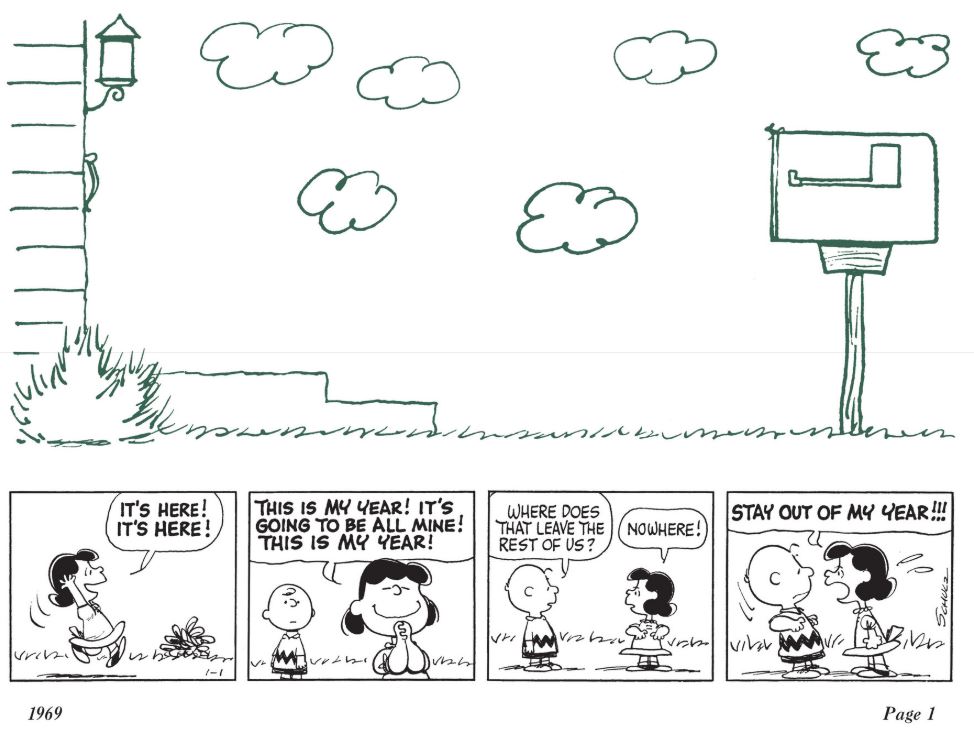
Human interactions still find the boy a pitiable outlier. Mean girl Violet, musical prodigy Schroeder, self-taught psychoanalyst/dictator-in-waiting Lucy, her brilliantly off-kilter little brother Linus and dirt-magnet “Pig-Pen” are fixtures honed and primed to generate joke-routines and gag-sequences around their signature foibles, but some early characters have faded away in favour of fresh attention-attracting players. Newcomers sidle in and shuffle off without much flurry or fanfare but in our real world the use of “Minority” characters José Peron of New Mexico and African American Franklin drew much attention and controversy – because, I guess, there will always be gits and arseholes – especially if the oblivious readers elected them…

The most significant expansion is that weird upside bird bugging the beagle gets a name – Woodstock (as revealed on June 22, 1970) – and a job as his dogsbody – secretary, actually – whilst shock near-cripples the round-headed kid when he discovers that the “little red-haired girl” he almost plucked up the nerve to talk to moves to a new city. It’s a blow he’s still reeling from when this book ends two years later, and one only Linus really understands. After all, his teacher Miss Othmar is gone after the teacher’s strike…

There is much more madcap politically-tinged material, including repeated riffs on a recently inaugurated new real-world president (Richard Milhous Nixon on January 20, 1969) as seen when Snoopy briefly becomes the most powerful mutt in the Free world after being chosen as the new Grand Beagle…

At least the Brown boy’s existential crisis/responsibility vector/little sister Sally has grown enough to become just another trigger for relentless self-excoriation. As she grows, pesters librarians, forms opinions and propounds steadfastly authoritarian views, Charlie is relegated to being her dumber, but eternally protective, big brother especially as her biggest bugbear is starting school and Charlie is such an expert on all things scholastic…

Resigned to – but far from uncomplaining about – life as a loser in the gunsight of cruel and capricious fate, the boy Brown is helpless meat in the clutches of openly sadistic Lucy. When not sabotaging his efforts to kick a football, she monetises her spiteful verve via a 5¢ walk-in psychoanalysis booth (although supply and demand economics also affects this unshakeable standard), ensuring that whether at play, in sports, kite-flying or just brooding, the round-headed kid truly endures the character-building trials of the damned.

One deliciously powerful constant that grows more abundant is the boy’s utter inability to fly that kite. Here war with wind, gravity and landscape reaches absurdist proportions, as the tree haunts Charlie Brown’s adored pastime with vicious, violent and malign venom. Moreover, other kids are aware of its growing power. After one terse musical interlude with Schroeder, Lucy lobs our reluctant lover-boy’s beloved piano into the voracious carnivorous conifer…

By now, the beagle is the true star of the show, with his primary quest for more and better playing out against an increasingly baroque inner life, wild encounters with birds, sports, dance marathons and skating trysts (especially the close-order combat called ice hockey!), philosophical ruminations, and ever-more-popular catchphrases. Here, burgeoning whimsy leads to more glimpses of the interior world: his WWI other life, peppered with dogfights against the accursed Red Baron, but also careers as an astronaut, a sports coach, a prairie dog and a detective seeking his lost mother. That tragic obscured past as an alumni of the Daisy Hill Puppy Farm leads to constant introspection… and dancing… lots and lots of dancing…

Naturally, Snoopy soon subverts all that misery and curiosity to fuel his creative side and begins the Great American Novel that will change literature forever… but that’s before the Browns go on vacation and leave the dog with the Van Pelts. Naturally, Lucy has an idea about finally fixing the pooch. It doesn’t end well…

As always, timeless episodes of play, peril, peewee psychoanalysis and personal excoriation are beards for some heavy topics. Rendered in marvellous monochrome, there are crucial character introductions, plot developments and creation of more traditions we all revere to this day. Of particular note is the growing role of Patricia Reichardt – AKA tomboy Peppermint Patty – who heartbreakingly deals with the so-early discovery that she will never be pretty or beautiful. Even Snoopy’s most concerted efforts can’t quite salve that sting…

Another trenchant continued gag-series resumes Lucy obsessive attempts to “cure” Linus of his blanket dependency by again playing him off against Grandma who will give donations to charities if the boy grows up…

Snoopy is the only force capable of challenging if not actually countering Lucy. Over these two years, her campaign to curb that weird beagle, cure her brother of blanket addiction and generally reorder reality to her preferences reaches astounding heights and appalling depths, but the dog keeps trying and scores many minor victories. As always the book opens and closes with many strips riffing on snow, food, movie-going and television – or the gang’s responses to it – becoming ever more pervasive. And as always, Lucy constantly, consistently sucks all the joy out of the white wonder stuff and the astounding variety offered by the goggle-box. Perpetually sabotaged, and facing abuse from every female in their life, Brown and Snoopy endure more casual grief from smug, attention-seeking Frieda, who champions shallow good looks over substance. At least Linus is growing: hardened inside by what happened to teacher Miss Othmar, but Lucy’s amatory ambitions for Schroeder grow ever more chilling and substantive. She will never move on…
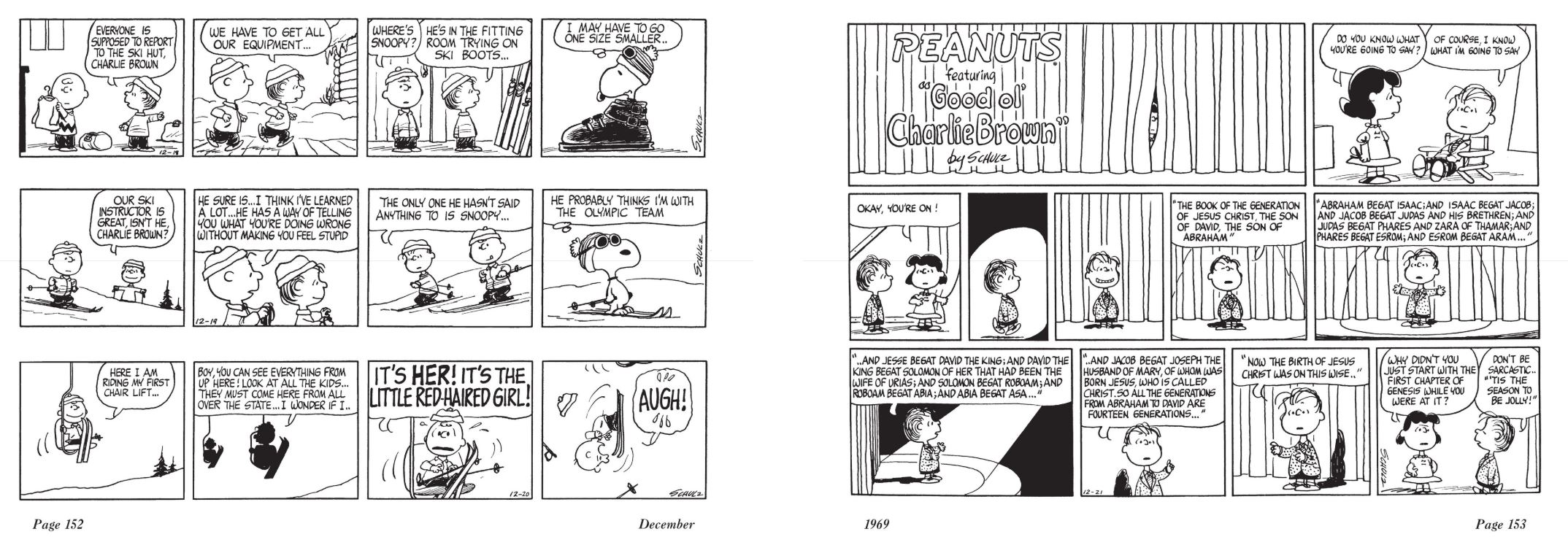
Schulz established way points in his year: formally celebrating certain calendar occasions – real or invented – as perennial shared events: Mothers and Fathers’ Days, Fourth of July, National Dog Week strips accompanied in their turn yearly milestones like Christmas, St. Valentine’s Day, Easter, Halloween/Great Pumpkin Day and Beethoven’s Birthday were joined this year by a return to another American ritual as many of the cast return to summer camp. At least there is unbridled joy when Brown’s baseball team hits a winning streak and Charlie meets his all-time sporting idol – except of course they’re not quite the boons they first appear…

Sports loom large and terrifying as ever, but star athlete Snoopy is more interested in new passions than boring old baseball or hockey. Even Lucy finds far more absorbing pastimes but still enjoys crushing the spirits of her teammates in whatever endeavour they are failing at. Anxiety-wracked Brown even steps down from the baseball team to ease his life, but that only intensifies his woes, and does nothing to help his kite wielding or football kicking…

Linus endures more disappointment in two Great Pumpkin seasons and before you know it, there’s the traditional countdown to Christmas and another year filled with weird, wild and wonderful moments…
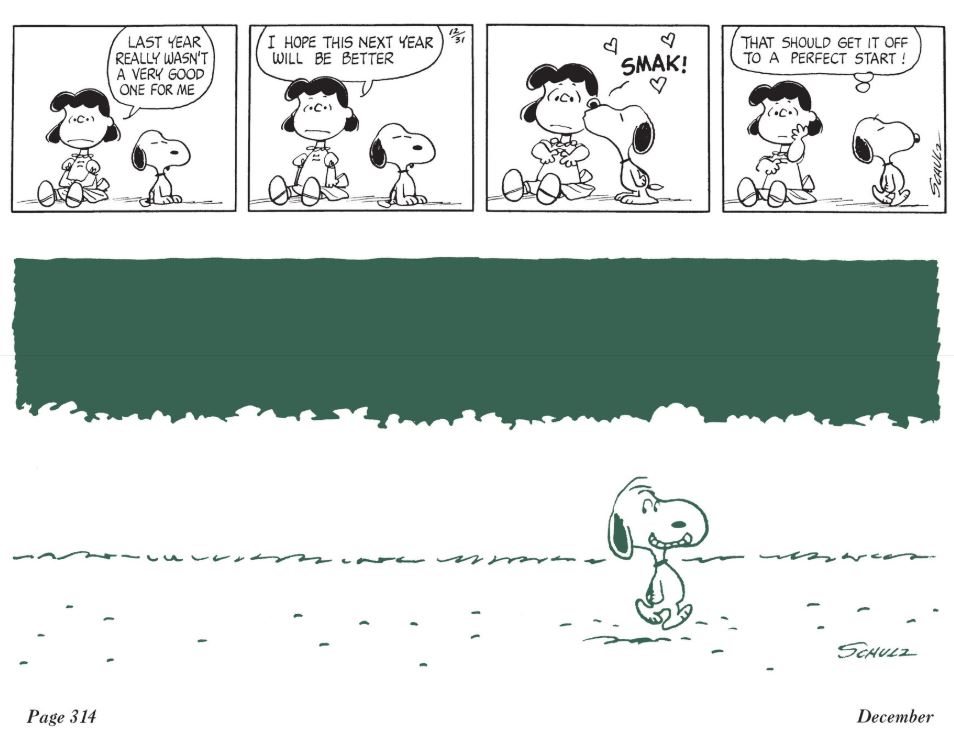
Wrapping it all up, Gary Groth celebrates and deconstructs the man and his work in ‘Charles M. Schulz: 1922 to 2000’, preceded by a copious ‘Index’ offering instant access to favourite scenes you’d like to see again…

Available in multiple formats, this volume guarantees total enjoyment: comedy gold and social glue metamorphosing into an epic of spellbinding graphic mastery that still adds joy to billions of lives, and continues to make new fans and devotees long after its maker’s passing.
The Complete Peanuts: 1969-1970 (Volume Ten) © 2008 Peanuts Worldwide, LLC. The Foreword is © 2008, John Waters. “Charles M. Schulz: 1922 to 2000” © 2008 Gary Groth. All rights reserved.

Today in 1946 Lucky Luke “debuted” in the Spirou Alamanch Annual – except if you read Lucky Luke: The Complete Collection Volume One you’ll know that ain’t necessarily so…

And in 1970 the incredible Rube Goldberg shuffled off this mortal coil. It was probably one he had designed in his masterful cartoons. Go google Rueben Awards

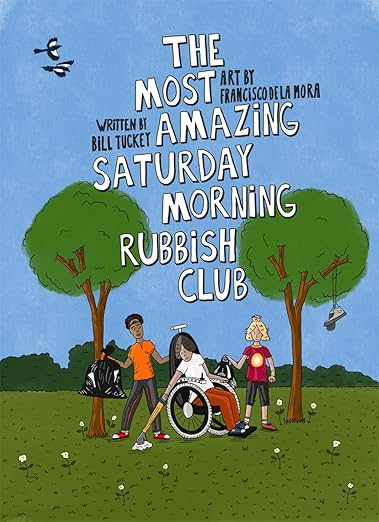
The Most Amazing Saturday Morning Rubbish Club


By Bill Tuckey & Francisco de la Mora (SelfMadeHero)
ISBN: 978-1-914224-36-2 (TPB)

Win’s Christmas Gift Recommendation: Family entertainment… 8/10

Are you old enough to remember, books, films and comics aimed at kids who would see players their own age finding a problem and sorting it out themselves? That’s what this fabulous yarn is, only here those plucky protagonists are all kids with conditions the world says renders them even more useless and in fact unable to act or think for themselves at all…

Writer (broadcaster, radio DJ, journalist, editor) Bill Tuckey & artist Francisco de la Mora (Frida Kahlo – Her Life, Her Work, Her Home please link to March 13th 2023) are both parents of children with special needs. Tuckey’s boys have ASD (Autism Spectrum Disorder) and de la Mora’s lad has PVL (Periventricular leukomalacia) and both creators have brought those experiences into a grand adventure that is also a signpost for how you should all behave around those of us that need a little forethought, patience and consideration…

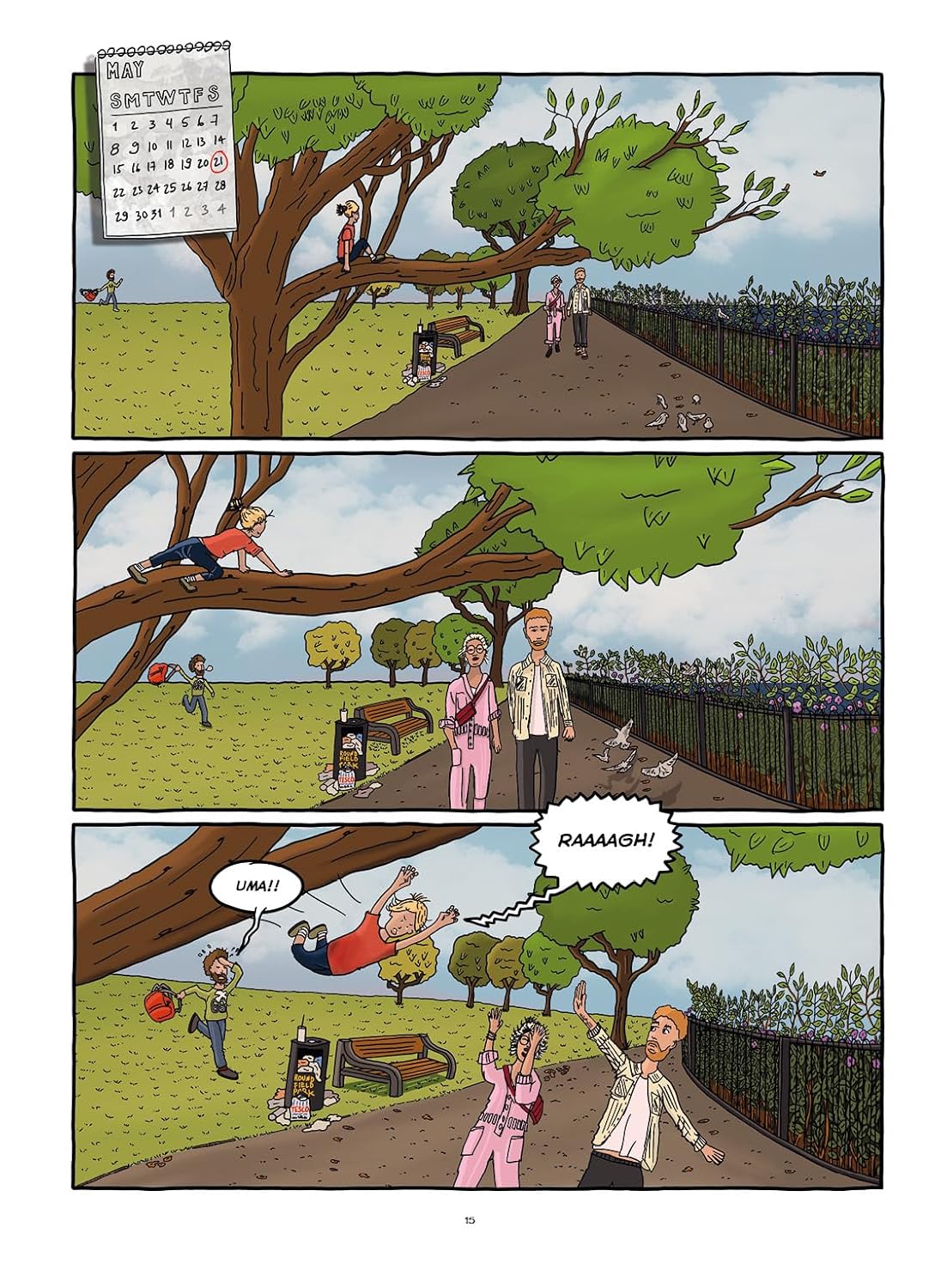
In a city district near a park, 11-year-olds Arthur Ballentine and Finn Gregory are already pals when they first encounter tireless fireball Uma Blanco. She’s 8 and has PVL. It leaves her with speech difficulties and cognitive deficits, but she always knows what she wants and runs rings around Arthur, who has ASD, and Finn, stuck in his wheelchair due to cerebral palsy.

They instantly unite over the way the insensitive folk (“the white people”) around them act and find purpose in the way their favourite space is becoming one huge litter trap. It’s just one aspect of the ongoing neglect slowly ruining the treasured urban green space. It’s getting less fun all the time now, as they learn from embattled park warden “the General”, lumbered with explaining why the latest council cuts mean the disabled toilets are closed from now on…

By June the kids are firm friends and resolved to do something. It begins with just picking up other people’s rubbish every Saturday, but builds before going into extreme overdrive once they discover a quiet, damaged man is living under the trees with a fox called Winchester. He’s buried himself in an underground hideout constructed secretly from other people’s cast offs…

And thus begins a quirky tale of renewal and unlikely friendships which charmingly lead to victory for the idealistic nippers, salvation for sad, strange wild engineer Richard (once the police stop being involved) and even a glorious storybook ending of sorts…

This is not polemic masquerading as entertainment. There’s a clever plot, compelling drama and a profound resolution in the offing. Of course there are plenty of incidents underlining how crap we are as society in taking care of our fellows, but it’s velvet-gloved in a welter of witty incidents and glorious characters studies of the kids and all the adults they impact and gradually convert to a better way of thinking and acting…

I don’t get to use the terms inspirational or heartwarming much when reviewing modern books and comics but when The Most Amazing Saturday Morning Rubbish Club inevitably becomes the next big British indie movie hit (like The Lady in the Van but closer to the kerb and bushes), I’ll be back to say I told you so and to plug the book all over again…
© 2025 Francisco de la Mora/Bill Tuckey. All rights reserved.

Today in 1911 Disney comics artist Paul Murray was born. We last saw his mastery in Walt Disney’s Donald Duck Volume 2: The Diabolical Duck Avenger. In 1950 Chris Claremont was born, and the magnificent Bob Haney died today in 2004. You don’t need me to tell you what they did and where to find their works.

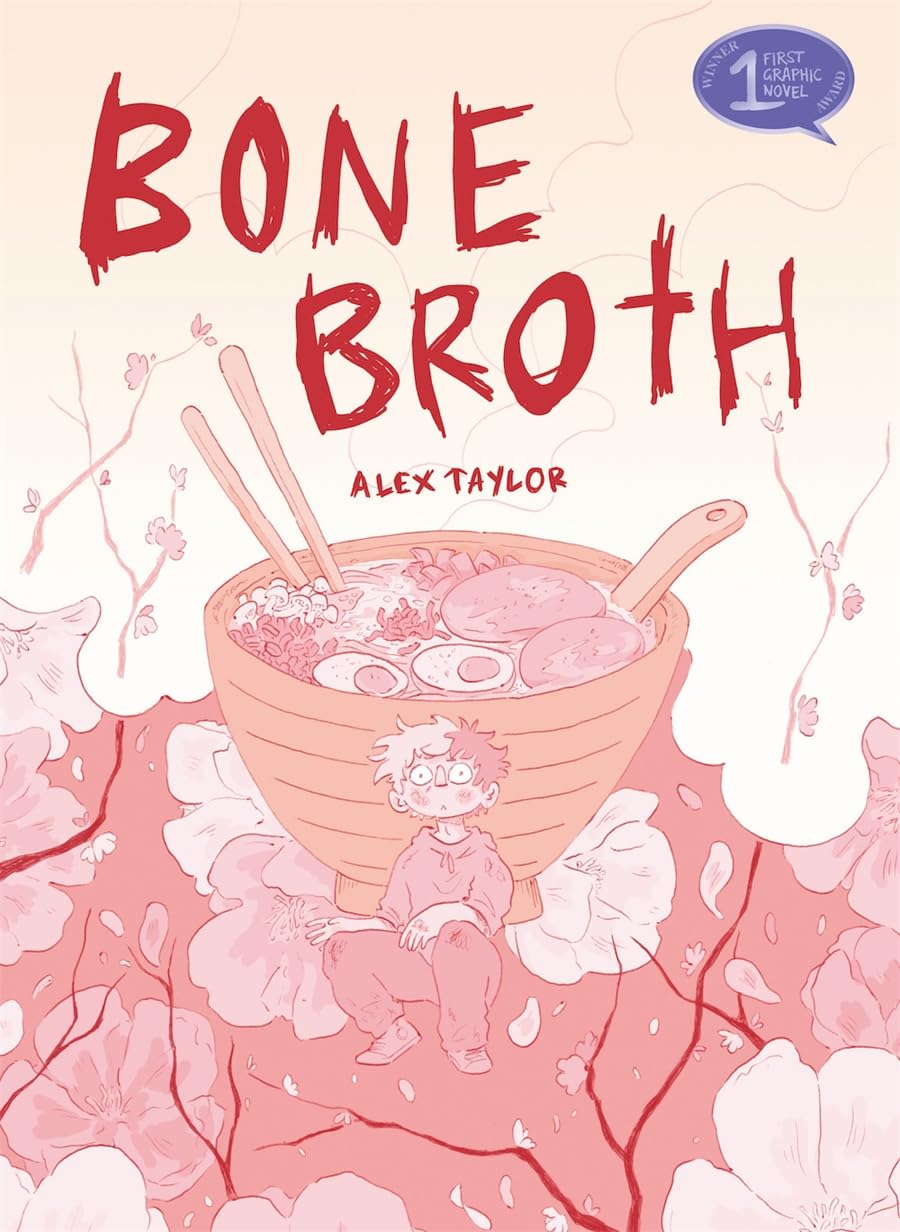
Bone Broth


By Alex Taylor (SelfMadeHero)
ISBN: 978-1-91422-432-4 (TPB)

Win’s Christmas Gift Recommendation: Tasty Treats for Comics Fan-Addicts… 9/10

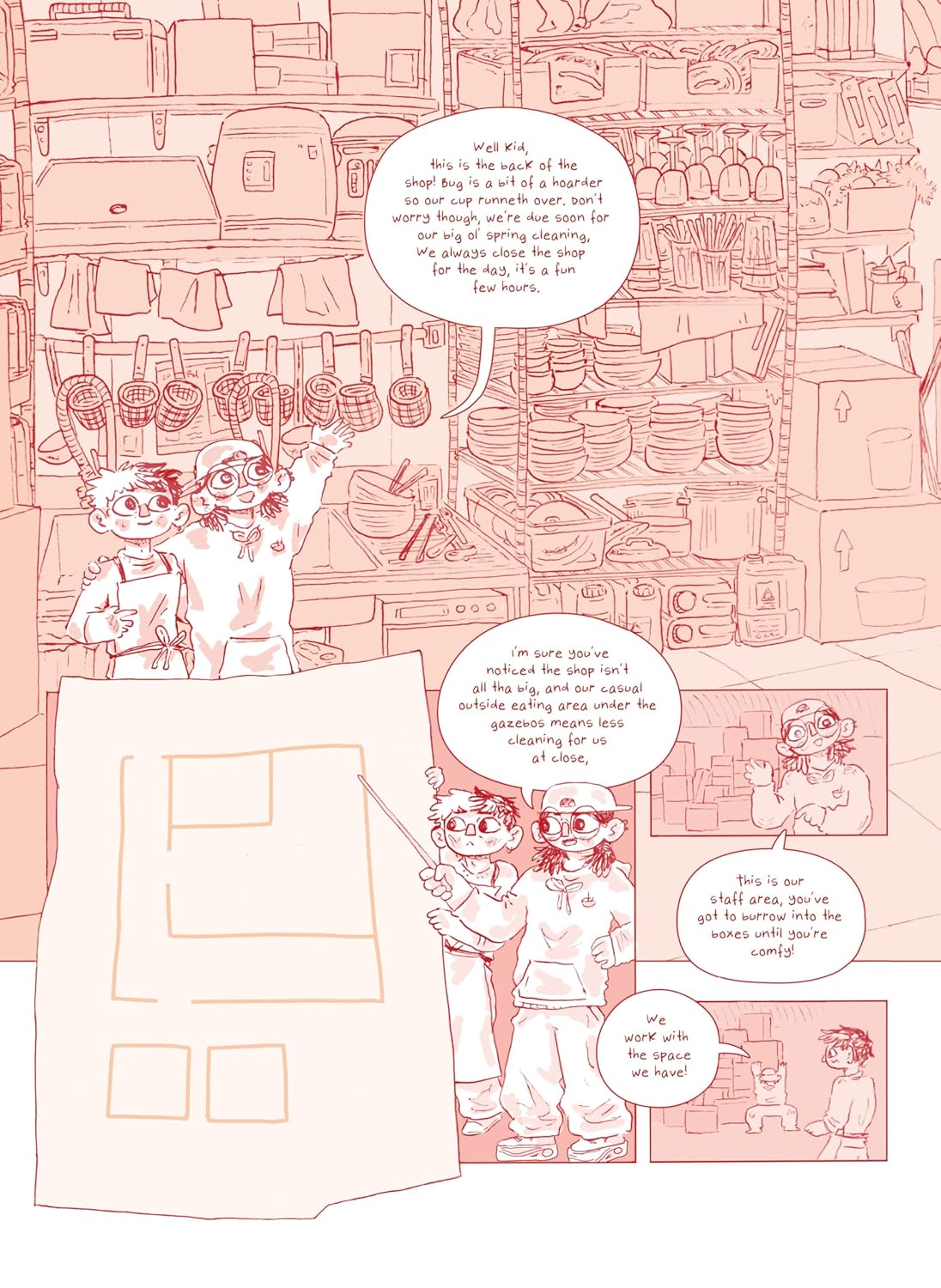
Here’s a quick, short review of a big, utterly fulfilling, extremely entertaining new confection from queer visual artist Alex Taylor. Winner of the First Graphic Novel Award for 2023, Bone Broth is set in contemporary London – literally underneath the arches! – and compellingly addresses modern living via the oldest traditions of mystery thriller writing…

Ash ia young transmaculine artist who almost nearly properly grown up. All that’s missing is to make enough money to pay rent, buy supplies and secure the meds supporting still- ongoing surgeries. That ideal opportunity knocks when crusty old coot/ramen sensei Bug adds the weedy-seeming new guy to the remarkable staff at his traditional noodle bar.

That highly popular haven of exotic eats and affordable takeouts is located off a dingy alley with trains roaring and clattering above at all times. It reminds me of Brixton, but of course, other rail lines, vibrant cross-cultural districts and eateries are available…

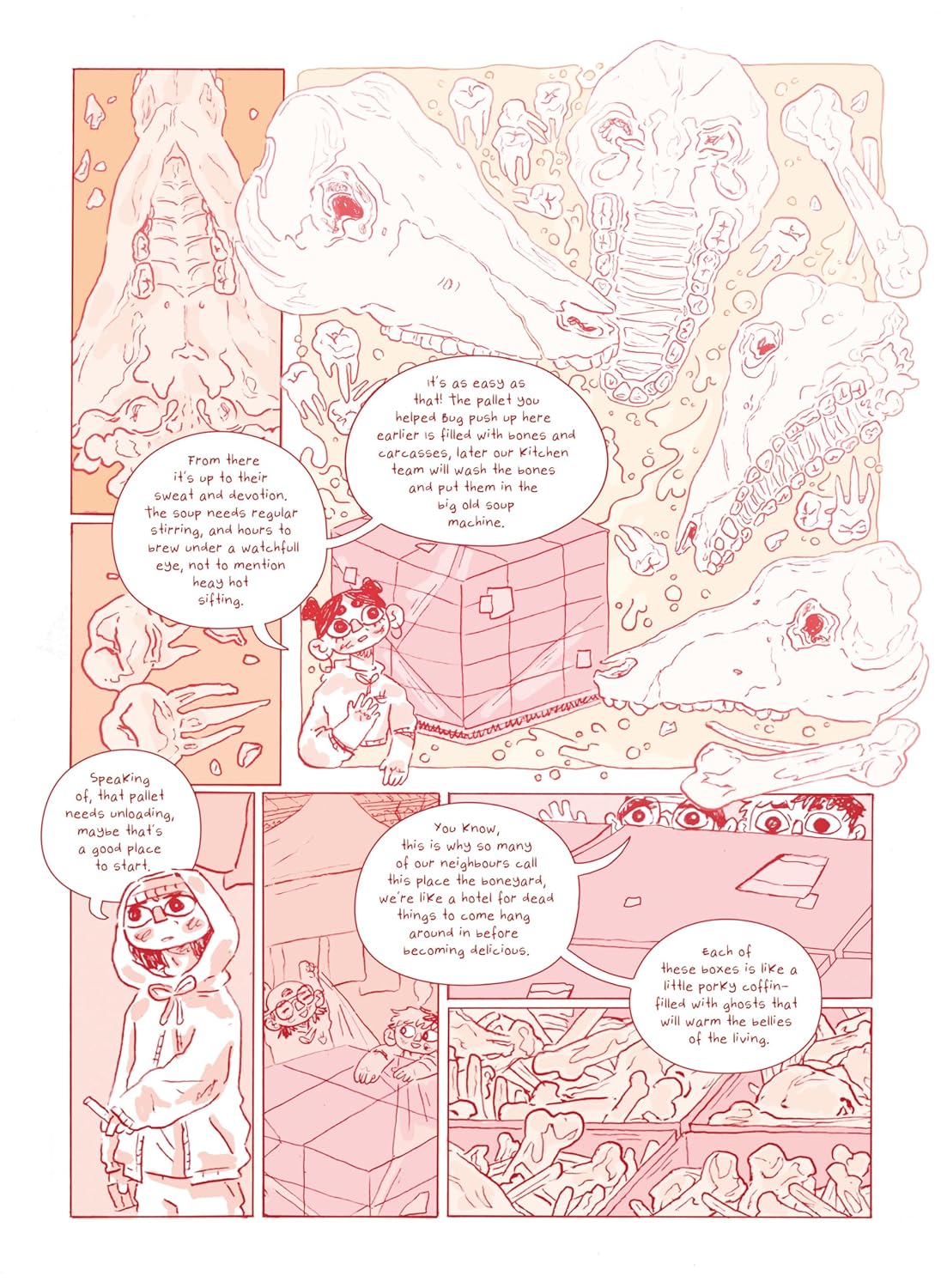
Business is brisk and Ash gets acquainted with floor maneger Honey, Sock, Blue, and burly Japanese broth-engineer Creamy – who philosophically monitors and stirs the industrial scale tonkotsu that is basis of all the dishes – whilst scrambling to learn the ropes. The work is intense, fast, complicated, relentless and – just like in any specialist enteprise (like a comic shop for instance ) – sticky, clammy, cloying and jampacked with weirdoes individualists on both sides of the till.

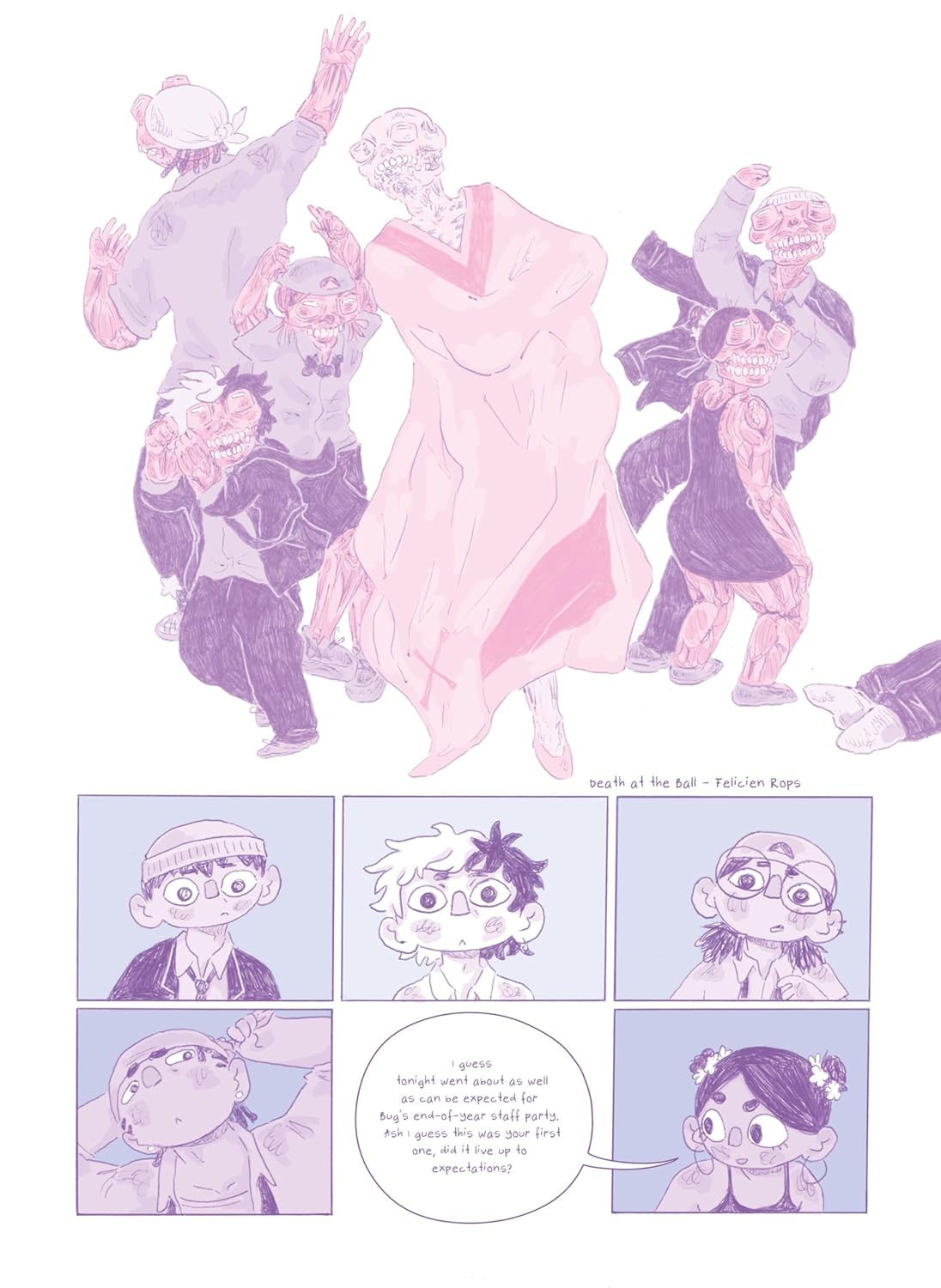
Nevertheless, Ash is immediatly part of the family, trading history and opinions, sharing moments and learning to live with the miasmic funk of entire pig carcasses perpetually becoming soup 24/7. It’s the kind of toil that quickly builds bonds that feel decades old so it’s no wonder everybody kicks back for celebratory drinks occaiosnally. Like the End-of-Year staff do when Bug drinks so much that he just goes to sleep on the floor and everybody took selfies with him.

Of course, Bug wasn’t unconcious and they all have to try and make rational decisions whilst being that drunk. Deleting recents posts is easy and logical but voting to lose the sensei in the body-rending broth doesn’t seem like such a great idea now…

Draped in biological hues and mired in literally organic imagery, Bone Broth’s motifs accentuate an unfolding comedy of errors: deftly mirroring the surgical progress of changing gender whilst reflecting on whatever beneficial butchery is involved in resculpting and crafting a human form with secret knowledge is exposed to those willing to look and think instead of react and revolt. This is a tale that some people will never countenance and that’s sad for them, because its also great stuff demanding second helpings…

Wryly subversive, tantalisingly warming and definitely NOT for little kids, this potent parable is seasoned with buddy film tropes and garnished with a delicious twist that will hit the spot for anyone with a taste for the out-of-the-ordinary fodder. Also included are a heartfelt ‘Thanks’ section and look at the artist’s ‘Process’ to deliver a multi-layered trifle you’d be fool to turn your nose up at.
Text and images © 2025 Alex Taylor. All rights reserved.

Today in 1951 Bob Smith (Super Friends, Superman, Plastic Man, Archie Comics) was born, as was Northampton’s Finest Alan Moore two years later. In 1985 Bill Watterson’s enfant terrible et big buddy Calvin and Hobbes launched. 1991 today saw UK comics stalwart Reg Parlett leave us. All of these optical miracles should be scrutinised at great length, so please go do that…

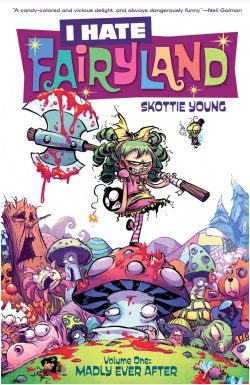
I Hate Fairyland volume 1: Madly Ever After


By Skottie Young, Jean-Francois Beaulieu, Blambot®’s Nate Piekos & various (Image Comics)
ISBN: 978-1-63215-685-3 (TPB/Figital edition)

This book contains Discriminatory Content included for comedic effect.

Win’s Christmas Gift Recommendation: Sugar & Spice & Everything Nicely Reimagined… 10/10

It feels like we haven’t had a good laugh in ages. Oh wait, here’s one now…

We grow up with fairytales all around us. They’re part of the fabric of our lives. Some people generally outgrow them whilst others take them to heart and make them an intrinsic aspect of their lives…

Have you met Skottie Young?

He’s a guy with feet firmly planted in both camps and well able to alternatively embrace the enchantment of imagination and give it a hilariously cynical mean-spirited drubbing at the same time. Hopefully you’ll have seen his glorious, multi-award-winning interpretation of Baum’s Oz books produced by Marvel and his spectacular run on Rocket Raccoon (and Groot!); or perhaps just his gut-bustingly funny baby superhero covers. Maybe you’re aware of his collaboration with Neal Gaiman on Fortunately the Milk?

If not, there’s so much more in store for you after enjoying this particular slice of vintage mirthful mayhem…

I Hate Fairyland is a truly cathartic little gem: a mind-buggering romp of deliciously wicked simplicity and one I heartily recommend as a palate-cleanser for anyone overdosing on cotton candy, wands and glitter, or spandex and slicked-back pecs.

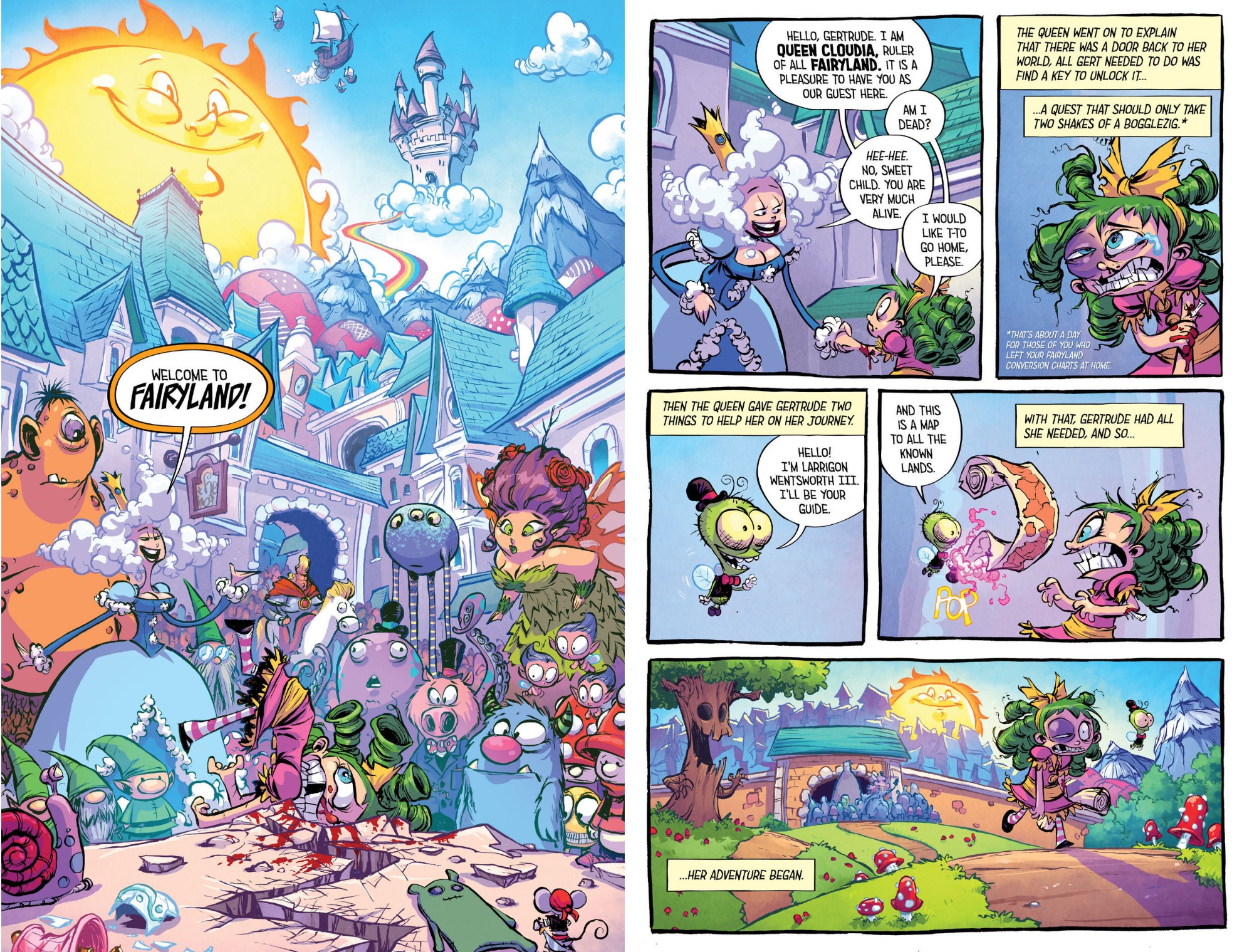
Once upon a time little Gertrude wished she could visit the wonderful world of magic and joyous laughter. Her wish was inexplicably granted and she met happy shiny people: fairies, elves, giants, talking animals and animated trees, rocks, stars, suns and moons; Gert just loved them all…

Resplendent Queen Cloudia made her an Official Guest of Fairyland and invited her to play a game. When she wanted to go back to her own world the bedazzled six-year-old simply had to find a magic key and open the door to the realm of reality. The fabulous Fairy Queen even gave Gertrude a quaintly talking bug as guide and helpmeet, plus a magic map of all the Known Lands…

That was 27 years ago and although Gert’s body has not aged a day her mind certainly has. It’s also gotten pretty pissed-off at the interminable insufferable task and just wants it all to end.

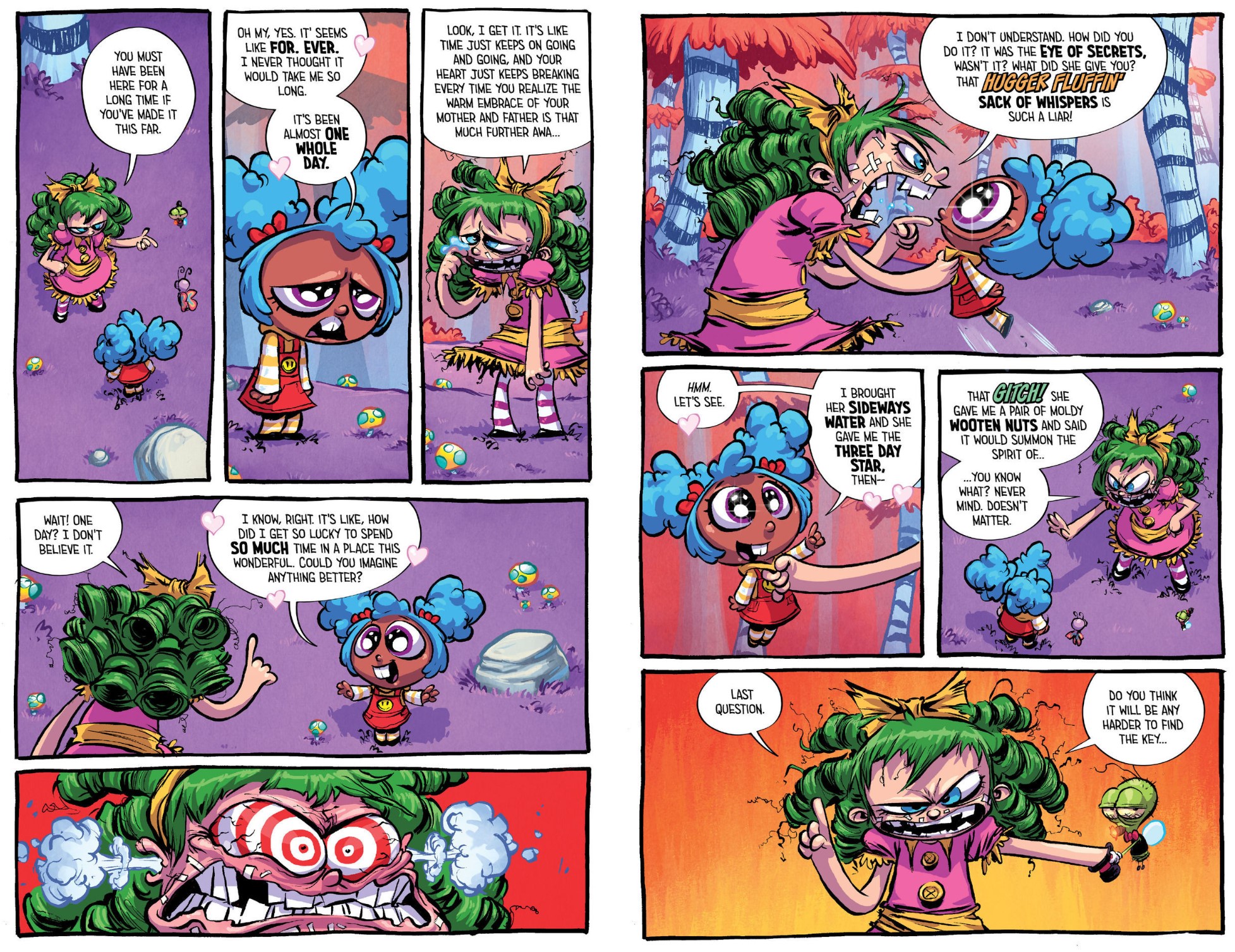
Of course, as an Official Guest of Fairyland Gert can’t die and has taken to expressing her monumental frustration in acts of staggering violence and brutal excess as she continues hunting for that fluffer-hugging key…

With no other choice, Gert and dissolute bug Larrigon Wentsworth III toil ever onward in search of the way home, regularly enduring horrific – but non-fatal – injuries and taking out their spleen (and often other peoples’) on whoever gets in her way.

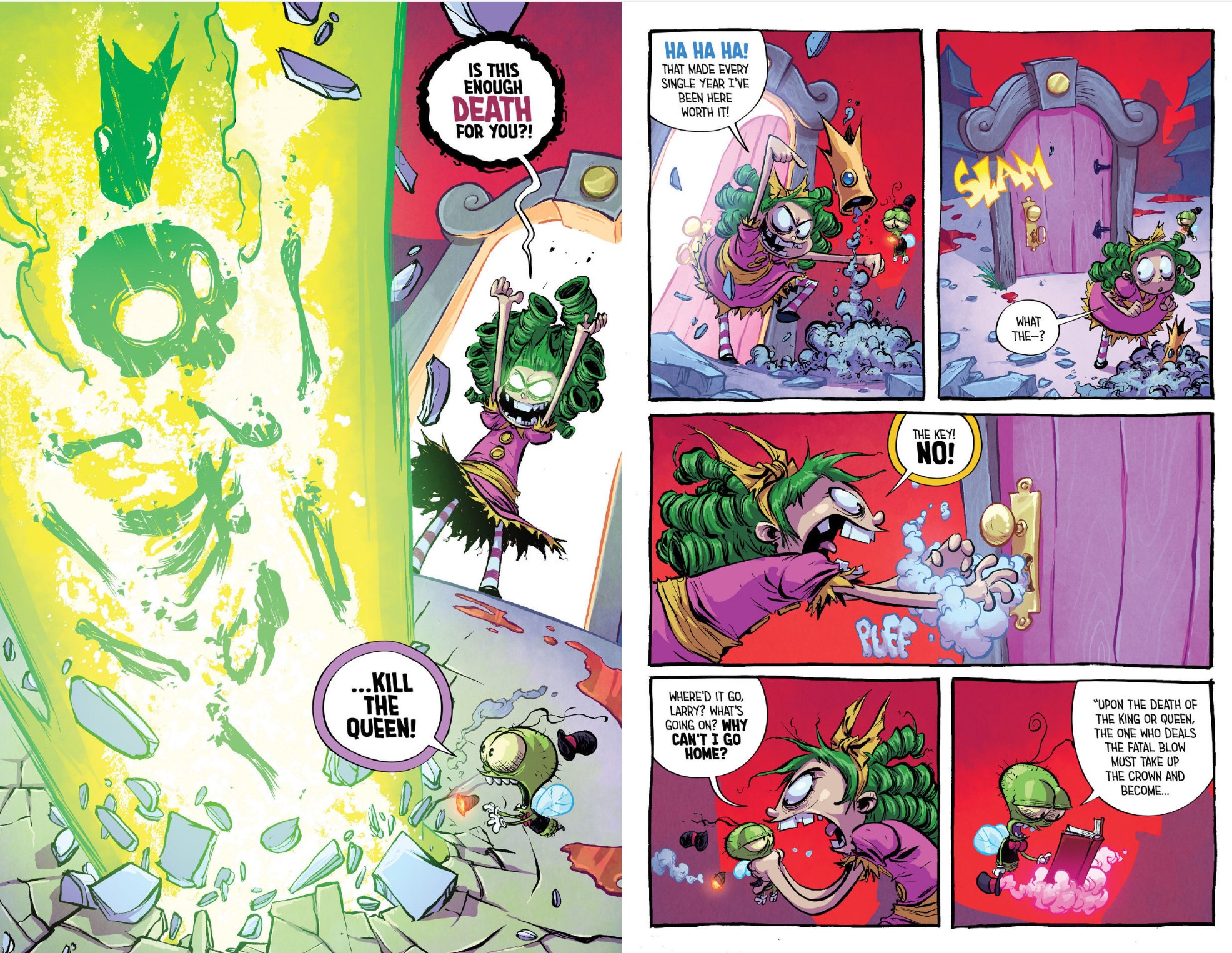
After all this time, however, Even Queen Cloudia has had enough. Sadly, she can’t do anything about it whilst Gert is “OFG” (Official Guest of Fairyland, keep up!): a privilege that simply cannot be revoked.

Subtle hints of vast rewards to barbarians and assassins and evil witches all prove worthless too. Between the protection spell and Gert’s own propensity for spectacular bloodletting, there’s nothing in the incredible kingdoms to stop her.

… And then someone has a really amazing idea. Why not invite another sweet little girl to Fairyland and offer her the same deal? When she finds the key, wins the game and goes back, Gert will lose her OFG status and they can be rid of her at last!

Of course, that all goes swimmingly, just like Cloudia hoped and everybody but Gert lives happily ever after.

No, it really, really doesn’t work out like that…

To Be Continued…

Collecting the first five issues of the Image Comic series from October 2015 – February 2016 by Young, colourist Jean-Francois Beaulieu and letterer Nate Piekos of Blambot®, this sublimely outrageous treat offers hilariously over-the-top cartoon violence and the most imaginative and inspired use of faux-profanity ever seen in comics.

This is an unmissable wakeup call for everybody whose kids want to be little princesses and proves once and for all that sweet little girls (and probably comics artists) are evil to the core if you push them too far…
© 2016 Skottie Young. All rights reserved.

Today in 1911, cartoonist Clarence Gray was born. Sadly, there isn’t much of his wonderful Brick Bradford strip around to review. Far more readily represented is Alberto Giolitti whose art can be seen on loads of licensed features books we’ve covered like Star Trek: Gold Key Archives volume 1, and who would be 102 today if he still lived…

In 1941 French star fantasist Caza was born, whilst Superman scribe Elliot S! Maggin joined us in 1950 and FF artist Carlos Pacheco was born in the same year they were: 1961…

Death Be Damned


By Acker, Blacker & Miller, Hannah Christenson, Juan Useche & various (Boom! Studios)
ISBN: 978-1-68415-039-7 (TPB) eISBN: 978-1-61398-716-2

This book contains Discriminatory Content included for dramatic effect.

First seen as a 4-issue miniseries in 2017 written by Ben Acker, Ben Blacker (The Thrilling Adventure Hour podcast, Deadpool, Thunderbolts. Supernatural) & Andrew Miller (Backstrom, League of Pan, The Secret Circle), spooky sagebrush saga Death Be Damned is a deft and compelling addition to the growing, cross-fertilising genre of supernatural westerns. The series was visualised by celebrated illustrator Hannah Christenson (Harrow County, Mouse Guard, Jim Henson’s Storyteller) with colours by Juan Useche and letters from Colin Bell.

In delivery the tale is stripped down, raw and utterly engaging, delivered in sweeping tributes to more than a century of high plains cinema, and begins in 1873 Wyoming after brutalised settler Miranda Coler awakes face down in the river to find her entire family have been butchered. A tough, determined survivor, she buries her husband and child and, picking up her man’s rifle, sets about tracking down the gang who killed them.

By the time she reaches South Pass City, she’s ready to accept any passing pain or humiliation if it leads to her justifiable vengeance, Sadly, righteous anger doesn’t make her good enough to kill one of the marauders in the town whorehouse and he casually puts a bullet in her brain…

Local undertaker Murray takes his job far too seriously. Since his wife passed, he’s become an expert on death rituals and is letting these studies affect his work. He keeps trying to raise the dead and now can’t believe he’s succeeded with the crazy woman just killed in the cathouse…

Events eventually prove he hasn’t, really, but perhaps his attempts to retrieve the dead have set something incredible in motion…

In Laramie City, mass killer Bickford hangs for his crimes. A little later he also gets up: drawn inexorably to South Pass where something unnatural needs to be quashed…

Miranda thinks Murray is crazy, but after he kills her and she comes back again, she finally hears him out. He wants the revenant to rescue his wife from Hell, but has no idea what the land of death is really like. Miranda still wants revenge though, and she’s quite happy to exploit the undertaker’s foolish whims if it gets her closer to her goal, no matter how many times she has to die in the doing of it…

A tale of dark obsessions played out through a nest of gradually-unfolding mysteries, this sinister saga employs all the iconography of “big sky” westerns to add mood to a blistering tale of debts incurred and accounts called due. Unstoppable Miranda even beats her devils to exact precious retribution and learns the painful truths of her life, her man and a hell of a lot of death…

Available in paperback and digital editions, Death Be Damned is graced with an expansive cover gallery by Christenson & Konstantin Tarasov, as well as character designs, and also reveals some secrets of the illustrator’s Cover Process.

A short sharp shocker, to ingest before heading out to roam your own streets in search of treats and judgement…
Death Be Damned is ™ & © 2017 Workjuice Corp. & Andrew Miller.

Today in 1976 appropriately saw the demise of UK gagfest Monster Fun after a mere year of yoks and giggles. Big bunch of birthdays though, with European giants Michel Charlier born in 1924 and Will in 1927, and US pioneer of comics fandom Don Thompson in 1935. In 1951 P. Craig Russell joined the party. Him you can adore in many books including Richard Wagner’s The Ring of the Nibelung.

Chas Addams™ Half-Baked Cookbook: Culinary Cartoons for the Humorously Famished


By Charles Addams (Simon & Schuster)
ISBN: ?978-0-7432-6775-5 (PB) eISBN: 978-1-439-10386-9

This boos includes Discriminatory Content produced in less enlightened times. It also uses Discriminatory Content included for comedic and satirical effect.

Cartoonist Charles Samuel Addams (1912-1988) was a distant descendant of two American Presidents (John Adams & John Quincy Adams). He compounded that hereditary infamy by perpetually making his real life as extraordinary as his dark, mordantly funny drawings.

Born into a successful family in Westfield, New Jersey, the precocious, prankish, constantly drawing child was educated at the town High School, Colgate University, the University of Pennsylvania, and New York City’s Grand Central School of Art, and apparently spent the entire time producing cartoons and illustrations for a raft of institutional publications.

In 1932 he became a designer for True Detective magazine – “retouching photos of corpses” – and soon after started selling drawings to The New Yorker. In 1937, at the peak of popular fascination in cinematic and literary horror stories, he began a ghoulish if not outright macabre sequence of family portraits that ultimately became his signature creation. However, during WWII, he toned down the terror and served with the US Signal Corps Photographic Center, devising animated training films for the military.

Whether Addams artfully manufactured his biography to enhance his value to feature writers or was genuinely a warped and wickedly wacky individual is irrelevant, although it makes for great reading – especially the stuff about his wives – and, as always, the internet is eager to be your informative friend…

What is important is that in all the years he drew and painted those creepily sardonic, gruesome gags and illustrations for The New Yorker, Colliers, TV Guide and so many others, he managed to beguile and enthral his audience with a devilish mind and a soft, gentle approach that made him a household name long before television turned his characters into a hit and generated a juvenile craze for monsters and grotesques that lasts to this day. That eminence was only magnified once the big screen iterations debuted. And now we have streaming fun too. He would have loved the sheer terrifying inescapability of it all…

As he worked on unto death, Addams got even wackier: marrying his third wife in a pet cemetery, spending a fortune collecting weapons and torture devices – “for reference” – and inventing… recipes…

In a legendary career dedicated to being odd, the sudden swerve into crafting and compiling an actual cookbook garnished with macabre cartoon japery is a fabulous affirmation of all the unharnessed unpredictability man stood for, and one which constantly delivers treat after tasty treat…

The compendium commences with introduction ‘Café Styx’ from culinary author Allen S. Weiss, after which a bundle of gags – many starring Addams Family stalwarts – brings us to the secrets of making mouthwatering ‘Mushrooms Fester’. Always be sure when cooking this where you sourced your fungi from – and what you need them to do…

The pattern repeats throughout in chapters divided into ‘Platters’: soundly sinister laughs and gruesomely gustatory giggles peppered with rather tasty recipes. You can see for yourself the quality of the cartooning here so I’ll be brief for a change and simply menu the other olfactory and tongue-tangling taste-bombs included.

The next is utterly self-explanatory ‘Macaroni and Oysters’, ending the first course prior to commencing the ‘Second Platter’ – specifically ‘Black Puddings’ (Yanks call them “blood puddings” and they’re not wrong) and ‘Transparent Pie’ with ‘Boiled Salad of Fiddleheads’ (that’s newly sprouted ferns)…

Pausing for a delicious ‘Intermezzo’ of home-made (for who could sell them?) ‘Dandelion Beer’ and ‘Influenza Punch’ accompanied by ‘Stewed Pigeons’, ‘Potted Woodland Squirrel’ & ‘Fried Locusts’ sagaciously catered to with helpful ‘Hints for the Ill’, we eventually come to what all gastrophiles, gastronomes (and gastrophobes!) have been waiting for: the triumphant ‘Third Platter’ and subsequent ‘Digestifs’

Here the drawings are in their prime and perfectly piquant whilst consumers are advised on how to tackle ‘Hearts Stuffed for Valentine’s Day’ (with a most special Stuffing mix); ‘Ostrich Eggs’ and ‘Reindeer Rice Curry’. Of course, as with all comedy, acquiescence and acceptance in adversity might mean modern kitchen scullions might need to replace the odd ingredient for all these GENUINE early American recipes collected by Chas and Tee Addams over decades, but what really matters is that gradually older collections of the Addams oeuvre are being unearthed and this one’s truly scrumptious; or perhaps just an acquired taste…

For clarity and pure knowledge this volume closes with a full biography of the auteur and full list of ‘Credits’ for the recipes included.

Should you not be as familiar with his actual cartoons as with the big and small screen legacy Addams unleashed, you really owe it to yourself to see the uncensored brilliance of one of America’s greatest humourists. It’s very appetising and dead funny…

© 2005 by Tee and Charles Addams Foundation. All rights reserved.

Today was a biggie for Comics. In 1764, grand master and originator of mean drawing William Hogarth died. In 1931 Stan’s brother (the one who could write AND Draw) Larry Lieber was born. Among his many unsung triumphs was Rawhide Kid, co creating Iron Man and writing most of the stories in Mighty Marvel Masterworks: The Mighty Thor volume 1: The Vengeance of Loki.

In 1941 Belgian Bob De Groot was born. You really should read one of his many light adventure gems such as Clifton volume 5: Jade.

In 1970, two US strips launched today one was Mel Lazarus’ venerable Momma, and the other was by Gary Trudeau. Go see and worship some more with the fabulous Yuge! – 30 Years of Doonesbury on Trump.

Black Jesus volume 1


By Jimmy Blondell & David Krintzman, Nicholas Da Silva & Bigjack Studios (Brazil)  (Arcana)
ISBN: 978-1-897548-55-4 (TPB)

I’m always keen to spark a little controversy, so here’s an intriguing parable you probably missed when it launched in 2009 or the last time we plugged it. Moreover, remember as you proceed that even worse than being oppressed, deliberately deprived or “othered” is being denied your own existence…

Superheroes are often cited as a new mythology and occasionally comic books dabble with the idea that there’s not much difference between gods and metahumans. In a world where unnatural powers are common currency – at least in our fictions and entertainments and certain religions – what happens when a genuinely different being appears and acts in ways neither the guardians of society nor the laws of physics will tolerate?

Conceived and written by Jimmy Blondell & David Krintzman with art from Nicholas Da Silva (assisted by Brazil’s Bigjack Studios) this gripping thriller presents all the facets of an urban/horror/conspiracy thriller but don’t be fooled. There’s more going on here than first appears…

Chris is a young black man in New York City. He’s a bit weird, and not just because of the recurrent nasty visions of cruel hunters slaughtering animals in the Serengeti. Chris lives a peaceful life in a city where criminality, intolerance and hostility are everywhere, harming no one and caring for his pigeons in their rooftop roost.

He’s got friends, a part-time job and plenty of questions about the strange things that keep happening around him. Case in point: despite never practising, he can score a basket from anywhere on the court without even trying. It’s a trick that’s earned the respect of violent angry young men throughout the neighbourhood. When he’s not anywhere else the loner spends time breaking into Central Park Zoo to feed animals, or studying with scholarly Rabbi Goldberg, a man who knows more about the boy’s past than he’s letting on…

An already complex existence takes a frantic turn the day Chris pulls some kids out of a car sinking into the Park Lake. He had to walk across the water to get to them and footage of the rescue made the news everywhere. Thankfully, he kept his hoodie up and most viewers don’t know who he is. That’s not a problem for the devout leader of the Black Christian Gang whose agenda is to reclaim the Messiah for people of colour and destroy forever the myth of a blond, blue-eyed white Christ. He sets his many brothers in the BCG to finding the miracle worker at all costs…

So does black televangelist Reverend Carnivean, whose millions of worshippers, billions of dollars and soaring political ambitions can’t afford such obvious competition. Rather than true believers, he sets his moneymen, whores and assassins to finding the mystery man the media have dubbed Black Jesus…

That becomes even more urgent after a second tragedy strikes and witnesses at a charity gala all report seeing an anonymous young black waiter heal a woman mauled by a lion…

So begins the frantic race to control a potentially divine force or the next stage in human evolution: a trail peppered with bodies and shocking outrages. Of course, it doesn’t help that Chris himself has no idea what he truly is…

Understated and thoughtful, Black Jesus is a thriller about being born different (and yes, I do think that’s a metaphor for being black in America today, and as much so here too and France and…) and exploring dangerous ideas about the nature of divinity, poverty, status and belonging. It also has a strong shot at attempting to debunk the biggest and most divisive lie in politico-religious history.

The series was delving into some truly interesting corners before slumping into a hiatus triggered by the project being optioned as movie. Maybe when the film is finished, we can finally see how the comic would have progressed from the conclusion – but not ending – it reached…

Certainly not for everyone, but smart and compelling enough for you perhaps?

I mention just as an interesting aside here that I googled this book and their fancy-schmancy AI butted in on my digging to say it didn’t exist.

It does.

Check Good Reads, for example, and then buy a copy and read it
© 2009 by Black Jesus LLC. All rights reserved.

Today in 1904 pulps legend and Silver Age Superman, Batman & Legion of Super-Heroes writer Edmond was born. Thirty years later France and most of Europe welcomed the first issue of Disney vehicle Le Journal de Mickey.

In 1995 we grieved the loss of maestro Jesús Blasco whose The Steel Claw: The Cold Trail made devotees of many when we reviewed it.

Chas Addams Happily Ever After: A Collection of Cartoons to Chill the Heart of You


By Charles Addams (Simon & Schuster)
ISBN: 978-1-43910-356-2 (PB/Digital edition)

This book includes Discriminatory Content produced in less enlightened times. It also has Discriminatory Content included for comedic and satirical effect.

Cartoonist Charles Samuel Addams (1912-1988) was a distant descendant of two American Presidents (John Adams & John Quincy Adams). He compounded that hereditary infamy by perpetually making his real life as extraordinary as his dark, mordantly funny drawings.

Born into a successful family in Westfield, New Jersey, the precocious, prankish, constantly drawing child was educated at the town High School, Colgate University, the University of Pennsylvania, and New York City’s Grand Central School of Art, and apparently spent the entire time producing cartoons and illustrations for a raft of institutional publications.

In 1932 he became a designer for True Detective magazine – “retouching photos of corpses” – and soon after started selling drawings to The New Yorker. In 1937, at the peak of popular fascination in cinematic and literary horror stories, he began a ghoulish if not outright macabre sequence of family portraits that ultimately became his signature creation. However, during WWII, he toned down the terror and served with the US Signal Corps Photographic Center, devising animated training films for the military.

Whether Addams artfully manufactured his biography to enhance his value to feature writers or was genuinely a warped and wickedly wacky individual is irrelevant, although it makes for great reading – especially the stuff about his wives – and, as always, the internet is eager to be your informative friend…

What is important is that in all the years he drew and painted those creepily sardonic, gruesome gags and illustrations for The New Yorker, Colliers, TV Guide and so many others, he beguiled and enthralled his audience with a devilish mind and a soft, gentle approach that made him a household name long before television turned his characters into a hit. This was a substantial part of what generated the craze for monsters and grotesques that lasts to this day. That eminence was only magnified once the big screen iterations debuted. And now we have streaming fun too. He would have loved the sheer terrifying inescapability of it all…

As he worked on unto death, Addams got even wackier: marrying his third wife in a pet cemetery, spending an absolute fortune collecting weapons and torture devices – “for reference don’cha know” – and inventing… recipes…

There will be more on that last one another time but what really matters is that older collections of his oeuvre are finally being unearthed. This one – compiled from Addams’s personal archive, with many previously unpublished gems, explores the widest gamut of emotion, from ecstatic love to disappointed affection to murderous obsession. It’s a creepy corker demonstrating that love really does hurt…

Chas Addams Happily Ever After: A Collection of Cartoons to Chill the Heart of You opens in full scholar mode with ‘Chas Addams’ a photo-essay appreciation by H. Kevin Miserocchi, backed up by an explanation of the work of the ‘Tee and Charles Addams Foundation’ – remembering of course that the Tee here is his truly kindred spirit third wife Marilyn Matthews Miller-Addams (1926–2002).

Then the cartoon carnival commences with early works as ‘In the Beginning’ sets the cultural scene with crime, terror, murder and the ever-lurking supernatural before the remainder of the perilous pictorium offers insights into what used to be called “the war of the sexes”. This socially sensitive selection judiciously deals even handedly with ‘His Side’ and ‘Her Side’ before going on to test ‘His Resolve’ and ‘Her Resolve’

The matter is naturally settled in revelatory style with ‘The Final Score’

For clarity and pure knowledge this hilariously judgemental tome closes with a full list of ‘Dates of First Publication’ and the happy confirmation that a goodly proportion of the gags are new/unpublished until this time.

Should you not be as familiar with his actual cartoons as with the big and small screen legacy Addams unleashed, you really owe it to yourself to see the uncensored brilliance of one of America’s greatest humourists. It’s dead funny…
© 2006 by Tee and Charles Addams Foundation. All rights reserved.

Today in 1897 English writer & cartoonist Charles Henry Ross died. He’s one of the chaps accused of inventing comics with his disreputable rogue Ally Sloper. The closest we’ve got yet to exposing that rapscallion was in Great British Comics.

Showcase Presents Dial H for Hero


By Dave Wood, Jim Mooney, George Roussos, Frank Springer, Sal Trapani, Jack Sparling & various (DC Comics)
ISBN: 978-1-4012-2648-0 (TPB)

This book includes Discriminatory Content produced in less enlightened times.

In the mid-Sixties the entire world went crazy for costumed crusaders and every comic book publisher (and some who weren’t) frantically sought new ways to repackage an extremely exciting yet intrinsically limited concept. Perhaps its ultimate expression – for Americans at least as UK comics were always skewing the curves – came with the creation of a teen-aged everyman champion who battled crime and disaster in his little town with the aid of a fantastic wonder-tool…

This slim monochrome paperback compendium collects the entire eclectic run from House of Mystery (#156, January 1966 to #173, March-April 1968), after which the title vanished for a few months, only to re-emerge as DC’s first new anthological supernatural mystery title and next big publishing sensation…

Created by Dave Wood & Jim Mooney, Dial H For Hero detailed the incredible adventures of lonely boy genius Robby Reed who lived with his grandfather in idyllic Littleville: a genial small town where nothing ever happened…

Born in Arlington, Massachusetts on September 5th 1926, Dave Silva worked prodigiously in comics as Dave Wood, as did his brothers Bob Wood and Dick Wood. Their father was a doctor who blotted his copybook so badly that the family had their surname legally changed sometime after 1932.

Dave’s brothers got into making comics early – founding a studio shop with Charles (Airboy, Crime Does Not Pay, The Little Wise Guys) Biro – and Dave joined them before his war service as an army reporter in 1944. He returned and blossomed into a go-to writer in many genres. His prolific output really began in the post-superhero days of AUS comic books and includes such seminal classics – often with artistic legends Jack Kirby and Wally (no-relation) Wood) – as Challengers of the Unknown and seminal Space Race newspaper strip Sky Masters. A skilled jobbing writer, Wood frequently and closely collaborated with brother Dick. They bounced around the industry, scripting mystery, war, science fiction and he-man adventure yarns. Amongst his/their vast credits are stints on Danger Trail, Our Army at War, most Superman family titles, Batman, Detective Comics, World’s Finest Comics, Green Arrow, Rex the Wonder Dog, Tomahawk, Blackhawk, Martian Manhunter and so many more. As well as Dial H For Hero Dave Wood created bizarre sleeper hit Animal Man and the esoteric but fondly regarded Ultra, the Multi-Alien. He was Bob Kane’s ghost writer and co-created eccentric villains Mister Zero/Mr Freeze, Doctor Double X and the Terrible Trio/The Fox, the Shark and the Vulture. He died far, far too young on July 7th 1974

The majority of the illustration was left to capable, unflappable, slick James Noel Mooney. He started his comics career in 1940, aged 21, working for the Eisner & Eiger production shop, and at Fiction House on The Moth, Camilla, Suicide Smith and other B-features. By the end of that year he was a mainstay of Timely Comic’s vast funny animal/animated cartoon tie-in department.

In 1946, he migrated to National/DC to ghost Batman for Bob Kane & Dick Sprang. He stayed until 1968, a regular on a host of key features including Superman, Superboy, Legion of Super-Heroes, World’s Finest Comics and Tommy Tomorrow, as well as many genre short stories for the company’s assorted anthology titles like Tales of the Unexpected and House of Mystery. He famously drew Supergirl from her series debut in Action Comics #253 to #373. He returned to Marvel in the late 1960s, delivering stellar runs on Spider-Man, Marvel Team-up, Omega the Unknown, Man-Thing, Ghost Rider and a host of other features including early adults-only feature Pussycat as both penciller and inker. Prior to that move he was illustrating Dial H For Hero; the only original DC feature he co-created.

Big things were clearly expected of the new feature, which was parachuted in as lead and cover feature, demoting the venerable Martian Manhunter J’onn J’onzz to a back-up role at the rear of each issue. Cover dated January 1966 (and on sale from November 18th 1965) House of Mystery #156 kicked off the strange adventures with an untitled tale that opens in an attack on the local chemical works by super-scientific criminal organisation Thunderbolt. This occurs just as young Robby and his pals are playing in the hills above the site. As they flee, the plucky kid is caught in a landslide and falls into an ancient cave where lies hidden an obviously alien artefact… that looks like an outlandish rotary telephone dial. If these words mean nothing to you, feel free to investigate on-line…

After finding his way out of the cavern Robby becomes obsessed with the device and spends all his time attempting to translate the arcane hieroglyphs on it. Eventually he determines that they are instructions to dial the dial symbols which roughly translate to “H”, “E”, “R” and “O”…

Ever curious, Robby complies and is suddenly transformed into a colossal super-powered Giantboy, just in time to save a crashing airliner and quash another Thunderbolt raid. On returning home, he simply reverses the dialling process and goes to bed…

These were and still are perfect wish-fulfilment stories: uncluttered, uncomplicated yarns concealing no grand messages or themes: just straight entertainment expertly undertaken by experienced and gifted craftsmen who knew how to reach their young-at-heart audiences. After all, what right minded child wouldn’t rush out and DO GOOD if they got superpowers?

Thus, no-one is surprised at the ease with which Robby adapts to his new situation. When Thunderbolt strikes again next morning Robby grabs his dial but is startled to become a different hero – high-energy being The Cometeer. Streaking to the rescue Robby is overcome by the raider’s super weapon and forced dial back into being a boy again. Undeterred, he later tries again and as The Mole finally tracks the villains to their base and crushes them. The leader escapes, however, to become the series’ only returning villain…

Mr. Thunder was back in the next issue as Robby became The Human, Bullet, bestial energy-being Super-Charge and eerie alien Radar-Sonar Man to combat ‘The Marauders from Thunderbolt Island’ after which criminal scientist Daffy Dagan steals the H-Dial after defeating the boy’s next temporary alter ego Quake-Master. Dagan becomes a horrifying multi-powered monster when he learns to ‘Dial… V… For Villain’ but after the defeated hero takes back the artefact, Robby redials into techno-warrior The Squid and belatedly saves the day. Clearly the Mystery in House of… was related to where the Dial came from, what its unknown parameters were and especially who or what Robby would transform into next…

HoM #159 pitted The Human Starfish, Hypno-Man and super-powered toddler Mighty Moppet (wielding weaponised baby bottles) in single combats with a shape-shifting bandit gang dubbed ‘The Clay-Creep Clan’ whilst ‘The Wizard of Light’ played with the format by introducing a potential love-interest for Robby in his best friend’s cousin Suzy. It also saw the return of Giant-Boy, introduction of sugar-based sentinel of justice King Candy and the lad’s only transformation into an already established hero – Golden Age legend Plastic Man.

Cynical me suspects the move was a tester to see if the Pliable Paladin – who had been an inert resource since the company had bought out original publisher Quality Comics in 1956 – was ripe for a relaunch in the new, superhero-hungry environment.

DC’s Plastic Man #1 was released five months later…

House of Mystery #161 featured awesome ancient Egyptian menace ‘The Mummy with Six Heads’ who proved too much for Robby as Magneto (same powers but so very not a certain Marvel villain) and Hornet-Man, but not intangible avenger Shadow-Man who eventually triumphed, whilst in the next issue ‘The Monster-Maker of Littleville’ is proved by Mr. Echo and Future-Man to be less mad scientist than greedy entrepreneur. Then, ‘Baron Bug and his Insect Army’ almost ends Robby’s clandestine career when the boy turns into two heroes at once. However, even though celestial twins Castor and Pollux are overmatched, animated slinky-toy King Coil proves sufficient to stamp out the Baron’s giant mini-beasts. Human wave Zip Tide, living star Super Nova and Robby the Super-Robot are then increasingly hard-pressed to stop the rampages of ‘Dr. Cyclops – the Villain with the Doomsday Stare’, but eventually overcome the outrageous odds – and oddness…

Things got decidedly peculiar in #165 when a clearly malfunctioning H-Dial called up ‘The Freak Super-Heroes’Whoozis, Whatsis and Howzis – to battle Dr. Rigoro Mortis and his artificial thug Super-Hood in a bizarrely captivating romp with what looks like some unacknowledged inking assistance from veteran brush-meister George Roussos (who popped in a couple more times until Mooney’s departure).

Suzy became a fixture and moved into the house next door with ‘The King of the Curses!’ He found his schemes to plunder the city thwarted by The Yankee-Doodle Kid and Chief Mighty Arrow, a war-bonneted “Indian brave” on a winged horse, before in HoM #167, ‘The Fantastic Rainbow Raider’ easily defeated Balloon Boy and Muscle Man but had no defence against returning Radar-Sonar Man. Next ‘The Marauding Moon Man’ easily overmatched Robby as The Hoopster, but had no defence when another glitch turned old incarnations The Mole and Cometeer into a single heroic composite imaginatively christened Mole-Cometeer. The biggest shock of all came when ‘The Terrible Toymaster’ defeats Robby – AKA Velocity Kid – and Suzy cajoles the fallen hero into dialling her into the scintillating Gem Girl to finish the mission.

Of course, as it was the 1960s, plucky Suzy didn’t quite manage on her own, but after Robby transforms into psionically potent Astro, Man of Space they soon closed the case – and toybox – for good. This one was all Mooney and so was the next, which turned out to be the artist’s last hurrah with the Kid of a Thousand Capes. ‘Thunderbolt’s Secret Weapon’ saw the crooks cartel seek to steal a supercomputer, only to be stopped dead by Baron Buzz-Saw, Don Juan (and his magic sword!) and the imposing Sphinx-Man. With House of Mystery #171 a radical new look emerged, as well as a darker tone. The writing was clearly on the wall for exuberant, angst-free adventurers…

‘The Micro-Monsters!’ was illustrated by Frank Springer and saw Robby dial up King Viking – Super Norseman, Go-Go (a fab hipster who utilised the incredible powers of popular disco dances… and how long have I waited to type that line?) and multi-powered Whirl-I-Gig to defeat bio-terrorist Doc Morhar and his belligerent invaders from a sub-atomic dimension. Springer also drew ‘The Monsters from the H-Dial’, wherein the again on-the-fritz gear simultaneously turns Reed’s friend Jim into assorted ravening horrors every time Robby dials up. Luckily the unnamed animated Pendulum, Chief Mighty Arrow and the Human Solar Mirror our hero successively turns into prove just enough to stop the beasts until the canny boy can apply his trusty screwdriver to the incredible artefact once again.

In those distant days series ended abruptly, without fanfare and often in the middle of something… and such was the fate of Robby Reed. HoM #173, by Wood & Sal Trapani, saw the lad solve a mystery in ‘The Revolt of the H-Dial’, wherein the process reshapes him into water-breathing Gill-Man and a literal Icicle Man: beings not only unsuitable for life on Earth but also compelled to commit crimes. Happily by the time Robby dials into Strata Man he’s deduced what outside force is affecting his dangerously double-edged device…

And that was that. The series was gone, the market was again abandoning Fights ‘n’ Tights fantasy and on the immediate horizon lay a host of war, western, barbarian and horror comics…

Exciting, fun, inspirational, imaginatively engaging and silly in equal amounts (heck, even I couldn’t resist a jibe or too and I genuinely revere these daft, nostalgia-soaked gems), Dial H For Hero has been re-imagined many times since these innocent odysseys first ran, but never with the clear-cut, unsophisticated, welcoming charm displayed here.

This was Ben-10 (remember him?) for your granddad’s generation and perhaps your kid’s delectation: and only if they’re at just that certain age. Certainly you’re too grown up to enjoy these glorious classics. Surely you couldn’t be that lucky; could you?
© 1966, 1967, 1968, 2010 DC Comics. All rights reserved.

Today in 1950 comics iconoclast and creative pioneer Howard Chaykin was born. You should track down American Flagg! and his interpretation of The Shadow but don’t miss Ironwolf: Fires of the Revolution. One year later international comics legend Enki Bilal did likewise, before going on to create masterpieces such as Century’s End: The Black Order Brigade & The Hunting Party.

The Complete Peanuts volume 1: 1950-1952


By Charles Schulz (Canongate Books/Fantagraphics Books)
ISBN: 978-1-56097-589-2 (Fantagraphics HB) 978-1-60699-763-5 (Fantagraphics TPB) 978-1-84767-031-1 (Canongate)

This book includes Discriminatory Content produced in less enlightened times.

Win’s Christmas Gift Recommendation: All that’s great about cartoon strips… 10/10

Peanuts is unequivocally the most important comics strip in the history of graphic narrative. It is also the most deeply personal. Today in 1950 it all began, and cartoonist Charles M Schulz went on crafting his moodily hilarious, hysterically introspective, shockingly surreal philosophical epic for half a century: 17,897 strips spanning October 2nd 1950 to February 13th 2000.

He died from complications of cancer the day before his last strip was printed.

At its height, Peanuts ran in 2,600 newspapers, in 21 languages and in 75 countries. Many of those venues still run it as perpetual reprints, and have ever since his death. During Schulz’s lifetime, book collections, a merchandising mountain and television spin-offs had made the publicity-shy doodler an actual billionaire at a time when that really meant something…

None of that matters. Peanuts – a title Schulz loathed, but one the syndicate forced upon him – changed the way comics strips were received and perceived: proving cartoon comedy could have edges and nuance and meaning as well as soon-forgotten pratfalls and punchlines.

Following a typically garrulous, charming and informative Introduction from fellow Minnesotan Garrison Keillor, this mammoth (218 x 33x 172 mm) landscape compendium offers the first two and a bit years. Here a prototypical, rather outgoing and jolly Charlie Brown and high-maintenance mutt Snoopy joined with bombastic Shermy and mercurial Patty in hanging out doing kid things.

These include playing, playing pranks, playing sports such as tennis, golf and baseball, playing musical instruments, teasing each other, making baffled observations and occasionally acting a bit too much like grown-ups. Fans of Bill Watterson’s Calvin and Hobbes will feel eerie familiarity with much of the hijinks and larks of these episodes.

As new characters Violet, infant prodigy Schroeder, and Lucy and her strange baby brother Linus were added to the mix, the boisterous rush of the series began to imperceptibly settle into a more contemplative pace. Charlie Brown began to adopt and embrace his eternal loser, singled-out-by-fate persona and the sheer diabolical wilfulness of Lucy began to sharpen itself on everyone around her…

The first Sunday page debuted on January 6th 1952; a standard half-page slot offering more measured fare than the daily. Both thwarted ambition and explosive frustration became part of the strip’s signature denouements…

By the end of 1952, all those the rapid-fire gags had evolved from raucous slapstick to surreal, edgy, psychologically barbed introspection, garnished by crushing judgements and deep rumination in a world where kids – and certain animals – were the only actors. The relationships, however, were increasingly deep, complex and absorbing even though “Sparky” Schulz never deviated from his core message: entertain…

David Michaelis then celebrates and deconstructs ‘The Life and Times of Charles M. Schulz’ after which Gary Groth & Rick Marschall conduct ‘An Interview with Charles M. Schulz’, rounding out our glimpse of the dolorous graphic genius with intimate revelations and reminiscences whilst a copious ‘Index’ offers instant access to favourite scenes you’d like to see again.

Readily available in hardcover, paperback and digital editions, this initial volume offers a rare example of a masterpiece in motion: comedy gold and social glue gradually metamorphosing in an epic of spellbinding graphic mastery which became part of the fabric of billions of lives, and which continues to do so long after its maker’s passing.

Happy ever afters, kids.
The Complete Peanuts: 1950-1952 (volume 1) © 2004 Peanuts Worldwide, LLC. Introduction © 2004 Garrison Keillor. “The Life and Times of Charles M. Schulz” © 2000 David Michaelis. “Interview with Charles M. Schulz” © 2004 Gary Groth and Richard Marschall. All other material copyright its respective owners. All rights reserved.

Today in 1909 Alex Raymond was born. You’ll know him best for stuff like Flash Gordon on the Planet Mongo volume 1: Sundays 1934-1937 (The Complete Flash Gordon Library. In 1916 Bob Powell, was born. He went on to do things like Bob Powell’s Complete Jet Powers.

Ramona Fradon was born in 1926, and Spirou stalwart Janry arrived in Belgium in 1957, whilst Maltese docu-comics journalist Joe Sacco was born in 1960. You can find dozens of books by the first two just by using a search box here, and I’ve almost summoned enough nerve to review Sacco’s Palestine despite – or because of – these febrile times…