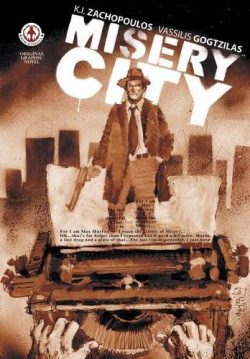
Misery City


By K. I. Zachopoulos & Vassilis Gogtzilas (Markosia)
ISBN: 978-1-905692-81-1 (TPB)

For purists every literary genre is sacrosanct – unless you can come up with a way to mix or blend them with such style, verve and panache that something new is born which feels like it’s always been one of the gang…

Lurking in the shadows since first released in 2013, Misery City is a dark, bleak and ferociously introspective tale that relates the cases of Max Murray. He’s a dowdy, down-at-heel private eye stalking the meanest streets imaginable, in a vast and ever-changing metropolis situated on the outskirts of Hell – and, no, that’s not poetic license or flowery prose, it’s a satnav instruction…

Following an effusive Foreword from arch-stylist Sam Keith and Introduction from writer J. M. DeMatteis, the first 5 issues of the original comics series unfold in this pocket novel package: a stark, unrelenting procession of grimly trenchant case-files starring a shabby, unshockable shamus just trying to get by uncovering other people’s secrets whilst making some sense of the most pitiless town in creation.

Of course, Max has a few secrets of his own…

The black parade begins on the ‘Night of the Corpse’ when the world-weary peeper is attacked by a giant skeleton and must employ his beloved and handy handgun Fat Betty to end the undead animate. Times are both tough and weird, so he doesn’t give it much thought before retiring to his dingy office to await a new client and case…

When the phone rings it’s that sexy waitress Pakita from The Bar. Max has suffered the serious hots for the hot totty simply forever, but his rising hopes take a dive when the mercurial Mexican only hires him to check up on her cheating boyfriend.

With heavy heart and azure cojones, the gumshoe goes looking, utterly unaware that an old enemy has returned seeking vengeance. Professor Ego was penned in unimaginable torment because of Murray, and now he’s out and wasting no time in sending a plague of devils to secure some payback…

As a host of demonic clowns hunt the private detective, Max finds Pakita’s man. However, catching the faithless dog with another woman drives the PI crazy, and Murray goes ballistic, beating the cheating Dick to a pulp. Appalled and repentant, he then heads over to Pakita’s place to apologise but finds her gone, snatched by his long-forgotten foe.

Answering the ‘Call of Ego’, Max heads for the horror’s Tower hideout and a brutal showdown…

Despite his shoddy appearance, this detective is no dumb palooka. His secret vice is reading, and Max’s unceasing internal monologue is peppered with quotes and allusions from poets like Dante and Tennyson. They’re the only thing comforting him as ‘A Wooden Coffin for Max Murray part I’ sees him taking the Hell train to a surveillance job in the worst part of Misery City.

Horny as always, Max is disappointed to discover what the owner of that so-sexy French voice on the phone really looks like, but nevertheless agrees to check out the abandoned timber-framed family house the tearful widow fears property developers crave…

Maybe he should have been more suspicious, but the client’s stunning daughter Josephine had turned his head and all points south…

Upon entering the ramshackle old pile, a colossal zombie fiend attacks and before he can react, the entire house explodes out of the ground and rockets into orbit. Lost in space and out of options, the gumshoe reveals a few of his own incredible survival secrets, destroying the monster (said client’s vengeful and very angry husband) in ‘A Wooden Coffin for Max Murray part II’ before escaping the timber trap to settle scores with the murderous she-devils. It appears Max is on a first name basis with the Big Boss of the Inferno, and the head man is keen on renewing a satanic acquaintance with the understandably reluctant detective…

These malign mystery yarns conclude with a stunning surprise in ‘The Last Drag of a Pocket God’ with Max dogging a phantom with astounding delusions of grandeur. However, after sending Marty “The Voice” Coronado to his final rest, an uncomfortable conversation with Pakita forces the shamus to confront his own long-suppressed thoughts: examining the illusions that keep him going on the pitiless streets of Misery City…

Potently targeted vulgarity and a brusque, verbally confrontational narrative style gives Kostas (Mister Universe, The Fang, The Cloud) Zachopoulos’ manic scripts a supremely savage edge, whilst the freakish, surreal Horror-Noir milieu is perfectly captured by frequent collaborator/illustrator Vassilis (The Biggest Bang) Gogtzilas’ astoundingly frenetic art, delivered in a melange of assorted styles.

This mean, moody and menacing chronicle is topped off with a host of powerful pin-ups and a cover art gallery to further disquiet and beguile the unwary reader.
Misery City ™ & © 2013 Kostas Zachopoulos, Vassilis Gogtzilas and Markosia Enterprises, Ltd. All rights reserved.

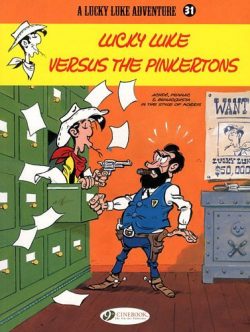
Lucky Luke volume 31 – Lucky Luke versus the Pinkertons


By Achdé, Daniel Pennac & Tonino Benacquista, in the style of Morris: coloured by Anne-Marie Ducasse, translated by Jerome Saincantin (Cinebook)
ISBN: 978-1-84918-098-6 (Album PB/Digital edition)

Doughty, dashing and dependable cowboy “good guy” Lucky Luke is a rangy, implacably even-tempered do-gooder able to “draw faster than his own shadow”. He amiably ambles around the mythic Old West, enjoying light-hearted adventures on his petulant and rather sarcastic wonder-horse Jolly Jumper.

Over nine decades, his exploits have made him one of the top-ranking comic characters in the world, generating upwards of 85 individual albums and many spin-off series, with sales thus far totalling in excess of 300 million in 30 languages. That renown has led to a mountain of merchandise, aforementioned tie-in series like Kid Lucky and Ran-Tan-Plan, plus toys, computer games, animated cartoons, a plethora of TV shows and live-action movies and even commemorative exhibitions. No theme park yet, but you never know…

Originally the brainchild of Belgian animator, illustrator and cartoonist Maurice de Bévère (“Morris”) and first officially seen in Le Journal de Spirous seasonal Annual L’Almanach Spirou 1947, Luke actually sprang to laconic life in mid-1946, before inevitably ambling into his first weekly adventure ‘Arizona 1880’ on December 7th 1946.

Working solo until 1955, Morris produced nine albums of affectionate sagebrush spoofery before teaming with old pal and fellow trans-American émigré Rene Goscinny. With Rene as his regular wordsmith, Luke attained dizzying, legendary, heights starting with Des rails sur la Prairie (Rails on the Prairie) which began serialisation on August 25th 1955. In 1967, the six-gun straight-shooter switched sides, joining Goscinny’s own magazine Pilote in La Diligence (The Stagecoach).

Goscinny co-created 45 albums with Morris before his untimely death, whereupon Morris soldiered on both singly and with other collaborators. He died in 2001, having drawn fully 70 adventures, plus numerous sidebar sagebrush sagas crafted with Achdé, Laurent Gerra, Benacquista & Pennac, Xavier Fauche, Jean Léturgie, Jacques Pessis and more, all taking their own shot at the venerable vigilante …as in this tale from 2010 which so neatly fits the week’s theme of “detective fiction”…

Lucky Luke has a long history in Britain, having first pseudonymously amused and enthralled young readers during the late 1950s, syndicated to weekly anthology Film Fun. He later rode back into comics-town in 1967 for comedy paper Giggle, using nom de plume Buck Bingo. And that’s not counting the many attempts to establish him as a book star beginning in 1972 with Brockhampton Press, and continuing with Knight Books, Hodder Dargaud UK, Ravette Books and Glo’Worm, until Cinebook finally and thankfully found the way in 2006.

The taciturn trailblazer regularly interacts with historical and legendary figures as well as even odder fictional folk in tales drawn from key themes of classic cowboy films – as well as some uniquely European notions, and interpretations. That’s used to sublime effect in Lucky Luke contre Pinkerton released as Cinebook’s 31st album in 2011, but only latterly added to the official continental cannon.

In France, it had graced Le Journal de Spirou #3779-3784 before being compiled and released as the 4th edition of sub-strand Les Aventures de Lucky Luke d’après Morris.

Since the Europeans take their comics seriously – especially the funny ones – they aren’t afraid to be bold or brave and this riotous romp cheekily plays with established chronology and even employs creative anachronism to carry an edged – if not actually barbed – pop at government oversight, the rise of a surveillance state and arguments pro and con concerning necessary evils and zealous protections versus plain old liberty and equality…

In America, Abraham Lincoln has just been elected President . The world is changing and modernity looms, but the nefarious Daltons think nothing of it until a train robbery goes hideously awry.

Instead of their usual duel with Lucky Luke they are ambushed and arrested by an army of detectives employed by iconoclastic, ambitious lawman Allan Pinkerton. The detective then begins a publicity campaign trumpeting that the day of the gifted amateur is done and that Lucky is passe and over the hill…

Untroubled by all the modern foolishness, Luke busies himself hunting a counterfeiting gang but thinks again when Pinkerton pips him to the post and abrasively tells him that from now on, there will be no room for amateurs…

Egotistically sharing his cutting edge crimefighting scheme, Pinkerton unveils modern incarceration, rapid communications, intelligence-led pre-emptive investigation, forensic methodology and ruthless methods of “interrogation” – and operates on the principle that everyone is guilty of something…

He’s compiling incriminating dossiers on everyone, with his legion of detectives building an (analogue) database holding all those dark secrets in one secure office.

Pinkerton’s authority comes from Lincoln, who has made the innovator his chief of security, unaware of the detective’s own vaulting ambition – which includes acting as an agent provocateur and manufacturing threats against PotUS. Lucky sticks to his guns and the old moral ways and battlelines are drawn…

Initially, everything seems to go the way of the moderniser, but his success proves his undoing when a sudden influx of arrests fills all the prisons and the Daltons are given early release to make room. With turmoil gripping the nation and Lincoln’s popularity plunging, Pinkerton seems unassailable until unrepentant recidivist Joe Dalton cherry picks modern ordnance and applies old fashioned predatory behaviour to beat Pinkerton at his own game.

The little monster is particularly impressed by that huge store of files and calculates how much most decent people will pay to keep their secrets unexposed…

Happily Lucky Luke also cherishes the old ways and is ready to set things right his way…

A wickedly wry exploration of the other side of the investigation game, Lucky Luke versus the Pinkertons blends fun and adventure with some salient views of where we’ve been and where we’re going in our ever more urgent quest for safety and security. Nevertheless, the yarn also revels in classic set-piece slapstick and witty wordplay: poking fun at the fundamental components of the genre and successfully embracing tradition with action in another wildly entertaining all-ages confection.
© Dargaud Editeur Paris 1971 by Goscinny & Morris. © Lucky Comics. English translation © 2009 Cinebook Ltd.

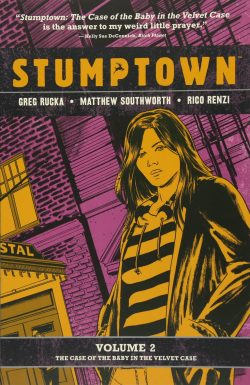
Stumptown volume 2: The Case of the Baby in the Velvet Case


By Greg Rucka, Matthew Southworth, Rico Renzi & various (Oni Press)
ISBN: 978-1-93496-89-7 (HB) 978-1-620104-80-4 (TPB) eISBN: 978-1-62010-032-5

Plenty of superhero, supernatural and sci fi comics make the jump to TV and movies these days, but not so many crime sagas. One that did came from ever-entertaining, prodigiously prolific, multi award-winning Greg Rucka.

A screenwriter (The Old Guard) and novelist (Atticus Kodiak crime sequence, Jad Bell series and a whole bunch of general thrillers), he also crafts astounding graphic thrillers like Whiteout, Queen & Country, Lazarus or The Old Guard whilst excelling on major properties and characters including Star Wars, Batman, Gotham Central (co-scripted by Ed Brubaker), Superman, Wonder Woman, Grendel, Elektra, The Punisher, Wolverine and Lois Lane. He has been a major contributor to epic events such as 52, No Man’s Land, Infinite Crisis and New Krypton.

To my mind this most engaging original comicbook concept features a non-traditional private eye barely getting by in the writer’s own backyard: Portland Oregon – AKA “Stumptown”…

The series launched in November 2009 as a 6-issue miniseries, with modern day Portland a vibrant and integral character in the story. A huge hit, the series was indefinitely extended and ran until #19. The TV show launched September 25, 2019 and was equally entertaining and initially successful, before dying after one superb season during the worst days of the pandemic.

Fronted by Kelly Sue DeConnick’s Introduction ‘On Stumptown’ and illustrated by Matthew (Savage Dragon, Ares, Infinity Inc.) Southworth and supplemental colourist Rico Renzi, the daily grind resumes with ‘The Case of the Baby in the Velvet Case’. Here we meet again Dexadrine Callisto Parios, independent private detective and sole owner/primary operative of Stumptown Investigations.

Professionally, things are on the up. “Dex” now has an actual office to work out of, but still struggles with bills, two mortgages, a gambling problem, impulse control and dangerously implacable ethics. She’s also caring for dependent brother Ansel and ignoring other people’s opinions of her bisexuality – or more likely her attitude to them shoving their noses into problems she doesn’t want to confront yet…

After a missing persons case struck far too close to home made her name, briefly secured her future and brought her to the unwelcome attention of billionaire crime-boss/legit businessman Hector Marenco, Dex hoped life would settle down to regular PI gigs: cheating spouses, lost wills and the like.

In fact, there is a lot of that, like the potentially rewarding work-pilferage job she turns down after learning it would be for one of Marenco’s shady enterprises…

Suddenly, things get complicated and crazy again when a living legend walks through the door of her new office. Miriam “Mim” Bracca is a local legend made good globally and her band Tailhook are the epitome of wild success and excess. The megastar has a unique problem though: someone has stolen her baby…

The sweet child in question is a 1977 Gibson Les Paul, perfectly restored and utterly adored. It’s her favourite guitar: more crucial to her life and wellbeing than all her internal organs combined. The sweet precious vanished during or after the last gig and she doesn’t care if it’s just lost or been stolen. Mim will pay anything to get her true and perfect soulmate back…

Parios is astounded and reminds the star that the police work for free. Bracca however, has just ended an affair with Detective Tracy Hoffman (Dex’s inside pal on the Portland Police Bureau) and resoundingly rules that out…

Swallowing a huge amount of sheer fan froth, Dex gets down to business: checking Mim’s mental state and physical dependencies. Once convinced she’s serious, it’s all about the process, and Dex looks into just how much Mim Bracca’s go-to guitar is worth on the open market before interviewing the other band members, roadies and crew. It all seems silly but straightforward: a simple case of following well-rehearsed steps until the axe is recovered or uncovered, but there are levels of betrayal, criminality and deception in play that will make this job lethally risky business…

Dex gets her first inkling visiting Mim’s personal guitar manager Fabrizio Pullano, who she finds being beaten up by manically violent and remarkably dumb skinheads prepared to torture and kill to find the guitar. Being smart and handy, she soon sends them packing, and learns she’s in the middle of a covert DEA operation. Obnoxiously abrasive agent Cathy Chase and her so-mellow associate Mike Vela try to arrest, implicate and then co-opt her…

No stranger to legal officialdom and blinkered procedures, Dex correctly assesses there’s a lot more going on than a missing instrument, and despite hot Tailhook drummer “Click” Mayes being far more open and forthcoming than he needs to be in his interview, she leaps to an obvious conclusion…

A confrontation with her client convinces her that if drugs are being smuggled on Tailhook tours, the band know nothing about it, but Dex’s notion that she’s now got it all sussed bar some legwork evaporates when she gets home and finds Ansel and neighbour Grey playing with “Baby”.

An unidentified stranger left the hot item at Her House (!) in an obvious attempt to deliver a threat and end her involvement, but a quick examination of the case proves her suspicions and Parios knows this isn’t over at all…

In fact, the return of Baby triggers a rapid spiral of manic events as Tracy Hoffman confronts her old lover, the DEA try to arrest everybody, and viciously stupid skinheads Brad and Mick burst in guns blazing and spark one of the most spectacular car chases in comics…

Insanely, when the dust settles, the mystery remains. No one admits to taking Baby in the first place and Dex has to think again…

Happily, she deduces whoactuallydunnit just in time, and is there when the drug smugglers, their skinhead clients and the enigmatic mystery supplier move to recover their product and seek redress for their trouble. With a fluid and potentially deadly standoff resulting, Parios – as always – hangs tough, thinks fast and exploits her gift for making plans on the fly…

A superbly stylish thriller perfectly exploiting the nature of Oregon myth and culture, this yarn perfectly captures a magical place and its self-appointed shop-soiled white knight. Extras include Artifacts of Stumptown – a feature on Southworth’s art process plus promo posters.

Rucka excels in capturing character in meaningful but believable ways that add to understanding whilst always advancing the plot. Ansel (a superbly positive take on a neuro-atypical character: living with Downs Syndrome but realistically rendered, sensitively realised and fully participatory) is used to great effect and, as always, serves to ground Dex’s more dangerous impulses.

…And it’s all clever, witty fast paced and superbly action-packed. If you love crime drama, detective fiction, strong female role models or just bloody great storytelling, you need to pay a visit to Stumptown.
Stumptown volume 2: The Case of the Baby in the Velvet Case ™ & © 2013 Greg Rucka & Matthew Southworth. All rights reserved.

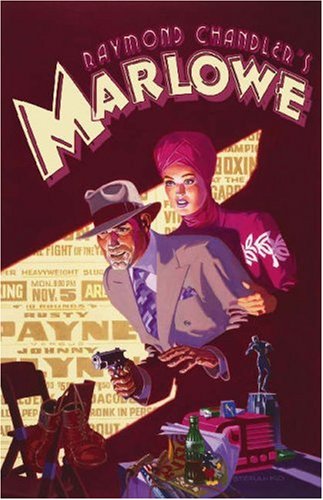
Raymond Chandler’s Marlowe: A Trilogy of Crime


Adapted by Tom DeHaven & Rian Hughes; Jerome Charyn & David Lloyd; James Rose, Lee Moyer & Alfredo Alcala, & various (iBooks)
ISBN: 978-0-7434-7489-4 (HB), 978-1-59687-839-6 (TPB 2016 edition)

If you’re going to adapt classic, evocative crime stories into graphic narrative there really isn’t no better source material than Chandler. This follow-up to the adaptation of Raymond Chandler’s Marlowe: The Little Sister was last reissued in 2016 as Raymond Chandler’s Marlowe: The Graphic Novel: once again the fruit of comics visionary Byron Preiss.

It adroitly adapts three short tales from the master of hard-boiled fiction. Significantly, they are all rendered in a variety of unique and impressive styles by an international array of top-flight creators…

Opening the show is ‘Goldfish’, first published in 1949 and the writer’s ninth short story sale. It preceded his first Marlowe novel by three years and is here adapted by Tom DeHaven (Green Candles, It’s Superman!) & lettered by Willie Schubert. The stylish illustration comes courtesy of British designer/artist Rian Hughes (Dare, I Am a Number) using muted colour tones that have only the merest hint of hue to them. The effect is powerfully evocative and atmospheric.

When former cop Kathy Horne sidles into the tough guy’s seedy office, she brings a tale of lost pearls, an absconded convict and a huge reward just waiting to be claimed. Dragged far out of his comfort zone and sent up and down the Pacific Seaboard, our world-weary shamus is just steps ahead of sadistic, casually murderous Carol Donovan and her gang of thugs in a superb thriller of double-cross and double-jeopardy…

Next up is ‘The Pencil’, scripted by award-winning mystery novelist Jerome Charyn (Isaac Sidel series, The Magician’s Wife, New York Cannibals), brilliantly rendered by British comics legend David Lloyd (V for Vendetta, Hellblazer, Wasteland, Aces Weekly) in moody, dry-brush black and white, and lettered by long-term collaborator Elitta Fell. This was Chandler’s 21st – and final – Marlowe adventure, published posthumously in 1959, shortly after the author’s death. You might know it as Marlowe Takes on the Syndicate, Wrong Pigeon or even Philip Marlowe’s Last Case.

Hollywood 1955: Ikky Rossen is a bad man, a career gangster and mob leg-breaker. When he crosses his bosses he hopes Marlowe can get him safely out of the City of Angels before The Organization’s East Coast “button men” send him to Hell. Marlowe knows these are people to be avoided at all costs and only one thing is always true: everybody lies…

Closing the casebook – and somewhat ill-considered and misplaced to my mind – is ‘Trouble is My Business’ as interpreted by James Rose (Thundercats, Savage sword of Conan), Lee Moyer (Starstruck, Dungeons & Dragons) & Alfredo Alcala (Voltar, Swamp Thing, Man Thing, Batman, Savage Sword of Conan), with Schubert again filling the word balloons.

This is a weak tale of vengeful Harriet Huntress who intends to destroy two generations of wealthy socialites mixed up in the gambling rackets originated in 1939: a rather tame and straightforward yarn in comparison to the other stories here, not to mention the landmark first full novel The Big Sleep, which was also published in that year.

Moyer and Alcala do a solid job of illustrating the plot (although it’s a little pretty for my tastes) but the cynical edge that is the hallmark of Chandler’s iconic creation is muted if not actually extinguished here.

Despite ending on a sour note, this is still a superb sample of Detective comics any fan can revel in, with the incredible Steranko cover alone well worth the effort of tracking down…
Adaptations and illustrations © 2003 Byron Preiss Visual Publications Inc. Original stories “Goldfish” and “Trouble is my Business” © 2003 Philip Marlowe BV (Estate of Raymond Chandler) All Rights Reserved. “The Pencil” © 1971 Helga Greene, Executrix, Estate of Raymond Chandler. All Rights Reserved.

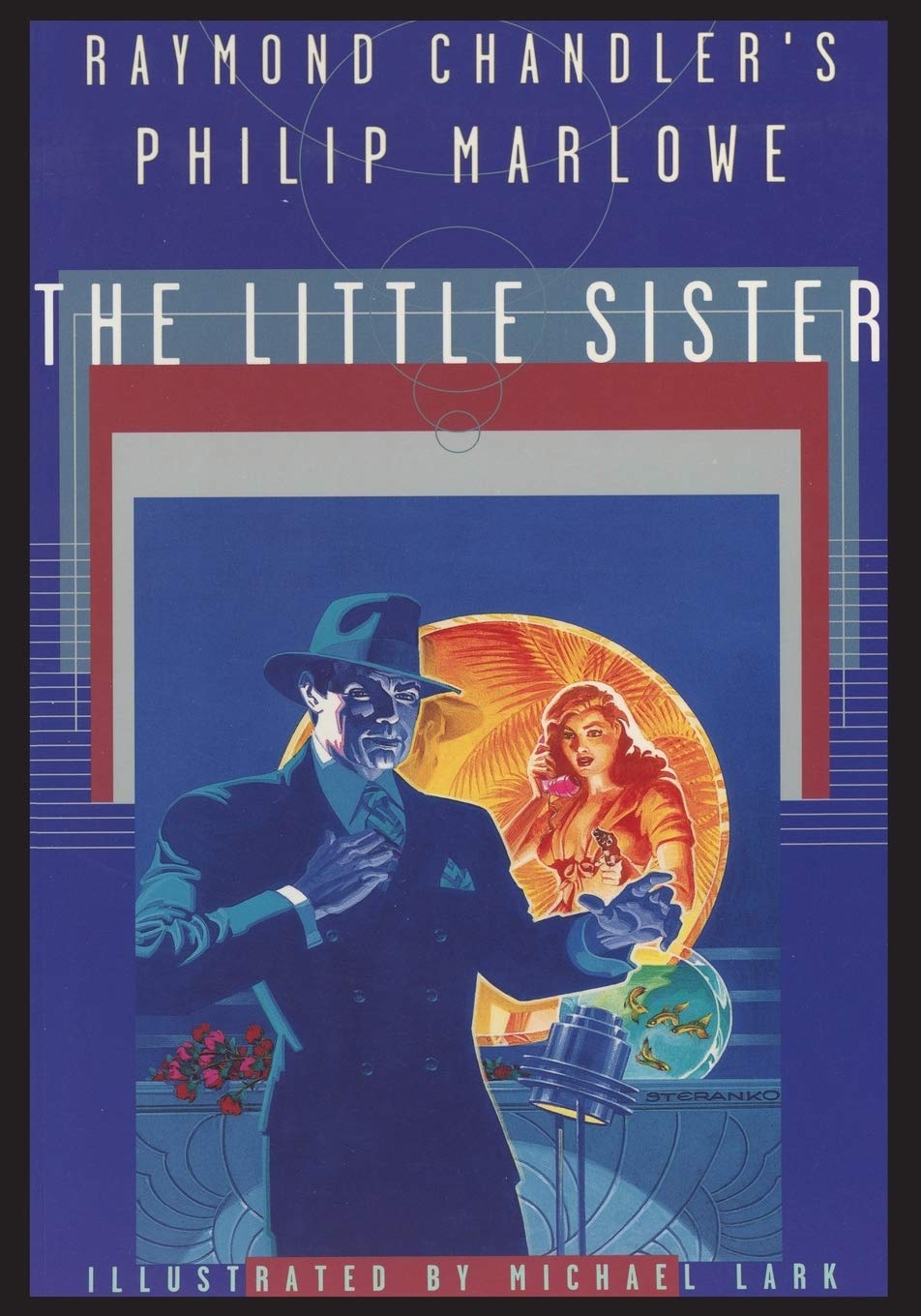
Raymond Chandler’s Philip Marlowe: The Little Sister


Adapted by Michael Lark (A Byron Preiss Book/Fireside Books)
ISBN: 978-1-59687-535-7 (TPB)

If you’re going to adapt classic, evocative crime novels into graphic narrative you really can’t start from better source material than Raymond Chandler. His fifth novel, The Little Sister, was published in 1949, after nearly a decade of hard living and work as a Hollywood screenwriter, and it is a perfect example of his terse yet poetic hard-boiled style.

All the beloved and iconic imagery is present in Michael (Gotham Central, Legend of Hawkman, Terminal City) Lark’s static snapshot style as prim Orfamay Quest hires the laconic Marlowe to track down her missing brother, a spiritual soul who seems to have gone off the rails since hitting the sin city of Los Angeles.

Little Orfamay seems wound up pretty tight for such a run-of the-mill case, but the world-weary detective soon starts to take things a little more seriously after the bodies begin to drop and corpses start showing up in the strangest places…

This taut and twisted compote of mobsters, blackmail and double-dealing is an ideal example of a tale adapted well: underplayed art and direction augmented by controlled pace and a sensitive use of a deliberately limited colour palette.

A cool look at a period classic, this is a crime-fan’s dream book, and what’s truly criminal is that it’s been allowed to remain out-of-print.
© 1997 Byron Preiss Visual Publications Inc. Text of The Little Sister © 1949 Raymond Chandler, © renewed 1976 Mrs Helga Greene. All Rights Reserved.

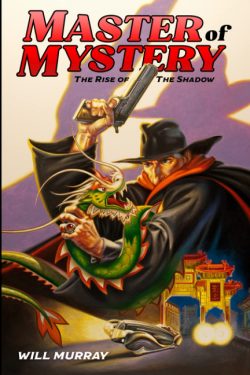
Master of Mystery: The Rise of The Shadow (Will Murray Pulp History Series)


By Will Murray, illustrated by Frank Hamilton, Rick Roe, Colton Worley, Joe DeVito, Edd Cartier & various (Odyssey Publications)
ISBN: 979-8-54I38-708-7 (PB/Digital edition)

In the early 1930s, just as the Great Depression hit hardest, a new kind of literary (and ultimately multimedia) hero was born …or more correctly, evolved. The Shadow afforded thrill-starved Americans measured doses of extraordinary excitement via cheaply produced periodical novels and over eerily charged airwaves via an iconic radio show.

Made exceedingly cheaply and published in their hundreds for every style and genre, “Pulps” bridged stand-alone books and periodical magazines. Results ranged from unforgettably excellent to pitifully dire, and amongst originals and knock-offs of every conceivable stripe, for exotic or esoteric adventure-lovers there were two stars who outshone all others in terms of quality and sheer imagination.

The Superman of his day was Doc Savage, whilst the premier relentless creature of the night darkly dispensing grim justice was the enigmatic vigilante/ultimate detective discussed here.

As seen in Dark Avenger: The Strange Saga of The Shadow (successor to this book) the enthralling enigma grew out of a combination of sources: radio show Detective Story Hour and the Street & Smith publication Detective Story Magazine it promoted; a succession of scary voices variously deployed by Orson Welles, James LaCurto and Frank Readick Jr.) but above all a Depression-era populace in dire need of cathartic entertainment.

From the very start on July 31st 1930, that narratorial “Shadow” was more popular than the stories he highlighted…

How that aural phenomenon was translated into an iconic literary/media sensation and exactly who was responsible forms the basis of this compelling testament as prolific author, scripter and historian Will Murray turns his spotlight on those who contributed to the amalgamated marvel of mystery and imagination.

Following his reminiscence-fuelled Introduction, Murray restates the origin of the character in photo-filled feature ‘The Five O’clock Shadow’ and details how the Street & Smith campaign to make a voice and a feeling real and remunerative spawned a landmark of broadcast entertainment, before ‘Out of the Shadows: Walter Gibson’ offers an engaging and revelatory interview with the magician-turned-crime writer conducted by Murray and Jim Steranko at the 1975 New York Comic Art Convention.

That interview was in a public forum, and the transcript omitted a lengthy digression comprising Gibson’s oral history of the Shadow’s signature fire opal ring. Here – in its entirety – it comprises ‘The Purple Girasol’, after which it’s the turn of ‘Heroic Editor: John L. Nanovic’ to be rediscovered and awarded his share of the acclaim.

Prolific and underrated, successor scripter ‘Theodore Tinsley: Maxwell Grant’s Shadow’ is celebrated all his many works after which we concentrate on illustration as cover artist ‘Graves Gladney Speaks’.

‘Walter B. Gibson Revisited’ revisits an interview with the author from PulpCon 5 (Akron Ohio, July 1976) conducted by Murray and Bob Sampson, discussing his working stance and fellow creatives at Street & Smith, whilst his connection to, expertise and excellence in conjuring and legerdemain are celebrated in ‘Walter Gibson’s Magical Journey’

Back in the realm of visions, an appreciation of a true master of pulp art exploring the mysterious ‘Edd Cartier: Master of Shadows’ is augmented by acknowledgement of the Dark Detective’s most obvious legacy in ‘The Shadowy Roots of Batman’, with ‘Memories of Walter’ synthesizing the emotions stirred up by the author’s passing in December 1985.

Packed with fascinating detail and elucidatory anecdotes, plus plenty of pictures and photos, this beguiling documentary of bygone times and appreciation of the giant shoulders we all stand on, this so readable tome also includes biographies ‘About the Author’ and ultra-fan Tim King, whose crucial role is covered in ‘About our Patron’.

If heroes and history are important to you this Master of Mystery: The Rise of The Shadow is truly unmissable.
© 2021 Will Murray. All rights reserved. Artwork © Condé Nast & used with permission.

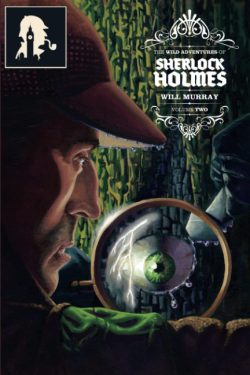
The Wild Adventures of Sherlock Holmes Volume Two


By Will Murray, illustrated by Gary Carbon, Joe DeVito, Jason C. Eckhardt (Odyssey Publications)
ISBN: 979-8-379327-44-6 (PB/Digital edition)

I’m always saying it, in fact we all are: Something Strange is Going On. Let’s address that situation with a week of detective-themed reviews…

Way back in the days when even the shabbiest waif or emphysema-riddled ragamuffin could read, story periodicals for young and old ruled. Countless stories recounted the exploits of adventurers, do-gooders and especially detectives. None ever matched the cachet and pulling power of Sherlock Holmes. Even today the meta-real household name continues and thrives, both in countless reworkings and adaptations of canonical classics and in new material by and for devoted and dedicated admirers ever-hungry for more…

Holmes wasn’t the first but he is most assuredly the most popular and well known. His success spawned a storm of imitators and tribute acts – some even going on to immortality of their own. In1893, just as The Strand Magazine published the “last Sherlock Holmes story” (The Adventure of the Final Problem – and it nearly was as Conan Doyle held out against incredible pressure from fans, editors and bankers until 1901 when The Hound of the Baskervilles began serialisation) another profoundly British criminologist was beginning his own spectacular multimedia career: Sexton Blake

As described by physician Arthur Conan Doyle via the narratives of companion and stalwart factotum Dr. John Watson, Sherlock Holmes’ fictional exploits (54 short stories and 4 novels beginning in 1887) popularised and formulated detective fiction: mythologising the processes of observation, deduction, logical reasoning and forensic science. Britain became a nation of crime fans and Holmes went on to repeat the process for most of the planet…

The first exploit was A Study in Scarlet, published in Beeton’s Christmas Annual 1887, with the majority of stories thereafter in The Strand Magazine. Inevitably, the character soon escaped the page to appear in countless, stories, plays, films, television shows, adverts and anything else canny entrepreneurs could think of.

Although graphic adaptations are plentiful, original English language comics have not excelled with regard to the Great Detective: a trio of newspapers strips, brief comic book runs by Charlton (1955) and DC Comics (1975) and some few later miniseries by independent publishers such as Caliber and Moonstone. Holmes is, however, an evergreen guest collaborator: popping up to aid everyone from Batman to The Muppets to The Shadow himself.

If you can find them, Scarlet in Gaslight: An Adventure in Terror and A Case of Blind Fear by Martin Powell & Seppo Makinen would provide resolute pictorialist devotees with a rare and worthwhile treat: showing the Master Ratiocinator testing himself against other literary touchstones of the period – specifically Bram Stoker’s Lord of the Undead in alliance with the truly evil Professor Moriarty and then H.G. Wells’ Invisible Man

He has also faced such contemporary challengers as The Phantom of the Opera and Mr Hyde in the company of Henry Jekyll, Toulouse L’Autrec and Oscar Wilde

Writers and fans alike share an oddly perverse but clearly overwhelming desire to “mix and match” favourite literary figures: especially from the Victorian Era, that birthplace of so many facets of popular culture. Holmes is so much a household name that his inclusion in any venture is a virtual guarantee of commercial success, but regrettably often no guarantee of quality. Of course, no one can get too much of a good thing and happily Holmes and Watson have thrived under the aegis of many creative stars ever since Doyle’s death. Writers adding to the oeuvre include Stephen King, Neil Gaiman, Anthony Burgess, A.A. Milne, P.G. Wodehouse, John Dickson Carr, Anthony Horowitz and so many more, and today I’m sharing the efforts of another with a well-earned reputation in the field….

Will Murray is something of a classic fiction force of nature. Journalist, editor and author, he produces scholarly histories and critiques on cult characters in the Will Murray Pulp History Series (as seen in today’s other posting) and celebrates the pulp experience in general and especially fading genres via new prose stories for the canon of so many landmark literary characters and concepts. Through print, audio and eBooks, Murray has extended the legends and shelf life of The Shadow, Doc Savage (and Pat Savage), The Spider, King Kong, The Green Lama, The Bat, The Avenger, The Destroyer (Remo Williams), Tarzan and The C’thulu mythos, He is especially adept at crafting combinations: teaming individual stars and concepts in team -up tales such as King Kong vs Tarzan

You’ll probably want to see – or may already enjoy – Murray’s comics too: gems like prose novel Nick Fury, Agent of S.H. I.E.L.D.: Empyre, and visual delights like The Unbeatable Squirrel Girl (co-created with Steve Ditko), Spider-Man, Hulk, Secret Six, The Destroyer, Superman, Batman, Wonder Woman, The Spider, The Gray Seal, Ant-Man, Green Hornet, Zorro, The Phantom and more…

These stories were originally published in magazines and books from MX Publishing, Thrilling Adventure Yarns and Belanger Books, and are set in various periods of the consulting Detective’s long and prestigious career. This tome is the second and latest of two volumes and I’m happy to confide that I enjoyed it so much when my comp copy arrived that I actually paid with my own money to get the first one too…

Following an effusive and informative ‘Introduction’ discussing how this collection concentrates on stories challenging Holmes’ rational mindset and non-rationalistic encounters, the casebook reopens with ‘The Singular Problem of the Extinguished Wicks’ as the investigator reveals his fascination with Spontaneous Human Combustion and its effect on a particularly gruesome demise, after which ‘The Mystery of the Spectral Shelter’ sees Holmes approached by a Hansom cab driver who has had a decidedly close call with a vanishing café used by his professional compatriots…

The irascible ratiocinator’s perennial problem with mind-numbing boredom is highlighted in ‘The Problem of the Surrey Samson’ and assuaged by a theatrical turn whose seemingly miraculous strength does not endure Holmes’ close scrutiny, whilst ‘The Uncanny Adventure of the Hammersmith Wonder’ exposes a body in incredible circumstance and – once properly pondered – sees the detective solve a long-hidden generational crime…

Weird – but still plausible – science and a truly grotesque murder inform ‘The Repulsive Matter of the Bloodless Banker’ before Murray adds his own choice pick to that army of previously established associates.

A ghost story – or is it? – bringing mysteries of ancient Egypt to Edwardian England, ‘The Adventure of the Abominable Adder’ is set in 1903 and introduces the champion of rational thought to his equally estimable but operationally opposite number. This tale sees Algernon Blackwood’s spiritual detective John Silence – Physician Extraordinary also consulted by a terrified client with both valiant advocates needed to solve the mystery.

Silence was among the best of a wave of “ghost-breaker” heroes from that death-obsessed era, appearing in six stories by the prolific Blackwood (1869-1951), beginning with ‘A Psychical Invasion’ (1908).

A genteel and refined war of world-views having been declared, Mind and Soul met again in ‘The Adventure of the Sorrowing Mudlark’ as Dr. Silence asks the esteemed logician to assist a dead woman trapped in an eternal search, before a mythological mystery manifests when a green-hued lad long ago abducted by fairies abruptly returns to a rustic village in ‘The Adventure of the Emerald Urchin’, with Silence again offering unique insights…

With Holmes assuming the narrator’s role, 1908-set conundrum ‘The Adventure of the Expelled Master’ details how he deduced the manner in which a maths teacher was actually murdered despite his body being observed flying up a chimney and rocketing across the heavens, before this embassage into eerie esoterica concludes with Watson’s already crucial role in the stories expanded. It’s 1915 and whilst involved in the war effort the military doctor seeks to drag his old comrade out of retirement to verify the provenance of an unearthed hoard seemingly minted in fabled Atlantis in ‘The Conundrum of the Questionable Coins’

Wrapping up the investigations are fulsome biographical dossiers on Murray in ‘About the Author’ and artist Gary Carbon in ‘About the Artist’.

Compelling, rewarding and just plain fun to read, these tales are a delight and a must for any Holmesian follower.
© 2023 by Will Murray. All rights reserved. Front cover image & frontispiece © 2023 by Gary Carbon. All rights reserved. Back cover image © 2023 by Joe DeVito. All rights reserved.

Action Heroes Archive volume 1: Captain Atom & volume 2: Captain Atom, Blue Beetle & The Question


By Steve Ditko, Joe Gill, Gary Friedrich, Dave Kaler, Steve Skeates, Rocke Mastroserio, Frank McLaughlin, Al Milgrom, Roger Stern, John Byrne, Michael Uslan, Alex Toth, and various (DC Comics)
ISBN: 978-1-4012-0302-3 (HB vol. 1) 978-1-4012-1346-6 (HB vol. 2)

Clearly I’m cashing in on the pre-release hype around a new DC Cinema blockbuster here, but I take honest refuge and some comfort in the fact that these books and the stories they contain are actually germane as well as being some of the best Silver Age comics ever crafted… 

Despite being dead – and so very much missed – Steve Ditko remains comics’ most unique stylist. Love him or hate him, you can’t mistake his work for anyone else’s. His career began in the early 1950s and, depending on whether you’re a superhero fan or prefer deeper, more challenging experimental work, peaked in either the mid-1960s or 1970s.

Leaving the Avenging World, Mr. A and his other philosophically-derived creations for another time, the superhero crowd should heartily celebrate and clamour for new editions of these deluxe collections of the first costumed do-gooder that Ditko worked on. Although I’m a huge fan of his linework – which is always best served by monochrome printing – the crisp, sharp colour of these Archive editions is still much better than the appalling reproduction on bog-paper that first displayed Charlton Comics’ Atomic Ace and latterly the Bug Bombshell to the kids of Commie-obsessed America.

As discussed in the Foreword by historian and Ditko-expert Blake Bell, Action Heroes Archive volume 1: Captain Atom reveals – in all the full-on, simplistic furore of a 1950s B-Movie – how a Cold War-obsessed America copes with a modern-day miracle just as the concept of costumed superheroes was being reimagined…

With covers by Ditko and/or Mastroserio, this tome amasses pertinent tales from Space Adventures #33-40 & 42 (spanning cover-dates March 1960 to October 1961), augmented by the contents of the revived, solo-starring Captain Atom #78-82, as published for December 1965 through September 1966.

In those simpler times the short, terse adventures of Captain Atom seemed somehow more telling than the innovative yet rather anodyne DC fare, whilst Marvel was still pushing romances, westerns and monsters in underpants, explorers in pith helmets and citizen scientists with labs in their garden sheds. Their particular heroic revolution was still months away even though Steve Ditko was producing top-flight work for both companies.

Nevertheless, Ditko’s hero was different and we few who read him all knew it….

As scripted by Jo Gill and predating Fantastic Four #1 by more than 18 months, Space Adventures #33 even cover-featured the new sensation-in-waiting as ‘Introducing Captain Atom’ in a brief but vivid vignette, giving us a true American hero and man of his time before instantly killing him.

Captain Adam was an astronaut accidentally but literally atomised in a rocketry accident. Eerily – and the way it’s drawn spooked the short pants off me when I first read it all those years ago – he gradually reassembles himself on the launch pad…

Now blessed with astounding powers, he reports to the President (Eisenhower) and is swiftly kitted up in a protective outfit, allowing contact with normal, non-irradiated humans and reassigned as a masked superhero who will be the USA’s secret weapon…

Mostly written by or co-written with Joe Gill, the first wonderful, addictive run of 18 stories from Space Adventures #33-42 (and three of those were in fact drawn by uninspired, out-of-his-comfort zone Rocke Mastroserio) are a magnificent example of Ditko’s emerging mastery of mood, pacing, atmosphere and human dynamics.

In 1961, with Ditko increasingly doing more work for blossoming – and better paying – Marvel, Charlton killed the Captain Atom feature. However, when Dick Giordano jumped on the superhero bandwagon and created a costumed character line for Charlton in late 1965, the Captain was revived. Space Adventures was retitled, with Atom’s first full length issue numbered #78.

Since he was still drawing Amazing Spider-Man and Doctor Strange, Ditko could only manage pencils, so Mastroserio was recruited to ink the series, resulting in an oddly jarring finish. With #79, Ditko became lead writer too, and the stories took on an eccentric, compelling edge and tone, lifting them above much of the competition’s fare. Eventually the inker adapted to Ditko’s style and much of the ungainliness disappeared from the figurework, although so had the fine detail that had elevated the early art. This volume ends with issue #82, leaving six more published issues and a complete unpublished seventh for another time…

However, those early, Cold War-fired tales are a truly unique blend of action, tension and sheer whimsy which continued in Space Adventures #34 as ‘The 2nd Man in Space’ cheekily sees the magnanimous hero covertly undercut another Soviet space triumph by saving the USSR’s first cosmonaut from his defective capsule, whilst #35#s ‘The Little Wanderer’ finds him traversing the stars to rescue the spirit of an little boy inadvertently abducted by a well-meaning cosmic traveller…

A thermonuclear double bill graced #36, beginning with ‘The Wreck of X-44’, with a new craft detonating in space and leading Captain Atom to a deadly saboteur, after which ‘Captain Atom on Planet X’ finds him defending a US satellite from all-out attack by the dastardly ruthless Russians…

Geopolitics gives way to fantasy as #37 (December 1960) initially details a fusion-foiled invasion by ‘The Space Prowlers’ before a US probe to the second planet is scuttled by svelte space sirens who score ‘A Victory for Venus’ over the stounded atomic Earthman…

Two months later and the count climbed to three stories, beginning with ‘One Second of War’, wherein the Captain wrecks the doomsday missile attack of Dr. Claudius Jaynes, a suicidal maniac with his own atomic arsenal, before repeating the feat in ‘Backfire’ when a tin-pot dictator seeks to nuke the USA. The issue ends with ‘The Force Beyond’ as an alien entity tries to destroy the world with meteors before encountering our nuclear nemesis…

Space Adventures #39 begins with a ‘Test-Pilot’s Nightmare’ as arrogance threatens the life of a helpless jet jockey and Atom invisibly comes to the rescue after which Mastroserio limns ‘Peace Envoy’ with the energetic enigma turning back another alien invasion. Ditko is back for the final fling as Captain Adam goes undercover in Berlin (just before The Wall went up) to crush an espionage plot in ‘An Ageless Weapon’

The atomic experiment was coming to a close. After #40’s ‘The Crisis’ – wherein the hero helps a diplomat call a tyrant’s bluff and ‘The Boy and the Stars’ features another Earth tot transported into the wondrous cosmos – the costumed heroics were absent the next issue.

Just as the FF was about to go big, Space Adventures #42 (October 1961) arrived and depleted all the inventory tales at once beginning with a brace of Mastroserio drawn yarns and one last tantalising Ditko masterpiece. ‘The Saucer Scare’ is yet another mediocre space war clash whilst ‘The Man in Saturn’s Moon’ sees the atomic ace hunting a Soviet dissent squirreled away by wicked commies. Those lesser efforts are utterly eclipsed by ‘The Silver Lady from Venus’ as another sexy extraterrestrial beguiles the humans of Earth before making a fool of the fiery champion…

And that was that the end until of 1965 when a global resurgence of costumed capers led to a new line at Charlton. Leading that charge came Captain Atom #78 (cover-dated December) when Gill & Ditko – with Mastroserio inking – revived the Atomic Adventurer in ‘The Gremlins from Planet Blue’. The genre had moved on in four years and the stripped-back, pared-down B-Movie feel of those early tales had evolved into a more uniquely fulsome and flamboyant affair for this particular extraterrestrial infiltration. Here were subplots and supporting cast to spare, as the hero foiled alien sabotage and mind control at Cape Kennedy, romancing Leah Jupe whilst her scientist father fell under the control of insidious infiltrators. There was even a new gadfly for Captain Adam in the grumpy form of martinet military man General Brill before ultimately saving Earth again…

In the next issue (February/March 1966), a true but tragic supervillain arrives in the series as ‘Captain Atom Faces Doctor Spectro, Master of Moods’ when a spy hunt brings the hero into the orbit of an embittered recluse seeking to master light and colour to revolutionise medicine. Sadly, sudden success tips him over the edge and his newfound abilities drive him even more crazy…

Apparently destroyed, the miscreant is soon forgotten when a wandering planetoid nears Earth and sounds the ‘Death Knell of the World’ (#80, Ditko, Gill & Mastroserio). Happily, the High Energy Hero is up to foiling a cosmic tyrant and liberating his captive satellite people before confronting ‘The Five Faces of Doctor Spectro’ as the misunderstood miscreant reappears in five prismatic pieces with a plethora of different plans but one overriding goal: pulling himself together and finally splitting this atom…

The hero hosts a quick fact feature drawn by Frank McLaughlin in ‘Captain Atom’s Secret’ before this initial outing ends with a magnificent step up in tension and quality. Issue #82 – cover-dated September 1966 and by Ditko with Dave Kaler & Mastroserio – debuts not just the series’ ultimate archfoe and a major story arc but also the company’s first female superhero.

With an enigmatic teleporting thief casually robbing the nation and the military of its wealth and top secrets, Captain Adam is sent undercover with mystery operative Nightshade in ‘Captain Atom vs. The Ghost’

Their mission introduces sleek scoundrel Alec Rois, channels the spy craze of the era and hints at a vast conspiracy underpinning a threat to Earth and even finds time to see the heroes battle an army of thugs and save Fort Knox from bold bullion banditry…

Over half a decade pioneers Steve Ditko and Captain Atom and paved the way and lit a path to a revolution in comics storytelling and these early exploits were only the start…


Action Heroes volume 2: Captain Atom, Blue Beetle & The Question

A second – far longer – volume completes Ditko’s controversial Charlton Comics costumed hero contributions with the remainder of Captain Atom’s exploits, the introduction of a new Blue Beetle and debut of his uniquely iconic vigilante The Question.

Following an effusive and extremely informative Introduction by original Action Line inventor and editor Dick Giordano, Captain Atom #83 (November 1966) starts the ball rolling again with a huge blast of reconstructive character surgery.

Although ‘Finally Falls the Mighty!’ was inked by Mastroserio and scripted by relative newcomer Kaler, thematically it’s pure Ditko. Plotted and drawn by him, it sees an ungrateful public swiftly turn on the Atomic Ace, due to the manipulations of a former colleague turned cunning criminal.

Intended to tone down the character’s sheer omnipotence, the added approachable empathy-inducing humanity of malfunctioning powers made his struggles against treacherous Professor Koste all the more poignant.

Moreover, the sheer visual spectacle of his battle against a runaway reactor is some of Ditko’s most imaginative design and layout work. The tale ends on a cliffhanger – a real big deal when the comic came out every two months – and with the last 7 pages dedicated to debuting a new superhero with one of the oldest names in the business.

The Blue Beetle first appeared in Mystery Men Comics #1, released by Fox Comics and cover-dated August 1939. Created by Charles Nicholas (nee Wojtkowski) the character was inexplicably popular: surviving the collapse of numerous publishers before ending up as an acquired Charlton property in the mid-1950s. After releasing a few issues sporadically, Charlton shelved him until the superhero revival of the 1960s when Gill and latterly young Roy Thomas revised and revived the character for a combined 10-issue run (June 1964 – February 1966).

Here however, Ditko accepts but sets aside all that history to utterly recreate him. Ted Kord is an earnest young scientist with a secret tragedy in his past, which Ditko and scripter Gary Friedrich sagely forbear revealing in deference to intrigue and action, in a taut, captivating crime-thriller where the new hero displays his modus operandi by stopping a vicious crime-spree by the Killer Koke Gang.

This untitled short has all the classic elements of a Ditko masterpiece: outlandish intense, fight scenes, compact, claustrophobic yet dynamic layouts, innovative gimmickry and a clear-cut battle between Right and Wrong. It’s one of the very best introductory stories of a new hero anywhere in comics – and it’s 7 pages long…

The remodelling of the Atomic Ace concludes in the next issue with ‘After the Fall a New Beginning’. Once again Ditko rattled his authorial sabre about the fickleness of the public as the villainous Koste exposes the hero’s face on live TV. Escaping, Atom gets a new costume to match his curtailed powers …and consequently, a lot more drama drapes the series.

Now there is a definite feeling of no safety or status quo. The untitled Blue Beetle back-up (scripted by Friedrich with full art from Ditko) pits the new kid against a Masked Marauder, but the real kicker is the bombshell revelation that Homicide detective Fisher – investigating the disappearance of Dan Garrett – suspects a possible connection to Kord…

Whilst extending a running plot-line about the mysterious Ghost and his connection to a lost civilization of warrior women, ‘Strings of Punch and Jewelee’ introduces a couple of shady carnival hucksters who find a chest of esoteric alien weapons and use them for robbery. Although Cap and partner Nightshade are somewhat outclassed here, the vigour and vitality of the Blue Beetle is again undeniable as a mid-air hijack is foiled and a spy sub and giant killer octopus are given short shrift by the indomitable rookie crusader.

Captain Atom #86 finally brings the long-simmering plot-thread of tech thief The Ghost to a boil as the malevolent science-wizard goes on a rampage, totally trouncing Nightshade and our hero before being kidnapped by the aforementioned mystery maidens. ‘The Fury of the Faceless Foe! is by Ditko, Kaler & Mastroserio whilst in the (still) untitled Blue Beetle strip by Friedrich & Ditko, the cobalt crusader confronts a ruthless scientist/industrial spy he’s convinced he battled before…

This leads directly into the first issue of his own comic book. Blue Beetle #1 (cover-dated June 1967) is an all-Ditko masterpiece (even scripting it as “D.C. Glanzman”) with the hero in all-out action against a deadly gang of bandits. ‘Blue Beetle… Bugs the Squids’ is crammed with the eccentric vitality that made Amazing Spider-Man such a monster hit, with justice-dispensing joie de vivre balanced by the moody, claustrophobic introduction of Ditko’s most challenging mainstream superhero creation.

‘The Question’ is Vic Sage, a TV journalist with an uncompromising attitude to crime and corruption, employing an alter-ego of faceless, relentless retribution. In his premiere outing he exposes the link between his own employers’ self-righteous sponsors and gambling racketeer Lou Dicer. This theme of unflinching virtue in the teeth of both violent crime and pernicious peer and public pressure marked Ditko’s departure from straight entertainment towards philosophical – some would say polemical – examination of greater societal issues and the true nature of both Good and Evil that would culminate in his controversial Mr. A, Avenging World and other independent ventures.

In Captain Atom #87 (August 1967), ‘The Menace of the Fiery-Icer’ presaged the beginning of the end for the Atomic Ace as Kaler, Ditko & Mastroserio dialled back on plot threads to deliver a visually excellent but run-of-the-mill yarn about a spy ring with a hot line in cold-blooded leaders.

Blue Beetle #2 however – another all-Ditko affair from the same month – showed the master at his peak. Lead story ‘The End is a Beginning!’ at last reveals the origin of the character as well as the fate of Dan Garrett, and even advances Kord’s relationship with his assistant Tracey. The enigmatic Question, meanwhile, tackles flying burglar The Banshee in a vertiginous, moody thriller reminiscent of early Doctor Strange strips.

Frank McLaughlin joins as inker for a satisfying no-nonsense escapist romp ‘Ravage of Ronthor’ (Captain Atom #88, October 1967), as the hero answers a distress call from space to preserve a paradise planet from marauding giant bugs. Blue Beetle #3 was another superbly satisfying read, as the eponymous hero routes malevolent, picturesque thugs ‘The Madmen’ in a sharp parable about paranoia and misperception. Equally captivating is the intense and bizarre Question vignette wherein a murderous ghostly deep-sea diver stalks some shady captains of industry…

Cover-dated December 1967, issue #89 was the last Captain Atom published by Charlton: an early casualty of the burn-out afflicting the superhero genre and leading to a resurrected horror and mystery craze. This resurrected genre would form a new backbone for the company’s 1970’s output; one where Ditko would shine again in his role as master of short story horror.

Scripter Kaler satisfactorily ties up most of the hanging plot threads with the warrior women of Sunuria in sci-fi-meets-witchcraft thriller ‘Thirteen’, although the Ditko/McLaughlin art team was nowhere near top form.

The next episode promised a final ‘Showdown in Sunuria’, but never materialized…

Blue Beetle #4 (released the same month) is visually the best of the bunch as Kord follows a somehow-returned Dan Garrett to an Asian backwater in pursuit of lost treasure and a death cult. ‘The Men of the Mask’ is pure strip poetry and bombastic action, cunningly counterbalanced by a seedy underworld thriller as the Question seeks to discover who gave the order to ‘Kill Vic Sage!’ Scripted by Steve Skeates (as Warren Savin) it was the last action any Charlton hero saw for the better part of a year…

Then, cover-dated October 1968, The Question returned as the star of Mysterious Suspense #1, with Ditko producing a captivating cover and three-chapter thriller (with Mastroserio providing a rather jarring full-page frontispiece). ‘What Makes a Hero?’ (probably rescued from partially completed inventory material) sees crusading Vic Sage pilloried by the public, abandoned by friends and abandoned by his employers yet resolutely sticking to his higher principles in pursuit of hypocritical villains masquerading as pillars of the community. Ditko’s interest in Ayn Rand’s philosophical Objectivism had become increasingly important to him and this story is arguably the dividing line between his “old” and “new” work. It’s also the most powerful and compelling piece in this entire book.

A month later one final issue of Blue Beetle (#5) was published. ‘The Destroyer of Heroes’ is a decidedly quirky tale featuring a nominal team-up of the azure avenger and the Question as a frustrated artist defaces heroic and uplifting paintings and statues. Ditko’s committed if reactionary views of youth culture, which so worried Stan Lee, are fully on view in this charged, absorbing tale.

Other material had been created and languished incomplete in editorial limbo. In the early 1970s a burgeoning and committed fan-base created fanzine Charlton Portfolio. With the willing assistance of the company, a host of kids who would soon become household names in their own right found a way to bring the lost work to the public gaze. Their efforts are also included here, in monochrome as they originally appeared.

For Charlton Portfolio #9 and 10 (1974), the unreleased Blue Beetle #6 was serialized. ‘A Specter is Haunting Hub City!’ is another all-Ditko extravaganza, pitting the hero against an (almost) invisible thief. Follow-up magazine Charlton Bullseye (1975) finally published ‘Showdown in Sunuria’ in its first two issues.

Behind an Al Milgrom Captain Atom cover, Kaler’s plot was scripted by Roger Stern (working as Jon G. Michels) and Ditko’s pencils were inked by rising star John Byrne – a cataclysmic climax almost worth the 8-year wait. But even there, the magic doesn’t end in this magnificent Archive volume.

Charlton Bullseye #5 (1975) offers one last pre-DC tale of The Question: 8 gripping, intense and beautiful pages plotted by Stern, scripted by Michael Uslan and illustrated by the legendary Alex Toth. This alone is worth the price of admission.

These weighty snapshots from another era are packed with classic material by brilliant craftsmen. They are books no Ditko addict, serious fan of the genre or lover of graphic adventure can afford to be without. It’s impossible to describe the grace, finesse, and unique eclectic shape of Steve Ditko’s art. It must be experienced, and this is as good a place to start as any. It’s just a shame DC have let these tales languish so long, but hopefully the power of Hollywood will induce a revival…
© 1966, 1967, 1968, 1974, 1975, 1976, 2007 DC Comics. All Rights Reserved.

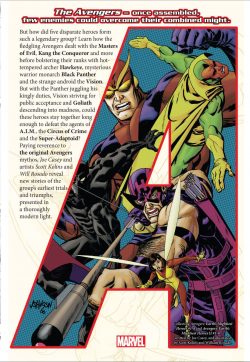
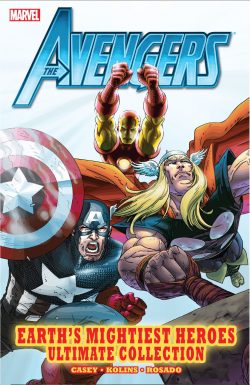
The Avengers: Earth’s Mightiest Heroes Ultimate Collection


By Joe Casey, Scott Kolins, Will Rosado, Tom Palmer & various (Marvel)
ISBN: 978-0-7851-5937-7 (TPB/Digital edition)

Time for another 60th Anniversary shout out…

One of the most momentous events in Marvel Comics history occurred in 1963 when a disparate array of individual heroes banded together to stop apparently marauding monster The Incredible Hulk.

The Avengers combined most of the company’s fledgling superhero line in one bright, shiny and highly commercial package. Over decades the roster has continually changed until now almost every character in their universe has at some time numbered amongst the team’s colourful ranks…

For Marvel’s transformational rebirth in the early 1960’s, Stan Lee & Jack Kirby took their lead from a small but growing band of costumed characters debuting or reimagined and revived at the Distinguished Competition. Julie Schwartz’ retooling of DC’s Golden Age stars had paid big dividends for the industry leader, and as the decade turned Managing Editor Lee’s boss (uncle/publisher Martin Goodman) insisted his company should go where the money was.

Although National/DC achieved incredible success with revised and updated versions of the company’s old stable, the natural gambit of trying the same revivification process on characters who had dominated Timely/Atlas in those halcyon days didn’t go quite so well.

The Justice League of America-inspired Fantastic Four indeed featured a new Human Torch, but his subsequent solo series began to founder almost as soon as Kirby stopped drawing it. Sub-Mariner was soon returned too, but as a deadly vengeful villain, as yet incapable of carrying his own title…

So a procession of new costumed heroes was created, with Lee, Kirby and Steve Ditko focussing on all-original inventive and inspired “super-characters”…

Not all caught on: The Hulk folded after six issues and even Spider-Man would have failed if writer/editor Lee hadn’t really, really pushed Uncle Martin…

After nearly 18 months, during which the fledgling House of Ideas churned out a small stable of leading men (but only two sidekick women), Lee & Kirby finally had enough players to stock an all-star ensemble – the precise format which had made the JLA a commercial winner – and thus swiftly assembled a handful of them into a force for justice and higher sales…

Cover-dated September 1963, The Avengers #1 launched as part of an expansion package which also included Sgt. Fury and his Howling Commandos and The X-Men, and, despite a few rocky patches, the series grew into one of the company’s perennial best sellers.

The early Avengers yarns became a cornerstone of the company’s crucially interlinked continuity. As decades passed they were frequently revisited and re-examined, and in 2005 Joe Casey and artist Scott Kolins (with colourists Morry Hollowell & Will Quintana) took the occasional exercises in creativity a little further: offering an 8-issue modernising miniseries adding devious – some would say cynically calculating – back-writing to the original stories. The epic was packed with post-modern in-filling for a more mature readership, exposing secrets and revealing how the team actually came to hold its prominent and predominant position in the Marvel Universe…

Avengers: Earth’s Mightiest Heroes #1-8 ran fortnightly from January to April 2005 and was successful enough to warrant a second season. Avengers: Earth’s Mightiest Heroes II #1-8 repeated the gambit from January to May 2007, and with both epics gathered in this splendid, no-nonsense compilation.

Chronologically set between Avengers #1 and 2, the drama begins as industrialist Tony Stark reviews media coverage of the coalition of mystery men currently residing in his family’s townhouse. He ponders how best to keep such diverse and headstrong personalities as Ant Man, The Wasp, Thor and the Hulk together. Across town in a seedy bar, young troublemaker and pool-hustler Clint Barton can’t understand why folks are so nervous about the “masked freaks”…

Two weeks later, the team has fallen apart and the Avengers are actually hunting their gamma-fuelled former colleague. In the course of calamitous events they unexpectedly recover a legendary form from a coffin of ice floating in sea…

The gradually assimilation of partially amnesiac WWII legend Captain America into a terrifying and seemingly mad new era is not without problems, and the iconic, grimly experienced warrior is soon keenly aware of seething tensions besetting the team he has joined.

Iron Man still fervently pursues an exalted Federal status for the Avengers, but the Army are baulking: clearly set on putting the wilfully independent powerhouses under military jurisdiction. After a ferocious clash with Lava Men from Earth’s deep interior, word finally comes. The powers that be have created an all-encompassing “Avengers Priority Security Status” – but only for as long as the fickle public’s new darling and National Treasure Captain America stays with them…

Self-made scientific genius Hank Pym created the roles of Ant Man and the Wasp (AKA debutante girlfriend Janet Van Dyne) but his inherent and growing mental instability has caused him to push further and harder ever since he joined the ranks of a group that includes a patriotic living legend, an infallible metal juggernaut and an apparent god.

Now operating as Giant Man he is letting feelings of inadequacy drive a wedge between him and his lover, even as the Army ups the pressure to take over the team. Meanwhile, modern-day Rip Van Winkle Steve Rogers increasingly sinks into survivor’s guilt over the comrades he failed to save in the war. That internalised torment kicks into overdrive when Nazi war criminal and archfoe Baron Zemo comes out of hiding to attack the Avenger through his Masters of Evil

When an invader out of time strikes, the Avengers finally and very publicly prove their worth to the nation and its government, and with Kang the Conqueror sent packing, the team at last secures favoured-but-fully-independent security clearance.

…And in the streets, a wanted vigilante dubbed Hawkeye saves Avengers butler Edwin Jarvis from muggers and they strike up a most irregular friendship…

Missions come thick and fast but the internal tensions never seem to dissipate. In far distant Balkan Transia fugitive mutants Wanda and Pietro desperately search for a place where they can feel safe, whilst in America Cap is increasingly fixated on tracking down Zemo.

After a battle with crime syndicate leader Count Nefaria leaves the Wasp near death, Giant Man also edges closer to a complete breakdown. With a surgeon battling to save her, Pym swears he’s going to quit and take her away from all the madness. Before that can happen, Zemo returns, abducting the Sentinel of Liberty’s teenaged friend Rick Jones

In response, the team acrimoniously divides, with Cap trailing the monomaniac to Bolivia whilst the majority of Avengers remain for a final battle against the Masters of Evil. Meanwhile below stairs, Jarvis and Clint are concocting a sneaky scheme of their own…

As the death-duel in Bolivia concludes, in Germany two restless young mutants orchestrate their return to America and – with some collusion from Jarvis – Hawkeye “auditions” for Earth’s Mightiest Heroes…

As Cap and Rick wearily and so slowly make their way back to civilisation, Iron Man deals with Government fallout after learning that their Red, White and Blue poster boy is missing. Soon news leaks out that the rest of the team are quitting and that Stark has lined up a wanted vigilante and two outlaw mutants to replace them…

The initial secret history lesson concludes with astounded Captain America’s re-emergence and reluctant accession to leadership: riding herd on a team of obnoxious, arrogant young felons he is expected to mould into true champions…

The rest is history…

The second bite of the cherry (by Casey, Will Rosado, Tom Palmer & Quintana) focuses on a later time when the Avengers are in resurgent form. The Founders have all returned at a time when Pym (now calling himself Goliath), The Wasp and Hawkeye are joined by enigmatic African monarch The Black Panther. The action commences immediately following the expanded team’s being attacked by an android called The Vision – whom they promptly signed up (in Avengers #58, if you’re keeping count). Apparently the density-shifting “synthezoid” was created by robotic nemesis Ultron – a murderous AI created by Pym whilst suffering one of his frequent psychotic breaks – before switching allegiances…

We open as the highly-suspect new Avenger is impounded by S.H.I.E.L.D. for investigation and clearance. Their ostensible reason is that another autonomous murder mechanism – Super-Adaptoid – has escaped from custody and humanity can’t be too careful…

In the Philippines, the real cause of all the anti-technology tension and overweening suspicion are busy. Science terrorists Advanced Idea Mechanics have secretly stolen the Adaptoid and are seeing how they can improve an already ultimate killing machine…

At a clandestine S.H.I.E.L.D. base, interrogator Jasper Sitwell has met his match in The Vision, but perseveres in trying to dig out dirt on the android and its “master” Ultron. The Panther meanwhile has foregone his status as a VIP dignitary to teach at an inner city school under the alias Luke Charles. What he finds there is a true education…

Hawkeye too is under pressure as his lover The Black Widow reveals she’s going back into the spy-game. With Pym close to apoplexy at the government’s quasi-legal rendition of the Vision, nobody is in a particularly good mood when S.H.I.E.L.D.  supremo Nick Fury (the white one who fought in WWII) demands the team head to the Philippines to investigate A.I.M.’s latest enterprise.

With Fury’s carrot-&-stick pep talk ringing in their ears the heroes – rejoined by the just released Vision – jet away, unaware that in Manhattan an assassination plot against King T’Challa/Mr. Charles has brought one of Panther’s greatest enemies to America…

The heroes are challenged over the Pacific skies by a mass-produced army of Super-Adaptoids and are soon engaged in the fight of their lives…

Overwhelmed, they are in danger of being swamped before Goliath valiantly turns himself into as colossal human rampart to stem the tide and save the endangered island population whilst his comrades rush to destroy A.I.M.’s superbase…

Left all alone, Pym fights in maddened frenzy and becomes increasingly obsessed with how human the things he is incessantly slaughtering seem to be. By the time the triumphant team get Goliath home, he is a deeply traumatised shell of a man…

Luke Charles returns to school in time to be deeply embroiled in a bullying case that will inevitably end in gunplay and tragedy. And then the apparently recuperating Hank Pym goes missing…

Soon after, a new, excessively brutal hero named Yellowjacket is making news even as Agent Sitwell again targets the Vision for further debriefing: specifically, Pym’s “massacre” of mechanical lifeforms on A.I.M. Island. This time he’s brought in S.H.I.E.L.D.’s top psychologist Agent Carver to try and get under the subject’s artificial skin…

The spies are in heated argument with Hawkeye when Yellowjacket breaks in, claiming to have murdered the Man of Many Sizes and demanding to take Goliath’s place on the team…

Nobody is fooled. Everyone recognises the abrasive stranger as Pym gone far off the deep end, but Carver prevents them from saying anything. She advises that he is clearly inches from being utterly incurable and devises a treatment to cure him which basically comprises “play along and don’t do anything to upset the crazy man”…

That even includes allowing Yellowjacket to kidnap the Wasp and agreeing to let him marry his hostage…

The wedding is held at Avengers Mansion and includes a Who’s Who of heroes along for the ride (The Fantastic Four, X-Men, Spider-Man, The Black Knight and Doctor Strange) but the scheme spirals out of control when The Circus of Crime – not privy to the details of the service – use the gathering as an opportunity to kill all America’s costumed champions in one go…

With Hawkeye and the blushing bride hostages and the first to be despatched, the deadly dilemma shocks Pym back to his rightest senses, but in the aftermath many S.H.I.E.L.D. agents are butchered as Wakandan assassin Death Tiger gets ever closer to fulfilling his own mission of murder…

To cap off all the chaos, the still-at-large Super-Adaptoid also attacks, determined to expunge “race-traitor” The Vision who has perpetrated the ultimate betrayal by siding with inferior humanity and denying the innate superiority and inevitable ascension of mechanical and artificial lifeforms…

Politically savvy, wryly trenchant and compellingly action-packed, this extremely impressive Fights ‘n’ Tights chronicle is a superb addition/codicil to the annals of The Avengers and would serve as perfect comics vehicle for movie fans in search of a print-fix for their costumed crusader cravings…
© 2021 MARVEL.

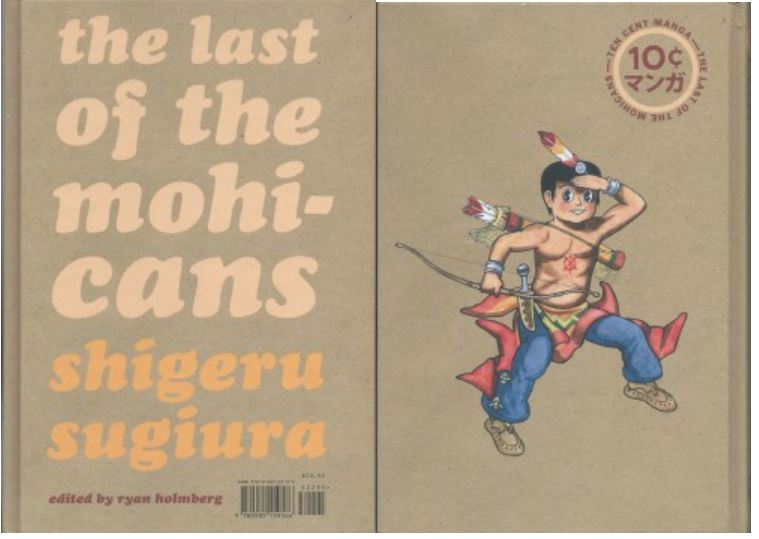
Last of the Mohicans: Ten-Cent Manga Series volume 1


Freely adapted from the novel by James Fenimore Cooper by Shigeru Sugiura, edited & translated by Ryan Holmberg (PictureBox)
ISBN: 978-0-985195-6-6 (HB)

Those of us in the know tend to believe that Japanese comics began with Osamu Tezuka in the years following the end of World War II – and indeed in most ways that assessment is reasonable.

However, as the superbly informative article bolstering this superb tome attests, a thriving manga business has operated in Japan since the 1930s, and one of its greatest proponents was artist and author Shigeru Sugiura.

This superb monochrome hardback volume (sadly no digital delight yet) re-presents one of his greatest triumphs as the initial volume in a proposed series of “Ten-Cent Manga” collections. Translated and edited by Ryan Holmberg, it highlights lost works displaying not simply indigenous Japanese virtuosity but also the influence of cross-cultural contact and pollination with other countries.

In erudite, lavishly illustrated essay and appreciation ‘Shigeru Sugiura and his Mohicans’ he describes in fascinating and forensic detail the origins of the project, state of play in Japan pre-and-post WWII. The absorbing life and career of an artist who began as a jobbing strip cartoonist only to elevate himself to the status of Psychedelic, Surrealist Pop Art icon is one that is utterly addictive to fans of American movies and comic books.

The treatise is fully supported by documentary excerpts from the 1950s magazines and strips. Sugiura scrupulously “homaged” and swiped from: Jesse Marsh’s Tarzan, Alex Toth’s Johnny Thunder, and particularly Fred Ray’s Tomahawk. These were most commonplace amongst a wealth of graphic treasures synthesised and transformed into something fresh, vibrant and, most crucially, relevant to the entertainment-starved kids of occupied Japan.

Also included is an article by the artist himself, written in 1988 describing his life-long passion for and debt of influence to American cinema – most especially ‘Silent Movies’

However, although scholarly and revelatory, the text portions of this singular treat pale beside the sheer exuberant energy and B-movie bravura of James Fenimore Cooper’s text…

Shigeru Sugiura (1908-2000) studied painting before becoming an art assistant to comics pioneer Suihō Tagawa (AKA Nakatarō Takamizawa). By 1933, the student was creating his own strips for the gags and Boys’ Own Adventure style comics that proliferated prior to the war.

He returned to the industry when hostilities ended, producing more of the same, but now influenced far more by the ubiquitous comic books of the occupying G.I.s than the silent Westerns and baggy-pants comedies he had voraciously consumed in his youth.

Shigeru Sugiura blended comedy/action stories for children and achieved great success throughout the 1950s, based on well-known characters such as ninja Sasuke Sarutobi or adapted Chinese classics like Journey to the West, furthermore including modern themes like wrestling, science fiction and even movie sensation Gojira/Godzilla to his fun-filled weekly pages in a most prolific and influential career.

…And Westerns; he did lots of rootin’ tootin’ shoot ’em up cowboy stories…

Sugiura (very) loosely adapted Last of the Mohicans in 1953 (when it was already a very familiar tale to Japanese readers) for Omoshiro Manga Bunko – a line of books presenting world classics of literature in comics form – albeit not exactly any form recognisable to literary purists…

He retired in 1958 but returned in 1970, reworking old stories and creating new pieces from the fresh perspective of a fine artist, not a mere mangaka earning a precarious living.

In 1973 he was already refining and releasing his classic tales for paperback reprints when he was approached by publisher Shobunsha to update another. The 1953 Mohicans became their latest re-released tale, slyly reworked as a wry pastiche and kick-starting Sugiura’s second career as a darling of the newborn adult manga market…

One word of warning: This is not your teacher’s Last of the Mohicans, any more than The Shining resembles Stephen King’s actual novel or the way South Pacific could be logically derived from James Michener’s Tales of the South Pacific – or how anything Alan Moore wrote could be found in films like From Hell or League of Extraordinary Gentlemen

Sugiura’s updated 1973-74 iteration forms the majority of this chronicle: a fast-paced riot of non-stop adventure, greed, pride, tragedy and whacky humour wherein both heroic frontiersman Leatherstocking and noble savage Chingachgook are re-imagined as bold young lads in bad times, their desperate quest punctuated with weirdly clashing moments of slapstick, creative anachronism, cross-cultural in-jokes and plain outright peculiarity…

It all works impossibly well, beginning with the introduction of Hawkeye, ‘La Carabine Kid’: a young but doughty colonial scout and spy for the British.

The Empire is at war with the French for possession of the New World, with the Kid and his companions suffering many reverses at the brutal hands of the Mingos – a tribe allied to France. They were also responsible for reducing the mighty Mohicans to two survivors: Chief Chinga and his son Uncas.

The plot thickens when the Mingo Chief and his manic son Magua threaten to abduct Cora and Alice – daughters of British Colonel Munro – in an attempt to force the veteran soldier to surrender his command East Fort to the French. After a savage assault, Hawkeye, the Mohicans and dashing Major Duncan decide to escort the girls to the safety of Fort Henry, with the hostiles close behind…

En route they pick up itinerant preacher Father Gamut, before fighting their way on through wilderness and repeated Mingo attacks, always one step ahead of ‘Magua’s Pursuit’.

The struggle is not one-sided. The wily fugitives contrive to blow up a French fort and even link with a war party of Delas who subsequently reduce the ravening Mingos to scattered remnants – but not before the pursuers carry off ‘The Abducted Sisters’

The scene is set for the heroes to rescue the girls and end Magua’s threat forever – but the showdown is costly with a high price to pay in ‘The Sad Ending’

Sheer graphic escapism, spectacular storytelling and a truly different view of a time-honoured masterpiece make this an unmissable treat for all lovers of world comics.

This book is printed in ‘read-from-back-to-front’ manga format.
© 2013 the Estate of Shigeru Sugiura. Translation and essay © 2013 Ryan Holmberg. All rights reserved.