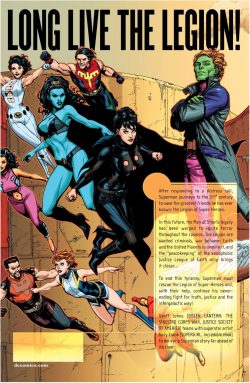
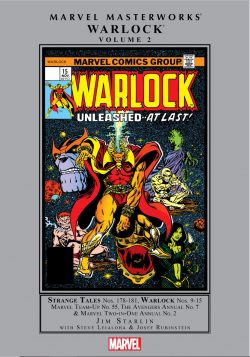
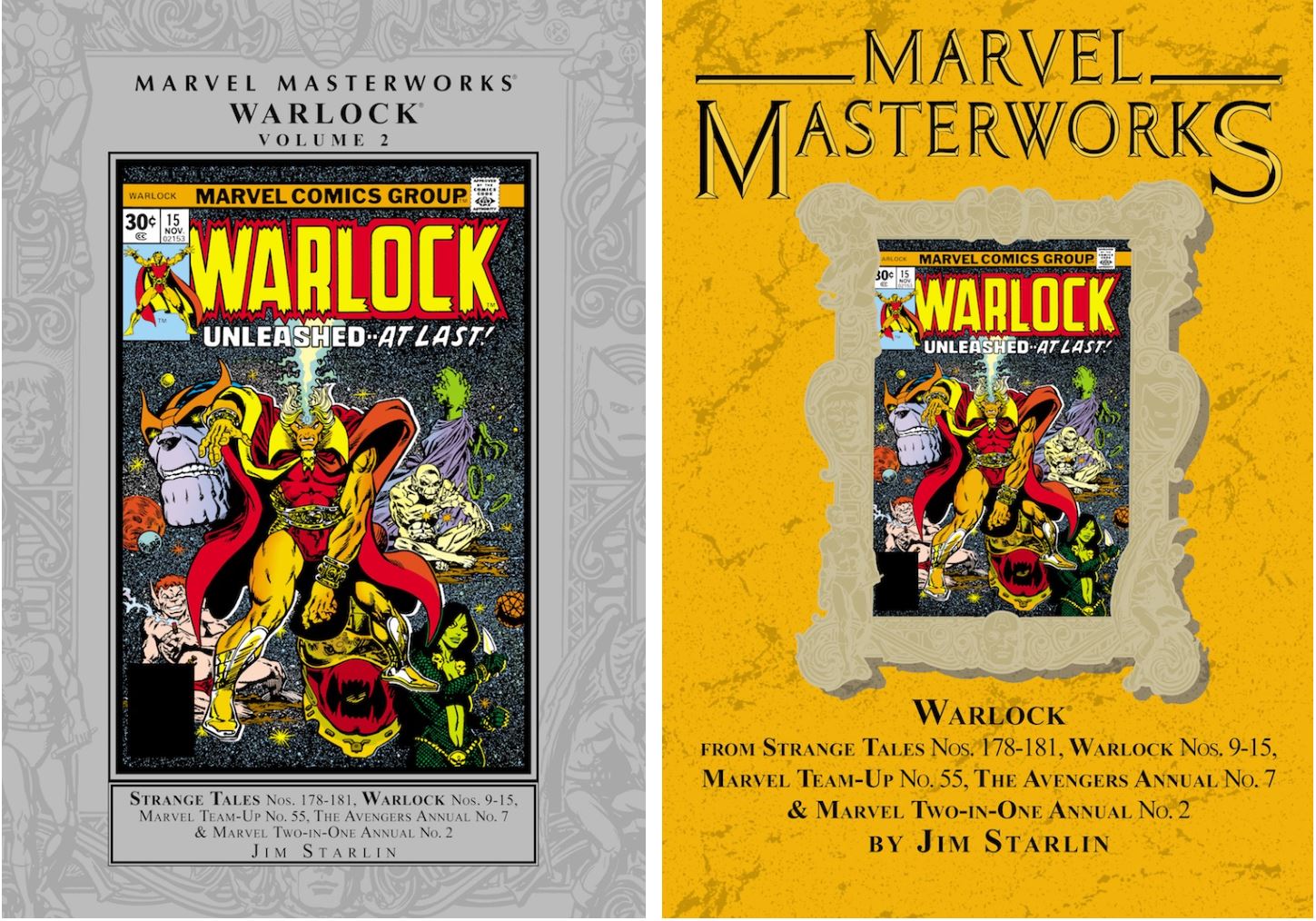
Warlock Marvel Masterworks volume 2


By Jim Starlin, with Bill Mantlo, John Byrne, Steve Leialoha, Josef Rubinstein, Al Milgrom, Alan Weiss, Dave Hunt & various (Marvel)
ISBN: 978-0-7851-3511-1 (HB/Digital edition)

During the early 1970s the first inklings of wider public respect for the medium of graphic narratives began to blossom in English-speaking lands. This followed avid response to pioneering stories such as Denny O’Neil & Neal Adams’ “relevancy” Green Lantern run, Stan Lee & John Buscema’s biblically allegorical Silver Surfer or Roy Thomas’ ecologically strident antihero Sub-Mariner. These all led a procession of thoughtfully-delivered attacks on drugs in many titles, and a long running undeclared campaign to support positive racial role models and include characters of colour everywhere on four-colour pages.

Part of a movement and situation mirrored in Europe and Japan, our comics were inexorably developing into a vibrant platform of diversity and forum for debate, engaging youngsters in real world issues germane and relevant to them.

In 1972, Thomas had taken the next logical step: transubstantiating an old Lee & Kirby Fantastic Four throwaway foe into a potent political and religious metaphor for the Questioning Generation…

Debuting in FF #66 (September 1967) mystery menace Him was re-imagined by Thomas & Gil Kane as a modern interpretation of the Christ myth: stationed on an alternate Earth far more like our own than that of Marvel’s fantastic universe.

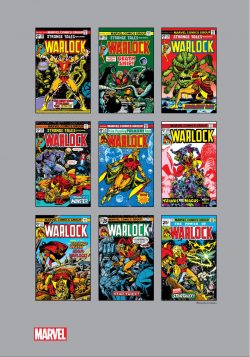
Re-presenting Strange Tales #178-181, Warlock #9-15, Marvel Team-Up #55, Avengers Annual #7 and Marvel Two-in-One Annual #2 – collectively spanning cover-dates February 1975 to the end of 1977, this epic astral adventure also offers a context-soaked Introduction from comics historian/documentarian Jon B. Cook.

For latecomers and those informed only by movies…

It all began with The Power of… Warlock as the artificial man’s origin story – a lab experiment concocted by rogue geneticists – was goosed up after meeting man-made and self-created god The High Evolutionary. He was wrapped up in a bold new experiment to replicate planet Earth on the opposite side of the sun. He replayed – on fast-forward – the development of life, intent on creating humanity without the taint of cruelty and greed and deprived of the lust to kill…

It might well have worked, but when the Evolutionary wearied, his greatest mistake cruelly intervened. Man-Beast was a hyper-evolved wolf with mighty powers, ferocious savagery and ruthless wickedness. He despoiled humanity’s rise, and ensuring the Counter-Earth’s development exactly mirrored its template – with the critical exception of the superheroic ideal. This beleaguered world suffered all mankind’s woes but had no extraordinary beings to save or inspire them.

A helpless witness to desecration, Him crashed free of his life-supporting cocoon to save the Evolutionary and rout Man-Beast and his bestial cronies -a legion of similarly evolved rogue animal-humanoids dubbed “New-Men”). When the despondent, furious science god recovered, he wanted to erase his failed experiment but was stopped by his rescuer.

As a powerless observer, Him had seen the potential and value of embattled humanity. For all their flaws, he believed he could save them from the many imminent dooms caused by their own unthinking actions – pollution, over-population, wars and intolerance. His pleas convinced the Evolutionary to give this mankind one last chance…

The wanderer was hurled down to Counter-Earth, equipped with a strange gem to focus his powers, a mission to find the best in the fallen and a name of his own – Adam Warlock

He battled long and hard and even gathered a band of faithful followers, but was constantly defeated and frustrated by human intransigence and Man-Beast’s forces, who had infiltrated and corrupted all aspects of society – especially America’s political hierarchy and the Military/Industrial complex.

After 8 issues of his struggle and a couple of interventions by Earth’s Incredible Hulk, the saga apparently ended when messianic Adam Warlock died and was reborn, thwarting Satan-analogue Man-Beast with the aid of the Jade Juggernaut: delivering a karmic coup de grace before ascending from Counter-Earth to the beckoning stars…

When the feature returned at the end of 1974 the tone, just like the times, had hugely changed. In the wake of Vietnam and Watergate, hopeful positivity and comfortable naivety had turned to world-weary cynicism and the character was draped in precepts of inescapable doom in the manner of doomed warrior Elric. It was a harbinger of things to come…

The story continues in Strange Tales #178 as ultra-imaginative morbid maverick Jim Starlin (Captain Marvel, Master of Kung Fu, Infinity Gauntlet, Dreadstar, Batman, Kid Kosmos) turns the astral wanderer into a Michael Moorcock-inspired death-obsessed, constantly outraged but exceedingly reluctant and cynical cosmic champion.

The slow spiral to oblivion begins in February cover-dated Strange Tales #178, where Starlin introduces alien Greek Chorus Sphinxor of Pegasus to recap the past by asking and answering ‘Who is Adam Warlock?’

Handling everything but lettering – that’s left to Annette Kawecki – Starlin has solitary wanderer Warlock brooding on a desolate asteroid in the Hercules star cluster just as a trio of brutes attack a frightened girl. Despite his best efforts they execute her, proud of their status as Grand Inquisitors of the Universal Church of Truth and ecstatic to remove one more heathen unbeliever…

Appalled to have failed another innocent, Warlock employs the Soul Gem at his brow to briefly resurrect her and learns of an all-conquering ruthless militant religion intent on converting or eradicating all life. His search triggers a chilling confrontation as ‘Enter The Magus!’ sees the living god of the UCT attack him and crushingly reveal an awful truth: the being who has subjugated countless worlds, exterminated trillions and fostered every dark desire of sentient beings is his own future self.

Adam Warlock than swears that he will battle this impossible situation and do whatever is necessary to prevent himself becoming his worst nightmare…

With Tom Orzechowski on words and Glynis Oliver-Wein doing colours, Starlin’s pilgrimage continues as Warlock attacks an UCT war vessel transporting rebels, “degenerates” and “unproductives” from many converted worlds. The church only deems basic humanoids as sacred and saveable, with most other shapes useful only as fodder or fuel. They make an exception for the universally deplored, vulgar and proudly reprobate race called “Trolls”. In the dungeon-brig of the ship Great Divide, Adam finds his gloomy mood irresistibly lifted by disgusting lout Pip: a troll revelling in his “independent manner and cavalier ways” and not frightened by the imminent death awaiting them all.

Meanwhile, mighty, enhanced true believer Captain Autolycus has received a message from the Temporal Leader of the Faithful. The Matriarch has decided to ignore The Magus’ instruction to capture Warlock and keep him unharmed.

As Adam instructs his fellow prisoners in the nature of rule, Autolycus acts on her command, losing his entire crew and perishing when Warlock breaks loose. After escaping the ‘Death Ship!’, Adam realises Pip has stowed away, keen to share a new adventure, but lets it go. He has a bigger problem: in the climactic final battle, the Soul Gem refused his commands, acting on its own to consume Autolycus’ memories and persona, locking them inside the twisted champion’s head…

In ST #180’s ‘Judgment!’ (with additional inking by Alan Weiss), Pip and Warlock have submerged themselves in the heaving masses of Homeworld whilst hunting the living god they oppose. Terrified of the uncontrollable spiritual vampire on his brow, Adam tries to remove it and discovers it has already stolen him: without it he will perish in seconds…

Pushed into precipitate action and living on borrowed time, Warlock invades the Sacred Palace and is offered a curious deal by the Matriarch and is captured when he refuses. Subjected to ‘The Trial of Adam Warlock’, the appalled adventurer endures a twisted view of the universe courtesy of Grand Inquisitor Kray-Tor, even as in the city, Pip thinks he scored with a hot chick. In truth, he’s been targeted by public enemy number one. Gamora is called “the deadliest woman in the whole galaxy” and has plans for Adam, which include him being alive and free…

Back in court, the golden man has rejected Kray-Tor’s verdict and, disgusted and revolted by the proceedings, foolishly lets his Soul Gem feed. The carnage he triggers and subsequent guilt leaves him catatonic and in the hands of the Matriarch’s cerebral reprogrammers…

Starlin was always an outspoken and driven creator with opinions he struggled to suppress. His problems with Marvel’s working practises underpin ST #181’s ‘1000 Clowns!’ as old pal Al Milgrom inks a fantastic recap and psychological road trip inside the hero’s mind. None of the subtext is germane if you’re just looking for a great story however, and – in-world – Warlock’s resistance to mind-control is mirrored by Pip and Gamora’s advance through the UCT citadel to his side.

Embattled by the psychic propaganda assaulting him, Warlock retreats into the safety of madness, and learns to his horror that this has been what The Magus wanted all along. Now the dark messiah’s victory and genesis are assured…

The triumph was celebrated by the resurrection of the hero’s own title and – cover-dated October 1975 – Warlock #9 revealed the master plan of Adam’s future self. Inked by Steve Leialoha ‘The Infinity Effect!’ saw the mirror images in stark confrontation with evil ascendent, unaware that Gamora was an agent of a hidden third party and that all the chaos and calamity was part of a war of cosmically conceptual forces.

The saga heads into the Endgame as the Magus explains in cruel detail how he came to power and that Adam’s coming days are merely his past, before summoning abstract terror The In-Betweener to usher in their inevitable transformation. There is one problem however: the first time around Adam/Magus was never attacked and almost thwarted by an invisible green warrior woman.

Crushed by the realisation that he will become a mass-murdering spiritual vampire, Warlock reels as the hidden third element arrives to save everything…

‘How Strange My Destiny!’ (#10, inked by Leialoha) finds Pip, Gamora, Adam and mad Titan Thanos battling 25,000 cyborg Black Knights of the Church rapturously paying ‘The Price!’ of devotion in a stalling tactic until the In-Betweener arrives…

Kree Captain Mar-Vell narrates a handy catch-up chapter detailing ‘Who is Thanos?’ as the beleaguered champions escape, before ‘Enter the Redemption Principle!’ explores some of the Titan’s scheme and why he opposes the Magus and his Church, even as the victorious dark deity realises that Thanos’ time probe is the only thing that can upset his existence…

How Strange My Destiny – with finished art by Leialoha from Starlin’s layouts – continues and concludes in #11 as ‘Escape into the Inner Prison!’ sees the Magus and his Black Knight death squads brutally board Thanos’ space ark. A combination of raw power and the Soul Gem buy enough time for Warlock and the troll to use the time probe, which dumps them in the future, just as In-Betweener arrives to convert the hero and supervise ‘The Strange Death of Adam Warlock!’, resulting in a reshuffling of chronal reality and Thanos’ triumph…

After months of encroaching and overlapping Armageddons, Warlock #12 diverts and digresses in ‘A Trollish Tale!’ as Pip’s addiction to hedonism and debauchery entraps him in professional harlot Heater Delight’s plan to escape a life on (non)human sexual trafficking in a star-roaming pleasure cruiser. He’s happy with the promised reward for his efforts, but hadn’t considered that her pimp might object to losing his meal ticket…

Drama returns with a bang in #13 as ‘…Here Dwells the Star Thief!’ introduces a threat to the entire universe stemming from a hospital bed on Earth. New England’s Wildwood Hospital houses Barry Bauman, whose life is blighted by a total lack of connection between his brain and nerve functions. Isolated and turned inward for his entire life, Barry has discovered astounding psychic abilities, the first of which was to possess his nurse and navigate an unsuspected outer world. His intellect also roams the endless universe and brooding, doomed Warlock is there when Barry consumes an entire star just for fun…

Outraged at the wilful destruction, Warlock uses his own powers to trace the psionic force and resolves to follow it back to the planet of his original conception and construction even as ‘The Bizarre Brain of Barry Bauman’ explores the Star Thief’s origins and motivations before formally challenging Adam to a game of “stop me if you can”…

Spitefully erasing stars and terrorising the Earth as Warlock traverses galaxies at top speed, Bauman knows a secret about his foe that makes his victory assured, but still lays traps in his interstellar path. The ‘Homecoming!’ is accelerated by a shortcut through a black hole but when Adam arrives at the Sol system, he receives a staggering shock: his journeys and simple physics have wrought physical changes making it impossible to ever go home again…

Sadly for Barry, his gleeful frustration of his foe distracts him just when he should be paying close attention to his physical body…

As the series abruptly ended again (November 1976), Starlin returned to full art & story chores in #15’s ‘Just a Series of Events!’ Exiled from Earth, Adam rants as elsewhere, Thanos moves on his long-term plans. Without the threat of The Magus, his desire for total stellar genocide can proceed, but he worries that his adopted daughter Gamora might be a problem. He should be more concerned about his own nemesis-by-design Drax the Destroyer

The saga then pauses with Adam, confronting a host of plebian injustices and seemingly gaining dominance over his Soul Gem…

Vanished again, Adam Warlock only languished in limbo for a few months. In mid-December 1976, Marvel Team-Up #55 (cover-dated March 1977) addressed his altered state as Bill Mantlo, John Byrne & Dave Hunt crafted ‘Spider, Spider on the Moon!’

For reason too complicated to explain here, Spider-Man had been trapped in a rocket and blasted into space and was happily intercepted and left in the oxygenated-and heated Blue Area. Warlock then assisted the Arachnid and mysterious alien The Gardener against overbearing ephemera collector The Stranger. He sought possession of the Golden Gladiator’s life-sustaining Soul Gem, but soon discovered an equally fascinating alternate choice…

Despite his sporadic and frankly messy publishing career, Warlock has been at the heart of many of Marvel’s most epochal and well-regarded cosmic comic classics, and ending this compendium is probably the very best: an extended epic spanning two summer annuals and seemingly signalling the end on an era…

‘The Final Threat’ (by Starlin & Joe Rubinstein) comes from Avengers Annual #7, which sees Protector of the Universe Mar-Vell AKA Captain Marvel and Titanian ultra-mentat Moondragon return to Earth with vague anticipations of impending catastrophe. Their premonitions are confirmed when galactic wanderer Adam Warlock arrives with news that death-obsessed Thanos has amassed an alien armada and built a soul gem-fuelled weapon to snuff out stars like candles…

Spanning interstellar space to stop the scheme, the united heroes forestall alien invasion and prevent the Dark Titan from destroying the Sun, but only at the cost of Warlock’s life…

Then ‘Death Watch!’ (Starlin & Rubinstein, Marvel Two-in-One Annual #2) finds Peter Parker plagued by prophetic nightmares. These disclose how Thanos had snatched victory from defeat and now holds the Avengers captive whilst again preparing to extinguish Sol.

With nowhere else to turn, the anguished, disbelieving webspinner heads for the Baxter Building, hoping to borrow a spacecraft, and unaware that The Thing also has a history with the terrifying Titan.

Although utterly overmatched, the mismatched Champions of Life subsequently upset Thanos’ plans for long enough to free the Avengers before the Universe’s true agent of retribution ends the Titan’s threat forever… at least until next time…

The sidereal saga seemingly done, this collection also offers bonus treats in the form of 16 pages of unused pencils by Alan Weiss. The photostats come from an issue lost in transit, and are supplemented by before-&-after panels judged unsuitable by the Comics Code Authority, the various production stages of Starlin & Weiss’ cover art for Warlock #9, with sketches, designs, frontispieces and full pages of original art.

Also on view are Starlin’s wraparound covers from 1983 reprint series Warlock Special Edition #1-6 and 1992-1993’s Warlock reruns (#1-6) in support of the Infinity Gauntlet, plus pertinent house ads and full biographies.

Ambitious, unconventional and beautiful to behold, Warlock’s adventures are very much a product of their tempestuous, socially divisive times. For many, they proved how mature comics might become, but for others they were simply pretty pictures and epic fights with little lasting relevance. What they unquestionably remain is a series of crucial stepping stones to greater epics: unmissable appetisers to Marvel Magic at its finest.
© 2017 Marvel Characters, Inc. All rights reserved.
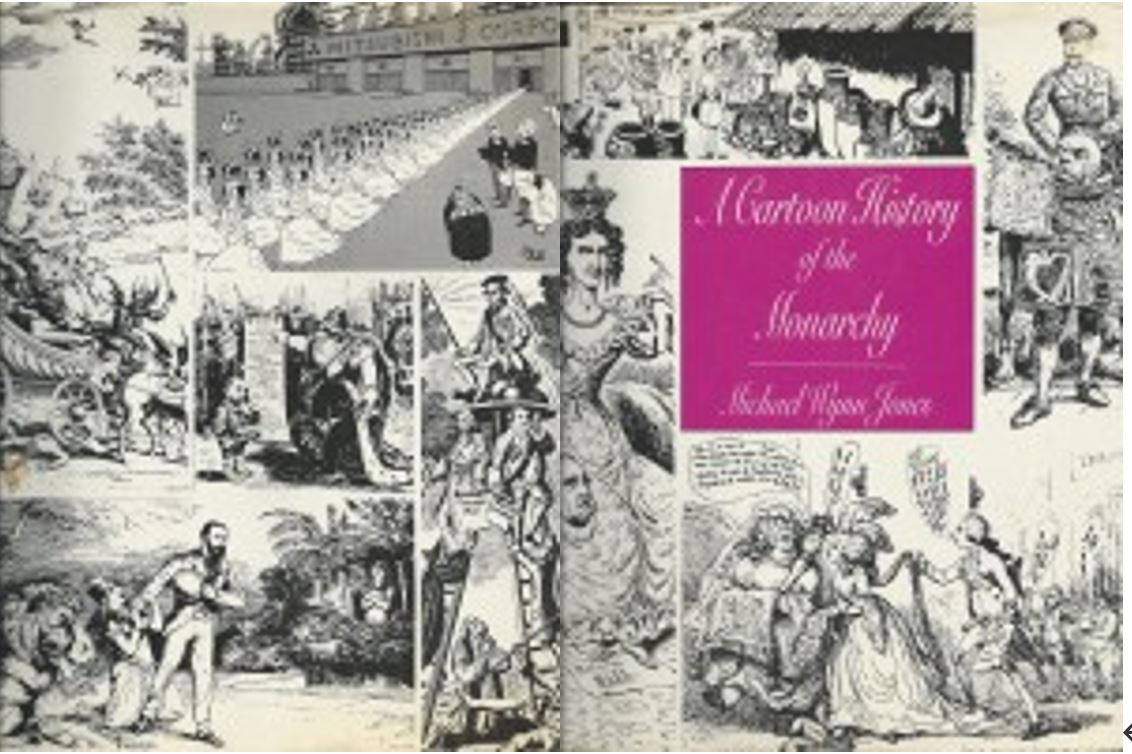
A Cartoon History of the Monarchy


By Michael Wynn Jones and Many & Various (Macmillan)
ASIN: B001H0OAOO (HB), ISBN: 978-0333198056 (PB)

We’re far too reluctant in this country to celebrate the history and quality of our own cartooning tradition; preferring simply to remark on the attention-grabbers or impressive longevity of one or two classic and venerable veterans of the pen-&-ink game for TV soundbites and platform clickbait. The actual truth is that for an incredibly long time the political art movement of the Empire and Commonwealth – and its enemies – was vast, varied and fantastically influential.

The British wing of the form has been magnificently serviced over centuries by masters of form, line, wash and most importantly ideas, repeatedly tickling our funny bones or enraging our sleeping consciences and sensibilities, all whilst poking our communal pomposities and fascinations.

From earliest inception, satiric draughtsmanship has been used to attack and sell: initially ideas, values, opinions and prejudices or but eventually actual products too. In newspapers, magazines and especially comic books, the sheer power of graphic narrative, with its ability to create emotional affinities, has led to the creation of unforgettable images and characters – and the destruction of real people or social systems.

When those creations can affect the daily lives of millions of readers, the force they can apply in the commercial or political arena is well-nigh irresistible…

In Britain, the cartoonist has held a bizarrely precarious position of power for centuries: the deftly designed bombastic broadside or savagely surgical satirical slice instantly capable of ridiculing, exposing, uplifting or deflating the powerfully elevated, unapproachable and apparently untouchable with a simple shaped-charge of scandalous wit and crushingly clear, universally understandable visual metaphor.

For this method of concept transmission, lack of literacy or education is no barrier. As the Catholic Church proved centuries ago with the Stations of the Cross, stained glass windows and a superteam of idealised saints, a picture is worth far more than a thousand words…

For as long as we’ve had printing there have been scurrilous gadfly artists commentating on rulers, society and all iniquities: pictorially haranguing the powerful, pompous, privileged and just plain perfidious through swingeing satire and cunning caricature. Sometimes artists have been just plain mean. Those are usually the best and most memorable…

Britain had no monopoly on talent and indignation, and this canny compendium also frequently features European – and latterly American – takes on our always-scandalous Royals and oddball citizenry…

Released in 1978 and desperately in need of updating and re-issue, A Cartoon History of the Monarchy offers a potted, far from hagiographic history and deliciously skewed view of our Ruling Elite in all their unsavoury glory. Here is an unbroken line of jibes, asides and broadsides culled from diverse sources by jobbing journalist and aficionado of japes, lampoons and sketches Michael Wynn Jones, who casts his discriminating eye from the reign of Elizabeth I up until just before the Silver Jubilee of the second Regina to bear the name…

Following a rota of the Kings and Queens of England, the pomposity-puncturing procession commences with The Age of Intolerance, reproducing cartoons and adding commentary dealing with the doings of the 10 monarchs from the initial Elizabeth I to George II.

Accompanying essays share the zeitgeist of those times; the religious questions as England, Wales, Ireland and eventually Scotland faced numerous crises regarding succession. That issue always revolved around whether the land should be Catholic or Protestant. ‘Popes, Plots and Puritans’ led to a final solution when ‘The Men from Hanover’ arrived to settle the matter and fully cement the nation under the Church of England.

A savage sampling of national and European opinions are represented by 26 visual bombards such as allegorical assault ‘Diana and Callisto’ by Dutch artist Miricenys (1585), the anonymous ‘England’s Miraculous Preservation’ (1648) and ‘The Royal Oake of Brittayn’ (1649) amongst many others.

Cartoon grotesques like ‘Cromwell’s Car’ (1649) or ‘Babel and Bethel’ (1679) appear beside such scandalous foreign attacks as Dutch illustrator Dusart’s ‘Fr. James King’ or anonymous French pictorial polemic ‘Notice of Burial’ (both from 1690). We Brit’s riposted with jeering celebrations of martial triumphs such as ‘The Arrival of William and Mary’ (1689), ‘The Great Eclipse of the Sun’ (simultaneously a topical spin on a 1706 solar event and defeat of “Sun King” Louis XIV by the British armies of Queen Anne), and ‘A Bridle for the French King’ from the same year.

Domestic contretemps are highlighted through such draughtsman’s delights as anonymous 1743 shocker ‘The Hanover Bubble’, Ebersley’s ‘The Agreeable Contrast’ (1746 and attacking King George’s brother “Butcher” Cumberland’s treatment of Jacobites after the Young Pretender’s defeat), and exposure of Popish influence in the Highlands, described in ‘The Chevalier’s Market’ 1745…

Whereas much of this material – British and foreign – was generally national commentary and straight religio-political assault, by the time period covered in The Wickedest Age: George III to George IV (1760-1830), the cartoon had also evolved into a weapon designed to wound with wit and crush through cruel caricature.

After covering major crises and scandals of the generally sensible – if parsimonious – third George in ‘The Royal Malady’, ‘The Dregs of Their Dull Race’ and ‘Twilight Years’, a veritable Golden Age of popular disapproval and pictorial pummelling of the Prince Regent and much-delayed, frustrated monarch (plus his many indiscreet mistresses) is covered in ‘The Prince of Whales’, ‘The Secret Marriage’, ‘…Pray Get Me a Glass of Brandy’ and ‘Delicate Investigations’.

The public disdain of the times generated a fusillade of cartoon prints, represented here by 35 graphic thrusts and savage cartoon sallies by names now as famous as any ruler. However master character assassins Townsend (‘The Scotch hurdy-gurdy’), George Cruikshank (‘Royal Condescension’), Gillray (‘A New Way to Pay the National Debt’, ‘A Voluptuary under the Horrors of Digestion’), Rowlandson (‘The Prospect Before Us’) and Heath (‘A Triumph of innocence over perjury’) are brilliantly bolstered by lesser lights West (‘The Save-all and the Extinguisher!’), Williams (‘Low Life above stairs’), Vowles (‘The shelter for the destitute’) and Marshall (‘The kettle calling the pot ugly names’) and some anonymous pen-pricks who nevertheless hit hard with ‘Tempora Mutantor’, ‘The captive Prince’ and ‘Reading of the Imperial decree’ and more.

Eventually, periodical publication overtook print-shops as the great disseminators of carton imagery, and open savagery and targeted vulgarity of caricaturists gradually gave way to mannered, if barbed, genteel observation. Thus, The Age of Discretion: William IV to Victoria (1830-1901) offers a different style of Royal Commentary: no less challenging, but certainly more overtly respectful even when critical. Sometimes, though, the new family-oriented cartooning – even in magazines like Punch and The Times, simply sunk to fawning veneration as the institution of monarchy became more and more removed from the lives of the citizenry.

William’s times are summed up in text via ‘The Sailor King’ and ‘Reform Billy’ whilst Victoria’s epochal reign and the Parliamentarians who increasingly wielded decisive power is described through ‘The Queen of the Whigs’, ‘Revolutions are bad for the Country’, ‘The Black and the Brown’ and ‘Years of Widowhood’.

The 36 collected images recapture days of Empire, with Heath, Seymour and Doyle predominant in illustrating bluff sea-dog William’s socially contentious days of Reform.

Victoria’s years – from engaging popular ingénue Queen, through happy bride to politically intrusive grand dame of European Court intrigue – highlights the craft of Doyle ‘The Queen in Danger’ (1837), Leech ‘There’s Always Something’ (1852), Tenniel ‘Queen Hermione’ (1865), ‘New Crowns for Old Ones!’ (1876), Morgan (Where is Britannia?’ and ‘A Brown Study’ (both 1867) and Sambourne ‘Kaiser-i-Hind’ (1876) amongst so many others.

Her latter years saw a rise in social conscience cartooning as displayed by the crusading Merry with ‘The Scapegrace of the Family’ (1880), ‘The fall of the rebels’ in 1886 and more. The telling modernist take of Max Beerbohm cuttingly illustrated the rift between the Empress and her playboy heir in ‘The rare, the rather awful visits of Albert Edward to Windsor Castle’

Despite her well-publicised disapproval of the good-time Prince, he became an effective king as did his son, both covered in The Edwardian Age: Edward VII to George V, spanning 1901-1936. Their dutiful achievements are depicted in ‘The Coming King’ and ‘The First Gentleman of Europe’ before war with Germany necessitated a family name change for George: ‘The First Windsor’

With kings increasingly used as good-will ambassadors and cited in scandals frequently ending in court (sound familiar?), the 30 cartoons in this section include many German pieces from not only the war years but also the tense decade that preceded them. At that time of tinderbox politics, Imperial Superpowers jostled for position and used propaganda to appeal to the world’s “unwashed masses” for justification in their aims and ambitions.

Beside veteran caricaturists like Leech, Morgan, May, Partridge, Staniforth and David Low are merciless lampoons from German cartoonists Brandt, Blir, Heine, Gulbransson and Johnson as well as French illustrator Veber and lone American Kirby.

Our pen-&-ink pictorial history lesson concludes with The Age of Respectability: Edward VIII, George VI, Elizabeth II, by generally skipping World War II, concentrating on the openly secret scandal of Edward and Mrs Simpson in ‘Abdication’. Thereafter the advent of ‘New Elizabethans’ brought a modern age of monarchs as sideshow attractions…

Although Fleet Street chose to whitewash and suppress the affair between a King-in-waiting and an American divorcee, the rest of the world made great play of the situation: as seen here with 11 telling cartoon shots from Americans McCutcheon and Orro, whilst French scribbler Effel posited typically insouciant Gallic pragmatism in ‘Une Solution’ and German-based Gulbransson played up the true romance angle…

In the meantime, British cartoonist Low had to be at his most obliquely hilarious, delineating the crisis by not mentioning it, whilst Punch stars such as Partridge steadfastly pursued a line of deferential, tragic sacrifice…

Although there is very little material featuring wartime monarch George VI – a propaganda casualty of the conflict – the last 20 cartoons herein celebrate the changing image of a very public Royal Family, pictured by names hopefully familiar to contemporary cartoon lovers.

The imagery is also contextually far more familiar – and presumably comfortable – to modern tastes as print media generally learned to save their vitriol for politicians and celebrities: reserving only minor chidings and silly teasing for “the Royals”, as seen in ‘Birthday Greetings’ and ‘Under the Splendid Empire Tree’ (Shepard from 1947) or Illingworth’s 1951 panels ‘Family Ties’ and ‘Happy Returns’.

Papers were, however, happy to utilise the monarchy to score points against governments, as seen in an attack on Enoch Powell (Cummings’ ‘Ministry of Repatriation’) and the battle between Rhodesia’s Ian Smith and Harold Wilson, lampooned in ‘Your Move!’ by Jak (both 1968) or the legendary Giles’ ‘New Rent Assistance Bill’ (1971).

Also offering acerbic jollity of a far more blueblood-specific variety are cartoon giants Trog and Waite, joining the abovementioned in exploiting the Royal Family’s gift for headline-stealing gaffes in such daring gags as ‘I Suppose we did send them to the Right Schools?’, ‘I Suppose she’ll think these are of the Queen Mother’, ‘More Pay’ and ‘Andrew’s Exchange Student’: coming full circle with the best of Hanoverian excesses scrutinised by cost-conscious government and public – albeit this time for rather more gentle laughs…

Appended with a scholarly section of Acknowledgements, Illustration sources and Index of artists, this is an extremely effective introduction to the lasting relationship between Royalty, Church and Fourth Estate, offering a fantastic overview of Regal adaptability and cultural life through cunningly contrived images and pictorial iconography that shaped society and the world.

These are timeless examples of the political pictorialist’s uncanny power and, as signs of the times, form a surprising effecting gestalt of the never-happy nation’s feeling and character.

None of that actually matters now, since these cartoons have performed the task they were intended for: moulding attitudes of generations of voters who never voted for monarchy. That they have also stood the test of time and remain beloved relics of a lethal art form is true testament to their power and passion.

Stuffed with astounding images, fascinating lost ephemera and mouth-watering tastes of comic art no aficionado could resist, this colossal collection is a beautiful piece of cartoon history to delight and tantalise all who read it.

We haven’t had many monarchs since this book was first released, but there are plenty of new Royals and scandals to ponder, so it’s long past time for a fresh edition, no?
© Michael Wynn Jones 1978. All rights reserved.

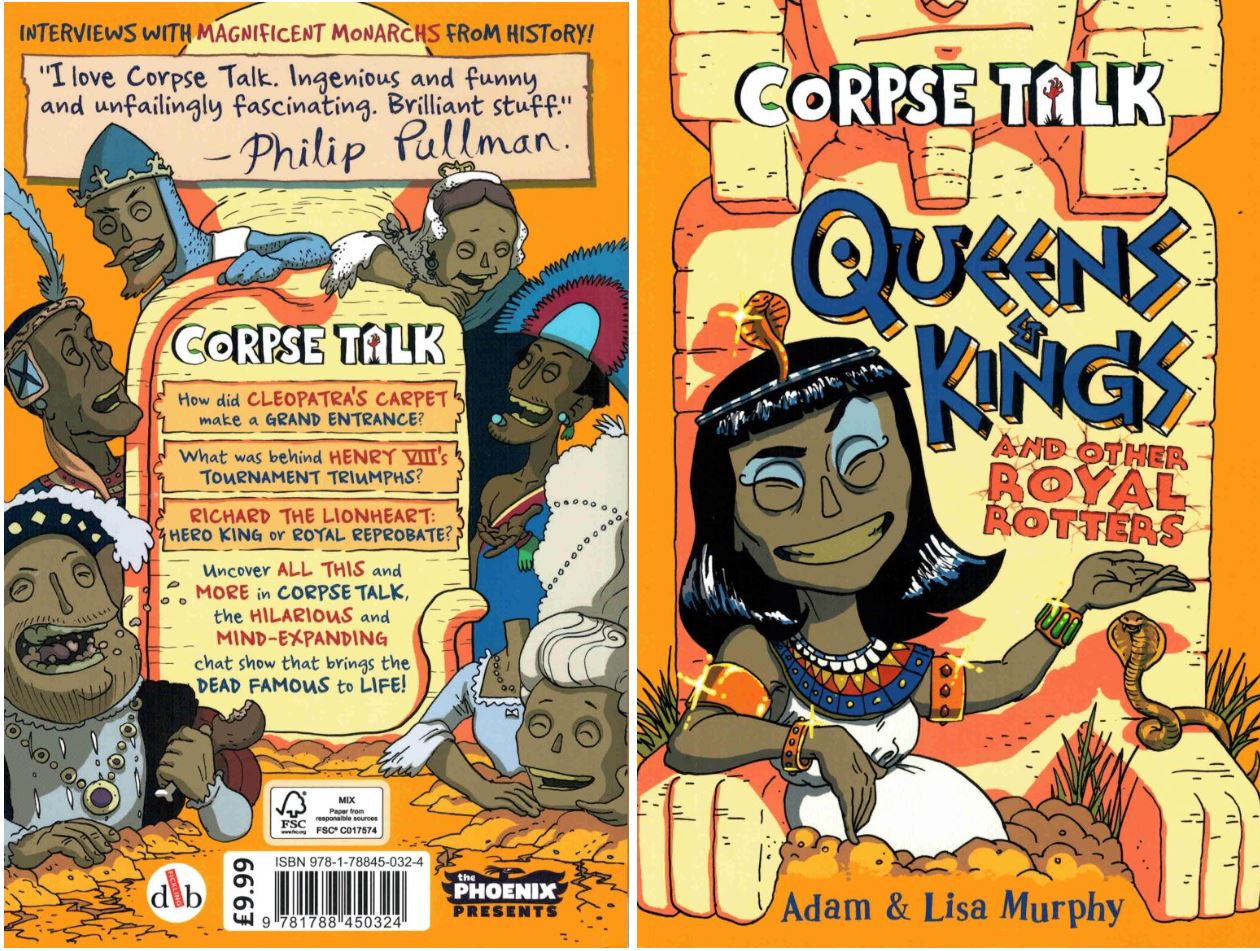
Corpse Talk: Queens & Kings and Other Royal Rotters


By Adam & Lisa Murphy (David Fickling Books)
ISBN: 978-1-78845-032-4 (PB)

The educational power of comic strips has been long understood and acknowledged: if you can make material memorably enjoyable, there’s nothing that can’t be better taught with pictures. The obverse is also true: comics can make any topic or subject come alive… or at least – as here – outrageously, informatively undead…

The fabulously effective conceit of Corpse Talk is that your cartooning host Adam Murphy (ably abetted off-camera by Lisa Murphy) tracks down (digs up?) famous personages from the past: serially exhumed for a chatty, cheeky This Was Your Life talk-show interview. It also often grosses one out, which is no bad thing for either a kids’ comic or learning experience.

Culled from the annals of The Phoenix, this regally-themed recollection is dedicated to not-so-private audiences with a succession of famous, infamous and utterly unforgettable royal rogues and rapscallions in what would almost certainly not be their own words…

Catching up in date of demise succession, our fact-loving host begins the candid cartoon conferences by digging the dirt with Ramesses II: Pharaoh of Egypt 1303 BCE – 1213 BCE. He preferred to be called ‘Ramesses the Great’ and our intrepid interviewer incisively traces the “accomplishments” and gift for self-promotion of the dusty legend.

As always, each balmy biography is supplemented by a sidebar feature examining a key aspect of their lives, such as here with ‘How to Make a Mummy’, scrupulously and systematically sharing the secrets of interring the definitely departed, after which we refocus on the ancient orient to quiz Qin Shi Huang Di: Chinese Emperor 259 BCE 210 BCE on his reign and once more sifting truth from centuries of post-mortem PR briefings.

Backing up the inquiry ‘The Emperor’s Tomb’ details the layout of the vast City of Death Qin was buried in, as well as the Palace of Shadows, its terracotta army and the treasures it guarded.

Cleopatra: Pharaoh of Egypt 69 BCE – 30 BCE outlines her incredible life, whilst ‘Barging In’ examines her astounding gold sea-craft – and how it brought her to the attention of back-up lover/sponsor Mark Anthony.

A thankfully thoroughly sanitised account of the sordid exploits of Nero: Roman Emperor 37-68 is supported up by a deconstruction of one of his feasts in ‘Cafe Nero’, after which Justinian II: Byzantine Emperor 669-711 personally explains how his determination and guile enabled him to rule, lose, recapture and retake control of the mighty Late Roman Empire. The impenetrable defences of 8th century Constantinople are then dissected in ‘The Walled City’

As well as a bit about burned cakes, Alfred the Great: King of Wessex 849-689 reveals remarkable military and civilising feats of the learning-obsessed ruler whilst expanding the knowledge base and defining the fractured kingdoms of ‘The Dark Island’ of Britain.

The Norman conquest is unpicked from the (one-eyed) view of the losing contender in Harold Godwinson: English King 1022-1066. The account is accompanied by an extended look at the historical source document in ‘Born on the Bayeaux’ before the first English civil war is remembered by formable Angevin matriarch Empress Matilda: English Queen 1102-1167. This is followed by a detailed deconstruction of the sturdy castle defensive system in ‘The Old Bailey’.

The Crusades are represented by rival legends made real. First up is admirable and noble Saladin: Sultan of Egypt and Syria 1137-1193, bolstered by a catalogue of Moslem contributions to global civilisation in ‘Gifts of Genius’, after which the unhappy truth about Richard the Lionheart: English King 1157-1199 is laid bare. After debunking centuries of self-aggrandising myths, ‘The Siege of Acre’ traces one of the crusaders’ few actual heroic exploits…

Moctezuma II: Aztec Emperor 1456-1520 relates how his timidity and sense of self-preservation led to the destruction of his dominions at the hands of conquistadores before ‘Temple of Doom’ takes us into the deepest inner workings of the bloodstained ziggurats dedicated to human sacrifice on an industrial scale…

The most complex and contentious period in British history is taken apart by those royals at the heart of it all when Henry VIII: English King 1491-1547 tries to give us his spin on events leading to the reformation. Following ‘Full Tilt – a History of Jousting’ – come ‘The Six Wives of Henry VIII’ – consecutively Catherine of Aragon (1485-1536), Anne Boleyn (1507-1536), Jane Seymour (1508-1537), Anne of Cleves (1525-1557), Catherine Howard (1523-1542 and Catherine Parr (1512-1548) – offering their side of the arguments and events.

Their raucous riotous revelations are augmented by a breakdown of the duties of a Queen’s faithful attendants in ‘The Waiting Game’.

Charles II: English King 1630-1685 relates how he came to power following the Second Civil War, backing up personal reveries with ‘A Memoir on Monarchy’ running down the changing role of rulers, after which we cross the channel to hear how it all went wrong for France’s final female autocrat in Marie Antoinette: French Queen 1755-1793. Her fall from grace is abutted by a chilling lesson on guillotine mechanics in ‘Decapitation Stations’.

Contemporary cousin Catherine the Great: Russian Empress 1729-1796 managed to run things largely her own way, but as back-up ‘Tsars in their Eyes’ shows, she was plagued by a constant stream of pretenders, all claiming to be true, proper, better qualified and, yes, male contenders for her throne.

South African rebel and strategic genius Shaka Zulu: Zulu King 1787-1828, recounts how he literally created a mighty nation from nothing whilst ‘The Battle of Isandlwana’ covers how his innovations were used to humiliate the overwhelmingly powerful British Army before the procession of pomp and circumstance closes with Queen Victoria: English Queen 1819-1901, accompanied by a phenomenally absorbing family tree, branching out and into every royal bloodline in Europe: a true ‘Game of Thrones’

Clever, cheeky, outrageously funny and formidably factual throughout, Corpse Talk unyieldingly tackles history’s more tendentious moments whilst personalising the great, the grim and the good for coming generations.

It is also a fabulously fun read no parent or kid could possibly resist. Don’t take my word for it though, just ask any reader, royal-watcher or republican in waiting…
Text and illustrations © Adam & Lisa Murphy 2018. All rights reserved.

Babar the King


By Jean de Brunhoff (Egmont/Albatross)
ISBN: 978-702375-705-0 (HB) 978-1-4052-3819-9 (2008 Album PB) 978-1-94696-311-6 (2018 facsimile edition)

Since 1931 Babar the Elephant has charmed (and on occasion outraged and incensed) generations of readers. Jean de Brunhoff’s L’Histoire de Babar was first published in France and was an instant hit. The English language version was released in 1933, complete with introduction by A. A. Milne, bringing the forthright and capable elephantine hero across the channel and thence onwards across the Oceans to America and the Colonies.

Apparently, the tale was a bedtime story the author’s wife Cecile created for their own children. De Brunhoff co-opted, scripted and painted seven adventures before his death in 1937, two of them published posthumously. After World War II his son Laurent continued the franchise producing ten more adventures between 1946 and 1966. To date that’s at least another 37 books supplementing the original magnificent seven…

The tales in those tomes have in their time been controversial. Many critics have seen them as being pro-colonialism, and as products of a more robust time, they could never be regarded as anodyne or saccharine, but they are sweet, alluring and irresistibly captivating.

When baby Babar was growing up in the jungle, his mother was killed by white hunters. Terrified and sad the baby fled in panic, eventually coming to a very un-African provincial city. There he met a kind old lady who supported him as he adapted to city life. Babar moved into her very large house and was educated in modern, civilised ways. But still, occasionally, he felt homesick and missed his jungle home…

After a few years he encountered cousins Celeste and young Arthur and the Old Lady adopted and supported them too. Soon, though, their mothers come to fetch them and Babar returns with them to show the other elephants all the wonderful things he has learned and experienced. Buying a motor-car and filling it with clothes and presents he returns just in time, because the King of all the Elephants has eaten a bad mushroom and is dying…

Babar The King is the third volume, published in 1933 as Le Roi Babar. Here – after a long time travelling, voyaging and getting the perfect wife – a youthful vigorous forward-looking monarch and his bride Celeste start civilising and modernising the Kingdom of the Elephants. With them is that wonderfully helpful and dedicated Old Lady…

In a wave of rapid modernisation, the inspirational city of Celesteville is completed. It has broad streets, magnificent civic buildings, parks, gardens, theatres, ports and every amenity to delight and edify the populace. There is even a brand-new school, but that is not so popular with every citizen! Now every elephant has a job and vocation, but even such a paradise is capable of misfortune. They must all pull together when a great fire ravages the house of King Babar’s great friend and advisor Cornelius

Charming and seductive, this venerable yarn – and the others – can still set pulses racing. In a crowded market it’s grand to see books that are both fresh and yet comfortingly pedigreed. Political assumptions of adults are one thing, but the most valid truth is that these are magical books for the young, illustrated in a style that is fluid, humorously detailed and splendidly memorable. Even after 90 years they retain the power to enthral and captivate with a charm leavened by underlying realism that is still worthy of note.

In 2018, a facsimile edition was released (170 x 250 mm), but the Egmont edition is also readily available. As far as I know the stories are still not found digitally.
2008 Edition. All Rights Reserved.

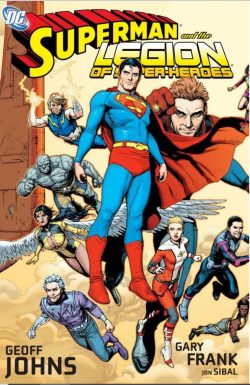
Superman and the Legion of Super-Heroes


By Geoff Johns, Gary Frank, Jon Sibal & various (DC Comics)
ISBN: 978-1-4012-1819-5 (HC/Digital edition) 978-1-4012-1904-8 (TPB/Digital edition)

Superman started the whole modern era of fantasy heroes: outlandish, flamboyant, indomitable, infallible, unconquerable.

He also saved a foundering industry and invented an entirely new genre of storytelling – Super heroes. Since May 1938 he has unstoppably evolved into a mighty presence in all aspects of art, culture and commerce, even as his natal comicbook universe has organically and exponentially expanded.

Long ago and far away a scientifically advanced civilisation perished, but not before its greatest genius sent his baby son to safety in a star-spanning ship. It landed in simple, rural Kansas where the interplanetary orphan was reared by decent folk as one of us…

Once upon a time, in the far future, a band of super-powered kids from dozens of alien civilisations took inspiration from the greatest legend of all time and formed a club of heroes. One day these Children of Tomorrow came back in time and invited that legend to join them…

And thus began the vast and epic saga of Superman and – tangentially – the Legion of Super-Heroes as envisioned by writer Otto Binder & artist Al Plastino in Adventure Comics #247 (cover-dated April 1958 and approximately 20 years after Kal-El’s debut).

Since that time, the fortunes and popularity of the Legion have perpetually waxed and waned, with their future history tweaked and rebooted, retconned and unwritten over and again to comply with editorial diktat and popular trends.

One always popular publishing stratagem is to re-embrace those innocent, silly, joyous, stirring and utterly compelling pre-Crisis on Infinite Earths tales, but shading them with contemporary sensibilities. With this in mind Geoff Johns gradually reinstituted the Lore of the Legion in a number of his assignments during the early part of this century.

Beginning most notably with Justice League of America: The Lightning Saga and culminating in the epic New Krypton and War against Brainiac sagas, the Legion were restored: once again carving out a splendid and unique niche in the DC Universe.

Along the way came this superb, nostalgia-laced cracker which re-established direct contact between the futuristic paladins and the current Man of Tomorrow…

Compiling Action Comics #858-863 (December 2007 through May 2008), this collected chronicle – sporting an Introduction from veteran LSH creator Keith Giffen – finds the Legion back in the 21st century, seeking Superman to save Tomorrow’s World once more.

Long ago the Legion had regularly visited: spiriting the young Kryptonian to a place and time where he didn’t have to hide his true nature. However, once he began his official and adult public career, the visits ceased and his memories were suppressed to safeguard the integrity of history and the inviolability of the timeline.

Now a desperate squad of Legionnaires must reawaken those memories since the Man of Steel is the last hope for a world on the edge of destruction. In the millennium since his debut, the myth of Superman has become a beacon of justice and tolerance throughout the Utopian Universe, but recently a radical, xenophobic anti-alien movement has swept Earth, marginalising, interning and even executing all non-Terrans.

Moreover, a super-powered team of Legion rejects has formed a Justice League of Earth to spearhead a crusade against all extraterrestrial immigrants, and outrageously claim Superman was actually a true-born Earthling. They have even declared him the figurehead and spiritual leader of their pogrom…

Of course, Kal-El of Krypton must travel to the future and not only save the day but scour the racist stain from his name: a task made infinitely harder because Earth-Man, psychotic supremacist leader of the Earth-First faction, has turned yellow sun Sol a power-sapping red…

Bold, thrilling and utterly enthralling, the last-ditch struggle of a few brave aliens against a racist, fascistic and unrepentantly ruthless totalitarian tomorrow is the stuff of pure comic-book dreams. Superman strives to unravel a poisonous future where all his hopes and aspirations have been twisted and soiled, with only his truest childhood friends to aid him. It’s all made chillingly authentic thanks to the incredibly intense and hyper-realistic art of Gary Frank & Jon Sibal, making it all seem not only plausible and inevitable, but also inescapably horrible…

Sweetening the deal is a stunning covers and variants gallery by Frank, Adam Kubert, Steve Lightle, Mike Grell & Al Milgrom, plus pages of notes, roughs and designs from Frank’s preparatory work before embarking on the epic adventure.

Unforgettable, total Fights ‘n’ Tights future shock in the best way possible, and a major high point for fans of all ages…
© 2007, 2008 DC Comics. All Rights Reserved.

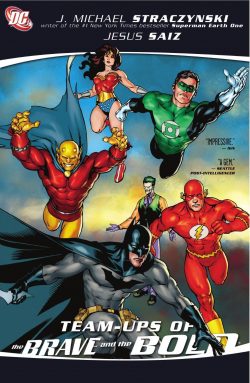
Team-Ups of the Brave and the Bold


By J. Michael Straczynski, Jesus Saiz, Chad Hardin, Justiniano, Cliff Chiang & various (DC Comics)
ISBN: 978-1-4012-2793-7 (HB) 978-1-4012-2809-5 (TPB/Digital edition)

The Brave and the Bold premiered in 1955; an anthology adventure comic featuring short complete tales starring a variety of period heroes and a format mirroring and cashing in on that era’s filmic fascination with historical dramas.

Devised and written by Robert Kanigher, issue #1 led with Roman epic Golden Gladiator, medieval mystery-man The Silent Knight and Joe Kubert’s now legendary Viking Prince. The Gladiator was soon replaced by National Periodicals/DC Comics’ iteration of Robin Hood, and the high adventure theme carried the title until the end of the decade when a burgeoning superhero revival saw B&B remodelled as a try-out vehicle like the astounding successful Showcase.

Deployed to launch enterprising concepts and characters such as Task Force X: The Suicide Squad, Cave Carson, Strange Sports Stories, Hawkman and the epochal Justice League of America, the title then evolved to create a whole sub-genre – although barely anybody noticed at the time…

That innovation was Superhero Team-Ups.

For almost a decade DC had enjoyed great success pairing Superman with Batman and Robin in World’s Finest Comics, and in 1963 sought to create another top-selling combo from their growing pantheon of masked mystery men. It didn’t hurt that the timing also allowed extra exposure for characters imminently graduating to their own starring vehicles after years as back-up features…

This was during a period when almost no costumed heroes acknowledged the jurisdiction or (usually) existence of other costumed champions. When B&B offered this succession of power pairings, they were unknowingly laying foundations for DC’s future close-knit comics continuity. Nowadays, there’s something wrong with any superstar who doesn’t regularly join every other cape or mask on-planet every five minutes or so…

The short-lived experiment eventually calcified as “Batman and…” but, for a while, readers were treated to some truly inspired pairings such as Flash and the Doom Patrol, Metal Men and Metamorpho, Flash and The Spectre or Supergirl and Wonder Woman.

The editors even achieved their aim after Robin, Kid Flash and Aqualad remained together after their initial foray and expanded into the ever-popular Teen Titans

That theme of heroes united together for a specific time and purpose was revived in 2007 for the third volume of The Brave and the Bold, resulting in many exceedingly fine modern Fights ‘n’ Tights classics, and this compilation collects issues #27-33 (November 2009 – June 2010): the first seven issues scripted by TV/comics star scribe J. Michael Straczynski.

The run of easily accessible, stand-alone tales delved into some of the strangest nooks and crannies of the DCU and opens here with ‘Death of a Hero’, illustrated by Jesús Saíz, wherein teenager Robby Reed visits Gotham City and decides to help out a Batman sorely pressed by the machinations of The Joker

The child prodigy had his own series in the 1960s as a kid who found a strange rotary device dotted with alien hieroglyphics that could temporarily transform him into a veritable army of super-beings when he dialled the English equivalents of H, E, R and O…

Here, however, after the lad dials up futuristic clairvoyant Mental Man, the visions he experiences force him to quit immediately and take to his bed…

He even forgets the Dial when he leaves, and it is soon picked up by down-&-out Travers Milton who also falls under its influence and is soon saving lives and battling beside the Dark Knight as The Star. What follows is a meteoric and tragic tale of a rise and fall…

Again limned by Saíz, B&B #28 takes us a wild trip to the ‘Firing Line’ as the Flash (Barry Allen) falls foul of a scientific experiment and winds up stranded in the middle of World War II. Injured and unable to properly use his powers, the diminished speedster is taken under the wing of legendary paramilitary aviator squadron The Blackhawks, but finds himself torn when his scruples against taking life crash into the hellish cauldron of the Battle of Bastogne and his manly, martial love of his new brothers in arms…

Brother Power, The Geek was a short-lived experimental title developed by legendary figure Joe Simon at the height of the hippy-dippy 1960s (or just last week if you’re a baby booming duffer like me).

He/it was a tailor’s mannequin mysteriously brought to life through extraordinary circumstances, just seeking his place in the world: a bizarre commentator and ultimate outsider philosophising on a world he could not understand.

That cerebral angst is tapped in ‘Lost Stories of Yesterday, Today, and Tomorrow’ when the elemental outcast crawls out of wreckage in Gotham City and clashes with Batman as they both strive to save homeless people from authoritarian brutality and greedy arsonists.

Like the times it references, this story is one you have to experience rather than read about…

Straczynski & Saíz play fast and loose with time travel in ‘The Green and the Gold’ as mystic Lord of Order Doctor Fate is helped through an emotional rough patch by Green Lantern Hal Jordan. As a result of that unnecessary kindness, the mage gets to return the favour long after his own demise at the moment the Emerald Warrior most needs a helping hand…

Illustrated by Chad Hardin & Walden Wong and Justiniano, The Brave and the Bold #31 describes ‘Small Problems’ encountered by The Atom after Ray Palmer is asked to shrink into the synapse-disrupted brain of The Joker to perform life-saving surgery. Despite his better judgement, the physicist eventually agrees but nobody could have predicted that he would be assimilated into the maniac’s memories and forcibly relive the Killer Clown’s life…

Straczynski & Saíz reunite as sea king Aquaman and hellish warrior Etrigan the Demon combine forces in a long-standing pact to thwart a revolting Cthonic invasion of ‘Night Gods’ from a hole in the bottom of the ocean before this mesmerising tome concludes with a bittersweet ‘Ladies Night’ from times recently passed, illustrated by Cliff Chiang.

When sorceress Zatanna experiences a shocking dream, she contacts Wonder Woman and Batgirl Barbara Gordon, insisting that they should join her on an evening of hedonistic excess and sisterly sharing. Only Babs is left out of one moment of revelation: what Zatanna foresaw would inescapably occur to her the next day at the hands of the Joker…

Smart, moving and potently engaging, these heroic alliances are a true treat for fans of more sophisticated costumed capers, and skilfully prepared in such a way that no great knowledge of backstory is required. Team-ups are all about finding new readers and this terrific tome is a splendid example of the trick done right…
© 2009, 2010 DC Comics. All Rights Reserved.

The Michael Moorcock Library Elric volume 2: The Sailor on the Seas of Fate


Adapted by Roy Thomas, Michael T. Gilbert, George Freeman, with Tom Orzechowski, L. Lois Buhalis & P. Craig Russell (Titan Comics)
ISBN: 978-1-78276-289-8 (HB/Digital edition)

Michael Moorcock’s irresistible blend of brooding Faustian tragedy and all-out action is best seen in his stories of Elric, last Emperor of the pre-human civilisation of Melniboné, with the adaptations scripted by Roy Thomas (Avengers, X-Men, Conan, All Star Squadron, Arak) during the 1980s being a high watermark in the annals of illustrated fantasy.

Elric is a primal icon of the Sword & Sorcery genre: ruling a race of arrogant, congenitally sadistic sorcerers: dissolute creatures in a slow, decadent decline after eons of dominance. Born an albino, he is physically weak and afflicted with a brooding, philosophical temperament. His energies perpetually bolstered by sorcery or the souls his sword steals, the Emperor cares for nothing save his beautiful cousin Cymoril, even though her brother Prince Yyrkoon openly lusts for his throne – and his own sister…

Thomas & P. Craig Russell had previously adapted debut tale The Dreaming City (based on the first novella from 1961), as a pioneering Marvel Graphic Novel in 1982, supplemented by 1984’s ‘While the Gods Laugh’ in Marvel’s fantasy magazine Epic Illustrated.

Those stories were refurbished during the first blossoming of the American Direct Sales Market as the soaring saga transferred to Pacific Comics – before their early demise – and thereafter alighting at First Comics in 1985. Given an archival polish and push, the franchise expanded into a graphic novel line and numerous limited series starring not just Elric but also other revered Moorcock properties such as Dorian Hawkmoon/The Runestaff and The Chronicles of Corum.

Ultimately, the epic adaptations alighted in these carefully curated chronicles courtesy of Titan Comics, in both physical and digital formats. The first volume of the Michael Moorcock Library of comics featured – according to internal narrative chronology – the first tale of the doomed king, despite it being one of the last adventures penned by Moorcock in the initial cycle of stories. He returned to the character years later, as all great authors do…

With Michael T. Gilbert (Mr. Monster, American Splendor, Mann & Superman, Mickey Mouse, Donald Duck, Bart Simpson) & George Freeman (Captain Canuck, X-Files, Jack of Hearts, Aquaman, Batman, Wasteland) illustrating Thomas’s script, this second volume features a 7-part miniseries from First Comics (1985-1986), adapting the novel which so impressively captured the otherworldly nature of Moorcock’s Eternal Champion concept.

Following a warmly informative Introduction by “Tanelorn Archivist” Guy Lawley, the saga resumes with ‘The Chronicle of the Black Sword’ (lettered by Tom Orzechowski & L. Lois Buhalis) as the doom-laden albino flees captivity and murderous humans of the “Young Kingdoms” who were everywhere usurping control from the world’s ancient former rulers.

The emperor had abandoned beloved Cymoril and the Dreaming City of Imrryr to seek an unattainable peace of mind, but fallen to treachery and torture in the city of Ryfel in the new land called Pikarayd. Having escaped carrying malevolent, wilful Rune-sword Stormbringer, he pauses his headlong flight, inexplicably waiting on a windswept beach for fate’s next twist.

It comes as a fantastic vessel arrives, ready to add him to its incredible crew…

The ship is a trans-dimensional galleon assembling heroes for an impossible mission. Aboard the eerie vessel he meets a motley crew of warriors from alternate Earths gathered in hopes of saving the multiverse. Risking the very nature of reality, Elric has taken ship with three other aspects of the Eternal Champion; Corum, Erekosé and Dorian Hawkmoon. Together they must voyage to a wild place and defeat Agak and Gagak, sorcerous siblings from beyond the multiverse intend on consuming creation.

Finding a grim kind of companionship amidst a company of similarly foredoomed warriors, Elric proceeds in the quest, but only succeeds after surrendering his individuality to the obscene horror and sheer indignity of becoming “The Four Who Are One”. That climactic clash comes after an interminable voyage across diverse dire realms, made ever harder as Elric’s cosmic patron refuses to aid him…

The pale Emperor had previously pledged allegiance to Arioch, a Lord of Chaos in eternal opposition to supernal Lords of Order. He had – on occasion – been granted power and aid in times of crisis. The eternal see-saw war of these puissant conceptual forces was the fundamental principle governing the Multiverse. However, for providing the etiolated Elric with the means to find and defeat his cousin, Arioch demanded his devil’s due, binding him to the Stealer of Souls: a vampiric black blade that frequently killed anyone he cared for…

Their mission ultimately completed at tremendous cost, Elric remains aboard ship for return to his proper place, but instead debarks in another desolate land and moment of crisis, uniting with wandering warrior Count Smiorgan Baldhead: former seagoing merchant prince and fellow dispatcher of marauding bandits and similar riff-raff…

Together they seek the fabled Crimson Gate, a dimensional portal that can transport them to their long-lost homes…

Before they find it, however, the questers face an ethereal horse, aid its spectral rider Prince Carolak and confront Elric’s legendary deviant ancestor Saxif D’aan to save human woman Vassliss from the revenant’s attentions: sparking an eldritch duel with an awful outcome…

The long trip to Melniboné moves to its final phase as Elric and Smiorgan take ship with another sea rover: charismatic Duke Avan Astran of Old Hrolmar. They join the enterprising trader in a voyage to discovery – for which read “plunder” – to the lost city R’lin K’ren A’a. The mystical metropolis is well known to Elric: it is presumed to be the direct precursor to his own Empire…

The arcane argosy again tests Elric’s every resource, ending in a torrid trek through foetid swamps infested with primordial progenitors of the Melnibonéan species. In this time and place, Arioch’s aid is an even more double-edged affair, initially refused but then granted only to precipitate a larger threat to all creation…

Triumphing thanks to the accursed assistance of J’osui C’reln Reyr – the Creature Doomed to Live! – Elric and Smiorgan only survive because Stormbringer indiscriminately slaughters all their foes and allies, ruthlessly paving the way for the voyagers return to Imrryr …

To Be Continued…

Deemed the second novel of the Elric cycle (Moorcock actually wrote most of the tales devoid of chronological order – but only purists need concern themselves with that) this is an unparalleled phantasmagoria of carnage and unshackled cosmic creativity, spectacularly brought to life by esteemed arch-stylists Gilbert and Freeman, who construct a decadently baroque, sinisterly effete yarn supplemented by a full cover gallery, additional art by P. Craig Russell and full creator biographies.

Another groundbreaking landmark of fantasy fiction and must-read-item, this resplendently flamboyant tale is a deliciously elegant, sinisterly beautiful masterpiece of the genre, blending blistering action and breathtaking adventure with the deep, darkly melancholic tone of a cynical, nihilistic, Cold-War mentality and era that spawned the original stories.
Adapted from the works of Michael Moorcock related to the character of Elric of Melniboné © 2015, Michael & Linda Moorcock. All characters, the distinctive likenesses thereof, and all related indicia are TM & © Michael Moorcock and Multiverse Inc. The Sailor on the Seas of Fate is © 1985 Roy Thomas, Michael T. Gilbert & George Freeman. All rights reserved.

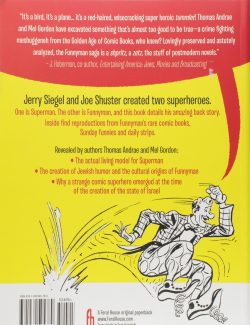
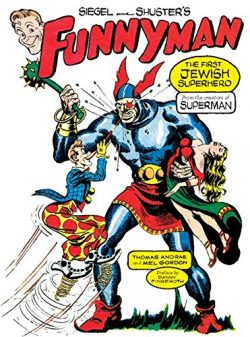
Siegel and Shuster’s Funnyman: The First Jewish Superhero


By Jerome Siegel & Joe Shuster with Thomas Andrae, Mel Gordon & various (Feral House)
ISBN: 978-1-932595-78-9 (TPB/Digital edition)

The comics industry owes an irredeemable debt to two talented and ambitious Jewish kids from Cleveland in the right place at the right time who were able to translate their enthusiasm and heartfelt affection for beloved influences and delight in a new medium into a brand-new genre which took the world by storm.

Writer Jerome Siegel and artist Joe Shuster were a jobbing cartoonist team just breaking into the brand-new yet already-ailing comicbook business with strips such as ‘Henri Duval’, Doctor Occult and Slam Bradley. Thanks to editorial visionary Sheldon Mayer, they hastily rejigged a frequently rejected newspaper strip concept for an upcoming new title and manifested the greatest action sensation of the age – if not all time…

Superman captivated depression-era audiences and within a year had become the vanguard of a genre and an industry. In those early days, the feature was both whimsical and bombastic – as much gag strip as adventure serial – and it was clear the utterly inspired whiz kids were wedded to laughs just as much as any wish-fulfilling empowerment fantasies.

As even the most casual scholar knows, Siegel & Shuster were not well-served by their publishers and by 1946 no longer worked for National Periodicals (today’s DC Comics). In fact, they were in acrimonious litigation which led to the originators losing all rights to their creation and suffering years of ill-treatment until an artist-led campaign at the time of the 1978 Superman movie shamed the company into a belated reversal and financial package (consisting mostly of having their names returned to the character’s logo and company medical benefits).

Long before this however, the dynamic duo produced an abortive “Last Hurrah”: another unique character based on early influences, but one who sadly did not catch the public’s attention in those post war years when the first super-heroic age was ending.

Based broadly on performing sensation Danny Kaye, Funnyman was a stand-up comedian dressed as a clown who used comedy gimmicks to battle criminals, super-villains and aliens: initially in 6 issues of his own comic book and thereafter as a Daily/Sunday newspaper strip.

A complete antithesis to the Man of Steel, Larry Davis was a total insider, no orphan or immigrant, but a wealthy, successful man, revered by society, yet one who chose to become a ridiculous outsider, fighting for not the common good but because it gave him a thrill nothing else could match. The series was light, beautifully audacious, tremendous fun and sank like a concrete-filled whoopee cushion.

Here social historians Thomas Andrae and Mel Gordon carefully re-examine the strip in the much broader context of Jewish Identity and racial character, with particular reference as it applies to Jewish-Americans, and make some fascinating observations and postulates.

Following an intriguing preface by author, writer, editor and comics historian Danny Fingeroth, this book assiduously dissects the history and psychology of the Judaic experience in a compelling series of astoundingly illustrated essays gathered under the umbrellas of Gordon’s ‘The Farblondjet Superhero and his Cultural Origins’ and Andrae’s ‘The Jewish Superhero’.

The former (and Farblondjet translates as “mixed up” or “lost”) probes ‘The Mystery of Jewish Humor’, ‘The Construct of Humor in Everyday Jewish Life’, ‘The Old Theories: Laughter-Through-Tears’; ‘A Laughing People’; ‘Outside Observer’ and ‘The Badkhn Theory’ (Badkhn being performers hired to insult, offend and depress guests and celebrants at social gatherings such as weddings or funerals).

‘Characteristics of Modern Jewish Humor’ are subdivided and explored in ‘Aggression’, ‘The Yiddish Language’, ‘Self-Mockery’, ‘Inversion and Skepticism’, ‘Scatology’, ‘Gallows Humor’ and ‘Solipsism and Materialism’ before Gibson’s compelling, contextual potted-history concludes with ‘American-Jewish Comedy Before 1947’ (the year Funnyman debuted), ‘Weber and Fields’, ‘On the Boards’, ‘The Borscht Belt’, ‘Cartoons and Jokebooks’ and ‘Hollywood Talkies and Syndicated Radio’.

Then, in ‘The Jewish Superhero’ Andrae examines Siegel & Shuster’s possible influences; everything from German expressionist cinema masterpiece The Golem: How He Came into This World to real-life strongman Sigmund Breitbart, a Polish Jew who astounded the world with his feats in the early 1920s. On his American tour Sigmund appeared in Cleveland in October 1923. Siegel, a local resident, would have been 9 years old – which as everyone knows is the actual “golden age of comics”…

‘Funnyman, Jewish Masculinity and the Decline of the Superhero’ explores the psychology and landscape of the medium through the careers and treatment of Siegel & Shuster in ‘The Birth of Funnyman’, ‘The Body Politic’, ‘The Schlemiel and the Tough Jew’, ‘The Decline of the Superhero’ and ‘Comic Book Noir’ before going on to recount the story of the newspaper strips in ‘The Funnyman Comic Strip’ and ‘Reggie Van Twerp’ (a last ditch attempt by the creators to resurrect their comic fortunes) before the inevitable axe falls in ‘End Game…

Thus far this engaging tome is a compulsive and hugely informative academic work, but in ‘Funnyman Comic Book Stories’ the resplendently vintage fan fun truly takes hold with a full colour section reproducing a selection of strips from the 6-issue run.

‘The Kute Knockout!’ (Funnyman #2, March 1948) pits the Hilarious Hero against a streetwalker robot built to seduce and rob Johns after which ‘The Medieval Mirthquake’ (Funnyman #4, May 1948) propels our Comedy Crusader back to the time of Camelot. From the same issue comes ‘Leapin’ Lena’ as Funnyman faces a female bandit who can jump like a kangaroo whilst yarn #5 (July 1948) catches him chasing a worrisome new crime wrinkle in ‘The Peculiar Pacifier’.

Also included are the striking covers of all 6 issues, the origin of Funnyman from #1, lots of splash pages and a selection of Shuster’s Superman art, but the most welcome benefit for fans and collectors is a detailed precis of the entire run’s 20 tales.

The same consideration is offered for the newspaper strips. As well as similar synopses for the Sundays (12 adventures spanning October 31st 1948 to the end of October 1949) and the Dailies (another dozen larks covering October 18th 1948 to September 17th 1949), there are 11 pages of full-colour Sunday sections plus the complete monochrome ‘Adventure in Hollywood’ (December 20th-January 12th 1949) to enjoy and marvel over.

Like Funnyman himself, this book is an odd duck. Whereas I would have loved to see the entire output gathered into one volume, what there is here is completely engrossing: a wonderful assessment and appreciation of genuine world-altering hugely creative comics pioneers enjoying some well-deserved acclaim and compelling cultural contextualization for something other than their mighty Man of Steel. This is a fabulous tome with an appeal extending far beyond its arguably limited funnybook fan audience.
Siegel and Shuster’s Funnyman © 2010 Thomas Andrae and Mel Gordon. All rights reserved.

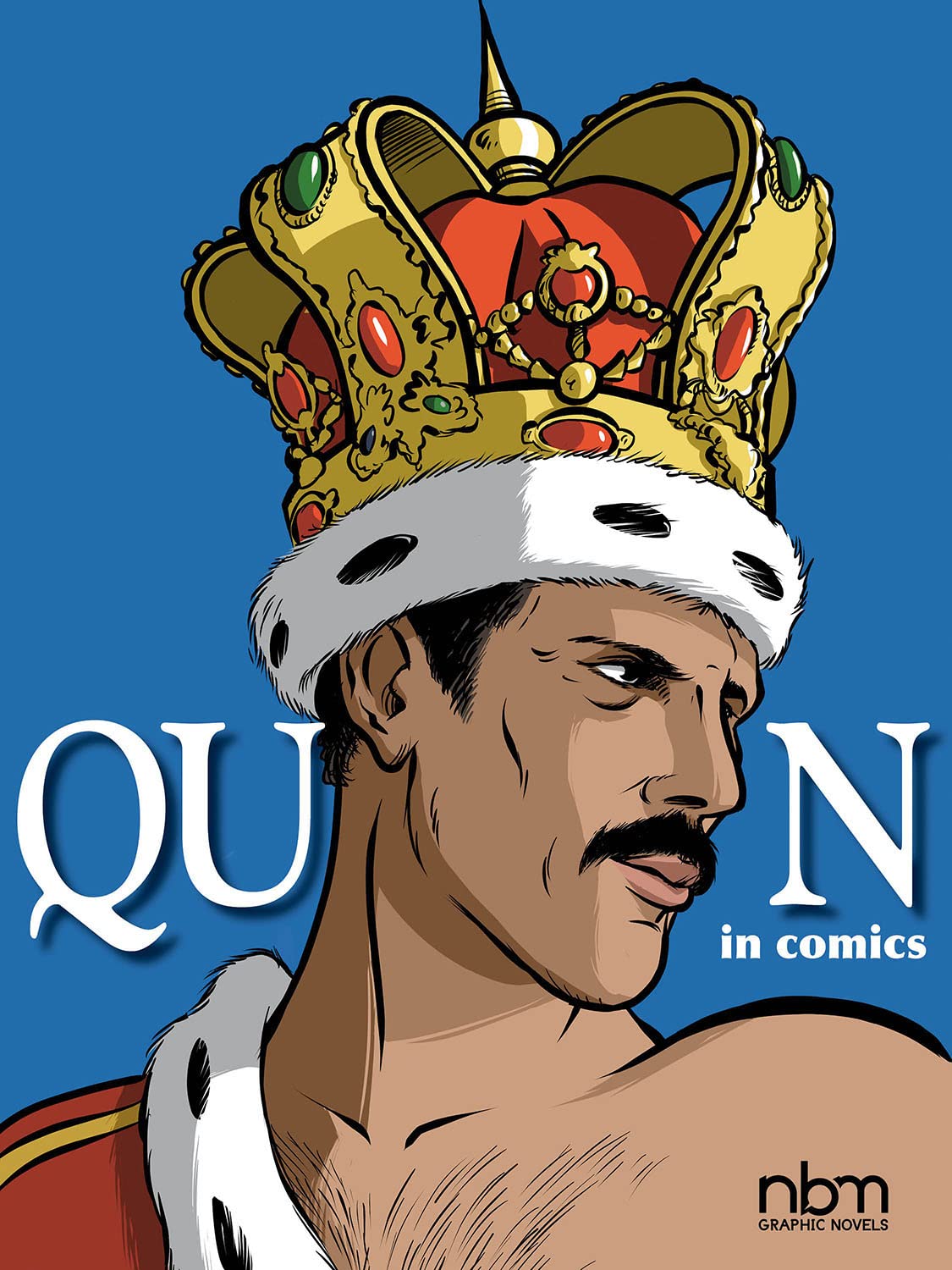
Queen in Comics


By Emmanuel Marie (narrative) & Sophie Blitman (articles); illustrated by Bast, Riccardo Randazzo, Céline Olive, Antonio Campofredano, Samuel Wambre, Julien Huggonard-Bert, Lauriane Rérolle, Jean-Jacques Dzialowski, Alex-Imé, Francesco Colafella, Samuel Figuiére, Antoine Pédron, Arnaud Jouffroy, Toni Cittadini, Carmelo Zagaria, François Foyard, Paulo Loreto, Dario Formisani, Nicolò Laporini, Luigi Ziteli, Enzo Gosselin & various: translated by Christopher Pope (NBM)
ISBN: 978-1-68112-311-0 (HB) eISBN: 978-1-68112-312-7

It’s time for another stunning rock biography: released continentally in 2021 but which will certainly appeal to readers all over the English-speaking world. Another entry in NBM’s superb “…in Comics” sub-strand, it unlocks and unleashes the history of another musical sensation that shook the planet, focussing in particular (how could you not?) on a unique performer who changed popular culture and modern society…

Gathered in this fetching account are context-providing, photo-packed essays bracketing individual comics sections. Here chronological article researched and documented by French journalist/educator Sophie Blitman and sociologist/graphic novelist Emmanuel Marie dramatise those dry facts for a horde of artists to spectacularly realise in comics vignettes…

Our baroque journey begins with the scene stealing front-man as ‘Farrokh’s Childhood’ – limned by Riccardo Randazzo and fleshed out by colourist Luigi Ziteli – views the schooldays of Farrokh Bulsara (September 5th 1946 – November 24th 1991) leaving his childhood home in the British Protectorate of Zanzibar. Son of a well-to-do Parsi family at the tail-end of the British Empire, in 1954 he transferred to St. Peter’s Boys Boarding School in what was then Bombay, India. Dubbed “Freddie” by his classmates, the boy excels at the piano and boxing.

In 1958, he hears Little Richard for the first time and adds Rock ‘n’ Roll to his eclectic love of Bollywood singers and classical opera. With his band – The Hectics – he plays constantly, honing his skills whilst pursuing his studies until 1964, when revolution creates the nation of Tanzania, forcing the entire Bulsara family to relocate to England…

Following Blitman’s context-packed essay on the geo-political and cultural status quo prior to the move to London, Céline Olive takes us to Kensington in 1969 to experience ‘Youth in London’. Here recent graduate in Graphic Arts Freddie Bulsara makes a living selling clothes on a market stall and tries to break into the big time with his band Ibex. His partner in the rags venture is Roger Taylor, who plays with guitarist Brian May in Smile. One night in September, both bands play in Liverpool and a jam session creates a kind of magic…

A text piece covering college days and tentative early moves in the burgeoning music scene segues into Antonio Campofredano’s bold rendition ‘Everything Starts With a Smile’ (colour by Nicolò Laporini) in 1970 as almost-hitmakers Smile take on pianist Freddie (call me “Mercury”) and discover a voice beyond compare…

A feature on the music biz and Smile precedes a leap to cartoon creativity in 1971 as Samuel Wambre reveals how a mix, match, merge and classified ad brings bassist John Deacon into play even as Freddie doodles out the ‘Birth of an Esthetic’ and Smile become Queen…

A prose feature detailing that transition in the era of Glam-Rock is accompanied by a detailed deconstruction of the band’s iconic “Royal Coat of Arms” before Julien Huggonard-Bert & colourist Laporini explore ‘First Album, Little Success’ as the up-&-comers cut their first LP and sign with EMI in 1972. After a discussion of Queen I, Lauriane Rérolle details the first days of an epic stage and performing legend in ‘We Want a Show!’ seeing Freddie consult fashion force Zandra Rhodes to ensure a once-seen, never-forgotten stage presence all round, duly supplemented and photographically augmented in another informative article…

Laporini’s hues boost Jean-Jacques Dzialowski trip to 1975 as ‘Queen Takes Off’ supported by a feature on the early albums and singles, after which Alex-Imé revisits landmark release Bohemian Rhapsody and how the record company tried to stifle it in ‘6 Minutes Too Long!’, which also offers a rather technical assessment of why it’s so gosh-darned great!

Francesco Colafella & Laporini examine the individual bandmates’ many side-projects and coping methods for too much time in each other’s company. ‘Roger Taylor Goes Solo’ is bolstered by a text feature adding detail and tenor, before Samuel Figuiére explores the supergroup era of ‘Legendary Hits’. Focusing on stadium-shaking anthems takes us to Montreux in Switzerland where Antoine Pédron further details a time when outrageously “decadent” Queen could not do a bad thing in ‘Get on Your Bike!’

A feature on Europe’s Jazz mecca and music the band conceived there precedes Arnaud Jouffroy’s graphic question ‘But Who Was Freddie Mercury Really?’: probing the flamboyant star’s scrupulously guarded private life and astoundingly broad friend network, and is again expanded upon in its prose accompaniment. Next comes the tremor-inducing, fan-polarising shift in musical stance of the Eighties, with its repercussions revealed and detailed by Toni Cittadini & Laporini in ‘Disco Never Dies!’ An attendant article exploring the band at the height of its fame and power is an intro to Figuiére’s graphic interlude as a return to Montreux in 1981 leads to a confrontational collaboration with David Bowie in ‘Under Pressure’ with Blitman’s supporting article detailing the bandmembers’ need to express their individualism.

That theme is further explored in Carmelo Zagaria’s ‘Search for Freedom’: an illustrated interview/skit on how the video for I Want to Break Free scandalised macho nations across the Earth, with the text support explaining the situation and how it all started with the band watching Coronation Street

François Foyard limnsThe Works, Rock and Controversy’ as 1984 saw Queen return to its raunchy rocking roots with global tours and 11th album leading to reinvention via the Live Aid benefit event, as a text piece reviews those events and the band’s controversial tour of South Africa (at that time a UN-sanctioned pariah state due to its Apartheid regime)…

Randazzo & Ziteli take an anachronistic peek at ‘History-Making Concerts’ – suitably expanded upon in prose – before Paulo Loreto tackles the beginning of the tragic end in ‘A Final Album Amidst Suffering’ as the vivacious, attention-attracting frontman becomes a recluse due to a mystery disease, and his bandmates organise one last musical hurrah…

The article on HIV and AIDs at that moment in time is a sobering preamble and overture to the star’s final days and recordings – as visualised by Dario Formisani & Laporini – in ‘“Was it all Worth It?” Yes!’ and an abridged overview of everything that has happened since in ‘The Show Must Go On!’ each accompanied by comprehensive prose features.

With beguiling ‘endpapers’ by Enzo Gosselin and an iconic cover from Bast, this graphic appreciation offers a tantalising glimpse at true legends of mass entertainment and an evocative exploration of a one-man cultural and social revolution, who was at once known by all and truly seen by no one.

In so many ways, Queen and Freddie Mercury inspired and united people of disparate views and did so by example and not listening when they heard the words “no” or “but”…

Queen in Comics is an astoundingly readable and beautifully rendered treasure for narrative art and music fans alike: one to resonate with anybody who loves to listen and look. If you love pop history and crave graphic escape, this will truly rock you.

© 2021 Editions Petit à Petit. © 2022 NBM for the English translation.
Queen in Comics is scheduled for UK release May 4th 2023 and available for pre-order now. Most NBM books are also available in digital formats. For more information and other wonderful reads see http://www.nbmpub.com/

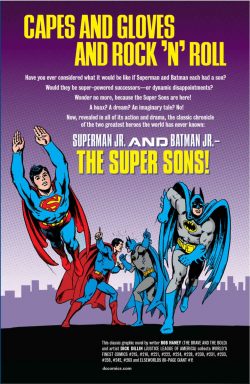
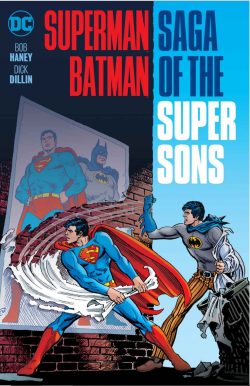
Superman/Batman: Saga of the Super Sons


By Bob Haney & Dick Dillin, with Dennis O’Neil, John Calnan, Ernie Chan, Rich Buckler, Kieron Dwyer & various (DC Comics)
ISBN: 978-1-4012-6968-5 (TPB/Digital edition)

Are you now old enough to yearn for simpler times?

The brilliant expediency of the Parallel Earths concept – and especially its contemporary incarnation Infinite Frontier – lends the daftest tale from DC’s vast back catalogue credibility and contemporary resonance, providing a chance that even the hippest and most happening of the modern pantheon can interact with the most utterly outrageous world concept in the company’s nigh-90-year history. It especially doesn’t hurt here, since – following the Rebirth reboot – the actual sons of the Dark Knight and Man of Tomorrow are now part of an established – and therefore “real” – DC Universe.

Thus, this collection of well-told but initially “imaginary” tales from 1972 to 1976, supplemented by some episodes from more self-conscious times, results from another earnest opportunity to make the fundamental allure of stuffy adult characters relevant to kids and teens.

Written by Bob Haney and drawn by Dick Dillin, The Super-Sons appeared without prior preamble or fanfare in World’s Finest Comics #215, (cover-dated January 1973, and hitting newsstands mid-October 1972). It was a tough time for superhero comics, but a great era for teen rebels. Those free-wheeling, easy-rider, end of the flower-power days generated a huge (and lasting) societal refocussing on “teen consciousness”, and the “Generation Gap” was a phrase on almost every lip.

It didn’t hurt that the concept was already tried and tested. Both Man of Steel and Caped Crusader had already been seen as younger versions of themselves many times over the years, and the evergreen dream of characters who would more closely resonate with youngsters never died in editors’ minds. After all, hadn’t original Boy Wonder Robin been created to give readers someone to closely identify with?

The editors – Murray Boltinoff and E. Nelson Bridwell – clearly saw a way to make their perilously old-school so-very establishment characters instantly pertinent and relevant. Being mercifully oblivious to the more onerous constraints of continuity – some would say logic – they simply and immediately generated tales of the maverick sons of the World’s Finest heroes out of whole cloth.

…And smartly-constructed, well told tales they are. Debut outing ‘Saga of the Super Sons!’ (inked by Henry Scarpelli) sees the young warriors as fully realised young rebels running away from home – on the inevitable motorcycle – and encountering a scurrilous gang-lord.

But worry not, their paternalistic parents are keeping a wary eye on the lads! Speaking as one of the original target market for this experiment, I can admit the parental overview grated then and still does, but as there were so many sequels, enough reader must have liked it…

‘Little Town with a Big Secret!’ appeared in the very next issue: another low key human interest tale, but with a science-fiction twist and the superb inking of Murphy Anderson complimenting Haney & Dillin’s tight murder-mystery yarn.

Crafted by the same team, WF # 221 (January-February 1974) featured ‘Cry Not for My Forsaken Son!’ depicting a troubled runaway boy discovering the difference between merit and worth, and the value of a father as opposed to a biological parent, after which #222’s ‘Evil in Paradise’(inked by Vince Colletta) saw young heroes voyage to an undiscovered Eden to resolve the ancient question of whether Man is intrinsically Good or Evil.

‘The Shocking Switch of the Super-Sons’ (WF #224, cover dated July-August and also inked by Colletta) took teen rebellion to its logical conclusion when a psychologist convinces the boys to trade fathers, whereas ‘Crown for a New Batman!’ provides a radical change of pace as Bruce Wayne Jr. inherits the Mantle and the Mission when dad is murdered!

Never fear, all is not as it seems, fans! This thriller – guest starring Robin – appeared in WFC #228, and was inked by Tex Blaisdell, who inked Curt Swan, on more traditional Lost Civilisation yarn ‘The Girl Whom Time Forgot’ in WF#230…

The Relevancy Era was well over by the time Haney, Dillin & Blaisdell crafted ‘Hero is a Dirty Name’ (#231, July 1975), wherein the Sons are forced to question the motivation for heroism in a thriller guest-starring Green Arrow and The Flash.

In #233’s ‘World Without Men’ (inked by John Calnan) the ever-rambling, soul-searching Super-Sons confront sexual equality issues and unravel a crazy plot to supplant human males, after which ‘The Angel with a Dirty Name’ (by the same team in June 1976’s WFC #238) offers a supervillains and monsters slug-fest indistinguishable from any other Fights ‘n’ Tights tale, before the original series fades out with December’s #242’s in ‘Town of the Timeless Killers’. Illustrated by Ernie Chua (nee Chan) & Calnan, it sees the kids trapped in a haunted ghost town and stalked by immortal gunslingers offering a rather low-key and ignominious close to a bold experiment.

Four years later in mid-March 1980, the boys surprisingly showed up in a momentary revival. Cover-dated June-July and courtesy of Denny O’Neil, Rich Buckler & Dick Giordano in WFC #263, ‘Final Secret of the Super-Sons’ shockingly revealed that the boys were no more than a simulation running on the Man of Steel’s futuristic Super Computer.

In a grim indication of how much of a chokehold shared continuity had grown into, they then escaped into “reality” anyway, accidentally wreaking havoc in a manner The Matrix movies would be proud of…

The collection concludes in a short tale by Haney & Kieron Dwyer from Elseworlds 80-Page Giant in 1999. ‘Superman Jr. is No More!’ is a charming, fitting conclusion to this odd, charming and idiosyncratic mini-saga, embracing the original conceit as it posits what would happen if Superman died and his boy was forced to take over too soon…

Supplemented with a full cover gallery by Nick Cardy, Chan, Calnan, Giordano, Ross Andru & Ty Templeton, these classic yarns are packed with potency and wit. If you’ve an open mind and refined sense of adventure, why not take a look at a few gems (and one or two clunkers) from an era where everybody read comics and nobody took them too seriously?
© 1972, 1973, 1974, 1975, 1976, 1980, 1999, 2017 DC Comics. All Rights Reserved.