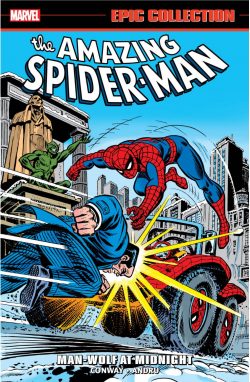
Black Lightning volume 1


By Tony Isabella, Denny O’Neil, Trevor Von Eeden, Mike Netzer, Frank Springer, Vince Colletta & various (DC Comics)
ISBN: 978-1-4012-6071-2 (TPB/Digital edition)

Black Lightning was far from the first superhero of colour, but his mutability, iconic image and sheer tenacity have made him one of the most enduring and widely travelled. He’s been everything from outraged lone street vigilante to teacher; Presidential Secretary to perfect team player (on a succession of super-groups); sporting legend, family man and world-saving wise mentor. He’s even made the turbulent transition to star of his own television series…

Very little of that was apparent when these groundbreaking adventures were first released. Back then, the simple fact that an African-American masked hero was considered sales-worthy was the biggest leap imaginable…

Excluding a few returning characters in jungle-themed comic of the 1940s and 1950s, War comics first opened the door to black characters in the early 1960s, when Robert Kanigher & Joe Kubert created negro boxer Jackie Johnson as a stalwart of Sgt. Rock’s Easy Company in Our Army at War #113 (cover-dated December 1961).

Marvel followed suit with a black soldier in Sgt. Fury’s Howling Commandos (Gabe Jones, debuting in #1, May 1963), and pulled far ahead in the diversity stakes after introducing America’s first negro superheroes. The Black Panther premiered in Fantastic Four #52, (July 1966) and The Falcon first flew in Captain America #117 (September 1969). Luke Cage became the Hero for Hire in the spring of 1972, carrying a June cover-date…

The honour of being the nation’s first black hero to carry in his own title had already come and gone via a little-remembered (or regarded) title from Dell Comics. Created by artist Tony Tallarico & scripter D.J. Arneson, gunslinger Lobo was a vigilante of the wild west who sought out injustice just like any cowboy hero would. He first appeared in December 1965, with his second and final issue cover-dated October 1966…

Gradually, more ethnic lead characters appeared, with DC finally getting a black-skinned hero in John Stewart (Green Lantern #87, December 1971/January 1972), although his designation as a “replacement” GL might be construed as more conciliatory and insulting than revolutionary. By then, Jack Kirby had introduced teen New God Vykin the Black in Forever People #1 (March 1971) and later created enterprising “ghetto kid” Shilo Norman as a hero’s apprentice and eventual successor in Mister Miracle ##15 (August, 1973). DC’s first superhero to have his own solo title didn’t debut until 1977…

This astoundingly accessible, no-nonsense collection – comprising Black Lightning #1-11, material from Cancelled Comics Cavalcade #1 and World’s Finest Comics #260, spans April 1977 to January 1980) and bolts into action following a forthright and informative Introduction by originator Tony Isabella.

It begins as ‘Black Lightning’ (illustrated by neophyte penciller Trevor Von Eeden & veteran inker Frank Springer) sees former Olympic decathlete Jefferson Pierce return to the streets of Suicide Slum, Metropolis to teach at beleaguered inner city Garfield High School. Pierce is determined to make a difference to the troubled kids he used to be numbered amongst, but when the educator interrupts a drug buy on school grounds and sends the dealer packing, the door is opened to vengeance and tragedy…

When the mob – a crime syndicate dubbed The 100 – seek retaliation, one of Pierce’s students pays the ultimate price and the teacher realises he needs the shield of anonymity if he is to win justice and safety for his beleaguered home and charges…

Happily, tailor Peter Gambi – who sheltered Jefferson and his grieving mother after the elder Pierce was murdered – has some useful ideas and inexplicable access to pretty far-out technology…

Equipped with a strength-&-speed enhancing forcefield belt, gaudy costume, a and mask/wig unit completely changing his appearance, a fierce vigilante stalks the streets of Metropolis…

The local chapter of The 100 is run by monstrous, cunning freak Tobias Whale and once the assaults on his soldiers starts biting into profits and offer the downtrodden populace a glimmer of hope, he starts ruthless retaliation.

The sinister strategist lays many traps, culminating in hiring a lethal super-assassin who previously faced Green Arrow and the Justice League of America.

When the killer pounces, Pierce is forced into uneasy alliance with mystery woman Talia Al Ghul, but it ends as soon as bodies start piling up all over the school gym in ‘Merlyn Means Murder’

Vince Colletta assumes the inker’s role as Black Lightning’s continued war against The 100 forces “the Whale” to fight smart, and Metro Police – led by doughty Inspector William Henderson – pursue the vigilante as vigorously as any gangster or felon. Taking seedy stoolie Two Bits Tanner into his confidence, Pierce savagely works his way up the criminal chain of command.

He eventually confronts Tobias in his inner sanctum only to find ‘Every Hand Against Him.’ As the police pounce, paranoia grips Pierce and he begins mistrusting his small team. Has someone he trusts betrayed him?

A more palatable answer seems apparent in #4 as suspicion falls on Tanner’s source – Daily Planet journalist Jimmy Olsen. When the outraged street fighter tries to force a confession from the baffled cub reporter, they are attacked by the 100’s latest super heavy in ‘Beware the Cyclotronic Man’

Jimmy is wounded when they unite to fight off the atomic villain, and Black Lightning is suddenly confronted by the kid’s enraged and late-arriving best pal, who immediately jumps to the wrong conclusion and quickly shows why ‘Nobody Beats a Superman!’

In fact, had Cyclotron not switched attention to the true target Tobias wanted him to kill, everyone might have died, but the heroes’ misunderstandings are all forgotten when Black Lightning saves the Man of Tomorrow from nuclear meltdown, beats the bad guys and uncovers a mole in the police force…

Patience exhausted and under pressure from his own bosses, the Whale declares open season, placing an astounding bounty on Black Lightning. When deeply conflicted manhunter Syonide (and his hilarious, Marvel-baiting in-joke kung fu assistants) stalk the Saviour of Suicide Slum, their first move is to shadow and learn everything about their quarry.

When Gambi is abducted, Jefferson’s secret is finally exposed in ‘One Man’s Poison’, Syonide afflicted with a bizarre sense of honour – hands over a helpless Black Lightning to the Whale in #7. However he cannot escape The Conscience of the Killer’ and is compelled to shelter the captive tailor from the 100’s vengeance before voluntarily paying the ultimate price when ordered to kill the apparently-helpless masked hero…

Tragically, even as Black Lightning undergoes a miraculous transformation and takes out the gathered crooks and villains, he loses another innocent to the violent life he has embraced…

With the power of the 100 seemingly broken and Tobias Whale in custody, Pierce’s war should be over, but the gigantic gangster quickly breaks free and takes hostages from Police HQ.

Determined to end the vendetta, Black Lightning tracks him down for one last duel and in the ‘Deadly Aftermath’ finds the renewed purpose to carry on his alternate lifestyle…

Now considering himself more hero than avenger, Pierce experiences ‘Fear and Loathing at Garfield High’ when his school is invaded by a maniac terrorist operating an army of robotic killers, after which a circus trip exposes ‘The Other Black Lightning’. Sadly, although this well-meaning admirer is a mostly-harmless copycat, jewel thieves and former Flash foe The Trickster provide plenty of genuine danger and menace before the big top sawdust settles…

Comics were experiencing another general sales downturn at this time, and just as Denny O’Neil took over scripting Black Lightning, it was cancelled with #11 (October 1978).

‘All They Will Call You Will Be… Deportee!’ offered hints of a new direction with the urban avenger exposing a people-trafficking ring luring South American refugees into slave jobs at a fast food chain, but for most readers that was the last sight of the hero for some time.

So abrupt was the cancellation, that for legal reasons and to secure copyrights, DC had to put out black-&-white ashcan anthology Cancelled Comics Cavalcade, printing completed but unpublished stories of Claw the Unconquered, The Deserter, The Green Team, Madame Xanadu, Firestorm and others. Also included was Black Lightning #12…

The wider world got to see that last adventure – ‘Lure of the Magnetic Menace’ by O’Neil, Mike Nasser (nee Netzer) & Colletta – a year later when the January 1980 cover-dated World’s Finest Comics #260 ran the story as a prelude to a new series of BL adventures.

This edgy yarn details how the shocking hero is attacked by costumed crazy Doctor Polaris after Jefferson Pierce investigates a possible case of child neglect and abuse involving one of his more troubled students…

Wrapping up this initial outing is a copious selection of working drawings from the ‘Black Lightning Sketchbook’ by Von Eeden, and Mike Netzer’s unfinished cover for never-seen issue #13.

Although closely interlinked to then-current DC continuity, these fast-paced Fights ‘n’ Tights thrillers are so skilfully constructed that even the freshest neophyte can settle in for the ride without any confusion and enjoy a self-contained rollicking rollercoaster of terrifically traditional superhero shenanigans.

So, go do that then…
© 1977, 1978, 1979, 2016 DC Comics. All Rights Reserved.

Captain America – Truth


By Robert Morales, Kyle Baker & various (MARVEL)
ISBN: 978-1-3029-3427-9 (TPB/Digital Edition) 978-0785136668 (Premiere HB)

It’s never been more apparent than these days, but Truth is a Weapon. Facts, events and especially interpretations have always been manipulated to further a cause, and that simple premise was the basis of one of the most groundbreaking and controversial comic book stories of all time…

Created by Joe Simon & Jack Kirby in an era of frantic patriotic fervour, Captain America was a dynamic and highly visible response to the horrors of Nazism and the threat of Liberty’s loss. Consequently, the concept quickly lost focus and popularity after hostilities ceased. Fading away during post-war reconstruction, only to briefly reappear after the Korean War: a harder, darker sentinel ferreting out monsters, subversives and the “Reds” who lurked under every American bed.

He abruptly vanished once more, until the burgeoning Marvel Age resurrected him just in time to experience the Land of the Free’s most turbulent and culturally divisive era. Cap quickly became a mainstay of the Marvel Revolution during the Swinging Sixties, but lost his way after that, except for a politically-charged period under scripter Steve Englehart.

Despite everything, Captain America became a powerful symbol for generations of readers and his career can’t help but reflect that of the nation he stands for…

Devised in the Autumn and on newsstand by December 20th 1940, Captain America Comics #1 was cover-dated March 1941 and an instant monster, blockbuster smash-hit. The Sentinel of Liberty had boldly and bombastically launched in his own monthly title with none of the publisher’s customary caution, and instantly became the absolute and undisputed star of Timely’s top-selling “Big Three” – the other two being The Human Torch and Sub-Mariner. He was, however, one of the first to fall from popularity as the Golden Age ended.

For all that initial run, his exploits were tinged – or maybe “tainted” – by the sheer exuberant venom of appalling racial stereotyping and heady fervour of jingoism at a time when America was involved in the greatest war in world history. Nevertheless, the first 10 issues of Captain America Comics are the most exceptional comics in the fledgling company’s history…

You know the origin story as if it were your own. In ‘Meet Captain America’ Simon & Kirby revealed how scrawny, enfeebled patriot and genuinely Good Man Steven Rogers, after being continually rejected by the US Army, is recruited by the Secret Service.

Desperate to stop Nazi-sympathizing atrocity, espionage and sabotage, the passionate teen accepts the chance to become part of a clandestine experimental effort to create physically perfect super-soldiers. However, after a Nazi agent infiltrates the project and murders the pioneering scientist behind it, Rogers is left as the only successful graduate and becomes America’s not-so-secret weapon.

For decades the story has been massaged and refined, yet remained essentially intact, but in 2002 – in the wake of numerous real-world political and social scandals (like the Tuskegee Experiment/Tuskegee Syphilis Study 1932-1972) – writer Robert Morales (Vibe Magazine, Captain America) & Kyle Baker (Nat Turner, Plastic Man, The Shadow, Why I Hate Saturn) took a cynical second look at the legend through the lens of the treatment of and white attitudes towards black American citizens…

The result was Truth: Red, White & Black #1-7 (January-July 2003), initially collected as a Premiere Hardcover edition in 2009 and here in trade paperback and digital formats. This hard-hitting view of the other side of a Marvel Universe foundational myth forever changed the shape of the continuity: using the tragedy and inherent injustice of the situation to add to the pantheon more – and more challenging – heroes of colour and contemporary role models.

‘The Future’ begins at “Negro Week” of the 1940 New York World’s Fair where Isaiah Bradley and his bride Faith learn yet again they are still second class citizens, and that their rights and freedoms are conditional. December in Philadelphia sees young firebrand and workers’ rights activist Maurice Canfield painfully realise that even his father’s hard-earned wealth and position mean nothing as long as their skin is dark in America…

Cleveland in June of 1941 and negro war veteran “Black Cap” is still in the army. It’s fiercely segregated and he’s been demoted to sergeant, but Luke Evans is content to have work and purpose. Since returning from the Great War, Evans has lived through so much crap – even a year of race riots and near-revolution that threatened to wipe out his kind – that he’s content to take each day as it comes.

Everything changes for these black men and thousands like them when the Japanese attack Pearl Harbor on December 7th 1941…

‘The Basics’ opens in 1942 at Camp Cathcart, Mississippi. The base is tense, and strife between partitioned white and black recruits at a perilous boiling point. Brawling between races is constant. Into the explosive situation comes oily G-Man Homer Tully and scientist Dr. Josef Reinstein who petition openly racist commander Major Brackett to give them two battalions of coloured recruits and cover up the fact that they ever existed…

Wartime secrecy is then employed to mask an appalling act of racist cynicism, as hundreds of patriotic black men are trained and callously discarded as Reinstein methodically perfects his super-soldier serum on expendable lower race guinea pigs.

The scene switches to Project Super Soldier (location classified) where Colonel Walker Price supervises ‘The Passage’ of the survivors from human to something else. Bradley, Canfield, Evans and the others have endured a cruel barrage of chemical interventions. Of three hundred, only a handful survive, and all are radically changed… or, more accurately, mutated. Reinstein is acutely aware that his former colleagues in Nazi Germany are just as close to solving the riddle of superhumanity and pushes on with increasing disregard for the laws of science or ethics of civilisation…

Next of kin are informed that their loved ones have been killed in training, but Faith Bradley knows the corpse in the casket is not her man and starts making waves…

Ultimately, military pragmatism supersedes scientific caution and the seven remaining negros – all immensely powerful in radically changed bodies – are pressed into action as an expendable super-suicide squad. Commanded by white supremacist Lieutenant Philip Merritt, ‘The Cut’ sees them deployed to the Black Forest with orders to destroy the rival Uber-mensch project. The mission catastrophically fails, but survivor Isaiah Bradley is coerced by Walker Price into returning to Germany on a solo suicide mission to eradicate the facility. Apparently, the “real” Captain America is unable to get there in time…

Rebellious to the end, Bradley complies, but steals and dons the flashy star-spangled uniform worn by the public – blue-eyed, blonde and exceeding white – face of America’s Super Soldier Project. It’s October 1942 and the last time the world hears from or about Bradley…

The horrors he saw and his spectacular triumph only start emerging in ‘The Math’ as – today in the Bronx – superhero Steve Rogers meets Bradley’s widow and discovers something truly astounding…

Whilst crushing domestic terrorism, Captain America had captured unrepentant mastermind Merritt and learned how the monster had been instrumental in Reinstein’s death decades previously. Further investigation uncovered ‘The Whitewash’ Merritt and his superior Walker Price instigated, and what they perpetrated after Bradley unexpectedly battled his way back to America…

Stunned to have unearthed a secret history of oppression and immorality that occurred all around him without his slightest inkling, Rogers is distraught and furious, resolved to set things right at all costs…

That mission takes him to the highest echelons of government and darkest corners of military intelligence in ‘The Blackvine’, where he learns more uncomfortable truths about his origins and the true nature of the country he loves and represents. Shellshocked and despondent, Cap returns to the Bradley’s home and gets a welcome if belated chance to salve his soul, set history straight and repay moral debts unknowingly incurred in his name…

With covers by Baker, promo art by Joe Quesada, Danny Miki & Richard Isanove, and unused cover treatments, this landmark saga is backed up with a context-laden, disturbingly informative Appendix by Robert Morales: clarifying and expanding on many previously sidelined moments of actual and black history that informed the story.

Powerful, engaging, enlightening and immensely gratifying, this is a story to enrage and enthral, and one no socially aware superfan should miss.
© 2022 MARVEL.

Evil Emperor Penguin: Antics in Antarctica


By Laura Ellen Anderson, with Kate Brown (David Fickling Books)
ISBN: 978-1-78845-282-3 (Digest PB)

Win’s Christmas Gift Recommendation: Outrageous Acts and Brilliant Buffoonery… 8/10

In 2012 Oxford-based family publisher David Fickling Books launched an “old school” weekly comics anthology aimed at girls and boys between 6 and 12. It revelled in reviving the good old days of British picture-story entertainment intent whilst embracing the full force of modernity in its style and content. This comprised comic strips, humour, adventure, quizzes, puzzles and educational material in a joyous parade of cartoon fun and fantasy.

In the years since its premiere, the periodical has gone from strength to strength, its pantheon of superbly engaging strips generating a line of superbly engaging graphic novel compilations, the latest of which is this riotous romp starring a gloriously malign arch-wizard of scientific wickedness to delight all readers with a profound sense of mischief and unbridled imagination…

Conceived and created by illustrator and author Laura Ellen Anderson (Kittens, Snow Babies, My Brother is a Superhero, Amelia Fang!, Rainbow Grey, I Don’t Want…), these are the revived ad remastered exploits of Evil Emperor Penguin!

He lives in a colossal fortress beneath the Antarctic, working tirelessly towards total world domination, assisted by his stylish, erudite administrative lackey Number 8 and cutely fuzzy, passionately loyal Eugene. The latter is an endlessly inventive little abominable snowman clone. EEP had whipped up a batch of 250, but none of the others are quite like Eugene…

The Penguin appointed the hairy, bizarrely inventive tyke his Top Minion, but somehow never managed to instil him with the proper degree of evilness. He is, however, a dab-hand with spaghetti hoops, so it’s not a total loss…

Following a pin-up of the ‘Fridge of Evil’ and an info-packed double-page map of the Evil Underground Headquarters disclosing all you’ll need to know, an assortment of vile vignettes begins with ‘A Stitch in Time’ wherein the cape-draped malcontent megalomaniac unleashes his Evil Emperor-bot of Icy Doom at the annual World Leaders’ Picnic.

Unfortunately, due to a totally typical cock-up with the plans by oafish underlings, the titanic tin-can terror’s ice-laser eyes have somehow been replaced by instant knitting machines…

The next nasty invention doesn’t even get out of the lab before malfunctioning. ‘Have No Fear’ finds a dire device that manifests personal terrors running amok in the lab, unleashing EEP’s domineering mother and sweet Eugene’s incredible, ghastly secret phobia before the inventors can reach the Emergency Self-Destruct Button…

‘Cat-astrophe’ introduces a terrifying rival in the Word Domination stakes who infiltrates the bad bird’s base as a cute and fluffy feline pet for Number 8…

When EEP’s giant spider robot immobilises the entire Earth in its ‘World-Wide-Web’, even Evil Cat is caught off guard, and only Eugene’s incomprehensible preoccupation with shiny, sparkly unicorns prevents total disaster.

The top-hatted, moustachioed, perfidious puss then attempts amnesty in ‘The Truce’ but the fuzzy fiend is, of course, shamming friendship. The floral gift he proffers is actually a deadly animated booby-trap which is only just defeated thanks to Eugene’s inherent ineptitude.

Would-be World Dictators are not a particularly forgiving bunch and when the fuzzy tyke accidentally unleashes the full force of EEP’s Ferocious And Really Terrible machine, ‘The Stinking Truth’ is released in a Nuclear Stench Cloud and prompting the penguin peril to fire his Top Minion. EEP’s loss is Evil Cat’s gain though, and Eugene soon settles in with a Malign Master who really appreciates him.

‘Please Alight for the Domination Station’ finds them quashing the chilly Caped Fiend’s scheme to transform Britain’s seat of government into the Houses of Penguinment (which I’m pretty sure we’d all vote for this week), but a pitched battle between super-science cat and ghastly gadget bird swiftly escalates beneath London streets before Eugene’s cuteness-filled ultimate weapon sadly takes out his new boss by mistake…

As a result of that debacle, the little snowman is briefly evaporated by Evil Cat and ends up floating wistfully over Antarctica as a ‘Head in the Clouds’ even as Evil Emperor Penguin faces his greatest challenge when his little sister Ruth – she prefers “Ruth-less” – pays a visit, sees what big bro is up to and decides that she too is going to rule the world in ‘Sibling Rivalry’…

Things get even worse after Evil Cat interferes, holding Ruth-less hostage until everybody involved has foolishly forgotten that tiny turncoat Eugene is afflicted with niceness and a powerful conscience…

The exploration of  cartoon evil and daft depravity amplifies and intensifies in an epic exploit detailing ‘The Return’ when sweet-natured Eugene’s continual bodges at last force Evil Cat to fire him with extreme prejudice. Hopeless, homeless and homesick, the shaggy savant is on his last legs when he’s adopted by jolly unicorn Keith, who nurses him back to health and flies him to Antarctica just in time for them both to become embroiled in a final fateful clash between Penguin and Cat.

Naturally such devoted do-gooders can only get stuck in and engineer some marvellously magical reconciliation…

More nefarious nonsense unfolds in extended thriller-chiller ‘I Will Crèche You’ wherein EEP’s incredible De-Ageifying “Youth Juice” wreaks the now-customary havoc after insidious rival Evil Cat breaks into the citadel and everybody gets a rejuvenating soaking…

Undaunted, the Penguin of Perfidy attempts to increase his own stature with a growth ray but doesn’t consider that his top menial might wander in and accidentally become ‘Hugene’

More trouble arrives when the Barmy Bird decides to digitise and upload himself into the global data net via his Super Computer of Evil. Believing supreme power is in his feathered grasp once he becomes ultimate virus ‘X-Treme Evil’, EEP is ambushed in virtual reality by digital demon virus Trojan the Hunk. Luckily, Eugene is a dab paw with computer games and comes to his master’s rescue… sort of…

Back in the physical world once again the Emperor is next subjected to a terrifying surreal assault by feathered scavengers and finds himself ‘Pigeon Holed’

Everybody loves cute kittens, which is what Evil Cat’s cousin Debra counts on when she uses soppy Eugene to infiltrate the fortress and steal all the Spaghetti Hoops in ‘What’s New Pussycat’. With the team – even Evil Cat – trapped and helpless, they must surrender all pride and dignity and call on jolly unicorn Keith to save them…

Without their favourite food, Christmas seems drab and dreary for the entire ice-bound army but when Eugene finds ‘The One Hoop’ it unleashes a torrent of unexpected emotion to tide the Evil Emperor over, even though it ultimately leads to deprivation mania in ‘A New Hoop’

Deranged and desperate, EEP is only saved after Eugene and Number 8 track down Debra and steal back the vast cache of spaghetti tins. Good thing too, as she wasn’t planning on eating them but needed them to power her world-destroying machine…

After all that drama, ‘Eugene’s Day Off’ is an unremitting stream of great experiences for the faithful servitor, but for the Penguin Potentate – forced to put up with substandard substitute Neill – a string of catastrophic and painful disasters. Thus, it’s no surprise and a total tragedy when EEP’s top flunky is lost on a melting ’berg after watching the pretty sunset ‘On Thin Ice’

Happily, the unthinkable occurs as the cape-clad malcontent megalomaniac teams up with scintillating Keith the Unicorn to save Eugene from dire deep sea doom…

‘Pop Goes the Easel’ finds the putrid penguin planning an attack on world leaders through the medium of art, but sadly, turning his victims into paintings proves to be a double-edged sword with unexpected repercussions, especially after Eugene tries to help…

This gag-filled grimoire of bird-based bombast concludes in high style as a sinister scheme to flood the world with scented candles of distilled Ultimate Evil is thwarted once ‘Essence of Eugene’ is added to the wax mixer, resulting in a global outpouring of warm, fuzzy euphoria…

Rocket-paced, hilariously inventive, wickedly arch and utterly determined to be silly when it most counts, this tome of terror also has educational merit as it offers lessons on ‘How to Draw Eugene’. Evil Emperor Penguin: Antics in Antarctica is a captivating cascade of smart, witty funny adventure, which will delight readers of all ages.
Text and illustrations © Laura Ellen Anderson 2022. All rights reserved.

Black Panther Adventures


By Jeff Parker, Marc Sumerak, Christopher Yost, Elliot Kalan, Roy Thomas, Manuel Garcia, Ig Guara, Scott Wegener, Christopher Jones, Chris Giarusso, John Buscema & various (Marvel)
ISBN: 978-1-3029-1034-1 (Digest PB/Digital edition)

From its earliest days, Marvel always courted and accommodated young comic book consumers, often through separates titles and imprints. In 2003, the company instituted the Marvel Age line to reframe classic original tales by Stan Lee, Jack Kirby, Steve Ditko and others for a fresh-faced 21st century readership.

The experiment was tweaked in 2005, becoming Marvel Adventures. The tone of all the tales was very much that of the company’s burgeoning TV animation franchises, in execution if not name. Titles bearing the Marvel Adventures brand included Spider-Man, Fantastic Four and The Avengers and ran until 2010 when they were all cancelled and replaced by new volumes of Marvel Adventures: Super Heroes and Marvel Adventures: Spider-Man.

Most of those comic book yarns have since been collected in digest-sized compilations such as this one, gathering a quartet of all-ages Black Panther tales but also including a brace of early1960s episodes from his first stint in mainstream MU series The Avengers.

Acclaimed as the first black superhero in American comics and one of the first to carry his own series, the Black Panther’s popularity and fortunes have waxed and waned since he first debuted as a character in Fantastic Four #52.

In that 1966 landmark the cat king attacked Marvel’s First Family as part of his extended scheme to gain vengeance on the murderer of his father, before eventually teaming up with them to defeat malign master of sound Klaw.

This eclectic compilation – comprising Marvel Adventures Fantastic Four #10, Marvel Adventures The Avengers #22, Avengers: Earth’s Mightiest Heroes #1, Marvel Universe Avengers Earth’s Mightiest Heroes #8, plus Silver Age epics from Avengers #52 and 62 – begins by broadly reimagining that initial FF encounter in ‘Law of the Jungleby Jeff Parker, Manuel Garcia & Scott Koblish (from Marvel Adventures Fantastic Four #10; May 2006) wherein the quixotic quartet are suckered into buying smuggled Vibranium.

The miracle mineral is Wakanda’s only export and the illegal sale quickly brings the duped heroes into savage conflict with a mysterious cat-garbed super-warrior. Tracking the Black Panther back to his super-scientific jungle kingdom, the team  eventually convince the king of their innocence and good intentions before teaming up to tackle the true villains…

Two years later Marvel Adventures The Avengers #22 (May 2008 and by Marc Sumerak, Ig Guara & Jay Leisten) revealed the ‘Wakanda Wild Side as sightings of murderous mutant Sabretooth in Africa draws Wolverine, Storm, Captain America, Spider-Man, Giant-Girl and the Hulk into an uncharted kingdom. They needn’t have bothered: Wakanda’s Panther chieftain is more than equal to the task of taking down the savage invader…

Following a page of comedic Marvel Mini Classics by Chris Giarusso, a short vignette from Avengers: Earth’s Mightiest Heroes #1 (November 2010) as Christopher Yost & Scott Wegener reveal how rival heroes T’Challa and Hawkeye work out their ‘Trustissues whilst battling crazed villain Whiplash.

Never the success the company hoped, the Marvel Adventures project was superseded in 2012 by specific comics tied to those Disney XD television shows designated as “Marvel Universe cartoons”, but these collected stories are still an amazingly entertaining and superbly accessible means of introducing characters and concepts to kids born sometimes three generations or more away from the originating events. They’re also pretty good fun for us old lags too…

Another short tale – this time from Marvel Universe Avengers Earth’s Mightiest Heroes #8 (November 2012) – unites the Panther with the Hulk. Crafted by Elliott Kalan, Christopher Jones & Pond Scum, ‘Mayhem of the Madbomb!finds Green Goliath and Cat King furiously fighting Hydra to prevent he detonation of an insanity-inducing WMD stashed in the Empire State Building…

Wrapping up the action are a brace of classic exploits from Roy Thomas & John Buscema.

On Captain America’s recommendation the Black Panther joined the Avengers in #52’s ‘Death Calls for the Arch-Heroes!’ (May 1968, inked by Vince Colletta): a fast-paced murder mystery which also saw the advent of obsessive super-psycho The Grim Reaper who tried to frame the freshly-arrived-in-America T’Challa for the murder of Goliath, The Wasp and Hawkeye.

Then ‘The Monarch and the Man-Ape!(Avengers #62, March 1969, and inked by George Klein) offered Marvel fans the first real view of hidden Wakanda – and a brutal exploration of T’Challa’s history and rivals – as his trusted regent seeks to usurp the kingdom and overturn the state religion after declaring himself to be ‘M’Baku the Man-Ape!’

Augmented by a cover gallery from Carlo Pagulayan & Chris Sotomayor, Leonard Kirk & Val Staples, Scott Wegener & Jean- François Beaulieu, Khoi Pham & Edgar Delgado and John Buscema, these ferociously enthralling riotous mini-epics are extremely enjoyable and engaging, but parents should note that some of the themes and certainly the level of violence might not be what everybody considers “All-Ages Super Hero Action”…
© 2017 Marvel Characters, Inc. All rights reserved.

Rork: The Ghosts


By Andreas, coloured by Isa Cochet and translated by Montana Kane (Europe Comics)
No ISBN: digital edition

Born in January 1951, Andreas Martens is an incredibly versatile artist from East Germany (and from a time when that meant another country, not a different location). He trained at the Academy of Fine Arts in Düsseldorf and the Saint-Luc Institute/comics school in Brussels. His work appeared in college magazine Le 9e Rêve, À suivre, Heavy Metal and Le Journal de Tintin where – in conjunction with his teacher Eddie Paape – he created the seminal Udolfo.

Relocating to France, Andreas adapted the works of Francois Rivière (collected in 1980 as Révélations Posthumes) and produced a graphic edition of Charlotte Brontë’s Jane Eyre for Je Bouquine.

Stand-alone works include La Caverne du Souvenir, Coutoo, Dérives and Aztèques, but his reptation was earned through gripping original series such as Raffington Detective, Cyrrus, Arq and others. His entire oeuvre is steeped in classical style, draped in period glamour and drenched in visual tension. Many are thematically linked. However, before all these, he created one of the most stylish and memorable “Challengers of The Unknown” in horror fiction: enigmatic psychic savant Rork.

His pale and moody period hero, (who first appeared in Le Journal de Tintin in 1978) draws on the tone, time and sometimes even “homaged” content of dark-fantasists August Derleth, H. P. Lovecraft and especially the Carnacki stories of William Hope Hodgson. Spiritual nomad Rork wanders the world and great beyond, unravelling mysteries and discovering startling wonders, not for fame or glory, but because he must…

In the early 1990s Dark Horse Comics serialized his adventures in their superb anthology of European comics Cheval Noir, and those translations formed the basis of a little seen or remarked upon series of albums from NBM.

After too long in absentia – that’s past Neverland, a little to the left of Narnia but not as far as The House on the Borderland – the mystic marvel returned in 2017, courtesy of digital-only publishing collective Europe Comics who kicked off what I still hope will be a complete revival by translating into English the final book in the sequence.

Released in 2012, Les fantômes is a prequel tale, regarded by devotees as volume #0, despite its being preceded by seven spooky tomes and crossovers with other Andreas concepts…

By this time, readers had learned that the snowy-haired enigma was a wizard from another dimension, compelled to solve supernatural mysteries even as he sought the secret of his own origins: twin quests that carried him all over creation and into scary battles beside many of the author’s other uncanny warriors of justice…

In this tale – vividly coloured by Isa Cochet (and I make this point as most Rork exploits have appeared in starkly stunning monochrome, in the manner and style of visual pioneers Bernie Wrightson and Jim Starlin) – the wanderer is consulted by Samuel, who has been the channel by which unquiet spirits informed the living of missing (and ultimately dead) persons…

Somehow linked to trees and forests, phantoms came to him ,and Samuel made his living helping others until the day he met Daphne and her son Cary. These living seekers’ search for a husband and father was for greed, not love or closure, and soured the diviner’s relationship with his ghosts. Now decades later, Samuel convinces Rork to intercede for him…

It’s not all altruism, though. The haughty, stubborn finder has been compelled to seek aid since ruthless treasure hunter Tryan has begun to threaten torture and worse unless Samuel uses his gifts to unearth hidden wealth. However, when the white wizard uses his own ability to converse with the departed, he hears a subtly different story and realizes he’s being played for a fool…

Andreas is fascinated by levels of reality and states of comprehension, so Rork tales always come layered with allegorical symbolism, abstract interpretation and trenchant pictorial clues pointing towards deeper meaning. As this story progresses, the mage draws Samuel into verbal duels whilst gradually removing him from the arcadian forests that harbour his ghosts: leading them to an arid desert of the American west where a godlike being offers hints to a greater truth, and where sinister pursuer Tryan falls into a cunning trap…

Ultimately, Rork divines the truth beneath strata of lies and self-deception and the mystery of Samuel is revealed for all to see…

For me, a great comic strip begins with the simple line. The greatest drawing is always about the power of black against white. Colour enhances but it seldom creates in our business. Andreas is one of the best line artists in the modern business so I’m delighted to confirm that there’s a stunning ‘Rork Gallery’ of seven breathtaking images closing his book.

Exotic, eccentric, chilling and lyrically beguiling, the traditional mysticism and otherworldly dread of these tales is a heady and captivating brew, especially with the intense, linear illustration and stark design of Andreas to mesmerize and shock your widened eyes.

Come see for yourselves why this series should be at the top of the list of books to re-release…
© 2017 ÉDITIONS DU LOMBARD (DARGAUD-LOMBARD S. A.) – ANDREAS. All rights reserved.

Walt Disney’s Donald Duck and the Ghost of the Grotto


By Carl Barks (Fantagraphics Books)
ISBN: 978-1-60699-779-6 (TPB/Digital edition)

Win’s Christmas Gift Recommendation: The Utter Acme of All-Ages Entertainment… 10/10

Carl Barks was born in Merrill, Oregon in 1901. He grew up in rural areas of the West during some of the leanest times in American history. He tried his hand at many jobs before settling into the profession that chose him. His early life is well-documented elsewhere if you need detail, but briefly, Barks worked as an animator at Disney’s studio before quitting in 1942 to work in the new-fangled field of comic books.

With cartoon studio partner Jack Hannah (another occasional strip illustrator) Barks adapted a Bob Karp script for an animated short into the comic book Donald Duck Finds Pirate Gold. Published as Dell Four Color Comics Series II #9 in October of that year – and although not his first published comics work – it was the story that shaped the rest of Barks’ career.

From then until his first official retirement in the mid-1960s, Barks worked in self-imposed seclusion, writing and drawing and devising a vast array of adventure comedies, gags, yarns and covers that gelled into a Duck Universe of memorable, highly bankable characters. These included Gladstone Gander (1948), Gyro Gearloose (1952), Magica De Spell (1961) and the nefarious Beagle Boys (1951), all supplementing Disney’s stable of cartoon actors. His greatest creation was undoubtedly curmudgeonly, energetic, paternalistic, money-mad giga-gazillionaire Scrooge McDuck: the World’s wealthiest winged nonagenarian…

Although producing all that landmark material Barks was just a working guy, generating cover art, illustrating other people’s scripts when asked and contributing stories to the burgeoning canon of Duck Lore. Only after Gladstone Publishing began re-packaging Barks material – and a selection of other Disney strips – in the 1980s, did he discover the well-earned appreciation he never imagined existed…

So potent were his creations that they inevitably fed back into Disney’s animation output itself, even though his brilliant comic work was done for licensing company Dell/Gold Key, and not directly for the studio. The greatest tribute was undoubtedly the animated series Duck Tales: heavily based on his works.

Barks was a fan of wholesome action, unsolved mysteries, rationality-based fantasy and epics of exploration. This led to him perfecting the art and technique of the blockbuster quest tale: blending wit, history, plucky bravado and wide-eyed wonder into rollicking rollercoaster romps to utterly captivate readers of every type and vintage. Without the Barks expeditions, there would never have been Indiana Jones

Throughout his working life Barks was blissfully unaware that his work (uncredited by official policy like all Disney’s cartoon and comic book output) had been singled out by a rabid and discerning public as being by “the Good Duck Artist”. When some of his most dedicated fans finally tracked him down, his belated celebrity began.

In 2013 Fantagraphics Books began collecting Barks’ Duck Stuff in wonderful, carefully curated archival volumes, tracing his output year-by-year in hardback tomes and digital editions that finally do justice to the quiet creator. These will eventually comprise the Complete Carl Barks Disney Library. The publisher also placed some of the most engaging (How to choose? How to choose?) in three accessible landscape paperback collections. At 185 by 140 mm, they are the perfect size to introduce kids to the master’s masterpieces. They’re all available in digital formats, and this particular tome has a spooky Halloween vibe to further entice you…

The majority of inclusions here come from 1947, so please be aware that – despite Bark’s diligent research and careful, sensitive storytelling – modern readers might be upset by some depictions crafted over seven decades ago…

It begins eponymously on a nautical note: ‘Donald Duck and the Ghost of the Grotto’ is an early masterpiece originating in Four Color #159 (August 1947), with Donald and the rowdy, know-it-all nephews who live with him currently residing in the West Indies, running a kelp boat and harvesting seaweed from the abundant oceans. Here, Huey, Dewey and Louie are the sensible ones in a risky, get-rich-quick venture. Although prime catalysts of comedic chaos in other situations when the mallard miser was around, in Barks’ comics the devilishly downy ducklings’ usual assigned roles were as smartly sensible, precocious and a just a bit snotty kid-counterfoils to their “unca”, whose inescapably irascible nature caused him to act like an overgrown brat most of the time. Nevertheless, all too often the kids fell into temptation, reverted to type and fell prey to a perpetual temptation to raise a ruckus…

When a freak accident temporarily strands them on an isolated reef, Donald and the lads discover a long-lost, shipwrecked galleon, encounter an ongoing abduction mystery dating back centuries, battle genuine monsters, confound a particularly persistent phantom and win and lose again a fabulous treasure in a  thrilling romp and supremely beguiling mystery that has never dated…

Originally from Four Color #147 (May), ‘If the Hat Fits’ is an 7-panel gag split over two of these landscape pages, detailing chapeau japery, and precedes ‘Fashion in Flight’ (FC#178, December), exposing hot-headed Donald’s views on car culture.

Thanks to the nephews and some imprudent bee-keeping, a potty scheme to make more cash becomes another painful and humiliating experience as the bellicose bird tries growing blooms commercially in his garden in ‘Donald’s Posy Patch’ (Walt Disney’s Comics and Stories #80, May 1947), after which ‘Turn for the Worse’ (Four Color #178 again) reveals just how annoying – and violent – people looking for directions can become…

From the same issue, ‘Machine Mixup’ sees kitchen confusion for Donald as he experiences the downside of modern white goods, before ‘Donald Mines his Own Business’ (WDC&S #81 June) finds the loco parent-ish duck and his boys prospecting in New Mexico. It’s barely moments before they all fall foul of America’s post-war arms rush and missile-race, with devastating and spectacular consequences…

From FC #189 (June 1948) ‘Bird Watching’ exposes the hidden perils of the gentle hobby before  superstition is painfully debunked in ‘Horseshoe Luck’. The fluffy fun finally finishes with an epic farrago – first seen in WDC&S #86 (January 1947) – as telling tale exposes the rise and fall of ‘Fireman Donald’ whose smug hubris ultimately deprives him of a job he’s actually good at!

Carl Barks’ efforts are readily accessible through a number of publications and outlets and every one of his stories is a treasure beyond price. If you’re new to his work and have never experienced his captivating magic, Walt Disney’s Donald Duck and the Ghost of the Grotto is a perfect introduction. No matter what your age or temperament, you can discover “the Hans Christian Andersen of Comics” simply by applying yourself and your credit cards to any search engine.

Always remember, a fan’s got to do what a fan’s got to do and treasure is out there just waiting to be unearthed…
© 2014 Disney Enterprises, Inc. All rights reserved.

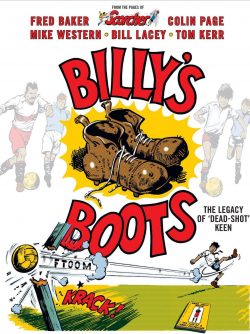
El Mestizo


By Alan Hebden & Carlos Ezquerra (Rebellion Studios)
ISBN: 978-1-78108-657-5 (HB/Digital edition)

Carlos Sanchez Ezquerra was born in Aragon on November 12th 1947. Growing up in Ibdes, in the Province of Zaragoza, he began his career illustrating war stories and westerns for Spain’s large but poorly-paying indigenous comics industry. In 1973 he got a British agent (Barry Coker: a former sub-editor on Super Detective Library who formed Bardon Press Features with Spanish artist Jorge Macabich): joining a growing army of European and South American illustrators providing content for British weeklies, Specials and Annuals.

Like so many superbly talented newcomers, Ezquerra initially worked on Girls’ Periodicals  – like Valentine and Mirabelle – and more cowboys for Pocket Western Library as well as assorted adventure strips for DC Thomson’s The Wizard. The work proved so regular that the Ezquerras upped sticks and migrated to Croydon…

In 1974, Pat Mills & John Wagner tapped him to work on IPCs new Battle Picture Weekly, where he drew (Gerry Finley-Day’s) Rat Pack, and later, Major Eazy scripted by Alan Hebden. Three years later he was asked to design a new character called Judge Dredd for a proposed science fiction anthology. Due to creative disputes, Carlos left the project and went back to Battle to draw instead a gritty western entitled El Mestizo

As we all know, Carlos did return to 2000AD, illustrating Dredd, dozens of spin-offs such as Al’s Baby, Strontium Dog (1978), Fiends of the Eastern Front (1980), adaptations of Harry Harrison’s Stainless Steel Rat and key Dredd storylines such as the epic Apocalypse War and Necropolis.

Soon after, Ezquerra was “discovered” by America…

El Mestizo debuted amidst a plethora of British-based war features and didn’t last long – June 4th to September 17th 1977 – with author Alan Hebden giving you his take on why in a concise Introduction before the action begins.

Born in Bristol in 1950, Hebden is a second generation comics scripter, having followed his dad into the profession. The lad began his career writing Commando Picture Library stories for DC Thomson – and he still does – and also contributed to the company’s adventure titles Hornet and Victor.

For Fleetway he co-created Major Eazy, and scripted Rat Pack for Battle; The Angry Planet for Tornado; Comrade Bronski, The Fifth Horseman and The Tower King for Eagle; Holocaust and Mind Wars for Starlord and – for 2000 ADM.A.C.H. One, Mean Team, Death Planet, Meltdown Man, Future Shocks, amongst many others.

Heavily leaning on Sergio Leone “spaghetti westerns”, the first starkly monochrome Mestizo episode – of 16 – introduces a half-black, half-Mexican bounty-hunting gunfighter who offers his formidable services to both the Union and Confederate sides in the early days of the War between the States.

Proficient with blades, pistols, long guns and a deadly bola, El Mestizo plays both sides while hunting truly evil men, whether they be Southern raiders, rogue Northern marauders, treacherous Indian scouts, army deserters from both sides organised by a crazy, vengeful femme fatale, or even a demented physician seeking to end the war by releasing plague in Washington DC.

Along the way, the mercenary even finds time to pay off a few old scores from his days as a starved and beaten plantation slave…

Sadly, the feature was always a fish out of water and was killed off before it could truly develop, but the artwork is staggeringly powerful and the stories deliver the kind of cathartic punch that never gets old.

This stunning package is another nostalgia-triumph from Battle, collecting a truly seminal experience, and hopefully forging a new, untrodden path for fans of grittily compelling fare and sampling a typically quirky British comics experience.

This gem is one of the most memorable and enjoyable exploits in British comics: acerbic, action-packed and potently rendered: another superb example of what British and European sensibilities do best. Try it and see…
© 1977 & 2018 Rebellion Publishing IP Ltd. All Rights Reserved.

Ultimate Comics Avengers: Blade versus The Avengers


By Mark Millar, Steve Dillon, Andy Lanning, Scott Hanna & various (Marvel)
ISBN: 978-0-7851-4009-2 (TPB/Digital)

Marvel’s Ultimates sub-imprint began in 2000 with key characters and concepts retooled to bring them into line with the tastes and sensibilities of modern readers – a potentially discrete market from the baby-boomers and their descendants. The line proliferated and prospered, but eventually this darkly nihilistic new universe became as continuity-constricted as its predecessor.

In 2008, cleansing event Ultimatum culminated in a reign of terror that killed dozens of superhumans and millions of lesser mortals. Although a strong seller, the saga was largely trashed by the fans who bought it, and the ongoing new Ultimatum Comics line quietly back-pedalled on its declared intentions…

The key and era-ending event was a colossal tsunami that drowned the superhero-heavy island of Manhattan. This post-tsunami collection (re-presenting Ultimate Comics Avengers 3 #1-6) focuses on a more or less dried out world with diminished global populations adapted to the new status quo.

Before the Deluge, Nick Fury (a black iteration so popular that he not only became the film version, but was also retrofitted into the mainstream MCU and replaced the white guy from WWII) ran a super-secret Black Ops team of superhumans designated the Avengers. He was eventually ousted from his position for sundry rule-bending antics – and being caught doing them. Now, as the world dries, he’s firmly re-established, running another black ops team, doing stuff his publicity-courting, officially sanctioned Ultimates team wouldn’t dream of…

Fury’s secret army consists of Hawkeyethe man who never misses; James Rhodes: a fanatical soldier wearing devastating War Machine armour; Gregory Stark, Iron Man’s smarter, utterly amoral older brother; Nerd Hulk – a cloned gamma-monster with all the original’s power but implanted/programmed with Banner’s brain and milksop character; size-shifting insect queen Red Wasp and ruthless super-spy Black Widow.

Also popping in when no one’s looking is resurrected WWII super soldier Captain America – part of the bright and shiny squad, but always happy to slum it when necessary…

Here the dark-side heroes stumble into an ancient and clandestine war that has continued uninterrupted by the end of the world, which sees half-human vampire-hunter Blade on the unaccustomed defensive. The undead bloodsuckers he has historically picked off with ease are now far better organised, more effective and more dangerous. As the story unfolds, it transpires they have found a new king with a grand plan…

This mysterious mastermind is wearing Iron Man’s old armour and now ignores ordinary mortals, preferring to turn super-heroes into a vampiric army. The situation starts bad and gets exponentially worse with metahuman heroes and guest-stars – like Kid Daredevil, Slavic thunder god Perun, numerous Giant-Men, and zen hero-trainer Stick – dropping like flies. With all possible saviours succumbing to the unstoppable plague, it looks hopeless when only Fury, Black Widow and Hawkeye are left untainted, and only the greatest miracle or boldest masterstroke can save humanity. After Cap also succumbs to the curse of the undead, the team’s unwelcome sometime-ally Blade makes a bold but surely suicidal move…

With covers and variants by Leinil Francis Yu, Marte Gracia, Ed McGuinness, Morry Hollowell, Olivier Coipel, Laura Martin, Greg Land, Frank D’Armata, this dark, moody and fast-paced thriller comes from Mark Millar (Judge Dredd, Civil War, Superman, Kick-Ass, The Kingsman, American Jesus, Jupiter’s Legacy) and Steve Dillon (Laser Eraser & Pressbutton, Abslom Daak, Judge Dredd, Animal Man, Preacher, Hellblazer, The Punisher): a wry, violent and powerfully scary romp that is engrossing and eminently readable.

This spooky, cynical, sinister shocker is another breathtakingly effective yarn that could only be told outside the Marvel Universe proper, but one that will resonate with older fans who love the darkest side of superheroes (and remember fondly the days when heroes could be horrors) as well as casual readers who know the company’s movies better than the comics.
© 2020 MARVEL. A British edition published by Panini is also available.

Semiautomagic volume 1


By Alex De Campi & Jerry Ordway, coloured by Marissa Louise (Dark Horse Books)
ISBN: 978-1-50670-001-4 (TPB) eISBN: 978-1-63008-668-8

In an industry/art form that has become over-reliant on vast interlocking storylines, requiring an encyclopaedic knowledge of a million other yarns and the tacit consent to sign up for another million episodes before reaching any kind of narrative payoff, the occasional short, sharp, intensely stand-alone tale is as welcome and vital as a reliable torch in a haunted house.

Just such a salutary singleton (thus far: there’s plenty of scope for more adventures!) was this solid action-horror outing that first appeared in 2014 in Dark Horse Presents volume 3 #4-9 and #13-17.

A no-nonsense, straightforward battle of earthly mage against ancient uncanny abomination, the series was devised (and lettered) by novelist, film director, columnist and comics creator Alex De Campi (Smoke, Kat & Mouse, Agent Boo, Archie vs Predator, Bad Girls, No Mercy, MADI, Bad Karma) and illustrated by certified comics giant Jerry Ordway (All-Star Squadron, Fantastic Four, Crisis on Infinite Earths, Adventures of Superman, The Power of Shazam!, WildStar, T.H.U.N.D.E.R. Agents, The Avengers) and introduces enigmatic-woman-with-a-past Alice Creed.

An untenured professor at New Haven, her classes attract all the cool kids, but she has a bad reputation and appalling attendance record. Her students never know when she will turn up to teach, because she consults on police cases. Not ordinary ones, though: Professor Creed gets a call whenever science and reason go out the window…

Her best friend is teaching assistant Archie Rollins: a constant helpmeet and dutiful substitute for her classes. He’s also her housekeeper and is not local – by at least a dozen dimensions…

This morning, as Archie pacifies another disappointed bunch of teens who wanted to experience the mystic “rock star” sharing the unseen secrets of existence, Creed is far away in Bridgeport, attending another uncategorizable case stumping the cops…

Having established that magic always comes at a cruelly high cost, ‘Semiautomagic: The Bomb That Will Bring Us Together’ follows her as the Prof uncovers a case of possession resembling an old case. This time, a kid’s soul has been sucked into the void, via his computer, and a little blood magic determines he’s only one of thousands to have fallen victim to a demonic computer game…

After a ghostly visitation and a touch of divination, Alice heads for Las Cruces, New Mexico tooled up and wearing her other hat: that of merciless monster killer…

Her flight is far from peaceful or uneventful, but overcoming all eldritch resistance, she’s soon bargaining with the local supernal forces for permission to work in their territory, discovering her current quarry has been poaching on their turf with no care regarding the rules and laws governing the magical world.

Creed is cautious and polite, but determined. She knows her place and mission in the ancient hierarchy and considers the huge number of people she couldn’t save as her greatest burden. Here, that attitude leads her an abandoned atomic test town and army of reanimated plastic dummies where she discovers all the magically-abducted games-playing kids just as the vile entity seeking access to Earth orchestrates one last nuclear detonation…

Surviving thermonuclear destruction thanks to her arcane gifts, Creed is then betrayed by one she trusted and forced to confront the extra-dimensional Traveller manipulating the awful events. The invader is exultantly triumphant… until Creed forcefully and fatally reminds it of the Hierarchy already established on this world and the next…

Her mass exorcism also sends most of the abducted souls back to their bodies at a terrible cost, but in the excitement and stress of the ritual, Alice misses something…

A year later – or ten days in-continuity – ‘Semiautomagic: Throne of Blood’ takes up the tale as the drained monster hunter returns to academia, blithely unaware that her oversight has come looking for her and is now attending her classes…

By the time she notices, the sweet and sexy “transfer student” Mark Van Scuyer has charmed his way into the lives of Creed’s class, but her own rules and spectral “Board of Advisors” won’t let her kill him. She has to writhe and burn in frustration until he does something to contravene the laws. She doesn’t have long to wait…

When the beast begins his predations by arcanely assaulting favourite student Chloe and feeding on her pain, the act unleashes a wave of staggering horror and rapacious evil as Mark gathers strength from attacks on the populace. When he targets the misery of the local hospital, Creed knows what she must do and will not be stopped…

Old-fashioned duels between Good and Evil featuring a kick-ass protagonist with almost as much emotional baggage as arcane weaponry, this is a superb done-in-one magical monstery tour to delight old time horror buffs seeking something a little bit new in the grand old manner. The saga is supplemented by ‘Semiautomagic: Behind the Scenes’ sharing Ordway’s roughs, pencil art, cover sketches and more, before tantalising glimpses of De Campi’s Grindhouse comics close the curtain on this fear fest.

Semiautomagic is a perfect B-Movie horror comic: stark, inventive, rollercoaster-paced and rendered with exhilarating bravura. This thundering, down-and-dirty fable grips like a vice and hits like a hammer, and in Professor Alice Creed comics have another weird warrior to join the ranks of Doctors Fate, Strange, Voodoo, Doom, Drew, Mirage and all the rest.
© 2014, 2015, 2016 Alex de Campi and Jerry Ordway. All rights reserved.

Showcase Presents The Witching Hour


By Alex Toth, Bob Haney, George Kashdan, Ed Herron, Jack Miller, Carl Wessler, Dennis O’Neil, Steve Skeates, Len Wein, Marv Wolfman, Gerry Conway, Jack Oleck, Mike Friedrich, Alan Riefe, Dave Kaler, Phil Seuling, Jack Phillips, Murray Boltinoff, Sergio Aragonés, Nick Cardy, Carmine Infantino, Jack Kirby, Gil Kane, Neal Adams, Mike Sekowsky, George Tuska, Wally Wood, Dick Giordano, Joe Orlando, Bob Brown, Gray Morrow, Murphy Anderson, Pat Boyette, Bill Draut, Howard Sherman, Howard Post, Jerry Grandenetti, John Celardo, Art Saaf, Jack Sparling, Michael Wm. Kaluta, José Delbo, Lee Elias, Sid Greene, Jeff Jones, Tony DeZuñiga, Bernie Wrightson, Jim Aparo, John Calnan & many & various (DC Comics)
ISBN: 978-1-4012-3022-7 (TPB)

American comic books struggled until the creation of superheroes unleashed a torrent of creative imitation and invented a new genre. Implacably vested in World War II, the Overman swept all before him (and the far too occasional her) until the troops came home and more traditional genres supplanted the Fights ‘n’ Tights crowd.

Although kids (of all ages) kept buying, much of the previous generation also retained a four-colour habit, but increasingly sought more mature themes in the reading matter. The war years altered the psychology of the world, and as a more world-weary, cynical public came to see that all the fighting and dying hadn’t really changed anything, their chosen forms of entertainment (film and prose as well as comics) reflected this.

As well as Western, War and Crime comics, escapist comedy and anthropomorphic animal features were immediately resurgent, but gradually another periodic revival of spiritualism and interest in the supernatural led to a wave of increasingly impressive, evocative and even shocking horror comics.

There had been a sector of supernatural stars before; even a pantheon of ghosts, monsters and wizards draped in mystery-man garb and trappings: The Spectre, Dr. Fate, The Heap, The Heap, Mr. Justice, Sgt. Spook, Frankenstein and dozens of others). However, these had been individualistic victims of circumstance, with the vague force of “The Unknown” acting as a power source for super-heroics. Now the focus shifted to ordinary mortals thrown into a world beyond human ken or control with the intention of unsettling, not vicariously empowering the reader.

Almost every publisher jumped on an increasingly popular bandwagon, with B & I (which became the magical one-man-band Richard E. Hughes’ American Comics Group) launching the first regularly published horror comic in the Autumn of 1948 – although Adventures Into the Unknown was technically pipped by Avon, who had released an impressive single issue entitled Eerie in January 1947 before launching a regular series in 1951.

By this time Classics Illustrated had already long-milked the literary end of the medium with adaptations of The Headless Horseman, Dr. Jekyll and Mr. Hyde (both 1943), The Hunchback of Notre Dame (1944) and Frankenstein (1945) among others.

If we’re keeping score this was also the period in which Joe Simon & Jack Kirby identified another “mature market” gap and invented the Romance comic (via Young Romance #1, cover-dated September 1947). They too saw the sales potential of spooky stories, resulting in the seminal Black Magic (1950) and boldly obscure psychological drama anthology Strange World of Your Dreams (1952).

National Periodicals/DC Comics also bowed to the inevitable, and in 1951 launched a comparatively straight-laced anthology that nevertheless became one of their longest-running and most influential titles – The House of Mystery. When the hysterical censorship scandal which led to witch-hunting hearings was curtailed by the industry adopting a castrating straitjacket of self-regulatory rules, HoM and sister title House of Secrets were dialled back into rationalistic, fantasy adventure vehicles, which nevertheless dominated the market. This was the status quo until the 1960s when superheroes (which had started to creep back after Julius Schwartz began the Silver Age of comics by reintroducing The Flash in Showcase #4, 1956) finally overtook them.

Green Lantern, Hawkman, The Atom and an avalanche of other costumed characters became a gaudy global bubble of masked madness which forced even dedicated anthology suspense titles to transform into super-character split-books.

However, nothing combats censorship better than falling profits and Silver Age superhero boom stalled and crashed as the 1960s ended, leading to surviving comics publishers agreeing to loosen their self-imposed restraints against crime and horror comics. Nobody much cared about gangster titles at that time, but since the liberalisation coincided with another bump in global interest in the supernatural, a resurrection of scary stories was a foregone conclusion…

Even ultra-wholesome Archie Comics re-entered the field with their rather tasty line of Red Circle Thrillers

With Tales of the Unexpected #105 and House of Mystery #174, National/DC switched back to anthology horror material, before creating an all-new title to further exploit our morbid fascination with all thingies fearsome and spooky (even resurrecting the cancelled House of Secrets in late 1969) for those heady days when it was okay – and profitable – to scare the heck out of little kids by making them laugh.

Edited until #14 by Dick Giordano, The Witching Hour first struck with a February/March 1969 cover-date (actually on-sale from December 19th 1968) and from the outset was an extremely experimental and intriguing beast. This amazingly economical Showcase Presents collection reprints the first 19 issues, covering the first three years as a fear fad grew to become the backbone of DC’s sales. It is perhaps the most talent-stuffed title of that entire period…

In this graphic grimoire, the cool and creepy horror-hosts who traditionally introduce the entertainment are three witches. Based as much on Macbeth as the ancient concept of Maiden, Mother & Crone, this torrid trio constantly strove to outdo and out-gross each other in the telling of terror tales. Moreover, Cynthia, Mildred and Mordred – as well as shy monster man-servant Egor – were designed by and initially delineated by master illustrator Alex Toth, making framing sequences between yarns as good as and sometimes better than the stories they brazenly bracketed.

One minor quibble: records from the period are not complete and occasionally a creator is unknown, but this volume also sadly misattributes the artist too. I’ve attempted to correct the mistakes when I’m certain, but please be warned and beware – I’m not always right either…

Following a stunning Nick Cardy cover, Toth started the ball rolling by introducing the sinister sisters and their ongoing contest before Dennis O’Neil & Pat Boyette relate the story of a time-travelling tap-dancer in ‘Save the Last Dance for Me’.

Toth wrote and limned a compelling period piece of peril in ‘Eternal Hour!’ and Jack Sparling related the eerie fate of wave-obsessed Stanley’s search for ‘The Perfect Surf’.

Toth’s scary sisters closed out the premier issue (with, I suspect, additional inks from Neal Adams), but still found room for ‘Silk Gauze’, an informational page by persons unknown which first appeared in Tales of the Unexpected.

Although attributed to Toth, #2’s introductory episode is by his old Standard Comics stable-mate Mike Sekowsky (inked by Giordano), leading into Sparling/s dream-chiller ‘Scream!’, after which José Delbo delineates a shocking period tale of slavery and vengeance ‘The Trip of Fools!’ before Sid Greene’s ghost story ‘The Beat Goes On!’ and Sparling’s ‘Once Upon a Surprise Ending!’ end an issue regrettably short on writer credits.

Following another Sekowsky/Giordano intro, Toth & Vince Colletta illustrate Don Arneson’s medieval mood masterpiece ‘The Turn of the Wheel!’ whilst Alan Riefe & Sparling tell a decidedly different ghost-story in ‘The Death Watch’, after which Steve Skeates & Bernie Wrightson debut a decidedly alterative fantasy hero in ‘…And in a Far-Off Land!’, followed by the first of a series of short prose vignettes: anonymous fright-comedy ‘Potion of Love’.

Toth illustrates the sisters’ ‘Witching Hour Welcome Wagon’ (a useful identifying rule of thumb for the uninitiated is that the master usually signed his work – and was allowed to…) after which new kid Gerard Conway scripted spectral saga ‘A Matter of Conscience’ for art veterans Sparling & George Roussos. Anonymous prose piece ‘If You Have Ghosts’ precedes smashing yarn entitled ‘Disaster in a Jar’ (Riefe & Boyette) before Conway scripts period witchfinder thriller ‘A Fistful of Fire’ for Delbo – a vastly underrated artist who was on the best form of his career at this time.

Toth’s Weird Sisters close out that issue and eerily, hilariously open #5 before Wrightson lavishly embellishes a nifty but uncredited (as is every script in this one) nautical nightmare ‘The Sole Survivor!’, followed by text-teaser ‘The Non-Believer! and Boyette’s stunning, clownish creep-feature ‘A Guy Can Die Laughing!’

Stanley Pitt & Giordano’s dating dilemma ‘The Computer Game’ was one of the first to explore that now-hoary plot and, after Toth signs off the witches, there’s an added single-page black-comedy bonus from Sid Greene in ‘My! How You’ve Grown!’

Sekowsky & Giordano limned Dave Kaler’s take on the sisters’ intro for The Witching Hour #6, after which a far darker horror debuts as ‘A Face in the Crowd!’ (Conway, Mike Roy & Mike Peppe), wherein Nazi war-criminal and concentration camp survivor meet in an American street; Marv Wolfman & Delbo described a tale of neighbourly intolerance in ‘The Doll Man!’ and ‘Treasure Hunt’ by Skeates, John Celardo & Giordano show why greed isn’t always good. Also included were Conway’s prose tale ‘Train to Doom’, ‘Mad Menace’ – a half-page gag strip by John Costanza, and ‘Distortion!’; another Greene-limned one-pager.

Toth & Mike Friedrich were on spectacular form for #7’s intro and bridging sequences, whilst Bill Draut was compulsively effective in prison manhunt saga ‘The Big Break!’, with scripter Skeates also writing modern-art murder-mystery ‘The Captive!’ for Roussos. Friedrich & Jack Abel then advise a most individual baby to ‘Look Homeward, Angelo!’, Whilst text piece ‘Who Believes Ouija?’ and Jack Miller & Michael Wm. Kaluta’s Gothically delicious ‘Trick or Treat’ round out the sinister sights in this issue.

Sergio Aragonés & Neal Adams provide the witch-bits for #8, bracketing their satanically sardonic ‘Above and Beyond the Call of Duty!’, as well as ‘Three Day Free Home Trial!’ (Aragonés & Cardy) and staggeringly inventive ‘ComputERR’ by that man again and Toth.

‘The Career Man’ is a witty but anonymous prose piece and the issue closes with a Twice Told Tale by Ron Whyte & Sparling, as an urban myth is exposed at ‘The Sign of the Hook!’

Toth & Draut began #9, after which Bob Brown & Murphy Anderson illustrate ghostly tale ‘The Long Road Home!’ and, after text story ‘The Dark Well’ peripatetic, post-apocalyptic, ironic occasional series ‘The Day after Doomsday’ (Len Wein & Sparling) makes a welcome appearance.

Delbo delightfully delineated a terrifying tale of Old China in ‘The Last Straw’ and, after George Tuska takes over the Weird Sisters link-segments, a doomsday debacle closes the dramas with a ‘Trumpet Perilous!’ as drawn by Sparling & Abel.

The witches opening issue #10 are once more by Toth & Draut, promptly followed by a magnificent illustration job by Gray Morrow on regrettably uncredited ‘A Warp in Time …Loses Everything!’ after which the all-word ‘I’ll See You in My Dreams’ precedes Conway & Toth’s superb forbidden romance ‘Hold Softly, Hand of Death!’. Tuska handles the Sisters before Sparling’s faux-fact page ‘Realm of the Mystics’ ends this excursion into outer darkness.

Toth drew the intro and Jack Oleck’s The Mark of the Witch’ (inked by Draut) in #11, whilst – following text-tale ‘Retired Undefeated!’ – Tuska inspirationally illustrates creepy chronal conundrum ‘The Sands of Time, the Snows of Death!’

TWH #12 was similarly blessed as, after a sinisterly sexy Skeates/Toth intro, the devilish duo then describe an horrific ‘Double Edge’ battle between witch-queens and valiant mortals, followed by a Machiavellian actor’s ‘Double Take’ (Skeates & Tuska) and a demonic duel and ‘Double Cross!’ by Skeates & Gil Kane. The ever-anonymous prose piece is mordantly merry ‘The Dead Can’t Talk But…’

Giordano’s last issue as editor was #13, opening in grand style as fellow comic book hosts Cain, Abel and the Mad Mod Witch (from Houses of Mystery and Secrets and The Unexpected, dis-respectively) attend ‘New Year’s Eve at the Witching Hour’ (illustrated by Adams), followed by a marvellously experimental psycho-thriller by Alan Gold & Gray Morrow entitled ‘The Maze’; a far more traditional but no less scary story ‘The Accursed Clay!’ (Miller, Sparling & Frank Giacoia) and just plain strange tale of ‘The Rush-Hour Ride of Abner Pringle!’ by Wein & Delbo.

As an added treat the text token is ‘The Witching Hour Mistree’ by that shy but not retiring rogue Egor and what looks like Sal Amendola…

When veteran editor Murray Boltinoff assumed the reins with #14 (April-May 1971), an element of experimentalism was surrendered but more conventional material was no less welcomed by the horror-hungry readership: more proof, if any were needed, that artistic endeavour and envelope-pushing aren’t to everybody’s taste. Tuska replaced Toth as regular illustrator of introductory and bridging sections, but otherwise most fright-seeking kids could hardly tell the difference.

The all-science fiction issue opens with a beautiful yet oddly-stilted yarn from Conway & Jeff/Catherine Jones exploring the solitary burdens of ‘Fourteen Months’ in deep space, and ‘Which Witch is Which?’ (Kaler and Stanley & Reg Pitt) depicts the comeuppance of an intergalactic Lothario.

As “Al Case”, editor Boltinoff provides text feature ‘Dead Letter Office’ before the issue ends on a classic visual high with ‘The Haunted House in Space!’ illustrated by dream team Al Williamson & Carlos Garzon.

After the usual grisly graphic girl-talk, #15 starts with a murder masterpiece from George Kashdan & Wally Wood, revealing ‘Freddy is Another Name For Fear!’, after which Al Case scripts ‘End of a World’ before Phil Seuling & Gray Morrow steal the show with fearsome fable ‘Bayou Witch’ and Case & Art Saaf ring down the curtain with ‘I Married a Witch!’

Issue #16 saw TWH expand from 32 to 52 pages – as did all DC titles for the next few years – opening doors to a superb period of new material and the best of DCs prodigious archives to an appreciative, impressionable audience. The magic began after Tuska’s punchy prelude with cautionary ‘Never Kill a Witch!’ by Carl Wessler, John Calnan & Bernie Case, after which Boltinoff (as Bill Dennehy) provides a slick, edgy reinterpretation of a classic fairy tale for Morrow to lavishly limn in ‘The Spell of Sinner Ella!’, before switching back to his Case persona for the Tony DeZuñiga illustrated duelling drama ‘You Can’t Hide From Death’.

Classic reprints began with ‘The Wondrous Witch’s Cauldron’ (drawn by Lee Elias from House of Secrets #58), followed by Joe Orlando illustrated, Charles King scripted text piece ‘Last Meal’ and Howie Post & Draut’s ghoulish period parable ‘The Curse of the Cat’: both originally seen in House of Mystery #177.

Kashdan & Heck opened #17 with a modern magic myth ‘This Little Witch Went to College’, after which a classic 1950’s fear-feature from Sensation Mystery Comics #109 saw Carmine Infantino & Joe Giella devastatingly depict the ‘Fingers of Fear!’ whilst – from House of Secrets #46 – Howard Sherman delineated ‘The Second Life of Simon Steele’. Dennehy, Calnan & Colletta provided new yarn with an old moral ‘The Corpse Who Carried Cash!’ before Wessler & mood-master Jerry Grandenetti fantastically finished the fear-fest with ‘The Man in the Cellar’.

The same team opened #18 with ‘The Worm that Turned to Terror’, a schizophrenic slice of domestic hell followed by ‘The Diggers!’: a nasty, vengeful yarn from Bobs Haney & Brown with Giacoia inks, encompassing half a century of French war and regret.

Tales of the Unexpected #13 was the original source of both the Ed Herron/Jack Kirby conundrum ‘The Face Behind the Mask’ and the Herron/Cardy creepy-crime caper ‘I Was a Prisoner of the Supernatural’, after which modernity resumes with Jim Aparo’s ‘Hypnotic Eye’ and Kashdan, Calnan & Colletta’s cautionary tale ‘When Satan Comes Calling!’

The final issue in this superbly spooky compendium is The Witching Hour #19 which – after the customary Tuska drawn kaffeeklatsch with Mordred, Mildred and Cynthia – commences in a stylish, sparkling Jack Phillips & Grandenetti chiller ‘Tomb for the Winning!’, followed by ‘The Four Threads of Doom’ (by anonymous & Cardy, from Tales of the Unexpected #12) after which another anonymous & Tuska provide fresh new thriller ‘Stop Beating, Heart! You’re Killing Me!’.

One final Cardy reprint – ‘The Lamp That Changed People!’ (House of Mystery #20) – follows before this glorious volume of witchy wonderment concludes with Kashdan/Elias shocker ‘What Evil Haunts This House?’

These terror-tales captivated reading public and critics alike when they first appeared, and it’s indisputable that the supernatural sector saved DC during one of the toughest downturns in comics publishing history. Now their blend of garish mordant mirth, classic horror scenarios and suspense set-pieces are most familiarly seen in shows like Goosebumps, Stranger Things and many, many others.

This volume – like so many others – is unavailable digitally, and hard to find in print, but with a growing taste for horror stories manifesting in comics again, perhaps it won’t be long before we can shiver and giggle to classic chillers once more. If you crave beautifully realised, tastefully gore-free sagas of tension and imagination, not to mention a huge supply of bad-taste, kid-friendly cartoon comedy chaos, stay up past The Witching Hour as long and as often as you possibly can…
© 1969, 1970, 1971, 1972, 2011 DC Comics. All Rights Reserved.