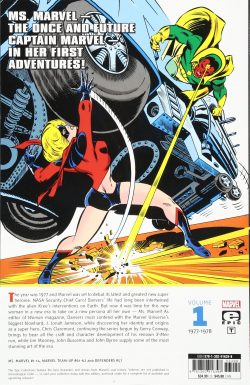
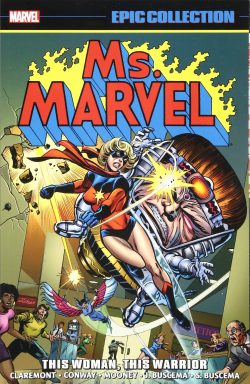
Ms. Marvel Epic Collection volume 1 1977-1978: This Woman, This Warrior


By Gerry Conway, Chris Claremont, John & Sal Buscema, Jim Mooney, John Byrne, Keith Pollard, Carmine Infantino, George Tuska & various (Marvel)
ISBN: 978-1-3029-1639-8 (TPB)

Until relatively recently American comics and especially Marvel had very little in the way of positive female role models and almost no viable solo stars. Although there was a woman starring in the very first comic of the Marvel Age, the Invisible Girl took years to become a potent and independent character in her own right – or even just be called “woman”.

The company’s very first starring heroine was Black Fury: a leather-clad, whip-wielding crimebuster lifted from a newspaper strip created by Tarpe Mills in April 1941. She was repackaged as a resized reprint for Timely’s funnybooks and renamed Miss Fury, enjoying a four-year run between 1942 and 1946 – although her tabloid incarnation survived until 1952.

Fury was actually predated by the Silver Scorpion, who debuted in Daring Mystery Comics #7 (April 1941), but she was relegated to a minor position in the book’s line-up and endured a very short shelf-life.

Miss America first appeared in anthology Marvel Mystery Comics#49 (November1943), created by Otto Binder and artist Al Gabriele. After a few appearances, she won her own title in early 1944. Miss America Comics lasted but the costumed cutie didn’t, as with the second issue (November1944), the format changed, becoming a combination of teen comedy, fashion feature and domestic tips magazine. Feisty take-charge super-heroics were steadily squeezed out and the publication is most famous now for introducing virginal evergreen teen ideal Patsy Walker.

A few other woman warriors appeared immediately after the War, many as spin-offs and sidekicks of established male stars such as female Sub-Mariner Namora (debuting in Marvel Mystery Comics #82, May 1947 and graduating to her own three issue series in 1948). She was followed by the Human Torch‘s secretary Mary Mitchell who, as Sun Girl, starred in her own 3-issue 1948 series before becoming a wandering sidekick and guest star in Sub-Mariner and Captain America Comics.

Draped in a ballgown and wearing high heels, masked detective Blonde Phantom was created by Stan Lee and Syd Shores for All Select Comics #11 (Fall 1946) whilst sort-of goddess Venus debuted in her own title in August 1948, becoming the gender’s biggest Timely-Atlas-Marvel success until the advent of the Jungle Girl fad in the mid-1950s.

This was mostly by dint of the superb stories and art from the great Bill Everett and by ruthlessly changing genres from crime to romance to horror every five minutes…

Jann of the Jungle (by Don Rico & Jay Scott Pike) was just part of an anthology line-up in Jungle Tales #1 (September 1954), but she took over the title with the 8th issue (November 1955).

Jann of the Jungle continued until issue June 1957 (#17), spawning a host of in-company imitators such as Leopard Girl, Lorna the Jungle Queen and so on…

During the costumed hero boom of the 1960s, Marvel experimented with a title shot for Madame Medusa in Marvel Super-Heroes (#15, July 1968) and a solo series for the Black Widow in Amazing Adventures # 1-8 (August 1970-September 1971). Both were sexy, reformed villainesses, not wholesome girl-next-door heroines… and neither lasted solo for long.

When the costumed crazies craze began to subside in the 1970s, Stan Lee & Roy Thomas looked into creating a girl-friendly boutique of heroines written by women. Opening shots in this mini-liberation war were Claws of the Cat by Linda Fite, Marie Severin & Wally Wood and Night Nurse by Jean Thomas & Win Mortimer (both #1’s cover-dated November 1972).

New jungle goddess Shanna the She-Devil #1 – by Carole Seuling & George Tuska – debuted in December 1972; but despite impressive creative teams none of these fascinating experiments lasted beyond a fifth issue.

Red Sonja, She-Devil with a Sword, caught every one’s attention in Conan the Barbarian #23 (February 1973) and eventually won her own series, whilst The Cat mutated into Tigra, the Were-Woman in Giant-Size Creatures #1 (July 1974) but the general editorial position was that books starring chicks didn’t sell.

The company kept on plugging and eventually found the right mix at the right time with Ms. Marvel who launched in her own title cover-dated January 1977. She was followed by the equally copyright-protecting Spider-Woman in Marvel Spotlight #32 (February 1977, and securing her own title 15 months later) and Savage She-Hulk (#1, February 1980). She was supplemented by the music-biz sponsored Dazzler who premiered in Uncanny X-Men #130 the same month, before inevitably graduating to her own book.

Ms. Marvel was actually Carol Danvers, a United States Air Force security officer first seen in Marvel Super-Heroes#13 (March 1968): the second episode of the saga of Kree warrior Mar-Vell, who had been dispatched to Earth as a spy after the Fantastic Four repulsed the aliens Kree twice in two months…

In that series the immensely competent Carol seemed stalled, perpetually investigating Mar-Vell’s assumed and tenuous cover-identity of Walter Lawson for months. This was until Danvers was caught up in a devastating battle between the now-defecting alien and his nemesis Yon-Rogg in Captain Marvel #18 (November 1969).

Caught in a climactic explosion of alien technology, she pretty much vanished from sight until Gerry Conway, John Buscema & Joe Sinnott revived her for ‘This Woman, This Warrior!’ (Ms. Marvel #1, January 1977) as a new chapter began for the company and the industry…

This sturdy trade paperback volume (or enthralling eBook if you prefer), gathers Ms. Marvel #1-14, and guest appearances from Marvel Team-Up #61-62 and The Defenders #57, cumulatively covering cover-dates January 1977 – March 1978 and dives straight in to the ongoing mystery and drama…

The irrepressible and partially amnesiac Danvers has relocated to New York to become editor of “Woman”: a new magazine for modern misses published by Daily Bugle owner J. Jonah Jameson.

Never having fully recovered from her near-death experience, Danvers left the military and drifted into writing, slowly growing in confidence until the irascible publisher makes her an offer she can’t refuse…

At the same time as Carol is getting her feet under a desk, a mysterious new masked heroine begins appearing and as rapidly vanishing, such as when she pitches up to battle the sinister Scorpion as he perpetrates a brutal bank raid.

The villain narrowly escapes to rendezvous with Professor Kerwin Korwin of AIM (a high-tech secret society claiming to be Advanced Idea Mechanics). The skeevy savant has promised to increase the Scorpion’s powers and allow him to take long-delayed revenge on Jameson – whom the demented thug blames for his freakish condition…

Danvers has been having premonitions and blackouts since her involvement in the final clash between Mar-Vell and Yon-Rogg and has no idea she is transforming into Ms. Marvel. Her latest vision-flash occurs too late to save Jameson from abduction, but her “Seventh Sense” does allow her to track the villain before her unwitting new boss is injured, whilst her incredible physical powers and knowledge of Kree combat techniques enable her to easily trounce the maniac.

Ms. Marvel #2 announces an ‘Enigma of Fear!’ and features a return engagement for the Scorpion as Korwin and AIM make Ms. Marvel their latest science project. As the Professor turns himself into an armoured assassin codenamed Destructor, Carol’s therapist Mike Barnett achieves an analytical breakthrough with his patient and discovers she is a masked metahuman even before she does.

Although again felling the Scorpion, Ms. Marvel is ambushed by the Destructor, but awakes in #3 (written by Chris Claremont) to turn the tables in ‘The Lady’s Not for Killing!’

Travelling to Cape Canaveral to interview old friend Salia Petrie for a women-astronauts feature, Danvers is soon battling an old Silver Surfer foe on the edge of space, where all her occluded memories explosively return just in time for a final confrontation with Destructor. In the midst of the devastating bout she nearly dies after painfully realising ‘Death is the Doomsday Man!’ (with Jim Mooney taking over pencils for Sinnott to embellish).

The Vision guest-stars in #5 as Ms. Marvel crosses a ‘Bridge of No Return’. After Dr. Barnett reveals he knows her secret, Carol is forced to fight the Android Avenger after AIM tricks the artificial hero into protecting a massive, mobile “dirty” bomb…

‘…And Grotesk Shall Slay Thee!’ then pits her against a subterranean menace determined to eradicate the human race, culminating in a waking ‘Nightmare!’ when she is captured by AIM’s deadly leader Modok and all her secrets are exposed to his malign scientific scrutiny.

Grotesk strikes again in #8 as ‘The Last Sunset…?‘ almost dawns for the entire planet, whilst ‘Call Me Death-Bird!’(illustrated by Keith Pollard, Sinnott & Sam Grainger) introduces a mysterious, murderous avian alien who will figure heavily in many a future X-Men and Avengers saga, but who spends her early days allied to the unrelenting forces of AIM as they attack once more in ‘Cry Murder… Cry Modok!’ (art by Sal Buscema & Tom Palmer).

In a push to achieve greater popularity, the neophyte then starred in two consecutive issues of Marvel Team-Up (#61-62, September and October 1977).

Claremont had actually begun scripting that title with issue #57 with a succession of espionage-flavoured heroes and villains battling for possession of a mysterious clay statuette. As illustrated by John Byrne & Dave Hunt, the secret of the artefact is revealed in #61 as Human Torch Johnny Storm joins his creepy-crawly frenemy Spider-Man in battle against the Super-Skrull and learns ‘Not All Thy Powers Can Save Thee!’, before the furious clash calamitously escalates to include Ms. Marvel with the next issue’s ‘All This and the QE2’…

Here, the Kree-hybrid uses knowledge and power she didn’t know she had and comes away in possession of an ancient, alien power crystal…

Frank Giacoia inks Sal B Ms. Marvel #11’s ‘Day of the Dark Angel!’ wherein supernal supernatural menaces Hecate, the Witch-Queen and the Elementals attack the Cape, tragically preventing Carol from rescuing Salia and her space shuttle crew from an incredible inter-dimensional disaster…

The astonishing action continues in ‘The Warrior… and the Witch-Queen!’ (Sinnott inks) before ‘Homecoming!’ (Mooney & Sinnott) explores Carol’s blue-collar origins in Boston as she crushes a couple of marauding aliens before the all-out action and tense suspense concludes when ‘Fear Stalks Floor 40’ (illustrated by Carmine Infantino & Steve Leialoha) with the battered and weary warrior confronting her construction worker, anti-feminist dad even as she is saving his business from the sinister sabotage of the Steeplejack….

Wrapping up the show is another guest shot: ‘And Along Came… Ms. Marvel’ (by Claremont, George Tuska & Dave Cockrum, from The Defenders #57, March 1978). Here the “non-team” of outsiders and antiheroes is paid a visit after Carol’s prescient senses warn her of their imminent ambush by AIM. Cue cataclysmic combat…

This comprehensive chronicle also includes ‘Ms. Prints’ – Conway’s and David Anthony Kraft’s editorials on the hero’s origins from Ms. Marvel #1 & 2, original character sketches by John Romita Senior, a house ad, unused cover sketches by John Buscema and Marie Severin plus pages of original art by Sal B, Giacoia & Sinnott and Infantino & Leialoha.

Always entertaining, frequently groundbreaking and painfully patronising (occasionally at the same time), the early Ms. Marvel, against all odds, grew into the modern Marvel icon of capable womanhood we see today in both comics and on screen as Captain Marvel. These adventures are a valuable grounding of the contemporary champion but also still stand on their own as intriguing examples of the inevitable fall of even the staunchest of male bastions – superhero sagas…
© 1977, 1978, 2018 Marvel Characters, Inc. All rights reserved.
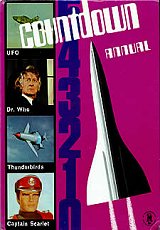
Countdown Annual 1972


By Many & various, edited by Dennis Hooper (Polystyle Publications)
SBN: 85096-018-5

As the 1960s ended, comics editors realised their readership was becoming increasingly sophisticated and sought to keep their attention with upscale rebrandings and style changes. Venerable old TV Comic and even TV21 were no longer dynamic enough and one answer to the situation – from licensing specialist Polystyle – was Countdown.

Running for a mere 58 weeks (beginning 20th February 1971) as a glossy, high end periodical, before its first dramatic makeover – which saw it relaunched on April 1st 1972 as TV Action + Countdown and ultimately TV Action – it subsisted until August 1973 when it was rolled up into TV Comic.

The magazine boasted a rich creative throughput, but the majority of the television-fuelled drama strips were written by editor Dennis Hooper, with additional material from Robin Hillborn, Allan Fennell and possible Angus Allen. However, as the company had access to TV 21‘s archive and used reprint material, I could just be misremembering…

This is the only official Annual. The following year it became Countdown Annual… for TV Action, but don’t let that put you off: whether you’re a telly addict or comics fanboy, this book is stuffed with superb entertainment.

The action opens with a full-colour UFO thriller ‘The Circus’ illustrated by Jon Davis. The saga of a predatory alien body-snatcher used as a cash-cow by a failing Irish carnival show is interrupted (like an advert break?) by photo/fact feature ‘The Defenders’, wherein the secrets of Gerry Anderson’s covert anti-extraterrestrial force SHADO (Supreme Headquarters, Alien Defences Organisation) are outlined, but the story finale remains explosive and satisfying.

Rendered in black-&-red on white paper, 2-page gag strip ‘Dastardly and Muttley’ (by Peter Ford?) sees the cartoon clowns still hunting that infernal pigeon, after which a ‘Countdown Quiz’ tests your knowledge of the Space Race.

Staying in the Wild Black Yonder, Don Harley limns tense Thunderbirds thriller ‘Terror at Torreba’ with a crashed meteor bringing madness and destruction to Africa…

Arnold Kingston was the chief writer of extremely contemporary science fact features for the Countdown comic so it’s safe to assume he’s responsible for the ‘Think Tank! News from the Frontiers of Science’ photo noticeboard here, and another ‘Countdown Quiz’ as well as later features in the book.

Dastardly and Muttley then return, afflicted with dreams of cinematic stardom, after which Martin Asbury paints a full-colour ‘Captain Scarlet’ tale as the Mysterons suborn a giant killer robot and let it run amok…

Board game ‘Countdown Rescue Mission’ dovetails into dystopian prose sci fi short story ‘Countdown: Dangerous Friend’ – magnificently illustrated by John M. Burns – whilst ‘Rockets’ provides a potted photo-history of the real march into space.

Abortive Gerry Anderson Property ‘The Secret Service’ (Peter Ford again) finds priest and part-time secret agent Father Unwin leading the charge back into restricted colour as he and his partner Matthew use their Minimiser shrinking ray to steal back microdots from a hostile embassy

Photo feature ‘A Day with Dr. Who’ visits the locations used whilst filming The Daemons, before ‘U.F.O.s in history’offers a more evidential lesson on extraterrestrial encounters, whilst a colour ‘Jon Pertwee pinup’ brings us to a cracking Time Lord tale as Dr. Who battles floral doom in ‘The Plant Master’, brilliantly illustrated by Jim Baikie.

Slim but potent, this box of delight then ends with prose yarn ‘Joe 90 Resigns’ as the 9-year-old breaks the rules to rescue his father from an alpine emergency.

Closing with the ‘Answers’ to all those quiz questions and a stunning UFO photo section, this is a powerful and evocative treat you’d be crazy to miss…
© Polystyle Publications 1971.

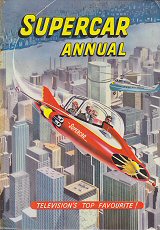
Supercar Annual


By Alan Fennel, G. Wood and H.J. Cauldwell (Wm. Collins and Sons)
No ISBN:

For its entire existence British Comics have tapped into and exploited other entertainment icons such as stage, film and radio stars. As television became commonplace in the 1950s and exploded during the late 1960s – especially in the range and variety of children’s shows and cartoons – those programmes increasingly became a staple source for cheap weeklies but especially the Seasonal Annual market, not just for celebrities such as Arthur Askey or Abbott & Costello but increasingly the shows themselves: adding extra episodes to little aficionados’ finite canon.

Moreover, in an era before home recordings of any sort, these were exploits that could be enjoyed over and over again…

During that critical developmental period, Gerry Anderson’s innovative and increasingly high-tech puppet-show dramas revolutionised kids’ TV, and their comics tie-ins did exactly the same for our pictorial reading habits.

TV Century 21 (the unwieldy “Century” was eventually dropped) was patterned on a newspaper – albeit from 100 years into the future – and this shared conceit carried the avid readers into a multimedia wonderland as television and reading matter fed off each other. The incredible graphic adventures were supplemented with stills taken from the TV shows (and later, films), and a plenitude of photos also graced the text features and fillers which added to the unity of one of the industry’s first “Shared Universe” products,

Number #1 launched on January 23rd 1965, instantly capturing the hearts and minds of millions of children, and further proving to our comics editors the unfailingly profitable relationship between television shows and healthy sales.

Filled with high quality art and features, printed in gleaming photogravure, TV21 featured previous shows in strips such as Fireball XL5, Supercar and Stingray to supplement currently airing big draw Thunderbirds. In a bizarre attempt to be topical, the allegorically Soviet state of Bereznik constantly plotted against the World Government (for which read “The West”) in a futuristic Cold War to augment the aliens, aquatic civilisations and common crooks and disasters that threatened the general well-being of the populace. Even the BBC’s TV “tomorrows” were represented by a full-colour strip starring The Daleks.

Before all that, however, there were far simpler and more inclusive epics for kids at Christmas from the Anderson stable: such as this charming tome, credited to future Anderson staff writer Alan Fennel with cartoon art, strips, puzzles and illustrations by G. Wood and H. J. Cauldwell.

Supercar was Anderson’s (in conjunction with designer Reg Hill and scriptwriters Hugh and Martin Woodhouse) second marionette series, following on from comedy western Four-Feather Falls. Soundly science fictional, it was the first to be internationally syndicated and detailed the exploits of a futuristic flying car, as piloted by dashing test pilot Mike Mercury. His adventure prone entourage included batty boffins Professor Rudolph Popkiss and Dr. Horatio Beaker – who invented and built the mechanical beast – as well as boy sidekick Jimmy Gibson and his mischievous pet Mitch who was a monkey…

Located in a desert base at Black Rock, Nevada, the team had daring adventures all over the world (seen in the 39 episodes recorded between 1961-1962), and frequently faced wicked enemy agent Masterspy and his henchman Zarrin.

Broadcasts began in January 1962 and were eagerly awaited by millions of fans who found solace when the show closed by buying TV Comic for further exploits.

There were three annuals released, of which this is the last, offering an unconventional experience since all the strips and prose adventures comprise one large complete saga.

Following an enthralling painted double-page frontispiece of the wonder vehicle at the bottom of the sea, the action opens with Cauldwell’s full-colour strip ‘Killer Whale’ as the action-ready team save ocean-going scientist Doctor Bombay from one of his own maddened experiments. In the aftermath, they learn the savant has been recently been restored to his previous role as Maharajah of Subahn and agree to escort him home to take up the reins of power…

Before they can set off, however, a fresh emergency occurs, and Supercar is needed to fix a sabotaged trestle in Wood’s 2-colour strip ‘Bridge of Danger’ and their base is plundered of secrets in prose mystery yarn ‘The Workshop Robbery’. Thankfully, Mike is as adept at crimefighting and counterespionage as he is at flying…

Following puzzle page ‘World Flight’, monochrome strip ‘Close-Up on Danger’ finally sees the journey to Subahn begin, but during a stopover in London deposed former dictator Randah Singh deploys a hired assassin to kill Bombay in front of a live studio audience…

Plot foiled, the voyagers resume their flight, leaving us to enjoy a puzzle-maze in ‘S-O-S’ before a flashback prose tale details how Beaker and Popkiss discovered ‘The Treasure of Mesa Verde’ despite the larcenous efforts of Masterspy and Zarrin…

Another full-colour section begins with activity pages ‘What is Wrong with this Picture?’ and ‘Memory Game: Exploring Space’, before ‘Sahara Inferno’ finds Supercar diverted again to help extinguish a blazing natural gas well. General knowledge teaser ‘Nevada Quiz’ then segues into a new restricted colour section foe Wood’s ‘Kidnapped’ wherein Randah Singh hires Masterspy and Zarrin to ensure Maharajah Bombay never takes up his throne…

Rebus page ‘The Lost Diplomatic Plane’ leads to another prose flashback for ‘Mission to Destroy’; revealing how Supercar was instrumental in eradicating an illegal weapons cache in Malaya, after which a return to the present sees Bombay’s triumphal accession procession interrupted by the ‘Eruption!’ of the local volcano…

Memories evoked, a prose tale follows of a time in Switzerland when a souped-up mechanical doll triggered ‘The Avalanche’ before the extended saga concludes in full-colour with ‘The Triumphant Procession’ as Randah Singh plays his last murderous ace…

Blending charm with action and exoticism with big laughs, this is a splendid example of simpler times and all-ages storytelling that no nostalgia-afflicted baby boomer could possibly resist.
© 1963, A.P. FILMS and A.T.V. Ltd. All rights reserved.

Genre Annuals

The comic has been with us a long time now and debate still continues about where, when and exactly what constitutes the first of these artefacts to truly earn the title. There’s a lot less debate about the Children’s Annual: a particularly British institution and one that continues – albeit in a severely limited manner – to this day.

It’s a rare and tragic individual who never received a colourful card-covered compendium on Christmas morning; full of stories and comic-strips and usually featuring the seasonal antics of their favourite characters, whether from comics such as The Beano, The Dandy, Lion, Eagle and their ilk, or TV, film or radio franchises/personalities such as Dr Who, Star Wars, Thunderbirds, Radio Fun or Arthur Askey. There were even sports and hobby annuals and beautifully illustrated commemorative editions of the fact and general knowledge comics such as Look and Learn, and special events such as the always glorious Rupert Bear or Giles Annuals.

Here then is a brief celebration of the kinds of genre celebrations which delighted kids and their parents…

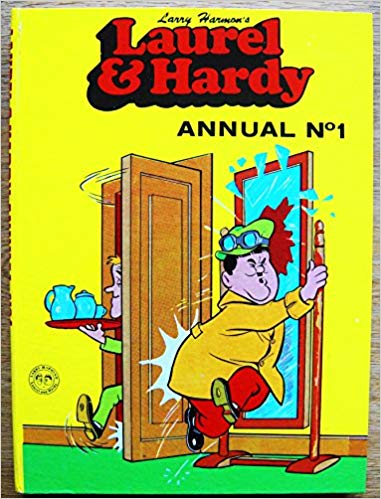
Larry Harmon’s Laurel & Hardy Annual #1


By various anonymous (Brown & Watson)
No ISBN:

Stan Laurel and Oliver Hardy comprise the funniest comedy duo of all time. Your opinion may differ, but mine’s correct.

Known all over the world, they became famous for their appearance and filmic characters, which made it pretty easy to establish an intellectual properties license for them after their passing.

Larry Harmon was the stage name of Laurence Weiss (1925-2008), one of a select group of American actors to be legendary icon Bozo the Clown. He was – also albeit unwillingly and to prove a point – a Presidential candidate in 1984. Make of that what you will.

In 1956, Harmon purchased the rights to Bozo, instituting a ferocious marketing strategy for advertising, merchandise and the growing television field. By the 1960s he had made Bozo a star in every US home (using local franchise performers) and generated an animated avatar on those live-action shows.

Harmon’s animation studio then took over the screen rights to Popeye in 1960, releasing a new series of TV cartoons, and in 1961 bought the merchandising rights to Laurel and Hardy. In the subsequent series that resulted, hands-on Harmon voiced Stan, just as he had voiced Bozo in those animated segments of the live action shows. There were 156 episodes which first aired in the US from September 10th 1966 to March 25th 1967.

Although not to my taste, those Laurel and Hardy cartoons were hugely popular, spawning a Gold Key comic book and a 1972 DC Digest Special in the US, and a new comics series in the UK (and presumably, the Commonwealth that British distributor Thorpe & Porter and its affiliated imprints such as Williams exported to) as well as being syndicated to European countries such as Germany where they were Dick und Dorf…

From 1969 to 1974 T&P generated their own licensed comic book iteration: at least 136 full-colour issues, 8 double-sized softcover albums (including at least one Christmas Special) and 2 proper hardback annuals – of which this is the first – via licensed properties specialists Brown Watson, who eventually evolved into Grandreams.

Stan and Ollie were certainly no strangers to British comics readers. The Odd Couple were a front-page staple of Film Fun from the 1930s to 1957 (rendered by the astounding George William Wakefield and inherited by his artist son Terry). The starred in Film Picture Stories (1934) and through the 1960s were a big draw in TV Comic.

After their solo comic folded, the puckish pair continued as a supporting feature and occasional headliner well into the 1980s.

In this first official Annual from 1972, an anonymous band of artisans begin the procession of slapstick tomfoolery with prose vignette ‘Mugs of the Legion’ wherein the dopey duo return to the theme of their movie The Flying Deuces, sticking out like sore thumbs in the desert until they accidentally capture the villainous scourge Abdul el Ratta…

A brace of pages full of one-off cartoons, ‘Stan & Olly’s Gag-Bag!’ leads to a second prose story wherein ‘Laurel & Hardy Go Camping’ with typically calamitous results, before the strips begin – in full colour – with ‘Rocketship Rumpus’. Here, the best window washers in the Space Program are accidentally sent to another world only to upset aliens and save space dragons…

Once back on Earth, Olly’s biggest mistake is letting Stan have ‘The Puppy’, and when the full-grown beast is stolen by a burglar, he’s not the only happy chappie, after which short strip ‘The Aerial’ proves why some household jobs should never be “do-it-yourself”…

Extended epic ‘The Treasure House’ sees the hapless loyal oafs as destitute beggars, but everything changes when Olly inherits ramshackle estate Fool Hardy Manor and learns there’s a valuable hoard hidden somewhere in its dilapidated walls…

Leaving Stan ‘Washing the Car’ proves a recipe for disaster and their time as ‘Private Detectives’ even more so, but nothing is as crazy as assuming Stan’s lesson’s in ‘Self-Defence’ can ever be successful, before the duo-chrome prose material takes an encore.

‘The Specialists’ see Stan and Olly revive the window washing gig, only to end up on the wrong side (that is INside) of a top-secret super jet, after which two more pages of ‘Stan & Olly’s Gag-Bag!’ and three of assorted puzzles, activities and games take us to the big finish as the eternal idiots agree to clean scary domicile ‘The House of Secrets’ and stumble into terror and criminality in equal measure…

Gentle, unassuming and – admittedly – a touch dated, these old-fashioned efforts are still effective and engaging examples of comedy cartooning and all-ages humorous storytelling that will appeal to the kid in all and most little kids of your acquaintance. Why not seek them out and give them a go again?
© 1972, Larry Harmon Pictures Corporation.

Superman Annual 1986


By Cary Bates, Elliot S! Maggin, Grant Morrison, Pete Milligan, Curt Swan, Barry Kitson, Jeff Andersen, Mike Collins, Mark Farmer, Mike Grell, Brian Bolland & various (London Editions)
ISBN: 978-0-72356-763-9 (HB)

Before DC and other American publishers began exporting comicbooks directly into the UK in 1959, our exposure to their unique brand of fantasy fun came from licensed reprints. British publishers/printers like Len Miller, Alan Class and Top Sellers bought material from the USA – and occasionally Canada – to fill 68-page monochrome anthologies, many of which recycled the same stories for decades.

Less common were strangely coloured pamphlets produced by Australian outfit K. G. Murray: exported to the UK in a rather sporadic manner. The company also produced sturdy Annuals which had a huge impact on my earliest years (I suspect my abiding adulation of monochrome artwork stems from seeing supreme stylists like Curt Swan, Carmine Infantino, Gil Kane and Murphy Anderson strut their stuff uncluttered by flat colour…).

In Britain we began seeing hardcover Superman Annuals in 1950 and Batman Annuals in 1960. Since then a number of publishers have carried on the tradition. This particular tome comes from the mid-1980s when a number of young British creators were perfecting their skills and looking for work in the home of the Brave…

Thankfully though the UK Annual format remains: offering a delightfully eclectic and inescapably nostalgic mix of material designed to cater to young eyes and broad tastes.

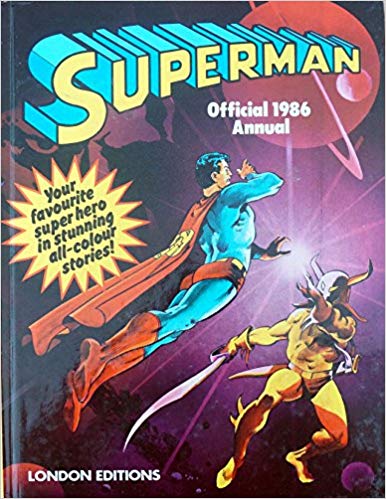
Released in the Autumn of 1985, this hardback gem opens with a frontispiece montage of the Man of Steel by a host of US luminaries before contemporary comics reprint (taken from Superman #392, February 1984) ‘If a Body Meets a Body…’ (by Cary Bates, Elliot S. Maggin Curt Swan & Dave Hunt) finds the Action Ace scouring the world for his childhood sweetheart Lana Lang. Complicating the issue is the abductor, alien superhero Vartox and a champion more powerful and experienced than the fraught and frantic Man of Steel.

What could possible have triggered this unexpected aberration?

This is followed by an original prose yarn written by then-up-&-comer Grant Morrison and liberally illustrated in full-colour by Barry Kitson & Jeff Anderson. When the Metropolis mob want to get rid of Superman, they back a mad scientist who tries psychological warfare with ‘Osgood Peabody’s Big Green Dream Machine’. Any guesses how that works out?

Returning to strip reprints, ‘This Legionnaire is Condemned’ is by Bates, Mike Grell & Bob Wiacek and originated in December 1976’s Superboy and the Legion of Super-Hero #222. The tales sees new member Tyroc seemingly terrorising 30th century Metropolis with his reality-bending sonic screams, but of course there’s a rational reason for all the cunningly conceived catastrophes…

‘Testing Time for Superman’ is another text adventure, courtesy of Pete Milligan, Mike Collins & Mark Farmer with the overworked Action Ace multitasking alien threats and romantic interludes with Lois Lane, after which a stunning Brian Bolland pinup (from Superman #400) segues into pages of ‘Super Puzzles’ and a bombastic final act from Bates, Swan & Tex Blaisdell as ‘Superman’s Energy Crisis’ (Action Comics #454, December1975) sees the Last Son of Krypton battling a new Toyman just as his powers are mysteriously fading away…

Smart, no-nonsense, solid superhero shenanigans have always been the watchword of Superman Annuals and this one is no exception.
© 1985 DC Comics Inc, and London Editions Limited. All characters © 1985 DC Comics Inc.

Smash! Annual 1975


By many and various (IPC Magazines, Ltd)
SBN: 85037-166-X

Smash! launched with a cover-date of February 5th 1966: an ordinary Odhams anthology weekly which was quickly re-badged as a Power Comic at the end of the year; combining home-grown funnies and British originated thrillers with resized US strips to capitalise on the American superhero bubble created by the Batman TV series.

Power Comics was a sub-brand used by Odhams to differentiate those periodicals which contained reprinted American superhero material from the company’s regular blend of sports, war, western, adventure and humour comics – such as Buster, Valiant, Lion or Tiger.

During the Swinging Sixties the Power weeklies did much to popularise the budding Marvel universe characters in this country, which was still poorly served by distribution of the original American imports.

The increasingly expensive American reprints were dropped in 1969 and Smash! was radically retooled with the traditional mix of action, sport and humour strips. Undergoing a full redesign, it was relaunched on March 15th 1969 with all-British material and finally disappeared into Valiant in April 1971 after 257 issues.

However, the Seasonal specials remained a draw until October 1975 when Smash Annual 1976 properly ended the era. From then on, the Fleetway brand had no room for the old guard – except as re-conditioned reprints in cooler, more modern books…

As I’ve monotonously repeated, Christmas Annuals were forward-dated so this monumental mix of shock, awe and haw-haw was probably being put together between spring and September 1974, combining new strip or prose stories of old favourites with remastered reprints from other Fleetway-owned comics and a wealth of general interest fact features.

Here then, following a contents page/cast pin-up double page spread of the Swots and Blots, the festive fun kicks off with a promise of trouble to come – and a modicum of editorial fourth wall-busting – from ‘Bad Penny’ with what today seems a rather uncomfortable photo spread featuring chimps in human dress entitled ‘Monkey Music Tricks’…

Devised by Barrie Mitchell and unbelievably popular, ‘His Sporting Lordship’ was a light-hearted everyman comedy drama and one of the most popular strips of the era. Debuting in Smash!, in 1969 Henry Nobbins survived the merger with Valiant and only retired just before the comic itself did.

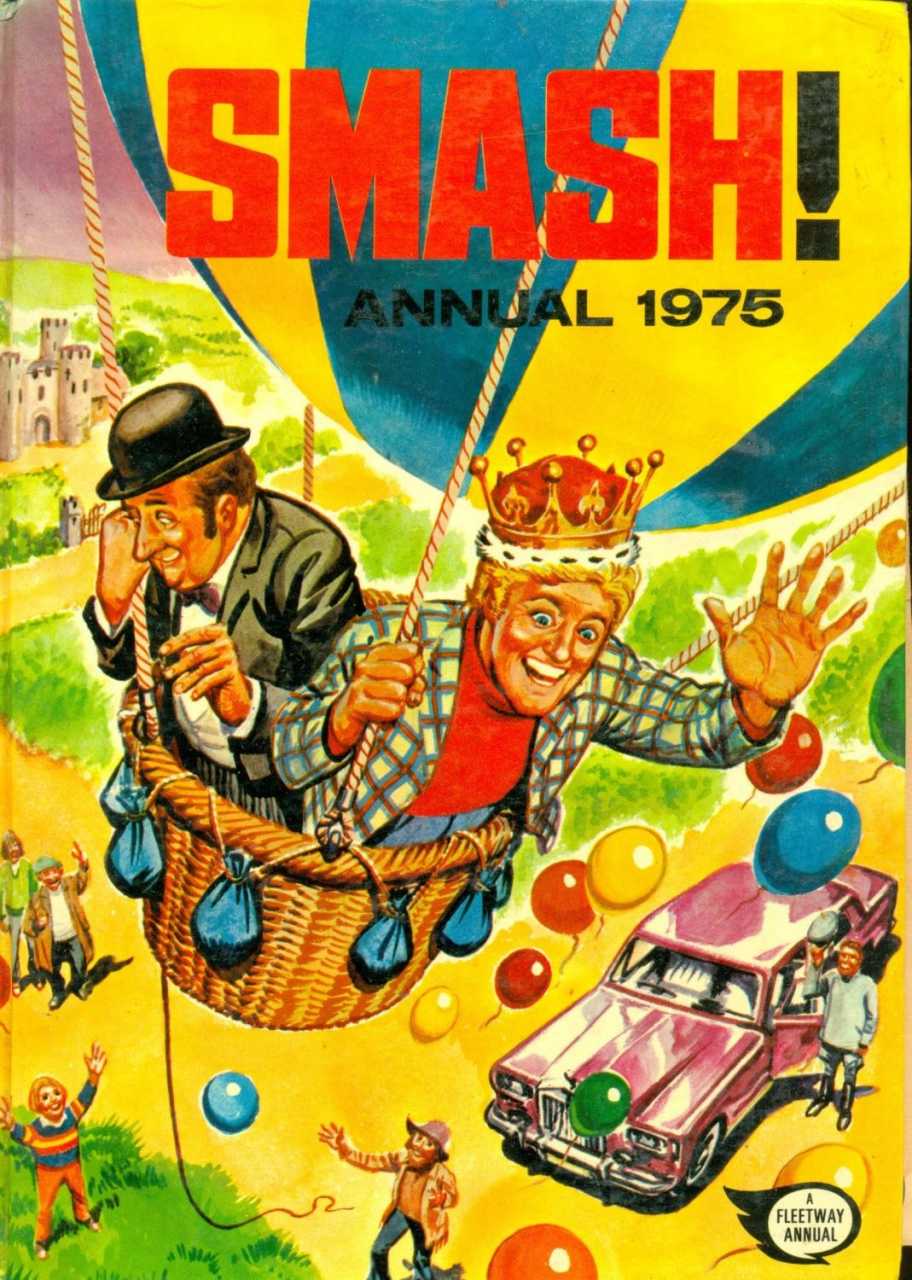
Cover-featured Nobbins was only a common labourer when he unexpectedly inherited £5,000,000 and the title Earl of Ranworth. Unfortunately, he couldn’t touch the cash until he restored the family’s sporting reputation… by winning all the championships, prizes and awards that his forebears had held in times past…

Further complicating the issue was rival claimant Parkinson who, with henchman Fred Bloggs, constantly tried to sabotage his attempts. Luckily the new Earl was ably assisted by canny, cunning butler Jarvis…

With art (possibly?) by Douglas Maxted, this red-&-black-hued romp is his last ever appearance as the unlikely toff and his capable manservant attempt a sporting double – in ballooning and knitting – despite the scurrilous efforts of the skulking nemeses…

The first of a series of puzzle pages is next as ‘Smash Quiz No. 1’ asks questions on sporting subjects after which a prose tale of ‘Master of the Marsh’ (illustrated by the Solano Lopez studio) sees enigmatic hermit/P.E. teacher Patchman taking his pack of hooligans and rabble-rousers on an exchange trip to America, after which gags return in a perilous sub-sea lark for the crew of ‘Ghost Ship’ (by Sid Burgon?) and a nasty dose of civic pride causes carnage amidst the ongoing class war on Reg Parlett’s ‘Consternation Street’.

Also splitting sides and tickling ribs is Leo Baxendale’s ‘The Swots and the Blots’ – with a cataclysmic snowy guest shot from minxish Penny – whilst Fool who Fell to Earth ‘Monty Muddle’ (originally Milkiway – The Man from Mars in Buster) explores Earthlings’ obsession with digging holes.

Prose fact-feature ‘Fishing Can be Fun’ – illustrated by Ted Andrews and with photos – leads to history vignette ‘Pursuit in the Snow’ detailing an alpine pursuit during WWII before we enjoy a true gem of British comics suspense.

Written by Scott Goodall with Ken Mennell and Chris Lowder, ‘Cursitor Doom’ is the unquestioned masterpiece of Eric Bradbury – one of our greatest ever stylists. The strip is a darkly brooding Gothic thriller quite unlike anything else in comics then or since. If pushed, I’ll liken it most to William Hope Hodgson’s Karnacki the Ghost Breaker novelettes – although that’s more for flavour than anything else and even that doesn’t really cover it.

Doom is a fat, bald, foul-tempered, cape-wearing know-it-all who is also humanity’s last-ditch defence against the forces of darkness. With his strapping and rugged young assistant Angus McCraggan and Scarab, a trained raven (or is it, perhaps, something more?), Doom crushes without mercy any threat to humanity’s wellbeing. Here, that’s the sudden rising of ancient pagan gods animating the nations flora and imbuing it with a taste for blood…

Refreshing ourselves with more laughs, a brace of animal antics in Stan McMurtry’s ‘Percy’s Pets’ segues neatly into chilling chuckles in Leo Baxendale’s ‘The Haunts of Headless Harry’…

Globe trotting journalist/adventurer Simon Test barely survives the diabolical ‘Revenge!’ of mad millionaire boffin Jabez Coppenger: a breathtaking thriller courtesy of Angus Allen & Bradbury, after which ‘Smash Hits’ doles out a double helping of single-panel gags and ‘Wacker’ (originally Elmer when first seen in Buster) finds the oaf trying out the job of lorry driver in a riotous romp from Roy Wilson, before we pause once more for intellectual stimulation as ‘Smash Quiz No. 2’ tests our affinity ‘For Motorcars’…

A full-colour section begins and ends with a brace of strips starring smug know-it-all ‘Big ‘Ead’ (another Buster ex-pat, limned by Nadal), bookending a lengthy photo-feature on model railways dubbed ‘Weeny Wonders’ before monochrome returns with ‘Smash Quiz No. 3 (For Animals)’ and another Baxendale (or maybe the legendary Mike Brown? You should look him up…) clash between ‘The Swots and the Blots’: a seasonal shocker as the kids perform a panto…

Another historical photo-feature on the British NRA and the shooting range at ‘Bisley’ follows, after which the spooks of the ‘Ghost Ship’ clash with a seagoing saurian and ‘Sam’s Spook’ gets his adopted mortal into more trouble before ‘Storm Hero’ tantalises in text with the tale of a daring cliff rescue.

‘Percy’s Pets’ (McMurtry or possibly Cyril Price) sees a skunk save the day before ‘Giants of Sport’ offers a roundup of contemporary legends and triumphs and ‘The Swots and the Blots’ indulge again in their own class war and thus won’t join us for ‘Smash Quiz No. 4 – For Soldiers’…

Returning to full-colour, Victorian escapologist and showman ‘Janus Stark’ involves himself in a police hunt for a fantastic band of thieves only to discover all is not as it seems…

Stark was a fantastically innovative and successful strip. Created by Jack Legrand, and written by Tom Tully for the 1969 relaunch of Smash!, the majority of the art was from Francisco Solano Lopez’s Argentinean studio (including stints by Francisco Fuentes-Man, Juan García Quirós and Tom Kerr). The eerie moodiness well-suited the saga of a foundling who grew up in a grim orphanage to become the greatest escapologist of the Steam Age.

The Man with Rubber Bones also had his own ideas about Justice, and would joyously sort out scoundrels the Law couldn’t or wouldn’t touch. A number of creators worked on this feature, which survived until the downsizing of Fleetway’s comics division in 1975 – and even beyond – as Stark escaped oblivion when the series was continued in France – even unto Stark’s eventual death and succession by his son!

Back in black & white for the final stages, ‘Smash Quiz No. 5’ tests For Hobbies, ‘Big ‘Ead’ goes skiing and photo-essay‘Clowning Around’ clues us in on everything we need to know about making kids laugh and some adults scream.

‘The World-Wide Wanderers’ were a literally international team of footballers drawn from many different countries – talk about prophetic! – who here star in prose yarn ‘Five-A-Side’ as acrimony and resentment between attack and defence divides the team, with unexpected benefits for a local charity before everything ends with ‘It’s Bad Penny Again’ as the tiny terror learns a painful lesson…

As my knowledge of British creators from this time is so woefully inadequate, I wouldn’t be surprised if I’ve misattributed and besmirched the good names of Leo Baxendale, Gordon Hogg, Stan McMurtry, Graham Allen, Mike Lacey, Terry Bave, Artie Jackson and numerous international artists anonymously utilised throughout this period. Even more so the unsung authors responsible for much of the joy in my early life – and certainly the childhoods of millions of others…

Christmas simply wasn’t right without a heaping helping of these garish, wonder-stuffed compendia offering a vast variety of stories and scenarios. Today’s celebrity, TV and media tie-in packages simply can’t compete, so why not track down a selection of brand-old delights with proven track record and guaranteed staying power…?
© IPC Magazines, Ltd. 1974.

Merry Christmas, One and All!

In keeping with my self-imposed Holiday tradition here’s another pick of British Annuals selected not just for nostalgia’s sake but because it’s my house and my rules…

After decades when only American comics and memorabilia were considered collectable or worthy, the resurgence of interest in home-grown material means there’s lots more of this stuff available and if you’re lucky enough to stumble across a vintage volume or modern facsimile, I hope my words convince you to expand your comfort zone and try something old yet new…

Still topping my Xmas wish-list is further collections from fans and publishers who have begun to rescue this magical material from print limbo in (affordable) new collections…

Great writing and art is rotting in boxes and attics or the archives of publishing houses, when it needs to be back in the hands of readers once again. As the tastes of the reading public have never been broader and since a selective sampling of our popular heritage will always appeal to some part of the mass consumer base, let’s all continue rewarding publishers for their efforts and prove that there’s money to be made from these glorious examples of our communal childhood.

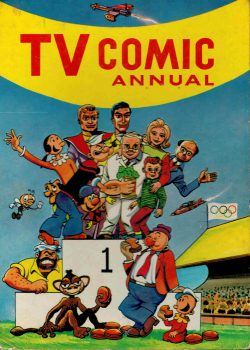
TV Comic Annual 1965


By Chick Henderson, Neville Main, Bill Titcombe, Dick Millington & various (TV Publications Ltd)
No ISBN

British Comics have always fed heavily on other media and as television grew during the 1960s – especially the area of children’s shows and cartoons – those programmes increasingly became a staple source for the Seasonal Annual market. There would be a profusion of stories and strips targeting not readers but young viewers, and more and more often the stars would be American not British.

Thanks to the vagaries of image licensing, one thing you won’t find herein is a wealth of photographs of any cast member (although the frontispiece and endpapers are spiffy publicity shot spreads of Gerry Anderson’s Supercar and Fireball XL5), but there are plenty of nostalgia-tinged, all-ages sci fi and adventure thrills, dashing derring-do and a horde of hilarious gag strips to delight not just TV devotees and comics fans but also any reader in search of a pictorially powerful grand adventure.

This book from 1963 was produced in a non-standard UK format, with limited 2-colour and full-colour pages but none in simple monochrome: a sign of its high-end book trade aspirations. The make-up is comics, brief prose pieces, puzzles, games and fact-features on related themes. As for the writers and artists of the originated material your guess is, sadly, as good as or better than mine.

TV Comic launched on 9th November 1951, an offshoot of the Beaverbrook newspaper concern and aimed explicitly at toddlers and pre-school children. It expanded its remit over the decade but didn’t really take off until 1960 when Polystyle Publications expanded the adaptations to include television adventures series enjoyed by kids who could read and choose their own entertainments such as Treasure Island, Black Beauty and the Lone Ranger.

Always a huge hit, the magazine absorbed companions and rivals such as TV Land, TV Express, TV Action, Tom and Jerry Weekly and Target. Amongst its most memorable features were early Gerry Anderson series such as Four Feather Falls, Supercar and Fireball XL5, Doctor Who (running from 1964-1979), Tarzan, Space Patrol, The Avengers (John Steed and Cathy Gale/Emma Peel), Star Trek and perennial cartoon hits such as Popeye, Pink Panther and many others.

Often eclectic and esoteric, the comic followed the tone of the TV times faithfully before finally going off air in 1984 with #1697.

This splendid example hails from 1963 and, eschewing bought in pre-existing material, offers British takes on many US icons such as the full-colour Popeye clash with brutish Brutus that gets the ball rolling before a beautifully painted adventure by Neville Main sees the crew of Fireball XL5 captured by alien technology bandits.

Main shows his versatility with a broadside of sci fi gags in Pick of the Jokes before venerable comedy feature Mighty Moth (by sometime editor Dick Millington) puts a strange spin on the traditional roles of man and wife…

A Supercar Christmas yarn (with art by Mike Noble, H Watts or maybe Bill Mevin) sees pilot Mike Mercury and Professor Beaker crush a Yuletide crimewave to close the first full-colour section before autograph-hunting TV TerrorsCuthbert, Buttons and Monica clash once more with mean TV Studio doorman Hoppit in their search for famous names in glorious two-tone orange and black on white…

US soldier Beetle Bailey then gets to act out one of the oldest jokes on Earth before the TV Terrors again clash with their officious nemesis, Beetle Bailey fails a medical and long-forgotten cartoon buddies Foo Foo and Gogo by Halas & Batchelor (or at least from their studio) have fun and fear in the snow…

Millington’s Mighty Moth indulges in some wildlife documentary making whilst a domestic sitcom sneaks in as The Dickie Henderson Family sees his unnamed wife make some radical wardrobe corrections in a strip beautifully rendered by Bill Titcombe.

The TV Terrors join a painful episode of This is Your Life, Foo Foo and Gogo indulge in hat hijinks and (some of) The Dickie Henderson Family enjoy a quiet round of golf and Mighty Moth helps out an enemy to get a bit of peace and quiet before Beetle Bailey revolutionises tank warfare with the aid of canteen utensils, after which the Technicolor turns on with Popeye and Wimpy at a barbecue. Oooh! Bad idea!

Mighty Moth and the TV Terrors revel in their full-colour escapades before a traditionally rendered tale of Robin Hood(but not the TV version with Richard Greene) sees the hero save a beekeeper from the Sheriff of Nottingham…

A Dickie Henderson Family country retreat turns into a rout before we pause for activities, courtesy of a Continental Tourboard game, supplemented by Party Puzzles and two more Main Pick of the Jokes pages, leading to a bizarre personal favourite as Bill Titcombe delineates deucedly deranged pastiche The Telegoons (based on characters devised on radio by Harry Secombe, Peter Sellars, Michael Bentine and Spike Milligan). It’s even more gloriously mad today than it ever was…

A theatre visit goes badly wrong for The Dickie Henderson Family whilst The Telegoons dabble with fortune telling and Foo Foo and Gogo bring the colour to a close with another pointless domestic spat…

Mighty Moth then wrecks dinner and the TV Terrors practise making faces, before more Party Puzzles bracket a short faux advertising episode for Foo Foo and Gogo and Mighty Moth ships out with the Royal Navy.

The Telegoons setting up as firemen segues into a historical battle as little Davie of the Glen attempts to save the doomed army of Bonnie Prince Charlie. Mighty Moth picks up a trumpet and the TV Terrors participate in a game show whilst the The Telegoons go fishing and Foo Foo and Gogo go birdwatching before another Pick of the Jokes selection brings us to a prose thriller set in the world of motor racing.

‘Johnny’s Big Chance’ leads to more Party Puzzles and the commencement of the last colour session, with boating fools Foo Foo and Gogo giving way to a thrilling Supercar yarn involving lost submarines and giant crustaceans.

A suit Mighty Moth can’t eat and a new pet for Popeye’s boy Swee’ Pea lead us to one last parcel of Party Puzzles before Main’s exuberant Fireball XL5 fable posits the risks of letting all kids have their own spacecraft…

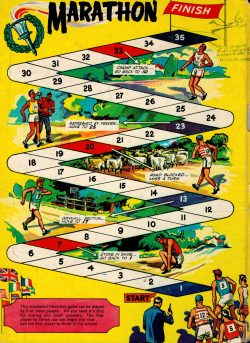
A barrel of fun from start to finish, this book concludes with Popeye demonstrating his incredible strength and even has a back-cover Marathon board game to enjoy when the reading concludes.

A true gem from a far nicer and more indulgent time, this is a perfect example of why Christmas Annuals have lasted and should never be forgotten.
© TV Publications 1964.

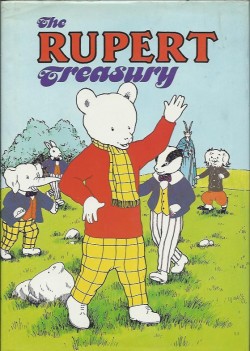
The Rupert Treasury


By Mary Tourtel & various (Purnell Books)
ISBN: 9 78-0-36106-343-2 (HB)

Win’s Christmas Gift Recommendation: Truly British Brilliance with Universal Appeal… 9/10

As we’ve all voted to head back to the fabled sunlit uplands of our own fictitious past, I’ve opted to review an actual icon of our Island Nation, and one I think we can all agree we’d be happy to find overseeing our next five years…

There’s not a lot around these days in the comics which caters specifically for little kids, as well as their nostalgic parents and guardians whilst simultaneously introducing them to the ineluctably tactile wonders and sensorium of a high-quality comics experience. Once upon a time, there was a whole subdivision of the publishing business dedicated to enthralling and enchanting our youngest and, hopefully, brightest, but now all I can think of are The Beano and The Phoenix…

At least we still have books – old and new – to fill the gap.

Moreover, comics fans and the British in general equally adore a well-seasoned tradition and in terms of pictorial narrative and sheer beguilement there’s nothing more perfect than the hirsute national treasure Rupert.

Long before television took him, the Little Bear was part of our society’s very fabric and never more so than at Christmas when gloriously painted, comfortingly sturdy rainbow-hued Annuals found their way into innumerable stockings and the sticky hands of astounded, mesmerised children.

The ursine über-star was created by English artist and illustrator Mary Tourtel (1874-1948) and debuted in the Daily Express on November 8th 1920; the beguiling vanguard and secret weapon of a pitched circulation battle with rival papers the Daily Mirror and Daily Mail. Both papers had cartoon characters for kiddies – Teddy Tail in the Mail and the soon-to-be legendary Pip, Squeak and Wilfred in the Mirror.

Tourtel’s daily serial of the Little Lost Bear initially ran for 36 instalments and triggered a phenomenon which remains in full force to this day, albeit largely due to the diligent efforts of her successor Alfred Edmeades Bestall, MBE, who wrote and illustrated Rupert Bear from 1935 to 1965 and was responsible for the Annuals which began with the 1936 edition.

The artist originally chosen to spearhead the Express’ cartoon counterattack was already an established major player on the illustration scene – and fortuitously married to the paper’s News Editor Herbert Tourtel, who had been ordered by the owners to come up with a rival feature…

The unnamed little bear was illustrated by Mary and initially captioned by Herbert, appearing as two cartoon panels per day with a passage of text underneath. He was originally cast as a brown bear until the Express sought to cut costs and inking expenses, resulting in the iconic white pallor we all know and love today.

Soon though, early developmental “bedding-in” was accomplished and the engaging scenario was fully entrenched in the hearts and minds of readers. Young Rupert lives with extremely understanding parents in idyllically rural Nutwoodvillage: an enticing microcosm and exemplar of everything wonderful and utopian about British life. The place is populated by anthropomorphic animals and humans living together but also overlaps a lot of very strange and unworldly places full of mythical creatures and legendary folk…

A huge hit, Mary’s Rupert quickly expanded into a range of short illustrated novels; 46 by my count from the early 1920s to 1936, with a further run of 18 licensed and perpetually published by Woolworth’s after that. It’s from the former that the five tales in this splendid hardback commemoration are taken…

Tourtel’s bear was very much a product of his times and social class: smart, inquisitive, adventurous, helpful yet intrinsically privileged and therefore always labouring under a veiled threat of having his cosy world and possessions taken away by the wicked and undeserving.

Heretical as it might sound, like the unexpurgated fairy tales of Hans Christian Anderson or the Brothers Grimm, the pre-Bestall Rupert yarns all have a darker edge and worrisome undercurrent with mysterious forces casually, even capriciously targeting our innocent star. Naturally, pluck, good friends and a benevolent adult or two are always on hand to help our hero win through…

This glorious tome – still readily available through many internet vendors and originated in 1984 – gathers a quintet of typical Tourtel tales from the book editions, packing a wealth of full colour painted, duo-hued and monochrome ink-line illustrations into his enchanting pages.

Here we open with the all-colour adventure of ‘Rupert and the Robber Wolf’ from 1932, with the text, as always, delivered in a succession of rhyming couplets.

When Rupert is deprived of his new pocket watch by a burly vulpine bandit – and despite seeking the assistance of best pal Bill Badger, friendly mystic The Wise Old Goat, pixies, fauns and rural troubleshooter The Pedlar – he ends up a prisoner of the wolf.

Happily, the Old Goat and a posse of police are on hand to collar the crook and his wayward son before something really nasty occurs…

Rendered in bucolic shades of green, ‘Rupert and the Old Miser’ (first released circa 1925) finds our bear playing with a new ball which flies over a forbidding wall into a large garden. When Rupert sneaks in to retrieve his toy, he encounters a range of odd and terrified creatures all suborned to the eccentric whims of the rapacious Master Raven…

Upon the bear’s capture, the ebon enchanter declares the trespasser to be his property too and sets the poor mite to work as his latest chattel. Rupert is despondent, but help is at hand. The Little Bear’s friends have concocted a cunning plan to rescue him and when their scheme succeeds the miser meets a grisly fate chasing his fleeing new slave…

Equally verdant in its art aspects is the saga of ‘Rupert and the Enchanted Princess’ (1928) which opens with the bear snatched up by a great bird and delivered to a distant kingdom whose feudal monarch pleads with him to find his missing daughter.

Despite the scorn of the assembled knights, Rupert sets out and – with the aid of woodland creatures and a talking horse – overcomes ogres, dragons and other terrors before reversing the magic curse of three witches and returning the Princess to her doting dad…

Rendered in beautiful, clear, clean monochrome line art, ‘Rupert and the Mysterious Flight’ (1930) begins when The Prince and Princess of the Wood of Mystery send the Little Bear a fully functional aeroplane. Soon, Rupert is enjoying his maiden voyage but gets lost and alights in the Land of Kinkajous, where King Toucan – after an initial fright – sets the little daredevil a series of never-ending mystic challenges. After a number of Herculean labours are accomplished, Rupert at last regains his flying machine and makes a break for freedom and home…

The fantastic voyages conclude with the full-colour ‘Rupert and the Magic Toyman’ (1933) wherein a thrilling day enjoying a Fair and Sports Day leads to the unlucky bear being spirited away by a genial craftsman whose enticing wares mask his true nature.

The toy maker is, in fact, a wicked sorcerer and his constructions are transformed animals. One of them was even a Princess…

Undaunted, Rupert organises an escape back to Princess Belinda‘s kingdom, but the Toyman has already ensorcelled the whole place into a land of marionettes. Happily, a glimmer of hope remains and the tables can be turned if only Rupert can find and recruit the valiantly heroic Moorland Will whose hunting horn can undo the magic spell…

Beautifully realised, superbly engaging fantasies such as these are never out of style and this fabulous tome should be yours, if only as means of introducing the next generation to a truly perfect world of wonder and imagination.
© 1984 Beaverbrook Newspapers Limited. Artwork & text © 1984 Purnell Publishers Limited from original Mary Tourtel material.