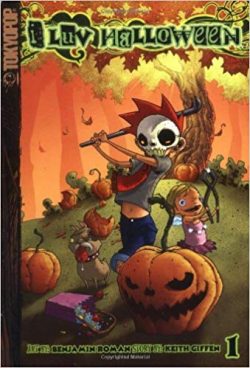
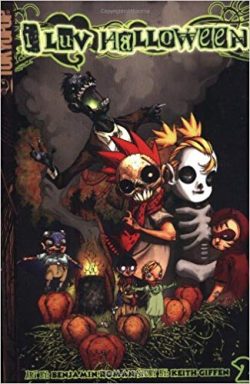
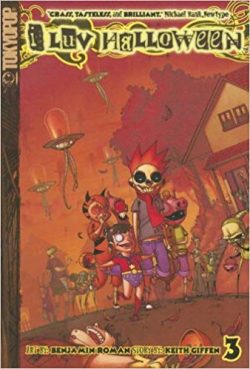
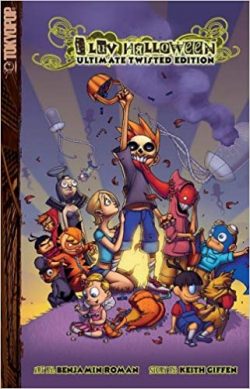
I Luv Halloween Ultimate Twisted Edition (Cabbage Poot)


By Keith Giffen & Benjamin Roman & various (TokyoPop)
ISBN: 978-1-42781-072-4 (HB U Twisted) 978-1-59532-831-1 (PB vol. 1) 978-1-59532-832-8 (PB vol. 2) 978-1-59532-833-5 (PB vol. 3)

Are you sick, depraved, demented or just plain ‘not right’? If so (it’s not necessary – but it won’t hurt either) you might want to pick up this darkly wicked little tome to reaffirm your skewed view of reality.

First unleashed in 2005, it spawned two further paperback volumes, a snazzy hardback Ultimate Edition in full-colour and, latterly, eBook editions (all converted from moody monochrome to gaudy sunset shades and blood-spatter hues thanks to the tender ministrations of Michael Kelleher and Glasshouse Graphics)…

This holiday now is primarily one where kids of varying ages go mooching about, begging for sweets, exercising their inalienable rights to practise extortion and generally threating mayhem. Once upon a time, it used to be about predatory monsters roaming the land, terrorising the citizenry and making mischief. Here, those worlds collide and collude…

In I Luv Halloween volume 1 we learn that every Halloween, Finch, Moochie, Pig Pig, Mr. Kitty, Spike, Bubbles & Squeak, Li’l Bith and the rest of the kids join Devil Lad for their annual sugar-coated loot-fest.

Typically, this year it’s all botched up from the get-go ’cause the very first old lady they accost just gives them fruit, and everyone knows if you don’t get candy right from the start it’s nothing but rubbish all evening. Drastic steps have to be taken, or else this Halloween is ruined…

You don’t know drastic until you see what this band of masked reprobates get up to. These are not your average trick-or-treaters…

Along the way you’ll also meet that friendly old policeman, the vicious, bullying older kids and the really stacked chick who lives next door (they call her “Nips” for suitably scandalous reasons) as well as her doofus boyfriend. See their ultimate fates and give thanks it’s just a comic!

And as the night unfolds – with each kid given his/her/its own chapter to play in – we’ll see that theirs is a very bleak and nasty kind of fun with a vicious undercurrent to the shenanigans. You might even call it tragic if it wasn’t so inappropriately funny…


Volume 2 somehow sees another All Hallows Eve in the township of Turgid Meadows, where Finch’s little sister Moochie is inexplicably addressing the issues of Christianity and bodily functions in a distressingly scatological-slash-surgical manner, thanks to set of extremely sharp knives that have become her constant companions.

There are some new kids – such as Hully Gully, Vera, Vinnie and unfortunate Vivian – prowling the streets, even though there had been some doubt about the event actually taking place, what with the plague of flesh-eating zombies attacking the town…

Still, tradition is sacrosanct, so the kids make do as best they can, even though candy seems in short supply and the adults who are still breathing act real weird. Some even try to keep the kids inside, so they can repopulate after the apocalypse, but Finch has a pretty good idea how to deal with them…It has to be quick, though because the Walking Dead are everywhere and have their own ideas about “Hhhik Uh Heeeett”-ing…

Happily, Finch, Devil Lad and the remaining uneaten have an explosive solution to securing the town and remains of the sweet, sweet loot…


Volume 3 opens on yet another October festival and again circumstances are conspiring to spoil the fun for Finch, Devil Lad, Mr. Kitty (don’t call him Spencer!) and the rest. This time the town is being attacked by marauding aliens. Sure, some adults are apparently delighted with all the probing that’s going on, but most are just running and screaming or being turned into mobile roman candles by all the indiscriminate heat ray blasts.

Moochie has moved on a bit: now her incessant inquisitiveness is fixated on the miracles of birth and why she hasn’t had a sister yet. At least there’s plenty of fleshy material she can examine with her enhanced surgical techniques, especially after she commandeers kindly Dr. Kramer‘s office and surgery…

Pig Pig is, as usual, not quite in tune; asking why the aliens haven’t been deported back to Mexico, whilst new recruits Kevin Kyle Kramer – a black kid who hates being called Triple K – and pious dog-killer Monica do their best to keep up. They almost lose Mr. Kitty entirely when the invaders drag a naked Nips off to their mothership and strange, uncontrollable feelings compel him to follow…

Most importantly, a rival band of kids are also on the streets. Brutish lunch money extorters Bubbles and Squeak are on the prowl, even though the big boss can’t get his mind off Monica and back on candy-scoring…

All the kids know for sure is that no-one’s got any treats to hand over, so they’re supposed to come up with lots of retaliatory tricks, but now something’s just not feeling right anymore…

Worst of all, the incredible secret beneath Kramer’s office threatens to end their annual sweet deal forever…

This book also contains bonus story and cartoon coda to the previous night ‘Friends till the End’: a solo outing for inspired originator and illustrator, 3D concept artist and genuine sick puppy Benjamin Roman (Cryptics, Auntie Agatha’s Home for Wayward Rabbits); a delight for the dark hearted and strong-stomached, supplemented by pin-ups, a Roll Call of characters; instructions for making a Pig Pig Mask (Pig Pig Papier-Mache Madness!); and fan art by Dan Hurd, Liz Siegel, Jeremy Goad, Kevin Harden, Mauricio Arcila, Neil Phyfer, Tara Billinger and “Rez”

Comics veteran Keith Giffen flexes his comedy – and bad taste – muscles in this addictive confection that would win nodding approval from Charles Addams and the producers of any self-respecting splatter movie. Jovial malice is uniquely captured by Roman’s astonishingly enchanting art: his inexplicably charming grotesques are the stuff of any animation studio’s dreams. If you don’t believe me just check out the stupefying Sketchbook sections and frankly alarming Creator Bio feature…

All the above irresistible atrocity has been latterly packed into a deliriously compelling hardback entitled I Luv Halloween Ultimate Twisted Edition (Cabbage Poot), and there’s a new super-complete warts ‘n’ all edition slated for release in January 2020 (slick timing, no?), but if you have no patience or impulse control issues, there’s never been a better time to revisit perhaps the most definitive statement on the hallowed festival known nowhere at all as “Knock! Knock!BOO!! Night” as so callously perpetrated by two grown men who really should have known better…

If you have no fear of the dark, love a gross joke, have a soft side that can be hit by a brilliantly sad twist or two and especially if you don’t care what your immediate family or the clergy think of you, then you really want to read this stuff. Over and over and over and over again. Amen…
© 2005 Keith Giffen & Benjamin Roman. All Rights Reserved.
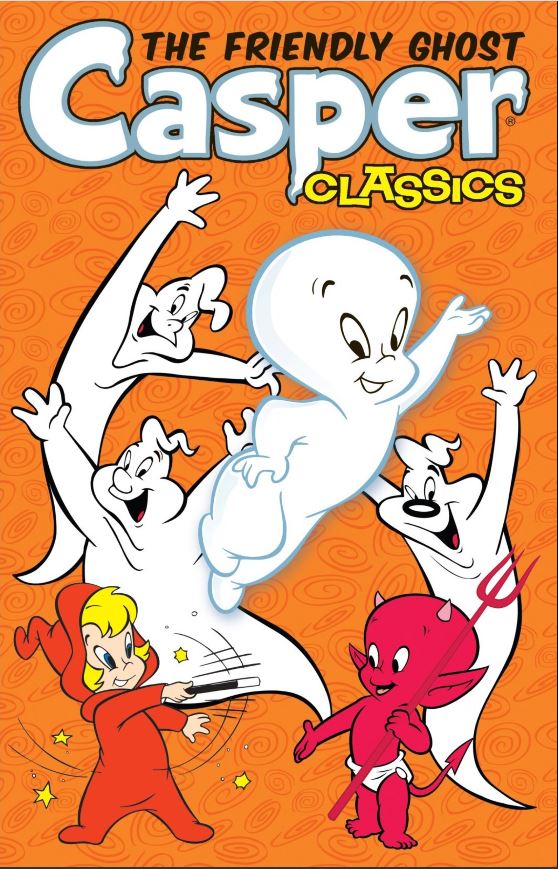
Casper the Friendly Ghost Classics


By Sid Jacobson, Warren Kremer, Howie Post, Ernie Colón & various (American Mythology)
ISBN: 978-1-94520-509-5 (TMB)

Once upon a time the American comicbook for younger readers was totally dominated by Dell/Gold Key – with numerous Movie, TV and Disney licenses – and Harvey Comics. The latter had begun in the 1941 when Brookwood Publications sold its comicbook licenses for Green Hornet and Joe Palooka to entrepreneur Alfred Harvey. Hiring his brothers Robert B. and Leon, the new publisher began making impressive inroads into a burgeoning new industry.

For its first nine years the company combined conventional genres with some licensed properties in a bid for the general market, but from 1950 onwards devoted an ever-greater proportion of its resources to a portfolio of wholesome, kid-friendly characters for early readers and all-ages fans of gentle comedy.

Back in the late 1940s, the perspicacious Harvey Brothers had struck a deal with Famous Studios/Paramount Pictures to produce strips starring movie animation stars Little Audrey, Baby Huey, Herman and Katnip and Casper, the Friendly Ghost to supplement their newspaper comics stars such as Blondie and Dagwood, Mutt and Jeff and Sad Sack. Eventually the publishers minted original wholly-owned stars like Little Dot, Little Lotta and Richie Rich to cement their position as the kids’ comicbook company.

Even though Harvey consistently and persistently tried to maintain their strands in mainstream genres such as horror, science fiction, western, war and superheroes (producing some of the very best “forgotten classics” of the era such as Stuntman, Black Cat and Captain 3-D), it was always the junior titles that made the most money.

In 1959 the Harvey’s bought the controlling rights to their own Famous Studios characters just in time for the 1960s boom in children’s television cartoons. The result was a stunning selection of superb young reader comics starring Casper, Spooky the Tuff Little Ghost, Nightmare, The Ghostly Trio, Stumbo, Wendy, the Good Little Witch and Hot Stuff, the Little Devil: all bolstered and popularised by “free-to-air” weekly Harveytoons TV shows.

It was a new Golden Age for child-appropriate funny books that lasted until declining morals, the inexorable rise of “cost-free” television, growing games saturation and rising print costs finally forced Harvey to bow out in 1982 when company founder Alfred Harvey retired.

That gloriously evergreen archive of material has regularly resurfaced in assorted print revivals since then. This latest attempt to recapture the glory days comes from licensing specialists American Mythology, who also count Underdog, Pink Panther, Three Stooges and many other properties in their ever-expanding catalogue of comics gems.

Available in trade paperback and digitally, Casper the Friendly Ghost Classics gathers a timelessly wonderful wealth of reprint material to delight youngsters but, quite frankly, the reproduction is rushed and a bit shoddy, and there’s precious little creator information to satisfy older readers who might want to share these fragments of their own childhoods with children or grandkids.

Don’t get me wrong, this a wonderful and long-overdue collection of magical stories, but it – and the people who crafted those original gems – deserve to be treated with a little respect and a little due diligence in future volumes would definitely pay dividends. I’ve included my guesses where I’m able, but writers are harder to identify, so the likes of Ralph Newman, Lennie Herman and Sid Couchey only get a mention here, not on the tales they may or may not have penned…

This economical, no-nonsense affair could stand a few editorial extras and a little more care and attention to reproduction values and creator credits, but is nonetheless a delightful package of charming yarns and gloriously timeless 1-page gags displaying the sheer ingenuity and wit of its originators.

One such solo jape opens proceedings with our happy dead boy and his witch friend Wendy foiling the scary intentions of their relentlessly fear-inducing relatives, before the sweet little spirit decides to visit less noisome kinfolk in ‘Booed Relations’, ‘Educated Ghosts’ and ‘The Mysterious Helper’ (illustrated by the legendary Warren Kremer and originally from giant-sized Casper’s Ghostland #15, October 1962).

Of course, the extended expired family are all equally dedicated to scaring the living out of their wits…

Following a 1-page telephonic boo-duel starring Tuff Little Ghost Spooky, Hot Stuff the Little Devil visits and evicts ‘The Monsters of Creepwood Castle’, scoring ‘A Clean Sweep’ of horrors (from Hot Stuff the Little Devil #72 June 1966, with art, I suspect, by the astounding Ernie Colon).

The Ghostly Trio get a page to harass assorted woodland wildlife before Casper returns in fourth-wall bending yarn ‘Real Gone’ (Casper’s Ghostland #31 August 1966, by Stan Kay & Kremer I think). After an invisible menace bullies assorted forest folk Casper investigates and leaves his own reality to sort out unpleasant, out-of-control artist Pete Pencil who’s messing about in ‘Uncomic Book’. Before long ‘The Honeymoon is Over’ and the friendly ghost is heading back where he belongs…

The Good Little Witch gets some limelight of her own in ‘Flattery Works’, teaching her mean aunts the benefits of niceness before Spooky’s next vignette sees him using a garden hose to maximise his scare tactics, after which talking horse Nightmare (the Galloping Ghost) visits a human theatre and wants to become ‘The Actress’ (Casper and Nightmare #20 June 1969, with art by Marty Taras?)

From that same issue, Casper then visits ‘Puzzleland’, enduring a ‘Dog-Gone Dilemma’ and offering illustrator Kremer plenty of opportunity to display his graphic virtuosity whilst the see-through star is engaged in ‘Baffling the Baffler’…

Courtesy of Colon, Hot Stuff visits ‘Dreamland’ to cure his recurrent nightmares before Wendy has a brief but good-natured duel with an artist and Casper drops in on a ‘School for Fools’ (The Friendly Ghost Casper #112, December 1967): learning lots that the students somehow cannot…

The Ghostly Trio lose a battle with a mean dark cloud before Spooky solos again in ‘Nobody Hoid a Woid’ – an exercise in restraint utterly wasted – before Casper strives against a bizarre vandal in ‘The Scribbling Menace’, ‘Erasers for Sale’ and ‘Trouble Erased’ (Casper’s Ghostland #80, September 1974).

Hot Stuff’s Grampa Blaze exhibits his hot temper and foul language in a sharp short strip before Spooky gets a present from Australia and suffers the woes of ‘The Wacky Come Back Stick’, after which Casper & Wendy remark ‘Wow! What a Whammy’ (The Friendly Ghost Casper #112, December 1967) when the witch girl’s awful aunts begin playing mystic pranks…

As Hot Stuff tries turning his trident into ‘The Magnetic Fork’ (Hot Stuff Sizzlers #10, November 1962) – with predictably painful results – Spooky is dreaming of a perfect Scare Raid and Wendy helps an unhappy hobo follow his dreams, before joining Casper in search of ‘The Prize!’ (Casper’s Ghostland #31 August 1966) hidden on a demon’s ship.

With the help of a living boy, this ‘Adventure on Ghastly Island’ leads to a suitably strange ‘Journey’s End’…

Hot Stuff’s final appearance finds him aiding an archaeologist against tomb-robbers in ‘A Fortune in Fire’ before the spiritual shenanigans close with one last treat as Casper supernaturally scuppers a western bank raid…

For a worrisome while it looked like contemporary children’s comics would become extinct, but far-seeing outfits in the US and UK have thankfully engineered a robust revival in the marketplace that has seen ubiquitous ever-proliferating licensed product joined by brilliant original kids’ titles – just check out The Phoenix, Goldie Vance, Gotham Academy, Lumberjanes and many others, to see what I mean…

Nevertheless, it’s a boon that we have such timeless characters as Casper and Richie Rich to draw upon and draw kids in with, so compilations like this one belong on the shelves of every loving parent and even those still-contented, well-rested couples with only a confirmed twinkle in their eyes. This clutch of classic children’s tales is a fabulous mix of intoxicating nostalgia and exuberant entertainment readers of all ages cannot fail to love (but there’s still room for improvement, pretty please)…
© 2018 Classic Media LLC. Casper, its logos, names and related indicia are trademarks of and copyright by Classic Media LLC. All rights reserved.

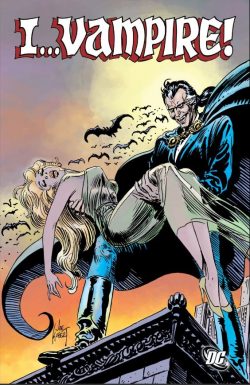
I… Vampire


By J.M. DeMatteis, Bruce Jones, Dan Mishkin, Gary Cohn, Mike W. Barr, Tom Sutton, Ernie Colon, Adrian Gonzales, Paris Cullins, Dan Day, Jim Aparo & various (DC Comics)
ISBN: 978-1-4012-3371-6 (TPB)

When superheroes entered their second decline at the end of the 1960s, four of the six surviving newsstand comicbook companies (Archie, Charlton, DC, Gold Key, Harvey and Marvel) increasingly turned to horror and suspense anthologies to bolster their flagging sales. Even wholesome Archie briefly produced Red Circle Sorcery/Chillers comics, diverting a portion of their teen-comedy core gently into tales of witchcraft, mystery and imagination.

DC’s first generation of mystery titles blossomed at the end of the first Heroic Age when most comicbook publishers of the era began releasing Crime, Romance, Western and Horror genre anthologies to recapture an aging readership which was drifting away to other mass-market entertainments like television and movies.

After a few tenuous attempts with supernatural-themed heroic leads in established titles (Johnny Peril in Comic Cavalcade, All-Star Comics and Sensation Comics; Dr. Terry Thirteen, The Ghostbreaker in Star-Spangled Comics) in 1951 National Comics bowed to the inevitable and launched a comparatively straight-laced anthology sans recurring stars – which nevertheless became one of their longest-running and most influential titles – with the December 1951/January 1952 launch of The House of Mystery.

When a hysterical censorship scandal led to witch-hunting hearings attacking comicbooks and newspaper strips (feel free to type Senate Subcommittee on Juvenile Delinquency, April-June 1954 into your search engine at any time) the industry panicked and hurriedly adopted a castrating straitjacket of stringent self-regulatory rules and admonitions.

Even though mystery/suspense titles produced under the aegis of the Comics Code Authority were sanitised, anodyne affairs in terms of Shock and Gore, the appetite for mystery and suspense was still high, and in 1956 National introduced sister titles Tales of the Unexpected and House of Secrets.

Supernatural thrillers and spooky monster stories were dialled back into marvellously illustrated, genteel, rationalistic fantasy-adventure vehicles which nonetheless dominated the market until the end of the 1950s when the super-hero returned in force – having begun a renaissance after Julius Schwartz reintroduced the Flash in Showcase #4, 1956.

Revivals of Green Lantern, Hawkman, The Atom and a host of new costumed cavorters generated a gaudy global bubble of masked myrmidons which even forced these dedicated anthology suspense titles to transform into super-character split-books with J’onn J’onzz, Manhunter from Mars and Dial H for Hero in House of Mystery and paranormal investigator Mark Merlin (latterly Prince Ra-Man) sharing space with anti-hero Eclipso in House of Secrets.

When the caped crusader craziness peaked and popped, Secrets was one of the first casualties, folding with the September-October 1966 issue. House of Mystery carried on with its eccentric costumed cohort until #173, and Tales of the Unexpected carried on until #104.

However, nothing combats censorship better than falling profits, and at the end of the 1960s the superhero boom busted again. With many once-popular titles gone and some of the industry’s most prestigious series circling the drain too, this real-world Crisis led to the surviving publishers of the field agreeing to loosen their self-imposed restraints against crime and horror comics. Nobody much cared about gangster titles at the time, but as this liberalisation coincided with another bump in global public interest in all aspects of the Great Unknown, the resurrection of scary story comics was a foregone conclusion and obvious “no-brainer.”

Thus, with absolutely no fanfare at all House of Mystery and Unexpected switched back to tales of magic, mystery and imagination stories and House of Secrets rose again with issue #81, (cover-dated August-September 1969): retasked and retooled to cater to a seemingly insatiable appetite for terror and suspense yarns…

Before long, an expansive battalion of supernatural thriller titles dominated DC – and other companies’ – publishing schedules again. This time, however, although the initial impetus died out by 1978, horror comic books had secured a dedicated audience, and soldiered on despite a decline in sales into the turbulent 1980s.

During that period, the venerable periodical experimented with varying formats and became a springboard for many creative careers, but never returned to established, recurring heroes until the reign of publishing whiz kid Karen Berger who officially assumed control with #292. A few issues earlier, a new longform miniseries had debuted, detailing the exploits of a reluctant monster seeking to atone for past sins…

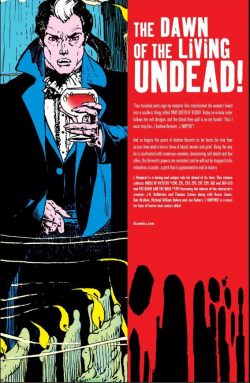
The full groundbreaking tragic, idiosyncratic saga has been gathered into a sinister trade paperback – or digitally formatted – chronicle collecting the adventures of the bloodsucker and his human allies as first seen in House of Mystery #290-291, 293, 295, 297, 299, 302, 304-319 as well as a fast-paced guest-shot in The Brave and the Bold #195, cumulatively spanning March 1980 to August 1983 and opens without fanfare or preamble with ‘I… Vampire’ by co-creators J.M. DeMatteis & Tom Sutton.

In ten tightly-packed but smoothly inviting pages we are introduced to English noble Sir Andrew Bennett, who died at the hands of a nosferatu during the reign of Queen Elizabeth I. Beloved by his fiancée, Mary Seward, Bennett succumbs to her desperate pleas to be similarly infected, her so their love could last forever. Only afterwards does he realise that the transformation creates soulless monsters, but, somehow, he has retained his conscience and personality…

Over four centuries, “Bloody Mary” becomes a leader of vampires in an insidious, influential covert global cult dubbed the Blood Red Moon, spreading chaos and destruction whilst working towards their ultimate goal of vampires ruling a world of human cattle. Heartbroken and guilt ridden, Bennett opposes her schemes for all that time, aided by human allies such as his most recent daywalkers: aged Russian warrior Dimitri Mishkin and go-getting “Eighties Woman” Deborah Dancer…

Empowered by all the traditional gifts of the undead (shapeshifting, supernatural vigour, hypnosis, etc) and similarly afflicted by their weaknesses (sunlight, crucifixes, Holy Water, stakes et al) Bennett staves off his insatiable hunger for blood by sheer willpower and the determination that he will not die until he has ended Mary’s depredations…

The introductory episode covers all that even as Mary’s minions lose another running battle with Bennett’s team but escape to instigate their latest plan…

The adventure concludes in ‘Night of the Living Undead’ as team Bennett expose and end a proposed alliance between the cult and New York’s biggest drug dealer after which ‘The Burning’ sees the hunters scotch a scheme to infiltrate the White House after Mary affiliates with a race-hate spouting demagogue with links to the KKK and the President…

The closure of that case tears open old wounds, as Mishkin subsequently clashes with one of Mary’s lieutenants only to discover a dreaded family connection in ‘Mother Love/Mother Hate’, leading to a look into how Bennett recruited him as a boy at the turn of the 20th century…

DeMatteis’ moves on after the dark heroes foil Mary’s attempt to destroy an ashram and its spiritual guru in ‘Zen Flesh! Zen Bones!’ after which Bruce Jones moves in, offering a more fanciful approach in ‘The Sun Also Burns’. Here Bennett and his human friends are ambushed and left to die in a mine. As time passes, the valiant vampire – deprived of bottled blood – must battle his irresistible thirst, before abandoning them. Resolved never to endanger them again, he sets out on a solo quest for vengeance…

‘Blood Ties’ in HoM #302 sees that lonely walkabout take him to Eudora, Kansas where strange events culminate in Bennett causing the accidental death of an entire family of innocents before stumbling across a predatory circus abducting innocents for profit, and sponsored by Bloody Mary. His war against the ‘Carnival of Souls’ lasts until #304 where – with Ernie Colon substituting for Sutton – Bennett learns that ‘The Night Has Eyes’ and proves that he has no pity for child stealers…

Jones kicks off a lengthy saga in ‘Blood and Sand’ as the still-solo Bennett tracks Mary’s agents to Egypt in the wake of a global anti-cancer vaccine rollout that has the unexpected side-effect of making human blood toxic to the undead…

Meanwhile, and for all this time, Mishkin and Dancer have been hunting for their leader, and are closing in…

Made unwilling allies by fate, Andrew and Mary invade a lost tomb, where the cult queen steals the time-travelling Rings of Anubis from a mystic mummy and sets off to the past to undo the creation of the vaccine. In hot pursuit, thanks to a second ring, Bennett arrives in Whitechapel, London at the height of history’s most infamous serial killer spree.

Crafted by Jones and the returned Sutton, ‘A Rip in Time’ sees all Mary’s efforts thwarted, and the ancestor of mysterious vaccine creator Dr. Barr escape unharmed, even as the vampires are hurled back into the time stream…

Bennett washes ashore in Maine in November 1964, just in time to save a little girl from drowning. ‘Lovers Living, Lovers Dead’ reveals that in the present Deborah Dancer has developed a psychic link and can “see” the vampire past actions as they happen. She is suitably horrified to observe Mary then attack the child and aghast to realise that the child is herself…

After a heroic intervention from Bennett saves the girl, the time chase pauses as the undead knight battles a crew of revenant Nazi submariners in ‘Mirrors That Look Back’ before his pursuit resumes, depositing him and his quarry in Elizabethan England mere days before their first deaths…

A bewildering succession of time-tossed doubles and mistaken identity switches culminates in a deadly ‘Witch Hunt’ with religiously enflamed peasants running riot before all the chronal paradoxes dump them both back in the 20th century where new writers Dan Mishkin (no relation) & Gary Cohn concoct a ‘Manhattan Interlude’ (HoM #310, November 1982) foe penciller Adrian Gonzales and ever-faithful Tom Sutton to render. Here Bennett encounters another vampire who has retained both soul and innocence and regretfully helps her meet her final end on her own terms…

Paris Cullins joins Mishkin & Cohn, Gonzales & Sutton for a dark peek at Deborah Dancer’s teen years in ‘By the Time We Got to Woodstock…’, revealing how she “first” stumbled into the Blood Red Moon’s schemes of conquest after losing all her friends to hippy vampires at the legendary festival and only survived thanks to an old Russian and eerie, red-eyed Englishman…

Issue #312 reunites the trio in time to tackle ‘The Thing in the Tunnel’ (Mishkin, Cohn, Gonzales & Sutton): a predatory beast escaped from the familiar-sounding Barr Research Laboratories leading to a deadly clash with the enigmatic and extraordinarily long-lived (hint, hint) biologist in ‘Side Effects’, before ‘I.. Edward Trane, I… Vampire’ in #314 (illustrated solely by Sutton) sees a tragic reunion for Bennett with one of his Victorian acolytes who fell in battle but never fully died…

Mishkin, Cohn, Cullins & Sutton then detail an untitled exploit wherein the vampire hunters are targeted by sanctimonious religious zealots hunting he unholy. Sadly, their leader’s top aide is not only undead herself, but also Dimitri’s mother and the Presidency is once more the glittering prize being sought…

Although the plot is foiled, the cost is high, compelling Bennett to turn eastwards, and ‘Back in the U.S.S.R.’ he uncovers a KGB program to weaponize vampirism and extend the joys of eternity to the aging Politburo. The result is open warfare between Mary’s cult and a Soviet secret army, ultimately proving in ‘Blood is Thicker…’ that that not all military spending is pointless and not every hero gets to ride off into the sunset…

Despite a long run, changing times and tastes were indicating that the title and, indeed, entire genre were not a viable contemporary option. With the series building to climax, #318 offered another untitled yarn (with Dan Day pencilling) wherein a freshly bereaved Andrew Bennett employs stolen Soviet technology to force a final confrontation with Mary and the Blood Red Moon resulting in his final demise and the birth of a new kind of hero in climactic last episode ‘Dreams of Death’ by Mishkin & Cohn, & Sutton in House of Mystery #319 (August 1983).

Rather annoyingly, the big finish isn’t the end here, as there follows a solid but painfully out-of-continuity tale taken from The Brave and the Bold #195 (February 1983). In ‘Night of Blood’ – by Mike W. Barr & Jim Aparo – Bennett’s perpetual hunt for Mary brings him to Gotham City after a gangster’s daughter becomes the latest victim of a killer vampire. Batman is firmly convinced the attacks are fake – and he’s right – until an actual magic-accursed blood drinker shows up. At least this time the standard misunderstanding doesn’t result in pointless battle before reason prevails and the mismatched heroes unite to catch the real culprits…

A genuine slice of engaging, unorthodox and vastly entertaining horror action that predates – and probably influenced – later hits like Buffy the Vampire Slayer and Angel, this is a hugely enjoyable edgy romp: well-scripted, imaginative and gorgeously illustrated. Even the covers are special; crafted by industry icons Joe Kubert and Michael Wm. Kaluta.

I… Vampire is a tome for all lovers of dark delight and one no arcane aficionada can afford to be without.
© 1981, 1982, 1983, 2012 DC Comics. All Rights Reserved.

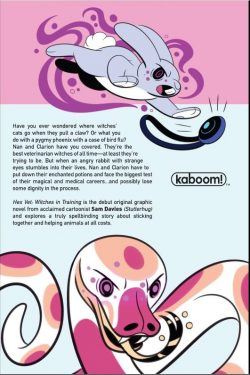
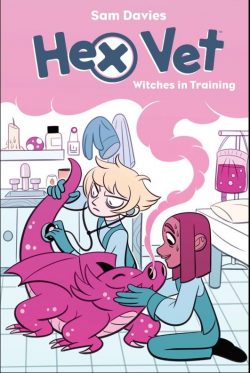
Hex Vet: Witches in Training


By Sam Davies (KaBOOM!)
ISBN: 978-1-68415-288-8 (PB) eISBN: 978-1-64144-127-8

Win’s Christmas Gift Recommendation: Animal Magic… 9/10

When your animal companions fall ill, you know they need the help only a qualified veterinarian can offer, right?

However, if said furry, feathered, finny or scaly housemate can turn people to stone, teleport or summon devils and imps, a far more specialised service is required. And staff at such vital animal alms houses need a lot of on-the-job training…

At Willows Whisper Veterinary Practice, Dr. Cornelia Talon (Head Veterinary Witch; high Society of Sorcerers. Hons.) and Nurse Ariel Chantsworth (Registered Veterinary Witch; Head of Administration) employ two promising prospects. Trainees Clarion Wellspring and Annette Artifice have all the dedication they need: now they’re just topping up on knowledge, and experience. And co-operation. They really need to learn to work together…

Clarion is fine cleaning out the kennels, dosing beasts with anti-monstrosity tablets or giving hairy horrors a quick tummy rub, but Nan – who comes from a rather infamous family – is quiet and reserved; avoiding contact and preferring to try to learn some new technique or other from a book.

One morning, with Dr. Talon handling an early surgery, Nurse Ariel gives them their assignments – Wellspring to extract and cage a feral bugbear that’s messing up the storeroom and surly Artifice to handle Reception duties – before he and Dr. Talon are called away to an emergency. It’s bad enough being left in charge on their own, but Clarion still hasn’t subdued that bugbear and Nan has unwisely admitted a strange rabbit creature (without an owner or talking companion) which is somehow setting off all her warning instincts…

When it breaks free and stirs up all the other patients (griffins, pythons, witches’ cats and beasties even more exotic!) the stressed students have a real crisis on their hands and must work out how to fix things before their teachers get back or any of their charges are harmed…

A celebrated web cartoonist, Sam Davies (Stutterhug) reaches new heights with her fabulous and charmingly inclusive debut graphic novel which will delight youngsters and all us elderly-but-unbroken fantasy lovers out here. A second volume will be with us early next year, so buy and love this before pre-ordering that…

Also included here is bonus feature ‘How to Make a Comic page (from Scribbles to Finished Artwork)’ giving a step-by-step rundown using book pages as examples of the process from Scribbling while Scripting to Sketch to Inks; Flat Colors to Touch Ups & Smaller Color Details to The Final Page with Letters!, so you and yours can have a go, too.

So much to enjoy!
© December 2018. Hex Vet, Inc. ™ & © 2018 Sam Davies. All rights reserved.

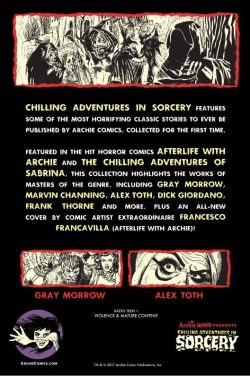
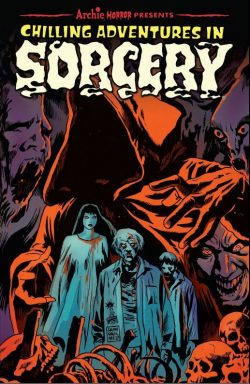
Archie Horror Presents Chilling Adventures in Sorcery


By Harry Doyle, Gray Morrow, Marvin Channing, Don Glut, Steve Skeates, Mary Skrenes, Carol Seuling, Phil Seuling, Larry Hama, Bob Holland, Stan Goldberg, Vicente Alcazar, Dick Giordano, Carlos Pino, Dan DeCarlo, Howard Chaykin, Alex Toth, Bruce Jones, Ed Davis, Frank Thorne & various (Archie Comics)
ISBN: 978-1-62738-990-7 (TPB)

Win’s Christmas Gift Recommendation: Shockingly Wicked Chronicle of Chills… 9/10

For nearly 8 decades Archie Comics have epitomised good, safe, wholesome, fun but the company has always been a surprisingly subversive one. Family friendly – and not – iterations of superheroes, spooky chills, sci fi thrills and genre yarns have always been as much a part of the publisher’s varied portfolio as the romantic comedy capers of America’s cleanest-cut teens.

As you probably know by now, the eponymous Archie has been around since 1941, but the publisher has other wholesome stars – such as Sabrina the Teenage Witch or Josie and the Pussycats – in their stable, almost as well known… and just as prone to radical reinterpretation.

To keep all that accumulated attention riveted, the company has always looked to modern trends with which to expand upon their archetypal storytelling brief. The contemporary revival in horror across all media has thus resulted in a few supernatural sidebar titles such as Afterlife with Archie and Jughead: The Hunger.

Moreover, in times past the publisher have cross-fertilised their pantheon through such unlikely team-ups as Archie Meets the Punisher, Archie Vs Sharknado and Archie Vs Predator, whilst every type of fashion fad and youth culture sensation has invariably been accommodated into and explored within the pages of the regular titles.

Following-up the stunning success of aforementioned zombie apocalypse Afterlife with Archie, they took another boldly controversial step: radically reinventing their saccharine-TV teen witch in astoundingly sophisticated Chilling Adventures of Sabrina after playwright, screenwriter and comics scribe Roberto Aguirre-Sacasa (whose many hits include The Mystery Plays, 4: Marvel Knights Fantastic Four, Stephen King’s The Stand and Afterlife with Archie amongst others) pitched the idea to re-imagine the saucy sorceress in terms of Rosemary’s Baby and The Exorcist.

Archie Comics was no stranger to such material. In the 1970s the company created sub-imprint Red Circle for anthology terror tales during a previous supernatural boom time, before gradually converting the line to superhero features as the decade progressed and the fad faded. They even had resident witch-girl Sabrina narrating Chilling Tales of Sorcery for the first two issues…

The title dropped subhead “…As Told by Sabrina” for #3, and with #6 (April 1974) became Red Circle Sorcery until folding in February 1975’s issue #11.

In a great example of circularity, the newly-wicked 21st century Sabrina features snippets from the ’70’s anthology, sparking this edgy compilation of many of those lost classics in a spiffy monochrome collection, available in paperback and digital formats.

Following a fervent Introduction by letterer and fright-fan Jack Morelli, the vintage terrors open with Chilling Tales of Sorcery …as Told by Sabrina #1 (September 1972): a rather standard anthology of short thrillers with twist-endings, little different from those churned out by DC, Gold Key or Charlton at the time and crafted by Archie’s on-staff comedy creators.

‘Behold the Beast’ by Frank Doyle & Stan Goldberg, revealed the fate of a lonely and misunderstood deformed lad, after which ‘The Boy Who Cried Vampire’ (Doyle & Dan DeCarlo) deals out ironic justice to a pesky kid and ‘Assignment in Fear’ (Doyle & DeCarlo) sees a teacher with a secret sort out a class bully in horrific style.

Anonymous prose yarn ‘A Real Hot Talent’ gets under the skin of a juvenile firestarter after which Doyle & DeCarlo return to exhibit ‘Quick Justice’ in an art gallery before Doyle & Goldberg reveal how ‘Curiosity Kills’ in a story of an accursed inheritance.

Issue #2 opens with Doyle & Goldberg’s ‘The Ultimate Cure’ wherein a waiting bride’s tragic misapprehension destroys her man and her sanity, and text tale ‘Look Upon Your Legacy’ warns of the dangers of an over-active imagination. Pictorial perils resume with ‘Sonny’s World’ (Doyle & Dan DeCarlo) with a little brat learning how to make all reality his plaything after which ‘The Measure of a Monster’ Doyle & Goldberg) sees mad science unleash a colossal creature and (almost) find a safe conclusion and the same creators outline the fate of a jewel-obsessed lass succumbs to ‘The Cameo’s Curse’…

A massive shift in style and tone began with issue #3 (October 1973) as writer/artist Gray Morrow came aboard, personally crafting or supervising far more mature fare that seemed closer to Warren’s adult horror magazines than contemporary newsstand fare such as House of Mystery, Ghostly Haunts or Boris Karloff Tales of Mystery.

Dwight Graydon “Gray” Morrow was born in Fort Wayne, Indiana in 1934 and studied at the Chicago Academy of Fine Arts. After serving in the army he moved to New York City in 1955 and began a steady career contributing strips, covers and illustrations to Cracked, Classics Illustrated, Atlas Comics (pre-Marvel), numerous children’s books and pulps such as Galaxy.

A master of graphic realism, his art and stories graced a vast array of comics titles, magazines such as Space: 1999 and alternative vehicles such as Wally Wood’s Witzend. He freelanced for dozens of companies (he co-created DC’s El Diablo and Marvel’s Man-Thing, and revamped Archie’s Black Hood into a gritty urban avenger during his tenure at Red Circle), as well as drawing the newspaper iterations of Tarzan and Buck Rogers. He won numerous awards – including three Hugos – over a long and extremely wide-reaching artistic life. He died in 2001.

His influence on the title was instantaneous. With the imprint renamed Red Circle Comics for the third (almost all-Morrow) issue, the new chief introduced a growing band of fresh writers and master artists, as the title unleashed a wave of terror tales that owed much to movies and TV of the period.

It began with ‘…Cat’ (written, drawn & lettered by Morrow) wherein a ruthless, misogynistic society burglar targets the wrong gem-bedecked senorita and lives to regret it forever.

Following prose thriller ‘A Stab in the Dark’ – exposing a plot to murder by witchcraft – a thematic diversion into EC-tinged science fiction finds a time traveller accidentally become an evolutionary ‘Missing Link!’ whilst a bereaved man investigates the death of a sister and discovers that a new ‘Immortality Factor’ is anything but.

An embezzler then pays the price for his betrayal in ‘Haunted Gallery’ before the issue closes with fact-page ‘Essays into the Supernatural’: a featurette by Phil Seuling & Morrow exploring timeless rituals of magic and the use of ‘Familiars’…

Due to his prestige and sheer artistic quality, Morrow could call upon a lot of high-end associates to fill pages and #4 (December 1973) introduced an internationally famous master of mood as Spaniard Vicente Alcazar (Jonah Hex, Commando Picture Library, Star Trek, Space: 1999) began his association by writing and illustrating ‘Suicide… Maybe’: a saga of Faustian tragedy wherein a lifelong failure makes a fool’s bargain and discovers politics is the Devil’s playground…

Text vignette ‘Loophole’ also explores such contracts before Don Glut & Dick Giordano highlight the ‘Horripilate Host’ whose TV show excesses lead to infernal doom, after which Morrow adds a sinister tweak to the legend of Midas when a greedy creep gains the legendary ‘Golden Touch!’

The power of a Hebrew Golem deals poetic justice to a modern oppressor in ‘A Thousand Pounds of Clay’ by Glut & Alcazar before the issue ends with another fictive factoid as ‘Essays into the Supernatural’ finds Morrow exploring truths and fictions of ‘The Witch’…

Cover-dated February 1974, #5 opens with a vivid pastiche of Arabian adventure courtesy of writers Morrow and Larry Hama. Limned by Alcazar ‘The Two Thieves of Baghdad’ exposes the fatal flaw of overconfidence before the all Alcazar ‘Esme’ details the fate of a hit-&-run victim whose vision is horrifically enhanced by her accident.

Morrow brings his lifelong affinity for baroque, barbaric science fantasy to the creepy epic ‘Barometer Falling…’ after which Alcazar’s ‘The Choker is Wild’ reveals the shocking history of blood-drinking sovereign Queen Maleena and the ‘Essays into the Supernatural’ featurette – by Seuling & Morrow – catalogues the totemic value of ‘Dragons’.

Red Circle Sorcery #6 (April) opens with ‘Warrior’s Dream’ by Steve Skeates, Mary Skrenes & Morrow as a lusty barbarian finally pays the price for all that wenching and, following an ‘Essays into the Supernatural’ page detailing legends of ‘The Werewolf’ (by Marvin Channing & Morrow), sees a conjuring upstart destroyed by a sagacious warlock in ‘Out of Practice’ by Seuling & Ed Davis.

British comics stalwart Carlos Pino was Alcazar’s studio partner for years (often collaborating as “CarVic”) and here he solos in Channing’s tale of vengeance-by-witchcraft ‘Death Goes to a Sales Convention!’, before Carol Seuling & Howard Chaykin go full medieval in epic saga of demonic manipulation and feline vengeance ‘The Patience of a Cat’…

Futuristic sensory-inundation tech is the driving force in T. Casey Brennan’s extended prose mystery ‘Black Fog’ – illustrated by Morrow – after which Channing & Alcazar serve out just deserts to a serial womaniser in ‘Face of Love – Face of Death’ to close the issue.

Red Circle Sorcery #7 commences with ‘A Twist in Time’ by Skeates & Pino as an ancient wizard is drawn into Fate’s plan to punish a modern-day murderer after which Channing & Morrow explore legends of ‘The Dibbuk’ in another gripping ‘Essays into the Supernatural’ featurette before Channing & Alcazar memorably reveal the dangers of owing ‘The Knife of Jack the Ripper’…

Channing scripts a rare but welcome artistic foray for Bruce Jones as ‘The Rivals’ follows two kids from mid-western poverty to dizzying heights and their grim, witchcraft assisted ends after which Brennan & Alcazar showcase the frustrating fate of ‘The Benefactor’ nobody will listen to…

Closing the chronological portion, ‘Essays into the Supernatural’ then offers a featurette by Morrow detailing ‘Possession and Exorcism’ which happily leads not to the end, but rather a selection of Bonus Stories from later issues.

From #9 (October 1974) comes ‘…If I Were King’ by Channing & the magnificent Alex Toth, wherein a meek nobody gets his greatest wish fulfilled – with the usual regrets – before #8 (August 1974) offers a compelling ‘Essays into the Supernatural’ featurette by Channing & Frank Thorne, detailing the tricks of pesky ‘Poltergeists’ and closure via illustrated calligraphic ode ‘The Spectre’ by Bob Holland & Morrow.

The company’s recent resurgence on TV and in the comics has seen a variety of alternate iterations of the timeless pantheons and this no-frills massively monochrome trade paperback (or digital download) is a perfect complement to those aforementioned horror-tinged titles.

Please don’t be put off by the black-&-white reproduction here: these tales are crafted by masters of line art and tonal values and their efforts actually benefit from the subtraction of the cheap colour used in the original releases. These are superb voyages into the bizarre unknown that no lover of dark fiction should miss.
© 2017 Archie Comic Publications, Inc. All rights reserved.

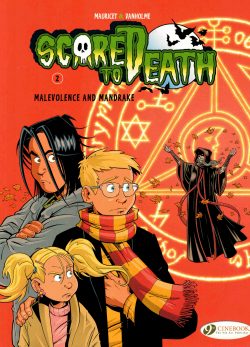
Scared to Death volume 2: Malevolence and Mandrake


By Mauricet & Vanholme, with Lee Oaks: colours by Laurent Carpentier and translated by Luke Spear (Cinebook)
ISBN: 978- 1-905460-77-9 (PB Album)

There’s a grand old tradition of scaring, empowering and entertaining kids through carefully crafted horror stories starring junior protagonists, and this occasional series is one of the better modern examples.

Conceived and executed by journalist Virginie Vanholme and youthful yet seasoned illustrator Alain Mauricet, the Mort de Trouille albums launched through Casterman in the year 2000. There have been seven sinister sorties thus far…

Whilst I’ve not been able to find out much about the author, the artist is rather well travelled, having worked for CrossGen, Image and DC in America as well as on a wide variety of features in Europe.

He’s also seen in David Lloyd’s magnificently wonderful digital delight Aces Weekly…

Born in 1967, Mauricet originally inherited the comic bug from his parents and, after studying at the Academy of Fine Arts under legendary creator Eddy Paape, began his own career aged 20 at Le Journal de Spirou.

From spot cartoons he graduated to strips, creating superhero parody Cosmic Patrouille with Jean-Louis Janssens and Les Rastafioles with Sergio Salma. Following the aforementioned stateside sojourn, he resumed his Franco-Belgian efforts with the strip under review here, as well as basketball comedy Basket Dunk (with Christophe Cazanove) and Boulard (with Erroc) and others.

He now lives in Brussels, and also designs for computer games whilst working on a more personal graphic enterprise entitled Une Bien Belle Nuance de Rouge…

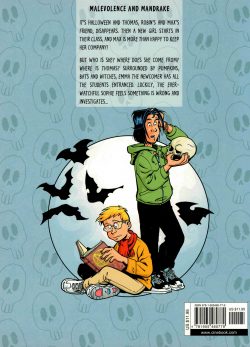
Back in early 2000, though, he was detailing a sequence of spooky yarns starring studious Robin Lavigne, son of an esteemed forensic scientist and boisterous, overly-imaginative, horror-story obsessed Max Mornet: a couple of lads with an infallible instinct for ferreting out the weird and uncanny and increasing dependent – though they’d never admit it – upon the wit and bravery of Robin’s brilliant little sister Sophie…

Cinebook’s second translated selection was third French chilling chronicle Mort de Trouille: Maléfice et mandragora: suitably set around All Hallows Eve and posing uniquely terrifying problems for the youthful, trouble-magnets…

It all begins a little before the much-anticipated night with the Elizabeth Simon Secondary School abuzz with worries over missing student Thomas and seemingly simultaneous arrival of oddly-attractive, exotic new student Emma Corpescu. She comes from Romania and Max is strangely antipathic to her at first, but that soon changes…

Robin also feels a bit off as the newcomer blatantly insinuates herself into their lives, paying particular attention to Max. Soon, so-savvy Sophie is paying close attention. Far more so than the idiot boys…

She’s very wise to do so: Emma soon revealed as an ancient shapeshifting sorceress named Malevolence, who steals the youth of boys to restore her own life force and to one day resurrect her dead sister Mandrake…

After doing research online, Sophie arms herself with anti-witch tricks and gadgets and, after discovering the incredible fate of Thomas, ultimately convinces her incredulous brother to stalk the wicked enchanter to her lair in Deadwater Swamp to rescue the now missing Max. The poor lad has succumbed to Emma’s wiles and now resides in her lair transformed into the same uncanny form as Thomas…

Arriving just in time, his rescuers are set for an incredible clash of wills and powers – especially Sophie, who’s borrowed a few supernatural forces for the ordeal…

Of course, good triumphs in the end, but can such seductive evil truly die?

Deliciously delivered in the manner of Goosebumps and Scooby-Doo, this is a superb slice of all-ages spooky fun in the classic mould, seamlessly mixing fear with hilarity to enthral and enchant all generations equally.
Original edition © Casterman, 2003 by Mauricet & Vanholme. English translation © 2008 by Cinebook Ltd.

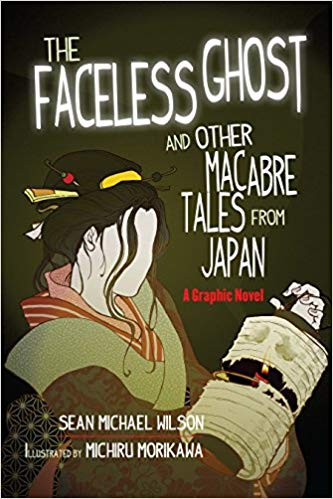
Lafcadio Hearn’s The Faceless Ghost and Other Macabre Tales from Japan: A Graphic Novel


By Seán Michael Wilson & Michiru Morikawa (Shambhala Publications)
ISBN: 978-1-61180-197-2 (TPB)

If you read prose and love old stories you should really track down the works of Patrick Lafcadio Hearn, an Irish-Greek raconteur laterally renamed Koizumi Yakumo. They are wonderful and truly compelling. He was a pretty impressive character too, so you’d be best served to learn of his remarkable life too…

I’m not certain how the socially pioneering teacher, journalist, historian, translator and archivist would react to seeing some of his most engaging works translated into graphic narratives but as a renowned breaker of borders and flouter of taboos, I suspect he’d approve, even if this gleefully wry collation hadn’t been produced by such stellar luminaries as Scottish author Seán Michael Wilson (Breaking the Ten and Portraits of Violence – An Illustrated History of Radical Thinking) and his frequent collaborator Michiru Morikawa.

Wilson’s life has some parallels with Hearn’s. The Japan-based writer, educator and dedicated Humanist has written political and philosophical tracts such as Goodbye God – An Illustrated Examination of Science Vs. Religion in graphic form and has adapted Western and Eastern literary classics such as Wuthering Heights, A Christmas Carol, Sweeney Todd, and Chinese classics Tao Te Ching and The Garden, as well as original genre pieces such as urban interacial romance The Story of Lee.

Illustrator and manga artist Michiru Morikawa won the 2005 International Manga and Anime Award before going on to illustrate Wilson’s books Buskers, Yakuza Moon, The Demon’s Sermon on the Martial Arts and Musashi, amongst numerous comics series.

Hearn visited Japan as a correspondent in 1890, and fell in love with the land and the culture. He ended his days there in 1904, after marrying, becoming a Japanese citizen, teaching in numerous schools and universities and introducing the western world to the exotic enigmatic East through his writings and translations of its myths and legends.

Absurdly accessible, the tales here are gathered from the nation’s feudal period and open with a samurai yarn dubbed ‘Diplomacy’, wherein a highborn executioner performs his onerous task and plays a subtle and crafty trick upon the imminently departed to ensure that there will be no repercussions from beyond the grave…

That mordantly amusing distraction then gives way to a classic ghost story in ‘The Snow Woman’, wherein a young woodcutter survives an icy encounter with a mystical spirit at the cost of a simple promise. Tragically, in all such stories, a keeping one’s word is always impossible and leads to appalling inescapable circumstances…

Vanity and dissatisfaction fuel the saga ‘Of a Mirror and a Bell’, after the priests of Mugenyama ask the local women to donate their bronze mirrors so they can be cast into a great bell. After complying, one farmer’s wife began to bitterly regret her actions and so intense were her feelings that the mirror could not be melted down.

Wracked with guilt for her shameful intentions and the spoiling of the bell, she took her life, triggering a concatenation of unfortunate events…

After the history-making final clash between Heike (Taira) and Genji (Minamoto) clans, the rulership of Japan was decided for centuries to come. However, the sea battle created thousands of ghosts and ‘Hoichi the Earless’ relates how a blind musician and bard was tricked and beguiled by these restless spirits until a Buddhist priest intervened.

The end result was not an unqualified success…

Straight, inescapable horror drives the brief yet potent tale of a luckless merchant who encounters ‘The Faceless Ghost’, whilst love and friendship inspire the story of a young man in need of bride who prospers after he graciously saves a shark spirit and is uniquely rewarded by ‘The Gratitude of the Samebito’…

As recounted in the ‘Author’s Note’ – detailing the origins and source material of the adaptions – the stories are mostly taken from Hearn’s books Kwaidan: Stories and Studies of Strange Things (1903) and Shadowings (1900), and come packed with sleek, informative and delightfully rambling diversions which add fabulously engaging context to the stories.

Eerie, exotic and wonderfully compelling, these “yokai” stories are gems of unease, disquiet and wonder that no lover of the strange can fail to adore.
© 2015 by Sean Michael Wilson. Illustrations © 2015 by Michiru Morikawa. All rights reserved.

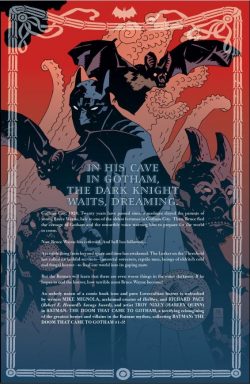
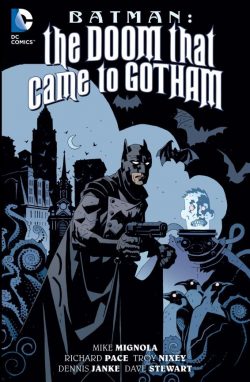
Batman: The Doom That Came to Gotham


By Mike Mignola, Richard Pace, Troy Nixey, Dennis Janke & Dave Stewart (DC Comics)
ISBN: 978-1-4012-5806-1 (TPB)

The origins of the Dark Knight are so well-known now that it’s simple to twist and tweak them to suit almost any tale. It doesn’t hurt that the character has a universal recognition factor that holds up in almost any imaginary scenario…

Released in 2015, available in trade paperback and digital formats and collecting the 3-issue Elseworlds miniseries (from November 2000 – January 2001), The Doom That Came to Gotham was written by horror moodmeister Mike Mignola (Hellboy; duh!) and Richard Pace (Negative Burn; Ashes; Imaginary fiends) with art from Troy Nixey (Harley Quinn; Trout; Only the End of the World Again), inker Dennis Janke & colourist & Dave Stewart.

In case you came in late: During the 1990s, DC regrouped and rebranded its frequent dalliances with alternate reality scenarios under the copious and broad umbrella of a separate imprint. The Elseworlds banner and credo declared that heroes would be taken out of their usual settings and put into strange places and times – some that have existed, or might have existed, and others that can’t, couldn’t or shouldn’t exist…

No doubts here, however, as the tale deftly takes us back to Roaring Twenties America, dishing out a daring dose of pulp fiction plumb centre in the ghastly spine-chilling mythos of H.P. Lovecraft, Clark Ashton Smith and their darkly-demented contemporaries…

It’s 1928 and orphaned Bruce Wayne is returning to Gotham City two decades after his parents were murdered by a maniac. He’s been roving the world, and recently uncovered the fate of long-lost Professor Cobblepot‘s Antarctic expedition. That resulted in a clash with a naked madman who talked to penguins and a large slab of ice with a creature inside it: a thing that never evolved on this world…

By the time he and his close associates Alfred, Dick, Jason and the rest have docked in his bleak and daunting home town, they have all had more than enough of the vile dreams the thing in the hold has generated…

There are more surprises when he reaches his long-closed mansion: a dead man who somehow speaks and a mysterious stranger named Jason Blood who has been sent to deliver a dire warning. Turning into an actual demon the visitor warns that to save Gotham, Bruce must cut out its heart…

Although shocked, Bruce is ready to act, and dons the strange uniform that makes him look like a human bat…

And thus begins a skilful, macabre pastiche as the desperate driven mystery man haunts the alleys and byways of the city, testing corrupt cops, self-serving officials and outright villains – all with names most comics fans will recognise – uncovering a long-suppressed, centuries-old secret even as literal Things From Beyond human comprehension and the borders of time and space congregate.

Can even a heroic Bat Man triumph against such odds and if so, at what cost…?

Complementing the eldritch epic is a full cover gallery by Mignola and a hefty sketches and design section, featuring pencilled pages by Pace (originally slated to illustrate the tale) and layouts by Nixey.

Bold, compelling, potently stylish and chilling in all the right places, The Doom That Came to Gotham is a supernatural romp to delight and impress: once read and never forgotten…
2000, 2001, 2015 DC Comics. All Rights Reserved.

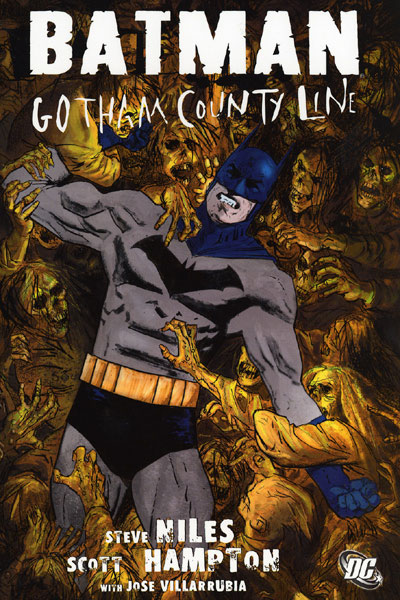
Batman: Gotham County Line


By Steve Niles & Scott Hampton, with Jose Villarrubia (DC Comics)
ISBN: 978-1-4012-0905-6 (TPB)

Many superheroes have a universal genre plasticity and can fit seamlessly into almost any kind of story. Even so, it’s almost no stretch at all to see DC’s Dark Knight tackling marauding monsters and dire demonic disaster, such as in this lost gem, long overdue for a new edition.

Released in 2006 and collecting a 3-issue miniseries (October-December 2005) by written by Steve Niles (30 Days of Night; Simon Dark; Criminal Macabre) with art by Scott Hampton (Silverheels; Batman: Night Cries; Simon Dark) and colourist Jose Villarrubia, the sinister suspense opens in ‘The Obvious Kill’ as yet another Batman-Joker clash throws up an aggravating mind-worm for the Dark Knight: is there a continuance of spirit and personality after death?

Suddenly obsessed with the notion, the manhunter’s subsequent researches are interrupted by a strange series of robbery/murders in the notionally peaceful, sleepy suburbs of the big, bad city. Reluctantly investigating, Batman overturns the police findings and discovers a serial killer at work. In the process of stopping the slaughter, Detective Radmuller of the Gotham County Sheriff’s Department is killed. He won’t be the last…

After closing the case, Batman returns to the city, unaware that the officer has subsequently risen from the dead. With unalloyed horror Batman realises that this case only really kicked into high gear after the death of the perpetrator. …

With zombies prowling the city and county – and even faithful manservant Alfred exhibiting symptoms – a nightmare-wracked but still ardently rationalistic Batman is forced to face the incredible facts of supernatural incursion by the ghost of Boston Brand – murdered aerialist and questing spirit Deadman – who accompanies him on ‘Death’s Highway’ in search of a solution to the plague of walking dead…

With life itself in retreat, Deadman, mystic guardian Phantom Stranger and recently deceased sidekick Jason (Robin) Todd hold back the hordes of unlife, allowing Batman to divine the root cause of the necromantic disaster and set the balance right again on the ‘Night of the Living Death’.

Batman is one of the few heroic icons who has always been equally at home with super-science and the supernatural and the Dark Knight’s arena is here extended to beyond the veil of tears and deep into nightmare territory.

Rife with zombies, ritual killers, early life revelations and doom-drenched guest-stars, this still manages to be a crime thriller and a detective mystery Bat-fans will enjoy and cross-over readers – especially horror aficionados – can revel in.
© 2006 DC Comics. All Rights Reserved.

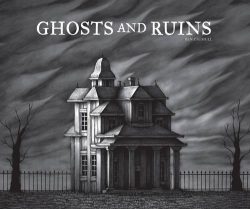
Ghosts and Ruins


By Ben Catmull (Fantagraphics Books)
ISBN: 978-1-60699-678-2 (HB)

If you know the works of Sidney Sime and Edward Gorey, the horror comics of Bernie Wrightson and Michael Kaluta or simply love to peer through your interlocked fingers at the films of Tim Burton or the creepy backgrounds in Charles Addams creations, you’re clearly an aficionado of silly, spooky business and know mordant fantasy plays best when played for laughs.

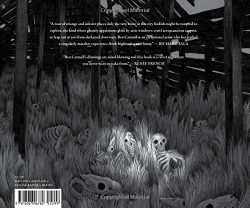
With that in mind, you might be interested in this macabrely monochrome coffee-table art book (and also digital formats) from cartoonist Ben Catmull (Monster Parade, Paper Theater) which classily celebrates the stuff of nauseating, stomach-churning terror and sinister, creeping suspense in a series of eerie illustrated plates crafted in scratchboard on Masonite… for extra-spooky darkness!

All that audaciously arcane art is wedded to epigrammatic prose snippets to comprise tantalising skeletons of stories best left untold and consequences safely ajudged as unimaginable…

The engrossing landscape hardback (268 x 222mm) combines gloomy gothic imagery with wry and witty updates on uncanny situations in a procession of locations best left well enough alone, and commences with six views of the dank domicile of diabolical ‘Drowned Shelley’ and a single ghastly glimpse of ‘The Buried House’.

A queasy quartet then divulges the doings of the ‘The Disgusting Garden’, after which one peek at ‘The Secluded House’ leads inexorably to a triptych revealing ‘The Woman Outside the Window’…

Four frightful frames of ‘Wandering Smoke’ roam towards ‘The Order of the Shadowy Finger’ – five in full – before giving way to three glimpses of ‘The Lighthouse’; a visit to a domicile all ‘Hair and Earwigs’ and thence to numerous views of the monstrous masterpieces hewn by horrific revenant ‘The Sculptor’…

On view is the ‘Labyrinth of Junk’ once concocted by a demonic carpenter, but that is as nothing compared to the sheer terror of ‘The Crawling House’ and the ghastly practises of a ‘Lonely Old Spinster’…

Mordantly blending bleak, spectral dread and anxious anticipation with timeless scary scenarios, this terrifying tease is a sheer delight no lover of Dark Art could conceivably resist…
© 2013 Ben Catmull. This edition © 2013 Fantagraphics. All rights reserved.