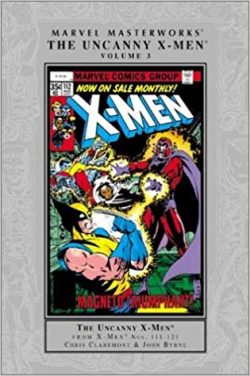
Uncanny X-Men Marvel Masterworks volume 3


By Chris Claremont, John Byrne, Terry Austin, Ricardo Villamonte & various (Marvel)
ISBN: 978-0-7851-1194-8 (HB) 978-0-7851-4570-7 (TPB)

In the autumn of 1963, The X-Men #1 introduced Scott (Cyclops) Summers, Bobby (Iceman) Drake, Warren (Angel) Worthington, Jean (Marvel Girl) Grey and Hank (The Beast) McCoy: very special students of Professor Charles Xavier.

The teacher was a wheelchair-bound telepath dedicated to brokering peace and integration between the masses of humanity and the emergent off-shoot race of mutants dubbed Homo Superior; considered by many who knew him as a living saint.

After nearly eight years of eccentrically spectacular adventures the mutant misfits virtually disappeared at the beginning of 1970 during another periodic downturn in superhero comics sales. Just like in the closing years of the 1940s, mystery men faded away as supernatural mysteries and traditional genre themes once more dominated the world’s entertainment fields…

Although the title was revived at the end of the year as a cheap reprint vehicle, the missing mutants were reduced to guest-stars and bit-players throughout the Marvel universe and the Beast was refashioned as a monster fit for the global uptick in scary stories until Len Wein & Dave Cockrum revived and reordered the Mutant mystique with a brand-new team in Giant Size X-Men #1 in 1975.

To old foes-turned-friends Banshee and Sunfire was added one-shot Hulk hunter Wolverine, and all-original creations Kurt Wagner, a demonic German teleporter codenamed Nightcrawler, African weather “goddess” Ororo Monroe AKA Storm, Russian farmboy Peter Rasputin, who transformed at will into a living steel Colossus and bitter, disillusioned Apache superman John Proudstar who was cajoled into joining the makeshift squad as Thunderbird.

The revision was an instantaneous and unstoppable hit, with Wein’s editorial assistant Chris Claremont writing the series from the second story onwards. The Uncanny X-Men reclaimed their own comicbook with #94 and it quickly became the company’s most popular – and high quality – title.

Cockrum was succeeded by John Byrne and as the team roster shifted and changed the series rose to even greater heights, culminating in the landmark Dark Phoenix storyline which saw the death of arguably the book’s most beloved and imaginative character.

In the aftermath team leader Cyclops left but the epic cosmic saga also seemed to fracture the epochal working relationship of Claremont and Byrne. Within months of publication they went their separate ways: Claremont staying with the mutants whilst Byrne moved on to establish his own reputation as a writer on series such as Alpha Flight, Incredible Hulk and especially his revolutionised and freshly-groundbreaking Fantastic Four…

After Apache warrior Thunderbird became the team’s first fatality, the survivors slowly bonded, becoming an infallible fighting unit under the brusque and draconian supervision of Cyclops.

This third titanic compilation (available in luxurious hardcover, trade paperback and eBook editions) is perfect for newbies, neophytes and even old lags nervous about reading such splendid yarns on fragile but extremely valuable newsprint paper. It celebrates the unstoppable march to market dominance through the pivotal early stories: specifically, issues #111-121 of the decidedly “All-New, All-Different” X-Men – spanning June 1978 to May 1979.

The drama resumes cloaked in moody mystery as ‘Mindgames’ (by dream team Chris Claremont, John Byrne & Terry Austin) sees the Beast visit a circus in search of the new team. They have been missing for weeks…

His presence disrupts a devilish scheme by mutant hypnotist Mesmero to subjugate the heroes through false memories and implanted personalities, but the reawakened team’s vengeance is forestalled when their greatest enemy ambushes them…

In X-Men #112 the revived and furious heroes fight and fail, leaving ‘Magneto Triumphant!’ and his enemies helplessly imprisoned miles beneath Antarctica in the tense, action-packed battle bonanza follow-up ‘Showdown!’

However, by the time the Polaric tyrant returns after terrorising the humans of Australia, the X-Men have broken free and are waiting for him…

In the apocalyptic battle which follows the base is utterly destroyed and Magneto grievously wounded. With boiling lava flooding everywhere, only Beast and Phoenix manage to reach the surface and, in horror, realise they are the only survivors…

They could not be more wrong.

Unable to go up, the remaining mutants tunnel downwards and ‘Desolation!’ turns to joy as they emerge into the antediluvian wilderness dubbed the Savage Land.

Linking up with old ally Ka-Zar, the team slowly recover in a dinosaur-filled elysian paradise. The idyll is rudely shattered when former foe Karl Lykos succumbs to his old addiction and absorbs their mutant energies to become lethal leather-winged predator Sauron…

His ‘Visions of Death!’ are readily dispelled by the assembled heroes, but he’s just the first course in a campaign of terror as crazy, colonializing barbarian queen Zaladane revives proto-god Garokk as the figurehead of her army of conquest…

When the insane imperialists meddling disrupts the tropical climate of the sub-polar region, Ka-Zar and the X-Men invade their noxious citadel ‘To Save the Savage Land’, where the brutal battle demands the best and worst from the young warriors before the job is done…

With the distasteful task completed, the mutants opt to try a perilous sea-passage back to the outside world…

Uncanny X-Men #117 begins with their rescue by an Antarctic exploration vessel, heralding a slow torturous voyage to Japan, before lapsing into an untold tale of Charles Xavier in his globe-trotting days prior to losing the use of his legs. ‘Psi War!’ is full of clever, in-filling insights as it details how the dispirited, restless young telepath fetches up in Cairo and meets his first “Evil Mutant”…

Amahl Farouk uses his psionic abilities to rule the city’s underworld: a depraved, debauched monster who thinks he is beyond justice. The enraged, disgusted Xavier defeats the beast and in doing so find his life’s purpose…

A revelatory 2-part epic follows as the X-Men – still believed dead by Xavier, Jean and the wider world – arrive in Agarashima, just as the port is being devastated by a vast firestorm. Inked by Ricardo Villamonte, ‘The Submergence of Japan!’ sees tectonic terrorist Moses Magnum undertake a most audacious blackmail scheme, countered by the valiant mutants who briefly reunite with old – and still belligerently surly – comrade Sunfire.

Perhaps he is just surprised to discover Wolverine has unsuspected connections to Japan and has turned the head of local highborn maid Lady Mariko. A bigger surprise awaits the American specialist the government have brought in. Misty Knight is Jean Grey’s roommate in Manhattan and grieved with her at the X-Men’s deaths.

Now she has to tell Cyclops his girl has moved on and Professor X has abandoned Earth for the Shi’ar Empire…

Of course, all of that is moot if they can’t stop Magnum and his Mandroid army sinking Japan into the Pacific, but after a catastrophic conflict inside a volcano there’s a seasonal reunion in store for all in the Austin-inked ‘Twas the Night Before Christmas…’

This volume concludes with another tumultuous two-parter and the introduction of a foreign super-squad in ‘Wanted: Wolverine! Dead or Alive!’, as the enigmatic wild man – accompanied by Cyclops, Nightcrawler, Storm, Colossus, Banshee and Nightcrawler – returns from a bombastic battle and heartbreak in Japan only to be covertly herded into Canadian airspace so that the Ottawa government can confiscate their former property…

Forced down by a magical tempest, the heroes are soon on the run in Calgary, ambushed by the aforementioned Alpha Flight – specifically battle-armoured Vindicator, super-strong Sasquatch, First Nations magician Shaman, shapeshifting Snowbird and mutant speedster twins Northstar and Aurora – all ordered to repossess at any cost former special operative and top super-agent “The Wolverine”…

After a brutal but inconclusive clash at the airport the X-Men fade into the city but only after Wolverine and Nightcrawler are captured…

The retaliation results in a ‘Shoot-Out at the Stampede!’ with the mutants confronting their pursuers as Shaman’s eldritch blizzard spirals out of control, threatening to destroy the entire province. Even after Storm fixes the problem, the Canadians are adamant, so to end hostilities Wolverine surrenders himself in return for his comrades’ safe passage.

Of course, he never promised to stay arrested…

These are some of the greatest stories Marvel ever published; entertaining, groundbreaking and uncannily intoxicating: an invaluable grounding in contemporary fights ‘n’ tights fiction no fan or casual reader can afford to ignore.
© 1977, 1978, 2013 Marvel Characters, Inc. All rights reserved.


Martin Brown’s Lesser Spotted Animals


By Martin Brown (David Fickling Books)
ISBN: 978-1-910200-53-7 (HB) 978-1-910989-56-2 (PB)

It’s a beautiful, wonderful world which we humans – sadly, the temptation to say You Humans grows stronger in me every day – don’t appreciate enough. Thankfully, there are still many studious, thoughtful types – many of them rather artistic in temperament – who are aware of the astounding fascinations of flora and fauna for the public, and remain joyously eager to share what they know.

Available in hardcover and paperback, this glorious book is the phenomenally compelling and generally hilarious efforts of one of the best of them…

Martin Brown hails from Melbourne (that’s in Australia where they have loads of amazing, little-known and generally deadly bugs and critters) but made his name as a designer, cartoonist and illustrator in the United Kingdom (not so many dangerous beasts, but far too many idiots).

After training as a teacher and working for television in Oz, Brown put on a backpack and travelled around the world for a bit. He stopped when he got to Britain, and lived by doing drawings: greetings cards, cartoons, magazines and book illustrations. The books included Coping with Parents (by Peter Corey), Philip Pullman’s New Cut Gang and a series of popular children’s tomes written by Terry Deary entitled Horrible Histories. Those light-hearted factoid files sold upwards of 20 million copies…

Brown draws good and he draws funny: very, very funny.

A couple of years back, the artist compiled a bright and breezy bestiary of the creatures less well-represented on TV and in environmental and ecological campaigns: animal underdogs – although there’s not one of those included here – that always get pushed out of the limelight by glamour-pusses like Lions, and Tigers and Bears.

Oh. Why?

It’s certainly not because they’re dull, boring or inconsequential…

Martin Brown’s Lesser Spotted Animals is an award-winning graphic treatise which highlights and introduces a host of creatures that will take your breath away: described and delineated with wit, empathy and proper facts like Size; What they eat; Where they live; their Status (from Critically Endangered to We don’t know) as well a specific fact on each that will delight or disgust, depending on your age or maturity…

Fabulously, hilariously illustrated, please meet here and be besotted by the Numbat, Cuban Solenodon, Lesser Fairy Armadillo, Zorilla, Silvery Gibbon, Dagger-Toothed Flower Bat, Long Tailed Dunnart, Russian Desman, Speke’s Pectinator, the Onager, Banded Linsang, Yellow-Footed Rock-Wallaby, Gaur, Sand Cat, Southern Right Whale Dolphin, Three Monkeys (Red-Faced Spider Monkey, Grey-Shanked Douc Langur and Golden Snub-Nosed Monkey), Hirola, Crabeater Seal, Ili Pika, Zebra Duiker and Black-Footed Ferret: all topped off with an extremely accessible Glossary…

Sure, you can look them all up online but there they’ll just be cute or awesome, not funny…

An utterly enticing piece of work that could only be improved by an accompanying set of badges, greetings or post cards…
Text and illustrations © 2016 Martin Brown. All rights reserved.

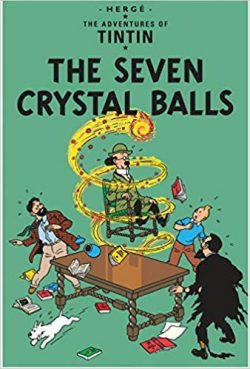
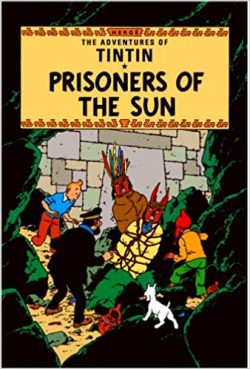
Adventures of Tintin: The Seven Crystal Balls and Prisoners of the Sun


By Hergé & various; translated by Leslie Lonsdale-Cooper & Michael Turner (Egmont)
ISBNs: 978-0-82885-071-1 (HB Crystal Balls)
978-1-40520-624-2 (PB Crystal Balls)
978-1-40520-813-0 (HB Sun)
978-1-40520-625-9 (PB Sun)

Georges Prosper Remi – known universally as Hergé – created a true masterpiece of graphic literature with his astounding yarns tales of a plucky boy reporter and his entourage of iconic associates.

Singly, and later with assistants including Edgar P. Jacobs, Bob de Moor and the Hergé Studio, Remi completed 23 splendid volumes (originally produced in brief instalments for a variety of periodicals) that have grown beyond their popular culture roots and attained the status of High Art.

It’s only fair, though, to ascribe a substantial proportion of credit to the many translators whose diligent contributions have enabled the series to be understood and beloved in 38 languages. The subtle, canny, witty and slyly funny English versions are the work of Leslie Lonsdale-Cooper & Michael Turner.

On leaving school in 1925, Remi worked for Catholic newspaper Le Vingtiéme Siécle where he fell under the influence of its Svengali-like editor Abbot Norbert Wallez. The following year, the young artist – a passionate and dedicated boy scout, produced his first series: The Adventures of Totor for monthly Boy Scouts of Belgium magazine.

By 1928, Remi was in charge of producing the contents of the parent paper’s children’s weekly supplement Le Petit Vingtiéme while discontentedly illustrating The Adventures of Flup, Nénesse, Poussette and Cochonette when Abbot Wallez urged the artist to create an adventure series. Perhaps a young reporter who would travel the world, doing good whilst displaying solid Catholic values and virtues?

And also, perhaps thereby highlighting and exposing some the Faith’s greatest enemies and threats…?

Having recently discovered the word balloon in imported newspaper strips, Remi decided to incorporate this simple yet effective innovation into his own work. He would produce a strip both modernistic and action-packed.

Beginning in early January 1929, Tintin in the Land of the Soviets appeared in weekly instalments, running until May 8th 1930. Accompanied by his garrulous dog Milou (Snowy to us Anglophones), the clean-cut, no-nonsense boy-hero – a combination of Ideal Good Scout and Remi’s own brother Paul (a soldier in Belgium’s army) – would report back all the inequities of the world, since the strip’s prime conceit was that Tintin was an actual foreign correspondent for Le Petit Vingtiéme…

The odyssey was a huge success, assuring further – less politically-charged and controversial – exploits to follow. At least that was the plan…

During the Nazi Occupation of Belgium, Le Petit Vingtiéme was closed down. Hergé was compelled to move his popular strip to daily newspaper Le Soir (Brussels’ most prominent French-language periodical, appropriated and controlled by the Nazis). He diligently toiled on for the duration, but following Belgium’s liberation was accused of collaboration and even being a Nazi sympathiser.

It took the intervention of Belgian Resistance war-hero Raymond Leblanc to dispel the cloud over Hergé, which he did by simply vouching for the cartoonist and by providing the cash to create a new magazine – Le Journal de Tintin – which Leblanc published and managed. The anthology comic swiftly achieved a weekly circulation in the hundreds of thousands.

Begun in conquered Belgium and running in daily instalments, Les Sept Boules de Cristal began in December 1943 but was abruptly shelved when the Allies arrived in September 1944. Hergé, tarred as a collaborator, was unable to work for two years. When he was cleared the story resumed, serialised in Le Journal de Tintin from September 26th 1946 to April 22nd 1948

In 1943 the artist had met Edgar P. Jacobs, who became his assistant. They began with this extended adventure-tale which is now divided into eerie thriller The Seven Crystal Balls and grandiose epic Prisoners of the Sun. These dates seem odd but once again the Nazi conquest holds the answers.

For Belgium. Liberation day was September 3rd 1944. When the occupiers fled, workers on Le Soir were arrested as potential collaborators or Nazi sympathizers and the newspaper was closed down. For the two years they were under suspicion, Hergé, Jacobs and Alice Devos spent their time adapting old Tintin adventures for release as colour albums. The Seven Crystal Balls remained unfinished and unpublished until Raymond Leblanc stepped in.

Anthological Le Journal de Tintin continued the tale before completing the saga with Le Temple du Soleil. During this period, Jacobs left Hergé when the artist supposedly refused him a by-line for his work. At that time, Jacobs was also producing his own science-adventure masterpiece Blake and Mortimer which also featured in the weekly Tintin.

The Seven Crystal Balls sees affable old soak Captain Haddock returned to family manse Marlinspike Hall where he is adjusting (poorly) to his new-found wealth, and the prospect of exasperating Professor Cuthbert Calculus as his house-guest.

When Tintin and Snowy visit, a trip to the theatre embroils them all in a baffling enigma wherein the survivors of the South American Sanders-Hardiman Expedition all successively fall into comas due to an Incan curse and some rather suspect strangers. Tintin soon determines someone more solid than ethereal is causing the tragedies, but even he can’t stop the attacks, and soon he and his friends are also on the mysterious malefactor’s “to-do” list…

When Calculus is abducted from under their very noses, Haddock gives up his life of luxury and resumes adventuring once more, determined to help Tintin rescue their friend and solve the mystery.

Giving chase. they narrowly miss the villains at a seaport but still have a chance to beat the ship carrying Calculus if they board a sea-plane for Peru…

This is classic hairsbreadth storytelling. The pace is spellbinding and the ever-present slapstick actually serves to heighten the tension of the chase. The tale ends on a cliff-hanger, which is only right and proper. Still, imagine how you’d have felt all those decades ago when the conclusion was months away…


The helter-skelter drama continues in as, in the Port of Callao, Tintin and Haddock anxiously await the arrival of the freighter Pachacamac. However, when it arrives, suspected of carrying their kidnapped friend Cuthbert Calculus, the vessel flies a plague-pennant. There is Yellow Fever aboard and nobody can approach her!

And so begins Prisoners of the Sun, epic conclusion of the maddening mystery of Inca curses and the doomed Sanders-Hardiman Expedition to South America…

Suspecting a trick, Tintin sneaks aboard and finds the Professor, only to be driven away by gunfire. After telephoning Haddock, he chases the abductors, leaving the Captain and inept detectives Thompson and Thomson to catch up if they can. The chase takes them deep into the beautiful, rugged country where they finally reunite, only to become the target of many murder attempts, and other methods of dissuasion.

Undaunted, Tintin and Haddock continue their trek towards the mountains, and are befriended by Zorrino, a young lad who risks his own life to help them cross valleys, mountain-ranges and jungles, dodging death from both beasts and men, until they are all finally captured by the last remnants of a lost, wondrous and deeply cautious civilisation…

This is an epic staggering in scope and breathtaking in execution. Whether drawing a battle, choreographing a pratfall or delineating a golden temple, the clean precise line of the art and the simplified colour palette makes every panel “realer-than real”, whilst the captivating imagination of the storytelling makes this a truly graphic narrative.

These are two of the best comic adventures of all time and they demand a place on every fan’s bookshelves.

The Seven Crystal Balls: artwork © 1948, 1975 Editions Casterman, Paris & Tournai.

Text © 1962 Egmont UK Limited. All Rights Reserved.

Prisoners of the Sun: artwork © 1949, 1977 Editions Casterman, Paris & Tournai.
Text © 1962 Egmont UK Limited. All Rights Reserved.

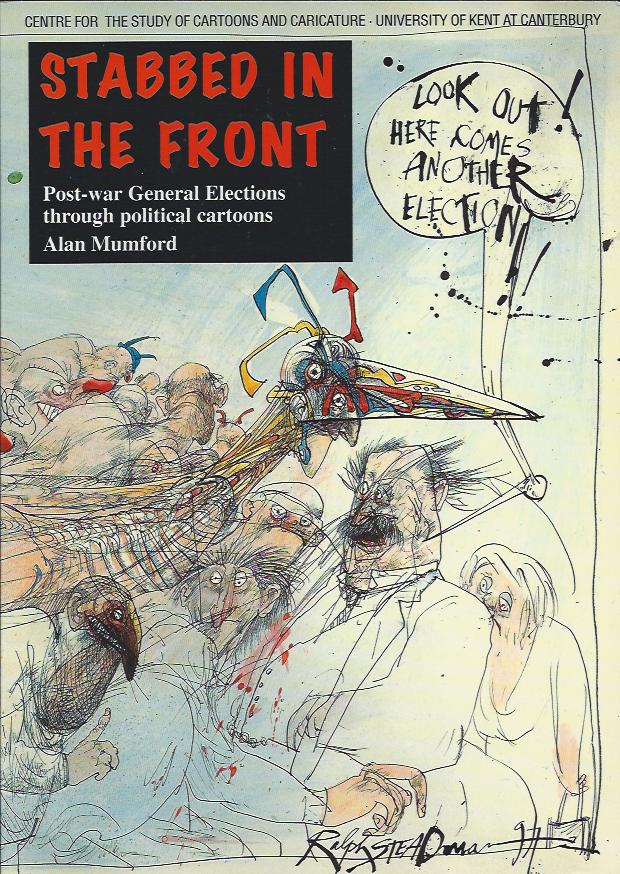
Stabbed in the Front – Post-War General Elections through Political Cartoons


By Dr. Alan Mumford (Centre for the Study of Cartoons & Caricature, U of K, Canterbury)
ISBN: 978-1-90267-120-8

“True patriotism hates injustice in its own land more than anywhere else” – Clarence Darrow

From its earliest inception cartooning has been used to sell: initially ideas or values but eventually actual products too. In newspapers, magazines and especially comicbooks the sheer power of narrative with its ability to create emotional affinities has been linked to the creation of unforgettable images and characters. When those stories affect the daily lives of generations of readers, the force that they can apply in a commercial or social arena is almost irresistible…

In Britain the cartoonist has held a bizarrely precarious position of power for centuries: the deftly designed bombastic broadside or savagely surgical satirical slice instantly capable of ridiculing, exposing and always deflating the powerfully elevated and apparently untouchable with a simple shaped-charge of scandalous wit and crushingly clear, universally understandable visual metaphor.

For this method of concept transmission, literacy or lack of education is no barrier. As the Catholic Church proved millennia ago with the Stations of the Cross, stained glass windows and a pantheon of idealised saints, a picture is absolutely worth a thousand words…

More so than work, sport, religion, fighting or even sex, politics has always been the very grist that feeds the pictorial gadfly’s mill. This gloriously informative book (sponsored by the marvellous Centre for the Study of Cartoons and Caricature, University of Kent at Canterbury), offers a fantastic overview of political adaptability and cultural life as Britain moved from Empire to mere Nationhood in the latter half of the 20th century, examined through General Elections and the wealth of cunningly contrived images and pictorial iconography they provoked and inspired. It’s one of my favourite things ever and crucially in need of updating and re-release…

After an effusive Foreword by professional politician and celebrated cartoon aficionado (the Rt. Hon.) Lord Kenneth Baker of Dorking, author Alan Mumford – a specialist in management training – covers the basic semiology and working vocabulary of the medium in his copious Introduction.

Designating definitions and terms for his splendid treatise, he subdivides the territory into ‘Origins’, ‘Criteria for Selection’, ‘Newspapers and Magazines’, ‘The Longevity of Political Cartoonists’, ‘References, Symbols and Metaphors’, ‘The Impact of Cartoons on General Elections’ and ‘Savagery in Political Cartoons’ as a very effective foundation course in how to best contextualise and appreciate the plethora of carefully crafted mass-market messages which follow.

The format is extremely ergonomic and effective. Thus, Philip Zec’s iconic cartoon and caption/slogan “Here You Are. Don’t Lose it Again!” begins the Great Endeavour with historical background in The Run-up to the General Election of 1945, followed by Election Issues and the 1945 Campaign, Major Personalities of the 1945 General Election, Results of… and finally a nominated “Cartoonist of the Election” whose work most captured the spirit of, or affected the outcome of, a particular contest.

This methodology then proceeds to efficiently and comprehensively recreate the tone of each time, augmented whenever possible by a personal interview or remembrance from one of the campaigners involved. These telling vignettes include contributions from Frank Pakenham/Lord Longford, Barbara Castle, Edward Heath, Denis Healey, Roy Jenkins, Kenneth Baker again, Jim Callaghan, Jim Prior, Margaret Thatcher, David Steel, Norman Tebbit, John Major and Tony Blair…

Each fact-packed, picture-filled chapter then dissects every succeeding campaign: 1950’s tame ‘Consolidation not Adventure’ which resulted in Labour and Clement Attlee’s second victory by the narrowest – practically unworkable – of margins, Churchill’s resurgence in 1951 as ‘The Grand Old Man Returns’ and a slow steady decline in fortunes and growth of a New Politics as Anthony Eden’s star rose for the 1955 General Election when ‘The Crown Prince Takes Over’…

In an era of international unrest Harold McMillan eventually rose to become Tory top gun and in 1959 was ‘Supermac Triumphant’, but domestic troubles – race, unionism and the always struggling economy – wore away his energies. In a minor coup, he was ousted and Sir Alec Douglas Home took over mid-term, consequently losing to glib, charismatic new Labour leader Harold Wilson.

This entire era is one of aged and infirm Big Beasts passing away suddenly with too many lesser lights to succeed them; further complicated by both Labour and Conservative parties rent by infighting and jockeying for position with wannabe upstarts such as the Liberals cruising the room looking to pick up what scraps they could (so it’s not a new thing, OK?).

In 1966 “Labour Government Works” took Labour to a second term but social turmoil in the country, with unions demands spiralling out of control, enabled Edward Heath to lead the Conservatives into the most dangerous and turbulent decade in modern British history. The General Election of 1970 proved ‘Wilson Complacent, Heath Persistent’…

There were two General Elections in 1974.

A massive ongoing crisis in industrial relations and the growing racial tension caused by maverick Tory Enoch Powell’s continual cries to “end Immigration or face rivers of blood in the streets” forced Prime Minister Heath to ask in February ‘Who Governs Britain?’ He was informed by the disaffected electorate “Not you, mate.”

Even though Wilson and Labour were returned to power, the majority was miniscule and by October the people were compelled to do it all again and ‘Vote for Peace and Quiet’.

Although he’d again narrowly led them to victory, Wilson’s time was done and he abruptly resigned in 1976 to be replaced by deputy Jim Callaghan.

Heath too was reduced to the ranks and relegated to the Tory Back Benches, replaced by a rising star from Finchley. As Britain staggered under terrifying economic woes in 1979, Callaghan called an election and lost to Margaret Thatcher who had famously said “No Woman in My Time” would ever be Prime Minister. I think that was the last time she ever admitted to being wrong…

Despite horrifying and sustained assaults on the fabric of British society – and great unpopularity – she enjoyed two more election victories: in 1983 “The Longest Suicide Note in History” and again in 1987 as ‘Thatcher Moves Forward’ before finally being turned on by her own bullied and harried Cabinet.

The best political cartooning comes from outrage, and the Tory administrations of the 1980’s provided one bloated, bile-filled easy mark after another. Just look at TV’s Spitting Image which grew fat and healthy off that government’s peccadilloes, indignities and iniquities (as well as Reagan’s America and the Royal Family) in just the way that millions of unemployed and disenfranchised workers, students and pensioners didn’t. The election cartoons reproduced here from that period come from a largely Tory Press, and whilst contextualised and accurate don’t approach the level of venom she engendered in certain sections.

For a more balanced view one should also see Plunder Woman Must Go! by Alan Hardman, Drain Pig and the Glow Boys in Critical Mess, You are Maggie Thatcher: a Dole-Playing Game or even Father Kissmass and Mother Claws by Bel Mooney & Gerald Scarfe, not to mention any collection of the excoriating Steve Bell’s If…

In 1992, the only thing stopping a Labour landslide was the party itself, which had so dissolved into factional infighting and ideological naval-gazing that not even the fiery oratory of Welsh Wizard Neil Kinnock could pull them together. Once again, however, the newspapers claimed the credit when Tory consensus/concession leader John Major pulled off a surprising ‘Triumph of the Soapbox?’

That Labour Landslide had to wait until 1997 and the ‘Teeth and Sleaze’ of Tony Blair (although at that time we all thought the latter term only applied to corrupt Tory MPs selling parliamentary time and attention to business interests) which brings this incredibly appealing tome to a close. I said it before and I’m saying it again: since then a whole lot has happened and I think its long past time for a new, revised and updated edition…

As well as making addictively accessible over half a century of venal demagoguery, hard work, murky manipulations, honest good intentions and the efforts of many men and women moved in equal parts by dedication and chicanery, this oversized monochrome tome is also literally stuffed with the best work some of the very best cartoonists ever to work in these Sceptred Isles.

The art, imagination, passion and vitriol of Abu, Steve Bell, Peter Brookes, Dave Brown, Michael Cummings, Eccles, Emmwood, Stanley Franklin, George Gale, Nick Garland, the Davids Gaskill and Ghilchik, Les Gibbard, Charles Griffin, Graham High, Leslie Illingworth, Jak, John Jensen, Jon, Kal, David Low, Mac, Mahood, Norman Mansbridge, Sidney Moon, Bill Papas, Chris Riddell, Paul Rigby, Rodger, Stephen Roth, Martin Rowson, Willie Rushton, Peter Schrank, Ernest Shepard, Ralph Steadman, Sidney Strube, Trog, Vicky, Keith Waite, Zec and Zoke are timeless examples of the political pictorialist’s uncanny power and, as signs of the times, form a surprising effecting gestalt of the never happy nation’s feeling and character…

None of that actually matters now, since these cartoons have performed the task they were intended for: shaping the thoughts and intentions of generations of voters. That they have also stood the test of time and remain as beloved relics of a lethal art form is true testament to their power and passion, but – to be honest and whatever your political complexion – isn’t it just a guilty pleasure to see a really great villain get one more good kicking?

Stuffed with astounding images, fascinating lost ephemera and mouth-watering tastes of comic art no fan could resist, this colossal collection is a beautiful piece of cartoon history that will delight and tantalise all who read it… and it’s still readily available through the University of Kent’s website…
© 2001. Text © 2001 Alan Mumford. All illustrations © their respective holders or owners. All rights reserved.

The Steel Claw: The Vanishing Man

,”

By Ken Bulmer & Jesús Blasco (Titan Books)

ISBN: 978-1-84576-156-1 (HB)

So, I’ve just pulled an all-nighter to finish my latest book by deadline—an obsessive point of pride with me that will kill me someday soon—and I’m buzzing like a bucket of angry bees. So, too tired to sleep yet, I reach for one of my favourite books to mellow out and wonder again why the hell hasn’t this been rereleased or made available digitally. And why no follow-up releases? Surely, sheer quality must count for something?

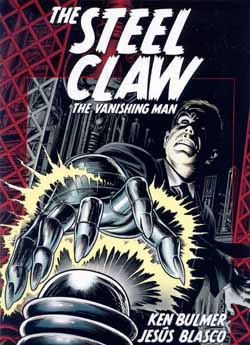
One of the most fondlyremembered British strips of all time is the startlingly beautiful Steel Claw. From 1962 to 1973 the stunningly gifted Jesús Blasco and his small studio of family members thrilled the nation’s children, illustrating the breakneck adventures of scientist, adventurer, secret agent and even costumed superhero Louis Crandell.

Initially written by science fiction novelist Ken Bulmer, the majority of the character’s career was scripted by comic veteran Tom Tully.

Our eventual hero began as the assistant to the venerable Professor Barringer, working to create a germdestroying ray. Crandell is an embittered man, probably due to having lost his right hand, which has been replaced with a steel prosthetic. When the prof’s device explodes, Crandell receives a monumental electric shock which, rather than killing him, renders him invisible. Although he doesn’t stay unseen forever, this bodily transformation is permanent. Electric shocks cause all but his steel hand to disappear.

Kids, don’t try this at home!

Whether venal or simply deranged, Crandell goes on a rampage of terror against society,culminating in an attempt to blow up New York City before finally coming to his senses. The second adventure in this astounding oversized hardback volume pits the Claw against his therapist, who in an attempt to treat him is also exposed to Barringer’s ray, becoming a bestial ape-man who frames Crandell for a series of spectacular crimes.

Bulmer’s final tale begins our star‘s shift from outlaw to hero as the recuperating Crandell becomes involved in a modernday pirate’s scheme to hijack an undersea weapons system…

More than any other, the Steel Claw was a barometer for reading fashions. Starting out as a Quatermass style science fiction cautionary tale, the strip mimicked the trends of the greater world, becoming a James Bond-like super-spy strip with Crandall tricked out with outrageous gadgets, and latterly a masked and costumed super-doer when Batmania gripped the nation. When that bubble burst, he resorted to becoming a freelance adventurer,combating eerie menaces and vicious criminals.

The thrills of the writing are engrossing enough, but the real star of this feature is the artwork. Blasco’s classicist drawing, his moody staging and the sheer beauty of his subjects make this an absolute pleasure to look at. Buy it for the kids and read it too; this is a glorious book.

So, track it down and agitate for more of the same…

© 2005 IPC Media Ltd. All Rights Reserved.

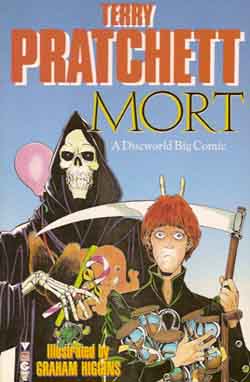
Mort: A Discworld Big Comic


By Terry Pratchett & Graham Higgins (VG Graphics/Gollancz)
ISBN: 978-0-57505-697-8 (HB)                    978-0-57505-699-2 (PB)

Us old codgers have always maintained that a good comic needs a good artist and this superb adaptation of Terry Pratchett’s fourth Discworld novel proves that point.

Just in case you’ve been living on another world: The Discworld is a flat planet supported on the backs of four elephants standing on the shell of a giant turtle swimming across the universe. Magic works there and the people are much too much like us.

This, of course, makes it an ideal location for spleen-venting, satire, slapstick and social commentary…

Scripted by the so-very-much-missed author and brilliantly illustrated by Graham Higgins, it tells a complex and darkly witty tale of Death (big grim chap, carries a scythe, nobody gets his jokes, always has the last laugh) and hapless, literal-minded, sort-of-useless young oaf Mort, whom he hires as his apprentice.

Of course, that’s not all there is to it, with sub-plots including an orphaned princess and her dangerously ambitious guardian, Death’s vacation, the daughter he adopted and the mystery of his most peculiar servant Albert to season a very impressive spin on a very familiar myth.

Higgin’s light, dry touch adds volumes of texture to the mix, and his deft sense of timing and comedy pacing – reminiscent of Hunt Emerson – marvellously match Pratchett’s unmistakable, acerbic dialogue and plot.

Incomprehensibly unavailable digitally and only physically in editions from the last century, if you have to have adaptations of great novels, this is how they should be done.
Text © 1994 Terry and Lyn Pratchett. Illustrations © 1994 Graham Higgins. All Rights Reserved

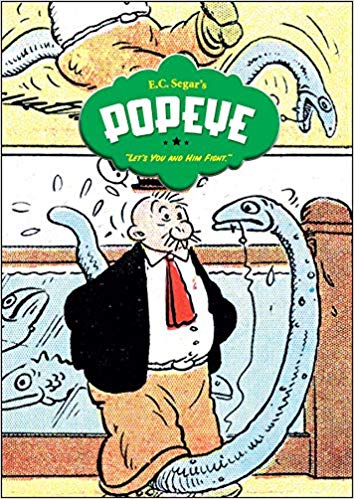
E.C. Segar’s Popeye volume 3: “Let’s You and Him Fight!”


By Elzie Crisler Segar (Fantagraphics Books)
ISBN: 978-1-56097-962-3

There are relatively few comic characters that have entered world consciousness, but a grizzled, bluff, uneducated, visually impaired old sailor with a speech impediment is possibly the most well-known of that select bunch. Elzie Crisler Segar had been producing the Thimble Theatre daily newspaper strip since December 19th 1919, but when he introduced a coarse, brusque “sailor man” into the ever-unfolding adventures of Castor Oyl and Ham Gravy on January 17th 1929, nobody suspected the heights that slouching walk-on would reach.

This third magnificent collection of Segar’s immortal – certainly unkillable – clay-footed reprobate reproduces one spectacular groundbreaking epic after another as the artist-auteur, in a whirlwind of creative inspiration, took the daily strip to new heights of cliffhanging thrills and absurdity. This he did whilst building unique and jovial character studies with the more humorous Sunday pages, generally set in the generic small seaside town of Sweethaven.

Following another erudite essay by Comics historian Donald Phelps, the daily delights (stretching from June 9th 1932 to December 9th 1933) begin with a rip-snorting mystery thriller full of action, tension, scares and laughs featuring a large portion of Thimble Theatre‘s extensive cast. ‘The Eighth Sea’ finds Popeye, Castor, Olive, King Blozo of Nazilia and his idiot retainer Oscar all following the instructions of Oolong the Chinese Parrot to recover a fabulous lost treasure, aided by the incredible Merlock Jones, quick-change detective. This sinister sea saga was the one-and-only Segar tale to feature Popeye’s ultimate nemesis (in the animated cartoons at least) Bluto.

With breakneck pace – Segar never rested on his laurels or his plots – that adventure led the voyagers back to Nazilia for ‘Long Live the King or Gold and Goofs’ and a rematch with General Bunzo and his new Mata Hari Dinah Mow: a worldly-wise vamp even iron-willed Popeye couldn’t resisk…

After taking a well-aimed pop at popular democracy in ‘The Great Lection’ the old sea-dog sets up his own nation in ‘Popeye: King of Popilania’: another stinging satire which sees the increasingly irrepressible J. Wellington Wimpy expand beyond the Sunday pages to join the dailies cast, almost mooching the infant country away from its idealistic founder. Popilania’s problems are multiplied by an invasion of “furiners”, “emmygrunts” and even jungle-Neanderthals in ‘Wild Men and Wild Women’ before the well-meaning reformer learns his lesson. At least he never had to cope with Brexit…

The trenchant social commentary and barbed satire continued when he returns to America to become ‘Star Reporter’ for The Daily Blast, a periodical edited by Castor and “blessed” with Wimpy as photographer. This leads to the next big cast addition and our hero’s greatest advancement when a reader mails Popeye a baby in ‘Me Sweet Pea.’

Discovering the “infink’s” true history and heritage pits the sailor-man against some pretty ruthless types, and results in him suffering a serious brain injury in ‘Bonkus of the Konkus’ but his indomitable soul and noble heart win through as always in the turbulent desert debacle ‘Popeye’s Cure’…

The Sunday Page selection follows a decidedly more domestic but no less riotous path. Running from 9th October to 23rd November 1933, the full-colour section was increasing given over to – or more correctly, appropriated – by the insidiously oleaginous Wimpy: ever hungry, always cadging, yet intellectually stimulating, casually charming and usually triumphant in all his mendicant missions.

Whilst still continuing his pugilistic shenanigans, the action of the Sunday strips moved away from Popeye hitting quite so much to alternately being outwitted by the unctuous moocher, and saving him from the vengeance of Diner owner Rough-house and passionately loathing George W. Geezil, an ethnic Jewish stereotype, who like all Segar’s characters swiftly developed beyond comedic archetype into a unique person with his own story… and another funny accent.

Wimpy was unstoppable – he even became a rival suitor for Olive Oyl’s scrawny favours – and his development owes a huge debt to his creator’s love and admiration of comedian W.C. Fields. A mercurial force of nature, the unflappable mendicant is the perfect foil for common-man-but-imperfect-champion, Popeye. Where the sailor is heart and spirit, unquestioning morality and self-sacrifice, indomitable defiance, brute force and no smarts at all, Wimpy is intellect and self-serving rapacious greed, freed from all ethical restraint or consideration, and gloriously devoid of any impulse-control.

Wimpy literally took candy from babies and food from the mouths of starving children, yet somehow Segar made us love him. He was Popeye’s other half: weld them together and you have an heroic ideal… (and yes, those stories are true: British Wimpy burger bars are built from the remnants of a 1950s international merchandising scheme that wanted to put a J Wellington Wimpy-themed restaurant in every town and city).

The gags and exploits of the two forces of human nature build riotously during this period, ever-more funny; increasingly outrageous. The laugh-out-loud antics seem impossible to top, and maybe Segar knew that. Either he was getting the stand-alone gag-stuff out of his system, or perhaps he was clearing the decks and setting the scene for a really big change.

Within weeks (or for us, next volume) the Thimble Theatre Sunday page changed forever. In a bold move, the blood-and-thunder serial-style adventure epics of the dailies transferred to the Technicolor splendour of the “family pages” and all stops would be pulled out…

Topper strip Sappo actually increased its page-share during this period, going from two to three tiers, as the unstoppable scientist O.G. Watasnozzle took the little feature into increasingly surreal and absurdist realms. On a rocket ship journey, Sappo and his insufferable but long-suffering wife Myrtle experienced incredible thrills, chills and spills during an extended trip around the solar system; experiencing all the goofy wonders and embarrassments Segar’s fevered mind could concoct.

Always innovating, the restless creator also began adding extra value for his readers: incorporating collector stamps, games and puzzles to his Sunday pages. In an era with no television – and indeed, with only the very first prototype comicbooks just starting to appear – radio-shows and Sunday pages were the home entertainment choices of most Americans. Many strips offered extras in their funny-pages and Segar excelled in creating paper-based toys and amusements.

In this book alone there are stamps, play money “lucky bucks”, cartooning tips, drawing lessons and ‘Funny Films’ – dioramic scenes through which continuous strips of cartooned “filmstrips” could be moved to create a home cinema!

As an especially welcome bonus, this volume concludes with an incredibly rare piece of Popeye memorabilia: one I’d heard of but never thought I’d ever see. In 1934 the Chicago World’s Fair was held in the Windy City, and for two weeks before, at the end of 1933, it was advertised and promoted in the Hearst papers with an original full-page, monochrome Popeye serial. That’s terrific enough but the extended yarn was given extra push by escaping the funny-pages ghetto to run for that fortnight in the Sports section, as Popeye and crew explored the wonders of the World’s Fair in a truly spectacular and irresistible enticing prom feature – possibly the first of its kind.

This work is among the finest strip narrative ever created: reading it should be on everybody’s bucket list, and even when you do there’s still more and better yet to come…

In this anniversary year, you owe it to yourself to make the acquaintance of this icon of cartooning.
© 2008 Fantagraphics Books Inc. All comics and drawings © 2008 King Features Inc. All rights reserved.

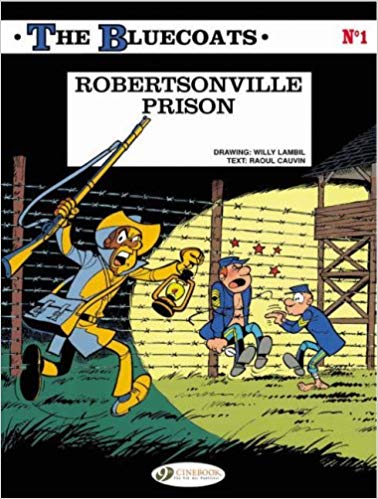
Bluecoats volume 1: Robertsonville Prison


By Lambil & Raoul Cauvin, translated by Erica Jeffrey (Cinebook)
ISBN: 978-905460-71-7

The mythology of the American West has never been better loved or more honourably treated than by Europeans. Hergé was a passionate devotee, and the range of incredible comics material from Tex Willer to Blueberry, Yakari to Lucky Luke display over and over again our fascination with all aspects of that legendary time and place.

Les Tuniques Bleues or Bluecoats began at the end of the 1960s, visually created by Louis “Salvé” Salvérius and scripted by Raoul Colvin – who has also written the succeeding 62 volumes of this much-loved Belgian comedy western series. The strip was created on the fly to replace the aforementioned Lucky Luke when the gunslinger defected from prominent weekly anthology Le Journal de Spirou to rival comic Pilote, and is one of the most popular series on the Continent.

After its initial run, Bluecoats graduated to the collected album format (published by French publishing powerhouse Dupuis) that we’re all so familiar with in Un chariot dans l’OuestA Wagon in the West – in 1972).

Salvé was an artist proficient in the Gallic style of big-foot/big-nose humour cartooning, and when he died suddenly in 1972 his replacement Willy “Lambil” Lambillotte gradually leavened the previous broad style with a more realistic – but still comedic – illustrative manner. Lambil is Belgian, born in 1936, and after studying Fine Art, joined Dupuis as a letterer in 1952.

In 1959 he created Sandy – about an Australian teen and a kangaroo – later self-parodying it and himself with Hobby and Koala and Panty et son kangaroo as well as creating the comics industry satire ‘Pauvre Lampil’.

Belgian writer Raoul Cauvin was born in 1938 and, after studying Lithography joined Dupuis’ animation department in 1960. His glittering and prolific writing career began soon after. Almost exclusively a humourist and always for Le Journal de Spirou, other than Bluecoats he has written at least 22 other long-running and award-winning series – more than 240 separate albums. Bluecoats alone has sold in the region of 20 million copies.

The protagonists are Sergeant Cornelius Chesterfield and Corporal Blutch, a hopeless double act of buffoons in the manner of Laurel and Hardy, or perhaps Abbot & Costello or our own Morecambe & Wise: two hapless and ill-starred cavalrymen posted to the wilds of the arid frontier.

The first strips were single-page gags based around an Indian-plagued Wild West fort but with the second volume Du Nord au Sud (North and South) the sorry soldiers went back East to fight in the American Civil War (this scenario was retconned in the 18th album Blue retro which described how the everyman chumps were first drafted into the military).

All subsequent adventures, although ranging all over the planet and taking in a lot of genuine and thoroughly researched history, are set within that tragic conflict.

Blutch is your average little man in the street: work-shy, reluctant and ever-critical of the army – especially his inept commanders. Ducking, diving, deserting when he can, he’s you or me – except sometimes he’s quite smart and heroic if no other easier option is available. Chesterfield is a big man, a career soldier, who has bought into all the patriotism and esprit de corps. He is brave, never shirks his duty and wants to be a hero. He also loves his cynical little pal. They quarrel like a married couple, fight like brothers and simply cannot agree on the point and purpose of the horrendous war they are trapped in…

Robertsonville Prison, the first release in the series from Cinebooks, is actually the sixth French volume. Available in paperback and digital formats, it’s loosely based on the actual Confederate-run Andersonville Prison compound in Georgia. It finds the irascible, inseparable pair captured after a calamitous battle and interned with many other Union soldiers. However, these two aren’t prepared to stay put – albeit for vastly differing reasons – and a series of increasingly bold and bonkers escape ploys eventually result in a crazy but appropriate reversal of fortunes…

The secret to the unbelievable success of Les Tuniques Bleues is that it is an anti-war comedy like M.A.S.H. or Catch 22, cleverly pitched at a young and less cynical audience. Historically authentic, uncompromising in terms of portrayed violence but always in good taste, the attitudes expressed by our oafish, down-to-earth anti-heroes never make glorious war anything but arrant folly and, like the hilarious yet insanely tragic war memoirs of Spike Milligan, these are comedic tales whose very humour makes the occasional moments of shocking verity doubly powerful and hard-hitting.

Fun, informative, beautifully realised and tellingly worthy, Bluecoats is the kind of battle book that any parent would be happy to let their children read – if they can bear to let go of it themselves…
© Dupuis 1975 by Lambil & Cauvin. English edition © 2008 Cinebook Ltd. All Rights Reserved.

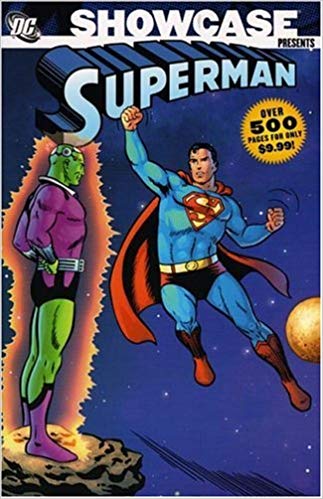
Showcase Presents Superman volume 1


By Otto Binder, Jerry Coleman, Bill Finger, Jerry Siegel, Robert Bernstein, Alvin Schwartz, Wayne Boring, Al Plastino, Curt Swan, Dick Sprang, Kurt Schaffenberger & various (DC Comics)
ISBN: 978-1-4012-0758-8

Although we all think of Jerry Siegel & Joe Shuster’s iconic creation as the epitome of comicbook creation, the truth is that very soon after his launch in Action Comics #1 he became a multimedia star and far more people have seen or heard the Man of Steel than have ever read him – and yes, that does include the globally syndicated newspaper strip.

By the time his 20th anniversary rolled around he had become a mainstay of radio, starred in a series of astounding animated cartoons – plus two movies – and just ended his first smash live-action television serial.

In his future were many more (Superboy, Lois & Clark and Smallville, Krypton et al), a stage musical, a franchise of stellar movies and an almost seamless succession of TV cartoons beginning with The New Adventures of Superman in 1966 and continuing ever since. Even Krypto got in on the small-screen act…

It’s no wonder then that the tales from this Silver Age period should be so draped in the wholesome trappings of Tinseltown – even more so than most of celebrity-obsessed America. It didn’t hurt that editor Whitney Ellsworth was a part-time screenwriter, script editor and producer as well as National DC’s Hollywood point man.

However, that’s not all there is to these gloriously engaging super-sagas culled from Action Comics #241-257 and Superman #122-133, reliving the period June 1958 to November 1959 in crisp, clean black and white in this first economical Showcase Presents collection.

I’d love to plug more modern, full-colour archival editions here, but for some reason DC’s powers-that-be have been woefully slow in gathering this material – and the equally superb all-ages Superboy stuff. I’m not getting any younger but I still eagerly wait in hope – and so should you…

In the meantime, then…

By the mid-1950s The Man of Tomorrow had settled into an ordered existence. Nothing could really hurt him, nothing would ever change, and thrills seemed in short supply. With the TV show cementing the action, writers increasingly concentrated on supplying wonder, intrigue, imagination and, whenever possible, some laughs as well.

The adventure begins here with the lead tale from Action Comics #241 and ‘The Key to Fort Superman’: a fascinating, clever puzzle-play guest-featuring Batman, written by Jerry Coleman and illustrated by Wayne Boring & Stan Kaye, wherein an impossible intruder vexes the Man of Steel in his most sacrosanct sanctuary, after which Superman #122 (July, 1958) proffers 3 yarns by veteran scripter Otto Binder, beginning with ‘The Secret of the Space Souvenirs’ (illustrated by Al Plastino) as temporary madness seems to grip the Man of Steel while he gathers artefacts for a proposed time-capsule. ‘Superman in the White House’ is a fanciful dream by Jimmy Olsen also drawn by Plastino whilst the closing Boring/Kaye bamboozler finds the hero investigating an outbreak of super-powers at a US military base in ‘The Super-Sergeant’…

That same month Binder & Plastino introduce both the greatest new villain and most expansive new character concept the series had seen in years with The Super-Duel in Space’ Action Comics #242) wherein an evil alien scientist named Brainiac tries to add Metropolis to his collection of miniaturised cities in bottles.

As well as a titanic tussle in its own right, this tale completely changed the mythology of the Man of Steel, by introducing Kandor, a city full of Kryptonians who had escaped the planet’s destruction when Brainiac abducted them. Although Superman rescues his fellow survivors, the villain escapes to strike again, and it would be years before the hero could restore the Kandorians to their true size.

Superman #123 (August 1958) featured ‘The Girl of Steel’ by Binder, Dick Sprang & Kaye which tested the potential of a distaff Supergirl as part of a 3-chapter yarn involving a magic wishing totem, which tragically segued into ‘The Lost Super-Powers’ before granting the hero’s greatest dream and facilitating ‘Superman’s Return to Krypton’.

Action #243 (Binder & Boring) sees Superman mysteriously transformed into a beast in ‘The Lady and the Lion’, after which Superman #124 provides the intriguing menace of ‘The Super-Sword’ by Coleman & Plastino, Binder & Kurt Schaffenberger’s delightful desert island drama wherein Lois Lane becomes ‘Mrs. Superman’ and Clark Kent‘s investigation of construction industry corruption which compels him to become ‘The Steeplejack of Steel’ (Binder, Boring & Kaye).

Curt Swan pencilled Binder’s ‘Super-Merman of the Sea’ (inked by Kaye) in Action #244: a canny mystery wherein the Man of Steel abandons the surface world for an alien aquatic princess, before Boring & Kaye delineate Binder’s compelling thriller ‘The Shrinking Superman!’: featuring an insidious menace from the Bottle City of Kandor…

‘Lois Lane’s Super-Dream’ (Coleman & Schaffenberger) led in Superman #125 (October/November 1958) with another potentially offensive and certainly sexist parable wherein the plucky news-hen learns a salutary lesson about powers and responsibility, whilst ‘Clark Kent’s College Days’ (illustrated by Plastino) opened an occasional series of Untold Tales of Superman: revealing just how, when and why Superboy became the Man of Tomorrow, before Boring & Kaye conclude Coleman’s hat-trick with ‘Superman’s New Power’ as the hero gained new and incomprehensible abilities with catastrophic consequences…

Action #246 featured ‘Krypton on Earth!’ (Binder, Boring & Kaye) as a trip to tourist attraction “Krypton Island” reveals a crafty criminal scam, and #247 presented ‘Superman’s Lost Parents!’ (Binder & Plastino), wherein a criminal scheme to reveal the hero’s secret identity prompts an extreme face-saving solution. Superman #126 had Binder, Boring & Kaye reveal ‘Superman’s Hunt for Clark Kent’: a thrilling tale of amnesia and deduction whilst ‘The Spell of the Shandu Clock’ (Coleman, Boring & Kaye), provides spooky chills and clever ploys to outwit a malevolent mastermind and ‘The Two Faces of Superman’ (Coleman & Schaffenberger) again saw “conniving” Lois learn an – apparently – much-needed lesson in humility.

Action #248 (January 1959) was a rare contribution from Bill Finger, illustrated by Boring & Kaye wherein the Caped Kryptonian becomes ‘The Man No Prison Could Hold!’ to topple a war criminal tyrant, before Superman #127 opened with another Untold Tale of Superman, ‘When There Was No Clark Kent!’ (Coleman, Swan & Kaye) as an accident temporarily deprives the hero of his treasured alter ego, after which Coleman, Boring & Kaye expose ‘The Make-Believe Superman’ as a depressed dad tries to impress his son with a most preposterous fib. The issue closed with the debut of another hugely popular character in ‘Titano the Super-Ape!’. The chimpanzee who is transformed into a giant ape with Kryptonite vision was one of the most memorable “foes” of the period, courtesy of Binder, Boring & Kaye’s sublime treatment combining action, pathos and drama to superb effect.

‘The Kryptonite Man!’, by Binder & Plastino in Action #249, sees Lex Luthor deliberately irradiate himself with Green K to avoid capture, but his evil genius proves no match for our hero’s sharp wits, used with equal aplomb in ‘The Eye of Metropolis!’ (Finger & Boring) as a prominent TV journalist seeks to expose Superman’s secret identity in #250.

Finger scripted the entirety of #128 as ‘Superman versus the Futuremen’ (limned by Boring & Kaye) and ‘The Secret of the Futuremen’ finds the Metropolis Marvel framed for heinous crimes and hijacked to the impossible year of 2000AD, before outwitting his abductors and returning in time to encounter ‘The Sleeping Beauty from Krypton!’ – actually Lois in another hare-brained scheme to trap her beloved into marriage, and deliciously illustrated by the unmistakable and fiendishly whimsical Kurt Schaffenberger.

‘The Oldest Man in Metropolis!’ – Robert Bernstein & Plastino – reveals how an unfortunate lab accident ages Superman many decades overnight in Action#251, whilst Superman #129 (May 1959) reveals ‘The Ghost of Lois Lane’ (Coleman, Boring & Kaye) to be anything but before Binder & Plastino’s ‘Clark Kent, Fireman of Steel!’ depicts the reporter’s aggravating and hilarious “luck” as a temporary fire-fighter. Another major debut follows before introducing the bewitching mermaid Lori Lemaris in ‘The Girl in Superman’s Past’ – a moving Untold Tale of Superman (from Finger & Boring) which again refined the Man of Steel’s intriguing early life.

From the same month, Action Comics #252 would have been significant enough merely for introducing the threat of John Corben, a criminal whose crushed skeleton is replaced by a robot body and Kryptonite heart to become ‘The Menace of Metallo!’ (Bernstein & Plastino), but a new back-up strip also began in that issue which utterly revolutionised the Man of Tomorrow’s ongoing mythology.

‘The Supergirl from Krypton!’ introduced Kal-El‘s cousin Kara Zor-El in another captivating, groundbreaking yarn by Binder & Plastino. The Maid of Might would occupy the rear of Action and alternate covers for a decade and more to come, carving her own unique legend…

Issue #253 featured ‘The War Between Superman and Jimmy Olsen!’ by Alvin Schwartz, Swan & Kaye as an alien presence gives the boy reporter super-powers and a mania to conquer the world whilst Superman #130 presented ‘The Curse of Kryptonite!’ (Binder & Plastino), wherein the Action Ace relives his past experiences with the lethal mineral; ‘The Super-Servant of Crime!’ (Bernstein, Swan & John Sikela) which finds the hero turning the tables on a petty crook who thinks he’s fooled the Man of Tomorrow, and ‘The Town That Hated Superman!’ (Binder, Boring & Kaye) which happy hamlet has outlawed the hero. He simply has to know why…

‘The Battle with Bizarro!’(Action #254, by Binder & Plastino) re-introduces an imperfect duplicate super-being who had initially appeared in a well-received Superboy story (#68, from the previous year), courtesy of Luthor’s malfunctioning duplicator ray.

Even way back then high sales trumped death and so popular was the fatally-flawed character that the tale was continued over two issues, concluding with ‘The Bride of Bizarro!’ in #255 – an almost unheard-of luxury back then. Here that bombastic, traumatic conclusion is separated by the contents of Superman #131, which firstly reintroduces a long-vanished pestiferous annoyance with ‘The Menace of Mr. Mxyzptlk!’ by Coleman & Plastino, before Lois Lane is granted a tantalising glimpse of ‘Superman’s Future Wife’ (Bernstein & Schaffenberger) and ‘The Unknown Super-Deeds’ reveals hitherto hidden connections with the Daily Planet staff long before Superboy left Smallville in another Untold Tale… from Binder & Plastino.

Action #256 seemingly unleashes ‘The Superman of the Future’ (Binder, Swan & Kaye) whilst in Superman #132 (October 1959) Batman and the projections of a super-computer show what might have happened had Superman grown up on an unexploded Krypton in the 3-chapter epic ‘Superman’s Other Life’, ‘Futuro, Super-Hero of Krypton!’ and ‘The Superman of Two Worlds!’ by Binder, Boring & Kaye.

Action #257 reveals Clark Kent as ‘The Reporter of Steel!’ after he is hit by a ray from mad scientist Luthor in a cunning yarn by Binder, Boring & Kaye, before the contents of Superman #133 brings to a close this potent premier compendium with ‘The Super-Luck of Badge 77’ (Binder & Plastino) with the reporter trying his hand as a beat cop, before we can enjoy the first new tales by co-creator Jerry Siegel in nearly a decade: ‘How Perry White Hired Clark Kent’ (art by Plastino) and the wryly light-hearted ‘Superman Joins the Army!’ illustrated by Boring & Kaye.

Superman has proven to be all things to all fans over his decades of existence and with the character seemingly undergoing almost constant radical overhaul nowadays, these timeless tales of charm and joy and wholesome wit are more necessary than ever: not just as a reminder of great memories past but also as an all-ages primer of wonders still to come…
© 1959-1963, 2005 DC Comics. All Rights Reserved.

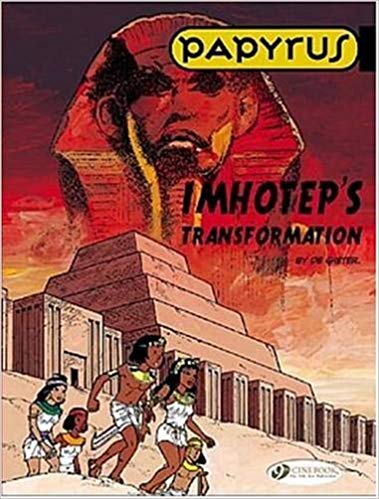
Papyrus volume 2: Imhotep’s Transformation


By Lucien De Geiter, coloured by Colette De Geiter: translated by Luke Spear (Cinebooks)
ISBN: 978-1- 905460-50-2

Once you get a certain taste in your mind you just can’t stop – well I can’t – so here’s another all-ages Euro-classic saga just not available through American funnybooks these days – although you can now get it digitally…

British and European comics have always been happier with historical strips than our cousins across the pond (a pugnacious part of me wants to say that’s because we have so much more past to play with – and yes, I know they’re responsible for Prince Valiant, but it’s an exception, not a rule) and our Franco-Belgian brethren in particular have made an astonishing art form out of days gone by.

The happy combination of past lives and world-changing events blended with drama, action and especially broad humour has resulted in a genre uniquely suited to beguiling readers of all ages and tastes. Don’t take my word for it – just check out Asterix, Adèle Blanc-Sec, The Towers of Bois-Maury, Iznogoud or Thorgal to name the merest few which have made it into English, or even our own much missed classics such as Olac the Gladiator, Dick Turpin, Heros the Spartan or Wrath of the Gods …all long overdue for collection in mass market album form and on the interweb-tubes….

Papyrus is the spectacular magnum opus of Belgian cartoonist Lucien de Gieter. It began in 1974 in the legendary weekly Le Journal de Spirou, running to 35 albums, plus a wealth of merchandise, a television cartoon show and a video game.

The plucky “fellah” (look it up) was blessed by the gods and gifted with a magic sword courtesy of the daughter of crocodile-headed Sobek. His original brief was to free supreme Horus from imprisonment in the Black Pyramid of Ombos and thereby restore peace to the Two Kingdoms. More immediately however the lad was also charged with protecting Pharaoh’s wilful and high-handed daughter Theti-Cheri – a princess with an unmatchable talent for finding trouble…

De Gieter was born in 1932 and, studied at Saint-Luc Art Institute in Brussels, before going into industrial design and interior decorating. He made the logical jump into sequential narrative in 1961, first through ‘mini-récits’ inserts (fold-in, half-sized-booklets) for Spirou, of his jovial little cowboy Pony, and later by writing for established regulars as Kiko, Jem, Eddy Ryssack and Francis.

He then joined Peyo’s studio as inker on Les Schtroumpfs – AKA The Smurfs – and took over the long-running newspaper strip Poussy.

In the mid-1960s he created South Seas mermaid fantasy Tôôôt et Puit even as Pony was promoted to the full-sized pages of Spirou, so De Gieter deep-sixed his Smurfs gig to expand his horizons producing work for Le Journal de Tintin and Le Journal de Mickey.

From 1972-1974 he assisted cartooning legend Berck on Mischa for Germany’s Primo, whilst putting the finishing touches to his new project. This creation would occupy his full attention – and delight millions of fervent fans – for the next 40 years.

The annals of Papyrus encompass a huge range of themes and milieus: blending boys-own adventure with historical fiction and interventionist mythology, gradually evolving from traditionally appealing “Bigfoot” cartoon content towards a more realistic, dramatic and authentic iteration. Throughout, these light fantasy romps depict a fearlessly forthright boy fisherman favoured by the gods as a hero of Egypt and friend to Pharaohs.

Imhotep’s Transformation was the second Cinebook translation (and 8th yarn, originally released in 1985 as La Métamorphose d’Imhotep): opening with our hero and his one-legged friend Imhotep (no relation) paddling a canoe through the marshes of the Nile.

The peaceful idyll is wrecked when Theti-Cheri and her handmaidens hurtle by in their flashy boat, but the boys don’t mind as they have a message for the princess.

The new holy statue of her father has arrived from the Priests of Memphis and the daughter of Heaven is required at the ceremony to install it at the pyramid of Saqqara before the annual “Heb Sed” King’s Jubilee.

As the girls and boys race back, an old peasant is attacked by a crocodile. Diving after him, Papyrus wrestles the reptile away and is about to kill it when Sobek appears, beseeching him to spare it.

On the surface Theti-Cheri and her attendants are ministering to the aged victim and the princess can’t help noticing how he bears an uncanny resemblance to her dad…

By the time they all reach the pyramid, the monumental task of hauling the statue into place is well under way, but suddenly blood begins pouring out of the monolith’s eyes. Terrified workers panic and the colossal effigy slips, crashing to destruction. The populace are aghast and murmurs of curses and ill omens abound…

Rather than running away, Imhotep heads for the rubble and discovers the statue’s head is hollow. Moreover, inside there is a dead dwarf and a smashed flask which had held blood…

Papyrus is in the royal compound where the recent events have blighted the anticipation of the court. During Heb Sed, the Pharaoh has to run around the sacred pyramid three times and fire his bow at the four corners of the kingdoms to prove his fitness to rule, but now it appears the gods have turned against their chosen emissary on Earth…

Papyrus is not so sure and when he tries to speak to a royal server the man bolts. Giving chase, the lad is in time to prevent the attendant’s murder, but not his escape.

And then a cry goes up: Pharaoh has been poisoned…

Knowing there is no love lost between the Memphis Priests of Ptah and the loyal Theban clerics doctoring the fallen king, Papyrus warns of a possible plot, but has no proof. What is worse, Chepseska, leader of the Memphis faction, is of royal blood too and will inherit if Pharaoh is unable to complete the Heb Sed ritual…

As loyal physicians and priests struggle to save their overlord’s life, Theti-Cheri remembers the old man in the swamp. If only the crocodile bite has not left him too weak to run…

The doughty dotard is willing to try and also knows of a wise woman whose knowledge of herbs can cure Pharaoh, but ruthless Chepseska is on to the kids’ ploy and dispatches a band of killers to stop Papyrus and Imhotep.

The gods, however, are behind the brave lads and after the assassins fall to the ghastly judgement of Sobek, the boys rush an antidote back to Saqqara, only to fall into the lost tomb of Great Imhotep, first Pharaoh, builder-god and divine lord of the Ibis.

With time running out for his distant descendent, the resurrected ruler rouses himself to administer justice for Egypt and inflict the punishment of the gods upon the usurpers…

This is an amazing exploit to thrill and astound fans of fantastic fantasy and bombastic adventure. Papyrus is a brilliant addition to the family-friendly pantheon of continental champions who marry heroism and humour with wit and charm, and anybody who has worn out those Tintin or Asterix volumes would be wise beyond their years in acquiring these classic chronicles tales.

…And Cinebook would be smart to keep on translating these magical yarns, too…
© Dupuis, 1985 by De Gieter. All rights reserved. English translation © 2008 Cinebook Ltd.