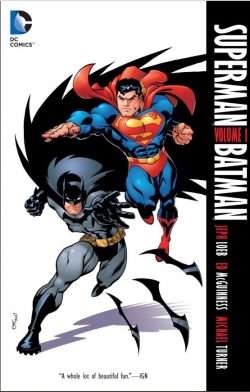
Superman/Batman volume 1 (New edition)


By Jeph Loeb, Ed McGuinness & Dexter Vines, Pat Lee & Dreamwave Productions, Michael Turner & Peter Steigerwald & various (DC Comics)ISBN: 978-1-4012-4818-5 (TPB)

Win’s Christmas Gift Recommendation: Compelling Comics Cavortings… 8/10

For many years Superman and Batman worked together as the “World’s Finest” team. They were best friends and the pairing made perfect financial sense as National/DC’s most popular heroes could cross-sell their combined readerships.

When the characters were redefined for the post-Crisis 1980s, they were remade as suspiciously respectful co-workers who did the same job but deplored each other’s methods and preferred to avoid contact whenever possible – except when they were in the Justice League (but for the sake of your sanity don’t fret that right now!).

After a few years of this new status quo the irresistible lure of Cape & Cowl Capers inexorably brought them together again with modern emotional intensity derived from their incontestably differing methods and characters.

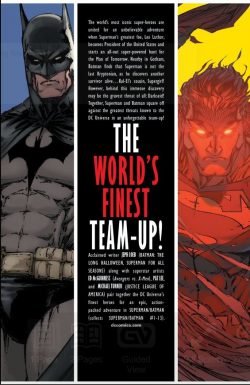
In this rocket-paced, post-modern take on the relationship, they have reformed as firm friends for the style-over-content 21st century, and this is the story of their first outing together. Outlawed and hunted by their fellow heroes, Superman finds himself accused of directing a continent-sized chunk of Kryptonite to crash into Earth, with Batman accused of aiding and abetting…

To save Superman, the world and their own reputations they are forced to attempt the overthrow of the United States President himself. Of course, said President is the unspeakably evil Lex Luthor. Back in 2003 he was considered the least likely leader America could ever elect…

I deeply disliked this tale when I first read it: Plot is reduced to an absolute minimum in favour of showy set-pieces, previously established characterisation often hostage to whatever seems the easiest way to short-cut to action (mortal foes Captain Atom and Major Force work together to capture our heroes because President Luthor tells them to?) but after all these years it’s worthy of another look and I’m not ashamed to say that I’ve changed my opinion somewhat…

This paperback (and eBook) compilation collects issues #1-13 of the hip turn of the century reboot Superman/Batman (and includes a vignette from Superman/Batman Secret Files 2003) collectively spanning October 2003 to October 2004)

The action – written by Jeph Loeb and illustrated by Ed McGuiness & Dexter Vines – opens with ‘World’s Finest’ as the Dark and Light Knights follow telling leads in separate cases back to shape-shifting cyborg John (Metallo) Corben, discovering evidence to suggest that the ruthless cyborg might have been the at-large-for-decades shooter in the still unsolved double murder of Thomas and Martha Wayne…

Even that bombshell seems inconsequential after the mechanoid monster shoots Superman in the chest with a kryptonite bullet before burying the stunned duo under tons of Earth in a Gotham graveyard…

Meanwhile at the Pentagon, President Lex is informed that a toxically radioactive lump of Krypton the size of Australia is on a collision course with Earth. Implausibly adopting (and foreshadowing) the “Fake News” disinformational line that Superman has summoned it, the Federal Government issues an arrest warrant for the Man of Steel and convenes a metahuman taskforce to bring him in…

Escaping certain doom thanks to Batman’s skill and unflappable nerve, the blithely unaware heroes reach medical help in the Batcave in ‘Early Warning’, only to be attacked by an older version of Superman, determined to prevent them making a mistake that will end life on Earth…

After a massive nuclear strike (somehow augmented by embargoed Boom Tube technology from hell-world Apokolips), Luthor overrules Captain Atom’s qualms about the mission and orders his anti-Superman squad to apprehend their target wherever he might be hiding.

The President then goes on television to blame the alien for the impending meteor strike and announces a billion-dollar Federal bounty on the Action Ace…

Man of Tomorrow and Man of Darknight Detective respond by direct assault in ‘Running Wild’, hurtling towards Washington DC only to be ambushed en route by a greed-crazed army of super-villains and mind-controlled heroes before Atom’s group – Green Lantern John Stewart, Black Lightning, Katana, Starfire, Power Girl and certified quantum psychopath Major Force – join the attack…

As the combatants ‘Battle On’, in the Oval Office even fanatical civil servant Amanda Waller – commander of covert Penal Battalion the Suicide Squad – begins to realise something is wrong with the President.

For a start, his behaviour is increasingly erratic, but the real clue is that he is juicing himself with a kryptonite-modified version of super-steroid venom…

The blistering battle between the outlawed heroes and Atom’s unit extends as far as Japan, (where the Cape & Cowl Crusaders are secretly organising a last-ditch solution to the imminent Kryptonite continent crash) before Major Force begins to smell a rat and realises some of his team are actually working with Superman and Batman.

Military martinet Captain Atom is not one of them, but eventually even he is made to see reason – only moments before the deranged Major goes ballistic and nearly turns Tokyo to ashes…

Using his energy-absorbing powers, Atom prevents the holocaust, but the monumental radiation release triggers his “temporal safety-valve” and the silver-skinned soldier materialises in a future where Earth is a barren cinder and only an aged, tragic, broken Superman resides…

Meanwhile in the present, the Presidential Pandemonium has prompted the venerable Justice Society of America to step in; despatching Captain Marvel and Hawkman to apprehend the fugitive Superman and Batman.

Apparently successful, the operation triggers a back-up team (Supergirl, Nightwing, Steel, Superboy, Natasha Irons, Robin, Huntress, Batgirl and even Krypto) who invade the White House only to be defeated by Luthor himself, high on K-Venom and utilising Apokolyptian technology in ‘State of Siege’…

With extinction only moments away and a deranged President Luthor on the loose, Superman and Batman prepare to employ their eleventh-hour suicidal salvation machine but are caught off-guard when a most unexpected substitute ambushes them to pilot the crucial mission in ‘Final Countdown’…

In so many ways this yarn is everything I hate about modern comics. The story length is artificially extended to accommodate lots of guest stars and superfluous fighting, whilst large amounts of narrative occur off-camera or between issues, presumably to facilitate a faster, smoother read.

On the plus side, however, is the fact that I’m an old fart. There is clearly a market for such snazzy, souped-up, stripped down, practically deconstructed comic fare. And if I’m being completely honest, there is a certain fizz and frisson to non-stop, superficial all-out action – especially when it’s so dynamically illustrated.

Public Enemies looks very good indeed and, if much of the scenario is obvious and predictable, it is big and immediate and glossy like a summer blockbuster movie is supposed to be.

The epic is followed by a stand-alone tale starring Robin – the Tim Drake version – and semi-Kryptonian clone Conner Kent.

‘Protégé’ sees the assistants – don’t call them sidekicks – despatched to Japan to end the threat of a new Toyman. This particular giggling genius is a lethally brilliant kid and their off-the-wall solution to his antics is both smart and effective…

Next follows a tale and situation that only comics could conceive.

For decades DC really couldn’t make up their minds over Supergirl. I’ve actually lost count of the number of different versions that have cropped up over the years, and I’ve never been able to shake the queasy feeling that above all else she’s a concept that was cynically shifted from being a way to get girls reading comics to one calculated to ease young male readers over that bumpy patch between sporadic chin-hair outbreaks, voice-breaking and that nervous period of hiding things under your mattress where your mum never, never ever looks…

After a few intriguing test-runs the first true Girl of Steel debuted as a future star of the ever-expanding Superman pocket universe in Action Comics #252 (May 1959). Superman’s cousin Kara Zor-El had been born on a city-sized fragment of Krypton, hurled intact into space when the planet exploded. Eventually Argo City turned to Kryptonite like the rest of the detonated world’s debris and her dying parents, observing Earth through their vision-scopes, sent their daughter to safety as they apparently perished.

Landing on Earth, she fortuitously met Superman who created the identity of Linda Lee and hid her in an orphanage whilst she learned of her new world and powers in secrecy and safety.

Her popularity waxed and waned over the years until she was earmarked for destruction as one of the attention-grabbing deaths during Crisis on Infinite Earths.

However, after John Byrne successfully rebooted the Man of Steel, non-Kryptonian iterations began to appear – each with her own fans – until early in the 21st century the company Powers-that-Be decided the real Girl of Steel should come back… sort of…

Thus, this visually intoxicating version (from Superman/Batman #8-13) resets to the original concept and has a naked blonde chick arrive on a colossal Kryptonite meteor, claiming to be Superman’s cousin…

Written by Loeb with captivating art by Michael Turner & Peter Steigerwald, the action commences in ‘Alone’, as a quarantined Superman chafes at enforced detention, the Dark Knight explores a section of the meteor submerged in Gotham Bay.

The JLA have all been active, clearing away the deadly fragments, but this last one is most disturbing. As Batman quickly grasps, it’s a ship, but its single passenger is now missing…

Soon the Gotham Guardian is tracking a wave of destruction caused by a seemingly confused teenaged girl with incredible powers and only Superman’s unwise early intervention stops the mounting carnage.

Their subsequent investigations reveal the comely captive to have all the Man of Tomorrow’s abilities and she claims – in fluent Kryptonian – to be the daughter of his long-dead uncle Zor-El…

The mystery further unfolds in ‘Visitor’ as a deeply suspicious Batman and ecstatic Superman continue their researches, arguing their corners as the most powerful girl on Earth becomes increasingly impatient. Fuelling the Dark Knight’s concern is superdog Krypto’s clear and savage hostility to the newcomer and Kara’s convenient claim that she has amnesia…

Then as Clark Kent endeavours to acclimatise his cousin to life on Earth, on the hellish world of Apokolips vile Granny Goodness and her Female Furies are ordered by ultimate evil space-god Darkseid to acquire the pliable naive newcomer…

Before they can strike, however, an attack comes from an unexpected source, as former ally Harbinger, ruthless hunter Artemis and beloved ally Wonder Woman ambush the Kryptonians. …

Princess Diana has acted arbitrarily but from absolute necessity: kidnapping Kara and bringing her to the island home of the Amazons to be trained in the use of her powers as a ‘Warrior’.

Superman’s growing obsession has rendered him unable to see her potential for destruction, despite a cryptic message on her space ship from Zor-El, and Wonder Woman chose to strike first and ask later…

With tempers barely cooled, Dark Knight and Action Ace are invited to observe Kara’s progress weeks later, just as the tropical paradise is assaulted by an army of artificial Doomsdays manufactured on Apokolips…

The wave of slaughter is a feint, but by the time the rampaging horrors are all destroyed, the Furies have done their work, slaughtering Kara’s only friend and stealing away the Kryptonian kid…

In ‘Prisoner’, DC’s superheroic high trinity enlist the aid of Apokolyptian émigré Big Barda and stage a devastating rescue mission to Darkseid’s homeworld, but not before the Lord of Evil apparently twists the innocent Girl of Steel into his tool: making her a ‘Traitor’ to the living…

The Master of Apokolips has never faced a foe as adamant as Batman and the quartet are unexpectedly victorious, but after returning Kara to Earth and announcing her as the new Supergirl, the heroes discover that they are not safe or secure, and in ‘Hero’ Darkseid horrifyingly returns to exact his ultimate revenge…

For me, the most intriguing aspect of this sometimes overly-sentimental tale is Batman’s utter distrust and suspicion of Kara as she is hidden from the world while she assimilates, but there’s plenty of beautifully rendered action – plus oodles of lovingly rendered girl-flesh and titillating fetish outfits jostling for attention amidst the lavish fight-scenes and interminable guest-cameos, should that be to your tastes – and enough sheer spectacle to satisfy any Fights ‘n’ Tights fans.

Even now the goods things have not been exhausted as Superman/Batman Secret Files 2003 provides a charming peek into the past with ‘When Clark met Bruce’ (“A tale from the days of Smallville”) in which bucolic 2-page snippet, Loeb & Tim Sale effectively tease us with the question of what might have been, had the go happy-go-lucky Kent boy actually got to have a play-date with that morose, recently orphaned rich kid from Gotham City…

Filling out the experience are pictorial fact-file on Superman, Batman,

President Lex Luthor, Talia and Metallo, plus a full cover gallery by McGuiness & Vines, Turner & Steigerwald and Jim Lee & Scott Williams and studies and design sketches for Supergirl.

Full of flash and dazzle this mighty tome might well be the kind of Fights ‘n’ Tights thrill you’re looking for this yule season.
© 2003, 2004, 2014 DC Comics. All Rights Reserved.

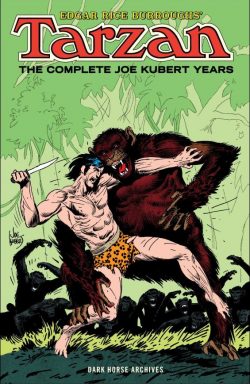
Edgar Rice Burroughs’ Tarzan: The Complete Joe Kubert Years


By Joe Kubert with Burne Hogarth, Hal Foster, Frank Thorne, Robert Kanigher, Russ Heath & various (Dark Horse)
ISBN: 978-1-61655-982-3 (PB)

Win’s Christmas Gift Recommendation: Captivating Classic Comics Entertainment… 9/10

Soon after first publication in 1912 Tarzan of the Apes became a multi-media sensation and global brand. More novels and many movies followed; a comic strip arrived in 1929, followed by a radio show in 1932 with the Ape-Man inevitably carving out a solid slice of the comicbook market too, once that industry was firmly established.

Western Publishing were a big publishing and printing outfit based on America’s West Coast, rivalling and frequently surpassing DC and Marvel at the height of their powers. They specialised in licensed properties and the jewels in their crown were all the comics starring the Walt Disney and Warner Brothers cartoon characters.

The publishers famously never capitulated to the wave of anti-comics hysteria that resulted in the crippling self-censorship of the 1950s. Dell Comics – and latter imprints Gold Key and Whitman – never displayed a Comics Code Authority symbol on their covers. They never needed to…

Dell also sought out other properties like movie or newspaper strip franchises, and would become inextricably associated with TV adaptations once the small screen monopolised modern homes.

In 1948 Dell produced the first all-new Tarzan comicbook. The newspaper strip had previously provided plenty of material for expurgated reprint editions until Dell Four Color Comic #134 (February 1947).

This minor milestone featured a lengthy, captivating tale of the Ape-Man scripted by Robert P Thompson – who wrote both the Tarzan radio show and aforementioned syndicated strip – with art by the legendary Jesse Marsh.

Marsh & Thompson’s Tarzan returned with two further tales in Dell Four Color Comic #161, cover-dated August 1947. This was a frankly remarkable feat: Four Colour was a catch-all umbrella title that showcased literally hundreds of different licensed properties – often as many as ten separate issues per month – so such a rapid return meant pretty solid sales figures.

Within six months the bimonthly Tarzan #1 was released (January/February 1948), beginning an unbroken run that only ended in 1977, albeit by a convoluted route…

After decades as solid Whitman staples, licensing of Edgar Rice Burroughs properties was transferred to DC – not just Tarzan and his extended family, but also fantasy pioneers John Carter of Mars, Carson of Venus, Pellucidar and others – with the new company continuing the original numbering.

Tarzan #207 had an April 1972 cover-date and the series carried on until February 1977 and issue #258. From then on Marvel, Malibu and Dark Horse extended the jungle Lord’s comicbook canon…

The early 1970s were the last real glory days of National/DC Comics. As they slowly lost market share to Marvel, they responded by producing controversial and landmark superhero material, but their greatest strength lay – as it always had – in the variety and quality of its genre divisions.

Mystery and Supernatural, Romance, War and Kids’ titles remained strong or even thrived and the company’s eye for a strong brand was as keen as ever.

The Ape Man and his family had been a mainstay of Dell/Gold Key, as well as a global multi-media phenomenon, so when DC acquired rights they justifiably trumpeted it out, putting one of their top creators in sole charge of the legendary Ape-Man’s monthly exploits, as well as generating a boutique bunch of ERB titles in a variety of formats.

The DC incarnation premiered in a blaze of publicity at the height of a nostalgia boom and was generally well received by fans. For many of us, those years provided the definitive graphic Tarzan, thanks solely to the efforts of the Editor, publisher and illustrator who shepherded the Ape-man through the transition.

They were all the same guy: Joe Kubert.

Kubert was born in 1926 in rural Southeast Poland (which became Ukraine and might be Outer Russia by the time you read this). At age two his parents took him to America and he grew up in Brooklyn. According to his Introduction his earliest memory of cartooning was Hal Foster’s Tarzan Sunday strips…

Joe’s folks encouraged him to draw from an early age and the precocious kid began a glittering career at the start of the Golden Age, before he was even a teenager. Working and learning at the Chesler comics packaging “Shop”, MLJ, Holyoke and assorted other outfits, he began his close association with National/DC in 1943.

A canny survivor of the Great Depression, he also maintained outside contacts, dividing his time and energies between Fiction House, Avon, Harvey and All-American Comics, where he particularly distinguished himself on The Flash and Hawkman.

In the early 1950s he and old school chum Norman Maurer were the creative force behind publishers St. Johns: creating evergreen caveman Tor and launching the 3D comics craze with Three Dimension Comics.

Joe never stopped freelancing, appearing in EC’s Two-Fisted Tales, Avon’s Strange Worlds, Lev Gleason Publications & Atlas Comics until 1955 when, with the industry imploding, he took a permanent position at DC, only slightly diluted whilst he illustrated the contentious and controversial newspaper strip Tales of the Green Berets from 1965 to 1968. From then on, he split his time drawing Sgt. Rock and other features, designing covers and editing DC’s line of war comicbooks.

And then DC acquired Tarzan…

This monumental paperback archive (also available in digital formats) collects the entirety of his work with the Ape-Man: stories from Tarzan #207-235 (April-November 1972 to February/March 1975); a tour de force of passion transubstantiated into stunning comic art, with Kubert writing, illustrating and lettering.

Moreover, the vibrant colours in this epic re-presentation are based on Tatjana Wood’s original guides, offering readers a superbly authentic and immersive experience whether you’re coming fresh to the material or joyously revisiting a beloved lost time.

The only disconcerting things about this stellar compilation are the cover reproductions, which appear in all their iconic glory but manipulated to remove DC’s trademark logos. The mightiest force in the modern jungle is still Intellectual Property lawyers…

The tense suspense begins with Kubert’s Introduction to earlier collections before an adaptation of debut novel Tarzan of the Apes opens with a safari deep in the jungle.

A pretty rich girl is driving her white guide and native bearers at a ferocious pace as she desperately hunts for her missing father.

When a bronzed god bursts into view battling a panther, she watches aghast as human impossibly triumphs over killer cat and then pounds his chest whilst emitting an astounding scream. As the terrifying figure vanishes back into the green hell the girl’s questions are grudgingly answered by the old hunter who relates a legend he has heard…

‘Origin of Tarzan of the Apes’ reveals how, following a shipboard mutiny, John Clayton, Lord Greystoke and his wife Lady Alice are marooned on the African coast with all their possessions, including the vast library of books and Primers intended for their soon-to-be-born baby…

Against appalling odds, they persevered with Greystoke building a fortified cabin to shelter them from marauding beasts, especially the curious and savage apes which roam the region. Despite the birth of a son, eventually the jungle won and the humans perished, but their son was saved by a grieving she-ape who adopted the baby to replace her own recently killed “Balu”…

The ugly, hairless boy thrived under Kala’s doting attentions, growing strong but increasingly aware that he was intrinsically different. He only discovered the how and why after years of diligent effort: through sheer intellectual effort and the remnants of his father’s books and papers, Tarzan learned to read and deduced that he was a M-A-N…

The tale within a tale continues in ‘A Son’s Vengeance: Origin of the Ape-Man Book 2’ as the boy rises to prominence amongst his hirsute tribe and through imagination and invention masters all the beasts of his savage environment. Eventually a brutal, nomadic tribe of natives settle in the area and Tarzan has his first contact with creatures he correctly identifies as being M-E-N like him…

The new situation leads to the greatest tragedy of his life as a hunter of M’Bonga‘s tribe kills beloved, devoted Kala and Tarzan learns the shock of loss and overpowering hunger for revenge…

Issue #209 revealed how civilisation finally caught up with Tarzan as ‘A Mate For the Ape-Man: Origin of the Ape-Man Book 3’ saw him meet and save American Jane Porter, her elderly father and his own cousin…

Just as had happened years earlier, these unlucky voyagers were marooned by mutineers. Discovering John Clayton’s cabin, the castaways find the lost peer’s diary, which is of especial interest to William Clayton, the current Lord Greystoke. As tensions rise and humans die, Tarzan takes his golden-haired mate deep into the impenetrable verdure…

It all concludes neatly and tantalisingly in ‘Civilisation: Origin of the Ape-Man Book 4’ wherein the innately noble Tarzan returns Jane to her fiancé William just in time for the westerners to be rescued by Naval Officer Paul D’Arnot.

When the dashing French Lieutenant is captured and tortured by M’Bonga’s tribesmen, Tarzan rescues him and nurses him back to health. In return, the grateful sailor teaches him to speak human languages that up until that moment he could only read and write in…

By then, however, the navy vessel and saved souls have all sailed away, each carrying their own secrets with them…

With no other options, lovelorn Tarzan agrees to accompany D’Arnot back to civilisation. The eternal comrades eventually settle in Paris with Tarzan practically indistinguishable from other men…

Even today ‘Origin of the Ape-Man’ is still the most faithful adaptation of ERB’s novel in any medium: potent and evocative, fiercely expressive, a loving and utterly visceral true translation of the landmark saga.

Kubert’s intent was to adapt all 24 Burroughs novels and intersperse them with short, complete tales but the workload, coupled with his other editorial duties, was crippling. To buy some time #211 combined old with new as ‘Land of the Giants’ partially adapted and incorporated Don Garden & Burne Hogarth’s newspaper classic ‘Tarzan and the Fatal Mountain’: Sunday strip pages #582-595 which had originally ran from May 3rd to August 2nd 1942.

You can see that saga in all its uncut glory by tracking down Tarzan versus the Barbarians (Complete Burne Hogarth Comic Strip Library volume 2.

Here, however, a battle with crocodiles lands Tarzan in a lost valley where giant natives are persecuted by deformed, diminutive outworlder Martius Kalban; a sadist who hungers for the secrets of their prodigious size and strength. Even after gaining his dark desire, Kalban finds himself no match for the outraged Ape-Man…

It’s followed by ‘The Captive!’, a latter-day exploit beginning a run of yarns based on the short stories comprising ERB’s book Jungle Tales of Tarzan as the relationship between Ape-Man and elephants is explored with each saving the other from the ever-present threat of the hunters of M’Bonga…

The Jungle Tales reworkings continue with ‘Balu of the Great Apes’ as childhood friends of Tarzan becomes incomprehensibly aggressive after the birth of their first baby and this first astounding compilation ends with ‘The Nightmare’ as starving Tarzan steals and gorges on meat and drink from the native village.

The resultant food poisoning takes him on a hallucinogenic journey never to be forgotten: one that almost costs his life when he can no longer tell phantasm from genuine threat…

Following Kubert’s Introduction to Tarzan #215-#224, the pictorial wonderment resumes with another vintage visual treat as ‘The Mine!’ (Tarzan #215, December 1972) incorporates material originally seen in 1930s Sunday newspaper strips (by Hal Foster & George Carlin) embedded in an original tale by Kubert.

As previously deadline pressure again compelled Kubert to combine original with found material, detailing how the Ape-Man is captured by slavers and pressed into toil deep in the bowels of the earth for a sadistic mine owner.

Naturally, Tarzan soon chafes at enforced servitude and quickly leads a savage workers’ revolt to overturn and end the corporate bondage…

Issue #216 took another route to beating deadlines with old pal Frank Thorne pencilling Kubert’s script for ‘The Renegades’, leaving hard-pressed Joe to ink and complete the story of a murderous raid which wipes out a Red Cross mission.

Investigating the atrocity, Tarzan discovers the “maddened savages” responsible are actually white men masquerading as natives; stealing supplies for a proposed expedition to plunder a lost treasure vault. When he catches the culprits, Tarzan’s vengeance is terrible indeed…

‘The Black Queen!’ is an all-new, all-Kubert affair wherein the Jungle Lord almost saves a man from crocodiles. Acceding to the ravaged victim’s last wish, Tarzan then travels to his distant homeland and overturns the brutal regime of tyrannical Queen Kyra who rules her multicultural kingdom with whimsy, ingrained prejudice and casual cruelty…

The equally selfish choices of American millionaire tycoon Darryl T. Hanson blights his family as his search for ‘The Trophy’ decimates the fauna of Tarzan’s home and leads to a clash of wills and ideologies which can only end in tragedy…

With #219, Kubert began an epic 5-issue adaptation of ERB’s sequel novel The Return of Tarzan. It opens in Paris as the unacknowledged son of long-vanished Lord Greystoke tries to adapt to his new life as a civilised man of leisure.

One night his natural gallantry draws him to the side of a woman screaming for help and he is attacked by a gang of thugs. After easily thrashing the brigands he is astounded to find her accusing him of assault and simply bounds effortlessly away from the gendarmes called to the disturbance.

This entire trap has been engineered by a new enemy; Russian spy and émigré Nikolas Rokoff and his duplicitous toady Paulvitch…

The rightful heir to the Greystoke lands and titles silently stood aside and let his apparently unaware cousin William Cecil Clayton claim both them and the American Jane Porter after Tarzan rescued her from attacking apes in the jungle. Missing her terribly, Tarzan had chosen to make his own way in the human world beside French Naval Officer Paul D’Arnot.

In the course of his urbane progression, the Ape-Man had exposed the Russian cheating at cards to blackmail French diplomat Count De Coude and earned himself a relentless, implacable foe forever.

When Rokoff subsequently tries to murder Tarzan, the vile miscreant agonisingly learns how powerful his jungle-bred enemy is…

With physical force clearly of no use, Rokoff’s latest plan is to put the Ape-Man through a ‘Trial by Treachery’; manufacturing “evidence” that Tarzan is having an affair with the Comte’s wife. Once again, the civilised beast underestimates his target’s forthright manner of dealing with problems and is savagely beaten until he admits to the plot and clears the innocent woman’s name…

With news of Jane’s impending marriage to Clayton, Tarzan seeks to ease his tortured mind with action and the next chapter sees him travel to Algeria where, sponsored by the grateful, ashamed Count, he begins working for the French Secret Service in Sidi Bel Abbes, ferreting out a traitor in the turbulently volatile colony…

His hunt soon leads him to a likely turncoat and subsequent brutal battle with Arab agent provocateurs, but things start to turn his way after he liberates a dancing slave who is the daughter of a local sheik.

When word of Jane comes from D’Arnot, Tarzan throws himself even more deeply into his tasks and falls into another ambush organised by Rokoff. This time his ‘Fury in the Desert’ seems insufficient to his needs until his newfound friend the Sheik rides to the rescue…

The intrigue continues to unfold in ‘Return of the Primitive’ as Tarzan finally uncovers a link between Rokoff and the espionage at Sidi Bel Abbes. Mission accomplished, he is then posted to Capetown and aboard ship meets voyager Hazel Strong, a close friend of Jane’s who reveals the heiress had never forgotten her tryst with an Ape-Man.

Unable to watch Jane enter into a loveless marriage, Hazel took off on an ocean cruise…

The story rocks Tarzan’s mind, but not so completely that he fails to notice Rokoff is also aboard and murderously dogging his footsteps. This time, however, the Russian is properly prepared and that night the jungle man vanishes from the ship…

Rokoff’s act of assassination is a purely pyrrhic victory. Soon after reaching Capetown the villain insinuates himself into the Clayton wedding party but when their yacht’s boilers explode next morning, he, Hazel, Clayton, Jane and her father are left adrift in a lifeboat…

Tarzan, meanwhile, has survived being tumbled overboard and spent days swimming hundreds of miles. He now washes up on the same beach his parents were left upon decades ago. Staggering inland, he finds himself in the cabin his father built before being stolen and adopted by Kala the She-Ape.

John Clayton is forgotten, for fate has brought Tarzan home…

A man changed by his time amongst other men, the Jungle Lord instinctively saves a native warrior from certain death and is astonished to find himself declared chieftain of the noble Waziri tribe.

…And off the coast, a lifeboat filled with dying travellers espies land and wearily sculls towards a welcoming beach in the heart of primeval forests…

Revelling in his newfound status, popularity and freedom, Tarzan enquires about the fabulous jewelled ornaments of his new friends and learns of an incredible lost metropolis. Soon he is curiously journeying to ‘The City of Gold’ where he encounters debased, degenerate sub-men led by a gloriously beautiful Queen.

La is high priestess of forgotten Atlantean outpost Opar, but can barely control her subjects enough to allow the perfect specimen of manhood to escape to safety. Both she and Tarzan know they are destined to meet again…

Refusing to be cheated of their sacrifice, the bloodthirsty Oparian males search far into the jungle and soon encounter the Clayton yacht survivors. When the primitives attack the human strangers and carry off Jane, Rokoff shows his true colours, leaving William to his fate. This callous act also inadvertently clears the path for Tarzan to finally claim his inheritance and reunite with Jane…

All the Jungle Lord has to do is break back into Opar, save his one true love from ‘The Pit of Doom!’ and escape the wrath of jealous Queen La…

That mission accomplished, he and Jane return to the beach in time to witness William’s dying confession and accept the succession to the estates and title of Lord Greystoke…

The adaptation is followed by an original adventure codicil, seeing Tarzan rescue a beautiful maiden from attacking apes and discovering she is a messenger from La, who is in peril of her life…

In Opar another insurrection by the Beast Men has left the Queen imperilled by her subjects and threatened by a gigantic mutant whom she tearfully reveals is her sibling in ‘Death is My Brother!’ With no choice, Tarzan regretfully battles the nigh-mindless brute and proves to the insurgents that his wrath is greater than their malice…

A third and final text missive of fond reminiscences from Kubert regarding the material from Tarzan #225-235 then leads into original tale ‘Moon Beast’ which sees a mother and child brutally slaughtered and Tarzan captured: framed for the hideous crime by cunning medicine man Zohar.

When the vile trickster overreaches himself, the captive Ape-Man breaks free but still has to deal with the mutant brute Zohar employed to perpetrate the atrocity…

Kubert only produced the cover for #226 as the crushing deadline pressures finally caught up with him. The contents – not included here – featured a retelling of the Ape-Man’s origins by Russ Manning, taken from the Sunday newspaper strips of 15th November 1970-7th February 1971.

Back for #227, Joe took Tarzan out of his comfort zone as ‘Ice Jungle’ saw young native warrior Tulum endure a manhood rite at the top of a mountain. Also converging on the site for much the same reason is American trust-fund brat J. Pellington Stone III, determined to impress his father by bagging a legendary snow ape. Sensing impending doom, Tarzan follows them both and is proved correct in his assessment…

After single-handedly killing an immense Sabretooth tiger in an unexplored region of the continent, Tarzan is captured by pygmies intent on offering him as sacrifice to a mighty monster who has terrorised them for years. However, his ‘Trial By Blood!’ sees Jungle Lord cleverly outwit giant lizard and teach the tribal elders a valuable lesson in leadership, after which albino queen Zorina seeks to extend her power by making him her consort.

The Ape-Man wants nothing to do with ‘The Game!’, and, after the kingdom descends into savage civil war, sees ironic Fate deal the white queen a telling death blow…

With Tarzan #230 (April/May 1974), the title transformed into a sequence of 100-page giants, mixing new material with reprints of ERB characters and thematically-aligned stars from DC’s vast back-catalogue.

Leading off that issue was a brief all-Kubert vignette as ‘Tarzan’ saves a deer from a lioness. That neatly segues into ‘Leap into Death’ starring Korak, Son of Tarzan and written by Robert Kanigher, with Kubert pencilling and inks from Russ Heath.

Here the titanic teen nomad hunted for his stolen true love Meriem and the barbarian Iagho who had abducted her, before stumbling into a nest of aggressively paranoid bird-people who learn to respect his courage but still fly away with his lover…

The next issue featured the start of another-Kubert-adapted Burroughs novel: possibly the most intriguing conception of the entire canon.

‘Tarzan and the Lion Man Part One’ saw a movie company on location in the deep jungle. They are making a picture about a white man raised by animals who becomes undisputed master of all he surveys. The chain of coincidences grows more improbable as actor Stanley Obroski is a dead ringer for Tarzan… which probably explains why he is taken by savages set on torturing him to death…

Rescued by Tarzan, Stanley explains how the expedition was attacked, unaware exactly how much trouble his fellow actors are in. During Obroski’s absence, stand-in Rhonda Terry and starlet Naomi Madison are kidnapped by El Ghrennem‘s Arab bandits who believe the production’s prop map leads to an actual valley of diamonds…

When Tarzan find the rest of the film crew he is mistaken for Stanley and drawn into their search for the missing women. The plucky Americans have already made a mad dash for freedom, however, and Rhonda has been captured by creatures she simply cannot believe…

After a fascinating bonus section revealing Kubert’s ‘Layouts and Thumbnails’ for the opening chapter, ‘Tarzan and the Lion Man Part Two’ reveals Rhonda taken by apes who speak Elizabethan English, and made the subject of a fierce debate. Half of the articulate anthropoids want to take her to “God” whilst the other faction believes her a proper prize of their liege lord “King Henry VIII”…

After being briefly recaptured by El Ghrennem, Naomi too is taken by the talkative Great Apes. When Tarzan discovers the kidnapper’s corpses, he follows the trail up an apparently unscalable escarpment. Rescuing and returning Miss Madison to her surviving friends, “Stanley” then returns to ascend the stony palisade and discover an incredible pastoral scene complete with feudal village and English castle…

Tracking Rhonda, he enters the citadel and meets a bizarre human/ape hybrid calling himself God. The garrulous savant explains that once he was simply a brilliant Victorian scientist pursuing the secrets of life. When his unsavoury methods of procuring test-subjects forced him to flee England and relocate to this isolated region of Africa, he eventually resumed his experiments and transformed himself into a superior being and apes into fitting servants.

Now they have a society of their own – based on the history books he brought with him – and his experiments are nearing completion. Having already extended his life and vitality far beyond its normal span by experimenting upon himself, God is now ready to attain immortality and physical perfection. All he has to do is consume Tarzan…

Of course, the madman has no conception of his captive’s capabilities, and when the Ape-Man and Rhonda promptly vanish from their dungeon it sends the palace into turmoil and God into a paroxysm of insanity…

The chaos also prompts already ambitious apostate King Henry to begin a revolution to overthrow his creator. As ‘Tarzan and the Lion Man Part Three‘ opens, the war between Church and State is in full swing and Tarzan battles to rescue Rhonda whilst God’s castle becomes a flaming hell.

Losing her in the chaos Tarzan is forced into a hasty alliance with God, unaware that maniacal monarch Henry has taken her back to the jungles below the escarpment and into a region where God casts his scientific failures…

All too soon Henry is dead and Rhonda is facing beings even stranger than talking apes. Thankfully, ‘Tarzan and the Lion Man Part Four‘ (preceded by another fascinating Kubert Layout spread) sees the Ape-Man arrive in time to save her from incredible peril before returning her to the film party in the dazzling, tragic conclusion…

Kubert ended his close association with Tarzan in #235’s ‘The Magic Herb’. Here the jungle hero saves a couple from a crashed aeroplane and siblings Tommy and Gail urge him to help them find a legendary flower that might cure the man’s fatal ailment. However, something about them makes Tarzan deeply suspicious…

Nevertheless, he takes them to the primeval lost valley where it grows, only to be betrayed as the intruders frame him: throwing the jungle lord to the resident lizard men whilst fleeing with specimens that will make them millionaires in the outside world.

Sadly, the treacherous pair have completely misunderstood the powers of the plant and pay the ultimate price all betrayers must…

Wrapping up the astounding thrills and captivating artistry (splendidly remastered by Sno Cone Studious & Jason Hvam) are more revelatory treasures from ‘Joe Kubert’s Tarzan Sketchbook’ tracing the art process from page-roughs to competed page

Supplemented by Creator Biographies of Burroughs and Kubert, this tome is another unmissable masterpiece of comics creation and wild adventure no lover of the medium or fantasy fan can afford to be without.
Edgar Rice Burroughs’ The Complete Joe Kubert Years © 1972, 1973, 1974, 1975, 2005, 2016 Edgar Rice Burroughs, Inc. All rights reserved. Trademark Tarzan and Edgar rice Burroughs Inc. All rights reserved.

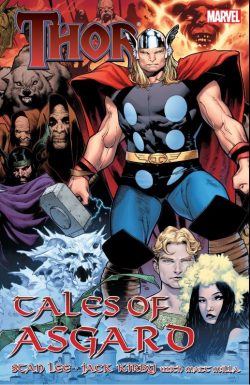
Thor: Tales of Asgard


By Stan Lee, Jack Kirby, George Roussos, Don Heck, Paul Reinman, Chic Stone, Vince Colletta & Bill Everett, with Matt Milla & various (Marvel)
ISBN: 978-0-7851-5189-0

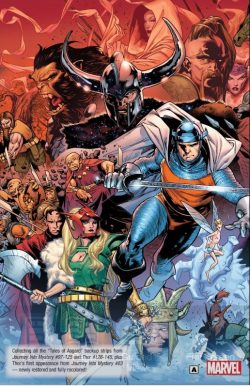
The Mighty Thor was the comic series in which Jack Kirby’s restless fascination with all things Cosmic was honed and refined through his dazzling graphics and captivating concepts. The King’s examination of space-age mythology began in a modest little fantasy/monster title called Journey into Mystery where – in the summer of 1962 – a tried-and-true comicbook concept (feeble mortal transformed into god-like hero) was revived by the fledgling Marvel Comics to add a Superman analogue to their growing roster of costumed adventurers.

That debut tale closes out this selection of mythic masterpieces collectively culled from Journey into Mystery #83, 98-125, and Thor #126 to 145 (August 1962 to October 1967), and available to you in trade paperback and digital formats and all fully recoloured and moodily remastered by hues-master Matt Milla.

Journey into Mystery #97 (October 1963) saw the launch of a spectacular back-up series to the ever-unfolding Thor sagas. Tales of Asgard – Home of the Mighty Norse Gods gave Kirby a vehicle to indulge his fascination with legends.

Initially adapting classic fables of the Elder Eddas but eventually with all-new material particular to the Marvel pantheon, the King built his own cosmos and mythology to underpin the company’s entire continuity. This first yarn, scripted by Lee and inked by George Bell (AKA old Golden Age collaborator George Roussos), outlined the origin of the world and the creation of the trans-dimensional World Tree Yggdrasil.

The next issue proclaimed ‘Odin Battles Ymir, King of the Ice Giants!’: a short, potent fantasy romp laying more groundwork for decades of cosmic wonderment to come, inked with brittle mastery by Don Heck.

The next peek at primordial prehistory details Odin’s war with ‘Surtur the Fire Demon’ and latterly (with Paul Reinman inking) crafted an exploit of the All-Father’s so different sons in ‘The Storm Giants – a Tale of the Boyhood of Thor’. As always, Lee scripted these increasingly influential comicbook histories…

JiM #101 shows Kirby & Roussos in epic form for another exuberant tale of the boy Thor. ‘The Invasion of Asgard’ sees the valiant lad fight a heroic rearguard action whilst introducing a host of future villainous mainstays such as Rime Giants and Troll King Geirrodur.

This is followed by a macabre Reinman-inked mood piece wherein ‘Death Comes to Thor!’, with the turbulent teen facing his greatest challenge yet. Two females who would play huge roles in his life debuted in this brief 5-pager; young goddess Sif and fearsome Hela, Queen of the Dead.

Kirby & Chic Stone next revealed ‘Thor’s Mission to Mirmir!’; disclosing how the gods created mankind. That led one month later to a new Tales of Asgard strand focussing on individual Gods and Heroes. ‘Heimdall: Guardian of the Mystic Rainbow Bridge’ was first, with Heck inking a dramatic recap of the sentinel’s astounding gifts…

Having set up the scenario, ‘When Heimdall Failed!’ (Lee, Kirby & Roussos) expanded the legend before ‘Balder the Brave’ (Lee, Kirby & Vince Colletta) further fleshed out the back-story of an Asgardian pantheon deviating more and more from those classical legends kids had to plough through in schools.

Then, next issue the seductive Norn Queen debuted as a reluctant ally to evil Asgardian Loki, in a quirky reinterpretation of the classic myth ‘Balder Must Die!’ illustrated by Kirby & Colletta.

‘Trapped by the Trolls’ showed the power and promise of tales set solely on the other side of the Rainbow Bridge after Thor liberates enslaved Asgardians from subterranean bondage.

In #109 the Young Thor feature ‘Banished from Asgard’ was an uncharacteristically lacklustre effort as Odin and Thor enacted a devious plan to trap a traitor in Asgard’s ranks but the vignette hinted at much greater thrills to follow…

The sequel was crafty vignette ‘The Defeat of Odin!’ with an old and silly plot sweetened by breathtaking battle scenes, after which another short fable co-opts a Greek myth (Antaeus if you’re asking) as ‘The Secret of Sigurd’ by Lee, Kirby & Colletta …

With Colletta firmly ensconced as inker, Journey into Mystery #112 offered an eagerly anticipated origin with ‘The Coming of Loki’, retelling Marvel-style how Odin came to adopt the baby son of Laufey, the Giant King of Jotunheim. One month later the creators exposed ‘The Boyhood of Loki!’: a pensive, brooding foretaste of a villain in the making.

JiM#114 adapted another Asgardian parable – ‘The Golden Apples’ – by way of a certain European fairy tale whereas #115’s back-up mini-myth detailed ‘A Viper in our Midst!’ as young Loki clandestinely cements relations with the sinister Storm Giants – sworn enemies of the Gods….

These one-off yarns are followed by stellar novellas ‘The Challenge!’ and ‘The Sword in the Scabbard!’ in which Asgardian cabin-fever develops into an extended quest to ferret out a threat to the mystic Odinsword, the unsheathing of which could destroy the universe…

In Journey into Mystery #118 the Quest further unfolds with verity-testing talisman ‘The Crimson Hand!’ before ‘Gather, Warriors!’ heralds the arrival of a band of hand-picked Asgardian “Argonauts” enlisting aboard Thor’s flying longship in a bold but misguided attempt to forestall apparently-imminent Ragnarok…

The next instalment of the godly sky-sailors’ voyage sees them all boldly ‘Set Sail!’, only to encounter an uncanny ‘Maelstrom!’ before ‘The Grim Specter of Mutiny!’ (invoked by seditious Loki) is quashed just in time for valiant Balder to save them all from ‘The Jaws of the Dragon!’…

Issue #125 was the last Journey into Mystery: the following month saw the title transformed and re-titled The Mighty Thor. The Tales of Asgard carried on regardless as fresh chapters saw the Questers homing in on the cause of all their woes.

‘Closer Comes the Swarm’ pits them against the flying trolls of Thryheim, whilst ‘The Queen Commands’ finds Loki captured until Thor answers ‘The Summons!’ and promptly returns his crew to Asgard to be shown ‘The Meaning of Ragnarok!’

In all honesty these mini-eddas were, although still magnificent in visual excitement, becoming rather rambling in plot, so a narrative reset was neither unexpected nor unwelcome…

Before the next serial started Kirby pulled out all the creative stops to depict the ‘Aftermath!’ of Ragnarok: for many fans the first indication of what was to come in the King’s landmark Fourth World tales half a decade later…

The assembled Asgardians next faced ‘The Hordes of Harokin’ as another multi-chaptered classic began, after which ‘The Fateful Change!’ reveals how the young Thunderer trades places with similarly-visaged, Genghis Khan-like Harokin…

Tales of Asgard – Home of the Mighty Norse Gods gave Kirby space to indulge his fascination with legends and love of fantasy movies by providing complete vignettes or lengthy serialised epics – in every sense of the word. Initially adapted myths, these back-up yarns grew into sagas unique to the Marvel universe wherein The King built his own cosmos and mythology, which would ultimately become a keystone of the company’s entire continuity.

Now, as a band of assembled Asgardians face Harokin’s all-conquering army, Thor is exposed even as his colossal comrade Volstagg steals the enemy’s apocalyptic wizard-weapon ‘The Warlock’s Eye!’, heralding the eerie arrival of ‘The Dark Horse of Death!’

The apocalyptic steed is looking for its next doomed rider and will not leave until it carries him on one last ride to ‘Valhalla!’…

Back in Asgard and some undefinable time agone, ‘When Speaks the Dragon!’ and ‘The Fiery Breath of Fafnir!’ then pit Thor and his Warriors Three comrades Fandral, Hogun and Volstagg against a staggering reptilian monstrosity: a threat finally quashed in #136’s ‘There Shall Come a Miracle!’

By this time the Tales of Asgard feature was winding down and wrapping up, but it still offered Kirby a place to stretch his creative muscles. ‘The Tragedy of Hogun!’ grants revelations concerning the gripping and tragedy-drenched history of the dour eastern warrior in an Arabian Nights pastiche which also introduces sinister sorcerer Mogul of the Mystic Mountain.

‘The Quest for the Mystic Mountain!’ finds Hogun and his comrades edging closer to victory and vengeance, culminating in a truly stunning Kirby spectacle in Thor #139 as the wandering warriors discover ‘The Secret of the Mystic Mountain!’ and are attacked by a devastating giant Jinni…

In ‘The Battle Begins!’, Hogun and company defeat the mystic monster only to encounter ‘Alibar and the Forty Demons!’ before Kirby’s seamless melange of myth and legend leap into overdrive as ‘We, Who are About to Die…!’ depicts young Thor and the Warriors Three facing all the magical menaces mastered by Mogul.

Issue #143 (inked by the magnificent Bill Everett) declared ‘To the Death!’ as comic relief Volstagg takes centre-stage to seduce Mogul’s sinister sister only to be interrupted by Mogul triggering ‘The Beginning of the End!’ before wrapping up in spectacularly cataclysmic fashion with ‘The End!‘.

The feature was replaced in the next issue with short tales of The Inhumans – but that’s a subject of a separate volume…

Filling out this mythic missal is the groundbreaking debut tale from anthological Journey into Mystery #83, which saw a boldly costumed warrior jostling aside the regular fare of monsters, aliens and sinister scientists in a brash, vivid explosion of verve and vigour.

That initial exploit followed crippled American doctor Donald Blake who takes a vacation in Norway only to encounter the vanguard of an alien invasion. Fleeing, he is trapped in a cave where he finds an old, gnarled walking stick. When in his frustration he smashes the stick into a huge boulder obstructing his escape, his puny frame is transformed into the Norse God of Thunder Mighty Thor!

Plotted by Lee, scripted by his brother Larry Lieber and illustrated by Kirby and inker Joe Sinnott (at this juncture a full illustrator, Sinnott would become Kirby’s primary inker for most of his Marvel career), ‘The Stone Men of Saturn’ is pure early Marvel: bombastic, fast-paced, gloriously illogical and captivatingly action-packed. The hugely under-appreciated Art Simek was the letterer and logo designer.

It was clear that they were making it up as they went along – not in itself a bad thing – and all that infectious enthusiasm showed over the following months and years.

Also on show are a wealth of hidden gems: 50 pages of “factual” detail material including maps and historical essays about Asgard; biographies of numerous Asgardian cast-members, infographics of The Nine Worlds; a gallery of the Eternal Realm’s greatest foes, an incredible double-page pin-up of downtown Asgard plus a cover gallery by Kirby and Walter Simonson, remastered by Milla.

The bonus bonanza doesn’t end there but also offers a selection of variant covers and a breakdown of the Thor: Tales of Asgard Cover Process from Olivier Coipel’s initial pencil sketches to published art, as well as a vast character key.

These early sidebar tales of the God of Thunder show the development not only of one of Marvel’s core narrative concepts but, more importantly, the creative evolution of perhaps the greatest imagination in comics. Set your common sense on pause and simply wallow in the glorious imagery and power of these classic adventures for the true secret of what makes Marvel’s most mythic superheroes such a unique experience.
© 1962, 1963, 1964, 1965, 1966, 1967, 2011 Marvel Characters, Inc. All rights reserved.

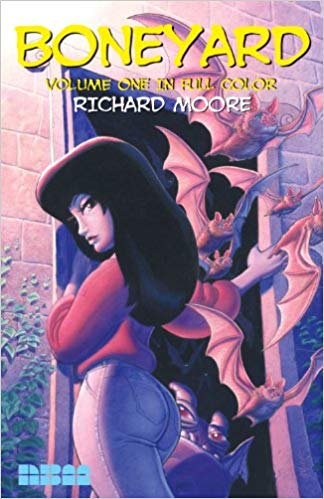
Boneyard in Color, Volume 1


By Richard Moore (NBM)
ISBN: 978-1-56163-427-9

Happy Día de Muertos to all of you who celebrate the occasion. Here’s something that might appeal to you today…

Boneyard was an award-winning comicbook that ran 28 issues between 2001 and 2009. It was subsequently collected as a series of monochrome albums and eventually seven full-colour collections between 2005-and 2010. Most volumes are still readily available online.

It’s been on hiatus since 2010 and I, for one, miss it something fierce. Surely it’s time for a re-issue and even some new stories, yes?

Young Paris – don’t call him Michael, he hates it – may finally have had a turn of good luck. Not only has he inherited some property from his reclusive grandfather, but the residents of picturesque little hamlet Raven Hollow are desperate to buy it from him, sight unseen. Nonetheless he makes his shambolic way there and finds that it’s not all so cut and dried.

The property in question is a cemetery named The Boneyard and not everything within its walls is content to play dead…

There’s Abby, a beautiful vampire chick, a foul-mouthed skeleton, a demon with delusions of grandeur, a werewolf who thinks he’s a cross between James Dean and the Fonz, a witch, a hulking Frankenstein-type monster and even talking gargoyles over the gate.

Most worrying of all: There’s even a voluptuous (married) amphibian who adds worlds of meaning – and assorted shades of grey – to the phrase “predatory man-eater.”

The place is a veritable refuge for the restless dead and every sort of Halloween horror, but somehow the residents all seem far more human in attitude and friendly in manner than the increasingly off-kilter townsfolk whose desperate measures to make Paris sell up prove that not all monsters haunt graveyards.

Reprinting issues #1-4 of the independent comic book in full-process colour, this is a charming, sly, funny and irresistibly addictive book, a warm-hearted comedy of terrors that is one the best humour series to come out of the States since Charles Addams first started reporting from that spooky old house in the 1940s.

This is a must-have for Horrorists, Humorists and especially Romantics with an open mind, which can even be read by younger teenagers. Get hunting, amigos…
© 2002, 2005 Richard Moore. All Rights Reserved.

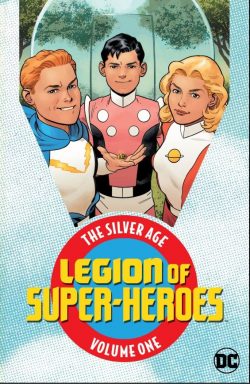
Legion of Super-Heroes: The Silver Age volume 1


By Otto Binder, Jerry Siegel, Edmond Hamilton, Robert Bernstein, Al Plastino, George Papp, Jim Mooney, Curt Swan, John Forte & various (DC Comics)
ISBN: 978-1-4012-8157-1

Win’s Christmas Gift Recommendation: Astounding All Ages Entertainment… 9/10

Once upon a time, in the far future, a band of super-powered kids from dozens of alien civilisations took inspiration from the greatest legend of all time and formed a club of heroes. One day those Children of Tomorrow came back in time and invited that legend to join them…

And thus began the vast and epic saga of the Legion of Super-Heroes, as first envisioned by writer Otto Binder & artist Al Plastino in early 1958, just as the revived comicbook genre of superheroes was gathering an inexorable head of steam. Since that time the fortunes and popularity of the Legion have perpetually waxed and waned, with their future history tweaked and rebooted, retconned and overwritten again and again to comply with editorial diktat and popular whim.

This glorious, far-and-wide ranging trade paperback and eBook collection assembles the many preliminary appearances of these valiant Tomorrow People and their inevitable progress towards and attainment of their own feature; including all pertinent material from Adventure Comics #247, 267, 282, 290, 293, and 300-310, Action Comics #267, 276, 287 and 289, Superboy #86, 89, 98 and Superman #147, cumulatively spanning April 1958 through July 1963.

The many-handed mob of juvenile universe-savers debuted in Adventure Comics #247 (cover-dated April 1958) in a Superboy tale wherein three mysterious kids invited the Boy of Steel to the 30th century to join a team of metahuman champions all inspired by his historic career.

Devised by Otto Binder & Al Plastino, the throwaway concept inflamed public imagination and, after a slew of further appearances throughout Superman Family titles, the LSH eventually took over Superboy’s lead spot in Adventure for their own far-flung, quirky escapades, with the Caped Kid Kryptonian reduced to merely “one of the in-crowd”…

However here the excitement was still gradually building as the kids returned more than 18 months later in Adventure #267 (December 1959) for Jerry Siegel & George Papp to play with.

In ‘Prisoner of the Super-Heroes!‘ the teen wonders turn up to attack and incarcerate the Boy of Steel because of a misunderstood ancient record they have uncovered…

The following summer Supergirl met the Legion in Action Comics #267 (August 1960, by Siegel & Jim Mooney) as Lightning Lad, Saturn Girl and Cosmic Boy secretly travel to “modern day” America to invite the Maid of Might to join the team, in a repetition of their offer to Superboy 15 years previously (in nit-picking fact they claimed to be the children of the original team – a fact glossed over and forgotten these days: don’t time-travel stories make your head hurt…?).

Due to a dubious technicality, young and eager Kara Zor-El fails her initiation task at the hands of ‘The Three Super-Heroes’ and is asked to reapply later – but at least we get to meet a few more Legionnaires, including Chameleon Boy, Invisible Kid and Colossal Boy…

With editors still cautiously testing the waters, it was Superboy #86 (January 1961) before ‘The Army of Living Kryptonite Men!’ (by Siegel & Papp) who turned the LSH into a last-minute Deus ex Machina to save the Smallville Sentinel from juvenile delinquent Lex Luthor‘s most insidious assault.

Two months later in Adventure #282, Binder & Papp introduced Star Boy as a romantic rival for the Krypton Kid in ‘Lana Lang and the Legion of Super-Heroes!’

In Action #276 (May 1961) Siegel & Mooney introduced ‘Supergirl’s Three Super Girl-Friends’, which finally saw her crack the plasti-glass ceiling and join the team, sponsored by Saturn Girl, Phantom Girl and Triplicate Girl. We also meet for the first time Bouncing Boy, Shrinking Violet, Sun Boy and potential bad-boy love-interest Brainiac 5 (well at least his distant ancestor Brainiac was a very bad boy…)

Next comes a pivotal two-part tale. ‘Superboy’s Big Brother’ (by Robert Bernstein & Papp from Superboy #89, June 1961) reveals how an amnesiac, super-powered space traveller crashes in Smallville, speaking Kryptonese and carrying star-maps written by the Boy of Steel’s long-dead father…

Jubilant, baffled and suspicious in equal amounts, Superboy eventually, tragically discovers ‘The Secret of Mon-El’ by accidentally exposing the stranger to a lingering, inexorable death, before desperately providing critical life-support by depositing the dying alien in the Phantom Zone until a cure can be found…

With an August 1961 cover-date Superman #147 unleashed ‘The Legion of Super-Villains’ (Siegel, Curt Swan & Sheldon Moldoff): a stand-out thriller featuring the adult Luthor and correspondingly mature wicked future bad guys coming far too close to destroying the Action Ace until the temporal cavalry arrives…

Bernstein & Papp seemingly give Sun Boy a starring role in ‘The Secret of the Seventh Super-Hero!’ (Adventure #290, November 1961) – a clever tale of redemption and second chances, followed in #293 (February 1962) by a gripping thriller from Siegel, Swan & George Klein. ‘The Legion of Super-Traitors’ posits the future heroes turning evil, prompting Saturn Girl to recruit a Legion of Super-Pets including Krypto, Streaky the Super Cat, Beppo, the monkey from Krypton and Comet the magical Super-horse to save the world – and yes, I typed all that with a reasonably straight face…

‘Supergirl’s Greatest Challenge!’ by Siegel & Mooney (Action #287 April 1962) sees her visit the Legion (quibblers be warned: for some reason it was mis-determined as the 21st century in this story) and saved future Earth from invasion.

She also met a telepathic descendent of her cat Streaky. His name was Whizzy (I could have omitted that fact but chose not to – once more for smug, comedic effect and in sympathy with cat owners everywhere)…

Action #289 originally hosted ‘Superman’s Super-Courtship!’ wherein the Girl of Steel scours the universe for an ideal mate for her cousin. One highly possible candidate is the adult Saturn Woman, but her husband Lightning Man objects…

Perhaps charming at the time, but modern sensibilities might quail at the conclusion that his perfect match was a doppelganger of Supergirl herself, albeit thankfully a little bit older…

By the release of Superboy #98 (July 1962), the decision had been made. The buying public wanted more Legion stories and after ‘The Boy with Ultra-Powers’ (Siegel, Swan & Klein) introduces a mysterious lad with greater powers than the Boy of Steel, focus shifts to Adventure Comics #300 (cover-dated September 1962) where the futuristic super-squad finally land their own gig; even occasionally taking an alternating cover-spot from the still top-featured Boy of Steel.

Tales of the Legion of Super-Heroes opened its stellar run with ‘The Face Behind the Lead Mask!’ by Siegel, John Forte & Plastino: a fast-paced premier pitting Superboy and the 30th century champions against an impossibly unbeatable foe until Mon-El, long-trapped in the Phantom Zone, briefly escapes a millennium of confinement to save the day…

In those halcyon days humour was as important as action, imagination and drama, so many of the early exploits were light-hearted and moralistic. Issue #301 offered hope to fat kids everywhere with ‘The Secret Origin of Bouncing Boy!’ by regular creative team Siegel & Forte, wherein the process of open auditions was instigated.

These provided devoted fans with loads of truly bizarre and memorable applicants over the years whilst here allowing the rebounding human rotunda to give a salutary pep talk and inspirational recount of heroism persevering over adversity.

Adventure #302 featured ‘Sun Boy’s Lost Power!’ with the golden boy forced to resign until fortune and boldness restore his abilities after which ‘The Fantastic Spy!’ in #303 provides a tense tale of espionage and possible betrayal by new member Matter-Eater Lad.

The happy readership was stunned by the events of #304 when Saturn Girl engineered ‘The Stolen Super-Powers!’ to make herself a one-woman Legion. Of course, it was for the best possible reasons, but still didn’t prevent the shocking murder of Lightning Lad…

With comfortable complacency utterly destroyed, #305 further shook everything up with ‘The Secret of the Mystery Legionnaire!’ who turns out to be the long-suffering Mon-El finally cured and freed from his Phantom Zone prison.

Normally I’d try to be more obscure about story details – after all my intention is to get new people reading old comics – but these “spoiler” revelations are crucial to further understanding here and besides you all know these characters are still around, don’t you?

Pulp science fiction writer Edmond Hamilton took over the major scripting role with Adventure #306, introducing ‘The Legion of Substitute Heroes!’ (still quirkily, perfectly illustrated by John Forte): a group of rejected audition applicants selflessly banding together and clandestinely assisting the champions who had spurned them, after which transmuting orphan Element Lad joins the big league.

He is seeking vengeance of the space pirates who had wiped out his entire species in ‘The Secret Power of the Mystery Super-Hero!’ whilst in #308 readers seemingly saw ‘The Return of Lightning Lad!’

Actual Spoiler Warning: skip to the next paragraph NOW!!!

Otherwise you’ll find out it was actually his similarly empowered sister who – once unmasked and unmanned – took her brother’s place as Lightning Lass…

Penultimate escapade ‘The Legion of Super-Monsters!’ was a straightforward clash with embittered applicant Jungle King who took his rejection far too personally and gathered a deadly clutch of space beasts to wreak havoc and vengeance after which the future tension temporarily subsides with ‘The Doom of the Super-Heroes!’ from #310: a frantic battle for survival against an impossible foe

The Legion is undoubtedly one of the most beloved and bewildering creations in American comicbook history and largely responsible for the growth of the groundswell movement that became Comics Fandom.

Moreover, these sparkling, simplistic and devastatingly addictive stories, as much as the legendary Julie Schwartz Justice League, fired up the interest and imaginations of a generation of young readers and built the industry we all know today.

These naive, silly, joyous, stirring and utterly compelling yarns are precious and fun beyond any ability to explain – even if we old lags gently mock them to ourselves and one another. If you love comics and haven’t read this stuff, you are the poorer for it and need to enrich your future life as soon as possible.
© 1958-1963, 2018 DC Comics. All Rights Reserved.
I Luv Halloween Volume 1


By Keith Giffen & Benjamin Roman (TokyoPop)
ISBN: 978-1-59532-831-1

Are you sick? Are you depraved, demented or just plain ‘not right’?

If So, it’s not necessary – but it won’t hurt either – if you pick up this darkly wicked little tome to reaffirm your skewed view of reality.

First seen in 2005, it spawned two further paperback volumes, a hardback Ultimate Edition in full-colour and, latterly, eBook editions (similarly converted from moody monochrome to gaudy sunset shades and blood-spatter hues thanks to the tender ministrations of Michael Kelleher and Glasshouse Graphics…

This holiday is primarily one where kids of varying ages go mooching about begging for sweets and threating mayhem. It used to be about predatory monsters roaming the land, terrorising the citizenry and making mischief. Here, those worlds collide and collude…

Every Halloween, Finch, Moochie, Pig Pig, Bubbles and Squeek, Li’l Bith, Mush and the rest of the kids get together for their annual sugar-coated loot-fest.

But this year it’s all botched up from the get-go ’cause the very first old lady they accost just gives them fruit, and everyone knows if you don’t get candy right from the start it’s nothing but rubbish all evening.

Drastic steps have to be taken, or else this Halloween is ruined…

You don’t know drastic until you see what this band of masked reprobates get up to. These are not your average trick-or-treaters…

Along the way you’ll also meet that friendly old policeman, the vicious, bullying older kids and that really stacked chick who lives next door as well as her doofus boyfriend. See their ultimate fates and give thanks it’s just a comic!

And as the night unfolds – with each kid given his/her/its own chapter to play in – we’ll see that theirs is a very bleak and nasty kind of fun with a vicious undercurrent to the shenanigans. You might even call it tragic…

Comics veteran Keith Giffen flexes his comedy – and bad taste – muscles in an irresistible confection that would win nodding approval from Charles Addams and the producers of any self-respecting splatter movie. The jovial malice is uniquely captured by the totally enchanting art of Benjamin Roman, whose inexplicably charming grotesques are the stuff of any animation studio’s dreams. If you don’t believe me just check out the stupefying Sketchbook section and frankly alarming Creator Bio feature…

Toys based on these sick puppies will sell and sell and sell – if you can bear to liberate them from any stout packaging or go to sleep in the same room as them…

If you have no fear of the dark, if you love a gross joke, have a soft side that can be hit by a brilliantly sad twist or two and especially if you don’t care what your immediate family or the clergy think of you, then you really want to read this book. Over and over and over and over again. Amen…
© 2005 Keith Giffen & Benjamin Roman. All Rights Reserved.

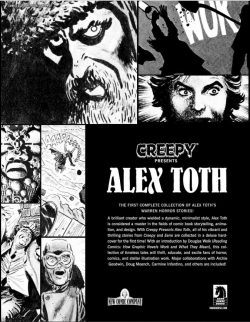
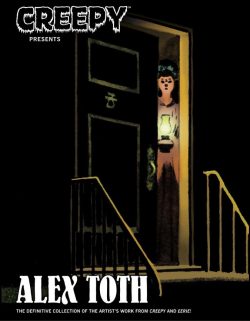
Creepy Presents Alex Toth


By Alex Toth, with Archie Goodwin, Gerry Boudreau, Rich Margopoulos, Roger McKenzie, Doug Moench, Nicola Cuti, Bill DuBay & Steve Skeates and Leopoldo Durañona, Leo Summers, Romeo Tanghal, Carmine Infantino & various (Dark Horse Comics)
ISBN: 978-1-61655-692-1 (HB)                    eISBN: 978-1-63008-194-2

Win’s Christmas Gift Recommendation: A Festive Flurry of Fearsome Fun… 9/10

Once upon a time the short complete tale was the sole staple of the comicbook profession, where the intent was to deliver as much variety and entertainment fulfilment as possible to the reader. Sadly, that particular discipline is all but lost to us today…

Alex Toth was a master of graphic communication who shaped two different art-forms and is largely unknown in both of them.

Born in New York in 1928, the son of Hungarian immigrants with a dynamic interest in the arts, Toth was something of a prodigy and after enrolling in the High School of Industrial Arts, doggedly went about improving his skills as a cartoonist.

His earliest dreams were of a strip like Milton Caniff’s Terry and the Pirates, but his uncompromising devotion to the highest standards soon soured him on newspaper strip work when he discovered how hidebound and innovation-resistant the family-values based industry had become whilst he was growing up.

At age 15 he sold his first comicbook works to Heroic Comics and, after graduating in 1947, worked for All American/National Periodical Publications (who would amalgamate and evolve into DC Comics) on Dr. Mid-Nite, All Star Comics, The Atom, Green Lantern, Johnny Thunder, Sierra Smith, Johnny Peril, Danger Trail and a host of other two-fisted fighting features.

On the way he dabbled with newspaper strips (see Casey Ruggles: the Hard Times of Pancho and Pecos) and confirmed that nothing had changed…

Constantly aiming to improve his own work, he never had time for fools or formula-hungry editors who wouldn’t take artistic risks. In 1952 Toth quit DC to work for “Thrilling” Pulps publisher Ned Pines who was retooling his prolific Better/Nedor/Pines comics companies (Thrilling Comics, Fighting Yank, Doc Strange, Black Terror and others) into Standard Comics: a comics house targeting older readers with sophisticated, genre-based titles.

Beside his particularly favourite inker Mike Peppe and fellow graphic artisans Nick Cardy, Mike Sekowsky, Art Saaf, John Celardo, George Tuska, Ross Andru & Mike Esposito, Toth set the bar incredibly high for a new kind of story-telling. In a cavalcade of short-lived titles dedicated to War, Crime, Horror, Science Fiction and especially Romance, the material produced was wry, restrained and thoroughly mature.

After Simon & Kirby invented love comics, Standard, through artists like Cardy and Toth and writers like the amazing and unsung Kim Aamodt, polished and honed the genre, regularly turning out clever, witty, evocative and yet tasteful melodramas and heart-tuggers both men and women could enjoy.

Before going into the military, where he still found time to create a strip (Jon Fury for the US army’s Tokyo Quartermaster newspaper The Depot’s Diary) Toth illustrated 60 glorious tales for Standard; as well as a few pieces for EC and others.

On his return to a different industry – and one he didn’t much like – Toth split his time between Western/Dell/Gold Key (Zorro and many movie/TV adaptations) and National (assorted short pieces, Hot Wheels and Eclipso): doing work he increasingly found uninspired, moribund and creatively cowardly.

Soon he moved primarily into TV animation: character and locale designing for shows such as Space Ghost, Herculoids, Birdman, Shazzan!, Scooby-Doo, Where Are You? and Super Friends among many others.

He returned sporadically to comics, setting the style and tone for DC’s late 1960’s horror line in House of Mystery, House of Secrets and especially The Witching Hour and illustrating more adult fare for Warren’s Creepy, Eerie and The Rook.

In the early 1980s he redesigned The Fox for Red Circle/Archie, produced stunning one-offs for Archie Goodwin’s Batman or war comics (whenever they offered him a “good script”) and latterly contributed to landmark or anniversary projects such as Batman: Black and White.

His later, personal works included European star-feature Torpedo and the magnificently audacious Bravo for Adventure!: both debuting at the independent magazine publishing company owned by Jim Warren.

Alex Toth died of a heart attack at his drawing board on May 27th 2006.

The details are fully recounted in Douglas Wolk’s biographically informative Foreword, as are hints of the artist’s later spells of creative brilliance at DC Comics, the growing underground movement and nascent independent comics scene…

The erudite and economical Mr. Evanier even finds room to describe and critique the differing art techniques Ditko experimented with during his brief tenure…

Whilst working for Warren (only intermittently and between 1965 and 1982) Toth enjoyed a great deal of editorial freedom and cooperation. He produced 21 starkly stunning monochrome masterpieces – many self-penned or written by fellow legend Archie Goodwin – and all crafted without interference from the Comics Code Authority’s draconian and nonsensical rules.

They ranged from wonderfully baroque and bizarre fantasy, to spooky suspense and science fiction yarns, limited only by the bounds of good taste… or at least as far as horror tales can be…

The uncanny yarns appeared in black-&-white magazine anthologies Creepy (# 5-7, 9, 75-80, 114, 122-125, 139) and Eerie (2, 3, 64, 65 and 67), affording the master of minimalism time and room to experiment with not only a larger page, differing styles and media, but also dabble in then-unknown comics genres…

Those lost Warren stories were gathered into this spectacular oversized (284 x 218 mm) hardback compendium (or assorted eBook formats): part of a series of all-star artist compilations – which also include Rich Corben, Bernie Wrightson, Steve Ditko amongst others – and begins here – after an appreciative Foreword from critic and historian Douglas Wolk – with the short shockers from Creepy.

Moodily rendered in grey wash-tones ‘Grave Undertaking’ comes from Creepy #5 (October 1965). Scripted by Goodwin the period piece relates the shocking comeuppance of a funeral director who branches out into providing fresh corpses for the local medical school, after which December issue #6 provides insight into ‘The Stalkers’ as a troubled soul seeks psychoanalytic help for the hallucinations of aliens plaguing him…

Prophetic visions play a part in ‘Rude Awakening!’ (#7, February 1966) as man flees omens of being gutted by a madman before Toth reverts to his minimalist line style for ‘Out of Time’ (#9 June). Here a murderous mugger seeks sanctuary for his latest crime and ends up making a devil’s bargain…

A long absence ended in November 1975 as Creepy #75 heralded a wealth of new stories from Toth, beginning with the Gerry Boudreau written crime-thriller ‘Phantom of Pleasure Island’ wherein a mob-owned San Diego funfair is plagued by a sinister sniper. Private Eye Hubb Chapin is on the case, but his dogged determination to find the killer opens a lot of festering sores his client should have left well alone…

Spectacularly experimental and powerfully stark, ‘Ensnared!’ scripted by Rich Margopoulos; #76, January 1976) is another paranoiac psychodrama with science fictional underpinnings before Toth begins writing his own stories in Creepy #77 (February) with a wash and tone tour de force depicting the strange fate of missing air mail pilot ‘Tibor Miko’ in 1928.

March’s issue #78 continued the tonal terrors with another 1920s tale exposing the stunning secret of a celluloid icon in ‘Unreeal!’ before we storm into Indiana Jones territory with ‘Kui’ (#79, May) as a couple of anthropologists make the holiday find of a lifetime on a deserted tropical island…

This tranche of Toth treats ends with ‘Proof Positive’ from June’s issue #80 wherein a gang of fraudulent patent lawyers and their ruthless honeytrap pay the ultimate price for gulling the wrong inventor…

When Toth returned in January 1980 his first story was another chilling collaboration with old comrade Archie Goodwin. Creepy #114’s ‘The Reaper’ was rendered in overpowering scratchy line and solid blacks, detailing how a virologist with six months to live decides he’s not dying alone and leaving a world of idiots behind him…

Issue #122 (October 1980) found Toth inking veteran illustrator Leo Duranona for the Roger McKenzie-scripted civil war yarn ‘The Killing!’ Here a Northern party occupying a mansion enduring conflicting passions of lust and vengeance before death inevitably settles all scores.

Doug Moench writes, Leo Summers draws and Toth inks & tones ‘Kiss of the Plague!’ (#123, November) as a welter of grisly murders slowly subtracts the inhabitant of a seemingly accursed house after which ‘Malphisto’s Illusion’ (#124, January 1981) finds Nichola Cuti, Alexis Romero (AKA Romeo Tanghal) & Toth explaining in grisly detail just how a stage magician pulls off his greatest trick and #125’s ‘Jacque Cocteau’s Circus of the Bizarre’ (McKenzie, Carmine Infantino & Toth) maintains the entertainment motif with a short shocker about a freak show like no other…

Toth’s last Creepy appearance was another collaboration with Goodwin. Issue #139 (July 1982) again featured the master’s moodily macabre tone painting in a grim post-apocalyptic rumination on ‘Survival!’

Toth’s tenure on companion anthology Eerie #2 was relatively brief and began with the second issue (March 1966). ‘Vision of Evil’ was the first of two Goodwin tales limned in tone and bold line, revealing the fate of an overly-arrogant art collector who couldn’t take no for an answer, whilst #3’s ‘The Monument’ (May 1966) saw an equally obnoxious architect accidentally engineer his own doom by stealing ideas from an old idol…

Eerie #64 offered intolerance, fear and sentiment in equal measure in ‘Daddy and the Pie’ (written by Bill DuBay). In Depression era America a very alien stranger is made welcome by one hard-up family despite the barely repressed hostility of his neighbours…

A very modern monster’s exploits comprise the end of this stupendous collection as Steve Skeates pens a wry tale of serial killers and doughty detectives in old London town. ‘The Hacker is Back’ (#65 April) depicts a maniac’s return to slaughter after a decade’s hiatus and leads to an inconclusive resolution before ‘The Hacker’s Last Stand!’ (#67 August) find forces of law and order overwhelmed by a killing spree unlike any other…

This voluminous volume has episodes which terrify, amaze, amuse and enthral: utter delights of fantasy fiction with lean, stripped-down plots and a mordant tone which lets the art set the tone, push the emotions and tell the tale, from times when a story could end sadly as well as happily and only wonderment was on the agenda, hidden or otherwise.

These stories display the sharp wit and dark comedic energy which epitomised both Goodwin and Warren, channelled through Ditko’s astounding versatility and storytelling acumen: another cracking collection of his works not only superb in its own right but also a telling affirmation of the gifts of one of the art-form’s greatest stylists.

This is a book serious comics fans would happily kill, die or be lost in a devil-dimension for…
Creepy, the Creepy logo and all contents © 1965, 1966, 1975, 1976, 1980. 1981, 1982, 2015 by New Comic Company. All rights reserved.

Misty Volume 2: featuring The Sentinels & End of the Line


By Malcolm Shaw, Mario Capaldi, John Richardson & various (Rebellion)
ISBN: 978-1-78108-600-1

Win’s Christmas Gift Recommendation: Sinister Thrills and Treats for Every Stocking… 9/10

Like most of my comics contemporaries I harbour a secret shame. Growing up, I was well aware of the weeklies produced for girls but would never admit to reading them. My loss: I now know that they were packed with some great strips by astounding artists and writers, many of them personal favourites when they were drawing stalwart soldiers, marauding monsters, evil aliens or strange superheroes (all British superheroes were weird and off-kilter…).

I actually think – in terms of quality and respect for the readership’s intelligence, experience and development – girls’ periodicals were far more in tune with the sensibilities of the target audience, and I wish I’d paid more attention to Misty back then…

Thus, I’m delighted to share another peek at superb comics fare from a British publication every bit as iconoclastic and groundbreaking as its contemporary stablemate 2000AD, albeit not as long-lasting…

Despite never living up to expectations – for all the traditional editorial reasons that have scuppered bold new visions since the days of Caxton – Misty was nothing like any other comic in the British marketplace.

Girls’ comics always had a history of addressing modern social ills and issues but this Girls’ Juvenile Periodical viewed events and characters through a lens of urban horror, science fiction, moody historical mysteries and tense suspenseful dramas. It was also one of the best drawn comics ever seen and featured stunningly beguiling covers by unsung legend Shirley Bellwood, a veteran illustrator who ought to be a household name because we’ve all admired her work in comics and books since the 1950s – even if we’ve never been privileged to see her by-line…

Unlike most weeklies, Misty was created with specific themes in mind – fantasy, horror and mystery – and over its too-short existence specialised in a string of usually self-contained features serialised like modern graphic novels, rather than ever-unfolding, continuing adventures of star characters.

Although adulterated from comics legend Pat Mill’s original grand design, Misty launched on February 4th 1978 and ran until January 1980 whereupon it merged with the division’s lead title Tammy, extending its lifeline until 1984. As was often the case, the brand lived on through Annuals and Specials, which ran from 1979 until 1986…

Another in the unmissable series working under the umbrella of The Treasury of British Comics, this second compact monochrome softcover compilation offers two more complete part-work novellas from the comic’s canon of nearly 70 strip sagas, starting off with the time-bending, socially aware saga The Sentinels.

Scripted by Malcolm Shaw (Misty‘s Editor and writer of dozens of strips in Britain and Europe) and illustrated by the wonderful and much travelled Mario Capaldi (Care Bears, James Bond Junior, Zorro, Thundercats, The Famous Five, A Christmas Carol and dozens of strips for Misty, Tammy, Hurricane, Eagle, Jinty, TV Action, Roy of the Rovers and others), The Sentinels leads off here.

The eerie tale of privation, intolerance, family discord and alternate universes originally ran between February 4th and April 22nd 1978 and revealed how in Birdwood on a post-war estate stood two identical tower blocks.

At least, once upon a time they were. Now whilst one is still a gleaming modern tribute to high rise modernism, somehow its twin sister had devolved into squalor and misuse: a sky-high slum tenants fled from and where apparently people vanished never to be seen again. The council had been under pressure to demolish the failing tower for years…

One day as Jan Richards comes home she learns that her family have been evicted from home. After exhausting all avenues, her mum and dad refuse to let the family be broken up and the kids put into care so they break into the evil block and begin squatting in one of the flats…

Almost immediately bizarre things start happening: Jan meets her dad in places he can’t be, she sees visions out of the windows that can’t possibly be true – and aren’t when she goes outside to check – and then her beloved dog Tiger attacks her…

The uncanny experiences continue as the squatters make the most of their new lives but Jan’s anxiety only increases. When at last she discovers the incredible secret of the ramshackle Sentinel sister, the result is the loss of her father, valiant, noble Tiger and best friend Sally and finding herself trapped in a Britain where evil reigns triumphant…

Potent, suspenseful and wickedly edgy, The Sentinels seamlessly blends powerful social commentary with traditional themes of loss and female agency whilst telling a chilling tale of parallel world peril. How this was never made into a film or Kids thriller series in the vein of Timeslip, Chocky or Children of the Stones is utterly beyond me – and it’s still not too late, as the tale’s themes are more relevant today than they’ve ever been…

From the same year (but serialised between August 12th and November 18th) and illustrated by the great John Richardson, End of the Line is a more traditional yarn of paranoia and loss, again scripted by the taken far too early Malcolm Shaw and once more presenting a story with plenty of contemporary parallels.

Richardson was a highly gifted artist with a light touch blending Brian Lewis with Frank Bellamy: a veteran visual storyteller who worked practically everywhere in Britain from 2000AD (Mean Arena, The V.C.s) to DC Thomson (Pussy Muldoon) to Marvel UK, as well as national newspapers (Amanda) and for specialist magazines such as Custom Car, Super Bike and Citizen’s Band. Here, his deft touch provides a smooth transition between slick modernity and Victorian moodiness in the saga of Ann Summerton.

The teenager and her mum are still coming to terms with the loss of breadwinner Andrew Summerton, even though he’s been gone two years now. He was one of seven men who perished in the construction of super-deep new London subway The Windsor Line.

Mum has moved on enough to be considering marriage to the deeply unpleasant “Uncle” Neville Chandler, but Ann just doesn’t like him…

Today the family are guests at the grand opening of the line, and invited to ride on the first scheduled journey along the Windsor. It’s a PR disaster however as Ann collapses in hysterical panic. She claims to have seen her dad and the other lost engineers slaving in a tunnel off the main route…

Despite the ministrations of doctors and the chiding abuse of Neville, Ann can’t get the image out of her mind. Despite the very real threat of psychological incarceration she returns to the tube again and again and uncovers evidence of a much earlier attempt to build a railway tunnel on the same route. The Prince Albert line also suffered a catastrophic collapse and was abandoned in Victorian times…

Ann eventually convinces a local reporter there might be something in the story, but when he goes missing – one amongst a slowly growing tide of disappearances – she decides to take action herself and is soon propelled into a world of nightmare and the private fiefdom of an ancient madman who has created a kingdom of the damned beneath the streets of the modern metropolis…

Evocative and dripping tension, End of the Line is a classic horror-mystery to delight anyone with a love of gothic mood and historical adventure…

Augmenting the strip thrills and chills is a reconditioned text feature appendix revealing how ‘…Your Face is Your Fortune…’ with an extended exploration of the prognosticatory clues a person’s feature reveal about them…

This engaging and tremendously compelling tome is another glorious celebration of a uniquely compelling phenomenon of British comics and one that has stood the test of time. Don’t miss this fresh chance to get in on something truly special and splendidly entertaining…
The Sentinels and End of the Line are © 1978 & 2017 Rebellion Publishing, Ltd. All Rights Reserved. Misty is ™ Rebellion Publishing, Ltd. and © Rebellion Publishing, Ltd. All Rights Reserved.

Showcase Presents The House of Secrets volume 1


By Mike Friedrich, Gerry Conway, Marv Wolfman, Len Wein, Steve Skeates, Robert Kanigher, Raymond Marais, Sam Glanzman, Jack Kirby, Mark Evanier, Jack Oleck, Mary Skrenes, Jerry Grandenetti, Bill Draut, Jack Sparling, Dick Dillin, Dick Giordano, Werner Roth, Neal Adams, Sid Greene, Alex Toth, Mike Royer, Mike Peppe, Don Heck, Wally Wood, Ralph Reese, John Costanza, Gil Kane, George Tuska, Gray Morrow, Ross Andru & Mike Esposito, Michael Wm. Kaluta, Rich Buckler, Bernie Wrightson, Al Weiss, Tony DeZuñiga, Jim Aparo, Sergio Aragonés, Nestor Redondo, Jose Delbo, Adolfo Buylla & various (DC Comics)
ISBN: 978-1-4012-1818-8

It’s the time for over-eating and spooky stories so let’s pay a visit to a much-neglected old favourite…

American comicbooks started slowly until the creation of superheroes unleashed a torrent of creative imitation and invented a new genre.

Implacably vested in the Second World War, the Overman swept all before him (and very occasionally her or it) until the troops came home and the more traditional genres resurfaced and eventually supplanted the Fights ‘n’ Tights crowd.

Although new kids kept on buying, much of the previous generation of consumers also retained their four-colour habit but increasingly sought older themes in the reading matter. The war years altered the psychological landscape of the world and as a more world-weary, cynical young public came to see that all the fighting and dying hadn’t really changed anything, their chosen forms of entertainment (film and prose as well as comics) reflected this.

As well as Westerns, War and Crime comics, celebrity tie-ins, madcap escapist comedy and anthropomorphic funny animal features were immediately resurgent, but gradually another of the cyclical revivals of spiritualism and public fascination with the arcane led to them being outshone and outsold by a wave of increasingly impressive, evocative and shocking horror comics.

There had been grisly, gory and supernatural stars before, including a pantheon of ghosts, monsters and wizards draped in mystery-man garb and trappings (The Spectre, Mr. Justice, Sgt. Spook, Frankenstein, The Heap, Sargon the Sorcerer, Zatara, Monako, Zambini the Miracle Man, Kardak the Mystic, Dr. Fate and dozens of others), but these had been victims of circumstance: The Unknown as a power source for super-heroics.

Now the focus shifted to ordinary mortals thrown into a world beyond their ken with the intention of unsettling, not vicariously empowering, the reader.

Almost every publisher jumped on the increasingly popular bandwagon, with B & I (which became the magical one-man-band Richard E. Hughes’ American Comics Group) launching the first regularly published horror comic in the Autumn of 1948. Technically though Adventures Into the Unknown was actually pipped by Avon who had released an impressive single issue entitled Eerie in January 1947 before at last launching a regular series in 1951.

By this time worthy monolith Classics Illustrated had already long milked the literary end of the medium with adaptations of The Headless Horseman, Dr. Jekyll and Mr. Hyde (both 1943), The Hunchback of Notre Dame (1944) and Frankenstein (1945) among others.

If we’re keeping score this was also the period in which Joe Simon & Jack Kirby identified another “mature market” gap and invented the Romance comic (Young Romance #1, September 1947) but they too saw the sales potential for macabre mood material, resulting in the seminal anthologies Black Magic (launched in 1950) and boldly obscure psychological drama vehicle Strange World of Your Dreams (1952).

Around that time the company that would become DC Comics bowed to the inevitable and launched a comparatively straight-laced anthology that nevertheless became one of their longest-running and most influential titles with the December 1951/January 1952 launch of The House of Mystery.

When the hysterical censorship scandal which led to witch-hunting hearings (feel free to type Senate Subcommittee on Juvenile Delinquency, April-June 1954 into your search engine at any time… You can do that because it’s apparently a free country now) was curtailed by the industry adopting a castrating straitjacket of self-regulatory rules.

Horror titles produced under the aegis of the Comics Code Authority were sanitised and anodyne affairs in terms of Shock and Gore but since the appetite for suspenseful short stories was still high, in 1956 National introduced sister title House of Secrets which debuted with a November/December cover-date.

Plots were dialled back into marvellously illustrated, rationalistic, fantasy-adventure vehicles which would dominate the market until the 1960s when superheroes (which had started to creep back in 1956 after Julius Schwartz began the Silver Age of comics by reintroducing the Flash in Showcase #4,) finally overtook them.

Green Lantern, Hawkman, the Atom and a slew of other costumed cavorters generated a gaudy global bubble of masked mavens which even forced the dedicated anthology suspense titles to transform into super-character split-books, with Martian Manhunter and Dial H for Hero monopolising House of Mystery whilst Mark Merlin – later Prince Ra-Man – sharing space with Eclipso in House of Secrets.

When caped crusader craziness peaked and popped, Secrets was one of the first casualties. The title folded with #80, the September/October 1966 issue.

However, nothing combats censorship better than falling profits and by the end of the 1960s the Silver Age superhero boom was over, with many titles gone and some of the industry’s most prestigious series circling the drain…

This real-world Crisis led to surviving publishers of the field agreeing to loosen their self-imposed restraints against crime and horror comics. Nobody much cared about gangster titles anymore but as the liberalisation coincided with another bump in public interest in all aspects of the Worlds Beyond, the resurrection of scary stories was a foregone conclusion and obvious “no-brainer.”

Even ultra-wholesome Archie Comics re-entered the field with their rather tasty line of Red Circle Chillers…

Thus, with absolutely no fanfare at all House of Secrets was resurrected with issue #81, cover-dated August/September 1969 – just as big sister The House of Mystery had done a year earlier.

Under a bold banner declaiming “There’s No Escape From… The House of Secrets”, writer Mike Friedrich, Jerry Grandenetti & George Roussos introduced a ramshackle, sentient old pile in ‘Don’t Move It!’ after which Bill Draut limned the introduction of bumbling caretaker Abel (with a guest-shot by his murderous older brother Cain from HoM) in ‘House of Secrets’.

The portly porter then kicked off his storytelling career with the Gerry Conway & Jack Sparling yarn ‘Aaron Philip’s Photo Finish!’ and the inaugural issue was put to bed with a Draut limned ‘Epilogue’…

HoS #82 is a largely Conway scripted affair as Draut drew both ‘Welcome to the House of Secrets‘ and the ‘Epilogue’, whilst cinema shocker ‘Realer Than Real’ was illustrated by Werner Roth & Vince Colletta.

Written by Marv Wolfman, ‘Sudden Madness’ was a short sci fi saga from the brush of Dick Giordano, whilst Conway regaled us with ‘The Little Old Winemaker’ (Sparling art): a salutary tale of murder and revenge. ‘The One and Only, Fully-Guaranteed, Super-Permanent, 100%’ is Wolfman again and realised by Dick Dillin & Neal Adams – a darkly comedic tale of domestic bliss and how to get it…

After Draut & Giordano’s ‘Welcome to the House of Secrets‘ piece, superstar Alex Toth made his modern HoS debut with the Wolfman-written fantasy ‘The Stuff That Dreams are Made Of’, Mikes Royer & Peppe visualised the sinister love-story of ‘Bigger Than a Breadbox’ before Conway & Draut revived time-honoured gothic menace for a chilling fable ‘The House of Endless Years’.

Conway & Draut maintained the light-hearted bracketing of the stories as #84 began with ‘If I Had but World Enough and Time’ (Len Wein, Dillin & Peppe), a cautionary tale about too much television. The tension grows with Wolfman & Sid Greene’s warning against wagering in ‘Double or Nothing!’ and Steve Skeates, Sparling & Jack Abel’s utterly manic parable of greed ‘The Unbelievable! The Unexplained!’, before Wein & Sparling mess with our dreams in ‘If I Should Die before I Wake…

Cain and Abel acrimoniously open HoS #85 after which Wein & Don Heck disclose what happens to some ‘People Who Live in Glass Houses…’ whilst art-legend Ralph Reese illustrates Wein’s daftly ironic ‘Reggie Rabbit, Heathcliffe Hog, Archibald Aardvark, J. Benson Babboon and Bertram the Dancing Frog’…

John Costanza contributed a comedy page entitled ‘House of Wacks’ and Conway, Gil Kane & Neal Adams herald the upcoming age of slick and seductive barbarian fantasy with the gloriously vivid and vital ‘Second Chance’.

Issue #86 featured the eerily seductive ‘Strain’ with art by George Tuska, a powerful prose puzzler ‘The Golden Tower of the Sun’ written by Conway with illustrations from Gray Morrow, after which the writer and Draut tug heartstrings and stun senses in the moving, moody madness of ‘The Ballad of Little Joe’…

The issue ends with an episode of the peripatetic, post-apocalyptic, ironic occasional series ‘The Day after Doomsday’ courtesy of Wein & Sparling.

The chatty introductions and interludes with Abel were gradually diminishing to make way for longer stories and experimental episodes such as #87’s ‘And in the Darkness… Light’; sub-divided into ‘Death Has Marble Lips!’, a sculptural shocker from Robert Kanigher, Dillin & Giordano; sinister sci fi scenario ‘The Man’ from Wolfman, Ross Andru & Mike Esposito and excellent weird pulps pastiche ‘The Coming of Ghaglan’ by Raymond Marais & talented newcomer Michael Wm. Kaluta.

Much the same was #88’s dread duo ‘The Morning Ghost’ by Wolfman, Dillin & Frank Giacoia and ‘Eyesore!’ by Conway & Draut.

Most of the covers were the magnificent work of Neal Adams but HoS #89 sports a rare and surprisingly effective tonal image by Irv Novick (although attributed here to Gray Morrow): a gothic romance special with period thrillers ‘Where Dead Men Walk!’ – drawn by Morrow – and ‘A Taste of Dark Fire!’ from Conway & Heck.

This latter tale debuted Victorian devil-busting duo Father John Christian and Rabbi Samuel Shulman who appeared far too infrequently in succeeding years (see also Showcase Presents the Phantom Stranger volume 2).

Tuska illustrated Skeates’ futuristic thriller ‘The Distant Dome’ in #90, whilst Wolfman, Rich Buckler & Adams described the short, sharp lives of ‘The Symbionts’, after which Mike Friedrich & Morrow end this SF extravaganza with the perplexing tale of ‘Jedediah!’

Issue #91 was almost entirely Conway scripted and led with a South American revolutionary rollercoaster ‘The Eagle’s Talon!’ illustrated by Grandenetti & Wally Wood. Sparling limned faux-factual feature ‘Realm of the Mystics’, after which writer/artist Sam Glanzman produced a potent parable of alienation in ‘Please, Don’t Cry Johnny!’ and Murphy Anderson wrapped up the wonderment with Conway’s deadly doppelganger drama ‘There are Two of Me… and One Must Die!’

Issue #92 was one of those rare moments in comics when all the factors are in perfect alignment for a major breakthrough. Cover-dated June/July 1971, the 12th anthological issue of House of Secrets cemented the genre into place as the industry leader as Len Wein & artist Bernie Wrightson produced a throwaway thriller set at the turn of the 19th century. Here gentleman scientist Alex Olsen is murdered by his best friend and his body dumped in a swamp.

Years later his beloved bride, now the unsuspecting wife of the murderer, is stalked by a shambling, disgusting beast that seems to be composed of mud and muck…

‘Swamp Thing’ was cover-featured – also eerily illustrated by Wrightson – striking an instant and sustained chord with the buying public. It was the bestselling DC comic of that month and reader response was fervent and persistent. By all accounts the only reason there wasn’t an immediate sequel or spin-off was that the creative team didn’t want to produce one.

Eventually however, bowing to interminable pressure, and with the sensible idea of transplanting the concept to contemporary America, the first issue of Swamp Thing appeared on newsstands in the Spring of 1972. It was an instant hit and an immortal classic.

The remaining pages in that groundbreaking HoS issue aren’t bad either, with Jack Kirby & Mark Evanier scripting the psychodrama ‘After I Die’ for old Prize/Crestwood Comics stable-mate Bill Draut to illustrate, whilst ‘It’s Better to Give…’ by Virgil North (AKA Mary Skrenes) provided an early chance for Al Weiss & Tony DeZuñiga to strut their superbly engaging artistic stuff.

The issue ends with a sudden shocker by Conway & Dillin entitled ‘Trick or Treat’

House of Secrets #93 (August/September 1971) saw the title expand from 32 to 52 pages – as did all DC’s titles for the next couple of years, opening the doors for a magnificent period of new material married to the best of the company’s prodigious archives for an appreciative, impressionable audience.

Jim Aparo made his HoS debut in the Skeates scripted spook-fest ‘Lonely in Death’ and so did macabre cartoonist Sergio Aragonés in ‘Abel’s Fables’, after which the reprint bonanza began with ‘The Curse of the Cat’s Cradle’ (originally from My Greatest Adventure #85) stupendously depicted by Alex Toth.

Jack Abel’s ‘Nightmare’ was followed by golden oldie ‘The Beast from the Box’; courtesy of Nick Cardy and House of Mystery #24, after which Lore (Shoberg) contributed a page of ‘Abel’s Fables’ before the entertainment ended with the chilling ‘Never Kill a Witch’s Son!’ by John Albano & DeZuñiga, rounding out the fearsome fun in period style…

Issue #94 began by revealing ‘The Man with My Face’ (art by Sparling) and ‘Hyde… and Go Seek!’ by Wein & DeZuñiga, whilst ‘The Day Nobody Died’ (George Roussos; Tales of the Unexpected #9) and ‘Track of the Invisible Beast!’ (Toth from House of Mystery #109) provided vintage voltage before another Aragonés ‘Abel’s Fables’ and ‘A Bottle of Incense… a Whiff of the Past!’ by Francis (Gerry Conway) Bushmaster, Weiss & Wrightson closed proceedings in devilishly high style…

Albano & Heck showed domesticity wasn’t pretty in ‘Creature…‘, everybody got a nasty case of chills in ‘And Thing That Go Bump in the Night!’ (credited to Sparling but probably Tuska & Win Mortimer) before ‘The Last Sorcerer’ (Bernard Baily from HoM #69) and ‘The Phantom of the Flames!’ – a rare DC illustration job for the great Joe Maneely from HoM #71.

The dark dramas close with Jack Oleck and Nestor Redondo’s ‘The Bride of Death’. Issue #95 also included a couple of Lore’s ‘Abel’s Fables’, a Sparling ‘Realm of the Mystics’ and a Wein & Sparling ‘Day after Doomsday’.

‘World for a Witch’ by Oleck & Draut opened the next peril-packed issue, followed by a high-tension, high-tech Toth reprint ‘The Great Dimensional Brain Swap’ (HoS #48) and Wein, Dillin & Jack Abel’s ‘Be it Ever So Humble…’ whilst Oleck & Wood’s ‘The Monster’ describes a different kind of horror.

‘The Indestructible Man’ (by unsung master-draughtsman Bill Ely, and originally seen in Tales of the Unexpected #12) closes the show. Also lurking within this issue is another agonisingly funny Aragonés ‘Abel’s Fables’ contribution…

The penultimate issue in this sparkling collection – incomprehensibly still the only way to access these chilling classics – led with classical creep-show ‘The Curse of Morby Castle’ by Sparling after which Skeates & Aparo return to ‘Divide and Murder’ and Aragonés strikes again in ‘Abel’s Fables’.

Blasts from the past ‘The Tomb of Ramfis’ (HoM #59, by the fabulous John Prentice) and ‘Dead Man’s Diary’ (drawn by Ralph Mayo for HoM #46) are demarcated by another trenchant Wein & Sparling ‘Day after Doomsday’, before Jose Delbo delineates a manic monster-fest entitled ‘Domain of the Damned’.

The last issue in this magnificent monochrome compendium opens with a glorious intro page from Mark Hanerfeld & Kaluta, after which the artist entrancingly illustrates Albano’s tough-as-nails-thriller ‘Born Losers’ and Toth illuminates the ‘Secret Hero of Center City’ (originally seen in HoM #120).

After one more Aragonés ‘Abel’s Fables’ Wein, Mikes Roy & Peppe reveal why ‘The Night Train Doesn’t Stop Here anymore!’ and another John Prentice treat is served up in ‘The Fatal Superstition’ (HoM #35) before the great Adolfo Buylla celebrates the end of the affair in grisly fashion with ‘Happy Birthday, Herman!’

These terror-tales captivated the reading public and critics alike when they first appeared and it’s no stretch to posit that they probably saved the company during one of the toughest downturns in comics publishing history. Now their blend of sinister mirth, classic horror scenarios and suspense set-pieces can most familiarly be seen in such children’s series as Goosebumps, Horrible Histories and their many latterday imitators.

If you crave beautifully realised, tastefully splatter-free sagas of mystery and imagination, not to mention a huge supply of bad-taste, kid-friendly cartoon chills, book your stay at the House of Secrets as soon as you possibly can…
© 1969, 1970, 1971, 1972, 2008 DC Comics. All Rights Reserved.
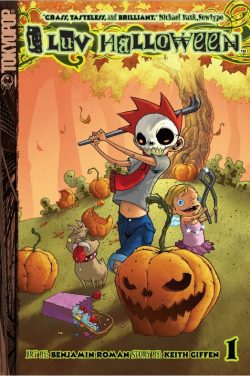
Archie & Friends All Stars volume 5: Archie’s Haunted House


By Fernando Ruiz, Batton Lash, Dan Parent, George Gladir, Stan Goldberg, Mark McKenna, Henry Scarpelli, Rich Koslowski, & various (Archie Comics)
ISBN: 978-1-879794-52-8

Win’s Christmas Gift Recommendation: Family Friendly Fear Fest for Kids of All Ages… 8/10

Archie Andrews has been around for more than seventy years: a good-hearted lad lacking in common sense whilst Betty Cooper, the pretty, sensible girl next door – with all that entails – waits ardently nearby, loving the great ginger goof.

Veronica Lodge is a rich, exotic and glamorous debutante who only settles for our boy if there’s nobody better around. She might actually love him too, though.

Despite their rivalry, Betty and Veronica are firm friends. Archie, of course, can’t decide who or what he wants…

Archie’s unconventional best friend Jughead Jones is Mercutio to Archie’s Romeo, providing rationality and a reader’s voice, as well as being a powerful catalyst of events in his own right. That charming triangle (with significant additions over the years) has been the basis for decades of funnybook magic and the concept is eternally self-renewing…

Adapting seamlessly to every trend and fad of youth culture since before there even was such a thing, the host of writers and artists who’ve crafted the stories over the decades have made the “everyteen” characters of utopian Riverdale a benchmark for childhood development and a visual barometer of growing up.

In this paperback and digital collection, the warring gal-pals and extended cast of the small-town American Follies are again plunged deep into whimsy and fable as writers Fernando Ruiz, Batton Lash, Dan Parent & George Gladir delve into the Dark Side for a selection of spooky spoofs and all-ages arcane adventure…

The weird wonders begin with Ruiz & Mark McKenna’s ‘…Clothes Make the Monster’ (Archie & Friends #135, September 2009) as the gang opt for a Halloween costume party at Riverdale High only to fall foul of a sinister sorceress whose bewitched outfits transform the kids into the monsters they’re dressed as…

Thankfully resident genius Dilton Doily has a plan and an unsuspected talent…

An extended gothic extravaganza that ran across a host of titles follows. The epic and episodic ‘…This Old House…’ was devised by Lash, Stan Goldberg & Henry Scarpelli) and opened in World of Archie #17, December 1995, with succeeding chapters erupting in Archie #442 (December 1995), Betty and Veronica #95 and Archie’s Pal Jughead Comics #93, both out for January 1996.

When Reggie vandalises a ramshackle, condemned property it sparks heated debate amongst the gang, all of whom have sentimental memories of the old pile from their younger days.

With the city council being urged to finally pull it down the teens are divided between demolition and declaring it a local landmark…

The politicking ensues in ‘House of Riverdale! Part 1’ even as Archie is plagued by nightmares of the dilapidated dwelling’s old occupants. Second chapter ‘Thou Protest Too Much…’ finds the gang on a picket line preserving the building until Veronica’s dad delivers the good news. The place has been saved for posterity. It turns out that it might not be good news, though, as in a nearby town Sabrina (the Teenaged Witch) pores over ancient records of the original inhabitants and readies herself to intervene…

The tension increases in ‘House of Riverdale! Part 3′ as Betty also does a little digging and connects the seemingly-benevolent name Father Riverdale to a nasty piece of work named Leander van Dermeulen whose 19th century crusade against progress resulted in a magic cult, a police shootout and a dying curse…

Fourth chapter ‘Worn Out Welcome’ finds the terrified Archie reversing his position and petitioning the council to tear down the house before the curse can be reactivated – with the expected reaction from the adults. Betty meanwhile, sneaks into the house to find some of her friends already there and totally ensorcelled…

‘House of Riverdale! Part 5′ sees Archie call on trusted comrade Jughead for help only to lose him to the dire domicile before everything comes to a head in ‘Fall of the House of Riverdale!’ As the malign ghost of van Dermeulen meets his match in ultra-nonconformist Juggy, unlikely hero Archie takes drastic action to save the day in the estate’s ghastly grounds…

With the main event concluded, lighter fare follows as B&V discover ‘An Axe to Grind’ (Betty and Veronica Spectacular #85, November 2008) with Dan Parent & Rich Koslowski revealing how the boys’ plans to crash a girls-only Halloween party go appallingly awry…

The same issue also provides a gallery of faux movie posters ‘Riverdale Style’, fashions and tips for ‘The Ultimate Halloween Bash!’ plus recipes and treats for all ‘Archie Zombies’ before the spooky shenanigans conclude with Gladir, Ruiz & Koslowski’s ‘For Monsters Only!’

First seen in Tales from Riverdale Digest #30 (December 2008) this sly shocker finds Archie and Jughead in full vampire ensemble but stumbling into a sinister soiree for actual devils, demons and creatures of the night…

Co-starring all the adorable supporting characters we know and love, these smartly beguiling skits are a marvellous example of just why Archie has been unsurpassed in this genre for generations: providing decades of family-friendly fun and wholesome teen entertainment – complete with goblins, ghosts and ghouls as required…
© 2010 Archie Comics Publications, Inc. All rights reserved.