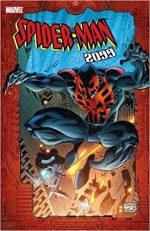
Spider-Man 2099 volume 1


By Peter David, Rick Leonardi, Kelly Jones, Al Williamson and various (Marvel)
ISBN: 978-0-7851-8478-2

Hey look! Another Spider-Man movie…

Comics phenomenon and teen-angst icon Peter Parker evolved from humbled beginnings into a globally recognised character with a life of his own. As such, the Amazing Arachnid has been subject to a myriad of permutations and spin-offs. This snazzy trade paperback – also available in assorted digital editions – is one of most intriguing takes on the whole idea of wallcrawling wonders ever conceived and has in recent times, following the company’s continuity reboot, even been assimilated into the mainstream Marvel Universe…

In the early 1990’s – a time when Marvel’s product quality was at an all-time low – following a purported last-minute dispute between the company and prodigal son John Byrne (who had re-invented himself by re-inventing Superman), the House of Ideas launched a whole separate continuity strand with all new heroes (and franchise extensions), set more than a century into the future.

This world was corporate and dystopian, the scenarios were fantastical and the initial character-pool was predictable if not actually uninspired. A lot of the early material was – by any critical yardstick – sub-par. But then again there was also Spider-Man 2099.

Some analogue of the webspinner is always going to happen in any Marvel imprint (remember Peter Porker, Spider-Ham?), and in those insane days of speculator-led markets (where greedy kids and adults dreamed of cornering the market in “Hot Issues” and becoming instant susquillionaires) early episodes were always going to be big sellers.

What nobody expected was just how good those stories were to actually read…

Now the first ten issues are available in a fantastic and entertaining full colour collection.

In 2099, world governments are openly in the capacious pockets of sprawling multi-national corporations which permeate every aspect of society. All superheroes have been gone for decades, although their legends still comfort the underclass living at the fringes – and below the feet – of the favoured ones who can survive in a society based on unchecked, rampant free-market capitalism.

Miguel O’Hara is a brilliant young geneticist fast-tracked and swiftly rising through the ranks of Alchemax. He enjoys the seductive privileges afforded to him for his work in creating super-soldiers for the company. He loves solving problems.

…And now, despite the constant interference of the salary-men and corporate drudges he’s forced to work with, Miguel’s on the verge of a major breakthrough: a technique to alter genetic make-up and combine it with DNA from other organisms…

But after a demonstration goes grotesquely awry the arrogant scientist makes a big mistake when he tells his boss that he’s going to quit. Unwilling to lose such a valuable asset, CEO Tyler Stone poisons O’Hara with the most addictive drug in existence – one only available from Alchemax – to keep him loyal and in his place.

Desperate, furious and still convinced he knows best, the young scientist tries to use his genetic modifier to reset his tainted physiology and purge the addiction from his cells. Sadly, one of the lab assistants he used to bully sees a chance for some payback and sabotages the attempt, adding spider DNA to the matrix…

Fast-paced and riotously tongue-in-cheek scripts from Peter David kept the series readable but the biggest asset to Spider-Man 2099 and the greatest factor in its initial success was undoubtedly the fluid design mastery and captivating dynamic, panoramic pencilling of Rick Leonardi, wedded to the legendary Al Williamson’s fine ink lines. The art just jumps off the pages at you.

After the eponymous origin issue, #2’s ‘Nothing Ventured…’ – introducing cyborg bounty hunter Venture – and concluding chapter ‘Nothing Gained’, which sees Miguel soundly defeat Alchemax’s go-to hired-gun, the early editorial policy downplaying “super-villains” results in yet another hi-tech Corporate raider attacking the new Amazing Arachnid.

In ‘The Specialist’ and ‘Blood Oath’ (issues #4 and 5) Stone, his cronies and his business rivals go to extraordinary – but not so much extra-legal – lengths to uncover the secrets of the first costumed adventurer since the mythic “Age of Heroes” ended…

In issue #6 the hero’s Pyrrhic victory leaves him wounded in the dank shanty-zone far beneath the giant skyscrapers of the productive citizenry. Spider-Man has to survive ‘Downtown’, encountering an unsuspected underclass of discarded humanity, but soon falls foul of its top predator (and first super-villain) Vulture in #7’s ‘Wing and a Prayer’ and concluding chapter ‘Flight of Fancy’.

Kelley Jones & Mark McKenna substituted for Leonardi and Williamson in #9’s ‘Home Again, Home Again’ as our reluctant rebel and increasingly acclaimed antihero finds himself the latest Idée Fixe of celebrity imitators – or are they actually John the Baptists for a brand-new religion?

All through the stories a strong family cast including younger brother Gabe, girlfriend Dana, Miguel’s astonishingly over-close Latina mother and his just-plain-crazy personal computer Lyla provide drama and scintillating laughs in complex and enthralling sub-plots, but in the last tale of this collection ‘Mother’s Day’ they all take centre-stage as we get a peek into the childhood that made Miguel O’Hara the man he is.

His reaffirmation of purpose at the end of the tale closes this superb sidelined gem on a merry high and promises great things to come…

Marvel’s output seldom achieved this kind of quality after the mid-1980s, especially in a character and setting that didn’t demand prior knowledge of an entire continuity. To share sheer enthusiastic enjoyment and old-fashioned Marvel Magic you simply need to step into this particular future…
© 1992, 1993, 2009, 2014 Marvel Characters Inc. All rights reserved.
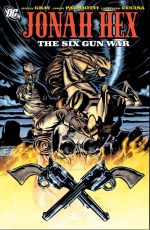
Jonah Hex volume 8: The Six Gun War


By Justin Gray, Jimmy Palmiotti, Cristiano Cucina, Rob Schwager & Rob Leigh (DC Comics)
ISBN: 978-1-4012-2587-2

When Justin Grey & Jimmy Palmiotti resurrected DC’s western wild-man Jonah Hex, they cunningly incorporated an even more mordant, blackly ironic streak of wit than originators John Albano and Tony DeZuñiga to amplify the already sanguine view of morality and justice that permeates the feature. The gritty – often macabre – narratives thus result in some of the most accessible and enjoyable comics fiction ever.

The writers also had the services of extremely talented people like colourist Rob Schwager and letterer Rob Leigh plus their pick of top artists such as Italian maestro Cristiano Cucina (Dragonero) who illustrates this entire uncompromising eighth trade paperback (or digital edition, should you be so inclined) compilation from 2010.

The contents comprise issues #44-49 of this much-missed iteration of the greatest gunman of all time: this go-round generally down-playing sly wit and slick satire in favour of a brutal, wide-ranging saga of death and vengeance…

The Six Gun War begins in the middle of a Texas tornado as Hex blithely stumbles into a cunning trap set by long-term nemeses Quentin Turnbull and El Papagayo.

The plutocratic southern millionaire has bedevilled Hex for more than a decade, mistakenly blaming the former Confederate soldier for the betrayal of his battalion to Union troops and consequent death of Turnbull’s son and heir Jeb.

Alternatively, the flamboyant Mexican bandit, border raider and rabid parrot-fancier is simply a psychotic madman who has had many murderous schemes frustrated by the bounty hunter and yearns to teach the goddam freak a painful final lesson…

Revelling in holding the upper hand, the human monsters do their worst and depart. Left for dead, Hex is miraculously saved by a most unlikely duo and sets off upon the trail of his unsuccessful murderers as they gleefully head back to Mexico.

Turnbull and El Papagayo have a secret joint venture in play. Far from American oversight, the Virginian aristocrat has restored his faded fortunes by enslaving an entire Mexican region and forcing the populace to mine gold for him. The bandit chief’s men act as enforcers and get their cut, as do local government officials…

As the villains head ever southward, they encounter Hex’s sometime allies Tallulah Black and Bat Lash and savagely take them captive for later fun and games…

Hex still has one creepy colleague to call on. Aging bank teller Lazarus Lane is unwilling host to injustice-stalking demon-spirit El Diablo who eagerly joins the coldly furious bounty killer upon the promise of many evil souls to reprimand…

The growing army of retribution is further bolstered by a war-party of Comanche braves trailing a band of whites and Mexicans who lately butchered an encampment of women, children and old men…

The quest quickly results in the grim pursuers liberating Lash and Tallulah – and even taking El Papagayo out of the picture – but after these setbacks, the rich man switches to wealth as his weapon of choice: hiring the world’s seven greatest assassins to stop Hex and Co by any means necessary…

An angry Jonah Hex is more elemental than human, however, and they won’t be nearly enough…

Sharp, smart, fast-paced, deliciously convoluted and staggeringly violent, The Six Gun War is a spectacular explosive epic showing the darkest side of the West’s greatest antihero and the depths to which his enemies will stoop. This is another intoxicating and unmissable yarn no fan of the genre or first tier comicbook wonder will want to miss.
© 2010 DC Comics. All Rights Reserved.

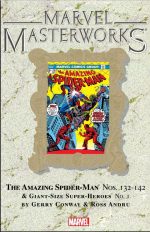
Amazing Spider-Man Masterworks volume 14


By Gerry Conway, Ross Andru, John Romita Sr., Gil Kane & various (Marvel)
ISBN: 978-0-7851-5975-9

The Amazing Spider-Man was always a comicbook that matured with – or perhaps just slightly ahead of – its fan-base and this 14th high-powered hardback compendium (also available as an eBook) of chronological web-spinning adventures sees the World’s Most Misunderstood Hero facing even greater and evermore complex challenges as he slowly recovers from the trauma of losing his one true love and greatest enemy in the same horrific debacle…

Original creator Stan Lee had replaced himself with young science fiction author Gerry Conway and the scripts acquired a more contemporary tone (which of course often feels quite outdated from here in the 21st century, Man!): purportedly more in tune with the times whilst the emphatic use of soap opera subplots kept older readers glued to the series even when the bombastic battle sequences didn’t.

Moreover, as a sign of the times a hint of cynical surrealism also began creeping in…

Thematically, there’s a decline in the use of old-fashioned gangsterism and a growing dependence on outlandish villains. The balance of costumed super-antagonists with thugs, hoods and mob-bosses was gradually ending and soon the global resurgence of interest in supernatural stories would result in more monsters and uncanny happenings…

Nevertheless, the wallcrawler was still indisputably mainstream comics’ voice of youth and defined being teenaged for young readers of the 1970s, facing incredible hardships, fantastic foes and the most pedestrian and debilitating of frustrations.

For newcomers or those just visiting due to exposure to the hype surrounding the latest Spider-Man movie: High School nerd Peter Parker had grown up and gone to college. Because of his guilt-fuelled double-life he struggled there too, developed a stress ulcer but found true love with policeman’s daughter Gwen Stacy…

And then she was murdered by the Green Goblin and Parker had to pick up the pieces of his life…

This volume – collectively spanning May 1974 to March 1975 – reprints Amazing Spider-Man #132-142 and includes a terrifying team-up tale from Giant-Size Super-Heroes #1 (June 1974), opening here with a spate of peculiar robberies.

Illustrated by John Romita Sr., Paul Reinman & Tony Mortellaro, the moody mystery sees the weary Spider-Man returns to New York after saving Aunt May from becoming a collateral casualty of atomic armageddon at the hands of Hammerhead and Doctor Octopus. All too soon he stumbles into ‘The Master Plan of the Molten Man!’ as old school flame Liz Allen resurfaces, needing help. Peter has no idea she is secretly trying to help her criminal stepbrother…

As a super-strong metal-skinned bandit Mark Raxton was only a minor inconvenience to the wallcrawler but now his chemically induced condition has worsened and he is swiftly turning into an incandescent human fireball. By the time ‘The Molten Man Breaks Out!’ in #133 (illustrated by new regular creative team Ross Andru and inkers Frank Giacoia & Dave Hunt), however, there is nothing the hero can do except fight until one of them is dead…

Infuriatingly breaking up that 2-part saga – presumably due to a rather doctrinaire attitude to following strict chronology – is a classic monster action yarn from Giant-Size Super-Heroes #1.

With the monster boom in full swing, Marvel during this period flooded newsstands with horror-themed heroes and antiheroes and cannily teamed two of the Amazing Arachnid’s eeriest enemies in a double-length epic as ‘Man-Wolf at Midnight!’ (Conway, Gil Kane & Mike Esposito) finds John Jameson again gripped by murderous moon-madness. This time, however, the tormented former astronaut has been enthralled by Living Vampire Morbius and used to help the bloodsucker secure a possible cure for his appalling condition ‘When Strikes the Vampire!’

That dynamic dust-up led directly into a flurry of over-sized Giant-Size Spider-Man editions, but as none of them are included in this volume we return to Spider-Man #134 (July 1974) wherein the webspinner again crosses paths with The Punisher after a South American bandit – trained to be his oppressive regime’s Captain America before going freelance – attempts to pillage and ransom a Manhattan tour boat in ‘Danger is a Man Named… Tarantula!’ (Conway, Andru, Giacoia & Hunt).

Once again unwilling allies, the ethically-estranged duo dutifully dismantle the villain’s larcenous schemes after a ‘Shoot-Out in Central Park!’ but the real danger is building elsewhere as Peter Parker’s roommate Harry Osborn accepts at last the infamous inheritance of his devilish, recently departed dad…

The compelling, long-brewing clash of former friends kicks off with completely crazy Harry attempting to blow up Peter and Mary Jane Watson in ‘The Green Goblin Lives Again!’

Privy to his best friend’s secrets, the maniac then targets all Parker’s loved ones, precipitating a desperate, deadly duel when ‘The Green Goblin Strikes!’ and resulting in doom, destruction, shocking revelations and another tragedy for Peter to feel forever responsible for…

‘Madness Means… the Mindworm!’ the finds the still-reeling Peter Parker evicted from his apartment and relocating downmarket to Queens, just in time to encounter a macabre psychic parasite feeding off the denizens of the district. Issue #139 introduces a bludgeoning brute with a grudge against J. Jonah Jameson on the ‘Day of the Grizzly!’

When Spidey intervenes he is soundly thrashed and handed over to the costumed crazy’s silent partner the Jackal who melodramatically reveals he knows the hero’s true identity… Even though Peter escapes his diabolical trap in ‘…And One Will Fall!’ the major maniac flees and remains at large…

A long-running comedy thread ends as the ridiculous Spider-Mobile ends up in the river, but the wallcrawler barely has time to care as an apparently dead enemy returns in #141’s ‘The Man’s Name Appears to be… Mysterio!’ Despite aggressive psychological assaults escalating and Peter continually questioning his own sanity, the mystery is solved in ‘Dead Man’s Bluff!’, wrapping up this transitional period in the life of Peter Parker and setting the scene for another shocking epic, life-changing encounter next time…

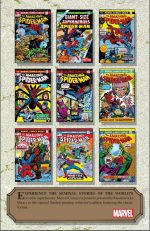
Supplemented by a series of contemporary Annual and compilation covers, House ads, original design sketches, and original art pages by Romita this book also includes full creator biographies and a fascinating Introduction. ‘Telling Stories’ – by author Conway – rightfully praises and appraises the work of collaborator Ross Andru and includes behind-the-scenes, real-life origins of many characters and situations transformed into Marvel magic in these pages.

Blending cultural veracity with glorious art, and making a dramatic virtue of the awkwardness, confusion and sense of powerlessness most of the readership experienced daily, resulted in an irresistibly intoxicating read, delivered in addictive soap-opera instalments, but none of that would be relevant if the stories weren’t so compellingly entertaining.

This action-packed collection comprises one of the most momentous periods in Spider-Man’s astounding life and is one every Fights ‘n’ Tights fanatic should see…
© 1974, 1975, 2011 2015 Marvel Characters, Inc. All rights reserved.

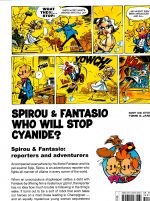
Spirou & Fantasio volume 12: Who Will Stop Cyanide?


By Tome & Janry translated by Jerome Saincantin (Cinebook)
ISBN: 978-1-84918-355-0

Spirou (which translates as both “squirrel” and “mischievous” in the Walloon language) was created by French cartoonist François Robert Velter under his nom-de-plume Rob-Vel. The inspirational invention came at the request of Belgian publisher Éditions Dupuis in direct response to the phenomenal success of Hergé’s Tintin for competing outfit Casterman.

Not long after, soon-to-be legendary weekly comic Spirou launched (on April 21st 1938) with Rob-Vel’s red-headed rascal as the lead of the anthology which bears his name to this day.

The eponymous star was originally a plucky bellboy/lift operator employed by the Moustique Hotel (a wry reference to the publisher’s premier periodical Le Moustique) whose improbable adventures with pet squirrel Spip gradually grew into high-flying, far-reaching and frequently surreal action-comedy dramas.

Spirou and his chums have spearheaded the magazine for most of its life, with a phalanx of truly impressive creators carrying on Velter’s work, beginning with his wife Blanche “Davine” Dumoulin who took over the strip when her husband enlisted in 1939. She was assisted by Belgian artist Luc Lafnet until 1943 when Dupuis purchased all rights to the property, after which comic-strip prodigy Joseph Gillain (“Jijé”) took the helm.

In 1946 Jijé’s assistant André Franquin assumed the creative reins, gradually sidelining the long-established brief, complete gag-vignettes in favour of epic adventure serials, introducing a wide and engaging cast of regulars and eventually creating phenomenally popular magic animal the Marsupilami to the mix.

Franquin continued crafting increasingly fantastic Spirou sagas until his abrupt resignation in 1969, and his tenure is remembered for the wealth of weird and wonderful players and villains he added to the cast. As well as comrade, rival and co-star Fantasio or perennial exotic arch-enemies such as Zorglub and Fantasio’s unsavoury cousin Zantafio, a particular useful favourite was crackpot inventor and modern-day Merlin of mushroom mechanics Pacôme Hégésippe Adélard Ladislas, the Count of Champignac (and sly tribute to an immortal be-whiskered druid dubbed Getafix…)

Franquin was succeeded by Jean-Claude Fournier who updated the feature over the course of nine stirring yarns tapping into the rebellious, relevant zeitgeist of the times: tales of environmental concern, nuclear energy, drug cartels and repressive regimes.

However, by the 1980s the series was looking a tad outdated and directionless. Three different creative teams then alternated on the feature, until it was at last revitalised by Philippe Vandevelde – writing as Tome – and artist Jean-Richard Geurts AKA Janry, who adapted, referenced and in all the best ways returned to the beloved Franquin era.

Their sterling efforts began with the tale under review here and quickly revived the floundering feature’s fortunes. They contributed fourteen more wonderful albums to the canon between 1984 and 1998, and allowed the venerable strip to diversify into parallel strands (Spirou’s Childhood/Little Spirou and guest-creator specials A Spirou Story By…).

Tome & Janry were followed on the core feature by Jean-David Morvan & José-Luis Munuera, and in 2010 Yoann & Vehlmann took over the never-ending procession of astounding escapades…

Cinebook have been publishing Spirou & Fantasio‘s exploits since 2009, alternating between Tome & Janry’s superb reinterpretations of Franquin and earlier triumphs by the great man himself. Who Will Stop Cyanide? is the twelfth English-language release and officially the cartoon crimebusters’ 35th collected collaborative caper; originally published continentally as Qui arrêtera Cyanure? in Spirou #2427-2448 in 1984 before being subsequently released as Tome & Janry’s third album a year later.

Funny, frenetically-paced and potently sinister when most appropriate, the tale leans heavily on science fiction paranoia and opens as photojournalist Fantasio tries to return a defective new camera. After some truly appalling customer service he is fobbed off with a bizarre bucket of bolts which seems to be a semi-sentient little robot that takes polaroid snaps…

The “screwball gizmo” is a mischief-maker with a mind of its own and finds a kindred spirit in Spirou’s pet squirrel Spip, but that doesn’t stop it making a cunning bid for freedom at the first opportunity. In hot pursuit, the adventuresome lads frantically trail the demented droid out to worryingly familiar territory: the far from peaceful hamlet of Champignac-in-the-Sticks. However, this time it’s not the mushroom-mad Count who’s behind an increasingly nerve-wracking situation…

Following a stern warning from the harassed Mayor – already well-acquainted with the kind of chaos that follows in Spiro and Fantasio’s wake – the jaunty journalists find the little gizmo at the dilapidated railway station. A furtive search through dank back rooms soon exposes an horrific scene: a beautiful woman tied to a chair and hooded.

The outraged heroes free the distressed damsel and are immediately attacked; both by her and a number of ordinary mechanical objects suddenly imbued with terrifying, violent animation…

After the former captive explosively escapes, the stunned lads meet dowdy Stationmaster Catenaire and hear an incredible story…

The little man is something of an unsung scientific tinkerer and when railway cutbacks left him with time on his hands he started dabbling in robotics. Firstly, he built the little droid – dubbed “Telesphore” – but eventually, craving a more exotic and comforting companion, moved on to formulate a comely android for his personal use.

Sadly, the Marilyn Monroe doppelganger he crafted gained instant sentience and an abiding abhorrence for humankind.

Calling herself Cyanide she played vicious jokes on people and even attacked them. When she started possessing machinery, Catenaire was forced to shut her down. Now, thanks to the gallant impulses of Spirou and Fantasio, she’s free and determined to make all meat-things pay…

And so unfolds a splendidly compelling and frantic game of cat-&-mouse as the lads chase the wicked automaton and she – thanks to the recent unwelcome advent of a huge fully-automated factory in the village – unleashes an army of mechanical monstrosities to crush them before expanding her horizons to encompass the village and eventually the rest of humanity…

Fast-paced and exuberant, Who Will Stop Cyanide? is a funny, thrilling rollercoaster romp easily accessible to readers of all ages and drawn with beguiling style and seductively wholesome élan. Catch it if you can…
Original edition © Dupuis, 1985 by Tome & Janry. All rights reserved. English translation 2017 © Cinebook Ltd.

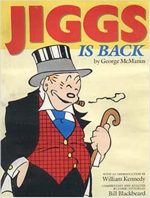
Jiggs is Back


By George McManus (City Lights/Celtic Book Company)
ISBN: 978-0-91366-682-1

Variously entitled Maggie and Jiggs or Bringing Up Father, the comedic magnum opus of George McManus ranks as one of the best and most influential comic strips of all time: a brilliant blend of high satire and low wit that drapes the rags-to-riches American dream with the cautionary admonition to be careful of what you wish for…

Relatively recently this magnificent series was celebrated with a lavish hardcover collection reprinting the strip’s captivating beginnings (see George McManus’s Bringing Up Father: Forever Nuts – Classic Screwball Strips) but that book, wonderful though it is, only prints black and white daily episodes, whilst this colossal softcover from 1986 concentrates on the exceptionally beautiful Sunday colour pages – a perfect proving ground for the artist’s incredible imagination to run wild with slapstick set-pieces, innovative page design and a near-mystical eye for fashion and pattern.

McManus was born on January 23rd in either 1882 or 1883 and drew from a very young age. His father, realising his talent, secured him work in the art department of the St. Louis Republic newspaper.

At thirteen George swept floors, ran errands and drew when ordered to. In an era before cheap, reliable photography, news stories were supplemented by drawn illustrations; usually of disasters, civic events and executions: McManus claimed he had attended 120 hangings (a national record!) but still found time to produce cartoons: honing his mordant wit and visual pacing. His first sale was Elmer and Oliver. He hated it.

The jobbing cartoonist had a legendary stroke of luck in 1903. Acting on a bootblack’s tip he placed a $100 bet on a 30-1 outsider and used his winnings to fund a trip to New York City. The young hopeful splurged his cash reserves but on his last day got two job offers: one from the McClure Syndicate and a lesser bid from Joseph Pulitzer’s New York World.

He took the smaller offer, went to work for Pulitzer and created a host of features for the paper including Snoozer, The Merry Marceline, Ready Money Ladies, Cheerful Charlie, Panhandle Pete, Let George Do It, Nibsy the Newsboy in Funny Fairyland (one of the earliest Little Nemo knock-offs) and, in 1904, his first big hit The Newlyweds.

This last brought him to the attention of Pulitzer’s arch rival William Randolph Hearst who, acting in tried and true manner, lured him away with big money in 1912. In Hearst’s papers, The Newlyweds became the Sunday page feature Their Only Child, and was soon supplemented by Outside the Asylum, The Whole Blooming Family, Spare Ribs and Gravy and, at last, Bringing Up Father.

At first it alternated with other McManus domestic comedies in the same slot, but eventually the artist dropped Oh, It’s Great to be Married!, Oh, It’s Great to Have a Home and Ah Yes! Our Happy Home! as well as his second Sunday strip Love Affairs of a Muttonhead to concentrate on the story of Irish hod-carrier Jiggs whose sudden and vast newfound wealth brought him no joy, whilst his parvenu wife Maggie and inexplicably comely and cultured daughter Nora constantly sought acceptance in “Polite” society.

The strip turned on the simplest of premises: whilst Maggie and Nora perpetually feted wealth and aristocracy, Jiggs – who only wanted to booze and schmooze and eat his beloved corned beef and cabbage – would somehow shoot down their plans; usually with severe personal consequences.

Maggie might have risen in society but she never lost her devastating accuracy with crockery and household appliances…

Bringing Up Father launched on January 12th 1913, originally appearing three times a week, then four and eventually every day. It made McManus two fortunes (the first lost in the 1929 Stock Market crash), spawned a radio show, a movie in 1928, five more between 1946-1950 (as well as an original Finnish film in 1939) and 9 silent animated short features, plus all the assorted marketing paraphernalia that fetches such high prices in today’s antique markets.

McManus died in 1954, and other creators continued the strip until May 28th 2000, its unbroken 87 years making it the second longest running newspaper strip of all time.

McManus said that he got the basic idea from The Rising Generation – a musical comedy he’d seen as a boy, but the premise of wealth not bringing happiness was only the foundation of the strip’s success.

Jigg’s discomfort at his elevated position, his yearnings for the nostalgic days and simple joys of youth are something everyone is prey to. However, the deciding factor and real magic at work here is an entrancing blend of slapstick, social commentary, sexual politics and flashy fashion, all cannily composted together and delivered by a man who lived and breathed comedy timing and could draw like an angel.

The incredibly clean simple lines and the superb use – and implicit understanding – of art nouveau and art deco imagery and Jazz Age philosophy – especially proffered in full colour – make this book a stunning treat for the eye.

This glorious rainbow of mirth includes an introduction from Pulitzer-winning author William Kennedy and an incisive analytical commentary from comics historian Bill Blackbeard for those that need or desire a grounding for their reading, but of course what we all want is to revel in the 48 magnificent, full-page escapades; thoughtfully divided into palatable sections starting with ‘The Joys of Poverty’ from 1923, wherein the family suffered a reversal of fortune and became once more poor, but happy.

This is followed by ‘The Vacation’ (December 9th 1939 to July 7th 1940), a visually spectacular epic following the wealthy-once-more family – complete with new aristocratic English twit son-in-law – on a city-by-city tour of America, and ‘Maggie, Do You Remember When…’ (selected from the peak period of the feature between 1933 and 1942): a shamelessly sentimental and dryly witty occasional series of bucolic recollections of “the good old days” that produced some of the most heart-warming and inventive episodes in the series’ entire history…

An added surprise for a strip of this vintage is the great egalitarianism of it. Although there is an occasional unwholesome visual stereotype to swallow and excuse, what we regard as racism is practically absent. The only thing to watch out for is the genteel sexism and class (un)consciousness, although McManus clearly pitched his tent on the side of the dirty, disenfranchised and downtrodden – as long as he could get a laugh out of it…

This wonderful, evocative celebration of the world’s greatest domestic comedy strip is a little hard to find but well worth the effort. Hopefully some sagacious entrepreneur will eventually get around to giving Bringing Up Father the deluxe reprint treatment it so deserves or at least creating a digital collection for modern-minded old-fashioned comedy mavens to relish and revel in.
© 1986 Celtic Book Company.

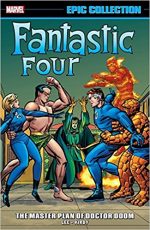
Fantastic Four Epic Collection volume 2: The Master Plan of Doctor Doom


By Stan Lee, Jack Kirby & various (Marvel)
ISBN: 978-1-3029-0435-7

Fantastic Four #1 (bi-monthly and cover-dated November 1961, by Stan Lee, Jack Kirby, George Klein & Christopher Rule was crude: rough, passionate and uncontrolled excitement. Thrill-hungry kids pounced on it and the raw storytelling caught a wave of change starting to build in America. It and succeeding issues changed comicbooks forever.

This full-colour compendium – also available as a digital download – collects Fantastic Four #19-32 plus the first two giant-sized Annuals issues of progressive landmarks (spanning July 1963 to October 1963) and tellingly reveals how Stan & Jack cannily built on that early energy to consolidate the FF as the leading title and most innovative series of the era.

As seen in the ground-breaking premier issue, maverick scientist Reed Richards, his fiancé Sue Storm, their close friend Ben Grimm and Sue’s teenaged brother survived an ill-starred private space-shot after Cosmic rays penetrated their ship’s inadequate shielding and mutated them all.

Richards’ body became elastic, Sue gained the power to turn invisible, Johnny Storm could turn into living flame and tragic Ben devolved into a shambling, rocky freak.

Here the wonderment resumes with the contents of the first summer Annual: a spectacular 37-page epic battle as, finally reunited with their wandering prince, the warriors of Atlantis invade New York City and the rest of the world in ‘The Sub-Mariner versus the Human Race!’ by Lee, Kirby and inker Dick Ayers.

A monumental tale by the standards of the time, the saga saw the FF repel the undersea invasion through valiant struggle and brilliant strategy as well as providing a secret history of the secretive race Homo Mermanus. Nothing was really settled except a return to the original status quo, but the thrills were intense and unforgettable…

Also included are rousing pin-ups and fact file features ‘A Gallery of the Fantastic Four’s Most Famous Foes!’, ‘Questions and Answers about the Fantastic Four’, a diagrammatic trip ‘Inside the Baxter Building’ and a charming short tale ‘The Fabulous Fantastic Four meet Spider-Man!’.

This is an extended re-interpretation of the first meeting between the two most popular Marvel brands from the premiere issue of the wallcrawler’s own comic. Pencilled this time by Kirby, the dramatic duel benefitted from Steve Ditko’s inking which created a truly novel look.

Cover-dated October 1963, Fantastic Four #19 introduced another of the company’s top-ranking super-villains as the quarrelsome quartet travelled back to ancient Egypt and ‘Prisoners of the Pharaoh!’ This time travel tale has been revisited by so many writers that it is considered one of the key stories in Marvel history introducing a future-Earth tyrant who would evolve into overarching menace Kang the Conqueror.

Another universe-threatening foe was introduced and defeated by brains not brawn in

FF#20 as ‘The Mysterious Molecule Man!’ menaced New York before being soundly outsmarted, whilst the next issue guest-starred Nick Fury: lead character in Marvel’s only war comic.

Sgt. Fury and his Howling Commandos was another solid hit, but eventually the brusque and brutal star would metamorphose into the company’s answer to James Bond. Here, however, he’s a simple CIA agent seeking the team’s aid against a sinister demagogue called ‘The Hate-Monger’ in a cracking yarn with a strong message, inked by comics veteran George Roussos, under the protective nom-de-plume George Bell.

By this juncture the team were firmly established and creators Lee & Kirby were well on the way to toppling DC/National Comics from their decades-held top spot through an engaging blend of brash, folksy and consciously contemporaneous sagas, mixing high concept, low comedy, trenchant melodrama and breathtaking action.

Unseen since the premiere issue, #22 finally saw ‘The Return of the Mole Man!’; another full-on monster-mashing fight-fest, chiefly notable for the debut of the Invisible Girl’s newly developed powers of projecting force fields and “invisible energy” – which would eventually make her one of the mightiest characters in the company’s pantheon.

Fantastic Four #23 heralded ‘The Master Plan of Doctor Doom!’, which introduced his frankly mediocre minions the Terrible Trio of Bull Brogin, Handsome Harry and Yogi Dakor, although the uncanny menace of “the Solar Wave” was enough to raise the hackles on my 5-year-old neck…

(Do I need to qualify that with: all of me was five but only my neck had properly developed hackles back then?)

Issue #24’s ‘The Infant Terrible!’ was a sterling yarn of inadvertent extra-galactic menace and misplaced innocence, followed by a two-part epic that truly defined the inherent difference between Lee and Kirby’s work and everybody else’s at that time.

Fantastic Four #25 and 26 featured a cataclysmic clash that had young heads spinning in 1964 and led directly to the Emerald Behemoth finally regaining a strip of his own. In ‘The Hulk Vs The Thing’ and ‘The Avengers Take Over!’, a fast-paced, all-out Battle Royale resulted when the disgruntled man-monster came to New York in search of side-kick Rick Jones, and only an injury-wracked FF stood in the way of his destructive rampage.

A definitive moment in the character development of The Thing, the action was ramped up when a rather stiff-necked and officious Avengers team horn in claiming jurisdictional rights on “Bob” Banner (this tale is plagued with pesky continuity errors which would haunt Stan Lee for decades) and his Jaded alter ego. Notwithstanding the bloopers, this is one of Marvel’s key moments and still a visceral, vital read.

The creators had hit on a winning formula by including their other stars in guest-shots – especially as readers could never anticipate if they would fight with or beside the home team. ‘The Search for Sub-Mariner!’ again found the undersea anti-hero in amorous mood, and when he abducted Sue Storm the boys called in Doctor Strange, Master of the Mystic Arts to aid them. Issue #28 is a superb team-up tale too, most notable (for me and many other older fans) for the man who replaced George Roussos.

‘We Have to Fight the X-Men!’ finds the disparate teams battling due to the machinations of Puppet Master and the Mad Thinker, but the inclusion of Chic Stone – Kirby’s most simpatico and expressive inker – elevates the art to indescribable levels of quality.

‘It Started on Yancy Street!’ (FF#29) starts low-key and a little silly in the slum where Ben Grimm grew up, but with the reappearance of the Red Ghost and his Super-Apes the action quickly goes Cosmic and results in a blockbusting battle on the Moon, with the following issue introducing evil alchemist ‘The Dreaded Diablo!’ who almost breaks up the team while casually conquering the world from his spooky Transylvanian castle.

Next up is Fantastic Four Annual #2 from 1964; boldly leading with ‘The Fantastic Origin of Doctor Doom!’, tragically detailing how brilliant gypsy boy Victor Von Doom remakes himself into the most deadly villain in creation.

Following a fresh batch of rogues starring in ‘A Gallery of the Fantastic Four’s Most Famous Foes!’ and pin-ups of Johnny, Sue, Ben, Alicia Masters and Reed, the past informs the present as the ultimate villain believes he has achieved ‘The Final Victory of Dr. Doom!’, but has in fact suffered his most ignominious defeat…

The monthly wonderment resumes with #31’s ‘The Mad Menace of the Macabre Mole Man!’ which precariously balances a loopy plan by the subterranean satrap to steal entire streets of New York City with a portentous sub-plot featuring a mysterious man from Sue’s past, as well as renewing the quartet’s somewhat fractious relationship with the Mighty Avengers…

The secret of that mystery man is revealed in the last tale in this titanic tome. ‘Death of a Hero!’ is a powerful tale of tragedy and regret that spans two galaxies, starring the uniquely villainous Invincible Man who is not at all what he seems…

Adding unique value to the proceedings, this epic encounter closes with a house ad for the first FF Annual plus the unused first cover version, many original art pages by Kirby inked by Ayers, Roussos and Stone, an unused pencilled Kirby cover for FF #20 and a quartet of re-mastered Masterworks collection covers drawn by Jack and painted by Dean White.

This is a truly magnificent book to read highlighting the tales that built a comics empire. The verve, imagination and sheer enthusiasm shines through and the wonder is there for you to share. If you’ve never thrilled to these spectacular sagas then this book of marvels is your best and most economical key to another world and time.
© 1963, 1964, 2017 Marvel Characters, Inc. All rights reserved.

Athos in America


By Jason, coloured by Hubert and translated by Kim Thompson (Fantagraphics Books) ISBN: 978-1-60699-478-8

Jason is secretly John Arne Saeterrøy: born in Molde, Norway in 1965 and an overnight international cartoon superstar since 1995 when his first graphic novel Lomma full ay regn (Pocket Full of Rain) won that year’s Sproing Award (Norway’s biggest comics prize).

He won another Sproing in 2001 for his Mjau Mjau strip and the next year turned almost exclusively to producing graphic novels. Now a global star among the cognoscenti he has numerous major awards from such disparate locales as France, Slovakia and the USA.

Jason’s breadth of interest is capacious and deep: comics, movies, music, high literature, low life, real life and pulp fiction all feature equally with no sense of hierarchy, and his puckish mixing and matching of these evergreen founts of inspiration always results in a picture-treatise well worth a reader’s time.

A master of short-form illustrated tales, many Jason yarns are released as snappy little albums which are perfect for later inclusion in longer anthology collections such as this one which gathers a half-dozen sharp of the very best.

As always, the visual/verbal bon mots unfold in Jason’s beguiling, sparse-dialogued, pantomimic progressions with enchantingly formal page layouts rendered in the familiar, minimalist evolution of Hergé’s Claire Ligne style; solid blacks, thick lines and settings of seductive simplicity. That delight is augmented here by a varied and beguiling palette ranging from stark pastels to muted primary colours to moody duotone…

Available as a sturdily comforting hardback and exciting eBook edition, the stream of subtle wonderment opens with understated crime thriller ‘The Smiling Horse’ as the last survivor of a kidnap team endures decades of tense anticipation before their victim’s uncanny avenger finally dispenses long-deferred justice, after which Jason examines his own life, career and romantic failings in harsh, uncompromising detail in ‘A Cat from Heaven’…

B-Movie Sci Fi informs ‘The Brain That Wouldn’t Virginia Woolf’ as a scientist spends years killing women whilst looking for a body that won’t reject the mean-spirited, constantly carping head he keeps alive in his laboratory, before ‘Tom Waits on the Moon’ inexorably draws together a quartet of introspective, isolated loners who spend too much time thinking not doing into a web of fantastic horror…

A cunning period gangster pastiche rendered in subdued shades of red and brown, ‘So Long, Mary Anne’ sees a decent woman helping a vicious escaped convict flee justice. After they snatch a hostage the “victim” soon begins to exert an uncanny influence over the desperate killer, but is she just wicked or is there a hidden agenda in play?

Most welcome attraction here is eponymous final story ‘Athos in America’. This is a fabulously engaging “glory days” yarn acting as a prequel to the author’s spellbinding graphic romp The Last Musketeer.

That epic detailed the final exploit of the dashing Athos, who met his end bravely and improbably after four hundred years of valiant adventure. But what was he doing in the years before that?

A guy walks into a bar… It’s America in the 1920s and the oddly-dressed Frenchman starts chatting to Bob the barman. As the quiet night unfolds the affable patron relates how he came to America to star in a movie about himself and his three greatest friends. Sadly, after he enjoyed a dalliance with the Studio’s top star, things quickly started to go wrong…

Effortlessly switching back and forth between genre, milieu and narrative pigeon holes, this grab-bag of graphic goodies again proves that Jason is a creative force in comics like no other: one totally deserving as much of your time, attention and disposable income as possible.
All characters, stories and artwork © 2011 Jason. All rights reserved.

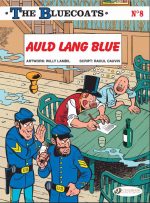
The Bluecoats volume 8: Auld Lang Blue


By Willy Lambil & Raoul Cauvin translated by Jerome Saincantin (Cinebook)
ISBN: 978-1-84918-245-4

Les Tuniques Bleues began in 1968; an occasional comedy western strip created by Louis “Salvé” Salvérius & Raoul Colvin – who has solo-written every best-selling volume since. The feature was created to replace Western wonder man Lucky Luke when the laconic lone gunslinger defected from weekly anthology Spirou to comic rival Pilote.

His rapidly-rendered replacements swiftly became one of the most popular bande dessinée stars on the Continent…

Salvé was a cartoonist of the Gallic big-foot/big-nose humour style, and when he died suddenly in 1972, his replacement – Willy “Lambil” Lambillotte – gradually moved to a more edgy and realistic (although still broadly comedic) illustrative manner. Lambil is Belgian-born (in 1936) and, after studying Fine Art in college, joined publishing giant Dupuis as a letterer in 1952.

Born in 1938, scripter Raoul Cauvin is also Belgian and studied Lithography before joining Dupuis’ animation department in 1960. He soon discovered his true calling as a comedy writer and began a glittering and prolific career at Spirou.

In addition to Bluecoats Cauvin has written dozens of other long-running, award winning series including Cédric, Les Femmes en Blanc and Agent 212: amassing more than 240 separate albums in total. The Bluecoats alone have sold more than 15 million copies worldwide.

The sorry protagonists of the show are Sergeant Cornelius Chesterfield and Corporal Blutch, a pair of worthy fools in the manner of Laurel and Hardy: hapless, ill-starred US cavalrymen posted to the wild frontier and various key points of mythic America.

The original format was single-page gags about an Indian-plagued cavalry fort, but with second volume ‘Du Nord au Sud’ (North and South) the sad-sack soldiers went back East to fight in the American Civil War.

That origin was discarded and rewritten a decade later, finally and canonically describing how the chumps were drafted into the military during the war and appears here as Auld Lang Blue: Cinebook’s 8th astoundingly attractive Bluecoats album.

All subsequent adventures – despite ranging far beyond the traditional environs of America and taking in a lot of genuine and thoroughly researched history – are set within the timeframe of the Secession conflict.

Blutch is your average whinging little-man-in-the street: work-shy, mouthy, devious and especially critical of the army and its inept commanders. Ducking, diving, feigning death and even deserting whenever he can, he’s you or me – except sometimes he’s quite smart and heroic if no other, easier, option is available.

Chesterfield is a big burly man; an apparently ideal career soldier who has passionately bought into all the patriotism and esprit-de-corps of the Military. He is brave, never shirks his duty and wants to be a hero. He also loves his cynical little pal. They quarrel like a married couple, fight like brothers but simply cannot agree on the point and purpose of the horrendous war they are trapped in…

But as this witty yarn elaborates, such was not always the case…

Les Tuniques Bleues: Blue rétro was first seen on the continent in 1980, serialised in Spirou #2222-2232. It was the unlikely lads’ 29th adventure, and became the 18th best-selling collected album a year later (of 58 and counting, thus far).

It opens here as dutiful son Cornelius is awakened by his doting but domineering mother. She’s thoroughly excited by her boy’s upcoming nuptial merger with butcher’s daughter Charlotte Graham. Bewildered Cornelius still can’t work how, let alone why, he’s all-but-inescapably betrothed to his boss’ far from comely child…

The boy’s rowdy, wheelchair-bound dad Joshua Chesterfield is less cheery. He fondly remembers his military years and, as a proud survivor of the Alamo, wishes his son had more gumption and get-up-and-go…

There’s no winning against his mother though, so Cornelius heads for the butchers’ shop, arriving just in time to deftly avoid Charlotte by delivering a large order to the new Pacific Bar that has just opened on Main Street. The little guy behind the gleaming bar is a bit of an annoyance but young Chesterfield’s initial distaste is soon swallowed up by the chatter of the patrons discussing the Secession War.

The Northern States are taking a terrible beating on all fronts, but neither butcher’s boy or barman care all that much about a subject so far removed from their own lives…

That quickly changes after Army Recruiters proudly parade their latest crop of raw material down the thoroughfare. Diminutive, canny Blutch is bemused, but Cornelius sees glory, adventure and escape from matrimonial servitude in the gleaming column of callow blue boys…

All the same, mother and Mr. Graham have Cornelius’ life utterly mapped out, and despite his fervent desires, soon after Cornelius M. Chesterfield is all dandied-up and despatched to make a formal proposal to Charlotte. Unwilling, unhappy and contemplating years of being bossed around by women, Cornelius stops off at the Pacific Bar to intestinally fortify himself before the ordeal.

Being a comradely, consoling type, barman Blutch keeps him company in a tot or two and they are both extremely amenable when – some hours later – the Army Recruiters enter the bar. Joining the festivities, the soldiers soon realise that their still woefully-unfilled quotas might benefit from a bit of blather and a couple of hastily modified application forms…

And so it begins: by the time they are conscious again our two new warriors are well on the way to becoming infantrymen: each adapting to the appalling situation in their own unique manner as they reluctantly adjust to the daily madness of army life.

However, even before basic training is over, they both realise their lives are now governed by elitist idiots who don’t care if they live or die. Unable to avoid being cannon-fodder, they conspire to transfer into the far safer and more glamorous cavalry. All they need to do now is learn to ride before anyone finds out they don’t know one end of a horse from the other…

Historically authentic, always in good taste despite its uncompromising portrayal of violence, the attitudes expressed by the down-to-earth pair never make battle anything but arrant folly and, like the hilarious yet insanely tragic war-memoirs of Spike Milligan, these are comedic tales whose very humour makes the occasional moments of shocking verity doubly powerful and hard-hitting.

This particular tome is heavy on comedy too: a fun, informative, beautifully realised and eminently readable yarn to appeal to the best, not worst, of the human spirit.
© Dupuis 1981 by Lambil & Cauvin. English translation © 2015 Cinebook Ltd. All rights reserved.

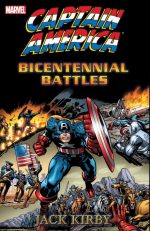
Jack Kirby’s Captain America: Bicentennial Battles


By Jack Kirby with Herb Trimpe, Barry Windsor-Smith, John Romita Sr., Bob Smith, Frank Giacoia, John Verpoorten & various (Marvel)
ISBN: 978-0-7851-1726-1)

These days Captain America is as much a global symbol of the Land of the Free and the Home of the Brave as Uncle Sam or Apple Pie ever were so I’m enjoying a lazy and rather obvious way to celebrate Independence Day by recommending this bombastic blockbuster featuring material first seen in 1976 as the nation commemorated its first 200 years.

The immortal Sentinel of Liberty was dreamed up by Joe Simon & Jack Kirby at a time of increasing national tension in an era of fervent patriotic fervour: Captain America was a dynamic and highly visible response to the horrors of Nazism and the threat of Liberty’s loss.

He quickly lost focus and popularity after hostilities ceased: fading during post-war reconstruction to briefly reappear after the Korean War: a harder, darker sentinel ferreting out monsters, subversives and the “commies” who lurked under every American bed. Then he vanished once more until the burgeoning Marvel Age resurrected him just in time to experience the Republic’s most turbulent and culturally divisive era.

He quickly became a mainstay of the Marvel Revolution during the Swinging Sixties but lost his way somewhat after that, except for a glittering period under scripter Steve Englehart. Eventually however he too moved on and out in the middle of the 1970s.

After nearly a decade drafting almost all of Marvel’s successes, Jack Kirby had become increasingly burdened by Marvel’s growing success and unwillingness to let him experiment, so he had jumped ship to arch-rival DC in 1971, creating a whole new mythology and dynamically inspiring pantheon.

Eventually he accepted that editors made the same promises everywhere, and that even he could never win against any short-sighted publishing company’s excessive pressure to produce and constant interfering g micro-managing.

Kirby exploded back into the Marvel Universe in 1976 with a promise of free rein, concocting a stunning wave of iconic creations (2001: A Space Odyssey, Machine Man, The Eternals, Devil Dinosaur). Simultaneously he was handed control of two of his previous co-creations – firmly established superhero characters Black Panther and Captain America – to do with as he wished…

His return was much hyped at the time but swiftly became controversial as his intensely personal visions paid little lip service to company continuity as Jack went explosively his own way.

Whilst his new works quickly found many friends, his tenure on those earlier inventions drastically divided the fan base. Kirby was never slavishly wedded to tight continuity and preferred, in many ways, to treat his stints on any strip as creative “Day Ones”. This was never more apparent than in the pages of the Star-Spangled Sentinel of Liberty…

This titanic trade paperback/eBook collection reprints Captain America’s Bicentennial Battles and Captain America #201-205 (September 1976 – January1977) with Kirby as writer, artist and editor, exploring his own notions of the American Dream as seen through the lens of the nation’s premiere comicbook patriotic symbol in the year of the nation’s 200th anniversary…

Captain America’s Bicentennial Battles was originally released as part of the nationwide celebration of the USA’s two hundredth year in Marvel’s tabloid-sized Treasury Format (80+ pages of 338 x 258mm dimensions) and took the Star-Spangled Avenger on an incredible excursion through the key eras and areas of American history.

A vast, expansive, panoramic and iconic celebration of the memory and the myth of the nation, this almost abstracted and heavily symbolic 84-page extravaganza perfectly survives the surrender of colour and reduction to standard comic dimensions, following Captain America when cosmic savant (and retrofitted Elder of the Universe The Contemplator) Mister Buda propelled the querulous hero into successively significant segments of history.

Enduring a blistering pace of constant change, Captain America encounters lost partner Bucky during WWII, meets Benjamin Franklin in Revolutionary Philadelphia and revisits the mobster-ridden depression era of Steve Roger‘s childhood as ‘The Lost Super-Hero!’.

In ‘My Fellow Americans’ Cap confronts Geronimo during the Indian Wars and suffers the horrors of a mine cave-in, before ‘Stop Here for Glory!’ finds him surviving a dogfight with a German WWI fighter ace, battling bare-knuckle boxer John L. Sullivan, resisting slavers with abolitionist John Brown, and observing both the detonation of the first Atom Bomb and the Great Chicago Fire…

‘The Face of the Future!’ even sees him slipping into the space colonies of America’s inevitable tomorrows before segueing into pure emotional fantasy by experiencing the glory days of Hollywood, the simple joys of rural homesteading and the harshest modern ghetto, before drawing strength from the nation’s hopeful children…

Inked by such luminaries as Barry Windsor-Smith, John Romita Sr. and Herb Trimpe, the book-length bonanza is peppered with a glorious selection of pulsating pin-ups.

After thus exotically absorbing the worth of a nation, the Star-Spangled Avenger reunites with his partner for Captain America and the Falcon #201, set in the aftermath of their struggle to stop a deranged aristocrat rolling back the American Revolution…

The pace then shifts to malevolent moodiness and uncanny mystery with the introduction of ‘The Night People!’: a street-full of mutants and maniacs who periodically phase into and out of New York City, creating terror and chaos with every sunset. When Falcon Sam Wilson and girlfriend Leila are abducted by the eerie encroachers, they are quickly converted to their crazed cause by exposure to the ‘Mad, Mad Dimension!’ the vile visitors inhabit during daylight hours. This leaves Captain America and folksy new colleague Texas Jack Muldoon hopelessly outgunned when their last-ditch rescue attempt results in them all battling an invasion of brutally berserk beasts in ‘Alamo II!’

On bludgeoning, bombastic top-form, the Star-Spangled Avenger saves the day once more, but no sooner are the erstwhile inhabitants of Zero Street safely ensconced on Earth than ‘The Unburied One!’ has the indefatigable champions battling against a corpse who won’t play dead. The concluding chapter and last tale in this thrilling tome reveal the cadaver has become home to an energy-being from the far future as ‘Agron Walks the Earth!’ Thankfully, not even its pulsating power and rage can long baulk the indomitable spirit and ability of America’s Ultimate Fighting Man…

The King’s commitment to wholesome adventure, breakneck action and breathless wonderment, combined with his absolute mastery of the comic page and unceasing quest for the Next Big Thrill, always make for a captivating read and this stuff is as good as anything Jack crafted over his decades of creative brilliance.

Fast-paced, action-packed, totally engrossing Fights ‘n’ Tights masterpieces no fan should ignore and, above all else, fabulously fun tales of a true American Dream…
© 1976, 1977, 2005, 2016 Marvel Characters, Inc. All rights reserved.

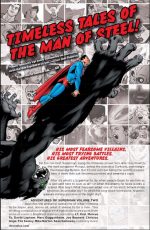
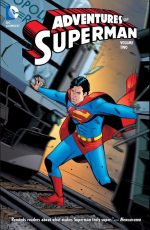
Adventures of Superman volume 2


By J.T. Krul, David Lapham, Tim Seeley, Marc Guggenheim, Christos Gage, Derek Fridolfs, Josh Elder, Marcus To, Mike Norton, Joe Bennett, Belardino Brabo, Eduardo Francisco, Sean Galloway, Victor Ibáñez, & various (DC Comics)
ISBN: 978-1-4012-5036-2

Almost 80 years ago Superman jump-started the entire modern era of fantasy heroes: indomitable, infallible, unconquerable, outlandish and flamboyant. He also saved a foundering proto-industry by personifying an entirely new genre of storytelling – the Super Hero.

Since June 1938 he has grown into a mighty presence in all aspects of art, culture and commerce, even as his natal comicbook universe organically grew and expanded. Moreover, as befits such an evergreen icon, periodically the Man of Tomorrow has been radically rebooted, such as in the aftermath of Crisis on Infinite Earth in 1985-86.

There have been subsequent minor tweaks in that continuity to accommodate different creators’ tenures until 2011 when DC drastically and emphatically re-imagined their entire comics line once more. Superman and his universe underwent a radical, fan-infuriating all-encompassing revivification.

Probably to mitigate the fallout, DC latterly triggered a number of fall-back options such as this intriguing package…

Adventures of Superman began as a “digital first” series appearing online before later gathering chapters into issues of a new standard comicbook. As conceived and concocted by a fluctuating roster of artists and writers, the contents featured previous eras and incarnations of the Man of Steel’s stellar career – plus some wildly innovative alternative visions – offering a wide variety of thrilling, engaging and sincerely fun-filled moments for both old-timers and neophytes to treasure.

The comicbook iteration was enough of a success to warrant its own series of trade paperback compilations which – in the fullness of time and nature of circularity – gained their own digital avatars as eBooks too.

This second full-colour paperback collection contains Adventures of Superman 6-10 (December 2013-April 2014) and opens with ‘Like Father, Like Son’ by J.T. Krul & Marcus To, wherein an AI recording of expired Kryptonian sire Jor-El seeks to convince Earth’s greatest champion that he is demeaning himself and his heritage by acting as a defender of primitives.

The moral dilemma takes a dark turn when Phantom Zone convict General Zod adds his own sinister spin to the debate just as all-conquering alien marauder Mongul attacks Earth, but as always, sound and sensible Earthly foster-father Jonathan Kent has the last word and best advice…

Multi-talented David Lapham weaves a different ethical quandary in ‘Saved!’ as, after defeating crafty cyborg Metallo, Superman must convince a growing army of disturbed humans that he is not a personal interventionist god ever-ready to preserve their lives from every mistake or suicide attempt…

In ‘Space, Actually’ (by Tim Seeley & Mike Norton) the Man of Tomorrow defers a battle with fellow superheroes J’onn J’onzz and Wonder Woman against Darkseid to salve the woes of a little Russian orphan before ‘Tears for Krypton’ (Marc Guggenheim, Joe Bennett & Belardino Brabo) takes the mighty Action Ace to his impossibly still-thriving birthworld and reunion with his bereaved father Jor-El. Tragically, the bittersweet return is only a trap laid by Superman’s greatest enemy…

Daniel Keyes’ seminal 1958 science fiction tearjerker potently informs Christos Gage & Eduardo Francisco’s ‘Flowers for Bizarro’ as the monstrous misunderstood Superman doppelganger undergoes a scientific process that corrects his skewed, backwards-working brain processes. Soon the menace is a hero, but then the procedure starts to misfire…

After dealing with aggravating arch-enemies such as Lex Luthor and Brainiac, Superman faces a true horror after meeting a bullied boy dying of an incurable ailment in Derek Fridolfs & Sean “Cheeks” Galloway’s ‘In Care of’ before Josh Elder & Victor Ibáñez wrap things up with a fierce battles and more sentimental moral challenges as ‘Dear Superman’ brings the Man of Steel to a children’s cancer ward…

Augmented by a spectacular cover gallery from Chris Sprouse, Karl Story, Bennett, Brabo & Jason Wright, Dan Panosian and Galloway, this is a spectacular celebration of Superman’s indisputably infinite variety which has resulted in decades of sheer delight for adventure addicts and promises even more to come for future generations.
© 2014 DC Comics. All Rights Reserved.