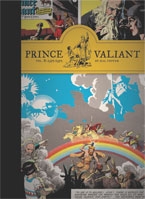
Hal Foster’s Prince Valiant volume 8: 1951-1952


By Hal Foster (Fantagraphics Books)
ISBN: 978-1-60699-699-7

The stellar Sunday page Prince Valiant in the Days of King Arthur debuted on 13th February 1937, a luscious and luminous full-colour weekly window into a miraculous too-perfect past of adventure and romance, even topping creator Hal Foster’s previous impossibly popular comics masterpiece Tarzan.

The saga of noble knights played against a glamorised, dramatised Dark Ages historical backdrop as it followed the life of a refugee boy driven from his ancestral homeland in Scandinavian Thule who grew up to roam the world and attain a paramount position amongst the heroes of fabled Camelot.

Writer/artist Foster wove the epic tale over decades, as the near-feral wild boy matured into a paragon of chivalric virtue: knight, warrior, saviour, vengeance-taker and eventually family patriarch in a constant deluge of wild – and joyously witty – wonderment.

The restless hero visited many far-flung lands, siring a dynasty of equally puissant heroes and utterly enchanting generations of readers and thousands of creative types in all the arts.

There have been films, animated series and all manner of toys, games and collections based on Prince Valiant – one of the few adventures strips to have lasted from the thunderous 1930s to the present day (over 4000 episodes and counting) – and even here in the end times of the newspaper narrative cartoons, it continues to astound in more than 300 American papers. It’s even cutting its way onto the internet with an online edition.

Foster tirelessly crafted the feature until 1971 when illustrator John Cullen Murphy (Big Ben Bolt) succeeded him as illustrator. Foster continued as writer and designer until 1980, after which he retired and Cullen Murphy’s daughter Mairead took over colouring and lettering whilst her brother John assumed the writer’s role.

In 2004 the senior Cullen Murphy also retired, since when the strip has soldiered on under the extremely talented auspices of artists Gary Gianni and latterly Thomas Yeates with Mark Schultz (Xenozoic) scripting.

Before the astonishing illumination of dauntless derring-do recommences, Editor Brian M. Kane discusses, in amazing detail, the incredible tales of the creator’s pre-and-early comics days as an advertising artist and the impact of his “Mountie” paintings on early 20th century American ads in the fascinating Foreword essay ‘An Artist Nowhere Near Ordinary: Hal Foster’s Lord Greystoke of the Royal Canadian Mounted Police’.

This volume of sublime strips is also balanced by another erudite Kane piece at the back: describing the now forgotten entertainments phenomenon of the Silver Lady Awards bestowed annually by the fabled, prestigious but now forgotten “Banshees”.

‘Hal Foster and the Other Woman’ reveals the story behind the story of King Features’ “Shadow Cabinet” and how Foster won his Silver Lady in1952 as well as noting many of his other testimonials such as the Rueben, the Swedish Academy’s Adamson Award and his election to our own Royal Society (for the Encouragement of Arts, Manufacturers and Commerce): an honour he shared with the likes of Charles Dickens, Benjamin Franklin and Stephen Hawking…

This 8th enormously entertaining and luxurious oversized (362 x 264mm) full-colour hardback volume reprints the pages from January 7th 1951 to 28th December 1952 (pages #726 to 829, if you’re counting) but before we proceed…

What has Gone Before: after the double christening in Camelot of his and Prince Arn of Ord‘s sons, Valiant was soon back in the saddle as an Arthurian troubleshooter, cleaning out a extortion-minded sorcerer’s den in Wales and picking up new squire Geoffrey – known affectionately as Arf – before heading North to Hadrian’s Wall and a brutally punishing and protracted siege by invading Picts.

It was nearly Val’s last battle…

When Aleta joined her dying husband he miraculously recovered. His forthright wife elected to take him back to his Scandinavian homeland so she dispatched Geoffrey to Camelot with orders for her handmaiden Katwin and nurse Tillicum to obtain a ship and meet her with baby Arn at the village of Newcastle…

Soon the group were bound for Thule, bolstered by the bombastic return of boisterous far-larger-than-life Viking Boltar: a Falstaff-like “honest pirate” who ferried the re-united extended family to Valiant’s harsh, cold homeland. Along the way Boltar found himself bitten by the love bug …

A chance meeting with an old cleric also disclosed the truth about Arf: the faithful squire had been forced from his home when his sire Sir Hugo Geoffrey took a new young bride. She didn’t want an annoying stepson underfoot but now she was gone and the boy could return home… if he wanted to…

Eventually the party reached the chilly castle of King Aguar and settled in for a winter of snowy rest and recuperation – although the temperatures could not cool Arf’s hot temper and propensity for finding trouble…

Aguar, meanwhile, had been seriously considering converting his rowdy Norse realm to the peaceful tenets of Christianity, but all the missionaries roaming his lands were cantankerous idiots preaching their own particular brand of faith – when not actively fighting each other.

Therefore when spring arrived he tasked his fully recovered son with a mission to Rome, beseeching the Pope to send proper priests and real teachers of the officially sanctioned religion to spread the Word of God.

No sooner had Val, Arf, doughty Rufus Regan and new comrade Jarl Egil set off, however, than vassal king Hap-Atla – seething from an old slight delivered to his deceased sire – rebelled, besieging Aguar’s castle. With manpower dangerously depleted the situation looked grim until wily Aleta took control, scoring a stunning triumph which shockingly contravened all the rules of manly warfare.

Valiant and his companions meanwhile had landed in Rouen and trekked onwards to the HolyCity, encountering thieves, murderers and worse as Europe, deprived of the Pax Romana, had descended into barbarism: reduced to a seething mass of lawless principalities ruled by greedily ambitious proto-emperors…

In one unhappy demesne the quartet dethroned a robber-baron but almost ended up wed to his unsavoury daughters, whilst in another Val encountered an alchemist-king who had accidentally invented an explosive black powder…

Exhausted, they eventually were welcomed at the castle of benevolent noble Ruy Foulke – but their good night’s sleep was spoiled when their host was attacked by villainous overlord Black Robert and his savagely competent forces…

This chronicle’s action commences as the visitors stoutly and resolutely defend their host against overwhelming force, with all combatants blithely unaware that Foulke’s daughter and Black Robert’s son are lovers. The youngsters almost sacrifice their lives to end the hostilities, and Valiant brokers an alliance which ends the bloodshed but has to leave quickly as his actions have deprived the invaders of much promised booty…

On the road again they missionaries encounter roving bands of barbarian reivers and take refuge in a monastery at the foot of the French Alps. The clerics offer to guide the quartet over the mountains to Italy, but are woefully short of the protective garments made from the cold-resistant Chamois, so Valiant goes off hunting the elusive antelope.

Trouble is never far from the Prince of Thule and his frozen safari brings him into conflict with another band of invading Huns or Tartars, which only ends when the capable northerner destroys them with an avalanche.

Properly kitted out, Arf, Egil, Rufus and Val are then taken over the horrific high passes, enduring ghastly arctic conditions before they reach the other side. Young Arf suffers most, and Val has to leave his crippled squire – whose feet have frozen – at a hospice in Torino whilst the remainder of his battered party carry on to Rome.

The EternalCity has become a cess-pit of iniquity since it was sacked by the barbarians and the Missionaries are given a constant run-around by greedy and duplicitous officials until Val discovers that the Pope has removed himself from the city and established a new home in Ravenna.

Although Valiant is still denied a meeting, the Pontiff appoints a committee which agrees to send true Christian teachers to icy Thule, but before details can be finalised the Prince is called back to Torino where Arf has taken a turn for the worse…

The Squire has lost the will to live, along with his left foot, and with all his chivalric ambitions destroyed is beyond consoling. In a powerful and moving sequence Valiant patiently brings the boy back from a fatal depression and sets him upon a new path: scholar and official historian of the kings of Thule.

Since the boy cannot handle the arduous trek back to Scandinavia, Valiant sends Egil and Rufus on ahead with the Pope’s team of missionaries and teachers by the most direct route whilst he accompanies Arf in a more leisurely and roundabout journey by ship.

En route the fierce man of war helps found the Christian Mission at San Marino before he and the still emotionally fragile lad board a Genoese trader. After crossing the Pillars of Hercules (Gibraltar), fresh passengers join them and the boy is utterly smitten by the demure charms of the beauteous Adele, daughter of wealthy Eastern lord Sieur Du Luc…

Luckily, Valiant has been schooling his former squire in the courtly skills of music and poetry…

The boy’s timorous wooing of the Mediterranean charmer pays off in a multitude of ways. His strength and confidence returns, Adele favours and returns his attentions and the amused and charmed sailors, delighted to have the burdensome (and occasionally pirate-plagued) journey eased somewhat, carve Arf a marvellous wooden leg which is so well-fashioned that he can throw away his crutches and walk as a man should…

When the vessel reaches England the boy takes time to reconcile with his father and introduce Adele so that the tricky and torturous process of making a marriage match may begin, whilst Valiant’s return to Camelot and joyous reunion with best friend Sir Gawain propels the two old comrades and devoted merry pranksters into an orgy of practical jokes and good-natured duels with their fellow knights…

Sadly the riotous times end too soon, as word comes from Aguar that Val should return to Thule with the utmost speed. Arranging for Arf to meet them en route, Valiant accepts Gawain’s offer to take ship from his own island kingdom of Orkney, but although his brother-in-arms is a fine fellow, the knight’s family are another matter.

Gawain’s mother Morgause is reputed a witch, whilst her other sons Agravaine, Gaheris and vile Mordred are little better than brutes and outright villains. Moreover the men of Orkney have little love for Scandinavians, being regular recipients of savage raids from assorted Northmen…

After Gawain scotches their plan to hold Valiant for ransom, the Prince proposes ending years on enmity with a trade agreement which will make the ancient nations allies and at last sets off for Thule to receive some shocking news: during the year he has been away Aleta has given birth to twin daughters.

Although the proud father is astounded and delighted, his firstborn son is not taking the loss of star-status well – as described in a charming sequence of comedic adventures starring Prince Valiant Arn in the Days of King Arthur…

Another crisis soon occurs however as Boltar, ignorant of Aguar’s new treaty, accidentally pirates the Orkney ship transporting Adele to Thule and suffers the wrath of his king and former comrades.

Imprisoned in Aguar’s castle, the confused and indignant Boltar is secretly released by Tillicum, but the old rogue, misinterpreting her gesture of love, does her the honour of kidnapping her – just as all his romantic forebears have – and is baffled when she escapes and pulls a knife on him…

Fed up and utterly desolate, Boltar and his crew continue to their base in the Shetlands, leaving Aleta to mend fences with the King and discuss with the disconsolate nanny how best Tillicum can get her man…

Boltar meanwhile has been thoroughly tested: Thule’s ancient rivals the Danes have amassed a fleet to attack Aguar and offer his now-disgraced “Good Right Hand” a share of the spoils and glory to join his ships to their armada…

Despite being vexed and tempted, the old pirate instead risks his life to warn Aguar of the sneak attack and after a spectacular campaign of seaborne slaughter accepts his long-delayed punishment. To keep him in line, Aguar makes Tillicum responsible for his continued good behaviour…

Idyllic weeks pass until Valiant, bored with inaction, drags his new biographer Arf into a patrol of the nation’s border, only to have them both washed away in a flash flood and forced to spend weeks fighting their way back to civilisation from the primitive northern wilderness.

There are gentler moments in the restless warrior’s life, such as the foolish wager he makes soon after his triumphant return that he can catch and train a hawk better than Aleta’s Merlin and his father’s Golden Eagle, but the days are mostly quiet in Thule… until at long last Rufus and Egil arrive with the Pope’s Christian missionaries.

Both have converted on the trip and Valiant and Aleta are overjoyed that their daughters Valeta and Karen can be baptised, but the task of taking the gospels to the devoutly warlike worshippers of Thor and Odin will be far from simple…

As the European set to, lecturing and building churches, Val and Rufus become involved in a cross-border water dispute and the Prince, in a rare moment of diplomacy, furnishes a solution that prevents rather than ends bloodshed.

No such opportunity arises when he is ambushed as he returns to Aguar. The arrow that nearly ends his life is fired in error, by a serf who mistakes the prince for the local under-chief, Sigurd Holem.

Once a noble and trusted deputy of Aguar, the Fief-holder has become a cruel tyrant: enslaving his own countrymen and defying any – including his Lord’s heir – to stop him.

Determined to avenge the cruelties of Sigurd, Valiant infiltrates the monster’s impenetrable citadel and, through cunning engineering tricks, brings the entire daunting edifice crashing into ruins…

The next few strips use the device of Arf’s growing biography to lavishly recapitulate many of Valiant’s greatest exploits, such as the overthrow of Sligon and restoration of Aguar to Thule or the haunting fate of doomed mountain outpost Andelkrag, before the tone switches again and little Arn is forced to face the stomach-churning consequences of being a “mighty hunter” when nanny Tillicum makes him confront the results of his firing arrows at animals…

The boy and his guardian take centre-stage in the next sequence too when Boltar returns home from another bloody and profitable voyage and jealous rivals at court attempt to humiliate the rowdy blowhard.

The plan is cruel and simple. When Tillicum rejoins her man at his home Vikingsholm she brings the wide-eyed Arn with her, where during a moment of quiet converse with Boltar the hunting-mad lad slips from her careful scrutiny and is abducted.

The kidnappers however have not reckoned on the Native American’s determination or tracking skills. After stalking them all alone for days, she rescues the boy just as the furious following Boltar catches up to her, and the conspirators have mere moments to regret their vile actions…

And when Valiant hears of the plot, he and Boltar then deal with the rest of the plotters in similar manner…

This volume’s stunning saga temporarily end with the opening movements of another epic extended story arc as the progress of the Christian missionaries leads Valiant – still far from a believer in the One God – to be targeted by Druids and Pagan warriors determined to crush the threat to their bombastic pantheon before it can take hold…

To Be Continued…

Rendered in a simply stunning panorama of glowing visual passion and precision, Prince Valiant is a non-stop rollercoaster of boisterous action, exotic adventure and grand romance; blending human-scaled fantasy with dry wit and broad humour, soap opera melodrama with shatteringly dark violence.

Beautiful, captivating and utterly awe-inspiring, the strip is a landmark of comics fiction and something no fan can afford to miss.
Prince Valiant and all comics material © 2014 King Features Syndicate. All other content and properties © 2014 their respective creators or holders. This edition © 2014 Fantagraphics Books. All rights reserved.
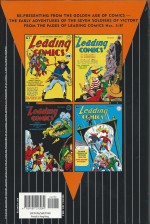
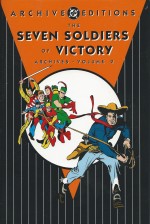
Seven Soldiers of Victory Archives volume 2


By Joe Samachson, Ed Dobrotka, Pierce Rice, Jon Small, Maurice Del Bourgo & various (DC Comics)
ISBN: 978-1-4012-1308-4

After the actual invention of the comicbook superhero – for which read the Action Comics debut of Superman in 1938 – the most significant event in the industry’s history was the combination of individual sales-points into a group. Thus what seems blindingly obvious to us with the benefit of four-colour hindsight was proven: consumers couldn’t get enough of garishly-hued mystery men and a multitude of popular characters would inevitably increase readership.

Plus, of course, a mob of superheroes is just so much cooler than one (…or one-and-a-half if there’s a sidekick involved…).

It cannot be understated: the creation of the Justice Society of America in 1941 utterly changed the shape of the budding industry. Soon after the team debuted, even All American Comics’ publishing partner National wanted to get in on the act and created their own squad of solo stars, populated with a number of their proprietary characters who hadn’t made it onto the roster of the cooperative coalition of AA and DC stars.    Oddly they never settled on a name and the team of non-powered mystery men who debuted in Leading Comics #1 in 1941 were retroactively and alternatively dubbed The Law’s Legionnaires and The Seven Soldiers of Victory.

They never even had their own title-logo but only appeared as solo stars grouped together on the 14 spectacular covers, the second quartet of which (by Mort Meskin, Jon Small, Maurice Del Bourgo and a sadly unidentified artist) preface each collaborative epic in this spectacular sequel of Golden Age delights.

The full contents of this bombastic deluxe hardback barrage of comicbook bravado were originally presented in the quarterly Leading Comics #5-8, spanning Winter 1942/1943 to Fall 1943 and, following an incisive discourse and background history lesson from comics historian Bill Schelly in his Foreword, that war-time wonderment resumes with the heroes’ fifth adventure.

The sagas all followed a basic but extremely effective formula (established by Mort Weisinger in their first case), and here the warped mastermind challenging the Legionnaires was The Skull, who devised ‘The Miracles That Money Couldn’t Buy!’ (illustrated over all seven chapters by Ed Dobrotka but again the work of a writer time has forgotten and sketchy records have not yet revealed – but most probably the amazing Joe Samachson…).

The drama began when publisher Lee Travis tips off his pal Oliver Queen to an imminent prison break in his bailiwick.

Green Arrow and Speedy are too late to stop vicious Bill “Porky” Johnson‘s escape via skull-painted mystery-plane and that soon-to-be-executed convict’s feat is repeated four more times across the country, leaving a handful of Death Row inmates beholden to a strange old man dubbed who has found that, for all his wealth, there are still things money cannot buy.

However, for an unscrupulous businessman unwilling to get his own emaciated hands dirty but with the right criminal specialists, they can be stolen…

The Seven Soldiers meanwhile have briefly convened and now stand ready to face their specified nemeses as soon as they rear their scurrilous heads…

In ‘The Case of the Criminal Vigilante’ rustler and horse thief Bronco Slade steals Spinaway – the fastest racehorse on Earth – by impersonating the Vigilante, with the true Sagebrush Centurion helpless to stop him, and indeed even taken prisoner beside his hapless, interfering biggest-fan Mr. Meek…

‘The Diamond of Doom!’ finds jewel thief the Sparkler targeting the fabulous, reputedly cursed Koram Diamond. Even though Star-Spangled Kid and Stripesy are unable to bring the bandit to justice, a spookily fatal fate befalls him.

A similar outcome ends hijacker Bull Corbin after he outfoxes the Crimson Avenger and Wing whilst purloining a prototype spaceship. However rather than a clean getaway all that awaits the thief is a grim and final ‘Destiny among the Stars!’

‘A Knight without Armor’ reveals how the Shining Knight‘s magic mail-coat is too tough a target for shifty Matt Grieder, but the thug’s subsequent attempt to pass off fake metal-wear ends in near-death for Sir Justin and execution for the villain, after which the Emerald Archers finish their hunt for Porky Johnson when the fugitive’s successful attempt to obtain a rejuvenation ray for the Skull prematurely rings down the curtain for The Murderer Who Couldn’t be Hanged!’

The untitled ‘Conclusion’ then shows how getting everything you want might not make you happy – or keep you breathing – as the Vigilante busts free just as his Legionnaire allies storm the triumphant Skull’s fortress…

Leading Comics #6 was also probably scripted by Samachson, but this time the penciller is unrecorded. At least we know he or she was inked by Maurice Del Bourgo…

‘The Treasure That Time Forgot!’ is a grand hunt for the hidden gold of the Incas. Archaeologist Mr. Milton publicly calls upon the Seven Soldiers to follow his old map and find Pizarro‘s lost treasure hoard the plan is to bolster America’s war-chest by a billion dollars…

Said map, sketched by an explorer named Burton, comes with cryptic verses and false trails, so the archaeologist’s assistant Scrivener suggests the heroes split up to save time. They could even make a competition of it…

‘Crimes by Proxy!’ finds Green Arrow and Speedy clashing with Star-Spangled Kid and Stripesy deep in the Andes as a hidden hand attempts to murder both teams using the weaponry of the other; a tactic repeated when Shining Knight and Vigilante discover a lost city and are tricked into conducting ‘A Duel to the Death!’

Their cataclysmic clash ends as an enigmatic and heavily disguised manipulator surfaces, confident the heroes have cleared all obstacles and booby-traps, only to fall foul of avian horrors in ‘Winged Masters of the Mountains!’

‘The Gold that Failed to Glitter!’ finds the man-&-boy teams still mistakenly battling each other until the late-arriving knight and cowboy forcibly restrain them. Soon after, aged Mr. Milton mysteriously turns up to help, but only succeeds in spreading further suspicion when the combined party discovers the legendary treasure vault… emptied!

Meanwhile the Crimson Avenger and Wing have followed ‘The Third Treasure Trail!’ and met the last of the Incas – as well as their real enemy – and everybody collides in the explosive conclusion which solves all the mysteries at ‘Trail’s End!’

Issue #7 – pencilled by Pierce Rice – takes the heroes on a similar fund-raising quest as War Bond Drive performers, but the tour is a scam by a strange individual who is an emissary of ‘The Wizard of Wisstark!’

He implores the Legionnaires to travel to his fantastic kingdom and liberate the Antarctic hidden city from the threat of invasion…

The Wizard is actually an elderly American stage conjuror who fell into the position of chief but now his peaceful, super-scientific subjects are being threatened by real magicians from the rival polar city of Stanovia…

The fight back begins when Star-Spangled Kid and Stripesy travel to ‘The Land of Giants!’ hoping to enlist the colossi in the struggle. Sadly the brutal hulks are already engaged in a struggle with a tribe of equally savage dwarves, but the boy genius has an idea and takes a few movie pictures before leaving…

‘The Wizard Archers and the Wizards!’ sees Green Arrow and Speedy strike to the heart of the matter and boldly invade Stanovia, where they discover a few intriguing secrets about the triumvirate of “mages” who rule the city…

Wing and the Crimson Avenger stayed with the Wizard in Wisstark, in case of fifth column attacks. They are unfortunately captured by ‘The Invisible Men!’ who have been despatched to sow disorder and terror. Whilst being taken to Stanovia, however, the mystery men discover a shocking secret about their foes…

Whilst that was happening the Vigilante made his own contribution to the cold war-effort, catching a Wizard doppelganger attempting to infiltrate the palace in ‘Double Trouble!’, before Shining Knight, patrolling the skies on his winged steed Victory, recruits timber-clad warriors to counterattack Stanovia in ‘The March of the Wooden-Armored Soldiers’…

With their pre-battle preparations completed, the Seven Soldiers reunite for the final ‘Battle of the Wizards!’, much-heartened by the conclusion each has individually reached regarding the truth about the Stanovian sorcerers…

This second classic collection concludes with a stirring time-travel, super-villain mash-up as Leading #8 sees the heroes ambushed and reduced to ‘Exiles in Time!’ (illustrated by Jon Small & Del Bourgo) by old enemy The Dummy.

The diminutive demon of destruction subtly lures his foes into a cunning ambush which catapults the crusaders down the corridors of history, before turning his attention to plunder and mayhem, not realising that heroism is found in every era, such as 17th century France where the Three Musketeers ally with Green Arrow and Speedy to solve the theft of ‘The Queen’s Necklace!’…

Crimson Avenger and Wing re-materialised in China but were utterly unable to determine when. Deductive investigation finally paid off as Japanese invaders trying to stop the completion of the Great Wall pointed to 225BC, when and where the time-travellers were happy to train the peasantry in how to fight them by displaying ‘Courage in Canton!’…

‘Voyage of the Vikings’ found Star-Spangled Kid and Stripesy deposited on a lost and ice-gripped dragon-boat, struggling for survival with their newfound comrades as they desperately sought solid ground. How astonished they all were when bold Leif Ericsson dubbed his discovery Vineland and he patriotic mystery men realised they had been part of the first discovery of America…

‘Friends, Romans, Countrymen’ saw Vigilante land in Rome and recognise a brace of 20th century mugs. Trailing the hoods to the house of super-rich Crassus, the Western Wildcat realised the criminals were using the Dummy’s device to plunder historical treasures but even after foiling their plans, he was still stuck in the past…

‘The Legend of Leonardo’ revealed how the Shining Knight came to the aid of the legendary Da Vinci and was rewarded with a quick trip on the master’s own recently completed time machine. Back when he started from, the Arthurian paladin then began toppling some temporal dominoes in the ‘Conclusion’, allowing his time-tossed companions to return and deal with the diabolical doll-man in the appropriate manner…

These raw, wild and excessively engaging costumed romps are amongst some of the best but most neglected thrillers of the halcyon Golden Age. Happily, modern tastes too have moved on and these yarns are probably far more in tune with contemporary mores, making this a truly guilty pleasure for all fans of mystery, mayhem and stylish superteam tussles…
© 1942, 1943, 2007 DC Comics. All Rights Reserved.

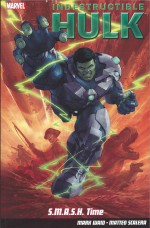
Indestructible Hulk volume 3: S.M.A.S.H. Time


By Mark Waid, Matteo Scalera, Kim Jacinto & Mahmud Asrar (Marvel/Panini UK)
ISBN: 978-1-84653-574-1

Once upon a time, Bruce Banner was merely a military scientist accidentally caught in a Gamma-bomb blast of his own devising. As a result, undue stress could cause him to transform into a gigantic green monster of unimaginable strength and fury. As both occasional hero and blockbusting brute he rampaged across the landscape for decades, becoming one of comics’ most popular characters and most enduring multi-media titans.

He has, inescapably, then undergone numerous radical changes in scope, character and format to keep his stories fresh and his exploits explosively compelling…

In recent years the number of Gamma-galvanised grotesqueries crashing about the Marvel Universe has proliferated to inconceivable proportions. The days of Bruce going green with anger at the drop of a hat are long gone, so anybody taking their cues from TV or movie incarnations would be wise to anticipate a smidgen of unavoidable confusion…

By the time of the game-changing Avengers versus X-Men mega-crossover relaunch, there were numerous Hulks, She-Hulks, Abominations and all kinds of ancillary rainbow-hued atomic berserkers roaming around, and in the aftermath of that house-cleaning exercise, the MarvelNOW! event saw the Jade Giant return in a stripped-down, back-to-basics version which energised new and old fans alike.

Modern comics are all about the next Big Event and throughout 2013 numerous Marvel titles experienced a few temporal troubles. This latest Hulk collection also tenuously ties in to those ongoing time travel travails, which all ostensibly arose from the after-effects of dramatic disruptions in the (Marvel) universes’ conjoined time-streams. The root cause was The Avengers unmaking of the Age of Ultron, but don’t fret as the stories here stand well enough on their own…

The big change in the Hulk’s fortunes occurred after S.H.I.E.L.D. Director Maria Hill was persuaded to provide perennial fugitive Banner with resources and funding in order to sanitise his scientific reputation. In return Hill could call on the Hulk as a living weapon of last resort…

One of the smartest men on Earth, Banner had lost years of success, progress and peer renown whilst trying to cure himself of the Hulk. Concerned about his legacy, the fugitive genius had at last decided to make future headlines as a scientist, not a devastating force of nature.

For the foreseeable future and as long as possible he would manage – rather than seek cures for – his affliction. Additionally, in return for S.H.I.E.L.D. science labs and trained assistants – generally in the isolated facility of Nuclear Springs, Nevada (AKA “Bannerville”) – the bombastic boffin would also give the agency first use of many of his discoveries and inventions…

This guest-star packed third volume details the next cataclysmic chapter in the ever-eventful life of Dr. Banner and his mean green alter ego (collecting Indestructible Hulk #11-15, cover-dated September 2013 to January 2014) with scripter Mark Waid letting the emerald engine of destruction loose on a multiplicity of Marvel’s genre-adventures roots…

Banner and his team are just getting back to business (after a agonising sojourn in Jotunheim, realm of Asgardian Frost Giants) when the irascible genius is summoned to an ultra-secret division of S.H.I.E.L.D. to apply his unique gifts to a cataclysmic situation. Even before seeing the Temporal Irregularity Management and Eradication site Banner knows something big is up: the Hulk’s last mission had included a surprise attack by a brand spanking new 75-year-old American bomber packed with ancient skeletons in flight suits…

The 5-part ‘Agent of T.I.M.E.’ (illustrated by Matteo Scalera, Kim Jacinto & Mahmud Asrar) continues as Banner meets the secret project’s prize prisoner. Zarrko the Tomorrow Man, has been an inmate of the facility for two decades – even though for that entire period he has been continually battling Thor, Iron Man, Spider-Man on the outside in a variety of centuries.

He explains the impossible paradox by describing – as he has continually for over twenty years – how, thanks to constant meddling, the Timestream is broken and all of reality is in imminent danger of shattering.

Thanks to recent events the S.H.I.E.L.D. higher-ups are at last prepared to believe him…

Stuck in his cell, helplessly emitting time-warping radiations, Zarrko again repeats his warnings: even with the armour and screening technologies he has provided, mere mortals cannot survive in the roaring chronal currents. Only the Hulk can be sent to key time points to fix the escalating chaos.

It’s pretty urgent he goes soon, too, since Chronarchists from beyond now are targeting weak spots in time, intent on overwriting the past to cement their own futures…

Banner is dead set against the idea until Zarrko reminds him that people and places are dropping out of reality every moment: people like Betty Ross, Banner’s ex-wife and now the riotous Red She-Hulk.

In the crowded lab only he and the Tomorrow Man remember her… and even Bruce is having trouble recalling her name…

The Chronarchists are also the reason the Hulk’s intellect is so mutable: his Gamma-charged existence is a threat to their victory so they have been tampering with his personal history…

Resigned to his task Banner acquiesces, allowing Zarrko and the T.I.M.E. technologists to set him up for the trip. Since he’ll need to stay “Hulked” for the duration Banner’s personality is duplicated in a free-floating, self-powered Recording Observation Bot, which effectively means the scientist and savage who have always despised each other will be working as a team…

The first stop is Arizona in 1873 where the Big Green Galoot and his floating metal sidekick/brain join Western legends Kid Colt, Rawhide Kid and Two-Gun Kid in battling dinosaurs and the Chronarchist Tok Baltusar who has enslaved a town and tried to turn the local silver mine into his personal factory for producing time-warping nano-alloys…

The bizarre aggregation of heroes eventually overcomes the temporal infiltrator but the Hulk is explosively propelled back to the sixth century and another heroic crisis: the too-early fall of Camelot…

Expelled from his citadel by Chronarchist Valdar Ahd (employing a legion of warriors from all ages), King Arthur even welcomes the assistance of a gross green ogre and its talking, flying box as he, Merlin and the puissant Black Knight lead the surviving paladins of the Table Round in a battle to restore honour and save the right and proper future…

After spectacularly and destructively dealing with the chronal iconoclast, R.O.B./Banner and the ferociously fluctuating Hulk are rather at a loss to track down the final temporal tamperer.

Following a host of false trails only leads into a procession of clashes with old foes such as the Abomination, Sandman and Fin Fang Foom, all cunningly placed in time-ambushes throughout a rapidly and constantly revising history to delay interference in a hidden mastermind’s true scheme…

Each subtle distraction further diminishes Hulk and the recording of Banner before, as time is literally about to run out, the answer occurs to the rapidly failing brainbox in a box…

At an atomic test site R.O.B. can barely remember, a scientist named Banner argues with his assistant Igor, his girlfriend Betty and her father – military martinet General Thunderbolt Ross – about the imminent detonation of the world’s first Gamma-bomb. Then when a kid drives onto Ground Zero, the Banner dashes out to save him, only to be caught in the blast…

This time though, a monolithic green giant pushes him aside and takes the full hit of raging radiation…

The rapidly failing Banner/R.O.B. has deduced their quarry’s when-&-whereabouts seconds too late, blinking in to the event just in time for the Hulk to be bombarded with a second dose of mutative energy – exactly as his time-bending opponents had intended…

With all his programs failing, the robot rapidly downloads his remaining memories into his pre-radiated organic self, leaving a horrified, physically powerless but utterly up-to-speed Bruce Banner to face the enraged atrocious monstrosity of a “Hulk-Squared”…

Or not.

Finally freed of the curse of the Hulk before he ever carried it, Banner is tempted to let the new status quo stand… until he realises that the last Chronarchist’s tampering has also deleted his beloved Betty from the timeline…

The heartbroken savant has only one chance to put things right: defeat the last time-bender Khotto and the now-obvious Machiavellian mastermind behind the entire audacious history-warping scheme – no matter the cost…

And when the dust of centuries finally settles, Banner’s world is back the way it should be, although the weary savant cannot help but feel that something, somewhere, somehow has changed in a way he cannot yet fathom…

Packed with the now-standard AR icons (Marvel’s Augmented Reality App: printed portals giving access to story bonuses and extras for everyone who downloaded the free software from marvel.com onto a smart-phone or Android-enabled tablet whatsit) and a stunning cover-&-variants gallery by Mukesh Singh, Michael Del Mundo & Leonel Castellani, this is a smart, comfortingly convoluted and amazingly compelling read: a fun-filled, fury-fuelled saga which brilliantly mixes incredible adventure with clever characterisation and an addictive excess of furious Fights ‘n’ Tights action that no comics fan could possibly resist.
™ & © 2013 and 2014 Marvel & Subs. Licensed by Marvel Characters B.V. through Panini S.p.A. All rights reserved. A British Edition published by Panini Publishing, a division of Panini UK, Ltd.

Hal Foster’s Prince Valiant volume 6: 1947-1948


By Hal Foster (Fantagraphics Books)
ISBN: 978-1-60699-588-4

Prince Valiant in the Days of King Arthur launched on February 13th 1937, a luscious full-colour Sunday newspaper strip offering wonder-struck readers safe passage into a world of noble combat, rousing adventure and thrilling romance. Year by year in real time, the strip followed the exploits of a royal exile, driven by invaders from his ancestral homeland in Scandinavian Thule, who grew up to roam the world and ascended to a paramount position amongst the mightiest heroes of fabled Camelot.

Crafted by sublime master draftsman and tale-teller Harold “Hal” Foster, “Val” matured to clean-limbed manhood in a heady sea of exotic wonderment; visiting far-flung lands and siring a dynasty of equally puissant heroes whilst captivating and influencing generations of readers and thousands of creative types in all the arts.

The feature has sired films, animated series and all manner of books, toys, records, games and collections based on the strip – one of too few to have lasted from the thunderous 1930s to the present day (over 4000 episodes and still forging ever onward) – and, even in these declining days of newspaper narrative cartoons as a viable medium, it still claims more than 300 American papers as its home. It has even made it into the very ether via an online edition.

Foster produced the saga single-handed, one spectacular page a week from 1937 until 1971, when he began to ease up on his self-appointed workload. With the syndicate’s approval – and after auditioning the likes of Gray Morrow and Wally Wood – Big Ben Bolt illustrator John Cullen Murphy was selected to become illustrator of the feature, with Foster continuing as writer and layout designer until 1980, after which he fully retired and Murphy’s son assumed the writer’s role.

In 2004 the senior Cullen Murphy also retired (and died a month later on July 2nd) since when the strip has soldiered on under the auspices of writer Mark Schultz and artists Gary Gianni and Tom Yeates.

This sixth magnificently oversized (362 x 268mm) full-colour hardback volume reprints the strips from January 5th 1947 to 26th December 1948 as Foster began a phenomenally impressive and productive run on a strip which was already regarded as one of the greatest in existence, revelling in the fact that with war-time restrictions ended, he could devote an entire colossal page to each ever-more gripping and luscious instalment…

The introductory essay for this volume is ‘Foster of the Yukon or The Son Also Rises’ by Brian M. Kane (with Dr. Christine Ballengee-Morris), exploring the early life of the creator when he worked for the Hudson Bay Company and detailing his many connections to the Canadian wildernesses and indigenous people – as well as his prior illustration work featuring Canadian cultural themes and motifs.

Also included is a critical and scholarly overview by Native American Dr. Ballengee-Morris, discussing this collection’s material and use of First Nation characters and customs.

What Has Gone Before: Having finally wooed and been won by Queen Aleta of The Misty Isles after many fantastic hardships and spectacular trials and travails, Val and his willing prize briefly sojourned in Rome where they were wed before eventually arriving in Camelot.

Here his unconventional and strong-willed bride caused quite a commotion before foiling a seditious scheme by Mordred to humiliate Queen Guinevere and destroy Sir Launcelot.

Her tactics almost ended her own marriage, and only Aleta’s ferociously loyal, tempestuous fire-haired northern handmaiden Katwin was able to bring Valiant to his outraged senses…

Reunited and both duly penitent, the newlyweds voyaged to winter-locked Thule, where King Aguar could meet his new daughter-in-law. It was not a peaceful homecoming and the barely-rested Val had to quell potential rebellion in fractious Overgaard whilst another brewed in the fiefdom of former ally Earl Jon.

With the doughty Prince recovering from many wounds – again – bright-and-breezy Aleta struggled to win the favour of her straight-laced and sternly formal Father-in-Law and his dour, grim-minded warriors…

Her charm offensive began by solving Aguar’s quarrel with Jon through diplomacy and party-throwing. But even after being accepted by the family the Princess Bride had trouble adapting to the rough sports and pastimes of the chilly region – such as skiing and bear hunting – and she was delighted when the snows finally relented and the Spring thaws began.

Now, the receding snows also bring visitors to the annual parliamentary “Thing”. Hostile sub-chief Gunguir and his mighty son Ulfrun, pride of the Vikings, come to pay their reluctant respects but the latter takes an instant and unhealthily obsessive interest in the golden Princess …

As Val visits old friend and shipbuilding genius Gundar Harl, the nefarious Ulfrun kidnaps Aleta and, despite the heroic efforts of Katwin, sails away into the cold Atlantic seas. Nigh-drowned and with a broken arm, the handmaiden finds Valiant and alerts him to the crisis.

As he readies his pursuit the wounded tigress also informs him that his stolen wife is pregnant and that she must be there when they rescue her…

As he sails ever westward Ulfrun begins to realise his mistake. His purloined prize shows no fear, refuses him all things and even begins to win over his rough Viking warriors…

Val and a hand-picked crew are in full pursuit in Gundar’s most advanced sailing ship, utilising the mariner’s greatest invention – a sextant – to follow the abductors. Never out of sight for long, the followers push Ulfrun further and further west and north, past Greenland and into uncharted waters. After weeks of cat-and-mouse sailing with common sailors on both vessels contemplating mutiny, Valiant’s vessel inexorably closes in until a huge sudden storm finally separates stalkers and quarry…

Days later, in the following calm Val’s ship reaches a strange shore where he finds evidence of Ulfrun’s survival: a native village devastated by the Viking’s men. Hot to pick up the trail again he nevertheless finds time to administer aid to the survivors before following the Raiders’ boat into this NewFoundLand…

The pursuit is easy if slow. As Ulfrun’s Dragon-ship sails ever onwards, finding a vast mainland and constantly attacking the red-skinned natives’ settlements for provisions. Val and Gundar patiently follow their crimson wake, always stopping to offer assistance and consequently gaining allies who will allow him first crack at the murderous invader.

Eventually just as they reach a vast inland sea (Lake Ontario) the pressure proves too much and, after killing a mutinous shipmate, Ulfrun attacks Aleta even as Val’s ship heaves into view. The Prince’s men, supplemented by Native allies, ferociously attack but in the melee Ulfrun and two of his subordinates flee deep into the wild green interior…

The chase is manic and a final confrontation inevitable. On a mighty cliff vengeance is taken and justice served, but even as Val deals with Ulfrun Aleta has managed to talk his men into surrendering…

His passion for slaughter slaked, Valiant convinces the aggrieved Red Men to let all the surviving Raiders board their Dragon-ship and try to return to their homes. In one last betrayal, however, the Vikings raid Gundar’s vessel, stealing food stores and his invaluable sextant before setting off downriver towards Newfoundland. They never made it back to Europe…

Valiant and Aleta meanwhile have decided to winter in this strange yet inviting country and, with their faithful retinue and new feather-wearing native friends, prepare for the cold season by hunting, fishing, exploring and building a peculiar dwelling of felled logs.

As the sagacious Tribal Chiefs observe the golden woman in their midst a strange notion forms, and when a spectacularly fortuitous event occurs whilst she and Val visit the Great Falls (yep, Niagara) the savage savants decide that she is far more than human…

Moreover the tribal women can clearly see that the “Sun Woman” is with child…

This particular section is a mesmerising change of pace in the ongoing saga, focusing on paradisiacal, humour-tinged Arcadian splendour rather than constant angst and action, and Foster’s sublime facility for illuminating the wonders of the wilds make these episodes irresistibly beguiling.

With the snows coming, the Tribes decide that the newfangled log-cabin is insufficient to Aleta’s needs and construct a magnificent birch bark Lodge to keep her in perfect comfort whilst her barbarian men can sit and shiver in their draughty wooden house. Even more insultingly, they hold a village ceremony and appoint a forbidding guardian midwife to look after the incipient’ mother’s natal needs.

Although getting increasingly annoyed at their hosts’ interfering hospitality, nobody has the nerve to gainsay the stoic and terrifying Tillicum… not even Val himself on the morning she kicks him out of Lodge and indicates that from now on he sleeps with the other men…

Soon after, the next prince of Thule is successfully delivered and an amazed, astounded – and hung-over – happy father greets his son and proceeds to get in the way and underfoot.

Luckily for him youngest crewman Gunnar has gone missing so, saying farewell to his smiling “Sun Woman” (and her scowling servants Tillicum and Katwin), Valiant heads off into the snow-covered forests to find him.

The trail takes him to a far distant region which has never seen white skins before, just in time to save the wayward youth from the curious natives, but their hazardous trek back takes quite a while and the ice is melting on the Niagara river before they reach friends once more.

With the cold season gone Valiant and Gundar prepare to make the voyage back to Europe (even though the inventor secretly fears it impossible without his sextant) so Val takes one last opportunity to explore.

Their is precious little food around yet and to provision the ship Val, with a hand-picked squad of Northmen, joins his native pals in a prodigious canoe journey to the Great Lake Trading Center in the Land of the Hurons…

The great event is another chance to meet and exchange ideas but proceeds at its own laborious pace. Happily Val’s impatience is assuaged once he is introduced to the intriguing, bone-crunching pastime called “Lacrosse”…

Eventually fully-supplied the men return to the Lodge and begin preparations to leave. The little prince – to be christened Arn once they reach Camelot – has grown strong and boisterous: and would not be overly imperilled by a perilous sea voyage, but another delay has suddenly manifested. Many of the tribes that live on the great river which will carry them back to the Atlantic are in revolt…

Valiant is again outclassed as his golden bride – a master of subtle diplomacy – who devises a cunning, slaughter-free solution to the problem, but her plan almost rebounds as the natives then baulk at the though t of letting their Sun Woman go back beyond the seas…

Once that obstacle is surmounted the only remaining problem is Tillicum, who refuses to be left behind…

The homesick crew head into the unknown and their journey becomes an incredible odyssey as only a general sense of the right direction, shipwreck, icy seas and appalling storms batter the lost voyagers before the weary sailors finally fetch up on a familiar shore.

No sooner has Aleta set foot on land for a moment’s solitude than she is spotted by Hibernian king Roary Dhu who fancies making her the next queen of Ireland…

That difference of opinion leads to appropriate outrage and bloodshed before Valiant and his rapidly diminishing crew head back out to sea, but at last fortune favours them when they are intercepted by Sir Launcelot’s personal ship.

The situation in Camelot is still tense after all these months, but Val’s faithful crew are exhausted and heartsore, so he and his extended family party transfer to the new vessel, leaving his weary followers to return to their own homes in Thule with tidings of his safe return and new son…

All Camelot is lifted by the presence of the Prince and his family, but another crisis is brewing and too soon Valiant is heading towards Cornwall to apply his lethal brand of problem-solving to murderous despotic, rebel king Tourien who, with his brutal sons Alp the Strong, Cedric the Dandy and Doorne the Slave Driver, flouts Arthur’s authority, murders his servants and believes himself utterly untouchable and beyond the monarch’s justice…

Eschewing a large armed force Valiant decides to dismantle the renegade’s threat from the inside using duplicity, and although largely successful he still has to resort to savage force of arms before the Cornish rat’s nest is finally cleaned out…

Back in Camelot again the victorious hero’s thoughts turn to his baby’s long-delayed christening. The only possible choice for a Godfather is his boyhood rival and the child’s namesake Prince Arn of Ord but when Val journeys to the outlying principality he receives an almighty shock…

To Be Continued…

This volume then concludes with ‘Coloring Valiant’ by in Brian M. Kane: a fascinating feature on Foster’s process to provide colour indications for the printers to work from which includes a huge and beautiful gate-fold fold-out of one of his original water-coloured pages, topped off and balanced by the published page his avid fans finally saw.

Rendered in a simply stunning panorama of glowing visual passion and precision, Prince Valiant is a non-stop, celebration of the human spirit in action, under torment, enduring duty and enjoying grand romance; mixing glorious historic fantasy with dry wit, broad humour with shatteringly dark violence.

Beautiful, captivating and utterly awe-inspiring, this is a masterpiece of fiction: a never-ending story no one should be without. If you have never experienced the intoxicating grandeur of Foster’s magnum opus these magnificent, lavishly substantial deluxe editions are the very best way to do so and will be your permanent portal to an eye-opening world of wonder and imagination…
Prince Valiant © 2012 King Features Syndicate. All other articles, content and properties © 2012 their respective creators or holders. All rights reserved.

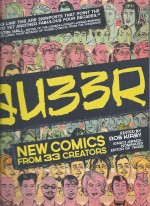
QU33R


By various and edited by Rob Kirby (Northwest Press)
ISBN: 978-1-9387203-6-9

It’s long been an aphorism – if not cliché – that Gay (or the more contemporary term LGBTQ) comics have long been the only place in the graphic narrative business to portray real romance.

It’s still true: an artefact, I suppose, of a society which seems determined to demarcate and separate sex and love as two utterly different – and possibly even opposite – things. I prefer to think that here in the 21st century – in most places – we’ve outgrown the juvenile, judgemental, bad old days and can simply appreciate powerful, moving and funny comics about people of all sorts without any kind of preconception, but that battle’s still not completely won yet. Hopefully, compendia such as this will aid the fight…

Nevertheless, at least in this superb anthology with contributions from 33 Lesbian, Gay, Bisexual, Transgender and/or Queer (or Questioning their sexual identity) craftspeople and creators, love stories are not all that’s on offer. The authors and artists cajoled and shepherded by Rob Kirby (Curbside Boys, The Books of Boy Trouble) have produced revelatory ponderings, satires, comics-reportage, pastiches, comedies, thrillers, horror stories and superhero adventures, plus many superb pictorial narrative diaries and autobiographical pieces to complement the wild, heady romances inescapably on offer.

Oh, and there’s sex and swearing: rather a lot and sometimes a bit graphic, so if you’re the kind of person liable to be upset by words and pictures of an adult nature (such as joyous, loving fornication between two people separated by age, wealth, social position and race who happily possess and constantly employ the same type of naughty bits on each other) then go away and read something else.

In fact, just go away.

Following a Foreword by Justin Hall (No Straight Lines: Four Decades of Queer Comics, Glamazonia, True Travel Tales, Hard to Swallow) recapitulating just how far the industry and society have come since Mary Wings self-published Come Out Comix in 1973, opening the doors for thousands of other non-hetero creators, Editor Rob Kirby’s Introduction places this contemporary compendium of excellence by a broad contingent of cartoonists and writers self-identifying as proponents of “Alt/Queer comics” in its contextual place leaving nothing for us to do except enjoy the cartoons and comics…

It all begins with ‘Porno’ by Eric Orner, wherein the artist beguilingly relates key moments and situations from his past whilst ruminating upon his relationship with his dad, after which ‘Mother’s Sisters’ by Annie Murphy offers similar family insights by searching through the pages of a faux-photo-album.

MariNaomi then beautifully explains how, if not why, ‘Three’s a Crowd’ for a date-shy lass, whilst Ed Luce’s dance hall days in a Death-Metal mosh pit are hilariously described in ‘Wuvable Oaf presents Kindness of Strangers’.

‘The Transformers – a True Story’ (by Dylan Edwards) is a moving and memorable account of growing up “different”; an oft-repeated experience recapitulated in Diane DiMassa’s girlish tale of young love ‘Born Qu33r’.

Always compelling and challenging, Justin Hall hits home hard here with ‘Seductive Summer’ and the doomed affair of two young men with very different causes for their feelings of attraction, isolation, alienation despair and doom, after which ‘Just Another Night in Carbon City’ (Jennifer Camper) tells a grimly witty noir crime tale with not a Tough Guy in sight.

‘Sissy That Walk’ by Eric Kostiuk Williams incisively relates the fan reaction to RuPaul’s Drag Race show before a meaningful conversation occurs between two old friends in Kris Dresen’s ‘Chop Suey’ and Tyler Cohen presents us with one enigmatic possible tomorrow in ‘Flux’…

‘So Young, So Talented, So What?!’ is an engaging and often scary comic jam by Jennifer Camper & Michael Fahy, couched in the cautionary tale of a young artistic boy lost even before he reached the Big City, and is followed by a triptych of Fahy’s narrative gallery images and strips entitled ‘Found’, ‘O’Hara Song’ and ‘Hazily Remembered Drag Queens’.

Edie Fake then plays coy and arch at the ‘Sex Club’, whilst José-Luis Olivares indulges in ‘Online Fantasy’ and Steve MacIsaac lets his mind wander back into thoughts of unpleasant school days in ‘Vacant Lots’ before wishful thinking and wistful hope poignantly meet in ‘For Fletch and Ruski, Spooner, and Calico’ by Rick Worley.

‘Life’s But a Walking Shadow’ (Christine Smith) silently scours the college scene with a couple of kids who haven’t found their way yet whilst ‘Political Will’ by Carlo Quispe reveals the inescapable highs and lows of the party scene

Do you remember Private Manning? The young soldier was an intelligence analyst in Iraq in 2009 and leaked thousands of classified documents to the horrified world. The records were leaked via a hacker named Lamo and the then transgender Bradley was communicating via electronic media. Here Andy Hartzell imaginatively and mesmerising illustrates those game-changing chat logs in ‘Manning/Lamo Project’ to create possibly the most engrossing piece in this wonderful book.

‘Toot Toot Heyyyyyyy Beep Beep’ by Carrie McNinch describes a first emotional connection and the fall of Skylab before Rob Kirby recounts his own dating dilemma in ‘Music for No Boyfriends’ and local London lad Sina Sparrow proves there’s no such thing as carefree love in ‘If You Want Me To I Will Be The One Who Is Always Good’…

Superheroes and wry humour inform Ivan Velez, Jr.’s  ‘Oso Oro – the night I got my hero card…’ with the protagonist falling foul of the masked community’s precarious pecking order after which ‘Coming Out With the Bunksteads’ (by Arch-Bishop of Gay Comics Howard Cruse) hilariously turns venerable family strip Blondie on its head with a little coming-out confession, whilst author and “Officially Out” professional wrestler Terrance Griep relates ‘The Second Most Asked Question’ about his grappling career with Rob Kirby supplying the excruciating visual details…

A different type of “tension and differences in the band” are disclosed in Craig Bostick’s ‘Guitar  Bass  Drums’ before ‘Burger Meister: a Story of Love and Loss’ by Amanda Verwey focuses on a tragic miscommunication and Comedy of desperate-dating Errors, and Nichole J. Georges describes just another date in the whimsically wonderful ‘Grief’.

David Kelly helpfully shares a few very sensible ‘Tips to a Teen-Age Me’ whilst Marian Runk offers some captivating memories and suggestions of her own in ‘This Winter, I Practiced Being Alone’…

‘Miss Sasha Velour’ (by Sasha Steinberg) then shows that you don’t need to be armed to be Fabulous and Jon Macy graphically examines his relationship with his heroes in a powerful and self-searching untitled graphic musing on Oscar Wilde, Frankenstein’s Monster, Djuna Barnes, Raymond Chandler and Charles Mingus before ‘Confession’ by L. Nichols rounds off the comics cavalcade with a light-hearted affirmation about finding yourself…

Situated between pin-up Drag in 1969 (Sasha Steinberg), and untitled pieces from MariNaomi and L. Nichols – plus one last strip starring ‘School Girls’ by Camper – About the Creators then briefs you on the talented story-makers and where else to find their work whilst a copious Special Thanks section gratefully name-checks the contributors and the investors on KickStarter who paid to make the project happen, ending this glorious rainbow-hued book of bright ideas and colourful yarns on an exceedingly positive and life-affirming note.

QU33R is a superb example of comics celebrating determination and difference: sensitive, evocative, romantic and humorously engaging “people stories” which any open-minded fan can’t help but adore. There’s not much fighting but plenty of punch, and in an ideal world this book would be readily available in every school and library for any confused kid in need of inspiration, comfort, understanding, encouragement and hope.
QU33R, the collection is © 2014 Rob Kirby. The individual art and writing contributions are © 2014 the original artists and writers. All rights reserved.

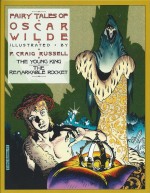
Fairy Tales of Oscar Wilde volume 2: The Young King and The Remarkable Rocket


Adapted by P. Craig Russell & various (NBM)
ISBN: 978-1-56163-771-3

P. Craig Russell began his illustrious career in comics during the early 1970s and came to fame young with a groundbreaking run on science fiction adventure series Killraven, Warrior of the Worlds.

Although his fanciful, meticulous, classicist style was joyously derived from the great illustrators of Victorian and Edwardian heroic fantasy, and the craftsmanlike visual flourishes of Art Nouveau was greatly at odds with the sausage-factory deadlines and sensibilities of the mainstream comicbook industry, the sheer power and beauty of his work made him a huge draw.

By the 1980s he had largely retired from the merciless daily grind, preferring to work on his own projects (generally adapting operas and plays into sequential narratives) whilst undertaking the occasional high-profile Special for the majors – such as Dr. Strange Annual 1976 (totally reworked and re-released as Dr. Strange: What Is It that Disturbs You, Stephen? in 1996) or Batman: Robin 3000.

As the industry grew up and a fantasy boom began, he returned to comics with Marvel Graphic Novel: Elric (1982), further adapting prose tales of Michael Moorcock’s iconic sword-&-sorcery star in the magazine Epic Illustrated and elsewhere.

Russell’s stage-arts adaptations had begun appearing in 1978: first in the independent Star*Reach specials Night Music and Parsifal and then from 1984 at Eclipse Comics where the revived Night Music became an anthological series showcasing his earlier experimental adaptations; not just operatic dramas but also tales from Kipling’s Jungle Books and other literary classics.

In 1992 he began adapting the assorted Fairy Tales of Oscar Wilde – a mission he continues to date, and this second volume (now in its third printing) deftly balances a tale of magnificent, pious allegorical wonderment with a wry and hilarious concealed yet concerted attack on conceit and self-aggrandisement packed with examples of the devastating, so-quotable epigrams which made the author so briefly the most popular man in London Society…

The Young King was originally published in 1891, one of the quartet of stories in A House of Pomegranates, (Wilde’s second book of stories for children) and here adaptor Russell utilises all his skills to staggering effect.

When the old king falters, the grandson he refused to acknowledge (due to the scandal of a Princess’ forbidden liaison) is plucked from the obscurity of a shepherd’s croft and made heir to the kingdom.

At first the crude, impoverished lad is beguiled and besotted by the sheer beauty of the Court and his new Station, but as his coronation approaches and he sinks into idolatry over the impossible, incomprehensible fineness of his vestments and symbols of office, the bedazzled 16-year-old dreams three dreams.

In them he sees three visions of the toil, privation, hardship and, too frequently, deaths the common folk paid for his Crown, Robe and Sceptre, and something changes within him.

Discarding all his finery, he dons his shepherd rags, picks up his crook and places a circlet of briars upon his brow. Then walking to the Cathedral, he draws scorn, derision and worse from the townsfolk, soldiers and nobility who decry the ingrate seeking to bring shame to a proud kingdom…

The miraculous, messianic ending to this stunningly realised parable is ably counter-pointed by a somewhat jollier – if wickedly barbed – offering.

Rendered in a more animated and fantastical manner, The Remarkable Rocket appeared in Wilde’s original 1888 collection The Happy Prince and Other Tales and begins with the betrothal of a young Prince to an exotic Princess.

As part of the festivities, a huge banquet and Grand Ball was to be concluded with a spectacular fireworks display: a spectacle the intended bride had never before experienced.

As the preparations began, in the palace gardens the assorted Roman Candles, Catherine Wheels and other pyrotechnics began to discuss their upcoming big night, one particularly obnoxious rocket increasingly monopolizes the conversation. Pompous, self-important, supercilious and unconscionably rude, he brags so much and babbles so long that he reduces himself to tears and is so sodden that when the big moment comes he is utterly incapable of igniting and completely misses the show.

Damp and disconsolate, he is discarded and lies unspent and obstreperous in the gardens having learned nothing. When a frog, dragonfly and duck try to engage him in conversation, Rocket again reverts to his abominable manner but things are about to change as two common boys pick him up to chuck on their campfire…

Gloriously rife with razor-sharp Wildean bon mots and ferociously barbed social criticism, this clever yarn still holds one final ironic tweak in the tale…

The brace of brilliant adaptations in this award-winning (a Harvey for Best Graphic Album and an Eisner for Best Artist) book signalled another high point in the artist’s splendid career, and on first release in 1994 displayed another milestone in the long, slow transition of an American mass market medium into a genuine art form.

Most importantly this and the other volumes in the series are incredibly lovely and irresistibly readable examples of superb writing (so go and read Wilde’s original prose tomes too!) and sublime examples of comics art their very best.

Now that it’s finally back in print, you simply must avail yourself of this masterful confection…
© 1994 P. Craig Russell. All rights reserved.

Essential Marvel Two-in-One volume 2


By Marv Wolfman, Jim Starlin, Tom DeFalco, John Byrne, Peter Gillis, Bill Mantlo, Alan Kupperberg, Mary Jo Duffy, Steven Grant, Ron Wilson, John Buscema, Sal Buscema, Frank Miller & various (Marvel)
ISBN: 978-0-7851-1729-2

Innovation isn’t everything. As Marvel slowly grew to a position of dominance in the wake of losing their two most inspirational creators, they did so less by experimentation and more by expanding and exploiting proven concepts and properties.

The only real exception to this was the en masse creation of horror titles in response to the industry down-turn in super-hero sales – a move expedited by a rapid revision in the wordings of the increasingly ineffectual Comics Code Authority rules.

The concept of team-up books – an established star pairing, or battling – often both – with less well-selling company characters was not new when Marvel decided to award their most popular hero the same deal DC had with Batman in Brave and the Bold.

Although confident in their new title, they wisely left their options open by allocating an occasional substitute lead in the Human Torch. In those long-lost days editors were acutely conscious of potential over-exposure – and since super-heroes were actually in a decline they may well have been right.

Nevertheless, after the runaway success of Spider-Man‘s Marvel Team-Up the House of Ideas carried on the trend with a series starring bashful, blue-eyed Ben Grimm – the Fantastic Four‘s most iconic and popular member – beginning with a brace of test runs in Marvel Feature #11-12, before graduating him to his own team-up title, of which this second economical, eclectic monochrome compendium gathers together the contents of Marvel Two-In-One #26-52 plus Annual‘s #2 and 3, covering April 1977- June 1979.

The innate problem with team-ups was always a lack of continuity – something Marvel had always prided itself upon – and writer/editor Marv Wolfman sought to address it by the simple expedient of having stories link-up through evolving, overarching plots which took Ben from place to place and guest to guest to guest.

Here the tactic begins with busy bombast in ‘The Fixer and Mentallo are Back and the World will Never be the Same!’ (illustrated by Ron Wilson & Pablo Marcos) which unites Ben with Nick Fury, Agent of S.H.I.E.L.D. battling a brace of conniving bad guys trying to steal killer-cyborg-from-an-alternate-future Deathlok .

The heroes spectacularly failed and the artificial assassin then co-featured in #27 as ‘Day of the Demolisher!’ found the now-reprogrammed killer targeting new US President Jimmy Carter. This time Big Ben had an alien ace up his sleeve and the hit failed…

The tempestuous Sub-Mariner shared the watery limelight in #28 as the Thing and his blind girlfriend Alicia Masters ferried the deactivated Deathlok to a London-based boffin. When they were shot down in mid-Atlantic by a mutated fish-man, Ben was forced to fight against and beside Namor whilst Alicia languished ‘In the Power of the Piranha!’ (with John Tartaglione inks).

Master of Kung Fu Shang-Chi then stepped in as Ben and Alicia finally landed in London. ‘Two Against Hydra’ (Sam Grainger inks) saw aforementioned expert Professor Kort snatched by the sinister secret society before the Thing could consult him: the savant’s knowledge being crucial to Hydra’s attempts to revive their newest living weapon…

As part of Marvel’s obsessive ongoing urge to protect their trademarks, a number of their top male characters had been spun off into female iterations. Thus at the end of 1976 Ms. Marvel debuted (with a January 1977 cover-date), She-Hulk arrived at the end of 1979 (Savage She-Hulk #1 February 1980) and Jessica Drew premiered in Marvel Spotlight #32 a mere month after Ms. Marvel as The Spider-Woman…

Her next appearance in Marvel Two-In-One #29 (July 1977) began an extended six-chapter saga which was designed as a promotional lead-in to her own series and ‘Battle Atop Big Ben!’ in #30 (by Wolfman, John Buscema & Marcos) saw her logo beside the Thing’s as she struggled to be free of her Hydra controllers, even as a couple of thieves embroiled Ben and Alicia in a complex and arcane robbery scheme involving a strange chest buried under Westminster Abbey.

Although the Arachnid Dark Angel was unable to kill Ben she did kidnap Alicia, who became ‘My Sweetheart… My Killer!’ (#31 by Wilson & Grainger) once Kort and Hydra transformed the helpless waif into a spidery monster. In #32’s ‘And Only the Invisible Girl Can Save us Now!’ (Marcos inks) Sue Storm joined the repentant Spider-Woman and distraught Thing in battling/curing the out-of-control Alicia whilst those two robbers continued their long-term campaign of acquisition and accidentally awoke a quartet of ancient elemental horrors.

It took the Arthurian sorcerer Modred the Mystic to help Spider-Woman and Ben triumph over the monsters in the concluding ‘From Stonehenge… With Death!’ before a semblance of normality was restored…

Back to business as usual in Marvel Two-In-One #34, Ben and sky-soaring Defender Nighthawk tackled a revivified and cruelly misunderstood alien freed from an antediluvian cocoon in ‘A Monster Walks Among Us!’ (Wolfman, Wilson & Marcos) before Ernie Chan stepped in to illustrate a 2-part wrap-up to one of Marvel’s recently folded series.

Issue # 35 saw the Thing dispatched by the Air Force through a time-portal in the Bermuda Triangle to a fantastic world of dinosaurs, robots, dinosaurs, E.T.’s and dinosaurs as ‘Enter: Skull the Slayer and Exit: The Thing’ detailed the short history and imminent deaths of a group of modern Americans trapped in a bizarre time-lost land.

Marooned in the past it took the intervention of best buddy Mister Fantastic to retrieve Ben and his new friends in #36’s ‘A Stretch in Time…’

Marvel Two-In-One Annual #2 then provided the second half of a landmark story, by Jim Starlin & Joe Rubinstein, which completed a tale which began in Avengers Annual #7 (not included here).

In that missing episode, the World’s Mightiest Superheroes in combination with Captain Marvel and cosmic wanderer Adam Warlock had forestalled a massed alien assault and prevented the Dark Titan Thanos from destroying the Sun – but only at the cost of Warlock’s life.

Now, in ‘Death Watch!’, Peter Parker was plagued by prophetic nightmares, revealing how the Titan had snatched victory from defeat and now held the Avengers captive whilst he again prepared to extinguish Sol.

With nowhere else to turn, Spider-Man headed for the BaxterBuilding,  hoping to borrow a spacecraft, unaware that the Thing also had history with the terrifying, death-obsessed Titan.

Although utterly overmatched, the unlikely champions of Life upset Thanos’ plans enough that the Avengers’ and the Universe’s true agent of retribution was able to end the threat forever – or at least until next time…

Marvel Two-In-One‘s apparent function as a clearing-house for old, unresolved series and plot-lines was then put on hold for awhile as issue #37 teamed Ben with Matt Murdock (alter ego of Daredevil) for ‘Game Point!’ (Wolfman, Wilson & Marcos).

Ben had been framed for monstrous acts of wanton destruction, and when the case went badly he faced decades in jail. However, DD and a strange street punk dubbed “Eugene the Kid” determined that the Mad Thinker was behind the plot to place the ‘Thing Behind Prison Bars’ (by Roger Slifer, Wilson & Jim Mooney) and tackled the maniac whose ultimate game plan was to corner the future and mass-produce his own android Avenger in #39’s ‘The Vision Gambit’ (with inks by Marcos).

Slifer, Tom DeFalco, Wilson & Marcos then detailed a spooky international yarn as the Black Panther became involved in a monstrous reign of terror: a zombie-vampire stalking the streets and abducting prominent African Americans. The concluding part – ‘Voodoo and Valor!’ (David Kraft, Wilson & Marcos) – saw Jericho Drumm (AKA Brother Voodoo) volunteer his extremely specialised services to Ben and T’Challa, in hopes of ending the crisis…

The trail took the heroes to Uganda for a confrontation with Doctor Spectrum and the far more dangerous real-world crazy killer Idi Amin…

Marvel Two-In-One #42 then introduced a mainstay of the Marvel Universe as Project Pegasus debuted in ‘Entropy, Entropy’ by Ralph Macchio, Sal Buscema, Alfredo Alcala & Sam Grainger

The Federal research station designated the Potential Energy Group/Alternate Sources/United States was dedicated to investigating alternative power sources and soon became the most sensible place to dump energy-wielding super-baddies once they were subdued.

Ben found and started trashing the place whilst tracking down his educationally- and emotionally-challenged ward Wundarr who had been renditioned by the Government, only to be contained by Captain America in his role as security advisor. They were only just in time to stumble over a sabotage scheme by martial maniac Victorius who unleashed a deadly new threat in the ghostly form of Jude, the Entropic Man…

This phantasmic force easily trounced Cap and Ben but found the macabre Man-Thing a little bit harder to handle in the concluding episode ‘The Day the World Winds Down’ (Macchio, John Byrne – & Friends – & Bruce Patterson)…

Marvel Two-In-One Annual #3 then offered an old-fashioned, great big world-breaking blockbuster in which Nova the Human Rocket battled beside the Thing to free captive alien princesses and save the Earth from gigantic cosmos-marauding space invaders a simple yet entertaining tussle entitled ‘When Strike the Monitors!’ carefully crafted by Wolfman, Sal Buscema, Frank Giacoia & Dave Hunt.

Back in the monthly comicbook issue #44 strayed away from standard fare with ‘The Wonderful World of Brother Benjamin J. Grimm’ (Wolfman, Bob Hall & Giacoia) with the Thing telling rowdy kids a rather fanciful bedtime story concerning his recent partnership with Hercules to free Olympus from invading giants…

In issue #45 Captain Marvel’s Cosmic Awareness warned him that the Thing had been targeted by vengeful Skrulls in ‘The Andromeda Rub-Out!’ (Peter Gillis, Kupperberg & Esposito), after which the Incredible Hulk‘s new TV show compelled an outraged Ben to head for Hollywood, only to become embroiled in ‘Battle in Burbank!’ (Alan Kupperberg & Chic Stone)

Perpetual gadflies The Yancy Street Gang headlined in MT-I-O #47 as ‘Happy Deathday, Mister Grimm!’ (Bill Mantlo & Stone) saw a cybernetic tyrant take over Ben’s old neighbourhood. The invasion ended – once awesome energy powerhouse Jack of Hearts joined the fight against ‘My Master, Machinesmith!’ in #48 by Mantlo, Stone & Tex Blaisdell.

Mary Jo Duffy, Kupperberg & Gene Day then piled on the spooky laughs in #49 as the ‘Curse of Crawl-Inswood’ saw Doctor Strange manipulate Ben into helping him crush a supernatural incursion in a quaint and quiet seaside resort.

The anniversary issue #50 was everything a special issue should be. ‘Remembrance of Things Past’ by Byrne & Joe Sinnott took a powerful and poignant look at the Thing’s history as a monster outcast and posited a few what-might-have-beens…

Following another failure to cure his rocky condition, Ben steals the chemical and travels into his own past, determined to use the remedy on his younger, less mutated self, but his bitter, brooding, brittle earlier incarnation is hardly prepared to listen to another monster and inevitable catastrophic combat ensues…

Issue #51 was even better. ‘Full House… Dragons High!’ by Gillis, up-&-coming artist Frank Miller & Bob McLeod, detailed how a weekly poker session at Avengers Mansion was interrupted by rogue US General Pollock, who again tried to conquer America with stolen technology. Happily Ben and Nick Fury found Ms. Marvel, Wonder Man and the Beast better combat comrades than Poker opponents…

This mammoth tome ends on a sinister paranoic note with Marvel Two-In-One #52 and ‘A Little Knight Music!’ (by Steven Grant, Jim Craig & Marcos), as the mysterious Moon Knight joins the Thing in stopping CIA Psy-Ops master Crossfire from brainwashing the city’s superheroes into killing each other…

These stories – from Marvel’s Middle Period – are certainly of variable quality, but whereas some might feel rushed and ill-considered they are balanced by many timeless classics, still as captivating today as they always were.

Even if artistically the work varies from only adequate to quite superb, most fans of Costumed Dramas will find little to complain about and there’s lots of fun to be found for young and old readers. So why not lower your critical guard and have an honest blast of pure warts and all comics craziness? You’ll almost certainly grow to like it…
© 1977, 1978, 1979, 2007 Marvel Characters, Inc. All Rights Reserved.

The New Avengers volume 1: Breakout


By Brian Michael Bendis, David Finch & various (Marvel)
ISBN: 978-0-7851-1479-6

During the Marvel rebirth in the early 1960’s Stan Lee & Jack Kirby aped a tactic which had recently paid big dividends for DC Comics, but with initially mixed results.

Although Julie Schwartz had achieved incredible success with revised and modernised versions of the company’s Golden Age greats, the natural gambit of trying the same revivification process on characters that had dominated Timely/Atlas in those halcyon days didn’t go quite so well.

The Justice League of America-inspired Fantastic Four featured a new Human Torch but his subsequent solo series began to founder almost as soon as Kirby stopped drawing it. Sub-Mariner was back too, but as a villain, as yet incapable of carrying his own title…

So the costumed character procession continued: Lee, Kirby and Steve Ditko churning out numerous inventive and inspired “super-characters”. Not all caught on: Hulk lost his title after six issues and even Spider-Man would have failed if writer/editor Lee hadn’t really, really pushed his uncle, the publisher…

Thus, after nearly 18 months during which the fledgling House of Ideas had created a small stable of leading men (but only a sidekick woman), Lee & Kirby settled on combining their meagre stock of individual stars into a group – which had made the JLA a commercial winner – and assembled a handful of them into a force for justice and even higher sales…

Cover-dated September 1963, The Avengers #1 launched as part of an expansion package which also included Sgt. Fury and his Howling Commandos and The X-Men…

Despite a few rocky patches, the series soon grew into one of the company’s perennial top sellers, but times and tastes always change and after four decades, in September to December 2004, the “World’s Mightiest Heroes” were shut down and rebooted in a highly publicised event known as Avengers Disassembled.

Of course it was only to replace them with both The New and The Young Avengers. Affiliated comic-books Thor, Iron Man, Captain America, Fantastic Four and Spectacular Spider-Man also ran parallel but not necessarily interconnected story-arcs to accompany the Big Show.

Said Show consisted of the worst day in the team’s history as the Scarlet Witch was revealed to have gone crazy, betraying the team who had been her family and causing the destruction of everything they held dear and the death of several members. That all happened in issues #500-503, plus the one-shot Avengers Finale.

The most important major change from that epic ending was The New Avengers, and this slim tome collects the first six issues from that celebrated revamp (covering January to June 2005) as Brian Michael Bendis and David Finch – with inking assistance from Danny Miki, Mark Morales, Allen Martinez & Victor Olazaba – redefined the nature of group heroics for a darker, more complex age.

The six-chapter saga ‘Breakout’ begins six months after the day Tony Stark shut down the Avengers and withdrew all funds, backing and support…

Somewhere in the city a shadowy client hires super-villain Electro to facilitate the escape of a certain individual from the metahuman super High Security prison The Raft.

The lock-up is located on an island in New York City Harbour: a high-tech exemplar of space-age confinement, keeping hundreds of super-thugs and deadly monsters safely away from decent folks, all efficiently operated and maintained by superspy peacekeeping agency S.H.I.E.L.D.

One particular day, lawyers Foggy Nelson and his partner Matt (Daredevil) Murdock are visiting a mystery prisoner at the behest of Reed Richards of the Fantastic Four. In accordance with security protocols they are accompanied by S.H.I.E.L.D. super-agent Jessica Drew – formerly costumed crusader Spider-Woman – but have also brought their own metahuman bodyguard in the formidable form of Luke Cage AKA Power Man.

They picked the worst possible day. As a city-wide sudden power blackout disables the technologies suppressing the powers of the inmates, Electro’s attack shatters the walls and, having secured his target, the mega-volt mercenary opens all the cells and tells the exultant escapees to have fun whilst he flees…

At the first sign of trouble Peter Parker switched to Spider-Man and headed for The Raft, snagging a ride on an official helicopter. When it is shot down, he is pulled from the freezing waters by Captain America who had diverted the chopper to get to the endangered island…

Far below the surface level, Agent Drew has shepherded her charges to relative safety, leaving Foggy in the cell of the man they’d come to interview. Bob Reynolds, a superhero known as Sentry, is the most powerful being on Earth and has allowed himself to be incarcerated for the murder of his own wife…

As Nelson tries to break through to the shell-shocked, nigh-comatose superhuman, Drew, Cage and Daredevil are engaging in a brutal holding action against an army of enraged psychos, whilst at the surface level Spidey and Cap are fighting for their lives.

Things go bad when the web-spinner’s arm is broken, whilst down in Sentry’s cell the sadistic metamorph Carnage finds a way to reach the cowering Foggy…

The inevitable bloodbath rouses Sentry from his stupor and the Golden Gladiator explodes out of the Raft, carrying Carnage to his doom in deep space, whilst on the surface level Iron Man’s blockbusting arrival begins to turn the tide against the army of maniacs…

The third chapter opens with Stark and Steve Rogers discussing the recently pacified penitentiary and the obvious need for the Avengers to reform. Captain America’s urgent belief that it was fate calling a new team together nearly sways the arch-rationalist – as does the fact that forty-two of the worst malefactors managed to get away in the chaos – but Iron Man remains uncommitted until Cap can get some – or any – of the staunch loners they fought beside to join the proposed New Avengers team…

Always undaunted, the Star-Spangled Avenger starts talking and soon Spider-Woman, Cage and Spider-Man are aboard. Daredevil again declines to join any group and the enigmatic Sentry just goes back to his cell…

Captain America even convinces S.H.I.E.L.D. to rehire the immediately cashiered Jessica as liaison between the agency and Avengers – although current Director Maria Hill is hostile to both her and the formation of a new team. Little do any of them know that Spider-Woman’s loyalties divide not two ways, but three…

The first order of business is to find Electro and discover who he was specifically after. The trail leads to Boston, another blistering battle but no joy, forcing Drew to try radical tactics on the remaining, re-incarcerated super-freaks in an attempt to divine the identity of the cause of all their problems.

Soon the rag-tag band are rocketing to the Savage Land – a sub-surface wonderland of cavemen, dinosaurs and other strange creatures left in splendid isolation as a UN Protectorate – to recapture Karl Lykos, a man who feeds on mutant energy to become the reptilian monster Sauron…

The excursion is a disaster: they are marooned, attacked by giant lizards and captured by mega-genius Brainchild and his band of Mutates. Lykos’ escape had been engineered by the ruthless experimenter, who still considers humans as guinea pigs and seems intent on eradicating mankind, but the proto-Avengers’ biggest problem is a former ally.

Wolverine has also tracked the fugitive to the Antarctic paradise and intends to end the threat of Sauron forever… no matter who gets in the way…

He is just too late and the great reptile is reborn. However, during the subsequent battle the heroes uncover an even greater horror. Global good guys S.H.I.E.L.D. have apparently enslaved the indigenous people of the region and are using them to mine alien wonder element Vibranium.

Unfortunately, the secret is guarded by ultra-operative Yelena Belova, the new Black Widow and she is quite prepared to destroy them – and the entire installation – to preserve the secret…

In the appalling aftermath the astounded Avengers make more ghastly discoveries. The Raft breakout also exposed the fact that many of the criminals held there had been reported dead for years and the new team – which now includes Wolverine – have to face the prospect that the Free World’s greatest peacekeeping force may be partly (or wholly) corrupt: stockpiling deadly elements, super-weapons and even metahumans for what cannot possibly be any good reason…

Shaken and betrayed, The New Avengers resolve to find out why, whatever the cost…

Smart, bombastic and laced with tension and brilliant hilarity, this was – and remains – a superb moment of innovation and bold thinking that truly revitalised a moribund concept, With covers-&-variants by Finch, Miki & Frank D’Armata, Steve McNiven, Joe Quesada,. Trevor Hairsine, Olivier Coipel, Jim Cheung, Richard Isanove, Adi Granov and Bryan Hitch, this is a grand jumping-on point for readers who love Fights ‘n’ Tights Fiction and fans familiar with either the TV animation series or movie blockbuster iterations of the World’s Greatest Superheroes.
© 2004 and 2006 Marvel Characters, Inc. All rights reserved.

Guardians of the Galaxy – Legacy


By Dan Abnett & Andy Lanning, Paul Pelletier, Rick Magyar & various (Marvel)
ISBN: 978-0-7851-3338-4

Following twin cosmic catastrophes (the invasion of our cosmos by the Negative Zone legions of Annihilus and consequent incursion of the shattered survivors of parasitical Phalanx) Marvel breathed new life in many of its moribund cosmic comics characters, and none more so than the rough agglomeration of rootin’, tootin’, blaster-shootin’ outer space reprobates that formed a new 21st century iteration of the Guardians of the Galaxy.

Although heralded since its launch in the early 1960s with making superheroes more realistic, Marvel Comics also maintained its intimate affiliation with outlandish and outrageous cosmic calamity (as wonderfully embodied in their pre-superhero “monster-mag” days), and with an upcoming big-budget movie due soon this is a property the company needs to keep in the public eye…

The original Guardians were created by Arnold Drake in 1968 for try-out title Marvel Super-Heroes (#18, January 1969), a rag-tag bunch of futuristic freedom fighters dedicated to liberating star-scattered humanity from domination by the sinister, reptilian Brotherhood of Badoon.

Initially unsuccessful, the far-future space squad floated in limbo until 1974 when Steve Gerber incorporated them into Marvel Two-In-One #4 and 5 and Giant Size Defenders #5 as well as the monthly Defenders (#26-29, July – November 1975), wherein assorted 20th century champions travelled a millennium into Tomorrow to ensure mankind’s very survival.

This in turn led to the Guardians’ own short-lived series (in Marvel Presents #3-12, February 1976 – August 1977) before abrupt cancellation left them roaming the Marvel Universe as perennial guest-stars in such cosmically-tinged titles as Thor, Marvel Team-Up, Marvel Two-in-One and The Avengers.

In June 1990 they were back, securing a relatively successful series (#62 issues, plus annuals and a spin-off miniseries) until the axe fell again in July 1995.

This isn’t them; this is another bunch…

By 2006 reading tastes had once turned to watching the skies and a massive crossover event involving most of Marvel’s 21st century space specialists erupted throughout the Marvel Universe.

Annihilation, brainchild of writing team Dan Abnett & Andy Lanning, resulted in a vast reconfiguration (pre- configuration), creating a set of galactic Guardians for modern times and tastes.

Among the stalwarts in play were Silver Surfer, Galactus, Firelord (and other heralds of the world-eater), Moondragon, Quasar, Star-Lord, Thanos, Super-Skrull, Tana Nile, Gamora, Ronan the Accuser, Nova, Drax the Destroyer, a Watcher as well as a host of alien civilisations such as the Kree, Skrulls, Xandarians, Shi’ar et al and more, all relentlessly falling before a invasion of rapacious Negative Zone bugs and beasties unleashed by undying insectoid horror Annihilus.

That conflagration spawned its own wave of specials, miniseries and new titles (subsequently collected in three volumes plus a Classics compilation which reprinted key appearances of most of the saga’s star players). It inevitably led to a follow-up event …

In Annihilation: Conquest, with Kree and Skrull empires splintered, the Nova Corps of Xandar reduced to one single operative, and wild ancient gods returned, a sizable proportion of the Negative Zone invaders had tenuously established themselves in territories once home to untold billions.

The Supreme Intelligence was gone and arch-traitor Ronan had become a surprisingly effective ruler of the few remaining Kree. Cosmic Protector Quasar had died, and Phyla-Vel, (daughter of the first Captain Marvel) has inherited both his powers and name…

Whilst she and psychic demi-goddess Moondragon worked with the pacifist Priests of Pama to relieve the suffering of starving survivors, Star-Lord Peter Quill toiled with Ronan to shore up the battered interstellar defences of the myriad races in the decimated space-sector.

Quill then brokered an alliance with the Spaceknights of Galador (an old noble cyborg species most famously represented by 1980s hero Rom) to enhance the all-pervasive etheric war-net, but the system had been treacherously compromised, and when activated instantaneously overwritten ruled by a murderous, electronic sentient parasitic species known as the Phalanx, whose cybernetic credo was “peace and order through assimilation”…

Once again a rag-tag rabble united to repel a cosmic invasion, with Quill commanding a Kree resistance division/Penal Strike Force. The highly engaging intergalactic Dirty Half-Dozen comprised Galactic Warrior Bug (originally from the 1970’s phenomenon Micronauts), the current Captain Universe (ditto), Shi’ar berserker Deathcry, failed Celestial Madonna Mantis, anamorphic adventurer Rocket Raccoon and the magnificently whacky “Kirby Kritter” Groot, a Walking Tree and one-time “Monarch of Planet X.”

In combination with stellar stalwarts Drax, Gamora – “Deadliest Woman in the Galaxy” – and Adam Warlock, the organic underdogs and other special all-stars turned back the techno-parasites and were left to set the saved if battered universe back on an even (ish) keel.

The success of all that intergalactic derring-do led in turn to a new series and this initial tome (collecting Guardians of the Galaxy volume 2 #1-6 from July-December 2008) finds some of the recently acquainted adventurers in the midst of saving the universe some more…

‘Somebody’s Got To Do It’ (by writers Dan Abnett & Andy Lanning, illustrated by Paul Pelletier & Rick Magyar) reveals how – thanks to fellow Earthling Nova’s prompting – Star-Lord determined to create a pro-active defence force to handle the next inevitable cosmic crisis as soon as it started.

To that end he convinced Drax, Gamora, Groot, Phyla-Vel, Warlock and the raccoon to relocate with him to the pan-species science-station Knowhere (situated in the hollowed out skull of a dead Celestial Space God) and start putting out the never-ending progression of interstellar brush-fires before they become really serious…

The station is guarded and run by Cosmo – a Russian dog with astounding telepathic abilities – and is where old comrade Mantis works as chief medic. It also offers unlimited teleportational transport which the team soon needs as it tries to prevent an out-of-control Universal Church of Truth Templeship crashing into a time/space distortion and shredding the fabric of reality…

Soon the surly scratch squad are battling savage, crazed missionary-zealots – powered by the worship of enslaved adherents channelled through the Templeship’s colossal Faith Generators – whilst desperately attempting to divert the vessel before it impacts the fissure in space. Such a collision would cause catastrophic destruction to the galaxy but the UCT crusaders only see heretics trying to interfere with their mission to convert unbelievers…

The crisis is exacerbated by another small problem: there are very nasty things on the other side of the fissure that really want to come and play in our universe, and when one of them breaks through the only thing to do is destroy the entire ship…

In the aftermath, Warlock reveals that the string of cosmic Armageddons has fundamentally damaged the nature of space, and more fissures will appear. He wants to repurpose the team to find and close them all before anything else escapes.

And on Sacrosanct, homeworld of the Universal Church of Truth, the Matriarch issues a decree for her Cardinals to deal with the interfering unbelievers…

‘Legacy’ sees the team dash to another Reality rupture which has recently spewed out a huge chunk of limbo-ice, only to find the temporal effluvia is encasing a chunk of Avengers Mansion and another appalling atrocity hungry for slaughter. As it attacks them they are saved by a recently-thawed costumed hero throwing a circular shield with concentric circles and a single star…

The confused hero says he is Vance AstrovikMajor Victory of the Guardians of the Galaxy and he has travelled back from the 30th century. The problem is that he can’t remember why or if he’s arrived in the right universe…

As the mystery man is probed by telepathic, precognitive Mantis, Quill and Warlock drag the team off to seal another Fissure, only to be ambushed by a unit of Cardinals as they enter a vast Dyson Sphere where something horrific is hunting…

As pitched, merciless battle breaks out on the Sphere in ‘Beyond Belief’, Mantis and Major Victory are attacked in Knowhere’s sickbay by a being of incredible power. Astrovik calls the assailant Starhawk but Mantis is unable to glean any information about him from any future she can see…

Within the Sphere, the war between Guardians and Cardinals is abruptly terminated as the bio-horror that haunts the solar system-sized construct attacks. Trapped and desperate Gamora is severely damaged when she uses the artefact’s captive sun to destroy it…

Back home at Knowhere to recuperate in ‘Damages’, the squad is caught in the latest of a series of escalating acts of sabotage. However the real shock comes as amongst the 38 dead are three Skrulls. The rapacious shape-shifting conquerors have clearly infiltrated the many races using the science station…

Apparently able to defeat all the base’s detectors and confound the many telepaths in situ, the reviled creatures prove a wave of panic and Cosmo is soon being challenged by Gorani and Cynosure of the Administrative Council, both demanding swift, strong action…

The news also incites a wave of paranoia and panic amongst the inhabitants and mystery man Astrovik is targeted by a mob, leading to Quill’s team being confined to quarters, where Drax overhears a shocking exchange between Star-Lord and Mantis…

The final two issues here form part of a major company-wide crossover but thankfully can stand alone from that event. It all begins with ‘Deception – a Secret Invasion Story’ wherein Drax goes rogue, hunted throughout the station by super-powered cops as the rest of his team undergo a trial. Of course, with a suffix like “the Destroyer” there’s little reason to trust the big green galoot, and no chance to stop him as he trashes Cynosure’s superteam The Luminals, and soon his former comrades join the search too.

Things take a darker turn as Starhawk reappears – this time as a woman – determined to stop the wrong future from happening, whilst elsewhere one of team is revealed to be concealing and protecting the dreaded Skrulls…

And in the bowels of the station Drax works on his plan to flush out the shape-shifters: after all, everybody knows that they revert to their own forms on death so all he has to do is kill everyone in Knowhere to find them…

The frankly brilliant conclusion occurs in ‘Death – a Secret Invasion Story’ which cleverly and spectacularly wraps up the crossover whilst positioning the assorted heroes for the next major story arc by splitting them up: a fairly natural reaction once the Guardians learned that Quill had had Mantis mind-control each one to get them to join his proposed pro-active strike-force in the days following the defeat of the Phalanx…

This stunning stellar treasure-chest also includes a covers-&-variants gallery by Clint Langley and Nic Klein, with a dozen of Langley’s unused Cover Options, a magnificent double-page pencil-art spread by Pelletier plus a Concept Artwork section on the new improved and savagely sinister Starhawk to astound and amaze all lovers of astral action and gritty, funny fantastic fantasy.

Smart, breathtaking adventure with loads of laughs and tremendous imagination, this is superb stuff well worth seeking out and, hopefully, set to be re-issued in the lead up to the forthcoming major movie production…
© 2008 and 2009 Marvel Characters, Inc. All rights reserved.

Dark Avengers: Molecule Man


By Brian Michael Bendis, Mike Deodato, Rain Beredo & Greg Horn (Marvel)
ISBN: 978-0-7851-3854-9
One of the most momentous events in Marvel Comics history occurred in 1963 when a disparate array of freshly minted individual heroes banded together to stop the Incredible Hulk. The Mighty Avengers combined most of the company’s fledgling superhero line in one bright, shiny and highly commercial package, and over the years the roster has waxed and waned until almost every character in their universe – and even some from others – has at some time numbered amongst their serried ranks.

After years of valiant, if often controversial service to humanity, when the draconian Federal initiative known as Superhuman Registration Act led to Civil War between costumed heroes, Tony Stark AKA Iron Man was appointed the American government’s Security Czar – the “top cop” in sole charge of a beleaguered nation’s defence and freedom: Director of high-tech enforcement agency S.H.I.E.L.D. and last word in all matters involving metahumans and the USA’s vast costumed community…

Stark’s mismanagement of various crises led to the arrest and assassination of Captain America and an unimaginable escalation of global tension and destruction, culminating in an almost-successful Secret Invasion by shape-shifting alien Skrulls.

Discredited and ostracised, Stark was replaced by apparently rehabilitated and recovering schizophrenic Norman Osborn (the original Green Goblin), who assumed full control of the USA’s covert agencies and military resources, disbanded S.H.I.E.L.D. and placed the nation under the aegis of his own new organisation H.A.M.M.E.R.

The erstwhile Spider-Man villain had begun his climb back to respectability after taking charge of the Government’s Thunderbolts Project; a penal program which offered a second chance to super-criminals who volunteered to undertake Federally-sanctioned missions…

Not content with commanding legitimate political and personal power, Osborn also secretly conspired with a coalition of major menacing masterminds to divvy up the world between them. The Cabal was a Star Chamber of super-villains all working towards a mutually beneficial goal, but such egomaniacal personalities could never play well together and cracks soon began to show, both in the criminal conspiracy and Osborn himself.

As another strand of his long-term plan, the Homeland Security overlord subsequently sacked the Avengers and formed his own, more manageable team consisting of replacements and outright impostors…

Constantly courting public opinion, Osborn launched his Avengers whilst systematically building up a new, personally loyal high-tech paramilitary rapid-response force. Moreover, seemingly to keep himself honest, he hired ex-S.H.I.E.L.D. hardliner Victoria Hand as his Deputy Director, tasked with watching the recovering madman for any signs of regression into criminal insanity…

His second-in-command was also occupied with the day-to-day running of the organisation whilst he concentrated on keeping Greek War-God Ares, mentally-disturbed superman Sentry and altruistic, dimensionally displaced alien Noh-Var – now dubbed Captain Marvel – unaware of his true intentions.

His other recruits were content with the sweet perks and devious deals on offer. Bullseye, Moonstone, Venom and Wolverine‘s psychotic son Daken Akihiro happily counterfeited Hawkeye, Ms. Marvel, Spider-Man and the irascible mutant Avenging X-Man, especially as Osborn had confiscated and repurposed Tony Stark’s greatest inventions into his own suit of super-armour, retooled and finished to invoke impressions of both Captain America and the Golden ex-Avenger. Iron Patriot was always at the forefront of his hand-picked team, leading from the front as a true American hero should…

Collecting issues #9-12 (December 2009-March 2010) of the controversial Dark Avengers series scripted by Brian Michael Bendis and illustrated by Mike Deodato & colourist Rain Beredo, this volume begins to catalogue the cracks in the façade.

As Osborn starts to become unglued, the God of War takes a personal day and follows his son Alexander.

Nick Fury, driven by duty, fuelled by suspicion and powered by a serum which kept him vital far beyond his years, didn’t go away when S.H.I.E.L.D. was shut down. He just went deep undercover and continued doing what he’d always done – saving the world, one battle at a time. From an unassailable, unsuspected vantage point Fury picked his battles and slowly gathered assets and resources he’d personally vetted or built…

The indomitable freedom fighter had always known that to do the job properly he needed his own trustworthy forces and no political constraints. To this end he had long endeavoured to clandestinely stockpile his own formidable team, which included a crack squad of super-human operatives: Yo Yo Rodriguez AKA Slingshot, Sebastian Druid, Jerry “Stonewall” Sledge, J.T. “Hellfire” James and Daisy Johnson, codenamed Quake, and the terrifyingly volatile Alexander: a 12-year old boy of incredible power.

The child Phobos was destined to become a true god – the personification of Fear – but until then his daily-developing divine gifts were Fury’s to use…

Now Ares tracks his delinquent child to the lair of his commanding officer’s most dangerous enemy. Instead of all-out combat, however, the confrontation with Fury leads to a shaky détente and an improbable deal…

The main part of this volume then deals with the faux team’s most perilous challenge, as a string of uncanny disappearances in back-of-beyond hamlet Dinosaur, Colorado ties in with Osborn’s desire to keep his bored and dangerous team occupied.

However when the more-than-godlike Sentry is apparently vaporised, the grand schemer realises the magnitude of the unidentified menace and mobilises his entire organisation.

But as his team approach ground zero and the still unknown foe, each is whisked into a personalised hell (illustrated in painted sections by Greg Horn) wherein impossibly overwhelming Molecule Man Owen Reece sits in judgement and metes out appalling punishments on the interlopers who have desecrated his private paradise and playground…

With only Victoria Hand left the situation looks dire, but the former S.H.I.E.L.D. bean-counter undertakes a brilliant last-ditch stratagem which delays events long enough for Sentry to somehow reassemble himself and battle the most powerful creature in existence to a standstill…

Not even Sentry himself realised just how strong he truly was, and as that terrifying fact sinks in Osborn continues to mentally unravel – even as his erstwhile Cabal ally Loki attacks…

To Be Concluded…

This portentous, doom-drenched psycho-drama builds breathtaking suspense whilst delivering blistering action in a slowly-intensifying progression as part of the “Dark Reign” company-wide crossover which impacted upon the entire Marvel Universe, yet besides being a component of an overarching epic, still holds together effectively as an entertaining one-off read for casual Fights ‘n’ Tights fans…

Also included to enhance the appeal are a cover gallery by Deodato & Beredo, a wealth of Characters Designs and unused material, a 4-page article on the Cover Process, Norman’s Dream Sketchbook by Greg Land and an information feature on Molecule Man taken from the Marvel Universe Handbook.

Although definitely not a book for younger fans, this is another striking saga from author Bendis, packed with intrigue and action, magnificently illustrated and offering an engaging peek at the sinister side of superheroics and the deadly downside of good intentions.
© 2009 and 2010 Marvel Characters, Inc. All Rights Reserved.