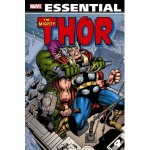
Essential Thor volume 3


By Stan Lee, Jack Kirby, & various (Marvel)
ISBN: 978-0-7851-2149-7

Whereas the rapidly proliferating Marvel Universe grew ever more interconnected as it matured with the assorted superheroes literally tripping over each other as they contiguously and continually saved the world from their New York City bases, the Asgardian heritage of Thor and the soaring imagination of Jack Kirby increasingly pulled the Thunder God away from mortal realms into stunning new landscapes.

Admittedly the son of Odin would pop back for an adventure or two, but it is clear that for Kirby, Earth was just a nice place to visit whilst the stars and beyond were the right and proper domain of the Asgardians and their foes.

Crippled doctor Donald Blake took a vacation in Norway only to stumble into an alien invasion. Trapped in a cave, he found an old walking stick, which when struck against the ground turned him into the Norse God of Thunder! Within moments he was defending the weak and smiting the wicked. Months swiftly passed with the Lord of Storms tackling rapacious extraterrestrials, Commie dictators, costumed crazies and cheap thugs, but these soon gave way to a vast kaleidoscope of fantastic worlds and incredible, mythic menaces.

Soon each issue also carried a spectacular back-up series. Tales of Asgard – Home of the Mighty Norse Gods gave Kirby space to indulge his fascination with legends and allowed both complete vignettes and longer epics (in every sense of the word).

This third mind-boggling monochrome collection, encapsulating the absolute zenith of the fantastic feature, reprints Mighty Thor #137-166, spanning February 1967 to July 1969, as a new era dawned for the no-longer Earthbound Thunder God. At the end of the previous volume Thor had just lost his human paramour Jane Foster, but rediscovered his childhood sweetheart, the goddess Sif, now all grown up and a fierce warrior maid to boot.

A good thing too, since ‘The Thunder God and the Troll!’ (by Stan Lee, Jack Kirby & Vince Colletta) which introduced the bestial menace of Ulik saw open warfare begin between the Asgardians and their implacable troglodytic foes. During spectacular carnage and combat Sif was captured and the Thunderer rushed to Earth to rescue her, whilst legions of monstrous subterraneans attacked the very heart of the kingdom…

The Tales of Asgard feature was being gradually wrapped up, but still offered Kirby a place to stretch his creative muscles. ‘The Tragedy of Hogun!’ (Lee, Kirby & Colletta) began revealing the gripping history of the dour warrior in an Arabian Nights pastiche which introduced Mogul of the Mystic Mountain.

In ‘The Flames of Battle!’ Thor was reunited with Sif but deprived of his magical mallet, courtesy of exotic technology the trolls had mysteriously developed. Did the malign invaders have a new ally or a terrifyingly powerful slave? Trapped on Earth, the hammerless Thor had no means of returning to the realm beyond the Rainbow Bridge whilst in Asgard, the war went badly and the heroic gods were close to defeat…

‘The Quest for the Mystic Mountain!’ found Hogun and his comrades edging closer to revelation and vengeance, which culminated in a truly stunning Kirby spectacle in #139 as the wandering warriors discovered ‘The Secret of the Mystic Mountain!’ in the Tales of Asgard segment whilst the lead story ‘To Die Like a God!’ wrapped up the Troll War in eye-popping style as Thor and Sif invaded the bowels of the Earth to save the day…

Thor #140 began a short run of compete, single episode tales heavy on action, starting with ‘The Growing Man!’ as Thor headed back to Earth and discovered New York under attack by a synthetic warrior who grew larger and stronger with every blow struck against him. Time travelling marauder Kang the Conqueror was behind the Brobdignagian brute, whilst in the back-up ‘The Battle Begins!’ Hogun and friends were menaced by a terrifying genie.

In #141 Thor faced ‘The Wrath of Replicus’, a bombastic, bludgeoning epic involving gangsters, alien and super-robots, counter-pointed by stunning fantasy as the wandering Asgardian warriors met ‘Alibar and the Forty Demons!’

‘The Scourge of the Super Skrull!’ pitted Thunder god against an alien with all the powers of the Fantastic Four, whilst in Asgard a new menace was investigated by Sif and the indomitable Balder. The back-up saw Kirby’s seamless melange of myth and legend go into overdrive as ‘We, Who are About to Die…!’ found young Thor and the Warriors Three facing all the mystic menaces of Mogul.

Thor #143 opened another extended epic with ‘…And, Soon Shall Come: the Enchanters!’ (inked by the magnificent Bill Everett) as Sif and Balder found a deadly trio of wizards plotting to overthrow All-Father Odin, only to fall prey to their power. Escaping to Earth they link up with the thunderer, but they have been followed… Everett also inked the Tales of Asgard instalment ‘To the Death!’ as comic relief Volstagg took centre stage…

Colletta return as inker with ‘This Battleground Earth!’, where two Enchanters attacked whilst the third duelled directly with Odin in the home of the gods. At the back the Mogul declared ‘The Beginning of the End!’

At the height of the battle in the previous issue Odin had withdrawn all the powers of his Asgardian followers, leaving Sif, Balder and Thor ‘Abandoned on Earth!’ Victorious, the All-Father then wanted his subjects home, but his son again chose to stay with mortals, driving Odin into a fury. Stripped of his magical abilities, alone hungry and in need of a job the once-god became embroiled with the Circus of Crime: hypnotised into committing an audacious theft…

The Tales of Asgard feature wrapped up in spectacular fashion with ‘The End!’, to be replaced in the next comicbook issue with the Inhumans – but as that’s a subject for a separate volume, the remainder of this chronicle is all-Norse action, beginning in #146 with ‘…If the Thunder Be Gone!’

Deprived of all but his natural super-strength Thor was helpless against the nefarious Ringmaster’s mesmerism and stole a life-sized, solid gold bull, but when the police interrupted the raid the hero awoke to find himself a moving target. Things got worse when he was arrested in ‘The Wrath of Odin!’ and left a sitting duck for the vengeance of his malign brother Loki. However, the god of Evil’s scheme was thwarted when Sif and Balder rushed to Thor’s rescue, provoking Odin to de-power and banish them all in ‘Let There be… Chaos!’

Even as all this high powered frenzy was occurring a brutal burglar was terrorising New York. The Wrecker was Public Enemy #1 and when he broke into the house where Loki was hiding the cheap thug achieved his greatest coup – intercepting a magic spell from the formidable Norn Queen intended to restore the mischief maker’s evil energies. Now charged with Asgardian forces the Wrecker went on a rampage with only the weakened Thor to resist him…

Issue #149 entered new territory with ‘When Falls a Hero!’ as, after a catastrophic combat the Wrecker killed Thor. ‘Even in Death…’ found the departed Thunder God facing Hela, Goddess of Death, whilst Balder and Sif hunted the Norn Queen and Loki. Hoping to save her beloved Sif entered into a devil’s bargain and surrendered her soul to animate the Destroyer, an unstoppable war-machine, unaware that the Thunderer had already convinced Death to release him…

‘…To Rise Again!’ saw the Destroyer, fresh from crushing the Wrecker, turn on the resurrected Thor as Sif was unable to communicate with or overrule the death machine’s pre-programmed need to kill. The situation was further muddled when Odin arbitrarily restored Thor’s godly might, prompting the Destroyer to go into lethal overdrive…

Meanwhile in the wilds of Asgard, Ulik the Troll attacked Karnilla, Queen of the Norns and Balder offered to be her champion if Sif was freed from the Destroyer…

‘The Dilemma of Dr. Blake!’ reached an epic turning point as Thor joined his lost companions to battle Ulik, only to lose his newly re-energised hammer to Loki, who fled to Earth with it. In hot pursuit the heroes followed and Sif was gravely wounded in ‘…But Dr. Blake Can Die!’ wherein Thor reverted to his mortal guise and operated on the dying goddess – an opportunity for further attack Loki could not resist, but which courage and ingenuity managed to frustrate…

A kind of order was restored but soon threatened again in Thor #154 when the vanquished Ulik accidentally released an ancient unstoppable beast in ‘…To Wake the Mangog!’

A creature imprisoned by Odin in his ancient prime, the monster now rampaged towards the heart of Asgard to trigger Ragnarok in ‘Now Ends the Universe!’ laying waste to everything in its path. All the Golden Realm’s resources were unable to slow its deadly progress in ‘The Hammer and the Holocaust!’ but the valiant delaying tactics, depicted in unimaginably powerful battles scenes from Kirby – a genius on fire – resulted in a last-minute save in #157’s ‘Behind Him… Ragnarok!’

The peculiarities of the Don Blake/Thor relationship were examined and finally clarified next; beginning with ‘The Way it Was!’ – a framing sequence by Lee, Kirby & Colletta that book-ended  the very first Thor story ‘The Stone Men of Saturn’ (inked by Joe Sinnott). This neatly segued into ‘The Answer at Last!’ which took the immortal hero back to his long-distant youth and finally revealed Blake was no more than a Odinian construct designed to teach the Thunder God humility and compassion…

With his true identity re-established Thor then answered a call from the Colonisers of Rigel, plunging into the depths of space to face a cosmic menace. ‘And Now… Galactus!’ reintroduced old companion the Recorder and pitted the Eater of Worlds against the living Planet Ego, a clash concluded with the Thunderer’s aid in ‘Shall a God Prevail?’ The Cosmic wonderment then escalated in ‘Galactus is Born!’ as Asgardian magic finally revealed a tantalising fragment of the space god’s origins…

For #163 and 164 Thor was returned to Earth to battle an invasion from the future. ‘Where Demons Dwell!’ found the recuperating Sif investigating a bizarre energy vortex until captured by mutate monsters controlled by the rogue Greek god Hades. Reunited with Thor the pair decimated the horrors from tomorrow ‘Lest Mankind Fall!’ and as Balder joined them in cataclysmic combat a mysterious cocoon hatched a man-made God…

‘Him!’ (Thor #165) and its conclusion ‘A God Berserk!’ close this hugely enjoyable collection in fine style as the creature created by evil scientists to conquer mankind and who would eventually evolve into the tragic cosmic savior Adam Warlock (as seen in Essential Fantastic Four volume 4) woke amidst the turmoil of the battle and seeing Sif, decided it was time he took a mate…

Trailing the naive superhuman Balder witnessed Thor’s descent into brutal “warrior-madness”, and as this volume ends with a shaken, penitent Thunder God eager to pay penance for his unaccustomed savagery, the best and last of Kirby’s Asgardian adventures still remain as part of the next collection.

More than any other Marvel strip Thor was the feature where Jack Kirby’s creative brilliance matched his questing exploration of an Infinite Imaginative Cosmos: dreaming, extrapolating and honing a dazzling new kind of storytelling graphics with soul-searching, mind-boggling concepts of Man’s place in the universe.

The Kirby Thor is a high-point in graphic fantasy and all the more impressive for their sheer timeless readability. These tales are an absolute must for all fans of the medium.
© 1967, 1968, 1969, 2006 Marvel Characters, Inc. All Rights Reserved.
King of the Flies Volume 2: The Origin of the World


By Mezzo & Pirrus, translated by Helge Dascher with Dag Dascher & Kim Thompson (Fantagraphics)
ISBN: 978-1-60699-390-3

Scary stories are everywhere, even in the most ordinary of suburban paradises: when DC Comics started calling Alan Moore’s Swamp Thing stories “Sophisticated Suspense” in the 1980s, to differentiate them from the formulaic “Set ’em up and then go Boo!” traditions of the horror comics medium, this kind of subtle, disorienting, creeping disturbia is exactly what they were aspiring to. Cleverly constructed, laconically laid out in the classic nine-panel-grid picture structure and rendered in comfortingly mundane style a la Charles Burns, King of the Flies is a landmark in metafictional mystery tales.

In volume 1, noted crime comics creators Pascal (Mezzo) Mesenburg and Michel Pirus introduced readers to the community of Hallorave and the eponymous Eric, a very troubled young man with a predilection for donning a gigantic Fly mask. A budding sociopath, the lad is into drugs, sex (consenting and otherwise), booze, introspection and instant gratification… but in that he’s not much different from the other residents of this little slice of Heaven. He also sees dead people occasionally – and again, he’s not the only one.

The book unfolded in seemingly unconnected vignettes narrated in the first person by a broad cast of unhappy campers and this second volume of three continues the tradition, but with the disparate threads increasingly overlapping and interlocking: the inevitable denouement seemingly inescapable and darkly bloody…

‘The Origin of the Species’ opens with Eric idly daydreaming of killing his mom’s new man Francis before heading out for Marie’s place. She isn’t Eric’s girlfriend really but she is sweet and easy and despises her parents too. Things kick off when gangster reprobate Ringo shows up and tells them to look after a bag he’s carrying.

Eric is cool but Marie takes a peek, finding bundles of cash and a bowling pin inside. Later that day Eric saves an old guy from drowning because he fancied the geezers young girlfriend Karine: once again his uncontrolled desires are screwing up his life…

‘Departures/Arrivals’ follows Karine, showing her dysfunctional relationship with her bitch of a mother and how her aged lover Becker dies of a heart attack in an airport. Karine is pregnant and Eric sees opportunity…

In ‘Come Back’ we see that Damien has no luck. Not only is he killed by a genuinely remorseful drunk driver, but his last mortal sight is the three thugs who chased him to his demise and his girl screwing his best friend Eric. He’s far more mellow as a ghost though, pitying his killer and hanging out with Becker, just as dead but far less sanguine about Eric, who’s now moved on to Karine… Damien’s ex-girl Sal was always wild and she too is making use of Eric’s hound-dog ways…

‘Flesh Safari’ returns the spotlight to Eric. His stepdad is wise to him but Marie’s father still trusts him to look after his little girl. When the youngsters go to a rich kid’s party at Coralie’s place, Fly boy is set up and humiliated, but does meet a new friend in the outcast intellectual David, before spitefully punishing Marie by sleeping with his host’s mother…

‘Maternal Damage’ shows the turmoil afflicting Marie’s mother and just how close to the breaking point she is, whilst ‘Superhero’ follows Eric as Sal leads him into trouble and somebody administers a particularly efficient punishment beating. Moreover, even though Eric has done with Marie he can’t bear her seeing a new guy and inflicts some rough injustice of his own.

We learn some intriguing and unsavoury insights about David in ‘Robin Redux’ before the focus switches to Ringo: a full-throttle psychopath who isn’t happy at all when he asks for his bag back and Eric discovers somebody’s taken it…

Ringo sees ghosts too, but they are no help when his Boss Ramos gets heavy. Eric and Marie are in deep trouble until somebody intercedes from ambush and there’s one more phantom in the cast…

‘Crazy Horse’ finds Eric still haunting Karine until he has a strange and disturbing encounter with Marie’s dad and this intermediate book ends on a foreboding spiritual high note with ‘2,969 Light Years From Earth’ as Damien takes steps to protect his loved ones from an angry spirit and each other. Meanwhile, the bag thief is revealed and the repercussions of all the messed up crap the residents have been inflicting on each other is coming to a head. The doorbell rings…

…And readers will have to wait for the concluding book to discover how this stunning, mesmerising amalgam of Twin Peaks, Desert Palms, Peyton Place, The Omen and Blue Velvet plays out. A stylish and magical portmanteau saga of a community cursed with an excess of human frailty – lust, rage, greed, despair and especially shallow selfishness – this is a story that will surprise, compel, distress and haunt anybody with even half an imagination.

Darkly addictive, casually violent and graphically sexual, King of the Flies is “adults only” and well worth waiting until you’re 18 for…
© 2005 Glenat Editions/Drugstore. This edition © 2010 Fantagraphics Books. All rights reserved.

The Return of Mister X


By Gilberto, Mario & Jaime Hernandez, Dean Motter & others (Graphitti Designs)
ISBN: 0-936211-03-2

It’s the same old story.

Sometimes chaos and acrimony can produce something uniquely beautiful. At the height of the 1980s independent comics explosion a group of very talented individuals briefly got on long enough to produce a visual masterpiece that perfectly captured the tone of the times, before personalities, fame, money and conflicting ideas brought everything down in disaffection and anger.

In 1983 illustrator and designer Dean Motter created an iconic visual image of a trench-coated bald man in smoked glasses. That evocative beginning grew into the concept of a tormented genius, drawn back to atone for his greatest creation – an incredible retro-futuristic metropolis. It was the 1980’s: the era of style over substance and fortunes and careers had been built on so much less…

Motter took the concept to Canadian indie publisher Vortex and brought in more experienced comics artists Paul Rivoche and Klaus Schönefeld to further develop the series. After an initial appearance in the company’s anthology Vortex #2 and a stunning poster campaign by Rivoche a new comicbook debuted. Already creative differences were pulling the team apart. Some session creators were needed to finish the job…

‘The Return of Mr. X’, scripted by Gilberto and Mario Hernandez with Motter, illustrated in a slick and compelling celebration of pure, synthesised-and-street-ready nostalgia by the inimitable Jaime Hernandez (all lavishly coloured by Rivoche and Schönefeld) blended a veritable bucket-load of cool influences into a staggeringly impressive melange of German Expressionism and American Film Noir, referencing also elements of pop science fiction, gangster movies, Art Deco, Bauhaus architectural design, LA street culture and the budding lexicon of graphic imagery from a brand new phenomenon – the music video…

Although Los Bros departed after completing the first story-arc in issue #4, citing payment disputes, the series carried on until 1985 with another ten issues by Motter and artist Seth rounding out volume 1: after which a second, black and white volume by writer Jeffrey Morgan illustrated by Shane Oakley, D’Iraeli and Ken Holewczynski was released in 1989. Since then the character has appeared sporadically under diverse hands including Motter, Bill Sienkiewicz, Neil Gaiman, Dave McKean and others. Most recently Dark Horse revived Mr. X in 2008.

Once upon a time an inspired architect designed the perfect city. With a brilliant mathematician as his partner they proposed the glorious concept of Radiant City, man-made paradise and City of Tomorrow. But as the city grew the scientist killed himself and the artist went mad: pushed by the drug he had invented to stave off time-wasting sleep. Perhaps the real reason was all the betrayals by friends, associates and his lover…

His brains scrambled, Walter Eichmann abandoned his “City of Dreams” allowing others to short-cut, adulterate and bastardize his unique mind-massaging “psychetecture” into something not soothing and beneficial but subtly dangerous. In his absence the rooms and buildings became twisted. The dwellings slowly poisoned the minds and souls of the citizens who occupied them. Le Corbusier called houses “machines for living” and the demented Eichmann had allowed them to become psychological war machines…

Years later, clean, relatively sane, cadaverous and hungry for redemption the mysterious Mr. X comes back to his city, now a gaudy, forbidding, vile and corrupted metropolis. He is armed with the intimate secrets of its genesis and determined to make amends, but to repair the mind-altering topography of the dark Somnopolis he will have to face all his old friends – men and women tainted by years dwelling in his creation and even more greedy, violent and ruthless than they were…

This material has been collected numerous times, but I’m concentrating on the first time: a sleek, luxurious tome which gathered those landmark first four issues – and more specifically the glorious signed, numbered hardback edition produced by high-end specialist printer/publisher Graphitti Designs.

In addition to the wonderful classic adventure this chronicle also includes a full colour by plate-page by Jaime, signed by all concerned, a huge designs, page-roughs and sketches section dubbed the X-files (that’s a catchy title: somebody should do something with that…) plus superbly pithy, short graphic sidebar novelettes entitled Tales From Somnopolis by Gilbert and Mario.

There’s also a tipped in colour plate reproducing Motter’s very first image of Mr. X (originally the cover for Patrick Cowley’s album Megatron Man).

Sexy, scary and funny, compelling and visually astounding, this tale – and this particular edition of it – absolutely captured and epitomised an era where how you looked was as or even more important than what you did – and the very special saga subsequently influenced a generation of comics creators, movie directors and video makers.

Whichever version you read The Return of Mr. X is a saga you must not miss.
© 1986 Vortex Comics Incorporated. All Tights Reserved. This edition © 1986 Graphitti Designs.

Butterscotch (The Flavour of the Invisible)


By Milo Manara, translated by Tom Leighton (Eurotica/NBM) or (Catalan Communications)
ISBN: 978-1-56163-109-4 NBM or 978-0-87416-047-5 Catalan

If the cover images haven’t already clued you in, for some folks the graphic novel under review here will be unacceptably dirty. If that’s you, please stop here and come back tomorrow when there will something you’ll approve of but which will surely offend somebody else.

I’m feeling all grown up and continental today, so here’s a long overdue review of a milder masterpiece by one of the world’s greatest graphic eroticists. Originally translated into English by Catalan in 1987 it was re-released in 2002 under NBM’s Eurotica imprint, but has since languished in that great big limbo-land of the inexplicably Out-of-Print…

Maurilio Manara (born September 12th 1945) is an intellectual, whimsical craftsman with a dazzling array of artistic skills ranging from architecture, product design, painting and of course an elegant, refined, clear-clean line style with pen and ink. He is best known for his wry and always controversial sexually explicit material – although that’s more an indicator of our comics market than any artistic obsession.

He studied painting and architecture before becoming a comic artist in 1969, beginning with the Fumetti Neri series Genius, worked on the magazine Terror and in 1971 began his adult career (see what I did there?) illustrating Francisco Rubino’s Jolanda de Almaviva. In 1975 his first major work, a reworking of the Chinese tales of the Monkey King, was released as Lo Scimmiotto (‘The Ape‘).

By the end of the seventies he was working for Franco-Belgian markets where he is still regarded as an A-list creator. It was while working for Charlie Mensuel, Pilote and L’Écho des savanes that he created his signature series HP and Giuseppe Bergman for A Suivre.

In 1986 he wrote and drew, in his inimitable blend of social satire, bawdy burlesque and saucy slapstick, the incredible tale of the ultimate voyeur’s dream in Il profumo dell’invisibile, translated here as ‘Butterscotch’ …

The star is a rather brilliant and incredibly innocent nerd-physicist who has invented a lotion which can bend light rays around anything smeared with it. He also has an unnerving and utterly sexless fascination with prima ballerina Beatrice D’Altavilla – which is a pity as she is a heartless, sadistic bitch and the biggest slut in creation.

Honey is Beatrice’s extremely liberated, licentious and hot-blooded associate (Beatrice don’t do “friends”) and when she discovers the naked, semi-invisible man in the dancer’s bedroom she feels it her duty to show the innocuous stalker what his dream girl is really like…

Sadly there are none so blind as those who will not see, especially if we can’t see them either, and her various attempts to open his invisible eyes lead to violence and a bizarre sexual co-dependence (what with Beatrice being far too virginal and perfect for that nasty, dirty stuff…)

As Honey perpetually and ever-more frantically attempts to prove the existence of her invisible man – whose cloaking lotion smells powerfully of Butterscotch – her already low position in the ballerina’s entourage plummets and the abuses intensify.

Finally however, as Honey grows increasingly closer to the omnipresent, unseen (but regularly felt) voyeur, she finally shows him Beatrice’s true nature, leading to a tempestuous climax nobody expected and some might not survive…

Couched in Manara’s beautifully rendered, lavish line-work this highly explicit and sexually charged tale casts fascinating light on what people can’t and won’t see around them. Absolutely for adults only, Butterscotch is a captivating exploration of love, obsession and misperception.

Raunchy, funny and extremely hard to find, this is a book desperately worthy of a new edition.
© 1987 Milo Manara. English Language edition © 1987 Catalan Communications. © 2002 NBM. All rights reserved.

John Constantine, Hellblazer: Reasons to be Cheerful


By Mike Carey, Leonardo Manco, Giuseppe Camuncoli & Lorenzo Ruggiero (Vertigo)
ISBN: 978-1-84576-450-0

You’ve either heard of John Constantine by now or you haven’t, so I’ll be as brief as I can. Originally created by Alan Moore during his groundbreaking run on Swamp Thing, he is a mercurial modern wizard, a hell-addicted chancer who plays with magic on his own terms for his own ends. He is not a hero. He is not a nice person. He is nothing like Keanu Reeves. Sometimes though, he’s all there is between us and the void… the magician that is, not the actor…

That’s the only slice of levity you’ll get here, as with Reasons to be Cheerful writer Mike Carey took the world-weary warlock through some of the most infernal horrors he’s ever encountered as another of the Trickster’s infernal and impromptu devil’s bargains came roaring back to bite him on the arse…

Following on and expanding the traumas seen in Hellblazer: Stations of the Cross this volume collects issues #201-206 of the magnificent Vertigo comicbook, but before the main course ensues, opens with a terrifying palate-clearing one-off thriller.

In ‘Event Horizon’ (illustrated with dark passion by Leonardo Manco) the now-retired urban mage is dragged back into the mire of supernatural horror when a greedy low-life gangster-wannabe hires some street thugs to burgle Constantine’s lock-up and steal all those “valuable antiques” he has squirreled away. Of course the assorted ne’er-do-wells soon realise to their everlasting regret that some things just aren’t up for grabs…

Throughout this creepy morality play on “don’t take what isn’t yours” the aging mage is one step behind the action and clearly off his game, so when the four-part ‘Reasons to be Cheerful’ begins he is utterly unable to even comprehend the danger he’s stepped into…

At the climax of the previous graphic novel the magician “married” a she-demon, and trapped in a nightmarish suburban family hallucination fathered three devil-babies. Now those Hell-brats have come to visit and, full of childish glee, have begun torturing and murdering his every surviving friend and associate – a very small club indeed…

Constantine only becomes aware when his oldest enemy comes to his aid, just in time for some last-minute heroics to save life-long pal Chas Chandler and one of his two remaining blood-kin…

Dragged back into the life he’d thought and prayed he had finally escaped, Constantine prepares to return to Hell and save that last, lost soul… but that’s the meat of the next collection as the final tale in this book digresses to follow the freshly exorcised Chas.

In ‘Cross Purpose’ (illustrated by Giuseppe Camuncoli & Lorenzo Ruggiero), still twisted, tainted and shell-shocked by the demon who recently rode his soul, Chas goes on a rampage of uncharacteristically bad behaviour before trying to pick up the pieces of a life seemingly shattered forever.

But some things just can’t be forgiven…

This relentlessly dark British series is always drenched with savage tensions, bloody confrontations and the perfect blend of supernal terror and contemporary angst. Hellblazer is the perfect horror-comic and one no mature modern fan can afford to miss.

© 2004, 2005, 2007 DC Comics. All Rights Reserved.

Mermaid Forest


By Rumiko Takahashi, translated by Matt Thorn (Viz)
ISBN: 978-1-56931-047-5

Rumiko Takahashi is one of the most successful comics creators of all time and indisputably the best selling woman in the field (170 million volumes – and rising – of her assorted inventions sold to date) with many awards to her name.

Born in 1957, she enrolled in a manga school whilst at university and began producing Dōjinshi (self-published stories) in 1975, under the tutelage of Manga genius Kazuo Koike. Three years later she sold her first professional story; the award-winning science fiction comedy Urusei Yatsura (34 volumes). Her next big series was rom-com Maison Ikkoku (15 volumes) and she continued both series simultaneously until 1987, whilst also producing a vast array of extremely popular short stories and mini-series.

In 1984 she tried something new: an occasional sequence of interlinked gothic-love horror short-stories that would become known as the Mermaid Saga which appeared at uneven intervals over the next decade.

In 1994 Viz Communications began collecting and translating the nine graphic novelettes for the English speaking world, and this first volume presents the first three in a stunning display of visual virtuosity and macabre menace.

‘A Mermaid Never Smiles’ begins in a remote rural village in modern Japan as beautiful maiden Mana calls out petulantly to her servants. Meanwhile miles away a derelict young man wanders aimlessly, searching for something. His name is Yuta and there’s something rather odd about him…

Mana’s attendants are all women and they are waiting for something. When one performs a unique sacrifice the assembled harridans decree that Mana is ready at last for her great purpose…

When Yuta stumbles into the village he is swiftly killed by the old ladies but doesn’t stay dead for long. Escaping from his grave Yuta confronts the women and rescues the far from grateful Mana, who has no idea that she has been farmed like a veal calf by her sevants, with but one purpose…

On the run Yuta explains the legend of Mermaids: eating their flesh can, if one is fortunate, impart immortality and invulnerability. More common is the slow transformation into ghastly monsters, called “Lost Souls”. Most likely though, is a swift and very painful death from the malignant meat…

Years ago Yuta unwittingly consumed mermaid flesh and has spent half a lonely millennium seeking a cure to his lonely un-aging existence. An old wise-woman told him the only solution was to find a live mermaid and ask her for a method to end his interminable life.

However he has cause to regret his wish when he discovers that all the old women are aged mermaids and Mana has been bred for years as a means by which they can regain the lost youth. Horrified and reluctantly heroic Yuta knows he must foil the plan at all costs – but it won’t be easy or pretty…

‘The Village of the Fighting Fish’ takes us back centuries to Feudal Japan and two island communities at war. Eking out their harsh existence with occasional piracy, the fisher-folk of Toba are being slowly squeezed by their ruthless rivals on Sakagami Island. Moreover, the Tobans leader is dying and his valiant daughter O-Rin is having trouble filling his sandals…

She thinks nothing of it when a dead body washes up; that’s just a sign of the times, but when the corpse comes back to life the sinister, manipulative wife of the Sakagami chieftain seeks him out. It appears she too is hunting for a mermaid, just like the un-killable stranger Yuta…

With a ruthless agenda of her own Isago stirs the bubbling pot of tension until war is inevitable, just as the restless wander Yuta dares to dream that he might risk loving again, but once more the terrible lure of mermaid flesh and supernatural longevity prove to be more curse than blessing and horrifying bloodshed is the inevitable result…

We return to contemporary Japan for the concluding tale as Mana and Yuta find an isolated village near deep woods and stop their wandering for the night. However the naive girl is utterly unaware of the modern world and walks into a near fatal accident.

Taken to the local cottage hospital the severely injured girl mysteriously goes missing, and when Yuta discovers the woodland called the ‘Mermaid Forest’ he fears the worst. His investigations uncover yet another tragic family destroyed by the mermaid curse that has tainted so many lives…

Kindly old Dr. Shiina has kept a dark secret for decades and now, with the girl Mana, he hopes to correct an ancient wrong, but no-one who has tasted mermaid flesh has ever ended happily and as Yuta hopelessly battles yet more Lost Soul horrors, the undying hero knows that this time will be no different…

This bleak supernatural tale of jealousy, twisted love and dark devotion is a spectacular and oppressive epic of understated horror, beautifully realised and movingly effective. One of the best mature manga tales ever produced, it can – and should – be read by older kids too, but please be aware that Japanese social conventions regarding casual nudity are not the same as ours and if you don’t want to see naked bodies you should read something else.
© 1994 Rumiko Takahashi/Shogakukan, Inc. All rights reserved.

Y: The Last Man: vol. 7 Paper Dolls


By Brian K. Vaughan, Pia Guerra, Goran Sudžuka & José Marzán Jr. (Vertigo)
ISBN: 978-84576-241-4

A venerable old science fiction concept got a new, pithy and wry updating in the Vertigo series Y: The Last Man when a mystery plague destroyed every male mammal on Earth and even all the sperm and foetuses.

If it had a Y chromosome it croaked, except, somehow, for college-boy slacker and amateur escapologist Yorick Brown – and his pet monkey Ampersand. One night the guy goes to bed pining for his absent girlfriend Beth DeVille (an anthropology grad on a dig in Australia) and the next day Ampersand is the only male animal on Earth and he’s the last man alive…

Yorick’s mum, part of the new (for which read Still-Standing after a failed power-grab by the assembled widows of Republican Congressmen) Presidential Cabinet, is by default a Leader of the Free World until the New President can get to Washington to take office.

Yorick made his way to her through a devastated urban landscape (the plague hit during rush-hour on the East Coast and we all know that chicks can’t even parallel park let alone wrestle the controls from the hands of a dead bus driver, subway steersman or airline pilot…) but had to escape from her half-hearted attempt to lock him a bunker. Forthwith the lad immediately set off for the Land Down Under and his one true love.

Over the course of three years he made his peril-packed way from the East Coast overland to California, getting ever closer to his fiancée, who he assumed had been stranded in Oz since civilisation ended. Accompanying him on his trek westward was secret agent/bodyguard 355 and geneticist Dr. Allison Mann, who has been trying to solve his mysteriously continued existence and who believes she might have caused the plague by giving birth to the world’s first parthenogenetic human clone.

Also out to stake their claim and add to the general tension were a crack squad of Israeli commandos led by the steely-willed General Tse’Elon, equipped with the latest high-powered weapons and a hidden agenda, plus post-disaster cult Daughters of the Amazon who wanted to make sure that there really were no more men left to mess up the planet.

To further complicate matters, for much of that journey Yorick’s occasionally insane sister, Hero, was stalking them across the ultra-feminised, ravaged and now generally dis-United States.

When they finally arrived in San Francisco, Agent 355 and Dr. Mann actually discovered the secret of Yorick’s immunity but before they could capitalise on it Ampersand was snatched by a ninja. Apparently, all along the monkey had held the secret to the plague which killed all us mouth-breathing, unsanitary louts…

After a violently revelatory time and lots of aggravation (see Y: the Last Man: Girl on Girl) this seventh volume (collecting issues # 37-42 of the award-winning Vertigo comicbook) at last finds our hero in the place he’s been aiming for, but Australia has undergone a few changes…

The eponymous ‘Paper Dolls’ (illustrated by Pia Guerra, Goran Sudžuka & José Marzán Jr.) introduces hard-bitten reporter Paloma West, haunting the Sydney docks and trying to verify rumours that a living man has been sighted. Whilst 355 and Mann are insistent that they travel on to Japan where Ampersand has been spotted, all Yorick can think of is that after years of struggle he’s finally where he needs to be…

Technically under arrest themselves, the well-intentioned but determined ladies bow to Yorick’s whining and give him 24 hours to find his long lost Beth. It’s not much of a chance but love will find a way… Nobody however, took Paloma West seriously and that was a big mistake…

With his existence about to be made globally public Yorick learns a few tantalising secrets about the mysterious Agent 355 before they confront West. The bodyguard wants her dead but the reporter claims to know where Yorick’s beloved Beth is now…

Time up, the man and his minders have to follow Ampersand to Japan and the secret of the plague, even though Beth has left on an epic trek to Paris – the French one…

Meanwhile in Washington, Yorick’s mother and Tse’Elon have a deadly confrontation before the scene shifts to the Midwest for ‘The Hour of Our Death’ as Hero meets one of her brother’s past indiscretions and realises she’s about to become an aunt just as a band of Vatican-sent nuns arrive to grab what might be the last child ever born. Seems they’re in the market for a new Madonna and Child…

‘Buttons’ (with art from Sudžuka & Marzán Jr.) focuses on the tragic story of 355 and how she became an agent of the insidious Culper Ring all whilst the unhappy voyagers flee from savages in New Guinea and this volume concludes by shifting scenes to follow that darn monkey in ‘1,000 Typewriters’ (Sudžuka & Marzán Jr. again), finally revealing exactly how this male-extinction mess came about, just as the cast reach Japan and the dramatic last act is set to begin…

By stocking this hoary old premise with carefully crafted, credible characters and situations Vaughan built an intellectually seductive soap-opera fantasy of distinctive power with the narrative thread consistently advancing to the point that this less than avid original reader was eventually fearfully avid to see where and how it would all end.

Marvelously well-paced, dryly ironic, moving and clever Y: the Last Man makes an old idea new and compulsively relevant: This delightful pot-boiler of a tale best is consumed in large chunks, however, so be prepared to invest in the entire run of volumes. Trust me, it’s well worth it.

© 2006 Brian K Vaughan & Pia Guerra. All Rights Reserved.

Green Lantern: Secret Origin


By Geoff Johns, Ivan Reis & Oclair Albert (DC Comics)
ISBN13: 978-1-4012-2017-4

Following the bombastic, blockbusting Sinestro Corps War scripter Geoff Johns continued his personal mission to make Green Lantern the most important series of the entire DC Universe by taking readers back to the start and producing the latest definitive biography of how he came to be. He sweetened the pot by linking the brand new revelations to the latest of the increasingly ambitious storylines which led into DC’s next two major crossover events Blackest Night and its sequel Brightest Day.

This volume (divided into seven chapter “books” collecting Green Lantern #29-35) written by Johns and illustrated by Ivan Reis and Oclair Albert takes the fundamental facts of the Silver Age story by John Broome & Gil Kane and in-fills with much of the subsequent ephemera that has come since – especially from Green Lantern: Emerald Dawn and the key Alan Moore Green Lantern Corps yarn ‘Tygers’ (reprinted in DC Universe: the Stories of Alan Moore and Across the Universe: the DC Universe Stories of Alan Moore)

The basic facts remain intact (and for that version see Green Lantern Archive volume1 or the Showcase Presents Green Lantern volume 1). Hal Jordan was a young test pilot in California when an alien policeman crashed on Earth. Mortally wounded, Abin Sur commanded his ring, a device which could materialise thoughts, to seek out a replacement ring-bearer, honest and without fear. Scanning the planet it selected Jordan and brought him to the crash-site. The dying alien bequeathed his ring, the lantern-shaped Battery of Power and his profession to the astonished Earthman.

Here however, we start years earlier with Jordan as a boy on the day his test-pilot dad died in a crash and see how the dysfunctional kid grew into a troubled, rebellious man: a thrill-addicted, hot-headed pilot who quickly burned up any good will he might once have deserved. Hooked on flying, he’s stuck in a dead-end job, working for the company that caused his father’s death and new boss Carol Ferris only hired him out of pity. On his very last chance his world changes forever when a spaceship crashes in the desert…

Book 2 opens with Green Lantern Abin Sur; a legend amongst his fellow peace-keepers, but now tainted and weakened by contact with mystic-terrorist psycho-warriors the Five Inversions. His resolution and will-power have been shaken by their poisonous prophecies of galactic doom and whilst transporting their leader, monster-mage Atrocitus, Sur crashes his spaceship on Planet Earth. The Green Lantern has gone rogue; defying the Guardians of the Universe and seeking proof of a coming Rise of Darkness – a “Blackest Night” of Life…

Dying Abin passes on the Ring and duties of a Green Lantern to the astounded Hal, who, unaware of the coming crisis, romps like a school boy with a new toy. Boss Carol, who hasn’t noticed Hal in decades, is suddenly very attentive to the new superhero whilst her creepy research chief Hector Hammond contemplates a rival for his illicit affections, but all Jordan sees is a new life of unfettered opportunity… which only lasts until the Ring and Battery shanghai him to Oa, home of the Guardians, for intensive training in a GL Rookie Boot Camp. Once again the mouthy punk makes more enemies than friends…

Meanwhile back on Earth, Abin’s friend and disciple Sinestro of Korugar has come seeking answers. Reckoned the greatest Green Lantern of all, even he is not without passion, and with his mentor’s death Sinestro’s unshakable resolve has been damaged. Moreover, Hammond has found the crashed ship and, exposed to its fuel core, has begun to mutate into something terrible…

When Sinestro and Hal meet there is no love lost nor respect won, especially after Hammond’s terrifying mental powers manifest as a threat to all humanity…

Until now no-one knew of Sur’s prisoner, but Atrocitus has been busy. Locating death-obsessed mortuary assistant William Hand, the alien seer sets about converting the young man into the harbinger of the Blackest Night – when the Guardians of the Universe will fall and the dead will rise…

Forced to cooperate, Jordan and Sinestro hunt the alien monstrosity and learn the prophecies that drove Abin Sur to his doom, but unaware of the human’s future role they allow Hand to escape with horrifying knowledge and a deadly weapon built by Atrocitus…

Book 7 ends the saga as the two GLs are summoned to Oa, where Hal teaches Sinestro that the Guardians are far from infallible and the Korugarian’s inevitable fall from grace is further hastened when he returns Atrocitus to the dead prison world of Ysmault. As with Abin before him, Sinestro’s resolve is destroyed by the contaminating prophecies of the Five Inversions. Now the universe itself will pay for the Guardian’s arrogance and over-confidence…

Combining big-picture theatrics with solid characterization, Green Lantern is an ideal contemporary superhero series, vast in scope, superb in execution and blending just the right amounts of angst, gloss and action in the storytelling mix – but even in this “jumping on” epic a basic familiarity with DC/Green Lantern history is advisable and necessary.

© 2008 DC Comics. All Rights Reserved.

Captain Britain: End Game


By Alan Moore, Alan Davis, Jamie Delano, Grant Morrison & others (Marvel/Panini UK)
ISBN: 978-1-84653-459-1

Marvel UK set up shop in 1972, reprinting the company’s earliest US successes in the traditional British weekly format, swiftly carving out a solid slice of the market – although the works of Lee, Kirby et al had already been appearing in other British comics (Smash!, Wham!, Pow!, Eagle, Fantastic!, Terrific!), and the anthologies of Alan Class Publications (which re-packaged a mesmerising plethora of American comics from Marvel, Charlton, Tower and ACG among others in comforting, cheap black and white) since their inception thanks to the aggressive marketing and licensing policies of and Stan and the gang.

In 1976 Marvel decided to augment their output with an original British hero in a new weekly – albeit in that parochial, US style and manner beloved by English comics readers. Although the new title still included fan favourites Fantastic Four and Agent of S.H.I.E.L.D. reprints filled out the issues, one bold departure was the addition of full colour printing up front for the new hero, and the equivalent back quarter of each issue.

Physics student Brian Braddock was in just the wrong place when raiders attacked the Atomic research centre on Darkmoor, but when he fled the brutal assault he stumbled onto a source of fantastic power and his inescapable destiny. Chosen by the legendary Merlin himself, Braddock was transformed into the symbolic champion of our Island Nation and battled incredible threats as the valiant Captain Britain…

This fifth volume chronologically completes the full-colour adventures of Marvel’s Greatest British super-hero prior to his being conscripted into the X-Men’s ponderous niche-continuity, gathered from Mighty World of Marvel #7-16 and the entire 14 issue run of Captain Britain volume 2 (January 1985-February 1986).

After a brief introductory reminiscence from multi-talented star-turn Alan Davis the action begins with ‘The Candlelight Dialogues’ by Alans Moore and Davis from Mighty World of Marvel #7 (and providing a plot-strand bled dry by Chris Claremont and successive X-Scribes over the next two decades in the US comicbooks)…

Two female internees converse in a prison camp after lights out: recounting tales of a legendary hero who will free them from bondage. The World has been taken over by fascist human forces incarcerating or destroying all the different ones… freaks, mutants, superheroes.

This tale introduces the amazing mystic metamorph Meggan who would become Captain Britain’s long-term inamorata, but the really big reveal is that our world also has a reality-warping Mad Jim Jaspers (see Captain Britain: the Siege of Camelot) – the big difference being that here he won and creation has become his instantly plastic plaything…

Issue #8 sets up a cataclysmic confrontation in ‘The Twisted World (Reprise)’ as infallible hero-killing super-weapon the Fury is still hunting, even though Jaspers has reworked the world into his own twisted version of a totalitarian paradise. Captain Britain, his sister Betsy, Omniversal fugitives Saturnyne and Captain UK, sole survivor of her murdered dimension, lead the last few rebels against the New Reality as Jaspers consolidates his psychotic hold on the nation. The fugitives’ consensus choice is “attack or die”…

Meanwhile in the higher realms, Merlin and his daughter move their human pieces in the great game to save our existence. In ‘Among These Dark Satanic Mills’ the good Captain struggles on but not without telling losses, confronting Jaspers as the madman begins his ascent to literal godhood in ‘Anarchy in the UK’.

Even so the cause seems hopeless until the long forgotten Fury enters the fray on nobody’s side but intent on taking out the greatest threat first in ‘Fool’s Mate’ – the beginning of an unbelievably intense and imaginative battle with Jaspers across the multi-verse using the building blocks of reality as ammunition. The chaotic clash continues in ‘Endgame’ with shocks and surprises aplenty, leading to unexpected victory, the death of a major player and in Mighty World of Marvel #13, ‘A Funeral on Otherworld’.

Moore left the strip with that wrap-up and re-set, leaving artist Davis to write (with the assistance of letterer Steve Craddock) the next episode ‘Bad Moon Rising’ which found the country recovering from the physical and psychic trauma of the Jaspers-Warp and the good Captain taking stock of the nation he represents. A less cosmic, more socially aware phase was beginning, and saw the hero meet the were-creature Meggan and make the most tragic mistake of his career.

‘Tea and Sympathy’ is a mini-masterpiece of sensitive, underplayed writing from Davis, following the hero as he meets the family of a boy who died as result of his actions and presaging the next extended epic, which begins in the Mike Collins co-scripted ‘In All the Old, Familiar Places…’

This last Mighty World of Marvel tale follows Betsy, Meggan and the surviving anti-Jaspers rebels as they take up residence at Braddock Manor, ancestral seat of Captain Britain’s family. However inimical forces are gathering to assault the weary champions and interdimensional raiders keep blipping in and out. Luckily Betsy’s psychic powers keep magnifying in strength…

The feature had been growing in popularity and was considered strong enough to carry its own title once more so in January 1985 Captain Britain volume 2 launched, with a selection of related strips and the Lion of Albion exploding into new adventures scripted by up-and-coming writer Jamie Delano.

‘Pictures, Puzzles and Pawns’ recapped the Captain’s career courtesy of Chief Inspector Dai Thomas, a cop with a grudge against metahumans, who had deduced the hero’s secret identity only to be sidelined by his own bosses. Meanwhile, not all the effects of Jasper’s reality-twisting had faded, and animated Alice in Wonderland characters the Crazy Gang were stranded on Earth with no visible means of support.

Vicious, demented and painfully simplistic, the larcenous loons went looking for a leader in ‘Law and Disorder’ finding instead Captain Britain’s most dangerous enemy whilst yet another trans-dimensional transgressor continued to make life difficult for Brian Braddock and friends…

Issue #3 saw the hero captured by Slaymaster and criminal mastermind Vixen in ‘Flotsam and Jetsam’ and heralded a new and darker hero, whilst ‘Sid’s Story’ (written by Collins and Davis) provided a moody change of pace to leaven a monster story with a mighty dose of pathos, before Delano returned for ‘Double Game’ as the multiversal mercenary squad Gatecrasher’s Technet whisked the Captain to a Britain ruled by Nazis, uncomprehendingly leaving behind his fascist doppelganger to run amok on our world…

Trapped ‘A Long Way From Home’ Brian Braddock and Technet had to fight their way back to our Earth, only to find Betsy’s terrifyingly growing psychic powers had already saved the day, whilst in ‘Things Fall Apart’ the Manor’s sentient super-computer Mastermind reactivated and revealed the true origins and heritage of the Braddock clan…

The secret of Meggan and her true nature came under scrutiny in #8’s ‘Childhood’s End’ and government intelligence unit Resources Control Executive invited themselves to stay, wanting the mansion as an orphanage for “Warpies” – super-powered children mutated by Jaspers’ reality-shifts. Naturally it all went wrong, resulting in a big battle but the ‘Winds of Change’ had unexpected repercussions and Brian and Meggan stormed off, leaving Betsy and Mastermind in the pocket of the RCX.

The Braddock twins had an older brother, and his past exploits dragged the lovers Brian and Meggan into a shocking ‘African Nightmare’ after which the disheartened couple went searching for Meggan’s Romany roots and became ensnared in the mystic horrors of ‘The House of Baba Yaga’, after which Gatecrasher’s Technet shanghaied them to the height of the Incan Empire for a nasty case of “Bait-and-Switch” in ‘Alarms and Excursions’.

Finally home the young lovers found RCX in charge and Betsy had become the new Captain Britain. Furious, Brian quit but was back in the very next issue when Betsy tragically learned the excessively hard way that ‘It’s Hard to Be A Hero…’ written, as was the concluding ‘Should Auld Acquaintance…’ by Davis, wherein the reunited but far from happy family experienced one last hurrah rescuing a Warpy from a exploitation at the hands of a Glasgow vigilante, and still finding space to wrap up all the plot threads in an expansive Happy Ever After…

But wait… there’s more…

One of the back-up strips in Captain Britain was a four-part tale starring a group of Warpy children dubbed the Cherubim, who had escaped RCX control at the end of #11’s ‘Winds of Change’. Written and drawn by Mike Collins with inks by Mark Farmer ‘Playgrounds and Parasites!’ told how the homeless wanderers encountered a Fagin-like young charmer who was gathering Jasper’s mutants into a band for their own protection – and his profit.

That complete saga is re-presented here in the original black and white after which a young Grant Morrison closes the entertainment with a prose tale of alternate champion ‘Captain Granbretan’, lavishly illustrated by John Stokes and ‘A New Vision of Captain Britain’ close the book with a selection of captivating sketches and rare or unseen artwork.

Captain Britain End Game sees the character finally reach the absolute heights of his potential and features some of the industry’s greatest talents at the top of their game. This is not only a wonderful nostalgic collection for old-timers and dedicated fans but also a book full of the best that superhero comics can offer… Some of the very best material ever produced by Marvel, this is a book every reader would be happy to have.

© 1983, 1984, 1985, 1986, 2011 Marvel Entertainment, Inc. and its subsidiaries, licensed by Marvel Characters, Inc. All Rights Reserved. (A British edition from PANINI UK LTD)
100 Bullets: The Hard Way

New Extended review

By Brian Azzarello & Eduardo Risso (Vertigo)
ISBN: 978-1-84576-041-0

When as perfect a story-hook as “what if you were given an untraceable gun, one hundred bullets and a damned good reason” is in the creative hands of talents like Brian Azzarello and Eduardo Risso you know the resultant drama is going to start big and end spectacularly but even after fifty issues the breakneck pace and heart-stopping tension of this series never faltered and indeed intensified…

With this eighth volume The Hard Way (collecting issues #50-58 of the 100 Bullets monthly comic) comes a ramping-up of suspense as a lot of questions are (partially) answered and the myriad players take their positions for the apocalyptic finale – still half a c-note away…

The key piece here is the full, complete and true history of the United States of America and the origins of the Trust: illicit brotherhood of hereditary crime-kings who have controlled the nation since before it even was a country.

In ‘Prey for Reign’ a guy walks into a bar…

So many stories start that way, but when the guy is reactivated Minuteman Victor Ray (100 Bullets: First Shot, Last Call) and the beer-and-buddies yarn he spins concerns the secret history of America, you’d better listen…

Not long after Columbus stumbled upon America, thirteen European crime-families migrated to his New World and clandestinely carved up the continent between them. When the new nation was born the Trust embedded itself in every aspect of it.

To prevent their own greed and ambition screwing up the sweetest deal in history the Families created an extraordinary taskforce to mediate and police any Trust member or faction acting against the best interests of the whole. Dubbed the Minutemen they were always led by the kind of peacekeeper needed to keep them honest and actively cooperating – a man uniquely honest, dedicated, smart and remorseless.

A few years ago Trust leaders decided they no longer needed overseers and acted with characteristic ruthlessness to remove them. Betrayed Minutemen leader Agent Graves didn’t take his dismissal lying down and has been manipulating events and people to rectify that injustice.

For years he has been appearing to various betrayed and defeated people as a “Court of Last Resort” offering answers, secrets, an untraceable handgun and 100 Bullets… Now Victor sits in bar spilling secrets, knowing that since all the listeners are murderous thieves awaiting a payoff that will never come, there’s little chance of this history lesson going public…

The Trust is under attack. House leaders have been killed, and as the surviving members convene to utterly rewrite their 400 year old accord, scattered members of Grave’s old team circle in the wings. Wylie Times (100 Bullets: A Foregone Tomorrow) resurfaces in New Orleans on another mysterious mission and takes up temporary residence in a jazz bar whilst waiting to make his move…

‘Wylie Runs the Voodoo Down’ finds him confronting Trust facilitator/fixer Mr. Shepherd and newest Minuteman Dizzy Cordova (also 100 Bullets: First Shot, Last Call) whilst stumbling onto a particularly grisly murder. Hunted by the brutal killers and torn by guilt over his lost love Rose, Wylie becomes too involved in the tragic lives of (relatively) ordinary folks until the grim reality of his past painfully, horrifyingly reminds him that his old masters have a long reach and their dirty fingers in every pie…

For someone like Wylie however, the safest escape plan is to remove all possible threats and the cataclysmic conclusion of this compulsive seven-chapter saga sees more than one major player taken off the board…

The book ends with ‘Coda smoke’ as dishonoured Minuteman Lono and cellmate Loop Hughes (100 Bullets: Samurai) get a shocking phone call and rush to Shepherd’s aid. It appears the man with all the answers was betrayed by his most trusted agent. How bad must it be if an ex-con and a sociopath with impulse-control issues are the first number on your speed-dial…?

Beginning as one of the best crime-comics in decades, 100 Bullets imperceptibly grew into a terrifyingly imaginative conspiracy thriller of vast scope and dazzling, intricate detail. Azzarello and Risso have never been accused of underestimating their audience’s intelligence – or appetite for blood, sex, intrigue and action.

If there are still any shock-starved story fans – grown-up, paid-up, immured to harsh language and unshaken by rude, nude and very violent behaviour – who aren’t addicted to this astounding epic crime-thriller yet, get out there and grab every one of these graphic novels at all costs! You need them all and the very best is yet to come…

© 2004, 2005 Brian Azzarello, Eduardo Risso & DC Comics. All Rights Reserved.