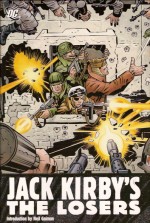
Jack Kirby’s The Losers


By Jack Kirby with D. Bruce Berry and Mike Royer (DC Comics)
ISBN: 978-184856-194-6

¡Perfect Christmas Present Alert! – for boys of all ages

There’s a glorious profusion of Jack Kirby material around these days and this astounding collection of his too-brief run on the DC war comic Our Fighting Forces is for far too many an unknown delight. Famed for his larger than life characters and gigantic, cosmic imaginings, the King was a decent, spiritual man from another generation, and one who had experienced human horror and bravery as an ordinary grunt during World War II. Whether in the world-weary verité of his 1950s collaborations with Joe Simon or the flamboyant bravado of his Marvel creation Sgt. Fury, his combat comics looked real: grimy, tired, battered yet indomitable.

In 1974, with his newest creations inexplicably not setting any sales records at DC, and as he tentatively considered a return to Marvel, he took over the creative chores on an established but always floundering series that had run in Our Fighting Forces since 1970.

The Losers were an elite unit of American soldiers formed by amalgamating three old war series together. Gunner and Sarge (later supplemented by the Fighting Devil Dog “Pooch”) were Pacific-based Marines; debuting in All-American Men of War #67, (March1959) and running for fifty issues in Our Fighting Forces (#45-94, May1959-August 1965), whilst Captain Johnny Cloud – Navaho Ace and native American fighter pilot – shot down his first bogie in All-American Men of War #82. He flew solo until issue #115, (1966), and the final component of the Land/Air/Sea team was filled by Captain Storm, a disabled PT Boat commander (he had a wooden leg) who had his own 18 issue title from 1964 to 1967. All three series were created by comics warlord Robert Kanigher.

The characters had all pretty much passed their sell-by dates when they teamed-up as guest-stars in a Haunted Tank tale in 1969 (G.I. Combat #138 October), but these “Losers” found a new resonance together in the relevant, disillusioned, cynical Vietnam years and their somewhat nihilistic, doom-laden group anti-hero adventures took the lead spot in Our Fighting Forces #123 (January/February 1970), written by Kanigher and illustrated by such giants as Ken Barr, Russ Heath, Sam Glanzman, John Severin and Joe Kubert.

With the tag-line “even when they win , they lose” the team saw action all over the globe, winning critical acclaim and a far-too-small, passionate following until #151 (November 1974) when Kirby was given complete control of the series. His radically different approach was highly controversial at the time but the passage of years has allowed a fairer appraisal and whilst never really in tune with the aesthetic of DC’s other war titles the King’s run was a spectacular and singularly intriguing examination of the human condition under the worst of all possible situations.

In ‘Kill Me with Wagner’ the Losers infiltrate a French village to rescue a concert pianist before the Nazis can capture her, but the hapless propaganda pawn has a tremendous advantage, as nobody knows what she looks like. As with most of this series a feeling of inevitable, onrushing Gotterdammerung permeates this tale: a sense that worlds are ending and new one’s a-coming. The action culminates in a catastrophic wave of destruction that is pure Kirby magic.

Most of DC’s war titles sported Kubert covers, but #152 featured the first in a startling sequence of hypnotic Kirby illustrations, almost abstract in delivery, to introduce the team to the no-hope proposition of ‘A Small Place in Hell!’ as they found themselves the advance guard for an Allied push, but dropped in the wrong town: one that has not been cleared… The spectacular action is augmented by a delightful two page Kirby fact feature: Sub-machine guns of WWII, and it should be noted that this collection is also peppered with un-inked Kirby pencilled pages and roughs.

Our Fighting Forces #153 is one of those stories that made the traditionalists squeak. Behind another Kirby cover, the story of ‘Devastator vs. Big Max’ veered dangerously close to science fiction, but the admittedly eccentric plan to destroy a giant German rail-mounted super-cannon wasn’t any stranger than many schemes the Boffins dreamed up to disinform the enemy during the actual conflict…

That tale, with two beautiful info-pages on military uniforms and insignia, is followed by a superb parable about personal honour. Behind another bombastic Kirby cover the team deployed to the Pacific to remove a Japanese officer who’s devotion to ‘Bushido’ had inspired superhuman resistance from his men. The means used to remove him were far from clean or creditable…

Preceded by two pages on war vehicles and a wonderful pencil cover-rough, ‘The Partisans!’ (OFF #155) took the Losers into very dark territory indeed (with two pages on artillery pieces and the pencils for the cover to that issue, before the team returned to America for ‘Good-bye Broadway… Hello Death!’ wherein the team experienced the home-front joys of New York whilst hunting for a notorious U-Boat commander who escaped the sinking of his submarine. Naturally there’s more to the story than first appears… This fast-paced thriller is complemented by a history of battle headgear and another penciled rough.

Issues #157 and 158 comprised a two-part saga about theft, black marketeering and espionage featuring the truly unique personage ‘Panama Fattie!’, whose criminal activities almost altered the course of the war; a tale concluded in the highly-charged ‘Bombing Out on the Panama Canal’ with accompanying pages on ships, subs and Nazi super-planes. Behind the last Kirby cover ‘Mile-a-Minute Jones!’ in #159, is a smaller-scaled duel between a black runner who embarrassed the Nazis at the 1936 Olympics and the Nazi ubermensch he defeated, which reignites on the battlefield with the Losers relegated to subordinate roles.

Kubert and Ernie Chan handled the three remaining covers of Kirby’s run, an indication that his attentions were diverted elsewhere, but the stories remained powerful and deeply personal explorations of combat. In ‘Ivan’ (OFF #160) the Losers go undercover as German soldiers on the Eastern Front and have an unpleasant encounter with Russian Nazi sympathizers whose appetite for atrocity surpasses anything they have ever seen before (supplemented by a two page tanks feature) whilst the hellish jungles of the Burma campaign prove an unholy backdrop for the traumatic combat shocker ‘The Major’s Dream.’

The volume and Kirby’s war work ends with a sly tribute to his 1942 co-creation the Boy Commandos (for more of which get yourself a copy of The Best of Simon and Kirby. ‘Gung-Ho!’ sees young Gunner training a band of war orphans in Marine tactics only to find fun turn to dire necessity when the Germans overrun their “safe” position. This is an optimistic, all-out action romp that ends on a note of hope and anticipation as the King made his departure. With issue #163 Kanigher resumed the story reins, with artists like Jack Lehti, Ric Estrada and George Evans illustrating, and the Losers returned to their pre-Kirby style and status, with readers hardly acknowledging the detour into another kind of war.

Jack Kirby is unique and uncompromising. If you’re not a fan or simply not prepared to see for yourself what all the fuss has been about then no words of mine will change your mind. That doesn’t alter the fact that Kirby’s work since 1939 shaped the entire American comics scene, affected the lives of billions of readers and thousands of creators in all areas of artistic endeavour around the world for generations and which is still, more than 15 years after his death, garnering new fans and apostles from the young and naive to the most cerebral of intellectuals. Jack’s work is instantly accessible, irresistibly visceral, deceptively deep whilst being simultaneously mythic and human.

These tales of purely mortal heroism are in many ways the most revealing, honest and insightful of Jack’s incredibly vast accumulated works, and even the true devotee often forgets their very existence. As Neil Gaiman’s introduction succinctly declaims, “they are classic Kirby… and even if you don’t like war comics, you may be in for a surprise…”

You really don’t want to miss that, do you?

© 2009 DC Comics. All Rights Reserved.
Captain America – Operation: Rebirth


By Mark Waid, Ron Garney & various (Marvel)
ISBN: 0-7851-0219-1             ISBN13: 978-0-7851-3126-7

The Sentinel of Liberty has been with us in one incarnation or another since the comic-book’s earliest light, a genuine icon of the wider public, but despite the noblest endeavours of many very talented creators has more often than not been a rather unsuccessful series for Marvel, and regularly one of the company’s poorest sellers.

In 1995 after a truly heroic and generally under-appreciated run, scripter Mark Gruenwald surrendered his post, going out on a high note by actually killing Captain America, as the super-serum that made him the world’s most perfect physical specimen degraded in his bloodstream, causing a total bodily collapse. This cleared the decks for a spectacular relaunch from Mark Waid and Ron Garney, (assisted by inkers Scott Koblish, Mike Manley and Denis Rodier) in issues #445-448.

Snatched from the jaws of death by his greatest enemy and his murdered true love, the Star-Spangled Avenger exploded back into action against the foes he was literally created to defeat when a Nazi cult attempted to resurrect Adolf Hitler and reconfigure the entire world using the reality bending Cosmic Cube.

With only the self-serving Red Skull and embittered, abandoned Sharon Carter beside him the hero was reborn in a dynamic thriller that instantly recaptured the vast energy of the character and perfectly displayed the mythic magical quality of Captain America, triggering a mini-renaissance that was thrown away when Marvel sublet him to the unreliable and inexplicably popular Rob Liefeld a year later.

Fast, pretty and utterly compelling Operation: Rebirth is a perfect superhero adventure and possibly the Last Hurrah of Silver Age Marvel’s most enthralling hero.
© 1995, 1996, 2008 Marvel Characters, Inc.  All Rights Reserved.

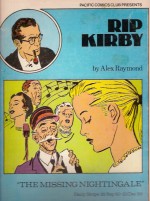
Rip Kirby: The Missing Nightingale Daily Strips 25 September – 23 December -1950


By Alex Raymond (Pacific Comics Club)
No ISBN

Alex Raymond made Flash Gordon, Jungle Jim and Secret Agent X-9 global icons (and himself terribly wealthy) but when America joined the War so did he. On returning to civilian life, rather than return to safe pastures he yearned for new conquests.

With King Features Editor Ward Greene he created a different kind of private detective: a demobbed marine; intellectual, easy-going, artistically inclined but physically capable who preferred to exercise his mind rather than fists and guns.

His girlfriend “Honey” Dorian and manservant Desmond (a reformed burglar) completed his supporting cast and Remington “Rip” Kirby debuted on March 4th 1946, to huge approval and success. Greene wrote the scripts until his departure in 1952 when journalist Fred Dickenson assumed the scripting role. Raymond drew it until September 6th 1956, when, aged 46, he died in a car crash. John Prentice assumed the art duties until 1986 when with Dickenson left due to ill-health, from which time Prentice wrote the strip too. Rip Kirby finally retired on June 26th 1999 when Prentice did.

Beautiful art and brilliant strips are simply irresistible. After recently reviewing a couple of giant-sized Rip Kirby collections (re-read in advance of an upcoming compilation project promising to reproduce the entire saga) I simply couldn’t stop before reviewing the best of the bunch…

This complete softcover adventure follows immediately upon ‘Gunpowder Dreams’ and ‘Buried Treasure’: all of which were originally released in 1980 and still occasionally turn up in shops and on the internet. They are all huge 340x245mm softcover tabloids (that’s nearly 15 inches by 10) with shiny white pages presenting thrilling and enchanting sagas of one of America’s most famous fictional detectives, drawn by one of the most influential artists of all time.

This masterful blend of 1950s style and fashion highlights a society in the midst of affluent change as Rip is hired to find a missing singer who has captivated the new record buying public but disappeared before she could cut her first record album. However what starts as a simple trace job turns into a particularly nasty murder plot that simply can’t end well…

Here is another fabulously chic caper, stuffed full of tension and lots of tricky plot twists, with plenty of action, beautifully realised by an absolute master of brush and pen.

Your chances of tracking down this gem are admittedly rather meagre, but well worth the effort if you’re an art-lover, as Raymond’s drawing at this size is an unparalleled delight.  Whatever size you find Rip Kirby inhabiting these are strips every fan must see.
© 1950, 1980 King Features. All Rights Reserved. Book © 1980 Pacific C.C.

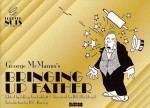
George McManus’s Bringing Up Father: Forever Nuts – Classic Screwball Strips


By George McManus, edited by Jeffrey Lindenblatt (NBM)
ISBN 13: 978-1-56163-556-6

¡Perfect Christmas Present Alert! – all ages

One of the best and most influential comic strips of all time gets a wonderfully lavish deluxe outing thanks to the perspicacious folk at NBM as part of their series collecting the earliest triumphs of sequential cartooning. Look out for Happy Hooligan and check out Forever Nuts: Mutt and Jeff to see the other strips that formed the basis and foundation of our entire industry and art-form.

George McManus was born on January 23rd of either 1882 or 1883 and drew from a very young age. His father, realising his talent, secured him work in the art department of the St. Louis Republic newspaper. He was thirteen, and swept floors, ran errands, drawing when ordered to. In an era before cheap and reliable photography, artists illustrated news stories; usually disasters, civic events and executions: McManus claimed that he had attended 120 hangings – a national record! The young man spent his off-hours producing cartoons and honing his mordant wit. His first sale was Elmer and Oliver. He hated it.

The jobbing cartoonist had a legendary stroke of luck in 1903. Acting on a Bootblack’s tip he placed a $100 bet on a 30-1 outsider and used his winnings to fund a trip to New York City. He splurged his winnings and on his last day got two job offers: one from the McClure Syndicate and a lesser bid from Joseph Pulitzer’s New York World.

He took the smaller offer, went to work for Pulitzer and created a host of features for the paper including Snoozer, The Merry Marceline, Ready Money Ladies, Cheerful Charlie, Panhandle Pete, Let George Do It, Nibsy the Newsboy in Funny Fairyland (one of the earliest Little Nemo knock-offs) and his first big hit (1904) The Newlyweds.

This last brought him to the attention of Pulitzer’s arch rival William Randolph Hearst, who, acting in tried and true manner, lured him away with big money in 1912. In Hearst’s papers the Newlyweds became the Sunday page feature Their Only Child, and was soon supplemented by Outside the Asylum, The Whole Blooming Family, Spare Ribs and Gravy and Bringing Up Father.

At first it alternated with other McManus domestic comedies in the same slot, but eventually the artist dropped Oh, It’s Great to be Married!, Oh, It’s Great to Have a Home and Ah Yes! Our Happy Home! as well as his second Sunday strip Love Affairs of a Muttonhead to concentrate on the story of Irish hod-carrier Jiggs whose vast newfound wealth brought him no joy, whilst his parvenu wife Maggie and inexplicably beautiful, cultured daughter Nora sought acceptance in “Polite” society.

The strip turned on the simplest of premises: whilst Maggie and daughter feted wealth and aristocracy, Jiggs, who only wanted to booze and schmooze and eat his beloved corned beef and cabbage, would somehow shoot down their plans – usually with severe personal consequences. Maggie might have risen in society but she never lost her devastating accuracy with crockery and household appliances.

Bringing Up Father debuted on January 12th 1913, originally appearing three times a week, then four and eventually every day. It made McManus two fortunes (the first he lost in the 1929 Stock Market crash), spawned a radio show, a movie in 1928, five more between 1946-1950 (as well as an original Finnish film in 1939) and 9 silent animated short features, plus all the assorted marketing paraphernalia that fetches such high prices in today’s antique markets. The artist died in 1954, and other creators continued the strip until May 28th 2000, its unbroken 87 years making it the second longest running newspaper strip of all time.

McManus said that he got the basic idea from The Rising Generation: a musical comedy he’d seen as a boy: but the premise of wealth not bringing happiness was only the foundation of the strip’s success. Jigg’s discomfort at his elevated position, his yearnings for the nostalgic days and simple joys of youth are something everyone is prey to, but the real magic at work here is the canny blend of slapstick, satire, sexual politics and fashion delivered by a man who can draw like an angel. The incredibly clean simple lines and the superb use – and implicit understanding – of art nouveau and art deco imagery and design make this series a stunning treat for the eye.

This magical black and white hardback collecting the first two years of Bringing Up Father covers the earliest inklings towards a perfect formula, and includes a fascinating insight into the American head-set as the family go on an extended (eight months) grand tour of the Continent in the months leading up to the Great War, and as 1914 closed, how ambivalent the New World still was to the “European War.”

An added surprise for a strip of this vintage is the great egalitarianism of it. Although there is the occasional visual stereotype to swallow and excuse, what we regard as racism is practically absent. The only thing to watch out for is the genteel sexism and class (un)consciousness, although McManus clearly pitched his tent on the side of the dirty, disenfranchised and downtrodden – as long as he could get a laugh out of it…

This is a wonderful, evocative celebration of the world’s greatest domestic comedy strip, skillfully annotated for those too young to remember those days and still uproariously funny. Buy it for grandma and swipe it while she’s sleeping off the sherry and nostalgia…

No © invoked.

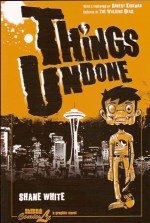
Things Undone


By Shane White (NBM/ComicsLit)
ISBN: 978-1-56163-563-4

The sheer variety of themes and species in modern cartooning can be quite breathtaking to an old coot who grew up with the severely restricted comics fare of a baby-boomer in Britain – and I wouldn’t have it any other way. These days I can peruse a graphic novel on any subject in any style and incorporating any number of converging genres – and this compelling lit gem comes pretty close to defying categorisation.

Things Undone is a little bit romance, a little bit alternative biography, a little bit punk and a whole lot of terrific. Young Rick Watts is an artist and world-weary peon in the art-consuming field of video games graphics. He’s just moved to Seattle for a new job, but nothing’s really changed and relationship-wise things aren’t going so great either. Long-distance never works so he dragged his girl-friend clear across the country, and his seven year hitch with her couldn’t have ended more badly…

When you can’t catch a break and the new life proves no better than the old one, what can a guy do? And it’s only a matter of time before somebody notices that Rick is a zombie, what with him leaving decaying extremities and eyeballs and such all over the place. Maybe he should just get a gun and do the job right…?

This sharp and bittersweet examination of modern life is funny and poignant, using the populist imagery of the walking dead as an effective metaphor for modern life, but it’s the amazingly comforting art and production (the book is printed in black, white and shocking orange, in a kind of skate-punk cartoon style) that underpins this tale, making the tragic comedic and using confusion as the means of exploring the mundane horrors of urban living.

Clever, witty and one of the most sensitive funny/sad, real/imaginary stories you’ll ever read: so you should.

© 2009 Studiowhite LLC.

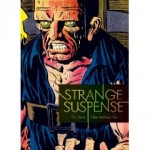
Strange Suspense: the Steve Ditko Archives vol.1


By Steve Ditko and various (Fantagraphics Books)
ISBN: 978-1-60669-289-0

¡Perfect Christmas Present Alert! – For the discerning comics fan

Steve Ditko is one of our industry’s greatest talents and probably America’s least lauded. His fervent desire to just get on with his job and to tell stories the best way he can, whilst the noblest of aspirations, will always be a minor consideration to commercial interests that for so long controlled comics production. So it’s a sublime joy to be able to look at his work from a more innocent time when he was just breaking into the industry, relentlessly honing his craft with genre tales for whichever publisher would have him, unrestricted by censors or intrusive editors.

This superb full colour hardback collection reprints his early works (all of them from the period 1953-1955) comprising stories produced before the draconian and self-inflicted Comics Code Authority sanitised the industry, and although most are wonderfully baroque and bizarre horror stories there are also examples of Romance, Westerns, Crime, Humour and of course his utterly unique Science Fiction tales, cunningly presented in the order he sold them and not the more logical but far less revealing chronological release dates. Sadly there’s no indication of how many (if any) were actually written by the moody master…

Ditko’s first strip sale was held for a few months and printed in Fantastic Fears #5 (published by Ajax/Farrell with a cover-date of January-February 1954); a creepy, pithy tale entitled ‘Stretching Things’, followed here by ‘Paper Romance’ an eye-catching if anodyne tale from Daring Love #1 (September 1953, Gilmor) and a couple of captivating chillers from Simon and Kirby’s Prize Comics hot horror hit Black Magic. ‘A Hole in his Head’ (#27, November-December 1953) combined psycho-drama and time travel whilst the more traditional ‘Buried Alive’ (#28 January-February 1954) was a self-explanatory gothic tale drama.

Stylish cowboy hero the Utah Kid stopped a ‘Range War’ in Blazing Western #1 (January 1954, Timor), and the artist’s long association with Charlton Comics began with the cover and vampire shocker ‘Cinderella’ from The Thing #12 (February 1954). The remainder of the work here was published by Charlton, a small company with few demands.

Their diffident attitude to work was ignore the creative staff as long as they deliver on time: a huge bonus for Ditko, still studiously perfecting his craft and never happy to play office politics. They gave him all the work he could handle and let him do it his way…

After the cover for This Magazine is Haunted #16, (March 1954) comes ‘Killer on the Loose’ a cop story from Crime and Justice #18 (April 1954), and the same month saw him produce the cover and three stories for The Thing #13, ‘Library of Horror’, ‘Die Laughing’ and ‘Avery and the Goblins’. From Space Adventures #10 (Spring 1954) comes the cover and the witty cautionary tale ‘Homecoming’, followed by three tales and a cover from the succeeding issue: ‘You are the Jury’, ‘Moment of Decision’ and the superbly manic ‘Dead Reckoning’.

This Magazine is Haunted #17, (May 1954), again featured a Ditko cover and three spooky tales ‘3-D Disaster, Doom, Death’, ‘Triple Header’ and the intriguingly experimental ‘The Night People.’ That same month he drew the cover and both ‘What was in Sam Dora’s Box?’ and ‘Dead Right’ for mystery title Strange Suspense Stories #18.

He got another shot at gangsters in the licensed title Racket Squad in Action (#11, May-June 1954) producing the cover and stylish caper thriller ‘Botticelli of the Bangtails’ and honed his scaring skills with the cover and four yarns for The Thing #14 (June 1954): ‘Rumpelstiltskin’, ‘The Evil Eye’, the utterly macabre ‘Doom in the Air’ and grisly shocker ‘Inheritance!’

He produced another incredible cover and five stories for the next issue, and as always was clearly still searching for the ultimate in storytelling perfection. ‘The Worm Turns’, ‘Day of Reckoning’, ‘Come Back’, ‘If Looks could Kill’ and ‘Family Mix-up’ range from giant monster yarns to period ghost stories to modern murder black comedies , but throughout, although all clearly by the same artist, no two tales are rendered the same way. Here was a true creator pushing himself to the limit.

He drew the cover and ‘Bridegroom, Come Back’ for This Magazine is Haunted #18, (July 1954), ‘A Nice Quiet Place’ and the cover of Strange Suspense Stories #19, plus the incredible covers of Space Adventures #12 and Racket Squad in Action #11 as well as the cover and two full stories in Strange Suspense Stories #20 (August 1954), ‘The Payoff’ and ‘Von Mohl Vs. The Ants’, but it was clear that his astonishing virtuosity was almost wasted on interior storytelling.

His incredible cover art was compelling and powerful and even the normally laissez-faire Charlton management must have exerted some pressure to keep him producing eye catching visuals that would sell their weakest titles. Presented next are the mind-boggling covers for This Magazine is Haunted #19 (August 1954), Strange Suspense Stories #22 and The Thing #17 (both November 1954) and This Magazine is Haunted #21, (December1954).

The Comics Code Authority began judging comics material from October 26th 1954, by which time Ditko’s output had practically halted. He had contracted tuberculosis and was forced to return to his family in Johnstown, Pennsylvania, until the middle of 1955. From that return to work come the final Ditko Delights in this volume: the cover and a story which originally appeared in Charlton’s Mad Magazine knockoff From Here to Insanity (#10, June 1955). A trifle wordy by modern standards ‘Car Show’ nevertheless displays the sharp, cynical wit and contained comedic energy that made so many Spider-Man/Jonah Jameson confrontations an unforgettable treat a decade later…

This is a cracking collection in its own right but as an examination of one of the art-form’s greatest stylists it is also an invaluable insight into the very nature of comics. This is a book true fans would happily kill or die for…

This edition © 2009 Fantagraphics Books. All Rights Reserved

Like a Dog


By Zak Sally (Fantagraphics Books)
ISBN: 978-1-60699-165-7

Some people do it for money or fame and money. It doesn’t matter what form of creative endeavour “it” is. Whatever art-form you’re thinking of there are those who are rewarded for their creative efforts (fairly or otherwise is another can of worms and I’m not going there) as they either work within or expand the boundaries of their medium, and there are the other sort. Sometimes the other sort gets really lucky and finds fame and fortune along the way.

Why am being so obtuse?

Because unless you are one of those other types that will produce paintings or music or poetry or whatever shapes your life even after every other carbon-based life-form on the planet is dead – or worse yet, just ignores or humours you – then you have no idea of how powerful the compulsion to create can be.

Zak Sally has travelled far (usually as member of the band Low) and dabbled in photography and all forms of print media, but what he is at his core is a cartoonist. He sees the world in terms of incidents, epigrams and bon mots produced as sequential images. He has been producing stories, mini-comics, gags, nonfiction and biographical tales and even historical and political drama for over fifteen years in his self-published ‘zine Recidivist, and other peoples productions such as Mome, Dirty Stories, The Drama, Comic Art Magazine and other places discerning enough to print them.

Even if they hadn’t he would still have drawn them, and now they been collected in a magnificent hardback collection from Fantagraphics which gathers the first two issues of Recidivist in their entirety, plus another thirteen unique and compelling tales in a variety of styles and media, all copiously and tellingly annotated.

Personal favourites – and there are many – include the bleakly informative ‘Dresden’ (because haven’t we all wanted to be rock stars?), the graphically bold ‘Dread’ and ‘The War Back Home’ but unfettered by commercial pressures the author has been able to turn his attentions to whatever caught his eye and the book is a broad anthology of material ranging from horror to comedy to surreal dreamy pure imagery, all underpinned by a keen wit, a canny eye for design and a great ear for dialogue.

Without doubt the best pieces are the utterly superb ‘At the Scaffold’ (an account of Fyodor Dostoyevsky’s imprisonment by the Tsar and ‘The Man who Killed Wally Wood’ an “it-happened-to-me” recollection that will captivate any fanboy with an ear for scandal and rumour…

This is a gloriously rough-hewn and hands-on collection from a compulsive cartoonist and storyteller packaged with the flair and imagination that has become a trademark of the world’s leading publisher of fascinating comics. This book won’t appeal to everybody, (especially devotees of the superhero mainstream) but Sally’s dedication to innovation, exploration and imagination will astound and entrance anyone who knows capital A Art when they see it.

© 2009 Zak Sally except where otherwise noted. All rights reserved.

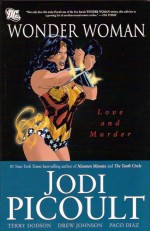
Wonder Woman: Love and Murder


By Jodi Picoult, Terry Dodson & various (DC Comics)
No ISBN: 978-1-84576-640-5

When Wonder Woman was (re)relaunched after Infinite Crisis and 52 with Terry and Rachel Dodson illustrating the scripts of TV big gun Allan Heinberg (Grey’s Anatomy, The O.C. and Sex and the City among others) there was much well-deserved attention, but the comic was plagued by missed deadlines and most of the series’ momentum was lost. Eventually the tale was abandoned unfinished and a new writer was parachuted in. (The creators regrouped and the initial story-arc was concluded in Wonder Woman Annual volume 2, #1, and collected as Who is Wonder Woman?)

That writer was Jodi Picoult, a best-selling author with a reputation for strong characterisation and a tendency to explore “hot-button” issues. This collection (reprinting issues #6-10 of the Amazing Amazon’s latest periodical incarnation) sees Picoult pick up the threads of WW’s latest secret identity and hit the ground running.

Field agent Diana Prince is an operative of the Federal Department of Metahuman Affairs, tasked with keeping an eye on all those pesky superhumans that abound in the DC universe. Her partner is the dashing but annoying Tom Tresser, an extraordinary agent and master of disguise known as Nemesis.

Something is far from right at DoMA. Whilst Prince and Nemesis are babysitting a new government sponsored superhero nefarious doings are occurring at the office of their boss Sarge Steel, all engineered by one of Wonder Woman’s most relentless enemies. These culminate in the resurrection of Diana’s dead mother…

When Wonder Woman is subjected to a dubious “rendition” by DoMA and made an illegal captive, the hidden mastermind initiates a plan to use the Amazons of Themyscira to rescue her and coincidentally destroy America. But there are plots within schemes and another hand is actually manipulating the manipulators…

This is a strikingly effective tale that peters out towards the end not because of the excellent scripts or the stunning art of Terry and Rachel Dodson, Drew Johnson, Ray Snyder and Rodney Ramos but because the story dovetails with the publishing event Amazons Attack! and intervening episodes and story advancements occur in a completely separate book.

If you can revel in delightfully arch “get-a-room” dialogue and quirky “Moonlighting” sexual tension rendered in spectacular, clever, glamorous ‘big visuals’ this is a very fetching read, and a canny interpretation of the genre’s greatest female character, but if you want it all to actually make sense then you’ll definitely need to supplement your purchase with the aforementioned Amazons Attack!, but not after as the last page of Love and Murder advises, but from somewhere between parts 3 and 5.

Just don’t ask me what order to read succeeding chapters in…

© 2007 DC Comics. All Rights Reserved.
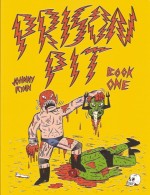
Prison Pit volume 1


By Johnny Ryan (Fantagraphics Books)
ISBN: 978-1-60699-297-5

Johnny Ryan is a cartoonist with an uncompromising vision and a clear intention of producing shock and even revulsion whenever he wants to. In this latest book, derived from his fascination with casual violence, social decay and the mythology of masked wrestling as well as his appreciation of the “berserk” manga strips of Kentaro Miura, he presents a brutally child-like view of a different sort of Hell.

The Prison Pit is an extra-dimensional purgatory where the most violent felons are dumped to live or die, plagued with monsters, vile organisms and the worst specimens of humanity society has ever produced. Into this hellhole is cast C.F. a masked wrestler who’s not prepared to back down for anybody or anything.

What follows is non-stop excessive force and graphic carnage: a never-ending battle delivered in the raw primitivist art of an impassioned engrossed child…

Savage, cathartic and blackly funny this is violent juvenilia pushed beyond all limits into the darkest depths of absurdist comedy. Not for children, the faint-hearted or weak-stomached, this is extreme cartooning at its most visceral and pure.

© 2009 Johnny Ryan. All rights reserved.

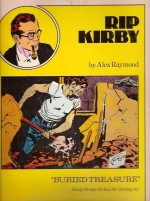
Rip Kirby: Buried Treasure Daily Strips 12 June -23 September 1950


By Alex Raymond (Pacific Comics Club)
No ISBN

Some strips are simply more addictive than narcotics or chocolate. After recently reviewing a giant-sized Rip Kirby collection (re-read after too many years in advance of an upcoming IDW compilation project promising to reproduce the entire saga) I simply couldn’t stop at just the one…

This complete softcover adventure follows immediately upon ‘Gunpowder Dreams’: released in 1980 and still occasionally available in shops and on the internet. You can’t miss it since the thing is a huge 340x245mm (that’s nearly 15 inches by 10) and its glossy white pages present another captivating tale of one of America’s most famous fictional detectives, drawn by one of the world’s most talented artists.

An intoxicating blend of 1950s style and fashion, this is another yarn that will suck you into a captivating world of adventure and resurgent post-war glamour, but this time with the added drama of a ruthless arch-enemy thrown into the mix, and all played against the backdrop of America’s post war fascination with the Italian glamour of La Dolce Vita…

During the 1930s Raymond made Flash Gordon, Jungle Jim and Secret Agent X-9 household names all over the world, but when the USA joined the War so did he. On returning to civilian life, like Milt Caniff and his iconic post-war adventurer Steve Canyon rather than rekindle old glories Raymond wanted something new.

From King Features Editor Ward Greene’s concept and scripts he designed a different kind of private detective: a rather unique individual: retired marine; intellectual, easy-going, musically and artistically inclined but physically powerful and who preferred to use his mind rather than fists and guns.

His steady girlfriend Judith “Honey” Dorian and mousy but competent manservant Desmond (a reformed burglar) completed a regular cast with plenty of depth and scope. Remington “Rip” Kirby debuted on March 4th 1946, to instant approbation and commercial success.

Greene wrote the scripts until 1952 when he was replaced by journalist Fred Dickenson and Raymond drew it until September 6th 1956, when, aged only 46, he died in a car crash. John Prentice assumed the art duties with Dickenson writing until 1986 when he left due to ill-health, from which time Prentice did that too. The feature closed shop on June 26th 1999 when Prentice retired.

Slick, polished and so very chic, old friend and flighty heiress Margie Pelham has found the man of her dreams in an Italian Count. Her lawyers are less ecstatic and want Rip to thoroughly investigate the uppity foreigner, so Honey Dorian is dispatched to accompany her old friend on the ocean cruise to Sorrento, but no one is aware of a lurking menace.

The Mangler was a brutal gangster brought low by Kirby, and he’d been craving revenge ever since. Now hooked up with a Nazi deserter he’s on his way to Sorrento too, in search of stolen treasure buried by the German in the very teeth of the allied invasion. The cash could set up the Mangler in a new life and the thought of settling with Kirby and his friends makes the brutal thug’s fingers itch and his mouth water…

This is another brilliantly stylish caper, packed full of tension, romance and lots of tricky plot twists, with oodles of action, beautifully executed by an absolute master of brush and pen. Just imagine Alfred Hitchcock in panels not movie screens…

Your chances of tracking down this gem are admittedly quite slim, but well worth the effort if you’re an art-lover, as Raymond’s drawing at this size is an unparalleled delight, but in fairness I should mention than the lettering here is appalling. I can only assume the art was shot from foreign printed copies (the rest of the world has always appreciated graphic arts more than us or the Americans) and lettered back into English by well-meaning but unprofessional hands.

Nevertheless these are still strips every fan should experience; even in the meagre dimensions modern strips are reprinted. Any Rip Kirby collections are a treat you simply cannot afford to miss. Let’s hope we’re not waiting too long…

© 1950, 1980 King Features. All Rights Reserved. Book © 1980 Pacific C.C.