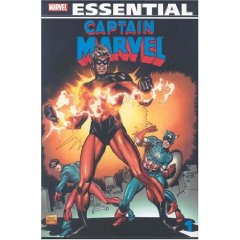
Essential Captain Marvel

Essential Captain Marvel

By various (Marvel)
ISBN: 978-0-7851-3059-8

By 1968 Marvel was in the ascendant. Their sales were catching up with industry leaders National (DC) Comics and Gold Key, and they had secured a new distribution deal that would allow them to expand their list of titles exponentially. Once the stars of “twin-books” Tales of Suspense, Tales to Astonish and Strange Tales each got their own title the House of Ideas just kept on creating.

One dead-cert idea was a hero named after the company – and one with some cachet and pedigree as well. After the DC/Fawcett court case of the 1940s-1950s, the name Captain Marvel disappeared from the newsstands. In 1967, during the superhero boom/camp craze generated by the Batman TV series publisher MLF secured rights to the name and produced a number of giant-sized comics featuring an intelligent robot who (which?) could divide his body into segments and shoot lasers from his eyes. Quirky and charming, devised by the legendary Carl (Human Torch) Burgos, it nevertheless did not attract a large following. On its demise the name was quickly snapped up by the expanding Marvel Comics Group.

Marvel Super-Heroes was a brand new title: it had been the giant-sized reprint comicbook Fantasy Masterpieces, comprising monster and mystery tales and latterly, Golden Age Timely Comics classics, but with the twelfth issue it added an all-new try-out section for characters without homes such as Medusa, Ka-Zar, Black Knight and Doctor Doom, and new concepts like Guardians of the Galaxy, Phantom Eagle, and, to start the ball rolling, an troubled alien spy sent to Earth from the Kree Galaxy. He held a Captain’s rank and his name was Mar-Vell.

The first 15 page instalment was by Stan Lee, Gene Colan and Frank Giacoia. ‘The Coming of Captain Marvel’ devolved directly from Fantastic Four #64 and #65 wherein the team defeated a super advanced Sentry robot from a mythical alien race only to be attacked by a high official of those long-lost extraterrestrials in the very next issue!

After defeating Ronan the Accuser the FF heard no more from the far from extinct Kree, but the millennia-old empire was once again interested in Earth. Dispatching a surveillance mission the Kree wanted to know everything about us. Unfortunately the agent they chose was a man of conscience; whilst his commanding officer Colonel Yon-Rogg was a ruthless rival for the love of the ship’s medical officer Una.

No sooner had the good captain made a tentative planet-fall and battled the US army from the local missile base (often hinted at as being Cape Kennedy) than the first instalment was over. Stan and Gene had set the ball rolling but it was left to Roy Thomas to establish the basic ground-rules in the next issue.

Colan remained, this time with Paul Reinman inking.‘Where Stalks the Sentry!’ found the alien spy improving his weaponry when an attempt by Yon-Rogg to kill him destroys a light aircraft carrying scientist Walter Lawson to that US base. Assuming Lawson’s identity Mar-Vell infiltrates “The Cape” but arouses the suspicions of security Chief Carol Danvers. He is horrified that the Earthlings are storing the Sentry (defeated by the FF) on base, when Yon-Rogg, sensing an opportunity activates the deadly mechanoid. As it goes on a rampage only Mar-Vell stands in its path…

That’s a lot of material for twenty pages but Thomas and Colan were on a roll. Joined by Vince Colletta as inker the third chapter was not in Marvel Super-Heroes but in the premiere issue of the Captain’s own title. ‘Out of the Holocaust… A Hero!’ was an all-out action thriller, which still found space to establish twin sub-plots of “Lawson’s” credibility and Mar-Vell’s inner doubts. The faithful Kree soldier was losing faith in his own race and falling under the spell of the Earthlings…

The Captain’s first foray against a super-villain came with the next two issues as we find that the Kree and the shape-changing Skrulls are intergalactic rivals, and the latter want to know why there’s an enemy soldier stationed on Earth. Sending their own top agent in ‘From the Void of Space Comes the Super Skrull!’, the resultant battle almost levelled the entire state in the concluding ‘From the Ashes of Defeat!’, and in #4 he clashed with fellow anti-hero Sub-Mariner in ‘The Alien and the Amphibian!’ as his superiors make increasingly ruthless demands of their reluctant agent.

Captain Marvel #5 saw Arnold Drake and Don Heck assume the creative chores (with John Tartaglione on inks) in a cold-war monster-mash clash ‘The Mark of the Metazoid’, as a mutated Soviet dissident is forced by his militaristic masters to kidnap Walter Lawson (that’s narrative symmetry that is). Issue #6 found the Captain battling a marauding sun-creature ‘In the Path of Solam!’ and forced to prove his loyalty by unleashing a Kree bio-weapon on an Earth community in ‘Die, Town, Die!’, but all is not as it seems since Quasimodo, the Living Computer is also involved…

The romantic triangle sub-plot is rapidly wearing thin by this time, as is the increasingly obvious division of Mar-Vell’s loyalties, so a new examination of Dr Lawson, whose identity the Kree man purloined, begins with #8’s ‘And Fear Shall Follow!’. When Yon-Rogg is injured by rival space imperialists the Aakon, Mar-Vell’s heroism buys him a break from suspicion but he’s soon embroiled with a secret criminal gang and a robot assassin apparently built by the deceased scientist, and trouble escalates when the surviving Aakon stumble into the mess in ‘Between Hammer and Anvil!’

A turning point was reached with #10’s ‘Die Traitor!’ and #11’s ‘Rebirth!’ (drawn by new penciller Dick Ayers) as author Drake kills off, as nobly as possible, the insipid Medic Una, has Mar-Vell openly rebel against his entire race and be reborn under the tutelage of a cosmic entity known only as Zo!

Moribund for months this new beginning with the honourable soldier as vengeful vigilante was a real shot in the arm, but it was still quite clear that Captain Marvel the comic was struggling to find an audience. ‘The Moment of… the Man-Slayer!‘ by Drake, Ayers and the great Syd Shores has the newly super-powered hero hunting Yon-Rogg before battling a synthetic assassin at The Cape, in a taut a spy-thriller with The Black Widow in deadly guest-star mode.

‘Traitors or Heroes?’ continued the Man-Slayer storyline with Gary Friedrich, Frank Springer and Vince Colletta as creative team, as well as finally providing a confrontation between Yon-Rogg and Mar-Vell, whilst #14 ‘When a Galaxy Beckons…’ found the Captain battling an entranced Iron Man as part of an early experiment in multi-part cross-overs (Sub-Mariner #14 and Avengers #64 being the other parts of the triptych) before going all cosmic in #15 (magnificently illustrated by Tom Sutton and Dan Adkins in a boldly experimental manner).

‘That Zo Might Live… A Galaxy must Die!’ saw Mar-Vell return to his home world on a mission of total destruction that wraps up the first career of Captain Marvel in spectacular style. Issue #16’s ‘Behind the Mask of Zo!’ by Archie Goodwin, Don Heck and Syd Shores is the first great “everything you know is wrong” story in Marvel history and captivatingly makes sense of the previous 15 – and some – issues, supplies a grand resolution and provides a solid context for the total revamp of the character to come. That’s how good a writer Archie Goodwin was.

Captain Marvel #16 is a magical issue and I’m being deliberately vague in case you have yet to read it, but I will tell you the ending. In his new red and blue costume, Mar-Vell is flying back to Earth when he is suddenly sucked into the anti-matter hell of the Negative Zone…

It’s probably best to think of everything previously discussed as prelude, since Captain Marvel really begins with #17 as Roy Thomas, Gil Kane and Dan Adkins totally retooled the character. ‘And a Child Shall Lead You!’ saw the trapped Kree Warrior inextricably bonded to voice-of-a-generation and professional side-kick Rick Jones who just like Billy Batson (the boy who turned into the original Fawcett hero by shouting “Shazam!”) switched places with a mighty – adult – hero when danger loomed. As thrilling, and as revolutionary as the idea of a comic written from the viewpoint of teenager, was the phenomenally kinetic artwork of Gil Kane whose mesmeric staging of the perfect human form in motion rewrote the book on superhero illustration with this series.

Issue #18 finally ended the Yon-Rogg saga and started Carol Danvers on her own super-hero career as the Captain swore ‘Vengeance is Mine!’ (with a last minute pinch-hit penciling from John Buscema for the concluding nine pages, and the next issue moved firmly into the “Relevancy Era” (where realism and social issues replaced aliens and super-villains as comics fodder) when a crazed sociologist was revealed as ‘The Mad Master of the Murder Maze!’.

And that’s when the series was cancelled.

As happened so often during that tempestuous period, cutting edge, landmark, classic comic-books just didn’t sell. The Silver Surfer, Green Lantern/Green Arrow and a host of other series we consider masterpieces of the form were axed because they couldn’t find enough of the right audience, but Captain Mar-vell refused to die. Six months later issue #20 was released, and the quality was still improving with every page.

‘The Hunter and the Holocaust’ saw Rick attempt to free his trapped body-and-soul mate by consulting his old mentor Bruce Banner. But en route a tornado destroys a town and Mar-Vell first renders assistance and then fights off resource-looters known as the Rat Pack. With the next issue Cap and Rick’s mentor finally meet, in ‘Here Comes the Hulk!’ (yes, that Bruce Banner) but that’s just a garnish on this tale of student unrest and manipulative intolerance. The book was cancelled again after that… only to return some more!

Although those tales are saved for another time, this gloriously economical black and white tome still has a few goodies to offer. First of these is a spoof strip from Marvel’s own parody comic Not Brand Echh # 9. ‘Captain Marvin: Where Stomps the Scent-ry! or Out of the Holocaust… Hoo-Boy!!’ is by Thomas, Colan and Giacoia, and is funny or painful depending on your attitude, but also included are some penciled pages and sketches that are the answer to every wannabe artist’s dreams.

There are 16 full un-inked pages from Marvel Super-Heroes #13 by Colan, a Marie Severin cover rough for #10, Kane’s layout for #17, page 19 and three pin-ups by Kane and Adkins. Glorious!

This is not Marvel’s best character, and much of the material collected here is rather poor. However, the good stuff is some of the very best that the company has produced in its entire history. If you want to see how good superhero comics can be you’ll just have to take the rough with the smooth… and who knows? Maybe you’ll learn to lower your standard a bit and enjoy yourself despite it all…

I often do…

© 1967, 1968, 1969, 1970, 2008 Marvel Characters, Inc. All Rights Reserved.

Dark Edge vols 1-6

STARTER PACK

Dark Edge 1-6
Dark Edge 1-6

By Yu Aikawa (DrMaster Publications)
ISBN: ISBN: 978-1-59796-159-2

Here’s a lovely idea for these cash-strapped times and just in time to beat the Christmas rush. A few years ago Yu Aikawa began his series of blackly comic tales set in the most unique High School in Japan. Kuro Takagi is a troubled boy. His mother has just died; he does not know his father and he’s been transferred to a new school. The kids there seem as wayward and difficult as he feels.

Yotsuji Private High School is not normal or traditional. The teachers only seem concerned with one unbreakable rule: under no circumstance must any pupil be on school property after dark. Those who have broken this rule are never seen again.

Kuro quickly befriends a disparate bunch of students, and learns that his absentee father is the secret owner of the school. And then, inevitably, one night they get locked in and learn why those giant gates are locked at dusk.

The school is a realm of monsters. Zombies roam the corridors, all the teachers are vampires, demons, succubae or worse and dead students can be reanimated at the will of the Powers subtly warring within the walls of this hell-academy…

And thus begins a highly engaging teen-horror saga with lots of twists and turns to satisfy the post-Buffy generation of older readers, manga or otherwise.

And now the first half-dozen volumes are available in a hugely economical shrink-wrapped six-pack that is both an ideal way to jump on board the fright-train and also makes for a cool Yule tool for that upcoming thing in December.

© 1999-2006 Yu Aikawa. English translation © 1999-2006ComicsOne/ DrMaster Publications Inc. All Rights Reserved.

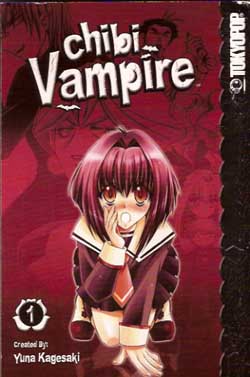
Chibi Vampire

Chibi Vampire
Chibi Vampire

By Yuna Kagesaki (TokyoPop)
ISBN: 1-59816-322-1

This supernatural teen comedy takes a few liberties with the traditional concept of vampires and some more genteel readers might have a few problems with the underlying metaphor in this tale of a family of immigrant Nosferatu whose middle daughter is a little different from most bloodsuckers.

Karin produces an excess of blood and about once a month is forced to expel it by biting someone. As well as injecting rather than draining her victims (which hyper-energises them) she is also able to move safely in daylight and sleep at night. Her peculiar life is disrupted when a new student Kenta Usui transfers to her High School – another thing most vampires can avoid.

Whenever he is near her condition manifests: She gets hot and dizzy, her blood pounds and the excess gushes out of her nose…

This gross-out horror comedy-romance has more charm than you’d expect from my description and as Karin discovers the meaning of her rare but not unique condition this nine volume tale really comes into its own. The comic strip, which originally appeared in Monthly Dragon Age between 2003 and 2006, spawned a series of Light Novels and an anime TV show.

Entitled simply Karin in Japan, the English version takes its name from the word “Chibi” which translates as “Short Person” or “Small Child”, but whatever you call it, you should also read it…

© 2003 Yuna Kagesaki. English text © 2006 Tokyopop Inc. All Rights Reserved.

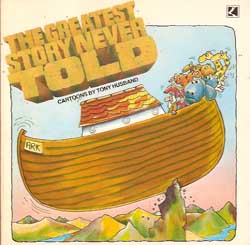
The Greatest Stories Never Told

The Greatest Stories Never Told

By Tony Husband (Corgi)
ISBN: 978-0- 552133-40-1

What is it about the Judaeo-Christian religion that positively invites us to laugh along with it? When I was a wee lad at the convent, there used to be a periodical pamphlet called the Crusade Messenger that the nuns would sell to us kids. There may have been uplifting fables and wholesome tracts in them, but all the children ever read were the copious jokes and gag pages. But I digress.

Accepting that – for the moment – there’s loads in the Bible that we can laugh at, who better than the prolific and award-winning cartoonist Tony Husband (of The Reduced… series of books and a jazillion other gag-tomes) to bring them to our attention in a smart, cheeky but never disrespectful and certainly not blasphemous manner, Hem Hem.

Ranging from dry and laconic to just plain silly these doodles will carry you back to Sunday School and happy hours spent whittling your name into somebody’s else desk and stifling the urge to say “yeah, but…” to that know-it-all in the cassock… It’s no sin to laugh so track down this nifty little chronicle for a spiritually uplifting moment or two.

© 1988 Tony Husband. All Rights Reserved.

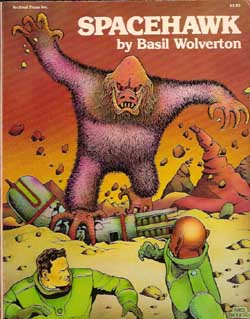
Spacehawk

Spacehawk
Spacehawk

By Basil Wolverton (Archival Press)
ISBN: 0-915822-26-1

Basil Wolverton was one of the most unique – not to say controversial – stylists ever to work in comics and indeed the field of illustration. Equally at home and renowned for horror and comedy subjects he was also one of the earliest and greatest exponents of science fiction comics. His greatest triumph is undoubtedly the pre-WWII adventures of a mysterious and solitary steely-jawed he-man known only as Spacehawk. The strip debuted in the June 1940 issue of Target Comics (volume 1 #5) and ran for thirty issues until Wolverton left the company for less hostile climes.

Spacehawk was a grim, relentless avenger of the innocent, prowling the star-lanes and outer reaches, and the stark meticulous art served only to highlight the singular appearance of the alien monstrosities and landscapes crafted by Wolverton. Many kids had nightmares after reading Spacehawk, and many parents wrote complaining letters because of it…

When the US entered the war in December the editors decided to bring the Lone Wolf of Space down to Earth to fight the Nazis and Japanese, diluting further the eerie power of the series. By the end of 1942 (Target Comics volume 3, #10) Wolverton and his interplanetary masterpiece were gone.

This wonderful collection from 1978 reprints 4 early Outer Space adventures, including the premiere outing ‘The Creeping Death from Neptune’, two earthbound war yarns and a delightful single page teaser of Saturnians and Neptunians in vibrant black and white, some of which owners of the 1990s Dark Horse reprint miniseries will recognise, but this is only the tip of a superb graphic iceberg.

Although some Spacehawk material is available as “bit-torrents” – with all that entails – what this classic character needs is a definitive book edition to captivate us citizens trapped here in a lacklustre future. Let’s hope it’s soon…

© 1940, 1941 Funnies Inc. © 1942 Novelty Inc. © 1978 Archival Press Inc. All Rights Reserved.

Showcase Presents: Teen Titans

Showcase Presents: The Teen Titans

By Bob Haney & various (DC Comics)
ISBN13: 978-1-84576-677-1

The concept of kid hero teams was not a new one when the 1960s Batman TV show finally prompted DC to trust their big heroes’ assorted sidekicks with their own regular comic in a fab, hip and groovy ensemble as dedicated to helping kids as they were to stamping out insidious evil.

The biggest difference between wartime groups as The Young Allies, Boy Commandos and Newsboy Legion or such 1950s holdovers as The Little Wise Guys or Boys Ranch and the creation of the Titans was quite simply the burgeoning phenomena of “The Teenager” as a discrete social and commercial force. These were kids who could be allowed to do things themselves without constant adult help or supervision.

As early as the June-July 1964 issue of The Brave and the Bold (#54), DC’s powers that be had tested the waters with a gripping tale by writer Bob Haney superbly illustrated by unsung genius Bruno Premiani. ‘The Thousand-and-One Dooms of Mr. Twister’ united Kid Flash, Aqualad and Robin the Boy Wonder in a desperate battle against a modern wizard-cum-Pied Piper who had stolen the teen-agers of Hatton Corners. The young heroes had met in the town by chance when students invited them to mediate in a long-running dispute with the town adults.

This element of a teen “court-of-appeal” was the motivating factor in many of the group’s cases. One year later the team reformed for a second adventure (The Brave and the Bold #60, by the same creative team) and introduced two new elements. ‘The Astounding Separated Man’ featured more misunderstood kids – this time in the coastal hamlet of Midville – threatened by an outlandish monster whose giant body parts could move independently. They added Wonder Girl (not actually a sidekick, or even a person, but rather an incarnation of Wonder Woman as a child – a fact the writers of the series seemed blissfully unaware of) and finally had a team name: ‘Teen Titans’.

Their final try-out appearance was in Showcase (issue #59, November-December 1965), birthplace of so many hit comic concepts, and was the first to be drawn by the brilliant Nick Cardy (who became synonymous with the 1960s series). ‘The Return of the Teen Titans’ pitted the team against teen pop trio ‘The Flips’ who were apparently also a gang of super-crooks, but as was so often the case the grown-ups had got it all wrong…

The next month their own comic debuted (#1 was dated January-February 1966 – released mere weeks before the Batman TV show aired on January 12th) with Robin the point of focus on the cover – and most succeeding ones. Haney and Cardy produced an exotic thriller entitled ‘The Beast-God of Xochatan!’ which saw the team act as Peace Corps representatives involved in a South American drama of sabotage, giant robots and magical monsters. The next issue held a fantastic mystery of revenge and young love involving ‘The Million-Year-Old Teen-Ager’.

‘The Revolt at Harrison High’ cashed in on the craze for drag-racing in a tale of bizarre criminality. Produced during a historically iconic era, many readers now can’t help but cringe when reminded of such daft foes as ‘Ding-Dong Daddy’ and his evil biker gang, and of course the hip, trendy dialogue (it wasn’t that accurate then, let alone now) is pitifully dated, but the plot is strong and the art magnificent.

‘The Secret Olympic Heroes’ guest-starred Green Arrow’s teen partner Speedy in a very human tale of parental pressure at the Olympics, although there’s also skulduggery aplenty from a terrorist organisation intent on disrupting the games. In #5’s ‘The Perilous Capers of the Terrible Teen’ the Titans faced the dual task of helping a troubled young man and capturing a super-villain called the Ant, despite all evidence indicating that they’re the same person, and another DC sidekick made his Titans debut in ‘The Fifth Titan’. Easily the weakest tale in the book, Beast Boy (from the iconic Doom Patrol) falls under the spell of an unscrupulous circus owner and the kids need to set things right. Painfully illustrated by Bill Molno and Sal Trapani, it’s the absolute low-point of a stylish run.

Quite a few fans would disagree, however, citing #7’s ‘The Mad Mod, Merchant of Menace’ as the biggest stinker, but beneath the painfully dated dialogue there’s a witty, tongue-in-cheek tale of swinging London and novel criminality, plus the return of the magnificent Nick Cardy to the art chores.

It was back to America for ‘A Killer called Honey Bun’ (illustrated by Irv Novick and Jack Abel) another tale of intolerance and misunderstood kids, played against a backdrop of espionage in Middle America, and #9’s ‘Big Beach Rumble’ found the Titans refereeing a vendetta between rival colleges when modern day pirates crash the scene. Novick pencilled it and Cardy’s inking made it all very palatable.

The editor obviously agreed as the art remained for the next few issues. ‘Scramble at Wildcat’ was crime caper featuring dirt-bikes and desert ghost-towns, whilst Speedy returned in #11’s spy-thriller ‘Monster Bait’. Twin hot-topics the Space-Race and Disc Jockey’s informed the whacky sci fi thriller ‘Large Trouble in Space-ville!’ and #13 was a veritable classic as Haney and Cardy produced a seasonal comics masterpiece with ‘The TT’s Swingin’ Christmas Carol!’, a styish retelling that’s one of the most reprinted Titans tales ever.

At this time Cardy’s art really opened up as he grasped the experimental flavour of the times. The cover of #14, as well as the interior illustration for the grim psycho-thriller ‘Requiem for a Titan’ are unforgettable. The tale introduced the team’s first serious returning villain (Mad Mod does not count!) the Gargoyle is mesmerising and memorable, and although he only inked Lee Elias’s pencils for #15’s eccentric tryst with the Hippie counter-culture, ‘Captain Rumble Blasts the Scene!’ is a genuinely unique crime-thriller from a time when nobody over age 25 understood what the youth of the world was doing…

Teen Titans #16 returned to more solid ground with the superb thriller ‘The Dimensional Caper!’ when aliens infiltrate a rural high-school (and how many times have you seen that plot used since this 1968 epic?). Cardy’s art reached dizzying heights of innovation both here and in the next issue’s waggish jaunt to London ‘Holy Thimbles, It’s the Mad Mod!’, a criminal chase through Cool Britannia which even included a command performance from Her Majesty, the Queen!

This volume ends with a fannish landmark as novice writers Len Wein and Marv Wolfman got a big break with a tale that introduced Russian superhero Starfire and set them firmly on a path of teen super-team writing. ‘Eye of the Beholder’ is a cool cat burglar yarn set in trendy Stockholm, drawn with superb understatement by Bill Draut, and acts a perfect indicator of the changes in style and attitude that would become part of the Teen Titans and the comics industry itself.

Although perhaps dated in delivery, these tales were a liberating experience for kids when first released. They truly betokened a new empathy with independent youth and tried to address problems that were more relevant to and generated by that specific audience. That they are so captivating in execution is a wonderful bonus. This is absolute escapism and absolutely delightful.

© 1964-1968, 2006 DC Comics. All Rights Reserved.

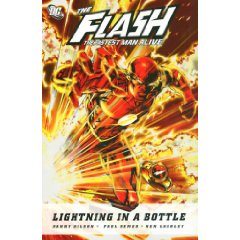
Flash — The Fastest Man Alive: Lightning in a Bottle

Lightning in a Bottle

By Danny Bilson, Paul DeMeo, Ken Lashley & various (DC Comics)
ISBN13: 978-1-4012-1229-2

In the slow build up to Final Crisis and by way of all those other “end-of-everything” multi-part mega-sagas, the grandson of the Silver Age Flash finally acceded to the mantle. Bart Allen had been introduced as the impetuous boy hero Impulse and had matured through a career as the second Kid Flash to finally become the third hero to wear the costume after the death of Barry Allen and the mysterious disappearance of Wally West. If you’re counting or caring he’s technically the fourth Flash since Jay Garrick was the first heroic speedster to use the name, albeit in a different outfit.

As this slim book (collecting issues #1-6 of the monthly comic-book) begins, Bart Allen is making a life for himself as an ordinary mortal. It’s One Year Later and the world has acclimatised to the aftermath of the Infinite Crisis. Jay Garrick is once again the hyper-speed guardian of the twin cities of Keystone and Central and Bart is a young blue-collar worker, stripped of his connection to the extra-dimensional Speed Force which enables super-fast metahumans to achieve Sub-Light velocities.

But when a disgruntled worker bombs the factory, that connection is explosively re-established. Unfortunately Bart’s best friend Griffin Gray is caught in the blast, and in tried and true comics tradition gets superpowers in the process. When Griffin decides to become a costumed crime-fighter, however, his tactics and motivations leave a lot be desired…

As troubled Bart reluctantly becomes a hero once more, he realises he will never be fast enough to outrun his responsibilities – or destiny. And in the wings a new love and old foe are both waiting for the perfect moment…

Slick and effective, this take on the Fastest Man Alive is very palatable, if a little insubstantial. Writers Bilson and DeMeo have a light touch, and the assembled artistic hordes of Ken Lashley, KWL Studio, Norm Rapmund, Marlo Alquiza, Jay Leisten, Walden Wong, Art Thibert, Karl Kerschl, Serge Lapointe, Sal Velluto, Ron Adrian, Alex Lei, Rob Lea and Andy Smith are surprisingly effective. As reboots go this version could have gone far… (and isn’t that a foreboding note to end on?)

© 2006, 2007 DC Comics. All Rights Reserved.

Chinese Hero: Tales of the Blood Sword, Vol 7

Tales of the Blood Sword 7

By Wing Shing Ma (DrMaster Publications)
ISBN13: 978-1-59796-131-8

The end is in sight for the spellbindingly action-packed, yet largely nonsensical, martial arts drama from Hong Kong. In this penultimate volume the plot, as ever, is largely incidental as Hero Hua continues to defend the mystical Blood Sword from a horde of vicious and exotic villains determined to use its powers for evil.

His lost son too faces threat after threat. Whether on sleazy city streets or jungle-lost temples The Black Dragon Gang persists in its wicked plans, and around the world Hero’s friends and surviving family endure a never-ending war for survival as magic and combat blend into a whirlwind of danger.

If you need a starting context, it all kicked off when a gangster tried to steal the Sword, which Hero’s family had guarded for centuries. That fight’s collateral damage included most of Hero’s family, launching a vendetta encompassing half the planet.

The villains are thoroughly evil, masters of every fighting art and dirty trick whom Hero and his incomprehensibly wide circle of friends and associates – coming and going with dazzling brevity – must fight unceasingly to preserve the sword and achieve their vengeance. By this volume nobody really cares: if you’re already buying this series it’s because of the astounding action and incredible art.

Hong Kong comics are beautiful. They’re produced using an intensive studio art-system that means any individual page might be composed of painted panels, line-art, crayons and coloured pencils: literally anything that will get the job done. And that presumably is to enhance not so much nuances of plot but rather details of the mysticism and philosophy of Kung Fu that my western sensibilities just aren’t attuned to.

They’re wonderful to look at, but don’t expect them to make much sense, because fundamentally this genre of comic is one glorious, spectacular exhibition of Kung Fu mastery. Like much of the region’s classic cinema, all other considerations are suborned to the task of getting the fighting started and to keeping it going.

If you’re looking for characterisation, sharp dialogue or closure, look elsewhere. If, however, you want Good Guys thumping Bad Guys in extended, eye-popping ways, give this a shot.

© 2008 Yasushi Suzuki. © 2008 DGN Production Inc.

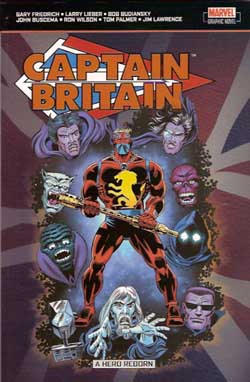
Captain Britain, Volume 2: A Hero Reborn

Captain Britain, Vol 2

By Friedrich, Lieber, Buscema, Wilson, Marcos & Kida (Marvel/Panini UK)
ISBN13: 978-1-905239-72-6

Marvel UK set up shop in 1972, reprinting the company’s earliest US successes in the traditional British weekly papers format, swiftly carving out a corner of the market – although the works of Lee, Kirby et al had already been appearing in other British comics (Smash!, Wham!, Pow!, Eagle, Fantastic!, Terrific!, and the anthologies of Alan Class Publications) since their inception, thanks to the aggressive marketing and licensing policies of and Stan and the gang.

In 1976 the company decided to augment their output with an original British hero – albeit in that parochial, US style and manner beloved by English comics readers – in a new weekly, although fan favourites Fantastic Four and Agent of S.H.I.E.L.D. reprints filled out the issues. One bold departure was the addition of full colour printing up front for the new hero, and the equivalent back quarter of each issue.

This second collection of those all-original adventures covers issue #24 through 39, the end of Captain Britain the comic, and includes the continuation of the strip when it was merged with a more successful comic to form Super Spider-Man & Captain Britain Weekly #231-238. Except for the covers the art had reverted to black and white midway through the previous volume.

Kicking off with the conclusion of the epic struggle against the Red Skull, Gary Friedrich and Larry Lieber have the benefit of artwork by comics legends John Buscema and Tom Palmer. The latter is replaced by a less well known but just as worthy inker, Fred (Airboy, The Heap) Kida, who stayed as the main brush-man for the majority of the strip’s run. The Skull, Nick Fury and Captain America hung around for the next four chapters before our boy flew solo again, but with #28 a new adventure started with the eccentric Lord Hawk whose weaponized robot raptor terrorised England until CB shut them both down. Kida alternated with Palmer on some truly brilliant Buscema super-hero art on this rather mediocre tale, but the quality lurched just a tad when Ron Wilson and Bob Budiansky assumed the pencilling chores.

With issue #33 Captain Britain’s powers got upgraded as his patrons Merlin and Roma tested him in another dimension, and on his return first Len Wein and then Jim Lawrence (best known in Britain as the scripter of the James Bond newspaper strip) took over the writing in a tale of the Queen’s Silver Jubilee with defrocked African dictators and a high-tech Highwayman. During this epic Pablo Marcos also joined the art team, alternating with the regulars on the punishing weekly production.

Midway through this story Captain Britain folded, and in tried and true tradition was merged with Super Spider-Man. Regrettably it did not improve the quality of the story-telling. Always a painful effort, it became increasingly clear that the US team had no real grasp of the British comics-reading experience (at this moment in time 2000AD was revolutionising our industry and the Beano was still the top-selling comic in the country).

Equally the creators seemed wedded to the idea that they needed to tailor their own – successful – Marvel style and formula to a separate, distinctly “English” audience. But if they were reading Marvel reprints didn’t it stand to reason that the buyers wanted established super-villains, and guest-stars?

Despite solid, professional art the last two adventures, ‘The Monster from the Murk!?’ (a Loch Ness and aliens yarn) and a gothic monster tale of vampires, werewolves and demons set in ‘Nightmare Castle’ make for an embarrassing end to this book.

Included in this primarily black and white volume are comments from Gary Friedrich, Ron Wilson and Bob Budiansky, a feature on the abortive Captain Britain project cancelled by Fleetway Publishing in 1973 and a nice selection of colour covers and reproduction ad pages.

Despite the reservations stated this book has a lot to commend it, especially to art fans with a tolerant or forgiving disposition, and in a world of angst and trauma, surely there’s still room for old-fashioned adventure?

© 1977, 2007 Marvel Characters, Inc. All Rights Reserved. (A UK EDITION FROM PANINI UK LTD)
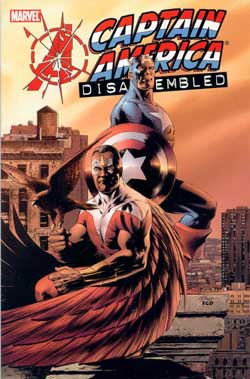
Captain America: Disassembled

Captain America: Disassembled

By Robert Kirkman & Scot Eaton and Priest & Joe Bennett (Marvel Comics)
ISBN: 0-7851-1648-6

A few years ago the “World’s Mightiest Heroes” were shut down and rebooted in a highly publicised event known as Avengers Disassembled. Of course it was only to replace them with both The New and The Young Avengers. Affiliated comic-books such as the Fantastic Four and Spectacular Spider-Man ran parallel but not necessarily interconnected story-arcs to accompany the Big Show.

The Star Spangled Avenger’s portions of that imbroglio are more or less collected in this volume, and originally ran in Captain America and the Falcon #5-7 and Captain America volume 3, #29-32, but be warned: if you’re a new or casual reader, that doesn’t include the beginning of the tale and the CA&TF portion is bewilderingly unclear. The book simply starts midway through an adventure.

Written by Priest and illustrated by Joe Bennett and Jack Jadson, the heroes are pursuing and protecting a young man who has been experimented on by the US Department of the Navy to create their own Captain America – kind of a Super-Sailor, if you will. All the while Nick Fury and the Daily Bugle are squabbling in the background, Cap is on the run and experiencing hallucinations of his dead sidekick Bucky and an overly-amorous Scarlet Witch driving a taxi!

Meanwhile over in Cap #29-32 (by Robert Kirkman, Scot Eaton and Drew Geraci) a series of nostalgic battles with Hydra, Mr. Hyde, Batroc the Leaper and the Serpent Society distract our hero as much as his returned paramour Diamondback, which is a shame as the red Skull and Modok are lurking with murder in mind. But are even they the real villains here?

Glossy and competent the book looks good and reads well, but the overall effect is truly marred by excluding the opening chapters from the collection. Would it have hurt so much to just have included it all?

© 2004 Marvel Characters, Inc. All Rights Reserved.