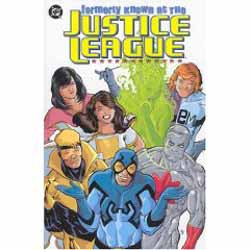
By Keith Giffen, J.M. DeMatteis, Kevin Maguire & Joe Rubinstein (DC Comics)
ISBN: 978-1-4012-0305-4
There’s a little micro-resurgence these days for the post-Crisis on Infinite Earths Justice League International incarnations (see our review in the archives section – ISBN: 978-1-84576-787-7) – so its no surprise that DC reassembled the creative team for one last hurrah (which typically turned into two) in 2003 with a surprisingly good mini-series that had the same tone and lots of those beloved old jokes.
Years after the JLI disbanded manipulative entrepreneur Maxwell Lord has a “Blues Brothers†moment and gets the band back together. He wants Blue Beetle, Booster Gold, Captain Atom, Ralph-Elongated Man-Dibny and his wife Sue, Fire, the Green Lantern dog G’nort and new addition Mary Marvel to become people’s heroes working out of a store-front deep in an inner city war-zone.
Obviously Max has an unscrupulous agenda and the menaces of Roulette’s superhero pit-fighting arena (serious), a bunch meta-powered gang-bangers (not so much) and Manga Khan (not at all) provide the action components but the real delight and raison d’être is the comedic interplay between the characters.
Giffen, DeMatteis, Maguire and Rubinstein are on top form in this fun and thrill stuffed reprise of lighter, brighter comic days that occurs just before the angsty traumas of Infinite Crisis and the interminable mega-epics that followed it. If you need a break from manic melodrama this is the one for you – and so is the sequel (I Can’t Believe It’s Not The Justice League ISBN: 978-1-4012-0478-5).
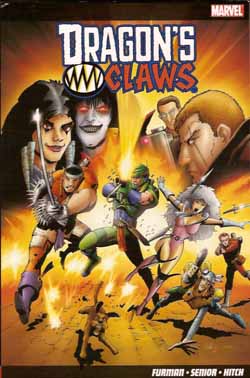
By Simon Furman, Geoff Senior, Bryan Hitch & David Hine (Marvel/Panini UK)
ISBN13: 978-1-905239-99-3
In the late 1980s Marvel UK, primarily a reprint arm for the American parent company, was starting to stretch itself. There had been some new material generated in comics such as Hulk Weekly, Dr Who Weekly/Monthly, and the licensed titles, but now the lads were ready to produce US style full comic books.
Yet rather than dive in with full-blown costumed cut-ups like the abortive Captain Britain, they wisely looked for a premise that would also resonate with established comics tastes. Thus was born The Dragon’s Teeth, which due to an unforgiving Rights clash became Dragon’s Claws.
The premise is simple: in the doomed and weary world of Earth AD8162, a dystopian society is gradually falling into chaos and anarchy, just as the planet itself is slowly falling into the sun. Lawlessness is rife and the populace is pacified by watching brutal gladiatorial combats known as The Game, devised by the World Development Council.
The greatest team to play the Game was Dragon’s Claws: Mercy, Digit, Scavenger and Steel, led by the ultimate warrior and tactician… Dragon. Now as anarchy increases the disillusioned sports star is asked to reform his team and become a more pure and traditional hero… a savior.
Collecting issues #1-10 of their own series, plus a crossover from Death’s Head #2 and featuring a rare single page adventure from a recent charity publication, plus copious data pages, these are raw and energetic tales of sci-fi action, uncomplicated and comfortingly satisfying, produced by Simon Furman, Geoff Senior, Bryan Hitch and David Hine during their fresh formative years, and provide rousing straightforward thrills and spills for 10 year olds of all ages.
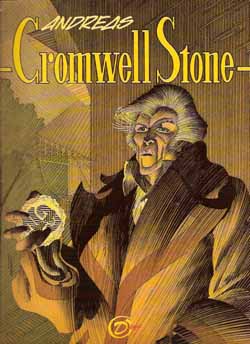
By Andreas (Michel Deligne Publishing Co)
ISBN: 2-87135-022-1
To me the perfect comic strip begins with the humble line. The greatest drawing is always the versatility of black against white. Colour enhances but it doesn’t create.
Andreas Martens is a versatile East German artist (from a time when that meant another country not different location) whose work has appeared in Le 9e Rêve, and Tintin for which last he produced Udolfo and Rork (from 1978).
In 1982 he crafted a chilling, moody pastiche of the fantasy works of August Derleth, William Hope Hodgson and H. P. Lovecraft that related the tale of a survivor of a mysterious maritime tragedy.
Years ago a mutiny aboard the ‘Leviticus’ led to thirteen survivors being abandoned in a lifeboat on the High Seas. Against all odds they reached land safely. Every year they hold a reunion, and every year there has been one less survivor at the table…
Now the last three are to meet again and Cromwell Stone feels that the mystery is coming to an end. He arrives in the small seaside town to prepare but is sucked into a swirling maelstrom of unease and anxiety…
And the horrors of an unimaginable world are waiting for him to misstep…
The art is a stark blend of early Berni Wrightson and classical woodcut prints in this suspenseful tale of the unknown. Compelling beyond belief this is a superb horror story from a criminally under-regarded creator. Hopefully some enterprising publisher will get the English language rights and bring this and all his other works to a greater public.
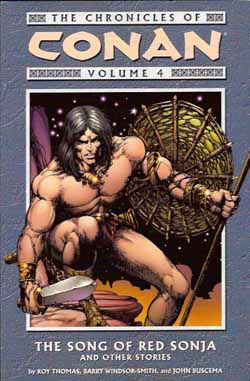
By Roy Thomas, Barry Windsor-Smith, John Buscema & various (Dark Horse Books)
ISBN13: 978-1-84023-891-4
With this collection in the series reprinting the Marvel Conan adventures, Barry (not yet Windsor-ed) Smith leaves the Barbarian and scripter Roy Thomas begins a long and fruitful partnership with John Buscema. In fact Buscema had been Thomas’s first choice for the job of drawing Conan, but deemed by then-publisher Martin Goodman too valuable to waste on a licensed property.
That’s just one of the fascinating insights afforded by Thomas’s highly entertaining and informative afterword, but what we’re all really wanting is another dose of savage, magic action and these tales, reprinting Conan the Barbarian #23-26 and the two-part Conan saga from Savage Tales #2-3 are some of the finest the genre can offer.
Adapted from Howard’s lost historical classic The Shadow of the Vulture, the War of the Tarim is a bold epic that embroiled our young wanderer in a Holy War between the city-state of Makkalet and the expansionist Empire of Turan, led by the ambitious Prince Yezdigerd, a bitter enemy of our sword-wielding hero.
‘The Shadow of the Vulture’ by Thomas, Smith, Sal Buscema, Dan Adkins and Chic Stone sets the scene and also introduces the trend-setting Red Sonja, a female mercenary who would take fantasy fans by storm, especially since the next chapter, ‘The Song of Red Sonja’ – drawn, inked and coloured by Smith – became one of the most popular and reprinted stories of the decade, winning the 1973 Academy of Comic Book Arts Awards in the Best Individual Story (Dramatic) category.
Issue #25 introduced Big John Buscema in ‘The Mirrors of Kharam Akkad’ (inked by brother Sal and the legendary John Severin) and incorporated a loose adaptation of Howard’s King Kull tale ‘The Mirrors of Tuzun Thune’ before the saga ended in spectacular and grimly ironic fashion in ‘The Hour of the Griffin!’ Inked by Ernie Chua (nee Chan) this tale swiftly quieted all the nay-sayers who claimed that the title would die without its original artist.
Although Smith had left the comic book – citing the punishing monthly schedules – he hadn’t quite finished with Conan. Back then allotted time on the Sparta, Illinois printing presses were the absolute arbiters of a comics existence. Product went to press when it was booked to, often leading to substitute stories or reprints – as Conan #22 had been – if the material wasn’t ready in time. These days books blow deadlines all the time…
When the adult-oriented Savage Tales magazine returned the artist agreed to illustrate ‘Red Nails’ if he could do it his way and at his own pace. The result was an utter revelation, moody, gory, full of dark passion and entrancing in its savage beauty. With some all-but invisible art assistance from Pablo Marcos this journey into the brutal depths of obsession and the decline of empires is the perfect example of how to bow out at the top of one’s creative game.
Although my own preference is for the black and white original, the enhanced and sensitive computer colouring of Richard Isanove, as well as Peter Dawes, Ian Sokoliwski, Dennis Nashton and Wil Glass does estimable credit to the art and modern readers should enjoy the work for its stirring power and leave grumps like me to mumble into our grog, where we’re best pleased.
Stirring, evocative, deeply satisfying, this is one of the best collections in a superb series of an immortal of adventure. What more does any red-blooded, action-starved fan need to know…
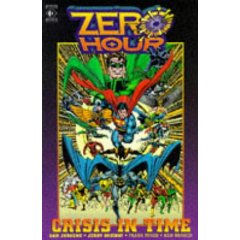
By Dan Jurgens, Jerry Ordway and various (DC Comics)
ISBN13: 978-1-5638-9184-7
Feeling a little like a rushed and rather desperate publishing stunt by DC in an attempt to rationalise some of the dafter choices made during a fairly tough time in the publishing market, this volume collects issues #4-0 (’cause it’s a countdown, right?) of the miniseries plus a two part prequel from Showcase ’94 #8-9. The saga was designed to re-retool the DC universe a decade after Crisis on Infinite Earths, but it’s just the tip of a veritable iceberg of crossovers, none of which can be seen here. At least the tale can be read with little loss of narrative flow (but then why bother with all those other storylines, at all?).
Monarch, the villain from Armageddon 2001, steals the power of the time-traveling energy-being Waverider and evolves into the devilish Extant, thus beginning a plan to unmake Time. As history catastrophically unravels from both ends, a small team of late 20th century champions struggles to save some semblance of reality. Prominently featured are the deaths of many favourite characters and by the time the shooting’s all done, most characters have a new and less contradictory history.
Jaded cynicism aside there’s plenty of fun to be had as the heroes fight bravely, and some genuinely moving choices to be made by the lead actors in the drama. Added menace is provided by the secret mastermind behind it all, (I’m not telling – buy the book) and a lot of very good comics did come about as a result of this conceptual spring-cleaning.
Not a classic, nor particularly relevant in the wake of the Infinite and/or Final Crises, this book still provides a solid hit of action, angst and sacrifice and the superb art by Jurgens and Jerry Ordway on the main book, and even the slightly more dated prequel segments by Frank Fosco and Ken Branch, make the end of the universe a treat for the eyes.
Not for the casual reader, perhaps but a worth a few precious moments of most fans’ time…
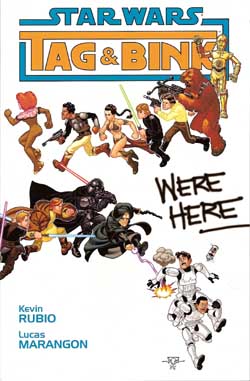
By Kevin Rubio, Lucas Marangon & Howard M. Shum (Dark Horse Books)
ISBN 1-84576-370-X
One of the greatest strengths of an all-encompassing franchise such as Star Wars is the ability to accept and of course profit from some occasional fun at its expense. This winning little tome plays with the movies’ magic and stills makes me laugh on the fourth re-reading but do be warned; you’ll need some passing familiarity with Star Wars IV-VI: A New Hope, The Empire Strikes Back, Return of the Jedi not to mention the lesser, newer films to fully appreciate the in-jokes and general jocularity.
In the original two issue miniseries ‘Tag and Bink are Dead’, the eponymous zeroes are two shiftless slacker crewmen (think Dude, Where’s My Car? or Clerks in Space) on Princess Leia’s cruiser at the beginning of A New Hope. When Darth Vader attacks they take the place of two Storm Troopers and get sucked into the events of the grand storyline in a classic comedy of errors.
Skillful researcher (for which read “watched the movies over and overâ€) Rubio manages to insert the hapless duo into key scenes from the films to such effect that it’s safe to assume that whenever you see two faceless guards, troopers or characters keeping still or marching in the background it’s Tag and Bink, and their hapless participation is what actually saved the galaxy, too!,
The miniseries was followed by ‘The Return of Tag and Bink Special Edition’, which embroiled them much more fully in the events of Return of the Jedi, as their hidden interference is instrumental in defeating Jabba the Hutt and costing Luke Skywalker his hand when they undertake a mission for the Rebel Alliance. They’re also there when the Emperor get his final comeuppance.
Irreverent, fast-paced and genuinely funny beyond the films’ broad-based slapstick, this is a book to read over and again, especially with the captivating artwork of Lucas Marangon and Howard M. Shum, reminiscent of the great Ernie Colon, which handles action and expression with equal aplomb. Only the saddest fanatic could fail to be amused by this terrific tome. Sing along now “♫We’re off on the Road to Dantooine… ♫â€
Despite this feeling in many ways like a cash-in-quick book this little package does offer a lot of value to the newcomer as a primer into the exotic rogue’s gallery that has be-devilled the web-slinger over the decades. Compiled in 1995, it shows not just the vast variety of the many talented artists who have worked on the character, but also some of the gifted writers who built on Stan and Steve’s masterpiece.
Open and closing the book are two tales by Messrs Lee and Ditko. Firstly the premiere performance of a criminal Special Effects genius who used subterfuge and psychology to wage war as ‘The Menace of… Mysterio!’ (from Amazing Spider-Man #13 1964), nicely book-ends our hero scoring one of his most decisive victories when he was ‘Unmasked by Dr Octopus!’ in issue #12.
Although I’m a little perturbed that it’s the concluding half of a two-parter, the story can be happily read on its own and the art is just so darned good! From Ditko and Mysterio we proceed to the psychopathic Spidey analogue Venom. Taken from issue #316 (1988) ‘Dead Meat’ by David Michelinie and Todd McFarlane is a spectacular action extravaganza, whilst Roger Stern, John Romita and Pablo Marcos’s ‘Let Fly these Aged Wings!’ (issue #224, 1982) is a tense and emotive thriller featuring the Vulture.
The Senior Romita and the desperately under appreciated Jim Mooney worked their magic on Lee’s ‘Mission: Crush the Kingpin!’ (Amazing Spider-Man #69 (1969), a bombastic battle that will leave you hungry for more – and not just because it’s the first part of an extended storyline that’s not included…
The Hobgoblin, usurper and heir of the fearsome Green Goblin (inexplicably not included in this collection) features in a tale of the black-costumed wall-crawler from Web of Spider-Man #38 (1988), by Fabian Nicieza, Alex Saviuk, Kieth Williams and Mike Esposito, which is followed by a pulse-pounding reprise from Lee, Romita Sr. and Mooney entitled ‘And then came Electro!’ originally published in Amazing Spider-Man #82 (1970).
The penultimate tale in this book is ‘The Mortal Past’ by Michelinie, Steven Butler and Bud LaRosa, another chaotic, blood-soaked outing for the mass-murdering shape-changing Carnage, which also delves into his traumatic childhood, taken from Amazing Spider-Man Annual #28 (1994).
This is one of those rare collections that will appeal more to a browser than a fan and thus, despite it’s rather choppy nature, one worth buying for a friend you’re trying to convert rather than a keeper for your own bookshelf.
By Danny Bilson, Paul DeMeo, Marc Guggenheim, Mark Waid & various (DC Comics)
ISBN13: 978-1-4012-1567-5
Collecting issues #7-13 of The Flash – Fastest Man Alive, and portions of All-Flash #1 and DCU Infinite Holiday Special, this volume concludes the super-hero career (at least for the moment) of Bart Allen, grandson of the Silver Age Scarlet Speedster. Carrying directly on from The Flash – the Fastest Man Alive: Lightning in a Bottle (ISBN13: 978-1-4012-1229-2).
The book starts with a heartwarming vignette from the Christmas special entitled ‘Father Christmas’, by Ian Boothby, Giuseppe Camuncoli and Lorenzo Ruggiero before returning to the scheduled hi-jinx from writers Danny Bilson, Paul DeMeo in the two-part ‘Speedquest’.
Bart is adapting to his role as super-hero in Los Angeles, and studying to be a cop/forensic scientist like his grandpa with a procession of old rogues and new villains complicating matters unaware that his evil clone Inertia (no, seriously) is assembling an army of enemies for an all-out attack.
The art is by an impressive assembly line including Ron Adrian, Alex Lei, Rob Lea and Art Thibert, who are joined by Andy Kuhn, Paco Diaz, Tony Daniel, Jonathan Glapion and Marlo Alquiza for the eponymous ‘Full Throttle’, written by Marc Guggenheim. I won’t be too specific about this tense and shocking five part mini-epic as the whole point of these reviews is to get people reading new stuff, but suffice to say that this preliminary to the return of Wally West and tie-in to Countdown to Final Crisis delivers all that it promised and if you’re a fan of super-hero stories you’ll want to see this one.
The book closes with a tale of the returned Mr. West from All-Flash #1 as he tracks down Inertia, written by Mark Waid and illustrated by Karl Kerschl, Ian Churchill, Norm Rapmund, Manuel Garcia, Joe Bennett, Ruy Jose and Daniel Acuña.
The figure of the Flash has ever been associated with triumph and tragedy and always with heroism. This is a good solid addition to a tradition that reaches back to the earliest days of comic-books, and may well come to be seen as a singular highpoint.
By Stan Lee & various (Marvel)
ISBN13: 978-0-7851-1861-9
As Marvel grew in popularity in the early 1960s it gradually replaced its broad variety of titles with more and more super-heroes. The recovering powerhouse was still hampered by a crippling distribution deal that limited the company to 16 titles (which would curtail their output until 1968), so each new untried book would have to fill the revenue generating slot (however small) of an existing title. Moreover as the costumed characters were selling, each new similar title would limit the breadth of genres (horror, western, war, girls’ comics, etc). It was putting a lot of eggs in one basket, and superheroes had failed twice before for Marvel.
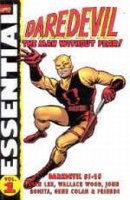
So the inconsistency of the first few issues of Daredevil, the Man Without Fear, seems a risky venture indeed. Yes, the artists were all seasoned, talented veterans, but not to the young kids who were the audience. Moreover they just weren’t Kirby or Ditko…
‘The Origin of Daredevil’ recounts how young Matt grew up in the slums, raised by his father Battlin’ Jack Murdock, a second-rate prize-fighter. Determined that the boy will be something, the father extracts a solemn promise from him never to fight. Mocked by other kids, called “Daredevilâ€, he abides by his vow, but secretly trains his body to physical perfection.
One day he saves a blind man from being hit by a speeding truck, only to be struck in the face by its radioactive cargo. His sight is burned away but his other senses are super-humanly enhanced and he gains a sixth, “radar-senseâ€. He tells no-one, not even his dad.
Battlin’ Jack is in dire straits. As his career declined he signed with The Fixer, knowing full well what the corrupt promoter expected from his fighters. Yet his career blossomed. Unaware that he was being set up, Murdock got a shot at the Big Time, but when ordered to take a dive he refused. Winning was the proudest moment of his life. When his bullet riddled corpse was found, the cops had suspicions but no proof…
Heartbroken Matt graduated college with a law degree and set up in business with his room-mate Franklin “Foggy†Nelson. They hired a lovely young secretary named Karen Page. With his life on track young Matt now had time to solve his father’s murder. His promise stopped him from fighting but what if he became “somebody elseâ€?
Scripted by Stan Lee and magically illustrated by the legendary Bill Everett (with assistance from Steve Ditko) this is a rather nonsensical yet visually engaging yarn that just goes through the motions, barely hinting at the magic yet to come, and the second issue fares little better as Joe Orlando and Vince Colletta take over the art: ‘The Evil Menace of Electro!’ guest-stars the Fantastic Four and a second hand Spider-Man villain. The heroic quartet call for a lawyer just as the electrical bandit tries to break into their building, with predictable results. Issue #3 finally gave the sightless crusader a foe of his own when he met and quickly trounced ‘The Owl, Ominous Overlord of Crime!’
Daredevil #4 was a turning point, and just in time. ‘Killgrave, the Unbelievable Purple Man!’ finally gave some character to the big, blind stiff as he strove to overcome a villain who could exert total control over anyone who could see him. Although Orlando and Colletta’s uncomfortable, over-busy art remained for one last episode Lee finally seemed to get a handle on the hero and just in time for a magician-in-waiting to elevate the series to spectacular heights.
With #5 Wally Wood assumed the art chores and his lush and lavish work brought power, grace and beauty to the series. At last this costumed acrobat seemed to spring and dance across the rooftops and pages. Wood’s contribution to the plotting didn’t hurt either. He actually got a cover plug on his first issue.
Number #5 ‘The Mysterious Masked Matador!’ introduced a cool, no-nonsense hero who looked commanding and could handle anything. The moribund sub-plot of Foggy adoring Karen, who only has eyes for Matt who loves her but won’t let her waste her life on a blind-man actually started making sense and progress. Most importantly, the action was intoxicating.
Although a bullfighter who used his skills for crime is frankly daft, the drawing makes it utterly convincing, and the following issue’s ‘Trapped by the Fellowship of Fear!’ is a minor classic as the Man Without Fear had to defeat not only the super-powered Ox and Eel (yet more recycled villains) but his own threat-specific foe Mr. Fear who could instill terror and panic in victims, courtesy of his deadly gas-gun.
Daredevil #7 is a true landmark. To my mind one of the Top Ten Marvel Tales of all Time, Lee and Wood concocted a true masterpiece with ‘In Mortal Combat with… Sub-Mariner!’ When Prince Namor of Atlantis travels to the surface world to sue mankind, he discovers too late that his warlord, Krang, has usurped the throne in his absence. The fiery monarch cannot sit languishing in a cell when the kingdom is threatened so he fights his way to freedom.
This story finally shows Murdock the lawyer to be a brilliant orator, the hopelessly one-sided battle with one of the strongest beings on the planet shows the dauntless courage of DD and nobility of the Sub-Mariner whilst most notably, with no fanfare at all, Wood replaced the original costume with the iconic and beautiful all-red outfit we know today. As one pithy commentator has said “the original costume looked as if it had been designed by a blind manâ€.
Another all-new villain debuted in #8’s gripping industrial espionage thriller ‘The Stiltman Cometh!’ and Golden Age Great Bob Powell came aboard as penciller to Wood’s layouts and inks with #9’s ‘That He May See!’ Relentlessly badgered by Karen, Matt agrees to see an eye-specialist who might be able to cure his blindness only to become embroiled in a plot to conquer the World.
Wood was clearly chafing after a year on the book. The series’ first continued story ‘While the City Sleeps!’ was also scripted by him, a political thriller that first saw Foggy Nelson run for District Attorney of New York. A mysterious mastermind known as the Organizer and his gang, Bird-Man, Frog-Man, Cat-Man and Ape-Man terrorised the city and only DD could possibly stop them. With Powell now on full pencils and Wood just inking, Lee was left to write the concluding ‘A Time to Unmask!’ and issue #12 saw the return of a 1950’s artist who was to eventually become Marvel’s top – and most loyal – star.
‘Sightless, in a Savage Land!’ was laid out by Jack Kirby and illustrated by John Romita, who had worked for Timely/Atlas in the 1950s before moving to DC romance comics and advertising. He returned to take DD on an epic quest guest-starring Tarzan-analogue Ka-Zar, that ranged from the dinosaur-haunted Savage Land via hi-tech pirates to Jolly olde England-land (#13’s ‘The Secret of Ka-Zar’s Origin!‘) to a US Early Warning Base (#14, ‘If This be Justice…’, with what I’m sure is some un-credited assistance from George Tuska).
With this three-part epic, DD began to establish the wisecracking Scarlet Swashbuckler persona that would carry him all the way to the grim ‘n’ gritty Frank Miller days, far, far in the future.
With the next issue ‘None are so Blind…’ a sub-plot began that would lead to some of the highest and lowest moments of the early Daredevil as Spider-Man accuses Foggy of being the Man Without Fear! Although the wall-Crawler soon realizes his mistake, others don’t…
Issue #18’s ‘There Shall Come a Gladiator!’ introduced the manic armoured villain in a tale two-thirds scripted by legend-in-waiting Denny O’Neil, where Foggy tries to impress Karen by maintaining the idea that he is Daredevil, and #19 saw the Masked Marauder ally with The Gladiator in the action-packed ‘Alone… Against the Underworld!‘; a fitting farewell for Romita who was moved over to Amazing Spider-Man after Steve Ditko’s controversial departure.
Originally tipped for a fill-in issue, Gene Colan came aboard as penciller with #20’s ‘The Verdict is: Death!’, inked by Mike Esposito thinly disguised as Mickey Demeo. Colan’s superbly humanistic drawing and facility with expressions was a little jarring at first since he drew Daredevil in a passable Romita imitation and everything else in his own manner, but he soon settled in and this two-part revenge thriller featuring the Owl (concluding with ‘The Trap is Sprung!’ inked by Giacoia, Dick Ayers and Bill Everett) is a fine beginning to his long, impressive run on the series.
‘The Tri-Man Lives’ by Lee, Colan Giacoia and Ayers carried on the Gangland theme but also returned focus to the Masked Marauder and Gladiator, whose eponymous android proved less of a threat than expected. Concluding in #23 with ‘DD Goes Wild!’ the ending found our hero trapped in Europe, but he’d soon made his way to England and a violent reunion with Ka-Zar who was the prime suspect in #24’s ‘The Mystery of the Midnight Stalker!‘ This tale contains my vote for the Most Obnoxious Misrepresentation of England in Comic-books Award when a policeman – sorry, “Bobby†– warns, “STAY BACK, PLEASE! THE MILITIA WILL BE ARRIVING IN JIG TIME!â€
The volume ends with the less than stellar ‘Enter: The Leap-Frog!’, a crook who dresses like a frog with springs on his flipper (yes, really) but the biggest event of the issue is the introduction of Matt’s hip and groovy twin brother Mike…
If you’ve not read these tales before I’m not about to spoil the read for you because even with all the archaic and just plain dumb bits in this book these are still fine super-hero tales with beautiful art that will never stale or wither, and the inclusion of designs, layouts and sketches from Jack Kirby, John Romita and Wally Wood are a bonus any fan would die for…
By 1968 Marvel was in the ascendant. Their sales were catching up with industry leaders National (DC) Comics and Gold Key, and they had secured a new distribution deal that would allow them to expand their list of titles exponentially. Once the stars of “twin-books†Tales of Suspense, Tales to Astonish and Strange Tales each got their own title the House of Ideas just kept on creating.
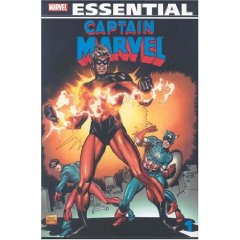
One dead-cert idea was a hero named after the company – and one with some cachet and pedigree as well. After the DC/Fawcett court case of the 1940s-1950s, the name Captain Marvel disappeared from the newsstands. In 1967, during the superhero boom/camp craze generated by the Batman TV series publisher MLF secured rights to the name and produced a number of giant-sized comics featuring an intelligent robot who (which?) could divide his body into segments and shoot lasers from his eyes. Quirky and charming, devised by the legendary Carl (Human Torch) Burgos, it nevertheless did not attract a large following. On its demise the name was quickly snapped up by the expanding Marvel Comics Group.
Marvel Super-Heroes was a brand new title: it had been the giant-sized reprint comicbook Fantasy Masterpieces, comprising monster and mystery tales and latterly, Golden Age Timely Comics classics, but with the twelfth issue it added an all-new try-out section for characters without homes such as Medusa, Ka-Zar, Black Knight and Doctor Doom, and new concepts like Guardians of the Galaxy, Phantom Eagle, and, to start the ball rolling, an troubled alien spy sent to Earth from the Kree Galaxy. He held a Captain’s rank and his name was Mar-Vell.
The first 15 page instalment was by Stan Lee, Gene Colan and Frank Giacoia. ‘The Coming of Captain Marvel’ devolved directly from Fantastic Four #64 and #65 wherein the team defeated a super advanced Sentry robot from a mythical alien race only to be attacked by a high official of those long-lost extraterrestrials in the very next issue!
After defeating Ronan the Accuser the FF heard no more from the far from extinct Kree, but the millennia-old empire was once again interested in Earth. Dispatching a surveillance mission the Kree wanted to know everything about us. Unfortunately the agent they chose was a man of conscience; whilst his commanding officer Colonel Yon-Rogg was a ruthless rival for the love of the ship’s medical officer Una.
No sooner had the good captain made a tentative planet-fall and battled the US army from the local missile base (often hinted at as being Cape Kennedy) than the first instalment was over. Stan and Gene had set the ball rolling but it was left to Roy Thomas to establish the basic ground-rules in the next issue.
Colan remained, this time with Paul Reinman inking.‘Where Stalks the Sentry!’ found the alien spy improving his weaponry when an attempt by Yon-Rogg to kill him destroys a light aircraft carrying scientist Walter Lawson to that US base. Assuming Lawson’s identity Mar-Vell infiltrates “The Cape†but arouses the suspicions of security Chief Carol Danvers. He is horrified that the Earthlings are storing the Sentry (defeated by the FF) on base, when Yon-Rogg, sensing an opportunity activates the deadly mechanoid. As it goes on a rampage only Mar-Vell stands in its path…
That’s a lot of material for twenty pages but Thomas and Colan were on a roll. Joined by Vince Colletta as inker the third chapter was not in Marvel Super-Heroes but in the premiere issue of the Captain’s own title. ‘Out of the Holocaust… A Hero!’ was an all-out action thriller, which still found space to establish twin sub-plots of “Lawson’s†credibility and Mar-Vell’s inner doubts. The faithful Kree soldier was losing faith in his own race and falling under the spell of the Earthlings…
The Captain’s first foray against a super-villain came with the next two issues as we find that the Kree and the shape-changing Skrulls are intergalactic rivals, and the latter want to know why there’s an enemy soldier stationed on Earth. Sending their own top agent in ‘From the Void of Space Comes the Super Skrull!’, the resultant battle almost levelled the entire state in the concluding ‘From the Ashes of Defeat!’, and in #4 he clashed with fellow anti-hero Sub-Mariner in ‘The Alien and the Amphibian!’ as his superiors make increasingly ruthless demands of their reluctant agent.
Captain Marvel #5 saw Arnold Drake and Don Heck assume the creative chores (with John Tartaglione on inks) in a cold-war monster-mash clash ‘The Mark of the Metazoid’, as a mutated Soviet dissident is forced by his militaristic masters to kidnap Walter Lawson (that’s narrative symmetry that is). Issue #6 found the Captain battling a marauding sun-creature ‘In the Path of Solam!’ and forced to prove his loyalty by unleashing a Kree bio-weapon on an Earth community in ‘Die, Town, Die!’, but all is not as it seems since Quasimodo, the Living Computer is also involved…
The romantic triangle sub-plot is rapidly wearing thin by this time, as is the increasingly obvious division of Mar-Vell’s loyalties, so a new examination of Dr Lawson, whose identity the Kree man purloined, begins with #8’s ‘And Fear Shall Follow!’. When Yon-Rogg is injured by rival space imperialists the Aakon, Mar-Vell’s heroism buys him a break from suspicion but he’s soon embroiled with a secret criminal gang and a robot assassin apparently built by the deceased scientist, and trouble escalates when the surviving Aakon stumble into the mess in ‘Between Hammer and Anvil!’
A turning point was reached with #10’s ‘Die Traitor!’ and #11’s ‘Rebirth!’ (drawn by new penciller Dick Ayers) as author Drake kills off, as nobly as possible, the insipid Medic Una, has Mar-Vell openly rebel against his entire race and be reborn under the tutelage of a cosmic entity known only as Zo!
Moribund for months this new beginning with the honourable soldier as vengeful vigilante was a real shot in the arm, but it was still quite clear that Captain Marvel the comic was struggling to find an audience. ‘The Moment of… the Man-Slayer!‘ by Drake, Ayers and the great Syd Shores has the newly super-powered hero hunting Yon-Rogg before battling a synthetic assassin at The Cape, in a taut a spy-thriller with The Black Widow in deadly guest-star mode.
‘Traitors or Heroes?’ continued the Man-Slayer storyline with Gary Friedrich, Frank Springer and Vince Colletta as creative team, as well as finally providing a confrontation between Yon-Rogg and Mar-Vell, whilst #14 ‘When a Galaxy Beckons…’ found the Captain battling an entranced Iron Man as part of an early experiment in multi-part cross-overs (Sub-Mariner #14 and Avengers #64 being the other parts of the triptych) before going all cosmic in #15 (magnificently illustrated by Tom Sutton and Dan Adkins in a boldly experimental manner).
‘That Zo Might Live… A Galaxy must Die!’ saw Mar-Vell return to his home world on a mission of total destruction that wraps up the first career of Captain Marvel in spectacular style. Issue #16’s ‘Behind the Mask of Zo!’ by Archie Goodwin, Don Heck and Syd Shores is the first great “everything you know is wrong†story in Marvel history and captivatingly makes sense of the previous 15 – and some – issues, supplies a grand resolution and provides a solid context for the total revamp of the character to come. That’s how good a writer Archie Goodwin was.
Captain Marvel #16 is a magical issue and I’m being deliberately vague in case you have yet to read it, but I will tell you the ending. In his new red and blue costume, Mar-Vell is flying back to Earth when he is suddenly sucked into the anti-matter hell of the Negative Zone…
It’s probably best to think of everything previously discussed as prelude, since Captain Marvel really begins with #17 as Roy Thomas, Gil Kane and Dan Adkins totally retooled the character. ‘And a Child Shall Lead You!’ saw the trapped Kree Warrior inextricably bonded to voice-of-a-generation and professional side-kick Rick Jones who just like Billy Batson (the boy who turned into the original Fawcett hero by shouting “Shazam!â€) switched places with a mighty – adult – hero when danger loomed. As thrilling, and as revolutionary as the idea of a comic written from the viewpoint of teenager, was the phenomenally kinetic artwork of Gil Kane whose mesmeric staging of the perfect human form in motion rewrote the book on superhero illustration with this series.
Issue #18 finally ended the Yon-Rogg saga and started Carol Danvers on her own super-hero career as the Captain swore ‘Vengeance is Mine!’ (with a last minute pinch-hit penciling from John Buscema for the concluding nine pages, and the next issue moved firmly into the “Relevancy Era†(where realism and social issues replaced aliens and super-villains as comics fodder) when a crazed sociologist was revealed as ‘The Mad Master of the Murder Maze!’.
And that’s when the series was cancelled.
As happened so often during that tempestuous period, cutting edge, landmark, classic comic-books just didn’t sell. The Silver Surfer, Green Lantern/Green Arrow and a host of other series we consider masterpieces of the form were axed because they couldn’t find enough of the right audience, but Captain Mar-vell refused to die. Six months later issue #20 was released, and the quality was still improving with every page.
‘The Hunter and the Holocaust’ saw Rick attempt to free his trapped body-and-soul mate by consulting his old mentor Bruce Banner. But en route a tornado destroys a town and Mar-Vell first renders assistance and then fights off resource-looters known as the Rat Pack. With the next issue Cap and Rick’s mentor finally meet, in ‘Here Comes the Hulk!’ (yes, that Bruce Banner) but that’s just a garnish on this tale of student unrest and manipulative intolerance. The book was cancelled again after that… only to return some more!
Although those tales are saved for another time, this gloriously economical black and white tome still has a few goodies to offer. First of these is a spoof strip from Marvel’s own parody comic Not Brand Echh # 9. ‘Captain Marvin: Where Stomps the Scent-ry! or Out of the Holocaust… Hoo-Boy!!’ is by Thomas, Colan and Giacoia, and is funny or painful depending on your attitude, but also included are some penciled pages and sketches that are the answer to every wannabe artist’s dreams.
There are 16 full un-inked pages from Marvel Super-Heroes #13 by Colan, a Marie Severin cover rough for #10, Kane’s layout for #17, page 19 and three pin-ups by Kane and Adkins. Glorious!
This is not Marvel’s best character, and much of the material collected here is rather poor. However, the good stuff is some of the very best that the company has produced in its entire history. If you want to see how good superhero comics can be you’ll just have to take the rough with the smooth… and who knows? Maybe you’ll learn to lower your standard a bit and enjoy yourself despite it all…